Volume 47 [2012–13]

Meat and veg

0

caitlin@sfbg.com

IRISH It’s early, even for me, to be in a pub. But cookbook author and Irish chef Larry Doyle requested that I make the trek to meet him at his Taraval and 29th Avenue Parkside Tavern at 9am so we can talk about his kitchens’ plans for St. Patrick’s Day. Sagely, he begins by proposing Americanos and telling me about latchkey kid dinners from growing up in Dublin.

“Whoever got home first in the evening would cook dinner,” he says. That was often Doyle. Starting at 11 years of age, he would work off of the food Mom prepped before leaving for work (she always made dessert first, he remembers), eventually creating the dinners from scratch. “Irish food is rustic, simple,” Doyle tells me, reminiscing about the kitchen gardens from which the family pulled each night’s veggies.

The country’s “Fourth of July,” as Doyle describes St. Patty’s Day celebrations back home, has been adopted by the world as much as its Guinness and Jameson. Dublin hosts a parade akin to the New York City Macy’s Thanksgiving processional and shamrocks and leprechauns rule the day in Eire, just as they decorate tiny hats and novelty t-shirts here in the States.

The only difference between the celebrations, Doyle says, is a slightly less fratty attitude in Ireland towards celebratory green beer bonging.

“Which I don’t have any complaints about,” the bar owner clarifies. Doyle not only owns the four-year-old Parkside, a well-appointed tavern positioned among Korean restaurants, dancewear suppliers, and single family Sunset homes, but works as chef at Johnny Foley’s in Union Square. Both spots get packed out, he says, over the holiday.

But it is at the Parkside where his smoked salmon boxty (a potato pancake topped with a dill sauce made of sour cream and shallots, and fish) “causes riots” when left off the menu and his Irish soda bread-and-butter pudding, which has been known to incorporate banana and feature a Bailey’s sauce, remains the most-ordered dessert. Should you doubt Doyle’s chops, do know that he wrote the book on Irish cooking (Irish Pub Cooking, Bristol Publishing Enterprises 2006, 139pp, $8.95).

Both boxty and pudding will be available at Parkside this weekend, as well as oysters, a stew made of simmered lamb cubes, and the traditional St. Patrick’s gut bomb of corned beef, white parsley cream sauce, and cabbage. Vegetarians can take solace in the regular menu’s wild mushroom penne, or Dubliner cheddar cheese plate.

Irish breakfast featuring black and white pudding topped with tomato and the starring role sweet, chewy imported bacon is served Friday through Sunday all year long, but Doyle pledges that brunch will be a particularly nice scene during this weekend’s festivities (he counsels coming close to the Fri.-Sat. 11am, Sun. 10am opening of the doors to ensure a spot to sit.)

So eat something in between shot-with-stout-chasers, dammit. There’s hardly an SF neighborhood — side eye, Castro — without an authentic spot that’ll be rolling out the orange-white-and-green flags.

Parkside Tavern 1940 Taraval, SF. (415) 731-8900, www.parksidetavernsf.com

LARRY DOYLE’S TOP PLACES TO REST YOUR PINT THIS WEEKEND

Johnny Foley’s 243 O’Farrell, SF. (415) 954-0777, www.johnnyfoleys.com

Irish Cultural Center 2700 45th Ave., SF. (415) 661-2700, www.irishcentersf.org

Danny Coyle’s 668 Haight, SF. (415) 558-8375, www.dannycoyles.com

Durty Nelly’s 2328 Irving, SF. (415) 664-2555

The Phoenix 811 Valencia, SF. (415) 695-1811, www.phoenixirishbar.com

Chieftain 198 Fifth Ave., SF. (415) 615-0916, www.thechieftain.com


Family plot

0

cheryl@sfbg.com

FILM None of the characters in Park Chan-wook’s English-language debut, Stoker, devour a full plate of still-squirming octopus. (For that, see Park’s international breakthrough, 2003’s Oldboy; chances are the meal won’t be duplicated in the Spike Lee remake due later this year.)

But that’s not to say Stoker — with its Hitchcockian script by Wentworth Miller — isn’t full of unsettling, cringe-inducing moments, as the titular family (Nicole Kidman as Evelyn, the dotty mom; Mia Wasikowska as India, the moody high-schooler) faces the sudden death of husband-father Richard (Dermot Mulroney, glimpsed in flashbacks) and the equally sudden arrival of sleek, sinister Uncle Charles (Matthew Goode). With a translator’s help, I recently spoke to Park about his latest thriller.

San Francisco Bay Guardian Especially with Stoker, it’s clear that Hitchcock has influenced you as a director. Do you have a favorite of his films?

Park Chan-wook Vertigo (1958) was a big film in my life. Before Vertigo, I wanted to be a filmmaker, but I had only thought about it. After seeing it, I decided that I must become a filmmaker. It’s my favorite Hitchcock film. But ever since that first time I saw it, I’m scared of seeing it again, out of fear that it might be less than I remember it.

SFBG Stoker also reminded me of The Bad Seed (1956) — particularly when a voice-over suggests “we are not responsible for what we come to be.” What are your thoughts on that? Is evil hereditary?

PCW I saw Bad Seed when I was little, with my parents on TV. But it was such a long time ago that I can’t really recall any of the details from it. So I wasn’t consciously bringing anything from it here. Maybe subconsciously I was influenced by it, though — if I see it again, I might realize that.

As far as evil being hereditary, I want to leave Stoker open to different interpretations. That’s part of the joy I want to give to the audience. That’s why I don’t really want to define it in any way. But if I was to give you one possible interpretation of what [that voice-over means], perhaps I intended the opposite, which is to say, does India not feel any responsibility about her actions? No, actually — maybe she feels acutely responsible. She knows it very well, but she doesn’t want to admit it. But there are many other interpretations of this.

SFBG A lot of your films, including Stoker, are about families with unusual dynamics. What attracts you to these kinds of stories?

PCW Family relationships are something that every audience member can identify with, and can understand. But a happy family is a boring story to tell!

SFBG Due to the costumes and the production design, I was convinced at first that Stoker was taking place in the 1950s or 60s — but then it’s revealed that India was born in the 1990s, and this is in fact a very contemporary story. Was this a deliberate choice to make the story feel even more otherworldly than it already does? It kind of felt like the whole thing was taking place in a parallel reality.

PCW The moment you see a cell phone, you realize this is a contemporary story — but even then, if you go back and look at the film from the beginning again, you may actually realize that the clothes they wear, and the way the house is decorated, are actually not completely anachronistic. They are still modern-day.

However, I do admit that it’s one of the first things I talked about with the producer after I read the script: the timelessness of this film. And the same goes for the location as well. It was deliberate in how I didn’t tie the story down to any particular location in America; you can’t really tell where the story takes place. That was intentional, and the reason I was trying to achieve this was that I was trying to create a more archetypical story.

SFBG I have to ask: Harmony Korine has a cameo as India’s art teacher. How did that come about?

PCW Well, we shot in Nashville, and Harmony is based there. He’s also good friends with Mia [Wasikowska]. So we met, and became friends. And the high school where we shot the art-class sequence was actually the high school where Harmony was once a student. *


STOKER opens Fri/15 in Bay Area theaters.

Ay, muchacha

1

marke@sfbg.com

SUPER EGO Can’t talk long, chicas grandes, I’m winging off to Oaxaca to dance with some gorgeous muxes, hike up lost pyramids, dive into cauldrons of darkest mole, and wooze along to the ethereal, chromatic-marimba sounds of son istmeño, one of my favorite musics in the world. (If I don’t come back, give my turquoise witchy retro-’70s thrift store jewelry to Juanita More, to distribute to wee drag newbies in need as she sees fit. And somebody play an accordion by the light of the equinox moon, because.)

Did you know that Oaxaca has one of the largest concentrations of pipe organs in the world? I did not. It’s a meta-calliope! In any case, I’ll need you to represent hard at the following parties, since I Mexican’t. See y’all in Abril.

DEEP EAST

The deep house domination of the East Bay continues with this new weekly, put on by some of pretty damned good DJs: Mo Corleone, Indy Niles, Alixr, and Nackt. Mo tells me they’re meaning to attract “house enthusiasts looking for something fresh (and maybe a little bit raw).” I’m so down.

Thursdays, 9:30pm, free. Lounge 3411, 3411 MacArthur, Oakl. www.lounge3411.com

THREE-NIGHT ELECTRONIC EXTRAVAGANZA

Maybe there could be a better name for this thingie, but if you’re bonkers for that poppy yet sensual tech house sound that’s dominated the past four years and helped form an accessible corrective to corporate EDM — well, your head’s about to explode. Kindly remove your fedora! Rebel Rave Thu/14 (not really a rave) with Art Department and Damian Lazarus, Detroit’s Seth Troxler Fri/15 with Cosmic Kids, and Israeli cutie Guy Gerber Sat/16 with Cassian. ‘Nuff said.

Thu/14-Sat/16, various prices, 9pm-late. Public Works, 161 Erie, SF. www.publicsf.com

AFROLICIOUS

Our favorite weekly Latin soul and Afro funk party, headed by those too-cute McGuire brothers, just released a zazzy album of live music, which is awesome. Check out the full band to celebrate, well, life and everything. You must dance to the beat of the drums.

Fri/15, 8pm, $15. Great American Music Hall, 859 O’Farrell, SF. www.gamh.com

BACK TO LIFE :: BACK TO REALITY

Vogue for life! The original dance form (not so much the Madonnified version) is back in full swing — here’s the second vogue ball this month. This time around there won’t be much shade, as our local representatives of the mighty House of Aviance (plus NYC’s fearsome Icon Mother Juan Aviance) present this showcase ball. Open to all newbies and welcoming of everyone, it should be a real hoot. Check out the link for the competition categories and bring it like a legend. With DJs Gehno Sanchez, Sergio, and Steve Fabus — and appearances by Vigure and Tone, Manuel Torres Extravaganza, many more.

Fri/15, 8pm, $10. Abada, 3221 22nd St., SF. www.theAdance.com/ball

GREG WILSON

One of the absolute greats of DJing returns from the UK to bring his pitch-perfect electro funk and old-school soul, seasoned for three+ decades, to the lovely Monarch’s tables. Maybe this time the club’s lighting system won’t project an error screen onto him for half his incredible set? That was neat for a minute, then weird.

Fri/15, 9pm-3am, $10–<\d>$20. Monarch, 101 Sixth St., SF. www.monarchsf.com

“HOOCH, HARLOTS, AND HISTORY: VICE IN SAN FRANCISCO”

I can tell by the title that this gathering was simply made for you. Super-cool old-timey event with complimentary native drinks pisco punch and 21st Amendment beer, plus “tales of dubious moonshine, dirty roadhouses, and nefarious characters” told by scene players like Broke-Ass Stuart and Woody LaBounty. Live music, rare film footage, and a gaggle of real characters for sure.

Thu/14, 6:30-9:30pm, $10. Old Mint, 88 Fifth St., SF. flipsidesfvice.eventbrite.com

THE QUEEN IS DEAD: THE SMITHS VS. SUEDE

The name says it all for this installment of the stylish yet dour monthly Morrisseypalooza. And with both Suede and Johnny Marr pimping new albums, it’ll be a twee bloodbath. They will play “Suedehead”? They must play “Suedehead.”

Sat/16, 9pm, $5–<\d>$8. Milk, 840 Haight, SF. thesmithsvssuede.eventbrite.com

In the blood

0

arts@sfbg.com

FILM Even Fukushima Daiichi-style nuclear meltdowns can’t sever the blood ties that bind a brood of CAAMFest films that focus on family. Modernity nevertheless ushers in a set of unique struggles in these films, not exactly family-friendly fare, though most are fulsome with empathy for these clans under pressure and in the viewfinder.

Throwing the lid back on the Mosuo Chinese ethnic minority, while unveiling the economic and cultural stressors weighing on families struggling to keep up in the soon-to-be world’s largest economy, The Mosuo Sisters documents the lives of two young women from a small village in the Himalayan foothills. Eldest sibling Juma is trying to maintain her role as family breadwinner — she sings in big-city clubs that trot her out like an exotic specimen — while the younger Latso is rooming with her, studying accounting and embracing urban life. It takes a global downturn to tear the two apart, as Latso is encouraged to help out on the farm and Juma finds it harder to remain the de facto matriarch-at-large, while the Mosuos’ way of life — in which “walking marriages” place the power and offspring in the hands of women and their households — is chipped away from afar by the draw of neon-dappled cities, rendered as eloquent, inexorable rivers of headlights by director-cinematographer Marlo Poras.

Two families — one far from home and the other navigating a thicket of cultural, political, and product safety issues — feel the pain of Xmas Without China in Alicia Dwyer and Tom Xia’s gently humorous and humane doc. Chinese-born, California-raised Xia is by all respects American (apart from his green card), but as a firestorm ignites over the lead in Chinese-made toys and the threat of Chinese industrial might, he comes up with the genius plan of finding out just how deeply China and its goods have rooted itself in the US, despite Americans misgivings. He finds a family, the Joneses, who are willing to go without anything made in China through the Christmas season — just to see if they can.

Meanwhile, Xia’s parents, who have set themselves up in their own American dream, a colonial McMansion, are also put under the lens as they struggle to keep up with their own neighboring Joneses, plotting the biggest Christmas-lights display on the block — and coping with homesickness for family back in the old country. As dad Tim Jones sneaks into the stash of verboten Chinese goods for his beloved Xbox, Xia uncovers his own insecurities, as he finds himself lying to the Joneses about his citizenship and hiding behind a facade of assimilation.

Taking the kin out on a pulpy, not-for-youngsters thrill ride, director-writer Ron Morales’ Graceland uncovers a lurid Manila of child sex workers, corrupt politicians and cops, and trash mountains. Chauffeur Marlon (Arnold Reyes) is tasked with enabling the dirty work of his politico boss, Changho (Menggie Cobarrubias), including packing up and paying off the little girls he drugs and rapes. The switch comes when kidnappers come for both their daughters, and the once-powerless servant becomes inextricably embroiled in the crime. Though occasionally threatening to topple over into scene-chomping territory and finally revealing drive-through gaps in its plot, the full-frontal Graceland is still capable of inspiring admiration for its sheer gusto, refusing to flinch at the brutality wrought on young girls’ bodies and likewise daring you to tear your eyes away in complicity.

Blood — whether it pulls a family unit together or rips them apart with fears of radiation contamination — underlies the apocalyptic scenes of The Land of Hope, the first feature film to grapple with the 2011 Fukushima disaster. Life in fictional Nagashima seems idyllic until the arrival of an earthquake and tsunami that ushers in a largely unseen nuclear disaster. Dairy farmer Yasuhiko (Isao Natsuyagi) forces his son Yoichi (Jun Murakami) and daughter-in-law Izumi (Megumi Kagurazaka) to leave him behind, along with wife Chieko (Naoko Ohtani), who suffers from dementia; it’s a sacrificial gesture that evokes 1983’s The Ballad of Narayama‘s mash-up of filial piety and noble embrace of death.

Yoichi denies reality as vigorously as he can, until Izumi becomes pregnant and learns that their new home also reads high in radiation. Writ with an eye to psychological trauma rather than physical dangers, Sion Sono (2002’s Suicide Club) has likely made his most ambitious film to date with Hope. It makes stirring use of exquisitely subtle images that imbue empty towns and blowing wind with dread; eerily surreal sights of a mother-to-be puttering around town in a Hazmat suit; and symbolism made literal, as when Ugetsu-like child phantoms materialize in wreckage from the waves.

Set in a country that prizes purity and conformity — and has a legacy of dealing with the aftermath of nuclear disaster — Hope may not leave you with hope, exactly. But it certainly imparts the expected horrors and unpredicted highs when the safe family home finds itself under siege, leaving on your mind’s eye the shadowy imprint of a woman, dressed in her finest kimono, dancing to festival music only she can hear, in the snow near a contaminated town reduced to tinder.

CAAMFEST

March 14-24, most shows $12

Various venues, SF and Berk.

www.caamedia.org


9 innings, 20 years

3

le.chicken.farmer@gmail.com

A giant hawk swooped down from the tall trees along the right field line. Against the blazing white San Francisco sky, it seemed all wing span and tiny-headed. And jaggedly, viciously beautiful.

The pickoff play was on.

Greg Snyder, caught completely off guard, dove back to third. Lucky for him, third-baseman Johnny Bartlett was also caught off guard, and the throw glanced off his glove and rolled to the chain link fence in front of the third base dugout, West Sunset Playground.

So I guess that means the pickoff play wasn’t on. Except in the pitcher’s mind. And maybe the hawk’s.

Eskimoed inside my furry-fringed corduroy coat in the stands, I watched with the hawk as Bartlett retrieved the ball. Snyder, with no thought of advancing, knelt on third base and looked at his fingers. The first joint of his right pinky was bent away from his hand at an unnatural angle. He’d jammed it on the bag. First Bartlett, then Sean Paul Presley, the pitcher, came over and had a look, and both turned away, wincing, while Snyder calmly torqued it back into place.

Then, yeah, the game went on.

When we talked later, in the stands, top of the seventh, Snyder had the pinky taped to the ring finger of his throwing hand with a thin strip of dirty white tape.

“Can I get you some ice?” I said.

He said, “Nah.”

“I have ibuprofen,” I said, reaching into my purse.

“No thanks,” he said. “I have some in my car.”

But I never saw him get it. Although he had pitched the first few innings for the visiting team, by the time of the finger thing, he was catching. And continued to catch — six more innings, to the end of a wacky, back-and-forth, 11-inning game.

In the bottom of the tenth, he threw out a runner trying to steal second.

Greg Snyder is 47 years old.

Carter Rockwell, 24, picked up the win in relief, and also hit a home run off his older brother, Will.

Doc Magrane, 69, did not play. But not because of age. He and chemo have recently whipped a little bone cancer into complete remission. He still suits up for pick-up games, puts on some of the extra catchers’ gear, and umps.

Tony Rojas brought a sweater for his dog, Dee Dee. He showed me before the game: black with white skull and crossbones.

“Nice. Does she like it?” I said.

“No,” he said. “She hates it.”

The sweater went on and came back off of Dee Dee, and then she started to shake and shiver and Rojas became worried, which affected his play. He threw high to first, swung at bad pitches . . . had she gotten into something? he wondered.

“We could use a field ump, too, you know,” Doc Magrane called out to me, between innings.

I didn’t know yet that I was a sports writer.

“No thanks!” I hollered back anyway.

It’s been twenty years now since the Mission Baseball Club, as it has come to be called, started. Maybe 21.

In 1992 (or 3), four or five Mission District musicians and poets, myself included, gathered at Jackson Field at the foot of Potrero Hill one day a week to play catch, field grounders, and take batting practice.

Six or seven, eight . . . Once there were nine, we could split into threes and play tiny three-way games, with right field foul and “imaginary runners.”

At twelve we opened right field, and any more than that meant we could have a catcher, so we bought some catchers’ gear.

For a few years there in the mid-90s, the Mission fielded a team in the city’s Roberto Clemente League. We were a ragtag crew, and the only team in the league with women on it. No one asked. We just did it.

Twenty years later: this. Eye black and uniforms. Field reservations. An umpire. As it turns out, a reporter . . . Two teams of 11, arbitrarily decided, share one dugout each week. And the range of play varies. Widely. Some have played college ball. One played in the minors.

Jen Ralston (a.k.a. Hedgehog, a.k.a. my Hedgehog), who at 42 is playing the first baseball of her life, lined a two-strike curve into shallow center: her first hit ever. I asked for the ball.

Eventually she came around to score, and commented later, over fish, that the bases had been softer than she’d expected.

“Are they always like that?” she said.

I said that they were.

The right to transgender health care

23

OPINION When I first came out as a transgender man in the mid 1990s, I quickly realized that I would have to pay out-of-pocket for the health care I needed.

Nearly every insurance plan has outdated exclusions that bar transgender people from receiving medically necessary health care. Everything from cancer screenings to the care related to gender transition is commonly excluded, despite being provided without exclusion to non-transgender health insurance customers.

For working people everywhere, including members of the LGBT community, accessible, affordable, quality healthcare is critical. And for union members like myself, healthcare equity is part of a basic and broader vision for equality for all people.

In recognition of this vision, Pride at Work, the SEIU National Lavender Caucus, National Center for Transgender Equality, the Transgender Law Center, and Basic Rights Oregon have partnered for the very first Transgender Month of Action, aimed at lifting the healthcare inequities that face our community.

I began to gender transition in 1996, starting with hormone therapy, a process that required walking through countless hoops. I will forever be thankful to the Tom Wadell Clinic and Lyon Martin Clinic for making hormone therapy accessible to low-income and uninsured trans people like myself, but I know I was one of the lucky ones. A few years later, when I was insured, I began to feel as if insurance companies were the gatekeepers of my body.

I knew that I needed to get chest surgery and that it wouldn’t be covered by my insurance, so I held a rent party and told my friends and loved ones that I needed help. It took a lot of vulnerability to do that. Like everyone else, transgender people need acute care when they are sick and preventative care to keep us from becoming ill, including services that are traditionally considered to be gender specific — such as Pap smears, prostate exams, and mammograms.

But insurers frequently expand discriminatory exclusions in a way that denies transgender people coverage for basic services. Take the outrageous example of a transgender woman in New Jersey who was denied coverage for a mammogram on the basis that it fell under her plan’s sweeping exclusion for all treatments “related to changing sex.”

Sometimes, trans people are denied care completely. In the late 1990s, I went to a gynecologist, but the doctor refused to treat me. Over the next 10 years, likes so many other trans people, I did not get an exam, too embarrassed and outraged to seek treatment.

In 2001, I worked with the a group of transgender healthcare activists to remove discriminatory exclusions for trans employees. When the Board of Supervisors voted to remove these exclusions, it was a huge and historic victory. Since that decision over a decade ago, San Francisco has proudly provided inclusive health care to city employees — and there’s been no cost increase to the overall plan.

Pride at Work, the organization that brings together LGBT union members and their allies, has a sign in the office that states: An injury to one is an injury to all. That’s the premise that underscores the labor movement’s commitment to LGBT equality, including trans-inclusive healthcare.

And it’s why Pride at Work is organizing local and national efforts to educate LGBT people and labor unions about the importance of ensuring access to basic healthcare for transgender people and providing coverage of medically-necessary transition-related care in health insurance. This first-of-its-kind effort is inspired by the belief that all workers deserve to have all medically-necessary care covered by health insurance, including transgender people whose healthcare needs are not being met.

Gabriel Haaland is co-vice president of Pride at Work.

Editor’s Notes

7

tredmond@sfbg.com

EDITOR’S NOTES I wasn’t invited to the meeting where Mayor Ed Lee (and Willie Brown and Rose Pak) sat down with representatives of Lennar Corp. and a Chinese investment consortium to try to finalize a deal for Treasure Island. But I can tell you with near-absolute certainty that what comes out will not be good for San Francisco.

I can tell you that because every major project the mayor has negotiated has been bad for the city.

The way the California Pacific Medical Center project came down is a perfect example. The mayor worked directly with Sutter Corp., which owns CPMC, last spring, and in March, came out with a proposal that he and his allies presented as the best the city and the hospital giant could do.

It was awful.

CPMC would pay nowhere near enough in housing money to offset the new jobs it was creating. St. Luke’s, the critical public health link in the Mission, would be cut to 80 beds, below what it needed to be sustainable. Only about five percent of the 1,500 new jobs would go to existing San Francisco residents.

It was also pretty much dead on arrival at the Board of Supervisors, where a broad-based group of community activists pushed for big changes — and won. Sups. David Campos, David Chiu, and Mark Farrell stepped into the void created by a lack of mayoral leadership and forced Sutter to accept a much better deal, with St. Luke’s at 120 beds, vastly increased charity care, a guarantee that 40 percent of the new jobs will go to San Franciscans, and a much-better housing and transit component.

The mayor got rolled; he was ready to accept what everyone with any sense knew was better for Sutter than for his constituents. He clearly didn’t know how to say what the supervisors said: This won’t work, and we’d rather walk away from the whole deal than accept a crappy outcome.

That’s exactly what’s going on with the Warriors’ arena — the mayor is giving away the store. And he, with Brown and Pak at his side, will do the same at Treasure Island.

The balance of power in the city is moving to the board. And for good reason — the supervisors seem to be able to get things done.

Sink and swim

0

le.chicken.farmer@gmail.com

CHEAP EATS At first we called her Papa, and then Center. Not only was she the central figure of a particular circle of friends, she was also the center on our football team. Then she and our quarterback split up, which happens — only afterwards it was too hard for poor Center to have her ex’s hands all up in her stuff, saying “down” and “set” and so forth (I am speaking metaphorically) so she quit the team, and since then I don’t see her as much.

Which sucks, cause I really, really like her.

And now I am going to change her name to Sinker because she doesn’t. She swims. But we’ll call her Sinker in the same spirit in which really gigantic people are sometimes called Tiny. Against all odds and crazy currents, Sinker swims. She swam Alcatraz. Next, she told me over lunch at My Father’s Kitchen, she swims from bridge to bridge.

That’s six miles! In the bay, which is (as I understand it) not no swimming pool.

I am thinking of taking up water polo. Does anybody know how to play water polo? I don’t, but if I get to choose sides, my first two picks will be Sal the Pork Chop and Sinker. My two badest-ass bay-swimming buds.

Anyway, after dating herself (as she puts it) for the past year-plus, Sinker has started to step outside of that relationship. You can see this just from looking at her. She’s glowing a slightly brighter shade of “gettin’ some” these days.

She showed me a picture of her lucky co-getter, who was for sure a babe, but I was more interested in the dating herself thread.

“So, did you bring yourself flowers?” I said. “Did you eat alone in nice places on purpose?” I wanted to ask a million other questions: Where did they meet? What did her mother think of her? Did she ever go out on double-dates with other people who were dating themselves, and then swap partners?

But before I could ask most of these stupid questions, she set me straight: This was more just a way of looking at things. Taking care of business, getting good with yourself, which everyone has to do at some point if not many many points in life, turning self-hatred into self . . . well, likedred, in my case.

What I love is pho.

So, yeah, My Father’s Kitchen. Vietnamese comfort food. It’s a tight, warm, friendly li’l place on Divis near Sutter, in the Medical District — where I have to go for physical therapy for my knee, or in this case a mammogram. Before and after which, comfort is a pretty good idea. Right?

There are only twelve things on the menu, and three of those are appetizers. I got pho, and Sinker got imperial rolls with rice noodles. How she stayed happy, I don’t know. For 12 clams, it was just imperial rolls with a plop of plain vermicelli next to a pile of lettuce and mint. No grilled pork. No chicken.

And she needed comfort food, too, having just had a weird time with a second-string gynecologist.

They did look good, though, those imperial rolls. Just a little bit paler than golden, but still crispy. And I think Sinker said, in fact, that they were great. But I forgot to get me a taste.

I was a little overly focussed on pho.

To warn you, my fellow soup-dwellers: if you plan to drown any medical sorrows (or brace yourself for getting your boobs squished) in a giant bowl of pho, this ain’t that. It’s northern Vietnamese style, meaning small means small.

So get the large.

Also: The rice noodles are wide ‘uns. BYO basil and bean sprouts, if you are a devotee of the southern-Vietnam style pho, which is apparently what we are accustomed to here in this here country.

The broth was subtle but delicious, once I tacked on a couple jalapeno slices. And no, I didn’t mind the absence of everything else. It was the not-at-all-rare rare beef — and not a lot of it, at that — that discomforted me.

But not as much as what was to come, damn the heavy-handedly careless crank.

MY FATHER’S KITCHEN

Mon-Fri 9am-7pm, Sat 11am-7pm

1655 Divisadero St., SF

(415) 829-2610

AE/D/MC/V

Beer & wine


Eats everything

0

culture@sfbg.com

THE BLOB This coming week sees most of our smaller neighborhood farmers markets resuming their merry little trade, the familiar young faces behind the stalls and bushy green produce spilling forth a sunny welcome after grueling — grueling — months of eating only in-season citrus and avocado. OK, this is California, so pretty much everything’s in season all the time, which is great news for an ever-voracious Blob. But it’s nice to meet with your neighbors on the street for reasons other than complaining about dog poop. (The Blob usually just devours its problem neighbors, but the point is farmers markets are nice.) Here are some tasty eats that also have us communing with a spring-like vibe.


ARTICHOKE RAVIOLI, DUARTE’S TAVERN

Recently, the Blob had the occasion to experience a NorCal classic — a warm creamy bowl of artichoke soup at Duarte’s Tavern in Pescadero, about half an hour towards Santa Cruz. The Blob’s in-laws were visiting for a sunny coastal drive, but the Blob did not eat them, much as we may have wished. Instead, we feasted on another of Duarte’s tributes to its famous local vegetable, a spectacular artichoke ravioli ($14). Its enveloping pasta perfectly al dente, the rich, peppery artichoke-ricotta stuffing had an unexpected granular texture that nonetheless melted on the tongue. (The Blob topped it all with zesty marinara, a special request.)

Plentiful deep-fried calimari, baked Pacific oysters erupting with hot butter, local ollieberry pie (think blackberry-meets-raspberry with a pinch of tart), a biker-family clientele, and that famous soup are Duarte’s stock-in-trade. Add a walk around Pescadero’s vintage California-quaint downtown, presto! A day trip to content any in-law.

202 Stage Rd., Pescadero. (650) 879-0464, www.duartestavern.com


MANGO SALAD WITH PRAWNS, KITCHEN STORY

Kitchen Story replaced midrange white tablecloth stalwart Tangerine last November, bringing an Asian fusion sensibility and some comfy decor — granite tile, wood bookshelves — to the Castro spot. (It also brings a hint of panic: “Due to high volume, we respectfully request no substitutions on the menu,” it announces repeatedly.) Although it’s open for Thai-heavy dinner, so far brunch is the name of the game for regulars. And the brunch items of choice are stuffed-to-perfection ricotta pancakes, a sweet yet satisfying banmi panini, and millionaire’s bacon, a sassy little item consisting of thick bacon slices marinated in brown sugar syrup and chiles that’s popular at the owners’ other restaurants, Blackwood and Sweet Maple.

The Blob is a contrarian however, and also a sucker for a good salad, so the mango salad with prawns ($13) was our chosen victim on the most recent visit. It took a few minutes to get some attention, but the food came out of the kitchen fast (1:30pm on Saturday is a great time to go). The Blob’s companion Krispy substituted anyway — gasp! — asking for an extra two poached eggs placed atop his grilled veggie and cilantro aioli “morning melt.” He found the kitchen willing and the combo delicious. The mango salad, a riotous heap of bright color, was brimming with mango. Grilled prawns, however, were scarce, and the smoky-lime dressing a tad too acidic: fruit-based salads need only the merest brightening hint of vinegar; this was over the top.

Nothing a giant mimosa ($8, bottomless $16) couldn’t cut through, but we eagerly await the chance to dive into chapter two of this story: dinner.

3499 16th St., SF. (415) 525-4905, www.kitchenstorysf.com


PISCO SOUR, LIMON ROTISSERIE

Maybe it’s because we ate our way through Peru a few springs ago, but pisco sours always put us in a warmer mood. The Blob defaulted to this classic at Peruvian pioneer Limon’s outpost on South Van Ness when purple corn miracle drink chicha morada had sadly run out. (Weird, since Limon possesses its own house brand, Inca Blu.) SF has a long and passionate relationship with the spunky Peruvian brandy — the pisco punch was invented here around 1893, and there are several versions on Limon’s menu. And to no Blob’s surprise, the basic pisco sour ($8), with lime juice, angostura bitters, and simple syrup was excellently sweet-tart without cloying or spiking. And it came with a smiley face drizzled into its heavenly egg white foam. Unbeatable accompaniment to crispy pollo empanadas and meaty tartara de tuna.

Limon Rotisserie, 1001 S. Van Ness, SF. (415) 821-2134, www.limonsf.com

BLOB TIP: Hey kids, tired of bologna-on-white and bit-sized Snickers in your bag for lunch? Tell your parents that Hayes Valley’s too-cute, newly spiffed Talbot Cafe (244 Gough, SF. 415-553-4945, www.talbotcafe.com) will pack your bagged lunch for them. Simply order from its regular menu — grilled cheese, BLT, chicken and havarti sandwich, mixed greens ($6–$8) — fill out a paper bag with school, name, grade, class, and date, and the Talbots will deliver something fresh and yummy to your school before 10:45am. They can’t deliver spring break early, however, so sorry.


Who am I?

0

arts@sfbg.com

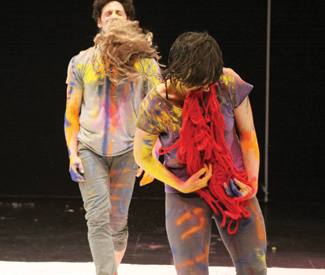
DANCE CounterPULSE always makes a point of thanking its volunteers. One can only hope that they’ll turn up en masse to help clean up after Faye Driscoll and Jesse Zaritt step off the stage this coming weekend. Their You’re Me is not exactly what might be called a clean show. Still, if the work-in-progress preview, presented at the end of their residency at the Headlands Center for the Arts almost two years ago, is any indication, the mess is more than worth it. After all, most of us will recognize a mess when we see it.

The Los Angeles-born Driscoll lived in San Francisco from 2003 to 2005. She put in a shift at the ODC/Pilot Program — for on-the-verge choreographers — even though dance was not her primary focus at the time. As she explained in a recent phone conversation from her home in Brooklyn, in San Francisco, “I really was inspired by the music and art scene, hanging out with people who were putting band together that were kind of art bands.” At the time, she was in recovery mode from two years of performing and touring with Doug Varone and Dancers. Apparently it had not been all that happy a match — too much structure, too much energy from the top down.

So San Francisco — where the mantra is “you can do anything you want,” and where you go “to find yourself” — proved to be liberating experience for her, particularly because she had been so “serious and disciplined about dance” since her childhood.

In some ways Driscoll is still trying to find herself. On the most visible level You’re Me is a piece about a relationship — after all, it is performed by a man and a woman. But it’s also a work looking at identity: the one you claim for yourself, that one you are working toward, or the one that is imposed on you by the outside world. For many people that is unstable territory that tends to slide away from under your feet.

Partly because she “had a lot going on in my home that was kind of crazy,” and because she remembered people reflecting an identity back to her that was quite different than the one she experienced herself, Driscoll was drawn to dance early on. “Dance had the structure that allowed me to express what I am in the world,” she says. “It was the place where I could go and practice my movements and make myself open to other people’s bodies.”

You’re Me is inspired by the in-between spaces Driscoll observes in non-verbal human communication, as well as by fixed historic representations she and Zaritt collected in the visual arts, from Renaissance paintings to contemporary magazines. In the process they became fascinated by how ideas of what is masculine and feminine have changed over time. Finding much that resonated but also created dissonance within themselves, the experience fed into their appetites for trying out other identities.

To do that choreographically, in one section of the five-part 80-minute duet, the two performers also draw on one of the earliest ways kids try to tell us something about who they are. A little girl who wobbles around in her mother’s heels is considered cute. A little boy who prefers dresses to pants rings alarm bells. Role-playing, fantasy games, make-believe, dress-up —whether in a playgroup or the theater — are serious business. They present way of talking about being or becoming in the world. But they are also a lot of fun.

Driscoll describes her working process as taking “things and blowing them up, creating them to excess and putting them into rhythmic structure and try to pull them apart and grapple with them.” Here, in addition, to the physically demanding movement interactions, the dancers have to don, strip off, and exchange parts of props and costumes, often at dizzying speed. They rehearsed a lot, she says, and they have a prop master who makes sure that the final mess is nicely controlled.

Pulling You’re Me together, however, was a different challenge. Like many artists, Driscoll is homeless, scurrying around from one studio to another. “I could never rehearse with all that stuff I had to lug around.” That’s why the residency at Headlands became such a respite: they gave her a closet. *

YOU’RE ME

Thu/7-Sun/10, 8pm, $20-$30

CounterPULSE

1310 Mission, SF

www.counterpulse.org


Trip history

0

SUPER EGO As Maria von Trapp sang at the climax of The Sound of Music, “Whenever the goddess closes a rave cave, somewhere she reopens a gay leather biker bar.”

That sad closure is upon us, as the wonderful 222 Hyde (www.222hyde.com), the city’s thumping bass-ment in the Tenderloin, wings into history. Owner EO emailed me a couple Saturdays ago to tell me he was closing the precious, risk-taking little venue due to pressure from the ABC state liquor board over a license technicality and uncertainty about cooperation from the 222 building’s new owners. In short: sucks.

But EO’s off to pursue his musical destiny — he killed it playing live at Robotspeak at Saturday’s Lower Haight Art Walk — as one half of upcoming analogue electronic duos Moniker (with Kenneth Scott) and Polk and Hyde (with Jonah Sharp). And you can say farewell to the lovely space, rumbly Turbo Sound system, twinkly LED dance floor ceiling, and gorgeous staff this week: a special guest superstar (cough DJ Fark Marina cough) is supposed to drop by Thu/7, the As You Like It crew brings in Dutch techno wiz San Proper on Fri/8 (9pm-2am, $20) and 222 hosts a huge closing blowout on Sat/9 (10pm-late) full of surprise guests, gushing tears, and yummy pizza. The space itself has an amazing history — as the “Three Deuces” from the 1940s-’60s, it played hst to jazz greats and wild gals. Whatever it becomes now, 222 will live 444 ever in our raving hearts.

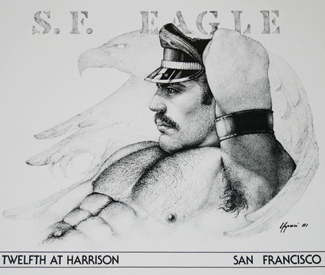
Throwing open its gay SoMa leather biker bar sash, however, is legendary rock ‘n roll watering hole SF Eagle (www.sf-eagle.com), reopened after a final passing grade on inspections last weekend, just in time for a Sunday beer bust of epic proportions — and 45-minute-wait lines — celebrating the victory of our new Mr. SF Leather, Andy Cross. (The true crown, I heard, went to anyone who made it through the four-hour Mr. SF Leather competition.)

I latched on my Nasty Pig kneepads and checked out the space (and the returned staff!) on Saturday night, and happily found myself there all Sunday as well. New owners Alex and Mike, inheriting the gutted space once slated for a pizza restaurant, have really opened it up by exposing the vaulted ceiling of the interior, pushing the main bar against the wall, and removing the trees from the patio (sad face). Everything is painted semi-gloss black — it looks like a beerhall designed by Anselm Kiefer. Although the mirrored bar is a wee bit ultralounge and there is as of yet no crusty, comfy decor, that good ol’ Eagle spirit is alive and well-drink drunk.

The beer bust was roiling delightfully with grateful scruffs and old school fetishists. Indie kids will rejoice at the return of Thursday Night Live on Thu/7 (8pm, $7, www.tinyurl.com/thursnightlive) with bands Beard Summit, the Galloping Sea, and Reliic, hosted by the Eagle’s ace music programmer Doug Hilsinger. (The space’s new layout is perfect for live music, and more regular parties will pop up soon, I’m sure). The Eagle reopened on the final weekend of fabulously festive Hayes drag dive Marlena’s, set to become another concept bar eesh, and the tail end of Soma’s fetish-friendly Kok Bar, also closing very soon. It’s a bittersweet trade-off for sure. Meet me at the Eagle’s patio trough and we’ll commiserate.


STACEY HOTWAXX HALE

I am freaking the funk out that Detroit’s own Godmother of House is going to vibe up the Housepitality weekly’s dancefloor — along with Chicago legends Gene Hunt and CJ Larsen? Try to pry me away!

Wed/6, 9pm, $5 before 11 p.m., $10 after. F8, 1192 Folsom, SF. www.housepitalitysf.com


DJ PIERRE

Following the Godmother of House comes the Godfather of Acid, one of the ones who started it all, Chicago Afro-Acid pioneer Pierre, whose sets are blissful rollercoasters to another, darker side.

Fri/8, 8pm-3am, $15. 1192 Folsom, SF. djpierre.eventbrite.com


DELHI 2 DUBLIN

Kick off your weeklong St. Patty’s Day binge the bhangra way, as great monthly Non Stop Bhangra brings in this beloved five-piece live band, a true multiculti mashup that meshes the Celtic with the Indian. Somehow, it works splendidly.

Sat/9, 9pm, $15. Public Works, 161 Erie, SF. www.publicsf.com


PARIS IS BURNING

“Shoot and arrow and it goes real high, well good for you.” SF’s Mistress of the Gay Night Peaches Christ and formidable NYC queen Patrice Royale host a screening of the all-the-rage-again 1990 doc and a vogue ball to die for. It’ll be an ex-travaganza.

Sat/9, 8pm, $22. Castro Theatre, 429 Castro, SF. www.peacheschrist.com


The Nonconformist

0

arts@sfbg.com

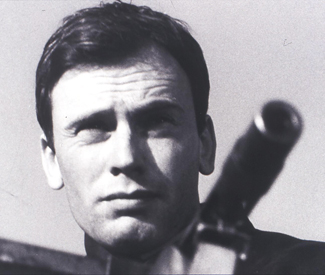
FILM Most observers of last week’s Oscar telecast assumed elegant 86-year-old Emmanuelle Riva was the star of the movie she’d gotten a Best Actress nomination for. Conspicuously absent — from that and most other awards events — was Amour‘s real performing lead, who’d gotten crowded out of the field by the usual surplus of major English-language roles for men. As the dignified elderly husband decreasingly able to care for a longtime spouse’s dignity-robbing failing health, Jean-Louis Trintignant grows more dominant in his character’s helplessness as Riva’s recedes into illness. It’s a powerful performance made all the more so by the simple shock of seeing him. Hasn’t he been, er, away a while? Or to put it bluntly: he’s still alive?!

The last time wide audiences would have seen him was in the large ensemble of Patrice Chéreau’s 1998 Those Who Love Me Can Take the Train. Already nearing 70 then, he remained somewhat active in theater while staying mostly off screen for the next 14 years. In honor of his return, the Pacific Film Archive is providing a retrospective that runs through April 21.

“And God Created Jean-Louis Trintignant” offers a mix of popular hits, agreed-upon masterpieces, and rarities that give fair measure of a long, prolific yet discriminating career. It’s surprising to see the wide range of films he’s played in, since Trintignant is so often the still center of them — he communicates such reserve, thoughtfulness, and economy of craft that it takes seeing numerous roles back-to-back like this to realize how very different his performances are. They’re just not flamboyantly different, in the way of a Daniel Day-Lewis or Meryl Streep. He’s said “The best actors in the world are those who feel the most and show the least,” a rule one could argue with — but it’s certainly true in his case.

Short, slight, handsome in a slightly nondescript way, he couldn’t have struck anyone at first as natural movie star material. But he did intrigue Roger Vadim, when the latter was looking for a newcomer to play off his female discovery in 1956’s …And God Created Woman. The woman was Brigitte Bardot, introduced completely nude (albeit laying on her stomach); it was Bardot and Vadim’s shared gift that though she spent the rest of the story clothed, one imagined with an indolent shrug those rags might tumble at any moment and she’d be starkers again. As the village lad who marries “that little slut” lest she be sent back to the orphanage (!), while she exerts a siren pull toward every other man around, Trintignant sounded a modest note in one of the most garishly silly yet influential films ever made. Yet the global sensation Bardot caused cast a public glare on anyone with a connection, let alone a purported inamorato. He voluntarily fled for military service.

When he returned — with rather less fanfare than Army-sprung Elvis — he set about building a serious actor’s resume with diverse projects and interesting directors. He was suddenly blond and uncharacteristically glamorous as a golden youth of Italy’s fascist elite in Valerio Zurlini’s Violent Summer (1959), so in love with an older woman (Eleanora Rossi Drago) they’re barely aware there’s a World War going on. But more typically he was creating anti-romantic characters typical of the 1960s — variably neurotic, eccentric, conflicted, always with more going on under the surface than one could fully grasp. One lesser-remembered PFA selection is Alain Cavalier’s 1962 New Wave triangle Le combat dans l’ile, in which his marital discord with Romy Schneider is eventually explained by his secretly belonging to a far-right terrorist cell.

https://www.youtube.com/watch?v=0WQhJyse4hg

Trintignant was in two of the most wildly popular “art” export hits of the decade, Claude Lelouch’s gauzy swoonfest A Man and a Woman (1966) and Costa Gavras’ political thriller Z (1969). Yet his race-car driver in the former tempers its Eurokitsch atmosphere with impenetrable cool, while in the hyperbolic latter he’s almost monastically austere as the investigator who patiently picks apart an assassination cover-up. Perhaps his ultimate role as a man of decisive inaction was as The Conformist (1970), again as a Mussolini-era fascist — one who betrays his friends as ruthlessly and usefully as director Bertolucci does the original Moravia novel. Amid that film’s ravishing baroque excesses, he’s as reptilian, quease-making, and pitiable as a Gollum, if better-dressed.

While he continued to make the odd all-star purely commercial project — a good one being rare 1973 American foray The Outside Man — he usually chose riskier fare. Thus he was the first major star to work with Eric Rohmer (as the Catholic fussbudget sorta-seeking romance in 1969’s My Night at Maud’s), and an early ally to figures as disparate as Jacques Demy, Claude Chabrol, Tinto Brass, Umberto Lenzi, Alain Robbe-Grillet, and André Téchiné.

Barely slowing despite the transition to character support, he’d found perhaps a definitive pre-Amour farewell role (and chronological end to the PFA series) as the retired judge busy bending laws for his personal amusement in Krzysztof Kieslowski’s Three Colors trilogy (and career) finale Red (1994). It might have served as a perfect capper — but you’ve got to hand it to any 83-year-old savvy enough to realize Michael Haneke was worth coming out of retirement for. *

“AND GOD CREATED JEAN-LOUIS TRINTIGNANT”

Through April 21

Pacific Film Archive

2575 Bancroft, Berk.

bampfa.berkeley.edu


Do want

0

arts@sfbg.com

MUSIC Someone shared a song, with the caption “I’m pretty sure this is what the future sounds like.” At first I scoffed at the hyperbole, and idea that progress meant New Age-y Enya harmonies, speedy trap hi-hats, and stomping chant-along choruses all fitted into a progressive, genre blurring R&B/electronic package. But a little piece of the track, “Counting,” stuck with me, a familiar sounding free-jazz squonk of atonal saxophone, and I soon found myself starting a conversation with Autre Ne Veut, a.k.a Arthur Ashin, to identify the sample, and find out more about his sophomore album Anxiety.

“I actually don’t use any samples at all in my music,” the response came (surprising, since I’d seen Autre Ne Veut filed under electronic). “Not just a party line, but actually because I don’t have the slightest idea of how to build songs around them. Al Carlson, who engineered the bulk of the record, is also a very fine jazz sax player. Plus there is some extremely dry atonal guitar that I played mixed in with the baritone sax. Obviously, it was cut up a bit, but we both just played along to the whole track, and then stripped the bulk of it away.”

This refining, reductive process differs from Autre Ne Veut’s 2010 self-titled debut. “My previous record was kind of the opposite,” Ashin said “I would keep globbing more on in different places to kind of create song dynamics. With this I tried to create a big slab and kind of chip away at it, and the sound was kind of defined by that.” It’s a contrast that’s led Autre Ne Veut to be at times labeled as both minimalist and maximalist, although he shrugs at the categories. “Somebody compared me to Hudson Mohawke and Rustie, which I felt a little uncomfortable about just because I seem really different to me than that. But what do I know?”

Regardless of process, the result is an album of stark emotion, conveyed primarily through Ashin’s dynamic diva-esque falsetto. This is obvious on the album opener “Play By Play,” where a potentially repetitive chorus is carried beyond expectations to become irresistibly catchy. On “Gonna Die” the singer goes well into Whitney Houston ballad territory over the most open, airy track on the record, while somehow getting existential over seemingly little more than looking in a bathroom mirror.

Musically there’s a tendency to lump Autre Ne Veut in the latest wave of R&B, but the instrumentation (when it’s familiar) recalls Ratatat (“Don’t Ever Look Back”) as much as Prince (“Warning”), while the disparate, layered production puts Ashin in league with the aforementioned maximalist company. As a result of everything going on, the mix of elements occasionally threatens confusion or invites alternate interpretations. The husky singing and banging rhythm on “Counting” lends it a sensual tone that without context could be surprising: Ashin was inspired by the difficulty he had making a phone call to his aging grandmother, fearing it might be the last time they talk.

It didn’t help that prior to this album, Ashin insisted on embargoing his real name and only using the Autre Ne Veut moniker in the press, hoping to maintain a clean Google record, separate from his academic life, where he studied Clinical Psychology. Now he’s putting himself out into the open. “I basically for this record realized that if I was gonna end up doing music — if that ever became a legitimate problem than I would have done pretty well for myself, and there’d be no way to fight that if I decide to have a second career in Clinical Psychology.”

The new stance is a better fit; given the personal quality of Autre Ne Veut’s new record, there’s now an actual person to associate with the experience. (Although Ashin is fine with not being the final authority, saying “I’m not gonna sit down and tell somebody who’s sure ‘Counting’ is a sex jam to stop having sex to ‘Counting.'”)

If a second album is a chance to refine not only the music, but also the image, and Ashin seems to be doing the latter with unexpectedly little apprehension or nervousness. The press release accompanying the new album has the following heady quote: “Anxiety in children is originally nothing other than an expression of the fact they are feeling the loss of the person they love.” Freud is alright, but I think this one is more appropriate: “To feel anxiety is to be blessed by the full wash of existence in its ripest chancre.”

AUTRE NE VEUT

With Majical Cloudz, Bago

Mon/11, 9pm, $12

Independent

628 Divisadero, SF (415) 771-1421

www.theindependentsf.com

Sunshine superheroes

0

From the nation’s Capitol to local city halls, requests filed under the Freedom of Information Act (FOIA) and local public records laws tend to be stymied by bureaucracy. Protecting the public’s right to know requires fierce dedication, and for 28 years, the Northern California Chapter of the Society of Professional Journalists (SPJ) has honored journalists, lawyers, citizens and others who have successfully used public records to hold government accountable. In an era of steep budget cuts and assaults on transparency laws, these first amendment champions deserve serious cred.

On March 12, during national Sunshine Week, the winners of the annual James Madison Freedom of Information Awards will be honored at a banquet hosted by SPJ’s local Freedom of Information Committee. Here are a few of the first amendment champions who will be honored for their work.

UP AGAINST THE FBI

Before embarking down the path of a FOIA request, it’s worth considering what sort of rabbit hole you might find yourself down. When then-undergraduate Seth Rosenfeld began investigating FBI activities on UC Berkeley’s campus for his senior journalism project, he started with a mere nine thousand pages of FBI files obtained through the Freedom of Information Act by his university’s newspaper, The Daily Californian. Thirty-one years and five lawsuits later, he ended up with a total of more than 300,000.

Rosenfeld, who has worked as an investigative reporter for the San Francisco Examiner and the San Francisco Chronicle, enlisted a team of pro-bono lawyers to pursue his case. The FBI resisted, claiming that the records were of little public interest and demanding that Rosenfeld pay thousands of dollars in processing fees, then by heavily excising any documents they were forced to release. The agency, which spent more than $1 million trying to withhold the information from Rosenfeld, argued that redactions were necessary to protect law enforcement operations, national security and the privacy of people named in the records. On one document, Rosenfeld found scrawled by former FBI director J. Edgar Hoover himself: “I sense utter fright as to the Freedom of Information Act. It doesn’t open up the flood gates to every ‘kook,’ ‘jackal’ and ‘coyote’ to all our publications, files & records.”

Rosenfeld’s research led him to publish Subversives: The FBI’s War on Student Radicals and Reagan’s Rise to Power, which details how the FBI, under Hoover, used Cold War-era tactics to target political dissent on the UC campus. The book reveals Hoover’s close relationship with Ronald Reagan and a plot—ultimately successful—to fire then-UC president Clark Kerr. Rosenfeld is this year’s winner of the Norwin S. Yoffie Career Achievement Award. (Dylan Tokar)

OUTING CONFLICTED JUDGES

Using information obtained through the Freedom of Information Act, Jennifer Gollan and Shane Shifflett of the Center for Investigative Reporting examined conflicts of interest in California’s federal judiciary. Using financial disclosures, court records and judicial budgets, Gollan and Shifflett cross-referenced the financial investments of federal judges with cases in which they filed rulings.

They discovered that, since 2006, judges had entered more than two dozen rulings in cases involving companies in which they owned stock — a violation of federal law and the Judicial Code of Conduct. Their investigation revealed flaws in the system that should prevent conflicts of interest. In California, Gollan and Shifflett found, judges are allowed autonomy in deciding who and how their financial interests are monitored.

Their story also demonstrated that FOIA doesn’t always function the way it should. According to the reporters, the federal government inhibits public access to what is supposed to be public information, by collecting fees from the Public Access to Court Electronic Records (PACER) valued at nearly five times the cost of running the system. The federal judiciary also refused to cooperate with the investigation. Fee waivers for PACER records were refused, judges were notified of requests for financial disclosures, and financial figures regarding PACER fees were withheld. (Tokar)

REALLY, BERKELEY? AN ARMORED VEHICLE?

Copwatch is a Berkeley-based advocacy organization dedicated to monitoring police action and opposing police brutality. Last May, Copwatch filed a FOIA request and received documents revealing that the Berkeley Police Department had requested a $170,000 armored vehicle from the Department of Homeland Security. The vehicle — a Lenco BearCat G3 — resembles a military-style armored truck and was intended to assist the Berkeley, University of California and Albany police in suppressing civilian protests and potential civil unrest. Thanks to the vigilance of Copwatch, the local community mobilized to oppose the introduction of the BearCat and convinced Berkley lawmakers to withdraw the request for funding. (Avi Asher-Schapiro)

For a full list of winners, visit tinyurl.com/sunshine13. The James Madison Freedom of Information Awards Banquet will be held at 5:30pm, Tues/12. To purchase tickets, visit tinyurl.com/2013spjFOI.

Editor’s notes

5

EDITOR’S NOTES Way back in the early 1980s, when I had a lot more hair and it wasn’t so grey, I got a tip that the San Francisco school district had a serious problem with asbestos contamination. My colleague Jim Balderston and I checked it out, and yes indeed — the toxic stuff was in so many classrooms that thousands of students were at risk.

After we broke that news, and the district started scrambling to clean up the mess, we asked ourselves: How were things allowed to get to that point? Who screwed up? Who let it happen?

We knew there was a paper trail, and we were all set to put together a detailed request under the Public Records Act, which would have taken months to process. But first we met with the recently hired school superintendent, Ray Cortines, and asked him how much he knew about the past few years of school maintenance.

“Very little,” he said. “But I know where you can find out.”

He took us to a huge room, filled with maybe 50 filing cabinets. “All of the building history and maintenance records are in here,” he said. “If you need to use the copy machine, just let me know.”

And that was that. No scrutiny from a district lawyer, no redactions, no documents withheld for shadowy reasons … just two reporters with full access to public records. He literally told us to turn out the lights whenever we were done.

We got some amazing stories. I’d like to think we hastened a lagging asbestos abatement program and revealed who was at fault .. but nothing bad happened. I guarantee that the district could have found a way, maybe even an arguably legal way, to keep us from seeing half the records we reviewed — but as Cortines saw it, what would have been the point?

And guess what? It was 1987. There wasn’t any fancy software program or nifty, expensive app. Just an open door.

That’s how a public agency should think about public records.

Now its 2013, and San Francisco is the epicenter of the Information Revolution. And as we note in this issue, it’s harder than ever to get the folks at City Hall — who love the tech world and all it offers — to turn over basic information about how they’re running the city.

That’s about as crazy as it gets.

Compromised position

16

steve@sfbg.com

When Mayor Ed Lee came to the Board of Supervisors for his monthly “question time” appearance Feb. 12, Sup. David Chiu tried to get some sense of where the mayor stood on a controversial piece of legislation that would allow more condominium conversions.

Chiu explained the complexities and implications of an issue where the two sides have dug in and appear to have little common ground, and he asked the mayor for some guidance.

“What is your position on this pending legislation?” he asked. “What protections would you support to prevent the loss of rent-controlled housing in our increasingly unaffordable city? How would you address the concern that if we allow the current generation of tenancy in common owners to convert, we will replace then with a new generation of TIC owners and additional real estate investments that will lead us right back to an identical debate within a short time?”

But if Chiu and other board members were looking for leadership, direction or a clue of where the mayor might stand, they didn’t get it. Lee said he understood both sides of the issue and hoped they could reach a consensus solution — without offering any hints what they might look like or how to achieve it. “I can’t say that I have a magic solution to this issue that will make everyone happy,” the city’s chief executive explained.

Asked by the Guardian afterward why he didn’t take a position and whether he might be more specific about how he’d like to see this conflict resolved, he replied, “I actually did take a position, even though it didn’t sound like it, because I actually believe they have good points on both sides.”

That’s a typical answer for a mayor who rose to power preaching the virtues of civility and compromise and striving to replace political conflict with consensus. But now several major, seemingly intractable issues are facing the city — and insiders say Lee’s refusal to take a strong stand is undermining any chance for successful.

The lack of mayoral leadership has been maddening to both sides involved in the negotiations over the condo-conversion legislation. Tenant advocates say the mayor’s waffling hardened the positions on both sides and emboldened the group Plan C and its allies in the real estate industry to reject the compromises offered by supervisors and tenant advocates.

“It’s very unhelpful,” San Francisco Tenants Union head Ted Gullicksen said of Lee’s refusal to take a stand. “Someone needs to kick the realtors in the butt, and that’s not happening. They have no impetus at all to compromise.”

Then there’s the case of California Pacific Medical Center’s proposed new hospital, a billion-dollar project that would transform the Cathedral Hill neighborhood and have lasting impacts on health care in San Francisco.

The mayor’s eagerness to get the deal done — even if it wasn’t the best deal for the city — led to a proposal that fell apart last year under scrutiny by the Board of Supervisors. That project has now been in mediation for months — and sources tell us they’re getting close to a deal that has little resemblance to the anything offered by the Mayor’s Office.

California Nurses Association Director of Public Policy Michael Lighty, who has been involved with the CPMC negotiations, said Lee’s unwillingness to take a strong and clear stand, or to help mediate the dispute once the deal blew up, is why this negotiation has been so difficult and protracted.

“If he had engaged stakeholders and the supervisors, we wouldn’t have had to go to the brink last summer,” he said. “You’ve got to have clear objectives and be willing to fight for those, and that means saying no…If you’re willing to accept any deal and just put political spin on it, this is what you get.”


ADMINISTRATOR-IN-CHIEF

Neither Lighty nor others involved in the CPMC negotiations would discuss details of the pending deal, as per the instructions of mediator Lou Giraudo. But they did talk to the Guardian about the political shortcomings that led to such a protracted mediation process on a project that has been in the works for many years and involving a looming state deadline to replace the seismically unsafe St. Luke’s Hospital.

Lighty called Lee’s conciliatory approach to CPMC “an administrative orientation and not a political one,” noting that what worked during Lee’s long career as a city administrator may not be working well now that he’s in the Mayor’s Office dealing with issues where consensus isn’t always possible.

“I don’t think it’s a very sophisticated view and I don’t think it’s one that produces the best results,” Lighty said.

Lighty did say the negotiations were getting close to resolution. “What comes before the board is going to be vastly superior to what the mayor and CPMC proposed,” he said. “I think what you’ll find whenever this comes out is it will repudiate the mayor’s approach.”

He contrasted Lee’s style to that of his predecessor, Gavin Newsom, who took positions on most controversial issues and would often get involved with forcing his allies to cut deals. For example, shortly after taking office on 2004, Newsom demanded that his allies in the hospitality industry end their lockout of hotel workers, and when they refused he turned on them and even famously joined workers on the picket line, pressuring the hotels to soon end the lockout.

“Why did you need to bring in an outside mediator for CPMC? Why didn’t the mayor do that?” Lighty asked, noting that Lee has stayed away from the current negotiations.

Ken Rich from the Mayor’s Office of Economic and Workforce Development has been in those meetings but didn’t return our call. Mayoral Press Secretary Christine Falvey has also ignored repeated messages seeking comment on the issues raised in this story.

Rudy Nothenberg, who negotiated big deals on behalf of five successive mayors before Lee and who has been critical of the Warriors Arena deal that the Mayor’s Office has negotiated, said Lee’s unwillingness to take strong stands with developers is hurting the city.

“I was able to say I’m going to get the best deal I can for the city,” Nothenberg told us, saying he approached all negotiations, including the construction of AT&T Park, with the understanding from the mayors he worked for that he could simply say no to bad deals. “You need to bargain for the city as if these guys walked away, well, then that’s okay too.”

Sup. David Campos, who has been trying to get CPMC to strengthen its commitment to keeping St. Luke’s open as a full-service hospital, agreed that, “There have to be times when you’re willing to say no.” And on the CPMC project, Campos said that fell to the supervisors when the Mayor’s Office wasn’t willing to. “It was clear that the board was not going to approve it,” Campos said, “and sometimes you have to do that to get to a result you can live with,”

UCSF Political Science Professor Corey Cook said the problem is less with Lee’s overall philosophy than with what is strategically smart on individual issues.

“The mayor’s strength is in trying to come up with consensus measures,” Cook told us, calling the approach “generally a good one” and saying “the decider isn’t always who you want, then you get George W. [Bush].” Yet Cook also said intractable problems like the condo conversion debate may require a different approach. “Sometimes you do need to stake out clear ground to limit the terms of the debate.”


CHIU’S CENTRAL ROLE

Chiu has at least been willing to put his energies behind his belief in compromise, taking an active role in the CPMC and condo negotiations, as well as complicated current negotiations involving how to legalize but limit Airbnb’s shared housing business in San Francisco, which involves landlord-tenant-neighbor dynamics, regulation of private leases, and complex land use and taxation issues.

“It’s been a very long month. I’ve been going around the clock on several challenging negotiations,” Chiu told the Guardian. “The most important things to work on are often the ones that are the most difficult to get done.”

Chiu was reluctant to discuss the negotiations, calling it a sensitive moment for each of them. But he did admit that he was disappointed in Lee’s non-answer to his publicly posed question. “I had hoped for a little more direction,” Chiu said. And while these negotiations haven’t shaken his faith in compromise, he did say, “It depends on the substance of the issue whether there are common ground solutions that are superior to two warring sides.”

But all involved in the condo debate say it appears we’ll be stuck with the latter. “The two sides are so far apart that I don’t know what a compromise that both sides would live with would even look like,” Campos said. “There are certain issues where I don’t think compromise or consensus is possible.”

On this one, tenant advocates are trying to protect a finite supply of rent-controlled housing and real estate interests want to convert that same housing into condos. “If the issue was just existing TIC owners, we would come to an agreement,” Gullicksen said. “But clearly the agenda of Plan C and the realtors is they just want more condos.”

Plan C board member Kat Anderson told us, “I have a simple approach to this: Home ownership is important to me.”

She was undeterred by arguments that thousands of new condos are now being built in San Francisco, but there’s a steadily dwindling number of rent-controlled apartments in a city where two-thirds of San Franciscans are renters.

Anderson made it clear that she wants to not only allow the backlog of condo applicants to be approved, but she doesn’t want to slow the flow of condo conversions for a few years thereafter or place TICs themselves under the cap, compromises offered by Gullicksen. “The worry is that if you change the system, it will never come back and we’ll lose our tiny toehold of 200 units [that the lottery allows to be converted to condos annually],” Anderson said. And so we end up with the very thing Lee sought to avoid: a big, nasty, divisive public fight that will probably end up being decided by big money and deceptive campaign mailers rather than a civil, deliberative political process. And the mayor has nobody to blame but himself.

Here, here

1

STREET SEEN As the author of a style column, I spend time trawling the city for innovative new local designers. Clothes that are made here, cute ones. Let me hear about them, I’ll put it in print, swear down.

But there’s not… that much of them. Speaking historically, of course. In the heyday of garment manufacturing, San Francisco churned out mountains of readywear — more than any other city in the country besides New York and Los Angeles.

Then we started to export our business overseas. You’ve heard about how Levi-Strauss used to have a factory on Valencia Street — not just the artsy pop-up shop they opened in 2010? Your jeans aren’t made here anymore guys, unless you’re copping from newbie “Kickstarter brand” Gustin (www.weargustin.com), Holy Stitch (www.juliandash.com), Self Edge (www.selfedge.com), or one of the other small local lines that have popped up in the denim giant’s wake.

These companies cater to locavore customers who “expect their clothing labels to read like restaurant menus,” as Modern Luxury put it in a 2011 article about the state of the SF garment industry. Making clothes locally means less turnaround time, less environmental impact — not to mention the sweet San Francisco cache that locally made palazzo pants hold.

Problem is, the garment factories that the industry needs have been greatly reduced in number.

In a Hayes Valley cafe, Gail Baugh sits at her laptop, shutting it with a morning-time, capable air when I sit at her table. Her outfit says boardroom, accented with exceptions. A beautifully-patterned scarf, and large brooch-like earrings suit this no-nonsense type with a degree in chemistry of textiles, 35 years of experience in the garment industry, and a byline on the book on fashion. Really, Baugh’s The Fashion Designer’s Textile Directory is a best-seller in its particular category on Amazon, she tells me.

She is the president and one of five founding members of PeopleWearSF (www.peoplewearsf.org), a Bay Area garment industry trade association that was formed in 2011 to fill the vacuum left by SF Fashion Industries, which played the role for 75 years before the garment industry collapse. PeopleWearSF’s members flip up to $25 million in yearly sales volume, though it also includes rank beginners in the clothes game.

“If you want a vibrant economy, you have to make stuff,” Baugh tells me matter-of-factly. Her organization — and SFMade (www.sfmade.org), the no-fee membership group who represents local producers and whose cheery stickers adorn a host of local retailers’ windows and product labels here in the city — provide networking opportunities to their members. These include 40-some brands, including outdoor label Triple Aught, longtime Mission District purveyor of pretty Weston Wear, and Babette, the flowing line of neutral-toned women’s wear based out of an Oakland warehouse. Those three manufacture locally, but not all PeopleWearSF members do.

Both trade associations work with public policy — specifically, through the Mayor’s FashionSF Economic Development Initiative — to provide more resources to the garment factories that were once much more prevalent in San Francisco. Efforts to keep the sew-shops open have to operate through a multi-pronged approach. It’s not just soaring rents that close the factories’ doors, but a dwindling high-skilled workforce pool that’s willing to work for the wages typically offered by the factories.

“Sharing resources, communicating issues — it’s a good business policy,” says Steven Pinksy, whose wife started Babette in 1968 and who was also a founding member of PeopleWearSF. Joiners, in other words, are welcome.

Those looking to jumpstart their Bay fashion career could do worse than attend tonight’s Renaissance Entrepreneurship Center’s panel discussion on starting small in fashion, featuring experts from PeopleWearSF, Apparel Wiz, Sheila Moon Apparel, and CBU Productions.

“Manufacturing Micro” Wed/27, 6-9pm, $20. Renaissance Entrepreneurship Center, 275 Fifth St., SF. tinyurl.com/manufacturingmicro

I’m your fan

0

arts@sfbg.com

MUSIC Like most love affairs, there was little indication on our first encounter that it would turn into a lifelong infatuation. I was 17, methodically singing my way through a book of folk tunes, one of which was his first real hit, “Suzanne”. Though I admired it for its lyrical content, it weighed heavy on my range, and I soon moved on to other songs.

When I stumbled across him again, years later, it was as if we had never met. He was older, rougher, seemingly more jaded. His brutal ode “The Future” was dominating the indie-radio airwaves, hot on the heels of its appearance in Oliver Stone’s bombastic Natural Born Killers. When my then-roomie confessed a fondness for his music, it turned that single song on the radio into a sort of clarion call — the key, perhaps, to winning my flatmate’s frustratingly platonic heart. From that time, Leonard Cohen became a constant presence in my life, hovering at the periphery of countless triumphs, challenges, and betrayals, a companionship of almost 20 years that has spanned the globe, and almost every kind of circumstance.

There’s no one song or phase of Cohen’s music that seems to universally predicate the shift from uninitiated or fair-weather fan to true believer. For some it is the Cohen of the 1960s, whose laborious finger-picking and reedy, untrained voice lent equal gravitas to meticulously-plotted stories of resistance fighters and blowjobs, transcendence and squalor. For others it’s the synth-infused litanies to the naked body and the painful futility of the excess of the ’80s, or the flintier, world-weary renegade poised for flight of the early ’90s. Even the most contemporary of Cohen’s “masks,” the “lazy bastard in a suit,” currently rides a wave of almost unprecedented popularity, particularly in the US where he has mostly languished on the fringes of recognition until the last few years.

Underpinned by the spare minimalism of poetry written by a man for whom silence has played a pivotal role as much as language has (including a five-year long retreat at the Mt. Baldy Zen Center), his 2012 album Old Ideas brims over with themes that have appeared in almost every Cohen album over the last 40 years — bittersweet entanglement, elevation of the spirit, the struggles of the flesh — and marks a decided turning point in Cohen’s life, both personal and professional. An old Zen master of the music business arguably at the height of his powers: depression vanquished and horizons expanding exponentially.

Local author, rock journalist, and Leonard Cohen biographer (I’m Your Man, Ecco, 2012), Sylvie Simmons had her first encounter with Cohen in her adolescence as well, but for her the attraction was more immediate.

“The day I hit puberty was the day I heard my first Leonard Cohen record,” she confides over the phone when I call to get her side of her most famous subject. And though “it was outside my usual taste,” she found herself listening to his songs again and again, even today. Now deeply immersed in her own exhaustive world book tour, she’s even found a new thing to be impressed by: Cohen’s unflinching dedication to the road. “He’s got the kind of schedule that would kill an 18-year-old,” she says with a laugh. “He’s definitely a better man than I!”

Seeing Leonard Cohen perform at the Montreal Jazz Festival in ’08, after years of worshiping from afar, will always remain one of my most luminous memories. The prodigal son gone good, working the hometown crowd for an epic three-and-a-half hours, holding his hat over his heart as we applauded each song until our hands were sore, bowing his head humbly again and again, prophet as fellow supplicant. By a twist of good fortune, I managed to see him twice more on that tour — in Oakland and in Paris — and each time, though the controlled orchestration of the event revealed itself more and more, so did the sense of sheer joy emanating from both the stage and the audience, an orgy of admiration, and, a real rarity in the business, of gratitude.

Simmons has an explanation for this gracious humility as well. “He just loves life on the road,” Simmons explains. “He told me it was wonderful…’for a man my age to have a feeling of full employment’.” I rather suspect that this weekend’s events will be just as wonderful for us as they will be for him. Thank you, Leonard Cohen, for being our man.

“THE NIGHT BEFORE LEONARD” WITH SYLVIE SIMMONS

Fri/1, 6pm, free

Marsh Berkeley Cabaret

2120 Allston Way, Berk.

(415) 641-0235

www.themarsh.org

LEONARD COHEN

Sat/2 and Sun/2, 8pm, $71.50–$253

Paramount Theatre

2025 Broadway, Oakl.

(510) 465-6400

www.paramounttheatre.com