Volume 47 [2012–13]

Threequel blues

0

arts@sfbg.com

GAMER Crysis 3 (Crytek/Electronic Arts; PC, PS3, Xbox 360)is a very familiar experience, and not just for players versed in the story and mechanics of the Crysis series. If you’ve played a futuristic shooter in the past 10 years, you’ve seen everything Crysis 3 has to offer: a hodgepodge of sci-fi clichés, stealth combat, and big alien guns. It’s an exercise in déjà vu that leaves little in the way of a lasting impression, but it’s a really good-looking hodgepodge.

After its moderately successful 2011 home console debut, developer Crytek set out to expand upon Crysis 2 and — to hear the company tell it — it began with the story. Twenty-four years after the events of Crysis 2, Prophet, the last of the original Crysis super-soldiers, infiltrates a post-apocalypse New York City on the hunt for a big bad alien. Half rubble, half jungle, NYC survives within its own ecosystem, thanks to a giant overhead dome controlled by evil corporation CELL.

Prophet himself might as well be a walking cardboard box, but Crysis finally achieves an emotional core in his soldier companion, Psycho, who struggles to deal with the loss of his own super-powered nanosuit. Unfortunately, attempts to wrangle a complicated story into something subtle and meaningful means tossing aside Crysis‘ rich mythos in favor of highlighting character moments that frequently lack context.

So, scrap the drama, let’s talk about how Crysis 3 boasts some of the finest graphics of this generation — especially on PC. Skyboxes are mighty impressive and incidental animations such as swaying grass, smoke, and fire promote the apocalyptic atmosphere. On consoles, the game sets a similar benchmark but it’s one that often reveals how near we are to the end of the road for this hardware. Similar to seeing The Hobbit: An Unexpected Journey (2012) in high-frame rate, the studio’s ambition sometimes exposes flaws and behind-the-scenes trickery that players would otherwise ignore.

Juggling between Prophet’s nanosuit camouflage and his armor powers allows players to choose the kind of combat experience they want, and the ruins of New York allow the freedom to tackle objectives using any number of methods. It’s a nice turn on the traditional run-and-gun format to be given the freedom to move about the environment in any way you choose, but objectives ultimately boil down to moving from point A to point B anyway. If you like the mechanics but find the structure limiting, try multiplayer, where managing stealth and shield adds considerable depth to the traditional death-match game.

Crysis 3 pushes the visual boundaries of first-person shooter, but a $60 game can’t be propped up on graphics alone. If you’re into shooting your friends online, Crysis offers a solid alternative to self-serious war games. The rest of the adventure is too often a tech-demo sandbox with no compelling reason for you to explore it. 


If you’re nasty

0

arts@sfbg.com

FILM The current hand-wringing over whether an irresponsible entertainment industry corrupts our youth is notable for being such a blatant diversionary tactic by gun-control foes — their argument being a little beside the point, of course, since incidents are rather few of people being shot dead by a copy of Grand Theft Auto or a Saw flick.

The case against Hollywood as corruptor of morality and youth is otherwise nothing new. On several occasions outrage has risen enough to actually force changes (however modest or temporary), such as when unprecedented late-1960s levels of violent and sexual content instigated the creation of the current MPAA ratings system, now considered wildly out-of date.

But the biggest such fracas reached its zenith with the 1934 enforcement of the Production Code, which levied drastic new limitations on screen content. It introduced a bland new era, and orphaned the one just past — the one we’ve come to celebrate as “pre-Code,” and which is back once again in Elliot Lavine’s latest Roxie series, the week-long “Hollywood Before the Code: Deeper, Darker, Nastier!”

Hollywood had already been building — rightly or wrongly — a rep as the “modern Sodom” for some time. High-profile scandals during the silent era involving drug abuse, wrongful death, and unsavory sexual revelations prompted many a pulpit denunciation. When sound arrived, old talent was replaced by new imports from “blue” Broadway, where racy patter was de rigueur; so once the movies learned to talk, they quickly learned to talk … well, unclean, if not exactly legally dirty.

The Depression had brought harsh new social realities, and while audiences craved escapism, they didn’t mind if it was also vicariously rude and raw. (At least urban ones did — rural patrons had more conservative tastes, and in an era well before “wide” simultaneous openings on umpteen screens, the studios provided selective product accordingly.)

Violence was indeed a major issue: The original “gangster” cycle kicked off by The Public Enemy (1931), Little Caesar (1931), and Scarface (1932) horrified many, with mayhem that barely registers by today’s standards censored on a state-by-state basis. But the main thing was allegedly pervasive and pernicious “smut,” as represented by everything from Betty Boop’s skirt length to the average prude’s Satanic Majesty Herself, Mae West. (The Code’s impact could be most directly measured in the speed with which a toned-down and thus nearly irrelevant West went from box-office titan to has been.)

In the brave new world of the Code, such threats to national sanity went away because sex no longer existed. Even married couples were to be depicted as having separate double beds, one spouse keeping always keeping a foot on the floor during any kisses (of less than three seconds in duration) in their vicinity.

But on the pre-Code screen, everybody was doing everybody, often for sweet cold cash — though of course the world’s oldest profession was never exactly named. This latest Roxie series features plenty of its practitioners, dames at once hard-boiled and over-easy but ready to go soft for an upstanding guy. The most famous is dubiously employed Marlene Dietrich in von Sternberg’s 1932 exotica masterpiece Shanghai Express, wherein she husks “It took more than one man to change my name to Shanghai Lily.” Then there’s Miriam Hopkins as Ivy the barmaid in Rouben Mamoulian’s classic Dr. Jekyll & Mr. Hyde (1931), with Frederic March in the lead role(s).

Most of the current program’s titles are variably obscure ones with glittering Golden Age stars in scenarios that further tarnish legally challenged ladies before romance buffs them shiny again — most in “four hanky” soap operas targeted toward a working-class female audience later represented by Mia Farrow in The Purple Rose of Cairo (1985). Paramount’s glossy 1933 Torch Song has the next year’s Best Actress Oscar winner (for It Happened One Night), Claudette Colbert, as a nice girl turned dirty-blues chanteuse. Further down the totem pole, there’s pre-screwball Carole Lombard as the heroine of Virtue (1932), introduced while being escorted out of New York by the vice squad. Her past won’t quit her when she redeems herself via marriage to cynical cabbie Pat O’Brien. It’s an archetypal pre-Code rediscovery, no doubt thrown together at the time yet wonderfully snappy, saucy, and even poignant now.

Its themes are taken even further by films set in the era’s reliably lawless “tropical” locales, fictive or otherwise. Nothing’s quite so filthy by implication as brief near-star (“The Girl with the Naughty Twinkle in Her Eye!”) Dorothy Mackaill’s 1931 William Wellman-directed Safe in Hell, wherein she’s the runaway goodtime-girl “only white woman on the island.” Save perhaps 1934’s pre-Code last huzzah Black Moon, a voodoo potboiler that puts King Kong’s girlfriend Fay Wray in yea worse peril.

Other notable highlights include Waterloo Bridge, the rarely-revived 1931 first version of Robert Sherwood’s play by Frankenstein director James Whale; quasi-Sapphic, proto-Petrified Forest melodrama Heat Lightning (1934); and a tribute to staple Hollywood character actor Lyle Talbot, whose author daughter Margaret will appear before screenings March 7.


“Hollywood Before the Code: Deeper, Darkier, Nastier!”

March 1-7, $11 (double and triple features)

Roxie Theater

3117 16th St, SF

www.roxie.com

American horror story

1

cheryl@sfbg.com

FILM “Go look in the refrigerator.” Normally, that’s not a particularly sinister phrase. But if the fridge in question happens to be sitting in Jeffrey Dahmer’s Milwaukee kitchen, circa 1991, it contains the following: a box of Arm & Hammer, condiments (mustard, ketchup, steak sauce), and a freshly severed human head.

With details like that, there’s no wonder the Dahmer case continues to fascinate, 22 years after his capture (and 19 years after he was bludgeoned to death by a fellow inmate). Chris James Thompson’s The Jeffrey Dahmer Files, a documentary with narrative re-enactments, is savvy to the fact that lurid outrageousness never gets old. It also plays off the contrast between Dahmer’s gruesome crimes and his seemingly mild-mannered personality.

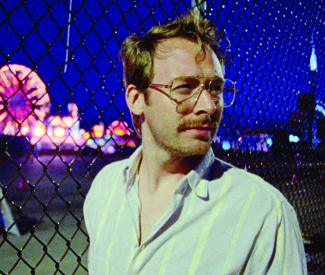
And thankfully, these aren’t cheesy, America’s Most Wanted-style re-enactments. We see Jeffrey (Andrew Swant) going about a mix of mundane and fraught-with-meaning tasks: being fitted for new glasses, eating a hamburger, shopping for 10-gallon drums, and buying way more bleach than one man could possibly ever need. We never see him kill, though we do witness him entering a hotel with another young man — and leaving with a suspiciously heavy suitcase. Swant isn’t a dead ringer for Dahmer, but he has the same “serial killers look like everybody else” quality. It’s unsettling, and goes a long way toward explaining why, as real-life Dahmer neighbor Pamela Bass recalls here, the Jeff she knew (“kinda friendly, but introverted,” Bass says) hardly seemed like a murdering cannibal.

https://www.youtube.com/watch?v=hSzeu6ohgeA

But Wisconsin’s most passionate body-part hoarder (since Ed Gein, anyway) was 100 percent authentic, a fact made abundantly clear to the homicide detective assigned to the case, Pat Kennedy (who made that stomach-turning fridge peek), and medical examiner Dr. Jeffrey Jentzen, tasked with identifying Dahmer’s torn-asunder victims. “We were dismantling someone’s museum,” Jentzen remembers of the crime scene, a tidy one-bedroom in a rough part of town where, months earlier, flippant cops had ushered a dazed teenager back into Dahmer’s clutches, believing his tale that the younger man had stormed out after a domestic spat. Oops.

Since Dahmer is dead and his crimes have been well-documented — in books by Dahmer’s father and others, true-crime specials, and the 2002 narrative film that gave future Oscar nominee Jeremy Renner his breakout role — The Jeffrey Dahmer Files does well to concentrate on people whose lives have been forever changed by the case, two because of their jobs and one due to an unfortunate coincidence. Though Kennedy and Jentzen offer compelling interviews, Bass’ participation is key; unlike the two men, who’ve no doubt told their stories dozens of times before, her emotions still feel raw.

She speaks about getting to know her across-the-hall neighbor — he stood out for being the only white guy living in the Oxford Apartments, a fact made more notable when it was revealed he killed mostly men of color, many of whom were also gay. (As his victims’ families would no doubt agree, if Dahmer’d had a taste for rich white girls, his story would certainly have played out differently.)

Not only did Bass have to deal with the revelation that she’d been living next to a killer (“I remember a stench, an odor”), she found herself surrounded by a media circus, harassed by gawkers, and blamed by strangers for “not doing anything.” Even after she’d moved — the entire apartment building was torn down — the stigma of having been Dahmer’s neighbor lingered.

Kind of like the killer’s own notoriety. Speaking of, the Akron, Ohio house where Jeffrey Dahmer grew up (and committed his first murder) has been on the market for six months. Refrigerator included.

THE JEFFREY DAHMER FILES

March 1-7

Roxie Theater

3117 16th St, SF

www.roxie.com


Punting for Peru

0

le.chicken.farmer@gmail.com

CHEAP EATS First time she touched a football it was a wonky, bouncing punt, and she plucked it up and ran it back 180 yards to the five-yard line. I say 180 yards because there was a lot of zigging and zagging involved. Coach’s grillfriend Zeezee is a professional surfer, and ever since that punt return (October), I have had newfound respect for the athleticism of professional surfers. Not to mention which, a bouncing punt is the hardest kind of football to pick up cleanly.

So . . . nice hands!

Her dad down San Diego way teaches surfing, as far as I know, and music. He made a cajon, which is that Peruvian box drum that you sit on while you play. I’ve seen Zeezee play the cajon, and she played the kaboodle out of it. In fact, ever since then I have had a newfound respect for punt returners. As musicians, I mean.

Anyway, Zeezee lives in S.F. now, so we get to have her for a full season this Spring, so long as she doesn’t get a job. That’s right: If you are looking for a rad-ass surfing teacher with great hands and cajones, look away. Please. We need her. Sunday mornings, at least.

For Hedgehog’s birthday I bought a cajon from Zeezee’s dad. It’s beautiful enough to be furniture, and Hedgehog has been spending a lot of time on it. She uses her hands, uses brushes, wears her washboard . . . Somehow I knew she would know what to do with a beautiful box.

But there is something about February makes me mad. Maybe because you never really quite get your money’s worth, rentwise. I don’t know. Or Valentine’s Day, which bugged me this year very literally. One of my cute little charges got sent home from school on account of lice, and me and her mom had to pick through her and her sister’s hair looking for and yanking out nits.

Then their mom went through my hair and found one there, too, so I had to sit on the edge of the tub just like them and get sprayed and combed and just all around humiliated. All on account of one lousy nit, yuk yuk.

And also, yuck.

So that was how I spent my Valentine’s evening: at the laundromat, washing our clothes and towels and bedding and everything, while the lovers passed two-by-two on their way to Delfina.

My own lover was in New Orleans, out with her single work friends. I called her, I was so depressed, and she sang “You Are My Sunshine” to me — wisely leaving out the verses. The day before she had sent me flowers with the sweetest little note attached. I forget what it said, but I read it again that night once everything was finally folded and put away, and I went to bed.

Her birthday is the real holiday, and she was back for that, like I said, slapping out straightforward 4/4 rhythms, as she ain’t Peruvian. She’s rock’n’roll. But for dinner we went to her favorite restaurant (and mine), Limon Rotisserie — not even thinking that it completed the Peruvian circle.

Next morning I woke up a little later than usual, threw on some clothes, sprayed my hair down with tea tree oil, and risked life and limb and driving record only to get to work two hours early. I had forgot (as usual) to look at my work calendar.

And this is where Olivia’s comes in. Olivia’s Brunch and Fine Dining. In Bernal Heights, down from Holly Park on Mission. Instead of driving all the way back home, during rush hour no less, I decided to kill two hours with two eggs.

Huevos Rancheros!

Good ones! With pinto beans, avocado slices, ranchero sauce, a corn tortilla underneath, and a whole damn quesadilla on top. Note: That’s two meals in one. Yeppers, Olivia puts the unch back in brunch. Which wasn’t exactly what I needed, since it was still pre-9am. But it did help kill the time.

There was no one else in the place to talk to. Just Mona Lisa, a painting of a mounted deer head, a charging elephant, and a very crooked picture of our lord and savior Jesus Christ pulling some crazed dude out of a pretty turbulent sea. Either that or pushing him back in. No no, he’s got him by the arm. See? They don’t call Him lord and savior for nothing.

Nice place. Good food for under 10 bucks. Boom, back to work.

OLIVIA’S

Mon-Sat 8am-2pm, 5-9pm; Sun 8am-3pm

3771 Mission St., SF

(415) 970-0375

AE/D/MC/V

Beer & wine


Game on

1

arts@sfbg.com

DANCE Unlike more commercially competitive markets, the Bay Area is, fortunately, still a place where young choreographers have the freedom to grow. This past weekend, two who are primarily known for dancing other people’s works showed their own promising premieres.

Katharine Hawthorne graduated from college with degrees in physics and dance. On February 22, its opening night at the Joe Goode Annex, you could not possibly miss Analog’s dual pedigree. This startlingly intense quintet opened on the quietest of notes but built its trajectory like a smoldering volcano that finally erupted into a threatening destructive force.

Looking at movement through a scientist’s lens, in conjunction with knowing it to be the dancer’s basic tool, allowed Hawthorne — and her fearlessly athletic dancers — to offer a fascinating perspective on how art and science can elegantly coexist with each other. However, why the dancers repeatedly lugged around an overhead project (and barely used it) remains a mystery.

A 19th century illustration of a mechanical hand, against which Katherine Disenhof wiggled her fingers, set the tone. Those tiny live gestures led other dancers (Hawthorne, Jesse Chin, Luke Taylor, and Megan Wright) to use their arms in almost machine-like ways, as if to demonstrate speed, direction, level, and space. Movements changed with sharp angles, trajectories were linear, and collisions avoided. Dancers also looked like planets circling a sun. Chin and Taylor repeatedly repulsed each other like two positively charged particles. Wright found herself in a whirling circle — a tornado about to take off.

But more and more the movements’ relentless and increasing intensity began to look like threats to the dancers’ well being. Several times I thought Chin was about to collapse though touches and handholds seemed to suggest temporary respite. Yet Analog resembled a nightmarish perpetuum mobile until finally the clock began to slow everything down. We were left with darkness descending on the two dancers left. I couldn’t decide whether that meant peace or the ultimate catastrophe.

As a performer, Tanya Bello brings a ferocious appetite for space, soaring elevations, and dizzying spins to her dancing. So it was almost expected that as a young choreographer she brought many of these characteristics to GamesWePlay(ed), which premiered at the ODC Dance Commons this past weekend. The half-hour piece is a nicely calibrated essay on play as both an innocent activity but also as a means to manipulate those around us. Bello wisely engaged dancers from top local companies: Vilte Bacinskaite, Tristan Ching Hartmann, Kelly Del Rosario, Norma Fong, Chin-chin Hsu, Mei-ling Murray, and Katherine Wells. The work also greatly benefited from Judy Hansen’s costumes, which were elegant, tiny dresses with just a wisp of a tutu suggestion.

GamesWePlay(ed) consisted of a number of distinct episodes which included versions of tag, races, imitation, and mirroring activities, but also pure dance sections. Some looked highly structured only to explode; others involved repeated and fast partner changes. Woven wicker balls were passed around but also hung onto. When Del Rosario curled up on the floor, a tiptoeing Wells gently sent him back into the fracas. I couldn’t help but wonder whether there was a joke here since as the ensemble’s only male, Del Rosario had to do all of the heavy lifts.

Though the work was not particularly fresh in terms of the vocabulary used, Bello showed an already impressive control in the way she used the dancers on stage. The choreography — from solos to septets — flowed and dissolved with almost filmic quality. A mirroring duet opened up into a group, loosing its architecture but gaining breath. Two dancers approaching each other from opposite corners became a double duet. But the piece also had its moments of (ballet?) humor when Fong released a quartet of shadowing women from their monotonous tasks. At another point dancers flopped over received a magic touch to blossom again like those eternal flowers in the Nutcracker.

Towards the end Bello went back to material used earlier in the piece. Was that just to lead up to a finale? There must be better ways to end a show.

Performing on the same program was Karen Reedy Dance from Washington, D.C. Reedy’s Sleepwalking (2008) was a beautifully danced septet, a work that gently yet penetratingly considered what makes us panic and silently scream at night.

Giving consent to capitalism

15

caitlin@sfbg.com

SEX “BDSM so quickly and easily gets painted with a broad brush,” said porn performer and author (her piece this week on Jezebel, “How I Became a Feminist Porn Star” is not to be missed) Dylan Ryan.

I’d called her in the wake of last week’s SF Weekly cover story (“Gag Order,” 2/20/13), which included some healthy critiques of Kink.com, the local porn company often held up as the standard when it comes to shooting kinky sex.

The piece also included testimony that was run without being fact-checked from certain ex-Kink employees — and that aside, the article was clearly timed to capitalize on controversy surrounding owner Peter Acworth’s recent drug and gun arrest. (ATTN: Weekly, you need not call into question the “strict code of ethical behavior and transparency” a pornographer is known for when it is discovered that said pornographer does cocaine, nor when he fires guns in the bowels of a building made for that purpose.)

The Weekly’s investigation continues. Hopefully it will help move conversation forward on how to make better porn.

As Ryan — who has shot for Kink.com for nearly 10 years — pointed out, the trouble with porn wars is that they can be skewed into a referendum on whether such-and-such porn (and often, by extension, the sexual desire it portrays) should exist.

So real quick, let’s use this moment to convene members of our occasionally dysfunctional, but forever-forward thinking sex work community. The question: can sexual consent exist when you’re doing it for the money? Who is in charge of making sure everyone’s needs are respected?

“When capitalism is involved, it makes the situation…interesting,” wrote performer Maxine Holloway [after protesting and ceasing to shoot for Kink.com when it removed base pay for web cam models, Holloway settled out of court with the company. Her voice appears in the Weekly article.] “As models we want to perform well, we want to push our boundaries, we want to get paid, and we want to be hired again and again.”

But, she continued, “money can be a perfectly legitimate reason to consent. Most people would not agree to show up at their nine-to-five job if they were not being paid an agreed amount of money.”

Ryan re-enforced the importance of the shoot’s producers stating clear run times, expectations, and other matters with performers before filming. After that point: “it’s a fine line, but so much of the onus is on the person to be their own agent.”

Locally, performer Kitty Stryker has examined these issues in her “Safe/Ward” consent workshops. And Holloway wrote she hopes to create an “industry standards” rating system that could guide performers to responsible producers. “Porn performers are not inherently victims and producers are not inherently exploitive,” she cautioned.

“These things can be positive, sexually healthy,” Ryan continued. “Every performance I do is about showing women how much fun I’m having.” Would that all debate on ethical porn started off with how its participants want to demystify, and excise shame from, sexuality — instead of drug charges.

THIS WEEK’S SEX EVENTS

“Bling My Vibe” Fri/1-March 31, free. Good Vibrations, 1620 Polk, SF. tinyurl.com/blingmyvibe.

Who says no to creating a work of art with a $3 vibrating dildo? Not this writer — check out my handiwork, and that of other Bay Area artists and sexy local celebs at this sex toy art show on view ’til the end of the month.

The Great Church of Holy Fuck Fri/1-Sun/3, 8pm, $15. Counterpulse, 1310 Mission, SF. www.counterpulse.org. The name, the fact that this production is helmed by Annie Danger, queer trans utopia-seeker, the promise of nudity — surely these will add to a truly religious interactive theater experience.

International Sex Workers Rights Day picnic Sun/3, 11am-2pm, free. Dolores Park, 19th St. and Guerrero, SF. www.swopbay.org. The Sex Workers Outreach Project and St. James’ Infirmary are hosting this gathering of past and present sex workers and their allies in celebration of this day of commemoration, which started in 2001 at sex worker festival in Calcutta, India.


Why labor should oppose the pipeline

0

OPINION As pressure from the fossil-fuel industry, conservative Canadian and US politicians, and some construction unions mounts on President Obama to greenlight the controversial Keystone XL Pipeline project, a growing coalition has a different message.

On February 17, tens of thousands rallied against the pipeline in cities across the US, including San Francisco — a testament to the climate movement, ranchers and farmers, First Nations leaders, most Canadian unions, some US unions (including my nurses’ organization), transport and domestic workers, and young people who are rightfully alarmed over the global impact of Keystone XL.

For nurses, who already see patients sickened by the adverse effects of pollution and infectious diseases linked to air pollutants and the spread of water and food borne pathogens associated with environmental contaminants, Keystone XL presents a clear and present danger.

First, extracting tar sands is more complex than conventional oil drilling, requiring vast amounts of water and chemicals. The discharge accumulates in highly toxic waste ponds and risks entering water sources that may end up in drinking water, as is already occurring.

Second, the corrosive liquefied bitumen form of crude the pipeline would carry is especially susceptible to leaks that can spill into farmland, water aquifers and rivers on route, threatening an array of adverse health outcomes.

Public health costs from fossil-fuel production in the US through contaminants in our air, rivers, lakes, oceans, and food supply are already pegged at more than $120 billion every year by the National Academy of Sciences. The Environmental Protection Agency warns that exposure to particulate matter emitted from fossil fuel plants is a cause of heart attacks, long term respiratory illness including asthma, cancer, developmental delays and reproductive problems. Global-warming inducted higher air temperatures can also increase bacteria-related food poisoning, such as salmonella, and animal-borne diseases like the West Nile virus.

That’s just the tip of the melting iceberg given the planet altering consequences of rising sea levels, intensified weather events including droughts, floods and super storms already in evidence, and mass dislocation of coastal populations and starvation that may well follow our failing to stem climate change.

Far more jobs would be created by converting to a green economy. As economist Robert Pollin put it in his book Back to Full Employment, every $1 million spent on renewable clean energy sources creates 16.8 jobs, compared to just 5.2 jobs created by the same spending on fossil-fuel production.

And, as one person acerbically commented on a recent New York Times article, there are no jobs on a dead planet.

Further, stumping for the pipeline puts labor in league with the many of the most anti-union, far right corporate interests in the U.S., such as the oil billionaire Koch Brothers and energy corporations, abetted by the politicians who carry their agenda.

The future for labor should not be scrambling for elusive crumbs thrown down by corporate partners, but advocating for the larger public interest, as unions practiced in the 1930s and 1940s, the period of labor’s greatest growth and the resulting emergence of a more egalitarian society.

Deborah Burger is a registered nurse and co-president of National Nurses United, the nation’s largest organization of nurses.

Morale, management, and money

3

rebecca@sfbg.com

The lack of a director at the Fine Arts Museums comes at a time when staff members say morale is low and some key employees have been dismissed. The agency is still suffering from the fallout of the firing of Lynn Orr, former Curator in Charge of European Art, who was stationed at the Legion of Honor and is widely respected in international art circles.

Orr planted the seed to bring Dutch paintings to the de Young in 2007, when she traveled to Maastricht and had tea with the former chief of collections at Mauritshuis, The Royal Picture Gallery. He’d told her that museum renovations would soon be in the works, so she encouraged him to schedule a tour and add San Francisco to the list of venues.

Yet when “Girl with a Pearl Earring: Dutch Paintings from the Mauritshuis” opened at the de Young on January 26, Orr was not invited, she told the Guardian.

“I was told on Tuesday before Thanksgiving at 4:30 in the afternoon that I was terminated immediately, with no prior discussion, no prior warning,” Orr explained. When she demanded to know why she was being fired, “they said it was for performance reasons,” she recounted. However, “They gave no specific examples.”

Orr was employed at the museum for 29 years, and considered it her life’s work. Her recent Victorian exhibit had been lauded in Apollo Magazine, an arts publication, and she had brought other celebrated exhibitions to the museum over the years. “The job of curator not just doing exhibitions,” she explained. “It’s being the steward of the city of San Francisco’s public collection.” The de Young’s European collection, she added, is “one of the most distinguished collections in the country. It generates a huge amount of scholarly research and correspondence. It’s an important city asset.”

Since June, Orr said, more than half a dozen staff members have been fired from the de Young. Among them “are seasoned professionals who have been with the museum for decades,” she explained. While some city employees hold some staff positions at the FAMSF, Orr’s employer was COFAM. An email forwarded to the Guardian showed that the most recent notice of termination was handed down to Bill White, who managed the de Young’s Exhibition Design department and worked at the museum for more than three decades. His assistant is also being let go. Reached by phone at the museum on Feb. 21, White told the Guardian he was unable to discuss his pending termination.

Orr said she was deeply affected by the news that two more long-term staff members would no longer be a part of the museum. In the meantime, she has hired an attorney and plans to challenge her own abrupt dismissal. “To fire me after 29 years without any prior notice, having received nothing but very positive feedback regarding my performance during that entire time, and to then refuse to provide me any detail or information about the supposed performance issues,” Orr said, “not only seems deceptive and unprofessional — but also affects my professional reputation.” Yet she is heartened by the fact that many have rallied to her defense. “I’ve heard from almost 100 people directly: Former directors, former colleagues, arts historical and curatorial colleagues all across the country.”

In another incident raising serious questions about leadership at FAMSF, records provided to the Guardian show that museum staff were involved in reducing the value of a painting on government forms, apparently to avoid customs payments.

An oil painting was being sent to Paris in September 2012 for authentication, where experts at the Wildenstein Institute would determine whether it was the work of Italian painter Amedeo Modigliani. Its value, originally reported on an accompanying pro forma export invoice at $500,000, could have risen considerably depending on the results of the evaluation.

At the last minute, however, when the painting was already on a pallet at the airport, museum staff learned that they would be subjected to a nonrefundable customs fee amounting to $35,000. To resolve the matter, “the decision is to have Maria issue a new Pro Form [sic] Invoice with a value of $15,000 so that the French customs fee would be lower,” Director of Registration Therese Chen wrote in an email to several staff members including Maria Reilly, then a senior registrar. Reilly, another staff member who has since been let go from the museum, balked. “With all due respect, I am quite uncomfortable working with two sets of values for one painting,” she responded via email, documentation shows.

Orr, the European exhibits curator, was also included on that thread. “I think $15,000 is absolutely unacceptable,” she wrote in an email in response. When asked during a telephone interview about this email thread, Orr confirmed to the Guardian that the exchange was authentic, and added that she had been overruled.

Ken Garcia, spokesperson for the museums, told us: “For security reasons, we do not disclose information about the value of works in the Fine Art Museums of San Francisco’s collection. Although we can’t discuss the value of specific works in our collections, we can say that prior to expert authentication, the estimated values of art works naturally fluctuate and may be difficult to determine.”

An undated statement sent to the Guardian expressing “points of great concern amongst a broad range of professional staff” at FAMSF suggests that, while no one is prepared to come forward and say so publicly, some employees are unhappy with the way things are going at the museums. “While recognizing and appreciating the dedication and support of all the Board of Trustees, members of FAMSF staff are alarmed with recent decisions made and the current lack of clear direction of the museums,” the statement begins. It concludes with, “The general morale among staff is at a low point. Many believe that the recent personnel decisions … will make it difficult to attract the caliber of staff that is needed to move the Museums forward in the coming years.”

Garcia declined to discuss personnel issues, citing employee privacy. There’s no evidence that Dede Wilsey had anything whatsoever to do with the dismissals, the morale problems, or the financial issues. But she is the president of the board, and it’s happening on her watch.

Mrs. Wilsey’s fine art

66

rebecca@sfbg.com

A little more than a year ago, Therese Chen, director of registration at San Francisco’s de Young Museum in Golden Gate Park, sent an email to another staffer concerning “Mrs. Wilsey’s new Matisse.”

That would be Diane “Dede” Wilsey, the wealthy art collector who is also president of the Board of Trustees of the Fine Arts Museums of San Francisco.

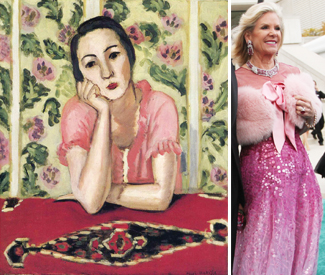
Chen asked Steve Brindmore, then a museum staff member who also runs a personal art crating business, whether he had a crate for the oil painting, which is titled “The Pink Blouse.” According to records from Sotheby’s New York auction house, the estimated value of this painting is between $3 and $4 million.

“The painting is on an A-frame in the Examination Room,” Chen wrote. “I’m taking the painting over to Dede on Wednesday … for [an event], and then it will come back here to the de Young to be crated for Portland around the week of Jan. 23.”

The exchange suggests that public museum facilities were being used to store and crate a piece of art from Wilsey’s personal collection.

Timestamps show that the exchange happened around 1:30 on a Monday, during museum hours. The correspondence was sent using museum staff email. It’s unclear what, if anything, this task had to do with the operations of a public museum. But FAMSF clearly handled a painting from the growing private art collection maintained by Wilsey, a major donor and key FAMSF fundraiser who loves Impressionist paintings and seems to gravitate toward works incorporating the color pink.

Beth Heinrich, a spokesperson for the Portland Art Museum, confirmed to the Guardian that a Matisse titled “The Pink Blouse” was indeed loaned to the museum from a private collection, and placed on display in its Impressionist galleries in February of 2012.

The email exchange between Chen and Brindmore is just one thread in a trove of correspondence, invoices, and other documentation anonymously submitted to the Guardian. Put together, the information shows museum staff being asked, during normal business hours, to handle, photograph, crate or arrange shipments for more than a dozen different pieces from Wilsey’s personal art collection in just the past two years. The documentation also shows several examples in which museum employees were directed by Chen to digitally reproduce works from Wilsey’s private collection.

It’s not uncommon for art collectors to put private pieces in the collection of a museum, nor it is unusual for collectors to lend out art to other museums. And if the de Young received some benefit from its association with Wilsey’s art, it wouldn’t be surprising (or inappropriate) for the museum to help reproduce or ship it.

On the other hand, if Wilsey is loaning out the pieces on her own, from her private collection, and using museum resources, it could raise conflicts of interest.

The de Young, for example, wasn’t cosponsoring the Portland exhibit where the Matisse was shown. Since Wilsey just bought the Matisse, it couldn’t have been part of the de Young’s collection.

There’s no indication that it was anything but her personal loan of a valuable painting — facilitated by the staff of a nonprofit that runs a city museum.

Invoices show that some staff members were paid separately for assisting with Wilsey’s art collection, in some cases through independent businesses.

WHO’S IN CHARGE?

The Fine Arts Museums include the de Young and the Legion of Honor. Included as charitable trust departments under the City Charter, they are governed by a 43-member Board of Trustees, which is responsible for appointing a director. Wilsey has presided over the body as board president since the 1990s. The bylaws of the board were changed to eliminate term limits for the president, meaning she could stay in the post for as long as her board colleagues want.

The FAMSF has been leaderless since director John Buchanan died in December, 2011.

Though the museums are public institutions, their governance structure is similar to that of a public-private partnership, since a private nonprofit organization called the Corporation of Fine Arts Museums of San Francisco handles museum administration and employs a number of museum staff, including curators and other professionals.

The city contributes some public funding to FAMSF, but the majority of revenue is derived from private sources. Wilsey, a multi-millionaire, contributed $10 million to the de Young, and spearheaded a 10-year fundraising campaign that culminated in 2005 with more than $180 million raised to rebuild the museum.

The socially connected philanthropist, known for throwing Christmastime bashes that attract a roster of powerful luminaries from government and big business to her Pacific Heights mansion, is often the subject of press reports or gossip surrounding San Francisco high society. Her stepson, Sean Wilsey, famously characterized Wilsey as his “evil stepmother” in his memoir, “Oh, the Glory of It All,” which includes an unflattering scene in which she is said to have pinned $200,000 brooches onto her bathrobe one Christmas morning.

She owns a fair amount of art — and apparently moves it around. In August of 2011, for instance, email threads show that Chen, using her FAMSF email address, contacted Jamil Abou-Samra of Masterpiece International, the shipping company, regarding “Mrs. Wilsey’s Degas.” Chen wrote: “I brought the Degas to the de Young last week for glazing. It should be ready for Steve to measure for crating any days [sic] now. Are we still looking at August 30, Tuesday, for pick up?” The thread indicates that the painting was destined for the Royal Academy of Arts, in London.

An Internet search shows that the Royal Academy indeed hosted an exhibit titled “Degas and the Ballet,” which opened in September of 2011. Press reports highlighting the artwork on display include an image of a Degas credited to “Collection of Diane B. Wilsey.”

There is no mention of the de Young or the Fine Arts Museums of San Francisco anywhere in the web or press materials discussing the exhibition. Numerous other cooperating museums are identified by name.

When the Guardian reached Abou-Samra by phone, she indicated that she was not at liberty to discuss any of Masterpiece International’s handling of art shipments.

OFF TO PARIS

In February of 2011, email records show, Chen contacted Brindmore on his FAMSF email regarding a crate for a painting by Jean-Louis Forain that was bound for an exhibition at the Petit Palais, in Paris. The Parisian exhibit was launched in partnership with a Forain exhibit at Dixon Gallery and Gardens in Memphis.

“Dede has a Forain painting that needs to be packed and crated … The painting is currently in our storage and [FAMSF staff member Steven Correll] knows the exact location,” Chen wrote to Brindmore. A few weeks later, Chen provided some special handling instructions for the Forain in an email to Samra, of Masterpiece International, just before it was transported to the airport.

There are established professional standards governing the operations of art museums, and the Guardian phoned several experts to determine whether it’s common practice for a member of the Board of Trustees to call upon museum staff members to handle their personal artwork. In response, communications director Dewey Blanton of the American Alliance of Museums highlighted an ethical standard stating, “No individual can use his or her position with the museum for personal gain.”

The code of ethics at the Boston Science Museum put it quite clearly: “When Museum of Science Trustees seek staff assistance for personal needs they should not expect that such help will be rendered to an extent greater than that available to a member of the general public in similar circumstances or with similar needs.”

It’s unlikely that a member of the general public who wanted to ship artworks would have the staff of the de Young at his or her disposal.

The Guardian telephoned a number believed to be Wilsey’s seeking comment, and was greeted with a receptionist who answered with the bright greeting, “Wilsey residence!” After being informed that Wilsey was traveling, we requested comment from her via email, explaining that documentation appeared to show use of museum time to manage her personal art collection. She had not responded by press time.

Ken Garcia, press spokesman for the Museums, told us “there are situations in which the museum facilitates loans to the Corporation of the Fine Arts Museums (COFAM), loans to other museums, and in other ways assists with the care and handling of artworks for private collectors, including trustees when there is significant value to our museum.” He added: “The reasons for museum staff to have handled the board president’s private art collection reflect standard practice for exhibitions and loans.”

He noted: “Reproductions of artworks (2D) are routinely requested by collectors when the loan of a picture conflicts with the lenders need for privacy, represents a potential security issue, or interrupts the continuity of the enjoyment of a collection. FAMSF provides for the photographic reproduction of artworks as an appreciative acknowledgment of the negotiated loan. Mrs. Wilsey has on occasion requested a reproduction be made of a loaned picture but on each occasion has generously assumed responsibility for the associated costs.”

Maybe it’s all perfectly fine and normal, “standard practice.” But there’s a lot of it going on, and some is at the very least curious.

Cutting from the bottom

86

news@sfbg.com

While the looming federal budget cuts known as sequestration were designed to equally hit Democratic and Republican party priorities, from social services to the military budget, in the Bay Area they would disproportionately target society’s most vulnerable citizens and strain already-stretched local agency budgets.

If Congress and the White House fail to forge a budget deal by March 1, the cuts could begin to withdraw $9-10 billion of federal support from the California. In the Bay Area, these cuts would have the biggest impact on low-income families, the homeless, victims of domestic violence, adults living with AIDS, and children ages 3-5.

Back in September, San Francisco Mayor Ed Lee signed a U.S. Conference of Mayors’ letter that called on federal lawmakers to resolve the budget conflict before the sequestration cuts could take effect, labeling the budget cuts “a threat” to local economies nationwide. Now, with the deadline looming, city officials and social service providers across the Bay Area are bracing for the impact.

Depending to how the cuts are eventually allocated, San Francisco alone could lose more than $10 million in critical social services. “All across the city, the sequestration hurts those most in need of services and support,” Gentle Blythe, spokesperson with the San Francisco Unified School District, told the Guardian.

San Francisco Unified stands to lose $3.8 million in funding, over 5 percent of the district’s federal education dollars. The cuts would strain an already-tight education budget, which has suffered from the slow economy and the corresponding dip in tax revenue. “We’ve been in a climate of cuts for years,” Blythe said. “There is a definite sense of fatigue.”

The pending round of cuts would force San Francisco district officials to make a series of uncomfortable decisions. The bulk of San Francisco’s federal education funding comes from Title I and Title III grants, money specifically earmarked for low-income students and English-language learners. If the state does not step in to fill the hole, the $3.8 million shortfall will translate into a significant rollback of services for the city’s most at-risk students and potential layoffs of teachers and resource officers.

Early childhood programs are especially vulnerable to the impact of the sequester. San Francisco Head Start Director Marjorie Weiss told us the demand for these federal education programs is spiking as more San Francisco children are living in poverty.

US Census figures show 13.8 percent of San Francisco residents were living below the federal poverty line in 2011, up from 12.2 percent in 2005. Over the last decade, 850 additional children became eligible for SF Head Start, which operates federally funded preschool programs in 19 classrooms at 9 different centers across the city.

These programs significantly improve the long-term employment and educational prospects of children living in or near poverty. But as the need for these early-childhood services grows, the money is drying up. Over the last two years, state and local funding for early-childhood education has be cut by nearly 20 percent.

Now, with the sequestration looming, San Francisco Head Start providers are worried about their ability to continue providing services. “At Head Start, we have already been dealing with years of budget cuts,” Weiss told us. If the sequester comes through, the program will lose an additional $1.1 million and will be forced to eliminate programming for more than 100 low income children ages 3-5.

“This will be devastating. These cuts will have a crippling effect on low-income children in the community and their ability to be ready for school” says Weiss. The funding cuts will take effect June 1st and directly impact the incoming class of 3-year-old preschool students.

Although education will absorb a significant impact from the sequestration, social services across the city will be cut back. San Francisco homeless advocates are forecasting a $1 million cut in federal assistance and AIDS groups have warned that nearly $800,000 dollars in housing vouchers for AIDS patients are on the chopping block. Federal funding for the AIDS Drug Assistance Program (ADAP), which subsidized medical care for AIDS patients, is set to be slashed by nearly 8 percent across the board.

Advocates for the victims of domestic abuse are also worried about the sequester’s impact on local survivors of domestic violence. In San Francisco, federal money provides crucial services for victims of domestic violence through nationally-mandated Family Violence and Prevention Services (FVPS). The city’s three primary domestic violence shelters rely on this revenue stream for outreach programming, translation services, and extended operating hours. The pending sequester would cut nearly 10 percent of FVPS grants, forcing shelters to tighten their belts.

“The sequester is going to dramatically impact the funding for lifesaving services for domestic violence shelters and rape crisis centers, as well as legal service, and children’s programs,” Beckie Masaki, the founder and former executive director of San Francisco’s Asian Women’s Shelter, told the Guardian. Masaki now works with the Asian and Pacific Island Institute (APIDV) on Domestic Violence, where she advocates for more federal funding for domestic violence service providers.

Masaki is worried that the cuts will disproportionately impact the city’s most vulnerable women: low-income and non-English speaking victims of domestic violence, as cash-strapped shelters lay off translators and cut back on outreach and group therapy.

“In the past, when we were facing cuts, we did our best to minimize the impact on survivors,” she explains. “But in this era of constant cuts, it’s going to mean layoffs, and ultimately fewer services for the most vulnerable survivors”. As lawmakers in Washington scramble to pass a budget deal before the March 1 deadline, the climate of uncertainty leaves local service agencies in a state of limbo. With future funding in doubt, long-term planning and strategizing become increasingly difficult. Yet for many local service providers, the most recent threat of sequestration is a familiar consequence of an increasingly fragile social safety net. According to Masaki, the sequestration should motivate Congress to rethink its budgeting priorities: “If they invest in these baseline life-saving services for those that are most vulnerable in our community, in the end that is the path to better economic and social sustainability for our whole nation.”

Just chill

0

arts@sfbg.com

MUSIC Four years ago, in the waning days of the aughts, the befuddling adlib term “chillwave” forged in the throes of the blogosphere, accompanied nearly every story about acts like Neon Indian, Washed Out, and Toro Y Moi. For the uninitiated, chillwave is a cheap, slap-on label used to describe grainy, dancey, lo-fi, 1980s inspired music, and most importantly is a disservice to any band associated with it. Luckily for music writers and listeners alike, this term has died a relatively swift death.

Toro Y Moi, the one-man bedroom project of Chaz Bundick, has exponentially progressed since the chillwave era, in addition to his relocation to Berkeley in August 2011. Bundick is currently on a sold-out tour with his live band and will headline two sold-out Noise Pop shows at the Independent this weekend.

His latest LP, Anything In Return, which came out last month on Carpark Records and was recorded in full in the Bay Area, is a fruitful expansion beyond his earlier albums Causers of This and Underneath the Pine, and a shining foray into experimental styles and sounds.

Anything In Return marks an ambitious departure from anything Bundick has done in the past; Bundick describes it to me as a “bigger sounding album, more accessible and poppy.” The result is a fluent and delicate fabrication of funk grooviness, R&B introspection, and swirling pop melodies. The success — and more importantly, the ethos of the effort — is highly indebted to the late sacrosanct hip-hop producer J Dilla. If Anything in Return signifies a reinvention of Toro Y Moi, then J Dilla and his “try anything, do anything” mantra are its guiding light.

Such a transformation can be daunting to some, but as Bundick notes during our phone call, Dilla “makes everything seem like it’s alright to try.” One of the few Dilla tributes outside of the Paid Dues and Rock the Bells festivals.

Though maturation and cheer remain central themes in terms of sound side of things, Anything in Return is loaded with confessions about Bundick grappling with his relationship and the strain the life of a touring musician has placed on it. The gripes are most poignant on tracks like “Cola” and “Say That,” where he laments the state of flux his and his girlfriend’s different lives have placed on their relationship and the resulting insecurities that arise from such limbo.

His new life in the Bay Area — he moved out here from his hometown of Columbia, South Carolina because his girlfriend enrolled in a grad program at Cal — is expectedly represented in Anything in Return‘s character and aural makeup. One of the first and last things heard on the opening track “Harm in Change” is the crisp noise of a BART train accelerating as it leaves a station — most likely one of the three Berkeley stations.

So far Bundick has fluidly adjusted to life in Berkeley and in the Bay Area in general and signals his health as the biggest benefactor of his relocation. Coming from BBQ-laden South Carolina, the recent vegetarian convert is grateful for the Bay Area’s wealth of veggie options; in a recent interview with SFStation, he listed the revered Berkeley institution Cheese Board Pizza as his favorite food joint. And like pretty much anyone who moves here, he’s been biking, busing, and BARTing more and more.


TORO Y MOI

With Sikane, Dog Bite, DRMS (Fri.), James and Evander (Sat)

Fri/1-Sat/2, 8pm, sold out

Independent

628 Divisadero, SF

www.theindependentsf.com

The unheard music

0

arts@sfbg.com

VISUAL ART “Silence,” the large new thematic show at Berkeley Art Museum and Pacific Film Archive, might have been titled in the plural, since it approaches silence from various angles phenomenological, political, and cultural. Co-curated by BAM/PFA and the Menil Collection, “Silence” takes its inspiration from one of the most famous 20th-century artworks in any medium, John Cage’s 4’33” (1952).

As you almost certainly already know, Cage’s 4’33” entails having the audience listen to ambient and accidental sounds of the auditorium while a pianist closes and opens a piano keyboard cover three times at set intervals but without touching the keys, both performing the difference between silence and quiet, and demonstrating the omnipresence of music wherever attentiveness is present. Cage’s work anchors the tone and scope of the show, and so from all possible kinds of silences, the exhibition limits to works by some 30 artists wherein silences are productive, pregnant, or impossible. Cage here is represented by scores for the performance as well as by several works that served as inspirations, descendants and tangents of his work.

Most directly, the show includes Robert Rauschenberg’s monochrome White Painting (Two Panel) (1951), which Cage cited as partial inspiration for 4’33” next to Ad Reinhardt’s all-black Abstract Painting (1965). If you know a bit of art history, then you get the curatorial statement here: aside from standing in for all sorts of minimalist silences, the yin and yang of Rauschenberg’s pregnant meditation juxtaposed with Reinhardt’s zero-degree absolutism are the boundaries for the gamut of representational possibilities that Cage and subsequent modernists have been sifting through. Of all Cage’s descendents, nobody gets that as well as Steve Roden, represented here by several conceptual and generative works based on 4’33”. Roden, who lives in Pasadena, crosses freely between sound and visual art in works that map, translate, and draw attention to the structures of sounds and the activity of listening. Alongside paintings and sculptures that take their generative cues from the text that accompanies the Cage piece, Roden is also exhibiting 365 x 433, (2011) three books of text that document and reflect on his daily performance of 4’33” over the course of a year.

Several other artists make explicit reference to silence and its relationship to listening, especially in social context. Brooklyn artist Jennie C. Jones uses materials commonly found in recording studios to make paintings that absorb and quench sounds in the spaces where they hang. Sustained Black with Broken Time and Undertone (2011) wraps around the corner on two walls of the gallery space, drawing attention to silence’s active relationship to architecture. Kurt Mueller’s Cenotaph (2011–13), a 100-CD jukebox filled with recordings of moments of silence called for by public figures, lays bare the thorny absurdity of state-imposed silence as ritual. On one jukebox panel, for example, you can choose between playing the moments of silence called for (from top to bottom) trapped miners, Michael Jackson, Corey Haim, or Ted Kennedy. Represented here by letters and photographs, Tehching Hsieh’s One Year Performance 1978–1979 (1979) casts silence as a form of cultural askesis. In that performance Hsieh locked himself in a cell inside his New York City loft for a year without talking, reading, writing, or entertainment.

Overlapping existential and cultural silences, the first gallery in the exhibition features several of Andy Warhol’s electric chair silkscreens (1965 and 1967), interspersed with Christian Marclay’s Silence paintings (all 2006), which appropriate a cropping from Warhol’s source photographs of the execution chamber and the “Silence” sign above the door that illuminated to alert attendees that the execution was about to take place. Also shown are extensive sketches from Marclay, showing his ongoing interest in these particular Warhols. As a framing device for the show, the pairing of Warhol and Marclay helps illustrate the pregnant potentials within Warhol’s bleak, lovely fascination with death imagery, and inverts the pairing of Rauschenberg and Reinhardt. Warhol’s particular silence, the attenuation and emptying of visual meanings through repetition, is taken up again by Marclay as productive fodder for an entire body of investigations.

Throughout February, film screenings addressing various kinds of cinematic and personal silences accompany the show. February 27, short experimental works that incorporate complications on sound and silence will include Darrin Martin’s Monograph in Stereo (2005), which addresses silence via hearing loss. *

SILENCE

Through April 28

Berkeley Art Museum and Pacific Film Archive

2575 Bancroft, Berk.

bampfa.berkeley.edu


Sort of and last

0

arts@sfbg.com

THEATER In a deceptively low-key but major theatrical event, Yerba Buena Center for the Arts last weekend presented the local debuts of both the Wooster Group and the New York City Players, in their collaborative take on three of Eugene O’Neill’s seafaring “Glencairn plays.”

It’s striking and not a little frustrating that San Francisco has never before been a port of call for either of these two world-famous and globetrotting experimental theater companies. Moreover, because this was a first-time collaboration between the two influential groups, Early Plays (as the O’Neill program is titled) was not really representative of either one of them. Rather, it was an intriguing, at times euphoric, at times baffling exploration fusing actors from both companies with relatively bare-bones Wooster design elements — all under the signature directorial style of NYC Players’ playwright-director, Richard Maxwell. Even so, it was a stimulating evening in which the attentive, open curiosity of the audience was palpable.

The triplet of early O’Neill one-acts — all written between 1913 and 1916 and featuring polyglot crew members of the British tramp steamer Glencairn —included, in order of presentation, The Moon of the Caribbees, Bound East for Cardiff, and The Long Voyage Home. In these short and atmospheric plays, O’Neill explores the hard, often brutal lives of sailors and other working-class people swept along by the winds of trade. But in paying attention to their distinct cadences, relationships, and dreams, the playwright also points to the lyrical nature of their lonely yet social lives, as well as flickering moments of transcendent experience amid coarse routines and unruly bursts of energy.

In this sense, they are not all that different from (and nearly as contemporary as) Maxwell’s own plays (like House, Burger King, Boxing 2000, or People Without History), which often delve into the mundane musicality of ordinary, inconsequential lives sideswiped by half-understood forces, churned by bumptious pretentions and bumpy social interactions, bewildered by quiet epiphanies. Indeed, Maxwell’s work comes shaded by his own original songs in which the banal takes unexpected flight.

But whatever their resonances, their plays remain a fat century apart in theatrical worldviews. O’Neill, learning from Europe and especially Stindberg, was inventing an American theatrical vocabulary still not entirely free of a certain melodramatic tradition. Maxwell and the New York City Players, on the other hand, represent a distinct and sustained attack on the stifling affects of the theatrical artifice that has accrued since then. And the Wooster Group has maintained a visionary re-imagining of the stage, its strengths and capacities, for nearly four decades (a project whose power and scope was clearly visible even on video in the three-weekend series of Wooster Group work screened at YBCA in the lead-up to the Early Plays premiere).

And so, what audiences encountered last weekend was a purposively monotone rendering of O’Neill’s rather overwrought dialogue, laden with a variety of archaic-sounding dialects that the actors dutifully articulated as written but, for the most part, without further embellishment or affectation. The action, meanwhile, unfolded with a deliberately subdued, knowing amateurishness on a Wooster-like set (designed by Jim Clayburgh and Wooster leader Elizabeth LeCompte) whose exposed gray-planed design featured a floating stage floor, supported by thin vertical cables, on which a skeletal framework of piping, bulging light bulbs, ropes, and pulleys combined in vaguely nautical abstraction.

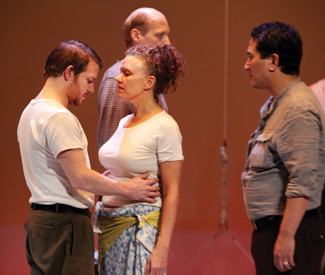
Not that theatricality per se was absent: three of Maxwell’s workmanlike yet stirring ditties, for example, stitch together the O’Neill plays with simple, poignant, uninflected harmonies and rhythms as the actors smoothly reconfigure the stage. During Bound East for Cardiff, moreover, the stage was plunged into semi-darkness, sculpted by the warm glow of a few lantern lamps and the looming, slowly dissipating clouds blasted at intervals from a smoke machine, as main characters Yank and Driscoll (played respectively by NYC Players’ Brian Mendes and Wooster veteran Ari Fliakos) conferred at the former’s deathbed in a recessed, beautifully haunted corner of the stage. And in The Long Voyage Home, NYC Players stalwart Jim Fletcher (a riveting presence who is perhaps the quintessence of Maxwell’s forthright aesthetic, deflating and commanding at once) donned a too-tight barman’s vest and a toupee that looked like an animal roosting rump-forward on his head; while beside him Wooster’s luminous Kate Valk burst into and out of tears with a kind of blank perfection.

But it was precisely the melding of the clumsy and the graceful — and the volatile tension that arose between the purposely anti-theatrical and the inescapable pull of the plays themselves — that marked the production’s dissonant, quasi-Brechtian approach. In eschewing the usual cohesion, the production gave itself over to an admittedly not entirely successful but fascinating pursuit of what is much more rare: a sense of raw immediacy and authenticity, and a poetic capacity for unexpected instants of reflection. It’s an approach that wrestled with itself as much as the material or the audience, but it led to a refreshing sense of possibility and inquiry, and in it too there were moments when the lyrical and transcendent were given new life.

Scare tactics

0

arts@sfbg.com

GAMER There aren’t a lot of great horror games on the console market. Even old stalwart Resident Evil gradually dropped anything resembling spooky game play, hoping to conjure the success of Western-developed shooters like Gears of War by incorporating cooperative play and action-packed, cover-based shooting. Good horror is about being alone, outnumbered and outgunned. So when Dead Space 3 was revealed at last year’s E3, fans were appropriately nervous when told the franchise’s new focus would be on cooperative play and cover-based shooting. It was Resident Evil all over again. The horror!

Now that it’s here, perhaps our concerns were misplaced. Dead Space 3 (Visceral Games/Electronic Arts; PS3, Xbox 360, PC) features everything fans were apprehensive about — and some unannounced and sour-tasting micro-transactions — but at its core beats the heart of a classic survival horror experience.

Dead Space‘s formula consists of traversing old spaceships, zero-gravity space, and desolate planets, unloading bullets into undead creepy-crawlies. Picking up shortly after the events of Dead Space 2, in which spaceship engineer Isaac Clarke battled zombies brought to life by alien artifacts called “markers,” Clarke once again is thrust into combat — this time to save ex-girlfriend Ellie and stop religious zealots from activating more markers on the ice planet Tau Volantis.

Dead Space 3 has a wonderful sense of location and atmosphere — hallmarks of any horror game. Rickety, malfunctioning hallways of long-abandoned spaceships fire sparks, creak and sway as you walk through, and enemies have a nasty way of sneaking up behind you with bloodcurdling screams. Although you won’t see the icy surface of Tau Volantis until maybe a third of the way through the game, the planet’s harsh winds and ivory cliffs are a welcome change of scenery. Some gamers will scoff at the “monster closets,” but Dead Space owns the artifice and builds upon it in interesting ways, making firefights consistently tense.

As for the co-op, cover-based shooting and micro-transactions, they are only as unpleasant as you allow them to be. While wholly different from the solitary feel of single-player, co-op is seamless and presents new approaches to combat and puzzle-solving. Being offered downloadable content each time you approach a work bench or spacesuit kiosk breaks the atmosphere of the game, but the weapon customization system is fun to play around with and cover-based shooting is encouraged only a handful of times.

That Dead Space 3 remains a solid traditional horror game in spite of distracting “broad appeal” additions is a dubious accomplishment, but perhaps it’s one fans can live with for the time being. The marketplace’s lack of quality horror games allows some leeway for a series that gets it mostly right. Let’s not get caught up in worrying how these lesser features might expand in the inevitable Dead Space 4; in the here and now, Dead Space 3 is exciting, beautiful, and best of all — scary.

Up the game

0

le.chicken.farmer@gmail.com

CHEAP EATS K-3PO lives right in the neighborhood and claims to have played ping-pong with me in the ’90s. He also claims to have photographed my old band, and on this score I believe him.

We write at the same coffee shop. Right now, for example, I’m writing about him and he’s sitting across the room from me, either oblivious or not. Who knows?

He doesn’t have a cell phone. He has a weekly planner, with a black cover.

“Remember these?” he said, trying to make a dinner plan with me.

“Oh yeah. You’re old-fashioned,” I said, and he feigned offense. “I mean that as a compliment.” (The truth.)

Anyway, yeah, we had tried to go eat barbecue one night last week at the new neighborhood smokehouse, Hi-Lo, and luckily for all of us — but especially Hi-Lo, I’m thinking — they were closed for a private function.

I buy my pork steaks at that divey little market, 19th and Mission, and my bread at Duc Loi, so I walk past Hi-Lo pretty often, “doing the block.” There’s always some kind of friendliness marking the spot, lately. Like, a couple weeks ago a guy was standing outside and Hedgehog had already told me that barbecue was going in there, so I said: “Open?”

“Not yet,” he said, “but go on in and look around.”

I did. It must have been like a dress rehearsal, or something. Waitresspersonpeople were everywhere, the kitchen was all a-bustle, smelled like smoke . . . The one thing missing was customers. Of which I would have gladly been one, if they were open open.

I also wish they would have showed me to the basement, where they keep their three-ton smoker, but that didn’t seem to be going to happen, so I went on ahead to the market and got my pork steaks, and to Duc Loi, and home.

Then, when we tried to go with K-3PO, there was a sign on the door saying closed for private function. I must have looked sad, cause someone came out and gave me a little paper bag of cookies.

Those cookies were good! They were not barbecue, but they were sweet and salty. And buttery. I ate them at Baobab, while we were waiting for our red curry prawns, red curry chicken, and some other kind of chicken. With black-eyed peas.

None of which was barbecue, either. But: good. But, according to K-3PO, overpriced. I give up on anything ever being cheap anymore, in the Mission. I just wish that places would step up their game a little, to earn it. In addition to going, OK, it’s the Mission so let’s charge 20 to 30 percent more, go: it’s the Mission so let’s also make our food 20 to 30 percent more amazing.

It’s too close: I will, eventually, give Hi-Lo a chance, but people on Yelp are saying 15 clams for three to five slices of pretty dry brisket, without any sides. So they better step up their game. I can get friendliness and cookies for a lot cheaper than that, even without leaving the ‘hood, and I have a smoker of my own. Albeit not a three-ton one.

Wait. Why would you want a giant smoker? If the idea of barbecue is to impart smoke to meat (and it is) . . . seems to me that smaller spaces full of smoke would make meat smokier than bigger ones. But there’s probably something I’m not factoring in.

Anyway, this isn’t a review of Hi-Lo.

It’s a character study of K-3PO, who — this is what he’s been up to: “watching hundreds of archived mental hygiene films from the ’40s and ’50s,” he said.

Because that’s what he does. Here in the teens. He makes mentally hygienic films, hisself. I saw one, one time. It was freakin’ beautiful.

Another thing we talked about was almost dying, and how each of us has done it, in life. K-3PO told the story of a hike he took in Israel, in the desert, when he and a friend got stuck on the trail overnight and almost froze to death.

Hedgehog, turns out, just missed being torpedoed by an exploding fire extinguisher while she was in film school.

And I … I ate too many pancakes.

Fresh sips

2

virginia@bayguardian.com

APPETITE In my endless treks ’round the city for the best partnerships of drink and food, here are a few notable current menu offerings.

MEZCAL AND COFFEE

Easily one of our city’s best bars, Comstock Saloon maintains historical reverence to SF’s Barbary Coast days without being stuffy. Old World decor, live jazz, and bartenders who know how to make a proper cocktail make it one of the most blessedly grown-up watering holes, particularly in partying North Beach. If this weren’t enough, it’s a top notch restaurant. Chef Carlo Espinas churns out dishes better than your typical gastropub “upscale comfort food” fare.

Mostly classic cocktails ($8-12) are often best ordered as a “Barkeep’s Whimsy” option (let the bartender decide how to make it, $12), like a gorgeous Smith & Cross Sour, showing off the musky-elegant-spicy notes of Smith & Cross rum with lemon, sugar, and frothy egg white. Another “whimsy” from the talented Ethan Terry: a stunner of smoky mezcal weaving with Firelit Coffee liqueur, Oloroso sherry and orange bitters. Menu classics remain, like an ever-drinkable Cherry Bounce: bourbon, cherry brandy, lemon, Angostura, Champagne.

Eat: I can’t resist melting soft, mashed potato fritters ($9) dipped in “loaded baked potato dip” (essence of bacon and chives in sour cream — I had to ask for more). Salads are refined yet comforting, whether the austere green of raw kale ($9) tossed with little gems, Parmesan and watermelon radishes in bright lemon dressing, or chunks of fresh crabmeat and smoked trout in a lentil, baby chicories salad ($12). Good thing I can contrast that healthy eating with bacon-wrapped meatloaf ($16), bearing a caramelized “skin” of ridiculously fine house ketchup (of brown sugar, tomato, chili, and more) alongside dreamy coleslaw.

Comstock Saloon 155 Columbus Ave., (415) 617-0071, www.comstocksaloon.com

MINI-MARTINIS AND G&TS

Consider leisurely Brasserie S&P, inside the Mandarin Oriental hotel, your gin and tonic haven. But not just any G&T. Though cocktails fall on the pricey side ($12-16), beverage manager Priscilla Young oversees a robust gin collection, blends tonic waters in house, and presents mix-and-match G&T options via iPad. Her sommelier’s palate ensures tonics align with botanical profiles of gins like local Old World Spirits’ Blade Gin, its Asian botanicals dancing with Young’s citrus-tinged Sensei #1 tonic, orange, and Thai chilies. There’s an earthier G&T of St. George’s Dry Rye Gin with Sensei #1 tonic, orange, black pepper. In a “Dirty” G&T, Scottish Botanist Gin flows with celery brine and Q Tonic, decorated with salt-pepper rim. Outside of G&Ts, Fresno chilis and bacon make the Diablo’s Whisper a refreshingly savory cocktail of Don Julio reposado tequila, blackcurrant hibiscus, and lime.

Bonus: A new (and genius) offering is mini-martinis available all day at $5, like First Word, a twist on a classic Last Word cocktail, with Beefeater Gin, Green Chartreuse, lime and grapefruit. Imbibing guilt free, the diminutive size makes you want to order another.

Eat: Conveniently open 11am-11pm, the Bar at Brasserie S&P is an all day, downtown drink option, though it’s also a smart, non-trendy power lunch spot. Light, clean kanpachi crudo ($17) nods to Hawaii with Kona fish and macadamia nuts, drizzled in sesame oil and Fresno chilis. Also light yet laden with Dungeness crab is a Louie salad ($19) stacked with butter lettuce, sieved egg, avocado. I often glaze over chicken, but Mary’s chicken paillard ($18) is a highlight breaded in anchovy garlic crumbs over marcona almond pesto.

Brasserie S&P Mandarin Oriental, 222 Sansome, (415) 986-2020, www.mandarinoriental.com

CILANTRO DAIQUIRIS AND CIDER SOURS

Rock-star cool and sexy describe Chambers’ record-lined dining room, one of the most striking in the city. Cocktails ($11) are improved from early days when it opened in 2011. Straightforward and unfussy, the drinks are well-made and thirst-quenching. Playing off one of the greats, a whiskey sour, the Whiskey Cider Sour combines house-made cider, whiskey, egg, and fresh-grated nutmeg. A garden-fresh cilantro daiquiri blends silver rum, Cointreau, and lime with plenty of muddled cilantro.

Eat: Appreciating executive chef Trevor Ogden’s unique presentation of smoked fish (salmon) in the past, now it’s tea-smoked tombo tuna ($15), slowly smoking over a grate tableside. Despite pork belly burnout years ago, I hadn’t tried smoking pork belly ($13) until recently, soft fat releasing its aromas as it burns before you, accompanied by Early Girl tomato kimchee. How could I resist? But salads unexpectedly steal the show. Winter is exemplified in an artistic display of fuyu persimmons ($10) happily partnered with burrata and toasted oat toffee, dotted with Angostura bitters (you heard right), olive oil, sea salt, and garam masala spices. Salade Lyonnaise ($12) is artfully deconstructed: grapefruit wedges, pork biscotti, lardons (thin strips of pork fat), and candied pomelo splay out spoke-like from a sous vide egg resting atop a mound of frisée in the center.

Chambers 601 Eddy St., (415) 829-2316, www.chambers-sf.com

Subscribe to Virgina’s twice-monthly newsletter, The Perfect Spot, www.theperfectspotsf.com

Go South

0

cheryl@sfbg.com

FILM San Francisco is a town of many film festivals: SF IndieFest wraps up Thu/21, and the Center for Asian American Media Festival (formerly the San Francisco International Asian American Film Festival) kicks off March 14. Lest you suffer fest withdrawal, the gap between is filled nearly end-to-end by Cinequest — San Jose’s 23rd annual salute to cinema that has a Silicon Valley-appropriate focus on technological innovations.

One example of that focus: Sony-sponsored 4K digital screenings of Taxi Driver (1976), Dr. Strangelove (1964), and Lawrence of Arabia (1962). While there’s no replacing the experience of seeing these classics projected on film, these restorations promise to render even Travis Bickle’s grimy apartment in eye-poppingly sharp relief. (“You talkin’ to me, or you checkin’ out my dirty dishes?”)

If the idea of burning highway miles to see movies you’ve already snagged on Blu-ray doesn’t appeal, Cinequest has corralled a genuine Hollywood icon for its Maverick Spirit Award: Harrison Ford. He’ll attend in person to discuss his career and, no doubt, field many a question about his rumored involvement in the upcoming Star Wars sequel-reboot-spinoff-thing — to be directed by J.J. Abrams, a past Maverick recipient himself. Other 2013 Maverick winners include Salman Rushdie, who’ll receive his award after the closing-night screening of Deepa Mehta’s Midnight’s Children, based on Rushdie’s 1981 Booker Prize-winning novel; and Chuck Palahniuk, who’ll be honored after a screening of a short film he scripted, Romance (one theme: Britney Spears), among others.

Cinequest’s largest component is, of course, its actual film programming, with a wide array of shorts, narratives, and docs. The fest kicks off with Sally Potter’s downbeat coming-of-age tale Ginger & Rosa. It’s the 1960s, nuclear war is a real possibility, and nuclear-family war is an absolute certainty, at least in the London house occupied by Ginger (Elle Fanning), her emotionally wounded mother (Mad Men‘s Christina Hendricks), and her narcissistic-intellectual father (Alessandro Nivola). Ginger’s teenage rebellion quickly morphs into angst when her BFF Rosa (Beautiful Creatures‘ Alice Englert) wedges her sexed-up neediness between Ginger’s parents. Hendricks (playing the accordion — just like Joan!) and Annette Bening (as an American activist who encourages Ginger’s political-protest leanings) are strong, but Fanning’s powerhouse performance is the main focus — though even she’s occasionally overshadowed by her artificially scarlet hair.

Horror fans: the number one reason to haul your carcass to Cinequest is Year of the Living Dead, a ghoulishly delightful look back at the making of 1968’s Night of the Living Dead. Rob Kuhns’ doc skews more cultural-legacy than fanboy, deploying a variety of talking heads (critics Mark Harris and Elvis Mitchell, Walking Dead producer Gale Anne Hurd, filmmaker Larry Fessenden) to explain why Night — offering just as much social commentary as any film from the Vietnam and Civil Rights era, except with way more squishy entrails — endures on so many levels. The best part, though, is the extended interview with George A. Romero, grinning and chuckling his way through anecdotes and on-set memories. On directing his amateur actors: “Just do your best zombie, man!”

Also highly enjoyable is Tom Bean and Luke Poling’s Plimpton! Starring George Plimpton as Himself, an affectionate portrait of the longtime Paris Review editor and “professional collector of experiences” who wrote books, articles, and made TV specials about his delight in being “the universal amateur.” His endeavors included playing football with the Detroit Lions, hockey with the Boston Bruins, and the triangle with the New York Philharmonic, among even more unusual pursuits. Some called him a dilettante (to his face while he was alive, and in this doc, too), but most of the friends, colleagues, and family members here recall Plimpton — born to an upper-crust New York family, he was friends with the Kennedys and worshipped Hemingway — as an irrepressible adventurer who more or less tailored a journalism career around his talents and personality.

Less upbeat but just as fascinating is Clayton Brown and Monica Long Ross’ The Believers, which starts in 1989 as University of Utah scientists Martin Fleischmann and Stanley Pons hold a press conference to announce they’ve discovered cold fusion — a way to make clean, cheap, plentiful power by fusing atoms instead of splitting them. But the initial excitement over their announcement soon gave way to skepticism and widespread dissent; eventually, their careers were in ruins, and by 1996, cold fusion was reduced to being a plot device for Keanu Reeves in Chain Reaction.

With new input from nearly everyone who was involved in the controversy (save the intensely private Pons, who’s seen in archival footage), The Believers captures cold fusion’s slow and spectacular fall from favor, while giving equal screen time to visionaries who believe it may still be possible. More importantly, its broader message explores what happens — or more pointedly, what doesn’t happen — when a radical idea appears, seemingly out of nowhere, to challenge an established way of thinking.

CINEQUEST

Feb. 26-March 10, $5-$50

Various venues, San Jose

www.cinequest.org


Travels well

0

caitlin@sfbg.com

STREET SEEN I was going to write this column about what it was like to be art star Kehinde Wiley’s model. It was supposed to be an eloquent reflection on musedom, and I’d locked down a post-performance chat with Ethiopian Israeli rapper Kalkidan, who stars in several of Wiley’s portraits in the current show at the Contemporary Jewish Museum.

But you know what, Tel Aviv to San Francisco is a long flight and I’ll wager that if you followed up the same journey with two hip-hop sets in front of the opening night Contemporary Jewish Museum hoi polloi — whose hosted-bar pink cocktails gave birth to some very art-world dance moves — you would wind up much the same way Kalkidan did for our chat. Call it jet lag. Our interview veered towards monosyllabic, though I did manage to gather he’d seen the Wiley paintings in which he stars two times before, when the exhibition toured LA and New York. And that he’s an Aquarius.

“Leviathan Zodiac”

… Leaving me to my own devices with you, dear reader. Well, not entirely. I did have a chance to ask Wiley about the direction he gives to his “painfully young and present models,” as he calls them, mere minutes after his flight touched down from New York. (Right before another journalist saw fit to ask him about Frank Ocean? Has a moratorium been decreed on talking to black queers, or anyone even tangentially related to hip-hop, about anything else?)

Insight into Wiley’s models seems central to his gorgeous “World Stage” series, for which he poses young men of color in classic historical poses, with ornate backgrounds and rarified postures mimicking 18th and 19th European portraiture, among other influences. The conceit started when the San Francisco Art Institute grad moved to New York, and he’s painted other chapters of “World Stage” starring men in India, Nigeria, Brazil, China, and elsewhere.

Kalkidan on “World Stage: Israel” opening night at the Contemporary Jewish Museum. Photo by David Schnur

Coupled with his subjects’ vivid streetwear, which Wiley and his assistants (the artist is well-known for employing staff that contribute the pieces’ background, if not more) render faithfully, and region-specific background motif, the series is a gorgeous homage to modern brown and black manhood, with a swagger that is decidedly hip-hop.

“There is an aspect of black American creative culture that has become globalized. Every country finds their own response to this evolving reality,” reads a Wiley quote that greets visitors to the CJM exhibit. How has a culture that’s made its way everywhere still so vilified?

Wiley allowed to our group of arthounds at the preview that he does tend to capture men who are gorgeous — you won’t miss the fact once surrounded by his canvas gods — but that his choice has less to do with his own personal preferences. “You can’t know who’s zooming who,” he said. “Nor is it a particular interest of mine.” I overheard curator Karen Tsujimoto tell another reporter that she didn’t believe sexuality played a role in his work.

I guess I buy that. Wiley said that painting beautiful men is about highlighting factors rarely pulled out to the front in the art world. “Male beauty seems to be the elephant in the room when it comes to the history of painting,” he reflected.

“The World Stage: Israel” Through May 27. Contemporary Jewish Museum, 736 Mission, SF. www.thecjm.org

BOYCHILD DOES BIG APPLE

I’d be wrong if I didn’t laserpoint out that drag (is that term adequate still?) babe boychild for bringing genderphucked Bay Area fierce to the runway for the Hood By Air-New York Fashion Week collection named, yeah, “boychild.” You know you’re the buzz when you’re overshadowing rapper A$AP Rocky, who also walked in the show. The look? Wetsuits and sportswear with glittering detail: canary yellow do-rags with blonde extensions, pearl-headphone earrings, French manicure. Strong, kinda freaky, hella pretty. Just like our child.

Clubs vs. condos

30

steve@sfbg.com

The Western South of Market area is ground zero for the city’s War on Fun, a place where nightlife often comes into conflict with residential expectations, particularly on the raucous 300 block of 11th Street and, to a lesser degree, Folsom Street’s old “miracle mile” of predominantly gay bars.

As the city’s Planning Department and its development community looks to accommodate another 4,000 homes for 10,000 new residents on less than 300 acres of Western SoMa — most of it along Folsom Street between 7th and 13th streets — that potential for conflict could grow in the coming years as funky old buildings give way to shiny new stacks of expensive condos.

And efforts to sort it out may hinge on the future of a 105-year old purple building.

After nearly eight years of work by a unique citizen-led task force, the Western SoMa Community Plan is now before the Board of Supervisors, with the Land Use Committee set to hold its first hearing on Feb. 25. Despite dozens of task force meetings seeking to strike the right balance between residential and entertainment interests, the plan is still being tweaked.

When the Planning Commission approved the plan and some related projects on Dec. 6, it followed King Solomon’s approach of cutting the 11th Street baby in half. The commission heeded the recent recommendation of the nightlife community and District 6 Sup. Jane Kim to modify the plan to prohibit new residential development on the 11th Street block where tipsy visitors to Slim’s, DNA Lounge, and other big clubs clog the sidewalks every weekend. But it also voted to grandfather in a 24-unit residential project at 340 11th Street, which everyone now involved in closed-door negotiations simply calls “the purple building,” a two-story masonry structure built in 1907 that is awaiting demolition.

The building houses light industrial businesses and is the former home of Universal Electric, whose owner, Tony Lo, wants to develop the property. Along with architect John Goldman, Lo submitted a residential project application in 2005, only to have it placed on hold pending adoption of the Western SoMa Community Plan.

“It was well along when the Planning Department put the project on hold,” Goldman told us.

City officials and even many of the nightlife advocates say they sympathize with the long wait that Lo and Goldman have endured, even if many oppose housing on the site and have been urging Lo to find another use for the site, such as an office building.

“They would have no idea what they’re getting into until that first Saturday night,” nightlife advocate Terrance Alan said of the would-be residents of the building, envisioning a young couple who had only visited during daytime hours trying push a baby stroller past the throngs of club-goers. Alan took part in recent meetings Kim facilitated with Lo and Goldman, and Alan told us, “There was, for the first time, a very frank discussion about the problems that owners would experience and the pressure they would put on clubs in the area.”

For example, just one neighbor of Slim’s — a popular live music venue on the block owned by singer Boz Scaggs — has waged a relentless campaign that has forced temporary shutdowns and cost the club more than $750,000 in mediation costs, Alan said, despite the club’s sound buffering and general compliance with local codes.

Alan said that it’s simply unthinkable to add more than two dozen new homeowners to that busy block in a condominium building that only allows access on 11th Street. Alan is hopeful for a negotiated compromise with Lo, something that Kim told us she also thinks is likely.

“I’m hoping we can come to a consensus of the property owners and business owners on 11th street, including the purple building,” Kim said, echoing Alan’s point that, “Just one resident can really shut down a business and hurt its financing.”

Goldman said he understands the concern and “my client is considering alternatives to housing.” While he was a little frustrated that it wasn’t until November that they first heard about a proposal to ban residential projects on the block, “We’ve definitely heard the concerns of the nightlife entertainment folks…No decision has been made yet, but it’s the goal of my client to decide fairly soon.”

A ban on housing is just one of the changes that Alan and other members of the California Music And Culture Association (CMAC) are pushing the supervisors to make to the plan, provisions he was unable to get into the plan as a member of the Western SoMa Task Force for four years before resigning in frustration.

“The task force was made up of people primarily interested in residential development,” Alan told us. “The plan is pretty much about protecting residential.”

That perspective irritates task force chair Jim Meko, who said he held about 60 meetings on entertainment and nightlife issues and bent over backward to accommodate that community. “Overall, the Western SoMa Plan is very friendly to the entertainment industry,” Meko said, noting that the plan grandfathers in all existing nightclubs, even after a building is demolished, and requires new residential construction to buffer against street noise. “They’re never satisfied.”

But Meko does concede that accommodating existing residents and new residential development was central to the task force’s work, as it was charged with doing by the Planning Department. “The most important thing was to do no harm to anyone,” Meko said was the guiding philosophy behind the task force’s approach. “We’re the real test case for a mixed use community in the city.”

While Folsom Street has more bars that 11th street, and those bars will be protected under the plan, Meko said the idea was to keep them limited in scale and prevent the proliferation of large clubs that operate into the wee hours.

“Folsom Street is where the residential growth will go,” Meko said. “That’s the area where we want to add the most residential growth and it seems dumb to add more nightclubs there.”

But he also doesn’t think it makes economic sense for many clubs to open there anyway. With allowable height limits in that corridor being increased from 50 feet now up to 65 feet, and with the plan’s approval allowing development projects to move forward, many of what he called the “old junky buildings” where clubs could find cheap rent will likely be demolished.

“With the height increases, those buildings are going to be history in five years,” Meko said.

Kim said she is supportive of both nightlife and the plan’s facilitation of residential development.

“It’s transit-first and a good place to be able to handle the density that’s close to downtown,” Kim said, noting that she’s supportive of even the massive residential project proposed for 801 Brannan Street, mostly because it includes units with up to two and three bedrooms and an elegant design by architect David Baker.

That project would have 432 housing units with a total of 606 bedrooms, 22,124 square feet of retail, and a 422-car parking garage on a site of just over four acres. In many ways, it is typical of the housing density that will begin to crowd into Western SoMa.

Meko was critical of how the entertainment community was able to make changes to the plan after all the hard work of the task force, and he told us, “It was a choice Jane Kim had to make, and she will have to answer to her constituents in the future.”

But Kim said the change on 11th Street made sense and that it’s important to strike a balance. “Entertainment is clearly an important part of Western SoMa and 11th Street is unique in showcasing that community,” Kim said.

Alan and Glendon Hyde — an LGBT activist who, like Meko, ran against Kim for D6 supervisor two years ago — are also pushing for other changes in the rules governing nightlife in SoMa, including who can get the limited live music permits that the city issues and extending the 10pm curfew in those permits.

“I think small businesses throughout the district should be able to use the limited live music permits, and they’re available only on Folsom Street under the plan,” Hyde told us, noting that otherwise he thinks nightlife fares well until the plan, particularly after Kim’s intervention on 11th Street.

Kim said that she in reluctant to start tweaking too many provisions of the plan, which she characterized as a separate discussion that doesn’t have to happen now: “I’m open to further discussions after we get the plan passed.”

The Western SoMa Plan was broken off from the larger Eastern Neighborhoods Plan by then-Sup. Chris Daly in 2005 to let a citizen-based effort tackle this area’s unique challenges, and Kim said the plan is a testament to the diligent efforts of Meko and a diverse set of members.

“I think it was a really good process with lots of stakeholders involved,” Kim said. “I like the balance. I’m happy.”


What Obama said — and what he meant

0

OPINION The words in President Obama’s State of the Union speech were often lofty, spinning through the air with the greatest of ease. But let’s decode the president’s smooth oratory in the realms of climate change, war and civil liberties.

“For the sake of our children and our future, we must do more to combat climate change.”

We’ve done so little to combat climate change — we must do more.

“I urge this Congress to get together, pursue a bipartisan, market-based solution to climate change…”

Climate change is an issue that can be very good for Wall Street. Folks who got the hang of “derivatives” and “credit default swaps” can learn how to handle “cap and trade.”

“The natural gas boom has led to cleaner power and greater energy independence. We need to encourage that.”

Dual memo. To T. Boone Pickens: “Love ya.” To environmentalists who won’t suck up to me: “Frack you.” (And save your breath about methane.)

“After a decade of grinding war, our brave men and women in uniform are coming home.”

How’s that for an applause line? Don’t pay too much attention to the fine print. I’m planning to have 32,000 U.S. troops in Afghanistan a year from now, and they won’t get out of there before the end of 2014. And did you notice the phrase “in uniform”? We’ve got plenty of out-of-uniform military contractors in Afghanistan now, and you can expect that to continue for a long time.

“We don’t need to send tens of thousands of our sons and daughters abroad, or occupy other nations. Instead, we’ll need to help countries like Yemen, Libya and Somalia provide for their own security, and help allies who take the fight to terrorists, as we have in Mali. And, where necessary, through a range of capabilities, we will continue to take direct action against those terrorists who pose the gravest threat to Americans.”

We don’t need flag-draped coffins coming home. We’re so civilized that we’re the planetary leaders at killing people with remote control from halfway around the world.

“We must enlist our values in the fight. That’s why my administration has worked tirelessly to forge a durable legal and policy framework to guide our counterterrorism efforts.

I’m sick of taking flak just because I pick and choose which civil liberties I want to respect. If I need to give a bit more information to a few other pliant members of Congress, I will.

“The leaders of Iran must recognize that now is the time for a diplomatic solution, because a coalition stands united in demanding that they meet their obligations. And we will do what is necessary to prevent them from getting a nuclear weapon.”

Maybe it’s just about time for another encore of “preemptive war.”

Norman Solomon is co-founder of RootsAction.org and founding director of the Institute for Public Accuracy. His books include “War Made Easy: How Presidents and Pundits Keep Spinning Us to Death.” He writes the Political Culture 2013 column.

When bankers lie

3

By Darwin BondGraham

news@sfbg.com

Although few have ever heard of it, there’s probably no number more important to the global financial system than the London Interbank Offered Rate, or LIBOR. Defined precisely, LIBOR is a set of different interest rates that the world’s largest banks charge one another for cash loans denominated in US dollars.

Because of its centrality to the economic system, and the trust placed in it, LIBOR is used to calculate everything from consumer loans and home mortgages to exotic financial derivatives and investments. LIBOR makes the financial world go round, influencing the price of everything. Fortune 500 companies decide whether or not to invest billions in new factories and product lines based on LIBOR’s direction. Governments rethink their debt levels and spending when LIBOR ticks up and down.

It turns out, however, that LIBOR has been a lie, and that the world’s biggest banks rigged the rate to skim off billions of dollars in value from other corporations and the general public. In a devastating set of revelations that began to surface two years ago, the panel of the largest global banks that set the LIBOR rate conspired to manipulate it, to increase or decrease LIBOR, solely because a higher or lower quote on particular days would allow them to reap millions in instant profits.

US authorities working with regulators in the UK, Japan, Switzerland, and Singapore are currently investigating upwards of two dozen banks in what is probably the single biggest financial crime ever perpetrated. So far, employees of Barclay’s, UBS, and Credit Suisse have been fired, arrested, and charged. Many more criminal prosecutions are surely coming, but the real battle will be in the civil courts and the court of public opinion.

To date only a handful of civil lawsuits have been filed, the first shot fired by the city of Baltimore early last year. Last month, the County of San Mateo, city of Richmond, and the East Bay Municipal Utility District filed their own cases which were quickly consolidated into a growing class action to be heard in New York’s Southern District Federal Court.

Now San Francisco is set to enter the ring. On January 29, Supervisor John Avalos called for public hearings to review the impact of LIBOR manipulation on San Francisco’s finances, starting next week. While other cities and public agencies might be ahead in the federal courts, Avalos’s recommendation takes the investigation further, and in a different direction.

“We’re trying to assess how the LIBOR scandal affects San Francisco, and that’s what the hearing is about,” Avalos told the Guardian. “These banks rigged the financial markets for their own benefit and the global economy suffered as a result.”

While early indications are that San Francisco is better protected than many jurisdictions, Avalos said, “I think it’s important to stand with other cities and counties that are suffering.” Or as his legislative aide Jeremy Pollock told us, “When a major city like San Francisco calls for hearings, it’ll get a lot more attention. The hearing will be an educational process for everyone to understand how this complicated financial world really works.”

Former Supervisor Chris Daly, now the political director for Service Employees International Union Local 1021, which represents most city employees, said there’s a need to hold the banks publicly accountable. “These other jurisdictions that have filed suit haven’t had a big public process. We don’t want to see settlements for less in courtrooms. We want to see the full public exposure of the issue, and in terms of the cause of bank accountability, it is the better approach.”

Avalos has already met with the heads of different city departments and agencies in an effort to determine what kinds of losses the public might have sustained as a result of LIBOR rigging. Pollock said the city’s finance staff and attorneys are currently working closely with the city’s airport, retirement system, and Office of the Treasurer to gauge the size of the problem.

“LIBOR rigging may have impacted the payments under the airport’s swaps,” said Kevin Kone, who oversees capital finance for the San Francisco International Airport. The swaps Kone is referring to include seven interest rate swaps that the airport used to convert variable rate debts into fixed rates for half a billion of SFO’s bonds (see “The losing bets,” 2/28/12).

The swaps require SFO to pay a fixed rate of between 3.4 and 3.9 percent on its half-billion dollars in debt, while the banks pay about 60 percent of LIBOR. When SFO signed these swap contracts years ago, 60 percent of LIBOR was roughly equal to 3.4 percent, meaning the net payments between SFO and the banks basically canceled one another out. However, if LIBOR was later rigged downward by the banks, then the net interest rate payments would shift in favor of the banks, draining hundreds of thousands or even millions from SFO’s capital budget.

“As an example of the order of magnitude, if LIBOR were set artificially low by 0.25 percent for a full two years, the Airport would receive $900,000 less each year (for a total of $1.8 million) than it should from its swap counterparties,” explained Kone in an email.

The airport’s counterparties on its swaps included JP Morgan Chase, Merrill Lynch, and Goldman Sachs. JPMorgan Chase sits on the committee of banks that sets various LIBOR rates, as does Bank of America, which bought Merrill Lynch in 2008. Both JPMorgan Chase and Bank of America are named as conspirators in the LIBOR lawsuits pending in federal court. JPMorgan Chase and Bank of America are also the subject of federal criminal investigations concerning LIBOR rigging.

Other losses may have been suffered by the San Francisco Employees’ Retirement System which makes investments in derivative instruments that are linked to LIBOR. “The retirement board has been looking at this,” said Nadia Sesay, director of the Controller’s Office of Public Finance. “We know Retirement has exposure and they’re assessing their portfolios.”

According to the most recent audit of the Retirement System’s portfolio, SFERs holds two interest rate swaps on its books with a notional value of $15 million. In prior years, SFERs held other swaps. In 2010, the Retirement System’s audit showed three interest rate swaps with a total value of $41 million. Over the last two years these swaps drained $5.3 million from the pension system, and some of these losses might have been due to the downward manipulation of LIBOR. Also on the Retirement System’s books are other investments in bank loans, options, and other securities that might have been impacted by the LIBOR fraud.

Still more losses due to LIBOR-linked instruments on the city’s books will be investments held by the city treasury in pooled funds. Banks offer various investment products to local governments that need a temporary place to park millions or billions in cash; the returns on these investment are often pegged to LIBOR. Just as with the airport’s swaps with JPMorgan and Merrill Lynch subsidiary, often times these so-called “municipal derivatives” investments are sold to cities by the same global banks that sit on the British Banker’s Association panels that determine the various LIBOR rates.

That’s one of the most alarming things about the LIBOR scandal: how absurdly easy it was for just 16 banks to rig the entire world financial system in their favor for several years on end. LIBOR isn’t actually a market rate that is determined by the loans banks make to one another. Rather, it’s a rate the banks claim they would able to secure loans from their peers, and the final LIBOR numbers for any given day are determined not by some independent authority, but instead by the British Bankers Association’s panel members — the banks themselves.

“The problem is that there’s a clear conflict of interest,” explained Rosa Abrantes-Metz, an economist at the NYU Stern School of Business who has closely studied LIBOR and is an expert in financial markets and cartels. “Banks make proprietary trades on instruments related to LIBOR, so they do have an interest in moving LIBOR in their own favor.”

Abrantes-Metz is currently working as an expert in several LIBOR lawsuits. Among her recent research findings in studies that tracked LIBOR alongside other economic indicators is that all the conditions of a potential conspiracy are present, and empirical evidence points toward coordinated fraud. “The banks had, as we say, the means, motive, and opportunity,” concluded Abrantes-Metz.

Regardless of what San Francisco’s public hearings on LIBOR uncover, the road ahead will be long and complicated. When asked about the the expected flood of LIBOR litigation, Abrantes-Metz said it’s just getting started. “We’ve only had the settlements of three banks with the authorities [Barclays, UBS, and Credit Suisse]. I’ve read there are investigations of 14 of the 16 banks that were on the LIBOR panel. That’s just US Dollar LIBOR.”

“Then there’s Euroibor, and there’s 40 banks on that panel. Then there’s Tibor which some overlapping banks with Yen Libor banks,” said Abrantes-Metz, referring to other key global interest rates denominated in Euros and Yen. Like LIBOR, these lesser rates are used to calculate the values and obligations of trillions in securities and payments.

“Those are just the governmental investigations,” said Abrantes-Metz. “I’m sure as more evidence comes out of these settlements it will probably generate more private litigation. I think this is to go on for very many years.”

Meanwhile, a proposal that Avalos made in the fall of 2011 to have the city start a municipal bank is nearing completion of its legal analysis by the City Attorney’s Office. While it’s legally complicated and wouldn’t eliminate the local need for big banks, he said the LIBOR scandal reinforces the need for alternative lending institutions with great public accountability. “My goal is this year to have something on paper that will lead to a municipal bank,” Avalos told us. “These institutions are willing to rig the system, and we could protect ourselves more locally if we had a banking institution.”

Missing person

0

arts@sfbg.com

THEATER A filthy, forlorn world emerges in surreal half-light at the outset of Magic Theater’s premiere of Se Llama Cristina, the new play by celebrated San Francisco–based playwright Octavio Solis. But almost as quickly, its initially intriguing outlines begin to look artificial, becoming the bloated lines of caricature more than a poetical evocation of real life, as the sentiment at the heart of this sometimes forceful but finally thin and frustrating play steadily takes over.

It’s odd and somehow appropriate that the two wayward characters at the center of the story — an at first nameless Woman (a vital Sarah Nina Hayon) and Man (a sympathetic but inconsistent Sean San José) — so aimless and rootless in their own lives, find themselves confined to the same dingy drug- and trash-strewn apartment (nicely realized by set designer Andrew Boyce and lighting designer Burke Brown), with initially no conception of where they are, who they are, or how they are related — let alone the meaning of the baby crib in the corner with a piece of fried chicken in it.

In this shabby environment, time and memory and biography all collapse and rise again as if within the ether of sleep or a heavy nod. Checkered histories and nervous dispositions slowly present themselves in a compact but oversaturated 80 minutes of dialogue that, at its best, pivots bracingly between horror and hilarity, with a rough lyricism that is a trademark of Solis’s border-town noir aesthetic. Soon a jilted villain named Abel (a very able Rod Gnapp) appears, incarnating the menace in the air. Also in the room is the possibility that the Man and Woman are about to be parents — or are already — which throws further fuel on the fire of their desperate coupling.

When, near the end, a young woman (Karina Gutiérrez) blows into this increasingly claustrophobic and wearying ménage, it’s like a breath of fresh air — and that is almost literally so, since she enters through the window. We could take her monologue as the voice of their daughter, the Cristina of the title, from some not too distant future. But whether or not we do, her impact is transformative in a way more or less synonymous with parenthood: presenting the couple with the possibility of a salvation at once of their own making and a gift from beyond — a kind of daughter ex machina.

If the details of the couple’s situation are better left subject to dream-logic than to a realistic accounting of probabilities and physical possibilities, it’s nevertheless true that the play suffers from an erratic need to fill in gaps. Among other things, that can lead to dialogue overburdened by exposition and back story (as in the Man’s graceless retelling of his self-exile from romantic attachments). Less would have been more. In director Loretta Greco’s staging, the awkward tension between the violence and despair of circumstance and an almost impatient rush toward love and hope is sometimes apparent in performances that can betray an uncertain balance between comedy, violence, and dread. In a scene where the Woman appears about to birth her daughter into the wicked, greedy mitts of Abel, the visceral, sexual, messy heat of the dialogue feels at odds with the somewhat guarded blocking of the actors. That said, there are moments in which a potent balance of elements reigns, as when Abel appears as the Telephone Man, threatening a total domination of the couple’s fate. It’s spooky, funny, surreal, and convincing at once.

In the end, however, the stakes never feel high or real, despite an almost too-insistent ladling on of gory detail, foul language, and teeth bearing. Like the impetuous verse scrawled on the back of Cristina’s sonogram image by her wannabe-writer father, Se Llama Cristina is ultimately a passionate poem to the deliverance that a child can offer her parents. But it’s scribbled too hastily and self-consciously in the hand of a playwright whose best instincts balk at the maudlin habit it encourages. *

SE LLAMA CRISTINA

Wed/13-Sat/16, 8pm (also Wed/13, 2:30pm); Sun/17, 2:30pm, $22-60

Magic Theatre

Fort Mason Center, SF

www.magictheatre.org