Volume 47 [2012–13]

Time to enforce the law

83

EDITORIAL The new tech companies that are making waves in San Francisco — Airbnb in the short-term rental business and Lyft and Uber in the taxi industry — may describe themselves as innovative and disruptive, and they may be appealing to investors.

But there’s a more accurate word that describes their relationship to the city:

Cheaters.

The way these companies are luring customers isn’t really about high-tech applications or brilliant business models. They’ve just found a way to get around the rules that everyone else has to obey.

Some city officials are talking about hearings and new legislation, all of which is fine. But in the rest of the business community, when someone flagrantly, openly violates the regulations, the City Attorney’s Office cracks down. That’s what needs to happen here, and soon.

Airbnb has a slick and appealing promise: You can rent out your house or apartment on the Internet to someone who wants to stay in the city for a few days, but is looking for an alternative to a traditional hotel. The homeowner or tenant gets some extra bucks; the visitor gets to stay in a cool neighborhood at a bargain price. What’s not to like?

Well, for one thing, most leases in San Francisco bar unauthorized sublets, so renters who offer their places on Airbnb face problems with their landlords, including possibly eviction. City laws also bar the use of residential property for commercial purposes. And, as we’ve pointed out repeatedly, Airbnb isn’t collecting the transient occupancy tax that every other hotel operator in the city has to pay. The total tab: At least $1.8 million a year.

Lyft and Uber say they’re using creative apps to offer an alternative to the screwed-up taxi system. Drivers offer rides to people who can “volunteer” to pay at the end — but if nobody pays, the whole business model fails and the venture capitalists who put up the money lose. So everyone knows that these are pay-for-hire taxis.

Except that San Francisco requires every taxi driver to have a permit, called a medallion — and drivers have to go through training, background checks, and carry extensive insurance. If a driver overcharges or refuses a fare, a customer can complain to the city, and get recourse. The startups don’t follow the same rules.

There are reasons the city regulates cabs and charges hotel taxes. Cab drivers are ferrying people, some of them vulnerable; it’s only a matter of time before a rogue driver who sneaks into the new unregulated startups winds up in a horrible crash or criminally preying on riders.

Driving a cab without a medallion is illegal. Failing to pay city taxes is, too. City Hall can debate and dither and try to avoid offending the mayor (who, unfortunately, is trying to help Airbnb slide). But this is a clear-cut case of businesses flouting city law. Herrera needs to put an end to it.


Dirty war over clean power

10

tredmond@sfbg.com

It was supposed to be part of Ed Harrington’s legacy, and the chief of the city’s Public Utilities Commission delayed his retirement to make sure it happened.

But six months after the Board of Supervisors voted 8-3 to move forward with CleanPowerSF, the plan is under attack from all sides. Pacific Gas & Electric Company’s house union is spending big chunks of money to shoot it down. The press is loaded with accounts of how expensive it’s going to be for customers. Advocates on the left are blasting it as too limited.

Critics say Harrington’s replacement, Harlan Kelly, is far less interested in making a program work that clearly lacks the support of a PG&E-friendly mayor.

That’s left Sup. David Campos, City Hall’s chief proponent for CleanPowerSF, trying to move forward with a program that, for all its flaws, is the city’s best chance to put a crack in PG&E’s monopoly.

CleanPowerSF will offer San Franciscans a greener alternative to PG&E power, most of which comes from nonrenewable sources. The city will buy renewable power in bulk, through Shell Energy, and distribute it to customers along PG&E’s lines.

A similar system is working well in Marin County, and communities all over the state are looking to see if a city the size of San Francisco — where PG&E has kept out any hint of competition for a century — can pull it off.

Clean power is more expensive right now, and that’s one sticking point: City officials recognize that not all San Franciscans will be willing to pay a premium (of perhaps $10 to $20 a month) for the option. An SFPUC survey released March 25 showed that about 45 percent of the city’s customers would pay extra for clean power and stick with the new program. Earlier studies suggested that 90,000 customers will remain with CleanPowerSF — enough to make the system financially viable.

(Interestingly, the areas most likely to pay extra to avoid fossil fuels are not the wealthiest parts of town. Most of the customers would be on the Eastside, in communities like the Mission, Potrero Hill, the Haight, and Noe Valley.)

The bigger problem with the current debate is that advocates and city officials can’t agree how much money the city ought to spend, on what schedule, to build its own renewable generation system, which would eventually replace much of the power purchased by Shell.

“In the past we would have figures and claims from all sides, and Ed Harrington would look at the numbers and figure it all out, and everybody trusted him,” Campos said. “But we don’t have Ed any more, and Kelly doesn’t seem to be as strongly behind this.”

Building a green-power infrastructure was always a critical part of the CleanPowerSF plan. And once the city has a system up and running, it can use the revenue stream to float bonds to pay for building solar, wind, and cogeneration facilities.

Over time, the locally generated power would be far cheaper than what anyone can offer today, meaning rates would come down.

“We agreed to move the sales agreement forward to get the system started, then keep working on the build-out,” Campos explained.

But a campaign by International Brotherhood of Electrical Workers Local 1245, which represents PG&E employees and is historically allied with the company’s political goals, is trying to scare customers away with claims of high rates. And in fact, the first rate proposals were above what Campos and others were hoping for.

So the Local Agency Formation Commission, which oversees CleanPowerSF for the supervisors, and the SFPUC, have send staff back to try to find ways to cut rates.

Meanwhile, Kelly wants to de-couple the public build-out from the Shell agreement, in essence launching the program with the most expensive elements in place — and potentially undermining the future of a publicly owned energy infrastructure.

That has some clean-energy advocates furious — and they’ve threatened to withdraw their support for the program.

“Ever since Harlan Kelly took over, the PUC staff has been less supportive of a robust build-out,” Eric Brooks, who works with Our City has been a longtime supporter of CleanPowerSF, told us. “We’re not saying the city should stop moving forward with the Shell deal, but the city has to continue the planning work for the build-out. It can’t be a piecemeal thing.”

The SFPUC hired a Marin-based outfit called Local Power, led by longtime clean-energy advocate Paul Fenn, to do some preliminary work on how a build-out could proceed. Fenn’s conclusion: The city could create 1,500 to 3,000 jobs and build enough renewable energy to power much of the city, over a seven-year period — at a cost of about $1 billion.

That’s a huge tab — and almost certainly more ambitious than this SFPUC and Board of Supervisors could accept.

Fenn told us that his economic analysis, presented to the SFPUC’s Rate Fairness Board Feb. 18, indicates that the city’s cash flow from CleanPowerSF with a renewable build-out would more than cover the payments on the bonds. But he also agreed that he’s suggesting the best possible alternative — and he expects the city would go for a much smaller piece.

“The Board of Supervisors hasn’t made the decision to spend that kind of money,” he said.

Fenn’s contract expired April 1, and the SFPUC hasn’t renewed it. Instead, another consultant will review Local Power’s work, Campos said.

Part of the political challenge is that Local Power has proposed that much of the build-out include what’s known as “distributed generation” — small-scale solar, wind, and cogen projects on private houses and buildings.

Those installations would be “behind the meter” — that is, they would allow households and businesses to generate their own power without buying it through PG&E’s distribution system.

The build-out proposals that the SFPUC staff have discussed are primarily larger solar arrays, some on land the city owns in the East Bay.

“That’s the most expensive way to do this, and it allows PG&E to still control the transmission and distribution,” Brooks said.

[TK-SFPUC comment Monday.]

Meanwhile, PG&E is preparing to roll out its own competing “green energy” plan — while IBEW ramps up it assault on CleanPowerSF.

The IBEW campaign includes robo-calls, mailers, and advertising, all aimed at convincing customers to opt out of the city program.

And now, with advocates from the Sierra Club to Our City criticizing the program on the left, and IBEW trying to undermine it before it gets going, there’s a real chance that a plan more than 10 years in the making could be in trouble.

That concerns Campos. “All I’m hearing from the advocates is negative,” he said. “I want more build-out, too, but unless we move forward with the program, we won’t be able to do that.”

In fact, he said, “you could wind up killing it and have nothing to show for it at all.”

That, of course, would be PG&E’s preferred alternative.

Are you experimental?

0

cheryl@sfbg.com

FILM At 52, the San Francisco Cinematheque is nearly the same age as the San Francisco International Film Festival, which kicks off its 56th incarnation later this month. And though there’s bound to be some filmmaker overlap between SFIFF and SF Cinematheque’s fourth annual Crossroads festival,

fans of avant-garde, experimental, and non-commercial films won’t want to miss the latter, a weekend packed with works by 48 artists across eight esoterically-titled programs.

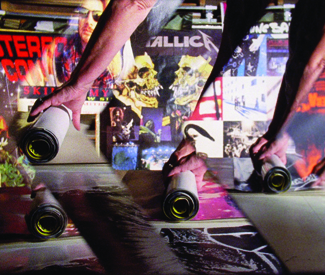
Crossroads, which is curated by Cinematheque artistic director Steve Polta, boasts several world premieres, including a pair worthy of particular attention: Jodie Mack’s Dusty Stacks of Mom: The Poster Project, and Scott Stark’s The Realist. At 40-something minutes each, these are among the longer works included in the program; both make the most of their running times to achieve artistically innovative and thematically complex results.

A partially animated, fully musical chronicle of the rise and fall of her mother’s mail-order poster shop, Mack’s Dusty Stacks of Mom lifts its tunes and certain motifs from Dark Side of the Moon. (Though the connection is never explained, it’s likely the Dark Side poster was a best-seller for the store, which specialized in dorm-room classics.) “Come and tour with me/my mother’s poster factory,” Mack sings by way of narration, as her camera discovers piles of cardboard tubes, stacks of handwritten invoices (which hint at why the business faltered in the Internet age), and images of stars like Leonardo DiCaprio and Johnny Depp frozen in time as their 1990s selves.

Stop-motion animation and eye-candy collages bring these paper performers to life, with Mack’s good-sport mother appearing periodically alongside what’s left of her inventory. Though some of the Pink Floyd covers-with-new-lyrics can skew a bit twee, Dusty Stacks‘ visuals never falter; this was clearly a labor-intensive labor of love for Mack, who teaches animation at Dartmouth. A particularly inspired sequence flashes between the holy trinity of college-dude decor: Che, Bob Marley, and Tony Montana.

Dusty Stacks anchors Crossroads’ “Gigs in the Sky: Let There Be More Light!”, which contains films tied together by music and “this post-Kenneth Anger kind of colorful thing,” as Polta calls it. Unlike more mainstream fests, which curate shorts programs with an eye for obvious links between the works, Polta tapped into a more intuitive process.

“The program ‘on the beach (at night)’ has a really interesting film by Jim Drain and Ben Russell called Ponce de León. It’s got these really strange camera techniques in it, and the way it deals with visual space is really interesting, outside of what it’s saying about the way people spend their time and the way generations look back and forth at each other,” he says. “When I saw the opening film of that program, Danielle Short’s Lost Ambulation, it was like, ‘Oh yeah. There’s this sort of depth and flatness going on.’ At a certain level there’s a whole thread in the avant-garde world about these issues; it’s just like talking about painting when you talk about depth and flatness.”

The programs began to take shape early on, while he was looking at all 400-something Crossroads submissions. “You start to take notes: here are some trends. This film and that film would look really interesting back to back. They start to assemble in these little sort of gravitational groups,” he says. “That’s the fun, or the challenge, of curatorial work. It’s like cooking: how can you get a certain kind of flavor, and what can you do to bring that flavor out? Here’s a really interesting film, and putting this other film next to it will sort of change the way you look at it.”

However, he adds, “I also think it’s worth leaving these connections a little bit mysterious. It’s interesting to kind of put these ideas out there and let the viewers sort of pick up on them, or not.”

Local filmmaker Scott Stark is the only artist in this year’s Crossroads to command a solo program (save the inclusion of a 1947 short by Fernand Léger). Stark’s latest, The Realist, uses flickering images of mannequins and consumer goods to investigate themes of “loneliness, desire, and presenting yourself in a certain way,” Polta says; it’s a mesmerizing work. But Polta is quick to note that, again, a sense of mystery is key to the viewing experience. “Part of the fun of The Realist is discovering, as you’re watching it, that there’s some suggestion of a narrative.”

A program of sorta-family-related films, “(as if clinging could save us),” contains another of Polta’s standouts: Jonathan Schwartz’s Animals Moving to the Sound of Drums.

“The film resonates with a well-known classical avant-garde film, [Jack Chambers’ 1970] The Hart of London, which also has to do with repetition of generational experiences through time, and relationships between animals and humans,” Polta says. More than that, though, “[Schwartz] makes films that are really bold in the ways they reach out and embrace sentimentality and emotionalism. They have a faith in sincere emotion that hasn’t been really hip in the last decade. I’d like to think that there’s a balance of that in this festival, between a certain kind of irony and a certain kind of sincerity. People are trying to work that out right now in the avant-garde world right now, whether to be sincere or ironic.”

Another emerging avant-garde star, Michael Robinson, has addressed this dichotomy in his work. His dreamy, glimmering 45-minute Circle in the Sand closes out Crossroads’ last program, “Slaves of Sleep”/”Destroy, She Said.”

“[Robinson has] made a lot of short films using found footage, stuff from video games, and music you’d hear on the radio — but in a way that sort of dares you to squeeze some real, serious emotion out of pop culture that most people would treat as this kind of ironic thing,” Polta says. “Circle in the Sand is mostly, if not completely, footage that he shot. It’s a science fiction film with a vague narrative; it feels like it’s set at a certain point in human evolution where the mundane world that we live in now isn’t going to matter anymore. It’s got a lot of mystery in it about what’s going to happen next to the human race — which is what we’re sort of leaving you with in the final program.” *

CROSSROADS 2013

Fri/5-Sun/7, $10 (festival pass, $50)

Victoria Theatre

2961 16th St, SF

www.sfcinematheque.org


Sabor de Oaxaca

4

marke@sfbg.com

WORLD EATS The first thing you probably need to know about the magical Southern Mexican state of Oaxaca is that sensory overload is always on the menu.

Ancient sci-fi Zapotecan ruins, Technicolor one-story colonial buildings, and an endless stream of live music, whirling dance, outspoken political protest, and eye-popping art justify the eponymous capital city’s reputation as one of the most vibrant crucibles of human culture on the planet. (Seriously, there is live music and dancing, from traditional to punk, outdoors in multiple venues until 3am most nights. San Francisco, where you at?)

The soaring mountains of the countryside host innumerable villages, each with their own dazzling take on local customs and artistic expression. The beaches, like renowned global hippie-nudist beauty Zipolite, expand expectations by drawing a saucy mix of laidback locals, hard-partying city folk, and misfit spiritual wanderers from around the world who greet the golden waves with fire-twirling at sunset and impossible-looking naked yoga at dawn. And for any travelers worried that this land of UNESCO World Heritage Sites has been completely sanitized for first-world tourists, there’s plenty of everyday chaotic Mexican street life and colorful off-the-map adventures in which to satisfactorily immerse oneself.

But all that’s not even talking about the food. Any foodie explorer worth her rock salt knows that Oaxaca is the “land of the seven moles” — rich, fragrant sauces, traditionally poured over roasted turkey, made from a range of pulverized ingredients including chili peppers, chocolate, nuts, cloves, dried fruit, and tomatillos. (A great SF introduction to mole can still sometimes be found at the Mission’s La Oaxaqueña, which has unfortunately been seesawing lately between being one of the city’s best restaurants and a bacon-wrapped hot dog stand on random nights.)

But in an area where dozens of indigenous languages are still spoken and villages are separated by vertiginous, day-long hikes through spruce cloud forests dripping with blooming epiphytes and eerie Spanish moss — by all means take a couple days out of your stay for a eco hike with Expediciones Sierra Norte to blow your nature-loving mind — innovation and improvisation is a way of life. Hunky Beau and I hopped down there for a far-too-affordable March getaway, and here’s what we dug our forks into.


ON THE STREETS

Mole gets all the press, but the backbone of Oaxacan street cuisine is the piping hot tlayuda, a very large grilled tortilla loaded with with bean sauce, guacamole, fresh and stringy Oaxacan cheese, and a hunk of grilled meat or scoop of zesty tinga de pollo stew that’s either served open-faced like a pizza or folded over like a crepe. The best ones we found in the city were at a pair of carts on Calle las Casas, conveniently located just down the street from the historic La Casa del Mezcal, opened in 1935. Ensconced in the Casa’s low light, you can slow-sip several kinds of maguey-derived liquor among baroquely carved wood fixtures, kitschy paintings of Zapotec warrior gods, and a motley assortment of fascinating locals. The mezcal flows until 3am, and the roughly $2.50 tlayudas even later, so you’re set for a good night out.

Oaxaca’s favorite fast food: the tlayuda. Photo by David Schnur

Or snatch a tlayuda for a perfect cheap dinner, paired with a steamy, meaty bowl of pozole from the carts down the block. (Fun fact: pozole is descended from the stew Zapotecs used to make of leftover human sacrifice parts. Now it’s mostly pork and corn.) Cheap breakfastwise, we were blown away by the scrumptious, hefty $2 morning chorizo- and omelet-filled tacquitos toasted on hot rocks by charming women on Calle García Vigil, near the Mercado 20 de Noviembre main market. Self-serve bakery Pan Bamby across from the huge, ever-bustling central zócalo serves a dizzying array of perfectly flaky empanadas for about 30 cents each, including several rare veggie options like creamed spinach and spiced vegetables. And, as always, the market is the best place to acquaint yourself cheaply with the local cuisine: witness the overflowing seafood cocktails at Mariscos Panchos and delectably overloaded roasted pork soft tacos, five for $3, at Carnitas Patlan.

Fascinating traditional drinks served at outdoor cart Nieves Cholito el Tule in the Plazuela de Carmen Alta include tejate (a crazy-sweet maize and cacao Zapotecan drink with a plasticky foam on top), chilacayote (made from a succulent squash with edible seeds as chewy treats), and syrupy tuna, a.k.a. cactus fruit.

And the mole? I want you to look up fabulously dramatic, yodeling folk singer Geo Meneses right now and imagine her backed by a full orchestra (six tubas!) in the open air of Oaxaca suburb Santa Cruz Xoxocotlan, which hosts enchanting, slightly witchy open-air Tuesday evening “Martes de Brujas” concerts, featuring an array of miracle street tamales from local venodors: chicken marinated in chocolaty mole negro, pork in tangy red mole coloradito or zippy mole verde, wrapped in eucalyptus-like yerba santa leaf. Kind of unbelievable.


IN THE SEATS

Mole, of course, also served as an entry into the more experimental cuisine of this tastebud paradise. When you can get a three-course meal for two with a bottle of surprisingly satisfying Mexican wine (Casa Madero of Parras de la Fuente is producing a quality chenin blanc, and Baja’s Cavas Valmar a perky grenache) for around $50, we went and splurged a little.

Intimate and colorful La Olla, near the imposing Santa Domingo church, is where you go for regional authenticity with flair. Wide, thin slices of beef tongue soaked in a mole verde of almonds, raisins, tomatillo, and cilantro; mole negro de fandango, a fantasy-fulfilling 25-ingredient mole negro over roasted chicken; and mole amarillo con pitiona, lively and yellow with corn masa, three kinds of peppers, and lemon verbena vanished from our table in a mad scramble of sauce-sopping tortillas.

La Biznaga is the hip joint, a “very slow regional food” operation named for a portly flowering cactus, its large courtyard decked out in vibrant Cuban hues, with towering chalkboards announcing the fascinating menu and a globe-hopping clientele lapping up pulque cocktails. (Mixing with milky, beer-like pulque, derived from the maguey plant, is super-trendy in Mexico right now, and should hit here any minute.) An appetizer of yerba santa-wrapped bricks of Oaxacan cheese drizzled with citrus liqueur-infused crema came off a lot lighter than it sounds. “El Necio,” a large hunk of flank steak stewed in a mole-like sauce of smoked chili, plums, and mezcal submerged us in flavor world several fathoms deep, while a mushroom and goat cheese-spiked coloradito lifted a fleshy fish fillet to the top of our list.

Jicama taquitos with grasshoppers, corn smut, and quesillo at Casa Oaxaca. Photo by David Schnur

If you’re looking for a true gourmet Oaxacan experience, though, the gorgeous Mission-style Casa Oaxaca, with its upstairs dining patio overlooking the kaleidoscopic downtown street hustle, is where you’ll find some of the most forward-thinking menu items that still pack an authentic local punch. Salsa is mixed and ground to tasted tableside in traditional molcajete mortar. Start with the exquisite, crunchy jicama taquitos filled with fried grasshoppers, cuitlacoche (corn smut), and quesillo cheese. Then, as the candlelight and atmosphere take hold, move on to absurdly tender venison bathed in ethereal mole amarillo and juicy slices of duck breast covered in nutty, deep orange mole almendrado.

Finally, for desert, slip back out into the captivating streets and share the refreshing carrot-apple-pecan ice cream flavor Beso Oaxaqueño, as the hypnotic local marimba music known as son istmeño drifts from the zócalo.

Two men, one spark

0

emilysavage@sfbg.com

TOFU AND WHISKEY It’s the B-story scene that rules 1983’s Valley Girl. Popped collar-sporting Skip is nervously riding his bike to the suburban home of his preppy high school girlfriend, Suzi — but we the audience know he’s more interested in her young step-mom. (He met the feisty Valley mom when she served him sushi at a house party. Gross me out.) It’s a palpable moment of orgasmic anticipation — with a surprise twist — that bops along perfectly to the soundtrack: “Eaten By the Monster of Love,” by experimental pop duo, Sparks (www.allsparks.com).

“Well, it’s worse than war, it’s worse than death/There ain’t too many left who ain’t been/Eaten by the monster of love(Don’t let it get me),” Sparks vocalist Russell Mael opines with a wide-ranging, Broadway-ready bravado, as his brother Ron Mael tickles a bouncy new wave blast out of his keyboards and synthesizers.

This is just one iteration of Sparks — the flashy new wave version, proudly on display in ’82’s Angst in My Pants LP, two tracks of which were used in that early Nicolas Cage vehicle, Valley Girl. But that’s only a small snippet of the band’s robust timeline, which got a running start in ’71 at UCLA, and continues to this day, with 22 albums and counting.

Sparks has had countless rebirths since the first record was released in ’71, the band then known as Halfnelson. There have been landmark albums like ’74’s electric Kimono My House, with that iconic cover of two powdered and kimono-swathed ladies, along with ’83’s synth-heavy In Outer Space, ’02’s chamber pop Lil’ Beethoven, and most recently, ’09’s The Seduction of Ingmar Bergman, a radio musical commissioned by Sveriges Radio Radioteatern, the radio drama department of Sweden’s national radio broadcaster. (More on that later.)

“It seems like the people that stick with Sparks appreciate that the band doesn’t rest on its laurels,” says Russell, a lifelong Angeleno, speaking to me from his home “in the hills above Beverly Hills.”

“I think that’s why we’re really proud of what we’re doing now; it doesn’t sound like a band that’s necessary had 22 albums,” he says. “Someone can come in fresh — a person that’s maybe never heard of Sparks — and if they hear the latest thing, we would be just as happy as we would be for them to have heard the first album.”

Sparks will perform much of its extensive back catalog during its Two Hands, One Mouth (the hands on the keyboard, mouth at the mic) tour’s rare stop in San Francisco next week, April 9 and 10 at the Chapel, 777 Valencia, SF. www.thechapelsf.com. As of press time, only April 10 is sold out.

The brothers Mael have recorded with dozens of other musicians over the decades, and nearly always toured with a live backing band, so the Two Hands, One Mouth trip has been a unique challenge. “It’s kind of the ultimate expression of self-containment for the band,” Russell says. “We just thought that at this point, it might be an interesting challenge to see what would happen if we just played as the two of us, and without computers or backing tracks.”

He adds, as if reading my mind, “It sounds simple, but we also didn’t want it to read as oh, singer-songwriter, that kind of thing where it lulls you to sleep with an acoustic guitar. We wanted it to keep the power that Sparks has had with the recordings and live band.”

The process has been about choosing the appropriate songs from the duo’s rich recording history, and distilling it with just one keyboard, and vocals. So far, the tour’s been well-received in Europe and Japan, with fans commenting on how this format has brought the strong vocals and songwriting to the forefront.

And the Maels work hard to layer those lyrics with humor, depth, and a drop of speculation. “It’s important to us to have something that’s provocative, but in ways that maybe aren’t like, being a punk band with a stance that you know what it is in five minutes. The Sparks stance is a little bit hard to articulate and place. We kind of like that too, that there is an ambiguity to what we’re doing.”

Their most recent project is that The Seduction of Ingmar Bergman piece. The plot of the radio drama is a farcical situation imagining that Ingmar Bergman had been lured to Hollywood and got trapped in the LA film industry in his worst nightmare — a big-budget action film he can’t figure out how to escape. The Swedish radio spot went so well that Sparks was asked to perform it live at the LA Film Festival last year, where they did so with a cast of 14.

The brothers are currently working on turning it into an ongoing theatrical performance — and also a motion picture. They have the Canadian director Guy Madden on board to direct, but still need the financial backing, so they’ll be flying out to the Cannes Film Festival in May to look for funders.

But before Cannes, Sparks will first play the massive sweaty shitshow that is Coachella for the first time. And yes, they will do it as a stripped-down duo — still just Two Hands, One Mouth.

“We know the show works in our own context, so we thought we should be faithful to ourselves and do it there as well, even if it seems incongruous with what you might expect at a big festival,” Russell says. Do I detect a tiny smirk through the phone? Perhaps wishful thinking on my end.

“It’ll be received however it will be received — [but] it will be different from other things there,” he says. “You tend to get blinded by an assault of 160 indie bands doing their indie thing. We’ll be doing whatever we do, whatever you want to call it.”


ESBEN AND THE WITCH

With swelling crescendos, emotional lyrics, gothy undertones, and shimmering vocals in tow, UK post-rock trio Esben and the Witch comes across the pond for the first time in two years, on tour with newest record, Wash The Sins Not Only The Face (Matador). Should be a witchy one. With Heliotropes.

Thu/4, 9pm, $13. Brick and Mortar Music Hall, 1710 Mission, SF. www.brickandmortarmusic.com.


GLAM.I.ROCK

Lyrically gifted young Oakland rapper Glam.I.Rock — the first half an acronym for “Good Lyrics And Music” — will perform a free in-store during Art Murmur this Friday. If you want to be in on an artist at the tipping point, this would be your chance. The MC has that classic ’90s female-empowerment hip-hop vibe but with some different interests (check the “Who is Glam.I.Rock?” video of her tapping out the Rugrats theme), and a more modern style.

Though like her predecessors, she still very much reps her home-base, performing “Inspire Oakland” at Oakland Digital’s Inspiration Awards last December. Makes sense, she’s the daughter of Nic Nac — the only female member of the Mobb crew — and Dangerous Dame, a member of Too $hort’s Dangerous Crew. Glam.I.Rock’s debut EP, The Feel, recently dropped on Savvie1ent/The Olive Street Agency.

Fri/5, 8pm, free. Oaklandish, 1444 Broadway, Oakl. www.oaklandish.com.


Precious Metal

0

emilysavage@sfbg.com

MUSIC A lot of elements needed to come together to inspire Metal Mother’s new record, Ionika. You can almost picture the woman behind the sobriquet, crouching in some foggy wooded wonderland, scooping up soil and critters, ancient buried treasures of forgotten societies and precious metals. Before we get into specifics, let’s slip off the mask. Metal Mother is really, mostly, the glossy coating of one delicate Oakland musician: Taara Tati.

In between the release and subsequent tour after her first album, 2011’s Bonfire Diaries, and the making of Ionika, which comes out in a week on April 16, Tati collected experiences that affected her future output. She picked wisdom up from extensive travels, Pagan and Celtic traditions, tales of ancient warrior women, and Sufjan Steven’s ’10 album The Age of Adz (which she listened to while exploring Europe for a month). Add to that Game of Thrones, the city of Oakland, the music of Son Lux, and all of Kate Bush. But the clearest running thread throughout Ionika is fascination with Druids.

“Getting into the whole ancient Celtic cultures thing, it was very matriarchal and tribal,” she says, sitting in her “incredibly cheap” Victorian in downtown Oakland. “It was a really profound lifestyle. The more I discover about that, the more I want to learn about it, to be able to see that history and sort of represent that in a way, or glean some power from that.”

She references the culture’s interest in psychoactive medicines, and Queen Boudica, a Joan of Arc-like figure of a British Iceni tribe who led an uprising against the Roman Empire.

“I really came into a full-on obsession last year when I was traveling in Europe. I went on this full journey to all these different ancient sites and sacred sites, and it was empowering for me to be there, and to feel the history of that land, and… my ancestors.”

Her lifelong inspirations, however, seem to have sprung from competing worlds; darkness and light, the electronic and the natural, woman and machine. And all those influences, all those cosmic connections are poured chaotically into Ionika, a densely layered, moody, and deeply spiritual release of 11 solid tracks.

The key track is first single “Prism,” a stunning Grimes-ish (if Grimes were a bit more wild) song with Tati’s many vocal tracks delicately laced throughout twitchy beats and drums. Equally breathy is “Prism”‘s sonic twin “Tactillium.” Some tracks waver questionably — “Windexx’d” kicks off with a harrowing grind and ghostly howl — while others sound as if they were ripped directly from her innards. The epic “Little Ghost” (clocking in at 7 minutes and 29 seconds) begins lightly with Tati’s crisp, otherworldly soprano vocals and a few click-click-clicks of the machines, then builds into an Enya-esque soundscape, with gently pulsating electronic drum hits.

Much of Ionika’s form and sensibility came from David Earl, an Oakland producer and sound engineer whom Tati met through friends. A multi-instrumentalist, Tati would write the songs’ skeletons alone in her Victorian — along with the vocals, and most of the melodies — then bring them to Earl and the two of them would pile on those folded ribbons of sound, with Earl adding crucial rhythms with beats and additional backing tracks.

“It was kind of insane, we had so many crazy, creative whims we went with. We didn’t really delete as much as I thought we were going to delete in the end, you know? We just went for it.”

“He took everything and put it on digital steroids, basically,” she says.


MOTHER RISING

Tati was raised “literally in the woods in Northern California,” in tiny Occidental, Calif. (population: 1,115) in Sonoma County, just west of Santa Rosa.

“I was left to entertain myself with the birds and insects and the critters out there. I have a huge love for the elemental part of the world, and also tribal rhythms and acoustic music and basic sounds forms in that way.”

These influences are clear in the earthly, rich melodies and rhythms of Metal Mother. The other half to her whole came when she began exploring rave culture in the ’90s. This is where she discovered electronic music.

It took both of these elements — the lush forest hangouts and the eye-opening rave nights to create the Metal Mother sound and aesthetic.

“It’s not super planned out, but those are just my preferences,” Tati says.

And yet, from the beginning, Tati has been almost entirely in control of her sound and career. While she’s picked up local musicians along the way, in particular to play as her backing band at live shows, and of course, Earl was a huge part of Ionika, she’s been the only constant of Metal Mother.

“I made every creative choice around the album,” she says. “I’m trying to really preserve my own sense of spirituality within putting out an image of myself around my music, to the world, outside of my own personal circle. That’s a huge part of who I am on a daily basis. I love herbs, rituals, and everything witchy, and I don’t want to have to tone that side down.” She laughs, a warm, frequent, occasionally nervous-sounding giggle.

After spending her early 20s in the street performance and renegade guerrilla performance art scene — mostly as part of the North Bay Art and Revolution, and a renegade little troupe called Action Creature Theatre — Tati unexpectedly shifted focus to music. She’d always dabbled in keyboards, but had never taken playing too seriously. And she’d all along been crafting poems and songs of her own. (Her mother was a theater director, which might explain the affinity for all things artistic expression.)

After friends discovered her “funny, quirky little keyboard songs,” they convinced her to play live, which she did and then quickly found her calling. “I’ve just been following all the open doors, that’s kind of how I operate my life. It’s just like, [going] where the doors are opening. And the doors started opening with music, rapidly, so I just went that direction.”

She named her new project Metal Mother, after the elemental fierceness of a mother and also a planet.

“I was just kind of wanting it to be like, maternal and loving and nurturing obviously, because I like to make pretty music and feel euphoric, but also that kind of fierceness because yeah, the world is a crazy place,” she says. “You’ve got to have that strength to endure some of the crude realities we’re faced with.” Those realities seem clearer when she describes looking out her bedroom window, to the poverty she’s faced with daily outside her doorstep, the homeless people huddled across the street, the loud chaos of the city whizzing by.

The name “Metal Mother” itself came from Joseph Campbell’s book, The Hero With a Thousand Faces, in which he talks of an ancient Chinese myth about the marriage of the Metal Mother and the Wood Prince — and that’s what brought lightness and darkness together, creating the human race.

It took most critics a minute to figure out that Metal Mother was not, in fact, a metal act.

After first album Bonfire Diaries came out in ’11, with its exhilarating single, “Shake,” Metal Mother was hailed as “ambient, sexy,” “beautiful, eerie, unfamiliar.” One review described the album as “tight, ethereal art pop filled with Bjork avant ambiance, Kate Bush drama, and tense Celtic underpinnings.”

Tati was on the cover of Performer Magazine, and featured in the Guardian’s first “On the Rise” batch of up-and-coming musicians last year, in which I wrote she was “some sort of neon, acid-drenched wood nymph.” (It works especially in the context of the video for “Shake,” viewing of which is highly suggested.)


THRUSTING FORWARD

Now, with the hardest part of Ionika over, Tati is free to pursue her next big project — Post Primal, a kind of loosely defined record label and collective she’s working to put together. Ionika is the label’s first release, and the only other band so far officially involved is Mortar and Pestle. But Tati has big plans for the near-future, boosted by others acts approaching her to express interest in Post Primal. Though, she admits, they’re still in the process of defining just what it will be.

“The whole goal is really to have a platform for more context for all of us to associate ourselves with. It’s also more of a collective, because I don’t really have a ton of money or anything to put out anybody else’s record, it’s just basically like we’re sharing resources, we’re sharing contacts and exposure.”

She also is hoping to find a warehouse space in Oakland to put on interactive collective showcases, and create a hub, a new music community in the heart of the adopted city she’s clearly still enamored of, more than six years after moving here. “I love Oakland so much. I’ve gone to a lot of other cities and checked out a lot of other scenes, but I always come home like, this is where I need to be, and this is where I want to grow.”

Metal Mother’s record release party takes place next month, May 2 at Public Works (www.publicsf.com) with all female-front acts: Tearist, Uncanny Valley, and Some Ember.


Three for the road

1

arts@sfbg.com

VISUAL ART Traveling juggernaut Christian Marclay: The Clock touches down at the San Francisco Museum of Modern Art this week for the latest stop along its endless summer tour of major world museums.

Marclay’s sprawling, oh-shit-inducing video work collages 24 hours worth of clips taken from both obscure and popular films, during each minute of which the correct time is shown on screen. Nominally, the artwork is about the representation of time in film, but it also manages to address some pretty heady concerns, including both the legacy of sweeping Victorian Age attempts to organize every last thing, and also the postmodern, now-seamless interchangeability of simulacrum with reality, making The Clock possibly the perfectly appropriate artwork for the era of Big Data. For the art wonk set, it caps conceptual investigations about indexes and taxonomies that stretch back at least as far as the 1970s, serving as the new-media, zero-degree equivalent of Ad Reinhardt’s all-black paintings. But more than that, it’s something unnervingly similar to Jorge Luis Borges’ fictional map of the world that is the same size as the world, an eerie herald of the age of Orwellian mindfuck as art.

You’re going to see it. Of course you are; it’s the most talked-about work of art since Damien Hirst dropped a preserved shark into a vitrine. But that said, you’re very unlikely to see all of it, unless you do so in May during one of SFMOMA’s scheduled 24-hour viewings.

And if you should give the entire viewing a go, you’ll be participating in what I suspect is the subversive heart of the The Clock, one that makes the entire concept of real time a kind of flimsy absurdism. Actually sitting in the museum in front of a single piece of work for a full day becomes a kind of performance, observing not just the comings and goings on screen, but also in the theater, engaging and disengaging in real life in equal, contesting proportion.

Marclay’s exhibition completes a crescendo at the museum, peaking just before the building closes for expansion, and the exhibits hit the road for various area temporary sites over the next couple years. Together with the current shows dedicated to photographer Garry Winogrand and architect Lebbeus Woods, The Clock is the third in SFMOMA’s trilogy on prolonged, meticulous fascination executed with utmost competence.

And about that Garry Winogrand retrospective, which in its way is even more overwhelming than the Marclay show: the thing you can’t escape while hopping, transfixed, from image to image, is that not only have half of these 300 photographs — many of them stunning — never been shown before, but that it was assembled from a massive archive including some 250,000 images that have never been seen, promising that Winogrand’s posthumous career will stretch on for quite a while.

And good thing, too, since these photographs, while rooted in the mid-late 20th century, are timelessly contemporary. We immediately recognize in them the same mix of unease, willful optimism, and absurdity that mark the post-9/11 world, realizing that disjointedness to be both a continuous thread and defining characteristic of American social fabric.

On the continuum of photographers, Winogrand is somewhere between Weegee’s operatic flair and Walker Evans’ incisive and empathic eye. There are definitely theatrical liberties taken with composition, but at heart Winogrand is a humanist. His particular knack inverts spectacles and intimacies, and his off-kilter shots deliver their actors amid a slippery, complicated search for the American dream.

His famous quote, that “there is nothing as mysterious as a fact clearly described,” speaks to both the allure and the central lie of his (and indeed all) photography. Although he began his career as a photojournalist, his main contribution was visual poetry over raw documentation. The tone of Winogrand’s later work, during which he focused on taking rather than developing or reviewing his photographs, is shot through with distress and disillusionment, as if the world imploded and dissolved completely somewhere around 1977. That late work, long ignored and incompletely catalogued, is featured here, and feels increasingly familiar and prescient.

On the second floor of the museum, the Lebbeus Woods retrospective offers a tonal break from the intense scrutiny of human interaction exhibited by the Marclay and Winogrand shows, but is no less sweeping or meticulous. Woods was a visionary architect of the possible, and although only one of his large scale projects was ever constructed, his psychologically-charged, intellectually-overloaded vision continues to reverberate throughout architecture and design worlds.

The show of 175 works, including models, drawings, and prints, is framed roughly by the Woods quote, “Maybe I can show what could happen if we lived by a different set of rules.” In the Woods universe, those rules bend physics and gravity for the sake of a complete reimagining of human-built structures. Part sci-fi, part utopian thought-experiment, the carefully and expertly drafted renderings of Woods’ theoretical architectural systems are as dizzyingly hypnotic as they are confounding to normal, run-of-the mill concepts of what a building is or should be.


CHRISTIAN MARCLAY: THE CLOCK

April 6-June 2

GARRY WINOGRAND

LEBBEUS WOODS, ARCHITECT

Through June 2

San Francisco Museum of Modern Art

151 Third St, SF www.sfmoma.org

SFBG.com to start charging for “premium content”

9

This will be the last day you can read this blog for free.

To reflect the changing environment of the new business, the SF Bay Guardian will begin instituting a $27-a-day paywall April 2, in what Managing Editor Marke B said was an attempt “prevent any sane person from actually reading this stuff.”

The site known as sfbg.com will remain in place, and remain free, but all content will be removed except for the comments of Lucretia Snapples and a selected number of “guests,” whose extensive contributions the Bay Guardian hopes to spin off as another packaged product in the coming months.

All staff-written content will now be available at sfbayguardiancostsalotofmoney.com. Except for Marke B.’s own Super Ego nightlife column, since no one really knows what the hell she’s jabbering on about anyway except teenagers, and teenagers don’t pay.

The idea of newspaper paywalls is spreading, with the San Francisco Chronicle creating one just this month. “We’re, frankly, just copying the Chron,” Bieschke, who also oversees Web operations, said. “If there’s nothing in one place and something somewhere else, and nobody knows which is where or why, then it only makes sense to charge a lot of money so the traffic will all go away and I can take a goddamn nap after yesterday’s all-nighter.

“Anyway, I say let the interns handle it.”

The fist style

0

le.chicken.farmer@yahoo.com

At the beginning of class, the children of the Oakland Kajukenbo Kwoon circle up and take a knee, with their heads bowed and their little fists pressed into the hardwood.

“I am powerful!” one little voice squeaks.

“I am fierce!” shouts the next.

“I am speedy!”

“I am unstoppable!”

It’s so freakin’ cool I don’t know what to do with myself and have to play with my phone just to keep from crying. They are learning something I wish I’d learned at five: how to have a say in things.

“I am somebody!” . . . is my personal favorite.

According to Sifu Kate Hobbs, a fifth-degree black belt and chief instructor of the school, vocalization is an integral part of self-defense. She lists “a voice that comes from deep in the guts” right alongside physical skills, agility, and timing, as factors she hopes will give her students a valuable edge if they are ever attacked.

For her, it’s all about the repetition of techniques and drills.

“I don’t spend any class time talking about what students might do if this or that happens,” she said. “Students are expected to attend regularly, engage fully, practice on their own, and stay for their whole lives.”

Kajukenbo, an American-made martial art, was established in the late 1940s in a violent Honolulu neighborhood by five black belts in five different Eastern disciplines — one of whom also happened to be Hawaii’s welterweight champion. So add a little Western pugilism to the mix.

Through this fist style, stilts the official Kajukenbo motto, one gains long life and happiness. The focus from the start — and Hobbs most definitely carries this torch — was on realism. Street smarts.

“Kajukenbo is beautiful and tough,” Hobbs told me. “It was created so men could kick other men’s asses if they got fronted on.” She described her own two Kajukenbo teachers as tough Irish-American women, and said she has tended — being herself of Irish descent — toward their “practicality and gritty-but-humorous self expression.”

Hobbs, who teaches a “Little Tigers” class for 3-5-year-olds, as well as older kids and adults, quoted Sijo Adriano Emperado, one of the five founders of Kajukenbo, as saying that “a great class was one where blood was shed.”

OK. But also, it’s cute. At least watching kindergartners practice “this fist style” is.

The parents who line the sidelines with me at the St. Columba Church in North Oakland seem sometimes mesmerized, sometimes traumatized, and sometimes proud as punch(es), watching their li’l beloveds stumble and soar through a variety of agility drills, jabs, and kicks.

I can speak for myself. Underlying everything, there is a sense of incredible gratitude, watching the kids I love (and worry about), as if they were my own, learn and practice something fundamentally important: using their five senses, their voice, and their bodies to not only defend themselves, but express what happened afterwards.

Sifu Kate, as they all call Hobbs, has a way with kids, and I feel like I could learn a little Nanny Fu from her, too. Without any perceivable effort, she has their respect and, generally speaking, their attention.

“I think I have a great combination of patience with the wild and unfettered nature of humans, and the timing of the drills and lessons,” she told me.

Watching my charge, Chunk de la Cooter, going through the running drills, forwards, backwards, skipping, grapevining, leaping, twirling — with an athletic grace I hadn’t yet seen in her — of course I couldn’t help imagining her with a soccer ball. And vowed to stay healthy enough to play on her rec league team one day.

When she’s 21, I’ll be 65. But that’s OK. I’m inspired, and she’s in excellent hands.

“Is Kung Fu sports?” I asked her in the car, driving home.

“No,” she said.

Then, after a brief period of reflection, she said: “Yes.”

Then: “We’ll ask Daddy.”

Hobbs, who I also asked, said, “I don’t think martial arts practice is anything like team sports. It is very individual and the competition is personal.

“We partner and we need each other to learn, and we bond,” she said, “but it has a totally different tenor.”

Among the lessons she feels are most important: Commitment, focus, love, self-respect . . . “Connect with the world,” she said. “Be open and curious, not afraid and careful, but large and messy and ugly.”

Oakland Kajukenbo Kwoon

www.oaklandkajukenbokwoon.com

sifukate.hobbs@gmail.com


Faith in flow

0

culture@sfbg.com

ON THE OM FRONT Every Tuesday evening, hundreds of people flock to the Grace Cathedral Labyrinth to practice yoga with local teacher Darren Main. With Easter around the corner, I talked to Main and the Reverend Jude Harmon, who manages the program, about how this unlikely class came to be, and why it works so well in San Francisco.

San Francisco Bay Guardian Darren, how did you wind up teaching the class at Grace Cathedral?

Darren Main Jamie Lindsay, a yoga teacher who had been attending Grace Cathedral for years, started the class there. When he moved to New York in 2009, he asked me if I would take the class. I had long admired Grace Cathedral for both its architectural wonder as well as how it has been on the cutting edge of social justice and spiritual equality. Right from the start I could feel something magical happening. What started off as a small group of students has now grown to over 300 people each week.

SFBG How does yoga fit in at the church?

Jude Harmon Grace Cathedral was established with the founding vision “to be a house of prayer for all people.” We were at the forefront of civil rights, welcoming Martin Luther King Jr. to preach here, and we paved the way forward for the embrace of LGBT people in the sacramental life of the Church long before it became the norm at a national level. This yoga class is just a natural extension of our commitment to welcome all people, from every walk of life, and to support them in their spiritual growth.

SFBG What’s it like to teach yoga at Grace?

DM It’s an amazing experience. You can’t help but feel something sacred by simply walking through the door. It’s like teaching in the Taj Mahal or the Great Pyramid. People come from all over the world just to see this building, walk its labyrinth, and admire the architecture and artwork. I am moved to tears sometimes when I think of how much this cathedral — and specifically doing yoga in this cathedral — represents the magic of San Francisco.

SFBG Do you have to be a churchgoer to attend?

DM Not at all. Yoga is a science, not a religion and so it requires no belief to be effective as a practice for quieting the mind, opening the heart, and balancing the body. In fact, many atheists find yoga extremely rewarding. Non-Christians attend the class for the community, the practice, and the beauty of the cathedral.

SFBG Can yoga enhance one’s spiritual practice?

DM Yes, because it helps us to more easily access the divine when we have a quiet mind, a balanced body and an open heart. Yoga can also be a way of exploring the same universal questions that religion explores, like “why are we here?” and “who are we?”

SFBG Does the practice of yoga connect in any way to the practice of Christianity?

JH I remember the first time I saw the yoga students ascending Grace Cathedral’s great steps in droves on the dusk of a July evening. They seemed like angelic visitors from some Hyperion realm. But they weren’t carrying Books of Common Prayer in their hands, or hymnals, or even Bibles — they were carrying yoga mats! While most of them wouldn’t dream of setting foot in a church for a traditional Eucharist, I felt my heart bond with them. At the heart of a yogic practice, just as at the heart of our Eucharistic practice, is the possibility of a self-integration that opens out our consciousness toward the world in compassion.

SFBG What is the yoga class like?

DM Given that the class is so diverse in terms of age, physical ability, and level of yoga practice, I focus on the more gentle and meditative side of yoga. The cathedral itself invites a more inward and contemplative experience as well, so it is really a perfect fit. Every week, I invite Bay Area musicians who have a transcendent quality to play at class.

SFBG Why do you think a class like this became so popular in San Francisco?

DM San Francisco has always been known for being open-mined, and that quality makes people open to the unique experience of doing yoga in a church. That said, I would not be at all surprised if we see this idea spreading beyond the Bay Area over the next 10 years or so.

Karen Macklin is a writer and yoga teacher in San Francisco. Read her On the Om Front column every other week on the SFBG Pixel Vision blog.


Alternative medicine

0

arts@sfbg.com

FILM No country exports mainstream films to the extensive success that the US does. To the frequent chagrin of local filmmakers and cultural watchdogs, Hollywood dominates many nations’ box offices, non-English-speaking ones included. Nor do we reciprocate much — there remains a wide separation between what are perceived as commercial entertainments and “art house” films, with foreign-language (or even just British) ones almost invariably limited to the latter category.

We’ve all rolled our eyes at otherwise sophisticated people moaning that they can’t be bothered with even the most accessible movie in another language because subtitles are too much trouble. As a result, ‘murricans seldom hazard big-screen exposure to anything but the most rarefied, prize-winning, serious, or conceptually novel features from other nations. While we feed them plenty of our mall flicks, their less-than-exceptional homegrown genre movies are considered to have little marketable value here. (Save as fodder for remakes, of course.)

So it’s a tiny bit unusual when one week brings openings of two movies unalike in every aspect save their being solid if unremarkable examples of mainstream hits abroad. French-Canadian comedy Starbuck and German crime thriller The Silence are both an uptick or two above “decent,” but they hardly sport the thematic-stylistic edginess or other qualities that usually win US distribution. They’re just kinda fun.

Maybe “fun” is a tasteless way to describe The Silence, which hinges on pederasty and child murder — though in the end this is more an intelligent pulp thriller than serious address of those issues, uneasily as it straddles both at times. In 1986 two men abduct an 11-year-old girl — one the initially excited, then horrified observer to the second’s murderous sexual assault. Twenty-three years later, another young girl disappears in the same place under disturbingly identical circumstances.

This event gradually pulls together a large cast of characters, many initial strangers — including the original victim’s mother (Katrin Sass) and the just-retired detective (Burghart Klaubner) who failed to solve that crime; parents (Karoline Eichhorn, Roeland Wiesnekker) of the newly disappeared teen, who experience full-on mental meltdown; a solidly bourgeoisie husband and father of two girls (Wotan Wilke Möhring), inordinately distressed by this repeat of history; and the erstwhile friend he hasn’t contacted in decades, an apartment-complex handyman with a secret life (Ulrich Thomsen).

Part procedural, part psychological thriller, part small-town-community portrait, director-scenarist (from Jan Costin Wagner’s novel) Baran bo Odar’s The Silence is just juicy and artful enough to get away with occasional stylistic hyperbole. Let alone having enough subplot intrigue and weirdo characterizations — Sebastian Blomberg’s spazzy grieving-widower police detective is a bit much, in the Anthony Perkins tradition — to float a miniseries. It’s a conflicted movie, albeit handled with such engrossing confidence that you might not notice the credibility gaps. At least until thinking it over later. Which, don’t.

There’s no complicated narrative brain-teasing in Starbuck, which has a great (if not entirely original) comedic concept it chooses to play seriocomedically — i.e., less for the laughs it seldom earns than for the heart-tugging it eventually pretty much does. An ingratiatingly rumpled Patrick Huard (a major Quebec star best known for the mega-hit Les Boys series and 2006’s Good Cop, Bad Cop) plays David, erstwhile stellar contributor to a Montreal sperm bank in his salad days. Now older but no wiser, he finds himself confronted by the reality of 533 biologically fathered, now-grown offspring who’ve filed a class action lawsuit to discover his identity even as he deals with mob debt and an exasperated, pregnant semi-ex-girlfriend (Julie LeBreton).

This is one of those “loser man-boy must semi-grow up fast amid crisis, finding family values en route” scenarios tailor-fit for Adam Sandler. That said, the overlong, stubbornly endearing Starbuck is so much less insufferable than anything Sandler has made since … um, ever? Halfway through, this agreeable movie gets clever — as David stumbles into a meeting of his prodigious anonymous progeny — and remains reasonably so to the satisfyingly hard-won happy ending.

It’s still got moments of contrivance, editorial fat (too many montages, for one thing), and more climactic hugs than any self-respecting dramedy needs to get the redemptive point across. Yet it’s also got something few comedies of any national origin have today: a lovely, distinctive, bright yet non-cartoonish wide screen look.

THE SILENCE opens Fri/29 in Bay Area theaters; STARBUCK opens Fri/29 in San Francisco.

Mind-doggling

0

cheryl@sfbg.com

FILM Poor Dolph Springer. His life’s already oozing downhill — he’s been unemployed for months and yet continues to show up at his old job, to the white-hot annoyance of his former co-workers — when his beloved dog, Paul, goes missing. His favorite backyard palm tree is suddenly a pine tree. His alarm clock flips from 7:59 to 7:60 every morning. Pretty much everyone he meets, from a pretty pizza-restaurant cashier to a traffic cop to the “top-level detective” who gets drawn into the search for Paul, behaves precisely the opposite of whatever normal would seem to be. What’s a lonely man living in a permanent state of mindfuck to do?

Wrong is the latest surreal-absurdist-subversive comedy from writer-director-cinematographer-editor Quentin Dupieux, who rightly earned a cult following for 2010’s wickedly funny Rubber (about a tire that goes rogue after summoning Carrie-like powers of destruction). The French filmmaker — also known by his musical pseudonym, Mr. Oizo — attempts a slightly more conventional tale with Wrong; Rubber‘s Jack Plotnick stars as the hapless Dolph. Unfortunately, for all its deadpan weirdness, Wrong contains nothing so genius as that diabolical tire.

However, few movies do, and for every element that telegraphs forced quirk (rain pours down indoors at Dolph’s office, because … why?), there are several that actually do work. As Dolph’s gardener, Victor, French comedian Eric Judor mixes his thick accent with hilariously dry line readings, and the detective character (Eastbound & Down‘s Steve Little) dresses exactly like Indiana Jones for reasons unknown — which is just as nonsensical as the rain thing, but funnier for being more subtle.

The lost-pet narrative that propels the story is nothing original, though Dolph’s quest is perhaps more existential than, say, Diane Keaton’s in last year’s not-dissimilar (but much warm-fuzzier) Darling Companion. Both films put forth the idea that humans and dogs can communicate telepathically — though in Wrong, it’s made out to be hilariously literal. Soon after Paul vanishes, Dolph learns he’s been pooch-napped by one Master Chang (William Fichtner, sporting a rat tail), a Zen-ish self-help guru who steals other peoples’ pets at random to make sure they’re being properly appreciated. Traditionally, he returns the animals once everyone’s attitude has been properly realigned, but there’s been, uh, a complication with Paul, who is now well and truly MIA.

As Dolph rightfully freaks out — amid even more bad news, like when his boss (who already fired him once) tells him he really needs to stop hanging around, or when the pizza clerk turns shrill and decides that Dolph is her destiny — the Master tries to soothe him. See, he happens to be the author of a two-volume series, My Life, My Dog, My Strength, featuring clip-art illustrations (“Diagram 13-D: Mind Link”) that instruct humans on making psychic connections with their canines. Just mind-link with Paul, and he’ll be found!

If that sounds like a lot to take in, it is. I didn’t even get to the subplot about Dolph’s neighbor who goes jogging every morning, but has a mental block against admitting it. (This “joke” is made more than once.) Though Wrong is a mere 90-something minutes, its deliberately slow pace and frustratingly even keel can be off-putting. Clever touches, like the use of ominous sound flourishes at seemingly innocuous moments, enhance the film’s overall bizarro-world milieu. But its overall success likely depends not on Dupieux’s artistic choices, but on the individual viewing it — and whether or not he or she finds its details tedious, twee, or transcendent. Me, I miss the tire. *


WRONG opens Fri/29 at the Roxie.

Fallacis and fallacies

0

arts@sfbg.com

THEATER Speaking of oneself in the third person is a thing few figures outside of fiction can really pull off. Tarzan and Yoda, fine. Oriana Fallaci — well, in journalist-playwright Lawrence Wright’s new two-hander, Fallaci, you could be forgiven for thinking the title character is not that real either.

But she was. And in a way the cartoonish aspects of this clunky bio-play do some unintentional justice to the sillier and more reckless and reprehensible qualities of the influential Italian journalist and war correspondent known for her confrontational interviews with powerful men like Henry Kissinger and the Ayatollah Khomeini, as well as for her post-9/11 book-length screeds against Islam.

Berkeley Rep’s production, directed by Oskar Eustis of New York’s Public Theater, opens on a sixtysomething Oriana Fallaci (Broadway veteran Concetta Tomei donning Italianate gestures) at home in her book-cluttered New York brownstone as a young New York Times reporter comes calling. Maryam (a somewhat anemic Marjan Neshat), a fictional creation of the playwright’s, is an Iranian American journalist tasked with preparing the obituary on the famous Italian now battling cancer (such an assignment being a standard practice at the paper for subjects of hefty historical stature). We soon learn that Maryam, who has idolized the older woman since the latter famously threw off her chador during her interview with Iran’s Khomeini, “fought like a tiger” for the assignment.

She gets past Fallaci’s initial brush-off a bit too easily to be believed, but secures a 25-minute interview with her cagey and self-aggrandizing heroine. Early on, Fallaci lets drop several casual racist dismissals of Iranians, Mexicans, and others as she recounts the highlights from her storied career and slowly opens up (or seems to) about her personal life, especially her father and the child she lost. Maryam, who seems to have all of Fallaci’s published writings memorized, is quick to recognize inconsistencies, however, and to call her out on them. “This is a lesson for you, huh?” prods Fallaci. “Find the lie.”

Fallaci’s master class in the art of the interview is baldly spelled out a little further on: the interviewer is out to violently expose her subjects, insists Fallaci, to lay them bare, but ultimately as an “act of love.” This, indeed, is the dynamic set up, in both directions, between Fallaci and her protégé-antagonist who defends a moderate version of Islam against the older woman’s insistence that “moderate Islam does not exist,” and so on. Several years pass and Maryam returns to confront Fallaci again. By now Maryam is a best-selling author herself (she seems to have written a book reminiscent of Azar Nafisi’s Reading Lolita in Tehran). She has also become a more devout Muslim and, moreover, has returned from an Iranian prison where nothing less than the intervention of Fallaci seems to have saved her from execution. However, now it’s Fallaci’s turn to dig into Maryam’s father complex —producing in no time a revelation as crassly dramatic as it is impossible to take seriously in so heavy-handed a form.

As if the mishmash of citation, exposition, and motivation that makes up the dialogue were not wearying enough, each time the dramatic tables turn in this play they creak so loudly you want to hide under your seat. Equally strained and unconvincing are the roughly managed philosophic debate about the relation between truth and drama and the half-hearted infusion of operatic overtones — naturally, and far too predictably, Fallaci’s story lends itself to the comparison, and it asserts itself like an afterthought in a dry-ice moment at the end.

But more disconcerting than the clichéd premise and the poor staging (which includes uneven, often leaden performances) is the way the relationship at the center of the play has a way of sweeping fundamental issues, and serious charges, under the carpet in the name of a shared admiration and soul-bearing. Those interested in a more serious investigation of such subject matter would be better off at Yerba Buena Center for the Arts, where the current gallery exhibition, “Without Reality There Is No Utopia” (through June 9; www.ybca.org), provides a lively critical engagement with the vast false narratives of the age, including the role of media and journalism in the ideologically laden construction of historical truth.

FALLACI

Through April 21

Tue, Thu-Sat, 8pm (also Sat, 2pm); Wed and Sun, 7pm (also Sun, 2pm), $29-89

Berkeley Repertory Theatre

2015 Addison, Berk.

www.berkeleyrep.org

Hospitable pectorals

14

caitlin@sfbg.com

SEX The clan I had assembled that day in my living room had little idea what was in store for them.

“So they’re strippers?” one of my friends hoped, fingering their tumbler of champagne.

“Not strippers, they’re sexy butlers. Same tipping rules,” I said. “They’ll serve drinks and do icebreakers.” “Oh.”

The parties in our living room are rarely in need of icebreakers, but the offer from the Bare Bachelors (www.barebachelor.com) to do a test run at a hastily-organized cocktail hour in honor of my roommate’s birthday — for journalism, mind you — was not one, I felt, a thinking person would pass up.

************

“I was looking for this kind of business and it didn’t exist in San Francisco.” I’ve installed Bare Bachelors founder Maureen Downey at my kitchen table so we can talk as two of her “actors, models, bartenders, or whatever,” attired in jockey briefs, aprons, and bow ties prepare Cazadores-and-grapefruit-sodas for the suddenly-awkward guests in the living room.

Downey, who tells me her previous career was in medical device clinical research, envisioned a party service less “dated” than strippers, but still sexy. It’s a combination that makes sense for the straight 30-something lady clientele Bare Bachelors has been attracting, mainly through word of mouth, since 2010. Downey’s Bachelors are self-aware, scantily clad caterers. She hopes to expand the clientele base.

For individuals well used to groin-thrusting go-go’s under strobe lights — or Dolores Park on a sunny day, as one of my guests pointed out — the Bare Bachelors’ impressive pectorals will not have quite the same novelty. But they charmed the goddamn pants off of the birthday boy, were handsome, and managed to get surprisingly candid during the game of Never Have I Ever they happily catalyzed.

************

So candid, I thought I’d open up the party to a little Q&A for my guests. Which was a mistake.

“So if someone, like, gave you a little more money will you, you know, go further?,” inquired another roommate emboldened by her tequila-and-grapefruit.

“No, absolutely not.” The Bare Bachelors tittered nervously, pecs unsure about the appropriate course of action under this kind of scrutiny.

“Do you consider yourself sex workers?,” her line of questioning pressed on, unrelenting in its desire to contextualize the Bachelors.

“No, definitely not.” The room pondered its next probe, but was unable to go further down the rabbit hole before one of my more socially-sensitive friends effectively closed interrogations.

Post-Bachelors, we reconvened for a processing session. Results were mainly favorable: “not creepy,” “tried to mesh with the group,” “the biggest problem was that there were no tits,” “visibly shy,” “pretty tasty drinks,” and perhaps most succinctly: “really sexy, and they had ass hair!”

THIS WEEK’S SEXY EVENTS

Spring Breakers Various Bay Area theaters. ATL twins, Gucci Mane, Vanessa Hudgens, blatant perversion of typical crime movie gender roles — Harmony Korine’s latest cult classic is the sexiest film of 2013 and you should see it before you get secondhand sick of the catchphrases.

Goodbye Gauley Mountain Sat/30, dinner 6:30pm, screening 7pm, $10-100. Center for Sex and Culture, 1349 Mission, SF. www.sexandculture.org. Feminist porn pioneer Annie Sprinkle and partner Beth Stephens premiere the couple’s documentary on their ecosexual relationship with the Appalachian mountains and the crusade to stop destructive mining practices. Come early for the pre-screening vegan Appalachian dinner.

FEAST: 5 stoner cookbooks

0

culture@sfbg.com

FEAST If that joint’s got you jonesin’ for some serious grub, look no further. We’ve rolled up the latest and greatest in stoner cookbooks, perfect for any discerning bud lover’s taste test. No, we didn’t include any weed-infused recipes in this list, but hey, feel free to augment the recipes in the brownie cookbook. Whether you’re a marathon midnight toker or a one hitter-and-quitter, we understand your need for accessibility, availability, and general ease in eating after that smoke sesh. But move beyond Pop Tarts — even the most gourmand of pot heads could use some guidelines for grilling up goodies every once in awhile.

THE MAC AND CHEESE COOKBOOK BY ALLISON AREVALO AND ERIN WADE

Get your mac on. Allison Areval and Erin Wade, co-owners and authors of The Mac and Cheese Cookbook dish out 117 pages dedicated to one of America’s most beloved dishes, based on the crowd pleasing specialties dished up in their Oakland restaurant Homeroom. The book is an homage to Homeroom’s endless variations on the classic orange variety. That’s good news if your cravings leave you hankering for a variety of tastes. Basic bechamel sauces figure on the pages alongside smoky bacon, blue cheese, sriracha, and jalapeno poppers. There’s even a section on desserts suitable for your post-mac munch.

Ten Speed Press, $16.99

FIFTY SHADES OF BACON BY JENNA JOHNSON AND BEN MYHRE

This self-proclaimed “erotic” cookbook sinks its teeth into all things bacon. Bacon au gratin, bacon-wrapped asparagus, bacon Alfredo (just to name a few) — this pork-inspired parody cookbook has all the seductive appeal of its sexy, silly source material. But instead of a half baked S&M narrative, Johnson and Myhre’s book gets you off with five different carnivorous sections of easy-to-follow recipes. A seductive succession of events unfolds with chapters entitled “Foreplay,” “Multiple Orgasms,” “Morning Wood,” and “Bondage”, where bacon bits, bacon jam, bacon martinis, and bacon peanut stoke your stoner flames. And even if pig parts don’t get you off, they’ll almost certainly taste better when you’re high.

CreateSpace Independent Publishing Platform, $19.95

TRY THIS AT HOME: RECIPES FROM MY HEAD TO YOUR PLATE BY RICHARD BLAIS

We’ve all done it. Remember that time when you were so high, you thought putting chocolate sauce on canned jalapeños was the most genius concept ever? Until, of course, you made that dream reality and were left with a wounded mouth and sobering regret. It turns out, however, that unlikely pairings aren’t always painful. Top Chef: All Stars winner Richard Blais proves it to us in this cookbook. From root-beer basted lamb-shanks to coffee butter pancakes, the chef’s recipes do flavor exploration the right way — 125 right ways, to be precise. Go forth and concoct creatively.

Clarkson Potter Publishers, $30

MAD HUNGRY CRAVINGS BY LUCINDA SCALA QUINN

Lucinda Scala Quinn takes on take-out. Her mission in Mad Hungry Cravings is to reconcile the almost unbeatable deliciousness of fast food with the nourishment and nutrition that a home kitchen can produce, without a lot of work. Can good for you also be good for munchies? Damn straight. While raising three boys in NYC, where street food beats about anything found in the fridge (particularly if you’re a ravenous adolescent), Quinn had to create home-cooked meals capable of competition with street dogs and shawarmas.

Artisan, $27.95

BRILLIANT BROWNIES AND BARS: 25 FAVORITE BROWNIE AND BAR RECIPES BY COOKING PENGUIN

Stoners, perhaps more than most, know that not all brownies are created equal. If you have ever tried to make a batch of brownies with your favorite herb, you know it requires a careful balance of elements and timing. This book’s sugary-sweet offerings are winners, and recipes are composed with chocolate and without for more innovative pastry pleasure. The pages start with the standards and segue into non-traditional options, like cocoa-avocado, pumpkin pie, and nonpareil brownies. If you’d rather stick to the classics, try whipping up chocolate walnut brownies or Cooking Penguin’s ace pecan blondies.

168 Publishing, $12.95

FEAST: Fave leaves

0

What to do when printing the news and raising hell leaves you with an appetite for healthy greens? Let the Guardian staff guide your salad steps.

SLANTED DOOR’S GRAPEFRUIT AND JICAMA SALAD

Can a salad be declared a cult classic? Mention the Slanted Door to a veggie-loving type and inevitably, the grapefruit and jicama Salad is the first thing off his or her lips. It’s so popular it’s on the lunch menu, the dinner menu, and is offered for takeaway or casual noshing at Out the Door, next to the Ferry Building restaurant. Since when do people go to a fancy, critically-beloved restaurant serving all manner of Vietnamese cuisine and walk out raving about a humble salad? And maybe go back the next day ’round noon for the to-go version? Since Chef Charles Phan created this mélange of grapefruit, jicama, red cabbage, pickled carrots, and candied pecans, apparently. (Cheryl Eddy)

1 Ferry Building, No. 3, SF. www.slanteddoor.com

HARD KNOX CAFÉ’S BLACKENED SHRIMP SALAD

Peruse the soul food offerings at San Francisco’s mouthwatering Hard Knox Cafe and you will likely be tempted to go all-in. Three-piece fried chicken? BBQ pork spareribs? Mac ‘n’ cheese? You could go there. Or, you could exit this delightful Southern homestyle-cooking establishment without plunging into a food coma directly afterward. Go with the blackened shrimp salad and you won’t be disappointed. The shrimp is cooked to tender perfection and coated in delicious Cajun seasoning with just enough bite. Paired with mixed greens, iceberg lettuce, tomatoes, mushrooms, red onions, and slivers of pepperoncini, we recommend trying it with the vinaigrette dressing. The waitress told us the salad has changed up a bit from the way they used to make it, so you may have to adjust if it’s already an old favorite. (Rebecca Bowe)

2526 Third Street, SF. 448 Clement Street, SF. www.hardknoxcafe.com

CHA CHA CHA’S WARM SPINACH SALAD

This isn’t the salad to order when you’re looking to cut back on calories, but goddamn it is good. Pretty much all of Cha Cha Cha’s New World cuisine gets five stars in my book, but just the thought of its warm spinach salad is enough to make me drool. The dish consists of thick bacon chunks, bits of mushroom, and green onion tossed in a warm Dijon mustard-sherry wine cream dressing. The dressing is cool enough to keep the leaves from wilting and warm enough to encourage you to dig in while it’s hot. (Cortney Clift)

1801 Haight, SF. 2327 Mission, SF. www.cha3.com

THE PLANT’S DINO KALE SALAD

Dino kale is all the rage. And why shouldn’t it be? It’s a hearty, richly-vitamin-packed dark leafy green. Plus, it has the word “dino” in it, which gives it a super cool edge. Likewise, the Plant Cafe, with locations at the Embarcadero, Financial District, and Marina, is known for a more decadent, and thus more exciting, take on the healthier side of lunch. Put those together, and you get the delicious, vegan, and gluten-free dino kale salad, with the aforementioned leafy green, avocado, red quinoa, almonds, cucumbers, tomato, and a fresh and tangy lemon cumin vinaigrette — that cumin packs the wallop. It’s the dish a Yelper recently described as the “best salad on earth.” I’m not about to disagree. (Emily Savage)

Various SF locations. www.theplantcafe.com


FEAST: Adventures in crabbing

1

brooke@bayguardian.com

FEAST I’ll admit, the prospect of DIY crabbing during our Bodega Bay camping trip was enough to give me pause. But the thought of a pot full of freshly caught crabs cooking over a campfire was enough to kick off a quest to add “amateur crabber” to my resume.

Taking a cue from our stomachs, my camping crew did some research. We needed advice and supplies, and a single trip to the Outer Richmond yielded both.

The owners of Gus’ Discount Fishing Tackle were happy to help some flailing first-time crabber, and outfitted my group with a circular crabbing net, rope, bait bag, and crab measuring gauge. Since we were venturing outside the city for our quarry, we opted to buy bait closer to our crabbing site (the better to avoid a fish-scented car.) Upon our arrival in Bodega Bay, we headed to Diekmann’s Bay Store for frozen mackerel and squid (for the crabs) and deli sandwiches (for the humans.)

Well armed, we made our way to the rock jetty that stretches past the harbor in Bodega Bay’s Doran Park. We picked out a sunny, unoccupied stretch of rock, chopped up some mackerel — the bloodier the better, we were advised, since crabs hunt with their noses — zip-tied our bait bag to the bottom of the net, and tossed it into the bay. Then we got busy chatting, snacking, and getting tips from other crabbers. (One entrepreneurial crab hunter suggested using a barely-open can of cat food as bait, but we stuck with the mackerel and squid to preserve the natural order of things.)

Every 20 minutes or so, we pulled our net in to see if it had snagged any crustacean treasures. We didn’t have much luck snagging specimens that met California Department of Fish and Wildlife size requirements — 5.75 inches for Dungeness (in season until June 30th), four inches for rock and red crabs (in season yearround.) We successfully netted one beefy Dungeness and one rock crab.

One of our neighbors (not the cat food guy) was a little more lucky, and managed to pull in what seemed like buckets of crabs. We begged for tips, but he was using the same trap and same bait that we were. We decided that staking out a good spot on the jetty was everything when it came to crabbing, and noted that many of our more-experienced peers took a more mobile approach to the hunt.

And then: seals. When the other crabbers saw them, they began to pack up and leave. We thought they were cute.

Pro crabbing tip: seals are not cute. If they arrive while your net is submerged, they are most likely after your bait and you are done crabbing for the day. If you stick around, you’d better be OK with your bait cage being dismantled by their nimble maws or losing your bait bag entirely. Or both.

When one of the seals was beelined for our net, we moved to the opposite side of the jetty, but to no avail. Five minutes later, it resurfaced, bait bag in mouth. To the excitement of a pack of squawking seagulls, the seal ripped it open and devoured its contents — the last of our bait.

Bait bag decimated, dreams of crab feast crushed, we headed home with the two crabbies we’d managed to catch.

They were delicious.


GUS’ DISCOUNT FISHING TACKLE

3710 Balboa, SF

(415) 752-6197

www.gusdiscounttackle.com


DIEKMANN’S BAY STORE

1275 Highway 1, Bodega Bay

(707) 875-3517

www.diekmannsbaystore.com


DORAN PARK

201 Doran Beach Road, Bodega Bay

Day use: open 7am to sunset; $7 per vehicle

Campsite: check-in 2pm, check-out 12pm; $26–$32 per campsite

(707) 875-3540


Do we care?

77

steve@sfbg.com

Teresa Molina faced abusive, belittling treatment on the job.

The 52-year-old immigrant from Sinaloa, Mexico, says she was paid $500 a month to provide 24-hour, live-in care to a girl in a wheelchair and her family. She wasn’t allowed regular breaks. She couldn’t eat what she wanted. Even her sleep was disrupted.

“I spoke up a couple times, but when I did, my employer told me I was dumb and good for nothing,” Molina, speaking Spanish through a translator, told us. “She would ask my immigration status, and I said that was not important, but she used that as a threat.”

Molina is a domestic worker — one of the only two professions (the other being farm work) exempt from federal labor standards.

Her experience, a common one among immigrant women in California, prompted Molina to get involved in last year’s California Domestic Worker Bill of Rights campaign, part of national effort that resulted in the first-ever protections being signed into law in New York in 2010.

Gov. Jerry Brown vetoed the California version of the bill late on the night of Sept. 30, 2012, the deadline for signing legislation, citing the paternalistic concern that better pay and working conditions might translate into fewer jobs or fewer hours for domestic workers.

“I was offended by how he did it, in the middle of the night on the last day, and he basically trivialized it,” Assembly member Tom Ammiano (D-SF), who sponsored the measure, told us. “Here in California, it’s a major workforce, but there’s no rules and there’s a documented history of abuses.”

But if anything, Brown’s veto has energized local activists, who say the battle for domestic worker rights is part of a much larger issue that women, children, immigrants, and their supporters are struggling against as they try to get society to value one of the most basic of social and economic functions: caring and caregiving.

Those in the caregiving professions are used to such defeats, but this one seems to be galvanizing and uniting several parallel movements — most of which have a strong presence here in the Bay Area — that want to apply human values and needs to an economic system that has never counted them.

It is, economists and policy experts say, a profoundly different way to measure economic output — and if the domestic workers and their allies succeed, it could have long-term implications for national, state, and local policy.


CARING DOESN’T COUNT

There are endless examples of how society undervalues caring and caregiving and other labor that has long been deemed “women’s work.” They range from nurses fighting for fair contracts to in-home support service workers fighting for their jobs. Many are jobs that have traditionally been done in the home — and in some cases, not counted at all as part of the Gross Domestic Product.

Social work, teaching, administrative support, caring for children or seniors, community organizing, and other jobs held predominantly by women and people of color are consistently among the lowest paid professions.

But the demand for those jobs is increasing — and the price of under-investing in education, caregiving, and child development is decreased productivity and increased crime and other costs for decades to come — so activists say they are critical to the nation’s future.

“It’s a different perspective. Caregiving isn’t transactional the way we think about other jobs,” said Alicia Garza, executive director of People Organized to Win Employment Rights (POWER), which has joined with other organizations nationwide for a Caring Across Generations campaign. “We’re a nation that has a growing aging population with no plan for how we’re going to take care of these people.”

In California today, caregivers find themselves under attack. Despite playing an important role in electing Brown as governor and in keeping Kaiser Hospital in Oakland and CPMC’s St. Luke’s Hospital in San Francisco open to the low-income residents they serve, the California Nurses Association is still stuck in a years-long contract impasse with those huge hospital corporations.

“We don’t think of ourselves first, we think of others first,” says Zenei Cortez, a CNA co-president who has been a registered nurse for 33 years, noting that patient care and advocacy standards have been key sticking points in their negotiations.

During each year with a budget shortfall, in-home support services for the sick, elderly, and disabled have been placed on the budgetary chopping block in California and many of its counties — including San Francisco, which has about 21,000 such workers — saved only by political organizing efforts and a longstanding lawsuit against the state (which was just settled on March 20 and will result in an 8 percent across-the-board cut in services).

“This program has been under assault for a full decade,” says Paul Kumar, a public policy and political consultant for the National Union of Healthcare Workers, calling that attack short-sighted, in both fiscal and human terms. “People get better care in a home setting.”


UNDERVALUED, ACROSS THE BOARD

If people generally act in their financial self interest, as economic theory holds, Oakland resident Lil Milagro Martinez would oppose the Domestic Workers Bill of Rights and its requirement that she pay her nanny at least minimum wage and allow for breaks and sick days.

After all, Milagro and her family are barely scraping by, with her husband working four jobs as she balances care for their infant son with coursework as a theology graduate student. Instead, Milagro said, she offers their nanny a living wage, benefits, and good working conditions.

“I wanted to feel that we were affirming her rights, so she would pass on that level of respect to my son,” Milagro told us. “If I can do this, and there are companies out there saying they can’t afford to do the right thing, that angers me.”

She was also angry when Brown vetoed the Domestic Workers Bill of Rights. She’s been working with a domestic worker employer group called Hand in Hand, a part of the larger National Domestic Worker Coalition.

“Our goal is to bring people together to create the kinds of worker relationships they want with people in their homes,” Danielle Feris, the national director of Hand in Hand, told us. “There will just be more and more people that need care in the home, so this touches all families.”

Milagro and other domestic worker employers say their stand is about much more than enlightened self-interest. They say this is an important step toward recognizing the important contributions that women and minority groups make to society and creating an economy focused on addressing human needs.

“Care, we can say, is undervalued across the board,” Feris said.

In addition to reintroducing the bill in Sacramento this year, the coalition is pushing similar legislation in Massachusetts and Illinois.

“I think the domestic workers have done a fantastic job at organizing across the country,” Ammiano said. “Making a movement of something isn’t easy, but once it gets traction then it’s tough to ignore.”

Like Milagro and Ammiano, Molina said she was bitterly disappointed by Brown’s veto, although all say it only strengthened their resolve to win the fight this year. “I felt very sad, depressed, and betrayed,” Molina said. “But we will win this…And I think the movement for women, workers, and immigrants will only grow from us winning.”

Domestic Workers Coalition campaign coordinator Katie Joaquin noted that the campaign is about triggering a cultural shift as much as it’s about winning legal protections, as important as they may be. “Once this bill passes and we have basic protections doesn’t mean the abuses will stop,” she said, noting that this is really about valuing care work.

“It’s bringing people together around the care we need,” Joaquin said. “These are conversations that are breaking new ground. The bill is really something that gets the ball rolling.”

Once some household work gets recognized, it’s not a big step toward a conversation about valuing all kinds of caring work and including that in our measures of economic progress.

“We definitely support the idea of valuing all care work, both paid and unpaid,” Feris said. “We all have something to gain by valuing each other.”


THE REAL WEALTH OF NATIONS

Author and researcher Riane Eisler has been a leading thinker and advocate for creating a more caring economy for decades, work that resulted in her seminal 1988 book The Chalice and the Blade, which sold half a million copies and was lauded as a groundbreaking analysis of the gender roles in ancient and modern history. She followed that with The Real Wealth of Nations in 2007, and the creation of the Center for Partnership Studies (CPS) and the Caring Economy Campaign.

Eisler takes issue with what most people call “the economy,” a wasteful and incomplete system that doesn’t actually economize in connecting what we have to what we need. She persuasively argues that it makes sense in both human and fiscal terms to value caring and caregiving, for one another and the natural world, providing myriad examples of countries, cultures, and companies that have benefited from that approach.

“In a way, the concepts are very simple. What could be more simple than saying the real wealth of nations isn’t financial? It consists of the contributions of people and nature,” Eisler told us by phone from her home in Monterey.

On March 20, Eisler gave a Congressional Briefing (attended by members and staffers in the Rayburn House Office Building) entitled “The Economic Return From Investing in Care Work & Early Childhood Education,” presenting a report on the issue that CPS and the Urban Institute released in December: “National Indicators and Social Wealth.”

“I think this is extremely timely,” Eisler told us, noting that the Republican Party’s currently aggressive fiscal conservatism must be countered with evidence that meeting people’s real needs is better economic policy than simply catering to Wall Street’s interests.

Her address to Congress followed ones that Eisler has given to the United Nations General Assembly and other important civic organizations around the world, and it was followed the next day by an address she gave to the State Department entitled: “What’s Good for Women is Good for World: Foundations of a Caring Economy.”

While Eisler said “there are people who are very excited about it,” she admits that her ideas have made little progress with the public even as the global economy increasingly displays many of the shortcomings she’s long warned against. “This is still very much on the margins.”

But that could be changing, particularly given the political organizing work that has been done in recent years around the rights of domestic workers and immigrants and on behalf of the interests of children and the poor, some of it drawing on the work of liberal economists such as Paul Krugman and Joseph Stiglitz.

“The Gross Domestic Product is a very poor measure of economic health,” she told us, noting that it perversely counts excessive healthcare spending, rapid resource depletion, and the cleanups of major oil spills as positive economic activity.

Erwin de Leon, a Washington DC policy researcher, opens “National Indicators and Social Wealth” with a quote from a speech that Robert F. Kennedy gave in 1968 criticizing GDP as a bad measure of progress: “It measures neither our wit nor our courage, neither our wisdom nor our learning, neither our compassion nor devotion to our country, it measures everything, in short, except that which makes life worthwhile.”

De Leon then writes: “An urgent need met by measuring a nation’s social wealth is identifying the attributes of a society that make it possible to create and support the development of the full capacities of every individual through the human life span. Social wealth indicators identify these drivers, with special focus on the economic value of caring for and educating children and the contributions of women and communities of color.”

The carefully documented report makes an economic argument that investment in caregiving and early childhood development more than pays for itself over the long run in terms of increased productivity and decreased costs from crime and other social ills, creating a happier and more egalitarian society in the process.

“Nobody talks about the work that immigrant women do and how it contributes to productivity. They free us up to do other things, but we don’t count it,” De Leon told us in a phone interview. “We put lots of value on numbers and the views of economists. The problem with the numbers is it’s an economic number that just values production.”

Eisler’s approach is neither liberal nor conservative, and she takes equal issue with capitalism and socialism as they’ve been practiced, labeling them both “domination-based” systems (as opposed to the “partnership-based” systems she advocates) that devalue caregiving and real human needs.

In fact, she seems to be even harder on progressives than those on the other end of the ideological spectrum, given the Left’s stated concern for women and communities of color. It was a point that Ammiano echoed: “There’s a lot of liberal guilt, but the follow-through has yet to happen.”

“What this entails is re-examining everything,” Eisler told us. “It starts with examining the underlying beliefs and values.”


INSTITUTIONAL SEXISM

Even in supposedly enlightened San Francisco, things are getting worse. On March 26, following a battle with SEIU Local 1021 that began last fall, the city’s Department of Human Resources submitted to a labor mediator its proposal to lower the salaries for new hires in 43 job categories, including vocational nurses, social workers, and secretaries.

The rationale: Those workers were paid more than market rates based on a survey of other counties. But it’s also true that those positions are disproportionately held by women and minorities. In the 1980s, San Francisco made a policy decision to raise the pay of what were traditionally female-dominated professions, part of a nationwide campaign to erase decades of pay inequity.

“The city is rolling back decades of historic work on pay equity in this city,” SEIU Political Director Chris Daly told us. “We were concerned about equal treatment of workers who were disproportionately women and people of color.”

DHS spokesperson Susan Gard told us, “The city is committed to that principal, equal pay for equal work, and we don’t think our proposal erodes that.” But she couldn’t explain why that was true. In reality, the move will lower the salaries for women that come to work for the city.

Those involved in the Domestic Workers Bill of Rights campaign mince no words when it comes to seeing the long history of sexism in political and economic institutions as one of the main obstacles they face.

“In so many ways, domestic work is women’s work, and women’s work has always been undervalued and underpaid,” Milagro said.

She even saw it growing up as child when she accompanied her father when he did housekeeping work, when he was treated “as nonentity, not human,” abuse and mistreatment that was exacerbated by the twin facts that he was an immigrant doing women’s work.

“Sexism has undervalued care work,” Feris said.

Ammiano likened the current struggle to the gay rights movement, and he said that when he started as a teacher back in the 1970s and wanted to teach in the early primary grades, he was told that was for women.

“It’s the feminization of labor,” Ammiano said. “When you have institutional sexism, you have to peel it back layer by layer.”

Eisler is equally direct: “We’ve all been taught to marginalize anything connected to the feminine,” she said.

She noted the vastly disproportionate global poverty rates of women compared to men and said “it’s because most are full or part-time caregivers,” work that isn’t often compensated.

Eisler said the current economic system “marginalizes and dehumanizes half the population,” asking how that could ever be considered ethical or equitable. She dismisses arguments that we can’t afford to value caregiving or work done in the home, noting that “there’s always money for the masculine values” of war and economic expansion.

Ammiano said the cultural blinders that prevent people from seeing how society discriminates against women and the work they do makes the problem more insidious and tougher to solve.

“If they’re doing it deliberately, it’s almost better because you can sink you teeth into it, but if it’s not deliberate then it’s tougher to corral,” he said.

Yet there could be subtle but important changes underway in how people value the roles of men and women in society.

There are indications that substantial majorities of people increasingly see men and masculine values as a big part of the problems the people of the world are facing. Author John Gerzema, whose forthcoming book is entitled Athena Doctrine: How Women (And the Men Who Think Like Them) Will Rule the Future, revealed some of the extensive polling research behind his book in a recent TED Talk.

Much of it points to what he called a “global referendum on men,” with strong majorities in countries around the world — with Canada the only exception — agreeing with the statements “I’m dissatisfied with the conduct of men in my country” and “The world could be better if men thought more like women.”

He and his research partners also had the tens of thousands of people they surveyed rate a list of traits as either masculine or feminine, and then later he had respondents state the traits they most wanted to see in their political leaders, finding that people around the world have begun to strongly prefer feminine traits to male ones in their leaders.

His conclusion: “Femininity is the operating system of 21st Century progress.”


THE SILVER TSUNAMI

The “silver tsunami” — Baby Boomers reaching old age and about to need more care — is about to break.

POWER, Senior Action Network, and many other San Francisco-based organizations in the Caring Across Generations campaign are part of a national push to increase access to and investment in caregiving, from early childhood development through care for those with disabilities to elder care.

“The caregiver industry is something we should invest in,” said POWER’s Garza. “We believe in a society that values care and we want to value that work.”

Yet with short-term, bottom-line thinking guiding the decisions, that requires a bold paradigm shift. Instead, the popular state In-Home Support Services program — which provides some compensation for caregivers of those with disabilities — is now facing an 8 percent cut as part of the recent settlement to lawsuits filed to prevent the 20 percent cut that then-Gov. Arnold Schwarzenegger had proposed.

The SF-based lawyer who filed the lawsuit, Stacey Leyton, told us this was the best settlement possible given the current political climate and the risk of deeper cuts if the Ninth Circuit Court of Appeals ruled in the state’s favor. But she thinks any IHHS cuts are short-sighted: “Any cuts to home care may balance the budget ledger now, but they can cause more costs later in the form of nursing home care and emergency room visits.”

James Chionsini, a community organizer with the Senior and Disability Action (SDA, formerly Senior Action Network), tells us that in addition to the sheer size of the “silver tsunami” coming through — which will require a huge influx of caregivers — efforts by the federal and state governments to contain medical costs could hurt the “upper-poor,” who are required to somehow pay a share of their MediCal health care costs.

That’s one reason why SDA, POWER, and other groups are supporting several campaigns aimed at creating a more caring society, from the Domestic Workers Bill of Rights to Caring Across Generations to basic, bread-and-butter political organizing efforts.

“Organizing is so important,” Garza said, while Chionsini said, “It’s about raising the profile of people who are providing care.”

Milagro said that if the immigrant women who do domestic work score a major victory, that could empower other marginalized groups. “It’s about a change in consciousness,” she said. “This can show a path for other movements to build, strengthen, and work together.”

Garza agrees that important, foundational changes are already underway, even though they will require lots of hard organizing work to bring them to fruition.

“There is a groundswell. This is happening,” she said, noting that it revolves around asking important questions. “How do you look at an economy not rooted in patriarchy? What would it look like if we had to compensate mothers?”

Next week: Part II, Do we care about the natural world?

The fist style

2

le.chicken.farmer@yahoo.com

At the beginning of class, the children of the Oakland Kajukenbo Kwoon circle up and take a knee, with their heads bowed and their little fists pressed into the hardwood.

“I am powerful!” one little voice squeaks.

“I am fierce!” shouts the next.

“I am speedy!”

“I am unstoppable!”

It’s so freakin’ cool I don’t know what to do with myself and have to play with my phone just to keep from crying. They are learning something I wish I’d learned at five: how to have a say in things.

“I am somebody!” . . . is my personal favorite.

According to Sifu Kate Hobbs, a fifth-degree black belt and chief instructor of the school, vocalization is an integral part of self-defense. She lists “a voice that comes from deep in the guts” right alongside physical skills, agility, and timing, as factors she hopes will give her students a valuable edge if they are ever attacked.

For her, it’s all about the repetition of techniques and drills.

“I don’t spend any class time talking about what students might do if this or that happens,” she said. “Students are expected to attend regularly, engage fully, practice on their own, and stay for their whole lives.”

Kajukenbo, an American-made martial art, was established in the late 1940s in a violent Honolulu neighborhood by five black belts in five different Eastern disciplines — one of whom also happened to be Hawaii’s welterweight champion. So add a little Western pugilism to the mix.

Through this fist style, stilts the official Kajukenbo motto, one gains long life and happiness. The focus from the start — and Hobbs most definitely carries this torch — was on realism. Street smarts.

“Kajukenbo is beautiful and tough,” Hobbs told me. “It was created so men could kick other men’s asses if they got fronted on.” She described her own two Kajukenbo teachers as tough Irish-American women, and said she has tended — being herself of Irish descent — toward their “practicality and gritty-but-humorous self expression.”

Hobbs, who teaches a “Little Tigers” class for 3-5-year-olds, as well as older kids and adults, quoted Sijo Adriano Emperado, one of the five founders of Kajukenbo, as saying that “a great class was one where blood was shed.”

OK. But also, it’s cute. At least watching kindergartners practice “this fist style” is.

The parents who line the sidelines with me at the St. Columba Church in North Oakland seem sometimes mesmerized, sometimes traumatized, and sometimes proud as punch(es), watching their li’l beloveds stumble and soar through a variety of agility drills, jabs, and kicks.

I can speak for myself. Underlying everything, there is a sense of incredible gratitude, watching the kids I love (and worry about), as if they were my own, learn and practice something fundamentally important: using their five senses, their voice, and their bodies to not only defend themselves, but express what happened afterwards.

Sifu Kate, as they all call Hobbs, has a way with kids, and I feel like I could learn a little Nanny Fu from her, too. Without any perceivable effort, she has their respect and, generally speaking, their attention.

“I think I have a great combination of patience with the wild and unfettered nature of humans, and the timing of the drills and lessons,” she told me.

Watching my charge, Chunk de la Cooter, going through the running drills, forwards, backwards, skipping, grapevining, leaping, twirling — with an athletic grace I hadn’t yet seen in her — of course I couldn’t help imagining her with a soccer ball. And vowed to stay healthy enough to play on her rec league team one day.

When she’s 21, I’ll be 65. But that’s OK. I’m inspired, and she’s in excellent hands.

“Is Kung Fu sports?” I asked her in the car, driving home.

“No,” she said.

Then, after a brief period of reflection, she said: “Yes.”

Then: “We’ll ask Daddy.”

Hobbs, who I also asked, said, “I don’t think martial arts practice is anything like team sports. It is very individual and the competition is personal.

“We partner and we need each other to learn, and we bond,” she said, “but it has a totally different tenor.”

Among the lessons she feels are most important: Commitment, focus, love, self-respect . . . “Connect with the world,” she said. “Be open and curious, not afraid and careful, but large and messy and ugly.”

Oakland Kajukenbo Kwoon

www.oaklandkajukenbokwoon.com

sifukate.hobbs@gmail.com


Caring: The Shanti project

0

In 1974, Charles Garfield was working in the acute care facility of the newly founded UCSF Cancer Center. A psychologist, Garfield had a patient named Jim Dees who had been diagnosed with Guillain Barré Syndrome. Dees’ body was rapidly deteriorating, and his prognosis was uncertain.

Garfield met with Dees for an evaluation. He quickly realized that Dees had no pathologies, no phobias — nothing for a mental-health professional to treat. He was simply “an extraordinarily aware man facing an ugly death,” Garfield later wrote.

Instead of leaving his care to physicians and nurses, Garfield ontinued to meet with Dees — not so much as a trained psychologist, but as a peer. He became someone Dees could talk to and share his fears, someone he could rely on for practical support after he was discharged from the hospital.

Dees was the first client of what Garfield would call the Shanti Project, and the basis for the sort of peer-to-peer, volunteer caregiving that has become a model for an estimated 600 organizations all over the world. It’s an organization that’s been a crucial thread in the fabric of San Francisco’s history. When the AIDS epidemic struck in the 1980s, the city asked Shanti to step in. In the early years of the epidemic, basically every person with AIDS had some form of contact with Shanti, Garfield estimates.

“If you had taken what we did away, I have no idea what many of those folks would have done,” says Garfield. “The catastrophe would have been unimaginable.”

Kaushik Roy, a former volunteer who is now the organization’s executive director, notes: “We do for our clients what you or I might do if one of our family or close friends got sick. It’s the difference between having one person there for you, or none at all.”