Volume 47 [2012–13]

Nice builds

5

marke@sfbg.com

STREETS ISSUE “Oh, we’re doing pretty well right now,” a hunky contractor with Cahill Construction said with a wink at a chic party a couple weeks ago. He was referring to the building boom that’s hitting SF, its slender cranes teetering across our skyline like a stilettoed bacherorette party drinking its way down Polk Street. In terms of new build, 2010s SF is the new 1990s Berlin (somebody wrap our Reichstag, already). And while some of the design is surprisingly gorgeous, and we thankfully haven’t fallen yet for too much trendy starchitect stuff, a lot of it is a bit perfunctory to say the least. For a region that produced visionary architects from A.G Rizzoli to Ant Farm (and the often gorgeous infrastructure of your personal computer), you’d think we could push beyond stacked glass boxes lined in travertine and looming USB-like forms a tad more.

Practicality intrudes, of course, and while we wait for this, one of the richest and most creative places on earth, to develop a contemporary street vernacular to replace those awful ’90s SoMa live/work lofts, there’s a lot of loveliness hitting our streets, This year’s American Institute of Architecture SF Awards, which took place April 25, were abuzz with great, recently completed projects that focused on ground-up design that was practical, sustainable, inventive, and just plain neato. Here are a few winners that caught my eye, mostly because I had seen them in action on my weekly walks through the city and beyond. Their worth a closer look on your own jaunts. (See more winners at www.aiasf.org.)

RICHARDSON APARTMENTS

Designed by David Baker + Partners (snappy sage of green design Baker is SF’s closest thing to a starchitect) and run by Community Housing Partnership, this Hayes Valley supportive housing complex is named for Drs. Julian and Raye Richardson, who started Marcus Books in the Fillmore, the country’s oldest black book store. It houses 120 formerly homeless tenants as well as several businesses, and its swoop of natural materials and neighborhood-brightening color “seek to repair the site of a collapsed freeway with homes.”

 

OAKLAND MUSEUM ENTRY PLAZA

You usually go to a museum to see (worship?) others’ creativity: Oakland Museum’s interactive entry plaza and event space, designed by Jensen Architects, allows you to express your own. Usable white garden furniture hangs from a giant blackboard — make a space to chill, and write out your thoughts. Simple and stunning.


OURCADIA

The parklet movement began in San Francisco in 2010 and has now spread throughout the world, decommissioning parking spaces for more humanely amenable uses. (Maybe parklets are our new native architectural vernacular? Hope so.) Now some of the sharper ones are being institutionally recognized, like this nifty zag outside farm:table restaurant in the Tenderloin, designed by Ogrydziak/Prillinger Architects and Reynolds-Sebastiani landscape architects. Funding by, duh, Kickstarter.


HAYES VALLEY PLAYGROUND

Hayes Valley has gotten so congested at this point, its need for some space to breathe is critical — and with patricia’s Green being pretty much overrun and Hayes Valley Farm about to disappear under a cloud of construction, it’s only getting worse. This groovy clubhouse and playground design by WRNS Studio (in association with the Trust for Public Land) updates the 1958 Parks and Rec space with some bright color, fun contraptions, and spacious feel, creating a safe space for kids to “foster an appreciation of nature and social gathering.”

 

LAND’S END LOOKOUT

Perched above Sutro Baths, on a cliff exploding right now with colorful blooms, this exceedingly graceful 4,050 sq. ft. National Park Service visitor center is one of my new favorite places in the world. It contains a smart little cafe, oodles of info on the natural surroundings and nearby historical hot spots, and a superfriendly staff. But the design itself, by EHDD, fits so perfectly into its Point Lobos surroundings (and puts further to shame the industrial barn-like Cliff House next door) that you may find yourself lingering beyond a cappuccino to enjoy the light and light-filled space, waves frothing on the rocks far below.


ONE KEARNY LOBBY

A walk through the Financial District at night is a journey into Mad Men nostalgia — further back, even, as elaborately sculpted Neo-Gothic lintels from the early 1900s beckon over entranceways, lit dramatically by the spacious lobbies within. Contemporary takes are worth searching out as well. Redeveloped century-old beauty One Kearny’s tiny new lobby, designed by IwamotoScott Architecture and entitled Lightfold (because we brand our lobbies now), is a wee swooner of luminescent stalactites, a.k.a. “an array of digitally-fabricated wood veneer lanterns” and bright, odd angles. Like all good entryways, it draws you fully in.


SFO T2

The glistening, organic-futuristic San Francisco International Airport Terminal Two “elevates the passenger experience with design strategies that reduce traveler stress, promote progressive sustainability measures and highlight the airport’s art installations.” It also kind of makes me not want to leave.

C who we R

0

arts@sfbg.com

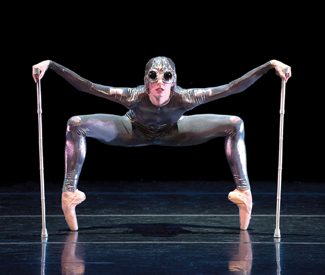
DANCE When Charles Anderson returned from a performing and choreographing career in New York 11 years ago to start a chamber-size contemporary ballet company, it seemed fair to wonder whether the Bay Area really needed another one. In the intervening years he certainly, and justifiably, has put his Company C Contemporary Ballet on the map. He assiduously assembles contemporary choreography that, at the very least, has a tenuous relationship to ballet. If there are missteps, and there are some in almost in every program, he nonetheless manages to offer a generous and broad spectrum of perspectives. You walk away glad that you came.

In the most recent program — which was performed in San Francisco May 2-4 and travels to Walnut Creek this week — his dancers dove into a smorgasbord of world and company premieres with gusto. Only Anderson’s own 2007 Boléro, choreographed to you-know-what, has been previously danced by this well-trained troupe.

What Anderson has not yet found is a good (and affordable) San Francisco venue to showcase his fine company. This season he tried out Z Space, an inviting theater, albeit one that could benefit from updating its lighting system. And for ballet dancers, who often have flying exits, Z Space’s lack of wing space is a problem. Momentum needs to be truncated to avoid crashing into the brick walls.

Company dancer David Van Ligon’s world premiere, Natoma, in particular needs to be seen on a more suitable stage. Set to an odd assemblage of scores by iconoclast composer Zoe Keating, Natoma runs out of steam about halfway through. Yet this is an honest attempt to deal with traditional structures seen through contemporary eyes. Laura Hazlett’s simple costumes (black bathing suits for the women, tights and white top for the men) nicely highlighted the dancers’ lines.

Van Ligon bowed to convention with a central pas de deux (for gorgeous Edilisa Armendariz and Connolly Strombeck), and three couples and a female duo (Laura Dunlop and Kristin Lindsay) that also framed the pas de deux. Yet he reconfigured this set-up into a number of ever-changing variations that gave Natoma a satisfying sense of elasticity. Wisely, perhaps influenced by Keating’s stab at minimalism, he pared down his vocabulary to basic steps and unisons in conjunction with flowing arms. Still, at times one wanted more richly textured choreography. Pleasing was the design’s clarity, though it put in relief both the dancers’ strengths and their weaknesses.

The appropriately-named A Modest Proposal, from John Bohannon (concept and text) and Carl Flink (direction and choreography), was a fresh, clever, and amusing smashing of verbosity against the succinctness of art, entertained without a whiff of Swiftian sarcasm. Trying to explain complex scientific facts with more and more words, and worse, with PowerPoint, is useless, narrator Ryan Drummond. Do it through dance. When the ensemble, having swirled around Drummond, stepped out of their overalls and into Hazlett’s diaphanous white for an airy, fluid finale, you could almost believe him.

Dennis Nahat’s 1970 Ontogeny — named for the process of life forms’ individuation, in case you slept through biology class — received a stunning interpretation. Using Karel Husa’s densely-layered, Pulitzer-winning String Quartet No. 3, Nahat excellently drew on the resources of modern dance and ballet to suggest eroticism and struggle as a biological necessity. With a powerful and nuanced Jacqueline McConnell and a vulnerable and athletic Tian Tan in the leads, Nahat’s angular yet expansive choreography looked as vibrant and edgy as it must been over 40 years ago.

A surprise addition was Anderson For Your Eyes Only, a splendid duet, originally performed for a hearing-impaired audience. Chantelle Pianetta and Bobby Briscoe, he a head taller than she, sensitively explored the give and take of an on/off relationship. Performed in silence, you heard their footfalls, the exertion of their breath, even the swish of their pants.

Anderson’s Boléro closed the program. It’s a good enough Spanish-flavored work for an over-used score. But perhaps it’s one that choreographers just have to get out of their systems.

COMPANY C CONTEMPORARY BALLET

Thu/9-Sat/11, 8pm; Sun/12, 1pm, $23-$45

Lesher Center for the Arts

1601 Civic, Walnut Creek

www.companycballet.org


The zero-sum future

74

tredmond@sfbg.com

It’s going to take longer, sometimes, to get from here to there. Acres of urban space are going to have to change form. Grocery shopping will be different. Streets may have to be torn up and redirected. The rules for the development of as many as 100,000 new housing units in San Francisco will have to be rewritten.

That’s the only way this city — and cities across the country — can meet the climate-change goals that just about everyone agrees are necessary.

Jason Henderson, a geography professor at San Francisco State University, lays out that case in a new book. He argues, persuasively, that the era of easy “automobility” — a time when people could just assume the ease and convenience of owning and using a private car as a primary means of transportation — has come to an end.

Henderson isn’t suggesting that all private vehicles go away; there are places where cars and trucks will remain the only way to move people and supplies around. But in the urban and suburban areas where most Americans live, the automobile as the default option simply has to end.

“In 10 years, there will be less automobility,” he told me in a recent interview. “It’s a simple limit to resources.”

And the sooner San Francisco starts preparing for that, the better off the city and its residents are going to be.


BIG NUMBERS

Henderson’s book, Street Fight: The Politics of Mobility in San Francisco, focuses largely on the Bay Area. But as he points out, the lessons apply all over. The numbers are daunting: Cities, Henderson reports, “use 75 percent of the world’s energy and produce 78 percent of global greenhouse gas emissions.” He adds: “Transportation is the fastest growing sector of energy use and [greenhouse gas] emissions, and this fact is in great measure owing to the expansion of automobility.”

And the United States is the biggest culprit. This nation has 4 percent of the world’s population — and 21 percent of the world’s cars.

To turn around the devastating impacts of climate change, “America will need not only to provide leadership, but also to decrease its appetite for excessive, on demand, high-speed automobility.”

And buying a lot of Priuses, or even electric cars, isn’t going to do the job. “Americans must undertake a considerable restructuring of how they organize cities, and that must include the rethinking of mobility and the allocation of street space.”

The Bay Area is about to enter into a long-term planning cycle that, according to groups like the Association of Bay Area Governments, will involve increased urban density. ABAG, according to its most recent projections, would like to see some 90,000 new housing units in San Francisco.

That’s got plenty of problems — particularly the likelihood of the displacement of existing residents. Henderson agrees that more density is going to be needed in the Bay Area — but he’s surprisingly bullish on the much-denigrated suburb.

“It’s actually quick and easy to retrofit suburbia,” he told me.

And like so much of what he discusses in his book, the primary solution is the old, venerable, human-powered contraption known as the bicycle.

“Existing communities like Walnut Creek are eminently bikeable,” Henderson told me. He suggests expanding development in three-mile circles around BART stations — after getting rid of all the parking. “We could easily get 20 to 30 percent of the trips by bike,” he noted.

In fact, he argues, it’s easier to put bicycle lanes and paths in the suburbs than in San Francisco. The streets tend to be wider, there’s more room in general — and it’s fairly simple to provide barriers from cars that make biking safe for everyone.

In fact, a lot of European cities are less dense than San Francisco — and have far fewer drivers. Even in California, the city of Davis is famous for its bike culture; “In Davis,” Henderson said, “There are all these children riding their bikes to school.”


ACRES OF PARKING

One of the most profound changes San Francisco is going to have to make involves coming to terms with the immense amount of scarce space that’s devoted to cars. Parking spaces may not seem that big — but when you combine the 300-square-foot typical space (larger than many bedrooms and offices) with the space needed for getting into and out of that space, it adds up.

“Parking for 130 cars amounts to about an acre, and the aggregate of all non-residential off-street parking is estimated to be equal in area to several New England states.”

Cars need more than a home parking space — they need someplace to park when they’re used. So in a city like San Francisco that has more than 350,000 cars, a vast amount of urban land must be devoted to parking. In fact, Henderson estimates that parking space in San Francisco amounts to about 79.4 million square feet — or about 79,400 two-bedroom apartments. Off-street parking alone takes up space that could house 67,000 two-bedroom units.

And it’s hella expensive. Building parking adds as much as 20 percent to the cost of a housing unit. He cites studies showing that 20 percent more San Franciscans could afford to buy a condo unit if it didn’t include parking.

But the city still mandates off-street parking for all new residential construction — and while activists have managed to get the amount reduced from a minimum of one parking space per unit to a maximum of around eight spaces per 10 units, that’s still a whole lot of parking.

And if San Francisco is expected to absorb 90,000 more housing units, under current rules that’s 72,000 more cars — which means a demand for 72,000 more parking spaces near offices, shopping districts, and parks. Crazy.

So how do you get Americans, even San Franciscans, to give up what Henderson calls the “sense of entitlement that we can speed across town in a private car?” Some of it requires the classic planning measures of discouraging or banning parking in new development (AT&T Park works quite well as a facility that is primarily accessed by foot and transit). Some of it means putting in the resources to improve public transit.

And a lot of it involves shifting transportation modes to walking and bicycles.

San Francisco has had significant success increasing the use of bikes in the past few years. But there are limits to what you can do by tinkering around the edges, with a few more bike lanes here and there.

There are, for example, the hills. And there’s grocery shopping for a family. Those things need bigger shifts in the use of urban space.

San Francisco’s street grid, for example, sends travelers straight up some nearly impossible inclines. Young, healthy people in great physical condition can ride bikes up those hills, but children and older people simply can’t.

Henderson suggests that the city could install lifts in some areas, but there’s another, more radical (but less energy-intensive) solution: Reroute the grid.

If city streets wound around the sides of hills, instead of heading straight up, walking and biking would be far easier. That would involve major changes, particularly since there’s housing in the way of any real route changes — but in the long term, that sort of concept should, at least, be on the table.

Bikes with cargo trailers make a lot of sense for shopping, Henderson told me — and once big supermarkets get rid of all that parking, the price of food will come down.


THE POLITICS OF NEO-LIBERALS

The biggest challenge, though — and the heart of Henderson’s book — is political. Transportation, he argues, is inherently ideological: “It matters how you get from here to there.” And he notes that progressives, who are willing to think about social responsibility, not just individual rights, see the choices very differently than the neo-liberals, who in this city are often called “moderates.” If the neo-libs have their way, he says, the changes will be too little, too late, and mostly ineffective.

Because Americans are facing a series of choices — and there are no solutions that preserve the old way of life without sacrificing the future of the planet. It’s entirely a zero-sum game: We can slow global climate change, or we can keep driving cars. (Oh, and electric cars — which still require large amounts of power, mostly from fossil-fuel plants — aren’t going to solve the problem any time soon.)

We can shift to bicycles and transit as our primary ways to get around, or we can leave our kids an ecological disaster of unprecedented scope. We can overhaul the entire way we think about urban planning — to make streets friendly to bikes and buses — or we can go down a deadly path of no return.

We can accept the fact that moving around cities may be a little slower, particularly while we adapt. Or we can join the climate-change deniers. “There are a lot of neo-liberals out there who say we can’t start controlling automobility until we have a gold-plated transit system,” Henderson told me. “But this is not a chicken and egg problem. First you have to create the urban space. Then you can build a better system.”

Man up

0

arts@sfbg.com

FILM While frequently spiced by dames alluring and sometimes deadly, film noir has always been intrinsically a manly-man’s world. Elliot Lavine’s latest Roxie noir retrospective, offering 30 features over two weeks, seems particularly heavy on vintage male charisma. Whether showcasing the seldom-noted comic chops of Humphrey Bogart, the seldom-appreciated star swagger of Victor Mature, or Cliff Robertson having an unusually credible (for the era) mental breakdown, the range of familiar and ultra-rare titles in “I Wake Up Dreaming 2013” offers a compendium of variably tough guys in tougher situations.

If you’re wondering where the series’ title comes from, the answer kicks things off: 1941’s I Wake Up Screaming is a most enjoyable murder mystery in which Manhattan sports promoter and all-around hustler Frankie Christopher (Mature) decides on a whim to play Pygmalion and make a pretty but coarse waitress (Carole Landis) his Galatea. Once she’s successfully launched as a “glamour girl,” however, she proves quite the little ingrate — “Why should I go on slinging hash when I can sling other things?” she leers, preparing to bolt for Hollywood. There’s no lack of suspects (including reliable sleazeballs Elisha Cook, Jr. and Laird Cregar) once she’s found knocked off.

The publicity at the time focused on 20th Century Fox’s big wartime pin-up and musical star Betty Grable making her dramatic debut as Landis’ “sourpuss sister” (meaning she’s a nice girl who disapproves of her trampy sib). But the movie belongs to Mature, a big strapping lunk who became a punch line about looks-but-no-brains Hollywood he-men. (Later career highlights include playing opposite Hedy Lamarr in Cecil B. DeMille’s vapid 1949 megahit Samson and Delilah, then getting mocked two decades later in the Monkees’ 1968 Head.) But he’s charming, confident, and surprisingly nuanced here. Oddly, Screaming‘s orchestral score heavily features unaccredited lifts from “Over the Rainbow” — a standard now, but then just a song from a two-year-old movie that everybody had already forgotten.

Similarly playing a semi-respectable Big Apple man-about-town, Bogart gives a master course in magnetizing viewer attention while seeming to do very little in the next year’s All Through the Night. “Gloves” Donahue is a gambler — surrounded by memorable flunkies including Jackie Gleason, Phil Silvers, and William Demerest — reluctantly sucked by his busybody mom (Jane Darwell from 1940’s The Grapes of Wrath) into investigating the death of her beloved local immigrant baker-neighbor. This being 1942, the path leads directly to Nazis — Peter Lorre, Conrad Veidt, and Judith “Mrs. Danvers” Anderson chief among them. Packed with priceless snappy patter, this comedy action hybrid may lack the “classic” cache of the star’s other ’40s vehicles. But it’s enormous fun, even if it goes off the rails a bit toward the end.

Another revelation in the program is Screaming‘s co-feature Blues in the Night, a strikingly ambitious sort of jazz musical melodrama written by Robert Rossen (director and co-writer of 1961’s The Hustler) and directed by another intriguing, now-neglected talent, Anatole Litvak. Following the very rocky road traveled by a combo of white musicians seriously dedicated to “real low-down New Orleans blues,” this starless effort is one of those rare B movies that packs an incredible amount of incident and depth into a relatively short runtime without ever feeling cluttered.

Some of “Screaming”‘s bills are themed by director or performer. May 19 brings a double dose of 1950s Joan Crawford, with her eerie resemblance at the time to Mrs. Potatohead. Female on the Beach (1955) is a fun thriller in which she’s a widow seduced and possibly menaced by Jeff Chandler, one of the era’s several leading blond pin-up boys. But Robert Aldrich’s 1956 Autumn Leaves is something else: a May-December romance that turns into a serious treatment of mental illness, as much-younger suitor Robertson turns out to be unstable in ways less conventionally scary than credibly pathetic. Unusually vulnerable — her nervously babbling curtain speech might be the finest acting she ever did — Crawford knew this was one of her best movies, and later paid due credit to Robertson’s “stupendous” performance.

Another evening pays tribute to the fascinatingly odd oeuvre of longtime industry fringe-dweller Arch Obeler, who famously made the first 3D feature (1952’s Bwana Devil), but is found in more intriguing form here with two earlier black and white cheapies. Bewitched (1945) is an offbeat thriller from the POV of a pretty schizophrenic (Phyllis Thaxter), though that term is never used. Its primitive psychoanalysis is bettered by the post-apocalyptic psychodrama of 1951’s Five, whose titular quartet — including a pregnant woman, a kind African American war veteran, and a fascistic white supremacist — mysteriously survive nuclear disaster but may not survive each other’s personalities. Politically progressive if sometimes dramaturgically simple, it’s a fascinating obscurity.

Other highlights include quintessential cult object The Monster and The Girl (1941), in which a giant gorilla takes out various corrupt underworld types whilst “Skipper the Terrier” follows its trail; ultra-low-budget 1957 Mickey Spillane adaptation My Gun is Quick, with Robert Bray as a marginally less cretinous Mike Hammer than usual; the very cool 1961 British drama All Night Long, which transposes Othello into a jazzbo context (complete with Brubeck and Mingus); and last but possibly least, a double bill devoted to short-lived blonde bombshell Beverly Michaels. A hammer-voiced minor challenge to Monroe, Mansfield, and Van Doren, she was invariably cast as destructive man bait. But like Victor Mature, her performances in Pickup (1951) and Wicked Woman (1953) suggest a more alert, modern intelligence than she was given credit for.

I WAKE UP DREAMING 2013

May 10-23, $10

Roxie Theater

3117 16th St, SF

www.roxie.com


Catch up!

0

SUPER EGO Happy 45th birthday to Specs, my favorite bar in the city. The Capitan cocktail at La Mar is drink of the year so far. I think I finally get Daft Punk. There will probably soon be a “high-end” “gay” “strip” club called the Randy Rooster in the Castro, but you can’t make it rain — tips are donated at entry to a favorite charity, the dancers only strip to g-strings, and there’ll be upscale food. (It sounds positively Mormon.)

The winner of How Weird Street Faire was homegrown genius Larry Gonnello Jr.’s Boombox Affair, the back alley stage with the wired-together boomboxes, this killer six-hour set, and a perfect respite from the overflow of looky-loos this year. And that proposal by Mark Leno for bars in Cali to stay open until 4am? It died in committee, much like Roxxxy Andrews’ hair (I don’t even know who that is) — mostly due to the twisted machinations of the California Police Chiefs Association, who said it would mean more drunks on the road. Absolutely untrue! And this is why we can’t ever have nice things. My goddess, even the bars in Anchorage, Alaska can stay open longer than ours. Guess I’ll just have to keep my Scooby Doo flask polished and at the ready in my tubesock.


BOO WILLIAMS

I am so very excited for this. A Chicago house legend and true sweetie who knows soul biz like nobody — except maybe his Strictly Jazz Unit partner in crime Glenn Underground. The Housepitality weekly does it again.

Wed/8, 9pm, $10. f8, 1192 Folsom, SF. www.housepitalitysf.com


AFROLICIOUS 6-YEAR

Six years of this awesome Latin funk and Afro jazz collective’s dance floor vibes. As always, groovy brothers Pleasuremaker and Senor Oz preside over the festivities, full of live goodies and sweaty hotties, so good it’s taking over two nights.

Thu/9 and Fri/10, $8–$15 per night. Elbo Room, 647 Valencia, SF. www.elbo.com


DERRICK MAY

Oh hi, Detroit originator of techno.

Fri/10, $20. 9:30pm-3:30am. Public Works, 161 Erie, SF. www.publicsf.com


KITSUNE CLUB NIGHT

Poof! It’s the return of that special-smart French hyperdisco feeling, as beloved label Kitsune spreads its pixie dust around with Fred Falke, Chrome Sparks, and our own Aaron Axelsen.

Fri/10, 9pm, $17. Mezzanine, 444 Jessie, SF. www.mezzaninesf.com


ODYSSEY

The best and most freakish roving house party is at it again, this time bringing in the energetic and gorgeous W. Jeremy and Christy Love of NYC’s House of Stank and Get Up Recordings.

Fri/10, $10, 9:30pm-3:30am. Public Works, 161 Erie, SF. www.publicsf.com


PUSH THE FEELING

“An all locals, disco-heavy night of music,” too-cute promoter Kevin Meenan promises, somewhat surprisingly, for this installation of his monthly boundary pushing night, with Beat Broker on decks and plaza performing live.

http://www.youtube.com/watch?v=nUsxpZ_xKyg

Fri/10, 9pm, $5. UndergroundSF. 424 Haight, SF.


TORMENTA TROPICAL

Everyone’s favorite 808cumbia, electro-salsa, and tech-bachata monthly celebrates a bangin’ new release on its Bersa Discos label from Mexican DJ Quality, with DJ Quality! Sat/11, $5–$10, 10pm. Elbo Room, 647 Valencia, SF. www.elbo.com


WOLF + LAMB, SOUL CLAP

The two greatest bromances of the retro-rebuild decade, these male duos melted minds when they Frankensteined tunes from the 1950s-2000s (emphasis on the ’90s) into exotic-sounding hybrids of moody funk and deep house. Now everyone’s taken their cues — what will they pull off next?

Sat/11, 9pm, $20. Mezzanine, 444 Jessie, SF. www.mezzaninesf.com


KIM ANN FOXMAN

She has the tightest style — sound + vision — of anyone going right now, melting late ’80s and early ’90s sonic signifiers into a sophisticated semiotic code that packs the dance floor every time. Funky Mother’s Day!

Sun/12, 10pm, $10. Holy Cow, 1535 Folsom, SF. www.honeysoundsystem.com


Kronnerburger

1

culture@sfbg.com

DINING “Never judge a book by its cover” — if ever there was a place that warranted that old saw, it’s KronnerBurger. Standing across from the Mission burger joint’s ramshackle facade, its name spelled out on the marquee atop a grungy window display, beneath an unlit “Tonight” neon sign, it was hard to believe this was the same place I’ve been practically begging my friends to attend with me. As we inched closer to the entrance, we noticed a little old-fashioned TV in the window displaying the restaurant’s logo on a background of static. My friend and I looked at each other warily and stepped inside chef Chris Kronner’s joint.

Even around 8pm on a rather sunny evening, light inside Kronnerburger was practically nonexistent. Besides the wooden, almost -’70s inspired light fixtures at the bar in the corner of the restaurant, sources of illumination are few and far between, with only a couple of other lights scattered throughout the dining area and a Mexican-style devotional candle at every table. It took my eyes a while to adjust but once I did, I was pleased to see walls of exposed brick and ample seating. Before long, the hostess emerged from the darkness and, despite the absence of a member of our party, seated us at a table anyway.

Once our party was complete, we ordered drinks. I must say that half of the reason I wanted to eat at Kronnerburger was to try its Carbonated Motherfucking Margarita ($10, $54 pitcher). But after looking over the paper menu — which included curiosity-spikers like scotchocolate milk and sasparilla Old Fashioned — I was torn between my original choice and the mysterious Stranger Juice ($9, $50 pitcher). A friend went for the Stranger, so I was able to get a taste of both.

As for food, both of my friends decided to get the eponymous KronnerBurger burger with a single patty ($11, $18 double), one with a $4 side of bone marrow, and the other with the addition of bacon ($3). I decided on getting a crispy Crabburger ($14, also available grilled). For sides, we got some onion rings ($6) and fries ($4).

Naturally, our drinks came out first and while both the margarita and Stranger Juice were perfect choices on an unusally hot day in the city, if I had the option to reconsider, I would have ordered the Stranger Juice for myself. Loaded with gin, Aperol and I’m guessing (they’re secretive) sweet vermouth, the Stranger Juice was surprisingly fresh, light, and floral. The Carbonated Motherfucking Margarita was tasty and bubbly, but a little bit too sour for me.

While waiting, my tablemates and I peered through the darkness to see what the other guests were ordering. We saw the burgers we couldn’t wait to sink our teeth into and a delicious plate full of marrow and fries — a twist on French Canadian poutine, also with cheese curds and beef cheek gravy.

Once it came out (not long) it took a while to dig in, because it really was too dark to get a good look at what was on our plate. As we waved our Jesus candles over our food, everything looked small but tasty. Small but decadent-looking patties on our burgers, a small but crispy portion of fries. We were, however, given an absolutely huge portion of onion rings. A little bit too much for the humble amount of delicious dipping sauce that accompanied it, alas. As for the taste, what can I say? The burger was moist and solid — and isn’t that everything a burger should be?

For dessert, we got the only item on the menu: strawberry bread pudding. Topped with chocolate ice cream, the warm dish was so gooey and flavorful that even though we had three people sharing the small portion, we couldn’t finish it.

After throwing in the towel on the dessert, we ordered a round of beers, talked some shop, and then asked for the check. When we stepped out of the restaurant around 10pm, the night was nice and warm. And while the “Tonight” sign still hadn’t been lit, we wondered if it would be when we returned.

2379 Mission, SF. (415) 656-9871, www.kronnerburger.com

Not from around here

0

arts@sfbg.com

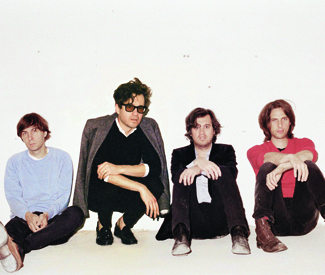
MUSIC It was a case of the French pop love that dared not speak its name, as earlier this month rumors roiled about a Coachella coupling — mon dieu, deux! — to truly rave about: headliner Phoenix along with possibly, just maybe, hush-hush special guest Daft Punk, returning to stage de triomphe that it dominated seven years ago. The Phoenix guest that materialized, R. Kelly, wasn’t exactly the faceless freak the audience had imagined springing from the closet, and instead the mob had to cool its jets and content itself with an old-school LP ad from Thomas Bangalter and Guy-Manuel de Homem-Christo.

The abbreviated 102-second spot saw the duo in glittery soft focus performing new single “Get Lucky” alongside Pharrell Williams and Nile Rodgers — the kind of clip you’d uncover on late-night TV during Don Kirshner’s Rock Concert — and announcing Daft Punk’s own special guest stars, including Giorgio Moroder, Panda Bear, past Daft Punk collaborator Todd Edwards, Paul Williams (who must have had Phantom of Paradise-tinged flashbacks), and Pharrell Williams. Just a taste, but enough to stir the pot in the lead up to the May 21 release of Daft Punk’s fourth studio full-length, Random Access Memories, on Columbia.

Is it so strange that Daft Punk and Phoenix should find their fortunes so intertwined out in the Cali desert, so far from Old World Paris and Versailles? After all, the two share a past — and a future: Phoenix guitarist Laurent Brancowitz, Bangalter, and de Homem-Christo all started out in a Beach Boys-inspired combo called Darlin’. And much like fellow French native Anthony Gonzalez’s M83, the two groups are managing to find creative juices to grease their wheels out west, in the fantasy industrial complex of LA — with Daft Punk stressing the importance of a West Coast feel à la Fleetwood Mac to Memories guest Edwards, and Phoenix telling MTV that its new CD, Bankrupt!, was inspired by its work on Thomas Mars spouse Sofia Coppola’s 2010 movie Somewhere.

Not to mention the fact that Bankrupt! and Memories are two of the most buzz-ridden releases of the year, particularly judging from the homemade “Get Lucky” remixes and videos already proliferating online. Long gone are the old rockist daze — the same that slurred “Disco sucks” — when French rock was derided as just another thing an entire country does wrong, like loving Jerry Lewis. Thoughts surely far from the minds of Daft Punk obsessives, though from the start the duo’s vocoder-obscured vocals and helmeted visages proudly proclaimed, “We’re alien, a.k.a. not from around here.” That tease is the name of Daft Punk’s space-rockin’ game this time around, taking control with a carefully orchestrated marketing campaign after a humbling day job scoring a sorry Tron sequel.

Working with its biggest crowd of collaborators yet, Daft Punk appears to be bursting the mythic bubble of an enigmatic twosome working solo behind the decks, letting others into the party, circling back to its clubland origins, and reaffirming that, as “Get Lucky” goes, its “ends were beginnings.”

And though indie seems leached of meaning, Phoenix sounds far deprived when it came to ideas for Bankrupt! Nate Chinen of the New York Times may quibble with Mars’s Dadaist “word salad” — why not attack a fellow for singing with an accent? — but then Phoenix isn’t the first band to privilege the sound of lyrics over content. Bankrupt! isn’t as “experimental” as promised early on, but it’s by no means as polished and predictable as your average Killers or Imagine Dragons product.

Starting with title and extending to the cover symbolism of a lucky peach, and the busy little rickshaw of an orientalist motif on opener “Entertainment,” Phoenix sounds as if it’s grappling with a Daft Punky notion of alien-ness, too — and the global economics of pop success, having hit it big at the height of an economic downtown with 2009’s Wolfgang Amadeus Phoenix. The distorted, bristling synths grinding beneath songs like “The Real Thing,” in fact, make Bankrupt! one of the noisier mainstream rock albums of recent years. Scope out the lonely cries of the entitled asking to have their names put on lists on “SOS in Bel Air,” the fluty synths opening the languorous “Trying to Be Cool,” and hear the sound of a band conveying the seduction — and anxiety — of too many bright lights, big cities, and marathon tours and responding by mainly turning up on the volume.

So why French pop and why now? In fits and starts, leaps and stumbles, Daft Punk and Phoenix are creating less a pop language of diplomacy than a kind of lingua franca between classic sunny pop hooks, Beach Boys style, and the all-mighty often-electronic groove, be it analog or digital, IDM or EDM, boyish or girlish, human or alien.

LPs like Memories hark to another time, while satisfying on the primal level of da funk. As Pharrell Williams has said of “Get Lucky,” “The only click track they had was the human heartbeat, which makes it really interesting because these are robots.” So how does the sunlit, smoggy terroir of the west touch two French aliens and a band of Versailles refugees? Perhaps we’ll know when Daft Punk unveils Memories even further out West: May 17, at the the 79th Wee Waa Regional Show in Wee Waa, Australia.

Let it all out

0

VISUAL ART Dottie Guy had a difficult time in 2006. In addition to the death of her grandfather, she was recovering from surgery for an injury to her ankle and foot that she had sustained on duty in Iraq. She started taking pictures as motivation to walk around and to reclaim a sense of purpose.

This year, Guy is one of the artists participating in a one-night art exhibition presented by Shout!, an initiative to support female veterans in the Bay Area. Primary organizer Star Lara asked Guy to submit a photo to an event that, in its fifth year, will include several different media — photography, painting, sculpture, drawing, writing, and music — made by 22 vets. As a result of Lara’s outreach efforts, this year’s event has grown so much that she had to turn artists away.

Lara is the Women Veterans Coordinator at Swords to Plowshares, a nonprofit that helps veterans transition back to civilian life. Leaving the military in 2007 after serving on active duty for 12 years, she knows the hardships of adapting, particularly those that affect women. As more women enlist, she explains, the gender-specific problems become increasingly defined. Female veterans now represent the fastest growing homeless population, yet they seek help through Veteran Affairs at far lower rates than men do.

Issues also stem from public perception. People understand what it means when they see a man with a military pin, but Lara often hears the question, “Is your dad in the military?” Society resists the idea of a female veteran.

And when civilians do know about a woman’s military service, another problem arises: the tendency to reduce all aspects of her persona to her veteran identity. For Guy, the exhibition provides an opportunity to showcase another side of herself. Though her life revolves around veterans — she works at the VA — she is also a photographer, and her photography does not directly address military service.

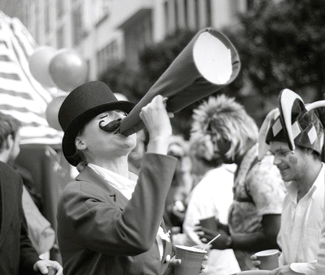
Guy snapped her Shout! photo at Bay to Breakers a couple of years ago when she stumbled across a woman in a top hat and fake moustache shouting into a bullhorn next to a man wearing a polar bear mask. It is a quirky image one could find in few places besides San Francisco. “I embrace the ridiculous stuff,” says Guy. “Being in the military, there’s not much room to celebrate that. You’d never see somebody walking around in a mask like that, unless it meant trouble.”

Another Shout! artist, JoAnn Martinez, has only recently begun to experiment with military subjects. For her second year in the show, she has submitted comics derived from dialogues she has heard within the female veteran community. By undertaking this new comedic mode of art, she hopes she can not only share a creation she’s proud of besides her family and work (she started the nonprofit Women Veterans Connect), but also communicate a digestible message to the non-veteran community. “Instead of complaining, let’s laugh about it,” she says.

Not only do Martinez’s comics convey a therapeutic levity, but they also contain an expressive subtext; they are printed on homemade paper created in response to the Combat Paper Project, in which workshops instruct veterans how to create paper pulp from their shredded military uniforms.

Extending the practice beyond Shout!, Martinez is seeking female veterans to submit stories about their uniforms for a Shotwell Paper Mill limited-edition book created using the same fabric-turned-paper method. So far, the stories range in tone, some reflecting a similar lightness to Martinez’s comics; one woman tells how after she painted her toenails, the Iraqi heat melted the polish and she had trouble removing her socks.

Lara has also participated in the project, an experience she found restorative in part because it involved breaking down and reclaiming an object laden with intense experiences, but primarily because of the work’s collectivity. After talking with fellow female veterans while their hands were busy cutting, she says, “It was no longer about the trauma that brought you to the table — it was about what you took from the table.” (The Combat Paper Project also inspired Lara’s contribution to this year’s Shout!, a piece that involved her “painting the shit out of” her last uniform.)

Though Lara does not consider herself a fine artist, Shout! presents an opportunity to share the voice of her small group within a greater context. In the Women’s Building, a hub of action in the Mission, the event will enact her idea that women veterans comprise a subset of larger existing communities and should be reached as such.

Lara says that without focusing on trauma, without involving policy, services, or outreach, Shout! offers a chance for artists like Guy and Martinez to declare, “I am a woman and a veteran, and here’s how I express myself.”

SHOUT!: ART BY WOMEN VETERANS

Wed/8, 6-9pm, free

San Francisco Women’s Building

3543 18th St, SF

swords-to-plowshares.org/shout


Yuh look good

0

STREETS Only our deep-seated disinclination against street harassment prevented us from hollering at these sterling examples of the Bay’s blazing style sense. We respectfully snapped their pics instead: the trio of gents in town for their 50th high school reunion sporting pencil mustaches and monochrome, Agathe Guttuhaugen’s surreal ombre locks and coordinated cap brim, Amber Asaly’s midriff. All good excuses to take to the sidewalk this season in search of fashion stimulation.


Alex Pingis. Photo by Cortney Clift

Amber Asaly. Photo by Stephanie Sesin

Brian McGrath, Jeffrey Tucker, and Donald Owen. Photo by Cortney Clift

Elena Miska. Photo by Jessica Wolfrom

Virgil Gabaldon. Photo by Jessica Wolfrom

Agathe Guttuhaugen. Photo by Cortney Clift

Unidentified filthy objects

0

caitlin@sfbg.com

SEX In an email interview in advance of her Fri/10 appearance at the Center for Sex and Culture, Suzie Silver told me that her interest in alien sex was spawned by a mix of her childhood fascination with Star Trek: The Original Series, NASA’s launch of the Kepler space observatory in 2009, and Isabella Rossellini’s “Green Porno” short film series on the sensual activities of insects and marine animals. Silver recently co-edited (along with Christopher Kardambikis and Jasdeep Khaira) Strange Attractors, a book-DVD project (www.extraterrestialsexuality.org) that explores the notions of extraterrestrial sexuality held by 70 artists, writers, and filmmakers. If that doesn’t inspire you to read the rest of this article, I give up on you.

San Francisco Bay Guardian Please explain your fascination with extraterrestrial sexuality.

Suzie Silver Strange Attractors  asks the participants and audience to try to imagine otherworldly and unknowable life-forms and sexualities. We are imagining sexual possibilities beyond gender, beyond genitalia. In my short story “Donkey Show,” one of the things I describe is a live sex show made up of shape shifting platonic solids that can create pleasurable and climactic responses from all audience members. I’m attempting to envision universal ecstasy and orgasm!

SFBG Have you noticed commonalities related in true-life alien sex experiences? 

SB I have read some accounts, mostly online. For the most part I find them rather unimaginative and not very interesting. The focus is usually on penetration. It all seems rather BDSM, which has its appeal, otherwise how to explain the success of all those 50 Shades books? Strange Attractors attempts a polymorphous perversity: sex outside of reproduction, for pleasure, communication, joy, connection, fun, more complicated power dynamics than dominance and submission. We imagine erogenous zones in, on, and outside of every part of the body and mind.

SFBG Which contributions to  Strange Attractors did you find particularly compelling?

SB I find all of the works truly amazing. Works that I’m particularly compelled by include Vanessa Roveto’s extraterrestrial dating profile where the being’s desirable qualities include “a body comprised mostly of healthy scrotal tissue, the ability to mimic my selves, an oral tolerance for liquid hand sanitizer, a traumatic childhood that will work in your erotic favor, and minimal bloating.” In Michael Mallis and Mikey McParlane’s “Love Puddles:” “In the golden fringe of a far off galaxy, an alien planet teems with exotic life. Twiggy creatures rush to an ominous volcano and rub their bodies against its glittering surface, enticing the volcano to awaken and spray its gooey chaos across the furry world.”

Strange Attractors video screening Fri/10, 7-10pm, $5-10 sliding scale. Center for Sex and Culture, 1349 Mission, SF. www.sexandculture.org


THIS WEEK’S SEXY EVENTS

Tricks and Chickenhawks reading Wed/8, 7:30pm, free. Booksmith, 1644 Haight, SF. www.booksmith.com. Sex worker literati — Madison Young, Kitty Stryker, Carol Queen, more — gather to read from a new anthology of sex worker and john experiences.

“How to Create an Effective Online Profile” Tue/14, 7-10pm, $20. Center for Sex and Culture, 1349 Mission, SF. www.sexandculture.org. Hear back from that babe on Scruff, FetLife, or Tinder after taking this one-off seminar.


Parking breaks

9

steve@sfbg.com

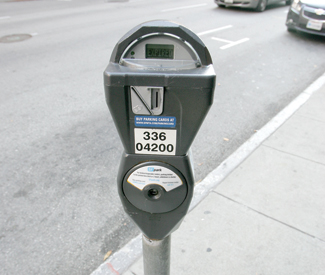
This was the moment these indignant motorists had been waiting for. The elected supervisors were finally going to get the unelected bureaucrats at the San Francisco Municipal Transportation Agency to back off of plans to manage street parking and install new parking meters in their Western SoMa, northeast Mission, Potrero Hill, and Dogpatch neighborhoods.

Anger and frustration over the parking program has been building for more than a year (see "Pay to park," 1/24/12), and when Sup. Mark Farrell called a May 2 hearing before the Neighborhood Services and Safety Committee, SFMTA’s critics put out the call and dozens showed up to voice their displeasure.

Farrell opened the hearing with a clear statement about where he stands on the issue: "I am very much against expanding parking meters into our residential neighborhoods." He also expressed opposition to the SFMTA’s extension of meter hours to evenings and Sundays and said that would be the subject of another upcoming hearing.

"I think we’re frankly on the wrong track," said Sup. Malia Cohen, who isn’t on the committee but showed up just to voice the frustrations of her District 10 constituents and to help grill SFMTA head Ed Reiskin. She repeated the populist criticisms of the SFMTA, calling its goals "unattainable" and its critics "reasonable," and accusing the agency of not having a comprehensive parking management plan.

"I look forward to you saying, ‘I quit, you win, no more parking meters,’" Cohen said to Reiskin, throwing red meat to the seething crowd, which erupted into loud, raucous, sustained applause and shouts of appreciation at the comment.

Those comments frame a defining problem in San Francisco: The city can’t get to its sustainability and climate-change goals without reducing car use (see "Zero-sum future, p. 12) — but even mild attempts to reduce parking create populist furor.

When Reiskin took the podium to deliver his presentation, he struck an even, diplomatic tone, saying that he understands people’s concerns about the issue. "Parking is a challenging, sensitive, and difficult issue. Parking matters to people," he said.

But then he went on to explain that voters and previous supervisors charged the SFMTA with managing the city’s entire transportation system — Muni, cars, bikes, cabs, pedestrians, and parking — in accordance with the city’s Transit-First policy, which calls for active promotion of alternatives to private automobile use in this dense and growing city.

Then he responded directly to Cohen’s challenge: "I would have to respectfully decline the suggestion that we don’t manage parking. We have an obligation under the Charter to do so."

BALANCING ACT


Reiskin rejects the frequent accusation that SFMTA is anti-car — and the suggestion that the agency should focus on improving Muni before it can realistically expect people to rely less on private automobiles. The reality, he said, is that the city can’t make Muni or bicycling more attractive without regulating automobiles in general and parking in particular.

He said drivers who circle the blocks looking for parking spots constitute 20-30 percent of traffic in this highly congested city, and they are the worst sorts of drivers to have on the roads. They clog traffic by stopping frequently or double-parking, they drive in bike lanes, they do dangerous U-turns, and they are often inattentive and distracted, presenting a danger to pedestrians and cyclists.

The agency’s SF Park program tries to alleviate some of that problem by using market-based pricing at meters and garages to promote turnover in high-demand areas and to ensure the availability of parking spots. But in Potrero Hill and the few other parts of the city that still have unregulated street parking, other issues arise, such as out-of-town commuters parking for free all day and limiting availability in a region slated for lots of new development in the coming years.

"Parking management matters," Reiskin said, adding that without it, "we won’t be able to achieve our goals of having an efficient transit system."

He cited policies in the Eastern Neighborhoods Plan that the supervisors approved that call for parking management and noted growth projections that could draw another 100,000 people into San Francisco in the next 20 years.

"The competition we feel today in the public right-of-way will only grow more intense," Reiskin said.

Farrell argued that families and many individuals need cars to get around: "The use of a car is simply necessary." Reiskin acknowledged that cars are still the top transportation choice in San Francisco and they will remain so for the foreseeable future. But he said that each person who opts to use a bike, Muni, or to walk is an important gain in the efficiency of the overall transportation system, given how much space cars take up, so eliminating free parking is an important incentive.

"There is a clear relationship between transportation choices and costs," Reiskin said. "If there is free parking, a lot more people will choose to drive."

Farrell then repeated the other big criticism that gets aimed at the SFMTA over its parking management program, that it’s simply a "revenue grab" that uses meter and parking citation revenue to make Muni and cycling improvements. But Reiskin said the $200 million in revenues from parking have been fairly consistent, with increases in meter revenue being offset by declining revenue from citations (which he attributed to longer meter hours and new payment options) and lowering the rates in city parking garages to make them more competitive with street parking.

"We’re lowering your rates as much as we’re raising them," Reiskin said after noting that, "We’d much rather get the revenue through the meter than through citations."

Finally, Farrell got down to the crux of the criticism from car owners: why can’t everything else wait until the SFMTA makes Muni more efficient and attractive? This is a car-dominant culture, and people won’t take the bus until it’s easy and reliable. Bike advocates make a similar argument, saying completion of a safe system of bike lanes is the only way to substantially increase cycling in the city. But Reiskin said the SFMTA has to do everything at once lest traffic congestion slow the entire system.

"I know it’s a challenge for you, but it’s a challenge for us with how to respond to it as well," Reiskin replied to Farrell. "I don’t think we have the luxury of putting one part on hold while we make up for decades of underinvestment in public transit."

Sup. David Campos said he understands the frustrations of his northeast Mission constituents and he thought the SFMTA was right to delay the implementation of parking management programs there (the revised plan comes out this summer). But he noted that many of his constituents can’t afford to own a car and they need SFMTA to actively promote other transportation options: "We do need to find a way to do everything and balance this out."

FRUSTRATION WITH SFMTA


No neighborhood epitomizes the tricky balancing act on parking polices more than the northeast Mission, with its tight mix of residential and production, distribution, and repair businesses in a neighborhood where growing parking demand will be exacerbated by plans to convert the parking lot at 17th and Folsom streets into a park.

That was where the anger at the SFMTA’s approach to parking reached a fever pitch last year, spawning opposition groups such as the Northeast Mission Coalition. Angela Sinicropi, who heads that group, is calling for new preferential parking permits for local residents and the PDR businesses in the area.

"It’s not a preference or a choice. Vehicles are a necessary part of these businesses," said Sinicropi, who owns a photography business called Syntax Studio. "We need long-term, all-day parking."

She said her members appreciate SFMTA staff working with residents, but they’re still frustrated by the agency’s reliance on parking meters as the main parking management tool. Others simply slammed the SFMTA — which was set up as an independent agency that would be somewhat immune from political pressures — as out-of-control.

"The problem with the MTA is their lack of transparency and accountability," Rob Francis said.

"MTA has lost its way. They shouldn’t be focused on parking. They should focus on transit," said Potrero Hill resident Jim Wilkins. "As taxpayers, we pay for the streets. We pay to maintain those streets. So we should be given priority on those streets."

"Keep things as they are and be respectful of taxpayers," said Walter Bass, a Potrero Hill property owner, blaming the "bike people" for skewing the agency’s priorities. "SFMTA has lost the privilege to manage parking in San Francisco."

Reiskin sat in the front row listening to angry tirades against him and his agency for more than an hour, yet he stuck by his position that managing parking is far from a privilege — it is a difficult duty and one he doesn’t intend to shirk, even as he tries to heed the public’s concerns.

In the end, the supervisors didn’t really chasten the SFMTA, as its critics had hoped for.

Farrell seemed content to declare, "There are no other plans to expand parking meters throughout San Francisco," after Reiskin said he’s not planning to go beyond the five parking management areas now being created.

"I hope MTA was listening to the public comments and concerns," Cohen offered, hoping the hearing will somehow alleviate the shitstorm from some of her car-driving constituents.

And Campos closed with perhaps the only real conclusion that could be drawn from this hearing: "This won’t be the last time we’ll be talking about this issue."

Behind the attacks on City College

17

OPINION Last year the Accrediting Commission for Community and Junior Colleges harshly sanctioned City College of San Francisco and gave us just nine months to shape up or face the consequences. This was pushed on the community even though the quality of education provided at City College was never in question.

Since then, CCSF has changed student assessment metrics and addressed the governance, institutional planning, and enrollment management issues cited. We have done so even as we have also documented disquieting information about the ACCJC’s damaging role at CCSF and at community colleges throughout California.

Our research into ACCJC found that the commission failed to respect the law and public policy of the state and violated federal common-law due process and California common-law fair procedure. Further, at CCSF and in districts around the state, the ACCJC often acts arbitrarily, capriciously, unfairly, and inconsistently in evaluating colleges, thereby harming the schools and their communities.

San Francisco has shown valiant support for City College despite the drumbeat of negative publicity around our accreditation status.

Recently, the San Francisco Board of Supervisors voted unanimously in support of preserving the quality and diversity of education at City College of San Francisco, of tackling the achievement gap and ensuring equitable opportunities for students, and of utilizing Proposition A funds as intended.

In the age of the 24-7 corporate news cycle, educators and unions are too often portrayed as the opposition in attempts to push austerity, undermine the public sector, and efface the important educational work we do for students. We will not apologize for resisting the downsizing of our students’ educations, for saving jobs, and for protecting educational programs that benefit our students—particularly our most vulnerable students. We will not apologize for attempting to sustain employees’ health, working conditions, and well-being.

When San Franciscans passed Proposition A overwhelmingly last November, it was a ray of light for those of us who have devoted our lives to City College and its students. Providing $15.2 million, the tax was designed to reverse the cuts to classes and employees in our starved public educational system, helping sustain our college for San Franciscans. Now the administration is diverting millions of these dollars and pumping additional money into consultants, lawyers, computers, and maintenance. Under the administration plan, next year less than a third of that money will go toward the educational purposes voters were promised.

Meanwhile, the race to downsize continues. At the negotiating table and in the press, the administration uses the need to retain the college’s accreditation—something all of us agree is crucial—as reason, excuse, and threat. It has shirked its duties at the bargaining table, imposing pay cuts and implementing premature and damaging layoffs of staff and faculty.

We face a host of other dramatic changes that cut into our ability to serve student needs, including a reorganization that pushes faculty expertise and voices further into the background and a shocking lack of substantive dialogue or transparent processes. Our trustees now preside over meetings that squelch public speech, restricting access to a too-small meeting room with the windows literally papered over so that no one can see in or out.

Thankfully, we are not alone in this fight. In Chicago, in Seattle, and in communities around the country afflicted with disingenuous “reforms” and diminished access, we are gathering strength and allies and standing up for the principles that inform our work as educators, responsible for defending and improving quality, accessible public education for the public good.

To join the fight to save our City College, email aft@aft2121.org

Alisa Messer is an English instructor at City College of San Francisco and president of AFT Local 2121, which represents instructors, counselors, and librarians at the college.


Editor’s notes

1

EDITORS NOTES It’s a good thing the Giants were at home Friday night, or I might have tried to drive across the Bay Bridge. Always a bad idea after work, always a worse idea on a Friday, when the backup starts somewhere around SF General Hospital. I spent almost two hours getting past Berkeley one Friday when I thought we could leave at 3:30 and beat the traffic. When the Giants are in town, it’s impossible.

It’s so crowded nobody drives there any more. Or something like that. I didn’t.

Instead, I got on my bike and rode to BART, took the Richmond train to North Berkeley, and rode a few blocks to a birthday party on University Avenue. Cost $7.70, I think, for the round trip. Took less than an hour each way, including biking home up Bernal Hill. The late train back was party central, with the bridge and tunnel crowd all decked out in club finery and a woman singing full-volume along with her phone.

“How was I?” she asked me. “Ready for American Idol,” I said.

I could have been stuck in traffic.

This is how life is going to have to be in the future, and it’s not a bad picture. One of the main reasons I like riding my bike in San Francisco, and I hate driving, is that I know exactly how long it’s going to take me to get somewhere on two wheels. On four, it could be 15 minutes, or it could be an hour.

The thing is, we’re so used to the idea that cars are the fastest way to get around — and in some places, sometimes they are. If we fixed up the city the way we should (which would mean changing not only the lane patterns but the directions of some streets) cars would almost always be the worst and slowest way to go most places.

Either way, in this Bike to Work Day issue, were explore the idea that speeding around town at 30 miles an hour in your personal can isn’t a natural right of all people. In fact, Jason Henderson, a professor at San Francisco state who I interviewed argues that the most environmentally sound thing we can do in urban areas might be to … slow down.

Hard to imagine, that. This city runs on speed: Tech speed, work speed, party speed, frenetic speed … I can’t imagine not being in a serious rush for a large part of my day. It’s nice, sometimes, to think about the alternative.

Bike hot spots

16

steve@sfbg.com

When a four-year-long court injunction against new bicycling improvement projects in San Francisco was finally lifted in 2010, there was great hope in the cycling community that the city would rapidly move forward on completing its long-planned network of bike lanes.

Feeding that optimism, Mayor Ed Lee, Board President David Chiu, and other top officials set ambitious goals to increase cycling, even though they did little to provide funding that was up to the task or overcome political opposition that inevitably arises to projects that take space from cars (see “20 percent by 2020,” 5/8/12).

San Francisco is still a long way from emerging into even double-digits in terms of the percentage of vehicle trips taken by bike, and a big part of that is many people don’t feel safe or comfortable fighting with cars for space on the roads. They want bike lanes throughout the city, ideally more of the physically separated cycletracks that debuted a few years ago on Market Street.

So, on Bike to Work Week 2013, we’re taking a look some of the cycling hot spots in the city, places where the San Francisco Bicycle Coalition and other advocates have been pushing for pivotal bike safety improvements, the opposition they’ve encountered, and the status on those improvements.

Polk Street: This has become the hottest of hot spots in recent weeks, with an SFMTA plan for cycletracks shot down by local residents and businesses who complained about the loss of parking spaces on this narrow and increasingly congested corridor. SFBC is organizing to restore the bike lanes, starting with a May 14 event at its office.

Masonic Boulevard: Cars turning left from Fell onto Masonic, which bisects the bike-friendly Panhandle, used to be one of the most dangerous spots in the city, a problem that was largely solved with a special bike-signal light. Next, the SFMTA is proposing to take a lane from cars on that fast-moving thoroughfare and install bikes lanes all the way to Geary, with important funding decisions on that project coming up this summer.

Fell and Oak Streets: There’s finally been some recent progress to this short but important east-west connection after years of delays and broken promises. Cycletracks on each busy street to connect the Wiggle to the Panhandle were approved in October, with an appeal denied the next month as Fell got new striping. But it was only in the last week that Oak finally got two blocks of temporary bike lanes, with parking spaces still standing in the way of the final block.

Second Street: After years of political haggling and community meetings, the SFMTA is finally on the verge of approving bicycle and pedestrian improvements on this dangerous car-clogged artery. The latest plans call for one-way cycletracks running next to the sidewalks on both sides of the street separated by a raised median with street trees separating riders from rows of parked and moving cars. Look for community meetings on the project in June.

Caesar Chavez Boulevard: This busy street got some much needed improvements earlier this year, with good bike lanes on the eastern portion, clearer signage for automobiles approaching the confusing maze as Chavez crosses I-280, and pedestrian safety improvements. Now the city just needs to continue what it started and complete the bike-lane link all the way to Valencia.

Market Street: Cyclist demand is causing mini Critical Masses everyday during the morning and evening commutes on mid-Market Street. Yet despite the fact that the last two mayors long ago called for private cars to be removed from this showplace thoroughfare, Market is a traffic mess and will probably remain so for awhile without fresh political will. The Better Market Street project has delayed improvements to 2017, and its planners this year offered the daffy idea of banning bikes from Market and forcing them over to Mission.

Mansell Street: Improving people’s ability to safely ride bikes to and through McLaren Park, the SFMTA has designed and approved a road diet along Mansell that includes a two-way cycletrack and pedestrian path from Brazil to University, after a series of multilingual community meetings.

Embarcadero: To help improve access to and views of the waterfront during this year’s America’s Cup, the SFBC is aggressively pushing for a pilot project with a two-way cycletrack along the bay side of the roadway. Meanwhile, the SFMTA is now doing a long-term transportation study that will inform approval of the Warriors Arena and the Giants/Anchor Stream development at Pier 48, which will hopefully fund the Blue-Greenway bike path along the waterfront.

Aquarius rising

0

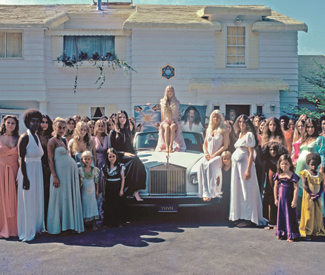
FILM Under the guidance of charismatic, luxuriously-bearded leader Father Yod (once named Jim Baker, later known as YaHoWha), the Source Family operated one of the country’s first health food restaurants. They lived in a Hollywood Hills mansion, wore flowing robes, assumed dreamy new names, meditated, and studied Father Yod’s custom blend of Eastern and Western philosophy and mysticism.

As the home movies that comprise Maria Demopoulos and Jodi Wille’s documentary, The Source Family, suggest, there were golden moments aplenty, even as the mainstream began to view the group with suspicion (and an aging Father Yod’s decision to take multiple wives confused some members — particularly the woman he was already legally married to). Tapping into the group’s extensive film and music archives, as well as interviews with surviving members, The Source Family (opening here with a big gala Thu/2 and running through May 9 at the Roxie) offers a captivating look at what had to be the most earnest (and most photogenic) cult of the 1970s. I spoke with Demopoulos and Wille to learn more.

San Francisco Bay Guardian When did you first hear about the Source Family, and how did you hook up with “Family historian” Isis Aquarian?

Jodi Wille In 1999, a friend showed me a CD box set with all nine of the original Family records. I’d been obsessed with cults, communes, and radical groups from the 1960s and ’70s for 20 years — but I’d never heard of the Source Family. I was shocked that this existed, and that they had this kind of musical output. Also, there were pictures of them looking very beautiful and stylish. But I went online and there was nothing there [about them].

One day, my then-husband, [Feral House publisher] Adam Parfrey, came home with a DVD he’d found at Amoeba Records: a very limited-release student film on the Source Family. We watched it, and I was struck by how thoughtful and charming the Family members were in the interviews.

I went online again, and this time there was a website. I’m a book publisher, too — I put out books on counterculture, sustainability, and things like that [on Process Media and Dilettante Press] — so I emailed, asking if they’d ever considered doing a book. Isis Aquarian wrote back and said [she and her Source Family brother Electricity] had been working on a book for seven years. So I started going through her massive archives with her; we worked to expand the book, which had been written for Family members, for the public. As we were doing that, we were filming interviews with other Family members. When Isis let me know about the film component to her archive, I realized that this was an extraordinary story that had all of the elements we would need for a great documentary.

At that point, I brought in Maria, a close friend of mine who had become a very talented commercial director. Before the book, [The Source: The Untold Story of Father Yod, Ya Ho Wa 13, and The Source Family], people were really private about their experiences, and I think some of them were uncomfortable about going public. But the book was received positively; it told the story from the believers’ point of view and I think that helped develop their trust. So we were very lucky to get incredible access.

SFBG You were friends with Isis, who’s credited as an associate producer, by the time you started working on the film — yet it offers a balanced portrait. How did you stay objective?

JW Isis has done an enormous amount of work helping us in many ways, but she was not involved creatively. That was really important to us, to have that freedom, and she agreed to that. But I became close to some Family members, so I think bringing Maria in was really essential to help with the balance.

Maria Demopoulos I think, objectivity aside, we just focused on letting the Family members speak for themselves, and trying to go for as much authenticity as possible, hearing all perspectives. We worked hard to represent as many Family members as possible and really tell the story from an insider’s point of view.

JW We tried to reflect the overall feelings that we were getting from Family members, because everyone had completely different experiences within the Family, and everybody had strong opinions about it.

And it’s not really about being objective — no filmmaker or documentary is ever truly objective. It’s just about being open and letting people come to their own conclusions.

SFBG Since you had access to all of that footage, what was the editing process like?

MD It was extremely difficult, but honestly, we hit the jackpot. It was just like an incredible gift and honor to go through the archive. We had a three-and-a-half-hour cut, and we just kept whittling it down. Often times, we just had to stay focused; even if we had some fantastic footage, if it didn’t absolutely serve the story, we had to pull it out. It was difficult, but that’s actually a great problem to have.

JW And I’d like to give credit to Isis Aquarian for preserving that archive. There were hundreds or maybe thousands of groups like this that existed. But most of them didn’t document themselves, or if they did, they didn’t hold on to the artifacts or preserve the documents. She’s a true documentarian, even now.

SFBG Did you encounter any resistance from former members, or anyone who thought the documentary shouldn’t be made?

MD From the Family members’ perspective, no. They were extremely cooperative. [On the other hand,] since the Source Family existed in Hollywood, they had many connection to celebrities. We approached a lot of celebrities who were around at that time, and we had a tough time getting access to them.

JW The Source Family members all knew about the book, and they knew that people in their 20s and 30s had become fans of the Family. So I think that made them a lot more open to talking to us. But as far as people like Warren Beatty and Donald Sutherland, who were actually friends with Father Yod, I don’t think they were aware of that phenomenon. They were still thinking about how the Source Family was perceived with a lot of controversy back in the ’70s. I think it’s possible that those people, besides being really busy, weren’t quite sure what we were doing with the material, or if they wanted to associate themselves with it.

SFBG Also, now that decades have passed, when people hear “Southern California cult” and “the Family,” they automatically think “Manson.”

JW For me, that was an important inspiration to make this film. Again, when you speak with the participants, or even with scholars, you find it’s a very different story. We have such a primitive understanding of what these radical, social, and spiritual experiments were really doing back in the 1960s and ’70s, and the kinds of effects that they were having on the participants’ lives.

Maria and I interviewed about 40 of them just for The Source Family, and I’ve gotten to know members of other groups over the years. I find that these groups, more often than not, were very important cultural incubators. A lot of progressive ideas came from them, including the slow food movement, the mind-body-spirit movement, the natural birthing movement. A lot of tech-industry people came from these experiments — San Francisco was a hotbed for them. And many of them were harmless. They didn’t create any major havoc. They were high-risk experiments, of course, but a lot of what people took away was deep and transformative.

SFBG Music plays a huge part in the film, and again, you had a lot of material to choose from. How did you decide which songs to match with the footage?

JW I knew the music really well, and then our editor, Jennifer Harrington, did an incredible job working with the music, and Maria pitched in, too. We did it by knowing the music and thinking about the mood, and just playing with stuff to see what fit.

MD We often chose songs that actually lyrically fit with what was happening in that particular scene. The music was incredibly well-suited to what was happening, because they’re basically singing their own story.

SFBG I missed The Source Family when it played the San Francisco International Film Festival last year, but I heard the Q&A got pretty colorful. How have screenings been going overall?

MD Response has been great. We’ve been selling out shows, and the Q&As have been very lively. A lot of people who participated in social experiments or lived in communes have been coming to the Q&As, but we’ve been getting a lot of younger kids as well. It’s been intergenerational.

JW That was the fun part in San Francisco, because there were two or three people in the audience who were in different communities who spoke up during the Q&A, and it became this really interesting group therapy session. And it’s not about us saying, “Oh, it was this way.” It’s us opening up new ideas so people can have new discussions about what was really going on back then.

SFBG What’s the opening event going to be like?

JW For the various premieres, we have Source Family members showing up to do Q&As in eight cities. We’ve got three in San Francisco: Isis, Electricity, and Galaxy — who was the fashion designer in the family. Also at the Roxie, we’re going to have food made from original Source Family recipes.

We’ll also have tribute bands in six cities. In San Francisco, after the screening, the Source Family tribute band is going to be playing at the Chapel [at 777 Valencia] — they’re called the Penetration Blues Band, with Michael Beach from Electric Jellyfish and Colossal Yes, Noel von Harmonson from Comets On Fire and Sic Alps, [and others]. It’s going to be a really fun night! *

THE SOURCE FAMILY

Opening event Thu/2, 7pm (complete experience with food, film, and concert, $40; film only, $10; concert only, $15)

Film runs May 3-9, 7:15 and 9:30pm (also Sat/4-Sun/5, 2:45pm), $6.50–$10

Roxie

3117 16th St., SF

www.roxie.com

Scenes from the struggle for economic justice

9

Hacking Oakland’s budget

Sporting trucker hats, nose rings, and in activist Shawn McDougal’s case, a white tee with “Revolutionary” printed across the front in simple black lettering, the young, energetic activists assembled at Sudo Room, an Oakland hacker space, come across as unlikely ballot-initiative proponents. Nevertheless, in a few short weeks, the all-volunteer Community Democracy Project crew intends to hit the pavement and begin collecting signatures for a measure to introduce “participatory budgeting” to Oakland city government.

Their objective is to set up a kind of direct democracy system for hashing out the city’s discretionary spending. The proposal would create a charter amendment and a new Oakland city department to reconfigure the politically contentious budget allocation process, by “shifting accountability in a way that more people are able to engage,” says organizer Sonya Rifkin.

The proposal envisions convening democratic “neighborhood assemblies,” each of which would represent roughly 4,000 Oaklanders. Any resident age 16 or older would be free to attend meetings and vote on NA proposals. The NA proposals would then be forwarded onto citywide committees and synthesized as proposals for the ballot, whereupon the electorate would have the final say.

For the Community Democracy Project organizers, who mostly became acquainted through Occupy Oakland, the radical concept is just as much about achieving equitable budget allocation as it is about stoking the embers of community building. To place it on Oakland’s city ballot, the ambitious campaigners hope to collect 40,000 signatures in the next six months.

It’s a tall order, yet the activists appear undaunted. It’s a movement, McDougal says, comprised of “regular people, realizing that they don’t have to be spectators. They can be participants.” (Rebecca Bowe)

Solidarity with Bangladeshi sweatshop workers

News of a Bangladesh factory collapse last week that killed hundreds of low-wage workers reached San Francisco just as labor organizers were preparing to rally for stronger safety measures in overseas sweatshops.

Last November, a fire broke out in the Tarzeen Fashions factory in Bangladesh, killing 112 employees who produced garments for Walmart and other retailers. Sumi Abedin, a 24-year-old garment worker who earned about $62 a month working 11-hour days, six days a week, survived the blaze.

Through a translator, Abedin told reporters, “We were trying to exit through the staircase, and then we saw a lot of burned bodies, injured bodies. And I jumped through a third floor window because I thought, instead of being burned alive, even if I die, my mother will get my body.”

Abedin was standing outside San Francisco’s Gap headquarters, flanked by Bay Area activists from Jobs with Justice, Unite HERE, Our Walmart, and others. They were there to call on the popular retailer to sign a fire-safety agreement to implement renovations, at an estimated cost of about 10 cents per garment. In a statement, Gap noted that it had implemented its own four-point plan “to improve fire safety at the selected factories that produce our products.”

Gap had no direct connection with the Tarzeen Fashions blaze that Abedin narrowly escaped. Yet Bangladesh Center for Worker Solidarity organizer Kalpona Akter explained that the campaign was targeting Gap because “they’re saying they have corporate social responsibility,” yet have refused to sign onto the worker-sanctioned, legally binding fire safety agreement endorsed by BCWS, which brands such as Tommy Hilfiger and German retailer Tchibo have committed to. “This is one appropriate thing Gap can do in this moment,” Akter said, “if they really wanted to prevent this death toll in other parts of the world.” (Bowe)

Making job-training programs actually work

The phrase “welfare” may conjure up the image of a couch potato catching up on daytime soaps while the checks roll in, but Karl Kramer of the San Francisco Living Wage Coalition says it’s simply not the case — some people are not only working to earn those meager checks, they’re faced with few options once their participation in such programs comes to an end.

In San Francisco, many recipients of public assistance are part of the local Community Jobs Program, designed to provide unemployed people with on-the-job experience to help them land on their feet after six months. In practice, however, “it’s not happening,” Kramer says. “They’re dead-end programs. People aren’t moving onto jobs, and at the end of the Community Jobs program, they’re cut off completely.”

Part of the problem is that few pathways exist to connect the workers with actual paid gigs once they’ve finished. So the Living Wage Coalition is pushing for legislation that would improve and expand upon the Community Jobs Program, by raising the wage rate from $11.03 to $12.43 per hour, giving participants the option of working 40 hours a week, extending the program from six months to one year to square with eligibility requirements for many job listings, and creating an advisory committee to facilitate entry-level job creation in city departments.

“There has not been political will to really make these programs successful,” Kramer notes. And in the meantime, “people don’t connect it with why there’s such a growth of homeless families” in San Francisco. (Bowe)

Basic rights for domestic workers

The California Domestic Workers Bill of Rights would apply basic federal labor protections (such as a minimum wage, the right to breaks, and basic workplace safety standards) to domestic workers. If it becomes law, credit will go in part to its author, Assemblymember Tom Ammiano, but also to the California Domestic Workers Coalition, which has been pushing the issue for years.

Supporters of the bill say it’s unconscionable that domestic workers — the people who care for our children and grandparents and tend our homes — are one of just two occupations exempt from the Fair Labor Standards Act of 1938, the other being farm workers (another profession with a well-documented history of labor abuses, and also one comprised largely of unpaid immigrants). “We need to have protections for the people who do really important work,” Katie Joaquin, campaign coordinator for the coalition, told the Guardian.

As we reported recently (“Do We Care?,” 3/26/13), Gov. Jerry Brown vetoed the measure last year after it was overwhelmingly approved by the Legislature, expressing the paternalistic concern that it may reduce wages or hours of domestic workers. But its supporters have come back stronger than ever this year. Now know as Assembly Bill 241, the measure cleared the Assembly Labor Committee on a 5-2 vote on April 24 and it now awaits action by the Assembly Appropriations Committee. They say this bill, which New York approved in 2010, is a key step toward valuing caregiving and other undervalued work traditionally performed by women. (Steven T. Jones)

Debt peons, unite!

49

rebecca@sfbg.com

David Graeber is renowned among occupiers and idealists as an intellectual founder, or anti-leader as it were, of the Occupy Wall Street encampment that sprung up in Zucotti Park in the fall of 2011. He’s an organizer, an anarchist, a professor of anthropology and sociology at Goldsmiths University of London, a former instructor at Yale, and the author of several books, including Debt: The First 5,000 Years, a tome tracing the concept of debt back to the roots of Western civilization.

His latest book, The Democracy Project: A History, a Crisis, a Movement (Spiegel & Grau, 2013), chronicles the rise of Occupy, a leaderless economic justice movement Graeber unapologetically characterizes as a success. In honor of International Workers Day, May 1, the Bay Guardian caught up with him over coffee to talk about economic pressures facing today’s workers, particularly the young and marginalized.

Turns out, it’s not a pretty picture out there — but at least Graeber, who has a propensity to collapse into giggles between full throttle ruminations on the absurdity of global economic policy, has a sense of humor about it.

Below are some excerpts.

San Francisco Bay Guardian: Looking at the Occupy movement, the mainstream narrative seems to be that it was a short-lived, failed experiment and now it’s over. But in your book, you ask the question ‘why did it work?’

David Graeber: Let’s put it this way. When was the last time that the issue of social class was put at the center of American politics? Probably the 1930s. Social movements have been desperately trying to do this for 50, 60, 70 years and gotten nowhere. We managed to do it in three months. Um, that’s pretty impressive. … And I’m pretty sure that if it weren’t for us, we’d have a President Romney right now. That whole 47 percent thing? It would not have resonated had it not been for the 99 percent thing.

SFBG: Why do you think the idea of wealth inequality, of all issues, resonated so much?

DG: I think because there’s a basic change in the way capitalism works in America. It’s been going for some time, but it just became unmistakably apparent after 2008. People talk about the “financialization” of capitalism, and it sounds very abstract. Casino capitalism, speculation, they’re playing these games, they’re making money appear out of thin air, which is not entirely untrue. … It’s based on getting everybody into debt. The profits of Wall Street are — they now say a very small percentage is actually based on commerce — it’s now based on finance. But what does ‘based on finance’ actually mean? It means they go into your bank account and take your money.

I’ve been trying to figure out just what percentage of the average American’s income is simply extracted every month by the finance sector. …You count mortgages, you count credit card debt, loan debt, all the fees and penalties that you don’t notice… all that stuff put together comes to about 20 percent at least, and probably higher. For example, families that are in their early 30s, it’s often 40 percent. … I saw a poll the other day that said, for the first time since they’ve been taking statistics, a majority of Americans don’t consider themselves middle class. … And I think the reason for this is because it really never was an economic category. It has to do with how you feel you relate to basic institutions. What middle class first and foremost means is, if you see a policeman, do you feel safer, or do you feel less safe? … Then there’s more going on. For the first time, we found that there is incredible solidarity between students and workers, which have traditionally not been friends — go back to the 60s and it’s hard-hats beating up hippies. Now, the transit workers in New York are suing the police over taking their buses to arrest us [occupiers].

SFBG: How would you reflect on the economic condition that workers are facing, compared with how things were historically over the last several decades?

DG: It’s atrocious. One thing that’s happened is there’s been this disconnect between productivity and wages. This is kind of the deal they struck at the end of World War II in most of the North Atlantic countries: It used to be that you work harder, you produce more, you get a share of the profits. And that was worked out through mass unionization, it was worked out through negotiations, and it was tacit somewhat, but you know, it was understood.

Since the ’70s, that deal is off. So, productivity goes up, wages stay flat. So that’s why they say all profits have now gone to one percent of the population. So workers are working harder and harder, more and more hours, under more and more stress. …It’s all the more difficult because of education, because now it’s gotten to the point where if you don’t have a college degree, your chance of having any benefits at work is basically nil. If you want to have health care, you need to go to college. At the same time, if you want to go to college, you need to pay student loans. So you’re double damned. … You have all these people who are sort of trapped: I’d like to finish, I’m still going, I’ll take night classes — for five or ten years, while you have a working class job. So the line between the students and the proletariat blurs, and this is one of the reasons why the student loan issue actually spoke to people in unions.

And there’s also a shift in the type of work. Did you ever see the “We are the 99 percent” tumblr page? It was all these people talking about their jobs… their debts and difficult medical problems…. One of the things that fascinated me about that was that like 80 percent of the people on that page were women. …They were all doing something where the work was clearly to the benefit of someone else. And I think that those are the people who are the most screwed right now, ironically. The more obviously your work benefits other human beings, the less you’re paid.

SFBG: Going back to this idea of debt — your book [Debt: The First 5,000 Years] looks at debt through the ages of human history. I’m curious to hear your thoughts on debt as it relates to personal freedom.

DG: That’s one of the most pernicious things about the current debt regime in America. Being young is supposed to be a place where you can let your imagination run free and explore your sense of possibility. That’s what college used to be. In a sense, those students who are just out of college, I always call them post-students, they’re the kind of people who are activists, the kind of people who are thinking okay I’ll start a band, maybe I’ll be an artist. That’s where everything comes out of in a generation, where everything new and exciting emerges. What could be more stupid than taking all those people and turning them into debt peons? … I think of it like horror movies — what is it that’s so scary about monsters? It’s that they turn you into them, right? Vampires, werewolves. But you don’t get to be like the really cool super count vampire, you get to be a pathetic minion vampire, where you’re in debt for the rest of eternity, as a flunkie. In a way, that’s what’s scary about debt. It forces you to think like a capitalist, you have to think about money and profit all the time. But it’s even worse, because you’re a capitalist with no capital. It like totally destroys your ability to think of anything but money, and you don’t even have any money.

SFBG: Another thing we’re seeing increasingly is austerity measures and public sector spending cuts. What’s the root cause of these rollbacks, and what do you see as the most appropriate response from economic justice activists?

DG: I am in the peculiar situation at the moment that some members of the ruling class actually talk to me and even ask for my advice. Which, you know they’re in trouble if they’re talking to me, right? Part of the reason for that is that these guys are on a completely self-destructive course. I live in the UK most of the time. They’re going into a triple debt recession because of these austerity programs. Now what are you going to make of it? It has nothing to do with economics.

SFBG: So why is it happening?

DG: It’s moral. It’s political, and moral. Neoliberalism is not basically an economic ideology. It’s about politics … Always prioritize the political advantage over the economic advantage. Breaking unions, getting rid of job security, making people work more and more hours — that’s not economically efficient … So what does it do? Well, it’s the best thing you could possibly do if you want to depoliticize workers … The classic justifications for capitalism are harder and harder to maintain. … So what excuse do they have left? They can say, well, it’s the only thing that’s possible. Basically all they can do is hammer away at our imagination. The only alternative is this, or North Korea. And the amazing thing is that the only war they’ve won, is the war against the imagination.


A call to arms

38

OPINION No one can deny that the San Francisco of the new dot-com boom is a scary place to live. Rents are astronomical: $2,353 is the median rent for a one-bedroom in the Bayview, an area that has never had high rents. Ellis Act evictions are up 68 percent from last year, and buyouts and threats of Ellis (de facto evictions) are skyrocketing. Longterm rent-controlled tenants live in absolute dread that their buildings will be sold to a real-estate speculator who will decide, a month later, to “go out of the business of being a landlord.”

Neighborhoods are being transformed, and not for the better. The once immigrant Latino and working-class lesbian area of Valencia Street is now mostly white, straight and solidly upscale. The Castro has more baby strollers per square foot than a suburban mall, not to mention a high rate of evictions of people with AIDS. Along Third Street and in SOMA and other areas, people of color are being pushed out, and the working-class is being replaced by middle-income condo owners. The African American population of the city is down to 6 percent.

Small businesses, too, are being decimated, as landlords demand higher and higher rents and chain stores try and creep into every block. If the demographics of the city continue to change and become more moderate, many longstanding political gains could be lost.

Resistance is not futile.

During the Great Depression, the Communist Party in the Bronx and elsewhere successfully mobilized the working class to block doorways when the marshals arrived to evict tenants. In the 1970s here in San Francisco, the “redevelopment” of the Fillmore and the I-Hotel was met with widespread protests. Then-sheriff Richard Hongisto went to jail rather than evict the working-class Filipino tenants at the I-Hotel. In the late 1990s, organizing to fight the evictions and displacement happening in the wake of the first dot-com boom culminated in a progressive takeover of the Board of Supervisors.

These days, there’s no mass movement to fight the evictions and displacement. Occupy Bernal, ACCE and others have successfully stopped the auctions of foreclosed homes, and even twisted the arms of banks to renegotiate some mortgages. Tenant organizations have been holding back efforts to weaken rent control for years.

Where is the building-by-building organizing of renters? Where is the street outreach in every neighborhood? Where are the blocked doorways of those being forced out of their apartments by pure greed? Where are the direct actions against the speculators and investors who are turning our neighborhoods into a monopoly game? Where is the pressure on the Board of Supervisors to pass legislation to curb speculation and gentrification rather than approve tax breaks for dot-com companies? Where is the pressure on state legislators to repeal the Ellis Act and other state laws that prohibit our city from strengthening rent control and eviction protections?

Every moment we wait, more people are displaced from their homes, more neighborhoods become upscale, more small businesses are lost. Progressives wake up.

It’s time to take back what’s left of our city.

Tommi Avicolli Mecca is a longtime queer housing activist who works at the Housing Rights Committee. He is editor of Smash the Church, Smash the State: the early years of gay liberation (City Lights).


A win for the tenants

44

EDITORIAL In a stunning victory, tenant advocates have managed to derail a terrible piece of condo-conversion legislation — and replace it with a compromise that actually improves the current situation and could help slow the wave of speculative evictions.

The supervisors need to support the revised version of the bill — and if Mayor Lee wants to have any credibility at all with tenants, he needs to sign it.

For some 30 years, San Francisco has had a strict policy limiting the conversion of rental apartments to condominiums. Only 200 units a year get permission, through a lottery.

But thanks to the popularity of tenancies in common (a backdoor way around the limit) and the state’s Ellis Act, which allows landlords to evict all their tenants and sell the units as TICs, there’s now a long waiting list.

TIC owners say it’s unfair that they have to accept (somewhat) higher mortgage payments and reduced value on their homes because the wait for a conversion permit has grown to ten years or more. Real-estate speculators see huge profits in clearing buildings of long-term tenants with rent-controlled apartments and selling the places as TICs.

When Supervisors Scott Wiener and Mark Farrell first proposed allowing more than 2,000 tenancy-in-common units to bypass the lottery, tenant advocates began organizing to defeat the bill. Nobody thought a compromise was possible — particularly when the landlord-backed Plan C refused to negotiate in good faith and look for a solution everyone could accept.

But with the help of Supervisors Norman Yee, Jane Kim, and David Chiu, the tenants were able to craft a deal that clears up the backlog — and then prevents any further conversions for at least a decade. That’s fair: If the limit is 200 a year, and TIC owners want to clear up a backlog of 2,000 all at once, a ten-year moratorium makes sense. The tenant package also bars conversion of any buildings with more the five units and includes more protections for existing tenants.

If this proposal is really about helping TIC owners who face a long and uncertain time on the conversion list, then the compromise ought to be fine — and indeed, many TIC owners support it. The real-estate speculators who want to see evictions continue at a rapid pace hate it — this would make TICs less appealing and less valuable. But that’s fine: Buying a TIC has never been, and should never be, based on a future promise of condo conversion. And if this slows down the horrifying epidemic of evictions and displacement, it will be a very positive change.

Wiener and Farrell didn’t accept the compromise, but it was amended into their legislation anyway. The new version will come before the supervisors May 7. The supervisors should see this for what it is — greedy speculators against everyone else — and vote yes.

Mean Greens

0

culture@sfbg.com

THE BLOB Good green goddess, we’re only midway through the season but your Blob is getting asparagused out! This year, that delectable spring stalk seems especially abundant on menus about the Bay, from the warming canh cua mang tay (crab and asparagus soup) at PPQ Dungeness Island (www.ppqcrab.com) in the Outer Richmond to the verdant asparagus ice cream served at a Blob friend’s garden party. Along the way: zingy asparagus lemon pizzetta with prosciutto at Per Diem (www.perdiem.com) in the FiDi, using Zuckerman Farm in Stockton’s trademark purple variety, and the snap of a Shattuck tempura roll with battered yam at Mission vegan Japanese go-to Cha-Ya (762 Valencia, SF).

The following treats are deliberately void of nubby spears — you can asparaguess why. Yet they’re pretty veg-tacular all the same.


WOLFGANG SALAD AT MARKET AND RYE

As the Blob was rolling through the diner-riffic wonderland that is West Portal — seriously, the bottomless coffee per square footage of this neighborhood is out of countrol — she remembered a sustainable, construct-your-own salad green spot had sprung up among the laden hash brown platters: Market and Rye. (There’s also one on Potrero Hill.) With choices like strawberries, flax seeds, crispy onions, and, yes, roasted asparagus, it was a lunch lock. It was also lunch rush, and the supercute staff seemed a might stretched to put together everyone’s picky orders, so the Blob chose a signature Wolfgang salad ($10.50) instead. It’s a twist on your old school Asian chicken salad, loaded with roasted chicken, red cabbage, carrots,

toasted sesame seeds, mandarin oranges, crunchy Asian trail mix, and hot mustard soy vinaigrette.

The dressing was just a might too creamy-thick for the Blob’s taste. But if there’s one thing

she loves, it’s a twisted Asian chicken salad. So she sat right down at the rustic space’s communal table with her Mason jar of strawberry water — and Wolfganged that ish right down. You can also order yummy premade salads like spring pea with lemon dressing or broccolini Waldorf by the scoop, like ice cream, which is neat.

68 West Portal and 300 De Haro, www.marketandrye.com


HAYES VALLEY FARM COCKTAIL AT ORBIT ROOM

The Orbit Room is such a special splice of atmospheric Europe cafe into artisanal SF cocktailia that the Blob hates to risk ruining it by overpromotion. Its spring drink menu is stunning ($10 each — add egg white for two more dollars, cluck cluck). The Blob stopped in with tasty amiga the Tablehopper (www.tablehopper.com), who recounted her scandalous Coachella exploits while enthusing over a Koriander — practically a salad in a glass, with leafy cilantro, tequila, ginger syrup, lime, and celery bitters. A Spring Shrub shapes a traditional American shrub (a colonial-era cocktail using sweetened vinegar syrup) with strawberry balsamic and black peppercorn base, vodka, lemon, a splash of rosé, and mint seltzer.

But the delicious Hayes Valley Farm coated the Blob’s gullet. It’s a classic bee’s knees cocktail, popular during Prohibition, with honey from the farm down the street, gin, lemon, celery juice, and rose water — all romantically garnished with dried rose petals. Sweet, but also bittersweet: sweet because the Hayes Valley farm honey came back after a massive bee die-off in 2010, bitter(ish) because the farm itself will be demolished next month for pricey condos. (The stalwart farmers claim to be OK with this, appreciating the brief time they had.) In 50 years, will people believe there was once a thriving farm there, not in 1813 but in 2013?

1900 Market, SF. www.orbitroomcafe.com


“LA FESTA DI TUTTE LE FESTE” AT CUPOLA

If you’re going to name something “the feast of all feasts” and price it at $30 per person, you know the Blob’s gonna check it out — even if it’s at a mall (in this case under the dome, thus “cupola,” at the Westfield Center). And yes, even though it does that awful phony four percent HealthySF surcharge thing, which the Blob didn’t know until she got the bill. Up to that point, she would have recommended it profligately.

Strap yourself in for eight or so random courses from handsome Lark Creek offshoot Cupola’s impressive Italian menu, decided by the kitchen. (A complementary “Festa Di Bacchus” wine journey can be had for $17.) As in: two-plus hours of well-portioned food — no flighty tasting menu flim-flam here, these are actual dishes. As in: the Blob and her companion Pinky received two whole Neapolitan pizzas (margherita and spice sopressata), a gloriously delicate handkerchief pasta with simple red sauce, a butter lettuce and gorgonzola salad, another salad of chopped veggies and wine-marinated croutons, an al dente squash and (sorry) asparagus dish, and frothy strawberry tiramisu. The highlight? A somehow feather-light artichoke lasagna — they do pasta soft here — accompanied by an arugula-cashew salad. Finally, the Blob was stuffed!

Westfield Center, 845 Market Street, fourth floor, www.cupolasf.com


Take the plunge

0

arts@sfbg.com

DANCE FACT/SF’s new Falling is a conceptually demanding, convincingly realized 70-minute sextet that annoys, puzzles, and ultimately persuades. Choreographer Charles Slender set his work on six beautifully-trained, well-rehearsed women. He also engaged excellent collaborators.

Falling asks questions that resonate beyond the physicality of what Slender has said he wanted to look at: the human need to stay upright and the reality of falling. That’s what the dancers do. They walk, stand, wobble, turn, and they fall — like rocks, sponges, and leaves. And then they get up. Again, and again, and again.

Repetition and unisons are the work’s most effective strategy. At first they are also annoying. A dancer bourrées across the stage like some Swan Queen, another joins her, then another. One starts an in-place stepping pattern, companions pick it up. A daisy-chain run calls up responses.

After a very short time this domino effect defocuses attention the way a déjà vu does. It also threatens to paralyze Falling’s thrust. But Slender keeps it going, and the set-up becomes uncomfortable because the process seems unstoppable. Then he shifts gears, with Shannon Leypoldt at the head of a diagonal shooting up her arm into the air as if delivering a manifesto.

That single gesture, besides elongating the body, becomes perhaps a leader’s command, an invitation, or a greeting among equals. It will be repeated over and over again, and everyone responds to it. To watch this process recalls cults and causes, rigid beliefs, and military indoctrination. In Falling, it’s insidious because not force but seduction sends those arms into the air. The initiation is made gently with a close body-to-body encounter as if in a tango. Tender hands help you take off that monkish, hooded robe to reveal the pretty dress, just like everyone else’s, underneath. Subjugation becomes possible because you really want to belong, no matter how hesitantly your arm responds.

There is a cool sense of inevitability about the way Leypoldt accrues these acolytes, until only Catherine Newman is left as the outsider. Desperately trying to hang on to her gown, and yet trying to step into the existing unisons, she attacks one of the dancers but crumples. That’s when hands reach out and welcome Newman to the brave new world accompanied by Dan Cantrell’s “angelic” voices. However, in that section, with its quasi-militaristic, though bare-foot stepping pattern, Falling stepped rather too close to literalism.

When Newman becomes the last acolyte and Leypoldt goes into a tailspin, Falling’s emotional temperature rises to something like a fever pitch. For the most part Slender keeps overt expressiveness in the cooler. The choreography stresses clarity and unity of purpose; there is little room for individual phrasing. Some of the floor patterns look as if they were designed on graph paper. Even when the dancers squirm flat on their backs and look like beasts about to expire, Darl Andrew Packard throws a harsh light on body parts as if they were on a dissecting table. Even in pretty phrases, elegantly rendered, the women look impersonal, primarily engaged in tasks — not in communicating. The dancing exists within strict parameters, yet not oppressively beyond the implications of the thematic material. The finale could have become melodramatic, but it didn’t; the dancers just walked away, leaving us with more questions than answers.

Falling benefits greatly from excellent production values. Packard suspended dozens of reflectors across the stage that blink on and off, suggesting a vast but dark space. Together with Slender he designed a simple set of dark woods in the beginning that became something like a world aflame at the end. Cantrell’s score, often fractured, is first-rate. Often you sense that the music, or its absence, serves as a comment to what’s happening in front of our eyes. Miyuki Bierlein designed two outstanding costumes, one a dark body-hiding robe, the other a subtly colorful summer frock that enhanced turns and suggested common ease. In addition to Leypoldt and Newman, the praiseworthy performers included Liane Burns, Michaela Burns, LizAnne Roman, and Amanda Whitehead.

Short takes: SFIFF week two

0

Prince Avalanche (David Gordon Green, US, 2012) It has been somewhat hard to connect the dots between David Gordon Green the abstract-narrative indie poet (2000’s George Washington, 2003’s All the Real Girls) and DGG the mainstream Hollywood comedy director (2008’s Pineapple Express, yay; 2011’s Your Highness and The Sitter, nay nay nay). But here he brings those seemingly irreconcilable personas together, and they make very sweet music indeed. Paul Rudd and Emile Hirsch play two men — one a fussy, married grown-up, another a short-attention-spanned man child — spending the summer in near-total isolation, painting yellow divider lines on recently fire-damaged Texas roads. Their very different personalities clash, and at first the tone seems more conventionally broad than that of the 2011 Icelandic minimalist-comedy (Either Way) this revamp is derived from. But Green has a great deal up his sleeve — gorgeous wide screen imagery, some inspired wordless montages, and a well-earned eventual warmth — that makes the very rare US remake that improves upon its European predecessor. Wed/1, 4pm, and Fri/3, 6:30pm, Kabuki. (Dennis Harvey)

Fill the Void (Rama Burshtein, Israel, 2012) Respectfully rendered and beautifully shot in warm hues, Fill the Void admirably fills the absence on many screens of stories from what might be considered a closed world: the Orthodox Hasidic community in Israel, where a complex web of family ties, duty, and obligation entangles pretty, accordion-playing Shira (Hada Yaron). An obedient daughter, she’s about to agree to an arranged marriage to a young suitor when her much-loved sister (Renana Raz) dies in childbirth. When Shira’s mother (Irit Sheleg) learns the widower Yochay (Yiftach Klein) might marry a woman abroad and take her only grandchild far away, she starts to make noises about fixing Shira up with her son-in-law. The journey the two must take, in possibly going from in-laws to newlyweds, is one that’s simultaneously infuriating, understandable, and touching, made all the more intimate given director Rama Burshtein’s preference for searching close-ups. Her affinity for the Orthodox world is obvious with each loving shot, ultimately infusing her debut feature with a beating heart of humanity. Wed/1, 6:30pm, and Thu/2, 4pm, Kabuki. (Kimberly Chun)

The Strange Little Cat (Ramon Zürcher, Germany, 2013) There’s a strange music to this light-on-its-toes, rhythmic, and ultimately mesmerizing chamber piece by first-time feature director Ramon Zürcher — one seemingly informed by dance, Gerhard Richter, contemporary opera, and Jean-Luc Godard in a latter-day gimlet-eyed state. The arc of a banal yet odd day is traced, within mostly the close confines of a Berlin apartment, as family members enter, interact, and then retreat in a kind of call and response: the mother runs a kitchen machine, a girl cries out as if to mimic its roar, a cousin who looks as if he’s straight out of a Dutch master painting soberly surveys the scene, while the eponymous feline weaves in and out of the action. In fact, that pet is the most domesticated of the lot populating this riveting domestic scene, all of which makes you want to see what Zürcher cooks up next. Wed/1, 9pm; Sun/5, 7pm; and May 8, 4pm, Kabuki. (Chun)

Salma (Kim Longinotto, England/India, 2012) Kept like a prisoner in her in-laws’ house for more than two decades, Salma is more than the most famed woman poet writing in the Tamil language. She’s also an archetypal South Indian woman of her time and place: married as a teen despite her desire to read and write poetry, her body controlled by her husband and family, and her freedom constricted to the point where she was once forced to write on scraps of paper in the toilet and to smuggle her verse out to have it published. What follows is the stuff of fairy tales, as Salma evolves into a politician and heroine who speaks for those otherwise muffled by their burkas and smothered by circumstance. Documentarian Kim Longinotto keeps a close eye on the oppressive culture that once harbored the writer — and inspired her to express herself — yet also takes the time to notice Tamil Nadu’s many small instances of beauty, in mutable pink and purple skies, a gold-flecked green sari, and showy weddings that mark both the beginning, and end, for so many young girls. Documentarian Longinotto whets one’s appetite for more of Salma’s words, while upholding her story’s relevance amid rising consciousness concerning the rights of all women in India. Thu/2, 6:15pm, Kabuki; Sat/4, 2pm, PFA; Sun/5, 3:45pm, New People. (Chun)

Computer Chess (Andrew Bujalski, US, 2013) Mumblecore maestro Andrew Bujalski (2002’s Funny Ha Ha; 2005’s Mutual Appreciation) makes his first period picture, kinda, with this stubbornly, gloriously retro saga set at an early-1980s computer-chess tournament (with a few ventures into the freaky couples-therapy seminar being held at the same hotel). The technology is dated, both on and off-screen, as hulking machines with names like “Tsar 3.0” and “Logic Fortress” battle for nerdly supremacy as a cameraman, wielding the vintage cameras that were actually used to film the feature, observes. Tiny dramas highlighting the deeply human elements lurking amid all that computer code emerge along the way, and though the Poindexters (and the grainy cinematography) are authentically old-school, the humor is wry and awkwardly dry — very 21st century. Keep an eye out for indie icon Wiley Wiggins, last seen hiding from Ben Affleck’s hazing techniques in 1993’s Dazed and Confused, as a stressed-out programmer. Thu/2, 9pm, and Sat/4, 4pm, Kabuki. (Cheryl Eddy)

The Cleaner (Adrián Saba, Peru, 2011) An austere take on substitute-parental bonding dressed in apocalyptic sci-fi clothing, Adrián Saba’s Peruvian feature finds the world ending not with a bang but with a sickly whimper. (If you’ve ever breathed the toxic air or looked at the shit-brown sea around Lima, you’ll find this pretty credible.) A middle-aged loner (Victor Prada) tasked with cleaning up the death sites of citizens felled by a fatal epidemic finds a surviving young boy (Adrian Du Bois) in one such apartment. Their forced, awkward pairing — because the death toll is so high city services can no longer taken in another orphan — is poignant and terse in what’s a minimalist companion to the underrated 2008 adaptation of José Saramago’s plague saga Blindness. Sat/4, 6:15pm, Kabuki; Tue/7, 8:40pm, PFA; May 9, 8:30pm, Kabuki. (Harvey)

Invasion of the Body Snatchers (Philip Kaufman, US, 1978) Yes, Vertigo (1958) is very nice. But here is my alternate choice for Best San Francisco Movie Ever: 2013 SFIFF tributee Philip Kaufman’s 1978 remake of the 1950s sci-fi classic. Donald Sutherland, Brooke Adams, Jeff Goldblum, Veronica Cartwright, and Leonard Nimoy are among the locals who get very paranoid — with no pot brownies involved — when everyone around them starts turning coldly conformist. Given the film’s fond evocation of the city’s loopy, friendly, countercultural vibe at the time, this shift in the psychological weather really is alarming — arguably much more dramatically so than it was the vanilla small-town setting of Don Siegel’s original or Abel Ferrara’s military-base 1994 version. Wonderfully creepy, eccentric, stylish and humorous, it was Kaufman’s first commercial success. He will appear at the Castro screening to discuss it, his career in general, and to accept his Founder’s Directing Award. Sun/5, 7:30pm, Castro. (Harvey)

Waxworks (Paul Leni, Germany, 1924) Paul Leni’s 1924 omnibus horror feature is considered one of the great classics of German Expressionist cinema. A young man (William Dieterle, who went on to a long Hollywood directing career) answers an ad seeking “an imaginative writer for publicity” work at a wax museum. There he’s asked to write “startling tales” about specific wax figures, envisioning himself and the owner’s comely assistant (Olga Belajeff) as hero and heroine in each narrative. The first and longest tale has the two of them as a couple who get unwanted attention from the tyrannical, lusty Caliph of Bagdad (Emil Jannings). It’s an attenuated comic episode sparked by spectacular abstracted “Middle Eastern” sets. Next, Conrad Veidt (of 1920 Expressionist flagship film The Cabinet of Dr. Caligari) plays Ivan the Terrible in a more macabre story of bloodthirst and madness. Finally, Werner Krauss is “Spring-Heeled Jack” (i.e. Jack the Ripper), terrorizing our protagonists in a brief riot of nightmarish superimposed images. SFIFF’s annual silent film extravaganza at the Castro will be accompanied by a stellar quartet of musicians playing an original score: Mike Patton, Scott Amendola, Matthias Bossi, and William Winant. Expect an eclectic and propulsive evening of sounds equally schooled by punk, prog rock, and jazz. Tue/7, 8:30pm, Castro. (Harvey)

Before Midnight (Richard Linklater, US, 2012) Proving (again) that not all sequels are autonomic responses to a marketplace that rewards the overfamiliar, director Richard Linklater and his co-writers Julie Delpy and Ethan Hawke reconnect with the characters Céline and Jesse, whom we first encountered nearly 20 years ago on a train and trailed around Vienna for a night in Before Sunrise, then met again nine years later in Before Sunset. It’s been nine more years since we left them alone in a Paris apartment, Céline adorably dancing to Nina Simone and telling Jesse he’s going to miss his plane. And it looks like he did. The third film finds the two together, yes, and vacationing in Greece’s southern Peloponnese, where the expansive, meandering pace of their interactions — the only mode we’ve ever seen them in — is presented as an unaccustomed luxury amid a span of busy years filled with complications professional and personal. Over the course of a day and an evening, alone together and among friends, the two reveal both the quotidian intimacies of a shared life and the cracks and elisions in their love story. May 9, 7pm, Castro. (Lynn Rapoport) *

The San Francisco International Film Festival runs through May 9 at the Castro Theatre, 429 Castro, SF; New People Cinema, 1746 Post, SF; Pacific Film Archive, 2575 Bancroft, Berk; and Sundance Kabuki Cinemas, 1881 Post, SF. For tickets (most shows $10-15) and info, visit festival.sffs.org.