Volume 48 [2013–14]

Hairy dilemma

3

news@sfbg.com

It used to be rare to see dogs in restaurants — which many people see as gross and the health codes don’t allow — but not anymore. It’s an increasingly common sight to see dogs in Bay Area restaurants, grocery stores, bars, and others businesses that traditionally haven’t allowed them.

Call it part of our love affair with canines, a loophole in medical privacy laws that stymies inquiries into whether Fido is a service dog needed for some ailment, or a manifestation of some people’s entitlement issues, but more and more pet owners see no problem with bringing their dogs to the dinner or lunch table.

Some have even angrily defended their supposed right to do so when confronted.

The city estimates there are about 120,000 dogs living in San Francisco, which equates to almost one dog per seven people. Sometimes it seems like even more than that given how omnipresent dogs seem to be, popping in places that used to be off-limits to them, such as restaurants.

Some people now see restaurants as dog-friendly zones, but they’re not, and for good reason. Due to public health concerns, dogs are banned by federal law from any establishment that serves or handles food.

The lone caveat to that rule is provided by the Americans with Disabilities Act (ADA), and it allows those who need service dogs to have them at all times, overriding the aforementioned policy established by the US Food and Drug Administration. The existence of the caveat isn’t really a problem — service dogs are necessary, helpful, and are highly trained animals — but the loophole it provides is.

That loophole allows regular, untrained folks to take regular, untrained dogs into restaurants under the guise of service.

“Under those provisions, restaurants are somewhat limited in that they can’t be too forceful in their line of questioning,” said Angelica Pappas, communications manager at the California Restaurants Association (CRA). “So I think that some people who want to bring their dogs know that and might think that they can get around the law that way.”

And in San Francisco, the trend is particularly pronounced, creating a problem for those who work in restaurants.

“The most obvious issue you see [when a dog is in a restaurant] is cross contamination,” said Terrence Hong, senior environmental inspector with the San Francisco Department of Public Health. “A food handler might pet a cute dog, for instance, where service dog handlers go through training themselves and are more prepared for that situation.”

Food can be contaminated with fecal bacteria — something many dogs just love to roll around in — in addition to just the unsightly hairs ending up in people’s meals. The US Centers for Disease Control estimates that one in six people (about 48 million) are sickened by food-borne illness each year. Of those, 128,000 are hospitalized and 3,000 die, according to the CDC’s last comprehensive study of the issue in 2011.

“Safety, too, is an issue,” Pappas said. “There’s no guarantee that all these dogs are well-trained and even having them on a patio is really no different than having them inside when it comes to that.”

Florida became the first state to allow non-service dogs in outdoors seating areas in restaurants in 2006, and California had followed the lead of the Sunshine State by 2012.

“But the application of those laws is far more difficult than the black and white on a piece of paper,” Hong says.

The ADA — the same law that allows service dogs to enter restaurants— is proving to be one of the biggest obstacles when it comes to identifying the fakes. The language in the ADA states that anyone entering a business with a dog claiming to be a service animal can be asked only two questions: Is the dog a service dog? What task is it trained to do for you?

Business owners can’t ask a person in question for identification, because no federally or municipally approved uniform identifier exists, according to Hong. They can’t ask what a customer’s ailment is, because that question violates a privacy clause in the ADA.


DOGS EVERYWHERE

While the restaurants are being unlawfully infiltrated, other areas around the city are experiencing atypical levels of canine traffic as well.

Buses? Sure, why not. As long as your dog has a muzzle, it can legally take part in the herkiest, jerkiest, most claustrophobic ride available in the Muni playground, at least according to the unbothered gentleman with his dog on the 47-Van Ness bus on a recent Saturday.

Cabs? Hop on in, Rover. The mall? Every dog could use an afternoon at Michael Kors. Grocery stores? Screw the food handling laws, dogs gotta eat too.

And if someone gets in the way of you and your pet canine’s umbilical relationship? Just claim it’s a service dog. Sure, it’s considered a federal offense to misrepresent your pet as a service animal, but you can order a super-official looking vest off the Internet easier than you can order a book off of Amazon. The malfeasance is also nearly impossible to report.

Thus, the misrepresentation of service dogs is a rapidly growing problem, and one that seems to be trivialized by a large number of people.

Unfortunately for those who need legitimate service dogs, Hong said the general public has offered little opposition to the fakes. He said that there is no exact figure for dog-related complaints, because they don’t consolidate them, but he also noted that many people are reluctant to speak out against the malfeasant service dog owners.

Whether it’s because they think the business owners will handle the complaint (they won’t, according to the CRA) or if they are just privately, rather than publicly, opposed to the trend (which Hong had said he thinks people are), it still leaves the owners of real service dogs in a tough place.

“We’ve been affected many times by fake service dogs,” said Wallis Brozman, service dog owner from Corporate Advancement Assistant for Canine Companions for Independence, a service dog training academy located in Santa Rosa. “It’s happened to us everywhere, we’ve been attacked right outside of restaurants. We’ve been denied service at restaurants, denied service at hotels.”

Brozman says that she has been denied service at those institutions expressly because of the bad name that poorly trained service dogs have given to the whole industry.

But Brozman needs her dog. She uses a manual wheelchair full-time due to a condition called dystonia, a neurological movement disorder that causes extremely painful and involuntary muscle contractions. Even with her condition, she says that she has been made to pay pet deposits in hotels, even though her dog isn’t even classified as a “pet” by the ADA.

And Caspin, Brozman’s dog, is definitely not a pet. He understands both Sign Language and English, making him a bilingual dog (and more linguistically savvy than this writer). He’s been trained to stay calm in loud, obnoxious public settings. He can pick up anything Brozman might drop. He’s a talented dog, but he’s no pet.


NOT JUST PETS

According to the California Penal Code Section 365.5, a “service dog means any dog individually trained to do work or perform tasks for the benefit of an individual with a disability, including, but not limited to, minimal protection work, rescue work, pulling a wheelchair, or fetching dropped items.”

Service dogs not only provide assistance when necessary, but they provide their handlers with a sense of autonomy that they can’t achieve through other means. That’s why service dogs were included in ADA of 1990.

It was a huge victory for the people that really need service dogs, like Brozman, for instance, or war veterans suffering from post-traumatic stress syndrome. One of the prescribed treatments for PTSD victims happens to be the presence of a service dog.

“It can cost us $5,000 to train these dogs for veterans,” said Robert Misseri, president of a service dog training organization called Guardians of Rescue. “Poorly behaved dogs make things more difficult for the vets who need our dogs.”

But the benefits of owning a service dog can be voided in a hurry if the dog encounters another dog without the same composure, training, and restraint.

“Our graduates have been bitten by dogs in public, provoked, and mistreated by other dogs,” said Angie Schact, an instructor at Canine Companions for Independence, a program that requires a minimum six-month program for their graduates. “They have gone through so much more training than the average dog. We’ve raised the issue with the Department of Justice. We’re serious.”

But when the ADA was originally drafted, according to Paul Bowskill, general manager of ServiceDogsAmerica.com, it “provided for very few mental disabilities. Most of the qualifying disabilities at the time were physical and [visible].”

After the ADA was passed, guidelines were expanded to include mental illness and seizure risk, in addition to physical ailment, so visual cues became far less notable.

“You can’t tell if someone needs a service dog now,” said Bowskill. “The law was written so you can train your own service dog, and by law, you don’t need an ID.” And as we, as a culture, become even more accustomed to steady streams of “Sure you can!” responses and discomfort demolishing inventions, our reluctance to leave pets behind is only trending upwards.

But for service dog owners just trying to lead an autonomous existence and those patrons simply tired of seeing dogs in places previously forbidden, it’s a scary thought. “Sometimes, [people] just assume that my service dog is a fake,” said Brozman. “I explain to people again and again, and I show them that my dog is perfectly trained and there to help me, yet people still stigmatize us.”

Homeless for the holidays

0

news@sfbg.com

As temperatures dropped in recent weeks, those who care for San Francisco’s homeless snapped into action.

Shelters stopped requiring reservations, making any beds still open after 8pm available to anyone who needed them. General Hospital’s Emergency Room treated the annual uptick of hypothermia cases, working closely with the city’s Homeless Outreach Team. Seven people in the Bay Area died as a result of cold weather in the last month — mercifully, none in San Francisco.

“Just one homeless person passing from being cold is way too many,” Carol Domino, program director at Mother Brown’s Drop-In Center, told the Guardian.

When the cold hit, Mother Brown’s staff could be found scouting encampments near its location in Bayview. Besides a respite from the weather, it offers bathrooms, showers, access to case management services, and other resources, as well as two hot meals a day in its dining room. But there’s one thing it can’t offer: a warm bed.

But that may change. A proposal for a 100-bed homeless shelter next door to Mother Brown’s gained political footing this year, despite controversy and a divided neighborhood.


SHELTER IN BAYVIEW

Behind the shelter effort is Gwendolyn Westbrook, director of the United Council of Human Services. Westbrook says the idea didn’t come from her, but from Barbara J. “Mother” Brown, the local legend who served hot meals out of the back of a Cadillac Seville before founding Bayview Hope Homeless Resource Center and Mother Brown’s Dining Room in 2001.

“People have come in here needing a place to sleep for as long as it’s been open,” Westbrook said. Brown’s solution was to set out folding chairs where people could sleep. Nowadays, 80 people rest in the chairs on a typical night.

Before Brown died in 2005, Westbrook remembers, she made it clear to her successor how much she wanted shelter beds where clients could lie down.

Of her clients, Westbrook says, “it’s a lot of people who are from this area, grew up in this area. Some people never leave this district. Their homes might have gone into foreclosure, or somebody died that set them back and triggered something mentally, and now they’re on the street. So this is a safe haven for them. This is a place where they can come and just relax.”

Even as the cost of living soars and the neighborhood changes, Westbrook says, her clients hold on.

“Most of our clients won’t leave the Bayview,” she said. “Some of them have told me, ‘well if I die, just cremate me and put my ashes up on Third Street. Spread them on Third Street.’ That’s how much they love this neighborhood.”

Human Services Agency (HSA) director Trent Rhorer witnessed the chair arrangement during an August 2011 visit to Mother Brown’s. He called the sight “simply not acceptable from a view of humanity.”

When Rhorer learned that a warehouse next door had recently been put up for rent, the shelter idea was born. The HSA applied for a forgivable loan from the state’s Emergency Housing and Assistance Program (EHAP). In January 2012, the project was approved for $978,000.

On Nov. 19, the Board of Supervisors voted to accept the grant, and on Dec. 10, it assigned the next two steps: city adoption of the lease for the property and creation of a special use district. The rezoning process could take six months to a year at the Planning Commission, and if the shelter ultimately goes through, construction is not likely to begin before 2015.

Until then, shelter options in Bayview-Hunters Point will stay slim. There is no single adult shelter with beds in the neighborhood. The closest thing is Providence Baptist Church at 1601 McKinnon. There, staff lay out mats on the gym floor each night.

“In Bayview-Hunters Point, that’s it. Providence is the shelter,” said Nick Kimura, shelter client advocate with the San Francisco Coalition on Homelessness.

In Mayor Ed Lee’s 2013 State of the City address, he said he was “proud to support” efforts to expand services for the homeless in Bayview—specifically “Sup. Cohen’s effort, aided by a federal grant — to build a new 100-bed shelter”

The only problem: that was the first Cohen said she had heard of it.

“My first concern was how the proposal came about,” Cohen told us. “I wasn’t made aware of it until it was announced.”


SHIFTING POLITICS

After Lee’s announcement, there were two community meetings, one in March at the police station and one in April at the YMCA. The idea gained support from the Southeast Community Facility Commission and the San Francisco branch of the NAACP.

A wave of opposition also grew, including the neighborhood organization Bayview Residents Improving Their Environment (BRITE), and a handful of businesses led by David Eisenberg, president of Micro-Tracers, a food testing company next door to Mother Brown’s.

On July 16, Cohen herself came out against the shelter. Cohen said her decision came after “meeting with residents about their concerns and fears.”

Neighborhood residents are a shifting demographic. The African American population has declined by 10 percent since Mother Brown’s was founded in 2001. The Asian population increased slightly in the same time period, and the white population has more than doubled.

Homelessness in the neighborhood has also increased. According to the city’s biannual homeless count, the number hovered around 400 until January 2011, when the number jumped to 1,151. It had 1,278 homeless people in 2013.

After Cohen declared her opposition, the meetings went back behind closed doors. In September, David Curto, director of contracts at the HSA, said that “[city homeless czar] Bevan Dufty and other folks in the Mayor’s Office are trying to revive it.” On Oct. 9, Lee met with a group of neighbors. And on Oct 30, the shelter proposal made its public reappearance.

Sups. John Avalos, Eric Mar, and Mark Farrell of the city’s Budget and Finance Committee heard the issue. They were tasked with voting on whether to accept the EHAP loan, a question that would be put to the Board of Supervisors if it passed.

Out in the gallery, the two sides sat divided down the aisle like squabbling families at a wedding. House left were the shelter’s supporters, a mix of residents and community leaders and staff of Mother Brown’s and their clients, some with their shoes pulled on only half way over feet swollen from sleeping in their chairs. On the right, BRITE members, an ad hoc group called Protect MLK Pool and Playground, Eisenberg, and other community members in opposition.

The shelter became a vehicle for a debate about larger changes in Bayview. BRITE member David Armagnac saw no need for shelter beds in the neighborhood that he has “seen transform and emerge into an ever-increasing vibrant area.” Bayview business owner Carla Eagleton wanted economic and quality of life impact reports on the proposed shelters “as it relates to the city’s only remaining blue collar industrial area, MLK Park, surrounding neighborhoods and the Third Street corridor, which the city of San Francisco has spent billions of dollars to revitalize.”

Meanwhile, resident Sandy Thompson testified that “for you guys to move in and make yourself comfortable,” many of her neighbors have been displaced. “Make the homeless comfortable, just like you guys are making yourself comfortable, because they need a place too,” Thompson said.

A client of Mother Brown’s talked about being homeless in the neighborhood her family had been in for generations. “My grandparents are the ones that migrated from the south, that came up here to work on those shipyards,” she said. “Think about that parent who is working at McDonalds, or working a low, minimum-wage job. They can’t afford the new housing that’s coming in, that’s being developed. Yes, we love it. We love to look at the property that we cannot live in.”

Both sides made passionate pleas, but shelter supporters won over the Budget and Finance Committee.

“It’s very rare that I get moved from hearing public comment. I hear a lot of public comment, and sometimes I feel like my heart is hardened to everything. But not today,” Avalos said.

Farrell agreed: “It’s rare that you get touched here, because we do hear so much public comment all the time. And the personal stories are pretty incredible.”


INSIDE MOTHER BROWN’S

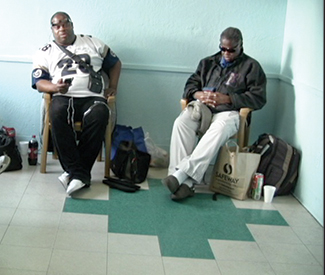
Inside Mother Brown’s cool blue walls, there’s no shortage of incredible personal stories. Lonnel McCall took a break from helping to cook dinner at Mother Brown’s kitchen to describe what the place has meant for him.

“I didn’t have nothing, not even ambitions. I felt I was a loser. I had no self-esteem,” he remembers. “I was smoking crack under the bridge and all that stuff.”

He now has a job as a hotel chef and lives in a HOPE House home. He rolled up his sleeves to reveal cuts and burns, the battle scars of a chef.

“These are my cook wounds,” he said, “instead of dope wounds.”

But for a period, McCall slept in the chairs. “It’s hard. Your ankles swell up,” he said.

Wade Verdun also slept in the chairs and went through HOPE House.

“I’ve got my own place now, got my own car. I’m no longer on drugs. And I’ve got a two-year-old son,” Verdun said. “This place saved my life, to tell you the truth.” Smiling, he patted his belly. “I’ve never been this fat. Trust me.”

If the shelter does get built, Westbrook hopes, it can lead to more happy endings like McCall’s and Verdun’s.There are already too many sad stories.

On Dec. 19, candles lit the dusk on the steps of City Hall in a vigil for the homeless people who have died in San Francisco. The vigil was organized by Night Ministry, a crisis intervention and counseling service that operates in the Tenderloin from 10pm to 4am. Reverend Lyle Beckman, director of Night Ministry, said that he got the names of 22 deceased homeless people from the Department of Public Health, but knew it was low. During the vigil, attendants came forward with the names of more dead, until the number reached 100.

Beckman said the crisis line gets busy this time of year. “We always see more conversations around holiday time,” he said. “When people have memories of it being a family time and then they’re not connected with their family in some way, it can bring isolation and loneliness.”

In a city of chosen families, Mother Brown’s “children” have found a way to heal that kind of loneliness. Perhaps McCall put it best when he described the first time he came back to his native Bayview and found Mother Brown’s after decades of isolation.

“When I came in through the door — this is God’s truth — I felt like I was at home,” he said. Soon, people like McCall may find a bed, too, when they walk through that door. Maybe for Christmas 2015.

Million, schmillion

0

arts@sfbg.com

YEAR IN VISUAL ART One of the art world’s largest trends for 2013 culminated in November, at Christie’s record-breaking contemporary art auctions that saw the most money ever paid for an artwork (Francis Bacon, Three Studies of Lucian Freud, $142 million) and the most ever for an artwork by a living artist (Jeff Koons, Balloon Dog (Orange), $58 million). The general outrage that followed for once united Joe Shmoe and the art blogosphere in reactions that ranged from disdain to histrionics. Hating rich people and their spending, it turns out, is something that we can all really get behind.

It was a bit surprising, really, to read such astonished responses from professed art world insiders, most of which gave voice to disgust and outrage at the amoral caprice and soulless gluttony of various, shameless one percenters plunking down ungodly sums of money on balloon dogs and other decadent, trashy, luxury stuff that clearly anybody’s kid could dream up. Or something like that.

Now that the dust has settled a little, it’s worth revisiting those sales without the preaching, and figure out what they mean for the art world going into 2014. A couple observations follow.

First, and contrary to universal opinion, as far as I can tell these artworks sold on the cheap. My math: the top ten collectors of art in 2013 are worth more than $10 billion each on average. At the November evening session at Christie’s, the average sale price for a work of art was just shy of $11 million. Those numbers make my head spin, so let’s scale down to you-and-me bucks: The wealthiest and most active collectors were paying mere fractions of their net worth, on average, for the artworks. Maybe a tenth of a percent. If you or I put down that much of our net worth, we’d be talking somewhere between, say, a couple hundred to a couple thousand dollars. In other words, a completely reasonable amount of money — cheap, even. About the pricing you’d expect for an emerging artist’s work.

Looking at the money in scale, there are actually very few buyers at the top willing to splurge heavily on individual works of art. If, as ARTnews reported in its 2013 summer issue, there are 100 collectors in the world willing to throw down more than $50 million on art, it’s a tiny number of people and a very modest amount for a billionaire. The high end of the art market is pretty conservative considering who’s playing in that game. In fact, if rumors are true and Russian billionaire Roman Abromavich is the buyer for Three Studies of Lucian Freud, then he spent about 1.4 percent of his net worth on the paintings, something between the price of a nice sofa and a car, in you-and-me terms.

Second, these purchases weren’t speculative or the result of a bubble. The runaway consolidation of global wealth among the one percent is accelerating. If their spending on luxury items like blue chip art keeps any kind of pace with their expanding wealth, then the prices at the top tier should be racing higher every year. These people are astronomically rich. They should be putting down lots of money on art.

And it’s not all balloon dogs and pill paintings, either. Looking back over the year, you notice record-breaking investments in the work of young and talented artists, among them former Bay Area artist Tauba Auerbach, whose six works sold in June for a combined $1.34 million, as well as Cecily Brown, Mark Grotjahn, Julie Mehretu, Tara Donovan, and others.

And, I’m not even going to get too upset about that orange Jeff Koons dog sale, clearly an act of peer showmanship. Like an episode of Voltron, the other four colored dogs are scattered between billionaires Steven Cohen (Yellow); the Broad Foundation (Blue); Francois Pinault (Magenta); and Dakis Joannou’s DESTE Foundation (Red). In the end, you know what? At a relative scale for us worker bees, $58 million is something like splurging on a Basil Racuk bag. Maybe not entirely necessary, but well worth the dough, and I can totally understand the peer pressure if your friends are all lucky enough to have one.

My most optimistic take on this is that money flooding in at the top end of the market helps not just bluest blue chip artists like Koons, and not even the newly minted blue chips like Grotjahn, but also helps to redefine what a quality work of art ought to cost, and widens the expectations for what wealthier people than you and me ought to be paying. Let’s face it: I’m not in the market for a Francis Bacon painting, nor are you. *

For the curious, I got the top ten list from ARTnews.com; each billionaire’s net worth from Forbes.com; and the auction results from Christies.com. I’m sure the more statistically inclined among you will take issue with my unweighted averages, and I hope you feel free to comment with more elegant calculations than mine.


Bravo!

1

arts@sfbg.com

YEAR IN THEATER Before the holiday season crushes us in its tinsel-glinted maw and poops us out into 2014, it’s time to cast a backward glance and ponder 2013’s best moments in theater and performance.

Most satisfyingly enigmatic flights Getting lost can be a good thing. It can concentrate the attention, heighten the senses, activate the imagination, leave room for reflection — and leave something to talk about afterward. This is as true for a visit to the theater as it is for a walk around town.

The great director Robert Wilson put it like this when, speaking in 2012 in Berkeley during the revival of Einstein on the Beach, he noted the difference between his brand of theater and the average: “It’s something that you can freely associate with. [In the usual theater piece] you’re constantly told what to think or how to respond. If you go to the theater tonight, if you go to Broadway, every 20 seconds, 10 seconds, no more than 30, you have to react. It’s always, ‘Do you understand? Do you get it? Do you understand? Do you get it? Do you understand? Do you get it? Do you understand? Do you get it? Do you understand? Do you get it?’ And after a while you don’t understand anything. So in this work it’s ok to get lost.”

Without detracting from the power that can attend even the most didactic of narratives, let’s hear it for the productions this year that did not shy away from abstraction and mystery, as in Shotgun Players’ staging of Linda McLean’s strangers, babies or (more radically, if in workshop form) Affinity Project’s Nocturne (the best part in foolsFURY’s inaugural Factory Parts, a works-in-progress festival). (Robert Avila)

Best Habitués of the Home Theater Circuit We’re big fans of the Home Theater Festival and the back-to-the-basics performance model it so ably demonstrates. But where the festival ends, at the threshold of one’s own doorstep, the notion that there could be a whole DIY living room tour circuit is gaining ground. Two recent exemplars of this lo-key, high-mileage approach are Sebastopol’s the Independent Eye, which just returned home from a month-long, cross-country sojourn during which it performed 17 shows — nine in living rooms — and San Francisco’s Right Brain Performancelab expanded its private-home Due West salon into a roving three-weekend run of its 10-year anniversary performance, What Stays?, from Half Moon Bay to Oakland. (Nicole Gluckstern)

Most “Twisted” take on the big screen Dogugaeshi at Zellerbach Playhouse. Combining his own brand of invention and humor with the titular ancient Japanese form — in which moving sets of painted screens coaxed the eye through a seemingly infinite recession of figurative and abstract environments — master puppeteer Basil Twist and his deft collaborators created an opulent, entrancing, even mystical journey that ranks as one of the purest theatrical experiences all year. (Avila)

Most Pervasive Unofficial Theme for 2013: “Losing my Religion” While our headlines were more concerned with political détente and economic implosion, our stages were full of struggles of a more personal nature: that of religious belief (or lack thereof). With works like Tanya Shaffer’s Siddhartha-inspired musical The Fourth Messenger; Mugwumpin’s mesmerizing fall from prophetic grace, The Great Big Also; the epistemological ponderings of a dead felid in SF Playhouse’s Bengal Tiger at the Bagdhad Zoo; and the wounded evangelicalism simmering in Aurora Theatre’s A Bright New Boise, both actors and audiences were forced to confront questions of faith in ways that pointed to unresolved unease on both sides of the pulpit. (Gluckstern)

Most overdue Bay Area debut The Wooster Group + New York City Players at Yerba Buena Center for the Arts. This production of three of Eugene O’Neill’s early seafaring one-acts seemed to flummox many, though the audience I sat with seemed as riveted as I was by the strange, challenging approach to these texts. Certainly it was a little misleading to describe this as a Wooster Group production — despite having two Wooster actors in the cast and a Wooster set, it was very much in debt to the idiosyncratic and deeply committed approach of director and playwright Richard Maxwell and his NYC Players, who made up the majority of the cast. A long overdue Bay Area visit by these acclaimed companies, it anyway made for one of the more distinctive and provoking encounters between actors and audience all year. (Avila)

Most Memorable Elementals In Aurora Theatre’s production of Max Frisch’s The Arsonists, fire played an ominous role, a tool deployed to destroy the civilization it helped build, while in Ragged Wing Ensemble’s collaborative Time Sensitive, ice took the main stage, with a dripping block signifying both the passage of time and the impermanence of the material world. While at first glance the two plays were to each other as fire and ice — one a carefully modulated farce, the other a frenetic roller coaster of status seekers and secret keepers — both inventively explored common themes of moral decay and the follies of keeping up appearances in a society full of questionable values and diminishing spiritual rewards. (Gluckstern)

Best performance of herself Judith Butler at CounterPULSE. The famed philosopher and theorist of the performativity of gender appeared as part of the ongoing Dance Discourse series, in dialogue with CounterPULSE’s Julie Phelps and outstanding performances by artists DavEnd, and Xandra Ibarra and Hentyle Yapp. While confessing it was not always easy “performing Judith Butler,” the Berkeley prof proved game, contributing to an exceptionally lively cross-disciplinary encounter. (Avila)

Playwriting Series Most Likely to Win a Gold Medal: San Francisco Olympians Festival Here be giants. Plus gods, mortals, and mythological creatures brought to often hilarious life by dozens of local playwrights and theatre artists over the course of three weeks. The brainchild of No Nude Men’s Stuart Bousel, the festival features an array of thematically-connected staged readings featuring characters long forgotten by contemporary audiences: Teucer, Thersites, Laodike, Cruesa, and Neoptolemus, to name but a few. Not content to stick to the script, SF Olympians offers a corresponding gallery show of fine art, encourages wild experimentation such as the debut installment of Megan Cohen’s crowd-directed “Totally Epic Odyssey,” and has even generated a book of new plays (Songs of Hestia, EXIT Press 2011). (Gluckstern)

Most persuasive British accents Ian McKellen and Patrick Stewart in No Man’s Land at Berkeley Rep. In fact, the pair, true British theater royalty, made it all look so easy. (Avila)

Theater Company Most Likely to Boldly Go… Whether a given production is a hit or miss, Cutting Ball’s commitment to staging new absurdist and experimental works has secured it a very important spot in the Bay Area’s theatrical firmament. And although very different in content, the world premieres of Andrew Saito’s boldly apocalyptic Krispy Kritters in the Scarlett Night and Basil Kreimendahl’s quixotic, gender-queer vaudeville Sidewinders provided an essential sounding board for two bright new talents who would have otherwise struggled long to find homes for their misfit children. (Gluckstern)

Best mess Anthony Rizzi’s An Attempt to Fail at Groundbreaking Theater with Pina Arcade Smith at Kunst-Stoff. The Frankfurt-based American performer and former William Forsythe dancer took over the Grove Street loft space for three glorious nights in February as a magnificently straight-shooting queer amalgam of Jack Smith, Penny Arcade, and Pina Bausch, flouncing, crawling, and climbing around the bric-a-brac properties strewn around the room, dancing with anyone who wanted to, dropping a laptop from a ladder (ostensibly by accident), and generally flailing with memorable brio and brilliance. (Avila)

A Few Luminous Performances That Reminded Us There Are No Small Actors, Only Small Stages Donald Currie as Sandy in Cutting Ball’s Sidewinders; Nick Medina as Belinsky in Shotgun Player’s Shipwreck; James Udom as Freddy in Performers Under Stress’ Scamoramaland; Tamar Cohn as the Old Woman in Cutting Ball’s The Chairs; Safiya Fredericks as Sydney in 42nd Street Moon’s It’s a Bird…It’s a Plane…It’s Superman; and Amy Lizardo as Yitzhak in Boxcar Theatre’s Hedwig and the Angry Inch. (Gluckstern)

Most promising solo debut Safiya Martinez in So You Can Hear Me, at the Marsh. Writer-performer Martinez memorably recounted her shattering experience as a 23-year-old special ed teacher in the South Bronx, inhabiting lives and personalities still too rarely seen on any stage, and with a precision and verve equally uncommon. (Avila) *


Teen dream machine

0

arts@sfbg.com

YEAR IN TOFU AND WHISKEY Call it the Rookie Magazine trickle-down effect: Teen girl rockers ruled the world in 2013. Granted, some 20-somethings were in there too. But still, these young and fierce ladies — celebrated on either Rookie’s more polished site or eye-popping Tumblrs of a similar demographic — were the artists to take notice of this year.

The young majors of 2013 were 17-year-old New Zealander Lorde and Los Angeles sister trio Haim, all in their early 20s. There were also female rappers and soul singers, like Cameroon-raised Lorine Chia (20), and Brooklyn-based Angel Haze (22). Locally, there was teen surf pop quartet the She’s. On a smaller scale, there are emerging acts like Sacramento’s sister duo Dog Party, which, at ages 14 and 17, released its biggest record to date on Asian Man Records this August.

Rookie is the web magazine for young girls that looks more to the Sassy archetype than Seventeen, but so far beyond those bounds that it’s almost ludicrous to compare the two. Started in 2011 by now-iconic mini fashion blogger Tavi Gevinson, the website blends style, feminism, and culture into a Nylon-esque vision of rude glamour. More so, it’s become a casual, glittery hit-maker, simply by nature of showcasing exciting new talent early in the game, often before it’s been hungrily shredded by the widespread blogger industrial complex.

Musicians are featured in gushy profiles, or longer Q&As, often with more personalized questions than are found on standard music blogs. An early Rookie writeup on Lorde reviewed her full-length record Pure Heroine (Universal Music Group) in a typically conversational tone: “I first heard Lorde, when I was in the parking lot of a Target one night. It was 10:50pm and I was in the car by myself, listening to the radio; I had just been going through a breakup and was in an awful state of mind. Suddenly this song came on with a simple beat and this AMAZING voice that made me sit up straight and turn on Shazam, which told me it was Lorde’s song ‘Royals.'”

Can’t you too remember such a time? An moment in a youthful life, alone in your car or next to the stereo in your room, the disappointments of a confusing day rushing through your mind, and then the moment a song transformed that hurt into pure joy? It might not have been a pop song, but it certainly could have been.

Thanks to the thrill of that paradoxically anti-consumerist pop song “Royals,” Lorde (née Ella Yelich-O’Connor) was undoubtedly the biggest of the aforementioned bunch of teen girls who made it big in 2013. She became a bona fide pop star in black lipstick and a poof of untamed, grungy curls. And while her look and style are certainly endlessly dissected, she came to the pop charts when there was a specific need for her new breed of mainstream-yet-still-underground-enough-to-be-weirdish sound.

In her recent essay on Lorde and others of her ilk, NPR writer Ann Powers poetically described Lorde’s step away from pop stars of the tongue-out, twerked-out Miley variety we also suffered through in 2013: “Lorde is a phenomenon because of perfect timing. She came along just when listeners were craving what ‘Royals’ famously advocates: a different kind of buzz. After a few months as the new find of early musical adopters, this droll chanteuse became notorious for suggesting that some kids might prefer to stand apart from pop’s endless party.”

Angel Haze was another standout — a stunning, pansexual, artistically rare rapper who took Macklemore’s “Same Love,” and gave it meaning, singing of her own (real) struggles with sexuality. The young artist’s debut full-length, Dirty Gold, doesn’t even see release until January 2014, but her covers (she also took on Eminem’s “Cleanin’ Out My Closet”) made her a name to know in 2013.

Haze was featured on Rookie, as was soul singer Lorine Chia. A performer with a silky voice and tropical beats, Chia released an EP, Naked Truths (Make Millions Music), in October and frequently Tumbls her fascinating life and favorite musical finds. Like other young females who made their mark this year, she seems worlds apart from the sleek pop stars of yore, still enthralling but somehow approachable.

And then there was Haim, the crunchy, LA-based sister trio that hit it big with September-released Days Are Gone (Polydor Records, Columbia Records). The album went silver, selling nearly 90,000 copies stateside, which is big news in these unwieldy music industry days.

But apart from the pop and hip-hop charts, teen girls were also making waves in smaller local scenes. Case in point: The She’s. The talented, breezy-surf pop quartet started off the year playing Noise Pop and were on the cover of the Guardian, posed as a group to watch in 2013.

A few months later, there they were: life-sized on bus-stop posters plastered around downtown as part of that big Converse campaign that overran the city’s music scene this summer (not that we had anything to do with the leap). The She’s recorded a track for Converse’s Rubber Tracks popup station at Different Fur Studios, and also played a ton of shows throughout the year. Oh, and the SF natives all just graduated from high school.

As for Sacramento’s burgeoning Dog Party, the sister duo is still navigating those studious halls of yore. Singer-guitarist Gwendolyn Giles is a senior in high school, and drummer Lucy Giles is a 14-year-old sophomore. They started playing together at ages 9 and 6.

“Before [guitar] I played the flute, but that wasn’t for very long because I like guitar,” Gwendolyn tells me from their Sacramento home. “The flute made me dizzy. Also when I was in fourth grade, American Idiot came out and I was obsessed with Green Day.”

Lucy pipes up with her earliest inclination that she wanted to play rock’n’roll: “I was really into the White Stripes when I was in third grade. I like Meg White and so I just kind of decided I wanted to play the drums.”

Her dad picked up a drum set at a garage sale, and the girls soon began lessons, and then started writing songs — with angsty lyrics about worrisome BFFs and the like, and stories that were mostly autobiographical. In 2013, the Giles sisters released their third full-length, bratty pop-punk record Lost Control, on Mike Park’s legendary Asian Man Records. It stands with the Donnas, the Bangs, and a mix of other fun party punk acts before them.

Ty Segall tops their mutual list of favorite new (or new-to-them) acts of 2013, followed by the Descendents, the Babies, fellow SacTown locals Pets, and most of the Burger Records roster.

“My sister and I really love Ty Segall,” Gwendolyn gushes of the prolific rocker. “He’s amazing … my favorite artist of all time.”

Dog Party went on a full US tour with Kepi Ghoulie (of ’80s band Groovie Ghoulies) and just last week played with the Aquabats at Slim’s. Next up, they’ll play the Gilman Fri/20.

As with other female artists this year (and for the past decade), Dog Party has had to deal with web trolls intent on breaking them down.

“Now that we’ve gained a little bit of popularity, there have been some nasty things written about us on the Internet,” Lucy says. “But that doesn’t really affect us. We don’t like to listen to what they say because we don’t really care.”

While the Giles sisters hadn’t known about Rookie before they were featured on the site, they’ve heard a lot of feedback since the post, which urged readers to “stream the new album by our (and probably your) new favorite band.”

“We got a lot of attention from Rookie,” Gwendolyn says. “People have come up to us and been like ‘Hey, I heard about you from Rookie!’ It’s pretty cool.”

“Our social media sites had a pretty big boost off that article,” adds Lucy. 


Tofu and Whiskey’s top records (and sandwiches) of 2013

1. Weird Sister, Joanna Gruesome

2. In Dark Denim, Antwon

3. It’s Alive, La Luz

4. Run Fast, The Julie Ruin

5. Ionika, Metal Mother

6. Ride Your Heart, Bleached

7. Self-titled, Golden Grrrls

8. Mama’s Hummus sandwich, Bi-Rite

9. Tofu Banh Mi, Hella Vegan Eats

10. Vegan Reuben, Ike’s

Back in Burgundy

0

cheryl@sfbg.com

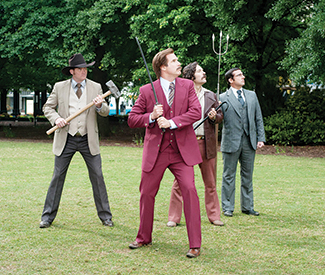
FILM The return of Ron Burgundy — the boorish, quotable Will Ferrell character immortalized in 2004’s Anchorman: The Legend of Ron Burgundy — has been heralded for months, thanks to an extravagant marketing campaign that has included car commercials, a new Ben & Jerry’s flavor, and Burgundy-branded Scotch.

But before you claim Burgundy fatigue, there’s the actual sequel to consider. And Anchorman 2: The Legend Continues is quite hilarious, as it turns out. Director, co-writer, and longtime Ferrell collaborator Adam McKay — formerly of Saturday Night Life, he’s the co-founder of Funny or Die, and has directed such Ferrell hits as Anchorman and Talladega Nights: The Ballad of Ricky Bobby (2006) — came to town to discuss his new comedy.

SF Bay Guardian I know you’re here to talk about Anchorman 2, but first I have to express my deep love for Step Brothers (2008).

Adam McKay We were just talking about how that’s the one movie we have that’s super-polarizing. People either loved it or hated it. Roger Ebert wrote one of my favorite reviews that we’ve ever had, where he said that the movie was a symbol of the downfall of Western civilization. [Ed. note: the exact quote is “In its own tiny way, it lowers the civility of our civilization.”] Will Ferrell and I loved that. It read like the Richard Jenkins character in the movie wrote the review! But it might be my favorite movie we’ve done. I think it makes me laugh the hardest.

SFBG Will you ever make Step Brothers 2?

AM We were actually on our way to making Step Brothers 2. The problem was, everyone I told said, “Why? Cause you can’t do Anchorman 2?” I said to Will, “Are we gonna make this movie and the whole response is gonna be, ‘[They made this because] they couldn’t do Anchorman 2‘?” I just didn’t want to deal with that. Fortunately, we love Anchorman as well. But yeah, we had a whole idea. We’d outlined it. John C. Reilly was in. So it still may happen.

SFBG A lot of Anchorman 2‘s humor comes from its cameos. Were you flooded with calls from actors who wanted in?

AM We did have a little bit of that, actually, which is unusual. Fortunately, they were people we loved. I heard right away that Tina [Fey] was up for a cameo, and I’m like, “Yes!” I bumped into Sacha [Baron Cohen], and I was like, “Hey, would you wanna…” “Yeah, I’ll do it!” It was weird to get those kind of effusive responses. It was kind of crazy.

SFBG The first film was PG-13. I’m surprised the sequel is, too. While watching it, I assumed it would get an R for language.

AM We actually had a long battle with the MPAA over it, and we had to trim down quite a few things. It’s all, like, sexual innuendo, and if you say this word you can’t say that word. But meanwhile, if you kill 100 people they don’t care. We were kind of pulling our hair out. But at the end of the day, I think we did pretty well with it. It was always meant to be PG-13. It’s a silly, kind of living cartoon movie. It’s not a hard, dirty movie.

The crack scene was a big, big [sticking point]. Originally it was much longer. But you’ll get to see that on the DVD. There’s a whole other version of the movie where we replaced all of the jokes, since we did so much improv. So it’s the exact same physical movie, but almost every joke is different.

SFBG A lot of the jokes might be perceived as racist or sexist if they were taken out of context. How do you ensure that viewers don’t receive those the wrong way?

AM That was really tricky. We had to calibrate that through all the screenings that we did. The first screening had too much of that in it, and it felt a little uncomfortable, so we’d kind of pull it back. But the whole premise is, these guys are idiots. And they don’t understand anything about multiculturalism, women’s lib — they don’t get any of it. So as long as that premise is clear, you’re OK. They’re not mean guys — except for Champ Kind, who probably is a Tea Party right-winger. But the rest of them are just idiots.

So long as the racial jokes were more just ignorance, it was OK. But if it ever became like a pointed slam, that’s when it would cross the line. So we stayed away from all that kind of stuff, and just had them sort of live in ignorance.

SFBG Like the first Anchorman, the film layers its silliness over cultural commentary. Here, it’s how ridiculous 24 hour news has become.

AM That was always the inspiration. In the first movie, we had women breaking into the newsroom, and these avuncular anchormen just being shits, basically. And that’s hilarious and awful at the same time, and significant enough that you have stakes that you can tell the story.

So for this one, the central idea was 24-hour news, and when the news became what it is today. Really, we knew we had the movie when we were like, “Let’s have Burgundy be the guy who ruins it all.” [Laughs.] And we decided to pin it all on him: the birth of infotainment, the birth of ratings-driven, corporate-owned news, and the idea that Burgundy would be really good at it.


ANCHORMAN 2 opens Wed/18 in Bay Area theaters.

All that glitters

1

arts@sfbg.com

FILM If longer were better, this would be the platinum era of movies. Never before have so many mainstream releases staggered toward or beyond the two-and-a-half-hour mark once reserved for the truly epic — in storytelling breadth, not just in fight scenes, expensive CGI effects, or simple directorial inability to say “when.”

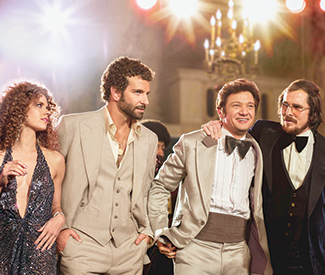
David O. Russell’s American Hustle is about that long, and it’s like a lot of things you’ve seen before — put in a blender, so the results are too smooth to feel blatantly derivative, though here and there you taste a little Boogie Nights (1997), Goodfellas (1990), or whatever. Normally that would not be a particularly promising combination, but in the current climate perhaps no praise could be higher than to say there isn’t a minute among Hustle‘s 138 when it’s safe to run to the bathroom. This isn’t necessarily the best film of the year, let alone the most original, but it’s quite possibly 2013’s most enjoyable major-studio release — at least if you’re over 15 and not over-enamored with superheroes or elves.

Loosely based on the Abscam FBI sting-scandal of the late 1970s and early ’80s (an opening title snarks, “Some of this actually happened”), Hustle is a screwball crime caper almost entirely populated by petty schemers with big ideas almost certain to blow up in their faces. It’s love, or something, at first sight for Irving Rosenfeld (Christian Bale) and Sydney Prosser (Amy Adams), who meet at a Long Island party circa 1977 and instantly fall for each other — or rather for the idealized selves they’ve both strained to concoct.

He’s a none-too-classy but savvy operator who’s built up a mini-empire of variably legal businesses while honing a ’70s swinger suavity à la Bob Guccione. She’s a nobody from nowhere who crawled upward, gave herself a bombshell makeover (Adams is almost exclusively costumed J. Lo-style, inner side boobs on full display), and like Barbara Stanwyck in 1941’s The Lady Eve specializes in posing as British aristocracy — the Lady Edith, to be precise. They’re upwardly mobile con artists who know their limits.

The hiccup in this slightly tacky yet perfect match is Irving’s neglected, crazy wife Rosalyn (Jennifer Lawrence), who’s not about to let him go — nor can he bring himself to leave their son, even if the kid isn’t his biologically. At least she’s their main problem until they meet Richie DiMaso (Bradley Cooper), an ambitious FBI agent who entraps the two while posing as a client in desperate need of loan-sharking services. Their only way out of a long prison haul, he says, is to cooperate in an elaborate Atlantic City redevelopment scheme he’s concocted to bring down a slew of mafioso and presumably corrupt politicians. Even if they have to fabricate crimes to hustle the not-yet-guilty into — notably a beloved Jersey mayor (Jeremy Renner) whose nose is as clean as can be given a constituency riddled with tough customers and backdoor deals.

A male even more aspirationally alpha than Irving, Richie is in over his head with this Machiavellian plan — which eventually ropes in terrifying, seldom-seen mob legend Victor Tellegio (Robert De Niro) — as his oft exasperated superiors are well aware. But as the sting rolls heedlessly forward, the conspirators’ Achilles’ heel turns out to be Rosalyn, who can’t be kept entirely out of the loop and certainly can’t be counted on not to blurt exactly the wrong thing at the worst possible time.

Scored to a K-Tel double-album-full of greatest hits from earlier in the Me Decade (these people aren’t on the cutting edge, musically or otherwise), American Hustle is a giddy tale of Horatio Alger-style all-American gumption headed toward a train wreck. Russell’s filmmaking is at a peak of populist confidence it would have been hard to imagine before 2010’s The Fighter, and the casting is perfect down to the smallest roles. But beyond all clever plotting, amusing period trappings, and general high energy, the film’s ace is its four leads, who ingeniously juggle the caricatured surfaces and pathetic depths of self-identified “winners” primarily driven by profound insecurity.

Our first view of Irving (or anything) is a camera spin around his ample middle-aged gut and up to the gaping bald spot he’s in the process of concealing. Bale retains his handsome features, but the physical transformation he’s undertaken here extends to a schlemiel-in-camouflage slouch whose roots you can feel in Irving’s very thought processes. More recognizable despite his curly locks and disco shirts is Cooper, who after this and Russell’s Silver Linings Playbook (2012) has clearly found his niche: playing control-freak rageaholism for manic comedy.

Lawrence’s Judy Holliday-meets-Valerie Perrine turn has justly been praised enough elsewhere. She’s spectacular, but the stealth heart of the movie belongs to Adams in a role that might easily have been played as merely “hot.” Sydney is brighter and more coolly rational than those around her; but life has taught her that a girl’s best bet is to look good and make the man think he’s doing the thinking for both of them.

Adams is a natural comedian, yet here she’s also the presence onscreen most alert to everything that’s going on, making Sydney the most thoughtful character and hers the most subtle performance. Without her, American Hustle would be great fun but a little hollow. With her, it almost seems genius, as if Preston Sturges had remade 1997’s Donnie Brascoe.

Big fantasy films have grown repetitious, yet they grow ever longer despite the fact that short-attention-span cinema really, really benefits from reining in the runtime. Prestige movies, too, seem to be under some sort of pressure to streeeeetch it out. Would Captain Phillips, The Butler, or even (sue me) Blue is the Warmest Color have been better with a tighter length and focus? Of course they would. But the sheer bulk seems to confer importance, like those literary magnum opuses each year that command attention not because they’re an author’s best, but because they weigh as if they ought to be. *


AMERICAN HUSTLE opens Fri/20 in Bay Area theaters.

Candy crush

0

marke@sfbg.com

YEAR IN NIGHTLIFE The drink of the year was the Chinese Mai Tai at Lipo Lounge. It’s $9, but it’s huge and you only need one. Or maybe a half, if you want to remember your pants. Oh, just drink the whole thing.

It was another supersweet, neon-bright yet sonically sophisticated year of clubbing and dance music, full of ups, downs, and twirl-arounds. Celebrated rave cave 222 Hyde and Hayes Valley drag outpost Marlena’s closed (boooo). But Mighty and 1015 got mindblowing new sound systems, Monarch and DNA Lounge expanded, Project One inherited 222’s speakers, Public Works and F8 doubled-down on adventurous bookings, and ambitious venues Audio Discotech and Beaux opened (and are still finding their footing). And we got a new dance music record store, RS94109, and rising dark techno star, Vereker.

As far as music goes: we’ve managed to fend off the worst of pop-EDM, while welcoming the drum ‘n bass and big-room ’90s sound comeback with open underground arms. (Also, there is an actual underground!) San Francisco’s still a major destination for techno up-and-comers — and even though you may stumble across some clueless tech-bros sporting 2k7-wear or novelty rasta wigs on our finer dance floors, give them a hug and hope they improve! It’s all good.

>>Read Emily Savage’s take on the YEAR IN MUSIC 2013 

Before I get into some of my favorite 2013 things, let’s tip a hat to two legends we lost this year: Scott Hardkiss and Cheb i Sabbah. Between them, they brought a whole world’s worth of music to our dance floors and spanned generations. Dancing forever in their honor.

HIP-HOP, Q’ED UP

Hip-hop got so good in 2013, the Year that Twerking Ate the Internet. Trap sounds and molly pops seemed to invigorate the East Bay scene: E-40 dropped a zillion slaps, while Iamsu! and Sage the Gemini (who can totally get it, hellieu) swerved onto the national scene. Buffed-up SF legends Latyrx dropped a nifty disc after two decades. In the bigtime, Kanye bought up every edgy electronic producer he could to impress Pitchfork, while Danny Brown and Kendrick Lamar recontextualized essential ’90s rap tropes — gangsta and concept albums, respectively, but in a party way.

Unfortunately, another ’90s rap trope, tired homophobia, was also revived, with Eminem and Tyler, the Creator fumbling bigtime. This time, however, there was such a huge and thriving queer hip-hop party scene that we could look right past all that lazy ish. Queer rap broke big in 2012 when eye-catching artists blended witch-dark sounds, quantum vogue moves, and afro-surreal poetry with R&B licks, broken bass boost, and neon-bright performance art.

That scene deepened and brightened this year — here, at super parties like Swagger Like Us, 120 Minutes, Fix Yr Hair, and House of Babes and unstoppable homegrown talent like Micahtron, Double Duchess, and even cameo appearances by classic homohop babes Deep Dickollective — proving that spitting flames can still burn down the disco. And queer-rap resistance even grabbed the national spotlight when Daddie$ Pla$tic‘s electro-anarchic “Google Google Apps Apps” went viral.


SWEET AND LOW

The Honey Soundsystem crew ended its Sunday night parties at the top of its game with a huge blowout — surprise marriage proposal, performance by fabled ’80s singer Jorge Socarras, and slew of unannounced guest DJs included. Honey was an ostensibly gay club, but that might have just been a feint to pack the floor with hairdressers. While it never ceased brazenly shoving its raw homosexuality in the oft-frigid techno scene’s face, its influence went way beyond the queer sphere. For five years, it was our best weekly in terms of musical guests (Wednesdays’ fantastic Housepitality almost ties it on that score), bringing in a mind-blowing roster of international underground players.

But Honey Sundays were more. Will there ever be a party ballsy enough to take as a month-long theme the skyrocketing real estate market, condo-mapping its venue and printing “luxury house” brochures? Or base the décor of one of its biggest parties around a collection of putrid haters’ comments? What promoters, nowadays, even bother to actually design and print challenging works of art as posters and flyers, or truly transform their venues? (DJ Bus Station John, still our gold standard, is the only one I can think of.)

Fortunately, Honey parties will continue, just not weekly. But SF is full of such amazingly talented crews, both well-established (As You Like It, No Way Back, Sunset, Lights Down Low, Icee Hot, Opel, Pink Mammoth) and burgeoning (Isis, Face, Modular, Mighty Real, Trap City, Odyssey). My wish for 2014 is that many of these really invest themselves in building a whole vibe for their parties, top to bottom, instead of just relying on groovy headliners, online promotions, and audience goodwill. As the changing city chases out its artists and loses its edge, we need entire worlds of freakiness to escape into and call our own.


TOP SOUNDS OF 2013

>> Nebakaneza, “Expansion Project, Vols. 1-11

What does our most forward-thinking dubstep DJ do when dubstep’s no longer an option? He deepens his crates, cycling through 12 months-worth of excellent mixes, themed by genres like yacht rock and classic soul, to rediscover his bass roots while transforming his sound into something even more thrilling.

>> Swedish House Mafia, Bill Graham Center, Feb. 16

I finally get it! All you need is a $1 million light rig, 40,000 glowsticks, an indoor fireworks show, and an arena full of half-naked teens. This EDM stuff is actually kind of fun.

>> The Disclosure Effect

Disclosure’s Grammy-nominated debut Settle (Cherrytree) will nest atop most critic’s dance picks this year, and rightly so: the young Lawrence Brothers brought lovely, 2-step-fueled house back into headphones and charts worldwide. But if it also brings more attention to breezy sonic relatives like Bondax, AlunaGeorge, Joe Hertz, the Majestic Casual roster, and the hundreds of bedroom producers who suddenly switched from making EDM and dubstep to deeper house sounds, then so much the better.

>> Deafheaven, Sunbather (Deathwish, Inc.)

Shoegaze plus death metal equals an arctic beauty and burning mystery that transcends even My Bloody Valentine’s wonderful, self-released mbv and, when listened to alongside this year’s icy electronic-ish masterworks like Tim Hecker’s Virgins (Paper Bag Records) and the Haxan Cloak’s Excavations (Tri Angle) — or more emotive ones like Chance of Rain (Hyperdub) by Laurel Halo, Psychic (Matador) by Darkside, or Engravings (Tri Angle) by Forest Swords — makes strange sense of a near future.

Steve Reich, “Music for 18 Musicians,” SF Contemporary Music Players, Jan. 28

The fact that there was a near-riot to get into a performance this hypnotic, hyper-complex 50-minute 1974 piece by minimalist icon Reich attests to SF’s ravenous appetite for “contemporary classical.” That the audience sat in stunned silence a full two minutes after the piece concluded before exploding with applause attests to the excellence of our local players. (And while we’re on “classical,” kudos, too, to the SF Opera’s summer production of Mozart’s “Cosi fan tutte” — three fantastic hours of the most ravishing singing I’ve ever heard.

>> Patrick Cowley, School Daze 2 x LP (Dark Entries)

The instant Internet popularity of Montag’s trippy “Porn Archives Lo-Fi Mix” earlier this year should have tipped off the coming re-evaluation of porn soundtracks as electronic artworks. But when members of Honey Soundsystem released this two-disc compilation of fascinating, atmospheric early tracks by local electronic wizard Patrick Cowley (1950-1982) used in ’80s gay porn flicks, it became a critical sensation.

>> Regis, As You Like It and Public Works, July 26

Here’s a question: Do you need to actually be at a party to enjoy it? I was out of town when this joint went down. But after witnessing my feeds blow up and listening obsessively to the Soundcloud set, later posted to Youtube, it feels like I was there when the young Brit freaked everyone out with a hard, deep techno set. No FOMO, baby.

>> Throwback monthly, Mighty

I may be fascinatingly elderly, but all the young kids flocked to the ’90s big-room house sound revival this year. This party, a SF reunion brimming with new faces, classic tracks, and legends at the decks, is like Universe plus cool straight people, or maybe the End Up in the East Bay.

>> Jay Tripwire

I fell deep(er) in love with so many DJs this year: Guy Gerber, Kyle Hall, Osunlade, J.Phlip, Greg Wilson, Catz ‘n Dogz, South London Ordnance, Finnebassen, 0Phase, MK, Vakula, Robert Hood, Huerco S., Kastle, Psychemagik, Jeff Mills, Keep Schtum, Stretford Dogs Club — but this revered Canadian DJ’s DJ always sets my (vinyl!) standard, especially with this year’s banging techno DJ Mag and expansive Electronic Groove (best deep house buildup of the year on that one, imho) mixes.

>> Divoli S’vere, Ckuntinomksz Vols. 1-3

Vogue beats continued to come into, er, vogue harder than ever this year, their flashy attitude and underground authenticity influencing musicmakers, like our own up-and-coming Soo Wavey label. Young NYCer Divoli, however, gives you real quantum fishiness to gag on all day — and goes waaay above your wig, hunty. These three volumes of lightning-made bedroom beats might be overload, but take us into some incredible sonic landscapes, beyond the balls.

>> Mexico

Forget Miami, Playa del Carmen is the new Ibiza of North America — with all the tech house festivals, bare white flesh, and urbanizing displacement (and opportunity) that entails. And Mexico’s tech scene, like its economy recently, is coming on strong with players like Rebolledo and White Visitation. But the best nightlife sound in the world still comes from Plaza Garibaldi at 3am in Mexico City, when dozens of spangled mariachi bands play all at once for your attention. Pure musical bliss.


Keep moving

1

arts@sfbg.com

YEAR IN DANCE This is not 12 Days of Christmas but 12 Months of Dancing. And while there were plenty of lords-a-leaping and ladies dancing (and even a few drummers drumming and pipers piping), there is nothing even remotely accumulative in this annual looking-back at the year that was. Chronology — and what stood out within a particular month because of the generating ideas — and their shape on the stage determined the (sometimes difficult) selection.

January Bebe Miller, a feminist post-modern choreographer, has been making work for over 25 years. So her multimedia A History (Jan. 25, Yerba Buena Center for the Arts), announced as a piece about “remembering remembering,” sounded just about right. It was and it wasn’t. The concept proved more intriguing than its realization, but watching the work attempt to give shape to complex ideas offered its own satisfaction.

February Modern dance repertory company Hubbard Street Dance Chicago teaming with Alonzo King LINES Ballet in the gorgeous Azimuth (Feb. 2, Cal Performances) seemed like one of the year’s unlikelier projects. Yet to watch Hubbard’s dancers take to LINES’ skewed approach to ballet with such ease — and seeing King rise to the challenge of choreographing for a large ensemble with utter confidence — was surprising and delightful.

March With the world premiere of Alexei Ratmansky’s From Foreign Lands (March 1, War Memorial Opera House) San Francisco Ballet acquired another treasure from possibly the most gifted ballet choreographer working today. In a series of beautifully distinct, picture-postcard scenes of refined dancing, the choreographer honored the roots of ballet in social dance. (Lands will return Feb. 18-March 1, during SFB’s upcoming season.)

April As an Indian American dancer, singer, musician, writer, and actor, Sheetal Gandhi has a lot of resources. She excellently drew on all of them for Bahu-Beti-Biwi (Daughter-in-Law, Daughter, Wife)(April 19, ODC Theater), her humorous and poignant portrait of the restrictions that still shape Indian women’s lives, both in this country and in India.

May The wild applause notwithstanding, it was such a relief to watch the end of Eifman Ballet of St. Petersburg’s overwrought Rodin (May 11, Cal Performances), based on the sculptor’s relationship with his pupil and lover Camille Claudel. You try to keep an open mind about an artist’s take on ideas, but sometimes it’s time to say “enough is enough, never again.”

June Though we also got versions by Yuri Possokhov and Bill T. Jones this year, Mark Morris and the Bad Ass Jazz Trio’s Spring, Spring, Spring (June 12, Cal Performances) was the most radical as well as most cogent reinterpretation of The Rite of Spring. Forgoing the original choregraphy and using the score’s four-hand version as musical inspiration generated a work of both ease and heft.

July Serendipity ruled. I happen to catch Pierre Lacotte’s approximation of what Parisian audiences might have seen in 1832 with La Sylphide (July 9, Palais Garnier) generally considered the first Romantic ballet. Excellently — of course — performed by the Paris Opera Ballet, this version looked like a distant cousin of the one we know, and offered a feast of classical dancing set to a score with hokey charm.

August ODC/Dance’s yearly Summer Sampler (Aug. 2-3, ODC Theater) is such a smart idea. As these superb dancers adapt themselves to their more intimate “home” theater and afford an opportunity to observe them up close, they newly reveal themselves as individuals and as a group. This year’s splendidly performed program showcased ODC’s most recent creation, the splendid Triangulating Euclid, Kimi Okada’s sparkling new Two If By Sea, and the company premiere of Kate Weare’s The Light Has Not the Arms to Carry Us.

September The San Francisco Dance Film Festival (Sept. 12-15, various venues) is growing up fast. This annual showcase of screen dance — the intricate partnering of two motion-driven arts — more than ever impressed with the range and quality of its lineup: shorts, documentaries and filmed versions of stage performances. Amy Dowling and Austin Forbord’s Well Contested Sites, filmed on Alcatraz with professional performers and former prisoners, carved itself into your brain as well as into your heart.

October Somehow artists manage to scratch enough support together to keep working (and eating, and living) in the Bay Area. So anniversaries still happen. But I can’t remember a recent one as joyous as Rhythms of Life: Down the Congo Line (Oct. 5, YBCA) for Dimensions Dance Theater’s 40th. To see a whole generation ready to build on what Deborah Vaughan has started was not the least of its gifts.

November In Joe Goode’s Annex, Jo Kreiter’s Flyaway Productions just may have found a home. The venue’s two-story ceilings and industrial look allowed Kreiter to add some discreet ladders, wires, and ropes as support structures for the aerial work she set on her six athletic women dancers. You can take the metaphor inside the piece any way you want, but Give A Woman A Lift (Nov. 8) soared.

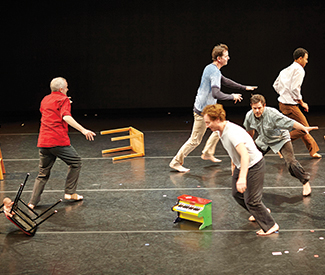
December Like it or not, parenthood is life-changing. Maybe that’s why, in Father On (Dec. 5, ODC Theater), Scott Wells’ five dancers — four of who are recent dads — looked not only sleep-deprived but also often frantic. The one non-dad, Rajendra Serber, was the ultimate outsider. Using game structures and sports imagery, Wells created a hilarious but also curiously affectionate piece about the challenges and confusions encountered by the male and his kid. The lesson on becoming a sensitive father left me laughing through tears. *


With more bikes on the roads, Folsom Street gets a makeover

7

As anyone who has traveled the streets of San Francisco knows, there’s an increasing number of bicyclists out there. And the just-released biennial bike count from San Francisco Municipal Transportation Agency attempts to quantify that increase: 14 percent since 2011.

The agency counted bikes at 51 key intersections around the city during the afternoon/evening commute from Sept. 10-19, counting a total of 23,225 bikes. Comparing 40 counted intersections in 2011, that’s a 14 percent increase; or a 96 percent increase since 2005 when comparing the 20 intersections measured then.

The San Francisco Bicycle Coalition trumpeted the report as good news, including in its press release this quote from Mayor Ed Lee: “Every year we are seeing more people riding a bicycle in San Francisco, and the latest bicycle count data proves it.” And SFBC Executive Director Leah Shahum said, “It’s clear that if we build it, they will come. No other mode of transportation is growing as fast or has a higher return on investment in terms of improving our city for everyone.”

But the reality is that the city is lagging far behind its own stated goals to make cycling a safer and more attractive transportation options, largely because of a severe underinvestment in its cycling network. The report notes that the city has invested $3.3 million in its bike network since 2011, but that was mostly playing catch-up from when a court injunction stalled all bike projects in the city for four years.

The SFMTA report doesn’t calculate the critical number in terms of how we’re really doing — transportation mode share, or the percentage of overall vehicle trips taken by bike — an estimate it is now working on in a separate study at the end of January.

An American Community Survey in 2012 put SF bike mode share at less than 4 percent, which is a far cry from the 20 percent by 2020 that is the city’s official goal, one it has little chance of meeting without a serious increase in infrastructure investment and other changes. The SFMTA’s own stated goal is 8-10 percent mode share by 2018, the result of failure to make needed investments, which amounts to an admission that the city’s official goal is little more than political pandering.

“We’re still moving forward on all the goals that we set to accomplish, but we do have funding needs,” SFMTA spokesperson Paul Rose told us, instead emphasizing the agency’s goal of attaining a 50-50 split between private automobile use and all other modes of transportation, including Muni and cycling.

The SFBC has worked in close partnership with the city, but the continuation of Shahum’s quote in her press release also indicates that she’d like to see the city doing more to promote safe cycling: “It’s time for the City to truly invest in our bicycle network, and ensure that our City’s streets are welcoming and comfortable for the growing number of people riding.”

But the city is moving forward with some bike improvements, including a makeover of Folsom Street now underway.

In the wake of some high-profile cases of motorists running over cyclists in San Francisco this year, including the Aug. 14 death of Amelie Le Moullac at the intersection of Folsom and 6th Streets, the San Francisco Municipal Transportation Agency has taken a lane from drivers to create safer cycling along seven key blocks of fast-moving Folsom Street.

The project on one-way Folsom Street between 11th and 4th streets creates an extra wide bike lane with bright green cycling signage on the roadway, with that green lane narrowing and breaking up as it approaches the right turns on 10th, 8th, and 6th streets. The idea is communicate with both motorists and cyclists about how to safely merge and avoid having cars make the unsafe “right hook” turns that are dangerous to cyclists.

“Right now, the project is almost complete and it should be complete by the end of the month,” Rose told the Guardian.

He said the design was discussed and subjected to community outreach efforts during community plan meetings in recent years, but that it was recently accelerated as a $250,000 pilot project with help from Sup. Jane Kim’s office following public concerns about how dangerous that fast-moving strip is to cyclists.

Rose said the traffic flows in the project area will be carefully monitored to see how it’s working, and the agency hopes to learn from that data “so it will inform future projects.” 

The Unconstitutional Truth about the Presidio

4


By John Farrell


OPINION When Congress established the Presidio Trust in 1996, it wanted to ensure its financial stability. Congress believed taxing private tenants impeded the Trust’s financial stability, so it enacted provisions within the Presidio Trust Act to ensure that tenants were tax-exempt. The only problem is that Congress doesn’t have the power to exempt tenants under the US Constitution.

In 1897, the State of California ceded to the United States exclusive jurisdiction on all lands held for military purposes, including the Presidio. Military installations are federal enclaves exempt from state authority. Per legal counsel of the State Board of Equalization, a “federal enclave” is a property over which the federal government holds exclusive jurisdiction.

In 1989, the federal government closed the Presidio as a military base. Since the Presidio is no longer for military use, the federal government transferred jurisdiction to the Golden Gate National Recreation Area (GGNRA) in 1994 for natural, historic, cultural, and recreational purposes.

Did this transfer to GGNRA end its tax-exempt status? Did this transfer negate the concept of “federal enclave” and “exclusive jurisdiction,” since the Presidio is no longer used for military purposes? Could the city now tax private beneficiaries? This issue has never been addressed.

The Presidio Trust was created by Congress in 1996 for a dual purpose: to rehabilitate and repurpose historic buildings and environmental resources, and operate as a vibrant public park independent of annual taxpayer funds.

In establishing the Trust, Congress’s concern was with the city’s potential assessment of property tax. In California, any private party that rents or uses space on government-owned property is subject to property tax.

In order to curtail the possible assessment of property tax, Congress enacted legislation signed into law by President Clinton on November 29, 1999. Public Law 106-113 (HR 3194) includes specific language providing that, “The Trust and all properties administered by the Trust and all interest created under leases, concessions, permits and other agreements associated with the properties shall be exempt from all taxes and special assessments of every kind in the State of California, and its political subdivisions, including the City and County San Francisco.”

Our City Attorney and Congressional representative have the opinion that all third party interests for private benefit under the Presidio Trust’s jurisdiction are exempted from taxes by the Presidio Trust Act.

This language confirms Congress’s intent to exempt private tenants from all forms of state and local property taxes. The only problem is that if Congress enacted the Presidio Trust Act to exempt third party beneficiaries, it did not have the authority per Article 1 Section 8 of the Constitution, which provides the Powers of US Congress. In other words, this part of the legislation was unconstitutional.

Because of this unconstitutional loophole, the city is losing at least $10 million annually in property tax and over $100 million since inception. This amount doesn’t include revenue loss from other taxes such as real estate transfer tax. Further, if the George Lucas plan for a Presidio museum is approved, the city will lose at least $8.1 million annually in property tax.

The city is losing an additional $12.5 million from the recent sale of Lucasfilm’s to Disney in 2012 (based on a 2.5 percent transfer tax on a conservative $500 million assessment). An ownership transfer includes a lease of 35 years or more. Lucasfilm had a 66-year lease at the Presidio transferred to Disney. Per the state Revenue and Taxation Code, this is a legal transfer and there is no rational why there is no transfer tax imposed.

The city has decided to adhere to the legislation by Congress to tax exempt tenants even though it is unconstitutional. But everyone should pay their fair share.  

John Farrell is a Realtor, former city budget analyst, and fifth generation San Franciscan.

Homework troubles

28

joe@sfbg.com

The San Francisco Board of Education approved a land swap with city government on Dec. 10, gifting San Francisco an empty lot that it will use to build new affordable housing. That’s 115 units of living space for low-income San Francisco renters, wrapped in a bow for the holidays.

The proposal was the brainchild of board members Hydra Mendoza-McDonnell and Sandra Lee Fewer, who worked on the measure with the Mayor’s Office of Housing for over two years. The district will trade a lot on 1950 Mission street and another on Connecticut Street in exchange for a property it currently rents from the city of San Francisco. The city will also pay SFUSD $4.5 million, according to district data.

The deal was the culmination of that work, which Fewer said was the right thing to do.

“Could we get more money from [selling] this property with a private developer? I’m sure. But would we get the value? No,” Fewer said at the meeting.

The original intent of the land swap was to provide affordable housing for the school district’s employees. Project proponents say school district workers are being priced out of San Francisco in droves. But the affordable housing project will be general use, with no specific provisions for teachers or other SFUSD workers.

teachersinSF Though the teachers’ union supports the land swap, United Educators of San Francisco President Dennis Kelly warned that teachers are in dire need.

“It’s more than an oversight, it’s an insult, felt very deeply, and very bitterly,” Kelly said at the podium. “Affordable housing will not house a single teacher, not a single one, because of where the dollar breaks are.”

The board has made various promises over the past decade to aid with teacher housing, all empty words, Kelly told the Guardian. There’s yet to be a solution from the school district or the board on finding sustainable housing for teachers.

The problem is a microcosm of one of San Francisco’s toughest challenges during this tech-fueled affordable housing crisis. Affordable housing helps the poor, and the rich certainly don’t need help staying in the city, but help for middle-income earners is hard to come by.


NEW RECRUIT

Research from education nonprofit ASCD shows most first-year teachers face three challenges: difficulty learning to manage classroom behavior, an overload of curriculum creation, and lack of school support. San Francisco’s new teachers face a fourth: finding a place to sleep at night.

Second-year SFUSD science teacher Kate Magary, 29, knows this all too well. Her first year on the job went from challenging to hellish as she looked for an affordable place to live.

Despite having a modestly salaried full-time job, she couldn’t afford a studio on her own. She eventually found a room for rent on Craigslist, but her noisy roommates made grading papers and writing curriculum a constant challenge. She started a new apartment hunt, but even that was like a full-time job.

“As a first-year teacher, it was awful,” Magary said. “I tried not to let it affect me too much at school, but the stress from home eventually made it with me to the classroom.”

She over-disciplined some kids, she said, and her patience was at the breaking point for most of the year. When teachers suffer, students suffer.

Magary is a science teacher at the Academy of Arts and Sciences, which is on the Ruth Asawa School of the Arts campus at Twin Peaks. Three-story homes and apartment buildings dot the hills along the road from Market Street on her drive to school, but Magary can’t afford them.

Instead, she eventually found a place on Treasure Island. A sixth-generation San Franciscan, Magary is happy to stay in what is still technically part of the city. But her lease is tenuous, and she anticipates having to move within the next few years. She’s not alone.

Out of SFUSD’s 3,284 teachers, 927 live outside of San Francisco, according to data from their union. That’s 28 percent of teachers living outside of the city, 3 percent higher than just last year. That number masks the depth of the problem.

New teachers who aren’t established in San Francisco bear the brunt of displacement. Half of all new teachers leave SFUSD in their first five years, according to data from the district. And 35 percent of teachers hired since July 1 live outside the city.

“A teacher might start in the district, live in the city, and move out,” said UESF spokesperson Matt Hardy. “The turnover is very high, particularly in newer schools.”

Teachers we talked to said there are problems for those who manage to stay in San Francisco as well. They sometimes sleep in unstable or unsafe housing, couchsurf, or sleep in their cars. In the morning they teach the city’s children.

It’s bad for teachers, but worse still, it’s bad for students. Recognizing this, federal, state and city government have all pitched in to try and find housing solutions for teachers.

Unfortunately for them, and for us, they’ve mostly failed.


OWNERSHIP FOR NONE

Art Agnos is most well known for being San Francisco’s former mayor. But after stepping down in the ’90s, he served in the Clinton Administration as the Department of Housing and Urban Development regional director throughout California, Arizona, Nevada, and Hawaii.

He was in charge of finding folks places to live.

The crisis for teacher housing was stark. At the time, Agnos was in charge of implementing Clinton’s housing program for teachers in San Francisco. The experiment? Build affordable housing units at Dianne Feinstein Elementary School on 25th Avenue exclusively for teachers.

The idea died in a sea of NIMBYism.

“The resistance came from the neighborhood who thought affordable housing for the teachers would diminish the value for their property and make traffic issues,” Agnos told the Guardian. “The Board of Education yielded to that NIMBYism and refused to pursue the deal, which was on the table.”

The federal push for teacher housing died, having created a home for just one teacher in San Francisco by the year 2000, and only 100 in California, according to news reports at the time.

California would follow suit with a less ambitious teacher housing program. The Teacher Next Door program offers assistance for teachers buying homes in San Francisco through the Mayor’s Office of Housing. We called the office to get statistics on its use, but as of press time it had not called back.

Among teachers, the program is mostly a joke.

“That’s the case with most teachers,” science teacher Tom Dallman of Ruth Asawa School of the Arts told the Guardian. “They roll their eyes when it comes to talk about buying a place in San Francisco.”

Median home prices in San Francisco skyrocketed past $1 million in June, a signal that for many teachers, homeownership in the city is a near impossibility.

Subsidized Below Market Rate housing is out of their reach too. San Francisco teachers make anywhere between $40,000 and $80,000 a year, placing them just above the salary as a single person to qualify for affordable housing.

“The struggle is about middle income people who do not qualify for mortgages or newly develop projects, because the market is astronomically high,” Agnos said. And that’s leading to a teacher migration, numbers from the UESF show.

“If they have to live in Oakland, they’ll work in Oakland,” Agnos said. “Their talent will follow them.”

The dream of homeownership for San Francisco’s education workforce is a thing of the past, Susan Solomon, vice president of the UESF told us.

“Maybe long, long ago this was a possibility,” she said, “way back when.”


FEW SOLUTIONS

Fewer was ecstatic to see the land swap deal go through, and excited to see affordable housing for San Francisco families.

But when asked what she’ll do to tackle the struggle to find affordable housing for teachers, she said that the upcoming contract negotiations may be the time to revisit a new plan.

“We’ve asked the unions to give us a poll for a long time,” she said. She wants to know what the teachers want. Do they want to live in housing together? Have rental subsidies? Housing assistance? What are their needs?

Sup. Jane Kim, a former school board member, said there’s a split of preference in the union. Should affordable housing solutions be given to teachers in their first five years in SFUSD, to encourage them to stay in San Francisco, or to veteran teachers?

“There’s a limited amount of funding,” Kim told us. And when the district lucks itself into extra funding, it’s hard not to spend it in the classroom. “How do you invest the limited dollars that you have?” she asked.

Santa Clara’s school district built its own affordable housing, and spent $6 million in 2005 to construct 40 units for its workforce. Three years later, they built 30 more units. Teachers there initially paid $1,075 a month in rent for a two-bedroom apartment, according to The New York Times.

“You cannot be an education advocate without being a housing advocate,” Fewer said. But housing help has been largely elusive for SFUSD employees.

“Stubbornness is keeping me in the city,” Magary said. But without some help, that may not be enough.

Bus stop

85

rebecca@sfbg.com

Each weekday, gleaming white buses operated by Google and other Silicon Valley tech giants roll through congested San Francisco streets and pause for several minutes in public bus stops, picking up passengers bound for sprawling tech campuses.

Using bus zones for private passenger pickup is not legal — but so far, that hasn’t resulted in any kind of systematic enforcement. It did boil over as an issue when it became the focal point of the Dec. 9 Google bus blockade, a Monday morning rush hour episode staged by anti-gentrification activists that went viral thanks to Bay Guardian video coverage, spurring commentary by Wall Street Journal, Fox News, and dozens of other media outlets.


SYMBOLIC ISSUE

The significance of the private buses as a symbol for an economically divided San Francisco, private service that spares a high-salaried class of workers from the delays, crowds, and service breakdowns that can plague Muni, has never been more resonant. The shuttles are frequently mentioned in conjunction with eviction and displacement, since apartment units in proximity to shuttle routes have become more desirable and expensive.

And as more shuttles are sent out to transport passengers, the San Francisco Municipal Transportation Agency has come under increasing pressure to solve the logistical and other problems they create.

“Our policies are catching up to this new transportation mode,” SFMTA spokesperson Paul Rose said in a recent phone call. “The shuttle service has been growing very rapidly.”

Accordingly, SFMTA is working on a pilot program to allow Google and other providers of private shuttle buses to share space in Muni bus zones in an organized fashion. The policy would establish a set of guidelines around boarding and alighting, implement measures to prevent Muni delays, create a formal permitting process, and require the shuttles to display identifying placards.

Although Muni needs funding to improve its aging infrastructure (see “Street Fight”), this plan to accommodate private shuttles would not result in any new revenue collection for the agency. Google and other private shuttle providers would be charged a fee under the program, but it would go only toward cost recovery, allowing the agency to break even.

Leslie Dreyer, one of the masterminds behind the Google bus blockade, calculated that the SFMTA could theoretically collect $1 billion if it aggressively targeted private shuttles for violating the Curb Priority Law, which prohibits vehicles other than Muni from using designated bus zones.

“It’s a ballpark estimate,” Dreyer said, describing her project as more of a thought experiment to illustrate a broader point. “We were trying to get people to think about … the bigger issue of what these things symbolize: evictions, gentrification.”

Dreyer based her findings on a color-coded chart released by SFMTA in July, showing the frequency of shuttle stops at 200 known locations. Paul Rose insisted the $1 billion estimate was too high because the total number of daily private shuttle trips is actually lower. He added that it’s more than just Google that is using the stops: At least 27 institutions and employers provide private shuttles in SF, according to data compiled by SFMTA.

But even based on the information that Rose provided, that same calculation shows that Muni could collect $500-600 million in fines from all the shuttle providers. That’s theoretically enough to augment a sizeable portion of Muni’s annual operating budget, which is around $800 million.

The pilot program for sharing bus zone space with private shuttles is expected to be reviewed by the SFMTA board early next year, and it could be implemented by July of 2014. It does not require approval by the Board of Supervisors.


SCOFFLAW BUSES

In the meantime, given that Google and other private shuttle providers are in rather obvious violation of a law prohibiting them from doing what they do every weekday like clockwork, why doesn’t the SFMTA bother to enforce the law?

Rose offered several answers to this question, but most just pointed to more questions.

The fine for violating the law that prohibits vehicles other than Muni from using bus zones is $271, Rose confirmed. According to a Strategic Analysis Report prepared for the SFMTA in June of 2011, which notes that the Curb Priority Law is part of the City Transportation Code, “enforcement … has been limited.”

“We have only so many resources, and most enforcement is based on complaints,” Rose explained.

But the same strategic analysis report, dating back to 2011, shows that a great number of complaints have flowed in from disgruntled transit riders.

“The frequency of public comment and complaints regarding bus zone conflicts … may indicate a more problematic situation than these limited data imply,” a portion of the 2011 study noted after presenting the results of a field study, in which some analyst was presumably sent out to physically observe the private shuttle buses (illegally) stopping in the bus zones.

Rose’s contention that a lack of complaints was behind the lack of enforcement didn’t really seem to hold up, but he offered another reason, too. “We’d have to ID the bus,” he explained. “There isn’t an identity placard or permit to ID them specifically.”

Establishing an identification system is one of the goals of the pilot program now under consideration, he added. Then again, Google buses have license plates. And if SFMTA has the capability to do anything well, it’s to harness license plate data as a mechanism for collecting fines from offending motorists.

In fact, officers under the parking enforcement division of the SFMTA use an automated system called AutoVu Patroller, made by a tech company called Genetech (not to be confused with Genentech, a pharmaceutical giant that has its own fleet of buses transporting San Francisco employees to its South Bay campus).


EASY TO TRACK

The AutoVu patroller starts automatically when a parking enforcement officer fires up the on-board computer. It works by scanning license plates as the parking vehicles cruise down the street, using plate recognition technology to feed the data into a system that checks the identifying numbers against an existing hotlist.

When a hit occurs, it’s automatically flagged on screen. With the flick of an index finger, an enforcement officer can instantly bring up a vehicle’s model, year, and VIN. If a vehicle lacks a permit, it automatically generates a hit, signaling that enforcement may be needed. Then there’s the obvious point that Google buses and other shuttles are highly visible, and stopping all the time — whether or not an enforcement officer has a license plate scanner or not.

But at the end of the day, the private shuttles are treated differently from other kinds of vehicles that are found to be in violation of the transportation code. No matter what the laws on the books say, it’s difficult to imagine the SFMTA or the SFPD, which also has enforcement power, causing tech employees to be late to work as they roll through the city in climate-controlled coaches with tinted windows.

Far from targeting the shuttles for enforcement, an in-depth conversation has actually been taking place between the shuttle providers and SFMTA for quite some time, with representatives from the Planning Department and other agencies brought to the table as well.

The SFMTA actually regards the shuttles as being somewhat helpful, Rose said, since they get drivers out of their cars and into pooled transportation modes, thereby helping to alleviate congestion.

“We are developing these policies to better utilize the boarding zones for these shuttle providers,” Rose explained. “What we’re trying to do is provide a more efficient transportation network.”

To that end, the city has organized a series of stakeholder meetings in recent years with Google, Apple, Adobe, Genentech, the University of California San Francisco, and other shuttle providers to design a way for Muni buses and private buses to coexist in harmony, in city bus zones. Those conversations were referenced in the 2011 report; three years later, the pilot program is expected to solidify those discussions into a formalized system.

Here and there, some bus zones have already been altered to accommodate the private shuttle buses. “[An] extension of the Muni zone on 8th Street (in the South of Market) appears to be working well; although SFMTA Staff report that shuttle operators using the new zone have balked at the suggestion that they should help pay for the $1,500 improvement,” the 2011 strategic analysis noted.

The plan that’s coming down the pipe will essentially serve to legitimize what the shuttles are already doing. But so far, this deal won’t result in any financial gain for the transportation agency. If it goes forward as planned, the opportunity to make transit improvements by collecting revenue from private companies that use public infrastructure will be passed up.

Crowdfunding apartments

7

rebecca@sfbg.com

We caught up with Dan Miller at a cafe in San Francisco’s Financial District, where solitary patrons hovered over laptop screens as they sipped coffee.

Sporting a goatee and collared shirt, Miller, 26, seemed to blend in perfectly. The Washington DC native, a product of the East Coast real estate development world whose father had a hand in developing several iconic properties, was in San Francisco for meetings about FundRise, a startup he and his older brother Ben cofounded. The company is frequently described as being like Kickstarter, but for real estate investment.

Miller has been meeting with representatives from San Francisco’s Office of Economic and Workforce Development, a city agency in the Mayor’s Office. While nobody in City Hall was willing to get specific about those meetings, it seems officials are looking to FundRise for help tackling the city’s bedeviling housing affordability crisis.

Miller has been meeting with economic development offices in cities nationwide, and he’s convinced that housing affordability is a problem everywhere. “But it’s more acute in San Francisco than anywhere else I’ve seen,” he said, “just because of an influx of tech jobs.”

In the last six months, he added, OEWD representatives have seemed increasingly concerned.

The idea of crowd funding real estate is new, and the whole enterprise is still coming to fruition. But the underlying idea is intriguing: Take real-estate investment out of the hands of exclusive multimillion-dollar investment firms, and open it up instead to anybody who happens to have 100 bucks or more to throw in.

In an affluent city like San Francisco, the tool could create wiggle room for more housing projects that are tailored to actual needs, through partnerships with affordable housing developers.

It started when Miller and his brother encountered across-the-board rejection from big investment firms. To hear him tell it, the rise of private equity firms — which have no meaningful connection to the communities they develop — has produced blandness on a sweeping scale.

Objectives like preserving economic diversity, or honoring a community’s wishes, don’t factor in when these firms determine what to fund; they only consider whether an investment is deemed safe and profitable. That means predictable: think obscenely expensive, characterless market-rate condos. And since they’re the dominant financiers, their judgment is the final call.

“We spun off from our family business and started buying old auto warehouses, converting them, leasing them to local tenants,” Miller explained. “We took these projects to private equity firms, and they just didn’t get it. All the decisions they made were predicated on the financial pro forma,” he added, referring to documents that project expected returns. “They were really constraining what’s possible.”

Sounding like a tech person, he pronounced the whole system woefully inefficient. FundRise seeks to take advantage of little-known Securities and Exchange Commission regulations, as well as new provisions under the federal Jobs Act, to give people the opportunity to use crowd funding instead. (It doesn’t eliminate the need to apply for bank loans, which is a different part of the financing picture.)

The idea is that FundRise vets a project’s viability to make sure it won’t result in widespread loss, then helps proponents attract contributions through an online social network.

In the investment world, the vast majority of transactions are made by “accredited” investors, whose net worth equals $1 million or more, or with annual incomes of $200,000 or higher. But there are others out there who might have extra cash to put toward projects they believe in, like, say, affordable housing complexes for seniors — who don’t mind making a lower return.

The Miller brothers have built an online system they hope will connect these would-be lenders with projects in their own communities.

“Since you can invest directly, digitally, you’ve cut out so many middle men,” Miller explained. “You can make a 6, 8, 10 percent return. The real estate investment firm targets are 20 percent. But that’s because there’s just people taking a piece all the way down the ladder.”

The cofounders may be idealistic, but at the end of the day, they’re businesspeople, not activists. Since the company takes a cut of all investment earnings, it could succeed financially even if it the platform only winds up getting used to finance pet projects for dot-com millionaires.

Nevertheless, some longtime champions of low-income housing have recognized its potential to help solve a perplexing puzzle: How to secure capital for affordable housing in a world where investors are hardwired to make as much money as possible.

“We are hoping that as the larger movement for crowd funding works with the SEC, we can have more people make these investments in the local community,” said Tracy Parent, executive director of the San Francisco Community Land Trust.

Her organization is the first nonprofit affordable housing developer to test the waters with FundRise, in a bid to raise $1 million to keep Marcus Books, a historic African American-owned business, in its current Fillmore Street location. Due to a short timeline, they’re confined to accepting funding only from accredited investors. But in the future, they could use the tool to structure a public offering that would allow anyone to contribute toward preserving affordable housing.

While public subsidies will still be needed for below-market housing, “FundRise allows affordable housing developers to take properties off the speculative market,” Parent explained. “Any way we can democratize capital investment,” she added, “will be a good thing for our community.”

Carb your enthusiasm

0

On a bright November afternoon, I ducked into Biondivino, a tiny but tremendously well-stocked Italian wine shop in Russian Hill, to meet John Pauley and Anna Li of Mattarello — an artisanal, handmade pasta pop-up.

Li, a Europe-raised, multilingual physician by day and tortellini-shaper by night, greeted familiar faces while pulling bundles of sage pappardelle, whole-wheat tagliatelle, parsley-garlic tagliatelle, squid ink spaghetti, saffron cavatelli, and the coveted tortellini al brodo from inside a cooler. Pauley, a former chef at several restaurants including the nearby La Folie, now works as a full-time sfoglini, or Bolognese-style pasta maker, for the couple’s two-year-old venture. If he was tired after spending five-and-a-half hours rolling out 50 pounds of dough (and subsequently stuffing and shaping it into 26 portions of thimble-sized, knotted nuggets), it didn’t show.

Walking me along the foldout table where pastas winked with specks of semolina, Pauley discussed their journey into la sfoglia. Five years ago while traveling in Bologna, a culinary capital known for parmigiano reggiano, prosciutto, mortadella, and tortellini, Pauley apprenticed with pasta makers Franco and Grazia Macchiavelli of Salumeria Bruno e Franco.

“In Bologna, pasta making is pretty much women’s work,” Pauley explained. Naturally, the women at the school were intrigued that a man would come all the way from San Francisco to learn their practice. “We all fell in love with each other,” said Pauley.

Mattarello maintains the same authentic spirit as the pasta made in Bologna. “Tortellini is as Bolognese as the Golden Gate Bridge is [San Franciscan],” said Pauley. Yet he was quick to point out that authenticity means different things to different people. In Bologna, tortellini is only eaten in broth. “To change something, you have to understand where it comes from. You start with a 450-year-old recipe for tortellini.”

In the US, Li and Pauley noticed, the bar for pasta has been set very low. Americans treat it as a vehicle for heaping on store-bought sauce and every vegetable in the pantry. On the other hand, explained Pauley, “the mistake other people make is that bringing a virgin olive oil or cheese back from Italy doesn’t make that food authentic. The spirit of cooking authentic Italian food here would mean, say, using great artisan prosciutto from Iowa.”

Pauley’s version of tortellini involves driving two hours to get the perfect farm eggs. “The hardest part is finding the right coloring. The egg yolks need to be orange to make the pasta really golden.”

He makes almost everything by hand in order to “get intimate with the pasta.” It’s not supposed to look perfect. The tortellini is stuffed with a mix of pork loin, eggs, parmesan, nutmeg, salt, and breadcrumbs; rolled; and sold the very next day.

That night I cooked the golden knots until they bobbed to the top of my boiling pot for several seconds, and slid a spoonful into my mouth. The texture alone was startling — the silk of the broth combined with an elastic, tender chew of pasta, creating a wholly new experience. The flavor came almost as an afterthought, in a delightfully grounding depth of meat, lift of nutmeg, and occasional bite of pepper, wrapped snugly between the sweet broth containing the brined memory of gently bruised vegetables. It only helped that the sky had turned dark and rainy.

The exception to Pauley’s handmade rule comes in the form of squid ink spaghetti, when he swaps the mattarello (or rolling pin, after which the pop-up was named), for the torchio, or “my torture device,” as he calls it. It began as a fun experiment after a trip to the Amalfi Coast, but customers can’t order enough, and La Folie has begun ordering it for its menu. “It’s too good of a product,” said Pauley, shrugging.

I leaned closer to the coiled ropes, noticing that they smelled strongly of the ocean in their pre-boiled state. I pinched one end of a beautiful black noodle, rubbed the Play-Doh-like string between my fingers, and took a bite. Raw, it contained an oddly tender chew. Cooked, it firmed up, yet remained fragile, pliable — I was seized with the desire to create a whole new adjective to describe these noodles, because the ones that came to mind couldn’t adequately capture what I tasted.

An epiphany: Fresh pasta is the dish. You need never wonder what you’re going to do with pasta — you’re not going to dress it, or drown it. You’re going to eat it. I ate these squid noodles in Mattarello tomato sauce for round one, which hid the essence of the sea more than I wished. I went lighter in round two, with a squirt of lemon juice, a plop of butter, a glop of olive oil, grated parmesan, and (this may sound strange) small chunks of avocado. Delectable, absolutely.

Amid San Francisco’s ultra-hip, ultra-now pop-up scene, Li and Pauley have witnessed friends turn their transitory trucks and tables into brick-and-mortar restaurants. They have business-savvy friends who tell them that now is the time to move forward.

“We know we’re at a fork, but we don’t know yet which prong we’re going to take,” said Pauley. He briefly pondered a larger pop-up, or expanding into more locations, but opening an eatery doesn’t appeal. “Anna is a doctor, and I don’t miss the restaurant scene, the appetizers, the entrées, the running around.” Pauley stops to say hi to friends entering Biondivino, then concludes, “I love making love to my dough. I love doing this.” *

Mattarello’s next pop-up is Dec. 22, noon-3pm at Biondivino, 1415 Green, SF. For future locations and pre-ordering, visit www.mattarellosf.com.


Band practice

0

arts@sfbg.com

THEATER We meet above the waterfall in Yerba Buena Gardens. It’s cold, getting dark. Everyone seems relieved to get inside the YBCA theater next door. We’ll talk here for the next hour, standing around a worktable with a gold lamé circle spread over it, before the band heads downstairs to a windowless rehearsal space in the deep well of the building.

Nicole Kidman Is Fucking Gorgeous is the band formerly known as the artists John Foster Cartwright, Maryam Rostami, and Mica Sigourney. In fact, NKIFG is more and less than a band — it’s a conceit, a project title, a series of performances, maybe a forthcoming album? (They don’t know yet.) None of its members actually plays an instrument, as far as I can tell. But they do compose songs, choreography, and objects that they employ in an unfolding series of situations they as readily call parties as performances. And they will have live music infusing their show this weekend at CounterPULSE, courtesy of ongoing collaborator and perennial inspiration Deep Teens.

Embracing a loopy goth spirit, the triumvirate, which has its origins in a performance two years ago at dancer-choreographer Liz Tenuto’s apartment during the Home Theater Festival, takes its send-ups of contemporary dance and performance art tropes seriously. And for all its insouciance and nonchalant humor, the project is at some level equally as much about the crisis of three artists (two of them well-known drag queens, the other a DJ and videographer) finding a way to live and work in today’s severely stratified San Francisco. It also draws eagerly, if obscurely, from their own private lives.

As for the name, its members like to say what they do is defined by both the presence and absence of someone or something called Nicole Kidman. To hear them talk about it, Kidman starts to sound like a key swallowed by a red herring.

“Who cares about Nicole Kidman?” notes Sigourney, with paradoxical delight. “But people do care about her! She’s the perfect vessel.”

What else should you know about Nicole Kidman Is Fucking Gorgeous? The answer to that question took a rambling, circuitous form. It was ultimately put to a Tarot deck set in the middle of the table.

Mica Sigourney So the frame of this reading is around getting at the truths and dispelling the illusions around this project for you. [The first card is] the Seven of Cups, which is about illusion [versus] reality, and picking out the truth. Right now, all of us are [experiencing] an abundance of emotions, an overwhelming amount.

Maryam Rostami Cups are heart energy, heart chakra, love, emotions.

[skipping ahead]

MS So what we need to manifest in our next step in this project — see, I don’t know if this is telling us what to tell Rob.

MR No, I think it is, I think this is great.

MS We are students of creativity…

MR And magic…

MS So we’re not masters of this yet. We’re still learning. Page of Wands is also about adventure and following bliss really. And our final outcome is the Ten of Swords. So it means we’re being stabbed in the back!

MR The Ten of Swords looks like this: It’s all of our fears pointing toward one single spot. The Ten is when the next step is coming. We’ve reached the end of something and it’s the next thing. The Moon, I feel, has to do with a difficult birthing process. The Moon is about traversing these murky emotional territories, which we have done together and we continue to do. I think this represents our fear.

MS Can I give it a reading too?

MR Yes.

MS Ten being the overabundance of the suit, and Tens being about communication and intellect: The outcome is an overabundance of ideas that sometimes feel like a burden, and are sometimes painful because there are just too many ideas happening. So we’re going to end up with too many ideas. Coupled with the Moon, I’m going to say our final outcome will actually be knowledge that is not measurable by the intellect and is much more intuitive and based in mystery, that is, not easily described by the mind.

MR We’re going to have to dig deeper from all of this. The Ten makes us need to take the next step.

MS And that next step is toward the dark. Well, toward intuition.

MR It is toward intuition. I think that moving toward the more Moon aspects will maybe then inform the next piece.

MS Oh, the moon…

MR Oh, the moon, duh! But this is perfect!

MS The moon is in our piece a lot.

MR Like the actual physical moon.

MS So basically, to clarify things for Rob: The Tarot reading says that we need to dispel some illusions for you. What we need to tell you is that we are about to have a moment of reckoning at this show at which we realize our values and our worth, and our sins. And what’s driving us as a collective is to reap the benefits of a good harvest, as well as learn from each other, and continue to be students of creativity, passion, and magic.

MR Ultimately, not to let our fears get us down and to know that we’re going in the right direction.

MS And this being our final outcome makes me think that maybe you should just know: “The moon.”

John Foster Cartwright The moon.

MS We need to shut up with all our ideas and just be like, the moon.

MR I’m with that. *

NICOLE KIDMAN IS FUCKING GORGEOUS

Thu/12-Sun/15, 8pm, $20

CounterPULSE

1310 Mission, SF

www.counterpulse.org


Rattlin’ bones and sugar plums

0

arts@sfbg.com

TOFU AND WHISKEY The tuba comes quickly, bubbling over excitedly at the start of the wildly entertaining “That’s It!” — the title track off the Preservation Hall Jazz Band’s first record of all original compositions. The vivacious New Orleans jazz album, released earlier this year, was a long time coming. The Preservation Hall Jazz Band has been a staple of Louisiana for 50 years, and in its different variations has released more than 20 previous albums of covers, tributes, and reworked classics.

And there’s a reason the tuba stands out: It’s tooted by creative director Ben Jaffe, whose father and mother, Allan and Sandra Jaffe, created the revolutionary Preservation Hall jazz venue in the French Quarter in 1961. Allan organized the first incarnation of the Preservation Hall Jazz Band in 1963 and was the group’s first tuba player. Ben and his brother grew up around the corner from the venue and spent most of their time there, hanging out at the venue with the greats. “We literally grew up at the Preservation Hall at the feet of these pioneers of New Orleans jazz,” Ben tells me from his current home (he still lives just minutes from the hall). He seems still in awe of it all, genuinely impressed and appreciative of his past with the venue.

He took over the group and the venue in the early ’90s after graduating from college (Allan passed away in ’87). Along with managing the day-to-day operations of the hectic venue, he also plays tuba along with bass, and produces the band’s albums. This newest release was co-produced by Jim James from My Morning Jacket. The core group of eight musicians recorded That’s It! last year, blasting out Dixieland and New Orleans jazz tracks like spooky “Rattlin’ Bones” and slowing down for twinkly songs like “Sugar Plum” on percussion, banjo, piano, trumpets, tenor sax, clarinet, tubas, and the like. “All combined, out of eight guys, we probably play something like 300 instruments.”

The band will play select tracks off its original record this weekend at the Davies Symphony Hall, but there’ll be another tradition taking over most of that performance: peppy, jazzy holiday selections. The band’s on-and-off again (but mostly annual) Creole Christmas touring show lands in SF Sun/15 (Davies Symphony Hall, 201 Van Ness, SF. www.sfsymphony.org).

The selections will include songs culled from the band’s storied past repertoire, holiday classics, and ditties that have a special meaning to the outsized group. The band’s “spry, charming” 81-year-old clarinet player, Charlie Gabriel, suggested one of the songs, “We Wish You,” which he heard in church as a young boy. The rest of the song list is under wraps for now, but don’t expect a gaudy Xmas spectacular.

“We’re not bringing the Rockettes, and we don’t have a light show. It’s really going to be an intimate evening of music,” says Jaffe.

But he knows the drill for upping the holiday charm, having performed a variation of Creole Christmas for the better part of a decade. Plus, he’s crazy for the holiday season — he loves to decorate and celebrates both Christmas and Chanukah.

“These Creole Christmas shows started at Preservation Hall and that’s when we decided it was something we should take on the road,” says Jaffe. “New Orleans music is a reflection of our community, and we have such a wonderful community of musicians and artists in New Orleans. Every time we play a concert, it feels like a family gathering.” And when they’re home from the road — they tour most of the year — the members of the Preservation Hall Jazz Band play the venue that bears their name two to three times as week.

They’ve long been the buzzing heart of venue, and the holidays are just another reason to celebrate with wailing horns.

When the boys were younger, Allan used to bring Ben and his brother around to different churches, senior homes, banks, and restaurants to perform live holiday songs, instead of sending out gift cards. “I still do it,” says Jaffe. “I wake up early on Christmas morning and go out with my horn and walk around the French Quarter to really remind me of my childhood.”

He adds, “Any reason to have a party in New Orleans, you know? If the wind blows we’re going to have a parade.”


COCKTAILS AND HAPPY DIVING

San Francisco’s Happy Diving has that mid-’90s Weezer thing going for it, certainly, but there’s a fuzzier, punkier edge than anything off Pinkterton, like a lazier Rivers Cuomo on a slacker punk bender. The band plays this weekend with fellow Bay Area pack Cocktails, which features members of Dirty Cupcakes. It describes its sound as “slop-punk” but sounds closer to power pop on tracks like “No Blondes (in California)” off this year’s Father/Daughter Records-released debut EP, which Matthew Melton of Warm Soda recorded. Also cool to note: The opener for this grand occasion is Blood Sister’s first show. Thu/12, 8pm, $5. Knockout, 3223 Mission, SF. www.theknockoutsf.com.


THE WEIRDOS

Early LA punks the Weirdos (first active in that gritty hotspot ’76-’81) matched swagger to wit, chugging along thundering guitars and those gravelly, growly, depths-of-hell vocals and song titles like “We Got the Neutron Bomb.” They played with all the bands you might expect, given the time and place: Germs, Dead Boys, Middle Class. And more so, the legacy of the band and its ilk clearly influenced later SoCal bratty punks and snarling weirdos alike. And now, after a few revivals an oh-so-many decades later, that band of Weirdos is back again, arriving at Thee Parkside with VKTMS and the Re-Volts. Sat/14, 9pm, $18. Thee Parkside, 333 11th St, SF. www.theeparkside.com.


SARAH JAFFE

No relation to those Preservation Hall Jaffes we met earlier in Tofu and Whiskey (that I know of), Sarah Jaffe is indeed her own lady. Yet the Texas-bred singer-songwriter, who’s collaborated with Eminem, has the delicate whisper of Cat Power and the wild-woman howls of Fiona Apple. That’s just a longwinded way of saying her vocals are lovely and textured and worthy of live listening. She’ll make you feel something deep on songs like “Satire,” off 2012 release, The Body Wins. With Midlake. Mon/16, 7:30pm, $14. Bottom of the Hill, 1233 17th St, SF. www.bottomofthehill.com.


PERE UBU

Experimental Cleveland post-everything art rock group Pere Ubu only has one original member. That person, warbly singer David Thomas, gives the band its backbone of avant-garde oddness. Thomas’ vocals and the band’s echoing, effects-heavy guitars make Pere Ubu sound at once like it’s hovering in outer space and being shot down into the deep, dark, muddled waters of unexplored oceans. It’s always a trip, either way. Tue/17, 8pm, $16. Slim’s, 333 11th St, SF. www.slimspresents.com *

Play on

0

arts@sfbg.com

YEAR IN GAMER The year 2013 has been a triumphant, confident peak in a particularly long generation of gaming, and as we gather around various top ten lists to send off the Xbox 360 and PlayStation 3 in style, let it be remembered that the pair received a more-than-decent eulogy. Most of the year’s accolades will likely fall upon three games, and while all involve guns, shooting and explosions, the refinements of those mechanics demonstrate the medium is unquestionably evolving.

Following a massive plague that wipes out much of the US, Naughty Dog’s The Last of Us is a survival horror/third-person shooter involving an unlikely pair of survivors, Joel and Ellie. “Zombies” and “stealth combat” seem to be two ever-present gameplay types, but here they are conduits into a lengthy and subtly-developing relationship between these protagonists. Playing this game won’t change your mind about what it means to shoot a guy a bunch of times, but the human moments between the battles are some of the strongest the medium has seen.

>>Check out our indie game picks of 2013 here. 

BioShock Infinite (Irrational Games/2K Australia) also offers a memorable experience — even if at first you don’t fully understand what you’re playing. Set in an alternate 1912 America, Infinite initially plays out like gumshoe pulp fiction, as private eye Booker DeWitt blasts through a city in the sky in search of a missing girl — but the game concludes with a twist that will have you playing it again to see all the ways in which you were duped. A storytelling exercise in the guise of a first-person shooter, Infinite might be more fun to think about than to play…but boy is it fun to think about.

You’re aware Grand Theft Auto V  (Rockstar North) careened onto shelves this year? Admittedly, the series hasn’t changed much — it’s still an excuse to play the bad guy, this time in a faux-LA setting. But left to your own devices, and given the keys to the most detailed and straight-up “fun” cities the Grand Theft Auto series has seen, how will you spend your time? For every criminal option there’s an equally enticing civilian activity, and taking the experience online allows for fascinating commingling among fellow tourists of the criminal lifestyle.

Beyond the big three … Assassin’s Creed IV: Black Flag  (Ubisoft Montreal) shrugged off last year’s messy entry by casting the player as a pirate on the high seas. Like Grand Theft Auto, freedom is key to this series’ success and ACIV wastes no time loosing you upon small islands, lush jungles, and 18th-century port towns in your very own, customizable privateer vessel.

Who doesn’t like Ghibli movies? Ni no Kuni: Wrath of the White Witch is a Ghibli movie you can play. Featuring cut-scenes direct from the Japanese animation studio and stirring music from frequent Ghibli composer Joe Hisaishi, Ni no Kuni is more than a little “grindy,” but it offers a truer sense of childlike wonder than any other title this year.

Lucas Pope’s Papers, Please is often decidedly not-fun. As an immigration agent for a fictional communist country, you decide who enters and who is denied. Managing applicant’s passports and entry tickets is just the beginning of the frustration, and the real bite is in juggling doing the right thing against feeding your family. No matter which decision you make, you’ll probably feel a bit icky about it — a genuinely exciting feat for an industry that traditionally triumphs fun above all.

Sometimes it’s best to go in not knowing anything about a game. In the Fullbright Company’s first-person mystery Gone Home, a young woman returns to her childhood home to find no one there to greet her. The mystery of her family’s disappearance draws you through the old house, where you discover the private histories and desires of her loved ones through the bits and bobs they’ve left behind. *


Don’t shoot!

0

joe@sfbg.com

YEAR IN GAMER This list is for all the gamers sick of blasting your last alien, zombie, or oppositional soldier of the moment (Nazis, Soviets, snore). That’s it. Done! As indie games grow in popularity, games that eschew the “shoot everything” mentality are becoming easier to find. Get your joystick thumbs ready and enjoy this list of 2013’s “top games where you don’t shoot things.”


PLANT CAT: FIRST BLOSSOM

There are treasures to be found, and Quince the Plant Cat will snag them all with his ability to create ridiculously long vines that curve and bend off cliffs and walls. It’s a game as cute as Kirby’s Dream Land, with a heavy Game Boy esthetic, a nod to the annual Game Boy Jam coding contest the game was made for. A side scrolling adventure à la Mario, the game (and soundtrack) is pure retro goodness. Though mouse and insect enemies abound, Plant Cat deals with them by feeding them vines, leading one to wonder if maybe all the evil Goombas in Mario are just hungry. flashygoodness.com/games/plant-cat


NIHILUMBRA

You are Born, a scrap of darkness that separated from “the Void” and formed sentience. Now the Void wants you back. Nihilumbra is a deeply atmospheric, side-scrolling puzzle game; playing as Born you discover different colors, which you magically paint around levels in order to escape the Void’s teeming, mysterious black mass. Colors help you escape the traps of the world: Blue is ice, speeding your runs; brown sticks enemies (and puzzle objects) in their places; red burns things away; and green turns surfaces into trampolines.

Throughout your travels, the Void questions your right to live, and solving the mystery of your existence is half the fun. Nihilumbra is a heady game that first debuted on iOS and Android last year, but only recently was released on the computer — with vocal performances and HD graphics. Now available on Steam and as a web browser demo online, Nihilumbra will have you hooked. www.nihilumbra.com


DUMB WAYS TO DIE

Quick! Clean the puke! Bat the piranhas away from the guy dancing underwater! Dumb Ways to Die is a hyperactive mobile game tasking the player with protecting cute jellybean creatures from eminent death in new ways every 10 seconds or so. Failure to save the adorable smiling beans leads to all manner of hilarious deaths: bears chomping half their bodies off, trains flattening them into bean paste, pythons biting them in the eyeball, etc. It surprised the bejesus out of me to find out this was a Public Service Announcement game made by Melbourne, Australia’s Metro Trains network. The lesson? Rail safety. Why can’t more municipalities create games revolving around cute bean people? San Francisco, get on it! www.dumbwaystodie.com


WAKING MARS

Waking Mars is one of those games that makes you want to explore its every nook and cranny. The year is 2097, and playing as Dr. Liang, an astronaut and research scientist, you land on Mars and discover a cave under ancient ruins. That’s when you meet Martian life for the first time, only the aliens aren’t monsters — they’re plants. The game quickly becomes part exploration, part horticulture simulator. Armed only with a jetpack and his science skills, Dr. Liang must experiment with and breed the “Zoa” to help solve the mystery of how the red planet turned to dust. Waking Mars is the very opposite of shooter games, as growing ecosystems and creating life are the axis of gameplay (instead of, ya know, killin’ stuff). Technically speaking, this game squeaked onto Steam in December 2012, but it’s still notable enough to include here. tigerstylegames.com/wakingmars *


Gore to the world

1

cheryl@sfbg.com

FILM Consider the giants of ho-ho-horror. Bob Clark’s Black Christmas (1974) boasted an above-average cast (Olivia Hussey, Margot Kidder, Keir Dullea, John Saxon). Christmas Evil (1980) was dubbed “the greatest Christmas movie ever made” by no less an authority than John Waters, who recorded an audio commentary for its 2006 special-edition DVD.

And then there’s Silent Night, Deadly Night (1984), which borrows several of Christmas Evil‘s plot points: a kid suffering mental damage from a Santa-related trauma grows up, unwisely takes a job working with toys, become obsessed with the concepts of “naughty” and “nice,” and eventually snaps. Christmas Evil may have the better last shot (you’ll believe a van can fly!), but Silent Night, Deadly Night is not without its sleazy charms.

Directed by Charles Sellier Jr. — best-known for creating TV’s The Life and Times of Grizzly Adams, he later segued into Christian-themed entertainment — Silent Night, Deadly Night contains scream queen Linnea Quigley, a year before her signature role as the naked, grave-dancing “Trash” in Return of the Living Dead. Though she’s only onscreen for a few minutes, her death scene (shrieking, flailing, topless, wearing jorts, piercing antlers) is Z-grade slasher gold.

Beyond Quigley’s rack (and the other boobs showcased eagerly and gratuitously herein) and some gorgeous Utah location shots, Silent Night, Deadly Night‘s memorable moments come courtesy of its creepy soundtrack. The Internet proves that least one dance remix exists of “Santa’s Watching,” a nightmarish ditty which reprises throughout the film. In the film’s opening credits, it’s a sing-songy lullaby; it plays in full-cheese form on a car radio shortly before unfortunate tot Billy Chapman sees his parents slaughtered by a baddie in a Kris Kringle costume; and it’s sung drunkenly by grown-up Billy’s co-workers at the toy store where he works.

And Santa is, indeed, watching. Early on, wee Billy’s catatonic grandfather snaps to when nobody’s looking, which is one of the film’s few genuinely frightening bits. “Christmas Eve is the scariest damn night of the year!” he croaks with cruel glee. “If you see Santa Claus tonight, you better run for your life!” Point taken, Gramps.

A few years later, Billy and baby brother Ricky are marking time at a Catholic orphanage. Billy’s still traumatized by what he witnessed (exhibit A: he punches the benevolent Santa that comes to visit the kids on Christmas), but the bitchy Mother Superior believes her punishments will set the naughty (ahem) boy right. When the film jumps ahead a few more years, Billy (played as an adult by Robert Brian Wilson) is a strapping lad employed at a dingy toy shop. He’s happy for the first time, therefore we get a peppy montage (more original music!) that spirals into darkness as soon as we realize what month it is.

Guess who’s pressed into Santa-clad service, with predictably messy results? (Not Billy’s boss, who kicks off the store’s after-hours party by announcing “Time to get shitfaced!”) Like Christmas Evil, Silent Night, Deadly Night is novel amid the 1980s slasher wave in that it follows the killer’s story, rather than empowering whatever Jamie Lee Curtis character is left standing at the end. Frankly, by the last reel, it’s a relief when put-upon weirdo Billy goes full psycho, meting out punishment among the naughty (and sparing the very few he deems “nice”).

And what about little Ricky? Oh, he survives to cause his own jingle-bell rampage in the sublimely campy, meme-spawning Silent Night, Deadly Night Part 2 (1987) and the less-notable Silent Night, Deadly Night 3: Better Watch Out! (1989). The series continued with the Clint Howard-starring, witch-themed Silent Night, Deadly Night 4 (1990); and Silent Night, Deadly Night 5: The Toy Maker (1991), featuring Hollywood legend Mickey Rooney as the titular craftsman. Spoiler alert: He’s evil. Just like Santa. *

FANGORIA PRESENTS: SILENT NIGHT, DEADLY NIGHT

Sat/14, 10pm, $10

Balboa Theatre

3630 Balboa, SF

cinemasf.com/balboa