Volume 46 [2011–12]

Pre-Occupied

0

arts@sfbg.com

YEAR IN VISUAL ART “Occupy the Empty,” Amanda Curerri’s 2010 solo show at Ping Pong Gallery (now Romer Young Gallery), seems about as appropriate a tag line as any for this past year. It’s not just Curerri’s prescient title that resonated with the occupations at Zucotti Park, Frank Ogawa Plaza, and the Mario Savio steps at U.C. Berkeley’s Sproul Hall, as well as the populist expressions of protest seen throughout the Arab Spring that many involved with the Occupy movement looked to, not always unproblematically, as sympathetic precedents.

“Occupy the Empty” took seriously the question of how art and aesthetics can create a more democratic society, testing the tensions inherent within the question’s very terms by asking viewers who entered Curerri’s deconstructed courtroom to become witnesses. The efficacy of the entire enterprise was predicated on individuals taking the stand, but also placing their testimony against and alongside those who had spoken before about a form of speech no less personal and performative: last words.

Similarly, the tension of the individual voice in relation to the collective it contributed to has been the engine motor of the Occupy movement. At the encampments no one could speak for anyone else and yet everyone was, at the very least, in agreement on the necessity of being present, a message often relayed (without an apparent sense of irony) back to the assembled, via a re-presentational strategy known as “the human microphone.”

One could also point to the whimsical criers and peddlers of Allison Smith’s “Market Day,” a public performance event held on and around Market Street in June as part of her Southern Exposure exhibit “The Cries of San Francisco,” or Stephanie Syjuco’s “Shadow Shop,” a mom-and-pop-style art market that resided for five months at SFMOMA, as other examples of participatory artistic practice that aimed to insert alternative forms of democratic exchange into public life, in some ways anticipating much of the discussions around aesthetics and politics that Occupy generated.

Whether this exploratory, incessantly present dynamic will — or can — continue to “trickle up” further through the art world remains to be seen. Major museums largely played it safe this year going with tried and true blockbusters (locally, Picasso and Impressionism) or spectacular spectaculars that had critics alternately swooning or pointing at the naked emperor’s relentless march, as in the recent retrospectives of Mauricio Catalan and Carsten Höller in New York.

Certainly, the likes of Charles Saatchi grumpily lecturing about cultural capital and the “vulgarity” of new super-elite art collectors in the pages of the UK Guardian doesn’t make the one percent look necessarily any more “in touch.” (Not that any of the moneyed gawkers I encountered at Art Basel Miami would care.) On the other hand, Alice Walton’s recently opened Crystal Bridges Museum of American Art in Arkansas, funded with Wal-Mart cash, can be seen as presenting both a possible new model and a grim augury about how art’s public future will rely even more transparently but no less troublingly on private beneficence. Why must we travel to a major urban center to see outstanding art? Then again, why donate to a museum when you can build you own?

ADDENDA

Although I don’t do regrets, I believe that putting out something “for the record” should still count as as a positive — despite constant abuse of the phrase by those publicly scandalized for their private moral failings. So, following in the tradition of last year’s “year in art” column, here is an incomplete rundown of art, exhibits, and, institutions that didn’t entirely make it in for myriad reasons, none of which had to do with the work itself.


KATHYRN VANDYKE “PAINT” AT STEPHEN WIRTZ GALLERY, MAR. 16-APRIL 23

Who said non-representational collage was done for? VanDyke’s colorful, mixed media mash-ups of paint and paper flaunted the grain of their materials and the elegance of their compositional logics with the disciplined flourish of a master flamenco dancer.


SFMOMA PUBLIC PROGRAMMING

Whereas SFMOMA’s track record in regard to exhibitions has been mixed this year (cheers to the recent Richard Serra and Francesa Woodman retrospectives; good riddance to the slog that was “Exposed”), its public programming has brought an invigorating mix of poets, musicians, performers, and audiences to the institution, making that word seem an awfully staid descriptor for a venue that has consistently hosted such unexpectedly engaging and fun events.


“BALENCIAGA AND SPAIN” AT THE DE YOUNG MUSEUM OF FINE ART, MAR. 26-JULY 4

The sculptural, late 1960s pieces in this quiet stunner of a show highlighted the influence of Spain’s many forms of national costume upon its most gifted native sons, couturier Cristobal Balenciaga — and should shush the grousing of anyone upset over the rise of fashion and textile exhibits at major art institutions. To appropriate a nugget of praise once paid to Yves Saint Laurent, we can debate whether or not fashion is art until the cows come home, but there is no doubt that Balenciaga was an artist. Bring on the Gaultier!


DAVID IRELAND AT GALLERY PAULE ANGLIM, NOV. 2-26

Ireland’s early ’70s canvases of cement, dirt, and rock are slices of time, fragments of place. They are numinous, fragile reminders of being, as well one piece of the legacy of this late, great Bay Area artist.


PACIFIC STANDARD TIME, VARIOUS VENUES, LOS ANGELES

If you haven’t already planned a weekend around the Getty’s massive, multi-institution survey of postwar California art (www.pacificstandardtime.org), you owe it to yourself to head south ASAP. Many of the participating exhibits close in late January, so get!

Curtain calls

2

arts@sfbg.com

YEAR IN THEATER With a grateful nod to former colleague Brad Rosenstein, we re-inaugurate a system of accolades and nah-ccolades celebrating some memorable highs and lows of the rapidly closing year in theater and performance.


Most Memorable Food Fight

A Three Little Dumplings Adventure

Within seconds of the appearance of the three titular protagonists of Megan Cohen’s A Three Little Dumplings Adventure — a hot pink and powder blue hurricane wreaking havoc on the subdued prison of a suburban living room — it was impossible not to get sucked into their chaotic orbit. Alternating between being patently obnoxious, emotionally unanchored, and frankly homicidal, the “three little dumplings” played by Sarah Moser, Molly Holcomb, and Megan Trout teased, baited, jabbed, and wrestled each other across the stage, culminating in Moser pinning Trout to the floor threatening to eat her (“dumpling” being no tidy euphemism here, but a physiological condition). Presented at the Bay One Acts Festival, it was definitely the year’s best meta-cannibalistic food frenzy, and it whetted our appetite for more. (Nicole Gluckstern)


Best Drug Story

Greg Proops at “Previously Secret Information”

Admittedly the best highs are often hard to remember. Kudos to the seemingly rock-hard memory of otherwise mellow-ab’d comedian Greg Proops, who recalled prodigious intake and takeout as a Chicken Delite delivery boy in 1970s San Carlos for an edition of Joe Klocek’s storytelling series, “Previously Secret Information.” (Robert Avila)


Best Political-Historical Thesis Disguised as a Wildly Funny and Louche “Songplay”

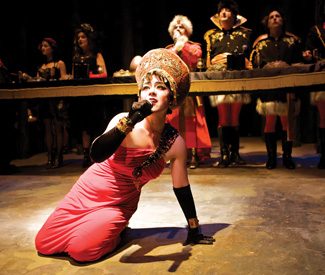
Beardo

Their own prior hit, 2008’s Beowulf: A Thousand Years of Baggage, was going to be a hard act to follow. But Banana Bag & Bodice and producers Shotgun Players made playwright Jason Craig and composer Dave Malloy’s take on Rasputin look like child’s play — very precocious child’s play — where performances, music, costumes, mise-en-scène, themes, and dialogue all contributed to another hirsute masterpiece. (Avila)


Most Inscrutable Triumvirate

Mimu Tsujimura, Lily Tung Crystal, and Katie Chan in Songs of the Dragons Flying to Heaven

Speaking of frankly homicidal, the otherwise nameless characters “Korean 1, 2, and 3” in the joint Crowded Fire/Asian American Theater Company production of Young Jean Lee’s Songs of the Dragons Flying to Heaven were as outrageously bloodthirsty a collection of countertypical characters as ever graced the Thick House stage. By turns violent, ecstatic, girlish, and demented, the eclectic trio played by Mimu Tsujimura, Lily Tung Crystal, and Katie Chan skewered every tradition-bound Asian stereotype in the book. Clad in the dazzle camouflage of their flowing silk dresses, rendering their monologues in their respective “mother” tongues, not spoken by this or many other audience members, the fiercely energetic characters expertly revealed themselves by not revealing a thing. (Gluckstern)


Best Lighting Design

Allen Willner for inkBoat’s The Line Between

Willner’s worked wonders before, not least with longtime collaborators inkBoat (Heaven’s Radio), but he outdoes himself in this wild and excellent production, making the lighting design a full member of the ensemble with a world of shifting moods and ideas. (Avila)


Best Tentative Revival of a Theatrical Artform

Puppetry

Where have all the puppets gone? It seemed like for a few years there they all went into hiding, perhaps barricading themselves in little puppet bunkers, awaiting the end times. But a modest slew of puppet-driven performances resurfaced over the course of 2011, reigniting our hopes for a full-blown revival in the future. A shortlist of memorable puppets encountered this year include Lone Wolf Tribe’s dark circus of clowns and war veterans in Hobo Grunt Cycle; a beleaguered Orson Welles puppet manipulated by Nathanial Justiniano’s sociopathic Naked Empire Bouffon Company alter ego Cousin Cruelty; Thomas John’s “hard-boiled” egg puppets who populated his Humpty Dumpty noir thriller The Lady on the Wall; the over-the-top awesomeness of a trio of Audrey Jrs. in Boxcar Theatre’s Little Shop of Horrors, and the silently suffering soldier of Aurora Theatre’s A Soldier’s Tale. Here’s hoping this miscellany foreshadows the triumphal return of the missing puppets, to as opposed to their last hurrah. (Gluckstern)


Nicest timing

The Agony and the Ecstasy of Steve Jobs

Just before public figures across the spectrum wailed their approval of a fallen business idol, Seattle-based monologist Mike Daisey, at Berkeley Rep, not-so-quietly reminded people of what a corporation is. Then Occupy Wall Street happened. (Avila)


Most Polarizing Descent Into the Reptilian Complex

Chekhov Lizardbrain

Whether you loved it or loathed it, Pig Iron’s touring production of Chekhov Lizardbrain was certainly one of the year’s most striking. Performing as part of foolsFURY’s Fury Factory, the Philadelphia-based Pig Iron spearheaded an expedition into the inner workings of one man’s brain beset by shifting vagaries of memory and truth. Combining a series of pompously-referenced “rules” of drama, stock Chekhovian alter-egos, and the dual personalities — internal and external — of an undersocialized protagonist (James Sugg) struggling to shape his memories into a recognizable narrative, Chekhov Lizardbrain elicited the most polarized reaction from its sold-out houses I saw all year. From a standing ovation to a fair number of disgruntled walk-outs, this dark-edged exploration inspired a panorama of strong responses in its audience, a solid sign of success in my book. (Gluckstern)


Best Labor of Love

The Companion Piece

Inspired by a concept by Beth Wilmurt, who was inspired by a book about the biological roots of human emotions (A General Theory of Love), Mark Jackson directed Wilmurt and fellow “vaudevillians” Christopher Kuckenbaker and Jake Rodriguez at Z Space in one of the most inspired pieces of devised theater all year (with a close second going to Jackson’s own SF State production of the blissful Wallflower). (Avila)


Best Conversation Starter

The closure of a “remixed” Little Shop of Horrors

Another polarizing moment in Bay Area theater occurred this summer when Boxcar Theatre’s ambitious remix of the cultish Alan Menken and Howard Ashman musical Little Shop of Horrors was shut down by Music Theatre International due to admitted violations of its licensing agreement. The debate inspired by both the violations and the show’s subsequent closure was as passionate and considered as the production that inspired it, from both perspectives of the situation. Without taking sides, I found the conversation about artistic freedom vs. artists’ rights to their own works to be as stimulating and thought-provoking as any night in the theater could strive to be. It seems unlikely that Boxcar Theatre knowingly set out to become the vanguard for open-source theater-making, but here’s hoping it’s a banner they are willing to carry a little longer. (Gluckstern)


Best Part of Getting Old

Geezer at the Marsh

I’m glad I lived long enough to see Geoff Hoyle live long enough to produce this solo piece extraordinaire. (Avila)


Best Couch-Surfing Opportunity

“Home Theater Festival”

Sometimes it’s hard to leave the comfort of one’s home to gamble on the capricious vicissitudes of a theater outing. Gambling in the comfort of someone else’s home was, on the other hand, really easy. (Avila)


Best Ostentatious Design Overload

The Lily’s Revenge

Watching the four-and-a-half-hour epic performance mash-up that was Taylor Mac’s The Lily’s Revenge at the Magic Theatre was in parts harrowing, exhausting, and transcendentally fabulous, but what stuck with me long after the vague twists of plot and character had mostly faded from my memory were indelible images of the seriously overwhelming design. From dazzling, sequined flower costumes by Lindsay W. Davis, to four complete sets built to accommodate five acts designed by Andrew Boyce, to the extravagant lighting by Sarah Sidman, The Lily’s Revenge could have been subtitled The Tech Crew’s Revenge, which would have been a fitting description of the glorious fantasia created by the uniformly top-notch production team. (Gluckstern)


Best Jump on George Clooney

Farragut North

North is better known to multiplex crowds as The Ides of March. But Bay Area theatergoers were first to get a former Howard Dean speechwriter’s fictionalized story of real-deal electoral politics in a so called democracy — and in a nimble low-budge production from OpenTab Productions at Noh Space that made it all the sweeter for not being Hollywooden. (Avila)


Best Planned Revitalization of a Theater District Linchpin

PianoFight at Original Joe’s

When the venerable, family-run Original Joe’s at 144 Taylor burned down in 2007 it was a catastrophic blow to the neighborhood — especially to all the theaters in the area who had adopted it over the years as a go-to post-show hang-out. It even served as a San Francisco Fringe Festival off-site venue for several years, hosting the likes of RIPE Theatre and Dan Carbone. So it was wonderful news on many levels when the turbo-charged PianoFight theater company signed a ten-year lease with the Duggan family to turn the old Original Joe’s into the new home of PianoFight. In addition to rebuilding the restaurant and bar, PianoFight plans to house two theaters, offices, and rehearsal spaces under the same roof — a huge boost to the neighborhood and greater theatrical community both. (Gluckstern)


Worst-Attended Theatrical Gem

Hobo Grunt Cycle at the Exit Theater

I’m not sure why there were so few people in the audience for this stunning cri de coeur against warfare by Kevin Augustine’s rightly acclaimed New York–based puppet theater ensemble, Lone Wolf Tribe. As hard as it can be to look at the real face of war, this piece brilliantly insisted on the need to do just that: manipulated with consummate grace by one or more black-clad puppeteers, Augustine’s life-sized puppets remained strikingly sentient, heartbreakingly damaged beings you absolutely could not take your eyes off. (Avila)


Classiest Beginning to a Final Bow

In the Maze of Our Own Lives

Playwright-director Corey Fischer’s sleekly staged, prescient take on the radically influential Group Theatre ensemble of the thoroughly agitated 1930s, In the Maze of Our Own Lives, which lead off the Jewish Theatre’s 34th and last season. (Avila)

Best Reason to Cross the Bridge: SQUART at Headlands Center for the Arts This 24-hour, all-stops-pulled-out version of choreographer Laura Arrington’s shrewd experimental series in collaborative performance-making capped a residency at the Headlands with a well-attended set of four sneaky, astonishing pieces by a multi-talented ensemble of harried sleep-deprived creator-conspirators. Why isn’t art always made this way? (Avila)

Worst Gas-to-Show Ratio Lolita Roadtrip at San Jose Stage A surprisingly unmoving outing from otherwise quick playwright Trevor Allen, who indeed quickly bounced back with a remounting of his popular solo, Working for the Mouse. (Avila)  

Strangest Encounter Between “Performer” and “Audience” Robert Steijn Steijn questioned everything, including what the hell he was doing onstage in front of the people assembled to see the famed Dutch performer at Joe Goode’s new annex in the Mission. They were all good questions, and the micro-choreography of physical and psychic states to which they pointed charged the room with a delicate intensity that encouraged many thoughtful beers afterward. (Avila)

Short takes: Biggest Dick: Kevin Spacey as Richard III. With balls and chops to match.  

Best Beefcake Ham and Cheese on Wry for under $100: Hugh Jackman at the Curran.

Best use of salvia: Philip Huang at “Too Much!”  

Best medicine for complacency: Cancer Cells, selections from late works and words by Harold Pinter by Performers Under Stress.  

Biggest site-specific punch (with gloves on or off): Peter Griggs’ one-man show, Killer Queen: The Story of Paco the Pink Pounder, at Michael the Boxer Gym and Barbershop.

Most intellectually stimulating drag lecture: David Greenspan reading Gertrude Stein’s Plays at the Contemporary Jewish Museum. (Avila)

The bottom of the top

0

YEAR IN GAMER One of the most exciting release windows in recent memory, this year’s fall gaming onslaught is officially behind us. And while most gamers are quick to rank the marquee experiences — battling dragons (The Elder Scrolls V: Skyrim), thwarting diabolical clowns (Batman: Arkham City), and riding giant birds in a green tunic (The Legend of Zelda: The Skyward Sword), it’s only when you approach the bottom half of a critic’s top 10 that the real debate begins.

So let’s skip ahead, past Uncharted 3 and Portal 2, which round out the established top five games of the year, and delve into the bottom half of the top 10. Any one of the following games might have taken home top honors in years past. As it stands, you may have overlooked one or two. And that’s what Christmas is for.

6. Rayman Origins

2D platforming in 2011 takes place in one of two venues: the games marketplace, like PSN or XBLA, or on your phone. Rayman Origins‘ greatest disadvantage is that it looks like something you can get on your phone for a buck but it costs full price. Don’t be fooled, a dollar will never get you as much content as you’ll find in Rayman, with its more than 60 levels of hand-drawn animation, four-player co-op, and star limbless thingamajig. Rayman isn’t just a re-skinned Mario; it’s a brighter, sillier and more rhythm-based experience than the Italian plumber, with a similar level of polish.

7. Dark Souls

It feels strange to be recommending a game that I’m often too afraid to play. Dark Souls is a brutal action RPG wherein you play a sort of zombie that most enemies can kill with a single hit. Save points are sparse and taking a break respawns any enemies that you might have killed already. (If you’re an old-school gamer, you’re screaming “all games used to be like this!”) Dark Souls employs an amazing level design that intricately connects its diverse dungeons and features a unique multiplayer system that allows other players to either leave tips for you or invade your game and make life even harder. You know that snotty friend who says today’s games are too easy or too much like movies? Get him this game.

8. L.A. Noire

Dismissed by some as a hackneyed attempt to marry Rockstar Games’ Grand Theft Auto with a point and click adventure, L.A. Noire may not be the perfect joining of genres we all hoped it would be, but it’s a wonderful homage for aficionados of 1940s crime movies. A sordid tale of an ex-Marine turned policeman rising through the ranks of the LAPD, L.A. Noire is well paced and acted, with a fully fleshed-out story — which can be hard to find in video games. Though it ultimately made more headlines for the developers’ harsh working environment, L.A. Noire remains a unique and expansive take on an under-represented genre.

9. Driver San Francisco Do you like driving fast cars but find yourself overwhelmed with the intricacies of real-life simulations? More racing games are contextualizing their in-game courses with a bit of drama and back story, and Driver San Francisco takes the cake when it comes to unique storytelling. You play an SF cop in a coma who can enter the bodies of other drivers on the road and drive like a maniac without consequence. He uses this amazing power to help teenagers win street races, freak out driver’s ed instructors and save the city from a terrorist attack that may or may not exist at all. Driver SF is less than polished, and local residents will notice some discrepancies in the city’s geography, but for pure entertainment few games take risks like these.

10. Super Mario 3D Land

After a bit of an embarrassing year for Nintendo, and the 3DS in particular, Super Mario 3D Land marks the first game to make the troubled console truly worth owning. A jump-in-and-play good time, Mario 3D highlights both the 2D platforming of New Super Mario Bros. and the fluid 3D exploration of Mario Galaxy, creating something that’s more than a throwback, it’s a refinement of everything that makes the 25-year franchise so popular. It’s not innovative enough to be worth buying a 3DS for, but early adopters finally have a game to call their own.

The new (open) world order

0

YEAR IN GAMER In 2010, year-end awards were dominated by one game: Red Dead Redemption. Published by Rockstar Games, the title was a sweeping, epic Western in the best American tradition. Using a proprietary game engine, Rockstar stitched together a giant swath of imaginary frontier, a teeming open world that seems to leap straight from the imagination of John Ford or Sergio Leone.

Now that 2011 is nearly done, it’s clear that Red Dead Redemption‘s success was merely a sign of things to come. Rival publishers must have watched contentedly as the game’s accolades stacked up. They were about to make 2011 the year of the open world game, ushering in a glut of go-where-you-want, do-what-you-want, slay-who-you-want titles that would dominate both discourse and sales.

Rockstar themselves were the first to get in on the action, taking a second bite at the apple in May with L.A. Noire. Developed by now-shuttered Australian studio Team Bondi, the game takes place in a meticulously recreated version of late-40s Los Angeles. Like Red Dead Redemption, Team Bondi’s title is an engrossing pastiche of classic cinema, drawing on the tropes, mopes, and molls of vintage noir. While critics rightly complained that the game’s open world offered little except the opportunity to drive around and sightsee, the simulated city’s presence added atmosphere and heft to an already immersive game.

Explore L.A. Noire‘s carefully art-directed metropolis, and the most dangerous thing you’re likely to encounter is fast-talking dame with nothing to lose. Not so in Dark Souls, an October release by iconoclastic Japanese studio From Software. From’s open world is a foreboding, twisted take on fantasy gothic, full of decaying grandeur, uncanny creatures, and fetid environs. Players must creep forward against their better judgment, dreading whatever horror lurks around the next corner. Though the game’s uncompromising difficulty acts as a deterrent, Dark Souls‘ labyrinthine, deadly world and endless creativity are well worth the frustration.

In Batman: Arkham City, British developers Rocksteady Games put Batman in his place: perched on the roof of some crumbling Gotham pile. The game’s titular open world is a vast outdoor prison, an entire urban zip code done up in hyperbolic neon-noir, then filled with psychopaths and super-villains. While he’s not using Rocksteady’s impressive, flowing combat system to put the hurt on Gotham’s criminal underclass, Batman can deploy gadgets like the Batclaw to swoop around. Though Arkham City mostly serves as a backdrop for a fairly linear narrative, but there are also dozens of collectible, lime-green “Riddler Trophies” scattered around, giving gamers an incentive to explore every inch of the game’s open world.

For sheer size and scope, you can’t top The Elder Scrolls V: Skyrim, released in November by Maryland-based Bethesda Game Studios. Bethesda have made open worlds something of a specialty in recent years, and Skyrim is the company’s most ambitious effort to date. Set in a frigid, arctic landscape, the game showcases natural beauty on a grand scale, rendering icy peaks, swampy tundras, and furtive wildlife darting among snow-dappled pines. Players will spend hours completing hundreds of quests, scaling the world’s highest heights and descending into the bowels of its darkest dungeons. Though the game makes it easy to follow a floating arrow directly to you current goal, Skyrim’s best moments are often the product of getting hopelessly lost.

When it comes to the sheer joy of exploring an open world, Minecraft reigns supreme. Created on a lark by Swedish programmer Markus Persson, the game randomly generates a gargantuan new environment every time you tell it to. Comprised entirely of chunky, Lego-like blocks, the world can be altered at will — dedicated players have spent hours moving blocks one-by-one to create replicas of things like the USS Enterprise. Minecraft is an impressive indie success story — first released in its alpha version in 2009, the game now boasts nearly 242 million logins per month.

What lessons will open world games learn from the class of 2011? Will 2012’s vast gaming environments be welcoming or forbidding? Will players be given long lists of collectibles to hunt, or simply asked to explore for its own sake? Dec. 20, thousands of people logged into Star Wars: The Old Republic for the first time, a big-budget MMORPG from local publishers LucasArts and Electronic Arts. Not content with the vast worlds already available to them, these intrepid gamers opted for an entire galaxy — a galaxy far, far away.

Small town values

0

caitlin@sfbg.com

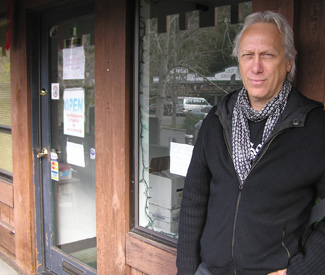
HERBWISE When we arranged to meet Fairfax (population 7,500) councilperson Larry Bragman, he suggested a rendezvous at “the coffeeshop.” When asked to be more specific, he clarified he meant Fairfax Coffee Roastery. “But you’ll see it, it’s right there.”

Bragman is a San Francisco-educated attorney who began coming to the small Marin County town decades ago. He’s been on town council — whose members pass around the title of mayor every year — since 2003. He was mayor in November, when the four-member council passed Resolution No. 11-58.

Bragman’s voice clogs a little with emotion when asked why the resolution was passed. “I don’t understand how you can justify a policy that denies help for patients that are going through that kind of hardship and suffering.”

The only medical marijuana dispensary in Fairfax, which is located in the county with the breast cancer rate in women is nearly 50 percent — closed its doors last weekend. The Department of Justice’s Melinda Haag sent a letter to the Marin Alliance for Medical Marijuana’s landlord, the likes of which are all too familiar to the medical cannabis industry nowadays.

The dispensary was located in a school zone. Landlord Fred Ezazi had 45 days to evict the dispensary, it said, or he would face up to 45 years in prison or civil forfeiture. (See 12/14/11’s Herbwise column “For the kids?” about an SF dispensary that received a similar notice)

“It feels like a violation,” says Bragman when asked how it feels to be a small town politician being railroaded by federal agencies. Resolution No. 11-58 supports the Alliance and other California dispensaries’ right to continue business. San Francisco’s Board of Supervisors passed a similar resolution in October.

Bragman insists that the policies his city developed to regulate the Alliance were exemplary. When the dispensary was founded by longtime marijuana activist Lynette Shaw shortly after Proposition 215 passed, Fairfax “had the foresight and courage to create the first use permit in the state of California [for a marijuana dispensary],” says Bragman. When called for comment, the city’s finance director Michael Vivrette said the Alliance was one of the top ten sales tax contributors in a town struggling with budgetary woes.

Later, we walk the three blocks to the Alliance, which is (was) located on a quiet street next to a Little League field in a non-descript office building. You have to walk up a flight of stairs and peer inside its windows to even know what it is.

A few despondent marijuana patients lingered in the waiting room, sadfaced and bewildered that the space would soon be gone. “I thought that a press blackout meant that we wouldn’t talk to press,” a woman spits at me when I ask the man at the front desk when they would be closing. It was hard to be frustrated with her truculence.

Bragman went so far as to call Haag to try to reason with her letter’s logic. “I said ‘you’re going to encourage the black market traffickers which we all know are a threat to the community. It’s unbelievable. It’s just so stupid.”

Correction: An earlier version of this article identified the Marin Alliance for Medical Marijuana as Marin County’s only cannabis dispensary. It is not, and we regret the error

The right way to rebuild CPMC

9

OPINION As 2011 comes to an end, San Francisco witnesses yet another year with community stakeholders and city officials mired in conflict over Sutter Health’s plans to rebuild its massive CPMC hospital system. In what has proven over the years to be an intensely complicated, politicized, and polarizing issue, one important point has been left out of the public dialogue — this conflict is entirely resolvable.

Very few parties have stated outright opposition to Sutter’s CPMC project. In fact, the unifying demand of a city-wide coalition with nearly 60 community and labor organizations is to “Rebuild CPMC, the Right Way.”

What exactly is the “right way?”

It’s simple: There’s a proven tool used in cities across America known to resolve complex standoffs such as this one — a community benefits agreement (CBA).

A CBA would bring this project to a resolution in two ways. First, it would provide direct accountability between the community and CPMC. A CBA is a legally binding contract between a developer and community and labor organizations that can be enforced on an ongoing basis without city involvement. And a CBA gives valuable assurances to developers that community and labor organizations will not politically or legally oppose the project — and in many cases, results in these groups providing public support.

Community stakeholders are often positioned to negotiate a stronger agreement than the city. They best understand the needs that have to be met in their neighborhoods and the adverse consequences that have to be avoided. And the city isn’t legally allowed to address any labor issue subject to a collective bargaining agreement — but a CBA is an independent agreement that can bring unions to the table in a meaningful way to resolve basic workers’ rights issues.

A recently released study by Hastings College of the Law cites the enormous profits made by CPMC ($744 million from 2006 to 2010), yet points out that the organization spends proportionally far less on charity care for poor residents than other private nonprofit hospitals. At a time when the 99 percent are standing up to corporate profiteering, a strong CBA can be a tool to help address the growing inequality in this city.

Among other things, a strong CBA should include:

Appropriate mitigation fees to address the full impact CPMC’s new workforce will have on one of the nation’s most expensive housing markets. CPMC estimates the project will increase demand for San Francisco housing by 1,440 new households.

More job opportunities for San Franciscans. CPMC is projecting an increase of over 4,100 new jobs by 2030, but the city has only negotiated a promise that 40 permanent jobs a year for the first five years will go to San Francisco residents.

Basic worker’s rights, including the right for current CPMC employees who are displaced to transfer to comparable jobs at new facilities and the right for workers at the new Cathedral Hill campus to join a union of their choosing without management intimidation.

Stipulation of key community clinics for CPMC to partner with. Although CPMC says it will increase its Medi-Cal service, it currently refuses to link its new hospital to any of the major clinics Medi-Cal patients use to access services.

A stronger guarantee to operate St. Luke’s Hospital over the long term. CPMC has agreed to a 20-year guarantee but has insisted on a “trigger” clause that will release it from this obligation, of which the details are unknown right now.

Without a CBA, the ongoing struggle between CPMC and affected communities across San Francisco will continue to delay this project. CPMC should meet with community stakeholders before any development agreement is approved and negotiate a community benefits agreement.

Steve Woo is a Community Organizer with Tenderloin Neighborhood Development, Emily Lee is a Lead Organizer at Chinese Progressive Association, and Gordon Mar is Executive Director of Jobs with Justice.

Making CleanPowerSF work

4

EDITORIAL The way the San Francisco Chronicle describes it, the city’s new green power program “won’t come cheap.” That’s a line that Pacific Gas and Electric Co. will use over and over again in the next few months as the city finally prepares to get into the retail electricity business, 98 years after Congress mandated public power for San Francisco. Clean Power SF will offer 100 percent clean energy — and yes, right now, this spring, it will cost a little bit more than buying nuclear and coal power from PG&E.

But that price differential will change dramatically in the next few years — if the city goes forward not just with buying and aggregating power from the commercial market but developing renewable energy on its own.

That’s the key to the future of CleanPowerSF — and as a proposed contract to get the system up and running comes to the Board of Supervisors, the need for a city build-out of at least 210 megawatts of energy generation capacity is, and must be, an essential part of the plan.

The fact that the city, at long last, is moving toward implementing this program is a testament to the work of Sup. Ross Mirkarimi, who pushed it for years, and Sup. David Campos, who more recently took over the lead role. Both deserve immense credit for their work.

As Rebecca Bowe reports in this week’s issue, there’s some disagreement about the contract proposed by the San Francisco Public Utilities Commission. The deal with Shell Energy North America would have the energy giant buy green power wherever it can, deliver it to San Francisco customers along PG&E’s lines — and charge enough to pay for the power and overhead expenses. That, initial reports say, could raise the bill of an average customer somewhere between $7 and $50 a month, depending on use. For most residential customers, the increase is going to be on the low end.

The problem is that the PUC estimates from the start that two-thirds of the potential customers will drop out of the program and stick with PG&E. That’s an abysmal projection, reflecting in part the PUC’s long reluctance to take the program seriously, in part a failure to plan an aggressive marketing campaign — and in part the lack of a long-term vision for the program.

The bottom line is simple: As long as the city is buying energy from somebody else, there are going to be problems. Right now, renewable energy demand exceeds supply, so prices are high. That’s going to fluctuate over the next decade.

But it’s entirely possible for the city to build its own renewable infrastructure and generate power that will beat PG&E’s prices in the short-term future — and will be far, far less expensive a decade down the road. Clean Power SF will never work to its full potential unless the city owns a significant part of the generation system. (Ultimately, the city will never see the full economic benefits of public power until it buys out PG&E or builds its own delivery system.)

The PUC included — at the demand of public-power advocates — a clause in the contract stating that a city build-out was part of the plan. The proposal before the board only includes the contract with Shell — but the final deal should include specific plans for how much local power will be generated, how it will be funded — and how it will ultimately replace the power Shell is providing. The city should start right now looking for sites (there’s lots of surplus city land) and seeking bids for construction, and if the PUC can’t come up with enough revenue-bonding money, the board should put a comprehensive clean energy bond on the November ballot.

The Local Clean Energy Alliance estimates that building 210 megawatts of clean power in San Francisco would generate nearly 1,000 direct jobs and as many as 4,300 indirect jobs. That sort of program would be a boost to the economy and guarantee the city stable energy sources for the future. And it would allow the PUC to market Clean Power SF not as a plan that will cost consumers more today — but as a plan that the city can all-but guarantee will save you money, substantial amounts of money, over the next 10 years.

Editor’s notes

2

steve@sfbg.com

Hugely influential political figures died in the last week: Czech playwright-turned-president Vaclav Havel, North Korea’s “dear leader” Kim Jong-Il, and writer Christopher Hitchens, who shaped perceptions of war and religion. But it was the death of investment banker Warren Hellman that has most affected me and the rest of San Francisco.

It wasn’t just because I knew and greatly respected the man, but it was how I came to know Warren and the unique role that he played in this polarized city. Up until 2007, I saw Hellman as just another wealthy Republican power broker pumping money into conservative campaigns that the Bay Guardian and progressives were constantly fighting.

Even before Occupy coined that new paradigm, I saw him as part of the one percent working to keep the 99 percent down, and I bitterly resented what the very rich were doing to San Francisco. But increasingly, Hellman began to break with his downtown allies, partnering with bicyclists, burners, and music lovers on various pursuits. So I decided to do an in-depth profile of this courageously independent man (see “Out of downtown,” 5/19/07) and that evolved into an ongoing relationship.

Like everyone else, I appreciate what Warren has done for San Francisco, particularly his creation of the Hardly Strictly Bluegrass Festival, the Bay Citizen, the San Francisco Foundation, and other important institutions. He felt an obligation to use his wealth for the common good.

But even more striking was his humble and cooperative approach. He believed luck matters more than ability in people’s socioeconomic status. So Warren brought goodwill and real curiosity to all his interactions — he wanted to learn from San Franciscans of all kinds, to let them shape him and this city. I can think of no better example to follow during this holiday season and the fraught political year that follows.

Come, as you are

0

YEAR IN MUSIC While thousands of shoppers — many appearing unfocused in their consumerist abandon — swarmed around me in the midst of Black Friday madness a couple of weeks ago, I knew exactly what I was looking for. Indeed, it was the only thing on my shopping list — the only thing that could make me get out of bed early the morning after Thanksgiving.

Capping off this fall’s many assorted special releases marking the 20th anniversary of Nirvana’s Nevermind, Universal Music was issuing a special, limited-edition, four record, 10-inch vinyl singles box set in conjunction with Record Store Day’s Black Friday festivities.

The re-release of these seminal singles — “Smells Like Teen Spirit,” “Come As You Are,” “Lithium” and “In Bloom”— probably only appeals to die-hard Nirvana fans or the completests; though possibly also to all those who were around when Nevermind first started making waves, and can vividly remember the impact of each single (and its accompanying music video) as they were released in the fall of 1991 and throughout 1992.

I fall into all of these categories, so it was with reverence and much anticipation that I braved the crowds of Union Square, walked briskly into Rasputin Music, found a set, and grabbed it off the shelf. There were no new tracks to discover, nothing that I hadn’t heard before — but the sense of excitement and joy from racing down to the record store was a welcome feeling, transporting me back to junior high, when Nirvana was exploding, and I was first exposed to a new world of music that would forever changed my life.

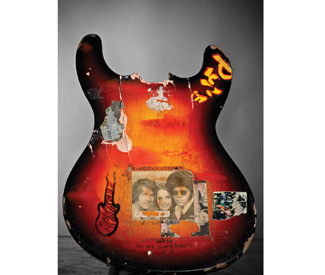
It was with these same highly-charged emotions (albeit months earlier) that I made the pilgrimage to Seattle in September to visit a new exhibit celebrating Nirvana’s legacy and impact on popular culture at the Experience Music Project museum. “Nirvana: Taking Punk To The Masses,” opened in April and features a treasure trove of artifacts and interactive installations telling the story behind Nirvana — how it became one of the most influential and beloved rock bands of the last quarter century.

Seeing the instruments that were used to create the music that has had such a profound effect on my life was awe-inspiring; as was gazing at hand-written lyric sheets, original demo tapes, artwork, family photos, stage props and more. Oral histories from band members Krist Novoselic and Chad Channing, along with others who had worked alongside them including producers Jack Endino and Butch Vig, and guitar tech Earnie Bailey, provided a personal look at the life of the band.

When coming to the end of the exhibit, my friend and I both commented that while it was a touching experience, it somehow seemed too brief, that there really should have been more to it. It was then that we looked at each other and came to what should have been an obvious realization; for all its influence and impact on our lives and the lives of millions of fans around the world, Nirvana only existed for a mere seven years. The band’s career, like Kurt Cobain’s life, was cut much too short.

In that time, however, the band made an incredible impression on its fans — and at the end of the exhibit there’s a video station where visitors are invited to share and record their memories of Nirvana — what the music has meant to them personally. After walking past the final panels and displays that recounted the events of April 8, 1994, though, I (and several other people nearby) was a little misty-eyed, and didn’t feel much like trying to sum up what Nirvana has meant to me all these years, on the spot, in front of a camera.

Instead, my friend and I proceeded to do what Nirvana had inspired us to do as teenagers; we went into one of the jam rooms in the museum, picked up a guitar, cranked up the volume, and played some tunes off Nevermind.

Lack of charity

8

news@sfbg.com

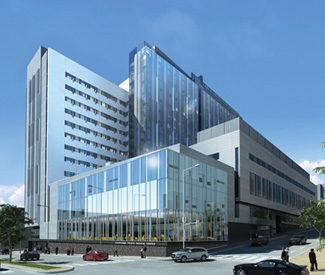
Activists and city officials are challenging California Pacific Medical Center — which a new study shows provides far less charity care than other San Francisco hospitals — to do more for all city residents if it wants approval for the massive new high-end hospital and housing project it is seeking to build on Cathedral Hill.

That $2.2 billion project, which the city will consider sometime next year, would also rebuild or modify four other CPMC hospitals in town, including St. Luke’s Hospital, which serves low-income Mission District residents, but which will see its number of beds cuts from 130 now down to 80.

Community groups opposed to the CPMC project as it now stands — including the Good Neighborhood Coalition, Jobs with Justice, and Coalition for Health Planning-San Francisco — commissioned the UC Hastings College of Law to study how CPMC’s charity care compares with other nonprofit hospitals in the city.

The result, “Profits & Patients: the Financial Strength and Charitable Contributions of San Francisco Hospitals,” was released Dec. 8 and was scheduled to be the subject of a public hearing at the Board of Supervisors on Dec. 13 after Guardian press time. Activists planned to use the hearing to highlight some of the report’s most damning conclusions about CPMC and its nonprofit parent company, Sacramento-based Sutter Health.

“Mainly due to Sutter Health’s plan to alter its current hospital structure within San Francisco, the provision of community health benefits by San Francisco hospitals is now a major issue before the Planning Commission and Board of Supervisors,” the report reads.

The report compares CPMC’s hospitals with St. Francis Memorial Hospital, St. Mary’s Medical Center (both are Catholic Healthcare West facilities), and Chinese Hospital, as well as noting how the city-run General Hospital provides by far the most charity care in town. The report finds CPMC is only spending about 1 percent of its revenues on charity care while the city sets a minimum standard of 3 percent.

Even before that project, CPMC/Sutter is the dominant health provider in town, and by far the most profitable. Between 2006-2010, the report says the company made $743.9 million in profits from its San Francisco operations, compared to St. Mary’s $22.6 million in profits and the $14.8 million loss by St. Francis.

“Our analysis shows that CPMC has the financial capacity to provide more of a share of services for uninsured and underinsured San Franciscans than it presently does, and that it is crucial for CPMC to do so in order to meet the city’s health care needs,” said Jeff Ugai, a Hastings student who worked on the study.

In 2010 CPMC’s three oldest campuses — Pacific, Davies, and California — provided charity care at a patients per bed rate less than half that of St. Francis, even though CPMC is triple St. Francis’s size and has much greater financial stability.

“St. Francis meets a huge amount of charity care patients. CPMC clearly can and should meet healthcare needs,” said Emily Lee, a member of the Chinese Progressive Association who spoke at a press conference announcing the report. “From the position of the coalitions, we want to see a project, and we want to see a good project.”

But CPMC, which has been resisting calls by Mayor Ed Lee and other city officials to commit to more charity care as a condition for its project, isn’t even accepting the report’s damning conclusions that it is extracting huge profits from San Francisco and giving little back.

“It depends on how you calculate it,” said CPMC spokesperson Kevin McCormack. “As a dollar amount, we give more in charity care than any other hospital except for General Hospital.”

That’s not surprising given that CPMC makes more money in San Francisco than any other hospital, enough that it has become a cash cow for the entire chain.

“CPMC-St. Luke’s is not only the most profitable hospital in San Francisco, but it is also the most profitable hospital in the Sutter Health statewide network. Out of twenty-one hospital groups within the Sutter Health network, CPMC/St.Luke’s brought in nearly one quarter of Sutter Health’s average net income over the last five years,” the report reads.

But McCormack says Sutter reinvests its profits back into the system.

“It goes back into the system itself,” he said. “It goes back into the hospital, into salaries, building new facilities, repairing old ones.” Yet the activists are unconvinced. Even before this report on charity care, they were critical of a CPMC project that includes housing on Van Ness with low rates of affordability, and which they say doesn’t rebuild St. Luke’s large enough to meet the community’s needs. It is also agreeing to operate St. Luke’s for only 20 years. “I like to call it a stay of execution,” said Jane Sandoval, who’s been a nurse at St. Luke’s for 26 years. “When CPMC took over with their master plan, it was an enigma to me how they concluded what the community needed. I know what the community needs, and I wonder who they asked.”

Policing the police

2

Bay Area cities have been at the forefront of local challenges to the police state, making stands on issues including racial profiling, deportations of undocumented immigrants, the use of force against peaceful protests, and police intelligence-gathering and surveillance of law-abiding citizens. But the city of Berkeley is creating comprehensive policies to address all of these issues in a proposed Peace and Justice Ordinance that is now being developed.

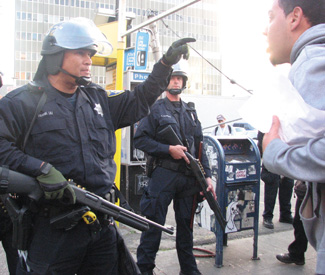
The effort comes against the backdrop of clashes between police and Occupy movement protesters, including the violent Oct. 25 police raid on OccupyOakland, with Berkeley Police and other jurisdictions on the scene.

Among other things, Berkeley is redefining when it will join other communities in what’s called “mutual aid” agreements — deals that require nearby agencies to help each other out when one public-safety department is overwhelmed.

It’s not terribly controversial when it applies to firefighting — but some people in San Francisco and Berkeley weren’t happy to see their officers joining the Oakland cops in the crackdown in peaceful protesters.

Berkeley officials also want to limit the ability of local cops to work with the FBI and federal immigration agents.

The effort began quietly last summer with behind-the-scene organizing spearheaded by the Washington D.C.-based Bill of Rights Defense Committee, which reached out to a wide variety of groups, include the NAACP, the ACLU, Asian Law Caucus, National Lawyers Guild, the Coalition for a Safe Berkeley, and the city’s Peace and Justice Commission.

“It was a series of one-on-one conversations with the leaders of these groups and then getting them into a room together,” said Bill of Rights Defense Committee Executive Director Shahid Buttar.

That effort got a major push forward last month when Councilmembers Jesse Arreguin and Kriss Worthington led an effort to suspend mutual aid agreements the Berkeley Police Department has with the University of California police and two other police agencies — as well as two city policy documents — over concerns about the use of force against peaceful protesters and domestic surveillance activities.

The council approved the proposal unanimously. Ironically, on the day after the vote, the university launched a violent and controversial crackdown on the OccupyCal encampment — without the help of Berkeley Police.

“It sends the message that we’re not going to try to suppress people’s rights to demonstrate and express themselves,” Arreguin told the Guardian.

The timing of the violent police raid on OccupyOakland — which made international headlines — helped elevate the issue. “What happened in Oakland made people very concerned,” Arreguin said.

Peace and Justice Commission member George Lippman agreed: “People were so shocked by what happened in Oakland that they didn’t resist. …To me, it comes down to what are our values.”

Arreguin used public records laws to obtain the mutual aid agreements between the various cities and then, with help from activists, identified provisions that conflict with Berkeley laws and values. Worthington said that work was crucial to winning over other members of the council: “If it was a generic objection to the whole thing, we would not have won the vote.”

The agreements that the council suspended were with the UC police, the Northern California Regional Intelligence Center (an arm of the Joint Terrorism Task Force, a domestic surveillance pact that has ramped up activities since 9/11), the Urban Area Security Initiative (a creation of the Department of Homeland Security), the city’s Criminal Intelligence Policy, and its Jail Policy (which directs local officers to honor federal immigration holds).

“There is a real potential for problems when we give police the blank check to respond to mutual aid agreements,” he said. “We’re trying to ensure they respect this community’s values.”


“WE DON’T DO ICE’S JOB.”

Arreguin and other members of his coalition have been working on modifying provisions of these documents, and they are expected to return to the council for a vote next month. But that’s just the first step in Berkeley’s efforts to create comprehensive peace and justice policies, covering civil liberties, crowd control policies, use of force, and cooperation with other policing agencies.

“The ordinance we’re discussing would cover a lot of these areas,” Arreguin said. “What we’re trying to achieve here is more accountability.”

For example, the police are the ones who decide what is an “emergency situation” that would trigger a mutual aid response. But should a peaceful protest that blocks traffic or goes on an unpermitted march be considered an emergency? “It may not be appropriate for us to respond to every request, particularly when it comes to political activities,” Arreguin said. “Just because people are breaking laws, that shouldn’t be a pretext to respond to mutual aid.”

In a similar vein, the coalition is developing policies to support Berkeley’s status as a sanctuary city for immigrants of all kinds and looking for ways to resist the federal Secure Communities program, a national database of fingerprints and arrest information that allows Immigration and Customs Enforcement agents to place detention holds on those suspected of being undocumented immigrants.

The boards of supervisors in San Francisco, Santa Clara, and other jurisdictions have tried unsuccessfully to opt out of the program, something that requires state approval. But the activists say Santa Clara has become a model by following up with an ordinance that says the county won’t honor the federal requests until they have a signed written agreement to cover all the county’s costs associated with honoring the holds.

“We don’t do ICE’s job,” Sup. George Shirakawa told supporters after the Oct. 17 vote, according to published reports. Arreguin called the effort “a smart approach and we want to see if we can do it in Berkeley.”

Other Bay Area cities have also begun to examine issues related to a police state that has expanded since the 9/11 attacks, including Richmond and Piedmont. In San Francisco, the latest process of challenging the role of local police officers in domestic surveillance — issues the city has periodically wrestled with for decades — began earlier this year (“Spies in blue,” April 26). It led to an ordinance that would limit that activity, which activists say Sup. Jane Kim will introduce next month.

“If our local police are going to work with the FBI at all, they have to observe our local laws,” says John Crew, the police practices expert with the ACLU-Northern California who has been helping develop San Francisco’s ordinance. “Far to often, the FBI has shown interest in protest activities that have nothing to do with illegal activities.”

For example, documents unearthed by a lawsuit filed by the ACLU and the Bay Guardian and through other avenues show FBI coordination with local police agencies related to the Occupy protests, those aimed at BART, and in the aftermath of the trail of Johannes Merserle, the former BART officer who shot Oscar Grant. The UC Board of Regents also canceled a meeting last month where a large protest was organized, citing unspecified intelligence about threats to public safety.

Crew noted that a right to privacy is written into California’s constitution, yet San Francisco has two experienced police inspectors assigned full-time to work with FBI and its Joint Terrorism Task Force. “They aren’t focused on laws being broken, but on collecting massive amounts of information,” Crew said.


SURVEILLANCE IN THE SPOTLIGHT

Veena Dubal of the Asian Law Caucus, which has also been involved with Berkeley coalition, is happy to finally be connecting various issues related to an overreaching police state. “What’s really exciting about the ordinance is it’s pushing back on all these very problematic federal polices that have really gone after communities of color,” she said. “The people being spied on in Berkeley are not the people who live in the hills, it’s the students and people of color.”

She said the Occupy movement, its broad appeal to the 99 percent, and police overreaction to peaceful protests have helped to highlight some of these longstanding policing issues and caused more people to feel affected by this struggle.

“The Occupy movement certainly brings these issues to an audience that wasn’t concerned about it before. Surveillance and police brutality, all the sudden that’s in the spotlight.” she said, noting that people have begun to question their willingness to give police more power after 9/11. “More and more people are understanding that the powers the government took aren’t just being directed at terrorists, but members of their families.”

Willie Phillips of Berkeley’s NAACP chapter, a lifelong Berkeley resident who has experienced discrimination and racial profiling by police his whole life, said it’s good to finally build a coalition that broadens support for addressing policing issues.

“It gets people discussing issues that overlap and creating that kind of dialogue is important,” he told us. “Separation only creates a division in addressing the issue that we’re facing…..We have to start looking at our commonalities and our hopes, instead of fear, because fear is what divides us.”

Phillips said the Occupy movement, with its engaged young people who have stood strong against aggressive police tactics, has helped place the spotlight back on policing issues after progress on combating racial profiling in the ’90s was derailed by 9/11.

“It’s shows that everyone can be marginalized,” Phillips said of the Occupy movement. “Ninety-nine percent of people have been marginalized and that context helps us understand each other.”

Arreguin hopes that Berkeley’s work in this realm sparks discussions with other Bay Area jurisdictions. “We want to work on a regional level to deal with these issues,” he said, later adding, “I’ve been alarmed as the police state has developed over the years.”

Asked whether he’s gotten any pushback from police to his efforts, Arreguin said Police Chief Michael Meehan and his department have been very cooperative and that “our police are just waiting for a dialogue about what kind of changes we want to see.”

A Berkeley Police spokesperson says the department won’t comment on political matters. Berkeley Police Association President Tim Kaplan said mutual aid agreements are important to public safety, but that “we do feel like we’re part of the Berkeley community and we want to work with the city and its citizens….We’re going to do what the law says.”

And the coalition is intent on writing some of the country’s most progressive laws for policing the police.

“The victory we had on mutual aid agreements is very exciting and we have an opportunity to make some real changes,” Arreguin said.

Buttar said his organization has helped to facilitate similar coalitions in about 30 cities, from Los Angeles to Hartford, Conn. But he said Berkeley’s is the biggest and has the most ambitious agenda. “I tend to think that just getting the coalition together is a win,” Buttar said. “So, to that extent, Berkeley is already a model.”

Plugging the flow

0

rebeccab@sfbg.com

When significant events related to the Occupy movement occur in the pre-dawn hours, it usually means a protest encampment has been raided. But on Dec. 12, Occupy protesters were the ones carrying out a strategic plan before sun up.

Activists organized by OccupyOakland effectively blocked cargo shipments from moving through several Port of Oakland terminals that day, as part of a coordinated West Coast Port Blockade that featured similar actions in other cities including San Diego, Portland, Seattle, and Longview, Washington.

About 150 longshore workers were sent home from their morning shifts at Oakland shipping terminals because protesters were marching in circular picket lines outside the gates.

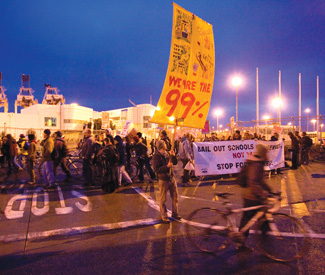
The day began when more than 1,000 protesters met up at the West Oakland BART station at 5:30 a.m., sleepily raising signs and banners in the chilly morning air as they proceeded down 7th Street toward the port. Once they reached the sprawling shipping hub, they formed picket lines outside terminal entrances. Police were on the scene and clad in riot gear, but no clashes with protesters occurred early in the day.

Around 7 a.m., when the morning shift would have typically started, two International Longshore & Warehouse Union (ILWU) dockworkers — who declined to give their names — stood near the Hanjin Shipping gate at berths 55 and 56. Past the gate, a cargo vessel which had likely come from Japan was berthed and waiting to unload.

The men calmly surveyed the roughly 200 chanting Occupy activists as they marched around and around in a circular picket. “Ain’t nobody going to cross it,” one offered. The other gestured toward the protesters. “These are Americans wanting American jobs,” he said.

Around 10 a.m. outside the same terminal, protest organizer and Oakland hip-hop artist Boots Riley declared the first part of the port shutdown to be a victory. “Longshoremen are going home now,” he said. “Effectively, the Port of Oakland is shut down.” Later in the afternoon, protesters returned to prevent the start of an evening shift.

Until recently, the nationwide Occupy movement manifested as tent cities springing up everywhere in rebellion against the lopsided economic conditions. After a series of police raids cleared the tents away, however, organizers in the Bay Area and beyond took a different tack with the port blockade.

Working in tandem with allies from labor, occupiers from San Diego all the way up to Anchorage directed their gaze at international shipping hubs, critical infrastructure for multinational businesses importing and exporting goods between Asia and North America.

Cargo terminals make for heavyweight targets, as five of the nation’s 10 largest ports are located along the West Coast. The value of annually traded goods flowing in and out of Oakland alone is $34 billion, and authorities there estimate some $8 million could be lost if business were to be halted for a full day.


MAKING HISTORY

OccupyOakland unanimously approved the call for a coordinated West Coast port blockade at a Nov. 18 General Assembly.

“The ports play a pivotal role in the flow and growth of capital for the 1 percent in this country and internationally,” occupiers explained on a website announcing the port shutdown. “For that reason alone it is the ideal place to disrupt their profit machine.”

The ports weren’t selected as a target for that reason alone, but rather as an affront to specific corporations whose labor practices have sparked the ire of port workers. Export Grain Terminal (EGT) and its parent company, Bunge, Ltd., came into Occupy’s crosshairs because of their ongoing dispute with ILWU Local 21 in Longview, Wash., stemming from what longshoremen characterize as union-busting practices.

Port terminal operator Stevedoring Services of America (SSA Marine) and its parent company’s primary shareholder, Goldman Sachs, were also singled out in support of low-wage port truckers whose employment classification as independent contractors bars them from unionizing.

The third objective of the blockade, according to organizers, was to strike back against a series of police raids that dismantled Occupy encampments nationwide.

It wasn’t the first time cargo ships traversing the Pacific would be stalled by a politically motivated coast-wide port blockade. In 2008, ILWU members coordinated a West Coast port shutdown in dissent of the Iraq War.

In 1984, longshoremen and anti-apartheid activists blocked South African cargo to boycott the apartheid regime, noted ILWU member Stan Woods. Similar shutdowns, carried out in response to politically explosive issues going back to 1934, have been led by community activists forming picket lines at port entrances to prevent dockworkers from beginning their shifts.

Occupy’s call for a coordinated blockade brought an unprecedented twist to this historic trend, representing the first time a group unaffiliated with dockworkers had called for a shutdown spanning the entire West Coast. It left some seasoned organizers wondering anxiously how things would unfold, while others saw it as a gust of wind in the sails of the labor movement.

“One of the good things about the Occupy movement is that it’s challenging leaders of progressive institutions,” Woods said. “The old way … isn’t working. There’s been a one-sided class war, and there has to be a two-sided class war.”

Organizer Barucha Peller noted that the Occupy movement could be galvanizing for non-unionized workers, too. “Our movement is giving a framework for the 89 percent of workers who are not in unions,” she said.

For occupiers up and down the West Coast, the port shutdown also seemed to present a kind of test as to whether their young movement could successfully “exert its collective muscle,” as an OccupyOakland press statement put it, and effectuate a mass mobilization even after police raids flattened their encampments.


A ROUGH VOYAGE

In the weeks leading up to Dec. 12, even as Bay Area Occupy organizers plastered fliers about the blockade everywhere, met with union members, and organized outreach events to garner community support, they stumbled into challenges. Robert McEllrath, the president of the ILWU, publicly criticized the blockade plan, saying organizers had failed to reach out to union officials before unanimously approving the call to action.

“Any decisions made by groups outside of the union’s democratic process do not hold water, regardless of the intent,” McEllrath wrote. He seemed troubled that Occupy had attached itself to a union struggle without adequate communication, but an official endorsement of a third-party blockade by the ILWU would have landed the union in legal trouble.

“Whenever a group of people decide to march into a workplace in an effort to shut it without respecting the democratic decision-making process, it’s not an ideal situation,” ILWU spokesperson Craig Merrilees told the Guardian.

Some rank-and-file ILWU members saw things differently. “The rank and file do support the principles of the community, and Occupy,” said Anthony Lavierge, an ILWU steward. “Longshoremen had a good response to [the Nov. 2 port blockade]. It was empowering to a lot of people that so many came out.”

Another rank-and-file union member said, “the majority of ILWU workers are supportive of what’s going on, definitely.”

One rank-and-file ILWU member and self-described anarchist published a critique online raising concerns that OccupyOakland had failed to bring local union officials on board before approving the call to action.

In response, OccupyOakland organizer Mike King said, “We never brought it to them, because it’s not something they could endorse.” Yet he added that they had sought to include the rank-and-file from the start.

“We have done far more outreach for Dec. 12,” than in the days prior to the Nov. 2 port shutdown, which brought tens of thousands of activists to the street, King said. “Leading up to Nov. 2, we never expected half that many people would show up.”

Occupiers in San Diego, Los Angeles, Portland, Vancouver, Anchorage, and other cities all signed up to participate, and the idea drew support from activist groups as far away as Japan who vowed to perform solidarity actions in their own communities.

Nevertheless, the international union president’s statement prompted a flurry of mainstream news articles — along with some downright derisive columns — casting occupiers as out of sync with the very workers they claimed to stand with.

In Oakland, authorities of the targeted facility posed another obstacle. The Port of Oakland took out full-page ads in local daily newspapers and the New York Times urging the community to “Keep the Port Open.” The ads borrowed the language of the movement by proclaiming that the port “employs the 99 percent.” Port spokesperson Robert Bernardo emphasized this message in an interview with the Guardian. “When you shut down a port, you lose jobs,” he said. “Local jobs.”

Sue Piper, special assistant to Oakland Mayor Jean Quan, noted prior to Dec. 12 that the mayor was working with police and port officials to ensure that the port remained open for business. On the morning of the port blockade, however, police stood down and did not prevent protesters from circling up in front of terminal entrances.


BIG FISH TO FRY

Lost in much of the mainstream coverage of the port blockade were Occupy Oakland’s three main objectives. The protesters aimed to demonstrate solidarity with low-income port truckers laboring in service of the powerful SSA Marine; stand with ILWU Local 21 members in their face-off against EGT; and deliver a show of resistance against coordinated police raids of Occupy encampments nationwide.

In October, 26 Los Angeles truckers working for a port company called Toll Group were fired after wearing Teamsters truckers’ union jerseys to their shifts to demonstrate their wish to unionize. Because they’re classified as independent contractors instead of employees, it’s illegal for the truckers to join unions. They’re paid per shipment rather than per hour, which translates to hours of unpaid labor spent in the queue, and must cover their own job-related costs.

Occupy Los Angeles caught wind of the incident and began to talk about doing an action in solidarity with the truckers.

“The date of Dec. 12 was originally suggested by people in Los Angeles,” explained Dave Welsh, a delegate of the San Francisco Labor Council and secretary of the Committee to Defend the ILWU. “It’s also Our Lady of Guadalupe feast day, a Mexican holiday. Since many truckers of the Port of LA are Mexican, they picked that date. One focus [of the blockade] is support for truckers and their demand for better wages, working conditions, etc.”

On the day of the blockade, an open letter from port truckers was published on the website of the Coalition for Clean and Safe Ports, an advocacy group. “We are inspired that a non-violent democratic movement that insists on basic economic fairness is capturing the hearts and minds of so many working people,” the message read. “Thank you ’99 Percenters’ for hearing our call for justice. We are humbled and overwhelmed by recent attention. Normally we are invisible.”

The second major target of the blockade was EGT, which constructed a new grain terminal on Port of Longview property at the edge of the Columbia River in southern Washington, about an hour’s drive from Portland, Ore.

EGT’s parent company is Bunge, Ltd., a major agribusiness firm that has come under fire for everything from tax evasion, to rampant clearing of Amazon rainforest lands for soybean cultivation, to the use of slave labor in Brazil.

Although the terminal construction first brought hope to a small community inflicted with 15 percent unemployment , ILWU Local 21 President Dan Coffman says things soured when EGT brought in out-of-state laborers to build the facility, then refused to hire members of his union.

Coffman contends that EGT’s lease with the port means the company is required to hire Local 21 workers, but EGT disputes this, and has been locked in a federal court battle with the port. The dispute has prompted union members to stage port blockades of their own, resulting in some arrests.

Peller, the Occupy Oakland organizer, announced on a megaphone Dec. 12 that occupiers in southern Washington had shut down the Port of Longview, according to a text message from ILWU Local 21. Union members wanted to thank the movement for the show of support, she added.

“They thought they could just run over a small local,” Coffman told the Guardian, referencing EGT. “Well, David met Goliath. We’re going to fight them till the bitter end.”

Cream of the crop

0

virginia@sfbg.com

APPETITE On a recent misty morning in Point Reyes, and then during a Petaluma afternoon inland, I visited two of our most beloved creameries. The damp earth of a dairy farm in dark, early hours is oddly intoxicating, while sampling fresh cheese in various stages of ripening is sheer pleasure. These dairies make me proud of the familial, forward-thinking, humane food practices that have been going strong in the Bay Area for decades.


STRAUS FAMILY CREAMERY

One look in the eyes of cows at Straus Family Creamery (www.strausfamilycreamery.com) and you’re changed. If you did not care where your milk came from, you do now. Petting baby cows, tagged with names such as Wilma or Eve, you become attached, even protective, of these peaceable animals.

Organic before it became a “trend,” Bill Straus began farming this coastal Point Reyes land in 1941 with 23 cows (there are now over 300 milk cows). His wife Ellen read Rachel Carson’s game-changing Silent Spring in the 1960s, mobilizing them both toward a lifelong commitment to environmental sustainability. Theirs were the first certified organic dairy farm west of the Mississippi in 1994, leading in sustainable farming practices.

Early on a soft, gray weekday, I trekked up to the farm, right on Tomales Bay, via scenic winding roads. The air smells funky with cows, yes, but also bracingly of earth, water, grass.

Bill and Ellen’s son Albert Straus now runs the farm. Majoring in dairy science, he launched the famed ice cream line (he’s a real aficionado), continuing to grow Straus Creamery in sustainable practices like composting solids and waste to fertilize their land (or that of nearby biodynamic wineries).

Straus keeps a “closed herd” so no infection or disease gets transported to the cows. While he works with 300 milking cows, he’s simultaneously raising 250 young cows who begin milking after two years.

As prices of basics like grain and production have gone up at least 25 percent in the last couple of years, there’s not a lot of profit to made allowing the natural process vs. increasing milk flow by injecting cows with hormones. It is heartening to see those like Straus, who care more about the quality and health of the product for consumers, along with the animals and their land, than the bottom line. Still, Straus presses on, under standards for organic farm certification that are stricter than for any food product.

“Most farmers are pretty risk averse, but I seem to continue to go the other way, “Albert told me with a laugh.

He’s pleased to note that around 50 percent of Marin and Sonoma farms are now organic. (Learn more about the organization formed in part by Albert and Sue Conley of Cowgirl Creamery, Marin Organic, www.marinorganic.org, now celebrating 10 years and responsible for promoting much of the region and industry’s growth).


COWGIRL CREAMERY

A day spent with Cowgirl Creamery (www.cowgirlcreamery.com) founders Sue Conley and Peggy Smith, among the finest cheesemakers in the country, is a delight. There are close ties to the Straus family: Conley and Smith not only source milk from Straus, but Sue was in part inspired to launch Cowgirl by the Strauses.

Both from rich culinary backgrounds, Peg and Sue created highly-lauded cheeses like that triple-cream dream, Mt. Tam, and earthy, unique Red Hawk. Their shop in the Ferry Building is a cheese destination.

The Cowgirls produce 10 different cheeses, seven in Petaluma (a town boasting other major creameries like Clover Stornetta and Three Twins), and three in their original, smaller Point Reyes facility. Peg notes that in Europe keeping cheeses regionally uniform — like Camembert in Camembert, France, for example — means strict style regulations. “We are lucky to have such great variety of cheeses here,” she told me, celebrating the freedom of experimentation led to some of the most popular Cowgirl cheeses.

Besides an idyllic lunch at Sue’s house, the day’s high point came in sampling Mt. Tam in numerous states of age, from an hours’ old, just-brined specimen that tasted salty-sour-tart to a meaty, acidic example at seven days, and finishing with a creamy, nutty 32-day chunk. (Mt. Tam is usually sold in the mid 20-30 day range.)

Schedule a tour of Cowgirl (tours resume in the Spring) or the Straus farm (group tours only), and you may come away as I did, with an increased appreciation for cheese, cows, our diverse region, and the artisans who strive to create the best… and change the world while they’re at it. *

Subscribe to Virgina’s twice-monthly newsletter, The Perfect Spot, www.theperfectspotsf.com


Do drop in

0

le.chicken.farmer@gmail.com

CHEAP EATS I am not my new favorite restaurant’s new favorite customer. No. If restaurants could review the people who eat at them, I would be roasted and raked right now. Or deep-fried.

Really, I deserve worse.

We were dining with people we hadn’t dined with before and didn’t know especially well: our landlordladypersons. They were kind enough to sublet their amazing li’l cottage to us, and to share with us their amazing li’l tomatoes, and sunshine and garbage collection in general. And, oh, we love it here in the Oakland foothills. Therefore, we invited them out to dinner. Not the foothills; the people, these beautiful two foothillbillies who have roofed our heads until the end of the year.

Which is fast approaching, so we figured we’d go somewhere close. First, though: a cocktail. It was so cute: like we were all on a first double-date together. Which, I guess, we kind of were. We live in these people’s back yard, but we went around to the front door and knocked very formally.

They showed us in, sat us down, and popped a bottle of champagne.

I’m not making excuses. I mean, I am making excuses, but I’m not. I don’t handle my alcohol very well. Still, I did manage to have a polite glass of champagne and a handful of home-roasted almonds without ruining very much of their furniture or saying anything particularly stupid.

We talked about where we were all from, and accordions.

Then we walked to the restaurant. The Bay Leaf! Home of fantastic fried things, and even some fantastic other things, too. My new favorite restaurant was the first place I saw the first time I wandered around my new neighborhood. It’s at the corner of MacArthur and 38th, in the Dimond District. But they’re not open for lunch, or I would have fallen in love with them a lot sooner.

Cold night, warm place. Friendly waitressperson. We ordered two fried oyster dinners, a fried chicken dinner, and a fried catfish dinner. With greens, greens, yams, yams, mac & cheese, fried cabbage, and fried okra by way of sides.

The idea being to share it all, so in addition to the regular dinner plates of fried things, they also brought four empty plates. For sharing.

Luck would have it, waitressperson set the fried catfish in front of me. Being a good citizen, I immediately cut it into four equal pieces, and — being a bad citizen — elected to serve myself first. You know me: I was starving.

So, while everyone else was doling out everything else in no particular order that I knew of, I scooped some mac & cheese from my plate onto my other plate, a piece of fish, and in the process of passing the plate along to Hedgehog, I didn’t dump it in my lap so much as throw it across the restaurant.

It’s not for no reason that Hedgehog calls me Graceful Little Flower. It’s for sarcasm, which is as noble a cause as any, my book. I walk into things. I trip over things that are just barely there, like a color.

And, finally, I drop things — in sometimes (such as this one) spectacular fashion.

It landed face-down behind me, fried catfish and creamy mac & cheese grinding into the carpet. (Yes, my new favorite restaurant is carpeted.) And while I buried my face in my hands out of equal parts embarrassment and loss, a different very nice waitressperson came and cleaned up my mess, and my dining companions swung into suicide-watch mode, there-there-ing and graceful-little-flowering me with sentiments meant to help me fathom that I might not be the clumsiest fucking idiot in the history of the world.

There was plenty of great food, for example, that was still on the table! The fried oysters were the best I’ve had in the Bay Area since the Gravy days. The fried chicken wings were great. That quarter of a catfish fillet on my other plate, the still-plated one, was out of this world …

But saying so only makes me miss the three quarters of it that left this world even earlier. *

THE BAY LEAF

Wed.-Sat.: 3-9 p.m.; Sun. 1-7 p.m. Closed Mon.-Tue.

2000 MacArthur Blvd., Oakl.

(510) 336-2295

MC/V

Beer and wine


How guilty?

0

caitlin@sfbg.com

YEAR IN MUSIC You call it godawful taste in music, I call it reverse colonization. Learn to like the schlock on the radio and instead of groaning through that car ride you too can passenger seat-rock fit to make the Acura in the lane next to yours take “lookit this spazz” photos. Famous!

Yes, it takes some synaptic refiguring to truly enjoy Top 40 music. And not just so that you can enjoy facile lyrics — certain idealistic underpinnings can change your head’s bob to Drake’s latest into a rueful shake real quick. Sexism? Yes.

But this year had some R&B and commercial hip-hop gems. The general trend towards dance music has been making the sounds in those worlds fluffier, more addictive. And the videos — well this is the best part about succumbing to the ways of the Billboard Hot 100. One gets to bask in the light of candy-colored, expertly choreographed, lip-pursing versions of heaven. Forever chain-pressing repeat, because you’re not really a fan of any of these jams until you know. Every. Word.

So we’ve come to the conclusion that it’s all about mitigating the damage that you’re doing to your psyche. And so here we have some favorite bubblegum-ish tracks of the year, arranged so that the true soul crushers bring up the rear of the list.


RIHANNA FEAT. DRAKE “WHAT’S MY NAME?”

Rihanna entranced us in 2011 with her dance-ready beats, her off-kilter brand of hot (red hair dye, S and M wear, and oversize pastel cashmere sweaters playing equal roles), and sass. The yardstick by which all guilty pleasure songs must be judged is how loudly you feel like singing to them, which is usually tied to how much you can puff your chest out while imaging the lyrics apply to you. “What’s My Name?” is exactly the song you want to come on after you’ve celebrated a big win, say gotten a cup of coffee for free from your favorite grounds-slinger, or woken up on time. Plus, in the video Drake hits on Rihanna while she’s buying milk.

Guilty?: Not. Rihanna is the zeitgeist, the rest of us dust on her wind.


BEYONCE FEAT. J. COLE “PARTY”

Queen B continued her reign of terror right on through pregnancy this year, enrapturing all those lucky enough to catch sight of her baby bump. Carrying a child did not prevent her from making nearly every song from this year’s 4 into a hit single, or even discourage her from sporting Lycra and jouncing about in the video for “Countdown” (whose dance steps were later proven to be an “homage” to a routine by Belgian choreographer Anne Teresa De Keersmaeker). “Party” is a summer song, and judged by aforementioned I-wanna-be-that metric, it kills.

Guilty?: Do you hate babies? Not guilty.


NICKI MINAJ “SUPER BASS”

Another defining characteristic of the guilty pleasure is the inextricably linked dance move that accompanies its entry into one’s auditory landscape. Minaj’s “Super Bass” inevitably inspires a pushing away from the chest movement, usually paired with some kind of stomping of the feet. Wait, but does that make you a Barbie (the singer-emcee’s term for her own fans)? Being one of Nicki’s flock might just speak more to your hip-hop philosophy these days: like Drake, she came from a performing arts background, and makes no bones about the hip-hop world serving as a canvas for performance.

Guilty?: Fans of hip-hop with teeth take it easy — this music’s always been about putting on a show. Not guilty.


WILL.I.AM FEAT. SESAME STREET “WHAT I AM”

How do we hate Will.i.am? Let us count the ways. One, his group the Black Eyed Peas are the textbook example of sell-out. Nothing makes it past this group that will not sell Pepsis or $2 toasters at Target. Two, he told Elle Magazine that women who keep condoms around are “tacky.” Three, his participation in the Ed Lee “2 Legit 2 Quit” video (a production that seemed specifically engineered to enrage me). But then, this song, in which this hurricane of a man is surrounded by the beloved scamps of Sesame Street. It makes us want to high step. But is it right?

Guilty?: For above three reasons, all Will.i.am projects must be considered tainted — but positive behavior by him must be encouraged. Guilty, but harm to self is mitigated if you listen to this song while buying Trojan Her Pleasures.


DRAKE “MAKE ME PROUD”

A time-honored tradition contained within the “songs for women” canon of male hip-hop and R&B stars is the sweet hook versus the totally busted approach to the female sex in the lyrics. Pretty much the entirety of this year’s Take Care album qualifies for inclusion in this time-honored rite — although the way the singer-rapper calls an ex-flame out of his “old phone” in the track “Marvin’s Room” says as much about him as it does the girls that he’s calling. “Make Me Proud” is a big brother approach to the same hot chick he’s demeaning in every other song on the album. She’s good-looking, smart, she reserves sex because she’s sick of guys hitting on her. Ugh. Too bad Nikki Minaj has a verse on here rapping about being a Sagittarius and it’s now on my Spotify “starred” list.

Guilty?: Are you kidding? Lock yourself up.

The tops of 2011

0


CHERYL EDDY, GUARDIAN


TOP 10 METAL SHOWS OF 2011 (CHRONOLOGICAL ORDER)

1. Feb. 2: Motörhead, Clutch, and Valient Thorr at Warfield

2. March 11: Weedeater, Zoroaster, Kvelertak, and Begotten at Thee Parkside

3. March 12: Slough Feg, Christian Mistress, and Witch Mountain at Hemlock

4. April 3: Saint Vitus, Red Fang, and Howl at Mezzanine

5. June 7: Orange Goblin and Gates of Slumber at Bottom of the Hill

6. Aug. 12: Eyehategod, Impaled, Laudanum, and Brainoil at Oakland Metro

7. Aug. 16: Pentagram at Mezzanine

8. Oct. 13: Enslaved at Slim’s

9. Nov. 3: Mastodon and Red Fang at Warfield

10. Nov. 19: Kyuss Lives! and Black Cobra at Regency Ballroom


JOSH CHEON, DARK ENTRIES RECORDS


TOP 10 NEW RELEASES OF 2011

1. Container, S/T LP (Spectrum Spools) 2. Staccato du Mal, Sin Destino (Weird Records) 3. Bronze, Copper (RVNG Intl.) 4. Grouper, Dream Loss/Alien Observer (Yellow Electric) 5. White Fence, Is Growing Faith (Woodist) 6. Belong, Common Era (Kranky) 7. Widowspeak, S/T LP (Captured Tracks) 8. Total Control, Henge Beat (Iron Lung) 9. Iceage, New Brigade (What’s Your Rupture?) 10. Brotman & Short, Heights (Cold Dick)


GEORGE CHEN, MUSICIAN AND WRITER


2011: MAN, MOST OF IT WAS SHITTY. BUT HERE WERE THE GOOD THINGS

1. Helm. Luke Younger from Birds of Delay, Halloween weekend in London. Best noise set I’ve seen in a while, it helped that there was a fan blowing his bangs out of his hoodie. He has an album called Cryptography out on Kye. 2. White Lung. Youngins from Vancouver B.C. playing sick, straight forward punk. Saw them in a bowling alley. 3. Village of Spaces’ Alchemy and Trust album. It took a village to put this out, or at least four labels working in conjunction. Dan Beckman’s (Uke of Spaces Corners) quiet folk masterpiece. 4. Divorce. A band from Glasgow that exists in kind of a cultural vacuum there, a bit like the early ’00s trapped in amber, but then cracked open and given adrenal supplements. They are coming to America in July 2012. 5. Trash Kit put out an album in 2010, but I only got to see them once in 2011. Sadly, they have broken up. Finger-picky jaunty punk with weird rhythms. 6. Andrew W.K. This was not particularly “good”, but distinct encapsulation of the zeitgeist. My band played a show with him at Dem Passwords. He didn’t actually watch us or anything, he showed up right before going on with an entourage. Fans started force-feeding him bananas, Redbull, and whiskey and it turned into a freakish spectacle. I took a nap during his set, came back in, and he was still going for like two and a half hours, driving his fans away. Respect, the modern Andy Kaufman. 7. This Invitation. Chen Santa Maria went on a California tour with Warren in April and it was sparsely attended, but perhaps we’re to blame for that. It’s nice to see one of your oldest friends get some recognition for their work, which Aquarius did by giving their stamp of approval to his three (!) double CDs. 8. Cacaw from Chicago, a few ex-Coughs peeps project. They are now broken up, but this summer they came through and it was a monstrous sludge engine. Dark and fierce. 9. Anika. Technically a 2010 release, but she played at the Independent in October. The lady herself has a passive stage presence, but the music of the whole group (members of Portishead and Beak>) is best described as “Nico fronting PiL” (someone at the LA Times can claim that one). 10. SF Comedy. I still feel like an outsider at all this, but holy shit, there’s good stuff going on right now. Perhaps it is a national, even international renaissance in comedy, but the energy and talent going on here feels as exciting to me as the music scene used to feel. I actually don’t want to name names although the free show at the Rite Spot is a good place to start. I also noticed that none of the music I put on this list has anything to do with the Bay Area. Sorry, music. I just listen to podcasts now.


JHAMEEL, MUSICIAN


TOP 10 SONGS FOR 2011

1. “Cruel” by St. Vincent 2. “Don’t Fuck with my Money” by Penguin Prison 3. “Holocene” by Bon Iver 4. “Bam Bam” by King Charles 5. “King of Diamonds” by Motopony 6. “Don’t Move” by Phantogram 7. “5 O’Clock” by T-Pain 8. “White Lie” by Jhameel 9. “Love U More” by Sunday Girl (RAC Mix) 10. “Imprint” by Amtrac


MARC RIBAK, TOTAL TRASH FEST


TOP 10 RECORDS I AM DIGGING DURING THANKSGIVING WEEK

1. The Fall, Wonderful and Frightening World of the Fall (particularly the tape that includes singles)

2. The Spits, Kill the Cool (demos and rarities, LP on In the Red)

3. Reigning Sound, Time Bomb High School and Too Much Guitar (LPs on In The Red)

4. The Ronettes, Presenting the Fabulous Ronettes featuring Veronica, and Phil Spector’s A Christmas Gift for You.

5. Devo, Workforce to the World (early live bootleg)

6. The Marvelettes, Greatest Hits (LP on TAMLA)

7. Coachwhips, Bangers Versus Fuckers (LP on Narnack)

8. South Bay Surfers, Battle of the Bands (LP on Norton)

9. Tav Falco and the Unaproachable Panther Burns, Panther Phobia (In the Red Records)

10. Jonathan Richman, Rockin’ and Romance (LP on Twin/Tone)


FRANCES CAPELL, GUARDIAN


TOP TEN SELF-RELEASED ALBUMS OF 2011

1. WU LYF, Go Tell Fire To The Mountain Recorded in an abandoned church, the full-length debut from British heavy pop quartet WU LYF was funded by membership fees for the band’s deviant fan club, the Lucifer Youth Foundation.

2. Death Grips, Ex Military The sinister debut mixtape from Sacramento’s Death Grips is an explosion of dark, twisted shout-rap and noisy, industrial beats.

3. Nick Diamonds, I Am An Attic Former Unicorn and current member of Islands and Mister Heavenly, Nick Diamonds (a.k.a. Nick Thorburn) released his understated, haunting solo album via Bandcamp.

4. Clams Casino, Instrumental Mixtape Clams Casino’s collection of swirling, synth-laden instrumentals crafted for the likes of Lil B and Soulja Boy reveals the genius of this visionary New Jersey producer.

5. Big K.R.I.T, Return of 4Eva Of all the exciting rap mixtapes released in 2011, Southern heavy-hitter Big K.R.I.T.’s Return of 4Eva is my favorite.

6. Frank Ocean, nostalgia, Ultra. This R&B pop gem presents Frank Ocean as, perhaps, the only member of the OFWGKTA family who proved worthy of the hype in 2011.

7. Fort Lean, Fort Lean (EP) Though it’s only 12 minutes long, Fort Lean’s infectious, summery debut EP is a promising glimpse of things to come for this indie five-piece from Brooklyn, NY.

8. Friendzone, Kuchibiru Network II I chose East Bay duo Friendzone’s Kuchibiru Network 2 over Main Attrakionz’s 808’s & Dark Grapes II, as it showcases Main Attrakionz at its best along with tasty selections from Oakland’s Shady Blaze and Finally Boys, Japanese producer Uyama Hiroto, and more.

9. Small Black, Moon Killer In addition to some of Small Black’s catchiest electronic pop songs to date (like the Nicki Minaj-sampling “Love’s Not Enough”), this mixtape features two appearances by Das Racist’s Himanshu Suri, and some inspired remixes from Star Slinger and Phone Tag.

10. The Weeknd, House of Balloons This is a no brainer. Canadian-Ethiopian R&B prodigy the Weeknd’s debut mixtape House of Balloons is the best album of the year, period. (Frances Capell)


LAURA GRAVANDER, DIRTY CUPCAKES


TOTALLY NEPOTISTIC LIST OF THE TOP TEN LIVE BANDS OF 2011

1. ELECTRO: This is the band of 8-year-old girls I mentored this summer as a volunteer at Bay Area Girls Rock Camp. After learning two chords from scratch, they wrote a droney, unintentionally avant-garde five-minute anti-bullying opus with a rap breakdown that blew my mind at their July showcase at the Oakland Metro. This is the future.

2. Uzi Rash: Swamp reptile Max Nordile and his band of trashy weirdos play music that is both grating and catchy, and deceptively complex. See them live and they will freak you out, and possibly hit you in the eye socket with an empty 40 oz. (it happened to me).

3. Shannon and the Clams: Seeing the Clams live feels like being magically reunited with your childhood dog — happy and nostalgic, a little bit sad. This metaphor is especially apt if you and your childhood dog loved to DANCE! 4. Younger Lovers: Killer guitar parts, dance-crazy beats, and singer-drummer-songwriter Brontez’s onstage bitching makes Younger Lovers’ shows unpredictable and exciting. Plus, their guitarist is super-cute!

5. King Lollipop: Elfin hillbilly plays bubblegum rockabilly (or something like that!) backed by six drummers who sound like a marching band meets drum circle, minus the lame.

6. Human Waste: Freaky spacesuited dystopian moog-punk from the Moon. Rumored to consist of members of Uzi Rash, Shannon and the Clams, and Dirty Cupcakes. More space waste to come in 2012.

7. Glitter Wizard: Intricate, impressive glam rock. And once, mid-song, I saw frontman Wendy Stonehenge light his hand on fire!

8. PIGS: This three-piece plays metal for people who love metal. Ripping it up soon in a scummy warehouse near you.

9. Knifey Spoony: Oakland punk rockers with impressive live show and unexpectedly melodic hooks. Singer-guitarist Steve Oriolo studied music in college but uses his powers for good (rock), not evil (anything that doesn’t rock).

10. Sweet Nothing: I’m a sucker for two-piece bands and girl drummers, and Ian and Melissa always rock my face off.


KUSH ARORA AND THE INGROOVES OFFICE STAFF


TOP 10 RELEASES OF 2011

1. Los Rakas, Chancletas Y Camisetas (Soy Raka Inc.) 2. Am and Shawn Lee, Celestial Electric (ESL Records) 3. People Under The Stairs, Highlighter (Piecelock 70 ) 4. Toddla T, Watch Me Dance (Ninja Tune) 5. Boris, New Album (Sargent House) 6. Kendrick Lamar, Section.80 (Top Dawg Entertainment/Section 80) 7. Youth Lagoon, The Year of Hibernation (Fat Possum) 8. Little Dragon, Ritual Union (Peacefrog Holdings Ltd) 9. Jay Rock, Follow Me Home (Strange Music) 10. Vybz Kartel, Colouring Book EP (Tad’s Records)


MARCO DE LA VEGA (@S4NTA_MU3RTE), 120 MINUTES


TOP 10 SUBSTANCES THAT HAVE INFLUENCED MUSIC IN 2011

1. Adderall: Not just because Bay-local comeup, Kreayshawn, spits bout slangin’ em (“gnarly, radical, on the block I’m magical… see me at your college campus baggie full of Adderalls”) or even because of Kendrick Lamar’s thoughtfully spaced out track “A.D.H.D.” but mostly because of its association with hyperactive, creative, and willfully scattered children. Odd Future blew up, Tyler the Creator dropped Goblin, A$AP Rocky put out one of the strongest releases of the year with LIVELOVEA$AP. All kinds of kids were spittin’ up mixtapes right outta high school and then signing multimillion dollar contracts.

2. DMT: Dimethyltryptamine is some fucked up shit, and I mean that in the most complementary way possible. A small glimpse behind the fabric of reality. There were a few releases this year that resemble and reflect this completely alien and confusing greater truth. Oneohtrix Point Never’s Replica, James Ferraro’s Far Side Virtual, and Laurel Halo’s flawless EP, Hour Logic (Hippos In Tanks).

3. Nitrous Oxide: whippets are back and that shit makes everything sound like you’re living in a vacuum cleaner. As much as I despise the hyperwobbly, fist pumpin’ sounds of brosteppers like Rusko, and (cringe) Skrillex, I can’t deny that that shit is selling cars; dubstep car commercials. Also, to be fair, real dubstep and what is often called post-dubstep is some amazing music and some of its less commercially viable/more critically acclaimed artists have put out some beautiful work. Zomby dropped Dedication this year on 4AD and that shit is sick. James Blake’s debut album is also impossibly good.

4. Pills: maybe it’s just the kids I roll with, but I assume that most sensitive, well thought, independent rock is made by people on pills (think old Brian Jonestown Massacre or Jesus and Mary Chain). The second I heard that track “Vomit” off of friends and local heroes Girls new album Father, Son, Holy Ghost, I had to raid my own medicine cabinet, take a couple Vicodin, and listen to a stack of records including that, Tamaryn, King Dude, Chelsea Wolfe, and Zola Jesus.’Bout as close to heaven as a guy like me can get.

5. Coke: coke always has and always will rule the dancefloor. It goes further than that though; coke rap is alive and well. Trap rap (rap about drug dealing) in general is continuing to run shit. And when you got Lex Luger droppin’ some of the illest beats around for songs that are 90 percent chorus, how can you go wrong? This is a very serious statement — the Ferrari Boyz (Gucci Mane and Waka Flocka Flame) mixtape that came out about a week before that overhyped, tired, abomination that is Watch the Throne, has some of the best tracks this year.

6. K: club drugs in general are back, and nothing says party like as strong debilitating dissociative. I mentioned this album earlier when I was talking about DMT, but it’s good and weird enough that it needs to be mentioned twice. James Ferraro’s Far Side Virtual.

7. Acid: my favorite substance. LSD is an extended barrage of overwhelming sensory input, particularly sight and sound, and should therefor be discussed in those terms. Sight: this year has been all about projections, lasers, and smoke — there are a lot of amazing producers playing live right now, and a dude with a laptop ain’t a show, so it’s important to add some flare. Sound: from mixtapes like White Ring’s tranced out Chaind and Nike7up’s crazy melted-pop gem 33:33 to Araabmuzik’s breathtakingly unfuckwithable album Electronic Dream, this has been the strongest showing dosed out music has had since the mid ’90s.

8. MDMA: like I was saying earlier, club drugs are huge right now. Best part about the ecstasy thing though is that we’re not talking pressies here, just pure crystalized love. You can hear it in the work of groups like Sleep 8 Over and (of course) Pure X. But I think it’s most evidenced by song’s like The Weeknd’s “High for This” and on Pictureplane’s brilliantly positive album Thee Physical (Lovepump United).

9. Weed: not that weed ever goes away, but it’s had a really strong year. Seems like everybody’s smoking blunts and flipping pounds these days. Wiz Khalifa, A$AP, Lil B, Lil Wayne, Miley fucking Cyrus. and of course Zip and a Double Cup himself, Juicy J., which brings us to our big winner…

10. Promethazine: Lean, purple drank, double cup, sizzurp — codeine cough syrup has a lot of names, and it’s been an important factor in rap, particularly Southern rap, for a very long time. But that influence is spreading. Bands like Salem have created whole new subgenres of music built off applying the late great DJ Screw’s production sensibilities as liberally as possible. New York Rappers like A$AP Rocky are singing the praises of Screw and Pimp C while repping Harlem and putting New York back on the map. I think 2012 is gonna be all about double cup dinner parties and art walks. Do yourself a favor, call your doctor and fake a cough, pop in Clams Casino’s Instrumental mixtape and/or LIVELOVEA$AP and chill for a bit.


Man/machine

0

arts@sfbg.com

Year in Music "Here in my car / I feel safest of all / I can lock all my doors / It’s the only way to live in cars." — Gary Numan, "Cars"

Are friends electric? In 2011, synthpop sounded like a safe vehicle with which to whirl forward, one wheel in the quickly receding past and the other in the fast-coming future.

As the light turned green on ’11 and roared on through 11/11/11, those binary 1’s pointed to the synthetic pleasures harking back to Human League, Yazoo, and Depeche Mode. Early in the year, La Roux’s Elly Jackson took home a Grammy for her eponymous debut — signifying the U.S. music mainstream’s approval.

You could detect the synths popping beneath the beckoning, bright textures of Vetiver’s "Can’t You Tell," the Paisley Park-meets-"Enola Gay" washes of Nite Jewel’s "One Second of Love," and the Doppler effect textures of Toro y Moi’s "Talamak," while the much lamented departure of James Murphy’s LCD Soundsystem from the intersection of synth beats and rock squall threw up yet another sign that synthpop was on the move. Tellingly, Holy Ghost!, on Murphy’s DFA imprint, cast its eyes back longingly to the chilly dreamtime of the Ministry’s "I Wanted to Tell Her," lodging it in a busy thicket of bumping, rumbling bass and keys.

Don’t fear the ’80s: Yesteryear synth populists the Cars released its first LP with Ric Ocasek since its ’88 split, and the year closed with Gary Numan getting the avant seal of approval as an honored guest at the recent Battles-curated ATP show. Adding fuel to the firing pistons, locally, was a look back at the real Bay underground article: this year’s comp BART: Bay Area Retrograde (Dark Entries) wiped the "Clean Me" messages written in dust from tracks like Voice Farm’s "Voyager." The latter almost seemed to lend its synth tone directly to the sinewy, eerily sensual "Nightcall" by Kavinsky and Lovefoxxx off the Drive soundtrack (Lakeshore).

Much like that violently dreamy film’s Danish-American hybrid, "Nightcall" and College’s "A Real Hero" teetered between the almost OTT strain of romanticism and superchilled detachment embodied by the best of synthpop— the simple hooks and breathy, girlish vocals perfectly complementing the propulsive, forward-thrust mechanism of the tracks. You can’t drive those songs from your head.

In one of the strongest contenders for (double) album of the year, M83’s Hurry Up, We’re Dreaming (Mute), synthpop was only one component of the deep, ambitious, magnificent sprawl, a recording much like French transplant Anthony Gonzalez’s adopted L.A. home. Its breakout single, "Midnight City," tapped both the brooding nihilism of Grand Theft Auto and the noirish retro-epics of Michael Mann in collaboration with Giorgio Moroder, as leader Anthony Gonzalez emotes wistfully, "Waiting in a car /Waiting for a ride in the dark / Drinking in the lounge / Following the neon signs / Waiting for a roar / Looking at the mutating skyline / The city is my church / It wraps me in the sparking twilight."

Cue the orchestral, rollercoaster synths, faux bird calls, and reclaimed-from-the-cheese-bin skywalking sax. It may say as little as Numan’s "Cars"—making it the perfect tabula-rasa fodder for both Victoria’s Secret commercials and capitalism-happy How to Make It in America —but like a European native finding inspiration in the simultaneously alienating and freeing highways of El-Lay or J.G. Ballard, both songs prove that you needn’t rely on language to move a listener.

Rearview mirror

0

emilysavage@sfbg.com

Year in Music “Out of all the records I’ve recorded, that was the worst experience,” says prolific Dinosaur Jr. bassist and Sebadoh guitarist Lou Barlow. He’s speaking of Bug, the classic, feedback opening alternative rock album Dinosaur Jr. released on SST in 1988.

Why then, did the band tour the East Coast during the spring of 2011, playing the album start to finish, and why does it continue to play it now — appearing at the Fillmore this week? “All the negative associations I had with it are gone. What I hear now is a really great batch of songs that J [Mascis] wrote.” He goes on to describe the early days of Dinosaur Jr., “when we formed it was my first textured, creatively ambitious band — and that was at the age of 17 — so it’s a real part of my DNA now. Musically, it’s a very familiar spot to be at.”

There, in a history-rich bed with a familiar texture, is the spot where aging rock fans crave to be. According to Simon Reynold’s exhaustive and polarizing 2011 tome Retromania, it’s also the space in which we all now inhabit, new listeners and old. His introductory words are harsh, if provoking. “The 2000s [was] the decade of rampant recycling: bygone genres revived and renovated, vintage sonic material, reprocessed and recombined. Too often with new young bands, beneath their taut skin and rosy cheeks, you could detect the sagging grey flesh of old ideas.” Brutal.

In some sections, Reynolds is dead on, and his methodology applies equally to the year in rock that was 2011 (though the book was written in the summer of 2010). We couldn’t possibly look back at these twelve months without including the grander trail of rock’n’roll, and how it was again repackaged throughout the year.

Given the retro-crazed times we live in, to judge the year, we must also fall deeper down the nostalgia inkwell, in part due to the onslaught of monster reunion tours, complete album trips, rereleased records, anniversary celebrations, and retro reverential new rock/garage/punk acts of 2011. One point Reynolds makes, is that the span of time elapsed between creative endeavor and nostalgia for said endeavor is rapidly fading.

Just recently the Weakerthans — which formed in 1997 — spent four power-pop nights at the Independent, playing one whole album from its catalogue each night. Earlier this year, Archers of Loaf launched a reunion tour (13 years after its demise) and the reissue of four of its studio albums on Merge. There were also reunion shows and tours from the Cars, Kyuss, Pulp, Cibo Matto, Masters of the Hemisphere, Death From Above 1979 (big up to Treasure Island Music Festival), and strangely, J. Geils Band, the Monkees, and System of a Down.

There were rereleased Smashing Pumpkins albums, a Throbbing Gristle greatest hits, and a Hot Snakes one-off (at press time) at All Tomorrow’s Parties’ Nightmare Before Xmas in Minehead, England — a fest also headlined by Archers of Loaf.

There was Nirvana’s Nevermind 20 year anniversary celebration, and Metallica’s 30 years strong, though the output for these celebrations was obviously disparate given the nature of the acts. Nirvana’s label released a series of singles and special edition anniversary batches. Metallica took perhaps the most surprising turn a no-frills metal act could — it paired with Lou Reed and released a confusing collaboration, Lulu, though the real anniversary celebration was yet to come — a four-night, devil-horned, juicy guest-starred tête-à-tête for hardcore fans at the Fillmore.

There were also the bands that just felt retro, or at least, stood with one foot in rock’s not-so-distant past. But the good ones were more reverent than carbon vintage copy, acts like Dum Dum Girls and Cults, played on romantic ideals of ’60s garage and slipped in some doo-wop and girl group-esque vocals, but neither directly mimics a particular era. In its debut follow-up, Only In Dreams (Sub Pop), Dum Dum Girls also referenced a distinct ’90s Mazzy Star vibe. Meanwhile, Canadian chanteuse Austra looped back to the ’80s with prominent synth and operatic love songs, and the Beets happily alluded to its own ’60s garage-meets-Ramones influences on fourth album Let The Poison Out (Hardly Art), like something out of a Nuggets boxset; a modern, bilingual Seeds.

Locally, longtime Ty Segall band member Mikal Cronin finally made the move to San Francisco in 2011. Raised on surf and garage rock down south, he brought with him a distinctive nostalgic sound; his solo self-titled record — released this year on Trouble in Mind — was one of the most intriguing of the year. Like many now living and playing in SF, he’s drawn to vintage rock’n’roll and garage, but his style stands out above the pack.

This year he released a multifarious record of crusted garage-punk and swirling psych-pop, glamorized with the hazy, sand-swept beach days pictured in vintage Polaroids. Opening track “Is It Alright” could be plucked from a psychedelic Beach Boys LP, laid thicker with grime. And Cronin, when pressed, reveals a long history of influences — along with current bands such as Thee Oh Sees and Strange Boys — mentioning longtime favorites “Emitt Rhodes, Del Shannon, the Beatles, the Beach Boys,” adding “I’ve been trying to relisten to the classics” And yes, the remaining Beach Boys were said to be planning yet another reunion for next year, a thrill for likely a few young fans (though the same can not be said for Brian Wilson’s 2011 Disney covers album).

Here’s another spot where Reynolds and I tend to split: I’m an unabashed rearview mirror fan. And while I agree that the “re-s” in our sonic world are sometimes overwhelmingly dull, the opportunity to see live bands that broke up before I was cognizant has just too strong a pull on my psyche. Even Reynolds seems to consent to that last bit, stating in Retromania, “The exceptions to my ‘no reunions’ policy are a few bands that I loved as a youth but never managed to see live.” So wouldn’t that be the case for someone in every audience? The giant pink headphones-wearing toddler I saw at the Iggy Pop show undoubtedly missed the punk singer’s first 40 odd years of shows. Now, will somebody please reunite Operation Ivy, Minor Threat, and Neutral Milk Hotel for complete album tours, or is that too sacrilegious for your precious memories? It’d just be for my own comfort, obviously. *


EMILY SAVAGE’S TOP 10 SHOWS OF 2011

Feb. 26: No Age, Grass Widow, and Rank/Xerox at Rickshaw Stop

April 27: Steve Ignorant plays Crass songs at Slim’s

June 1: Gayngs at Independent

July 13: King Khan & Gris-Gris, Shannon & the Clams, King Lollipop/1-2-3-4 Go! Records Showcase at Oakland Metro Opera House

Sept. 22: Hightower, Black Cobra, and Walken at Yerba Buena Center for the Arts

Oct. 6: CSS at Fillmore

Oct. 13: Gardens & Villa at Bottom of the Hill

Nov. 5: Wild Flag at Great American Music Hall

Dec. 4: Iggy Pop at Warfield

Dec. 10: Tycho at Independent

For the kids?

2

caitlin@sfbg.com

HERBWISE Mission District dispensary Medithrive has started doing home deliveries. Since Nov. 22 its medical marijuana patients can have buds, tinctures, Auntie Dolores’ brownie bits, and more delivered straight to their apartment doors.

So why are Medithrive customers and staff members peeved? Because the new feature isn’t an expansion in services — it’s a forced shift in the co-op’s business structure. The dispensary was compelled to close its doors on 1933 Mission Street after a Sept. 28 letter from Department of Justice attorney Melinda Haag threatened its landlord with jail time if Medithrive didn’t cease operations in the space within 45 days. (Full disclosure: Medithrive is a Guardian advertiser)

The feds’ given reason was Medithrive’s proximity to Marshall Elementary School, located a 745-foot walk (according to Google Maps) from the dispensary door.

But Marshall’s principal Peter Avila wasn’t consulted on the matter. When called for comment by the Guardian, he said that he had bigger safety concerns.

“Right next door to Medithrive is a liquor store,” Avila said, adding that there is also a methadone clinic across the street from his school. “We have to deal with people passed out on the property, people smoking — those are more the issues than people buying medical marijuana.”

The principal says he patrols Marshall’s immediate neighborhood three to four times a day, dealing with drug addicts, people with mental problems, and the Mission’s homeless population. He called the dispensary “discreet” and never saw any cannabis usage by dispensary patients. Indeed: “They looked pretty much like the people who were coming out of the Walgreens [down the street].” In the past, Medithrive has offered to sponsor health education at Marshall.

Regardless, the dispensary’s Mission Streets doors are shuttered now. On many days, a staff member stands outside, handing out flyers announcing the delivery service to customers unaware that walk-up sales have ceased.

“We’re actually not in such a unique position,” said Medithrive community outreach liaison Hunter Holliman. The Tenderloin’s Divinity Tree and the Mission’s Mr. Nice Guy dispensaries also closed their doors this autumn in light of similar school zone notifications sent to their landlords. The landlord of Marin County marijuana activist Lynnette Shaw, founder of Marin Alliance for Medical Marijuana, was also hit. Shaw intends to fight to stay open.

Holliman says the shift to delivery services has been unexpectedly popular with Medithrive’s customers and allows the dispensary to service patients unable to physically access the storefront location — but it’s not without its challenges. Operations have been transient since the co-op is unable to even stage deliveries from the space on Mission Street. The day that the Guardian called, a voicemail informed patients that due to high call volume they’d have to leave a message so that dispensary staff could call them back. Once contacted by a helpful “budtender,” it took a little over an hour for the order to arrive.

Although Medithrive let go of many employees in its initial closure, it’s hired nearly all back in the transition to the labor-intensive delivery services. The dispensary is still hoping to secure another brick and mortar location, but permitting for new dispensaries has stalled at the city level.

Even if the dispensary’s been booted from its space, at least Medithrive patients still have access to medical cannabis — for now. Holliman is convinced that Bay Area dispensaries haven’t seen the end of legal challenges. “I’m sure there’s more to come,” he said grimly. “The feds are really serious about this.” 

Medithrive’s delivery-only menu is available at www.medithrive.com

Occupy’s next steps

6

EDITORIAL In less than three months, the Occupy movement has changed the national political debate — and possibly the course of U.S. history. A small group of protesters, derided in the mainstream media, grew to a massive outpouring of anger at economic inequality — and it’s no coincidence that politicians at all levels have begun to respond. At least five different measures aimed at raising taxes on the rich are in the works in California. In Kansas Dec. 6, President Obama made one of the most progressive speeches of his career, talking directly about the need for economic justice.

While even some supposed allies say the encampments weren’t effective, the truth is that the out-front, in-your-face tactic of holding nonstop protests in the financial heart of places like Manhattan and San Francisco got attention. The visibility of the Occupy camps forced everyone to pay attention. The U.S. economy is in a crisis; less disruptive tactics wouldn’t have worked. But now most of the encampments are gone, broken up by police forces and scattered from the central areas of major cities. It’s crucial that this growing and powerful national movement not fall apart after the almost inevitable crackdown on one style of protest. Occupy needs to look forward and plan its next steps.

Some of that is already happening, with Occupy activists targeting home foreclosures and marching on West Coast ports. But it’s worth considering another tactic, too: Occupy ought to begin planning now for a massive spring mobilization in Washington and a series of nationwide actions that could bring millions more people into the movement.

Part of the strategy of the Occupy camps was to maintain a presence, day after day — and that made perfect sense when the movement was starting. But single-day events, if organized on a massive scale as part of a larger campaign, can have a profound and lasting impact.

The original Earth Day — April 22, 1970 — involved 20 million people across the United States. There were events in hundreds of cities and thousands of high school and college campuses. It brought together old-school, sometime stodgy conservation groups with radical young environmentalists, the United Auto Workers with people concerned about pollution from car exhaust. It was, by any reasonable account, the birth of the modern American environmental movement.

The other great thing about Earth Day — and the reason it makes a great model for the Occupy movement — is that it was largely a grassroots event. Although there was a national office, most of the work was done spontaneously, in local communities, with no top-down direction.

And everyone — from Washington D.C. to the state capitols and city halls — paid attention.

Mass marches and mobilizations helped end the Vietnam War, spark the Civil Rights Movement and fight the anti-labor politics of the Reagan Administration. None of those events took place in isolation, any more than a national Occupy Day would take place in isolation. The nation’s ready for major economic change — and organizing a national event alone could help make stronger connections among the broad constituency that is the 99 percent.

Editor’s notes

68

tredmond@sfbg.com

Twenty years ago, if you mapped income distribution in San Francisco on a standard graph, you’d see what the economist call a bell curve: At one end were a small number of very poor families, at the other a small number of very rich, and in between the bulk of the city was somewhere roughly close to what you could call middle class.

Take the 2012 census data and make that graph today and you get the opposite — it’s becoming a U-shape, with more people in poverty and more gross wealth and not as much in the center.

You could see that on stark display at City Hall Dec 12.

At 10 a.m., the City Operations and Neighborhood Services Committee heard several hours of testimony on the alarming rise in the number of homeless families. In the end, the Mayor’s Office agreed to find $3 million to help out.

At 1 p.m., the Land Use and Economic Development Committee heard testimony on a plan to build more housing — on the waterfront, for the top one quarter of the top one percent of the richest people in America, people who will need more than $3 million just for the downpayment on their new digs.

The plan calls for 145 of what Port of San Francisco officials call “high end” or “luxury” condominiums, along with 400 underground parking spaces. “It’s going to be tight on three levels,” a Port official testified. “Most of it will be valet parking.” The developer wants to raise the height limit along the waterfront for the first time in half a century.

The Port, which controls some of the land, will get a cut of all the condo sales, maybe as much as $500,000 a year; that money will go to rebuild old piers and fund a long list of Port projects — including the America’s Cup. (Ted Gullicksen of the San Francisco Tenants Union was sitting next to me at the hearing, and he shook his head at that bit of news. “Condos for rich people to pay for boats for rich people,” he said.)

A long list of people, including former City Planning Director Alan Jacobs and former City Attorney Louise Renne — spoke against the project. Jacobs and Renne both explained that this was single-site spot zoning that would change the half-century consensus that the city should “decrease height toward the waterfront so the people can see and enjoy the meeting of land and water,” as Jacobs put it.

Jacobs gave the committee members his one “absolute truth” about city planning: “If a developer accepts and knows that a rule can’t be broken, then it will be economical to build within it. If he or she think it can be changed, then suddenly it will not be economical. It’s called greed.”

In other words, Simon Snellgrove, the developer of 8 Washington, could make money with a lower-scale project that conforms to existing height limits. But he can make more money if the city gives him a big honkin favor.

But it’s not all about height limits for me. It’s not even about the fact that the project will chop up a tennis and swimming club that serves about 2,000 more-or-less middle-class people in an effort to make life nicer for about 145 very rich people.

It’s about what kind of housing we’re building in San Francisco. “Every study that we’ve seen shows that we’ve vastly overbuilt housing for the wealthy,” Gullicksen testified.

And we’re not just talking the ordinary wealthy here. The most compelling testimony came from Frederick Allardyce, a real-estate broker from Sotheby’s who said he had been involved in the sale of about 70 percent of all luxury condos sold from Washington St. to the waterfront. He gave us a glimpse of who would be living — sort of — at 8 Washington.

The cheapest condos would require an income of $469,000, a downpayment of $625,000, and another $493,000 of liquid reserves. Monthly payment: $13,699. The higher-end units would require an annual income of $1.029 million and a downpayment of $6.5 million.

“That’s not the one percent,” he said. “It’s the top one quarter of the top one percent.”

And, Allardyce explained, most of the people who buy that level of property are so rich that they don’t actually live there. It’s a second or third or fourth home, a place to stay a few weeks out of the year. And since the project involves chopping up a tennis and swim club used by some 2,000 people (who are nowhere near that rich), “you’re eliminating the use of that land by the general public” in favor of a tiny elite.

The developer says that the city will get money to build 33 below-market-rate units. That’s nice; by that standard, 80 percent of the new housing goes to the richest people in the world, and 20 percent for everyone else. That percentage ought to be reversed — and until it is (or at least, until we have a plan to build enough affordable housing for the people who really need a place to live in San Francisco) I can’t imagine why we’d want to be doing favors to feed the greed of developers.

What we’re doing in this city is making life harder for low-income people who are increasingly living on the streets and doing big favors for the spectacularly wealthy. There’s no sanity in our housing policy — except to turn San Francisco even more into a city of the rich.