Volume 45 [2010–11]

Criolla Kitchen

5

DINE The soft bigotry of low expectations — one of those marvelous phrases dreamed up by George W. Bush’s hardworking speechwriters, who fed him their words the way you would put junk mail through a shredder — was on my mind recently when I walked into Criolla Kitchen, which earlier this spring replaced Bagdad Cafe at the corner of Market and Sanchez streets. My expectations were low. Why? Because Bagdad Cafe was the last titan of mediocre 24-hour gay diners in the Castro. Oh, it had its charms, and it had been there forever, but people weren’t piling in for the food.

Still, when the old soldier mustered out at the end of March, I felt a pang, because it was one of the last memories of what the Castro once had been — for that matter of what this city had once been. And when I learned that it was to be replaced by a restaurant serving Creole food, I thought: eh. Bagdad Cafe, for all its winsome qualities, did leave the premises with the bar set on the low side food-wise, and Louisiana cooking has never been particularly well-represented here.

But: the man behind Criolla Kitchen is Randy Lewis, late of Mecca, Le Club, and other distinguished kitchens, so more optimism might have been warranted. Lewis’ food is brightly seasoned, full of life, and reasonably priced, while the setting — a triangle of light, a slice of glass pie with a flower stall on the sidewalk outside for color — recalls an early edition of Zuni Cafe.

It’s always seemed right to me, in a wistful sort of way, that we don’t have particularly distinguished Louisiana food here. This isn’t Louisiana, after all; if you want good Louisiana cooking, you should go there. The Cajun and Creole culinary traditions of the Mississippi delta are an authentic cuisine, a blend of French, Spanish, Caribbean, and African influences quite different from those that make up our own, also authentic — and distinctive — style.

The delta style is a little brighter and more pointed than ours — more Matisse than Monet — and because I am personally fond of extroverted food rendered in primary colors, I found myself bewitched by Criolla Kitchen. There is a lot of fried stuff on the menu, and why Southerners like to fry things so much remains a mystery to me. But they do it well, and it does taste good. I’ve heard people fret endlessly about eating too much of it, but I’ve never heard them say they don’t like it.

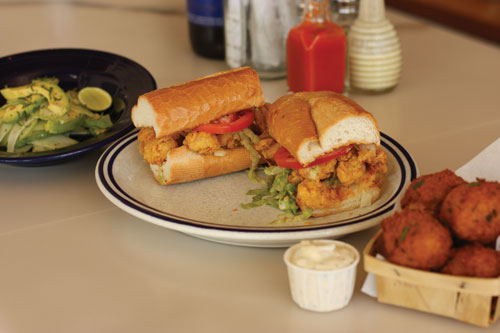
Besides, if you want hush puppies ($5.90), like little fried corn dogs except with shrimp inside, you can balance your account with the likes of the mirliton salad ($5.90). Mirliton is a cross between a cucumber and a pepper, and has a cool crunch and refreshing quality you might associate with sorbet. The salad was enriched with slices of ripe, creamy avocado, then lighted up with a well-balanced vinaigrette of lemon and cumin. As for the hush puppies, you dip them in a pickle rémoulade, a modified mayonnaise that’s a lot like what the French call sauce gribiche. It’s rich, but with enough acidity to make at least a slight dent in the hush puppy fattiness.

The ribs ($18.90), we were told, were slow-barbecued at an undisclosed location in the East Bay. I found them flavorful but slightly dry. The barbecue sauce on the side, on the other hand, had a pepperiness far more assertive than is typical of the commercially available stuff, which tends to be sweet and thick even if with some kick. This sauce was taut and lean, with low body fat. We also admired the accompanying sides of coleslaw (tangy, not sweet, and with long threads of green cabbage) and potato salad, made from smashed new potatoes and sober, direct mayonnaise. The importance of good mayonnaise in this kind of cooking can’t be overstated; it also made the difference (along with a tangy-fresh baguette) in the shrimp po’boy ($10.90).

All the juiciness absent from the ribs turned up in the fried chicken ($12.90), a full half-bird served with red beans and rice. Even the breast meat was juicy, while the skin and the artfully seasoned batter had fused into a shell that was an experience unto itself — almost like shards of savory candy.

Dessert could only be pecan pie ($3.90), which was not at all cloying and for that matter didn’t even really resemble a slice of pie — more a kind of crumble, with chunks and bits of pastry everywhere. We didn’t mind, but … is there such a thing as a pie shredder?

CRIOLLA KITCHEN

Dinner: Sun..–Thurs., 6–11 p.m.;

Fri.–Sat., 6 p.m.–midnight

Brunch: Sat.–Sun., 10:30 a.m.–2:30 p.m.

2295 Market, SF

(415) 552-5811

www.criollakitchen.com

Beer and wine

AE/DS/MC/V

Noisy

Wheelchair accessible


Na Nach hey hey

2

marke@sfbg.com

SUPER EGO My ever-ahead Hunky Beau just introduced me to Na Nach techno — and I’ve been kinda freaking out about it, like I would about 3-D animated GIF nail polish, that you could upload Hipstamatic photo booth pics of you and your friends to, reenacting tacky 1980s movie dance montages, but happening on your nails, in 3-D, if it even existed, which it doesn’t, so why don’t you just get off your boring global warming-proving ass and do something fabulous about that, Mr. Scientist. I already know the weather’s weird. I want Footloose on my fingernails!

Na Nach is the name of a newish Hasidic Jewish subsect of followers of Rebbe Nachman of Breslov, the kabbalist mystic who lived 200 years ago. But unlike the larger Breslovian following, it has mobile rave units. Driving around Israel in white vans graffitied with giant Hebrew letters, the Na Nach stop at intersections and come tumbling out, blasting homemade electro trance, chanting “Na Nach Nachma Nachman Me’uman” (the Rebbe’s name spelled out), and dancing ecstatically in outfits that are part typical Orthodox dude and part Ali G. It’s basically a glorious logical conclusion to the whole “trance music as religious experience” thing. Of course the Sufis already got there centuries ago but, one suspects, without the aid of JBL 18-inch portable subwoofers and a pirated copy of Ableton Live.

The happy, energetic music and mood are actually pretty infectious. And the Na Nach, some of them former ravers and gangsters, have become so ubiquitous that hilarious parodies have started springing up — including one by the great gay Tel Aviv party Arisa (whose video flyers rule the homo Web right now.) Have a Na Nach look and listen at www.sfbg.com/nanach.


TABOO

DJ David Harness’s lovely, deep-yet-breezy party anchored San Francisco’s soulful house scene throughout the early 2000s, one of those joints where you could use the words “vibe” and “spiritual” and not feel like you were tossing up disco clichés. Yes, there were candles and, er, incense involved, and quite a few flowers tucked behind perked-up ears — hands snaking luxuriously up into the air as well. Now the party returns, finding a new biweekly Oakland evening home at the spacious Bench and Bar. Organic sounds, no labels.

Thurs/7, 6 p.m.–midnight, free. Bench and Bar, 510 17th St., Oakl. www.bench-and-bar.com


TIPPER SOUND EXPERIENCE

Cosmic, Burner-like blasts of time-warped bass and cheeky step from multimedia mindblower Tipper, the modest Brit who takes his audio technology fetish to another level. Gotta love it when he drops the lingo: “Featuring a five-way crossover sound system in a Quadraphonic Array with specialized subwoofers dedicated to 45 hertz and below … ” With a six-screen projection rig thrown in, you’ll basically be entering the electronic space-pod of your ear dreams. It’s an experience.

Fri/8, 8 p.m., $22.50. Regency Ballroom, 1290 Sutter, SF. www.theregencyballroom.com


LEE BURRIDGE

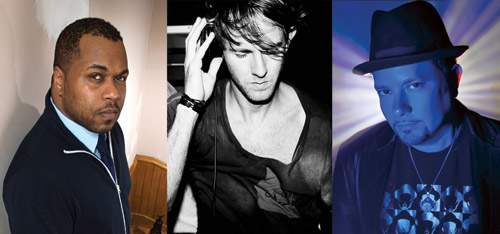
The bloke from Bournemouth who was crucial in spreading the acid house gospel in the ’80s — and brought rave to Asia, with his storied seven-year stint in Hong Kong — has become a reliably sunny, techno-twisty force on Top 100 DJs lists and better global dance floors. Good, solid fun is had whenever he gets to town (and sometimes I just randomly prance around and drop to his xylo-yummy 2010 track “Wongel” in my head) so go already. Nikola Baytala, Rooz, and other locals work the build-up.

Fri/8, 10 p.m.–late, $15. Mighty, 119 Utah, SF. www.mighty119.com


LEE FOSS

Guess it’s a battle of the Lees this week — luckily there’s some after-hours leeway to hit up both. This Lee comes to us from the Midwest via Los Angeles and London, were his chiseled looks and dreamboat eyes were at first as much of a talking point as his music. Luckily he overcame that crippling handicap to inject some bouncy tech-funk flavor into the trademark R ‘n’ B house of the Wolf and Lamb set. Call it the new New Jack Swing sound if you like. And you will like, especially when grouped at Public Works with Beats in Space radio host Tim Sweeney and my not-so-secret French house crush, Le Loup. (I love his little fuzzy mustache!)

Fri/8, 10 p.m.–3 a.m., $12. Public Works, 161 Erie, SF. www.publicsf.com

The nonconformist

0

arts@sfbg.com

FILM Marxist, aesthete, padrone, Oscar winner, supreme screen sensualist — the list of contradictions goes on, onscreen as well as off, for Bernardo Bertolucci. Earlier this year he emerged from a long creative hibernation (attributable, it turns out, to back pain so severe it prevented any work) to accept an honorary Palme d’Or at the Cannes International Film Festival and begin work on his first film in nearly a decade, a claustrophobic drama about a withdrawn teen who secretly sequesters himself in the family basement. It will be filmed in 3-D — an idea so daft it just might prove brilliant.

Because, after all, it is lunacy and excess as well as intelligence, beauty, instinct, and so forth that have led Bertolucci to some of his most extraordinary as well as dubious achievements, nearly all of them debatable as falling into either category.

Now that he’s reaching a half-century spent in the director’s chair, it is clear what an unpredictable, erratic, even arbitrary career this has been; the line between the sublime and silly in his films is easily felt but almost impossible to define. What makes 1972’s Last Tango in Paris, for instance, a genuine fever dream of mad desire, while two later films equally about eros and yearning — 1996’s Stealing Beauty and 2003’s The Dreamers — are fussy, false, a little embarrassing? Trained as a poet (whatever that means), he surrenders to cinema time and again as someone intoxicated by images as he once was to words, taking each sustained impulse to its logical (or illogical) endpoint, whether to transcendence or off an artistic cliff.

The Pacific Film Archive’s summer retrospective “Bernardo Bertolucci: In Search of Mystery” provides an opportunity to weigh most of the exhilarating highs and a couple of the baffling lows in a wayward trajectory one hopes is nowhere near complete. (Only 71, he can surely spare us another three decades — look at Manoel de Oliveira, wildly prolific at 102, yet without a single film as memorable as a half-dozen or more of Bertolucci’s.) All 13 features will be offered in new prints, a big lure for a director whose best movies — particularly those shot by the incomparable cinematographer Vittorio Storaro — it would be criminal to view in any but the most pristine visual condition.

After a promising literary start as a teenager — his father, notably, was a well-regarded poet, art historian, and film critic — Bertolucci apprenticed to family friend Pier Paolo Pasolini on 1961’s Accattone!. When Pasolini moved on to another project, Bertolucci made his own directorial debut at age 21 with similarly gritty The Grim Reaper (1962). That tale of a prostitute’s murder, cowritten with Pasolini, as well as 1964’s Before the Revolution (a presumably somewhat autobiographical mélange about a young bourgeois torn between tentative radicalization and pleasures of the flesh as represented by Bertolucci’s then-wife Adriana Asti) reflected his heavy early influencing by the ebbing Italian neorealist movement and still-current French New Wave.

Inspired by Dostoyevsky, 1968’s Partner was a transitional work, straddling Godardian dialecticism and pure extravagance. When 1970’s Jorge Luis Borges-drawn puzzle The Spider’s Strategem found Bertolucci discovering his sumptuous mature style (as well as Storaro’s rapturous lighting and camera movement), Godard denounced him as a sellout. The international breakthrough was that same year’s The Conformist, a Moravia story about the individual surrender to fascism — passivity turning to criminality being a frequent Bertolucci subject — that somehow became a baroque tone poem of saturated color, hedonistic suggestion, and damp paranoia. It announced the arrival of a great artist, albeit one for whom style would always trump political content, and whose literary sources were often twisted nearly past recognition by his own overwhelming authorial stamp.

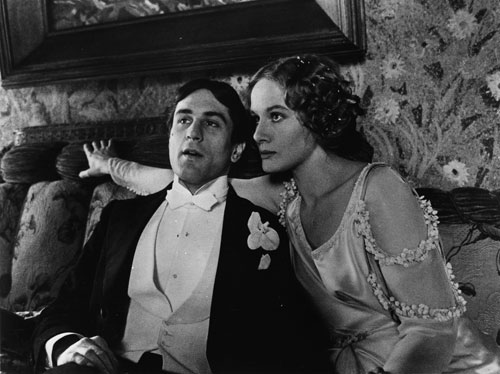
The 1970s were a dazzling high-wire decade for Bertolucci. Last Tango was an X-rated scandal and sensation, an experience so psychologically (and literally) naked for Marlon Brando that he didn’t speak to the director for years afterward. Bertolucci explained: “He felt that I stole something from him, that he didn’t know what he was doing … I like to have very famous, important actors because it is a challenge to find out what they are hiding.”) Its tale of two people with only compulsive coitus in common is still berserk, implausible, off-putting, and completely enveloping.

The epic, multinational cast (Robert De Niro, Gerard Depardieu, Donald Sutherland, Dominique Sanda, Burt Lancaster, even some Italians) 1900, a film originally over five hours long, offered the first half of Italy’s 20th century as a class struggle, as well as a conceptual one, between idealism and decadent pageantry — Pasolini wrestling with Luchino Visconti. Few knew what to make of the contrastingly intimate (yet, again, stylistically gaga) 1979 La Luna, an Oedipal drama based on a dream Bertolucci had about Maria Callas. Fervently loved by a slim cult following, it was otherwise so ridiculed and loathed that 32 years later 20th Century Fox still hasn’t coughed up a U.S. home-format release.

With the new decade, the limbs Bertolucci went out on became less reliably inspirational, perhaps partly because Storaro had developed conflicting allegiances to other directors (Francis Ford Coppola, Carlos Saura, Warren Beatty). Tragedy of a Ridiculous Man (1981) is dispirited and dull. Little Buddha (1993) was a silly idea nonetheless spiked by enchanted storybook scenes with Keanu Reeves as Siddhartha — ludicrous-sounding stunt casting that is somehow perfect. Stealing Beauty and The Dreamers found this uneasily homophilic director reduced to ogling young bodies of both sexes like a dirty old professor.

On the other hand, 1990’s The Sheltering Sky was difficult, ravishing, another masterpiece if a great commercial disappointment. Another leap into exotica, 1987’s The Last Emperor had the opposite fate — winning all nine of its nominated Oscars in a slow year, a staggering spectacle widely admired yet loved by few (least of all the Chinese), elephantine yet wry, and closer to David Lean respectability than auteurist idiosyncrasy. Then after all this 1998’s Besieged, a tiny story of unrequited love and noble sacrifice shot with two actors and hand-held camera, felt rejuvenative — as if the increasingly burdened composer of massive symphonies had discovered the joy in a piano miniature.

The curio in the PFA’s series is 1967’s The Path of Oil — a three-part Italian documentary about petroleum production, apparently undertaken in a funk when two failed first features had temporarily reduced his career prospects. It’s handsome, if clearly less than a labor of love. But for the Bertolucci fetishist, no film is so impersonal or underwhelming (or on the other hand beloved) that it might not yet spring surprises, whether on a first viewing or an umpteenth. 

BERNARDO BERTOLUCCI: IN SEARCH OF MYSTERY

July 8–Aug. 18, $5.50–$9.50

Pacific Film Archive

2575 Bancroft, Berk.

(510) 642-5249

bampfa.berkeley.edu

A minor place

0

arts@sfbg.com

HAIRY EYEBALL The painter Margaret Kilgallen died in 2001; she was just 33 years old. A year later, critic Glen Helfand would write in the Guardian (“The Mission School,” 7/1/2002) a coming out party for Kilgallen, her husband Barry McGee, and friends such as Chris Johanson and Alicia McCarthy, whose scruffy, heartfelt, and street-influenced art had started to attract a popular following abroad as well as intense interest from beyond the Bay Area art world.

When an artist dies young, it is hard to not view their work through the lens of their cruelly curtailed biography. The work that remains is always haunted by speculation about what could have been. Posthumous exhibits will always be, to some extent, tributes, and those who write about that artist’s work face the very human impulse to eulogize, as well as the critical one to historicize.

This dilemma is especially true for Kilgallen and her art. In the decade since her untimely passing due to complications from breast cancer, the Mission School has been variously contested and embraced as both an aesthetic and historical category, and the artists Helfand associated with it have become well-known, frequently imitated, and displayed in increasingly prestigious venues. Kilgallen, along with Johanson and McGee (with whom Kilgallen had a daughter just three weeks before she died), is prominently featured in the Geffen Contemporary’s current, much-hyped summer blockbuster “Art in the Streets.” And viewers need only spend a few hours trolling Etsy to sense the larger stylistic impact the Mission School has had on a younger generation of creative types.

“Summer/Selections,” Ratio 3’s current exhibition of paintings by Kilgallen and the first San Francisco solo show of her work in 13 years, is a bittersweet homecoming, to be sure. But it’s also, like Kilgallen’s art, unsentimental — which is not the same as unfeeling. It’s a reminder that while time doesn’t heal all wounds, it can sometimes afford us enough distance to see with greater clarity those qualities of the departed that so compelled or moved us in the first place. And, undoubtedly, the soft power of Kilgallen’s talents as a sympathetic observer is fully on display here.

Like her contemporaries, Kilgallen culled much of her imagery from hand-painted storefronts and signage along Mission Street, thrift-scored printed matter, old-fashioned typography, and the hand-scrawled texts of the homeless and itinerant. But sometimes the signal-to-noise ratio in her larger pieces — the crazy quilts of painted and stitched-together canvas scraps, or even her wall murals — drowned out the delicacy and assuredness at work in each individual component.

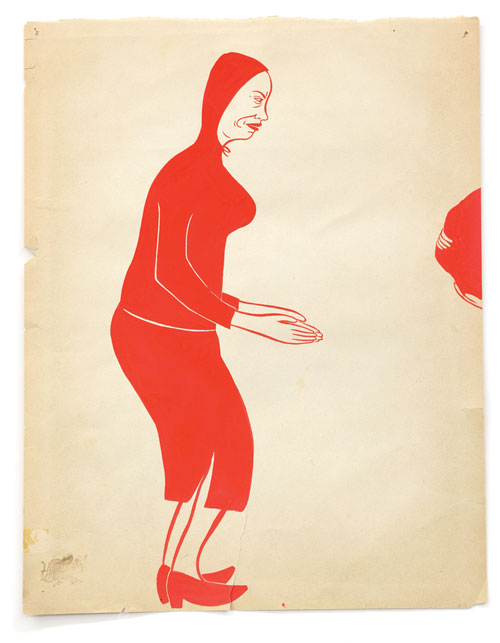
The remarkable selection of acrylic paintings — most from 2000 and all untitled — hanging in Ratio 3’s main space offers some much-welcome breathing room. They are single-subject studies of objects (groups of shoes, wigs, lips, trees, and plant life), simple repeating patterns (droplets, waves, grids), or (mostly) female figures on canvases made from discarded endpapers or repurposed grocery bags — another instance of Kilgallen’s sensitivity to the material grain of her surroundings.

Whether in the color gradations and tiny spiked edges of a leaf, or in the finely outlined toenails of a mule-clad foot, Kilgallen’s remarkable control over line and paint application imbues each canvas, even the simplest or most abstract, with an untold back-story. This is especially true of the women, who all have laugh lines but usually address the viewer with a tight-lipped smirk. If Kilgallen’s flora could have come from a children’s book, her women could pass as characters from a Dan Clowes comic.

The untitled collage pieces in the back room — smaller-scale examples of Kilgallen’s quilt-like assemblages of canvas — are more abstract, yet still retain the just-right sense of color, line and proportion on display in the other paintings. In one piece, from 1999, a single fluffy gray cloud is the only graphic break in a long expanse of sutured turquoise. Another from the same year resembles the collaged remains of a billboard’s past incarnations. But like all of the pieces in “Summer/Selections,” it feels wholly fresh.

I wish the same could be said of the recent work of Johanson, an SF expat and Kilgallen’s contemporary, whose current show at Altman Siegel is about as coherent and compelling as its title: “This, This, This, That.”

I have always preferred Johanson’s folksy takes on Sol LeWitt’s rainbow-hued precision over his text or figure-filled paintings, and there are plenty to take in here. The problem is one of editing.

For every piece — such as the carefully thought-out uneven grid of squares and rectangles “Fall Apart and Let It Go” (2011) — that feels like Johanson is trying to push himself and his explorations of color into a more formal direction, there is another that reads as an easy way out.

The acrylic and latex color shards of “Same Brain, Same Body, Different Day” (2011) nicely mirror the visible segments of the pressed grain of the wood they’re painted on, whereas “Celebration of Life Through Found Palette and Paint” (also 2011), a painted panel mounted to an upright, rainbow-colored wooden shipping palette, just feels lazy.

Certainly, many artists have made repetition a compelling cornerstone of their practice, extending their engagement with a single technique, approach, or material into a fruitful long-term relationship. Johanson, however, seems like he is simply in a rut, making more and more of the kind of art that first brought him wider renown with diminishing creative returns. Warhol did all right for himself in the 1970s, though, and I’m sure Johanson is doing just fine as well. But I know he’s capable of doing more.  

MARGARET KILGALLEN: SUMMER/SELECTIONS

Through Aug. 5

Ratio 3

1447 Stevenson, SF

(415) 821-3371 www.ratio3.org

CHRIS JOHANSON: THIS, THIS, THIS, THAT

Through July 30

Altman Siegel

49 Geary, Fourth Floor, SF

(415) 576-9300, www.altmansiegel.com


Is LEED really green?

news@sfbg.com


The archangel of sustainable development has arrived, promising much needed city housing that will add to the “social fabric of the waterfront community” with its glamorous green rooftops and unheard-of bay views. This is going to be the greenest building of them all, or so we’ve been told, but the truth is a bit more complicated.


A condominium development 25-plus years in the making, 8 Washington would transform the site of the Golden Gateway Tennis and Swim Club near Pier 39. The developer plans to renovate the recreation center with a larger fitness facility, provide two new waterfront parks with public access, and supply 30,000 feet of ground-floor retail stores and restaurants beneath its 165 new luxury apartments.


Sounds nice, doesn’t it? The problem with this $345 million project is that it’s being touted, with its “green building” LEED certification, as the most sustainable structure it can possibly be.


But there’s nothing sustainable about building high-end condos in San Francisco, a city with too many high-end condos and not enough affordable housing. And LEED (Leadership in Energy and Environmental Design), the most popular sustainable development certification system in the country, is a lie — at least as your friendly neighborhood building developer is marketing it.


LEED, the baby of the U.S. Green Building Council (USGBC) is a great marketing tool for developers in San Francisco, the city with the single most LEED certified buildings in the United States. San Francisco was just named the “greenest” city in North America at the 2011 Aspen Ideas Festival, largely due to its extensive representation of green buildings — which normally means structures built with recycled materials, near a transportation hub, featuring some solar panels or other renewable energy sources.


“LEED is certainly a positive thing,” Planning Commission President Christina Olague told us. “There’s this whole push toward green sustainability.”


The project’s “platinum” LEED status is all a San Francisco developer could hope for to attract the green — and more important, the city’s approval.


“LEED certification is part and parcel to the vision for the project,” said PJ Johnston of PJ Johnston Communications, speaking for the developer. “The city, neighborhood, and waterfront deserve healthy, sustainable structures, living spaces, public spaces, and amenities. That’s exactly what 8 Washington will bring.”


LEED has become the final word in green building — if your building is LEED certified, you’re golden. But all this green they’ve been feeding us is really a misleading, incomplete rating system.


The first thing to consider is that sustainable development, even if it uses recycled materials and 10 percent sun-powered electricity, is still development. Any time a structure is torn down, “the energy and materials in that [original structure] are going to get sent to landfills somewhere. You gotta calculate all that,” said sustainable development activist Brad Paul, a former SF deputy mayor, who believes in considering the entire “life cycle of a building” in determining its sustainability.


Even the Environmental Protection Agency sometimes discounts essential considerations of sustainable building. When it sought a new SF office space in 2009, its intention was to find a home that was “a model of sustainable development,” the SF Biz Times reported. But its first choice was to build new development, at the site at 350 Bush Street — with its environmental costs of demolition, throwing out old materials, and starting from scratch.


Last month, the EPA decided to remain at 75-95 Hawthorne Street instead of moving to a new building, but not because it was the sustainable choice. No deal was reached for 350 Bush, and as Regional Public Affairs Officer Traci Madison said, “There was no other option to choose from.”


Although it’s a measure of a structure’s material sustainability, LEED does not consider a building’s life cycle, or even its use. Consider 8 Washington. The developer has boasted that it’s the most expensive housing project in San Francisco history, with a hefty price tag of $3 million to $10 million per apartment.


“Who can afford these luxury condos, and what do they use them for?” Paul asks. “These guys who work for hedge funds on Wall Street,” who use the condo as a second or third home and commute on their private jets to get there.


Johnston said 8 Washington will be marketed to a “mix of buyers, including young professionals, empty-nesters looking to move back to San Francisco, and families … The project has many two- and three-bedroom units, encouraging family living,” he said. But it’s unlikely that those who can afford a condo of this luxury will make it their only home.


“[Board President] David Chiu says he’s worried about SF becoming a bedroom community for Silicon Valley,” said Paul. “I’m more worried about this being a bedroom community for New York, Boston, L.A.”


Instead of providing the affordable housing that San Francisco so needs, projects like 8 Washington attract the wealthy, who aren’t using public transportation. Instead, Paul said, they burn tons of fossil fuels using their new condos as weekend getaways.


LEED FOR THE RICH


LEED certifies buildings as “sustainable developments” based on the following categories: sustainable sites, water efficiency, energy and atmosphere, materials and resources, indoor environmental quality, and innovation in design and regional priority.


Earning points in each category brings a building closer to LEED certification, which requires at least 40 points. Above “silver” and “gold” status, a “platinum” LEED certification requires 80 points. But how builders get the points is what matters. For example, a developer might skimp on the insulation to install extra solar panels and get more points for a less efficient building.


Does LEED consider a building’s actual use? “The short answer is no,” said Jennifer Easton, a communications associate at the USGBC who added, “We want [LEED] to be used by every type of project.” But despite its billing, LEED tells an incomplete story.


“It’s just green drapery,” said SF attorney Sue Hestor, a slow growth advocate. “They’ve really had a PR machine. They keep touting all this greenness.”


LEED certification has value, Paul said, but it doesn’t turn multimillion dollar condos green. “There is absolutely no need for high-end luxury housing in the city right now,” he said.


Building luxury condos in place of affordable housing encourages the “Manhattanization” phenomenon, attracting wealthy out-of-towners to expend fuel on their private jets to get to their new crash pads.


“They aren’t gonna be living there all year,” Olague said of residents of luxury housing. “We hear a lot of, ‘We need more housing.’ If you keep building housing for the top 2 percent, how does it lessen the demand on your average workforce?”


But not everyone sees luxury condo-building as counterproductive. “Building that project actually allows for more affordable housing,” said Gabriel Metcalf, executive director of SPUR (San Francisco Planning + Urban Research Association). “It’ll provide housing for some people, and that can only be helpful to the housing market. If you don’t build new condos, then people just compete for the crumbs, and that means people who are rich push the rest of us out.”


In other words, if you give the rich housing, then they won’t take over your flat in the Mission — if they ever really wanted it in the first place. “I don’t think we can impose some kind of hipster elitism that they’re not our kind of people so they’re not allowed in,” Metcalf said of the wealthy out-of-towners.


LEED agrees. “We don’t want [LEED] to be for one specific group of people,” Easton said. “We have LEED-certified homeless shelters, but having a LEED certified luxury condo building is an advantage. We can’t control if someone is flying across the country in a jumbo jet every day — but we can control their energy efficiency in a building.”


WHO RIDES BUSES?


For the typical working class San Franciscan, living modestly is a must and public transportation is essential. So there’s an inherent environmental advantage to attracting residents who don’t rely on polluting planes and cars.


“There’s a definite need for workforce housing, middle class housing in San Francisco,” Paul says. “I guarantee you none of those people get there by private jet. The less income people have, the more likely they’re going to be to use public transit.”


But 8 Washington and luxury developments like it don’t foster public transit. The more wealthy people who move in, the more low-income residents get displaced — to the East Bay or other areas with more affordable housing. It’s another strike against sustainability when these workers opt to drive back into the city for work instead paying for BART, says Paul, particularly when they drive older, less-efficient cars.


“LEED was a way to spell an environmentally friendly product, but you have to figure in the extra driving,” said Paul.


But 8 Washington gets LEED points for building on a site close to public transit in an attempt to discourage individual car pollution. But will wealthy condo owner actually take the infrequent F-line with all the tourists instead of parking their $150,000 car in the underground parking garage right below their feet?


“When you’re talking about sustainable practices and reducing greenhouse gas emissions and how it relates to land use planning, it makes you wonder if that’s supposed to [solely] relate to housing people near transit corridors,” said Olague. “It seems to me you have to look at equity.”


The garage at 8 Washington, to be built below sea level under the condos, will house 415-plus parking spaces. The developer says that 250 of the spaces will be offered as public parking for the busy Ferry Building down the street, but the 165 additional spaces guarantee one parking space for each residential unit.


“Given the larger size of the residential units and the fact that the majority of the units are two to three bedrooms, we believe that one parking space per dwelling is appropriate,” said Johnston. Appropriate, maybe, but not environmentally friendly.


PROMISES AND REALITY


Wealthy people and affordable housing aside, LEED doesn’t actually measure the energy used in a building, says New York City-based architectural associate Henry Gifford. He filed a $100 million class action lawsuit against LEED last October for gaining a monopoly on the sustainable development market by making false claims about buildings’ energy savings.


“They say that the building is required to be energy efficient. But the building doesn’t have to be energy efficient — it just has to earn points, to promise it’s going to be energy efficient,” Gifford said.


It’s up to the developer what computer software is used to predict a building’s energy efficiency, and Gifford says that computer diagrams can easily be manipulated and do not consider inconsistent factors, like weather.


“California is the promise land,” said Gifford. “All you’re required to do is provide a promise. The sad thing is that it removes all the integrity from the process — it encourages lying.”


Furthermore, once the building is built and has achieved LEED certification, the building’s actual energy use in its life cycle isn’t considered. The only way you can truly know if a building is energy efficient is by looking at the utility bills, says Gifford. But once it’s LEED-certified, who cares?


There is a voluntary program called Building Performance Partnership (BPP) that tracks a building’s energy and water use over time. “The idea is we want LEED to be a system where it enacts change in the actual building,” said Easton. But the problem is the building has already gained LEED certification before the first utility bill is even mailed.


“We publish baseball scores. With everything in life, people get scored,” said Gifford, who operates with transparency in developing energy efficient buildings in New York, hosting open houses after buildings are built with printouts of their recent utility bill history.


LEED was never intended to have the final say on sustainable building, to be a seal of green approval, according to a New York Times op-ed by Alec Appelbaum last year (“Don’t LEED us astray,” 5/19/10). “Rather it was to be a set of guidelines for architects, engineers, and others who want to make buildings less wasteful. However, developers quickly realized that its ratings — certified, silver, gold, or platinum — were great marketing tools, allowing them to charge a premium on rents.”


Therein lies the issue. Yes, 8 Washington will “allow for more ‘eyes on the street’ at all hours of the day” and provide two or three-bedroom units for families who can afford them, as it promises. But a sustainable structure is far different than the promise of a sustainable life cycle of a building. And a promise is just that. *


UPDATE: Jennifer Easton at LEED wrote to inform us that, although the 8 Washington website clearly states that the project will include LEED certified buidlings, “We would like to clarify that 8 Washington is not a LEED-certified project, nor a LEED-registered project.”


PLANNING COMMISSION HEARINGS


July 7: Community Vision for San Francisco’s Northeast Waterfront


July 14: City demographics and sustainability; the need for low-income housing; presentation of “jet fuel burn rate” argument.


July 21: 8 Washington’s EIR approval hearing


All hearings to be held at 12 p.m. in the Commission Chambers, Room 400, City Hall, 1 Dr. Carlton B. Goodlett Place.


JET FUEL BURN RATE FOR LUXURY CONDOS


Let’s assume that just five of the 165 condo buyers at 8 Washington (3 percent) are Wall Street hedge fund traders or venture capitalists using them as second or third homes. Let’s also assume they’ll use them 1.5 times a month and commute to SF aboard their business jet, a reasonable assumption for Wall Street execs making tens of millions in salary and bonuses. Why would they fly by private jet rather than take Southwest or Amtrak? Because they can. This must be factored into any environmental analysis of a project that explicitly markets to this demographic and include the following:


Mid to large size business jets used to fly cross country (Hawker 800XP, Gulfstream G2/ G3, Bombardier Global Express) on average burn 400 gallons of jet fuel/hour, take 6 hours to fly New York to SFO and 5 hours for return trip. Therefore, a single round trip burns:


11 hours X 400 gallons per hour = 4,400 gallons of jet fuel per trip. A typical family car uses 1,200 gallons of gas per year, so one flight from NYC to 8 Washington equals almost four years of driving a family car.


1.5 trips/mo. = 6,600 gallons X 12 months = 79,200 gallons of jet fuel/year or the equivalent of driving a family car for 66 YEARS each month.


Using our example of five residents, the numbers over one year and 20 years are:


5 X 79,200 gallons/per year = 396,000 GALLONS OF JET FUEL A YEAR or equal to driving a family car 330 years, A THIRD OF A MILLENNIUM, each year.


396,000 gal. X 20 yrs. = 7,920,000 gallons of jet fuel, equivalent of driving family car 6,600 years, OVER 6 MILLENNIUM, in 20 years.


Given this reality, the 8 Washington environmental impact report must analyze such questions as:


How many solar panels are needed compensate for burning 396,000 gallons of jet fuel/year? How many low flow toilets would make up for burning 396,000 gallons of jet fuel/year? Etc.


Fetish and armor

1

culture@sfbg.com

LUST FOR LIFE The year I was 16, I wore nothing but thrift shop vintage lingerie. As outerwear. I’d layer two slips or two half-slips on top of each other so they wouldn’t be quite as see-through and clomp around in impossibly high heels. I bought my actual underwear from the Victoria’s Secret at the mall when they had their blowout sales. There and at places like Forever 21 — flashy, clubby, and cheap.

I tell you these details because it’s important, naming the places I picked up armor and fetish. Because it felt like armor and it felt like fetish — in all senses of the word. Sexual but mythic and protective in proportion, too. That lacy magenta push-up demi-bra, the one that was just a little too tight, the one that was always uncomfortable. But I’d wear it anyway because I understood the importance of armor. Of having something that would protect me if bad shit went down.

The refrain from my mother — and from the more prudish crowd at my school, the tough homophobic boys in my neighborhood, the cat-calling older men at the Mission BART Station who didn’t realize how young I was — was that if you wear clothes like that, you are asking for it. You’re putting yourself in danger.

But didn’t any of them realize that this was my way of staying out of danger? I felt so much more powerful in those impossible heels, tits pushed up and out, cleavage for days, fishnets encasing my thighs, tight leather boots hugging my calves. I felt so much more powerful and able to fight if any shit went down.

I get that kids are sexualized young in this culture, especially girls. That’s creepy, and I’m not saying it’s okay. When Abercrombie & Fitch sold thongs to preteens, it disgusted me. Toddler beauty pageants scare the hell out of me.

But whenever people get moralistic and concerned about teenage girls’ slutty outfits, about how sexual teens are these days — I cringe. Because I was that girl who got into screaming fights with her mother about fishnets and cleavage and dresses that were too tight. And I want us to actually talk to that girl without screaming at her. To see how she feels about what she’s wearing. To see if she’s doing it solely to impress people, or if she’s doing it to go along with the crowd, but she really hates it. Or if she’s doing it because it’s a way to claim power in a world that hates sexuality and hates femininity.

I was a queer chubby girl wearing sexy clothes trying to learn how to love herself in a viciously fatphobic, sexist, homophobic world. Honestly? Cobbling together a wardrobe of vintage lingerie was one of the ways I coped. I spent a lot of time figuring out what clothes worked for my body. Like most fat people, I had to figure it out on my own.

There is no cultural road map for being fat and sexual. We’re taught that the two are at odds with each other. I have lost count of how many times I have heard people say — in person, on the Internet, in print media — that fat people should not go out in clothes that are tight or revealing or provocative. That the very sight of our flesh — and in particular, the sight of our sexual bodies — is cause for disgust, even for violence. I wonder sometimes if people would have reacted as strongly to my outfits as a teenager if I’d been a size 2 or 4 instead of a size 12 or 14. How much of it was fear of young people being sexual? How much of it was fear of fat people being sexual?

I was speaking at a reproductive justice conference a while back, on a panel called something vague and cutting-edge like “The Politics of Sexuality.” I was supposed to be talking about my work in the porn industry as a fat queer woman — what I like and don’t like about doing porn. But the panel moderator opened the session by referring to Andrea Dworkin and Catherine McKinnon (who are famously anti-porn) as “sex-radical feminists.” My eyes about bugged outta my head.

It all went downhill from there. Women in the audience started disclosing their rape fantasies during the Q&A: “Why do we like this? Are we fucked up?” It was like group therapy and second-wave feminist sex guilt were getting together to have a really terrible party. By the end of it, I was bowled over and exhausted.

And then a pretty young fat girl — white, maybe 19 or 20, kinda punky, with wire-rimmed glasses and fine blonde hair with an orange streak — walked up to me as I gathered my things. She had tears in her eyes.

“I’ve …” She had to gulp, she was that choked up. “I’ve never… Gina, you’re the first fat person I’ve ever heard talk about being comfortable with your body and comfortable with sex. I really want to be there, and I’m not yet. What do I do?”

I was floored. I almost started crying too. I hugged her. I told her she was beautiful. I scribbled down some websites and some book titles. And then I hugged her — again — and told her she was beautiful — again. I felt like I could not say that enough times.

I wish I’d had time to tell her my story — how wearing clothes as armor and fetish helped and healed, and got me to where I am now. If that girl wants to wear nothing but vintage lingerie for a year? For the rest of her life? More power to her. 

Gina de Vries is a San Francisco-based writer, sex worker, activist, and writing instructor. Hear all about her at www.ginadevries.com. Hot for Lust for Life? It’s our new sex column, stay tuned.

Ameri-cows rejoice!

0

Come our nation’s day of independence, all non-meat eaters will eat one: a homogenized, unexciting tofu dog. Especially if they are shy and/or lazy – the dog package conveniently slips into one’s red-white-and-blue woven straw tote, and they are easily sneakable onto BBQ grills without a huge amount of haranguing from friends pumped up on animal proteins. 

But they suck (except for Field Roast sausages, whole food fist pump). And thankfully, this year all you little veggies have an option to the tube-shaped madness: the San Francisco Vegetarian Society‘s Healthy Holiday BBQ on Sun/3.

Belly up to the benefit for Go Vegan Radio (which airs Sundays at 3 p.m. on am channel GREEN 960) BBQ for treats from a tummy grumbling V-list: Souley Vegan, Rudi’s Bakery, and Sunshine Burger among other moo-friendly vegan magic makers. 

But what would a vegan gathering be without a little speechifying on topics that affect your belly and other things? Dr. Elliott Katz, the founder of In Defense of Animals will give a talk to reaffirm your anti-burger convictions, and at 2:30 p.m., animal rights crusaders Jake Conroy of the persecuted e-activists Shac Seven, Alfredo Kuba, and Pat Cuviello will flap jaw in a panel discussion entitled “Coffee, Cake, and Constitution.” 

Oh, and vegan bodybuilder Kenneth G. Williams will be there. Stoked!

Meat-free muscles: Kenneth G. Williams

Should Sunday’s festivities leave you unable to stomach the thought of being restricted to one kind of coleslaw and buns on the Fourth itself, you’re in luck: bring your best cornmeal-crusted tempeh over to the Presidio for a conveniently-located potluck before the fireworks, also sponsored by the Veg Society (details below).


San Francisco Healthy Holiday BBQ

Sun/3 noon-3:30 p.m., $10 suggested donation

First Unitarian Universalist Center

1187 Franklin, SF

www.sfvs.org


Fourth of July SF Vegetarian Society-Living Foods picnic potluck

Mon/4 1 p.m., free

O’Reilly Avenue between Lincoln and Eddy, SF

www.sfvs.org


Dearly beloved

0

Pop historians have praised Prince’s 1984 Purple Rain as the greatest soundtrack of all time, the greatest album of the 1980s, and even the greatest album (full stop) of all time. Fans agree — the Oscar-winning platter has sold more than 13 million copies.

Purple Rain, the movie, occupies another space entirely — it’s a time capsule of the big-hair, tight-pants era. Far from a forgotten footnote to the Purple Rain album, however, the movie has emerged as a full-fledged cult classic. Naturally, this means it’s a favorite of Peaches Christ, who’ll be feting the movie in royal style this weekend. The film’s leading lady, actor-musician Apollonia, who still performs and also runs her own production company, will appear in person. I spoke with her from the shores of Lake Minnetonka — er, Los Angeles — ahead of her San Francisco visit.

SFBG One of the highlights at the Castro event is sure to be the costume contest. Do you have any ’80s fashion regrets?

Apollonia I think my fashion regret was wearing, like, lace leggings. I wore those with undies underneath for a TV show in Mexico. They looked great in person. You know, sometimes you wear things and you look in the mirror and you go, “Oh man, this is kickin’.” Then I saw it on TV and I was like, “Oh shit, what the hell did I just do?” It was baaad. [Laughs.]

SFBG I’m sure Purple Rain fans always ask about your relationship with Prince.

A The funniest thing — a bit annoying, too — is that a lot of people will ask, “I want to buy tickets for the Prince concert, can you get me better seats?” [Laughs.] And these are just innocent fans who don’t know better. [I also get] “Did you guys date? Were you married?” No, we never dated. We were not married. I’m not the drummer, I’m not the ex-wife. I’m the actor that was in the movie!

SFBG How was Prince to work with? Do you keep in touch?

A He’s funny, great personality. Musical genius. We don’t see each other every month, but we [performed together] at the Roosevelt Hotel in Hollywood maybe two years ago. I always tell friends, you know, forever it’s Ike and Tina, Sonny and Cher, and Prince and Apollonia. I could see people’s faces, they were freaked out watching us!

SFBG Do you have a favorite memory of working on Purple Rain?

A It was all hard work, but I enjoyed it from day one — and going to the Oscars, which was wild! Just being part of music folklore — it’s an iconic movie and I’m honored to have been part of it. 

PURPLE RAIN

Fri/1, 8 p.m., $25–$43

Castro Theatre

429 Castro, SF

www.peacheschrist.com


He’s back!

9

steve@sfbg.com

It’s been more than a year since relations between San Francisco’s nightlife community and the San Francisco Police Department bottomed-out following a nasty crackdown and pattern of harassment led by plain-clothes Officer Larry Bertrand and Michelle Ott, an agent with the California Department of Alcoholic Beverage Control.

The pair’s antics included repeatedly shutting down clubs, aggressively raiding private parties, seizing laptop computers and other property, making arrests for minor infractions, roughing up and threatening those who objected to the harsh treatment, dumping out dozens of bottles of alcohol, and, according to one lawsuit, retaliating against those who filed complaints.

There were at least four lawsuits against the city related to the crusade, including one that the city is in the process of settling for $50,000 (involving promoter Arash Ghanadan, who had repeated run-ins with Bertrand) and another federal lawsuit alleging that Bertrand’s harassment of legal businesses amounted to a criminal racketeering enterprise. The federal case is headed for trial later this year.

After cover stories in the Guardian (see “The new War on Fun,” 3/23/10) and SF Weekly exposed the abuses, and the nightlife community formed the California Music and Culture Association to counter the assault, Bertrand and Ott were pulled off the nightlife beat and things slowly got better.

So when Bertrand appeared back on the beat on a recent Friday night, June 17 — targeting two of the same clubs he allegedly harassed before, Mist and Sloan, and shutting Sloan down for the night on a technical violation — many in the nightlife community freaked out, fearing that their improved relationship with SFPD was over and the bad old days were back.

“My phone was blowing up with texts and photos of his raid on Sloan nightclub. People are livid,” attorney Mark Rennie, who works with clubs on permitting and compliance issues, wrote to a group of nightlife advocates in an e-mail titled “Officer Larry Bertrand back on the Streets last night and up to his old tricks.”

Complaints were made to new Police Chief Greg Suhr and others in the command staff. The SFPD initially refused a Guardian request for comment on whether Bertrand would remain back on the beat, citing the ongoing lawsuits. But police spokesperson Sgt. Mike Andraychak eventually admitted it was a mistake to have Bertrand busting clubs and said he won’t be back on that beat anytime soon.

Andraychak said the new commander of Southern Station, Capt. Charlie Orkes, assigned Bertrand to police the clubs for the night and “he wasn’t aware of the history of lawsuits, and so that’s why Officer Bertrand was out there that night doing permit inspections … He won’t have Officer Bertrand in that role again, in the interests of good community relations.”

Those relations have become much better and more cooperative in the last year, according to Suhr, Rennie, and Entertainment Commission Executive Director Jocelyn Kane. “We’re happy with our relationship with the Police Department right now,” Kane told us. “That’s why [the reappearance of Bertrand] was of concern to people.”

During an interview with the Guardian on the morning of June 17, Suhr said he was supportive of nightlife. “I’m pro entertainment and I want the clubs to succeed. It think it draws people to the city and allows us to do a lot of things,” Suhr said, emphasizing the importance of clear communications and good relations between clubs and the SFPD. “If we’re being fair, consistent, and objective in how we treat situations, the clubs will know how it works.”

To many in the nightlife community, Bertrand represents the antithesis of that approach. Mist owner Mike Quan, a plaintiff in the ongoing federal lawsuit alleging Bertrand repeatedly harassed him and his customers, said he was shocked to hear Bertrand showed up at his club and was abrasive with his employees again. “My attorney sent [SFPD] a letter the next day saying this is not acceptable,” Quan told us. “Hopefully they got the message.”

Mayoral candidate Bevan Dufty, who is close to the nightlife community, helped reach out to Suhr after the incident and said he believes it was an aberration. “This is something that is a concern and the leadership needs to be sure that we’re not falling back,” Dufty told us.

Appeals also went out to the City Attorney’s Office, headed by another mayoral candidate, Dennis Herrera, who said he was happy to hear this was an isolated incident. But he said it illustrates something he’s been saying in meetings with clubs and cops — that SFPD’s nightlife enforcement policies need to be clear and consistent.

“We need to get it above the ad hoc way we’ve done it, so that it’s above the captain level and coming from the command staff,” Herrera told us.

Suhr, who has better relations with the nightlife community than any of his recent predecessors, also emphasized the need to lay out clear expectations. But he stopped short of saying there wouldn’t be anymore undercover raids of clubs and parties, telling us, “I think it’s important that people think that’s a possibility.”

Smells like motherland spirit

0

cheryl@sfbg.com

FILM When North Korea makes the news, it’s usually under unpleasant headlines containing words like “nuclear” and “hostilities.” What most Americans know of this secretive country is either drawn from these dire reports or formed via pop culture. Notable are Vice magazine’s surprisingly illuminating North Korean travelogue, which “aired” online, and a pair of 2004 films: doc A State of Mind, about two girls training for the country’s circus-on-a-terrifying-scale Mass Games, and, of course, Team America: World Police.

For the sum of a few thousand euros, Beijing-based Koryo Tours can book Westerners (except journalists — NO JOURNALISTS ALLOWED!) on trips that include the Mass Games, the DMZ, Baekdu Mountain, and more (act now for the “Kim Il Sung 100th Birthday Ultimate Mega Tour 2012”!) The Koryo website’s FAQ (“Will the guides try to brainwash me?”) offers quite an education about how controlled access to the country really is — as you might suspect, tourists have to be extremely careful where they point their cameras. Still, a vacation in North Korea would surely be a one-of-a-kind experience.

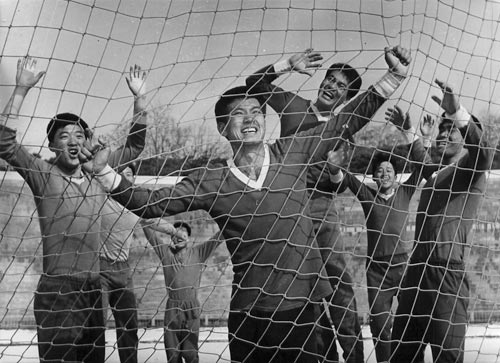
With that in mind, Koryo is sponsoring a screening of a one-of-a-kind — at least in America — film, Centre Forward, a 1978 curio that was digitally restored in 2010. Directed with limited artistic flair by Pak Chong-Song (according the Yerba Buena Center for the Arts’ website, “considered one of the DPRK’s finest filmmakers”), this 75-minute, black-and-white propaganda piece weaves the tale of Comrade In Son, a gifted but inexperienced soccer player struggling to succeed on a team that recently upgraded its training regime from merely exhausting to sadistically brutal.

Along the way, the lad wearing No. 17 learns important lessons from his sister (a dancer whose training also tends toward the sadistically brutal), his roommate (an older player with international triumphs under his belt), his coach (who gives motivational speeches that invoke the teachings of the Fatherly Leader), and the lyrics of the rousing tunes that play over the film’s many montages — “Oh we are sportspersons of the Leader, let us demonstrate wisdom and vigor,” that sort of thing. There’s never any doubt, because it’s emphasized over and over, that sporting glory is owned by the motherland, not individual players. (Though if you fail, you’re personally responsible for hindering the DPRK’s pursuit of being “a kingdom of sports.”)

Centre Forward‘s original release must’ve stirred the hearts of North Korean soccer fans who recalled the national team’s best-ever World Cup showing; in 1966, it reached the quarter-finals after defeating perennial powerhouse Italy. Contemporary fans might better remember the 2010 World Cup, though they’d probably prefer not to — while even qualifying for the tournament was an accomplishment (and the extreme underdogs did score a goal in their game against Brazil), the team exited after three losses, including a humiliating 0-7 defeat versus Portugal.

The media, of course, feasted on the oddities the outsider country brought to the World Cup stage: the identically-dressed fans that were alleged to be Chinese actors imported to South Africa for the occasion; the assertion that the North Korean coach was getting pitch-side advice from Kim Jong-il via an invisible phone invented by the Supreme Leader himself. We chuckled, sure. But who didn’t worry a bit when the team had to trudge back to Pyongyang, still stinging from having their asses handed to them on international television by Cristiano Ronaldo and company?

Multiple sources reported the team and coach were “publicly rebuked” (some said for six hours) for their poor showing, and that the team was forced to “reprimand” their own coach, who was then quickly shunted into a laboring job (see above, re: “kingdom of sports.”) Superstar striker Jong Tae-se — loyal to North Korea, but born in Japan, so he enjoys the decadent luxury of playing in Europe — was spared from this punishment. But what happened to the other players? If Centre Forward‘s “no pain-no gain” training philosophy at all resembles real life, I shudder to imagine.

CENTRE FORWARD

Thurs/30, 7:30 p.m., $6–$8

Yerba Buena Center for the Arts

701 Mission, SF

(415) 978-2787

www.ybca.org

Down Mexico way

0

arts@sfbg.com

FILM Traditional noir cinema is like a whirlpool (and there is, in fact, a 1949 noir titled Whirlpool): its protagonists are haplessly sucked into a vortex of escalating, devouring peril against which their struggles are likely to be futile. Violence, deceit, perversity, love gone wrong, vengeance, and insanity envelop the good and the weak, the haunted and proud alike.The familiar noir setting is that of the bustling city turned malevolent and strange, suddenly underpopulated streets fraught with danger in an unending night of guns, dames, and double crosses. But the open road is equally a noir landscape, exchanging the maze of urban entrapment for flights that seek rescue from dire straits but instead only dig deeper into trouble with each incriminating mile. Loss of control and comfort is the noir hero’s inevitable slippery slope; he (or the occasional she) is increasingly at the mercy of cruel fate, unrelenting pursuit, bad judgment, and/or unforgiving alien surroundings.

The Pacific Film Archive July series “Going South: American Noir in Mexico” explores one such manifestation of the traveler becoming “lost” in ways no AAA map can help. The eight vintage black and white features in curator Steve Seid’s program trace Yank protagonists’ odysseys southward, often on the lam or otherwise under duress. Some never actually make it to Mexico, or just to those border towns fabled for lawlessness and licentiousness (if largely because northern money, cultural ignorance, and thrill-seeking encouraged criminal predation).

Those who do make it find no comfort in a strange land: the stark desert, tourist traps, and insinuating locals with their maddening foreign tongue (the titular villain from 1953’s The Hitch-Hiker keeps expressing exasperation that Mexicans insist on speaking “Mexican”) provide no hiding place from their demons.

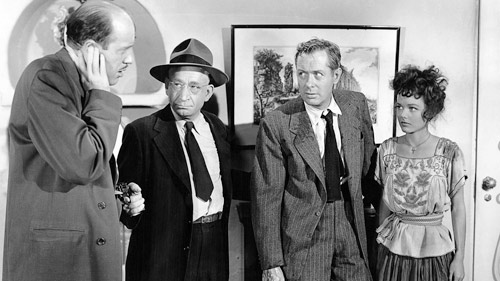
No less than three features star the inimitable sloe-eyed Robert Mitchum, a man who always seemed like he’d have a few Tijuana stories unfit for family consumption. Two by Mia’s dad John Farrow (1950’s Where Danger Lives and the next year’s His Kind of Woman), as well as Jacques Tourneur’s 1947 noir classic Out of the Past, find his variably innocent heroes drawn like flies into ornate sticky webs with an alluring brunette at their center. If Danger and Past prove her deadlier than the male, Woman‘s lighter tone allows a tropical resort near Santa Rosalita to parody den-of-thieves exoticism. In it, Jane Russell gets to be one dame who’s hard-boiled on the outside but soft on the in, as opposed to vice versa.

Mexico is likewise just the end point of thorny chases — after stolen loot or lying tail, respectively — in Phil Karlson’s excellent 1952 Kansas City Confidential and Anthony Mann’s cheesy Blue Angel (1930) update The Great Flamarion (1945) (with Erich von Stroheim as a grandiose vaudeville sharpshooter). But it’s central to the series’ three most potent entries, which also notably offer more complex takes on the relationship between our perennially poorer neighbor and imposing Gringolandia.

If you haven’t seen Orson Welles’ 1958 Touch of Evil — either in its original studio cut or drastically different 1998 Walter Murch reconstruction of the director’s original intent — you need to, because it’s a masterpiece of noir, exploitation, irony, and stylistic delirium. When Charlton Heston’s unlikely spray-tanned Mexican narcotics agent marries very blonde, “pure” (and racist) gringa Janet Leigh, their honeymoon becomes a grotesque nightmare of border-straddling sleaze, though the Spanish-speaking miscreants are just pawns in the hands of Yankee pros — especially Welles’ own Jabba the Hutt-like police captain.

Much lesser-known are two other films by actors behind the camera. Ida Lupino’s The Hitch-Hiker finds two average American Joes on a Baja fishing trip kidnapped by a serial-murdering psycho who forces them deep into desolate foreign terrain. It’s the keen eye of locals rather than our desperate heroes’ resourcefulness that might ultimately save them from the maniac’s itchy trigger finger. Spare, tense and realistic, it’s contrasted by Robert Montgomery’s 1947 Ride the Pink Horse, a sort of noir-fever-dream spin on Under the Volcano (1984) in which the director stars as a war-veteran tough guy unraveling from sleep deprivation and general dislocation on a revenge mission in a fictitious border town. Full of phony ethnic exoticism and stereotypes, it nonetheless offers hope of salvation solely from kindly Spanish-speaking locals, notably a teenage girl (pigtailed Wanda Hendrix) who can see his imminent death in our gruff hero’s eyes.

“Go on, beat it. Scrambo!” he barks at her — a good line to be sure, though none can beat Out of the Past‘s (false, it turns out) koan “A dame with a rod is like a guy with a knitting needle.”

GOING SOUTH: AMERICAN NOIR IN MEXICO

July 1–29, $5.50–$9.50

Pacific Film Archive

2575 Bancroft, Berk.

(510) 642-5249

www.bampfa.berkeley.edu

Fake-out

0

arts@sfbg.com

HAIRY EYEBALL It’s not just the title of Stephanie Syjuco’s solo show “RAIDERS” — her first at Catharine Clark Gallery — that brings to mind Indiana Jones. Something of the latter-day swashbuckler comes across in Syjuco’s art, which, like Indy, initially seems to be playing to all sides for the sake of plunder — when in fact this cleverness is the outward expression of a deeper skepticism toward the very institutions it’s engaged with.

But Indiana Jones is also a pop cultural commodity and a franchise that has netted millions for creators George Lucas and Steven Spielberg. This too, I imagine, is not lost on Syjuco, whose work frequently strips Pop Art bare of its smart, slick exterior (as well as Conceptual Art of its pretensions) to access the larger and far less glamorous network of market forces, production processes, and questions of ownership that shape it as a commodity.

Whereas Takashi Murakami installed an actual Louis Vuitton boutique inside Los Angeles’ Museum of Contemporary Art, Syjuco’s project “Counterfeit Crochet” called on hobbyists the world over to knit fake designer bags, complete with logos, and even provided the patterns and instructions. She has also, on more than one occasion, set up detourned versions of shops and marketplaces inside museum walls.

“RAIDERS” opens with an installation of what at first glance appears to be a collection of handsome Asian antiquities — mainly vases and small, decorative vessels — arranged on the very shipping crates they were transported in. It quickly becomes obvious that what we’re looking at is truly a set-piece, and that the “priceless” cache before us is actually an arrangement of life-size photographic reproductions adhered to laser-cut wooden backings.

Raiders: International Booty, Bountiful Harvest (Selections from the A____ A__ M______) — to give the installation its full title — becomes more interesting when you consider that Syjuco used images downloaded from the Asian Art Museum’s online database of its holdings as her source material. Love and theft (if I may poach the title of Eric Lott’s remarkable study of American minstrelsy) are certainly forces that have shaped many a museum’s prized holdings, and it is this history — one so often bound to colonialism and its aftermath — that is also embedded in Syjuco’s fakes.

And Syjuco decidedly, politically, traffics in fakes, not forgeries. Practically every piece in “RAIDERS” has rematerialized online, open source materials — be they digital images or readily accessible canonical texts — into art objects that are themselves parodies of object-ness. Conceptually whip-smart and materially banal (wood, tape, paper, and glue are common ingredients), Syjuco’s pieces continually taunt us with the question, “Why buy the cow when you can get the milk for free?”

In the gallery’s back room, jewel-case-size blocks of wood covered in pixilated digital prints of CD cover art representing Syjuco’s entire collection of “music illegally downloaded or pirated from others” are, as the bright orange stickers adhered to their shrink-wrapped exteriors proclaim, really available for the “blowout price” of $9.99 a piece.” Across from this pile that looks as if it had been airlifted straight from a Tijuana bootlegger, is Phantoms (h__rt _f d__kn_ss) an installation organized around Joseph Conrad’s Heart of Darkness, replete with a table, sawhorses, houseplants, TV monitors, and 10 bound copies of different online, public domain versions of Conrad’s text that are strictly “price upon request.”

Syjuco is certainly not the first artist to take on the art world’s biggest white elephant: value. But she wields her scalpel with a thoughtful precision and economy of gesture that will forever be beyond the abilities of a gaseous giant such as Damien Hirst. And that, to borrow another clichéd bit of market-speak, is truly priceless.


INKSTAINS

If you missed the San Francisco Museum of Modern Art’s excellent Eadweard Muybridge retrospective that closed earlier this month, Matt Bryans has created something of an homage to the early master’s photographic panoramas and doctored views of a not-quite-virginal Yosemite at SF Camerawork.

“Untitled” unfurls along one of the gallery’s walls for nearly 30 feet, a fantastical expanse of ever-shifting landscape seemingly captured from a middle distance. Glaciers give way to snow-capped peaks, which then dip into valleys that ease into rolling plains and finally abut more misty crags. In the piece’s upper half, clouds swirl and dissolve across the arc of the sky as in a Chinese ink painting.

Although the piece has the weathered patina of an old daguerreotype and recalls Muybridge in its staged epicness, Bryans is a collage artist who works solely with a medium whose livelihood has been called into question about as often as film photography’s: newsprint. “Untitled” — which like the other large collage commissioned by SF Camerawork is all explosions and stars wrapped around a support column — was created using only India erasers and inky photographs clipped from newspapers.

Scanning the sky of Bryans’ panorama, you can make out the smudged traces of what was once type. And the closer you look, you start seeing the fissures between the thousands of carefully glued pieces that Bryans has transformed into a seemingly organic whole, which nonetheless appears on the point of disintegration.

The panorama piece is large enough that it sags a little and billows whenever a current of air hits it. It seems to hang heavy with the losses it embodies — photography’s ghosts, newspapers as a disappearing medium, the unknowable contexts of the images themselves — a load that’s almost too much to bear. 

STEPHANIE SYJUCO: RAIDERS

Through July 16

Catharine Clark Gallery

150 Minna, SF

(415) 399-1439

www.cclarkgallery.com

MATT BRYANS: BREAKING THE LAND

Through Aug. 20

SF Camerawork

657 Mission, SF

(415) 512-2020

www.sfcamerawork.org


Zero Zero

0

paulr@sfbg.com

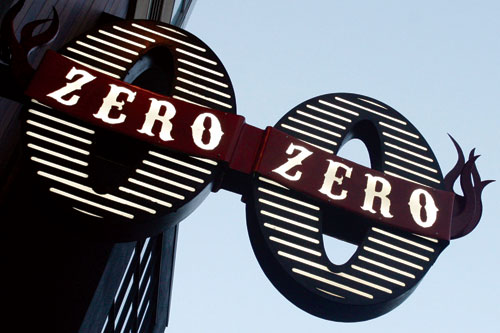
DINE Our recent bout of pizza chic was bound to reach some sort of apex sooner or later, like all fevers, and it now appears to have done so at Zero Zero, the Bruce Hill endeavor that opened last summer in the old Azie space adjoining LuLu. The name refers to a vaunted Neapolitan flour used to make pizza dough, but it also seems to suggest the turn of the millennium, with its near-5,000 Nasdaq and the reinvention of SoMa as the urban version of Silicon Valley. If you’d gone to sleep about 10 years ago and were just now waking up, you probably wouldn’t think much had changed, except that pizza had become very grand indeed during your little nap.

As a pizza master, Hill has a formidable pedigree. He was the longtime chef at Oritalia, one of the city’s most interesting and innovative restaurants of the 1980s and 1990s before moving on to reinvigorate the cooking at both the Waterfront and Bix. The Zero Zero gamble is to open a pizzentric restaurant in the heart of the city’s new restaurantland instead of at its fringes, in the lower Haight (Ragazza), Dogpatch (Piccino), or Glen Park (Gialina). A major plus of the location is that a rich lode of clientele is near at hand; being upstairs at Zero Zero on a busy weekend night is a little like trying to work your way through the break room of the Abercrombie and Fitch catalog. Clearly pizza is familiar and reassuring to people who aren’t too many years past their college graduations and who are now living in SoMa’s innumerable new luxury lofts. But is pizza enough to carry a serious restaurant?

Hill has gracefully hedged his bets by laying out a menu that’s considerably broader and more sophisticated than a few tomato-red pies to be washed down with steinfuls of brew. The kitchen turns out an assortment of crudo, antipasti, and pasta plates to keep things interesting. And if you don’t want pizza at all, you can certainly get by — although you won’t find so much as a single conventional large dish. It’s little dishes, with or without pizza. Or bupkes.

We found the food beautifully conceived and presented, although several dishes struck me as being on the verge of too salty. This is odd, considering that so much restaurant food has struck me as underseasoned over the years. Whenever I come upon oversalted food in a restaurant, I find myself thinking of the young chefs-in-waiting who can often be seen in clusters on the sidewalks in front of culinary academies, puffing away at their ciggies. It is well known that smoking cigarettes dulls the sense of taste and affects the way a chef is seasoning things.

A crudo of California halibut flaps ($12.95) was presented on a narrow sushi platter, as if subtly to enhance our sense of its freshness. And it was glisteningly tender, its butteriness deepened by Fiordolio EVOO. But the promised “panzanella” was just golden-crisp croutons with salt sprinkled over the top. It is surprising how much damage even a little salt can do to delicate food. I also found too salty an otherwise marvelous salad of wild arugula ($9.50) with quarters of ultra-ripe yellow nectarine and marcona almonds. The greens, with their almost prickly freshness, could have been picked five minutes before. But the lemon vinaigrette tended toward briny. One dish we did find in good tune was expertly braised octopus ($13.95), cubed and tender and plated with Sicilian chickpea fritters that could have passed for polenta triangles, along with the wondrous weed purslane and an agrodolce (sweet-sour) sauce. There was an important clue in this dish — that saltiness is a relative phenomenon. It can be balanced.

The pizzas buck the local trend by using a slightly thicker, puffier crust. One nice feature of puffs: they blister well. Blisters suggest that the pie has been rushed to you straight from the oven, like a popover. The topping combinations are elegant and restrained; even a relatively lavish pie, the Fillmore ($15.95), with leeks, mozzarella, hen-of-the-wood mushrooms, garlic, thyme, and three cheeses (parmesan, pecorino, fontina), remained coherent, with fresh herb breath.

But Zero Zero’s best feature is probably its build-your-own-dessert option. You choose your base ($4), your ice cream ($4.95) — simple flavors but housemade — and your toppings ($1 each). Olive oil and sea salt are among them, but so is chocolate hazelnut crunch. Which would you rather have? 

ZERO ZERO

Dinner: Sun.–Thurs., 5:30-10 p.m.;

Fri.–Sat., 5:30–11 p.m.

Lunch: Mon.–-Fri., noon–-2:30 p.m.

Brunch: Sat.–Sun., 11:30 a.m.–2:30 p.m.

826 Folsom, SF

(415) 348-8800

www.zerozerosf.com

Full bar

AE/DS/MC/V

Noisy

Wheelchair accessible


Punk prophet

0

arts@sfbg.com

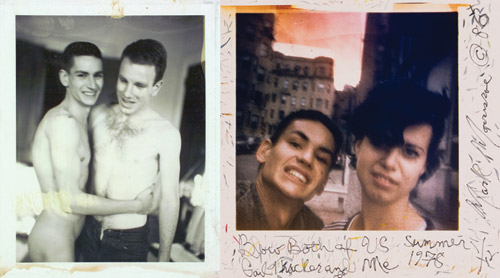
LIT Perhaps the biggest faux pas in critical art writing is using the artist’s first name when addressing his or her work. Countless teachers, critics, and editors have embedded this notion deep into the recesses of the right side of my brain. However, when writing this essay I continuously found myself wanting to address Mark Morrisroe only by Mark — as if I were having a personal conversation with him about his work. It could be that after spending a great deal of time with the artist’s recently published posthumous monograph Mark Morrisroe (JRP-Ringier, 512 pages, $65), that a bond, strong enough to diminish such formalities, seems to have formed between us. I feel as if we would have been the best of friends had Mark survived his untimely death from AIDS in 1989.

This mammoth publication spans the artist’s relatively short but undeniably influential oeuvre and includes 500 impeccably printed reproductions of his photographs, photograms, Polaroids, Super 8mm films, and signature “sandwich prints.” The resulting survey is nothing short of breathtaking. Mark’s dynamic approach to image-making is showcased alongside several poignant theoretical and explanatory essays reminiscent of Felix Gonzales-Torres’ retrospective monograph published by Nancy Spector and the Guggenheim Museum in 1995. As Gonzales-Torres would say, this is a book you would want to bring on leisurely day at the beach.

The monograph is divided into several sections, each encapsulating a portion of Morrisroe’s career and augmented with an essay detailing the importance of the specific subject matter in defining his artistic vision. I found myself spending countless hours examining each section and noting how Morrisroe’s hand is so vividly present throughout. Even in his most straightforward portraits, the notion of his human presence behind the camera — like so many other artists in the history of photography — is not lost. He is not simply producing likenesses of his subjects, he is simultaneously projecting reflections of himself onto the surface of the paper.

To be honest, I have yet to give the literary portion of the book its due diligence because I have been so blindingly seduced by the imagery. There is potential for this to happen to you as well, but keep in mind that the biographical knowledge available greatly informs the work and provides essential historical context that considerably heightens its cultural significance. I won’t go into too much detail of Morrisroe’s biography here because I feel that a few short sentences on the matter won’t do him justice. Besides, it would be far more entertaining for you to discover his story on your own among the pages of drag queens, hustlers, X-ray images, and vintage porn photo montages.

As a young photographic artist myself, I was struck most by Morrisroe’s visceral interest in understanding the alchemical processes of his chosen medium and the unflagging beauty of the individuals and peripheral culture he aligned himself with. Morrisroe’s photographs might be considered off-center — infused with the tumultuous happenings of his extraordinary life story. Yet the immediate sense of tragedy present within much of the work is lyrically transcended through his bold use of color and dreamlike, oftentimes surreal, and pictorial imagery.

Today Morrisroe’s palette could be read as reminiscent of the 1980s, a consciously busted queer-punk aesthetic. But it also serves as an elegiac reminder of dying analog photographic processes. (For those who aren’t photonerds: many of the techniques used by Morrisroe over the course of his career have become nearly extinct with the rise of digital technology and rapidly increasing cost of maintaining a strictly analog practice.)

The last section of the book features installation images from various solo exhibitions of Morrisroe’s work before and after his death. I can’t help but think of the myriad possible trajectories that would have been available had he survived the AIDS epidemic. It seems as if he was just beginning to come into his own and to fully understand his potential as a maker and progenitor of culture. Instead we are left with an impressive and spontaneous collection of work that was light-years ahead of its time. It seems appropriate that a monograph of this caliber would come to fruition now to allow a younger generation to connect with Mark’s spirit found in every lush-hued image.

Girls just want to have fun

9

culture@sfbg.com

SEX It was their first official slumber party and a late-night run to the grocery store for pink hair dye was in order. Decked out in a combination of pink, pajamas, and leather, the San Francisco girls of Leather shrieked and giggled as they wandered the aisles searching for anything rosy-colored. The girls could easily have been mistaken for a freshman herd of coeds soaked in Malibu and cheap vodka, but as the group’s president, Leland, remembers, they were “just high on girls.”

Until they discovered the store’s collection of pink and white unicorns — on sale.

“We all oohed and ahhed and ended up purchasing six of them, surprising the other girls by returning to the party with an entire unicorn herd,” Leland says. From sleeping bags and hair braiding to dirty storytelling and play piercing, the night teetered between innocent and naughty, sweet and sexy. “So many unicorns, so many needles, and so much blood!” she said.

The SF girls of Leather (the girls prefer a lowercase “g” and uppercase “L” out of respect for the traditions of the leather community) are giddy and flirty: the epitome of seventh-grade girliness, complete with kinky sleepovers, hearts, and cuteness. As this year-old group sees it, maturity is overrated when it comes to BDSM — and a hint of silliness in a dark dungeon can only heighten the sex appeal. Who else is going to giggle or blush after a spank?

The group’s approach to leather is hardly in line with the masculine traditions that have come to be associated with the history of the kink community. But in the year since the girls formed their group, they’ve been working to secure their place in the continuum of leather lovers. And judging from the group’s growing membership — and accolades from the leather community at large — SFgoL is providing a much-needed refuge for marginalized fans of lighthearted play, splashing accents of pink across the traditional wash of black.


GIRL GOALS

Historically, a girl in the leather community has been defined as the female-identified version of a boy — a submissive expected to service a dominant individual in various kinds of BDSM play. But in SFgoL parlance, girl means something way more fun. Top, bottom, submissive, dominant, giver, receiver, experienced, or curious: all roles are welcome in the group, as long as you “girl” identify.

Which means what, exactly?

“Leather doesn’t have to be serious,” says Leland, who is of the mind that people of all ages, bodies, and sexual preferences can find bliss by tapping into their own personalized “girl-space.”

“You’re a leathergirl if you feel like it,” says SFgoL Vice President Kate McKinley. Even boys and bois are allowed in the group — as long as they have a “girl heart.” Coincidentally, McKinley wears one of these around her neck — a silver heart necklace.

“I play girly and therefore this group is where I belong,” she says.

An important tenet of the leather life, service (traditionally, the practice of obediently pleasing a dominant character) is still an integral part of the girl group’s goals — but its definition of the term goes beyond tending to masters and daddies.

In the year since the group’s inception, SFgoL has volunteered at multiple fundraisers and organized charity drives for nonprofits benefiting women in the leather community and beyond. Members are free to service individuals but are required to serve the community by means of philanthropy: grown-up Girl Scouts earning merit badges for kink.

Their efforts haven’t gone unnoticed — the San Francisco Bay Area Leather Alliance recognized SFgoL as its best new organization of 2010. “Contributing to the community makes it easier for us to enjoy what we’re doing,” says SFgoL member Anita, who asked that we not use her last name for professional reasons.

Anita moved to San Francisco from Norway on a work visa, but soon found herself lusting for a close encounter with leather. She discovered some BDSM groups for women interested in playing with women, but because she identified as straight when she arrived in the city, the SFgoL’s more inclusive membership requirements felt like a better fit.

She was also attracted to the group because it didn’t require members be in a dominant-submissive relationship. She was free to play with whomever, whenever, and however she pleased. “I’m a girl and I was interested in exploring the leather community in a group where I could just be myself and share my feelings,” she says.

Last month the SFgoL celebrated its one-year anniversary with 18 full members and more than 100 girls on its Listserv. The numbers are a strong indicator of its success, especially since the current version of the SFgoL isn’t the city’s first attempt at a girly collective. In 2004, a leathergirl group was formed, but failed to secure footing in the established leather community. The second time around seems to be the shiny charm — or maybe these girls are just extra-charming?

“We do have a smokin’ hot group of girls,” giggles Leland, looking around the table and raising her eyebrows at Anita and McKinley.

It’s lunch hour on a Tuesday and the three girls flirt like crazy, constantly laughing and finishing each other’s sentences between small bites of spicy Thai food. The three are a prime example of the group’s demeanor and exactly why Leland has enforced a “no cruising” rule during official meetings.

“The meetings are meant to be safe space and for taking care of business. But yes, we can play outside the meetings,” she says, batting her lashes as the other girls smirk, hiding a thousand secrets anyone with a pulse would die to hear.


RESIZING THE LEATHER FIT

Since its inception, the leather community has been predominately male. Icons like Marlon Brando, and the work of Tom of Finland and the Satyrs Motorcycle Club, defined modern masculinity in the 1950s, igniting a kinky obsession in the gay community. A badass jacket, muir cap, and related wardrobe of black hide became a symbol of sexual power and masculine independence, eradicating the stereotype that all gay men were effeminate.

Leather rules and traditions grew from military protocol and were diligently enforced by masters and their slaves, daddies and their boys. Women were intrigued, but struggled to find a place among the men; many leather bars turned away women at the door.

Over time, elements of BDSM became associated with leather and the community began to flex. During the ’80s, leatherwomen competitions popped up, and in the ’90s, groups like San Francisco’s Outcasts — now the Exiles —provided the community with strong female-identified role models. In 2006, the Exiles helped open Betty Paige’s Secret, which in subsquent years of the festival became Venus’ Playground. It was the first leatherwomen play space at the Folsom Street Fair.

It’s been six years since the Venus milestone, yet during this April’s International Ms. Leather competition in San Francisco, it was apparent that questions about the role of women in the leather community remain.

In a moment of call and response, “Where are the leatherwomen?” was shouted into the microphone. The answer was loud and proud: “Here we are! We’re here!” followed by a rumble of audience applause. Women may be standing their ground with paddles in hand, but the exchange was telling of their struggle for continued acknowledgment.

Deborah Isadorah, a veteran of kink and current leather momma, has been entranced by the leather community for more than 40 years, and is proud to have watched the roles of women expand. But in Isadorah’s eyes, the progression has been slow going.

“We live in a patriarchal society and that reflects on every part of our society, including leather,” she says, sipping a latte in Oakland and soaking in the spring sun.

“The men outnumber us physically in this community, [but that] doesn’t mean women’s voices are missing,” she continues. Isadorah is pleased with the progress of her generation of leatherwomen and is happy to sit back and nurture the younger crop. “I think we’ve done our job: to educate women about their bodies and the opportunities they have to explore sexuality beyond what society thinks is appropriate.”

Today, nearly half the current directors of the Leather Alliance, the community’s well-respected governing board, are female.

“We’re sitting at the table now,” says Daddy Vick Germany, a female-bodied leather daddy who has been a part of the Bay Area’s leather community for more than 15 years and serves as a director for the Alliance. Overall, Daddy Vick is content with the community’s moves toward inclusivity. “The men are leaving more space for us,” she says.

But traces of segregation can still be found. “Sometimes men just don’t see you — you’re not even in their line of vision,” she says, referring to a recent experience at the Up Your Alley street fair where a man blindly butted in front of her while she stood in a concession line. She recognizes that these incidents can be subconscious, but any female who roams the SoMa leather fairs is bound to encounter this feeling of invisibility. It makes her “mad as hell.”

Elected SF Dyke Daddy in 2002, Vick made substantial efforts to bridge gaps between the sexes. She’s currently running for SF Leather Daddy, a traditional competition built on fundraising for the AIDS crisis. In 2009 a transman won the competition, but if she wins, Daddy Vick would be the first female-bodied daddy to hold the title. Her candidacy alone is sure to shake things up with leathermen who believe in upholding traditional roles — but her motives are pure.

“I’m not doing this to make a statement as a female daddy. I’m running because I think I’m a good daddy for the community,” she says, meaning she cares about being a supportive, reliable father figure for those around her. The “working title” would help her foster change more effectively than her individual efforts.

Besides Folsom’s Venus’ Playground, there are no official social spaces intended for leatherwomen. This makes sharing communal bars and events incredibly important. Change is a slow process, but Daddy Vick says ample motivation is brewing in all corners, and — paired with the diffusion of kink — the space for growth can only flourish. Leather is opening into an umbrella term with the capacity to encompass multiple elements of fetish, and to further accept people of all genders, bodies, and preferences in any role.

In this respect, Daddy Vick thinks the SFgoL could play an important role. “It just takes people like Leland, coming in with a different energy. People who stand up in the crowd, see a need, and start organizing.”


FOLLOW THE PINK BRICK ROAD

While leatherwomen made slow but steady strides in the past decade, those straddling the space between butch and femme — the girl space — began breaking ground for themselves, too. In 2003 an international Leather Girl Network was born, led by the Bay Area’s Cheryl D. The group intended to mirror the already well-established leather boy community. Girls everywhere were giddy with possibilities.

“I had always identified with the title of ‘girl.’ I was a girl who liked to serve the community, but I was also a switch,” says Mistress Pilar, a longtime leather veteran and member of the original, and now revived, SF girls of Leather. Being a switch — someone who doesn’t commit to top or bottom exclusively — meant her definition of girl didn’t fit with that of the Leather Girl Network, which stated: girl equals submission. She wasn’t alone in her dilemma.

In 2004, San Francisco girls decided to put together their own troop, headed by girl Lori, the 2003 San Francisco Leather Dyke girl (a contest that no longer exists), and girl Hayden, the 2004 title-holder. They intentionally left the definition of girl open to allow for individual interpretation. The leather community shuddered at the loose restraints, confused by the men, boys, and transpeople that joined the girl ranks.

“People in the leather community were not comfortable with this idea at the time. No one even liked talking about it,” says Pilar, referring to the notion that a girl didn’t need to be a biological woman to be in their group. “The attitude that people should ‘get off the fence’ really hurt.”

The initial group grew to about 30 members and its short three years as a successful alliance was packed with fundraising, volunteer work, and super-girly fun. But eventually the negative attitudes, biased expectations, and confusion over the definition of “girls” wore down on moral.

“People would walk up to me and demand, ‘girl, clean my boots’ and I would say, ‘I don’t serve you, I serve the community,'” Pilar says shaking her head.

Even Daddy Vick remembers how the group of strong, independent individuals struggled to prove themselves to the wider leather community. The girls, she says, “took a lot of flak” for contesting tradition. “There was still a belief in place that girls and boys couldn’t be leaders. Some thought girls and boys should be seen and not heard.”

The girls managed to have good times regardless, but Pilar says by early 2007 the group was down to five members who reluctantly agreed the end had come. It wasn’t until the 2010 International Ms. Leather competition — when Pilar decided to donate the leftover SF girls memorabilia and a curious Leland started asking questions — that SFgoL sparked back into life, with a little PR and a lot of ambition.

“Leland is a wonderful leader. She creates a really positive image of a girl,” says Pilar, nostalgically looking over an old stack of meeting notes, scribbled calendars, and photos from the original group. The dissolution of her crew hit hard, and it’s bittersweet for Pilar to hear about the new group’s instant success. But more than anything, she’s proud. “I feel like a proud mom. Those are my girls.”

Coincidentally, just as the girls sprung out of the woodwork and formed an official group, the San Francisco boys of Leather, a longstanding and once very active organization, hung up their chaps and caps due to a decline in membership. The boys generously donated all their remaining funds to the girls.

Steve Gaynes, the 1994 SF Leather Daddy and Alliance director representing the 15 Association, a longstanding sexual fraternity for men interested in BDSM, has been a leatherman since 1978 and has watched all kinds of groups come and go. He says the ebb and flow is just a reflection of the community’s current needs.

“The energy ran of out the boys and ran into the girls. If there’s no driving force behind a group, it will die,” he says, noting the community’s excitement for the new girl group. “They’re enthusiastic, inclusive, and have clear ideas for their future. And they’re doing [it all] with a lot of respect for tradition.”

And the SFgoL’s continued dedication to volunteer work and partnerships with other groups have shown the community at large that it values the path paved by the forefathers — and foremothers — of leather.

Paying tribute to old protocol is simple. Isadorah boils it down to three simple rules: integrity, honesty, and service to the community. Judged by this metric, she says, anyone who thinks the SFgoL is out of line is just being stubborn. “Whenever something happens in the community that brings change, there will always be someone who is offended,” Gaynes says. “You won’t know you’ve created change until you’ve offended those people. Change is good and should be embraced.”


LOOKING OUT FOR THE GIRLS

Leland and McKinley agree that there seems to be a buzz of excitement surrounding the SfgoL lately. The group’s logo is everywhere, and partnerships are being fostered across the community. Leland has even been asked to serve as a director for the SF Leather Alliance.

But her primary concern is making sure the SFgoL remains a safe, welcoming landing pad for girls who are new to the leather community. And these days, the media is providing all sorts of inspiration for curiosity. Rihanna’s song “S&M” speaks directly to sexual play, but even a quick Google search for “girls in leather” retrieves images of celebrities in fetish gear, from Lindsay Lohan and Miley Cyrus in leather leggings to Emma Watson in a full latex suit with collar. In general, our society is opening up to alternative sex and women want in on the action.

But girls who jump in with little research and few friends may not leave with the most positive experiences. The inherent power dynamic associated with BDSM relationships and play can blur the lines between consent and abuse, and Leland says it’s important for newbies to have mentors within reach. “Sometimes the person you’re playing with may not have your best intentions at heart,” she says. “But as an alliance of girls, we can look out for each other.”

Bernal’s bucks

0

caitlin@sfbg.com

SHOPPING I stumbled into a small-town saloon, complete with a dingy 1950s cowboy mural over the door, a horseshoe-shaped bar, and the feeling that everybody — everybody! — knew the score better than I did.

Oh wait, I remembered. I’m just in Bernal Heights.

Normally I do not spend my Tuesday night on this hill, but tonight was an exception. Cortland Avenue was hosting a local business walk — the sidewalks lined with bustling young families and the fundraising popcorn stands of neighborhood groups. Paulie’s Pickling was offering free tastes of its delicious jarred carrots and cauliflower.

I wasn’t even on the hill for the sour samples. The evening also was meant to debut the Bernal Bucks card — an innovative, or at the very least, new take on the idea of local currency.

Bernal Heights is a neighborhood full of folks who don’t have much call to go anywhere else. Harriet — the kindly woman whose hubby was playing fiddle in the bluegrass sextet perched cozily on the small stage to the side of the Lucky Horseshoe’s front door — told me that they had lived in the neighborhood since 1971. They were well-acquainted with Lisa Marie Delgadillo, owner of the Horseshoe. In fact, Delgadillo’s partner would be playing banjo during the next set with his band Shedhouse.

“I wasn’t expecting this many people to show up,” Delgadillo said. As luck would have it, that day was actually the soft opening of the tavern, which she had bought from an owner who had stocked the historic space with great blues music but “hadn’t given it a good clean in 20 years.”

“Bernal really has a tight-knit community of business owners and residents — it totally makes sense that they’d promote in this way. It’s totally Bernal,” she said, refilling my pint as Shedhouse launched into four-part gospel harmony.

Mind you, this was not the start of Bernal’s local currency program. Bernal Bucks have been in circulation since 2009, initially as stickers users could affix to $1 bills. By spending them, users got a little more for their money — a free Fuji apple at Good Life Grocery, a free used DVD from Four Star Video, $1 off your drink at Stray Bar. The money went to the Bernal Heights Neighborhood Center and other community groups. The nonprofits got funding, shoppers felt warm inside, and businesses passed along the stickered bills to the next consumer, encouraging more people to drop dough in the area.

But now there’s a debit card, which eliminates the sticker step and acts like a frequent-flyer miles credit card. The more you spend, the more Bernal Bucks you rack up. You print out the bucks in $10 increments on your computer and spend them in your favorite local enterprise — on a screwdriver on Wild Side West’s garden patio perhaps, or a quick knife sharpening at Bernal Cutlery. The whole shebang is accessible via computer: no fuss, no muss.

“How can we create a mechanism that gives us more control over our economic destiny?” asked Arno Hesse, co-creator of the program, in a phone interview. Hesse hopes the card will “create a reminder in the wallet and an incentive to do the right thing more often.” He cited a study done on a similar shopping mall program that yielded a 24 percent income growth for business owners as a result of increased buying trips and ticket sales.

Hesse expects that “hundreds, hopefully even thousands” of Bernal Heights residents and workers will sign up. “We are optimistic that it will be a mainstream phenomenon. You don’t have to have a degree in economics to jump on this program,” he said.

He estimates that the program’s participating companies receive 50 percent of the neighborhood’s cash flow to locally run businesses.

The card is available through Mission SF Federal Credit Union, whose sole location is just down the hill from Cortland Avenue. Local bank, local businesses, card design by local artist (Ashley Wolff, an accomplished children’s book author) — it’s all local except for one thing: the glaring Visa symbol in the card’s lower right-hand corner.

Hesse is aware of the irony of having a megacorporation’s logo on a card meant to prevent Bernal money from “leaking out to the Safeways, Home Depots, or Amazons of this world.” There was debate at the Bernal Business Alliance over the issue, he said. But in the end, it was all about convenience: Business owners were unsure if part-time employees would be able to grasp an alternative payment system and counter space was too valuable to set up another kind of card-processing apparatus.

“Choosing Visa makes sense because is widely accepted by most merchants,” said Kathleen Scheible, an eight-year resident of the area and owner of Bernal Homeopathy. She added that the program also features a Web interface for businesses that would like to skip the Visa step. “There was a fair amount of logistical challenge to using the Bernal Bucks: having to go somewhere to physically purchase them, knowing how to use them. We like the idea of cash over credit in Bernal, but for many of us, debit or credit is the reality for anything over $10.”

I handed Delgadillo my sticker-less cash and told her I’d be back for more bluegrass when the bar gets its cabaret license in August. Judging from the convivial tenor of her first night, I bet by that point she’ll have seen her share of the Bernal Bucks card.

Bernal Heights is truly doing its own thing — few neighborhoods in the city produce the same close-knit, down-home vibe. If the program succeeds, Hesse said his group might respond to requests to help implement it in other neighborhoods or even citywide. The responses I heard from neighbors that night indicated the program will continue to succeed. Still, it is somewhat discouraging that even this successful local business campaign comes by way of plastic fantastic.

To learn more about the Bernal Bucks program, let your fingers do the walking to www.bernalbucks.org.


Farmville

1

le.chicken.farmer@gmail.com

CHEAP EATS I probably could have picked a better route to the restaurant. Maybe if I’d gotten off at the Powell station instead of Civic Center. As it was, at not-even-9 a.m. on a Saturday, I had to step over piles of shit and vomit.

It was like reading one of my restaurant reviews; it’s part of life, yes, but not necessarily the part you want to happen before dinner. Or in this case, breakfast.

But, so you know, I would step over dead bodies and piles of fish guts to caffeinate and chew things up with my friend Kayday. Especially at farm : table, which I had heard about and have been meaning to get to for forever. High on my list of Things To Do this year is to find my way back to my former farmerliness. Because I miss the eggs, but also because I’m tired of myself in my shit-kicking city-fried people personhood. I long for the smell of a chicken coop.

Kayday, who was essentially nudged out of San Francisco for the same reason I will be one day — for not being the cool kind of queer — was down for the weekend from Seattle. Not for Pride — for the weekend before, to consign and collect her guitars and things.

I do hope everyone had a happy and proudful Pride month, and weekend, and parade. I encourage this forward-thinking bubble, being the self-proclaimed beacon of queer acceptance that it, um, proclaims itself to be, to start opening not only its mouth but its employment opportunities, its hearts, and even in some cases (gasp) its zippers to transwomen before we lose more good guitar players to Seattle.

Mine had about a gazillion job interviews in the one year she was here, but no job offers, whereas she was one-for-one in both Los Angeles and Seattle. Which reminds me of my romantical track record, home and away. Not that we talk about this. You just can’t help wondering.

“I feel like I was dumped by San Francisco,” Kayday said.

We were sitting at the inside table. That’s officially all there is, inside, at farm : table, is one pretty big square one, seats maybe eight, and then a couple more on the sidewalk.

“That sucks,” I said, biting into my fresh pea and pecorino quiche, which didn’t. It was light and fluffy, and I could almost hear the hens that laid those eggs, clucking softly in the kitchen. I was almost halfway done with it before Kayday figured out how to even approach her baguette-bacon-hard-boiled-egg pileup. By which time everyone else at the table had weighed in with their own techniques.

“Turn the egg over and smash it into the bread,” one woman offered. Another said she just takes the pieces off and eats them à la carte.

“Me, I get the quiche,” I said, chomping on clouds. Christ, I love San Francisco. And the Tenderloin.

One nice thing about sharing a table with a bunch of strangers: Kayday was spared the gory details of my recent bad butt health. I only told her what the surgeon told me: that if it doesn’t heal in two to four weeks, the next procedure is so uncomfortable they will have to put me to sleep. Those were his words.

“I hope he doesn’t come from a veterinary background,” Kayday said.

“I know. Right?” I said. “I’m getting my affairs in order, just in case.”

FARM : TABLE

Mon.–Fri. 7:30 a.m.–6 p.m.;

Sat. 8 a.m.–6 p.m.;

Sun. 9 a.m.–3 p.m.

754 Post, SF

(415) 292-7089

No alcohol

Cash only

Life at 45 r.p.m.

2

arts@sfbg.com

MUSIC Hunter Mack is many things — visual artist, U.C. Berkeley mechanical engineering PhD, new dad — but music fans know him best as the owner and president of Oakland-based, 7-inch-centric Gold Robot Records. The indie label’s releases include the now-disbanded Volunteer Pioneer, San Francisco’s Man/Miracle, and Bonnie “Prince” Billy of Drag City Records, among others.

Thirty-two-year-old Mack, an avid concert-goer and audiophile, became disheartened when bands he saw perform only had their music available on CDRs. And he would continually hear these musicians express their want and longing to do a vinyl record. His close friend, Graham Hill, drummer for Beach House and Papercuts who records solo under the moniker Roman Ruins also had a few tracks that had not been released. “[Hill] is one of the reasons [I started the label]. His music needed to be preserved on something archival,” Mack explains.

Early on, Mack resolved to physically release GRR’s music on vinyl only (through its website, gold-robot.com/records, the label also distributes digital downloads). “I like the active listening experience that a 7-inch forces you into. You listen to things on one side; you have a song; if you want to listen to that song you have to actively flip it over,” he says. “Instead of setting your music on shuffle and not knowing where it came from or not making an actual choice, a 7-inch makes you — forces you — to make a choice.”

Thus GRR’s inaugural release was “Releasing Me/Your House,” a 7-inch by Roman Ruins, in 2007. “It was wonderful. I worked with [Hill] since and continue to work with him now,” Mack says.

Since its inception, GRR has grown to include a very diverse array of artists who have produced more than 30 releases, from Ned Oldham’s simple guitar songs, to the 1990s hip-hop of Meanest Man Contest, to the experimental noise rock of Railcars. “There’s something vain about being able to choose all the music that goes onto [the label]. I’m essentially the decider on what comes out,” he says. “For that reason, it ends up being an extremely eclectic collection of music because I listen to extremely eclectic music.”

An older version of GRR’s website explained that the only requirement for music to be considered for the label was that it “inspired space travel.” This, of course, was a joke — but it stuck and has become the label’s tagline throughout the years. In selecting artists to work with, Mack exclusively seeks out musicians who are as excited, motivated, and invested in the project as he is. “I’m just looking for stuff that I’m listening to and that I’m loving. I’m looking for somebody who needs my support,” he explains.

Mack enjoys working with artists in different stages in their careers: emerging artists like Monster Rally; well-established musicians doing a unique project (Bonnie “Prince” Billy’s Gold Robot Release featured poetry set to music); or a solo side project of an artist already in a band, like Roman Ruins. Mack’s openness to work with artists at different points in their professional careers reflects his commitment to providing musicians with several avenues to showcase their art.

This philosophy extends to designers too. While Mack has created album art for different releases — including the abstract cover for “Pastor/al,” a Roman Ruins 7-inch on orange vinyl — most of the artwork is done by other artists. “I know when I was just starting my visual arts career, I would have jumped at any chance to make art for a release. And so I’m trying to give people that opportunity,” Mack says. This year, Mack anticipates the release of five new GRR releases, from Not the 1s, Primary Structures, Seamonster, Monster Rally, and Roman Ruins. He acknowledges that this release schedule is very ambitious. “[It’s] a lot for me,” he says. Despite his mild apprehension, his passion for and love of music is palatable. “I’m not making any money off this,” Mack says. “It’s solely a project of getting music out and giving music back to the musicians.”

Cryptic cave wave

0

SOUND TO SPARE “What show are you here for?” asked what looked like a curious 10-year-old as I took care of business at the urinal. “I’m here to see Uzi Rash,” I answered matter-of-factly. But I wasn’t so sure he was curious about the bands by the way he stared at what makes it the men’s room. Apparently Oakland’s the New Parish (www.thenewparish.com) took the phrase “all ages show” to heart.

After that somewhat disturbing run-in, I settled into the bar excited for a night of firsts. It would be my first time at the venue, as well as my first time seeing openers Terry Malts. They were fine, but like I told the tiny Peeping Tom, I wanted to check out the East Bay’s Uzi Rash (www.myspace.com/uzirash). I hadn’t seen them since they did a memorable night of Monks’ covers on Halloween, where their performance included theatrical embellishments like shaved monk-like heads and makeshift robes.

This night’s scene was different. The onset of a rare heat wave was kicking in while the murky, cave-wave sounds of the mutable band — these days, a seven-piece stage outfit — took charge with a commanding and cacophonous presence. The Rash seems to be sitting on a backlog of sludgy, lo-fi treasure: current LP Palmwine Rumpus Vol. 2 (Party Ngg! Records) precedes a September release on Volar Records titled I Was 30 in 2012. Next month the band plans to start recording another full-length album, Whyte Rash Time — not a play on “white trash,” but a reference to the Monks’ Black Monk Time — which will hopefully see the light of day before the year’s end and they embark on a West Coast tour.

I caught up with Max Nordlie, the band’s toenail-painted, jorts-wearing guitarist and vocalist. He gave me a peek into his philosophy on degeneration and premonitions. (With song titles like “Bag of Dirt” and “I’m a Trashbag,” it’s tempting to see Uzi Rash as emblematic of the self-deprecating sounds I often notice oozing out of Oakland.)

Nordlie directly references 2012 as the year of the band’s apocalyptic demise, and explains how the Rash players were “born grown” four years ago. “The band sound was much more the same of itself than it could possibly be now,” Nordlie says cryptically, going on to cite a permanent need for regression. I hear that yearning for regression in the music — at times it reminds me of an unpolished version of Devo’s de-evolution.

That night, the ensemble’s delivery of what Nordlie calls “beach party squelch and shimmy” included electro-sax, keys, and cool-looking guitars. The band looked sort of like a low-budget version of Sly and the Family Stone: keyboardist Thee Whyte Bitch in her long white wig hammering out some discord and bassist Mateo Luv looking svelte in his long johns.

Their performance is raw and charged, and while the front man looks as if he’s working out some serious emotion, Nordlie assures me that he’s aiming at “getting it right” in an expressive sense — he just wants a playfully spirited “twist-and-shout-up.”

I asked Nordlie if the constant revolving door of musicians in the band dizzies him. “Stability, much like ability, is overrated,” he replied. “We seek to compensate for the traditional rock spectacle of ritual with monstrous unpredictability — even to ourselves,” he said, before quipping that the forthcoming Volar record is simultaneously “sophisticated and appalling.” That sounds like a great introduction to 2012, end times or no.

There will be a few more local opportunities to catch Uzi Rash this summer — most notably the 1-2-3-4 Go! Records 10-year anniversary show July 22 at Oakland Metro Operahouse (www.oaklandmetro.org) — before it goes on tour with Unnatural Helpers.

Rock on with you

0

arts@sfbg.com

MUSIC Oh, Michael. So much has happened in these two years since you’ve been gone. I left my man and got my heart broken by another, chipped my front tooth, had to pay all my taxes up front, and manually upgraded my ass into the kind of shape that gives a woman like me a certain pride. Things have been rough; things have been good. And 90 percent of the good shit, including the fruits of all that ass-pumping, I achieved together with you. Keep on with the force, don’t stop. No, I’ll never stop getting enough of you.

Speaking of you, my darling, well, for you things have stayed exactly the same. Crazy-ass La Toya is still on TV, running her mouth about murder conspiracies, and the headlines are still a sordid “Jacko the Mysterious Nutter” mess. Every book written about you is still rude, invasive, and tabloidy, and the family, friends, and fans who claim to have cared for you the most still refuse to lovingly embrace you for who you were: an incomparable genius, the world’s greatest superstar, who, BTW, was totally gay.

Fuck everybody else and their delusional ways. After all this time, I’ve come to see: I am the only one who ever got you.

Memories of you, especially the ones honored on the anniversary eve of your death, should be as celebratory and joyous as the world’s greatest dance party — complete with fog machines, chemical inhalants, and unicorns. But all everyone wants to talk about is the drama. Little boys this, plastic surgery that. They actually think you did your face-up weird because you wanted to be a white Diana Ross with a superbutch Marlboro Man chin. That you hated yourself so severely you had to become someone you were not. But I know the truth: you built that distracting construction zone around your sacred temple to claim your private space. Only behind a strap-on nose and reptilian fake white skin could the real you stretch out and relax, connect with your spirit, make some art, do all your drugs. Who could blame you — and who’s to judge you? — for needing a tangible shield between yourself and all the stupid bitches who could not deal?

But as you receded further into this private space, your shield got thicker and you started to piss everybody off. Because it was awfully, horribly amorally sissy of you to want to look like a woman. A real man takes the face he is born with. In other words: you lied to us, motherfucker. You sang about loving women, rubbed your silky load on their thighs, even married all those hags. You grabbed your cock onstage and put on like vagina was cool.

Why was everyone so dumb and gay-blind in the first place? Because at the height of your Thriller fame in the 80s, no one was gay, not even those old warhorses George Michael and Boy George. But when it turned out that they, too, had lied to us — leading us on with all that maddening, un-Christian ambiguity — the real men had to take them out back and have a little talk. George and Boy — where are they today? Ruined.

No one forgives a liar. But maybe you were trying to tell us the truth, just no one was paying attention:

If they say, why, why?

Tell ’em that it’s human nature

Why, why, does he do me that way?

I like livin’ this way

I like lovin’ this way …

I listened to you, dear friend. I heard what you said about Billie Jean, that wacked-out club trash who said that you, rare orchid of the disco, would be “the one, who will dance, on the floor, in the round” — whether you were feeling it or not. She didn’t say anything about fucking! Not only that, you told us over and over — 10 times in less than five minutes, in fact — that, “Billie Jean is not [your] lover.” And I believed you. Everybody else was being a fool.

And so they had to tear you down, proving that total, brutal, violent annihilation of character is even more delicious when the victim is rich and black.

I always tell people the same high-minded thing: don’t read a single book; watch the movie instead. By that I mean 2009’s This Is It, of course, with its amazing rehearsal footage shot right before your death. If anyone has any questions or misgiving about who you were, this movie will correct it. All the drama and the Jacko the Freak-o bullshit fades away for once, revealing a musician of astonishing skill and professionalism. Not only do you hit every note on your own with your pure, naked voice, you also dance like a 20-year-old at the height of his game. To all those who scoff at my insistence that you were a genius: fuck you in the heart and prance on to hell.

But it wasn’t just your artistry that made me cry in This Is It — it was your extreme, almost over-the-top graciousness as well. I was stunned by the level of gentleness and respect you showed every single member of your crew — from the dancers to the musicians, the lighting guys to the PAs. You surely didn’t have to be so kind. Equally revealing was how your crew responded — unable to contain their awe and ecstatic delight, they were just plain thrilled to work with a compassionate legend like you. To them, you were the embodiment of love, humility, and respect. And if the people who worked so intimately with you before your death knew this, why can’t everybody else?

Don’t go changin’

0

arts@sfbg.com

THEATER The story of earnest young traveling salesman Gregor Samsa, who awakens one morning to discover he has changed into something he and his family can only describe as vermin, Kafka’s 1915 novella The Metamorphosis has undergone a number of metamorphoses of its own in terms of adaptations for stage and screen. One of the latest is the lauded 2006 interpretation by actor Gísli Örn Gardarsson and director David Farr, a coproduction between Iceland’s Vesturport Theatre and England’s Lyric Hammersmith that debuted in London and made its U.S. premiere at the Brooklyn Academy of Music last winter.

Berkeley’s Aurora Theatre offers the first wholly American production of this stage version, under the direction of Bay Area playwright-director-actor Mark Jackson. The production has many fine features, but the balance between the social and emotional content of the story and its abstract or absurdist framework gets skewed a bit too far toward the latter.

Jackson’s production stakes out its own territory by eschewing the Nazi-era periodizing of the original Vesturport–Lyric Hammersmith production. This Metamorphosis is set in the American 1950s — although the trappings of that place and time are only vaguely evoked here. Indeed, the costumes, semi-abstract split-level set, and heightened performance style together seem a blurry blend of Germanic petit bourgeois culture, high modernism, and Leave It to Beaver-esque TV surreality.

A horror and embarrassment to his family, Gregor (a winningly agile and sympathetic Alexander Crowther) confines himself most of the time to a variety of perches in his second-floor room — an environment rendered via a striking modernist pop-out painting and vertical jungle gym by Nina Ball. Its spare features are all askew and rotated forward on a sloped, accordion-like set of ridges, a veritable waterfall of steps supporting an elongated metallic bed frame and the creeping, scrambling Crowther.

Formerly the main breadwinner of his downwardly mobile lower-middle-class family, Gregor does not report for work one day. It’s that day, of course, that he drops so far in the estimation of his family that he is no longer even comprehensible to them, no longer even human. They instinctively side with his overbearing employer (Patrick Jones) and consider their own plight now that they must fend for themselves. Only his beloved sister Grete (Megan Trout) makes a serious attempt at communication and sympathy, although with melancholy results.

Grete is the key figure in this brisk 80-minute stage adaptation. Her brother’s transformation entails her own, from a would-be dancer into an eligible commodity in the material calculations of her desperate family and finally into a self-possessed agent in the cold material world. Trout is sharp but perhaps too perky and superficial in the role, since the anguish Gregor feels at seeing her metamorphose doesn’t have the same impact in the absence of a convincing sibling bond. Gregor clearly lives vicariously through the promise of Grete’s freedom, her life as an artist. When that dies, when she is transformed, his own demise is complete.

Gregor’s parents (played with sure satirical exaggeration but, again, little beyond comic anguish by Madeline H.D. Brown and Allen McKelvey) also feel too distant from it all. The cast offers little coherence as a family, albeit a fractured one. Instead we get a nicely wrought metaphor without much of a sense of its stakes, a lost opportunity and no doubt an unintended consequence. Bosses and subhumans, marriage as sexual commerce, art as perversion, the quiet everyday destruction of personality, the corruption of the closest social bonds by vast coercive hierarchies of power and authority — Jackson’s right, you don’t need to go back to Nazi Germany to find all that. It should all feel closer to home. *

METAMORPHOSIS

Through July 17

Wed.–Sat., 8 p.m.; Tues. and Sun., 7 p.m.;

Also Sun., 2 p.m., $10–$55

Aurora Theatre

2081 Addison, Berk.

(510) 843-4822

www.auroratheatre.org

The way forward

0

sarah@sfbg.com

Two days before President Obama announced his plan to begin withdrawing 33,000 troops from Afghanistan over the next 15 months, Peace Action West’s political director Rebecca Griffin delivered a box containing thousands of toy soldiers to Sen. Dianne Feinstein’s office in downtown San Francisco.

Tied to each soldier were handwritten messages that gave reasons for demanding a large and swift withdrawal. Many of the petitions came from folks whose loved ones are in the military or are veterans of Afghanistan and Iraq.

Unlike most Democratic Party leaders, Feinstein has not demanded a significant draw-down of combat troops, despite polls showing that Americans increasingly support leaving Afghanistan, particularly after the killing of Osama bin Laden. There’s good reason for the public’s growing restlessness. This 10-year war has already surpassed Vietnam as the longest conflict in U.S. history.

According to the online database icasualities.org, 1,637 U.S. soldiers have died in Afghanistan and 4,463 soldiers have died in Iraq. Another 11,722 service members have been wounded in Afghanistan, and 32,100 in Iraq, primarily by improvised explosive devices. And that’s not counting the thousands who are suffering from depression, posttraumatic stress disorder, and other ailments.

Griffin said her goal was to draw attention to the political organizing in support of ending the war. But even as she made her delivery, Feinstein was on MSNBC maintaining that draw-down decisions should be left to the military generals.

In the wake of President Obama’s June 22 announcement, which went way farther than the generals wanted, many of Feinstein’s colleagues such as Sen. Barbara Boxer and Rep. Nancy Pelosi, the house minority leader, expressed disappointment that the pace of withdrawal isn’t quicker.

“I am glad this war is ending, but it’s ending at far too slow a pace,” Boxer said.

“We will continue to press for a better outcome,” Pelosi stated.

Rep. John Garamendi (D-Concord), who visited the troops over Memorial Day weekend, told us that a different strategy is needed. “Our troops are incredible, dedicated, and skilled. But every minute of every day, they are in a very dangerous situation, and many of them are dying. There is no recognition that we are caught in the middle of a five-way civil war.”

And Rep. Barbara Lee (D-Oakland) vowed to offer defense appropriations amendments to cut all funding for combat operations. “History shows there is no military solution in Afghanistan,” she said. “We’ve got to engage with the Taliban and engage with those in the region to find some stability.”

But where does Obama’s plan leave the peace movement as the election nears?

Griffin said activists should take credit for getting Obama to withdraw 33,000 troops rather than the smaller number his generals wanted. She sees his plan as a sign that activists need to keep pushing for more, including a concrete timeline for when he will bring all the troops home.

Under Obama’s plan, 68,000 troops will still be on the ground in September 2012, and 2014 is identified as the deadline for completing the transition to Afghan control and ending the U.S.’s combat mission.

“This means there’ll be a significant military presence in Afghanistan for at least another three-and-a-half years,” Griffin said. “By the end of Obama’s first term, the war will be 11 years old and there will be nearly double the American troops on the ground as there were when [George W.] Bush left office.”

Progressive activist and author Norman Solomon, who is running in the 2012 race to replace Rep. Lynn Woolsey (D-Marin County), noted that a recent New York Times’ headline read “Obama Opts for Faster Afghan Pullout.”

“But faster than what?” Solomon said, noting that “10,000 troops are only 10 percent of our force. This is a pattern we saw in Iraq, where the withdrawal was too slow and the numbers remaining doubled when you factored in all the private contractors.”

Solomon said that when Nixon pulled 500,000 troops from Vietnam in the late 1960s, the conflict actually increased in terms of the tonnage of weaponry used. “And the U.S. is now engaged in wars in Libya, Yemen, and a Pakistan air war.”

But longtime antiwar activist and former Democratic state legislator Tom Hayden saw a number of clues in Obama’s speech for how to push for a faster, bigger, more significant draw-down.

“Obama said 33,000 troops will be withdrawn by next summer, followed by a steady pace of withdrawal. So that gets you to 50,000 troops by the election, and all combat troops out by 2014,” Hayden told us. “If he could be pushed by the peace movement, that would break the back of the warmongers’ planning.”

In his speech, Obama noted that the U.S. will host a summit with our NATO allies and partners to shape the next phase of this transition next May in Chicago, where Obama’s former chief of staff is mayor.

“Get ready, Rahm Emanuel, for big demonstrations,” warned Hayden, who was a member of the Chicago Seven group tried for inciting riots during the 1968 Democratic National Convention. “But do you imagine Obama would do that if he were going to escalate the war? No — he’s wrapping a ribbon of unity to transfer control to Afghanistan on a timetable.”

He also noted that Obama’s allies aren’t exactly pushing him to stay. “They may not have an exit strategy, but they are heading for the exits,” Hayden said. “So if you organize demonstrations with international support, that gives you an organizational opportunity in multiple governments to press Obama to leave.”

Hayden predicts that Obama is moving toward a diplomatic settlement, led by Secretary of State Hillary Clinton, that is pro withdrawal and pro women.

“But Obama’s got a genuine problem of his own making. He escalated the damn war,” Hayden said. “He doesn’t want the military to be attacking his plan. But if he wants to be in the center, he’s going to offend the generals.

Hayden noted that in his speech Obama said, “America, it is time to focus on nation building here at home.” It was a statement that sounded in line with a recent U.S. Conference of Mayors resolution calling on Congress “to bring these war dollars home to meet vital human needs, promote job creation, rebuild our infrastructure, aid municipal and state governments.”

But Richard Becker, western regional coordinator of the antiwar ANSWER Coalition, described Obama’s draw-down as “a minimal pledge.”

“Given the growing discontent with the war, it’s hard to see how you can claim that this is a step forward,” he told us.

Becker said it has been difficult to mobilize the antiwar movement under a Democratic administration. He also stressed the importance of people coming out in San Francisco for a “protest, march, and die-in” on Oct. 7, the 10th anniversary of the war, and for a major action in Washington. D.C., on Oct. 6. “What’s going to get the U.S. out is a combination of what’s going on in Afghanistan — and what kind of antiwar movement we have here.”

Don’t privatize public safety

3

Four weeks ago, surgeon Dimitry Nikitin walked out of Florida’s Orlando Regional Medical Center to his car and was shot dead by a disgruntled patient who then turned his gun on himself and committed suicide. Last September, a doctor at Baltimore’s Johns Hopkins was shot and killed by a patient distraught over his mother’s terminal diagnosis.

There is an epidemic of violence in America’s health care facilities. Many of the scenarios are familiar — the news is full of stories of combatants in gang fights following wounded rivals into hospital emergency rooms to finish them off. But the full depth of the problem is largely unreported and extends to hospital wards, clinics, and long-term care facilities

A recent report from the U.S. Department of Labor based on 2009 statistics says health care providers rank third in the likelihood of being assaulted on the job — just behind police and correctional officers. In 2009, there were 38 assaults per 10,000 nurses aides.

Despite this troubling trend, the San Francisco Department of Public Health is asking the Board of Supervisors to approve its proposal to replace institutional police officers in some public health facilities with low-paid private security guards.

Here are two reasons this is a profoundly bad idea.

1. Health care is a stressful environment and growing more stressful every day.

As the providers of last resort, public hospitals and clinics often face a perfect storm of patients who are involved in violence, alcohol and drug abuse, or are suffering from untreated mental illness. But even outside emergency wards, health care workers must work up-close with patients and family members pushed to the breaking point by an overburdened delivery system.

As health care costs spiral, public health budgets shrink and access to high quality care dwindles, many hospitals and clinics are reporting assaults by patients and family members upset by long lines, half-day waits, and unaffordable care.

According to a September report by CNN on rising violence in health care facilities, violence caused by patients’ frustration with health care services is on the rise.

“People are just tired of waiting, or they are just angry that they’re not getting the care they feel is acceptable,” nurse Rita Anderson told CNN. “Instead of saying something, their response is yelling, hitting, screaming, and spitting.”

2. Well-screened and trained security officers reduce health care violence.

According to a study on reducing violence in hospitals by the National Crime Prevention Council, three top strategies for keeping health care facilities safe include reducing patient wait-times through well-organized and managed patient processing; controlling facilities through locked wards, staff ID badges, and security cameras; and hiring carefully selected and well-trained security personnel.

Currently, San Francisco’s hospitals and health care facilities are protected by highly trained San Francisco Sheriff’s deputies and institutional police officers. The Department of Public Health wants to replace some of these officers with private security guards.

But the private security industry is notoriously bad at screening recruits and plagued with turnover, in part because of low salaries. As a result, the use of private security creates unsafe working conditions for employees who deal with difficult or violent patients, such as those in San Francisco’s psychiatric emergency wards.

Unlike institutional police officers, private security guards cannot make arrests. Instead, they must involve the San Francisco Police Department, accumulating costs that quickly defeat the budget savings of using low-paid private guards to do work that should be done by highly trained officers.

Everyone who uses San Francisco’s public health system should contact the San Francisco Board of Supervisors and ask them to make the right choice to keep our hospitals, clinics, and long-term care facilities safe.

Ed Kinchley is an emergency room social worker at San Francisco General Hospital.