Volume 45 [2010–11]

Foxy saves

0

arts@sfbg.com

SOUND TO SPARE Sweating in that crevice behind your knee? Notice more mesh tops in the Castro than usual? Or maybe you’re like me, pretending it’s Wimbledon but really just stinking up the tennis courts at Dolores Park. It seems the Bay Area is actually being blessed with some unusually above-average temperatures this summer. But even when the fog inevitably rolls back in, sticky-hot summer jams don’t necessarily have to be about weather. They can be a mentality. So allow me to stroll down Memory Lane with a fitting album for these should-be-sizzling times.

Chock-full of lyrical wit and endless one-liners, 1999’s Chyna Doll (Def Jam) by Foxy Brown is the downright filthiest album of all time. Brown (only 19 at the time) had me inappropriately quoting her ill flows all summer long. Stuff like “MCs wanna eat me, but it’s Ramadan” or “Gimmie some room, all I need is some dick up in my womb” are among the most graphic, but rate as some of my favorites. I probably appreciated them even more back then, when I was equally as young, angsty, closeted, and still living at my parents’.

The Brooklynite’s brazen delivery of FCC-unfriendly rhymes (every track drops the F-bomb) was probably a combination of marketing brilliance and dumb luck that made for her best-sounding album. On this sophomore effort, she received solid reviews from mainstream press. Even the British magazine Q weighed in saying, “There’s more to her than simply showing off and swearing.” And boy does she love swearing. On the track “4-5-6” she rhymes the word “shit” with “shit” 15 times.

Admittedly a huge part of the appeal for me was that such raw content was coming from a female. (Note: Jay-Z contributed heavily as did many other male hip-hop notables on writing and production). I guess I ignorantly found novelty in the manifestation of a female feeling need to prove herself to the industry. Sure, women curse — and there were other femcees before her. In fact, it was an era of stiff competition with the likes of Missy Elliot, Jean Grae and Brown’s legendary rival and cohort Lil’ Kim. But it was Brown who titillated me with her confidence and cockiness, asking, “Do you know how many words I’ve flown past?” She was the undisputed queen of hardcore.

The song “My Life” explains this black girl’s ordeal, struggling with the price of fame while explicitly chronicling the falling out between her and former friend Lil’ Kim. Here we get the depth that Q must have been referencing with lines like “I ain’t asked to be born.” Whether she intended it or not, she reveals an existential vulnerability, one that queer youth could certainly relate to. Her descent turns darker, more chilling, and profoundly plain to see with the line, “Sometimes I wanna slit my wrists and end my life y’all.” It’s clear she had a lot more on her plate than her beef with Kim.

Foxy also calls out gender’s double standards when she raps, “If I was a dude, they’d all be amused. But I’m a woman, so I’m a bitch — simple as that,” pointing out how femininity can be a hindrance to achieving success in hip-hop. With clever wordplay she takes on the theme of inequality, sometimes through simple metaphor (“My bullets hurt same as yours”), other times with more lyrical prowess (“Talk slick, suck dick for money in ya hand, I’m like bitch …I got mo’ money than yo man!”)

This isn’t to say that Chyna Doll isn’t littered with the materialistic clichés common in mainstream hip-hop. But there’s a refreshing air of entitlement involved that is unapologetic. After all, it was released at a time when rap reigned supreme and MP3 downloading hadn’t yet collapsed the industry’s marketing model. There was plenty of money to be made. Brown tells us exactly what she wants written on the license plate of her Lexus as she rides in a decade later to light up another summer.

Calling the doom tune

0

arts@sfbg.com

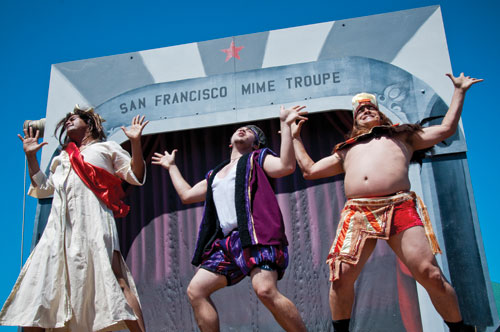
THEATER 2012: The Musical!, the San Francisco Mime Troupe’s latest offering in its annual free outdoor theater shows, opens in the Oval Office, where President Obama (Michael Gene Sullivan) — face painted a garish red, white, and blue — sells out Workingclass Man (Cory Censoprano) at the bidding of his spooky capitalist overlords. It plays like a parody of agitprop conceits and, sure enough, it is. Audiences sprawled on the glade at the northwest corner of Dolores Park this Fourth of July (the production tours throughout the summer and fall across the Bay Area and beyond) were being treated to the radical stylings of “Theater BAM!”, a tiny left-wing theater company fighting the good fight against the Man and the Pigs, among other stock characters in the black-and-blue pageant of industrial and postindustrial capitalism.

It earned a good laugh, this dramatic feint. The scene ends, the company takes its bow, and the “real” play begins as life imitates art with uncomfortable (and self-referential) complications: the members of Theater BAM! are indeed committed to overthrowing the system, but have been at it some time now with limited results and redundant gestures. Worse still, the company is facing an unprecedented financial crisis that has them leaning toward corporate sponsorship.

This last detail appalls at least one member, steadfast artistic director Elaine (Lizzie Calogero). But the rest of the company finds itself swayed by Elaine’s sister and fellow BAMmer, ambitious daytime corporate sellout Suze (Siobhan Marie Doherty), otherwise busy climbing the ladder as assistant to investment banker Arthur Rand (Victor Toman). (“It’s all dirty money,” she sings, in composer-lyricists Pat Moran and Bruce Barthol’s bouncy 1950s-style R&B. “If you don’t take dirty money you don’t have any money at all.”)

Rand, for his part, tired of competing with the piffling “people” in the political marketplace, gets the idea (with Suze’s prompting) to buy himself a politician outright. The serviceable Senator Pheaus (Sullivan) does nicely in this position (i.e., supine). Eagerly, desperately following Rand’s explicit instructions, the telegenic Pheaus pushes forward Wall Street’s business-as-usual agenda through a ready rhetorical smokescreen of nebulous and all-pervading fear.

Meanwhile, the stalwarts of Theater BAM! find themselves underwritten by an ostensibly progressive, feel-good corporation called Green Planet, Inc., headed by a bubbly Ms. Haverlock (Keiko Shimosato Carreiro) who, with hands clasped firmly on the purse strings, “offers” increasingly invasive production suggestions. The upshot? A new musical about the end of everything called 2012, replete with Mayan priests and giddy millennial mayhem. Needless to say, apocalypse doesn’t go so well with political commitment or revolutionary change, but dovetails quite nicely with an apolitical consumerist ethos of all now and damn the future.

Directed with reliable snap by SFMT vet Wilma Bonet (augmented by Victor Toman’s big-time small-stage choreography) 2012: The Musical! is a solid SFMT production attuned to the timber of the “end times,” not as a biblical prophesy but as capitalist conspiracy. It also flags the messy compromises made all too easily by artists and audiences alike with “the system.” The script (by longtime head writer Sullivan, with additional dialogue from Ellen Callas) is along the way dependably smart and funny — and seemingly inspired at least in part by the recent Flake flap (to wit, Congressman and Arizona Republican Jeff Flake’s attack on NEA chair Rocco Landesman last May for the NEA’s funding of the 52-year-old left-wing San Francisco Mime Troupe). The half a dozen songs are equally snazzy, with admirably clear and pointed lyrics, and while the singing is not as strong as in recent years, the comic acting is first-rate.

But if the story complicates the usual agitprop scenario represented by the fictitious Theater BAM!, it can also be too pat to be wholly satisfying. The excuse offered business as usual by the distracting and enervating fear of the millennium has several sources after all, including the pernicious hard-on by religious demagogues for spiritual redemption in a fiery end (a crowd and pathology wonderfully exposed in SFMT’s Godfellas). The solutions as presented here are also less than clear. Getting the airhead Senator Pheaus to save the day by reading a speech crafted by our heroes, instead of his Wall Street handlers, only underscores the idea that such “representatives” are ventriloquist dummies who lean left or right depending on whose forearm is up their ass. Those guys are Theater Bum, and they’re overfunded.

2012: THE MUSICAL!

Through Sept. 25

Various Bay Area venues, free

www.sfmt.org


TV party

2

TRASH These days we’re used to TV series regularly offering better, more serious, and more relevant drama than mainstream movies, a notion unthinkable not long ago. But even at the height of boob tube silliness, when zero cable alternatives and FCC strictures resulted in mostly bland programming, there was some room for deviation from formula. That room was primarily occupied by TV movies, which began being produced in 1964. By decade’s end they were a broadcast staple, earning strong ratings and lessening the need for networks to purchase old theatrical-release films for broadcast.

In the 1970s TV movies would increasingly take on social issues. That kind of activist edge was still pretty rare, however, when two little-remembered telepics the Vortex Room is showing on Thursday, July 14 first aired. Both are dated relics stylistically but surprisingly prescient politically.

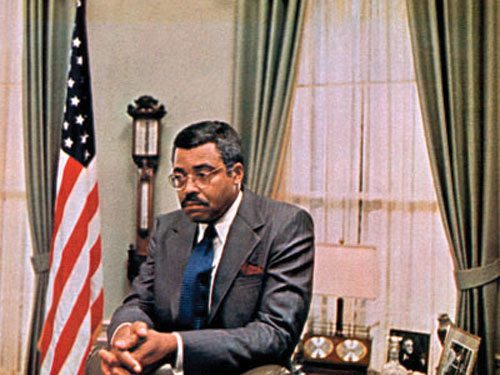
The Man (1972), which was given a brief theatrical release after being made for ABC, was adapted from Irving Wallace’s trashy bestseller by The Twilight Zone‘s Rod Serling — fair enough, since its conceit must have seemed science fiction at the time. James Earl Jones plays a fusty academic Senate president pro tempore suddenly swept into the Oval Office after circumstances wipe out the succession line before him.

Having a “black,” “Negro,” or “jigaboo” (depending on who’s talking and how publicly) commander-in-chief naturally brings out the not-so-latent racism in the various old white male power-mongers used to minority colleagues being powerless token figures. Polite and awed by his position to a fault — he’s no 2008 Barack Obama — our protag nonetheless learns to stand up for himself and his office, even if that means making some decisions unpopular with black voters.

Four years earlier, another trashy novelist (Sidney Sheldon of The Other Side of Midnight) had the pretty good idea of updating (without crediting) Sinclair Lewis’ 1935 cautionary novel It Can’t Happen Here — about a “patriotic” political party pushing the country toward a fascist dictatorship — as a modern action-suspense series. What with Vietnam protests, campus unrest, civil rights struggles, and so forth, the concept of our nation undergoing civil war was evidently too hot for the networks. They passed even after the original script had been shorn of nearly all direct political commentary.

Nonetheless, feature-length pilot Shadow on the Land is fairly strong (and violent) meat for the era. Its hectic portrait of a nation oppressed by governmental “security” brutality, air travel restrictions, etc. on one side, destabilized by a “Society of Man” underground resistance on the other is a metaphor applicable to the Nazi threat of Lewis’ day, Nixon vs. the Left, or post-Patriot Act America. It’s by turns wooden, heavy-handed, shrill, and sophisticated — not exactly good, but still a credible picture of something that could well happen here, perhaps more easily now than in 1968.  

THE UNITED STATES OF VORTEX

The Man, Thurs/14, 9 p.m.;

Shadow on the Land, Thurs/14, 11 p.m., $5

Vortex Room

1082 Howard, SF

www.myspace.com/thevortexroom


Hot reels

0

culture@sfbg.com

LUST FOR LIFE In 1969, San Francisco became the first American city to legalize screening hardcore pornography. In honor of director Michael Stabile’s documentary-in-progress Smut Capital of America, which chronicles the 1969 event and SF’s ensuing pivotal role in the adult film industry during the early 1970s, Yerba Buena Center for the Arts is sponsoring a festival from July 14-Aug. 24 that will screen Stabile’s project and seven vintage porn films.

The festival kicks off with an evening featuring Smut Capital, a post-screening Q&A, rare vintage porn clips, and a discussion between Stabile and YBCA film and video curator Joel Shepard on SF sex culture in the 1960s and ’70s. After seeing the 16 minute-excerpt of the film, I ‘m already intrigued, entertained, and offended.

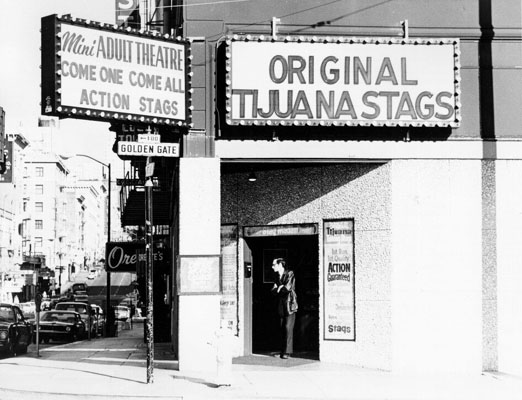
Smut Capital does more than give a blow-by-blow (sorry for the pun) porn history. It is also one of the few existing histories of sex work and queerness in the 1970s Tenderloin district. There is some pretty transphobic and sexist language in the footage (said by interviewees, not the filmmaker), and its treatment of street sex work and survival sex feels weirdly lighthearted. But because documenting the Tenderloin’s importance to queer and sex cultures is rare, I’m glad this film is in the works. I’m interested to see what other footage Stabile has for us down the road.

YBCA is also screening good old-fashioned smut — a passel of 1960s and ’70s blue shorts and full-lengths are on the schedule. And for another take on the era, a perspective piece from right in the thick of things, look to director Alex De Renzy’s Pornography in Denmark (1969), a controversial (at the time — but then, what wasn’t?) documentary he made during the first Danish adult trade expo to shoot its load after the country rescinded many of its anti-sex laws. De Renzy went on to direct such gems as 1989’s Bring on the Virgins and 1997’s Trashy Ass Deliquents, so you can probably guess where he stands on matters of sexual freedom.

Pornography in Denmark is far more interesting as a historical document than as a documentary or a porn film. As far as docs go, it’s slow; as far as porn goes, well, there’s nudity and sex, but they’re not very arousing. The film is a bit dry and long-winded, with the narrator earnestly explaining the history of porn in Denmark, right down to reciting the national average of production costs.

The interviews with sex industry workers are interesting, though, and some of the dialogue is priceless. I was having giggle fits over lines like “Probably not many men carry a vibrator in their attaché case”; “A tourist’s raincoat has deep pockets”; and “Making a pornographic film can raise a sharp appetite!”

All in all, these events are definitely worth checking out. I’ll be at “Smut Capital” — see you there?

SMUT CAPITAL OF AMERICA: SAN FRANCISCO’S SEX FILM REVOLUTION

Smut Capital , Thurs/14, 7:30 p.m., $6–$8

Pornography in Denmark , July 21, 7:30 p.m., $6–$8

Yerba Buena Center for the Arts

701 Mission, SF

www.ybca.org


The toast of London

0

virginia@sfbg.com

>>View an extended version of this article at Virginia’s site, the Perfect Spot.

TRAVEL TALES Twenty-five bars, from Notting Hill to Hoxton. I did some serious exploring when I splashed down in London’s famed cocktail scene this June, from cutting-edge experimentation to dive-y comfort, legendary classics to just-opened destinations. I sipped with cocktail luminaries like Nick Strangeway, imbibed incognito at world famous haunts, and raised my glass at good old-fashioned pubs. Here are some of my experiences, served neat.

A SHOT OF INNOVATION

It’s true: there’s some cutting edge stuff going down in London Town. Among them, 69 Colebrooke Row is considered a standard of experimentation, if not mad science, with drinks pioneer Tony Conigliaro at the helm. A visit to its test lab, Drink Factory — “a collective of like-minded bartenders and artists” — was a revelation. There, unexpected flavors are subjected to rigorous R&D via a dazzling collection of lab equipment ranging from sous vide thermal immersion circulator to tube-tangled “vacuum machine.” (Press comparisons of Conigliaro to Willy Wonka have grown cliched but remain effective.).

Drink Factory rhubarb gimlet, post-centrifuge

By no means are Conigliaro and crew’s concoctions fussy. When you taste a rhubarb gimlet, for example, you get the pure tart of fresh rhubarb stalks, their essence extracted via centrifuge. This gimlet — among the best cocktails I encountered in London — may have had a complex origin but it contained a mere three ingredients: rhubarb, Beefeater gin, and a twist of grapefruit.

The Colebrooke crew recently took on the fabulous new Zetter Townhouse bar. They’ve created a cocktail menu of understated, intricate sips like the Flintlock: Beefeater gin, gunpowder tea tincture, sugar, Fernet Branca, and dandelion and burdock bitters. Zetter’s British drawing room, whimsically peppered with taxidermy (a full-sized kangaroo!), a gramophone, and mismatched furniture, complemented by a stately yet quirky basement gaming room, is among London’s nicest spots to linger over drinks.

Another standout was the spanking new Worship Street Whistling Shop. I chatted with bar manager Ryan Chetiyawardana, formerly of Bramble Bar in Edinburgh and 69 Colebrooke Row. Candlelight glowed warmly against dark wood fixtures and a classic organ with more than a hint of Victorian influence in the basement bar’s decor. Chetiyawardana showed us their Rotovap (for distilling at low temperatures) in a tiny, glass-walled “lab.” Here the Whistling Shop elves create bitters, tonics, and ingredients like “walnut ketchup” (port wine, green walnut, chocolate, saffron, and spice).

Wonders are many, from a house gin fizz using vanilla salt, orange bitters, extra virgin olive oil, and soda, to a conversation-starter called the (Substitute) Bosom Caresser, layered with baby formula milk (you heard right), Hennessy Fine de Cognac, dry Madeira, house grenadine, salt, and pepper bitters. A pricey Champagne gin fizz (80 pounds a bottle) takes No. 3 gin, lemon, and sugar, fermenting the ingredients with yeast via méthode champenoise, a classic process of secondary fermentation in the bottle. Elegant, integrated beauty.

Some of Whistling Shop’s profoundest joys came from a row of mini-casks behind the bar where an intriguing mix of ingredients are infused into a range of spirits. Though the barrel-aged cocktail craze has swept the world, I’ve yet to see this range at any one bar. WS2 “Whisky” ages Balvenie with beech, maple, and peat syrup in new oak. WS2 “Genever” captivates with Tanqueray gin, Caol Ila Scotch, green malt, and spices, aged in sherry oak. Wherever you turn at this bar, you’ll find the unusual, while the staff and vibe are comfortable, classy. Just the kind of place I’d love to have in my own city.

TRADITIONAL, WITH TWISTS

Smokin’: Hawksmoor’s julep and Tobacco Old Fashioned

Hawksmoor is the territory of visionary mixer Nick Strangeway, where friendly bartenders continue his tradition of well-crafted drinks. I was delighted to order from a menu loaded with classic juleps, cobblers, punches. St. Regis mint julep is a 1930s new Orleans recipe: rye whiskey and Cuban rum form the base, while homemade grenadine rounds it out. it comes, wonderfully, in a traditional julep cup (atypically caked in thick ice, however) with a vivid garnish of berries and mints, tasting like a proper southern julep. compared to other smoke-infused cocktails, I would have liked to taste more tobacco in the Hawksmoor’s tobacco old fashioned. But with rye and house tobacco bitters, the drink was still beautifully executed.

AND THEN … NOT SO MUCH

It’s incredible how many acclaimed London menus are still littered with flavored vodkas and fruity, chichi, or just plain played-out drinks. I witnessed entire groups of friends each with a mojito in hand in bars that carried extensive, fascinating menus.

The 1930s tunes and classy, basement vibe of Nightjar worked in terms of a speakeasy-themed bar. But clientele appeared to be not a day over 18, making the place feel like “kindergarten just let out,” as my companion the Renaissance Man said. Fine — but the flamboyantly garnished yet crappy-tasting drinks really sank the place. Despite a beautiful menu, “signature” cocktails tasted of juice (Pedro Pamaro) or smoky tea (Name of the Samurai) but not at all of alcohol. The only win was a surprisingly good canape platter. For a mere 6 pounds, one can get six tasty, generously-sized canapés until 2 or 3 a.m. This is significant when you realize how impossible it is to get even a bite to eat in London’s hippest neighborhoods after 11 p.m. (just try!)

POMP OVER TASTE

My expectations were high for my visit to the lauded Artesian Bar at the Langham Hotel. The gorgeous, airy room is illuminated with Asian-meets-French decor, romantic and intimate. An extensive menu hosts a brilliant flavor-profile map to help choose a cocktail to suit your mood. All seemed to confirm how special this place was. And then …

Yes, I was prepared for pricey cocktails (15 pounds) but not for the menu to read better than it tasted. The standout was Cask Mai Tai, a cask-aged Mai Tai, deeply spiced and autumnal, with tart lime and fresh mint. However, Silk Route, an intriguing milk punch of Batavia Arrack, Pimento Dram, and Elements 8 Platinum Rum was bland with a funky aftertaste. I yearned for its sun-dried roasted coconut and lime elements to shine through. Alexino sounded luscious: Ron Zacapa 23 Rum shaken with whipping cream, red bean paste, and aromatic spices. I tasted little red bean or spice, while the bean paste sat sludge-like at the bottom of the glass. Granted, red bean is not an easy ingredient to mix into a drink. But at roughly $25 a cocktail, each should be exemplary.

SOMETIMES CLASSIC IS BEST

I’ve saved one of the best for last: Duke’s. This elegant, small hotel bar is a temple to the martini. I could see why it was frequented by James Bond author Ian Fleming and other martini lovers over the years. I cannot recall a more perfect martini. Head barman Alessandro Palazzi is among the most delightful, consummate bartenders I’ve had the pleasure to be served by. As he wheeled out a trolley laden with olives, lemons, ice, and gorgeous barware, he immediately impressed with his expert gin knowledge.

Asking where we were from, he launched into a rapturous account of his love for San Francisco gins 209 and Junipero, saying he’s long been extolling the glories of Junipero. Well-versed and intimately acquainted with the best gins the world over, he dropped distiller names like “Arne” and “Fritz.”

I asked for London’s Sipsmith gin. Alessandro proceeded to bring out a sample of another locally-produced, small distiller Sacred so we could compare side-by-side. He mixed our martinis to icy perfection, gin’s bite tempered with the refreshing cool of dry vermouth and a hint of lemon. This tiny, quiet haven remains among my favorite memories of London, an impeccable martini immaculately served lingering in my mind.

Ariel Soto-Suver’s world of animals

4

Pygmy elephants, Kinabatangan River, Borneo, Malaysia, 2010. My husband Sam and I spent three days along this river, spotting hornbills and proboscis monkeys. On the last day, we came across a herd of these gentle mini-giants, who played along the shore of the river for almost an hour, just 10 feet from our boat. Sadly, they are very much in danger of disappearing — the exploding palm oil business is decimating their habitat.

Yellow-eyed penguin, Dunedin, New Zealand, 2010. Unlike most penguins, the yellow-eyed penguin is unique in its mating habits. It likes to nest in the woods, under trees, just like this fellow we found while hiking along the coast of New Zealand. Only a few thousand of these penguins remain, mostly due to excessive tree removal along the coast for pasture land.

Green sea turtle, North Shore, Oahu, Hawaii, 2010. My mom, a.k.a. Snorkel Mom, read that there was a tiny beach along the North Shore where giant green sea turtles like to chill. There’s no sign on the beach, but after several hairy U-turns we found the beach, and several gigantic turtles, lazing at sunset in the sand.

Monkey cat, Koh Libong, Thailand, 2008. After gorging on a huge pile of stir-fried noodles prepared by an elderly lady in a turban, we wandered around the small village in search of even more delicious local food. Instead, we came across this cool little customer. The special love child of one monkey and one cat? Probably.

Great Bay escapes

0

culture@sfbg.com


AÑO NUEVO STATE PARK

Due to their penis-noses and penchant for lazing about, no animal invites as much tittering as the male elephant seal. We are currently in the thick of their molting season (older males nap and shed on the beach from July until the end of August), the perfect time to hike out to their hangout on the tip of Año Nuevo. Be sure you snag your visitor’s permit — you’ll need one to enter from April-August — from the entrance station.

Open March–Sept., 8 a.m.–6 p.m. 1 New Year’s Creek, Pescadero. (Off Highway 1) (650) 879-2025, www.parks.ca.gov


ALAMEDA BOOZE DISTRICT

On the western edge of the island of Alameda, a one-time naval station has been repurposed into the discerning boozehound’s day trip of choice. Located within a easy block’s stumble of one another lie the tasting rooms of St. George Spirits (boasting absinthe, flavored vodkas, and coffee liqueur on the shelves) and Rock Wall Wine Company, a co-op of local wineries. They’re both a sunny walk from the ferry terminal — stroll by the massive aircraft carriers docked farther down the shore if you need to sober up after, or west to Rosenblum Cellars (2900 Main, Alameda) if you need more tastes.

St. George Spirits, 2601 Monarch, Alameda. (510) 769-1601, www.stgeorgespirits.com; Rock Wall Wine Company, 2301 Monarch, Alameda. (510) 522-5700, www.rockwallwines.com


CANDLESTICK POINT STATE RECREATION AREA

Candlestick Point has gone through a lot of changes in its varied history — but its current incarnation as a well-tended, if sometimes landscaped-feeling, urban refuge perfectly jibes with our times. Refreshing views of the bay, some fantastic hiking trails, and a sense of seclusion (despite the nearness of Highway 101 and the stadium) make this a neato spot to picnic, bird watch, or fish. Don’t forget to bring those layers though becuase sometimes the wind attempts to rifle gently through you.

Candlestick Park exit off Highway 101, SF


CHINA CAMP STATE PARK

Historically this waterfront slice on San Pablo Bay is important as the site of a Cantonese immigrant shrimp-fishing village in the 1800s (there’s a wee museum). For nature, there’s a delightful salt marsh and lazy-day winding paths drenched in sunlight and the calls of waterfowl. But — why hide it? — this is one of the best make-out places on the bay, with couples gladly making hay in the grasses. After the picnic, of course. Wet your whistle for the Annual Heritage Day Celebration on Aug. 27, 11:30 a.m.–4 p.m.

101 Peacock Gap Trail, San Rafael. www.parks.ca.gov


INK WELLS

Damn this SF summer fog! Escape north to Marin, where just past Boonville and just inside the border of Samuel P. Taylor State Park lie these cool pools. The rocky, clothing-optional swimming holes cascade into each other and feature prime jump-off spots for the daredevils among us who can’t be satisfied with a shady forest and some cold water on a hot day. Park your car just past Shafter Bridge (coming from Lagunitas) and walk underneath the copper-colored bridge to arrive. Samuel P. Taylor Park, Sir Francis Drake, Lagunitas


SLACKER HILL

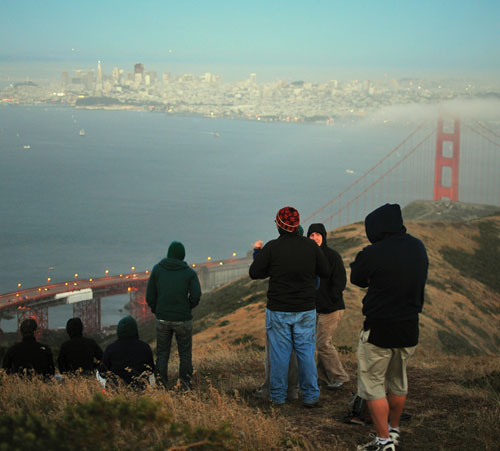
Don’t freak, you don’t have to go far for nature adventures. This inappropriately-named Marin Headlands summit is just a 15 minute — albeit gnarly — hike up a gorgeous trail from a stop on the No. 76 Muni line. Once you’ve peaked, rest in the tall grass with a phenomenal 180 degree view of Sausalito, the bay, the bridges, and the city from downtown to the avenues. It’s like you’re inside one of those awesome Panoramio pics, but it’s not freezing your computer.

Trailhead begins on the right, 100 feet downhill on McCollough from the Conzelman intersection, Marin County.


UPCOMING FESTIVALS

SUNSET CAMPOUT

Three-day dancing and frolicking to superlative house music with thousands of others. With DJ Larry Heard, a.k.a. Mr. Fingers.

Fri/15-Sun/17, $125–>$150, Belden. www.sunsetcampout.com


PAL BLUES FESTIVAL

A smokin’ BBQ competition will satisfy, as will roots and blues music from dozens of performers.

Friday, July 22, 6 p.m.–8 p.m. and Saturday, July 23, 11 a.m.–8 p.m., free.

Courthouse Square, 2200 Broadway, Redwood City. www.palbluesfestival.com


SONOMA COUNTY FAIR

It’s the 75th year for this bonanza of California country living, with carnival rides, turkey races, vaudeville performances, wine tasting, and live music.

July 27–Aug. 14, various times, $9, kids under six and seniors free. Sonoma County Fairgrounds, www.sonomacountyfair.com


WANDERLUST

Bend over backward, outdoors, as yoga meets music with Michael Franti and Spearhead, Girl Talk, Cornflower, MC Yogi, and more.

July 28–31, $24.50–$450, Squaw Valley. squaw.wanderlustfestival.com


GAIA FESTIVAL

Celebrate the earth by getting down (and dirty?) with India.Arie and Idan Raichel, Aaron Neville, the Wailers, Funky Meters, and dozens more.

Aug. 5-7, $5–$180. Black Oak Ranch, Laytonville. www.thegaiafestival.com


GOOD OLD FASHIONED BLUEGRASS FESTIVAL

The Northern California Bluegrass Society goes all out with three days of pickin’ and pluckin’ campground jams and family fun.

Aug. 12–14, $8.50–$65. Bolado Park, Tres Piños. www.scbs.org/events/gov


OUTSIDE LANDS

A revamped food and wine aspect refreshes the massive SF music fest, whose star power includes Muse, Phish, and Arcade Fire.

Aug. 12–14, times and prices vary. Golden Gate Park, www.sfoutsidelands.com


BODEGA SEAFOOD ART AND WINE FESTIVAL

Drink, dine, and shop to your heart’s content. Also: Bodega Seafood Festival rubber duck races!

Saturday, Aug. 27, 10 a.m.–6 p.m. and Sunday, Aug. 28, 10 a .m.–5 p.m., $8–$15. children under 12 free. 16855 Bodega Hwy, Bodega. www.winecountryfestivals.com


LOVEVOLUTION

The Bay’s hugest legal outdoor rave returns, now in Oakland for your fun-fur, hands-in-the-air pleasure. There will be a million DJs.

Sept. 24, price and time TBD. Oakland Coliseum Grounds, Oakl. www.sflovevolution.com


For more summer fairs and festival fun, visit www.sfbg.com/summerfests.


Big solar, little solar

4

rebeccab@sfbg.com

At a business conference this past May hosted by Wired Magazine, Bill Gates, the billionaire chair of Microsoft and an influential philanthropist, offered his two cents on solar energy. “If you’re going for cuteness,” he told Wired, “the stuff in the home is the place to go. It’s really kind of cool to have solar panels on your roof. But if you’re really interested in the energy problem, it’s those big things in the desert.”

Those big things in the desert are solar farms, designed to concentrate energy from the sun using arrays of mirrors or parabolic troughs spanning vast swaths of land. They’re green versions of the types of power plants big energy companies have always relied on — centralized, dependent on transmission lines, and requiring billions of dollars in investment. Some rely on water from desert aquifers for cooling, cleaning, and steam generation. Yet the plants can replace electricity that traditionally has been derived from burning coal, representing a significant advancement away from fossil fuels.

It’s too early to say whether California’s energy future will follow Gates’ maxim that rooftop solar is “cute” while desert solar represents the serious stuff. Others have argued just the opposite, and momentum is building on both fronts. Gov. Jerry Brown has endorsed the idea of installing 12,000 megawatts of rooftop solar, and was expected to bring stakeholders together in late July to discuss how to accomplish that goal.

At the same time, large-scale desert solar is attracting billions in investment, and big-name companies such as Bechtel, Chevron, AECOM, and Pacific Gas & Electric Co. are engaged in its development. The California Energy Commission approved nine desert solar-thermal projects last year, capable of producing 4,100 megawatts.

As California moves toward fulfilling a mandate of generating 33 percent of electricity from renewable power sources by 2020, there’s bound to be a political edge to solar development too. Giant utility companies profit by sending power along their transmission lines from desert solar farms to the grid. On the other hand, if energy-conscious customers generate more power than they use with rooftop solar panels, the utility company has to cut them a check. So there’s little incentive for utilities to encourage customer-owned, distributed generation of renewable power.

Jeanine Cotter, CEO of San Francisco-based Luminalt, a small solar installer, says it takes her work crew about a day and a half to mount new panels onto a rooftop. “That will produce power for that home for the next several decades,” Cotter notes. “It’s a rapidly deployable technology that is durable and will last a long time.”

Cotter practices what she preaches. “At my house, if you turn on all the appliances, you can look at the meter and see that we’re still relying on PG&E to bring us power,” she says. Cutting down results in the meter showing that the panels are producing electricity for the grid.

Self-empowerment is a major draw for proponents of rooftop solar. “The choice is pretty clear: pay for the ongoing cost of remote central-station renewable power or pocket the savings of locally-generated renewable power,” Al Weinrub of the Sierra Club writes in a pitch for decentralized solar generation in a January 2011 report. “Businesses with large rooftops or parking lots can become small power companies that feed electricity into the grid. Community cooperatives can pool the rooftop area of their neighborhoods to form, for example, an East Oakland Power Company.” The revenue could be rolled into job creation and more green-energy development.

Rooftop solar has gained traction in California over the past five years with a $3 billion program to subsidize installations. The California Public Utilities Commission recently touted the California Solar Initiative (CSI) program’s success — a 47 percent growth in installations since 2009. All told, the Golden State boasts 924 megawatts of solar generation capability, installed at 94,891 locations. Consultants for the California Public Utilities Commission found that 11,543 megawatts of solar could be generated on large urban rooftops statewide, while another 27,000 megawatts could be generated on empty lots near rural substations.

The potential is huge, but a cost barrier remains. Even with incentives, residential solar remains largely inaccessible to people who aren’t rich enough to own property or finance the upfront cost. In San Francisco — recently declared the greenest city in North America by Siemens — roughly 70 percent of residents are renters who almost never have the option of going solar. Proponents of desert solar farms claim that the large-scale, centralized technology offers something that rooftop panels can’t — the potential to bring renewable energy to the masses.

The largest desert solar plant under construction worldwide is BrightSource’s Ivanpah plant, which Bechtel is building in the Mojave Desert. Spearheaded by an Oakland company, the plant uses sunlight and mirrors to generate steam to power a turbine. The energy will flow onto the grid to serve PG&E and Southern California Edison customers. It’s a dramatic improvement compared with burning coal, but there are other issues. On a yearly basis, it will use enough groundwater in the arid desert to cover 100 acres, one-foot deep. And it riled environmentalists who worried that it would affect the habitat of an endangered tortoise.

No one disputes that on a per-watt basis, it’s cheaper to install desert solar than rooftop solar. According to estimates from Go Solar California, it costs more than $8 per watt to install small-scale rooftop solar systems, while recent costs for desert solar farms have been calculated at around $4 per watt. “Because they have the economy of scale, they can be built at less cost,” notes John White, executive director of the Sacramento-based Center for Energy Efficiency and Renewable Technologies.

Yet a renewable energy expert who formerly worked for the California Energy Commission (CEC) says comparing costs of desert and rooftop solar from the point of view of the customer tells a different story. In April, Sanford Miller delivered a presentation at UC Davis that could have been considered subversive. His analysis essentially found that ratepayers shell out less to subsidize rooftop solar installations than they do to finance the purchase of energy from desert solar farms once the full cost of transmission and environmental mitigation are factored in.

“From a ratepayers’ perspective, rooftop solar would be significantly cheaper than the desert solar,” Miller says. When he sent his findings around to his colleagues at the CEC, “no one disputed it,” he said. “But the view was that desert solar was inevitable.”

But that still leaves the question of who can afford solar — and this is where Tom Price, former executive director of Black Rock Solar and now part of a solar investment firm called CleanPath, believes he’s found a middle way. As things stand, every utility customer chips in to subsidize the cost of individualized solar panels for the lucky few who are installing them, he points out, and those same customers are footing the bill for energy companies to buy power from giant solar farms. He’s pushing the Community Solar Gardens bill as an alternative.

Introduced as Senate Bill 843 by Sen. Lois Wolk (D-Davis), the bill would allow any customer to purchase a subscription to a centralized renewable energy facility, and receive credit on their utility bill in exchange for the monthly fee.

White takes the view that all the different solar technologies are needed — rooftop, desert, and “intermediary” — the kind of small-scale, centralized facility that is located closer to the customers who will use it, like the solar array at the Sunset Reservoir in San Francisco. “After Fukushima [Daiichi Nuclear Power Plant in Japan], we need to begin talking seriously about reducing our dependence on nuclear power,” White says. “When you look at what we’re trying to replace and what we’re trying to avoid, it’s like we’re trying to assemble a new portfolio.”


State park closures raise difficult issues

0

The recent state budget cuts remind us to treasure the natural beauty of California reflected in our state parks that we’ve taken for granted — until now. For the first time in state history, budget cuts will require closing up to 70 of our 278 state parks by July 1, 2012.

The closures are a result of the budget cuts of $11 million for the next fiscal year 2011-12. Another $11 million will be cut for the following fiscal year 2012-13. In the Bay Area alone, 20 state parks are set for closure, including Samuel P. Taylor State Park in Marin County and Castle Rock State Park in Santa Cruz County. “These cuts are unfortunate, but the state’s current budget crisis demands that tough decisions be made,” Resources Secretary John Laird said in a prepared statement.

Because no state park has ever been closed before, “we’re still figuring out what a closed park looks like,” said Danita Rodriguez, state park superintendent of Marin County.

One option is to continue to let people into the parks, but without facilities—no potable water, no bathrooms. Rodriguez hopes to create new partnerships and operating agreements in an effort to keep some of the doomed parks open, at least seasonally. “We’re in a whole new ball game right now,” she said.

Though the state park system has no intention of privatizing its parks to keep them open, it is still developing plans and guidelines and could allow private companies to operate parks under state rules as equipment rental places and restaurants within parks already do.

“In Little Basin, there’s United Camps Conferences and Retreats that operates the campground for us,” said California Department of Parks and Recreation Deputy Director of Communications Roy Stearns. “If we can find more professional campground organizations that can run campgrounds, under our rules, we’re going to consider it.”

The goal is to keep the land public, but to keep it open with private sector help if necessary, a scenario that could raise controversial privatization issues depending on what the department allows. At least 92 percent of today’s park attendance will be retained, even with the closure of 70 parks. But no one knows how the individual parks will be affected. “There are many unanswered questions,” said Chet Bardo, state park superintendent of Santa Cruz County. One such question is, how do you close a beach?

“It would be very difficult to keep people out,” Rodriguez said. But if you continue to let people in, they could act as extra eyes and ears to discourage vandalism.

Bardo suggested shortening the parks’ open seasons. “We’ve just never done this before,” so they don’t know what’s going to happen. Bardo is in the middle of submitting draft proposals for alternatives to full park closures, which could begin as early as February 2012, according to Stearns, as park employees begin getting laid off or moved to vacancies in other parks.

“Anybody who cares for their parks should visit them now and in the future, if they can,” said Bardo. 


PARKS IDENTIFIED FOR CLOSURE IN BAY AREA

Candlestick Point State Recreation Area

Gray Whale Cove State Beach

Samuel P. Taylor State Park

Tomales Bay State Park

Castle Rock State Park

Portola Redwoods State Park

Henry W. Coe State Park

Twin Lakes State Beach

Santa Cruz Mission State Historic Park

Brennan Island State Recreation Area

Benicia Capitol State Historic Park/Benicia State Recreation Area

Olompali State Historic Park

China Camp State Park

Petaluma Adobe State Historic Park

Jack London State Historic Park

Annadel State Park

Sugarloaf Ridge State Park

Bale Grist Mill State Historic Park

Bothe-Napa Valley State Park

Austin Creek State Recreation Area

For a map of all parks identified for closure statewide, go to www.parks.ca.gov/?page_id=26685.


Parks Inc.

6

steve@sfbg.com

Should the city be trying to make money off of its parks, recreation centers, and other facilities operated by the Recreation and Park Department? That’s the question at the center of several big controversies in recent years, as well as a fall ballot measure and an effort to elevate revenue generation into an official long-term strategy for the department.

So far, the revenue-generating initiatives by RPD General Manager Phil Ginsburg and former Mayor Gavin Newsom have been done on an ad hoc basis — such as permitting vendors in Dolores Park, charging visitors to Strybing Arboretum, and leasing out recreation centers — but an update of the Recreation and Open Space Element (ROSE) of the General Plan seeks to make it official city policy.

The last of six objectives in the plan, which will be heard by the Planning Commission Aug. 4, is “secure long-term resources and management for open space acquisition, operations, and maintenance,” a goal that includes three policies: develop long-term funding mechanisms (mostly through new fees and taxes); partner with other public agencies and nonprofits to manage resources; and, most controversially, “pursue public-private partnerships to generate new operating revenues for open spaces.”

The plan likens that last policy to the city’s deal with Clear Channel to maintain Muni bus stops with funding from advertising revenue, saying that “similar strategies could apply to parks.” It cites the Portland Parks Foundation as a model for letting Nike and Columbia Sportswear maintain facilities and mark them with their corporate logos, and said businesses such as bike rental shops, cafes, and coffee kiosks can “serve to activate an open space,” a phrase it uses repeatedly.

“The city should seek out new opportunities, including corporate sponsorships where appropriate, and where such sponsorship is in keeping with the mission of the open space itself,” the document says.

Yet that approach is anathema to how many San Franciscans see their parks and open spaces — as vital public assets that should be maintained with general tax revenue rather than being dependent on volunteers and wealthy donors, subject to entry fees, or leased to private organizations.

That basic philosophical divide over how the city’s parks and recreational facilities are managed has animated a series of conflicts in recent years that have soured many people on the RPD. They include the mass firing of rec directors and leasing out of rec centers, the scandal-tinged process of selecting a new Stow Lake Boathouse vendor, new vending contracts for Dolores Park, the eviction of the Haight Ashbury Neighborhood Center recycling facility, plans to develop western Golden Gate Park and other spots, the conversion by the private City Fields Foundation of many soccer fields to artificial turf, and the imposition of entry fees at the arboretum.

Activists involved in those seemingly unrelated battles united into a group called Take Back Our Parks, recognizing that “it’s all the same problem: the monetization of the park system,” says member John Rizzo, a Sierra Club activist and elected City College trustee. “It’s this Republican idea that the parks should pay for themselves.”

And now, with the help of the four most progressive members of the Board of Supervisors, the group is putting the issue before voters and trying to stop what it calls the auctioning off of the city’s most valuable public assets to the highest bidders.

The Parks for the Public initiative — which was written by the group and placed on the ballot by Sups. John Avalos, David Campos, Eric Mar, and Ross Mirkarimi — is intended to “ensure equal public access to parks and recreation facilities and prevent privatization of our public parks and facilities,” as the measure states. It would prevent the department from entering into any new leases or creating new entry fees for parks and other facilities.

Even its promoters call it a small first step that doesn’t get into controversies such as permitting more vending in the parks, including placing a taco truck in Dolores Park and the aborted attempt to allow a Blue Bottle Coffee concession there. But it does address the central strategy Newsom and his former chief of staff, Ginsburg, have been using to address the dwindling RPD budget, which was slashed by 7 percent last year.

“What a lot of us think the Recreation and Parks Department is actually doing is relinquishing the maintenance of park facilities to private entities,” says Denis Mosgofian, who founded the group following his battles with RPD over the closures and leases rec centers. “They’re actually dismantling much of what the public has created.”

He notes that San Francisco voters have approved $371 million in bonds over the last 20 years to improve parks and recreation centers, only to have their operations defunded and control of many of them simply turned over to private organizations that often limit the public’s ability to use them.

By Mosgofian’s calculation, at least 14 of the city’s 47 clubhouses and recreation centers have been leased out and another 11 have been made available for leases, often for $90 per hour, which is more than most community groups can afford. And he says 166 recreation directors and support staffers have been laid off in the last two years, offset by the hiring of at least nine property management positions to handle the leases.

Often, he said, the leases don’t even make fiscal sense, with some facilities being leased for less money than the city is spending to service the debt used to refurbish them. Other lease arrangements raised economic justice concerns, such as when RPD evicted a 38-year-old City College preschool program from the Laurel Hill Clubhouse to lease it to Language in Action, a company that does language immersion programs for preschoolers.

“Without telling anyone, they arranged to have a private, high-end preschool go in,” Rizzo said, noting that its annual tuition of around $12,000 is too expensive for most city residents and that the program even fenced off part of the playground for its private use, all for a monthly lease of less than $1,500. “They don’t talk to the neighbors who are affected or the users of the park … We’re paying for it and then we don’t have access to it.”

They also refused to answer our questions. Neither Ginsburg nor Recreation and Park Commission President Mark Buell responded to Guardian messages. Department spokesperson Connie Chan responded by e-mail and asked us to submit a list of questions, which department officials still hadn’t answered at Guardian press time. But it does appear that the approach has at least the tacit backing of Mayor Ed Lee.

“In order to increase its financial sustainability in the face of ongoing General Fund reductions, the Recreation and Parks Department continues to focus on maximizing its earned revenue. Its efforts include capitalizing on the value of the department’s property and concessions by entering into new leases and developing new park amenities, pursuing philanthropy, and searching for sponsorships and development opportunities,” reads Mayor Lee’s proposed budget for RPD, which includes a chart entitled “Department Generated Revenue” that shows it steadily increasing from about $35 million in 2005-06 to about $45 million in 2011-12.

And that policy approach would get a big boost if it gets written into the city’s General Plan, which could happen later this year.

Land use attorney Sue Hestor has been fighting projects that have disproportionately favored the wealthy for decades, often using the city’s General Plan, a state-mandated document that lays out official city goals and policies. She also is concerned that the ROSE is quietly being developed to “run interference for Rec-Park to do anything they want to.”

“By getting policies into the General Plan that are a rationalization of privatization, it backs up what Rec-Park is doing,” Hestor said, noting how much influence Ginsburg and his allies have clearly exerted over the Planning Department document. “It’s effectively a Rec-Park plan.”

Sue Exeline, the lead planner on ROSE, said the process was launched in November 2007 by an Open Space Task Force created by Newsom, and that the Planning Department, Neighborhood Parks Council, and speakers at community meetings have all influenced its development. Yet she conceded that RPD was “a big part of the process.”

When we asked about the revenue-generating policies, where they came from, and why they were presented in such laudatory fashion without noting the controversy that underlies them, Exeline said simply: “It will continue to be vetted.” And when we continued to push for answers, she tried to say the conversation was off-the-record, referred us to RPD or Planning Director John Rahaim, and hung up the phone.

The rationale for bringing in private sources of revenue: it’s the only way to maintain RPD resources during these tight budget times. A July 5 San Francisco Examiner editorial that praised these “revenue-generating business partnerships” and lambasted the ballot measure and its proponents was titled “Purists want Rec and Park to pull cash off trees.”

But critics say the department could be putting more energy into a tax measure, impact fees, or other general revenue sources rather than simply turning toward privatization options.

“We need to see revenue, but we also need to stop the knee-jerk acceptance of every corporate hand that offers anything,” Mosgofian said. “Our political leadership believes you need to genuflect before wealth.”

And they say that their supporters cover the entire ideological spectrum.

“We’re getting wide support, everywhere from conservative neighborhoods to progressive neighborhoods. It’s not a left-right issue, it’s about fairness and equity,” Rizzo said.

In sponsoring the Parks for the People initiative and unsuccessfully trying to end the arboretum fees (it failed on a 5-6 vote at the Board of Supervisors, with President David Chiu the swing vote), John Avalos is the one major mayoral candidate that is raising concerns about the RPD schemes.

“Our parks are our public commons. They are public assets that should be paid for with tax dollars,” Avalos told us. He called the idea of allowing advertising and corporate sponsorships into the parks, “a real breach from what the public expects from parks and open space.”

When asked whether, if he’s elected mayor, he would continue the policies and let Ginsburg continue to run RPD, Avalos said, “Probably not. I think we need to make a lot of changes in the department. They should be given better support in the General Fund so we don’t have to make these kinds of choices.”

ROSE will be the subject of informational hearings before the Planning Commission on Aug. 4 and Sept. 15, with an adoption hearing scheduled for Oct. 13. Each hearing begins at noon in Room 400, City Hall, 1 Dr. Carlton B. Goodlett Dr., San Francisco.


Dismantle death row

0

The moment has arrived to eliminate the death penalty in California and, for the first time in decades, it is a goal we can accomplish.

My legislation, Senate Bill 490, would close death row and replace the death penalty with life imprisonment without the possibility of parole. Last week it passed its first legislative test by a vote of 5-2 in the Assembly Public Safety Committee.

The witnesses who appeared in support of the bill were most certainly not people we think of as the usual suspects. One of them — Don Heller — was the author of the 1978 initiative that reinstituted the death penalty in California. A former prosecutor and a Republican, Heller now believes it should be eliminated. He says it has been applied unequally, that at least one possibly innocent person has been executed, and that it is not making us safer in our communities.

More striking testimony came from Jeanne Woodford, who presided over four executions as the warden of San Quentin State Prison, where she worked for almost 27 years. She called the death penalty process a “broken, costly, failed system.”

Finally, Judith Kerr testified about the heartbreaking murder of her beloved brother in 2003. “I want Bob’s killer to be apprehended and punished — I do not want someone else’s brother to be killed and I do not want to wait 25 years for the case to finally close,” she said. “Public safety would be better served by spending the money solving the 46 percent of California murders that go unsolved every year.”

Reconsidering the death penalty is particularly important at a time when the state is making heartbreaking cuts to higher education, children’s health, help for the elderly and disabled, and all the great public institutions took decades to build and that are now being allowed to wither. The fact is, the death penalty is costing us a fortune.

Since 1978, California has spent approximately $4 billion on death penalty costs and has executed only 13 people. That’s $308 million per condemned inmate. And every year it costs Californians $185 million more to maintain the 714 prisoners on death row than if they were housed in a maximum-security prison.

We aren’t being tough on crime; we’re just being tough on the taxpayer.

Those stunning figures come from a study released earlier this week by U.S. Ninth Circuit Judge Arthur L. Alarcon and Loyola Law School professor Paula M. Mitchell. Their neutral analysis, based on previously unavailable data from the California Department of Corrections, estimates the state could save $1 billion every five years by replacing the death penalty with life in prison without parole.

It might seem counterintuitive that sentencing people to death is more costly than life in prison without parole. But death penalty cases require longer trials, careful investigation, heightened security, and legal reviews mandated by both the state and federal constitutions. A death penalty trial can cost as much as 20 times more than sentencing an inmate to life without parole.

It’s more likely for a death row prisoner in California to die of illness, suicide, or old age than execution.

As a state senator, a mother, and a grandmother, I cannot justify this expense. Not when we are all tightening our belts and accepting deep cuts to education, health care, and environmental protections — cuts that diminish the life prospects for us and for generations to come.

My bill would also eliminate the risk of wrongful execution. At least 138 people across the country have been released from death row after new evidence emerged proving they were innocent.

Opponents claim that public support for the death penalty is strong in California. However, a 2011 poll released by David Binder Research found that 63 percent of likely California voters support replacing the death penalty with permanent imprisonment without the chance of parole. It seems that voters have had enough.

Now is the time. Eliminating the death penalty will save hundreds of millions of dollars every year. It is the right thing to do.

State Senator Loni Hancock represents the East Bay.


Editor’s notes

16

tredmond@sfbg.com

I’m not prone to agreeing with right-wing nuts from Riverside County, but there’s a county supervisor down there named Jeff Stone who has a dandy idea. He wants to secede.

According to the Los Angeles Times, Stone is proposing that 13 counties in the southland and inland empire split off and become their own state, which would be called South California. We’re talking everything south of Madera, with the coastal counties (and Los Angeles) left behind. A real conservative haven of low taxes and limited regulation.

And I say: Go for it, pal. I’m completely with you.

Imagine what would happen if Supervisor Stone got his way. There would be no more budget paralysis in the California Legislature. Democrats would control two-thirds of both houses and could pass a budget that included higher taxes on the rich and big corporations. Candidates for governor wouldn’t have to worry about getting votes from the conservative parts of the state, so they could talk more honestly about the major issues. Same-sex marriage would pass the first week. Pot would be legal. The death penalty would be gone in a year or two.

It might take a while longer to amend Prop. 13, but with the ability to raise revenue instead of just cutting, California could begin to fund the schools adequately, rebuild the state university system, and move forward with projects like high-speed rail.

And let’s remember: those counties that want to leave? They elect representatives who won’t vote for taxes — but they are the biggest beneficiaries of state revenues. The northern and coastal counties, the more liberal ones, pay more in taxes than we get in services. Our taxpayers are subsidizing their tax haters.

So go on — leave. We’ll keep our money here.

Now, just to our south and east would be a train wreck of a state with few public services — but South California would still be part of America, so people could move north without worrying about immigration papers. I’d propose that we set up a state fund to resettle refugees from Republicanland.

And maybe, after a while, the people who have to live with crappy schools and crumbling roads will look across the border and say, Why do they have it so good? And maybe they’ll start to think differently about the role of government.

End the BART cover-up

3

Ten days have passed since a BART police officer shot and killed a man at the Civic Center station — and the public still knows almost nothing about what happened. BART will only say that an officer (unnamed) shot a man who was “aggressive” and “holding a bottle and a knife.” One witness told the Bay Citizen that the man “looked like a drunk hippie” and wasn’t running or lunging toward the two officers on duty. The coroner has identified the victim as Charles Blair Hill, 45; he had no known address.

And that’s about it. BART is investigating and so is the San Francisco Police Department, but neither agency has released a single police report or any further information. BART is still withholding a security video from the station that shows part of the incident. All that either police department will say at this point is that the investigation is under way — but nobody will offer any time frame for its completion.

For an agency still reeling from the last police shooting and still trying to win some kind of public confidence in its ability to run a law-enforcement operation, this kind of stonewalling is a big mistake.

We understand that the surveillance video might influence potential witnesses and perhaps should be kept under wraps until everyone on the scene has made a statement. But how long can that take? Two weeks? Three? At a certain point, the cops will have found all the witnesses they’re going to find — and the public needs to know that there will be a reasonable time limit after which the video will be made public.

The same goes for police reports on the incident, including the statements of other witnesses — and the names of the officers involved.

BART’s spokesperson, Linton Johnson, told us he can’t release the names of the officers because state law forbids it. He says he will release the video footage as soon as the investigation is complete. When will that be? Nobody’s giving so much as a hint. Johnson says he doesn’t know because the San Francisco Police Department is the lead agency; SFPD public affairs says the only person authorized to talk about the case is Johnson at BART.

SFPD has no business giving BART the final says on this — San Francisco ought to release the information from its incident reports immediately.

We’d be more patient about this if BART didn’t have such a long, disgraceful history of cover-ups, obfuscation, and lies about police shootings. Since 1992, when the agency completely fabricated a story to justify the shooting of an 19-year-old Jerrold Hall (BART said Hall was struggling for control of the cop’s gun; evidence showed he was actually shot in the back, from a considerable distance) it’s been hard to trust anything the transit system says.

A BART cop shot and killed a naked, mentally ill man in 2001 (and tried to cover up the scandal). And of course, the 2009 Oscar Grant shooting was marked by misinformation and cover-ups.

So BART has a particular responsibility to handle this case with the greatest amount of sunshine possible. For starters, the basic police reports — the officers’ own accounts and the reports of the initial response team — ought to be public (even if the names of the officers and witnesses are redacted). And if there’s a legal issue, the BART board ought to take the initiative to ask a judge to authorize the release of at least some relevant information.

If the officer who fired on Charles Blair Hill acted properly, then there’s nothing to hide. If the officer shot too quickly, then the public needs to know that BART is aware of the problem and is going to act on it — before anyone else gets killed.


Upcoming summer festivals

0

July 14-24

Midsummer Mozart Festival Various Bay Area venues. (415) 627-9141, www.midsummermozart.org . Prices vary. You won’t be hearing any Beethoven or Schubert at this midsummer series — the name of the day is Mr. Mozart alone.


July 16-17

Connoisseur’s Marketplace Santa Cruz between Camino and Johnson, Menlo Park. (650) 325-2818, www.miramarevents.com. 10am-6pm, free. Let the artisans do what they do best — you’ll polish off the fruits of their labor at this outdoor expo of artisan food, wine, and craft.


July 21-Aug 8

SF Jewish Film Festival Various Bay Area venues. www.sfjff.org. Times and prices vary. A three week smorgasbord of world premiere Jewish films at theaters in SF, Berkeley, the Peninsula, and Marin County.


July 22-Aug 13

Music@Menlo Chamber Music Festival Menlo School, 50 Valparaiso, Atherton. (650) 330-2030, www.musicatmenlo.org. Classical chamber music at its best: this year’s theme “Through Brahms,” will take you on a journey through Johannes’ most notable works.


July 23-Sept 25

 SF Shakespeare Festival Various Bay Area venues. www.sfshakes.org. Various times, free. Picnic with Princess Innogen and her crew with dropping a dime at this year’s production of Cymbeline. It’s by that playwriter guy… what’s his name again?


July 30

Oakland A’s Beer Festival Eastside Club at the Oakland-Alameda Coliseum, 7000 Coliseum Way, Oakl. www.oakland.athletics.mlb.com. 4:05-6:05pm, free with game ticket. Booze your way through the Oakland A’s vs. Minnesota Twins game while the coliseum is filled with brewskies from over 30 microbreweries, there for the chugging in your souvenir A’s beer mug.


July 30-31

 Berkeley Kite Festival Cesar Chavez Park, 11 Spinnaker, Berk. www.highlinekites.com. 10am-5pm, free. A joyous selection of Berkeley’s coolest kites, all in one easy location.


July 31

Up Your Alley Dore between Folsom and Howard, SF. www.folsomstreetfair.com. 11am-6pm, $7-10 suggested donation. Whether you are into BDSM, leather, paddles, nipple clamps, hardcore — or don’t know what any of the above means, this Dore Alley stroll is surprisingly friendly and cute once you get past all the whips!


Aug 1-7

SF Chefs Various venues, SF. www.sfchefs2011.com. Times and prices vary. Those that love to taste test will rejoice during this foodie’s paradise of culinary stars sharing their latest bites. Best of all, the goal for 2011’s event is tons of taste with zero waste.


Aug 7

SF Theater Festival Fort Mason Center. Buchanan and Marina, SF. www.sftheaterfestival.org. 11am-5pm, free. Think you can face about 100 live theater acts in one day? Set a personal record at this indoor and outdoor celebration of thespians.


Aug 13

San Rafael Food and Wine Festival Falkirk Cultural Center, 1408 Mission, San Rafael. 1-800-310-6563, www.sresproductions.com. Noon-6pm, $25 food and wine tasting, $15 food tasting only. A sampler’s paradise, this festival features an array of tastes from the Bay’s best wineries and restaurants.


Aug 13-14

Nihonmachi Street Fair Post and Webster, SF. www.nihonmachistreetfair.org. 11am-6pm, free. Founded by Asian Pacific American youths, this Japantown tradition is a yearly tribute to the difficult history and prevailing spirit of Asian American culture in this SF neighborhood.


Aug 20-21

Oakland Art and Soul Festival Entrances at 14th St. and Broadway, 16th St. and San Pablo, Oakl. (510) 444-CITY, www.artandsouloakland.com. $15. A musical entertainment tribute to downtown Oakland’s art and soul, this festival features nationally-known R&B, jazz, gospel, and rock artists.


Aug 20-22

* SF Street Food Festival Folsom St from Twenty Sixth to Twenty Second, SF. www.sfstreetfoodfest.com. 11am-7pm, free. All of the city’s best food, available without having to go indoors — or sit down. 2011 brings a bigger and better Street Food Fest, perfect for SF’s burgeoning addiction to pavement meals.


Aug 29-Sept 5

Burning Man Black Rock City, Nev. (415) TO-FLAME, www.burningman.com. $320. This year’s theme, “Rites of Passage,” is set to explore transitional spaces and feelings. Gather with the best of the burned-out at one of the world’s weirdest, most renowned parties.


Sep 10-11

* Autumn Moon Festival Street Fair Grant between California and Broadway, SF. (415) 982-6306, www.moonfestival.org. 11am-6pm, free. A time to celebrate the summer harvest and the end of summer full-moon, rejoice in bounty with the moon goddess.


Sept 17-18

SF International Dragon Boat Festival California and Avenue D, Treasure Island. www.sfdragonboat.com. 10am-5pm, free. The country’s largest dragon boat festival sees beautiful man-powered boats take to the water in 300 and 500 meter competitive races.


Sept 23-25

SF Greek Food Festival Annunciation Cathedral. 245 Valencia, SF. www.sfgreekfoodfestival.org. Fri.-Sat., 11am-10pm; Sun., noon-9pm, free with advance ticket. Get your baba ghanoush on during this late summer festival, complete with traditional Greek dancing, music, and wine.


Sept 25

Folsom Street Fair Folsom between 7th and 12th St., SF. www.folsomstreetfair.org . 11am-6pm, free. The urban Burning Man equivalent for leather enthusiasts, going to this expansive SoMa celebration of kink and fetish culture is the surest way to see a penis in public (you dirty dog!).


Sept 30-Oct 2

Hardly Strictly Bluegrass Speedway Meadows, Golden Gate Park, SF. www.strictlybluegrass.com. 11am-7pm, free. Pack some whiskey and shoulder your banjo: this free three day festival draws record-breaking crowds — and top names in a variety of twangy genres — each year.


Items with asterisks note family-fun activities.

The joy of joysticks

1

GAMER On a sunny Sunday afternoon in late June, the crush of body-painted, thonged masses surged down Market Street, a trail of gold confetti, empty bottles, and promotional debris in its wake. Downtown was full to bursting with what seemed like everyone in the Bay Area celebrating Pride. But only a few blocks away, a very different scene was unfolding.

South Town Arcade is easy to miss. Tucked into a corner at the mouth of the Stockton Tunnel, its vivid green awning is all that stands out from the other small doorways at the periphery of Union Square. If you’re serious about video game arcades, South Town is a godsend: the cabinets are all sit-down, Japanese “candy cabs” with ultra-precise parts. And there is no shortage of skilled competition.

This particular day, the arcade was a locus of activity. Much like the teeming blocks nearby, South Town was packed with people, although not nearly as uncomfortably. About two dozen men and a handful of women were talking amicably, sketching in notebooks, or glued to a screen in rapt attention.

Every now and then a group of girls in thigh-high fringed moccasins and tie-dye tank tops, or someone in heels without pants, wandered past. It was a little surreal, but no one at South Town seemed to notice. Everyone was too absorbed with Super Street Fighter IV: Arcade Edition (which I was assured is the end-all, be-all of cabinet games these days) tournament that had been underway since noon. When contestants were evenly matched and a good game was in the works, everyone crowded around, enrapt as Hadoukens, as the sounds of two digital characters pummeling each other mixed with the emanations of around a dozen other cabinets and the eight-bit coming over the stereo. The tension was palpable, but you definitely couldn’t hear a pin drop.

There were cheers throughout the matches as someone landed a combo or dodged a sweep, and discussions in between as players and audience members (though basically everyone in the audience was also in the tournament) dissected what went right or wrong. There was a sense of community and camaraderie, something that Simon Truong, who runs the arcade along with Arturo Angulo and Cameron Berkenpas, points out is at the very heart of South Town.

“We wanted to build a community. Playing online is fine, but it’s totally different when you can actually see your opponent. You could, you know, talk shit if you want,” he said, laughing. “But mostly, the people who play in our arcade, if they lose, they talk. They figure out, how can I beat you with the same moves? They give each other tips — so basically everybody can up their level of play and represent San Francisco and Northern California. We need better players out here to represent the area.”

It seems to be working. With little or no advertising, South Town Arcade has seen the number of customers balloon in the six weeks since it opened. Some players sit down when the doors open and only leave when they close for the night, six to nine hours later. As I sat feeding my tip money into Metal Slug between tourney matches — the coin slot basically a vacuum at first, but less so as an hour of play began to hone my meager skills — I could only imagine what that amount of time playing Street Fighter IV could do for your game.

Watching Pavo Miskic, a lanky San Mateo resident, shoot his hand across the buttons before a match, it became clear to me that practice helps. But until South Town opened, the only places in the Bay Area for Miskic to get his hours in were limited to Golflands in Sunnyvale and Milpitas, and to the student centers at San Francisco and San Jose State universities. “San Francisco hasn’t really had that much of a scene for [Street Fighter IV],” Miskic says. “[South Town] is gonna help. Until then everyone was playing mostly in the San Jose area.”

After braving Pride parade traffic and finally making it to South Town, Miskic emerged six hours later as tournament champion, despite arriving late and taking a default loss. As he stepped outside to speak with me, a girl handed him a congratulatory portrait she had drawn of Balrog, his character of choice in the day’s matches. Inside, even though the tournament was over, no one seemed ready to leave. A small circle began gathering around the Street Fighter II cabinet.

“I’ll add that I’m really bad at this game,” Miskic said. “I consider myself terrible. That’s the thing that I like about it, though. Because there’s always a constant challenge between the old-school people and the new-school people coming up, once you’re around the community for long enough, people will get used to you. You’ll make friends in it. People will help each other out.” 

SOUTH TOWN ARCADE

447 Stockton, SF.

www.southtownarcade.com


Mayor Lee’s budget deal

0

The way the daily newspapers are presenting it, the budget that Mayor Ed Lee and the Board of Supervisors Budget and Finance Committee negotiated represents a new era of civility and cooperation at City Hall. The committee, after marathon negotiations, approved the $6.8 billion deal unanimously. Both sides called it a good process and a good result.

And indeed, by any standard, the way Lee worked with community groups was a huge breakthrough. After 16 years of essentially being cut out of the process under mayors Willie Brown and Gavin Newsom, the stakeholders — the people who provide the essential city services — were actually at the table. And the final blueprint isn’t as bad as it could be.

But it’s still a budget that does nothing to restore the roughly $1 billion of General Fund cuts over the past five years, that seeks no new taxes from big business or the wealthy, and that includes spending on a new Police Academy class that even the mayor doesn’t think the city needs.

And from the start, the mayor and his staff were absolutely determined to privatize security at the city’s two big public hospitals — even when it makes no political or fiscal sense.

The privatization plan was the centerpiece of what became a 13-hour shuttle diplomacy session, as staffers and supervisors sought to reach a deal they could all accept. The Mayor’s Office — particularly Steve Kawa, the chief of staff — put immense pressure on the committee members to accept a plan to replace deputy sheriffs with private security guards at San Francisco General and Laguna Honda hospitals. In the grand scheme of things, the $3 million in projected savings wasn’t a huge deal — but the politics was unnecessarily bloody. It’s as if Lee and Kawa were determined to privatize something, whatever the cost.

In the end, Sup. Jane Kim deserves considerable credit for holding firm and refusing to accept the proposal — and since Sup. David Chiu went along with her, they joined Sup. Ross Mirkarimi as a three-vote majority on the five-member panel and shot it down.

Police Chief Greg Suhr pushed for funding for a new police academy class to train 35 officers at a cost of $3.5 million (that’s $100,000 a cop). “I don’t think the department has looked hard enough at how we deploy the existing officers,” Sup. John Avalos told us.

And some key issues are still up in the air — for example, whether the mayor will adequately fund public financing of the November campaigns. With at least eight serious candidates running for mayor (not counting Lee), and most of them looking for the public financing that will help level the playing field, the city’s going to have to come up with at least several million dollars. That’s critical to the fairness of the election.

The bottom line remains: This city has been deeply damaged by years of cuts. And the next budget needs to start with a plan to repair that.

Editor’s Notes

tredmond@sfbg.com

I had, as they say, a spirited and frank discussion last week with Enrique Pearce, the political consultant working on the Run Ed Run campaign. I chided Pearce, whose firm is called Left Coast Communications, for leading an effort that, at the very least, involves some touchy legal and ethical issues. (After all, the group is raising money for a campaign for a candidate who hasn’t filed as a candidate. There are reasons why federal, state, and local laws mandate that people who are running for office declare that they want the office before they start raising money.)

Pearce insisted he was doing nothing illegal. (Okay, if he says so.) He also argued that his firm is the most progressive consulting operation in the city. (Whatever.) But the real focus of our discussion — and the reason it’s worth talking about — was the question of whether corruption really matters.

I think sleaze — and the appearance of sleaze — is a defining progressive issue. If Pearce agrees, he’s got some ‘splainin’ to do.

Let’s back up here. When Willie Brown was speaker of the state Assembly, he passed some good legislation, and allowed some very bad legislation to become law. But his greatest legacy is term limits — and the terrible public perception of what was once one of the best state legislatures in the nation.

Brown was the epitome of corruption, a guy who actively flouted the notion of honest, open government. Among other things, he had a private law practice on the side — and clients would pay him big money because of his influence on state legislation. Of course, we never knew who the clients were; he wouldn’t release the list.

When he was mayor, his sleazy ways continued — and left even progressive San Franciscans believing that you can’t trust City Hall with your money. Which means, of course, that it’s harder to convince anyone to pay more taxes.

There’s no question that Brown and Chinatown powerbroker Rose Pak (don’t get me started) were key players in putting Mayor Ed Lee in office, and that they’re playing a big role in this new effort. Which means, as far as I’m concerned, that it’s utterly untrustworthy — and that progressives should be miles and miles away.

I’m not arguing that Ed Lee is a bad mayor (he’s way better than the last guy). He might even turn into a good mayor if he runs for a full term. Pearce thinks he’d be better for progressives than state Sen. Leland Yee. We can argue that later.

But as long as his campaign is directly linked to people whose standard practices undermine the heart of the progressive agenda (which depends on a belief that government can be trusted to take on social problems), then you can count me out.

Campaign for the Woolsey legacy

0

Rep. Lynn Woolsey (D-Marin, Sonoma counties) is a rarity on Capitol Hill. She’s a lawmaker with guts who speaks from the heart.

Whether focusing on children and seniors at home or the victims of war far away, Woolsey insists on advocating for humane priorities. Several hundred times, she has gone to the House floor to speak out against war. She stands for peace, social justice, human rights, a green future, and so much more.

Last week, after more than 18 years in the U.S. House of Representatives, Woolsey announced that she will not run for reelection next year.

She has set a high bar for representing the region in Congress. It’s a high bar that I intend to clear.

Back in January, I wrote in the Guardian that “if Rep. Woolsey doesn’t run in 2012, I will” (“Why I may run for Congress,” 1/25/2011).

At the time I noted that “alarm is rising as corporate power escalates at the intersection of Wall Street and Pennsylvania Avenue.” I cited such realities as “endless war, massive giveaways to Wall Street, widening gaps between the rich and the rest of us, erosion of civil liberties, outrageous inaction on global warming … “

Six months later — with war even more endless, giveaways to Wall Street even more massive, and overall conditions even worse — my grassroots campaign for Congress is well underway.

Redistricting lines are in flux this month, but the political lines are clear as corporate Democrats salivate for this congressional seat. They want it bad.

This is a grassroots vs. Astroturf campaign. I’m facing opposition with a long history of big corporate funding. But we have something much better going for us: a genuine progressive campaign that’s growing from the ground up.

Already, more than 750 people have made donations to my campaign (we topped $100,000 weeks ago) and nearly 300 have signed up as volunteers. You’re invited to join in at www.SolomonForCongress.com.

We have to hold the North Bay congressional seat for the values that Lynn Woolsey has represented. That means directly challenging the undue corporate power that stands in the way of real change.

As a member of Congress, I want to work on building coalitions to fight for a wide-ranging progressive agenda — including guaranteed health care, full employment, workers’ rights, green sustainability, full funding for public education, fundamental changes in federal spending priorities, and an end to perennial war.

On Capitol Hill, I will insist that we need to bring our troops and tax dollars home — and that caving in to Wall Street and polluters and enemies of civil liberties is unacceptable.

Every day, the ideals we cherish are up against what Martin Luther King Jr. called “the madness of militarism,” running amok in tandem with corporate greed.

Nuclear power is emerging as one of the big issues in this campaign. I reject the claim that we need to wait for more “studies” from nuclear-friendly federal agencies before closing down the likes of California’s Diablo Canyon and San Onofre reactors. We need to fight for serious public investment in renewable energy, conservation, and a nuclear-free future.

Overall, the obstacles to gaining electoral power for progressives may seem daunting. But the narrow definition of politics as “the art of the possible” has led to disaster. What we need is the art of the imperative. 

Norman Solomon is national co-chair of the Healthcare Not Warfare campaign, launched by Progressive Democrats of America. His books include War Made Easy: How Presidents and Pundits Keep Spinning Us to Death. For more information go to www.SolomonForCongress.com.


Ghost Fleet wanderers

5

Scott Haefner, Stephen Freskos, and Jon Haeber aren’t the types to stand out in a crowd. Haefner is a web developer, Freskos supervises projects for an engineering firm, and Haeber has a desk job at a company that helps businesses hit high on Google — three straight-laced Bay Area professionals who blend readily into the corporate world.

But everyone’s got their thing — a way to break out of bounds, or scratch the itch of some incessant curiosity.

For these three friends in their late-20s to mid-30s, their thing entails prowling around in rundown deserted places by the light of the full moon, at times taking great pains to avert detection by security patrols. “We go into places that most people don’t go,” Haefner says. They’ve been traipsing into the unknown and documenting their discoveries together for years, motivated as much by art as adrenaline.

This past May, after weighing the consequences, they publicized one of their boldest excursions yet: Sneaking aboard the Mothball Fleet in Suisun Bay to spend entire weekends roaming the bowels of the mildewed vintage ships, while dodging the beams of patrol-boat searchlights.

Unlike many nocturnal wanderers magnetically drawn to abandoned spaces — squatters, taggers, or scrappers, for instance — they don’t break in, vandalize, or steal. Instead, they adopt the same sense of reverence in decaying, chemical-laden industrial places that conscientious hikers assume on backwoods trails. They shoot night photos with professional quality gear, occasionally using flashlights to achieve a technique called light painting.

Haefner, Freskos and Haeber consider themselves advanced practitioners in the art of urban exploration (a.k.a. urbex or UE), an underground activity that’s grown trendier as it draws in adventuresome novices. Now that they’ve publicized their caper aboard the Mothball Fleet, however, they’ve also come under the watchful eye of the feds.


EXPIRATION DATE

At first they thought it was a pipe dream. Doubting their ability to access the Mothball Fleet was saying a lot, considering they’d once snuck onto the Vandenberg Air Force Base and wandered amid abandoned missile silos, absorbing the gravity of the military history those Cold War artifacts represented. Another time they’d managed a nighttime excursion to Neverland Ranch, the famed private amusement park of the late Michael Jackson.

But the ghost ships moored at Suisun Bay seemed out of their league. The rows of hulking, government-owned vessels were locked up and berthed offshore, surrounded by a security headquarters and a shoreline barricade plastered with “No Trespassing” signs. Patrol boats equipped with searchlights circled the docks 24 hours a day, and the prospect of climbing aboard without being spotted seemed crazy.

But then they got word that the last of the aging ships would soon be towed away and destroyed. For Haeber, the history nut of the bunch, this changed everything. “It was about the urgency of making sure these ships were documented,” he explained. “Getting them in the current state that they’re in is so important.”

Alternatively known as the Mothball Fleet and the Ghost Fleet, the ships are part of the National Defense Reserve Fleet, a collection of cargo ships, tankers, and military auxiliaries overseen by the U.S. Maritime Administration (MARAD). Created in 1946 to be ready for deployment in case a national emergency arose, the fleet consisted of 2,277 ships at its height in 1950, strategically stationed at eight anchorages nationwide. For most of the vessels, the call to service never came, and they declined into obsolescence. By April, the entire fleet had dwindled to just 178 ships, at dock in Suisun Bay; Fort Eustis, Va.; and Beaumont, Texas.

The ships that have been moored at Suisun Bay for decades have long since deteriorated, and now they’re being hauled off to the scrap yard bit by bit, though the spot will continue to serve as an anchorage for newer additions to the National Defense Reserve Fleet.

Some were constructed in the World War II era, while others date back to the 1960s and 1970s. While many are tankers or merchant vessels, there are also warships, relics of history deployed in World War II, the Korean War, the Vietnam War, and Operation Desert Storm.

Many of the roughly 70 dilapidated ships have become ecological hazards, leaching toxins and heavy metals into the tidal estuary, which flows into San Francisco Bay. The monumental task of removing and dismantling them began late last year, providing badly needed blue-collar jobs on Mare Island, in the economically depressed city of Vallejo.

By 2017, the last of the ghost ships will have met with torch cutters. At least one will be salvaged: the USS Iowa (BB-61) — a 1938 lead battleship that shuttled President Franklin D. Roosevelt to and from the Tehran Conference during World War II — will be donated and turned into a museum.

Aside from being scrapped, outmoded ships meet with a variety of fates. Some are donated for educational use while others are deliberately sunk to create artificial reefs. Still others are used for target practice in the Navy’s sink-at-sea live-fire training exercises program (SINKEX).

“We saw that these things were going to be gone,” Haefner said. “So we planned it out.”

Haeber examined satellite imagery on Google Earth. Freskos, who’d spent time at sea, studied the tidal patterns. The three scoured the Internet for online photos of the Ghost Fleet. They conducted a scouting mission with binoculars in hand, and gained a sense of when they could take advantage of windows of opportunity between the 30-minute patrol boat rounds.

Long before they even discovered a navigable slough that snaked through a marsh into Suisun Bay or spotted the Craigslist post advertising an inflatable raft for sale, Freskos went up to shoreline gate where the “No Trespassing” signs were posted. He peered through at the tantalizing rows of mothballed ships, and hollered as loud as he could. Nobody responded.


DECAYED TIME CAPSULES

After the months of planning left them confident that it was indeed possible to access the Mothball Fleet, the trio of photographers set out for their first visit, with about 700 pounds of gear in tow. They split the cost of a 12-foot inflatable Fish Hunter raft with a Minn Kota trolling motor. They carried the raft and their gear through a muddy expanse to a marshy spot where the low-profile craft could be set into a narrow slough, safely out of view.

“We always went on or exited at nighttime,” Haefner said. “We would go on nights near the full moon so we could take pictures. It makes it look even more ghostly.”

Their first target was Row F, a line of ships docked in a straight shot from where the slough filtered into the bay. They maneuvered down the narrow channel in their raft, dodging submerged obstacles along the way. Keeping tabs on the whereabouts of the security boat, they started rowing once they reached the open water, and managed to bridge the 800-foot distance to the first ship.

“Our plans were kept secret to all except our loved ones,” Haeber wrote in an online account of that first excursion. “Nobody, other than my girlfriend, knew exactly where I was that weekend. For all intents and purposes, I was on a fishing trip with some friends.”

“Keep Off” signs announcing an invisible 500-foot barrier that was not to be breached were affixed to the hull of every ship. The intruders maneuvered their raft between two Coast Guard cutters, Planetree and Iris, and tied up.

“It can be kind of a challenge getting on,” Haefner explained. “We’re risking ourselves, obviously, but we also brought a bunch of expensive camera gear.” He was the first one to climb aboard the Iris, reaching high to grab onto a bumper that he could then pull himself up on to gain access to the ship. While Freskos kept watch, Haeber handed the gear up to Haefner bit by bit. Once all three were aboard with their backpacks and camera equipment, they hauled up the raft and deflated it.

The Iris was commissioned in 1944. In 1970, it responded to the scene of an oil-rig fire in Galveston, Texas. In 1987, it assisted with cleanup operations in Prince William Sound after the Exxon-Valdez spill. It was decommissioned in 1995, so their entrance likely marked the first time anyone other than MARAD employees had been aboard in 16 years.

A handy feature of ghost ship exploration is that once aboard a ship, it’s possible to access any ship along the entire row, thanks to gangplanks connecting the vessels. So while many of the mothballed vessels were completely secured, there was always the chance that the next one down would have an unlocked entranceway. Part of the ethos of urban exploration is to avoid breaking anything, so they only accessed the interiors of unsecured ships. “They are fairly vigilant about keeping doors locked up tight,” Haefner said. “But there are just so many doors.”

Haeber found a single open door on the SS Exxon Gettysburg, a mammoth oil tanker constructed in 1957, and entered the ship alone, enthralled. The interior, he later wrote, smelled like a mix of mold, benzene, and soggy newspaper. He turned on his flashlight and began tiptoeing through the corridors and peering into the cabins. “They were like time capsules, untouched since the 1970s,” Haeber said.

“Some of the ships were 15 stories deep, like a maze,” Freskos said. “We’d get lost inside.” The trio split from Row F before sunrise and managed to get back to the slough without any mishaps, but they returned on a handful of other occasions with sleeping bags and enough food and water to last a weekend. On those subsequent journeys, they’d seek out places to sleep, often crashing in the once-luxurious captain’s quarters. They slept by day, so that entire nights could be devoted to wandering in awe of the decayed, post-apocalyptic industrial environs, shooting hundreds of photographs.

They visited rooms where crews once hung out playing board games, still littered with cigarettes. They photographed molded interiors, dark cavernous stairwells, engine parts, navigational equipment, and abandoned cabins with peeling wallpaper. “We found personal letters, cards, things people left,” Haefner said. “We were always looking for signs of life.” They wandered through mess halls, engine rooms, bathrooms, galleys, even chilling places with operating chairs and overhead spotlights. They climbed around on the decks in the open night air, wandering through derricks and cranes.

The old ships would make eerie creaking noises when the tide rushed in, and there was always that mild sensation that one experiences on a boat, of things not staying still. “It was like a cacophony of sound when the current was coming in,” Freskos recalled. Hawks, osprey, and owls nested aboard some of them, so the creaking noises were sometimes accompanied by screeching birds of prey.

“The place is steeped in history,” Freskos said. “I’d always think of what this room was used for, or what went on here, when people were experiencing the suffering, craziness, and nervousness of war.”


HIGHLIGHTS AND HAIR-RAISERS

A highlight of their journeys aboard the Mothball Fleet was stumbling across the sleek black Sea Shadow, a stealth ship, which was ensconced within a barge on Row G. Shrouded in secrecy, the angular vessel was developed by Lockheed for the U.S. Navy to test how low of a radar profile could be achieved, and it served as inspiration for a stealth ship featured in a James Bond film. According to the MARAD website, “Sea Shadow was constructed and tested under a high degree of secrecy; until the Navy made its existence public in 1993, all tests were conducted at night.” The ship entered the Suisun Bay Reserve Fleet in September 2006.

They also found their way aboard the USS Iowa, which bears the distinction of being the only U.S. Navy warship ever outfitted with a bathtub, so FDR could have a soak while crossing the Atlantic. While they didn’t manage to go inside, an eerie photograph of three enormous guns on deck conveys the magnitude of the battleship.

One of Haeber’s most cherished discoveries was a three-story-tall mural he photographed inside the SS President Lincoln, an American President Lines ship constructed in San Francisco in 1961. An early version of a containerized cargo vessel, the Lincoln doubled as a cruise ship catering to a small number of elite passengers, and remnants of the elegant interior décor remained. The ship has since been hauled to the scrap yard.

It wasn’t always smooth sailing for the three urban explorers. Once they narrowly dodged a work crew aboard a ship — “but we saw or heard them before they saw us,” Haefner said. Another time, while paddling back to the slough, they discovered their raft was punctured and had to manually pump air into it as they traveled. Then, at the tail end of their final journey to the Ghost Fleet, they found themselves fully illuminated by the dreaded patrol-boat searchlight for a full 10 seconds. They froze, convinced they’d been caught. But nothing happened, so they powered up and rowed like hell to get back ashore, and never returned.

Of course, posting interior photographs of the Mothball Fleet all over the Internet and delivering a public slideshow about their sneak-aboard escapades has attracted the attention of the federal government. “The Department of Homeland Security has been looking into it,” said Haefner, who can tell by monitoring web traffic on his blog. “I know that they know.” He also noticed hits from the U.S. State Department and the U.S. Department of Justice, but so far, none have come knocking.

In response to a Guardian request for comment about the Mothball Fleet photographers, Kim Riddle, a spokesperson for MARAD, e-mailed an official statement. “We were aware of the intrusion,” she wrote. “We are concerned about the safety of individuals onboard our ships. This is a dangerous industrial site, and we take significant precautions for our own workers when they are onboard the fleet to make sure that areas are safe for them to enter. While trespassing on federal property, these photographers put themselves in a very dangerous position and could have been severely injured or killed from a fall or by entering an enclosed space that doesn’t have enough oxygen. Since learning of this incident, we took additional security steps, reviewed our procedures, and reinforced training with our employees to stop these kinds of intrusions.”

Freskos touched on the safety issue in an online discussion about the project. “There were many long discussions about oxygen-deprived spaces such as anchor chain lockers and ballast tanks,” he wrote. “There were contingency plans made for injuries. We carried a medical kit, we wore [life jackets], and took many other precautions.” He also responded to those who questioned the wisdom of publicizing their late-night excursions to the Mothball Fleet. “I think I speak for the three of us when I say that we are well aware of the consequences,” Freskos wrote. “But it’s a passion of ours, and it’s worth it.”

The photographers’ work can be viewed here, here, and here.



Biting the Big Apple

0

arts@sfbg.com THEATER The world’s largest arts festival, the now-venerable Edinburgh Festival Fringe, got its start in 1946 as a scrappy party-crasher outside the official Edinburgh International Festival. Thanks to its inspired blend of difficult-to-categorize, anything-goes performances, the Edinburgh Fringe helped create a definitive theatrical format that has since flourished in Fringe Festivals around the world. Among other things, Fringe is a catalyst for new works, new companies, and new interpretations of how theater can be made, and experienced.

Of all the Fringe Festivals in the United States, the one that generates the most buzz is by far the New York International Fringe Festival (this year’s dates are Aug. 12-28). That the New York Fringe is curated is a sticking point among festival purists because it violates one of the founding precepts of Fringe: that anyone with a story to tell and a willing venue can take part. Despite that breach, there still manages to be a pretty broad spectrum of representation.

Works originating in the Bay Area display a staggering variety: the tale of an Iranian-American woman striking a compromise with her Islamic family over her live-in atheist boyfriend; a provocative series of multigenerational monologues on body image and acceptance; a musical homage to a 19th century black opera pioneer; and a transcontinental coming-of-age story.

When Bay Area comedian Zahra Noorbahksh began developing her solo show All Atheists Are Muslim at the Bay Area’s Solo Performance Workshop in 2008, she discovered something about the material that she had previously worried about being alienating or inaccessible.

“The Muslim and non-Muslim public is [hungry] for a three-dimensional view of a mainstream Islamic-Iranian American family that isn’t some heavy-handed political discourse,” she shares over e-mail. “I love seeing that moment when the audience that came in with their arms crossed, ready to challenge me and my ‘ludicrous’ title, realize that by my father’s very mathematical equation, all atheists are in fact Muslim.”

For Noorbahksh, the fest offers not only the opportunity of performing in New York but of expanding on the very definition of Fringe.

“It gives a ‘fringe’ culture and religion like Islam a platform and an opportunity to open up a dialogue with the non-Islamic world,” she says. “[And it] has given me an opportunity to be a part of the healing that needs to happen between Muslim and non-Muslim Americans and the general image of Islam in the public consciousness today.”

Oakland native ‘rie Shontel (a.k.a. Anita Woodley) raises consciousness every week as a producer for syndicated North Carolina Public Radio show The Story in Chapel Hill. But it wasn’t until 2009 that Shontel was moved to tell her own story, initially to friends and family, and Mama Juggs was born. Inspired by the memory of her 100-year-old great-grandmother, Suga Babe, and her repertoire of breast-feeding songs, Shontel performs four interwoven monologues wrestling with body image and breast awareness (her mother, one of the characters portrayed, died of breast cancer at 47), and the cultural myopia surrounding both. What sounds on the page like potentially heavy-handed material reveals itself on the stage as a thoroughly engaging, irreverent take on “titty juggs,” her great-grandmother’s term.

August may mark Mama Juggs‘ first foray into Fringe, but Shontel has already been drumming up national support via her “100 Living Rooms” tour, performing in private homes across the U.S.

“The intimate parlor performances have raised many interesting discussions and encouraged many to get breast exams,” she reports. “My mission for Mama Juggs is to make breast health a topic for conversation.”

“I was inspired by this very accomplished woman of color and wanted to give voice to her story that has been largely forgotten.” Opening up an entirely different conversation, Oakland-based opera singer Angela Dean-Baham’s solo show The Unsung Diva traces the history of 19th- century black opera sensation Sissieretta Jones. In a format reminiscent of Tayo Aluko’s tribute production Call Mr. Robeson, Dean-Baham’s one-woman work of musical theater combines American folk and spirituals with operatic arias and character vignettes drawn from the life of a woman once so influential that she was the first African American to perform at the then-unnamed Carnegie Hall. Like her hero, Dean-Baham is excited about what a successful run in New York could mean for her future.

“NY Fringe offers its artists a tremendous opportunity to put work before NY agents, producers, press, diverse audiences at a reasonable cost to self-producing artists,” she said. “As a juried theater festival, they offer the immediate gratification that other artists find the work engaging and that there is an audience for the work.”

San Francisco-born Aileen Clark knows firsthand the universality of a good story. Raised speaking three languages on four continents, Clark nevertheless refers to herself as the “whitest Latinita” on the planet, and her solo show How I learned to Stop Worrying and Lost My Virginity has touched a nerve among audiences of all colors and persuasions.

“I’ve always loved telling stories and acting out everything I see and do,” she says, describing the impetus behind the show’s creation. “I set out to make a play that would feel like we were just hanging out at a party and talking.” With John Caldon of Guerrilla Rep and Claire Rice of AMP, she crafted a comedic coming-of-age memoir packed with 21 characters, which debuted at the EXIT Theatre in November 2009. Newly transplanted to Brooklyn, Clark hopes Virginity will help introduce her to New York audiences.

“This show definitely gives me a wonderful connection with the people who come to see it,” she enthuses. “I’m hoping Fringe can be a door that opens other doors to great opportunities.”

www.fringenyc.org

Maniocs!

0

le.chicken.farmer@gmail.com

CHEAP EATS I’ve got to get my head out of my ass. I don’t know if bars are where this happens, but the music is better. At the Dovre Club, they were playing the Cars, then the Clash, and Kayday was trying to think what comes next — the Dead Kennedys, or Devo — when a cockroach peeked out from under a coaster, then scampered between our drinks.

An interesting thing is that I was having a gin and tonic for probably the first time since I was in high school, listening to the Cars, the Clash, and then-what. This cockroach had probably only been alive for six days, week-and-a-half tops. It was pretty scrawny.

Kayday, who is a way, way more classy woman than I can ever dream of being, sort of lifted her glass (without spilling!) and scooted the little no-no over toward the bartender, who unceremoniously dealt with it.

And that was a life.

Mine is different. The Dovre Club has always been good to me, ever since it was in the downstairs corner of the Women’s Building. It was there, 15 years ago, in front of a pint of something-or-other, that I made an important, life-altering decision: to go to El Rio.

Where I met Crawdad de la Cooter, my most significant ex-other ever, whose children are the strongest argument for getting out of bed in the morning that I have ever heard. Especially the past couple mornings, when the argument was made in person and accompanied by pulls and tugs and demands for oatmeal.

With kids it’s automatic: your head can’t be up your ass because it has to be up theirs. And this is why my No. 1 goal in life is to become a grandmother. Somehow. Against all odds — every single one of them, given my own personal lack of children. But if I can only have a grandchild! Then I can die, when I do, with my head out of my ass.

And with a big pot of sauce on the stove.

I was talking with my hairdresser last night about mortality, and our problems with it — which are for the most part, at this point, conceptual. When I left the house, the kids were sleeping. Their father was home from work, eating ice cream, being the dad of their dreams, and just generally practicing the sousaphone. Their mom was in Bellingham, Wash., memorializing a friend of ours who was too young to die but did.

So I got my hair done. And when I came back, he didn’t even look up from his ice cream. “Nice haircut,” he said.

“Crawdad is a lucky woman,” I said, and went to bed.

But before any of this, before even the cockroach that came after the Cars and the Clash and between our drinks, my long-lost bestie Kayday and me were seeing to some Nicaraguan food at Nicaragua Restaurant on Mission Street.

There was ceviche, which I loved, and a tamale, which I didn’t, and the great Nicaraguan dish called chancho con yuca, which means, in no uncertain terms, pig with yuca.

As you know if you’ve ever been to Limon Rotisserie and ordered right (i.e. fried), yuca can be so good. Or … not.

Not that it was bad at Nicaragua. It just was, you know, a starch. Like a boiled potato, it needed work. If you scoop a bunch of the tangy ceviche juices onto it, hot sauce, salsa, and mash it up with your fork: OK. Yum. Otherwise, you know, ho fuckin’ hum.

Kayday started waxing poetic on the nature of starches, such troopers! How resilient and accommodating they are. Up for anything. Then the next thing I knew, she was speaking from the point of view of our plate-loads of underseasoned yuca. She’s from Indiana and therefore does great impersonations of starches.

Anyway, it was better than the music. For some strange reason, by way of atmosphere, they were playing Juice Newton and Laura Branigan. Which is why the Cars and Clash songs after were such a treat, like a chiropractic adjustment.

Or something.

NICARAGUA RESTAURANT

Sun.–Thurs. 11 a.m.–8:30 p.m.;

Fri.–Sat. 11 a.m.–9:30 p.m.

3015 Mission, SF

(415) 826-3672

Beer and wine

Cash only

Don’t fence him in

0

arts@sfbg.com

DANCE One of the most fascinating aspects of the world of dance studies has been the split that has taken place in the last few decades between dance history and dance theory. To oversimplify, the first concerns itself with discussing works in terms of their formal values of aesthetics; the second, influenced by cultural studies, prefers to look at pieces as social constructs.

Of course, there is an overlap between the two fields, and while I appreciated this new way of thinking about dance as a mind expander, I also deeply resented what I considered the devaluing of individual artistic achievement.

Good news: dancers themselves have come to the rescue. Immersed in cultural, gender, race, and other sociological studies — the lingua franca of today’s academy — they have started making works in which concepts like ambiguity, perception and reality, performance and identity, and direct and mediated experience are the subject matter, not a byproduct, of their work-making concerns. Some of these approaches — such as Jess Curtis’ ongoing Symmetry Project Studies, for instance — have yielded astounding results. Or Keith Hennessy’s mashing together of sociopolitical issues into novel form-giving approaches. Even at the heart of Joe Goode’s work, though he is in many ways a more traditional artist, lie principles of uncertainty and multiplicity on a constantly shifting ground.

It’s probably no accident that Miguel Gutierrez, a prominent member of this group of artists, started his career in the Joe Goode Performance Group. Gutierrez, now a New York City resident with a growing international reputation from France to Australia, is bringing his most recent piece, HEAVENS WHAT HAVE I DONE, to San Francisco. Clever that man he is, he recently refused to describe this solo in an interview with the Dancers Group’s indance publication.

Gutierrez last performed in San Francisco in 2008, when he brought his Bessie Award-winning Retrospective Exhibitionist/Difficult Bodies to what is now Z Space. It consisted of a solo for himself and a trio for Anna Azrieli, Michelle Boule, and Abby Crain. Although the trio had its own merits, it was Gutierrez’s appropriately-titled solo that communicated as a gutsy, spectacularly in-your-face piece of dance theater. Retrospective intrigued because of newness, intoxicated because of its intensity, and overall impressed because it was a complete statement. The questions Gutierrez asked about identity, perception, and the nature of performance may not have been that novel or original, but the way he framed them within a reshaped theatrical context made them so.

Wriggling lasciviously on a full-length mirror, he attempted to devour and slip into his own image. It was simultaneously pathetic and touching. Putting side-by side a video of himself as a high school pretty boy with two girls and his current, lived-in body as a gay man on stage put both identities in question.

In another section, Gutierrez laconically read aloud answers he had given in a videotaped interview while we watched the original on a monitor. What was more true: the artifice of his aping himself or the fake spontaneity of the television image?

Gutierrez appears in San Francisco as part of the Garage’s Verge festival, where kindred spirits Laura Arrington, Jorge de Hoyos, and Jesse Hewit will open for him. Garage director Joe Landini is presenting Gutierrez because he wants to encourage this type of performance practice, but also because he is an old friend. “Miguel used to run that [Methuselah-age] elevator at 50 Oak Street,” he remembers — up to Lines Ballet’s studios and down to the basement swimming pool. 

HEAVENS WHAT HAVE I DONE Fri/8–Sun/10, 8 p.m., $15. Garage, 975 Howard, SF. www.brownpapertickets.com