

Volume 45 [2010–11]
Perverts give good poetry

culture@sfbg.com
LUST FOR LIFE I work at the St. James Infirmary, an occupational health clinic for current and former sex workers. The clinic is a beneficiary of Dore Alley’s Up Your Alley Fair — a pride celebration for kinky people and little sister of the Folsom Street Fair — so every year I have to a work a shift at the festival. I haven’t been able to enjoy the actual street fair aspect of it for a while. But I always look forward to this week, and to Dore Alley Eve (as those of us in the kink and leather communities jokingly call it) because of Perverts Put Out (PPO), which this year takes the stage Saturday, July 30.
Now, it’s impossible for me to write about PPO without bias. I’m good friends with the producers and I’ve been on their rotating roster of performers since 2007. But I’ve also been coming to PPO as an audience member since 2004, right about the time I graduated from teen poetry slams and started performing my own works around the Bay Area.
Attending PPO for those first three years as an adult performer (in all senses of that term) and newly-minted sex writer trying to find her place in the SF spoken word scene, I received an amazing lesson in our sex and art communities. PPO is responsible for much of my education about both writing and performance. I sat back. I watched. I learned. I took a lot of notes.
So consistently well curated it borders on absurd, PPO is an impressive mix of genre and content — everything from poetry to performance art, diatribes to elegantly crafted erotic short stories. The unifying theme of PPO is of course sexuality, and most of the performers are queer in some way. But queerness and sexuality can cover a lot of ground.
Some of my favorite PPO memories from over the years: Kirk Read’s tragically beautiful piece about going duck hunting with a new lover. Daphne Gottlieb’s gorgeous poem “Carpe Nocturne” about (among other things) desire, lineage, death, and love. Lori Selke’s razor-sharp breakup letter to the racist and sexist mainstream BDSM scene. Meliza Banales’ riotously funny story about doing crystal healing sex work in Santa Cruz. Steven Schwartz’s “Bearlesque,” a smart and funny rumination on bear identity, complete with dancing and tassles. Jaime Cortez’s eerily beautiful short story “Excelsior,” about queer men cruising not in the Castro or SoMa, but in the Excelsior District. Fran Varian’s secret and brutal cop fantasy, told from the perspective of an anti-imperialist queer activist protagonist. Pretty much everything poet Horehound Stillpoint has ever done, ever. I could go on. But really, you should just come to the show.
PERVERTS PUT OUT: THE DORE ALLEY EDITION
Sat/30 7:30 p.m., $10–$15
Center for Sex and Culture
1349 Mission, SF
(415) 902-2071
BEST OF THE BAY 2011

Welcome to the Guardian’s Best of the Bay 2011! This is our 37th annual celebration of the people, places, and things that make living here such a great experience — from Best Burrito and Best Local Band to Best Strip Club, Best Shoe Store, Best Drag Queen, and beyond.
More than 15,000 of our readers voted in our 2011 Best of the Bay Readers Poll for their favorites in more than 200 categories. You’ll find the results inside — as well as 150 Editors Picks that highlight some Guardian favorites, old and new, that we think deserve special recognition for lighting up our lives this year.
Our theme for 2011 is “Beautiful Rebels” — and inside this year’s Best of the Bay, we’ve highlighted eight of our favorite “beautiful rebels” who we think are helping change the Bay Area for the better. Throughout its history, the Bay Area has attracted wave upon wave of people looking to create something unique. From Barbary Coast explorers to Belle Epoque, Jazz Age, and Beatnik free spirits, from hippies and queer and civil rights pioneers to tattooed 1990s swing kids and Burning Man visionaries, to today’s global tech innovators and their DIY, local, organic, small-batch counterparts.
We seem to be living in a time when a certain conservatism and conformity reigns, when speaking out gets you pilloried in the comments section and big-box consumerism squeezes out charming idiosyncrasies. That’s why we wanted to take this Best of the Bay opportunity to celebrate the Bay Area’s proud perseverance in remaining the weirdest, oddest, most interesting and rewarding place in the world, somewhere where “freak” is a compliment and “out there” equals “gorgeous.”
In 1974, Esquire magazine asked us for ideas for its Best of the USA issue, which led to us publish the original Best of the Bay. Made by the people of the Bay Area for the people of the Bay Area, it’s our annual opportunity to celebrate the people and places that make this city great. We were the first weekly paper to publish a regular “best of” issue. Thirty-seven years on — and 45 years after we opened our doors — we’re still going strong.
Editing this year’s installment was a hoot. I shower grateful smooches on all my collaborators, especially my right-hand amiga Caitlin Donohue, creative wiz Mirissa Neff, amazing illustrator Renee Castro, photographer Ben Hopfer, the Guardian staff, and the ever-supportive Hunky Beau, my own personal Best of the Bay.
But most of all I thank you, dear reader, for your generous participation, for making the Bay Area such an astounding place to live, and for turning us on to some great new things this year.
Marke B.,
Best of the Bay 2011 co-editor
ABOUT THE ILLUSTRATOR
Like the Guardian, Renee “Lady Reni” Castro is native to the Bay Area — really. Born in Oakland, Castro’s heritage stems from the Ohlone Native American tribe. (You can’t get more local than that.) Her background serves as inspiration for much of her art, especially her subjects’ clothing and their deeply-rooted connections to the natural world. Her other influences for her illustrations in this year’s “Beautiful Rebels”-themed Best of the Bay include Mexican and Spanish folklore, broken-hearted femmes fatales, disheveled muses, and erotic heroines. Castro’s current projects include commissions for SF companies the Loin and Peasants and Travelers, shows in local galleries, plus an apprenticeship at Amor Eterno Tattoo in Oakland, where you’re welcome to drop by and see her.
BEST OF THE BAY STAFF
BEST OF THE BAY EDITORS
Marke B., Caitlin Donohue
CREATIVE DIRECTOR
Mirissa Neff
ASSISTANT ART DIRECTOR
Ben Hopfer
ILLUSTRATOR
Renee Castro
CONTRIBUTING WRITERS
Jackie Andrews, Emily Appelbaum, Rebecca Bowe, Richard Boyce, Kimberly Chun, Angelina Cravich Cheryl Eddy, Nicole Gluckstern, Sean Hurd, Steven T. Jones, Heather Mack, Virginia Miller, Carly Nairn, Sarah Phelan, Julie Potter, Tim Redmond, Paul Reidinger, Kat Renz, Charles Russo, Amber Schadewald, Ariel Soto-Suver, Diane Sussman, Hannah Tepper, Christopher Trenchard
BEST OF THE BAY PHOTOGRAPHY
Francesca Balaguer, Stephen Heraldo, Ben Hopfer, Eric Lynch, Virginia Miller, Ariel Soto-Suver
COPY EDITORS
Emily Appelbaum, Diane Sussman
Taking out the trash

sarah@sfbg.com
A controversial city waste disposal contract appeared primed for final approval by the Board of Supervisors on July 26 (after Guardian press time) — despite being challenged by a lawsuit and initiative campaign — after two progressive supervisors rescinded their initial vote in a July 20 committee hearing and supported awarding the contract to Recology.
City staff had recommended awarding the 10-year, $112-million landfill disposal and facilitation agreement to Recology (formerly NorCal Waste Systems, Inc.), which has grown from a locally based company to the 10th largest waste management firm in the US, with $652 million in annual revenue, according to Waste Age magazine.
If the full board follows the unanimous recommendation of its Budget & Finance Committee, the vote will authorize Recology to transport and dispose up to 5 million tons of the city’s solid waste at the company’s Ostrom Road landfill in Wheatland, Yuba County. The contract will take effect when San Francisco’s disposal agreement at Waste Management Inc.’s Altamont landfill in Livermore expires — estimated to occur in 2015.
The deal will cement Recology’s control, at least for a 10-year period, over all aspects of the city’s solid waste stream, at a cost of about $225 million per year, even as the company faces significant challenges, many related to the city’s 1932 refuse collection and disposal ordinance.
That law, approved during the Great Depression to prevent conflict between competing garbage haulers, has resulted in Recology’s exercising complete control over trash collection and transportation in San Francisco, without having to bid on those contracts or pay the city franchise fees.
During the negotiations over the city’s next landfill contract — the only aspect of San Francisco’s waste stream put out to bid — this 79-year-old law was invoked to explain why Recology has the sole authority to transport trash and compostables to Wheatland, which is 130 miles from San Francisco.
The move also comes as Yuba County is contemplating significantly increasing dumping fees at the landfill — from $4.40 per ton to $20 or $30 per ton — a hike that could erase the $100 million that the Department of the Environment (DoE) claims the Recology deal would save over a competing bid by Waste Management Inc. WM is the largest waste firm in the U.S., according to Waste Age, with about $12.5 billion in annual revenues.
On July 18, WM filed a lawsuit in San Francisco Superior Court to prevent the city from approving the agreements with Recology on the grounds that they violate the city’s competitive bid laws.
“The Department of the Environment inappropriately and unlawfully expanded the scope of its 2009 ‘request for proposal for landfill disposal capacity’ and, therefore, violated the city’s competitive procurement laws,” WM alleges in the suit.
WM has long held that DoE inappropriately issued a tentative contract award for both the transportation and disposal of solid waste to Recology without soliciting any other transportation bids. But DoE, which gleans $7 million annually (to operate recycling, green building, and environmental justice programs and long-term planning for waste disposal) from rates that Recology’s customers pay, ruled last year that WM’s objections are “without merit.”
Now WM is asking the court to require DoE to scrap its award to Recology and issue a new request for proposals to comply with competitive bidding requirements.
“There is ample time for the department to issue a new RFP,” WM stated July 18, noting that there is plenty of room at its Altamont landfill to accommodate the city’s waste after the contract expires.
That same week, a coalition led by retired Judge Quentin Kopp, community activist Tony Kelly, and Waste Solutions CEO David Gavrich announced that it had submitted enough signatures to qualify an initiative on the June 2012 ballot requiring competitive bidding and franchise fees from any company that seeks to win any aspect of the city’s solid waste business.
Kelly says his group was unable to collect enough signatures in time for the November election because Recology hired the city’s two biggest signature-gathering firms to circulate what he calls a “phony petition” in support of Recology’s performance in San Francisco. And signature gatherers say they were harassed by Recology boosters while trying to petition citywide.
“But I believe the question of whether candidates support competitive bidding will continue to be a defining issue this fall,” Kelly said.
The board’s decision on the landfill agreements has already been delayed several months, following a February 2011 Budget and Legislative Analyst report recommending that the board consider submitting a proposition to the voters to repeal the 1932 refuse ordinance so that future collection and transportation services be put to bid. The report also recommended that future residential and commercial refuse collection rates be subject to board approval.
But with two progressive supervisors running in citywide elections this fall, and with Recology exerting massive pressure on elected officials, the Kelly coalition could not find four supervisors to place such a charter amendment on the November ballot, forcing them to launch their own initiative.
And at the July 20 meeting of the board’s Budget and Finance Committee, Sup. Ross Mirkarimi, who is running for sheriff, and Sup. Jane Kim rescinded their initial decision to send the agreements to the full Board without recommendation. Instead, after the committee had moved on to other business, they joined Chair Carmen Chu, one of the most conservative supervisors, in forwarding the Recology agreements to the full board with unanimous support.
Mirkarimi interrupted the committee’s next discussion to rescind the landfill vote. “I think there was some misunderstanding a little bit in wrapping up the landfill agreements with Recology, ” Mirkarimi said. He said that he asked for the vote to be rescinded, “so we can accurately reflect some of the sentiments being articulated here. I think we just learned some things on the fly.”
In many respects, the switch by Kim and Mirkarimi made sense: prior to their initial vote, they made positive statements about the proposed agreements, but also stated an interest in exploring the appropriateness of the city’s 1932 law.
“Overall, I think this was a good contract,” Kim said. But she noted that, thanks to the 1932 ordinance, the city doesn’t get franchise fees. And she claimed that it only gets half of what other Bay Area cities get from their waste contractors. “So, I’m really interested in continuing that conversation, but I think it’s a separate conversation,” she said.
Mirkarimi said it was his concerns that led the committee to “put a pause” on the Recology agreements until it could “undertake more homework.” He also noted that his office “held a number of meetings” and he tried to “leverage this opportunity to reanimate activity at the Port.”
“I was hoping that we might be able to arrive at something much more deliverable,” Mirkarimi said, presumably referring to the fact that these efforts resulted in DoE unveiling an amendment to include two “possible changes” to operations and facilities at the Port of San Francisco in the agreements.
These changes involve utilizing other modes of transportation, including barges, as alternatives to the rail-haul plan proposed in the agreement. They also call for developing new facilities at the Port for handling waste, recyclables, organics, and other refuse. The cost of such alternatives would be passed onto the rate payers.
“I think that, cost-effectively, we may be able to insert the Port into this equation, but it’s not ready for prime-time yet,” Mirkarimi said. He concluded by saying that Recology has been innovative in reducing the city’s waste stream.
“This should be a front-burner conversation,” Mirkarimi said, noting that former Mayor Gavin Newsom focused on making San Francisco “the greenest city” in the United States. He added that San Francisco claims to have a 77 percent diversion rate, the highest in the U.S., and said, “That comes at a cost, it doesn’t come for free.”
After the meeting, DoE deputy director David Assmann said that the City Attorney’s Office is reviewing WM’s filing. “But it’s too soon to comment,” Assmann said.
He also claimed that, thanks to the 1932 ordinance, “there was no practical way” for another company to transport San Francisco’s waste to its designated landfill, “other than building a second transfer station outside the city.”
But Kelly continued to express concerns that the agreements are not competitive, and that the city lacks a contract and ensuing franchise fees. “They are running this as if it’s still the 1950s,” he said.
Kelly claimed that Recology Vice President John Legnitto, who is the 2011 chair of the SF Chamber of Commerce’s Board of Directors, recently told him that Recology has been in negotiations with City Hall around a $4 million franchise fee, but that the money would now be spent opposing Kelly’s competitive bidding initiative.
Anger erupts over police shootings

rebeccab@sfbg.com
As the murky details of two recent police shootings emerge, a palpable anger surging through targeted communities points to a deeper issue than the particular circumstances surrounding each of these deaths. Simply put, many Bay Area communities are fed up with police violence.
For many activists who descended on transit stations to protest the fatal BART police shooting of Oscar Grant III, the 20-year-old unarmed Hayward man who was killed on New Year’s Day 2009, an upwelling of rage was rekindled after BART cops shot and killed a homeless man named Charles Blair Hill on July 3 in Civic Center Station.
Then, on July 16, San Francisco police officers in the Bayview shot 19-year-old Kenneth Wade Harding Jr. multiple times after he ran from the T-Third train platform because he’d been stopped for fare evasion, leaving him dead on the sidewalk.
The recent officer-involved shootings occurred under two different law enforcement bodies, and both incidents remain under police investigation with many questions still unanswered. BART police say Hill was brandishing a knife; the San Francisco Police Department (SFPD) said its response was justified because Harding fired at officers first. The investigation in Harding’s case took a bizarre twist July 21 when SFPD issued a press release based on a medical examiner’s report stating that Harding had died not from rounds fired by police, but a self-inflicted gunshot wound.
But among communities distrustful of the police, the particulars of each case seemed to matter less than the perception that officers are too quick to escalate conflicts into deadly standoffs. Both incidents provoked intense anger because they resulted in marginalized transit passengers suffering sudden, violent deaths following interactions that were initiated by police. The shootings sparked angry protests, prompting standoffs at Civic Center BART Station, along the T-Third line in the Bayview, on Valencia Street, in Dolores Park, inside the Castro Muni Station, and at the cable car turnaround on Powell Street.
A group of activists staged protests in the Mission following the Bayview police shooting, snaking through the streets as they disrupted traffic and public transit service. “The march began at Dolores Park where nearly 200 of us departed,” an anonymous post on the anticapitalist Bay of Rage website recounted, describing the events of a July 19 protest that resulted in 43 arrests. “Upon reaching the Castro Muni Station, all hell broke loose…. What had now become a mob moved effortlessly past the bewildered cops … Trash was set alight and thrown down onto the tracks below … ticket machines, the fare checkpoints, and the agent booth were all smashed with hammers and flags — totally ruined. Smoke bombs and fireworks were thrown throughout the station.”
This display occurred just eight days after protesters shut down BART stations in downtown San Francisco during rush hour to condemn the fatal shooting of Hill, the homeless BART passenger.
The message from outraged Bayview residents at a chaotic and emotionally charged community forum staged July 20 at the Bayview Opera House was not that people were upset that this had happened to Harding, a Washington state resident, in particular. Instead, people expressed outrage that police had gunned down yet another African American youth, and that unless some complicated and long-standing issues were addressed, it could happen again, to anyone. The forum was organized in partnership with the SFPD and clergy members from the Bayview. Police had prepared a PowerPoint presentation, but never managed to get that far.
At the meeting, Police Chief Greg Suhr tried to provide an explanation for the July 16 shooting. “During this foot pursuit, at some point in time, the suspect … fired at the officers, and the officers returned fire. This is the account that we have so far,” he said. “I cannot tell you how badly that I feel … as captain of this station for two years,” Suhr continued, as an angry crowd shouted him down.
Police escorted Suhr out of the meeting before everyone who had signed up to speak had a chance to be heard. Once outside, the police chief told reporters that he planned to return.
After Suhr and other city officials departed from the meeting, District 10 Supervisor Malia Cohen stayed at the Bayview Opera House and addressed the crowd that remained, she later told the Guardian, and engaged in discussion with Bayview homeowners, merchants, and other community stakeholders.
“We had a very thoughtful conversation,” she said. “People had questions about [Municipal Transportation Agency] policy over the SFPD riding the bus. We talked about the importance of attending Board of Supervisors meetings, Police Commission meetings, and giving public comment. And there will be future conversations, without obstruction.”
Many who attended the meeting voiced concerns that went well beyond the July 16 incident. Several said they believed youth were unduly harassed by law enforcement over Muni fares on a regular basis. Elvira Pollard spoke about how her son was shot 36 times by police and killed seven years ago. Another woman complained that police had used abusive language when she was arrested in the Bayview four years ago.
Mayor Ed Lee told the Guardian that a bigger police presence at the Oakdale/Palou stop on the T-Third line was part of the city’s strategy to prevent violence in that area. “I actually asked the chief to pay more attention to areas that had a history of gun violence and shootings and other kinds of violence … and it just so happens that this particular area, Third and Palou, is a place where there’s a lot of violence,” Lee said. “So we had more uniformed officers on that specifically at not only my request, but with the understanding of the police chief, too.”
Responding to acts of violence by sending in more police sounds simple enough, yet it seems a toxic environment has arisen out of a heightened police presence in a community where tensions between police and residents already run high, fueled by anxiety and bad past experiences. Add to this dynamic a trend of youth who lack other transportation alternatives riding public transit even if they don’t have enough money to pay the fare, and the situation feeds ongoing strife, particularly when fare evaders are asked for identification and searched by police.
Lee, in partnership with Cohen, called a meeting in City Hall July 19 with leaders of the Bayview community. The press was not allowed to attend, but participants said later that officials gave a presentation about the shooting and played an audio of gunfire from the SFPD’s SpotShotter program to offer evidence that Harding had fired first. Later that day, the SFPD reported that gunshot residue had been detected on Harding’s hand, supporting the police account of what happened. Yet the July 21 press release, suggesting that Harding had shot himself because a .380-caliber bullet that police said could not have come from SFPD firearms had entered the right side of Harding’s neck, made it even less clear what really happened.
By July 22, confusion was still swirling over why a gun hadn’t immediately been recovered from the scene of the shooting, and there still wasn’t any clarity on whether an online video of a passerby removing a silvery object from the sidewalk showed a person who retrieved Harding’s firearm after the shooting, as police have claimed. Police recovered a gun that was initially believed to be Harding’s, but later reported that the gun could not have been the same weapon that discharged a .380 caliber round into the victim’s head.
Chris Jackson, a Bayview resident who sits on the board of City College of San Francisco and ran for District 10 supervisor in 2010, said after the City Hall meeting that he felt it had amounted to little more than a lecture from the city’s top officials. Jackson said he perceived a need for a policy shift in terms of how to deal with fare evasion and violence prevention. “We need a better approach,” he said. “We cannot address this with more cops on the T line.”
After Harding’s death, it came to light that the 19-year-old Washington state man had served time for attempting to promote prostitution, and had been named as a person of interest in connection with the fatal shooting of a 19-year-old Seattle woman. Yet a widely circulated online video showing him writhing on the sidewalk in a pool of blood after being shot, while a handful of officers continued to stand around with weapons drawn, sparked outrage. Once the forum at the Bayview Opera House had broken up, LaDonna Callaway condemned the police response, saying, “They didn’t have to shoot him as many times as they did.”
Angelique Mayhem, a Bayview resident who stood nearby, told the Guardian that she didn’t think the meeting had solved anything. “A boy gets gunned down. We don’t know if there was a gun there, but we do know that for 40 damn years, people have been getting gunned down in this community,” Mayhem said. “People are angrier now than when they were when they walked in the door. We’re a community that’s truly in pain, that’s truly frustrated, and really needs some respect.”
As the world turns

arts@sfbg.com
THEATER The title of Matt Smith’s solo show recalls a certain long-running television soap, but the tale it flags is nutty even by the guiding light of that genre. The Seattle-based writer-performer’s All My Children, now running at the Berkeley Marsh, is the wry, offbeat first-person account of one solitary middle-aged man’s shameless construction of a family by unconventional means — namely, stalking the children of his exes.
Max Poth (an affable, dryly amusing Smith) explains he’s had six serious romantic relationships in his life. But owing to a certain reticence or immaturity on his part, none of them lasted or led to marriage, let alone children. Max has recently learned, however — after a little nostalgic trawling of the Internet — that the women he once loved all managed to marry some other dude within months of breaking up with him. More than that, they each had a child — their one and only child — within a year of leaving him.
Max is the kind of guy who takes that kind of thing personally. Intrigued, stirred, and more than likely gripped by a midlife crisis, the wiry, weathered, graying perennial bachelor seeks out these grown children one by one, and tells them he is their real father. To hear Max confess it, this pronouncement comes out the first time as the pure inspiration of the moment, an irresistible impulse. But what begins willy-nilly soon continues with premeditation, a half-examined earnestness, and an almost scientific detachment. We, his audience, listen with increasingly rapt attention, a combination of fascination, mounting horror, and nervous laughter as Max — alone on a small stage with no mise-en-scène to speak of beyond a deliberately hokey light shift or two — waxes on about his cuckoo-like experiment in brood parasitism, or fatherhood.
The beauty of the show and its sly, unadorned storytelling (handily managed by director Bret Fetzer) lies in its ability to expand beyond a one-liner premise. Max soon introduces us to six younger characters as intriguing as his own suspect self. That this droll, unpredictable yarn ends up not just a midlife ode to parenting but one with something that smacks of real truth in it can be chalked up to the delicate (im)balance in Max between seemingly psychotic tendencies, morbid humor, and a genuine urge to devote himself, at last, to others. If love is the ultimate high he seeks, for Max — and all his voluntary children — a willing weirdness is the gateway drug.
SUBURBAN MAUL
Dysfunctional parents and dysfunctional children ultimately harmonize and heal amid the silent stalking of an escaped tiger in Tigers Be Still, a sweet and competent if TV-mannered 2010 comedy from young New York City playwright Kim Rosenstock, now making a sure West Coast debut at SF Playhouse under director Amy Glazer.
After her advanced degree in art therapy leads to exactly no job offers, Sherry (Melissa Quine) moves back into her mother’s house. It’s a house that admittedly could use some therapy. Mom is a recluse who communicates by an internal phone line from upstairs (and offstage), where she battles the shame of weight gain from an unknown ailment. Sister Grace (Rebecca Schweitzer) meanwhile occupies the couch, besotted, recovering not too well from a breakup with her fiancé with the aid of a large bottle of Jack Daniels, a well-worn DVD of Top Gun, and a reckless flirtation with the geriatric postman.
But Sherry’s ostensible charge, and first client, is in fact Zack (Jeremy Kahn), the morose son of her mother’s old flame and Sherry’s new boss (Remi Sandri). Zack, it turns out, is burdened by guilt over the car accident that took his own mother’s life, and his relationship with his loving but perplexed father has accordingly attenuated. In other words, that escaped tiger outside ends up standing for a lot of people’s trauma and fear — unless of course it’s just as lost and bored and depressed as everybody else in this gentle, mildly funny, and well-acted production. Although sentimental and not quite as outrageous or acute as it would like to pretend, Tigers Be Still has some decent laughs and can charm, especially with so likeable a cast, even if it doesn’t bite.
ALL MY CHILDREN
Fri/22, 8 p.m.; Sat/23, 8:30 p.m., $20–$50
Cabaret at Marsh Berkeley
2120 Allston, Berk.
TIGERS BE STILL
Extended through Sept. 10
Tues.–Wed., 7 p.m.; Thurs.–Sat., 8 p.m. (also Sat., 3 p.m.), $30–$50
SF Playhouse
533 Sutter, SF
Shuttle wars at SFO

news@sfbg.com
It’s a misty morning at San Francisco International Airport, with the fog breaking into a slight drizzle. At the ground transportation area, travelers were repeatedly running in to each other in their head-down dash across packed taxi lanes.
The biggest bottleneck wasn’t the cars, though; it was the confused populace staring up at multicolored, multiarrowed transportation-related signs. Taxi? No. Shuttle? Yes, but which shuttle — reserved, hotel, or shared-ride?
I watch the collective confusion from the shared-ride zone, itself a tricolor ménage. A small sign shows that the red, yellow, and blue zones each correspond to a set of shuttle companies, but it takes some time to figure out which is which. Someone (official or not, I can’t tell) has crossed out and reassigned companies with a permanent marker. Good thing I don’t actually need a ride.
I ask a curb coordinator on duty, Carlos Marenco, about the colored zones. He explains that there are eight small shuttle companies that share the yellow zone — they rotate every five minutes. Two companies use the red zone and rotate every seven minutes. And one company, SuperShuttle, has its own blue zone. Why are the zones distributed like this, I ask?
“SuperShuttle and Lorrie’s (a red zone company) are bigger. More people know them, so they need more space,” Marenco said.
Just then a bewildered couple approached the shared-ride zone. They began talking to the driver of a small yellow zone company who is about to finish his allotted five minutes.
“No,” a coordinator shouts as he comes bustling toward passengers. “You need to go down to the blue zone.”
“Why?” the man asks.
“It is not this driver’s turn. You need to go to the blue zone,”
The coordinator takes their bags from the driver and begins wheeling them to the blue zone.
“They want to ride with me!” he shouts.
The couple is already down the sidewalk though, guiltily following their bags to a waiting SuperShuttle — and the next yellow zone driver idles nearby waiting for their spot at the curb. The driver curses, slams his door, and drives off empty.
AT THE CURB
Curb space at SFO is prime real estate, and a battle is underway between the giant SuperShuttle — owned by a French conglomerate — and a group of small, locally owned airport shuttle companies that say that they’re being pushed aside.
It gets heated out at the curb — when I talked to him after the unlucky driver left without his potential passengers, Marenco explained that the coordinators are often yelled at by enraged drivers.
“They think we cheat them, but we do not,” Marenco said. He says his job is to make sure drivers do not solicit passengers and that each zone gets an equal number of walk-up customers. He has come up with his own system — three large rectangular red, yellow, and blue magnets he puts on a pole at the front of the line to show drivers who gets the next passenger.
But Aaron Chan, owner of Advance Airporter, a small company stuck in the yellow zone, said that “the drivers are always telling me that the curb coordinators give many more passengers to SuperShuttle, even when it is not their turn.” And some small companies say that the big outfit pays the coordinators for more favorable treatment.
Marenco insists he never took money (which you can call tips or bribes, depending on your attitude). But Matt Curwood, San Francisco SuperShuttle general manager, acknowledged that “there have been a number of situations where our drivers are forced into circumstances where coordinators will only escort passengers to their shuttle if they are provided with payment of some form.”
There are no shining angels here. Both parties blame the other side; both deny bribery themselves (but claim the others do it), and the coordinators deny it happens at all.
And the whole mess is getting dropped in the lap of the Airport Commission, which in the past has been very friendly to SuperShuttle.
GET RID OF THE LITTLE GUYS
When the new Terminal 2 opened in April, airport staff asked each shuttle company to submit a letter discussing how zoning should be organized at the new curb. SuperShuttle responded — and took the opportunity to push a topic it has been trying to get SFO officials to adopt since the early 1990s: limiting the number of shuttle companies allowed to serve SFO to no more than two or three.
Curwood says that of the airports SuperShuttle operates in, SFO is the most difficult for customers to navigate. In the letter, he proposed the solution of “a competitive RFP process [that] enables competition and improves the quality of service the customer currently experiences. The essence of the problem SFO faces is that it is trying to accommodate too many substandard operators at the jeopardy of the public’s experience and safety.”
Gil Sharabi, general manager of Airport Express, a yellow zone company his father started in 1979, told me that his company has a perfect safety record and is just as qualified to serve the public as SuperShuttle. Sharabi says that SuperShuttle is really aiming to eliminate local business competition.
SuperShuttle’s corporate offices are in Illinois, and it serves 36 airports in the United States.
Curwood says it’s unfair to make this about the big company versus the little guy. “When you see one of those SuperShuttles on the road, that’s its own business. That’s its own franchise. I want that to be clear because we talk about small companies, and in fact what we are is a franchise for over 100 small companies.”
SuperShuttle may be made up of franchises, but the company itself is owned by Veolia Transportation, part of French multinational company Veolia Environment. Veolia is a Fortune 200 company with four divisions — water, energy, environmental services, and transport — and is the 34th-largest employer in the world. Its website boasts that it is the leading private water service provider in the world and the “No. 1 private transportation operator in Europe and North America.” So much for the little guy.
Sharabi says that aside from monopolization threats, the real problem is the special treatment SuperShuttle is given by airport staff.
The current tricolor system began in 1993 when the airport tried to terminate space in the yellow zone. The issue went to the Board of Supervisors, which directed the airport to give yellow zone companies their space back.
Since then, the companies in the yellow zone have been forced to share their space eight ways, which means fewer customers for them. If each colored zone gets one-third of walk-up customers, a company in the yellow zone — if it’s lucky — one out of every 24. SuperShuttle, on the other hand, gets all blue zone customers and can wait to pile in passengers, saving on gas and time. Furthermore, the eight yellow zone companies pay more of the third-party curb coordinator’s salaries than SuperShuttle.
A FREE BILLBOARD
Ray Sloan-Zayotti of the local lobbying firm Public Policy Advocates, which has represented the eight yellow zone companies since 1993, said that by not making SuperShuttle rotate, “they essentially have a free billboard right outside the terminal — and they don’t have to pay the fees the others pay to loop through the airport.”
Sharabi said the situation at SFO is unusual. “There are even more shuttles at Oakland Airport, but no one complains there,” Sharabi said. “It’s because everyone over there is treated fairly — and that’s all we’re asking for.”
Indeed, Sharabi said, one of the most aggravating parts of this debate is that the day after airport staff received SuperShuttle’s letter, it led to a long discussion at the Airport Commission. He said his and other yellow zone companies have been trying for years to get the commission and staff to listen to their complaints of unequal treatment.
“They don’t want to listen to us,” Sharabi said. “They have decided that they want SuperShuttle here, and not us. And they haven’t given us a reason why.
“We’ve been sending letters and doing proposals and lots of work for years,” he added. “And they have not only never cared for us, they have never forwarded anything to the commission,” Sharabi said.
In exasperation, the eight yellow zone companies sent a response letter directly to the Airport Commission outlining their position. “For nearly two decades a majority of companies — many that have been around much longer than SuperShuttle — have sent letters to SFO and the commission that have been received with little or no interest,” it stated. The letter went on to ask the commission to consider giving all 11 companies equal time at the curb.
A MATTER OF SURVIVAL
Sharabi and Sloan-Zayotti both point out that SuperShuttle hired Platinum Advisors, a well-known local lobbying firm. Curwood confirmed that SuperShuttle has hired the company, adding that it’s common for businesses dealing with the city to hire lobbyists. (Indeed, yellow zone companies have a lobbyist of their own.) He said SuperShuttle’s proposal will benefit passengers, but that it is ultimately up to the commissioners and airport staff.
“The system is right now catering to the small companies to ensure their survival rather than catering to the public,” Curwood said. “[The letter is] not saying ‘I want to kick everyone out of business,’ it’s saying that these are serious issues our customers say they face and proposing a way to put standards in place that will change it.”
“In all honesty, we understand what SuperShuttle is doing — and that’s reducing the competition for them,” Sharabi said. “It’s business, right? But what’s not right is that unelected officials get to make decisions that affect small business owners like us without having to answer to the public. That right there is the problem.”
“I do not know where that’s coming from,” said Michael McCarron, director of the SFO Bureau of Community Affairs. “We listen to everyone. We can’t make everyone happy, but we try to listen to everyone and work out the best possible arrangements for all the operators.”
Sharabi disagreed. “Everybody drops the line ‘You know we support the local people.’ But it couldn’t be further from the truth.”
The long wait for sleep
rebeccab@sfbg.com
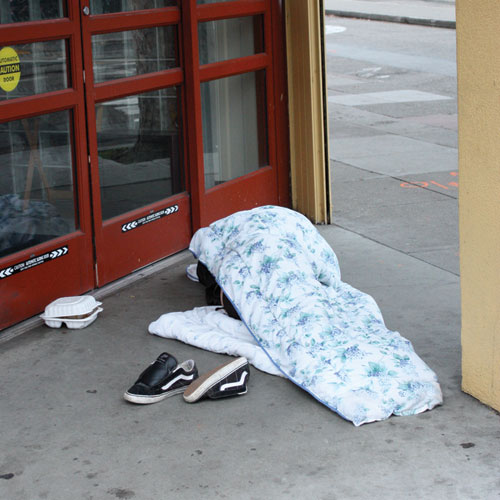
Rodney Palmer is 52, and he uses a cane because he has a bad hip. Walking is painful for the homeless native San Franciscan, but to reserve a bed at a shelter, he’s got to get up early and cover a lot of ground. “I get up at 4 a.m. and go to Glide” in hopes of getting a long-term shelter bed, he told the Guardian. “By the time I get there, there’s people sleeping on the ground.”
People arrive at the homeless assistance center so early because the shelter beds that can be reserved for 90 days free up at 7 a.m. on a first-come, first-served basis — and they’re quickly snapped up.
Palmer reached into his sock and pulled out a small plastic bag full of painkillers to demonstrate how he copes. Lately he hasn’t had any luck getting a long-term bed, so he’s devoting many hours a day to getting on wait lists for overnight beds. That means heading to drop-in centers in SoMa and the Mission, where at least there are chairs he can rest in. “It’s an all-day job,” he said. When it comes to waiting outside, “I feel vulnerable. People can die like that when the winter comes.”
BEYOND SHELTER
A coalition of homeless advocates is trying to change the way shelter beds are allocated in San Francisco, and District 6 Supervisor Jane Kim has taken up their cause, spearheading an initiative for the Nov. 8 ballot. The Fair Shelter Initiative would eliminate “shelter” from the definition of housing under Care Not Cash, the signature homeless policy created under former Mayor Gavin Newsom.
Since about 41 percent of shelter beds are set aside as housing for Care Not Cash recipients — who represent an estimated 7 percent of the city’s homeless population — advocates say the move would effectively free up long-term shelter space for veterans, disabled people, seniors, and others who don’t qualify for Care Not Cash. It would, they say, give everyone an equal shot at getting a bed.
At the same time, proponents say, it would solve a recurring problem of beds going unfilled even as shelter seekers wait for hours on end only to be turned away or to finally give up, discouraged by the system.
Cyn Bivens, a peer advocate at Mission Neighborhood Resource Center, says roughly 60 people sign up for shelter beds on a given day at his facility. People who are trying for the 90-day beds show up before 7 a.m.
“They may drop between one and five beds, but we may have 50 people in line,” Bivens explains. “Usually, by 7:15, I’m saying sorry, they’ve only dropped two beds.” People then continue to sign up all day in hopes of reserving overnight beds, which are released later in the day. Bivens estimates that about half the people who start out seeking a bed don’t wind up getting one.
While Kim and supporters of the Fair Shelter Initiative view the proposed change as a simple adjustment that would improve a dysfunctional system, they face opposition from Mayor Ed Lee and Human Services Agency Director Trent Rohrer, who have described it as a bid to dismantle Care Not Cash.
$59 A MONTH
As things stand, several hundred indigent adults in San Francisco benefit from County Adult Assistance Programs (CAAP), an umbrella encompassing General Assistance and several other programs intended for people who are waiting to receive Social Security Income (SSI) or seeking employment.
Each month, CAAP beneficiaries are allocated a maximum of $422, or $342 in the case of General Assistance recipients, but they never actually see that money. Instead, under Care Not Cash, they receive $65 and $59, respectively, since the rest is deducted for housing. Some CAAP recipients have actual housing in single-room occupancy (SRO) hotels, but roughly two-thirds are guaranteed shelter beds to meet their housing needs, according to an estimate from the Coalition on Homelessness.
The upshot of this system is that most CAAP recipients are effectively made to pay up to $357 a month from their benefits to sleep on a cot in a shelter, provided they make it there by curfew. For one frustrated homeless man on General Assistance who spoke at a July 14 hearing about the proposed initiative, living on less than $2 a day rather than closer to $11 a day was making it very difficult for him to improve his situation.
“I’m trying to look for work,” he said, adding that he’d seen job postings in other cities. “How am I going to subsidize my trip to Emeryville or San Jose? I’m stuck, and there are things that I cannot do.”
Mark Leach, another homeless CAAP beneficiary, said the low cash grant posed a vexing problem for him too: “I can’t afford to pay my phone bill.” Living on nothing more than $65 a month can mean living in isolation, with no way to receive calls in case work becomes available.
Another issue arising from the current system, according to Bob Offer-Westort of the Coalition on Homelessness, is that a disproportionately high number of beds are reserved for the relatively small number of CAAP recipients citywide, and those program beneficiaries don’t always use their beds. Some don’t make it to the shelter in time for curfew, others couch surf, and still others may prefer to sleep outside, far from the confines and crowds of the shelters. If they don’t show up to claim the bed, it will eventually become available to someone else for the night — but that can take hours. So people who either aren’t enrolled in CAAP or don’t already have long-term beds are reduced to waiting, day after day, for space to free up overnight.
If the Fair Shelter Initiative were in place, CAAP recipients “won’t be guaranteed a shelter bed” as part of Care Not Cash, says Offer-Westort. “But they’ll be competing for more beds,” he added, which “should reduce the wait time.”
In the meantime, CAAP recipients who aren’t being housed in SROs or some other transitional housing would receive the full amount of their benefits. Rohrer, the HSA director, seized on this point as problematic, saying that doling out the full cash grants would draw people to San Francisco from other counties where benefits are lower. “If we start to get folks from other counties and states … the result will be more homeless people in San Francisco and less access for folks,” Rohrer said.
Jennifer Friedenbach of the Coalition on Homelessness countered this, saying, “they have never been able to prove that people will come from out of town.” She addressed the notion that the Fair Shelter Initiative would dismantle Care Not Cash by saying, “It’s news to me — big news — that shelter is the entirety of Care Not Cash.”
Opponents of the measure who spoke at the hearing argued that $422 a month was too much to give to a homeless person because it could feed addiction. While it’s true that many homeless people in San Francisco have substance-abuse issues, many others are disabled or have just fallen on hard times. Advocates say they’ve noted a surge in newly homeless people accessing services, particularly women.
HUNDREDS OF BEDS CUT
Compounding the overall problem is that more than 300 shelter beds have been lost since 2004. During the hearing, L.J. Cirilo ticked off a long list of homeless service programs and facilities that had vanished in recent years due to budget cuts, going on for several minutes.
Palmer falls into the category of people who might benefit from a shorter wait time if Kim’s initiative were in place. He was just one of many who turned up at the Mission Neighborhood Resource Center — a homeless drop-in center that offers a clinic, shower, and laundry facilities — to watch a movie and eat supper. Two of the others there said they had experienced traumatic brain injuries and had been victims of identity theft. A construction worker explained that he was seeking odd jobs with little luck. Another man shuffled impatiently back and forth as he spoke, scratching incessantly, while he condemned the entire homeless services system as corrupt.
The measure has drawn opposition from Mayor Lee, who is “concerned that changes to Care Not Cash may begin a process that would unravel the program,” according to Christine Falvey, Lee’s spokesperson. “He wants to make sure we don’t do anything to prevent our department from providing the program.”
Falvey also noted that Lee was interested in meeting with advocates to find an administrative fix, rather than a ballot initiative, that could address concerns about the shortcomings of the shelter system. Kim expressed some openness to that idea at a hearing, but seemed committed to moving forward with changing the system that’s in place. “We do want to address inequity,” she said. “There absolutely should be no vacant beds.”
Runs in the family

culture@sfbg.com
LUST FOR LIFE My Calabrese grandmother is 98, but people routinely mistake her for 75. Nana’s tiny and round, witty and brazen, with laughter in her voice and a mischievous twinkle in her eyes. She stays up late to watch World Wrestling Federation matches, swears like a sailor, cooks like a goddess, crochets, and maintains a garden full of fruit trees.
Most of my femme tricks and working-class paisan survival skills are lessons from her. Nana’s taught me everything from how to do my lipstick to how to stretch the polenta and the pasta-beans when money’s tight. When I named this column “Lust for Life,” I was thinking about sex and the Iggy Pop song and how I aspire to live my own life with gusto. But I was also thinking about Nana. Because Nana is the first person who taught me to have a lust for life.
For a little old Catholic lady, Nana has been amazing about my queerness. She tells homophobes who give her shade about having a queer granddaughter that queerness “runs in the family” (she’s convinced that her own father was bisexual). She used to knit blankets and pom-pom hats for an ex-girlfriend of mine.
But Nana is also human, and flawed. She’s fatphobic, extremely critical of her own body and other people’s bodies; she’s also pretty sex-negative. When her comments about my body cut right to the bone, I try to remember compassion and patience. I grew up with access to a counterculture that has given me the tools to love my body and love sex. Nana was not as fortunate.
This weekend, I got news that Nana is dealing with a serious medical issue. I was at NoLose, a conference for queer fat people and our allies. NoLose was held at the site of the former Edgewater, a notorious swingers hotel. Imagine 150 fat queers descending on a kitschy 1970s panopticon built for cruising, and the debauchery and delight that ensued. You can stand out on your porch and see into the pool, the conference room, and other people’s rooms. It was easy to imagine the hotel as a former swing palace, and there were a lot of shenanigans (spur of the moment play parties, make-out parties, cuddle parties, and a “den of desire”) at the conference.
I didn’t partake in the grand tradition of queer conference booty. I felt too bowled over by the news about Nana to hit on a stranger. But I did want the comfort, connection, and sweetness that sex with a friend can offer when you’re sad. So I texted a new friend I’ve been sleeping with, a sweet queer boy with doe eyes and smooth hands. I told him I was stressed out and asked if he could come over and fuck me. He could, and things did not feel quite so awful the next day.
Nana would be aghast that I’m talking about conferences for fat people and my own sex life here. But to use her phrase: our lust for life runs in the family. I’m grateful for the ways Nana’s fierceness, tenacity, boldness, and mischief have influenced my life. I am who I am today — embodied, brazen, and sexual — because of her.
Pod people
arts@sfbg.com
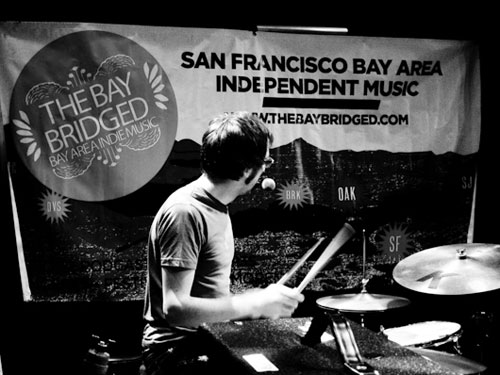
LIGHTS OUT Ironically, the Bay Bridged founders Christian Cunningham and Ben Van Houten were on their yearly pilgrimage to South by Southwest when they came up with the idea for a local music website.
In 2006, the two were watching a San Francisco band whose name has since been lost to time, wondering why they’d come all the way to Austin to discover how much they liked this band from their own town. “It just struck us as odd,” Van Houten explains.
Life-long music fans, they decided they wanted to take active roles in promoting the local SF indie scene. When they returned to the Bay Area, they started an audio podcast. “Since I had done college radio, my friend kept telling me about podcasting and he finally sold me on the idea,” Van Houten says. “We just decided we would interview a band every week that was always local, and that all the music was going to be local.”
From there, the mission expanded — now the Bay Bridged is a nonprofit with a complete website that gives out recording grants and other creative support to local music groups. The podcast continues, airing every other week. During the first week of the month, the site offers tracks from a sampling of bands coming to the Bay Area. Later in the month, it releases a mixtape with a thematic binding agent, like a single artist (the most recent mix featured a set of 15 favorite Ty Segall songs) or a festival (for example, 20 tracks by bands playing at SF Pop Fest 2011). “The question we’ve been asking ourselves for the past five years is how to get people interested in local music,” Van Houten says.
These days, it’s not a Bay Bridged deal breaker if you’re not a local band. Van Houten explains that the organization’s new focus is on getting people out to see the music for themselves. “If you stay just on the Internet, then you’ll discover good things — but you’ll never have that visceral experience one gets with live music.”
Many Bay Area shows are a mix of local and other music, a combination of sounds that becomes part of the experience of seeing these bands. The site clues you into a gig with one of your favorite visiting bands, and in the process you discover a rad local opener: mission accomplished. The website also curates its own concert and festivals, including the third annual Regional Bias fundraiser showcase that will stuff four local indie groups into the Verdi Club on Aug. 6.
“On the radio waves you can’t find independent rock in San Francisco,” Van Houten says. “[But] podcasts are good for many of the same reasons radio is great. I still think there’s a value to being a passive participant in music, to being part of the audience and letting someone else do the programming.”
We’re living in an era when most of our AM and FM radio waves are stuck in a controlled loop. Luckily, it’s also the age of the Internet and for many music fans, creating a podcast is just mic check away.
The Bay Bridged recently made its 250th podcast. And Van Houten sees no end to his role as a local hype man. “Periodically we say, ‘Surely, we’re going to run out of things we’re interested in.’ But It hasn’t happened yet — and I don’t see it happening in the near future.”
THE BAY BRIDGED’S REGIONAL BIAS 2011
With Royal Baths, Little Wings, Sea of Bees, and White Cloud
Aug. 6, 8 p.m., $10–$50 donations
Verdi Club
2424 Mariposa, SF
California dreaming

arts@sfbg.com
HAIRY EYEBALL In his review of the latest Venice Biennale, Boston Globe art critic Sebastian Smee threw down something of a gauntlet when he wrote, “The received wisdom is that contemporary art is mostly about ideas. In truth, however, it’s mostly about gestures.”
Smee’s generalization offers plenty to chew on and plenty to disagree with. For starters, it implicitly presents one of art’s oldest chicken-egg scenarios — one that was muddied decades ago by Marcel Duchamp and later Conceptual Art — as a false choice between thought and spectacle, sustained engagement and capricious showmanship.
But it can also be read as a pretty spot-on diagnosis of the current moment in art — at least, as refracted through the fun house mirror of the Biennale — in which having a gimmick, however thought through or critically engaged, or bringing out the big guns guarantees attention in an increasingly crowded market already clogged with gimmicks and big guns.
Bay Area Now, Yerba Buena Center for the Arts’ triennial snapshot of local creative culture, is the closest thing the Bay Area has to the Biennale and also, thankfully, the furthest thing from it. Still, Smee’s comment provides a useful rubric for navigating its sixth installment, which is full of gestures (some well-executed, others not so much) that at times overshadow the ideas (some half-baked, others worth mulling over) they’re meant to put across.
Visual art curators Betti-Sue Hertz and Thien Lam have pared the number of participating artists, now augmented by art collectives, to a tidy 18. This smaller range gives each participant’s work — most of it created especially for BAN6 — a little more breathing room, although the exhibition’s layout isn’t exactly conducive to following the connecting threads (environmentalism, geopolitics, Americana, and local subcultures, among other topics) unspooled in their curators’ statement.
Tammy Rae Carland’s wonderful series of work about the self-effacing price female comedians have had to pay (and continue to pay) to get a laugh is the first thing you see when you enter. But her photographs of local comediennes in ambiguous forms of self-presentation, text pieces that isolate the painful punch lines of Phyllis Diller, Joan Rivers, et al., and banana peels cast in brass are spread between two floors: a confusing arrangement if you don’t directly proceed up the stairway next to which Carland has created an elegiac installation that, save for the large helium balloons suspending a porcelain microphone, is also easy to miss.
YBCA’s main gallery is another case in point: it’s a good site for large installations that pack a lot of visual impact (think Song Dong’s Waste Not or Nick Cave’s soundsuits), but can pose a challenge for arranging groups of smaller-scale pieces coherently. It’s too bad, then, that the three box-like structures housing works by Brion Nuda Rosch, Rio Babe International, and Chris Sollars cut diagonally across the space like a semipermeable wall of shipping crates. Incidentally, these installations are also some of BAN6’s least compelling pieces.
Harder to ignore is Ben Venom’s See You on the Other Side, a giant quilt whose centerpiece motif of snakes sprouting from a human skull, all made from old metal band T-shirt scraps, only becomes visible as your eyes adjust to the surrounding negative space. It is, in a word, awesome. But it’s also a canny fusion of craft traditions already present in metal subcultures — the quilt is flanked by two cut-off embroidered and studded denim vests, familiar handmade vestments of the tribe — with an older American precedent.
Quilting is also taken up in Suzanne Husky’s nearby Sleep Cell Hotel installation, a collection of three potentially inhabitable nest-like wooden structures that resemble porcupines, replete with quilts covered in radical slogans. A goofy infomercial touts the dwellings as the next development in politically conscious eco-tourism, while a hand-drawn sign warns of their structural unsoundness. Husky’s isolation tanks take the piss out of radical chic and backpackers alike while questioning the impact even the most well-intentioned and off-the-grid 21st century nomads leave in the wake of their habitats beyond carbon footprints.
That question is reframed in more ambiguous terms by Ranu Mukherjee’s wonderful series of drawings and watercolors of “nomadic artifacts” located in YBCA’s smaller second gallery. Each work is based on an image or stories sent to Mukherjee by friends and associates that reflect their conception of the nomadic, a process of translation neatly embodied by the blank fields against which a camper van or an ancient Egyptian temple is depicted. Isolated from their original contexts, these purloined postcards from the edge form an ongoing archive of mobile existence (the call for submissions is still open).
This second room — darkened to accommodate a video projection by Mukherjee as well as Sean McFarland’s crepuscular, large-format photographs of forest interiors — is actually BAN6’s most coherent grouping, with Weston Teruya’s architectural model-like paper sculptures and Richard T. Walker’s winsome three channel video installation rounding out a chorale of differing takes on land use, abuse, occupation, and representation.
In many cases at BAN6, ambition tends to exceed execution, but the results — as with Tony Labat’s large neon marijuana leaf that, seen from the outside, makes YBCA’s Mission Street lobby look like the city’s chicest pot dispensary — still pack a punch. Whether that is enough, or enough for a “moment in time” group survey such as this, is another question.
BAY AREA NOW 6
Through Sept. 25
Thurs.–Sat., noon–8 p.m.; Sun, noon–6 p.m., $5–$7
Yerba Buena Center for the Arts
701 Mission, SF
To Hellman and back
arts@sfbg.com
FILM “Legendary” is a term often applied to artists distinguished by either ubiquity or scarcity. Monte Hellman definitely falls in the second camp — nearly 80, he’s just made his first feature in 22 years, causing a flurry of interest in the sparse 10 he made during the prior three decades he was, relatively speaking, active — movies hardly anyone saw when they came out since none were more than a blip on the commercial radar.
That of course aided his reputation as a fascinating oddball working — when allowed — on the B-movie margins of mainstream entertainment, yet never quite at home there. Presumably this status, and the small number of projects he’s realized (let alone had a satisfying amount of control over), has been a cause of some frustration. Yet the laconic distance from emotional display or anything else that might pander to the audience’s easier responses — even in genres as typically uncomplicated as the western or horror movie — suggests a filmmaker who might well enjoy being perceived as the rugged, tether-resistant outsider. Lord knows it’s impossible to imagine him directing something brash, accessible, and popular.
Not that his interview quotes have ever revealed a willfully elusive nature. Hellman appears at the Roxie Friday, July 22 (and at the Smith Rafael Saturday, July 23) when his new Road to Nowhere opens, so you can gauge for yourself just how the man does or doesn’t feed the enigma his films have built around him.
After that night, the Roxie plays Road on double bills with the four movies that most shaped his cult following, offered in a mini-retrospective called “Monte Hellman: Maximum Minimalism.” They’re all road flicks in one way or another — the typical Hellman film, if there be such, is a one-way trip of some urgency but no certain destination save oblivion. Its protagonists’ circumstances may be desperate, but they themselves ruffle an outwardly sardonic, existential cool as they ride into the incinerating sunset.
Hellman got into the business via Roger Corman, Hollywood’s all-time greatest nose for cheap young talent from Francis Ford Coppola, Peter Bogdanovich, and Martin Scorsese to James Cameron. His first directorial job was 1959’s The Beast From the Haunted Cave, about a giant spider — a movie notable for being better than it needed to be, since it didn’t need to be any good at all, though no indicator of a distinctive sensibility. Nor were two 1964 action movies shot back-to-back in the Philippines, Flight to Fury and Back Door to Hell, though they commenced his brief but key collaboration with Jack Nicholson (who wrote the first as well as acting in both).
The next year they did another two-for-one deal for Corman, Nicholson now producing as well. Ride in the Whirlwind and The Shooting were low-budget westerns shot in Utah, intended for the bottom half of drive-in and grindhouse double bills. As Hellman later said, the expectation that they’d fly so far below radar was freeing: “Any thoughts about doing something different were for our own satisfaction. We never thought that anybody would notice.”
Evidently Corman and/or distributors noticed, because these two idiosyncratically spare Old West odysseys into ever more desolate (and deadly) terrain wound up being sparsely released around the globe as a seeming afterthought over the next many years, then falling into public domain limbo. (You can still find cheap dupes on fly-by-night labels in $1 bins.) The Nicholson-penned Whirlwind has him, a young Harry Dean Stanton, and Rupert Crosse (1969’s The Reivers) as itinerant cowhands mistaken for killer bandits, chased into the desert by vigilantes who’ll shoot first and hear claims of innocence later.
In The Shooting, Nicholson doesn’t appear until midpoint, joining Millie Perkins as a second black-hatted angel of death hiring two cowboys (Warren Oates, Will Hutchins) to lead them on a trek whose slowly revealed actual intent turns the guides into captives. That film, written by Carole Eastman (who later cemented Nicholson’s post-Easy Rider stardom with 1970’s Five Easy Pieces), not only introduced Hellman to his acting muse Oates but attracted enough stealth attention as a strikingly stark genre statement that it was shown out of competition at Cannes.
His mythos already growing in inverse proportion to his films’ popular exposure, Hellman found himself one of the more experienced directors to benefit from the major studios’ early 1970s panic — the old system having largely collapsed, and no clear roadmap to the future in place, they greenlit anything that seemed like it would appeal to the fickle new “youth” audience. Two-Lane Blacktop (1971) was one of many fascinating commercial flops that resulted, a cross-country race with a stubbornly detached, becalmed pulse, Oates wryly chewing scenery that included rock stars James Taylor and Dennis Wilson (as “The Driver” and “The Mechanic” respectively). The two had never acted before, and never would again — indeed you could say Taylor never has, since Hellman’s cryptic communication on set left Sweet Baby James stiff as a board. This effect winds up seeming part and parcel of the film’s droll in-joke tenor; it’s an action movie about extreme acceleration, yet one that absolutely will not get agitated.
There was even less hope of commercial benefit from Cockfighter, a 1974 adaptation of a Charles Willeford pulp with Oates — one actor who never needed being told what to do in the claustrophobic Hellman universe — perfect as the mute loner drifting through an unlovely small-town America of sleazy small-time operators, wayward wimmen, and bloody gambling “sport.” It’s the last film in the Roxie’s mini-retro, alongside the Corman westerns and Blacktop.
Hellman’s subsequent career has largely been off the map — as a director and editor for hire, often fixing problems (like directors who die mid-production) without screen credit. Among films with his name on them, 1978’s China 9, Liberty 37 was an Italian-produced, internationally-cast western that’s okay but uncharacteristically driven by sex and sentiment. (Oates’ rancher says “There ain’t no soft-hearted gunfighters,” but that’s exactly what impossibly handsome Fabio Testi plays.) Direct-to-video killer Santa Claus sequel Silent Night, Deadly Night III: Better Watch Out! (1989) shoehorns just enough eccentricity into the slasher formula to be bearable for Hellman completists.
But the prior year’s Iguana is something else: Shakespeare’s Tempest (with a little Robinson Crusoe) in reverse, a willfully misanthropic castaway adventure in which the facially deformed Oberlus (Twin Peaks‘ Everett McGill) avenges himself on lifelong tormentors by escaping his 19th-century whaling ship and ruthlessly ruling his own “kingdom” of enslaved castaways on an uncharted isle. Its Canary Islands shoot apparently an off-screen form of torment, Iguana was (natch) barely released and remains undervalued, but it’s as uncompromising, bitterly humorous and assured as anything Hellman’s done.
Whether Road to Nowhere qualifies as summary statement or aberration has already divided viewers since its Venice premiere last fall. Written by Iguana‘s Steven Gaydos, it’s a hall of mirrors in which a hotshot filmmaker (Tygh Runyan) making a movie about a woman’s apparent real-life murder casts an alluring non-actress (Shannyn Sossamon) whom an insurance investigator (Waylon Payne) and reporter (Dominique Swain) come to suspect might be playing herself — having faked her own death and adopted a new identity.
The mix of noir, reality-illusion puzzle, industry in-jokes, film history name-dropping (as well as archival clips), uneven performances, sometimes stilted dialogue, brief startling violence, and handsome compositions (shot without permits on a hand-held digital camera) can be taken as two hours of delicious gamesmanship or exasperating self-indulgence. But no one can argue that by now Hellman hasn’t earned his right to be difficult.
MONTE HELLMAN: ROAD TO NOWHERE AND REPERTORY
July 22–28, $5–$10.25
Roxie
3117 16th St., SF
Christopher B. Smith Rafael Film Center
1118 Fourth St., San Rafael
Parton me

marke@sfbg.com
“Well, hi, Marke! This is Dolly calling you from Nashville. I hope you’re doin’ well out there in San Francisco.”
Are you freaking kidding me? There are no better gifts for a little gay boy on Pride weekend than a call from Dolly Parton. After the squee-squee squealing subsided on my end, we got down to business: discussing what she was going to wear on the tour supporting her latest (41st!) album, Better Days on Dolly Records. Would she be pitching any wardrobe curve balls to throw off the legions of Dolly impersonators when she comes to the Concord Pavilion on Sunday, July 24?
“Now, I know you’ve seen me before,” she laughed. “I couldn’t really get much gaudier — unless maybe I walked out with a beaver on my head!”
Gaaaah, I adore her.
“You know, though, I love the drag queens,” Dolly continued, “and all my gay fans, too. I’ve always loved all my fans equally. We just have so much fun together when I’m up on the stage. I always look forward to seeing what the impersonators are gonna wear. It cheers me right up.”
Dolly has never been lachrymose, exactly, but she does have a famous way with homespun bluegrass melancholy — something that’s put to use only sporadically on the new album. Instead, Better Days is meant to be a rootin’, tootin’ shot of inspiration in these dark economic times. Like Backwoods Barbie before it, it doesn’t shy away from sharp power anthems and those unmistakable Dollyisms (“I’m quite content with who I am/And if you ain’t, well, kiss my ham”).
Now playing the honky-tonk preacher — rolling chords and gospel choir included — Dolly’s determined to lift spirits. Her melodies here, including a sparkling solo redo of her great 1974 duet with Porter Wagoner, “Together You and I,” are as infectious as always. And at points her bootstrap-tugging lyrical confidence almost crosses into televangelistic materialism or even classic gangsta rap territory (albeit with killer banjos), unabashedly boasting in “The Sacrifice” about how leaving family, friends, and fun behind has been worth it to be rich and famous. Get that skrilla, Dolly! Make it rain.
“That was an important song for me to write,” Dolly said. “I get a lot of comments on it. But I wanted to be honest. If you want something bad enough, like I did, you need to have faith, work hard, and you can get it. You just need to be prepared to pay the price.”
Some of Better Days‘ razzy boosts might help keep the ever-ambitious musician and businesswoman herself in a positive state of mind, especially now that she’s navigating the current industry with her own label, launched in 2007.
“People may think I’m crazy to start my own thing like this now, but I love calling the shots and being able to release my own material. And to tell you the truth, there just aren’t the big record contracts out there for established performers anymore — those multimillion-dollar deals are mostly for the young people on the rise. And this way, with Dolly Records, I can adapt faster to all the changes going on in the music business.
“I can also be a lot more flexible in what I do, try some new things,” she continued, a mischievous spark lighting up her voice. “I’m even thinking about doing a dance record. I wrote this song just the other day called ‘Just a Wee Bit Gay’ that I think would go really well on the dance floor.”
I told her that the extended version of her 1983 stomper “Potential New Boyfriend” has been ruling certain parties lately, and she sounded tickled. “I never thought that would be what everyone’s into! I’ll have to look into re-releasing that one.”
“You know, I can’t wait to get back to the Bay Area. The people are so warm and friendly,” she concluded. “Now you just make sure to grab all your drag queen friends, fluff up that tutu of yours, and come down and see me, you hear?” Yes, ma’am!
DOLLY PARTON
Sun/24, 7 p.m., $34–$206
Concord Pavilion
2000 Kirker Pass Road, Concord
DOLLY PARTON DRAG TRIBUTE
Thurs/21, 10 p.m.–1 a.m., $5
The Monster Show at the Edge
4149 18th St., SF
Los Yaquis
paulr@sfbg.com
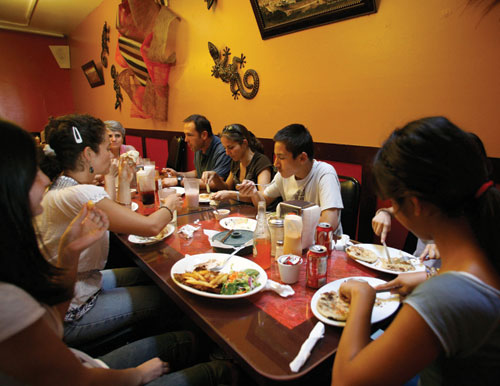
DINE Los Yaquis is easy to find: It’s just steps from los Audis, those gleaming iron horses sitting in their well-lighted lots at the corner of 14th and South Van Ness streets, waiting for people with sacksful of cash to come along and buy them. Window-shopping for cars that cost $40,000 used — and up, plus tax — does make one hungry and slightly value sensitive. In this sense, Los Yaquis couldn’t be better-situated. The restaurant serves quite a few Salvadoran dishes (it was a Salvadoran spot before changing hands two years ago), but its name refers (paradoxically, I thought) to an ancient Indian tribe of the Sonora desert in northern Mexico. The owners, the brothers Sammy and Chava Aguirre, are from Jalisco, in southwest Mexico, and the restaurant’s name turns out to be a family reference to their father.
As a reminder that this part of the city has not always been absolutely fabulous, the windows are lined with iron bars, which give a certain jailhouse cast if you happen to glance toward the street. I haven’t seen fortifications of this sort since I was last at Pauline’s Pizza, a few blocks west on 14th. But that was years ago, along a Valencia Street that has ceased to exist several times over. These days Valencia seems increasingly done over with plate glass. I wonder if this trend will migrate east.
Inside, the ruddy good cheer of a beer hall obtains. And speaking of that: the restaurant offers Corona beer brewed in and imported from Mexico, which is different from the brewed-under-license stuff you typically find around here. The bottle is of brown glass, opaque and etched, and is available in a near-liter size ($12) that looks like a piece of ordnance ready to be loaded into the magazine of a warship. Beer is not usually presented in shareable form, but in this case, sharing should be given careful consideration — if you actually reached bottom, you would want to hand off the Audi keys to someone else.
In homey little spots, one looks for the unusual amid a raft of familiar faces. I had never before come across loroco, for instance, an edible flower that figures in Salvadoran cooking. When I think of edible flowers, I think first of nasturtiums, which are really more edible colors than flavors, or of perfumy lavender. Loroco resembles neither of these; even worked into an expansive pupusa ($2) with cheese, it revealed a peppery, slightly acidic bite. It also wasn’t much to look at — a muddy green, like okra. The spinach-filled pupusa ($2) also had a theme of green, but it was a more luxurious, creamy, liquid sort. And for no green at all, how about good old beans and cheese ($2)? The pupusas are made from white masa and are about as big around as a hamburger bun. Two or three would make a real meal.
The kitchen is also proud of its fried tacos ($7), which come bundled in groups of five, like a litter of puppies. They’re filled with shredded beef, topped with shredded green cabbage, sour cream, and your choice of delicacies, among them head cheese, pig skin, pig’s ears, cactus, and carrot. Quail’s eggs were an elegant thumbnail size, and a kind of ivory white stippled with blue; they looked like bits that had dropped from an example of gorgonzola statuary. To me they tasted like hard-boiled eggs, with the advantage that, because they were bite-sized, they were gone quickly. It was like doing egg shots. A couple of the other finishers, white cheese and avocado, were testament to the limits of adventurousness, but there is a reason these foods are perennially popular.
One of the most striking dishes on the menu is the fish soup ($12.95). Fish definitely means fish in this instance; we turned up a dorsal fin and a tail, each still sheathed in glossy black skin, along with several steaks — i.e. pieces of the creature cut crosswise. There was, thankfully, no head. The flesh had the look and texture of halibut, but the skin was wrong. According to our voluble server, it was catfish, which in my experience tends to turn up as filets, like its farmed river-fish relation, tilapia.
The broth was intense (and housemade), and floating in it, amid the dramatic piscine debris, were bits of tomato and carrot and, for extra color, shreds of spinach. The soup was presented with fresh-made tortillas, still warm in their little plastic flying saucer. Of course they were sublime, but also useless with respect to soup. We dunked, with unimpressive results. A bowl of rice — Spanish rice, plain rice — would have had a better sop factor. As for the tortillas: they would have been better with butter. What isn’t?
LOS YAQUIS
Mon.–Thurs., 9 a.m.–8 p.m.; Fri., 8 a.m.–9 p.m.;
Sat.–Sun., 7 a.m.–9 p.m.
324 South Van Ness, SF
(415) 252-8204
Beer and wine
MC/V
Somewhat noisy
Wheelchair accessible
Turning the tide
arts@sfbg.com
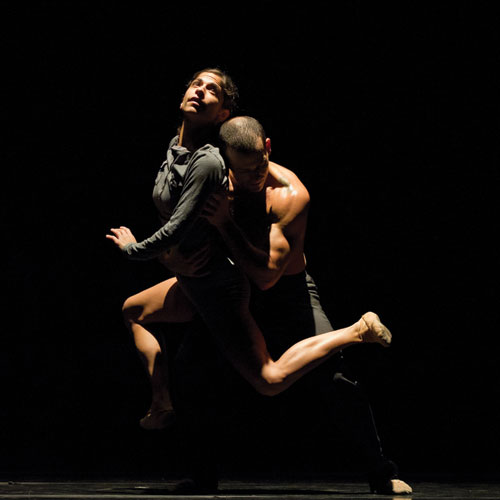
DANCE Joan Lazarus is one determined woman. This month, WestWave Dance celebrates its 20th anniversary. WestWave originated in 1991 as SummerFest by choreographer Cathleen Murphy; Lazarus joined her three years later, and the two women ran it together until Murphy moved on.
A few months ago Lazarus made noises about perhaps calling it quits. She was frustrated because in all the years of curating these annual menus of contemporary, often brand-new, choreography, “I could not make it work,” she says. Audiences remained small, budgets smaller.
From the beginning, Summerfest/WestWave had a clear idea of its role within the panoply of Bay Area dance. Most important was offering opportunities to choreographers who may not be on other presenters’ radar screens and who didn’t have the cash — or energy — to self-produce. The application process has always been wide open. This year, for instance, Lazarus programmed three unknown-to-her choreographers simply on the basis of the video they submitted. “I was intrigued by their work,” she explains.
It was imperative to present each choreographer under the best circumstances, which meant a professional presentation — lighting, sound, tech — in a professional setting, like the Cowell or ODC theaters. It was also important to create visibility, which usually translated into getting reviews. “It was only in year seven or eight that we started getting reviewed,” Lazarus remembers. “That’s when we noticed a tremendous jump in people who wanted to be in.” Still, the festival barely scraped by. Every year it was touch and go.
Lazarus sounds newly invigorated about starting another decade for this problem child of local dance that, nonetheless, has given many a choreographer — Katie Faulkner, Ben Levy, and Kara Davis among them — a push up the professional ladder. So what happened?
An experienced local presenter Lazarus consulted with told her that what she did didn’t work because it couldn’t be done. Audiences, she was told, will not attend contemporary performances on successive nights, so forget about trying to run this type of program as a festival. She should also forget about preferring world premieres (something Lazarus admits she was “prejudiced toward”) and insist instead that the artists present the best pieces they have. “You choose the artists based on their previous works and then let them make the decision on what they want to show,” she recalls from the conversation.
Last year — by programming WestWave on three monthly Monday nights — Lazarus took a first step in rectifying the situation. The overall quality of the three evenings turned out to be more than respectable.
For the 20th anniversary season she expanded the format. Evenings of solos, duets, trios, and more will again be shown on Monday nights: Aug. 15, Sept. 12, and Oct. 10 at ODC Theater.
This month, Lazarus wanted to feature some of the artists for whom WestWave had been an important early step. This weekend (July 22-24) at Z Space, she offered Seiwert — in 2007, WestWave had hosted her first full-evening concert — another program along the same lines. But Seiwert demurred, wanting her im’ij-re dancers to grow beyond her own choreography. So with Lazarus’ assent, Seiwert commissioned works from Matthew Neenan (Philadelphia), Adam Houghland (Cincinnati), and Susan Roemer (San Francisco).
For the second July program (July 28-29), the artists Lazarus selected asked to co-choreograph a single work. Lazarus told Manuelito Biag, Davis, Faulkner, and Alex Ketley to go ahead. Since each of them has a well-developed independent voice, this collaboration could prove fascinating. Later that weekend (July 30), Viktor Kabaniaev and Tina Kay Bohnstedt — Diablo Ballet’s strong in-house-nurtured choreographers — present an evening of their own work. Why? “Because they have never had one, and it’s about time,” Lazarus says.
One more change. Lazarus quit her daytime jobs so that she won’t have to steal an hour here and an hour there, often at midnight, to work on WestWave. “We’ll see how it goes, ” she laughs, ever the optimist.
WESTWAVE DANCE
July 22–31, 8 p.m., $18–$25
Z Space
450 Florida, SF
Aug. 15, Sept. 12, and Oct. 10, 8 p.m., $18–$25
ODC Theater
3153 17th St., SF
1-866-55-TICKETS
Nude Beaches Guide 2011

garhan@aol.com
A few snippets from the year in nude beaches: TV installer Paul Jung enjoyed playing nude volleyball on the north end of Baker Beach. Stinson Beach local and attorney-teacher Fred Jaggi preferred to be naked while tossing a Frisbee on Red Rock Beach in the North Bay. And when he wasn’t busy representing an area that stretches from Tomales south to Muir Beach and as far east as Novato, Marin County Supervisor Steve Kinsey could sometimes be found without a stitch of clothing at a beach in Point Reyes National Seashore.
They’ll be able to continue enjoying their favorite clothing-optional spots. Unfortunately, that’s not the case for all Californians.
BUDGET CUTS TO NAKED SPACE
As you may have heard, our state government plans to close 70 state parks and beaches, including at least three places in Northern California that have traditionally attracted naturists: Montara’s Gray Whale Cove State Beach in San Mateo County, Garrapata State Park near Carmel, and Zmudowski State Beach in northern Monterey County. All three sites have seen declines in nude use recently.
But there’s good news too: After a July 8 meeting of the California State Park & Recreation Commission, Allen Baylis, a board member of the Naturist Action Committee, was hopeful that the state will soon officially designate some beaches as clothing-optional — and said that progress is being made behind the scenes. “We’re going to get there sooner or later,” he predicted. Plus, we’ve learned that none of the spots slated for closure will be fully shuttered before July 2012.
Roy Stearns, deputy director of communications of the California State Parks, says that until then “there may be service reductions and closures on non-peak days, such as Monday through Thursday,” but nothing firm has been decided yet.
“And how do you really close a beach?” asks a state official who wants to remain anonymous. “It’s never been done before in California, so it’s new territory to us. Sure, we can close the bathrooms and the doors, turn off the electricity, and stop the garbage pickup, but you probably can’t keep people out.”
To prevent them from being broken or vandalized, authorities may even decide to keep some gates open at closed beaches.
MARIN TIDINGS
Thankfully, Kinsey won’t have to worry about those concerns in Marin County, although he has had his hands full trying to broker an agreement between homeowners and nudists at Muir Beach in 2009 and 2010. In the end, county officials ordered a sign to be erected on the sand, warning visitors not to engage in lewd behavior and encouraging them to report violations to law enforcers.
“My favorite ongoing spot for going au natural is Limantour Beach, in the dunes heading toward Drakes Estero,” Kinsey says. In fact, while others were mowing their lawns or having barbecues with their families, Kinsey spent part of his Fourth of July weekend sunbathing in the nude area of Limantour.
Limantour isn’t the only clothing-optional place in Marin where Kinsey likes to relax. He was at Bass Lake, also in the Point Reyes National Seashore last year. “And I make it a point to check Red Rock once a year to make sure things are steady and stable,” Kinsey says.
THE NEW BEACH ON THE BLOCK
Even while some nude beaches face closure, we’re proud to add North Garberville Nude Beach in Humboldt County to our online guide this year.
Its discovery comes as a surprise to us, even though it has been known to locals for years. If there’s one thing we’ve learned about covering — and uncovering — nude beaches over the years, it’s to expect the unexpected.
For instance, at North Garberville some visitors even camp naked. “I’ve done it, but so have others,” says reader Dave.
NAKED ON THE MOUNTAINTOP
In January, the leader of the Tahoe Area Naturists, North Swanson, used snowshoes to walk down a flurry-covered hill and go nude with some friends at Secret Harbor Creek Beach, just south of Incline Village, in North Lake Tahoe. “If it’s above 40 degrees and there’s no wind, it’s okay,” says Swanson, who went back several more times that month.
A few times, bears have wandered onto nude beaches at Tahoe during broad daylight, though nobody’s been injured, and the bears have left quickly every time. Once, a federal park ranger on a trail near Marin County’s Bass Lake let a group of nudists pass without incident while he was busy writing a citation to a man (clothed) for not having his dog on a leash.
About the ratings: We give an A to spots that are large or well-established and where the crowd is mostly nude, B to places where fewer than half the visitors are nude, C to small or emerging nude areas, and D to areas we suggest you avoid.
Please send brainstorms, your new beach finds, trip reports, and improved directions (especially road milepost numbers), along with your phone number to garhan@aol.com or Gary Hanauer, c/o San Francisco Bay Guardian, 135 Mississippi St., San Francisco CA 94107
SAN FRANCISCO
NORTH BAKER BEACH
RATING: A
From the first day of summer, when several hundred people appeared — by the estimate of regular visitor Paul Jung — to the warm spells that followed, visitors have been swarming onto San Francisco’s North Baker Beach this year. And when it’s been hot, 60 percent to 80 percent of those people showing up on the shoreline have been nude. The only bummer: a mini-war has erupted between beach regulars and a few gawkers with cameras or binoculars who occasionally hang out in the rocks above the site. “Most of the regulars carry small mirrors to shine at them,” explains Jung, who keeps one in his beach bag. “Some people are even starting to shine laser pointers at them, with great success. Sometimes, five of us will aim up at one guy. So far, it’s been pretty effective in getting them to back off.”
Directions: Take the 29 Sunset or go north on 25th Avenue to Lincoln Boulevard. Turn right and take the second left onto Bowley Street. Follow Bowley to Gibson Road, turn right, and follow Gibson to the east parking lot. At the beach, head right to the nude area, which starts at the brown and yellow “Hazardous surf, undertow, swim at your own risk” sign. Some motorcycles in the lot have been vandalized, possibly by car owners angered by bikers parking in car spaces; to avoid trouble, motorcyclists should park in the motorcycle area near the cyclone fence.
LAND’S END BEACH
RATING: A
What ends at Land’s End? Quite possibly your tan lines. Shorts, bikini tops, and even a few work clothes seem to disappear during weekday lunch breaks on warm summer days at this fun cove, which attracts a few skinny-dippers among a mostly swimsuit-wearing crowd. The site features a mix of sand and rocks, plus some of the Bay Area’s best views. The beach is a quarter-mile long, with some nice sunbathing nooks. Bring a windbreaker in case the weather changes or check out the mini-windbreaks that visitors there have made with rocks and put together one of your own.
Directions: Follow Geary Boulevard to the end, then park in the dirt lot up the road from the Cliff House. Take the trail at the far end of the lot. About 100 yards (past a bench and some trash cans) the path narrows and bends, then rises and falls, eventually becoming the width of a road. Don’t take the road to the right, which leads to a golf course. Just past another bench, as the trail turns right, go left toward a group of dead trees where you will see a stairway and a “Dogs must be leashed” sign. Descend and head left to another stairway, which leads to a 100-foot walk to the cove. Or instead, take the service road below the El Camino del Mar parking lot for a quarter-mile until you reach a bench, then follow the trail there. It’s eroded in a few places. At the end, you’ll have to scramble over some rocks. Turn left (west) and walk until you find a good place to put down your towel.
GOLDEN GATE BRIDGE BEACH
RATING: A
Golden Gate Bridge Beach’s rocky shoreline features incredible views of the world-famous bridge, along with water that can be great for wading. “In low tide,” one woman says, “you can sometimes go 150 feet.” But if you want to be alone, don’t even think about visiting this site, where hundreds of gay men — along with some women and straight visitors — pack three side-by-side coves on the hottest days. No wonder it’s also known as Nasty Boy Beach!
Directions: From the toll booth area of Highway 101/1, take Lincoln Boulevard west about a half mile to Langdon Court. Turn right (west) on Langdon and look for space in the parking lots, across Lincoln from Fort Winfield Scott. Park and then take the beach trail, starting just west of the end of Langdon, down its more than 200 steps to Golden Gate Bridge Beach, also known as Marshall’s Beach. Despite recent improvements, the trail to the beach can still be slippery, especially in the winter and spring.
FORT FUNSTON BEACH
RATING: C
Even though Fort Funston has gone to the dogs — who appear here with their human entourages by the hundreds — a few naturists sneak in from time to time. But don’t even think about going naked here on weekends. Even on weekdays, be sure to use discretion before disrobing. Suit up quickly if you see rangers or families in the area. Authorities usually only issue several citations a year at Fort Funston, south of Ocean Beach, so if you don’t make a fuss and remain in the dunes, you may not be busted. If anyone complains, put on your beach gear right away. Two more fun activities at Fort Fun: watching the passing parade of people and their dogs, and watching the hanggliders that take off from the cliffs.
Directions: From San Francisco, go west to Ocean Beach, then south on the Great Highway. After Sloat Boulevard, the road heads uphill. From there, curve right onto Skyline Boulevard, go past one stoplight, and look for signs for Funston on the right. Turn into the public lot and find a space near the west side. At the southwest end, take the sandy steps to the beach, turn right, and walk to the dunes. Find a spot as far as possible from the parking lot. Don’t go nude here on the weekends. And if you dislike dogs, try another beach.
CONTRA COSTA COUNTY
LAS TRAMPAS REGIONAL WILDERNESS
RATING: C
Are you ready to moon the moon? Imagine walking nude on parkland in the East Bay Hills, with the trail silhouetted by a full moon and small herds of horses coming up to greet you: it’s a scene that makes you feel like you’re on Avatar‘s fictional planet Pandora, mingling with another species.
“It’s absolutely surreal,” says Jurek Zarzycki of Fremont. “The horses come within inches of you, so close you can feel their breath. It’s like being on a moonscape with aliens. You may be a little afraid at first, but the horses are very friendly.”
As part of a partnership between the Sequoians nudist park and the San Jose-based Bay Area Naturists, Hikers leave the Sequoians’ property fully clothed at dusk and walk through meadows and up hills until the moon rises, before heading back down the slopes completely nude, with their clothes folded neatly into their backpacks. Some people walk partially nude, especially near the top of the main ridge used by the hikers where, says Zarzycki, “there can be very cold winds.” San Leandro resident Dave Smith, who leads the naked treks, adds that “the coastal air just starts pouring over the hilltop. And the wind begins howling.” Once on the peak, almost everyone dons a windbreaker.
Zarzycki suggests hikers bring good hiking shoes, a flashlight — though most of the time, the moon provides plenty of light — and bug spray. And don’t forget baby carrots to give to the horses. “It’s truly wonderful,” says Smith. “We’re usually the only ones on the path.”
Zarzycki agrees. “It’s one of the best experiences I’ve ever had. I pitched my tent right there at the Sequoians and then slept under the sky.”
After the walk, most hikers shower at the Sequoians, then take a dip in the pool or hot tub.
Directions: Contact the Sequoians (www.sequoians.com) or the Bay Area Naturists (www.bayareanaturists.org) for details on how to join a walk. Meet at the Sequoians park. To get there, take Highway 580 east to the Crow Canyon Road exit. Or follow 580 west to the first Castro Valley off-ramp. Take Crow Canyon Road toward San Ramon three-quarters of a mile to Cull Canyon Road. Then follow Cull Canyon about 6.5 miles to the end of the paved road. Take the dirt road on the right until the Y in the road and keep left. Shortly after, you’ll see the Sequoians sign. Proceed for another three-quarters mile to the Sequoians front gate.
SAN MATEO COUNTY
DEVIL’S SLIDE, MONTARA
RATING: A
Though it’s one of 70 beaches and parks being closed by the state to save money, Gray Whale Cove is set to remain available for use through at least July 2012. (But days and hours may be reduced according to Roy Stearns, deputy director of communications of the California State Parks.) Today only a few visitors go nude: naturist numbers are down sharply form the several hundred that came during Devil Slide’s heyday as a privately operated nude beach. The nudists that do come tend to hang out on the pretty northern end of the shoreline. “It’s a good place to recharge from work,” says Ron, a regular visitor who enjoys swimming there, even though signs warn of dangerous surf. Dogs are prohibited.
Directions: Driving from San Francisco, take Highway 1 south through Pacifica. Three miles south of the Denny’s restaurant in Linda Mar, turn left (inland or east) on an unmarked road, which takes you to the beach’s parking lot and to a 146-step staircase that leads to the sand. Coming from the south on Highway 1, look for a road on the right (east), 1.2 miles north of the Chart House restaurant in Montara.
SAN GREGORIO NUDE BEACH, SAN GREGORIO
RATING: A
Now in its 45th year of operation, San Gregorio continues its reign as the USA’s longest continually used nude beach. The beach, adjacent to the no-nudity-allowed San Gregorio State Beach, usually attracts a large gay crowd, along with some nude and suited straight couples, singles, and families. First-timers should be wary of the driftwood structures on the sandy slope leading down to the beach, which are used by some visitors as “sex condos.” (If you see one with a t-shirt on a pole, it means it’s occupied.) However, fans of the beach savor San Gregorio’s stunning scenery. It has “awesome natural beauty,” says regular visitor Bob Wood. Attractions at this 120-acre site include two miles of great sand and intriguing tide pools to explore, as well as a lagoon and lava tube.
Directions: From San Francisco, drive south on Highway 1 past Half Moon Bay. Between mileposts 18 and 19, look on the right side of the road for telephone call box number SM 001 0195 at the Stage Road intersection. From there, continue 1.1 miles to the entrance, ABOUT 0.1 MILES from Junction 84. Turn into a gravel driveway, passing through an iron gate with 19429 on the gatepost. Drive past a grassy field to the parking lot, where you’ll be asked to pay an entrance fee. Take the long path from the lot to the sand; everything north of the trail’s end is clothing-optional (families and swimsuit-using visitors tend to stay on the south end of the beach). The beach is also accessible from the San Gregorio State Beach parking area to the south; from there, hike about a half mile north. Take the dirt road past the big white gate with the toll road sign to the parking lot.
SANTA CRUZ COUNTY
BONNY DOON NUDE BEACH, BONNY DOON
RATING: A
At Bonny Doon, “free bathers” head for the northernmost of two coves, where Santa Cruz County’s best-looking nude beach usually has a friendly, social crowd. In recent years, its delightful scenery and peaceful vibes have attracted more women and couples than most clothing-optional sites. However, the Doon’s reputation has been tarnished recently by reports of increased visits by law enforcers and comments left on message boards by men and women alike about some men on the sand making unwanted advances. Jill from Santa Cruz visited the beach in March and wrote that, even after she and her boyfriend left, “one of the men actually got up and followed us.” But after a June visit, Elizabeth from San Jose said, “I gave them the get-away-from-me look and things were cool after that.”
Directions: Go south on Highway 1 to the Bonny Doon parking lot at milepost 27.6 on the west side of the road, about 11 miles north of Santa Cruz. From Santa Cruz, head north on Highway 1 until you see Bonny Doon Road, which veers sharply to the right just south of Davenport. The beach is right off the intersection. Park in the paved lot to the west of Highway 1; don’t park on Bonny Doon Road or the shoulder of Highway 1. If the lot is full, drive north on Highway 1, park at the next beach lot and walk back to the first lot. To get to the beach, climb the berm next to the railroad tracks adjacent to the Bonny Doon lot, cross the tracks, descend, and take the trail to the sand. Walk north past most of the beach to the cove on the north end.
2222, SANTA CRUZ
RATING: A
Named for the house number across the street, America’s smallest nude beach could probably fit in your yard. And that’s what makes it a magical place. You won’t find crowds at this pocket size cove, which takes scrambling to reach and isn’t recommended for children or anyone who isn’t a good hiker. However, those who are agile enough to make it down a steep cliff and over some concrete blocks on the way down will probably be rewarded with an oasis of calm and a good spot to catch some sunrays. Even though there’s a walking path just above it, the beach can’t be seen from above. College students like to hang out here and, if they’re lucky, get a glimpse of a local juggler who can sometimes be seen practicing his routines on the sand.
Directions: The beach is a few blocks west of Natural Bridges State Beach and about 2.5 miles north of the Santa Cruz Boardwalk. From either north or south of Santa Cruz, take Highway 1 to Swift Street. Drive for 0.8 miles to the ocean, then turn right on West Cliff Drive. The beach is five blocks away. Past Auburn Avenue, look for 2222 West Cliff on the inland side of the street. Park in the nine-car lot next to the cliff. If it’s full, continue straight and park along Chico Avenue. Use care in following the path on the side of the beach closest to downtown Santa Cruz and the municipal wharf.
PRIVATES BEACH, SANTA CRUZ
RATING: A
Surf and turf conditions at Privates are excellent once again. The beach — 4524 Opal Cliff Drive, north of the Capitola Pier — is nearly always pristine. “Privates is one of my favorite beaches,” says Brittney Barrios, manager of the nearby Freeline Design Surfboards shop. “It’s always very peaceful.” Nudists, surfers, and families all mingle on the sand. “Everyone gets along,” adds Barrios. “And it’s never crowded.” Barrios, who likes to lay out in the sun at Privates, says many of the local naturists share a favorite pastime: “They like to play paddle ball.”
Directions: Some visitors walk north from Capitola Pier in low tide (not a good idea since at least four people have needed to be rescued). Others reach it in low tide via the stairs at the end of 41st Avenue, which lead to a surf spot called the Hook at the south end of a rocky shore known as Pleasure Point. Surfers can paddle on their boards for the short stretch between Privates and Capitola or the Hook. But most visitors buy a key to the beach gate for $100 a year at Freeline (821 41st Ave., Santa Cruz (831) 476-2950), 1.5 blocks west of the beach. Others go with someone with a key or wait outside the gate until a person with a key goes in, provided a security guard is not present (they often are). “Most people will gladly hold the gate open for someone behind them whose hands are full,” says Bay Area Naturists leader Rich Pasco. The nude area starts to the left of the bottom of the stairs.
MARIN COUNTY
MUIR NUDE BEACH
RATING: A
Happier times have returned to the clothing-optional portion of Muir Beach, long cherished by nudists and known to locals as Little Beach. “Dogs without leashes have replaced people without swimsuits as the top beach concern of the season,” says Steve Kinsey, the member of the Marin County Board of Supervisors who found himself smack dab in the middle of the brouhaha between some homeowners and nudists over use of the sand in the last few years. After several community meetings, it was decided that, while naked use of the incredibly beautiful cove would not be ended, a warning sign stressing “respect” for everyone and listing a phone number for complaints would be installed by the county. Unlike many other nude beaches, Muir doesn’t have a challenging beach path, with eroded steps or poison oak — and the swimming here can be good. To reach it, walk along the water to the north end of the public beach and follow the others you will see crossing over a line of rocks there.
Directions: From San Francisco, take Highway 1 north to Muir Beach to milepost 5.7. Turn left on Pacific Way and park in the Muir lot (to avoid tickets, don’t park on Pacific). Or, park on the long street off Highway 1 across from Pacific and about 100 yards north. From the Muir lot, follow a path and boardwalk to the sand. Then walk north to a pile of rocks between the cliffs and the sea. You’ll need good hiking or walking shoes to cross. In very low tide, try to cross closer to the water. The nude area starts north of it.
RED ROCK BEACH, STINSON BEACH
RATING: A
With what’s thought to be the friendliest Bay Area nude beach crowd, Marin’s Red Rock Beach plays host to Ultimate Frisbee games that last up to three hours. Nudists are also trying their luck at double disc court, for which players toss two Frisbees at once (“We throw them really hard and fast,” says Fred Jaggi, the attorney-teacher from Stinson Beach), and Befuddle, which, Jaggi explains, means that “you throw the first one soft and the second disc hard.” Naked Scrabble has replaced nude hearts as the most popular game played by sunbathers. Tips: the lower part of the trail sometimes is slippery, so wear good shoes on the path instead of flip-flops. For more sitting space, visit when the tide is low (check tide tables before visiting) and bring a folding beach chair. If possible, arrive early in the day, before crowds, or come on a Monday.
Directions: Go north on Highway 1 from Mill Valley, following the signs to Stinson Beach. At the long line of mailboxes next to the Muir Beach cutoff point, start checking your odometer. Look for a dirt lot full of cars to the left (west) of the highway 5.6 miles north of Muir and a smaller one on east side of the road. The lots are at milepost 11.3, one mile south of Stinson Beach. Limited parking is also available 150 yards to the south on the west side of Highway 1. Or from Mill Valley, take the West Marin/Bolinas Stage toward Stinson Beach and Bolinas. Get off at the intersection of Panoramic Highway and Highway 1. Then walk south 0.6 mile to the Red Rock lots. Follow the long, steep path to the beach that starts near the Dumpster next to the main parking lot.
BASS LAKE, BOLINAS
RATING: A
“It really was nice in May,” says Dave Smith of San Leandro regarding his visit to beautiful Bass Lake, deep in the Point Reyes National Seashore. The lake lies off a path that, if you continue past the lake turnoff, will eventually take you to a waterfall. “The trail was a little overgrown — but I had fun swimming nude in the lake.” Bass, though, doesn’t attract as many nudists as it did 10 years ago. “When I first went, everybody was nude,” says Smith, who usually leads a group of Bay Area Naturists once a year for picnicking and swimming outings at Bass — which, by the way, doesn’t have any bass fish. Pat, a recent visitor, says, “Most people are cool if you take off your clothes, but some are kind of freaked out.” Suggestions: bring an air mattress, water shoes, and a thick towel or tarp for sitting on the matted, sometimes prickly meadow near the water. For even more fun, try the lake’s rope swing.
Directions: From Stinson Beach, go north on Highway 1. Just north of Bolinas Lagoon, turn left on the often-unmarked exit to Bolinas. Follow the road as it curves along the lagoon and eventually ends at Olema-Bolinas Road. Continue along Olema-Bolinas Road to the stop sign at Mesa Road. Turn right on Mesa and drive four miles until it becomes a dirt road and ends at a parking lot. On hot days the lot fills quickly. A sign at the trailhead next to the lot will guide you down scenic Palomarin Trail to the lake. For directions to Alamere Falls, 1.5 miles past Bass Lake, please see “Elsewhere In Marin” in our online listings.
RCA BEACH, BOLINAS
RATING: A
Inspiring. Romantic. Isolated. Rugged. However you describe RCA Beach, a Point Reyes National Seashore property near Bolinas, you’ll probably say you like it. “It hasn’t changed much in 20 years,” says regular visitor Michael Velkoff. But it can be a bit breezy at the cove, which requires a moderately long walk to reach. The good news is that there are lots of nooks that are sheltered from the wind. And there’s so much driftwood on the sand that many people build windbreaks or even whole forts. Though seldom deserted, RCA is never crowded and averages five to 20 people per day. “It’s a quiet place,” says Velkoff. “Whenever I’ve been there, everyone’s been nude.”
Directions: From Stinson Beach, take Highway 1 (Shoreline Highway) north toward Calle Del Mar for4.5 miles. Turn left onto Olema Bolinas Road and follow it 1.8 miles to Mesa Road in Bolinas. Turn right and stay on Mesa until you see cars parked past some old transmission towers. Park and walk a quarter mile to the end of the pavement. Go left through the gap in the fence. The trail leads to a gravel road. Follow it until you see a path on your right, leading through a gate. Take it along the cliff top until it veers down to the beach. Or continue along Mesa until you come to a grove of eucalyptus trees. Enter through the gate here, then hike a half mile through a cow pasture on a path that will also bring you through thick brush. The second route is slippery and eroding, but less steep. “It’s shorter, but toward the end there’s a rope for you to hold onto going down the cliff,” says Velkoff.
LIMANTOUR BEACH, OLEMA
RATING: B
On warm days in the summer, arrive by 10:30 a.m. or the parking lot of this Olema-area clothing-optional beach may be full. More parking is located a half mile away. Even with several hundred visitors on a hot weekend day, Limantour is so large that it usually looks deserted. Recently named one of the USA’s top 10 national park beaches in the west by Sunset Magazine, you may just want to wear one thing: a pair of binoculars for watching birds, whales, and seals. Leashed dogs are okay, but only on the south half of the beach. Nudity is allowed away from main public areas like the parking lot or a picnic area, as long as nobody complains. A regular visitor says he walks several minutes from the lot before going nude. “The closest person is usually 100 to 150 yards away,” he says. Also popular for disrobing are the sand dunes on the north end.
Directions: Follow Highway 101 north to the Sir Francis Drake Boulevard exit, then follow Sir Francis through San Anselmo and Lagunitas to Olema. At the intersection with Highway 1, turn right onto 1. Just north of Olema, go left on Bear Valley Road. A mile after the turnoff for the Bear Valley Visitor Center, turn left (at the Limantour Beach sign) on Limantour Road and follow it 11 miles to the parking lot at the end. Walk north a half mile until you see some dunes about 50 yards east of the shore. Nudists usually prefer the valleys between the dunes for sunbathing, which may be nearly devoid of, or dotted with, users depending on the day.
GET NAKED: UPCOMING NUDIST EVENTS
BODYFEST
A five day long, clothing-optional summer camp at a retreat in the Santa Cruz Hills
July 20–26, www.photonaturals.com
SEQUOIANS NUDIST PARK
The family friendly Castro Valley park is holding a naked luau on July 30, an outdoor movie on the lawn Aug. 6, and a day of Jamaican food and reggae music Aug. 20.
FULL MOON HIKE
For fun that’s not in the sun, join this group nude hike in the East Bay Hills.
Next hike Sept. 9. Leaves from the Sequoians, Castro Valley. www.sequoians.com
BONNY DOON BEACH CLEANUP
Want to help the environment and work on your tan at the same time? Drop by this nude beach to give back to nature, in your natural state.
Sept. 17. Bonny Doon Beach, Santa Cruz. www.bayareanaturists.org
NUDE BEACH PARTY DAY
Clothes-free races, nude fashion show, track and field events, naked sand sculpting, and body painting — and prizes up to $500 for winners.
Oct. 8, 11 a.m.–4 p.m., free. North Baker Beach, SF. www.photonaturals.com
Winning big

le.chicken.farmer@gmail.com
CHEAP EATS In Lovelock at the Saddest Little Carnival Ever I threw ping-pong balls into little glass cups of water and in this manner won two goldfish. Live ones, looping insanely in a small plastic water cup with a lid on it.
“What do you have to do to win a stuffed one?” I said, indicating with a tilt of my head one of the strings of orange-and-white-striped Nemo fish adorning all four posts of the booth. These would have made much better travel companions. Then I could have given it to one of the chunks when I got home.
The carny flashed a piano keyboard smile and drawled, “Those are just for show.”
“I see,” I said, wishing I could have those five-for-a-dollar ping-pong balls back and miss this time. What was I going to do with a plastic cup of goldfish on a 10-day road trip?
There were about 14 other people at the Saddest Little Carnival Ever, and about 13 of them were not on the Zipper, the Orbit, the Spaceship 2000, or the merry-go-round. I found a 10-year-old mark who had gotten away from his parents for the moment and looked like he might know what to do with some goldfish on a 10-day road trip. Or maybe he lived in Lovelock.
“Do you want them?” I said.
“Yes,” he said.
So I handed him the little plastic cup and got the hell out of there before his parents came around.
I should have gambled, because lately I’ve been hitting my marks. In San Francisco, weirdly, I scored goals each of the past two Sundays. One was in a 14-4 win, so everyone was doing it, and the other — in a 6-5 win — was lucky cause it grazed off a defender’s head or their keeper surely would have gotten it.
But that’s what I’m saying. Lucky. I should have gambled in Lovelock. On money, not ping-pong balls and goldfish.
Alice Shaw the Person, my teammate and old friend, wanted to go to a barbecue with all the Brazilian boys on our team, and — having grilled the meats with Brazilian boys myself, once or twice — I wanted to go too.
Alas, I had me some childerns to tend to that afternoon, so Alice Shaw the Person went to the feast with someone else and lent me her car to get home.
In life, no one has lent me more cars than Alice Shaw the Person. The last thing I want to do is get onions all over her upholstery. But I was not only hungry as a fullback, I was running late for work and needed of course a bath.
So I did. I ate in the car. First I had to find a parking spot between Ghirardelli Square and the Mission, and that happened at Gough and Hayes. So Kebabs of Hayes Valley seemed like a pretty good idea.
Kebabs in cars, right? It’s like a giant toothpick only it’s putting in instead of taking out, and in the end everyone is happy, give or take the onions.
Yeah, but I didn’t get kebabs. They had Mediterranean wraps, and that seemed even better. Lamb and beef gyro on lavash, with lettuce, tomato, pepper, cukes, and tahini. Sounds to me like shawarma.
Whatever, it was so good, and I was so hungry, that I’m pretty sure none of it — not even a crumb — made it to the floor or even the seat of that car.
One thing, though: there wasn’t any lamb, or beef, in my lamb and beef gyro wrap. It was chicken. All chicken. And it was so juicy and delicious that instead of being mad I was like, yeah, that’s what I meant.
So: New favorite restaurant, for reading my mind. And for being there. It seemed like an okay place to eat in, too. Some people were. They looked happy and clean.
But what do I know?
I know there’s a little boy in Nevada whose parents are yelling at him, right now, and while this isn’t ideal, I’ll take it.
KEBABS OF HAYES VALLEY
Sun.–Thu. 11 a.m.–10 p.m.;
Fri.–Sat. 11 a.m.–11 p.m.
406 Hayes, SF
(415) 252-5100
kebabsofhayesvalley.com
Beer and wine
MC/V
Over the edge
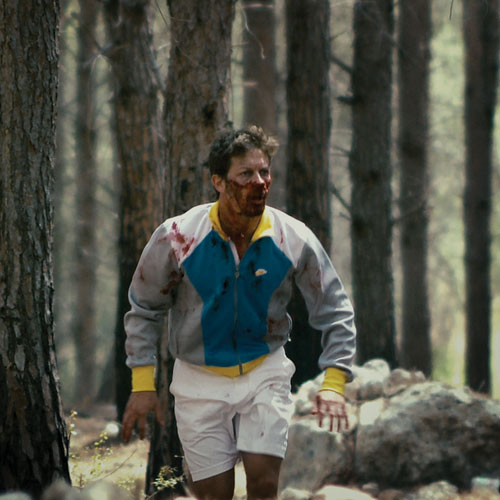
cheryl@sfbg.com
SAN FRANCISCO JEWISH FILM FESTIVAL The 2011 San Francisco Jewish Film Festival program touts Rabies as Israel’s first horror movie. I suppose I agree that the gloriously trashy filmography of producers Menahem Golan and Yoran Globus doesn’t technically count, though the cousins were Israeli and can be thanked/blamed for flicks like 1985’s Lifeforce and 1980’s New Year’s Evil. Anyway, Rabies is the first shot-in-Israel horror movie, made by Israeli directors Aharon Keshales and Naot Papushado, with a cast of comely Israeli stars Americans probably won’t recognize. Not knowing anything about the actors is actually an advantage — Rabies is the kind of movie that builds its tension around absolutely anything happening at any given moment, viewer expectations be damned.
See, there’s this fox preserve. It’s supposed to be deserted, but is actually overrun with humans whose nightmarish plights keep intersecting. Just when you think you have things figured out — ah, yes, it’s another movie about a coveralls-wearing psychopath who builds traps to ensnare lost girls who happen to stumble near his rural lair — yeah, you don’t. Not even the presence of a dog (see: title) is a reliable indicator of what’s to come. Here’s a hint without giving anything away: Rabies redefines “mean-spirited;” it’s also squirm-inducing on many, many levels.
Writer-directors Keshales and Papushado are lifelong horror fans, and their influences (early Wes Craven, Tobe Hooper, Eli Roth) are obvious. But there’s something different afoot, which is explained in the directors’ statement and is worth keeping in mind while watching: “Rabies is a satirical horror film about the intense and harsh difficulties of living in Israel.” The (satirical) end result turns out to be total madness. If Rabies finds an audience, expect more genre movies (there’s at least one Israeli-made zombie flick underway) from a region uniquely suited to exploit horror’s way of commenting on social unease.
Another kind of insanity takes hold in Bobby Fischer Against the World, the new documentary by Liz Garbus (1998’s The Farm: Angola U.S.A.) This is, of course, the story of the Brooklyn chess champion’s sad spiral from prodigy to famous eccentric to tin-foil crazy; at the end of his life, his controversial post-9/11 rants and raging anti-Semitism (despite coming from a Jewish family) saw him exiled to the only country that would have him: Iceland, where he’d won the 1972 World Chess Championship.
Bobby Fischer Against the World will no doubt stand as the definitive Fischer bio-doc; Garbus compiles vintage footage, photographs, and letters, plus a huge array of interviews — people who knew Fischer intimately, chess experts, sportscasters, Henry Kissinger. That last one’s not so surprising once you realize the Cold War-era significance of Fischer’s high-profile 1972 battle with Soviet opponent Boris Spassky. Think quick — when’s the last time a chess match enthralled the world? Maybe we cared for half a minute about Garry Kasparov versus that computer? In the Fischer era, the stakes were so high that matches were shown on live TV, results were broadcast in Times Square, and, according to one interviewee here, “there were chess groupies” (cut to the unlikely sight of the Charlie’s Angels cast posing seductively behind a game board).
The sport’s golden boy, already kind of an odd duck to begin with, dealt with his newfound superstardom by engaging in ever-stranger behavior. Garbus leaves it open to interpretation whether Fischer’s diva tactics (delaying matches, refusing to play in front of a camera) were the result of his flaring neuroses, or an elaborate plan to psych Spassky out. After the match that riveted the world (game six was “a symphony of placid beauty,” a chess colleague remembers dreamily), Fischer’s inability to function within the world of chess — the only world he’d known since he was six years old — led to him being unable to function at all. Bobby Fischer Against the World‘s ultimate question is a thorny one: was being so good at chess (and only chess) the thing that drove Bobby Fischer crazy — or was his mental illness the only reason he was so good at chess in the first place?
SFJFF
July 21–Aug. 8, most shows $12
Killed for riding while poor
OPINION We sat together: elders, youth, workers, students, and folks. We were on our way to a low-paid job, an overpriced university, a pre-gentrified home and a public school. There was laughter and shouts, murmurs and silence. Then suddenly, there were nine heavily armed police officers and fare inspectors walking through the crowded 14 Mission Muni line. One stopped in front of me and my son.
“I don’t have a transfer, I lost it,” I tentatively answered a cop who asked to see my paperwork as I clutched my son’s stroller and tried to see how close I was to the back door of the bus.
“We will have to write you a citation and you will have to step off the bus — now.” He was yelling at me and was flanked by another officer. I knew I couldn’t make a run for it, but I almost tried.
I thought of this moment when I heard about the 19-year-old man shot by the SFPD while running away from a Muni bus because he didn’t have a transfer in the Bayview July 16.
Shot and killed for not having $2 bus fare.
At a press conference held July 18 at the scene of the shooting, Joanne Abernathy from People Organized to Win Employment Rights made the point: “No one should be shot for not having enough money to ride the bus.”
For the last few years, police presence on Muni has increased — as have attacks on poor people and people of color whose only crime is not having enough money to ride the increasingly expensive so-called public transportation known as Muni. From fare inspectors working for Muni to fully armed officers, they form a terrifying mob waiting menacingly at bus stops in the Mission, Ingleside, Bayview, and Tenderloin, and then enter buses to harass, eject, and cite anyone too poor to ride.
The police said the man pointed a gun. That’s what they consistently claim when rationalizing involved shootings. Several eyewitnesses said otherwise.
But before we get caught up in whether he had a gun or not, let’s stay with the real point: this young man was shot for not having a transfer. He was shot for not having $2. How did we get here?
Even if you are a supporter of the police, you have to see the Les Miserables-esque insanity in this shooting.
Police culture enables, allows, and encourages the use of deadly force — so much so that it seems at times as if killing can happen for any old thing. Throw in institutional racism and classism, and more and more people will not only be incarcerated but killed with impunity.
“Don’t get on the bus again if you don’t have the fare or you might be arrested,” the cop on Muni told me. He ended by giving me a citation and kicking me off the bus. He should have added “killed” to his threat of what would happen to us for riding while poor.
Tiny, also known as Lisa Gray-Garcia, is coeditor of POOR Magazine.
Don’t gut SF campaign law
The U.S. Supreme Court, which has already ruled that corporations can spend all the money they want on political campaigns, dealt another huge blow to democracy in June when it struck down a campaign finance law in Arizona that was designed to level the playing field for candidates running against better-financed opponents.
The ruling has implications for San Francisco’s public finance law, and already the Ethics Commission has moved to amend — some would say gut — the ordinance. The supervisors also have to approve the changes, and they should move cautiously; there is much about the local law that can still be saved, and there are experts working on alternative models that could still work under the Arizona ruling.
The Arizona law gave public funds to candidates who agreed to limit personal spending to $500. The more privately financed opponents and independent expenditure (IE) committees spent on a candidate, the more public matching money the other candidates received.
The idea: if one rich candidate — or one candidate supported by deep-pocketed special interests — tried to dominate the election, the others would be given enough money to make things fair.
That’s the same motivation behind San Francisco’s law, which sets a spending limit for the mayoral and supervisorial races, provides matching funds for small contributions — and gives public money to candidates who are attacked by outside independent expenditure committees.
It’s possible that the current IE match won’t hold up to legal scrutiny under the Arizona decision. And already some of the city’s biggest downtown interests are threatening to sue to overturn the local ordinance. But there is much about the San Francisco law that will likely survive a court challenge.
Bob Stern, a campaign finance expert and president of the Center for Governmental Studies in Los Angeles, told us that he’s working on a new model law for cities like San Francisco. The Ethics Commission knew that when it voted July 11 to eliminate matching for IEs and to reduce the available pot of money.
Now the law comes to the Board of Supervisors, where eight votes are required to accept the Ethics Commission amendments. Good government advocates say the supervisors should do only what is clearly legally necessary: “The Ethics Commission should have used a scalpel, not a sledgehammer,” Oliver Luby, a former commission staffer, told us.
The November mayor’s race is a huge test for the city’s law; this will be the first time effective public financing will be in place for a citywide race, and the success of the ordinance will draw national attention. The supervisors should stop short of so badly amending it that it will lose all its teeth.
The board should hold public hearings and solicit input from local and national experts. The supervisors shouldn’t be intimidated by downtown lawsuits and consider only the most limited changes — after reviewing every possible alternative.
Buggin’ out

Actor Michael Rapaport probably didn’t set out to make a hip-hop Metallica: Some Kind of Monster (2004), but that’s pretty much where his portrait of A Tribe Called Quest ends up. The first half of Beats, Rhymes & Life: The Travels of A Tribe Called Quest is predictably worshipful, slathering on low angles and slow motion to cover mediocre live shows. More effectively, Rapaport traces the Queens group’s brief incubation period and subsequent breakthroughs in what would later be called alternative or, more obnoxiously, conscious hip-hop. A slew of notable followers and contemporaries toast Tribe’s first three albums, but by the time Rapaport catches up to the group’s 2008 reunion even their longtime friends De La Soul are wishing they’d call the whole thing off.
The documentary slides into the Monster zone of hurt feelings and passive aggressive behavior in accounting for the group’s split after their inappropriately named 1998 album, The Love Movement. Phife Dawg and Q-Tip are the warring egos, though perennially slighted Phife is really no match for the imperially cool Tip. DJ Ali Shaheed Muhammad is the Kirk Hammett of the outfit, looking on helplessly as the two bigger personalities make a mess of things. Tribe’s transgressions seem wholesome compared to Metallica’s binging (we hear a lot about sugar addiction from Phife, the self-proclaimed “funky diabetic”), but it’s similarly a case of childhood friendships distorted by success.
It’s not that surprising that the recent glut of cookie-cutter rock docs has for the most part left hip-hop untouched — someone like Jay-Z hardly needs the help of a bozo with Final Cut Pro to spin out self-mythologies. Rapaport’s portrait is utterly conventional, but there’s still novelty in a story about aging in hip-hop. Because Q-Tip basically just wants to talk music and Ali seems genuinely shy of the spotlight, turbulent Phife emerges as the emotional center of the film. He shakes off his wife’s suggestion that he should see a therapist, but that’s very much the mode of his rambling address to the camera. “I love hip-hop, but as it is now I could do with or without it,” Phife says at one point. That’s not what we expect from a fan’s notes, and Beats, Rhymes & Life is the stronger for it.
Those who appreciate Tribe’s flowing soul sound will find interesting tidbits spread thinly across the film: roll calls of the original legends of New York City hip-hop; fond reminiscences of the group’s Afrocentric costuming (“Some questionable shit,” per Black Thought); Phife’s breakout “Yo!” at the top of “Buggin’ Out”; and especially Q-Tip’s refined taste for loops (he gives a great reenactment of discovering the sublime groove for “Can I Kick It?” on an old Lonnie Smith record). One would happily trade 10 minutes of mediocre performance footage for more production insights (Ron Carter’s contribution to the Low End Theory hardly rates a mention), though Pharrell Williams’ rhapsodic praise goes some ways toward plugging the gap.
Rapaport doesn’t pursue more interesting questions of race and politics that naturally follow the band’s crossover appeal. And as is so often the case with hagiographies, discussion of broader musical trends comes to a halt when the group in question hits the big time. A stray exception is when bookish Questlove mentions that Tribe’s third album, Midnight Marauders, and the Wu-Tang Clan’s debut, Enter the Wu-Tang (36 Chambers), came out on the same day in 1993 — the last great day of classic hip-hop according to him, though one could just as easily read it as a sea change away from Tribe’s good vibes.
BEATS, RHYMES & LIFE: THE TRAVELS OF A TRIBE CALLED QUEST opens Fri/15 in Bay Area theaters.
Black and white and red all over
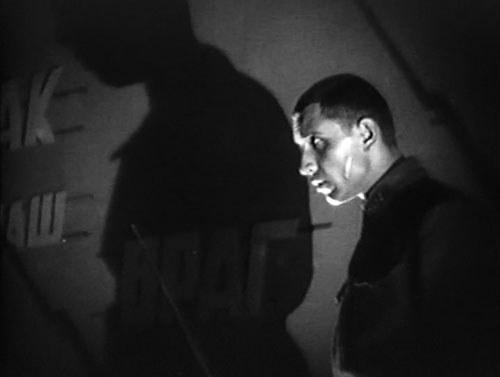
Mikhail Kalatozov’s career had a large hole in the middle, one that remains incompletely explained. Why were the two periods of his greatest work separated by roughly three decades? Why did he make almost nothing between? The answer definitely involved Stalin and his fickle cultural watchdogs, even if the full reason for such a long lull (or fall from favor) might never be known.
At least he was spared a permanent gulag vacation, which would have deprived us of a late 1950s reflowering that resulted in three world classics still being discovered in the West — particularly since 1964’s astonishing I Am Cuba got rereleased under Francis Ford Coppola and Martin Scorsese’s auspices 16 years ago. If you’ve seen that or another Kalatozov film, it’s distressing to think he spent any time unwillingly idle, since every feature still accessible today is some kind of masterpiece.
The San Francisco Silent Film Festival’s 16th annual edition offers the last feature he made before that mysterious long withdrawal from the director’s chair. Nail in the Boot (1931) lasts just 53 minutes, but packs in more photographic and editorial ideas than a dozen features twice its length. It’s a dazzling application of sheer stylistic invention to propagandic material. Yet rather than please the apparatchiks upstairs, it ticked them off enough to derail Kalatozov’s career for a good spell.
Born in Tbilisi, Georgia, he began working as an actor, editor, and cinematographer in that (reluctant) Soviet republic’s 1920s film industry, eventually graduating to directing documentaries celebrating the USSR’s industrial, agricultural, and cultural advancement. Little is known about a first narrative feature, 1930’s Little Blind Girl. But the same year’s semi-staged Salt for Svanetia won acclaim for its strikingly poetical imagery of life in a remote Caucasus Mountains village.
That success presumably greased the way for the larger endeavor of Nail in the Boot, which mixes up the epic and the intimate, beautiful shots of lovingly lit machinery and glowing worker faces intercut with striking battle vistas and the proverbial cast of thousands. The story can be reduced to the title’s troublesome metal inch: when enemy forces strand armored train “Guardian of the Revolution” between blown-up track sections, a lone comrade (Aleqsandre Jaliashevili) is dispatched on foot to notify HQ. Running over hill and dale, he’s severely hampered when the poorly made boot from his own factory falls apart, driving a binding nail into his foot. As a result, his trapped compatriots are gassed to death before reinforcements arrive.
At a huge subsequent Party trial, our fallen hero is excoriated as a traitor for stopping to soak his painful, bleeding foot. “You shot them! The undelivered dispatch was like a bullet!” “He spared his feet and destroyed the armored train!” angry comrades shout, calling for his head. But this nameless prole finally defends himself, indicting his footwear’s shoddy workmanship as at least equal in fault. Nail in the Boot was intended as a parable (based in turn on a Russian folk tale) urging Soviets to always perform superlatively for the good of all, whatever their job. A final intertitle accuses lazy bones present: “Among you spectators: are there many like the bootmakers?”
That message seems simple and unimpeachable enough, not to mention spectacularly presented. Yet Nail had the ill fortune to arrive just as USSR arts ideology was changing. The experimentation encouraged in the 1920s was now judged indulgent “formalism” unsuitable for the masses, while a new school of nail-on-the-head “Social Realism” took shape as the sole officially state-sanctioned artistic guideline. Kalatozov’s film was denounced as confusing and unrealistic on petty grounds, as well being guilty of “formalistic aestheticism.” The film was banned, for a long time considered lost, and beyond a couple features at the start of World War II, Kalatozov was kept offscreen — albeit kicked upstairs to various film administrative posts.
He did well enough in those capacities to become the Soviet film industry’s emissary to Hollywood for an extended late 1940s stay. Hobnobbing with stars, he greatly admired the major studios’ streamlined production methods and technical advances — but like a good comrade, returned home to condemn Tinsel Town as the apex of capitalist decadence. (Hell yeah!) Then, finally, he was considered rehabilitated enough to trust behind a camera once again.
The results, after a few more conventional features no longer in circulation, were stupendous: 1957’s The Cranes Are Flying introduced a new Kalatozov, energetic and inventive as ever, director of photography Sergei Urusevsky’s wildly mobile camera replacing rhythmic Eisensteinian montage as his primary instrument. Taken as a cinematic emblem of Khrushchev-era Cold War thawing, it was an international triumph, even if its tragic wartime romance now seems less conceptually unique than two extraordinary (if far less popular) next ventures.
The Unsent Letter (1960) is one of the movies’ great man vs. nature depictions, as Soviet geologists searching for diamond deposits in remotest Siberia fall prey to that land’s geographic and climatic extremes. I Am Cuba, a Soviet-Cuban collaboration depicting the Cuban revolution on a humongous scale, was derided as being “too Russian” by the Cubanos, “too formalist” (or whatever the current ideological phrase was) by Moscow. Forgotten for decades, it’s been much written about lately — suffice to say Roger Ebert thought it contained the single “most astonishing [shot] I have ever seen,” amid 141 minutes full of such wonders.
After less idiosyncratic but impressive 1970 Soviet-European superproduction The Red Tent (1970) — an arctic adventure with international stars like Sean Connery and Claudia Cardinale, shot in locations as frigid as 40 below zero — Kalatozov died at age 70, planning another impossibly ambitious epic. In a perfect world, he’d actually finish it, his cryogenically frozen brain retrieved from some secret polar lab. Imagine what he could do with a Steadicam and 3-D; James Cameron might find himself merely a wee prince of the world by comparison.
SAN FRANCISCO SILENT FILM FESTIVAL
Thurs/14–Sun/17, free–$20
Castro Theatre
429 Castro, SF
(415) 621-6120
Couscous with Al Qaeda
marke@sfbg.com
TRAVEL TALES Earlier this year, a wave of revolution swept the Arab world: Tunisia and Egypt deposed their dictators through popular protest, almost all of it nonviolent and nonsectarian, with similar uprisings — many still in progress — in pretty much every other country with a substantial Arab population. Democracy was the stated goal of many of these upheavals, and a newly technologized pan-Arab youth movement was leading the way to freedom via Facebook and Twitter, using social networking to undermine long-entrenched authoritarianism.
It was inspiring. It was exhilarating. It was absolutely delicious.

Pastry vendor, Marrakech. All photos by David Schnur
Hunky Beau and I wanted to taste the revolution. We planned a trip to check out Morocco — which, despite the nonviolent, populist Fevrier 20 movement, had so far escaped turmoil due to a popular and quick-footed king — and Tunisia, which was still dazed by its quick success and which we wanted to support with our meager tourist dollars and a show of good will. The outbreak of air bombing in Libya stymied any plans to expand our journey to Egypt, so we made do with more time in our Spanish travel base, Madrid, which underwent its own plaza-occupying convulsions while we were there, influenced by the Arab Spring.

Berber castle, Southern Morocco
Besides the energy, though, we sought the flavors. The scintillating temptation of Maghreb (North African) cuisine, a hybrid of zesty Mediterranean, formal French, savory Arabic, Spice Route African, and indigenous Berber flavors, was possibly a mirage in this globalized world of ours, but it seemed one worth chasing, preferably by camel, even if it came served on a pizza with a side of fries. Also I wanted to explore my Arab heritage a bit — I’m half-Lebanese, but as pretty much everyone we met in North Africa observed, I have “Berber face.” I’d eat my way to my roots!

Central roundabout, Douz, Tunisia
So off we headed in April and May, a newly gay-married, half-Arab virtual drag queen nightlife columnist and a punk-rock Jewish leather enthusiast, backpacks laden, travel sporks at the ready.
PIGEON PIE AND PISTACHIO JUICE
Fez, my friends, is magical chaos. You will hardly get a minute alone. The life of the justly famed souk (market) dominates this pale, sprawling adobe metropolis. You are here to buy things, and the citizens are going to use any means necessary to sell things to you. The labyrinthine souk itself befuddles and enchants: an ancient, arterial maze of sensory overload, jostling with polyglot shoppers, hard-haggling hawkers, dogged hustlers, shrieking children, braying mules, the odd scrawny chicken. No one wears fezzes. Intertwined roof slats suffuse the tiny passageways with idyllic light. Food stalls tower with rose hips, fig relish, lamb heads, preserved lemons, mint leaves for the ever-present national drink (syrup-sweet mint tea), and myriad pyramids of neon-tinted spices.
And always someone wanting to meet you, someone wanting to know where you’re from. “Ali Baba!” some would call me, referring to my beard. “Obama!” many would say admiringly, shining with African pride, on learning we were rare American visitors. And then, ugh, “Schwarzenegger!” when we mentioned California.

In the Fez souk
Morocco doesn’t have a native dining-out tradition, people eat big meals at home, so we had to hit up tourist restaurants for basic dishes like steaming heaps of vegetable couscous; bubbling, cumin-spiked lamb tajine; and the fabled kefta mkaouara, beef meatballs stewed with eggs and paprika. That was fine, these were good and everywhere. Street food was our real holy grail. Hunky Beau was observing Passover in the Sephardic kosher tradition, which meant avoiding most doughs, so he munched on a array of meaty kabobs. Moroccans will skewer and roast almost anything. Meanwhile, I went all in for a Fez specialty, bastilla (pigeon pie), snagged from a jolly vendor near the ATM at the Bab Boujeloud gate. The small, addictive, golden-baked phyllo triangles stuffed with squab, cinnamon, almonds, salt, and sugar steamed with savory sweetness. I ate, like, 10.
When the pandemonium became too much, we clung to thick, musky camel burgers on the roof of Cafe Clock, located in a medieval water clock tower; drank fortifying bowls of tomato lentil harira soup from the nice guy next to the garish Cremerie Disney Channel ice cream parlor; or rested in Place Baghdadi, a huge square surrounded by the old city’s crenellated walls, where the city’s mass of unemployed young men gathered in the evening to socialize and dig through a massive clothing swap. There we sipped tart glasses of radioactively chartreuse pistachio juice, purchased from a cart run by Fatal Tigers, the boisterous fan club of Fez’s champion soccer team, and discussed world affairs with the city’s male youth. (Morocco was packed with lively women who, apparently, were busy doing everything. We did eventually make a few female friends. however.)

A rare woman in Place Baghdadi
By the way, did I mention that young Arab people — and 65 percent of the Arab world is under 30 — are freaking gorgeous? Seriously, we’re about to see some major Arab children flooding our runways. But most of them are dressed in G-Star Raw knockoffs, which I guess is like Old Navy now in Europe? And who knew that those cute boys whispering “shooky” weren’t offering us hash at all, but blow jobs? Oh well.
Older Moroccan men gathered in the evening to play the backgammon-like shesh besh and talk politics at sidewalk cafes, like Salon de Thé Afaf, where we joined them for espresso with a side of water (cafe noir avec l’eau) a Fez staple, and nibbled on roasted chickpeas sprinkled with cumin, watching the hurly-burly street scene and Al Jazeera simultaneously in the fading pink light. No matter what was happening in other Arab countries — like satellite dishes and vehicular hubbub, Al Jazeera’s breathless revolution reporting was everywhere — young King Mohammed VI had so far managed to dodge the boot by immediately offering, and later following through on, constitutional reforms. Compared to everywhere else, this country of 32 million was almost too peaceful. Or so it seemed.
A BOWL OF SNAILS
It smelled like the sewers had been backing up all week by the time we entered Marrakech, so a gas explosion didn’t seem so entirely out of the question. We’d just come from the “Hollywood of Africa,” Ouarzazate, where Lawrence of Arabia and Gladiator were filmed. A fantastically diverse former caravan trade route outpost, Ouarzazate lay on the edge of the Sahara and was the gateway to the Draa Valley, studded with crumbling Berber warrior ksars (fortresses) from long ago. While there, we happened upon an enormous International Women’s Day celebration, bursting with brightly attired clans, ululations abounding. It was some fierce female power out there.


International Women’s Day, Ouarzazate, Morocco
And we had to check out one of North Africa’s top French-Berber restaurants, Relais Saint-Exupéry — named for The Little Prince author and storied desert aviator’s private runway — where, for about $30 we could pull out the stops with an eight-course formal diner Francais. Lapin and canard pate, balled melon pelted with pink peppercorns, a tangy, deep-red dromedaire avec sauce “Mali,” and a tiny chalice of Berber fig liquor were soon finished off, as was a yummy bottle of full-bodied 2002 Domaine du Sahari Guerrouane Rouge. That’s right, even in the Sahara I could sniff out wine.

In the Draa Valley

Les Jeunes Tinariwen de M’Habib performing in Ouarzazate
Now, unearthly, overcast, red-walled Marrakech thrummed with activity, masses of tourists pouring into the huge, famous Djemaa El Fna square. Djemaa is basically where all your Raiders of the Lost Ark fantasies of Morocco come to life — snake charmers, smoke-pouring food stalls, boisterous storytellers, scheming monkeys, even (yes!) elaborate drag shows. Except, of course, for all the cell phones, dreadlocked Spanish kids in genie pants, and tacky French families dressed in the worst cheap Quechua brand travel wear imaginable. Obviously, colonialism didn’t win.
The morning of April 28 we’d hunted in vain for bisara, a thick pea breakfast soup drizzled with green olive oil from Moulay Idriss, but had given up, grabbed a couple kaab el ghzal (“gazelle’s horns,” small croissants stuffed with almond paste) and decided to e-mail our folks.
We were in a nearby Internet cafe when the blast hit. The clock rocked against the wall: 10:56. A man in a hooded shepherd’s tunic at the terminal next door looked up at me, panicked, and then mimed ducking under his desk as a question. I wasn’t sure how to answer. When no immediate second blast came, we hurried out of the building. No source of the explosion could be found, but Hunky Beau and I both had the same thought: the square. We walked about 100 meters and rounded the corner into catastrophe.
It looked like the Cafe Argana, a large, terraced tourist favorite, where backpackers regularly stopped for ice cream sundaes, had folded in on itself. A man dressed in a tuxedo gestured like a mad maitre d’ from the collapsing second floor to the crowd below, most of which was covered with debris. We surged forward to see what we could do, but people were already hauling off bodies. I saw a frantically shaking, middle-aged white woman lifted in the air with no legs. A man’s bald head lay on a table, an arm (his?) had landed like a limp bird on a crumpled metal railing. Yellow tablecloths were used as stretchers, as shrouds. Finally, the ambulances came.

Stunned, we walked slowly from the square. Morocco was supposed to be safe! Rumors quickly spread. Someone was smoking by a gas canister. An oven had exploded. An old furnace burst. Polisario, the Western Saharan separatist group, had struck. The anti-monarchical Fevrier 20 movement had turned violent. Possibly Al Qaeda itself?
It kind of was. In the end, 17 people died, Moroccans as well as foreigners, including a 10-year-old girl. A man in his 20s named Adel Othmani is accused of dressing “like a Western hippie” with long hair and a guitar case, ordering an orange juice, and leaving behind a bomb that he later detonated with a cell phone. (The Fevrier 20 movement led a peace vigil the night of the bombings, at which people symbolically drank glasses of orange juice to protest terrorism.) Al Qaeda in the Western Maghreb officially denied involvement — though it supported the outcome — but it seems Othmani was a terrorism junkie, trying previously to get into Iraq and Chechnya, and the government claims that he bombed the Argana as a tribute to Al Qaeda. This was like his audition! What psychological madness can grip our world’s young. I had never been so close to pure evil.
The people of Marrakech are nothing if not resilient, though. A day later and it was almost as if nothing happened. Out came the snake charmers, out came the Quechua Frenchmen. (Al Qaeda is tired, anyway — the Arab Spring is mostly about the economy and internal reform, not religious war and anti-Westernism.) All the tourist restaurants and food stalls were closed in the square though. Since we were still in shock and hardly had any appetite, we took the opportunity to order some of the more adventurous things on offer in the market. A bowl of snails ladled by a handsome vendor held a surprisingly delicious broth (soup will always help) and the snails, extracted with a toothpick, were more chewy than slimy, like salty jerky.

And a shared ground beef heart sandwich, richer than anything, washed down with an avocado shake, even richer than that, helped calm our stomachs. Our thoughts, however, remained disquieted.
TUNA TUNISIENNE
OK, food. “Thank you Facebook” read graffiti in English on Avenue Bourguiba, Tunis’ main thoroughfare. “The women of Tunisia are and will remain free” read another in French. And another in Arabic: “Bourguiba is for the people,” referring to either the road itself or the beloved Westernizing dictator it was named after, who ruled before the dictator the people just kicked out.

Tunisia is regarded as the most educated country in North Africa — a program of free schooling proved deposed authoritarian Ben Ali’s undoing when students, frustrated by the lack of jobs, used their knowledge to organize and overthrow him. (We met a street hustler named Wassam, for example, who said he held degrees in art history, math, and textile design, because what else had there been for him to do except keep enrolling in school?) So if we felt intimidated that everyone in Morocco was expected to speak at least three languages fluently — French, Standad Arabic, and Moroccan Arabic — here was a whole country of people who could probably help build a superconductor.

Five months after the revolution, however, and the recession was still there. General disgruntlement was simmering again. Protesters, impatient for the July general elections (later postponed until October) were showing up on the ministry steps. The shine of the revolution appeared to be tarnishing. Still, everyone we met was so intensely proud of what they’d accomplished, positively giddy with their newfound freedom of speech. We had no problem making conversation. Any lingering bitterness about the Bush era seems to have been dispelled once President Obama signed on to NATO’s bombing campaign against Gadaffi. They hate Gadaffi.
Because of the recent clashes between protesters and police, however, the interim government had imposed a 9 p.m. curfew right when we arrived. That made it difficult to find dinner — northern Tunisians are European in their late eating habits — but everyone seemed to take it in stride. Cafes were bustling on the evening sidewalks beneath Tunis’ famous mid-20th-century architectural gems.

Plates came laden with Tunisian staples: creamy mechouia (eggplant salad), bread and dipping harissa (hot red pepper paste), young olives, salade Tunisienne (shredded tuna with olive oil and tomatoes), and slata (mixed salad). Our dinner experience — with alcohol! — at seafood paradise L’Orient included octopus steaks simmered in cumin sauce and a dazzling platter of fruits de mer. (Tunisia has 700 miles of glittering Mediterranean coastline, a seafood lover’s paradise.) A row of restaurants serving cuisine from the southern city of Sfax hooked us on salt-and-pepper fried fish over couscous and stewed rabbit with pequillo peppers. And, believe it or not, Tunisian sandwiches, stuffed with tuna, olives, harissa, and french fries, are bangin’.
A certain wide-eyed tension between the past and future could be felt everywhere in the white and turquoise city. Cell phone ads targeting gay men, however ambiguously, had started showing up, and gay groups were emerging from the shadows with blogs and Facebook pages. At the same time, some religious women were reembracing the head-covering hijab, banned since 1981. Hip-hop had fueled the revolution — the aggressive sounds of El General, DJ Costa, and Blid Boy blared next to those of classic divas like Fakhet Amina and Oum Kalthoum and more traditional raï singers. (And then there were the ethereally overamplified calls to prayer from the muezzins high atop their minarets, some of them divas in their own right, auditioning for Arabian Idol. You’ve never heard the Koran recited until you’ve heard it AutoTuned.)

Finally, there’s the Carthaginian connection, with breathtaking mosaics and legendary landmarks from the classical empire that rivaled Rome scattered everywhere. We could barely tear ourselves away from the great archaeological treasures of the Bardo Museum, located in an old harem, but we were eager to make our way to the south, where the revolution began, and where we heard the ojja (sausage stew) was piping hot.
More tasty camels, another brush with Al Qaeda, and an Englishwoman who said God told her to drive through Libya with a Jesus fish on her bumper: Read part two of this story here.