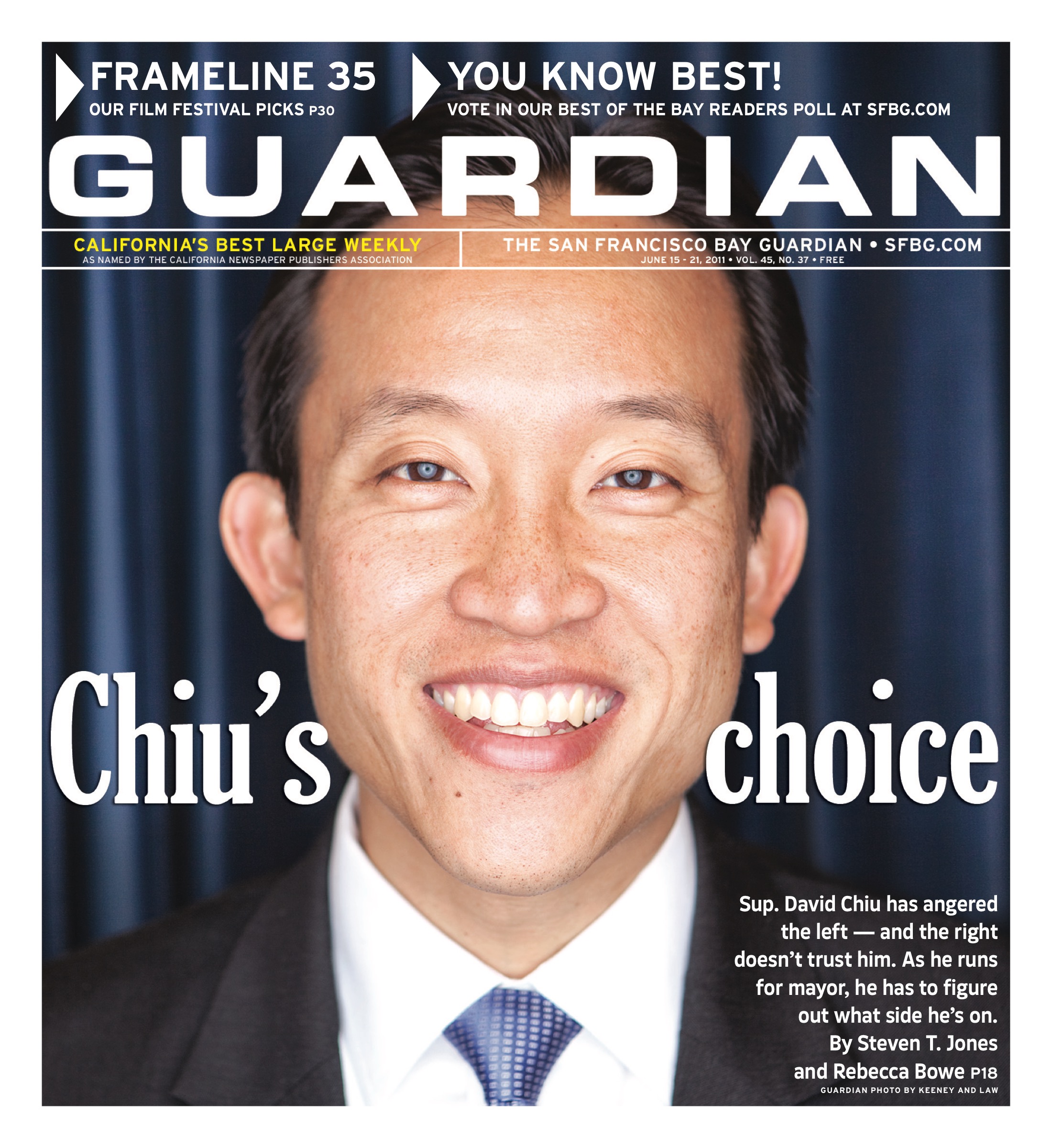
Volume 45 [2010–11]

Editor’s notes

5

tredmond@sfbg.com

I’m not going to tell Ed Lee he can’t run for mayor. I know he promised he wasn’t going to. I know that if he hadn’t made that promise, he wouldn’t have had the six votes to win the office. I think Lee believed at the time that he didn’t want to run in November, and he may believe it now.

But this is still a democracy, and if Lee thinks the situation has changed and he’s the only person who can properly lead the city over the next four years, he ought to put his name forward.

Right now, though, he’s allowing the “draft Ed Lee” movement to get out of control.

Chinatown powerbroker Rose Pak and political consultant Enrique Pierce (who runs the clearly misnamed Left Coast Campaigns and loves to tout his progressive credentials) have set up an office, are raising money, and have hatched this plan to get Lee to agree to put his name on the ballot and not actively campaign.

The operation — which, let’s remember, carries Ed Lee’s name on it — has already run afoul of the law. The Ethics Commission — hardly an aggressive political watchdog — says the campaign had improperly filed as a political action committee. That’s not Lee’s fault — he has nothing to do with this. But it already taints his reputation.

Lee, by all accounts, has done a far better job with the budget than his immediate predecessor. He’s actually been talking to people. He listens; he accepts logic; he tries to make thing work. I admit, the bar is pretty low — Gavin Newsom was a complete asshole. Still: Lee’s a decent guy.

But he has some heavy political baggage — and most of it has to do with his connections to sleazy operators like Pak and Willie Brown. As long as he’s linked to people who treat campaign finance laws, lobbying rules, and political ethics with disdain bordering on hostility, he’s going to have trouble keeping the public trust.

And right now, those same people are raising money — money that is already being spent on a political campaign — and the noncandidate is letting it happen.

Run if you want, Ed. But if you’re going to keep your promise, then it’s time to call Pak, Pierce and company and tell them to quit.

Three good initiatives for the fall

2

The progressive wing of the Board of Supervisors (including, to her credit, Sup. Jane Kim) has placed three important reform measures on the November ballot. That the measures are headed for the voters is a clear indication of the shift of power at the board — progressives no longer have a reliable six votes. But the progressives still have the ability to push issues — and in an mayoral election year, these measures will provide a valuable gauge for the candidates and create broad-based organizing opportunities.

The measures include a ban on the demolition of more than 50 units of rent-controlled housing; a ban on further admissions charges at parks or leasing park facilities to private companies; and a requirement that participants in the Care Not Cash program get an actual housing unit — not just a shelter bed — before their welfare grants are cut.

The supervisors are under immense pressure to back off from those proposals, and if two of the five supporters pull their names before the final deadline of July 14, the measures won’t make the ballot. Some argue that the controversy over the measures could threaten the mayoral campaign of progressive standard-bearer John Avalos. But Avalos told us he supports all three measures and has no interest in turning back. He’s right — the supervisors should hold firm and insist on a public vote on all three.

The Care Not Cash reform has already generated a lot of controversy. Mayor Ed Lee has denounced it, saying it will destroy the entire program, and two mayoral candidates, former Sup. Bevan Dufty and Assessor-Recorder Phil Ting, have come out against it. But the measure is pretty simple and straightforward: it says that a bed in a shelter doesn’t count as “housing.”

That’s a critical definition, because under Care Not Cash, the city tries to put homeless welfare recipients into housing, mostly single-room-occupancy hotels — and in exchange, takes back most of the welfare grants. But by law, a bed in a shelter counts as a home — so the minute the city finds someone a cot to sleep on in a noisy, sometimes dangerous shelter with no privacy and arbitrary curfews and rules, that person loses most of his or her welfare grant. Along the way, the city locks up shelter beds for people in the CNC program — so when other homeless people show up for a place to sleep, they’re told there’s no room. That’s a sign of a broken system.

The housing demolition measure comes as a response to a badly flawed proposal to rebuild Parkmerced — tearing down hundreds of rent-controlled housing units in the process. The parks measure is an attempt to stop Phil Ginsburg, head of the Recreation and Parks Department, from turning public property over to private for-profit firms in an effort to raise cash.

The community groups and grassroots sponsors of these measures have a responsibility to organize and mount serious campaigns; there’s going to be big-money opposition. But it’s worth having all three on the ballot in November.

Smooth sailing for developers

3

rebeccab@sfbg.com

It’s a mad dash at San Francisco City Hall to put all the pieces together in preparation for the America’s Cup, the prestigious regatta that will culminate in the summer of 2013 along the city’s northern waterfront. But once that spectacle is over, the biggest impact of the event will be a massive, lasting, and quite lucrative transformation of the city’s waterfront by a few powerful players, a deal that has been modified significantly since it was approved by the Board of Supervisors.

As negotiations on the fine terms of the development agreements continue to unfold, the future landscape of a huge section of the San Francisco waterfront is in play. If the America’s Cup Event Authority (ACEA) — the race management team controlled by billionaire Oracle CEO Larry Ellison — aims high in its investments into port-owned infrastructure, it has the potential to lock-in leases and long-term development rights for up to nine piers for 66 years, with properties ranging from as far south as Pier 80 at Islais Creek to as far north as Pier 29, home of the popular dinner theater Teatro ZinZanni.

The possibility of securing long-term leases and development rights to Piers 19, 23, and 29 — provided race organizers sink more money into infrastructure improvements — was added to the deal in the last two weeks of 2010, just before San Francisco won its bid to host the world-famous sailing match. The possibility of obtaining rights to portions of two additional piers, 27 and 80, were also added at the last minute. Race organizers and city officials negotiated the final modifications after the Board of Supervisors signed off on the Host City Agreement on Dec. 14, 2010.

Not all board members knew that three additional city-owned piers were being added as possible extensions of the land deal, and those properties weren’t mentioned in any of the earlier documents that went through a public review process in the months leading up to the approval of the agreement. Yet Board President David Chiu was evidently appraised of how the last-minute negotiations were unfolding and he quietly offered his support.

On Dec. 22, 2010, Chiu sent a letter to Russell Coutts, CEO of Oracle Racing, the team that won the 33rd America’s Cup and is an integral player in laying plans for the 34th. “I understand that Mayor Newsom and the city’s team have been working directly with you since the board’s approval of the Host City Agreement to make the necessary adjustments and clarifications to the agreement to ensure it meets your needs. I am aware of these changes and support them,” Chiu wrote in a letter that was not shared with his fellow supervisors.

Quoting from a section of the agreement that explains that ACEA is ensured long-term development opportunities in exchange for funding improvements and upgrades, Chiu’s letter went on, “This section specifically applies to … Piers 30-32 and Seawall Lot 330, as well as Piers 26 and 28, and if mutually agreeable could apply to Piers 19, 23, and 29. To obtain the community’s support and agreement for future development rights to piers on the northern waterfront, you will need to invest in a strong partnership with the community … I am prepared to help facilitate that relationship.”

Former Board President and Democratic County Central Committee Chair Aaron Peskin, who has closely followed the America’s Cup land deal and has for decades been actively involved in land-use issues along the northern waterfront, interpreted Chiu’s letter to Coutts as a backroom deal.

“There is no question that the president of the board, without the authorization of the majority of the Board of Supervisors, went behind closed doors, out of view of the public, and committed to [long-term development] for three piers,” Peskin said, highlighting the fact that no other supervisors were copied on Chiu’s letter. “That he has done this unilaterally, without the consent of a board’s vote at a board meeting, is not good governance. If there’s one body that’s supposed to do all of its work for the public, it’s the Board of Supervisors.”

Chiu defended the letter by emphasizing the part that asked for a partnership with the community. “This was all within the broader framework of the Host City Agreement that we signed in the middle of December,” he told the Guardian when presented with the letter during an interview and asked to comment. “They had questions about, well, can we develop on these other piers? And what I said was, ‘Well, as I think the language here specifically says if mutually agreed upon … you could possibly do this.’ And we specifically said you’ll need to invest in a strong partnership with the community.”

He added that specific development plans would still have to be approved by the Board of Supervisors. Proposals for each parcel will be made in separate Disposition and Development Agreements, subject to board approval.

On hearing Chiu’s response, Peskin was still critical of the lack of transparency in this deal: “My position is, if it walks like a duck and quacks like a duck, it’s a duck.”

Meanwhile, an analysis prepared by Budget Analyst Harvey Rose in mid-March suggests that the final amendments did reflect new commitments for the city that go well beyond what was discussed publicly. “No city approval of the Event Authority’s selection of Pier 29 for a long-term lease is required in the agreement, as modified by the Mayor’s Office and other city officials,” the Budget Analyst’s report notes. “This entire provision … was not included in the agreement of Dec. 14, 2010 as previously approved by the Board of Supervisors.”

Brad Benson, special projects manager at the Port of San Francisco, explained the Pier 29 provision slightly differently. “The city would have to be acting in its reasonable discretion to say no,” he said, emphasizing that ACEA would have to invest well above the $55 million threshold to obtain rights to Pier 29.

At a time when a new era of civility is being hailed at City Hall, two elements of the city family are essentially agreeing to disagree on the broader question of whether the 11th-hour modifications to the deal resulted in a greater hit to city coffers than supervisors approved. While Rose stated in public hearings that the modifications would deal a greater blow to city revenues, City Attorney Dennis Herrera, a mayoral candidate, has stood with the Office of Economic and Workforce Development in his assessment that the changes did not significantly exceed the scope of what was approved by the board. Fred Brousseau of the Budget & Legislative Analyst chalked it up to “a difference in opinion,” reflecting “the auditor’s standard for materiality versus the city attorney’s.”

Legalese aside, it’s clear that the race organizers stand to gain some highly desirable waterfront property in exchange for investing in the piers and bringing an event to the city that is expected to generate substantial economic activity. If ACEA invests a minimum threshold of $55 million for infrastructure improvements, it can likely secure long-term development rights for Piers 30-32, a 13-acre waterfront parking lot where Red’s Java House is located, plus win the title to Seawall Lot 330, a two-acre triangular parcel along the Embarcadero that has been discussed as the site of a future luxury condo tower that has already cleared city approval for that use.

A high-rise next door to Seawall Lot 330, called the Watermark, currently has condos going for $1.2 million apiece on average, according to a calculation of online listings. Under the America’s Cup deal approved by the board, the port would have received 1 percent of each condo sale plus 15 percent of transfers or subleases made by ACEA. “Such required payments … have been entirely removed from the agreement as modified by the Mayor’s Office and other city officials,” the budget analyst’s report points out.

Waterfront real estate in San Francisco, always expensive, has recently soared to even higher values. According to a June 22 article in the San Francisco Business Times, Farallon Capital Management recently put up for sale a 3.36-acre parcel in Mission Bay zoned for life science and tech office space — and it’s expected to fetch around $90 million. This past April, BRE Properties shelled out $41.4 million for two Mission Bay residential development sites entitled for 360 residential units, and last year, Salesforce.com acquired a 14-acre Mission Bay property for $278 million, or $140 per buildable square foot.

By comparison, the $55 million that ACEA must invest to be granted a two-acre waterfront parcel on the Embarcadero, plus long-term rights to lease and develop an additional 13 acres across the street, sounds like a good deal. “We’re using an appraisal approach. It’s not going to ridiculously undervalue the property,” Benson said. Under changes made to the deal after the board signed off, base rent for Piers 30-32 will be $4 per square foot of building area. Rent for all other possible piers will be $6 per square foot of building area.

The ability to transfer city-owned Seawall Lot 330 outright to the ACEA is predicated on the approval by the State Lands Commission to strip that property of constraints placing it, like all coastal properties, in the public trust. Lt. Gov. Gavin Newsom, who pushed the deal as mayor, is one of the three members of that commission.

Under a provision in the agreement, the ACEA’s $55 million investment will be applied toward rent credits on city-owned parcels — and depending on how much the company puts in, that credit balance can increase by 11 percent every year. Benson described this as a typical arrangement, saying, “It’s not out of the line with other rent-credit deals the port has done.”

Two former mayoral advisors from OEWD, Kyri McClellan and Alexandra Lonne, have since gone to work for the America’s Cup Organizing Committee (ACOC), a nonprofit entity working in tandem with the city and the ACEA to secure financial commitments for hosting the race. Newsom has also been named ambassador at large for the America’s Cup effort.

Meanwhile, an OEWD budget proposal includes $819,000 in staffing costs for four management-level positions relating to America’s Cup planning. A refund is expected in the form of $12 million that the ACOC has committed to fundraise by the end of 2011, with an ultimate target of $32 million by 2013. So far, ACOC has only raised $2 million, but plans to seek higher donations once it gains tax-exempt status. “I think the $2 million is a really good start,” said Mike Martin, who transferred in February from the San Francisco Public Utilities Commission to OEWD to direct the America’s Cup effort. “They’re building a foundation for an effective pitch.”

For now, city departments are scrambling toward completing the environmental review process for the infrastructure improvements, expected to be complete sometime in November. “It’s incredibly compressed,” Martin said. “There’s a lot to be done in a very short time.”

Peskin, for his part, seemed be keeping a watchful eye on the unfolding America’s Cup plans. “What we, the citizens of San Francisco, have to watch out for is that we’re not being taken advantage of,” he said. “We’ve got to be vigilant that we don’t get taken to the cleaners.”

The Queer Issue 2011

5

Every year we bring it for Pride — attempting to represent the incredibly varied and creative community we call queer. This is an impossible task, of course, but that doesn’t mean we don’t try! We really try. So strap on those rainbow knickers, hop on a unicorn, and let’s dive in. 

>>EDITOR’S NOTES

Queer youth and you

By Marke B.


>>THE GUARDIAN HOT PINK LIST 2011


>>OUR MEGA-GUIDE TO PRIDE

Events, parties, art, action and more


>>GO WITH THE FLOW

Oakland rap phenom Kreayshawn reps a casual Bay sexuality

By Amber Schadewald


>>BRIGHT ON

Dyke porn pioneer Susie Bright opens up with Big Sex, Little Death

By Mattilda Sycamore Bernstein


>>YEARBOOK OF HEARTBREAK AND OUTRAGE

A 40-year retrospective highlights the Bay Area Reporter’s heroic AIDS coverage

By Oscar Raymundo


>>SHE’S GOT THE LOOK

Cat Perez’s Lesbians in San Francisco blog captures queer hotness

By Amber Schadewald


>>GETTING WHAT YOU WANT

Second annual This Is What I Want performance extravaganza plumbs the nature of desire

By Robert Avila


>>SCENES FROM THE ROAD

Queer youth art from the Roaddawgz homeless youth program

Go with the flow

2

arts@sfbg.com

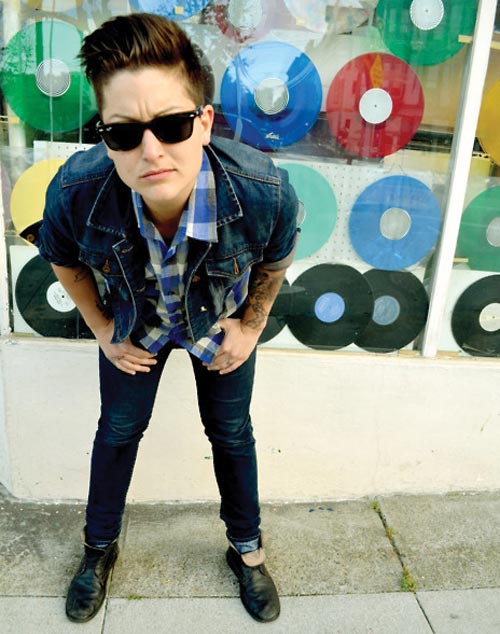
QUEER “I don’t like titles. I’m an open-minded person. I’m not going to shoot anybody down based on gender or color,” Kreayshawn told me over the phone. “I’ve dated girls. I’ve dated guys. And I’ve felt the same way for both.”

It’s only been about a month since the 21-year-old East Oakland native’s “Gucci Gucci” video blew-up, gaining both props and criticism for her label-bashing, be-yourself approach — designer-addicted “basic bitches” are her favorite target, and everyone from college-campus Adderall addicts to crass Barbie wannabes gets a dig. She’s generated a lot of hype and the immediate backlash has been harsh, but Kreayshawn’s rambunctious persona has kept things fresh. She’s an adorable little stoner with mad style, a naughty mouth, and a cartoonish sexual vibe. Her “White Girl Mob” is a swagged-out version of the Spice Girls and her collection of work (including a hilariously over-the-top, girl-on-girl makeout session in the video for “Online Fantasy”) immediately gave the press a reason to cry “lez.”

That’s usually the story when a woman steps up in the rap game, though — in a genre marked by macho preening and degrading insults, most women in hip-hop usually play the boys’ game and highlight their masculine side or market a hypersexed sluttiness, both of which can easily play into stereotypes of lesbianism. (Recently, rap — and pop — women have found one escape hatch: straight-up out-of-body weirdness, à la early Nicki Minaj.)

For actual gay or bi ladies who want a piece of big-time rap’s pie, the odds so far have been stacked against them — out lesbian rappers like super-talented Yo Majesty only seem to get so far, although there is, at least, a still-flickering homo-hop circuit that promotes queer talent. Major label artists are pressured to stay in the closet, despite all the rumors and paparazzi shots of “companions.” This last approach can be psychologically disastrous, as I found out one night in Minneapolis when a devastated and drunk Lady Sovereign, who had repeatedly rejected the lesbian label at her management’s request, crashed on my futon after her ex-girlfriend refused to let her stay over. Sov finally came out last summer. You could tell that her bottled-up feelings had taken their toll, however.

But hey, it’s 2011 and it’s nice to think the rap game has matured along with the rest of pop culture. Ellen is wifed up. Lohan dated Ronson. Lambert should’ve won American Idol. Everybody seems “Born This Way.” As celebrity homos become more visible, the “openly gay” tag seems old-fashioned. But that doesn’t mean we still aren’t curious — and if you don’t tell, people will keep asking.

Yet while Kreayshawn hasn’t denied being a lady-lover, questions regarding her sexuality have garnered a wash of fuzzy responses, only fueling curiosity and more sound-bites. My personal favorite was her quote in Complex Magazine, in which she stated she isn’t a “raging lesbian” but an “occasional lesbian.” Should I be insulted? This needed some clarification.

“I say occasional because I go with the flow,” Kreayshawn told me over the phone, while relaxing on what she considers a “chill day:” hours of interviews and business related to her recent $1 million deal with Columbia Records.

She could easily claim the “B” in LGBT, but says she’s not comfortable with that label either. If anything, she’d go for an “A.”

“Sometimes I tell my friends I’m asexual because I don’t feel like I seek out guys or girls.” Kreayshawn lets interested parties approach her and would just rather let things happen organically. “A girl and I could start talking and I could think, ‘Hey, she’s cool, we should be friends’ or I could think ‘This girl is hot, we should hang out on another kind of hype.’ And it’s the same with guys.”

She’s like the indie-rap version of Lady Gaga — another young woman in the public eye who isn’t afraid to declare her undeclared sexual status. This isn’t a phase and she’s not on the fence. Nor is she checking just one box. She could be the poster child for that nebulous term, “post-gay,” if we’re at a point in our culture where we can move beyond the importance of mainstream representation. (Many would say we’re not.)

“I wish everybody was open-minded so we wouldn’t have to have any labels — no bi, straight, gay. We wouldn’t have to have these titles that separate people.”

Her spirited musician mother helped shape Kreayshawn’s flexible ideas on sexuality. Mom even worked in the warehouse of Good Vibrations, San Francisco’s sex-positive one-stop shop.

“I’d go visit my mom and bring my homework. That place is really diverse, you know what I’m sayin’? I saw some crazy dildos and shit, but I was taught that it’s normal. That’s why I’m open and accepting of everything.”

She admits her lyrics are consistently more lez-oriented, but not necessarily raging. “It’s not like I say I’m gonna eat this girl’s koochie — it’s on a different hype.” This way, she says, guys can sing along too.

It’s appropriate that Kreayshawn keep one eye toward her male audience and supporters — she rolls with a lot of buzz-worthy industry dudes, most notably the guys of Odd Future. As nice as their beats may be, members like Tyler, the Creator have been known to deliver some nasty, homophobic lines. Does she just bite her tongue?

“I know those guys personally, but I’m also not someone who goes off and listens to their music every day. I don’t like homophobe stuff, not in music and not in my friends,” she says, maybe hinting that the Odd Future guys just like to ruffle rainbow feathers for effect. Kreayshawn herself is no stranger to playing dirty, although she often takes on a mocking male persona when doing so — calling other girls hos and Twittering lines like “I need a bitch on my lap.”

“Growing up in the hood and shit, I would hear all kinds of that shit walking down the street,” she explains. Now she wants to turn sexist speech on its head and play with it. “When guys say that stuff in music, like, uh girl, your pussy is so wet — what? Ew — nasty!” She wants girls to be able to sing along and participate instead of feeling attacked or uncomfortable.

“But I wouldn’t say you should read into every single lyric,” she says. With all the attention she’s receiving, she may yet turn her girl-love outward with some solid lyrics. She’s already hard at work on a mixtape and her first full-length, which she hopes will be released by the end of the year. Predicting where Kreayshawn will be by next summer isn’t so easy.

“I’ll probably be touring like something crazy. Maybe directing a music video. Or maybe I’ll be knitting socks. You never know with me. It could get completely out of control.”

And as for advice at this year’s Pride: “Everyone be safe. Have fun. And just make sure you have fun and be safe while doing it.”

I told her she sounded like a mom. “I know,” she giggles in her squeakiest voice. “I just care about my people.”

She’s got the look

0

culture@sfbg.com

QUEER Apparently being a lesbian is the hottest new trend — so much so that middle-aged white dudes are posing as gay ladies, writing famous blogs and filling entire websites with lesbian content. (Yes, I’m talking to you, “Amina” and “Paula.”) Really?

Fortunately, there are plenty of actual queer women who can blog for themselves, thank you very much. Catherine “Cat” Perez, is one of those real-life queer women — verified by an in-person chat at the Wild Side West bar — posting real-life depictions of other actual lesbians on her blog Lesbians in San Francisco, a tribute to girls who like girls in America’s gay capital.

The layout is simple: each featured lez gets one photo and three fun facts of her choosing (“She won a s’mores eating contest as a Girl Scout.” “She doesn’t know how to whistle.” “She is related to Chuck Norris.”) Perez started LISF last summer with the intention of giving queer women of the Bay some flattering but honest representation.

“I just think in terms of the queer community, women can get bypassed and overlooked,” she told me, flicking her cigarette. “I want to educate people about what queer women look like, what they’re interested in, what they do. It may not always be what people assume.”

Perez began by photographing her friends, then opened it to anyone in the Bay Area, aiming for an accurate depiction of the city’s diversity. She swears there is no screening process. Although the aim is inclusion, the final product looks pretty tailored. Beauty may reside in the eye of the beholder — but it’s undeniable that these super-fashionable, adorably hipster girls are hot.

“Yes, there is definitely a ‘scene’ element to it. But that’s not the point,” Perez shakes her head and throws up her hands. “I’m only one person and I work a nine-to-five. People need to actively pursue a shoot with me.”

And it’s that simple — send Perez an e-mail, brainstorm your idea for the shoot, and show up. It’s an offer she often won’t refuse. So why are only a specific type of lezzies contacting LISF? Vanity? A need for self-promotion? Has LISF become a showcase of our local celesbians? Maybe it’s time for the rest of the community to get our faces up there, too.

“I wouldn’t consider myself a celesbian — I don’t know how I feel about that term,” Perez said with a laugh. “If I had to choose a label, I would identify as a queer woman,” embracing the broader, more inclusive mode of thinking. The title of the blog has discouraged some women from participating, but Perez says she has no plans to change it anytime soon.

“Growing up, I always wondered what queer communities looked like outside of my home in New Jersey,” she says. With its general-interest name, her blog comes up pretty high on Google searches. “I just want to shed some light on the people who live here. That’s it.”

Through the end of the month at the Lexington Club (www.lexingtonclub.com), Perez is exhibiting a collection of blog-inspired photos called “Stereo,” which simultaneously celebrates and debunks lesbian stereotypes. Perez selected 15 queer women and photographed them each twice: once in a stereotypical role (softball player, gym teacher, high femme) and once as themselves. As one might imagine, there’s a lot of overlap.

“Some girls were dressing up as other’s stereotypes,” she says. “Stereotypes don’t have to be negative. These photos embrace that, because, yeah, sometimes we are the stereotype.”

Bright on

1

culture@sfbg.com

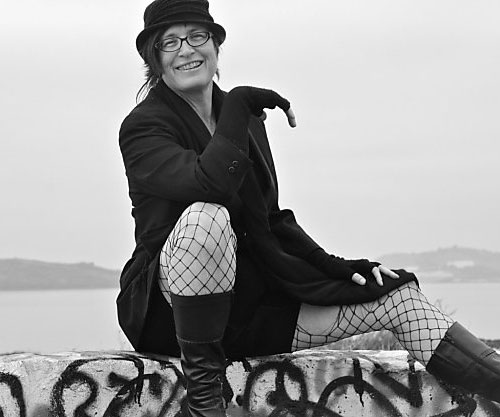
QUEER Heady, hilarious, heartbreaking: Big Sex Little Death explores legendary sex writer, educator, and instigator Susie Bright’s coming of age from the 1960s to the present. Bright’s memoir focuses on her involvement with The Red Tide, a radical high school newspaper in Los Angeles in the 1970s, and her subsequent membership in a socialist sect that sends her halfway across the country. Her union organizing stint lasts until the Party leadership expels her for “joining or leading a cult of personality.” Personality is certainly one of Bright’s strong points, so perhaps we should be grateful for this particular falling out. It eventually leads to Bright’s role in founding the first lesbian porn magazine, On Our Backs, in San Francisco in 1981, as well as her pioneering work as a fiery spokesperson for free speech and sexual liberation. I spoke with her over the phone about sex and memory and writing.

SFBG You do such a great job of talking about your sexual coming of age as a teenager: describing your sluttiness without shame, your curiosity about bodies and pleasure and the intricacies of sexual positioning.

Susie Bright I think it’s because I wrote my memoir like a storyteller, like a poet — not a polemicist. I wasn’t ashamed; it never occurred to me. Margaret Mead would have found my little teenage tribe to be quite poignant.

SFBG There’s a tendency for many sex-positive spokespeople to glamorize even the most annoying, mundane, or gross sexual experiences as somehow — well — positive. Sometimes this sex-positive rhetoric ends up making those of us who don’t always succeed at having a wonderful sex life feel like failures …

SB I think bad sex — obnoxious, absurd, BIG FAIL sex — is funny, nostalgic, and more endearing as you grow older. It also goes hand in hand with adventurous, rapturous, mind-blowing sex. You actually know the difference. You’ve spanned the spectrum, you’ve lived. The big bummer with American sex right now is the unrelenting banality and flat-out scarcity.

SFBG The most striking part of Big Sex Little Death for me is the way you describe betrayal in the social and political realms you choose to inhabit — places that initially give you so much hope. Like when you helped to start On Our Backs, the first lesbian porn magazine, in the early ’80s. Feminist bookstores refused to carry it, claiming that you were aiding the patriarchy.

SB It was more than that. The whole mainstream feminist movement was calling for our heads. Or, as Barbara Grier of Naiad Press put it, “Everyone I know thinks y’all should be assassinated.”

It’s been a part of every civil rights and social justice movement that I’ve been a part of. We know it — we talk about how the powers that be would prefer to let the weak fight among themselves. We see how divide-and-conquer tactics are so effective, but it’s very hard to resist.

What kills me is the blindness, even years after the fact. Sometimes it’s comical. I got a letter from an ambitious writer the other day who told me that in the ’80s she fought the sex-positive On Our Backs types tooth and nail, no tactic too dirty. “We” were pimping the patriarchy and she was on point to take us down. She asked me if I found it amusing that she’s now in a submissive relationship with a man — no! Then she asked me if I would blurb her new book.

Someone asked me on this tour if I ever got an apology, and I was startled. No, not for the bombings or the death threats or the bannings or the locked doors or the bizarre libels and slanders. No way.

SFBG When the feminist movement refused to support you, you found several surprising allies. Among them were John Preston, at the time the editor of the gay leather magazine Drummer; cult filmmaker Russ Meyer of Faster Pussycat fame; and even the Mitchell brothers of that legendary exploitative straight strip club on O’Farrell Street.

SB Well, those were strange bedfellows, eh? They were all mavericks, iconoclasts, outlaws, film buffs, and we shared that in common. Aside from public librarians and ACLU lead attorneys, these guys were probably the most eloquent defenders of the First Amendment you ever met.

SFBG On Our Backs was started by two strippers who worked at various clubs in the Tenderloin and North Beach. One of the most heartbreaking chapters in Big Sex Little Death is where you show us how so many strippers worked to support their lovers financially, male and female, and then ended up strung out on drugs, homeless, or dead after their lovers used and abused them.

SB “Legalize it,” as Peter Tosh said. That is why these tragedies happen — because sex work is criminalized.

SFBG In your preface, you say, “I’m more preoccupied with people dying than with people coming.” And so of course you want to prevent these unnecessary deaths. Toward the end of the book, you also mention the deaths of friends, lovers, and confidantes to AIDS — but only briefly. It’s as if it’s still too painful to talk about.

SB The main deaths I talk about are my parents’, where I could fit more of the puzzle together; then John Preston, as a small example of what went on in early ’80s plague life; and the dykes I first knew at On Our Backs, some of who died too young. I am angry and too ragged to write about it all yet — I don’t have the distance from it. The last memorial I attended this past fall was [for] one of my greatest inspirations, a total ball-of-fire who ate a Fentanyl patch, choked to death on her vomit, and left a suicide note.

It was the exact one-year anniversary of the death of her father, a Southern fundamentalist preacher who beat and raped her as a child. She left him at 15 to come to California and made her way as one of the first generation of out dyke strippers and punk rockers. My redheaded friend was a leader of a local NA chapter by the time she was 20. What happened to her, all these years later, breaks the heart of everyone who knew her. She was a wonderful, wonderful, caring, radical feminist creative dyke who wanted to be a superhero who would vanquish all the abusers. It’s not fair.

SFBG Fairness is one of the central issues of the book — who lives and who dies, which cultures disappear and which remain. At the end of the book, you talk about deciding to give birth to a child, Aretha, and raising her. I’ll admit I got a bit worried that you would suddenly talk about this trajectory in a way that erased your sexual and political history, the histories of people like the friend you just mentioned.

SB My daughter has a trajectory of her own, now!

SFBG But somehow you’re able to talk about your love for Aretha while making it clear that child rearing certainly isn’t for everyone, and still articulating an anti-assimilationist queer world view focused on sexual liberation and radical politics.

SB I’m just drawn that way.

SFBG Why do you think gay assimilationists emphasize marriage, military inclusion, and child-rearing as the only choices for respectable queers, narrowing the options for everyone and rejecting sexual liberation as something dangerous from the past?

SB They’re squares — what can I say? They’ve always been around. Square used to be a synonym for straight. We’re constantly caught in the middle on this, the boho bunch. Of course we want civil rights for all, duh. I defend anyone’s right to let the state be their pimp, to fight the wars, be the cannon fodder, acquire family assets like a stamp-collecting hobby. Bully for you. But as Peggy Lee said, “Is that all there is?” Christ, I hope not.

Mattilda Bernstein Sycamore (mattildabernsteinsycamore.com) is most recently the author of So Many Ways to Sleep Badly.


Pasión

2

paulr@sfbg.com

DINE Amid the restaurant babble of Ninth and Irving streets (UCSF’s answer to Harvard Square), there is one restaurant that stands out as a spot for people who already have all the degrees they’re ever going to get, and that is Pasión. The name suggests both the high energy of the place and the style of its cooking, which draws many of its influences from Latin America and, in particular, Peru. The young chef and owner José Calvo-Perez, a native San Franciscan whose father Julio launched what was to become the highly successful Fresca enterprise, describes the style as “modern Latin.”

The space was the longtime home of P.J.’s Oyster Bed (Pasión moved in late last year), and because it’s in the middle of a cluttered block, it doesn’t stand out as a physical fact as much as it does as an idea. You could walk right by without noticing it, or you might notice it but think it’s just another one of the sort of food emporia you so often find near large university campuses. But once you’re inside, you find that Pasión feels a little like Miami: twinkles and gleams here and there in the suggestively dark lighting, a sense of human warmth, a dramatic open kitchen with two faces at right angles, and a main dining area doubled around the back of the bar like a horseshoe. The restaurant is on the loud side, and no doubt that’s in large part because it’s busy. Clearly there was an unmet demand for this kind of destination in the neighborhood.

Pasión might not be that innovative — pan-Latin cooking was unexpected 10 years ago; it is less so now. Still, it can’t be a bad thing to claim descent from Fresca. Some of the more prominent signifiers of that lineage on the menu are the pollo a la brasa ($18), a beautifully roasted half-chicken with Peruvian-style spices and fine french fries, and a broad selection of ceviches.

As someone who likes ceviche without loving it, I was pleasantly surprised by the exquisiteness of the Pasión version ($10), which brought together cubes of ahi tuna and salmon, kernels of purple corn, and bits of cilantro, red onion, and yellow pepper — I haven’t seen so much color in one place since looking into a box of Crayola crayons — in a marinade softened and deepened by passion-fruit purée. Too many ceviches seem to me to be joltingly salty-sour, salt and lime being a pair of alpha ingredients that will fight if there is no mediator. (Morty Seinfeld: “You’ve gotta have a buffer zone!”) A little sugar, a little sweetness, brings a necessary balance, and all the better if the sweetness comes, as here, from a natural source, a sweet fruit, instead of a sack of C&H.

But, even in America, land of the sweet, sweetness isn’t always a good thing. The aioli that served as a dipping sauce for salt-cod fritters ($10) had been enhanced with lemon and honey (honeioli?), but for me it was too sweet and reminded me of Miracle Whip. The fritters themselves, presented in a small basket, were right at the edge of being too crisp. And yes, that is a kind of euphemism.

The duck empanadas ($10) were better, though of course they were very rich, made as they were with shreds of duck confit and smoked duck. Here the richness of the meat and the frying was moderated by a clever combination of currants and a sherry reduction — fruit to the rescue again.

Is there a good way to serve paella in a restaurant? Calvo-Perez was probably bound to try to figure one out, since he apprenticed in Spain. My thought would be to make a big, proper one every hour or so and serve portions of it, but Pasión appears to follow a made-to-order model. The kitchen’s vegetarian version, called arroz verde ($18), was made with cilantro rice and did have a green sheen, but it was as much gray as green, and this wasn’t reassuring. The dish, although presented in a small, cast-iron paella pan, lacked the crust of caramelized rice you hope will form on the bottom. It was also afflicted by a bitterness we finally traced to large chunks of celery, lurking in the murk like alligators in a bog among the green peas, shiitake mushrooms, pickled carrots, and green beans. It also featured an abundance of red onion slivers, which were methodically plucked out (not by me), like bits of shrapnel being removed from a wounded soldier. Obviously some people feel passionately about raw red onions.

Pasión

Dinner: Sun.–Thurs., 5–10 p.m.;

Fri.–Sat., 5–11 p.m.

Brunch: Sat.–Sun., 10 a.m.–3 p.m.

737 Irving, SF

(415) 742-5727

www.pasionsf.com

Full bar

AE/DS/MC/V

Noisy

Wheelchair accessible


Busted!

0

le.chicken.farmer@gmail.com

CHEAP EATS I have already written a restaurant review, a poem, and a cheerful pop song about my anal abscess. I don’t know how else to celebrate the cursed motherfucker. I could curse … But I guess I’ve done that too.

I’ve already had it lanced twice. Those were the good times. Except that on the first occasion I missed a day of work, and on the second I missed a baby shower. I felt so badfully about the missed baby shower that I invited the moms-to-be, Pod and the Attack, to breakfast the following Saturday. Technically I guess maybe I invited myself to breakfast. At their house.

Bless them, they made my favorite: waffles! With fresh strawberries! They made bacon! They made eggs! They made roasted tomatoes! It was the perfect meal! It was a masterpiece! It was culinary genius! It was the time of our lives!

Problem: I forgot to go. I don’t know, I was looking forward to it all week and then I woke up on Saturday morning, went, “Dum-de-doe,” and decided — oh, I don’t know — maybe do a little recording, or something.

I record in my kitchen because it’s the quietest room in my apartment, if I turn off the refrigerator. My cell phone was in the closet. At the designated hour, Pod went to West Oakland BART and waited for me.

When she called to say what-the-where-the-fuck-are-you? I was in the kitchen. I had my headphones on, refrigerator off, and was laying some blistering electric ukulele tracks onto Garage Band, singing: “It’s a new day/ It’s a driving rain/ I’m gonna have anal surgery/ It’s gonna be OK/ Gonna feel no pain / Or if I do it will be good for me.” La la la la la la.

And so forth.

Then.

I saw my cell phone while I was getting ready for work. It was lit up like a Christmas tree: texts, voicemails, e-mails. What-the-where-the-fuck-was-I? Oh my sweet baby Jesus, you can imagine my horror, and self-hatred — nay, loathing — as it all sunk in. How did I do that? How could I? Was my head so far up my ass that … ?

Well, technically it was, damn me. Clobber me in the kidneys with a golf club. I felt as low as a horse’s hoof cheese. And that was before the Attack sent me a picture of their spread, Pod in all her pregnancy sitting down to eat those wonderful things I said, plus cantaloupe.

Minus me.

I’ve done some dumb-ass things in my day, but don’t know if I’ve ever hated myself more. I couldn’t imagine how I was ever going to forgive myself. I still kinda can’t. I mean, the bacon alone looked so good in that picture.

They were of course very gracious and forgiving, and I was of course determined to make it up somehow. I invited them over to Berkeley that evening for some of the chicken pot pie that me and the kids were making. They declined.

I invited them to breakfast the following morning. Out somewhere, on me, and they accepted. We went to the Sunny Side Café in Albany, which was alleged to be kind of fancy-pants, and great.

Never in my life, before this, have I wanted a meal to cost more than it did. But, alas, it didn’t. It was like normal weekend brunch prices, roughly $10 apiece. Less tragically, but more to the point, I didn’t think the food was that good. Let alone great. I may have malordered. Maybe I was still traumatized by my brain fart from the morning before, but my spinach-and-sausage scramble was bland city, even with salt-pepper-Tapatío. The roasted tomatoes … meh.

Pod’s pigs in blankets … that was better. And the Attack, she got it right. She hit the jackpot with the Alameda, a stack-up of good stuff — ham, cheese, french toast, eggs — and some other things I personally don’t go for, which is to say mushrooms and Hollandaise. Oh, and a balsamic reduction.

It’s her new favorite restaurant.

SUNNY SIDE CAFÉ

Mon.–Fri. 8 a.m.–3 p.m.;

Sat.–Sun. 8:30 a.m.–3 p.m.

1499 Solano, Albany

(510) 527-5383

Full bar

AE/D/MC/V


Cleaning up UC’s mess

5

news@sfbg.com

By 7 a.m., when engineering students begin to trickle into Cory Hall at UC Berkeley, Arnold Meza has already scrubbed the floors, wiped clean the chalkboards, and emptied the trash of 30 offices and many of the classrooms and hallways of the six-floor building.

His early shift as a custodian is a gift, he says, because it is steady compared to his former swing-shift schedule, but Meza is still barely making rent. And he is a single father of four. Like many service workers in the University of California system, Meza wonders how the university can refuse to give him a 3 percent wage increase while top UC executives receive six-figure bonuses every year.

“It falls on broken promises,” Meza said while tying up a bag of trash, one of hundreds he would take out that week. Meza was referring to an agreement in 2009 between the university and its service workers unions, including Meza’s union, AFSCME (American Federation of State, County and Municipal Employees). At that time, the administration established a minimum wage (currently $13 per hour) for the more than 7,000 service workers and agreed, if funding was available, to increase wages annually to bring their low-wage workers out of poverty.

But the university is going back on its promise, refusing to increase wages with the funding dedicated for that very purpose, the East Bay Alliance for a Sustainable Economy and the Partnership for Working Families (EBASE) notes in its recent report titled “Bad Budgeting, Broken Promises.”

As the UC Office of the President sees it, the 2009 discussion was not an agreement at all, but a “conditional memorandum of understanding” that would only be effective if state funding was available, said UCOP spokeswoman Dianne Klein.

“We’ve already taken $500 million in cuts. We’ll have to take another $500 million in cuts. Because there is no new money, the memorandum of understanding is moot,” Klein told us.

The state budget vetoed by Governor Jerry Brown last week would have set the UC system back $150 million in cuts on top of the $500 million in cuts approved by Brown in January. How much more will actually be cut from UC funding remains to be seen, but the forecast is not promising.

Despite the cuts, the proposed budget bill states that $3 million in distributed state funds should go toward the salaries and benefit of service workers in the UC system. In a March 24 letter to the governor, UC President Mark Yudof requested that the governor veto that restriction so the university could use the dedicated $3 million “to preserve our flexibility in dealing with the $500 million reduction.”

Compared to the total UC budget of $21.8 billion, that $3 million makes up only 0.014 percent — nickels and dimes to give employees a living wage.

Meanwhile, Meza and his fellow coworkers struggle to put food on the table, making ends meet by working two jobs. After his 4 a.m. to noon Monday through Friday shift, Meza works eight-hour shifts as a car mechanic on weekends. Similarly, many UC service workers collect cans to get a few dollars from the recycling center.

“When I started here 20 years ago, I was making close to $9 an hour. That wasn’t enough,” recalled Meza, who put his four children through public high school on that salary. Today, Meza brings home about $2,400 a month, barely enough to cover rent and a few bills at his El Cerrito home.

“I want my kids to go to college. But financially, I can’t afford it,” he said. “For me, it’s a sad reality.”

Meza’s union, AFSCME, is working with UC to lower the workers’ contribution to retirement pensions to 1.5 percent. The university proposes a 3.5 percent pension plan to go into effect this July and 5 percent in July 2012—the same amount requested from top UC executives. At their low wage, that would cost the service workers the equivalent of one biweekly paycheck a year.

Some UC executives, such as UC Berkeley Chancellor Robert Birgeneau, receive additional retirement perks. Roughly 200 highly paid UC executives receive a supplemental retirement benefit of 5 percent of their annual pay, said Nikki Fortunato Bas, the executive director of EBASE. That’s a total annual cost to UC of $4 million.

“If UC gets its way in 2011, instead of getting to climb that next rung on the ladder out of poverty, [the low wage workers] will take a step backward through a combination of increased contributions to retirement and healthcare and UC withholding a 3 percent raise,” Bas said. “All the while, UC is showering already highly-paid executives with six-figure bonuses.”

In an infamous budget battle that has required the UC system to restructure its quickly diminishing funding from the state, more than 100,000 employees’ paychecks have been reduced while top execs like UCLA Ronald Reagan Medical Center CEO David Feinberg receive thousands of dollars in bonuses. In September 2010, Feinberg’s base pay was increased by 22 percent and he received a $250,000 “retention bonus,” for a total compensation of $1.33 million.

These astounding numbers, as part of a $3.1 million package in bonuses for 37 UC executives last September, were quoted in the EBASE report, using data from the UC Regents website (www.universityofcalifornia.edu/regents).

UCOP says the retention bonuses are necessary “because we pay below market as it is [for top executives’ salaries],” said Klein, and the UC needs to offer huge bonuses to keep the executives from moving to higher paying universities. “You have two options: sayonara or we’ll match it,” Klein said. “You can’t recruit in the classifieds for these people … and you’ll have to replace them for the same money, anyway.”

The bonuses are not state-funded, said Klein, but are taken from research grants, patient care, and even federal funding. But Bas said the problem is with UC’s priorities: “Time and again, they have shown that they can find money to give bonuses or backfill sports programs,” she said. “UC may look at this as a matter of technicalities, but we cannot ignore the stories of employees and their families who are struggling to get by.”

As it stands, UC is short-staffed when it comes to service workers. “We’ve been short-staffed for the last 10 years,” said Meza, who estimates that UC Berkeley employs about 140 custodians, less than one-third of the 460 or so custodians the university employed in the 1980s. The result is that the students suffer, said Meza. “The students are getting the short end of the stick because we can only clean once a week in some classrooms because we’re short staff. We see the students pay a lot with tuition, and they’re getting less.”

Already, student fees have increased by more than 32 percent, and another 8 percent fee increase is pending, reported EBASE. As the state continues to make cuts, students and low wage service workers suffer the consequences.

According to the California Budget Project, a single-parent family needs to make $68,375 a year just to make ends meet in Alameda County. “UC workers have reduced-cost healthcare, so this number could be adjusted downward to $58,544,” said Bas. “For a custodian at UC Berkeley or UC San Francisco making $30,000 or even $40,000 a year, this means working two jobs and collecting cans just to scrape by.”

When his oldest was nine years old, Meza remembers, he used to drive his family to the recycling center to get cash for cans he had taken out of the garbage. “The kids were happy in the car because I was going to get money for food when I recycled cans,” which meant there would be dinner on the table that night, Meza said, apologizing for getting teary-eyed at the memory.

“I just don’t want people who work here to go through what I went through to raise a family,” he said.

No matter how many cars Meza fixes on the weekend, he never seems to have a break from the stress of trying to cover fuel, rent, heating bills, doctors’ bills, and other necessities. He’s only 43, but he feels much older after 20 years of working two jobs, seven days a week, providing for four children on his own.

UC workers, unions like AFSCME and other stakeholders have proposed $600 million in budget alternatives such as reducing the excessive 7-to-1 employee-to-management ratio (at UC Berkeley, the average is four employees to one manager). Yet UC does not appear to be seriously considering these alternatives; its current goal is to take back the $3 million dedicated to its low-wage service workers.

“We think this is a matter of finding the will within the UC administration to do what’s right by honoring their word to protect working families’ a path out of poverty,” Bas said.

Two months ago, Meza and his fellow union members marched into UC Berkeley’s Chancellor Robert Birgeneau’s office and asked him to spend one day in the life of a service worker on campus. He still hasn’t answered their request.

“People are really struggling here. We are committed to working and we give 110 percent — that should be accounted for,” said Meza. “Give us our 3 percent. We earned it.”

Beyond the Ford severance scandal

0

Supervisor John Avalos and state Senator Leland Yee, who are both running for mayor, picked up on a populist issue last week, blasting away at Muni for paying outgoing chief Nathaniel Ford a whopping $384,000 severance. “With $384,000,” Yee’s website lamented, “the entire city of San Francisco could park free of charge for three days. Muni could be entirely free for a whole day. We could stripe seven miles of new bike lanes.”

In reality $384,000 is a fraction of Muni’s budget — less than half of 1 percent. And it’s a trivial amount compared to what CEOs get in the private sector — Peter Darbee, whose firm killed eight people and wiped out a neighborhood, walked away with $35 million when he left Pacific Gas and Electric Co. in disgrace.

But this is exactly the sort of deal that infuriates the public. When the cost of parking meters and tickets keep rising, and Muni’s on-time performance lags, why is the guy in charge, who’s leaving in part because he isn’t doing the job, getting such a nice golden parachute, courtesy of the taxpayers?

In the end, there’s not a lot Yee or Avalos can do about it. For one thing, the decision was made not by the supervisors but by the San Francisco Municipal Transportation Agency. Beyond that, SFMTA had only limited choices — Ford has an employment contract. And it’s hard to fire someone in the middle of a term of contracted employment without buying out at least part of the deal.

That’s the larger issue here, one that the mayoral candidates ought to be talking about. Why does the head of Muni get a special employment contract? The heads of the Police Department and Fire Department don’t get one. In fact, most department heads don’t get contracts specifying a term of office and including severance pay.

Those contracts can be expensive — Susan Leal got $400,000 when she was dismissed as head of the SF Public Utilities Commission. Arlene Ackerman got $375,000 when she left the San Francisco Unified School District.

No rank-and-file city employees get severance if they’re fired for cause (or if they negotiate a resignation to avoid disciplinary action). City department heads shouldn’t either.

We understand why school superintendents and Muni managers want those sorts of deals: If you work for a political agency, there’s always a chance that the people who hired you will be gone at some point and you’ll be working for people with different visions and political positions. But none of these department heads are paupers — they’re well paid, and, like anyone who takes a management job, they know that their job security depends on performance.

It’s akin, in a much more limited way, to what’s been happening in the private sector, where the top people get compensation that vastly exceeds what even the people immediately below them get. Muni’s assistant general managers don’t get employment contracts with golden parachutes.

San Francisco needs a city policy on special employment contracts — and rules barring excessive severance pay for management-level employees. The supervisors ought to ask the budget analyst for a report on which city employees have contracts, what they call for, and how they compare to what similar-level employees without contracts are paid. There should be hearing on this and legislation that clears up what is now an expensive — and disheartening — hodgepodge of private deals.


On the hook

4

rebeccab@sfbg.com

Unique Roberts squared back her shoulders and recalled what it was like when she first moved to San Francisco from East Oakland more than a decade ago. A tall, 33-year-old African American transgender woman with piercing eyes and a charming smile despite gaps of missing teeth, Roberts said she performed as a showgirl at clubs like Harvey’s and the Pendulum in the Castro. In those exciting days, “I fell in love with this boy, and he was an addict,” she explained. “I thought that if I did it, it would keep our relationship together.”

She recalled how awful her boyfriend felt when he found out she was using, telling her, “You don’t know what you’re doing to yourself.” He departed for Texas several years later, but addiction stuck with her as a way of life.

She says she’s tried to kick the habit, but it’s wrapped up in a battle against depression stemming from the loss of loved ones. Roberts was wearing one of the bright orange sweatshirts issued to inmates at San Francisco County Jail. She landed there after being arrested in April for allegedly selling a tiny rock of crack, weighing just 9/100s of a gram, to an undercover narcotics officer. According to the police report, the cop offered her $20 for it — but based on National Drug Intelligence Center street-value estimates, that amount is only worth about $2.50.

Roberts may go by the first name Unique, but her lawyer Tal Klement, who works for the San Francisco Public Defender’s Office, is fond of saying her case is hardly unique at all. She was one of several people arrested in the Tenderloin that day after interacting with the same plainclothes officer.

It was part of a coordinated sweep known as a buy-bust, a common practice under which an officer may pose as a homeless person, a clueless outsider, or a dope-sick fiend to lure people into selling crack, pills, meth, heroin, or marijuana. Once a transaction is made, a team of officers awaiting the signal immediately closes in and arrests the seller.

As of June 20, there were at least 109 open buy-bust cases in San Francisco. Based on defendants’ rap sheets, 92 percent had prior drug-use histories, according to a tally conducted by the Public Defender’s Office.

The officers posing as buyers — who often earn overtime — use street lingo, know which drugs can be obtained at which intersections, and sometimes offer higher prices than the accepted street value. Attorney Anne Irwin, also a public defender, is critical of the practice, saying it’s an expensive tactic that’s makes for easy arrests — because the money is irresistible to addicts who think they’re getting an opportunity to convert a personal stash into more drugs.

In a lean budget year, “they’re cutting social services left and right, and these are the very services that could help the addicts get off the street,” Irwin noted. She’s skeptical that the strategy stems the flow of substantial quantities of drugs.

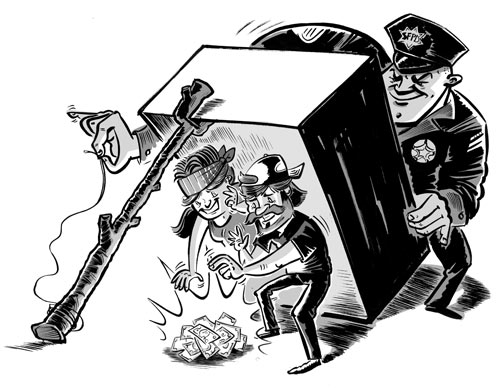
Police Chief Greg Suhr, who said he participated in buy-busts for years as a narcotics officer, credits the tactic for helping to eradicate a rampant open-air drug market on Third Street in the Bayview, and says it can help prevent drug-related violence.

Klement, however, condemns it as a “war on crumbs,” saying it ensnares far more addicts than serious dealers and often ends up unnecessarily pinning felony convictions onto low-level offenders.


NUMBERS GAME

Buy-busts usually involve around eight officers, according to an average calculated by the Public Defender’s Office based on open cases, but have involved as many as 14 and as few as three. There’s the decoy buyer, who sometimes dresses in grimy sweatpants, goes without shaving, or dirties his face to look like a street addict in desperate need of a fix. There’s a “close cover” officer who follows the decoy, plus an arrest team that is also sometimes in plainclothes. Beforehand, officers will photocopy cash — usually $20 bills — to document the serial numbers so that the same marked city funds can be used as evidence once recovered from arrestees. Busts can happen within minutes of one another, and a single shift may net five or six arrests.

Irwin says the people snared aren’t typical drug dealers — certainly not big-time players. But they’re charged as dealers — and in many cases wind up branded as felons, with severe legal penalties such as multiyear prison sentences.

While the police department is able to show on paper that it’s brought hundreds of drug dealers into custody — and the district attorney can point to a boost in the conviction rate thanks to the program’s efficiency — Irwin says the amounts being peddled are tiny.

“In traditional narcotics operations, they cultivated snitches, used surveillance, and obtained search warrants” to go after major dealers, Irwin said. With buy-busts, “It’s like shooting fish in a barrel. Everyone agrees that we need cops on the streets to help keep us safe … But do we want to be paying hundreds of thousands of dollars for this?”

Sharon Woo, chief assistant of operations for the San Francisco District Attorney, told the Guardian that “we charge based on the conduct of the individual.” Woo went on to say that the DA tried to “exercise appropriate discretion” on a case-by-case basis when individuals are selling to support an addiction or due to being in dire financial straits.

Sometimes individuals are ushered into alternative programs such as drug court or a Back on Track program for first-time offenders, Woo said. And while the DA typically includes charges that make defendants ineligible for probation under state law if they have prior convictions for selling crack-cocaine — a discretionary practice that has drawn criticism from public defenders — Woo observed that “it doesn’t mean that’s how cases resolve.”

Police forces in nearly every major metropolitan area practice buy-busts, said Frank Zimring, a law professor at UC Berkeley’s Boalt Hall School of Law specializing in criminal justice issues. Yet he described the practice as costly and noted that paying overtime for it “makes what would ordinarily be a very expensive operation into a more expensive operation.”

Cost estimates for the entire program are tough to pin down. It costs $130 per day to house each prisoner in the county jail, amounting to more than $14,000 per day if all of the defendants with pending cases are in custody. If an average of eight officers per bust were paid $60 an hour each to spend six hours conducting a buy-bust, the current caseload represents more than $300,000 in officer pay — a conservative estimate — and that’s before lawyers in the offices of the public defender and district attorney are paid to prosecute and defend the suspects in court.

But no matter how you add it up, it’s a lot of money.

Suhr told the Guardian that apprehending street-level offenders occasionally leads officers to bigger fish. “Sometimes you get a low-level person, or a buyer if you will … if that same person would say, ‘But I know this guy and he has guns and he’s a big dealer and whatever.’ That is a good way to get to those bigger people.”

“We’ve never seen that happen in practice,” Klement countered.

One of Irwin’s clients, a homeless man, was charged with selling narcotics after he scraped out the contents of his pipe to sell 1/1,000th of a gram of crack to an undercover officer for $20. In a rare twist, the case was ultimately settled on a misdemeanor possession of narcotics.

Inspector Robert Doss, who served as the decoy in that case, has earned substantial amounts of overtime while going undercover to buy drugs, according to a court transcript. In 2009 Doss earned $35,488 in combined overtime and “other pay,” which includes time spent testifying in court, according to a San Francisco Chronicle database of municipal salaries.


ON THE STREET, OFF THE STREET

The Tenderloin is frequently targeted for buy-busts, with 65 percent of open cases as of June 13 having taken place in that neighborhood. The Haight ranked second, with nearly 12 percent of cases, and the Mission followed with 10 percent. Shortly after District Attorney George Gascón was sworn into his prior post as police chief in 2009, he announced a concerted effort to clean up the Tenderloin, and Klement maintains he’s seen a surge in cases stemming from buy-busts there ever since.

Drug dealing in the Tenderloin often makes the news as a source of frustration to merchants and residents. “You try and explain to the people of San Francisco that it’s okay for people to have open-air drug markets right in front of their stores,” Suhr said.

Yet Klement maintains that what is essentially a quality-of-life crime should not be treated as a felony. “There’s a lot of pressure from people who are invested in businesses [in the Tenderloin] who would love to see that neighborhood become the next Hayes Valley,” he said. “But what they don’t realize is that people are paying with prison for that agenda.”

Once someone has been labeled a drug dealer in the eyes of the law, he said, it becomes more difficult for them to access drug treatment — not to mention get a job, qualify for a student loan, or find housing.

Roberts’ case nearly went to trial. If convicted, she could have been sent to prison for a minimum of three and a maximum of 17 years due to extra penalties from prior convictions. On the eve of the trial, however, the case was settled on a possession charge for a year in jail, a rare outcome. Klement was hoping to have her placed in a treatment program.

Asked if she knew of others swept up in undercover operations, Roberts gave a wry chuckle and gestured to the jail corridor behind her, indicating that nearly everyone there had been taken down in similar fashion. Klement noted that the targets of the buy-busts are almost exclusively people of color, saying, “You walk into the holding cell and you think you’re in Alabama or Mississippi, not San Francisco.”

In an editorial on the subject that he wrote a couple years ago, Klement noted that by contrast, predominantly white middle class people with a fondness for illegal drugs are rarely targeted because they aren’t the ones selling drugs on the street. “The hard truth is that the police ignore most of the middle class drug use and dealing occurring out of private homes in every neighborhood or other public venues in the city — bars, nightclubs, concert halls. More drugs are being transported to Burning Man as we speak than will probably be seized during Gascón’s entire crackdown.”

For Klement, it’s just another symptom of a broken system. “A lot of these people are repeat players because we don’t have the right interventions at the right time,” he said. “We don’t understand addiction.”


 

Yearbook of heartbreak and outrage

0

news@sfbg.com

The giant commemorative AIDS ribbon that was up on Twin Peaks during the first half of June has been taken down, but the 30th anniversary of the epidemic, and how it changed San Francisco, is still reverberating throughout the city.

“It was like paradise,” Mark Ottman said as he guided me through the high-ceiling lobby, quiet as a library, of Union Bank on 400 California St. “For a few years. Then things got really scary.”

Ottman, the vice president of personal trust and estate services at the bank, recalled arriving in the city in 1981 as a 22-year-old Montana transplant. That year, the gay newspaper the Bay Area Reporter published the word AIDS for the very first time.

Although the paper has been at the forefront of reporting gay news for its 40 years — from White Night Riots of the 1970s through the Lavender Sweep of the 1990s, the Bowers vs. Hardwick decision through the “don’t ask, don’t tell” repeal — the way it straightforwardly handled the heartbreak of AIDS and the outrage that followed has become its lasting legacy.

“This was not stuff that was shown on the nightly news,” Ottman continued. “The B.A.R. was three or four months ahead in covering AIDS. In that sense, it was really the leader.”

This month, those with a thirst for history will need to look no further than newsprint. Union Bank’s LGBT Alliance has commissioned a retrospective exhibit highlighting the Bay Area Reporter’s coverage of the gay and lesbian community.

When the B.A.R. started in 1971, founders and friends Paul Bentley and Bob Ross had the intention of making it more than just a gossipy guide to bars and bathhouses. The newspaper focused on serious local news — even recruiting Harvey Milk as a political columnist.

“The founders weren’t journalists,” said Rick Gerharter, the longtime freelance photographer who curated the photo- and front page-filled exhibit at Union Bank. “But as the paper grew, it certainly became more professional.”

In 1981, when AIDS first appeared, the B.A.R. had no choice but to undergo a journalistic coming of age as it struggled to be first and be fair covering the mysterious disease that had begun to mow down gay men.


UNEASY EARLY AIDS COVERAGE

Yet the newspaper was not immune to the confusion and uneasiness that enveloped the community during the early days of the “gay cancer.”

“Me and my boyfriend both laughed — it must be another Anita Bryant plot against homosexuals,” said Robert Julian, recalling his first response to talk of the “gay-related immunodeficiency” or GRID.

“Gay people are united by sexual orientation, not genetics,” said Julian. Initially, the former B.A.R. entertainment editor and author of But the Show Went On: San Francisco 1987-1988 had his suspicions, thinking that a “physical ailment confined solely to gay people was a practical impossibility.”

It didn’t take long before the B.A.R. began reporting on the latest research, medical resources, and information about financial services available to the hundreds of gay men in San Francisco who had contracted the HIV virus.

Once researchers discovered that AIDS was being transmitted sexually, public opinion divided. Then-Mayor Diane Feinstein and Director of Public Health Mervyn Silverman wanted to close the bathhouses, but some members of the gay community considered this a violation of personal rights.

“There was this repression around gay people and sex, this hysteria around bathhouses,” said Gerharter. And the B.A.R. was hesitant to feed into that frenzy at first. “When it was clear what was really happening, how this thing was being spread around, then it clicked — and the paper really jumped to the forefront of covering what had tuned into an epidemic.”


STEAMY BATHHOUSE DEBATE

The paper not only began to cover the AIDS crisis extensively, but did it with an editorial slant that fostered debate in the community. Paul Lorch, then-managing editor, became a prominent voice arguing to keep the bathhouses open. Bathhouses don’t give you AIDS; unprotected sex gives you AIDS, Lorch expressed in strongly-penned editorials. Sometimes he even answered back to Letters to the Editor.

“Lorch and the publishers didn’t believe closing the bathhouses would solve it,” said Wayne Friday, who took over the paper’s political column after Harvey Milk was assassinated and continued it for 27 years. “But no one had an alternative. Diane [Feinstein] would call me at 5 a.m. asking me what we should do about this thing.”

The community was split. Some, including Friday, believed that the bathhouses were a public health hazard while others accused Feinstein of scapegoating. “Those people were being selfish and foolish,” Friday said. “Closing the bathhouses saved lives.”

In 1984 the San Francisco Health Department asked for a court order forbidding renting out private rooms in bathhouses. Without the luxury of privacy, most closed within months. “San Francisco became a blueprint of how to handle AIDS on the city level for the rest of the country,” Friday said.


OBITUARIES KEPT SAD TALLY

During this time, the B.A.R. was also keeping a more morbid type of tally: the obituaries. Each week the paper published two pages — 30 to 50 obituaries — until 1998.

“When you picked it up, it was the first thing you turned to,” Gerharter said. “It was just a name and a face. Maybe you recognized the person. Maybe someone you tricked with.”

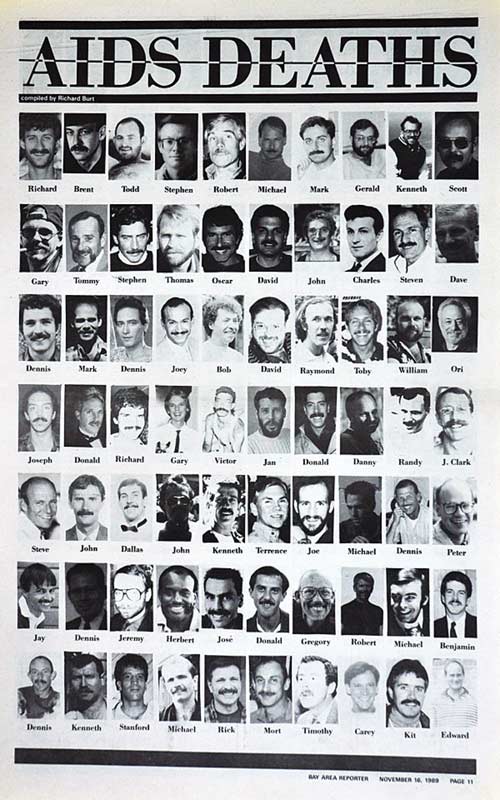
In 1989, art director Richard Burt became so overwhelmed by the number of obituaries that had been turned in to the B.A.R. within the first 10 months that he wanted to convey the sinking feeling in the pages of the paper. The Nov. 16 issue included a four-page collage of everyone who had passed away due to AIDS that year. Just a name and a face.

“It was heartbreaking,” Julian said, “to see my friends and lovers pictured there.”

Through the efforts of Tom Burtch and the San Francisco GLBT Historical Society, a massive searchable online database of B.A.R. obituaries since 1979 was launched in 2009 (www.leifkerdesigns.com/olo/index.jsp).

During his tenure at the paper, Julian chose not to cover AIDS, feeling that the point of entertainment news was to distract away “from the soul-crushing presence of the grim reaper stalking our neighborhoods.”

Though AIDS was a heavily political newsbeat, Friday removed himself from covering it for different reasons. “I knew every elected official. I sat in on all the City Hall meetings about the bathhouses,” Friday said. “But I just couldn’t do it every week. It was too damned personal.”

“Thinking about turning the page to those obituaries even now is making me shiver,” Ottman said. “It’s like a high school reunion, except you don’t know which half made it.”


COVERING THE RISE OF ACTIVISM

The B.A.R. was also instrumental in covering the various political and protest actions that accompanied the disease, including the bloody police sweep of ACT-UP protesters the Castro and the Stop AIDS Now or Else blockade of the Golden Gate Bridge, both in 1989.

Gerharter remembers the blockade. “They arranged it for the morning commute. And thank God it was foggy or else the surveillance cameras would have stopped us.”

Gerharter would often be trusted with information about an upcoming demonstration and be the only photographer allowed to tag along. “You can document history better when you become a part of it. You get closer to the people — they’re not posing,” he said. “It was our job to be advocates and watchdogs.”

After consistently seeing the tragedy of AIDS on the front page for almost a decade, the B.A.R. became more active itself, inciting its readers to action. “We’d read the B.A.R. to find out about the rallies were happening so we could skip work and take a road trip to Sacramento,” Ottman said. “The Chronicle would never cover that.”

When the fight against AIDS became a war, the B.A.R.’s writers often felt like they had become war correspondents, complete with all the outsize personality conflict and drama of the classic stereotype.

“[Bob] Ross was a nightmare boss, a pain in the ass, and complete rageaholic,” Julian said of B.A.R.’s often conservative cofounder, who died in 2003. “But he was committed to keeping the paper and us running.”

THE BAY AREA REPORTER 40TH ANNIVERSARY EXHIBIT

Through June 30, 9 a.m.–5 p.m.

Union Bank Main Branch

400 California, SF


Treasure Island: 11 ayes, no sight

6

On June 7, the San Francisco Board of Supervisors voted 11-0 to reject an appeal of the Treasure Island environmental impact report. The appeal was brought by Arc Ecology and our colleagues the Sierra Club, Golden Gate Audubon Society, Wild Equity, former Sup. Aaron Peskin, and Yerba Buena Island resident Ken Masters.

The board will tell you that the Department of City Planning and the Mayor’s Office of Economic and Workforce Development found the appeal lacking in merit.

In the appeal, we claimed the EIR lacked the specificity to qualify as a project EIR, which means that after it passes, the city will have substantially limited the ability of any future Board of Supervisors to address the project’s actual environmental impacts. But these impacts cannot and will not be known until actual development proposals, none of which presently exist, are made.

Sup. Jane Kim and city planning staffers argued that the EIR had almost too much specificity. For example, without showing a single confirming diagram, project sponsors claimed they could cut as many as 100 stories off the proposed skyscrapers — yet keep the same number of condos without increasing the bulk, height, or number of buildings in the overall project. How? Through the Harry Potter-like magic of “flex buildings and zones.”

The board will tell you that this project presents a vision of a new community unrivaled in the Bay Area and nation — a new Athens. But the supervisors don’t seem to realize that it’s a development with a population larger than Emeryville, about the size of Albany. Indeed, the separate dedicated buildings of affordable homes truly make Treasure Island like Athens of old, with poorer people segregated from the rich.

They don’t see that this is a self-reflecting vision blithely unconcerned about the impacts it will have on the greater Bay Area region, and that it’s a bloated project that will vastly exceed the region’s capacity to support it. It’s a project whose impacts will enslave legions of people to longer commutes as more cars flood the bridge, pushing traffic like rising sea levels into the upper reaches of East Bay freeways. Nor are project proponents particularly concerned about the impacts of air pollution blowing from the bridge and the region’s freeways into Berkeley, Emeryville, and Oakland.

Finally, neither the supervisors, nor the city planners, nor the Office of Economic and Workforce Development seem to be aware that San Francisco currently has 30,000 vacant housing units. It will cost a projected $577,000 to build each Treasure Island unit. But more units could be built on San Francisco’s mainland with almost no impact, simply by allowing rental units in the basements of some of our stock of 130,000 single-family homes.

That kind of housing isn’t as luxurious as a 45-story view of the bay from Treasure Island perhaps — but at a cost of $100,000 to $200,000 per unit, more than half of those in-law apartments could be rented at or below market rate. Infill housing of that sort would also mean greater stability for established home owners, more jobs and business opportunities, and more riders for Muni.

Still, the appellants weren’t trying to halt any project at Treasure Island. The appeal was about was fixing the deficiencies in the EIR and right-sizing the project so it can move forward with its benefits intact.

In the Tarot, the Five of Cups depicts an individual so besotted by that possibilities floating before his eyes that he stands mesmerized, believing they are at hand — of course, in reality he’s fooling himself. In the case of Treasure Island, the supervisors and city officials are intoxicated by the visions floating in the bay — and are thus blinded to the better options of making this city and region more sustainable and affordable.

Ready for takeoff

0

arts@sfbg.com

DANCE Life partners running a dance company together is rare, and when it happens the couple usually keeps responsibilities distinct. In ballet, Gerald Arpino and Robert Joffrey did it for many years; Thordal Christensen and Colleen Neary are making a go of it in Los Angeles. In modern dance, it is simply unheard of. Modern dance companies are one-man or one-woman affairs. But no longer: Janice Garrett and Charles Moulton have broken the mold.

A couple for the last 15 years, they plunged into choreographing together in 2007 with the splendidly original String Wreck. In 2009, they raised the ante with The Illustrated Book of Invisible Stories, which used a movement choir — something Moulton had perfected in his Precision Ball Passing works — of student performers and Garrett’s professional dancers. Now they have refined that model.

The exhilarating The Experience of Flight in Dreams was a wondrous meditation on the idea of being liberated from the boundaries and restrictions — physical and intellectual — that tie us down. With Experience, Garrett and Moulton have, in fact, taken flight. This new work tightly integrates the dancers and the choir into a propulsive whole without infringing on the essential identities between the two groups.

The choir was used ingeniously. Their many hands allowed the dancers to fly or float or swoop and dive. With their fingers, they delineated individual portraits. But they also became obstacles to be overcome and roads to be traveled. At one point supine on the floor, they were the dead calling out to dancer Nol Simonse.

The choreography for the five professional dancers was so fragmented and high-pitched that the relative calm of the choir’s activity created balance. Their unisons were also much less regimented; they were alive and filled with breath.

There were dreamers of many kinds in Experience. Dudley Flores was a loner who, encased by supporting arms, periodically woke up and tried to reach for the beyond. He finally succeeded at the end when, carried above the heads of everyone, he became a living image of transcendence — though it wasn’t an image I found convincing.

There was also the petite dynamo Tanya Bello and Yu-Mien Wu in spitfire encounters of kicks, rolls, and lock-steps. When carried aloft by the choir, Bello and Wu looked as if they had sunk into pillows and seemed slightly surprised at what happened to them. Wu is a stunning newcomer with a bravura elevation and leaps that hang in the air forever. He didn’t, however, need such a long solo to prove the point.

Simonse and Carolina Czechowska’s duet had a twitchy but distanced intensity to it as they tried to make contact. Simonse’s dream was a nightmare from which he couldn’t wake up. Like a wounded soldier who comes home, he couldn’t open his fists, no matter how hard he tried. Carried out by the choir, he looked like he had been crucified, or was a carcass. Always an intense artist, he outdid himself in this show.

But not all of Experience‘s dreams were lofty and profound. Some were earthy and simple, like a high-spirited social encounter to some gypsy music. Or Flores and Simonse in a hilarious, gesture-driven meet in which they went at each other, as a friend observed, like two roosters. Or perhaps Bello who, for the heck of it, interrupted a solemn proceeding with a running, screaming fit that, no surprise here, became infectious.

In the penultimate section, the choir hoisted and lowered big panels of fabric that created billowing waves the dancers had to pass through (not unlike the worshippers did in the “Wade in the Water” section of Alvin Ailey’s Revelations). Perhaps it was meant as a transition to the finale. It didn’t seem to make much sense.

Garrett and Moulton work well together; they also choose excellent collaborators. Foremost among them was group of eight top-flight musicians who, under the guidance of Jonathan Russell, played one of the most deliciously appropriate dance scores that has been heard in these parts in a long time (along with the absolute pleasure of having live music). Oana Botez Ban’s red and black palette for the costumes worked well, as did Jacob Petrie’s supportive lighting design.

Gamer road trip: E3 report!

0

If last week’s E3 press conferences in Los Angeles are any indication, game consoles are no longer just about games. The Electronic Entertainment Expo, the year’s biggest video game industry event, lavishly presented gamers with a sneak peek at the most-anticipated titles and hardware goodies looking to lighten wallets later this year. But as more blockbuster game franchises are released simultaneously on the Wii, PlayStation, and Xbox, it’s become imperative for their parent companies to differentiate themselves — and traditional gaming has begun to take a back seat to this broad experimentation.

Along those lines, Microsoft attempted to guide itself out of the corner it had painted itself into following the huge sales of Kinect, the camera device that quickly became the fastest-selling consumer electronic of all time. Microsoft has been lacking significant game releases for Kinect owners, making this year’s release slate integral to satisfying the new and unexpectedly large consumer base. An upcoming Xbox interface allowing users to control other entertainment like Netflix and live TV by voice seemed to be a hit, as was the announcement of Kinect controls for traditional games like Mass Effect 3 and Ghost Recon: Future Soldier. Microsoft undoubtedly launched Kinect to compete with the draw of Nintendo’s family-friendly Wii, and the device’s appeal to the more serious gamer is a delicate maneuver that these franchises could help accomplish.

In the PlayStation camp, Sony made a speedy apology for the PlayStation Network outage that has battered its reputation for the past two months and piggybacked its return with announcements for bundles, deals, and partnerships offering consumers considerable content for their respective price points. Presenting these products as “gifts” to consumers was an interesting approach to mitigating ire over the network snafu. All business, Sony’s presentation was the least titillating but perhaps most solid of the conferences.

No more beating around the bush: the biggest question going into E3 2011 was “What is Nintendo’s new console?” Leaked information that pointed to a new, more powerful console was confirmed when Nintendo announced the Wii U, a console with a touchscreen controller capable of streaming games to your hands — with or without a television screen. Actual game announcements were left to the newly-launched 3DS and surprises were scarce: tried-and-true franchises Mario Kart, Starfox, and The Legend of Zelda. While the possibilities for Wii U initially seem vast, the console’s true nature — and that of its “revolutionary” controller — remains nebulous. There’s the potential for an HD system to recapture Nintendo’s diminishing hardcore audience, but right now the Wii U looks like another stab at cornering families and casual players.

Third-party publishers care less about console revolutions and more about good ol’ fashioned video games. Electronic Arts stuck to its guns, offering concrete gameplay footage and loud (loud!) speakers that shook the Orpheum Theatre with Battlefield 3 explosions. The Battlefield franchise is looking to take Call of Duty head-on this year, and time will tell if players favor authenticity over that series’ scripted bombast. Either way, Battlefield 3 is one pretty game. EA also made a strong go at providing social networking experiences that augment traditional play, and offered them all for free — perhaps a dig at Activision’s recent announcement it will offer paid subscriptions to a similar Call of Duty social experience.

Inside the Los Angeles Convention Center, many newly-announced games were playable or shown in demo form. Highlights: Uncharted 3‘s two gameplay demos both boasted a top-tier knack for exciting set-pieces and storytelling, and it is the first game to truly suggest the power 3-D can add to the gameplay experience. BioShock Infinite was unmatched in attention to detail with its departure to a city-in-the-clouds backdrop. And Mass Effect 3 finally gave gamers a glimpse of Earth’s destruction in a short demo that demonstrated massive carnage and a surprisingly-affecting level finale. There were tears in a few eyes, folks.

E3 2011 was less about this or that game, and more about the process of evolving your traditional game console into an entertainment center where you surf the Web, watch movies, and even take the experience on the go. Nintendo was eager to suggest the new home applications its controller might afford, and Microsoft and Sony focused on expanding new possibilities for their current hardware through Kinect and Sony’s motion device, PlayStation Move. As more and more of the public identify as gamers, this is the playing field expanding to allow for different types of game experiences. Even so, games like Battlefield 3, Uncharted 3, and Mass Effect 3 suggest traditional gaming is more than up to the competition a broader user base might bring. 


The ol’ Vic-trola

0

arts@sfbg.com

SOUND TO SPARE The potential closing of Haight Street’s Red Vic Theater has unsettled me. With one less place to go out and enjoy, what’s a shut-in-prone type like me to do?

Fortunately, when I spoke to Sam Sharkey, one of the co-op’s managing partners, he offered a ray of hope by saying that the Red Vic Movie House is here, organized — it just partnered with the Haight Street Fair and the California Jug Band Association for a benefit — and best of all, still screening movies, some of them music-related.

Let me take a breath for a minute to reflect and appreciate some of the carefully curated films I’ve encountered at this fine establishment. I’ve transcended the mundane through Ziggy Stardust’s gender-bending, screwed-up-eyes stage persona in Ziggy Stardust and the Spiders from Mars. Director D.A. Pennebaker, better known for documenting Bob Dylan in the 1960s, tried his hand at capturing the Bowie in full glam garb during a 1973 tour. Mick Ronson shreds on guitar to undeniably comical proportions. I recall the audience cracking up, something you just don’t get when you’ve opted to Netflix at home.

The less acclaimed — but equally gorgeous — somber sounds of a pop-star- turned-recluse proved to be quite a treat. Scott Walker: 30th Century Man (2006) was one of those films I didn’t know I needed to see, until the rainy day someone sent me a YouTube link to his song “It’s Raining Today.” The opening atmospheric sounds alone on this track are enough to captivate, but as it moves forward into Walker’s commanding crooning voice, you realize that he has the ability to convey dread and beauty at once. The film is a concrete testament to his influence on contemporary musicians.

Later I was given the soundtrack to boxing’s “Rumble in the Jungle,” set in early 1970s Zaire, where a showcase of mostly familiar soul artists pulled off a hugely successful stadium concert. Soul Power (2008) sort of serves as a musical counterpart to 1996’s When We Were Kings, which was the cinematic predecessor dealing with the same Ali vs. George fight. The symbolic implications of the event for African and African American pride are brought to the fore, and the concept of power is examined, whether it is achieved physically, politically or even musically.

Sharkey said that declining attendance was the Red Vic’s main obstacle. Single-screen theaters aren’t as much of a sustainable business anymore, as evidenced by the number that have closed in the last 10 to 20 years. The Castro Theatre and the Roxie in the Mission seem to be surviving, though — I wondered why people weren’t coming out for movies in the Haight anymore. Was it a bad rap from all the sit-lie buzz? Sharkey didn’t seem convinced on that argument, trusting that his patrons wouldn’t buy into that hype. He leaned toward more technology, calling this an age of competition and noting that the accessibility of movies via broadband Internet is just too convenient.

If you’re a music fan who wants to help curb the trend against local establishments falling by the wayside, then the no-brainer is to hit the Red Vic for the following music films. Rock out for the cause — or you may end up drowning in a sea of Whole Foods.

June 26-28, Phil Ochs: There But for Fortune. The unsung 1960s antiwar folksinger (who doesn’t mind taking a backseat to Dylan) gets the full doc treatment.

July 14, The Hippie Temptation. Vintage 1967 footage of the Haight-Ashbury scene in its glorious heyday as seen through the eyes of CBS News. Originally aired on TV, this “hilariously biased” take on flower power should have you craving the street peddlers’ wares immediately after the show.

July 15-16, Stop Making Sense. Classic Talking Heads circa 1984 at L.A.’s Pantages Theatre. Watching a jittery David Byrne working the crowd in his oversized boxy white suit should be worth the price of admission alone.

July 19-20, The Last Waltz. This one’s cool for a couple of reasons. First, it’s directed by Martin Scorsese and, second, it captures The Band’s final show at San Francisco’s old Winterland Ballroom, a place I’ve often dreamed of seeing a show.

Schizoid trickster

0

arts@sfbg.com

MUSIC Tyler, the Creator makes schizophrenic music. At least four entangled voices riddle his latest effort on XL Recordings, Goblin, the follow-up to his self-produced, rapped, and designed debut, Bastard, which he released on Tumblr.com in late 2009. One of those voices is some sort of inner conscience or demon, a pitched down grumble of bass, that doubles as Tyler’s obsequious therapist. But it also takes on the roll of ethical advisor and spiritual consultant: Tyler, you’re right to feel that way; people do like you; you shouldn’t kill all your friends. Even Tyler’s conscience disintegrates into corroded delusions and anxiety. Meanwhile, Tyler, at 20 years old, is an uncompromising, violent, self-hating, offensive, sexually repressed, obnoxious, yet sometime charming and funny protagonist who growls and spews partially digested rhymes over off-syncopated drum programming and synthetic keyboard washes.

The therapist conscience is a foil for Tyler’s caustic self-reflection in Goblin. This dynamic allows for multiple layers of inner dialogue, which subside only when other members of Los Angeles’ Odd Future collective (short for Odd Future Wolf Gang Kill Them All) give Tyler’s disturbed and heavily claustrophobic mental space some breathing room. Frank Ocean, the only member of the crew above the drinking age, waxes sincere R&B verses in “She,” bringing into contrast how Tyler’s unfulfilled desire for his lust interest degenerates into anger, voyeurism, and eventually, fantasies of possession. With Hodgy Beats, Tyler is hungriest on “Sandwitches.” Who the fuck invited ‘Mr. I Don’t Give a Fuck’/ Who cries about his daddy and a blog because his music sucks, he raps, before flipping the chorus of “Wolf Gang” into a call to arms for all who feel slighted by the establishment, any establishment.

In response to the rapid escalation of media attention circling Odd Future since last winter (which perhaps recently climaxed in a lengthy New Yorker article on the mysterious disappearance of member Earl Sweatshirt), Tyler negates excessively: the hip-hop blogs that gave him no love, kids with comfortable homes and families, music critics, moralists who accuse him of homophobia and misogyny. Tyler stands for defiance and offensiveness, rejection and swag, bastards and goblins, skateboards, skating apparel, and the simple joys of juvenile delinquency.

Another voice in Goblin is a rare appearance: some sort of helium-intoxicated creature. It slightly echoes Madlib’s incarnation of gratuitous violence in the Quasimoto character, culled straight from a Melvin Van Peebles’ film trailing a black man’s escape and redemption from the systematic violence brought to bear on his body in America’s inner city. But there’s not much of a redeeming light in Goblin. And the source of Tyler’s frustration and belligerent lashing out is all the more obscure. The record is thoroughly dystopian, despite its pretensions to comedy — a lonely soul trying to find its way in a desolate and often antagonistic world.

Tyler shares as much in spirit with the paranoid hallucinations of the Geto Boys’ “Mind Playing Tricks on Me,” minus the lighthearted melody, as with Eminem’s confessional tirades. Moments of vulnerability seem to, if not justify the violent outrage, then at least make it bearable (and for a certain listener, endearing). The critique in Goblin, if there is any critique, might be one of taking the system more seriously than it takes itself. The record is neither ironic nor detached, but a head-on dive into the gluttony of indulgences that comprise popular culture and much of everyday life today, as well as the psychological pain and alienation that the system manufactures in its wayside.

Goblin is not much of a crossover album, either. There aren’t many hooks to hold onto since much of the schizoid discourse replaces formal pop structures. It’s a sprawling record, some songs inching toward 10 minutes. The most memorable hook is the anarchic anthem of “Radicals” in which “Kill people! Burn shit! Fuck school!” is yelled in a repetitive chant. It’s hackneyed and silly enough to make you cringe. But the chant makes more sense when Odd Future performs live (let me tell you, shit is wild), where a sea of teenagers, and those of teen spirit, tap into the sort of rebellious energy you thought had dispersed into the dust of musical archives. This seduction also comes through in the recording. The beat fumbles sickly and the distorted melodic slime falls away to empty pockets of sound where Tyler calls to the listener: “Odd future, wolf gang. We came together cause we had nobody else. Do you? You just might be one of us. Are you?”

ODD FUTURE

Tues/21, 8 p.m., $20

Regency Ballroom

1300 Van Ness Ave., SF

(415) 673-5716

www.theregencyballroom.com


Crying in public

0

arts@sfbg.com

HAIRY EYEBALL Weaving my way through the groups of slower moving shoppers and tourists ambling out of the Powell Street BART Station, I realized I was already too late.

I had wanted to be present for the June 11 noon kickoff of Market Day — the large-scale public art event tied to Allison Smith’s current Southern Exposure exhibit “The Cries of San Francisco” — but when I reached Mint Plaza and had been handed a schedule I saw that my timing had been off by an hour.

Oh well. The point of Market Day wasn’t to necessarily be at a certain place at a certain hour to see a certain something. The “something” was supposedly happening all around me. The nearly 70 Bay Area artists, performers, and craftspeople Smith had gathered for this ambitious public art project had dispersed throughout Mint Plaza, and up and down Market Street between Fifth and Third streets, to peddle their wares (many homemade), offer more ineffable “services” (such as owning the expletive of your choice or telling you a story), or to simply “perform” in “character.”

The criers were to be like tiny pebbles subtly altering the fast-moving watercourse of weekend foot traffic. Granted, participation is hard to measure for something like “The Cries of San Francisco,” but wherever I turned, people seemed engaged even if the number of folks documenting a given artist seemed to greatly outnumber the members of the public they were interacting with.

I decided I needed a little more intimacy if I was to get my feet wet. I started back toward Market and ran into a woman dressed in steampunk-ish attire. Her name was Jamie Venci, a.k.a. the Questing Choreographer (each participating artist conveniently had a large nametag). She offered me an informative pamphlet about one of three historic buildings in the vicinity that had survived the 1906 earthquake if I promised to carry out the site-specific choreography contained within.

I agreed, and for convenience’s sake, I went with the Mint Building. Not five minutes later, I was on the steps of “the Granite Lady” attempting to convey the shape of its crenellated outline with my arms — per a step in Venci’s cutely drawn instructions — in what must have looked like a particularly inept approximation of tai chi.

Conceptual art requires a suspension of disbelief on the part of its audience. I was not merely being ridiculous in public, but was publicly enacting a new relationship to a space I had not really considered too closely before. I, as much as Venci, was the Questing Choreographer, and together we had collaborated on a piece.

The satisfaction I took in my demonstration of good faith was fleeting, as questions took over. What had passersby thought about what I was doing? And how could they really have anything to think about without some context for my undertaking? If a person dresses up in a colorful manner in San Francisco and carries on in public does anyone raise an eyebrow, let alone pause to consider the host of artistic and economic concerns that “The Cries of San Francisco” aimed to bring to the streets?

Materials for the event cited Mohamed Bouazizi, the Tunisian street vendor who set himself on fire to protest police harassment, as well as Carol Reed’s 1968 film version of the musical Oliver! as representational precedents. But despite the presence of Art for a Democratic Society’s Class War Store cart full o’ Marxism, the tenor of many of the criers was more playful than revolutionary. Whimsy was the order of the day.

Ha Ha La (Nathaniel Parsons) pushed around an “amusement park,” a steep ladder that participants would gingerly climb up and down while Parsons bellowed a New Age-y chant affirming their bravery and blessedness through a conch shell. After I took my turn on the rickety structure, I chose a souvenir badge that read, “You don’t have to behave you just gotta be brave.”

Also hard to miss was Maria de los Angeles Burr, who, as the Unsellable, had transformed herself into a walking pile of paper bags. “I have become burdened by too many possessions,” she muttered to me, as confused shoppers exiting from the Westfield Centre stopped to take pictures or gawked while hurrying on their way.

I wondered if they got the visual pun, or would simply move on and tune out the other criers much in the same way many of us avoid other solicitors like petitioners or canvassers.

I also wondered what the Market Street regulars — the men who sell cheap earrings, bootleg Giants merchandise, and faux-cashmere scarves from tables or the young hip-hop dancers who busk near the Powell Street cable car turnaround — thought about the criers. Did they view them as competition? As a friendly change-of-scene? Or did they see them at all?

By 4:30 p.m., all the criers had reconvened at Mint Plaza. They seemed tired from their day of art-making and being “on.” Continuing at a full clip, however, were tweens Colin Cooper and Cole Simon, by far the loudest and youngest hawkers, who had set up shop as the Masters of Disguise (one of their parents informed me that their after-school art teacher, a California College of the Arts student, had encouraged them to get involved with the project).

I walked away from our genial encounter $1 poorer but with a pair of plastic pink sunglasses and an orange mustache to my name. I felt braver with them on.

The carnival continues: the gallery installation component of “The Cries of San Francisco” is up until early next month and will host a series of performance events. Future Saturday marketplaces are scheduled for two Saturdays, June 18 and July 2 (noon to 6 p.m.). And on Wednesday, June 15 at 7 p.m., various criers will present a showcase of musical storytelling, speeches, and other forms of public address.

THE CRIES OF SAN FRANCISCO

Through July 2

Southern Exposure

3030 20th St., SF

(415) 893-1841

www.soex.org


In spite of himself

0

arts@sfbg.com

FILM Apparently Steve Coogan in no way cares if you think he’s an asshole. Fitting, then, that he has perfected an onscreen persona as vain and insecure as it is vapid and self-indulgent. Playing a fictionalized version of oneself has always been a tricky proposition, but Coogan has taken the gambit of self-portrayal-as-schmuck to the level of masochistic brilliance (Larry David, take note). Why would someone this purportedly insecure want to expose himself for the insecure mess that he is? Who cares? In The Trip, comedy as self-flagellation goes down with the ease of an expertly mixed cocktail at a Michelin-starred eatery.

Eclectic British director Michael Winterbottom, who previously worked with British actor Coogan in 2005’s Brechtian Tristram Shandy: A Cock and Bull Story and the 2002 cult fave 24 Hour Party People, humiliates Coogan (2008’s Tropic Thunder) on all number of levels in this largely improvised comic romp through England’s Lake District. Well, romp might be the wrong descriptive. Dubbed a “foodie Sideways” but more plaintive and less formulaic than that sun-dappled California affair, this TV-to-film adaptation displays a characteristic English glumness to surprisingly keen emotional effect.

Ironically, the “real” Coogan’s persona is rooted in a fictional character. Alan Partridge, the sniveling talk show host Coogan has embodied in all his vile glory for nearly two decades, has come to virtually define him not only as an actor but also, perversely, as a man. Partridge’s penchant for clueless assholery has reached legendary proportions in the United Kingdom, and the Coogan-is-Partridge attitude is clearly widespread. “Is it true what they say about you?” a young man asks before holding up a copy of the Daily Mail with the screaming headline “Coogan is a Cunt.” Yes, it’s part of the actor’s dream sequence, but it nicely folds his rampant insecurity together with the affirmation that (as seen in The Trip, anyway) he is indeed pretty much just that.

Coogan displays all the characteristically carefree joie de vivre of a colonoscopy patient with hemorrhoids as he sloshes through the gray northern landscape trying to get cell reception in between dining on haute cuisine and being wracked with self-doubt over his stalled movie career. His happily married, happy-go-lucky frenemy, comic actor Rob Brydon (his Tristram Shandy costar, also playing himself here), is subjected to constant denigration during their travels but takes it all in stride. “I’d love to quote your work back at you, but I don’t know any of it,” Coogan jabs after Brydon does a spot-on Partridge. A particular highlight is the much-vaunted scene featuring the pair’s dueling Michael Caine impressions.

While Coogan can’t help but come off like a pathetic middle-aged prick in a puffy coat, somehow his confused narcissism is our perverse panacea. Also be sure to enjoy the snot martinis and scallops, as well as Brydon’s gleeful “small man in a box” routine. Just don’t be put off by the schadenfreude. Coogan insists.

THE TRIP opens Fri/17 in Bay Area theaters.


The faith and the fury

0

arts@sfbg.com

FILM Hell hath no fury like an enraged Klaus Kinski. The late German actor, who rose to prominence in the 1970s as the combusting supernova at the center of the Wernzer Herzog films Aguirre: The Wrath of God (1972) and Cobra Verde (1987), was as famous for his coruscating off-camera temper as for his onscreen intensity. With Kinski, there is always the near-unanswerable question of to what extent is his performance acting and to what extent is he just being himself. Are we watching someone who has totally, obsessively (unhealthily?) committed to his craft, or a petulant diva whose overinflated ego perhaps bruises too easily?

Klaus Kinski: Jesus Christ the Savoir, a recently rediscovered concert film of a 1971 solo performance, makes a riveting case for all of the above. Filmed a year before he headed to the South American jungle with Herzog, Jesus Christ finds Kinski alone on a spot-lit stage before a packed house delivering a monologue that frames Christ as a persecuted outlaw. “Wanted: Jesus Christ,” he purrs, “charged with seduction, anarchistic tendencies, conspiracy against the authority of the state.”

Not five minutes in the catcalls begin, no doubt encouraged by Kinski’s sudden switch to the first person, making overt the already implicit and problematic association of himself with his subject. “I want my 10 marks back!” cries one audience member. “Shut up!” Kinski volleys back. When one particularly bold heckler climbs on stage to chasten Kinski for his un-Christ-like language, the actor has his security guards forcibly remove the young man and storms off stage to the audience’s cries of “fascist.”

Things only get uglier as the evening progresses. Kinksi returns a second time to proselytize for the continued relevance of scripture by drawing comparisons to then-current issues such as Vietnam and the growing counterculture. The audience, both fascinated and repelled by this wealthy actor whose truculent delivery and hostility toward his flock undercuts his message of nonviolence and justified outrage at the world’s horrors, continues to have its say. Many times, in fact. Kinski walks away from the mic twice more in disgust at the “riffraff.” It is only after the film’s credits that the visibly drained thespian finally delivers his sermon in full to the remaining faithful.

What’s surprising is the palpable sincerity beneath Kinski’s vitriol: He seems genuinely exasperated by the unreceptive crowd, even as each successive disciplinary outburst further alienates them. Of course, such naiveté is another symptom of privilege, but rarely are the privileged as hypnotic or as loose a cannon as Kinski. God bless him.

KLAUS KINSKI: JESUS CHRIST THE SAVIOR

Thurs/16, 7:30 p.m.; Sun/19, 2 p.m., $6–$8

Yerba Buena Center for the Arts

701 Mission, SF

(415) 978-2787

www.ybca.org *