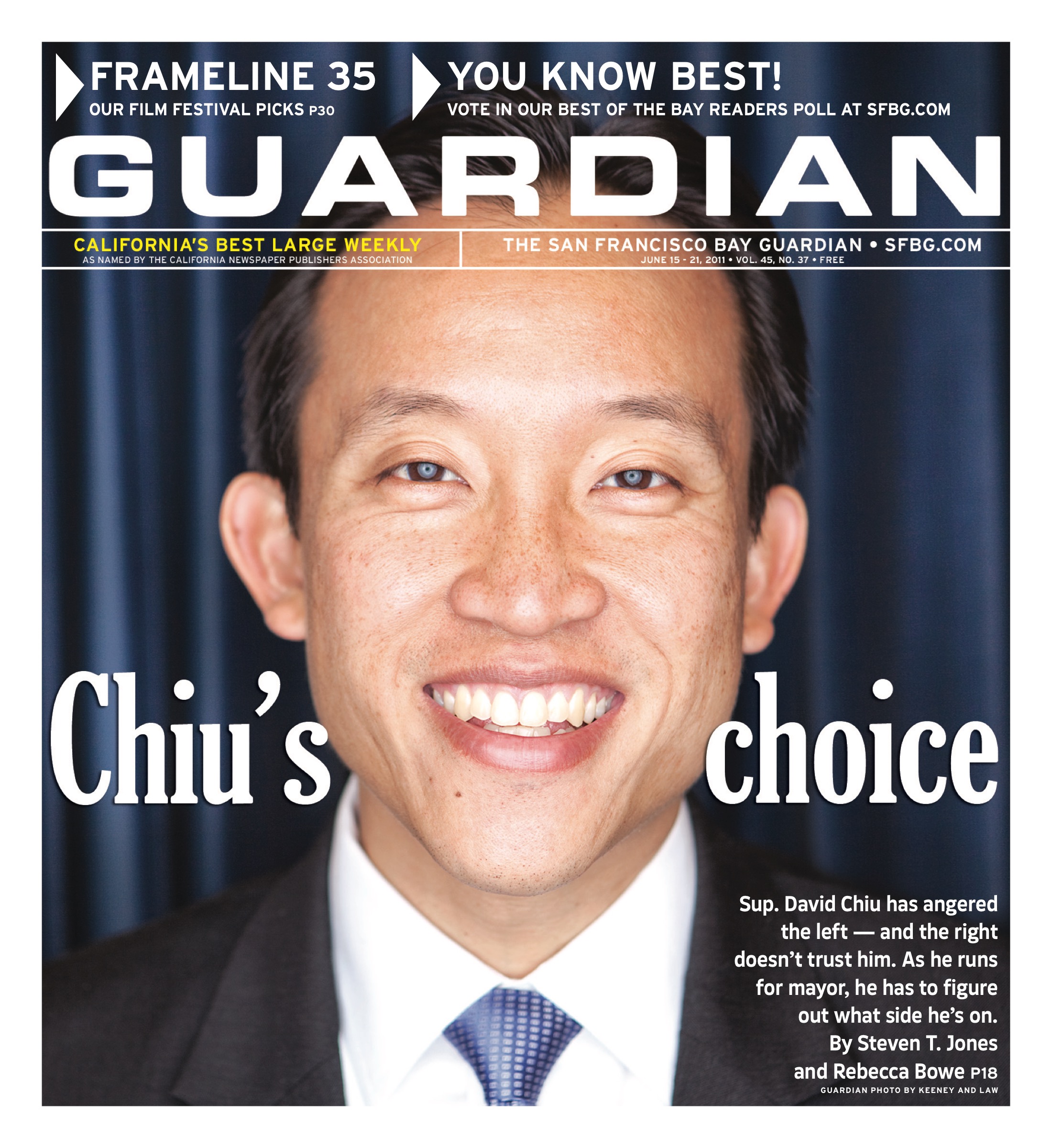
Volume 45 [2010–11]

The ballad of Peter and Raymond

0

arts@sfbg.com

Once upon a time (1987 to be exact), two young men who were old friends moved to San Francisco from the Midwest to take in all the big city had to offer. Like many 20-somethings, Eddie Lee “Sausage” and Mitchell “Mitch D” Deprey didn’t have a lot of money and wound up living in a somewhat derelict apartment in the Lower Haight with a bright pink exterior they dubbed “the Pepto Bismol Palace.” The paint was peeling and the walls were thin but the rent was cheap.

What Eddie and Mitch didn’t count on was having Peter J. Haskett and Raymond Huffman as their neighbors. “You blind cocksucker. You wanna fuck with me? You try to touch me, and I will kill you in a fucking minute.” “Shut up! Shut up! Shut up! Shut up, little man!”

The insults, tantrum-throwing, and threats of violence (which sometimes crossed over into actual fisticuffs) coming from next door were constant. When they weren’t drinking like fishes, Peter — acid-tongued, gay — and Ray — the more hotheaded of the two and an unrepentant homophobe — seemingly devoted their every waking hour to mercilessly tearing each other apart.

Weeks went by. Eddie and Mitch started to lose sleep. And after one failed attempt at complaining to Raymond’s face (he threatened death), they started tape-recording Peter and Ray’s endless geyser of vitriol — first, as possible future evidence — but also out of a growing voyeuristic fascination with these two seniors who had to be the world’s oddest and angriest odd couple.

The rest is history. Mitch and Eddie started including snippets of Peter and Ray’s bickering on mixtapes for friends. Somehow, the editor of the now-defunct SF noise music zine Bananafish heard a snippet and approached Mitch and Eddie about distributing compilations of the recordings to a large network of found sound fans. Gradually “Peter and Raymond” became known and much-beloved characters. Their warped repartee — frequently referred to using Raymond’s favorite rejoinder, “Shut up, little man!,” as shorthand — inspired several theatrical adaptations, short animated films, pages of comic book panels by artists such as Daniel Clowes, and even a one-off single from Devo side project the Wipeouters. SF Weekly did a cover story and there were reams of additional press. Hollywood types called wanting to know who owned the rights to Peter and Raymond. Things had gotten big.

“Shut Up Little Man has been an enchanted, messy cultural accident,” reflects Sausage (he’s kept the moniker) over a Skype conference call. “It was a personal obsession and a private joke that in a very curious way became an underground cultural phenomena.” Sausage, a visual artist and musician who supports himself as a rare-book seller, remains, in his words, “the official custodian” of Shut Up Little Man’s (SULM) legacy, which is copiously detailed on its website.

Deprey — who now works as an insurance agent in Wisconsin where he lives with his wife and teenage children — is also on the line. Although Sausage is doing most of the talking, he interjects from time to time to provide clarification. We are discussing Matthew Bate’s documentary Shut Up Little Man! An Audio Misadventure — perhaps the squarest peg in Frameline 35’s lineup. As much an attempt to comprehensively recount the above long, strange trip from start to finish, the film is also the newest chapter in the now 20-year saga of Peter, Raymond, Mitch, and Eddie.

Bate is a clever filmmaker who is able to translate a story that has primarily been told through sound into something visually compelling. Goofy animated interludes are woven between interviews with Clowes, Devo’s Mark Mothersbaugh, and the many other SULM fans who have created art inspired by Peter and Raymond. Sausage and Deprey also get plenty of screen time, and Bate goes so far as to have them play their 20-something selves in dramatized reenactments of their early days of interacting with and recording Peter and Raymond, who are played by actors. (Huffman died in 1992 of a heart attack brought on by colon cancer, pancreatitis, and alcoholism; Haskett died four years later of liver problems also due to alcoholism.)

Bate’s film is less successful in presenting a clear account of Sausage and Deprey’s 1994 controversial decision to copyright their recordings — which up to that point had been accompanied only by a note encouraging creative liberties and humbly asking for credit — going so far as to imply that this was an ideological about-face. As Sausage and Deprey tell it, they were simply doing the responsible, professional thing in the face of mounting disputes over who could or couldn’t sell the rights (the current disclaimer on the SULM website notes that “permission and licensing is usually granted, but please ask first”).

“Because this stuff was so viral and so innocuous, it wasn’t clear who owned any of this, ” explains Deprey, “We just didn’t want people wrongfully charging other people to use it. And the truth is, we’ve never gotten a penny from any of the artists [featured in the film].”

Still, Deprey and Sausage have now become the semiofficial executors of Peter and Raymond’s estate, even if it’s a legacy composed of hours and hours of blue streaks captured on tape. No surviving relatives of either Huffman or Haskett have come forward in the time that their infamy has grown, underscoring the fact that these two men — despite the venom they constantly spewed at back and forth — really only had each other.

“In a very real way, I think it’s a nontraditional love story,” says Sausage. “There’s a lot of passion and a lot of intimacy there. I mean, arguing is one of the most intimate things we can do as human beings.”

Indeed, Peter and Raymond’s highly dysfunctional Boston marriage might be the queerest onscreen relationship in the whole festival.

SHUT UP LITTLE MAN! AN AUDIO MISADVENTURE

June 22, 9:30 p.m., $11

Victoria Theatre

2961 16th St., SF

www.frameline.org

P.S. Shut Up Little Man! An Audio Misadventure was recently picked up by a distributor and will be released theatrically Aug. 26.


Sing out

0

arts@sfbg.com

FRAMELINE It may be summer break for America’s favorite Slushee-barraged show choir, but judging by the array of song-and-dance numbers in this year’s San Francisco International LGBT Film Festival, Glee fever continues to spike. Half of the fest’s showcase films celebrate the power of the performing arts, including Mangus!, about a young man’s against-all-odds dream of playing the lead in his high school’s production of Jesus Christ Spectacular. Leading Ladies features a mother-daughter-daughter trio immersed in the world of competitive ballroom dancing. And the shorts roster offers no less than three musicals — the Australian films Slut: The Musical and Cupcake: A Zombie Lesbian Musical hail, naturally, from the program “Zombies, Aussies, Musicals, Oh My!,” while Who’s the Top? explores a relationship’s diminished sexual undercurrents through musical comedy. Directed by Jennie Livingston, Who’s the Top? is paired with Paris Is Burning (1990), Livingston’s acclaimed full-length documentary on the late-1980s ball scene in New York City.

The on-and-off-stage drama continues with Jamie and Jessie Are Not Together, a tale of thespians, best friends, and housemate tension rooted more in unvoiced amour than in chore wheels and whose turn it is to buy toilet paper. As the title’s Chicago-dwelling characters negotiate Jamie’s imminent departure for the Big Apple and (she hopes) Broadway, a few wistful tunes are crooned, accompanied by the occasional step-ball-change, but the songs feel somewhat opportunistically tacked on, and the film’s strength lies more in its exploration of that foggy, foggy gray area between the romance of intimate friendship and the romance of ripping the clothes off of someone you really care about.

The tweens of Spork show slightly more promise, at least when it comes to working the dance floor at a nightclub unaverse to letting in 13-year-olds. Spork — so nicknamed by her burnout but well-meaning brother due to her intersex status — is shy, awkward, and isolated at school — when not being tortured by a clique of tiny, racist mean girls led by a Britney Spears wannabe named Betsy Byotch. The answer, clearly, is to best the Byotch in a high-stakes middle-school dance-off — for if we’ve learned one thing from Glee and every high school musical and dance-ical pumped out by Hollywood in the past few decades, it’s that community can be found through soaring vocal harmonies, choreographed ass-shaking, and following one’s dreams.

This lesson is perhaps best exemplified by Leave It on the Floor, which updates (and fictionalizes) the drag and tranny ball scene of Paris Is Burning, transports it to the warehouses of South Central L.A., and adds some infectious music and lyrics (the song “Justin’s Gonna Call” is particularly likely to stay trapped in your brain for days). Leave It‘s kicked-to-the-curb protagonist, Brad, is equally in need of community and a place to crash, and he finds both (after a fashion) in the House of Eminence, the reigning underdog of the ball scene, proudly populated by outcasts and freaks — as well as a hot dueting partner, queer family, and a closing-number set of runway moves that nearly set a warehouse ballroom on fire and probably won’t be coming to a show choir competition near you anytime soon.

FRAMELINE 35: SAN FRANCISCO INTERNATIONAL LGBT FILM FESTIVAL

June 16–26, most films $9–$15

Various venues

www.frameline.org


Camp rocks

0

arts@sfbg.com

FRAMELINE The eponymous character in Ash Christian’s Mangus! has a simple ambition: to be Jesus. That is, to play Jesus in the local production of Jesus Christ Spectacular. Mangus does get the part, but his dreams are crushed when a freak limo accident lands him in a wheelchair and his neighbors decide he’s no longer cut out to play their Lord and Savior.

“When you’re in a small town and you want to be an actor and you don’t get the lead, it’s the most devastating thing in the whole world,” says Christian (2006’s Fat Girls), who was inspired by his own history in community theater.

Mangus! is an interesting but wise choice for Frameline: while it features queer characters (including Mangus’ sister Jessica Simpson, played by Heather Matarazzo), the film as a whole is subtler than other festival picks. It has what Christian calls a “queer sensibility,” but much of that is subtextual.

“I don’t look at it as a queer film,” offers Matarazzo. “I just look at it as a really great dark comedy.”

Christian’s cast is full of actors who might be considered queer icons — among them Matarazzo, Jennifer Coolidge, and Leslie Jordan. But Matarazzo, who is openly gay, doesn’t want to restrict herself.

“When I’m playing to a specific audience because I want this to be a gay and lesbian film, that’s fine for any filmmaker who desires to do that,” she reflects. “But for me, film is really about unifying on all fronts.”

And Christian has his own ambitions. Mangus! is a dark comedy in the tradition of Christian’s cinematic idols John Waters and Todd Solondz. (It’s worth noting that Waters has a cameo in the film, and Matarazzo made her breakthrough in Solondz’s 1995 Welcome to the Dollhouse.) With this work, Christian tackles the topic of discrimination apart from sexuality.

“I’d never really seen a movie with a young disabled kid who had a dream,” he says. “It deals with discrimination in a small town, which I’ve definitely been a part of — not with a disability, but because of the gay thing.”

Mangus! is both hilarious and poignant because its filmmaker is unafraid to hold anything back. It somehow manages to walk the line between over-the-top and honest, presenting a portrayal of disability and sexuality that will only shock those not in on the joke.

“Ash is the perfect master of getting to bring absolute balance in terms of letting an audience pity a character, but then also cheer for him and go along with the ride,” Matarazzo notes. “There was never any kind of mentality of trying to manipulate the audience.”

For a while, Christian did worry about audiences taking his films the wrong way, but he admits that it’s no longer a concern. Indeed, he takes pleasure in making movies edgy enough to unnerve people.

“It’s just something that’s going to keep happening because I don’t want to tell boring stories for Lifetime,” he says. “It’s not really what I want to do. So it kind of turns me on now to have people actually have a problem with what I’m trying to say.”

Those who take Christian’s film in the intended tone will appreciate that it’s not meant to be mean-spirited. In the tradition of the great queer films that came before it, Mangus! lives outside the box: it’s unconventional, subversive, and yes, not even a little bit PC.

“In my heart, I’m not trying to say anything offensive at all,” Christian explains. “They’re just taking it that way.”

MANGUS!

Wed/15, 8:30 p.m., $11

Castro

429 Castro, SF

www.frameline.org


Heroes and hoedowns

0

arts@sfbg.com

FRAMELINE This year’s Bay Area-centric Frameline features run a thematic and identification gamut appropriate to the festival’s ever-inclusive programming. Several are celebrations of local LGBT heroines and heroines, some recently deceased and some still-with-us.

Scott Gracheff’s With You commemorates the life and legacy of late local resident Mark Bingham, who famously died on United Airlines Flight 93 and is strongly suspected of being among the passengers who stormed the cockpit and prevented that hijacked Newark-to-SFO flight from reaching its presumed governmental target in Washington, D.C., on 9/11.

As his activist mother Alice Hoagland and everyone else here says, it’s the sort of thing he would do — Bingham was, among other things, an avid rugby player, metalhead, daredevil, UC Berkeley frat president, world-class partier, several-time arrestee (for reckless hijinks rather than criminal menace), bear chaser, global traveler, dot-com-wave surfer, and “human labrador retriever” (as a long-term boyfriend calls him). He lived a very full life and doubtlessly would have continued living it to the limit if this encounter with terrorism hadn’t cut his time short at 31.

A life that remained eventful for nearly three times that length was that of Del Martin, who along with surviving partner Phyllis Lyon founded SF’s Daughters of Bilitis — the nation’s first lesbian political and social organization — in the highly conservative climate of 1955. They remained highly active in feminist, gay, senior, and other progressive causes over the decades. Martin’s death in 2008 at age 87 occasioned a tribute in the City Hall rotunda that is captured by veteran local filmmaker Debra Chasnoff’s Celebrating the Life of Del Martin. This hour-long document demonstrates the breadth of Martin’s influence as prominent politicians, musicians, authors, progressive and religious leaders, et al. pay homage.

How exactly to honor our dead is the question at the heart of Andy Abrahams Wilson’s very polished The Grove, which charts the creation of the National AIDS Memorial Grove — an idea brought to fruition by the surviving partner of local landscape gardener Stephen Marcus — as well as some struggles over its visibility (even most visitors to Golden Gate Park don’t seem to know it’s there) and purpose.

When a recent contest was held for an installation to be added to the site, two women designers won with a striking sculptural concept intended to make a potent statement à la D.C.’s Vietnam Veterans Memorial about the disease’s devastation. But the grove’s current board shot it down, preferring to maintain the space’s leafy, meditative feel — even if that might also maintain its relative public invisibility. Should the memorial comfort those who directly suffered loss, or metaphorically convey that loss in vivid terms for future generations?

Very much living with HIV — emphasis on the living part — is the subject of Dain Percifield’s Running in Heels: The Glendon “Anna Conda” Hyde Story. Glendon Hyde a.k.a. Anna Conda fled a horrific Bible Belt background to become one of SF’s premier drag personalities, running the Cinch’s popular Friday night Charlie Horse revue for five years until a new condo’s complaining tenants shut that down. Enraged by the city’s “war on fun,” hostility toward the homeless, and other issues to boot, he joined 13 other candidates running for District 6 (Tenderloin) supervisor last year. He didn’t win, but this doc will make you hope he tries again.

Last but far from least is this year’s sole Bay Area narrative feature, shot largely in Fruitvale even if it is set in Texas. A big leap from writer director David Lewis’ prior features, Longhorns is a delightful romantic comedy about several 1982 Lone Star state frat boys dealing with sexual impulses and related emotions that might — oh lawd no — mean they’s quar, not just “messing around.” With some soundtracked songs by H.P. Mendoza (2006’s Colma: The Musical), this total charmer is (as one character puts it) “hotter’n a billy goat in a pepper patch.”

FRAMELINE 35: SAN FRANCISCO INTERNATIONAL LGBT FILM FESTIVAL

June 16–26, most films $9–$15

Various venues

www.frameline.org

Wild is the wind

0

marke@sfbg.com

SUPER EGO “I remember the last time I saw Nina Simone, it was just after the Bush-Gore election fiasco. She was maaad,” graciously loquacious jazz chanteuse Kim Nalley told me over the phone when I asked her about the High Priestess of Soul’s relevance today. “Here was this woman who had been there through so many stages of the civil rights struggle, fought for voting rights in Mississippi, been there through all of that — and then to hear about black communities, Jewish communities, where the votes just disappeared …

“Well, she wasn’t having any of that. She told us we had to always keep up the fight, keep the fire going, and never let go. What was gained in one generation could be completely wiped out in the next. And all the while she was playing the most spellbinding music. I think that’s her angle on now”

Golden-voiced and full of fierceness, Ms. Nalley, a longtime (but not too long) Bay Area phenom and former owner of Jazz at Pearl’s in North Beach, intends to keep that message alive for five straight weeks at the Rrazz Room — and sing the sugar out of a Nina Simone set list that runs to 44 songs, augmented with tales of the activist diva’s life and accomplishments. If just thinking about doing all that makes you draw a breath, add in that Nalley is finishing up her Ph.D. in history at UC Berkeley, teaching jazz to grade school kids, and preparing to embark on a string of international tours and recording projects. Plus she’s catching up on all four seasons of Mad Men. Did I mention she’s gorgeous and actually exists?

She’s also well aware of the hold almighty Nina still exerts on the dancefloor imagination — from the famous, or infamous, Verve Remixed series of the early ’00s, to more recent sample-based efforts like those of Massive Attack, Gui Boratto, Ark, and this spring’s rather unfortunate minimal-tech hit “Sinnerman 2011” by Sean Miller and Daniel Dubb, which apparently took two people to make. (Civilization has so far escaped an Auto-Tuned strip-rap version of “See-Line Woman” or Deadmau5’s “Young Gifted and Black” but I could easily see Nicki Minaj as all “Four Women” at once.)

“You hear these newer versions of her, but some can sound so dated so quickly,” Kim said. “The originals never stop being fresh, alive. There’s nothing wrong with introducing her to new audiences in different ways. But Nina has always been with us, right there, so go out and hear her actual music, already.” *

SHE PUT A SPELL ON ME: THE MUSIC OF NINA SIMONE

Through July 17, Wed.–Sat., 8 p.m.,

Sundays, 7 p.m., $30–$37.50

Rrazz Room at Hotel Nikko

222 Mason, SF

www.therrazzroom.com


TRANNYSHACK: HEKLINA’S BIRTHDAY

The highest hog in dragland turns 103, and this night of greatest hits command performances will be an over-the-top trashtacular. Plus: Justin V. Bond from New York City, and probably some light rimming.

Fri/17, 9:30 p.m.–-3 a.m., $12–>$15. DNA Lounge, 375 11th St., SF. www.trannyshack.com


PRECOMPRESSION

It’s that time, again — time for the Burning Man gear-up and things that sound like this: “We invite you to live out this year’s theme in ways that manifest your personal journey.” I’m gonna be a pizza! Put it on the pizza! Put it on the pizza! It’s all good. With a holy helluva lot of DJs, theme installations, and fun-fur coughs.

Sat/18, 8 p.m.–4 a.m., $15 in “Playa finery,” $20 without. Public Works, 161 Erie, SF. www.publicsf.com


FLYING SAUCER BEACH PARTY

What do you get when you mix big-headed invaders, a slew of hot bodies, a ton of zombie-Martian makeup, and the “Hand Jive”? No, not Weinergate II: Night of the Living Tweets. Culturally invaluable burlesque crew Hubba Hubba Revue and a slew of groovy ghoulies play beach blanket bingo — but with laser guns! — at this ginchy all-day dress-up-and-rock-out bash.

Sun/16, 2 p.m.-8 p.m., $10 before 3 p.m., $12 after. DNA Lounge, 375 11th St., SF. www.hubbahubbarevue.com

Alexander’s Steakhouse

0

paulr@sfbg.com

DINE “This doesn’t really look like a steakhouse,” a friend said recently while scanning the ambience of Alexander’s Steakhouse, which opened last fall in the fabulous Bacar space. Since Alexander’s isn’t an ordinary steakhouse, it’s probably okay that it doesn’t look like one. It’s probably additionally okay that it still looks more or less like Bacar: old brick, gleaming copper and chrome, a vault-like spaciousness, the wall of translucent glass cells in which bottles of wine are stored as if by giant oenophile bees. Even the lounge below decks is still there; it’s is a peaceful haven from the tumult upstairs, with its noticeable Hooters atmospherics.

The central novelty of Alexander’s (the original is in San Jose) is the sensibility of the chef, Jeffrey Stout, whose culinary poles are Japan and France. In this respect the kitchen’s nearest relation in town is probably 5A5, the splendid Asian-inflected steakhouse in the Barbary Coast. Stout’s wrinkle is to swirl some Gallic seasoning into the pot. And while most of the food’s cues seem to be taken from east Asia, the kitchen does turn out such sly treats as truffled french fries ($12 for a good-sized stack). As someone who’s not wild about truffles, despite or because of their expensive exclusivity, I was surprised to find this was an effective idea, with the earthy taste and scent of the truffles neatly nested in the crunchy, all-American bonhomie of the potatoes. Americanness isn’t a neglected theme here, either, incidentally, from Maine lobster to a credible salad of iceberg lettuce ($10), with Point Reyes blue cheese, a fine dice of smoked bacon, and a tangy buttermilk dressing I thought to describe as “ranch.”

“Please don’t call it ranch,” a voice across the table implored. Well, okay, but that’s what it was. Next to the lettuce wedge sat cubes of candied applewood smoked bacon ($5), like a stack of miniature bricks. In their meatiness they could easily have passed for Canadian bacon.

For a steakhouse, there’s a surprising amount of seafood, including Kusshi oysters ($4 each) and hamachi shots ($4 each), cubes of fish served like ceviche in martini glasses with an electric ensemble of chile coins, ginger, and truffled ponzu sauce. There was also, one evening, a main dish of halibut ($34), a perfectly nice filet that had a length of chicken skin roasted onto it. This wasn’t quite a bad idea, but it wasn’t a good one, either. Chicken skin would in theory provide some chicken fat, which is full of flavor and moistness, important considerations when dealing with fish. But halibut is a hardy fish that stands up well to chefly handling, and the chicken skin turned ornery in the roasting, like gum stuck to the bottom of a shoe. Worst of all, the fish seemed to have dried out a bit during its time in the kitchen — not fatally, but still.

Well, you’re thinking, what fool orders fish at a steakhouse? The point of such a place must be the beef, and what grander beef is there than prime rib? Alexander’s offers it in two sizes: 14 ounces ($38) or 20 ounces ($42), the 20-ouncer seeming almost big enough to have been pulled from its own Cryovac pack. The meat, we were told, had been slow-roasted for hours and were presented with jus and a trio of horseradish creams.

(The service, incidentally, must be the among the wordiest in the city. Each item is described at length, with the particulars flying at you like buckshot. Complicating matters is the noisiness of the place, which is like being in the pit of the New York Stock Exchange when full and can make some of the servers hard to understand. I saw lips moving, I heard sounds, but I could not piece together a narrative. Like Woody Allen in Annie Hall, I nodded, smiled, and hoped for the best.)

The beef looked splendid — rather on the purplish, rare side, but that was fine. It was also tough. This was a new prime-rib experience for me; in the past it’s always been tender, if not quite butter-like. Alexander’s meat had a good, rich flavor, but it was hard to separate flavor from texture when texture was calling attention to itself. I’ve often roasted my own prime rib at the holidays, but I’ve never had it show this kind of obstinacy.

Pastry chef Dan Huynh’s dessert menu is littered with French terms (financier, crème brûlée), along with something called “dark dimensions” ($12) that sounded like an episode of The Twilight Zone but turned out to be a miniature playground of chocolate, including logs of malted chocolate ice cream and a small bowl of popcorn. All was tender.

ALEXANDER’S STEAKHOUSE

Dinner: Mon.–Sat., 5:30–10 p.m.;

Sun., 5:30–9 p.m.

448 Brannan, SF

(415) 495-1111

www.alexanderssteakhouse.com

Full bar

AE/DS/MC/V

Noisy

Wheelchair accessible


Cheese bits

1

le.chicken.farmer@gmail.com

CHEAP EATS K. Chunk’s favorite restaurant is Caffe Venezia so that’s where we went for her third birthday. She was having a fruitful, productive, and all-around happy day until — just before dinner — she fell off the slide and cut her mouth. Now some things were going to be hard to eat, like crusty bread. Poor little carb loader.

I tried to distract her from her discomfort in the usual way: by talking about mine.

I’m kidding! We talked about love, of course. I had just come back from Nola for the umpteenth time, and was, well, in it. But I’m not going back for the rest of the year, because Hedgehog won’t be there. And Li’l Edible’s fambly already up and moved to Los Angeles, damn em, so I wouldn’t have any kind of babies to squeeze at all. Ergo: what’s the point?

Hedgehog is driving up to Pennsylvania as we speak, stopping to watch Minor League Baseball games along the way. She has work in New York, and then back to Nola, and then back to New York, and then we’re going to go camping a little out here before I leave the country for a couple months, to write.

She keeps score. She sent me a snapshot of the scorecard from last night’s single-A game in Hagerstown, Md., and in a blank square where she’d missed an at-bat she’d written: “BBQ pork.”

So you see?

“I see,” K. Chunk said. “Did she meet your mommy?”

K. Chunk’s ma and pa looked at me like, Yeah, what about that? Are you going to introduce her to your mom?

“Sure, if she wants to meet her,” I said. “I want everyone in the world to meet my mom. Then they’ll finally cut me some slack for being like I am.”

But it’s my dad who’s really going to hit it off with this pokey, spiny, pointy critter of mine when they cross paths at my nephew’s wedding in the fall. I wish I could say he’ll like her ’cause she obviously makes me happy and proud and inspires me to make songs and other things, and treats me with more care and respect than any of my other recent loves. But really it will be because she keeps score at baseball games.

Our food came.

Wagon wheels with butter sauce and lots of cheese for the birthday girl. Her older sister, whose birthday it wasn’t, had ordered wagon wheels too, but seemed to prefer eating all the little seafoods out of my linguine de mare. Her favorite — get this — was calamari. She might just have been trying to impress me, though, like when she sat with me on the couch in the dark, when she was three, and ate raw onions.

I was impressed with Venezia’s fare. I didn’t expect to like it that much, because it seemed at first glance like a place place, where the point was going to be the village square setting, complete with a fountain, muraled store fronts, fake pigeons, and line-hung laundry.

Cheese city, in other words. I loved it!

Mind you, it’s not cheap eats, but it’s good uns. The pasta was great, the tomato cream sauce was perfect, and the calamari, shrimp, clams, and mussels were not only fresh and delicious, but plentiful.

I got to taste some carbonara too. Next time I’m getting that. And I might not even wait for K. Chunk to turn four.

Venezia is a great place for a big group, and, of course, the childerns. They bring out little plates of carrot sticks, celery and olives for them right away, and they get jars of crayons to color on the paper tablecloths.

In this case, the kids were tired, bleeding from the mouth, and whatnot, so perhaps not surprisingly nobody finished their wagon wheels. Still, pennies were tossed into fountains, pigeons were spotted on rooftops, nourishment was achieved, and all-in-all somebody fantastically special to me turned three. So happy birthday to her.

And happy Father’s Day to her dad, and mine. And yours, I guess. Why not?

CAFFE VENEZIA

Mon.–Thu. 5:30–9 p.m.; Fri. 5:30–9:30 p.m.;

Sat. 5–9:30 p.m.; Sun. 5–9 p.m.

1799 University, Berk.

(510) 849-4681

Full bar

AE/D/MC/V


3348 with a bullet

3

arts@sfbg.com

A name like writer James Boice’s no doubt washes up waves of adulation. His partner-in-assonance is a certain modernist master whom Boice, at 29, surely knows something about. The Good and the Ghastly (Scribner, 288 pages, $25), a wicked new novel, is the kind of towering bildungsroman-cum-crime fiction carnival that is both entertaining and well-crafted — something we’ve come to expect from writers like Chuck Palahniuk, but don’t usually get these days.

For all its explosions, the book isn’t mere spectacle for spectacle’s sake. Often contemporary imaginations of literary violence sink into the page-filling, glittery sands of ersatz — but James Boice, quite the contrarian, has conjured a brutal, sharp diamond in the literary rough. The Good feels fresh and urgent while culling themes as old as the Bible and as zeitgeist-y as The Sopranos: the neo-noir crime epic. Boice has certainly eaten his cultural vegetables; at the same time, he isn’t afraid to spew them up to create a pulpy piece of work that is contemporary and allusive. It’s enough to satisfy readers in need of instant gratification as well as those less ravenous who prefer to sip and savor.

The Good and the Ghastly is a mad picaresque, the story of antihero Junior Alvarez’s rise and fall as criminal overlord. It is the 34th century. Seminal cultural artifacts were lost in some kind of nuclear devastation centuries before, so Sarah Palin and Oprah are among this world’s spiritual and intellectual pundits. Someone called Kevin Lithis is the new Jesus Christ. Everybody believes Stephen King wrote the works of Shakespeare. Ikea tables are considered antiques. But down in the underbelly, an implacable race to power wages between the Italians and the Irish as Josefina, a good mother turned hardened revenge-seeker, sets out to avenge the death of her son — one of Junior’s victims — by assassinating Junior and his unctuous underlings. And how far she goes I won’t say, but it does involve, in one scene, a bazooka, a baby, and a priest’s garb. Yeah.

A peak at the epigraphs inaugurating The Good and the Ghastly give a real sense of Boice’s literary antecedents. There are quotes from Faulkner, Shakespeare, Stephen King, and the OJ Simpson trial. With this mixed bag of chestnuts as synecdoche, Boice traverses the furrows of the high- and lowbrow in his novel. At once, The Good deserves the literary fiction crown and yet, it is also, in its own right, a piece of glorious trash. It is ugly and sensational, yet Boice is an evocative writer who knows what he’s up to.

With no degree to speak of, he has made himself something of a literary wunderkind. When Boice began writing, he “purposefully wanted no formal education,” he explained to me in an e-mail. “I did not want to be a proficient and well-executed writer. I wanted to be a writer who writes in blood. I wanted to live on the margins of decency and write things that were dangerous and true.” After dropping out of college, he moved to San Francisco and holed up in a room at the Halcyon Hotel on Jones Street, writing, drinking coffee, listening to Blood on the Tracks. Now, he lives in New York City and “life is good. I’m happy as a pig in shit.” And he should be. He already has two novels — MVP and NoVA — under his belt. This third entry is set in northern Virginia, where Boice is from. “I feel it is a microcosm of America, the quintessential American place,” he said. But here, NoVA is run by gangsters.

“Part of the impetus for the book was to sort of acknowledge our culture’s twisted relationship to gangsters,” Boice said. “We glorify them. We do. We love Scarface and Goodfellas and The Godfather. It’s fucked up that we do, because gangsters are evil motherfuckers.” Boice says the best writing is “the work of the subconscious.” Guy’s got a sick subconscious.

Like The Godfather, Boice creates a kind of ensemble piece, oscillating between a few different characters and third- and first-person while also generating a universe peppered with striking verisimilitude. Pop cultural references abound, and Boice’s prose contains an arsenal of neologisms — “smuck” is the new “fuck,” Visa rules the world, and Bar With Pool Table is Junior’s haunt. Boice’s invocation of particular brand names and coinages — reminiscent of Anthony Burgess, Bret Easton Ellis, or more recently, Junot Díaz — underscores the kind of fully imagined, multifaceted literary universe that would sate science fiction or fantasy nerds. And like those contemporaries, Boice is doing satire here, although it never feels heavy-handed because the mores of this literary world mirror ours. The year 3348 isn’t looking so glamorous after all.

The novel’s balls-to-the-walls violence, in scenes that glide as giddily as Scorsese’s camera, has a point: “Violence is not fun to think about, but it exists and has a way of interrupting your peace and penetrating your isolation out of the blue whether you want it to or not,” Boice said. “I believe in describing violence in a violent way. Otherwise you’re not telling the truth.”

Great works of art are always something of a mystery, and Boice leads us unflinchingly into the dark while cutting believable characters out of cardboard archetypes, right down to their flesh and bone (literally). Boice saves his most packed punches for last, where he rains down a reckoning upon Junior and Josefina. But all the while, Boice sidesteps easy moral punctuations in favor of ambiguity and open questions. In the end, it’s like a brick through a windshield.

Groupon’s secret

0

sarah@sfbg.com

A San Francisco-based bus tour operator who relies on the Internet to drum up business has filed a class action suit against Groupon, alleging that the deal-of-the-day website uses false advertising, or bait-and-switch tactics, to get customers to its site.

San Francisco Comprehensive Tours, LLC, which does business as San Francisco Shuttle Tours and Wine Country Tour Shuttle, originally filed suit March 17 in the U.S. District Court, Northern District of California “to stop false and misleading business and advertising acts and practices employed on Google.com by Groupon, Inc.”

In essence, the tour company claims that Groupon is dominating Google searches with offerings for discounted local tours — of, say, Alcatraz — that don’t actually exist.

On April 19, SFCT amended its complaint into a class action suit. The amended suit includes “all persons and entities in the United States who purchased Internet ads with Google for the purpose of advertising local tour company business information and whose tour businesses, including the cost of advertising on Google, have been affected by the false advertisements of Groupon which claim to provide discounted offers for tours but actually provide no such offers.”

Attorneys for Groupon have asked for an extension until June 13 to respond to SFCT’s complaint. Representatives for Groupon told the Guardian they can’t comment on the case.

SFCT’s attorneys claim that Groupon is arguing that this shouldn’t be a class action suit because everyone’s complaint is different.

“They’re spamming the Internet with false advertising that affects everyone’s ability to do business, so this is tailor-made for a class action suit,” said SFCT’s attorney Steve Williams of Cotchett, Pitre & McCarthy in Burlingame. “It’s not easy to take on Groupon now that it has gotten so big and can afford top-notch lawyers.” In other words, it could take a group to take on Groupon.

The suit comes as Groupon, which launched in Chicago in 2008 and now claims to have 70 million subscribers as well as annual revenues of $700 million and an estimated worth of $12.7 billion, prepares to go public. Investors are trying to figure out if Groupon has a sustainable business model.

Last December Groupon fueled speculation that it would offer an initial public offering (IPO) when it rejected Google’s jaw-dropping $5 billion-plus takeover bid. Spurned, Google responded by launching Google Deals, a Groupon clone, in Portland, Ore., this June and announcing plans to expand into San Francisco and other U.S. cities later this year.

But as Forbes magazine noted last August, Groupon founder Andrew Mason has “managed to build the fastest-growing company in Web history.” Groupon’s meteoric rise has been attributed to Mason’s decision to combine a familiar concept with a novel idea: customers only get Groupon’s deeply discounted deals if enough customers pay up in advance for the deal that day.


A BAIT AND SWITCH?

SFCT is accusing Groupon of manipulating ad space that it buys from Google to funnel visitors to its site and collect data about these visitors — while SFCT and other tour companies lose customers and have to spend more money on online advertising.

This isn’t the first time Groupon has been sued since it was launched. But the bulk of those cases revolved around claims that Groupon’s “Daily Deal” gift certificates have illegal expiration dates. By contrast, SFCT’s suit is about Groupon hurting other businesses through manipulating Google’s AdWords program, which is Google’s main advertising program and main source of revenue.

“It’s the means that Groupon uses that is harming legitimate businesses. But they argue that it’s the Internet, it’s all new, and therefore the rules don’t apply,” Williams claimed.

Even though Google has not been sued in this instance, Eric Goldman, an associate professor at Santa Clara University School of Law and director of the school’s High Tech Law Institute, said that much of SCTF’s complaint is as much an indictment of Google’s platform as it is of Groupon’s practices. “Even though Google hasn’t been sued, I wonder if Google has or will make changes to its ad platform in response to the allegations in this complaint,” Goldman said.

Google spokesperson Diana Adair told the Guardian: “Unfortunately, we’re not able to comment.”

Williams claims that Groupon is gaming the algorithm that underpins Google’s AdWords program, which uses a combination of the number of click-throughs to a website, the closeness of an ad’s wording to an Internet user’s search terms, and the amount of money businesses are willing to bid on specific keywords to rank search results on Google.

“Groupon can’t say it’s just an AdWords problem,” Williams said. “It’s a manipulation.”

In its suit, SCTF claims it successfully bid on keywords such as “San Francisco tours,” “Alcatraz tours” and “Napa wine tours” for years. Then, in September 2010, Groupon started bidding on these terms as well — and though it rarely offered any discounted Alcatraz tours, it began to rank high in search results, driving up SFCT’s ad costs.

The suit notes that one time, in response to the keyword “Alcatraz tickets,” Groupon’s ad copy read “Alcatraz tickets — one ridiculously huge coupon a day: Do Alcatraz CA at 50 to 90 percent off.” Groupon’s actual ad that day was for discounted acting lessons.

“But they don’t care because they are trying to direct as many people as they can to their website,” Williams claimed.

Williams said he believes he can show that from the moment Groupon started placing ads for tours it didn’t sell, SFCT has suffered financially. “For someone like the plaintiff who is not about to put out an IPO, the frustration is that Groupon is funneling people into their direct mail campaign to develop huge databases and monitor what people like to buy so Groupon can target those people in future,” he said.

Williams told us he thinks he knows how Groupon will try to defend its strategy. “They’ll probably say that there is nothing wrong with what they are doing because if a business want to attract people to its product, it can talk to them about other products,” he said.

But he doubted they would try to blame it on Google. “Google would say that Groupon is taking advantage of AdWords,” Williams explained.

He sees Groupon’s strategy as a “bait and switch” tactic that’s illegal under the federal Lanham Act and California’s unfair competition and false advertising laws. “If I did this in a newspaper’s classified advertising section, it would be wrong. But the way Groupon looks at it, the normal rules don’t apply because it’s doing this online,” Williams said.


TRUTH IN ADVERTISING

Williams also noted that Groupon hasn’t disclosed all the other lawsuits it’s facing. “They view this as a pesky little thing. But most companies, unless the suits are patently without merit, will err on the side of caution, believing it’s better to disclose than fail to disclose,” he said. “Or maybe they are thinking, ‘Soon we’re going to be making $30 billion, so who cares?'<0x2009>”

Goldman notes that SFCT’s class action adds extra complexity for its lawyers. “Groupon will likely try to prevent the class from forming in addition to attacking the substance of the arguments. This is not a quick-and-easy win for the plaintiffs. In many cases, companies like Groupon decide to settle rather than fight because it’s a costly defense, even if they ultimately win.”

“The starting point of this suit is simple enough, namely that businesses need to tell the truth in advertising,” he said. “The complaint alleges that Groupon wasn’t telling the truth because it says X in its ad but when you get there it says Y, which has nothing to do with X.”

Goldman also predicted that, to the extent that SFCT’s suit is truly about an algorithm problem, it won’t be helpful to Groupon. “But that doesn’t mean the plaintiff will win,” he added, noting that establishing false advertising is tricky.

The plaintiffs will have to establish that their parties are competitive and that their businesses were harmed, Goldman said. He also observed that this particular class action suit points to a broader range of questions about the legitimacy of Groupon’s business practices and problems with Google’s AdWords platform.

Goldman pointed to a lawsuit filed June 7 against Amazon suggesting that Amazon had an algorithmic tool for buying ads and that perhaps the tool had gone awry. In that case, Maxfield, a New York City company that markets and distributes the magnetic desk toys called Buckyballs, alleges that beginning May 5 when people searched online for “Buckyballs,” an ad popped up for Buckyballs at Amazon. But when customers clicked on this ad, they wound up on a website that purports to be a listing for Buckyballs but is actually an ad for Maxfield’s competitors’ products.

Goldman also said there is a growing trend of plaintiff law firms feasting on Internet companies, especially in Silicon Valley. “They are watching for these companies to make a mistake and are pouncing on them. It’s possible that suits are mushrooming into class action suits because someone is looking to get more money,” he said.

But in SFCT’s case, Goldman noted, “the plaintiff’s story makes sense.”

Editor’s notes

7

tredmond@sfbg.com

I heard Phil Ginsburg, the head of the San Francisco Department of Recreation and Parks, on KQED’s Forum June 13, talking about the state of the public parks, and he got the usual angry calls. One person wanted to know why it costs so much to play on the city’s ball fields. Another wanted to know why the city is working with a private foundation to put artificial turf and big lights out at the end of Golden Gate Park. (I still don’t understand why the baseball field at Holly Park is always — always — locked and nobody seems to be allowed to play on it at all. Except the people who jump the fence. Not that my kids and I would know anything about that.)

Ginsburg did his best to duck and weave and answer — and portray this as a tough situation with a lack of public resources. But what he didn’t say is that the overall mission of the department has changed over the past few years. Dramatically. And it follows an alarming national trend that, ironically, started right here in San Francisco, with the Presidio National Park.

When the Sixth Army moved out of the Presidio and the land reverted to the National Park Service, Republicans in Congress threatened to sell it off. The NPS was short of money to develop and maintain the place, so Rep. Nancy Pelosi came up with a plan. She turned the park into a semiprivate enclave run by a board of real-estate developers with a mandate to become economically self-sufficient. Step one: give that notable Marin County pauper George Lucas a $50 million tax break to build a commercial office building in the middle of a national park.

It was a terrible precedent. Public parks aren’t supposed to be money-making enterprises. But it took hold — and now Ginsburg is following the same model.

Rec and Parks these days is all about commercialization. The recreation centers are leased to private operations. More and more park space is going to private food vendors. The Stowe Lake concession is set to become an upscale café (run by an out-of-town outfit). The City Fields Foundation, run by the sons of Gap Inc. founder Don Fisher, is taking over soccer fields. It costs money for tourists to visit the arboretum.

I know: there’s no cash, the city’s broke, and Ginsburg says this is the only way to keep the department running. But it’s really dangerous — because once you treat the public commons as a commodity, you’ve crossed a line. And it’s hard to go back.

CPMC’s stunning arrogance

0

The San Francisco City Planning Commission hearing June 9 on California Pacific Medical Center’s expansion plans was remarkable — both in the comments that the commissioners had and in the mind-boggling arrogance of the giant hospital chain.

CPMC wants to build a massive new hospital and medical office building on Van Ness Avenue and rebuild St. Luke’s Hospital in the Mission. The plans aren’t even close to complying with city planning codes — the Sutter Health affiliate will need city approval to exceed height limits on Van Ness (by more than 100 feet); a modification of the housing construction requirement for new offices; permission to demolish existing housing units; permission to take over a part of San Jose Avenue — and a lot more. In other words, CPMC is asking a lot from the city.

And since this nonprofit controls four major hospitals in the city, its future development decisions need to be considered in the context of San Francisco’s overall health care needs.

It’s entirely reasonable that the city ask CPMC for a development agreement that provides benefits to city residents. Mayor Ed Lee has made it clear that the approval of this project will depend on whether CPMC can address affordable housing, healthcare access for low-income people, a secure future for St. Luke’s, workforce development, and transportation impacts. Lee’s proposals are more than reasonable: he’s asking that CPMC pay the standard fee for affordable housing required of any major commercial developer; increase its level of charity care (now an abysmal 0.99 percent) to the average of other regional hospitals (2.3 percent); increase its Medical acceptance rate; and maintain St. Luke’s as an acute care facility with an emergency room. Union nurses are asking that Sutter deal with them in good faith.

But Dr. Warren Browner, CEO of CPMC, showed little interest in working with the city. The demands are way too high, he told the commissioners, insisting that it was unreasonable to ask the hospital to contribute that much to affordable housing. He acted as if CMPC was somehow entitled to move forward — at its own proposed schedule — and that all of these city demands were nonsense.

That’s not going to work.

A clear majority of the commissioners got the point. As Ron Miguel pointed out, Sutter is a nonprofit — and its tax-exempt status mandates a certain level of social responsibility. Every big commercial developer has to pay for housing and transit impacts. Gwyneth Borden and Bill Sugaya noted that hospital officials knew full well what the planning rules were when they bought the Van Ness site.

This is a $2.5 billion project. Community benefits need to be a significant part of the final plan. If anything, Lee’s proposals are too limited (Sutter should agree to protect St. Luke’s for 50 years, not 20). The planning commissioners should stick to their positions — this project is out of control, and if Browner wants to see it built, he needs to come back with a new set of numbers, and a new attitude.

Not the face!

0

marke@sfbg.com

SUPER EGO Henny, I don’t even know where to start. I leave the country for a lousy two months and I come back to this? No more Eagle Tavern to blow my mind on Thursday nights and blow my other parts on Sunday afternoon? No more Ti Couz for a hot bowl of pear cider when it’s pissing down rain? Straight people from Richmond puking all over the Castro on the regular? (Actually not too sad about this. I love my Richmond girls — and their unattended purses and boyfriends.)

Perhaps worst of all — um, Kreayshawn? Wow. At least we’re balancing out that catastrophe with a healthy, sleazy obsession with the Weeknd.

OK, I’m gonna move it all along, not dig my claws into bygones. I just flew in and my arms are too short to box with blah. It’s actually great to be back in blackout among my SF dance floor family. So let’s toast the future by getting toasted, because there’s a Jeroboam-load of parties sparkling in the fridge. Hiya!


BAWDY STORYTELLING: “LIBERTINE!”

“Carnal chronicler” Dixe De Tour’s over-the-top scandalous, sexy Bawdy Storytelling reading series is so successful it just expanded to Los Angeles. But home is where its, er, heart remains as Oakland’s infamous Ouchy the Clown joins a bevy of ear-burners for a no-holes-barred night of free speech.

Wed/8, 7 p.m. doors, 8 p.m. storytime, $10. Blue Macaw, 2565 Mission, SF. www.bawdystorytelling.com


WIG OUT: KIM KONG BENEFIT

Beloved DJ and promoter Kim Kong of Non-Fat and Bitches with Stitches was just diagnosed with lymphoma, and the SF scene is stepping up to lend support at this bonkers fundraiser. The Housepitality, dirtybird, and Non-fat crews are bringing heavy hitters Mr. C and Claude VonStroke to the decks — you throw on your favorite wig and dance around.

Wed/8, 8 p.m., donation requested. Icon, 1192 Folsom, SF. www.wigoutwednesday.com


BLOW UP SIX-YEAR ANNIVERSARY

You mean our seminal electro banger glamourpuss joint is already six years old? That’s almost the age most of the kids who went there were during its insane early Rickshaw Stop days, what? Blow Up power couple Ava Berlin and Jeffrey Paradise join the Tenderlions, Nisus, Trevor Simpson, Holy Mountain, and more for the hands-up blur.

Fri/10, 10 p.m., $16 under 21, $12.50 over. DNA Lounge, 375 11th St., SF. www.blowupsf.com


DAVE NADA

The godfather of Moombahton — pitching Dutch house down to its deliciously tropical (and far less annoying/wannabe gangsta) roots — hits the raucous Lights Down Low party, not previously known for its reggaeton or Netherlandish leanings. But dude, when it gets darker anything goes. U.K. funky beatsplitter Canblaster and IHEARTCOMIX’s Franki Chan open up, local locos Deevice, Sleazemore, and Eli Glad preside.

Fri/10, 9:30 p.m.-3 a.m., $10. SOM, 2925 16th St., SF. www.lightsdownlow.net


EVOLVE ANNIVERSARY

Monthly party Evolve has grabbed the crown for deep yet spirit-raising soulful house in the Bay. (Was there ever any doubt Oakland would reign supreme?) And while the emphasis is on the “sacred element of music,” DJs David Harness and Soul Luciani don’t stint on the more earthly pleasures of a friendly, packed dance floor.

Fri/10, 9 p.m., $10. Era Art Bar, 19 Grand, Oakl. www.oaklandera.com


LEE DOUGLAS

Sophisticated nu-disco and deeper house funkiness from this Brooklynite, who has garnered a star-studded following by unashamedly embracing the lo-fi analog techniques of yore. (No fear of the wah-wah here!) He’ll be at the monthly No Way Back party with DJs Conor and Navid.

Fri/10, 9:30 p.m., $5–$7. 222 Hyde, SF. www.222hyde.com


LOOSE JOINTS THREE-YEAR ANNIVERSARY

One of the funkiest parties in the city — a real topper combining secret sampled classics with up-to-the minute edits into a heady yet hip-swinging brew — hits the triple. Guest star: live beatboxer, producer, and instrumentalist James “Ayro” Ellison of Ubiquity Records, with residents Tom Thump, Damon Bell, and Centipede.

Fri/10, 10 p.m., $5. Make-Out Room, 3225 22nd St., SF. www.makeoutroom.com


MALL MADNESS

The totally not ironic, awesomely gnarly, giddily drag-ridden tribute to 1990s boy bands, ’80s Spandex pop, and ’70s unicorns on roller skates (bonus Bieber nods!) is folding up its Sunglass Hut and moving on with its life. Hostess Oxana Olsen serves up Glamour Shots and Hot Topics for the final installment.

Sat/11, 10 p.m., $7. UndergroundSF, 424 Haight, SF.


FADE TO MIND

Those wacky Tormenta Tropical kids are at it again, expanding the signature electro-cumbia sound of their monthly gig with some warped global bass action. This Fade to Mind showcase flies in the L.A. label’s biggest draws: rave ‘n’ b king Kingdom, bouncy duo Nguzunguzu, and kooky pixellator Total Freedom.

Sat/11, 10 p.m., $10. Elbo Room, 647 Valencia, SF. www.elbo.com


THIRD ANNUAL SUNSET MUSIC AND ARTS PICNIC

It doesn’t exactly feel like summer as I write this — most likely because one of the Bay’s most adored free summer-launching events hasn’t occurred yet, right? The Sunset crew is once again taking over Treasure Island for a daytime dance and chill extravaganza, featuring a live set by the actually legendary house and jungle pioneer A Guy Called Gerald of “Voodoo Ray” and “Black Secret Technology” fame. DJs Solar, Galen, J-Bird, and (yay!) Primo Preems support.

Sun/12, noon–8:30 p.m., free. Treasure Island. www.pacificsound.net 2


Sing out, sister

1

culture@sfbg.com

BAR CRAWLER Until last week, I’d never set foot in a karaoke lounge. It wasn’t exactly on purpose; it was just something — like using dryer sheets and eating those little lathed carrots prepackaged with swimming pools of ranch dressing — that never occurred to me.

This is not a story where, by the end, I uncover a newfound talent and become an instant rock star. Turns out, karaoke is hard — and commands a hardcore following of seriously legit singers. But after one whirlwind karaoke tour of the city, I found that it can be tons of fun for the rest of us too.


ENCORE KARAOKE LOUNGE

A friend enlisted for guidance and moral support assured me the first stop on our Friday night list would be mellow. So mellow, in fact, that when we entered from the still-light evening, about six people were watching a surprisingly spot-on rendition of “I Dreamed a Dream” from Les Miz. Next, a potbellied beer-in-hander stepped up for some Led Zeppelin. The patrons were singles and couples, none of the giggly groups of girls I expected. The lights, however, were just what I expected: over-the-top and outdated all at once. The tables were sticky and the drinks were predictably terrible (but cheap). The overall experience seemed like a cozily trashy movie-scene karaoke pastiche.

1150 California, SF. (415) 775-0442. www.encorekaraokesf.com


(Click here for larger Google map.)

THE MINT

Though this be-spangled Mid-Market spot reprised Encore’s small, watery drinks, there was nothing cozy about it. The Mint is on the tip of everyone’s karaoke tongue, so it was packed almost beyond maneuverability with fratty types and hipsters galore, who were too busy huddling in little beanie-topped clusters to pay attention to the stage: no fun for veteran singers of big booming anthems, but potentially good for first-timers.

I hadn’t yet worked up the courage to sing, but my friend joked that if nothing else, I could do “Bicycle Built for Two.” Well, no shit: 40,000 songs to pick from, and someone with mismatched thigh-highs and a fuzzy panda hat beat me to it. Galvanized, I submitted a slip for “American Pie,” which I figured might arouse the passion — or, at least, compassion — of even the most blasé in attendance. When I wasn’t called in 30 minutes, I took it as a signal to duck out with my dignity intact.

1942 Market, SF. (415) 626-4726. www.themint.net


FESTA WINE AND KARAOKE LOUNGE

Next, we headed to Japantown for a more authentic experience. Festa fit that bill, according to our one companion with bona fide Tokyo chops. It’s a surprise to walk into Festa — with its twinkling LED stars, cityscape wall motif, and lustrous dark décor — from the deserted second floor of Japantown’s mall-like Japan Center. With five bartenders for an intimate 30 seats, Festa definitely has an upscale vibe. Most of the women wore heels and cocktail dresses, and the cocktails were likewise elevated, both in price and quality. It took a Bellini, lychee martini, and sake-tini to precondition my vocal chords.

The song list was extensive but lacked my planned-on Don McLean classic — which seemed out-of-place anyway amid such a demure crowd. Billy Joel’s “Entertainer” popped into my head because it’s light and mercifully fast. With hardly a wait, I was twanging, left leg trembling, a good half-octave below where my voice stops sounding like a woman’s and starts sounding like the Marlboro Man’s. I got a rush of mercy applause and swept my friends out the door.

1825A Post, SF. (415) 567-5866. www.festalounge.com


500 CLUB

More than a week passed, and I was ready to go it alone. For a low-key bar with a neighborhood vibe, 500 Club is perfect. Karaoke Sundays start when the afternoon light is still streaming through large windows and a Tecate on the crowded benches feels just right. Audience participation — including some friendly heckling — is big here, and the singers heckle right back. Be warned: the front row, which is nearly every seat in the joint, is something akin to Sea World’s splash zone. You may be personally serenaded, implored to sing backup, or even humped a bit — all in good fun.

500 Guerrero, SF. (415) 861-2500. www.500clubsf.com


PANDORA

Pandora begs a reference to the overstuffed box, and it’s appropriate: this bar has it all — in a good way. Bins brim with cymbals, tambourines, silly hats, and other props. Candy Land and Jenga top a stack of board games. Flat-screen TVs flash the night’s basketball scores. A disco ball sprinkles light over sleek silver couches, low coffee tables, and a posh lit-up bar.

Make a splash

0

virginia@sfbg.com

BAR CRAWLER Overrun with partiers from the burbs on weekends, North Beach remains far more than its hordes of visitors would suggest. Italian history, comforting foods, historical churches, and Beat mystique keep tourists roaming the streets. But savvy locals know North Beach’s under-the-radar gems. In some ways, it’s our most European neighborhood, where you’re most likely to find elderly Continental gentlemen gesticulating over coffee and cigarettes at sidewalk tables outside Cafe Greco or Caffe Trieste. Beneath the tourist trappings and meat markets, beats a vibrant and cultured heart.

This is equally true of its nightlife. Look beyond seedy strip joints and bars packed with suburbanites to find a long list of spots rich with history and colorful characters. If you haven’t hung out in NB in awhile, it’s time to fall in love with this late-night neighborhood’s impressive diversity again via a nice north-to-south bar crawl.


BIMBO’S

There’s no cooler live music venue in San Francisco than Bimbo’s. A Rat Pack-style supperclub where Rita Hayworth danced as a chorus girl in the early 1930s and gin was served in coffee cups, the spacious club is rife with character. Wood-paneled walls, red curtains, and stools create a space Dean Martin’s Matt Helm character would have felt at home in. Start your night with a show of acts as divergent as Flaming Lips and Adele.

1025 Columbus, (415) 474-0365, www.bimbos365club.com


TONY NIK’S

Divey and lived-in, Tony Nik’s still shines under its original neon sign. A Prohibition-era bar opened in 1933 by namesake Tony Nicco, it’s a funky, worn respite from the bustle of North Beach. It’s like stepping back in time … with rock ‘n’ roll attitude. It’s just the place to pop in for conversation and a stiff martini.

1534 Stockton, (415) 693-0990, www.tonyniks.com


CHURCH KEY

This underrated beer haven keeps a rotating selection of craft beers from around the world on tap. Victoriana wallpaper melds with a mellow vibe, offering a welcome respite from weekend craziness. Sip an Allagash Witbier in the upstairs alcove with wild game sausages while a DJ plays classic soul records that won’t drown you out.

1402 Grant, (415) 963-1713


(Click here for larger Google map.)

THE SALOON

It’s time for more music at one of the country’s oldest bars. The Saloon hit the Barbary Coast in 1861 as Wagner’s Beer Hall. Beat-up and worn down (in look and regulars), this bar feels like New Orleans, where music sings out into the night from seasoned musicians who play as hard as they live. Offering live music seven nights and three afternoons a week, the Saloon’s key focus is blues, although rock ‘n’ roll and soul influences abound. Dancing erupts in tight confines — like one ongoing party where music legends relive glory days.

1232 Grant, (415) 989-7666


15 ROMOLO

No North Beach night would be complete without killer cocktails, and they don’t get better than at 15 Romolo. A turn-of-the-century bar vibe is balanced by killer jukebox. Karaoke Gong Show nights are legendary and, although frequently packed, it’s often a place to get an artisanal drink in a relaxed setting. Spawning some of our city’s best bartenders, the talent behind the bar remains impressive. You’ll be hard-pressed not to count their inventive (yet far from fussy) creations among the best in the city.

15 Romolo Place, (415) 398-1359, www.15romolo.com


BAMBOO HUT

It’s a grungy sort of tiki vibe at Bamboo Hut. Live surfer bands, kitschy tiki paraphernalia, and tropical drinks (warning: this ain’t no Smuggler’s Cove) make it a fun, distinctive stop on your crawl for a fruity island escape. And, yes, there are volcano bowls.

479 Broadway, (415) 989-8555, www.maximumproductions.com


MONROE

If you must do a club, this newest North Beach addition is unlike the rest. With decidedly Hollywood flair, mirrors and artwork of models draped in pearls (alas, no Marilyn) line brick walls over leather and velvet couches in this unexpected den of hip classiness.

473 Broadway, (415) 772-9002, www.monroesf.com


SPECS

Journeying south down Columbus Avenue, you’ll hit a few of the city’s great classics. Specs’ Twelve Adler Museum Cafe is the dive to trump all dives. Singing around the piano with a Guinness or a shot of whiskey is a favorite pastime, as is soaking in the glowing, musty atmosphere and listening to stories from crusty locals your mother would be nervous around. A maritime SF mainstay since 1968, Specs is more than a bar, it’s an institution.

12 William Saroyan Place, (415) 421-4112


TOSCA CAFÉ

In the realm of classic bars, Tosca stands alone. Surviving Prohibition with “house cappuccinos” (hot chocolate with brandy), still its No. 1 seller, Tosca has been a North Beach hotspot for decades, its famed back room a haven for rock and movie stars alike. With a lovingly faded yet romantic interior, red booths and chairs hark back to its early days. The famed jukebox spins out a line of tunes crucial to Italians, from legendary opera singer Enrico Caruso to Dino and Frank.

242 Columbus, (415) 986-9651, toscacafesf.com


VESUVIO

Vesuvio is not so much about drink. Libations are an afterthought in a legendary 1950s space like no other. This is the kind of bar where intellectual discussion and reading books are the norm, where inspiration seeps out of the walls. Eclectic, hodgepodge decor is quirky and artsy, just like the clientele. The spirit of the Beat poets who frequented its corners lives on … with beer.

255 Columbus, (415) 362-3370, www.vesuvio.com


COMSTOCK SALOON

End your long night with a mellow, classy stop recalling Barbary Coast days. Comstock Saloon captures that spirit in a restored turn-of-the-century space replete with antique mahogany bar, Victorian furniture, 1916 rotating ceiling fans, and wood-burning stove. Cocktails are impeccable, classic and expertly-made … and top-notch jazz musicians play from the upstairs balcony.

155 Columbus, (415) 617-0071, www.comstocksaloon.com

Alameda all at once

0

caitlin@sfbg.com

BAR CRAWLER Rumored to have given birth to the snow cone, the Popsicle, and the Kewpie doll back in its amusement park days, Alameda still gives off a summery island vibe. (With Playland at the Beach, Oakland’s Idora Park, and Alameda’s Neptune Beach, the primary mode of transportation in the Bay used to be a Big Dipper. Picture rush hour.) The golden sun, rad flea market, and laid-back neighborhoods — well, the place screams “stay a while.” So you may as well get drunk. FYI, the flatlands crawl works best on a bike, but if you soldier up and walk it, you don’t risk getting tipsy and bloody — to each her own. (Caitlin Donohue)


ALAMEDA FERRY

No, you’re not driving out there. Hop the ferry, ’cause guess what? It’s the first stop on the crawl. Take advantage of the bracing winds to order a beer, or better yet, a bay-ready cocktail. Affable bartenders will recommend a bloody or one of the Campari concoctions that sometimes make the specials board. Take your sweet-ass time and ascend to the top deck with your glass — you have 30 to 45 minutes to kill coming from San Francisco. Once you disembark, you’ll be flush with the possibility of a new island lifestyle. Steady on captain, much boozing lies ahead.

Departs from SF Ferry Building, Pier 41, and Jack London Square. www.eastbayferry.com


ST. GEORGE SPIRITS

Surprise! Not only is Alameda a great bar town, it’s also home to a burgeoning alcohol-making district. The island’s northwestern blocks — once the Naval Air Station and still fetchingly speckled at the edges with behemoth military boats — went through an era of tumbleweed rule but are now being reinvigorated by pioneer businesses that enjoy the commercial, wide-open spaces that only airplane hangers can provide. St. George Spirits moved here in 2004 and now produces pleasant, not-too-cloying Hangar One-flavored vodkas (mandarin blossom and chipotle versions are amazing), absinthe, superlative Firelit coffee liqueur, and more. Check out the $15 tasting menu in the jovial tasting room and toast to Alameda with every tiny, long-stemmed glass the good saint presents you with.

2601 Monarch, Alameda. (510) 769-1601, www.stgeorgespirits.com

(Click here for larger Google map.)

ROCK WALL WINES

Don’t worry if your St. George tasting ended with a disorienting absinthe-root beer closer — you don’t have far to bike to the next stop on the crawl. A few hangars over, step into the sleek tasting room of Rock Wall Wines, where you can order flights of swishes from Rock Wall’s father-daughter team plus nine other small wineries that share production space next door in the massive urban vintner hangar-hangout. Feel good about supporting the little guys along with another chance to sample an array of finely-crafted local booze.

2301 Monarch, Suite No. 300, Alameda. (510) 522-5700, www.rockwallwineco.com


BLADIUM BAR AND GRILL

So you’re a few drinks deep — time to check out the actual Alameda haunts. Bar! Well, a gym bar. Once you arrive at the Bladium (you’ll pedal past an impressive lineup of battleships on the way), smile sousedly at the front desk of the Bladium athletic center and weave your way through in-line hockey and indoor lacrosse arenas to the comfortable second-floor sports bar, where you can knock a pint back and take in some of the heated amateur action going on among the athletic types below. Don’t let all the secondhand endorphins make you feel lazy — the kind of drinking you’re doing takes endurance.

800 West Tower, Building 40, Alameda. (510) 814-4999, www.bladium.com


FORBIDDEN ISLAND TIKI LOUNGE

Enough crawling with the generalists — let’s get dark ‘n’ sugary the way only a quality tiki bar can encourage. Find the flavor at the low-lit Forbidden Island, where there will be a luau in progress, if you play your cards right, and sufficient vats of rum and juice even if you didn’t schedule your crawl around roast pig. Hoist a Neptune’s Garden (it’s blue and has fruit garnishes!) to discovering more about the Forbidden Island’s watering holes and continue on your way.

1304 Lincoln, Alameda. (510) 749-0332, www.forbiddenislandalameda.com


LOST WEEKEND LOUNGE

See how we planned this out? We started with sober sea legs on the ferry, pinky-up tastings while you can still bullshit about noses and mouthfeels, then the limber tiki limbo — enter now the dives. Lost Weekend is a good one, and it’s smack in the center of Alameda’s fun downtown, which is worth a saunter about if you’re feeling a little shaky after Forbidden Island. Otherwise, belly up the bar, gaze at the TVs and myriad ephemera on the walls from hazy sports meccas — Philly? Texas? — and discover that here in the Island City, the jock and black-clad hipster crowds can oftentimes merge into one.

2320 Santa Clara, Alameda. (510) 523-4700, www.lostweekendlounge.com


LUCKY 13

Turn the corner onto Park Street and you, my friend, have come to the end of your bar crawl — lucky for SF residents, it’s on familiar turf. The Lucky 13’s East Bay branch is just as good a rockabilly dive into a heavy, microbrew-tinged blackout as its Castro counterpart. Same wooden tables to back-slap and talk trash over without blazing TVs to distract your train of thought, same walled patio for fresh air and lighting of the cancer stick (yeah, alright, you’re wasted). Two big points for the Alameda Lucky: you can bring in take-out stromboli and french fries from Scolari’s next door — and the Fruitvale BART Station is only a happy downhill ride away when you’re ready for the mainland. Lean your bike against the wall and find a comfy seat for yourself, brave crawler — you’ve earned it.

1301 Park, Alameda. (510) 523-2118, www.lucky13alameda.com 

Tipping point

3

sarah@sfbg.com

On June 14, members of the Board of Supervisors will vote to appoint a new member of the Police Commission — in the wake of a messy string of alleged police misconduct scandals that, progressives argue, underscore why having strong civilian oversight is critical to ensuring a transparent, accountable police department the public can trust.

The appointment comes less than two months after San Francisco native Greg Suhr was sworn in as chief in the wake of Mayor Gavin Newsom’s decision to appoint former Chief George Gascón as the next district attorney — a move that has served to muddy the D.A. Office’s efforts to investigate the alleged police misconduct.

Further complicating the board’s choice is the heated battle that erupted over the appointment, led in part by members of two Democratic clubs that represent lesbian, gay, bisexual, and transgender communities.

The Alice B. Toklas LGBT Democratic Club has officially endorsed Julius Turman, a gay attorney and community activist who was a former assistant U.S. attorney and the first African American president of the Alice club. Turman currently works for Morgan, Lewis & Bockius, where he represents companies in actions for wrongful termination, employment discrimination, and unfair competition. He is also state Sen. Mark Leno’s (D-SF) proxy to the San Francisco Democratic County Central Committee and serves on the Human Rights Commission.

On the other side, members of the Harvey Milk LGBT Democratic Club, the voice of the city’s queer left, are supporting David Waggoner, an attorney and community activist who is a former Milk Club president. Waggoner has worked on police use-of-force policy and as a pro bono attorney for the National Lawyers Guild at the Oakland Citizen’s Police Review Board, and been a passionate advocate for the LGBT community, immigrants’ rights, people with disabilities, and the homeless.

The other two applicants for the post are Vanessa Jackson, a staffer at a women’s shelter with experience in counseling ex-offenders; and Phillip Hogan, a former police officer who serves on the board of the Nob Hill Association and has been trying to get on a commission for years.

Although both Jackson and Hogan have diverse experience with law enforcement — Jackson as an African American woman who claims the police have “no respect for people of color” and Hogan as a former police officer of Lebanese-Irish descent who manages real estate — neither has the support of the LGBT community. The position occupied by Deputy District Attorney James Hammer for the last two years, and Human Rights Commission director Theresa Sparks occupied before that, is widely considered to be an LGBT seat.


WHO’S THE REFORMER?

So now the fight is about whether Turman or Waggoner would be the strongest reformer.

In a recent open letter, former Board Presidents Harry Britt, Aaron Peskin. and Matt Gonzalez expressed support for Waggoner. “While most hardworking police officers perform their jobs admirably, insufficient oversight and poor management systems have led to significant problems,” their letter stated. “Despite these widely reported problems, the Police Commission has failed to adequately address these issues. San Francisco needs real reform, not more of the same. We believe David Waggoner will be that voice at this critical time.”

At the June 2 Rules Committee hearing, Waggoner proposed taking away master keys to single-resident occupancy (SRO) hotels from the police. “Significant abuse of that resulted in seriously tarnishing the department,” he said.

Turman made an equally impassioned — if less stridently reformist-sounding — speech. “Why would we allow an officer to enter a home, regardless of the master key rule, which I’m not a fan of?” Turman asked. He also said Tasers are dangerous weapons with unintended consequences. “I fear communities of color will suffer more from Taser use.”

Waggoner’s supporters noted that their candidate has more than 15 years of police accountability experience. Turman’s supporters vouched for his integrity, maturity, ability to build consensus, and “belief in strategically serving his community.”

In the end, Sups. Sean Elsbernd and Mark Farrell voted for Turman, while Rules Committee Chair Sup. Jane Kim voted for Waggoner.

That means Turman’s name has been forwarded to the full board with a recommendation. But because the Rules Committee interviewed all the candidates, the board can still appoint any of them.

At the Rules Committee, Sup. Scott Wiener voiced support for Turman. And Board President David Chiu recently told the Guardian that he has known Turman for years, has worked with him professionally, and will vote for him. “I found him to be fair, thoughtful, and compassionate,” Chiu said, noting that he believes the role of the commission is “to provide oversight and set policy.”

Sup. David Campos, one of the solid progressive votes on the board and a longtime Milk Club member, believes Waggoner would make an excellent commissioner but is a friend of Turman, and believes he’ll be a strong voice for reform. “Sean [Elsbernd] and Mark [Farrell] could be in for a big surprise if Julius gets appointed,” Campos mused shortly after Elsbernd and Farrell voted for Turman.

Campos recalled how he and Turman started working at the same firm years ago. “So I got to know him well,” he said, adding he is “like a family member.

“By virtue of his involvement with Alice, some folks think Julius will be a certain way,” Campos added. “But I believe he’ll take a progressive point of view on the issues. He has both the knowledge and the experience with the police, he understand the important role that police oversight and the Police Commission play in making the SFPD accountable.”

Kim told us that she primarily voted for Waggoner because she knows him the best, and not out of concern that Turman wouldn’t do a good job. “I’m more familiar with David and that’s what tipped the scale,” Kim said. “It’s great to have two strong LGBT attorneys who have a clear understanding of public safety issues, the law, and are advocates for the community.”

But Debra Walker, who ran against Kim last November, steadfastly supports Waggoner. “Julius has been active in the Alice B. Toklas club for a while, he’s a prosecutor, while David is more of a citizen’s defense attorney,” she said.

Turman continues to be dogged by reports of domestic violence, thanks to a lawsuit that Turman’s former domestic partner Philip Horne filed in March 2006 alleging that Turman came into his house when he was sleeping on New Year’s Day 2006 and tried to strangle him.

Horne claimed he “was terrified that the lack of air supply would cause him to pass out and potentially die at the hands of such a jealous and unmerciful former lover.” He alleged he was able to calm Turman down only to see him get enraged again and punch Horne in the face seven to 10 times. When Horne decided he needed to go to the emergency room, the complaint states, Turman grabbed his phone and keys saying, “If you leave, you’ll never see the cats (alive) again,” and “I will report you to the state bar.”

Horne claimed he ran outside screaming for help and that when SFPD arrived, they arrested Turman for domestic violence and called an ambulance for Horne.

Turman responded in July 2006 to what he described as Horne’s “unverified complaint,” arguing he acted in “self-defense” and that the conduct Horne complained of “constituted mutual combat.” He added that “damages, if any, suffered by Horne were caused in whole or in part by entities or persons other than Turman.”

In the end, no criminal charges were ever filed against Turman and the case was settled out of court. Turman now says “I’ve done nothing wrong and these allegations are false.”

Campos warns people not to jump to conclusions. “We need to remember that there is a presumption of innocence,” Campos said. “Yes, there was a court case, but there was never a conviction. Yes, there was a settlement, but people do that for a lot of reasons.”

Turman told the Rules Committee that the incident was from “an extremely difficult time that is now being used against me as a political sideshow.”

Meanwhile, Campos notes that without a reform-minded mayor, there will be only so much any board-appointed police commissioners can do. “What we really need to implement police reform is a mayor who is willing to do that,” he said. “Otherwise it’s going to be very difficult because the mayor still gets to appoint four commissioners and mayor still gets to control who is in charge of the police department.”


WHAT DIRECTION?

Civil liberties advocates praised as a “first step in the right direction” Suhr’s May 18 decision to issue an order clarifying that SFPD officers assigned to the FBI’s joint terrorism taskforce should adhere to SFPD policies and procedures set by the Police Commission, not FBI guidelines.

But in the coming months, the commission will have to decide whether to push a Portland-style resolution around SFPD involvement with the FBI. The commission also will be dealing with fallout from the other scandals, including the crime lab, the use of force against mentally ill suspects, and videos that allegedly show police conducting warrantless search and seizure raids in single residential occupancy hotels.

These scandals have progressives arguing that it’s critical that the board’s three seats on the commission are occupied by applicants with proven track records of reform.

Waggoner notes that in 2003, voters approved Prop. H., which changed the composition of the commission from five to seven members. Four are appointed by the mayor; three by the board.

Last year, he said, the commission made significant progress in the right direction when it adopted new rules after the Jan. 2 shooting of a man in a wheelchair in SoMa. “That was not the first time an unarmed person with a disability was killed,” he said. “After Prop. H and a crisis, the commission finally took steps. It remains to be seen if Chief Suhr will implement that.”

Waggonner said the current arrangement “creates tension between people who are more willing to defer to the chief on policy issues and being in an advisory capacity, as opposed to people who want to be in the forefront of setting policy.”

That tension played out when Commissioners James Hammer, Angela Chan, and Petra DeJesus tried to find consensus on the Taser controversy last year. “Overall they worked well together. But there’s been no progress yet on Tasers,” he said, noting that the commission eventually decided on a pilot project.

Waggoner said he would be in favor of the commission having a more active role and exerting its authority under the city charter to set policy, but in collaboration with the chief.

The Police Commission’s May 18 joint hearing with the Human Rights Commission about FBI spying concerns was a symbol of the broader issue at the Police Commission. The majority of the commission didn’t see any major problems — but the progressives were highly critical. “Is the commission there to set policy and take leadership, or is it there in an advisory capacity?” Waggoner asked.

With Hammer’s departure, Chan and DeJesus, both board-appointed women of color, are the most progressive members of the commission. Chan hopes Hammer’s replacement believes in strong civilian oversight. “We should never be a rubber stamp for the police department,” he said. “We need to take community concerns very seriously. When the police department is doing great things, we should support them — but if we see something wrong, we should not be afraid to speak out.”

Turman told the Guardian that “being the voice for reform and advising are not mutually exclusive roles — and an effective police commissioner needs to be both.

“I would advocate for series of meetings with representatives from the Arab community, the SFPD, and the FBI to increase communication and understanding of each side’s perspective on exactly what we need to implement in San Francisco,” Turman said.

Asked more about Tasers, Turman said that “one of the things I would be interested in pursuing is a recognition by some that female officers are less likely to incapacitate during an arrest, which could lead to learning for the larger police force.”

But does this means Turman will turn out to be a swing vote for Tasers? Only time — and the board’s June 14 vote — will tell.

Lee should veto Parkmerced

0

EDITORIAL Mayor Ed Lee got his start as a lawyer working on tenant issues. He understands the city’s rent laws and the shortage of affordable housing. He also knows — or ought to know — that when the city’s tenant groups are unanimously opposed to a project, elected officials who care about tenant rights should pay attention.

The Parkmerced project will be a clear test: Does he follow his activist roots, stick with the people he started with and show his independence — or side with the big out-of-town developer and allow the project to move forward?

The supervisors approved the project by the narrowest of margins, 6-5. All of the progressives voted to reject the development agreement and rezoning — and for good reason. The deal would lead to the demolition of 1,500 units of rent-controlled housing. And while the developer says it will abide by the rent laws for the newly built replacement units, that’s a shaky legal guarantee. The larger point, tenant advocates say, is that demolishing existing affordable housing is always a bad idea.

In the end, 1,500 people will have to leave the homes they’ve lived in for years — in some cases, many years. They will be offered replacement units in a high-rise — very different from the garden apartments (with, yes, gardens) that they’ve occupied. And if the developer decides that there’s more money to be made by jacking up the rents on those units, it’s a safe bet that an army of lawyers will arrive attempting to undermine the questionable guarantees now in the deal.

There’s also the problem of transportation and traffic. The project will include a new parking space for every new unit, meaning 6,000 new cars in an area already overwhelmingly congested. Since the vast majority of the units will be market-rate (the developer will provide 15 percent affordable units, under city law, which means 85 will be sold or rented to rich people) the development will transform what is now still something of a working-class neighborhood into another enclave for the wealthy.

When we talked to Mayor Lee, he was noncommittal on the deal. At the same time, he noted that the garden apartments are old and will have to be replaced at some point. We don’t dispute that there are ways to add more density at Parkmerced. But wholesale demolition of affordable housing isn’t the answer.

This deal is bad for tenants and bad for the city. Mayor Lee ought to recognize that then tenant groups opposing this have analyzed it carefully and come to an entirely reasonable conclusion.

Sup. David Chiu, the swing vote in favor of the project, did serious damage to his reputation as a progressive and lost thousands of tenant votes by siding with the developer. Lee, who insists he isn’t running in November, ought to demonstrate that he hasn’t forgotten his roots, that he listens to activists, and doesn’t simply go along with poorly conceived development projects. He should veto the development agreement and zoning changes and send this thing back to the drawing board.

Behind the all-smiles budget

2

news@sfbg.com

When Mayor Ed Lee released his 2011-12 budget proposal June 1, all was sweetness and light at City Hall.

The mayor delivered the document in person, to the supervisors, in the board chambers. Sup. Carmen Chu, chair of the Budget Committee, was standing to the mayor’s right. Board President David Chiu was to his left. There was none of the imperious attitude we’d come to expect in the Gavin Newsom era — and little of the typical hostility from the board.

As Sup. David Campos, who was elected in November 2008, remarked afterward: “It’s the first time since I’ve been elected that the mayor has taken the time to come to chambers. It’s reflective of how this has been a lot more of an inclusionary process.”

Lee went even further. “This is a pretty happy time,” he said. “There are no layoffs, and instead of closing libraries we’ll be opening them.” That earned him an ovation from assembled city leaders, including mayoral candidates City Attorney Dennis Herrera and Assessor-Recorder Phil Ting along with District Attorney George Gascón. “I think this budget represents a lot of hope.”

It’s true that this year’s cuts won’t be as bad as the cuts over the past five years. It’s also true that the pain is spread a bit more — the police and fire departments, which Newsom, always the ambitious politician, wouldn’t touch, are taking their share of cuts.

But before everybody stands up and holds hands and sings “Kumbaya,” there’s some important perspective that’s missing here.

Over the past half-decade, San Francisco has cut roughly $1 billion out of General Fund spending. The Department of Public Health has eliminated three- quarters of the acute mental health beds. Six homeless resource centers have closed. The waiting list for a homeless family seeking shelter is between six and nine months. Muni service has been reduced and fares have been raised. Recreation centers have been closed. Library hours have been reduced.

In other words, services for the poor and middle class have been slashed below acceptable levels, year after year — and Mayor Lee’s budget doesn’t even begin to restore any of those cuts.

“We’re not ready yet to restore old cuts,” Lee told the Guardian in a June 2 interview. “It was enough for us to accomplish a pretty steady course and keep as much. Particularly with the critical nonprofits that provide services to seniors and youth and homeless shelters, we kept them as close as we could to what last year’s funding was.”

But the current level of funding is woefully inadequate. As Debbi Lerman, administrator of the Human Services Network, noted, the people who work in the nonprofits Lee was talking about haven’t had a pay raise in four years — even though the cost of living continues to rise. “Our costs have gone up with cost of inflation,” she noted.

She said the cuts over the past few years have deeply eroded services for children, homeless people, substance abuse programs, and others. “There have been significant cuts to every area of health and human services.”

And in a city with 14 billionaires and thousands more very wealthy people, Lee’s budget is distinctly lacking in significant new ways to find revenue.


THE GOOD NEWS

Just about everyone agrees that the budget process this year has been far better than anything anyone experienced under Newsom. “He [Mayor Lee] listened to everybody,” Lerman said. “That doesn’t mean they fixed everything. Mayor Lee fixed as much as he could.”

At his press conference announcing the release of the budget, Lee thanked Police Chief Greg Suhr for having already made significant cuts through management restructuring and for considering an additional proposed cut of $20 million.

“We want to thank you for that great sacrifice,” Lee said, addressing Suhr, who sat in front row of public benches, dressed in uniform. Lee next acknowledged that adequate funding for social services also helps public safety. “Without those services, officers on the street would have a harder job,” he said.

Lee also praised the departments of Public Health and Human Services for helping to identify $39 million in federal dollars and $16 million in state dollars, to help keep services open and the city safer.

Lee noted that San Francisco no longer has a one-year budget process and has just released its first five-year financial plan as part of its decision to go in five-year planning cycles.

“To address this, I’ve asked for shared sacrifice, ” Lee continued, adding that he recently released his long-awaited pension reform charter amendment, emphasizing that it was built through a consensus and collaborative-based approach.

Lee also said he would consider asking voters to approve what he called “a recovery sales tax” in November if Gov. Jerry Brown is unable to extend the state’s sales tax. That would bring in $60 million — but it is only on the table as a way to backfill further state budget cuts.

Lee observed that San Francisco is growing, the economy is looking brighter, and unemployment is down from more than 10 percent last January to 8.5 percent today. He plugged the America’s Cup, the city’s local hire legislation, the Department of Public Works’ apprenticeship programs, and tourism, both in terms of earmarking funding in the budget for these programs and their potential to boost city revenues.

He said his budget proposed $308 million in infrastructure investments that include enhanced disability access, rebuilding jails, and energy efficiency, and is proposing a $248 million General Obligation bond for the November ballot to reduce the street repair backlog.

“We will get these streets repaired,” he promised.

“This submission of a budget is not an end at all, it’s the beginning of the process,” he continued, going on to recognize Chu for her work getting the process rolling and thanking Budget Analyst Harvey Rose in advance. “I do know his cooperation is critical.”

And he concluded by thanking each of the supervisors. “I will continue enjoying working with you — we need to keep the city family tight and together.”

The sentiment was welcomed by supervisors. “As he said, this is the beginning of the process, and it’s an important and symbolic step” Campos said. “The budget shows that a lot of good programs have been saved. But there is still work to do.

“There are still gaps in the safety network,” he added, singling out cuts to violence-prevention programs. “It’s my hope they will be restored.”


THE BAD NEWS

But even if the cuts for this year are restored, the city budget is nowhere near where it ought to be. “We still had to make cuts,” Lee acknowledged.

“We did consider very seriously a whole host of revenue ideas that we had,” he said. “They were not off the agenda at all.” At the same time, he noted that state law requires a two-thirds vote for new taxes (although that threshold drops to 50 percent in presidential election years). “We decided that it’s not that they were bad ideas, but that we wouldn’t be able to sell them at this time.”

Lee praised some of the revenue ideas that have been suggested in the past year, including the alcoholic beverage fee proposal by Sup. John Avalos, which Lee called “a pretty good idea.” He said that “a year or two from now” an additional sales tax and a parcel tax (for the police or for schools and open space) might be on the agenda.

The city now has a multiyear budget process and projections are supposed to go beyond a single year. But what’s missing — and what nobody is talking about — is a long-term plan to restore critical city services to a sustainable level. That means talking — now — about tax proposals for 2012 and beyond and including those revenue streams in long-term budget planning.

Because the city parks, the public health system, the libraries, the schools, affordable housing programs, and the social safety net are in terrible condition today, the result of year after year of all-cuts budgets. And while the supervisors and the mayor wrangle over the final details, and advocates try to win back a few dollars here and a few dollars there, it’s important to recognize that this budget does nothing to fix the damage.

“We’re about $10 million short of what we need right now to keep service providers at current levels,” noted Jennifer Freidenbach, who runs the Coalition on Homelessness. “But we also need to restore the health and human services system that was slaughtered under Gavin Newsom.”

Cold comfort

0

le.chicken.farmer@gmail.com

CHEAP EATS I write to you from Dot’s Diner in Jefferson Parish, La. Hedgehog is getting her knee looked at down the road, and I thought I would find me a place to sit that wasn’t the waiting room. Or a pool hall. Or bar. Or fast food joint or automotive shop. Or warehouse, thrift store, or — but only because it’s 9:30 a.m. and I ain’t the slightest bit hungry — a fried seafood shack or po-boy shop.

Jefferson’s got good eats in its own right. Crabby Jack’s is here, and at the French Canadian Quarter Festival this spring they fed me the best boudin I ever had, but at 9:30 a.m. the only way you can get a table, apparently, is if you’re an upside-down chair.

If it were 10 a.m. or even three hours later, I would have been in heaven. All’s I really required was a good strong cup a coffee and a seat, but this ain’t California or Seattle or even New Orleans. It’s the parish, as the locals call it, where you can’t exactly sit down without having a meal.

But how pretentious of them to refer to their parish as “the parish.” Don’t you think that’s pretty arrogant? Louisiana has a lot of parishes. They’re like counties everywhere else.

Whatever, I’m sure you’re more interested in what I’ve been eating San Franciscowise than Dot’s Diner’s biscuit with a fried egg on top, smothered in crawfish julie.

I will tell you: duck soup.

As always I have been on the prowl, trying to find the city’s best bowl of cold medicine and antidepressant.

It ain’t at Big Lantern here in the ‘hood, I can promise you that. Me and Hedgehog went there the last time we were in the city together, and I was fighting a cold. A fight, by the way, that I lost.

I’m human. I get sick. In fact, I get sick more than most people, being not only human but a hypochondriac. (Not that I’ve been diagnosed with hypochondria. I can just tell I have it.)

Anyway, I had wanted to show Hedgehog something special like Zuni, Delfina, or Slanted Door, but I felt too much like crap to eat anything but duck noodle soup, pea sprouts in garlic, and string beans with smoked pork.

There were dumplings, too. I forget what they were called on the dim sum menu. Some kind of “little buns,” I think. The ones that were soupy inside, they were great, but some weren’t so soupy. They had lost their juice. Not so great.

I can’t really complain about the duck soup because it wasn’t technically on the menu. Nor was it all that half bad. But the pea sprouts needed a lot of doctoring to taste like anything, and the beans with smoked pork were some of the worst things ever. About half of the beans were lifelessly old tough shriveled ones, overcooked. And the pork was like pork jerky. Very dry. Very tough. Which — granted — maybe that’s what smoked pork means in Chinese restaurants. I don’t often order it, and won’t often order it again, to be safe.

To their credit, the garlic pea sprouts and the beans and pork got better the next day for lunch, and better still the day after that, because I doctored and doctored them back to life.

The soup hit the spot, but as long as I’m healthy enough to get on BART and buses, I will be having my future duck soups in Chinatown, at Great Eastern Restaurant, thank you.

The legendary Jackson Street standby, it turns out, has a rich, flavorful dark broth with perfectly succulent roast duck and great homemade noodles. Or wontons. Or both. For $9, it’s the reigning duck noodle champion, in my book.

I would like to thank John’s Snack and Deli for being out of kimchi burritos again, or else I might never have found this out.

Oh, and Great Eastern also has crocodile soup and soft-shell turtle soup, by the way. In case you’re not sick when you go there. *

New favorite restaurant! *

GREAT EASTERN RESTAURANT

Daily: 10 a.m.–1 a.m.

649 Jackson, SF

(415) 986-5603

Beer and wine

MC/V

Stopping foreclosure secrecy

4

OPINION Thanks to a shadowy corporate mortgage recording system, millions of Californians have no idea who owns their home loans.

As we suffer through this recession triggered by reckless subprime lending and Wall Street speculation, our recovery is being held back in part because people are struggling with foreclosures and underwater home values — exacerbated by a lack of mortgage transparency.

The mess created by Wall Street is causing wrongful foreclosures and wreaking havoc. Real people — often lower-income families and communities of color — are enduring the devastation of foreclosure processes because of the excesses of bankers and investment firms.

In San Francisco, we’ve seen the highest number of foreclosures in the Ingleside-Excelsior, Bayview, Tenderloin, and Mission neighborhoods — many of the places where home values have fallen most. Whether or not you face foreclosure, we all pay for this crisis by losing vital tax revenue that could go to support our schools, protect our neighborhoods, or build our economy.

When Wall Street realized it could make billions by bundling mortgages and selling them to investors, banks and financial institutions needed a way around recording the ownership and assignment of home loans. What the banks and Wall Street came up with is a shadowy, industry-backed reporting system called MERS — mortgage electronic reporting system.

Simply stated, subprime and predatory lending allowed banks to create millions of questionable mortgages, Wall Street bundled these risky mortgages together to sell to investors, and MERS made it quicker and easier to conduct these risky transactions with impunity.

As San Francisco’s assessor-recorder and a financial advocate for low-income communities, we have seen harmful industry practices wreak havoc on families trying to stay in their homes — whether by use of MERS that clouds property titles, wrongful foreclosures, or denied loan modifications.

The state Legislature considered several good foreclosure bills this year. One proposal placed a $20,000 fee on financial institutions attempting a foreclosure. This would have discouraged foreclosure and helped defray costs to communities if the process went ahead.

State Sen. Mark Leno( D-SF) and Senate President pro tem Darrell Steinberg (D-Sacramento) offered legislation stopping banks from proceeding with foreclosures when a homeowner is attempting to modify his or her mortgage.

Assessor-Recorder Ting is sponsoring a bill requiring that all mortgage assignments and transfers be recorded with counties, thus taking this process out of the murky MERS system.

Unfortunately, the banks and their armies of lawyers and lobbyists have been able to stymie these reforms.

We must continue to fight these wealthy, powerful lobbies so that the long road to recovery in our housing markets and communities can begin. We cannot let Sacramento forget it was financial institutions that fueled the housing bubble, crashed the stock market, and sent shockwaves throughout the economy with their reckless practices.

Few states have been ravaged by subprime lending and the meltdown of mortgage-backed securities the way California has, so we must continue reforming the practices of banks and Wall Street that have thrown our economy and communities into turmoil.

Phil Ting is San Francisco assessor-recorder. Kevin Stein works with the California Reinvestment Coalition.

Father’s day

0

arts@sfbg.com

FILM The central figures in Mike Mills’ Beginners — a grown son and his elderly, newly out father — share a relationship rarely featured on screen. But however unique the story seems, it’s based on real events in the writer-director’s life.

“I thought my dad coming out was the most awesome thing that ever happened in my life,” Mills (2005’s Thumbsucker) reflects. “What happened between us after he came out — it was the biggest story I had to tell. I like it when filmmakers make really personal stories.”

Even though Beginners is based on his life, Mills made sure the film would have a broader appeal. When he appealed to Ewan McGregor — eventually cast as Oliver, the son — Mills stressed the importance of expanding on the personal.

“The first thing I said to Ewan when I wrote a letter, I was like, ‘This has to be more than personal. It has to reach out to people. You can’t feel like you have to mimic or anything like that.'<0x2009>”

For McGregor, the truth behind the script was part of what attracted him to the project. Although he was committed to playing Oliver and not Mills himself, the actor also wanted to connect with the reality of the film.

“I thought it was a wonderful story,” McGregor says. “I wanted to know more and more about the real story. I think that’s always really important. That’s what makes you identify and commit to something wholeheartedly — believing in the story you’re telling.”

Veteran actor Christopher Plummer stars opposite McGregor as Hal, who comes out at 75 and proceeds to make the best of his twilight years. Again, Mills wanted the character of Hal to be distinct from his actual father, though he was charmed by the similarities between the two men.

“It was a real natural fit, I’ve got to say,” Mills admits. “Christopher got so many of the key points, like the humor.”

Indeed, all the actors — including costars Mélanie Laurent and Goran Visnjic — brought humor to their roles, helping Beginners achieve the bittersweet tone Mills intended. The film maintains a whimsical style, alternating between moments of joy and tragedy throughout. But on either end of the spectrum, it feels organic, something McGregor credits to the positive energy of the set.

“It was absolutely the best environment to create good acting, to create good work for us,” he notes. “It very much felt like we had this space — and the peace and quiet and the time — to live those scenes and to make them feel very, very real.”

Although McGregor says he doesn’t pick films based on their budgets, he does acknowledge the benefits of working on a smaller, independent movie.

“On a big film, there are maybe 500 people on the set — you don’t know who anyone is,” he explains. “All the direction is given through earpieces to everybody, and you can feel very lonely. But on a film like this, you’re just part of the process. It’s lovely, and it really feels wonderful.”

Mills is pleased with the finished product, which is one of the all-too-infrequent depictions of a happy older gay man. He believes that his father and the film-loving friends he met with weekly would have appreciated the portrayal. But he also notes the need for more.

“I’m very honored to get to treat a gay character in a movie hopefully with respect and curiosity,” Mills says. “The thing that would be more interesting would be a movie not just with an older gay man, but by an older gay man. We need more stories obviously through gay eyes, not just a straight guy telling a story about a gay guy.” *

BEGINNERS opens Fri/10 in San Francisco.


Ladies first

0

arts@sfbg.com

FILM The phenomenon of scene-stealing Japanese divas is all too familiar to this wannabe, having grown up in the clutches of unrepentantly demanding, real-life J-power matrons — the kind who will ply you with unsolicited advice, gifts, and edibles while smilingly applying the thumbscrews of sweet guile, pile-driving guilt, and sheer gambatte.

Where to begin when it comes to the overwhelming careers of the five femme forces of nature rhapsodized in “Japanese Divas” at the Pacific Film Archive? Inspired by, though not identical to, this spring’s series at the Film Forum in New York City, “Japanese Divas” flips the focus, with an elegantly loaded bow and a smile, away from the Toshiros, Chishus, and the other male stars of Japan’s cinematic classics and toward idealized Yasujiro Ozu beauty Setsuko Hara; the crossover face of midcentury Japanese film, Michiko Kyo; Kenji Mizoguchi favorite Kinuyo Tanaka; and Naruse muse Hideko Takamine. And though this incarnation of “Japanese Divas” can often seem like the Setsuko Hara show with its attention to Ozu’s works, other formidable females show themselves fully capable of grabbing viewers’ attention.

One compelling player is Tanaka, Mizoguchi’s once-go-to-gal for her open-faced humanity, unforgettable in the revered The Life of Oharu (1952) and the wrenching Sansho the Bailiff (1954) depicting noble women on their way down to the lower depths. At 24, but looking barely legal with her tremulous baby face and minuscule chin, Tanaka’s remarkable at the center of the 1933 Ozu silent Dragnet Girl as the titular shady lady straddling the straight world of good office wenches and fiery dance-hall molls.

In this slice of hard-boiled gangster tropes speckled with eloquent imagery, Tanaka’s fearsome, politically savvy Tokiko rules the school, be it boxing circles or the academy of 20th-century hard knocks, and plays all the angles. A prickly intelligence and overpowering will are clearly ping-ponging behind that dolly plate-face, as Tokiko fights for her heavily guylinered boy-toy Jyoji (Joji Oka) against challengers, both femme and fuzz, then undertakes the ultimate surrender. This dragnet girl is the whip-smart, indomitable harbinger of modern Japanese womanhood, come the hell of battle, the humility of occupation, and the struggles of survival while tugged by the tide of change.

In Mizoguchi’s biggest crowd-pleaser, and arguable masterpiece, 1953 ghost story Ugetsu, Tanaka crumbles, now the angelic, self-sacrificing wife and mother Miyagi, seemingly lacerated by stark branches in one of the filmmaker’s most strikingly composed images. The moment somehow foreshadows Tanaka’s professional break with Mizoguchi after he tried to stop Nikkatsu studio from hiring her as a director (her first film, Love Letter, was released the same year as Ugetsu).

Rivalry apparently knows few earthly bounds, and in Ugetsu, Tanaka found her worthy seductive, spectral counterpart in Machiko Kyo’s ethereal Lady Wakasa. Kyo — who stars in that other J-cinematic monument Akira Kurosawa’s Rashomon (1950) as well as Kon Ichikawa’s now-tough-to-see Odd Obsession (1959) — strides a quivering line between untouchable delicacy and teasing desire, her half-moon eyes flaring through an immaculate alien-aristocratic visage. Kyo’s almost unrecognizable as ’60s-cute, jewel-polishing, distrusted wife-in-a-box in The Face of Another (1966), Hiroshi Teshigahara’s mad, mod, fantastic-looking postwar treatise on disfiguring trauma and Japan’s obsession with the mask and identity.

My current favorite diva of the bunch: the bravely smiling, long-suffering Hideko Takamine, epicenter of Mikio Naruse’s wonderful drama, When a Woman Ascends the Stairs (1960). Also the star of Keisuke Kinoshita’s Technicolor Carmen Comes Home (1951) and his well-loved Twenty-Four Eyes (1954), Takamine’s put-upon, stubbornly independent hostess Mama is beautifully filled out with almost imperceptible shading — from the slightly arch, whiny tone she assumes when drunk and forced to consort with a heartless customer to the guarded polonaise of politeness she undergoes while sitting down with a rival hostess. Here, as Naruse matter-of-factly breaks down the economics of the biz, Takamine is less Douglas Sirk’s Jane Wyman than Rainer Werner Fassbinder’s Hanna Schygulla, colored in less lurid hues: a post-World War II heartbreaker all too familiar with the disaster attendant with hitching one’s hopes and fortunes to men. 

JAPANESE DIVAS

June 17–Aug. 20, $5.50–$9.50

Pacific Film Archive

2575 Bancroft, SF

(510) 642-5249

www.bampfa.berkeley.edu