Volumes

Show trial

0

arts@sfbg.com

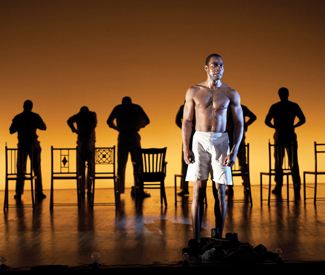
THEATER The set (by Beowulf Boritt) is almost unassuming in its simplicity: just a trio of receding frames arching over the stage, each progressively more askew, and beneath them a jumble of aluminum chairs piled to one side. Still, such simplicity also hints at, and soon delivers, rich complexity.

The chairs become many things over the course of the evening but first of all a bus stop, where an African American woman (C. Kelly Wright) in 1950s dress waits and remembers. This mute opening scene then gives way to a reverie and nightmare — a memory and history that take the form of a highly fraught “entertainment” — as a man in a white suit and a black string bow tie (Hal Linden), invariably recalling the Old South if only via the emblem of a certain fast-food chicken franchise, comes onto the stage and pronounces the start of the show.

That would be a minstrel show, a notorious artifact of 19th and 20th century American popular culture, which returns with subversive vengeance in The Scottsboro Boys — the iridescent 2010 Broadway musical by the famed song-making team of John Kander and the late Fred Ebb, in collaboration with equally-no-slouch associates David Thompson (book) and Susan Stroman (director and choreographer). Making an impressive Bay Area debut at American Conservatory Theater, The Scottsboro Boys revisits the trials and the international cause célèbre sparked by the false accusation of rape leveled by two white women at nine freight-train–hopping African American youths (all teenagers ranging in age from 13 to 19) in Depression-era Alabama.

If this seems a heavy subject for a musical, that hardly prevents The Scottsboro Boys from being exquisitely well wrought and enthralling, thanks to an excellent score (channeled wonderfully by Eric Ebbenga’s pit orchestra), Stroman’s devilishly potent staging and choreography, and a strikingly multifaceted, charismatic cast that includes a memorable Clifton Duncan as Haywood Patterson, upon whose memoir, Scottsboro Boy, the narrative partly draws (David Bazemore, Cornelius Bethea, Nile Bullock, Christopher James Culberson, Eric Jackson, Jared Joseph, James T. Lane, JC Montgomery, Clifton Oliver, and Clinton Roane make up the rest of the outstanding ensemble).

At the same time, it’s precisely the mesh-clash of form and content —recalling similar canny deployments of popular theatrical forms Kander and Ebb’s Cabaret and Chicago — that makes Scottsboro a vigorous, if sometimes simplified excavation of the case, as well as this country’s ongoing convolutions over race, sex, ethnicity, and class. A productive tension arises between the show’s exquisite spectacle and the often uncomfortable, even macabre content of the storyline. In just one example, a winning tap number erupts in the young men’s shared jail cell, inspired by the terrifying proximity of the electric chair. So charged a number generates as much thought as emotion, as the audience shifts uneasily in a place where popular entertainment mingles pleasure and complicity, truth and artifice.

The subversive appropriation of minstrelsy is not unique to Scottsboro —there’s the San Francisco Mime Troupe’s 1965 production of Minstrel Show, Or Civil Rights in a Cracker Barrel, Suzan-Lori Parks’ use of minstrel tropes in Topdog/Underdog and The America Play, and Spike Lee’s 2000 film Bamboozled, for instance — but the musical deploys it with its own intent, humanizing the young men whose lives were permanently altered by their arrest and the subsequent trials, which became international news when the Communist-led International Labor Defense got involved, sending in celebrated New York attorney Samuel Liebowitz as the new defense counsel. That the trials were themselves the lesser evil in a white Southern regime of lynching and mob justice (waiting, essentially, just outside the walls of the jailhouse) is never lost on the audience either.

Thompson’s admirable book, meanwhile, in the figure of the woman at the bus stop (an unnamed Rosa Parks) bearing witness to the events of the past, draws a line from the Scottsboro case to the later Civil Rights Movement. But, ironically, the use of Rosa Parks obscures as much as it reveals if we think of her as a lone actor who sparks a revolt against an unjust system. She too was a member of a movement culture, one that had built on the activism of the 1930s that first brought the Scottsboro case to light. *

THE SCOTTSBORO BOYS

Extended through July 22, $20-$95

American Conservatory Theater

415 Geary, SF

www.act-sf.org

The economies of desire

0

THEATER Since 2010, This Is What I Want has hitched its program to the National Queer Arts Festival to explore the artistic and social ground between intimacy and performance. Privileging the immediate, even confused elaborations of desire over the canny or slickly theorized, TIWIW (produced by THEOFFCENTER in association with SOMArts, the Center for Sex and Culture, and the Queer Cultural Center) challenges adept, professional performance makers to risk forgoing the usual control or cohesion in the hope of finding new avenues for creation and participation.

TIWIW’s free-ranging curatorial approach, which includes artists operating outside queer or identity-based practices, gets a further boost this year with the inclusion of several Los Angeles–based artists and a symposium at the Center for Sex and Culture moderated by Carol Queen.

San Francisco–based performance artist and choreographer Tessa Wills took over as artistic director this year at the invitation of TIWIW’s founder, choreographer Jesse Hewit. Wills’s own piece caps the five-day program with a “participatory experience” at the Center for Sex and Culture, and in general she brings a particular stamp to this year’s festival, even as TIWIW stretches out within and beyond the Bay Area via a curatorial team that includes Hewit, Rachael Dichter, and Los Angeles–based artists Anna Martine Whitehead and Doran George.

Wills, a thirtysomething whose relaxed mien belies a probing stare, is an internationally produced performance maker who grew up studying music, ballet, and contemporary dance in England before relocating to the Bay Area. She’s one of those artists always worth going out of your way for. In fact, she was behind one of the more memorable contributions to last year’s TIWIW program (more on that below). Wearing a sleeveless T-shirt that nonchalantly compliments the shorn sides of her sandy brown bob, Wills sat down at a Mission café last week to discuss her directorial vision for TIWIW and the economies of desire.

San Francisco Bay Guardian Can you describe briefly the curatorial process this year?

Tessa Wills We asked people to apply, either people whose work we like or with a specific piece in mind, like Sara Kraft’s — Rachael [Dichter] knew exactly what the piece was. [Multimedia artist Sara Kraft’s The Truth employs a pair of dueling narratives in what the artist describes as a desperate search for objectivity, “fueled by the deeply subjective madness of desire, loss and the chaos of experience.” It premiered at Yerba Buena Center for the Arts in 2007.]

I had the curatorial statement underway, and the other curators added to it, enriched it or changed parts, and we invited people from there. About half of them are new commissions from people we are just excited by, like Dia [Dear] and Mica [Sigourney], and half of them are pieces that already exist. There are loads of people coming up from LA this time because two of the curators are down there.

SFBG One of those is British artist Doran George. How did he become involved?

TW I followed his work in England but never met him. Then he came to San Francisco, and we made very fast, intense connections around work and politics, and also a friendship. So we were looking for a way to work with each other.

When Jesse asked me to direct TIWIW and invite in curators, it seemed like that was really where Doran was at. A lot of his work is about somatics as it relates to gender. Because he was [in Los Angeles], it seemed sensible to think about other people that could support him and his choices down there. Anna Martine [Whitehead] is also down there working, and obviously she has this strong history with the festival, and her voice is clear, rich and powerful.

SFBG Can you explain the emphasis on desire and economy in your work and in your directorial approach overall?

TW Broadly, people in this festival [in the last two years] have looked at desire through the lens of sexuality — but they also have not. My artistic direction has put it very specifically; I really wanted to bring in that question of how money and desire weave together, and where the places of empowerment and disempowerment are around that. I’ve brought sex work to the fore in that. Doran also is interested in that. But we were very careful in the curating to broaden that out a lot. The pieces are not all about sex; but the pieces are all about desire. So there is breadth, but also that very specific thing that I’ve brought in.

In my piece, at Center for Sex and Culture on Saturday, there are nine people who are “charging,” they’re doing one-on-one performances with audiences. Basically, they’re facilitating you talking about your desire. But it’s not like straight sex work. It’s not like they’re going to meet your desire. They’re going to interrogate it with you and charge it up.

SFBG So “charge up” has a double entendre.

TW It’s got a double entendre, exactly. All of the chargers are sex workers. I identify as a sex-worker ally, and I identify in the space between performance and sex work. Those are my two communities. So this theme, the value of desire, somehow has those two together.

SFBG Where do you see subversive or radical points of departure in the intersections of desire and economy? 

TW People will take money and then use it for their subversive practices. So there’s that. Then there’s the fact that everybody is working for free to put this festival on. I think that adds a really interesting perspective to the conversation about how desire and money relate. Because the thing that’s really driven this festival is this passionate desire to put it on for its own sake. It defies any economic logic that any of us are working this hard. I mean, it’s ridiculous. I feel stupid how hard I’m working on this.

SFBG That’s the position of a lot of art-making in this society. But then, ridiculousness is a tried-and-true strategy of subversion too. I’m reminded of the argument in Judith Halberstam’s book, The Queer Art of Failure, where a willingness to “fail” — in the terms set by the dominant social and economic order — may offer a way out from under that order, and suggest alternatives beyond its reach or ken.

TW There are all these other economies that come to light when you look at that disconnect or failure [vis-à-vis the dominant economic model]—then it’s like, ok, that’s obviously not working, so what else can be motivating? There are just so many diverse economies at work. Like DavEnds piece, for example. She was really motivated by wanting to have close, intimate exchanges and make more friends. The people she’s brought into her piece, she’s very clear about it, are people that she wants to be friends with.

SFBG There’s a social impulse mixed in there. I also like the idea that desire could be tied to giving away or losing, as opposed to taking, receiving, gaining or possessing. Does that resonate with some of the pieces this year? 

TW Yes, I think that’s right. Mica Sigourney’s piece is one that I was very keen to curate. He’s the only one who’s been in all the iterations of the festival, and I think each time he’s done [TIWIW], it’s gotten a little closer to actually managing to stage desire, in motion, on the stage. His piece is kind of a secret, but there’s a way in which he is working directly with money. He’s trying to figure out his erotic value in the moment, with the audience. There’s a way in which his work always gets right to the heart of the theme for me.

SFBG Back to your piece: Does it build on previous work?

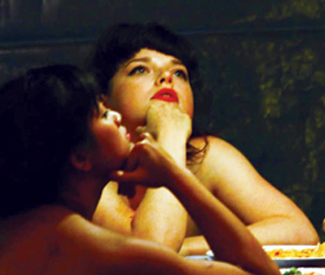
TW Yes. Last year, when I was at the festival, I did this piece with electric butt plugs. [Note: In this piece, Wills and co-performer Harold Burns were naked inside (what looked like) giant pink bath scrunchies (designed by Honey McMoney), wearing electric butt-plugs attached to a microphone set low before a pillow at the front of the stage. Individual audience members could come kneel and whisper their fantasies, their words registering solely in the physical responses and expressions of the performers.]

When they asked me to be in the festival, I identified that what I’m really excited about is the process of saying what you want, the somatic experience of saying what you want — especially if it feels transgressive inside of you. I don’t really care what the content of the thing is. And I don’t care whether society thinks it’s ok or not. I’m not really interested in any of that. I’m just interested in the physical, somatic experience of saying what you want. That seems like the most valuable thing for me.

So what I did in the butt-plug piece was to get the audience to come up and say things, to say what they wanted, and they couldn’t really be heard, and then we would just get the sensation — we would get the quality of how they were talking but we wouldn’t get the content. And we’d experience that in a very intimate, deep way. That’s what I wanted to try and develop a bit further this year. So after this week of people watching other people struggle and interrogate and stage their desire, [in this piece] they get to have all of that research land in their own body. They have their own process of saying what they desire, and they have their own somatic experience.

SFBG So it’s very individual and private, there’s no larger audience, there’s no documentation of the whole thing.

TW Exactly. It’s kind of rough for me as an artist, because I’ve put so much work into it, and it’s a very generous piece in terms of the amount — like we talked about the economic worth and the amount of one-on-one time with the audience. So it’s very sad for me to never get an audience response, actually.

SFBG No payoff?

TW Yeah, I’ll never get that.


THIS IS WHAT I WANT

Performances Wed/27-Fri/29, 8pm, $20

SOMArts Cultural Center

934 Brannan, SF

“Slow Sex Symposium” Sat/30, noon-4pm, free

“This Is What You Want — Experiential” Sat/30, 5-11pm, $15-$25

Center for Sex and Culture

1349 Mission, SF

thisiswhatiwant.eventbrite.com

Garage Days re-revisited

0

MUSIC In 2003, at Moses Music in East Oakland, I stumbled across a CD labeled “Numskull of the Luniz Presents…Hittaz on tha Payroll, Ghetto Storm” (Hitta Records). I bought it and was blown away, not simply by the rappers — one of whom, Eddi Projex, has gone on to be a Bay hitmaker — but also by the cinematic expressiveness of the music, with its moody, minor-key atmospheres and rapid counterpunctual basslines, courtesy of the Mekanix: Dotrix 4000 and Kenny Tweed.

Who were they? I found out in ’04, when I met Dot at a Digital Underground show. Turned out, he’d been the group’s late ’90s tour DJ, but left to pursue production, forming the Mekanix with Tweed in 2001. They invited me to their High Street studio, the Garage, to meet J-Stalin, a rapper they were developing who’d debuted as a teen on Richie Rich’s Nixon Pryor Roundtree (Ten-Six, 2002).

Soon after, the yet-unnamed hyphy movement began to foment and I got a gig covering rap for a great metropolitan alt-weekly….

I’d say the rest is history but nothing in Bay Area rap is ever that simple. On the one hand, the prolific Stalin is among the most popular local rappers — currently second biggest seller after E-40, according to Rasputin rap buyer Saeed Crumpler — with Dot and Tweed producing his entire solo debut, On Behalf of the Streets (Zoo Ent., 2006) and a chunk of his sophomore effort, The Pre-Nuptial Agreement (SMC, 2010).

Besides Stalin and Eddi, the duo helped launch former Delinquent G-Stack’s solo career, as well as newer artists like Shady Nate, DB the General, and Philthy Rich. Last year, they even landed a track on the deluxe version of E-40’s Revenue Retrievin (Heavy on Da Grind), and 40 declares his intention to continue working with them.

“The Mekanix are pure talent,” 40 enthuses over the phone. “Even though they make mob music, you can tell they grew up listening to soul music from the R&B days; they could make a killer cry!”

On the other hand, in the digital age, when anyone can slap a beat together, the question is, how do you get paid for production in a region like the Bay, whose rap suffers the twin neglect of corporate radio and major labels? With the decline in album sales, rappers out here derive their music income chiefly from live performances, an option unavailable to producers.

Despite their undeniable artistic impact, the Mekanix today find themselves in a tiny East Oakland studio not far from the Garage where it all began.

“We can’t go outside without somebody playing our music,” Dot says. “That’s cool, but it’s not that fly if your rent ain’t paid.”

“We sell beats but it’s never consistent enough to feed our families and pay our bills,” Tweed admits. “That’s why we’re putting out albums now.”

Thus the duo have made 2012 the year of the Mekanix, beginning with February’s The Chop Shop (Zoo Ent.), a digitally-released compilation of Youtube and street hits they’ve produced for various artists, with a handful of new cuts like the Yukmouth-driven title song.

They followed in April with the Go Boyz, Everything Must Go (Zoo Ent.), a “lost” supergroup project from the hyphy era (ca. ’05), featuring Kaz Kyzah (the Team), Stalin and Shady (Livewire), and Dot himself on vocals in addition to producing with Tweed. Almost released half-a-dozen times, in deals that collapsed at the last minute, the darkly comedic, Ecstasy-themed Everything destroys most Bay albums of that period and remains fresh, even if Shady especially is a far greater beast on the mic today.

Both releases, however, are merely set-up for an album “coming all the way new,” according to Tweed: The Chop Shop 2 (Zoo Ent.), due late July. With a pair of monster lead singles — “Bay Area Perspective” teaming 40, Stalin, Keak Da Sneak, and Turf Talk, and “Money” featuring a vintage verse by Mac Dre recorded at the Garage, alongside fresh contributions from Stalin, Keak, and Bay R&B phenom R.O.D. — Chop 2 is the most ambitious Mekanix project to date, its judiciously matched voices sewn together by the gradual emergence of Dot’s rapping alter ego, 4rax.

Oddly enough, 4rax has had airplay outside the Bay, largely from DJ Premier, who’s spun several tracks on his SiriusXM show, Live from Headqcourterz, over the past two years. But Dot’s only begun sprinkling the conscious thug persona into the mix locally, dropping a very Oakland video, “Kerosene,” in January.

“4rax always been there,” Dot says. “I just ain’t focused on him. But it’s at the point where, shit, we done focused on everyone in the Bay, so either I do it now or not at all.”

“We’ve laid the groundwork, but people gotta pay for it this time,” he laughs. “But we made it; we’re still here.”

Besting a star

1

le.chicken.farmer@gmail.com

CHEAP EATS Hedgehog goes and goes and goes to New York. For work — so they fly her and put her up in a nice hotel. This is what’s called (I believe) a business trip. But there’s more than that, of course, to it.

Examples include eating at WD-50 on my birthday (without me), and being at that Mets game (without me) when Johan Santana pitched the first no-hitter in team history, lucky duck. By which I mean Hedgehog. Santana’s a pretty good pitcher.

Me, I’m not a Mets fan or a foofy restaurant fan but, in a word, still… I like baseball. I like food. These are documented facts. Well, I must have whined and complained enough, because this time she said, “Wanna come with me?”

“No thanks,” I said. “I’d rather whine and complain.”

“Suit yourself,” she said, adding that there was a fitness center in the hotel, that she would take me to WD50 after work, and a Mets game the next night. Romanticness was insinuated. That, and hot dogs.

I thought and thought. And thought and thought. There was no guarantee that my new friend Shaya (from last week’s review) would be on this flight too. But Hedgehog would hold my hand real hard during takeoff and landing, she said, and sing my favorite songs into my ear.

I thought about how hot it was in New Orleans in June, how lonely it was in the air-conditioning without her, and I decided to go to New York.

She bought all the necessary tickets, made the necessary reservations, drove us to the necessary airport, and when I emerged from my necessary Valium haze I found myself in a nice, cozy room on Times Square, staring out the window at those scoreboardy ticker tape thingies with all the stupid stock statistics flying by. One of the most dizzyingly annoying events I have ever found outside of any window, anywhere…

Until early next morning, this morning, when I awoke abruptly to “Blister in the Sun” by Violent Femmes over a PA system in the street below. That’s a great song, but at 6:30am in the morning I think I might rather sleep, thank you.

At 7:30am in the morning it was yoga — loud, microphone yoga. This was the annual Mind over Madness yoga event, Solstice on Times Square, idea being “to find tranquility and transcendence in the midst of the world’s most commercial and frenetic place.” At an hour when sane, peaceful people are trying to sleep.

At least all the colorful mats and yogawear made a pretty picture when I finally got out of bed and opened the curtains to see what the flying fuck all the noise was about.

I need a nap.

Tonight, if all goes as planned, the normally entirely hittable Dillon Gee is going to pitch a no-hitter for the Mets! And I’ll be there, with Hedgehog and hot dogs.

Last night was more of a lobster roe duck egg chicken confit veal brisket crab toast lamb sweetbreads kind of a night, but even I know not to compare a Michelin-starred restaurant to stadium hot dogs. No. I’m going to compare it to a tiny takeout sushi place on Solano Avenue in Berkeley, where once I went with a Chunk de la Cooter and her dad to bring home the hamachi, as the saying goes, for the whole wide family.

Except there wasn’t much hamachi, as I recall. A lot of cucumber and avocado rolls, that sort of thing…

Mostly people get prepackaged sushi from the display case, which might explain the de la Cooter family’s preference for sushi-less sushi, but you can also order made-to-order items, and I got a lot of those.

All of them were awesome! I especially liked the unagi bowl and the nigiri saba.

Saba is my favorite sushi. Thus was I delighted to see something very much like it leading off the 13-thing tasting menu at WD-50 last night: nigiri’d mackerel on salsify, instead of rice, with seaweed and sesame. Many of the later dishes, especially the yuzu milk ice dessert, did indeed blow my mind. But this, the nigiri, wasn’t one of them. Ha! It’s better at:

KYOTO SUSHI

Mon-Fri 11am-7:30pm; Sat-Sun 11am-6:30pm

1599 Solano Ave., Berk.

(510) 527-3288

Cash only

No alcohol


Walk this way

2

arts@sfbg.com

DANCE If you’ve ever had to create a multi-course meal from random fridge contents, or pulled together a smashing outfit moments before a big party, you are well familiar with the fine art of making do.

ODC Theater Director Christy Bolingbroke might have been thinking along these lines as she put together the Walking Distance Dance Festival — SF, a three-day marathon of 12 companies both local and national, with one from Singapore thrown in for good measure. These are the ingredients that she had to work with; the occasion is that Dance/USA, the national service organization for dance, is in town. That’s a big opportunity to show the rest of the country who we are and what we do.

The ten-year-old but little-known Scuba, a multi-city initiative between San Francisco, Seattle, Minneapolis, and Philadelphia, offers touring opportunities to mid-career artists to and from participating cities. ODC has a long tradition of offering developmental residencies to local choreographers. And last, but not least, ODC has an elegant multi-venue “campus,” as they call it, suitable for simultaneously showcasing performances both intimate and large. For Walking Distance, Bolingbroke curated a mix of Scuba and former ODC resident artists performing in three ODC venues.

But she also had something else in mind. Walking Distance presents most works in shared line-ups. “We know that audiences follow individual artists,” she explains. “We wanted to create opportunities for them to see different artists in one sitting to get a taste of a variety of choreographies.”

It’s a model that has been the norm in other performing arts, such as symphony orchestras. Dance companies, however, have for the most part stuck to one-artist programs, though Robert Moses’ Kin Dance Company’s recent “The BY Series” and Amy Seiwert and Imagery’s upcoming “Sketch 2” may be indications of change to come.

One of Walking Distance’s most intriguing pairings just might be ODC Dance with Maya Dance. Maya is a five-year-old contemporary ensemble from Singapore that bases its work on Asian esthetics and traditional dance forms. In May, ODC and Maya performed in a shared program in Singapore. Both groups performed Brenda Way’s 2008 Unintended Consequences: A Meditation; KT Nelson set a work on Maya, and Kavitha Krishnan set one on ODC. The repeat will be Maya’s first US appearance.

Making their first appearance in San Francisco are three Scuba artists; it’s impossible not to be impressed with the sheer variety of dance being created outside the Eastern corridor. A colleague from Seattle described Alice Gosti’s Spaghetti Co — Are you Still Hungry? as “basically a food fight with kinetically interesting things happening.” For her Halo, Gabrielle Revlock is bringing one prop — a hoop — from Philly. And then there is the German-born Minneapolis choreographer Angharad Davies, who in Security examines the effect of tedious shift work on relationships.

Of the work by former ODC Theater residents, only the excerpt of Catherine Galasso’s Fall of the Rebel Angels is new. Perhaps that’s not what festivals traditionally do, but for Bolingbroke this one is an opportunity to gather works that have proven themselves.

Walking Distance also reflects the theatrical strengths among former ODC resident artists. There is no pure dance, and no ballet unless you count the revival of Kunst-Stoff’s deliciously deconstructed Less Sylphide. The festival’s choreographers — Ben Levy, Monique Jenkinson, Ryan Smith and Wendy Rein, and Shinichi Iova Koga — have extraordinarily broad perspectives on how dance communicates.

“It’s a taster, a sampler of many different things,” Bolingbroke says of Walking Distance, which was inspired by a 2011 version held in the Mendocino County town of Willits. At that festival, several theaters in close proximity to each other collaborated to present BARE Dance (from Los Angeles), AXIS Dance Company, and Na Lei Hulu I Ka Wekiu; it focused local attention on California dance in an informal, easily accessible manner. This approach just might work in San Francisco as well — now and at future incarnations of the fest.

WALKING DISTANCE DANCE FESTIVAL — SF

Fri/29-Sat/30, 6:30pm; Sun/1, 2pm, $20-$75

ODC Theater

3153 17th St., SF

www.odctheater.org

Rio Grande

0

virginia@sfbg.com

APPETITE Who needs menus when the bartenders are this good? The granddaddy of the speakeasy resurgence, New York’s Milk and Honey, has been doing the menu-less thing since 2000, while places like LA’s Library Bar get their inspiration from daily changing, farmers market produce. Two fascinating new SF bars are serving custom cocktails their own way, only able to go sans menu because of strong talent behind the bar. Reviewed online on the Guardian’s Pixel Vision blog is the intimate, amusingly named Big; here is my take on the other menu-less charmer, Rio Grande.

I’ve written about Bon Vivants (cocktail designers Scott Baird and Josh Harris, operations specialist and behind-the-scenes mover Jason Henton) numerous times over the years, from early days at 15 Romolo to recent cocktail menu creation at Berkeley’s new Comal. Anticipating their long-awaited Mission bar Trick Dog, I’ve been having fun in the meantime with multiple visits to Rio Grande, a bar they just launched as part of ATO (A Temporary Offering) in the Kor Group’s Renoir Hotel, a genius pop-up project where local entrepreneurs can test concepts, from FoodLab restaurants to shops and art events.

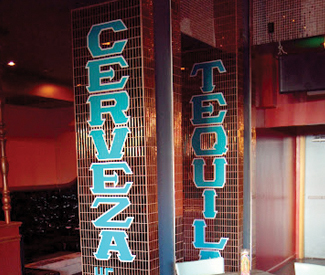
Using the hotel’s vacant, three-room space, revolving projects invigorate the stretch of Market near Seventh Street. Rio Grande is unlike any other bar in town. Evoking a South of the Border cantina, or what the Vivants dub “Tarantino and Once Upon a Time in Mexico meet border town roadhouse,” here funky kitsch glitz marries laidback ease, as tequila, mezcal, whiskey, and canned beer flow.

Under the gaze of Wild Turkey bourbon and Espolon tequila logos emphasizing the bar’s whiskey-tequila union, the ceiling sports a Virgin of Guadalupe shrine in front of a painting of 1970s adult film actress Vanessa del Rio, a Baird crush after whom he named the Del Rio cocktail (reposado tequila, fino sherry, St. Germain elderflower, orange bitters). The Del Rio will soon be served on tap, while the current on-tap cocktail is an Old Fashioned.

The bar was initially launched as a pop-up, in keeping with ATO’s rotating offerings, but the Renoir folks like it enough to try and find a way for it to stay. If it can’t, the Vivants will move it to various locales as a gypsy bar. Here’s hoping it remains while they launch other nomadic bars — a fine concept.

Rio Grande was, impressively, built out in three weeks: Henton says there were days they’d still be wielding power saws at 5:30am, building high-top tables or implementing one of Harris’ many estate sale-flea market finds. (He stalks local sales for vintage pieces like the bar’s fascinating ceiling fans and the cowhide splayed in the entrance. Harris even gathered Mexican national newspapers from 1945-’47 to became the wallpaper behind the bar.) The bar itself boasts a pole on either end for whatever shenanigans might ensue, while a mini-stage is set for live music. Even without bands, tunes are perfection: a little hard rock, a lot of classic country — think Waylon, Hank I and II, your general outlaw cowboy musicians.)

To exist sans menu, it’s crucial that bartenders be talented, knowledgeable and versatile. Rio Grande couldn’t be more on the right path with hand-chosen barkeeps Morgan Shick and Russell Davis, assisted by Trick Dog chef Chester Watson. Shick is one half of Jupiter Olympus, a bar-restaurant consulting company that throws some crazy, imaginative parties. I’ve judged a number of cocktail contests where Shick (who’s worked at bars from Marzano to Michael Mina) was an entrant: his sense of balance and ingenuity stand out every time. Davis, besides being named Nightclub and Bar’s 2012 Bartender of the Year, recently crafted a brilliant soda fountain menu at Ice Cream Bar and can be found actually igniting flames at Rio Grande for special cocktails.

According to Harris, the Vivants wanted “to take all the pretentiousness out of the bar scene and make it fun”, which is why Tecate and Dos Equis flow just as freely as Del Maguey. During my visits, I’ve sipped a mezcal and yellow chartreuse winner and a bitter amaro beauty on crushed ice (Julep snow cone-style). Speaking of ice, it’s hand-cut here, a pleasure to watch. During one visit, Shick made a mezcal, grapefruit soda drink accented with crème de cassis (black currant liqueur), lime, Luxardo Maraschino liqueur, and salt: smoky, salty and citrusy. Spiced fall notes shine in his mixture of Siete Leguas anejo tequila, made with Averna for a tinge of bitter balance, Angostura orange bitters, sweet vermouth and apple brandy. I’m in love with a finish of Old Bardstown bourbon, Nocino walnut liqueur, Balcones’ rum-like Rumble (made from Texas wildflower honey, Mission figs, turbinado sugar), plus dry vermouth and triple sec. Dry, sweet, full, it’s still bracing enough to put hair on your chest.

“Watch for some potentially interesting surprises musically,” says Harris of the tiny stage, and for Tarantino Tuesdays, when Tarantino films and soundtracks accompany your pour.

RIO GRANDE

1108 Market, SF

Subscribe to Virgina’s twice-monthly newsletter, The Perfect Spot, www.theperfectspotsf.com


Midnight in Woodyland

0

arts@sfbg.com

FILM Woody Allen’s film legacy is not like anybody else’s — his imitators don’t count — and is likely to grow ever more interesting in retrospect, as it becomes clear how even his (by now many) bad or indifferent movies still provided some idiosyncratic diversity in American comedy. (For the most part his few straight dramas are, face it, only really interesting as digressions from his strengths.)

At present, however, he suffers from a sense that he’s been too prolific for too long. It’s been nearly two decades since a new Woody Allen was any kind of “event,” and the 19 features since Bullets Over Broadway (1994) have been hit and-miss — the “hits” just nice rather than truly memorable, the misses landing with a soft, listless thud. Every few films there’s a heralded “return to form,” whether it’s Melinda and Melinda (2004), Match Point (2005), Vicky Christina Barcelona (2008), or last year’s Midnight in Paris. But they’re just pretty good, and no one should be surprised anymore when something as dismal as Cassandra’s Dream (2007) or Anything Else (2003) pops up between them.

Still, there’s the hope that Allen is still capable of really surprising us — or that his audience might, as they did by somewhat inexplicably going nuts for Midnight in Paris. That mild, harmless amusement had a half-developed clever concept and a snugly-fitting lead in Owen Wilson, one of few actors who’ve held on to their own personality while playing Allen’s surrogate. It was Allen’s most popular film in eons, if not ever, probably helped by the fact that he wasn’t in it — for reasons beyond the real-life distaste some have felt toward him ever since the Mia/Soon-Yi fracas. With increasing age, he’s become an onscreen liability to his own movies.

http://www.youtube.com/watch?v=dZcip9HY1Pw

Unfortunately, he’s up there again in the new To Rome With Love, familiar mannerisms not hiding the fact that Woody Allen the Nebbish has become just another Grumpy Old Man. He has trouble making eye contact with other actors, and his fussbudgeting is now a long way from cute, well into annoying. He’s meant to annoy the other characters in his scenes, but still, there’s a doddering quality that isn’t intended, and is no longer within his control.

But then To Rome With Love is a doddering picture — a postcard-pretty set of pictures with little more than “Have a nice day” scribbled on the back in script terms. Viewers expecting more of the travelogue pleasantness of Midnight in Paris may be forgiving, especially since it looks like a vacation, with Darius Khondji’s photography laying on the golden Italian light and making all the other colors confectionary as well. But if Paris at least had the kernel of a good idea, Rome has only several inexplicably bad ones; it’s a quartet of interwoven stories that have no substance, point, credibility, or even endearing wackiness. The shiny package can only distract so much from the fact that there’s absolutely nothing inside, not even Styrofill.

Allen’s segment has him as Jerry, a retired opera director married to Judy Davis (wasted, which could be said of everyone here), reaching the Eternal City to meet the fiancé (Flavio Parenti) of his daughter (Alison Pill). He’s distracted by discovering the latter’s father (tenor Fabio Armiliato) is a superb singer — albeit only in the shower. The joke is that Jerry gets him to sing publicly … in showers. Yep, that’s the whole joke.

The other threads are, if anything, even feebler. Through inane mix-ups a honeymooning couple (Alessandro Tiberi, Alessandra Mastronardi) end up separated, paired respectively with a prostitute (Penélope Cruz) and veteran movie star (Antonio Albanese).

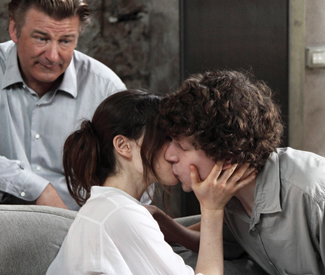
The relationship between study-abroad students Jack (Jesse Eisenberg) and Sally (Greta Gerwig) is complicated when her seductive actress friend (Ellen Page) shows up; Alec Baldwin plays a visiting architect who, for no apparent reason, acts as their omnipresent adviser à la the Bogart ghost in 1972’s Play It Again, Sam.

Worst of all is an utterly stupid non-story in which Roberto Benigni — who doesn’t need to imitate Woody because he’s already annoyingly mannered enough — plays an ordinary family man suddenly treated, and paparazzi-hounded, as a celebrity. There’s no explanation for this, and the presumably intended spoof of meaningless media fascinations famous-for-being-famous folk is so cluelessly handled you wonder if Allen was having a senior moment while writing it.

At the beginning a stereotypical traffic-directing polizia tells the camera directly that he sees all of Rome pass by and knows all their stories. At the end, he tells us there are plenty more where the ones we’ve just seen came from. Pretty as it’s been to look at, after 112 barely chuckle-prodding minutes of To Rome With Love that sounds very much like a threat.


TO ROME WITH LOVE opens Fri/29 in San Francisco.

Public teacher in a public hospital

7

By Sasha Cuttler

OPINION San Francisco Unified School District teachers and Department of Public Health nurses are going through difficult times. Despite years of service reductions, layoffs, and ceaseless budget pressures, teachers continue to educate San Francisco’s young people while nurses care for the sick and injured.

One week before the end of this school year, Balboa High School math teacher Ruth Radetsky was found unconscious after flying over the handlebars of her bicycle. She was brought to San Francisco General Hospital and Trauma Center, where she was treated for broken ribs, scapula, and cracked vertebrae. Although she suffered a concussion, she avoided a more severe head injury because she wore her bicycle helmet.

After being stabilized in intensive care unit and transferred to the step-down unit, Ruth was instructed by nurses to call for help before trying to get up. She was afraid of the pain but understood the importance of regaining mobility. Her injuries and the side effects of the pain medication put her at high risk for falling. Noting how busy the nurses were, however, Ruth felt badly about having to “bother” the staff.

Ruth and the nurses at SFGH who cared for her have a lot in common. Both education and health care rely upon appropriate ratios: teachers to students and nurses to patients. Students and patients alike benefit from these ratios. Despite the need for enough human resources, adequate staffing depends on other factors as well.

Ruth explained how a reduced class size is not enough. In one of her classes, nearly half of the students had learning needs that required preferential seating. Not everyone can sit in the front seat. Nurses with a floor full of patients who need close observation because they are experiencing delirium tremens, traumatic brain injury, or even a mass casualty event have to do similar triage. In both cases, maintaining the minimum staffing may be inadequate — which is why nurses and teachers need support to achieve quality education and healthcare. And UCLA researchers have demonstrated that lower nursing staffing in hospital wards is associated with increased patient mortality.

While researchers argue about the effect of increased class size and nurse-patient ratios, teachers and nurses in the public sector struggle to maintain professional standards of education and care. Ruth is worried about the effects of teacher layoffs on her students. At the same time, the nurses who cared for her at San Francisco General Hospital are being told that layoffs could result if wages and benefits and staffing aren’t reduced. In both professions, staff is concerned about maintaining adequate services with fewer resources.

Teachers and nurses in the public sector continue to be predominately female. Perhaps because of traditional gender roles, teachers and nurses tend to be apologetic about taking a stand for their own working conditions. Unlike an assembly line worker, a teacher or nurse’s profession is all about people, not things. It is only logical that too many students make it difficult for each to receive the amount of support needed. It’s dangerous for nurses to not have enough time for patient assessment and care.

Teachers such as Ruth Radetsky and the nurses who cared for her embody the very best of public education and health. San Francisco Unified teachers and Department of Public Health nurses should not have to apologize for upholding high standards and demanding a professional environment to teach the young and care for all of San Francisco.

Sasha Cuttler, RN Ph.D, is a nurse and activist in the SEIU Local 1021 RN chapter. He has been friends with Ruth Radetsky for more than 25 years.

Out of the paincave

0

arts@sfbg.com

MUSIC Apocalypse doesn’t exactly identify what Brooklyn-born producer and rapper El-P conjures in his music. Sure, furtive sirens blare out almost immediately in his new record Cancer 4 Cure (Fat Possum). Synthetic melodies disfigure themselves while break beats rumble with the intensity of the Bomb Squad, all drowned out through a wash of distorted noise. The lyrics are just as unsettling too: an overpowering technological violence brought to bear on soft human bodies, whose voices are fractured, rendered nearly schizophrenic.

El-P’s satire has here become more cutting, discordant — refining the unrest signature to his former group Company Flow, a host of solo and production credits, and his recently disbanded indie label Definitive Jux. But apocalyptic? Just another blockbuster word that conceals far more than it reveals.

“I’m not writing about an insane apocalyptic world,” says El-P, whose official documents give him the name Jaime Meline. “This is reality. I’m not writing sci-fi; I’m writing about Brooklyn. Yes, there’s an obvious sense of dread in my records. There’s a part of me that is fucking terrified of the world right now, and has been for a long time, and maybe always will be.”

From this fear, even an overwhelming paranoia, El-P gathers fuel for both incendiary attacks and self-abjection. So if there’s any rubble left by an apocalyptic catastrophe in his music, its value is that in showing us our world reduced to ash, it also gives us a chance to see what it is that we’re running from.

El-P’s protest finds a kindred spirit in William S. Burroughs, who introduces “Request Denied” amidst a haze of electric signals: “Prisoners of the earth, come out — Storm the studio,” he roars. Translating this incitement as a call to arms, El-P unleashes an onslaught of modulated rhythms and rapid-fire wordplay that jars you out of your sleeping flesh. “I want these records to be a blast of truth,” he says. “When you’re dealing with music and dealing with what’s real, screaming and crying and kicking and punching has something of the truth — in its reaction.”

Another way of putting it is that El-P’s music is not a diagnosis but a symptom. Rather than devising some sort of sonic therapy that would allegedly purify us of the systematic disease, he sets out to immerse himself as fully and desperately as possible into its cancerous cells in order to explode them from within. Words themselves come to suffer in this exaggerated space.

In “Drones Over Brooklyn,” El-P growls, “I’m a holy fuck what did he just utter marksman/Orphan, a whore born war torn, life for the harvest.” And in the concluding elegy, “$4 Vic” he navigates the threshold of a language stretched to its limits: “That Paincave Kid talk, at the end of the painbow/ The permanent stain bop/Maligning my name will holy ark up your squad’s face/ Viewers of the divine rage learn to worship the hard way/You get it? I don’t fade, just float where the poem slays.”

For El-P, the poem also struggles to survive, fighting against a syntax that embodies societal pressures of normalization, and an absolute pain on the horizon that ultimately spells death. He calls this jokingly the paincave: “the most horrible psychological place that you could possibly inhabit.” The word stems from the comedic yet admittedly still horrifying experience of when smoking excessively turns on you — when getting too high brings about a fall into madness.

But it’s within this naked fall that El-P finds an unexpected promise, even a chance for renewal. “I’m operating from a point of confusion and despair, but I don’t see it as pessimism. Maybe there’s an optimism to admit it: to stop running, to work through your own fear,” he says. “I want to make music that is the signifier of fighting to live, fighting for sanity, recognizing that it ain’t what it should be. So I’m going to scream. I’m going to run into the middle of the street, and take my clothes off, and scream.”

EL-P

With Killer Mike, Mr. Muthafuckin’ eXquire, Despot

Fri/29, 8pm, $25

Regency Ballroom

1290 Sutter, SF

(415) 673-5716

www.theregencyballroom.com

Queen bee

0

arts@sfbg.com

MUSIC “You wanna be this Queen Bee, but ya can’t be. That’s why you’re mad at me.” That was one of many audacious lines delivered by a much younger Lil Kim in her beautiful, black, Brooklyn accent on Hardcore, her raunchy debut album from 1996.

Now coming up on her 38th birthday, she just returned to the stage at San Francisco’s Mezzanine earlier this month; her performance not only had hip-hop fans who missed out asking, “How was the show?,” but also, “How did she look?”

Followers of the Geneva Diva’s career know these past 16 years since her debut LP dropped haven’t been easy. Sure, she’s released three more albums and got a Grammy for the Lady Marmalade remake, but rougher times saw her spend about 12 months in the slammer on perjury charges, and she’s been widely criticized for accusations of having undergone plastic surgery (photos may prove that point, and BET credits her as being one of the first hip-hop stars to have work done to their face).

Still, the fact remains, Kim loves her fans in SF, and the feeling is mutual. Appearing more youthful compared to some of the recent botched looking photos, Kim wore a crispy-looking blonde wig — perhaps extensions, whatever — and not surprisingly donned a skimpy sequined black and red ensemble that accompanied her backup dancers’ (I guess I’ll call them militant) looks. Think Rhythm Nation Janet, but scantily clad. Somehow she still had it goin’ on.

Four opening acts wore on the patience of a large number of feisty ladies in the audience. My photographer was even shoved for allegedly stepping “all over” the shoes of one particularly pushy woman’s sister. It was after midnight when Kim finally took the stage for a set that lasted little more than an hour. There she did her thing, delivering a rapid fire, foul- language trip down memory lane from rap’s pre-Auto-Tune era.

She always had a way with words and while they did grab our attention through shock value, I’ve always felt she didn’t receive enough credit for lyrical merit. Instead we focused attention on looks and her beefs with fellow female rappers (although that often made for great subject matter). To this day, these are still the kind of lyrics that can make you cringe.

Take for instance these slickly-delivered rhymes from “Queen Bitch” and “Not Tonight”, both deserving of gold medals: “Got buffoons eatin’ my pussy while I watch cartoons.” Now there’s a visual. And who can blame her for wanting to speak out for fed up ladies who were unsatisfied in the sack? “I don’t want dick tonight. Eat my pussy right.” Well said.

Back in the day a friend of mine once reduced her to being nothing more than a prostitute with a microphone, but let’s not sell her short. In “Big Momma Thang,” when Kim lets us know exactly how many times she wants to cum, (21, for those of you not in the know) she’s spreading her own original brand of sex ed.

“We Don’t Need It” is physiologically forthcoming in its call and response about what to lick, suck, and stroke, even advising to “work the shaft”. Elsewhere on the album she may be acting pseudo-psychological when she wonders: “What’s on ya mind?”, while that certain someone goes downtown.

Because hip-hop’s golden age had previously been male dominated, the timing was right for someone like Kim to pave the way, bringing in some say from the female perspective, especially with how she pointed out there’d be no such thing as a free fuck anymore.

It’s true the Biggies, the Puffies, and the Jay-Zs were all instrumental in Lil Kim’s success, but now it’d be tit for tat, so to speak, and it couldn’t have been pulled off without a pioneer like her — who was willing to take sexually charged content to a new, and quite frankly ridiculous, level of filth.

Mayor vs. Mirkarimi

58

steve@sfbg.com

For all the lawyers, investigators, witnesses, politicians, and political appointees involved in Mayor Ed Lee’s official misconduct case against suspended Sheriff Ross Mirkarimi, this case is ultimately a battle between these two politicians, who come from rival ideological camps — and have a lot riding on the outcome of their clash.

And this week, both Mirkarimi and Lee are expected to take the witness stand and face tough questioning from each other’s attorneys.

These first two rounds of live testimony before the Ethics Commission — which has been painstakingly setting up procedures for its inquiry, defining its scope, and making myriad rulings on what evidence and witnesses to allow — could be the emotional high point of hearings likely to drag on throughout the summer.

On June 28, after the commission finishes ruling on the admissibility of evidence — dealing mostly with the controversial testimony of Lee’s star witness, Ivory Madison, the neighbor who triggered the police investigation that found Mirkarimi had grabbed his wife’s arm during a Dec. 31 argument — Mirkarimi is expected to take the stand.

Given the tacks taken by each side so far, the deputy city attorneys representing Lee will likely try to ask Mirkarimi a broad array of questions about his actions and their wider implications, while his attorneys will seek to limit the line of inquiry to what they see as the narrow question of whether he committed specific acts of official misconduct.

“They’re going to want to blast him with every single issue they can conjure up,” said Mirkarimi attorney Shepherd Kopp. But he thinks the Ethics Commission “will limit it consistent with how they’ve been ruling on our objections,” which has already greatly limited the case that Lee sought to present.

The next day, Lee is scheduled to take the stand, with Mirkarimi’s attorneys planning to question the mayor about why he didn’t conduct an investigation or seek more input from witnesses or former mayors before demanding Mirkarimi’s resignation and suspending him without pay in March.

“The suspension was not done carefully with the best interests of the city at heart. It was a rash political decision that had little to do with the facts,” Mirkarimi’s other attorney, David Waggoner, told us.

Indeed, the city didn’t begin gathering evidence until after the charges had been filed, and since then Lee and his team haven’t been able to unearth much evidence in support of his most damning allegations that Mirkarimi tried to dissuade witnesses and thwart the police investigation, something that Mirkarimi and his attorneys have adamantly denied. In the absence of that evidence, Waggoner said Lee has stepped up his efforts to defame Mirkarimi publicly.

Lee told reporters on June 19 that he suspended Mirkarimi because he was “beating his wife,” seeming to escalate the characterization of a single arm-grabbing incident. The city has also released the video that Madison made of Mirkarimi’s wife tearfully recounting the incident and the couple’s text messages, which made Mirkarimi look bad but don’t offer much new information or evidence.

“He’s panicking. The ship is going down and he’s beginning to flail,” Waggoner said of Lee’s recent statements and actions. “The more the mayor uses that kind of rhetoric, the less credibility he has.”

We sought responses and comments from the press secretaries for Lee and the City Attorney’s Office, but both refused to comment for the record.

Ethics Commission Chair Benedict Hur has taken an increasingly strong role in running the hearings and limiting the ability of either side’s attorney to control them. At the June 19 hearing, he cut off Deputy City Attorney Sherri Kaiser at least twice when she tried to offer unsolicited comments, at one point causing her to get visibly agitated and declare, “I’m objecting to the procedures for objecting to evidence.”

But Hur didn’t relent or modify his approach, telling her, “We are trying to conduct these proceedings in a fair and expeditious way.” Waggoner praised the way Hur has run the hearings so far: “I think he’s been fair in his rulings and how he’s conducted the process.”

After this week’s pair of hearings, the Ethics Commission is scheduled to reconvene its inquiry on July 18 and 19, when it will likely hear from Madison, whose testimony could make or break the case. But first, attorneys for each side are meeting this week to decide where they can agree to limit Madison’s testimony, with the commission making rulings on realms where the two sides differ. Deputy City Attorney Peter Keith has previously said he expects Madison to face tough questioning in which her credibility will be attacked, but the commission itself has already criticized her written declaration and greatly limited her hearsay accounts of life in the Mirkarimi household (see “Ethics Commission undercuts the main witness against Mirkarimi,” June 20, SFBG.com Politics blog). And Kopp told us, “If I get most of my objections sustained, I may not need to cross examine her, as fun as that might be.”

Pipe dreams and nightmares

3

LIT In the early pages of his new memoir, Steven Martin admits he’s obsessive. This is not uncommon, he explains, for collectors — not to be confused with the dilettantes he calls “gatherers.” Serious hobbyists hunt down highly specific items, fervently scrutinize them, and then evangelize to whoever’ll listen about their findings.

This kind of behavior can manifest around just about anything that people collect: Civil War artifacts, Depression glass, Beanie Babies. San Diego-born Martin became fascinated with Asian culture at a young age; after a stint in the military, he ended up living in Bangkok. A few decades later, he’s chronicled his adventures thereabouts in Opium Fiend: A 21st Century Slave to a 19th Century Addiction (Ballantine, 396 pp., $26).

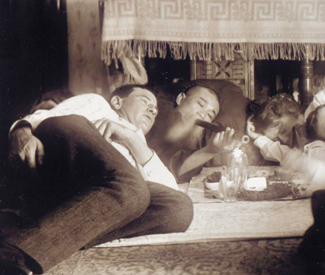
Yep: as unlikely as it sounds, he became hooked on opium. If you thought what Martin calls the cause of “the world’s first real drug epidemic” vanished along with the Model T — well, you’d mostly be right. Opium Fiend, which is crammed with plenty of historical information as well as Martin’s first-hand experiences with the drug, explores how an obsessive interest in antique opium-smoking paraphernalia — a formerly obscure thing to collect, at least until Martin’s own photo book, The Art of Opium Antiques, came out in 2007 — led to, perhaps inevitably, a full-blown dependence on opium itself.

He’s clean now; in the first chapter, he discusses the gruesome agony of detoxing. Later, one of his close friends, a fellow addict, doesn’t survive the experience. It’s a sobering moment in a book that, though clearly a cautionary tale, propels forward with the particular energy of someone who’s really, really stoked to share his story.

“Some people watch movies or sports, but my favorite past time is seeking out and studying whatever I happen to be collecting at the moment,” Martin says. “When I got serious about collecting opium-smoking paraphernalia, around 2001, I realized there was just nothing really out there about it. I took it as a challenge to collect as much as I could, and learn as much as I could about it.

“It had this outlaw chic about it that was interesting. But it also seemed to have this really odd juxtaposition — you have these beautiful, finely-crafted pieces of art, made from the best materials a century or so ago: jade, silver, or ivory. Really, really strikingly beautiful. But in actuality these things were instruments of self-destruction. It’s a bit dark, but I found that appealing.”

Though he’d dabbled in smoking even before he began building his trove of implements, he did not expect to become a raging addict — mostly because he didn’t think becoming an opium addict was even physically possible.

“Most of the research that I did was coming from Victorian-era accounts of what opium smoking was like. I was very skeptical of what these books said. The tone was often very shrill, almost like a Reefer Madness kind of thing, so I didn’t take it as seriously as I should,” he says. “But opium’s not like these modern drugs we hear about, a one-hit-and-you’re-hooked-for-life sort of thing. It can take months — or in my case, years — to develop a serious addiction.”

And “opium tends to rebuff the amateur,” Martin says. “People often try it once and never try it again. But I happened to be in a place where it was possible to get opium that was processed specifically for smoking, which is actually a misnomer. The paraphernalia that’s used is designed to vaporize the drug, not burn it.”

For the curious, Opium Fiend describes the actual experience of smoking, including the specific feelings associated with the high (tranquil, but “it turns you inward,” says Martin; he took detailed notes daily, even at the height of his addiction) and the preparation required to achieve the highest-quality result. It’s a delicate, time-consuming process, but for Martin that was part of the thrill.

“For me, that was the best part. I was really hooked on the ritual. Once I’d actually learned to prepare the pipes myself, that became my favorite source of entertainment: lying there next to the opium layout, within the glow of the opium lamp, watching myself prepare pipe after pipe. It was just mesmerizing,” he says.

“I’d be lying if I didn’t say I miss it very much. Sometimes I’ll have these very vivid dreams about smoking, and I’ll wake up in the morning, lying on my left side, in the same position I used to smoke in. It’s crazy — even though I’ve quit, it won’t leave me alone. I think about it all the time.”

Seeking local control

0

news@sfbg.com

As a potentially troublesome court decision threatens the existence of cannabis dispensaries in cities throughout California, San Francisco City Attorney Dennis Herrera submitted an amicus brief last week urging the California Supreme Court to reverse the decision.

In October, the state Court of Appeal ruled in the case of Pack v. City of Long Beach that city ordinances regulating medical cannabis dispensaries are preempted by federal law. Local jurisdictions across the state have adopted discretionary rules for permitting cannabis dispensaries that vary by jurisdiction. The court decision throws out local ordinances, making it illegal for cities and counties to develop regulations.

“The Court of Appeal’s decision strips cities of an essential tool for protecting public health and welfare,” reads Herrera’s amicus brief, which is joined by Santa Cruz Counsel Dana McRae. An amicus brief is commonly filed in an appeal concerning broad public interest by parties not directly involved the court proceedings.

The ruling could have drastic consequences for cannabis dispensaries and the clients they serve. Most cities in the state, including San Francisco, rely on local ordinances to regulate the medical marijuana industry. Herrera says cities will be forced to choose between banning cannabis dispensaries altogether or allowing their operation without local controls, such as San Francisco’s extensive regulations on where and how dispensaries can operate.

In the absence of local regulations, he argues that ” dispensaries and cultivation sites have the potential to generate serious impacts on surrounding communities, including electrical fires, criminal activity, hazards to children’s safety, pollution, harm to wildlife, traffic, noise and odors.”

The appellate court ruled local ordinances go beyond Prop. 215, the California voter-approved decriminalization of medical marijuana, and cross into the realm of actually legalizing it, conflicts with the federal Controlled Substance Act.

In the wake of the court’s decision, the impact was felt immediately. Across the state, cities suspended all new permit activity.

Since the decision was sent to the state Supreme Court in January, where it is currently under review, San Francisco resumed its permitting process. Not all cities resumed. Herrera noted that as many as 12 jurisdictions continue to suspend or severely limit new cannabis dispensary permits, including Santa Cruz.

Rory Bartle, a lawyer at Pier 5 law offices and medical marijuana advocate, says that if the decision isn’t overturned, the entire industry could be upended. However, Bartle says the ruling isn’t widely supported, many counties have filed amicus briefs, and in his opinion the ruling will be overturned.

It is hard to imagine Ryan Pack and Anthony Gale, plaintiffs in the Pack v. City of Long Beach case and members of a cannabis collective that was shut down because of local ordinances, realized the implication of challenging such regulations. Long Beach required a $14,000 non-refundable application fee and annual $10,000 fee.

“Long Beach has some crazy regulations designed to pull as much money as they can out of the medical marijuana industry,” says Bartle. “It’s stupid and unfair.”

In San Francisco, the fees for an application permit are $8,656 and another $4,019 for a license and re-inspection.

The Feds are watching — badly

9

yael@sfbg.com

So, you’re a law enforcement officer in training for participation on a local Joint Terrorism Task Force. Or a student at the United States Military Academy at West Point, involved in the counterterrorism training program developed in partnership with the FBI. Or you’re an FBI agent training up to deal with terrorist threats.

Get ready for FBI training in dealing with Arab and Muslim populations.

Take note that “Western cultural values” include “rational, straight line thinking” and a tendency to “identify problems and solve them through logical decision-making process” — while “Arab cultural values” are “emotional based” and “facts are colored by emotion and subjectivity.”

Be advised that Arabs have “no concept of privacy” and “no concept of ‘constructive criticism'” and that in Arab culture it is “acceptable to interrupt conversations to convey information or make requests.”

“Westerners think, act, then feel,” an FBI powerpoint briefing notes, while “Arabs feel, act, then think.”

Those are some of the most dramatic examples of racial profiling and outright racist stereotyping revealed in thousands of pages of documents obtained under the Freedom of Information Act by the Bay Guardian, the ACLU of Northern California and the Asian Law Caucus.

The documents show a pattern of cultural insensitivity, sometimes bordering on the ridiculous, not only tolerated by promoted as official instructions by the FBI. The records also show a broad pattern of surveillance of people who have engaged in no criminal activity and aren’t even suspected of crimes, but have been targeted because of their race or religion.

Pieces of this story have come out over the past year as the ACLU has charged the FBI with racial profiling and Attorney General Eric Holder has insisted it’s not happening. And some of the documents — which are not always properly dated — may be a few years old.

But none of it is ancient history: All of the material has been used by the FBI in the past few years, under the Obama administration.

This is the first complete report with the full details on a pattern of behavior that is, at the very least, disturbing — and in some parts, reminiscent of the notorious (and widely discredited) COINTELPRO program that sought to undermine and disrupt political groups in the 1960s.

The information suggests that the federal government is using methods that are not only imprecise and xenophobic but utterly ineffective in protecting the American public.

“This is the worst way to pursue security,” Hatem Bazian, professor of Near East Studies at UC Berkeley, told us.

CULTURAL STEREOTYPES

Dozens of documents attempt to describe “Arabs and Muslims” but other groups aren’t left out of the sweeping stereotyping and blatant racism and xenophobia that the FBI has used in its training guides. One training presentation is titled “The Chinese.” The materials give such tips as “informality is perceived as disrespectful.” The presentation warns “expect your gift (money) to be refused” but advises to give “a simple gift with significant meaning- tangerines or oranges (with stems/leaves.)” But “never give a clock as a gift! (death!)”

And if those in the training on “The Chinese” find themselves in “interactions with the opposite sex,” then “touching, too many compliments, may imply a romantic liaison is desired — be careful!”

The vast majority of the “cultural awareness” training materials imply that the authors believe that the law enforcement personnel receiving the training will never be female or interact with female members of the groups they describe. Some warn repeatedly to never ask Arabs how “females in their family” are doing in polite conversation.

A presentation on “Arab and Muslim culture” compares the western thought process with that of all Arabs. According to the FBI, westerners are “rational” thinkers; Arabs, on the other hand, are “emotion based.” A slideshow on cross-cultural interrogation techniques says, “It is characteristic of the Arabic mind to be swayed more by words than ideas and more by ideas than facts.”

Bazian said the FBI’s generalizations about the Arab intellect are “ideological constructs reflective of the orientalist discourse.”

“Many of these individuals have not done any primary sociological, psychological, or historical work in the Arab/Muslim world,” said Bazian, who works on UC Berkeley’s Islamophobia Research & Documentation Project. “What they basically do is take a text from a particular historical period and pick these points and put it as reflective of contemporary Muslim society. Most of these statements have no basis in any critical analysis. They’re not rooted in any type of research.”

Included in the FBI’s recommended reading list for counterterrorism agents-in-training is the “Politically Incorrect Guide to Islam,” in which “Islam expert Robert Spencer reveals Islam’s ongoing, unshakeable quest for global conquest and why the West today faces the same threat as the Crusaders did.”

It’s not exactly an academically sound piece of work, Bazian told us. Spencer and his cohorts are “political hacks,” the professor said. “They come from neo-con backgrounds. Even saying ‘extreme right wing’ is giving them credit; they’re way down below the cliff. They create this contrast between western society and the rest of the world based on a nostalgic idea of western society.”

Arab culture is often the target these days, but the rhetoric recalls that used during the Chinese Exclusionary Act era, and toward Latinos in the United States today, Bazian said.

“They pick on the weakest, most vulnerable people in western society at a particular time and lay blame on them,” he said.

The FBI’s xenophobic approach to interrogation training—which involves warning new agents that “If an Arab is scared, he will often lie to try to avoid trouble”—is not even productive, Bazian said.

“If you go to people with professional training in interrogation and investigation, they’ll say none of this gives them access to security. If anything, it creates a greater global misunderstanding.”

RACIAL MAPPING

And the creation of misunderstanding doesn’t stop there. The FBI is also involved in an intelligence-gathering method known as racial mapping. Racial mapping involves local FBI offices tracking groups in their “domains” based on race and ethnicity.

In blog post, the ACLU writes, “Empirical data show that terrorists and criminals do not fit neat racial, ethnic, nation-origin or religious stereotypes, and using such flawed profiles is a recipe for failure.” In the Counterterrorism Textbook read by all trainees the FBI seems to agree, warning multiple times that there is no such thing as a typical terrorist and that making assumptions based on stereotypes is dangerous and unproductive.

Yet the FBI files we’ve acquired reveal that the bureau consistently does just that. Though the Department of Justice prohibited race from being “used to any degree” in law enforcement investigations in 2003, a convenient and potentially unconstitutional exception allows racial profiling in national security matters.

When the FBI created its Domestic Investigation and Operations Guide in 2008, it used that loophole to permit the mapping of racial and ethnic demographic information and to keep tabs on “behavioral characteristics reasonably associated with a particular criminal or terrorist element of an ethnic community,” the ACLU reported.

Communities in San Francisco have been the victims of this prejudicial loophole more than once. In 2009, the ACLU reported that the FBI justified mapping and investigating the Chinese American population in the city because “within this community there has been organized crime for generations.” Likewise, the bureau collected demographic data on the Russian population because of the “Russian criminal enterprises” known to exist in San Francisco.

The loophole, however, may not even apply to these investigations in the first place.

According to Michael German, a 16-year veteran of the FBI and senior analyst with the ACLU, these investigations don’t fit the national security description. “In intelligence notes on Chinese and Russian organized crime, those are not national security issues,” German told us. “Those are all clearly criminal investigations.”

German has brought attention to another troubling use of racial mapping — documents revealing that the FBI’s Atlanta bureau tracks Georgia’s African American population.

The stated reason is a threat of black separatist groups; the documents name the New Black Panther Party and the Black Hebrew Israelites as the black separatist groups that pose a threat.

German wrote about this problematic practice in a May 29 article on the website Firedoglake.

“The problem with these documents,” German told us, “is that it’s not black separatists or alleged black separatists who are being tracked — it’s the entire black community in Georgia.”

“Those individuals and those communities are being targeted only for their race,” German said. “Were it not for their race they wouldn’t be part of that assessment. There is no reason to do that, accept to treat that community differently than the way it treats other communities. It’s problematic from a constitutional standpoint.”

The New Black Panther Party was founded in Dallas and has mostly East Coast chapters. According to the Southern Poverty Law Center, which tracks hate United States hate groups, “The group portrays itself as a militant, modern-day expression of the black power movement (it frequently engages in armed protests of alleged police brutality and the like), but principals of the original Black Panther Party of the 1960s and 1970s— a militant, but non-racist, left-wing organization — have rejected the new Panthers as a ‘black racist hate group’ and contested their hijacking of the Panther name and symbol.” The Black Hebrew Israelites is another fringe group, an apocalyptic group whose ideology holds that black Americans are God’s chosen people.

Both groups have written and spoken record of racist and violent rhetoric, but record of violent or criminal acts are hard to find.

“I’d say they’re a fairly small part of the radical right, and generally quite small. As far as we know, there is virtually no connection between these groups and criminal activity,” Mark Potok, a senior fellow with the SPLC, told the Guardian.

According to Potok, the center’s list of hate groups in operation in 2011 includes four organizations classified as black separatist, which, between them, have 140 chapters. Those chapters are counted as 140 of the list’s 1,018 groups.

“Most of the rest of the list are white supremacist groups,” Potok notes. “There are some exceptions — anti-gay groups and anti-Muslim groups.” After a quick count, Potok found 688 groups to be “straight-up white supremacist.”

The majority of these hate groups may be white supremacist — but the FBI is not involved in tracking white populations.

Last October, the FBI’s press office responded to the ACLU’s concerns with racial mapping. “These efforts are intended to address specific threats, not particular communities,” the agency’s statement reads.

“These domain management efforts seek to use existing, available government data to locate and better understand the communities that are potential victims of the threats. There must be an understanding of the communities we protect in order to focus our limited human and financial resources in the areas where those resources are most needed.”

With that defense, resources continue to pour into racial mapping efforts.

Black separatist organizations are not the only groups to be targeted for political beliefs. Groups such as “anarchist extremists” and “animal rights/environmental extremists” are also, according to the FBI, groups to watch out for.

A training presentation for the Bay Area’s Joint Terrorism Task Force includes a list of those groups: “animal rights/eco terrorism, anarchists, white separatists, black separatists, militia/sovereign citizens, and ‘lone offender’.”

How do you spot a potential “animal rights extremist”? According to the documents, “ideology and concepts” found among this group includes a “complete vegan lifestyle,” and activities include the promotion of “anti-capitalist literature.” In other words, your roommate is probably a terrorist.

SPYING ON MUSLIMS

Racial mapping is not the only FBI practice that targets people just for being members of groups “associated with crimes.” The FBI routinely gathers information on Muslims through deceptive “community outreach” programs.

Memoranda we’ve obtained reveal that FBI agents, operating under the guise of community outreach, attended various events hosted by local Muslim organizations in order to gather intelligence between 2007 and 2009.

When agents attended Ramadan Iftar dinners in San Francisco, they wrote down participants’ contact information and documented their conversations and opinions. At an alleged outreach event at CSU Chico, they recorded a conversation with a student about the Saudi Student Association’s activities and even took the student’s picture. That information was sent to the FBI in Washington, DC, the ACLU reported.

Writing down information on individuals’ First Amendment activities—in this case without any evidence that they were notified or asked—violates the federal Privacy Act, the ACLU says. Using access to community events to gather personal information undermines the FBI’s stated effort to form relationships with Muslim leaders and community members.

And covert surveillance can also have an immediate and hazardous impact on the unwitting subjects.

“It’s becoming more of a public discourse that these FBI background checks are affecting immigration status, the ability to send money back home, and generally creating an environment of fear,” said Miriam Zouvounis, membership coordinator with San Francisco’s Arab Resource and Organizing Center.

The organization has helped clients who have been detained for months because their names were mistakenly placed on a no-fly list, and others whose immigration processes have taken up to ten years because they were erroneously perceived as threatening, Zouvounis said.

“The process of information collecting on covert and overt levels is accelerating, and definitely a present reality in San Francisco. People don’t want to be civically engaged if that material’s being used against them,” she said.

ONLINE SPYING

“Extremism online is the most serious international terrorist threat in the world.” Or so says FBI training materials in a presentation entitled “Extremism online,” meant for those training to be online covert employees. The documents teach OCEs to scan through comment threads and enter chat rooms, searching for people whose speech may be “operational.”

This surveillance has led to investigations.

Some of the documents are individual files and summaries of individual files, and many note that the person (often someone who was convicted, so the name isn’t redacted in the documents) was “detected via the Internet.” Some examples: “Mohamad Osman Mohamud, detected via the Internet, discussing Jihad plans” and “Hosam Smadi, detected via the Internet: online chats.” Both men were 19 when they were convicted of crimes.

These men — and the many more who have not been accused of any criminal activity but are likely under surveillance or investigation by OCEs — could have been “detected via the Internet” in a variety of ways, according to German.

“It could be that the chats were open source, or that an informant was in the chat room, or a person participating simply turned them over to the FBI, none of which would require any legal process,” German explained.

“It could also be monitored under FISA [ the Foreign Intelligence Surveillance Act] or traditional criminal wiretaps, which would require court warrants (secret ones under FISA). Finally, the stored chat logs retained on third party servers could have been obtained with Patriot Act Section 215 orders, or what’s called a “D” order under the Stored Communications Act (if held for over 180 days),” German detailed in an email.

So what kind of speech are OCEs looking out for to peg potential terrorist threats? The Extremism Online presentation has a list of “major themes and language used in online extremist writings,” which includes Islam-related terms such as “Caliphate, Al-Ansar, Al-Rafidah, Mushrik, and Munafiq” as well as the Arabic words “Akhi, Uhkti, Ameen, Du’aa, Shari’ah, and Iman” (brother, sister, amen, prayer, Islamic law, and faith.) Other words the agents are told to look out for: “crusaders, hypocrites, dogs and pigs,” and any discussion of “occupation of Muslim lands.”

The FBI can really get into your business if agents confiscate your possessions. Personal computers, cell phones, and other electronic devices, according to the documents, are routinely checked out at Regional Computer Forensics Labs.

The nearest one to San Francisco is in Menlo Park, where employees brag of having investigated thousands of pieces of data.

Law enforcement routinely confiscates property after arrests, and if local cops are involved with the FBI through the Joint Terrorism Task Forces or other partnerships, they may very well send the belongings of those arrested to be checked out at a local RCFL. But there are other ways the FBI can obtain your electronics.

“Certainly the FBI has the authority to obtain computers and other devices with search warrants, either traditional search warrants where the individual is given notice or expedited warrants where the person isn’t aware,” German told the Guardian, noting that the second type of warrant is the preferred method, for obvious reasons, when the Feds plan to search a confiscated computer.

“The FBI also works with immigrations and customs enforcement, so laptops and other devices seized at the border the FBI can gain access to. There are myriad ways they can get them.”

“DISRUPTION”

A 2009 FBI memorandum on investigating suspected terrorists reveals that the Bureau encourages its agents to implement a “disruption strategy” that German wrote is “eerily reminiscent” of the COINTELPRO tactics used to stop political organizers in the1960s. “If the risk to public safety is too great, or if all significant intelligence has been collected, and/or the threat is otherwise resolved, investigators may, with substantive desk coordination and concurrence, implement a disruption strategy,” one memo reads. Investigators can conduct interviews, make arrests, or use any number of other undefined “tools” to “effectively disrupt subject’s [sic] activities.” Such disruption strategies have been used in the past to investigate and shut down First Amendment-protected activity, German said. The reintroduction of such tactics could open the door for a major breach of the subjects’ constitutional rights.

A MATTER OF PRIORITIES 

“After September 11th, 2001, the FBI realigned its mission and purpose to reflect the global and domestic threats that face the US,” begins an orientation packet for members of Joint Terrorism Task Forces. “FBI director Robert M. Meuller III defined the following as the top ten priorities (in order of importance) that confront the Bureau today,” Number one on the list: Protect the United States from terrorist attack.

Indeed, after 9/11, the FBI prioritized terrorism investigations, a shift from the previous focus on criminal investigations. Classified as national security threats, these investigations are not subject to the same type of privacy and anti-racial discrimination protections that other criminal investigations might be.

Terrorist threats, apparently, are to be found in mosques, in online conversations that involve criticism of US foreign policy, in entire populations of African Americans or Chinese Americans in given areas. In recent years, simply speaking Arabic online or being black makes a person a suspect and potential target of surveillance.

Look out America, especially members of that celebrated “melting pot.” The feds are watching.

Two for the road

0

arts@sfbg.com

THEATER On a warm evening last week in Williamsburg, Brooklyn, Jason Craig and Jessica Jelliffe were milling around the sidewalk outside the Collapsable Hole, a small warehouse performance venue one subway stop from Manhattan, dressed in dark blue one-piece suits, skull caps, heavy-rimmed glasses, and long beards.

“You wanna see a show?” asks Jelliffe, looking a little like a Hassid at the public pool. It’s a physical fact that passersby can’t always pass by fast enough to escape the sideshow gravity of a woman in a beard, and sure enough one or two wanderers fall in with the rest of the crowd arriving already determined to see Space//Space, the much anticipated new show from the bicoastal company that most recently brought Bay Area audiences (with co-producers the Shotgun Players) Beardo and Beowulf: A Thousand Years of Baggage.

The audience comes through the front door and slips passed a silvery space ship set snuggly inside the painted brick garage, a combination that carries the vague threat of an aluminum container shoved in the microwave, only you’re inside with it. Some airy, oxygenated house music thrumming the room like a zither adds nicely to this anticipatory pre-show mood. Soon the lights go down leaving only a clip lamp on a sidewall illuminating the figure of some rambling madman-scientist-grease monkey (Peter Blomquist) who introduces a half-comprehensible “experiment.”

And with that, the stunning space pod — a self-contained octagon with milky translucent glass walls, an old-school turntable for a control console, and a series of small bare speakers clinging magnetically to its aluminum framework — comes to life, rumbling and flickering like a miniature nightclub, a plush DJ booth, or an industrial-sized hi-fi egg chair. Its passengers, wearing furry suits with ear hoodies, are the bearded pair of brothers seen outside a few minutes earlier. Penryn (Jelliffee) is waking up confused from a deep sleep. Lumus (Craig) cautiously explains to his addled brother that he’s been asleep for the better part of three years. In that time their mission has been going forward: they’re still bound for some unknown destination as representatives of earth civilization, a madcap message in a half-corked bottle recording their words and deeds for some future audience.

But like a latter-day Gregor Samsa, Penryn has awakened to find himself metamorphosed, still hairy as a Harry but sporting the “girl bits” of a Henrietta. This change will propel the mission in an unanticipated direction. Penryn reborn is full of questions and challenges for his/her brother and their gender blender of a mission inside this increasingly stuffy intergalactic studio apartment.

Meanwhile, it seems Lumus, when not studying his brother’s transmogrifying bod, has spent the last few years working out a comedy routine, bits of which wend their way through the narrative as an alternately hilarious and eerie metanarrative of sorts, inviting a Henny Youngman–grade hermeneutics of the patriarchal social construct left back on earth. “I’m dying up here,” Lumus likes to say in an increasingly ominous showbiz metaphor, hitting a button for canned laughter as his inept struggle with off-color bar jokes and Rat Pack–era machismo gives way to a darker prophesy of his own demise.

Too much more plot will spoil the surprises in store for venturers to Brooklyn or those awaiting the production’s hoped-for (but not yet scheduled) future landing in the Bay Area. But let’s just say this oeuvre Lumus is making — a summation of a life, the echo of a civilization now reduced to two — is up for grabs, and Penryn may be the person to grab it. The outcome of their space//space odyssey contains the seed of a new world and an old one, both slouching toward Alpha Centauri to be born.

Composer and BB&B regular Dave Malloy’s wonderfully vital music-sound scape brings a deep, dark, low creep under this or that moment, as the exquisitely Dada-esque space program and its thornier implications come to light in playwright Craig’s inimitably arch dialogue, and Craig and Jelliffe’s masterfully subtle performances. Directed with cool precision by Mallory Catlett, Space//Space features another incredible BB&B low-or-no–budget set (conceived by Craig and Jelliffe with choice video, lighting, and sound designs by Zbigniew Bzymek, Miranda k Hardy, and Brandon Wolcott, respectively). While less epic than recent shows past, this cosmic two-hander is also more romantic, thematically complex and moodily resonant in its half-haunted, half-blissful reflection on the intimate universe between one human being and another.

bananabagandbodice.org


LGBT Pride: the good, the bad and the ugly

0

OPINION No doubt about it, LGBT Pride is a mixed bag.

Long gone are the days when Gay Freedom Day, later Gay Pride, was a one-day affair, a protest march and celebration to commemorate the Stonewall Riots in New York City in June, 1969.

These days, it’s a month-long, corporate-sponsored, $1.8 million-dollar, glitzy affair with events at fancy hotels and a “parade” (not a march) that remains totally out of touch with the radical, grassroots activism that first created it. Not only are contingents charged to participate, but curbside barricades make it impossible for onlookers to jump in, and participants are asked to “donate” to enter the festival after the parade. Even if the pride committee waives the fee for small groups, why does anyone have to pay to be part of pride?

Especially given that it has corporate sponsors with very deep pockets. Some of those sponsors are strange — and ugly — bedfellows indeed. They include Wells Fargo and B of A, two banking institutions that have been foreclosing queer and other people out of their homes. Their motto might well be, “We take Pride in evicting you.” What does it say about our community that we allow these institutions to use our events to buy good PR? Banks don’t deserve good PR, especially when the government is not holding them accountable in any real way for what they continue to do to us.

Fortunately, there are pride events that remain true to the fiery, uncompromising spirit that was demonstrated by those queens who refused to go quietly into the paddy wagons 43 years ago. Including the Faetopia “pop-up queer arts, ecology, theater and community center” at the old Tower Records space at Market and Noe, with lots of great events continuing through June 22 (www.faetopia.com); and the Vito Russo documentary, Vito, at the Frameline Film Festival last week. Vito’s life of gay and AIDS activism is a reminder of why Pride month exists. It’s just a shame that Wells Fargo is a sponsor of the festival.

You won’t find banks sponsoring the Trans and the Dyke marches (Friday, June 22 and Saturday, 23 respectively). Nothing in Pride month comes closer to being like the 1970s gay Pride marches (that I miss so much) than these two grassroots efforts.

Finally, a coalition calling itself OccuPride plans to protest the “increasingly commercialized” Pride parade that caters “only to those of us with money to spend.” According to a press statement, it will also “honor our radical roots for full liberation for women, people of color, immigrants, the disabled, all the oppressed and marginalized.” Sounds like a Gay Liberation Front manifesto I helped write 42 years ago. Join up with OccuPride on June 24 at 10 AM at Mission and Main, or at Taylor and Turk at 2:30 PM for a rally on the site of the former Compton’s Cafeteria where, three years before Stonewall, drag queens rioted.

Like Vito a reminder of where we came from.

A longtime queer and tenants rights activist, Tommi Avicolli Mecca was involved with organizing Philly’s first pride march in 1972. He is editor of Smash the Church, Smash the State: the Early Years of Gay Liberation (City Lights).

After the raid

1

caitlin@sfbg.com

HERBWISE It is exceedingly difficult to get Oaksterdam University founder Richard Lee to talk about himself. I have him — the person who drove the Proposition 19 legalization campaign, whose house and cannabis trade school were raided by federal agents in April, who through his businesses’ success has helped revitalize and make safe a previously gloomy stretch of downtown Oakland — on the phone to talk about the lifetime achievement award he will be receiving from High Times at this week’s Cannabis Cup (Sat/23-Sun/24).

I want him to share his emotional journey since government agents poured into his home, what’s it’s like to be the public face of the flashpoint between California and national government over marijuana. High Times editorial director Malcolm MacKinnon calls Lee a “fearless trailblazer,” perhaps he’d like to make grand predictions about the future of pot? At least describe exactly what’s happening with Oaksterdam, post-raid. But Lee prefers to stress the latest poll numbers on legalization.

“All the national polls and the Colorado polls are going our way,” he says. “If you could get the word out about that, that’d be great.” FYI, on June 6 Rasmussen Reports found that 61 percent of Coloradoans support regulating cannabis like alcohol and cigarettes.

Lee has retired from university administration — he’s referred to as a professor emeritus, although he is still teaching classes in cannabis policy, history, and advocacy. In his “big Converse All-Stars” (as she calls them) now stands Dale Sky Jones. She once developed Oaksterdam’s curriculum and now joins a short list of female leaders in the marijuana industry as the university’s president.

“When the federal government came in, they took the curriculum, the computers — everything else that was the blood and breathe, heart and soul of the school short of the tables and chairs and teachers,” Jones says in a phone interview. Under her watch, the finances of “top-heavy” Oaksterdam’s gift shop, dispensary, and university have split and are now under separate ownership. Staff is attempting to rebuild curriculum from email records. 45 employees have lost their job because of the disruption in business affairs. “This was a violation on so many levels for the staff of Oaksterdam,” Jones says, sadly.

But life goes on. Lee says his “students are great, they have lots of energy and enthusiasm.” And the cultural contributions that the school and its founder have hardly been negated by federal intervention. “[Lee] brought the debate about marijuana policy reform to the kitchen table,” says Jones. “Before Prop. 19, the only time parents and kids had conversations around marijuana it was ‘where the hell did you find it? who are your jackass friends?’ It was always a negative discussion. This was the first time that families were able to discuss marijuana as a policy issue.”

This weekend’s Cannabis Cup will bring the pot world’s focus back here, as some of NorCal’s [author’s note: and hence, the world’s] best strains compete for the title of best indica, sativa, edibles, etc. Lee’s lifetime achievement award (presented at 7pm on Sun/24) will just confirm what we all already knew: even when it comes to activists, we grow things better out here.

HIGH TIMES CANNABIS CUP

Sat/23 noon-10pm, Sun/24 noon-9:30pm; one-day pass $40, two-day pass $65 advance, $80 at door

Craneway Pavilion

1414 Harbour Way, Richmond

www.medcancup.com

Apocalypse meh

0

arts@sfbg.com

FILM Being a movie star is a precarious business. It seemed very good news when The 40 Year Old Virgin (2005) made Steve Carell one after years of very good work as a sketch comedian and supporting player (and with years of The Office to come). He was smart, funny, personable, and versatile. But Little Miss Sunshine (2006) and the animated Despicable Me (2010) aside, movies have been trying to pound his round peg into a square hole ever since. Evan Almighty (2007), Dan in Real Life (2007), Get Smart (2008), Date Night (2010), Dinner for Schmucks (2010), Crazy, Stupid, Love (2011) — there are worse lists (see: Eddie Murphy, Adam Sandler), but each failed him and its audience in some way. At this point he seems just a few more flops away from re-entering the network sitcom world.

Seeking a Friend for the End of the World won’t help. A first directorial feature for Lorene Scafaria, who’d previously written Nick and Norah’s Infinite Playlist (2008) — another movie dubiously convinced that sharing its Desert Island Discs equals soulfulness — it’s an earnest stab at something different that isn’t different enough.

Specifically, it’s a little too similar in premise to the 1998 Canadian Last Night (which wasn’t all that hot, either). But the problem is more that Scafaria’s film isn’t anything enough — funny, pointed, insightful, surprising, whatever. Lars von Trier’s Melancholia (2011), for all its faults, ended the world with a bang. This is the whimper version.

An asteroid is heading smack toward Earth; we are fucked. News of this certainty prompts the wife of insurance company rep Dodge Peterson (Carell) to walk out — suggesting that with just days left in our collective existence, she would rather spend that time with somebody, anybody, else. A born self-defeatist, he accepts this rejection as proof of total failure in life. So while the multitudes go nuts with apocalyptic fervor — partying, fucking, weeping, etc. — he anticipates quietly crawling toward the hereafter on a business-as-usual schedule.

Public hysteria turns from giddy to violent, however, and rioting vandals force Dodge to flee his apartment building. By now, however, he has acquired two strays: A mutt he names Sorry (after the terse note its owner left in surrendering custody) and professedly “flaky, irresponsible” neighbor Penny (Keira Knightley), who’s just broken up with her useless boyfriend (Adam Brody) and missed the last available planes to England, where her family lives. She decides she must reunite Dodge with the long-ago love of his life — an event that could have happened months ago, had the mail carrier not delivered that woman’s flame-rekindling letter by mistake to Penny’s mailbox, and if she hadn’t simply forgotten to slip it under his door.

Thus ensues a tepid road-trip dramedy of episodic encounters with interesting actors — William Petersen, Martin Sheen — primed to shine in better material than they get. (One fresh if hardly slam-dunk sequence has comedian T.J. Miller as the host at Friendly’s, a chain restaurant where “everyone’s your friend,” perhaps because its orgiastically inclined staff seems to be “rolling pretty hard” on Ecstasy.) Needless to say, however, Carell and Knightley’s odd couple connects en route.

Except they don’t, in the chemistry terms that this halfway adventurous, halfway flatlined film ultimately, completely depends upon. Carell’s usual nuanced underplaying has no context to play within — Dodge is a loser because he’s … what? Too nice? Too passive? Has obnoxious friends (played early on by, in ascending order of humiliation, Rob Corddry, Patton Oswalt, Connie Britton, and Melanie Lynskey)?

His character’s angst attributable to almost nothing, Carell has little to play here but the same put-upon nice guy he’s already done and done again. So he surrenders the movie to Knightley, who exercises rote “quirky girl” mannerisms to an obsessive-compulsive degree, her eyes alone overacting so hard it’s like they’re doing hot yoga on amphetamines. It’s the kind of role, conceived to be dithering-helpless-eccentric-charming, that too often plays instead as annoying. Knightley makes it really annoying. She’s certainly been capable before — and might yet be in Joe Wright’s forthcoming Anna Karenina, scripted by Tom Stoppard. Here she’s so forcedly over-agitated she sucks life from scenes in which she never seems to be acting with fellow cast-members, but rather with line-feeders or a video monitor. It’s an empty, showy performance whose neurotically artificial character one can only imagine a naturally reserved man like Dodge would flee from.

That we’re supposed to believe otherwise stunts Scafaria’s parting exhale of pure girly romanticism — admirable for its wish-fulfillment sweetness, lamentable for the extent that good actors in two-dimensional roles can’t turn passionate language into emotion we believe in.


SEEKING A FRIEND FOR THE END OF THE WORLD opens Fri/22 in Bay Area theaters.

Homebodies

0

arts@sfbg.com

DANCE Anyone who watches dance — and perhaps any of the other arts — over a period of time will experience the excitement of discovery for one of two primary reasons. Proven choreographers may come up with fresh perspectives on who they are and what drives them. The voice may be familiar, but the intonation is new. Or you can have a first encounter with an artist who pushes you right to the edge of your seat — the work’s ingredients are good, but it’s the way they interlock or bounce off each other that makes you look forward to what else this person will come up with in the future.

Such was the case with Nicole Klaymoon, who founded her Embodiment Project company in 2009. For her latest project, House of Matter (performed at Dance Mission Theater June 8-10), she collaborated with jazz singer Valerie Troutt and her vocal ensemble, also founded in 2009. The result was one of the most rocking, joyous dance theater pieces that have hit the town in a long time.

Jamie Tracey’s multi-level panels, perhaps inspired by calligraphy, however, were not up to par; the set design was a weak link. Klaymoon is a writer, social activist, poet, performer, and dancer who grounds her choreography in modern and “urban” (read: hip-hop) styles. Troutt, who created House‘s musical universe, calls what she does house music, though to my ears it sounded more jazz and soul-influenced. Dance-y, however, it is.

“The body as our home” is one of those post-structuralist tropes that academia has bequeathed on us. In her opening spoken and danced monologue about “wanting to let you in” but not daring to do so, Klaymoon didn’t push it. The image of the house did set the tone — not for a series of narratives, but stories nonetheless. Jennifer “JenAy” Anolin and Rama Mahesh Hall longingly yanked and confronted each and yet separated. Ndubuisi Madu, rooted in place, popped so violently it seemed his limbs might fall off. When during Solas B. Lalgee’s ecstatic vocal solo he embraced Assad Conley, the moment was both grand and intimate. I can’t pretend to have followed the details of Troutt’s song cycle, which started with “Make Me Ovah” and ended with “Peace Lives Here,” but House‘s trajectory from tension to reconciliation flowed seamlessly.

The finale looked a bit too protracted and flirted with sentimentality. But there was something so grand and operatic about this house that became a home that I couldn’t help but feeling pulled in.


GOODE BUT NOT GREAT

Joe Goode has used the image of the body as a home — the only one we have — in many of his dances. In his latest, the house literally collapses on top of him. It’s a rickety, unstable lattice structure that is the visual focal point of the hour-long When We Fall Apart. Putting a libretto together from inquiries among acquaintances, Goode paints a multi-hued portrait of the dashed hopes and failed expectations that come with living. Looking around the audience, with just about every seat having a nametag on it, I couldn’t help but think but how many patrons could identify with those voices.

Goode’s ability to shed skins with but a few props kept me gasping and laughing at the same time. His splendily versatile dancers, with choreography in which they reached and stretched towards each other and some invisible goals on the ground and above, amplified the sense of life as inherently unstable. At one point they surrounded Goode as characters from his dreams. The scene looked like a merry-go-round. These days, performers Melecio Estrella and Damara Vita Ganley also shine vocally.

Still, with all its charm, wit and theatrical skill, Fall struck me as ultimately facile; its plaintive tune didn’t ring as true as others I have heard from Goode. *

‘WHEN WE FALL APART’

Through June 30

Wed.-Sat., 7pm (also Fri.-Sat., 9pm), $25-$35

Z Space

450 Florida, SF

www.joegoode.org


Are we real?

1

le.chicken.farmer@gmail.com

CHEAP EATS I took a cab from the airport to the football game and changed in the back seat without (I don’t think) leaving anything behind, not even the big bag of smaller bags of airline pretzels. Which came in handy because it was a 6:30 kickoff — an awkward time, whether you’re coming from work, like my teammates, or across the country.

How I came to come by said bag of bags of airline pretzels for entirely free is a restaurant review unto itself, starring a five-year-old girl named Shaya. She got on the plane in Los Angeles with a big bald doll named Jacob, a small Dora the Explorer backpack, and a clipped-on ticket.

“Are you my babysitter?” she said to the stewardessperson, who, as it happens, was standing right next to me while I waited to use the bathroom.

Seatwise, I’d just leapfrogged to an aisle seat in the front of the plane, which you can do on Southwest when it stops to re-passenger.

While I was in the bathroom, the stewardessperson ushered little Shaya to the window seat of my row. When I came out, she apologized. As if!!! “I hope you weren’t planning on having a quiet flight,” she said.

What she couldn’t have known: that I had just said goodbye to two of the many little loves of my life, age 4 and 5, and wasn’t going to see them for one more month, if ever, because — as you know — I have a horrible fear of flying. Every time I step in an airplane I have to assume I am climbing into my tomb.

What neurotic nutcases like me need most in life is a sense of purpose, and here was mine, the moment I’d been waiting for, my “is there a babysitter on board” moment.

“No worries,” I said to the stewardessperson. “I’m a pro.” And I moved my stuff from the aisle seat to the middle one, right next to the girl and her doll so that no one could possibly come between us.

“Is this his first time flying?” I asked, indicating the doll.

“This is my little brother. His name is Jacob. I didn’t have him last time, but mama got him for me. His eyes close when he lays down,” she said. “See?”

I did, and said so.

She leaned toward me conspiratorially and whispered over his head: “He’s not real.”

I whispered back: “Are we?”

She laughed and we introduced ourselves. She was on her way to her dad’s for the summer. Her dad had a new house. She was going to go swimming. I showed her pictures of the Chunks de la Cooter and told her how old they were, and she told me how old she was: Five, like I said. Almost six.

We were hitting it off. Then she got very thoughtful. “I feel awkward,” she said.

“Why?”

“I like you, but my mom told me not to talk to strangers.”

I got a little thoughtful myself. I thought: uh-oh. Was I encouraging unhealthy behavior in a five-going-on-six-year-old?

“Your mom is right,” I said. “You shouldn’t talk to strangers. But the person sitting next to you on an airplane, for as long as you are on that plane, is not a stranger. She is your airplane-only friend.”

This seemed to set Shaya’s mind at ease. In any case, she offered me a Chicken McNugget.

“No thanks,” I said. “I’m still full from last night.” (Comal, the trendy new downtown Berkeley joint with the fancy noise-reduction sound system and way overpriced, way underimpressive food, immediately after which I needed a snack at Phil’s next door: a completely awesome bacon cheeseburger slider with homemade tater tots and my favorite cookie ever, which was essentially a homemade Oreo. Ohmigod, new favorite restaurant ever!)

“What did you eat?” my airplane-only friend Shaya asked.

“Long story,” I said.

After we landed she looked up at me and said, out of the blue: “I was brave.”

“Me too,” I said. “Thank you.”

And the stewardessperson gave me pretzels.

PHIL’S SLIDERS

Sun-Wed 11am-9pm; Thu-Sat 11am-midnight

2024 Shattuck, Berk.

(510) 845-5060

www.philssliders.com

AE,D,MC,V

Beer and wine

That’s amore

1

virginia@sfbg.com

APPETITE After moving from Southern California to New Jersey at age 14, I learned what a true city was when I discovered New York City. Whenever in that New York state of mind, I miss its boundless energy, frank people, eclectic neighborhoods, and, yes, East Coast-style Italian. I reminisce about family dinners filling up on mountains of cheese, doughy pasta, and impeccable red sauce — which, to achieve perfection, should exhibit both sweet and savory notes. In both NYC and NJ, it was often perfect. (I miss you, Cafe L’Amore).

It can be challenging getting my red sauce Italian fix here. I crave old school, heartwarming places, whether drinking a Manhattan in the brilliant time capsule of Joe’s of Westlake, dining on Gaspare’s “real deal” lasagna, Mozzeria’s oozing, baked mozzarella, or a plate of my beloved guanciale (pig jowl bacon) and garlic-heavy spaghetti alla matriciana at Ristorante Marcello. Enter Original Joe’s, a reborn San Francisco classic appealing to a blessedly broad demographic, satisfying East Coast cravings.

You couldn’t be blamed for initially assuming the sizable Original Joe’s off North Beach’s idyllic Washington Square Park is a tourist destination or primarily for older clientele. There is a more mature set dining here, a factor I welcome and at times seek out intentionally. But families, couples, residents, and tourists alike mingle in this new home for a restaurant founded here in 1937, yet closed since a 2007 fire at its Tenderloin location. Though impossible to replicate the original locale’s dive-y 1970s charm, the new space feels more old school NYC than modern-day tourist trap. Roomy red leather booths and a tuxedoed waitstaff immediately comfort.

The food surprises with an amped-up dose of quality compared to the old days on Taylor. A market price crab cocktail is expensive at $25 but the crab is clean and plentiful. A daily special of fresh burrata and Spring pea salad could have come from any current SF restaurant. Joe’s Italian chopped salad ($15.95) ends up being one of the quickest transports East. Ordering it to share, it arrives split, a half portion plenty for one. Chopped romaine is doused in Italian dressing, with garbanzo beans, olives, cherry tomatoes, silvers of salami, provolone, fennel, and the necessary pepperoncini. It’s brighter — and almost as satisfying — than heavier, loaded versions I used to fill up on back in Jersey.

As in the old Joe’s, there’s plenty of tender, juicy beef, from flat iron steak ($24) to a porterhouse (25 oz. at $44) and prime rib on Saturdays. But when in such an setting, I crave red sauce. It doesn’t get much comfier than spaghetti with meat sauce ($13.95) or meatballs ($16.95). Even if Joe’s is not the superlative version, it hits the spot, as does classic ravioli ($16.95), although I tend to prefer Jackson Fillmore’s housemade ravioli over the years. Another way to my East Coast Italian heart is parmigiana, whether chicken, veal, or eggplant. Here I’m drawn to the eggplant ($16.95), not too smoky, layered in cheese, breading, and, of course, red sauce.

I was tickled to find that $6 cocktails, including simple but revered favorites like a whiskey sour or negroni, are actually well-made — completely unexpected and at this price, one of the best drink values in town for solid classics.

Another unexpected pleasure is impeccable spumoni for dessert ($5 for a few generous scoops). Often in spumoni, unnatural cherry, chocolate and pistachio ice cream flavors are cluttered with nuts and candied fruits in what feels like a dated flavor that should be relegated to the past. Joe’s version delivers authentic, rich flavor with smattering of crumbled pistachios on top, demanding me to rethink, and once again enjoy, this classic ice cream rumored to have Neapolitan roots.

Joe’s isn’t revolutionary gourmet or cutting edge cuisine, but what it does, it does well. Its clientele reminds me of the history and sense of place San Francisco possesses that makes it one of the truly great cities in the world, now ideally situated in a neighborhood that fiercely maintains reverence for and ties to that history. Amid SF’s influx of tech-attracted newbies, Joe’s attracts that breed we often forget is here: the San Francisco native. Feeling like a family/group restaurant first and foremost, it’s a place I’d bring visiting family and Sicilian relatives with hefty portions and friendly service. But I’ve also had a cozy date night with my husband here, transported to decades past… but with fresher ingredients.

ORIGINAL JOE’S

601 Union, SF.

415-775-4877

www.originaljoessf.com

Subscribe to Virgina’s twice-monthly newsletter, The Perfect Spot, www.theperfectspotsf.com


Female trouble

0

arts@sfbg.com

THEATER We’ve come a long way, baby, but why does it feel like women’s equality is a legal concept that still troubles the status quo? This past year has proven that the erosion of women’s rights remains a powerful political agenda across the country, with state bans on certain forms of abortion, the redefinition of rape, and the blocking of the Paycheck Fairness Act.

Two very different shows opening this week in Berkeley (previews began last week for both) are poised to provide timely additions to the ever-evolving discourse on female power and its reverberations on society at large. Mark Jackson’s Salomania, at the Aurora Theatre, and Eve Ensler’s Emotional Creature, at the Berkeley Rep, take on themes of gender parity and its embattled vanguard with a historical drama set in the early 1900s based on the life of one notorious woman, and an ensemble work exploring the challenges of girlhood in the present day.

Salomania, commissioned by Aurora, has been percolating on Jackson’s burner since 2006, when he directed Oscar Wilde’s Salome, also at the Aurora. While researching the production history of the play, he discovered a mostly forgotten scandal involving Maud Allan, a San Francisco dancer who achieved stardom with a provocative interpretation of “The Dance of the Seven Veils.” But it wasn’t her dancing that cemented her notoriety, but rather a high-profile media controversy in which she sued British M.P. Noel Pemberton Billing for libel after he accused her of being a lesbian (she was), a sadist (she wasn’t), and a German sympathizer (she wasn’t that either) after starring in a private performance of Wilde’s then-banned play.

Like all the best media scandals, her 1918 trial had all the necessary elements for a juicy celebrity circus — the personal vs. the political, beauty vs. bigotry, a titillating flush of sexual impropriety — and temporarily displaced the more austere wartime headlines of the era.

There are several themes at work in Jackson’s biographical drama, gleaned in part from courtroom transcripts and letters from Allan to her family, but the one that seems to best tie Allan together with her biblical muse is the emergence of the “independent” woman in popular culture, and the fearfulness they’ve inspired in their detractors throughout history. And just as New Testament figure Salome has been almost unanimously vilified by both church and secular society for her coerced display of her physical sensuality (almost more so than for her adolescent act of brutal vengeance), so was Allan maligned for her empathic recreation of same.

Both Jackson and Allan’s attitudes towards Salome accentuate the positive lurking within her oft-maligned reputation. Jackson posits that she’s “the only honest person in the room,” the one with the greatest potential for breaking free of the venal, decadent atmosphere of Herod’s palace. Allan found in her a kindred beauty-seeker, whose attraction to John the Baptist was formed partially from a sense of wonder at his purity and capacity for selflessness.

“She was not an uncouth child,” she protested at her libel trial. “She was a woman who valued beauty.” Their mutual reverence for beauty aside, another tie that binds Salome and Allan is a shared reputation for willfulness.

“She was kind of a force of nature in her personality,” Jackson says of Allan. “[And] without apology said, ‘This is what I do, and this is who I am’.” This unyielding attitude contributed to Allan’s reputation as “difficult,” even “arrogant,” a complexity of character that attracted Jackson’s interest as a playwright as much as it repelled her critics.

“Any woman with a forward personality who has pushed her boundaries is going to be characterized that way by her culture,” he muses, a sentiment that could be applied equally to Salome as well as to Allan, as well as to almost any controversial female celebrity today: our Madonnas and our Hillary Clintons.


GIRLS, GIRLS, GIRLS


“Part of why I wanted to write this is to say there’s this amazing resilience here, and power, and resistance, and energy and vitality in girls that we haven’t even begun to unleash,” says Eve Ensler, who has also been compared to a force of nature (by Berkeley Rep artistic director Tony Taccone). Best-known for The Vagina Monologues, Ensler’s latest play, Emotional Creature, is having its world premiere at Berkeley Rep.

Global girlhood is its focus. Based on her book I Am an Emotional Creature: The Secret Life of Girls Around the World, the subject matter includes stories from Congolese rape victims, Eastern European sex workers, young factory workers, and Western anorexics, all struggling to move forward from their circumstances. Despite the often violent circumstances Ensler’s protagonists find themselves in, it’s their vitality that she hopes will come across, onstage and off.

Quick to emphasize that Creature is fictional, Ensler’s encounters with young women around the world — Democratic Republic of Congo, South Africa, Sarajevo, Haiti, Afghanistan — have nonetheless heavily informed the characters of her piece. And of course, she has her own experiences in girlhood to draw from. “When I was younger, I was constantly told I was being too alive or too intense or too dramatic, and I chose to learn how to mute myself,” she says. An outspoken and prolific anti-violence advocate, Ensler does seem to have overcome that mute button in adulthood, but she’s quick to point out that its existence can make girlhood a bewildering, disempowering time in life.

The creation of the piece began in Johannesburg, with a staged workshop at the Market Theatre in July 2011, and another in Paris in September. Director Jo Bonney likens the shape of the play to that of an event being put on by the girls themselves: a variety show of monologues, ensemble pieces, even song and dance numbers, with music written by South African composer Charl-Johan Lingenfelder. Navigating the stormy seas of modern-day adolescence and young adulthood, Ensler’s “girls” may still be facing a whole spectrum of obstacles while tapping into their personal power. But thanks to precedents set by strong women such as Maud Allan, and even Salome, the fact that they should want to at all no longer seems unusual or unfortunate — no matter how often American right-wingers might have us otherwise believe. *


EMOTIONAL CREATURE

Through July 15, $14.50-$73

Berkeley Repertory Theatre

Roda Theatre, 2025 Addison, Berk.

www.berkeleyrep.org

SALOMANIA

Through July 22, $30-$55

Aurora Theatre

2081 Addison, Berk. www.auroratheatre.org

Prancing at the revolution

19

marke@sfbg.com

QUEER ISSUE “Right now it seems we have more in common with the Christian Right than the gay liberation movement. We’ve become so focused on marriage as the end-all and be-all of gay rights that it’s completely within the realm of possibility that the next leader of Focus on the Family could be a gay man. We all have to get married now for tax breaks, health care, or to stay in this country? Are you kidding me?” Mattilda Sycamore Bernstein spilled some truth into my hot pink Princess phone.

“I don’t know how we got to this position where we’re either agitating for more tax breaks for the rich via marriage, or we’re treating people like disposable objects on hookup sites because they don’t conform to certain standards. It’s really sickening. How does any of this further any agenda at all besides becoming what we’re supposed to be fighting against? I don’t get it.”

Sycamore Bernstein, who often writes for the Guardian, was speaking about the impetus behind her latest book, Why are Faggots So Afraid of Faggots? Flaming Challenges to Masculinity, Objectification, and the Desire to Conform (AK Press), an invigorating collection of essays from a vast variety of queer people that “challenges the assimilationist norms of a corporate-cozy lifestyle.” (Let’s just say that President Obama’s limp “evolution” on same-sex marriage was not going to be a topic of conversation.) From envisioning a more faggoty Internet and reclaiming perversity as a proud, queer norm to honestly exploring the complex cultural confusions that Western-originating political expressions of gayness can wreak on immigrant and native homos, Faggots goes there with inspiring directness.

“I wanted to put out something that captured the spectrum of radical queer thinking that’s been going on while it seems everyone else was in line to get married. There are so many topics that affect our lives that have just been completely bulldozed by the ‘gay rights’ corporate lobbying groups’ crazed marriagemania.

“For example, Chris Bartlett, in his contribution ‘Gravity and Levity’ talks about how the idea of ‘risk’ in the gay community has been so associated with AIDS that it may have pushed any aspiration towards risk — emotionally, politically, socially — right out of gay consciousness. Yet being gay used to be all about taking risks. It’s what got us so far in the first place!

“I think exploring how the medicalization of AIDS terminology may have numbed us from each other — or how race still defines us in the ‘community,’ or how every dollar sucked into the corporate marriage machine means less for those in need of actual life or death help, or how hate crimes legislation ridiculously puts more power and resources into the hands of the very system oppressing us — is something we desperately need right now. We’re raising an entire generation to think that marriage is the only fight. Meanwhile, we’re discriminating against ourselves in so many other ways.”

Faggots is no mere spitting into the wind, either. Although Sycamore Bernstein has been sounding the assimilationist alarm for years, the prolific author and activist, now living in Seattle, has been surprised by the tome’s positive reception. (“It’s quite shocking!” she says with a lilting laugh.) Edmund White, Samuel R. Delaney, and Mx Justin Vivian Bond offered blurbs, and younger readers and the press have been grabbing onto Faggots’ incendiary yet sophisticated tone. Could the recent wave of AIDS activist nostalgia and a Occupy-like disillusionment with big money Pride sponsorships (embodied locally, especially, by a Wells Fargo advertisement covering the entire front page of Bay Area Reporter’s Pride Issue and a Stoli-sponsored GLAAD Pride float) be buoying the book’s popularity?

“I think the re-emergence of interest in things like ACT UP is very interesting. When I came to San Francisco I was part of ACT UP, and — with everybody dying from drugs, suicide, and AIDS — there was a real drive to come together to confront this massive structural neglect and recognize how brutalities align themselves to bring about our annihilation. But nostalgia can be dangerous without recognizing the reality. There was a very real, very dangerous moment in the 1990s when activism suddenly became about discrimination in the military, of all things.

“It turned from trying to guarantee health care for all to being about whether or not we could go die faster in wars. Whose decision was that?”

Marke B. is the author of Queer: The Ultimate LGBT Gude for Youth (Zest)