Volume 48 [2013–14]

Housing balance and neighborhood stabilization

68


By Peter Cohen and Fernando Martí

OPINION

The Guardian last week published an editorial on the outcome of the process around the Housing Balance measure. We offer here an alternative perspective from the field.

Since 1990, San Francisco has developed an incredible track record of building close to 30 percent affordable housing — but that ratio is quickly slipping away as new market-rate approvals far outstrip funding for affordable housing.

In many parts of our city, this imbalance in housing affordability is opening the door to displacement and gentrification at an unprecedented level, as long-term residents find they can no longer afford to live in their own neighborhoods.

The Housing Balance measure, developed as legislation for central city neighborhoods and introduced in April, and promoted by CCHO members TODCO and SOMCAN coming out of the West SoMa planning process, was intended to link market-rate development to affordable housing production by setting a goal of at least 30 percent affordable housing and establishing stricter conditions on approvals of market-rate housing whenever the city fell below this minimum balance. The Housing Balance measure was meant to compel all sides to work together to achieve a minimum of 30 percent affordability over time.

In June, Supervisor Jane Kim revised the Housing Balance to introduce it as a measure for the November 2014 ballot, extending the reach of the measure to not only establish a 30 percent affordable housing requirement for District 6, but across the neighborhoods of the city. Perceived as a threat by developers, this new proposal compelled the Mayor’s Office to put its own measure on the ballot — a so-called “poison pill” that would override the conditions placed on market-rate development by the Housing Balance. Since that time, the Mayor’s Office and Sup. Kim’s office engaged in extensive negotiations, which CCHO supported as a pathway to more substantive outcomes than simply a ballot “war.”

On July 29, negotiations produced a compromise measure — a policy statement that was introduced for the November ballot and agreed-upon terms for a work plan to take the policy statement into action. Though “compromise” is often considered a dirty word in politics, this measure represents a real potential win for affordable housing.

By putting the possibility of a housing linkage on the table, the negotiated outcome allowed Sup. Kim and housing advocates to up the ante to 33 percent affordable housing instead of the original 30 percent, and to get more immediate solutions for the housing crisis started immediately. The original Housing Balance was a tool to create leverage, but didn’t create ways to produce more affordable housing. This new measure establishes a package of policies and funding to set the conditions to reach the 33 percent minimum housing balance goal.

If approved by the voters, it will formalize the city’s commitment to maintain a one third affordable housing goal and set expectations on how to get there. While lacking the conditional use requirement “teeth” of the original Balance legislation, the policy and work plan sets up the conditions for a future Balance, compelling the city to do the following:

1) Establish a housing balance report and require public hearings to hold the city accountable to its goal of minimum 33 percent affordable housing;

2) Develop funding and site-acquisition strategies;

3) Develop a strategy to maintain one-third affordability citywide;

4) Make high-rise luxury developments pay their fair share of inclusionary obligations;

5) Establish a funded Neighborhood Stabilization Trust to acquire small-to-large buildings and take them out of the speculative market, preserving them in perpetuity as affordable housing;

6) Create immediate interim controls to protect PDR (production, distribution, repair/service) businesses and artists in SOMA from displacement.

The pieces of this agreement constitute a step towards addressing San Francisco’s ongoing affordability crisis and stabilizing neighborhoods facing rapid gentrification. It may seem less dramatic than the prospect of a ballot battle with developers. But it is a package to work with that was leveraged from the process. That said, we must keep an eye on the larger goal of real citywide affordability. Though 33 percent affordable housing production is higher than what we’ve achieved in the past, we must not forget this is only a floor — realistic given the funding goals of this measure, but an incremental step toward achieving the affordable housing we need to house all San Franciscans fairly.

Peter Cohen and Fernando Martí are co-directors of the Council of Community Housing Organizations.


The last Republican

34

steve@sfbg.com

BART Director James Fang is San Francisco’s only elected official who is a registered Republican, yet over the last 24 years, he has somehow managed to easily win election after election in a city dominated by the Democratic Party, often with the endorsements of top Democrats.

But this year, Fang is facing a strong and well-funded challenge from investor and former solar company entrepreneur Nicholas Josefowitz, a Harvard graduate in his early 30s. Thanks in part to support from the tech community — Lyft cofounder Logan Green is one of several prominent figures in tech to host fundraisers for him, according to Re/Code — Josefowitz has managed to amass a campaign war chest of about $150,000.

Josefowitz has also secured some key political endorsements, including from Sups. John Avalos, Eric Mar, and Scott Wiener, BART Director Tom Radulovich, former SF Mayor Art Agnos, and the Sierra Club.

After Josefowitz sold his solar company, RenGen, almost two years ago, “I got more and more involved in sustainable community advocacy,” he told us. “Then the BART strike happened and I was like, wow, this shouldn’t be happening.”

Josefowitz cited BART’s history of worker safety violations, last year’s unnecessarily divisive labor contract negotiations, the district’s massive deferred maintenance budget, property devoted to parking lots that could be put to better uses (he sees potential there for real-estate development), corrupt cronyism in its contracting, and lack of cooperation with other transit agencies as problems that urgently need correcting.

Fang is being challenged by well-funded Democratic newcomer Nicholas Josefowitz.

“BART does a terrible job at coordinating with other transit agencies,” Josefowitz told us, arguing the transit connections should be timed and seamless. “James has been there for 24 years, and if he was going to be the right guy to fix it, then he would have done it by now.”

But perhaps Josefowitz’s strongest argument is that as a Republican in liberal San Francisco, Fang’s values are out-of-step with those of voters. “Why is someone still a Republican today? … He’s a Republican and he’s a Republican in 2014, with everything that means,” Josefowitz told us. “He hasn’t been looking out for San Francisco and he’s out of touch with San Francisco values.”

We asked Fang why he’s a Republican. After saying it shouldn’t matter as far as the nonpartisan BART board race is concerned, he told us that when he was in college, he and his friends registered Republican so they could vote for John Anderson in the primary election.

“Some people feel the expedient thing for me to is switch parties,” Fang said, but “I think it’s a loyalty thing. If you keep changing … what kind of message does that send to people?”

Fang said he thought the focus ought to be on his track record, not his political affiliation. It shouldn’t matter “if it’s a black cat or a white cat, as long as it catches mice,” he said. He pointed to programs such as seismic upgrades, completing the BART to the airport project, and instituting a small-business preference for BART contractors as evidence of his strong track record. “I’m a native San Franciscan — I’ve gone through all the public schools,” Fang added. “It’s very important to get people from a San Francisco perspective and San Francisco values.”

Josefowitz supporters say he has perhaps the best shot ever at defeating Fang, largely because of his prodigious fundraising and aggressive outreach efforts on the campaign trail. “He is doing all the things that someone should do to win the race,” Radulovich, San Francisco’s other longtime elected representative on the BART board, told us. “There’s a lot of unhappiness with BART these days.”

But in an interesting political twist, Fang has the endorsement of Service Employees International Union Local 1021, a champion of many progressive causes in San Francisco, after he walked the picket line with striking BART employees last year and opposed the district’s decision to hire a high-priced, union-busting labor consultant.

“It’s a priority for us to elect Fang,” SEIU 1021 organizer Gabriel Haaland told us. “When we needed him on the strike, he walked our picket line.”

SEIU Political Chair Alysabeth Alexander sounded a similar note. “In the middle of one of the most important and highest-profile labor fights in the nation, when two workers had to die to prove that safety issues were the heart of the struggle, Fang was the only board member who took a position for safety,” she said. “Every other member shut out the workers and refused to acknowledge that serious safety issues put workers lives at risk every day. If more BART Board members has the courage of Fang, two workers would be alive today.”

BART got a series of public black eyes last year when its contract standoff with its employees resulted in two labor strikes that snarled traffic and angered the public. Then two BART employees were killed by a train operated by an unqualified manager being trained to deliver limited service to break the strike, a tragedy that highlighted longstanding safety deficiencies that the district had long fought with state regulators to avoid correcting. Finally, after that fatal accident helped force an end to the labor standoff, BART officials admitted making an administrative error in the contract that reopened the whole ugly incident.

“One of the things that really opened my eyes in this labor negotiation is that often we get told things by management, and we just assume them to be true,” Fang said, noting that he’d questioned the agency’s plan to run train service during last year’s strike.

Yet Josefowitz said the BART board should be held accountable for the agency’s shortcomings in dealing with its workers. “It starts with having a genuine concern over worker safety issues, and not just at bargaining time,” he said. “If the board had acted early enough, that strike was totally avoidable.”

Indeed, BART’s decisions that led to the tragedy have been heavily criticized by the National Transportation Safety Board, California Division of Occupational Safety and Health, and the California Assembly Committee on Labor and Employment.

Fang also has the support of many top Democrats, including Attorney General Kamala Harris, US Rep. Nancy Pelosi, and former state legislator and current Board of Equalization candidate Fiona Ma, who told us: “I have endorsed one Republican in my political history, and that is James Fang for BART Board.” Noting that Josefowitz “just moved here,” Ma said, “The BART system is one of our jewels, and I don’t think we should elect first-time newcomers in San Francisco to manage it.”

Radulovich said he was mystified by prominent San Francisco politicians’ support for Fang, saying, “In this solidly Democratic town, this elected Republican has the support of these big Democrats — it’s a mystery to me.”

One reason could be Fang’s willingness to use newspapers under his control to support politicians he favors, sometimes in less than ethical ways. Fang is the president of Asian Week and former owner of the San Francisco Examiner, where sources say he shielded from media scrutiny politicians who helped him gain control of the paper, including Willie Brown and Pelosi (see “The untouchables,” 4/30/03).

But political consultant Nicole Derse, who is working on the Josefowitz campaign, told us that she thinks support for Fang among top Democrats is softening this year, noting that US Sen. Dianne Feinstein and state Sen. Mark Leno haven’t endorsed Fang after doing so in previous races.

“[Fang] has longstanding relationships with folks, but Nick is challenging people in this race to stop supporting the Republican,” Derse told us. “It’s now up to the Democratic Party and it’ll be interesting to see what they do.”

She was referring to the San Francisco Democratic County Central Committee, which plans to vote on its endorsements on Aug. 13. While DCCC bylaws prevent the body from endorsing a Republican, Ma and other Fang allies have been lobbying for no endorsement in the race, which would deny Josefowitz a key avenue for getting his name and message out there.

“This is going to be one of the most expensive races in BART’s history. He will kill me on money,” Fang said of Josefowitz. He suggested that his opponent’s candidacy underscores tech’s growing influence in local politics, and urged voters to take a closer look. “People are saying oh, it’s all about Fang. What about this gentleman?” Fang asked. “Nobody’s questioning him at all.”

Derse, for her part, noted the importance of having a well-funded challenge in this nonpartisan race. “It allows him the resources to get his message out there,” she said of Josefowitz. “Most San Franciscans wouldn’t knowingly vote for a Republican.”


Arguments against minimum wage increase are out of touch

8

EDITORIAL

“Will the SF minimum wage hike kill our restaurants?” Zagat SF tweeted last week.

No, Chicken Little, it won’t. Not even if you tweet it.

Two days earlier, the Board of Supervisors had unanimously approved a measure for the November ballot to raise the city’s minimum wage to $15 an hour by 2018, up from where it stands at $10.74.

Zagat may be fine for restaurant reviews, but this attack on raising the minimum wage — which parroted fearmongering about high-priced burgers and relied heavily on a narrative served up by a powerful business lobby, the Golden Gate Restaurant Association — was enough to cause heartburn.

And it’s only one example of the backlash directed at low-wage workers since the bid to boost the minimum wage has picked up steam. A now-infamous billboard that popped up in SOMA, funded by conservative lobbying group Employment Policies Institute, taunted minimum-wage workers by claiming they would be replaced with iPads if they didn’t give up the fight for higher pay.

The proposed minimum wage increase, actually a compromise that turned out weaker than an initial proposal spearheaded by a progressive coalition that would have delivered $15 an hour a year earlier, is backed by business-friendly Mayor Ed Lee. Even the San Francisco Chamber of Commerce has expressed support for it. Still, some conservative interests seem bent on ensuring that minimum-wage workers never achieve living-wage status — demonstrating how out of touch these naysayers are.

Once better known for its rich labor history and track record of holding employers accountable for wage theft and discriminatory practices, San Francisco is better known these days as one of the nation’s highest-ranking cities for income inequality.

Scraping by at a minimum wage job translates to a stressful existence. Even if minimum-wage earners were currently earning $31,000 a year, the amount a full-time $15-an-hour job would bring in before taxes, it wouldn’t begin to stretch far enough to rent a market-rate apartment. Earlier this year, the National Low Income Housing Coalition pointed out that a renter’s got to earn at least $29.83 an hour — or $62,046 annually — to afford a San Francisco one-bedroom at market rate.

Meanwhile, those spouting doomsday scenarios over a higher minimum wage seem blind to the fact that the city is regularly populated with hordes of tourists and well-compensated San Francisco professionals with a penchant for fine food, even if it’s pricey.

Just for a sense of how much cash is pumping through the local economy, the San Francisco Center for Economic Development reports that San Francisco claimed 40 percent of all venture capital investment in the Bay Area last year, with nearly $5 billion in VC funding invested in 2013. Meanwhile, 16.5 million visitors flocked to the Bay Area last year — can anyone really claim with a straight face that a higher minimum wage for restaurant workers will prevent this army of tourists from chowing down at local restaurants?

Instead of having a debate about whether we ought to raise the minimum wage, a better conversation would focus on the consequences of allowing the city’s sharp inequality to continue unchecked.

Mayoral meltdown

95

joe@sfbg.com

When he launched an unexpected mayoral bid in 2011, Mayor Ed Lee campaigned on a platform of changing the tone of San Francisco politics. The appointed mustachioed mayor claimed he put the civility back in City Hall, marking a sharp departure from the divisive tone of city politics as progressives battled former Mayor Willie Brown, followed by Mayor Gavin Newsom.

“We’ll continue the high level of civility in the tone we’ve set since January, and solve the problems with civil engagement,” he told Board of Supervisors President David Chiu, then his mayoral opponent, at a 2011 debate.

Yet over the past two weeks, Mayor Lee has started swinging hard against supervisors who have introduced measures that go against his own priorities. So much for civility at City Hall.


COMPROMISE EVERYTHING

When asked about the outcome of her newly revised affordable housing measure, Sup. Jane Kim did not sound enthusiastic.

“It was definitely a compromise,” Kim said. But compromise is a word you use when you find a middle ground. By most accounts, Mayor Lee weakened the measure by hammering the right pressure points.

Kim crafted a novel solution to the city’s housing affordability crisis for the November ballot. Her initial Housing Balance Requirement would have established controls on market-rate housing construction, requiring a reevaluation whenever affordable housing production falls below 30 percent of total construction. The goal was to ensure that a certain amount of affordable housing would be built — but it was unpopular with housing developers.

Lee immediately drummed up a ballot measure in opposition to Kim’s, the Build Housing Now Initiative. The nonbinding policy statement asked the city to affirm his previously stated affordable housing goals. So what was the point?

It contained a poison pill which would have killed Kim’s Housing Balance Requirement. If Lee’s measure was approved, Kim’s would fail. The two politicians were in heated negotiations, trying to diffuse this ballot box arms race up to the very moment Kim’s measure went before the Board of Supervisors for approval at its July 29 meeting.

By the end of that process, Kim’s measure had been gutted.

Mirroring the mayor’s Build Housing Now Initiative, the new Housing Balance Requirement is a nonbinding policy statement asking the city to “affirm the City’s commitment” to support the production or rehabilitation of 30,000 housing units by 2020, with at least 33 percent of those permanently affordable to low or moderate income households.

Kim said she’d won funding pledges and promises for a number of affordable housing projects from the mayor. But Lee did not sign any agreement.

Essentially, the revised measure is a promise to promise, a plan to plan. Kim told us flatly, “We didn’t get the accountability we wanted.”

Political insiders told us the Mayor’s Office put pressure on affordable housing developers, who backed the original measure but later asked Kim to revise it to reflect the mayor’s wishes. The Mayor’s Office allegedly threatened to cut their funding next year, or divert projects to other affordable housing organizations.

Everyone acknowledged the mayor was pissed.

Tenants and Owners Development Corporation, an affordable housing developer in SoMa, sat in on the negotiations. The city paid $170,961 in contracts to TODCO last year, according to the City Controller, and over $250,000 the year before. John Elberling, president of TODCO, and Peter Cohen, co-director of the Council of Community Housing Organizations, denied the mayor influenced them to ask Kim to revise her measure.

“I didn’t hear my phone ringing saying we’ll pull funding for affordable housers if you don’t do X, Y and Z,” Cohen told us. Yet he acknowledged the mayor “brought certain leverages to bear” in the closed-door negotiations to “compromise” on Kim’s ballot measure. Then everything changed.

“Yes,” Cohen said, “we then convinced the lead supervisor to change her position.”

Despite being labeled as a “compromise,” many observers read this as a sign that Lee had prevailed. Now the same hammer is coming down on Sup. Scott Wiener.


BALLOT BATTLE

“I agree with the mayor on many things,” Wiener told us. But the mayor is targeting Wiener’s new Muni funding ballot measure, hoping to knock it off the ballot.

“It’s not personal,” Wiener said. “It’s a policy disagreement.”

The mayor has a transportation bond on the ballot, asking voters to pony up $500 million to fund Muni. But Lee already blew a $33 million hole into Muni’s proposed budget when he decided to pull a Vehicle License Fee measure off the ballot. When that measure began to poll badly, he got cold feet, and withdrew it.

The San Francisco Municipal Transportation Agency’s budget outlined a doomsday scenario if the funding ballot measures failed to pass. It would be impossible to improve transit travel time, reliability, or to fund pedestrian and bike safety projects, the SFMTA staff noted in recent budget presentations.

Seeing the potential fallout due to the mayor pulling the VLF measure, Wiener placed his own measure on the ballot, tying expansion for Muni funding to the city’s growing population. If passed, Muni could see a $22 million bump just next year.

Openly, the mayor told reporters he would hold the supervisors who supported Wiener’s ballot measure “accountable.” Lee then initiated a conversation about slashing funding to city programs, signaling that supervisors’ favored projects could be jeopardized.

“Last week, the Board of Supervisors sent a measure to the ballot that the budget does not contemplate,” Kate Howard, the mayor’s budget director, wrote in a memo. She directed departments to cut their budgets by 1.5 percent, and asked for “contingency plans” including a “revisit” of hiring plans and scaling back existing programs and services.

Wiener issued a statement describing the move as “an empty scare tactic.”

“For whatever reason,” he wrote, “the Mayor’s Office felt the need to issue these emergency instructions now — a full year before the fiscal year at issue, in the middle of an election campaign, without even knowing whether the measure will pass.”

John Elberling, president of TODCO, recalled when then-Mayor Willie Brown used the same schoolyard-bully tactics to ensure his favored measures passed.

“The punchline is there were competing ballot measures, one from our side and one from Willie’s side,” Elberling told the Guardian. “There was an effort to reach a compromise, but that failed. I was in the meeting where he shot it down.”

“He said ‘I will make the decisions,’ quote unquote. ‘There is no compromise unless I say there’s a compromise.’ That was quite memorable,” Elberling recalled.

When things didn’t go his way, “Willie Brown took a housing project away from us,” Elberling said.

But Mayor Lee’s bluster and anger is new, and Elberling said it should be taken with a grain of salt. “Is it a bluff? That’s always a question. Real retaliation like Willie did, that’s a real thing. But huff and puff, that goes on all the time.”


Sailing through

3

culture@sfbg.com

THE WEEKNIGHTER It opened a couple years ago at this point. Someone had said to me, “Hey man you been to Southern Pacific Brewing yet?” I hadn’t even heard of it, “What the fuck is a Southern Pacific Brewing?” I asked. A giant, 10,000-square-foot brewpub had just opened almost directly behind my regular bar, The Homestead, and, like, two blocks from my apartment — and I hadn’t even heard of it. Well maybe it’s because it’s not my apartment anymore, I thought to myself. I’d recently moved out of the neighborhood after breaking up with my long-term girlfriend and was sleeping on my cousin’s couch… for a few months.

You know, just some SF shit.

It seemed like my life, my neighborhood, and my city were all spiraling, not exactly out of control, but past mere comprehension. Besides the upheaval of my personal life, San Francisco was just beginning to swell with some kind of sickness, one that it had somehow survived a decade before. And my neighborhood, the Mission, seemed to be the place on San Francisco’s body where the sores of the Money Virus were showing the most. Restaurants were opening on Valencia faster than zippers at the (soon-to-be-closed) Lusty Lady, and little shops and bookstores that had been around for decades were getting tossed out with the trash.

But the thing that worried me the most was that I, Broke-Ass Stuart, the guy who likes to think he knows this city better than anyone, hadn’t even heard of Southern Pacific Brewing. “Have I lost a step?” I wondered. I knew I had to check it out.

All anyone had really said about Southern Pacific Brewing (620 Treat Ave, SF. www.southernpacificbrewing.com) was that it was HUGE! The ceiling is probably 2.5 stories high and the old warehouse space holds not just the bar-restaurant but also the entire brewing operation as well. I noticed all this when I walked in that first night, despite the fact that I was pretty trashed. I’d downed some booze at Dear Mom, banged a few back at Bender’s, hoovered some shots at the Homestead, and then sauntered into Southern Pacific. I was drowning in heartbreak and — that friend’s couch — numbing backache.

“It is huge,” I said to whichever of my no-goodnik friends I was with that night. We took in the environs. There was a sizable crowd, lots of good-looking people who probably would’ve been terrified to go that deep into the Mission a few years before. Thrillist or something like that had just blown the place up that day so all the Chads and Madisons from other parts of the city were there to explore a “hot new neighborhood spot,” I figured.

And then I looked around some more and saw plenty of Mission locals and natives whom I’d spent my twenties running around the neighborhood dive bars with. It was a good mix of everything the Mission was at the moment, for better and for worse. I liked the place immediately.

A bit later I ran into a girl I hadn’t seen in awhile and we talked about the city and its changes and about all the things that happen to you while you’re trying to grow up. And then it was last call and my friends were gone so the girl took me home with her. I hadn’t slept in a bed in a long time, so for at least that night my heartache and my backache were put to rest.

Stuart Schuffman aka Broke-Ass Stuart is a travel writer, poet, and TV host. You can find his online shenanigans at www.brokeassstuart.com


Democracy wow!

0

arts@sfbg.com

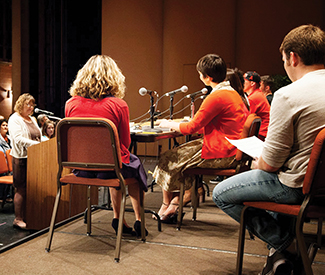
THEATER From a certain angle, democracy is just one big bout of audience participation. So when playwright Aaron Landsman, director Mallory Catlett, and designer Jim Findlay started kicking around the idea of somehow staging a city council meeting, of all things, the notion that the audience itself should enact it must have come as a eureka moment.

It is indeed the charm and challenge of City Council Meeting that, while conceived and instigated by the New York–based artistic trio, the show is ultimately a collaboration with whoever shows up, plus a few semi-rehearsed locals in on the running of the thing. These latter include a group of “staffers” who help guide participants through an actual city council meeting — or more precisely, a seamless composite of public transcripts of such meetings held around the US in the past couple of years, plus an artistic flourish or two. For the San Francisco premiere (running this weekend at local co-presenter Z Space), the staffers include Claudia Anderson, Awele, Dwayne Calizo, Jennifer Chien, Sarah Curran, and me.

Moreover, the piece always concludes with an original ending crafted specifically for the locale in which it plays (that, so far, has been Houston, Texas; Tempe, Ariz.; and New York City). This time, the play’s unique final movement, a creative response to what has preceded it, was built in partnership with Bay Area director-choreographer Erika Chong Shuch.

As a staffer, your job is to help facilitate the encounter between the play and its audience. Since that’s kind of what a critic does anyway, I reasoned, and given that everyone in the audience is already at least minimally involved in the production, I signed on for a more inside track on City Council Meeting‘s three-day San Francisco run. At the first rehearsal, director Catlett introduced us to our binders, which contained things we’d need, including something like the script of the performance.

(There is no definitive script. The play is an un-distillable architecture of discrete dialogue, directions on note cards, live and recorded video feeds, and whispered cues, not to mention the unforeseeable but pretty much guaranteed contingency. And perspectives and experiences will vary pretty widely depending on the physical and dramatic space one chooses to occupy: council member, speaker, bystander.)

It was a little confusing, frankly. But halfway through a swift two weeks of rehearsal, I’m seeing more clearly the shape of the show as well as appreciating the subtleties in its construction. Like much contemporary participatory performance, or what’s sometimes called “social practice” art, City Council Meeting moves the bulk of the action and agency onto its audience as a way to simultaneously investigate and manifest our social circumstances and potentialities. It is therefore purposely unsettled — participants are always themselves and yet tasked with enacting the words of other real people like, or more often not like, themselves.

The sheer awkwardness of it is really the point. Is this a study, a parody, an incitement, an invocation? In enacting the form, does the piece share in some of its power? A strange combination of sincerity and dry humor runs throughout it all, as the double-consciousness built into the piece throws everything gleefully up in the air, suspended somewhere between the rehearsal of dead forms (whether political or aesthetic) and the activation of new ones.

That’s a salubrious position, encouraged by the context at large. Or so I couldn’t help thinking. Was it merely coincidence that after leaving rehearsal one night I walked directly into road blocks, sirens, and hundreds of cops — the wake left by a president and secretary of state on political shopping sprees? Is the power that creates such disruption, traffic, and annoyance wherever it goes, like some heedless B-movie giant, even related to the power invested in local government? Was it just coincidence that after leaving another rehearsal a few days later, the Chronicle building was papered over in posters reading, “the media lies as Gaza dies,” this time the unsanctioned wake of a protest on behalf of the powerless?

For a moment there, Occupy took back government from representative bodies and held it in the bodies of real people, acting on their own behalf. It was wild, unexpected, and startlingly easy. It was also strikingly creative — and art was everywhere in the movement. It’s become clearer since then that the relationship between art and politics is a much more serious question than many of us had realized. We can’t afford a paucity of imagination in either. We need the room and wherewithal to ask questions. If nothing else, City Council Meeting asks questions. Including these:

“Are we working together? Are we capable of it? Is that why this structure is here? Or is that what the structure prevents?” *

CITY COUNCIL MEETING

Fri/1-Sat/2, 7pm; Sun/3, 2pm, $20

Z Space

450 Florida, SF

www.zspace.org


Snap sounds

0

LYKKE LI

I Never Learn (LL/Atlantic)

Lykke Li is a pop star who surrounds herself in clouds of reverb, so the obvious reference point for her music is Phil Spector’s ’60s girl-group productions. But strip away the layers of sound and her third album I Never Learn is essentially a set of adult-contemporary ballads that would slot nicely into any KOIT lineup. These songs are personal rather than universal, introverted rather than extroverted, subtle and slight rather than big and dumb — though there are some pretty shameless hooks on this album, readymade for festival sing-a-longs.

Li and her production team took a gamble on taking the brutally-short approach to this album; it’s only nine songs over 33 minutes, and music this fluid usually needs more room to splash around. But these songs are rich enough in content that each one feels like an event. “Just Like A Dream” and “Silver Line” have great choruses, while “Gunshot” and “Heart of Steel” feature neat production touches (slinky organ and twangy Morricone guitar, respectively). The album’s highlight is undoubtedly “Love Me Like I’m Not Made Of Stone,” a great acoustic ballad that could make it onto the charts with a bit more exposure.

XIU XIU

Angel Guts: Red Classroom (Polyvinyl)

Xiu Xiu has always been a bit silly. Though Jamie Stewart’s long-running project is often brutal in its emotional honesty, there’s no denying how over-the-top Stewart’s gasping vocals are, how absurd their lyrics can be are. Angel Guts: Red Classroom continues this trend, and it’s more theatrical than ever. And while this is the first Xiu Xiu album in about ten years that still might have the power to shock people, it also has more ill-advised moments than usual.

The main edge Angel Guts has musically over past Xiu Xiu albums is the change in Stewart’s voice. The vulnerability and hurt remains, but it’s overshadowed by a commanding deepness. The porn ode “Black Dick” wouldn’t be effective if he didn’t sing it with such power. But then we have him screeching “IT TASTES LIKE A COOKIE” for no reason, opening and closing the album with shameless noise, delivering monologues that scan as melodramatic even by Xiu Xiu standards. Though Angel Guts is flawed, it’s their most engaging listen in a decade, and it also features two of their best songs to date: the Michael Jackson-like “Stupid In The Dark” and “Adult Friends,” the most terrifying aging ballad I’ve ever heard.

https://www.youtube.com/watch?v=1r89LG9QGsc

RICKY EAT ACID

Three Love Songs (Orchid Tapes)

There are 12 songs on this album, none of them are really about love, and if you put this on during an acid trip you’d probably be in ultimate entrapment by track four. Sam Ray’s ironic streak has always been pretty obvious — he’s got a folk project called Julia Brown (he’s not really a girl, haha) and previously performed under the name Teen Suicide. But as annoying as indie-rock irony can be, Ray can get away with it simply on the virtue of how sincere his music is. As on his wonderful Julia Brown debut To Be Close To You, Three Love Songs evokes the mundane but beautiful — empty rooms, road crews working late at night, light filtering through curtains.

As such, it’s a great all-purpose ambient album. Just about any situation could easily be soundtracked by a track on this album; while the first half of the record is a bit melancholy and might ruin your day in the wrong context, the second half is playful and almost goofy. There are better ambient albums for specific situations, but if I can’t think of the proper music pairing for a certain environment, I’d feel safe turning to Three Love Songs.

Of borders and love songs

0

esilvers@sfbg.com

LEFT OF THE DIAL The way in which Diana Gameros first came to America is a world away from the heart-wrenching images we’re currently seeing in the news media of children who’ve been sent, on their own, to the U.S. border from Honduras, Guatemala, and El Salvador. At 13, she arrived on an airplane from her home city of Juarez, Mexico; the plan was to stay with an aunt who lived in Michigan for the summer. When Gameros visited her cousin’s school there, and saw that it had a swimming pool, among other luxurious-seeming facilities, her aunt asked if she wanted to go to that school and learn English. Gameros couldn’t say yes fast enough. She wound up staying three years, returning to Mexico for the second half of high school, and then moving back to the U.S. for college.

So no, no one ever sent her out on foot for the border, hoping that on the other side lay someone or something that could mean a brighter future.

And yet: “I’m kind of a fanatic when it comes to following this country’s immigration system and its history,” says Gameros, a fixture in San Francisco’s singer-songwriter scene for her thoughtful, melodic story-songs that contain both English and Spanish (she’s been referred to as the Latin Feist).

“I think there’s a lot that most American people don’t know. You hear people judging, calling these parents irresponsible…it’s so much more complicated than that,” she says. “People don’t know how the U.S.’s actions have affected these countries. People are risking their children’s lives because they need to be here. It’s not for the American dream, they’re not here to buy a nice car, a big house. They’re here because they want to eat, have a roof over their heads, fulfill basic necessities. It’s frustrating. There’s so much ignorance.”

Her unique perspective on border issues is one reason Gameros was selected to perform at MEX I AM: Live It to Believe It, a nearly weeklong festival organized by the Yerba Buena Center for the Arts in conjunction with SF’s Consulate General of Mexico. Bringing together musicians, actors, visual artists, and academics from throughout Mexico from July 31 through Aug. 5, the festival includes classical, indie, and pop music and dance, lectures and discussion of Mexico’s achievements and challenges, and a meeting of minds around border issues.

The program in which Gameros will perform, on the evening of Friday, Aug. 1, is called “Ideas: North and South of the Border,” and aims to explore innovation in the sciences, arts, and culture in Mexico. Among the other speakers: astronaut Jose Hernandez, who grew up in the Central Valley as the son of immigrant farmers; he’ll discuss his journey from childhood (he didn’t learn to read or speak in English until he was 12) through getting a degree in electrical engineering and eventually being tapped by NASA. Rosario Marin, the first Mexican-American woman to serve as Treasurer of the United States, will also be present, along with Favianna Rodriguez, a transnational visual artist whose work “depicts how women, migrants and outsiders are affected by global politics, economic inequality, patriarchy and interdependence” and the director of CultureStrike, an arts organization that works to organize artists, writers, and performers around migrant rights.

On the afternoon of Saturday, Aug. 2, actress-dancer Vicky Araico will perform her award-winning monologue Juana In a Million, which chronicles an undocumented immigrant’s quest to find home.

The other musical performances throughout the week run the gamut from Natalia Lafourcade, a two-time Latin Grammy winning pop singer, to Murcof + Simon Geilfus, an electronic audio-visual collaboration, the award-winning percussion ensemble Tambuco, renowned composer and jazz musician Hector Infanzon, and more.

Gameros, whose 2013 album Eterno Retorno (Eternal Return) features a song called “SB 1070” (after the racist Arizona law designed to prosecute undocumented immigrants), says she thinks her music can be a subtle form of education, an artistic entry point for people who might not know or think much about immigration issues.

“It’s a topic that touches me deeply, so my protest music is my offering, my way to say I’m with you and I stand with you,” she says. “Though if you listen to my lyrics you might think many [songs] are love songs, or written to a lover who didn’t treat me right.”

Gameros adds that she hopes the Latino community in San Francisco will embrace the festival and show up, a sentiment that carries a particular weight as housing prices in areas like the Mission are changing the local face of the local Latino population. “Unless its the symphony doing something with a Mexican artist, we don’t really have access to events like this that are mainstream cultural celebrations, normally,” she says. “And there’s such a fascinating group of people all here for it — I just hope as many people as possible take advantage of it, that they come and hear these stories we have to tell.”


MEX I AM: LIVE IT TO BELIEVE IT

July 31 through Aug. 5, prices and times vary

Most events at Yerba Buena Center for the Arts

701 Mission, SF

(415) 978-2700

www.ybca.org/mex-i-am

Shots fired

2

cheryl@sfbg.com

FILM “The First World War holds the distinction of being America’s most popular conflict while it lasted, and the most hated as soon as it was over,” writes Russell Merritt in the intro to his guest-curated Pacific Film Archive series “Over the Top and Into the Wire: WWI on Film.” Though World War I is a much less popular cinematic subject than WWII, or even the Vietnam War, its complexities mean that the films it did inspire continue to fascinate.

The PFA series kicks off Sat/2 with Charlie Chaplin’s Shoulder Arms (1918), in which the Little Tramp heads “over there” and becomes a most unlikely hero. Included in that same program are Disney short Great Guns (1927), and Winsor McCay’s The Sinking of the Lusitania (1918), a fiery argument in favor of America going to war, as well as one of the first animated documentaries.

“Over the Top” also includes two silent epics (D.W. Griffith’s 1918 Hearts of the World, and Alexander Dovzhenko’s 1929 Arsenal); three certified classics (Jean Renoir’s 1937 POW saga Grand Illusion; Lewis Milestone’s harrowing 1930 All Quiet on the Western Front; and Stanley Kubrick’s 1957 Paths of Glory, starring an impeccably furious Kirk Douglas); and a Washington-set oddity: Gregory La Cava’s 1933 Gabriel Over the White House.

I spoke with Merritt, an adjunct professor in UC Berkeley’s Film and Media Studies Department, just days before the 100-year anniversary of the war’s outbreak on July 28, 1914.

SF Bay Guardian How did you become interested in World War I films?

Russell Merritt For me, World War I is the event that shaped the 20th century, more than the Depression or World War II — and to see how films contributed is one of those endlessly interesting kinds of problems. They were mainly part of the war hysteria that gripped the country starting in 1917, and that in itself is of interest, because we were so opposed to the war just a few years before that, and we became even more opposed to the war after it was all over. The movies reflect that. Trying to account for these dramatic mood swings is part of the fascination.

SFBG How did you select the films in the series?

RM I tried to find both classics and some off-center ones. I suspect nobody who does a series on the First World War is going to forget All Quiet on the Western Front, Grand Illusion, or Paths of Glory, but few would think of Dovzhenko’s Arsenal or Gabriel Over the White House — though those enable us to get to some hidden aspects, or lesser-known aspects, of the ways in which the war was considered.

Of the war films that were made during the war, the only two that anybody remembers are a cartoon [The Sinking of the Lusitania] and a comedy featurette [Shoulder Arms]. Meanwhile, the most popular war film made during the war, D.W. Griffith’s Hearts of the World, with Lillian Gish, is all but forgotten.

SFBG World War I coincided with the early days of cinema. What bearing do you think the two had on each other?

RM In the case of Hearts of the World, it has a direct bearing. This production was unique in that Griffith is the only filmmaker — the only American filmmaker, the only fiction filmmaker — to be allowed onto battlefields, and onto the training grounds in England, to use the armies more or less as extras. It represents this great effort at trying to use motion picture fiction films as what would have been called “informational films” back then — today, we would call them war propaganda films. It reflects this fascination with movies as the latest medium with which to try to influence public opinion.

One of the most fascinating things about this film is Griffith is an American, world-famous for [1915’s] Birth of a Nation. He is invited by the British to make a feature film that will encourage Americans to join the war, or at least to be sympathetic to the Allied side of the war.

But by the time he arrived in Europe, the war had already come to America. So the project changed, and he created an American story about the war. I’m shortening a story that goes on even longer, but this kind of crazy wandering from one project to another reflects the difficulty of trying to find an image for the war other than making the Germans hideous, lustful barbarians. How do you portray the battles, the French, the Americans? That’s all being changed as he’s making the film, and he starts falling back on the patterns that he used when trying to sell the Civil War [in Nation].

All of this relates to your question, because today we have a quite pronounced way of selling government, or more frequently anti-government documentaries. Back then were the very beginnings of this effort to use film for these types of social purposes.

SFBG Hearts used real soldiers, and some of the films, like Grand Illusion, don’t depict any battles, but some of the special effects in the other films are surprisingly impressive. Disembodied hands gripping the barbed wire in All Quiet on the Western Front…

RM That is an unforgettable image, even all these years later. There was also a silent version made of that, with that same shot in it. In some ways, Paths of Glory is the most shocking of the films in the series, because it’s so angry. But the sheer horror of the war, I think, has never been better illustrated [than in All Quiet].

This leads to a subtext in this series: In some ways, you could regard this as a kind of cross-section of the kinds of films that represent the war. But I have a particular argument to make, which is that the films help perpetuate the illusion that the war that Americans fought was interchangeable with the war that Europeans fought. All Quiet is a great example of that. To this day, we think the Americans fought in trenches, that our cause was as confused and as hopeless to understand as was the European cause, and so on.

But in fact, we fought quite a different war. Our reasons for going into the war were quite different, and the experiences we had in the war were quite different. You can ask a class, as I do, “How many of you had relatives that were killed in the First World War?”, and just a sprinkling of hands will go up. Ask the same question in Europe, and it doesn’t matter if it’s France, England, or Germany — all the hands will go up. That gets blurred over in these films, and I’d like [audiences] to reconsider that.

The other thing I want to do is show how the war was used as the teens gave way to the 1920s, and into the 1930s. It had different functions, especially during the Depression, [when it was] interpreted so that it was appropriate to this great economic disaster. That’s the reason I’m including Gabriel Over the White House. And it has a much different purpose when it’s being incorporated into Soviet history; that’s why I’m showing the Ukranian film, Arsenal.

SFBG Perhaps it’s due to those complexities, but World War I hasn’t become a part of pop culture, for lack of a better phrase, the way World War II has.

RM I can’t think of a modern film about America’s involvement in the First World War. I suspect with the American centennial coming up in 2017, that will change. But even documentary filmmakers haven’t touched it. There was a 10-part British documentary series that was made 10 years ago, but we have nothing like that; Ken Burns isn’t going to do something on World War I. The strange part is, it may be as influential as any war we ever fought, certainly more than World War II, in shaping what kind of country we became.

SFBG Why did you only choose one film that was made after World War II? Is it because there just aren’t very many?

RM That’s one reason. And they’re not as interesting, since they more or less recycle the party line on World War I: it was terrible, it was unfair. There’s no new news coming out about the First World War after Kubrick’s movie, as far as I can tell.

SFBG Do you have a favorite among the movies you’re showing?

RM No, I love all my children [laughs]. When you see Grand Illusion, how can you not respond to Renoir’s humane view? This is the most generous view of the war, of officers, and of POWs, that you’ll ever see. It’s not exactly a comedy, but it’s this remarkable way of reconciling enemies, and officers and enlisted men.

Paths of Glory never gets old. It’s based on a historic event that took place in 1914, and kept on taking place; soldiers were frequently being executed for mutiny or cowardice when a military operation became a disaster.

I haven’t seen All Quiet on the Western Front in a long time, and yet for me it’s unforgettable. The big battle scene comes toward the beginning of the film, rather than where it usually comes at the end, and that makes all the difference. *

OVER THE TOP AND INTO THE WIRE: WWI ON FILM

Aug 2-27, $5.50-$9.50

Pacific Film Archive

2575 Bancroft, Berk

bampfa.berkeley.edu


What she sees

1

cheryl@sfbg.com

SFJFF The San Francisco Jewish Film Festival opens July 24 with The Green Prince, a documentary based on the memoir of Mosab Hassan Yousef. The son of a founding member of Hamas, he worked as an undercover agent for the Israeli secret service for 10 years, sharing a profound trust with his Shin Bet handler. The closing night film is also a documentary about a conflicted childhood that paves the way for tough choices later in life — but if Little White Lie is also a personal story, it’s a far less political one.

It’s a thoroughly American story, telling the tale of filmmaker Lacey Schwartz, who was raised by her parents — both products of “a long line of New York Jews” — in the decidedly homogeneous town of Woodstock. All of Schwartz’s grade-school friends had light skin and straight hair, while Schwartz was dark, with coarse curls. Lovingly recorded snapshots and home movies of her Bat Mitzvah and other occasions suggest a happy young life, but the “600-pound gorilla in the room,” as one relative puts it, was that Schwartz did not look white, despite ostensibly having white parents. Once she reached her teenage years — and particularly after she enrolled in a high school that had African American kids among its population — she began to realize the go-to family explanation (yeah … that one Sicilian way back in the family tree …) was nothing but a flimsy excuse holding back a mountain of denial.

Now in her 30s, Schwartz has overcome years of identity confusion and is self-confidently assertive in a manner that suggests years of therapy (and indeed, we see footage of sessions she filmed for a student project at Georgetown, where she found a supportive community among the Black Student Alliance). Her parents, however, are not quite as psychologically evolved, although her mother — a pleasant woman who has nonetheless been content to spend her life surfing the waves of passive-aggression — eventually opens up about the Schwartz family’s worst-kept secret. The aptly-titled Little White Lie clocks in at just over an hour, but it packs in a miniseries’ worth of emotional complexity and honesty. Schwartz will be on hand at the film’s San Francisco and Berkeley screenings — the Q&As are sure to be lively.

Another, rather different tale of women using cameras in pursuit of the truth surfaces in Judith Montell and Emily Scharlatt’s In the Image, a doc about Palestinian women who work with Israeli human-rights NGO B’Tselem. Group members, who include high school girls and middle-aged mothers, are given small video cameras to keep an eye on protests, harassment, and anti-Palestinian violence perpetrated by Israeli soldiers and settlers. (In one disturbing clip, we see a small child launch a giant spitball at the lens.) Able to capture footage in areas deemed off-limits to mainstream journalists, In the Image shows how B’Tselem brings investigative reporting to the front lines, and then to the world (thanks, YouTube). It’s also an empowering outlet for the camerawomen-activists, for whom career opportunities are otherwise as rare as are opportunities for artistic expression.

Women are also front and center in a number of SFJFF’s stronger narrative entries. Writer-director Talya Lavie won Best Narrative Feature and the Nora Ephron Prize at Tribeca for Zero Motivation, a pitch-black comedy about female frenemies jammed into close quarters while doin’ time in the Israeli Defense Forces. Most movies prefer to show soldiers in combat, and Zero Motivation does just that — if “combat” means fighting to avoid boring admin work, to achieve the highest score at Minesweeper, to fuck up the most extravagantly, or with staple guns. “There’s a war going on — get a grip!” a superior officer reminds self-centered slacker Daffi (Nelly Tager), and that’s more or less the only current-affairs statement uttered in a film that’s mostly concerned with the agonizing task of achieving responsible young adulthood.

Another coming-of-age tale unfolds in Hanna’s Journey, director and co-writer Julia von Heinz’s drama about a Berlin business-school student (Karoline Schuch) whose résumé is lacking in the sort of warm-fuzzy community service that’ll elevate her in the cutthroat job market. Her estranged mother, who works with a German group placing volunteers in Israel, proves unexpectedly helpful, and Hanna is soon winging her way to work with developmentally disabled adults in Tel Aviv, leaving her sleek wardrobe and yuppie boyfriend behind.

Hanna’s Journey has all the potential to be a pat story about a German woman coming to terms not just with her own life choices, but with complicated family history (hint: it involves World War II) only a trip to Israel can unearth. There’s also a conveniently hunky Israeli (Doron Amit) in the mix. But! Schuch, who resembles Jessica Chastain, brings authenticity to a character who morphs from superficial to soulful in what might otherwise seem like too-rapid time. She also benefits from a subtle, nicely detailed script, which avoids stereotypes and oversimplification, and is not without moments of wicked humor (“German girls are easy — it’s the guilt complex!”)

Less successful at achieving subtelty is For a Woman, writer-director Diane Kurys’ latest autobiographical drama. Here, she explores her parents’ troubled marriage, inspired by a photograph of an uncle nobody in the family wanted to discuss. The fictionalized version begins as Kurys stand-in Anne (Sylvie Testud) and older sister Tania (Julie Ferrier) have just buried their mother, who was long-divorced from the girls’ ailing father.

For a Woman takes place mostly in flashbacks to post-war Lyon, where young Jewish couple Léna (Mélanie Thierry) and Michel (Benoit Magimel) settle and have Tania soon after. Russia-born Michel is a devoted Communist, and he’s overjoyed — yet understandably suspicious — when long-lost brother Jean (Nicolas Duvauchelle) suddenly appears in France, having somehow escaped the USSR. Michel’s political paranoia blinds him to the fact that Léna — who married him to escape a death camp (he didn’t know her, but couldn’t resist her icy blond beauty) — is bored with her stay-at-home-mom life, and has taken an unwholesome interest in his mysterious little bro.

There’s more to the story than that, of course, but For a Woman never goes much deeper than a made-for-TV melodrama: entertaining in the moment, but ultimately forgettable. And even gorgeous period details (Michel’s car is to die for) can’t make up for a frame story that feels rather wan next to the film’s cloak-and-dagger main plotline. 2

SAN FRANCISCO JEWISH FILM FESTIVAL

July 24-Aug. 10, most shows $10-$14

Various Bay Area venues

www.sfjff.org


In tune

0

arts@sfbg.com

DANCE If you have attended any ODC Theater presentations in the last couple of years, chances are you’ll recognize Christy Bolingbroke. Until recently, she was the ODC Theater director, and the one who welcomed audiences with unmatched enthusiasm. Now that she has added ODC deputy director for advancement to her title, she will be able to pour even more energy into two of her passions: performance and connecting audiences with it.

One of her initiatives, the Walking Distance Dance Festival, has offered double bills on two different ODC stages and allowed audiences to discuss the performances while navigating between the venues. During the festival’s late May run, the 300 block of Shotwell Street never looked more alive. Bolingbroke’s latest project is the ambitious, almost month-long Music Moves Festival (July 31-Aug. 24), which looks at the relationship between dance and music.

The timing of the festival, Bolingbroke explains, is tied to ODC’s first Next Moves Summer Intensive, a two-week residency program for professional and budding dancers which ODC hopes to expand into something larger, not unlike the Jacob’s Pillow Dance Festival in Massachusetts. Music Moves is a way to expose these students — and the audience — to different ways of thinking about looking and listening.

Music and dance, of course, have been connected since time immemorial. Many culturally specific genres, such as African, Hawaiian, Indian, and flamenco, are still unthinkable without this symbiotic relationship. Concert dance, ballet included, however, has developed a more ambiguous association with musical compositions. Think of Merce Cunningham’s works, where the sound simply ran along a parallel track to the dance. Today’s choreographers may choose an existing score, commission one, work in tandem with a composer, forego music entirely, or use it solely in the background like wallpaper.

As marketing director for the Mark Morris Dance Group, Bolingbroke became intimately aware of how dance and music inform each other. But she also realized that dance audiences are much smaller than those for music. “So if I can pull in a few more people to see dance because of the music that was used, that is exciting for me,” she says. “We’re not booking the super stars of contemporary dance. This is really for audiences interested in the creative process, and in being able to think about performance in a different way.”

The festival opens with ODC/Dance’s highly popular “Summer Sampler,” which this year includes Brenda Way’s Breathing Underwater, a collaboration with cellist Zoe Keating; Way’s Life Saving Maneuvers, set to a commissioned score by Jay Cloidt; and KT Nelson’s Scramble, her take on a couple dancing to a Bach cello suite.

The festival’s closing night program highlights alumni of ODC’s Pilot program: deaf dancer Antoine Hunter and ballet-trained Milissa Payne Bradley. Says Bolingbroke, “Antoine has interesting things to say about the fact that we hear music, while he feels it. Milissa challenges herself not to start choreography with music, as she had been trained to do.”

Other programs include “Tuesday is Tunesday” setups, with choreographers like Eric Kupers — who started out in modern dance, but with his Dandelion Dance Theater’s Bandelion Ensemble has increasingly blurred lines between dance, music, and community action (Aug 5). There’s also body music pioneer Keith Terry, making a rare local appearance on his home turf with his Corposonic ensemble (Aug 12).

Bolingbroke is also intrigued by the intersection of concert performance and pop culture, so the idea of having a culturally-rooted form like taiko collaborating with a DJ proved irresistible. So for one night it will be San Jose Taiko x The Bangerz in what the program calls “a musical conversation between taiko and hip-hop” (Aug 17).

Also on the pop side of this festival will be Napita Kappor’s Hindu Swing, her fusion of Bollywood and jazz; she shares an evening with Cuba’s salsa band Rueda Con Ritmo (Aug 22-23). Pearl Marill, who likes to meld theater, modern dance, and comedy, will premiere Some Bodies Confessional (Aug 10-11). Irresistibly Drawn, Joe Goode’s evening of song and dance (Aug 3-4), includes former company member Marit Brook-Kothlow and singer-songwriter Holcombe Waller, who will also have his own show (Aug 19).

Kate Weare is returning one more time to set work on ODC’s dancers. Drop Down is her take on the tango, and Still Life with Avalanche is a collaboration with Brenda Way. The evening also features Rande Paufve’s recent Soil, her musing on aging, set to a live cello and piano score (Aug 14-16).

Finally, the young but already much acclaimed Dance Heginbotham will present three works, including one of the late Remy Charlip’s Air Mail Dances (Aug 7-9). Says Bolingbroke, “I have been interested in them for a while, particularly as a 21st century version [of] Mark Morris,” with whom John Heginbotham danced for 14 years. “So it’s exciting to be able to present the company’s West Coast debut.” *

MUSIC MOVES FESTIVAL

July 31-Aug 24, $25-45

ODC Theater

3153 17th St, SF

www.odctheater.org

Reducing phone charges helps inmates connect with families

11

OPINION

It’s expensive being poor. Families of inmates often live on the edge of insolvency.

I know a mother of two, married to a man doing time in the San Francisco jail, who is trapped between the domino effect of poverty and the desire to maintain her children’s relationship with their father. The trouble began when her credit rating dropped due to late bill payments, which triggered the repossession of her car, which put her job at risk because public transit couldn’t get her to work on-time.

Now she relies on loan centers that charge high interest rates or paying the rent on her dilapidated apartment late, all while trying to stave off eviction. She says she contemplates leaving San Francisco on a daily basis. To do so would improve her financial situation, but would reduce her children’s already limited access to their father.

Depending if they can afford the time it takes to take transit to County Jail 5 in San Bruno for a weekly visit, or the unreasonable cost of a phone call, this family must literally choose between putting food on the table or connecting with their loved one.

Research shows that inmates who preserve ties with their families, especially their spouses and children, have a much better chance of staying out of jail once released. Keeping in touch is almost an impossible reality considering the jolting cost of making a $1 per minute in-state, long-distance or pre-paid collect call.

Until a cap on interstate calling rates was introduced earlier this year by the Federal Communications Commission, the telephone companies providing inmate phone services were largely unregulated. As a result, correctional facilities allowed inmate phone service providers to charge jacked-up calling rates in exchange for a cut of the revenue, paid to the facility in the form of a phone commission. Because these commissions are used to fund services for inmates, this decades-old practice created a paradoxical relationship between inmates, inmate phone service companies, prisons, and county jails.

In the San Francisco Sheriff Department’s most recent contract with its phone service provider, Global Tel*Link (GTL), we broke this counterproductive cycle and changed the way we do business. We’ve dramatically reduced calling rates and surcharges for inmate phone calls, including a 70 percent reduction for a 15-minute collect or pre-paid collect, in-state, long-distance call, from $13.35 to $4.05, and a 32 percent reduction for a 15-minute debit, in-state, long-distance call, from $5.98 to $4.05.

Given the city’s longtime dependence on phone commissions to fund rehabilitative programs, like Resolve to Stop the Violence and the One Family visitation program, reducing inmate calling rates endangers program stability while spotlighting an addiction that’s shared by almost every prison and jail in the country: balancing incarceration budgets on the backs of people who can afford it least. According to the US Department of Justice, 80 percent of families who have a member incarcerated live at or below poverty levels.

Fortunately, our department recently won a settlement against GTL’s predecessor, enabling us to fund programs for several years without taking a hit. But, in the long run, City Hall must realize that gouging poor people doesn’t improve public safety. It punishes innocent children by limiting their communication with their family, subordinates the healing value of family reunification to profit, and strengthens the inter-generational resentment that is laced between impoverished communities and the justice system that is supposed to protect them.

Gratified with the unanimous support of our phone rate reform by the San Francisco Board of Supervisors, the San Francisco Sheriff’s Department is proud to be one of the first county jail systems in the nation to dramatically reduce its telecom rates.

Our next policy reform will be the unregulated, exorbitant cost of inmate commissary fees and commissions.

Ross Mirkarimi is elected Sheriff of San Francisco

Everyone’s hospital

15

rebecca@sfbg.com

“I am a survivor of the AIDS epidemic,” Daniel volunteered, beginning to tell us his very San Francisco story.

He was diagnosed with HIV in the 1980s. Working in fine dining rooms of San Francisco hotels at the time, he had health insurance, and had gone to Kaiser for an unrelated procedure. That led to a blood test — and then wham.

“They just bluntly, without any compassion, just told me: You have it,” Daniel said. “Like telling you that you have a pimple on your nose or something.”

All around him, friends were dying from the disease. “I didn’t freak out, because that’s just my personality,” he recalled. “I know a lot of people who have been diagnosed, and they want to take their lives or whatever.”

Today, he’s unemployed and living on a fixed income. He lost his left eye years ago to an infection linked to HIV; he now has a prosthetic eye.

“I’m single, disabled, and low-income,” reflected Daniel, who didn’t want his last name printed due to privacy concerns. Originally from El Salvador, his family came to the U.S. when he was 10 and Daniel has permanent resident status. But despite the disadvantages he faces, Daniel still isn’t freaking out. His medical needs are met.

He got on MediCal after having to drop Kaiser. “And then I ended up at SF General,” he said, “with some of the most professional staff, doctors rated worldwide. It has some of the most professional health care providers for HIV, all in one place.”

Daniel is one satisfied San Francisco General Hospital patient, and he might as well be a poster child for how public health is supposed to work in big cities. Rather than being deprived of primary care and then showing up at the emergency room with preventable complications stemming from his disease, he’s keeping everything in check with regular doctor’s visits — and he can access this high level of care even though he’s on a very tight budget.

There’s a concerted effort underway in the San Francisco Department of Public Health to give more patients precisely the kind of experience Daniel has had, while also expanding its role as the region’s go-to trauma center.

But a difficult and uncertain road lies ahead of that destination, shaped in part by federal health care reform. The new course is being charted amid looming financial uncertainty and with more patients expected to enter the system and the doors of SF General.

Not every General Hospital patient is as lucky as Daniel. For scores of others, SF General is the last stop after a long, rough ride.


EMERGENCY CARE

Craig Gordon and Dan Goepel drive an ambulance for the San Francisco Fire Department, regularly charging through congested city streets with sirens blaring as they rush patients to SF General and other care facilities. They see it all: Patients who are violent and psychotic and need to be restrained in the back of the ambulance, folks who’ve just suffered burns or gunshot wounds.

Sometimes, in the thick of all of this, SF General’s Emergency Department is closed to ambulances — in public safety lingo, it’s called being “on diversion” — so the medics will have to reroute to different hospitals.

SF General might go on diversion because the Emergency Department is too slammed to take on anyone new, or because it’s too short-staffed to take on new patients without pushing nurse-to-patient ratios to unsafe levels.

For serious trauma cases, strokes, heart attacks, or traumatic brain injuries, however, the doors are always open. Patients with less-serious cases are the ones to be turned away when the hospital is on diversion.

Patients who wind up en route to SF General in Gordon and Goepel’s ambulance might be living on the margins. “If you’re kind of living on the cusp … you’re not likely going to pursue getting a primary care physician,” Goepel pointed out. “When something comes up, then you find yourself in the emergency room.”

Or their patients might be getting rescued from a spectacularly awful situation, like a plane crash. In this densely populated, earthquake-prone region, there is only one top-level trauma center between Highway 92 and the Golden Gate Bridge: SF General. Anyone in the city or northern San Mateo County unfortunate enough to experience a life-threatening incident — a car wreck, shooting, nasty fall, boating accident — winds up there, regardless of whether they’re rich or poor, indigent or insured. Ranked as a Level 1 trauma center, SF General is equipped to provide the highest level of care.

“In the summer, when school is out, we have a high season of gunshot wounds and stab wounds,” explained Chief Nursing Officer Terri Dentoni, who recently led the Guardian on a tour of the Emergency Department. “When it’s really nice outside, you have a lot of people who get into bike accidents, car accidents. … Last week, we were just inundated with critical care patients.”

Around 100,000 patients flow through SF General’s doors each year, and more than 3,900 need trauma care. On July 6, 2013, when Asiana Airlines’ Flight 214 crash-landed at San Francisco International Airport, more than 60 crash victims were rushed to SF General with critical issues ranging from organ damage to spinal injuries.

“It was a very big tragedy,” Dentoni said. “But it was amazing how many people we took care of, and how well we took care of them.”

Aside from being the sole trauma center, SF General is also designated as the county’s safety-net hospital, making it the only healthcare option for thousands who are uninsured, poor, undocumented, homeless, or some combination thereof. This makes for complex cases. Patients might require translators, be locked in psychiatric episodes, or need a social worker to help them get to a medical respite facility after being discharged if they’re too weak to fend for themselves and don’t have anyplace to go. There isn’t always a place to send them off to.

“We’re seeing people who are dealing with poverty, and often homelessness, in addition to mental health issues,” explained Jason Negron, a registered nurse in the Emergency Department. “You’re seeing patients who often have a number of things going on. Someone who has multiple illnesses — HIV, heart failure, Hepatitis C — even under the best of circumstances, they would be juggling medications. So what happens when they’re out on the streets?”

San Francisco ranks high on the list of health-conscious cities, a haven for organic food aficionados, yoga addicts, and marathon runners. It’s also a world of high stakes struggles and mounting economic pressures. With the city’s skyrocketing cost of living, sudden job loss can spell disaster for someone without a financial cushion. SF General is the catchall medical care facility for anyone who’s slipped through the cracks.

But while rank-and-file hospital staff must tackle grueling day-to-day problems, like how to juggle multiple patients with complex health issues when all the beds are full and the hospital is understaffed, hospital administrators face an altogether different challenge.

For the past several years, the city’s Department of Public Health has been preparing for the implementation of the Affordable Care Act, aka Obamacare, the federal policy that is reshaping the health care landscape. Since public hospitals are mandated to provide safety-net care, they are uniquely impacted by the ACA.

Even with a sweeping new rule mandating health insurance for all, some segment of the population will nevertheless remain uninsured. But they’ll still need medical care — and when health crises come up, they’ll turn to SF General. Trouble is, no one knows exactly how much funding will be available to meet that need as the financial picture shifts.


FUNDING CUTS LOOM

Even as ACA aims to increase access to medical care, it’s also going to trigger major funding cuts at the local level. With both state and federal funding being slashed, San Francisco’s county health system stands to lose $131 million in financial support over the next five years, a budgetary hit totaling around 16 percent.

That’s a significant shortfall that will directly impact SF General — but the cuts are being made with the expectation that these gaps will be filled by reimbursements riding in on the waves of newly insured patients enrolled in ACA. Before federal health care reform took effect, around 84,000 San Franciscans lacked health insurance. At the start of this year, 56,000 became eligible to enroll in a health insurance plan.

SF General serves most of the area’s MediCal patients, the subsidized plan for people living on less than $16,000 a year. And since the county gets reimbursed a flat rate for each patient, the expansion of MediCal under federal health care reform will presumably help San Francisco absorb the state and federal funding losses.

“There’s a certain set of patients who previously were not paid for, who now will have MediCal,” explained Ken Jacobs, an expert in health care policy and professor at the UC Berkeley Labor Center.

But there’s a catch. Since MediCal and insured patients will be able to choose between San Francisco’s public system (called the San Francisco Health Plan) and a private medical provider, SF General also runs the risk of losing patients. If too many decide to go with Anthem Blue Cross instead, the system could veer into the red.

“There’s some question of what share of those we’ll keep,” Jacobs noted.

Asked about this, hospital CEO Sue Currin sounded a note of confidence. “Because our outcomes and our quality of care has been so high…75 percent of everyone who’s enrolled in MediCal managed care default to the Department of Public Health,” she told us.

But the journey toward ACA has only just begun, and things are still falling into place. Costs are projected to rise if nothing is done to improve efficiency, while at the same time, the pending state and federal funding shortfalls could take a toll.

Retaining and attracting insured patients is the only way to avoid a resource crunch — but patients could always walk away if they’re dissatisfied. This uncertainty “makes financial planning and management of risk even more challenging,” according to a report issued by the City Controller.

“We don’t know yet today how the Affordable Care Act will impact the safety net,” acknowledged Erica Murray, CEO of the California Association of Public Hospitals, which represents 21 public safety-net institutions throughout the state. “How are these health care systems evolving to be competitive? How do we continue to fulfill our core mission of being the safety net? That is the fundamental challenge. And we don’t know today, and we can’t be certain, that these public health systems will have sufficient funding.”

It’s all “very dynamic,” Murray said. “We don’t have sufficient data to be able to draw any definitive conclusions. It’s just too short of a time to be able to make any predictions. It will take several years.”

For all the newly insured patients under ACA, a certain segment will continue to rely on the safety net. Undocumented immigrants who don’t qualify will be left outside the system. Some individuals can be expected to outright refuse ACA enrollment, or be too incapacitated to do so. Others will opt out of Covered California, the ACA plan for people who make more than about $29,000 a year, because their budgets won’t stretch far enough to afford monthly payments even though they technically qualify. They’ll need safety-net care, too.

Yet under the new regime, “We can’t, as a safety net, go forward only with uninsured patients — because there won’t be funding to sustain the whole organization,” explained hospital spokesperson Rachael Kagan. “We will still have uninsured patients, always. But it won’t be sufficient to serve only them.”

Mike Wylie, a project manager in the Controller’s Office, worked on the city’s Health Reform Readiness project, an in-depth assessment performed in tandem with DPH and consultants. “The million dollar question is: Are we going to be on target with the projections?” Wylie asked.

Instead of standing still, San Francisco’s health system must transform itself, the Health Reform Readiness study determined. Ask anyone who works in health care management in the city, and they’ll tell you that DPH has been working on just that. The idea is to focus on network-wide, integrated care that runs more efficiently.

“We need to switch from being the provider of last resort, to the provider of choice,” Wylie noted, voicing an oft-repeated mantra.

This could mean fielding more patient calls with nursing hotlines, or using integrated databases to improve communication. There’s also emphasis on increasing the number of patients seen by a care provider in a given day. The report urged the department to ramp up its productivity level from 1.5 patient visits per hour, where it currently stands, to 2.25 patient visits per hour. Currin noted that the hospital has also been looking into group patient visits.

“Part of getting ready for health care reform was creating more medical home capacity,” Currin said, referring to a system where multiple forms of care are integrated into a single visit, “so we knew we needed to have better access to primary care.”

If no changes are made, the Health Reform Readiness study found, the city’s General Fund contribution to DPH is projected to rise substantially — to $831 million by 2019, up from $554 million in 2014-15.

“We’re a little concerned about this rising General Fund support,” Wylie noted. And even though staffing represents a major expenditure, “They didn’t assume cuts in staff,” while performing the assessment, he said. “What they’re trying to get is more outputs, more efficiency. The managers went over this and said: in order for us to survive, we’ve got to get more out of our system. We may have to cut money — we may have to cut later, if city leaders don’t commit to this rising General Fund. We’ve got to do all these best practices.”

Throughout crafting this road map, he added, “There were some uncomfortable meetings and uncomfortable moments. But I think [DPH Director] Barbara Garcia got everyone to agree to these strategies.”

Talk to rank-and-file hospital staff, however, and some will tell you that getting more out of the system is a tall order — especially when the system already feels like it’s busting at the seams.


SPACE CRUNCH, STRESSED STAFF

“We hit capacity every single day,” said Negron, the RN in the Emergency Department. Patients are regularly placed on beds in the hallways, he said. Wait times for the Emergency Department can last four to six hours, or even longer. The hospital is working on limiting those waits, not just because it’s better in practice, but because timely patient care is mandated under ACA.

“Now, we have 26 or 27 licensed beds in our Emergency Department,” Negron said. But in reality, on a regular basis, “We function with 45 to 50 patients.”

A nurse who works in the Psychiatric Emergency Services unit described her work environment as “a traffic jam with all lanes blocked. This is totally business as usual.”

The workload is on the rise, she added. “The psych emergency room used to see 500 patients a month,” she said. “Now we see 600 patients a month, sometimes more. People are moving faster and faster through the system.”

Her unit is the receiving facility for anyone who is placed on an involuntary psychiatric hold, known as a 5150, for individuals who are a danger to themselves or others or gravely disabled.

“It doesn’t matter who they are,” she said. “We get homeless and destitute. We get CEOs. And we have had CEOs — it’s an experience for everyone involved.” Some patients have been involved in criminal activity. “I’ve had high profile people in my unit; people who have done things that, if I tell you what they did, you would easily be able to Google them.”

Patients who come to her wing need to be evaluated, because someone has determined that they are dangerous. It could be that they are “eating rotten food, or running naked in the street, or suicidal, or want to jump off Golden Gate Bridge, or their family thinks they’re out of control.” Sometimes, patients have to be let go once they’re no longer deemed to be a threat, but they still aren’t altogether recovered, she said.

In the psychiatric inpatient unit, meanwhile, the total number of beds has declined from 87 to 44 in the past five years — leading some staff members to voice concerns.

“There is more to do, and there’s less time to do it,” said another staff member who did not want to be named. This person said one psych unit was essentially shut down and another left open — “but then … a patient climbed up into the ceiling, broke some pipes, and flooded the room” in the open unit, so everything was shifted back to the closed unit.

In part, the daily patient crunch is due to a vacancy rate in the hospital nursing staff that hovers around 18 percent — but steps are being taken to address this problem, caused in part by the city’s Byzantine hiring process.

“The nurses are concerned about how, on a day-to-day basis, they don’t feel they have the support and resources they need,” said Nato Green, who represented the nurses’ union, SEIU Local 1021, in recent contract negotiations. “Staff was expected to do more with less. SF General chronically operates at a higher capacity than what it is budgeted for.”

Currin, the hospital CEO — who started out as a nurse herself — rejected this assertion, saying it is not the norm for the hospital to operate over budget. She added that she would like to reduce the nursing staff vacancy rate down to just 5 percent.

“We have had a fairly significant vacancy rate,” she acknowledged. “But just like any other hospital in the city and the country, you have countermeasures that you put in place to address staffing shortages. And so we use nurse travelers. We use as-needed staff, who work here part-time. We’ve been able to fill those gaps with these other staffing measures. We do want to have a more permanent workforce. We’re working with the city and [DPH] to bring in new hires.”

Roland Pickens, director of the San Francisco Health Network (the patient-care division of the Department of Public Health), said he was working with the city’s Human Resources Department to further streamline operations and get a jump on filling vacancies.

“[Chief Financial Officer] Greg Wagner is working with City Controller’s office and the Mayor’s Office, so everyone is addressing the issue of having a more expedited hiring process,” he said.

Negron, the RN, seemed to think it couldn’t happen soon enough. “For us, at the end of the day, who do we actually have that’s on the schedule, that’s on the floor?” he said. Being fully staffed is important, he added, “so we don’t have any more shortages. So we don’t close beds, or go on divert unnecessarily.”

Staff members, who deal hands-on with a vulnerable patient population, lament that there doesn’t seem to be enough resources flowing into the system to care for people who are at the mercy of the public safety net. After all, San Francisco is a city of incredible wealth — shouldn’t there be adequate funding to care for the people who are the most in need?

“Poor people are not profitable,” Green said. “Without regulatory intervention, poor people would not have adequate health care.”


EVOLVING INTO THE FUTURE

For all the concerns about staffing and the financial uncertainty caused by ACA, SF General still has plenty to brag about. For one, it’s moving into a brand new, nine-story facility in December 2015, which will be equipped with a seventh-floor disaster preparedness center and nearly twice as much space in the Emergency Department.

It will have 283 acute care beds, 31 more than there are now. Most of the patient rooms will be private, and the new hospital will be seismically sound — a critical upgrade in a city prone to earthquakes. The hospital construction was funded with an $887.4 million bond approved by voters in 2008.

“In a new care environment, it will be more comfortable for the patients and the staff,” Currin said. “It’s just a much better environment. We’re hoping with the expansion … the wait times [in the Emergency Department], instead of taking four to six hours, we’re hoping to decrease that by 50 percent,” she said. “There will be more nurses, physicians, housekeepers.”

Pickens, the Health Network director, said he felt that “the stars had aligned” to have the hospital rebuild nearing completion just as ACA gets into full swing, since the new facility can help attract the patients needed to make sure the health system is fully funded.

The hospital has also launched an initiative to reduce patient mortality linked to a deadly infection. “Sepsis is a reaction the body has to a severe infection,” explained Joe Clement, a medical surgical unit clinical nurse specialist. “It causes organ dysfunction, and in some cases death. It’s very common, it’s growing, there’s more and more of it every year, and about a third of hospital deaths have been associated with sepsis in some way.”

In 2011, SF General began implementing new practices — and successfully reduced the hospital mortality rate from 20 percent in 2010 to 8.8 percent in 2014.

SF General was also recently lauded in The New York Times for being a top performer in quality and safety scores for childbirth. In San Francisco, low-income women who may be uninsured and dealing with harsh life circumstances can nevertheless get full access to multilingual doctors, midwives, lactation consultants, and doulas. The World Health Organization has even designated it as “Baby Friendly,” because of practices that support breastfeeding.

As things move ahead, management is projecting a sense of confidence that SF General’s high-quality care will allow the hospital to attract patients and maintain a healthy system that can continue to support the insured and uninsured alike.

“Value, we usually define as improving health outcomes, and optimizing the resources we have, for as many people as we can,” said William Huen, associate chief medical officer.

Speaking about the sepsis initiative, he said, “This is kind of our model program of, how do you focus on one area where you know you can improve health outcomes, with integration throughout the system, education at every level … and then having the data and perfecting the care. That can be applied to anything. So as a system, I think we’ve developed infrastructure to support that type of work.”

But for the staff members who are actively involved in the union, it continues to be a waiting game to see if the promises of new staffing levels are realized. Until then, many have said that the low staffing levels are a threat to patient safety. “They are waiting to see if DPH lives up to its commitment to hire the people they said they were going to hire, and staff it at the level they were going to staff at,” Green said.

It all comes down to providing care for people who really have nowhere else to turn, Negron told us in the Emergency Department. “I’m sure we see the highest portion of uninsured patients in the city,” he said. “We’re doing that in many different languages, with people from all over the world. I feel like it’s a real honor to be able to work there in that context. I feel honored to meet a need — that’s not always able to be met.”


Homeless in transit

25

joe@sfbg.com

For most people, the Bay Area Rapid Transit system’s stations are just that: transitory. Walk into Powell Station, zip down the escalator and glide out on a train, destination somewhere. But for homeless people drawn to BART stations, the agency is a place to be stationary, a home and safe haven from the elements, muggings, and other hazards of sleeping on streets.

But now, BART intends to reclaim the T in its name. It wants the homeless to be transitory and get out of the stations.

Last week, the agency announced new enforcement of existing safety regulations that ensure people can evacuate a BART station in an emergency. BART argues homeless people sleeping or sitting in BART station hallways are in the way of a swift evacuation.

This legal interpretation gave BART carte blanche to scoop the homeless up and out. On the first day of the new rules, 17 homeless people were removed from Powell Station, which the agency justified to news media by repeatedly showing a video of a smokey accident that sent passengers fleeing.

“We had places where a big puff of smoke would fill the station very quickly,” Jeffrey Jennings, BART Police’s deputy chief, told the Guardian. “People were running not knowing what happened, very fearful. Other people were lying down, tripping folks. We could have had significant injuries occur because of that.”

First time offenders get a verbal warning, the second offense garners a citation, and the third offense jail time, all in the name of safety.

But the idea that homeless sleepers in all parts of a BART station may be trampled seems a little silly. Sure, there are sections of BART that are narrow and should be kept clear, but a walk through Powell Station shows 20-foot wide hallways throughout. This is where the homeless often sleep and sit.

At 8pm on a Wednesday, Powell Station is quiet and mostly empty, except for Charles T. He’s sitting in a chair right by the Powell Street entrance, strumming a guitar (skillfully), singing Otis Redding’s “Dock of the Bay.”

His voice is a dead ringer for Redding’s: “Sitting on the dock of the Bay, wasting my good time… I have nothing to live for, looks like nothing’s going to come my way. So I’m just going to sit on the dock of the Bay.”

Some still sat in Powell Station that night, flouting the new ban. A woman in baggy clothes sat by the Fourth and Market streets stairwell, cuddling her very big, very droopy-faced Rottweiler. A bald man in soiled gray pants sat along the hallway to the next exit. Slightly past him lay a man with long black hair snoring next to the wall. And at the end of that hallway, two men stayed in each other’s orbit: a slender one in a red jacket and blue jeans slept with his dirt-caked hands folded over his stomach, while a portly man sat nearby on cardboard boxes, tapping his fingers to a silent tune.

The last man we saw sat with his feet pulled under his knees by the entrance to the Westfield Centre, studiously reading his Bible as he underlined passages from Revelations. The would-be scholar, Henry Terry, 59, greeted us with a smile.

Terry was born in Los Angeles, a child of Watts who was a kid during the violent 1965 riots when 34 people died, over 1,000 people were injured, and the neighborhood burned. Terry’s mother sent him to Alabama with his father.

Terry fondly recalls growing corn, peas, watermelon, okra, squash, and sugar cane. That’s food he doesn’t have ready access to nowadays.

After bouts with the bottle and drugs, Terry cleaned himself up and got a place to live at the Hotel Essex, part of the city’s Community Housing Partnership. But alcohol lured Terry back. While in rehab, he missed an important court date, and he was evicted.

Now he spends his nights holding his Bible sitting in a BART station, seeking guidance and shelter. “The only thing getting me back to functioning is reading God’s word,” he said.

Terry’s already been ousted due to BART’s new rules. But on this day, some of the officers were more lenient. “[The officer] told me to cross my legs the entire time I’m here,” he said, “so people walking don’t trip over you.”

They also asked him to leave the commuters be. “I don’t ask for food or money,” Terry said. He just wants shelter until he can appeal his eviction.

Counterintuitively, BART Police officers who already threw Terry out once are the reason he stays there. He said the streets are dangerous, and muggings by other homeless people are common. The gates to the station go down at 12:30am, and Terry sleeps next to them because he knows the BART police will keep the muggers away.

BART argues the new rule is about safety of the passengers. California Building Code 433.3.2.2 states, “There shall be sufficient means of exit to evacuate the station occupant load from the station platforms in four minutes or less.”

Though Terry was glad the officers left him alone to sit, the Guardian saw BART police apply the law to other homeless people: usually the ones mumbling to themselves, or, frankly, the dirtiest ones.

The two men in each other’s orbit were ousted. One tall and broad-shouldered officer woke the man sleeping in the red jacket.

“Excuse me sir, excuse me. Do you know about the new rules at BART?” he asked. After explaining the ban, he said “This is the first time, so I’ll give you a warning, the second time I will cite you. The third time, you go to jail.”

The officer recommended services they could call, together. He spoke kindly, even sweetly, but the result was the same as if he had been cruel: The man in the red jacket picked up his cardboard and went out into the streets.

We told Deputy Chief Jennings about the apparent selective enforcement, questioning the law had anything to do with safety. From our four hours of observation at Powell Station, it seemed to be applied only to the dirtiest or rowdiest people, or the ones specifically sleeping, we told him.

“Our policy is someone needs to be conscious, awake, and aware of their surroundings,” Jennings told us. “There’s no selective enforcement. We only have so many officers, so officers will be drawn more to someone who is not being quiet, or having a problem.”

He also told us they had never enforced the building code before because no one had ever thought to, until the idea occurred to a newly promoted sergeant.

To its credit, BART is making inroads to help the homeless. First, transit officials went to Bevan Dufty, the director of the Mayor’s Office on Homelessness.

“I was honest and said we don’t have on demand resources and our shelters are full,” Dufty told us. The Homeless Outreach Team is stretched to the limit. Dufty suggested BART hire its own help, which it did.

Its first full time Crisis Intervention Training Coordinator, Armando Sandoval, helps pair the homeless at BART stations with housing and other services. He targets his efforts on what BART calls its 40/40 list, which tracks the 40 homeless people that generate the most service calls to BART police. A BART press release said it placed 22 people with services within the last year.

“[Sandoval] hunts them down to see if he can work his magic with these folks,” Jennings said.

Supervisor Jane Kim is working with Dufty’s office to revamp BART’s new policy. “They clearly stretched safety concerns,” Kim told us. “It’s one thing to offer services, but another to force people out.”

BART’s Quality of Life service calls doubled from 2013 to 2014, according to a BART quarterly report, generated by complaints like public urination and disturbing the peace.

A BART police officer, who did not want to be named, told us he thinks BART has a hard choice: to let riders feel harassed and unsafe, or to oust people clearly in need of compassion. He said he saw the homeless population in the station swell with “the weather and the economy.”

“We have to do what we have to do,” he told us. But on the other hand, he said, “It’s not against the law to stink.”

He’s half right. Though being homeless and dirty may not be illegal, it may get you thrown out of a BART station.

Housing ballot measures would weaken city policy

47

EDITORIAL Under the misleading guise of encouraging the development of more affordable housing in San Francisco, Mayor Ed Lee and Sup. Jane Kim have sponsored a pair of fall ballot measures that actually weaken existing housing policy in San Francisco. It’s a ruse that shouldn’t fool politically savvy San Franciscans.

Lee has the authority to place his Build Housing Now measure on the ballot, although he may withdraw it under his backroom deal with Kim. But the Board of Supervisors should reject Kim’s City Housing Balance measure, a once-promising proposal that she last week made toothless and counterproductive. What she called a “compromise” was actually a capitulation to developers and the Mayor’s Office [Editor’s Note: The board was scheduled to consider Kim’s measure on July 29 after Guardian press time, which is why we posted this editorial early at sfbg.com, where print readers can check for an update].[UPDATE: The board unanimously approved the amended measure.]

Kim’s original measure called for market-rate housing developers to get conditional use permits and perform additional economic studies on their projects when affordable housing production falls below 30 percent of total production. She then weakened it with several exemptions, yet it was still a check against runaway development of luxury housing.

But her new measure, much like Lee’s, is little more than a wishful policy statement calling for the city to seek the goal of 33 percent of housing affordable by moderate income San Franciscans and below (usually defined as those making 120 percent of area median income or less) and 50 percent by the more vaguely defined “working middle class.”

While neither measure includes any enforcement or funding mechanism to help reach that goal, it’s noteworthy that the goals themselves weaken those the city set for itself in the Housing Element of the General Plan, which call for 60 percent of new housing construction to be affordable to those with moderate incomes and below. The board adopted an amended version of this Housing Element just last month.

This is politics at its very worst: Politicians claiming to be doing one thing in order to score points with voters and appear responsive to their concerns, while they actually do just the opposite and try to disguise that fact with disingenuous rhetoric.

Kim’s allies in the labor and progressive political communities tell us they’re disappointed in her capitulation at such a crucial moment in determining whether San Francisco becomes a city of the rich or whether it can retain its socioeconomic diversity.

We were also disappointed, although we weren’t surprised. There’s an ugly, money-driven brand of politics being practiced at City Hall these days, and Kim has repeatedly shown herself to be more concerned with her future political prospects than living up to the progressive values she has long espoused.

Foaming at the mouth

2

culture@sfbg.com

THE WEEKNIGHTER There’s a series of photos of me at Mad Dog in the Fog (530 Haight St, SF. 415-626-7279) where I am an absolute monster. I’m dressed in a wretched, beer-stained Santa suit, I have Mickey Mouse ears on, and there’s also some kind of sparkly garland thing adorning my head. In most of the pictures I’m flipping off the camera and making ridiculous faces that usually include an Elvis type lip curl. I look unhinged. I look subhuman. Goddamn, I look like I’m having fun. It was SantaCon 2011.

One of the few things I remember about our pit stop at the Mad Dog was gurgling, “I didn’t know they had a backyard here!” as we stumbled out into it. Apparently they do have one. I feel like I may have found out where the bar’s name came from as well, but that was lost, just like my sense of personhood that day. There is nothing noble about being Oscar the Grouch-level trashed. The only thing you get out of it is a bunch of photos where you look like somebody Shrek wouldn’t even fuck.

Luckily for us, Mad Dog is used to having stark, raving lunatics, in colorful garb, wasted there in the middle of the day. In fact the Lower Haight pub just had a full month of it. Mad Dog in the Fog has long been a staple for any soccer fan in San Francisco. Whether it’s the World Cup or The English Premier League or even a Las Chivas game, Mad Dog lives and breathes soccer. The doors open at 7am every Saturday and Sunday, so people can come watch their favorite team shoot goals and take flops.

I was lucky that day in 2011 that Mad Dog doesn’t serve hard alcohol. I was in a state of saying “hell yes” to pretty much everything, and who knows what would’ve happened. This lack of hard alcohol is also a blessing to serious beer drinkers: It allows Mad Dog to serve more than 150 different kinds of beer from around the world, some of which are rare and hard to get.

In fact, Mad Dog is so supportive of your beer problem that it even lets you pour your own. Yes, you read that right. A few years ago the proprietors installed a TableTender, a system of two taps that stick out of the middle of a table. You and your pals then pour all the beer you’d like from said taps and a display keeps track of how much you drink. Afterwards you settle your tab with the bar staff. I’m pretty sure they were hiding the TableTender from me and my friends that day. I would’ve if I were them.

I’d like to say that after behaving like a Garbage Pail Kid at Mad Dog in the Fog I went home and slept it off, but that would be a lie. Just like Rudolph the Red Nosed Reindeer, I was a tenacious bastard and led my party of holiday revelers to a number of other bars after that. I eventually lost them all, of course, and ended up at a house party… I think. Honestly nothing else I did later that night exists because nobody, to my knowledge, took any more photos.

But to this day, every time I walk by Mad Dog in the Fog, even when there’s a line of 50 people waiting to get in to watch a sports game, I mutter to myself, “I didn’t know they had a backyard here!” and smile thinking about that weird day back in 2011.

Stuart Schuffman aka Broke-Ass Stuart is a travel writer, poet, and TV host. You can find his online shenanigans at www.brokeassstuart.com


Gorgeousness unbound

0

arts@sfbg.com

THEATER If you were milling around the Asian Art Museum last Thursday evening, you might have seen a woman tumble — ever so slowly — down the Beaux-Arts building’s elegant flight of central stairs. Ringed by a crowd of onlookers and the second floor’s imposing colonnade, her limber form caressed the marble steps luxuriously as she cascaded beneath the elegant arched ceiling, entirely at her own pace, leaving behind her the unraveling, impossibly long train of her white and lavender gown.

Bystanders ruminated silently or chatted quietly, sipping cocktails, for the duration of Fauxnique’s 20-minute high-art pratfall, Beautility, as house music reverberated from DJ Hoku Mama Swamp’s station in the nearby lobby. Passing through the lobby, you would have seen mercurial artist Dia Dear offering free makeovers, while members of TopCoat Nail Art Studio applied lacquer to willing hands, in designs inspired by pieces in the museum’s current show, Gorgeous, built from the permanent collections of both the Asian Art Museum and the San Francisco Museum of Modern Art.

Having at last landed on the first floor, in front of the shiny red and white speed demon parked there — German designer Hartmut Esslinger’s Prototype for Frog 750 motorcycle (1985), from the SFMOMA collection — Fauxnique (aka Monique Jenkinson) gathered up her enormous train and rushed up the stairs and out of sight.

Back in the lobby, you might also have caught sight of Nude Laughing, a peripatetic work by La Chica Boom (Xandra Ibarra), and followed the nude figure as she went by, dragging behind her a large nylon stocking filled with what appears to be hair and plastic breasts. You’d have ended up in an alcove on the first floor between several incongruent sculptures — including British artist Tracey Emin’s hot pink neon phrase-sculpture, Fantastic to Feel Beautiful Again (1997); a voluptuous, powerful, and headless stone torso of a female deity from southern India (1400–1600); and American Dan Flavin’s horizontal row of fluorescent colored beams, untitled (in honor of Leo at the 50th anniversary of his gallery) (1987).

In the company of these disparate pieces, the performer slips inside the giant nylon pouch — a Marilyn Monroe wig over her dark hair and atop her painted face, fake furs and sundry toy boobs pressed against her brown body — as she stretches the sheer fabric enveloping her, writhing in coquettish spasms, emitting artificial squeals of pleasure. A puissant abstraction, seriously unsettling and completely mesmerizing in her vaguely menacing flirtation with her audience, the figure eventually sheds her gauzy cocoon and, with a confident stride, disappears down a hallway, leaving behind some flotsam of costume pearls, wigs, and fur.

Headlining this promiscuous night of performance making — part of the museum’s seasonal Thursday night programming, which also featured work from queer punk drag artist Phatima Rude and drag duo Mona G. Hawd and VivvyAnne ForeverMORE — was art-band collective Nicole Kidman Is Fucking Gorgeous (John Foster Cartwright, Maryam Rostami, and Mica Sigourney). At about 8pm, NKIFG took over the regal upstairs chamber with its show, Fuck Gorgeous, a 45-minute incantation, exultation, and rumination on the elusive properties of art, celebrity, fashion, and existence — Nicole Kidman, for short — by three Goth punks with microphones and boundless insouciance.

With enormous projections of full moons looming over a small stage, John, Mike, and Mary engaged in welcoming speeches, banter among themselves, victory laps with streamers, occasional howling, extended ferocious lip-synched roaring, and worshipful mouthing of one truly insipid Oscar acceptance speech. Sound rose and fell, a cacophony of noise gave way to mumbled quips, focus blurred and shifted, bodies went slack, writhed on the dance floor, or bounded around the room. At one point, Mike’s address from the podium slipped from a kind of self-actualization seminar into an outright stab at mass hypnosis as he charged us all to “be Nicole!”

Nicole Kidman, their vessel, “both everything and nothing,” was not quite an object and not quite a projection. Like the other performances enlivening the spaces of the museum and the strange harmony of the artworks on display, Fuck Gorgeous was deeply ambivalent but committed to being in-between, both a come-on and a refusal. *

GORGEOUS

Through Sept. 14, $10-$15

Asian Art Museum

200 Larkin, SF

www.asianart.org


Snap sounds

1

THE SOFT PINK TRUTH

Why Do The Heathen Rage? (Thrill Jockey)

How can you love music that hates you? Drew Daniel grapples with this question throughout his third album as The Soft Pink Truth, which seeks to reconcile his homosexuality with his love of black metal — a genre with a history of hatred and violence. His thesis: Black metal is already pretty gay. Why Do The Heathen Rage? consists of 10 disco covers of black metal songs, and in this context, the “blasphemers” and “fornicators” who inhabit these songs could easily be gay men as seen through a prejudiced lens. It’s a powerful thought, but it’s also kind of funny.

Why Do The Heathen Rage? is an admirable project, not least because Daniel is making himself a walking target for those who add to black metal’s hateful reputation. But it’s also a great listen. Humor is key to the album’s appeal, especially when Wye Oak’s Jenn Wasner puts on her best diva voice to sing about penetration and desecration. But there are also some gorgeous moments — the slow house chord that surfaces at the end of “Sadomatic Rites” is nothing short of breathtaking. This is one of the most audacious experimental albums I’ve ever heard, and easily one of the year’s best albums.

KIWI TIME

It’s Kiwi Time EP (Granted Access)

There are a million indie pop bands in the world, and it’s becoming increasingly obvious that most of them are just in it for the money. It’s increasingly rare to hear an indie pop band that sounds like it actually wants to play indie pop, and Kiwi Time is one of these. The San Francisco-via-Belarus quartet’s debut EP, It’s Kiwi Time, showcases a style that’s anything but original but nonetheless possesses a certain passion and respect for pop music history that’s all too rare in this field.

Opener “Butterfly” starts out sounding like a Spotify commercial, but the disco-esque vocals quickly lift the song to another plane. “Be My Love” uses the Beatles-pioneered trick of ending much faster than it should, and it’s a relief to hear a band use this tactic in a post-club era where songs often stretch far too long for anywhere but the dancefloor. Both of the album’s guitar solos are seamlessly integrated and lack any irony or tastelessness. Though It’s Kiwi Time is unlikely to elevate its creators above their countless ilk, it’s refreshing in that it fits as comfortably into the universal pop tradition as the indie-pop trend.

A SUNNY DAY IN GLASGOW

Sea When Absent (Lefse)

Shoegaze is one of those genres that seems spent if only because it’s easy to just slap the term on anything. Just as any garage band without a singer can be “post-rock,” any band with a shy vocalist and a lot of pedals can be “shoegaze.” Now more than a quarter of a decade after My Bloody Valentine dropped its debut, A Sunny Day In Glasgow is still pushing the style’s boundaries on their new Sea When Absent. The secret to the band’s success is viewing shoegaze as an approach rather than a genre, and as such, members are not picky about what they slather in reverb.

Rock, dance, hip-hop, and metal sounds swirl around in the maelstrom of this album, never settling but tearing by at thrilling speeds. Sea When Absent‘s kitchen-sink approach most likely owes to the fact that the band members mostly assembled this album via e-mail chain. (The slowed-down coughing at the end of “Double Dutch” suggests kind green buds may also have been involved, especially in tandem with the track’s name.) Though Sea When Absent is uneven and messy, it’s never dull — a rare quality in a genre that anyone with enough cash to blow on pedals can play.

A hard look at ‘A Hard Day’s Night’

0

arts@sfbg.com

More than any other Beatles album, A Hard Day’s Night — which turned 50 last week — embodies the clichés surrounding the band’s early period. The cheesy harmonies, the “whoa”s and “yeah”s, the sappy love songs: All are there in abundance. It’s also the most obvious manifestation of the John/Paul dichotomy. Though the idea of John as the bad boy and Paul as the balladeer is largely accepted as a myth by Beatles fans, that dynamic is a lot closer to the truth than folks give it credit for, and on no album is it clearer than A Hard Day’s Night.

Paul’s songs are a bit silly, but spectacularly well-crafted. “And I Love Her” repeats the word “love” incessantly, but the twinkling background makes it seem transcendent. You’re more likely to come out of it remembering the four-note guitar riff that frames the song anyway. Better yet is “Can’t Buy Me Love.” The song’s chorus looks absurd on paper (“can’t buy me love/everybody tells me so/can’t buy me love/no no no no”), but it’s so catchy it’s hard not to ignore the lyrics.

John’s love songs are far more bitter and sarcastic. But it’s important to remember that John Lennon was more than just a media-ready “bad boy.” His reputation as a peacenik and a member of the most (supposedly) infallible paragon of pop music in history has sadly clouded his history of alleged neglect and abuse toward his children and various lovers. Knowing the latter gives an unpleasant context to the Lennon songs on this album.

I find “You Can’t Do That” unlistenable for this reason. The song is told from the perspective of a man whose girlfriend has been talking to another boy. He warns her that if he catches her doing it again, he’ll “let her down” and “leave her flat.” It’s hard not to interpret those as a reference to domestic violence, given that Lennon’s first wife, Cynthia, was a victim of such abuse. And the theme of the song evokes Lennon’s own worries concerning his second wife, Yoko Ono, whom he often dragged into the studio out of fears she would abscond with another man if left alone.

Another prominent theme is Lennon’s pride and his fixation on the shame of having had his girl cheat on him. This theme surfaces on “You Can’t Do That” (“if they’d seen you talking that way they’d laugh in my face”). It’s as bad on “If I Fell.” John asks his potential girlfriend if she’d “hurt my pride like her” then bluntly tells her how much he’d enjoy his ex’s misery at seeing the two of them together.

It’s less rational to believe that these songs are told from the perspective of an abuser so much as they illustrate Lennon’s own viewpoint as a real-life abuser. There’s nothing in these songs to suggest he’s playing a role of any sort. On one song, he does. “I’ll Cry Instead” finds Lennon simulating the illogical thoughts that come in the wake of anger and sadness. His girl left him, and he’d like to go out and “break hearts all ’round the world” as revenge, but he can’t, so he’ll cry instead.

The point of this song isn’t that he’d like to hurt her, but that he’s thinking irrationally — he’ll feel better once he’s had a good cry. Thus, I find it easier to separate this song from its creator. Nonetheless, A Hard Day’s Night is one of those albums — at least for me — where art and artist are too firmly entwined for the album not to suffer.

It would be ridiculous to accuse anyone who enjoys this album of being a misogynist. But I would object to anyone denying these issues are present. If these moral questions inhibit you from enjoying the art, so be it. But to dismiss these issues in order to preserve your prior appreciation of the music would be tantamount to ignoring those issues in the first place.

There are two Lennon songs that truly warm my heart on this album. The first, “When I Get Home,” is an ecstatic love song that finds its protagonist rushing home to be with his girl. That he has “a whole lot of things to tell her” suggests he’s actually interested in conversing with the girl, not just having sex. And he’ll love her the next day too, and accordingly make the same voyage. Now that’s love.

Second is the title track. On no other Beatles song is the interplay between John’s voice and Paul’s more effective. It’s difficult to even notice that the vocalist has shifted until the end of the first chorus. But it’s the gradual build in emotion that makes this song so brilliant. By the time the chorus is about to transition back into the verse, Paul is emoting relentlessly — and then in comes the verse again, with John’s dry voice snapping satisfyingly into place and contrasting icily with Paul’s catharsis. This song elevates the album substantially by itself, though A Hard Day’s Night remains my least favorite of the Beatles’ “great albums” (i.e. the ones with only original songs).

Though I generally avoid discussing my own sentimental attachment to albums in reviewing them, I’ll close this review by saying A Hard Day’s Night is by far the most important album in my life. As the first rock album I ever listened to, it ended my 12-year streak of aversion to music due to my sensory processing disorder. But I haven’t gone back to it much — simply because I listened to eight other Beatles albums immediately afterward, and every single one of them puts A Hard Day’s Night to shame.


Grown-up GRMLN

0

esilvers@sfbg.com

LEFT OF THE DIAL Yoodoo Park is the kind of musician who might make some people — people who didn’t find their calling until well into their 40s, or 50s, or 60s, aka lots of people — a little angry.

As GRMLN — a band name he chose when he realized the word “Gremlin” wasn’t Google search-friendly — the singer-guitarist’s new album, Soon Away (out Sept. 16 on Carpark records), is 10 tracks packed into 45 minutes of introspective yet confident, caffeine- and hormone-fueled energy, with nods to power pop and an eye toward the grittier side of the ’90s punk spectrum.

A follow-up to Park’s full-length, 2013’s far dreamier, poppier Empire, GRMLN’s sophomore effort (if you don’t count the self-produced EP he put out in 2011) still contains fairly simple songwriting, is still maybe a little overly concerned with being catchy — but on the whole, the album reads like evidence of maturation, of a songwriter stepping off the suburban curb and tentatively into the street; it’s the sound of someone picking up speed, realizing potential, realizing he’s just getting started. (He’ll debut songs from the record July 30 at the Rickshaw Stop.)

In the meantime, Park turned 21 last month.

“You know, we were in the van driving back from Texas, and it was, like, barren,” says Park, who’s Korean-American, but grew up splitting time between Japan and Orange County, of how he spent the milestone birthday. “I would’ve stopped somewhere to get a couple drinks just because, but there was really nothing.”

If the new weight and levels of distortion on this album (recorded and mixed at a breakneck pace at SF’s Different Fur) speak to the familiar pains of growing up — “Go, go, go outside/be the one you want,” Park urges in the album’s first single, “Jaded,” over the peal of an electric guitar hook that lodged itself in my head the first time I heard it — Park, the person, seems far less angst-ridden. Either that, or he doesn’t believe in showing it.

Still, there’s a musical genealogy here that calls to mind Weezer’s most jagged, honest (best) stuff, a little Teenage Fanclub here and there, with a breezy understanding of pop-punk structure that he seems to have learned by osmosis (Orange County tap water?) and a tone that could maybe be described as “what you sound like when you grow up thinking of Social Distortion as senior citizens and then start a punk band. “

“I guess writing-wise I got way more darker and aggressive on this one,” he muses in the easy, sunny, pseudo-stoned drawl of which only kids who grow up in Southern California are truly capable. “This album is about how a lot of things don’t work out the way you want to, and how in life in general, getting attached to things really isn’t good, emotionally or materialistically. I’ve been reading about Krishna, and how the best thing you can do to make yourself a better person has to do with letting things go…so, yeah.”

What kind of things is he letting go of at the moment? Well, there’s school, for one. He just talked to his counselor from UC Santa Cruz, and it turns out he could graduate in one quarter but he’d have to take a lot of credits, which sounds like a lot on top of touring. So the plan right now is to move to SF and take the whole next year off for playing live, which is, he says, “way more fun” than any other aspect of being a musician (especially now that he and his friends can drink legally). It probably helps that his band is made up of his brother, Tae San Park, on bass, and a friend from high school, Keith Frerichs, on drums.

To be fair, he knows he has it good. “Part of what I wanted with this record was to send a message about how life really isn’t that bad,” says Park. “Life is great in California, but if you pay attention to what’s happening in the world, you watch any documentaries, see how people live other places&ldots;I’m really blessed. I think people take it for granted.”

GRMLN

With Everyone Is Dirty, Mall Walk (Different Fur showcase)

July 30, 8pm, $10

Rickshaw Stop

155 Fell, SF

www.rickshawstop.com


Fests, fests, fests

Just like the line for Bi-Rite ice cream on a day when the temperature climbs above 70 degrees, summer festival season seems to be getting longer all the time. This past week brought the announcement of two different festivals that promise solid lineups of local acts alongside serious grub, hopefully warm weather (as is usually the case when fall begins) and, of course, fine excuses for day drinking. The 20th Street Block Party, a free food and music festival brought to you by Noise Pop and the darlings of the SF culinary world (Thomas McNaughton and David White’s love-child of a restaurant group, made up of flour + water, Central Kitchen, Salumeria, and Trick Dog), will take over, yes, 20th Street in the Mission on August 23 for performances by Rogue Wave, Melted Toys (whose new release we highly recommend), Cayucas, The Bilinda Butchers, Myron & E, and more. Oh yeah, did we mention it’s all free? www.20thstreetblockparty.com

And on Oct. 14 – 15, the Culture Collide Fest, a long-running favorite in LA, will debut its first Bay Area event, with a thoroughly international lineup of bands from the US, Korea, the Netherlands, and Costa Rica: Cloud Nothings, Beat Connection, GRMLN, Go Back to the Zoo, Glen Check, Glass Towers, Alphabetics, KLP, and more. Participating venues include The Chapel and the Elbo Room; we’ll have more as the party gets closer. www.culturecollide.com