SFJFF The San Francisco Jewish Film Festival opens July 24 with The Green Prince, a documentary based on the memoir of Mosab Hassan Yousef. The son of a founding member of Hamas, he worked as an undercover agent for the Israeli secret service for 10 years, sharing a profound trust with his Shin Bet handler. The closing night film is also a documentary about a conflicted childhood that paves the way for tough choices later in life — but if Little White Lie is also a personal story, it’s a far less political one.
It’s a thoroughly American story, telling the tale of filmmaker Lacey Schwartz, who was raised by her parents — both products of “a long line of New York Jews” — in the decidedly homogeneous town of Woodstock. All of Schwartz’s grade-school friends had light skin and straight hair, while Schwartz was dark, with coarse curls. Lovingly recorded snapshots and home movies of her Bat Mitzvah and other occasions suggest a happy young life, but the “600-pound gorilla in the room,” as one relative puts it, was that Schwartz did not look white, despite ostensibly having white parents. Once she reached her teenage years — and particularly after she enrolled in a high school that had African American kids among its population — she began to realize the go-to family explanation (yeah … that one Sicilian way back in the family tree …) was nothing but a flimsy excuse holding back a mountain of denial.
Now in her 30s, Schwartz has overcome years of identity confusion and is self-confidently assertive in a manner that suggests years of therapy (and indeed, we see footage of sessions she filmed for a student project at Georgetown, where she found a supportive community among the Black Student Alliance). Her parents, however, are not quite as psychologically evolved, although her mother — a pleasant woman who has nonetheless been content to spend her life surfing the waves of passive-aggression — eventually opens up about the Schwartz family’s worst-kept secret. The aptly-titled Little White Lie clocks in at just over an hour, but it packs in a miniseries’ worth of emotional complexity and honesty. Schwartz will be on hand at the film’s San Francisco and Berkeley screenings — the Q&As are sure to be lively.
Another, rather different tale of women using cameras in pursuit of the truth surfaces in Judith Montell and Emmy Scharlatt’s In the Image, a doc about Palestinian women who work with Israeli human-rights NGO B’Tselem. Group members, who include high school girls and middle-aged mothers, are given small video cameras to keep an eye on protests, harassment, and anti-Palestinian violence perpetrated by Israeli soldiers and settlers. (In one disturbing clip, we see a small child launch a giant spitball at the lens.) Able to capture footage in areas deemed off-limits to mainstream journalists, In the Image shows how B’Tselem brings investigative reporting to the front lines, and then to the world (thanks, YouTube). It’s also an empowering outlet for the camerawomen-activists, for whom career opportunities are otherwise as rare as are opportunities for artistic expression.
Women are also front and center in a number of SFJFF’s stronger narrative entries. Writer-director Talya Lavie won Best Narrative Feature and the Nora Ephron Prize at Tribeca for Zero Motivation, a pitch-black comedy about female frenemies jammed into close quarters while doin’ time in the Israeli Defense Forces. Most movies prefer to show soldiers in combat, and Zero Motivation does just that — if “combat” means fighting to avoid boring admin work, to achieve the highest score at Minesweeper, to fuck up the most extravagantly, or with staple guns. “There’s a war going on — get a grip!” a superior officer reminds self-centered slacker Daffi (Nelly Tager), and that’s more or less the only current-affairs statement uttered in a film that’s mostly concerned with the agonizing task of achieving responsible young adulthood.
Another coming-of-age tale unfolds in Hanna’s Journey, director and co-writer Julia von Heinz’s drama about a Berlin business-school student (Karoline Schuch) whose résumé is lacking in the sort of warm-fuzzy community service that’ll elevate her in the cutthroat job market. Her estranged mother, who works with a German group placing volunteers in Israel, proves unexpectedly helpful, and Hanna is soon winging her way to work with developmentally disabled adults in Tel Aviv, leaving her sleek wardrobe and yuppie boyfriend behind.
Hanna’s Journey has all the potential to be a pat story about a German woman coming to terms not just with her own life choices, but with complicated family history (hint: it involves World War II) only a trip to Israel can unearth. There’s also a conveniently hunky Israeli (Doron Amit) in the mix. But! Schuch, who resembles Jessica Chastain, brings authenticity to a character who morphs from superficial to soulful in what might otherwise seem like too-rapid time. She also benefits from a subtle, nicely detailed script, which avoids stereotypes and oversimplification, and is not without moments of wicked humor (“German girls are easy — it’s the guilt complex!”)
Less successful at achieving subtelty is For a Woman, writer-director Diane Kurys’ latest autobiographical drama. Here, she explores her parents’ troubled marriage, inspired by a photograph of an uncle nobody in the family wanted to discuss. The fictionalized version begins as Kurys stand-in Anne (Sylvie Testud) and older sister Tania (Julie Ferrier) have just buried their mother, who was long-divorced from the girls’ ailing father.
For a Woman takes place mostly in flashbacks to post-war Lyon, where young Jewish couple Léna (Mélanie Thierry) and Michel (Benoit Magimel) settle and have Tania soon after. Russia-born Michel is a devoted Communist, and he’s overjoyed — yet understandably suspicious — when long-lost brother Jean (Nicolas Duvauchelle) suddenly appears in France, having somehow escaped the USSR. Michel’s political paranoia blinds him to the fact that Léna — who married him to escape a death camp (he didn’t know her, but couldn’t resist her icy blond beauty) — is bored with her stay-at-home-mom life, and has taken an unwholesome interest in his mysterious little bro.
There’s more to the story than that, of course, but For a Woman never goes much deeper than a made-for-TV melodrama: entertaining in the moment, but ultimately forgettable. And even gorgeous period details (Michel’s car is to die for) can’t make up for a frame story that feels rather wan next to the film’s cloak-and-dagger main plotline. 2
SFJFF Given the seemingly endless one-step-forward, two-steps-back nature of peace negotiations in the Middle East, it seems a fair bet that the San Francisco Jewish Film Festival (July 24-Aug. 10) will never stop being among the most politically charged among umpteen annual Bay Area film festivals. But considerably older than the state of Israel — and all attendant controversies — is an aspect of Jewish history that reliably provides a counterbalance to the inevitable heavyweight documentaries and dramas. That would be the ubiquity of Jewish talent in popular entertainment, as performers, presenters, and in every other necessary role.
An old saw that never exactly went away but nonetheless has come back with a vengeance in our alleged post-racial era is that perpetual complaint of the envious, paranoid, and prejudiced that “the Jews run Hollywood.” While it’s true that the movie biz has always has employed a large number of Jewish people, anti-Semites have only themselves to blame for originating this state of affairs. It was the entertainment industry’s lack of respectability in its fledgling years that created an opening for an industrious and imaginative minority who were frequently discouraged from sullying more prestigious art forms with their participation. For decades (arguably even now) many stars, studio moguls, and others tried to downplay or entirely hide their ethnic identity; the silent era, in particular, was a hotbed of biographical revisionism among Hollywood players. Nonetheless, Jewish business, tech, design, and acting talents established deep roots in moviemaking well before Hollywood as idea or physical entity existed, precisely because flickers were initially viewed as a lowbrow novelty unfit for the higher working castes. A very sad microcosm of that semi-hidden Jewish industry presence’s early heights and depths is offered offered by David Cairns and Paul Duane’s multinational documentary Natan, about a hugely important yet lamentably overlooked figure in French cinema. Romanian-born Bernard Natan went from projectionist to cinematographer, producer, film laboratory owner, and more in the medium’s early days. An innovator in the use of sound, color, wide screen, and other techniques, he helped rebuild French film production whole in the aftermath of World War I (in which he volunteered for military service, despite not yet being a legal French citizen).
His extraordinary, tireless enterprise made him an ideal candidate to take over pioneering and powerful, but financially teetering, Pathé Studios in 1929. He virtually rescued it from ruin, while steering it successfully into the talkie era. But despite his efforts, Pathé went bankrupt at the height of the Depression in 1935. Natan was the designated fall guy because he’d used legally questionable means in an attempt to cover losses created largely by people and institutions outside his control. There was a strong whiff of then-increasingly-fashionable anti-Semitism to his pillory: He was accused not only of fraud, but of hiding his Jewish heritage, and of being a pornographer.
The latter charge was accepted with remarkable gullibility by historians until quite recently. But as this doc suggests, painting Natan as a predatory perv making potentially career-ending stag reels makes as little sense realistically as it makes great sense propagandically. (We also see how vague the resemblance is between him and the dude or dudes in “smokers” he’d said to have performed in.) That taint helped usher him to prison in Nazi-occupied France, then to an unrecorded demise at Auschwitz. Shamefully, as late as 1948 his estate was still being sued by an invigorated Pathé. Natan is a belated reclamation of a forgotten cultural giant’s abused reputation.
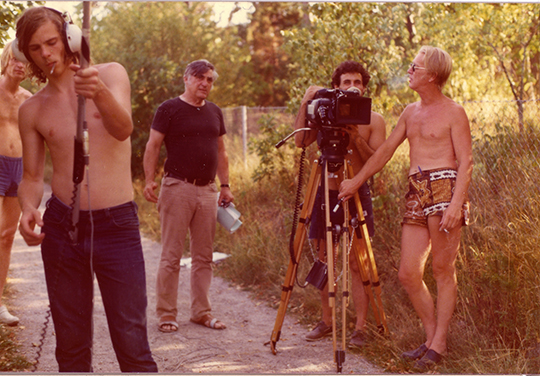
Whether or not he ever actually had anything to do with filmed erotica, Natan would have been amazed by the career of another cosmopolitan Jew launched just a few years after his life’s end. Wiktor Ericsson’s A Life in Dirty Movies pays bemused biographical homage to what Annie Sprinkle calls “the Ingmar Bergman of porn.” Joe Sarno’s micro-budgeted features targeting “the raincoat crowd” from 1962 onward were exceptionally moody, complex and tortured psychodramas focused on being “as hot as you could without showing anything.” He met his soul mate in aspiring off-off-Broadway actress Peggy, who “could discuss John Ford and Truffaut and Renoir” while juggling all the logistical and fiscal details he was naturally oblivious to as a genu-wine artist.
It’s hard now to imagine the mixed excitement and bewilderment that must have been experienced by 42nd Street grindhouse patrons as they witnessed the likes of 1962’s horrors-of-swingerdom melodrama Sin in the Suburbs, or 1967’s claustrophobic self-portrait-of-a-neurotic-artist All the Sins of Sodom. Strangely not glimpsed in this documentary is the artistic apex of Sarno’s color softcore career, 1972’s Pirandello-esque Young Playthings.
The marketplace soon muscled him into hardcore. He was unhappy enough chronicling graphic XXX action to seriously risk financial ruin — and Peggy, still very much the histrionic type, is seen here swanning about as protector of his legacy. It’s lovely when his unexpectedly big 2010 New York Times obit affirms at last to her that he’s “famous like everybody else,” just as he’d always hoped, and as her scandalized Establishment parents figured he’d never be.
Other features in this year’s SFJFF area focus less on impresarios than on performers. The festival’s Freedom of Expression Award goes to the subject of Theodore Bikel: In the Shoes of Sholem Aleichem. This is one of those occasional, simultaneously valuable and dubious documentaries that enlarge upon a well-traveled celebrity solo stage showcase (Sholem Aleichem: Laughter Through Tears). The 90-year-old Bikel has done Aleichem’s characters (especially Tevye the Dairyman) so much that the excerpts here feel worn into a groove that congratulates both veteran performer and veteran viewers who recognize bits they’ve already seen. Who can object? He’s like a tabby grooming itself, essential adorability undeniable.
But he never allows himself an unrehearsed moment in what comes off first as an awfully self-congratulatory self-portrait, and secondly as a workmanlike salute to the single greatest shaper of all American Jewish cultural tropes. Shoes is the kind of proud, way-back machine tribute that makes you feel like you’re watching its 12th pledge week replay. Why are the likes of Gilbert Gottfried and Dr. Ruth the principal interviewees here? Because everybody else has moved on, maybe. Aleichem will always be classic, but to what extent do contemporary US Jews recognize themselves in his worldview?
Other entertainers showcased in SFJFF 2014 include The Secret Life of Uri Geller: Psychic Spy?, about the Tel Aviv-born “spoonbender” phenomenon. This UK documentary assumes a campy, skeptical stance re: his paranormal fame, while actually providing evidence that he’s far from a fraud. Go figure. An even more swinging figure of the era is the subject of Quality Balls: The David Steinberg Story. The dapper latter epitomized smart, improv-based standup comedy on a national stage once he’d left Chicago’s Second City for TV — surviving the 1969 cancellation his edgily political material purportedly forced upon the hugely popular The Smothers Brothers Comedy Hour. Those looking for an additional peek behind the comedic curtain might also check out documentary feature Comedy Warriors, about disabled Iraq and Afghanistan veterans taking the standup stage; Little Horribles: An Evening With Amy York Rubin, drawn from the popular online series; and thematic program “Jews in Shorts.”
Then there’s this year’s major excavation from the treasure-trove of forgotten US Yiddish cinema: 1938’s Mamele, in which late pixie queen Molly Picon plays a cheerfully suffering yenta Cinderella awaiting justice for her many sacrifices to a selfish family. She cooks, she cleans, she sings — what more do you want? Of course there’s a happy ending. 2
SUPER EGO Hitch up your skirt and strap on your skates: It’s another crazy weekend full of too much to do. The bonkers three-day-long Sunset Campout riverside rave and Sunday’s gay fetish pig roast Up Your Alley Fair are only the start. (I’m totally stealing my Seattle buddy DJ Nark’s “inflatable yellow rubber ducky inner tube attached to leather harness suspenders” outfit idea so I can hit both, with a pair of winged Saucony Progrid running shoes — and nothing else — in honor of this weekend’s SF Marathon.)
Sunset Campout (Fri/25-Sun/27, $70–$150, Belden, CA. www.sunsetcampout.com), put on by our own illustrious Sunset crew, is pretty much the electronic dance music festival of my dreams, with a huge roster of acts like Soul Clap, Guillaume and the Coutu Dumonts, Danny Daze, Spacetime Continuum, Traxx, Lovefingers, and dozens of local heroes. And Up Your Alley (Sun/27, 11am-6pm, donation requested. 10th St and Folsom, SF. www.folsomstreetevents.org) is Folsom Street Fair’s gayer little sister, proving that most homosexuals need but a tiny strip of clothing to make a lasting fashion statement. Both events will feature wiener roasts.
J.PHLIP
One of my favorite local DJs, dirtybird crewmember J.Phlip, turns her poppin’ bass up for the United Hearts fundraiser, helping to buy school buses for kids in Ghana. DJ Khan from Bristol, UK, and our own Ryuryu of Soundpieces and several members of the Surefire crew will make sure your heart rumbles in the right place.
Thu/24, 9:30pm-2:30am, $15–$50. Public Works, SF. www.publicsf.com
BRAZA!
World Cup what? The world may have moved on ever-so-briefly from boys in shorts chasing little white balls. But this regular party, celebrating the funky breaks and beats of Brazil and beyond, will have you waving your arms and singing. Special guest Tom Thump, whose crates run so deep they pierce the Earth’s mantle, presides. With live percussion and DJs Elan and Zamba.
Fri/25, 10pm, $5–$10. Elbo Room, 647 Valencia, SF. www.elbo.com
KASTLE
Yummy UK bass and future sounds by way of this LA fave, one of the early players in the ’90s R&B dance floor revival. Support by a host of others, including Elliot Lipp, Lindsay Lowend, and Chiller Whale.
Fri/25, 10pm-4am, $15–$20. 1015 Folsom, SF. www.1015.com
PHIL KIERAN
Irish techno, thy name is Phil. Mr. Kieran has spent a couple decades repping Belfast with some truly fun, truly stylish stuff. (Latest killer slice “Computer Games” comes with a video worthy of cult flick The Visitor.) He’ll be making his debut at the Lights Down Low party.
Fri/25, 10pm-3am, $10–$15. Monarch, 101 Sixth St, SF. www.monarchsf.com
TOO $HORT
You know you still know all the words to “Money in the Ghetto” — sing out with Oakland’s finest and his full band.
Fri/25, 9pm-3am, $20–$25. Public Works, 161 Erie, SF. www.publicsf.com
GUY J
The Israeli technician (with such thick, silky-looking hair!) keeps his tempos at a deep and steady trot — the better for building excellently textured rides through sensual, emotive soundscapes. Good, heady stuff.
Sat/26, 9:30pm, $15. Audio, 316 11th St., SF. www.audiosf.com
TEEN WITCH
Those neon sad-emoji kidz from the 120 Minutes monthly are back with special guests Teen Witch, summoning all dark and lovely laptop electro-ghosts, and Banjee Report, an outstanding vogue-rap outfit from Chicago.
Sat/26, 10pm, $5–$10. Elbo Room, 647 Valencia, SF. www.elbo.com
PIXEL MEMORY
This awesome local atmospheric electro pop trio just released nifty Night Colors EP. They’ll be kicking it up live with ethereal matriarch Metal Mother and catchy shoegaze-hop Magicks for a truly magickal night of SF sounds.
DANCE What the future holds for the most recent crop of dancer-choreographers to graduate from SAFEhouse for the Performing Arts’ Resident Artist Workshop remains to be seen. They may return to the comfort of the studio space at the Garage on Bryant Street for another session of work, work, work. Others might strike out on their own locally, while a few may take off for places like Amsterdam and Lisbon, as other RAW grads have done.
On the basis of five of the possible 10 programs seen last weekend during seventh annual Summer Performance Festival, or SPF7, at ODC Theater, SAFEhouse is doing more than saving the arts from extinction; it is nourishing an extraordinarily broad spectrum of choreographic voices.
Still, SPF’s currently established presentation format needs some rethinking. Scheduling three programs per night, each with a different time slot in two different venues, appears to disadvantage those performing later. Audiences dropped off noticeably during the evening. Since not everyone was able to show a 45-minute work as planned, returning to the more traditional grouping in one venue appears worth considering.
To watch expressions of untamed abandon and fierce control, first in Cali & Co’s Suspect and You Are Here, and then in similar yet so differently realized impulses in Miriam Wolodarski’s Fall Work, was enough to get one’s head spinning. Cali’s excellent Suspect is a tight, highly athletic sextet in which pedestrian moves — a lot of walking and running — build a sense of suspense that becomes increasingly ominous when glances become stares, and accidental bumps turn into shoves. Choreographed in short, intense phrases that get cut off or melt into duets and trios, Suspect is seamless. You, a work in progress, fascinated by the individuality of its sections: a woman systematically folding and unfolding her body; dancers trying to get a foot over their head; versions of boxing thrusts. Hopefully, we’ll see a completed version soon.
Because of the oddities of the programming, I saw Wolodarski’s chaotic Fall Work twice. She is a wild woman whose anarchy is meticulously timed as she works her way toward a gradual revealing of herself as a mount of raw flesh. It’s a piece that embraces physicality to the point of insanity. At first Wolodarski disappears into the shakes and twitches that emanate from her raincoat; at the end, half naked, she collapses after having flung herself into the air again and again. Fall sports some tenderness in a tortuous coupling, and a sense of humor with which the choreographer tries to keep us at arm’s length.
Closing that evening was Ronja Ver’s solo, Dear America, a piece she describes as a “complex declaration of love to the post economic collapse United States of America.” Quite a topic. Ver is a strong, at times mesmerizing performer, more interesting to watch than her choreography. Dear has some well defined theatrical impulses, as when an outstretched hand acquires ambiguous power, or a trembling motion evolves into different characters, or her take on kissing the ground of one’s country. But the piece needs to be better defined.
SPF7 opened with Jaara Dance Project, a young company that works on the intersection of experimental and traditional African dance. To see these strong, so very individual women express themselves with a contemporary sensibility rooted in African dance values made you want to see more of what they do.
The programming, however, was a little problematic. Musically speaking, having the two parts of Red Clay divided by Other Halves, a duet set to Arvo Part’s “Spiegel,” was jarring. Considering the score, Martha L. Zepeda and Kao Vey Saephanh also took a rather stiff, awkward approach to their duet.
In the opening Red Clay: Not One, choreographer Baindu Conté-Coomber introduced lacy hand gestures for a trio of women on folding chairs that they later carried on their heads like water jugs. The solos showcased Zepeda in an angular dramatic vein, while Jaade Green, gifted with a strong liquid back, performed with exuberant lyricism.
In Red Clay: Not Two, Conté-Coomber took over the stage in a fleet and finely detailed solo that celebrated her identity with its recurring refrain of “I am not afraid of my life…” Fragmentary pieces of text read by volunteers created a bond between the audience and the dancer.
In another time slot, Anata Project was co-billed with Unum Dance. Both companies deserve to be seen again. Claudia Anata Hubiak’s quietly circular and well-shaped HomeBody seemed pushed along an inexorable trajectory toward individuation that got re-absorbed into a communal identity. Ashille Kirby was the soloist who soared for but a moment. Unum’s short Working Title showcased Diana Broker, a fine expressive dancer, and a hooded Michael Michalski as … her memory? Her shadow? Her inspiration? Take your pick. 2
Big soda industry players including Pepsico and Coca Cola spent at least $2.5 million two years ago to defeat Richmond’s sugary beverage tax initiative, which lost in a landslide. Richmond’s ballot measure to tax sodas and curb obesity drowned in a sweet, carbonated tide of money.
Now, San Francisco has its own struggle with sugar and the industry that pushes it, and proponents of the measure intend for the city to be ground zero for a national movement.
“If we can pass this ballot initiative in November,” Sup. Eric Mar said in a hearing last week, “San Francisco would be the first to challenge the big soda companies, their lobbyists, and their front groups.”
San Franciscans may never find out how much money the American Beverage Association is spending on those front groups to defeat the local sugary beverage tax. The Board of Supervisors narrowly passed the measure Tuesday, which will soon trigger campaign finance laws.
The soda industry hired a small army of high-profile public relations firms to fight the tax measure since January. But the San Francisco Ethics Commission says some PR firms’ actions may be legally construed as grassroots organizing, not campaign spending that is subject to disclosure laws.
The Associated Press gives an overview of SF’s proposed soda tax.
Additionally, public relations firms hired by the beverage association don’t have to register as lobbyists since they’re not directly contacting politicians.
The ABA contracted at least three firms to fight the sugary beverage tax: BMWL and Partners, Rodriguez Strategies, and Alza Strategies. The beverage association promised BMWL payment of $22,500 for the first and second quarters of 2014 for their work opposing the soda tax, according to Ethics Commission filings.
But Rodriguez Strategies and Alza Strategies payments are harder to track. Rodriguez Strategies, based in Southern California, fought against a state measure to fix warning labels on soda at the behest of the ABA, but there’s no way to trace the PR firm’s funding related to the San Francisco soda tax, yet.
The first time we met a Rodriguez Strategies consultant was at a soda tax hearing in April. The Board of Supervisors chamber was filled to the brim with opponents wearing red T-shirts. The Guardian watched as BMWL and Partners employees handed out red shirts emblazoned with the slogan “STOP Unfair Beverage Taxes,” but they weren’t alone. In the corner was a slickly dressed woman handing out talking points to the opposition. She identified herself as Jessica Borek, a consultant with Rodriguez Strategies.
“I would just go and look at the filings online, it should all be in accordance with the law,” she told us, in a phone interview. “That was the first event I was at. All the information on what we do is at RodriguezStrategies.com.”
We asked her how much the ABA paid the firm. “You can go onto the website and see the extent of our work with that,” she said. But the information isn’t there, because legally it doesn’t have to be.
The same black hole of campaign finance information is true of Alza Strategies. Roger Salazar, the firm’s president, told us he mainly coordinates interviews for media, helping them reach out to opposition to the beverage tax.
“We don’t engage in direct lobbying efforts,” he said. When we asked him if he’d disclose how much the ABA is paying him, he declined. “Wouldn’t Maggie say the same thing?” he said, referring to Maggie Muir, who runs the Choose Health SF campaign in favor of the soda tax. Actually, Maggie did disclose her funding.
Jessica Borek, a consultant for Rodriguez Strategies, sitting next to a “Stop the Unfair Beverage Tax” supporter at City Hall, in April. Photo by Joe Fitzgerald Rodriguez.
From January to March of this year, records show the pro-soda tax campaign received $48,000 in contributions. But Muir estimates that’s a fraction of what the beverage industry spent.
“It flies against the spirit of the law to not know who pays for all this,” she said. Muir estimates the ABA spent at least $400,000 in San Francisco against the sugary beverage tax so far. She would know, as she used to work for BMWL and Partners, but left the firm around 2002, she told us.
Her estimate of the ABA’s spending so far is: $134,000 on direct mailers, $64,000 on paid calls, $25,000 on Facebook ads, $45,000 on online ads, $90,000 on paid organizers, and $90,000 on consultant fees.
But Muir was not aware that Rodriguez Strategies and Alza Strategies were also working for ABA in San Francisco, causing her estimate to rise.
Sup. Scott Wiener, one of the main sponsors of the tax, told us the hidden money is a big problem. “They try to pretend they’re the champions of low income communities,” he said, “but we know they’re marketing them products that make them sick. [ABA] ignores liver disease, heart disease, obesity — the diseases clinically linked to these beverages.”
BMWL and Partners has tried to paint the soda tax as an affordability issue. “Their mailer linking the cost of a Dr. Pepper to the evictions of San Franciscans was offensive to a lot of people,” Wiener said.
When we tried to contact Chuck Finnie, a former San Francisco Chronicle reporter who now works for BMWL, he directed us to another colleague who has not yet called the Guardian back. When we reported on BMWL’s misrepresentation of local business opposition to the measure (“Kick the can,” Feb. 25), he told us, “This is bullshit, the gloves are off.”
Sources tell us the ABA wasn’t pleased with Finnie’s quote or tone. But the campaign — which is expected to be one of the best funded and highest profile of the fall elections — certainly won’t be lack for spokespeople.
Chances are, you’ll find Jonathan Dean at the SoMa West skatepark. Dean, 23, is a San Francisco native who spends the majority of his free time at the newly opened skatepark located on Duboce Avenue between Valencia and Otis.
“I’ve been here every single day, except the first day the park opened,” Dean told the Guardian. “Everybody here loves this park. It feels like you’re skating on a street.”
The hum of overhead traffic on the freeway makes conversation difficult at times, though many of the skaters aren’t here to talk. Some stand off to the side smoking or drinking 40s in paper bags. But in the end, everyone comes to the park to skate. There’s constant activity, never a moment without someone flying into the air or grinding on a ledge, and the sound of skateboard wheels screeching on sharp turns regularly pierces the air.
The park itself is spacious, covering an entire block. Graffiti lines some of the walls and ramps, but the majority of the park has been left untouched, at least for now.
“I remember when I was 13, 14, dreaming about this park, and now it’s finally here,” said Flash Canet, 20, a San Francisco native. “I’ve been doing this since like the 7th, 8th grade, and it’s all I know, really. This is my life, this is my passion.”
The park cost more than $2.2 million, according to the Department of Public Works, which initiated the conceptual planning phase in March 2009. But already, problems are beginning to spring up, even though the park opened on July 1. For one, the graffiti that has started to line the walls and ramps is hazardous for the skaters.
“When you take krylon [a type of aerosol paint] and put it on glassy concrete, your wheels are not going to stick on it,” said Ryan Barlow, 22, a skater who moved to the area eight months ago. “It’s not even that the graffiti looks bad. It’s just really dangerous.”
Barlow says the graffiti issue will inevitably turn into a bigger problem, as is the case with many skate parks, but the skaters mostly seem to love the new park.
“It’s really easy to meet people here,” Canet said. “Skateboarding brings so many different kinds of people together to form a common bond, and that’s the beautiful thing about it. It’s like music, it just brings people together.”
In the small, colorful Precita Valley Community Center, a woman clutches a black ceramic goblet, circling a teenage girl with wisps of incense, and repeats the act with the 60 or so attendees. The spiritual cleansing ritual is much needed. Afterward, the San Franciscans will set their minds to saving the lives of children.
Nearly 50,000 Central American children crossed the Mexican border since October, according to federal data, fleeing targeted violence in Honduras, El Salvador, and Guatemala. This recent surge has hit home, as hundreds of those young refugees, often unaccompanied, seek asylum through immigration courts in San Francisco.
The courts often decide between life and death: Do the children stay in the safety of our sanctuary city, or return to countries from which they fled violence and chaos?
Jose Artiga, executive director of the Salvadoran Humanitarian Aid, Research and Education Foundation, told the crowd a story of life in El Salvador.
“A boy of only 11 years old waited for his grandfather one day,” he said, in Spanish. “A gang captured him, and the community organized to search for the boy. They found the child, but in six parts. The grandfather said, ‘How can I bring my grandchild back to his mother in six parts?’ This was a child. The gang showed up at the funeral, and would not let the community bury him.”
Some say the rising power of gangs sparked this surge in immigration. As President Barack Obama struggles with a bitterly partisan and gridlocked Congress to find a solution, US cities are dealing with the impacts of the overburdened immigration court system.
Now politicians of all partisan stripes, activists, and families are coming together to help the child refugees. Just last week, Sup. David Campos’ resolution to find additional aid for overburdened immigration services unanimously passed the Board of Supervisors. The next step, he told the Guardian, is to determine how best to use funds to help these children.
At the Precita Valley Community Center and beyond, activists call for that funding to reach attorneys, without which these kids will almost certainly be sent home into harm’s way.
OVERBURDENED
The refugees travel far. Children fleeing violence in El Salvador, Honduras, and Guatemala trek through Mexico to cross the US border, and some die in the attempt. Those who live and are discovered by Border Patrol officers along the Southwest border are held temporarily in crowded, cold detention centers in McAllen, Texas, or Nogales, Ariz.
Images of these detention centers show groups of children lying on hard floors in thin blankets, and some advocates for the refugees reported feces and urine soaking the floors. The young refugees tell officials where they have family connections, and are flown to immigration courts across the country.
One such court is in San Francisco.
In 2005, San Francisco had 227 new active deportation proceedings for unaccompanied children, according to federal data obtained by Syracuse University’s TRAC Immigration project. That number was stable until 2012 when it jumped to 450 new cases. In 2013, the number jumped again, to 820.
San Francisco now has over 1,900 pending juvenile immigration cases, according to TRAC. Most of those children are Salvadoran, Honduran, and Guatemalan. The surge is pushing organizations that help these children to the breaking point.
Lariza Dugan-Cuadra, executive director of the Central American Resource Center, knows one thing for sure: “Things have been crazy.”
CARECEN is one of many organizations providing legal representation to Central American child refugees in San Francisco. Two attorneys and two paralegals handle the bulk of cases, which jumped from 20 children a month to 60.
“All a child is given is a court date,” Dugan-Cuadra told the Guardian. “While the US guarantees the right to court, it does not guarantee the right to representation.”
While US citizens have a constitutional right to representation by an attorney, noncitizens in Immigration Court do not. And when organizations like CARECEN can’t provide an attorney, the child loses.
“We’ve heard cases where a 6-year-old will go before a judge having to represent themselves,” she said. “The judges are throwing their hands up saying ‘Are you serious!?'”
Data obtained by TRAC Immigration backs up her claim.
Nationwide, only 52 percent of unaccompanied children are represented by an attorney in deportation court proceedings.
With an attorney, judges rule in a juvenile’s favor to stay about half the time, TRAC’s research found. Without an attorney? Only one in 10 children are granted asylum.
“The onus has been hard on nonprofit providers and pro-bono attorneys,” Dugan-Cuadra said, because they know the stakes. Legal Services for Children, Catholic Charities, and the Asian Law Caucus are among the organizations calling for more aid.
Many of the attorneys are experiencing burnout. One we talked to was on a vacation for her mental health. Studies by the American Bar Association show judges are burning out too, and things are only getting worse: California has 77,000 pending immigration cases backlogged in its courts.
But locally, the children bear the worst of this: TRAC Immigration’s data shows only 71 of the new 830 unaccompanied children in San Francisco were represented by an attorney as of June 2014.
And without representation, many will be sent home to violence.
“We’re witnessing a complex situation in which children are leaving home for a variety of reasons, including poverty, the desire to join family, and the growing influence of trafficking networks,” Shelly Pitterman, UNHCR’s regional representative in the United States, said in a press statement. “Within this movement there are also children who are fleeing situations of violence at the hands of transnational organized criminal groups and powerful local gangs.”
Those fleeing violence and persecution, said Pitterman, will require access to asylum determination procedures and will need long-term protection. Others should be sent home, she said, and assisted with reintegration.
But some can’t find refuge anywhere at home, no matter where they go.
“My brother’s son was kidnapped eight years ago by extortionists,” one Salvadoran woman at the Precita center told the Guardian, declining to give her name out of fear for her family’s safety. Her brother moved to other cities, but the gangs continued to harass him and his family in provinces throughout El Salvador.
“He got letters threatening to kidnap his child. ‘We know where you live, we know where your child goes to school,'” she said. Her nephew is now 14. The last time she visited him she saw something that chilled her.
“He was approached by gangs to be recruited. I witnessed that. One day after when we were in the car, my nephew saw the gangs in another car. He hid on the floor and started to shake.”
The woman turned her head away and held back tears.
“My brother said ‘I have to take you out of here.'”
Now her nephew is somewhere safe in the United States, she said, though she would not say where. But the reason he left is clear.
“These kids don’t want to be the next dead body on the street,” Clarisa Sanchez, a Board of Immigration’s representative from Catholic Charities CYO told the Guardian.
Nationally, Republicans are calling for the mass deportation of these children. “I won’t stand idly by while our citizens are under assault and little children from Central America are detained in squalor,” Texas Gov. Rick Perry said this week, as he announced deployment of 1,000 National Guard troops along the Texas border.
But many pin the origins of the crisis squarely on the United States.
DRUG LEGACY
Salvadorans are familiar with violence and cruelty. In 1932, more than 30,000 Salvadorans were slaughtered in a peasant revolt called la matanza: the slaughter. Nearly 75,000 civilians died in El Salvador’s bloody civil war, from 1980-1992.
The US government intervened in that war, sending government aid to the Salvadoran government. Now the US has a hand in today’s violence in Central America, some say, as our country’s drug habits fuel cartels throughout the region. Those cartels are arming Central American gangs, whichObama admitted in a press conference last year.
“The United States recognizes that we’ve got responsibilities; that much of the violence in the region is fueled by demand for illegal drugs, including in the United States,” the president said.
Obama requested $3.7 billion emergency funding that would bring at least $64 million to immigration courts, but also at least $1.5 billion to border security and US Immigration and Customs Enforcement, a troubling addition to needed funding.
Back at the Precita Valley Community Center, Jose Cartagena pled for legal aid at the border. Cartagena is intimately familiar with the need: He fled El Salvador’s civil war over 30 years ago. As he crossed the Tucson desert, 13 of his fellow border-crossers died in the blazing southwestern heat. Only Cartagena survived. Now he’s a representative for the National Network of Salvadorans in the Exterior in San Francisco.
He called for justice.
“We have to help these kids find their families or sponsors,” he said. “If we don’t provide legal support now, the Obama administration may deport all of them. We can’t wait until it’s too late.”
OPINION Achieving a more sustainable San Francisco means a city running on clean power. It also means maintaining our infrastructure to keep San Francisco functioning.
Right now, our city can do better on both fronts, and legislation we are sponsoring will help move us in the right direction by increasing our use of clean, hydroelectric power while generating more revenue for infrastructure investment in our streetlight and power systems.
San Francisco’s Hetch Hetchy power system produces a massive amount of clean, hydroelectric power, yet our city uses very little of this energy despite our stated goal of moving toward 100 percent clean power by 2030. Moreover, the operator of this power system, the San Francisco Public Utilities Commission (PUC), has massive unmet infrastructure needs. Our streetlights, most of which are owned by the PUC, are badly in need of upgrade, and PUC’s power delivery system has almost a billion dollars in deferred maintenance.
To address these challenges, we are authoring legislation to bring more revenue-generating, clean power to San Francisco.
For over 100 years, the PUC has provided 100 percent clean, hydroelectric power to municipal agencies, including Muni, the San Francisco International Airport, San Francisco General Hospital, police and fire stations, libraries, and our public schools. Using this clean public power saves taxpayers millions versus what we would pay if we were to purchase PG&E power. Hetch Hetchy generates 1.43 million megawatt hours of clean power a year and is 100 percent greenhouse-gas free. This is a tremendous asset, but it has been underutilized.
Any excess public power that the PUC generates and doesn’t use for governmental customers is now sold on the wholesale market at a significantly reduced rate. Retail rates are around four times higher than wholesale rates. This means that with every megawatt sold at wholesale rates, the PUC is losing out on significant revenue to address its aging infrastructure needs.
If the PUC obtains more customers paying retail rates, we can generate more revenue to upgrade and improve our failing streetlight system and address the power system’s massive deferred capital needs. The PUC estimates that for every 10 megawatts sold to new retail customers — rather than selling that power on the wholesale market — we will see a net revenue increase of $4 million per year.
That is why we are sponsoring legislation to bring the PUC more retail customers and hence more infrastructure investment. The legislation provides the PUC with the right of first refusal to be the power provider for new development projects in San Francisco, including large private projects. This will allow the PUC to determine if it feasibly can serve as the power provider for these new developments, and in doing so expand the agency’s retail customer base.
Allowing the PUC the flexibility to add retail customers will move us toward a more financially sustainable public power system, while providing 100 percent greenhouse-gas free power to our city and generating significant resources for infrastructure investment, including for our streetlight system.
Some have raised questions about what this legislation means for the future of CleanPowerSF, our previously approved clean energy program that has been stalled by the PUC Commission’s refusal to set rates. These two public power measures are not in any way mutually exclusive, and both can move forward. We are both supporters of CleanPowerSF, and we want it to succeed.
We know the PUC can provide reliable, greenhouse-gas-free power that works for its customers. Anyone who disagrees can just look at San Francisco International Airport. If the PUC can reliably provide power to serve one of the most significant airports in the world, powering new housing and commercial developments won’t be a problem.
A sustainable, clean energy future requires a broad range of solutions. This proposal is one that will deliver our city more clean power and make our power enterprise stronger by redirecting energy revenues back into the system. Let’s put our clean power to work for San Francisco.
Scott Wiener and London Breed are members of the San Francisco Board of Supervisors.
When Susan King attends the Aug. 24 Sunday Streets in the Mission District — the 50th incarnation of this car-free community gathering, coming the week before her 50th birthday — it will be her last as director of an event she started in 2008.
That successful run was made possible by King’s history as a progressive community organizer who also knew how to do fundraising, a rare combination that has made Sunday Streets more than just a bicycle event, a street faire, or a closure of streets to cars that the city imposes on its neighborhoods on a rotating basis.
Instead, King took the ciclovia concept that started in Bogota, Colombia in the late ’70s — the idea was creating temporary open space on streets usually dominated by cars (See “Towards Carfree Cities: Everybody into the streets,” SFBG Politics blog, 6/23/08) — and used it as a tool for building community and letting neighborhoods decide what they wanted from the event.
“I regard the organizing as community organizing work rather than event organizing, and that’s significant,” King told the Guardian. “We’re creating the canvas that community organizations can use.”
San Francisco was the third US city to borrow the ciclovia concept to create open streets events — Portland, Ore, was the first in June 2008, followed quickly by New York City — but the first to do one that didn’t include food trucks and commercial vending, which Sunday Streets doesn’t allow.
“It’s not a street fair, it’s about meeting your neighbors and trying new things,” King said, referring to free activities that include dance, yoga, and youth cycling classes and performances. “It’s a really different way of seeing your city. A street without cars looks and feels different.”
Now, after seeing how Sunday Streets can activate neighborhoods and build community, and watching the concept she helped pioneer be adopted in dozens of other cities, King says she’s ready for the next level.
“I want to apply what I know on a larger scale, ideally statewide,” King said of her future plans. “This really opened my eyes up to the possibilities.”
WORKING WITH COMMUNITIES
After a lifetime of progressive activism — from grassroots political campaigns to city advisory committees to working with the Green Party — King knew the value of listening to various community stakeholders and earning their trust.
“We try to be culturally competent and work with each neighborhood,” King said. “We want to work with the neighborhood instead of dropping something on the neighborhood.”
That distinction has been an important one, particularly in neighborhoods such as Bayview and the Western Addition, where there is a long history of City Hall officials and political do-gooders trying to impose plans on neighborhoods without their input and consent.
“We worked really closely together and she gave me a lot of leeway to do Sunday Streets in a way that it worked for the community,” said Rebecca Gallegos, who managed public relations for the Bayview Opera House 2010-2013. “I can’t say enough great words about Susan. She was a truly a mentor to me. They’re losing someone really great.”
The first Sunday Streets on Aug. 31, 2008, extended from the Embarcadero into Bayview, opening up that neighborhood to many new visitors. King cited a survey conducted at the event showing 54 percent of respondents had never been to Bayview before.
“Susan wore a lot of hats. Not only did she create community in all the neighborhoods in San Francisco, but she knew how to go after the money,” Gallegos told us. “She walks the walk and doesn’t just talk the talk.”
Meaghan Mitchell, who worked with the Fillmore Community Benefits District, also said King’s skills and perspective helped overcome the neighborhood’s skepticism about City Hall initiatives.
“Susan came in and was very warm and open to our concerns. She was a joy to work with,” said Mitchell, who went on to work with King on creating Play Streets 2013, an offshoot of Sunday Streets focused on children.
The neighborhood was still reeling from a massive redevelopment effort by the city that forced out much of its traditional African American population and left a trail of broken promises and mistrust. Mitchell said King had to spend a lot of time in community meetings and working with stakeholders to convince them Sunday Streets could be good for the neighborhood — efforts that paid off as the community embraced and helped shape the event.
“It was nice to know the Fillmore corridor could be included in something like this because we were used to not being included,” Mitchell told us. “Community organizing is not an easy job at all because you’re dealing with lots different personalities, but Susan is a pro.”
ROUGH START
It wasn’t community organizing that got King the job as much as her history with fundraising and business development for campaigns and organizations, ranging from the San Francisco Symphony to the San Francisco Women’s Building.
At the time, when city officials and nonprofit activists with the Mode Shift Working Group were talking about doing a ciclovia, King was worried that it would get caught up in the “bike-lash” against cyclists at a time when a lawsuit halted work on all bike projects in the city.
“I thought that would never fly,” King said. “We started Sunday Streets at the height of the anti-bike hysteria.”
But her contract with WalkSF to work on Masonic Avenue pedestrian improvements was coming to an end, she needed a job, and Sunday Streets needed a leader who could raise money to launch the event without city funds.
“I know how to raise money because I had a background in development,” said King, who raised the seed money for the first event with donations from the big health care organizations: Kaiser, Sutter Health/CPMC, and Catholic Healthcare West. And as a fiscal sponsor, she chose a nonprofit organization she loved, Livable City, for which Sunday Streets is now a $400,000 annual program.
King had a vision for Sunday Streets as an exercise in community-building that opens new avenues for people to work and play together.
Immediately, even before the first event, King and Sunday Streets ran into political opposition from the Fisherman’s Wharf Merchants Association, which was concerned that closing streets to cars would hurt business, and progressive members of the Board of Supervisors who were looking to tweak then-Mayor Gavin Newsom, whose office helped start the event.
City agencies ranging from the Police Department to Municipal Transportation Agency required Sunday Streets to pay the full costs for city services, something that even aggressive fundraising couldn’t overcome.
“We were in debt to every city department at the end of the second year. It was the elephant in the room going into that third year,” King said.
But the Mayor’s Office and SFMTA then-Director Nat Ford decided to make Sunday Streets an official city event, covering the city costs. “It was the key to success,” King said. “There’s no way to cover all the costs. The city really has to meet you halfway.”
King said that between the intensive community organizing work and dealing with the multitude of personalities and interests at City Hall, this was the toughest job she’s had.
“If I would have known what it would be like,” King said, “I would never have taken the job.”
SUNDAY STREETS SOARS
But King had just the right combination of skills and tenacity to make it work, elevating Sunday Streets into a successful and sustainable event that has served as a model for similar events around the country (including at least eight others also named Sunday Streets).
“The Mission one just blew up. It was instantly popular,” said King, who eventually dropped 24th Street from the route because it got just too congested. “But it’s the least supportive of our physical activity goals because it’s so crowded. It was really threatening to be more of a block party.”
That was antithetical to the ethos established by King, who has cracked down on drinking alcohol and unpermitted musical acts at Sunday Streets in order to keep the focus on being a family-friendly event based on fitness and community interaction.
Even the live performances that Sunday Streets hosts are required to have an interactive component. That encouragement of participation by attendees in a noncommercial setting drew from her history attending Burning Man, as well as fighting political battles against the commercialization of Golden Gate Park and other public spaces.
“It was my idea of what a community space should look like, although I didn’t invent it…We really want to support sustainability,” King said. “We’re not commodifying the public space. Everything at Sunday Streets is free, including bike rentals and repairs.”
As a bike event, the cycling community has lent strong support to Sunday Streets, with the San Francisco Bicycle Coalition strongly promoting it along the way.
“The success of Sunday Streets has been a game changer in showcasing how street space can be used so gloriously for purposes other than just moving and storing automobiles. At every Sunday Streets happening we are reminded that streets are for people too,” SFBC Director Leah Shahum told us. “Susan’s leadership has been such an important part of this success.”
EDITORIAL When lawyers become politicians, and when those politicians assume offices where they can exercise discretion about when to appeal judicial rulings, the decision to do nothing can be as big and impactful as the decision to file a lawsuit.
Luckily for California, it is progressive-minded attorneys from the Bay Area who have found themselves in the position of advancing public policy through wise decisions about when to let rulings stand and when to challenge them. And it is our hope that Attorney General Kamala Harris remembers her Bay Area roots when making a couple of important pending decisions on appealing some high-profile recent rulings.
Harris was already weighing whether to appeal a judge’s ruling striking down teacher tenure laws (see “Pride and prejudice,” June 24) when another judge ruled that California’s death penalty is unconstitutional (see “Death sentence for executions?” Page 16).
Her opponent in fall runoff election, Republican Ron Gold, has called for Harris not to appeal the teacher tenure ruling — and he would almost certainly make great political hay of a decision by Harris not to challenge the death penalty ruling. But Harris should easily defeat this also-ran challenger in November and she should maintain the courage of her convictions in making these decisions.
We urge Harris to aggressively appeal the teacher tenure ruling and not be swayed by the judge’s fallacious argument that teacher tenure hurts urban schoolchildren. And on the death penalty, which Harris has long opposed, we urge her to help end the barbaric, expensive, and ineffective executions (which could mean appealing the recent ruling to the Ninth Circuit Court of Appeals and then not appealing a favorable ruling there, which would serve to end capital punishment in California).
That kind of selective use of the Attorney General’s Office discretion on appeals would follow in the tradition of Gov. Jerry Brown, when he was attorney general, choosing not to appeal the ruling striking down Prop. 8 and instead helping to legalize same-sex marriage.
Meanwhile, in San Francisco, we’re happy that City Attorney Dennis Herrera decided to “aggressively defend” Prop. B, which requires voter approval for projects that exceed current height restrictions on the San Francisco waterfront, against a lawsuit by the State Lands Commission.
Likely prompted by Lt. Gov. Gavin Newsom, one of three members of that commission and someone who has long been friendly to big investors and developers, this lawsuit should have never been filed — and Herrera was right to say so and pledge a vigorous defense of the measure.
The people of San Francisco and California are lucky to have Harris and Herrera in the position to make these important decisions.
The tale of the threatened independent bookstore, quivering under the might of Amazon, is nothing new.
It’s only been two months since Marcus Books was evicted from its Fillmore District location. Both Adobe and Forest bookstores fled the Mission’s 16thh Street last year. But ebook sales growth is shrinking, and sales for many of San Francisco bookstores are up.
Instead, the tale of the struggling indie bookstore has become less about Amazon and more about a different monster: gentrification. San Francisco’s rising rents, demand for commercial space by deep-pocketed chains, and lack of commercial rent control are putting the squeeze on the city’s remaining bookstores.
Take Bibliohead, for instance. Its owner has recently been forced to relocate in spite of her bookstore’s success. Bibliohead is an easily navigable, highly curated, and tiny book jungle — more like a carefully manicured garden, really. The whole store can be explored in minutes, and there’s a gumball machine that dispenses poetry out in front once the book-happy are satisfied.
Its size has served it well. Sales at Bibliohead — Hayes Valley’s only bookstore — have risen solidly 7 percent each year since the store opened 10 years ago.
“We’re small, but mighty,” Melissa Richmond, Bibliohead’s owner, told the Guardian. “Although recently we haven’t been feeling so mighty. I’m kind of a wreck.”
In May, Richmond learned that she has until January 2015 to leave her store for four months while her building undergoes mandatory earthquake retrofitting. The landlord will double Richmond’s rent after the retrofitting, and has asked Richmond to pay for further renovations to the building when she returns.
“It’s off the table that I can stay here,” Richmond said. “I will not be offered a new lease. I don’t hate landlords, but I want a landlord who will contribute to the spirit and creativity of San Francisco.”
On June 22, Richmond launched an Indiegogo campaign to raise the $60,000 she’ll need to move and attract new customers. So far, with a little less than a month to go, she’s raised almost $3,000.
“What really breaks my heart is when a new customer walks in,” Richmond said. “They ask you how you’re doing after they’ve fallen in love with the place a little bit. Then you have to break their hearts by saying you don’t know what’s in store for your future right now.”
DISPLACEMENT TREND
Richmond is not the only bookseller in San Francisco forced to relocate. Last year, Adobe Books and Forest Books were forced out of 16th Street within three months of each other when their rents increased. Forest Books slipped quietly off to Japantown, and has since experienced an increase in sales. Adobe Books’ anticipated closure was met with an invigorating Kickstarter campaign that raised $60,000. It was enough to keep the store alive, but not on gentrifying 16th Street.
Nowadays, Adobe is re-branded as Adobe Books and Art Cooperative at its 24th Street location. The original Adobe’s charming, lackadaisical, and no- structured structure has been traded for alphabetized and carefully curated books. There are only two staff members, and its used books are selling far faster than in the old location, despite its shrunken size.
“It’s strange. A lot of the times I was not sure if it would work at all, and now here we are in this shop,” Brett Lockspeiser, a member of the Adobe Books and Art Cooperative, told us. “Things are running differently, but it’s still Adobe.”
Adobe will soon be celebrating its first anniversary in the new spot. The store might not be making any profits, according to Lockspeiser, but the cause for celebration is that it’s survived.
There has been discussion among the collective members about whether or not Adobe should try to sell eReading devices, like Green Apple Books has done without much success for almost two years with the Kobo eReader. Adobe’s collective voted against Kobo, preferring not to use the same weapons as its competitor.
“I’m pretty technology positive, but I think some people in the group thought it was an ‘us or them’ kind of thing,” said Lockspeiser. “Like either you’re a book reader or you’re a techie who reads on a Kindle.”
Besides, it seems that ebooks’ incredible growth rate has finally simmered down. According to the Association of American Publishers, ebooks accounted for 27 percent of all adult trade sales in 2013. While that was up from 23 percent in 2012, it marked the first year ebook growth was down to the single digits. In January, a Pew study reported that among adults who read at least one book in the past year, just 5 percent said they read only an ebook.
Hut Landon, executive director of the Northern California Independent Booksellers Association, reports that book sales throughout San Francisco bookstores have increased overall in the past two years. Green Apple Books, an expanding bookstore with an growing collection of books and records, is even poised to open another location in the Sunset below beloved video rental store Le Video on Aug. 1.
Pete Mulvihill, co-owner of Green Apple Books, said he recently got a call from Bibliohead’s owner asking for advice on potential neighborhoods and techniques for negotiating with landlords. But he can’t always explain his own store’s success.
“Some of it is just the economy. All that money floating around South of Market is maybe trickling over here,” he told us. “Or maybe the waiters are getting better tips. I don’t know what it is, but things have been better for us.”
The growth of bookstore sales, Landon said, is mainly because Barnes & Noble has been cast out of San Francisco. Last year, Barnes & Noble, the nation’s largest bookstore chain, reported that its revenue decreased by 8 percent in the final quarter. The company’s Nook division, meanwhile, slid down 32 percent.
Yet Joe Marchione, who owns Mission Street’s Valhalla Books, still places the blame for his diminishing foot traffic on Amazon, which has made his hard-to-find books pretty easy to locate online. In 1998, when his store opened, 90 percent of Valhalla’s business came from people browsing through his odd and unique assortment of rare and used books. Now, 95 percent of his business is online.
“People forgot the joy of browsing,” Marchione told us.
As soon as his landlord makes him commit to a lease, he says he’s going to have to leave the business. “When we first opened, we were smug. We said there was no way trendy was ever going to come to Mission between 17th and 18th [streets]. Get real!” he said. “But trendy creeps in closer by the week. There’s no problem with that, except it’s forcing us out.”
“TRENDY CREEPS IN”
It’s even forcing successful booksellers, like Bibliohead’s owner, to worry. Her faith in the printed word remains strong. “I find that there’s a whole core of people who are relieved to feel something in their hands, to flip the pages of really cool, beautiful books and kind of remember with their bodies what reading is like,” Richmond said.
When Kate Rosenberger opened a fourth bookstore in 2011 — Alleycat Books on 24th Street — many questioned her sanity, the owner said. The store has only recently been able to pay its own bills, having been relying on Rosenberger’s other store, Dog Eared Books, for survival. But the rent at Dog Eared Books is set to increase, and that means trouble.
“You can talk about e-readers, and people being distracted. You can talk about people slipping out since the Gutenberg press was invented, and all that’s true, sure,” Rosenberger told us. “But when you get hit with a huge increase in your rent, how do you deal with that? When the lease is up, you can pretty much figure you’re gone.”
These days, you deal with it by setting up a crowdsourcing campaign, and crossing your fingers that people with money like you. Or maybe you transform into an art cooperative. Or you just go somewhere else. But Richmond doesn’t want to leave San Francisco.
“I would like to preserve the culture of the city,” Richmond said. “I still think there’s something really special here.”
Barnes & Noble might be gone, ebook sales might have stabilized, and the printed word might just still be alive — but for San Francisco’s booksellers, that no longer means anyone in the book business is safe.
“Die techie scum.” Those words are sprayed ominously on sidewalks throughout San Francisco. They’re plastered on stickers stamped on lampposts. They’re even scrawled in the bathrooms of punk bars, the very establishments now populated by Google-Glass-wearing tech aficionados.
Journalists from San Francisco to New York have opined on the source of the hate: Is it the housing crisis? Tech-fueled gentrification? Rising inequality? Those same journalists later parachute into the tech industry to periodically peer at its soul: Is tech diverse enough? Is it sexist? Is it a true meritocracy?
Those issues are often looked at in a vacuum, but perhaps they shouldn’t be. Perhaps those problems are all interconnected, and solving tech’s diversity problem is also part of solving income inequality in San Francisco, giving longtime San Franciscans a chance to join the industry many now view as composed of outsiders and interlopers.
The average Silicon Valley tech worker makes about $100,000, according to Dice Holdings Inc., which conducts annual tech salary surveys. Opportunity in the tech sector may bolster San Francisco’s middle-income earners, vanishing like wayward sea lions from the city’s landscape. Statistics from the US Census Bureau show that 66 percent of the city is either very poor or very rich, showing a hollowing out of the middle class.
Some tech CEOs are addressing their employment needs with a foreign workforce. Mark Zuckerberg and a cadre of tech CEOs have lobbied Senate and House Republicans to reform immigration in their favor, hoping to lure out-of-country workers to fill tech’s employment vacancies. Politico reported Sean Parker gave upwards of $500,000 to Republicans in 2014, all for the cause of immigration reform.
Conversely, a movement is already underway to bring San Franciscans into tech’s fold, based on the idea of a win-win scenario: San Francisco’s public school students are overwhelmingly diverse and lower income, while the tech industry is not.
Google, Facebook, LinkedIn, and Yahoo recently released their diversity numbers, showing the companies are mostly white and male. This accusation has long haunted Silicon Valley.
Two years ago, Businessweek heralded the “Rise of the Brogrammer.” The stereotype is as follows: He preens as he programs in his popped collar, his startup funds fuel the city as he hunts “the ladies,” and he is insensitive toward women in the workplace in the most fratboy-like way imaginable.
Biz dev VP of @path just cracked lame jokes re: “nudie calendars,” frat guys + “hottest girls,” “gangbang” at #swsx talk. Cue early exit.
But while outlier brogrammer douche-bros certainly exist, whose classist opinions ignite widespread ire (think Greg Gopman’s statement comparing homeless people to “hyenas”), the real brogrammer threat is more insidious, more systemic.
“The brogrammer is always someone else,” wrote Kate Losse, a freelance journalist, in an April blog post. “He is THOSE Facebook guys who yell too loudly at parties and wave bottles in the air, he is not the nice, shy guy who gets paid 30 percent more because of his race, gender and appeal to the boy-genius fetishes of [venture capitalists].”
The overarching point of Losse’s article was this: There is a subtle sexism, and also racism, in the tech sector, which shuts out women and people of color. The looming stereotype of a douchey brogrammer can obscure the smaller, more indirect ways in which minorities and women are shut out of the industry.
Tech’s disturbing (but unsurprising) lack of diversity is being highlighted amid an economic backdrop that has resulted in widespread displacement of San Francisco’s working class and minorities.
Some are seeking to create opportunities for Bay Area communities of color within tech, as a way to even the scales. A swell of new applicants with programming skills — including people of color and women — may soon come knocking. But in the time it will take school-age coders to cycle through the first generation of new computer science classes, Silicon Valley is going to have to take a hard look in the mirror.
Some of the Bay Area’s hate toward tech may be rooted in a perceived lack of access. Longtime residents see a sea of newcomers, often white, often male, who aren’t pulling up a seat for minorities to join the new gold rush.
The age of the brogrammer is now, and it’s as socially progressive as the paleolithic era, meaning: not at all.
FAKE IT TIL YOU MAKE IT
Talk to anyone in the realm of new technology companies and startups, and they’ll surely tell you this: Tech is an inspiring, creative field, where pure skill is the key to unlocking any job you’d like. The dress style is casual (hoodies, of course) and the perks flow like wine (or energy drinks).
When the Guardian visited the CloudCamp social good hackathon, we saw video game arcade machines in the ground floor and beer flowing throughout. Another company, Hack Reactor, had desks attached to treadmills and a life coach on hand to mind employee health. These are accoutrements de rigeuer, stunningly standard. But tales of true Silicon Valley excess abound: One CEO offers employees free helicopter rides, many offer in-house chefs and extravagant travel.
Interns in Silicon Valley are enjoying huge perks like free meals, massages, swimming pools, nap pods: http://t.co/BdaaOdC95P
Skill and ability alone are the keys to unlocking this lifestyle, the tech industry says. Workers’ fervor can take on an almost cult-like zeal.
“I think the sharing economy is addictive,” said Rafael Martinez-Corina, a panelist at the Share2014 sharing economy conference in May, touting tech’s biggest stars like AirBNB, Lyft, and Uber. “Once you get it, you want more and more. You get into car sharing, you want to get into food sharing, time sharing.”
He asked the audience, “Who else is addicted to sharing?”
Almost every hand went in the room shot right up. Cheers immediately followed. Hallelujah!
Mars Jullian, an engineer at AdRoll, told the Guardian that employees of tech companies with name-brand apps tend to exhibit more ego. AdRoll is a big player, but more behind the scenes, she said, giving her perspective on the attitudes of her fellow tech workers.
“Sometimes it seems tech people feel like they own the city,” she said. “I don’t know if that’s the right attitude to have. Sometimes it’s more important to be humble.”
One might forgive the tech workers for their enthusiasm. The industry, after all, has ushered in widespread transformation in business and communications, resulting in dramatic economic shifts. But with such a high concentration of wealth and influence in the Bay Area, the question of who gets to participate is key.
Google’s diversity numbers rocked the world outside Silicon Valley, but surprised few in the Bay Area. The behemoth is 70 percent male and 60 percent white, with Asians making up 30 percent of the company’s ethnic representation.
Soon after Google’s numbers were revealed, Facebook, Yahoo, and LinkedIn followed suit with their own diversity reports. Their numbers differ a bit from Google, showing more Asian employees, and slightly more women. The numbers look worse, however, when only technology jobs are factored in. The tech worker population among these companies is about 15 percent female.
Hadi Partovi, an early Facebook investor, now adviser, and ex-chief of Microsoft’s MSN, told the Guardian that despite the industry’s challenges, tech’s doors are open to people with skills, regardless of background.
“The computer doesn’t know if it’s being programmed by someone rich or poor, black or brown,” he told us in a phone interview. “A lawyer, for instance, is looked at more explicitly. Tech has the opportunity to be more meritocratic.”
But the tech sector’s pious belief that it functions as a world-changing meritocracy ignores a host of factors that serve to hinder inclusion.
Many have touted the education pipeline as the root cause of tech’s lack of diversity. The number of women pursuing science, technology, engineering, and math (STEM) fields is stunningly low, 24 percent, according to the US Department of Commerce. African Americans and Latinos also lag far behind their white and Asian counterparts in completing their computer science degrees, according to studies by the East Bay nonprofit Level Playing Field Institute.
Considering Asian groups is important: the Level Playing Field Institute draws a distinction between represented and underrepresented minority groups, acknowledging that ethnicity, income and class intermingle in complex ways. It’s those underrepresented groups like women, Latinos and African Americans LPFI identifies as groups lacking in tech.
But the pipeline is only one part of the problem. Subtle (and not-so-subtle) misogyny and racism, often labeled micro-aggressions, pervade hiring.
Level Playing Field is focused on creating opportunity for people of color and women in STEM fields. In an extensive tech-industry study conducted in 2011, called “Hidden Bias in Information Technology Workplaces,” researchers concluded: “Despite widespread underrepresentation of women and people of color within the sector, diversity is not regarded as a priority.”
Surveying more than 645 engineers, the study’s authors found that white men were the most likely to believe that diversity was not a problem that needed addressing in the tech sector. The study also found that underrepresented people of color (Latinos and African Americans), and women were more likely to encounter exclusionary cliques, unwanted sexual teasing, bullying, and homophobic jokes.
Sometimes, these instances blow up for the world to see.
THE MIRROR-TOCRACY
The workday text messages between Tinder’s co-founder Justin Marteen and former VP Whitney Wolfe went public after Wolfe sued Tinder, revealing the ugly waters women must sometimes navigate in tech. Marteen was allegedly harassing Wolfe over her new love interest, and Wolfe asked him to stop.
“Stop justin [sic]. Were at work,” Wolfe asked of Marteen, to which he replied, “Ur heartless… go talk to ur 26 year old fucking accomplished nobody. I’ll shit on him in life.”
He should have ended there. But he continued his rage at his ex-girlfriend.
“Hagsgagahaha so pathetic I even imagined a life w u. I actually thought u would be a good mother and wife. I have horrible judgement. He can enjoy my left overs,” he allegedly wrote. “You’re effecting my work environment,” she replied, “and this is very out of control. Please don’t do this during work hours.”
Besides an awful command of rudimentary spelling, the squabble showed the very real harassment women in tech are exposed to every day. When Wolfe went to Tinder CEO Sean Rad for help, she found herself out of a job.
Tinder is not an outlier, according to studies by Level Playing Field. Nor is it the only company to see its harassment go public. Earlier this year, GitHub’s CEO Tom Preston-Werner resigned after a former employee, Julie Ann Horvath, alleged she was harassed by him, his wife, and engineers.
While Github denied the allegations, Horvath was defiant: “A company can never own you. They can’t tell you who to fuck and who not to fuck. And they can’t take away your voice.”
But for every example of outright sexism or racism, there are multitudes of more subtle biases in the workplace. Level Playing Field’s studies found these biases are pervasive. They start as early as the hiring process.
Carlos Bueno is a former Facebook engineer, now tinkering behind the scenes at memSQL. He is of mixed ethnicity, Irish and Mexican, among others. “My father called us ‘Leprechan-os’,” he told us.
Bueno trained interviewers at Facebook, and like many there, he also conducted interviews. He said Facebook’s interview process was probably one of the best in the industry for screening out biases of the interviewer, but other companies were not as aware of bias as a problem.
“Every startup wants to be a big dog,” he said, describing the process. “But the point of a startup is to grow very large, very quickly. They don’t have time to learn. Some people take rules of thumb or investor advice and run with it.”
Paypal co-founder Max Levchin is looked to as a thought leader in the startup world. He touts the idea that diversity of perspective in a startup’s early phases can actually hurt its chances of success, hindering its speed in “endless debates.”
Paypal co-founder Peter Thiel once famously put it this way: “Don’t fuck up the culture.”
Bueno pointed to a real estate startup, 42Floors, as an example of a company adopting Levchin’s philosophy. It looks for potential hires who are a “cultural fit,” i.e., making sure the candidate and employer think alike.
One 42Floors interviewer explained this on the company blog: “I asked her how she was doing in the interview process and she said, ‘I’m actually still trying to get an interview. Well, I grabbed coffee with the founder, and I had dinner with the team last night, and then we went to a bar together.’ I chuckled. She was clearly confused with the whole matter. I told her, ‘Look, you just made it to the third round.'”
So the interview process for tech may involve coffee dates or “beer with the guys,” and the onus is on the interviewee to figure all of this out. Similar blog posts from 42Floors go on to call out interviewees who wear suits, or act too stodgy for their liking.
We spoke to Bueno extensively over burgers, but he put it best in his blog.
“You are expected to conform to the rules of The Culture before you are allowed to demonstrate your actual worth,” he wrote. “What wearing a suit really indicates is — I am not making this up — non-conformity, one of the gravest of sins. For extra excitement, the rules are unwritten and ever-changing, and you will never be told how you screwed up.”
Founders back up their faulty hiring practices with faulty logic. “It’s so hard to get in, if you get in you must be good,” Bueno said. “But those two statements don’t support each other.”
Some students of color training to code have already caught a glimpse of how the mirror-tocracy functions.
OPENING THE DOOR
Eight years ago, Kimberly Bryant moved to San Francisco to work in biotech. She moved to the city because she believed it to be more racially and economically diverse. She worked adjacent to Bayview Hunters Point, and has since revised her view of the city as a welcoming multicultural environment.
Instead, she found a city with an African American population dwindling below six percent in a city of over 800,000, and a gutted middle class. Latinos are moving out in greater numbers too. Over the last decade, 1,400 Latinos left the Mission District, according to a recent report on displacement by Causa Justa / Just Cause. In the same time, 2,900 white residents flooded in.
The displacement data reveals a significant parallel: The diverse ethnic groups Silicon Valley lacks in its employed ranks are the very same ethnic groups being priced out of San Francisco.
Seeking to mitigate the ethnic and gender disparity in tech, Bryant formed Black Girls Code, a student mentor and workshop program. It first opened up shop in the Bayview, but has sinced moved on.
“I really saw and experienced the true diversity of the community in Oakland,” Bryant told the Guardian, of the nonprofit’s new home. “It’s just an amazingly incredibly diverse community in terms of race and economy. What San Francisco used to be,” she added, “but is no longer.”
Black Girls Code teaches K-12 students rudimentary coding skills, providing instruction in Ruby and Python. Although companies like Google and others have opened their doors with welcoming arms, she said, convincing her students that the tech world is ready for them has been challenging.
When she brought her young students to an industry event, TechCrunch Disrupt, she dodged a minefield of fratboy-like behavior that made her students feel unwelcome, she said. This is the same event that heralded a prank app called “titstare,” which invited users (presumably male) to upload photos of themselves staring at women’s breasts.
The app was displayed on a stage before some of the most influential players in the tech industry, but Bryant’s students were in the audience too.
“They were shocked, like everyone there. It was disconcerting for the parents and the girls,” she said. Though she’s careful not to overplay the damage done (the girls “laughed awkwardly,” she said), the takeaway of the conference was that women and girls were not the intended participants. “It’s like a frathouse. I thought, ‘oh my god, this is like college all over again. This sucks.'”
At Mission and 19th streets sits MEDA, a nonprofit that has long worked to help Mission residents gain a foothold in San Francisco workplaces. This begins even in the lobby, where a small kitchenette in the corner plays host to a chef who mixes up a mean ceviche, with spices admittedly leaving this reporter in tears. He aspires to open his own restaurant, and MEDA is helping him get there.
The upstairs houses a group of students called the Mission Techies. They seek support in their aspirations to enter the tech industry, but for them the dream may be further off than the chef’s.
Gabriel Medina, policy manager at MEDA, doesn’t mince words. These are the “challenge” kids, he said, but they’ve done him and program manager Leo Sosa proud.
The Mission Techies pull apart computers to learn about their innards.
Sosa described a visit from Google and Facebook engineers who taught his students rudimentary coding skills. One student, Jamar, was so engrossed in programming that one engineer asked: “Is he okay?!”
“Jamar is on the coding program, [and he’s] on fire,” Sosa told the Guardian, while sitting in a MEDA office.
But students like Jamar, an African American San Franciscan, face an uphill battle before they ever get to the step of applying for a job like one at Google.
After visiting some tech offices, the students felt less sure of themselves.
“They were like ‘I don’t see no black guys, I don’t see no Latinos. Leo, do you really think I can get a job here?'” Sosa told us. For them, the mirror-tocracy did not reflect an image they recognized.
By many measures, MEDA’s Mission Techies program is a success, taking kids of modest means and equipping them with digital skills that can aid their employment prospects. Mission Techies, Black Girls Code, and other programs such as Hack Reactor and Mission Bit all nip at the heels of the education pipeline leading to tech industry employment. They also share a common focus: They’re educating largely minority populations, often low-income, and located in the Bay Area.
The solution to tech’s diversity problem and to San Francisco’s displacement may spring from the same well: educate the people who live here to work in the local industry. But in order to do that effectively, afterschool and summer programs alone won’t do the trick.
The schools themselves need disruption.
WORKING TOGETHER
In the midst of the tech hub, the San Francisco Unified School District finds itself surrounded by tech allies. Still, change comes slowly.
Only five of SFUSD’s 17 high schools have computer science courses. Ben Chun, an MIT graduate and former computer science teacher at Galileo High School, told us the outlook is bleak without digital training in schools. Though kids sometimes teach themselves programming at home, most low-income students don’t have that opportunity.
“It’s a privilege thing,” he told us. If you have access to computers at home, you’re more likely to tinker and teach yourself. Those kids are more likely to be the Bill Gates of the future, he said, the self-starters and early computer prodigies.
“If you don’t have those things in place,” he said, “there’s a zero chance it will be you.”
When he first got to Galileo, his computer teacher predecessor taught word processing. But a lot has changed since 2006.
Partovi took his successes at Facebook and Microsoft and parlayed his money into a nonprofit called Code.org. The organization created its own coding classes for kids as young as 6, and compelled 30 school districts nationwide to create computer science courses based on its work.
Code.org’s tutorials have been played by millions of students.
Now it has its sights set on SFUSD’s 52,000 students, potentially solving tech and the school’s problems at once.
“It would for sure level that diversity gap,” Partovi told the Guardian. “All of the data released from Google, Yahoo, and others show a male-dominated industry. The pipeline of educated kids is actually much more diverse.”
But integrating tech in the district is slow, and likely years away. The district needs state standards to require computer science, something SFUSD Superintendent Richard Carranza has already lobbied Gov. Jerry Brown to change.
“The demand [for computer science classes] is coming from everywhere,” Carranza told us, including parents, students, the tech industry, and city leaders.
“What makes it a game changer is the partnership with our tech partners,” he said. “It gives our students the opportunity to interact elbow to elbow with people doing computer science out in the real world.”
But the tech workers those students are interacting with, though well meaning, remain the domain of the brogrammers. Will they hire SFUSD graduates with computer science skills when and if they’re ready? Will they be the right “culture fit?”
“There’s definitely a libertarian thread, a free market, red-toothed nature of things [in tech],” Bueno told us. “Talking to people in unguarded moments, that definitely leaks out. You’re not going to convince anyone by singing kumbaya and holding hands.”
But logical tech workers need look no further than the current numbers facing Silicon Valley to see the need to reach beyond their in-groups: 1.2 million new tech jobs will be created by 2020, studies from the US Department of Labor show. At the same time, 40 percent of the United States will be Latino and black by 2040.
When the minority is the majority, the brogrammers may become a dying species.
THE WEEKNIGHTER I don’t know, man. Would I believe what, that cocktails exist? Yes absolutely, I have four in my belly right now. Is this an X-Files themed bar? I hope so! Why is the grammar so totally screwed up in the name of this bar? What is the goddamn question anyways?
These are all things I was thinking as Ashley and I walked into Would You Believe? Cocktails (4652 Geary Blvd., SF. 415-752-7444). We’d wandered down from Trad’r Sam on our little weeknight adventure in the Richmond and here we were. Walking in I surveyed the scene: sitting around the bar was a crowd of Asian folks of various ages. Some were drinking and talking, others flirting with each other, while still others were at the short end of the bar slamming down dice. One girl kept squealing very loudly every time the dice went down. I don’t think she quite understood the game.
“I know what the question is,” I told Ashley. “It’s ‘Would You Believe how cheap the drinks are here?!'” Well drinks were $4, a shot and a beer combo was $5, and Hennessey was also $5. I don’t drink Henny, but I spend enough time in bars to know that’s insanely cheap.
“Hey, wanna have an orgy?” Ashley smiled as she asked me. I’d been trying to get her to warm up to the idea of a threesome for a while, so I was surprised that, of all places, Would You Believe? was what finally got her in the mood. Then I looked where she was pointing and saw that I’d been had. An “Orgy” was just the name of one of the spot’s signature cocktails. Other drinks had names like “Wet Pussy” and “One Night Stand.” I wouldn’t have been surprised if there was a drink called a “Long Slow Fisting Against a Wall.”
I stuck with my usual vodka soda, and we picked a place on a banquette to soak in the atmosphere. In this case the “atmosphere” was fake flowers, lots of mirrors, low lighting accented with some blues and purples, and songs by 2 Chainz. I fucking hate 2 Chainz.
My favorite part of Would You Believe was the sign outside that said “Forecast for Tonight: Alcohol. Low Standards and Bad Decisions.” I’m always a sucker for clever sidewalk signs. I was telling Ashley this when a group of five guys rolled in, none of which could’ve have been more than 22 years old. Considering they were all so clean cut and of pretty much every ethnicity but Asian, I said, “Those guys have to be hostel kids. There’s no way they are local.” I strained to hear what their accents were but dice kept banging on the bar and the damn woman kept squealing about it. Nobody likes dice that much. The whole scene was pretty weird.
The new boys flirted with the pretty bartenders and then played some pool and Ashley and I lost interest in figuring out what their accents were. The night was misty and cold and the thought of my warm bed was enough to draw us out of there and send us on our way. But we still never got the answer to the question “Would You Believe?”
Stuart Schuffman aka Broke-Ass Stuart is a travel writer, poet, and TV host. You can find his online shenanigans at www.brokeassstuart.com
THEATER If you were milling around the Asian Art Museum last Thursday evening, you might have seen a woman tumble — ever so slowly — down the Beaux-Arts building’s elegant flight of central stairs. Ringed by a crowd of onlookers and the second floor’s imposing colonnade, her limber form caressed the marble steps luxuriously as she cascaded beneath the elegant arched ceiling, entirely at her own pace, leaving behind her the unraveling, impossibly long train of her white and lavender gown.
Bystanders ruminated silently or chatted quietly, sipping cocktails, for the duration of Fauxnique’s 20-minute high-art pratfall, Beautility, as house music reverberated from DJ Hoku Mama Swamp’s station in the nearby lobby. Passing through the lobby, you would have seen mercurial artist Dia Dear offering free makeovers, while members of TopCoat Nail Art Studio applied lacquer to willing hands, in designs inspired by pieces in the museum’s current show, Gorgeous, built from the permanent collections of both the Asian Art Museum and the San Francisco Museum of Modern Art.
Having at last landed on the first floor, in front of the shiny red and white speed demon parked there — German designer Hartmut Esslinger’s Prototype for Frog 750motorcycle (1985), from the SFMOMA collection — Fauxnique (aka Monique Jenkinson) gathered up her enormous train and rushed up the stairs and out of sight.
Back in the lobby, you might also have caught sight of Nude Laughing, a peripatetic work by La Chica Boom (Xandra Ibarra), and followed the nude figure as she went by, dragging behind her a large nylon stocking filled with what appears to be hair and plastic breasts. You’d have ended up in an alcove on the first floor between several incongruent sculptures — including British artist Tracey Emin’s hot pink neon phrase-sculpture, Fantastic to Feel Beautiful Again (1997); a voluptuous, powerful, and headless stone torso of a female deity from southern India (1400–1600); and American Dan Flavin’s horizontal row of fluorescent colored beams, untitled (in honor of Leo at the 50th anniversary of his gallery) (1987).
In the company of these disparate pieces, the performer slips inside the giant nylon pouch — a Marilyn Monroe wig over her dark hair and atop her painted face, fake furs and sundry toy boobs pressed against her brown body — as she stretches the sheer fabric enveloping her, writhing in coquettish spasms, emitting artificial squeals of pleasure. A puissant abstraction, seriously unsettling and completely mesmerizing in her vaguely menacing flirtation with her audience, the figure eventually sheds her gauzy cocoon and, with a confident stride, disappears down a hallway, leaving behind some flotsam of costume pearls, wigs, and fur.
Headlining this promiscuous night of performance making — part of the museum’s seasonal Thursday night programming, which also featured work from queer punk drag artist Phatima Rude and drag duo Mona G. Hawd and VivvyAnne ForeverMORE — was art-band collective Nicole Kidman Is Fucking Gorgeous (John Foster Cartwright, Maryam Rostami, and Mica Sigourney). At about 8pm, NKIFG took over the regal upstairs chamber with its show, Fuck Gorgeous, a 45-minute incantation, exultation, and rumination on the elusive properties of art, celebrity, fashion, and existence — Nicole Kidman, for short — by three Goth punks with microphones and boundless insouciance.
With enormous projections of full moons looming over a small stage, John, Mike, and Mary engaged in welcoming speeches, banter among themselves, victory laps with streamers, occasional howling, extended ferocious lip-synched roaring, and worshipful mouthing of one truly insipid Oscar acceptance speech. Sound rose and fell, a cacophony of noise gave way to mumbled quips, focus blurred and shifted, bodies went slack, writhed on the dance floor, or bounded around the room. At one point, Mike’s address from the podium slipped from a kind of self-actualization seminar into an outright stab at mass hypnosis as he charged us all to “be Nicole!”
Nicole Kidman, their vessel, “both everything and nothing,” was not quite an object and not quite a projection. Like the other performances enlivening the spaces of the museum and the strange harmony of the artworks on display, Fuck Gorgeous was deeply ambivalent but committed to being in-between, both a come-on and a refusal. *
One of the more exciting places to hit the scene in a summer full of tons of new openings is Monsieur Benjamin (451 Gough, SF. www.monsieurbenjamin.com), a project from Corey Lee (Benu), with chef Jason Berthold (previously RN74, and French Laundry and Per Se, where he worked with Lee) and Thomas Palauqui.
Lee has wanted to open a late-night bistro in San Francisco for some time, something he thought was missing from our local scene. He’s right. So now we have a hot spot open until 1am nightly in Hayes Valley, serving a modernized and technique-driven take on classic French dishes like escargots and sweetbreads Grenobloise, plus steak frites, roast chicken, and blanquette de veau. The list of entrées is significant, with 13 in all.
You can come by for a cocktail and oysters at the intimate marble bar before the opera, or find a spot at a communal table for small plates and appetizers to pair with wines from smaller family-owned producers from France after the symphony (or when you get out of work). You’ll definitely be entertained with peeks into the gleaming open kitchen — the joint is staffed up. The vibe is lively, and the room is chic yet understated, kind of like Isabelle Huppert. Coming soon: weekend brunch and a prix-fixe theater menu. Hours are nightly 5pm–1am for now.
BALLIN’ ON A BUDGET
The original location of Loló in the Mission has been tweaked by the owners and reopened as Loló Cevichería (3230 22nd St, SF. www.lolosf.com/lolo-cevicheria), serving a casual and affordable menu of ceviches — five in all — and some Loló classics, like the taco tropical and tuna tacon. It’s a fun place to hang out for an impromptu meal, and there will be plenty of beverages to get you feeling good, from a couple different sangrias to agave wine margarita slushies (which include one made with tamarind).
If you’re over waiting for a table at the recently opened Loló on Valencia — that place is caliente! — or if you’re a larger party than that funky little spot can handle, this one’s for you. Designer and business partner Lorena Zertuche has updated the space, featuring lots of tropical birds (caw caw!) and of course a riot of bright colors. The grand opening is Wed/16; hours are Mon–Thu 6pm–10pm, Fri–Sat 6pm–12am, closed Sun.
While fans of the hefty hoagies from 1058 Hoagie in SoMa will be sorry to hear that joint is closed, here’s your silver lining: Owner Adam Mesnick has turned the space into Rye Project (180 Seventh St, SF www.ryeproject.com), his take on a Jewish-style deli. He’s calling it “Newish Deli.” This is the place for overstuffed corned beef and pastrami sandwiches on rye bread from a special source in Detroit ($14). Other choices: roast beef, tuna salad, kosher or hard-beef salami, and turkey. You want double meat/double bread? Go for it for $6 extra.
Also coming in from back East: par-baked bagels from New York that are finished here (top those bad boys with lox, smoked trout, or Mesnick’s smoked whitefish salad). A whole other category to explore is his creative salads, including the Rye House ($13), with romaine, corned beef, Muenster cheese, hard-boiled egg, cucumber, cherry tomato, and chickpeas. Bonus: All salads come with a bagel, because hey, more is more. Additional options are soup of the day (expect some matzoh ball soup in rotation), chopped liver, mac and potato salad, and other classic deli faves. Eat, eat! Open Mon–Fri 11am–4pm.
Marcia Gagliardi is the founder of the weekly tablehopper e-column; subscribe for more at www.tablehopper.com. Get her app: Tablehopper’s Top Late-Night Eats. On Twitter: @tablehopper.
Everyone knows that true artists do their best work right before deadline. [Ed note: I may or may not be writing this an hour or so before mine.]
Now in its third year, the Music Video Race is an annual San Francisco tradition that takes this dictum to heart, pairing 16 different musical acts with 16 filmmakers for a challenge that makes that “find a flag in the middle of this big fake nose filled with green goop” thing on Double Dare seem like a cakewalk: Conceive, film, and edit an entire music video in 48 hours.
After accepting applications from both filmmakers and musicians for roughly two months, MVR organizers matched up pairs by random drawing at 7:30pm on Friday, July 11, turning the teams loose around the Bay Area, with a final deadline of 8pm on Sunday, July 13. This year’s bands include SF’s Rin Tin Tiger (which will cap their participation with a headlining spot at the video release party, held at The Independent Sun/20), Oakland’s Bill Baird (fresh from rocking Phono del Sol), Rich Girls, Lemme Adams, and bed. [Another ed note: Yours truly will be helping to judge said videos, and I’m rather excited about it.]
“We try to pick a diverse group of bands — we don’t want 20 garage bands or folk acts, etc. There’s so much variety in the Bay, and we really ant to respect that,” says Tim Lillis, an MVR founder, of how they select the participants. “But beyond that, we’re mostly just looking for flexibility, a willingness to roll with the punches, a sense of adventure.”
New this year: We Bay Area-dwellers aren’t so special anymore. The MVR is expanding to Austin and LA, over the weekends of Sept. 5-7 and Nov. 7-9, respectively.
“We’ve had a few really expansive years here, and I think this will help people understand that this isn’t just a San Francisco thing — we’re stoked to help local scenes build themselves,” says Lillis.
For an extended version of this interview, check out the Noise blog this week (www.sfbg.com/noise) and for more info or tickets to the premiere party, visit www.musicvideorace.com.
MUSIC VIDEO RACE PREMIERE PARTY W/ RIN TIN TIGER, BED.
LEFT OF THE DIAL In a parable that opens one of the best-known speeches by the late great David Foster Wallace, two young fish are swimming along when an older fish passes them. “Morning boys,” says the (sentient, verbal) fish. “How’s the water?” And the two young fish swim on for a while, until one of them looks over at the other and says “What the hell is water?”
Living in the Bay Area, especially, water is a constant: Our travel routes often entail tunneling under or gliding over the Bay; white sheets of fog roll out in a damp coat over city daily, even in June; the Pacific, with its cold, gray version of the beach imagery most Midwesterners probably think of as “Californian,” provides our most obvious grounding point — I can’t un-learn directions based on the way I learned them growing up here. “Well, the ocean’s that way, so that’s west.” This was problematic when I lived in New York.
The ubiquity of water in our lives — and the corresponding ease with which we take it for granted, until, you know, we’re in a major drought that severely threatens California’s agricultural and therefore economic well-being — is part of what made H20 such a natural theme for this year’s Soundwave Biennial, a festival of music, science, visual and performance art thrown by the arts nonprofit Mediate every other year. Throughout July, August, and September, in museums and music venues throughout the Bay Area, on beaches, in bunkers and even aboard a boat or two, more than 100 different artists across all different media will explore water and its relationship to sound.
“We’re the city by the bay; water’s all around us, literally, but we don’t really talk about it, or what that means to us,” says Alan So, the festival’s executive and artistic director. “We’ll talk about drought or climate change, but it can be myopic — water makes up 70 percent of our world, and there are so many kinds of life we don’t get to see; there’s still so much that’s mysterious about it.”
After kicking off the evening of July 10 with a party at the California Academy of Sciences’ Nightlife featuring special interactive water life exhibits and live music from Rogue Wave (get it?) and Kasey Johansing, the festival continues with a somewhat overwhelming menu of happenings.
On July 19, SOMArts will host Pool, a video installation by Fernanda D’Agostino that plays off the idea of pairing memory with place, projecting watery images — a choreographer, Linda Johnson, submerged in water; salmon swimming upstream — via a two-channel generative video system.
July 26 will mark the opening night of Water World and no, that doesn’t mean you have to sit through any Kevin Costner dialogue. A multi-media exhibition that will take over SOMA’s Alter Space gallery through Aug. 30, Water World is a combination of sound and light installations, a collaboration between seven artists, designed to take the visitor through different sea levels that mirror humans’ levels of consciousness.
Viewers begin with “Ark and Surroundings,” a foggy seashore designed by Jeff Ray that features boats and bridges as interactive beings, including a 15-foot sailboat that’s been outfitted with a pipe organ. “Sirens,” by Reenie Charriere, aims to connect ocean pollution with the siren songs that nearly did in Odysseus, using sounds and fabric and barnacles and man-made tapestries, while “El Odor del Agua” explores the importance of access to clean water from the perspective of women living in rural Mexico. On Aug. 26, a musical performance called Flooded at Intersection for the Arts will see, among other artists, SF’s experimental musician Daniel Blomquist exploring the experiences of floods and flood victims, using video footage and audio from tapes that have literally been flooded — recordings that were discarded after being exposed to water.
Maybe most interesting, however, are this year’s site-specific installations. Those willing to bundle up for a trek out to Ocean Beach on July 27 will hear “music for a changing tide,” listening to an original composition by Seattle composer Nat Evans (attendees are encouraged to download the music ahead of time onto an iPod) whose ebbs and flows were designed specifically for watching the tide recede, with one group listening scheduled for twilight and one at sunset.
And on Aug. 3, a program that has Soundwave partnered with the National Parks Service will explore the potential water actually has to create music and art. Travis Johns’ hydroprinting instrument features an invented instrument that makes prints using a sonograph, measuring underwater sound reverberations in the battleship gun pool to create the water-equivalent of a seismograph line, while Jim Haynes — an artist whose bio often begins with “I rust things” — will delve into water as a chemical agent and sound conductor, making music out of amplifying processes like water turning to steam.
The festival will wrap up in late September with what So called “without being cheesy — a love letter to San Francisco,” featuring concerts (artists still TBA) on board an “audioboat” that takes participants around the Bay, with a cruise by the Bay Lights. Soundwave has done concerts on buses since about 2008, says So; this time it was only nature to make the jump to water. (This event is especially worth noting if other offerings like, say, Sept. 21’s Exploratorium performance that includes a meditation on the fear of water and/or drowning isn’t for you.)
“I’m always surprised by what comes back [from the open call for artists’ submissions],” says the director. “I think we don’t want to tell people what to do. There are some social, political pieces here, and some that aren’t at all. But if we can get people to appreciate water, what it means in terms of our daily lives — we drink it, we buy it, we swim in it — we can appreciate it for what it is, and not take it for granted. And we have researchers and city planners and scientists and artists of all kinds coming together for the closing symposium [at CCA Sept. 27-28]. I think the exciting part for a lot of people is ‘Where do we go from here?'”
FILM As one of the Bay Area’s largest film festivals prepares for its opening (that’d be the San Francisco Jewish Film Festival, which runs July 24-Aug. 10), this weekend heralds several smaller fests with unique approaches to programming, including the San Francisco Frozen Film Festival at the Roxie, and Oakland’s outdoor Brainwash Drive-In/Bike-In/Walk-In Movie Festival. Also in Oakland: the second annual Matatu Film Festival, which takes its name from colorfully decorated mini-buses found in Kenya and other East African countries.
The reference suggests a focus on films from that region of the world. But while it is an international festival, it’s more interested in “matatu” as metaphor, presenting films as a way to transport the viewer to new places or points of view. Amid an overall strong program, one of the most timely entries is Mala Mala, a gritty yet joyful exploration of Puerto Rico’s trans community that makes great use of neon-lit streetscapes, a retro-synth score, and the oversized personalities of its subjects. Among them are drag queens, including recent RuPaul’s Drag Race contestant April Carrión, and transgender activists like Ivana Fred, who cuts a striking figure whether she’s raising awareness on TV talk shows, handing out condoms to sex workers, patiently enduring the opinions of a homophobic priest, or modeling her carefully sculpted assets (“I was born in Puerto Rico, but I was made in Ecuador,” she jokes).
The less-glamorous figures are also compelling, including prostitute Sandy, who’s refreshingly candid about all aspects of her life, and Paxx, the sole transman interviewed, who faces what he sees as a “harder transition than trans girls,” since his hormone therapy is far less accessible, and his social support system is far more limited. With trans issues in the spotlight more than ever — see: TV actress Laverne Cox’s Time magazine cover and Emmy nomination — Mala Mala directors Antonio Santini and Dan Sickles do an admirable job showing how diverse the community is, and how complex each individual’s struggles and triumphs can be. Speaking of triumphs, once the dance moves of future drag superstar Queen Bee Ho command the screen, it’s pretty clear who should star in the filmmakers’ next project — or at least season seven of Drag Race.
Elsewhere among Matatu’s docs is Evolution of a Criminal, Darius Clark Moore’s deeply personal film about his detour from standout Houston, Texas, high school student to bank robber, and from prisoner back to school — this time, at NYU’s esteemed film school. Criminal benefits from the sheen of executive producer Spike Lee, but Moore’s story would be gripping even with less polished production. He frames the film as a series of interviews with family members — mom, step dad, grandma, assorted aunts and uncles, etc. — and others (former teachers, the district attorney who prosecuted him) who reflect on the family history and financial circumstances that nudged Moore down the wrong path.
He was a bright kid from a close-knit, hardworking family that couldn’t seem to dig its way out of debt. One night, he was watching America’s Most Wanted and got the bright idea to plan a crime so flawless there’d be no way he’d get caught. He and his fellow teenage accomplices even had the perfect alibi: They’d show up at school, fake illness so they could slip out for the heist, do the deed, and then return to class several thousand dollars richer.
It did work — we watch the crime unfold in re-enactments far more tasteful than anything ever seen on America’s Most Wanted — until it went sideways, as recounted in interviews with Moore’s now-grown, now-regretful friends, and Moore himself, who brims with genuine emotion and yearns for closure, even going so far as to track down, and apologize to, bank workers and patrons who witnessed the robbery. After awhile, this feels like we’re witnessing a 12-step program in progress, but one of the men, a born-again pastor, is an effective mouthpiece for Criminal‘s themes of forgiveness. On the other hand, the DA is far more skeptical, wishing Moore well with his film career, but suggesting she won’t believe he’s really turned a corner until his prison stint is more than 10 years in the past.
Also among Matatu’s doc fare is Evaporating Borders, Iva Radivojevic’s poetic take on the current immigration crisis in Cyprus, an island ruled by both Turkey and Greece (with an “open wound” of a border between). “Its story is multi-layered and complex,” the filmmaker explains in voice-over. “It’s sordid and manipulated.” She has personal insight — she immigrated there herself during the war in her home country, the former Yugoslavia — but also offers of-the-moment perspective via firsthand accounts from recent arrivals. Many arrive fleeing war, as Radivojevic did, though now most come from Iraq, a situation that inflames the island’s considerable anti-Muslim bias. (The filmmaker interviews one Cypriot politician whose anti-immigration rhetoric sounds awfully Tea Party, a reminder that sweeping intolerance isn’t a uniquely American trait after all.)
Other Matatu docs include Virunga, about park rangers fighting to protect the dwindling population of mountain gorillas in Congo’s Virunga National Park; 12 O’Clock Boys, about a scrappy pack of young Baltimore dirt-bike riders (it had a Roxie run earlier this year, though here it’s paired with dreamy sci-fi short Afronauts as an added incentive); and Kehinde Wiley: An Economy of Grace, which follows the famed NYC-based painter as he shifts his focus from male to female subjects for the first time.
Clocking in at under 40 minutes, Kehinde Wiley is paired with a film of similar running time, if not subject matter: Unogumbe, a refashioning of the Benjamin Britten opera Noye’s Fludde. Set in South Africa, sung in Xhosa, and orchestrated with African instruments, it also recasts the Noah character as a woman (the wonderful Paulina Malefane) who gets a heads-up from the guy upstairs that she needs to gather her family and build an ark, pronto. The other two narrative films in the festival are Of Good Report, a contemporary film noir that also hails from South Africa, and the African folklore-inspired Oya: Rise of the Orisha.
But the best companion piece for Unogumbe is Matatu’s opening-night film, The Great Flood, which pairs archival footage shot during and after the devastating 1927 Mississippi River flood (curated by filmmaker-multimedia artist Bill Morrison) with a jazzy, bluesy score (by guitarist-composer Bill Frisell). It’s a memorable, haunting collection of images: slow pans across small towns with just rooftops visible; residents paddling whatever few belongings they’ve salvaged to higher ground; a makeshift tent city for the displaced, with an open-air piano providing much-needed entertainment; and starched politicians, including future POTUS Herbert Hoover, surveying the damage while skirting the mud as much as possible. *
FILM Time is money, making both things usually in short supply when it comes to moviemaking. Ergo, a movie that takes forever to make is often a novelty — an extreme conceptual luxury. (On the other hand, movies that never actually get finished are probably more common than you’d expect; there’s a whole invisible history of films abandoned mid-production, usually because the money ran out.) This week sees the theatrical release of Richard Linklater’s Boyhood, an unusual and by all accounts wonderful experiment shot over a 12-year course, so its actors (particularly Ellar Coltrane’s titular youth) could grow older naturally within the story’s time span.
Unfortunately, the by-all-accounts wonderfulness of Boyhood didn’t screen in time for this particular column — necessitating an attention shift to the Roxie, which just happens to be opening a movie also shot over several years’ course. If Boyhood is obviously about life’s formative early years, Tamar Halpern and Chris Quilty’s Llyn Foulkes One Man Band leaps forward decades to that point where an individual life no longer seems to change very much. Not nearly as much as they’d like, in this case. Foulkes is a veteran of that fabled Los Angeles art scene briefly and famously (albeit mostly in retrospect) centered around the Ferus Gallery. He was such a prodigy he dropped out of the Chouinard Art Institute (now known as CalArts) to go professional, then got kicked out of Ferus for (he says) dissing another, better-entrenched resident “rebel,” Bob Irwin.
Of course, no one since approximately 1900 has ever met a “serious” painter who wasn’t also a “rebel.” After that parting of ways, Foulkes became quite a popular artist for a while via large paintings derived from vintage landscape (in particular, rocks) photography. Such popularity chafed, so he turned toward what he calls his “bloody heads” period, gory portraiture that made his “macabre edge” very plain to anyone who somehow hadn’t sussed it already. Suddenly he was no longer the US artist invited to international biennales and handed prestigious prizes. One Man Band follows him some time later (2004-2012, to be exact), when he passes age 70 with no ebbing of lust — for acclaim, that is, for the sales and exhibitions and critical raves he possibly bypassed in “going out of his way to turn his back on the proprieties of the art world,” as one bemused observer notes.
We see him prepping for shows that force him into the position he most resists: actually finishing a work. At least that’s his problem with two notable pieces. Intense surreal landscape The Lost Frontier was started in 1997. It has grown so thick in places that he’s periodically used saw and hammer to excise a section he wants to rework. It duly includes a representation of Mickey Mouse, the pop culture icon he worshipped early on (in high school he’d aimed at working for Disney), then increasingly used as the perfect symbol of all things corrupt, exploitative, and American. A gallery deadline finally forces him to sign off on it, following a typical final frenzy of tinkering all-nighters.
There’s no similar happy ending for The Bedroom Painting, aka The Awakening, which depicts himself and his second ex-wife (she wasn’t “ex” when he started it) in bed — she in a near-fetal position, alone, the very definition of neglect. “The one thing I’ve failed at in my life is being a good husband. I’m too self-centered. My marriage was falling apart, I was trying to solve it in the painting,” Foulkes says here. We hear from this wife, and the prior one — albeit so briefly and tactfully it’s as if the subject forbade the filmmakers from digging into the psychological truths his art so often bares nakedly. (That second wife mentions realizing he could “not be a nurturing partner,” a terribly polite way of describing what must have been a colossal disappointment.) His grown children also appear, fleetingly. Why does their tone invariably hit the “long-suffering” note? Viewers would like to know.
Foulkes himself is spry, petulant (“If something doesn’t happen with this show, I feel like quitting art”), quite possibly brilliant, admittedly obsessive (“My process is kind of make and destroy and make again”), random (“I think vegetables are overrated”), and self-indulgently juvenile in that way of men who once got away with it by being very handsome. (When we see an archival clip of him clowning on Johnny Carson’s Tonight Show in 1974 as part of a joke band, he looks like a delighted prankster passing among actual misfits.)
Foulkes’ proclaimed alternative second career is as a “one-man band” whose bizarre stream-of-consciousness autobiographical lyrics (sum: he’s bad with women) are accompanied by the often delightful racket of his “monkey on my back” — a massive sculptural whatzit composed of myriad cowbells, bicycle horns, and other gizmos. He’s the ultimate Incredibly Strange Music ironicist, goin’ all primitive as an art project. You can exit One Man Band thoroughly intrigued, yet still so puzzling over its subject’s overall personal history or impact on contemporary art. *
LLYN FOULKES ONE MAN BAND opens Fri/18 at the Roxie.
SUPER EGO I’ve been kind of taking a healthgoth/normcore approach to life lately — banging my sequined coffin shut at 10pm or so, then springing out, my mirrorball Reboks shooting fire, for an early morning jog and beet shake (extra pollen). Does this mean I’m ready to be a dad? I’m even hanging out most nights at the gay sports bar, hiking volcanic parks on weekends, and refusing cocktail straws with my drinks, to save the Earth.
None of this has quite stopped me from finding myself off my eyeballs with 3,000 others in the middle of a packed Basement Jaxx dance floor, or huddling at noon with a vodka rocks in a dark corner of Hole in the Wall on occasion. I’m still San Franciscan, duh. But I can’t have my midlife crisis yet. I’m only 21!
Hunky Beau says it’s typical SF summer hibernation, a sort of supernatural supermoon precharge as we head into a ginormous party fall. I certainly hope so. Please, if you ever see me jogging 10k to fight restless leg syndrome or whatever, drag me to the nearest giant speaker and sacrifice some whiskey down my throat. The Blackout Goddess must be appeased.
MOON BOOTS
Moon Boots is cute. Moon Boots is spacey. Moon Boots will give you that marshmallow-floor feeling via classic R&B samples, tropical/freestyle grooves, and catchy tech house hooks. Nothing new under the sun, but a lush moonscape of aural delight.
The Swedish hypnotic techno genius put together a band a few years ago — and pulled off one of my favorite live shows of 2011 (despite it almost being ruined by a clutch of talky gay bears. Talky gay bears STFU!). Hot on the heels of releasing a pair of remix volumes of latest LP Cupid’s Head he’s back with the band to lead us far and away.
Fri/18, doors 8:30pm, show 9pm, $18–$22. The Independent, 628 Divisadero, SF. www.blasthaus.com
JOSH WINK
Aw, you gotta love this rave legend. Philly’s Wink started on decks at 13, soon launched Ovum Records and a slew of pounding singles, and made the kind of surprisingly complex mixtapes that were passed around like “candy” at underground gatherings. It’s about time “Evil Acid” came back into vogue.
Fri/18, 9:30pm-3:30am, $12–$20. Public Works, 161 Erie, SF. www.publicsf.com
TONY HUMPHRIES
Since 1981, Brooklyn’s Tony has been holding down the uptempo soul and classic house side of things with his “Hump in the Homefries” style. I have no idea what that really means, either, but I do know this adorable legend brings true light and love to any floor.
One of my favorite tribute nights from the T-Shack crew. Heklina was born to be a Spider from Mars! This will be a night of stunning performances to rekindle your love affair with the vanishing pansexual whirligig of glitter and blood we call San Francisco.
A couple years ago, Brooklyn disco-tech wiz Justin put out one of my favorite summer mixes of all time. “Pool Mix” (find it on Soundcloud, k?) is an effortless ripple of groovy Balaeric psychedelia tempered with loose and funky DFA effects. He’ll be glowing up the Public Works loft in a lovely way.
Sat/19, 9:30pm-3:30am, $10. Public Works, 161 Erie, SF. www.publicsf.com
SUMMER SUNDAYS
One of my favorite Sunday things (since I can’t go to EndUp anymore). Daytime dancing at Mars Bar and hanging on the patio with new friends and great tunes from top local DJs. The series kicks off with soulful house master David Harness headlining. Bonus: tiki bar!
Sun/20, 1pm-8pm, free before 3pm with RSVP at events@marsbarsf.com. Mars Bar, 798 Brannan, SF.
OPINION I left a 17-year career in film to become a taxi driver. I just wanted to be here full time, drive a taxi, and write.
I’ve taken cabs in several cities and countries over the last 20-odd years. When I got here in 1998, it took two hours for a taxi to get to my house on 43rd Avenue. I still never would’ve gotten into anyone’s personal car and paid them for a ride, no matter how hard it was to get a cab sometimes. Not in San Francisco. Not in Jamaica. Not in Jamaica, Queens.
I’m from Toledo, Ohio originally. We always went on road trips. Maybe being in such close proximity to Detroit, some of that car mojo rubbed off on us. My mother is the kind of woman who, at 70 years old, will drive cross-country alone, stopping to call me at 3am from deserted truck stops outside Amarillo, Texas. You might see why I’d drive a taxi.
I have a feeling that a lot of the anti-taxi contingent now in this city haven’t taken too many cabs. Cabs could never put me off because I’d taken so many of them and I knew I was safer in one than standing in a crosswalk. I’ve been hit by cars on foot and on my bike but I’ve never been in an accident in a cab. Not in London. Not in Los Angeles. Not here.
I don’t drive for Lyft or Uber because San Francisco cab drivers receive workers compensation and TNC drivers don’t. Because Lyft mustaches look unprofessional to me. I went to taxi school, got fingerprinted, had a background check, and got licensed.
My taxi has 24/7 commercial livery insurance. My company pays the bills if there’s an accident. San Francisco taxi companies don’t have bylaws stating that passengers cannot hold them liable. San Francisco taxi companies don’t have bylaws stating that passengers take taxis at their own risk. San Francisco taxi companies don’t have bylaws that can be legally interpreted to allow discrimination against passengers of any persuasion. We have to accept pets. And we have to be green.
San Francisco taxis pick up bartenders, sweet old ladies at the hospital who don’t have smart phones, teachers, lawyers, wheelchair users, people of color, San Francisco Giants, former mayor Willie Brown, hookers, trannies, ballerinas, and limo drivers. Everybody. You don’t need a smartphone, but you can always hail a cab using an app called Flywheel.
I’m not a fan of the smugness emanating from Lyft, Uber, et all. Perpetuating spurious claims that cab drivers are all scary or awful is neither cute nor clever. And it certainly isn’t true.
It’s far more likely for a passenger to physically attack a cab driver than the opposite. About a month ago, several men took a cab from my fleet to San Mateo and severely beat up the driver. We have video cameras in every single San Francisco cab, but that still didn’t guarantee this driver’s safety. Nonetheless crime and accidents in taxis are down significantly.
We’re mothers, fathers, grandparents, students, artists, musicians, and entrepreneurs. Cab drivers give companionship, counseling, and safe passage to their passengers.
I want to know how we can have faith in TNCs when drivers aren’t commercially licensed, fully insured, and packing security cameras. How should we feel about droves of these Uber and Lyft phones being shared by multiple drivers, when only one is on record? What happens when a TNC is wrapped around a pole and the driver is held responsibility for their own safety and well-being. These brand new cars won’t be paid off before we start to witness incidents such as this.
How’s a “young mother just trying to make some extra pocket money” going to feel when she has her wages garnished into perpetuity because she rear-ended someone? She’s personally liable with the TNC company. She’s your friend with a car who absorbs all legal responsibility whether she’s found at-fault or not.
As long as there’s a taxi industry, I’ll keep proudly driving my taxi in the city I love. I’ll pick up sweet and not so sweet old ladies, people in wheelchairs, people with dogs, and whomever else needs a ride wherever it is they need to go.
Believing that they’re somehow discriminated against on the streets of San Francisco, a new political coalition of motorists, conservatives, and neighborhood NIMBYs last week [Mon/7] turned in nearly twice the signatures they need to qualify the “Restore Transportation Balance in San Francisco” initiative for the November ballot.
It’s a direct attack on the city’s voter-approved “transit-first” policies, which prioritize alternatives to the car, and efforts to reduce automobile-related pollution and greenhouse gas emissions. It would prevent expanded parking meter enforcement unless requested by a neighborhood petition, freeze parking and permit rates for five years, require representation of motorists on the SFMTA board and create a Motorists Citizens Advisory Committee within the agency, set aside SFMTA funds for more parking lot construction, and call for stronger enforcement of traffic laws against cyclists.
“I think it’s been building for a long, long, long time, but the real catalyst was the Sunday and holiday parking meters,” political consultant David Looman — the 74-year-old Bernal Heights resident who is one of three official proponents of the measure — said of the motorist anger that led to the campaign. “That’s the straw that broke the camel’s back.”
Yet he also said the meetings that led to the measure began in March, after Mayor Ed Lee had already called for a repeal on charging for parking meters on Sundays. The SFMTA voted to repeal Sunday meters in April, a month before the measure was certified to begin gathering signatures — an effort paid for by tech titan Sean Parker (founder of Napster and a top investor in Facebook) and the city’s Republican Party, which kicked in $49,000 and $10,000 respectively.
But Looman fears the repeal of Sunday meters could be temporary and that a small minority of road users are dictating transportation policy in a way that unfairly discriminates against motorists.
“The bike lobby is running transportation policy in San Francisco,” Looman said, even though motorists “are the overwhelming majority and we make this society run.” He said the city needs to do more to facilitate driving “so the economy can continue to function, so people can continue to shop.”
But given that drivers already dominate the space on public roadways, often enjoying free parking on the public streets for their private automobiles, transportation activists say it’s hard to see motorists as some kind of mistreated population.
“Anyone looking at how street space is allocated in our city or at the fact that a mere 1 percent of transportation funding is focused on biking improvements knows that we have a long way to go toward creating real balance on our streets,” San Francisco Bicycle Coalition Executive Director Leah Shahum told us. “City leaders are making up for decades of lost time by rightfully investing in safe, affordable and healthy transportation options.”
“The idea that anyone who walks or cycles or takes public transit in San Francisco would agree that these are privileged modes of transportation is rather absurd,” Tom Radulovich, executive director of Livable City and an elected member of the BART board, told the Guardian.
He said this coalition is “co-opting the notion of balance to defend their privilege. They’re saying the city should continue to privilege drivers.”
But with a growing population using a system of roadways that is essentially finite, even such neoliberal groups as SPUR and the San Francisco Chamber of Commerce have long promoted the idea that continued over reliance on automobiles would create a dysfunctional transportation system.
“This balance measure would be a terrible step backward for San Francisco, and it misunderstands what makes cities work,” SPUR Executive Director Gabriel Metcalf told the Guardian.
But the revanchist approach to transportation policy in San Francisco has been on the rise in recent years, starting with protests against parking management policies in the Mission and Potrero Hill, and continuing this year with the repeal of Sunday meters.
The coalition behind this ballot measure includes some of the combatants in those battles, including the new Eastern Neighborhoods United Front (ENUF) and old Coalition of San Francisco Neighborhoods. Other supporters include former westside supervisors Quentin Kopp, Tony Hall, and John Molinari, and the city’s Republican and Libertarian party organizations.
They seem to be banking on the idea that motorists are a majority of the population and should be able to dictate transportation policy.
“With 79 percent of San Francisco households owning or leasing an automobile and nearly 50 percent of San Franciscans who work outside of their homes driving or carpooling to work, it is time for the Mayor, the Supervisors, and the SFMTA Board to restore a balanced transportation policy for all San Franciscans,” the group claims on its petition.
Walk SF has long advocated transportation policies that would better protect pedestrians, focused largely on trying to slow down automobiles and create safer street crossings using curb bulbouts and other tools, all of which proponents of the initiative criticize for making the streets less “efficient” for cars.
“Between bulbouts and bike lanes, the space given to cars has been drastically reduced,” Looman said.
Walk SF Executive Director Nicole Schneider told the Guardian that any effort to bring “balance” to the city’s transportation policy would help those who walk, which includes all San Franciscans at times.
“Pedestrian safety is something that accounts for 50 percent of all traffic fatalities in San Francisco and has traditionally been given 1 percent of the transportation budget,” Schneider said.
While some city officials have embraced pedestrian safety after a recent record 20 pedestrians were killed by cars in San Francisco last year, joining New York City with Vision Zero goals that seek to eliminate pedestrian fatalities, that program still hasn’t been fully funded.
Schneider said that addressing pedestrian safety means slowing down cars, citing studies showing that the chance of a collision causing a death increases exponentially with a vehicle’s speed: “There is a direct connection between slowing down traffic and reducing all deaths.”
But the initiative criticizes the “increased travel time for motorists” and calls for this official city policy: “Any proposed re-engineering of traffic flows in the City should aim to achieve safer, smoother-flowing streets.”
It’s hard to see how the initiative does anything to create “safer” streets, particularly when one listens to the rhetoric and standards of proponents of the measure.
For example, Looman considers Valencia Street to be “a disaster” after taking away a car lane to create bike lanes more than a decade ago. Yet many cyclists and city officials see Valencia as a well-functioning transportation corridor, with its “Green Wave” timed stoplights that allow both bikes and cars not to get caught in any red lights if they travel at 13 mph. Obviously, good transportation policy is a matter of perspective.
“Any city that has a Costco has to make substantial accommodation for automobiles. It’s not realistic for this to be a transit and bike town,” Looman told us, calling for the city to cater more to shoppers, families, and others that he says need to drive.
But Metcalf said it’s not realistic for San Francisco to continue catering primarily to automobiles in its transportation policy, which was the approach adopted in the bland and environmentally unsustainable suburbs that simply doesn’t work in big cities.
“Cities are crowded, diverse, and messy. There is not a great city in the world where it is easy to park,” Metcalf said. “What we need to be doing is ramping up our investments in transit, walking, and biking, not ramping it down. We need to be moving toward a city where there is less driving.”
At its core, the initiative calls for a revanchist approach to transportation policy, conjuring up a bygone era of unfettered automobility even as the number of residents and workers using the finite street grid increases substantially.
Asked what he’d like to see in transportation policy for San Francisco, Looman told us, “Let’s go back 10 years, before the proliferation of bike lanes and increased parking fees.”
“Prioritization of the single modes of transportation isn’t a matter of ideology, it’s a matter of geometry,” counters Radulovich. “We’re all better off, including motorists, if we prioritize other modes of transportation and encourage people to get out of their cars.”
Yet many San Franciscans resent being told there are limits to how much transportation policy can prioritize free parking and fast-moving streets. Radulovich said that while conservatives are driving this coalition, anger over the city’s transportation policies is based more on a sense of entitlement than conservative principles (for example, the SF Park program criticized by the coalition uses market-based pricing to better manage street parking and encourage turnover in high-demand areas).
As Radulovich said, “There are certain people who believe in the welfare state, but only for cars and not for humans.”
Although the mid-Market Street headquarters of Twitter was targeted with protests by the city’s largest employee union this spring, Zendesk was technically the first company to take advantage of what came to be known as the Twitter tax break.
Crafted by Mayor Ed Lee along with Sups. David Chiu and Jane Kim in 2011, that controversial policy lured the elite tech sector to the central core with the promise of payroll-tax exclusion — leading progressives to deride it as corporate welfare, served up to an industry already soaked in venture capital.
In the years since, the property values around mid-Market have swelled — ushering in the revitalization fervently desired by Lee and his political allies, but also putting the squeeze on long-term tenants who couldn’t keep pace with rising rents.
Some area nonprofits have been sent packing for the East Bay, while a group of relatively low-income tenants residing at nearby 1049 Market Street continue to float in a state of limbo, having been threatened with evictions that haven’t been carried out yet but also haven’t been rescinded.
When members of the media were invited to survey Zendesk’s sprawling new corporate headquarters July 9, spanning eight floors of newly renovated office space, I took the opportunity to witness firsthand the mid-Market facelift ushered in by the Twitter tax break.
What we found was a meticulously crafted corporate space populated by hip, well-intentioned employees, who seemed as if they inhabit an altogether different city — maybe a different world — than that of low-income residents living in the surrounding neighborhood.
MAYORAL LOVE
“My, how things change so rapidly,” Mayor Lee said when he took the stage at Zendesk. “Two years ago, [Zendesk CEO Mikkel Svane] and I, and Sup. Kim, were celebrating the expansion from one floor to two floors. And just in literally two years, we’re celebrating a fantastic IPO.”
Zendesk’s May 15 IPO was hailed by investors as a sign that cloud computing stocks could perform well, raising just under $100 million on its first day of public trading.
Lee thanked Zendesk for its contributions to the community. The company had just announced its intention to open up its basement space for community programs and dinners for neighborhood groups, in partnership with area nonprofits and childcare providers. Under its community benefit agreement with the city, a required tradeoff for the tax break, the company commits volunteer service to activities like serving hot lunch to destitute clients at the St. Anthony’s Foundation.
“Already, being a major resident in mid-Market, I congratulate you on working so closely with our Office of Economic Development staff, our … nonprofits, our arts community,” the mayor said. “This building compliments so much of what I’ve envisioned for Market Street — to bring it back as a grandiose place. “
“The sense of being part of San Francisco reverberates with all your employees,” he added with an approving smile.
Zendesk, which sells customer-service software that’s widely used even if not well known outside the tech industry, has more than tripled in size in just a few years, expanding from 80 employees to more than 360 since 2011.
The grand opening bash was held on the basement level, equipped with a stage, amphitheater, and bar, with natural light filtering through the first floor. The mood was celebratory, with catering staff circulating through with trays of hors d’oeuvres and fresh-baked treats. Lee and Sup. Kim mixed with the crowd and delivered short speeches. Zendesk staff even presented Kim with a birthday cake, candles ablaze.
The unveiling of Zendesk’s crisp new headquarters was paired with the launch of a new initiative, the Mid-Market Business Association. With membership including Zendesk, Spotify, Zoosk, Benchmark Capital, WeWork, Silicon Valley Bank, and Koch Ventures, the newly formed group aims to spur even more business activity along Market Street between 5th and 10th streets.
It “came about organically,” explained Zendesk’s Tiffany Apczynski, who heads up the company’s corporate responsibility programs. “We’re all neighbors.” The Mid-Market Business Association “is mainly going to be focused on getting ground-floor retail space filled,” she added.
I asked Svane about working in the neighborhood. “The week we moved in, there was a murder,” right across the street from its first Mid-Market space, he said. “We did this thing, like if you’re working after dark, just take a cab — we’ll pay for it.” Three years later, “we’ve had no incidents,” Svane said, adding that he was glad to have Zendesk staff engage in community volunteer work. “It’s great to get people out there,” he said. “Like it’s really changed people — it makes them smarter, more well-rounded.”
RAGS TO RICHES
Mid-Market used to be the type of neighborhood that middle-class white people might refer to as “gritty.” Years ago, then-Mayor Gavin Newsom bemoaned the stubborn blight of the area, vowing to do better, and Lee echoed that sentiment in the early days of his administration.
A few short years later, some long-term nonprofits and businesses have found it tough to adjust to the new market forces. And with venture-capital firms and tech companies flooding in, the contrast between rich and poor is jarring. In the area surrounding Zendesk’s gleaming new headquarters, it’s typical to see homeless people rummaging through shopping carts, or curled up in sleeping bags in storefront doorways.
Not far from Zendesk’s new headquarters, on Golden Gate Avenue, the Tenderloin Outpatient Clinic has found it must relocate due to a steep rent increase. Cindy Gyori, executive director of the clinic’s parent organization, Hyde Street Community Services, said she’s hoping to move the clinic to medical offices on Nob Hill but it has run into neighborhood resistance. The clinic, which has been in operation since 1975, serves about 1,200 clients per year. If the pending move doesn’t go as planned, then the clinic could be forced to shut its doors, Gyori said.
A city analysis from several years ago showed that a full 31 percent of the households in the densely populated Mid-Market neighborhood, mostly single-room occupancy hotels, earned less than $15,000 a year, making it three times as poor as the citywide average.
A Central Market Economic Strategy for revitalizing the area, published by the city’s Office of Economic and Workforce Development in November 2011, listed guiding principles voiced by community stakeholders at the time. Among them was: “Prevent displacement of existing residents and businesses.”
But in the face of market forces, revved up by the high interest in mid-Market created by the payroll tax exclusion zone, those guiding principles haven’t exactly panned out.
Last fall, a mass eviction facing long-term tenants at 1049 Market made headlines. Attorney Steve Collier, of the Tenderloin Housing Clinic, continues to represent some of those tenants. While the eviction notices they received have long since expired, they haven’t been kicked out, but they also haven’t been given assurance that they can stay.
“For some reason the landlord hasn’t been accepting rent,” Collier said. “The tenants know to save the rent money. But it’s always hard for people who are low income to save.”
Just before he left after touring Zendesk, we caught up with Mayor Lee to ask him a few questions, including whether he thought enough was being done to assist nonprofits being displaced from the area.
“We have a lot of focus on how to help nonprofits,” Lee responded, adding that he thought a solution was to “create even more public-private partnerships between nonprofits and tech,” and that “we need to bridge that more quickly.”
DANISH MODERN-SLASH-NIRVANA
Zendesk’s new headquarters is a veritable fortress, housed in a 1909 building at 1019 Market that was once a department store. Renovations were completed in June, exposing historic wood beams and brick walls to complement the spacious workspaces, all featuring white and green hues for consistent corporate branding.
The building renovations cost $9.5 million, the same amount as the 2012 purchase price. When a reporter asked Jay Atkinson, a managing partner at building owner Cannae Partners about the sale price, Atkinson gave the number and then quipped, “Less than it’s worth today.”
Compared against the recently surging property values, that $19 million investment might now be considered small potatoes.
Just across the street, the recent flip of Zendesk’s other Mid-Market office space, at 989 Market, underscores the dramatic commercial property value increase in what the buyer termed the “rapidly-evolving Mid-Market district.”
ASB Real Estate nabbed the six-story building — which Zendesk shares with Zoosk, a social dating service — for $61.3 million. As the San Francisco Business Times reported, that’s more than double what the building sold for in 2011.
“Led by Twitter, Spotify, Yammer, and Intuit, new and expanding technology companies have made the Mid-Market District a location of choice,” ASB President Robert Bellinger said in a prepared statement, “leading to a market renaissance, from which our investors can take advantage.”
Back at 1019 Market, side office nooks and conference rooms were interspersed throughout the new space, with signs taped into the windows bearing enigmatic labels such as S’MORES, or FEATHER.
Ainsley Hill, a Zendesk staffer, led reporters on tours of the newly renovated space, describing how it had been configured “to our core brand values: airy, humble, valued, uncomplicated.” The aesthetic, Hill explained, might be described as “Danish Modern,” true to the company’s Scandinavian roots.
Danish Modern with a splash of California-style zen, you might say. The corporate logo is a cartoon Buddha wearing a telemarketers’ headpiece. Ergonomic workspaces are highly prioritized at Zendesk: That means adjustable desks, which can be lowered to the point where “you can actually sit on an exercise ball, and still be ergonomic,” Hill noted. Some choose to raise their desks and stand upon memory-foam pads (priced at $100 a pop) to support spinal health while working.
Svane, Zendesk’s genuinely approachable and gregarious CEO, could not express enough appreciation for the mayor. “Ed Lee has just been such a fantastic supporter,” he said. “I got his number, he got my number. He’s very hands-on with these things. Ultimately, we all have the same goal — to see mid-Market become a fantastic space.”
I asked Svane what he thought about the trend of displacement that had been affecting some long-term tenants in the area, particularly nonprofits. “As this neighborhood becomes more popular, it’s really hard to keep rents down,” he said. “There will be change. It’s hard to avoid.”
San Francisco’s rapid economic growth is increasingly being framed in reference to the Tale of Two Cities, and signs of its staggering wealth gap are ubiquitous. Luxury retailers are gravitating to the South Bay to cater to the tastes of newly minted millionaires, the San Francisco Chronicle recently reported, while low-wage workers on opposite sides of the Bay are charging forward with campaigns to increase the minimum wage, since soaring rents and a rising cost of living have made it tricky to achieve basic economic survival.
And while sidewalk graffiti delineating “real San Franciscans” from “techies” has raised some eyebrows, a stark and growing disparity does exist between the abundant tech sector and the day-to-day struggle of lower-paid residents to maintain a foothold. When it comes to the youth being raised in the economic margins — including the thousands in San Francisco public schools — that contrast has disturbing implications. Can the kids who weren’t born into wealth hope to someday raise families of their own in San Francisco?
Some tech companies have signaled that they wish to do the right thing — or at the very least, they’ve taken seriously their commitments under a deal with the city that requires community givebacks in exchange for a sweetheart tax break. Zendesk, which unveiled its newly renovated, plush corporate headquarters July 9, has promised to welcome Mid-Market residents into its palatial building for community dinners and events, with an emphasis on youth programming.
But to create real opportunities for up-and-coming generations to sustain themselves, the thriving tech industry needs to go a lot farther than welcoming the poor kids into the gleaming office space. If tech wants to coexist in harmony with the community members who are bearing the brunt of this dramatic economic shift, then tech needs to act like a community member.
That doesn’t mean spreading wealth around here and there, to placate local anger. Nor does it mean checking a box to fulfill obligations. It means seeking community partnerships, finding ways to hire local, racially diverse applicants, and partnering with educational institutions to carve out reliable pathways for disadvantaged youth to connect with decent-paying jobs.
This week’s cover story turns its gaze upon the “brogrammer,” that stereotypically white tech-sector worker perceived as self-absorbed, clueless about sexism, and unaware of his fantastic privilege. The “brogrammer” is the boastful, misogynistic brat who has it all, thanks to his connections and his programming skills.
In the current climate, the “brogrammer” may as well represent the aristocracy in San Francisco’s own version of the Tale of Two Cities. But if tech manages to grow up a bit and make a concerted effort to solve its own diversity problem, the industry could open a new chapter in its relationship with San Francisco.