Volume 47 [2012–13]

Lightning strikes twice

0

emilysavage@sfbg.com

TOFU AND WHISKEY If experimental artist Nick Zammuto was pulling from a storied sample library after all those years with beloved former band the Books, he’s now building from scratch with his new band, Zammuto. The first Zammuto record sprang from a more angsty place, a fear of the unknown after the breakup of the Books. Skyping from a McDonald’s in Springfield, Mass., a humble Zammuto admits to fears about “lightning striking twice,” regarding his musical evolution.

His fears are unwarranted; the Zammuto self-titled debut (Temporary Residence, 2012) is as invigorating as it is multifaceted; mixing classic pop sensibilities with digital burps, buzzy electronics, sampled found objects, and still a more traditional band set-up than the Books, the artist has again found his own creative niche: the mad scientist family man, digging through crates of toys and creating emotional connections with the sounds he squeezes out of them. And he’s kept his humor in tact, with tracks titled “Zebra Butt,” “Groan Man, Don’t Cry,” and “FU C-3PO.”

Zammuto, the band, travels to the Independent this week (Sat/3, 9pm, $15. 628 Divisadero, SF. www.theindependentsf.com) but it’s been to SF once before. It came out west this spring to open for Explosions in the Sky at the Palace of Fine Arts. And after that show, Zammuto met some young Australian rockers. I’ll let him tell the story:

Nick Zammuto I was at the merch table, and this group of Australians comes up and buys everything on the table. I’m like, ‘you guys look like you’re in a band or something.’ And they’re like, ‘oh yeah, we’re Gotye.’ And I’m like, ‘cool, I’ve never heard of you, I’ll check it out.’ Literally, in that moment, they had the number one single in like, eight countries. I felt like a moron. Two weeks later I got a call from Wally [De Backer] to come tour with them, so we ended up playing seven shows with them. I live under a rock, I don’t have time for anything except working in my studio, and playing with my kids.

San Francisco Bay Guardian Has having children has affected your music?

NZ I have all boys, three sons, who are six, three, and one, you can’t help but live vicariously through them, because they experience life in such directness. I think it’s tuned me in to a simpler way of looking at things, and to be around that kind of innocence is inspiring. Just the sense of wonder they have is infectious.

SFBG How has your approach to songwriting shifted with Zammuto, as compared to the Books?

NZ I’ve never really been part of a band, I sort of came to that realization when we started rehearsing the [Zammuto] material. The Books was really a meta-band in a lot of ways, and at the end I was starting to think of it as a sort of glorified karaoke; we’d get up on stage and have all these electronic rhythms going on and we would just kind of play along with it. With the new project I really wanted to make something that was meant to be played live.

Key to that was finding a great drummer, and I think I found just an amazing drummer [in Sean Dixon]. Having a live time keeper on stage has been the biggest difference between the new project and the Books. And for me it’s been the most fun, to play with him, and see what he does. We really connected over this idea of polyrhythms. He helps me find these grooves that are really unusual. And I think the reason why I shied away from drums for so long is that it’s a very kind of genre-fying instrument. It’s hard to do anything out of the ordinary because it all sounds too ubiquitous. But Sean’s the kind of guy who sounds like nobody else. It’s a real balance with Sean between precision and heart.

I have [Dixon, Gene Back, and brother Mike Zammuto] up for sessions and we record things in a very loose way and then I go through those recordings later and pull out the parts that can go beyond expectation and build from those elements, rather than the sample library that the Books were drawing from.

SFBG But you’re still creating your own instruments out of found objects.

NZ It’s such a weird habit, and it’s something I’ve been doing a long time. My interest in music came out of recording these sculptures back in college…I started to make these sculptures that had this sound component, and I needed a way to record those sculptures. So it’s kind of been in the backdrop of everything I’ve done for a long time.

One of the first things I started doing was cutting into vinyl, cutting patterns into the circle at the end of each side of a record, and using that as a percussion. That sound sounds like clicks and pops, but if you take those impulses and put them through various environments you get amazing sounds, so playing them through PVC pipes or through filing cabinets with subwoofers installed in them you get these really strange but kind of naturalistic sounds at the same time, where you can’t put your finger immediately on what they are, and I think that’s why I’m interested in them. They have this mysterious quality.

SFBG What about the thematic elements, lyrically, on the record, it seems like it’s coming from a lot of new beginnings, new experiences, “The Shape of Things to Come” and so forth?

NZ The end of the Books was a harrowing experience, it took a very long time for it to go through its death throes. Lots of frustrations, then finally giving up and being like, ‘OK, what the hell do I do now?’ I’m asking lightning to strike twice, starting another band at this point in my life, so the lyrics are coming out of a very angsty place on this record. And I think I’m getting out of it, finally. Now that the band has come together in such an amazing way. I’m not in such a dark mood anymore [laughs].

I think I was writing about my own experiences, but in the frame of something more universal, for somebody who is frustrated out of their minds and in need of a new beginning. Just a general expression of having this need to move forward, but also going into unexplored territory.

ENDLESS SUMMER

San Francisco’s own Future Twin (soundcloud.com/futuretwin) released the second of its Summer Single series tracks last week. Angular “Sara” is tethered by a driving guitar line, and singer Jean Yaste’s caramel-coated vocals. Lyrically, it’s a testament to Yaste’s personal female heroes, and a call to action to all women to question the status quo and explore alternative experiences.

WOODKID (CANCELLED DUE TO TRAVEL CONDITIONS AFTER THE STORM)

French composer-artist Woodkid (a.k.a Yoann Lemoine) creates sounds that bloom like live-action role-playing background music. Or, video game music using entirely classical orchestration, strings, and Lemoine’s low octave, accented pipes. (You could easily picture Link chasing after Zelda during “Iron.”) Each track builds like a sassy, page-turning epic, which make his two EPs feel like brief odysseys. That’s right, he’s yet to release a full-length, but that record — The Golden Age — is coming. Though you might have seen his stylish videos for Agyness Deyn-featuring “Iron” or “Run Boy Run.” Or hell, you may know him from his other life as a music video director: Katy Perry’s “Teenage Dream,” anyone? With Pacific Air.

Fri/2, 9pm, $20

Bimbo’s

1025 Columbus, SF

www.bimbos365club.com

The new old school

0

arts@sfbg.com

MUSIC “When I was growing up, bootsy wasn’t in,” Deev Da Greed says. “I wish I was rappin’ when Seagram [1969-1996] was alive, when Rappin’ Ron and the Dangerous Crew were shining. There were a handful of real rappers back then and if you tried to fake it you were blown out the water.”

I feel him. Being a Bay Area rap critic is heartbreaking. I have nothing for or against Kreayshawn, but it kills me she’s the only Oakland rapper on a major label. Lil B gets the cover of Fader and Wire, but I can’t pretend to give a shit about Lil B when dudes like Husalah are around. Yet just when I’m ready to hang it up, something authentic emerges from the streets to renew my faith in hip-hop, and I find myself rolling with Deev through East Oakland’s notorious Murder Dubs (the 20s off International).

Deev himself hails from the equally infamous “Avenal” hood some forty blocks east, but we’re meeting his production crew—To-Da-T, a.k.a Sir Rich and Quinteis — to hear tracks from his new discs: Dem$Boyz (4TheStreets/RapBay), an eponymous group project with Jacka protégé Bo Strangles and Curcinado from Hittaz on tha Payroll that dropped in September, and GREED, his first solo album, slated for December.

The younger cousin of G-Stack, one-half of Oakland’s legendary Delinquents, Deev first entered the rap game to help Stack run his new label, 4TheStreets, after that pioneering group split in 2007. What began as a little trash talking on intros and outros soon turned into writing verses, as Deev formed a group called the HEEM Team with young label recruits Tay Peezy and Qoolceo, debuting, along with To-Da-T, on Stack’s Welcome to Purple City (4TheStreets, 2007).

“I didn’t really come to be an artist,” Deev says, “but once I tested the waters, the waters felt good.”

By the label’s second comp, Tha Color Purple (2007), Deev was clearly G-Stack’s breakout protégé, able to hold his own alongside old school vets like Askari X and new stars like Beeda Weeda on the Town anthem “Geast Oakland” with his elastic flow, switching effortlessly from rambling and conversational to rapid-fire gassing in mid-verse. By the fourth comp, Abraham Reekin (2008), Deev was sharing top billing with Stack, but was also in legal trouble.

“I caught a [parole] violation for sippin’ on some syrup,” Deev recalls. “They raided my house and found some guns. To get money in Oakland, you got to be a real dude because you can get shot for anything now. I don’t carry no gun thinking I’m gonna do nothing, I’m doing that shit because that’s what time it is.”

Rather than face the charge, Deev went on the run, moving to Atlanta with the HEEM Team and trying to establish an East Coast branch of 4TheStreets. Feeling homesick, the rest of the group soon returned to Oakland, leaving Deev on his own in the city that’s become known as Black Hollywood.

“Hip-hop out there is alive; the heartbeat is flowin’,” Deev says. “Like, going to get a burger, you see somebody famous. I bumped shoulders or shook hands with everybody. It was hella hard because all I had was group songs, and to do shows I couldn’t be doing one verse. I called To-Da-T and was like, ‘I’m gonna fly you guys out here so we can knock out some songs.’ I did like nine songs and we mixed and mastered them in five days. But then three or four months after that, I got knocked.”

Nabbed by the cops in Atlanta, Deev was extradited back to California for a 13-month stay in Pelican Bay.

“By the time I was free in May 2010, I had to adapt to how much shit had changed in Oakland,” Deev admits. “A lot happens in three or four years. So I had to dumb down my swag to act like these youngsters so I could get right and make them respect my mind.”

“I’ve been running these streets now for two years and I got my movement back active,” he concludes. “The streets are feeling me. They know what I’m about. I got no paperwork. I’m gonna do it right this time.”

The case for Prop F

89

By Mike Marshall

OPINION Progressives have a rare opportunity to improve San Francisco’s water and power policies by passing Proposition F, the Water Conservation and Yosemite Restoration Initiative, this November. Prop F would require the city to do something it’s been reluctant to do: develop a plan for making our outdated, wasteful water system more sustainable and environmentally friendly.

Despite San Francisco’s “green” reputation, we don’t yet recycle water, we treat rainwater as sewage, we wash our streets and flush our toilets with drinking water, and we use Yosemite National Park as a water storage tank (Hetch Hetchy Valley, where we built a dam almost 100 years ago, was one of Yosemite’s grandest valleys and contained an extraordinary ecosystem).

Meanwhile, other California cities and counties have developed much more eco-friendly water systems. Orange County, not known for progressivism, recycles 92 million gallons of water a day.

Opponents of Prop F claim that reform of our water system would be too expensive, but they cite unreliable and inflated cost estimates. One of Prop F’s purposes is to replace such speculation with realistic numbers.

Opponents say it’s “insane” to take away San Francisco’s water source, but that’s misleading; Hetch Hetchy Reservoir is a storage site (one of nine reservoirs in our water system), not a water source. The Tuolumne River is our primary water source, and will remain so regardless of whether we return Hetch Hetchy Valley to the National Park Service for restoration.

Opponents claim we’d lose the hydropower generated by the current system, but our hydropower facilities are downstream from Yosemite, and would continue to power all the same city services they currently do. It’s true that if we relinquish the Hetch Hetchy Reservoir, we’ll have less power to sell to other energy markets, but we can make up the difference by increasing our investment in renewable power such as wind and solar, which we should be doing anyway.

In fact, San Francisco owns 42 miles of above-ground right-of-way between Yosemite and the city, where we can place enough solar panels to generate at least 40 megawatts per year—an idea that the San Francisco Public Utilities Commission has never even considered. This, too, can be part of the plan that will result from passage of Prop F.

Remember, Prop F changes nothing about our current system. It simply requires the formation of a task force with a lean budget of $8 million to develop a specific plan for reform, which will be completed in 2015 and made available for public review, discussion and debate. San Francisco voters would then approve or reject the plan in 2016. Only if voters approve the plan will actual reform begin. This approach is appropriately cautious, thorough and transparent. If the costs of reform are too high, or if our commitment to a sustainable future is too low, voters will reject the plan and our current water system will continue unchanged.

Prop F opponents aren’t waiting to see what the costs of reform might be, or even whether the reform plan makes sense. They want to prevent the plan from happening. How does that serve the interests of San Francisco residents, when the plan would give them essential information about how and whether their water system can become more sustainable?

So please join me in voting for Proposition F. Let’s at least get a water reform plan on the table.

Mike Marshall lives in Hayes Valley is the Executive Director of Restore Hetch Hetchy.

West Memphis free

0

arts@sfbg.com

LIT When Damien Echols stepped out of the Craighead County courtroom on August 19, 2011 a free man, he’d spent more than half of his life on death row, for a crime he insists he didn’t commit — the gruesome murders of three young boys. His trial and quest for exoneration, along with co-defendant Jason Baldwin and a third accused, Jesse Misskelley Jr., are well documented in the Paradise Lost documentaries directed by Joe Berlinger and Bruce Sinofsky, and the subject of a fourth documentary, West of Memphis, due out in December. But for a more microscopically focused, day-to-day accounting of growing up behind prison walls, Echols’ book Life After Death (Blue Rider Press, 392 pp., $26.95) delivers a highly personal account of living under a sentence of death.

The timing of the book’s release could not be better for Californians, who are facing the opportunity to overturn the death penalty in the upcoming November election by voting yes on Proposition 34. For the undecided, reading about death row from the perspective of one who lived on it may offer one of the most compelling arguments against maintaining it. Echols’ book offers a vision of life on death row as bleak as it is banal: the glacial grind of the appeals process, the dehumanizing effects of institutionalization on both the incarcerated and the incarcerating, and the unsettling reality that there have been numerous factually innocent people sent to death row for sentences that have little to do with deterrence, and much with revenge. (More information on wrongful convictions can be found via organizations such as the Innocence Project, the Death Penalty Information Center, and Amnesty International.)

Even when you strip away Echols’ penchant for overwrought hyperbole (“I cannot explain it, the way everything in my soul gibbers and shrieks for some sort of closure”), he effectively paints a portrait of an isolated sovereign state characterized by rote adherence to pointless, administrative ritual. The primary focus of Echols and his fellow inmates seems to be staving off boredom and breakdown, chronic death row maladies on which Echols provides plenty of detail. Echols learns to sit zazen, increasing his ability to silently mediate from 15 minutes to five-hour stretches. He watches television — looking forward every year to each Charlie Brown holiday special and baseball season — and offers tips on cooking chili over a light bulb plus novel uses for magazine cologne samples. In fact, at certain points his discourse (written mostly while Echols was still in jail) reads a bit like a “Hello Muddah” letter from summer camp rather than a hardcore exposé of the prison system.

Since he was sent to death row while still a teenager, Echols’ essays and letters are frequently tinged with lingering shades of adolescent angst, and confined as he was to an effectively solitary existence, he can’t help but to come off sounding somewhat self-absorbed (“I look at the people who have done horrible things to me … and I know they would never have been able to rise above the things that I have”). When not writing about prison life, he writes about his poverty-stricken childhood and his side of the criminal case that catapulted him to an uncomfortable celebrity, vacillating between emotional extremes. In one paragraph he fondly describes the way his father could make him laugh, in another he describes being “disgusted” by his “childishness.” His mother, sister, and step-father are all singled out for similar treatment, and he even takes a swipe at onetime best friend Jason Baldwin, for hesitating over the deal that allowed the West Memphis Three to walk out of prison in 2011 with time served — but not with exoneration.

But Echols the person is more than just Echols the condemned, and Echols the writer is more than a one-note diva. Strewn throughout his narrative are wryly humorous observations, such as his glowing description of a sumptuous breakfast at the mental institution where he was temporarily confined as a youth (“The insane do not count carbs”), and his tongue-in-cheek recounting of his teenage attempts to find a summer job (“I was growing desperate because potential employers didn’t seem to value the exceptional intellectual giant who was presenting himself to them”). His glowing tributes to his wife and defending angel Lorri Davis are touching and truthful, and his penchant for poetic phrasing is transcendent when it hits its mark.

“I’ve seen ghosts in the lines of a woman’s face and heard them in the jangling of keys,” Echols writes urgently. “Sometimes I even mistake myself for one.” Fortunately for his audience his writing, at least, tethers him unequivocally to the corporeal world — a man after all, not a shade. *


Déjà vu all over again

0

‘Medal of Honor: Warfighter’ (Danger Close/Electronic Arts)

Xbox 360, PS3, PC

GAMER I hate to start off a review by highlighting the competition, but — Call of Duty. The biggest name in gaming casts a long shadow, and a good number of publishers are happy to step aside and let Call of Duty have the holiday months.

Publisher Electronic Arts has more aggressive plans. Last year they pitted their Battlefield franchise against Call of Duty, and made a pretty good go at taking the crown. But that was last year. The Call of Duty franchise has at least three different developers working at getting a game out every year; can EA compete on an annual level when they have just one developer working on Battlefield?

Enter Medal of Honor: Warfighter. The sequel to a reboot of another World War II franchise, Warfighter sports the same engine as Battlefield 3 and to EA probably seemed just the thing for the off-year between Battlefield entries. But competition isn’t always healthy. If last week’s hefty day-one patch — which introduced a litany of simple fixes and features that should have been in the game to begin with — is an indication, Warfighter‘s release date became more important than the quality of its content.

Warfighter‘s single-player campaign isn’t as egregiously inconsistent as the 2010 Medal of Honor reboot, but it’s hardly memorable. Dropping its predecessor’s gritty, controversial setting of Afghanistan for a hammy international terrorist plot, Warfighter delivers nothing gamers aren’t familiar with. You get cinematic set-pieces, characters delivering a mish-mash of military jargon and acronyms, and plenty of shooting at bad guys; there’s no real context and no real stakes.

Battlefield 3’s Frostbite 2 engine provides nice lighting and animation, but most of the pretty environments are window dressing on cheap thrills and glorified shooting galleries. Car chases through Pakistan and Dubai are nice diversions with solid mechanics, considering we’re talking about an FPS, but you’re probably better off jumping directly into multiplayer.

Fewer frustrations inhabit the game’s multiplayer, and it’s a good bet more time and care went into this part of the Warfighter package. Gamers looking for something that’s not Call of Duty will find Warfighter multiplayer serves up military excitement that’s similarly addicting, if safe.

Military shooters can mine real emotional territory and there are amazing stories to be told, but Warfighter isn’t really interested in telling them. With more time spent on development we might have gotten an interesting game, but its fall arrival is intended to fill a hole in this year’s release calendar, and its creative successes are an afterthought. Warfighter passes the time amiably and it’s hard to chastise it for giving people what they want, but it’s also a lesson in why the annual franchise model doesn’t always work. (Peter Galvin)

Past lives

0

cheryl@sfbg.com

FILM When filmmaker Arnon Goldfinger’s grandmother, Gerda Tuchler, passed away at 98, she left behind a Tel Aviv apartment crammed with a life’s worth of objects. As The Flat begins, Goldfinger and his family — particularly his mother, Gerda’s daughter Hannah — have just started clearing out drawers and closets, sorting through the possessions of a woman who apparently never threw anything away. The discovery of several vintage fox-fur stoles, complete with faces and paws, elicits much mirth.

But it’s while flipping through Gerda’s papers that Goldfinger hits pay dirt: a copy of Der Angriff, the newspaper founded by Nazi Minister of Propaganda Joseph Goebbels. The headline: “A Nazi Travels to Palestine.” The Nazi was Leopold von Mildenstein, an SS officer with an interest in Zionism. In 1933, he made the trip with his wife and a German Jewish couple named Kurt and Gerda Tuchler — Goldfinger’s grandparents, who moved there permanently a few years later.

This shocking revelation propels Goldfinger’s fascinating documentary forward. It’s part family history, as Goldfinger learns for the first time the tragic fate of his great-grandmother, and part old-fashioned mystery, complete with digging for clues in dusty archives and basements.

“I somehow got this feeling that I needed to grab my camera and film it,” he remembers over the phone from Tel Aviv, thinking back to the family’s first day in the apartment after Gerda’s death. “When I realized there was so much stuff over there, I thought maybe I could make a short film out of it. The line was: what can you learn about people from the stuff they left behind?”

Of course, he soon realized that a short doc wasn’t going to be enough. The Flat really began to take shape after he placed a phone call to the von Mildenstein’s elderly daughter, Edda — incredibly, still living at the house outside Düsseldorf where her parents had spent most of their lives. “This call completely blew my mind,” he says. “That was the minute I knew, this is it.”

A visit to the friendly but guarded Edda came next, followed by a return trip with Goldfinger’s curious (but remarkably reserved) mother in tow. With its many twists and turns, The Flat is the rare documentary about history that’s also loaded with suspense.

“Speaking broadly, being a German Jew, we are the kind of people who like to plan ahead,” the filmmaker says. “Every time I went to shoot a scene, and I thought ‘This is what’s going to happen,’ almost every time the opposite happened. It’s like the story was showing me what to do during the journey of making it.”

Though The Flat focuses on the past, Goldfinger wanted to avoid using animation, re-enactments, or other techniques to illustrate what he couldn’t film. “One of the key things for me was to try, through the present, to tell the past. For me, the real emotions lie in the present and the perspectives of people toward the past,” he says. “We also really tried to edit it as close as possible to the way I experienced it, so the audience could view the events through my eyes.”

Letters, photos, and a necklace given to Edda as a girl indicate that — against what would seem to be all logic — the Tuchlers and the von Mildensteins renewed their friendship after World War II. Though he was baffled by this, Goldfinger was even more affected by another discovery.

“If somebody had told me before that one day I would make a film about my family and the Holocaust, I would never believe it,” he says. “For me this is the most shocking, even more than the Nazis and von Mildenstein and my grandparents. To think that I had a great-grandmother, and she was a [Holocaust] victim, and nobody talked about it. All of my family, my mother, we were under the impression that we had no connection to it.”

The Flat first screened locally at the 2012 San Francisco Jewish Film Festival, but it’s been enjoying successful runs in Israel and Germany for months. In Israel, Goldfinger says, the film has become “an event.”

“My aim was to take something that is very singular and personal and try to see the universal emotions and implications of the story — something that is deep enough that many people can share,” he says. “But I was very surprised. From the very first screenings, people said, ‘It’s exactly like in our family.’ And what they meant is that in their families, they also didn’t ask questions, or they don’t know enough about their parents’ pasts. I think it goes to show you that many people share these feelings, and that they really identified with what happened onscreen.”


THE FLAT opens Fri/2 in San Francisco.

Black-belt Sabbath

0

arts@sfbg.com

FILM In the 1970s, movies like Dirty Harry (1971) and Death Wish (1974) surprised and raised a certain amount of controversy for being quite so blatantly pro-law enforcement, and anti-scum of the earth — viewing good and bad in such simplistic terms was no longer fashionable, it being more typical to see films about corrupt cops or saintly criminals. With the arrival of the Reagan era, however, it became all black and white again. There was a certain amount of eye-rolling in liberal quarters when Rocky fought communism (1985’s Rocky IV), Brat Pack teens did likewise (1984’s Red Dawn), Rambo fought practically everybody (in films spanning 1982-88), and in 1986, Top Gun‘s Maverick and Iceman played “Who’s got the biggest balls?” like they wanted to do a taste test.

But times had changed very rapidly, and hardly anyone else — certainly no one filling those seats — questioned this cartooned new ultra-machismo as being a little, uh, stupidsville. We seem to be coming full circle back to that era, given recent re-launches of the above franchises, the Expendables movies (an anti-rest home for still-ready-to-‘roid 80s action stars), and a Red Dawn remake suggesting a whole lot of people are ready to find not-funny what they rather astonishingly didn’t find funny the first time around.

But this stuff is funny, at least if you don’t check your brain like a coat before entering the theater. Probably the world’s greatest as-yet-underappreciated treasure trove of cinematic camp lies in the umpteen cheaper knockoffs that were made of those original major-studio hits for the grindhouse, cable, and VHS rental markets.

OK, many of these machine-gunning-patriotism-set-to-power-ballads exercises were just formulaic dreck. But a surprising number (especially anything from the Cannon Group) were hilarious formulaic dreck, like the MacGruber (2010) movie but meaning it. They starred not Stallone, Schwarzenegger, Norris, or Van Damme but people like Cynthia Rothrock, Lorenzo Lamas, Leo Fong, and a whole lot of people who’d won some martial-arts prize or other but couldn’t touch “acting” with a ten-foot barbell. The likes of Cage II: The Arena of Death (1994), Ted V. Mikels’ War Cat (1987), Low Blow (1986), McBain (1991), American Ninja 3: Blood Hunt (1989), and 1986’s Hell Squad (Vegas showgirls vs. terrorists!) are among the best drinking-game movies ever made.

These movies likely have their tiny fan bases. But until recently absolutely no one was a fan of 1986’s Miami Connection — let us just establish the tone by noting this movie takes place in Orlando — because no one had seen it. In the mid-1980s Richard (a.k.a. Woo-sang) Park, an established Korean director who’d recently transitioned to US marital arts movies, saw fellow émigré and taekwondo teacher Y.K. Kim doing a demonstration on TV. He proposed making an action flick together. So the two cooked up a jaw-dropping story, hired a never-to-be-heard-from-again scenarist, cast Kim’s students in most roles, and co-directed what was originally called American Streetfighters. When they were finished, they expected the world to take notice.

The world declined — sales agents and distributors laughed the filmmakers out of their offices. Kim finally arranged Florida bookings himself, yet still Connection died, albeit not before one local critic called it “the worst film of the year.” Even its self-made co-director/star finally had to admit it was at best a big write-off.

But two decades or so later, a curator for Austin’s Alamo Drafthouse Cinema bought a $50 35mm print off eBay, having no idea what it was. It instantly became an object of cult adoration by patrons, and the Drafthouse’s distribution arm now has a midnight phenomenon that’s growing nationwide.

Miami Connection is like 2003’s The Room, in that it’s one of those rare flabbergasting movies which seems to approach its medium as if no one involved had ever seen (let alone worked on) a film before, starring a multi-talent whose performance must be seen to be disbelieved. And who, like Tommy Wiseau, now basks in the belated appreciation of his sole screen vehicle, seemingly oblivious to the precise nature of that appreciation.

The film really is All That. Suffice it to say that Mark (Kim) is one hell of a taekwondo instructor as well as a member of an electro-rock band called Dragon Sound, a “new dimension in rock ‘n’ roll.” This is due to ideas like (actual line here) “We could write another taekwondo song, then after Tom does one of his guitar solos we can all break boards!” When Jane (Kathy Collier) is caught going out with bassist John (Vincent Hirsch) by her creepily possessive drug lord brother Tom (Angelo Janotti), it’s black belt taekwondo rockers versus kickboxing motorcycle-riding bad guys. Before Good triumphs, there is an “International Programming Contest,” spring break-type comedy, a gym full of people making those show-off weightlifting sounds that announce “I am a giant tool,” gratuitous biker-chick toplessness, terrible songs with power-of-positive-thinking lyrics, and much yelled dialogue leading to countless fights, shootings, and stabbings. There is also the parting onscreen message “Only through the elimination of violence can we achieve world peace.” A bit late, that.

Miami Connection‘s clash between low-end but professional basic craftsmanship and batshit-crazy amateur everything else is a never-ending delight. Kim still operates a taekwondo studio in Florida, and has since also become a “philosopher/author/inspirational speaker.” He will not be attending the Roxie’s screenings this week. But as with Mr. Wiseau’s magnum opus, his movie can only snowball in terms of repeat viewers and fresh converts — so eventually, he’s bound to show up in the flesh to be worshipped.

And worship we will. 

MIAMI CONNECTION

Fri/2-Sat/3, 10:45pm, $6.50-$10

Roxie Theater

3117 16th St., SF

www.roxie.com

Don’t take the knee

1

le.chicken.farmer@gmail.com

CHEAP EATS And then one day my left foot stuck to the planet and my left knee, under the influence of the opposing team’s cornerback, bent backwards. First, two of my teammates tried to help me off the field, and both of them are med students but one is much shorter than me and the other much taller, so the refs tapped us all on the shoulder and said “here. Let us.”

They made a kind of a chairlift out of their arms and carted me away. “The fireman’s carry,” they called this, but I knew that it was not.

“You realize,” I said, with an arm around each of these tall dudes’ shoulders, “how embarrassing this is going to be when I come running back on the field two plays later.”

“That’s okay,” they said, depositing me on the sideline, and they mentioned a famous basketball player who famously did the same.

I pretended I knew what they were talking about, but basketball is not my sport.

Anyway, it took more than two plays; it took 10 plays, and all of halftime, but I did make it back onto the field, and played the whole second half. Adrenalin is like this.

On the last play of the game, which sealed our victory, I intercepted a pass over the middle, and very foolishly tried to run it back.

Well, there was one woman between me and six (unnecessary) points, and when I made my cut: boom. That same damn knee wasn’t there for me. Strangely, it didn’t hurt; it just wasn’t exactly there.

So I went about my business as usual, give or take ice and Ibuprofen, and a hot bath asizzle with Epsom salts.

I drove to Berkeley, played with the Chunks de la Cooter, helped Crawdad hang some lights over their patio, smoked a slab of ribs, made a homemade barbecue sauce for them, coleslaw like I like it, and played with the kids some more.

Hedgehog, Sal the Pork Chop, and the Jungle Boy were on their way. What was special about this night: Hedgehog’s cowrote episode of Treme was coming on, and the de la Cooters have HBO.

Now, I’m not a TV reviewer. I’m a sportswriter reviewer, and I think someone owes us a retraction. Or . . .

CHEAP SPORTS

by Hedgehog

So the Giants done got their shit together in the 25th hour of the NLCS and pulled a trip to the World Series out of their collective ass. Anything to make me look bad, huh?

I admit it was fun to watch them win those last three games — over pork tacos and natchez at Southpaw (with Long Tall Philip), in the Lost Weekend basement cave (on my way to barbecued ribs with Chicken Farmer and the Family de la Cooter), and again at Southpaw, over smoked goat and fry bread (with the Chicken Farmer herself.)

Despite South Paw winning my NLCS comeback mini-series 2-1, I’m going to declare my post-season MVP to be Lost Weekend’s basement cave by a landslide. Here’s why: movie theater seating for about 30 and the baseball projected on the wall with the sound — all for the price of a suggested donation. There’s no waitperson in your face trying to guilt you into drinking more empty calories or giving you the stink-eye.

In the cave, you just sit and cheer. And clap and high five. And listen to baseball nerds wax rhapsodic about who’s breaking ball is on and which sportscaster needs to retire already. It’s a done deal — they are sweeping my World Series viewing this year.

And since by the time you read this it will be too late for you to join me, fear not: I will donate early and often, so that the tradition will be in place next year, in time for us to watch the A’s go all the way together.

Cheap Eats continued

You should of seen her episode! I was never more proud of my sportswriter truly, until last night when she played soccer for the first time since sixth grade. And all I could do was watch. Medically, the news had been good, considering: nothing torn, two weeks.

New favorite restaurant? Trust the name, go for the pho, and avoid lunch specials:

GOOD NOODLE RESTAURANT

Open daily: 10 am-10 pm

239 Clement, SF

(415) 379-9008

MC, V

Beer and wine


One fish, two fish

0

virginia@sfbg.com

APPETITE Sushi bars proliferate around SF, with two more brand new spots opening on Russian Hill and down in the Mission.

ELEPHANT SUSHI

Think of Elephant Sushi as on “island time” (read: chilled out) and you’ll enjoy your experience all the more. Reminiscent of early days at the original Sushi Bistro in the Inner Richmond when it first opened, dreadlocked wait staff and reggae tunes set a relaxed, island vibe at Elephant. It’s soft opening was in late August in the former Sushi Groove space, so Elephant is still in its infancy. Besides the Japan-meets-Jamaica spirit of the cozy space, the restaurant sets itself apart at first glance with real wasabi (which I love eating on its own), housemade soy sauce, and pots of intense, pickled ginger.

Winning points for doing what so few sushi restaurants do, even in our eco-conscious region, Elephant sources mostly wild or sustainably farmed fish, going the funky-fun route in their rolls and appetizers without sacrificing freshness and precision. Walu (Hawaiian term for escolar, the fish occasionally known to cause potentially unpleasant side effects in the… ahem… bathroom) is succulent and buttery here ($5 nigiri/$11 for five-piece sashimi), among the best walu I’ve ever tasted. Sizzling mango seabass ($12) wins on presentation, arriving on fire in a mini-cast iron skillet, thanks to sake and vodka, doused in masago aioli, Japanese chilis, and scallion. Unfortunately, the dish was bland, a let down after the flashy flame of its presentation.

Sipping sake and Sapporo on draft, I ordered crudo ($14) served in four spoons, two of young yellowtail in truffle oil, ponzu sauce, garlic chips and scallions, two of seared scallop in heirloom tomato, pickled wasabi stem, and a tangy yuzu vinaigrette.

If not quite the exquisite bites served at Bar Crudo, this crudo still pops with fresh flavor. Though varying in taste, maki (rolls) seems to be where their whimsical ethos best shines. Spicy king salmon ($9) rolled with cucumber, orange peel, and masago roe in chili sauce is heavy on the orange notes, while the White Out ($15) is a mix of hamachi and avocado draped in more of that luscious walu (seared in this case — I prefer it raw.)

The roll that stayed with me is the Boom Box ($10). I adore raw scallop, served here with avocado, crunchy garlic chips and English cucumber. A ripe banana drape with a sweet soy glaze sets it apart, a spanking fresh, of-the-sea dessert. The banana theme continues in neighboring Swensen’s banana ice cream ($3), all-in-all leaving Elephant Sushi firmly placed in the sleepy Hyde Street ‘hood, a welcome addition that I look forward to watching come into its own.

916 Hyde, SF. (415) 440-1905, www.elephantsushi.com

SUGOI SUSHI

The building formerly housing Spork and pop-up Rice Broker was too cool to stay empty for long. In August, Sugoi Sushi opened in the space serving nigiri ($4.25–$7 for two pieces), five-piece sashimi ($12-15), sushi rolls/maki ($6–$13), and a quite reasonable omakase tasting menu of roughly $40 for a few rounds of sushi. Mini-two person booths remain intact, while red walls, pillows of lime green and red brighten the space.

Friendly staff bring out plates that border on works of art — as fine sushi tends to do. In this case, the artistry goes a step beyond. Case in point: a sashimi platter as part of the omakase arrives on a stone slab with a bundle of twigs covered in shredded daikon radish and draped with cuts of fish: masaba, Japanese mackerel ($6); toro. blue fin fatty tuna ($10); and kanpachi, baby yellowtail ($6). Another trio — raw scallops, escolar dotted with lemon seed mustard, and albacore belly bin toro — is presented three ways: in a cup, on a shell, on a pile of daikon.

While presentation immediately impresses, on each of my visits there’s been a funky piece of fish or two, though the restaurant emphasizes sourcing fresh daily. Japanese mackerel on one visit was almost unbearably salty, while Japanese red snapper with truffle oil and sea salt was nearly gummy. Yakitori ($3) at times disappoints, namely the hot dog-like spicy pork sausage. Tender chicken thigh fares better.

Rolls are filling and bright, like the Golden Mountain ($14) packed with toasted salmon, scallop, crab, and avocado, in curry tempura, or the Hot and Cold Tuna ($12), deep-fried spicy tuna covered with maguro roe and seaweed salad. Sashimi-like slices of seared blue fin toro ($18) are a bit salty, but fresh in chili sesame sauce and curry onion tempura, which adds a rich, savory layer to the fish.

While Sugoi is still clearly on the hunt for its identity, suffering from consistency issues, the funky, relaxed space on Valencia Street and the artful eye of its sushi chefs hold promise — it’s still steps beyond the other sushi restaurants lining the street.

1058 Valencia, SF. (415) 401-8442, www.sugoisushisf.com

Subscribe to Virgina’s twice-monthly newsletter, The Perfect Spot, www.theperfectspotsf.com

Birds of pray

1

arts@sfbg.com

DANCE In the continental United States, the Filipino population is mostly concentrated in California, and it’s a good bet that most are settled in the Bay Area. Still, their voices are not as present in dance — outside the San Francisco Ethnic Dance Festival — as they should be.

Perhaps that’s why Alleluia Panis, executive director of Kularts, a presenter of Filipino art and culture, and Jay Loyola, artistic director of the American Center of Philippine Arts, decided to collaborate two years ago. The new work would not include the ever-popular tinikling, the country’s national dance in which performers nimbly try to avoid clashing bamboo poles that threaten to chop off their feet.

Palau’an Bird Call – Huni Ng Tandikan does, however, include bamboo poles, fashioned into the type of blowguns that so terrified invaders of Palawan, a long, skinny island in the Western Philippines that is settled by the country’s most ancient inhabitants.

As a former member of Bayanihan National Folk Dance Company of the Philippines and creator of over 40 folkloric style choreographies, Loyola got involved in studying the Palawan through some of his students.

“The people are not a very colorful tribe, and they are not very well known, but they have a spirituality that really drew my attention. They don’t even have an exact translation for war,” he explained. Though profoundly Islamic, the Palawan also connect with Buddhism, using in their ceremonies, for instance, the sacred chakras which are supposed to open the body to positive energies.

Because of his commitment to the Palawan culture Loyola was eventually adopted into the Tagbanua tribe, whose members live on the island’s northern section. Their leader told him, “Nobody has ever been interested in us the way you have. You are like a son to me.”

So on a Monday night, when the rest of the US was glued to the tube watching the battle between two men who claimed to be able to restore the country back to health, 16 Filipino dancers, chosen by audition, were rehearsing an ancient ritual about healing the ill head of their tribe.

They were evoking a story based on Francisco Baltazar’s Ibong Adarna, a Philippine epic about the mythic adarna bird — the only creature in the universe that could return both health and peace of mind to a leader. Loyola freely adapted this tale to the Palawan, replacing, for instance, the adarna with the tandikan, a secretive and rarely seen peacock that resides in the forests. He also explored Palawan spirituality that even today is deeply grounded in nature myths. It’s the tandikan’s movements and its song that call the deities into action.

Watching these dancers embody the spirits of water, fire, wind, and the earth, it was striking to note the elegance and power that both men and women poured into their leaps, twirls, and strides. When they descended, they planted their feet as if the ground had reached up to grab them. The steps may be based on traditional patterns — especially a vertical skipping phrase for some of the village women — but these were contemporary artists with strong physical training. If some of the choreography looked influenced by martial arts, it was no accident.

“Because of an ancient land-bridge to Borneo, Palawan culture includes elements of martial arts practices as prevalent on the Indonesian archipelago,” explains Loyola. Perhaps the fiercest dancing — she ended by standing on her head — belonged to Metem Sumpa, danced by Alexandria Diaz de Fato. As a Spirit of Darkness, she almost succeeded in disrupting the healing process.

In contrast to the strong gender differentiation still prevalent in many Western practices, Palawan spirit dancers have to be gender neutral, otherwise the deities will not manifest themselves. So, Loyola says, female performers may be dressed as men.

Another notable element of Loyola’s choreography is that the blowgun, when used on the chakras, is transformed into a tool of healing. So perhaps it was not surprising to find that, after watching this work in progress, a huge storm had washed away the city’s soot — leaving Market Street’s formerly grimy sidewalks positively glistening. *

PALAU’AN BIRD CALL – HUNI NG TANDIKAN

Fri/2-Sat/3, 8pm (also Sat/3, 2pm), $21-26

Yerba Buena Center for the Arts

701 Mission, SF

www.kularts.org


Man for the moment?

25

steve@sfbg.com

This year’s supervisorial race in District 5 — representing the Haight, Panhandle, and Western Addition, some of the most reliably progressive precincts in the city — has been frustrating for local leftists. But as the long and turbulent campaign enters its final week, some are speculating that John Rizzo, whose politics are solid and campaign lackluster, could be well-positioned to capitalize on this strange political moment.

Appointed incumbent Sup. Christina Olague has been a disappointment to some of her longtime progressive allies, although she’s now enjoying a resurgence of support on the left in the wake of her vote to reinstate Sheriff Ross Mirkarimi. Now two allies of the mayor — tech titan Ron Conway and landlord Thomas Coates — are funding a $120,000 last-minute attack on Olague.

The campaign of one-time left favorite Julian Davis lost most of its progressive supporters following his recent mishandling of accusations of bad behavior toward women (see “Julian Davis should drop out,” 10/16).

The biggest fear among progressive leaders is that London Breed, a well-funded moderate candidate being strongly supported by real estate and other powerful interests, will win the race and tip the Board of Supervisors to the right. The final leg of the campaign could be nasty battle between Breed and Olague and their supporters, who tend to see it as a two-person race at this point.

But in a divisive political climate fed by the Mirkarimi and Davis scandals and the unprecedented flood of hundreds of thousands of dollars in real estate and tech money, it’s hard to say what D5 voters will do, particularly given the unpredictably of how they will use ranked-choice voting to sort through this mess.

Running just behind these three tarnished and targeted candidates in terms of money and endorsements are Rizzo and small business person Thea Selby, who described their candidacies as “the grown-ups in the room, so there’s an opportunity there and I’m hopeful.”

Selby hasn’t held elective office and doesn’t have same name-recognition and progressive history as Rizzo, although she has one of the Guardian’s endorsements. It probably didn’t help win progressive confidence when the downtown-backed Alliance for Jobs and Sustainable Growth recently did an independent expenditure on behalf of both Selby and Breed.

And then there’s Rizzo, who has been like the tortoise in this race, quietly spending his days on the streets meeting voters. Between fundraising and public financing, Rizzo collected about $65,000 as of Oct. 20 (compared to Breed’s nearly $250,000), but he’s been smart and frugal with it and has almost $20,000 in the bank for the final stretch, more than either Olague or Davis.

But perhaps more important than money or retail politics, if indeed D5 voters continue their strongly progressive voting trends, are two key facts: Rizzo is the most clear and consistent longtime progressive activist in the race — and he’s a nice, dependable guy who lacks the oversized ego of many of this city’s leaders.

“I see consistency there and a lack of drama,” Assembly member Tom Ammiano, an early Rizzo endorser, told us. “He’s looking not like a flip-flopper, not like he owes anyone, and he doesn’t have a storied past.”


PROGRESSIVE HISTORY

Rizzo, who was born in New York City 54 years ago, is downright boring by San Francisco standards, particularly given his long history in a local progressive movement known for producing fiery warriors like Chris Daly, shrewd strategists like Aaron Peskin, colorful commenters like Ammiano, bohemian thinkers like Matt Gonzalez, and flawed idealists like Ross Mirkarimi.

Rizzo is a soft-spoken family man who has lived in the same building on Waller Street in the Haight-Ashbury for the last 27 years. Originally, he and Christine, his wife of 25 years, rented their apartment in a tenancy-in-common building before they bought it in the early 1990s, although he’s quick to add, “In all the years we’ve owned it, we never applied for condoship.”

He supports the city’s limits on condo conversions as important to protecting working-class housing, although he said, “The focus should be on building new affordable housing.” That’s an issue Rizzo has worked on since joining the Sierra Club’s San Francisco Bay Chapter more than 20 years ago, an early advocate for broadening the chapter’s view of environmentalism.

He’s a Muni rider who hasn’t owned a car since 1987.

Michelle Myers, director of the Sierra Club’s San Francisco Bay Chapter, said Rizzo brings a wealth of experience, established relationships, and shrewd judgment to his role as the group’s political chair. “We really rely on John’s ability to weigh what is politically feasible, not just what’s ideal in our minds,” she told us.

Yet that political realism shouldn’t be confused for a lack of willingness to fight for big, important goals. Rizzo has been an advocate for public power in San Francisco for many years, strategizing with then-Sup. Ammiano in 2001 to implement a community choice aggregation program, efforts that led to this year’s historic passage of the CleanPowerSF program (with a key vote of support by Olague) over the objections of Mayor Lee and some business leaders.

“CleanPowerSF was carried by John Rizzo, who has been working on that issue for 10 years,” Myers said.

Rizzo is a technology writer, working for prospering computer magazines in the 1990s “until they all went away with the dot.com bubble,” as well as books (his 14th book, Mountain Lion Server for Dummies, comes out soon).

He sees the “positives and the negatives” of the last tech boom and this one, focusing on solving problems like the Google and Genetech buses blocking traffic or Muni bus stops. “On the one hand, these people aren’t driving, but on the other hand, they’re unregulated and using our bus stops,” he said. “We need to find some solution to accommodate them. Charge them for it, but accommodate them.”

That’s typical of how Rizzo approaches issues, wanting to work with people to find solutions. As president of the City College of San Francisco Board of Trustees, Rizzo suffered the bad timing of the district having its accreditation threatened just as his supervisorial race was getting underway, but he’s steadily worked through the administrative problems that predated his tenure, starting with the criminal antics of former Chancellor Phil Day and continuing with “a management structure still in place, and it had calcified.”

Despite being on the campaign trail, Rizzo called the trustees together six times in August to deal with the accreditation problems. “We now have a plan that shows all the things the district needs to do to keep it afloat. City College is back on track.”


WEAKNESS BECOMES STRENGTH

Eileen Hansen — a longtime progressive activist, former D8 supervisorial candidate, and former Ethics Commissioner — gave her early endorsement to Rizzo, who never really seemed to catch fire. “There hasn’t been a lot of flash and I would love for there to be more energy,” she admitted.

So, like many progressive leaders, she later offered her endorsement to Davis, believing he had the energy needed to win the race. But after Davis’ problems, Hansen withdrew that endorsement and sees Rizzo as the antidote to its problems.

“We are in such a mess in D5, and I’m hoping they will say, ‘enough already, let’s find someone who’s just good on the issues, and that’s John,” Hansen said. “As a progressive, if you look at his stands over many years, I’d be hard-pressed to find an issue I don’t agree with him on. He’s a consistent, strong progressive voice, someone you can count on who’s not aligned with some power base.”

Other prominent progressive leaders agree.

“What some people may have viewed as his weak point may end up being his strength,” said former Board President Aaron Peskin, who endorsed Rizzo after the problems surfaced with Davis. “A calm, steady, cool, collected, dispassionate progressive may actually be the right thing for this moment.”

Sup. Malia Cohen, a likable candidate who rose from fourth place on election night to win a heated District 10 supervisorial race two years ago, is a testament to how ranked-choice voting opens up lots of new possibilities.

“Ranked choice voting defies conventional wisdom,” Peskin said. “There may be Julian Davis supporters and Christina Olague supporters and London Breed supporters who all place John Rizzo as their second.”

In fact, during our endorsement interviews and in a number of debates and campaign events, nearly every candidate in the race mentioned Rizzo as a good second choice.

Yet Rizzo doesn’t mince words when he talks about the need for reconstitute the progressive movement after the deceptions and big-money interests that brought Mayor Lee and “his fake age of civility” to power. Lee promised not to seek a full term “and he broke the deal,” Rizzo said. “And it was a public deal he broke, not some backroom deal.” 

That betrayal and the money-driven politics that Lee ushered in, combined with the divisive political climate that Lee’s long effort to remove Mirkarimi from office created, has deeply damaged the city’s political system. “I think the climate is very bad It’s bad for progressives, and just bad for politics because it’s turning voters off,” Rizzo said.

He wants to find ways to empower average San Franciscans and get them engaged with helping shape the city’s future.

“We need a new strategy. We need to regroup and think about things long and hard. I think it’s not working here. We’re doing the same things and it’s not working out. The money is winning.” He doesn’t think the answers lie in continued conflict, or with any individual politicians “because people are flawed, everyone is,” Rizzo said.

Yet Rizzo’s main flaw in the rough-and-tumble world of political campaigns may be that he’s too nice, too reluctant to toot his horn or beat his chest. “That kind of style is not me. That aggressive person is not who I am,” Rizzo said. “But I think voters like that. Voters do want someone who is going to focus on policy and not themselves.”

Labor money fighting Prop. 32

0

Modern California politics can be tug of war between corporate interests and the public interest. On one side is a gang of the biggest, toughest, strongest kids on the playground. On the other side is everyone else.

The labor movement isn’t always on the side of the disenfranchised — the prison guards union, for example, has long used its clout to push for greater incarceration levels, costing the taxpayers hundreds of millions and destroying lives in the process.

But overall, with the huge expense that’s now involved in running a political campaign in this state, labor — using the combined money of millions of dues-paying members — is often the only force that can stand up to the big-business bullies.

“The working class doesn’t have enough institutions through which to makes its voice heard,” says Nelson Lichtenstein, Director of the Center for the Study of Work, Labor and Democracy at UC Santa Barbara.

That’s why some of the richest and most powerful corporate interests in the country are trying, once again, to cut labor money out of politics — and why the battle over Proposition 32 is so critical for the state’s future.

And, ironically, the fight over an initiative whose backers say it’s aimed at limiting campaign spending by special interests has become one of the most expensive ballot battles in state history.

BILLIONAIRE’S BANQUET

Prop. 32, to put it bluntly, is backed by a handful of rich people. Billionaire Republican Charles Munger, hedge fund manager William Oberndorf, and investment manager Jerrold Perenchio have between them put up nearly $24 million to get the measure on the ballot and pass it.

The Yes on 32 campaign talks about limiting both corporate and union spending. Again, in a biting irony, backers capitalized on the public’s concern with Citizen’s United, which gave corporations the same constitutional rights as people and enabled them to spend unlimited amounts of money on political campaigns.

But the measure really only affects one side. Corporations don’t use paycheck deductions to collect political money — and partnership, limited liability companies and many other entities could give as they wish. So, of course, could rich individuals, like the ones behind Prop. 32.

“All we’re doing is exposing the truth,” says Eric Heins, Vice President of the California Teachers Union, which has thrown more than $20 million dollars to block 32. The truth, he says, is that it will exempt corporations while limiting the voice of unions. “All you really need to do is just follow the money and follow who is exempted from it. We’re not doing anything other than telling it like it is.”

Labor’s efforts seem to be working. A September 21 survey by UC Berkeley and the Field Poll showed that just 38 percent of voters favored the measure while 44 percent opposed it. Another late September poll from USC and the Los Angeles Times showed similar results. The latest numbers from the Public Policy Institute of California show labor’s efforts have made more gains with just days before the election.

“The No on 32 campaign has been working overtime,” says Chris Daly, political director for the Service Employees International Union local 1021. “I think in the beginning the feeling was 32 started with a lead and as we educated voters about what it really is, support evaporated.”

Part of the labor effort has been to remind voters that they have seen this kind of proposition before. In 1998 it was called the “Paycheck Protection” initiative that aimed to establish new requirements with regard to payroll deductions for political activity. It was defeated at the polls. A 2005 measure aimed to do the same thing, but after a hard fought campaign and millions of dollars spent, it too was blocked.

Unions have also reached out to young people. “Voters 18 to 35 are a key demographic,” says Daly. “They tend to be much more progressive voters and more concerned about corporate power.”

For years the anti-union movement has argued that payroll deductions for political use without consent from employees is unethical and corrupt. They’re also one of the few ways working people can compete with wealthy corporate donors in politics and are necessary to keep the playing field somewhat balanced.

So while the corporate world is contributing money to silence one side of the debate, the other is using money to keep its voice alive. According to Maplight — a nonpartisan research group that tracks money in politics — spending on 32 has surpassed $100 million, with supporters spending roughly $45 million and the opposition $58 million.

THE FINAL PUSH

And there’s still a significant amount of money to be spent before November 6. The campaign finance database on Secretary of State Debra Bowen’s official website breaks down the 18 committees formed to support or oppose the measure. Of the five pro-32 committees, three have a combined $7 million dollars left to spend on their agenda while eight of the 13 opposition committees have roughly $9.7 million left.

The labor folks argue that their big money is different than big corporate money. “When we put money into a campaign its money that’s been cobbled together from a lot of people,” says Heins. “There’s a big difference with CTA putting in money as opposed to Munger putting in a check of $20 million that he won’t even miss.”

In addition to direct support from wealthy individuals like Munger, Prop. 32 has received money from a number of political action committees that aren’t required to disclose their donors. So while it’s pretty clear who the teachers union is and what its members want, its hard for voters to know the agenda of The American Future Fund — a PAC that’s donated $4 million raised from anonymous sources.

AFF has close ties to right-wing billionaires Charles and David Koch — but their names aren’t anywhere on any disclosure forms. “The ability to hide behind large PACS is corrosive and I think everybody knows it,” says Barbara O’Connor, Emeritus Professor of Communications at California State University, Sacramento.

The campaign financing behind Prop 32 is symptomatic of what’s happening across the country in the world the US Supreme Court has created with its Citizens United decision. At the national level, the Obama and Romney campaigns combined will have spent more than $1 billion by Election Day. While the President’s campaign has spent more money, Romney’s camp has benefited from enormous amounts of outside cash from super PACS, erasing Obama’s edge.

Could this be a new normal for election spending and campaigning?

O’Connor says change will likely come sooner than later. But as Prop. 32 demonstrates, that change will be tricky. What would happen if 32 passed? Would other states follow? Would one-sided campaign laws be the next frontier in reform?

“Discourse has gotten more bipolar,” says O’Connor, noting the change in the political atmosphere since Citizens United became law.

What everyone wants to know is whether or not this is the new normal for elections. “I think people on both sides are seeing the impact and skewing of citizen voting and once the fury calms down it will change. You’re going to see a big shift in how we campaign after this election.”

Women complain about F.X. Crowley’s union

0

Four women filed National Labor Relations Board complaints and one of them filed a lawsuit alleging gender discrimination against a union run by supervisorial candidate F.X. Crowley, public records show.

Many of their charges were dismissed, but in at five instances, the complaints ended in settlements — and some involved substantial payments to the women.

The union, Local 16 of the International Alliance of Theatrical Stage Employees, Moving Picture Technicians, Artists and Allied Crafts, has never admitted to gender discrimination.

Four settlement agreements that occurred while Crowley, a candidate in District 7, was the union’s business agent contain confidentiality clauses. But details of a lawsuit settled in 2008 are public — and the records show that the plaintiff, Sandy Reed, accepted $500,000 to settle claims of gender discrimination, harassment, retaliation, and disability discrimination.

Crowley says that the accusations of discrimination are completely untrue. When we asked if gender discrimination went on at Local 16 under his leadership, he replied, “absolutely not.”

“Local 16 has never admitted that there’s been any discrimination at the union hall,” said William Sokol, an attorney for the union. “The union is steadfast that there has been absolutely no discrimination.”

SANDY REED’S CASE

Reed works in craft service, catering film shoots. Since 1989, she worked regularly on sets that were organized by the union and protected by a union contract. She even paid the union 3.5 percent of her earnings in “work fees.”

But some craft-service jobs required union membership, and when she tried to become a union member, Reed alleged in her suit, she ran into problems. She was informed that applicants needed to take a three-year apprenticeship class — and then told that the classes were full, year after year. Meanwhile, male friends and colleagues, doing what she saw as similar work, were brought in as “auxiliary members,” a process by which workers can bypass the apprenticeship program and become members, she claimed in her suit.

In 2001, she filed a complaint with the Equal Employment Opportunity Office, asking what recourse she could take for what she perceived as discrimination based on gender and disability.

The EEOC made a determination in her favor, and in 2003, Reed sued Local 16, its president Richard Putz, and Crowley. Reed settled in 2008, after the case went before labor arbitrator Gerald McKay.

In his findings, McKay wrote: “The Union’s arbitrary standards provided the opportunity for the Plaintiff to claim that the reason for her denial was based on her status as a woman. Whether it is true or not true, the Union has forfeited its defense by not having any objective or transparent criteria against which one could measure the Plaintiff to see whether she is being rejected for reasons other than her status as a woman. The Plaintiff’s evidence is sufficiently strong to conclude that it is quite possible that she was discriminated against in her request for membership because of her status as a woman. What the Union has failed to do is to rebut that assertion by objective evidence that there were other reasons for her rejection. The Arbitrator is persuaded that the Plaintiff was the victim of discrimination because of her status as a woman.”

But charges aimed specifically at Crowley and Richard Putz, the union’s president, were dismissed. The two had allegedly facilitated the discrimination.

We asked Sokol about Reed’s case. “I don’t think Sandy Reed’s case was about gender discrimination at all,” he said. “That may be her retrospective point of view on that. That sure wasn’t what the case was about at the time.”

OTHER CHARGES

Charlotte Laughon’s story, as she tells it, followed a similar path — she told us she was prevented from joining the union, and retaliated against when she took legal roads in an attempt to rectify the situation.

Laughon and two other women, Victoria Lewis and Laura Chariton, filed a joint National Labor Relations Board charge in 1998.

Chariton declined to comment for this story.

“We just wanted to be able to join the union,” Laughon told us. “I want to work in my chosen field.”

The case was settled in 2000.

In the settlement agreement, Local 16 agreed to pay the women damages. The settlement also stipulated that they be permitted to join the union.

But when they joined, Laughon and Lewis say, they didn’t get as much work as they wanted. They described it as being “blackballed.”

At Local 16, members call in when they are free to work to be added to referral lists. Producers and directors sometimes call the union for availability lists and referrals of workers, although producers and directors also use other methods to find crews.

The women say that their names weren’t being added to referral lists that the union made available to employers. Laughon says she called every week to ask to be added to the list, as well as asking for copies of the list to check if her name was on them.

Laughon said she could not recall how many EEOC and NLRB charges she filed during that time, but there were many.

Three of those charges were consolidated in July 2005, and the next year, Laughon and the union had reached another settlement agreement. It was ordered that the union furnish Laughon with back pay and send her documents detailing who was on referral lists and other information about several films that had recently been shot in San Francisco.

Crowley said that the union only settled to save money, and that he believes if the cases had gone to court, the union would have won.

Local 16 has also sued Laughon. After the 2000 settlement, the union claimed, she breached the confidentiality agreement.

“Following a resolution between the union and a member of the union, the member breached the terms of the settlement which ultimately resolved in arbitration proceeding and federal court proceeding. The union has a judgment against her in the six figure range,” said Kristina Hillman, an attorney with Weinberg, Roger, and Rosenfeld, the firm that represents Local 16.

Hillman added that “The union is hopeful that she would be gainfully employed,” because she could then pay the money she owes Local 16.

Laughon admitted that she hasn’t paid the judgment. She denies breaching the contract, and told us the case against her had been dismissed.

Crowley said that he is named on these settlements simply because of his role as business manager, and that it has no bearing on his connection to any gender discrimination that may have taken place.

“I wasn’t sued as anything else other than the head of the local. I’m responsible for taking care of those things,” Crowley told us. Dealing with complaints like these is not uncommon, Crowley said, “When you’re the head of an organization.

“I have a track record of advancing woman in my industry,” Crowley told us. “As business manager for the stagehands, I promoted and mentored several woman to our Executive Board including the four woman who currently serve. I am also proud that I identified and recommended to the SF Opera its first female property master.

“I feel that someone’s doing this to make me look bad when all I’ve done is the best I could.”

The Guardian Clean Slate 2012

3

NATIONAL RACES

President: Barack Obama

US Senate: Dianne Feinstein

Congress, District 8: Nancy Pelosi

Congress, District 9: Barbara Lee

Congress, District 12: Jackie Speier

STATE CANDIDATES

Assembly District 13: Tom Ammiano

Assembly District 19: Phil Ting

State Senate District 11: Mark Leno

BART Board District 9: Tom Radulovich

BART Board, District 7: Zachary Mallett

STATE BALLOT MEASURES

Proposition 30: YES

Proposition 31: NO

Proposition 32: NO, NO, NO

Proposition 33: NO

Proposition 34: YES, YES, YES

Proposition 35: NO

Proposition 36: YES

Proposition 37: YES

Proposition 38: YES Proposition 39: YES

Proposition 40: YES

SAN FRANCISCO RACES

Board of Supervisors

District 1: Eric Mar

District 3: David Chiu

District 5: 1. John Rizzo; 2. Thea Selby

District 7: 1. Norman Yee; 2. F.X. Crowley; 3. Joel Engardio

District 9: David Campos

District 11: John Avalos

Community College Board

Chris Jackson

Rafael Mandelman

Steven Ngo

Amy Bacharach

Board of Education

Sandra Fewer

Jill Wynns

Shamann Walton

Matt Haney

SAN FRANCISCO BALLOT MEASURES

Proposition A: YES

Proposition B: YES

Proposition C: YES

Proposition D: YES

Proposition E: Yes

Proposition F: NO, NO, NO

Proposition G: YES

EAST BAY ENDORSEMENTS

Oakland City Attorney: Barbara Parker

Oakland City Council, at-large: Rebecca Kaplan

Berkeley Mayor: Kriss Worthington

ALAMEDA COUNTY BALLOT MEASURES

Measure A1: YES

Measure B1: YES

BERKELEY BALLOT MEASURES

Measure M: YES

Measure N: YES

Measure O: YES

Measure P: YES

Measure Q: YES

Measure R: YES

Measure S: NO, NO, NO

Measure T: NO

Measure U: YES

Measure V: No

OAKLAND BALLOT MEASURES

Measure J: YES

>>READ OUR FULL ENDORSEMENTS HERE

Francophilia

0

arts@sfbg.com

TRASH “Obsessed” is a term not infrequently bandied about when talking about film directors, particularly those with particular, distinctive thematic or stylistic trademarks that are clearly more a matter of personal than commercial instinct. It applies well enough to now 82-year-old Spaniard Jess Franco, who’s been making movies for 55 years — he’d already clocked time as a philosophy student, earned a law degree, written pulp novels, and flirted with becoming a jazz musician before turning to the medium — and doubtless won’t stop till he keels over dead with a Red One in his hand.

But in his case, the more relevant term might be “addicted.” What can you say about a man who’s made a number of features probably unknowable to himself, let alone anyone else (let’s just say somewhere not far below 200), often working under dozens of pseudonyms? Their funding cobbled together from umpteen international sources (not excluding Liechtenstein), distributed under hundreds of titles and in myriad edits for specific markets (i.e. more sex where allowed, more violence where not)? You can’t say he’s in it for the money, since chronic lack of it has helped shape his aesthetic, not to mention the composition of loyal colleagues willing to work now and get paid (maybe) later.

You can say he’s an admitted voyeur whose peephole is the camera, and that this particular addiction must be satisfied no matter what the obstacles, or how sub par the results. Hence, who knows how many hours of frequently lurid, strange, usually shoestring filmmaking that would probably drive any wannabe completist mad, particularly since so much of it shows every boring and/or depressing sign of having been thrown together just because it could be. Yet the House of Franco provokes wary fascination — like the contents of a hoarder’s home, it may seem a reeking pile of junk at first glance, but with gas mask and gloves on you will eventually uncover interesting artifacts of a unique life lived deep in the nether-realms of Eurotrash genre cinema.

Several vintage Francos have come out on Blu-ray and DVD lately, offering movies that, depending on your tolerance, will fall into the “good to know” or “too much information” category. If you’re a newbie, it’s best to start with the 1960s hits that briefly made him look like a global contender. He struck pay dirt with 1961’s The Awful Dr. Orloff, Spain’s first horror movie and a pretty shocking one to have gotten away with during the censorious Francisco Franco regime. He was always pushing the envelope further than the censors liked, particularly with such sexy surrealisms later in the decade as Succubus (1967), Venus in Furs (1969), and Marquis de Sade’s Justine (1968). Dreamlike in imagery and narrative, their arty psychedelic kitsch still casts a certain spell.

For good or ill, they also typed Franco as a man who could work in any language (he speaks a half-dozen), anywhere, with any cranky B-level international star (Klaus Kinski, Christopher Lee, etc.) imported for marquee value, and make something exploitable out of any slim means. Thus the means steadily got slimmer — though he’d still get an occasional bump in production values on titles like 1975’s Jack the Ripper (a curiously flat enterprise despite the genius casting of Kinski), 1980 slasher Bloody Moon, and 1988 gorefest Faceless. Who knows where his career might have gone if he’d held out for better projects? Probably he wouldn’t have increasingly crossed over from softcore to porn, let alone made 15 features in one not-so-exceptional year (1983).

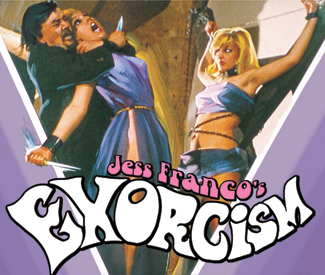
But then, neither would he likely have made numerous movies that seem driven by insatiability alone — like 1972’s Sinner (a.k.a. Diary of a Nymphomaniac, a surprisingly moralistic corruption-of-youth tale; 1973’s Countess Perverse, succinctly described on IMBD as “Two wealthy aristocrats lure a virginal girl to a Spanish island for a night of sex, death, and cannibalism;” 1973’s Female Vampire, the first starring vehicle for waifish, exhibitionist muse Lina Romay, his spouse and collaborator until her death earlier this year; and 1974’s Exorcism, with the short, squat director himself as a murderously crazy ex-priest who mistakes swingers’ mock “black masses” for the real thing. These four were recently issued for home viewing. The latter two (on Kino Lorber) come complete with alternate versions emphasizing bloody mayhem over naked frisking.

They are, of course, a mixed bag, sometimes winningly eccentric or even poetical, sometimes just sleazy and dull. For every decent to genuinely good Franco opus (among the latter, improbably, 1976’s quite serious Love Letters of a Portuguese Nun), a dozen or more are likely better off unseen when they’re not outright unseeable. (He’s left behind many films unfinished, lost or in legal limbo). What are we missing in the likes of 1980’s Two Female Spies With Flowered Panties, 1981’s Bloodsucking Nazi Zombies, 1984’s The Night Has a Thousand Sexes, 1986’s Lulu’s Talking Ass, 1986’s Tribulations of a Cross-Eyed Buddha, or this year’s Al Pereira vs. the Alligator Women? Maybe they’re best kept suspended somewhere between Franco’s imagination and our own.

Girl on wall

5

caitlin@sfbg.com

STREET SEEN Welcome welcome, friends, to my new column. You’ll wanna check back here for Bay Area style — clothes, weed, art, sex, y’know. But this week, international women’s studies: a Puerto Rican street artist on domestic violence, in her home town.

It may have been the moment of my recent trip to check out San Juan’s first street art festival.

Artist Sofia Maldonado was teaching no less than four high school females how to properly shade the middle fingers extending from two painted yellow fists. Lunchtime traffic whizzes past Maldonado’s mural in San Juan’s Santurce neighborhood, site of the 12-plus walls that would be painted as part of the week-long Los Muros Hablan. Small, wandering packs of street art fans stopped by intermittently, snapping photos, talking among themselves.

The 28-year old Maldonado’s mural is pretty dreamy for anyone overdosed on commercial, overly-testosteroned street art. It addresses domestic violence in Puerto Rico, showing a bashed-but-not-beaten beauty and those fists, which — once properly shaded — were lettered with “basta ya/enough already.” The work’s not soft, despite the bright colors she used to paint it.

Days earlier, when the moderator at a panel discussion at San Juan’s contemporary art museum that was part of the Los Muros Hablan programming asked the all-male panel of artists (Maldonado was south, painting a commission in the town of Ponce) to weigh in on female muralists, one responded that he was in favor. “They’re sexy,” he said, to a hearty laugh from the audience.

The domestic violence mural wasn’t the greatest piece of artwork that was created in San Juan that week. But then, Maldonado had a different intention than many of her male peers at Los Muros Hablan.

“Nowadays, I feel like doing murals is how to give back to the community.” It’s the afternoon and Maldonado and I are eating at a cafe a few blocks from her wall. “Especially for girls in Puerto Rico, it’s important to have a strong female representation.”

Maldonado grew up in San Juan, going to the same art school down the street that her eager assistants attend. She started painting walls with brushes when, inspired by the vivid street art on walls in France and Spain, she tired of the dull color palette available in aerosol on the island. She rolled with the boys, mainly. A few of them, from her San Juan crew, are painting alongside her at Los Muros Hablan.

After high school, she moved to New York City, got her MFA, found artistic success inside the studio too. She’s on the board of Cre8tive YouTH*nk, an organization that facilitates art projects that encourage critical thinking in at-risk youth. The week after Puerto Rico, she was at the Bronx Museum, doing a mural with the help of New York kids.

She’s the only female who had a wall at the festival. She’s also the only artist whose work is currently taking up an entire floor at the contemporary art museum. “She’s one of the best-known women these days, not only in urban art, but in visual art in Puerto Rico,” said Elizabeth Barreto, another San Juan street artist who painted in Los Muros Hablan’s all-female live painting and DJ event.

Along the museum’s open-air hallways, Maldonado’s controversial renderings of bra-less, heavily accessorized women of color are displayed. Google search “Sofia Maldonado 42nd Street mural” for the blowback she incurred when she erected them in Times Square. Maldonado tells me that the hurt the figures dredged up among people of color says more than the piece itself.

Her new canvas work also bears the language of graffiti, the strokes, the characters. But as a medium — her work’s not really about “getting up” anymore. She hasn’t rejected the bold artistic mark that you have to have if you paint in the streets, but you get a sense that Maldonado knows that audacity’s a tool, a microphone you use, not an end in itself.

She won’t really stand for all my editorializing. Actually, she kind of wanted me to shut up about her being a female role model. Her feminism is hard to describe in a 745-word article.

“You have to know it’s a male’s world, like any other profession,” she tells me, shrugging off all my questions about her take on the street art gender divide. “You gotta be strong.”

But one can’t help but read into her focus when it comes to education. “I don’t feel like I’m representing,” she concludes. “But I do feel like I need to set an example.”


Candy apples and razor blades

20

emilysavage@sfbg.com

TOFU AND WHISKEY While I don’t miss living in Long Beach, Calif. too much (save for some particular pals and the endless flat biking roads), I do sorely yearn for the yearly costumed Halloween performance — at steak restaurant/dive bar the Prospector — of the Shitfits, a Misfits cover band made up of local musicians. Luckily, in San Francisco, there are numerous bands-costumed-as-other-bands shows in late October, including at least one Misfits tribute: Astrozombies, a full-time tribute act, which will do the horror-punk legends right at Hemlock Tavern (Oct. 31, 8:30pm, $7. 1131 Polk, SF; www.hemlocktavern.com).

“The band was essentially formed to be a Halloween act,” Astrozombies’ vocalist-guitarist Kevin Amann, a.ka. Doyle Vonn Danzig, tells me.

Because what is Halloween without a Danzig-alike howling “Hallow-e-e-e-e-en?” Prefaced by, “Bonfires burning bright/Pumpkin faces in the night/I remember Halloween.” Doesn’t that make you itchy to slick down your devil-lock, and paint your face like the quintessential skull?

I ask Amann if his band’s Misfits (and some Danzig/Samhain) repertoire is constraining, and he says, nope: “I think, because there is some pretty serious diversity within the Misfits catalog, it really doesn’t ever feel limiting. We can go from a lightening fast punk song like ‘Demonamania’ to a brooding slow tempo rock song like ‘London Dungeon’.”

An aside: The actual Misfits — or, their current incarnation, minus Danzig — are playing the Oakland Metro on Nov. 16, but that’s still a few weeks away.

http://www.youtube.com/watch?v=lpENY3nEAx8

Let’s get back to the Halloween tribute show in general. It’s often the peak of the year’s nights out, the pinnacle when one might revert to early show-going wonder and moshpittery. Everyone is feeling creepy, and the only true nerds are the kids who come in street clothes, or as something “ironic” or “thought-provoking.” This year, some friends and I hope to go out as Pussy Riot, as both a fun fashion choice, and in solidarity. Wait, is that thought-provoking? Well, my partner will be a bearded man in a hot dog suit, so it’s not all politics.

Along with the Astrozombies, another local year-round tribute act, Bob Saggeth, will play Halloween again: two Black Sabbath-ish nights at Amnesia (Oct. 30-31, 10pm, $7–$10. 853 Valencia, SF; www.amnesiathebar.com.).

Then there’s the kind of once-a-year special mashup tribute night I was blathering on about above at Thee Parkside (Oct. 31, 8pm, $8. 1600 17th St., SF; www.theeparkside.com), with Glitter Wizard “Pushin’ Too Hard” as the Seeds, Twin Steps as the Cramps, Meat Market as G.G. and the Jabbers, and excellent new local bluegrass band the Parmesans as the Kinks.

There’s also a few Total Trash Booking monster mashes, which are pretty much always guaranteed to be raucous, punkish blowouts. There’s the pre-party at the New Parish (Nobunny, Shannon and the Clams, who will also be the Misfits, Pangea, Audacity, Uzi Rash. Fri/26, 8pm, $12–$14. 579 18th St., Oakl.; www.thenewparish.com) and two totally exciting Coachwhips reunion shows.

Coachwhips of course being John Dwyer’s pre-Thee Oh Sees noise punk outfit. One of the reunion nights (Sat/27 at Verdi Club) is totally sold out, and you’re bummed because there’s going to be a haunted house inside the venue. I’m stoked because that’s where I’ll be Pussy Riot-ing.

The other (Sun/28, 7pm, $12. Lobot Gallery, 1800 Campbell, Oak.) espouses another epic blend of Total Trash and totally touring bands: the aforementioned Coachwhips, Pangea, Fidlar, Guantanamo Baywatch, and White Mystery. I can only imagine all the blood-soaked costumes and sweaty brows.

You can find tons more freak shows in the Halloween concerts and parties guide elsewhere in this issue. But for an entirely different kind of year-round showmanship (holidays be damned), there’s SSION, performing with House of Ladosha and DJs from High Fantasy at this freaky-colorful installment of Future | Perfect at Public Works (Thu/25, 9pm, $10-$15. Public Works, 161 Erie, SF; www.publicsf.com).

SSION, pronounced “shun,” is hard to take your eyes off of, a confetti-puke electro-art-pop party collective from Kansas City, Missouri, led sultry androgynous vocalist Cody Critcheloe, who now resides in Brooklyn, with the aesthetic of early John Waters oeuvre meets Pee-wee’s Playhouse. While the recorded music is often relegated to pre-party pump-ups, live is where SSION really shines, as some may have witnessed at DNA Lounge’s Blow Up night earlier this year.

CRYPTS

The people were weary at first of Seattle’s Crypts, a synth-based (specifically a rewired CR-8000) darkwave electro act led by Steve Snere. For Snere was already known and beloved as a former member of Kill Sadie and post-hardcore geniuses These Arms are Snakes, in an angular realm of post-punk proficiency. But Crypts is enticing in a new, much gloomier fashion, and yes, Snere still kills it, and it maintains a paranoid frenzy vibe. Check deep, dark, and ghoulish “Breathe,” off the band’s self-titled debut LP (Sargent House, Sept. 4). The band played SF this summer, but this time it’s much closer to Halloween, plus they’re opening for Omar Rodríguez-López, of At the Drive-In and Mars Volta fame.

Wed/24, 8pm, $15

New Parish

579 18th St., Oakl.

www.thenewparish.com

CONVERGE

If you had told me 15 years ago that I’d be almost 30 and still recommending Converge, I’d of called you a liar or a time jumping cheat. And yet, after a forceful return listen, suggested by a fellow music nerd, I too must admit it: new record All We Love We Leave Behind (Epitaph Records, Oct. 9) is the thinking person’s heavy metal album. It’s still the blistering axes of hardcore and heavy metal, with melodic guitar riffs, rapid-fire drums, and pained chants, but with a more grown up, complex sensibility — or maybe that’s just me?

With Torche, Nails, Kvelertak

Fri/26, 8pm, $18

Slim’s

33 11th St., SF www.slimspresents.com

HUNK OF BURNING LOVE

And then there’s Hunx, or H.U.N.X., of Hunx and His Punx. In the past few weeks, Seth Bogart released an insta-classic Halloween music video for his track “I Vant to Suck Your Cock” — full of gothy late night cable access details, sexy vampires, lime-green wigs, and tombstone booty thumping — and announced both a new variety show, Hollywood Nailz, and his own record label, Wacky Wacko Records, which is releasing “I Vant to Suck Your Cock” as a single. According to the release, the label will be “an outlet to release novelty records, children’s music, holiday themed hits, songs from…Hollywood Nailz, and other bizarre things that most labels wouldn’t bother with.” Bogart is currently living in LA (as his variety show moniker would suggest) but still visits his store in the Bay, Down at Lulu’s, often. He’s doesn’t have any local shows booked as of press time, but he knows we vant to see him.

www.wackywacko.com


Rum tales

3

virginia@sfbg.com

FEAST Rum has had a rough and tumble history. It was the Royal Navy’s spirit of choice, and on a grim note, benefited from association with the slave trade. Consider the story of Admiral Horatio Nelson, whose body was preserved in a cask of rum after his death in the Battle of Trafalgar en route back to England. Upon arrival, the cask was empty of liquid, the rumor being his crew drank it in hopes of ingesting Nelson’s courageous spirit. From this comes one of rum’s many nicknames, “Nelson’s blood.” The act of imbibing it is often dubbed “tapping the admiral.”

Despite its dark days, rum thrives as the spirit of the Caribbean where, along with Latin America, the majority of the world’s supply is produced. The liquor is associated with island breezes, relaxation, the good life. From airy white rum to the sweet, spiced variety, there’s more complex rum variances than one might initially suspect.

Though no hard and fast rules apply to all rum, here’s a quick rundown of categories:

Light/silver/white rums are often smooth, sometimes sweet, mixable rums ideal for cocktails, made from both sugarcane and molasses. Typically aged briefly, they maintain a colorless look from being aged in stainless steel or neutral oak, or from having their color filtered out.

Gold/amber rums are typically medium-bodied, generally aged in wood barrels. They are the halfway point between light and dark rums.

Dark rums are molasses-based, aged in charred barrels. They are at times quite sweet and silky, at other times complex, best for mixing or sipping.

And there is a wealth of other categories. Spiced rums have, yes, spices and even caramel added. Flavored rums are infused with a wide range of tastes. Overproof rums are high proof spirits that exceed the standard 40 percent ABV. Premium rums are essentially a more refined category of sipping rums. Cachaça is, more or less, a Brazilian rum made solely from sugarcane juice.

In addition to styles, regions determine rum characteristics. The Spanish-speaking Caribbean (namely Cuba, the Dominican Republic, Puerto Rico) and South and Central America are most highly regarded for their smooth añejo style. English-speaking islands (like Barbados, Belize, Jamaica, Saint Kitts, Trinidad) are best known for full, dark rums, including demerara rums made from natural, unrefined demerara sugar. French-speaking Caribbean islands (including Haiti, Guadeloupe, Saint Martin, Martinique) are famed for agricultural rums (rhum agricole), produced solely from sugar cane juice, which are refined, complex, even grassy and funky.

RUM BARS

Where to find good rum in the Bay Area? One of the greatest selections available anywhere, the standard-setting menu at Smuggler’s Cove offers over 200 rums, with flights and pours grouped by style and region. The bar even has a Rumbustion Society encouraging (and rewarding) exploration. Smuggler’s honors the roots of tiki (Don the Beachcomber and Trader Vic’s paraphernalia abound) in its intimate, three-level layout. The cocktail menu is extensive, with sections on Cuban cocktail favorites from Havana’s glory days to modern interpretations of tiki drinks.

650 Gough, SF. (415) 869-1900, www.smugglerscovesf.com

Newly-opened Tradition offers booths (called “snugs”) with themes like New Orleans, Pre-Prohibition, and Scotland, each boasting vintage ads, signs, and barware in keeping with the motif. An artistic menu is likewise themed around each category. One theme is exotic/tiki, that page bearing mostly rum-based cocktails. For a unique rum experience, there’s an extensive house-blended and barrel-aged spirits program, including all manner of spirits finished in house barrels, like Flor de Caña rum in pinot noir or sweet vermouth barrels, imparting unexpected wine notes to the rum.

441 Jones, SF. (415) 474-2284, www.tradbar.com.

Though not a rum bar per se, Bar Agricole, with its impressive modern design and a bar flanked with dramatic photography, is named after French Caribbean rums and boasts a strong rum selection. Agricole perfects classic rum drinks — chat with bartenders about which version of the classic daiquiri you might want to try, they’re well-versed on each. Imbibe lesser-seen classics like a Martinique Crusta from Charles Baker’s Gentleman’s Companion, this particular recipe dating back to 1840 of agricole, lemon, bitters, and Maraska, a Croatian maraschino liqueur.

355 11th St., SF. (415) 355-9400, www.baragricole.com.

For dive bar rum and cheap rum punch, try Hobson’s Choice in Haight-Ashbury (www.hobsonschoice.com). Other notable tiki bars include the transporting East Bay classics, Forbidden Island (www.forbiddenislandalameda.com) and Oakland’s Conga Lounge (www.congolounge.com), not to mention out-of-the-way Tiki Haven (www.tikihavensf.com) in SF’s Outer Sunset.

BEST RUM COCKTAILS THIS YEAR

Brand new to the bar’s fall menu is frothy, light beer and rum beauty, Jasper’s Rum Shaker (a cheeky reference to the 1990s rap song, “Rump Shaker”): Bacardi 8 Rum, Shipyard Pumpkin Ale, lime, pumpkin syrup, cream, egg white, and orange flower water recall a classic Ramos Gin Fizz. Also new to the menu is bartender Taylor White’s Haymaker, which allows Appleton Reserve Rum to shine in a fabulously musty, spiced way with Combier orange liqueur, chai tea infused Punt Mes vermouth, Angostura, and orange bitters.

401 Taylor, SF. (415) 775-7979, www.jasperscornertap.com

An after dinner sipper this summer was AQ’s Senegal at Dusk ($10), a mixture of Lemon Hart rum, coffee and a blissful cardamom banana cream. At Tradition, Kona Kope stands out from an entire book of cocktails. Sweet Diplomatico Reserva Exclusiva rum and barrel-aged spiced rums intermingle with coffee syrup and a touch of coconut cream, evoking lively coffee-tinged tropical breezes. For a milky rum stunner, try Smuggler’s Cove’s Jamaican Milk Punch, reminiscent of traditional Brandy Milk Punch, smooth, frothy, spiced.

1085 Mission, SF. (415) 341-9000, www.aq-sf.com

The Lower Haight joint might not be a rum bar, but Maven’s Nauti’ Mermaid is a winner, mixing Jamaican rum, lime, orange, coconut, and housemade hazelnut orgeat, substituting orgeat’s typical almond base for hazelnuts.

598 Haight, SF. (415) 829-7982, www.maven-sf.com

In downtown Berkeley, Comal’s Black Daiquiri is a refreshingly unique expression, mixing Pampero Aniversario rum, Averna, lime, sugar, and Chiapan coffee tincture for a tart, bitter, sweet, and robust imbibement. Coffee notes don’t dominate, but add a hint of earth and body.

2020 Shattuck, Berk. (510) 926-6300, www.comalberkeley.com

RECOMMENDED RUMS

One of my all-around favorite rums is Brugal 1888 ($54.99), from five generations of family distillers in the Dominican Republic. First aged in American white oak barrels, then finished in Spanish oak, it’s a blend of rums aged five to 14 years that hits the nose with spice, coffee, dried fruits. Tasting it yields notes of bourbon-like caramel, wood, spice, a hint of earth, a complex finish. An affordable sipping rum is Appleton Estate Reserve 12 year ($34.99) from Jamaica, blended by female master blender Joy Spence. It’s bright and bold, but also nutty and buttery. If you can get your hands on Appleton 21 year, it’s a beauty. Fascinating grassy notes, nuts, orange blossom, molasses.

Ron Zacapa 23 year ($37) is a Guatemalan classic, smooth with toffee and spice and crafted by a female master blender Lorena Vasquez. Diplomatico Reserva Exclusiva ($35) is lushly sweet with caramelized brown sugar, a spice-redolent Venezuelan dark rum. Botran Solera 1893 Gran Reserva ($24), a Guatemalan añejo rum, is an affordable, different side of the sweet coin. A blend of five to 14 year old rums, is balanced, not cloying. It tastes of caramelized banana and coconut.

Shellback is a new release of two affordable ($17 per bottle) Barbados-blended rums, ideal for cocktails. The silver is clean, with vanilla smoothness and whispers of tropical fruit, while the spiced is medium-bodied with cinnamon bark, ginger and clove oils, nutmeg, cassia.

Possibly my top white rum, Banks Five Island ($25.99) is rife with character, funk, and elegance — a blend of rums from five islands (hence the name), it’s reminiscent of the Asian-Indonesian sugarcane spirit Batavia Arrack. Banks recently released Banks 7 Golden Age Blend ($30), 23 rums sourced from seven places. It’s a complex as that would imply, dry, nutty, tropical, and rich.

Rhum agricole is my favorite style of rum — it’s often funky, grassy, complex, elegant. I adore the floral, fresh spirit of Clement Martinique Rhum Blanc ($30) and its VSOP ($35), which exhibits spice, coconut, apple, earth. I’m already a fan of the brand’s elegant rhum agricoles from Martinique, and they just released a fresh, smoky six year old ($56), not to mention a cinnamon, wood, and vanilla-inflected 10 year ($73). For a splurge, I adore the unique, cask strength (though still reasonably under 100 proof) 10 year Rhum J.M. Millesime 1997 ($130), which unfolds with toasted nut, lemon, sage, cinnamon.

FURTHER EDUCATION

Started by rum expert and all-around great guy Ed Hamilton, Ministry of Rum is a key resource for all things rum. Find reviews and discussions on just about every rum in existence, plus glossaries, rum basics, and rum events worldwide, including the annual Ministry of Rum tasting held in the Bay Area.

www.ministryofrum.com.

Rum For All is a project started by F. Paul Pacult (publisher-editor of Spirits Journal) and industry expert Sean Ludford. Their website is an online resource of rum primers, select producer profiles, and cocktail recipes. I recently went to their touring seminar when it was in SF, which offered an impressive range of rums to sample side-by-side — which is, of course, the best way to get educated.

www.rumforall.com.

Subscribe to Virgina’s twice-monthly newsletter, The Perfect Spot, www.theperfectspotsf.com

Feast 2012

0

FEAST 2012 Fall arrives, daisy dukes disappear. This can only mean one thing: it’s time to start eating again. Our guide to autumnal appetite will help you do just that, of course. Marke B. will get you hyped for crab season here in the Bay, George McIntire found some of the most useful local apps for finding haute plates (and goblets). Caitlin Donohue sussed out the Marin-Sonoma Cheese Trail, and Virginia Miller shares her knowledge on all things rum and chocolate. And more! Read on, get hungry. 

>>5 LOCAL FOOD APPS Swipe your way to good eatin’

>>WEDGE ISSUES Happy days on the Sonoma-Marin Cheese Trail

>>TRUFFLE TOUR Yes, chocolate. From fudge at your fingertips to artisan producers, worldwide

>>CLAWS FOR CONSIDERATION Do you know where your Dungeness is? A quick guide, from retail to restaurants

>>CANTONESE COUNTRY COUSIN An interview with the author of The Hakka Cookbook

>>FRESH Food trucks and restaurants new in 2012 — a list of the best by our food writer Virginia Miller 

>>RUM TALES Bars, cocktails, favorite bottles, and the facts you need to be an educated sipper

Fresh

0

AFFORDABLE

Aria Korean American Snack Bar (932 Larkin, SF. (415) 292-6914)

Cat Head’s BBQ (1665 Folsom, SF. (415) 861-4242, www.catsheadbbq.com)

Craftsman and Wolves (746 Valencia, SF. (415) 913-7713, www.craftsmen-wolves.com)

Gioia Pizzeria (2240 Polk, SF. (415) 359-0971, www.gioiapizzeria.com)

Hot Press (2966 Mission, SF. (415) 814-3814, www.hotpresssf.com)

Ice Cream Bar (815 Cole, SF. (415) 742-4932, www.theicecreambarsf.com)

Marcella’s Lasagneria and Cucina (1099 Tennessee, SF. (415) 920-2225, www.marcellaslasagneria.com)

Market and Rye (68 West Portal, SF. (415) 564-5950; 300 De Haro, SF. (415) 252-7455, www.marketandrye.com)

Mission Bowling Club (3176 17th St., SF. (415) 863-2695, www.missionbowlingclub.com)

903 (903 Cortland, SF. (415) 678-5759)

MID-RANGE

Abbott’s Cellar (742 Valencia, SF. (415) 626-8700, www.abbotscellar.com)

The Corner Store (5 Masonic, SF. (415) 359-1800, www.thecornerstore-sf.com)

Elephant Sushi (1916 Hyde, SF. (415) 440-1905, www.elephantsushi.com)

FuseBOX (2311A Magnolia, Oakl. (510) 444-3100, www.fuseboxoakland.com)

Honor Kitchen and Cocktails (1411 Powell, SF. (510) 653-8667, www.honorbar.com)

Local’s Corner (2500 Bryant, SF. (415) 800-7945, www.localscornersf.com)

Machka (584 Washington, SF. (415) 391-8228, www.machkasf.com)

Namu Gaji (499 Dolores, SF. (415) 431-6268, www.namusf.com)

Orexi (243 West Portal, SF. (415) 664-6739, www.orexisf.com)

Pläj Scandinavian Restaurant and Bar (333 Fulton, SF. (415) 294-8925, www.plajrestaurant.com)

Rich Table (199 Gough, SF. (415) 355-9085, www.richtablesf.com)

Saru Sushi (3856 24th St., SF. (415) 440-4510)

State Bird Provisions (1529 Fillmore, SF. (415) 795-1272, www.statebirdsf.com)

St. Vincent (1270 Valencia, SF. (415) 285-1200, www.stvincentsf.com)

FOOD TRUCKS

Adam’s Grub Truck (428 11th St., SF. (650) 440-7956, www.adamsgrubtruck.com)

All Good Pizza (1605 Jerrold, SF. (415) 846-6960, www.allgoodpizza.com)

Casey’s Pizza (www.caseyspizza.com)

Cosmic American Voodoo Van (2250 Jerrold, SF. (415) 341-7203)

Del Popolo (www.delpopolosf.com)

Old World Food Truck (www.oldworldfoodtruck.com)


Points of no return

2

cheryl@sfbg.com

FILM Wake in Fright opens with a slow 360 degree pan across a dry, barren, isolated landscape. There are railroad tracks and two small structures, but the rest is filled with a whole lot of nothing.

This is Tiboonda, the tiny Australian town where Ted Kotcheff’s 1971 thriller begins. The descriptor “thriller” and the film’s title — not to mention its arrival in theaters under the genre-friendly Drafthouse Films banner — suggests that Wake in Fright is a horror movie, but if it’s Aussie Outback thrill-killing you seek, look elsewhere (starting with 2005’s Wolf Creek). Wake in Fright is more of a psychological thriller, of the escalating-dread-building-to-a-gut-ripping-climax variety. Not for nothing did chatty ol’ Martin Scorsese, a champion of the film since its 1971 Cannes debut, admit “It left me speechless.”

Pity poor teacher John Grant (Gary Bond), assigned to teach in Tiboonda’s one-room schoolhouse by the government he owes money to in return for his own education. Or don’t: Grant, primly dressed in coat and tie despite the scorching weather, can barely disguise his disgust over being plopped into such a backwater. When the six-week Christmas break rolls around, he’s on the first train out of town, heading for an overnight stop in mining town Bundanyabba before flying to Sydney, where cool waters and his sophisticated girlfriend await.

Of course, the best laid plans of desperate, sweaty men always go astray. Kotcheff — who is actually Canadian and whose best-known film is probably the first Rambo movie, 1982’s First Blood (or 1989’s Weekend at Bernie’s) — sets the tone early with that lonely 360 degree shot, but Grant’s misplacement becomes even more obvious once he starts encountering locals in “the Yabba.” Everyone, except for the odd woman working the front desk at his hotel (has anyone ever come so close to making out with an electric fan?), emits a strange combination of menacing and friendly.

First, there’s the cop (Chips Rafferty) who, five seconds after meeting him in the town’s raucous meeting hall, simply insists that Grant chug multiple beers with him. Boozing leads to a back-room gambling game — where, again, everybody acts like it’s no big deal that there’s an outsider, “the guy in the jacket,” in their midst. “One mere spin and you’re out of it,” reflects an oily man (Donald Pleasence) Grant meets in the chaos. Prescient words: when an unlucky coin toss means Grant’s lost all his money, he’s not only out of the game — he’s out of his Sydney trip, out of any other options, and on his way to going out of his mind.

But he doesn’t get there alone, and Wake in Fright amps up as Grant’s downward spiral begins. There’s beer — gallons and gallons of the stuff — off-roading at breakneck speeds, fistfights, further strange encounters with Pleasence’s character (who turns out to be the unabashedly alcoholic town doctor), and a grim-faced beauty (Sylvia Kay, married to Kotcheff at the time) who is not as out of place in the sticks as Grant first assumes. The film’s most brutal sequence involves kangaroo hunting — it’s so disturbing that it warrants a disclaimer as the end credits roll. But really, all of Wake in Fright is a nasty, grimy, hopeless misadventure, an exposing of the dark heart Grant didn’t realize he had, or was even capable of having. “I got involved,” is all he can say of the experience, though the audience might lean more toward “Uh, what the fuck just happened?”

Wake in Fright‘s return to theaters (and first-ever uncut appearance on US screens) after 41 years is the result of a negative-saved-at-the-last-minute miracle — the sort of tale that makes cinephiles both happy and nervous, wondering about all those films that didn’t get rescued before they went into the shredder. Anyway, be glad Wake in Fright is still with us; it competed at Cannes in 1971, and played there again in 2009 as a “Cannes Classic.” If you didn’t catch it at the 2010 San Francisco International Film Festival, here’s your chance to be freaked out by this newly-available classic.

ALL OUT OF BUBBLEGUM

Horror fans will recognize the name of Wake in Fright star Donald Pleasence from John Carpenter’s 1978 Halloween — ’tis the season, after all, and that film happens to be screening at the Balboa Theatre Oct. 30-31. But the Carpenter movie du jour is 1988’s dystopian-future drama/true story They Live, which comes out on Blu-ray Nov. 6 — never before has Rowdy Piper’s mullet looked so crisply feathered, nor Meg Foster’s eyes so eerily seafoam, nor the black-and-white matte paintings depicting Los Angeles’ subliminally-enhanced landscape (“MARRY AND REPRODUCE”) so stark and startling.

There are some recycled extras, including Carpenter and Piper’s audio commentary, trailers, and a vintage press-kit reel featuring wrestling superstar Piper reflecting on his leading-man debut (“Ain’t a lot of difference between John Nada and Roddy Piper”). But there’s new stuff, too: separate interviews with Foster, Carpenter (who scoffs when he’s asked if he was tempted to edit down the film’s epic, legendary fight scene: “Fuck no!”), and co-star Keith David, who hilariously reminisces how he had to un-learn stage diction when he was hired for his first Carpenter film, 1982’s The Thing — and devotees of that film will want to rewind multiple times, just to hear David jokingly enunciate “You believe any of this voodoo bullshit, Blair?” in near-Shakespearean tones.

For behind-the-scenes junkies, there’s a featurette on the film’s “sights and sounds,” highlighted by an interview with veteran stunt coordinator Jeff Imada, who breaks down that iconic fight scene and reveals he played most of the aliens in the film (including the “What’s wrong, baby?” guy at the end). Just about the only thing missing from this Blu-ray package (kudos for the ridiculous cover art, Shout! Factory)? A pair of sunglasses. 

Wake in Fright opens Fri/26 in Bay Area theaters. Halloween screening info at www.cinemasf.com. They Live Blu-ray info at www.shoutfactory.com


Staunch characters

0

cheryl@sfbg.com

FILM Last year’s The Artist is still glowing months after its multi-Oscar triumph — its canine star just released a memoir, Uggie: My Story, and its human star, Jean Dujardin, will appear in Martin Scorsese’s 2013 The Wolf of Wall Street.

But The Artist had more in common with Hollywood — starting with its setting — than most contemporary French films, which don’t always receive stateside theatrical runs (unless Luc Besson is involved). As you bide your time until Leos Carax’s masterpiece of mindfuckery Holy Rollers arrives Nov. 16, hit the Embarcadero for the San Francisco Film Society’s fifth annual “French Cinema Now” series.

It opens with Noémie Lvovsky’s Camille Rewinds, about a fortysomething woman (Lvovsky, who also co-wrote) who gets a chance at a do-over when she inexplicably wakes up as her teenaged self in 1985. (Yes, it’s been called “the Gallic Peggy Sue Got Married.“) Closing night is Ursula Meier’s well-reviewed Sister, Switzerland’s Oscar entry for Best Foreign Language Film, which stars Léa Seydoux as a woman supported by the petty-thief habits of her 12-year-old brother; if you miss it here, it’ll be in theaters Nov. 9.

The series’ female-centric theme extends into My Worst Nightmare, which follows icy art curator Agathe (Isabelle Huppert) as her airless, tightly-controlled world begins to crumble — thanks in no small part to an exuberantly uncouth, down-on-his-luck Belgian contractor named Patrick (Benoît Poelvoorde), whose mere presence in Agathe’s orbit gives rise to the film’s title. Director and co-writer Anne Fontaine (2009’s Coco Before Chanel) injects plenty of offbeat, occasionally raunchy humor into what could’ve been a predictable personal-liberation tale — the sight of Huppert driving through a bikini car wash, for instance.

There’s no such mirth in Louise Wimmer, the first narrative feature for director and co-writer Cyril Mennegun, though the two films do share parallel stories of characters battling bureaucracy to secure public housing. In Louise Wimmer, it’s an increasingly anxious pursuit for the middle-aged title character (Corinne Masiero), who’s been living in her sputtering Volvo for months. She has a (crappy, part-time) job, but it’s not enough to pay her ever-increasing debts; what’s worse, the goodwill of those who’ve been helping her is starting to wear thin. Masiero’s believably weary performance suggests a woman clinging to the only things she has going for her — resourcefulness and an innate elegance, though both are fading by the day. On her car stereo, Nina Simone’s “Sinnerman” plays on a constant loop, a frantic, powerful tune that moves Louise to weep and, in her most desperate moment, flail around in a solo dance that’s equal parts cathartic and depressing.

Jane Fonda, in her first French film since 1972’s Tout Va Bien, plays a woman who conceals her cancer diagnosis from family and friends in Stéphane Robelin’s All Together (literal English translation, according to the subtitles: And If We All Lived Together?). It’s an ensemble film about a group of seventysomethings who decide to “go all hippie” and share a house — an arrangement that also rescues the less-robust among them (including a man with a weak heart, and one who’s increasingly forgetful) from being shunted into nursing homes. Some of All Together‘s plot points feel forced — as when a young anthropology student moves into the communal house to “study” its inhabitants — but Fonda is a standout as a woman who faces the end with remarkable reserves of cheer and dignity. In addition to its “French Cinema Now” appearances, the film also opens Oct. 26 at the Christopher B. Smith Rafael Film Center. 

FRENCH CINEMA NOW

Wed/24-Tue/30

Embarcadero Center Cinema

One Embarcadero Center, SF

www.sffs.org