Volume 48 [2013–14]

On the veg

1

arts@sfbg.com

LIT The first thing you need to know about Isa Chandra Moskowitz is that she’s a punky legend in the global vegan community. She started the DIY Post Punk Kitchen public access show in Brooklyn and (perhaps more importantly) created the vegan hub website of the same name exactly 10 years ago. While maintaining PPK she has authored or co-authored eight popular cookbooks, right up to this fall’s unfussy workday vegan cookbook, Isa Does It: Amazingly Easy, Wildly Delicious Vegan Recipes for Every Day of the Week (Little Brown, 320 pp., $30).

The second thing you need to know is that many people mispronounce her name (it’s “EE-sah” not “EYE -sah”), though it doesn’t seem to bother her much. I find myself profusely apologizing for flubbing her name when she picks up the phone — especially since I’ve been following her work, and making her delicious dishes, for the better part of a decade. I should know better.

From a hotel room in Minneapolis while on her book tour, the soft-spoken Omaha-based chef shrugs off the faux pas and we quickly get to work pinpointing her favorite recipes from Isa Does It: anything that’s creamy cashew cheese-based like the alfredo and the mac’n’cheese, along with a kale-lentil-quinoa stew, which she describes as the “classic vegan recipe” that she makes herself more than once a week, mixing up the spices as she goes.

She spouts an important note about preparation, something which is thoroughly dissected in the early sections of Isa Does It, with tofu butchery, and handy pantry tips for making cooking after work more streamlined: “I always have kale in the fridge; I always have lentils and quinoa in the pantry.”

There are also the recipes from Isa Does It that are featured in her newest video series, Make It Vegan, which has Moskowitz whipping up the Meaty Bean Chili and Cornbread, and the Nirvana Enchilada Casserole (“I like a lot of onions in this, and a lot of jalapeno; a lot of everything, really”) to the tune of “Salt” by Kelley Deal. The casserole is part of the “Sunday Night Supper” section of the book — a few more ambitious recipes, like many from her previous cookbooks such as Veganomicon (a must-have for any vegan), Appetite for Reduction, or Vegan Brunch.

That enchilada casserole is next on my list of Isa Does It dishes to tackle. I’ve so far tried the flavorful Tempeh Giardino, Kale Salad with Butternut Squash and Lentils, and the Cast Iron Stir-Fry With Avocado, Basil & Peanuts, which is a light yet super filling weekday stir fry. The avocado really gives it a fresh kick. I’m also now officially obsessed with cashew cheese, and have cashews soaking at all times, just like the author.

Moskowitz has been working on this particular cookbook for the past two years, concocting recipes in her Omaha home — the Brooklyn native moved there three years ago, mainly because she wanted a garden but also thanks to the local music scene. Her inspirations come from her pantry — “I have Brussels sprouts and sweet potatoes, what can I make with that? — and sometimes she’s inspired to veganize something she saw on the Food Network. “Like, there might be some secret Guy Fieri recipes in there that I veganized.”

Like her previous cookbooks, each of the recipes went through rigorous testing. “I have like, 30 testers. One of the biggest things for people was ‘would you make this on a week night?'” Moskowitz explains. She asks each tester to make the meal and answers a series of questions. For this particular book, she wanted everything to be accessible as possible, so another important question was: Were any of the ingredients hard to find?

“I live in Omaha now — I’m in the middle of the country — and that really changed my views on what people have access to. So I just wanted it to be really accessible ingredients,” she says. “Another reason I wanted to write this book is because I was cooking more than ever because there were not that many places to go out to eat.”

It’s another world away from Brooklyn, where meat-free restaurants and offerings dot the streets, and markets have aisles full of items clearly marked “vegan.”

While there are meat-and-dairy free offerings at local sushi spots and coffee shops (and Whole Foods Markets) there’s no dedicated vegan restaurant in Omaha — yet.

When we spoke, Moskowitz had recently been handed the keys to her first restaurant, which will open in spring 2014. Attached to a bar owned by the members of Saddle Creek band Cursive, Moskowitz’s spot will serve a revolving menu of vegan comfort foods, all made from scratch. “All the mayo is from scratch, I’m going to make my own cheese, [there will] even be house-made sodas, and kombucha on tap.”

Although there have been some rumblings about Moskowitz’s restaurant for some time, she gives the Guardian an exclusive: The name of her new restaurant will be Modern Love. 

www.theppk.com


This stuff’ll kill ya

0

cheryl@sfbg.com

FILM Clad only in a dingy T-shirt and tighty-whities, with an overgrown beard and a hollow look of defeat in his eyes, shut-in Ian (Adrian DiGiovanni) spends his days channel-surfing and plotting ways to commit suicide. When his beloved vintage TV (“His name was Kent,” he tells the camera, in the first of many direct addresses) fizzles, smokes, and goes dark, he finally takes action.

But after he’s lurched off the couch and dumped enough household chemicals into his bathtub to kill several hundred depressed agoraphobics, he falls and hits his head. When he wakes up some time later, groggy and bleeding from the mouth, he realizes his grimy bathroom has a new inhabitant: a talking pile of mold that immediately starts spouting Tony Robbins-like encouragement at our sad-sack hero.

A lot happens in the opening act of first-time feature director Don Thacker’s Motivational Growth. Delightfully, and sometimes gruesomely, the rest of the film keeps pace, even though we never leave Ian’s apartment. Unwelcome visitors (a wacked-out TV repairman; a snarky delivery girl; Ian’s angry landlord) and a series of surreal hallucinations, in which Ian imagines he’s appearing in the shows he used to watch on Kent’s screen (the best one: an alien buddy-cop drama that looks straight outta Troma), are troubling — though the pretty neighbor he glimpses through his apartment peephole offers brief moments of relief.

But Ian’s main focus, of course, is Motivational Growth‘s title character (voiced with purring bravado by the great Jeffrey Combs). The mold — it insists on referring to itself in the third person — looks like a Krofft Superstar Hour prop that fell into a sewage tank; it has barely-discernable features beyond an expressive mouth that never stops talking (and “when the mold talks, you listen,” it says, sternly). Though the mold encourages Ian — who hasn’t left his apartment in over a year, to tidy up and set a course for “Successville” — there’s also something undeniably sinister about Ian’s increasingly bossy new buddy.

With its pleasingly retro vibe, including a bleep-blorp video game-y soundtrack, Motivational Growth is quirky without getting in your face about it — though it may inspire you to rush home and scrub every inch of your bathroom. It’s a high point in the 10th annual Another Hole in the Head Film Festival, produced by SF IndieFest and stuffed tighter than a turducken with indie horror, sci-fi, and fantasy flicks.

The fest offers a sprinkling of classics (for all you Room 237 obsessives out there, it features screenings of both 1980’s The Shining and projection-booth stunt “The Shining Forwards and Backwards” — talk about a labyrinth). But mostly, it’s a showcase of new films that might be having their only local theatrical screenings, including several intriguing imports.

Billed as the Philippines’ first-ever indie zombie movie, T.A. Aderto’s The Grave Bandits has a few major flaws, including an overload of bodily-function jokes and some of the worst mad-scientist acting ever captured on film. But its young leads — particularly Marti Sandino San Juan as the slingshot-wielding Peewee — and some gushing gore effects mitigate most of The Grave Bandits‘ more unfortunate elements.

The premise: Two scrappy ragamuffins (Peewee and his slightly older buddy, played by Ronald Pacifico) make their living robbing corpses, a survival strategy that makes them unpopular enough to be chased by angry mobs. They’re able to steal a small boat and escape to one of the country’s tiny islands — unluckily, it happens to be the same place a gang of pirates acted the wrong way around a giant gemstone tainted by “an alien virus, dormant for over 100 years.” Ergo, a new angry mob to evade — one made up of flesh-ripping zombies.

Elsewhere among the international selections is French Canadian filmmaker Renaud Gauthier’s Discopath. The writer-director is clearly a fan of cult-horror nasties — 1980’s Maniac and 1979’s Don’t Go in the House, and to a lesser extent 1977’s Suspiria, seem to have influenced this stylish, self-assured creepfest. After witnessing a terrible tragedy as a child, shy loner Duane (Jeremie Earp) can’t stand music, particularly that newfangled genre called disco. For whatever reason, he agrees to go to a dance club with a girl he’s just met — with disastrously bloody results. Fast-forward a few years, and he’s fled New York City for Montreal. Living under a fake name, he’s working as a handyman at a Catholic girl’s school and wearing hearing aids that mute out the dreaded sound of music (insert your own “Disco sucks!” joke here).

But once a psychopath, always a psychopath, and heads soon start rolling (and spinning on turntables, in fact). If Discopath‘s plot is familiar to the point of homage, its synth-scored commitment to detail reaches exceptional heights: period-perfect clothes, cars, tabloid newspapers, décor (including a giant remote control that Motivational Growth‘s Ian would covet), and carefully-calibrated amounts of garbage scattered on NYC’s Me Decade sidewalks. *

ANOTHER HOLE IN THE HEAD FILM FESTIVAL

Nov 29-Dec 12, $12

Balboa Theater, 3630 Balboa, SF

New People Cinema, 1746 Post, SF

www.sfindie.com


La ho-hum vita

1

arts@sfbg.com

FILM Paolo Sorrentino has only been directing features for 12 years, so perhaps it’s premature to expect a masterpiece from him — although he probably doesn’t think so. Amid generally tepid post-millennium Italian cinema, he’s been consistently ambitious and bold, from 2001’s One Man Up onward. That facility has won a lot of acclaim (most notably for 2008’s Il Divo), but also attracted a certain amount of skepticism: Is he more style than substance? What does he have to say?

The Great Beauty, aka La Grande Bellezza, arrives as a high-profile contender for the Best Foreign Language Film Oscar, already anointed a masterpiece in some quarters, and duly announcing itself as such in nearly every grandiose, aesthetically engorged moment. Yes, it seems to say, you are in the presence of this auteur’s masterpiece. But it’s somebody else’s, too. The problem isn’t just that Fellini got there first, but that there’s room for doubt whether Sorrentino’s homage actually builds on or simply imitates its model.

La Dolce Vita (1960) and 8 1/2 (1963) are themselves swaying, jerry-built monuments, exhilaratingly messy and debatably profound rather than “perfect” works of art. But nothing quite like them had been seen before, and they did define a time of cultural upheaval — when traditional ways of life were being plowed under by a loud, moneyed, heedless modernity that for a while chose Rome as its global capital. The mood there was giddy and alienating, magnetizing celebrities (especially as the Italian film industry found itself hosting myriad international productions), virtually creating “paparazzi” — a term introduced in 1960 by Fellini to describe the ambushing photographers buzzing like flies around movie stars and pop idols.

The films were so striking and influential that even (or most of all) Fellini himself couldn’t escape them. For the most part his later works were increasingly pale imitations, risking self-parody even as other artists waxed “Fellini-esque” on their own terms.

Sorrentino announces his intention to out-Fellini Fellini in an opening sequence so strenuously flamboyant it’s like a never-ending pirouette performed by a prima dancer with a hernia. There’s statuary, a women’s choral ensemble, an on-screen audience applauding the director’s baffled muse Toni Servillo, standing in for Marcello Mastroianni — all this and more in manic tracking shots and frantic intercutting, as if sheer speed alone could supply contemporary relevancy. Eventually The Great Beauty calms down a bit, but still its reason for being remains vague behind the heavy curtain of “style.”

Servillo’s dapper Jep Gambardella is turning 65, a never-married playboy who once wrote a well-regarded novel, then ever since has done nothing but interview other famous people and stay at the center of the Eternal City’s uppermost social whirl. Somehow he’s remained rich and famous himself, bearing the bored-with-it-all air that precludes discussion of what (if anything) he ever did to become either. He’s still invited everywhere, still occasionally beds the requisite younger women attracted by power. But it’s all getting old — not that Jep seems like someone to whom it was ever new, or who’d be able to find fulfillment elsewhere now that he’s drunk his fill of privileged excess.

As if to externalize the emptiness he feels, Beauty‘s Rome is all exquisitely framed but (aside from several lavish-party set pieces) underpopulated elegant rooms and grand exteriors. Has he simply forgotten the city’s teeming everyday life, or has Sorrentino? The supporting cast of available (albeit troubled) women, backbiting colleagues, and miscellaneous grotesques are right out of the Fellini handbook of “fabulous” faces. Yet when Jep (let alone the director) was coming of age, the “dolce vita” had already ended, degenerating into the political chaos of the 1970s, the tacky coke binges of the ’80s, then the crass, tawdry conspicuous consumption of Berlusconi and company — a decadence no longer divine but merely depressing. So why does this hangdog-faced protagonist’s world seem so little changed from the ones Mastroianni inhabited half a century ago?

Even the “shocking” novelties Jep is unimpressed by feel old-hat: a child artist whose violent tantrums create Pollock-like action paintings; a Marina Abramovic-type performance artist who solemnly bangs her head against a pillar for suitably worshipful patrons. We grok his superiority to such nonsense, but just what does he have to offer that’s any better? In a notably cruel sequence, Jep demolishes the pride of a prolific, idealistic female writer, calling her a fraud in both private life (she’s married to a closeted homosexual) and artistic endeavors (she’s acclaimed only by fellow Communist Party sympathizers). His smug satisfaction in doing so seems to be shared by the film itself. Yet when the film finally gets around to offering up what Jep can grasp as a core redemptive truth, it’s ye olden mother/whore equation: a sequence cutting between a 104-year-old Mother Teresa-like “modern saint” crawling up a staircase to a Madonna painting, and a flashback to the moment when his first love exposed her boobs to Young Jep. Seriously, 142 minutes of pretentious bravado leads to that?

Servillo is a chameleon, far more than Mastroianni was, but the latter had a soulfulness both contemporary actor and film sorely lack. (Admittedly, some of the latter’s layers may be inaccessible for foreign viewers, just as the equally over-amped but more focused Il Divo required familiarity with the never-ending scandalousness of Italy’s political circus to be fully grasped.) As for Sorrentino, he’s such a natural filmmaker on the surface that at times even the most skeptical will be seduced into The Great Beauty‘s sweeping gestures. But for all their panache, it’s reasonable to worry the movie’s “statement” may be no more than (to quote Jep’s favorite all-purpose dismissal) “Blah, blah, blah.” *


THE GREAT BEAUTY opens Fri/29 in Bay Area theaters.

Meat is murder

1

arts@sfbg.com

TOFU AND WHISKEY Of course Morrissey would name his long-awaited memoir Autobiography (Putnam Adult, 464 pp., $30). The legendarily morose British pop singer and former Smiths leader has always seemed a bit larger than life.

The book already came out in the UK (and France) in October and was a huge sensation, topping best-seller lists, but US audiences have been forced to wait for the precious tome, twiddling their thumbs for its arrival, much like the infrequent uncancelled Morrissey live performance. The hardcover finally arrives stateside Dec. 3.

That said, the book on the life of the “Meat is Murder” singer-activist is worth the twiddling, if only for morbid curiosity. It’s lengthy, uncanny, and packed with daggering insults toward other musicians (Johnny Marr), ex-presidents and royals (George W., Sarah Ferguson), and himself, along with drawn-out sections on his favorite poets, court cases, and desire to die. It covers his life from birth to present day.

People go crazy over Morrissey — there’s even a Mozipedia book, published in 2010, so clearly the desire to hear it all in his own voice is there. I’ll claim to be a Morrissey novice, comparatively. At least, I’ve never worn a bedazzled jean jacket to a fever-pitched Moz convention, so some revelations in the book were still eye-opening, though needing to be extracted from verbose prose.

The long-time vegetarian, proudly outspoken against the meat industry, writes instead mostly about his suicidal depressive past and his dreary youth — and he finally speaks to those rumors of his sexuality. Yup, he loved a man named Jake Owen Walters. Though he later released this statement about those sections of the book: “Unfortunately, I am not homosexual. In technical fact, I am humansexual. I am attracted to humans. But, of course … not many.”

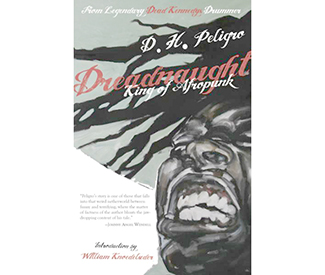
So Steven Patrick Morrissey, as he was known at birth, recounts a dark and uncomfortable childhood in Manchester, much of which was spun into early Smiths songs. But if we’re comparing horrific childhoods, another recent memoir might outweigh every aspect of Morrissey’s sad complaints: that of D.H. Peligro, whose own bio, Dreadnaught: King of Afropunk (Rare Bird Books, 280 pp., $13) came out in October.

Peligro — the complex, wild-man drummer of SF’s Dead Kennedys, as well as (briefly) Red Hot Chili Peppers, and guitarist in his own band, Peligro — grew up “dirt poor” in St. Louis, Mo., where he was born in 1959. (He literally eats dirt as a punishment in one section.) Like Moz, he now eats a veg-heavy diet. “All that food we had growing up in the ghetto was poison, drained of any nutritional value. Being forced to eat that food was one of the reasons that later in life, even when I was strung out on heroin, I remained a fanatic vegan,” he writes.

While the book opens with an extremely upsetting and grotesque strung-out hospital stay in a room with “puke green walls,” one of many incidents for the drug-addicted musician, it quickly falls backward in time to his beginnings as a “Satan’s Child,” the name by which he was known as around town. He never met his father, was mercilessly beat by his oft-drunk stepfather, and lived in a hotbed of violence and racial segregation in his early years.

And yet, despite all this, growing up in St. Louis also greatly influenced Peligro’s interest in music, and fostered a space in which to learn rhythm and blues. His beloved Uncle Sam Carr, who introduced him to musical instruments, was the son of blues guitarist Robert Nighthawk (who supposedly was the first to play slide guitar). Peligro recalls playing Carr some Dead Kennedys music years later and Carr “really listening” and nodding his head along to the noisy, Jello Biafra-led punk band.

Written in a poetic and reflective yet conversational style, Peligro’s tale stands out above most fast-living memoirs. The stories are vivid and disturbing, and the experiences run the gamut from the epicenters of Southern blues, to the influential early SF punk scene, to the costumed LA rock ‘n’ roll lifestyle. And yet, Dreadnaught still follows much of the standard course for the musician’s book tale: grew up poor, found shining beacon influencer, rose above, partied too hard, came down, and reflected.

And while there have been countless rocker memoirs in the past, only a small handful are worth your time — and there’s no time like now: It’s Thanksgiving week, and you’re likely itching for some quiet downtime, away from TVs filled with screeching sportscasters and your aunt asking you (if you’re in line with Moz and Peligro’s dietary habits) one more time: “Just how do you get protein?”

The top of any list should be Patti Smith‘s 2010 Just Kids. It’s eloquent and nonetheless gritty, with sinuous stories tumbling from her recollections and minute details beautifully recounted. The end made me ugly-cry crocodile tears while on Muni.

Like Smith, some musicians take the more introspective approach to their writing, revealing inner strength through the written word. For more of that nature, see Ronnie Spector‘s 1990 memoir, Be My Baby: How I Survived Mascara, Miniskirts, and Madness; or Bob Dylan‘s 2004 Bob Dylan: Chronicles, Volume One.

And then there’s Pamela Des Barres‘ groupie classic I’m With the Band. Oh, the torrid, gushy love tales within that book, of Ms. Pamela’s exploits with famous rock ‘n’ rollers from the 1960s right on up through the decades. Many years ago, over breakfast at a diner in Haight-Ashbury, Des Barres told me: “As far as wanting to meet the guys, I just couldn’t sit in my room and get all horny over Mick Jagger … it was just inside me to see where all that amazing stuff was coming from, that music.” If you’re in the mood for more scandalous tales of sex, drugs, and rock ‘n’ roll, these memoirs come highly recommended as well: Slash‘s Slash or Keith RichardsLife.

If you’re looking for an ironic, jokey, or food-based story, there’s Ian SvenoniusSupernatural Strategies for Making a Rock ‘N’ Roll Group, which I reviewed in an earlier column — noting that the book holds séances with dead rock stars to glean important information for the reader — and Cookin’ with Coolio: 5 Star Meals at a 1 Star Price, which includes a section called “How Coolio Became the King of Kitchen Pimps.” (Hint: his mom.)

Or there’s this year’s insta-classic “cookbook” — which really came as a download with the B.O.A.T.S 2 #Metime albumCooking With Two Chainz. It includes cooking tips like, “Put on your Versace apron.”


LIFE STINKS

Here’s all I know about Life Stinks: The band has a great name, was described as “brutal and mysterious” after SXSW last year; and makes throwback snotty punk songs. It also just released a self-titled debut LP on S.S. records. Listen to “Cemeteries” off said album for more reasons to see the live show. That’s all you need to know. This album release gig is the Friday after Thanksgiving; you’ll be stuffed, sick of family, and most definitely ready to shake along. Plus, one of the openers is messy and awesome high-pitched SF band Quaaludes — they sound like ’77 punk on helium meets ’92 riot grrrl, which is perfect. With Dancer. Fri/29, 9:30pm, $5. Hemlock Tavern, 1131 Polk, SF; www.hemlocktavern.com.


BREAD & ROSES BENEFIT

I was discussing the upcoming Kathleen Hanna doc The Punk Singer with a musician pal, and we got on the topic of the very real healing power of music. While Hanna is certainly not playing this event (sorry), that power translates broadly. Bread & Roses is a Northern California-based organization that knows this well, producing hundreds of free shows a year at hospitals, nursing homes, shelters, and treatment centers. This benefit is full-circle, benefiting the org so it can put on more shows, and offering up live local talent for you: sparkly piano rocker Marco Benevento (of Tea Leaf Green), acoustic folk singer-songwriter Megan Slankard, along with her band, the Novelists, and (((folkYEAH!))) Presents DJ Britt Govea. Sun/1, 8pm, $20–<\d>$50, Chapel, 777 Valencia, SF. www.breadandroses.org. *

From the ground up

0

arts@sfbg.com

DANCE Conceptual French choreographer Jérôme Bel thrives on conversation. Sometimes, he participates directly, as he did in Pichet Klunchun and Myself, in which he and Thai dancer Klunchun talked on stage. Performed at Yerba Buena Center for the Arts in 2009, the piece enchanted me with its daring theatricality and enraged me with its faux naïveté. Pichet was both sturdy like a rock and evanescent like a passing thought.

Bel has made it his task to ask questions and shake up concepts around performance. It’s the lingua franca in today’s academia, but Bel is an artist. After stripping away the hoopla around art making, what are we left with? What do we as an audience expect? What is a performer, both from our and his or her perspective? Is there room for virtuosity, or is that something to hide behind? Marcel Duchamp asked similar questions in the visual art realm 100 years ago; choreographer Pina Bausch engaged with them for most of her career.

Two performances during Stanford University’s current Festival Jérôme Bel opened a perspective on the way Bel deals with his dissecting knife — with utter skill, and yet also with a smile and an easy mind. Bel may not like creating steps for his performers because he wants to see the moving body stripped down to its laconic essence. Yet he is one hell of a choreographer.

As a backbone and a trajectory for his The Show Must Go On (presented at Stanford’s Memorial Auditorium Nov. 13), Bel — actually, his assistants — chose 20 non-dancers, plus a few professionals to spice up the mix. They gave them a series of Bel-chosen popular music selections on which to develop movement material; the songs often skirted that tenuous line between sentiment and sentimental.

The dancers carried themselves anonymously, looking as they would if you were to encounter them on the street. But at the musical cue, they jumped into action with individualized physical responses. Yet the parameters were as tightly set as anything you might want to see on a ballet stage. These performers may have appeared untrained, but they had 55 hours of rehearsal to look as ordinary as they did.

Much of Show’s appeal arose from its simple, even simpleminded sense of humor of acting out song lyrics — normally, an absolute taboo in dance. For “Let the Sunshine In,” the stage lights came up; for “La Vie en Rose,” the audience was bathed in rose hues; during “Private Dancer,” the DJ jumped into the limelight. You could feel the audience gradually relax into the setup. (I fully expected some to join in on “Macarena.“) But they needed more time. When the volume of “The Sound of Silence” repeatedly dropped off, the audience’s humming filled in the gap; they had entered the performance. Toward the end, each dancer expressed a piece of individually chosen music, heard over a headset. In the back, a group belted out “We Are the World,” while downstage, French-born Muriel Maffre croaked out a hoarse “Born in the USA” and Jesselito Bie moaned “Oops … I Did It Again.” Perhaps most surprising was that for all its easy viewing and entertainment values, The Show Must Go On rode on an undercurrent of wistfulness and melancholy.

On Nov. 18, the festival moved to the beautifully appointed Bing Concert Hall. It was not a good decision. Sitting toward the front center, I had to strain to hear former Merce Cunningham dancer Cédric Andrieux’s contemplation on both the man and the dancer called Cédric Andrieux. After the performance, I spoke with other audience members and learned that they’d also had difficulty following the dancer. Cédric Andrieux is an intimate show; it belonged into a more supportive environment.

Performances exist in time, and Andrieux (with Bel?) controlled every last second of his: the way he made eye contact with us and paced his narration; the time he took to change clothes or reenact a painful modeling gig. His life, loves, and professional stories became part of him, whether he danced excerpts from Cunningham or contrasting ones by Trisha Brown. He complained about the tediousness of a Cunningham class, yet he looked gorgeous in the exercise. His regret about “not ever getting it right” — which eventually he admitted to having figured out — was contradicted by what he showed. Awkwardness and difficulties are as part of art as they are of life. I think most artists know that; Andrieux showed it. *

PICHET KLUNCHUN AND MYSELF (A FILM)

Mon/2, 7:30pm, $10-20

Bing Concert Hall

Stanford University, Palo Alto

live.standford.edu

THE THINGS I HAVE DONE WITH DANCE: A CONVERSATION WITH JÉRÔME BEL

Tue/3, 11am, free

Pigott Theatre, Memorial Hall

Stanford University, Palo Alto

events.stanford.edu


Brawl fallout

4

D’Paris “DJ” Williams spent his day the same way many San Franciscans did Nov. 15, watching young Miles Scott, aka Batkid, rescue a damsel in distress to the cheers of thousands.

Williams, 20, then biked from downtown to visit relatives in the Valencia Gardens housing project in the Mission District. It was there, as the nation continued cooing over the caped crusader, that two plainclothes police officers pulled Williams onto the ground. Police said they initially pursued Williams into the housing complex because he was coasting his bike on the sidewalk, a traffic violation.

That’s when all hell broke loose.

Neighbors quickly came to Williams’ defense, fists at the ready. The ensuing brawl was recorded on video and quickly went viral nationally. Fast forward two weeks and two protests later, and Williams’ family has joined with prominent attorney John Burris to sue the SFPD, for allegedly using excessive force and violating Williams’ civil rights.

“The violence is the grave matter of the entire thing, and the illegal detention and subsequent arrests,” Burris told the Guardian. He has not yet filed suit.

As the video went viral, allegations of improper police conduct abounded. Police are now crying foul, too. SFPD Chief Greg Suhr called for wearable cameras for police officers, saying he’s confident that it would clear police of wrongdoing.

The question that haunts the community around Valencia Gardens, though, is not only about the use of force. Residents wonder if the police profiled Williams because he’s black.

Was he really stopped because of a traffic violation? Or was that just legal justification for the police to search him on suspicion that he was carrying a firearm or controlled substance, which would amount to profiling?


TWO SIDES OF THE STORY


D’Paris’ stepfather, Frank Williams, told the Guardian that his son was in disbelief immediately following the ordeal.

The elder Williams related the story DJ told him.

While walking to his grandma’s house in Valencia Gardens, DJ walked with his bike for a bit, then sat on it and scooted it with his feet. Some people he didn’t recognize got out of a car nearby, calling “hey come here, come here.” As Williams stood in the doorway, “They grabbed him by his jeans and pulled him out,” the elder Williams said. “They kept pulling on him, and he’s saying ‘What did I do? What did I do?’ as they started punching him on the side of the face, and dragged him out.”

The police shared a different version of the story with reporters.

The plainclothes officers, who remain unnamed, identified themselves as police and displayed their badges, according to the SFPD account. When Williams “failed to comply” with their orders to stop, they caught up to him and attempted to detain him.

“He became combative, resisted arrest, and multiple subjects came out of that residence and formed a hostile crowd around the officers,” said Officer Gordon Shyy, a SFPD spokesperson.

When the Guardian asked him to explain the officers’ actions in more detail, Shyy said he didn’t have that information. The SFPD did not make the incident report public, but Shyy had a copy.

The reason the brawl broke out remains under dispute, but what happened next was captured on video and posted to the Internet.

As the plainclothes officers tried to subdue Williams, a neighbor took a swing with a cane that nearly hit an officer. A policeman threw haymaker punches at a neighbor as bystanders shouted them down. In the end, Williams and three of his cousin’s neighbors were taken into custody.

Williams’ sister was there, too, watching them fight as she held her newborn.

Video shows the four men who were detained scraped and bloodied, and Williams was bleeding and bruised as the officers took him in. All were taken to San Francisco General Hospital.

Williams was charged with felony assault with a deadly weapon, which Shyy said was for biting an officer. He was then discharged pending further investigation, the District Attorney’s Office told the Guardian. Public Defender Jeff Adachi said the city doesn’t usually pursue such cases.

“The reason you discharge cases is, you can’t prove them,” Adachi explained.

While Shyy maintained that the officers pulled him aside because he was riding his bicycle on a sidewalk, those officers were outside Valencia Gardens for a particular reason. Part of a SFPD squad called the Violence Reduction Team, their unit is tasked with pulling guns off the streets.

“What were these guys doing stopping DJ for a traffic violation?” wondered Travis Jensen, a friend of Williams who publicized the incident on Instagram. It’s a fair question: The Violence Reduction Team isn’t exactly known for pulling over bicyclists.


GUN HUNTERS

AK47s, .45 handguns, semi-automatics, guns hidden in waistbands. That’s what the Violence Reduction Team seeks to do away with when they hit the streets.

SFPD spokesperson Gordon Shyy credits the team with a drop in citywide homicides. It has certainly been busy.

The Violence Reduction Team arrested 20 suspects during last year’s Fleet Week, a press release from the SFPD announced, touting the unit’s success. That Halloween, they nabbed six more guns. Just last month they made 10 arrests, pulling even more firearms off the street, Shyy said.

“The VRT officers were on their regular patrol for their shift, it had nothing to do with the Batkid event,” Shyy told the Guardian. “VRT is tasked to patrol high crime areas and conduct pro-active policing to prevent violent crimes from occurring.”

When asked directly if the officers stopped Williams because they suspected he had a gun, Shyy repeated that they lawfully detained him because he illegally rode his bicycle on the sidewalk. “If officers lawfully detain a person, and can articulate a cursory pat search of that person, they may do so,” he said.

When officers took Williams to the ground they did search him for weapons.

The Guardian contacted former Tiburon Police Chief Peter Herley, who previously served as president of the California Police Chief’s Association, to ask if plainclothes officers responsible for seizing guns would take the time to cite a bicyclist for a traffic violation.

“Generally they don’t do it, because it may blow their cover,” he said. “If the violation was grievous enough, maybe. Usually a plain clothes unit wouldn’t do it.”

Adachi put it another way. When a person is stopped for an infraction, “the expectation is there’s a ticket drawn up and a person is sent on their way.”

Based on what Shyy read to us from the police report, the officers at the scene seemed to enter the situation believing Williams could be armed. “Williams continued to resist by pushing his upper body against the sidewalk and tried to get to his feet. Williams was unhandcuffed and unsearched at this point. From my knowledge and experience I know this is a high crime area and people in this area often carry weapons. I believed if Williams were able to free himself from us, he may attempt to access a weapon.”

Ultimately the officers only found two things on D’Paris Williams: juice and a cupcake.


SHAKEN, BUT NOT DETERRED

Williams’ cousin Dave lives in Valencia Gardens. Dave, who refused to provide his last name because he feared retaliation, says Williams rode his bike to a Goodwill store that day to apply for a job. Dave, 36, invites some of his younger distant cousins, including Williams, over for what he calls a “positive hype.”

“They’re over here like every day. We have a big family, we’re very lovable,” he said.

Williams’ sixth grade science teacher, Norm Mattox, told the Guardian DJ was in school at City College, known as a young man with prospects.

“He’s someone we think can get out of the neighborhood, get out of the projects,” he said.

That’s why D’Paris was in disbelief too, his stepfather told us. “I did question my son about it. Why would they follow you? Explain this to me,” the elder Williams told the Guardian. He fears his son was targeted for being the wrong color, in the wrong place, at the wrong time.

That’s why Burris took the case. “The young people need to know there is a place to go, that you don’t have to accept this level of brutality by an officer,” he said. “The legal issues themselves, are an illegal detention, illegal arrest, and use of excessive force. [These are] federal civil rights violations.”

D’Paris took that to heart. The younger Williams told his father something had to change, that he was determined that something good had to come from this.

“He kept repeating it. ‘This has got to stop. Got to stop. Got to stop,'” the elder Williams said.

“It makes a dad proud to hear that.”

Heavy-duty problems

2

rebecca@sfbg.com

As a kid, Turcilo Caldera would climb into his father’s big rig and accompany him on runs to the Port of Oakland. “He would sit me on his lap and show me how to drive,” he remembered.

Originally from Nicaragua, Caldera came to California at age 5 and grew up in San Francisco’s Excelsior District. Now 30, he too is a trucker.

Speaking by phone around 8:30pm on a recent Friday, on his way to Stockton to drop off a shipment, he recounted how he’d arrived at the port at 5am and waited in line until 8:30am, only to move to a different line to pick up a load. “I ended up leaving the terminal around 10,” he said. That’s when he started getting paid.

Companies pay by the load, regardless of the time it takes to wait in line. Caldera works 12 to 13 hours a day.

He recently became a member of the Port of Oakland Truckers Association. It’s not a union, since truckers are classified as owner-operators rather than employees of the companies that hire them. Nevertheless POTA, which represents several hundred owner-operators, reflects the truckers’ attempt to ban together for better working conditions.

Truckers never know what they’re hauling, but it’s safe to assume that major retailers — Walmart, IKEA — are expecting shipments in advance of a holiday shopping blitz. While some companies anticipate a bump in profits, POTA and hundreds of other port truckers are facing potential job loss come New Year’s Day.

At a Nov. 22 meeting, POTA membership voted unanimously to begin a work stoppage at the port, starting Wednesday (11/27). “We don’t want to stop working, we need to make a living,” said Roberto Ruiz, a POTA member. “But this is the only thing they respond to.”

On Jan. 1, 2014, when new clean air regulations go into effect, hundreds of independent truck drivers will lose work as their vehicles fall out of compliance. They can’t afford to pay out of pocket for trucks that are compliant with new emission control regulations. Many face a tough time getting loans, and those who have dodged the bullet by securing a loan now find themselves in a worse financial crunch than before.

Many could be forced out of jobs completely. By the Port’s estimates, around 80 percent of the roughly 6,000 registered to service the Port are set to be in compliance. POTA estimates 800 truckers could be impacted.

POTA’s vote to stop work followed a series of meetings with Oakland Mayor Jean Quan and Deputy Mayor Sandré Swanson, as well as representatives from the Port and the California Air Resources Board (CARB) to try and hash out a solution.

In meetings, POTA asked city officials and CARB to identify funding to help those in danger of job loss retrofit their vehicles to comply with the clean-air regulations. They also proposed some solutions: They want fees billed to shipping customers for the time truckers must spend waiting in line for the loads they haul, to help offset the cost of buying and maintaining compliant trucks.

The Jan. 1 ban on older trucks is part of a broader effort to alleviate air pollution in surrounding West Oakland, where cancer and asthma rates are abnormally high. The Port’s system of loading cargo shipments results in long lines idling for hours, leading to a chronic congestion problem that has fouled the air. Before the problem was addressed, “Ports were where old trucks went to die,” explained Isaac Kos-Read, a Port of Oakland spokesperson. “Old trucks were the worst polluters on the road.”

West Oakland, known for its iconic shipping cranes, has traditionally been a majority African American neighborhood with lower income levels than the surrounding Bay Area. The demographic is beginning to change as comparatively well-heeled newcomers settle in, but it was an economically disadvantaged community of color who disproportionately bore the brunt of harmful air pollution for decades. Switching to low-sulfur fuel for shipping vessels has helped the port make drastic reductions in air pollution, but harmful emissions linked to asthma are still emanating from truck tailpipes.

The rule change will lead to what is indisputably an environmental improvement. But that benefit doesn’t have to come with the tradeoff of job loss. State funding was made available in 2011 to help financially strapped truckers afford new rigs or retrofits — but the funding has now vanished, and truckers who are late in pursuing compliance are finding doors shut all the way around.

In December of 2011, the California Air Resources Board made $58 million available to the owners of 2,100 trucks across California “to replace their retrofitted trucks with newer trucks,” Karen Caesar, a CARB spokesperson, explained in an email. About 1,700 of those could legally service the Port of Oakland.

The funding came from a $4.5 billion set-aside created by Proposition 1B, a transportation bond approved by voters in 2006. The $58 million was available for truckers who had installed filters to comply with an earlier regulation limiting diesel particulates.

In theory, the funding was enough to award all 2,100 trucks more than $25,000 apiece. That’s an amount that Frank Adams, an organizer with POTA, told the Guardian would be adequate for affected truckers to get compliant without going underwater.

But that’s not what happened. “Applications for 970 trucks were received,” Caesar explained, bringing the total funding request to $24 million. But in the end, CARB awarded grants to just 359 trucks, disbursing $10 million. The rest of the money was reallocated to other air-quality improvement programs, Caesar said.

And since the remaining funding is now gone, neither the city of Oakland nor CARB has come up with any other answers for the truckers. “We’ve been meeting with them on a regular basis to see if there are other funding sources,” Kos-Read said. “We want to help all the truckers.” But the meetings clearly haven’t been productive, since POTA’s staging a work stoppage during the busiest shopping week of the year.

CARB officials emphasize that truckers can still take road work even after they’re banned from ports, but Caldera says it’s not that simple. “If my dad were to decide to run up and down California, he wouldn’t be home like he is now,” he said. Road work means being away from home for possibly long stretches, and it’s unclear whether enough of those jobs exist to make up for the port jobs that will be lost.

The truckers represent a predominantly immigrant workforce, with many native speakers of Chinese, Punjabi, and Spanish. “Most of the truckers don’t speak English, let alone write good English,” Adams said. He guesses that’s why some didn’t apply for CARB funding.

Yet CARB officials say they sent out materials in various languages and held outreach events. As for those now trying to stave off job loss, “It’s not as if this blindsided anybody,” Caesar said.

Caldera’s truck is compliant, but only because he borrowed $50,000 from a relative to purchase the $72,000 rig, which replaced a 2006 truck purchased on loan. Today, “I’m still paying that loan, which is $680 a month,” he explained. “But it’s not as much as I’m paying for my new truck.”

Truckers’ financial problems go deeper. Caldera estimates that fuel costs eat up around 40 percent of his earnings. There are insurance payments, registration fees, maintenance and other associated costs, all borne by the truckers and not the companies that hire them.

As it turns out, selling cheap Chinese goods to American consumers is rather lucrative. Delivering said goods by truck is not, even though it’s integral to the business.

Then there’s the restroom problem. A Port a Potty was recently installed near the Port entrance, Caldera said, but it’s only a partial solution. Truckers aren’t supposed to exit their vehicles while they’re waiting. “If you decide to go to the bathroom you have to leave your spot in line,” but that just means more unpaid time sitting in line. “So we have to carry bottles in here,” he said. “These are awful conditions. This is something that I imagine in a third world country where people have no rights.”

Now, with a work stoppage looming, the truckers could also wind up entangled in legal problems since they have no union and no authority to strike. “It’s a complicated and unclear legal situation that they’re in,” said attorney Dan Siegel, who is advising POTA. “Because they’re ‘owners,’ they’re not considered workers under labor laws … they are subject to punishment for anti-trust violations.”

“They cannot illegally block streets,” said Kos-Read, the port spokesperson. “Our goal is to respect the trucker’s free speech rights and keep commerce flowing.”

On Nov. 21, POTA members visited the International Longshore and Warehouse Union seeking support. Clarence Thomas, speaking as a rank-and-filer of the ILWU Local 10, said union or no, the truckers deserve to be treated fairly.

“For many years, trade unionists have looked at those workers as having a sweatshop on wheels,” Thomas said. “We don’t want to see anyone at the Port being exploited.”


BART standoff continues as board modifies contract

1

The BART Board of Directors voted 8-1 on Nov. 21, with conservative young Director Zakhary Mallett in dissent, to approve a hard-won contract with its unions, after removing Section 4.8, the paid family leave section that the district says was inserted by mistake.

The motion also directed management to negotiate a settlement over that issue with its unions, which have already approved the contract and now must decide whether they are willing to do so again without that provision or whether the possibility of another BART strike is once again looming.

The next day, BART’s largest unions, SEIU Local 1021 and ATU Local 1555, issued a joint statement: “We consider the Board’s actions to be unprecedented and illegitimate, and we’re considering our next steps, including possible legal action. The BART Board of Directors has disregarded the vote of more than 2,000 BART workers and has chosen to subvert the collective bargaining process, and we take their actions seriously.”

After meeting in closed session for about two hours, Vice President Joel Keller began the open session with a motion to remove Section 4.8 from the contract, approve the rest, and direct management to negotiate with the unions.

Mallett, the 25-year-old newbie who lives in unincorporated West Contra Costa County but whose District 7 includes part of San Francisco, spoke first: “Even before this hiccup, I was not in the position to support this contract. I find it too costly.”

But he was the only one to take that stance, with the rest of the directors calling the underlying contract a fair compromise, even if all said they couldn’t support the paid family leave provision that would add anywhere between $4 million and $44 million to a contract that was already going to cost the district an additional $67 million.

Director Gail Murray noted that the unions had given up raises for years when BART had budget deficits, and now that the district is running surpluses, it’s reasonable to give workers raises that amount to about 2 percent per year for four years.

“Our employees kept the system going…They’re the reason why we keep 40-year-old cars still running,” Murray said, later adding, “To say this contract is not a good contract is wrong.”

The rest of the board agreed, even while acknowledging it is more than they hoped to pay given the district’s capital needs and aggressive expansion plans.

“We’re probably paying more for this than we anticipated we would pay, and labor is probably giving up more than they want to, but that’s the nature of collective bargaining,” Keller said, who also began what turned into a chorus of criticism for how district negotiators signed off on a provision the board never agreed to.

“We ended on a sloppy note and that’s regrettable,” Keller said, pledging that if he’s elected president next month — an ascension that is customary for the vice president — he plans to launch a full investigation into what happened.

“I’m pained that we put ourselves in such adversarial positions with each other and that we lost the lives of two employees,” Director John McPartland said of the protracted labor negotiations and the fatalities that occurred while the unions were on strike Oct. 19. He called the contract “more than fair and equitable.”

Director James Fang, who represents western San Francisco, sounded the strongest criticisms of BART management and negotiators. “Yes, it was a mistake, but nobody has come forward and said ‘there was a mistake and I’m responsible,” Fang said, later adding, “The ones who signed this must be held to account.”

Fang then went further, albeit without specifics, when he said, “Every bit of management advice we’ve received has not worked out to the district’s best interests.”

Director Robert Raburn echoed Fang’s calls for accountability: “I’m still not clear on how that [contract provision] arrived and it hasn’t been accounted for by anyone at the district who said ‘I am responsible.'”

But he also said that the provision was clearly an error and not something arrived at through the negotiations: “Both parties agreed on a $67 million package and we should keep that intact because it’s fair.”

Reached by the Guardian while union leadership was conferring to plan next steps, SEIU Local 1021 Political Director Chris Daly told us, “We are about as up in the air as we’ve ever been.”

He called it “unlikely” that union leadership would simply submit the board-revised contract to an up-or-down vote by union membership, saying that he doesn’t think it would be approved.

And Daly echoed the concerns expressed by several BART directors about how this mistake happened and why nobody has taken responsibility or been held accountable: “If I were on that board, I’d have the general manager’s head, there’s no two ways about it.” (Steven T. Jones)

SF General reduces psych care

A 22-bed psychiatric unit at San Francisco General Hospital will be taken out of service, and reopened only if the facility experiences a high caseload of patients exhibiting the worst signs of psychiatric crisis.

As of Nov. 19, five patients were receiving care in that unit, 7B, according to spokesperson Rachael Kagan. None had symptoms that rose to the level of requiring acute care. Instead, they were classified as sub-acute patients, a distinction that essentially means they didn’t present an immediate threat to themselves or others.

But under a new policy that will take effect after they have been released, all 22 beds in 7B will be closed — unless they are needed for acute patients who do reach that critical threshold. The unit will be staffed only if patients can’t be accommodated in the hospital’s other acute psych unit, which has 21 beds.

The decision was made in response to a changing financial picture under federal health care reform, Kagan explained.

“There is a big push … to ensure hospitals are only providing acute care,” Kagan said, and this trend is driving efforts to reduce sub-acute patients. “It fiscally makes more sense,” she added, because insurers pay higher rates for acute care than for lower levels of treatment.

Yet some hospital staff members are nervous about the implications of this shift, because it means fewer patients will be able to access psychiatric care at SF General unless they represent a danger to themselves and/or the general public — at a time when demand for these services is on the rise.

“To us, it’s a matter of priority for the city,” said Brenda Barros, an employee at SF General who is active with hospital union SEIU 1021. “Do you want to take care of these people, or don’t you?”

Some staff members are doubtful that 7B will reopen. An internal SF General memo issued Nov. 18 informed the 7B staff: “Our census will be gradually reduced until we won’t have any more patients. Then 7B will be closed.” The memo added, “this came from [SF General CEO] Sue Currin due to budgetary constraints.”

However, a second internal memo went out the following day, to “clarify” the first one. In that message, Nursing Director Kathy Ballou wrote: “We are not closing psych beds or any beds.” Instead, beds in 7B would be closed unless “we get acute patients needing that level of care,” she wrote. “As in other hospitals, we are accountable to our operating budget.”

Further complicating matters, said Barros, is that patients can fluctuate rapidly between needing acute care and a lower level of attention. “They absolutely can swing back and forth.” She added that patients initially requiring a lower level of care could experience worsening conditions if they’re unable to secure an appointment in time to get help, and delays are very common.

Kagan emphasized that the unit wasn’t being closed down, but did confirm that sub-acute patients would no longer be able to receive treatment in 7B. Instead, those patients will be placed with various service providers throughout the city, she said. “The goal is to move the patients to their appropriate placement.”

Meanwhile, this shift coincides with an overall rise in citywide demand for psychiatric services. According to a report delivered to the Police Commission earlier this year, SF General had 6,293 patient admissions for psychiatric holds in 2012, a sharp increase from 5,837 in 2009.

While there were deep cuts to the city’s Department of Public Health during the economic downturn, Mayor Ed Lee has recently trumpeted a boost to city coffers thanks to growing economic activity. But if the city’s financial health has improved, it seems odd that its safety-net hospital would be put into the position of reducing psych care due to budgetary pressures when that kind of care is sorely needed.

For Barros, it’s a matter of whether or not city officials will decide to allocate more funding for mental health services. “If they don’t have enough money in Public Health,” she said, “then they need to put more into Public Health.” (Rebecca Bowe)

We give thanks

0

EDITORIAL We offer a lot of criticism here on the Guardian’s editorial page, which is probably inescapable given the obvious failures of our political and economic systems to address the needs of the people and the planet and to uphold the progressive values that the Guardian and much of the Bay Area supports. We have so much potential, and it’s sometimes maddening when we fall short of realizing it.

So, this week, in the spirit of Thanksgiving, we’re going to put a positive spin on the civic scene and talk about some of the things that we’re thankful for.

We’re thankful to live in such a beautiful, vibrant place. San Francisco is one of the greatest cities in the world, both physically and culturally. And we’re thrice blessed to have Marin County and the East Bay — particularly the progressive and diverse cities of Oakland and Berkeley — just a short bridge ride away. Layer on top of that the nearby Sierras, Sonoma County, and the coastline from Point Reyes down to Santa Cruz and this is perhaps the best region on the planet.

We’re thankful to have a functional, modern transportation system that offers plenty of good alternatives to the automobile. While there’s certainly room for improvement, BART is an amazing transit system that closes the gap among the Bay Area’s many diverse communities, while Muni does a good job at ferrying huge numbers of people around this bustling city. Caltrain is a great link down the peninsula and we’re super excited to see it electrified and that transportation officials are working hard to connect downtown San Francisco to downtown Los Angeles with a long overdue high speed rail line. And we love how San Franciscans have embraced bicycles as an important everyday transportation option.

We’re thankful that so many smart, interesting, creative people have been drawn to San Francisco and its environs. This is home to recognized global leaders in pursuits ranging from technological innovation to progressive and environmental organizing and advocacy. We’re proud of the political initiatives hatched here in the Bay Area, from marriage equality to criminal justice reform. We have a cornucopia of artists and musicians tucked into every little nook of the city, from the stage of Slim’s to the studios of surreal Hunters Point Shipyard. And the locals here cook up some of the world’s best culinary offerings, from a plethora of fancy restaurants to quickie taquerias to surprisingly bountiful food trucks.

And we’re really thankful for you, the person reading these words. The Guardian has been around since 1966 because of the support of our readers, our advertisers, and our community, and we’re grateful that you’ve all given us the opportunity to offer the news, views, and reviews that are helping to shape this wonderful place. Happy Thanksgiving.


Why I’m resigning from the City College board

15

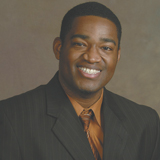
By Chris Jackson

When I worked for the state legislature, a member once told an overly ambitious guy that there are those who get into politics to be someone and those who get into politics to do something, and we have enough of the first type.

Serving on the City College of San Francisco Board of Trustees was always a means for me to work to connect underserved communities to education and eventually economic empowerment.

One of the first measures that I passed while on the board was to expand City College’s Community/Outreach Ambassador to the Mission and the Southeast campuses. Through this program, City College was better able to do outreach to underserved communities.

Be it by protecting CCSF’s GED program or child care sites, working with community leaders to continue to make the Mission campus an educational jewel to its residents, or working with Bayview advocates to ensure the Southeast campus’ survival and eventual growth, I came to the CCSF Board of Trustees on a mission to help ensure that our most vulnerable populations are given access to education as a means of equity.

Although I’ve had amazing success and even made a few mistakes along the way, I don’t want anyone to doubt my continued passion and commitment to the communities that CCSF serves. It is this passion to do something and not simply be a figurehead that has led me to the difficult decision to resign from the CCSF Board of Trustees.

The Accrediting Commission of Community and Junior Colleges, an unelected and publicly unaccountable organization, seeks to change the values and charge of City College from an inclusive, community-based and student-focused college to a simple junior college that serves the few and shares the values of the corporate education reform movement.

Even more disappointing has been our state Community College Board of Governors. Instead of performing its public-policy duties, the state Board of Governors, led by State Chancellor Brice Harris, has continued to allow itself to be bullied by the ACCJC to the point where there is a serious question of who really sets public policy for the 112 colleges in our statewide system: our publicly appointed Board of Governors or the unelected, unaccountable private ACCJC.

It pains me to see the scope of our class offerings pared back, our community-based campus continually threatened with closure, much-needed academic counselors laid off, and our Second Chance program for ex-offenders with an over 900-student waiting list. It pains me even more to be sidelined by Harris and our public Board of Governors and watch them shrink and cower to the power of Barbara Beno and her private ACCJC.

But in the face of this challenge to our public education, I see hope. Students like Trustee Shannell Williams, Student President Oscar Pena and former Trustee William Walker rallying students to stand up for their public education give me hope. The American Federation of Teachers Local 2121 and the Save CCSF coalition have become rallying points not just for the immediate CCSF community, but for the larger SF community. Their bravery in the face of the withering attacks on public higher education should be commended and be a model that others should follow. At this moment, there exists the base for a long-lasting coalition of students, educators, and community fighting for the high-quality, affordable education.

Thank you for the opportunity to do something to make an impact in people’s lives. Thank you for allowing me the opportunity to serve on the City College of San Francisco Board of Trustees.

Chris Jackson was elected to the CCSF Board of Trustees in 2008.


More than a memorial

16

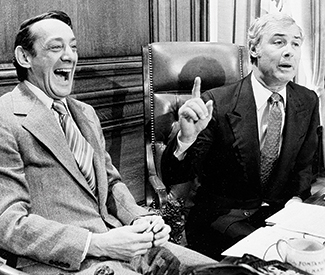
When Mayor George Moscone and Sup. Harvey Milk were assassinated in their City Hall offices on Nov. 27, 1978, San Francisco changed in innumerable ways. Among those ways is the city lost two of the leading progressive advocates for renters and affordable housing ever elected here.

Today, as San Franciscans mark this tragedy with their annual memorial march, organizers and activists have broadened and elevated the event by enlisting the support of 20 community organizations now doing work to combat the eviction, gentrification, and affordable housing crises that are gripping the city.

“We wanted to make this even more than just a candlelight vigil,” David Waggoner, one of the organizers of the event, told the Guardian. “We want to use this time to remember Harvey and George’s legacy in really fighting for the underdog.”

He noted that attendance at the march has waxed and waned from year to year, but the coalition putting this one together promises to have a strong turnout this year because of the surging progressive activism around housing issues and the need to organize the community to save the soul of the city.

“There is very little to stop what’s happening with the rapid gentrification,” Waggoner said, but he also noted, “By building coalitions, the same way Harvey and George did, we can fight.”

“We’re not only honoring the history of Harvey Milk and George Moscone, but we’re honoring their legacy by making them relevant today,” Brian Basinger, head of the AIDS Housing Alliance/SF, told us. “The Milk March is going to be very exciting. We have over 20 community groups invited and helping us put it together.”

Basinger said the progressive activism will continue through the 25th annual World AIDS Day on Dec. 1, and that participants in both events will be asked to present their demands to the city for dealing with the AIDS and housing crises. That list will be presented at City Hall during a noon rally on Dec. 2.

He said that affordable housing issues are LGBT issues given that nearly 30 percent of the city’s homeless population identifies as LGBT, while that identification makes up just 15 percent of the overall city population.

“Those of us who are lucky enough to talk to the folks who knew Harvey remind us that it’s about coalition-building,” Basinger said, noting that many of Milk’s contemporaries are now being forced to leave the city by evictions or economic displacement.

One voice from that era who is still around and active is gay activist Cleve Jones, who was an intern in Milk’s office at the time of the assassination and wrote a poignant guest editorial in the Nov. 21 issue of the Bay Area Reporter about what Milk and Moscone advocated.

“They fought for renters, honored labor, and built coalitions to connect, not divide, us from each other,” Jones wrote. “They would, I’m sure, be pleased by the progress that has been achieved on some of the issues they cared about. But they would be alarmed by the growing chasm between rich and poor, they would be angered by the evictions of the elderly, disabled, and people with AIDS. They would be fighting to keep City College open and they would be outraged by the violence and despair experienced by so many in our city’s neighborhoods.”

Organizers of the event say they think this is just the kind of memorial that Milk and Moscone would have wanted.

“We want the housing crisis to be front and center,” Waggoner said. “We want this to be a time for people to connect with the legacy of Milk and Moscone in a very direct way.”

The march begins at 7pm in Milk Plaza, Castro and Market streets, and continues with a rally outside City Hall.


Family album

0

arts@sfbg.com

THEATER Forgetting can be a key to understanding, and to freedom. This is something any jazz musician knows. Learning theory, practicing scales, getting to know your instrument and your craft — it’s all prelude to forgetting, to letting go. What comes back to you in the moment, ideally, is deeper than any superficial knowledge. It’s everything behind the music — a life.

A memory play can function similarly, at least it seems to for Margo Hall. The well-known Bay Area actor and director found herself improvising over her own carefully crafted words in the creation of Be Bop Baby — a musical memoir of her remarkable Detroit upbringing under the guiding influence of her musician stepfather Teddy Harris Jr., that Hall says really marks her debut as a playwright (Hall was also one of several actor/co-writers for the 2005 verbatim treatment of the Jonestown tragedy, The People’s Temple).

A world premiere capping Z Space’s 20th anniversary season, Be Bop Baby is set in the busy basement of Hall’s childhood home, which doubled as a rehearsal space for her stepfather — a musical director, composer, arranger, and performer known and respected in both jazz and Motown circles (the latter as, most famously, musical director of the Supremes). There, as well as throughout Detroit’s exceptional musical scene, Hall and her two sisters grew up amid a panoply of musicians, artists, celebrities, and eccentrics.

The basement thus becomes the site of an excavation, filled with colorful characters and anecdotes and brimming with music. Indeed, helping to bring it all to life onstage is a 15-piece jazz orchestra under Marcus Shelby. The acclaimed Bay Area musician-composer — along with dramaturg Nakissa Etemad — collaborated closely on this return to 1960s-70s Detroit, developing arrangements around Hall’s own lyrics and the melody lines she imagined for them.

“Marcus reminds me a lot of my dad,” says Hall, speaking just before a rehearsal last week. “He has a big band; he knows what that means. He understands the discipline of the musicians. Marcus is a guy of tradition. He likes real instruments — I mean all of these things that my stepfather would promote. And he’s just a cool cat, just like my dad, just into the music fulltime; a real, honest, true musician. Growing up with that kind of person really taught me about authenticity and not faking it. I hate to say, ‘You don’t find those people anymore,’ but they sometimes can be a rare breed.”

But even memory, to remain true, can’t always stay fixed. Since the death of her mother in 2000, and Teddy several years later, Hall’s childhood home and its once-vibrant basement have come under a new tenant: Hall’s own, formerly estranged, biological father.

“It’s this crazy thing that happened that I never expected. My real father and my mom divorced 45 years ago. [My biological father is] a free spirit; he’s a totally different character than Teddy. And I found out he moved into Mom and Teddy’s house. Mom and Teddy, that was their house, that was their basement, my mom’s estate, you know, our little two-unit duplex.”

That development found its way into the emotional landscape of the play itself, giving it a more complex dramatic makeup, but also leaving Hall at a loss as to how to channel it all. Staging this kind of dynamic seemed to defy the manicured sentences she had set down on paper. Hall found herself unable to even recall them — something unusual for the experienced actor in her — as if Hall the playwright were someone she had yet to figure out.

“I had written all this text, and I couldn’t remember it. It was very strange. So I said, ‘Can I just improv a little it on top of this text so that it really feels authentic?’ I became the actor, and I felt, ‘I don’t like what that playwright wrote!'” she laughs. “Was I censoring myself? Was I trying to be perfect in the writing? I had to figure out how to take that text and make it my own — even though I wrote it. Now, the more we do it, I do say a lot from the text. But it’s a freedom that I have now, where I can be more authentic in the moment.”

As for her ongoing relationship with her biological father, Hall credits Be Bop Baby with strengthening her resolve to pursue an understanding there.

“It’s definitely made me realize that I do need to pursue my relationship with my real father more than I have,” concludes Hall. “And he’s a wonderful, fascinating man. I could write a whole play about him too,” she says with conviction, before an afterthought makes its way quietly to the surface. “Maybe I will?” *

BE BOP BABY: A MUSICAL MEMOIR

Wed/20-Thu/21, 7pm; Fri/22-Sat/23, 8pm, $25-75

Z Space

450 Florida, SF

www.zspace.org


Gray days

3

arts@sfbg.com

TOFU AND WHISKEY New DIY record labels? Minimalist two-person ukulele bands? These are not the signs of fast-paced, modern, glossy hi-tech lifestyles. While San Francisco is at a crossroads, on the verge of an identity crisis splintered throughout many a start-up, at least a few of SF’s musicians (and likely plenty more) have made an artist’s leap farther north to even grayer Portland, Ore.

Magic Fight’s Alex Haager is one of those expatriates. He started a new indie label — Breakup Records — and moved to Portland with his partner, Sierra Frost, another musician, from the bands clintongore and Downer Party. “It’s a great place for music and a great place to live if you make less than 200k a year. And we like the rain.”

They started the label last month with an indeterminate interest in dreamy, brainy pop acts. There are already plans to release records by Frozen Folk, Magic Fight, Jesus Dude Mom, and a few more in the next six months or so. Right now, the roster of acts soon to be rolled out is all from the Bay Area.

“We each have tight relationships with some great independent bands whom we have worked with in different capacities over the years,” says Haager, from his newish home in Portland. “Our goal is to help grow the bands that inspire us — especially musicians with approaches and aesthetics that we find interesting within the realms of what can be considered pop.”

“Frankly, we’re both underwhelmed by garage rock. We plan to release records that offer an alternative to the overly nostalgic, blasted out stuff that has become so prevalent in California in the last 10 to 15 years. We want to showcase what the West Coast sounds like to us.”

One of the label’s first releases will be the debut EP of Kitten Grenade, a deceptively named duo made up of old-timey vocalist-ukulele player Katelyn Sullivan and drummer Ben Manning. Breakup previewed it with a single release a few weeks back, for a song titled “Gray.”

The minimalist pop track is arresting — occupying a space between bright and dark, it’s both melancholy and lightly fluttering over heavier vibes, with much of those emotions pinned to Sullivan’s jazz-inflected vocals. “That was very intentional,” says San Francisco’s Sullivan, who lives in the Mission. “‘Gray’ started out being about my inability to make decisions, and is another play on opposites; it felt like a great song to pick as our first single.”

The video for the track, shot in black and white, similarly plays with light and dark shadows. It features crisp repetitive images cropped in closely around Sullivan’s face and bare shoulders, and dancing orchids and roses twirling around her. Like Georgia O’Keeffe’s storied paintings, the close-ups of the flowers can resemble female sexual organs, in particular the still from the video that was chosen for the cover of the single.

“In a way, the orchid in the image — with its vaginal undertones — could represent purity, which then fades into the muddled gray of the real world in the background. Using it as the cover wasn’t so much planned as it was a happy accident. It’s an image that happened to be in our video that really resonated with me,” Sullivan says.

The full four-track debut EP, Nice Day, on Breakup is coming in January 2014. Sullivan — who calls Philz Coffee, the Phone Booth, El Rio, and Hog and Rocks her favorite local spots — says the album title references her experience with drummer Manning when they were recording during the “beautiful San Francisco summer we had this year.”

So why go with a label full of SF ex-pats? Turns out Sullivan played music with Frost before, in her previous ukulele band, Hate Factory. “[I] have always admired her smarts and knowledge when it comes to music,” says Sullivan of Frost. “Both Alex and Sierra are working musicians, but they’re also excellent at playing a supportive creative role. In terms of building my band, they’ve really helped me realize what’s in my head when on stage, in the studio, and representing myself out in the world, which can be hard and weird. It’s wonderful to be a part of something during its beginning stages.”

Sullivan, whose long-running influences are Fiona Apple and Joli Holland, got her own start doing musical theater on the East Coast. She came to California to study visual arts and later began writing music. She met Frost around then and they formed Hate Factory, another charming act with a defiant name: “Although most people who hear the name Kitten Grenade imagine shredding guitars and screaming metal ballads, it really does fit the theme of our little indie folk band. The name has actually been with me for a long time, and was the name of my thesis project in art school. Kitten Grenade in itself is all about juxtapositions and opposites. I really like names that trick you.” she explains. “I mean, when you hear the name Hate Factory, you don’t think of two cute girls playing ukuleles.”

While Sullivan and Manning await the release of their EP on Breakup, they’ll play a few local shows including opening the BFF.FM launch party for the new local radio station Best Frequencies Forever, with the Happy Hollows next week (Nov. 27, 9pm, $10. Bottom of the Hill, 1233 17th St., SF. www.bottomofthehill.com.)

“If you haven’t seen Kitten Grenade yet, you definitely should,” says Haager. “She’s basically an angel.”

As for Haager’s concert schedule, he’ll flee the life of Portland comfort momentarily for the Bay Bridged’s annual Bay Brewed festival Dec. 7 at Public Works. Also, he too is looking forward to a new release through Breakup: a split cassette EP with Oakland-based Frozen Folk. And of course, he’s excited about Kitten Grenade’s debut.

“It’s simple and elegant and will encourage you to fall in love.”


WORLD MUSIC MAYHEM

Longstanding global music-mashers Dengue Fever (of LA) and New York City’s Balkan Beat Box (originally from Tel Aviv) both arrive in SF on extended tours this week. Led by Cambodian singer-songwriter Chhom Nimol and guitarist Zac Holtzman, Dengue Fever will release its Girl from the North EP Dec. 3 — its first release in more than two years, on its own label, Tuk Tuk Records. It plays the Independent this Thu/21 with locals Seventeen Evergreen (8pm, $18. 628 Divisadero, SF. www.theindependentsf.com). BBB is releasing new videos, including one for “Suki Muki,” a single off 2012’s Give (Nat Geo Records), and a remix of “Suki Muki” by Ori Kaplan’s alter ego DJ Shotnez. It plays with Canadian Bhangra-Celtic fusion act (really) Delhi 2 Dublin at the Regency Fri/22 (8:30pm, $27. Regency Ballroom, 1300 Van Ness, SF. www.theregencyballroom.com).


House party

8

arts@sfbg.com

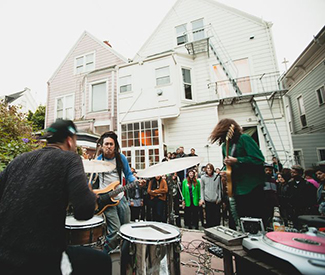
MUSIC It was decided — my BFF-roommate and I would host a rock ‘n’ roll show, and like many of our favorite activities (feasting, boozing, twirling), we became set on throwing said party from the comfort of our own home. Denying our fears of venue hunting, financial commitments, and general hassle, we focused on the power rewarded to the classic hostess with the mostest; the ability to control all elements of a dirty bash and adjust them to our liking.

What bands will play? Ones we like, who also like each other. What kind of liquor will be present? Whiskey, no exceptions. What kind of snacks might we serve? None, people should bring us burritos (or in my case, homemade kimchi and quinoa — a foul smelling food for a social event that did wonders for curbing my potential hangover). Not only was this party to be at our house, but this little rock shindig would blast from our backyard on a (hopefully sunny) Sunday afternoon. Day drinking to shredding guitars? The neighbors were going to love it.

We nailed down a date and who would play, rounding out the bill with some hip DJ acquaintances. A buddy drafted a flier and the process of inviting humans began. The presence of close friends was expected and offers for help were not denied. Then we cast the net, awkwardly approaching yoga teachers, favorite baristas, local celebrities, and secret crushes. The boyfriend promised to roll deep with eligible males of various sexualities and I may have plotted some (later to be discovered unsuccessful) matchmaking. We urged bands to cart along their musician homies and peed at the thought of John Dwyer or Wymond Miles walking up our stoop in the halo of afternoon light.

Of course we had no legitimate way of predicting who would actually show up. Expect everyone who confirms to flake and everyone who rejects to bring a pack of wingmen. We crossed our fingers and braided our hair, then calmed our nerves by remembering that even if all bailed, the bands were confirmed. A show in our yard is still a show in our yard. Guaranteed win. Oh yes, and we had a fuck-ton of beer — free of charge. We miraculously managed to get the party “sponsored,” which allowed us to collect donations for the dudes on stage. Major bonus.

While party planning seemed to be sailing, our biggest concern loomed: the noise complaint. A similar party we hosted in June garnered 22 calls to the SFPD — thankfully our only injury was a slap on the wrist and some sneers. In anticipation of upset, I baked a batch of chocolate chip cookies from mom’s recipe and skipped up the stairs of the neighboring stoop, treats in tow.

With the oldies next door sugared up, I called the SFPD for the lawful scoop and learned that cop arrival is completely tattletale-based. Officers can only issue a citation if the party pooper signs a citizen’s arrest. This is why you ALWAYS INVITE THE NEIGHBORS. If the uniforms still rap on your door: answer it, shoot the shit, and promise to cool it, ASAP. Our biggest takeaway: short sets. By the time the doorbell rings, they’ll be singing the encore. “It’s their last song, officer. I promise,” perfectly compliments a drunk wink.

So, after weeks of planning and a morning full of chaotic setup, we were crazy high on anticipation. I forgot to shower. I drank everyone’s coffee. I zoomed down the block for incense — “to set the mood,” I shouted. And then all we could do was wait for the madness to begin.

Heads banged. Hair was tangled. Happiness was found at the bottom of countless empty cases. People climbed the fire escape for a better view of the bands, while my exes pleasantly mingled in the garden below. The cops dropped by, as anticipated, but left without trouble. My dream of getting a mug shot will have to wait.

The freedom of a privately hosted show put everyone in a tender mood and it felt overwhelmingly blissful to support local music in independent fashion. The party was a complete success, depending on how you measure extreme happiness and unfathomable coolness. And OK, we were hammered. Everything is a delightful blur and I ended up wrestling in the gravel. You can do what you want at your own house — people can’t say shit. All the more reason why we’re already planning the next round. See you there.


Gobble online

2

culture@sfbg.com

FOOD AND DRINK As Thanksgiving nears, along with the daunting task of writing up the grocery list, more food-savvy family chefs are swapping the commercially manufactured Broad Breasted White for a heritage turkey, which promises better flavor through a higher standard of bird life. Famous local grower Bill Niman of BN Ranch is trying to give his free-range, GMO-free, organic heritage birds a wider audience by offering them for order: starting at $98.98 for an eight-10 pound bird, delivered anywhere in the US, through his website, www.bnranchtotable.com. We caught up with him to ask what all the cluck’s about.

SF Bay Guardian What breeds of heritage turkey do you raise on BN Ranch?

Bill Niman Narragansett, Standard Bronze, and Spanish Blacks.

SFBG What is an average lifespan?

BN From hatching to market, probably 28 weeks.

SFBG How many do you raise for one holiday season?

BN This year we have about 8,000 heritage turkeys.

SFBG What do your turkeys eat?

BN It’s a GMO free ration. We’ve been struggling for about three years now to get something that’s GMO free, and this year we were able to do that 100 percent.

SFBG The other distinguishing factor of heritage turkeys, besides lifespan and feed, is their ability to mate on their own?

BN As extraordinary as that might sound. [Laughs.] And they can fly. And they don’t get sick. And they’re hearty. And they’re interesting, and intelligent. It’s all the things you’d expect from any animal in the barnyard.

SFBG What’s the basic personality of a heritage?

BN Turkeys are really cruel to each other, in the pecking order and whatnot, surprisingly cruel — but they’re really friendly to humans. When they’re young, 6 to 8 weeks old, they fly up and land on your shoulder, they follow you around, and in a sense we become surrogate mothers. You can call, and they follow you. I suspect these turkeys that we raise are so close to being feral, they’re so much like their wild ancestors. They could fly away anytime they want to. But they waddle up to the building, and say, “Kill me and eat me.” That’s probably how turkey became part of Thanksgiving, because they’re ready to be eaten in the fall.

SFBG How do you manage to see the turkeys as both animals and as meat?

BN You mean sending them to slaughter? Well, it is difficult, and it doesn’t get easier with numbers. What’s important is to make sure the animals only have one bad day on the farm. For me and our operations, it’s essential that we are at the slaughterhouse, making sure that it’s done as properly and as humanely as possible. We do that because we respect the animals, but we also know that there’s a very direct correlation between the eating quality of the animals and their temperament at slaughter.

SFBG What about flavor?

BN They rule in taste tests, the heritage turkeys. The entire bird, even though it has a white breast, has the wonderful characteristics of the dark meat.

SFBG Got any favorite Thanksgiving preparation?

BN Yes I do. You cook the turkey till the breast meat is done, take it out, remove the leg and thigh, put them back in covered, and roast them for an additional half an hour, while the breast stays on the carcass on the counter, warm and covered.


Born to lose

0

By Dennis Harvey

arts@sfbg.com

FILM Alexander Payne may be unique at this point in that he’s in a position — which, of course, could easily be changed by a flop or two — of being able to make nothing but small, human, and humorous films with major-studio money on his own terms (re: casting and final cut). As he’s said, in a better world this would be the norm rather than a singular achievement. It’s hazardous to make too much of a movie like Nebraska, because it is small — despite the wide Great Plains landscapes shot in a wide screen format — and shouldn’t be entered into with overinflated or otherwise wrong-headed expectations.

Still, a certain gratitude is called for. As usual, most of the year’s better films have been ones (too indie, too foreign) that won’t get the big drumbeat of awards-consideration thumping. And notably this year, most of the ones that will have been American movies made by foreign directors (i.e. Gravity, Dallas Buyers Club, 12 Years a Slave, Prisoners, etc.) Nebraska is, finally, a win by the home team.

It is also the first time Payne and his writing partner Jim Taylor weren’t involved in the script, and the first one since their 1996 Citizen Ruth that isn’t based on someone else’s novel. (Hitherto little-known Bob Nelson’s original screenplay apparently first came to Payne’s notice a decade ago, but got put off in favor of other projects.) It could easily have been a novel, though, as the things it does very well (internal thought, sense of place, character nuance) and the things it doesn’t much bother with (plot, action, dialogue) are more in line with literary fiction than commercial cinema.

Elderly Woody T. Grant (Bruce Dern) keeps being found grimly trudging through snow and whatnot on the outskirts of Billings, Mont., bound on foot (he’s no longer allowed to drive) to Lincoln, Neb., 900 miles away. Brain no doubt fuzzed by age, not to mention decades of drinking and tuning out the Mrs. (June Squibb as Kate, who in a moment of restraint greets his latest forcible return with “You dumb cluck!”), he’s convinced he needs to collect the million dollars waiting for him there. After all, he got a notice he’d won that amount in the mail. Never mind that it was just some Publishers Clearing House-type flier in fact promising nothing while attempting to sell magazine subscriptions. Woody didn’t read the fine print, and won’t be dissuaded. Something bigger than reality — or senility, even — is compelling him to make this trek. Finally, long-suffering younger son David (Will Forte), a stereo salesman whose girlfriend of two years just moved out, agrees to drive him in order to simply put the matter to rest. None of this will be particularly easy or pleasant, even if David is used to dad being problematic (or as Bob Odenkirk as older brother Ross puts it, “[He] never gave a shit about us”). Perhaps selectively deaf, Woody is no conversationalist, and claims that he’s sobered up are quickly dashed when he stumbles into their first-night motel room and bashes his head in the dark, requiring stitches. This fool’s mission acquires a whole extended family-full of other fools when father and son detour to the former’s podunk farming hometown.

There, a slew of Grants — the men all close-mouthed, the women all gabby — prove eager to believe Woody has struck gold, coming up with variably imaginary reasons why they should share in his newfound wealth. Likewise greeting this reunion with eyes full of dollar signs is Ed Pegram (Stacy Keach), a former business partner who by Woody’s reckoning has actually owed him money for 40-odd years.

Nebraska has no moments so funny or dramatic they’d look outstanding in excerpt; low-key as they were, 2009’s Sideways and 2011’s The Descendants had bigger set pieces and narrative stakes. But like those movies, this one just ambles along until you realize you’re completely hooked, all positive emotional responses on full alert. There are minor things to quibble about (mother Kate could be less of a shrew — it’s always a bit bothersome when the only significant female role in a movie evokes the “b” word), but so much that’s so deeply satisfying you hardly want to get out of your seat at the end.

Having apparently considered and bypassed bigger names (like Jack Nicholson, who for my money was too snarky — too Jack Nicholson — for 2002’s About Schmidt), Payne has a perfect cast, from 1970s almost-stars Dern and Keach to pliant-faced comedians playing straight Forte and Odenkirk. Forte (who also does good dramatic work in another upcoming seriocomedy, the Irish Run & Jump) in particular does the kind of ballasting act that attracts little attention to itself but perfectly harmonizes with other actors’ higher notes. We can feel how David has probably always undervalued himself, as well as how his wishing the people around him were kinder just might, eventually, make them so.

It’s a great pleasure just to watch the timeless flat vistas — timeless because these characters stayed behind in towns everybody else has been leaving for decades — of Phedon Papamichael’s photography, which recalls other great black and white rural movies of the color era like Hud (1963) and Paper Moon (1973). Nor should anyone overlook the soundtrack by Mark Orton of SF’s own Tin Hat, whose other members also contributed to an acoustic score that at an unusual moment of high-profile movies dominated by American roots music — neotraditionalist 1960s folk in Inside Llewyn Davis, bluegrass in the Belgian Broken Circle Breakdown — feels at once the most modest, effective, and emotionally authentic derivation of the lot.


NEBRASKA opens Fri/22 in Bay Area theaters.

Out of the fog

0

cheryl@sfbg.com

FILM In movies, maybe more than in life, trouble awaits outsiders who poke into cults that don’t take kindly to outsiders. Sound of My Voice (2011) is a recent example, but The Wicker Man (1973) remains probably the gold standard of “Pardon me, but I’ll be infiltrating your society, passing judgment, and suffering the inevitable consequences” cinema. For every recruitment-happy group (step right up, young ladies, and throw your lot in with 2011’s Martha Marcy May Marlene), there are plenty more that would just as soon be left alone.

A new entry into this genre, Holy Ghost People, comes courtesy of Mitchell Altieri, half of the directing duo known as the Butcher Brothers (the other “brother,” Phil Flores, co-wrote and co-produced). You may remember the BBs from their 2006 breakout, The Hamiltons — about a family with a bloody secret. It’d make a perfectly nightmarish double-feature with another recent indie horror, Jim Mickle’s We Are What We Are. Holy Ghost People, which borrows its title and some archival footage from the 1967 documentary about Pentecostal churchgoers in West Virginia (now in the public domain, it’s viewable on YouTube), aims more for dread than gore, and represents an artistic step forward for the San Francisco-bred pair.

If certain choices don’t entirely work (a bookending voice-over feels unnecessary, given the film’s vivid visuals; the score can feel intrusive at times), Holy Ghost People is bolstered by some blistering performances, chiefly from co-writer Joe Egender as Brother Billy, the boyish leader of a church compound tucked into the Southern wilderness. (The film was shot at a summer camp — a setting not used so creepily since the first few Friday the 13th flicks.) Stumbling not-so-innocently into Billy’s lair are unlikely friends Wayne (Brendan McCarthy) and Charlotte (Emma Greenwell), who pretend to be spiritual wanderers when really they’re searching for Charlotte’s long-lost sister, last seen spiraling into junkie oblivion.

Anyone — but particularly Billy, whose tidy pompadour and welcoming words can’t hide the fact that he’s as sinister as the serpents he handles during sermons — can see that Wayne, a haunted alcoholic, and Charlotte, who’s battling her own demons, aren’t who they claim to be. Still, they’re cautiously accepted by lower-ranking members, including Sister Sheila (Cameron Richardson), a soft-spoken blonde whose beauty is marred by prominent facial scars.

As events get freakier in God’s country (or is it?), Holy Ghost People doesn’t quite offer a grand payoff to all that suspense — though it does establish a new clause to that old cinematic rule about guns: If you see a poisonous snake in the first act, damn certain it’ll bite someone by the end.

Holy Ghost People kicks off the San Francisco Film Society’s fifth annual Cinema By the Bay Festival, which showcases movies made “in or about the Bay Area,” as well as works made by artists with Bay Area connections. This agreeably loose thematic structure allows the Tennessee-shot Holy Ghost People to share marquee space with SF-centric doc American Vagabond, by Finnish director Susanna Helke.

American Vagabond, about homeless LGBT youth, is particularly timely in light of the SF Board of Supervisors’ recent vote to close parks overnight. Golden Gate Park is home for James and Tyler, a young couple who’ve fled their close-minded families, dreaming of a better life in the rainbow capital of California. Guided by James’ poetic, confessional narration — as well as other voices that chime in to share their experiences — American Vagabond is a specific, deeply personal story that also offers a broader comment on how gay youths and the homeless are treated, even in a city as progressive as SF. And it does take some unexpected turns, as when James reunites with the family that rejected him — though the reasons for the reconciliation are not happy ones.

Elsewhere in the fest, take note of Berry Minott’s The Illness and the Odyssey, a medical whodunit of sorts that explores the history and controversy surrounding Lytico-Bodig, a neurological disease found almost exclusively in Guam. For years, scientists have believed that finding its cause would be like “a Rosetta stone,” according to Dr. Oliver Sacks, resulting in cures for Alzheimer’s, Parkinson’s, and related illnesses. But since nobody can settle on a hypothesis — is it infectious? Caused by plants? The result of a curse? — and nobody really wants to share research (what, and let that Nobel Prize slip away?), there’s been little progress other than clashing speculation, to the great annoyance of those in Guam whose families are affected by the disease. Ultimately, The Illness and the Odyssey is more about the scientific process than anything else, with plenty of prickly personalities (in both current and vintage footage) stepping up to share their views.

Also worth a mention: In Hak Jang’s The Other Side of the Mountain, a Korean War-era romance (with musical numbers) that happens to be the first-ever North Korea/US cinematic co-production. And don’t miss “Street Smarts: YAK Films’ Dance Then and Now,” an Oakland-born phenomenon that has spawned a international array of films showcasing so-called urban dance — staged on subway cars, in intersections, and other unexpected places — of the most limber, slinky, sassy, acrobatic, and awe-inspiring varieties. *

CINEMA BY THE BAY FESTIVAL

Fri/22-Sun/24, $10-$25

Roxie Theater

3117 16th St, SF

www.sffs.org


Pop shop

0

arts@sfbg.com

DANCE For an event with a reputation for wall-shaking energy, the first program of the 15th Annual San Francisco International Hip Hop DanceFest turned out to be an oddly muted experience. The mix of acts — which in the past has always opened new perspectives on an art that has moved from the street onto the stage (and even reality TV) — simply wasn’t potent enough. Also, with only one company from abroad, the evening just barely warranted its claim of being “international.”

But even though the program disappointed as a totality, it did include individual acts of quality. In an aesthetic that so often emphasizes virtuosic use of the torso and the legs, Struggle for Pleasure — from a sextet of dancers of the London-based Far From the Norm Company — captivated because of its gentle and controlled employment of the arms. They snaked, embraced, and coiled into tendrils, perhaps embodying the human spirit, maybe with a sense of longing. Performed to violins, the choreography, much of it presented as a group endeavor, dipped the dancers into a hypnotic state in which they froze or tried to break open. One of them readied himself for a sprint that never happened. Another exploded into a whirlwind. Struggle felt subdued, dreamlike, and yet true.

In their first appearance at this festival, New York’s Bones the Machine and DJ Aaron sent gasps through the audience with the decidedly uncommon Bonebreakkings. It was a truly astounding contortionist act in which they pretzled their arms into joint-crunching positions — accompanied by appropriate sound effects. Even though the act has been widely circulated thanks to America’s Got Talent, to see these two dancers live was a pleasure, though a somewhat chilly one.

Another excellent first-timer was the Embodiment Project, one of the Bay Area’s most fascinating hip-hop troupes, in part because of the way it collaborates with MoonCandy LiveHouse’s fine musicians who, once again, performed on stage. In the sinister Dare To Love, choreographer Nicole Klaymoon and Michelle “Mystique” Lukmani slithered in and out of d. Sabella Grimes’ slippery embrace, paying what looked like a heavy price. Grimes, a former member of Rennie Harris Puremovement, and an extraordinarily sinewy and seductive popper, finally snared himself vocalist Shamont Hussey. This was hot theater, over so fast you hardly knew what hit you.

Also fun to watch was the return of four members from FootworKINGz. These speed demons developed a virtuosic style of footwork, based on one that originated in Chicago as a response to house and juke music. In addition to delivering razor-sharp attacks at dizzying tempos, the quartet performed with wit and charm.

It is understandable that the fest wants to honor the Bay Area’s diverse hip-hop community, which offers training in dozens of local studios and schools. These are also places where many youngsters find a welcoming environment to develop skills and in which to express themselves, so there has always been place for them at the annual Hip Hop Fest. But this year’s selection short-changed the audience. Whatever the curating process, it needs to be improved. Openers Funk Beyond Control is one of the largest and most well-established Bay Area schools, but the group did not look as good as they had at previous festivals. The choreography looked tired and lacked care.

The premise for After Hours was intriguing enough. It took a popular dance trope — the doll that acquires life — and translated it into mannequins that take over a department store once it closes its doors. After opened with a sextet of women fighting over some hats on sale before being kicked out. Then the black-clad ensemble descended from its pedestal for elastic group dancing, some modestly intriguing solos, including the compulsory tot — here cast as the janitor. But the whole thing felt dutiful and uninspired. Also, not waiting for the traditional community bow at the end of the evening was disrespectful to fellow artists and the festival’s producer, Micaya.

Another first appearance, by the Great House of Dance, showcased a huge company from Sacramento. It was big but not great. Its group sequences seemed strung together willy-nilly, and went on for much too long. There was nothing that held this presentation together besides the good will by the performers — some who had real talent.

Illstyle & Peace Productions Ain’t No Party Like a Illstyle Party, sent individual performers into competent, sometimes athletically-impressive solos, but this was a thrown-together, clumsy, applause-milking endeavor, unworthy of a group that has done much better work. Why?

Also part of the festival were San Francisco’s well known and solidly performing SoulForce Dance Company, and Oakland’s spunky, in your face, all-women Mix’d Ingrdnts. *