Volume 48 [2013–14]

Parents under pressure

1

 In recent weeks, the San Francisco Unified School District held a series of community forums to ask parents what they think kids need in order to thrive in school. The meetings were held as part of a policymaking process leading up to next year’s renewal of two important funds — the Children’s Fund and the Public Education Enrichment Fund, which account for some $100 million in funding combined.

There were huge turnouts — a Chinatown forum, where Mayor Ed Lee was reportedly in attendance, attracted more than 180 participants, while a Nov. 14 meeting at Cesar Chavez Elementary in the Mission District drew a crowd of between 80 and 90.

The parents weren’t exactly asking for more museum field trips for their kids. During breakout sessions where facilitators wrote group members’ concerns on flip pads, a few recurring themes emerged. “Job security for parents,” one read. “Affordable housing,” another stated. “It’s a shame to have to talk about lack of funds given wealth and corporations in SF,” more parent feedback stated.

Maria Su, director of the San Francisco Department of Children, Youth and their Families, thanked parents for coming and told them, “We know how hard it is and how challenging it is to survive in the city. But that doesn’t mean we should give up.”

The whole exercise provided a glimpse into just how tough it is for families to get by in a city where a hefty cost of living amounts to serious pressure. “The sacrifices they make is, their children will have access to resources you can’t get anywhere else,” said Mario Paz with the Good Samaritan Family Resource Center, who works with a lot of Latino immigrant families.

A report digesting the findings of stakeholder focus groups boiled it down. “Many participants commented on … the extraordinarily high cost of living in San Francisco,” it noted, which “contributes to both financial and emotional strain on the part of our many working class and lower income residents.” 


Eviction epidemic spurs legislative solutions

3

Tenants, organizers and residents impacted by Ellis Act evictions packed the Board of Supervisors Chambers at San Francisco City Hall Nov. 14 for a hearing on eviction and displacement in San Francisco. As more and more residents face ousters only to be priced out, lawmakers and advocates are floating legislative fixes to try and reverse the trend before it reaches the soaring levels of the displacement epidemic that impacted the city during the first dot-com boom.

“It seems to me that we have a tale of two cities,” Sup. David Campos, who requested the hearing, said at the start of the discussion, held at the Board of Supervisors’ Neighborhood Services and Safety Committee. “We must act urgently to address this crisis, which I believe is a crisis,” he added. “We are fighting, I think, for the soul of San Francisco.”

Fred Brousseau of the San Francisco Budget and Legislative Analyst’s office shared his recent analysis on eviction and displacement trends across the city.

Overall evictions in San Francisco rose from 1,242 to 1,716 over the past three years, he said, reflecting an increase of 38.2 percent. Ellis Act evictions rose by 169.8 percent in that same time frame.

Almost 42 percent of individuals impacted by eviction had some form of disability, Brousseau noted, while 49 percent had incomes at or below the federal poverty level. On the whole, a total of nearly 43 percent of San Francisco households are “rent-burdened,” a term that officially means devoting more than 30 percent of household income toward rent, the study found.

Ted Gullicksen of the San Francisco Tenants Union emphasized that tenant buyouts, frequently offered in lieu of an eviction, are also driving displacement, although those transactions aren’t reflected in city records. “There are about three of them for every Ellis Act eviction,” he said. “When you consider them in combination with Ellis, the numbers are very dramatic.”

Throughout the afternoon, tenants shared their stories and fears about getting frozen out of San Francisco by eviction. “I’m looking at shopping carts, and I’m terrified,” one woman told supervisors during public comment. “You have to do something. It might not be enough for me right now, but you can’t do this to any more people.”

Campos is working with Assembly Member Tom Ammiano on a proposal to grant San Francisco the authority to place a moratorium on Ellis Act evictions. He’s also pursuing legislation that would create a mechanism at the San Francisco Rent Board to allow tenants to register formal complaints about landlord harassment and other kinds of pressure.

“I am eager to introduce a bill in January,” Ammiano noted. “One option might be a law that will allow the local jurisdictions, like San Francisco, to suspend the Ellis Act or establish a moratorium, because of the emergency housing situation. Another possibility is working to make sure that landlords are not skirting Ellis eviction requirements by improperly pressuring tenants to leave. We must do something, but we have to work together to make it successful.”

Meanwhile, Mayor Ed Lee recently announced that he is working with Sen. Mark Leno on legislation to curb Ellis Act evictions by requiring additional permits or hearings before they proceed. They’re also contemplating floating more stringent regulations on the sale and resale of properties where tenants have been evicted under Ellis.

At the end of the day, it’s clear that housing advocates are gaining momentum as the spike in tenant ousters continues in pricey San Francisco, where rents are the highest in the nation.


After Prop 30, What’s Next? Reform Prop 13.

23


By Matt Haney

Proposition 30 was a big deal: It raised over $6 billion a year by increasing taxes on the wealthy, balanced the state budget, and allowed our K-12 and higher education systems to put an end to mass layoffs, exploding class sizes, and ballooning tuition.

But one year later, it’s about time we ask ourselves: What’s next?

Even after Prop 30, the under funding of education and essential services remains, with California still near the bottom nationally in K-12 per pupil funding. Prop 30 was a step forward, but we all knew that we ultimately would have to take on the “Godzilla” of California tax policy: Proposition 13.

Since its passage in 1978, Prop 13 has decimated public education and essential services in our state. Per pupil support in California plummeted from top 10 in the nation to bottom 10, and the tax burden shifted away from businesses and onto individuals. As state investments in services and education went down, poverty went up.

California voters originally passed Prop 13 mainly to protect homeowners. But due to loopholes in the law that prevent regular reassessment of commercial property, large commercial property owners are getting a multi-billion dollar public subsidy. Many commercial property owners are paying taxes at rates that are nearly unchanged from decades ago. Chevron alone is under-taxed by a billion dollars!

Reforming the commercial property tax loophole in Prop 13 could bring in over $7 billion dollars annually, most of which would go directly to education. Despite new funding from Prop 30, our schools desperately need greater investments if we are going to provide a 21st century education for all of our children.

Prop 13 has long been viewed as the “third rail” of California politics. Talk about reforming it, and risk your political career. Yet recent polls show an openness from Californians to reform Prop 13 to ensure more regular value reassessment of commercial property. Demographic change, voter education and registration, and the victory of Prop 30, have shifted the political landscape.

The San Francisco School Board recently joined dozens of School Boards, City Councils, and Board of Supervisors across the state in calling for the reform of Prop 13 through a statewide ballot initiative in 2016 or sooner. The strategy, led by organizations like Evolve California and California Calls, is to ramp up the pressure from the ground up. Cities, schools, and communities are the canaries in the mine. We have experienced Prop 13’s carnage firsthand, and we cannot be silent.

Just as we did with Prop 30, Californians deserve a choice: fully fund education and essential services, or maintain a broken and inequitable tax system. We can’t have both. Next time the stakes will be even higher, so it’s critical that we start preparing for this fight now. Let’s get to work.


Overstimulated

2

Environmentalists who oppose fracking in California are concerned about more than possible groundwater contamination or other hazards that could directly result from the fossil fuel drilling practice. They also want to save the planet.

The Monterey Shale, a massive underground geological formation spanning a large swath of California, contains approximately 15 billion barrels of hard-to-get oil that could technically be extracted in massive fracking operations, Kassie Siegel of the Center for Biological Diversity said during a Nov. 15 call with reporters.

All told, burning that quantity would eventually release six billion metric tons of carbon dioxide into the air. “That is a carbon bomb,” Siegel stated bluntly. Combined with methane that is released from the wells during the drilling operations, “a fracking boom in California could undo all the progress our state has made on greenhouse reductions,” she warned.

But for now, the debate on fracking in California is focused on newly drafted state regulations that would place controls on the practice for the first time. The proposed rules pertain to permitting and disclosure in the areas surrounding individual wells — yet they don’t contemplate the cumulative impact of fossil fuel combustion over time.

Fracking, formally known as hydraulic fracturing, is a technique used for extracting oil or natural gas. It involves injecting high-pressure fluids underground, often containing toxic chemicals, to break up bedrock in order to access the fossil fuel sources trapped within. The California Division of Oil, Gas, and Geothermal Resources (DOGGR) released a set of draft regulations Nov. 15 proposing new rules around what’s known as “well stimulation,” industry-speak for a type of drilling that includes fracking.

The new rules are slated to go into effect on Jan. 1, 2015. They’ll continue to be hashed out throughout next year, and DOGGR will accept public comment on the initial proposal until Jan. 14, 2014.

The regulations came about in response to Senate Bill 4, legislation enacted Sept. 30 after a statewide coalition of environmentalists launched a campaign to put a stop to fracking, which is already happening in some parts of California. Many groups within that coalition viewed the legislation as flawed, because it didn’t prohibit the practice outright.

“The only safe way forward for California is a halt to fracking in our state,” Siegel said.

Still, the draft regulations do seek to place new requirements on the oil and gas industry in an effort to protect public health where fracking occurs. According to DOGGR records, fracking is most common in Kern County.

“There are some good provisions in the regulations,” Bill Allayaud of the Environmental Working Group said in the briefing. “For the first time, all forms of well stimulation will require a permit from DOGGR. That’s a good thing.”

The rules will also require companies to conduct an analysis of groundwater and other wells nearby before proceeding with fracking operations, unlike before. The new regulations also establish a notification process to make nearby residents aware of new drilling operations.

Meanwhile, SB 4 calls for an environmental impact report and a study on the overall health and safety effects of fracking — but it’s unlikely that this study would result in a prohibition on the drilling practice, as environmentalists had initially called for.

“The Natural Resources Agency is currently developing the scope of the study and will begin the analysis in December 2013,” according to a fact sheet published by DOGGR.

“We don’t think we’ll be getting deep answers as to whether fracking and acidization and all forms of well stimulation are safe or not, for both protecting public health and the environment,” Allayaud said.

Meanwhile, he expressed concern that the public comment period for the initial set of proposed rules did not provide enough time for concerned Californians to respond, because people are being asked to weigh in over the course of the holiday season. The Environmental Working Group has requested an extension of that deadline, but it seems unlikely that DOGGR will grant one.

“The comment period was extended from the mandatory 45 days to 60 days for that reason,” California Department of Conservation Chief Deputy Director Jason Marshall said when asked whether the deadline extension would be granted in light of the holidays. “Additionally, we are anticipating an additional 45-day public comment period after the initial draft regulations are adjusted based on that initial public comment.”

Environmentalists also voiced the concern that while DOGGR plans to hold a series of public hearings on the proposed fracking regulations, none will be held in the Bay Area, despite its concentration of advocates who helped get the statewide opposition campaign off the ground.

“The law requires one public meeting, if requested. We are doing five, primarily in areas of the state where oil production is most common,” Marshall responded when asked why there weren’t any Bay Area meetings scheduled.

Asked whether any of the pending studies would take into account the six billion metric tons of CO2 that could potentially be released if the Monterey Shale were to be developed, Marshall seemed to suggest that the state was willing to go along with a regulated form of fracking even as it continues pursuing initiatives to curb greenhouse gas emissions.

“We still derive over 90 percent of our transportation fuels from hydrocarbons,” he wrote in an email. “With SB 4 and these regulations, California is acting now to ensure that extraction of those hydrocarbons happens in the safest way possible, even as we work to reduce our energy dependence on those hydrocarbons.”

Single-payer is the cure

168

EDITORIAL We’re sorry to see all the problems surrounding President Obama’s Affordable Care Act, which has made some important improvements to the country’s healthcare system, such as helping those with preexisting conditions get coverage and preventing those who do have coverage from being arbitrarily dropped. Given a break from being exploited by the insurance industry, there’s no way this country’s citizens will want to go back to how things were.

But the convoluted Obamacare system was a foreseeable mess, one that is now causing unnecessary anxiety across the country and bringing right-wing extremists back from the political dead as the mid-term elections approach. Republicans may not be correct when they trumpet the old system as the best on the world, but their criticisms of Obamacare are already finding increasing resonance, and we haven’t even gotten to the point yet where it will be illegal not to have health insurance.

It doesn’t make sense to leave something as important as our healthcare system in the hands of for-profit corporations with the incentive to drive up costs. The New York Times has done some excellent work this year showing how US residents pay astronomically more for every procedure and drug than citizens of other countries. We should have all been suspicious when the insurance industry cooperated with enacting Obamacare and helped preclude a public option, leaving us with the insurance exchanges that have been so problematic.

There’s really only one remedy to this country’s ailing healthcare system, which we said at the time that Obamacare was being passed and we’ll repeat again now that there’s even more evidence supporting our position: We need socialized medicine in this country.

Conservatives who read that assertion are probably shaking their heads in disbelief right now, believing that Obamacare’s shortcomings prove that government can’t run a healthcare system. And the inexcusable technical problems with the federal healthcare.gov website and its related state exchanges unfortunately reinforce that view. But they’re wrong, and the single-payer advocates have been right all along, noting among other things that the government runs Medicare well and with far lower overhead than insurance companies.

The problems with Obamacare are similar to the problems it sought to address, and they stem from the fact that an insurance-based model is a terrible way to run a healthcare system. It’s too expensive and does too little to hold down medical costs, it’s confusing and stressful to people who are already wrestling with disease or injury, and it unjustly creates different standards of care for the rich and poor.

Socialized medicine — or a single-payer system, administered by either government or a private contractor, but paid for automatically through our taxes — works well in just about every other industrialized country, most of which are far less expensive and yet have better healthcare outcomes. A single-payer system could utilize the existing healthcare infrastructure, it would simply change how we pay for it and bring much-needed price controls and regulatory oversight.

Think about it: Healthcare coverage is something that every citizen needs in equal measure. We all need the right to see a doctor when we’re sick or injured. None of us should have to gamble with our health by weighing the cost of various monthly insurance premiums against our likelihood of ending up in the hospital. And it really shouldn’t be up to struggling small businesses to pay expensive health insurance premiums for their employees, even though that’s really the only way to make the fatally flawed insurance model work.

There’s infighting among congressional Democrats now about whether to roll back parts of Obamacare, such as hospital subsidies and whether to let people remain on minimal catastrophic coverage plans, and all that will do it upset the careful balance the plan tried to achieve to hold down long-term costs.

For now, we need to apply whatever bandages needed to stop the bleeding and limp the flawed Obamacare along for a little while. But we also need to immediately start the difficult work of transitioning to a socialized medicine system.


Cul de sac

0

arts@sfbg.com

Two mothers are coping with grief — and becoming friends — in a room at a Bakersfield community center. Ruth (Nora El Samahy) is still not at the point of speaking the depth of her burden, and instead chirps on about the horror visited on her murdered child with a kind of fierce, enforced casualness, fueled by too much coffee. Mary (Catherine Castellanos), meanwhile, her emotional turmoil welling just beneath the surface, has a stronger bearing — and a peculiar lilt indicative of someone who has only recently heard the sound of her own voice.

“My son is alive,” avers Mary. “I don’t mean to be rude, but it’s true,” she tells a skeptical Ruth. “But he’s spinning inside a very big tornado,” she explains, before catching herself. “Oh. That’s very dramatic…”

It is dramatic. But then her son, Isaac (Sean San José), a onetime child faith healer turned junkie drifter, is an extraordinary person, named with equally telling Biblical import. Sacrificed without his consent to the extravagant will of his parents — including a wily Pentecostal preacher of the Central Valley (Donald E. Lacy Jr.) who sports a red tail under his Western gear — the once gifted Isaac has an ambivalent relationship with the open road that set him free but left him rootless, lost, dogged by his past. Spurning pleas by his drug-addled girlfriend (Maria Candelaria) to be healed by him, he is now headed backward down that road, haunted by her death from a subsequent overdose, in search of his estranged brother (Brian Rivera) and some kind of redemption. It’s a road that leads him to the Golden Gate, as far west as you can get, and maybe a step too far.

Mary’s deflating note of modesty at the top of the play, amid the outsized proportions of her character’s almost classical stature, not only produces a gentle laugh. It marks something wise and alluring in the work of Luis Alfaro, which resurfaces with varied success throughout Campo Santo’s production of Alleluia, the Road, a world-premiere collaboration with the playwright now up at Intersection for the Arts. That amounts to a built-in, meta-theatrical commentary on the epic proportions of the vernacular, and the normally unsung lives that speak it. (Part of the Triangle Lab’s Califas project and festival, summoning and celebrating voices of the Central Valley, the play takes place amid the faces and recorded stories of an accompanying gallery exhibition.)

It’s a knowing style, mixing pop references and inflated prose, that lends itself naturally to fourth-wall breaks, asides, or magical realism; and it reflects throughout a certain ethnic “double consciousness” (to borrow W.E.B. DuBois’s famous term) alive and present in the “real” world. For the characters seem aware at times of the vastly different cultural terrain they occupy simultaneously and straddle almost surreally — including the narrative tropes of the dominant culture, as well as a set of more familial narratives rooted in some mélange of Latino, African American, and indigenous traditions.

This double consciousness in the writing is redolent of a similar tragi-comical tension in the plays of Octavio Solis, for example, a Campo Santo stalwart. Or those of Richard Montoya — whose American Night premiered in the summer at California Shakespeare Theater as part of the same Califas project of Intersection’s Triangle Lab (a community-expanding initiative of Intersection and Cal Shakes). But it does not necessarily make for a strong play, and neither American Night or Alleluia, the Road is very persuasive as reflections of real life, or even magical-real ones. (Montoya’s The River, which premiered last April, while uneven, was a more inspired outing penned specifically for Campo Santo, also as part of the Califas project.)

Among other problems, the narrative twists and turns in Road feel too well trod already, and too bumpy in terms of characterization or backstory. (These are characters who speak their complexes and motivations with too much ready articulation, leaving little for the audience to interpret or intuit.) At the same time, the use of a choir of voices, bursting now and then into some classic spirituals, tends to feel thematically heavy-handed rather than rousing and meaningful. Aesthetically, instead of genuinely forward leaning, the play ends up seeming derivative of stronger Campo Santo productions of the past.

Directed (like Night) by Cal Shakes’ Jonathan Moscone, the action unfurls along a runway playing area, two small stages on either end, and around the audience, but for all its structured intimacy is only sporadically effective. Castellanos and San José deliver the strongest, most intricately crafted performances — and indeed their characters are the more detailed ones. San José also offers a volcanic monologue that’s a highlight of the evening. There is a listless and forced feeling to the performances overall, however, which reinforces the sense that this road does not lead anywhere very new.

Who speaks, who is heard, and the power of the word — a major theme connecting not only the stories in Alleluia, the Road but those of the larger Califas project of which it is a part — is a perennially important, and potent, subject for drama. But our ability to connect with it in Road, at least, may require that it be pitched in a new key. *

ALLELUIA, THE ROAD

Extended through Nov 23

Thu-Sun, 8pm, $30

Intersection for the Arts

925 Mission, SF

www.theintersection.org


War of the roses

32

emilysavage@sfbg.com

TOFU AND WHISKEY Rock ‘n’ roll guitarists do not typically have the opportunity to play with full, live orchestras. Though legendary avant-punk composer Rhys Chatham has long challenged that notion.

“I thought it would be nice to write a piece for a literal orchestra of guitars, both for its unique sonority, as well as for the social element of massing so many guitarists together, to give them the experience of playing in an orchestra, the way classical musicians do,” the 61-year-old writes from his home in France.

His first piece for multiple electric guitars was back in ’77 — Guitar Trio — and by ’84 he upped the number to six. But this is where the electric guitar orchestras of Chatham took a huge leap: 100 guitars, wailing, riffing, battling, rising in unison and twisting on their own windy paths.

Since then, Chatham has launched multiple pieces based on 100 to 400 electric guitarists, including An Angel Moves Too Fast to See (1989), and A Crimson Grail (2005). His newest piece, A Secret Rose, is back to 100 and will have its Bay Area premiere Sun/17 (7pm, $10–$75. Craneway Pavilion, 1414 Harbour, Richmond. otherminds.org).

The difference? A Secret Rose was a piece intended to be learned quickly, without placing “unreasonable demands” on the participating musicians’ time.

“An added plus as far as ease of mounting the piece is concerned is that I wrote the piece for guitars in a standard tuning, so the musicians can simply arrive with the strings they normally use, cutting down on the time it takes to restring the guitars, not to mention the purchasing of special strings for 100 guitarists!”

Like much of his other work, A Secret Rose is informed by Chatham’s strong connection to the roots of the ’77 punk scene, a world the minimalist composer cracked open in his early 20s. He says at the time he was trying to find his voice as a composer.

He grew up in New York City playing his father’s harpsichord, which he first picked up at age six. By age eight he was playing clarinet, and at 12, he switched to flute. “Luckily, my flute teacher was a contemporary music specialist, so she taught me Density 21.5 by Varèse, Sonatine for flute and piano by Boulez, and many others.”

In his early 20s, he first became entranced with the burgeoning loft jazz scene in NYC.

“I switched to tenor saxophone because the fingering is almost the same as flute, also because it was louder.”

There, he studied alongside the greats, including La Monte Young — he even sang in his group, the Theater of Eternal Music — along with Terry Riley. He was an early member of Tony Conrad’s the Dream Syndicate, and played alongside Charlemagne Palestine.

Around this time though, there was the punk awakening. Everything changed with an electrifying Ramones concert in 1976 at CBGB.

“I had never seen anything like it in my life. Wow! I felt that I had something in common with their music. I mean, as a hardcore minimalist composer, I was only using one chord in the music I was doing at the time — the Ramones were using three — but I loved the repetition, and that’s when I decided to embrace this music into my own.”

He dropped the sax and picked up a Fender Telecaster guitar, and he was soon playing minimal music in a rock context at Max’s Kansas City and CBGB.

The classic Fender is still integral to his performances more than three decades later. For A Secret Rose, each guitarist will bring her or his own electric guitar. Says Chatham, “The piece was written for a Fender kind of sound…so we ask the guitarists to bring guitars that have a Fender type of sound.”

As for finding those 100 talented guitarists to join the orchestra? It was a collaboration with the Other Minds new music community nonprofit, which is presenting the West Coast premiere of A Secret Rose, and Chatham’s manager Regina Greene. The application process was wide open, so the end result is a batch of musicians from all over the world, including the UK, Argentina, and Canada. The Richmond performance in the dramatic waterfront Craneway Pavilion includes musicians from Guided by Voices, Akron/Family, Tristeza, Hrsta, Sutekh Hexen, and Girls Against Boys.

Many of the guitarists are also local: Other Minds received a grant from the James Irvine Foundation that focuses on “nonprofessional and professional musicians from low-income and ethnically diverse communities in Contra Costa and Alameda counties” to help put the event on. After the applications came in, Other Minds and Chatham went to work mixing in musicians with backgrounds in jazz, folk, noise, psych, metal, experimental, classical, and punk.

The final blend includes Oakland’s Carolyn Kennedy, Alameda’s Kurt Brown, Berkeley’s Becky White, and more, plus Chatham alumni (who’ve played in different electric guitar orchestras with him) including John Banister of San Francisco and Brian Good of Walnut Creek.

All those guitarists will be backed by electric bassist Lisa Mezzacappa, and drummer Jordan Glenn, both from the Bay Area. In a much smaller scale preview of A Secret Rose earlier this year, Mezzacappa and Glenn did Guitar Trio (version for eight musicians) with Chatham at the Lab in the Mission. “They are excellent musicians. Well, they’d have to be to accompany 100 electric guitars,” Chatham says. “They are the rhythm section, the wind, indeed the hurricane that lights the fire of the playing of the guitarists!”

The performance itself is structured similar to a symphony, starting with an introduction and slow prelude, followed by an allegro movement

“[And] then I break with sonata form and have a structured aleatory movement, followed by an adagio section, ending with a brisk allegro, although having a vastly different character than the first one,” explains Chatham.

“All the music is notated, even the aleatory section has specific prose instructions. When we mount the piece it will probably be one of the few times the guitarists make use of a music stand!”

HOT TODDIES

For this third annual Friends of Tricycle Records comp release show, the favored local indie label brings out Oakland lady trio Hot Toddies. The Toddies make sunny though rough-edged beach pop with sugary multipart harmonies, and released their Bottoms Up EP on Tricycle earlier this year. The Tricycle Records comp, produced by Julie Schuchard, includes the slow-burning Hot Toddies’ track “Summertime Blues,” along with songs by James & Evander, Happy Fangs, Swiftumz, WOOF, and more. With Tambo Rays, Kill Moi, Odd Owl, Blaus (DJ set).

Wed/13, 8pm, $6–$9. Brick and Mortar Music Hall, 1710 Mission, SF. www.brickandmortarmusic.com.

MELT-BANANA

Melt-Banana has always been a curious subject: rapid, triumphant grindcore matched to yelpy staccato vocals tinted with Japanese accents, like Spazz meets Deerfhoof. And with each album, the group — formed in 1993 — has proved itself still endlessly fascinating, complex, even fun. Its latest, Fetch (A-Zap), is its first in six long years, and it comes speeding back to the present, not a moment of chaos lost. Check “The Hive” — it’s like riding a terrifying roller coaster on acid with a screeching sprite on your shoulder. With Retox. 

Sat/16, 8pm, $15. Oakland Metro, 630 Third St, Oakl. www.oaklandmetro.org.


Years Latyr(x)

0

arts@sfbg.com

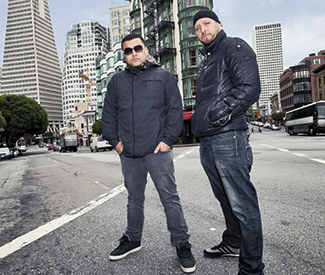
When the last Latyrx album, The Album, came out in August 1997, hip-hop was still trying to figure out its footing in a post-Biggie and Tupac world. The duo, made up of East Bay rappers Lyrics Born and Lateef the Truthspeaker, was one of the first conscious acts to make waves in that world before the actual subgenre of conscious or progressive hip-hop solidified.

But 16 years is almost half the lifespan of hip-hop and every cultural aspect associated with it. Countless micro-genres, fads, and rappers have emerged, disappeared, and assumed their position in the annals of style during the years after The Album and before Latyrx’s follow-up. Though the game has changed between the last time they collaborated and the release of 2013 full-length The Second Album (Latyramid), Lyrics Born and Lateef have still been putting work in the hip-hop industrial complex. Combined, they’ve put out more than a couple dozen solo albums, remix records, EPs, live albums, and mixtapes.

http://www.youtube.com/watch?v=INU9nk4OQlY

So why get the band back together? Lyrics Born puts it simply “[The Album] was such a milestone in our lives and careers. It was something we always planned to revisit but never had the opportunity to do so. It was definitely one of the top five questions I was always asked by fans. ‘When are you guys gonna do the next Latyrx album?’ It was just sort of time.” A second Latyrx album was announced on Lyrics Born’s website back in early 2007, but there was little movement until a few years later. The duo realized it better finally get cracking on the follow-up record when it was invited to do a show in 2010 with local jazz maestro Adam Theis of the Jazz Mafia group at the Mezzanine — and witnessed the immensely warm reaction to its set the following year at Outside Lands. Following those two performances, it was apparent that another Latyrx record needed to happen: “The window was right, so we got in the studio” says Lateef.

The most striking element of The Second Album is the feeling that each track comes from a different album. “It’s Time” features Zion I incorporating whizzing Transformers-like synths. “Gorgeous Spirits” is a booty-shaking clubbanger. The two tracks featuring tUnE-yArDs’ Merrill Garbus — “Watershed Moment” (also featuring longtime collaborater Blackalicious’ Gift of Gab) and “Deliberate Gibberish” — each shine in uniquely differing ways. “Deliberate Gibberish” sounds like it was culled from a fast-paced spoken word album and “Watershed Moment” percolates with a bouncy and eccentric flow. “There’s really no reason why a song like [‘Deliberate Gibberish’] should exist. It’s like the anti-song, the anti-hip-hop song in the sense that there’s no drums, it’s just Merrill from tUnE-yArDs doing these weird voices in the background,” says Lyrics Born, on working with the indie-art pop crooner.

The seemingly out-of-nowhere appearances of Garbus on the LP is due to an artist retreat in New Orleans. The conference put on by the Air Traffic Control (ATC) organization (which put on the Tibetan Freedom Concert series) is described by Lyrics Born as “an effort to coordinate artist with nonprofits.”

“We were there looking at the aftermath and recovery with the Gulf oil spills as well as the recovery from Katrina. We spent a lot of time in the gulf and different neighborhoods connecting with other musicians and orgs to get involved there. It was amazing to see the spirit that the city has.”

Those drawn to Latyrx for its conscious aesthetic will find its progressive expectations satisfied. Its signature wordplay ricochets throughout the album, railing against crass commercialism, gun culture, and the overall desolate situation faced by many struggling Americans today.

Some may argue that progressive hip-hop is a relic from another generation, but for Lyrics Born, being an artist in 2013 is no different than in ’97. “It means what it’s always meant: I can’t do today what I did yesterday. That’s really how we approached this record and all my records. Neither of us is interested in covering ground that’s already been covered.”

Things are going well on the underground alt-rap stalwarts’ current tour together, and in the next year, Latyrx will be doing a larger world tour. As for the now-looming question about a third Latyrx album, the duo says: “We just hope the third one doesn’t take another 16 years to create. This last album was a chance for us to get back to doing what we do best. We got a lot of our solo stuff out of our system. The world needs unusual records right now.”

LATYRX

With Forrest Day, DJ Aaron Axelsen

Nov. 20, 9pm, $25

Independent

628 Divisadero, SF

www.independentsf.com


Break on through

1

arts@sfbg.com

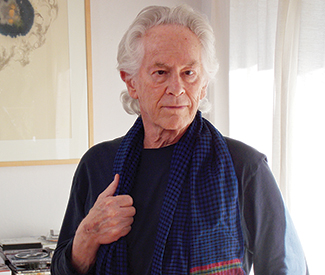
 I drive up into the East Oakland hills, past 19th century “Poet of the Sierras” Joaquin Miller’s odd little cabin, to visit Michael McClure. Based on his youthful good looks, you’d never guess he was a few days shy of 81, but the trail McClure has blazed through literary history testifies by length, stretching back to 1955 when — alongside Philip Lamantia, Philip Whalen, and Gary Snyder — he was the youngest participant in the famous Six Gallery reading at which Allen Ginsberg debuted “Howl.” It was a seminal moment in postwar American poetry. “We all put our toes to the line that night and broke out,” he says. “And we all went our own directions.”

Beginning with his first book of poems, Passage (1956), McClure would find himself going in many directions, writing novels, essays, journalism, and even Obie-award-winning plays like The Beard (1965). As a countercultural figure, he could roll with the times, reading at the Human Be-In in 1967 in Golden Gate Park; associating with high-profile rock acts like Bob Dylan, the Doors, and Janis Joplin (for whom he co-wrote the 1970 classic “Mercedes Benz”); and appearing in movies like Peter Fonda’s The Hired Hand (1971) and Martin Scorsese’s The Last Waltz (1975). In the mid-’80s, he even began performing with the Doors’ Ray Manzarek on piano, releasing such CDs as last year’s The Piano Poems (Oglio Records). And though I’ve come to discuss Ghost Tantras, his 1964 self-published book of “beast language” reissued this month by City Lights, we inevitably touch on the recently deceased keyboardist with whom McClure played over 200 gigs.

“Ray died at a very wonderful time,” McClure says. “He’s 74 and at the height of his powers. People say, ‘You must feel broken up about Ray,’ but I’m actually happy to know someone who stepped out in his own glory. The last time I saw him was [last] November. We had just done a performance at the Sweetwater in Mill Valley. That night Bobby Weir sat in. It was like the Doors and the Grateful Dead embraced.”


THE LANGUAGE OF THE BEAST

But Ghost Tantras predates most of these famous exploits. The origins of what McClure calls its “beast language” can be traced back to his early play The Feast, performed in 1960 at SF’s Batman Gallery.

“The walls had Jay DeFeos and Bruce Conners on them,” he recalls. “The actors were dressed in Indian blankets and torn white tissue paper beards, seated before a long table that carried black plums and white bread, black wine. Thirteen of them performed a Last Supper-like rite and spoke in beast language and English of the melding of opposites and the proportion of all beings, from the incredibly tiny to the cosmic.”

“Beast language” might be described as a roaring deformation of language into something less oriented toward signification and more toward the physicality of the body, poetry as “a muscular principle,” as he writes in the original introduction, rather than as a mimetic text conveying images and ideas. Take, for example, these lines from tantra 46: “NOWTH / DROON DOOOOOOOOR AGH ! / Nardroor yeyb now thowtak drahrr ooh me thet noh / large faint rain dreeps oopon the frale tha toor / glooing gaharr ayaiieooo.” Signification isn’t the prime motivation here, nor is it entirely absent, as snippets of sense emerge and dissolve amid a sea of syllables. Such moments almost suggest reading Chaucer or Finnegans Wake, texts in some distant version of our own tongue, but they just as quickly vanish into phrases that resist intelligibility (“gaharr ayaiieooo”).

Yet despite this resistance, the writing of Ghost Tantras was also bound up in visionary experience. McClure began Ghost Tantras in 1962 while working for the Institute for Personality Assessment and Research, for the University of California.

“My role with IPAR was to give psilocybin to artists and to film them in that timeless state of the high,” he says. “I was probably an ideal person because I had given up the use of psychedelic drugs myself. Already, after a lot of experimentation in psychedelics and several essays that had been published by City Lights in Meat Science Essays (1963), I wanted to write a deep exploration of these highs after reading Henri Michaux’s gorgeous Miserable Miracle (1956), which was his — I felt personally — inaccurate description of the mescaline high. That inspired me to want to write clearly about this experience. Meanwhile, I had begun practicing Kundalini yoga, which is a chakra-centric yoga, and I was beginning to have powerful experiences.”


“ART WITH NO EDGES”

This desire to convey visionary experience might seem at odds with Ghost Tantras‘s frequent resistance to signification, yet the apparent paradox might be resolved through Abstract Expressionism, which McClure insists was “one of my most profound sources, the art with no edges, the art with no limits.” Viewed thusly, Ghost Tantras aspires to the degree of autonomy accorded to nonrepresentational art by not referring to experience but rather offering it.

“Allen Ginsberg had introduced me to Mark Rothko, and I got Rothko’s phone number,” McClure recalls. “I had Ghost Tantras and I wanted to show them to him but in the meantime I lost his number, as you did in those days. I always thought Rothko would be the right person to see the fields of letters in Ghost Tantras, as you see in one of his field paintings. If you look at Ghost Tantras in a different way, you see that each one is a field, a work of visual substance. Or nonsubstance.”

“I knew I was tangoing with my own personal ridiculousness when I wrote these. I don’t mind that, because in my writing when it’s at its most intensely serious it’s also at its most comic. And I call to mind what I think are some of the most important poems of the 20th century, Federico García Lorca’s ‘Gacela of Unforeseen Love,’ which is among the most intense love poetry I’ve ever experienced. It’s also kinda comic. My own poetry, when I believe in it the most, also has an edge to it that is not serious, or it’s serious, all right, but real seriousness has an edge that breaks on through to the other side.”

“It was part of the massive and inspired creativity that was rushing around me,” he concludes. “That’s probably the best clue I can give to anyone who wants to understand the sources behind Ghost Tantras, as part of the huge energy that was amassing itself and pouring through California at the time.” *

MICHAEL MCCLURE

Nov 20, 7pm, free

City Lights Bookstore

261 Columbus Ave, SF

www.citylights.com


Eternal spring

0

arts@sfbg.com

Chris Marker did not seem to see a hard distinction between cities and their people. The cat-loving leftist documentarian, whose distinctly poetic outlook we sadly lost last year, is probably best known for his experimental sci-fi short La Jetée (1962) and his ethnography-cum fictionalized-travel-memoir Sans Soleil (1983), film-school favorites both available through the Criterion Collection.

But his filmography goes much deeper than that, and often focuses on the inner life of human and political organisms. Restored and screened at this year’s Cannes Film Festival, Le Joli Mai is a 1962 collaboration with cinematographer Pierre Lhomme, which traipses geographically and temporally around Paris in May ’62. Much of the movie consists of man-and-woman-on-the-street interviews, with an assortment of more settled chats in people’s homes or workplaces. Framed by a chimera of English and French narration, by Simone Signoret and Yves Montand respectively, the film gives its “biggest roles” to “free people, those who are able to question, to refuse, to undertake, to think, or simply to love.”

Marker investigates these free people’s attitudes toward their professions, their social lives, their home city, the housing problems of Paris, the Algerian War, and numerous other subjects close to their hearts. Some are passionately political, while others think it’s best to keep silent or ignore certain crises — a cross-section of political approaches that echoes throughout modern society, whether in Europe or the United States. Indeed, seeing this movie now with its specificity of time and place, it’s possible to imagine a not-too-different portrait of, say, 2012 Paris, or Los Angeles, or London.

During the mostly casual interviews, Lhomme’s camera wanders, never too committed to its initial subject to notice something more interesting in the background, or even just elsewhere on the subject’s person. Marker and Lhomme’s approach is almost never without levity — people’s opinions on the issues of the day are not to be mocked necessarily, but neither are they to be taken at face value. They’re all just people, and the texture of the film repeatedly reinforces that truth. In one segment, a talkative inventor loses the spotlight to a spider crawling on his suit. In another, as two engineering consultants debate in complex Marxist terms the future of labor, the film cuts away over and over to close-ups on the faces of housecats, serving as both commentary and comic relief for the heated discussion.

Marker and Lhomme strive to represent the true diversity and cultural fabric of ’62 Paris. Their subjects include poets, a painter, an inventor of automotive technology, a pair of teenage stock market assistants, an introverted single theater seamstress and cat-lover, a worker from Algeria, a student from Dahomey, a poor family finally granted more spacious housing, an ex-clergyman turned union militant, and on and on.

In the film’s final act, a montage of city symphony-esque time lapse shots of the city and a litany of statistics about life, death, and resources in the month of May gives way to a glimpse at Paris’ not-so-free inhabitants. Finally, Marker offers a reflective monologue (via Signoret) in a style that will be familiar to anyone who has seen Sans Soleil, and which also prefigures Werner Herzog’s sci-fi-tinged epilogue to his Cave of Forgotten Dreams (2010). Marker makes a literary text of the human face, offering his interpretations and looking for recurring themes among the wildly diverse denizens of Paris; he imagines how a “Martian just landed on the planet Earth” might read these human documents, and philosophizes about what plagues these haunted-looking faces.

His poetic extrapolation might frustrate some viewers, as it leaps beyond the boundaries of empirical detail to ponder the collective psyche of the people of Paris, but this is Marker’s true gift. He is an imaginative reader of the human face, mind, and heart as they operate in an urban environment, and his critique from 1962 is as valuable as ever today. *


LE JOLI MAI opens Fri/15 in Bay Area theaters.

The great pretender

1

cheryl@sfbg.com

If something appears too good to be true, the saying goes, it probably is. Take Lance Armstrong, who beat cancer to become a cycling superstar, winning the grueling Tour de France a record seven consecutive times. He vehemently denied using performance-enhancing drugs until January 2013, when he ‘fessed up during a tastefully choreographed sit-down with Oprah. By that point, the big reveal wasn’t that he’d doped his way to athletic glory — it was that he was finally admitting to it.

“This is a story about power, not doping,” a talking head points out in Alex Gibney’s latest doc, The Armstrong Lie. Gibney, an Oscar winner for 2007’s Taxi to the Dark Side (he also made this year’s We Steal Secrets: The Story of WikiLeaks), set out to make something more along the lines of The Armstrong Return, shadowing Armstrong as he prepped for his 2009 Tour de France comeback. He envisioned crafting a “feel-good movie,” especially when Armstrong notched an impressive third-place finish — a feat intended to silence the drug rumors once and for all. In the end, it only amplified the skepticism that loomed over his accomplishments. And as the evidence against Armstrong mounted, Gibney scrapped his original concept and went in a decidedly darker direction.

Gibney, who narrates in the first person, unwittingly became a character in his own film. Armstrong’s critics, interviewed for Lie, admit they spotted the acclaimed documentarian among Armstrong’s Tour de France entourage and feared he was “buying into the bullshit.” Among these voices are Armstrong’s former US Postal Service teammate, Frankie Andreu, and his wife, Betsy, who both testified during the US Anti-Doping Agency’s investigation into Armstrong. Over the years, they’d been excoriated by their former good friend and his supporters for speaking out against him.

A feel-good movie, this is not. One need only read the film’s title to understand what motivated Gibney’s second attempt at making an Armstrong doc. “For this new film, doping was not the most important thing,” he writes in his director’s notes. Doping, he says, “was an essential part of the culture of professional cycling … and evidence of [Armstrong] doping had been hiding in plain sight since 1999.” Instead, “it was the lie that interested me” and “the abuse of power. Armstrong was so powerful in his sport that he could protect and defend his lie with the arrogance and cruelty that he showed his cycling rivals on the road.”

That arrogance extended to his participation in Gibney’s original film; unsurprisingly, he made for a control-freak documentary subject. But all bets were off once Armstrong came clean. He wasn’t Superman — he’d been pumping dope like everyone else. He was also revealed to be a bullying jerk who’d used his celebrity power to cover his tracks, according to his former teammates and associates. And once the curtain was lifted, he forfeited the luxury of being “the manager of his own storyline,” as Gibney puts it.

For someone like Armstrong, possessed of such carefully tended personal mythology, that was huge. His reputation suffered and sponsors cut ties. (In at least one San Francisco gym, an image of the Golden Gate Bridge was hastily tacked over an Armstrong photo mural.) His seven victories were stripped away, and — worst of all — cancer survivors who’d lifted him up as a hero were left feeling deeply deceived.

Ultimately, Gibney’s film probes deeper than Armstrong’s flaws; it’s careful to point out that drug use is widespread among professional cyclists (and in other pro sports, too — just ask Barry Bonds), who are surrounded by an insular, high-stakes culture that encourages it. The sports world lives and dies by the next world record or superhuman achievement. Is it any wonder that elite athletes seek out that extra competitive edge? And that Armstrong would believe he had the power to rearrange reality to keep his victories intact? *


THE ARMSTRONG LIE opens Fri/15 in Bay Area theaters.

Liquid spine

0

marke@sfbg.com

Here’s an insane and insanely wonderful San Francisco nightlife life — perhaps the kind of life we’re in danger of seeing no more. Run away from home in the 1950s and join the circus as a male hoochie-coochie dancer in the sideshow. Make your fame in the Midwest as glamorous and naughty drag performer back when men could be jailed for wearing a dress (priests excepted). Move to San Francisco and become a glorious institution, enshrined every weekend at Aunt Charlie’s in the TL, where you perform right up until you pass away at 76 in 2011 — “The Girl with the Liquid Spine,” looking and living fabulous as ever without losing your feisty, gritty edge. Then the accolades, the grand service, the big-screen documentary Forever’s Gonna Start Tonight.

And now, the museum exhibition. Vicki Marlane: I’m Your Lady (opening reception Fri/15, 7-9pm, $5 GLBT History Museum, 4127 18th St., SF. www.glbthistory.org) displays “video, artifacts and photographs from the performer’s estate that tell a remarkable life story.” But maybe it does more than just celebrate the kind of unique personality San Francisco used to make room for. Maybe Vicki’s life can inspire us to take heart that this city, too, has a liquid spine, and can bend itself around (and over) any obstacle that threatens to block us with blandness and smother us in meh. Forever really is gonna start tonight!

Fancy an Oddjob? There are an estimated 15,000 people moving in along Market Street in the next five years. Where will they all eat and drink? That’s the first thing that pops right into my mind. And then: Woah, I need to open a bar or a pop-up exotic flan truck or something and cash in. And then, also: Does this asymmetrical haircut make my butt look flat?

Well, someone has done something at least about the bar part — and I’ll soon be parking my well-rounded (thank you) cheeks at Oddjob (1337 Mission, SF. www.oddjobsf.com), a cute new joint in the old Shine spot from two of my longtime secret boyfriends Jeff Whitmore (Public Works) and Peter Glikshtern of practically every club in town, plus Jordan Langer of my former secret favorite bar, Big, now sadly closed.

Oddjob looks amazing — it has the deconstructed, construction site-like ambiance of Public Works in the front (including a conveyor belt bar top, drafting chair bar stools, and a neato Rube Goldberg-like “Corpse Reviver” automated cocktail maker) and the playfully swanky-swaggy atmosphere of Big at the back (along with Big’s incredible cocktail sensibility). Oddly, the press materials say Oddjob is located in, ugh, “Mid-Market Gulch,” which surely equals “SoMissPo” in catastrophic neighborhood nomenclature. A good stiff drink might erase that.


BUTANE

The ever-traveling Alphahouse label head, coming at us via St. Louis, blew me away with a roiling, bass-heavy techno set the old Kontrol party in 2008. But come for the whole evening, which also features phenomenal up-and-comers Stephanie from Brooklyn and Marija Dunn and Amber Reyn from the Bay.

Thu/14, 9pm-3am, $15. Public Works, 161 Erie, SF. www.publicsf.com


ALEXI DELANO

As luck would have it, one of Butane’s partners in tech-crime, Swedish-Chilean Alexi Delano (they release the booming EP “What You See Is What There Is” on Nov. 18) is in town at the very same time. Oooh, techno fight! Alexi experiments with dubby, acid effects but still keeping things pounding.

Thu/14, 9:30pm, $10. Monarch, 101 Sixth St., SF. www.monarchsf.com


KMFDM

Before the excruciatingly boring hyper-machismo (and hyper-whiny) phase of industrial music kicked in, there was the dark, delicious dance floor stomp of bands like Nitzer Ebb, early Ministry, and this aggressive batch of Germans, KMFDM, who are back and louder than ever.

Thu/14, 7:30 doors, 8pm show. $30. The Independent, 628 Divisadero, SF. www.theindependentsf.com


ODYSSEY

The old underground space that housed this incredible house and disco party is now a super-fancy restaurant. But you can’t stop the music. Seriously, one of the cutest affairs going in the city, with a lovely, freaky crowd. Happy birthday DJ Robin Simmons!

http://www.youtube.com/watch?v=sGapPeba4is

Fri/15, 9pm-3:30pm, $10. Public Works, 161 Erie, SF. www.publicsf.com


MASTERS AT WORK

Oh, honey. If you don’t know, you just don’t know. True masters Kenny Dope and Lil Louie Vega, who brought out one of the most diverse crowds I’d ever seen when they were at 1015 last time, are back to school us on classic house jams, soulful grooves, Latin rhythms, and vinyl wizardry — on the outstanding Mighty sound system. I can’t get no sleep.

http://www.youtube.com/watch?v=jYxZaLhNpTQ

Fri/15, 9pm-3am, $30. Mighty, 119 Utah, SF. www.mighty119.com


BOOGIE NITE

Old-school Chicago-style house mixing and some good ol’ dancefloor fun from Windy City denizen Boogie Nite will light up the funky new Play It Cool party. With Parisian Guillame Galuz, Matthew Favorites, Derek Opperman, and Avalon Emerson.

Sat/16, 9pm, $5. Balancoire, 2565 Mission, SF. www.howtoplayitcool.com


ORIGINAL PLUMBING

Hot-hot quarterly mag for transmen and admirers throws a party to celebrate the release of its latest issue — the Party Issue, duh. Hosted by Amos Mac and Rocco Katastrophe, with DJs Rapid Fire and Jenna Riot. Transmazing!

Sat/16, 10pm, $7. The Stud, 399 Ninth St., SF. www.originalplumbing.com


Move freely

0

arts@sfbg.com

Was Kunst-Stoff’s 15th anniversary concert this past weekend its last show in town? Perhaps, perhaps not. Yannis Adoniou, who founded the company with Tomi Paasonen, chooses his words carefully a couple of days before the shows. He acknowledges talking with local presenters about maybe “having an annual season here” and about “stabilizing our presence here.”

But for the time being, Kunst-Stoff is gone. The questions are “why?” and “why now?” In some ways, Adoniou has become a victim of his own success. He, together with La Alternativa and the Off Center, has run a successful studio space — the envy of many a struggling company — which has become what he calls a “sanctuary.” Besides classes and workshops the place has offered performance opportunities, not just for local artists but also for dancers from abroad like Anthony Rizzi and Constantine Baecher. “These conversations have been fantastic,” Adoniou says. “I could stay here as institutionalized Kunst-Stoff, but that’s what not what I am supposed to be doing. I have not done a major work in a theater for a long time because I have wanted to be available [to the artists working here].”

Adoniou, a ballet dancer originally from Greece, came to the Bay Area in 1993 after having seen Alonzo King set Without Wax on the Frankfurt Ballet. What impressed him was the equality between the sexes in King’s work. “I wanted to dance,” he remembers, and he knew that most ballet repertoire (at the time) reduced the male dancer to support the ballerina. He also liked that the Bay Area “does not have institutionalized names and technique as there are in New York and Europe.” So this was a good place for him as a young artist — but like many others, he finds it “very, very hard” to get support once you have developed beyond a certain level. So back to Europe it is, where he feels he can take his own work where it needs to go.

The easy riding 98-13, the second of the three pieces which formed the 15th anniversary retrospective, offered a good overview of Adoniou’s perspective on dance. He has long passed the restrictions of his ballet training not be rejecting but by transcending it. Some of 98-13’s individual moments did ring a bell — Repetika, Less Sylphides, the moment you stood — but for the most part they toppled over each other as if spilled from a bag of toys. This was an affectionate, lighthearted look at the past.

The fun was in seeing the dancers take shape. Leyya Tawil resembled a huge bird on the tip of her toes. Daiane Lopes da Silva is a fierce mover but also a comedian. Katie Gaydos told us that giving birth is no more difficult than doing a rond de jambe en l’aire. I’ll take her word for it. Parker Murphy, as the only male, of course got to lift some obstreperous females. In the end, Adoniou, in a business suit, offered an intricate, determined walking combination that included a lovely arabesque. Maybe he was taking measure of what has passed, or perhaps of what lies ahead.

If 98-13 was full of surprises, the trajectory for the opening Solo for Yannis could be foreseen. Strongly danced by Lopes da Silva with the assistance of Widon Yang, Ivo Serra, and Tomi Paasonen, the piece posed questions about navigating unstable ground if you have no point of reference. Blinded by a hooded garment, she rolled, stretched, and recoiled on a rug that kept being yanked away, her fingers becoming antennas, her head sniffing the air. Precarious for the men and the dancer, Solo derived its interest from the tiny shifts of give and take, limitations set and rejected. The moral of this story? Keep going even if you end up being naked, vulnerable, and alone.

Paasonen’s ironically named Those Golden Years may have been inspired by a dream about his mother but it also threw a mirror at Adoniou. The work opened with composer Yuko Matsyama, a flower garden in motion, carefully tracing a path along the edge of a mound of what turned out to be crumpled sheets of gold and silver Mylar. Her rhythmically intriguing score, which included a narration by Paasonen, set the tone for what became a seductive, but also touching visual feast.

Predictably, Adoniou emerged from this heap of plastic — one limb at a time. Yet Golden’s airy, glittering artifice contrasted seductively with the solidity and warmth of the human body. The dancer smashed, admired, hugged, and hid in it. He donned it as a fairy prince’s garment but also as a garbage bag. Eventually he too was left naked — even deprived of his manhood. *


Driving us crazy

209

STREET FIGHT Parking reform is one of the most radically important elements of making San Francisco a more livable and equitable city.

In this geographically constrained city, parking consumes millions of square feet of space that could be used for housing, especially affordable housing in secondary units. Curbside parking in the public right of way impedes plans to make Muni more reliable for hundreds of thousands of transit riders. Parking in new housing and commercial developments generates more car trips on our already congested and polluted streets, slowing Muni further while bullying bicyclists and menacing pedestrians.

Fundamentally, parking is a privatization of the commons, whereby driveway curb cuts and on-street parking hog the public right-of-way in the name of private car storage. The greater public good — such as reducing greenhouse gas emissions and enhancing public safety through bike lanes, wider sidewalks, public green spaces, and transit-first policies — is subsumed to narrow private interests. These are among the many reasons why, for over a decade, parking reform has been a key part of progressive transportation policy.

Yet lately, it has been disappointing to watch progressives, especially on the Board of Supervisors, retreat from that stance. In Potrero Hill and North Mission, a vitriolic reaction has slowed rollout of nationally acclaimed SF Park, which raises revenue for Muni and is a proven sustainable transportation tool. Yet there are murmurings that some progressive supervisors might seek an intervention and placate motorists who believe the public right-of-way is theirs.

On Polk Street, some loud merchants and residents went ballistic when the city and bicycle advocates proposed removing curbside parking to accommodate bicycles. The city, weary of Tea Party-like mobs, ran the other way, tail-between-legs. Progressive supervisors seem to have gone along with the cave-in.

Along Geary, planning for a desperately needed bus rapid transit project drags on. And on. And on. And on. The lollygagging includes bending over backward to placate some drivers who might be slightly inconvenienced by improvements for 50,000 daily bus riders.

One thing that is remarkably disturbing about this backpedaling is that, in an ostensibly progressive city by many measures (civil rights, tolerance, environmentalism), the counterattack is steeped in conservative ideology. That is, conservatives believe that government should require ample and cheap parking, whether in new housing or on the street. This conservative ideology, shared by many car drivers and merchants — and even by some self-professed progressives — is steeped in the idea people still need cars. This despite the evidence that cars are extremely destructive to our environment, socially inequitable, and only seem essential because of poor planning decisions, not human nature.

Progressive backpedaling has become more confusing with the recent debate over 8 Washington, defeated at the polls Nov. 5, and on the same day of a convoluted Board of Supervisors hearing on a proposed car-free housing development at 1050 Valencia. Both of these projects highlight the muddled inconsistency emerging among progressive supervisors.

Enough has been written about how 8 Washington was a symbolic battle for the soul of San Francisco. But during the campaigns, the lack of attention to parking was curious. Notably, progressive-leaning transportation organizations like the San Francisco Bicycle Coalition, Walk SF, and Transform sat out the election despite the project’s excessive 327 underground parking spaces, which violated hard-fought progressive planning efforts to make the waterfront livable. The Council of Community Housing Organizations also sat it out, despite benefitting from the progressive parking policies that 8 Washington violated. It appears that despite their transit-first rhetoric, progressives made a tactical calculation to keep parking out of the campaign.

The progressive victory came with a Faustian bargain which involved ignoring parking. To ensure 8 Washington was defeated, conservative voters were folded into the opposition. Groups like Eastern Neighborhoods United Front (ENUF), the Coalition for San Francisco Neighborhoods, and the Republican Party came out against 8 Washington and yet, ironically, all are opponents of progressive parking reform.

Moving forward, whatever happens at the 8 Washington site must include progressive parking policies. Don’t expect this from the unimaginative leadership at the Port, which speciously demanded the excessive parking. Don’t expect it from the developer, who steadfastly insists that the rich must have parking. And don’t expect conservatives to latch on to a waterfront scheme that is both publicly accessible and genuinely transit-oriented. It is progressives who will need to muster political will for a zero-parking project at the waterfront and set the tone for consensus among the other factions in the waterfront debate.

Meanwhile on the same day 8 Washington went down, 1050 Valencia barely made it out of a tortuous Board of Supervisors hearing in which progressives seemed to be the antagonists. As the first car-free market-rate housing proposal on Valencia under progressive parking reforms, this 12-unit mixed use building seemed an obvious win for progressives. It would be a walkable, bicycle-friendly urban infill mixed-use project with on-site affordable housing, all of which the city needs more of.

Yet since 2010, when the project first went to the Planning Commission, conservative rhetoric has been deployed to stop the project. Significantly, the Liberty Hill Neighborhood Association objected to the transit-oriented characterization of the project. It claimed that the 14 Mission and 49 Mission/Van Ness are filthy, crime-ridden, and unreliable and so 1050 Valencia must have parking.

Unlike progressives, who also decry shortfalls with Muni but propose solutions, the Liberty Hill opponents offered only secession from public transit, insisting on driving in secure armored cocoons instead of addressing Muni reliability, and they also expect free or cheap parking in the public right of way.

You would think that progressives at the Board of Supervisors would see through this thinly veiled bigotry against the 14 and 49 buses. But instead, four self-professed progressive supervisors — John Avalos, David Campos, Jane Kim, and Eric Mar — voted against 1050 Valencia.

They may argue that they were more concerned about the neighboring Marsh Theater, which has concerns about construction noise (and also parking). The noise issue can be worked out, and why the progressive supervisors did not work this out in advance is a mystery. But if you watch the hearing closely, the Marsh basically opposed the development — period — and thus a modest car-free development that included affordable housing at an appropriate location. And so did four progressive supervisors. It’s baffling.

At the end of the day, 1050 Valencia moved forward, barely. But it can still be stopped at the upcoming Board of Appeals hearing. Meanwhile, it’s time for progressives to make a frontal response to the Muni-bashing coming out of Liberty Hill.

The SFMTA is offering a bold and ambitious proposal for these buses on Mission between 13th and Cesar Chavez. This includes a transit-only lane, restricting automobile traffic, rearranging loading zones, and removing curbside parking so that 46,000 daily 14 and 49 passengers have better reliability and less crowding.

This plan will make life easier for San Franciscans who rely on these buses, but will require progressive supervisors to openly and sincerely advocate for removal of on-street parking, to support SF Park, and push for car-free housing development in the Mission, rather than knee-jerk posturing for a few political points in future elections. Progressives, stop screwing around.

Street Fight is a monthly column by Jason Henderson, an urban geography professor at San Francisco State University.

BART’s safety culture slammed at Assembly hearing

1

BART was slammed by legislators and its workers on Nov. 7 for refusing to make a key worker safety improvement demanded by state regulators since a 2008 fatality, instead choosing to aggressively defend the “simple approval” process that contributed to two more fatalities on Oct. 19, after which the district finally made the change.

The Assembly Committee on Labor and Employment had already planned the San Francisco hearing into why BART spent years appealing rulings by the California Occupational Safety and Health Administration before the recent tragedy, but that incident sharpened criticism of the district for valuing efficiency over safety.

“The culture of safety at BART must change,” said BART train operator Jesse Hunt, who gave dramatic testimony about the callous culture at BART that led to the Oct. 19 tragedy. “It’s not a single incident, it’s a pattern of disregard for safety.”

The hearing also delved into why BART had an uncertified trainee at the helm of the train that killed Christopher Sheppard and Laurence Daniels on Oct. 19, despite warnings by its unions that district preparations to run limited service during the strike would be unsafe (see “Tragedy follows strike,” Oct. 23).

“Simple approval” made employees doing work on the tracks responsible to avoid being hit by trains moving silently at up to 80mph. When BART exhausted its administrative appeals of Cal-OSHA’s rulings in June, it filed a lawsuit in Alameda County Superior Court and continued to defend the practice, which its unions had long sought to end.

“BART challenged that citation and continues to do so to this day,” Chair Roger Hernandez (D-West Covina) said in his opening remarks, noting that it took two recent fatalities for BART to drop its stance. “I’m deeply troubled this decision wasn’t made much earlier.”

For BART, the hearing only went downhill from there as state regulators testified to the district’s litigious refusal to adopt important safety precautions, employees painted a picture of a district hostile to them and their safety concerns, and legislators chastised BART managers for not having reasonable answers to their questions.

In response, BART Assistant General Manager of Operations Paul Oversier denied the district undervalues safety and said that it defended the simple approval process because it had been used tens of thousand of times and, “We had a track record in mind of a procedure that was working well.”

Asked whether he continues to defend it after the Oct. 19 incident, Oversier said, “Irrespective of what our opinion might be, we suspended the simple approval process,” a decision that he said could disrupt service, increase costs, and “that may cause us to look at what our hours of operation are.”

The hearing was called by Assemblymember Phil Ting, D-SF, who said in his opening remarks, “I was very concerned to read many of the OSHA findings, that it found BART was in violation of California state law,” which prohibits employers from making workers responsible for their own safety in dangerous situations.

Later, Ting questioned BART Chief Safety Officer Jeff Lau about how many of OSHA’s safety violations it had taken steps to correct versus how many it continues to resist, a question Lau said that he couldn’t answer. “I’m extraordinarily disappointed in your response,” Ting told Lau, demanding that he prepare a detailed written response to the questions and submit it to the committee, which plans to revisit the issue once more details emerge from the NTSA investigation of the Oct. 19 incident.

Tale of two parties: Voters reject 8 Washington project

21

From the Election Night victory party for opponents of the 8 Washington waterfront luxury condo project, the overwhelming defeat of developer-backed Propositions B and C seemed to go beyond just this project. It sounded and felt like a blow against Mayor Ed Lee’s economic policies, the gentrification of the city, and the dominion that developers and power brokers have at City Hall.

“What started as a referendum on height limits on the waterfront has become a referendum on the mayor and City Hall,” former Board of Supervisors President Aaron Peskin told the large and buoyant crowd, a message repeated again and again at the Nov. 5 gathering.

Former Mayor Art Agnos also cast the victory over 8 Washington as the people standing up against narrow economic and political interests that want to dictate what gets built on public land on the waterfront, driven by larger concerns about who controls San Francisco and who gets to live here.

“This is not the end, this is the beginning and it feels like a movement,” Agnos told the crowd. “We’ll have to tell the mayor that his legacy,” a term Lee has used to describe the Warriors Arena he wants to build on Piers 30-32,” is not going to be on our waterfront.”

Campaign Manager Jon Golinger also described the victory in terms of a political awakening and turning point: “We are San Francisco and you just heard us roar!”

Campaign consultant Jim Stearns told the Guardian that he thought the measures would be defeated, but everyone was surprised by the wide margin — the initiative B lost by 25 percentage points, the referendum C was 33 points down — which he attributed to the “perfect storm” of opposition.

Stearns cited three factors that triggered the overwhelming defeat: recent populist outrage over the city’s affordability crisis, concerns about waterfront height crossing ideological lines, and “a tone deaf City Hall that didn’t want to hear there were any problems with the project.”

Among the key project opponents who have sometimes stood in opposition to the city’s progressives was former City Attorney Louise Renne, who blasted City Hall and called the Planning Department “utterly disgraceful,” telling the crowd, “Get your rest, more to come, San Francisco.”

Both progressive and political moderates often share a distrust of the close connections between powerful developers and the Mayor’s Office, and that seemed to play out in this campaign and at the polls.

“San Francisco, this victory is for you,” Renne said. “And to all those developers out there: Do not mess with our waterfront. We’re not going to stand for it.”

Meanwhile, it was a very different scene over at the Yes on B and C party.

Developer Simon Snellgrove, whose 8 Washington project was soundly rejected despite his spending almost $2 million on the campaign, was in no mood to comment. “I’m having a little private party tonight,” he told us, “and I don’t want to talk to the press.”

Rose Pak, a consultant for the San Francisco Chinese Chamber of Commerce who is well-known for her ties to powerful interests in the city, had a small circle of guests around her throughout the night and spent some time catching up with Snellgrove. Asked to comment, Pak said, “I don’t know the Bay Guardian,” and stopped making eye contact. At previous events, Pak has lectured Guardian reporters about what she sees as the paper’s shortcomings.

“I think this project got caught up in a lot of other things,” Jim Lazarus, the vice president for public policy at the San Francisco Chamber of Commerce, told us. “There was a lot of I think mistaken concern about the impact.”

He criticized the focus on building heights and the idea that it was about something more than just a waterfront development project. But this was the outcome, he said, because “an unholy alliance of people got together to oppose the project.”

Perhaps “unholy alliance” is in the eyes of the beholder, but the voters of San Francisco seemed to prefer the alliance that opposed 8 Washington and all that it has come to represent in San Francisco. 


Reduce California’s prison population

67

EDITORIAL California must reduce its prison population — as federal judges have been ordering for years to address severe overcrowding and substandard health care — and it should use this opportunity to completely reform its approach to criminal justice.

Instead, Gov. Jerry Brown has chosen to fight this reasonable directive, exporting thousands more of our inmates to other states and propping up the unseemly private prison industry in the process by signing a $28.5 million contract with Nashville-based Corrections Corporation of America.

Last month, the federal judges overseeing California’s prison downsizing once again extended their Dec. 31 deadline for the state to cut its 134,000-person prison population by another 9,600 inmates, pushing it back to Feb. 24 while the state and lawyers for the prisoners try to negotiate a deal. An update on the status of negotiations is due Nov. 18.

We urge Gov. Brown to follow the lead of his fellow Bay Area Democrats in choosing a more enlightened path forward. Assemblymember Tom Ammiano (D-SF), who chairs the Assembly Public Safety Committee, has convened several recent hearings looking at alternatives to incarceration, including one on Nov. 13 focused on diversion and sentencing.

“I’m hoping to come up with a sentencing reform bill out of this hearing,” Ammiano told the Guardian, expressing hopes that Californians are ready to move past the fear-based escalation of sentences that pandering politicians pushed throughout the ’90s, continuing the progress the state has already made on reforming Three Strikes and some drug laws. Sen. Mark Leno has also provided important leadership on these issues.

There’s no justification for California to have among the highest incarceration rates in the world, four times the European average, and we should embrace the mandate to reduce our prison population with everything from sentencing reform to addressing poverty, police and prosecutorial bias, early childhood education, and other social and economic justice issues.

Closely related to reducing our prison population, at least in term of dropping the “get tough” attitudes that undermine our compassionate and humanity, is treating those we do incarcerate more humanely.

Ammiano and Sen. Loni Hancock (D-Oakland) helped end this summer’s prisoner hunger strike by holding a hearing on improving conditions in the prisons, including the possibility of abolishing cruel solitary confinement practices, as the United Nations recommends and even Mississippi has managed to do. And we think abolition of capital punishment should remain an important near-term goal.

Brown isn’t the most progressive on criminal justice issues, following in an unfortunate tradition of Democratic governors who fear being called soft on crime. But Ammiano sees hopeful signs of potential progress, and he has our support. Now is the time to move California’s criminal justice system into the 21st century.

Schooled

10

joe@sfbg.com

Federal politicians are blasting the commission that would close City College of San Francisco, calling the entire accreditation process a debacle.

At a forum US Rep. Jackie Speier (D-SF) and Rep. Anna Eshoo (D-Palo Alto) convened at City College on Nov. 7, Speier trumpeted what local advocates have said all along: The evaluation of CCSF was bungled, lacked transparency, and violated federal education regulations, all pointing to a desperate need for reform of its accreditors.

Accreditation has been the means to check the quality of education in colleges, but now a growing chorus of critics says the process can be used to carry out an ideological agenda and usurp local control (“Whose college?” Aug. 13).

Yet upending the accreditation process could also have unintended consequences, perhaps letting corporate and conservative interests seize the chance to implement their long-simmering agendas.

Either way, it is beginning to look like the fight to save City College could end up being about more than just City College.


ACCJC UNDER FIRE

The Accrediting Commission of Community and Junior Colleges keeps a watchful eye on the community colleges of California, Guam, and Hawaii. After a six-year review, the ACCJC this summer rocked City College by terminating its accreditation, pending appeals before the sentence is carried out in July 2014.

At the forum, Speier said the debacle with the ACCJC signaled a need to reform accreditation on a national level, citing a lack of public accountability.

“I think the ACCJC has run amok, they have lost their vision — if they ever had one,” Speier said in an interview after the forum. “They are riddled with conflicts of interest and arbitrariness.”

Teachers, faculty, and education advocates packed City College’s Diego Rivera Theater, all cheering at every jibe toward the ACCJC. Pressure on the group is mounting. A third lawsuit against the body was announced the day of the forum, this one filed by the activist group Save CCSF.

But Speier sees the problems as stemming from the US Department of Education, which she said needs the tools to correct problems at the ACCJC, something she plans to meet with Education Secretary Arne Duncan to discuss.

“The Department of Education only has one hammer, and that is to deny the ACCJC certification,” she said.

The group is slated to undergo this evaluation in December, which could spell its end. But if the fight for City College sparks a change in accreditation nationally, what would take its place?

There are wolves at the door of the US education system, for-profit colleges with a history of taking vulnerable students to the bank with nothing to show for it. And they want accreditation reform too.


THE DEVIL YOU KNOW

The ideological argument between the ACCJC and City College is taking place nationally.

President Obama called for a change to college accreditation in his last State of the Union speech, calling for higher graduation and transfer rates for community colleges (see “Who killed City College?” July 9).

One of the biggest cheerleaders of the president’s reform is the American Enterprise Institute, a conservative think tank. At a conference it held on accreditation last month, AEI and its partners lampooned accreditation as it stands now.

“This is a system that is flawed, unable to deal with the rapidly changing higher education landscape,” Anne D. Neal, a partner of the American Council of Trustees and Alumni, a national education reform group, said at the conference. “If meat inspections were as loose as college accreditation… most of us would have mad cow disease.”

On the surface, the critique seems reasonable. More people should transfer, and more people should graduate. But how colleges get those numbers is the challenge. The ACCJC asking City College to jettison students not aiming for a higher degree was just the start, one higher education watchdog told us.

“There are people on both sides saying that accreditation is broken. The White House is pushing this, as are Republicans. You almost never hear that,” Paul Fain, a reporter for Inside Higher Ed, told the Guardian.

But the reform may lead to the transformation of accreditation, allowing tech companies and long distance online learning universities to bypass the process entirely.

Accreditation is seen as “holding back innovators who are trying to transform the Internet,” Fain said.

These “innovators” are largely for-profit colleges that want to offer single courses or shortened courses online, like the Minerva Project or Straighterline, both online universities lobbying Congress to loosen accreditation requirements.

But for-profit colleges have been attacked nationally for their abysmal job placement rates, and their graduation rates aren’t much better. A widely circulated 2010 report by the think tank Education Trust found that for-profits in the U.S. had a graduation rate of 22 percent.

And with many of those for-profits fighting for accreditation reform by Congress, it’s unclear how a push to reform accreditation from Speier would aid or stall them.


FEAR FACTOR

ACCJC President Barbara Beno said that City College is having problems facing reality. Beno would only speak with the Guardian by email through a representative. She defended the accountability of the ACCJC, saying that her doors were always open.

“Colleges don’t need a forum like that held on Nov. 7; they can write to the commission at any time, or ask to address the decision-making commissioners at one of their two meetings each year, or can call up the commission chair or president,” Beno wrote.

“Instead of joining forces to help improve City College, many purported supporters of the college are bent on disrupting the ACCJC operations. It is simple to blame the messenger of bad news,” she wrote. “People unhappy with the commissioners’ decisions are targeting [me] for doing [my] job.”

But Rafael Mandelman, a newly elected member of CCSF Board of Trustees, told those assembled at the forum that ACCJC was unprofessional and unduly punitive: “I went from ACCJC agnostic, to skeptic, to foe”

Dr. Sarah Perkins, vice president of instruction of Skyline College, told the forum that ACCJC is hard to work with.

“I came here to California after spending 25 years in the middle part of the country under the Higher Learning Commission,” she said, contrasting that accrediting agency with the bullying done by ACCJC. “That I even feel like I’m putting my college at risk by speaking at this forum speaks volumes.”

Indeed, the ACCJC even makes criticism of the agency or its methods grounds for a revocation of accreditation, making “collegiality” part of its “policy on institutional integrity and ethics.” CCSF Special Trustee Bob Agrella in September cited that as one reason not to criticize the agency.

Sen. Jim Beall and Assemblymember Tom Ammiano were also in attendance at the forum, and promised to continue the fight at the state level to preserve City College. The Joint Legislative Audit Committee is evaluating ACCJC at the request of those legislators and Sen. Jim Nielsen (R-Gerber).

“We will kick a lot of butt, with class, of course,” Ammiano said.

And would City College close down? “It’s not going to happen,” Speier said to the cheering crowd.