LEFT OF THE DIAL First things first: No matter what her lyrics might imply, Kristine Flaherty — the 28-year-old, Illinois-born, Stanford-educated rapper better known as k.flay — is not sniffing glue.
“Nor have I ever, actually,” she says thoughtfully, having folded herself into a chair in the corner of her West Oakland rehearsal space. “I’d just like to state that for the record. People think I’m on drugs because in some of my lyrics I’m in a really dark place…but no. And sniffing glue in particular seems like something you do when you’re 15 and can’t get drugs.”
Her desire to correct that misconception aside, Flaherty’s not exactly known for giving a shit what people think of her. It’s an admirable quality, something that radiates from the musician as part of a natural, understated air of confidence, but one has to imagine it’s been built up over the years for functional purposes: When you’re a young, white, middle-class, private school-bred female rapper whose image mainly involves jeans and sneakers, who went from making beats and rhymes in the dorm as a joke to collaborations with Zion I, Danny Brown, and Grieves, opening spots for Snoop Dogg, and a record deal with RCA, you’re going to hear some unsolicited opinions. About authenticity, about your skills. Your background, your appearance. Your drug preferences.
But it’s been 10 years since k.flay self-released Suburban Rap Queen as a college junior, and if she didn’t have thick skin then, she sure does now. That mixtape sent buzz-waves through the Bay Area hip-hop scene thanks to its energetic amateur’s sense of fun, lyrics about feminism, frat parties, haters, and the joys of eating red meat (she’s said she was listening to a lot of Dizzee Rascal at the time), coupled with a flow and production value that promised big things to come. And come they did, though perhaps not in the order she might have expected.
Life As a Dog, out June 24 (but streamable until then over here), is a debut of a whole other kind. After a decade of EPs, near-constant touring, and prolific appearances as a guest vocalist — a time in which she stole the Bay Area indie hip-hop scene’s heart before up and moving to Brooklyn three years ago — it’s the rapper’s first full-length record, and the most thematically and sonically cohesive work she’s produced. It also showcases growth, a musician fully embracing her love of melody and structure, of pop music and indie-electronic sounds. Gone is the I-don’t-give-a-fuck-what-this-sounds-like shit-talk/talk-singing, and in its place is just plain singing.
Turns out, she’s good at it. The vulnerability in her voice contrasts satisfyingly with the sharp-edged corners of her rapping, which has slowed from its previous freneticism into a more comfortable swagger that gives the whole record a personal, conversational feel. She’s still funny, goofy, approachable, gross — “Suckin’ on a bottle of Jim Beam, wishin’ it was you” goes one of the most sing-songy choruses — but there’s a grownup self-assuredness, and its flip-side, an all-too-familiar grownup’s cynicism. Regardless, her bummed-out hungover days spent walking around the city now sound like they’re actually in step with yours.
And, oh yeah: She managed to finally make this record, after a few years of trying, because in the fall of 2013, she asked if she could please be dropped from RCA.
“I got signed at a time when there was this swirl of female rappers — some electronic, some more pop, more urban, but I think everybody was interested in trying to bring female rappers a little outside of Nicki Minaj into the mainstream,” says Flaherty, who finds herself happily back on her home turf for a bit before heading out on Warped Tour (her mom and stepdad live in Oakland; her former roommates still live in their old place near Alamo Square — the Warped Tour lands here Sat/21). “And I was still figuring out my sound. I think one of my selling points is I was a little electronic, a little indie rock, a little rap, but I think that was actually not a great way to get signed. The goal with being on a major label is to get you on the radio, and I think there was a lot of internal dissent about the way to do that with me.”
She had a vision for putting out a full-length record, but over the course of three years, “it just didn’t seem like that was possible.” So she filled her time with touring — an experience that, she says, wound up informing most of the songs she was able to put out once she got dropped.
“Their heart was in the right place, but I think the structure of a major label system is so opposed to developing artists that don’t fit into a radio format that it’s kind of a battle for everyone, a lose-lose,” she says. “It felt like an ill-advised marriage. Where you’re done, but you’re still cool with, you know, running into them at Walgreens or whatever.”
She headed for LA in January of this year, anchorless as she’d ever been — she didn’t have an apartment, still doesn’t — and started from scratch, material-wise: She’d let go of upwards of 60 songs she’d written while signed to get out of her contract. But left to her own devices, she found that new songs came quickly.
“It was weird to go from lots of opinions [with the label] to literally none except my own,” she says. “I’ve never done a juice cleanse, but in some ways I feel like that’s what it would be like. ‘Oh, I’m back, and it’s just me, and here’s the bare bones of the project.’ Which was great at times, and also scary. But I’ve been mentally and musically in a much better place the past eight months that I’ve been working on this.” You can hear the solitude, the physically empty space around her in these songs, an electric post-breakup air of someone realizing how strong she is on her own.
Another result: The shift toward melody.
“For a while I was very enamored with rapping really fast, almost like when you get a toy or a video game and you want to see what weird stuff you can do,” she says. It took the encouragement of close collaborators for her to try singing more, though she’s always loved pop and melodic hip-hop (like the Kendrick Lamar she was listening to in the car on the way over here). “It’s still a lot scarier for me to sing than rap,” she says. “And I can’t say as much. I have to be pickier. But I think it’s a more comfortable zone for me, to be honest.”
She raised money to make the record through a crowdfunding site that donates 10 percent to charity, tapping into a fan base that already hangs on her every Internet-word, and reached her goal within five days (“The response was awesome … I mean, considering we’re not Reading Rainbow.”). She wrote and recorded in LA, New York, and San Francisco, mixing the record at SF’s Different Fur.
And now? She doesn’t know exactly where she’ll land geographically when the dust settles from promoting this album, but it’s pretty clear the Bay Area will always be home. At the time of this interview in Oakland, she was rehearsing with her sole bandmate and longtime partner in crime, drummer Nick Suhr (who, over the course of this interview, fetches the wifi password and coffee for both of them, and lets Flaherty know he just told a studio employee she was single). She’s chilling before tour starts, and preparing to maybe field some questions about her mental health (or deflect assumptions about drug abuse) once people hear some of her darker lyrics.
Though, “My parents like it,” she says eagerly. “Sometimes they get scared that I’m, like, extremely depressed. One time after I put up a mixtape my brother called me and was like, ‘Are you okay?'” She shrugs. “I tend to want to write when something’s troubling me, whether it’s something in my own life or I’m witnessing something that I don’t understand, that frustrates me as an observer. I never had a diary as a teenager, but I think I use songwriting like that now, and you can definitely hear that on this album.
“For better or for worse, though, I think it all makes sense together. And it sounds like me. That’s all I could really hope for.”
k.flay will come through the Bay next with the Warped Tour on Sat/21 at the Shoreline; check her Facebook for other dates.
LIT Andy Hall was five years old in 1967, a kid living at the base of Denali, North America’s tallest peak. His father, a National Park Service veteran, took a job overseeing Mount McKinley National Park (as it was then called) just months before a climbing party known as the Wilcox Expedition encountered a freak storm near the summit. Seven of its 12 members died in one of the mountain’s most enduring tragedies.
Hall, who grew up to be the editor and publisher of Alaska magazine, was always haunted by the incident, which he chronicles in Denali’s Howl: The Deadliest Climbing Disaster on America’s Wildest Peak (Dutton, 252pp., $27.95). These days, he lives north of Anchorage in the small community of Chugiak. I called him up to discuss his book, a page-turner that’s as much about memory as it is about mountaineering.
SF Bay Guardian Why did you decide to write a book about the Wilcox Expedition?
Andy Hall I’d been working at a magazine for about 16 years, and I started feeling like I needed a change. I’d been close to this thing because my dad had been the park superintendent, and I’d run into a lot of people who’d been involved in it one way or another. I saw how it affected them still. I thought, “Well, I’ve got a great story sitting right here in my lap.”
At the time I started [writing the book], my dad had died five years prior. Some of the guys who’d been involved were getting up there in age. I thought, if I’m gonna do this, I gotta do it now. There were times I regretted not sitting down and having a formal interview with my dad about it, but I had talked with him enough that I knew what happened, and I knew there was a lot more material I could dig into.
SFBG Beyond the folks in your community, how did you track down your sources?
AH Some of the key players I did already know. But the ones that I really wanted to find were more difficult. For example, I wanted to find Gary Hansen, who’d managed the Alaska Rescue Group, the civilian rescue organization [that had attempted to help the climbers]. He left Alaska in the early 1970s, but I knew he was an architect, and I’d heard he’d gone to California. I’m not a detective, but I just thought: Look for someone who’s licensed in both Alaska and California. He got on the line after I called his office and said, “You found me!” Once I connected with him, he made even more recommendations, and it went on from there.
SFBG How did you extract the truth from the various stories you were being told?
AH Memory was definitely a big player. [Survivors] Joe Wilcox and Howard Snyder had both written books; I read both, and there were conflicts. If I could investigate [discrepancies] in person, I would. Then, there were original letters, documents, and journals, and I read what everybody wrote, but I would go beyond that. In the National Park archives, there were longhand accounts that had been written immediately after the incident.
In my dad’s desk, I found a reel-to-reel tape that had interviews with the would-be rescuers from the Mountaineering Club of Alaska. It was their firsthand account of finding artifacts [from the Wilcox Expedition], and then finding [the first three] bodies. So I had these early-as-possible accounts, and I would compare them to what was written later. Some people maintained a pretty solid account of what happened throughout, while others were less consistent.
In the case of Joe Wilcox, I think he wanted to make sure that people didn’t think the men on his team were incompetent. I don’t think he needed to do that, but I think he really wanted them to be portrayed in a positive light.
SFBG Building off that last thought, Denali’s Howl opens with a section listing each man’s climbing credentials. They weren’t inexperienced by any means. Did clashes within the group lead to their downfall?
AH One of the things I wanted to do with the book was contextualize the climb in the day, in the environment. In the 1960s, climbing was something you did as a group. This wasn’t a guided climb. Joe was the organizer, and he did try to lead, but he wasn’t the guide. Today, a hired guide could look at you and say, “You’re getting the early stages of altitude sickness,” and send you back down the mountain. He’s in charge, and you have no choice.
In this incident, it was a bunch of guys, essentially peers, some of whom had more experience than others, but they were climbing together. There were conflicts, but I don’t think there were any more than in successful climbs — and I don’t think they were the deciding element of the tragedy.
SFBG The book really shows how mountaineering has changed.
AH Denali National Park is now a major destination. There are more climbing rangers on the mountain at this moment, probably, than in the entire park in ’67. Back then, there were an average of about 20 people climbing the mountain in a given year. Today, a couple of thousand summit each year. It’s an industry now. There are satellite phones, [high-tech] weather reports, and a high-altitude helicopter standing by ready to respond. In 1967, these guys went up in what Joe called “the age of self-reliance” — they knew they were up there on their own. *
The Case Against 8 (Ben Cotner and Ryan White, US) This documentary follows the successful fight to have Proposition 8 overturned as unconstitutional and restore legality to gay marriage in California. There’s way too much time spent on the couples chosen as plaintiffs, a Berkeley lesbian pair and two Los Angeles male partners — we get it, they’re nice people — and the decisions to disallow broadcast of the eventual court proceedings means we get laborious recitations of what people have already said on record. Frameline has shown so many documentaries about gay marriage already that festival regulars may find this one covers too much familiar ground at excessive length. (It also doesn’t bother giving much screentime to the anti-gay forces, which might have livened things up a bit.) Still, it’s a duly inspirational tale, with real entertainment value whenever the focus turns to the case’s very unlikely chief lawyers: mild-mannered Ted Olson and boisterous David Boies, the latter a longtime leading conservative attorney who’d argued the other side against Olson in the Bush v. Gore presidential election decision. Nonetheless, he’s all for marriage equality, and these otherwise widely separated figures are great fun to watch as they work, taking considerable pleasure in each other’s company. Thu/19, 7pm, Castro. (Dennis Harvey)
Bad Hair (Mariana Rondón, Venezuela, US) Living in a Caracas tenement, Marta (Samantha Castillo) has no husband, no romance in her life, and now no job after she’s fired from a security company. She turns her frustrations on the older of her two fatherless children, 10-year-old Junior (Samuel Lange Zambrano), whose insistence on straightening his hair like the people he sees on TV strikes her as incipiently gay — and that is something she is not willing to tolerate. Mariana Rondón’s prize-winning feature is a small, subtle drama about the poisoning effects of economic pressure and homophobia within the family unit. It’s also quietly devastating about something you don’t often see in movies: The real-world truth that, sometimes, deep down, parents really don’t love their children. Sat/21, 1:30pm, Roxie. (Harvey)
Floating Skyscrapers (Tomasz Wasilewski, Poland, 2013) Competitive swimmer Kuba (Mateusz Banasiuk) has moved girlfriend Sylwia (Marta Nieradkiewicz) into the Warsaw apartment he shares with his possessive divorced mother (Katarzyna Herman), but the two women don’t get along and Kuba doesn’t seem very committed to the relationship anyway. So Sylwia immediately worries her days are numbered when Kuba — who already indulges in the occasional furtive public gay sex — shows unusual interest in out Michal (Bartosz Gelner). As the two young men grow closer, it becomes clear that this is something neither of the women in Kuba’s life will stand for. Tomasz Wasilewski’s Polish drama has a crisp widescreen look and a minimalist air, with little dialogue articulating emotions the characters are wrestling with. Though its protagonist isn’t particularly likable, the film’s simultaneous confidence and ambivalence lends its eventually depressing progress real punch. Sat/21, 9:30pm, Victoria; June 26, 9:30pm, Roxie. (Harvey)
I Am Happiness On Earth (Julián Hernández, Mexico, 2013) When young dancer Octavio is picked up by well-known filmmaker Emiliano, he’s instantly smitten — not realizing yet that the latter is the kind of serial seducer allergic to fidelity. Rich, famous, and gorgeous, he can have anyone he wants, and he does. That’s about it for story in Julián Hernández’s latest, which features some of his characteristically lush camerawork and poetical romanticism. But it’s one of his weaker efforts, basically turning into one sex scene after another with even less attention to character and plot development than usual. This sexy, aesthetically sensual eye candy sports the odd enchanting moment, as when two men after a quickie are suddenly transfixed by the TV and begin singing a pop ballad along with it, to each other. But Hernández (2006’s Broken Sky, 2003’s A Thousand Peace Clouds Encircle the Sky) is a highly talented filmmaker who here seems to be running out of ideas. Sat/21, 9:30pm, Castro. (Harvey)
The Foxy Merkins (Madeleine Olnek, US, 2013) Writer-director Madeleine Olnek of Codependent Lesbian Space Alien Seeks Same (2011) hits a bit of a sophomore slump with this similarly loopy but less inspired absurdist comedy. Lisa Haas returns as Margaret, a sad-sack new arrival to Manhattan who — apparently like most holders of Women’s Studies degrees — ends up homeless and prostituting herself to a large available client base of better bankrolled lesbians. She gets schooled in the ways of the street and kink-for-pay by veteran Jo (Jackie Monahan), who’s a good business partner if also a somewhat unreliable ally. After a hilarious first half hour or so, the movie runs out of steam but keeps plodding on to diminishing returns, despite scattered moments when Olnek and cast hit the comedic bull’s-eye. She’s got a unique sensibility, at once deadpan and utterly nonsensical, but it’s fragile enough to need a stronger narrative structure to sustain than it gets here to sustain feature length. Sun/22, 9:15pm, Castro. (Harvey)
Winter Journey (Sergei Taramaev and Luba Lvova, Russia, 2013) This stylish Russian drama depicts the paths-crossing and eventual unlikely friendship of two extremely different young men in Moscow. Keanu-looking Eric (Aleksey Frandetti) is a bratty, lieder-singing voice student who escapes pressures at home and school by getting drunk and hanging out with a circle of older gay artistic types. Lyokha (Evgeniy Tkachuk) is homeless and unstable, inclined toward picking fights and stealing stuff. Their not-quite-romance — a bit like a below-zero My Own Private Idaho (1991) with lots of Schubert — isn’t particularly credible, but it’s directed with confident panache by Sergei Taramaev and Luba Lvova, to ultimately quite poignant effect. Mon/23, 9:15pm, Victoria. (Harvey)
Violette (Martin Provost, France, 2013) Taking on another “difficult” woman artist after the excellent 2008 Séraphine (about the folk-art painter), Martin Provost here portrays the unhappy life of Violette Leduc (Emmanuelle Devos), whose fiction and autobiographical writings eventually made her a significant figure in postwar French literature. We first meet her waiting out the war with gay author Maurice Sachs (Olivier Py), one of many unrequited loves, then surviving via the black market trade before she’s “discovered” by such groundbreaking, already-established talents as Jean Genet (Jacques Bonnaffé) and Simone de Beauvoir (Sandrine Kiberlain). It is the latter, a loyal supporter who nonetheless retains a chilly emotional distance, who becomes bisexual Violette’s principal obsession over the coming 20 years or so. Devos does her best to portray “a neurotic crazy washed-up old bag” with an “ugly mug” — hardly! — who is perpetually broke, depressed, and awkward, thanks no doubt in part to her mean witch of a mother (Catherine Hiegel). “Screaming and sobbing won’t get you anywhere,” Simone at one point tells her, and indeed Leduc is a bit of a pill. For the most part lacking the visual splendors of Séraphine (this character’s environs weren’t so pastoral), Violette is finely acted and crafted but, like its heroine, hard to love. Note: Frameline is also showing Violette Leduc: In Pursuit of Love, a documentary on the same subject. Mon/23, 9:15pm, Castro. (Harvey)
To Be Takei (Jennifer Kroot, US) The erstwhile and forever Mr. Sulu’s surprisingly high public profile these days no doubt sparked this documentary portrait by SF’s own Jennifer Kroot (2009’s It Came From Kuchar). But she gives it dramatic heft by highlighting the subject’s formative years in World War II Japanese-American internment camps, and finds plenty of verite humor in the everyday byplay between fairly recently “out” gay celebrity George and his longtime life and business partner Brad Altman — the detail-oriented, pessimistic worrywart to his eternally upbeat (if sometimes tactlessly critical) star personality. We get glimpses of them in the fan nerdsphere, on The Howard Stern Show, at Takei’s frequent speaking engagements (on internment and gay rights), and in his latter-day acting career both as perpetual TV guest and a performer in a hopefully Broadway-bound new musical (about internment). Then of course there’s the Star Trek universe, with all surviving major participants heard from, including ebullient Nichelle Nichols, sad-sack Walter Koenig, thoughtfully distanced Leonard Nimoy, and natch, the Shat (who acts like a total asshat, dismissing Takei as somebody he sorta kinda knew professionally 50 years ago.) We also hear from younger Asian American actors who view the subject as a role model, even if some of his actual roles weren’t so trailblazing (like a couple “funny Chinaman” parts in Jerry Lewis movies, and in John Wayne’s 1968 pro-Vietnam War film The Green Berets). Even if you’ve tired of Takei’s ubiquity online and onscreen, this campy but fond tribute is great fun. Tue/24, 6:30pm, Castro. (Harvey)
Back on Board: Greg Louganis (Cheryl Furjanic, US) For most Americans, the words “famous diver” conjure up only one name: Greg Louganis, the charismatic, record-breaking Olympian who dominated the sport in the 1980s. But as Cheryl Furjanic’s doc reveals, athletic perfection did not spell easy livin’ for Louganis. Though he hid the fact that he was gay (and HIV positive) from the public for years, his sexuality was an open secret in the diving world, and likely cost him lucrative endorsement deals. Louganis’ tale is not being shared for the first time (see also: the best-selling autobiography, which became a made-for-TV biopic), but Furjanic goes in deep, revealing Louganis’ considerable financial woes even as he finally finds personal happiness — and recharges his sports career when he’s asked to mentor 2012 Olympians. He’s clearly a good-hearted guy, and it’s hard not to root for him, particularly when we’re treated to so much footage of “the consummate diver” in his prime. He made it look easy, when clearly (in so many ways) it was not. June 25, 4pm, Castro. (Cheryl Eddy)
Regarding Susan Sontag (Nancy Kates, US) This excellent documentary by Nancy D. Kates (2003’s Brother Outsider: The Life of Bayard Rustin) places more emphasis on the subject’s life — particularly her lesbian relationships — than on the ideas expressed in her work as a novelist, essayist, filmmaker, and cultural theorist. But it’s still a fine overview of a fascinating, often divisive figure. Extremely precocious (she began college at 15), she abandoned an early marriage for freedom in late 1950s Paris, then became a charismatic cultural theorist at the center of all 60s avant-gardisms. Her lovers included playwright Maria Irene Fornes, painter Jasper Johns, choreographer Lucinda Childs, and finally photographer Annie Liebovitz. A terrific diversity of archival footage and contemporary interviewees contribute to this portrait of a very complicated, difficult (both personally and as an artist/intellect) woman perpetually “interested in everything.” June 25, 7pm, Victoria; June 26, 7pm, Elmwood. (Harvey)
Lady Valor: The Kristin Beck Story (Sandrine Orabona and Mark Herzog, US) “I don’t do anything halfway,” admits Kristin Beck, a 20-year, highly-decorated veteran of the Navy SEALs. During her time in the military, she was known as Christopher — and she admits now, as a trans woman “trying to be the real person that I always knew I was, and always wished I could be,” that her willingness to embrace danger was a coping mechanism as she struggled to realize her true identity. In this moving, well-crafted doc, we follow along as Kristin travels to visit with family (some more accepting than others, and some, like her aging dad, making a heartfelt effort even as they stumble over pronouns and still call her “Chris”) and former Navy colleagues and fellow veterans, many of whom have put aside their initial confusion and embrace Kristin as she is. And who is she? A badass who survived multiple tours of Iraq and Afghanistan, with a wry sense of humor and an easygoing, thoughtful personality, Beck is also an inspiration — an American hero on multiple levels. June 27, 1:30pm, Castro. (Eddy)
Appropriate Behavior (Desiree Akhavan, US) First seen packing her belongings under the malevolent eye of her newly ex–girlfriend, then walking unabashedly down the street with a harness and dildo in hand, Brooklyn-dwelling twentysomething Shirin (played by writer-director Desiree Akhavan) doesn’t seem like a person who has trouble owning her sexuality. And indeed, in the parts of her life that don’t require interacting with her close-knit Iranian American family, Shirin is an out, and outspoken, bisexual. Brash, witty, self-involved, and professionally unmoored, she has a streak of poor impulse control that leads her into situations variously hilarious, awkward, painful, and disastrous. Through a series of flashbacks, Akhavan walks us back through the medium highs and major lows of Shirin’s defunct relationship, while tracking her floundering present-day attempts to wobble back to standing. Akhavan’s first feature, Appropriate Behavior has a comic looseness that occasionally verges on shapelessness, but the stray bits are entertaining too. June 27, 7pm, Castro. (Lynn Rapoport)
Of Girls and Horses (Monika Treut, Germany) A semi-delinquent teenager named Alex (Ceci Chuh) is sent away to work on a horse farm as a sort of last-ditch effort to shift her onto a more salutary path. Under the care of thirtysomething Nina (Vanida Karun), who is taking time apart from urban life in Hamburg, where her girlfriend lives, Alex comes to fall under the quiet spell of the horses, and when another young girl, Kathy (Alissa Wilms), shows up to vacation at the farm with her horse, Alex falls for her as well. Director Monika Treut (1999’s Gendernauts) favors long, lyrical shots of horses grazing or gazing soulfully into the lens, of Nina and Kathy cantering over flat green expanses of countryside, and of Alex forking hay into the stalls. A few small dramas take place, but Of Girls and Horses is more of a sketch than a story, and whether it holds your interest may depend on how many Marguerite Henry horse stories you consumed in your youth. June 27, 9:15pm, Roxie. (Rapoport)
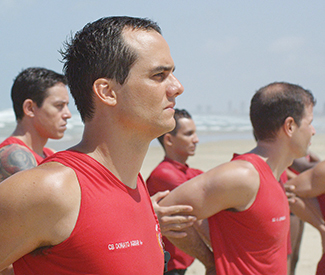
Futuro Beach (Karim Ainouz, Brazil) When two German men globe-trotting on their motorcycles go for a dip off the Brazilian coast, they’re pulled under by the current — only Konrad (Clemens Schick) is saved by local lifeguard Donato (Wagner Moura), his companion lost. The two men console one another with sex. Then in the first of several disorienting jumps forward in time here, suddenly Donato has moved to Europe in order to continue their relationship, leaving his old life (including a dependent mother and younger brother) behind. There are further narrative leaps ahead — director Karim Ainouz (2002’s Madame Satã) is all about bold gestures here, but his visual and sonic assertiveness don’t necessarily fill the blanks in narrative and character development. The resulting exercise in style will leave you either dazzled or emotionally untouched. June 27, 9:30pm, Castro. (Harvey)
Cupcakes (Eytan Fox, Israel, 2013) After a run of politically tinged features, Eytan Fox (2002’s Yossi & Jagger, 2004’s Walk on Water) goes the Almodóvar-lite route with this flyweight comedy about a Eurovision-style song contest. Gay Ofer (Ofer Shechter) and various girlfriends who all live in the same Tel Aviv apartment building decide to enter the Universong competition, becoming Israel’s official entry with improbable ease despite never having performed publicly before. Their mild travails (fighting the creative inference of professional handlers, Ofer’s attempts to drag his boyfriend out of the closet) fill time pleasantly enough before the inevitable triumphant telecast climax. This candy-colored fluff, its mainstreamed camp sensibility predictably reflected in corny vintage hits (“Love Will Keep Us Together,” “You Light Up My Life”), is aptly named — it’s as colorful, easily digested, and about as nutritious as a tray of cupcakes. June 28, 8:30pm, Castro. (Harvey)
I Feel Like Disco (Axel Ranisch, Germany, 2013) When housewife Monika (Christina Grobe) suffers a stroke and falls into a coma she may never come out of, her chubby teenage son Flori (Frithjof Gawenda) and junior high swim coach husband Hanno (Heiko Pinkowski) are forced to depend on each other without mom as a buffer. Things tentatively look up when Flori develops an unlikely friendship — and possibly something more — with dad’s star diver, Romanian émigré Radu (Robert Alexander Baer). Axel Ranisch’s gentle seriocomedy doesn’t make much of an impression for a while, springing few surprises (despite occasional deadpan fantasy sequences) along its moderately amusing path. But as father and son struggle to rise to the occasion of their shared crisis, we grow to like them more — and likewise this ultimately quite disarming feature. June 29, 7pm, Castro. (Harvey) *
Frameline 38, the San Francisco International LGBT Film Festival, runs June 19-29 at the Castro Theatre, 429 Castro, SF; Roxie Theater, 3117 16th St, SF; Victoria Theatre, 2961 16th St, SF; and Rialto Cinemas Elmwood, 2966 College, Berk. For tickets (most shows $10-15) and schedule, visit www.frameline.org.For even more Frameline 38 short takes, visit www.sfbg.com.
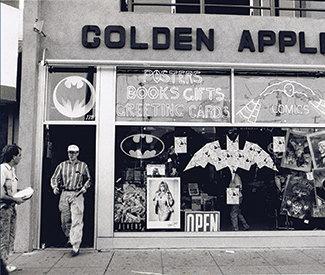
FILM Clad in his signature cape and cowl, Batman has been taking to the streets in the darkness of night and fighting crime in the imaginations of comic-book fans for 75 years.
Thanks to the Christopher Nolan film trilogy, the public has gotten used to the idea of the character being dark and brooding and living in a gritty, more realistic world. But it was Tim Burton’s eye-popping Batman, starring Michael Keaton, that first ushered in a modern vision of the Dark Knight, 25 years ago this week on June 23, 1989. That summer, Batman unleashed in a wave of pop-culture Batmania. No matter where you turned, you’d see the Bat-Signal on a T-shirt, hear “Batdance” on the radio, or catch yourself muttering one of Jack Nicholson’s iconic Joker quips.
Sam Hamm, who wrote the story for Batman and co-wrote the script with the late Warren Skaaren, is a San Francisco resident.
“I grew up reading comic books — I was completely saturated with the stuff. A few years ago, I was cleaning out some old boxes, and I came across a picture of myself when I was probably five years old, wearing a cowboy hat and reading a copy of Batman. So in that photograph somebody had encapsulated my entire future. Obviously, it was my destiny,” laughs Hamm.
By the mid-1980s, an early script for a Batman film had been kicking around at Warner Bros. for several years. Hamm had started working for the company on some different projects around that time; one day, while waiting for a meeting, he saw the script on a shelf and started reading it.
“It was very much the same structural model as Superman,” he recalls. “I was reading it, and thinking, ‘No, this is not the way.’ It [was] explaining all this stuff you don’t have to explain. It’s basically just a guy who puts on a suit and goes out and kicks ass — but why would a rich guy go out and do that every night? That, it seemed to me, was the interesting part of the story. It wasn’t how this guy came to be, it was why this guy came to be — that’s the central mystery of the movie.”
After lobbying for about six months, he was asked by Tim Burton, who was attached to direct at the point, to share his ideas for a new story.
“I said, ‘Okay, here’s the deal — you don’t start with Batman. It’s the origin of the Joker that you start out with, and Batman is the mystery. I have this feeling that Batman is really depressed, and he has to keep on going out and doing this stuff because he’s reenacting this mess with his parents.'”
Hamm’s vision was a drastic departure from the campy 1960s television show that mainstream culture most closely identified the character with at the time, but the filmmakers quickly decided that it was the direction they wanted to take.
“We started with the idea that Batman is bat-shit crazy. He goes out and does this, but then meets a girl, and starts thinking, ‘What would it be like if I had a normal life? I’ve never thought of having a normal life.’ So the progress of the story is that he starts to go sane, and what does that do to the weird sort of lifestyle decision that he’s made?”
That approach clearly resonated with fans around the world. Looking back decades later, Hamm has fond memories of being part of the phenomenon.
“It was wild. There was a huge buzz around it,” he says. “I would be driving around San Francisco, and there was a house in Noe Valley where the guy had painted the logo on his garage. They put a Bat-signal on Zeitgeist! It was quite bizarre to feel you were a part of that.” *
SUPER EGO Fellow freakazoids, I’m disturbed. There’s an alarming new microtrend in nightlife: daylife. More specifically: morninglife. Halp!
First NYC’s Daybreakerparty hit our shores a couple weeks ago, enticing hundreds of people to line up outside Audio at 8am for two hours of pre-work dancing ($15-$20) that apparently involved giant jellyfish costumes, a brass band (just to make sure you were awake?), and Four Barrel coffee — no alcohol here. I didn’t make it, because fuck that. But I was intrigued! Daybreaker’s AM disc jockey DJ Bradley P is a quality cutie, and the after-vids were rad. I’m waiting to hear if more are in the works.
Now comes Morning Gloryville from London (Wednesday, June 25, 6:30am-10:30am, $20. Heron Arts, 7 Heron, SF. www.morninggloryville.com), which places itself at the nexus of Burning Man, Ministry of Sound, and 24-Hour Fitness. Kind of a spiritual neon-flashmob throwdown, with wigs, massages, and smoothies. “Rave your way into the day!” It looks real cute. And exhausting.
I should have seen this coming the moment fluorescent Fitbits and post-ironic ’80s “Get Physical” dance routines started hitting the dance floors. Of course, SF has a long, glorious, deranged history of morning parties, from 6am Sunday Church at the End Up in the ’70s to recent blasts at North Beach’s Monroe and our own occasional Morning Glory party. I’ve loved dancing in the wee hours ever since I hung out in West Berlin in the ’80s and discovered high school kids hit the clubs before going to school.
But this new wave is just so darn wholesome — complete with slick marketing campaigns, relentless cheerfulness, and franchise ambitions. Despite my liver’s squeaky pleas, I’m not quite ready to come over to the “nightlife as workout routine” side, let alone sans cocktails. At least not yet. Yes, this fantastic ass came from tripping the light fantastic four-six nights a week. But these massive biceps? Grasping my vodkas, dear. Perhaps one day I’ll see the light.
BAIKAL
Sound Department continues to delve monthly into the more thought-provoking side of electronic music. This 11th installment features Berlin multi-layerist Baikal, who’s been building a body of impeccable (yet quite danceable) tech-work.
New show “Gorgeous” at the Asian Art Museum challenges and redefines the notion of beauty in “Eastern” art: Fantastic-sounding opening party makes it all come to life, with deep techno tunes from Dr. Sleep and Robot Hustle, bounce jams from DavO and Natalie Nuxx, vogue extravaganza from House of Nu Benetton, milky tea, fresh nail designs, full bar, and an afterparty at the Stud.
Fri/20, 7pm-11pm, $20–$25. Asian Art Museum, 200 Larkin, SF. www.asianart.org
LEE BANNON
Based-goth monthly funhole 120 Minutes presents this brilliant, trip-hoppy Ninja Tuner, drifting on gorgeous, post-glitch waves to the darker side.
Fri/20, 10pm, $8–$10. Elbo Room, 647 Valencia, SF. www.elbo.com
LOCO DICE
Maestro of that muscular quasi-minimal Ibiza sound — and not bad to look at, either — Mr. Dice blew me away last time he touched down, a couple years back. He’ll be on the 1015 system this time: All aboard the silver spaceship.
Fri/20, 9pm-4am, $20–$25. 1015 Folsom, SF. www.1015.com
LOUIE VEGA
Here’s a “flashback” night for ya: Master at Work and Latin house legend. He’ll be stretching back into his roots with some Afrobeat, samba, disco, and soul at Mighty. With old school heroes David Harness and Jayvi Velasco.
Fri/20, 10pm-4am, $20 advance. Mighty, 119 Utah, SF. www.mighty119.com
KAFANA BALKAN
“Join us for wild brass, abandon, and reverberating floors” — you can say that again, as this whirling, stomping Balkan delight returns to its Rickshaw Stop home. DJ Zeljko, Fanfare Zambaleta live band, Elizabeth Strong, and the Foxglove Sweethearts belly dancers bring gypsy joy to an adoring crowd.
The superfly UK whiz kid with a knack for connecting dance music history dots continues to thrill in the spotlight. She’s headlining a powerhouse night featuring NYC early-’90s fantasist Kim Ann Foxman, Alex Arnout, Young Marco, Bells & Whistles, and more at the As You Like It party.
https://www.youtube.com/watch?v=eV4ZiUSFvIQ
Sat/21, 9pm-5am, $20–$25 advance. Public Works, 161 Erie, SF. www.ayli-sf.com
WERD.
The classic Sunday weekly ran at now-closed Otis Lounge for more than seven years — now it’s at Monarch and sweeter than ever. This week’s ace tech-house guest Peter Blick helps break things in.
DANCE The 36th annual San Francisco Ethnic Dance Festival opened with an ambitious agenda: presenting India’s eight classical dances in one program. Yet this first weekend — EDF continues at Yerba Buena Center for the Arts through June 28 — didn’t quite meet the high expectations the festival had set for itself.
In part, this was because a shadow fell on the show. Last week, great kathakali practitioner K.P. Kunhiraman, who was to make his farewell appearance, died unexpectedly in India. With his wife, Katherine Kunhiraman, he had directed Kalanjali: Dances of India, one of the Bay Area’s oldest Indian dance schools, teaching both folk and classical Indian dance.
While bringing these classic forms together was a noble idea, EDF should have presented them on equal footing. This is particularly true because while bharatanatyam, kathak, and to a lesser extent odissi and kuchipudi are well known to Bay Area audiences, kathakali, manipuri, mohiniattam, and sattriya may have been unfamiliar even to many of the Southeast Asian families who attended the festival.
Performed by guest artists from out of town, these new-to-us genres were set to music that came out of loudspeakers. For a first exposure to an art, which so intimately depends on instruments and the human voice, recorded music was a disservice to both the practitioners and the audience.
One only had to look and listen to tabla player Samrat Kakkeri (and his colleagues) with the first-rate Chitresh Das Dance Company, which closed the program, to realize that the subtle give-and-take that flows between dancers and musicians should not be given up to expediency. No wonder the Chitresh dancers managed the intricacies of the multiple rhythmic patterns in Das’ kathak yoga with such confidence and joy. Many dance genres do just fine with unrelated music or no music at all. Indian dance, as this program proved, does not.
Also, while some of the less familiar dance forms might have been given more stage time — some others could easily have been shortened. What intrigued most in these first EDF appearances was how little use was made of the sophisticated rhythms that we have come to know as Indian dance.
More drama than dance, kathakali’s spectacular performances can last all night. The excellent Sunanda Nair gave us a glimpse of a work in which an evil demon — in the shape of a seductive woman, wouldn’t you know — gets her comeuppance from baby Krishna. She returned later in an example of mohiniattam which highlighted articulate arms and feathery hands. It was thrilling to see how her torso contrasted with her legs planted into wide plies, from which she smoothly sank into and rose from the ground.
Sohini Ray’s snippet of manipuri, however, disappointed because it looked stiff, and didn’t really develop those wonderfully gentle whipping turns that make the dancers look prayer wheels. She communicated much better in what seemed a more folkloric form of manipuri in which leaping, running, and turning on the knees conversed with a dual head drum.
Intriguing in its use of unisons and rolling wrists, sattriya — performed by two women, one in pants — conveyed the gently rocking geniality of two friends on the road. I have to assume that the one with a hat was Lord Krishna. For those familiar with the mudras, Indian dance’s gestural language, they were so beautifully clear that they were easy to follow. I recognized three for sure: a welcoming gesture, shooting an arrow, and riding a horse.
In its first appearance at the EDF, San Francisco’s Nava Dance Theatre proved itself a fresh, spunky, and musically-aware bharatanatyam company. In its piece, a love-struck young man (a dreamily handsome Arun Mathai) was comforted by a bevy of young maidens. A spectacular, theatrically savvy soloist, Bhavajan Kumar, may yet do for bharatanatyam what Joaquín Cortés did for flamenco.
In their celebratory kuchipudi — bharatanatytam’s younger, looser sister — the nine young women of San Jose’s Natyalaya school of dance handled the rigors of their geometries with considerable grace. Maybe one day we’ll see them perform to live music.
Charming, yet very serious in odissi were Maya Lochana Devalcheruvu (age 11) and Akhil Shrinivasan (10). Young as they are, they already showed odissi’s curved body position and light footwork. With good stage presence, they knew what they were aiming for. The duo then welcomed Sujata Mohapatra, an exquisite odissi dancer light but firm on her feet, floating on her toes, and her rippling neck enhancing the facial expressions.
Though in mourning, Kalanjali: Dances of India performed Tillana, the final section in a bharatanatyam performance, for which the dancers pull together everything they learned. These women probably did. *
Programmers-in-training line the work tables at HackReactor, a software engineering boot camp many in the tech community call a “university disruptor” due to its speed in training coders. Those hunched over computers are typing their way toward a goal: joining the ranks of the 12-week course’s alumni, now employed at tech companies like Adobe, Beats Audio, Pandora, and Hipmunk. But walk past the rows of intensely driven (yet casually dressed) engineers and you’ll also encounter the program’s unlikely new trainees: San Francisco high school students.
Tech company HackReactor and nonprofit Mission Bit are co-training San Francisco Unified School District students for the summer, and throwing them into the trenches with pre-professional engineers.
Soon, these students will be proficient coder kids.
“Mission Bit gave us our first understanding of what javascript was,” Gisela, a 17-year-old Lowell High School student told us. “Hack Reactor said ‘now make a game,’ and threw me into the code.”
The free program is a new extension of Mission Bit’s after-school coding classes, offered this year at Mission High School, a SFUSD public school, and Lick Wilmerding High School, which is private. The semester program is paid for by tech companies: mainly WeChat (Tencent America), with in-kind sponsors including Salesforce, HackReactor, DeNA, Brightroll, AdRoll, Rackspace, co.lab, and Tagged. The summer program is fully paid for by HackReactor.
It also comes at a crossroads for San Francisco: Its communities of color are being priced out just as its tech industry is searching for ways to enroll more diverse workers.
Though many pin the displacement problem on the rising cost of housing, there’s also another less-spoken-of culprit: Local tech companies draw many applicants from around the world to fill jobs instead of hiring local residents.
This may be due in part to lack of trained prospective employees locally.
There’s a broken education pipeline between local schools and the tech sector, both sides admit. The new effort by Mission Bit and HackReactor may be a first step towards plugging the leak. If the program is successful, subsequent iterations may establish the first stable pathway to technology sector jobs for San Francisco students.
Though the intern program is still in its beta phase, it shows much promise, and comes at a dire time for the city.
PROBLEMS CONVERGE
The summer coding program may hold solutions for three problems that coexist simultaneously: displacement of communities of color, the tech sector’s shocking lack of diversity, and the SFUSD training gap.
The city’s Mission District, often pointed to as tech workers’ most desired neighborhood, saw 1,400 Latinos leave between 1990 and 2011, while its white population grew by over 2,900, according to a recent study by Causa Justa, Just Cause.
The tech industry has a complementary problem: Google recently revealed its employees are 70 percent men and 61 percent white. Just five percent of Google’s workforce is black or Hispanic. Though the Asian population is 30 percent of its workforce, that’s still out of line with the significant Asian presence in the Bay Area.
Sources tell us Google puts heavy effort into diversity recruitment and likely had better percentages than the rest of the industry. Google claimed in myriad news reports that potential employees of color were difficult to find.
But SFUSD’s 52,000 students are 25 percent Latino, 41 percent Asian and 10 percent African American, so why not recruit students from our diverse local public schools, bolstering San Francisco’s flailing middle class at the same time?
That brings us to our last problem. Until recently, the SFUSD only taught computer science in three of its 17 high schools: Balboa, Galileo, and Lowell. There’s a tech training gap in San Francisco, making the leap for SFUSD students to the tech sector all the less likely.
The SFUSD is now taking steps to rectify this, but the change will take time.
“SFUSD sees teaching coding, digital literacy and computer science as critical to preparing our students for success,” SFUSD spokesperson Gentle Blythe told the Guardian. “We have a long-term plan in place for how we are phasing in teaching computer science, including coding, throughout a student’s K-12 career.”
SFUSD launched computer science courses in two additional schools last year: Wallenberg and Washington. More are on the way, Blythe said. Other schools host coding tutoring programs. One organization, Code.org, led a “day of code” where thousands of SFUSD students to tried a hand at rudimentary programming exercises.
But in order to really tackle the gap, SFUSD teachers and students will need hands-on training with coders and software engineers. That’s where Mission Bit and HackReactor come in.
STARTING SMALL
Tyson Daugherty founded Mission Bit after a startling realization: San Francisco schools weren’t prepared to teach his children how to enter the tech industry.
Daugherty was on the business side of tech, starting his first company in 1999. After moving to the city he wanted schools where his children, ages 5 and 2, could one day train to join his industry.
“I became incredibly frustrated with what I was finding in public schools,” he said, sitting with us in HackReactor’s Market Street office. “These kids are learning fundamental material in science and math, but there’s a disconnection to application and purpose.”
Mission Bit was born, with a simple objective of increasing coding education in local schools.
Gisela’s Lowell High School classes were rigorous, she said, but while programming her first game she relearned physics all over again.
“I’m making a game where each player has a ball, they bounce against each other to bounce the player into the hole,” she told us. Her technical mentor, Kwyn Alice Meagher, gave her a physics crash course to get the ball to bounce just right.
“[In school] I learned the logic of physics but not the application,” Gisela said. “Now that I understand the purpose of learning it, I’m figuring it all out.”
The students start at Mission Bit learning HTML, Javascript, CSS3, Ruby, SQL and Sinatra, with instruction provided by volunteers from local technology companies. Daugherty told us over 60 volunteers emailed Mission Bit after they reached out for potential teachers, and the nonprofit could only utilize 30. Those additional volunteers will get a chance to teach students in the upcoming fall after school program.
Once students “graduate” Mission Bit it’s time to join the workforce. Gisela and two other students jumped to an internship at HackReactor, where they’re putting their coding knowledge to practical use.
Isaac Zimmern, a graduating Lowell senior, is one of those other students. He celebrated working side by side with mentors while he programmed, inspiring him to pursue computer science in college.
And though Gisela and Zimmern are both from Lowell, many schools were represented in Mission Bit’s program. In one office a group of about a dozen students sat at computers, programming Android phones to play a simple game resembling “Doodle Jump.”
They hailed from a myriad of schools: Raoul Wallenberg, Balboa, Lowell and more. Douglas Mejia, 18, let us see his “Doodle Jump” clone. Its theme music popped on loud, singing “I ain’t sayin’ she’s a gold digger, but she ain’t messin’ with a broke — — -,” and on-screen Kanye West hopped from platform to platform.
Mejia smiled proudly as he showed us his game. He said he wasn’t interested in making games while in school, but Mission Bit turned him into a believer. Now he’ll study computer science at the University of San Francisco.
Mission Bit’s class body is 8 percent African American, 24 percent Latino, and over 50 percent Asian, according to the company’s internal data (that’s in line with SFUSD’s own demographics). Nearly half of the students come from the south side of San Francisco, around the Ingleside District.
The program is still small, but Daugherty says it’s designed with scalability in mind. There’s potential for these students to one day not only fill tech’s diversity gap, but to allow tech jobs to be filled by San Franciscans, born and raised.
But Daugherty says such goals are secondary. The focus is on the students.
“The industry has a very specific agenda about where they want their engineers diversified,” he said. “If this is where our students want to go, we’ll support them. But there are other paths to take.”
Students can use their programming skills in many jobs and industries, he said, not just tech.
Still, the students will have an opportunity to visit local tech companies Square, AirBnb and others, meeting engineers who one day may be peers. Daugherty calls these people “touch points,” making social contacts for mentorships and job seeking that blue-collar SFUSD students may not have themselves.
Ultimately, the program “lets you get programming skills without going through the money filtering step of a university,” said Anthony Phillips, CEO of Hack Reactor. Counter to the belief in pure meritocracy many in tech swear to, Phillips acknowledged he had help: his brother, a Twitter employee. When Phillips first learned code and started to fumble, his brother told him “you’re so smart, but so dumb. Just keep doing it.”
So Phillips aims to do the same for the students at HackReactor. He’s like a coach in the corner for new boxers taking their aim at advanced coding skills.
“Not everyone has someone there that can say, ‘just keep doing it,'” Phillips said.
Since we at the Bay Guardian published a story flagging Pacific Gas & Electric Co.’s odd behavior of stonewalling a developer who had basic questions about a high-pressure gas pipeline running beneath his Bernal Heights building lot (see “Bernal blows up,” May 20), we’ve heard from others concerned about the company’s practices regarding safety.
PG&E has undertaken a massive pipeline improvement project to correct the underlying problems that led to a disastrous 2010 natural gas explosion in San Bruno, which destroyed a neighborhood, killed eight people, and injured 58 others.
But the repairs have been complicated by a number of factors, including inaccuracies in records that provide a foundation for the whole undertaking. Meanwhile, a fascinating document obtained by the Bay Guardian raises troubling questions about whether state regulators are taking seriously PG&E’s shortcomings in this endeavor.
Established in 1905, PG&E is California’s largest utility company. It wields tremendous political influence, particularly in San Francisco, where it’s headquartered. But the utility giant has been in hot water lately. It was indicted by federal authorities on charges of criminal negligence earlier this year in connection with the San Bruno explosion, and may soon face additional charges in a superseding indictment, the company noted in a recent regulatory filing.
PG&E’s safety upgrade project, known as the Pipeline Safety Enhancement Plan, was launched to address the underlying problems that led to the unanticipated pipeline rupture and explosion in San Bruno. That disaster brought the powerful utility under intense scrutiny, exposing a deeper pattern of negligence and sloppy record-keeping. The PSEP was rolled out as a corrective measure, in response to regulatory demands.
SHIFTING TARGETS
The detailed PSEP outlined how the utility would go about strength testing, replacing, and retrofitting its vast network of natural gas transmission pipelines, which comprise 6,750 miles traversing the utility’s Northern California service territory. The hefty document was submitted for CPUC approval in 2011.
However, things haven’t gone exactly as planned. Phase I of this plan was supposed to have been completed by the end of 2014 — but that’s now behind schedule, and some of the original targets have been revised.
The Bay Guardian attempted to contact both PG&E and the CPUC for this story, but did not receive responses. However, regulatory filings reveal quite a lot about the company’s progress.
A comparison of the work PG&E proposed to complete in 2011, versus what it reported having completed as of March 31, 2014, demonstrates how the massive safety upgrade project has shifted over time.
In a document submitted to the CPUC on May 22, PG&E reported that it had completed 541 miles of strength testing, as compared with 780 miles of strength testing originally proposed to be completed by the end of 2014. PG&E said it had replaced 105 miles of pipeline, as compared with the 186 miles of pipeline replacement it initially said would be done by the end of the year. It also reported installing 141 automated valves — but in 2011, PG&E told regulators that by the end of Phase I, “228 gas shut-off valves will be replaced, automated, and upgraded to enable PG&E to remotely or automatically shut off the flow of gas in the event of a pipe rupture.”
In hefty technical documents, PG&E provides reasons for why some of the targets have shifted, often the result of new information coming to light. In a June 6 CPUC filing, PG&E noted that nine scheduled pipeline replacement projects included in Phase I likely would not be completed by the end of the year, as originally planned.
This formal acknowledgement of a delay seems to substantiate the account of a Guardian source familiar with the pipeline safety upgrade work, who asked not to be identified. Work crews hired by PG&E contractors and subcontractors to perform the safety upgrades have found themselves in a holding pattern of waiting to be called out to job sites, our source said, despite the extensive planned work.
The utility typically sends work crews out to perform maintenance work during spring and summer months, so it can be wrapped up in time for winter, when there’s higher demand for gas heating.
The cost of these upgrades is shared between PG&E shareholders and revenues collected from utility customers.
PROBLEMS REVEALED
A major obstacle to the goal of improving safety has yet to be resolved: PG&E’s pipeline records still aren’t in order, despite a major push to iron out data in the wake of San Bruno.
Since these records are the foundation for making safety upgrade decisions, these informational gaps threaten to undermine the project. The implications of this glaring problem are outlined in a CPUC document obtained by the Bay Guardian which was circulated on an internal “service list,” but not made publicly available.
First, some background: In October 2013, PG&E submitted an update to its PSEP plan to the CPUC, which included reporting on its effort to collect and analyze pipeline records. The regulatory agency’s Safety and Enforcement Division conducted an audit of this reported progress.
The audit, which made headlines when it was released in April, commended PG&E for its work but also noted, “PG&E does not have traceable, verifiable, and complete records for every pipeline component in its transmission system.” The audit also found errors in the work papers submitted by the company to back up its claims. Nevertheless, the Safety and Enforcement Division concluded, “no imminent safety concerns arose” from the findings.
But this proclamation isn’t the final word on the matter. The Office of Ratepayer Advocates is a small division within the CPUC, which functions as a watchdog looking out for the interests of utility customers. Its comments on the audit tell quite a different story, raising questions about why the enforcement division didn’t seem to place much weight on its own findings.
In its comments, reflected in the document that was circulated internally, the ORA sharply questioned the Safety and Enforcement Division’s overarching conclusion. It should “reflect the actual findings of the audit,” the ORA wrote, recommending that the Safety Division “define what is meant by … ‘no imminent safety concerns.’
“In common language,” the ORA went on, “this would be interpreted to mean there is no situation that puts the public in immediate risk of death or serious physical harm. If that is the meaning, please confirm. If not, please clarify the meaning.”
The ORA goes on to note that such a statement is “contradicted by findings within the body of the report,” and that “it is difficult to understand how the SED Report could reach this conclusion.”
The Safety Division’s audit “documents errors that ORA would define as safety risks,” the ORA notes, such as the discovery of a pipeline that has a maximum operating pressure nearly 20 percent higher than it should be, based on the pipeline feature data, or the discovery that PG&E had been “inappropriately operating a pipeline with a reduced margin of safety.”
PG&E responded to the Safety Division’s audit, and “they view their report as final,” noted ORA spokesperson Nathaniel Skinner. As far as addressing the problems uncovered in the audit, “It’s unclear to us what the next step is for the Safety and Enforcement Division.”
OPINION Every year, around 3,500 formal eviction lawsuits are filed against residential tenants in San Francisco Superior Court. Contrary to popular belief, the eviction lawsuit — known as an “unlawful detainer” — is one of the fastest moving cases in the entire civil system. While we’ve all heard anecdotes about how it can take years to remove San Francisco tenants from their homes, tenants sued for eviction experience civil litigation at warp speed.
More than a third of those sued for eviction miss the five-day window the law provides to file a response with the court. In 2013, 1,294 of the tenant households that were sued for eviction in the city missed that deadline to respond. The strong tenant protections found in San Francisco’s Rent Ordinance and California law don’t mean much to those who miss their five-day deadline: Sheriff’s deputies clear the property just a few weeks after the case is filed if you don’t respond. So much for due process.
Securing tenants due process rights in San Francisco has been our job at the Eviction Defense Collaborative (EDC) since 1996. At our drop-in legal clinic, our team of attorneys and volunteers assist over 94 percent of all tenants who respond to their eviction lawsuit in San Francisco each year. Although our office is open Monday through Friday to help tenants respond to the lawsuit on time, nine out of 10 tenants sued for eviction represent themselves for the duration of their case. Over 90 percent of landlords can afford to hire expert, aggressive attorneys to evict their tenants — very few tenants can afford to hire a private attorney to defend their homes.
Unsurprisingly, tenants agree to move out in most eviction lawsuits — around four out of five tenants sued for eviction will settle the case with an agreement to leave their homes. And who could blame them? The choice of conducting a jury trial against a licensed attorney is not an appealing — or realistic — choice for a self-represented tenant. Without an attorney to stand up and fight for your rights at trial, those rights remain the empty, meaningless promises of the pay-to-play American legal system.
Of course, tenants who get represented by attorneys can win eviction cases — exactly the reason we started our Trial Project at EDC last year. Since the Trial Project launched, EDC staff attorneys have represented a small percentage of tenants facing the prospect of a jury trial on their own. Through the hard work of EDC staff attorneys (who on average earn less than $50,000 a year), the Trial Project enjoyed another jury trial victory in May. While very few eviction cases reach a verdict, this was EDC’s third trial victory in the past year.
This particular jury verdict saved the home of a Spanish-speaking couple who has lived in the Mission District for the past 19 years. They have young children who attend the local public schools and attend church in the neighborhood. This family has limited income and would certainly have had to leave of San Francisco if it was evicted, uprooting the children and leaving behind its community.
The landlord had accused the family of not paying the rent — even though the family had repeatedly tried to pay. The jury agreed with the tenant, finding that the conditions on the property were so bad that the landlord wasn’t entitled to the rent being demanded. The jury actually followed the law, and reduced the tenants’ rent.
The heroes in this case are the tenants — their courage in standing up for their home and their civil rights is inspiring, and should be a lesson to tenants across the city. We need tenants in San Francisco to push back against this current wave of displacement and we’re here to help.
Tyler Macmillan is a tenants’ rights attorney and the executive director of the Eviction Defense Collaborative, a nonprofit legal services clinic in the Tenderloin. Any tenant sued for eviction can drop into EDC at 995 Market St., #1200 (at Sixth Street) Mon-Fri, 9:30-11:30am and 1-3pm.
EDITORIAL Members of the San Francisco Board of Supervisors who try to identify with both the progressive movement and business-oriented Mayor Ed Lee — most notably, Sups. David Chiu and Jane Kim — engaged in a strange bit of self-congratulations during their June 10 meeting, patting themselves on the back for a trio of “progressive” reforms.
Yet in each case, the measures are weaker than they should be and too long overdue — and they have their full implementation delayed for years, while the needs of the people they aim to serve are immediate. What Kim and Chiu presented as a demonstration of political effectiveness on behalf of needy constituents is actually just the opposite. It is political cowardice and not political courage.
The best of the trio of approvals was a measure by Sup. David Campos that finally closes the loophole that allows employers to satisfy their employee healthcare mandate by creating healthcare savings accounts, which they make difficult to use and then pocket the money that remains.
This should have been enacted three years ago when Campos first won approval for it, only to see Lee veto it and Chiu sponsor a watered-down alternative that didn’t address the problem. Even now, in order to win over Sups. Mark Farrell and London Breed to attain a veto-proof majority, Campos had to delay full implementation until 2017.
“I also want to commend Sup. Campos for finding compromise,” Chiu said before joining the inevitable majority, a snide dig at his Assembly race opponent that only served to reinforce Campos’ campaign trail points that Chiu’s compromises are often just sellouts to downtown interests. This watered-down version, albeit better than the last watered-down version, also won unanimous approval.
Another kumbaya moment came with the introduction of a consensus ballot measure for increasing the minimum wage in San Francisco, with the Mayor’s Office and business community finally agreeing with the campaign by labor and progressive groups to increase the minimum wage to $15 — but delaying that implementation to 2018. How much displacement and economic hardship will San Franciscans experience between now than then?
Chiu and Kim also sang the praises of Lee for finally agreeing to finally keep his word and support a local increase in the vehicle license fee to fund safer and smoother streets and more money for Muni. But rather than this year as promised, that measure will be on the November 2016 ballot, pushing it back from prosperous to uncertain times.
At the June 12 Guardian community forum, Sup. Scott Wiener said he may still move forward with his proposed charter amendment to give Muni more general fund money until the local VLF is approved, and we strongly urge him to so do.
“Justice delayed is justice denied” is a legal maxim that this board full of lawyers is certainly familiar with. Their delays of crucial reforms are disgraceful and damaging to the city, and for them to congratulate themselves for doing so is insulting.
San Franciscans have always been wary of chain stores, more so than residents of any other major US city, none of which have taken on the ever-expanding national corporations and their homogenizing impact on local communities as strongly as San Francisco.
In the decade since San Francisco first adopted trail-blazing controls on what it calls “formula retail” businesses, those restrictions have only gotten tighter for various commercial districts around the city as elected supervisors seek to prevent big companies from taking over key storefronts from local shopkeepers.
But now, as the Planning Department and Mayor’s Office push a new set of formula retail regulations that they say standardizes and expands the analysis and controls for chain stores throughout the city, neighborhood groups and small business advocates are decrying aspects of the proposal that actually weaken those controls.
Most controversial is the proposal to almost double the number of outlets that a company can have before it is considered a formula retail business, going from up to 11 stores now up to 20 under the proposal, which was approved by the Small Business Commission last week and heads to the Planning Commission next month.
Opposition is particularly strong in North Beach, one of two neighborhood commercial districts that have an outright ban on formula retail business (Hayes Valley is the other) and where residents are organizing to fight the proposal at the Board of Supervisors and at the ballot if necessary.
“The Planning Department proposal to redefine what a chain store is flies in the face of the voters’ will and 10 years of successful chain store policy,” Aaron Peskin, the former Board of Supervisors president from North Beach who sponsored the ordinance banning chains there, told the Guardian.
The citywide voters he refers to are those who approved Prop. G by a wide margin in 2006, defining formula retail business as having 11 or more outlets with common branding and merchandise and requiring that they obtain a conditional use permit before opening in most neighborhood commercial districts, thus giving local residents a vehicle to stop those projects.
Although Prop. G allows the city to update its standards and definitions regarding formula retail, Peskin and others said throwing out the negotiated number of 11 outlets undercuts “the fundamental underpinning of the formula retail controls.”
The Planning Department proposal also does nothing to prevent big national chains from creating spin-offs to circumvent the controls, a growing trend that raised controversy in the last few years, including when Gap subsidiary Athleta opened a store on Fillmore Street and when Liz Claiborne owner Fifth & Pacific Companies tried to open a Jack Spade store in the Mission District.
Those two controversial provisions in the Planning Department proposal aren’t in rival legislation by Sup. Eric Mar, who has long been a champion of expanding controls on chain stores. Both the Mar and Planning Department legislation will go before the Planning Commission on July 17, and they could be either merged or move forward as rival proposals.
“We’re hoping this legislation moves forward as quickly as we can,” Mar told us. “We’re losing neighborhood character in many areas.”
WEAK LINKS
For all the indignant opposition to the Planning Department proposal expressed at the June 9 Small Business Commission meeting, where mayoral appointees led that body’s 4-2 vote approving the measure, the planners who developed it say they’re actually trying to expand the controls on chain stores.
Senior Policy Advisor AnMarie Rodgers and Project Manager Kanishka Burns sat down with the Guardian to go through details of the proposal and a May study it was based on, “San Francisco Formula Retail Economic Analysis,” by Strategic Economics, as well as an earlier study by the Controller’s Office.
“Our department is super committed to encouraging the diversity of neighborhood commercial districts,” Rodgers told us, acknowledging that small businesses often need protection from deep-pocketed corporations that can pay higher rents and enjoy other competitive advantages over mom-and-pop stores.
Rodgers cited studies showing that local small businesses circulate more of their revenues in the city than big chains, boosting the local economy. That’s one reason why the Planning Department proposal expands formula retail controls to include the categories business and professional services (including Kinko’s and H&R Block), limited financial services (including street front ATMs and small banking outlets), and fringe financial (such as check-cashing and payday loan outlets).
The new controls would also count a company’s outlets in other countries and locations that have been leased but not yet opened, it would expand some of the neighborhoods subject to formula retail controls, and it would require formula retail businesses to minimize their signage on the street, improve their pedestrian access, and fund more detailed analysis on their impacts on the local economy. Big box stores, in particular, would be required to submit to even more detailed economic impact studies.
Many of these same provisions are included in the Mar legislation, which also goes further in including gyms, gas stations, smoke shops, strip clubs, massage establishments, and various automotive businesses under the formula retail controls. Like the Planning Department measure, Mar’s also requires more data for formula retail applicants.
“We want to make chains fund economic impact statements before they go into the neighborhoods,” Mar said, noting how those studies will allow city officials to make better decisions about whether to approve formula retail applications.
Stacy Mitchell is the senior researcher for the Institute for Local Self-Reliance, an organization that has been working with San Francisco on its formula retail controls since their inception. She applauds the city’s current efforts to create more comprehensive guidelines and to require more economic analysis.
“San Francisco doesn’t have a good mechanism for fully evaluating the economic impact of these proposals,” Mitchell told us, calling the Planning Department and Mar efforts “a really good place to start the conversation.”
But Mitchell said that she doesn’t want to weigh in on what specific number of outlets may be right, saying city officials just need to decide, “What is the right balance and mix and how do we want to handle it?”
Rodgers told us the Planning Department legislation will expand the number of businesses that fall under formula retail controls, even as the threshold is raised to 20 outlets, although she couldn’t quantify exactly how much.
But critics are focusing on aspects of the proposal that loosen current restrictions, noting how that cuts against the trend in recent years of supervisors seeking to tighten restrictions in their districts, creating a hodgepodge of legislation that the Planning Department was trying to overcome with comprehensive new legislation.
WHAT’S A CHAIN?
The Planning Department’s new threshold and the arguments being made to support it rely heavily on making the case that three specific homegrown companies should be excluded from formula retail protections: Philz Coffee (with 14 stores), Lee’s Deli (13 outlets), and San Francisco Soup Company (16 locations).
“Right now, we would treat Philz the same way we treat Starbucks,” Burns said, noting that Starbucks has more than 20,000 outlets.
“Can’t you cut a break to the businesses that started here?” was a question that Rodgers says helped shape development on the regulations. The Strategic study found that about 5 percent of the retail establishments in the city had 11 to 20 outlets, while another 4 percent had 21-50 outlets. “We’re just trying to find the sweet spot.”
Yet Peskin said the change doesn’t make sense, and it’s just a way to give special treatment to a handful of local companies with political connections, and which have more resources to go through the conditional use process than a true small business.
“They’re basically finding another way to satisfy San Francisco Soup Company, a stalwart member of the Chamber of Commerce,” Peskin said.
Asked how she can seemingly circumvent the will of the voters, Rodgers told us, “It was a voter initiative, but it says the Planning Commission will establish further details.” In fact, Prop. G simply relies on the formula retail definitions that had already been adopted by ordinance started with a measure by then-President Matt Gonzalez in 2004.
But Peskin said the proposal to increase the threshold to 20 is an affront to popular local controls on chain stores, one that has little chance of becoming law.
“I don’t think the Board of Supervisors is crazy enough to go and undo one of the most successful pieces of legislation from the early part of this century. And if they do, then the voters won’t stand for it,” Peskin said, pledging to personally work on the campaign to protect existing formula retail controls.
Mar also said he will defend the current threshold. “The 11 that was written into the legislation was the result of a compromise,” Mar said, noting that Gonzalez initially placed the threshold at four stores and compromised with the business community on 11. “We’re going to do our best to work with our coalition to hold it to 11.”
CORPORATE CONTROL
Mar was also critical of the Planning Department proposal for not looking at corporate ownership of subsidiaries, something that his legislation does, stating that companies with a 50 percent or more ownership stake in an outlet get included in the formula retail designation.
“Our proposal has been attacked by people who think we’re over-regulating and those who think we’re under-regulating,” Rodgers told us.
Yet as the June 9 Small Business Commission hearing made clear, supporters of the proposal predictably came from the same business groups that have opposed formula retail controls from the very beginning: San Francisco Chamber of Commerce, San Francisco Association of Realtors, and San Francisco Building Owners and Managers Association.
Representatives from each of those three groups were the only people who spoke in favor of the proposal, each of them declaring it a “balanced” and “data-driven” compromise that they support, even as they argued for loosening the restrictions even more. But the vast majority of speakers were neighborhood activists critical of the proposal.
“Going from 11 to 20 makes no sense at all. Who picked out this number?” Susan Landry, owner of Animal Connection in the Marina District, told the commission. “Please have a conscience and vote for independent businesses.”
But Small Business Commissioner Kathleen Dooley said the vote was just the latest example of a commission stacked with mayoral appointees (including two bankers) doing the bidding of downtown rather than advocating for small business interests.
“Nine supervisors have tightened up the restrictions in their districts, but the Planning Department has gone the opposite way,” Dooley told us. “The irony was it all started with the protests [of chain applicants skirting local controls], but the Planning Department turned it on its head to loosen the restrictions.”
Yet the planners involved on the proposal call that a simplistic view that discounts the comprehensive nature of the new policy, which they say could serve as a model for other cities.
“I think they’ll all catch up to us,” Rodgers said of the other big US cities that have become to explore formula retail controls as local small businesses struggle against competition from chain stores. “We are a national leader on this and we want to get it right.”
Mitchell agreed: “There are lots of conversations going on around the country about how to meet this challenge, and people are watching what San Francisco does.”
THE WEEKNIGHTERWeekends are for amateurs. Weeknights are for pros. That’s why each week Broke-Ass Stuart (www.brokeassstuart.com) will be exploring a different San Francisco bar, bringing you stories about the places and people who make San Francisco one of the most phenomenal cities in the world. Who wants a drink?
We decided to walk around the Tenderloin. I had my computer, Gene had his bike, and Sabrina had a bag of things I’m sure she didn’t want taken from her as well. We were coming from my weekly Wednesday gig at Monarch where I do a coloring book happy hour.
“It’s very San Francisco out,” I said as we came up Taylor and saw the fog sliding its fingers down the sides of Nob Hill’s buildings. “I love summer in San Francisco,” I mused. “Me too,” Sabrina said, “I hate when people bitch about it. It’s part of San Francisco and loving it is part of being a San Franciscan.”
As we got to the entrance of Jones (620 Jones, SF. www.620-jones.com), the three of us landed on something we felt was important at the moment, that before this current gold rush, it was San Francisco’s summers that weeded out who would stay and who would go. You couldn’t take the mist and the fog? Then you got the fuck out of town. That fog is our inheritance and our merit badge and such a part of The City that you have to love it to live here.
Walking out onto the patio at Jones we were surprised there were no heat lamps. The entirely of the joint’s drinkers were crammed into the little sidebar adjacent to the patio, and as we sat down at the short end of the bar, the three of us gave each other a knowing glance. It said: How many of these people are experiencing their first San Francisco summer? How many would be considering packing up and heading back to wherever they’re from if they weren’t here for the gold rush? How many are living in apartments recently vacated by people whose love for the fog, and all it represents, just wasn’t enough to be able to keep them here?
Gene tipped the barman with a two-dollar bill. “Oh wow,” the bartender said, “you’re still doing that after all this time?” Gene told us he’d met him years before, during the first dot com boom, when the guy tended bar at 111 Minna. “Back then Minna was just a small one room space, not like it is now, Gene explained. “And I remember being there and learning for the first time how badly cocaine got on top of some people when these two girls, up from LA, were offering to blow people for blow.” As I looked around the room at all the pretty and well-dressed people, I wondered what they’d all be willing to do to get something they really wanted. I wondered the same thing about myself. What was I willing to do to stay in San Francisco if push came to shove and shove came to eviction.
Across the bar I noticed a friend who was obviously on a date and even more obviously drunk. “Hey look who it is,” I said to Sabrina who was also friends with the girl, and our conversation changed to the fact that, another integral part of living here is being ok with your past. “You can’t burn bridges,” Gene said, “since you’re bound to run into that person on a barstool sometime soon.” To which I replied, “If you burnt San Francisco’s bridges, all we’d be left with was the Peninsula…” The joke hit all three of us harder than expected. We looked around, looked at each other, and then left the bar. We felt more at home amid the fog anyways.
Stuart Schuffman aka Broke-Ass Stuart is a travel writer, poet, and TV host. You can find his online shenanigans at www.brokeassstuart.com
San Francisco’s municipal transportation system stood still, stranding middle class riders. Riots raged throughout the city as over 1,500 streetcar drivers, known as carmen, literally fought with bottles and stones for higher wages. Left with few options, stranded San Franciscans took to other means to get to work: by foot, by bicycle, and by horse-drawn carriage.
The year was 1907, and United Railroads carmen raged against their Baltimore-based bosses in a year-long strike, in the wake of the great earthquake and fires that leveled much of the city of St. Francis. It was a clash that made last week’s Muni driver sickout look tepid and tame by comparison.
It was one of the single bloodiest strikes in San Francisco history,” Fred Glass, a California labor history teacher at City College of San Francisco, told us. “People were killed on both sides as the cars were run by armies of scabs.”
But minus the violence, the century-old union action has eerie parallels to last week’s Muni sickout, the “non-strike” in which nearly 500 Muni drivers left buses stagnant in garages across San Francisco. The similarities begin with anti-union sentiment in the mainstream press.
As the conservative-leaning San Francisco Chronicle did during this sickout, one of the city’s papers-of-record, The Call, lambasted the unions and city officials alike in 1907.
“Two of the most essential public utilities, the streetcar monopoly and the telephone monopoly, are tied up,” The Call wrote in a front-page editorial on May 06, 1907. “Where — and the question must suggest itself irresistibly to every man with a spoonful of brains — where does the public get off?”
A mob of strikers circle a streetcar at Turk and Fillmore, one site of violence during the 1907 carmen’s strike. San Francisco Examiner file photo courtesy of Market Street Railway, home of lots of interesting SF public transportation history.
The Call offered to publish the tirades of everyday citizens. Today, we can hear the hew and cry more directly. Last week, #MuniSickOut was a top San Francisco trending Twitter hashtag, as irate tweeters pounded their thumbs on smartphones with thoughts like that of user @ReggieMuth: “Grind the city to a halt? You should pay the consequences.”
Muth’s sentiment was echoed by many on the Twitterverse, and angry citizens emailed city leaders as well. One constituent wrote to Sup. David Chiu’s office that, “Public transportation workers held the public hostage for their greedy demand on pay and benefits.”
The San Francisco Municipal Transportation Agency proposed Muni workers pay into their pensions more than it was offering in salary increases, amounting to a pay cut of $1.10 per hour. Muni workers make on average $29.52 an hour, the sixth-highest paid transit workers in the nation, according to the SFMTA. But San Francisco also has the highest cost-of-living in the country.
Transit Workers Union Local 250-A President Eric Williams told us most Muni drivers were long ago priced out of living in San Francisco. “The only members that live inside the city are those who purchased a home 20 or so years ago,” he told us. “The majority of our members live outside the city.”
Muni workers’ wages used to be mandated to be the second-highest in the nation. But in 2010 voters passed Proposition G, requiring Muni worker wages be negotiated and subjected to binding arbitration that the union says is skewed in the city’s favor. But Prop. G and the city charter also prevents workers from striking, hence the drivers calling in sick en masse.
By modern standards the Muni sickout was labeled extreme, by the Chronicle and others. San Franciscans of 1907 feared the URR carmen’s strike for another reason: The workers were ready to die for their cause. Market Street Railway and issues of The Call recalled the strike christened on a day known as Bloody Tuesday.
On May 07, 1907, a mob of URR carmen formed outside the Turk and Fillmore carbarn. At 3:25pm, six streetcars emerged, greeted by a hail of sticks and stones from the strikers. The cars were driven by scabs who crossed the picket lines. More dangerously, they were also manned by gunmen at the behest of the infamous URR strikebreaker, James Farley.
A second pelting of sticks and stones drew action: Farley and his men opened fire on the crowd. Bullets sprayed wildly into nearby police and union men alike. The strikers ran for cover and fired back. A gun battle echoed past what is now a Bi-Rite grocery, ending only when the strikers lacked the ammo to carry on.
“CAR STRIKE LEADS TO BLOOD” read The Call’s headline on Wednesday, May 08, 1907. The first to die was 19-year-old James Walsh, a teamster who was shot through the head. Ultimately, two died and 20 were injured that day. The strikers would bear six fatalities by 1908.
San Francisco is not only experiencing transit strike deja vu, but a repeat of the economic circumstances around the historical Bloody Tuesday, with a wealth gap approaching historic highs. According to the Pew Research Center, in 2012 the top 1 percent of Americans took home about 22 percent of the nation’s wealth, and the bottom 90 percent of the country took home less than 50 percent of the nation’s wealth.
A look at a graph of income inequality shows two giant spikes of the 1 percent’s massive wealth, one spire in the modern era, and another spire planted firmly in the gilded era of the early 1900s, altered only by the Great Depression and the leveling economic policies adopted to address it.
“We’re back to the level of inequality that existed at that time now,” Glass said. “To me that suggests there’s the potential for that kind of explosive conflict between classes.”
The 1907 strike was one in a series of labor battles around the country as wealth became consolidated in fewer and fewer hands, peaking with the stock market crash of 1929, after which the continuing hard times led to one of the most famous union actions in San Francisco history: The Longshoreman’s Strike of 1934.
Led by Australian-born Harry Bridges, the Longshoreman’s Strike seized San Francisco even more boldly than on Bloody Tuesday, with other unions participating in a General Strike that paralyzed the city. That and other labor battles compelled Congress to adopt the National Labor Relations Act, cementing union power that strengthened the middle class, which is today disappearing.
Harry Bridges’ brought the city of San Francisco to a standstill.
“It’s poor or rich in this city,” TWU’s Willliams told us. “There’s no in between, that’s no secret.”
But worse than just a hollowing out of San Francisco’s middle class, modern workers teeter on the edge. Creatives, designers, tech employees, and other professionals are increasingly independent contractors, “freelancers” with little wage or job security protections. Many tech workers, notably younger and libertarian-leaning, also may have little experience with unions, Glass said.
The difference in sentiment between the 1900s and now may be that of will. Glass tells a story from one of his History of California Labor classes. The year was 1991, and as is usual with most community colleges, Glass’ class drew people of a wide range of ages.
“One of my students was a woman in her late 70s,” he recalled, “and she listened as I talked about the situation before the Longshoreman’s Strike. I mentioned some people were disappearing, people lost their jobs, there was a dark mood, even suicides. She stopped me right there.”
“She said ‘I was there, and what you’re saying is completely wrong. Sure, some people despaired, but when we organized, we had hope.You want to know about despair? Now is the real despair, because people don’t think they can change anything.'”
EDITORIAL Does the construction of brand new high-end towers represent the only possible opportunity for new affordable housing in San Francisco? To hear the arguments of those bemoaning the passage of Proposition B, the ballot measure overwhelmingly approved June 3 requiring voter approval for increased building heights along the waterfront, one would think so.
Shortly after Prop. B had been decided, the Washington Post ran a headline proclaiming: “Voters in one of America’s most expensive cities just came up with another way to block new housing.” The idea seems to be that by making it harder for developers to build waterfront towers incorporating a small percentage of affordable units, San Francisco has sealed itself off from any new affordable housing, forever.
To buy this argument, you must resign yourself to a world where the only conceivable pathway for housing average-income people is to hope high-end developers decide to incorporate them into massive complexes for the wealthy on a narrow strip of waterfront property. Which just isn’t a terribly creative solution.
Surely, alternatives exist. The city is brimming with clever people who are skilled at creative thinking and aren’t afraid to dream big. Why not apply some brainpower to the housing crisis? Here are a few ideas.
• Change city law to allow people to build their own backyard cottages to rent out at affordable prices. Here we must holler at the Public Press, which is hosting a conference Fri/13 called “Hack the Housing Crisis,” and recently calculated that San Francisco could theoretically add another residence to each of its 124,000 single-family lots if the city were to legalize backyard cottages. That would increase the total number of households by 33 percent; no luxury towers required.
• Make the most of public land holdings. A Budget and Legislative Analyst’s report dating back to March of 2012 determined that city agencies have in their possession at least 27 underutilized “surplus” properties. Under the Administrative Code, the top priority for such lands is affordable housing, yet they go unused. Why not prioritize the transfer of these parcels for 100 percent affordable projects?
• Figure out some alternative financing schemes. Recent changes to federal law sanction crowdfunding for real-estate projects, an option that didn’t previously exist. Say some affordable housing people got together, started an online fundraising campaign, bought vacant properties for conversion into affordable units, and secured public funding to make the whole thing pencil out. Real estate investors won’t give a project a green light unless they’re guaranteed a stupidly high return; maybe under this scenario, thousands of nontraditional investors who care about the city they live in could reap small bonuses for pitching in.
And by the way, developers are still free to propose highly affordable projects under Prop B. In fact, voters might be much happier to sign off on that idea than high-end luxury condo towers.
A very pretty restaurant just joined our downtown dining scene, Aveline (490 Geary, SF. www.avelinesf.com). Theatergoers, you have a new spot! The chef is Casey Thompson, whom many of you will recognize from the third season of Top Chef. She has crafted a New California menu, with plenty of creativity and beautiful plating. Start with truly decadent bites like yolk beignets with lardo or crab macarons. And of course the Texas native needed to have some fried chicken on the menu: Her updated version comes with kimchi powder and pickled vegetables.
There are two seating areas in the attractive dining room, with tufted upholstered seats and banquettes, or you can reserve one of the four seats at the chef’s counter, where she’ll just cook for you (off menu). This place would be perfect for a date, or a spot to take out-of-town visitors, or even have a business dinner. The room is stylish, but not too feminine, or too masculine either. Bonus: Just across the Warwick hotel lobby is The European, a sophisticated cocktail bar with a swanky lounge area in the back. Not only can you enjoy some lighter aperitif-style cocktails (try its namesake, The European), but Thompson has created a fun menu of bar bites, which helpfully includes a burger. And I can’t wait to try the “chips ‘n dip” of chicken skin “chips” with charred onion, smoked eggplant, and trout roe. Whoa. Both are open nightly.
BUSY BIZ LUNCH
With all these openings around town, you have a bunch of new lunchtime places to add to your list. First up, Thai hotspot Kin Khao (55 Cyril Magnin, SF. www.kinkhao.com) has reinstated its lunch service. Stop by the downtown spot for its pretty hot wings (sriracha lovers will dig ’em) and som tum papaya salad. Or fill up on the pork bowl with flat rice noodles, crispy belly, braised shoulder, and a runny-yolk egg in pork broth (perfect for our June gloom days). Hours are Mon–Fri 11:30am–2pm.
One of the exceptionally stylish places to open downtown is Gaspar Brasserie (185 Sutter, SF. www.gasparbrasserie.com), with two levels, two bars, and a brand-new lunchtime service — meaning you get to soak in all the swish ambience while dining on a tuna tartine or steak frites. Start your lunch with some oysters, I sure would. There are excellent lighter-style cocktails as well, so go for it, without the three-martini hangover. Lunch is served Mon–Fri 11:30am–3pm.
Have you checked out the updated Schroeder’s (240 Front, SF. www.schroederssf.com) yet? The hip space has plenty of seats for you: beer hall-style communal tables (popular at happy hour) and more traditional-style seating in the back. Lunch is served Mon–Fri 11:30am–2pm. Hello, duck pastrami salad (a mix of cabbage dressed in a very mustardy vinaigrette with rye croutons). You’ll also see the hearty chicken schnitzel sandwich on a lot of tables. Start with the potato pancakes (they’re good to share) and treat yourself to a light Kolsch for lunch — come on, it’s a beer hall!
The folks at Twenty Five Lusk (25 Lusk, SF. www.25lusk.com) have launched a weekday lunch service (Mon–Fri 11:30am–2pm), with a $15 special each day. You ready for the lineup? Okay, let’s do this. Mondays feature braised short ribs with truffled tater tots and a Syrah reduction (afternoon nap not included); Tuesdays bring a smoked duck tartine with bacon, fig mostarda, wild arugula, Fontina cheese, and Portuguese bread (sign me up); Wednesdays are grilled prawn soba noodles with mint, asparagus, and hoisin barbecue sauce (you gotta go light one day); Thursdays it’s Fried 38 North Chicken with salt-roasted new potatoes, sausage gravy, and cucumber salad (don’t tell your doctor); and on Fridays, you can get a Dungeness crab roll on buttermilk pain de mie, with drawn butter and wild arugula. (Hold me.)
Marcia Gagliardi is the founder of the weekly tablehopper e-column; subscribe for more at www.tablehopper.com. Get her app: Tablehopper’s Top Late-Night Eats. On Twitter: @tablehopper.
LEFT OF THE DIAL For Zakiya Harris, creativity has often grown out of loss. An Oakland native, Harris grew up singing in choirs, but “never really considered it a feasible career route,” she says. It wasn’t until college, when several people close to her passed away within the span of a couple years, that she began to pour herself into songwriting. “The music just started coming,” says the singer, teacher, and community organizer.
More than 15 years later, music acted as a lifeline yet again, and the result is Adventures of a Shapeshifter, Harris’ debut EP as a solo artist, out June 14; she’ll celebrate with a release show that same night at Oakland’s Awaken Cafe. With a mix of pop, hip-hop, electronic elements, and African-inspired percussion laying down a base for Harris’ soulful voice — it’s no surprise to hear her say she truly found her musical footing in Brooklyn, around the time The Roots were taking off — Shapeshifter‘s liveliness and joy hardly hints at the fact that, had the singer’s world not been totally shattered the year before, the record might not exist.
First, the nonprofit organization Harris ran lost its funding when she and her husband were a year and a half into buying their home in West Oakland; the organization collapsed, and the couple eventually lost their home. They divorced soon after, a split that took Harris away from the band and musical circles she’d been part of with her husband — notably, the established hip-hop crew Fiyawata — for the last 10 years.
“I was a wife, a homeowner, and a businesswoman, and then overnight everything shifted. All of a sudden I was a statistic — a single black woman, a mother, and I didn’t have a job,” says Harris. “Music was my solace, the place I went to express all the challenges I was going through, and try to channel all that energy into something.”
Zakiya Harris. Photo by Luke Abiol.
She recorded the bulk of the EP in a makeshift home studio — quite literally, using ProTools in a closet in her new apartment, she says with a laugh. “I got beats from different producers and just sang my heart out.” This was in the early days of Oakland’s Art Murmur, and Harris began performing these songs to the crowds that would gather on First Fridays. “I did a residency in the streets,” she says. “I was rebuilding my fan base, and I met a lot of new musicians, allies, local promoters that way.” Other East Bay bands like The Seshen and Bells Atlas became friends and collaborators; Harris eventually recruited the musicians that now make up her band the Elephantine.
As for the EP, Harris says it’s something of a coming-out for all of her identities, a statement about what it’s like to be a mother, musician, teacher, organizer, and businesswoman. It’s been a big few years: She has her hands in several nonprofits, co-founded a technology program for low-income youth of color, and was recently named director of the Bay Area Hive Learning Network, a social change laboratory.
“I went to law school, I became a social entrepreneur, and I’ve also been doing music my whole life,” she says. “This project is the first time I’ve been able to represent all my roles authentically. For a long time I felt ashamed of it, like I wasn’t doing my music family a service or my business a service, or being a mom. This record is about me realizing, we can do what we love, and we can be bold about it, and not feel ashamed about it.”
“You don’t have to cut off who you are, keep those roles so separate,” she adds. “In fact, the world is a better place when you don’t.”
Zakiya Harris and the Elephantine EP Release With Antique Naked Soul and Miss Kia Sat/14, 9pm, $10 Awaken Cafe 1429 Broadway, Oakl. www.awakencafe.com
ADIOS AMIGO
Trying to make it as a musician in San Francisco arguably requires a certain amount of stubbornness — if not starry-eyed hope and obliviousness, at least a determination that you’re not going to let cynicism and the high cost of rent get the best of you, and you’re not going to measure your own worth by any rubric that involves commercial success. Johnny Major has that determination, but to hear him tell it, he also has no choice.
The singer and frontman of Adios Amigo — a jangly/moody indie pop outfit that started as a side project, as Major also drums for SF scene veterans Il Gato — has learned the hard way that not making music is simply not an option.
“I can’t live without playing music,” says Major simply, a week or so after releasing the band’s third EP in three years. Erasable Truth is a bright record with some disillusioned lyrics, a contrast that plays with the relationship between staying hopeful and getting jaded, between melancholy and introspection and positivity and focus. All of it has somehow been funneled into warm, horn-punctuated little gems of very sweet pop music. Comparisons to Built to Spill and Broken Social Scene (certainly, at least, the moods induced by listening to the latter) are apt.
Johnny Major of Adios Amigo.
“I think in comparison with the other EPs, it’s a little more jaded,” allows Major. “It’s darker, there are some strains of sarcasm.” He note that the band’s lineup has shifted, dissolved, re-formed and dissolved again over the course of the band’s four-year lifespan. That was part of the inspiration for the record’s title — the idea of coming to terms with the fact that “there is really no sense in trying to hold onto things, to finding truth…all you can really do is try to make sense of life on the fly, and try to seek a medium of expression that’s satisfying, that allows you to connect with other people.”
“I’ve been playing music in the Bay Area for six years in several projects, and I have a ridiculous amount of time and money invested, and having to have a day job when all you really want to do is play music, especially in a city this expensive…it’s a constant struggle with disillusionment,” he elaborates. “You do get to the point of, ‘Why the fuck am I doing this?’ But I can’t give up, regardless of how illogical it might be. It’s a spiritual thing for me — you gotta feel alive, you gotta feel passionate. And there’s a certain one-ness I only get from playing music.”
A handful of other new releases from local bands that have gotten more than one spin in my, um, virtual Discman:
K.Flay, the unassuming-looking rapper/singer/Stanford alum who formerly called SF home (these days she’s bouncing between coasts), has finally released a full-length, Life As a Dog, after freeing herself up from her former label. I just met with her in Oakland the week before the record dropped; check this space next week for a full-length interview.
Monster Treasure, self-titled LP, out June 2 on Harlot Records: Lo-fi, lady-fronted, melodic garage fuzz-punk from Stockton. This three-year-old trio has a handful of sweet EPs to their name, but this studio debut should take them to the next level; they put on a hell of a show at SF Popfest in May, and are currently touring the Pacific Northwest. Check www.facebook.com/monstertreasure for more.
No Worries, the debut LP from SF’s barely year-old rockers WAG, doesn’t sound like a debut LP. Singer Lucas Nerlva’s vocals have a natural Julian Casablancas-esque snarl to them, paired with hard-driving guitar hooks. Worth keeping an eye on. They’ll hit Thee Parkside Aug. 7 with Coo Coo Birds and The Singles; check www.facebook.com/wagband for more.
FILM Sometimes a movie can only be called a gift — a gift intended for somebody other than the viewer. Clearly a film is a vanity project if its primary intent seems to flatter its maker. But what about when it’s a love letter from one rich, entitled celebrity to another? Then the vanity grows complicated, not least by the fact that we’re expected to pay for the privilege of watching one ass kiss another.
Anyone who blinked probably missed Super Duper Alice Cooper, which mostly did just one-night showings across the nation in April. That rockumentary was duly “authorized” but awfully entertaining, with the wit to tell its original shock-rocker’s tale entirely through archival footage plus a running oral history of latter-day interviews. Mike Myers’ directorial bow Supermensch: The Legend of Shep Gordon tells the same story for its first half hour — Gordon being the “Jewish kid from Long Island” who stumbled into being Cooper’s manager, shepherding (har) him to fame with an uncanny knack for promotional stunts and image-shaping.
He eventually provided those services and more to a highly eccentric roster of talents including Wonder Bread pop thrush Anne Murray, R&B vibrator Teddy Pendergrass, and (an end-scroll informs) King Sunny Ade, Ben Vereen, Raquel Welch, Michelle Shocked, Rick James, and Frankie Valli. He co-founded Alive Films, which produced and distributed an innovative slate of indie and foreign features. Discovering that the world’s greatest chefs were “treated like shit” (?!), he had the foresight to create the whole “celebrity chef racket” in which they have reality TV shows and hawk their own supermarket products, for which we presumably must be grateful.
In a respite from bedding and occasionally marrying other “tens,” he kept Sharon Stone off the dating market for two years, for which we should probably also be grateful. She introduced him to the Dalai Lama, of whom he says, “Every time His Holiness walks into a room I feel like I’ve taken the greatest shower of my life.” (Apparently, he feels spiritually cleansed.) Dropping more names than a telephone book in a shredder, Gordon shares amusing anecdotes about Cary Grant and Steve Jobs alike. He is a wellspring of generosity who supported an ex-girlfriend’s orphaned grandchildren and secured financial stability for an elderly Groucho Marx. Meeting Myers via Cooper on the set of 1992’s Wayne’s World, he subsequently housed the famously difficult comedian turned (here) documentarian for two months at his Maui compound when the erstwhile Austin Powers was going through a rough stretch.
“He’s the nicest man I’ve ever met, hands down,” Myers gushes onscreen, while some other famous person (Michael Douglas? I forget) calls Gordon “the nexus for everybody who means anything in the entire world.”
Supermensch is a professional funny guy’s documentary, which means it can’t help manipulating things (wacky klezmer soundtrack; campy re-enactments; celebrity testimonials from Tom Arnold, Sammy Hagar, and Sylvester Stallone) in ways that beg for approval. Gordon is no doubt a great host, a good cook, a consummate cocksman, and a social and business genius. But watching this movie is like paying to see a $5,000-per-plate benefit dinner via closed circuit TV — as if it were a humbling honor to witness famous people pat each other on the back.
It’s a given here that the tragedy of Gordon’s life is his not being able to foster a biological family of his own — no matter that he’d out-bachelored many a former lover who might have realized it. “I felt really lonely for him,” says one loyal personal assistant re: the moment he woke up from near fatal surgery (cue Radiohead track “Everything In Its Right Place”) and was disappointed her less-than-gorgeous self was at his bedside. The by-association narcissism Supermensch exudes is exceeded only by the depressingly low self-esteem of she who pities a man who hasn’t yet found his impossible feminine ideal. *
SUPERMENSCH: THE LEGEND OF SHEP GORDON opens Fri/13 in San Francisco.
FILM Poland had not been a major hub of film production in the early decades of the medium, and its industry stabilized without getting very interesting in the years after World War II, when a Soviet-backed Stalinist regime founded state-controlled Film Polski. This shotgun wedding of art and bureaucracy wasn’t ideally conducive to creative expression, however. By the mid-1950s younger filmmakers, many graduates from the recently founded National Film School in Lodz, agitated for more independence — which, surprisingly, they won.
The resulting United Groups of Film Production almost immediately began producing work that won international attention and came to be known as the “Polish Film School” of cinema. Then in the 1970s a second wave of distinctive talents arrived, their troubled and ambivalent movies coming to be known as the Cinema of Moral Anxiety movement. Presented by Martin Scorsese, the touring “Masterpieces of Polish Cinema” retrospective playing Berkeley’s Pacific Film Archive offers 13 features spanning three decades.
The series kicks off this weekend with perhaps the most famous films by two polar (ahem) opposites of the school’s first wave: fantasist Wojciech Has and sober, socially conscious realist Andrzej Wajda. The latter sounded a new Polish cinema’s opening salvo with 1955’s A Generation, and is still at it 60 years later. Last year he continued his never-ending project of dramatizing 20th century Polish history with the biographical Walesa: Man of Hope (as yet unreleased in the US), and might yet be active when he hits 90 in 2016.
An honorary Oscar winner, Wajda has been the most imposing presence in Polish cinema for nearly his entire career, even if he’s not the nation’s most fabled cinematic son — that would be Roman Polanski, a sensibility as slippery as Wajda is solid (and sometimes stolid), as well as a director who fled to the West at his first opportunity. (Polanski made a rare return after the fall of Communism, acting the lead in Wajda’s atypical period comedy Zemsta in 2002.) The four features representing Wajda in the PFA series see his development from an edgy young voice to the master artisan of large-canvas, often polemical works on subjects of official import.
Ashes and Diamonds (1958) introduced the striking screen presence of Zbigniew Cybulski — one consciously modeled on the magnetic malcontents of James Dean, and Marlon Brando in 1953’s The Wild One — as one of two resistance fighters tasked with assassinating a Communist official just days after the end of World War II. While his partner copes with this now-pointless mission by going on an epic drunk, Cybulski’s Maciek expresses his ambivalence in distracted pursuit of a barmaid (Ewa Krzyzewska). His iconic death scene would influence many others, notably those in Godard’s Breathless and Truffaut’s Shoot the Piano Player (both 1960). The actor coped with his subsequent international stardom by doing everything to excess; there was grief but not much surprise among those who knew him when he died in a drunken fall at a train station in 1967, not yet 40 but looking much older.
He also has supporting roles in Jerzy Kawalerowicz’s 1959 slice-of-life demi-thriller Night Train, and in Wajda’s Innocent Sorcerers from the next year — both long journeys toward dawn, the second set in a jazz-soaked, raffishly disillusioned Warsaw where it’s “harder to catch a taxi than a girl.” The two other Wajda titles here are later epics: 1975’s The Promised Land, a long, lavish and shrill indictment of worker-exploitative Industrial Revolution capitalism; and 1981’s Man of Iron, dramatizing the rise of the Solidarity movement. Man won the Golden Palm at Cannes, but also angered Polish officials sufficiently to drive its director abroad for some years, making films in Germany and France.
By contrast, political — or any — reality is infrequently found in the works of the late Has, whose best films are hothouse phantasmagorias rich in surreal imagery and dreamlike illogic. The PFA series kicks off with his 1964 The Saragossa Manuscript, perhaps that decade’s first “head” film, and duly named by Jerry Garcia as his favorite film. (The musician was involved in the PFA acquiring a print before his death.) Its picaresque maze of tall stories, with beautiful available women ornamenting most of them, remains a stoner’s delight. In a similar vein, Has’ The Hour-Glass Sanatorium a decade later is a triumph of Gothic jumble-sale production design, its own hapless hero pulled down a richly colored rabbit’s hole of dress-up role playing and various perversities at the titular institution.
A much more straightforward costume extravaganza is 1960’s Black Cross, aka Knights of the Teutonic Order, about the 15th century struggle between Poles and Christian invaders that led to the Battle of Grunwald. Its director Aleksander Ford was a major figure in establishing the post-war state film industry, yet not long after this expensive epic he was purged in a late-decade anti-Semitic campaign, and his unsuccessful attempts at a career overseas ended with suicide in 1980 Florida. A very different historical piece is Kawalerowicz’s 1961 Mother Joan of the Angels, a treatment of the same 17th century alleged convent demon infestation that inspired Ken Russell’s 1971 The Devils, and one that’s as quiet and stark as the latter film is hysterical.
The leading lights of the later Cinema of Moral Anxiety movement—which mostly eschewed such grand gestures and bizarre subjects for small, disquieting modern narratives — are represented in three films toward the series’ end. Krzysztof Zanussi’s 1976 Camouflage and 1980 The Constant Factor are terse, bitter portraits of institutional corruption. The late Krzysztof Kieslowski’s pre-Three Colors series breakout A Short Film About Killing (1987) is, if anything, bleaker: Drawn together by chance and then by tragedy, its protagonists live in a Warsaw where injustice is practically in the air — thanks to the oppressively tinted cinematography — and the climactic events of a murder and an execution have their existential pointlessness underlined by each being excruciatingly prolonged. *
MARTIN SCORSESE PRESENTS MASTERPIECES OF POLISH CINEMA
FILM We’re neck-deep in local film festival season right now — which, yeah, is kind of 12 months out of the year around here, but the SF Silent Film and Green Film festivals just ended, DocFest is underway, and Frameline starts June 19 — but there are plenty of reasons to carve out time for Yerba Buena Center for the Arts’ outstanding New Filipino Cinema mini-fest this weekend.
A big one is opening-night selection How to Disappear Completely; director Raya Martin, a bright light in the Philippines’ burgeoning indie film scene, will appear in person at the screening. This is a good thing, since Disappear is a bit of a head-scratcher, but in a commendable way — part coming-of-age drama, part dreamy puzzle, part old-school exploitation flick (I can’t be the only viewer who sees Martin’s shot of someone pawing through a pot full of intestines and immediately thinks of Herschell Gordon Lewis). Martin told the Philippine Star that Disappear was partially inspired by 1980s American horror filmmakers like Wes Craven, and there are fragments of 1984’s Nightmare on Elm Street lurking in this tale of a troubled tomboy (Ness Roque) whose vibrations of high-tension fear conjure a sinister spirit only she can see. This, on top of threats both natural — her island home is dark and lush, with nature’s stormy menace permeating every frame — and domestic: “You think the road home is safe? No one will hear you when you scream,” snarls her mother, who has a bit of Carrie White’s Bible-thumping mama in her.
Mom’s not even the biggest issue, though — that’d be the girl’s drunk, leering father (Noni Buencamino, one of the country’s most acclaimed actors — along with his wife, Shamaine Buencamino, who plays his wife in Disappear), who lurches around with a loaded shotgun and spends all his money betting on cockfights. Aside from its more experimental sequences, which are set to a buzzing electronic soundtrack (and thankfully, no Radiohead), Disappear‘s deliberately loose narrative pivots around strained dinner-table conversations among this dangerously dysfunctional family. Most of the longer passages of dialogue take the form of recitations: Bible stories (Lot and his daughters get a thematically appropriate shout out); folklore (a surprisingly funny tale involving a royal chicken); and a school recital on Filipino history, in which the young heroine plays a gun and her classmates, portraying vengeful villagers, warn the parent-filled audience: “We are going to hunt you down!”
Disappear‘s title card appears a full hour in, or nearly at the end of this 79-minute tale; it’s a blazing beacon in a film otherwise dominated by water imagery. Things only get bleaker, more surreal, and more shockingly violent from there. “If you’re wondering why we’re making such a fuss about new Filipino cinema, this is a great place to start,” explain series co-programmers Joel Shepard and Philbert Ortiz Dy in their program notes.
A far sunnier view of youth in the Philippines emerges in Sigrid Andrea P. Bernardo’s Anita’s Last Cha-Cha, also about a tomboy, whose coming-of-age through first love begs the question why this film isn’t called Anita’s First Cha-Cha instead. Anita is 12 and not ready to embrace puberty, despite her widowed mother’s best efforts to dress her up like a princess for the community’s annual fertility festival. This all changes when she catches sight of long-limbed lovely Pilar, the former town beauty who’s returned after a stint studying physical therapy abroad. As Pilar sets up a massage practice in her house (not surprisingly, the local men line up for appointments), Anita begins spending all of her time daydreaming about the older woman.
Of course, her fantasy girlfriend — who has a tortured romantic past with Anita’s age-appropriate male cousin — is just that, and the two become allies as the story takes a melodramatic turn. Writer-director Bernardo will attend the screening in person to discuss her feature debut.
Probably the most high-profile entry in the YBCA series is Sean Ellis’ urban thriller Metro Manila, which won an Audience Award at the 2013 Sundance Film Festival, as well as the top prize at that year’s British Independent Film Awards. Ellis is a Brit, but Metro Manila is acted (splendidly) by an all-Filipino cast. After a meager harvest, naïve farmer Oscar (Jake Macapagal) convinces his wife, Mai (Althea Vega), to move with their small children to the big city in search of work. But the grimy metropolis proves a dangerous place, and what’s essentially a predictable tale of country-bumpkin-learns-a-hard-lesson-on-the-mean-streets is elevated by a ruthlessly desperate tone and a killer performance by John Arcilla (as Oscar’s shifty new co-worker). Even better: a couple of clever last-act twists that shake up the story’s seemingly inevitable arc.
These three films are just a surface glimpse of what New Filipino Cinema has in store. Closing night’s screening of Brillante Mendoza’s Thy Womb, starring veteran superstar Nora Aunor, is already sold out, but fret not: The film, the much-praised latest from the director of 2009’s controversial Kinatay, returns to the YBCA for its own engagement June 26-29. Also screening post-fest is Lav Diaz’s acclaimed Norte, The End of History (June 19-20), a 250-minute epic inspired by Crime and Punishment. *
SUPER EGO Vampires beware, or at least grab a pair of killer shades. A recent, very late walk of shame (both heels broken but my rep intact) revealed that afternoon outdoor parties are currently raging full-tilt. So invite me to your dang retro-fidget-yacht-goth-IDM BBQ already! I promise not to spill anything. Everybody looks great in hot sauce, anyway.
Glorious global soul weekly Afrolicious may have moved on to conquer the world as a touring act, but don’t cry: In its place is this tropical beats and live funk jams showcase from key Afrolicious members. “Expect elevation,” say DJs Pleasuremaker and Izzy Wise.
Beautifully constructed, all-encompassing post-Orb grooves that hit a global ambient-funk sweetspot from this San Franciscan. Support from local bass-tech heroes Justin Martin and J. Phlip (and a dozen more), plus mindbending décor and organic treats from the Symbiosis crew.
Thu/12, 9pm-3am, $15–$20. 1015 Folsom, SF. www.1015.com
ADULT.
Live Detroit art-tech darlings were lumped in with electroclash back in the day, but they cut oh so much deeper. With brainy-cute goth-raver Pictureplane, ghostly White Ring, and evil siren/playmate Tamara Sky, this will certainly be an edgy night of stylish Friday 13 dread.
Body and Soul legend (and my eternal DJ crush) brings his rare Latin house and gorgeously smooth mixing style to the Salted party, with Miguel Miggs, Julius Papp. and much-loved Naked Music vocalist Lisa Shaw.
Beam me up! The DFA disco-funk addict possesses one of the sharpest sensibilities out there, sending dancers to truly cosmic places. Hosted by the fantastic, female-powered Isis party.
Sat/14, 9:30pm-3:30am, $10 advance. Public Works, 131 Erie, SF. www.publicsf.com
SUNSET ISLAND
Our incomparable summer nightlife season continues, marked by the Sunset crew’s passing annual parties. Time for this “electronic music picnic” on Treasure Island, which — squee!!! — features Phuture, the dudes from Chicago who basically invented acid house. Also on hand: Detroit whiz kid Kyle Hall and Awesome Tapes From Africa, which is exactly what it sounds like. Acid sunshine, y’all.
I admit it, I had my doubts about this monthly afternoon party at first — everyone seemed to be smiling so hard in the pics, I thought they’d eat me. Especially towering drag hostess Heklina (who just bought the old club Oasis at 11th and Folsom, btw.) Then I went and got completely sucked in, in a non-oral way. Gorgeous mixed crowd, insanely good beats from DJs Stanley and Carnita — special guests this month Guy Ruben and beloved Trannyshack regular Pinky Ring — synchronized dance numbers, wild drag shenanigans, and Sneaky’s BBQ. Shit got real.
Sun/15, 2pm-8pm, $6 before 3pm, $8 after. El Rio, 3158 Mission, SF. www.elriosf.com
DISCO DADDY
Who knew a gay leather biker bar could get this steamy? If you’re looking for an authentic homosexual disco experience (who isn’t), DJ Bus Station John and his crate of vinyl 12-inches will put some soul in your gloryhole at this monthly get-down.
DANCE Circus Automatic’s In the Tree of Smoke is a fun and greatly entertaining show that aims to place circus acts, traditionally viewed as club and variety show entertainments, into a more mainstream theatrical context. Tree‘s organizers could not have chosen a better place than Chinatown’s recently resurrected Great Star Theater, an old-time movie house that had fallen on hard times.
In the spirit of its venue, the show was interspersed with newsreel-like video collages that proposed a perspective of the world more inclusive than the one we tend to encounter. They included vast landscapes suggesting hunters and foragers, an homage to Blade Runner (1982), and depictions of catastrophes both natural and man-made. They created a dreamy, perhaps phantasmagoric environment — one in which a contortionist feels just at home as a would-be stripper wielding claws instead of fans, or a lusciously adorned queen dragging a bunch of black balloons behind her. On opening night the connection between the narrated video clips and the live show was not yet well enough established. Yet it is hoped that by the time this ambitious but low-budget performance closes June 27, the kinks will have been ironed out.
Circus artists face a conundrum. Because what they ask of their bodies is often so extreme, it is tempting to not look beyond their sheer physical accomplishments. But Tree‘s performers tried to go deeper, via technique, discipline, and the sheer bravado of it all. Jewel-encrusted contortionist Inka Siefker ritualistically rearranged her body parts until she finally shaped them into an eerily beautiful image involving two feet and a bow and arrow. When ballet dancer Micah Walters played with verticality and gravitational pull, he seemed to transcend and affirm his own humanity. You couldn’t miss the dance elements in Katie Scarlett’s dramatic give-and-take between her and her silk apparatus; at times the silk appeared to control her as much as she did it. When Chloe Axelrod, in white, brilliantly “danced” with, in, and around her hoop, she was highly controlled, yet ever so free. But freest of all was Fleeky Flanco, a superb apparatus juggler, varied contortionist, and clown — not to mention the brains and heart behind this brave and much-welcome artistic endeavor.
LAST WALTZ?
In its seventh incarnation, Nol Simonse and Todd Eckert’s “Shared Space” became a celebration of dance, dancers, and two fine choreographers. Eckert is heading for the Midwest, and the future of what has become a popular showcase may be in doubt. Both choreographers have long and distinguished performance careers, which may account for the superb dancers they have been able to enlist for a long time, but they were particularly fine in this program.
Simonse’s new trio Mistakes and Gifts is an intimate yet translucent meditation on what it means to live as a gay man, with James Graham swinging the proverbial about-to-drop other shoe like a Damocles sword, and Christy Funsch as a haunted, fearful, but ultimately embracing spirit.
Eckert’s problematic Previously Published Or I Could Never Make You Stay — Revisited is a synthesis of four earlier pieces. It traces the relationship between two couples, Crystaldawn Bell with Eckert and Norma Fong with Victor Talledos. The men find each other in glorious dancing by Talledos and Eckert; they leave the women contemplating their own futures as they are holding the T-shirts the men left behind. Previously looked like both a movie romance and a soap opera, though the quartet engaged in its tasks with such passion, competence, and individuality that I almost bought into the premise.
No such reservations came with Eckert’s mesmerizing Yaw, for which Bell, Fong, and Talledos returned in a work of pure dance that explored physical forces that affect an object in motion. Light on their feet, comfortable in the air, and close to the ground, they listened to their bodies, and then followed their impulses wherever they went.
Not every episode in Simonse’s infectiously exuberant yet thoughtful What’s Important is Not Always convinced equally. The high-intensity, unison trio (Dudley Flores, Juliann Witt, and Simonse) of money-chasing business types was brilliantly comedic and scary. However, the quartet of pole-dancing males (with one ending up as a carcass) needed more complexity. Simonse also engaged a white-clad Hannah Rose in a ghoulish courting duet. But then the pace picked up with Stella Adelman and Jerry Lin exploding into a Lindy Hop-inspired duet that segued into a large-scale beach party in which couples hooked up but just as quickly dissolved. What’s closed with a stunningly beautiful solo for 17-year-old Mia Chong that explored the dancer’s relationship not with others but with her own body, carefully, curiously, and completely. *
OPINION California’s ongoing drought has brought hardship to nearly every corner of the state, but the Central Valley has been ground zero. Communities are struggling just to fill their taps, farmers are letting fields go unplanted, and dry conditions are decimating habitat for birds and other wildlife.
Clearly, our elected leaders need to pull together, put aside political agendas, and take steps to minimize harm from the drought by improving how we manage our water in California. Sadly, some have chosen to exploit the crisis for political points rather than find reasonable solutions.
As you read this, negotiations are just getting started between backers of drought relief bills from both the House of Representatives and the Senate. These will be difficult negotiations, as each piece of legislation contains an entirely different vision of a future California. We can only hope that common sense prevails.
Earlier this year, several members of the House of Representatives descended on the Central Valley for a series of press conferences at which they blamed the water shortages on environmental protections that placed fish before farmers and habitat before crops. They then returned to Washington and passed a drought relief bill, authored by Rep. David Valadao [R-CA21], which would override the Endangered Species Act, suspend the San Joaquin River Restoration efforts, and divert critically important water from the 19 Central Valley wildlife refuges.
Efforts like endangered species protection, water for the wildlife refuges, and the San Joaquin River Restoration settlement became necessary only after decades of habitat destruction due to water diversions that resulted in the loss of more than 90 percent of the Central Valley’s wetlands and riparian habitats. The changes in California’s water system to benefit cities and farms has resulted in population declines in more than 80 percent of California’s native fish species while migratory shorebirds and waterfowl populations have also endured significant declines.
Drought legislation should not make it even harder to hold on to our last remnants of habitat.
Sen. Dianne Feinstein has proposed legislation for drought relief without gutting environmental protections. While the version of Feinstein’s bill that recently passed the Senate no longer has provisions to actively help birds and habitat that it initially had, it nonetheless preserves several essential environmental protections.
Some in the House are vowing to ensure that any drought legislation will include Valadao’s provisions to gut the Endangered Species Act and disregard management of wildlife and habitat. This effort is really just the same they have made for years under the guise of “drought relief.” It’s cynical opportunism to serve a particular special interest. If successful, this policy shift will have long-term negative impacts without providing any real relief to farmers.
We are already seeing the biological impacts of the drought. Just last week, a report from the California Department of Fish and Wildlife showed a 20 percent decline in the number of breeding mallards over last year. While the survey showed that the total number of breeding ducks was only slightly slower — 448,750, compared to 451,300 last year — this year’s number is nonetheless 23 percent below the long-term average. Department officials cited the degradation of Central Valley habitat due to the ongoing drought as the cause. We’ve seen similar declines in breeding efforts in other birds as well, including pelicans, hawks, and owls.
Hardship due to the drought hasn’t been caused by the Endangered Species Act or the small amounts of water that go to Central Valley wildlife refuges. It’s been caused by an inadequate water infrastructure, decades of poor management worsened by California’s byzantine water laws and policies, and, of course, Mother Nature herself.
The smarter way forward is for the House to adopt Feinstein’s bill without playing political games with the Endangered Species Act, Central Valley wildlife refuges, or the San Joaquin River restoration.
The House’s version of drought legislation will only divide the various interests in the Central Valley, pitting one beneficial use against another, at a time when we need unity and sound, sustainable policy.
We hope that Feinstein will hold firm against that House resolution’s supporters.
Mike Lynes is the Public Policy Director for Audubon California
“I first applied for a job at the Select agency in 2000. A lot of people had told me that this job was really bad. At first they put me on the cardboard line. That didn’t seem so bad because it’s not so dirty. It’s just that the cardboard stacks up so fast. But then they put me on the trash line, which was a lot dirtier. But the thing is, I needed the job. So I worked hard, and the years passed, and I was still there.
“The worst position — the one with the heaviest and dirtiest work — is the trash line. All the really terrible things are there. Things like dirty diapers. There are dangers too. Broken glass. Rusty iron.
“I got punctured twice by hypodermic needles, and they sent me to the hospital. I was really scared. You could get HIV. They kept checking my blood at a clinic in Castro Valley for eight months afterwards, for AIDS or hepatitis or other illnesses.
“Afterwards, the agency said the company had checked my papers and found out that they weren’t any good. I wouldn’t be able to work anymore if I couldn’t give them new papers within a month. I told her I wanted to see this in writing, and I’d take it to a lawyer before I signed anything. I told her, ‘With the lousy wages you’re paying us, do you think you’re going to find people with good Social Security numbers?’
“After the month was up they didn’t say anything. I knew three people after that who were called into the office after they’d been punctured by a needle, and the company then checked their papers. But they lost their jobs, because they didn’t speak up the way I did.
“Once I was sorting on the line and a heavy piece of equipment fell on me. It really hurt me bad, but they didn’t pay me anything for that or send me to the doctor. Last November I slipped and fell while I was putting a cylinder on the forklift, and it hit me in the stomach. They didn’t do anything for me that time either.
“We don’t have any medical insurance. No vacations. Nothing. They call us temporary workers … but we’re not really temporary. Many of us have been working at ACI for many years.
“When I started at ACI they were paying me $8 an hour. They made us work 10 or 12 hours every day, standing in one place. If we got sick and asked for time off they’d deny it. Every Saturday was mandatory. If we went to the bathroom, they’d look at their watch to see how much time we were taking.
“Then in 2012 they started two shifts and raised the wages to $8.50 for nights and $8.30 for days. I don’t think that’s a fair wage. In one safety meeting I asked them to give us a raise. Then the manager yelled at me … Afterwards he told me I had to go apologize in the office.
“Once a woman said we’d go on strike and Brenda, the manager, said we’d all be fired if we did.
“Then they decided to motivate us by giving us clocks as presents, but they didn’t work. When I asked why they’d give us broken clocks the company was insulted, but I see better stuff in the trash.
“We never knew that San Leandro had a living wage law. We learned about it when we talked with the union organizer, Agustin. We decided to file a court case to force them to raise the wages.
“Then in February they began calling us in to say they’d started checking our papers. When I asked a manager why, she said it was partly because we’d sued the company and partly because the company had been audited by la migra [immigration authorities]. People have worked here for 14 or 15 years, and no one ever said anything to them before. Now that we filed the suit, we’re getting fired.
“Since I got fired, I’ve been very worried about my situation. I can’t get hired and my sons lost their jobs in Los Angeles and came up to live with me. My PG&E bill is very high, $258. The water bill came — $239. The rent is $1,250. We’re all living in one room and renting out the others just to be able to pay it.
“I’ve been here 14 years, and it’s impossible for me to go back to Apatzingan, in Michoacan, where I was born. I may not have a job right now, but I don’t regret anything. I’m going to struggle, and continue moving ahead.”
Editors’ note: Cristina Lopez’ name has been changed to protect her identity
“My father is a farmer in Chiapas, and grows corn, mangoes, and bananas. Our land wasn’t enough to support our family, though. The little we were able to grow was just to eat.
“When I was 16 I left home and school, and went to Mexico City. Parents never want their children to leave. But we … can’t stay. The majority of young people in my town have left, like me, looking for a way to help their families survive.
“In Mexico City I found work as a musician, because I play the marimba. Then I met my wife. I was the one who suggested to her that we come here. I came first and found a job with this same agency. After five months, I put together enough money to bring my wife.
“We had a daughter we had to leave behind. She was just 3 when we left, and she’s 16 years old now. This was very hard for us. We send money home for her, but she doesn’t want to come live here and leave her grandmother. We don’t want to force her. And now, of course, it’s much harder to come. It’s not just more expensive, but you’re risking your life.
“When we were thinking about coming here, my idea was that we’d stay here for two or three years, save up some money, and then go back and build a house. Now we’ve been here 14 years, and we can’t go back. My children belong here, and there are a lot of benefits for them here.
“I worked at ACI for 12 years. When I started I was a sorter on the line. Then they asked me if I wanted to operate machinery. I ran the packing machine. My job was to watch the line, and calculate the weight of the material going into the machine. If I let too much go in, the machine would seize up. It would be a big headache.
“No one is irreplaceable, but it takes anyone time to learn. You can’t go to sleep on this machine. If you fall in, you’ll wind up in pieces. This is a very dangerous place to work.
“At another company, a friend of my wife reached in to free a piece of metal that had jammed the machine. The machine grabbed his foot. He didn’t lose it, but he’s disabled now.
“When I started at ACI they paid me $6.75 an hour. I left in 2009 because they were only paying me $8.50. But the person they hired to replace me wasn’t very good at the job. After a year, the agency called me and I went back at $10 an hour.
“I didn’t know about the living wage, but some women at work talked with Agustin from the union and decided to file the suit. I never imagined they would fire us for this.
“I thought if we filed a suit, it might lead to having a union. Instead, [the agency managers] said, ‘We want you to re-verify your Social Security number, and bring us proof that you can continue to work here.’
“If we had good numbers we’d never have the kind of problems we have now. By 2001, when I came, you could not get a real Social Security number, although long ago you could.
“At first I was very angry. I felt helpless. And then quickly I began to worry. I have to pay the rent, the bills. The kids have to eat. When you’re working, you only make enough just to live.
“I haven’t been able to find another job. My wife is working, but only part time. Lately I’ve been going out to work with some friends. But it’s just two or three days a week. Every penny I make I’m putting away to pay the rent.
“I don’t believe that what happened to us at ACI is just. We’re looking for the welfare of our families, trying to get a fair wage so we can live better. People need to understand what happened to us — the abuse and low pay that immigrants have to live with.”
Editor’s note: Valladares’ name was changed to protect his identity.