Volume 47 [2012–13]

I sell a rat

0

STREET SEEN Like many of his Bay Area art world peers, the beret-wearing rat that Banksy stenciled on the side of Haight Street’s Red Victorian hotel in 2010 was in Miami for Art Basel week.

But sadly, our stenciled friend wasn’t available for air-kisses. The rodent-adorned chunk of wall hung behind a velvet rope and its own security guard in the VIP lounge at Context, a new-this-year contemporary wing of the sprawling Art Miami art fair.

The rodent was one of five reappropriated Banksy walls being shown in an exhibition that was controversial even by the standards of Basel week’s art-star-big-money whirligig. A local weekly newspaper helpfully pointed out that the wheelings-and-dealings in Miami during Basel involve art worth roughly the GDP of Guyana. (Check out the Guardian’s Pixel Vision blog for our full report on the week’s best showings, scenes, stilettos.)

The galleries documented the removal of the West Bank murals with this promotional video (?)

It’s not clear how the rat got there. (SEE OUR UPDATE ON THE HAIGHT STREET RAT HERE) Red Vic owner Sami Sunchild wouldn’t comment when I called her to ask, besides to decry the art as vandalism on her property. But given that I had just seen the Banksy rodent presiding over $15 cocktails and Asian noodle salads in Miami, one imagines that somewhere along the way, she realized that the unauthorized art had its audience. The wall appears to be in the possession of a gallery in the Hamptons that has already run afoul of Banksy, the cheeky-mysterious Bristol-born street artist whose immense popularity has helped explode the street art genre.

“When artists like Picasso traded paintings with his barber for haircuts, or when he gave them as gifts to friends, he did not do so with any intention other than that they enjoy those works and view them as a sign of his appreciation,” Hampton-based gallery owner Stephen Keszler wrote me in a rather irate email when he learned of my intentions to write about his exhibit. “Now Picasso’s works sell at auction for millions of dollars, and not a single collector cares about the original intention.”

In addition to the Bay’s rat-friend, Keszler’s show included “Stop and Search” and “Wet Dog,” two Palestine walls that had been completed during Banksy’s trip to the West Bank to focus international attention on a region that the artist calls “the world’s largest open-air prison.”

Their price tags hovered around $400,000 at Keszler’s Southampton gallery this summer, though now they are said to be off the market. Although the gallerist has insinuated to the media that the walls might be destined for a museum, he may just be waiting until some decidedly negative reactions to their attempted sale die down. “We have no doubt that these works will come back to haunt Mr. Keszler,” Pest Control, Banksy’s representative agency, said in a statement largely credited with scaring off potential buyers for the walls.

Keszler’s camp refused to give me any detail of how the walls were acquired, or who owns them now — though they assured me the process was legal. The online art marketplace Artnet has reported that the pieces were removed by some Bethlehem entrepreneurs who tried to sell them on eBay before Keszler, in a project with London’s Bankrobber gallery, picked them up. The gallerists say they’re preserving the murals, and making them available to a larger audience.

Selling Banksys has become a veritable cottage industry — In Easton, England, a couple attempted to hawk a stencil for hundreds of thousands of dollars, with the house it was painted on thrown in for good measure — complicated by the fact that the artist doesn’t sign or authenticate his illegal street art.

Gallery owners should hardly be surprised when attempts to capitalize off of public art are taken to task, particularly works as site-specific and political as the Bethlehem walls. They should stay away language like that which appeared at the “Banksy Out of Context” exhibit in Miami: “The exhibition aims to provide public access to these walls and create a platform where they can be reevaluated as artworks in themselves.”

Because an event that costs $20 to enter is hardly more public than the streets of Palestine. And maybe separating the walls from their intended audience allow some people to better evaluate their artistic meaning — but only those who need a hefty pricetag to recognize creativity.


The end of the world as we know it

7

steve@sfbg.com

It’s easy to dismiss all the hype surrounding the auspicious date of December 21, 2012. There’s the far-out talk of Mayan prophecy and the galactic alignment. There’s the pop-culture lens that envisions the apocalypse. There are the extraterrestrials, about to return.

But even the true believers in Mayan folklore and its New Age interpretations say there’s no end of the world in sight. Time doesn’t end when the Mayan cycle concludes; it’s actually a new beginning.

And even some of the most spiritually inclined on the 12/21 circuit agree that it’s highly unlikely that anything of great moment will happen during this particular 24-hour period in history. The sun will rise and set; the winter solstice will pass; we’ll all be around to see tomorrow.

In fact, instead of doomsday, the most optimistic see this as a signpost or trigger in the transformation of human consciousness and intentions. Their message — and it isn’t at all weird or spacey or mystical — is that the world badly needs to change. And if all the attention that gets paid to this 12/21 phenomenon reminds people of what we have to do to save the planet and each other, well — that’s worth getting excited about.

Check out the news, if you can bear it: Global warming, mass extinctions, fiscal cliffs, social unrest. Now stop and turn the channel, because we’re also writing another story — technological innovation, community empowerment, spiritual yearning, social exploration, and global communication.

Both ancient and modern traditions treat the days surrounding the solstice is a time for reflection and setting our intentions for the lengthening, brightening days to come. And if we take this moment to ponder the course we’re on, maybe the end of the world as we know it might not be such a bad thing.

THE LONG VIEW

The ancient Mayans — who created a remarkably advanced civilization — had an expansive view of time, represented by their Long Count Calendar, which ends this week after 5,125 years. Like many of our pre-colonial ancestors whose reality was formed by watching the slow procession of stars and planets, the Mayans took the long view, thinking in terms of ages and eons.

The Long Count calendar is broken down into 13 baktuns, each one 144,000 days, so the final baktun that is now ending began in the year 1618. That’s an unfathomable amount of time for most of us living in a country that isn’t even one baktun old yet. We live in an instantaneous world with hourly weather forecasts, daily horoscopes, and quarterly business cycles. Even the rising ocean levels that we’ll see in our lifetimes seem too far in the future to rouse most of us to serious action.

So it’s even more mind blowing to try to get our heads around the span of 26,000 years, which was the last time that Earth, the sun, and the dark center of the Milky Way came into alignment on the winter solstice — the so-called “galactic alignment” anticipated by astrologists who see this as a moment (one that lasts around 25-35 years, peaking right about now) of great energetic power and possibility. The Aztecs and Toltecs, who inherited the Mayan’s calendar and sky-watching tradition, also saw a new era dawning around now, which they called the Fifth Sun, or the fifth major stage of human development. For the Hindus, there are the four “yugas,” long eras after which life is destroyed and recreated. Ancient Greece and early Egyptians also understood long cycles of time clocked by the movement of the cosmos.

Fueled by insights derived from mushroom-fueled shamanic vision quests in Latin America, writer and ethnobotanist Terence McKenna developed his “timewave” theories about expanding human consciousness, using the I Ching to divine the date of Dec. 21, 2012 as the beginning of expanded human consciousness and connection. And for good measure, the Chinese zodiac’s transition from dragon to snake also supposedly portends big changes.

In countries with strong beliefs in myth and mystical thinking, there’s genuine anxiety about the Dec. 21 date. A Dec. 1 front page story in The New York Times reported that many Russians are so panicked about Armageddon that the government put out a statement claiming “methods of monitoring what is occurring on planet Earth” and stating the world won’t end in December.

Here in the US, the National Aeronautics and Space Administration was also concerned enough about mass hysteria surrounding the galactic alignment and Mayan calendar that it set up a “Beyond 2012: Why the World Won’t End” website and has issued press statements to address people’s eschatological concerns.

So what’s going to happen? There are authors, scholars, and researchers who have devoted big chunks of their lives to the topic. Two of the most prominent are Daniel Pinchbeck, author of 2012: The Return of Quetzacoatl and star of the documentary film 2012: A Time for Change and John Major Jenkins, who has written nearly a dozen books on 2012 and Mayan cosmology over the last 25 years.

“I never proposed anything specific was going to happen on that date. I think of it as a hinge-point on the shift,” Pinchbeck told me.

But there are those who hope and believe that the end of 2012 marks an auspicious moment in human evolution — or at least that it represents a significant step in the transformation process — and they seem fairly patient and open-minded in their perspectives on the subject.

“The debunking type isn’t some rational skeptic. They are true believers in the opposite,” Jenkins said. “We don’t know what’s going to happen. We’ve been filtering 2012 through some kind of Nostradomus filter.”

Jenkins and others like him have been clear in stating that they aren’t expecting the apocalypse. Instead, they emphasize the view by the Mayans and other ancient thinkers that this is a time for renewal and transformation, the dawning of a new era of cooperation.

“I think the Maya understood that there are cycles of time,” Jenkins said. “2012 was selected by the Maya to target this rare procession of the equinoxes.”

If the ancients had a message for modern people, it was to learn from our observations about what’s going on all around us. As Jenkins said, “They recognized their connection to the natural world and the connection of all things.

ACHIEVING SYNTHESIS

Many Bay Area residents are now headed down to Chichen Itza, Mexico, where the classic Mayans built the Pyramid Kukulkan with 365 faces to honor the passing of time — and where the Synthesis 2012 Festival will mark the end of the Mayan calendar with ceremonies and celebrations.

“It’s probably one of the most pointed to and significant times ever,” Synthesis Executive Producer Michael DiMartino told me, noting that his life’s work has been building to this moment. “As a producer, I’m very focused on the idea of spiritual unity and events with intention.”

DiMartino told me he believes in the significance of the galactic alignment and the ending of the Mayan calendar, but he sees the strength of the event as bringing together people with a wide variety of perspectives to connect with each other.

“We’re at a crossroads in human history, and the crossroads are self-preservation or self-destruction,” he said. “Synthesis 2012 is the forum to bring people together into a power place.”

Debra Giusti, who is co-producing Synthesis, started the Bay Area’s popular Harmony Festival in 1978, and co-wrote the book Transforming Through 2012. “Obviously, the planet has been getting out of balance and there is a need to go back to basics,” Giusti told me.

They are reaching out to people around the world who are doing similar gatherings on Dec. 21, urging them to register with their World Unity 2012 website and livestream their events for all to see. “We are launching this whole global social network to help develop solutions,” DiMartino said. (You can also follow my posts from Chichen Itza on the sfbg.com Politics blog).

Two of the keynote speakers at Synthesis 2012 are a little skeptical of the significance of the Mayan calendar and the galactic alignment, yet they are people with spiritual practices who have been working toward the shift in global consciousness they say we need.

“It’s more of a marker along the way,” Joe Marshalla, an author, psychologist, and researcher, told me. “We’ve been in this transition for almost 30 years.”

Marshalla said his speech at the festival will be about using certain memes to focus people’s energy on creating change, starting with letting go of the thoughts and structures that divide us from each other and the planet and replacing them with a new sense of connection.

“Everyone is waking up to the deeply held knowledge of the one-ness of all the planet, that we are in this together,” Marshalla said. “I think the world is waking up to the fact there are 7 billion of us and there are a couple hundred thousand that are running everything.”

Caroline Casey, host of KPFA’s “Visionary Activist Show” and a keynote speaker at the Synthesis Festival, takes a skeptical view of the Mayan prophecies and how New Age thinkers have latched onto them. “Everything should be satirized and there will be plenty of opportunities for that down there,” she said, embracing the trickster spirit as a tool for transformation.

But the goal of creating a new world is one she shares. “Yes, let’s have empire collapse and a big part of that is domination and ending the subjugation of nature,” she said. Rob Brezsny, the San Rafael resident whose down-to-earth Free Will Astrology column has been printed in alt-weeklies throughout the country for decades, agrees that this is an important moment in human evolution, but he doesn’t think it has much to do with the Mayans.

“My perspective on the Mayan stuff tends to be skeptical. It might do more harm than good,” Brezsny told me. “It goes against everything I know, that it’s slow and gradual and it takes a lot of willpower to do this work.”

READING THE STARS

The ancient Maya based their calendar and much of their science and spirituality on observations of the night sky. Over generations, they watched the constellations slowly but steadily drifting across the horizon, learning about a process we now know as precession, the slight wobble of the Earth as it spins on its axis.

Linea Van Horn, president of the San Francisco Astrological Society, said there is something simple and powerful about observing natural cycles to tap into our history and spirituality. “All myth is based in the sky, and one of the most powerful markers of myth is precession,” she said.

DiMartino said it wasn’t just the Maya, but ancient cultures around the world that saw a long era ending around now. “They each talk about the ending and beginning of new cycles,” he said. “Prophecies are only road signs to warn humanity about the impacts of certain behaviors.”

Casey’s a bit more down-to-Earth. “This has nothing to do with the galactic center,” Casey said, decrying the “faux-hucksterism” of such magical thinking, as opposed to the real work of building our relationships and circulating important ideas in order to raise our collective consciousness.

Van Horn has been focused on this galactic alignment and its significance for years, giving regular presentations on it since 2004. “The earth is being flooded with energies from the galactic center,” she said.

Issac Shivvers, an astrophysics graduate student and instructor at UC Berkeley, confirmed the basic facts of the alignment with the galactic center and its rarity, but he doesn’t believe it will have any effect on humans.

“The effect of the center region of the galaxy on us is negligible,” he said, doubting the view that cosmic energies play on people in unseen ways that science can’t measure. In fact, Shivvers said he is “completely dismissive” of astrology and its belief that alignments of stars and planets effect humans.

Yet many people do believe in astrology and unseen energies. A 2009 poll by the Pew Research Center’s Forum on Religion & Public Life found that 25 percent of Americans believe in astrology. A similar percentage also sees yoga as a spiritual practice and believes that spiritual energy is located in physical things, such as temples or mountains.

This moment is really about energy more than anything else. It’s about the perception of energies showering down from the cosmos and up through the earth and human history. It’s about the energy we have to do the hard work of transforming our world and the vibrational energy we put out into the world and feel from would-be partners in the process ahead.

“If you’re a liberal person without a spiritual grounding, it does look pretty bleak,” Pinchback said, noting the importance of doing the inner work as the necessary first step to our political transformation.

And both Casey and Brezsny believe in rituals. “Humans have been honoring the winter solstice for 26,000 years,” she said. “Every winter solstice is a chance to say what is our guiding story that we want to illuminate.”

GLOBAL TIPPING POINT

The world is probably not going to end on Dec. 21 — but it could end in the not-too-distant future for much of life as we know it if we don’t change our ways. Humans are on a collision course with the natural world, something we’ve known for decades.

In the last 20 years, the scientific community and most people have come to realize that industrialization and over-reliance on fossil fuels have irreversibly changed the planet’s climate and that right now we’re just trying to minimize sea level rise and other byproducts — and not even with any real commitment or sense of urgency.

The latest scientific research is even more alarming. Scientists have long understood that individual ecosystems reach tipping points, after which the life forms within them spiral downward into death and decay. But a report released in June by the Berkeley Initiative in Global Change Biology has found that Earth itself has a tipping point that we’re rapidly moving toward.

“Earth’s life-support system may change more in the next few decades than it has since humans became a species,” said the report’s lead author, Anthony Barnosky, a professor of integrative biology at UC Berkeley.

While the Earth has experienced five mass extinctions and other major global tipping points before, the last one 11,700 years ago at the end of the last ice age, Barnoksy said, “today is very different because humans are actually causing the changes that could lead to a planetary state shift.”

The main problem is that humans simply have too big a footprint on the planet, with each of us disturbing an average of 2.27 acres of the planet surface, affecting the natural world around us in numerous ways. The impact will intensify with population growth, triggering a loss of biodiversity and other problems.

“The big concern is that we could see famines, wars, and so on triggered by the biological instabilities that would occur as our life-support system crosses the critical threshold towards a planetary-state change,” Barnosky said. “The problem with critical transitions is that once you shift to a new state, you can’t simply shift into reverse and go back. What’s gone is gone for good, because you’ve moved into a ‘new normal.'”

Barnoksy said he’s not sure if the trend can be reversed, but to minimize its chances, humans must improve our balance with nature and avoid crossing the threshold of transforming 50 percent of the planet’s surface (he calculates that we’ll hit that level in 2025, and reach 55 percent by 2045). That would require reducing population growth and per-capita resource use, speeding the transition away from fossil fuels, increasing the efficiency of food production and distribution, better protection and stewardship of natural areas, and “global cooperation to solve a solve global problem.”

His conclusion: “Humanity is at a critical crossroads: we have to decide if we want to guide the planet in a sustainable way, or just let things happen.”

Perhaps it’s not merely a coincidence that our knowledge of the need for a new age is peaking in 2012. “It’s not surprising the world is in a crisis as we approach this date,” Jenkins said. “I don’t know how it works, but there is a strange parallel with what the ancient Maya foresaw.”

But the change that we need to make isn’t about just buying a Prius, composting our dinner scraps, and contributing to charities. It requires a rethinking of an economic system that requires steady growth and consumption, cheap labor, unlimited natural resources, and the free flow of capital.

“Basically, we are going to have to have a rapid shift in global consciousness,” Pinchbeck said. “You would not be able to create a sustainable economy with the current monetary system. It’s just not possible.”

Yet to even contemplate that fundamental flip first requires a change in our consciousness because, as Pinchbeck said, “We have created a stunted adult population that isn’t able to think in terms of collective responsibility.”

Brezsny said humanity shouldn’t need a galactic alignment or Mayan prophecy to feel the compelling need to take collective action: “I can’t think of any bigger wake-up call than to know that we’re in the middle of the biggest mass extinction since the dinosaur age.”

What comes next is really about how humans use and guide their energies, or as DiMartino said, “We, through our actions and intentions, create the world and take the path that we are creating.”

CATASTROPHISM HAS LIMITS

It may be the end of the world as we know it, but sounding that warning may not be the best way to motivate people to action, according to a new book, Catastrophism: The Apocalyptic Politics of Collapse and Rebirth.

Two of the book’s authors — Sasha Lilley, a writer and host of KPFA’s “Against the Grain,” and Eddie Yuen, an Urban Studies instructor at the San Francisco Art Institute — recently spoke about the limits of catastrophism as a catalyst for political change at Green Arcade bookstore.

Christian conservatives have long sounded the apocalyptic belief that Jesus will return any day now. Yet Lilley said those on the left have had a long and intensifying connection to catastrophism — “seen as a great cleansing from which a new society is born” — based mostly around the belief that capitalism is a doomed economic system and the view that global warming and other ecological problems are reaching tipping points.

As committed progressives, Lilley and Yuen share these basic beliefs. “Capitalism is an insane system,” Lilley said, while Yuen said climate change and loss of biodiversity really are catastrophes: “We are living in an absolutely catastrophic moment in the history of the planet.”

Yet they also think it’s a fallacy to assume capitalism will collapse under its own weight or that people will suddenly — on Dec. 21 or at any other single moment — decide to support drastic reductions in our carbon emissions. These changes require the long, difficult work of political organizing — which has been underway for a long time — whereas Lilley called catastrophism “the result of political despair and lack of faith in our ability to take mass radical action.”

It’s tempting to believe that capitalism is one crisis away from collapse, or that people will be ripe for revolution as economic conditions inevitably get worse, but Lilley said that history proves otherwise. “Capitalism renews itself through crisis,” she said, whether it was the collapse of the banking system in 2008 or weathering the anti-globalization and Occupy Wall Street protests.

Sounding the alarm that capitalism and climate change will devastate communities doesn’t motivate people to action.

“It focuses on fear as a motivating force, but I think it really backfires on the left,” Lilley said. “It’s really immobilizes people…It’s paralyzing and deeply problematic.”

In fact, she said, “It’s important that we don’t succumb to what’s been called the left’s Rapture.”

DEATH AND REBIRTH

So what if the sky doesn’t fall Dec. 21 — and solutions don’t fall from the sky either? Are we are just going to die?

Yes, we are, at least in old forms, a process that can be cause for celebration and empowerment.

“Really, what’s happening is a psychological death, an identity death of what it means to be human on the planet,” Marshalla said.

He compared it to the five stages of grief identified by author Elizabeth Kubler-Ross: denial, anger, bargaining, depression, and then finally acceptance. Marshalla thinks humans are in the depression stage, verging on accepting that our old way of life is dying.

Part of that acceptance involves embracing new self-conceptions. When humans developed the prefrontal lobe in our brains, it allowed us to not only climb to the top of the food chain, but to achieve unprecedented control over the natural world.

But at this point, we’ve become too smart for our good, rationalizing behavior that our heart knows is out of balance, causing us to forget essential truths that we once knew, such as our power to create our reality and the humility to live in harmony with the natural world.

We learn apathy and competitiveness the same way we can learn empowerment and cooperation. “The goal is to bring on that peaceful, loving state of mind where we see all of us as equal,” Marshalla said, noting that it doesn’t really matter whether that’s achieved through traditional religion, meditation, political organizing, or belief in ancient prophecies and energies showering down from the galactic center.

“It’s less about being right than finding any way to lift us up, so whatever thoughts take us there,” he said. “It’s whatever causes us to realize that shift is upon us.”

Whether the universe and mythology have anything to do with it, the hold they have on human imagination, belief, and intention is still a powerful force — and maybe it can create self-fulfilling prophecies that a new age of global consciousness and cooperation is dawning.

“That’s the best thing the Dec. 21 date can be, a ritual of acknowledging that we’re in the midst of a fundamental transformation,” Brezsny said. “The activists believe this may be a good moment, a good excuse to have a transformative ritual and to take advantage of that. We need transformative rituals.”

The ancient Mayans and the energies of the galactic center may not deliver the solutions we need, although I’m certainly willing to wait a few days — or even a few years — to receive this moment with an open heart and open mind. Why not? Let’s all bring our own visions and prophets, mix them into the cauldron, and watch what bubbles up.


The Muni vs. housing clash

73

OPINION Two votes at the Board of Supervisors and the Municipal Transportation Agency Dec. 4 laid out a stark contrast between two different approaches to transportation advocacy — one based on a sense of justice and the idea that public transit is an issue of equity, and another based on the self interest and transactional politics of a cash-strapped transportation agency and its dedicated allies.

After years of work, organizing transit riders and talking to policy makers from the local to the regional levels, a scrappy group of transit justice advocates, many of them young, most of them people of color, got the Municipal Transportation Agency board to approve a $1.6 million plan to fund free Muni passes for low-income youth. It sent a strong message that a new kind of transportation advocacy has arrived, one that puts race, class, and environment at the center.

Meanwhile, a separate vote was taking place at the Board of Supervisors that seemed to pit community organizations, nonprofit service providers, and affordable housing developers on opposite sides of the fence from what has become a mainstream transportation and bicycle advocacy community.

We should have been on the same side. But a last-minute maneuver by Sup. Scott Wiener to add to the MTA’s strained budget (a worthy goal) by expanding the 30-year Transportation Impact Development Fee (TIDF) to include nonprofits that provide critical services in our neighborhoods backfired and sent his amendments out the door in a 9-2 vote.

Many transportation and bicycle advocates seemed incredulous that the rest of the world did not accept their arguments.

I consider many of these transportation advocates friends and acquaintances whom I have known and worked with for years. But rather than seeing themselves as part of a greater social justice movement rooted in the communities who are most affected, some of these advocates have become increasingly narrow in their scope, single-minded in their pursuit of funding for bike lanes and bulbouts, as well as rapid transit projects serving downtown commuters.

Real-world politics requires that activists, organizers, and policy advocates be flexible and willing to figure out how to work with others very unlike themselves. Recently an organization I work for was able to work in a broad coalition, convened by the mayor, to develop and campaign for a Housing Trust Fund to create a permanent source of funding for affordable housing, as a direct response to the State of California taking away the city’s housing budget when it dissolved the redevelopment agencies. We walked into the room knowing that we would have to make tough decisions, and have to take those back to our allies in the progressive movement.

But we also walked in with non-negotiables. We were not going to entertain any attempt at weakening rent control by tying the Housing Trust Fund to lifting the condo conversion lottery. We would not support a set-aside without increasing city revenue to support not just our housing trust fund but also critical health and social services. We do not screw over our broader movement for pure self-interest.

We stand at a crossroads, and we could very well end up with two different transportation advocacy communities, both talking about the same thing, but with very little to say to each other. As the old mineworker’s song used to say, it’s time to decide: “Which side are you on?”

Fernando Martí works at the San Francisco Information Clearinghouse

Editor’s notes

5

tredmond@sfbg.com

EDITORS NOTES The president promised “meaningful action,” but did not mention guns once in his response to the unthinkable killing spree in Newtown, Connecticut. The gun nut lobby argued that if the teachers at the school had been armed, one of them might have shot the killer — suggesting that we ought to devolve into the worst parodies of the Old West (where, in truth, many towns, like Dodge City, banned handguns altogether).

And there was the usual hand wringing by observers on all sides about how hard it is to get gun-control laws through Congress, how the Second Amendment has been interpreted, how gun-registration laws didn’t prevent Adam Lanza from killing his mother and stealing her (legally purchased and registered) .233 Bushmaster rifle.

It’s infuriating that this keep happening, and nobody seems to be able to gather the political courage to tell the truth: We are allowing tens of thousands of Americans (including some who are deeply disturbed and dangerous) to own weapons of mass destruction.

Seriously: We spent a trillion dollars and the lives of 4,488 US soldiers to wipe out suspected WMDs in Iraq. We talk over and over about how Iran must not be allowed to obtain a WMD; nuclear nonproliferation has always been a centerpiece of our foreign policy.

And nobody argues that nuclear bombs don’t kill people, or that the crazy dictator with a war wish will find other ways to inflict carnage.

There’s a difference. A crazy guy with a machete could have done some serious damage in the Sandy Hook elementary school — but he wouldn’t have killed 20 children and six adults. In fact, a madman with a pistol would have killed some people, but not as many — and some of those shot might have lived.

In this case, a rifle that belongs on a battlefield of war, with huge ammo cartridges, allowed Lanza to put multiple bullets into the tiny bodies of every one of his victims. Nobody had a chance.

You have to appreciate West Virginia Senator Joe Manchin, who is a devoted hunter and lifelong member of the National Rifle Association, who made the point nicely:

“I don’t know anybody that needs those multiple clips as far as ammunition in a gun. The most I’ve ever used in my rifle is three shells. Usually you get one shot, and every seldom ever two.”

Exactly. There is no need for anyone who wants a gun for self-defense, for sport, or for hunting to carry 30 rounds at a time. And if you think that your assault weapon is going to protect you when the black helicopters of the United Nations Storm Troopers arrive to force us into a World Government, you’re seriously delusional.

No: People buy these guns because they think it’s cool to have massive firepower. It’s fun shooting off a whole lot of rounds at a target. It’s also cool to have a car that goes 240 miles an hour and runs with open heads, and it’s fun to drive it drunk on city streets at high speeds. But we have decided as a society that we don’t think the potentially lethal impacts on others make it worth allowing those sorts of fun.

I get it — we’re not going to become Canada (too bad) or Western Europe. Americans like guns. Fine. We’re not going to eliminate standing armies all over the world, either. But we can stop the spread of weapons of mass destruction. Or at least we could try.

Stage might

1

arts@sfbg.com

YEAR IN THEATER In addition to Christmas lights, the seasonal landscape would not be the same without a thick, shiny coating of awards. We reflect on some highs (and a few lows) from the year in theater with a nod of appreciation here, a nod of respect there, or just a nod, short and involuntary, before the house lights jolt us awake again.

Best theme, or, the year of living nervously Every year it seems like an unplanned, unintentional theme emerges from the collective theatrical hive mind, and this year it was definitely our ever-uneasy relationship with technology. From Mugwumpin’s Future Motive Power, an electric ode to the oft-overlooked genius of inventor Nikola Tesla; to Josh Costello’s dynamic adaptation of Cory Doctorow’s tech-age YA novel Little Brother at Custom Made Theatre Co.; to a stunning revival of Philip Glass’ 1976 opera Einstein on the Beach — technology’s omnipresence seeped onto the stage.

An incomplete list of other plays that variously explored this theme in 2012: Machine at the Crucible, FWD: Life Gone Viral at the Marsh, The Hundred Flowers Project at Crowded Fire, Status Update at Center REP, She Was a Computer by Cara Rose DeFabio, Zombie Vixens From Hell by Virago Theatre Company, and a quintet of newly-translated August Strindberg chamber plays at Cutting Ball Theater. (Nicole Gluckstern)

Best ensemble Choreographer-performer Keith Hennessy’s experimental project Turbulence (a dance about the economy) was the most unusual and fascinating piece to appear this year, hands down, and it featured a deceptively chaotic eruption of performances by a highly skilled ensemble of artist-generators whose sheer present-mindedness made me toss out my zafu in frustration. (Robert Avila)

Best “The Peasants are Revolting!” Just like a case of herpes, you just can’t keep a good revolution down, and who better to tackle the over-the-top outrageousness and poke-to-the-establishment’s-eye of Peter Weiss’ Marat/Sade than the wild and wily Thrillpeddlers? Set in a dilapidated insane asylum spray-painted with “Occupy” slogans and bathroom humor, starring the Marquis de Sade (Jeff Garrett) and a fully engaged complement of rabble and aristocracy, and stuffed with show tunes and moments of questionable taste, Marat/Sade played out like it was written expressly for the notoriously ribald and exhibitionistic Thrillpeddlers, right down to the “copulation pantomime.” (Gluckstern)

Pithiest acronym for a musical: Actor-musician-playwright DavEnd’s rowdy and saucy and smart new musical F.A.G.G.O.T.S. the Musical, directed by D’Arcy Drollinger, had a very long title (Fabulously Artistic Guys Get Overtly Traumatized Sometimes: The Musical!) but all too short a run when it premiered this year at CounterPULSE — so it was great to learn it’s coming back in February 2013. (Avila)

Best armchair cultural revolution The experience of watching The Hundred Flowers Project at Crowded Fire was like being trapped in a distilled version of Mao’s Great Proletarian Cultural Revolution, and all its ostentatious unpredictability. An unstable yet mesmerizing territory of shifting alliances and heightened paranoia, implicating even the colluding silent majority of the audience, Christopher Chen’s epic sprawl created a landscape of Big Brother totalitarianism with the deceptively innocuous building blocks of social media technology and theatricality. A recurring theme in the piece is that of zeitgeist, and Chen admirably captured the nervous implications of our own. (Gluckstern)

Best couple to give George and Martha a run for their money Megan Trout and Joe Estlack as Beth and Jake in Sam Shepard’s A Lie of the Mind at Boxcar Theatre. Trout and Estlack were powerhouses, terrifying and devastating by turns, but director Susannah Martin’s production was a winner all around, fitting nicely into Boxcar’s generally outstanding four-play Sam Shepard festival. (Avila)

Most glam-infused baker’s dozen Another from Boxcar: its summertime take on beloved rock musical Hedwig and the Angry Inch was certainly the most vibrant live production of it I’ve ever seen. Filling the stage with 12 Hedwigs and one very kickass Yitzhak (Anna Ishida), director Nick A. Olivero enhanced the rock club vibe with his unique line-up of “fractured” Hedwigs in skintight gear dripping with sweat and glitter, a guest DJ, and plenty of interaction with the rowdy Hed-heads who packed the house. (Gluckstern)

Best supporting cast Rami Margron in Precious Little at Shotgun. A fine three-member ensemble (also featuring Zehra Berkman and Nancy Carlin) was made to seem much larger thanks especially to Margron’s nimble work as, alternately, a streetwise graduate student, the nebbishy daughter of an aging research subject, a chirpy medical counselor, a relentlessly talkative little girl, and an entire crowd of visitors to the zoo. (Avila)

Most pleasurable peeks behind the mask Although the subject matter of each play were completely different, what The Elaborate Entrance of Chad Deity (at Aurora Theatre) and Truffaldino Says No (at Shotgun Players) had in common was their unmasking of traditionally disguised figures whose role in life is to entertain: professional wrestlers and commedia dell’arte stock characters. Masks off, a pair of truly memorable characters emerged — fall guy in the ring Macedonio “Mace” Guerra (Tony Sancho), and Truffaldino (William Thomas Hodgson), set to follow in the pratfalling footsteps of his father, the famous Arlecchino (Stephen Buescher). While neither play was entirely without flaw, these winsome protagonists bore their respective identity crises with wit, bravery, and heart. (Gluckstern)

Most prescient debut Mojo Theatre. It was in the immediate aftermath of Hurricane Sandy, many miles away from the storm’s path, in an obscure upstairs theater of the old Redstone Building on 16th Street, that Lost Love, a little jewel of an existentialist comedy from director-playwright Peter Papadopoulos, marked the San Francisco debut of impressive newcomers Mojo Theatre — and prefigured the day’s events with humane intelligence and uncanny meteorological instincts. (Avila)

Best example of “I might as well have slept in and just read the press release” The art of the interview is a delicate balance of research and serendipity, and just as important as knowing what questions to ask is knowing when to let the subject take the lead — which made interviewing the truly legendary playwright Eve Ensler on her newest piece, Emotional Creature (performed at Berkeley Rep), so frustrating. She never deviated from her well-worn script with any fresh insights, to the point where it didn’t seem to matter what my questions were. My only consolation is the fact that every other interview I’ve read with Ensler on the topic has unfolded almost word-for-word the same as my own — so at least I know I’m not alone. (Gluckstern)

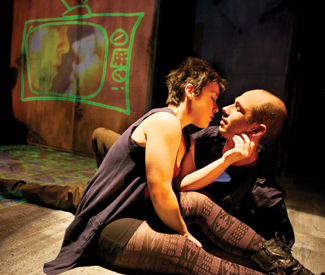
Sexiest scene in which the actors don’t move (but the stage does) Alex Moggridge and Marilee Talkington at a slowly rotating pub table in Mark Jackson’s Salomania at Aurora. Eros and Thanatos seemed in a slow dance with each other in this striking flirtation between a jaded frontline soldier and a war widow recently liberated from stultifying domesticity. (Avila)

Most graceful bow Becoming Grace at the Jewish Theatre. Naomi Newman’s potent solo play, built from the words and writing of author Grace Paley, closed the 34th and final season of San Francisco’s esteemed Jewish Theatre (formerly Traveling Jewish Theatre). (Avila)

Best musical theater collaboration The Ratcatcher at the Imaginists. This Santa Rosa company is a must see for lovers of smart, intimate, community-based theater, and their latest, a re-telling of the Pied Piper of Hamelin legend, is a pitch-perfect dystopian fairytale featuring a memorable cast and an irresistible musical score by full-partners in the production, the Crux. It’s worth the drive, but here’s hoping they bring it down to SF sometime. (Avila)

Best death scene Michael Zavala in Phaedra’s Love at Bindlestiff Studio. Do It Live!’s worthy production of Sarah Kane’s reworking of the Hippolytus myth climaxes with Hippolytus (a hipster hedonist in Zavala’s capable rendering), castrated and disemboweled, but finally interested in life. (Avila) *


Short takes by Robert Avila:

Best impersonation of a pervy authority figure Sara Moore as Mr. Roper in Three’s Company at Finn’s Funhouse

Best argument for going color blind Red at Berkeley Rep

Best approximation of a teenager Ann Lawler as Theresa in 100 Saints You Should Know, at Theater Rhino

Worst approximation of teenagers Jesus in India, at the Magic Theatre

Best actual teenagers Director Nick A. Olivero’s excellent, age-appropriate cast in Dog Sees God at Boxcar

Most existentially satisfying use of a digital delay Sara Kraft’s TRUTH++ at the This Is What I Want festival at SOMArts

Best lounge act without a lounge Anne McGuire (and Anne McGuire) and Wobbly in Music Again at San Francisco Museum of Modern Art

Discovery channels

0

arts@sfbg.com

YEAR IN DANCE Looking back on 2012’s over 500 performances — as calculated by Dancers’ Group — the game of “best” and “worst” makes less sense than ever. What makes the Bay Area a place worth living in is the vitality of its arts, and dance in particular. We only have one superstar company, San Francisco Ballet, but we’ve got a number of excellent mid-size ensembles and just enough of a competitive environment to discourage rank amateurism.

Whether for financial reasons or a desire to forego the demands of conventional stage presentations, dancers have continued their exodus to galleries and museums, like the San Francisco Museum of Modern Art, the Asian Art Museum, the California Academy of Sciences, and the de Young Museum. But they have also presented work in public spaces: City Hall, Market Street, Union Square, and Golden Gate Park. These performances necessitate the rethinking of formal parameters, but also reach out to new audiences.

Here are ten companies and artists who challenged expectations or unveiled surprises (at least to me) in 2012. Surprises from young artists are the norm, but experienced choreographers have a far more difficult task when it comes to catching viewers off-guard.

In the middle of March (and after 40 years of rethinking time, space, and motion), Eiko and Koma presented their most radical performance yet. With the breathtaking Fragile, a four-hour meditation in which they moved perhaps two feet, they stretched every conceivable theatrical concept beyond where it could reasonably be expected to go. It was mesmerizing, though I kept wondering where Fragile would be without the wondrous collage of music that David Harrington had assembled for his Kronos Quartet.

Keith Hennessy’s Turbulence (a dance about the economy), a many-tentacled creature that sprawled and oozed its way through Yerba Buena Center for the Arts, was one of the year’s most controversial premieres. No easy viewing, it showed that, for all his passion to redesign the social order, Hennessy is still working on creating new vehicles into which to pour his content. Gratifyingly, Hennessy just received a USA Fellows Award, one of only five Bay Area choreographers to have been so honored.

Monique Jenkinson’s splendid solo Instrument just finished its run at CounterPULSE. It needs to come back. She’s known as Fauxnique in her drag alter ego, but there is nothing faux about this dancer-performance artist. In Instrument, perhaps Jenkinson’s finest work yet, she asks questions about the body as a tool and the nature of being on stage. The figure of Rudolf Nureyev gave her the entrance into a witty but also heartbreaking portrayal of what it means to be a performer.

Even if you watch dance a lot, once in a while it happens that somebody pops up that you have never seen — and yet what they show is already excellent. Such was the case with Nicole Klaymoon’s Embodiment and her joyously rocking House Matter. Working with very good modern and hip-hop dancers, plus jazz singer Valerie Troutt and her vocal ensemble, the women created an evening-long piece about how a house can become a home.

Jenny McAllister’s two-year old 13th Floor Dance Theater is the newest incarnation of McAllister’s dance making endeavors. She has been choreographing genuinely funny dance, often sending up popular culture, for a long time. Bloomsbury/It’s Not Real was her first evening-length work. Using reality TV as a format, she came up with a lovingly loony but smart portrait of the lives and loves of that motley crew known as the Bloomsbury Group.

At the end of September, Birju Maharaj, the 74-year-old Kathak virtuoso, packed the Palace of Fine Arts with a primarily Indian audience who sat through a four-plus hour performance of superb dance. Maharaj performs here every couple of years, often with a similar repertoire. And still you sit there and can’t believe your eyes and ear at this gentle, witty, and generous artist playing “games” with someone like Zakir Hussein.

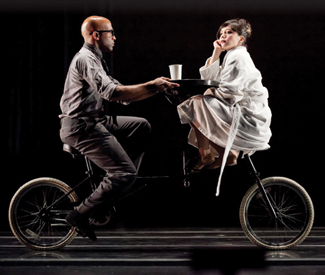
During its 41st home season, ODC/Dance premiered KT Nelson’s Transit. Taking one look at Max Chen’s whimsical bike concoctions, I just knew that they would steal the show — but they didn’t. Nelson used these metamorphosing velocipedes to call to the stage an image of urban life as fast-paced, fluid, and unstable. Yet for all its fractured continuity, Nelson and ODC’s superb dancers seemed to say, it’s a wonderful life.

San Francisco Ballet’s Beau raised more eyebrows than any of its other commissions, as far as I can remember. Longtime guest artist Mark Morris has built up expectations, so people were furious, feeling let down by what they considered thin, slipshod, easy-way-out choreography. My opinion was in the minority — so I’m looking forward to the piece’s return to find out whether what I thought was there, really is.

In the fall, my first encounter with Einstein at the Beach opened my ears and eyes to what I had known as “an opera” by Robert Wilson and Philip Glass. Surprising to see was how its exquisite details and extraordinary stylization owed more to kabuki than opera, and how Lucinda Childs’ choreography fit into it like a jewel set into a frame. For once the hype surrounding a piece did not even approach the reality of the experience.

Dancers around the world know the Venezuelan-born David Zambrano as a superb, idiosyncratic teacher. So his Soul Project, set to a rich selection of blues and soul music, raised questions about his approach to choreography. Using the YBCA’s Forum as a unified space for dancers and audience, Soul’s meandering trajectory — you never knew who would perform what where — made this one of the year’s most intimate experiences. To be a couple of inches away from such different, yet such superb performers doing what they do best was a treat.


Holiday movie massacre!

0

cheryl@sfbg.com

FILM To paraphrase Christmas Vacation (1989), 2012 is poised to deliver the biggest late-December film glut since Bing Crosby tap-danced with Danny Fucking Kaye. From Wednesday, December 19 to Tuesday, December 25, no less than 12 new movies are opening in the Bay Area, doomsday be damned.

Because I would not want to steer you wrong in this most wonderful time of the year — and since the movie everyone’s buzzing about, Zero Dark Thirty, doesn’t open in San Francisco until January 4; trust me, it’s worth the wait — I’m taking a cue from the man with the bag and making a list, checking it twice, etc. Who’s naughty, and who’s nice? Read on for my rundown of this year’s holiday movies.

Top of the food chain: Er, unchained. Django Unchained (out Tue/25), that is. Quentin Tarantino’s spaghetti western homage features a cameo by the original Django (Franco Nero, star of the 1966 film), and solid performances by a meticulously assembled cast, including Jamie Foxx as the titular former slave who becomes a badass bounty hunter under the tutelage of Dr. Schultz (Christoph Waltz). Waltz, who won an Oscar for playing the evil yet befuddlingly delightful Nazi Hans Landa in Tarantino’s 2009 Inglourious Basterds, is just as memorable (and here, you can feel good about liking him) as a quick-witted, quick-drawing wayward German dentist.

There are no Nazis in Django, of course, but Tarantino’s taboo du jour (slavery) more than supplies motivation for the filmmaker’s favorite theme (revenge). Once Django joins forces with Schultz, the natural-born partners hatch a scheme to rescue Django’s still-enslaved wife, Broomhilda (Kerry Washington), whose German-language skills are as unlikely as they are convenient. Along the way (and it’s a long way; the movie runs 165 minutes), they encounter a cruel plantation owner (Leonardo DiCaprio), whose main passion is the offensive, shocking “sport” of “Mandingo fighting,” and his right-hand man, played by Tarantino muse Samuel L. Jackson in a transcendently scandalous performance.

And amid all the violence and racist language and Foxx vengeance-making, there are many moments of screaming hilarity, as when a character with the Old South 101 name of Big Daddy (Don Johnson) argues with the posse he’s rounded up over the proper construction of vigilante hoods. It’s a classic Tarantino moment: pausing the action so characters can blather on about something trivial before an epic scene of violence. Mr. Pink would approve.

A disaster movie to make you rethink your tropical vacation: Spanish director Juan Antonio Bayona (2007’s The Orphanage) directs The Impossible (Fri/21), a relatively modestly-budgeted take on the 2004 Indian Ocean tsunami, based on the real story of a Spanish family who experienced the disaster. Here, the family (Naomi Watts, Ewan McGregor, three young sons) is British, on a Christmas vacation from dad’s high-stress job in Japan.

Beachy bliss is soon ruined by that terrible series of waves; they hit early in the film, and Bayona offers a devastatingly realistic depiction of what being caught in a tsunami must feel like: roaring, debris-filled water threatening death by drowning, impalement, or skull-crushing. And then, the anguish of surfacing, alive but injured, stranded, and miles from the nearest doctor, not knowing if your family members have perished.

Without giving anything away (no more than the film’s suggestive title, anyway), once the survivors are established (and the film’s strongest performer, Watts, is relegated to hospital-bed scenes) The Impossible finds its way inevitably to melodrama, and triumph-of-the-human-spirit theatrics. As the family’s oldest son, 16-year-old Tom Holland is effective as a kid who reacts exactly right to crisis, morphing from sulky teen to thoughtful hero — but the film is too narrowly focused on its tourist characters, with native Thais mostly relegated to background action. It’s a disconnect that’s not quite offensive, but is still off-putting.

A disastrous movie to make you rethink procreation: A spin-off of sorts from 2007’s Knocked Up, Judd Apatow’s This is 40 (Fri/21) continues the story of two characters nobody cared about from that earlier film: Debbie (Leslie Mann, Apatow’s wife) and Pete (Paul Rudd), plus their two kids (played by Mann and Apatow’s kids). Pete and Debbie have accumulated all the trappings of comfortable Los Angeles livin’: luxury cars, a huge house, a private personal trainer, the means to throw catered parties and take weekend trips to fancy hotels (and to whimsically decide to go gluten-free), and more Apple products than have ever before been shoehorned into a single film.

But! This was crap they got used to having before Pete’s record label went into the shitter, and Debbie’s dress-shop employee (Charlene Yi, another Knocked Up returnee who is one of two people of color in the film; the other is an Indian doctor who exists so Pete can mock his accent) started stealing thousands from the register. How will this couple and their whiny offspring deal with their financial reality? By arguing! About bullshit! In every scene! For nearly two and a half hours! By the time Melissa McCarthy, as a fellow parent, shows up to command the film’s only satisfying scene — ripping Pete and Debbie a new one, which they sorely deserve — you’re torn between cheering for her and wishing she’d never appeared. Seeing McCarthy go at it is a reminder that most comedies don’t make you feel like stabbing yourself in the face. I’m honestly perplexed as to who this movie’s audience is supposed to be. Self-loathing yuppies? Masochists? Apatow’s immediate family, most of whom are already in the film?

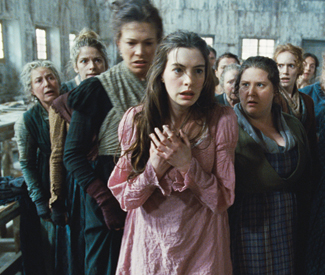
For theater geeks only: By contrast, the audience Les Misérables (Tue/25) hopes to reel in is abundantly clear. There is a not-insignificant portion of the population who already knows all the words to all the songs of this musical-theater warhorse, around since the 1980s and honored here with a lavish production by Tom Hooper (2010’s The King’s Speech).

As other reviews have pointed out, this version only tangentially concerns Victor Hugo’s French Revolution tale; its true raison d’être is swooning over the sight of its big-name cast crooning those famous tunes. Vocals were recorded live on-set, with microphones digitally removed in post-production — but despite this technical achievement, there’s a certain inorganic quality to the proceedings. Like The King’s Speech, the whole affair feels spliced together in the Oscar-creation lab. The hardworking Hugh Jackman deserves the nomination he’ll inevitably get; jury’s still out on Anne Hathaway’s blubbery, “I cut my hair for real, I am so brave!” performance.

For Marion Cotillard fans disappointed by The Dark Knight Rises: Hathaway’s Dark Knight co-star also has a new movie out this week. Unlike Hathaway, Rust and Bone (Fri/21) star Marion Cotillard never seems like she’s trying too hard to be sexy, or edgy, or whatever (plus, she already has an Oscar, so the pressure’s off). Here, she’s a whale trainer at a SeaWorld-type park who loses her legs in an accident, which complicates (but ultimately strengthens) her relationship with Ali (Belgian actor Matthias Schoenaerts, so tremendous in 2011’s Bullhead), a single dad trying to make a name for himself as a boxer.

Jacques Audiard’s follow-up to 2009’s A Prophet gets a bit overwrought by its last act, but there’s an emotional authenticity in the performances that makes even a ridiculous twist (like, the kind that’ll make you exclaim “Are you fucking kidding me?”) feel almost well-earned.

For those who are more Black Christmas (1974) than The Christmas Story (1983): Yes, Virginia, even smaller genre flicks get Christmas release dates. Irish import Citadel (Fri/21 at the Roxie) begins with terror: a young pregnant woman, on the verge of moving out of her soon-to-be-condemned high-rise, is attacked — while her husband, Tommy (Aneurin Barnard), looks on helplessly — by a pack of hoodie-wearing youths who inject her with a mysterious substance.

Though the baby lives, the woman dies, and Tommy becomes a haunted, paranoid husk of a man. Not that you can really blame him; the housing project he lives in is nearly deserted, and those hoodie-wearing gangs seem to be increasing (and are increasingly interested in his infant daughter). After an ominous build-up, the darkly disturbing Citadel can’t quite keep the momentum going, though James Cosmo (Game of Thrones fans will recognize him even out of his Night’s Watch blacks) offers an amusingly over-the-top performance as a foul-mouthed priest.

Thriller Deadfall (Fri/21), set amid a howling blizzard, has an all-star cast: Eric Bana and Olivia Wilde play a creepy-close brother-sister team who crash their getaway car after a successful casino heist; Sons of Anarchy‘s Charlie Hunnam plays a vengeful boxer just out of the slammer (with nervous parents played by Kris Kristofferson and Sissy Spacek); and Treat Williams and Kate Mara are an antagonistic father-daughter team of cops chasing after most of the above. Bana’s glowering performance is the high point of this noir-Western, though if the snowy landscape were a character, it’d be the most important part of the ensemble.

And the rest: Tom Cruise plays Lee Child’s taciturn ex-military investigator in action thriller Jack Reacher (Fri/21) — featuring a villainous Werner Herzog; Sulley and company return in Pixar’s enhanced re-release of its 2001 animated hit, Monsters, Inc. 3D (Wed/19); more 3D in acrobatic fantasy Cirque du Soleil: Worlds Away (Fri/21); a son (Seth Rogen) and mother (Barbra Streisand) drive cross-country in comedy The Guilt Trip (Wed/19); and Billy Crystal plays a harried grandpa on babysitting duty in Parental Guidance (Tue/25).


Zombies FTW

6

arts@sfbg.com

YEAR IN GAMER It was a good year for gaming. You may not have realized it, with fewer marquee titles than last year’s three-mageddon of Resistance 3, Gears of War 3, Battlefield 3, and Modern Warfare 3 in a span of two months, and with no sign of the long-rumored and eagerly-anticipated new PlayStation and Xbox consoles. But this year was actually an embarrassment of riches for gamers who were willing to buck the franchise bug and try something new, suggesting that developing games for a generation of flagging consoles doesn’t have to be an exercise in repetition and sequel-itis. Instead, it provides an incentive for developers to get a little creative.

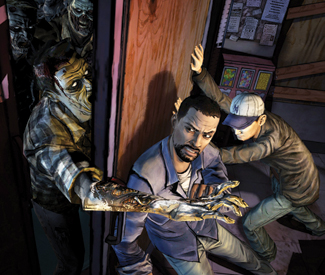
Tell me a story The surprise success of 2012 was The Walking Dead (Telltale Games), a game that’s a series of shorter “episodes” in which you play as Lee, an escaped convict in a zombie-occupied Atlanta. But the real heart of the experience is in developing who Lee is for yourself. Sure, the game often decides what your character does and where he goes, but you are given the tools that shape his motivations for why.

In my play-through, Lee made many decisions I would describe as “good,” but the options were never black or white. I helped form a back story that had Lee helping others to survive the zombie apocalypse in order to alleviate guilt for his wrongdoings. Each choice you make, no matter how superficial or comparatively insignificant, strengthens your attachment to your character. The real challenge of The Walking Dead is in reminding yourself not to focus on making the “right” decision because there never is one.

Look at what they ask of you! Most gamers play to have fun; it’s cathartic to blow off steam after work by shooting some computer-generated bad guys. Spec Ops: The Line (Yager Development/2K Games) is not content to offer target practice without also asking you to question why you blindly accept the tenets of this structure. On the surface Spec Ops looks a lot like a military third-person shooter — and it plays competently as one if that’s all you’re looking for. But Spec Ops is also a secret art game, a shooter that wants gamers to take a harsh look at the atrocities they commit in these war shooters, and ask why they enjoy playing them anyway.

In direct contrast to The Walking Dead, Spec Ops experiments in neglecting player choice. For instance, there’s a sequence where you have no choice but to deploy the deadly chemical white phosphorous upon a group of enemy troops in order to survive, only to learn that your actions resulted in the deaths of civilians, many of them women and children.

It’s debatable whether Spec Ops fully succeeds in balancing art project and fun; there are times when it’s clear you are not meant to be enjoying the game. But that there’s a shooter on the market attempting to be more than mindless about its murder makes it worth a look.

A new IP isn’t a death sentence Savvy gamers are beginning to recognize that they are being sold the same experiences year after year. Call of Duty and Mario Bros. continue to sell well, but highly iterative franchises like these are causing increasingly apathetic gamers to lash out in interesting ways, such as the now annual Metacritic bombing of Call of Duty.

It’s hard to blame publishers; making a non-sequel, non-franchised game is risky. Each month more and more small companies are shuttering their doors, and the future doesn’t look great for middlemen like THQ either, who are currently dangling on the verge of bankruptcy. So it’s kind of amazing we’re able to celebrate the successes of a good number of smaller titles this year.

Kiss kiss Lollipop Chainsaw did fairly well for Japanese auteur Suda 51, although it may have been the zombies and cheerleader on the cover that gave the game a bit of a boost in the young male demographic. A tongue-in-cheek hack ‘n’ slash game with English dialogue written by indie filmmaker James Gunn, Chainsaw is laugh-out-loud funny in enough places to make up for a little repetitive gameplay.

Bang bang More unlikely successes this year were Square Enix’s Hong Kong sandbox shooter Sleeping Dogs and Bethesda’s first-person stealth game Dishonored, both of which are happily finding themselves on more than a few Top Ten lists. Either one could have been easily overlooked in stores, but it seems more and more consumers are looking at the shelf and saying, “Show me something new!” *


Last-minute gifts

0

culture@sfbg.com

SHOPPING Dearest Christian and Christian-adjacent reader: it’s too late for the Internet. Unless you want to shell out Santa-sized bucks for overnight delivery, you’re gonna have to fill those loved-ones’ stocking IRL, with a good ol’ fashioned brick-and-mortar dash through the metaphorical snow.

We mean you’re going to have to go shopping, duh. And your flight leaves on Saturday, or their flight lands on Friday, or you’re actually on your way to a holiday house party tonight! You can do better than a gift card. Yet even though you seem surrounded by retail options every moment of your life, when you’re forced to suddenly think about what to get tea party maven Aunt Tilly or your nine-year-old second cousin who you think is named Erica (Caitlin? Amy? Danica?) or your drunk sort-of-friends, the mind blanks and the plan nogs.

So some of the options below may seem obvious any other time of year, but here they are to help kickstart your Christmas consumer creativity motors. get ready to fill your sack with goodies! (Don’t forget to bring your own sack.)


GREEN APPLE BOOKS AND MUSIC

Calendars, calendars, calendars! No gift crisis cannot be solved by a glossy 2013 calendar featuring soft-focus lighthouses of Nova Scotia, baby baboons smearing ice cream in their hair, or various memes of yesteryear, repackaged helpfully for the Web-tardy. Oh, by the way, Green Apple is the largest bookstore in California, so there are books — and extremely helpful staff recommendations! — for everyone on your listicle.

506 Clement, SF. (415) 387-2272, www.greenapplebooks.com


HEARTFELT

Heartfelt is the very definition of a last-minute gift emporium, a place filled with low-cost creative items for all ages. Italian cookware, spandex log pillows, a hanging mobile you can customize with your own art … it’s an affordable world of creativity at your fingertips in Bernal Heights! Joke gifts (really creative ones), retro gifts, classic gifts, cool stuff you won’t see anywhere else .. you can cover almost everyone on your list in one heartfelt stop.

436 Cortland, SF. (415) 648-1380, www.heartfeltsf.com


22ND ANNUAL TELEGRAPH AVENUE HOLIDAY STREET FAIR

OK, more than 200 artists are showing off their goods all weekend in Berkeley — pottery, jewelry, t-shirts, hats, wall art, candles, leatherwork — surely you can find something for your dad while enjoying all the colorful characters, groovy tunes, and interesting eats that Berkeley can bring? It’s a bargain bonanza.

Dec 22-24, 11am-6pm, free. Between Dwight Way and Bancroft Way, Berk. www.telegraphfair.com


THE CANDY STORE

There are handmade smores. There are marshmallows made of vanilla and Maker’s Mark. Adorable candy-filled Christmas tree ornaments? Yes ma’am. A cornucopia of season-perfect foil-wrapped chocolates; pre-wrapped “round of four” gift packs featuring four kinds of house made candy; large jars of gianduja, chocolate-hazelnut spread that puts Nutella to shame? What were we talking about again?

1507 Vallejo, SF. (415) 921-8000, www.thecandystoresf.com


RARE DEVICE

Put a bird on them! Everyone needs a little twee under the tree, and this store — recently relocated to Divisadero in the place of our former butcher store — has lovely trinkets for all, in that naïve-sophisticate hipster style so popular with the kids these days. Everyone’s koo-koo for Rare’s impeccable jewelry collection and neato home decor and kitchenware collections — there are actually coffee mugs with birds on them, yasss. Unique kaleidoscopic printed blocks by Lisa Congdon will brighten anyone’s season, while festive Leah Duncan pillows add punch to every couch.

600 Divisadero, SF. (415) 863-3969, www.raredevice.net


POT AND PANTRY

What says love more than an exquisite aluminum egg timer, or cheer more than a fanciful cutting board shaped like a chicken? You’ll be ladling out the love (ladles available) and satisfying every cook and non-cook’s desire for kitchen accessories at this supercute Mission cupboard of culinary delights. This year, stick a whisk in their stocking and whip up some fun! (Sorry.) Or simply gift a unique recipe zine from P+P’s neat library. Great for everyone? Sparq stones — soapstone cubes you can use in hot or cold drinks to maintain temperature — and kicky colored salt cellars.

593 Guerrero, SF. (415) 206-1134, www.potandpantry.com


SUCCULENCE

The venerable and much-loved Four Star Video rental shop in Bernal Heights found that its business model had run its course, so it morphed into Succulence, a yummy boutique plant store that features (of course) succulents but also a wide range of gardening supplies and cute classes for kids of all ages. Creative and artsy plants and planters, terrariums, hanging plants — plenty here for anyone who likes to fill their home with greenery. Plus: Really cool hand-carved ballpoint pens, which, in the $50 range, are cheap for one-of-a-kind writing instruments.

402 Cortland, SF. (415) 282-2212, www.thesucculence.com


GREEN ARCADE

We’ll take any gift you’d like to gift us from this liberal bastion of bookery on Market Street. A wonderfully curated selection of tomes focuses on history and social and environmental issues, with a generous sprinkling of poetry, theory, and California-centric items. (While researching for this article, we were compelled by joy to snag a set of dish towels with old-time maps of the Golden State printed on them.) You’ll find great stuff for out-of-towners, armchair prophets, and new San Francisco arrivals here, or anyone who loves this kooky-beautiful land of ours.

1680 Market, SF. (415) 431-6800. www.thegreenarcade.com


UPPER PLAYGROUND

We have teenage boys in our life! Possibly you do in yours. They like to dress cool. Upper Playground has so many uniquely SF cool and boyish t-shirts, hats, hoodies, and related items that shopping for our cool teenage friends was so easy we began to suspect the whole enterprise. Is this reality? (There are also tasty items for women and walls as well.)

220 Fillmore, SF. (415) 861-1960, www.upperplayground.com


CHOCOLATE COVERED

This Noe Valley treasure is billed as “San Francisco’s Original Chocolate Boutique” — but we call it Dr Coacoa-nassus’ Chocolatarium of Head-Explosion and Wonderment. There is every kind of fantasy chocolate bar combination to be found within its charming bounds — maple-coconut chocolate, blueberry chocolate, gingerbread chocolate, luscious vegan chocolate truffles, tiny bon bons with the face of Mrs. Claus sculpted upon them! People, they had Obama chocolates here during the election. The walls are lined with mystery cabinets labeled with street signs indicating the theme of the candy within, making for an adventurous shopping experience as well.

4069 24th St., SF. (415) 641-8123, www.chocolatecoveredsf.com


ALL OF JAPANTOWN CENTER

Seriously, there is so much of interest here you can’t go wrong. Insanely detailed, completely untranslatable magazines devoted to singular cats and manga insanity at Kinokuniya Books; novelty fruit and animal eraser sets at Mai Do Fine Stationery so full of squee you want to eat them; scary-good replica samurai swords at Katachi; exquisitely wrapped boxes of chocolate strawberry mochi at Nippon Ya … spend a couple hours wandering this mall and you’ll come out with some really unique presents. Plus you’ll be full of delicious sushi and hot tea.

www.sfjapantown.com


Balkan brass blowup

0

emilysavage@sfbg.com

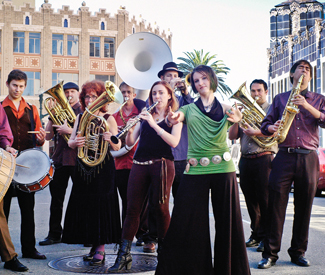
Tofu and Whiskey If you’re going to book a Balkan-influenced band, don’t expect the crowd to stay put. The Bay Area’s Inspector Gadje, an offshoot of the Brass Liberation Orchestra, usually packs in around 15 players, including 12 on horns and three percussionists. When the raucous group came marching through the wilderness (read: Golden Gate Park) during Outside Lands, it filled in crevices between trees, and created an instant party atmosphere between the main stages. Those fast-walking through the thoroughfare of Choco Lands stopped in their tracks, surrounded the group, and started dancing, against everyone’s better judgment. It all happened in the blink of a dirt-lodged eye.

“A lot of Balkan music has a great ‘party’ feel to it…even when the music includes moments or textures that might have a darker feel, the music is played with an undeniable exuberance,” says Oakland’s David Murray. “The rhythms of the Balkans; Greece, Macedonia, Serbia, Bulgaria, etc., include many unusual time signatures that are compelling and especially attractive to musicians.”

Murray, a graphic designer by trade, is one of those musicians — he’s been playing bouzouki in Greek Rebetika band Disciples of Markos since 2004, and also plays fiddle in the Squirrelly Stringband, which is the house band for the North Oakland square dance (a “monthly underground hillbilly dance party,” as he describes it). As a combination of his art and music backgrounds, he also produces and designs albums for the Dust-to-Digital record label, which specializes in reissuing obscure folk and world music.

His newest project, however, is all about the music of the Balkans. He began the Berkeley Balkan Bacchanal (berkeleybalkanbacchanal.com) music series at Berkeley’s Starry Plough in October 2011. He got the idea after meeting like-minded acts in the Bay Area, with affinities for Southeastern European styles of music. In the past year or so, the monthly Balkan showcase has seen performances by Murray’s band, along with Inspector Gadje, Zoyres, Veretski Pass, Janam, Gadjitos, and a dozen or so more.

The last Berkeley Balkan Bacchanal of 2012 takes place this week, with Fanfare Zambaleta, “Middle Eastern marching band” MWE, and Helm, a group that specializes in Turkish classical and pop music (Thu/20, 8pm. Starry Plough, 3101 Shattuck, Berk. www.starryploughpub.com). Murray says MWE, which includes three or four horns and the wailing Turkish reed (zurna), is known to play in the middle of the dancefloor with the crowd dancing around them. See? Instant party music.

I asked Murray if it’s been challenging to track down acts for this series, as it has such specific influences but he shut that down quick: “No, it hasn’t been difficult at all. There are a lot of great bands around here that fit into the theme of our series. At one point there were no less than three Balkan brass bands in town…And because we don’t mind pushing the boundaries of the Balkans to include neighboring influences, we’ve been able to feature bands that play Algerian music, Persian, and more.”

He added in some historical links, for good measure: “The Bay Area has a very vibrant Balkan music scene, which has some interesting origins in the 1960s, with bands like Kaleidoscope. The early California Renaissance Fairs provided an early outlet for many Balkan musicians, and music camps, such as Lark Camp in Mendocino, have been inspiring and teaching musicians for generations.”

As a novice listener, I’ve (admittedly) grown interested in Balkan sounds via more mainstream bands that have remote influences from the regions, acts like Balkan Beat Box and early Beirut, which typically blend sounds and instruments from a variety of places with pop and folk influences; but also thanks to Gogol Bordello and, more recently, Inspector Gadje, which is more purely influenced by the Balkan style.

“I tend to avoid bands that are actively ‘fusion,’ it doesn’t interest me much, especially bands that combine many styles,” Murray says. “It seems, to me, to usually dilute the very thing that makes the music interesting to begin with. But I’m sure there’s a wide range of opinions on this subject among the various bands and audience members.”

He says he’s more interested in bands that dig deep into the music they play, understanding the history and playing it in an authentic style. He brings up local bands such as Veretski Pass, which plays klezmer with accordion, fiddle, and bass, but also has studied the Jewish music of the Carpathian mountains, noting that the band will be back to the Starry Plough Jan. 17 for an all-klezmer night with the Gonifs.

But Murray points out that this doesn’t mean the acts of the Berkeley Balkan Bacchanal are rigid. “…that’s not to say that these bands are stuffy academics or that they don’t play with styles to some degree. On the contrary, most of the players are young and bring the music to life in a vibrant way that gets heads bobbing and feet dancing.”

“A great example is the Mano Cherga band, which played in September, and sounds like a Serbian party band you’d hear at a drunken wedding bash.”

Bring on the brass and vodka.


A VERY CASTLE FACE CHRISTMAS

There are a number of reasons why A Very Castle Face Christmas is an obvious choice. There’s performances by Thee Oh Sees, Blasted Canyons, Warm Soda, and recent GOLDIES winner the Mallard. Plus, it’s a benefit for the Coalition on Homelessness in SF, a very worthy cause. There’s also the added bonus of the venue itself. I just this week finally made it to a show at newish Mission venue the Chapel, and it was, frankly, charming — from the dark-wood high beam arched ceiling, to the multiple bars (three), to the band-watching angles (you can see from the main room, the balcony, and the soon-to-be-restaurant, plus there are flatscreens linked to cameras fixed on the stage). Win-win-win. Thu/20, 8:30pm, $15. Chapel, 777 Valencia, SF; www.thechapelsf.com.


HIGH ON FIRE

Following front person Matt Pike’s treatment for alcohol addiction, Oakland’s beloved stoner metal act High on Fire is back. Well, technically, the band has been back for about a month, touring the country on most recent release De Vermis Mysteriis. But this will be it’s first big show back in the Bay, where it belongs. With Goatwhore, Lo-Pan. Sat/22, 9pm, $21. Slim’s, 333 11th St., SF. www.slimspresents.com.

CHURCHES

Remember this summer, when distortion-loving East Bay act CHURCHES was Kickstarting a record written for the pro-marriage equality cause? The band — led by Caleb Nichols of Port O’Brien and Grand Lake, Pat Spurgeon of Rogue Wave, and Dominic East — exceeded its goal, and that seven-inch (LOVELIFE) will see release at Bottom of the Hill this week. The trio also released a music video in conjunction with the record: interspersed with the band playing is a classic family portrait set-up with scenes of smiling families, and CHURCHES with their friends and loved ones, including Nichol’s fiance, Grand Lake drummer John Pomeroy. With Tijuana Panthers, Toshio Hirano. Sat/22, 9pm, $12. Bottom of the Hill, 1233 17th St., SF; www.bottomofthehill.com

State of the art

0

arts@sfbg.com

YEAR IN VISUAL ART Maybe it’s the Mayan calendar thing. Large cycles and turnings, old giving way to new, and all that. But in thinking about 2012, I can’t help but think about big seismic shifts and changes to infrastructure that are moving large pieces of the art world around, setting adrift transformations that won’t settle down for some time.

So, at year’s end I’ve written here something more like a love letter of hopes and apprehensions for my chosen profession as it evolves into whatever comes next. For to be sure, 2012 saw the structures of the art world (whatever that term means to you) a-changing.

From the viewpoint of commerce, never before has the term “art market” seemed more apt, as the art fair circuit has seized firm control over art buying, in environments that feel much more like a Tangier spice bazaar than any kind of dispassionate white-walled arena for ideas.

But forget that old definition for an art gallery anyway. The new one for 2012 and beyond is this: a storefront for itinerant consultancies who are measuring their time until touching down in the next art fair booth.

Given that, it’s completely logical, and also disheartening, that larger numbers of Bay Area galleries truncated their hours in 2012. Why be open for more than 10 or 15 hours a week? As one gallerist told me this year, “The storefront is just for hospitality. We don’t really sell anything out of here.” Indeed, increasingly Bay Area galleries sell on the road in Miami, New York, Basel, Hong Kong, or somewhere else at one of the large art-fair conglomerations that now define the selling calendar.

For people like me, for whom wandering in and out of galleries is necessary for our peace of mind, this emerging scenario really bites. The nascent, creeping practice of keeping gallery hours only on Saturday, possibly Sunday with maybe another weekday thrown in (and you know who you are) does nothing to bridge the widening gap between the commonly held outsider perception that galleries are not for ordinary people and the dawning insider suspicion that, well, maybe galleries are not for art people either.

There has always been a divide between inside and outside the art world, but that has largely been a matter of self-identification. The insiders have always been the weirdos who bothered to care, who got geeky about the poetic language of objects and situations, tracking artists and galleries the way other people track chefs and restaurateurs. What worries me is that us weirdos are losing bandwidth in our own scene; until recently “insider” has included the art-viewing-and-talking public, and not just the art-buying class. The forming idea of what an art constituency is has rapidly shifted, and though I’m not exactly on the same page as ex-critic Dave Hickey, who very publicly “quit” the art world this year (with statements like “Art editors and critics — people like me — have become a courtier class. All we do is wander around the palace and advise very rich people. It’s not worth my time.”), I get where he’s coming from.

If the work is increasingly being shown and promoted elsewhere along a rarified travel route, what recourse are the rest of us empty-pocketed onlookers supposed to have? But all signs point to this continuing and accelerating. In 2013 we’ll see the market further consolidate around global cities and travel plans, and for local galleries, “risk-taking” will increasingly have less to do with ambitious, place-aware programming and more with stretching budgets and maximizing production to keep pace with the expanding endless summer of art fairs.

But gathering together seems to present its own risks, too. Superstorm Sandy served an ominous warning about the geographic and physical contingency of the architectures where art is both sold and guarded. This year we witnessed the mass wipeout of both artworks and small galleries caused by a single (albeit badass) storm, literally swamping the world’s highest concentration of art dealers and contemporary artworks in the hemisphere’s most important art neighborhood. Many of those galleries and artworks will not resurface. For every one David Zwirner, with his stable of well-insured, blue chip artworks, there are a dozen small galleries each with emerging artists who just lost entire seasons of work and rent.

And I can’t not mention the January suicide of Mike Kelley, a hero to me and most artists I know. His death was a somber reminder that the art world is still inhabited by, and is shelter for, troubled hearts who sometimes can’t outrun their own demons, no matter how successful or beloved they become.

Yet there’s hope too. I saw some great shows this year, in museums, in galleries and, yes, at Burning Man, where Matthew Schultz’ breathtaking Pier 2, a 250-foot, full-size pier complete with shipwrecked Spanish galleon, hit the perfect note of surreality and absolute joy. Both the Jean Paul Gaultier show at the de Young and Cindy Sherman show at the San Francisco Museum of Modern Art reminded us that institutions can dazzle when they set their minds to it, and Ben Kinmont at SFMOMA demonstrated that even if you’re stuffed into the mezzanine reading room, you can still pack a conceptual wallop. I also loved Mark Benson’s show at Ever Gold, Liam Everett at Altman Siegel, and Brent Green at Steven Wolf, to name just a few.

Where art making intersects the public there were bright spots, too. I mean, sure it’s a publicity gimmick that’s in practice all over the country, but somehow Oakland Art Murmur became a thing this year, an authentically energetic collection point that now draws thousands of people to Uptown Oakland each month. And tech continues to make inroads into the decidedly old school art machine: Kickstarter, Indiegogo, Paddle8, Art.sy, and a slew of other web tools made following, researching, and funding creative projects more democratically accessible. Indeed, I’m increasingly hopeful that from tech somewhere we’ll see an antidote to the increasingly oligarchical practices that sustain the current art market. *


YEAR IN MUSIC 2012: Top 10s Galore

0

YEAR IN MUSIC Local musicians, rappers, producers, and music writers sound off on the year’s best songs, album releases, shows, personal triumphs, and local acts.


HANNAH LEW, GRASS WIDOW


TOP 10 OF 2012

1. Starting our own label HLR and releasing our own record (Internal Logic)

2. Total Control’s LP

3. Touring with the Raincoats and singing “Lola” with them every night

4. Getting obsessed with Silver Apples

5. Hollywood Nails

6. Wymond Miles LP

7. Scrapers (band)

8. Sacred Paws (band)

9. Making eight music videos and losing my mind

10. Wet Hair’s LP


ANTWON, RAPPER


TOP 10 2012 RAP JAMZ

1. DJ Nate, “Gucci Gogglez” 2. Chief Keef, “Ballin” 3. French Montana, “Shot Coller” 4. Chippy Nonstop, “Money Dance” DJ Two Stacks remix 5. Cash Out, “Cashin’ Out” 6. Future, “Turn on the Lights” 7. Gucci Mane, “Bussin Juggs” 8. Juicy J, “Drugged Out” 9. Lil Mouse, “Don’t Get Smoked” 10. Lil Reese, “Traffic” feat. Chief Keef


MICHAEL KRIMPER, GUARDIAN


THE ENDLESS DESIRE LIST


(IN NO PARTICULAR ORDER, OR, OUT OF ORDER)

1. Les Sins/”Fetch”/12″ (Jiaolong)

Run, fall, catch your desire.

2. The Soft Moon/”Want”/Zeros (Captured Tracks)

Infinite want, can’t have it. O, ye of bad faith.

3. Frank Ocean/”Pyramids”/channel ORANGE (Def Jam)

Pimping Cleopatra, whoring the pyramids.

4. Daphni aka Caribou/”Ye ye”/Jiaolong (Jiaolong)

Affirmation on repeat.

5. Grimes/”Genesis”/Visions (4AD)

Whatever, you know you like it.

6. Todd Terje/”Inspector Norse”/It’s the Arps (Olsen/Smalltown Supersound)

Inspecting never felt so good.

7. Burial/”Kindred”/Kindred (Hyperdub)

Kindred outcasts, jealously desiring their solitude.

8.John Talabot/”Estiu”/Fin (Permanent Vacation)

If a permanent vacation wasn’t hell, this might be its soundtrack.

9. Purity Ring/”Obedear”/Shrines (4AD)

Nothing pure in this abject need.

10. Kendrick Lamar/”A.D.H.D.”/good kid m.A.A.d city (Interscope)

Crack babies: she says, distracted, endless desire.


TYCHO, AKA SCOTT HANSEN


FAVORITE BAY AREA AND BAY AREA-AFFILIATED MUSIC ACTS

1. Toro Y Moi 2. Christopher Willits 3. Blackbird Blackbird 4. Jessica Pratt 5. Sam Flax 6. Ty Segall 7. Yalls 8. Doombird 9. Little Foxes 10. Dusty Brown


BEN RICHARDSON, GUARDIAN


BEST METAL ALBUMS OF 2012

1. Dawnbringer, Into the Lair of the Sun God (Profound Lore)

2. Asphyx, Deathhammer (Century Media)

3. Woods of Ypres, V: Grey Skies & Electric Light (Earache)

4. Uncle Acid and The Deadbeats, Blood Lust (Metal Blade)

5. Pallbearer, Sorrow And Extinction (Profound Lore)

6. Windhand, Windhand (Forcefield Records)

7. Omens EP

8. Hour of 13, 333 (Earache)

9. Gojira, L’enfant Sauvage (Roadrunner)

10. Lord Dying, Demo


CALEB NICHOLS, CHURCHES


TOP 10 VINYL PURCHASED IN 2012, AND WHERE I PURCHASED THEM

1. The Shins, Port Of Morrow (Amazon — forgive me, I had a gift card.)

2. The Walkmen, Heaven (Urban Outfitters clearance — yeah, I know, but you can’t beat brand-new vinyl for $10.)

3. Various Artists, Death Might Be Your Santa Claus (Boo Boo Records, San Luis Obispo. My hometown record store.)

4. Ella Fitzgerald, Live at Montreaux (Boo Boo Records, San Luis Obispo)

5. Mahalia Jackson, Christmas With Mahalia (Abbot’s Thrift, Felton, CA — Great thrift store in the Santa Cruz Mountains.)

6. Benjamin Britten/Copenhagen Boys Choir, A Ceremony Of Carols (Abbot’s Thrift, Felton, Calif.)

7. Thurston Moore, Demolished Thoughts (Urban Outfitters clearance)

8. The Hunches, Exit Dreams (1234Go! Records, Oakland)

9. Various Artists/Angelo Badalamenti, Wild At Heart OST (Streetlight Records, Santa Cruz)

10. Tijuana Panthers, “Crew Cut” seven-inch (Picked up at show — Brick and Mortar Music Hall, San Francisco)


KACEY JOHANSING, SINGER-SONGERWRITER


TOP 10 FAVORITE SONGWRITERS IN THE BAY AREA

1. Sleepy Todd

2. Tommy McDonald of The Range of Light Wilderness

3. Emily Ritz of Yesway and DRMS (biased opinion, I know)

4. Kyle Field of Little Wings

5. Alexi Glickman of Sandy’s

6. Michael Musika

7. Bart Davenport

8. Indianna Hale

9. Jeffrey Manson

10. Sonya Cotton


HALEY ZAREMBA, GUARDIAN


TOP TEN CONCERTS OF 2012

1. El Ten Eleven at the New Parish

2. Good Old War at Slim’s

3. Girls at Bimbo’s

4. St Vincent and Tune-Yards at The Fox

5. Bomb the Music Industry! at Bottom of the Hill

6. Fucked Up at Slim’s

7. Amanda Palmer and the Grand Theft Orchestra at the Fillmore

8. Ariel Pink at Bimbo’s

9. Conor Oberst at the Fillmore

10. Titus Andronicus at the Great American Music Hall


CARLETTA SUE KAY, SINGER-SONGWRITER


BEST OF 2012

1. “See All Knows All,” A Thing By Sonny Smith at The Lost Church.

2. “Silent Music” music ephemera show at Vacation (651 Larkin) curated by Lee Reymore, opening party set by the Fresh and Onlys, after -party pot cookie monsters invade the Gangway.

3. Dusty Stax & The Bold Italic Present: “Summer Soul Friday Night”.

4. Wax Idol’s Hether Fortune fronting the Birthday Party cover band at Vacation.

5. Jessica Pratt’s debut LP (Birth Records).

6. Bambi Lake at the Museum of Living Art.

7. Pruno Truman, aka Heidi Alexander from the Sandwitches “Sleeping with the TV on” b/w Carletta Sue Kay “No, no” (Weird World).

8. Opening for Baby Dee at Brick & Mortar Music Hall.

9. Kelley Stoltz’s cover of “Sunday Morning” on Velvet Underground and Nico by Castle Face & Friends (Castle Face).

10. Christopher Owens premiers Lysandre live at the Lodge.

11. Mark Eitzel’s Don’t Be A Stranger (Merge) and its accompanying promo video series. Featuring Grace Zabriskie, Neil Hamburger, Parker Gibbs et al.


EMILY JANE WHITE, MUSICIAN


TOP 10 SONGS OF 2012 BY FEMALE ARTISTS

1. “Spinning Centers” Chelsea Wolfe: Unknown Rooms

2. “Who Needs Who” Dark Dark Dark: Who Needs Who

3. “Oblivion,” Grimes: Visions

4. “Old Magic” Mariee Sioux: Gift for the End

5. “Apostle” Marissa Nadler: The Sister

6. “In Your Nature” Zola Jesus: seven-inch (w/ David Lynch Re-Mix)

7. “Silent Machine” Cat Power: Sun

8. “Moon in My Mind,” Frankie Rose: Interstellar

9. “Serpents,” Sharon Van Etten: Tramp

10. “Video Games,” Lana Del Rey: Born to Die


MORNIN’ OLD SPORT


FAVORITE ARTISTS/ALBUMS

1.Moons, Bloody Mouth

2.Patti Smith, Banga

3.Mykki Blanco, Cosmic Angel: The Illuminati Prince/ss Mixtape

4.ABADABAD, The Wild EP

5.Kendrick Lamar, Good Kid m.A.A.d city

6.Shady Hawkins, Dead to Me

7.Howth, Newkirk

8. Bikini Kill EP (reissue)

9. Sharky Coast, Pizza Dreamz demo

10. FIDLAR, No Waves/No Ass seven-inch


ROSS PEACOCK AND NATHAN TILTON, MWAHAHA


ALMOST TOP 10 ALBUMS (IN NO PARTICULAR ORDER)

1. Air, Le voyage dans la lune

2. Naytronix, Dirty Glow

3. I Come To Shanghai, Eternal Life Vol. 2

4. Beak, >>

5. Steve Moore and Majeure, Brainstorm

6. Clipd Beaks, Wake

7. Brian Eno, LUX

8. Neurosis, Honor Found in Decay

ALMOST TOP 10 SHOW (IN NO PARTICULAR ORDER)

1. Pulp at the Warfield: Think that was this year. Cocker sings sexy

2. Red Red Red: just saw this guy play at a warehouse in Oakland…live house music made with actual hardware!

3. Flying Lotus at the Fox was pretty epic….. insane visuals.

5. Lumerians at the Uptown

6. Neurosis at the Fox: Fuck!

7. Deerhoof at SXSW ….. maybe the best live band in the universe

8. Indian Jewelry at the Terminal …. strobe light universe


EMILY SAVAGE, GUARDIAN


LIVE SHOWS THAT CREATED THE MOST POSI MEMORIES IN 2012

1. Feb. 14: Black Cobra, Walken, Yob at New Parish

2. Feb. 23: Budos Band and Allah-Lahs at the Independent

3. March 30: Hot Snakes at Bottom of the Hill

4. April 10: Jeff Mangum at the Fox Theater,

5. July 21: Fresh and Onlys and La Sera at Phono Del Sol Music Fest

6. July 28: Total Trash BBQ Weekend at the Continental Club

7. Aug. 11: Metallica at Outside Lands

8. Aug. 31: Eyehategod at Oakland Metro

9. Oct. 9: Saint Vitus at the Independent

10. Oct. 27: Coachwhips and Traditional Fools at Verdi Club


NEW ALBUMS I LISTENED TO ENDLESSLY IN 2012

1. Grass Widow, Internal Logic (HLR)

2. Cloud Nothings, Attack on Memory (Carpark)

3. Ty Segall, Slaughterhouse (In the Red)

4. Dum Dum Girls, End of Daze EP (Sub Pop)

5. Frankie Rose, Interstellar (Slumberland)

6. Godspeed You! Black Emperor, Alleluja! Don’t Bend! Ascend! (Constellation)

7. The Fresh and Onlys, Long Slow Dance (Mexican Summer)

8. THEESatisfaction, awE naturalE (Sub Pop)

9. Terry Malts, Killing Time (Slumberland)

10. Guantanamo Baywatch, Chest Crawl (Dirtnap Records)


TAYLOR KAPLAN, GUARDIAN


TOP 10 ALBUMS OF 2012

1. Hiatus Kaiyote: Tawk Tomahawk (self-released) I could tell you that a bunch of white Australians somehow merged the sound-worlds of Erykah Badu, J Dilla, and Thundercat into a 30-minute, self-released debut LP that rivals the best work of any of those musicians, but you just might have to hear for yourself: hiatuskaiyote.bandcamp.com.

2. Lone: Galaxy Garden (R&S) This is the Lone album we’ve been waiting for. The British laptop producer’s past efforts, while exquisitely lush, were inhibited by a sense of hollow simplicity; Galaxy Garden, his danciest effort yet, shows improvement on nearly every front, from generously layered percussion, to a nuanced, bittersweet take on melody and harmony. A gorgeous fulfillment of Lone’s hedonistic vision.

3. Scott Walker: Bish Bosch (4AD) Difficult as it is to proclaim Bish Bosch 2012’s best album, (its hulking weight and unyielding grimness renders casual listening a difficult proposition) no LP this year has matched its gutsiness and sonic adventurousness, or consolidated so many ideas into a singular space. An array of musical possibilities as dense, thorny, and encyclopedic as a Pynchon novel, with Walker’s quivering, operatic baritone as its sole, anchoring force.

4. Zammuto: s/t (Temporary Residence) Former Books member Nick Zammuto’s solo debut impresses with its vitality and strength of purpose. Despite the heightened emphasis on conventional songwriting this time around, Zammuto strikes that divine balance between bewildering sound-collage and pop approachability that made the Books such an endearing project in the first place.

5. Tame Impala: Lonerism (Modular) Kevin Parker’s first LP as a lone, multitracking solo artist under the Tame Impala moniker, is a bubbly, golden pop album, despite its pervasive theme of existential dread. Its hooks achieve a weird form of transcendence, befitting the Beatles and Britney Spears in equal measure.

6. Laurel Halo: Quarantine (Hyperdub) Much like Oneohtrix Point Never’s Replica (2011), Quarantine is ideal soundtrack material for those late-night, marathon web-surfing sessions that seem to transcend time and space. Halo’s cold, glassy electronics are anchored by dry, straightforward vocals on an album that occupies a mysterious void between vocal pop and ambient electronica.

7. Field Music: Plumb (Memphis Industries) Less a song-cycle than a series of hooks, Field Music’s latest is the work of a band with a hundred wonderful ideas up its sleeve, and only 35 minutes to communicate them. Channeling the impulsive energy of Abbey Road‘s second half with proggy dexterity, Plumb cements this vastly underrated British outfit as one of the most visionary songwriting duos around.

8. THEESatisfaction: awE naturalE (Sub Pop) Splitting the difference between progressive hip-hop and neo-soul, this Seattle duo’s breakthrough record zips through its 30-minute run-time with remarkable tenacity and economy. Bearing the exhilarating energy of J Dilla’s rip-roaring beat-tapes, and shrewd lyricism that effortlessly balances the political, the personal, and the cosmic, awE naturalE feels urgently, confrontationally NOW.

9. Nik Bärtsch’s Ronin: Live (ECM) Not quite nu-jazz, math-rock, or classical minimalism, Swiss ensemble Nik Bärtsch’s Ronin is as compelling, and innovative, as any live band around, tackling Reichian time signatures with the borderline robotic technical ability of Juilliard grads, and the undeniable groove of an airtight funk band.

10. d’Eon: LP (Hippos In Tanks) Approaching the tongue-in-cheek meta-pop of James Ferraro’s Far Side Virtual with a twisted mythology of Christianity and Islam vs. iPhones and the Internet, and a bizarrely heavy dose of Phil Collins’ influence, d’Eon’s LP‘s totally dubious backstory is redeemed by solid songwriting, lush synths, killer keyboard solos, and a ’70s big-time art-rock sensibility. The most convoluted release to date from the prankish Hippos In Tanks imprint.

Honorable mention: Farrah Abraham: My Teenage Dream Ended (self-released) You can’t make this shit up: the year’s weirdest, most haunted and terrifying album wasn’t brought to us by Swans or Scott Walker, but the star of MTV’s Teen Mom. Trapped between the real world, and a web-based alter-reality, it’s the sound of an All American girl, brought up on The Notebook and Titanic, finding herself imprisoned in a Lynchian nightmare.


No brand

0

caitlin@sfbg.com

STREET SEEN To the casual observer, it may have appeared as if I had taken a painful, rainy early morning Muni ride into SoMa for the sole purpose of eating plastic-wrapped Japanese pancakes filled with red bean paste in a chain store. But to adherents of the Muji phenomenon, I was actually witnessing the birth of cross-Pacific retail revolution.

“The minimalism of Muji fits San Francisco perfectly with what the city is trying to do with conservation,” said store manager Eric Kobuchi, who was standing with the cash registers behind of him, and the sleepy-eyed attendees of the November 30th press preview and reception in front of him. His company was to open its first West Coast location (540 Ninth St., SF. www.muji.us) in an hour-and-a-half.

Among minimalism aficionados, this brand is paramount. Muji was born in 1980, originally as a line of 40 house and food items that were sold in Seiyu supermarkets. The name itself means “no label, quality goods.” The items were cheap, but relatively high quality. These savings were possible, said the company, by simplifying packaging and production, and utilizing offbeat materials, like the parts of the fish near the head and tail for its canned fish.

Muji fans kindled to the line’s recycled, plain packaging (the company has courted the “sustainable” label for decades). Being a Muji consumer is an identity unto itself, at least according to the brands’s brilliant ad campaigns. From a 256-page coffee table book of such endeavors presented to me at the preview: “Muji tries to attract not the customer who says ‘This is what I want,’ but rather the one who says, rationally, ‘this will do.'”

Zen. Today, Muji’s selection is an Ikea-Gap mélange. The San Francisco location, says Azami, has a similar, but smaller product selection (minus the food — tight regulations here make importing comestibles complicated), and the same layout and presentation as its Japanese stores. I don’t doubt that little changes have been made to the Muji formula for its West Coast audience — during the press preview, display prices for some of the stock were still only visible in yen.

Muji is but one simple, made-from-recycled-material package in a shopping bag full of newish Japanese brands to hit the Bay Area. Daiso, in my eyes the epitome of dollar (or rather 100 yen, roughly $1.50) store excellence, has been plying lunch boxes, fake eyelashes, party wigs, and stationary on the West Coast since 2005. It has several stores from SF to Milpitas (SF locations at 570 Market and 22 Japantown Peace Plaza).

We have homegrown Japanese retailers as well. Lounging in a bright office lined with shelves of Japanese comics, Seiji Horibuchi explained to me how he came to open retail complex New People (1746 Post, SF. www.newpeopleworld.com) in the heart of San Francisco’s Japantown.

Dressed in head-to-toe Sou Sou, a neo-traditional line of Japanese worker comfortwear whose signature item is its brightly patterned split-toe shoes, Horibuchi says he moved to the city in 1975, and started his anime-manga publishing house Viz Media in his adopted city in 1986. Viz Pictures, a distribution company for Japanese films followed, and then New People was born, originally as a movie theater at which to play Viz titles.

But the project grew, and by its opening in 2009, the J-pop mall included a gift shop, art gallery, and entire floor of Japanese fashion brands like Sou Sou and the babydoll goth Lolita brand Baby, the Stars Shine Bright.

New People is a bit different than the new megachains in town, however. Even the casual visitor can tell Horibuchi’s inventory couldn’t have come from any other country — unlike a lot of Muji’s stock, comprised of simply-universal products, most of New People’s vinyl dolls, high design flatware, and frilly babydoll bonnets could really have only come from Japan.

But Horibuchi understands why brands like Muji choose San Francisco for their debut on this side of the country. “We’re more open to foreign culture,” he says. “San Francisco is very flexible, livable.”

Plus, Asian Americans make up nearly 36 percent of the city’s population — and that ratio has grown in recent years. Companies know that many residents are already familiar with their brand, Horibuchi says. “I’m sure they’ve done enough marketing research.”

A company that has certainly done its marketing research is Uniqlo, which opened a popup shop (117 Post, SF) this summer, then a full-size West Coast flagship store (111 Powell, SF) in Union Square in October. In its opening weeks, the latter attracted 100-plus-person lines of shoppers with cheaply-priced rainbows of colored denim and ultralight down jackets.

In a calm moment on a busy holiday shopping day, I got a chance to talk with Uniqlo’s John “Jack” Zech, a “superstar store manager” according to a publicist that sat with us while we talked.

The three of us had a view of Uniqlo’s specially-designed-for-SF “magic mirror” (put on a down jacket, press a button, and the hue of your garment in the reflection shifts through the line’s different colors), its staircase of melting rainbow tones, and slowly rotating armies of mannequins clad in ski-ready fashions, ensconced in glass cases.

Zech worked in Uniqlo’s Japanese locations for months before the SF stores opened, and he says the company’s goal is to bring the Japanese concept of supreme customer service, irrashai mase, to the rest of the world.

When you walk into Uniqlo, a person in a happi day kimono greets you warmly. But other than that, I couldn’t see much of a difference between the cheery sales staff there versus that of any of the other chain stores in the neighborhood.

You won’t find happi on sale at Uniqlo. Instead, its affordably-priced cashmere, “Heat Tech” clothing — that I promise you, actually tingles and heats your skin up — and $9.90 packable raincoats (the only clothing item made specifically for the SF store) dominate the sales floor.

In 2010, the company’s official language switched to English. All managerial staff worldwide is required to speak it. “We found that people basically need the same things in Japan, France, London, here,” chirps Kech. “[CEO] Tadashi Yanai thinks we can improve the world by being a global company.”

Which snapped me out of the reverie I’d been lulled into by banks of $29.90 beige boot-cuts. Are Uniqlo and Muji really all that different than the globalized brands from the United States? Walmart, after all, has store greeters.

“If the product is good, it will sell,” regardless of geography, Horibuchi told me. These big brands have real cute stuff (admittedly, I would like to draw Santa’s attention to Muji’s $38 cardboard MP3 speakers.) But you’re not being worldly by shopping at them, though you are being globalized.


YEAR IN MUSIC 2012: Blowing like the wind

2

marke@sfbg.com

SUPER EGO Look, if I was doing my job properly, there’s no way in Hello Kitty I’d remember what happened on the club scene the past year. It’s all fuzzy shapes and drunk colors, like Barbara Bush in a bathhouse. Last February, it took me two whole pages of tiny type just to list my favorite weekly clubs, so I’m not gonna go into all that here. (I will say that parties like Housepitality, Honey Soundsystem, Lights Down Low, Icee Hot, Dub Mission, Non-Stop Bhangra, No Way Back, As You Like It, Forward, Deep, Base, and Sunset continued to introduce us to incredible DJs. And wasn’t there someone from Detroit here, like, every week?) Here are some things, however, I do recall

Loudest: Body and Soul at Mighty — my ears rang for a week, my feet for three.

Wowest: Amon Tobin’s giant tetris of digital video projections for his ISAM Live 2.0 tour at the Greek Theater.

Scary-Hottest: International leather techno entity Luther at Folsom Street Fair.

Coolest: Marco De La Vega, cross-genre promoter of the year, watching from the DJ booth as a kick-ass $3000 light falls on a table’s-worth of Balam Acab and Andy Stott’s live electronic equipment at Public Works. Then finishing his cocktail before handling the ensuing panic.

Wowest, part 2: The SF Symphony’s American Mavericks concert series (including a Kate Bush-referencing piece by DJ Masonic), SF Opera’s “Nixon in China,” the amazing Soundwave Festival, the hella robust Electronic Music festival.

Trippiest: Those immersive projections at Public Works, which turned Laurent Garnier’s live show into a cartoon-heart-filled rave aquarium and Jeff Mills’ into a star-map vortex.

Cutest: The tiny flashing lights on the ceiling of the remodeled, excellent 222 Hyde.

Latest: We got a trap club (Trap City), a new wave of cyber-horror drag performance artists (at Some Thing, Dark Room, High Fantasy), a packed gay sports bar (Hi Tops), a great-sounding new club (Monarch), a lunchtime dance party (Beats for Lunch, also at Monarch), an outbreak of vogueing (everywhere), a queer nu-hip-hop club (Swagger Like Us), a queer funk classics party (Love Will Fix It), and a weird “sparkling alcohol water” (Air). But we lost Club Six, which I loved. Also I think dubstep died.

Loveliest: Dancing in a church with 30 other people to hip-house legend Tyree Cooper, singing along to “Turn Up the Bass.” Watching real house parties like The People blow up in the East Bay. Sipping homemade sljivovica behind the decks with DJ Zeljko of Kafana Balkan. Doing the jerk ’til I melted at Hard French. DJing (eek!) Club Isis classics on vinyl at Go Bang. I think I almost made out with Kenny Dope at Red Bull Music Academy? Oh, and running into you.

>>Check the rest of our YEAR IN MUSIC 2012 issue.


MARKE B.’S 2012 JAMS

1. Todd Terje, “Inspector Norse” This was a dance music year that sometimes seemed to vacillate among three primary moods — prim sophistication, moneyed “indulgence,” and too-broad jokes. But Norwegian Terje dared proffer the sweetest humor in this instant earworm’s worth of re-engineered nostalgia, embracing the cheery electronic toodles of early ’80s British and Scandinavian TV show themes (cf. especially “Grange Hill” and “Swap Shop,” though not “Inspector Morse”) and bringing smiles back to the dance floor.

2. John Talabot, FACT Mix 315 A spectacular year for the Spaniard, whose expansive take on the decades-old Balearic sound already had him pegged for a 2012 favorite, even before he dropped excellent album Fin, which toyed with melancholic UK bass sounds and yielded my second favorite tune of the year, hopelessly romantic “So Will Be Now” with Pional. But this mix for FACT showed that the dark underpinnings of witchy house and the sunstroked uplift of Ibiza could be reconciled via a tingly rush of subtle, brilliant psychedelia. Trippy, lovely, and the right little bit of creepy.

3. Plan B, “Ill Manors” I detested The Prodigy the first time around — they were goofy twats who had nothing to be angry about. No surprise “Firestarter” was played for the Queen at this year’s Olympics opening ceremony. So much for anarchy in the UK, although Azaelia Banks mashing it up with “212” at Coachella was fun. UK rapper-singer Plan B managed to weld the Prodigy (and nascent drum and bass) revival to the real world anarchic energy of last year’s UK riots, his Tchaikovsky-sampling tune shivering with council flat rage, ambivalent violence, Olympic protest, and youthful nihilism. Watch his self-directed, horrifically poignant shoestring video, then laugh at the Grammys as accolades rain down on Romain Gavras’ extravagant ripoff for “No Church in the Wild.”

4. Rrose, Smoke Machine Podcast 069 Electronic Body Music for our time, rippling with muscular textures and ethereal trap doors.

5. Justin Martin, Crackcast 019 For all the diversity of the local scene, the Dirtybird crew is still our major player on the global dance music stage. (Of our three big breakout acts this year, Safeword is rad, Poolside is cute, Pillow Talk leaves me cold so far.) Fine, I adore them. Nobody else sounds like they’re having more fun while slyly executing tricky, emotionally satisfying bass maneuvers like Claude VonStroke and his stable. This year was stellar for the fiendishly clever Justin in terms of addictive mixes (his album “Ghettos and Gardens” was good, too, but I took issue with the insensitive tone of some of the promotional materials). This podcast, along with his Fabric and Clash ones, never left my iRotation.

OTHERS: MK, Old School Classics Mix; Le1f, “Wut”; Azaelia Banks, “Fierce”; Fantastic Mr. Fox, “San’en”; Andy Stott, “Luxury Problems EP”; Dutch Uncles, “Fester”; Ripperton, “Let’s Hope”; Sailor & I, “Tough Love (Aril Brikha remix)”; Jessie Ware and Julio Bashmore, “110%,”; Disclosure, “Latch”; Prince Club and Steve Huerta, “Can’t Let Go”; Bwana, “Baby Let Me Finish (Black Orange Juice Remix)”; Stereogamous, “Feel Love Anew”; Little People, “Aldgate Patterns.”

Wrong side of history

1

tredmond@sfbg.com

In June, 2006, the august and powerful Association of Alternative Newsweeklies held its convention in Little Rock, Arkansas — and to the surprise of most of us, former President Bill Clinton agreed to come and speak. He even took questions.

I had one.

“Mr. President,” I said, “when Lyndon Johnson signed the Civil Rights Act, he knew it would cost his party votes in the South. But he did it anyway, because it was the right thing to do. Same-sex marriage is a civil-rights issue; why can’t Democrats like you stand up and support it?”

He ducked brilliantly, telling us all the great things he did for gay people (I know, Jim Hormel, ambassador to Luxembourg). He never answered the question.

That was how much of the Democratic Party leadership was acting in the days (and years) after Gavin Newsom set off a political bombshell in 2004 by legalizing same-sex marriage in San Francisco. Newsom got calls from a wide range of liberal party leaders begging him to reconsider. Even San Francisco Dems made statements that, in retrospect, are mortifying.

So as we prepare for the Supreme Court to decide if it’s on the right side of history, let us take a moment to reflect on all the Democrats who weren’t.

Leading the list is Sen. Dianne Feinstein, who now supports marriage equality but at the time proclaimed that it was “too much, too fast, too soon.” (In other words, just be patient, little gay ones, your time will come. Eventually.)

Even Rep. Barney Frank, the first openly gay member of Congress, said Newsom had broken the law and would only “feed the flames of fear.”

Rep. Nancy Pelosi for the first weeks of the city gay marriage celebrations stayed far, far away from the issue, although (after she realized how immensely popular the move was in her district) she broke down in late March 2004 and said she approved of Newsom’s actions.

Sen. John Kerry, during the 2004 presidential campaign, not only proclaimed that only a man and a woman could get married but said he would support state legislation banning same-sex nuptials. He didn’t publicly change his mind until 2011.

Barack Obama, as a candidate for president, never endorsed same-sex marriage and, according to some accounts, refused to have his picture taken with Newsom at a 2004 fundraiser in SF. In fact, during the 2008 Democratic primary, none of the major candidates endorsed same-sex marriage. Some of the commentary was laughable — then-Gov. Arnold Schwarzenegger proclaimed that “gay marriage is between a man and a woman,” and the Hartford Courant denounced Newsom for “turning City Hall into a wedding mill for homosexuals.” Chronicle columnist Debra Saunders, who said she supported same-sex marriage, said the mayor’s “lawlessness” was “just unbelievable.” But on a more sober note, there were, in February, 2004, exactly zero major national Democratic Party officials who came to Newsom’s support. Most of them ran for cover. And when the US Supreme Court decides, as it must, that marriage is a civil right for all, they’ll have a lot of explaining to do.

Choked out

0

news@sfbg.com

When a struggle occurs in jail, it happens behind closed doors where the only witnesses are usually on opposite sides of the law. And when a struggle between these adversaries results in death of an inmate, a lot of questions emerge, questions that can linger for years if not publicly addressed.

Three years ago, a 31-year old inmate named Issiah Downes died in a San Francisco jail cell following a confrontation with deputies. After a yearlong investigation, San Francisco Chief Medical Examiner Amy Hart determined the death was a homicide. Weeks later, Downes’ mother Esther filed a wrongful death suit against the city, which was ultimately settled for $350,000, a significant sum that could have been even higher if she wasn’t too ill to pursue a trial.

Yet the deputies involved remain on the job, working in the jail, with nobody ever punished for what at least one witness said was a homicide that should have had consequences for more than just city taxpayers.

According to the lawsuit, on September 7, 2009 Downes complained about the televisions in his unit being turned off. Deemed a disturbance, he was transferred to a segregated area of the jail. The transfer turned into a scuffle involving multiple deputies who forced Downes to the ground. He was then moved into a “safety cell” where another struggle broke out and he was held prone on the floor while deputies allegedly applied pressure to his back and neck. After complaining that he could not breathe, Downes lost consciousness and was soon declared dead.

The lawsuit named the deputies involved with restraining Downes as Mel Song, Juan Guitron, Edward Gutierrez, Ken Lomba, Kevin Macksound, and Dan White. No charges were pressed against anyone. What’s more, the Sheriff Department’s Communications Director Susan Fahey confirmed that all the deputies named as defendants in the civil suit are still employed by the department in the jail.

While the story has slowly faded from the headlines, one witness has been knocking on doors across San Francisco in an attempt to tell his version of events and bring some light to this man’s murky death. Dennis Damato was in jail at the time and remembers it being a quiet day as he and other inmates watched college football. “Miami played Florida State,” Damato told the Guardian. “I was on a top bunk at the end of the row.”

From his bunk, Damato saw Downes step into the hallway outside the cell and he says Downes was not resisting deputies or being confrontational. “There was no commotion. This guy wasn’t doing anything,” says Damato, who saw a deputy approach and stand beside Downes. “He (Downes) was just standing there nice and quiet and [a deputy] was standing to his left. I did not see them communicate.”

Damato says he looked away for a moment to check the score of the game and when he turned back, he saw the deputy attacking Downes, who was in handcuffs. “He was bent over, handcuffs in front of him, and the deputy had him in a choke hold,” Damato told us. “Mr. Downes was saying he can’t breathe. His eyes were bulging while being choked and brought down.”

Damato says Downes was already on the floor when more deputies arrived to assist and roughly 15 minutes passed before they dragged Downes to a secluded room. Convinced that Issiah Downes was murdered, Damato has reached out to everyone from the DA’s office to the Sheriff’s Department but he says he was shut down at every turn: “They’d say ‘it’s over with. Go home.'”

The deputies could not be reached for comment because the Sheriff’s Department didn’t make them available or release their contact information as we requested.

After Downes’ death the Medical Examiner’s Office investigated and the subsequent report confirms that Downes suffered blunt trauma to his neck (in addition to his torso and extremities), consistent with Damato’s claim that Downes was strangled.

“Were it not for the physiologic stresses imposed by the struggle and restraint, there is no reasonable medical certainty that Mr. Downes would have died at the moment he did.” Assistant ME Judy Melinek, M.D. Concluded in her report. “The manner of death, homicide, indicates that the volitional actions of others caused or contributed to this death.”

Although Chief Medical Examiner Amy Hart said her findings did not speak to any unlawful behavior on the part of the deputies, Esther Downes’ attorney, Geri Green, says, “I think it was very brave of her to call it a homicide,” noting that the finding strengthened the family’s case against the city.

That “homicide” call came after a yearlong investigation that included analyzing a prone restraint method called “figure four,” which incident reports from deputies say Downes was placed in moments before his death. In a figure four, a person lies in a prone position, hands held behind his/her back with knees bent and feet held in the air. Prone restraint is not uncommon but it is controversial as its various methods have lead to deaths.

Downes weighed more than 300 pounds and the autopsy found evidence of pressure on his neck and back. The report summarizes an interview with a trainer for the Sheriff’s Department who said the hold is often difficult to accomplish on an overweight person. Additionally, other inmates reported hearing Downes yell that he could not breathe and a jail nurse said she could hear loud moaning coming from the safety cell where Downes was restrained.

Fahey said the department looked into the matter. “The department conducts its own internal investigation but its report is not public record,” Fahey told us. The Police Department also investigated but in an email, spokesperson Albie Esparza said the results are confidential under laws protecting peace officers. “The case file was handled by SFPD, however those are not public records under section 6254(f) of the Government Code, which protects case files, even after a case has been terminated.”

Ellen Hirst, a spokesperson for then-Sheriff Mike Hennessey, told reporters at the time that the department believed all procedures were executed properly. The department’s official “Safety Cell Use” policies, which we reviewed, state “A prisoner may remain restrained, with handcuffs, waist chains, and/or leg irons as necessary, while in the safety cell to prevent self-inflicted injury” for no more than one hour. Yet the department’s “Use of Force” policies state, “Choking and the use of carotid restraint are not allowed by the SFSD.”

The ME concluded the cause of death to be probable respiratory arrest during prone restraint with morbid obesity. That conclusion, along with the report’s other findings, lead Esther Downes’ to charge in her lawsuit that the deputies used excessive force and illegal and unconstitutional restraint procedures on her son and “in an effort to conceal the homicide, conspired to cover up the cause and manner of death.”

Attorney Ben Nissenbaum is an associate with the renowned John Burris Law firm in Oakland, which has done extensive work on civil rights and police brutality including the Rodney King case. He says the need to further subdue an inmate in a segregated area of the jail is suspicious.

“Why would you restrain a person in a safety cell?” says Nissenbaum. “They’re already restrained. All you have to do is close the door.”

He also noted that safety cells — unlike the rest of a jail facility — are not equipped with surveillance cameras. “There are no cameras or video inside the safety cells and that is common knowledge among deputies,” Nissenbaum told us.

Although the Sheriff Department’s investigation report is not public record, it doesn’t appear that it found any criminal conduct. San Francisco District Attorney’s Office spokesperson Stephanie Ong Stillman told us, “We would have to be presented with something showing criminal conduct before we prosecute anyone…When someone dies in jail, it’s a Sheriff’s investigation.”

Over at City Hall, the City Attorney’s Office — which deals with civil suits against the City — wasn’t exactly eager to pursue the matter. “We have to consider the cost for the city of taking the case to trial,” says City Attorney spokesperson Matt Dorsey, adding that a trial is often not in the city’s best interest.

The case didn’t go to trial and was officially closed on May 18, 2011, two months after San Francisco settled with Esther Downes for $350,000. She died last June near her home in Hawaii and her surviving relatives declined comment on the lawsuit or Issiah Downes.

Like many of those who find their way into the judicial system, Downes had personal problems. He was morbidly obese, suffered from schizophrenia, received counseling for suicide (at one point he tried to gouge one of his eyes, leaving him partially blind), and had previous convictions for involuntary manslaughter, robbery, assault with a deadly weapon, and battery of a police officer. Yet he was paying his debts to society and getting help. He was a member of what public officials like to call “society’s most vulnerable”, which might turn out to be a great understatement if his mother’s conspiracy charge and Dennis Damato’s story are true.

YEAR IN MUSIC 2012: Digital scraps and analog curiosities

3

arts@sfbg.com

YEAR IN MUSIC Are we being punked? Is this all some kind of stupid joke?

Upon first listen, the sound-world of Berlin-London duo Hype Williams (not the music-video director, mind you) is practically guaranteed to provoke a bewildered response. Incorporating half-baked hooks, brutishly cut-and-pasted samples, apathetic vocals, inept musicianship, crude effects, and grainy production into a gnarled, genreless mishmash, its approach gives off a superficial whiff of laziness and inconsequence.

After further inspection, however, Hype Williams reveals itself as a vital, innovative force in modern music, paving the way for a new form of artistic synthesis in an age when information flows like unchecked tap water.

The impulse to pillage the art-world for scraps and fragments, and reassemble them within a new framework, (see: postmodernism) has a diverse history, from The White Album to the writings of Thomas Pynchon; yet, it was once widely perceived as a snooty, elitist activity reserved for outsider artists, avant-gardists, and other seemingly unreachable, black turtleneck-wearers.

Hype Williams operates at the forefront of what I like to call “new postmodernism,” recycling musical idioms as a kneejerk response to the Internet’s constant outpouring of accessible information. Whereas pre-Internet postmodernism required relative effort, calculation, and resources to connect the dots between musical forms, anyone in 2012 with a laptop, a WiFi connection, a pirated copy of Ableton or Logic, and a Bandcamp account, was a legitimate artist, granted easy access to an infinite sea of musical possibilities.

http://www.youtube.com/watch?v=4ZK7SVm8hvE

You know how Brian Eno said his instrument of choice is the recording studio? In 2012, the people’s instrument was the iTunes library/MIDI keyboard combo: easier, and cheaper, to learn than the guitar, with a wider sonic range, to boot.

Given the declining relevance of record labels, studios, expensive gear, marketing campaigns, and other barriers preventing would-be artists from crafting and distributing their work, it was easier and cheaper to be a recording artist/collagist in 2012 than ever before. Hype Williams explored the potential of this new musical landscape more relentlessly, and enthusiastically, than perhaps anyone else this past year, rendering it, in my view, 2012’s most essential musical entity.

Within the context of new postmodernism, Hype Williams’ 2012 output sounds less like goofy amateurism than an unfiltered current of creative energy. On this year’s Black is Beautiful LP, released by Hyperdub under the pseudonym Dean Blunt and Inga Copeland (which may, or may not, be their real names), haphazard beats and keyboard melodies are seemingly recorded in one take, prioritizing creative flow and forward movement over the refinement of previously committed ideas.

The tracks are generically titled (“Track 2,” “Track 8”), opting to skip ahead to the next project in lieu of assigning an identity to the last one. Each of the album’s 15 pieces is a non sequitur to the one before it, evoking the scatterbrained impatience brought on by the Internet age.

“Venice Dreamway” (the only properly titled track of the bunch) slaps a rollicking, free-jazz drum solo over an ominous synth drone, while “Track 8” strongly resembles an underwater level from Super Mario Bros.; “Track 10” is an extended, weed-addled dub workout, spilling over the 9-minute mark, while the 35-second “Track 6” consists of little more than a shambolic MIDI flute melody. “Track 5” is a reckless, sloppily executed take on an otherwise competent vocal pop song; and, interestingly enough, “Track 2” is a cover of Bobby and Joe Emerson’s “Baby,” a ’70s R&B obscurity that Ariel Pink’s Haunted Graffiti also reinterpreted on this year’s Mature Themes.

Highly regarded among DIY enthusiasts, Ariel Pink is often credited for rescuing postmodernism from the artistic elite, and thus providing the roadmap to Hype Williams’ aesthetic. In an interview this past September, I asked Pink to rattle off a list of favorite books, albums, films, and visual artists: a request he (politely) declined. “Favorites? No,” he explained. “My aesthetic is too all-inclusive. That’s the best part, and the worst part about it. It doesn’t make me a very loyal fan of any one thing in particular. But, at the same time, I love everything.”

Aside from fuzzy, queasy texture, this “all-inclusive” philosophy is the primary link between Hype Williams’ and Ariel Pink’s output. Just as Pink’s kaleidoscopic lo-fi pop makes no judgments between “good” and “bad” musical influences, forcing the entire art-world through his sonic meat grinder, one can picture Hype Williams hoarding digital scraps and analog curiosities, recycling them indiscriminately into new forms.

United by a simultaneous love for, and indifference to, all forms of art, both Pink and Hype Williams seem motivated not by ironic detachment or hipster posturing, (see: Hippos In Tanks, Not Not Fun) but by the pure joy and freedom of using everything available.

Another proponent of the all-inclusive strategy, SF party curator Marco de la Vega, orchestrated a club night at Public Works this past April, headlined by Hype Williams, with additional sets by Gatekeeper, Teengirl Fantasy, and Total Accomplishment.

De la Vega described his aesthetic to the Guardian as “the embodiment of this idea that there is such a huge cross-section between various musical genres, and particular production styles of music, so rap, electronic… post-dubstep, post-anything. There’s this huge intersection between all these scenes that doesn’t actually have, strangely, its own outlet.”

Named “Public Access,” the event set an ideal context for Hype Williams’ art, recognizing its position at the crossroads of musical approaches. The duo’s performance (its second US appearance, ever) was a wild success, the most engaging “laptop set” I’ve ever witnessed, and perhaps the best live show I saw in all of 2012.

With strobe lights flashing, and the stage enshrouded in fog, Blunt and Copeland were rendered completely invisible, reinforcing their mysterious public image, and keeping the specifics of their musical process under wraps.

Making full use of the club environment, and its thumping, punishing sonic capabilities, they delivered a seamless, hour-long barrage of heavy, industrial beats, cavernous drones, mysterious field recordings, and characteristically skewed melodies, with the occasional, approachable pop hook thrown in to provide a grounding influence.

With all too many live bands churning out unimaginative replications of their own studio output, Hype Williams’ set was striking, immersive, and wholly refreshing. Ear-splittingly loud, and physically exhausting, it exposed the dark underbelly of the post-everything, all-inclusive approach, daring the audience to submit to its overwhelming, cacophonous potential.

If Black is Beautiful exhibited the joyful liberation of new postmodernism, Blunt and Copeland’s live set was the equivalent of a system overload: inclusive to the point of devastation.

Between an LP for Hyperdub, a handful of web-only mixtapes, and a live SF performance for the ages, Hype Williams spent 2012 re-evaluating the significance, and egalitarian capacity, of postmodernism, in an age when anyone with a WiFi connection can go digital-dumpster-diving for musical scraps to quilt together as they please. As long as casual musicians keep on harnessing the vast creative potential at their fingertips, and “professionals” like Blunt and Copeland continue to expose the waning relevance of the art-world’s precious institutions, our culture of musicianship is bound to inch closer and closer towards democracy.


TAYLOR KAPLAN’S TOP 10 ALBUMS OF 2012

1. Hiatus Kaiyote: Tawk Tomahawk (self-released)

2. Lone: Galaxy Garden (R&S)

3. Scott Walker: Bish Bosch (4AD)

4. Zammuto: s/t (Temporary Residence)

5. Tame Impala: Lonerism (Modular)

6. Laurel Halo: Quarantine (Hyperdub)

7. Field Music: Plumb (Memphis Industries)

8. THEESatisfaction: awE naturalE (Sub Pop)

9. Nik Bärtsch’s Ronin: Live (ECM) 10. d’Eon: LP (Hippos In Tanks)

Final step?

4

steve@sfbg.com

President Barack Obama is fond of reciting the Martin Luther King Jr. quote, “The arc of history is long, but it bends toward justice.” On the issue of marriage equality, that arc looks more like a zig-zagging path that began when San Francisco unilaterally began issuing marriage license to same-sex couples just before Valentines Day in 2004 and ending — its backers hope — in June 2013 with the US Supreme Court affirming the basic constitutional right of everyone to marry whomever they want and to have those marriages treated equally under the law.

“We’ve seen the ups and the downs, the highs and the lows,” said City Attorney Dennis Herrera, who has watched court injunctions blocking marriages by the city, the California Supreme Court ruling that the ban on same-sex marriage violated the state constitution, the 2008 vote amending the constitution through Proposition. 8, and the Ninth Circuit Court ruling that the measure violated federal equal protection standards.

Yet few officials or legal experts are willing to predict with any certainty that this long and winding road will end with a definitive conclusion in June. In fact, Herrera and other same-sex marriage supporters expressed disappointment Dec. 7 when the Supreme Court announced it had decided to review the Ninth Circuit Court ruling that Proposition 8 was unconstitutional.

Letting the ruling in Perry v. Brown stand would have re-legalized same-sex marriages in California, which would have joined the nine other states and the District of Columbia as places where it’s legal for gays and lesbians to get hitched. Yet in taking the case — along with U.S. v. Windsor, which challenges the Defense of Marriage Act and its prohibition on recognizing the inheritance law and tax code rights of same-sex spouses — the court could issue a landmark civil rights ruling striking down all laws that discriminate against same-sex couples.

That’s the hope of California Attorney General Kamala Harris. “Are we a country that is true to its word and true to its spirit, or not?” was how Harris framed the question at a Dec. 7 press conference with Herrera. She focused on the basic equal protection argument and the need to “stand for the principle that we are equal and we will be treated that way.”

Herrera, who had just gotten off a conference call with lead attorneys Theodore Olson and David Boies and the rest of the advocates who are defending same-sex marriage, told reporters that the main goal was a broad ruling: “Ted Olson has made it clear he’s going to make a very broad argument.” Yet the Supreme Court could also issue a narrow ruling, extending the twisty path of this issue.

As for reading the tea leaves, Deputy City Attorney Terry Stewart, who has litigated the city’s position since the beginning, said she doesn’t think anyone knows how this case is going to be resolved — not even the Supreme Court justices themselves. “I don’t think they know, to be honest with you,” Stewart said when asked whether taking the Perry and DOMA cases indicate a willingness to finally settle the broad question of whether same-sex couples should be treated equally to heterosexual couples.

She noted that the Supreme Court waited until the last minute — its decision had initially been expected on Nov. 30 — to decide to take the cases: “They took a long time, so clearly they’re wrestling with it.”

Like many observers, Harris speculated that Justice Kennedy is the likely swing vote if the court reaches a 5-4 ruling on the issue, and some have speculated that Chief Justice Roberts could also be a surprisingly liberal vote on the issue, as he was earlier this year in upholding Obamacare. And the advocates say their optimism is reinforced by the long and meticulous case for marriage equality that advocates put together in the courtroom of federal Judge Vaughn Walker, whose 2010 ruling the Ninth Circuit upheld.

“We worked really hard to put in the best possible case,” Stewart said, while Herrera said, “I can think of no better case to take up than this case…The confidence level of all of us is high.”

Yet even if it turns out that there are a few more turns to navigate before justice prevails on what Harris called “the civil rights struggle of our time,” the advocates are pledging to win marriage equality in California next year, even if that means going back to the ballot. “We’re going to win this fight one way or another,” Sup. Scott Wiener said at the press conference, with Sup. David Campos later adding, “the question is whether the Supreme Court chooses to be on the right side or history or the wrong side of history.” It was a theme that Lt. Gov. Gavin Newsom — who started us down this path with his unilateral decision as mayor to issue marriage licenses to same-sex couples — echoed in public statement he released: “Today’s announcement starts the clock towards the final decision for California. History will one day be divided into the time before marriage equality and the period that follows. And thankfully, we will be on the side of history worthy of being proud of.”

Editor’s notes

0

EDITOR’S NOTES The two prominent lawyers who helped bring same-sex marriage to the US Supreme Court, Theodore Olson and David Boies, started out their case with the notion that it would get to the highest court, and that the Court would find a fundamental Constitutional right to marriage equality.

They’re both brilliant litigators who have argued more than 50 cases before the Supreme Court — and they think they know something. I can’t get into either man’s brain, but what legal scholars around the country are saying is that the fate (for now) of same-sex marriage may come down to one person, Justice Anthony Kennedy. And they figure he’s going to be on the right side.

I wouldn’t be surprised — those two have been here before, parsed this court, and been right enough to give them the benefit of the doubt. In fact, although 30-some states still ban same-sex marriage, I think the members of the Court see the direction that history is going. It’s moving fast, too — in five years, the tide will have fully turned, and the Court doesn’t want to be horribly embarrassed.

Kennedy, of course, is often the swing vote on the divided court — and in two prior cases, he wrote the decision affirming gay rights.

Kennedy was appointed by Ronald Reagan, but what hasn’t been mentioned much in the press was that he was a second choice. Reagan wanted Robert Bork in that position — and if Bork had gotten the job, we wouldn’t be having this discussion. Bork is another Antonin Scalia and would have held down the right wing of the Court and ensured a 5-4 right-wing majority.

This goes back to 1987, ancient history for a lot of political people today. When Reagan, who mostly got his way, nominated Bork, an unheard-of coalition came together to oppose him. It seemed a long shot — it was rare for a Supreme Court nominee to get rejected. Some argued that it wouldn’t matter, anyway — if Bork lost, Reagan would nominate someone else just as bad.

But the opposition came together. The ACLU, which in its history had only opposed one other Supreme Court nominee, helped lead the way. Women’s groups around the country joined in, mostly because of Bork’s open hostility to abortion rights. The Guardian ran a front-page piece called “The case against Judge Bork.” It was a huge national issue.

Sen. Ted Kennedy led the Judiciary Committee opposition to Bork, and all of us were riveted to the proceedings, which aired on KPFA and NPR. Bork gave detailed answers to all the questions, explaining, for example, why he thought Roe v. Wade was “improperly decided.” In the end, his nomination was rejected, 58-42.

Reagan got the message. He nominated Anthony Kennedy — also a conservative, but not a Bork-style nut. And the course of legal history was changed.

So if the Court comes down 5-4 for same-sex marriage, and Kennedy is the fifth vote, we can all thank that massive mobilizing effort a quarter century ago that kept a young, healthy, wingnut who would still be there today from holding that critical seat.

IN OTHER NEWS: The mayor may think the scandal over Housing Authority Director Henry Alvarez is going to blow over, but he’s wrong. There are lots of problems in that agency. Among other things, as Citireport publisher Larry Bush has detailed over the past year, Alvarez used his official position (and city time) to go after a nonprofit, the Housing Rights Committee, that was advocating for public-housing tenants. Lee needs to distance himself from this guy, or he’s going to get dragged down with him.

YEAR IN MUSIC 2012: Waiting for Four-O

0

arts@sfbg.com

YEAR IN MUSIC I’m at the Marina in Berkeley with J-Stalin around noon, waiting for producer-rapper Droop E to arrive so he and J can shoot a video for his upcoming EP, Hungry & Humble. I was invited, not by Droop but by his “Pops,” Bay Area legend E-40, to do an interview for 40’s epic, two-album collaboration with Too Short, History (HeavyOnTheGrind/EMI, 2012).

“Shiiit, me and you go way back, patna,” 40 said the week before over the phone, recalling prior interviews. “I just gotta film a cameo then we’ll do it there.” But since scheduling the article, I haven’t been able to reach him, either directly or by publicist, so Stalin took pity on me and brought me along to the shoot.

“I’m going on tour with Trae tha Truth,” Stalin says, referring to the Houston rapper signed to T.I.’s Grand Hustle label. “He flew out here and Ghazi from Empire Distribution picked him up from the airport; when Trae got in the car, he was like, ‘Who is J-Stalin? I need to work with him.'”

That word of Stalin has spread to Houston is an encouraging sign in the usually bleak landscape of Bay Area rap, and couldn’t come at a better time as the West Oakland MC prepares his fourth “official” solo album, On Behalf of the Streets, Pt 2. Like J’s debut, OBOTS2 is produced entirely by the Mekanix; the difference six years later is Stalin’s now the second bestselling local rapper after E-40 — according to Rasputin Records — and the Mekanix are among the Bay’s hottest producers, working with everyone from 40 on down. In the absence of local radio or major label support, the stakes continue to increase for the author of Memoirs of a Curb Server (Livewire/Fontana, 2012) and the proprietors of The Chop Shop (ZooEnt, 2012).

The day stretches on, tedious yet fascinating. Droop E’s got a serious film crew here and armed security to boot; the only thing missing is a permit. And 40. Various rappers drift in and out, like Cousin Fik, latest star of DJ Fresh’s ongoing Tonite Show series, or Lil Blood and Boo Banga, who released a syrup-drenched duo disc Cream Soda and Actavis (Livewire) this year. A member of Stalin’s Livewire crew from Oakland’s Dogtown neighborhood, Blood’s prepping his own official debut, Meet the Driver and the Shooter, for February. He takes off his ski hat and shows off his scalp, revealing an entrance wound and an exit wound about an inch and a half apart. Everybody laughs, but they don’t think it’s funny. It’s a stark reminder of how little insulation there is between the industry and the street out here.

HYPHY 2.0

Between takes, I get in some questions with Droop E. Besides launching his own career, Droop has had a big hand in his dad’s, co-executive producing four volumes of Revenue Retrievin’ (2010-11) and three of Block Brochure (2012) for his HeavyOnTheGrind imprint of 40’s Sick Wid It Records. Yet the 24-year-old veteran — who, as a teen, was one of the architects of hyphy, along with Rick Rock, Traxamillion, and ShoNuff — lives up to his EP’s title.

“I’m a partner but I’m still a protégé,” he says. “I’m learning a lot, seeing my Pops get into a whole nother mode of beastin’ and just making our own sound.”

That sound, judging from Block Brochure and History, has grown suspiciously more hyphy lately, in the wake of Drake’s double platinum “The Motto,” an overt homage to the Bay Area music of half a decade ago.

“That ended up being beneficial,” Droop says, “because look at the sound now in the Bay and L.A. ‘The Motto’ opened it up again.”

Given the bizarre local backlash against hyphy beginning mid-2007 — forcing its originators to prematurely back away from the sound — this is a remarkably philosophical purchase. Reached by phone, Traxamillion agrees, as his own 2012 disc My Radio (SMC) finds him revisiting the implications of the sound.

“I’m not mad,” he says. “I felt like I had an influence on music on a national level.”


OUT HERE TRYNA FUNCTION

The next night, I’m in a Dublin club, where we’re not allowed to drink, because this is a movie. Sympathetic to my long wait, Droop E’s somehow procures me some Jameson’s and the tawny liquid immediately catches E-40’s eye. “Gable, what you got there?” Dressed in a black pinstriped suit, 40 has finally arrived for his cameo, a series of elaborate tracking shots of him pouring a shot and toasting. Finally, I manage to catch him in an unoccupied moment and remind him about the interview; can we tape a few questions? He fixes me with a look of contempt.

“Nah, I ain’t fuckin’ with you.”

I feel the blood drain from my face. Then, with agonizing slowness, a smile begins to creep across his lips.

“Nah, I’m just playin’,” he says. “Let’s do it.”

Delays are nothing new to the Vallejo MC; he and Too Short first began announcing History in the late ’90s while they were both on Jive, but Jive never let it happen.

“It was 10 years in the making, but it didn’t take 10 years to make,” 40 says. “God work in mysterious ways so now’s the perfect time because we get all the marbles. We superindependent. We got a distribution deal through EMI.”

40’s made the most of his new freedom, only releasing albums in pairs and trios since parting with Warner after The Ball Street Journal (2008). Where BSJ bore clear signs of corporate overthink, 40’s prolific post-Warner output makes it obvious that he does his best work with a free hand. At age 45, the rapper scored one of his biggest hits this year with Block Brochure‘s “Function,” which in turn has provided a convenient new label to replace the toxic term “hyphy.” History‘s two volumes are thus divided into Mob Music and Function Music.

“Function music is more club, party music,” 40 says. “The difference between function music and mob music, function is the feel of the new era; we’re covering two and a half to three decades of music. We been doing it since the mid-’80s and here it’s almost 2013. Some people wish they could have one hit; I have had many hits in my life.”

“There’s people who don’t like me but I’ve carved my name into the history books,” he concludes. “There’ll never be another E-40 ever because I’m too different. One thing about the Bay Area: we some trendsetters and we got haters and they talk about us but they duplicate us later.”


YEAR IN MUSIC 2012: Beach squelch shimmy

0

arts@sfbg.com

YEAR IN MUSIC Imagine a frustrated ghost floating above his own funeral. He might hear someone getting the eulogy wrong or even see an unwanted guest. One of the benefits of having your band come to an end rather than your own demise is living to react to retrospectives of your creative output and impact. But as I write this, Uzi Rash isn’t quite dead yet. In fact, it has one last breath of doing what it does best — live performance.


PRACTICE MAKES PERFECT?

It was the type of weather where you only sometimes need a coat and had been raining on and off. Wearing too many layers, I found the address where the band said it’d be practicing. The garage was wide open and I got a friendly wave to come in.

The group’s final incarnation, featuring founding band leader Max Nordile, Steve Oriolo (Steve0) on bass, and new drummer, Erin Allen, was preparing for a new recording and its first national tour. Aptly titled “End Days — Last Tour” it would be its last altogether. (This was solidified when I was handed a swag pair of generic party-dude shades wrapped in cellophane. I opened them and found Uzi Rash 2007-2012 boldly written in black on white on one of the temples.)

A live sneak-preview performance of the cassette, The Garbageman’s Uniform (Minor Bird Records) was preceded by stage-ready versions of more familiar sounding songs. We talked baseball a bit during a beer run, even though the postseason hadn’t yet begun. The A’s were still doing well and that’s where we were — on MLK in Oakland.

“You truly are a noise-ician. Keep it stupid, stupid,” Nordile, clad in a Grass Widow t-shirt, quipped to his drummer on a particularly up-tempo number. Earlier, he complimented the newest member’s ability to learn over 20 songs in about a month and a half’s time. Allen smiled at some of the mistakes that were made and the three wondered if they needed to dumb it down even more.

They ran through another song twice because Nordile said it went too fast. His bassist conceded with the line, “You’re the maestro.” To which he lightheartedly replied, “The maestro has decomposed.” After a few chuckles practice ended somewhat abruptly when Nordile’s guitar string broke.

COMMUNITY WASTE

Despite any corrections or control, it didn’t seem like perfection in a refurbished sense is what he was going for. I don’t think they were hamming it up for me when they foraged from bins of discarded food, which included some less-than-fresh looking bagels outside a church down the block. Nordile would later articulate part of his concept as a stance against the desacralization of nature.

“Waste, detritus, trash and garbage are documents, like fossils of the wasteful and destructive aspects of civilization,” he said. It’s that very affinity for what some consider undesirable that has fueled themes, inspired songs, and had allowed for five years of non-stop live shows that thrived on chaos and confusion (sometimes there was blood).

The industrial-strength cacophony is apparent when you listen to the final product of Uzi Rash recordings. What started as a solo project out of Nordile’s desire to not have to depend on anyone became a virtual who’s-who of East Bay-band inbreeding some 30-plus members later. Ultimately, Nordile would be calling the shots, but he’d rely on his like-minded community of supporting players and embrace their complimentary abilities by having them around. Something he considered a huge improvement.

By the time you read this, their last performance will have come and gone and Nordile will have screamed along to “I’m a Trashbag” with the deepest conviction. Oakland has long served as a gritty breeding ground for so many acts that never got their fair due or enough recognition, but with Uzi Rash, we recognize their ability to put Dylan in self-deprecating drag, to recycle a riff, rip a melody (sometimes a whole song title straight up), but to put their own “beach squelch shimmy” spin on it and make it exciting.

“Rock’n’roll has been mostly boring white boys with guitars. I am too, but I realize it and strive to acknowledge it and move on.” With that we take the boogie or, booji, as he’d say in stride and wait while Nordile casually contemplates his next music project because five years is up.