Volume 47 [2012–13]

Keep the focus on real estate

70

OPINION Let’s stop blaming the hipsters. The Google bus, that annoying icon of yuppie invasion and transit privatization, is not the lead driver of gentrification’s reckless stampede reshaping our city (though it does play a role). The upscale restaurants dominating commercial strips may be economically and aesthetically offensive to many, but they are the natural byproducts of gentrification’s much-ignored elephant in the room: the real estate industry.

While headlines, comment threads, and café chatter fixate on the tech industry and yuppies with fistfuls of dollars, it’s the profit-gobbling real estate companies and speculators who are jacking up rents and evicting so many small businesses and renters—and they are surely happy to stay out of the spotlight.

Gentrification is a many-layered beast nurtured by cultural and economic trends, regional and local labor and housing factors, and public policies (or lack thereof). Beneath the surface-level aesthetics, it is about displacement of people who don’t fit the dominant economic growth plan—radical market-driven upheavals of communities often abetted by government policies and inaction.

The stats are familiar but bear repeating as they are so destructive: average apartment rentals exceeding $2,700 a month, requiring someone making $70,000 a year to pay half of his or her salary in rent. Literally thousands of no-fault evictions in the past decade, according to the Rent Board.

Despite rampant displacement of thousands of San Franciscans, there has been little response from City Hall: no hearings, no proactive legislation, not even bully-pulpit style leadership. We must demand more.

Where is the leadership demanding the city do everything in its albeit limited power to halt further displacement of residents and small businesses? The toxic combo of tenant evictions and home foreclosures by the thousands — driven principally by major banks and real estate companies — is destroying lives and communities.

Some of this is beyond City Hall’s jurisdiction: state laws like the Ellis Act and Costa-Hawkins enable no-fault evictions and prevent vitally needed commercial rent control. Still, beyond their valiant opposition to the Wiener-Farrell condo conversion threat, city leaders have been largely silent about this latest wave of gentrification that’s eviscerating communities, driving out small businesses, and squeezing renters to the bone.

What can we do? We won’t defeat gentrification with city hearings or loud protests or online screeds and petitions — but we need all those things, along with serious public education, to shine a bright hot spotlight on the companies and individuals defining who lives and votes here.

We need a new era of citywide awareness, unity, and action to literally save San Francisco — a bold unapologetic vision that puts affordability and diversity at the forefront of what our city is about. We can’t have diversity without affordability; it’s that simple.

Renters are gearing up to fight back. An ‘Eviction Free Summer’ is being planned — an innovative campaign to counter the rash of evictions that are generating both displacement and skyrocketing rent prices. The idea of ‘Eviction Free Summer’ is to put evictions and evictors in the spotlight, to put would-be evictors on notice and capture the attention of city officials who have so far done little to stem their tide.

We must demand accountability and action by City Hall and state legislators to rein in the real estate industry and put the brakes on evictions and other displacement. People’s lives, neighborhoods and communities, and the very fabric and identity of our city are at stake.

To those who cheer “change” as if its victims were not real, or who wearily concede the fight, we must ask: are we really going to allow the profit-hungry market and wealth-seeking executives and speculators decide who lives and votes here? Are we going to let the market destroy what’s left of our city’s economic, cultural, racial and ethnic diversity — the very things that make San Francisco what it is?

Christopher D. Cook is an award-winning journalist and author, and former Bay Guardian city editor. Contact him at www.christopherdcook.com

Editor’s notes

57

tredmond@sfbg.com

EDITORS NOTES I know you’re getting a lot of shit these days, and it’s not entirely fair. You’re not the ones making a killing in overpriced real estate. You came here looking for a job, and the jobs you get pay well enough that landlords and speculators can extract wealth that you ought to be able to save or spend in town, creating more jobs for everyone. I can’t blame you for wanting to live in one of the world’s greatest cities; I came here too, from the East Coast, in 1981, looking for work as a writer but mostly looking to live in San Francisco. So did waves of immigrants before me.

But we all have to remember something: There were people living here when we arrived. It was their city before it was ours. And they had, and have, the right to live here, too.

In fact, the people who have been here for 20 or 30 years, who have worked to build this community, have — in a karmic sense — even more right to be here than you. Trite as it sounds, they were here first.

Americans have a bad record when it comes to moving into established populations. Ask any American Indian. Ask the Mexicans about the treaty of Guadalupe Hidalgo.

The hippies who arrived in San Francisco in the 1960s — attracted, among other things, by really cheap rent in the Haight Asbury — weren’t always terribly polite to, or concerned about, the natives who lived there, and had fun teasing the straights and fouling their parks. But they didn’t force anyone else to leave; there was lots of empty space in San Francisco. The city wasn’t kind to them, either — official San Francisco may celebrate the Summer of Love now, but back then, the cops went after the hippies with gusto.

Gay people who arrived in the 1970s — attracted, among other things, by cheap rent in Eureka Valley — faced harassment, discrimination, and brutality.

You, on the other hand, are officially welcomed — the mayor thinks you’re the city’s future. You face no barriers to renting or buying a home, no police crackdowns. The only people unhappy about your presence are the ones who are getting forced out of town to make room for you.

It’s not your fault that the city lacks eviction protections or effective rent control — but it is your fault if you act as if it doesn’t matter. Building community means more than spending money. It means getting involved.

Many of you are tenants. You may be richer than the people who you displaced, but your landlord will cheat you just the same. The Tenants Union needs support. You can be a part of making it stronger. Some of you will have kids at some point; there are great public schools in San Francisco, and I hope you support them.

Meanwhile, you can help keep longtime residents from being forced out. Jeremy Mykaels, a former web designer disabled by AIDS, has set up a site listing all the properties that have been cleared through the eviction of a senior or disabled person (ellishurtsseniors.com). Check it out. Don’t buy those units. If that means you have to live with lesser housing for a while, you can deal. For generations, the rest of us did.

Yeah, we were here first. Show a little humility and a little respect, and perhaps we’ll all get along fine.


Planning for displacement

70

tredmond@sfbg.com

The intersection of Cesar Chavez and Evans Avenue is a good enough place to start. Face south.

Behind you is Potrero Hill, once a working-class neighborhood (and still home to a public housing project) where homes now sell for way more than a million dollars and rents are out of control. In front, down the hill, is one of the last remaining industrial areas in San Francisco.

Go straight along Evans and you find printing plants, an auto-wrecking yard, and light manufacturing, including a shop that makes flagpoles. Take a right instead on Toland, past the Bonanza restaurant, and you wander through auto-glass repair, lumber yards, plumbing suppliers, warehouses, the city’s produce market — places that the city Planning Department refers to at Production, Distribution, and Repair facilities. Places that still offer blue-collar employment. There aren’t many left anywhere in San Francisco, and it’s amazing that this district has survived.

Cruise around for a while and you’ll see a neighborhood with high home-ownership rates — and high levels of foreclosures. Bayview Hunters Point is home to much of the city’s dwindling African American population, a growing number of Asians, and much higher unemployment rates than the rest of the city.

Now pull up the website of the Association of Bay Area Governments, a well-funded regional planning agency that is working on a state-mandated blueprint for future growth. There’s a map on the site that identifies “priority development area” — in planning lingo, PDAs — places that ABAG, and many believers in so-called smart growth, see as the center of a much-more dense San Francisco, filled with nearly 100,000 more homes and 190,000 new jobs.

Guess what? You’re right in the middle of it.

The southeastern part of the city — along with many of the eastern neighborhoods — is ground zero for massive, radical changes. And it’s not just Bayview Hunters Point; in fact, there’s a great swath of the city, from Chinatown/North Beach to Candlestick Park, where regional planners say there’s space for new apartments and condos, new offices, new communities.

It’s a bold vision, laid out in an airy document called the Plan Bay Area — and it’s about to clash with the facts on the ground. Namely, that there are already people living and working in the path of the new development.

And there’s a high risk that many of them will be displaced; collateral damage in the latest transformation of San Francisco.

CLIMATE CHANGE AND “SMART GROWTH”

The threat of global climate change hasn’t convinced the governor or the state Legislature to raise gas taxes, impose an oil-severance tax, or redirect money from highways to transit. But it’s driven Sacramento to mandate that regional planners find ways to reduce greenhouse gas emissions in California cities.

The bill that lays this out, SB375, mandates that ABAG, and its equivalents in the Los Angeles Basin, the Central Coast, the Central Valley and other areas, set up “Sustainable Communities Strategies” — land-use plans for now through 2040 intended to reduce greenhouse gas emissions by 15 percent.

The main path to that goal: Make sure that most of the 1.1 million people projected to live in the Bay Area by 2040 be housed in already developed areas, near transit and jobs, to avoid the suburban sprawl that leads to long commutes and vast amounts of car exhaust.

The notion of smart growth — also referred to as urban infill — has been around for years, embraced by a certain type of environmentalist, particularly those concerned with protecting open space. But now, it has the force of law.

And while ABAG is not a secret government with black helicopters that can force cities to do its will — land-use planning is still under local jurisdiction in this state — the agency is partnering with the Metropolitan Transportation Commission, which controls hundreds of millions of dollars in state and federal transportation money. And together, they can offer strong incentives for cities to get in line.

Over in Contra Costa and Marin counties, at hearings on the plan, Tea Party types (yes, they appear to exist in Marin) railed against the notion of elite bureaucrats forcing the wealthy enclaves of single-family homes to accept more density (and, gasp, possibly some affordable housing). In San Francisco, it’s the progressives, the transit activists, and the affordable housing people who are starting to get worried. Because there’s been almost zero media attention to the plan, and what it prescribes for San Francisco is alarming — and strangely nonsensical.

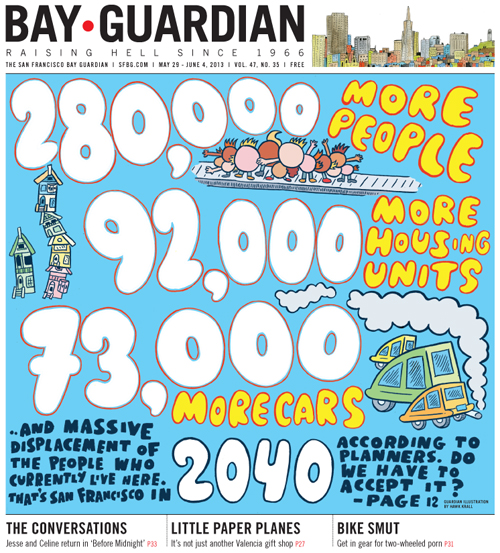
Under the ABAG plan, San Francisco would approve 92,400 more housing units for 280,000 more people. The city would host 190,000 more jobs, many of them in what’s called the “knowledge economy,” which mostly means high tech. Second and third on the list: Health and education, and tourism.

The city currently allows around eight cars for every 10 housing units; as few as five in a few neighborhoods, at least 10 in many others. And there’s nothing in any city or regional plan right now that seeks to change that level of car dependency. In fact, the regional planners think that single-occupancy car travel will be the mode of choice for 48 percent of all trips by 2040 — almost the same as it is today.

And since most of the new housing will be aimed at wealthier people, who are more likely to own cars and avoid catching buses, San Francisco could be looking for ways to fit 73,000 more cars onto streets that are already, in many cases, maxed out. There will be, quite literally, no place to park. And congestion in the region, the planners agree, will get a whole lot worse.

That seems to undermine the main intent of the plan: Transit-oriented development only works if you discourage cars. In a sense, the car-use projections are an admission of failure, undermining the intent of the entire project.

The vast majority of the housing that will be built will be too expensive for much of the existing (and even future) workforce and will do little to relieve the pressure on lower income people. But there is nothing whatsoever in the plan to ensure that there’s money available to build housing that meets the needs of most San Franciscans.

Instead, the planners acknowledge that 36 percent of existing low-income people will be at risk for displacement. That would be a profound change in the demographics of San Francisco.

Of course, adding all those people and jobs will put immense pressure on city services, from Muni to police, fire, and schools — not to mention the sewer system, which already floods and dumps untreated waste into the Bay when there’s heavy rain. Everyone involved acknowledged those costs, which could run into the billions of dollars. There is nothing anywhere in any of the planning documents addressing the question of who will pay for it.

THE NUMBERS GAME

Projecting the future of a region isn’t easy. Job and population growth isn’t a straight line, at best — and when you’re looking at a 25-year window in a boom-and-bust area with everything from earthquakes to sea-level rise factoring in, it’s easy to say that anyone who claims to know what’s going to happen in 2040 is guessing.

But as economist Stephen Levy, who did the regional projections for ABAG, pointed out to us, “You have to be able to plan.” And you can’t plan if you don’t at least think about what you’re planning for.

Levy runs the Center for the Continuing Study of the California Economy, and he’s been watching trends in this state for years. He agrees that some of his science is, by nature, dismal: “Nobody projects deep recessions,” much less natural disasters. But overall, he told me, it’s possible to get a grip on what planners need to prepare for as they write the next chapter of the Bay Area’s future.

And what they have to plan for is a lot more people.

Levy said he started with the federal government’s projections for population growth in the United States, which include births and deaths, immigration, and out-migration, using historic trends to allocate some of that growth to the Bay Area. There’s what appears at first to be circular logic involved: The feds (and most economists) project that job growth nationally will be driven by population — that is, the more people live in the US, the more jobs there will be.

Population growth in a specific region, on the other hand, is driven by jobs — that is, the more jobs you have in the Bay Area, the more people will move here.

“Jobs in the US depend on how many people are in the labor force,” he said. “Jobs in the Bay Area depend on our share of US jobs and population depends on relative job growth.”

Make sense? No matter — over the years it’s generally worked. And once you project the number of people and jobs expected in the Bay Area, you can start looking at how much housing it’s going to take to keep them all under a roof.

Levy projects that the Bay Area’s share of jobs will be higher than most of the rest of the country. “This is the home of the knowledge industry,” he told me. So he’s concluded that population in the Bay Area will grow from 7.1 million to 9.2 million — an additional 2.14 million people. They’ll be chasing some 1.1 million new jobs, and will need 660,000 new housing units.

Levy stopped there, and left it to the planners at ABAG to allocate that growth to individual cities — and that’s where smart growth comes in.

For decades in the Bay Area, particularly in San Francisco, activists have waged wars against developers, trying to slow down the growth of office buildings, and later, luxury housing units. At the same time, environmentalists argued that spreading the growth around creates serious problems, including sprawl and the destruction of farmland and open space.

Smart growth is supposed to be an alternative: the idea is to direct new growth to already-established urban areas, not by bulldozing over communities (as redevelopment agencies once did) but by the use of “infill” — directing development to areas where there’s usable space, or by building up and not out.

ABAG “focused housing and jobs growth around transit areas, particularly within locally identified Priority Development Areas,” the draft environmental impact report on the plan notes.

The draft EIR is more than 1,300 pages long, and it looks at the ABAG plan and several alternatives. One alternative, proposed by business groups, would lead to more development and higher population gains. Another, proposed by community activist groups including Public Advocates, Urban Habitat, and TransForm, is aimed at reducing displacement and creating affordable housing; that one, it turns out, is the “environmentally preferred alternative.” (See sidebar).

But no matter which alternative you look at, two things leap out: There is nothing effective that ABAG has put forward to prevent large-scale displacement of vulnerable communities. And despite directing growth to transit corridors, the DEIR still envisions a disaster of traffic congestion, parking problems, and car-driven environmental wreckage.

THE DISPLACEMENT PROBLEM

ABAG has gone to some lengths to identify what it calls “communities of concern.” Those are areas, like Bayview Hunters Point, Chinatown, and the Mission, where existing low-income residents and small businesses face potential displacement. In San Francisco, those communities are, to a great extent, the same geographic areas that have been identified as PDAs.

And, the DEIR, notes, some degree of displacement is a significant impact that cannot be mitigated. In other words, the gentrification of San Francisco is just part of the plan.

In fact, the study notes, 36 percent of the communities of concern in high-growth areas will face displacement pressure because of the cost of housing. And that’s region wide; the number in San Francisco will almost certainly be much, much higher.

Miriam Chion, ABAG’s planning and research director, told me that displacement “is the core issue in this whole process.” The agency, she said, is working with other stakeholders to try to address the concern that new development will drive out longtime residents. But she also agreed that there are limited tools available to local government.

The DEIR notes that ABAG and the MTC will seek to “bolster the plan’s investment in the Transit Oriented Affordable Housing Fund and will seek to do a study of displacement. It also states: “In addition, this displacement risk could be mitigated in cities such as San Francisco with rent control and other tenant protections in place.”

There isn’t a tenant activist in this town who can read that sentence with a straight face.

The problem, as affordable housing advocate Peter Cohen puts it, is that “the state has mandated all this growth, but has taken away the tools we could use to mitigate it.”

That’s exactly what’s happened in the past few decades. The state Legislature has outlawed the only effective anti-displacement laws local governments can enact — rent controls on vacant apartments, commercial rent control, and eviction protections that prevent landlords from taking rental units off the market to sell as condos. Oh, and the governor has also shut down redevelopment agencies, which were the only reliable source of affordable housing money in many cities.

Chion told me that the ABAG planners were discussing a list of anti-displacement options, and that changes in state legislation could be on that list. Given the power of the real-estate lobby in the state Capitol, ABAG will have to do more than suggest; there’s no way this plan can work without changing state law.

Otherwise, eastern San Francisco is going to be devastated — particularly since the vast majority of all housing that gets built in the city, and that’s likely to get built in the city, is too expensive for almost anyone in the communities of concern.

“This plan doesn’t require affordable housing,” Cindy Wu, vice-chair of the San Francisco Planning Commission, told me. “It’s left to the private market, which doesn’t build affordable housing or middle-class housing.”

In fact, while there’s plenty of discussion in the plan about where money can come from for transit projects, there’s virtually no discussion of the billions and billions that will be needed to produce the level of affordable housing that everyone agrees will be needed.

Does anyone seriously think that developers can cram 90,000 new units — at least 85 percent of them, under current rules, high-cost apartments and condos that are well beyond the range of most current San Franciscans — into eastern neighborhoods without a real-estate boom that will displace thousands of existing residents?

Let’s remember: Building more housing, even a lot more housing, won’t necessarily bring down prices. The report makes clear that the job growth, and population boom that accompanies it, will fuel plenty of demand for all those new units.

Steve Woo, senior planner with the Chinatown Community Development Center, sees the problem. In a letter to ABAG, he notes: “Plan Bay Area and its DEIR has analyzed the displacement of low-income people and explicitly acknowledges that it will occur. This is unacceptable for San Francisco and for Chinatown, where the pressures of displacement have been a constant over the past 20 years.”

Adds the Council of Community Housing Organizations: “It would be irresponsible for the regional agencies to advance a plan that purports to ‘improve’ the region’s communities as population grows while the plan simultaneously presents great risk and uncertainty for many vulnerable communities.”

Jobs are at stake, too — not tech jobs or office jobs, which ABAG projects will expand, but the kind of industrial jobs that currently exist in the priority development areas.

Calvin Welch, who has been watching urban planning and displacement issues in San Francisco for more than 40 years, puts it bluntly: “It is axiomatic that market-rate housing drives out blue-collar jobs,” he said.

Of course, there’s another potential problem: Nobody really knows where jobs will come from in the next 25 years, whether tech will continue to be the driver or whether the city’s headed for a second dot-com bust. San Francisco doesn’t have a good record of building for projected jobs: In the mid-1980s, for example, the entire South of Market area (then home to printing, light manufacturing, and other blue-collar jobs) was rezoned for open-floor office space because city officials projected a huge need for “back-office” functions like customer service.

“Where are all those jobs today?” Welch asked. “They’re in India.”

TOO MANY CARS

For a plan that’s designed to reduce greenhouse gas emissions by moving residential development closer to work areas, Plan Bay Area is awfully pessimistic about transportation.

According to the projections, there will be more cars on the roads in 2040, with more — and much worse — traffic. The DEIR predicts that a full 48 percent of all trips in 2040 will be made by single-occupant vehicles — just slightly down from current rates. The percentage of trips on transit will only be a little bit higher — and there’s no significant increase in projected bicycle trips.

That alone is pretty crazy, since the number of people commuting to work by bike in San Francisco has risen dramatically in the past 10 years, and the city’s official goal is that 20 percent of all vehicle trips will be by bike in the next decade.

Part of the problem is structural. Not everyone in San Francisco 2040 is going to be a high-paid tech worker. In fact, the most stable areas of employment are health services and government — and hospital workers and Muni drivers can’t possibly afford the housing that’s being built. So those people will — the DEIR acknowledges — be displaced from San Francisco and forced to live elsewhere in the region (if that’s even possible). Which means, of course, they’ll be commuting further to work. Meanwhile, if current trends continue, many of the people moving into the city will work in Silicon Valley.

Chion and Levy both told me that the transit mode projections were based on historical trends for car use, and that it’s really hard to get people to give up their cars. Even higher gas prices and abominable traffic delays won’t drive people off the roads, they said.

If that’s the case — if auto culture, which is a top source of global climate change, doesn’t shift at all — it would seem that all this planning is pointless: the seas will rise dramatically, and San Franciscans ought to be buying boats.

“The projections don’t take into account social change,” Jason Henderson, a geography professor at San Francisco State University and a local transportation expert, told me. “And social change does happen.”

Brad Paul, a longtime housing activist who now works for ABAG, said these projections are just a start, and that the plan will be updated every four years. “I think we’re finding that the number of people who want to drive cars will go down,” he said.

Henderson argues that the land-use policy is flawed. He suggests that it would make more sense to increase density in the Bay Area suburbs along the BART lines. “Elegant development in those areas would work better,” he said. You don’t need expensive high-rises: “Four and five stories is the sweet spot,” he explained.

Most of the transportation projects in the plan are already in the pipeline; there’s no suggestion of any major new public transit programs. There is, however, a suggestion that San Francisco adopt a congestion management fee for downtown driving — something that city officials say is the only way to avoid utter gridlock in the future.

SIDELINING CEQA

ABAG and the MTC have a fair amount of leverage to implement their plans. MTC controls hundreds of millions of dollars in transit money; ABAG will be handing out millions in grants to communities that adopt its plan. And under state law, cities that allow development in PDAs near transit corridors can gain an exemption from the California Environmental Quality Act.

CEQA is a powerful tool to slow or halt development, and developers (and some public officials) drool at the prospect of getting a fast-track pass to avoid some of the more cumbersome parts of the environmental review process.

Under SB 375 and Plan Bay Area, CEQA exemptions are available to projects that meet the Sustainable Community Strategy standards and are close to transit corridors. And when you look at the map of those areas, it’s pretty striking: All of San Francisco, pretty much every square inch, qualifies.

That means that almost any project almost anywhere in town can make a case that it doesn’t need to accept full CEQA review.

The most profound missing element in this entire discussion is the cost of all this growth.

You can’t cram 210,000 more residents into San Francisco without new schools, parks, and child-care centers. You can’t protect those residents without more police officers and firefighters. You can’t take care of their water and sewer needs without substantial infrastructure upgrades. And even if there’s state and federal money available for new buses and trains, you can’t operate those systems without paying drivers, mechanics, and support workers.

There’s no question that the new development will bring in more tax money. But the type of infrastructure improvements that will be needed to add 25 percent more residents to the city are really expensive — and every study that’s ever been done in San Francisco shows that the tax benefits of new development don’t cover the costs of public services it requires.

When World War II and the post-war boom in the Bay Area brought huge growth to the region, property taxes and federal and state money were adequate to build things like BART, the freeways, and hundreds of new schools, and to staff the public services that the emerging communities needed. But that all changed in 1978, with the passage of Prop. 13, and two years later, with the election of Ronald Reagan as president.

Now, federal money for cities is down to a trickle. Local government has an almost impossible time raising taxes. And instead of hiking fees for new residential and commercial projects, many communities (including San Francisco) are offering tax breaks to encourage job growth.

Put all that in the mix and you have a recipe for overcrowded buses, inadequate schools, overstressed open space (imagine 10,000 new Mission residents heading for Dolores Park on a nice day), and a very unattractive urban experience.

That flies directly in the face of what Plan Bay Area is supposed to be about. If the goal is to cut down on commutes by bringing new residents into developed urban areas, those cities have to be decent places to live. What would it cost to accommodate this level of new development? Five billion dollars? Ten billion? Nobody knows — because nobody has run those numbers. But they’re going to be big.

Because just as tax dollars have been vanishing, the costs of infrastructure keep going up. It costs a billion dollars a mile to build BART track. It’s costing more than a billion to build a short subway to Chinatown. Just upgrading the sewer system to handle current demands is a $4 billion project.

And if the developers and property owners who stand to make vast sums of money off all of this growth aren’t going to pay, who’s left?

The ABAG planners point out, correctly, that there’s a price for doing nothing. If there’s no regional plan, no proposal for smart growth, the population will still increase, and displacement will still happen — but the greenhouse gas emissions will be even worse, the development more haphazard.

But if the region is going to spend all this money and all this time on a plan to make the Bay Area more sustainable, more livable, and more affordable in 25 years, we might as well push all the limits and get it right.

Instead of looking at displacement as inevitable, and traffic as a price of growth, the planners could tell the state Legislature and the governor that it’s not possible to comply with SB375 — not until somebody identifies the big sums of money, multiples of billions of dollars, needed to build affordable housing; not until there are transit options, taxes, and restrictions on driving.

Because continued car use and massive displacement — the package that’s now facing us — just isn’t an acceptable option.


The Blob eats Quebec

0

culture@sfbg.com

THE BLOB If you thought the first thing you’d see when you landed in Quebec City, Canada, was a mime in a black mock turtleneck playing “My Heart Will Go On” on an accordion, you’d be almost right. Almost, because the Blob promptly devoured him — chewy! — and went on to enjoy a brief culinary tour of one of the most charming, clean, and friendly cities she’s visited.

Also surprisingly diverse: waves of Canadian immigration have gently streaked “traditional” Canadian cuisine (yes there is such a thing, from the “meat pie” pork tortierre of the Blob’s maternal grandmother to Canadian bacon, berry jams, sweet pickles, and caribou steaks) with global flavors. Quebec being heavily French, there’s also an attention to detail and service that boosts its current restaurant boom to another level — without stinting on any creamy richness.

Chefs here have dived into experimenting with local St. Lawrence Seaway ingredients like meaty Îles de la Madeleine sea scallops, tender green saltwort, smoked Kamouraska eel, late spring fiddleheads and asparagus (all experienced at the superior L’Échaudé in the stonewalled Vieux-Port area, www.echaude.com). Blackberry cassis and cider, made in the bright, tin-roofed farmhouses on Île d’Orléans across the river, boutique chocolate galore, and ubiquitous maple delights from Quebec’s interior sweeten the pot.

“Smoked meat,” a.k.a. molasses-cured pastrami, piled on a plate with a pickle (Joe Smoked Meat, www.joesmokedmeat.com) or tucked deliciously beneath cheese and a layer of butter spread on a pizza (Pizzeria TM in nearby Thetford Mines) fattens up, as does that ubiquitous Quebecois staple, poutine, in a panoply of forms. Let’s eat.


RABBIT PIE AT LE LAPIN SAUTÉ

Holy leaping quaintness. This cozy joint in the Lower Town, tucked amid shops selling Inuit art and hip-mom scarves, is a true Quebec experience. Pretty waitstaff offer the house specialty, rabbit, in a dazzling variety of formats: juicy in white bean cassoulet, dipped in honey-rosemary sauce, roasted with “two mustards,” even plated with a hefty side of duck. Simplicity is best, the Blob may have learned from some Beatrix Potter book. So a slice of rabbit pie ($21.95) it was, savory-sweet, with currants and potatoes, atop a splash of balsamic sauce. Paired perfectly with a local Boréale Rousse beer? Mais oui!

52, rue du Petit-Champlain, www.lapinsaute.com


NEIGE RECOLTÉ D’HIVER FROM LA FACE CACHÉE DE LA POMME

Ice cider, who knew? The Blob has been put off by ice wines before — too sweet, too supermarket-y — but this premier line of Quebecois ciders ($47 per 375 ml, less expensive versions available), distilled from frosted apples, has changed her life. Wonderful after a spicy meal, the chilled-syrup, full-bodied sweetness lingers in your mouth like a very good port, but without the sting.

www.lafacecachee.com


DUCK POUTINE AT LE COCHON DINGUE

Le Cochon Dingue is a Denny’s-like restaurant chain (but better), and poutine — fries smothered in gravy and cheese curds — is a French Canadian staple that’s become popular in the US. Poutine is available everywhere, from fast food versions to ones with foie gras or hunks of venison. The measure to which all poutine is held? The squeakiness of its curds. And this affordable version ($10) with shredded duck in a sweet gravy has incredibly squeaky curds. It’s squeaky curdlicious.

www.cochondingue.com  


BOUDIN NOIR AT CLOCHER PENCHE

This is the place: a former bank on a corner in the neat Saint-Roch district, transformed into a magnet for foodies (there are some gentrification issues here, yes). The innovative menu doesn’t show its hand too much — you’re getting deeply thought-through, hyperlocal fare, but that fact’s not treated like a showy gimmick, plastered everywhere. One stand-out: blood pudding sausage ($23.95), melting with rich, dark pork and accompanied by pineapple (OK, not so local always) chutney and hearty fresh vegetables. Desserts are a must — tiny chocolate squares as dense as black holes dot caramelized bananas in rum sauce with sticky popcorn; érable (maple) flavor erupts in a warm fritter crusted with sweet pecans.  

203, rue Saint-Joseph Est, www.clocherpenche.ca

Gopi and the Yoglers

0

culture@sfbg.com

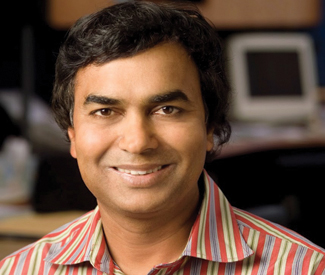
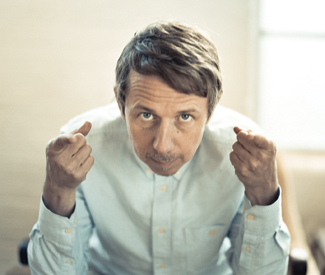
ON THE OM FRONT  Seven years ago, Gopi Kallayil, currently the Chief Evangelist for Google+ (there is indeed such a position), started a program at the Mountain View Google office called Yoglers: members go beyond merely practicing yoga in the office to participating more fully in its potential. It’s kind of like Google+ circles for yogis, where employees become teachers rather than just lunchtime practitioners. I recently spoke with Gopi, a force of nature himself who speaks often on such topics as “Envisioning the Conscious Corporation” and once engineered an online hangout with Desmond Tutu and the Dalai Lama, about this program and his life’s passion: merging business and technology with mindfulness practices like yoga and meditation.

SFBG OK, so what exactly is a “Yogler”?

Gopi Kallayil There are communities of Googlers that self-organize themselves into doing different things. For instance, there is a group for LGBT Googlers (and their straight allies) called Gayglers, a group for Jewish Googlers called Jewglers, and a group for Carpooling Googlers called Carpoolglers. Self-organizing yoga practitioners are called Yoglers.

SFBG Is this different than the corporate yoga program at Google?

GK Yes. Google does a lot of things to keep employees fit and healthy—there are gyms in many offices, and we have group exercise programs that include yoga instruction with contracted yoga teachers to lead these classes. But the Yoglers classes are led only by people who work for Google. They could be product managers or engineers, but they will take a break periodically and not just take a yoga class, but actually teach a yoga class.

SFBG Are Yogler instructors trained yoga teachers or just yoga enthusiasts?

GK They are trained teachers. People who work here are intensely intense about the things that they do. They are very passionate about all aspects of their lives.

SFBG How did you first become involved with yoga?

GK I grew up in India, and became a yoga teacher as a teenager. I was taught yoga by Swami Vishnudevananda, who is one of the people who first brought yoga to America. He taught it as a path to self-realization, but also as a practice that brings joy, peace, and happiness to the world. He wanted us to go and teach it to other people. Since then, I’ve always taught, and I’ve always taught for free.

SFBG What inspired you to start Yoglers?

GK When I joined Google, one of my colleagues here encouraged me to teach a yoga class. So I started teaching a class in a conference room to one student and called it Yoglers. It was a way I could bring yoga to my community at work and pass on this great tradition that I was blessed to have received. Word of mouth spread and years later it’s become a big movement across Google offices worldwide. I had no idea that something I started with one student would evolve to this level.

SFBG Do you think the location of the Mountain View office helped to launch Yoglers?

GK Without question, something like this could happen more easily in the Bay Area. This is a very awakened, conscious place. People are curious about these traditions and don’t look at them suspiciously. People have studied yoga here, they welcome it.

SFBG Why is it important to bring yoga into the workplace in society today?

GK It’s not just today. It has always been important. It was important 50 years ago, 100 years ago, as long as there have been human beings. Yoga and meditation help to create a higher quality, more conscious human being. And any organization—whether it’s a corporation or educational institution—is staffed and run by human beings. If we incorporate these practices into our working life, we get along with each other better, make better products, and make choices that will better serve our customers.

SFBG It’s great that tech companies are embracing yoga, but isn’t technology part of what’s making us scattered and stressed?

GK: Technology, if not used properly and consciously, has the capability to completely distract us and make us unproductive and frenzied. But it’s no different than many other innovations. It’s like fire. Ever since we’ve discovered it and known how to harness it, we’ve found it exceptionally useful. You can cook your food with it, you can melt and blow glass with it. But if you misuse it, you can burn yourself or raze an entire city to the ground. I only check email certain times a day — I’m not constantly looking at it. Technology is a powerful tool. But whether you use the tool to be productive or destructive is up to you.

SFBG How does yoga help people in stressful work environments stay focused and calm?

GK When you practice yoga, you’re asked to bring your complete, 100 percent awareness to your body and your breath. If you practice regularly, it makes you more aware and conscious, and you make choices driven by that. The quality of your interactions improves. You stop checking your email when someone is talking to you. At Google, we’re building amazing technologies like self-driving cars, Google Glass, and Google+. And yet, the most important technology that every human being has access to is right within us: our body, our mind, our consciousness.

SFBG Any advice on how people can start a yoga or meditation program at work?

GK It’s simple. Go book a conference room. Sit, close your eyes, start meditating. Put up a sign that says, “Random acts of meditation.” It doesn’t matter if only one person shows. If you just sit there for 60 seconds and watch your breath, you have just started a meditation program. You don’t need a budget or resources. Someone just needs to step forward and do it.


The conversations

0

arts@sfbg.com

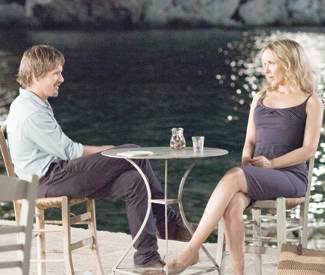
FILM Half a lifetime ago — that is to say, sometime in the mid-’90s — on a train rolling through Austria, a young American man named Jesse (Ethan Hawke) met a young French woman named Celine (Julie Delpy). They were in their early 20s, and maybe that’s why it didn’t seem outlandish when, after some passing miles and some good conversation, he asked her to get off the train with him in Vienna, proposing that they spend the next 12 or so hours wandering the city, until his flight home in the morning. He didn’t scream axe murderer, and he made the case that if she stayed on the train, she might look back on her decision in 20 years, from the vantage of an unsatisfying marriage, and regret it. On paper, it sounds dubious bordering on smarmy. But sometimes it’s all in the delivery, and it didn’t seem too lunatic when Celine said yes.

So for the next hour and a half, we followed them as they traced a meandering itinerary among Vienna’s monuments, cafés, bars, and riverside walkways. Drifting through half a day’s worth of dense conversation (a sort of retort to the typical romantic comedy montage), they told personal anecdotes, took philosophical positions, and did a certain amount of playful flirting, whose intensity crept upward with the passing hours as the parameters of their encounter began to constrict. By morning, we were pretty invested in the last-minute arrangement they made just before Celine boarded her train: to reconvene there, barring personal constraints, in one year’s time. As the sun rose on all the places they’d passed through, empty now, we were left with that ambiguous possibility and our own guesses and projections as to whether Jesse and Celine would ever see each other again.

Since 1995, when director Richard Linklater, Delpy, and Hawke told this story in the film Before Sunrise, they’ve returned to these characters three times: they surface in a disconnected cameo in 2001’s animated Waking Life. The 2004 follow-up Before Sunset, shot in real time, reunites them after nine years in a Paris bookstore, where Jesse, now a successful writer, is reading from his novel about their time together in Vienna; more discursive talk and a beautifully ambiguous ending ensue. And now Before Midnight marks the third installment in a series whose occasional, compressed episodes submerge us so deeply in a particular moment of Jesse and Celine’s lives that we begin to forget how long it’s been since we saw them last.

When the newest film — co-written, like Before Sunset, by Linklater, Delpy, and Hawke; Linklater wrote the first film with Kim Krizan — picks up with Celine and Jesse, another nine years have passed. And it’s possible that they no longer recall with the warm clarity we do that gorgeous, affecting, flirty scene in the last few moments of Before Sunset, when we left them alone in Celine’s Paris apartment listening to Nina Simone, Jesse looking very likely to miss his plane back to the States this time around. It was one of the more perfect movie endings in recent memory, true. But in the intervening years, a lot has happened, including twins, a rancorous divorce and custody fights (for Jesse, whose teenage son lives in Chicago with his ex-wife), another best-selling (and semiautobiographical) novel, various environmental battles (for nonprofit worker Celine), and nine years of steady, unrestricted companionship that have inevitably overshadowed the telescoped intensity and romantic longing of the pair’s early encounters.

Now in their early 40s, Jesse and Celine have formed a web of commitments domestic and professional, and Before Midnight reflects this shift by adopting a more expansive outlook, the camera pulling back to take in a wider circle of family and friends. The film begins with a scene between Jesse and his son, Hank (Seamus Davey-Fitzpatrick), saying their farewells at an airport in Greece’s southern Peloponnese, where the family have been spending the summer at the home of an older expat and writer, Patrick (played by veteran cinematographer Walter Lassally).

When we finally see Celine, waiting curbside at the car with their little girls, she’s on the phone with a colleague in Paris, and her and Jesse’s exchanges as they drive signal a habitual intimacy (new to us but now commonplace to them) — as well as a few recurring sources of tension. Back at Patrick’s, the camera moves amid a crowded intergenerational scene and, at dinner, circles the table in an extended take as these disparate characters reflect on the stages of love and life in the kind of rambling, associative conversation we’ve come to expect of the series.

There’s a neatness to the generational roll call at the dinner table — a couple in their 20s (whose long-distance affair via Skype is juxtaposed to Before Sunrise‘s romantic, chancy gesture); two couples in their 40s; the elderly Patrick and a female friend, both widowed. But the discussion itself is messy like life, and things get messier still when Jesse and Celine finally manage some alone time. We see the people who met half a lifetime ago, but the shock of recognition comes when the fissures in their relationship are fully exposed, cracks we can follow back nearly 20 years, as well as forward. We remember, and so do they, Jesse convincing Celine to get off the train with that fast-forward glance at a possible future, and wonder if we’ll ever see the two of them again.


BEFORE MIDNIGHT opens Fri/31 in Bay Area theaters.

Tourist trappers

1

cheryl@sfbg.com

FILM From the wonderfully cracked mind of British director Ben Wheatley — whose 2011 Kill List infused the played-out hitman genre with gory verve and folkloric terrorscomes, at last, Sightseers. If you missed it earlier this year at SF IndieFest, here’s your chance to experience Wheatley’s latest mash-up, a black-comedy road movie that follows a pair of infatuated misfits as they visit some of England’s more prosaic tourist attractions. Long before they reach the Keswick Pencil Museum, however, it becomes clear that one of them is a serial killer.

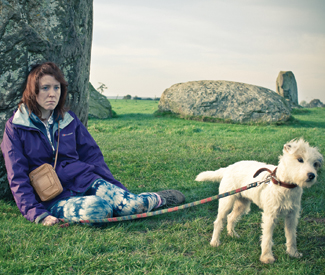
But it doesn’t take frenzied bloodshed to indicate that something’s a little off with both Tina (Alice Lowe) and Chris (Steve Oram; both actors co-wrote with Amy Jump, Wheatley’s wife and frequent collaborator). Tina’s a sheltered, frumpy 34-year-old who still lives at home with her controlling mother (Eileen Davies); their relationship revolves around baby talk and emotional manipulation, as well as a shared sense of grief over losing their much-worshipped dog, Poppy, in a freak knitting-needle accident.

Bitter Mum blames Tina, a compulsive knitter, for Poppy’s demise. “Murderer!” she hisses, as Chris whisks a giddy Tina away (“Show me your world, Chris!”) with his beloved Abbey Oxford Caravan in tow, the upbeat-tempo-meets-cautionary-lyrics of “Tainted Love” blasting on the soundtrack. After these bits of foreshadowing, it’s not a complete surprise when Chris reacts oddly to a man who carelessly discards an ice-cream wrapper amid the sacred environs of Crich Tramway Village. The first death is perceived as accidental, by Tina, the police, the victim’s family — but we saw Chris peep the offender in his rearview mirror before mowing him down, and we also saw the delighted smile creep across his face in the chaotic aftermath.

As Tina and Chris’ holiday continues, their relationship settles into a comfortable groove: Chris calls the shots, while Tina — delighted to be dubbed the budding author’s “muse” — follows his lead, spending her downtime decking out the trailer with tacky tchotchkes. The litterbug’s death fades quickly, but it’s not long before things get weird again, when the couple encounters two smugsters who are more or less upgraded versions of themselves: more attractive, more tasteful, more successful, and possessed of both a nicer trailer and a dog who’s a dead ringer for Poppy. Once again, the molecules in the crisp English-countryside air rearrange themselves, and the façade of a peaceful vaycay crumbles. The tone shift is heralded by a slo-mo montage set to Vanilla Fudge’s “Season of the Witch,” a cover so acid-soaked it makes an already-spooky song even more appropriately nightmarish.

Thus zooms forth Sightseers, with two protagonists so snapped from reality that happy, goofy moments continue to shine through the darkness. Though Tina disapproves of Chris’ habits (or does she?), her main concern is making sure the trip continues apace — and that Chris continues to treat her like a muse, even if she’s serving as muse for a creative endeavor that hardly resembles writing a book. The film’s most literary moment comes when a booming voice-over, not heard before or after, chimes in to narrate a key moment with William Blake’s “Jerusalem” (cutting off right after the word “Satanic”).

Not immediately familiar with that poem? Well, the musical version of “Jerusalem” is so popular in Britain that it was incorporated into the opening ceremonies at the 2012 London Olympics. If there’s a downside to Sightseers, it’s that some of its Brit-specific quirks might be lost on American viewers. It’s funny enough even if you don’t have an ear for regional accents (or the ability to sort out the posh ones), an appreciation for Daily Mail jokes, or the slightest knowledge of caravan culture. But the humor in Sightseers, probably more than Kill List and definitely more than exec producer Edgar Wright’s Shaun of the Dead (2004), is aimed more at the hometown crowd.

Still, any Yank with a wicked streak will appreciate Sightseers‘ deliciously deviant, decidedly deadpan point of view, and its take on class wars is obvious enough to translate into haughty vs. tacky. If the pairing of Tina and Chris is a disaster waiting to happen, Lowe and Oram — both British TV stars who developed their characters over a period of years — create comedy gold, with some of the more luridly awkward sex scenes in recent memory. Though Oram got the funniest of Sightseers‘ four promotional posters (tag line: “Death has a ginger beard”) Lowe, in particular, makes the most of Tina’s little-girl-lost shtick, eager to please her man but most certainly not to be fucked with. 


SIGHTSEERS opens Fri/31 in Bay Area theaters.

Functional hyphy

0

arts@sfbg.com

MUSIC Here, in the depths of the pot smoke-drenched green room of Slim’s, the muffled chants of an insatiable gathering of Bay Area hip-hop fiends grows louder and more forceful by the second. The crowd is brazen in its vocal yearning for the show’s main act of IamSu! and Compton rapper Problem.

This show, which took place at the end of last month, was a de facto homecoming spot on the Million Dollar Afro mixtape tour and the leader of the HBK (Heart Break Kids) Gang was keen to give his fans what they wanted, and then some.

After a quick team prayer, IamSu! and Problem make their way up the back stairs towards the stage, giving the ceremonial daps to the homies along the way. Then amid a torrent of blaring horn drops courtesy of HBK Gang DJ Azure, IamSu! and Problem leap out on stage like they’re t-shirts being launched from a cannon, the kind you’d traditionally see at baseball games.

IamSu!’s lumbering 6-foot-something frame is rocking a dashiki and a slim leather jacket. The duo commandeers the performance with the skills of a group of season veterans and dutifully maintains the hype level two clicks above organized calamity for the majority of the show. Between each track, someone or some group out there is getting a shout-out, but the biggest shout-out of them all is reserved for the completely unexpected appearance of Juvenile, who is trotted out to perform his verse on “100 Grand.”

If IamSu! had followed the conventional hip-hop career path, he would have quickly spat out an album following his 2011 potty-mouthed, Gold-certified single “Up” and filmed the all-too-common hip-hop club music video with Lil Wayne. But for all his youthful cheerfulness, IamSu!, or Su for short (his real name is Sudan Williams), embodies a dexterous patience when it comes to decisions regarding his budding career.

He has plans for an album but no specific date. He frankly would rather kick it in the studio with his HBK crew laying down tracks on tracks on tracks than strut it out on the national stage, at least for the time-being. Su cheerfully remarks that “with or without music, HBK Gang would be having fun together,” but, almost conversly, holds high aspirations for his crew: “I want it to be a brand like Nike and you see our logo and you already know it’s from the Bay Area. That bond is what keeps us so humble right now, the fact that people will check me when I’m being an asshole, I’ll check somebody else and vice versa.”

A handful of major labels have courted Su and he has rejected generous offers from at least one. In fact, he’s still residing at home because he admits he “just hasn’t had the time to find a new spot”, but he did confirm to me that his pockets “are on sumo.” It was there in his childhood room/makeshift studio that he recorded his incredibly slippery and jolting verse on E-40’s “Function,” while recovering from a cold.

Su, who raps and talks with an undeniable East Bay twang, is just as adept in the studio as he is on the mic and just like the Kanye-model, Su produces nearly every track he raps on. Like East Bay hip-hop stalwarts Trackademiks and Kool A.D., Su explored and absorbed the craft of beat-making at the Oakland nonprofit media center, Youth Radio. Starting at the age of 15, he spent three days a week immersing himself in knobs, keyboards, and drum pads. The first poignant moment of his time there — and of his rap career — occurred when he performed for his peers at Youth Radio, which was the result of a weeklong competition. Su fondly recalls it was “one of the best feelings ever” when he observed the positive reactions of the crowd at Youth Radio.

Su now does the bulk of his production at a small and almost claustrophobic studio tucked away in a nondescript office on the border of Emeryville and Berkeley. There in that studio, I caught a glimpse of the process of constructing a slap.

Starting with a simple synth riff and voice sample, Su gradually and artfully added layers of drum hits, hi-hats, and bass jabbed while twisting and warping the voice sample. Operating the keyboard drums with his left hand, Su maneuvered the mouse to dig in the sample database and drop in instrument clips, all while methodically bobbing his head like a metronome. It wouldn’t be an IamSu! joint if he wasn’t also testing out some indistinguishable lyrics under his breath. Around 15 minutes later, the result was a rough draft of what will likely be a banger, which had the overwhelming approval of his crew present in the studio. Though Su affirmed for me that this joint won’t be hitting speakers “for at least a while”.

While in the studio, Su couldn’t help but bug out with giddiness every time he listened to one of his unfinished tracks, he seemed playful yet focused, relaxed yet determined. That brimming combination of curiosity and enthusiasm remains the driving force behind his dozen or so mixtapes.

Overarching questions pertaining to the status of hyphy or Bay Area hip-hop don’t apply to Su. Whether or not he brings back hyphy or becomes the first rap superstar of the decade from the Bay Area, the self-described “laid back friendly kid who likes to make music, go shopping, and listen to ’80s music,” is going be having the time of his life in the studio, with the full support of his crew.


What we do is secret

2

emilysavage@sfbg.com

TOFU AND WHISKEY Bay Area garage pop quintet the Mantles will release Love Enough to Leave on Slumberland Records next month (June 18) and play the Rickshaw Stop a few short days before that (June 14). The breezy group formed in 2007, but sounds like it could just have easily been hanging out at Vesuvio in Jack Kerouac Alley or across the street at Specs Bar in 1968, grasping stiff drinks and talking politics and fashion with local drunks.

Although, singer-guitarist Michael Olivares, wife and drummer Virginia Weatherby, and their new dog Jumbo moved to Oakland’s Temescal neighborhood last year thanks to rising rents in Bernal Heights, where they formerly lived. So that old-time SF scenario isn’t quite as picturesque as conjured. But the band still bleeds Bay Area. Olivares and Weatherby frequent nearby 1-2-3-4 Go! Records for vinyl, and the Night Light, the Hemlock, the Knockout, and El Rio for live shows. The band recorded its new album with local legend Kelley Stoltz, and the other three band members — keyboardist Carly Putnam, bassist Matt Roberts and, newish lead guitarist Justin Loney — live scattered throughout SF, in the Tenderloin and the Mission.

Plus, it’s really more the sound that evokes those vintage tastes, those early Nuggets-esque psych-pop ideals. Olivares gets the comparisons and appeal, though hopes his band does not come off as just a carbon copies of the past (it doesn’t). “We definitely like all of that music and other things from that era, that culture,” he says. “We’re aware enough though that I hope to not become just a blatant revivalist band that’s trying to wear tie-dye shirts and bell-bottoms or something.”

But still, the favorable comparison is applicable, “Most of the music I listen to is from that era, the ’60s and ’70s, so I’d say we’re pretty heavily influenced by it.”

This may come as no surprise to listeners still besotted with the Mantles’ self-titled 2010 debut (Siltbreeze), with its nimbly Byrds-like appeal. Yes, three years later (and EP Pink on Mexican Summer in between) the mood remains upbeat, but like the musicians who created it, there’s an older wisdom to the approach.

There’s a seen-it-all-before strength from tracks off Love Enough to Leave such as “Brown Balloon” and only slightly more solemn album closer “Shadow of Your Step.” It’s like the group time-warped and took those free-wheeling early folk popsters back to the garage with them, plugged in and showed them proto-punk, then had a serious conversation about what would happen to the Bay Area in 2013: housing prices will rise again, there will be this thing called the web that changes everything.

When asked what’s changed since he first moved to SF a decade ago, Olivares says it seems like bands have gone poppier (including his own), but also notes there’s been a shift in the sheer number of house shows in SF proper.

He says their migration to the East Bay loosely influenced title track, “Long Enough to Leave,” and “Don’t Cross Town.”

Conversely, there are some more character-based tracks inspired by books and films like Mike Leigh’s comedic camping ode Nuts in May (1976), including jangly opener “Marbled Birds” and the illusory single “Hello,” which initially seems like a pleasant conversation. Cheery to begin with, it feels like candy and turquoise rotary telephones in teenage bedrooms (a ruse, the band members are all actually in their early 30s). But then, it gets to the line, “Hello/Maybe you can help me get out of here.” Ah, the hook, and out comes the reverb. Olivares told me it was actually about a time when his friend in France was sending postcards and he kept forgetting to respond.

While the Mantles may evoke vintage San Francisco, there’s something moving in this week that’s entirely new to the area and musical landscape. The America’s Cup Concert Series at the America’s Cup Pavilion (between Piers 27/29), stricken by neighborhood complaints, finally soldiers forward (but now down to 30 concerts from 40). It’ll be SF’s largest venue — holding up to 9,000 classic rock fans in an outdoor concert bulb connected to the equally maligned America’s Cup. Teamed up with Live Nation, the Pavilion will host a barrage of top 40 acts including Imagine Dragons this weekend, Fri/31, (already sold out).

Then there’ll be Sting, the Steve Miller Band, Counting Crows with the Wallflowers, 311, Train, Sammy Hagar, and it goes on. It’s a rather stale line-up, perhaps best suited for those legitimately excited for the boat races. The youngest group is the Jonas Brothers, after that Fall Out Boy and Panic! At the Disco (all well into their 30s). Perhaps the only really interesting additions are Weezer and the symphony. Here’s hoping the neighbors don’t keep complaining.


BAY FEVER

And now, a little spring-cleaning for Tofu and Whiskey. Some Bay Area bands are killing it in late May and June. Dreams in the Rat House (Hardly Art), the explosive new full-length from Oakland trio Shannon and the Clams dropped last week. As noted when the single “Rip Van Winkle” was released, the kings and queen of surfy doo-wop have kept up their hip-shaking guitar lines and voracious vocals with a joyfully trashy edge. There’s also now a mini doc on the band, OutofFocus TV’s “American Music Episode 6: featuring Shannon and the Clams,” which you can check on Youtube and Vimeo.

In it, Shannon Shaw, Cody Blanchard, and drummer Ian Amberson (who quit sometime during filming apparently) struggle to describe their band, which leads to a great video edit that includes snippets of each saying words such as “fantastical, ballads, cozy, weirdo, Muppet, punk, oldies.” shannonandtheclams.com. Song to check: “Rip Van Winkle”

After what seems like an eternity (three years and a brief hiatus) Rogue Wave will release new record Nightingale Floors Tue/4 on Vagrant Records. It’s the band’s fifth studio album, and newest since 2010’s Permalight. On Nightingale Floors, bandleader Zach Rogue and longtime drummer Pat Spurgeon battle out demons (death, personal tragedies) and come out the other end with trusted jangly guitars, Rogue’s delicate vocals that still sound like an old friend telling stories, and Spurgeon’s expert off-time drumming — a sharp new release produced by John Congleton (who also produced Rogue’s solo effort, Release the Sunbird). In addition to Rogue and Spurgeon, Nightingale Floors includes contributions by bassist Masanori Mark Christianson, guitarist Peter Pisano, vocalist Jules Baenziner (Sea of Bees) and Mwahaha’s Ross Peacock on synths.

The record seems to take listeners on a narrated life trip, through “College” and “Figured It Out” to the “Siren’s Song,” finally settling on the inevitable with twinkly “When Sunday Morning Comes” and unhurried “Everyone Want to Be You.” Rogue Waves plays the Independent July 13. roguewavemusic.com. Song to check: “No Magnatone”

And then there’s Oakland’s Mortar and Pestle. On its self-titled new full-length, the band projects a vibe akin to a trippier Little Dragon. There are bouncy keyboard lines and scattered found-sound touches boosted by the lush, dreamy vocals of lead singer Janaysa Lambert. On first single “U.V” there’s even the familiar ping-ping-ping of a classic pinball game, forcing you to picture the full Mortar and Pestle set-up placed neatly between games in a 1980s arcade. The synth-pop trio is also one of the first acts to see release on Metal Mother’s new label-collective, Post Primal, so you know it has her stamp of approval. www.mortarandpestlemusic.com Song to check: “Pristine Dream.”

The action of bodies in heat

4

arts@sfbg.com

THEATER Tom Stoppard is not a playwright who shies away from topics of unusual size. While other writers might confine themselves more narrowly with plumbing the emotional depths of their protagonists, Stoppard further concerns himself with the very workings of the universe they live in, and the machinery of history and the evolution of thought that informs their relationship to it.

In Arcadia, Stoppard inserts his articulate, intellectually-curious characters into long-winded conversations about Euclidian geometry, determinism, and the second law of thermodynamics, while still giving plenty of stage time to more emotionally-fraught preoccupations such as “carnal knowledge,” public reputation, and even romantic love. Set in both the Romantic age and the modern era, the two storylines are rife with parallel plot points: the philosophical implications of chaos theory; the abrupt self-exile of that most tempestuous of poets, Lord Byron; the struggles of two brilliant female characters to be taken seriously in their respective times; and even a quiet affection for tortoises.

Set primarily in the gracious drawing room of an English estate (designed for this production by Douglas W. Schmidt), the play is nevertheless far from static, spanning, as it does, 200 years of Western thought and several generations of the wonky Coverly clan, who inhabit their Derbyshire home with the carefree insouciance of the very wealthy. However, with the exception of the formidable Lady Croom (Julia Coffey), the expected mannerisms of a stifled upper-class don’t really manifest themselves in either her gifted daughter Thomasina (Rebekah Brockman), or in the modern-day coterie of Coverly siblings, who wander through their stately mansion in hoodies and jeans, speaking frankly of mathematics and sex as if the two passions were one and the same. Indeed, by the end of the play, it’s hard to believe otherwise, testament to Stoppard’s ability to thoroughly contextualize both.

It’s the character of Thomasina, as luminously portrayed by Brockman, who first captures our attention. Armed with precocious directness, the 13-year-old quickly reveals herself to be both sharp-witted and intellectually hungry, tackling Fermat’s Last Theorem, the meaning of “carnal embrace,” and the scientific implications of a bowl of rice pudding with equal intensity. Although her advanced aptitude eventually commands the respect of her otherwise professionally-frustrated tutor, Septimus Hodge (a handsomely rakish Jack Cutmore-Scott), she is constantly and casually dismissed by every other adult in her life — from her forceful mother, to the foppish Captain Brice (Nick Gabriel), to her unpleasant, Eton-educated brother Augustus (Titus Tompkins). Truly a product of her time, even Thomasina’s name is telling — the name given to a girl child whom everyone would have preferred to have been a boy, then left to her own devices until she reaches the age of matrimony.

Shifting to the next scene and the present day, we encounter Hannah Jarvis (a pitch-perfect Gretchen Egolf), a brittle yet erudite academic whose own intelligence has recently come under attack thanks to her controversial book about Lord Byron’s erstwhile lover, Caroline Lamb. As she seeks clues to the identity of the mysterious “Hermit of Sidley Park,” her pragmatic Classicist outlook locks horns with the strident Romanticism of a fellow academic, Bernard Nightingale (a fabulously fatuous Andy Murray) who has come to Sidley Park in search of Lord Byron. The combative chemistry between the two professional and philosophical rivals is one of the production’s great pleasures, and although it’s hard to not delight in Nightingale’s eventual comeuppance, the occasional points he scores in the name of “gut instinct” can be equally cheered.

This is Perloff’s second go-round helming Arcadia, the first occurring in 1995 at the then-Stage Door Theatre (now Ruby Skye). Despite some lags in energy, her measured direction matches the elegance of both the decor and the lofty ideation without sacrificing the sly wit that simmers beneath almost every dialogue. Though the pragmatic, modern-day scientist Valentine (Adam O’Byrne) points out that thanks to the principles of thermodynamics, everything in the universe will eventually wind up “at room temperature,” the emotional heat trapped in the most coolly academic characters nonetheless gradually seeps to the surface. The play’s final scene, a wordless waltz between two unlikely pairs, trembles right at the verge of combustion. 

ARCADIA

Through June 9

Tue-Sat, 8pm (also Wed and Sat, 2pm); Sun, 2pm, $20-$95

Geary Theater

415 Geary, SF

www.act-sf.org


Tour of duty

0

arts@sfbg.com

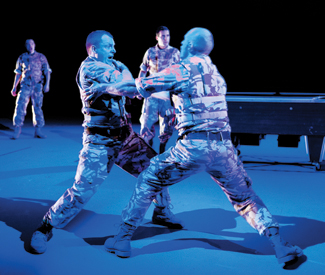
THEATER Audience members entering the drill court of the Mission Armory and climbing the bleachers to their seats do so amid the buzzing drone of Highland music and an eager swarm of searchlights, all of it punctuated by booming pre-show announcements over the PA. When silence falls at last, a solitary man in jeans and leather jacket emerges a bit sheepishly from a doorway at the far end of the stage. Appearing small and inconsequential against the stadium-like surroundings and the preceding pomp and circumstance, he stutters a few opening lines before returning to his element — the local pub in Scotland’s Fife. There he assumes wholly different proportions, as he and his friends relay their own perspectives on the spectacle of war.

In Black Watch, the touring revival of a site-specific 2006 production by the National Theatre of Scotland (currently being presented by American Conservatory Theater), writer Gregory Burke and director John Tiffany set out to present a spectacle grounded in real lives. To that end, they blend fictionalized scenes with the accounts of young Fife veterans who served in Iraq as part of Scotland’s famed 300-year-old Black Watch regiment.

Meanwhile, the show employs a hybrid theatrical form that draws equally on the conventions of the music hall, the docudrama, and physical theater. The stage is a wide and busy corridor running between two tall banks of seats, with scaffolding on either end where actors also play, video monitors flicker, and large video projections are sometimes cast.

This is the production’s fourth international tour, remarkably. But despite its continued popularity abroad, little in it seems especially surprising or penetrating. There’s a lot of brash dialogue (hyper-macho, casually chauvinistic, expletive-laden soldierly banter in slightly toned-down Scottish brogues); some muscular dance routines (with the martial drills the most interesting); a sometimes affecting, sometimes overbearing musical score; and a few flashy staging ideas (including an eerily unexpected entrance in the barroom).

But whether the play is offering gritty realism or stylized interpretation, the message is generally and familiarly on-the-nose: war seems glamorous to the young man back home, and hell to the soldier in the field; soldiers are sold out by politicians; and soldiers don’t fight for their country or some high ideal, but for less abstract ties and especially for their fellow soldiers. The lies, illegality, and massive unpopularity surrounding the Iraq War is also hardly new ground in itself — though one line rings with unintended irony in the Armory setting (where Kink.com has been in residence since 2007) when a Scottish officer (Stephen McCole) jokingly admits the war is being waged for “petrol and porn.”

The narrative toggles between the aforementioned pub — where Cammy (Stuart Martin) and his fellow vets somewhat grudgingly and aggressively divulge their experiences to a timid middle-class Writer (Robert Jack) — and a flashback to the daily drudgery and danger of Iraq in 2004, where the company’s assignment in support of devastating American military assault on Fallujah leads to the death of three Scottish soldiers in a suicide car bombing. There’s also a segue into a somewhat silly if historically relevant recruitment scene at the outset of World War I, which further convolutes a narrative already burdened with details about political machinations at home and distress over “amalgamation” (the British government’s ill-timed decision to dissolve the Black Watch and fold it into a single, cheaper Royal Scottish Regiment).

The play never represents Iraqi lives or perspectives, nor is there more than passing sympathy for them among the characters; this is instead a work focused squarely on the Scottish soldier’s experience and, most significantly, the molding of that experience by a state reliant on a voluntary military. In a world of limited and dispiriting options, the military opportunistically and very successfully offers young men a seeming basis for pride in themselves and in an inflated (or degraded) masculine ideal. Black Watch is itself successful in those rare moments where sentimental spectacle gives way to images that register the profound, uneasy, and complex implications of this fact.

BLACK WATCH

Through June 16

Tue-Sat, 8pm (also Wed and Sat, 2pm); Sun, 2pm, $100

Drill Court, Armory Community Center

333 14th St, SF

www.act-sf.org


Björkphilia

0

MUSIC Can you even recall your first run-in with the mythic, boundary-less creature that is Björk? Perhaps it was bounding through the neon blue forest with tiny crystals underneath her eyes as a giant paper-mache bear chased her through Michel Gondry’s video for “Human Behaviour,” off 1993 solo album Debut. Or maybe it was poised for the tabloids in an elegant swan dress, holding a large egg purse and preening for the worst dressed lists at the ’01 Academy Awards after her devastating performance in Dancer in the Dark (2000). Those long obsessed will likely point to first hearing ’88’s “Birthday” by the Sugarcubes, her early Icelandic act (post teenage punk bands), on international radio.

Whenever — and however — it went down, it left a lasting impression, the stunning shock of that otherworldly voice tends to permeate memories. Solo, Bjork has long coupled that voice with innovation, always grasping at new objects and sounds, or as she described it to me in conversation, she’s “like a kid in a toy shop.”

Her latest triumph was Biophilia, the ’11 album that paired science, nature, iPads, Tesla coils, and tinkling church bells. Since its release, she’s hopped the planet with her sonic education in tow, spreading pixie dust and learning tools at schools and museums along the way. Next up, she’ll play a trio of shows at the Craneway Pavilion in Richmond (Wed/22, Sat/25, and Tue/28). Also during that time, her Biophilia Education Program comes to the Exploratorium, which means interactive workshops exploring connections between music and technology, Wed/22 through Tue/28.

In her unassuming but confident way — with the most endearing accent I’ve ever heard — the avant-pop megastar opened up to the SF Bay Guardian about her song writing process (yes, there’s a new project in the works), early punk career, natural musicology, and how to keep it all DIY:

SF Bay Guardian How did you initially come up with idea to include apps for every song on Biophillia?

Björk It started in 2008. I wanted to use touch screens…though the iPads weren’t out ’till 2010 or something. But I’d been using touch screens on my Volta tour, but more just to perform on stage. When I started doing Biophillia, I was very determined that I wanted to write with [touch screens], not just perform. That’s when I started to map out, to visualize. I had to decide, what did I want to hear on the touch screen when I’m writing this song. That sent me back to my own music education as a child, when I felt the way they explained scales and rhythms and those basic musicology themes, was way too academic. It was like reading a book to learn to dance.

Music is something that doesn’t work that well in the written word, you know? Especially not explaining to kids. So I started making my own map…this is how I would I like to have scales and this is how I would like to have chords and this is how I would like to have arpeggios and this is how I would like to have counterpoint, and so on. This project became naturally educational. I was kind of like, repairing my own education. I was trying to cover what I thought was lacking when I was in music school. In that way, I was able to share it.

We [created] a different program for each song. For example, one song would feature arpeggios, and then I would pick an actual element that would be the simplest way for a kid to understand what an arpeggio is, to visualize it. So we took a pendulum to explain counterpoint, a little bit like how church bells swing back and forth, and that’s like a bass line that swings.

I wrote 10 songs and we did different programs for each song, and it came together using natural elements. For example, one song is called is called “Crystalline” and there are crystals kind of growing as the song changes.

In 2010, when we were programming this and were kind of almost done, the iPad arrived, so we were like, ‘wow!’ It’d be silly just to record these songs and put them on a CD because we’d already written all these programs, we might as well share the programs, and put them with some more poetic, natural things — the moons, the tides, things like this. It was a very gradual thing.

SFBG And now it’s been brought in to educate children at schools throughout Iceland, but also there are related events where you’re touring, as well?

Björk It differs from city to city. So far it’s been in Manchester, Iceland, New York, Buenos Aires, and Paris, and now it’s going to be in California. Some places, like for example, New York Library and the Children’s Museum of Manhattan, took on the curriculum for a few months, and the middle school of Reykjavik, the 10 to 12-year-olds, they have it now in their curriculum for the next three years. It’s looking like it’s going to go to more countries. It sort of keeps growing.

SFBG It seems like you’ve long been ahead of the curve, as far as creating music with new technology, is that something you grew up with as well?

Björk I’m actually really bad with technology. I think that’s why I’m so excited about, for example, the touch screen, because it’s like I waited until technology caught up with me, for it to be simple enough. You have your imagination, and whatever helps you express yourself, I’m all for it, if it’s the violin or piano or singing. Or what has been really helpful for me, since I started doing my own solo albums, the computer has made me a lot more self-sufficient. I guess that comes from being in bands for 10 years, where things are more democratic. It was always drums and bass and keyboards and guitars in every single song [laughs], which is great. But then when I started doing my own album, I was like a kid in a toy shop, I wanted to have every single noise. And this is great, using the computers to do this yourself. It’s quite empowering, especially for a girl. You don’t have to go through this whole hierarchy of whatever, you can just be self-sufficient.

SFBG Some of your early groups were punk bands [Tappi Tíkarrass, and KUKL, which toured with Crass], I was wondering how you discovered punk as a teen, and ended up working with Crass?

Björk I was hanging out with kids that were older than me, like the other guy who used to sing in the Sugarcubes and another guy who was friends with Crass. They played our country, and then we would go and visit them at their farm [Dial House in Essex], and for me what was most important was that one of the bands that was on Crass’ label, a band called Flux of Pink Indians, had a bass player called Derek Birkett and he helped the Sugarcubes release their first album, just from his bedroom. And he’s my manager still today. So I’ve worked with him for like, 30 years now.

It’s pretty much DIY, especially now when the labels are not really functional like they used to be. It’s pretty much just three of us that do most of my stuff.

SFBG Do you have any other long-term goals with Biophillia, or are you working on your next project?

Björk I think I will be doing that on the side, but when it comes to writing my own stuff, I always like the first couple of years to be kind of mysterious. It’s important to play around in the dark, blind-folded, not really knowing what you’re doing. Biophillia was very much like that the first two years, it was very intuitive and impulsive and having no idea what would come out of it. And I’m at that stage with my next album. I really enjoy that. As much as it’s rewarding when [an album] first sees the daylight, I think I even enjoy more the first half of the process, when it’s all still a mystery.

SFBG Were you living in New York during the early playing stage of Biophillia? It seems to have a real connection to natural elements, and science, so I assumed you were in Iceland?

Björk I’ve been living half the year in New York and half in Iceland. I think Biophillia addresses my life in Iceland and the financial crises in a direct way because it’s sort of very DIY. And one of my first dreams was that Biophillia would be a music house and each room would be a song — eventually these rooms became the apps. But it might be that we would be able to go back and make a musical house in Iceland that would serves also as a children’s’ museum and we would use one of the buildings that got kind of half-built in the financial crises and create jobs that way.

But also Biophillia is also about urban areas, because you could stay connected with the moon through your iPad, or to nature and natural structures with your phone.

SFBG My time is almost up but may I ask a few of your favorite things? Like your favorite songs currently, or music that’s helping inspire you creatively now?

Björk At the moment I’ve been listening to the new James Blake album a lot. These things change all the time!

SFBG Favorite mythological story or creature?

Björk I like Icelandic mythology, there’s a lot of amazing tales there.

SFBG And a favorite tour snack?

Björk Um, I like berries.

SFBG Any kind in particular?

Björk Mmmm, no, I like all of them.

BJÖRK

Wed/22, Sat/25, Tue/28, 8:30pm, $75

Craneway Pavilion

1414 Harbour Way, Richmond

www.craneway.com

Let’s dance

1

cheryl@sfbg.com

FILM Noah Baumbach isn’t exactly known for romance and bright-eyed optimism. Co-writing 2009’s Fantastic Mr. Fox with director Wes Anderson is maybe the closest to “whimsy” as he’s ever come; his own features (2010’s Greenberg, 2007’s Margot at the Wedding, 2005’s The Squid and the Whale, 1997’s Mr. Jealousy, and 1995’s Kicking and Screaming) tend to veer into grumpier, more intellectual realms. You might say his films are an acquired taste. Actual declaration overheard at this year’s San Francisco International Film Festival: “Am I going to see Frances Ha? Ugh, no. I can’t stand Noah Baumbach.”

Haters beware. Frances Ha — the black-and-white tale of a New York City hipster (Baumbach’s real-life squeeze, Greta Gerwig) blundering her way into adulthood — is probably the least Baumbach-ian Baumbach movie ever. Owing stylistic debts to both vintage Woody Allen and the French New Wave, Frances Ha relies heavily on Gerwig’s adorable-disaster title character to propel its plot, which is little more than a timeline of Frances’ neverending micro-adventures: pursuing her nascent modern-dance career, bouncing from address to address, taking an impromptu trip to Paris, visiting her parents (portrayed by the Sacramento-raised Gerwig’s real-life parents), “breaking up” with her best friend. It’s charming, poignant, it’s quotable (“Don’t treat me like a three-hour brunch friend!”), and even those who claim to be allergic to Baumbach just might find themselves succumbing to it.

Frances Ha marks the second film to feature a dance subplot for Gerwig, after Whit Stillman’s 2011 Damsels in Distress. (She also appeared in Greenberg but is probably best-known for her mumblecore oeuvre: 2008’s Baghead; 2007’s Hannah Takes the Stairs.)

“I love dancing,” she admitted on a SFIFF-timed visit to San Francisco. “I was never a professional, but I danced a lot growing up and I still go to dance class whenever I can. I don’t think there’s enough dancing in movies.”

Like Frances, she studied modern dance in college. “I did this kind of modern dance called release technique. A big component of it is learning how to fall. It’s connected to bouncing back from the ground, or giving into the ground — letting everything flow. It’s a beautiful way to dance, and the dance company that [Frances] wants to be a part of, that’s the kind of dance that they do,” she said. “I also thought it was this incredible metaphor for life: learning how to fall, because you’re going to. At first, as you’re learning how to do it, you get terribly banged up — and then at some point you just are falling and it’s not hurting you anymore.”

Though much of Frances Ha, which was co-scripted by Baumbach and Gerwig, is about its protagonist’s various relationship struggles, there’s another less-expected theme: class warfare (a mild version of it, anyway). Frances scrambles to pay her $1200 rent — previously, she’s seen paying $950 a month to sleep on a couch — while her housemate, who comes from a wealthy family and spends his days noodling on spec scripts, casually mentions the necessity of hiring a maid service. You know, for, “like, 400 bucks a month.”

“We didn’t set out to make a movie about class, specifically,” Gerwig noted. “But I think typically Americans have a lot of trouble talking about class, or even acknowledging that it exists. It operates on a really subtle level. You get out of college and you suddenly realize that some people are paying off loans, and some people aren’t. It can be hard to talk about. I’m very inspired by Mike Leigh’s movies, where it’s always there in the background. I felt like I wanted to have it in the movie, and Noah felt the same way, too.”

Later that day, Baumbach elaborated on the same thought. “Economics were really going to influence a lot of what Frances does, because the movie was structured by finding a home, lack of a home, constant movement,” he said. “Her economic reality had to be a huge component of her story.”

Frances Ha captures twentysomething ennui with the same honesty Baumbach deployed in Kicking and Screaming, though there are some key differences: the Kicking and Screaming guys were mere months post-graduation, while Frances, who is 27, is more removed from college — whether she wants to admit it or not. “It didn’t feel like the exact same territory, but I was aware that it was kind of addressing some of the stuff that I was addressing back then,” Baumbach said. (Not coincidental, one presumes, is the cameo in Frances Ha by Kicking and Screaming star Josh Hamilton.)   

Though he won’t cop to naming his main character after, um, France, Baumbach does admit that the country’s films (he points specifically to works by Truffaut, Rohmer, and Carax) have had a strong influence on him as a director, and on Frances Ha in particular.

“I think [for these filmmakers], the joy of making the movie is somehow evident in the movie itself,” he said. “Sometimes, that can be annoying! But the rush you get from it, you can just feel, like, the pleasure of movies. With Frances Ha, I wanted to push that, and do things like have her run down the street [while David Bowie’s ‘Modern Love’ plays on the soundtrack]. Just go for it, because the movie really could hold it. I think a lot of [the films that inspired me] have that. And because a lot of the music is borrowed from those movies, it feels even more like a clear connection.”

FRANCES HA opens Fri/24 in Bay Area theaters


MEM.DAY

0

marke@sfbg.com

SUPER EGO What good is freedom if we don’t toss a wig on it?

FAG FRIDAYS

The incredibly fun, superfriendly gay party is back, now monthly at DNA Lounge — bigger diggs, hotter hotness, giant bass, and, best of all, more fags. Also: Prince of NYC house Quentin Harris (my favorite producer of the ’00s) and DJ David Harness to set the spirits of the dancefloor aflame.

Fri/24, 10pm-very late, $10 before midnight. DNA Lounge, 375 11th St., SF. www.dnalounge.com

FREAKY-DEAKY

“Put on the weirdest shit you can find in your costume box. Regardless, come dance your ass off!” says party host Broke-Ass Stuart. Free Ike’s sandwiches and Hey Cookie! cookies, too.

Fri/24, 10pm-2am, $5. Showdown, 10 Sixth St., SF. www.brokeassstuart.com

AZARI & III

Canadian duo Azari & III are acid sex. LA hottie Lee Foss is tech house bliss. Legendary Todd Terry is king of cuts. They will all be there at the Lights Down Low seventh anniversary bash. CAN U PARTY?

Sat/25, 9pm-3am, $22. Mezzanine, 444 Jessie, SF. www.mezzaninesf.com

OSUNLADE

The deep house sage from Greece is doing some serious shit on a spiritual level.

Sat/25, 10pm-4am, $20. Mighty, 119 Utah, SF. www.mighty119.com

DJ DEEP

A super-rare appearance by the revered Paris groovemaster at the untouchable Stompy + Sunset all-day patio party tradition. He’s backed up by Detroit boy wonder Kyle Hall, who’ll take us somewhere real.

Sun/26, 2pm-2am, $10 before 5pm, $20 after. Cafe Cocomo, 650 Indiana, SF. www.pacificsound.net

MAGIC MOUNTAIN HIGH

One of my favorite deep techno DJs, Move D of Germany, has teamed up with Juju and Jordash, wonderfully oddball Israeli improvisational jazz-house duo, to form this live act. I have a feeling with this much smarts in the room, it’s gonna be amazing. With the As You Like It party crew.

Sun/26, 9pm-4am, $15 before 10pm, $20 after. Monarch, 101 Sixth St., SF. www.monarchsf.com

SIXXTEEN

Annual rock ‘n’ roll fantasy-insanity at Cat Club with bad-ass characters in torn fishnets galore: DJs Jenny and Omar, Lady Bear, Jackie Sugarlumps, Princess Pandora, Carnita, Galene Modmoiselle, Creepy B, Union Jackoff, and a motley crew more.

Sun/26,10pm-3am, $10. 1190 Folsom, SF. www.sfcatclub.com

STEFFI

Treats! The fantastic Panorama Bar resident comes at us with the full force of her gorgeous, hypnotically muscular sound at Honey Soundsystem. Then at 2am, Honey moves down the street to Beatbox, driving into dawn with special secret guests for five dollars.

Sun/26, 10pm, $10. Holy Cow, 1535 Folsom, SF. www.honeysoundsystem.com

TWILIGHT CIRCUS DUB SOUND SYSTEM

For 25 years, dub wizard Ryan Moore of the Netherlands (psychedelic heads know him from Legendary Pink Dots) has blown minds with his reverberating soundscapes, pumping up classic ragga sound with sly wit and smokin’ updates. This is top sound, folks. Sun/26, 9pm-2am, $7–$10. Elbo Room, 647 Valencia, SF. www.dubmission.com


Growth potential

8

arts@sfbg.com

DANCE For all of the hype about the communicative power of social media, the energy that flows from one body to another has yet to be beat. Dancers know that. That’s why they keep searching for new ways to make this silent language speak.

The Garage on Folsom is one place where they do it; the studio is run on a first-come, first-served basis with a compulsory performance component, so a lot of what you will see there is unfinished. Yet the other night, two Finnish-born choreographers presented pieces as refined and polished as anything shown in bigger venues.

Another venue that fosters innovation is Yannis Adoniou’s Kunst-Stoff Arts, above a Burger King across from the San Francisco Main Library. It takes a more focused approach by inviting similarly-minded artists (who don’t care about the occasional whiff of fried food making its way upstairs). The recent opening of Kunst-Stoff Arts Fest 2013 showcased three choreographers who pushed the dancing body to the edge of what seems humanly possible.

But first, back to the Garage — where Raisa Punkki’s punkkiCo world premiere, Other Space, took command. Some lengths could be edited to keep the trajectory better on track. Also, the image of a dancer emerging from a kind of subterranean existence in the shape of a raincoat didn’t ring true. But overall, this quartet (for three women and one man) was finely crafted dance making that explored states of being with a rich, multi-faceted vocabulary and formal controls that allowed for flux and even spontaneity.

Other is designed along the concept of making connections that could be in unison pirouettes or jumbled limbs of labyrinthine complexity. Densely layered encounters gave way to stillness or something as simple as a walk or sitting quietly. The spatial thinking pulsated against the stage’s perimeter, enlarged in a couple of places by mirrors. For the most part the dancing was fierce and full out, yet still had room for small gestures: hands that turned into claws, fists that pushed the dancers into relevé and down again. The idea of balance — and lack thereof — lay below much of Other, sharply brought to life by Jennifer Meek, Sarah Keeney, Meegan Hertensteiner, and Derek Harris.

The Bay Area premiere of Alpo Aaltokoski’s 2004 astounding Deep showed a dancer who seemed to exist simultaneously inside and outside his body. Gaunt with a shaven head, he whipped himself into a tornado, engaged in turns that layered his body horizontally, and stretched his frame beyond his height only to squat again and again. Crawling, he looked pre-human; howling, he became Everyman. At one point, he was on all fours and sucked in his spine to turn his shoulder blades into wings. Yet none of these physical feats were self-serving; there were stories aplenty in them. Mila Moilnan’s subsequent video, based on Deep, felt like an afterthought.

First-week performances at the Kunst-Stoff Arts Fest included three works, two of them in progress, and clearly presented as such. What I saw made me want to follow them because both choreographers seemed to think intriguingly about time.

Christina Bonansea’s Floaters #2, set on identical twin dancers Michaela and Liane Burns with excellent live music by Zachary Watkins, started as an installation in the basement. At first resembling statues of saints, the silver-gowned women came to life, slithering and scraping. Upstairs, they ripped into waves of frenzy that threatened to tear them inside out.

For Portraiture, the forbiddingly prodigious Lindsey Renee Derry, as much a gymnast as a dancer, assembled a linear structure from thematically distinct solos that ranged from lyrical to ferocious. In the future, she wants to extend this trajectory by inviting other choreographers, perhaps to evoke something like Andy Goldsworthy’s Wood Line installation in the Presidio.

Adoniou and the gorgeous Constantine Baecher, a former Royal Danish Ballet dancer, paired up for The Excruciating Death of St. Sebastian. One is dark and older, the other blond and tall, so the tracing of their relationship started on a note of difference. Their give and take began intertwined, as if they were asleep, and grew into teasing and tenderness, shot through with exploration and exuberance. Finally, with the help of a cane, the piece moved into darker territory. My tolerance for watching pain — real or pretend, received or given — is just about zero. Still, this was fine work. 

KUNST-STOFF ARTS FEST 2013

Through June 7, most events $10-$15

Kunst-Stoff Arts

One Grove, SF

www.kunst-stoff.org

NATIONAL QUEER ARTS FESTIVAL

May 31-July 3 (various curated events)

Garage

715 Bryant, SF

www.715bryant.org

Visit queerculturalcenter.org/NQAF for NQAF events at different venues.

Urbicide

53

Every point on the map (click here for the detailed, interactive version) is a building where the landlord has used the state’s Ellis Act to evict all the tenants. (The points typically involve multi-unit buildings, so the number of tenants displaced is even worst than it looks). Some tenants have been here for decades, living in rent-controlled apartments, contributing to the community. And when the eviction notice arrives, they have nowhere else to go.

>>TO SEE A PROPERTY-BY-PROPERTY SPREADSHEET TRANSLATING OUR COVER’S EVICTION MAP — THAT INCLUDES LANDLORD NAMES –CLICK HERE

It feels as if all of crazy, radical, artistic, and unconventional San Francisco is under attack, as if a city that once welcomed waves of weirdos and malcontents — who, in turn, gave the city its attractive reputation and flavor — is changing forever. It’s as if there’s no longer any room for the working class — the people who, for example, keep the city’s number one industry (that’s hospitality and tourism, not tech) functioning.

It’s terrifying. Neighborhood after neighborhood is losing affordable rental housing as landlords cash in on soaring prices. And there’s a huge human cost.

In the end, if trends continue, this will soon be a very different city. We all know that change is part of life (and certainly part of hyper-capitalism) but the notion that there’s a value to a city culture that needs low rent housing and cheap commercial space has been all-but abandoned by the administration of Ed Lee, which wants high-paying jobs at all costs.

And it’s hard to imagine how the best of San Francisco — the city whose culture and sense of madness attracted all these creative folks in the first place — will ever survive. Call it Urbicide — because as Rebecca Bowe reports here, it goes way beyond residential evictions.

Fire fight

1

le.chicken.farmer@yahoo.com

IN THE GAME In a pink dress, with a pink hair tie and those little pink sneakers that light up every time you take a step, she dominated the Alameda High School hardwood. I’m going to guess she was three. How else to explain the dogged determination with which, time after time after time, she took aim at the far-away hoop, and with all her cute-little-cutey-pie might heaved the basketball to a point about a foot-and-a-half in front of her feet. Bounce, plop, and roll …

All around her, Alameda police and fire fighters were shooting jumpers, warming up for the second half of their game, entirely unfazed by li’l Pinkie, or any of the other children who had swarmed the court during the halftime raffle — and weren’t in any hurry to give it back to the grownups.

Pinkie took her shots from the top of the key. From the lane. From the foul line. She shot for two, and she shot for three, and though she never really managed to propel the ball more than a couple feet away from her self, she was on fire.

One jumper went about six inches in the air before coming back down and landing on her nose. But not even this could dampen her spirits. With a huge smile, and the forever blinking shoes, she went right back to work.

I want this! Not the child — although I’d take one — but the attitude. Yeah: there’s a thing I can’t possibly do but it sure is fun to try! . . . Maybe I’ll start a novel. Learn a new instrument, or language. Or, for that matter, basketball! A sport which has always eluded me. Because I am small, I have always said. But Pinkie changes everything.

I wonder if she’s had ACL surgery. Probably not. She’s three. But I’ll bet she would . . .

In one week I’ll be 50. My second-half goal is to do like her.

It took more than the ref’s whistle to clear the floor for the second half. Moms and dads had to come scoop up their kids. And I missed them, because the third quarter was sluggish.

Carl Rolleri, police officer, who had hit five of five three-pointers in the first half, came down to Earth and missed a shot. Jill Ottaviano, the game’s only female player, who had scored the first two points for the police, was on the bench. The fire department seemed a little burnt out. I speak from experience: half time will do that to you.

The score, 31-20 after two quarters, was only 37-26 at the end of the third. Not that it mattered who was winning — this was Alameda’s police and fire departments raising money for a whole slew of children’s programs — but the police were winning. Soundly, and from the get-go.

They had a mascot, an adorable pet pig named Charlie in a police hat and a fake mustache, who had been walked out onto the court before tip-off, and spent the rest of the game in a baby stroller, tormented by children.

They had a chant: “Let’s go pigs! Let’s go pigs!” . . .

They had a guy in a wig and one with hearts on his socks, and they had the game’s only woman.

But I was rooting for the fire fighters, because they had a boy cheerleader. And, for my money, that’s even braver than the many awesome picks I saw Ottaviano set against guys twice her weight.

The Alameda High Hornets cheerleaders cheered on the fire department, and the Jets from Encinal High cheered on the police. The Encinal squad had a couple of acrobats who went flipping across the court once or twice during breaks. Which seemed even more impressive later, when I overheard one of them tell the woman sitting next to me, “We have bad stomachaches from the sushi.”

Anyway, the game got interesting again in the fourth quarter. The fire department pulled to within two. (They might have tied it, but I think the scoreboard operator was just confused.)

It was 42-39, police, with two minutes left. What a comeback!

But, like the Celtics facing elimination against the Knicks earlier that Saturday afternoon, the Alameda Fire Department came on strong and came up short: 44-40 was the final.

We went and talked to Charlie the pig a little bit, but it wasn’t a post-game interview per se. Her owner, a friend of a police, was trying to redirect would-be petters away from the poor pig’s face.

“Pet him back here, sweetie,” she said to one of these children, explaining to me that the smell of cotton candy and such all over all the kids’ hands was “starting to confuse him.”

Who I really wanted to talk to was the little girl, Pinkie — but it was way past her bed time.


Just for kicks

0

IN THE GAME It’s not kickball; it’s matball. Which looks a lot like kickball, with one big difference: You can have more than one runner at a time on any given base. You can have up to three, but if a fourth is incoming, someone’s got to go.

You don’t have to stop running, either, when you reach home, in some versions of the game. You can keep going — back to first, and around the bases again. In gym class, this was a way to make kids run laps without quite exactly knowing it.

Here in the adult world it’s just good, clean chaos. Jay Li uses that word a lot — chaos — talking about his co-ed pickup kickball scene.

“That’s the reason we’re playing at Dolores Park,” he said. “You have people, and other variables, that you can’t predict.”

“Like the volleyball net in left field?” I asked.

“That’s one of the variables,” he said.

The volleyball net went up in the fourth inning. Someone came, set it up, and then didn’t play. After grumbling a bit, the matballers turned it into a home run fence. A very shallow one. A “mesh monster” of sorts.

Other variables are self-imposed. There are no force-outs, for example. You have to either hit or touch the runner with the ball, between bases. Or, of course, catch it.

The kicking team supplies its own pitcher. And the kicker gets to choose from a whole menu of balls that lie scattered about the pitcher’s feet. There was a giant one, a tiny one, and a couple of different midrange sizes.

My favorite of Li’s innovations, though, is his loose interpretation of the basepath. Twice during the game runners, thinking they were out, left the field of play . . . only to find they had in fact not been called out; nor were they out for leaving the basepath. And, thanks to Li’s leniency, they had every right in the world to try and get back safely. Neverminding that the base, by that time, was being guarded by a defender with a ball.

Hilarity ensued. In one instance, a couple offensive teammates came charging from the sidelines toward the base, like pulling guards and tackles, to block for the poor, displaced baserunner.

Watching from the hill, with a picnic, I almost choked on my chicken I was laughing so hard.

“That’s the whole idea,” Li said later, when I asked about this particular play. “It hasn’t happened that much, but when it does, I let it happen. It’s entertaining. People get creative.”

Matball is not a low-scoring game. The score was 14-0 before the first out was recorded. It was 15-14 at the end of the first inning — at which point they decided to move the bases back a little.

Li, an energetic, easy-going, backwards-hatted commissioner, moderates the game, photographs the bejesus out of it, and fills in for anyone who has to leave early or turns their ankle. He also buys drinks — alcoholic or not — for the winning team after.

Before Li’s Meetup group, Bay Area Kickball, formed a couple years ago, he played on a team in a league. “I found the game a little too serious. A little too much alcohol,” he said. “It wasn’t that much fun for me.”

Now, once or twice a month, he sets up these more casual (and more sober) coed games through Meetup. If under 25 people show, they play kickball. If more than 25, matball.

The one I saw . . . there was a good mix of men and women, serious athletes and beginners. One with keys jangling from his belt loop, others in cleats. In truth, the athleticism surprised me. I saw one guy run with the ball from centerfield all the way to home plate to bean someone just as they were about to score.

“As long as there are people who can play very well, it kind of keeps the game going, and keeps it interesting,” Li said. “I’m trying to balance all these things.”

He’s doing a good job. Impressively, with all that scoring, and all the chaos, plus the almost-arbitrary divide of serious athletes and just-for-funners, it was, in the end, a one-run game.

The team called Cannibal Sheep won, 36-35. But the losers, the Winners, had the tying run on 2nd base when the final out was recorded.

Oh, and by the way, that “final out” was the fifth, not the third. You get five outs in the ninth inning, so long as both teams agree to it.

Then, before the bar, both teams pile up together for a group photo for the Web page. Which, in this case — as the only member of the press present — I had the honor to snap. Check it out.

http://www.meetup.com/BayAreaKickball


Small Business Awards 2013

0

Welcome to a tradition we hold near and dear at the Guardian — our annual round-up of independent businesses that represent the best of entrepreneurship here in the Bay. From a local sweet shop that’s defied the Nestle odds to become the Bay’s best-loved ice cream treat to the Castro’s best new spot for punting and catching, read on for our favorite small businesses now.


>>WOMEN IN BUSINESS: MOTHERSHIP HACKERMOMS

>>COMMUNITY SERVICE: UNIVERSAL MARTIAL ARTS

>>CULTURE CHAMPION: HI TOPS

>>LEGACY AWARD: LA VICTORIA BAKERY

>>SMALL BUSINESS ADVOCATE: BUSINESS ALLIANCE FOR LOCAL LIVING ECONOMIES

>>EMPLOYEE-FRIENDLY BUSINESS: R & G LOUNGE

>>GOLDEN SURVIVOR: IT’S IT

>>LOCAL MANUFACTURING: BABETTE

>>READER’S CHOICE: SHAMELESS PHOTOGRAPHY