Volume 46 [2011–12]

Occupy is back — with horns and glitter

8

yael@sfbg.com

On Jan. 20, hundreds of activists converged on the Financial District in a day that showed a reinvigorated and energized Occupy movement.

The day of action was deemed “Occupy Wall Street West.” Despite pouring rain, the numbers swelled to 1,200 by early evening.

Critics have said that the Occupy movement is disorganized and lacks a clear message. Some have decried its supposed lack of unity. Others have even declared it dead.

But the broad coalition of community organizations that came together to send a message focused on the abuses of housing rights by corporations and the 1 percent sent a clear message:

The movement is very much alive.


A FULL SCHEDULE

Protesters packed the day with an impressive line-up of marches, pickets, flash mobs, blockades, and everything in between.

The action began at 6:30 a.m., when dozens chained and locked themselves together, blocking every entrance to Wells Fargo’s West Coast headquarters at 420 Montgomery Street. The bank didn’t open for business that morning.

Another group of protesters did the same thing at the Bank of America Building around the corner. A dozen blockaded one of the bank’s entrances from 8:30 a.m. to 6 p.m., preventing its opening. A group organized by Act Now to Stop War and End Racism (ANSWER) closed down the Bank of America branch at Powell and Market for several hours.

The Bank of America branch at Market and Main was also closed when activists turned it into “the Food Bank of America.” Several chained themselves for the door, while others set up a table serving donated food to hundreds of people.

Meanwhile, activists with the SF Housing Rights Coalition and Tenants Union occupied the offices of Fortress Investments, a hedge fund that has overseen the destruction of thousands of rent controlled apartments at Parkmerced. Direct actions also took place at the offices of Bechtel, Goldman Sachs, and Citicorp.

Hundreds picketed the Grand Hyatt at Union Square in solidarity with UNITE HERE Local 2 hotel workers.

A group of about 600 left from Justin Herman Plaza at noon and marched to offices of Fannie Mae, Wells Fargo, and the Immigration and Customs Enforcement Agency (ICE) in a protest meant to draw attention to housing and immigrant-rights issues.

“It’s not just a corporate problem. The government has been complicit in these abuses as well,” said Diana Masaca, one of the protest’s organizers.

More than 100 activists from People Organized to Win Employment Rights (POWER) and the Progressive Workers Alliance “occupied Muni,” riding Muni buses on Market Street with signs and chants demanding free transit for youth in San Francisco.

Another 200 participated in an “Occupy the Courts” action at the Ninth Circuit Court of Appeals, in protest of the Citizens United Supreme Court decision and corporate personhood.


GLITTER AND BRASS

Exhausted, soaked protesters managed to keep a festive spirit throughout the day, with colorful costumes, loud music, and glitter — lots of glitter.

The Horizontal Alliance of Very Organized Queers (HAVOQ) and Pride at Work brought the sparkly stuff, along with streamers and brightly colored umbrellas, to several different actions. Many painted protest slogans onto their umbrellas, proclaiming such sentiments as “I’ll show you trickle down” and “Not gay as in happy, queer as in fuck capitalism.”

According to protester Beja Alisheva, “HAVOQ is about bringing fabulosity to the movement with glitter, queerness, and pride. All day we’ve been showing solidarity between a lot of different types of oppression.”

There was also the Occupy Oakland party bus — a decked-out former AC transit bus — and carnival, a roving party that shut down intersections and bank entrances in its path while providing passengers a temporary respite from rain.

The Brass Liberation Orchestra, a radical marching band that has been energizing Bay Area protests for a decade, showed up in full force with trumpets, drums, trombones, and a weathered sousaphone.

The Interfaith Allies of Occupy also used horns to declare their message. About 30 participated in a mobile service, sounding traditional rams’ horns and declaring the need to “lift up human need and bring down corporate greed.”

Said Rabbi David J. Cooper of Kehela Community Synagogue in Oakland: “Leviticus 19 says, do not stand idly by in the face of your neighbor’s suffering. Well, we’re all neighbors here. Ninety-nine percent of us are suffering in some way, economically or spiritually. And maybe that number is 100 percent.”


FOCUS ON HOUSING

A coalition called Occupy SF Housing called for and organized the day of action, but the messages ranged from environmental to anti-war to immigrant rights.

Many groups did focus in on housing-related issues — and a takeover of a vacant hotel building stressed the urgency and need to house homeless San Francisco residents.

Housing protests included an anti wage-theft occupation led by the Filipino Community Center and the National Alliance for Filipino Concerns at the offices of CitiApartments, an action at the offices of Fortress Investments to demand a halt to predatory equity, and an “Occupy the Auction” demonstration in which protesters with Occupy Bernal stopped the day’s housing auction (at which foreclosed homes are sold) at City Hall.

“A lot of the displacement in this city is happening because of banks and because of things that are out of peoples’ control,” said Amitai Heller, a counselor with the San Francisco Tenants Union. “People will live in a rent controlled apartment for 20 years thinking that they have their retirement planned. A lot of the critiques of the movement are, if you couldn’t afford it you should move. But these people moved here knowing they could afford it because of our rent controls.”


LIBERATE THE COMMONS

Most of the early protests drew a few hundred people. But when the 5 p.m. convergence time rolled around, many people got off work and joined the march. A rally at Justin Herman Plaza brought about 600; by the time the march joined up with others at Bank of America on Montgomery and California, the numbers had doubled.

The evening’s demonstration, deemed “liberate the commons,” was also more radical than other tactics throughout the day; organizers hoped to break into and hold a vacant building, the 600-unit former Cathedral Hill Hotel at 1101 Van Ness.

When protesters arrived at the site, police were waiting for them. Wearing riot gear and reinforced by barricades, the cops successfully blocked the Geary entrance to the former hotel.

The darkness, rain, and uncertainty created a chaotic environment as protesters decided how to proceed. Some attempted to remove barricades; others chanted anti-police slogans.

Soon, cries of “Medic! We need a medic!” pierced the air. A dozen or so protesters had been pepper sprayed.

Police Information Officer Carlos Manfredi later claimed that the pepper spray was in response to “rocks, bottles and bricks” thrown by protesters. He also claimed that one officer was struck in the chest by a brick, and another “may have broken his hand.”

But I witnessed the entire incident, and I can say that no rocks, bottles or bricks were thrown at police.

When protesters opted to march down Van Ness, apparently towards City hall, several broke windows at a Bentley dealership at 999 Van Ness.

The march then turned around and headed back up Franklin, ending at the former hotel’s back entrance. There, it became clear that some protesters had successfully entered the building; they unfurled a banner from the roof reading “liberate the commons.”

Soon, many other protesters streamed into the building. They held it, with no police interference, for several hours.

Around 9:30, police entered the building and arrested three protesters for trespassing. About 15 others remained in the building, but left voluntarily by midnight.

This building has been a target of protest campaigns in San Francisco since it was purchased by California Pacific Medical Center, which closed the hotel in 2009. There are plans underway for a hospital to open at the site in 2015.

The project has been met with opposition from unions such as SEIU United Healthcare Workers West and UNITE HERE Local 2. The California Nurses Association (CNA) has also come out against the hospital proposal. In fact, it was the target of a CNA protest earlier in the day Jan. 20, when protesters created a “human billboard” reading “CPMC for the 1 percent.”

At a Jan.18 press conference, CNA member Pilar Schiavo said that at the former Cathedral Hill Hotel site, “A huge hospital is being planned with is being likened by Sutter to a five-star hotel. At the same time, Sutter is gutting St. Lukes Hospital, which is essential to providing healthcare for residents in the Mission, the Excelsior and Bayview- Hunter’s Point.”

Homes Not Jails, a group that finds housing for the homeless, often without regard to property rights, was crucial to planning the “Liberate the Commons’ protest. The group insists that the 30,000 vacant housing units in San Francisco should be used to shelter the city’s homeless, which they estimate at 10,000.


RAINY REBIRTH

Wet and cold conditions were not what Occupy SF Housing Coalition organizers had in mind they spent weeks planning Occupy Wall Street West, which was billed as the reemergence of the Occupy Movement in San Francisco for 2012.

Yet for many, the day was still a success.

“The rain’s a downer. But I think it speaks to the power of the movement, the fact that all these people are still out getting soaked,” said Heller on Jan. 20.

Perhaps hundreds of “fair-whether activists” did forgo the day’s events to stay out of the cold. If that’s the case, then occupy protesters with big plans for the spring should be pleased.

At this rate, it seems that Occupy will survive the winter- and emerge with renewed energy in 2012.


This article has been to corrected. We originally reported that a demonstration at the offices of Citi Apartments was led by the Chinese Progressive Association (CPA). In fact, it was led by the Filipino Community Center and the National Alliance for Filipino Concerns, and supported by a number of organizations including the Progressive Workers Alliance, of which CPA is a member organization. We regret the error.

Barrel-aged beauties

0

virginia@sfbg.com

APPETITE Here are two new barrel aged beauties worth seeking out, plus more to look forward to in 2012.

1512 SPIRITS BARREL-AGED 100% RYE

I’ve enthused about small production 1512 Spirits (www.1512spirits.com) rye before, crafted by Salvatore “Sal” Cimino with a unique custom still up in Santa Rosa. During the day you’ll find him giving shaves and cutting hair in his classic Nob Hill barbershop, at 1512 Pine Street (www.1512barbershop.com).

His brand new release is a barrel-aged 100 percent rye, just on the market in a very limited release ($59.99 per half-bottle) with the largest allocation available through K&L Wines, www.klwines.com. Ryes are (blessedly) flooding the market these days but only a handful are made from 100 percent rye and even less with the one-man attention that goes into 1512. Sal cautiously guards his process, not allowing anyone else present when distilling.

Whiskey fans may quibble about a $60 half bottle when they can get cheaper ryes (or higher-priced stand-outs like Thomas H. Handy Sazerac Rye, available at Cask, www.caskstore.com). But this rye is the opposite of high production whiskey. One tastes the hands-on care in each sip. Though 100 proof, it is bright, fresh, popping with apple, vanilla, pepper, a gentle rather than bracing spice, and a lingering complexity.

I had the privilege of tasting early batches of Cimino’s future releases, including a 105 proof poitín, or “poteen” in the States, a rare Irish spirit made in this case from potatoes. (The word poteen refers to small pot stills in which the liquor is historically made). Despite the use of potatoes, I would not liken this to potato vodka. Clear, bold and light, it evokes cucumber and summer, with the spirit of an eau de vie and robustness of a white whiskey. There’s nothing in the US quite like it. (Release is set for April.)

Also later in 2012, Cimino is releasing a bracing white wheat whiskey — with more than 70 percent wheat. (I sampled it at 120 proof, but it will be bottled closer to, or below, 100 proof.) For that proof, it’s awfully smooth, evoking surprising flavors from straight-up wheat bread to clean chocolate notes. Another unusual sip, it confirms that this Nob Hill barber is creating some of California’s — and yes, the country’s — more interesting, very small batch, historical spirits. Aged Rye $59.99

BOLS BARREL-AGED GENEVER

The classic Dutch spirit, Bols Genever (www.bolsgenever.nl), has been produced by the Lucas Bols company since 1575. Not many distilleries can boast such a heritage. Master distiller Piet Van Leijenhorst has crafted the spirit for more than 25 years. Genever is often referred to as the original gin that London dry and other gins descended from. It’s worlds apart from what we commonly call gin, more akin to whiskey in boldness but with its own unique, herbaceous profile.

In trying the new Bols Barrel-Aged Genever, which Esquire magazine just named best new liquor of 2011, I notice the complexity rises a few more notches. Made with traditional botanicals (like cloves, anise, hops, ginger, juniper, etc…), the genever is aged 18 months in French Limousin oak. Bottled in a grey, earthenware bottle, it is as striking visually as it is in flavor. It drinks bold with a silky texture — subtly sweet with vanilla honey, cinnamon spice, wood and pepper linger on the finish.

As with a good whiskey, I like to sip Bols Barrel-Aged Genever neat, pre- or post- dinner, but it also gives intriguing dimensions to classic cocktail greats like a Mint Julep or Manhattan (substitute whiskey for genever). Bottles are $49.99.


COCKTAIL INTELLIGENCE: FIFTH FLOOR DELIGHTS

Food and wine are the draws at gorgeous Fifth Floor (www.fifthfloorrestaurant.com), but bartender Brian Means, formerly of Zero Zero, has created singular cocktails worth a stop in the mellow lounge. Perhaps you’ll skip dinner entirely.

The unassuming Mr. Means creates some of the more promising recipes I’ve tasted from an up-and-coming crafter. As I judge multiple cocktail contests, his entries consistently exhibit a surprising level of sophistication, often placing high. He shakes (and stirs) with an unfussy hand, comprehending classic cocktail foundations, but varying off-path enough to keep it interesting.

Here are three of his cocktails I’d recommend, currently on the Fifth Floor menu:

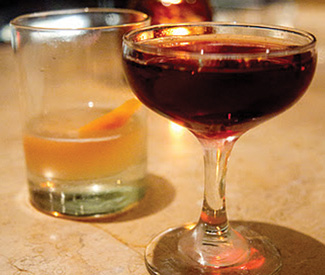
Pink Elephant — Death’s Door (one of my favorite gins), with rosato vermouth, pineapple gomme syrup, orange bitters and smoked absinthe. Means doesn’t let the smoke overpower. Rather, it gives off a faint smoke aroma, hinting at brawn behind a delicate surface. Don’t judge it by its color.

Loretto Wrangler — Named after a key Kentucky bourbon town (home of Maker’s Mark, the Wrangler’s base spirit), Loretto Wrangler includes Cynar (Italian artichoke liqueur), Graham’s Six Grapes port, Dubonnet Rouge, and Bitter Truth chocolate bitters. It may sound like a lot of ingredients, but never fear. Playing like a classic, spirit-driven whiskey cocktail, it unfolds with layers of bitter, sweet, boozy, and — thanks to the choco bitters — meaty, goodness.

Spanish Maiden — El Tesoro blanco tequila and elderflower liqueur with a lemon twist makes for an obviously pleasing aperitif pre-dinner, right? Add in a dash of sherry and this bright refresher takes on depth and dimension, if ever so subtly, while still remaining stimulating and light. *

Subscribe to Virgina’s twice-monthly newsletter, The Perfect Spot, www.theperfectspotsf.com


A real SF tweet

0

le.chicken.farmer@gmail.com

CHEAP EATS I keep buying little plants and killing them. This makes me miss chickens, which are, in my experience, both easier to keep alive and more gratifying to kill. Now that they come from the grocery store, I cook more chickens than ever. Therefore, I would like to have fresh herbs in my kitchen. Therefore, I keep buying these little plants.

And killing them.

Luck would have it, I was in New Orleans when the 49ers beat the Saints. Did you see that? Both Coach and Wayway, with whom I was in constant textual contact that day, described hoots, honks, and general happiness in our neighborhood here. And that was before kick-off! I can imagine what it was like after.

Here there was dead-ass silence for a change. Except me and Hedgehog, who were writhing and screaming on our leather couch in front of our 50-inch flat screen plasmatic TV. Until we both wet our pants and had to jump in our Jacuzzi bathtub.

By our I mean someone else’s.

Except the pants.

Next day on KCBS John Madden called it the best game he ever saw — which is saying something, as he’s seen a lot of games. Me, I am not so prone to hyperbole. Either that or I am journalismically challenged by the old-fashionedest of lag times between my opinion of Things and publication. (Don’t worry; as we speak, Hedgehog is teaching me how to twit.)

Well, whatever happens(ed) with the rest of this football season, I want you to know where I’ll be watching the games next season, since in real life I don’t even own a TV, let alone a big flat plasmatic one .. .

At my new favorite restaurant: The Old Clam House!

Twenty-two years I’ve been living in and around this city, and for exactly that long have I been meaning to eat at The Old Clam House. It’s the oldest restaurant in San Francisco! In the same location! Since 1861!

To give you some idea of how long ago that is, think of it like this: 151 years.

Considering what all has gone down since then — the big earthquake, the other one, and Donte Whitner’s hit on Pierre Thomas — it’s amazing that even some of the Clam House is still standing. But the bar area is original, according to them. And from the photos you can tell that it is.

So that was where we sat. Checkerboard floor, wood trim, old-fangled ceiling tiles, and the Niners game on TV. Mind you, I had just played football, over at Crocker Amazon, so I probably didn’t smell very pretty. Or look nice.

In fact I was starving, cold, and frazzled. And my hamstring was gone, so I had to sit on ice. We ordered clams paella acini and Swiss chard with onions and bacon, and Hedgehog ordered something stiff to drink, because as hard as it is to play on my football team, I think it’s even harder to watch.

The paella was delicious, and in an unusual way: cioppino sauce, sausage, olives, cheddar cheese. And acini are little tiny pastas, between couscous and orzo. We’d have preferred rice, but it was good this way too. The clams were good, and plentiful, the sausage so-so, and the Swiss chard of course was great. (Bacon.)

As for the bread and butter, besides being pretty good breads and butters, I like it that they tell you on the menu not only where the bread comes from, but where the butter comes from: Acme and Strauss, respectively.

Butter does matter.

My favorite touch, however, was the little glass of warm clam broth with onions that they brought to our table first. That was a yummy, warming treat, and a very nice touch.

Plus I ordered a Coke and it came in a carafe.

But listen up, Mr. Madden: I totally agree. And for more up-to-date (and shorter) musings on sports, food, and Things, you can henceforth tweeter me at @lechickenfarmer. *

THE OLD CLAM HOUSE

Daily: 11 a.m.-10 p.m.

299 Bayshore Blvd., SF.

(415) 826-4880

AE/D/MC/V

Full bar

The best medicine

0

<P>arts@sfbg.com
<P>
<P><B>FILM</B> French actor Val&eacute;rie Donzelli made her first feature as writer-director with 2009’s <I>The Queen of Apples</I>, which trawled the film festival circuit for a couple of years &#151; eventually getting its title tweaked to <I>The Queen of Hearts</I> &#151; before making its unheralded U.S. debut at the 2010 Mill Valley Film Festival. It got a minor theatrical release in France and none at all here.
<P>All this goes to show that, contrary to all optimistic wisdom, not every film will find its audience. Not even when it is, in fact, the kind of movie that tends to win audience awards. <I>Queen</I> was endlessly energetic, quirky, and endearing, in the manner of 1960s independent films whose youthful makers needed to prove they could do every trick and break every rule in the book. It was charming despite being almost too cute for words, and a mite too pleased with itself. The slender story aimed for little more than charm: Donzelli played a hapless young Parisian flinging herself from one comically doomed love to another before winding up with Mr. Right, played (as were all the Mr. Wrongs) by J&eacute;r&eacute;mie Elka&iuml;m, who in 2000 was the unstable gay teen in S&eacute;bastien Lifshitz’s memorable <I>Come Undone</I>. <I>Queen</I> may have been uneven, but it was frequently so funny that hardly mattered.
<P>Obviously somebody noticed, however, since Donzelli is now back with a second feature she co-stars in, and co-wrote with, Elka&iuml;m. (Evidently other people like this team as well &#151; in the interim they got cast opposite one another in &Eacute;lise Gerard’s 2010 <I>Belleville-Tokyo</I>.) It’s even playing at a theater near you, at least for the next five minutes.
<P>Though more ambitious as (largely) a serious drama, <I>Declaration of War</I> reprises the same flaws as its predecessor, being over-stuffed with stylistic digressions, a little too eager to please at times. But once again it’s a very likable piece of work that largely works on its own terms.
<P>While <I>Queen </I>was primarily content to poke fun at the great French tradition of slender twentysomethings moping lovesick about Paris, <I>War </I>declares itself on something inherently humorless: a child’s grave illness. Juliette (Donzelli) meets Romeo (Elka&iuml;m) &#151; yep, that’s a bit much &#151; at a punk club, where his pogoing catches her eye. After a very 1960s montage of love al fresco (although they do not run through any flower fields), out pops the no less auspiciously named Adam, and all is well apart from some higher-than normal new-parent exhaustion issues related to the baby crying just about every waking moment.
<P>Eventually, however, Adam’s tendency to barf, cough, and tilt his head leftward while showing no interest in learning to walk raises suspicions confirmed by Dr. Prat (B&eacute;atrice De Sta&euml;l, who was also a standout as the heroine’s neurotic flatmate in <I>Queen</I>): little Adam has a brain tumor, and there’s a long uncertain road ahead that puts infinite strain on the young couple’s individual emotions, collective resources and future together.
<P>Even in this much more sober story context, Donzetti can’t resist cramming in every stylistic whim that comes to mind, from superimpositions to interior voices and multiple anonymous narrators, not excluding a bursting into song. The cost of her chasing after such spontaneity is that sometimes a gamble falls flat, calling attention to itself without adding anything, like the soundtrack choice of some overly gimmicky electronica when Juliette freaks out during her child’s CAT Scan. Eclecticism isn’t always an ideal tactic, especially when a subject like this one demands a certain groundedness.
<P>But many of her tactics work, finding humor in surprising places and refreshing some familiar devices of domestic tragedy. Donzetti has a very sure touch with actors; she and the ingratiating Elka&iuml;m work so well together that we don’t mind their characters remain in some ways underdeveloped. (In fact this seems somewhat intentional &#151; Juliette and Romeo plunge into serious commitment before they’re fully formed adults, and the script doesn’t spare them the odd outburst that’s childishly unflattering.) Much less melodramatic than its title would suggest, <I>Declaration of War </I>is uneven but full of life and ideas &#151; there’s room for Donzetti to refine her directorial instincts, but one hopes they stay a little messy. 
<B>DECLARATION OF WAR </B>opens Fri/27 in Bay Area theaters.

Whatever happened to Baby Jaymes?

1

arts@sfbg.com

MUSIC One day in November 2004, my then-girlfriend returned to our Oakland apartment all excited. “I just heard this on KMEL,” she said. She handed me a CD, Baby Jaymes, Ghetto Retro (Underground Soul), while she unwrapped the included Ghetto Retro EP and cued up “Nice Girl.” “He sounds like Prince,” she enthused—we were Prince geeks—”but he’s from East Oakland!”

Something in the way the vocals were layered, the tasty guitar and bass details under aloof keyboards, and the idiosyncratic, non-pimp, non-player personality that disclosed itself seemed to justify the comparison, particularly as we moved on to the LP. The hidden track “Ev’ry Nuance,” for example, could be a Lovesexy outtake, even as its more lo-fi aesthetic seemed to allude knowingly to 1999-era bootlegs.

http://www.youtube.com/watch?v=YJrO8GoozIE

Comparisons to Prince would be made in nearly every review of Ghetto Retro, though the insistence was a little misleading. While Prince is definitely an influence, BJ — as he’s known — isn’t especially well-versed in the Purple One’s catalog. Some of the resemblance stems from the common influence of 1960s and ’70s soul; Motown, particularly Smokey Robinson, and Stax loom much larger for Baby Jaymes, and in many ways, the similarly pint-sized singer is the anti-Prince, possessing no conventional technical musical ability, depending on collaborators to translate the melodies and arrangements he hears in his head.

In 2007, I had the experience of watching him cajole a string trio from blank incomprehension into a soaring, unscripted overdub reminiscent of a Paul Riser classic. Yet I’ve also seen the comparatively simple matter of a guitar overdub founder for want of a common vocabulary.

“It’s all about energy to me,” BJ says, “but I can’t always articulate it in a way that musicians understand. But if I articulate it emotionally they might be like, yes! and we’re there. I used to knock myself out because I can’t play, but that’s part of my gift. I’ve gotten to the place where I’m ok with that.”

The other major difference is the difference between Minneapolis and East Oakland, for while Prince has profoundly influenced hip-hop, he’s never known what to do with it, whereas it’s second nature to BJ, hailing from the notorious Rollin’ 100s (99th and MacArthur, to be exact).

Much of Ghetto Retro is built on heavily manipulated samples, augmented with instruments, and though he’s the furthest thing from a thug — I’ve never heard him cuss, though I have heard him say “my goodness” and even “golly”—Baby Jaymes sounds entirely natural with Turf Talk on his 2008 single “The Bizness” or The Jacka on his new EP, Whatever Happened to Baby Jaymes?, released late last year on Hiero-imprint Clear Label Records.

THE SHIFT

The EP’s title, BJ admits, was the brainchild of Souls of Mischief and Hieroglyphics member and Clear Label head Tajai Massey, both punning off the Bette Davis film and nodding to the seven-year wait since Ghetto Retro. BJ initially resisted.

“I disappeared,” he admits. “But I don’t want people to think I wasn’t doing anything.”

“I was bummed out with the artist thing,” he continues. “People remember me — which is a good thing. But I couldn’t imagine life not having anonymity. To this day I can’t go anywhere in the Town without seeing at least one person that knows me. It can be overwhelming.”

BJ’s local profile, elevated by airplay on KMEL, national press from Fader and XLR8R, and even a 2005 GOLDIE, was complicated by the chronic difficulty of making money as a Bay Area urban artist. In the mid-’00s, besides longstanding major label distinterest, Bay Area independent artists suddenly saw their financial foundations crumble with the decline of CD sales.

“You have to preserve your mystique,” he says, “but you don’t have money to be that guy all the time. I might really be on the bus and you see me on the bus and it just kills my whole thing for you. So I decided I just wanted to make music, not make music to be famous.”

Instead BJ moved to L.A. to pursue licensing deals in movies and TV. Even before Ghetto Retro, he’d already tapped into Hollywood money, writing a song (“Without a Daddy” by Touché) that appears in Oliver Stone’s Any Given Sunday (1999). (His own version appears on Ghetto Retro as “Black Girl/White Girl.”) Since relocating, he’s racked up an oddball assortment of screen credits, from a few seconds of music in a Nicole Kidman vehicle (2007’s The Invasion) to production work on Fox’s intro to the 2008-09 NFC Championship broadcast (apparently Cleatus the Robot’s first foray into hip-hop).

More recently NCIS used a snippet “so small and incidental, you can barely hear it,” but this brings in incomparably more money than dropping a Bay Area hip-hop soul classic. Essentially BJ makes the bulk of his modest income off five song placements and would like to bring that number up to around 40 reliable ones, which he estimates would bring in a comfortable enough existence to fulfill his artistic ambitions.


THE PROVERBIAL RETURN

For, despite his earlier discomfort, Baby Jaymes’s artistic ambitions remain, and Tajai was able to induce him to sign to Clear Label to record a new album, for which the seven-song Whatever Happened is simply a calling card. Still, after so long a hiatus, the EP is a joy to hear. I’d wondered if BJ and long-time collaborator, producer Marc Garvey, would shy away from the sound they’d crafted in favor of something more obviously commercial, but instead they’ve dug deeper, returning to the samples-plus-hip-hop-drums core that makes Ghetto Retro feel so warm and timeless.

The single, “Heart & Soul,” captures the throbbing drama of a kind of vintage R&B that concerns matters of deeper import than Bentleys and Belvedere, serving by turns as a declaration of love and an artistic manifesto. Yet BJ also shows off a new swag with an inventive reimagining of 50 Cent’s “21 Questions” over a live band, co-produced by Ledisi mastermind Sundra Manning.

This more than anything else gives a foretaste of the album to come, judging from the unreleased tracks he played me, all of which featured live instrumentation. This is a far more expensive way to make a record, but he hopes to have complete and release it sometime in 2012.

“Honestly, if Tajai hadn’t said, ‘We should do a record, I’ll help you pay for it,’ I probably wouldn’t have been able to do it,” he says, clearly relishing the new material. “I do it for the love of music, nothing else.” *


Sorrow, tears, blood — and dance

0

arts@sfbg.com

MUSIC Musical genius, human rights activist, cultural legend, African icon — late Nigerian Afrobeat pioneer Fela Kuti encompassed multitudes, but to his 1980s-era guitarist Soji Odukogbe, he provided not only inspiration but a way into his music.

“The music was written by Fela, so if you were good enough, you could add to it, and he wouldn’t say anything. But if you were not good enough, he’d say, ‘This is the line,'” explains Odukogbe, 49, by phone from Berkeley where he now lives. “Afrobeat is a written music — you can’t add to it. You can add if you know your instrument, and it’s sweet enough, then you can go there.”

Fortunately the Lagos, Nigeria, native — who as a child was inspired enough by Fela’s hits to take a wood plank, hammer a nail into it, and pretend it was a guitar — was good enough to take his liberties on guitar on legendary Fela albums like Teacher Don’t Teach Me Nonsense, Beasts of No Nation, and Underground System (all Barclay; 1986, 1989, and 1992). “[Fela] was anxious to meet me [after he got out of prison], and when he saw me, he was so happy — he said, ‘I have a guitar player that’s really good!,'” recalls Odukogbe, who joined Fela’s band in ’85. “One day I said, ‘Fela, I want to take a guitar solo. He only allowed horn and keyboard solos, and he said, ‘Yeah, go ahead,’ and I blew his mind. He was so proud of me.” Odukogbe appears with kindred Fela player Baba Ken Okulolo at a “Fela Kuti Extravaganza” dance party at Cafe Du Nord Jan. 28.

The guitarist played with Fela for five years before deciding to take his chances in the U.S. where a so-called world music movement was catching fire with the success of Nigerian juju master King Sunny Adé, Le Mystere des Voix Bulgares (Nonesuch, 1987), and Brazil Classics 1: Beleza Tropical (Luaka Bop, 1990). Now, with publications such as The New York Times trumpeting an “African invasion” in indie rock and a fascination with African music takes hold once more — morphed and bent to new ends by performers ranging from Vampire Weekend to Dirty Projectors to this year’s Pazz and Jop poll-topping tUnE-yArDs — the time seems right to revisit Fela’s legacy.

Long before African outfits like Tinariwen and Blk Jks threaded rock ‘n’ roll guitar into indigenous rhythms, and hipster-cred comps such as the Ethiopiques and Congotronics series touched down stateside, Fela was hybridizing jazz and highlife with a potent dose of James Brown-style funk, a black power sensibility (not for nothing did he dub himself the Black President), and a driving thirst for justice, even after being jailed some 200 times, suffering at the hands of soldiers (the wounds Fela revealed when he dropped his trousers in the 1982 documentary Music Is the Weapon are heartbreaking), and undergoing a level of government harassment and abuse that would break most mortals. It all appeared to climax in 1977 after the release of his military-mocking 1977 LP Zombie (Barclay) and the subsequent invasion of his Kalakuta Republic commune by soldiers, which led to the death of his mother and the beating and brutalization of the performer, his family, wives, and friends.

Though mainstream superstars Will Smith and Jay-Z threw their producing weight behind the recent Tony Award-winning musical production of Fela!, it’s tough to imagine an artist quite like Fela in today’s music scene, fighting back from the top of the pop charts, occupying the public imagination with his radical politics and spiritual beliefs, and speaking his mind, loudly and outrageously. Still, Fela’s story and music speak louder than ever, especially in the context of indie’s less-than-political appropriation of African sounds, the recent SF run of Fela!, the 2011 rerelease of Fela’s Universal-controlled albums in North America by Knitting Factory Records, the upcoming film directed by artist-filmmaker Steve McQueen, and continuing tide of injustice in Nigeria, where weeks of protests continue over fuel prices and the country has undergone its worst oil spill in a decade.

“The thing that’s most interesting about Fela’s music is how traveling and seeing other cultures, going to the United States, and getting familiar with American music and James Brown and American politics inspired him to fulfill his own roots and look back on himself and to really see these international forces as part of his background and his own culture,” observes Will Magid, 26, who organized the Fela dance party and has played with Odukogbe and Okulolo. Magid’s own forthcoming debut album promises to mix Kuti’s influence with Balkan, pop, and funk sounds. “We need more people who are like that and who are speaking up.”

El Cerrito-by-way-of-Nigeria bassist Okulolo played with Fela as well as King Sunny Ade and has performed with Odukogbe in the Kotoja, the Western African Highlife Band, and the Nigerian Brothers. Magid’s friend and mentor since the two met through Okulolo’s son at UCLA, the musician sees “Fela Kuti Extravaganza” as a teaching opportunity.

“Fela was a great musician, and his music will never die,” says Okulolo. “I think it would be a good idea to continue educating people about his music and how beautiful it is. I worked with [Fela] briefly, and I know the man well, and so many bands are playing Afrobeat now — generally the music needs to be out there.”

“It has funk; it has jazz; it has an African beat; it has everything,” he continues. “It’s our opportunity to showcase it to as many people as we can and make it valuable, to put it in a category that someday will be what reggae is today.”

And during hard times, we can all learn something from Fela, his still-vibrant music, and his way of moving, fluidly and artfully, through oppression, through pain. “There’s this element of social consciousness, of people dancing and then hearing about these oil spills,” muses Magid of the upcoming dance party. “It’s a different kind of dancing when you’re dancing through suffering.” *


WILL MAGID’S WORLD WIDE DANCE PARTY: FELA EXTRAVAGANZA

With Baba Ken Okulolo and Soji Odukogbe, Will Magid Trio with Fely Tchaco, MSK.FM, and izzy*wise

Sat/28, 9:30 p.m., $15

Cafe Du Nord

2170 Market, SF

www.cafedunord.com

Too much in the son

1

arts@sfbg.com

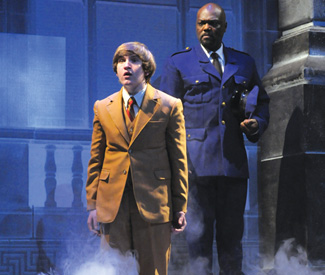
THEATER The Berkeley Rep’s thrust stage sinks to floor-level down front where a simply furnished living room freely communicates with the audience seated nearby, while to the back rises the imposing façade of San Francisco City Hall. The impressive jumble of a set (by Todd Rosenthal) ensures the jarring conflation of private and public life strikes us palpably before a single line is uttered in Ghost Light. As it happens, the first words are those famous ones spoken by Dianne Feinstein from City Hall on November 27, 1978, announcing the assassination of Mayor George Moscone and Supervisor Harvey Milk by former supervisor Dan White. They come over the television to a 14-year-old boy (Tyler James Myers) home sick from school the day his father died.

The dream play that follows is not realistic, but it is also more than fiction. A unique collaboration between Bay Area–based director and California Shakespeare Theater artistic director Jon Moscone (real-life youngest son of the slain mayor) and Berkeley Rep’s Tony Taccone, Ghost Light is an at times promising but otherwise laden attempt to explore the stifled grief of a man haunted by the death of a murdered father — a father who was also a public figure, a political leader whose legacy is in some sense embattled (or at least seriously overshadowed by the subsequent apotheosis of Harvey Milk).

The complex feelings this entails for the son of such a man — whose career in the state senate and as mayor was arguably more important than Milk’s to the legal and social battle for gay rights — are only heightened by the fact that the son is also gay, with a public profile of his own and the mixed blessing of a prominent family name.

If the son in this situation-turned-scenario sounds a little like Hamlet, the comparison was not lost on Taccone either, who penned the script while drawing on hours of freewheeling conversations with Jon Moscone, initiator of the project and the play’s director. (Ghost Light had its world premiere last year in Ashland at the Oregon Shakespeare Festival, where it was commissioned as part of its “American Revolutions: The United States History Cycle.”) Director-turned-playwright Taccone has the character “Jon” (played with manic energy and sudden introspection by a sympathetic Christopher Liam Moore) stuck midway through the preparations for a production of Hamlet, unable to decide what to do with the Ghost — indeed, haunted by the whole idea. This unusual block has his best friend and collaborator Louise (a lively if slightly affected Robynn Rodriguez) frustrated and worried.

Jon’s block also feeds a dream life populated by several characters — a Loverboy (Danforth Comins) spun from an online flirtation; his perennially 14-year-old self (Myers) locked in a battle of wills with some cosmic undertaker cum grief councilor named Mister (a sure, larger-than-life Peter Macon); the silent image of his black-veiled widow mother (Sarita Ocón); and a menacing prison guard in a soiled shirt (a sharp Bill Geisslinger), who turns out to be the grandfather he never knew.

It’s suggested more than once in the dialogue that all of these characters stalking his sleep (and often arriving onstage through the portal of Jon’s bed, pitch atop the shiny black granite steps of City Hall) are merely the dreamer himself in various disguises and aspects. This much, of course, we are already primed to assume. In fact, the fundamental problem facing the main character — namely, his inability to properly let go of his own grief and suffering around the death of his father, which appears here as an inability to let his own father’s “perturbed spirit” rest at last — is equally a condition readily recognizable to a modern audience in a therapeutic age. It may be grounds to build on in terms of character development, but the lack of mystery here also undercuts any suspense in the plot, as the increasingly blurred line between Jon’s dreaming and waking lives points toward nervous collapse and the threat of some self-inflicted disaster (personified by the foul-mouthed, homophobic, and gun-toting prison guard stalking his unconscious).

Taccone makes a valiant attempt to draw together a complicated and wrenchingly personal yet all-too-public story with a set of interrelated subplots and quick-moving dialogue (filled with as much quippy humor and menace as pathos). But the results are uneven. Although Geisslinger makes a serviceable villain, the danger he represents never feels palpable. Likewise, the underworld subplot involving boyhood Jon (played a little too typically “boyishly” by Myers to be readily believed) comes across as vague and treacly.

Perhaps unsurprisingly, it is the more realistic, down-to-earth scenes that play best and are most evocative. The intricacy of a life divided painfully between public and private personas, public and private pain and loyalties too, comes across best when the character of Jon is operating in the “real” world. To this end, Moscone the director shrewdly brings the audience in at key points as well, raising the houselights for an acting master class led by his onstage character. Meta-theater, town hall meeting, group therapy — the lines begin to blur here in a lively, resonant discussion of “acting” as social action.

Another interesting scene takes place in a bar, where Jon finally meets Basil (Ted Deasy), the man with whom he’s been having an online fling for weeks (and the inspiration for the Loverboy of his increasingly intrusive dream world). The awkwardness, defensiveness, and barely contained rage revealed here — as Jon discovers that Basil’s own fantasy projection incorporates his public familial tragedy — speak more eloquently to the messy particulars of the main character’s dilemma then perhaps any other scene in the play.

In the end, the thematic aptness of the mise-en-scène — which forces Jon, for instance, to open the front doors of City Hall just to retrieve a beer from the fridge — speaks also to the monumental task this play has set itself. If the results prove very mixed, they are all the more discomfiting because the root story is so fascinating, the dramatic project itself audacious and strange, and the insight to be potentially gleaned so tantalizing — speaking to our collective intersections with history in the deepest recesses of the psyche.


GHOST LIGHT

Through Feb. 19

Tues., Thurs.-Sat., 8 p.m. (also Sat. and Feb. 16, 2 p.m.); Wed. and Sun., 7 p.m. (also Sun., 2 p.m.), $14.50-$73

Berkeley Repertory Theatre, Thrust Stage, 2025 Addison, Berk.

(510) 647-2949

www.berkeleyrep.org

Public TV, for sale

2

OPINION The San Mateo Community College District Board of Trustees has announced the upcoming sale of its independent public television station, KCSM-TV. Some potential new owners are cause for alarm.

A January 10th walk-though for potential bidders was attended by the Christian broadcasting giant Daystar Television. The fastest-growing faith-based network in the country, Daystar’s mission is to reach souls with the good news of Jesus Christ as one of a “new breed of televangelists.”

While the prospect of San Mateo Community College bringing Daystar to the Peninsula is the most dramatic possible outcome of the district’s decision to sell, some of the other bidders present challenges as well.

Public Media Company, controlled by radio brokers Public Radio Capital and much in the news for its role in the still-contested sale of KUSF’s radio license to the formerly commercial station KDFC, also toured the station on Jan. 10.

Public Media Company/Public Radio Capital is based in Boulder, Colorado. The intertwined family of limited liability companies has been buying up college radio stations at fire-sale prices all over the country and folding them into tight National Public Radio classical or jazz-only formats. Independent musicians have expressed alarm at the loss of accessible college radio outlets, and the San Francisco Board of Supervisors denounced the loss of KUSF to San Francisco’s cultural fabric in a 2011 resolution.

Other possible bidders included the mysterious Locust Point Networks, a website without a definition beyond “an early stage telecommunications company,” and Cheifet Productions, which produced programming on Silicon Valley for the PBS Nightly Business Report. Also in the potential market are Independent Public Media, a satellite TV service created by one of the founders of Free Speech TV, and KAXT, a South-Bay based family of foreign-language stations founded by a former KGO reporter.

In the Bay Area, public broadcasting is dominated by the vast KQED, which owns television and radio stations from Sacramento to Salinas to San Jose. KQED has long been criticized for a paucity of local programming and news, and a fondness for cooking shows.

The absorption of independent outlets into the KQED structure promises more standardization and less variety for peninsula residents.

The district claims the sale of the educational, noncommercial TV license is a necessity because operating an independent public television station is not compatible with the core mission of educating students. But the district will continue to operate the radio station Jazz 91 radio station.

District officials also said that the TV station was losing money. But a financial statement posted with bid materials seemed to include many shared radio/TV expenses.

The district trustees meet Jan. 25 at 6:00 p.m. at the College of San Mateo, 3401 College of San Mateo Drive. They should be told in no uncertain terms that a sale to a Christian broadcaster is unacceptable — and that that any sale must protect the public interest in localism, independence, and a diversity of points of view. 

Tracy Rosenberg is the executive director of Media Alliance, a Bay Area nonprofit that advocates for democratic communications. www.media-alliance.org


Ding dong, you’re dead

0

TRASH It takes a certain kind of sicko to fall in love with Italian horror, what with all the oozing maggots, spurting jugulars, WTF plot twists, weird zooms, jarring musical cues, and supporting characters who do completely bizarre things that are never explained.

Sickos take note: Yerba Buena Center for the Arts is screening an uncut 35mm print of Lucio Fulci’s 1981 The House By the Cemetery. HUGE. Within the gore-splattered Fulci canon, House is maybe not as well-known as 1981’s The Beyond, 1980’s City of the Living Dead, or 1979’s Zombie (which made a recent local appearance thanks to Blue Underground, the cult champions also responsible for this showing of House). But it’s no less essential or enjoyable than the others, despite suffering from one nearly insurmountable flaw. (More on that that in a minute.)

House‘s story is actually pretty straightforward, as Fulci flicks go. After a mysterious murder-suicide claims his colleague, professor Norman Boyle (Paolo Malco) uproots his family, including wife Lucy (Fulci scream queen Catriona MacColl) and young son Bob (Giovanni Frezza), from New York City to small-town Massachusetts, where he plans to finish the dead man’s research. Fate or something worse means the Boyles will be bunking in “the Freudstein place,” a notorious mansion once occupied by “a certain Dr. Freudstein — a turn-of-the-century surgeon with a penchant for illegal experiments.” Uh-oh. That the family is merely renting this sinister abode is ignored by the film’s ad campaign: “Read the fine print. You just may have mortgaged your life!”

That may be so, but the truth is Bob’s dubbed-over voice is the scariest thing in this movie. Among the House DVD extras is an interview with a grown-up Frezza; the first thing out of his mouth is an apology. (His later filmography includes Lamberto Bava’s ludicriously amazing 1985 Demons, so he’s off the hook as far as I’m concerned.) It’s a distraction that elevates Bob from a mere rip-off of the kid in 1980’s The Shining, an obvious House influence, to eardrum-torturing moppet from hell.

http://www.youtube.com/watch?v=zbIiJeCpCgY

Fortunately, the rest of House is weird enough to cushion this sonic godawfulness, or at least blunt it a bit; it helps that the other kid in the movie — Silvia Collatina as Mae, the Scatman Crothers to Bob’s Danny Torrance — sounds perfectly normal. There are plenty of juicy bits for Italian horror geeks, including Ania Pieroni as a creepy, glaring babysitter (doing a slight variation on her creepy, glaring Mother of Tears in Dario Argento’s 1980 Inferno) and Carlo De Mejo (star of City of the Living Dead) as a helpful librarian. The traditional Fulci cameo casts the director as Dr. Boyle’s bow tie-wearing academic peer, uttering the immortal line “I adore New England!”

Speaking of, the titular house actually exists, though it’s not actually located by a cemetery as advertised. Also the setting for Umberto Lenzi’s 1988 Ghosthouse (sickos know Lenzi’s name well, thanks to grindhouse nuggets like 1981’s Cannibal Ferox and 1980’s Nightmare City), it’s the historically significant Ellis House in Scituate, Mass. No word, however, if the arts association that now maintains the property accommodates curious horror fans — or if the basement décor is still keepin’ it funky. 


THE HOUSE BY THE CEMETERY

Fri/27-Sat/28, 10 p.m., $8

Yerba Buena Center for the Arts

701 Mission, SF

www.ybca.org

Plazas are public spaces

3

EDITORIAL The attack on public space has been underway for years now in San Francisco. Parks and recreation centers have been turned into pay-to-enter facilities rented out to private organizations. The sit-lie law restricts the use of public sidewalks. Occupy protesters have been evicted from a public plaza. And now, Supervisor Scott Wiener wants to put new restrictions on the mini-parks and plazas that have been a rare bright spot in the battle to reclaim the streets.

Wiener has introduced legislation that would ban camping, cooking, four-wheeled shopping carts, and the sale of merchandise in Harvey Milk Plaza and Jane Warner Plaza, near Market and Castro. He argues that the two parklets — one reclaimed from what had been roadway — are in legal limbo: They aren’t parks, so the city’s park codes don’t apply, and they aren’t sidewalks, so rules like the sit-lie law don’t apply, either.

But there are serious problems with the Wiener legislation. For one thing, it’s clearly directed at homeless people — the ban on shopping carts makes no sense at all except for the fact that a lot of homeless people carry their possessions in those carts. And the ban on camping (which isn’t a problem right now in the two plazas) could be used to prevent an Occupy-style action in the Castro.

The ACLU says there are serious constitutional issues with the bill. In a Jan. 21 letter, ACLU staff attorney Linda Lye notes that the ban on the sale of merchandise without a permit could “burden expressive activity.” And she explains that the shopping cart rules have exceptions for bicycles, strollers, and two-wheeled carts, but “it is wholly unclear why some but not other wheeled conveyances are singled out for prohibition, other than to restrict the activities of an unpopular group.”

A letter signed by 21 members of the Harvey Milk Club, including co-founders Harry Britt and Cleve Jones, Assemblymember Tom Ammiano, and eight past club presidents, points out that “the interests of the LGBT community have always been united with the interests of public space. As a community that is forced—far too often and for far too long—to spend much of our collective lives ‘in the closet,’ the ability to be free in public spaces has been tremendously liberating. Harvey Milk knew that liberation was only possible if we escaped the shadows of anonymity and invisibility. When we restrict these spaces—even when those restrictions are meant, initially, to be applied to another group of people—we damage ourselves.”

The issue goes far beyond the Castro. There are a growing number of small plazas in the city, part of the popular and successful Pavement to Parks Program — and the last thing the city should be doing is putting undue restrictions on their use.

Wiener, to his credit, has been in touch with the ACLU, and amended his original proposal to exempt the sale of newspapers and other printed material. But that doesn’t solve the First Amendment issues — for example, would the sale of t-shirts with political slogans be banned? Could the city decide which political candidates or causes could get a permit and which couldn’t?

The whole thing seems like a solution in search of a problem. The plazas, like most of the city’s parklets, are for the most part clean and well-maintained community gathering spots that don’t need new rules or restrictions. The supervisors should reject the Wiener legislation.

Legal, not legal

4

caitlin@sfbg.com

HERBWISE It’s been a weird year to start a marijuana column. Shortly after we started Herbwise, which was intended to be our weekly look at marijuana culture and events, politics reared its ugly head, rendering it necessary to go to hearings at the State Building, call up California Assembly members, and occasionally wade through seas of legalese. Such is the state of cannabis under ongoing federal prohibition, but it’s been a particularly dramatic year.

And in some moments, news and culture reporting melded together in the marijuana world. Take, for example, the case of Oakland’s Harborside Health Center, which is often called the largest dispensary in the world (it is certainly the largest in California). After years of painstakingly crafting a working relationship with city government, the business was heavily audited by the IRS. The federal agency decided Harborside — and 40 other California dispensaries — fell under the jurisdiction of Section 280E of the Internal Revenue Code, which denies the right for businesses involved in illegal drug trafficking to claim standard business expenditures. The collective now owes $2.4 million in back taxes, an amount that founder Steve DeAngelo asserts will bankrupt it if his business is forced to pay up.

Despite the ever-growing acceptance of the plant in the United States — a Gallup poll put the number at 50 percent in the fall of 2011 — medical marijuana is under attack by the federal government. Last fall, US Attorney for Northern California Melinda Haag sent out letters to the landlords of roughly a dozen Bay Area dispensaries threatening them with civil forfeiture, or possibly four decades in prison, if they failed to move this “trafficking” off their property within 45 days. The letters targeted dispensaries considered to be in a school zone.

Most left without a fight. In San Francisco, the Tenderloin’s Divinity Tree Patients Wellness Cooperative, the Market Street Collective on Upper Market, and the Mission District’s Medithrive and Mr. Nice Guy were among the businesses that shut their doors, some completely and some to transition into delivery-only services. [UPDATE: Attorney Matt Kumin tells the Guardian that Divinity Tree and Medithrive have filed a “coordinated federal lawsuit” through his office in protestation of the closures]

Fairfax’s sole dispensary, Marin Alliance for Medical Marijuana, was forced to close after 15 years of legal operation overseen by long-time cannabis activist Lynette Shaw. The 7,500-person Marin County berg’s town council passed a resolution supporting the Alliance, which served as a symbol of popular support for legal cannabis in a county beset with some of the highest breast cancer rates in the country.

Assemblymember Tom Ammiano and Sen. Mark Leno have been the most outspoken California politicians in coming out against the federal government’s meddling with the state’s cannabis. At a press conference at San Francisco’s State Building in October 2011, Ammiano announced his frustration that the feds would “upset the will of the people” by curtailing safe patient access. Proud to be an elected gay official, he promised to continue to crusade for an issue that he says disproportionately affects the LGBTQ community.

One of the steps Ammiano took was to meet with Haag to discuss what could be done to assuage her concerns with the industry. “That was very, very disappointing,” Ammiano commented on this initial talk. In a recent phone interview with the Guardian, he remembered that Haag implied that the order was coming from above, from high up in the Obama Administration.

Ammiano doubts her assertion that she had little discretion in the matter. “She said she was only doing what the boss was telling her to do. We had a hard time with that.”

He does think that the Obama Administration is sending its attorneys mixed messages — case in point, US Attorney General Eric Holder’s repeated comments that federal interference in state-legal marijuana operations would be “a low priority.” Ammiano also makes the connection between the attacks on cannabis and the self-sustaining industries behind the War on Drugs. “The DEA, some of the diehards, this is like a jobs program for them,” he said.

His meeting with California Attorney General Kamala Harris went more smoothly. Ammiano says Harris, who voiced cautious support for the industry last fall, was eager for a more comprehensive regulatory system to be put into place, but she supported Proposition 215 — the 1996 measure that legalized medical marijuana in California — on principle.

Faced with an ambiguous future, medical cannabis’ proponents — politicians, activists, entrepreneurs, and patients — are putting forth plans for just such a system. This year will be the playing field for a passel of campaigns to take medical marijuana out of the under-supervised arena in which it’s found itself.

Three ballot initiative campaigns seek to address the issue. Two — Regulate Marijuana Like Wine and Repeal Prohibition — would legalize cannabis use for adults across the board. Another, which has perhaps the most likely chance to succeed in the $2 million process of getting onto the ballot, is being put forth by patient advocacy group Americans for Safe Access, the United Food and Commercial Workers (the union that represents many cannabis workers in California), and marijuana collectives. It’s called the Medical Marijuana Regulation, Control, and Taxation Act.

“We decided to focus on medical because we figured that taking that further step at this point is unwise given the federal government’s actions over the last months,” said attorney George Mull, who is part of the team that proposed the measure. If passed, the initiative would establish a 21-member state regulatory board comprised of doctors, industry folk, patients, activists, government officials, and others. A state supplemental tax on cannabis would be levied and local governments would be required to allow one dispensary per 50,000 residents. Ammiano said that he and Leno were also working on proposing legislation that would provide regulations.

But the future of medical marijuana in California remains somewhat cloudy. “I’m worried that even if we come up with the regulations, the feds will find something else,” said Ammiano. Complicating the matter, the California Supreme Court moved unanimously on Jan. 18 to review the power that cities and counties have to make their own laws concerning cannabis accessibility — plus, it plans to look at the old disconnect between state and federal law on the matter..

So much for the politics of marijuana in 2012. Away from the headlines, it’s plain to see that the plant is increasingly accepted in popular culture. On a local level, East Bay YouTube stoner Coral Reefer continues to tweet to thousands of followers every time she sparks a bowl, and on the national stage, Miley Cyrus admits to smoking “way too much fucking weed,” after seeing the birthday cake friends had gotten her. (It had Bob Marley’s face on it.)

On television, the United States is learning about Harborside’s travails — but not just from the news shows. Discovery Channel shot a season of reality TV following DeAngelo and his staff, telling the stories of patients and about the reality of running a dispensary for a show they entitled Weed Wars even before the final $20 million IRS ruling. As the collective is being persecuted by the feds, its fan base across the country grows.

Will Discovery Channel renew Weed Wars for a second season? Regardless of the network’s views on the protagonists’ profession, if the cameras are kept rolling they’re sure to capture another year of interesting times for California cannabis.


We want the airwaves

12

MUSIC It was written in an email exchange more than two months before 90.3 FM, better known as KUSF, was abruptly taken off the air. “We expect there will be a vocal minority that will be unhappy with the sale.” That cold-corporate speak delivered plainly from one of the involved entities was an ominous and understated prediction.

One year has passed since Jan. 18, 2011, when the station eventually was silenced in a shrouded and complex deal involving conglomerates, brokers, and non-disclosure agreements. However, the University of San Francisco’s attempt to sell the station’s broadcast license to Public Radio Capital and the University of Southern California’s Classical Public Radio Network (CPRN) for $3.75 million is not a done deal.

The Federal Communications Commission (FCC) has yet to approve the sale that has thus far been thwarted by a collective of volunteers who secured legal counsel in order to preserve over 33 years of independent, community radio and to resume broadcasting at the 90.3 frequency.

According to attorney Peter Franck, co-counsel for Friends of KUSF, a hearing would be the next step in the flurry of legal action if all goes well in the effort to save the station. He’s optimistic that the chances are greater with every day that passes that the sale will be denied and is confident the FCC is taking the situation seriously.

“I think it’s a very important case and the trend of college stations disappearing isn’t good. It’s about keeping the airwaves public,” he said.

CPRN initially said the move to acquire the frequency was out of a genuine desire to preserve classical music. But according to the group Save KUSF, Entercom — one of the top five largest radio broadcasting companies in the U.S., is a for-profit entity that was instrumental in orchestrating the deal. Classical and formerly commercial programming, previously heard on KDFC 102.1, took over 90.3 while the ubiquitous sounds of classic rock (KFOX) began emanating from 102.1 and Entercom’s studios.

Dorothy Kidd, a media studies professor at USF, who has adamantly opposed the sale because the university kept faculty and students in the dark, speculated that Entercom is footing the bill to keep KDFC afloat, presumably losing hundreds of thousands of dollars.

The much larger issue of media consolidation of course goes beyond KUSF. Tracy Rosenberg from Oakland-based Media Alliance noted that colleges and universities are selling their non-commercial educational licenses for millions of dollars.

WRVU (Vanderbilt University, Nashville) and KTRU (Rice University, Houston) are going through similar struggles with corporate radio lusting after their licenses. But on a positive note, Rosenberg said smaller, independent stations are banding together and that a coalition has emerged from this issue. “San Francisco is not the same city or as culturally vital without KUSF,” she said.

The absence of the station immediately sparked the ire of the community who felt deceived by USF. The man in the middle of it all who claimed responsibility for the decision and took some heat for it was USF President Father Stephen A. Privett. A day after the deal was made public; he held an uncomfortable public meeting on campus. There he repeated that KUSF would continue in an “online only” format. In addition, a promise was made that a “teaching lab” would be put in place for students. Though he couldn’t guarantee the full $3.75 million in would-be revenue was going to the department.

After talking to faculty, students, and alumni it became clear that no such media lab for students was in place. “The online station is not up and running and most likely will not be until the legal battle is over,” said Chad Heimann, a graduate from the Media Studies Department who was also a KUSF volunteer. He added that he thinks USF doesn’t want to invest in the online station until they know that the station will be sold.

“As far as I know, students are not getting an equivalent educational experience. The new digital studio has not been set up,” Professor Kidd concurred. She called any lab offers “rhetoric” on the school’s part, and that the money has been held up, while USF spends on legal fees. According to Friends of KUSF lawyers, CPRN and USF are using FCC lawyers in Washington for their joint response to legal action.

With costly litigation involved in the pending decision, there are claims that CPRN and USF didn’t comply with FCC law and that KUSF’s studios were dismantled prematurely in May. Additionally, questions have been raised about the operating agreement between the potential buyer and seller and the legality of their fundraising practices.

When the FCC asked for copies of emails from the University’s President regarding the sale, they were told Father Privett deletes his emails. “The IT department keeps backup copies. Their claim that they’re gone is ridiculous,” Franck said.

Father Privett could not be reached for comment as he was in Africa on business, but according to USF’s media relations department, they, along with CPRN, maintain commitment to the transaction and await FCC action, hoping the matter is resolved in the near future.

The legalese may leave you asking, where have all the DJs gone? “One of the issues moving forward is going beyond a grass-roots effort,” said Friends of KUSF treasurer Damin Esper. They did reach the milestone of fundraising $50,000 by November, mostly by holding benefits, like their upcoming DJ night at Bender’s.

Last spring KUSF- in- Exile emerged as a web stream coming out of the Bayview District’s Light Rail Studios with assistance from WFMU. With roughly 80 volunteers, and a music library being re-built from scratch, they remain committed to the cause, protesting in front of Entercom and playing local music, cultural and independent programming in a nonprofit, commercial-free format, all in the name of community.

Andre Torrez is a longtime volunteer and DJ with KUSF and now KUSF-in-Exile.


SAVE KUSF BENEFIT

Fri/20, 9 p.m., $5–$10 donation

Bender’s Bar and Grill

806 S. Van Ness, SF

(415) 824-1800

www.savekusf.org

Abstract truth

0

VISUAL ART A museum-quality show in terms of ambition and achievement, “Surrealism: New Worlds” fleshes out a forgotten, if not effaced, chapter in American art history, even as it incidentally tells the story of the gallery showing it.

For the éminence grise of the Weinstein Gallery was Gordon Onslow Ford (1912-2003), who, in addition to his role in the evolution of abstract art, was also one of the great collectors of modernism. Along with his friends Roberto Matta and Esteban Frances, the British-born Onslow Ford joined André Breton’s Surrealist Movement in Paris in 1938, and would subsequently pursue an increasingly visionary, Zen-influenced abstraction in New York City, Mexico, and finally Northern California, where he lived from 1947 until his death. Onslow Ford’s influence helped transform Weinstein — his exclusive dealer — into a serious gallery for historically-connected surrealist art; through him, the gallery would forge links with other, then-living surrealists like Enrico Donati (1909-2008), and even now, after his death, it continues to gather his fellow travelers, as when it began representing the estate of Gerome Kamrowski in 2005, or the estate of Jimmy Ernst (Max’s son) in 2010.

As befits its plural title, “New Worlds” doesn’t present anything like a unified aesthetic, because surrealism alone among the modernisms isn’t an aesthetic but rather a critical assault on the conventions of reality. Thus abstraction mingles freely with figurative art, assemblages with bronzes, an automatic work like Oscar Domínguez’s Three Figures (1947) with a meticulous imitation readymade like Marcel Duchamp’s Eau & Gaz à tous étages (1958). Drawn from a roughly 30-year time span, the 1930s to the ’60s, the show lists some 22 artists — an unlisted Dorothea Tanning (still alive at 101, though more active these days as a writer than a painter) brings that number up to 23 — all of whom were connected to some degree to Breton’s group. The theme, broadly speaking, is the encounter between the European-formulated surrealism and the “new world” of America.

Being a gallery, Weinstein naturally leans most heavily on painters it represents; Onslow Ford, Donati, Kamrowski, and Leonor Fini are the pillars of this show, along with substantial contributions from Matta and Jimmy Ernst. What is remarkable, therefore, is how deftly the gallery has filled out the show with works from big-name artists from the surrealist pantheon. A pair of Max Ernsts — Convolvulus! Convolvulus! (1941) and Head of a Man (1947) — gives as good an impression of his mercurial range as possible from merely two paintings, the former an Henri Rousseau-like jungle of hidden creatures emerging from weird plumes of color, the latter an austere though colorful Neo-Cubist mask. A single André Masson must suffice for that artist’s equally varied output, but the massive Le Centaure Porte-Clé (1947) (or “centaur key-ring”) is a real stunner whose mutating image suggests something of his graphic work. Large canvases by seldom seen surrealists like Domínguez and Kurt Seligmann lend the show considerable depth.

The most crucial of the surrealist old masters represented here, however, is Yves Tanguy, who stakes out his own wall with three oils and one of his delicately rendered gouaches. All are what you would call prime works of the artist, with significant pedigrees: one belonged to the early surrealist poet Paul Éluard, another to Hans Bellmer, and even the gouache has appeared in books and museums. But to identify Tanguy as more “crucial” here than, say, Masson or Max Ernst isn’t to remark on the greater significance and number of the works in question; rather, the influence of Tanguy on painters like Onslow Ford, Donati, Matta, Kamrowski, and William Baziotes feels more pronounced, and brings us to the heart of the show. For while, again, “New Worlds” showcases the surrealism’s variety over a 30-year span, the main thrust of the show inevitably becomes the development of abstract surrealism, particularly as affected by the arrival of Breton, Tanguy, and other members of the surrealist group in NYC in the early ’40s, fleeing the Nazi occupation of Paris.

The encounter between the European surrealists and American artists like Kamrowski and Baziotes is the chapter of art history largely effaced through the application of the term “abstract expressionism” to NY artists of the late ’40s and the ’50s. The term was already in use, coined in 1919 in German and brought into English by the Museum of Modern Art’s first curator, Alfred Barr (see his 1936 book Cubism and Abstract Art), to describe Kandinsky. But the term was anachronistically applied by American art critics like Clement Greenberg as a way to avoid the label “abstract surrealism.” With its communist and anarchist associations, “surrealism” carried too much revolutionary baggage for the post-war political climate in the US. The move also helped elide the stubborn political reality that abstract art was first achieved in Germany by a Russian artist, as if to suggest that historical “expressionism” hadn’t really been “abstract” and only here in America had become so. Thus Greenberg, in his essay “‘American-Type’ Painting” (1955, 1958), elaborates an account of art as a series of laws, problems, and solutions in order to write: “The early Kandinsky may have had a glimpse of this solution, but if he did it was hardly more than a glimpse. Pollock had had more than that.”

Though no one believes in laws of painting anymore, the eclipse of abstract surrealism from American art history has proved curiously durable. But “New Worlds” illustrates the pivotal role of surrealism with a collaborative poured painting by Kamrowski, Baziotes, and Jackson Pollock, uncertainly dated “Winter 1940-1941.” Given that Onslow Ford began pouring paint in 1939, and gave a series of lectures on surrealism in NYC attended by at least two if not all three of the young American artists beginning in January 1941, it’s hard not to conclude that Pollock’s initial inspiration for his drip paintings was Onslow Ford’s account of surrealist automatism. This is the type of connection the label “abstract expressionism” obscures.

Yet this historical neglect has paved the way for Weinstein’s success, as the gallery has become an effective advocate for abstract surrealism.

“SURREALISM: NEW WORLDS”

Through Feb. 11

Weinstein Gallery

291 Geary, second flr., SF

(415) 362-8151

www.weinstein.com


In the realms of the unreal

3

FILM/DANCE Watching Pina Bausch’s choreography on film should not have been as absorbing and deeply affecting of an experience as it was. Dance on film tends to disappoint — the camera flattens the body and distorts perspective, and you either see too many or not enough details. Avatar (2009) certainly didn’t convince me that 3D was the answer.

However, improved technology gave Wim Wenders (1999’s Buena Vista Social Club; 1987’s Wings of Desire) the additional tools he needed to accomplish what he and fellow German Bausch had talked about for 20 years: collaborating on a documentary about her work. Instead of making a film about the rebel dance maker, Wenders made it for Bausch, who died in June 2009, two days before the start of filming.

Pina is an eloquent tribute to a tiny, soft-spoken, mousy-looking artist who turned the conventions of theatrical dance upside down. She was a great artist and true innovator whose thinking was crucially shaped by her work in the 1960s with Antony Tudor and the team of Donya Feuer and Paul Sanasardo.

Wenders’ great accomplishment in this beautifully paced and edited document is its ability to elucidate Bausch’s work in a way that words probably cannot. While it’s good to see dance’s physicality and its multi dimensionality on screen, it’s even better that the camera goes inside the dances to touch tiny details and essential qualities in the performers’ every gesture. No proscenium theater can offer that kind of intimacy.

Appropriately, intimacy (the eternal desire for it) and loneliness (an existential state of being) were the two contradictory forces that Bausch kept exploring over and over. There is something absurd about the way her dancers never tire of being curious, silly, cruel, childish, hysterical, loving, and angry. The nobility and desperation comes from not giving up.

By taking fragments of the dances into the environment — both natural and artificial — of Wuppertal, Germany, Wenders places them inside the emotional lives of ordinary people (subjects of all of Bausch’s work), where there is room for a man with rabbit ears to ride public transportation and couples make love at intersections.

In Bausch’s work, sets — deluges, walls that crumble, hippos, mountains, floors made from dirt, grass, and carnations — are the obstacles that challenge and dwarf the dancer. Wenders chose his outside “sets” brilliantly to similar effect. Many locations are huge: gyms, factories, convention halls, and quarries — and the performers are clearly strangers.

The 3D technology Wenders uses rarely jumps out at the viewer. Instead, his space has a sheen and glassy quality that is non-realistic; it seems to pervade the whole film even in its more conventionally-shot sequences. While it’s good to see dance’s physical multidimensionality, perhaps even more satisfying is Wenders’s juxtaposing of different senses of dimensionality into a coherent whole that I suspect Bausch would have approved of. It’s the artifice and not the realism that makes Pina the fine work it is.

Before her death, Bausch had chosen four choreographies as the film’s core material. They were excellent picks, though it’s curious that three of them are quite early while Vollmond is her last complete work, more in the genre of her later “travel-inspired” pieces. Perhaps she meant to tell us something. Café Mueller shows a young Bausch in a dreamy, nightmarish labyrinthine environment; The Rite of Spring starts her investigation of male-female struggles; and Kontakthof is a work about the eternal mating frenzy as danced by her own company, a group of seniors, and an ensemble of teenagers.

Not pre-planned, however, was Wenders’ brilliant decision to include “interviews” with the dancers. They silently look at the camera but their grief-stricken faces speak of loss, loneliness, and a sense of abandonment. They were thinking about Bausch’s death, but perhaps also about her work. *

PINA opens Fri/20 in San Francisco.

Higher and higher

0

TRASH Rejected by audiences. Panned by critics. Beloved by a loyal cadre of alternative comedy fans.

Wet Hot American Summer may not have found success when it premiered in 2001, but the offbeat comedy has since become — like so many underrated flops — a cult classic.

“I’m always amazed that some critics didn’t just dislike it, they were outright hostile to it,” says David Wain, who directed the film and co-wrote it with Michael Showalter. “But those who keyed into it, whether the first time or second or third, seemed to really key into it. And for that I’m grateful.”

Those diehard Wet Hot devotees came out in droves when SF Sketchfest announced a live radio play version of the movie: tickets to the event quickly sold out. At the event, Wain will join Showalter and other cast members, including Paul Rudd, Amy Poehler, and Michael Ian Black.

Black remembers when he first realized Wet Hot had achieved cult status.

“About two or three years after the film came out, people started hosting midnight screenings at various theaters around the country,” he says. “It’s very gratifying, particularly because its popularity has remained pretty consistent over the last decade, and has found new fans among people who are unaware of our work — The State, Stella — beyond that movie.”

Those who missed the sketch comedy of The State and Stella were likely the same audience members baffled by Wet Hot, a film that is gleefully strange and — past the simple premise of “last day at summer camp” — difficult to explain.

Wet Hot does not fit into neat categorizations,” Black reflects. “It’s not a parody, it’s not a romantic comedy, it’s not a comedic homage. It has its own thing, its own sensibility.”

Part of that sensibility includes a talking can of mixed vegetables (voiced by H. Jon Benjamin), a cameo by falling Russian space station Skylab, and Black having steamy storage shed sex with future Sexiest Man Alive Bradley Cooper.

“It was kind of awkward because neither of us had ever been with another man before, but once we got into it, it was fine,” Black recalls. “I thought, ‘Oh, this is pretty much just like making out with a girl, only with a dick.'”

Because Wet Hot is the kind of movie fans watch and rewatch endlessly —something I can attest to from personal experience — those attending the live show probably have a pretty good idea of what to expect. Still, Wain promises a unique theatrical experience.

“We’ve gathered much of the original cast and many other awesome comedy folks, and we’ll have a live band and we’ll do an audio version of the movie,” he says. “Should be a blast!” 

SF SKETCHFEST

Jan. 19-Feb. 4, $10–$75 (Wet Hot event SOLD OUT as of 1/18, alas — but there’s plenty more Sketchfest fun to be had!)

Various venues, SF

www.sfsketchfest.com

BODY 2012

0

Coming February 1

REINVIGORATE your New Year’s resolutions. . .

The SF Bay Guardian’s special BODY supplement will guide readers to a
healthier lifestyle by highlighting the Bay Area’s best workouts, gyms, fitness
classes, sports and outdoor activities, spas, beauty and wellness programs.

Plus a special section on Winter workout and spa specials!

To find out more about advertising in this full-color section and reaching tens of thousands of our readers, please click here (PDF).


Staying on track

0

steve@sfbg.com

After weeks of attacks from critics of the high-speed rail system now being built in California — a campaign that even came home to San Francisco City Hall last week, when Sup. Sean Elsbernd challenged Mayor Ed Lee on the issue and called for a hearing — Gov. Jerry Brown and other supporters have stepped up efforts to keep the train from being derailed.

With seed money from a $10 billion bond measure that California voters approved in 2008 and an initial federal grant of $3.3 billion to help build the Central Valley section of the track, the California High Speed Rail Authority is working on construction of a bullet train that would carry riders from San Francisco to downtown Los Angeles in about 2.5 hours, traveling at speeds of up to 220 mph. That project is slated to cost nearly $100 billion, and the next phase would extend service to Sacramento and San Diego.

But Republicans in Congress and the California Legislature began to balk at funding the project last year. Earlier this month, a report by the California High-Speed Peer Review Group recommended that the Legislature indefinitely delay issuing $2.7 billion in rail bonds, citing the uncertainty of future funding sources and problems with the project’s business plan.

“It does not take a rocket scientist to see the future of high-speed rail is in serious doubt,” Elsbernd said at the Jan. 10 Board of Supervisors meeting, where he used the monthly mayoral question time to ask Lee, “What is Plan B with Transbay Terminal if the high-speed rail money does indeed go away? What do we do?”

The Transbay Terminal is now being rebuilt downtown. The first phase includes a $400 million “train box” being built with high-speed rail funds, and the next phase will require billions of dollars more to build train tunnels into the station from the current Caltrain terminus at 4th and King streets.

“I’m committed to seeing the full implementation of high speed rail, which includes having a northern terminus at the Transbay center,” Lee replied, refusing to entertain the idea that the bullet trains won’t be coming into San Francisco, a stand he communicated to state officials in a recent letter. “I want to state my unwavering support for the notion of high-speed rail. It is the future of transportation in this state.”

Lee acknowledged that cost estimates for the project have gone up and there are uncertainties over future funding, but he said the state will need to make the investment either way. “California is growing and those people need to move up and down the state. The question is do we make transportation investments on bigger, wider highways and airport runways? I’d say no, that this perpetuates a car-dependent culture.”

Instead, Lee says the state must find a way to build high-speed rail, whatever the obstacles. But Elsbernd called for a hearing on the issue before the Board of Supervisors, telling the Guardian that he supports the project, “but high-speed rail is in trouble and we need to acknowledge that.”

Meanwhile Gov. Brown — who has rejected calls to delay issuing the rail bonds — was working behind-the-scenes to get the project back on track. Sources say he asked for CHSRA Executive Director Roelof van Ark and CHSRA Board Chair Tom Umberg to resign, which they did at the Jan. 12 meeting, with Brown appointee Dan Richard becoming the new chair.

Richard and fellow new Brown appointee Mike Rossi spearheaded the creation of a proposed new business plan for the project that was unveiled in November. While it addresses some of the criticisms of the project, it raises fresh concerns about whether the bullet trains will arrive in Transbay Terminal.

In fact, it calls for high-speed rail service to end in San Jose, where S.F.-bound riders would have to transfer to Caltrain, largely to placate citizens and politicians on the peninsula who have objected to trains rocketing through their communities and filed lawsuits challenging the project.

“That business plan is unrealistic and unreasonable,” said Quentin Kopp, the former state senator from San Francisco who authored of the original legislation to create high-speed rail and has helped shepherd the project. He said having to transfer twice from S.F. to L.A. would discourage riders and hurt the project.

Kopp isn’t a fan of the Transbay Terminal rebuild, which he derides as “a real estate project” because its funding plan relies on significant private residential and commercial development; he’s called for the trains to stop at the current Caltrain station for financial reasons. But Elsbernd — who also chairs the Peninsula Corridor Joint Powers Authority, which operates Caltrain — wants to ensure the Transbay project is completed and worth the investment.

“I’m terrified that we continue moving along and then we end up with that being just a big, beautiful bus terminal,” he told us.

Adam Alberti, a spokesperson for the TJPA, said California needs to have improved rail service to handle a growing population and the Transbay Terminal is being build to accommodate that, whether it be Amtrak, Caltrain, or high-speed rail trains coming into the station.

“We are steadfast in our belief that it makes sense to have high-speed rail in California,” he said. “When it does happen, we will have the infrastructure already in place to receive it.”

Furthermore, he expects that the CHSRA business plan, which is the subject of a public comment period that ends Jan. 17, will extend the service beyond San Jose. “They’ll lose significant ridership and revenues if they don’t bring it into San Francisco,” Alberti said.

Sen. Mark Leno, who chairs the Senate Budget Committee, also expressed confidence that current efforts to derail high-speed rail won’t be successful.

“What is the alternative if we don’t do this? California will grow by 10-20 million people in the next decade. There’s no way we could build enough freeways and airport expansions to handle that,” Leno told us. “I don’t think we have the option not to make this work.” Leno also said he was pleased to see top political leaders stepping up to defend the project: “I’m impressed by the governor’s steadfastness, as well as President Obama’s stand. Leadership from the top is important, particularly during difficult times like this.”

Fresh and fancy-free

0

virginia@sfbg.com

APPETITE Despite all its high-end culinary buzz, San Francisco is loaded with amazing cheap eats (as my colleague L.E. Leone has been documenting for decades for the Guardian). Here are three new places I consider worth adding to your go-to list.


CHUBBY NOODLE

Chubby Noodle easily counts as a best cheap eats opening of 2011. In the back of comfortably retro Amante (www.amantesf.com) bar, order at a kitchen window, illuminated in neon by the word “Hungry?” Then slide into roomy booths to fill up on fresh, daily ceviche, Hawaiian tuna poke ($11), and heartwarming red miso ramen ($9 with pork and poached egg; $11 with shrimp). I expected good from owners of the excellent, neighboring Don Pisto’s — but it’s better than good.

Whatever you do, don’t miss organic, buttermilk-brined, Mary’s fried chicken ($9 for five-piece wings or strips, 2 piece drum and thigh meal $7). It’s traditional American fried chicken with a contemporary Asian attitude, dipped in habit-forming, creamy sambal dipping sauce. Tender chicken strips are an elevated, gourmet version of chicken tenders from childhood.

House kimchi is no slouch, working its gently heated wonders as a side ($4) or on a kimchi kobe beef hot dog ($6). Besides the fried chicken, my other favorite dish is spicy garlic noodles ($8). Chewy and homemade, they’re oozing with garlic, oyster sauce, and a little jalapeno kick. The Korean pork tacos ($9) aren’t carbon copies of the usual trendy dish. Instead of shredded pork, chunks of Niman Ranch rib chop give beefy heft, contrasted by Korean pickles, yogurt sauce, and arbol chile vinegar.

570 Green, SF. 415-361-8850, www.thechubbynoodle.com


ROOSTERTAIL

Roostertail is, yes, another rotisserie joint. A few visits after the recent opening, I’m impressed with the friendly staff who exude a warm welcome, even when merely grabbing take-out (Note the just-launched curbside pickup with prepaid phone orders). The space boasts silver counter tops and bright red stools, festive with beer and wine on draft.

When it comes to rotisserie, I’ll take dark meat, thanks ($5.75–<\d>$18.50, quarter to whole birds). The organic, juicy meat is delightful with the garlicky green house sauce. Husband-wife team, Gerard Darian and Tracy Green, get their mainstay right.

A pulled pork sandwich ($10.75) is a solid sandwich pick, on an Acme bun topped with fresh coleslaw unencumbered by mayo. Tiny chicken wings didn’t excite (I prefer Hot Sauce & Panko’s creative, meatier wings), nor did the cheesesteak sandwich. But there’s brisket, five different sandwiches, or hefty salad options, along with soulful sides ($4–<\d>$5.50) like brisket baked beans or brussels sprouts with bacon.

1963 Sutter, SF. (415) 776-6738, www.roostertailsf.com


GALETTE 88

There’s a Ti Couz-shaped hole where my Brittany crepe hunger resides.

Through the years, crepes didn’t get better than at the now-defunct Ti Couz in the Mission. At the end of an alley off Kearny, the new Galette 88 isn’t exactly a replacement. There’s not quite the same depth of buckwheat earthiness. The French galettes (a.k.a. buckwheat crepes; savory: $6–<\d>$10, sweet: $5–<\d>$6) are even thinner, still crisp, a little less flavorful, but nonetheless worthwhile. Gluten-free and healthy, they’re made with only three ingredients — water, sea salt, buckwheat flour made from buckwheat which is a plant, not a grain — loaded with fiber, vegetable protein, calcium, iron.

Order Four Barrel coffee, Mighty Leaf tea, or hard cider and choose a crepe. Bruce’s Choice ($10) is my first pick, layered with smoked salmon, caramelized onions, and capers, topped with avocado slices, greens, and a tart/sweet lemon chive creme fraiche. Light yet filling, the zesty lemon sauce makes it.

Bleu Velvet ($9) is a savory-sweet choice with blue cheese, browned apples, arugula, honey, and toasted almonds. Dessert crepes (lemon sugar, roasted apples with salted caramel, chocolate with candied orange peel, or Nutella), made with eggs, milk, wheat flour and sugar, lacked the subtle chewiness and flavor of Ti Couz’s wheat dessert crepes. But in their absence, Galette 88’s crepes contend for the best in town.

It’s already one of the more pleasant FiDi lunch options (with just-added dinner, Wed.-Fri.): casual, order-at-the-counter ease, the owner flitting about, ensuring water cups are filled and everyone is content. The space is minimalist with live birch trees towering in one corner and a decidedly Mission air that’s rare in FiDi.

88 Hardie Pl., (415) 989-2222, www.galettesf.com *

Subscribe to Virgina’s twice-monthly newsletter, The Perfect Spot, www.theperfectspotsf.com


Try your luck

1

le_chicken_farmer@yahoo.com

CHEAP EATS Here’s how I’m different from most people, yo. When most people go to a restaurant and become gastrointestinally challenged on the walk home to the point of very nearly having to do something undignified in the bushes, they don’t go back to that restaurant.

Me, I not only go back, I order the exact same thing!

I don’t think it’s stupidity, per se. Maybe it’s patience. Extraordinary patience. Or curiosity. I needs to know, is all. In fact, maybe I needs to know more than I needs almost anything in life, including I guess dignity.

My motto is: Poison me once, shame on you. Poison me twice, shame on you again, mother fucker. And poison me three times . . . ack-ga goddamn it, stop poisoning me!

So . . . I don’t know, maybe it is stupidity.

You tell me:

The first time I ate at Ly Luck, I got a li’l unlucky with a bowl of duck wonton noodle soup. Is all. But maybe it wasn’t the soup, either. Maybe it was something I picked up off the floor and licked earlier that morning, at home. Or maybe a bug one of the childerns gave me, when I picked them up off the floor and licked them. Who knows?

Point is: usually, as you know, duck soup is medicine to me. This being flu season, I couldn’t just throw my leftovers away. I couldn’t. Even with just a common cold, you don’t always feel like going out, and there was, as I hope I have established, at least a chance that this soup wasn’t poisonous. I got what was left to go, fridged it, and a few days later I took a look.

Maybe it was a week. Anyway, it looked fine. Just fine, but not like a lot of soup. So, being very hungry, and not at all sick, I put my old leftovers back in the back of the fridge and made some eggs.

For the record, it smelled fine too.

But then I ate my eggs and went about my little life, trying to write, taking long baths, cooking up stuff for Hedgehog, playing my various sports, and just generally thinking about tomatoes, when all of a sudden one day, many weeks later around lunch time, I found myself on Fruitvale Avenue, returning a library book or something, and there was Ly Luck.

I didn’t think about it, I ducked in for the duck soup do-over.

Instead of duck wonton noodle soup, however, I accidentally ordered duck yee wonton soup. In Chinese, yee means that the wontons are fried, the broth is gelatinous glop, and the duck is just little tiny pieces of duck, and peas. And, you know, carrots and things ($5.50). But mostly gelatinous glop and fried wontons.

Yum!

I love gelatinous glop with fried wontons in it, turns out, but while it didn’t make me sick, luckily for Ly Luck (not to mention me) I couldn’t really call it medicine, either. I mean, fried things can be health food, in my book, but probably they don’t have curative powers. (This may require research.) Anyway, when I was done with the duck yee wonton soup, I ordered an order of duck wonton noodle soup to go.

This did I store in my fridge until dinner time, around about which I got hungry again.

Where was Hedgehog during all this? Welding class. New Orleans. Writer’s meetings. On an airplane. I think she was on an airplane exactly then, yes, about 30,000 feet over Albuquerque.

I think she heard me scream, over all those feet and the roars of all those engines, not to mention the episode of This American Life I was listening to when I dug distractedly into our refrigerator and pulled out the to-go container of soup in the little plastic white bag.

And opened it.

And saw the horror movie science project that I saw, all fuzzy and colorful and fingery, kind of clawing (or so I imagined) for my throat. I had grabbed the wrong one. Which settled it for me:

New favorite restaurant!

LY LUCK

Sun.-Thu. 11 a.m.-9 p.m.; Fri.-Sat. 11 a.m.-9:30 p.m.

3537 Fruitvale Ave., Oakl.

(510) 530-3232

MC/V

Beer & wine


Get Gorey

1

marke@sfbg.com

SUPER EGO Wax up your handlebar mustache, dust off your stripy topcoat, burnish your steampunk petticoats, and oil those wheezy accordions: The Edwardian Ball, that phenomenal annual gathering of exquisitely decked-out freaks, is back for its 12th installment of mannered mayhem. This time it aims to quell any kvetching about crowding by stretching itself over five official local events (and a satellite ball in Los Angeles next month). But the Fri/20 World’s Faire and the Sat/20 Ball itself will still be the main attraction for thousands of Friends of Ed.

Where did it come from, the distinctly San Franciscan style that the Edwardian Ball represents, the curious — and, in some pale lights, socially conservative — amalgamation of circus revivalism, steampunk mechanicals, Wild West gumption, burlesque peekaboo, 1990s anarcho-sincerity, and more than a hint of Burning Man fairy dust? The ball itself, launched in 2000 by Justin Katz of “premiere pagan lounge ensemble” Rosin Coven and Mike Gaines of the neo-cirque Vau de Vire Society, delectably conflates affection for Edwards Gorey, author, and Windsor, British king, producing a turn-of-the-last-century high-brow goth fantasia that’s impossible to resist. There’s more than a hint of Burtonesque Scissorhands-worship in there as well, bringing our Ed count to three. (Check out my revealing interview with founder Katz.)

Like absinthe, the ball’s drink of choice, I savor this native subculture most in small, strong doses — sometimes its sheer mass can overwhelm, and its style seems always in a state of coalescence rather than expansion. (An Edwardian Ball in 2112 would, and probably should, be much like the one this week, hover-bikes notwithstanding.) That’s why the ball’s a perfectly cromulent occasion to check in on the dark-eyed, ruby-red, velvety feast of one of our essential undergrounds. Promenade, anyone?

Fri/20: Edwardian World’s Faire Kinetic Steam Works, Cyclecide, Vau de Vire, games, and more

Sat/21: Edwardian Ball 2012 “The Iron Tonic” with Jill Tracy, The Fossettes, Miz Margo and more

Both at Regency Ballroom, 1300 Van Ness, SF. All ages, see www.edwardianball.com for prices, times, and more events.

BENEFITS FOR DJ TOPH ONE Beloved “wino” Toph One got struck while riding his bike by a hit-and-run driver on Sun/8 and was hospitalized with a broken pelvis and internal bleeding. The DJ, bike activist and annual AIDS Rider, and party promoter (of the incredibly long-running Red Wine Social and Pepper) is OK and in good spirits now. And the great Bay Area nightlife scene is banding together once again to help out a friend in need. There are going to be two big benefits — all proceeds going to Toph’s bills — that are also serving as major bay talent summits. One’s at Public Works (Fri/20, 9 p.m.-3 a.m., $10. 161 Erie, SF. www.publicsf.com) with J-Boogie, Jimmy Love, Matt Haze, Pleasure Maker, E Da Boss, Chris Orr, and many more. The other’s at SOM (Sun/22, 8 p.m., $10–$20 but no one turned away. 2925 16th St., SF. www.som-bar.com) with Billy Jam, Sake One, DJ Pause, Rolo 1-3, Rascue, Jah Warrior Shelter Hi-Fi, and tons more. Get well soon, buddy — and anyone with information on the crime please call the anonymous police tip line at (415) 575-4444 or send a tip by text message to TIP411.


LAURENT GARNIER

One day, I will write an entire book about French techno polymath Laurent Garnier’s seminal 1993 “Acid Eiffel,” a monumental track whose throbbing chords (not quite nabbed from Mr. Fingers), squiggling acid jabs, and cheeky whale-song bass figures pretty much audibly nailed where my rave-fatigue head was at back then. He hasn’t been here in a decade: this time he arrives as part of the trio LBS (Live Booth Sessions) with Garnier DJing and knob-twisting, Benjamin Rippert on keyboards and Scan X on “machines.” They’ll be tearing through a whole host of electronic styles at this installment of the whip-smart As You Like It roaming party (co-produced with Public Works), throwing some brilliant corners on Garnier’s signature ecstatic style. With M3, Rich Korach, Briski, and P-Play.

Thu/19, 9 p.m.-3 a.m., $15–$25. Public Works, 161 Erie, SF. www.publicsf.com


THE QUEEN IS DEAD

Honey, is she ever! There has actually been quite an uptick in Smiths tribute nights (maybe making up for Morrissey’s string of Bay Area concert cancellations?). And this monthly one, celebrating a year on Saturday, is the Frankly Mr. Shanklyest of them, with a wide range of melancholy jangle-pop tunes and DJ Mario Muse on decks. Unhappy birthday!

http://www.youtube.com/watch?v=8oYsQ1Ra1hI

Sat/21, 9 p.m., $5. Milk, 1840 Haight, SF. www.milksf.com


OCTAVE ONE

The classic Detroit techno Burden Brothers whose seminal “I Believe” and “Black Water” will always get me on the dance floor hollering and waving my arms around like the homosexual muppet I am have been touring successfully. Catch them on the swell Club Six sound system.

Fri/20, 9 p.m.-4 a.m., $15. www.clubsix1.com


SOUKI

Kooky-rad monthly queer and friends party Dial Up dials up a special Friday night with Berlin ‘s Souki, whose deep-but-friendly techno prowess is making recent waves. She’ll be performing a live PA, sure to get funky.

Fri/20, 9 p.m.-3:30 a.m., free before 10 p.m., $6 after. Public Works, 161 Erie, SF. www.publicsf.com


DUBSTEP PRODUCER BATTLE FINALE

Some great beats have come out of the rounds leading up to this grand wobble finale — nice to see so much local talent holding forth (and stretching the often narrow dubstep definition.) Come jiggle and support finalists Fivel, Taso, and Kontrol Freqs at the new Fuel Lounge (formerly Etiquette).

Fri/20, 9 p.m., $5 before 10 p.m., $10 after. Fuel, 1108 Market, SF. www.fuelsf.com 


Female trouble

0

arts@sfbg.com

FILM Rooney Mara’s chalk-complected cyberpunk Lisbeth Salander is one of the more fearsome and curious creatures to stalk across movie screens in recent memory, her freak genius and impassive veneer concealing deep reservoirs of pain and rage — and also desire. Cold and distant to the extreme, Salander makes for an odd duck of a femme fatale to disgraced journalist Mikael Blomkvist’s accidental gumshoe.

And yet, as many a reviewer has commented of David Fincher’s The Girl With the Dragon Tattoo (2011), the camera spends plenty of time surveying Mara’s naked body as she takes down Sweden’s patriarchal-industrial complex one misogynist at a time. Salander might be more leather than lace, but like many femme fatales before her she flickers (albeit far more unsteadily than her forbearers) between being an object to be desired and a force to be reckoned with.

If it is perhaps something of a stretch to claim that the dame-heavy titles at this year’s Noir City offer a tour of the more distant branches of Salander’s genealogy, at the very least, the gallery of black widows and Jezebels-in-disguise Eddie Muller has assembled for the festival’s tenth go-round offer a pointed lesson in how hard it has been for Hollywood, tattoos and mad hacking skills aside, to shake its old regimes of visual pleasure.

Something of Salander’s icy remove is detectable in mid-1960s Angie Dickinson, who will be feted and interviewed in person at a double bill of two of her best: The Killers (1964) and Point Blank (1967). Whereas Ava Gardner simmered her way through Robert Siodmak’s 1948 adaptation of Ernest Hemingway’s short story, the temperature of Dickinson’s Killers mob girl is harder to take in Don Siegel’s remarkably brutal remake: a Monroe in harsher lines with nothing of the little girl lost about her. So too in Point Blank —which re-teams Dickinson with her Killers costar Lee Marvin — does she put up a good fight, even as she brandishes her sexuality like a semi-automatic.

You can add Bedelia — writer Vera Caspary’s lesser-known 1945 follow-up to her convoluted 1943 novel Laura — to the canonical list of first-name-basis sirens (also in Noir City X: 1946’s Gilda and the 1944 film version of Laura). Bedelia‘s titular heroine was touted on an early cover of the 1945 book that inspired the 1946 film (for which Caspary also wrote the screenplay) as “the wickedest woman who ever loved,” a title more than lived up to by Margaret Lockwood’s performance as the small-town temptress.

That description also fits one of noir’s finest leading ladies, Gloria Grahame, who — as always when cast as the bad girl — makes damaged goods look damn fine. In Naked Alibi (1954), she plays a border town torch singer caught in an abusive relationship with a fugitive on the run. Beverly Michaels, on the other hand, is simply damaged (but no less a joy to watch) as the bullet bra-brandishing beauty trying to off her husband for money in Hugo Haas’ sleazoid rarity Pickup (1951).

In keeping with the Pacific Film Archive’s unofficial late-January tradition of running complimentary programming during Noir City, a retrospective of the films of French suspense auteur Henri-Georges Clouzot offers a more nuanced gloss on noir’s troubled women. Simone Signoret and Clouzot’s own wife, Véra, deliver a master class in how to simultaneously do and be undone by a dirty deed in Diabolique (1955). Perhaps more apropos to the dragon-tattooed girl is Clouzot’s final feature Woman in Chains (1968), which, much like Michael Powell’s tour de force Peeping Tom (1960), lays bare the operations of cinema’s gendered voyeurism by having the kinky Josée (Elisabeth Wiener) turning the gaze back on both her artist boyfriend and the amateur pornographer who covets her — a reversal that Clouzot formally mirrors in the film’s electric finale. Though she might not show it, I think Lisbeth Salander would be pleased.

NOIR CITY X

Jan. 20-29, $10-$15

Castro Theatre

429 Castro, SF

www.noircity.com

“HENRI-GEORGES CLOUZOT: THE CINEMA OF DISENCHANTMENT”

Through Feb. 4, $5.50-$9.50

Pacific Film Archive

2575 Bancroft, Berk.

bampfa.berkeley.edu

Conflict revolution

0

arts@sfbg.com

FILM Like the Olympics, albeit on a less rigid schedule, the perceived hotspot for evolving cinematic art tends to migrate every few years. Recently we’ve seen the likes of Romania and South Korea thrust into that rarefied limelight, just as decades earlier it had been Italy, France, Japan, or Sweden. Their moment usually occurs when a new generation of filmmakers with shared stylistic and/or political concerns impact as a collective force, reinvigorating the national cinema while making a splash on the international festival and art house circuits.

Iran has had a particularly long vogue, one that officially commenced with Abbas Kiarostami’s Where is the Friend’s Home? in 1987 and has only ebbed slightly in the quarter-century since. Contextualized by knowledge of the difficulties their makers have experienced enduring censorship and even imprisonment under the Islamic Republic’s strictures on free expression, it’s hard not to admire the rigor and range of their work — even if by the same token, expressing ambivalence toward it becomes a political and intellectual faux pas seldom allowed in polite circles. Partly to circumvent the censors, Iranian directors (excluding those making seldom-exported lighter entertainments intended solely for domestic audiences) have leaned heavily toward neo-realist poverty dramas, obtuse minimalist poetics, and stories about those typically least-objectionable protagonists, children. Only a philistine would say that many of these movies might reasonably strike a viewer as aridly uninvolving, tedious, or too precious. But there, I just said it.

Therefore it’s especially rewarding — even more so when fellow award magnets like 2011’s The Tree of Life and Melancholia are so aesthetically elaborate yet amorphous in narrative shape — to have an Iranian film like A Separation, which is both clear and complex in ways most directly connected to audience engagement. The country’s first movie to win Berlin’s Golden Bear (as well as all its acting awards), this domestic drama reflecting a larger socio-political backdrop is subtly well-crafted on all levels, but most of all demonstrates the unbeatable virtue of having an intricately balanced, reality-grounded screenplay — director Asghar Farhadi’s own — as bedrock.

A sort of confrontational impartiality is introduced immediately, as our protagonists Nader (Peyman Moadi) and Simin (Leila Hatami) face the camera — or rather the court magistrate — to plead their separate cases in her filing for divorce, which he opposes. We gradually learn that their 14-year wedlock isn’t really irreparable, the feelings between them not entirely hostile. The roadblock is that Simin has finally gotten permission to move abroad, a chance she thinks she must seize for the sake of their daughter, Termeh (Sarina Farhadi). But Nader doesn’t want to leave the country — for one thing, his senile father (Ali-Asghar Shahbazi) can hardly be uprooted — and is not about to let his only child go without him.

Unconvinced of the necessity of Simin’s argument, the judge refuses to grant a divorce, after which she moves into her mother’s house. While seeing both parents (and being the only party aware that both of them are basically waiting for the other to “come to their senses” and reconcile), Termeh stays at home with dad, who is quickly overwhelmed by having to care for grandpa. To pick up the slack he hires Razieh (Sareh Bayat), who desperately needs the income as her husband Hodjat (Shahab Hosseini) is unemployed. Yet she’s afraid to tell the latter about this job, and fears that it might violate their strict religious observances prove well-founded when what was billed as a simple housekeeping job instead proves much more suited to a nurse inured toward patient nudity and bodily fluids. Worse, her apparent abandonment of duty provokes an argument with Nader that drags all concerned into another, potentially much more serious court battle.

Farhadi worked in theater before moving into films a decade ago. His close attention to character and performance (developed over several weeks’ pre production rehearsal) has the acuity sported by contemporary playwrights like Kenneth Lonergan and Theresa Rebeck, fitted to a distinctly cinematic urgency of pace and image. None of the protagonists would likely consider themselves highly political. Yet the class differences and overlapping pressures experienced by both the white- and blue-collar couples here reveal a great deal about how a fissuring system is failing ordinary citizens, whether governmentally, economically, or ideologically.

There are moments that risk pushing plot mechanizations too far, and the use of both families’ children (esp. the director’s daughter, who looks of voting age while playing an 11-year-old) as silent, accusatory watchers of adult folly borders on cliché. But A Separation pulls off something very intricate with deceptive simplicity, offering a sort of integrated Rashomon (1950) in which every participant’s viewpoint as the wronged party is right — yet in conflict with every other. The escalating tensions that result pull you toward a resolution that might bang or whimper, but even there Farhadi springs the kind of high-wire trick that might seem pretentious or a cop-out in any film less exacting in its juggling act. 


A SEPARATION opens Fri/20 in San Francisco.

Way out East

0

THEATER The shows have been as varied and changeable as the weather this January in New York City, where the annual conference of the Association of Performing Arts Presenters (APAP) acts as catalyst for, by now, no less than four new-work festivals in the realms of theater, dance, and contemporary performance.

Near the beginning of the month, it got cold enough at night to make your nose hairs chime like little Christmas tree bells. “Every time you sneeze,” a friend explained to me, “a whole shitload of angels get their wings.”

This cheerful seasonal exchange took place in the Lower East Side during a frigid tromp to American Realness, a three-year-old festival offering a vital focus on contemporary dance and performance. Spread across three stages at the Abrons Art Center, American Realness is the brainchild of Ben Pryor, the festival’s 29-year-old curator and producing director, and once again features an eye-catching list of leading and emerging artists.

Indeed, 2012’s 11-day program (Jan. 5-15) is really pulling out the stops. Performances I’ve seen thus far have run a wide gamut, in every way, but have consistently attracted capacity houses to American Realness’s intriguing blend of the known, infamous, and brand new.

In addition to full-blown productions, the festival has added a new free series this year, “Show and Tell,” offering an opportunity to hear artists discuss their work or to glimpse work-in-progress. One recent afternoon was given over to a three-way discussion among songwriter and performance-maker Holcombe Waller, Cynthia Hopkins (at Yerba Buena Center for the Arts recently with The Success of Failure (Or, the Failure of Success)), and Miguel Gutierrez (last seen locally in July at the Garage with his solo, Heavens What Have I Done) about contemporary song-based performance. The Bay Area’s Keith Hennessy was on hand a couple of days earlier to discuss his collaborative project, Turbulence: A Dance About the Economy, which just had a two-night showing in December at CounterPulse. (Hennessy also premiered Almost, a “spontaneous performance action,” during the last week of the festival.)

American Realness opened with an evening lineup that included other San Francisco favorites, namely Laura Arrington Dance and New York–based Big Art Group. Arrington offered the New York premiere of Hot Wings (a piece born of her 2010 CounterPulse residency) to a sold-out house in the Abrons Art Center’s 100-seat Experimental Theater; while Caden Manson/Big Art Group debuted Broke House, a purposefully chaotic, multimedia camp meltdown loosely based on Chekhov’s Three Sisters, which sprawled across the proscenium stage in the 300-seat Playhouse Theater. The 99-seat Underground Theater, meanwhile, a cozy, brutalist semi-circle carved into the concrete basement, saw a U.S. premiere from Eleanor Bauer and Heather Lang (The Heather Lang Show by Eleanor Bauer and Vice Versa).

Those three initial shows together sounded an eclectic key that has been sustained throughout. The cold weather not so much. A few days later it was unseasonably warm. People tried to act concerned about it. Surely this was another sign of impending climactic collapse. But it was just too nice to care very hard about why it might be wrong.

The relaxed mood encouraged by the sudden warming trend was further augmented by an intimate little walking tour called Elastic City. Artists Todd Shalom and Niegel Smith conduct small groups of people around the grounds of the Abrons Art Center, training everyone’s attention, with a gentle and inviting playfulness, on the smallest and most quotidian details imaginable — with low-key but delighting results. A passage down one maintenance hallway, for instance, was an invitation to notice any little detail that caught the eye and stimulated the imagination and to share it with anyone around you, turning the seemingly bare walls into a topography that might have given a 16th-century explorer the chills, or … a woody. At one point, our guides led us outside barefoot onto the wide concrete steps in front of the building, for what was no doubt originally conceived of as a brief but striking encounter with the winter elements. Everyone stood there comfortably, however, thankful for the temperate bath of fresh air. “Yeah, it’s not very cold,” agreed Shalom. “Actually, it’s not cold at all.”

A couple more memorable moments as of this writing: Daniel Linehan spinning in a circle for a very long time, declaiming, “This is not about anything” — and variations on that theme. The young choreographer-performer (who’s worked with Big Art as well as Miguel Gutierrez, among others) delivered these poetically schematic lines at intricate length, in a voice precisely doubled by an offstage “doppelganger” piped through a nearby speaker, demonstrating a fairly wowing memory and focus, while alternating both the speed and shape of his whirling form to create a kinetic sculpture of transfixing beauty.

The stunning solo Not About Everything faltered only momentarily for me, when Linehan, pulling out and “reading” a self-conscious letter about his own art and practice from his pocket, shifted from mathematical-geometric abstraction to the all-too-specific. It was an almost rude awakening from a kind of syntactic ecstasy — the motive, unmooring meaninglessness of the mantra — back into the semantics of worldly and solipsistic concerns. It was saved ultimately by a combination of Linehan’s acuity and alacrity as a thinker and performer, however, and it was as fine, moving, and memorable a solo as any seen thus far.

Ann Liv Young presented a desultory piece called Sleeping Beauty Part I that held few surprises for anyone remotely familiar with her work. But the audience was caught off guard at one point at least, as Sleeping Beauty, having completed a Showgirls-style dance of seduction, pleads for understanding from her Prince Charming (a blowup doll sitting in the first row of the packed Experimental Theater). At that moment a soap machine above the stage suddenly erupted with a noisy rush of air and fluff, casting a snow-like arc of fine goo down onto the heads of maybe a third of the house, producing amusement and irritation in more or less equal measure. Only one patron actually got up and left. The rest sat stoically, trying to stifle coughs and sneezes for the next 20 minutes as the finer, mistier particles of whatever is in that stuff began lining breathing passages.

The remainder of the show was given over to an invitation to have your Polaroid portrait taken with the Sleeping Beauty (two bucks a pop). There were enough takers to drag this process out about half an hour. Then the performers left the stage. More ALY concessions were on sale as you exited.

www.tbspmgmt.com/AMERICAN_REALNESS_.html