Volume 46 [2011–12]

Cruising for a bruising

0

MUSIC On my first foray to Florida, I’d be checking into a hotel in Miami’s South Beach for a night then immediately embarking on the Carnival Imagination for the second annual Bruise Cruise to Nassau, Bahamas.

Over the next three days I’d witness a pole-dancing waiter, seasick garage rockers, and a bachelorette party that could easily be recognized by excitable shouts of “woooo!” Indeed, some of this was expected as part of the cruise culture that had mockingly seeped its way into both my reality and that of about 500 others. Together we’d bear witness to what at heart was a music festival where bands, usually in the cruise-ship lounges, gave their all. Apprehensive at first, I was ready to submit to a bizarre and unlikely voyage.

“I’d hug you, but I just barfed all over myself,” was the first thing Shannon Shaw said to me from the point of take off. Slightly worse for wear from a late night and pre-party performance where she joined Ty Segall in a cover band called the Togas, she and Segall’s drummer Emily Rose Epstein rolled in with instruments and prepared to check in. Later I’d join them for a cafeteria-style lunch and listen rapt during their stories of touring Europe: apparently German prostitutes have turf wars and badass outfits.

The Bay Area presence on the Bruise Cruise was heavy and I was genuinely thrilled to take it all in. Before I could see Thee Oh Sees, but not before a double rainbow mystically appeared during our safety briefing out on deck, the Dirtbombs had the first crack on the Xanadu Lounge’s stage. That’s when it hit me.

The first rough waves became apparent. I joined seemingly unlimited punk-rock paparazzi near the front. The entire audience was swaying, but not necessarily to the music. It was every bit as disorienting as a drug experience. The band ripped through its recognizable hybrid of Detroit rock and soul while a pina colada quelled my nerves.

Thee Oh Sees charged through a 45-minute set in typical electrifying fashion and I caught up with band member Brigid Dawson afterward. She said the camaraderie amongst our local music scene was one of her favorite things about it. “We’re just lucky. We have a lot of great bands right now. There are a lot of us here,” she said.

After confiding to her that I nearly had a panic attack from the vertigo, she recommended fresh ginger or Dramamine. Nonetheless, I was feeling better and it was time to experience what Carnival calls “fine dining.”

This was a more overt example of the Bruisers — if not easily identifiable by their tattoos, then by the fluorescent green wrist bands — co-existing with the normals, aka common cruise ship goers, for a unique mealtime experience. Once you managed to get the meal down (I didn’t hear too much praise for the fare and my fish was rubbery) before you knew it, T-Pain’s “Apple Bottom Jeans” was blaring while the mostly male waitstaff danced suggestively. Right before this, a call and response announcement was made that, “Whatever happens on the ship, stays on the ship!”

Other highlights included the Bruise Cruise Dating Game, followed by Vockah Redu’s request not to label him “sissy bounce” as he got a blow-up doll in a memorable display of athleticism before snagging one of his hair extensions on a stage fixture in a whirlwind of choreography.

Day two left Bruisers to their own vices for relaxation and an opportunity to explore Nassau. Strange Boys’ Philip Sambol, who wears a toga well, and Reigning Sounds’ Lance Wille rounded out the aforementioned cover band performing searing renditions of ’60s psych nuggets. Fanaticism trumps criticism as I thought their set blew Soft Pack’s and Fucked Up’s away. I thoroughly enjoyed listening to the Toga’s versions of “Helter Skelter,” “Teenage Kicks,” “96 Tears, and even a Pleasure Seekers cover, of course sung by Shaw.

By Sunday morning we were back on international waters and the waves were noticeable. Quintron hand delivered non-drowsy anti-nausea medication to a fellow rocker. Meanwhile, Miss Pussycat’s “Puppets and Pancakes Breakfast” was a hit.

I somehow missed Kyp Malone from TV On the Radio’s performance in which he announced Whitney Houston’s death. Shortly after, San Francisco’s Mikal Cronin took the stage and delivered a solid performance with Segall doing double duty on guitar.

Things reached a fever pitch when an open bar was called during Quintron and Miss Pussycat’s energetic set. Then a feather-adorned King Khan & the Shrines followed as the final live act.

In one of the last dance opportunities aboard the ship, Quintron DJ’d a Swamp Stack Dance Party mixing Archie Bell and the Drells’ “Tighten Up” with the infectious Bohannon beat.

Three days on a cruise ship is ridiculous enough, but adding the Bruise Cruise to the mix is insane. You meet people, you make friends, but you’ll be happy to see your next show back on land.

Occupying the Capitol

5

It’s an unseasonably hot day at UC Davis, and student activists are milling around a tent city, set up especially for 100 people arriving from a four-day March on Education. The school, one of the hubs of the Occupy movement, gained notoriety when public safety Officer John Pike casually pepper sprayed a line students during a sit-in back in November. Now, officers bike through the idyllic scene, smiling and chatting up occupiers.

Everyone is preparing for the next day, March 5, the statewide day to defend education that will bring thousands of students and teachers to Sacramento to demand an end to budget cuts and fee hikes at California’s schools, community colleges, and universities.

Those on the march hope to highlight the importance of this issue, marching 79 miles from the Bay Area. The first night, the march stayed in Richmond, and the next day Richmond’s Mayor Gayle McLaughlin came out to welcome them.

Students march annually on Sacramento, and say they won’t stop until education is affordable (or, as some would demand, free). A climate of worldwide protest over disparities in wealth and opportunity, including Occupy protests in the United States, helped fuel a larger than usual turnout this year.

More than 5,000 people converged in Sacramento March 5 and marched to the Capitol building, occupying the Rotunda all day. Many chanted “no cuts, no fees, education must be free.”

Community college student throughout the state are reeling from the cuts, and resulting fee hikes—course units, once free, were raised from $26 to $36 per unit last year, and will be increased another $10 this summer. These costs go towards closing the state budget deficit, and not toward a bigger course catalogue; classes continue to be slashed.

Frances Gotoh of San Bernardino Valley College is back at school after being laid off from her longtime job at Bank of America. She said she desperately needs the retraining; without it her job prospects look dim. She needs to support her family—her 20-year-old son is also a college student—but says she can’t afford the increasing fees. “Why is education being taken away?” asked Gotoh. “It belongs to the people.”

Josselyn Torres, a psychology major at Sonoma State University, felt similarly. “Every year, the fees are getting higher but the class size is getting bigger,” said Torres, who noted that many of her friends won’t be graduating with her because so many of the classes they needed were cut. “The politicians have all gone to college. If they keep cutting our education, how can we make it as far as them?”

When the march reached the Capitol, student and state government leaders spoke on the importance of education. Students demanded an end to fee hikes and budget cuts. Assembly Speaker John Perez (D-Los Angeles) and Senate President Pro Tem Darrell Steinberg (D-Sacramento) praised student activists and expounded on the necessity of accessibility to education. Almost all speakers decried the two-thirds majority needed to raise taxes, allowing just a few Republicans to block them.

Lt. Gov. Gavin Newsom also spoke, describing the need to support education in staunchly free-market terms: “You can’t have an economic development strategy without a workforce development strategy.”

Periodically, the crowd interrupted Newsom and other politicians in the midst of making promises with chants of “show us.” They also chanted this election year threat: “You’ll hear us out or we’ll vote you out!”

Around 12:30 p.m., the permitted rally ended and thousands dispersed. About 400 stayed to “Occupy the Capitol.” The group streamed into the building and into the rotunda. California Highway Patrol officers, responsible for policing the Capitol, blocked more than 150 from entering the central area. So, communicating via the Peoples Mic with several rounds of crowd repetition for every sentence spoken, the group participated in a statewide general assembly.

Some building employees showed support, but the only politician to sit down with the protesters was Newsom, who sits on the UC Board of Regents and CSU Board of Trustees. He chatted with students, some of whom requested that he ask police to stop blocking students from meeting in the same area; he didn’t do so, but was able to convince them to give protesters in the rotunda access to bathrooms.

The group managed to collectively decide on demands of the state: support the Millionaire’s Tax ballot initiative, repeal Prop. 13, cancel all student debt, fund all education through college, and democratize the Board of Regents. When building closed at 6 p.m., officers declared the assembly unlawful and arrested 70 who refused to disperse.

Meanwhile, another 400 or so attended a permitted rally on the Capitol lawn called by several Sacramento labor unions to support Occupy the Capitol.

Over the past five years, education funding in California has been cut drastically. Spending per K-12 student per year has gone down by almost $2,000 and higher education has seen program cuts and tuition hikes. Gov. Jerry Brown’s latest budget proposal includes still more cuts to California colleges and universities.

Several proposed ballot initiatives are designed to address this. An initiative sponsored by Brown would bring spending per student per year up by $1,000, stabilizing at $7,658 (it was $7,096 in 2011-12) and reversing a five-year slide. But it would still be less than 2007-08, according to a report from the California Budget Project (CBP).

That report shows K-12 education spending is the biggest piece of the state budget, although California ranks dismally low compared to other states for spending on K-12 education: 47th in the country.

The governor’s proposal would raise funds with a combination of a tax increase for those earning $250,000 and over per year and a sales tax increase. But critics say the increase in the sales tax, which is notoriously regressive, would hurt lower and middle income families.

The measure is up against other potential ballot initiatives that would raise revenue strictly from the wealthiest Californians. The so-called Millionaire’s Tax, for example, would raise funds for education by increasing taxes on those making $1 million or more per year. The Millionaire’s Tax also has the advantage of resulting in a permanent change in the law, while Brown’s measure would apply only for the next five years.

“California’s problems have also been exacerbated by tax cuts, one-time ‘solutions,’ overly optimistic assumptions, and the fact that the two-thirds vote requirement for the legislature to approve any tax measure has blocked adoption of a balanced approach towards bridging the budget gap,” according to the CBP report.

Teachers’ unions are divided over the best ballot measure. The California Teachers’ Association has endorsed Brown’s measure, emphasizing that it includes a plan to close the budget deficit.

“The governor’s initiative is the only initiative that provides additional revenues for our classrooms and closes the state budget deficit, and guarantees local communities will receive funds to pay for the realignment of local health and public safety services that the Legislature approved last year,” said Dean Vogel, CTA president, in a press release.

But the Millionaire’s Tax was sponsored by the California Federation of Teachers, and it has now been endorsed by this student general assembly. John Rizzo, president of the City College of San Francisco Board of Trustees, also endorsed the measure.

“We’ve got to tell the state of California that we cannot continue this. We cannot continue the cuts to our community colleges, to UCs, to the California State Universities,” said Rizzo, speaking at a March 1 rally in San Francisco.

According to a recent report, of five polls conducted throughout California, each initiative has majority support, but voter prefer the Millionaire’s Tax, with a recent Field Poll showing 63 percent support.

Legislators are also at work trying to increase education funding. Assembly Speaker Perez has introduced a bill that would slash tuition fees by two-thirds at CSU and UC schools for students of families making less than $150,000 per year. The bill would also allocate funding to city colleges throughout the state, for them to determine how to best use the money.

The cost of the plan, about $1 billion, would be paid by eliminating a corporate tax loophole that the Legislature approved in 2009, which would allow companies to choose the cheaper of two formulas for calculating their taxes. Critics have called the legislation bad for business, saying that removing tax incentives would hurt California companies.

“The California Middle Class Scholarship Act is very simple,” Perez told students at UC Davis when he unveiled the bill on Feb. 3. “Too many families are getting squeezed out of higher education. For students whose families make $150,000 a year or less, too much to qualify for our current financial aid system, but not enough to be able to write a check for the cost of education, without feeling that pinch, the Middle Class Scholarship Act reduces fees at the UC system and at the CSU system by two-thirds, giving tremendous assistance to those families to make college affordable again.”

Education advocates say California needs to do something to reverse the spiraling cost of higher education in California, which could do long-term damage to the state, affecting young people and businesses that need skilled workers and spiraling out from there. And these advocates say this short-sighted strategy is easily preventable if there is the political will to address it.

“There are a lot of sources of revenue that are not being taken advantage of,” Lisa Schiff, a member of Parents for Public Schools of San Francisco, told us.

Even if tuitions were lowered or—as the most ambitious of protesters demand—higher education was made free, most former students would still be saddled with massive debt. As costs have risen, debts of hundreds of thousands of dollars are commonplace. With the job market recovery slow and painful, graduates often feel helpless to pay back their debt.

Robert Meister, a professor of Political and Social Thought at UC Santa Cruz and president of the Council of UC Faculty Associations, has long argued that the state’s higher education systems ought to focus on keeping tuitions low and student debt in check (see “In the red,” 1/11/11).

Yet he told us that growing income inequality makes people even more desperate for a college education and willing to accept levels of student debt that limit their ability to become anything more than corporate cogs after graduation. “Their ability to raise tuition is a function of the growth of income inequality,” he told us.

In his speech at UC Davis, Perez cast the issue as one of a disinvestment in the state’s future: “California’s public colleges and universities has been one of our most prestigious institutions, and, unfortunately, because of the collapse of the economy, we’ve moved away from fully investing in those universities and colleges.”

A month later, the school again served as a backdrop for illustrating the problem and calling for reform. Dani Galietti, a MFA student at UC Davis who was setting up a performance art piece when I arrived, greets everyone cheerfully and is thrilled about the Occupy movement.

“I wanted to share myself and my work with the movement,” Galietti tells me while taping a “paper trail” to the sidewalk; she plans to walk on it with home-made stamps attached to the bottoms of her shoes.

But her mood darkens when I ask about her student debt. “I came out of five years of education $100,000 in debt,” says Galietti, “and I’m not the only one.”

She is a first generation college student, she explains, who helped pay for school with McNair scholarships.

“I grew up one of five, with a single mother,” Galietti explains. “We struggled my whole life, as a lot of people have, financially.”

“So many people are graduating with so much debt. There’s this looming fear, fear and hopelessness. The economy’s bad, the job market sucks. I’m so thankful that they’re out here. People are active, they’re making a difference.”

“We need education,” Galietti says. “I mean, knowledge is power.”

 

Here’s lookin’ at you, kids

1

arts@sfbg.com

SFIAAFF As the mainstream movie industry undergoes a senior moment and tips toward grandfatherly nostalgia, this year’s San Francisco International Asian American Film Festival seems to be in the throes of a youth movement. You can trace the growth spurt from Eduardo W. Roy Jr.’s reproduction production line Baby Factory and the childhood Xmas fantasy of Kim Sung-Hoon’s Ryang-Kang-Do: Merry Christmas, North! to Wang Xiaoshuai’s coming-of-age snapshot 11 Flowers and the teen gang wars of Byron Q’s Bang Bang. A closer look at three — Christopher Woon’s Hmong hip-hopper doc Among B-Boys, Akira Boch’s girl-band indie The Crumbles, and Takashi Miike’s tot action farce Ninja Kids — finds the disparate troika taking aim at shared themes of bonding and identity.

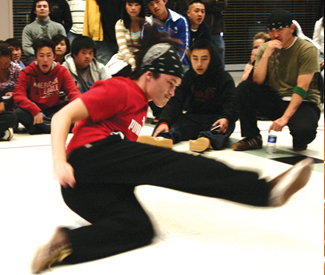
Among B-Boys gives outsiders an hour-long, respectful immersion in the lives of Hmong breakdancers, here “getting lost” in their impressively athletic moves and speaking for themselves, away from the flinty-eyed filter of Gran Torino (2008). In his quest to follow the Velocity/Soul Rivals and Underground Flow crews, Woon takes his camera from Oklahoma to Left Coast exurbia where the kids are attempting to dream with acrobatic handstands, freezes, and crazy-fancy footwork — and finding their efforts rewarded with trophies.

Their triumphs in gritty gyms and community centers are made that much more poignant in the context of their parents’ memories of war, displacement, and poverty. The elders’ stealth contributions to the CIA’s shadowy adventures in Laos casts a pool of lingering darkness on these hip-hoppers, who are striving to carve out a life for themselves while coping with the unique challenges that the Hmong have encountered in the states. As Joua Xiong, the rare B-girl in the Soul Rivals Crew, explains, “Hmong mean ‘the Free,’ and that’s basically what we are: we don’t have a certain country, but we don’t really know our original customs because we’re so mixed up. We have a lot of Thai, Lao, Chinese in us, and we’ve been running away so much from people trying to destroy our customs and make us conform with them.”

Cast away in a semi-rural Merced, Fresno, and Sacto, these kids appear to be finding another kind of freedom. “It’s not just breaking,” says Soul Rivals’ Kyle Vong. “It’s the culture of hip-hop — it’s about teaching yourself to understand life in general and expressing yourself.”

The awkward slackers and damaged hipsters of The Crumbles seem to be worlds away from the humble, proud B-boys of the Central Valley: theirs is a sun-strafed, paved-over Los Angeles habitat of coffee shops, taco trucks, bookstores, budding filmmakers, and living room-bound band practice. Darla (Katie Hipol) is slouching nowhere fast when her zany, charismatic cool-girl chum Elisa (Teresa Michelle Lee) enters the picture, looking for a place to crash.

Elisa’s wacky, erratic, and unreliable, but she’s also capable of generating real excitement — and a mean little keytar hook — and the girls’ band, the Crumbles, gets off the couch and threatens to get all involved to bust out of their shells. Though director Boch never quite dips into the deep background of his characters’ various dysfunctions — the threatened readings of Darla and Elisa’s psychic friend never quite sheds light — the first-time feature filmmaker has a real feel for the drifting, up-for-anything quality of Cali 20-somethings and an appreciation for their highs and lows that makes this familiar, loving, lets-put-on-show-kids update compelling.

With kindred ultraviolence vet Martin Scorsese throwing himself into his own kiddie roller-coaster of a cinematic ride with last year’s Hugo, it makes some sense that Takashi Miike — whose 2010 13 Assassins might have bested both Ichi the Killer (2001) and 1999’s Audition for sheer bloodletting — would enter the children’s field with such gusto. Manga fans will appreciate Miike’s broadly farcical, spoofy élan with comic book touches — down to the freeze-frame mucus drips, the CGI hatched-background stills denoting way-ramped-up action, and fourth-wall-bust-outs/pop-up trivia interludes by your “friendly ninja trivia commentator.”

http://www.youtube.com/watch?v=HVjoh-jG36o

Rantaro — your archetypal geek toddler, complete with thick glasses and bad haircut — has left the family farm and been sent off to ninja nursery school to learn all about deadly boomeranging stars, big-headed villains with testicular chins, and ninja master-slash-hair stylists. Does Rantaro, er, find himself amid the rigors of class, attacks from dastardly ninja outfits, and a final challenge that has him literally biting the dust? And does it matter when Miike digs in with such glee to lampoon the samurai genre, and kick up dust with the ankle-nibblers in this insanely comical alternate universe of ninja mini-mes?

SAN FRANCISCO INTERNATIONAL ASIAN AMERICAN FILM FESTIVAL

March 8-18, various Bay Area venues, most shows $12

www.caamedia.org

DOCS AND SHOCKS: MORE FROM THE SF INTERNATIONAL ASIAN AMERICAN FILM FESTIVAL

SFIAAFF Documentary fans, prioritize Give Up Tomorrow, Michael Collins’ probing examination of a high-profile murder case in the Philippines. If the Paradise Lost films got your blood boiling, expect to rage even harder at the unbelievably shifty way the events detailed here unfolded.

As with the West Memphis Three, the crime at Tomorrow‘s heart is horrific: in 1997, two sisters in their early 20s were kidnapped, raped, and murdered. Or were they? Only one body was found, and it was never quite confirmed that the dead woman was actually one of the missing sisters. Of course, that didn’t stop authorities (almost all of whom had ties to a local drug lord, who was also connected to the victims’ family) from fingering a group of local teens, including Paco Larrañaga — who became the case’s main target, despite the fact that dozens of his culinary-school classmates swore he was with them, hundreds of miles from the crime scene, at the time of the alleged murders.

Give Up Tomorrow offers a searing study of a corrupt court system, and the heartbreak that happens when a cause célèbre falls victim to the short attention span of the international activist community. Without spoiling all of its twists and turns, know that this story is better than any fictionalized crime drama, and more powerfully wrenching for being true.

Other docs worth checking out include Mr. Cao Goes to Washington, an insightful look at the American political system via Joseph Cao, who was the first Vietnamese American elected to Congress. But that wasn’t the most unique thing about him: he was a Republican, elected amid post-Katrina disarray in one of New Orleans’ traditionally African American and staunchly Democratic districts. S. Leo Chiang’s film follows Cao as he makes hard choices in the year leading up to his battle for re-election, including voting first for, then against, President Obama’s health care reform bill. (Reason for the switch: he’s passionately anti-abortion.) Even if you don’t agree with his views, Cao puts a human (and surprisingly honest) face on the great divide between the political parties in this country.

More hopeful is No Look Pass, Melissa Johnson’s quite enjoyable documentary about first-generation Burmese American Emily Tay, a basketball superstar who turns pro after graduating Harvard (eat your heart out, Jeremy Lin), and, oh yeah — happens to be a lesbian. No Look Pass also screened at the San Francisco Independent Film Festival, and it’s not hard to see why it appeals to a wide range of audiences: Tay is an inspiring figure on the court, and endearingly awkward off it, especially when trying to relate to her deeply traditional parents.

Even more uplifting, and perfectly compressed at 39 minutes, is Lucy Walker’s Oscar-nominated The Tsunami and the Cherry Blossom, which examines the “beauty and terror” of nature, as perceived by Japanese survivors of the recent earthquake and tsunami — and the spiritual significance of the cherry blossom, which is shown to be a key element in the country’s healing process.

Genre fans! I Am a Ghost, the world-premiere latest from prolific local H.P. Mendoza (2006’s Colma: The Musical), starts slowly but — holy ghost! — stick with it, and you’ll be shriekingly rewarded. And another recent IndieFest selection, Marlon N. Rivera’s satirical The Woman in the Septic Tank, returns to delight another wave of crowds with its tale of three ambitious filmmakers (and a hell of a leading lady) determined to make the most popular Filipino movie of all time. Best line: “Fuck Cannes, bro! We’re talking Oscars!” (Cheryl Eddy)

Gitane

0

virginia@sfbg.com

APPETITE While I miss the sophisticated, out-of-the-box cocktails of former bar managers Carlo Splendorini and Alex Smith (they both continue to craft excellent drinks, Splendorini at Michael Mina, Smith at Honor Bar), I am pleased to say Gitane, one of the sexiest spots in all of SF, is still a drink-worthy location. I’d be remiss not to likewise return to the Moroccan and Spanish-influenced menu that chef Bridget Batson has been rocking for years.

Sitting at Gitane’s bar under massive chandeliers and deep red tapestries, in a narrow, high-ceilinged space, one feels tucked away in some secret European bordello. The tiny, upstairs dining room is equally seductive and intimate, with a view over the bar. Perched on velvety bar stool, I find an ideal locale for drinks, food and chatting with fellow diners.

Batson’s grilled calamari ($16) stuffed with bacon and onion, and her unparalleled lamb tartare ($18) with three spreads remain top dishes on the menu. Bastilla ($13) and chicken breast tajine ($22) are still Moroccan highlights. Bright and wintery, a citrics salad ($12) is tangerines, cara cara and blood oranges vivid on chicories with Serrano ham in a pumpkin seed pesto.

On the entrée front, Caille ($28) is a hearty quail overflowing with chorizo apple stuffing over celery root gratin in pool of cider jus. I can’t imagine doing much better for a simple meal than a coca (Catalan flatbread, $15–$16) and a cocktail. The coca bread bubbles not unlike a blistered Neapolitan pizza crust. Go the vegetarian route topped with wild mushroom, drunken goat cheese, and oregano, or with my favorite, layered with Serrano ham, Bosc pears, manchego cheese, and thyme.

Keeping food pairing ever in mind, the current bar menu focuses on low alcohol cocktails. The bar is now helmed by Ramon Garcia who worked with both former bar managers. He maintains Gitane’s ethos, its continued sherry focus, its gypsy spirit (Gitane means gypsy, after all). Ramon assembled a new menu with spirits expert and Yamazaki Japanese whiskey brand ambassador Neyah White, who, even after all this time, I still miss behind the bar at Nopa.

There’s a lovely nod to cocktails created here in the past: two classic Gitane recipes are rotated regularly on the menu. The bulk of the new menu goes global, wandering Romany-like with various bartenders from around the world, featuring their best sherry cocktails. In keeping with the gypsy theme, the bar will feature a different spirit every couple months from their extensive collection, showcasing cocktails and traditional serving preparations, like Italian amaro on the rocks in the summer.

From the cocktail list, one of Neyah’s Nopa greats, a Sherry Shrub, is a mix of merely two ingredients: barbadillo manzanilla sherry and a seasonal fruit based shrub (a vinegar-based syrup): sour, vibrant, and palate-cleansing. I’m taken with the Bamboo, by Tokyo bartending legend Hidetsugu Ueno, of Bar High Five: dry and refined, combining dry vermouth, amontillado sherry, and two 1890s bitters recipes created by Louis Eppinger at the Yokohoma Grand Hotel.

On a warmer day, I’d gravitate toward the Caipirinha Con Moras by David Nepove, formerly of Enrico’s, and US Bartenders Guild national president. Fruit will change seasonally, but his take on Brazil’s national cocktail mixes Pedro Ximenez sherry and shaved nutmeg with cachaca (sugar cane rum). Another refresher is the Jenibre Smash from Chris Hannah of New Orleans’ French 75 Bar: Dry Sack sherry, Canton ginger liqueur, lemon, sugar, and mint are served over crushed ice. It’s delicately bright and minty, going down all too easy.

Gitane boasts an Iberian (Spain, Portugal, France) heavy wine list, although California is nicely represented. The sherry list is impressive, with plenty of Madeira, Port, brandies, and after dinner sips. An interesting companion to the hearty quail and chorizo entrée is a 2008 Domaine des Ouled Thaleb Benslimane Zenata ($12 glass, $35 carafe, $48 bottle), a 100 percent Syrah from Morocco. It’s big and bold in keeping with warm Moroccan temperatures, but maintains just enough acidity to pair with food. It’s welcome given the strong Moroccan food influence. After dinner pleasures were strongest in an earthy Charleston Sercial Madeira ($15 glass) from Rare Wine Co., and Gutierrez Colosia Moscatel Soleado Sherry from El Puerto ($10 glass).

My favorite cocktail on the new menu is the oldest recipe from 1800’s San Francisco bartending legend, Cocktail Bill Boothby, after whom our local educational spirits hub, The Boothby Center, is named. The Boothby is essentially a Manhattan (bourbon, sweet vermouth, Angostura bitters) topped with sparkling wine. It’s lush, sexy, and full bodied… not at all unlike Gitane. 

GITANE

6 Claude Lane, SF

(415) 788-6686

www.gitanerestaurant.com

Subscribe to Virgina’s twice-monthly newsletter, The Perfect Spot, www.theperfectspotsf.com


Against the grain

0

marke@sfbg.com

MUSIC It began as a burbling “Eeep!” It was June 7, 2000; we were in Davies Symphony Hall, in the middle of the second movement of Charles Ives’ super-intense Symphony No. 4 from 1910-1916. Yet despite the whirling maelstrom of that work — imagine three Fourth of Julys at once, in which a vast orchestra overlaps itself with marching band themes, spirituals, dance hall ditties, and children’s songs — I could still make out curious sounds coming from the audience behind me. Soon onlookers were shouting out nonsense; one down our row jumped up from his seat. For my part, I felt my shoulders twitch involuntarily, and my partner let out a loud hee-haw guffaw. The memory-triggering dissonance, expertly transmitted through conductor Michael Tilson Thomas, was having a spazzifying physical effect, making us active participants in Ives’ chaotic Main Street Parade.

http://www.youtube.com/watch?v=iYvWwI6YRsE

San Francisco has never lacked for excellent performances of works still often classified as “contemporary classical,” despite many being a century old. But the first American Mavericks festival, more than a decade ago, did much to elevate San Francisco’s status in the cultural world at large. We were at the very edge of the tech bubble, a maverick cultural achievement of its own, of course. Yet not much bold, native art had risen in response to all that “future now” attention and money. The much-hyped Mission School visual art movement was in its infancy, and concerned more with hermetic understatement than Bay reppin’ (a nice answer, in its way, to Web 1.0 bombast). Native dance music forms like turntablism and dirty breaks were being superseded by bland lounge house, hyphy was only hatching, Green Day was over, and literature hadn’t yet been Eggered and Chaboned.

The SF Symphony is justly famed for its impeccably polished sound and MTT’s cheeky programs pairing classical comfort food with spunky aperitifs. But American Mavericks was pretty damned ballsy for a major symphony — almost a month’s worth of edgy, attention-grabbing, well-funded gems from 20th century composers like Ruth Crawford Seeger, George Antheil, Meredith Monk, Duke Ellington, Steve Reich, Frank Zappa, Lukas Foss, and a dozen more. There was a plethora of symphonic reconfigurations and unique instrumentations: an extra brass section blared from the basement for the Ives symphony; audience members brought their own instruments to play along with Terry Riley’s ecstatic “In C.” At a very materialistic moment, American Mavericks illuminated the wild-eared, transcendentalist spirit of native music while showing the world that SF still had a huge, unfettered freak flag to fly.

American Mavericks is back Thu/8-Sun/18, this time spreading its wings to include Symphony stops in Chicago, Ann Arbor, and Carnegie Hall. And while some have bemoaned fewer and somewhat less ambitious performances on the whole (we’re in a recession, after all), there are plenty of pieces to jump up and shout about.

Ives returns, this time with astonishing masterpiece A Concord Symphony — I always hear crisp leaves crunch beneath my mental feet when this is played. Profoundly quirky enchantress Meredith Monk is back as well: in a coup of idiosyncrasy, she’ll be singing John Cage’s Song Books with magnificent diva Jessye Norman and experimental champion Joan La Barbara. Later, Hometown hero John Adams will premiere a new work, Absolute Jest, as will local techno-influenced composer Mason Bates, with “Mass Transmission.” There’s loads more packed into a mere 10 days, including pieces from Oakland instrument-inventor Harry Partch, San Francisco Tape Music Center founder Morton Subotnick, and Bay Area indigenous music devotee Lou Harrison.

Will it have the same cultural impact? Here we are back in an overconfident tech bubble — and once again our total cultural output seems a bit, well, blah. An irony of the social media onslaught is that all this personal expression seems to be quashing true individuality. So we’re having a materialist and conformist moment. A good dose of musical eccentricity from old school visionaries/crazies who turned their backs on the rat race might just do us a world of good. Here’s to more “Eeeps!” among the bleeps.

AMERCAN MAVERICKS FESTIVAL

Thu/8-Sun/18, various prices and times

Davies Symphony Hall

201 Van Ness, SF.

(415) 864-6000

www.americanmavericks.org


Hits and misses

0

arts@sfbg.com

DANCE When choreographers Sue Li Jue and Nina Haft found that they shared a common interest in exploring the body’s memory — of personal experience, history, origins — they decided to make a work in which their individual choreographies would take turns on the stage. Thus the problematic this.placed was born.

In the past Li Jue has created beautifully designed dance theater pieces that explored her Chinese American heritage from a decidedly contemporary perspective. She did it poignantly, and often with a sense of humor. Haft’s interest in Jewish American history has led her to create theatrically pungent works about writers (Gertrude Stein) as well as gangsters (unnamed, though their stories are well known). Additionally, she has quite successfully examined the theatrical potential of specific locations, cemeteries and docks among them.

this.placed is an intriguing, perhaps even fun idea in terms of rethinking presentational formats. It certainly is something that theater artists, dancers, among them, increasingly examine. Yet I don’t think this one flew.

For one thing, the 75-minute evening consisted primarily of duets and trios. Though some of them were finely chiseled, more rhythmic variety was needed. Also lacking, I felt, was a sturdier thread that held the individual dances together beyond their place in the lineup. After all, the perspectives by these choreographers are different.

Why, for instance, would a sardonic duet about the wreckage life has inflicted on a woman’s face be followed by a trio about happy Chinese adoptees? Misfortune vs. happiness? Or an encounter between two men be preceded by a woman’s observations about her mother? Because both vignettes involved memory?

I would like to see this.placed again as two halves of the same program, with perhaps a rethinking of some the dances and some additional material. Conventional as that might be, it might strengthen the focus on the commonality and difference between the two choreographers.

Haft’s dynamic interpretations of Britta Austin’s gutsy prose certainly warrant additions. The mostly gestural language (for the mouth) of Bite Marks — performed by Jill Randall and Amanda Whitehead — infused a macabre sense of humor on the process of rotting while alive. In Trouble, the mysterious and ever so elegant dancing by Pailing Kao provided a foil to her sturdier “daughter” Sarah Keeney. Flesh, Taste, Fiction started on a note of voyeurism but quickly grew into an obsessively meaty mating à trois. Let You Go‘s desperate fierce struggle between Carol Kueffer and Lisa Bush left one of them “dead,” the other one just about.

Haft’s misjudgment was in entrusting one of Austin’s texts to a student group. Some of these performers may eventually become dancers. At this point, they belong in a studio setting.

Li Jue’s Half the Sky, a pastoral tribute to unwanted Chinese girls who have been adopted abroad, was cloying. It’s almost impossible for adult women to suggest the happiness and frolicking quality of childhood. If the choreography was supposed to recall some of the more naïve perspectives of Chinese folk dancing for women, it didn’t work.

The Lost and Found looked as murky as Ian Winter’s accompanying video. It featured a quartet of women arriving from different directions, coalescing into a pile of bodies and splitting into double duets. Linnea Snyderman was carried aloft, and Frances Sedayao rolled over everybody (side note: Sedayao danced in four of the nine selections — what a treat she was). More eminently legible was the nightmarishly dramatic and excellently danced duet Remember Me? for Masataka Aita and Nhan Ho. Aita at first seemed like a pesky intruder into Ho’s life. But he became the leech, or perhaps the incubus to the increasingly desperate Ho. At the end both seemed destroyed.

Not What She Seams started as a fine solo at last year’s WestWave Dance Festival. It now has expanded into an equally fine quintet which also sings. Huge bolts of fabric became the means by which these “seamstresses” expressed their anger and desperation, but also their resilience and hope.

The patient that time forgot

0

caitlin@sfbg.com

HERBWISE I contact a lot of stoners throughout the course of writing Herbwise — activists, businessmen, artists — but none has had a more crisp-sounding receptionist answer the phone than Ft. Lauderdale stockbroker Irvin Rosenfeld, who is one of four citizens of the United States legally allowed to smoke marijuana by the federal government.

No really, he is.

In 1982, Rosenfeld hit upon a winning combination of perseverance, legal precedent, and audacity when he succeeded in suing the US government to prescribe him cannabis for his painful, bone growth-causing condition. After filing a civil suit that claimed weed was the only palliative that helped his intense physical discomfort, Rosenfeld became part of the FDA’s short-lived Investigational New Drug Program. Calling Rosenfeld, original patient Robert Randall, and the subsequent 11 others who qualified for the program participants in a clinical study was the only way the feds could justify supplying the weed.

In 1992, the program was terminated. But the 13 patients — only four survive today — continued to receive tins of pre-rolled joints, the cannabis for which is grown (shoddily) at a government-run farm near the University of Mississippi. Rosenfeld tells me the weed he smokes is “12 years old,” and so dry that he’s compelled to unroll the cigarettes, store with fresh lettuce for six to eight hours to rehydrate the bud, then re-roll before smoking.

He tokes nine ounces a months and, he says, never gets high. He tells all his clients about his prescription because, as he puts it “I don’t want them seeing, for example, this article and thinking ‘oh, he lost us that money because he was high off that marriage-ja-wanna.'”

I ask him if he’s surprised, 20 years since he won his legal battle, that patients like himself are still battling for access to the plant. He reels off a series of crucial court hearings that, to his disbelief, swung time and time again in the direction of continued Schedule I status for cannabis. Rosenfeld says has made it able for him to leave the house on a regular basis.

“As a stockbroker I look at it economically. I think about, if I didn’t have my medicine, where would I be today? I’d be homebound. Is it just me? Or maybe there’s other people sitting at home that could be productive members of society. It irritates me.”

Our conversation is over, but there’s time left for two plugs from Rosenfeld. One for his book, My Medicine: How I Convinced My Government to Provide My Marijuana and Helped Launch a National Movement (www.mymedicinethebook.com). Buy it?

The second is for himself. Anyone need a stockbroker with experience in battling the US government?

“The expertise I used to take on the federal government is the same expertise I use in my business,” Rosenfeld assures me before we hang up. “If you want that expertise, you should hire me as your broker. If you don’t, then have a good life.”

Together forever

1

arts@sfbg.com

FILM It’s hard to imagine taking on the controversial subject of genre-defying performance artist and musician Genesis Breyer P-Orridge and finding a hitherto-unexploited angle of approach — but Marie Losier’s delicate filmic collage of an artist as an elder pandrogene is full of whimsy and surprise. Losier’s portraits in film of other counter-culture figures, most notably both Mike and George Kuchar, helped shape her into the ideal candidate to tackle filming P-Orridge and her late, great life partner, Lady Jaye Breyer P-Orridge, over the course of several years, documenting their partnership and their pandrogeny project for posterity.

SFBG There’s a whole backstory about how you two met, that you stepped on Gen’s foot at a party, but how did the relationship develop from there?

Marie Losier It was immediate in the sense that I had seen Genesis reading poetry and songs with Thee Majesty [the night before]. I was kind of shy, and I said, “I really loved what you did,” and she looked at me with her big smile and her gold teeth appeared — and I was like, “Wow, that’s beautiful!” And we just spoke shortly but it was very tender and I felt it was very unusual because of the coincidence of timing, and she said, “You can write to me,” and gave me her card, and I emailed her. That was the beginning, for me, of a great adventure. I had no idea about the pandrogeny project except that I was discovering [Genesis and Jaye’s] resemblance and their love, and that’s when I started filming, without knowing that this would become the main subject.

SFBG How much of the film is your footage?

Losier The only archival footage was this tiny minute of William Burroughs, one minute of Gen in Throbbing Gristle, and this really great footage of Coum Transmission where Gen is really young. Then, the archive of [P- Orridge’s children] Genesse and Caresse singing “Are You Experienced?”, and a little tiny image of Jaye performing when she was much younger in New York City.

SFBG That moment when they are in the alley, dressed up in leather, and Gen has the little Hitler mustache?

Losier Sorry, yes, this is footage that Bruce LaBruce gave me. That was interesting because I would not have staged that, but it showed Jaye in a way that I didn’t have.

SFBG One thing that strikes me is that there’s quite a large chunk in the middle in which Jaye does not appear. I wonder if you had originally intended to interview her more about her past and her art? Losier Yes, but Jaye was a lot more shy, or a lot more fleeting in front of the camera, so I spent more time, in a way with Gen. But even if you don’t see her as much in the film, she’s very present. S/he never dies because even to the end she’s still there, and also you feel her in the atmosphere all the time through the film. But it’s true I had less footage of Jaye, and it was only when s/he passed away that I realized I didn’t have enough to make her own full story, but in a way that also made sense. She was very kind but also kind of wild, more secretive than Gen, so it also corresponded to her personality.

SFBG Were you ever intentionally trying to go for a cut-up feeling or technique while you were filming the film, or trying to shape it?

Losier To be totally honest, it’s really the way I edit. If you see my short films, they are all made this way because they are all shot with non-sync sound, 16mm, three-minute rolls of film … so it’s already a collage. I also always mix between the surreal aspect of tableau vivant, and the construction of daily life. I think with Gen and Jaye I found the symbiosis of the perfect cut-up couple to match how I work, and how I build a story.

Check out Pixel Vision for an extended version of Nicole Gluckstern’s interview with Marie Losier and film subject Genesis Breyer P-Orridge.

THE BALLAD OF GENESIS AND LADY JAYE opens Fri/9 in Bay Area theaters.

Deep aroma

0

arts@sfbg.com

MUSIC At some point in our lives, we all feel lost or confused, like we’re picking up the pieces of our broken selves and trying glue them back together. Rather than surrender, Seattle’s Perfume Genius, aka Mike Hadreas, takes these experiences and turns them into art.

Recorded at his mother’s house after a battle with addiction, Hadreas’ 2010 debut Learning (Matador) was an understated, deeply personal collection of lo-fi piano pop songs that earned him critical recognition and a circle of devoted fans.

For his sophomore album, Put Your Back N 2 It, also on Matador, Hadreas once again found himself navigating the confusing process of recovery. “That wasn’t the plan,” he says. “I didn’t plan after the first album like, ‘ok, now I’m gonna do round two and then I’ll make another album.’ It just unfortunately worked out like that.”

No one was more surprised than Hadreas that Learning was so readily embraced, but this time around he wrote with an audience in mind. “At first I was thinking about everyone, and that I had to make something that everyone would like,” says Hadreas. “But that was too crippling, so I started thinking about who I wanted to hear the songs, people in my life that I wanted to make songs for, and kids that wrote me from the first album. I didn’t expect to have a career [and] now I feel really purposeful.”

It’s for this reason, perhaps, that a resolute strength and optimism run through his second batch of songs. “I will carry on with grace / Zero tears on my face,” Hadreas sings on “No Tear.” There’s redemptive healing and an almost gospel quality to Put Your Back N 2 It. “I’ve always been kind of scared of religious or spiritual music because I thought most of the religions weren’t going to let me sing with them,” he explains.

An openly gay artist, Hadreas tackles subjects that are often absent from the indie music scene. “All Waters,” for example, explores internalized homophobia. The video for his gorgeous pop ballad, “Hood,” features burly porn star Arpad Miklos grooming and embracing Hadreas. Though the tender clip was widely praised by blogs and magazines, a 15-second ad containing scenes from the video was rejected by YouTube for “promoting mature sexual themes” and being “not family safe.”

“I just really didn’t get it, to be honest,” he says. “The actual ad itself was really sweet and tame. But I think everybody’s happy now because way more people saw the ad than if it would have just gone through.”

Hadreas is adorably timid when he talks about his music, yet fearless in his approach to songwriting. “Whatever fears I have, when I’m actually doing something I try to get over it, at least for that moment,” says Hadreas. “Even if I still struggle with confidence, I try to do that with my daily life and not when I have to make something.” Due in large part to studio recording, Hadreas sounds more confident here. His vocals ring out with clarity and his once subdued piano-driven arrangements are lush and expansive.

“Dark Parts,” which soars triumphantly over the galloping thump of a bass drum, is the album’s most hopeful track. “I will take the dark parts of your heart into my heart,” he sings as it concludes. It’s a promise that captures the deep connection he shares with fans, who he regularly thanks for the letters they send. “I haven’t been very helpful my whole life, really, until this. I was mainly just apologizing for 20 years,” he says. “Whatever bullshit I still have, when I read those messages, it makes me remember why I’m doing all the things that I’m doing.” *


PERFUME GENIUS

With Parenthetical Girls

March 21, 9 p.m., $12

Cafe Du Nord

2170 Market, SF

(415) 861-5016

www.cafedunord.com

The case against 8 Washington

35

tredmond@sfbg.com

In city planning terms, it’s a fairly modest project: 134 condos, no buildings more than 12 stories tall, on a 27,000-square-foot site. It’s projected to meet the highest environmental building standards and offers new open space and pedestrian walkways. It’s near Muni, BART, and ferry lines. And the city will collect millions of dollars in new taxes from it.

But the 8 Washington project, which will come before the Planning Commission March 8, has become a flashpoint in city politics, one of the defining battles of Mayor Ed Lee’s administration — and a symbol of how the city’s housing policy has failed to keep pace with the needs of the local workforce.

Put simply, it will create the most expensive condos in city history, housing for the richest of the 1 percent on the edge of the waterfront — and will further push San Francisco toward becoming a city that caters almost entirely to the very wealthy.

So in a city where the growing divide between the 1 percent and the rest of us has become a central issue and where the lack of affordable housing is one of the top civic concerns, 8 Washington is an important test. By any rational standard, this sort of development is the last thing San Francisco needs.

But some of the best-connected lobbyists in the city are pushing it. One of the mayor’s closest allies, Chinatown powerbroker Rose Pak, is a leading advocate — and the final outcome will say a lot about city politics in the Lee administration.

There are all sorts of half-truths and misleading statements by supporters of 8 Washington. Here are the five main reasons the project shouldn’t be approved.

1. It fills no housing need. San Francisco has no shortage of housing for the very rich; the dramatic need, outlined in both regional planning documents and the city’s own General Plan, is for low- and moderate-income housing for the people who actually work in this city (see “Dollars or sense?” 9/28/10). While San Francisco is getting richer by the day, the core workforce — public employees, workers in the hotel and restaurant industry, service workers, construction and trade workers, and a majority of the people in the lower levels of the finance and tech sector — are being priced out of the city. That means more people working here and living far out of town, often commuting by car, in what everyone agrees is an unsustainable situation. Meanwhile, more and more high-paid workers from Silicon Valley are living in San Francisco — again, commuting to distant jobs, either by car or by corporate bus.

The city’s General Plan states that some 60 percent of all new housing built in the city should be below market rate. San Francisco desperately needs housing for its workforce. This type of project simply puts the city deeper in the hole and further from its housing goals.

2. It’s a reward for bad actors. The main developer of this project is Simon Snellgrove, but one of his partners is, by necessity, Golden Gateway, which owns a significant part of the land — and which has been flouting at least the spirit if not the letter of city and state law and costing San Francisco tens of millions of dollars.

As project opponent Brad Paul has noted in written testimony, when Timothy Foo, the current owner, bought the complex from Perini Corp. about 20 years ago, he used a loophole in state law that allowed him to avoid a formal transfer of ownership. That means the property wasn’t re-assessed, costing the city about $1.5 million a year. According to the Assessor’s Office, the deal wasn’t illegal (and these tricks to avoid reassessment are relatively common) but still: He’s costing the city millions by using a loophole not available to most people.

Golden Gateway, which was built in a redevelopment area as middle-class housing, is now renting out apartments as short-term tourist or corporate rentals. There are dozens of examples right now on Craigslist. City law bars the owners of rental housing from converting it to hotel rooms, but a loophole in that law makes what Foo’s outfit is doing technically legal. But he’s clearly violating the spirit of the city ordinance that seeks to protect rental housing from hotel conversions.

One of the main aesthetic complaints about the area — something Snellgrove’s lobbyists have tried to use to support the project — is the ugly fence that now surrounds the Golden Gateway Tennis and Swim Club. But who do you suppose put that fence there?

Do we as a city want to be giving special zoning benefits to companies that try to circumvent tax and housing laws?

3. It’s an environmental disaster. Snellgrove and his architects, Skidmore Owning and Merrill, are seeking LEED platinum certification for the project, saying that its energy-efficiency, water use, and green building materials will make it one of the most sustainable structures in San Francisco. It is, the project website notes, close to all types of public transit.

But LEED doesn’t take into account what the building is used for (see “Is LEED really green,” 7/5/11) — and in this case, the use makes a huge amount of difference.

People who buy multi-million-dollar condos don’t tend to take Muni or BART when they go places. That’s not conjecture, it’s a proven fact. A 2008 study by the American Public Transportation Association notes, bluntly, that wealthier people are more likely to drive cars. When you move into the stratospheric regions of the ultra-rich, that’s even more true. A 2011 report on the Charting Transport website notes: “The very rich tend to shun public transport.”

The current zoning in the area allows for one parking space for every four residential units. Snellgrove is asking for one space per unit — in other words, he figures every single buyer will have a car.

Many of the people who buy these condos won’t be working or even living most of the time in San Francisco. These are condos for world travelers, second and third homes for people who want to spend a few weeks a year in San Francisco. “They aren’t going to be living here all year,” Christina Olague, a former Planning Commission member who is now the District 5 supervisor, told us last July.

If five of the 165 residents of 8 Washington fly in a private or corporate jet from, say, New York to their SF pad once a month, the project will cause the use of jet fuel equivalent to what a normal family would use driving a car for 330 years, Paul noted.

“How many solar panels are needed compensate for burning 396,000 gallons of jet fuel a year?” he asked.

Then there’s the construction issue. If the developer’s projections are correct, as many as 20,000 dump truck runs will be trundling along the Embarcadero for several months, one every two minutes — and it could be happening right as the traffic nightmare called the America’s Cup is hitting the waterfront.

It also goes against some 40 years of waterfront planning policy, all of which as focused on downzoning and creating open space. This would be the first upzoning of San Francisco waterfront property in decades.

4. It will wipe out what is mostly a middle-class recreation facility. The Golden Gateway Tennis and Swim Club will be closed for three years, then (possibly) reopened later as a smaller facility. The club — with two outdoor pools and six tennis courts — sounds like something for the elite, and it’s managed by the upscale Bay Club, but a lot of the users are longtime Golden Gateway residents and seniors. “I would say 30 or 35 percent of the users are seniors,” Lee Radner, chair of Friends of Golden Gateway, told me. Most, he said, are middle-class people, and the expense isn’t that high. “My wife and I pay $3 a day to use the pool,” he said. “I swim every day, and it would cost more than that to use the public pools in the city.” He added: “There are some wealthier people, of course, but many of us are retired and on fixed incomes.”

We’re talking about 90,000 total square feet of outdoor recreation space — which dwarfs the 20,000 square feet of open space the developer promised to provide.

5. The city doesn’t get much out of the deal. In exchange for upzoning the waterfront, creating a big all of buildings and screwing up the city’s housing balance, what does the San Francisco general fund get? Not a lot. The estimates for new tax revenue run about $1.5 million a year of the next 60 years — and when you translate that to what economist call “net present value,” the cash equivalent today of that revenue stream, it’s about $30 million. The Port of San Francisco is talking about creating a special infrastructure financing district — sort of the equivalent of a redevelopment area — to pull that money out in advance, which may not even be legal (since part of the land is a former redevelopment area, the state law that allows these special finance districts may not apply). But even so, a Jan. 14 Port memo suggests that the agency has plans to spend all that money on its own infrastructure — setting up a potential battle between the supervisors and the Port Commission over where the money, if it actually can be collected up front, will go.

Like any developer, Snellgrove will pay into the city’s affordable housing fund — in this case, about $9 million to pay for the equivalent of 27 units. No affordable units will be on site, of course; that would detract from the uber-wealthy ambience of the place. And it’s not clear when those units would be built. “Nobody builds 27-unit buildings any more,” Paul, a former deputy mayor for housing, said. “We’ll have to wait until there’s enough money for a bigger project, somewhere, sometime down the road. That’s what we’re getting here.”

Either way, it’s not a huge benefit for allowing this disaster of a project — and it’s a terrible statement for San Francisco to make. At a time when the mayor has cleared the Occupy protesters — who are talking about how little the rich pay in taxes — off the waterfront, the city is preparing to move in the exceptionally rich, who aren’t paying anywhere near their fair share in tax revenue to local government.

(Nobody knows for sure whether the costs of servicing high-end residential exceed the revenue the city gets from property taxes. In 1971, the Guardian put together the first-ever cost-benefit study for highrise office development, which showed that commercial buildings cost the city more than they paid; that’s been confirmed and demonstrated over the years to the point where it’s hardly even an argument any more. The supervisors ought to ask the city economist or the budget analyst to do the same sort of analysis for luxury condos.)

There’s another element here: Mayor Lee made a point during his campaign to say over and over again that he was an independent thinker, that powerful and influential allies like Rose Pak would not be calling the shots at City Hall. This will be his first major test: Pak and lobbyist Marcia Smolens are working hard to promote 8 Washington. And we’re already getting some disturbing signals out of the mayor’s office.

Lee told us that he has “no thoughts” about the project and hasn’t been paying any attention to it. That’s an odd stance, considering that his own Port Commission is pushing it and staffers in his office are working with the developer. This is a big priority for Pak, and the notion that she has never mentioned it to the mayor defies reason. Board President David Chiu, who talks to the mayor regularly, opposes the project, which is in Chiu’s district.

It’s hard to imagine that anyone who pays attention to local politics could be missing what will be one of the landmark votes this spring on the Planning Commission — which will take up the project March 8 — and the Board of Supervisors.

The mayor, may, indeed, be ignoring everything that supporters and opponents of 8 Washington have said and may be waiting until the Planning Commission vote to take a position. But if he’s just ducking questions because he’s planning to support it, he’s making a big mistake.

This is a chance for San Francisco to go beyond the platitudes about building housing, go beyond the hype about “green” buildings, see through the fraud about community benefits and consider what this really is: A special favor for a developer who wants to cater to the top 1 percent of the 1 percent and move San Francisco even closer to being a city of, by, and for the elite. The only reasonable vote on 8 Washington is No.

Viva la Vita

0

GAMER News of the Vita’s death in Japan has been greatly exaggerated. Sony’s new handheld console arrived on Japanese shores last November, with meager sales compared to 2005’s PSP and even fewer than the much-ballyhooed Nintendo 3DS launch last spring. Analysts were quick to point to the 3DS’s disappointing launch as the beginning of the end for dedicated handheld systems, and Sony’s comparatively low sales had many pundits patting themselves on the back.

But, unlike Nintendo, Sony seems to have learned that software is as important as hardware. Where the 3DS launched with a sparse game library and hoped to sell units on name recognition and a 3D gimmick, the Vita has arrived with one of the best all-around software launches in recent history. That the hardware is no slouch either indicates we’re looking at a winner — if gamers are willing to carry around another gadget.

The Vita is a system for tech geeks. It’s got gimmicks and novelties — front and rear cameras, tilt control, and a rear touch pad — but it’s the more traditional elements that drive them home. The system is comfortable to hold and has a beautiful OLED front touch-screen. It’s quick as a whip, and best of all it’s aesthetically pleasing. It’s no accident the Vita looks more like an iPhone than a plastic Speak & Spell. (Yes, that’s a dig at the 3DS.)

http://www.youtube.com/watch?v=WfBFx051pWM

Additionally, it’s a real surprise to see Sony at the forefront of the impending digital revolution. Not only is every Vita game available on a cartridge, it’s also available for download — often at a lower price. Flexible pricing is something Sony seems interested in across the board, and it’s a development the industry has needed for a while; helping smaller games release at prices related to their stance in the marketplace makes sense.

Early sales reports for the Vita’s Western launch currently remain low, but the problem is not with the system. The Vita is slicker and quicker than its big brother, the PlayStation 3, and with the right publishers and a steady pace it could be the handheld we’ve all been waiting for. Buying the Vita now means banking on the system’s potential. Its launch lineup is full of games that are undeniably fun to play, but one could argue they are mere previews of the bigger-and-better experiences the Vita can offer. Whether or not we see those experiences is in the hands of a public that just might be OK with 99-cent iPhone games and 10-minute time-wasters.

Check out Peter Galvin’s Vita game reviews over at Pixel Vision.

The unidentifiable dance grooves of ESG

1

MUSIC Even the strangest sounds tend to lose their unfamiliar aura after a few listens. But no matter how many times I spin ESG’s “UFO,” I find myself utterly incapable of identifying that synthetic warbling that meanders through the minimal groove. Is it water gurgling in old gas pipes, a whirling police siren, the ferocious grumbling of a subway train? Or something more disturbing: Clanging echoes of gunfire, successive bursts of city noise filtered through apartment hallways?

It’s as if the song prompts a flux of associations that never find a place to rest. But as much as the song prompts a heavy dose of uneasiness, it works a curative spell on the body. That mysterious noise, whose relentless growth heightens the pulse of the rhythm, ultimately triggers an urge to break out in rhythm, and to put it quite simply: dance.

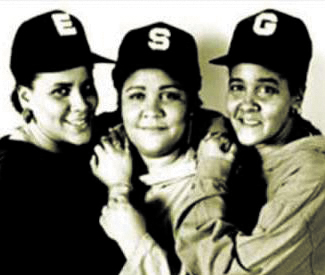
“Coming up in the South Bronx, in the 1970s, we watched Star Wars and Close Encounters of the Third Kind,” says lead vocalist and writer, Renee Scroggins, who together with her sisters — Valerie on drums, Deborah on bass guitar, and Marie on congas — originally composed ESG with a couple friends. “At the end of Close Encounters, they have that do do do do in the background when they communicate with the aliens,” she continues. “So I was sitting at home one day, and I thought: What would it be like if a UFO just landed in the middle of the projects? And that’s how I wrote the song. It begins with chaos and craziness, because I know what would happen,” she laughs.

http://www.youtube.com/watch?v=1o5vuMYQyhE

Over 30 years have passed since ESG (Emerald, Sapphire and Gold) pressed “UFO” to wax on its debut seven-inch for Factory Records in 1981. Today, the unlikely story of the vinyl’s origins seems to be the stuff of lore. While still teenagers, the Scroggins sisters had been performing in New York’s downtown scene for a couple of years. “We were opening for A Certain Ratio at a club called Hurrah in New York when Tony Wilson [of Factory Records] heard us,” Renee recalls, “and he said, ‘how would you like to make a record? I was like, yeah sure, because I didn’t think he was serious. But this was on a Wednesday night, and by Saturday, we were in the studio recording with Martin Hannett.”

Hannett, Factory’s eccentric in-house producer who is likely best known for his work on Joy Division, lent his uncanny touch to ESG’s sound. Bookmarked by the diss song “You’re No Good” and the other end of the love spectrum, “Moody,” with its emotional highs and lows, the EP consists in a stripped down polypercussive funk that would mark ESG’s style for the rest of its output: loosely structured drum patterns weave around pockets of emptiness and stark bass lines, letting Renee’s vocals flutter and hypnotize. It caught the attention of Ed Bahlman at NY’s 99 Records, who was already unofficially managing the outfit but hadn’t realized its full potential in the studio. The Scroggins followed with another EP and recorded their debut full-length for 99, Come Away with ESG, at Radio City Music Hall in ’83.

Come Away solidified its magnetic role during a fertile period of New York’s musical history, in which at least three strands of musical forms encountered each other to unexpected effect. The angular edge of post-punk deconstructed the blues guitar, no wave bands challenged rock purism by stressing the danceable groove, and block parties exploded in the South Bronx, establishing the conditions for what would eventually come to be known as hip-hop. ESG — which shared the stage with the Clash, Gang of Four, and Grandmaster Flash, and performed at Paradise Garage, Danceteria and the Mudd Club — was at the threshold of all this momentum.

What might single ESG out from its peers, though, is its rooted lineage in soul. “James Brown is definitely one of the biggest influences on my writing style,” says Renee. “He would always take it to the bridge, and cut loose, and I’d be like — ‘I didn’t want that part to ever end!’ But, I thought, if I could write a song, and just keep that bridge part going, then people could dance all night.” It’s not all that surprising that ESG’s talent for elaborating, intensifying, and prolonging the aesthetics of the bridge, in frenetic jams off its debut like “Dance,” “The Beat,” and “Christelle,” would correspond with the birth of the DJ, who would attempt a similar effect by looping breaks found in dusty bins of soul, funk, and rock. Soon enough, “UFO” became one of those sampled records.

Listening to “UFO” is all the more disorienting because of the overwhelming dispersion of offspring it calls to mind. That synthetic siren has been sped up, modulated, faded behind layers of reverb, or even spliced in its pure form onto a new backbeat. There are too many to name: Big Daddy Kane’s “Ain’t No Half Steppin’,” Notorious B.I.G.’s “Party and Bullshit,” and countless more from J Dilla, Beastie Boys, Q-Bert, among hundreds, if not thousands of others. You’d think that such an influential legacy would neutralize “UFO,” finally render it to that sterile status of the familiar, but the effect is much the opposite, as if its staggered mutations have only increased the alien, yet maddeningly ecstatic element, within the song.

ESG returned to the recording studio in the 2000s, introducing both Renee’s daughter as well as Valerie’s to the family venture. It dropped two albums of solid new material for Soul Jazz, which also released compilations of its classic singles and rarities. But after more than 30 years of performing and making raw grooves as well as some pop oriented songs in the mix, ESG plans to self-release its final record, Closure, this month (esgclosure.com), to coincide with a farewell world tour. So this might just be the last time its unidentified funk touches down live in San Francisco. 


ESG

Presented by No Way Back, With DJ sets from Solar, Conor, and Junior

Sat/March 3, 9 p.m., $20

Mezzanine

444 Jessie St., SF

www.mezzaninesf.com

Back in sight

2

MUSIC Roky Erickson spent much of the past few decades as the subject of endlessly rehearsed cautionary tales about the dangers of mind-altering drugs and mental illness, and romantic anecdotes framing him as a quasi-oracle, gifted and cursed with a second hearing into the weirder vistas of rock ‘n’ roll.

Following the release of Keven McAlester’s You’re Gonna Miss Me in 2005, Erickson reemerged as a subject of a different kind, as McAlester’s documentary dispelled some of the more profound biographical shadows, shedding light on the catalogue of ghosts and demons that haunt Erickson’s expansive body of recorded work.

Now 64, Roky Erickson has had such an indelible influence on psychedelic music, many would call him an architect. In the 1970s he reappeared, Rip Van Winkle-like, to a changed pop music landscape, where he would take a nascent approximation of punk and run it through his own esoteric sensibilities (“horror rock,” he called it), stumbling upon a lo-fi home recording aesthetic in the interstices of this period, though largely out of necessity, mind.

Most recently, Erickson carved out a provisional home in windswept and country-inflected indie. Never permanent, these dwellings serve as temporary shelters — motel rooms — for a restless and untethered voice, part Hank Williams, part Howlin’ Wolf, but even this doesn’t do it justice, and the veritable grimoire of demonic (lately divine) lyrical figures through which it moves.

His most recent record, True Love Cast Out All Evil (2010, ANTI-) — his first new material in more than a decade — saw collaborating band Okkervil River orchestrate a ghostly kind of folk rock capable of tracing the unpredictable contours of Erickson’s musical ideas. But the most memorable moments occur when the smooth continuity of the record is punctuated by intimate and acoustically frayed sounds emphasizing the fragile nuances of Roky’s performance.

The music dissociates into a field of droning harmonies, interspersed with snatches of studio banter, of singing birds and rapidly cycling TV channels. It’s hard not to hear these fragmentary moments as consciously referencing the intrusive sounds and voices that partially characterized his mental illness, yet here they have the feel of an exorcism, casting out, as it were an insistent static.

If there’s an underlying consistency to his immense and scattered catalogue, it’s that Erickson is a consummate blues singer, keenly attuned to the expressive potentials of rock n’ roll, and moreover, preternaturally skilled in reaching his listeners. Roky built up a rich lyrical world of vampire bats and B-movie extraterrestrials, and intangible vibrations that, in the minds and ears of listeners, came to stand in for a wealth of emotional timbres.

We feel, however faint or garbled, a connection through the cadences and inflections of Erickson’s voice. Like reading a novel written in a language you only half understand, you experience his music through these shifts in tone, through his alternating waves of anger and frustration and sadness, and the rare moment of contentment where Erickson retires into a sonic labyrinth of his own design.

When Elvis Presley died, Lester Bangs made the observation that we were all, effectively, saying goodbye to one another, having lost a figure whose music we could all come to a tentative agreement. Bangs’ fantasy of a capacity for a radical and far-reaching empathy encoded rock ‘n’ roll is one that we’ll most likely never stop repeating to ourselves.

Presently, it’s an invitation to patiently listen as the haunting and singular voice of the 13th Floor Elevators, of Roky Erickson & the Aliens, and a vast catalogue of hotel tapes and live recordings and rarities drifts from Austin to San Francisco. 


ROKY ERICKSON

With the Night Beats

Sat/3, 9 p.m., $25

Great American Music Hall

859 O’Farrell, SF

(415) 885-0750

Awesome explosion

0

FILM It’s almost impossible to describe Adult Swim hit Tim and Eric Awesome Show, Great Job!, but “cable access on acid” comes pretty close. It’s awkward, gross, repetitive, and quotable; it features unsettling characters portrayed by famous comedians and unknowns who may not actually be actors. Tim Heidecker and Eric Wareheim, who are much more low-key than the amplified versions of themselves they play on the show and in the new Tim and Eric’s Billion Dollar Movie, discussed the spoils of cult fame the morning after a recent screening in San Francisco.

“Seeing the last ten minutes with our hardcore fans — that was the best, because they’re laughing at everything,” Wareheim says. “Versus, we just came from the Sundance Film Festival, and there were good crowds, but there were a lot of people who didn’t know us. It takes awhile to adjust to what we do, like a learning curve.”

Though it opens theatrically this week, Billion Dollar Movie has been available On Demand since the end of January.

“The idea is to get it out to as many people as possible, especially people who won’t be able to see it in theaters, since it’s a limited theatrical release,” Wareheim explains. “But I also think that by getting it out there [early], our fans are talking about it, and they’ll go again in the theater.”

So, how do you transform something comprised of bite-sized insanity into a feature-length film? “Early on, we made a choice not to do a sketch movie, or just make a long episode of the show,” Heidecker says. “We felt that the pacing would never sustain itself. We tried to pace it in a way that the craziness would be there, but it just wouldn’t be coming at you so rapidly. But still, some people are saying that it’s completely exhausting. For us, we feel like we scaled down, but that might not be the reaction of the man on the street.”

http://www.youtube.com/watch?v=88pv0cbw8yQ

“For someone who’s unfamiliar with us, it’s at least an interesting take on comedy,” Wareheim says. “Some people are really going to enjoy it, some people are not going to get it, and some people are going to hate it.”

And though Billion Dollar Movie contains its share of boundary-pushing gags (literally, you will gag), Heidecker and Wareheim’s humor also springs from their deliberately crappy production values, inspired by commercials, TV outtakes, and promo videos — and necessitated by their own low budget (title notwithstanding). Still, Heidecker sees the movie as a turning point for the pair.

“We’ve been playing with that aesthetic for awhile now, and it is getting a little redundant,” he says. “As in any kind of aesthetic trend, you’re gonna run out of ammunition. I think in a lot of ways, the movie moves past the aesthetic [of the TV show]. We use it in certain places where it’s appropriate, but it wasn’t like, this is all we do. You gotta have other tools in the toolbox.”

TIM AND ERIC’S BILLION DOLLAR MOVIE opens Fri/2 in Bay Area theaters.

The war is over. Fun won.

1

steve@sfbg.com

>>Read Sup. Scott Weiner’s op-ed on SF nightlife here

Two years ago, the war on fun that the Bay Guardian had been chronicling and decrying since 2006 — involving overzealous cops, NIMBY neighbors complaining about noise, escalating fees on outdoor events, and politicians scapegoating nightclubs for urban violence –- seemed to be reaching a peak of official intolerance.

The San Francisco Police Department and California Department of Alcoholic Beverage Control were running amok, with an especially troublesome pair of enforcers harassing disfavored club owners and guests, getting rough with patrons at private parties, and seizing laptop computers from DJs and cameras from those who documented the abuses (see “The new War on Fun,” 3/23/10). Then-Mayor Gavin Newsom and then-Police Chief Heather Fong and their underlings only fed the conflict with brash statements and by refusing to support the nightlife industry.

But today, all involved say the situation has turned completely around, with the nightlife industry asserting its importance to San Francisco’s culture and economy and getting key support from a new generation of political leaders. It may be too early to say the war on fun is over, but everyone is certainly enjoying a welcome cease-fire.

Police Chief Greg Suhr has longstanding relationships with many leaders in the nightlife community -– and he’s someone who says that he goes out regularly and has a son who plays drums for a local band.

“I consider many of the people in the entertainment community to be personal friends,” Suhr told us. “And if there’s a problem, I don’t think anyone has been shy about approaching me personally.”

At the same time, the industry has taken on a higher political profile in town since forming the California Music and Culture Association two years ago during the height of the conflicts with the city and the ABC. The group now has monthly meetings with a nightlife liaison that Suhr has assigned to work through issues.

“The lines of communication are open. Despite some differences in opinion, there is a growing sense of trust and respect that is developing in these meetings,” CMAC co-chair Alix Rosenthal told us.

Rather than bashing the nightclubs as a source of trouble, political officials have been openly courting CMAC, which holds regular public events and forums on nightlife issues, including an “Industry Cocktail Hour with Mayor Ed Lee” on the evening Feb. 29 from 5-7 p.m. at The Grand, a club owned by the newest Entertainment Commission member, Steven Lee.

Sup. Scott Wiener has also been a strong advocate for nightlife issues, and has commissioned a city study on the economic benefits of the nightlife industry, which he discusses in this week’s Guardian Op-ed and which will be the subject of March 5 rally and hearing at City Hall.

Preliminary results in the study, with was conducted by City Economist Ted Egan, show that the nightlife industry generates $4.2 billion in annual spending, $55 million in taxes, and employs 48,000 people. And those figures don’t include outdoor events such as street fairs or the Outside Lands Festival, which another recent study by concert organizers found generated $60.6 million in San Francisco and $6.6 million in surrounding communities last year.

“People coming into the city to enjoy themselves is our number one industry,” Suhr said, noting how important it is to balance public safety concerns with support for the city’s cultural and entertainment offerings.

Rosenthal said CMAC was happy that Wiener commissioned the study. “This study is going to be helpful,” she said. “We’ll have hard data to show how much the entertainment economy contributes to San Francisco’s entire economy.”

Maven

0

virginia@sfbg.com

APPETITE Enter through a corner door into a restaurant lined with high communal tables, upstairs seating area, and a redwood bar backed by a stone wall overflowing with plant life. Formerly RNM, Maven is a sleek new cocktail haven in Lower Haight. I knew the drinks would be good, but I was pleasantly surprised at how strong the food is. Maven opened as a “drink with food pairing” concept venue: the menu lists three pairing columns. In the middle are generously-sized “small” plates, a couple entrées and dessert. To the left is a “distilled” column of cocktails, to the right, “fermented” beer and wine offerings.

While co-owners Jay Bordeleau and David Kurtz (Kurtz is also executive chef) have worked in numerous fine dining and popular establishments like Michael Mina, Saison, Beretta, in keeping with the times, Maven is decidedly casual yet chic, focused on quality over pomp. Sous chef Matt Brimer, formerly of Maverick, works with Kurtz on dishes more interesting than they read on paper.

Wise they were to bring on Kate Bolton to oversee the cocktail menu. Elegant restraint is something she honed during her days at Michael Mina. Working my way through each of her balanced drinks, there was little down time.

Jamie Pait, who worked in pastry at Slanted Door, made the slew of house syrups, like ginger and five spice, which Bolton uses in her recipes. Pait’s hazelnut orgeat simply rocks. Orgeat is a creamy, nutty almond syrup. With hazelnuts instead of almonds it is equally silky — fantastic even on its own. In Nauti’ Mermaid ($10), it adds sexy layers of nuttiness to Jamaican rum, lime, orange and coconut juices. Thai spirit shines in the cocktail’s vacation-like smoothness as it cools a dish of Monterey Calamari ($9) laden with Thai chilies, ginger, coriander. The calamari cleverly comes two ways: fried and grilled.

Another happy match occurs in braised fennel and watercress ($9), again far more satisfying than it sounds. Grilled fennel works beautifully with creamy burrata cheese and charred cherry tomatoes — a twist on a Caprese — over grilled toast. Its cocktail match is International Mistress ($11), a soft but powerful mix of Nonino amaro and Sombra mezcal, luxurious with orgeat and grapefruit, with just a hint of mezcal smoke. Also more exciting than the overwrought sliders category would suggest are Chinatown duck sliders ($9), like a gourmet Chinatown sandwich with tender duck, shiitake mushrooms, bitter greens and a smack of bacon. Its cocktail pairing is the 5 Spot ($10), a bright blend of La Favorite rhum agricole, lime, maple, and house ginger and five spice syrups, crowned with a Thai basil leaf.

Lush and subtle co-exist on the menu — and Bolton generally keeps cocktails light enough on alcohol so as not to overwhelm the food. Global Warming ($11) is a unique aperitif. Not only do you get dry riesling, but sake, even a splash of Ransom’s Old Tom Gin. Tart with lemon, a little scoop of absinthe sorbet permeates the drink as it melts. Brilliant. Its food spouse is a superior scallop crudo ($12), silken paired with hazelnut, shiso, and tart apple.

Contrast raw scallop freshness with rich broccoli agnolotti ($11/$18), a pasta meaty with southern Tasso ham, savory with orange-hued mimolette cheese and cipollini onions. Its drink mate is a full-bodied, but not overwhelming, Hometown Vixen ($9). Bolton infused black pepper in Four Roses bourbon, mixing it with lemon and two house syrups: gomme and a luxurious roasted pistachio.

The only dish I wasn’t as taken with is still well-executed: seared arctic char ($23) swimming in smoked fume broth with carrots and turnips. There’s nothing wrong with the soft white fish — it just lacked the flavor punch found in its accompanying pickled PEI mussels. Its match was one of the best cocktails on the menu, Hibiki Highball ($12), showcasing Japanese whisky — Hibiki 12-year in this case — with a giant ice cube, house ginger syrup, bitters, and soda water. Wine and beer pairings are likewise thoughtful: Hennepin, Ommegang’s farmhouse saison beer, with a mushroom tart, or Poco a Poco’s funky, fun Chardonnay with the arctic char.

Dessert could easily be Beach & Hyde, an off-menu cocktail named after the cross streets of legendary bar Buena Vista. Inspired by Buena Vista’s famed Irish coffees, the drink is Evan Williams bourbon, coffee brewed with cocoa nibs and vanilla, plus egg white and orange zest. If you want to actually eat dessert, you won’t suffer with dark Mayan chocolate in brownie-reminiscent slices, accented by black cardamom ice cream.

In fact, you won’t suffer here at all.

MAVEN

598 Haight, SF.

415-829-7982

www.maven-sf.com

Subscribe to Virgina’s twice-monthly newsletter, The Perfect Spot, www.theperfectspotsf.com


Revisiting the classics

0

arts@sfbg.com

DANCE This past weekend two master choreographers, each with more than 30 years experience, still managed to surprise us with fresh goods in their dance bags.

Ohad Naharin’s Batsheva Dance Company has a well-deserved reputation for physically lush though highly disciplined choreography. Again presented by San Francisco Performances, Batsheva brought the 2007 Max, whose name may be derived from Naharin’s pseudonym of "Maxin Waratt" as the work’s composer — or simply is an abbreviation of "maximum."

What packed in the audience, which included many dancers, was the Bay Area’s first public opportunity to observe "Gaga" in action. Naharin developed this dance technique in the 1990s while recovering from a back injury. Influenced by yoga and improvisation, this new road to expressive potential has developed an almost cult-like following, in part perhaps because it can only be learned from those accredited for teaching it. At the very least, that is new in contemporary dance.

Max, though fabulously performed by an ensemble of five men and five women, looked only partially successful. Naharin’s coupling of explosive individuality with strict unisons works as well ever. But this piece’s primary satisfaction came from watching individual dancers so clearly listening to themselves and each other, and then translating the resulting sensations into unadorned and spare movement. Even at their most flailing and angular, they proposed stillness and vulnerability. The jerkiness and matter-of-factness in much of the choreography suggested avoidance of transitions, which might be partially responsible for the impressive clarity of Max‘s intent.

The regimentation of Naharin’s unisons, while implying a sense of community, often looked disturbingly forceful. Max had plenty of those. The family portraits made you want to become a hermit. In its more percussive moments, Naharin’s score of chanting, babbling in made-up languages, and falling water sounded too much like strict commands. But it was in its overall trajectory that Max fell short. The emphasis on stasis within the dance itself — despite its vigorous individuality and countdown of accretions in its latter part — did not sufficiently take into account theatrical time.

Early in his career, Bill T. Jones, and his late partner Arnie Zane, pioneered the use of text in dance. At the time, they shocked some, delighted others. Jones has ever since worked to find structural formats with which to employ both of these languages. In his latest endeavor, Story/Time, he has created one of his most delightful pieces yet. In this delicious though quite serious 70-minute entertainment, Jones talks, the dancers dance. Both do it well.

Acknowledging a debt to John Cage, who used a similar format in his 1958 Indeterminacy — stringing together randomly-chosen, one-minute stories — Jones assembled a collection of anecdotes, many of them (no surprise from this artist) autobiographical. Then he and his company developed the choreography that stormed, slithered, and leapt around him as he sat center stage, the fulcrum of the action.

With his massive legs bracing a simple table, Jones looked like one of Michelangelo’s prophets. Employing his beautifully modulated and rich voice to marvelous effect, he carefully controlled the timing with pauses, silences, accelerations, and suspensions. Here, the choreographer was also a first-rate musician.

Jones’ words originated in real-life observations, musings, opportunities for name-dropping, family history, and, perhaps an urban myth or two. Into the core of these often humorous accounts, Jones also placed a dark, dramatic meditation on death. The tales occasionally left the audience hanging with unanswered questions. Some, probably too many, depended on a punch line to make their point.

Story kept viewers on their toes, trying to figure out whether the detailed, chock-full-of-ideas choreography swirled by independently, was engaged in a conversation with Jones’s text, or was acting out a narrative. What was certain: the work got its power from affirming life in all its messiness. It was in the text, the individual dances, the communal lines, and even the double roundelays that opened and closed these well-told tales.

Dame good fun

0

arts@sfbg.com

FILM What with the internet, the paparazzi, Rupert Murdoch’s CIA-level spy techniques, and the general displacement of actual news by “celebrity news,” it’s pretty hard these days for a star of any sort to keep their debauchery private. Not like the good old days, when Hollywood carefully stage-managed publicity and only those who’d become a real liability risked having their peccadilloes exposed.

Such rare windfalls aside, the public were mostly restricted to watching beautiful people behave badly onscreen — a pastime that took a big blow once the censorious Production Code was instituted in 1934. Elliot Lavine’s latest Roxie retrospective of movies from that golden-shower period of post-silents, pre-Nannywood licentiousness — this time entitled “Hollywood Before the Code: Nasty-Ass Films for a Nasty-Ass World!” — provides plentiful early talkie titillation. Now that the bodies involved are long buried, we also know a few tales of their stars’ off-screen misadventures, too.

The week-long series of double bills sports its share of familiar titles, notably Howard Hawks’ terrific original Scarface (1934); Edgar G. Ulmer’s Karloff vs. Lugosi smackdown The Black Cat (1934); and the first, probably best version of H.G. Welles’ prescient biotech fable Island of Lost Souls (1932). There are women in prison (1931’s Ladies of the Big House), women in Faulkner (1933’s The Story of Temple Drake, a watered-down adaptation of W.F.’s then-notorious Sanctuary), women in everything else (1932’s Three On a Match, whose Depression-era Valley of the Dolls-esque trio includes a very young Bette Davis), and just plain Joan Blondell (1933’s Blondie Johnson).

http://www.youtube.com/watch?v=hzxnEDEY2Hs

It’s a few choice dames in lesser-remembered pictures that provide the biggest “nasty-ass” discoveries this go-round, however. March 4 offers a shocking double dose of pure white femininity finding themselves in, ahem, “Yellow Peril” — miscegenation being something Hollywood could only begin to embrace a few decades later. Frank Capra’s atypically erotic The Bitter Tea of General Yen, with Barbara Stanwyck alllllmost surrendering the white flag to a “charismatic Chinese warlord” (Swede Nils Asther, eyes narrowed), has become a minor classic since flopping in 1933.

No such luck for The Cheat (1931), a remake of Cecil B. DeMille’s 1915 shocker that was part of Paramount’s brief, failed attempt to make stage sensation Tallulah Bankhead a movie star. Her gambling-addicted socialite gets branded (literally) in lieu of repayment not by the original’s Far East businessman (dashing Sessue Hayakawa) but by a mere rich Caucasian perv with Sinophile pretensions (Irving Pichel). The big courtroom climax is a notable howler.

Bankhead remained a Broadway star and a popular “personality,” her throaty voice hinting at a semi-private life that included a great deal of bourbon, a fondness for unexpected nudity, and sexual appetites all along the Kinsey scale. After two decades off screen she arguably found her camp métier as a berserk Bible-clutching hag terrorizing Stefanie Powers in 1965’s Die! Die! My Darling.

Much less of a survivor was poor Clara Bow, who was beloved when she played the wild thing yet unduly punished when it turned out that role had relevance in real life. The quintessential flapper and “It Girl” (“it” meaning sex appeal) was never much of an actress, but an incandescent, live-wire screen presence.

Call Her Savage (1932) is a pre-Code jaw-dropper that was supposedly her personal favorite. Running an A-to-Z gamut of emotions (and hairstyles), her Texas heiress heroine Nasa “Dynamite” Springer is “never two minutes the same” — a nice way of saying she’s nuts. In 88 minutes she rides a horse like it’s something else, plays with her mastiff likewise, is near-raped by an estranged husband, turns streetwalker, causes a brawl in Greenwich Village café catering to “wild poets and anarchists,” gets in two catfights, hits the bottle, and finds peace upon discovering she’s a part Indian “half-breed,” which apparently explains all.

Emotionally unstable, due in part to a pretty horrific upbringing, Bow must have related. At the time she was enduring myriad problems, notably some embarrassing public revelations spilled by a blackmailing secretary. Savage would be her next-to-last film, after which she retired into a deep and troubled seclusion.

Heading thataway as well was Juanita Hansen, a silent star who’d gone down in flames a decade earlier thanks to a “Queen of Thrills” image that unfortunately she enacted a little too enthusiastically in real life. She quit cocaine, got hooked on morphine, quit that, and became an anti-drug crusader — but nothing re-ignited her career. Certainly not lone comeback vehicle Sensation Hunters, a 1933 Poverty Row exploiter in which she was fifth-billed as “Trixie Snell,” manager-slash-madam to a troupe of “Hot-Cha Girls” who kinda dance, kinda sing, but mostly roll customers at Panama City’s “Bull Ring Club.” It was a sad exit. Puffy and peroxided, Hansen is all too convincing as a woman with too many hard miles on her to go anywhere but further downhill.

Waaaay uptown — glittering Broadway via glossy Paramount — 1934’s Murder at the Vanities offered the last hurrah for pre-Code naughtiness. And what a hurrah: chorus girls in pasties and less (at one point they simply clutch boobs as if on a latter-day Vanity Fair cover); production numbers like “The Rape of the Rhapsody” (the “rape” being Duke Ellington’s “colored” jazz musicians and dancers invading a classical orchestra with something called “Ebony Rhapsody” — until a white gangster jokingly machine-guns them all down); plus sexual humor so blunt that Jack Oakie ends the film telling a giggly blonde “Come on, let’s do it,” meaning exactly what you think.

http://www.youtube.com/watch?v=xCoj855Vdo8

On the side of the angels — definitely for losers here — there are numerous horrible songs (excepting standard “Cocktails for Two”), gag-inducingly sweet romantic leads, and kitschy-great ideas like having stage impresario Earl Carroll’s patented “Most Beautiful Girls in the World” pose en masse as tropical waves and cosmetics products. Representing Satan and evening gown-wearing pot smokers everywhere is villainous Gertrude Michael, who infamously sings torch song “Sweet Marijuana.” Michael was an elegant stage and radio star whose own recreational taste leaned more toward cocktails for one. Indeed, she was fictionalized as the hard-drinking love object in one-time lover Paul Cain’s 1932 novel Fast One, an early classic of hard boiled American pulp.

Saving the sleaziest for last, the series will truly flabber your gast with its closer. Normally prim MGM found itself reviled in early 1932 with the fleeting release of Tod Browning’s Freaks (playing the Roxie March 3), a much-misunderstood, now celebrated fable starring actual circus sideshow performers. It was considered so grotesque and unsettling that Freaks was banned in many areas — Britain didn’t see it until 1963.

Yet there’s no evidence of any similar backlash to the infinitely scuzzier Kongo, unleashed by Metro a few months later. A remake of Browning’s 1928 Lon Chaney vehicle West of Zanzibar, it stars Walter Huston as wheelchair-bound “Deadlegs” Flint. He’s used cheap magic tricks to appoint himself fearsome white-man “god” amongst spear-carrying tribesmen in a “dunghill” African outpost, all part of an elaborate, insidious plan to wreak vengeance on the rival who stole his wife and health long ago.

What this revenge eventually encompasses reads like a list of nearly everything the Production Code would soon bar from the screen: depicted or suggested drug addiction, alcoholism, prostitution, rape, sadism, and a convent-bred ingénue (Virginia Bruce) recalling “hot hairy hands pawing and mauling” her unwilling virginal body. Not to mention human sacrifice and a unique substance abuse “cure” using leeches.

One can almost hear the censuring voice of Will Hays, the Code’s original enforcer, when one character tells Deadlegs “The swamp’s wholesome compared to you!” It would arguably be 40 years before MGM distributed another movie so flagrantly perverse — and even then the studio was so ashamed they put it (Paul Bartel’s 1972 Private Parts) out under a fake subsidiary’s auspices.


HOLLYWOOD BEFORE THE CODE: NASTY-ASS FILMS FOR A NASTY-ASS WORLD!

March 2-8, $11

Roxie Theater

3117 16th St., SF

www.roxie.com

Agrarian visions

0

By Cynthia Salaysay

arts@sfbg.com

VISUAL ART Artists are makers, though rarely of history. But Fernando García-Dory and Amy Franceschini, two internationally recognized artists, seem to have a gift for it. “Perhaps,” García-Dory says, “when you start with a long perspective on history, you start to make history as well.”

At the David Brower Center’s Hazel Wolf Gallery, their joint show “Land, Use” presents work that is whimsical and futuristic, yet rooted in traditional agricultural values. It’s like Disney’s Tomorrowland — but on an urban farm, where wheelbarrows are pedal-powered. Or on the rolling green pastures of Spain, where sheep wear GPS transmitters around their necks.

Franceschini is one of San Francisco’s own. Her Victory Garden project in 2007 caught the fancy of SF City Hall, with pieces like Trike — a part-cycle, part-wheelbarrow, designed to contain all the supplies necessary to build a small garden. Soon the city began encouraging its residents to grow food, as it did in World War II. City Hall was decked out in raised garden beds, and residents throughout the city began their own vegetable patches.

García-Dory, from Madrid, has worked extensively with the dwindling Basque shepherds of the Pyrenees, where they have lived for centuries. His images and films portray white-haired men stacking golden cheese in ancient caves, or facing the wind, shearing one of their grim-faced flock.

The images come from the Shepherds School he created, and from his World Gathering of Nomadic Peoples (2005), in which shepherds and goatherds around the world came together to talk about their way of life, which has become so rarified in these modern times.

García-Dory’s work, in part, uses new technology to protect mobile pastoralism, as it’s called. His piece Bionic Sheep sits in the foyer of the gallery. The device emits ultrasound waves to repel wolves, as shepherds in Spain are no longer allowed to kill them to protect their flock. It also has a GPS so shepherds can keep track of their flock without being chained to the pasture. “They can stay at the bar, and have another beer,” Dory explains.

Adds Franceschini, “The role of art for us is, in part, utility. It has this negative connotation in the art world, but I think for us it’s important for the work we’re doing to be useful.”

Their first collaboration, Shepherd’s Wagon, a Blueprint, is “like the blueprint for a molecule that was sent on the Voyager shuttle to Jupiter,” says García-Dory. “It’s a way of saying, ‘Here, it’s a model, and it can be reproduced.'”

A canopy reaches out over the gallery, mimicking the awning of a shepherd’s wagon, where they sleep. Wooden chairs and a communal table fold down from the wall. As part of the installation, Franceschini and García-Dory invited young farmers, shepherds, and naturalists to sit together beneath their fragile roof. The forum’s purpose: to discuss how to balance the environmental concerns of naturalists with those of farmers and pastoralists, and forge a new network for social activism.

The gallery still holds some of the collective energy of the group. Remnants of their brainstorm litter the gallery like leaves blown over a sidewalk — a chaos of hopeful thoughts and ideas. Phrases like “We all need to come back to understanding the Farm Bill,” and “Let’s Shadow Each Other Voluntary Exchange Program” hang from the walls.

“Promoting a gathering as we did, it’s a way for us to be close to the people and have the direct communication that very often we lack in our lives,” says García-Dory.

“I haven’t been involved in food politics and land use in the last two years in the Bay Area,” Franceschini says. “For me, it’s a check in. Here’s all the people I’ve met from the Victory Gardens, here’s people I’d like Fernando to meet.”

Although the Bay Area is a hotbed of environmentalism and the slow food movement, awareness of pastoralism is low. “Dory’s reminding us of the history of the Basque sheepherders and the culture that brought shepherding to the American West,” says Brittany Cole Bush of Star Creek Ranch.

In the East Bay hills, Basque and Peruvian shepherds, along with young shepherds like Bush, use sheep and goats to reduce fire hazard, target invasive plants, and encourage native grasses to grow. “These animals are helping to revitalize the lands, and at the same time they’re producing a local grass-fed product that can be taken to market,” explains Bush.

Adds García-Dory, “Maybe sheep are the new celebrity, or should be.”

The Blueprint isn’t finished yet. “The people [at the gathering] said they would like to keep meeting and working, and that was really very encouraging for us,” says García-Dory. “We hope that the heritage of small farmers and shepherds can be a point of anchor for a new movement.”

Such a hope, though ambitious, seems realistic, given their past work. García-Dory’s World Gathering of Nomadic Peoples created an international, politically active community of shepherds that continues to work together. His Shepherds School has graduated 100 people. And Franceschini’s Victory Gardens live on — 10 of the gardens planted from the original 18 still exist. The city of San Francisco, which discovered through the project that people needed to learn how to grow food again, continues to fund educational programs like Hayes Valley Farm.

Although their pieces have created a lasting impact, Franceschini insists that much of that impact is due to the people around her. “An important part of what Fernando and I do is using the community around you to organize and activate ideas. That’s a message I’m always trying to tell my students. Your friends and your closest colleagues are your allies. I think sometimes you don’t see the potential in front of your nose.”

Other pieces on display include Franceschini’s This is Not a Trojan Horse, as well as short films and other artifacts documenting the Victory Garden, Shepherds School, and World Gathering.

LAND/USE

Through May 9

Hazel Wolf Gallery

David Brower Center

2150 Allston, Berk.

(510) 809-0900

www.browercenter.org

Nightlife: Fun plus jobs

8

By Supervisor Scott Weiner

OPINION We all know the cultural benefits of nightlife. It’s fun. We get to meet people — friends, lovers, and all the rest. We build community. We hear great music. We dance. We spend time outside on our streets. For LGBT people, we meet other LGBTs and keep our community strong. The list goes on: Without a strong entertainment scene, including bars, clubs, live music venues, arts venues, night-time restaurants, and street fairs, our city would be a less interesting and less diverse place.

But the undisputed cultural importance of nightlife isn’t the whole story. Nightlife is a significant economic contributor to San Francisco. It creates jobs, particularly for working-class and young people. It generates tax revenue that helps fund Muni, health clinics, and parks. It allows creative entrepreneurs to start businesses. It generates tourism. It draws foot traffic into neighborhoods to the benefit of other neighborhood businesses.

This is all pretty intuitive. Yet, as a city, we’ve never actually measured the economic impact of our nightlife scene. One of my first acts a member of the Board of Supervisors was to request the city economist to conduct an economic impact study doing just that.

The study is almost done, and we already have a few preliminary results. Nightlife in San Francisco generates $4.2 billion a year in spending, with $1 billion of that amount coming from bars, clubs, performance venues, and art spaces. Some 48,000 people are employed in nightlife businesses, and these businesses contribute $55 million a year in local taxes. On March 5, we’ll announce the full results of the study at a hearing of the Land Use and Economic Development Committee.

This data will help us make smart public policy around nightlife. In the past, those decisions frequently have been driven by anecdote and over-reaction to isolated events. Trouble near a small number of nightclubs? The city responds by making it difficult for all nightclubs to operate, even those with excellent safety records and despite the dramatic improvement in the Entertainment Commission’s oversight. Or, the city goes even further and proposes requiring all clubs, even small ones, to scan ID cards of everyone who enters. (That proposal, thankfully, was roundly rejected.)

When we make these decisions, we should do so with a full understanding not just of the downsides of nightlife but of the positives, including cultural and economic benefits.

Entertainment is under pressure in San Francisco. There are neighborhoods with significant friction between housing and nightlife. Some of that friction results from a small number of problem venues. Other times, a good venue is jeopardized for simply conducting its business within the limits of San Francisco law — for example, a single neighbor got Slim’s shut down for a few weeks for noise, despite the club’s compliance with our noise ordinance.

We also continue to have bizarre Planning Code restrictions that undermine entertainment, such as the Mission Alcohol Special Use District, which makes it difficult or impossible to start creative new businesses in the Mission if alcohol is involved. This provision almost prevented a new bowling alley from locating at 17th and South Van Ness. Similarly, some are concerned that the Western SoMa Plan, as currently written, will undermine nightlife on 11th Street by surrounding clubs with new housing and by reducing the number of venues.

A thriving nightlife scene is key to our city’s cultural identity and economic future. Now that we have the data on its benefits, we can take a more balanced and thoughtful approach.

Supervisor Scott Wiener represents District 8 on the Board of Supervisors. The March 5 hearing will start with a noon rally on the steps of City Hall followed by the hearing at 1 p.m. in City Hall Room 263.


The mortage crimes

5

EDITORIAL The mortgage crisis in San Francisco isn’t just devastating to homeowners and to the southeast neighborhoods where foreclosures are most common — it’s clear evidence that lenders and their affiliates are and have been acting illegally. This city ought to be taking the lead on pressing civil and criminal charges against the mortgage outfits.

City Assessor Phil Ting commissioned a report in February that showed that nearly every one of 382 foreclosures actions in the city between January 2009 and October 2011 had at least some irregularities. In more than 80 percent of the cases, the report identified direct violations of law.

It’s a stunning revelation: In nearly 100 percent of the cases studied, the mortgage companies did something wrong. Homeowners were not notified that they were in default. Properties were seized and sold by companies that didn’t have the proper title to them. Documents were backdated or signed by an entity that didn’t have the authority to sign. In some cases, it wasn’t clear who actually owned the mortgage, because the corporation that filed for foreclosure had never property taken title to the loan.

The report comes as Occupy protesters in San Francisco are moving aggressively to target banks that are tossing people out of their homes and at a time when county sheriffs in other parts of the country are refusing to execute foreclosure orders.

There may not be much San Francisco Sheriff Ross Mirkarimi can do — mortgage foreclosures in California can be done with almost no oversight and by the time the sheriff is called in there’s nothing left but an eviction. But the report makes clear that there were both violations of business regulations and crimes, in some cases felony crimes — and the San Francisco city attorney and district attorney should be moving as quickly as possible to take legal action.

Both City Attorney Dennis Herrera and District Attorney George Gascon have asked for more material from Ting’s office, although neither has announced a formal investigation. But every day that this goes on, more people lose their homes and more crimes are committed — and both offices should move as quickly as possible to take action.

There’s nothing in the federal settlement over fraudulent mortgage activity that prevents local officials from taking this sort of action. There’s nothing preventing Herrera from seeking an injunction against further foreclosures or preventing Gascon from indicting the lenders and their executives.

Meanwhile, Ting told us that he’s asking Attorney General Kamala Harris to investigate, because the pattern of violations almost certainly goes beyond San Francisco.

State Sen. Mark DeSaulnier has introduced a bill that would mandate transparency in foreclosures, so at least homeowners would know who to contact to seek a modification. That’s a good start. But holding these sleazy operators accountable would send a message that San Francisco isn’t going to let this sort of behavior continue.