Volume 47 [2012–13]

Can Yan noodle?

0

virginia@sfbg.com

APPETITE Style-over-substance at popular restaurants grew old in my Los Angeles days. A pretty package matters little if food isn’t excellent. In SF, we tend towards the other direction. Thank goodness for places like Gitane, Bix, Foreign Cinema, which manage both — a little style is welcome. With the entry of two new, upscale Chinese restaurants, we get style aplenty. One, the international Hakkasan chain, feels oh-so LA or NY, and the other, M.Y. China, is inside a mall (very Southern California) from famed chef Martin Yan.

Buzz has been nonstop about these two, where I’ve spent a pretty penny, from lunch to dessert. I disagree with the racist-tinged complaint that typically cheaper, ethnic cuisines shouldn’t cost more, but the reason any cuisine should is quality of ingredients and reinvention or reinterpretation of classic dishes. Stir-fry, for example, shouldn’t cost double what it would in a hole-in-the-wall if it’s virtually the same dish. After multiple visits, my assessment is mixed, each restaurant boasts strong points, but neither reinvents Chinese cuisine, which begs the question: are the prices worth it?


HAKKASAN

Early on, Hakkasan succeeds on a number of points: seamless service from a team that seemed to work in sync from opening day. Though the second floor restaurant overlooking Market Street is a bit scene-y, especially around a large, central bar, I can’t help but applaud a space that says “night on the town”… particularly when the food is quite good. Similar to dining at the subterranean London Hakkasan, I find the overall experience satisfying if someone else is paying.

Drinkwise, I’m delighted with a refreshing, elegant Plum Sour of Yamazaki 12 year Japanese whisky, umeshu plum liqueur, lemon, Angostura bitters and egg white, or a robust Smoky Negroni (Rusty Blade, Carpano Antica, Campari, smoke-infused Grand Marnier), but the $12-15 cocktails aren’t superior to or necessarily equal to lower-priced cocktails around town. Similarly, roasted silver cod in a Champagne honey sauce is silky and lush but at $39? Countless Japanese restaurants worth their salt serve a fantastic version of similar miso cod at half that price.

As with M.Y. China below, dim sum is a highlight, but $7–$26 for a few dumplings is a struggle when far cheaper, quality dim sum is plentiful around town. Worthwhile dishes are atypical dim sum, like roasted duck pumpkin puffs or black pepper duck dumplings. Whether noodles ($12–$39) or stir-fry ($12–$58), I haven’t had a bad dish here. But leaving lunch for two over $100 lighter, or the same for drinks and a couple appetizers, I can’t help but conclude: food, drink, and service shine… on someone else’s dime.

1 Kearny, (415) 829-8148, www.hakkasan.com/sanfrancisco


M.Y. CHINA

Growing up, I loved watching “Yan Can Cook.” To this day I’m inspired by Martin Yan’s energy and childlike exuberance. His anticipated SF restaurant opening, M.Y. China, is more affordable than Hakkasan, conveniently under the dome at the Westfield Center mall for a post or pre-movie meal. Despite all the noodle attention, including a world-champion noodle puller and noodle pulling stations viewable while dining, spectacle doesn’t necessarily equal stellar noodles. For example, squid ink snap noodles ($18), more like torn pasta squares, tossed with shrimp, scallops and calamari in Shaoxing wine, fail to exude much flavor. Dan Dan noodles ($12) are a stronger choice, and the favorite of everyone I’ve talked to is lush scissor noodles ($14), cut by kitchen scissors then wok-cooked with wild boar.

Wild boar shows up everywhere, a mild version of the robust meat (i.e. inoffensive for those afraid of boar), in lettuce cups ($9), dumplings (four for $8), and more. Every visit yielded disappointingly average wok-tossed dishes, and flavorless small plates like portabello sliders ($8) or mapo tofu ($8), which gets its sole perk from Sichuan peppercorn oil. Teas are a comforting choice, while cocktails ($10-13), which are better but pricier at Hakkasan, have been off balance, like a too sour Three Gorges, with a base of #209 Gin and lemon, lacking absinthe’s nuance or clean bitter structure from Cocchi Americano.

Each meal there’s a singular standout category: dim sum ($6-19). Spicy seafood dumplings (six for $9) are a joy in vivid green spinach wrappers loaded with scallops and shrimp, as are plump, lightly crispy whole wheat potstickers filled with pork and cabbage. Go for decadence with pork and black truffle dumplings ($18). Dessert includes Delise cafe ($4) offerings, among my favorite locally made ice cream, with flavors like Chinese almond, toasted rice or lemongrass.

Despite the mall setting, “under the dome” is the Westfield’s striking feature while chic design and noodle pulling entertainment set the experience apart. As for me, I’ll return for unusual dim sum.

Westfield Center, 845 Market, 4th Floor, (415) 580-3001, www.mychinasf.com

Subscribe to Virgina’s twice-monthly newsletter, The Perfect Spot, www.theperfectspotsf.com 


Out of the Batcloset

0

marke@sfbg.com

VISUAL ARTS “When I first saw the 1970s comics version of Batman by Neal Adams, I got a bit weak-kneed — though I was too young to know what that meant at the time,” comics artist Justin Hall (“No Straight Lines: Four Decades of Queer Comics,” “Glamazonia”) told me over a beer at his Mission apartment. “Here was a more realist Batman, with muscles and chest hair … and he had gotten rid of Robin at that point, which left room for me!”

Venturing into a comic nerds’ den — especially one containing Hall and Rick Worley (“A Waste of Time”), two of SF’s comicus nerdii ne plus ultras — can make for a heady experience, involving intricately detailed discussions on topics as varied as copyright infringement, Tijuana Bibles, Bob Dylan vs. Roy Lichtenstein, Alfred Hitchcock’s lesbian subtexts, the evolution of the muscle daddy in popular culture, and recent scandals like that of Vertigo Comics executive editor Karen Berber’s rather abrupt departure from the DC Comics fold.

In short, in this case, a delectable mental Bat Cave full of Gotham arcana pertaining to the hoariest slash-fic topic this side of Kirk/Spock, the enduring homo subtext of the Dynamic Duo. With “Batman on Robin,” a group art show at Mission: Comics and Art opening Fri/8, Hall and Worley are displaying the works of dozens of comics artists willingly tackling the theme — and finding that beyond the Boom! Pow! Splat! of the men-in-tights 1960s camp TV classic or the suggestively archetypal narrative of brooding, rich, handsome Bruce taking in and mentoring (and, in the ’40s, even sharing a bed with) young orphaned circus hustler Dick, there are innumerable points of entry and intrepretation for queer fans.

Of course, that candy-colored, vaguely existentialist TV show does have a lot to answer for, along with its direct descendants. “I’m pretty sure I first encountered Batman when the Tim Burton movie came out in 1989,” Worley told me. “I saw a table display at a B. Dalton in a mall, and I was intrigued because it was the first time I had ever seen comic books displayed like that in a bookstore. The comics there were Grant Morrison’s Arkham Asylum and Frank Miller’s Dark Knight Returns, and my mom wouldn’t let me look at them because she said they were too dark. I would have been about seven, and in the case of those comics she was probably right. So obviously, that just made Batman all the more intriguing to me.

“The first time I actually saw something with Batman in it, though, was probably afternoon reruns of the Adam West show, and I’m pretty sure I enjoyed it because I really wanted to bang Burt Ward as Robin. The Robin costume has always been hot to me since then.”

But once Worley and Hall put out the call to other artists for their graphic interpretations of Batman-Boy Wonder relations, they were inundated by all sorts of personal takes.

“The pieces we have in our show are amazing,” Worley said. “We have paintings, like a Gustav Klimt homage by Andrew Guiyangco. We have more indie style comics. We have some more Yaoi looking-ones, a cute chibi one, one by Brad Rader in a very classic ’40s Batman illustration style, only with Robin butt-naked. We have a story of a lesbian encounter between Batwoman and Catwoman by Tana Ford, which she did with sort of JH Williams-style layouts. Justin’s doing a Batman Kama Sutra. There’s so much stuff.”

The broader history of interpretations of the Dynamic Duo’s sexuality is full of twists and turns. “I think what has changed most over time is the awareness of gay identity,” Worley said. “If you were gay in the ’40s, there was almost nothing gay available for you to see. It was exciting when you found things [in comics]. I think what’s happened in the meantime is a kind of convergence. As people don’t have to be closeted, figuring out if somebody is or isn’t gay isn’t as much a part of gay life. Now in comics, there are superheroes who are gay, you don’t have to find signs and create your own interpretations of ones who may or may not be. And if you’re a gay writer trying to include that subject matter in a comic you’re writing, you don’t have to encode it, either. But because mainstream superhero comics are dealing with characters who were created decades ago and who have been worked on by hundreds of artists, those characters have now accumulated the baggage of all those interpretations and it’s part of what is always present when they’re being used.”

Hall adds: “In his 1954 book Seduction of the Innocent, Fredrick Wertham pointed their relationship out as particularly unwholesome, and so I think it’s fair to say that ever since Robin burst onto the scene in his little green Speedo and elfin shoes, there have been suspicions about the goings on in the Bat Cave. The Batman-Robin fantasy has changed some over time, as queer relationships have become more normalized and mainstream. But many readers still have a perverse joy in finding unintended homo subtext in work like the Batman comics.”

“BATMAN ON ROBIN”

Opening reception Fri/8, 7pm, free.

Show run through March 3.

Mission: Comics and Art

3520 20th St., Suite B

www.tinyurl.com/batmanonrobin


Out of place

414

news@sfbg.com 

In his State of the City address last week, Mayor Ed Lee cheerfully characterized San Francisco as “the new gravitational center of Silicon Valley.” He touted tech-sector job creation. “We have truly become the innovation capital of the world,” Lee said, “home to 1,800 tech companies with more than 42,000 employees — and growing every day.”

From a purely economic standpoint, San Francisco is on a steady climb. But not all residents share the mayor’s rosy outlook. Shortly after Lee’s speech, renowned local author Rebecca Solnit published her own view of San Francisco’s condition in the London Review of Books. Zeroing in on the Google Bus as a symbol of the city’s housing affordability crisis, she linked the influx of high-salaried tech workers to soaring housing costs. With rents trending skyward, she pointed out, the dearth of affordable housing is escalating a shift in the city’s cultural fabric.

“All this is changing the character of what was once a great city of refuge for dissidents, queers, pacifists and experimentalists,” Solnit wrote. “It has become increasingly unaffordable over the past quarter-century, but still has a host of writers, artists, activists, environmentalists, eccentrics and others who don’t work sixty-hour weeks for corporations — though we may be a relic population.”

LIMITED OPTIONS

The issue of housing in San Francisco is highly emotional, and there is perhaps no greater flashpoint in the charged debate than Ellis Act evictions.

When the housing market bounces upward, Ellis Act evictions tend to hit long-term tenants whose monthly payments, protected by rent control, are a comparative bargain. Even if they’ve submitted every payment on time and upheld every lease obligation for 20 years, these renters can find themselves in the bind of being forced out.

And they don’t just lose their homes; often they lose their community. San Francisco has become so expensive that many Ellis Act victims are tossed out of this city for good.

Enacted in 1986, the state law allows a landlord to stop renting units, evict all tenants, and sell the building for another purpose. Originally construed as a way for landlords to “go out of business” and move into their properties, the Ellis Act instead gained notoriety as a driving force behind a wave of evictions that slammed San Francisco during the tech boom of the late 90s. Between 1986 and 1995, just 29 Ellis evictions were filed with the San Francisco Rent Board; in the 1999-2000 fiscal year alone, that number ballooned to a staggering 440.

Under the current tech heyday, there are indications that Ellis Act evictions are gaining fresh momentum. The San Francisco Rent Board recorded 81 this past fiscal year, more than double that of the previous year, and there appears to be an upward trend.

TIC CONTROVERSY

Buildings cleared via the Ellis Act are typically repackaged as tenancies-in-common (TIC), where several buyers jointly purchase a multi-unit residence and each occupy one unit. Realtors often market TICs as a path to homeownership for moderate-income individuals, creating an incentive for buyers to enter into risky, high-interest shared mortgages in hopes of later converting to condos with more attractive financing.

The divide between TIC owners and renters came into sharp focus at a contentious Jan. 28 hearing, when a Board of Supervisors committee met to consider legislation that would allow some 2,000 TIC units to immediately convert to condos without having to wait their turn in a requisite lottery system.

One TIC owner said he was financially burdened, but had only entered into the arrangement because “I wanted to stay here and raise my family, but we couldn’t afford a single family home.” Yet tenants brought their own set of concerns to the table, saying the temptation to create TICs was putting a major dent in the city’s finite stock of rent-controlled units — the single greatest source of affordable housing in San Francisco.

“My feeling is, let’s stop doing TICs,” Tommi Avicolli Mecca, a tenants right activist with the Housing Rights Committee, told the Guardian following the hearing. “The city has to just start making sure that the condos that are built are the kind of thing [TIC buyers] can afford. Instead, we cannibalize our rental stock? That’s a reasonable way? You evict one group of people to house another: How does that make sense?”

The grueling five-hour hearing illustrated the sad fact that San Franciscans in a slightly better economic position were being pitted against economically disadvantaged renters. The two groups were bitterly divided, and all seemed weary, furious, and frustrated by their housing situations.

The condo-conversion legislation, co-sponsored by Sups. Scott Wiener and Mark Farrell, did not move forward that day. Instead, Board President David Chiu made a motion to table the discussion until Feb. 25, to provide time for “an intensive negotiation process.” Chiu, who rents his home, added: “While I myself would like to become a homeowner someday … I do not support the legislation in its current form.”

Sup. Jane Kim sought to appeal to the tenants as well as the TIC owners. “It’s very tragic that we have set up a situation where [TICs and renters] are pitted against one another,” she said. She hinted at what a possible alternative to might look like. “We should be looking at a ban of scale,” she said. “If we allow 1,800 potential units to go thru this year, are we willing to do a freeze for the next 8 to 10 years?”

It’s unclear what will happen in the next few weeks, but if this legislation makes it back to the full board in some form, the swing votes are expected to be Sups. London Breed, Malia Cohen and Norman Yee.

CASH OR EVICTION?

New protections were enacted following the late-90s frenzy to discourage real-estate speculators from using the Ellis Act to turn a profit on the backs of vulnerable seniors or disabled tenants. Yet a new wave of investors has discovered they can persuade tenants to leave voluntarily, simply by offering buyouts while simultaneously wielding the threat of an Ellis Act eviction. “The process got more sophisticated,” explains San Francisco Rent Board Deputy Director Robert Collins.

Once a tenant has accepted a check in lieu of eviction, rent-controlled units can be converted to market rate, or refurbished and sold as pricey condos, without the legal hindrances of an eviction blemish. Buyouts aren’t recorded with the Rent Board, and the agency has no real guidance for residents faced with this particular dilemma. “We don’t have the true number on buyouts,” says Mecca. “We don’t know how many people have left due to intimidation.”

Identity-wise, renters impacted by the Ellis Act defy categorization. A contingent of monolingual Chinese residents rallied outside City Hall recently to oppose legislation they believed would give rise to evictions; in the Mission, many targeted tenants are Latinos who primarily speak Spanish. From working immigrants, to aging queer activists, to disabled seniors, to idealists banding together in collective houses, the affected tenants do have one thing in common. When landlords or real-estate speculators perceive that their homes are more valuable unoccupied, their lives are susceptible to being upended by forces beyond their control.

The upshot of San Francisco’s affordability crisis is a cultural blow for a city traditionally regarded as tolerant, forward thinking, and progressive. In the words of Rose Eger, a musician who faces an Ellis Act eviction from her apartment of 19 years, “it changes the face of who San Francisco is.

Out of the Castro

By Tim Redmond

You can’t get much more Castro than Jeremy Mykaels. The 62-year old moved to the neighborhood in the early 1970s, fleeing raids at gay bars in Denver. He played in a rock band, worked at the old Jaguar Books, watched the rise of Harvey Milk, saw the neighborhood transform and made it his home.

He’s lived in a modest apartment on Noe Street for 17 years, and for the past 11 has been living with AIDS. Rent control has made it possible for Mykaels, who survives on disability payments, to remain in this city, in his community, close to the doctors at Davis Hospital who, he believes, have saved his life.

And now he’s going to have to leave.

In the spring of 2011, his longtime landlords sold the building to a real-estate investment group based in Union City — and the new owners immediately sought to get rid of all the tenants. Two renters fled, knowing what was coming; Mykaels stuck around. In September of 2012, he was served with an eviction notice, filed under the state’s Ellis Act.

He’s a senior, he’s disabled, his friends are mostly dead and his life is in his community — but none of that matters. The Ellis Act has no exceptions.

Mykaels spent a fair amount of his life savings fixing up his place. The walls are beige, decorated with nice art. Dickens the cat, who is chocolate brown but looks black, wanders in and out of the small bedroom. Mykaels has been happy there and never wanted to leave; “this,” he told me, “is where I thought I would live the rest of my life.”

There’s no place in the Castro, or even the rest of the city, where he can afford to move. Small studios start at $2,500 a month, which would eat up all of his income. There is, quite literally, nowhere left for him to go.

“A lot of my friends have died, or moved to Palm Springs,” he said. “But this is where my doctors are and where I’m comfortable. I’m not going to find a support system like this anywhere else in the world.”

Mykaels is the face of San Francisco, 2013, a resident who is not part of the mayor’s grand vision for bringing development and high-paying jobs into the city. As far as City Hall is concerned, he’s collateral damage, someone whose life will have to be upended in the name of progress.

But Mykaels isn’t going easily. The former web designer has created a site — ellishurtsseniors.org — that lists not only his address (460 Noe) and the names of the new owners (Cuong Mai, William H. Young and John H. Du) but the addresses of dozens of other properties that are facing Ellis Act evictions. His message to potential buyers: Boycott.

“Do not buy properties where seniors or the disabled have been evicted for profit by real estate speculators using the Ellis Act,” the website states.

Mykaels is a demon researcher — his site is a guide to 31 properties with 94 units where seniors or disabled people are being evicted under the Ellis Act. In some cases, individuals or couples are filing the eviction papers, but at least 14 properties are owned by corporations or trusts.

Mai told me that he knew a disabled senior was living in the building when he and his two partners bought it, but he said his plan all along was to evict all the tenants and turn the three-unit place into a single-family house. He said he hasn’t decided yet whether to sell building; “I might decide to live there myself.” (Of course, if he wanted to live there himself, he wouldn’t need the Ellis Act.)

Mai said he “felt bad about the whole situation,” and he had offered to buy Mykaels out. The offer, however, wouldn’t have covered more than a few months of market rent anyplace else in the Castro.

By law, Mykaels can stay in his apartment until September. If he can’t stave off the eviction by then, San Francisco will lose another longtime member of the city community.


Dark days in the Inner Sunset

By Rebecca Bowe

The living room in Rose and Willie Eger’s Inner Sunset apartment is where Rose composes her songs and Willie unwinds after playing baseball in Golden Gate Park. Faded Beatles memorabilia and 45 records adorn the walls, and a prominently displayed poster of Jimi Hendrix looms above a row of guitar cases and an expansive record collection.

It’s a little worn and drafty, but the couple has called this 10th Ave. apartment home for 19 years. Now their lives are about to change. On Jan. 5, all the tenants in their eight-unit building received notice that an Ellis Act eviction proceeding had been filed against them.

“The music that I do is about social and political things,” explains Rose, dressed from head-to-toe in hot pink with a gray braid swinging down her back. Determined to derive inspiration from this whole eviction nightmare, she’s composing a song that plays with the phrase “tenants-in-common.”

Cindy Huff, the Egers’ upstairs neighbor, says she began worrying about the prospect of eviction when the property changed hands last summer. Realtor Elba Borgen, described as a “serial evictor” in online news stories because she’s used the Ellis Act to clear several other properties, purchased the apartment building last August, through a limited liability corporation. The notice of eviction landed in the mailbox less than six months later. (Borgen did not return Guardian calls seeking comment.)

“With the [average] rent being three times what most of us pay, there’s no way we can stay in the city,” Huff says. “The only option we would have is to move out of San Francisco.” She retired last year following a 33-year stint with UCSF’s human resources department. Now, facing the prospect of moving when she and her partner are on fixed incomes, she’s scouring job listings for part-time work.

The initial notice stated that every tenant had to vacate within 120 days, but several residents are working with advocates from the Housing Rights Committee in hopes of qualifying for extensions. Huff and the Egers are all in their fifties, but some tenants are seniors—including a 90-year-old Cuban woman who lives with her daughter, and has Alzheimer’s disease.

Willie works two days a week, and Rose is doing her best to get by with earnings from musical gigs. Both originally from New York City, they’ve lived in the city 35 years. When they first moved to the Sunset, it resembled something more like a working-class neighborhood, where families could raise kids. The recent tech boom has ushered in a transformation, one that Rose believes “changes the face of who San Francisco is.” Willie doesn’t mince words about the mess this eviction has landed them in. “I call it ‘Scam-Francisco,'” he says.

The trio recently joined tenant advocates in visiting Sup. Norman Yee, their district supervisor, to tell their stories. Yee, who is expected to be one of the swing votes on an upcoming debate about condo-conversion legislation vehemently opposed by tenant activists, reportedly listened politely but didn’t say much.

As for what the next few months have in store for the Egers? “I can’t really visualize the outcome,” Rose says. “I can only visualize the day-to-day fight. And that’s scary.”


Fighting for a home in the Mission

By Tim Redmond

Eleven years ago, Olga Pizarro fell in love with Ocean Beach. A native of Peru who was living in Canada, she visited the Bay Area, saw the water and decided she would never leave.

Fast forward to today and she’s built a home in the Mission, renting a small room in a basement flat on Folsom Street. The 55-year-old has lived in the building for eight years; polio has left her wearing a leg brace and she can’t climb stairs very well, but she still rides her bike to work at the Golden Gate Regional Center. She’s a sociologist by training; the walls in her room are lined with bookshelves, with hundreds of books in Spanish and English.

The place isn’t fancy, and it needs work, but it’s hard to find a ground-floor apartment in the Mission that’s affordable on a nonprofit worker’s salary. Since 2011, when she moved in, she and her three housemates have been protected by rent control. And Pizarro’s been happy; “I love the neighborhood,” she told me.

The letter warning of a pending eviction arrived Jan. 16. A new owner of the building wants to turn the place into tenancies in common and is prepared to throw everyone out under the Ellis Act. There’s no place else in town for Pizarro to go.

“I’ve looked and looked,” she said. “The cheapest places are $2,500 a month or more. Maybe I’ll have to move out of the city.”

Pizarro’s building is owned by Wai Ahead, LLC, a San Francisco partnership registered to Carol Wai and Sean Lundy. I couldn’t reach Wai or Lundy, but their attorney, Robert Sheppard, had plenty to say. “San Francisco is going the way of New York,” he told me. “Manhattan is full of co-ops that used to be rentals, and lower-income people are moving to Brooklyn and Queens. That’s happening here with Oakland and further out.” He argued that TICs, like co-ops, provide home-ownership opportunities for former renters.

Sheppard, who for years represented tenants in eviction cases, said the Ellis Act is law, and America is a capitalist country, and “as long as there is a private housing market, there will be shifts of people as the housing market shifts.” He agreed that it’s not good for lower-income people to lose their homes, but “the poor will always be hurt by a changing economy. It’s called evolution.”

Pizarro told me she’s shocked at how expensive housing has become in the Mission. “It’s gotten so gentrified,” she said. “People show up in their BMWs. It’s starting to feel very isolated.”

She’s fighting the eviction. “I didn’t intend it to be this way,” she explained. “I just want to live here.” Lacking any family in the area, the Mission has become her community — “and I’m frustrated by the violence of how expensive it is.”


Affordability goes out of style

By Rebecca Bowe

Hester Michael is a fashion designer, and her home doubles as a project space for creating patterns, sewing custom clothing, weaving cloth, and painting. She’s lived in her Outer Sunset two-bedroom unit for almost two decades, but now she faces an Ellis Act eviction. Michael says she initially received notice last June. The timing was awful -– that same month, her husband passed away after a long battle with terminal illness.

“I’ve been here 25 years. My friends are here, and my business. I don’t know where else to go, or what else to do,” she says. “I just couldn’t picture myself anywhere else.”

Michael rents the upstairs unit of a split single-family home, a kind of residence that normally isn’t protected by rent control. Yet she leased the property in 1994, getting in under the wire before that exemption took effect. Since she pays below-market-rate rent in a home that could be sold vacant for top dollar, a target was essentially inscribed on her back when the property changed hands in 2004. That’s about when her long battle with the landlords began, she says.

From the get-go, her landlords indicated that she should look for a new place, Michael says, yet she chose to remain. The years that followed brought things falling into disrepair, she says, and a string of events that caused her feel intimidated and to fear eviction. Finally, she consulted with tenant advocates and hired an attorney. A complaint filed in superior court alleges that the property owners “harassed and retaliated [Michael] when she complained about the defective and dangerous conditions …telling [her] to move out of the property if she did not like the dangerous conditions thereat … repeatedly making improper entries into [the] property, and wrongfully accusing [her] of causing problems.”

Records show that Angela Ng serves as attorney in fact for the property owner, Ringo Chung Wai Lee. Steven Adair MacDonald, an attorney who represents both landlords and tenants in San Francisco housing disputes, represents the owners. “An owner of a single family home where the rent is controlled and a fraction of market has virtually no other choice but to terminate the tenancy,” MacDonald said when the Guardian reached him by phone. “They’ve got to empty it, and the only way to empty it is the Ellis Act.”

While Michael received an extension that allows her to remain until June 5, she fears her custom sewing business, Hester’s Designs, will suffer if she has to move. There’s the issue of space. “I have so much stuff in this house,” she says. And most of her clients are currently located close by, so she doesn’t know where her business would come from if she had to relocate. “A lot of my clients don’t have cars,” she says, “so if I live in some suburb in the East Bay, forget it. I’ll lose my business.”

The prospect of eviction has created a major dilemma for Michael, who first moved to San Francisco in 1987. While moving to the East Bay seems untenable, she says renting in San Francisco feels out of reach. “People are renting out small, tiny bedrooms for the same price as I pay here,” she says. With a wry laugh, she adds: “I don’t think there’s any vacant apartments in San Francisco -– unless you’re a tech dude and make seven grand a month.”

Ride ’em

1

le.chicken.farmer@gmail.com

CHEAP EATS “It’s amazing how Ohio still exists,” said Shawn Shine out of the blue. I think it was in Salt Lake City that an old woman, on her birthday, referred to him and my brother Phenomenon as “a couple of real cowboys” — and this made their day.

Phenomenon of course is a real cowboy — as surely as I am a real chicken farmer. It’s what he does, in other words. Puts on a western shirt, a bolo tie, boots, and a hat, and he sings “Home on the Range.” Shawn Shine plays the banjo and stomps his feet or slaps his thighs. He wears flannel shirts and a trucker-style baseball cap with the letters ROY G. BIV embroidered on the back of it.

Couple a real cowboys, yipee-kai-yai-yay.

Technically, Shawn Shine is more of a trail blazer. For real. I’m pretty sure he actually gets paid to blaze trail for National Park Service, sometimes. He gets a job, then he takes a train to somewhere, sleeps out on the trail, under the stars — with his ROY G. BIV hat pulled down over his eyes, as I imagine it.

Hedgehog and I befriended the bejesus out of Shawn Shine while we were all on that cute little tour together last month. In one of his songs he sings the line: “Now I can’t hug you goodbye if you’re covered in bees.”

Every night I’d hear him sing that with his eyes closed and some other place’s light reflecting off his glasses, and I would just squiggle and squish inside with admiration and respect for my new friend, the real damn cowboy, Shawn Shine.

Come to find he wrote that line about Jean Gene the Frenchman, my other brother! Shawn Shine explained the whole thing to me and Hedgehog at Thai House 530, other night.

Like a lot of people I meet here, or even in other parts of the world, Shawn Shine is already in with my whole kooky family in Ohio — where the weird ones stay. See, between trails once (pronounced wunst), he took him a class in cob bench making — I don’t know, I guess because he wanted to make cob benches, or something — and the teacher turned out to be Jean Gene the Frenchman. Then the next thing he knows he is helping my brother tear down some old gangster’s house around the corner from my mom’s. Something historical, from the 1800s, hammered together with what Shawn Shine called “Jesus nails — you know, with four corners.”

Anyway, they were recycling what they could for my other other brother’s house around the other corner from mom’s. Some beams, some posts. But the walls of the house . . . instead of insulation and wires or even dirty money, they were filled with billions of bees. And of course Jean Gene got it into his amazing head to recycle the bees, too. (Hot damn do I love that brother!)

So, yeah, they started a sort of a shuttle service for bees — as best as I can picture it, using their bodies as busses. And every songwriter in the world wishes they were there for that, I would imagine. But only this one was, bless him: Shawn Shine, everybody.

Most of the Bay Area, to think, doesn’t even know yet how happy they are to have him here! When Phenomenon drove back to Ohio after the last show last month, he left Shawn Shine behind. In need of a room in a house, by the way, and work. For between roundups.

Meanwhile, dinner’ll be on us. At Thai House 530, as I was saying. Over and over again, since I’ve latched on to that nasty head cold going around, and duck soup is my medicine. Plus the waitressperson there had the very good sense to compliment Hedgehog’s T-shirt, not knowing Hedgehog was not only wearing her T-shirt but had dreamed it up and had it made! To sell off the stage at our shows, even though it doesn’t say Sister Exister anywhere on it.

“I love her,” Hedgehog whispered to me, when she went to put our order in. I did not feel threatened. Just sick.

Hedgehog’s grilled pork was fantastic. The duck soup cleared my head a little bit, but not enough. Perfect: I would have to go back the next day, and the next. It’s good medicine: deep, dark, and greasy with plenty of duck, cilantro, sprouts, and scallions. In a bowl shaped like a football!

Or a boat, I suppose. Would be another way of looking at it.

Eat here on your way to Lost Church this Friday:

THAI HOUSE 530

Sun-Thu noon-10:30pm; Fri-Sat noon-11pm

530 Valencia, SF

(415) 503-1500

AE/D/MC/V

Beer & wine

Something old, something new

0

arts@sfbg.com

DANCE Once a year, long-time colleagues Todd Eckert and Nol Simonse share an evening showcasing their choreography. Unfortunately, the “Shared Space Six” program, presented last weekend at Dance Mission Theater, was not as promising as one would have hoped. Most dispiriting was that the evening’s best piece, Eckert’s Disparate Affinity, dates back to 2006.

Performed by Eckert and his former colleague at Robert Moses’ Kin, Katherine Wells, Disparate is a sensitively developed exploration of how two different people can inhabit similar universes. Here, they become aware of each other, finally get together only to separate again.

With her long-limbed physique, Wells looks as fragile as a reed, but she has a fierce and versatile technique, making her one of the finest dancers in the Bay Area. She and Eckert — strong, muscular, and sturdy — complemented each other excellently. At first occupying opposite spaces on stage, they engaged in a long-distance conversation. When they finally met, touch became an essential part of their connecting. As Eckert floated away, she was left holding in her hand the space he had occupied.

Unfortunately, Simonse badly misstepped in the premiere of his disappointing Kafka Sex Party, set primarily on himself and four male dancers, with Tanya Bello and Kaitlyn Ebert acting as, perhaps, guides to a netherworld. Referencing the fate of Gregor Samsa in Kafka’s The Metamorphosis, Simonse wiggled in with a giant shell on his back. He repeatedly asserted that this was who he was, and if you wanted to touch him, that’s what you’d get. Bello and Ebert, in black accessorized with aviator sunglasses, cheerfully liberated him, and the scene shifted to a dungeon.

Bathed in murky red light, the men — in black leather dance belts — pumped, stretched, and slid onto each other’s bodies, coupling and retreating. At one point, three of them squeezed themselves into a sandwich. These anonymous encounters occurred as if on cue, as did the periodic group hops and risings from the back like the spokes of a wheel. In the work’s third section, white streamers were lowered from a fan into a maypole for the men to dance around. Was it a dream or a nightmare, or both?

One of Kafka‘s difficulties may be that Simonse took a highly evocative literary reference but didn’t work with it enough (or, at least, not clearly enough). Also, the anonymous erotic encounters he tried to suggest are difficult to translate to the stage. They were both too stilted and too bland. The uncredited musical collage of rumbling drums threatening melodic strains had the kind of complexity that the choreography sadly lacked.

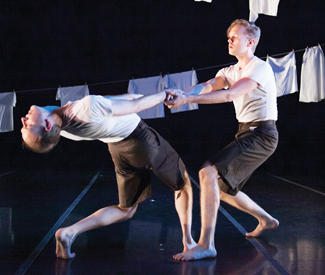
Last year, Simonse danced in a black ruffled skirt with Theatre Flamenco. He looked fabulous. So perhaps, it’s not surprising that for the premiere of I Could Never Make You Stay he donned a white facsimile. His and Eckert’s first try at co-creation yielded an unwieldy but harmless affair with some fine and a lot of meandering dancing. Each choreographer contributed a perspective on impermanence.

Eckert’s duet with handsomely trained newcomer David Schleiffers had the two men locked in a frozen head-to-head collision. It’s an image that would re-occur. They looked like boxers waiting for the referee to step in. But then some mysterious force started to turn and unglue them into luscious encounters with sensuously interlocking arms and a sense of spacious, though temporary, connection between them.

Taking a break from hanging laundry, Simonse’s well-paced solo sent him scurrying along the ground, loping across the stage, curling and shooting his limbs in all directions. Dancing on to his toes with his arms into ballet’s high fifth position, he projected his longing upward. I Could Never‘s most charming sequence, however, came with an unlikely duet for tall, sturdy and visibly pregnant Peta Barrett and a weasel-like Chad Dawson.

The white T-shirts on Simonse’s laundry line may have stood for past loves — but perhaps they were just ordinary white shirts. A quartet of women, in a feminist metaphor, wiped the floor with them, or donned them as accoutrements. The grand finale’s 16 whirling dancers cheerfully asserted as couples the work’s title, and indeed, they couldn’t make each other stay. Dressed in voluminous white wedding gowns, they looked as if they’d been plopped into creampuffs. Rigorously shaking their colorfully clad legs, they metamorphosed into circus artists.

Weird tales

0

cheryl@sfbg.com

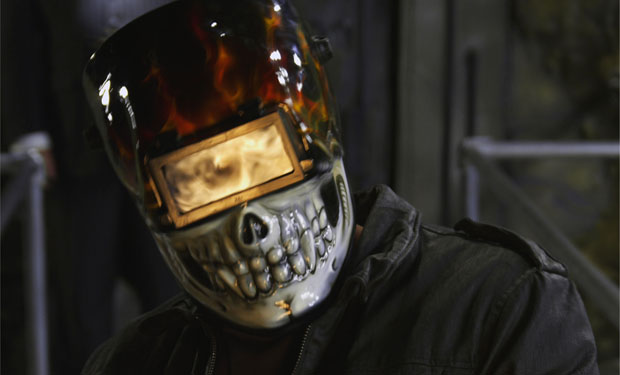
FILM It was a particular thrill to talk to Don Coscarelli on Jan. 8 — Elvis’ birthday. He is, after all, the guy who made 2002’s Bubba Ho-Tep, which imagined an elderly version of the King fighting the evil mummy that’s menacing his nursing home. Coscarelli’s other credits include 1979’s Phantasm (and its 1988, ’94, and ’98 sequels), 1982’s The Beastmaster, and his latest: supernatural noir buddy comedy John Dies at the End, based on David Wong’s comedy-horror novel.

San Francisco Bay Guardian I’m a big fan of Bubba Ho-Tep. I read that you met [John Dies star] Paul Giamatti because he was also a fan of that film.

Don Coscarelli Absolutely true. About five or six years ago, I received an email from Eli Roth, who was over in Eastern Europe working on one of the Hostel movies. He’d had a meal with Paul while they were there, and Eli sent me this email right away: “All Paul could talk about was Bubba Ho-Tep!” I thought he was just exaggerating, but it was true — Paul really liked the movie a lot, which was really rewarding to hear.

When we first met, I was trying to put together a sequel to Bubba Ho-Tep, and I had this idea that Paul could play Elvis’ manager, Colonel Tom Parker. The Bubba project didn’t end up coming together, but when I came across the David Wong book, I pitched it to him and he really liked the idea. So he helped as both executive producer and by playing the role of Arnie in the movie.

https://www.youtube.com/watch?v=Vy83MPk7Wpg

SFBG Besides Giamatti, the cast is mostly up-and-comers — plus Glynn Turman, who played the mayor on The Wire. Are you a Wire fan?

DC A huge Wire fan. I’m toying with the thought of starting from scratch and watching it from the beginning again.

SFBG How did you cast the dog, Bark Lee?

DC Here’s the thing with dogs: many years ago when I was a young lad, I made this movie called The Beastmaster (1982), and I learned not to expect much from animals. [Their performances] all have to be done in terms of editing and just lots of shooting. But this dog — and his real name is Bark Lee — I’d known for awhile, because [his owner is] a good friend who was one of the co-producers on the movie, Brad Baruh. So I thought, “Why couldn’t Brad’s dog just play the role?” Brad started training him on his own, and it worked out great. He did very well.

SFBG How did the special effects in John Dies break down, in terms of props versus CGI?

DC I never really quantified which is which. We probably bit off more than we could chew in terms of too many digital effects. But, look — they’re all just tools, and you just have to find the right one for the right thing. Sometimes, combining the two can be so much better than either of them.

The meat monster sequence [in John Dies] was always a challenge. In pre-production, I was trying to figure out how to do it. I consulted a lot of friends and effects folks, and was thinking at one time of making it a 3D construct. But then it had to interact with the actors, and throw out a sausage link and grab ’em by the neck, and I just didn’t see how that would work in CG.

Robert Kurtzman, who is one of the guys from K.N.B. EFX Group, had also done the Bubba Ho-Tep monster. He did an illustration where we could do it as a man in a suit, so we did it that way — and the suit is a total work of art. When it was finished, we added some highlights with CG, where we animated the little trout that runs up the back of the meat monster as he’s coming together. I think that added a level of bizarreness to it that took the edge off it just being only rubber.

SFBG John Dies has a lot going on: gore, surreal humor, buddy comedy elements, and even some film noir flair. How did you get the tone just right?

DC It’s all a function of the editing process. Going into it I had a lot of ideas about what the tone would be, but when you’re filming it’s hard to really keep track of that. With this screenplay, there was always the opportunity for it to go off the rails. It takes so many liberties and it’s so out there.

Luckily I had enough time where I was able to bracket the performances. I could do a subtle one, I could do a moderate one, and I could do an over-the-top one. Editing’s really like writing with visuals — you can watch the previous scene and watch the succeeding scene and then tailor it so that you’ve got some sort of tone and flow. But it always was a challenge.

SFBG Any chance you’ll ever make that Bubba Ho-Tep sequel?

DC Elvis is eternal. He will outlive all of us! It’s something I would like to do. It felt like it was gonna happen, about three or four years ago, and then it just fell apart. But I still would love to do it one day, and I’ve got a lot of great ideas.

One of the best things about Bubba was that we had a load of fun thinking up sequels. You can just take Bubba and put a monster after it, and you’d have a sequel. You’re talking about weird ones like Bubba Blob, and of course there was always Bubba Sasquatch, which would have been great. Because, you know, Elvis in the woods fighting a tribe of Bigfoot … now that would be cool! 

JOHN DIES AT THE END opens Fri/8 in Bay Area theaters.

West Memphis blues

3

arts@sfbg.com

FILM At this point, it’s hard to imagine a present-day murder trial more painstakingly documented than that of the so-called West Memphis Three. The subject of four documentaries, with a feature film in the works (starring Colin Firth and Reese Witherspoon, no less), and inspiring at least as many books, websites, and countless articles, the story of the three teenagers convicted of the brutal killings of three small boys has never quite dropped from public attention.

Still, despite its relatively high profile, almost two decades have passed since the crime, and the defendants’ quest to have their convictions overturned has taken literally half their lives — a journey they’re still traveling, despite a surprise 2011 deal cut with the state of Arkansas that allowed them to walk out of prison, free men but convicted felons. According to the newest documentary in the canon, West of Memphis, that’s just too long to wait for justice.

West of Memphis can be considered both a crash course for those who somehow missed the Bruce Sinofsky and Joe Berlinger-directed Paradise Lost trilogy of documentaries which preceded it, as well as a telling portrait of a deeply-flawed criminal justice system at work. It’s an evenly-paced montage of talking heads, archival trial footage, and interviews with investigators and legal experts, with additional focus on the personal life and relationship between death row inmate Damien Echols and his wife Lorri Davis, who met while he was incarcerated.

The doc traces the entire case, from the initial news reports of the disappearances of eight-year-olds Christopher Byers, Michael Moore, and Steve Branch, to the supporter-funded, post-conviction investigation and appeals process still unfolding today. Produced by Echols, Davis, and power-duo filmmakers Peter Jackson and Fran Walsh, West of Memphis centers specifically on Echols’ case, in distinct contrast to the Paradise Lost films.

“There were a lot of different reasons for that,” director Amy Berg explains. “[One was] because Damien was on death row, he was taking a different journey through the legal system [than fellow defendants Jason Baldwin and Jesse Misskelley Jr., who were sentenced to life imprisonment instead].”

Another reason: access. Echols and Davis were not only central to the narrative of the film, they were also instrumental in getting Berg acclimated to West Memphis. Their contacts became her contacts, and their story became her focal point.

Over the years, Echols’ defense team had gradually amassed testimony from a slew of high-powered experts — profilers, forensic pathologists, and DNA testers — all of which pointed away from the West Memphis Three, and in some cases suggested new suspects. But despite this seemingly compelling material, Echols’ appeal hit a wall in 2008, when then-Circuit Court judge David Burnett, who had presided over the original trials, denied a new hearing, citing “inconclusive evidence.” It was then that Jackson and Walsh, who had privately bankrolled much of the investigation leading to the DNA appeal, began to think about making a documentary.

“We’d been shut down by the court system,” Davis says. “We didn’t know what else to do to get this information about the case out to the public.” That’s when Berg, whose 2006 doc Deliver Us from Evil was nominated for an Academy Award, was approached by Jackson about the possibility of filming the continuing saga of the West Memphis Three. A former investigative journalist, Berg’s experience in the field led to some very interesting interview footage of subjects hitherto undocumented, including two young men — friends of a nephew to victim Branch’s stepfather — whose rather late-in-the-game affidavits may turn out to be the impetus for the state to reopen the investigation that the West Memphis Three have been hoping for.

“Amy just has this amazing ability to wait it out,” Davis says. “People would just open up to her.”

But where were these witnesses before West of Memphis? There’s been a reward offered on new information for years, and it seems like there’s been plenty of opportunity for folks to come forward before now.

“There’s such a culture of fear in Arkansas, and in the South in general,” Berg considers. “I really think everyone was concerned for their own well-being.”

It remains to be seen if breaking the long silence of a cluster of perjurers and procrastinators will translate into a reopening of the case; word is there’s some movement in that direction. But for now, at least, the public finally has a chance to hear the testimonies that the West Memphis Three have waited so long to present.

WEST OF MEMPHIS opens Fri/8 in San Francisco.

Editor’s notes

97

tredmond@sfbg.com

EDITORS NOTES People who rent apartments aren’t second-class citizens. In fact, under San Francisco laws, they have (and ought to have) many of the same rights as the landed gentry.

If you rent a place in this city, and you pay the rent on time, and abide by the terms of the lease, you should be able to stay in your home (and yes, it IS your home) as long as you want. The rent can only go up by a modest amount every year.

Landlords know that when they enter into rental agreements. Accepting a tenant means acknowledging that the person may want to say in his or her apartment for years, maybe for life; the rent the landlord sets for that unit has to be adequate to cover a share of the mortgage, expected maintenance costs, and a reasonable return on the owner’s investment.

When you buy a piece of rental property in the city, you are told that tenants live there; you’re told what rent they pay, you’re informed that you can’t raise it much, and unless your utterly ignorant of local law, you realize that the tenants have, in effect, lifetime leases since you can only evict them for “just cause” — which does not include your desire to make more money.

If the numbers don’t pencil out under those conditions, they you shouldn’t buy the place.

That’s how a sane rental housing system ought to operate. Unfortunately, the state Legislature has undermined local rent-control laws with the Ellis Act, which allows landlords to evict all their tenants, cease renting altogether, and turn the place into condominiums. Or, since there are limits on condo conversions in this city, into tenancies in common, which are not limited at all.

Sup. Scott Wiener wants to make it easier to turn TICs into condos; he says the poor TIC owners are having a tough time and can get better mortgage rates if they rules are changed. I don’t feel bad for them; they knew the rules when they bought their TICs. They have no right to convert to condos; that’s a privilege granted to a limited number each year, by waiting list and lottery. Buy a TIC? You should assume it will remain your ownership model for a long, long time.

The city can’t stop the TIC conversions, but it can set ground rules — for example, local law mandates a payment to tenants who are evicted, which can reach $5,000. Sounds big — but it won’t even pay two months’ rent on a new place in this market.

SO let’s be fair here: If you want to evict a tenant, who has and ought to have the right to a stable place to live, you should pay enough to make that person whole. Calculate market rent on a similar place; subtract the current rent the tenant is paying, and cover the difference — for, let’s say, five years.

If that makes TICs too expensive, and thus lowers property values by making evictions difficult and keeping rents low, fine: Property values are too high in this town anyway. And if it means more stability for lower-income people at the expense of property owners … well, I can live with that.

Freak show

0

emilysavage@sfbg.com

TOFU AND WHISKEY As Homer Flynn describes to me the Bay Area musical landscape during the time when iconic, experimental music-arts collective the Residents first rolled into town in 1966, I can’t help but picture a tiny gold hammer cracking the earth wide open like it was a piñata, with glitter, powdered wigs, freakish masks, oversized eyeballs, and gingerbread men spewing out in a magnificent tangle.

“A lot of what attracted the Residents to the Bay Area was the psychedelic music scene of the mid-to-late ’60s,” he says, with a pleasant Southern drawl. “What was so interesting about that era, was that it was wide open. Because the money was not as big, there was a lot more freedom.”

Flynn’s talking to me as a van carrying the current members of the Residents careens through the New Mexico desert on their first tour in two years, their 40th anniversary tour, which crawls to San Francisco on Feb. 24 (8pm, $35. Bimbo’s, 1025 Columbus, SF. www.bimbos365club.com).

Looking back at the beginning of the band’s career, he includes early FM radio as part of that equation: “FM radio was really getting its start, in terms of broad exposure, and it was wide open. You would turn on KSAN Radio at that time, [and] you could hear Mozart, the Grateful Dead, Bob Dylan, swing music. It was very eclectic, and that’s what made it interesting.”

He could be describing the Residents themselves with that last descriptor. The mysterious band (always covered in the face, often in whimsical dada-tastic costumery) might have been lured to the Bay by the psychedelia scene, but they took cues from far broader reaches of sound. There was cosmic jazz composer Sun Ra — “I mean, Sun Ra said he was from the planet Saturn.”

“There was a lot of mystery about Sun Ras…and when he spoke, everything was all poetic and enigmatic. He was a huge influence on the Residents, in terms of style and music presentation, although, they never really tried to emulate him in terms of music. But there was a lot of respect and influence.”

Musically, and composition-wise, there was influence from Captain Beefheart, more on the fringes of psychedelia, and far weirder than the acts that made it exponentially bigger by decade’s end. But the Residents have staying power — releasing 60 albums and multimedia CD-ROMs over four decades, including first single Santa Dog (1972), and milestone records like Eskimo (1979) and Freak Show (1990).

This is probably a good time to point out that we the listeners don’t exactly know who the band members are, or who Flynn is.

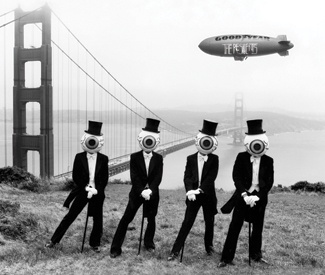
This much is true: the Cole Valley neighborhood resident is part of the band’s two-person management team, Cryptic Corporation. He’s also the art director who created most of their album covers, and who ushered in the concepts for the Residents’ many memorable faceless looks (specifically, and most well-known, the eyeball masks, though his original concept for that was giant silver globes).

The heavy globes were a no-go, so someone suggested eyeballs (the better to see you with).

“It was like, well if you have an eyeball, what goes with that? At this time it was still hippie to some extent. What was in for bands was sloppy and slovenly — which, of course, it still is at this time — so the idea of tuxedos they thought, that’s cool and classy. And then the top hat was just the perfect compliment to the eyeball and the tuxedo.”

He may also be in the band, and the band’s main lyricist, but claims to this day otherwise. It’s been a long debate, as to who is actually a member of the Residents, because, again, they all wear masks.

However Flynn’s connected with the group, he’s certainly been along for the journey — the Shreveport, La.-native has long been in that bumpy Residents bus, not least for this tour, the 40th anniversary special, which began a day before our conversation.

The live show this time around is a retrospective of the Residents entire career, laying out the colorful story of the band, with monologues and musical bits throughout. The show kicks off — where else? — with “Santa Dog.” Flynn says it’s meant to paint a broad and entertaining picture of the band.

To add a punctuation mark to the anniversary, the group is offering an ultimate box set: a 28 cubic-foot refrigerator containing releases from the group’s entire career, 100 different first pressings including 40 vinyl LPs, 50 CDs, DVDs, and a signature eyeball-with-top-hat mask. Asking price? A cool $100,000 to the lucky buyer.

On the road, the group is also bringing more practical merch, such as t-shirts and commemorative coins. Hopefully there’ll be plenty left at the Bimbo’s show near the end of the tour. While there will still be a couple more dates after it, Flynn considers the SF show to be the big return home.

“I’ve traveled around quite a bit, I’ve seen a lot of places that I like, I’ve never seen any place else that I’ve wanted to live. In terms of the Residents, best thing I can say is that they’ve been happy to call the Bay Area home.,” Flynn says dreamily. “I know it will feel really good to pull up in front of Bimbo’s and take all our stuff in, our well-worn crew at that point, coming to play the show.”


GHOST BEACH

Are you familiar with the term “tropical grit-pop.” Neither was I, but listen to the NYC band Ghost Beach’s Modern Tongues EP, and it should all come together. Or better yet, see it live this weekend. It’s all electronic burps and yacht rock vocals, from a pop duo (possibly?) named after a Goosebumps book, with ’90s-baiting lyrics, and ’80s synth layers. With ONUINU, popscene DJs.

Thu/7, 9:30pm, $10. Rickshaw Stop, 155 Fell, SF. www.rickshawstop.com.


BIG FREEDIA

If you’re celebrating Mardi Gras without Big Freedia, you’re doing it wrong. Lights Down Low is bringing the New Orleans bounce queen out especially for you, the sexy people. Oh, and don’t forget to twerk. With MikeQ, Hard French DJs.

Fri/8, 9pm, $16 (advanced tickets). Mezzanine, 444 Jessie, SF. www.mezzaninesf.com.


BEAK>

Beak> is at one once unsettling and charming; its Krautrock backbone and angular guitars create eerie, paranoid grooves, à la Silver Apples — you know the itchy, building beats — but those hushed, mumbly vocals soothe the senses. Drummer-singer Geoff Barrow, keys-guitarist Matt Williams, and bassist Billy Fuller, are all members of other bands (including Barrow’s Portishead), so they split their time between acts, but have already released two albums in the few short years they’ve been able to get together, including critically-lauded 2012 full-length, >>. And their albums are all live recorded improv sessions in the same room, which translates well to shows, making the appearances mesmerizing extensions of previous jam sessions. With Vex Ruffin, Peanut Butter Wolf.

Feb. 13, 8pm, $20. Independent, 628 Divisadero, SF. www.theindependentsf.com


Framing devices

0

VISUAL ART Several recent, notable group exhibitions have me thinking a bit more actively about the roles curators play as artists in the shows they assemble. As much as DJs or editors, curators are present in their shows as artists, sometimes demurely, sometimes not.

As curator of the “Disrupt” two-person show at Highlight Gallery, Kelly Huang has shrewdly assembled a pair of artists whose work reinforces each other. Seen together, the paper-based works of London’s Marine Hugonnier and Cairo’s Taha Belal, create a kind of duet of interrelated working styles. Both artists use silkscreen to recast newspaper and magazine pages with intricate designs and blocks of color. Hugonnier tends to work in series, appropriating several consecutive days worth of front pages from the same newspaper during the course of pivotal political events, then blocking out images with bright primary colors in a way that recalls both Ellsworth Kelly and Piet Mondrian. Belal prefers delicate tiled pattern work overlaid on full color ads, applied in a way that confuses, heightens, and twists the intended message on the page. Through Sat/2, Highlight Gallery, 17 Kearny, SF; www.highlightgallery.com.

When a gallery with considerable reach decides to mount a thematic exhibition, it can be both impressive and almost unruly, as with Fraenkel Gallery’s sprawling “The Unphotographable” show, featuring images by Alfred Stieglitz, Man Ray, Richard Misrach, Glenn Ligon, Wolfgang Tillmans, Diane Arbus, and many others. Truthfully, there’s probably too much here, but there are several gems in the gallery, lightly organized to highlight attempted photographic captures of the sublime, the disembodied, the transcendent, and the elusive. The most potent works in the show — among them Gerhard Richter’s September, an image of his 2005 painting, itself a conceptual model for abstract representation — counteract their own assertions of verisimilitude in favor of something more circumspect and self-aware. Through March 23, Fraenkel Gallery, 49 Geary, SF; www.fraenkelgallery.com.

For logistical and practical reasons, it’s fairly uncommon to hear of curators commissioning works for a gallery show, but the results can be intoxicating, as with “Remembering is Everything” at Alter Space. Bean Gilsdorf and A. Will Brown got six artists to contribute a work based on his or her own remembering of the same original video, which was destroyed after viewing. Befitting the premise, the works in the show contribute to a general field of reverberating feedback, each one in this context providing you incomplete points of view on an unknown experience.

Themes of recursion, repetition, and fugue recur, as in Stephen Slappe and Kate Nartker’s looped video works that both posit unresolved narrative chords, and Nancy Nowacek’s performance Circuit (As I Caught), in which mysterious packages filled with objects recalled from the video appear at the gallery each day of the exhibition. The effect is like an enacted Haruki Murakami dream sequence, and you’re immediately drawn into the activity of fabricating and assembling the show’s affects and objects into a kind of tenuous, vague, and poignant gestalt. Through Feb. 23, Alter Space, 1158 Howard, SF; www.alterspace.co.

Sometimes, the curatorial conceit is basically an excuse, as with “While We Were Away” at 941 Geary, which the press release says is “composed entirely of artists [curator Tova] Lobatz has become aware of while traveling.” Despite the throwaway premise, some of the work — especially by Sten Lex — is impressive. Sten Lex, the Italian stencil duo, makes arresting op-art flavored stencil portraits usually on grand scale on the sides of buildings; here on panels. What differs from the street-art norm in their work, aside from the precise Ben-Day rendering, is the not-really-offhand way they leave the painted stencil affixed to the substrate to let it peel or erode over time, a swerve that makes the painting’s correlation to the original photo more precise as it ages. Their four untitled works in the gallery demonstrate various points in that progression. Through March 2, 941 Geary, SF; www.941geary.com.

LOOKING AHEAD:

For “Silence,” curators Toby Kamps (Menil Collection) and Steve Seid (BAM/PFA) dig deep to assemble almost everybody you can think of — Beuys, Duchamp, Klein, Magritte, Warhol, Broodthaers, Manders, Marclay, Roden, Salcedo, others — to address the representation of silence using John Cage’s 4’33” as a point of departure. Jan. 30-April 28, UC Berkeley Art Museum/Pacific Film Archive, 2575 Bancroft, Berk; bampfa.berkeley.edu.

A new series of muralist group shows launches with work by Apex, Casey Gray, René Garcia Jr., and others. Erotic, anaglyphic 3D glitter wallpaper? Sign me up. Feb. 7-July 1, Project One, 251 Rhode Island, SF; www.p1sf.com.

Kehinde Wiley’s flashy, uber-hip portraits have made him the international go-to darling of both the upmarket and Juxtapoz crowds. Expect high craftsmanship and an eye for drama. “The World Stage: Israel,” Feb. 14-May 27, Jewish Contemporary Museum, 736 Mission, SF; www.thecjm.org.

The word “visionary” is perhaps overused in the world of architecture, but the jarring, psychologically charged work of Lebbeus Woods warrants the use. The recently deceased architect’s work will be represented by 175 drawings, renderings, and models in this career survey. Feb.16-June 2, San Francisco Museum of Modern Art, 151 Third St., SF; www.sfmoma.org.

Southpaw

1

virginia@sfbg.com

APPETITE As I’ve often bemoaned, finding authentic ‘que outside of the Deep South is a rarity. Case in point: Southpaw opened late 2011 on Mission Street, a BBQ oasis of the gourmet kind, brewing its own beers in a couple in-house tanks. Welcoming staff and flaky catfish impressed me early on, but watery sauces and dry ribs and brisket deflated my BBQ dreams.

Fast-forward a year. With new chef Max Hussey on board, I’m back, working my way through much of the food, cocktails, and beer selection. As a Massachusetts dishwasher and prep cook, Hussey boldly slipped a resume to Emeril Lagasse at a book signing, moving to New Orleans a month later to eventually become executive sous chef of Emeril’s Delmonico. Melding Southern touches with San Francisco tastes, he’s cooked at 25 Lusk and Epic Roasthouse.

Southpaw’s BBQ staples (pulled pork, brisket, ribs) have all improved under Hussey’s watch. While ribs look dry, crusted in 17 spices, they’re actually tender, aromatic, addictive. Appropriately fatty beef brisket is smoked for 14 hours. If you must do chicken at a BBQ joint, you could do worse than this whiskey-brined version. Catfish is still strong, lightly pan-fried, and available on a sandwich ($9), which begged for a little more remoulade on melting-soft brioche. Newly-added quail explodes with boudin sausage. Each meat and catfish selection comes as a platter ($14-19), with hushpuppies and choice of two sides. Choosing those sides ($5 each or 4 for $14) is a challenge. Cheddar grit cake hides a juicy hamhock, mac ‘n cheese comes alive with red pepper, sweet potatoes are whipped soft with bourbon, sweet chili-braised Southern greens and a new creamed “lollipop” chard kale make eating greens nearly dreamy.

Creativity shines in starters like smoked pulled goat ($12) with salsa verde and house pickles scooped up by Southern fry bread, or roasted duck breast and goat cheese rosti ($12). Abandon all, however, for Natchez ($12), named after the Mississippi town, sounding a lot like “nachos”. Think warm potato chips falling apart under pulled pork and black eyed peas, drenched in pimento bechamel and hot sauce. Divine bar food.

Hussey also perfects fried oysters. These delicately treated bivavles exude briny freshness unusual for fried oysters. Currently, they’re loaded with bacon and onions on a sandwich ($11). While BBQ sauces like sweet potato remain a bit watery, lacking in flavor punch for me, Memphis smoked sauce is briskly gratifying. But all praise goes to better-than-ever Alabama white sauce: mayo-based, packing pepper and vinegar bite, it makes just about everything sing. I’d rather fill up on savory options than desserts ($8), but banana pudding with house ‘nilla wafers evokes childhood comfort.

Drink is as important as food at Southpaw. Brewer Phil Cutti started homebrewing in 1995 after shopping at SF Brewcraft. Learning from Speakeasy founders Steve and Mike Bruce, homebrewing led to his own gypsy label, Muddy Puddle Brewing. Southpaw’s small program allows him to experiment with a range of beers and collaborate with other brewers. House brews ($6) are balanced, readily drinkable crowd pleasers. Posey Pale Ale is subtly hoppy, Pisgah Rye Porter is complex without being heavy, and a Smoked Cream Ale is smooth with a smoke-tinged finish. As active members of SF Brewers Guild, which puts on the fantastic SF Beer Week (www.sfbeerweek.org) coming up February 8-17, Southpaw hosts intimate classes and tastings, like a collaboration beer pairing dinner with San Diego’s famed Stone Brewing on Feb. 11, one of the brewers they feature on their hand-selected draft menu.

In addition to beer, Southpaw founder-manager Edward Calhoun’s American whiskey selection and cocktails make fanatics like me smile. Growing up in his father’s North Carolina bar, Calhoun honed bar chops in three cities that know how to drink well: Savannah, New Orleans, San Francisco. Playful balance exemplifies the cocktails ($9), whether a Rye Old Fashioned sweetened by pecan syrup or Rescue Blues: smoky Scotch and Combier Rouge dancing with cocoa nib syrup. My favorites? Mishi’s Regret No. 2, hot with habanero, smoky with Mezcal, brightened by lemon and cassis, or cheekily-named Tom Haverford (Aziz Ansari’s character on my beloved Parks & Recreation) where sarsaparilla-root beer notes of Root liquor intermingle with lemon and Shiraz wine. Get educated with whiskey flights ($12-16) grouped in themes like Peated American Single Malts or Bay Area Whiskey, or flights featuring a craft distillery like High West.

Gracious founder-manager Elizabeth Wells, an Alabama native, sets Southpaw’s downhome tone. She moves about the restaurant, attending to needs of each table. Staff follows her lead, ready with a smile, a platter of ‘que, and a glass of bourbon. Down home, indeed.

Southpaw BBQ 2170 Mission, SF. (415) 934-9300, www.southpawbbqsf.com

Subscribe to Virgina’s twice-monthly newsletter, The Perfect Spot, www.theperfectspotsf.com

Continuity

0

le.chicken.farmer@gmail.com

CHEAP EATS Hoolibloo lives next door, where Elsa the Very Very Old Peruvian Woman used to live. I changed light bulbs for Elsa in the ’90s, and reset her clock every time the time changed or the power went out. Or a battery died.

Then, when I moved back into the building 10 years later, she didn’t recognize me. A lot had changed. I tried to explain, but she didn’t understand, but maybe she did and I didn’t understand her understanding. Her ability to speak English started and ended with asking for help and bragging about how very very old she was. And my understanding of Spanish is limited to the meats. So a typical conversation between us would go something like this:

HER: Please can you help me?

ME: (helping her) Carnitas, Elsa. Carnitas!

HER: I am very very old. Very old.

ME: (finishing up with the helping her) Carne asada. Um, pollo.

HER: Thank you. Thank you very mucho.

ME: De nada, Elsa. Hasta lechuga.

And all of us, everyone in the building, would help her up the stairs. Whereas Hoolibloo, my friend who moved in when Elsa (sniff) moved out, takes the stairs by herself — often even briskly.

“Here, let me help you,” I say, out of habit. But she turns me down, arguing that she’s 25.

Fluently! She doesn’t even have to draw the numbers in the air, like Elsa used to do. But I guess that’s the difference between Chicago and Peru, coming-fromwise. Not to mention 50 years.

In spite of her relative youthfulness, Hoolibloo does not play on my football team, or even in a band. Still, she is our closest friend. When Hedgehog and I sit on our couch and she sits on hers, we are only two sheets of drywall and six inches of insulation apart.

She helps Hedgehog make movies, and me find restaurants. Why, just the other day she showed me to Poc-Chuc. We were both working at home, and were craving sandwiches, only when Hooli called up Ike to place our order they said it would take about an hour, that’s how crowded they were.

So then we started to crave empanadas instead.

One thing I love about hanging with people half my age is they talk about interestinger stuff than I do. I’m all, Oh, my knee is gone! I blacked out in the bathroom! What’s wrong with my butt! . . . and meanwhile they’re working out what to do with their life.

Which makes much more lively dinner conversation.

Lunch too, come to think of it.

Over Empanadas we discussed guns, Israel, guns in Israel, and writing. Hoolibloo would like to write something, she said, but not necessarily a whole book.

“You’re talking to the right person,” I said. I start and don’t finish books with a level of expertise seldom seen outside the world of professional bowling.

But that kind of wasn’t what she was talking about.

She had just come back from Israel, where her grandma lives, and was fixing to fly off somewhere else. Her dream job would entail a lot of travel. And autonomy. “But I also really like to be part of a team,” she said.

“I can teach you football,” I said. Ever the recruiter.

Poc chuc, the signature dish of Poc-Chuc, is thinly sliced pork marinated in citrus, grilled, and served with onions, tomatoes, rice, and a small bowl of pureed black beans that I almost forgot to even taste, everything else was so freaking delicious and plentiful.

I don’t normally like empanadas, but I loved Poc-Chuc’s ones. They were less doughy and more flavorful than most, maybe because of the same black bean puree. Which also found its way into the Panuchos. And believe me, as someone who changes diapers for a living . . . black bean puree in the panuchos? That’ll happen.

Really though: really really awesome Mayan food. The Panuchos, which also feature shredded turkey, avocado, and pickled red onions, were fantastic. Kinda somewhat similar to empanadas, only fried.

I can’t wait until Hedgehog comes back from L.A. so I can show this to her.

POC-CHUC

Mon-Wed 10:30am-8:30pm; Thu-Sat 10:30am-10pm; Sun 4-9:30pm

2886 16th St., SF

(415) 558-1583

AE/D/MC/V

No alcohol


Festival of festivals

2

arts@sfbg.com

THEATER The chill air had no snow in it. Instead, a particularly nasty outbreak of influenza whipped through the city, leaving a fine coating of mucus on the ground. Still, New York City looked beautiful as the various performing arts festivals that cluster around the annual meeting of APAP (the Association of Performing Arts Presenters) all revved up for a fat two weeks of shows this January.

These festivals, pitched to out-of-town-presenters and general audiences alike, include Under the Radar (an international but New York– and American-heavy program at the Public Theater), PS122’s Coil festival (specializing in theater but including some contemporary dance and performance), American Realness (a concentrated dose of leading contemporary dance/performance on the Lower East Side), Other Forces (a program of new independent theater presented by Incubator Arts Project, itself originally a program of Richard Foreman’s Ontological-Hysteric Theater), and the brand new Prototype festival (whose niche is new, chamber-sized opera-theater).

Under the Radar is the daddy of them all. Founded by longtime new-work maven Mark Russell (formerly of PS122) and now in its ninth year, Under the Radar has become more concentrated of late, partly in reaction to the other specialized festivals that have cropped up alongside it.

Festival director Russell described the trajectory in a recent phone conversation. “It’s a very interesting time, because by the ninth year you’re a fact on the landscape. People are beginning to take you for granted,” he said with a laugh. “Yes, there are a lot of other festivals now; it’s sort of become festival central in these two weeks in January, which is a little crazy, and I don’t recommend it. But it has created its own scene, in a way. I think that’s great. We started out trying to be big and trying to encircle a lot of the work that was going on downtown and around the world. Now, I’ve actually shrunk the festival to be more surgical and specific. Two years ago we were doing 21 things, and this year we’re doing 12, which feels more comfortable and better. We’re trying to go deeper in each of these performances and support them better, and let other people curate their way with the other festivals as well.”

UTR’s program this year included premieres by some leading American new-work companies, including Philadelphia-based Pig Iron (whose Chekhov Lizardbrain came to San Francisco as part of the 2011 FURY Factory Theater Festival). Pig Iron’s Zero Cost House is a simply but shrewdly staged, intriguingly unexpected collaboration with Japanese novelist-playwright Toshiki Okada (founder of theater company Chelfitsch). It unfolds an autobiographical dialogue between the younger and the present-day Okada over Thoreau’s Walden across a shifting set of actors and related characters (including a downbeat and down-at-the-heel Thoreau). Its po-faced humor belies an ultimately serious exploration of enduring ideas about our relation to society, political commitment, and art’s function amid the insanity of a status quo represented by the overwhelming indifference to the Fukushima nuclear disaster. This was a stimulating call to thought and imagination as nothing less than action toward survival.

Questions about art’s social role and power, as well as the lines joining the mundane to the great political and narrative arcs of the age, ran through much more work besides. One of the fresher, quietly unsettling surprises in this respect was Australian company Back to Back’s brilliantly staged Ganesh Versus the Third Reich, a deceptively low-key exploration of power and marginality by a five-member ensemble that includes actors with varying mental and physical disabilities. On a largely bare stage repeatedly transformed by large transparent curtains into a gorgeous shadowbox landscape of mythological proportions, the riveting cast plays out its own inner turmoil along an extremely subtle line separating the ridiculous and the profound, meanwhile complicating our perception of what is in fact real.

In a highly anticipated offering, New York’s Nature Theater of Oklahoma premiered eight hours worth of its Soho Rep–produced opus Life and Times (Episodes 1-4) — more episodes are apparently forthcoming — which channels the verbatim childhood reminiscences (replete with uhs, ums, likes, whatevers, and oh-my-gods) of a middle-class American 30-something (company member Kristen Worrall) through an evolving set of choreographed, highly stylized, mostly-musical ensemble performances. Again, as directed by founders Kelly Copper and Pavol Liska, the banal is elevated to the level of the epic, but in a precious and ironic way that, for all its precision and the seriousness of its core idea, leaves one feeling mostly empty, bored, and frayed by the text’s endless assault of half-articulate and overly familiar riffs on family, friends, awkwardness, first kisses, religion, and so on. With the dialogue divvied up among an entire ensemble in coordinated outfits, vocal harmonies, and group dance steps, we’re being made to hear again what we hear all the time, which invites certain revelations, but they seemed precious little compensation for the tedium of it all.

Further downtown at American Realness, where founder Ben Pryor’s astute gathering of contemporary dance-performance is now in its fourth year, there was much greater and subtler impact to be had from a slim hour spent in a largely unadorned room with performance maker Jeanine Durning. She also set forth a barrage of speech, a continuous stream of consciousness that touched on many subjects and her own self-consciousness, but in that simple score came a powerful emotional encounter and myriad questions about language, communication, reason, madness, art, and subversion that left the audience slightly stunned and reeling in their chairs.

American Realness had its much-hyped disappointments as well, in particular Trajal Harrell’s Antigone Sr., a self-conscious and dull three-hour riff on fashion and voguing that is part of his seven-part opus, Twenty Looks or Paris Is Burning at the Judson Church, which sets out to explore a dialogue between the post-modern dance movement of 1960s Greenwich Village and the voguing scene taking place uptown in the same era. A provocative enough project, but this piece had little to recommend in terms of ideas or movement.

There were more modestly-scaled but far more engaging works to be found at American Realness this year, including Miguel Gutierrez’s collaboration with Mind Over Mirrors (musician Jaime Fennelly), Storing the Winter, a supple, sinewy and raucous solo dance-for-keeps; and Faye Driscoll’s dynamic, ecstatically unhinged duet, You’re Me, which comes to SF’s CounterPULSE in March. While BodyCartography Project’s Super Nature (co-presented with the Coil festival) was a mixed success, it nevertheless made me want to see them again when they bring Symptom (also to CounterPULSE) in February. Another AR offering not to be missed is Frankfurt-based American and former Forsythe dancer Anthony Rizzi’s hilarious, ridiculously reasonable, and super-shrewd An Attempt to Fail at Groundbreaking Theater with Pina Arcade Smith, which plays locally at Kunst-Stoff Arts Feb. 7–9. *


Starting slow and ramping up

1

SEX It’s the end of an era at local sex toy and education company Good Vibrations: Dr. Charlie Glickman is stepping down from his position as education program manager for the national retailer.

But Glickman is leaving for another adult education adventure: bringing the joys of prostate play to mainstream society. Joining up with San Francisco-based sex educator, Aislinn Emirzian, Glickman has co-authored The Ultimate Guide to Prostate Pleasure; Erotic Exploration for Men and Their Partners, set to be published by Cleis Press in February. The book is all about easy and pleasurable anal play, prostate massage, toys, pegging and anal intercourse, positions, common concerns, and safer sex techniques.

Glickman told the Guardian in an interview about that the book has been in the works for years. Though it’s not the first guide to prostate play, he feels as though he’s tapping into the zeitgeist, that our culture is finally ready for pegging and prostate pleasuring.

The man should know. Since 1996, the sex educator has been on the frontlines of trying to get accurate sexual health information to the Bay Area, and has taught many a prostate class through Good Vibes. His book release party on Thu/31 kicks off a North American prostate play workshop tour sponsored by the sex toy company, and looks to target an audience that mirrors the people who have shown up in Glickman’s sex ed workshops throughout the years: male-female couples, solo women, gay men, the college-aged to senior citizens.

Throughout the course of their research, the book’s authors interviewed over 200 men of all sexual orientations and their partners to capture a wide spectrum of perspectives on how prostate play expands one’s sexual menu, and what holds men back from experiencing its joys. Pegging is the term used to describe men being penetrated by women, often within a heterosexual context. Glickman and Emirzian’s guide is both a 101 on prostate anatomy and sensation, and an examination of the stigmas associated with prostate play.

But one’s prostate play comfort level is not determined by one’s sexuality alone, according to the authors. Reluctance to experiment — even among gay men — can be due to a perceived threat to masculine identity with which anal penetration is often associated.

Glickman says that the first challenge to exploring prostate pleasure exists on a physical level. “For most straight men, and topping queer men, sex happens outside your body as penis-oriented sex.”

“The basic story goes like this,” he continues in the guide. “Real men don’t get fucked — that’s for women, fags, and sissies. Because receiving penetration is usually viewed as the woman’s role in sex, a man may be worried that he isn’t fulfilling the man’s role if he takes a turn catching instead of pitching.”

Leaving the “get it up, get it in, get it off” mentality behind and moving into a receptive role can result in a new feeling of vulnerability. But men can expand the scope of what sex means to them by exploring the world of prostate play. According to Glickman, letting go of ass-based insecurity can open up a whole new world of sexual pleasure.

“Many straight men have said ‘I tried this and it completely changed our sex life,'” Glickman says. Getting to know the prostate can be a game changer.

And The Ultimate Guide is far from being a book for straight men. Glickman and Emirzian are adamant that most gay porn doesn’t adequately explore prostate stimulation, and the guide is also geared towards homosexual men — and for prostate players from the beginner to the advanced.

For example, in the chapter titled, “Prostate Massage,” one can learn all about how to use fingers properly: “When it comes to the prostate, poking is exactly what you don’t want to do! It may have felt great on your shoulder just now, but the prostate is another matter entirely,” says the guide. “We’ve spoken with a lot of men who complained about finger tips poking and stabbing their prostate, which can feel too intense, uncomfortable, or even painful.”

That chapter also includes sections on “starting slow and ramping up” and “rhythm and variety.” Another common misnomer that Glickman puts some ink towards correcting is the idea that bigger is always better when it comes to butt play. Did you know there is a difference between anal sensation and prostate stimulation? While anal sensations are affected by size of penetrating object, incredible prostate pleasure can be found with just one finger or a finger-sized toy. Tips like these aren’t meant to reduce men’s anxiety about being penetrated, especially those who have only seen anal sex in porn.

The book seeks to address both psycho-social concerns while providing practical how-to advice by carefully delineating between the multiple ways that the prostate can be stimulated and sexual orientation.

Another quote from the text: “The important thing to know is that whether you like anal penetration is about what kinds of sexual stimulation work for you; who you want to do it with is about your sexual orientation. While there can be some correlation between the two, one doesn’t imply anything about the other. If you’re gay and you don’t like anal play, you’re still gay. If you’re straight (or bi or any other sexual orientation) and you enjoy it, that doesn’t make you gay.”

THE ULTIMATE GUIDE TO PROSTATE PLEASURE BOOK LAUNCH

Thu/31, 6:30-8:30 p.m., free

Good Vibrations

603 Valencia, SF

(415) 522-5460

www.goodvibes.com


Dynamic duo

0

arts@sfbg.com

DANCE The Bebe Miller Company’s A History at Yerba Buena Center for the Arts last weekend proved to be both exhilarating and frustrating. First, the good: watching two gorgeous dancers engage each other in one encounter after another — both huge and tiny — for over an hour. Gradually, they emerged as two completely different and yet ever-so-compatible characters.

Angie Hauser can look almost demure, but there is such fierceness to her presence that you don’t want to get on the wrong side of that intensity. Darrell Jones, a tall, lanky dancer with limbs that can (and do) shoot in all directions simultaneously, is unstoppable — yet he also has teasing sense of humor about him. If Hauser could be almost earnest in her focus, Jones brought an often relaxed, quasi-casual quality to their work.

In the program notes, Miller says that History is a work about making work, specifically about having worked with Hauser and Jones for the last decade. On video Miller is a tiny figure, planted like a tree in a lush meadow, telling us that her body — and by implication that of her dancers — is "possessed by past dances." So History is a piece about excavating shards, remembering, or as one of the texts says, "remember remembering," everything that goes into the creative process. That’s a tough assignment. While conceptually intriguing, the 70-minute work didn’t completely convince because it didn’t stand as its own artifact with its own parameters. Hence the frustration.

History‘s collaborators, including the choreographer and her long-time dramatist Talvin Wilks, conceived of the work as a multi-media experience in which spoken and projected text, video images, and live dance would collide with each other. Unfortunately, the co-existence of these elements too often didn’t spark, proving to be more distracting than illuminating. Viewing History thus became an exercise in both reveling in and rebelling against the experience.

Even as History continued to slip one’s grasp, it was beautiful to watch. Mimi Lien’s semi-transparent panels enveloped the dancers in a neutral yet luminous space. At its best moments, Lily Skove’s video ran alongside the dancers and sometimes almost reached to grab them. The opening and closing images resonated particularly well. Michael Wall and Darren Morze’s score ranged from soft humming to a dance-y tune that sent the performers into paroxysms of joyous.

But it was Hauser and Jones who carried History. Their rich interactions were in a constant state of flux. Some were funny, some contentious; others were intimate, still others playful. Their sense of ease with each other may have developed over the last decade, but on stage it didn’t make any difference where it came from. Hauser is the verbal dynamo to Jones’ high-speed physicality; when she exploded into one of her speed monologues, he responded with a tease, or by simply rolling off their shared bed. They wearily watched each other using space, but also companionably loped around the periphery and engaged in hand games at the table. They did things as ordinary as taking off a partner’s shoe, or kneading one another like a piece of rising dough. If he came close, she flipped him off with a gesture. In an extended contact-improv inspired section, their bodies attempted to fuse almost to the point of eroticism. But they didn’t go all the way there.

One of History’s ingenuous devices was the use of headphones — the big, old-fashioned kind. The dancers raced to them periodically for a kind of grounding. Were they gateways to the past or did the simple act of listening — or yakking back — offer a respite from the physicality of moving? The headphones also highlighted the differences between the two dancers. Hauser devoured whatever she got from them, while Jones’ reactions were a lot more nonchalant.

Ultimately one walks away from History, imperfect vehicle that it is, with a sense of two dancers whose humanity is so closely integrated with what they do that you couldn’t tell the difference between the person and the persona. It was a rich idea to take home.

Libertine dream

3

marke@sfbg.com

SUPER EGO One of my supreme happy places, apparently, turned out to be the packed dancefloor of an underground fundraiser for Radical Faerie Burning Man camp Comfort and Joy, right around 3am a couple Fridays ago, when the drag queen DJ dropped “Rock the Casbah” and some behooded elfin rogue’s giant LED rainbow wings lit up and blinded me. Joe Strummer smiles from heaven, surely.

Alas, that drag queen, mi amiga grande Ambrosia Salad, will soon join the current nightlife exodus to Los Angeles, to follow her twinkling star (and cheaper rent) along the path to immortality — or at least an all-night churro cart. Can we get one here please thanks. But just when I despair of the city emptying of its precious idiosyncracies and after-dark characters, someone amazing pops up to charm the hotpants off of me and remind me of both San Francisco’s resilient weirdness and its cyclical subcultural nature.

“Oh, I moved out of the Castro when the drones moved in. Everyone started wanting to look the same, dress the same. It really took the fun out of the gay scene, these marching costumes coming in and stamping out the magic.” That’s twinkle-toned Todd Trexler, poster artist, AIDS nurse, and legendary bon vivant, speaking over the phone — not about about the samey-samey Wienerville the Castro has become, but the Castro clones of the mid-1970s. For all the renewed interest in the workboots, cut-offs, and mustaches of pre-AIDS SF gay culture (see local director Travis Mathews’ exciting, upcoming, James Franco-starring Interior. Leather Bar, which imagines the lost orgy footage from classic homoerotic/gay panic slasher flick Cruising and wowed ’em at Sundance last week), it’s good to remember there were also some fabulous butterfly dissenters to that macho wannabe world.

Trexler was a player in one of the seminal moments of alternative gay culture — after snagging an art degree from SF State, he designed the posters for the queer-raucous, acid-kaleidoscopic performance troupe The Cockettes’ first official shows, as well as the Midnight Movie series, later the Nocturnal Dream Shows at the Palace Theater in North Beach in the early ’70s, back when North Beach was a magnet for free-lovin’ freaks and nightlife oddities. (See, anything can happen). Now, he’s reprinted many of those iconic and visually stunning “Art Deco revival meets Aubrey Beardsley louche meets underground comics perversion” ink-and-photo masterpieces for surprisingly affordable purchase at www.toddtrexlerposters.com.

Divine in her iconic, kooky crinoline (“Basically she just threw on a bunch of stuff from the trunk of our car and voila, Divine!”) outside the Palace of Fine Arts for the “Vice Palace” play and, later, starring in Multiple Maniacs and “The Heartbreak of Psoriasis”; Sylvester looking his sultry best for a New Year’s Eve concert, and featured on a controversially explicit piece for decidedly hetero rock outfit the Finchley Boys; Tower of Power, Zazie dans le Metro, Mink Stole as Nancy Drew, the Waterfront gay bar — Trexler’s platinum stash of memorabilia will reinvigorate anyone zoinked out by our increasingly conformist, consumerist moment. (Trexler was prodded into reprinting by my favorite classic SF eccentric, Strange de Jim.)

And hey, there’s some hope for a freakish future, even: lauded local theater troupe Thrillpeddlers, which includes a couple gorgeous surviving Cockettes itself, will put on the Cockettes’ 1971, Trexler-postered “Tinsel Tarts in a Hot Coma” starting March 28, www.thrillpeddlers.com.

Trexler’s importance to gay culture doesn’t end with his glamourous posterization, however. After his ’70s time “crafting assemblage sculptures from gems found at Cliff’s Variety Store, hand-drawing the posters in the flat at 584B Castro Street, smoking weed with Sebastian [Bill Graham’s accountant, who instigated the whole Nocturnal Dream Emissions insanity], and hanging out at the Palace and the Upper Market Street Gallery,” he moved down to Monterey and became a registered nurse, cared for the first GRID, aka AIDS, patient in the area, and pitched in on the groundbreaking early work on the epidemic with UCSF and the National Institutes of Health.

“What troubles me most now,” he says, reflecting on his experience, “is the rising prevalence of HIV infections among young gay men.” Some cycles don’t need repeating, k?


BROWN SUGAR

Heck yes — the classic hip-hop soul joint is back, scooping you up for free after the Oakland Art Murmur’s First Fridays blast, which is amazing. Brown Sugar crew Jam the Man, The C.M.E, and Sake 1 spin with the Local 1200 crew on the street and then take it inside to the spanking new Shadow Lounge (formerly Maxwell’s). Welcome back, fellas.

Fri/1 and first Fridays, 9:30pm, free. Shadow Lounge, 341 13th St., Oakl.


MATTHEW DEAR

Moody-poppy Detroit techno pretty boy is a favorite around these parts. He may have started the recent (sometimes regrettable) trend of DJs singing, but he’s one of the best at it — and his compositions aren’t afraid to get deep and edgy.

Fri/1, 9pm, free. 1015 Folsom, SF. www.1015.com


VINTAGE

Icon Ultra Lounge is dead — please welcome new, neater venue F8 in its place. Also, after a horrific hit-and-run accident last year, beloved and crazy DJ Toph One is alive! He’s returned with his crew to reboot this eclectic-tuned early evening fave every Friday to fly you into the weekend.

Fridays, 5:30-9:30, free. F8, 1192 Folsom, SF. www.feightsf.com


KAFANA BALKAN SIXTH ANNIVERSARY

Holy Balkans, Batman! Six years of wild, whirling, stomping, shouting Romani-inspired music goodness from one of the best and most unique parties anywhere, with DJ Zeljko, the Inspector Gadje brass band, and a Balkan bellydance blowout with the inimitable Jill Parker and the Foxglove Sweethearts. Get there early.

Sat/2, 9pm, $15. Rickshaw Stop, 155 Fell, SF. www.rickshawstop.com


GAVIN AND ROBBIE HARDKISS

OK, the headliner for this event is actually the excellent old-school California techno wizard John Tejada (along with fellow mage Pezzner playing live) downstairs in the big room of Public Works — but the big news is a reunion of two of SF’s wiggy, wowza Hardkiss Brothers all night long upstairs in the loft. Bigness!

Sat/2, $12 advance, $15 door. Public Works, 131 Erie, SF. www.publicsf.com

Who are you?

3

arts@sfbg.com

MUSIC Can dreams come true or is it all a teenage wasteland? The remains of British mod band (some prefer to call them rockers) the Who are being scraped together for the latest round of nostalgia when original members Pete Townshend and Roger Daltrey perform their second rock opera, 1973’s Quadrophenia, in its entirety at Oakland’s Oracle Arena this Fri/1.

I certainly have a soft spot for the band (despite the ’03 investigation and arrest of Townshend for accessing a child pornography website — he claimed it was for research on a book he was writing, and it was concluded that he never downloaded images), having owned its boxed-set since I was about 17. It’s doubtful this tour, which has been getting mostly positive reviews, needs any hype. After all — it’s the Who.

While ’69’s Tommy is generally regarded as its masterpiece and the standard as far as rock operas are concerned, (essayist Dave Marsh pointed out that mini operas like the Townshend-penned, “A Quick One While He’s Away” and “Rael” are their precursory “rock dramas”) the band continued this concept with a follow-up, even though the pressure of matching previous success reportedly lead to Townshend’s nervous breakdown.

Marsh’s essay The Who In America calls the introspective album a search for “where it all went wrong”: the it being an overly encompassing view of ’60s-rock stardom along with the counterculture; but at the same time, it mainly tells the story of Jimmy, the album’s protagonist, and his identity struggle (the whole violent, London mods vs. rockers thing). Still, Townshend’s self-analysis sounds majestic, but could be criticized as both vain and myopic, considering the band’s initial hits hadn’t even been around for a decade by that time.

The era bred stiff competition among bands and their contemporaries in both songwriting ability and recording technique, but also serves as a reminder that these larger-than-life artists were competing against themselves. Each album was measured against its predecessor. For a glimpse at Townshend’s fragile psyche, we could turn to one of its overshadowed albums, 1967’s The Who Sell Out.

In his book, Revolution In The Head, music critic Ian MacDonald calls Townshend “acid-inflated” during this period. He continues, saying he could barely write focused songs, much less hits. However, it was the Beatles who in 1968 were “provoked by hearing that the Who had gone all out on [its] latest track to achieve the most overwhelming racket imaginable.” This caused a paranoid reaction to outdo the Who (already notorious for impolite stage antics, i.e. toppling over Hiwatt amps, kicking over drum kits, and smashing guitars) by recording something raunchy and thrashing of their own. The result was “Helter Skelter”.

Sir Paul McCartney (widely credited as the song’s main, if not, sole composer) would reveal the Townshend track in question as “I Can See For Miles,” which ended up being a hit single. In fact, it was the only single from Sell Out, despite the album’s heavyweight melodies, intricate Beach Boys harmonies, and a maturing lyrical wit, that ranges from comedic to confessional.

“Sunrise” in particular, is the tale of profound loneliness, or at least, of a man wasting away his reality. He dreams day and night of either a lost love or of one that never existed in the first place. “Each day I spend in an echoed vision of you.”

The plucked acoustic strings throughout the song serve as metaphor for his own heavy heartstrings. He turns down the possibilities of love as he’s haunted by his visions, unable to move beyond them. When he does awake, it’s hopeless. “Then again you’ll disappear/my morning put to shame.” Singing in a haze, or in the tone of a lullaby, he fears everyday will be unfulfilling, just as the last. Meanwhile, his lament for the object of his desire consumes him.

It’s no surprise this feel-bad theme is repeated in the appropriately-titled “Melancholia” (a bonus track from the album’s reissue). The imagery couldn’t be clearer or more succinct when Daltrey and Townshend deliver a call-and-response vocal of one line in particular. Townshend taunts Daltrey in a sing-song voice posing as life itself, singing, “The sun is shining”. Daltrey, the embodiment of depression, screams out in response his tortured realization, “but not for me!”

If MacDonald was critical of Townshend’s acid phase for not producing hits, he should have listened to some of these deeper cuts for content. Unfortunately not every album had the ability to emerge from Tommy’s shadow, but the Who’s sound and focus always remained intact.

THE WHO

Fri/1, 7:30pm, $37.50–$123.25 Oracle Arena 7000 Coliseum Way, Oakl.

www.oraclearena.com


Hello goodbye

0

emilysavage@sfbg.com

TOFU AND WHISKEY While it’ll be hard to say goodbye, Brass Menažeri’s founder Peter Jaques might have the best possible reason for dissolving his decade-old, San Francisco band. He got a Fulbright grant to study traditional Greek music — in Greece.

He’ll be traversing the Grecian island of Crete, coastal Epiros, mountainous Florina, and capitol city Athens, studying with Greek master musicians. So yeah, don’t cry for Jaques. It’ll more be the Bay Area Balkan scene’s loss than his, given the group’s influence on the local set, lo these past 12 years. (Remember that Tofu and Whiskey column on the bumping Bay Balkan scene a few weeks back? That wouldn’t have happened without it.)

With two full sets of Balkan dance music, the band will bid adieu at a final show this Fri/1 (New Parish, 579 18th St., Oakl. www.thenewparish.com. 9pm, $15). That night will include four-part horn melodies, special guest dancer Zoe Jakes of Beats Antiques, and the debut of trumpeter eO’s new DJ set of “glitch-seasoned, heavy Balko-electronic compositions and remixes.”

With that in mind, I asked Jaques to give me the rundown on the highlights — and low points — in the life of Brass Menažeri.

There are those less-than-ideal band situations: “the sound guy who insists he needs to boost the ‘kick drum’ (we don’t have one) in a room with overwhelming bass resonance. We could hear nothing at all aside from the drum; playing an outdoor festival at Civic Center 100 feet from a techno stage; getting stiffed for a measly $200 when a venue said they’d paid our money to the other band (why?) and the other band denied it.”

And then there are the inspiring moments that kept the band humming: “collaborating with Boston MC Mr. Lif at the Seattle Folk Fest in 2010; playing for Ruth Hunter’s 50th birthday party while the sun was setting on a beachfront in Seattle; crowd surfers at Amnesia; the 2008 CD release at Great American Music Hall with Aphrodesia, and returning there for Kafana Balkan last year with Fishtank Ensemble; crowd reactions at the Sebastopol Apple Blossom Festival; chasing Rupa around the Mission during her birthday procession a few years ago; double bill Balkan brass afterparty for the Goran Bregovic show, with Inspector Gadje last year; the first Kafana Balkan at ArtSF in the Mission, with people hanging from the rafters”

Wouldn’t you know it, there’s a Kafana Balkan night this weekend as well. As Jaques mentioned, Brass Menažeri played the first of these raucous Balkan dance parties. This Sat/2 is the club night’s sixth anniversary show, with Inspector Gadje, Jill Parker and Foxglove Sweethearts, and DJ Zeliko (Rickshaw Stop, 155 Fell, SF. www.rickshawstop.com. 9pm, $15).

So yes, you can pretty much spend your whole weekend reveling in the Balkans.


PETRA HADEN

For those more interested in the scores than the moving pictures on the screen, indie rock icon — and master jazz spawn — Petra Haden has done something quite unique with her newest album, Petra Goes to the Movies, released last week on Anti-. She’s rearranged classic film scores — think Psycho, A Fistful of Dollars, Superman, and 8 1/2 — mainly using her extraordinary voice to flesh out the formerly instrumental sections. For “Psycho,” that means high, layered a capella vocals creating that haunting paranoia so associated with the film’s theme. “Goldfinger” is a fun one as it also features Haden’s sultry lyric singing, and bum-da-bum “Hand Covers Bruise” from The Social Network stands out as an unexpected new gem. “When I saw the film Social Network, I thought it was a great movie but it was the music that really drew me in,” Haden said in a statement to her record label. The former That Dog vocalist’s interpretations on this album have minimal instrumental contributions courtesy of her famous father, jazz bassist Charlie Haden, pianist Brad Mehldau, and guitarist Bill Frisell.


PUSSY RIOT LIBERATION NIGHT

To celebrate the release of new book, Pussy Riot! A Punk Prayer for Freedom (Feminist Press), City Lights is hosting an evening of reading, declarations, and manifestos, with Frightwig (Deanna Mitchell, Mia Simmans, Cecelia Kuhn, Eric Drew Feldman), Daphne Gottlieb, Penelope Houston (of the Avengers), Deborah Iyall (of Romeo Void),Sophia Kumin, and Michelle Tea. Pull up some neon tights, tug a hot pink ski mask over your head, and join the movement.

Wed/30, 7pm, free. City Lights, 261 Columbus, SF. www.citylights.com.


JACKIE-O MOTHERFUCKER

Experimental, ’90s-born Portland act Jackie-O Motherfucker live at Mexican restaurant Casa Sanchez, where I can also eat chips and salsa during the set? That’ll do just fine, thank you. With You Nori, Cuttle Buttle, Baus.

Thu/31, 7:30pm, free. Casa Sanchez, 2778 24 St, SF. www.casasanchezfood.com.


BAGEL RADIO ANNIVERSARY SHOW

Ted Leibowitz has been doing Internet radio far longer than the majority of your favorite podcast hosts. His indie rock-oriented Internet radio station, BAGel Radio, is turning 10 this year. So the station founder-music director is throwing this show with local rock bands including Pixies-honoring Mister Loveless, angsty Churches, and tender Birdmonster. A lineup worth showing up early for.

Fri/1, 9:30pm, $12. Bottom of the Hill, 1233 17th St., SF. www.bottomofthehill.com.

It’s the end of Brass Menažeri, the 10th anniversary of BAGel Radio, and the start of Petra Haden’s foray into a capella film scores. Plus: Pussy Riot Night at City Lights!

Noir Faze

4

caitlin@sfbg.com

STREET SEEN While larger clothing companies are free to define their brand through glossy print campaigns and billboards staring out impassively over downtown shoppers, the little guys look elsewhere to establish identity.

Last week I went to visit a silver grill, affixed to the grin of a one Edwin Haynes, the unapologetically pierced founder of graphically subversive clothing line Sav Noir. Think T-shirts covered in upside-down crosses, hot nuns making out, and a priest hoisting a Bible, gun, and shotglass — that would be the brand’s first collection, now available. Think a tough black-and-white color palette setting off designs by local artist Henry Lewis. Also think about a back room of an unmarked studio space, which is where I was last week checking out his works of the devil, artfully arranged on an L-section sofa.

Haynes talks mess about Catholic school while members of his team — event promoter Traci P of female hip-hop crew Sisterz of the Underground and Bogl, bass-and-beat DJ and event producer — look on.

“These figures and these idols who you were forced to worship were the people doing the most dirty shit,” the ex-chef, promotor, and “fashion guy” explains as we look at his sartorial takedowns of religion splayed out before us on the couch cushions. It’s all there: slutty sisters, gangster priest, schoolgirl swilling beer. Sav Noir is adamantly for the alternative nightclub set — the people, Haynes tells me, who don’t have to wait for the end of office hours to become who really are.

That makes sense, it’s hard to picture a real estate agent rocking the white tee with the photo print of the sexily open mouth cradling pills on its tongue. (If you are a real estate agent who wears things like that, get in touch with me.)

You can cop Sav Noir’s hats and tees at Infinite (www.infinitesf.com), True (www.trueclothing.net), and Santa Cruz’s So Fresh (www.sofreshclothing.com). But you may as well make a night of it. The brand also hosts The Gift, a first Sunday dub-trap party at Vessel starring DJs Ruby Red Eye and Atlanta’s DJ Holiday. Bogl spins Tuesday nights at Monarch. The events look like they crack — the Jan. 26 launch at 1AM Gallery for the new line attracted a crowd that spilled out into the SoMa streets.

“At the end of the day, we’re all we have,” says FAZE Apparel (3236 21st St., SF. www.fazeapparel.com) co-owner Johnny Travis as he tours me around his sunny Mission space, past the racks of his own line’s SF-made button-downs with printed cuffs, peculiar pockets — just intricate enough to catch the eye, but not so crazy that they can’t be basics.

FAZE also hawks ace $21 beanies, made in LA with leather tags affixed here in the city. The line’s hoodies are lined with nursery school zoo prints, part of the “Animal City” collection that also includes a tee with snarling pumas and the words “Easy Pussy” in heavy metal slant letters. It’s streetwear, but with details that make it pop.

The shop also has one of the mores interesting arrays of hyper-local brands I’ve seen: there’s All Out Foul, a San Mateo line that supplies tees to the quickly-growing legions of Niners fans. Those tees sit alongside nautical-inspired ones designed by Charlie Noble, an Alameda Coast Guard vet. The different brands are great for the store, Travis tells me. The days of single-brand customers, he says, are over.

And FAZE (an acronym for “Fearless and Zealous Everyday”) is nothing is not group-oriented. “We don’t want to be an intruder to the community,” the SF native Travis tells me, wary of the fact that he just moved a business into a part of the Mission where rents are skyrocketing and many residents feel displaced. “We want to be a part of it.”

To that end, the regular art parties. At January’s FAZE event, the paintings created by the line’s artists on-site, made in front of the eyes of party attendees right there in the shop, were sold to benefit the Boys and Girls Club down the street. At the next event (at the shop Feb. 8, 6-10pm, free), proceeds will round another corner to another neighbor of FAZE, going to low income student support service Scholar Match. Of course, you’re welcome to buy clothes at the party.

“I know a lot of people try to get their stuff in the hands of celebrities,” says Travis. “But that’s not what we’re about. It’s people like you and I who carry brands.”

Housing stability for all

9

OPINION San Francisco is in the midst of a housing affordability crisis. It’s way too expensive to live here, and for those fortunate enough to have housing they can afford, we need to provide stability. This need for housing stability applies to renters as well as homeowners. If we’ve learned anything from the foreclosure crisis, homeowners are not all rich, and they are not all stable in their housing.

Last week’s Guardian argued against legislation I’m co-sponsoring, which provides one-time relief to owners of tenancies-in-common (TICs) — mostly middle- and working-class first-time homeowners who reside in their units — while providing strong protection to renters. While the editorial correctly stressed the need to support rent control, it failed to acknowledge the need to support housing stability for homeowners as well.

Rent control is one of the pillars of our city. It stabilizes housing prices, recognizes that housing isn’t just another commodity, keeps communities intact, and helps maintain San Francisco’s diverse fabric. I’ve long supported rent control, as reflected by my voting record. I supported a series of rent control measures designed to reduce evictions, including requiring sales disclosure of a unit’s eviction history, requiring increased relocation benefits to evicted tenants, outlawing harassment of tenants, and restricting use of the Ellis Act by real-estate speculators. As a member of the Board of Supervisors, I authored successful legislation to ban conversion of rent-controlled units to student dorms and to provide temporary affordable units to renters displaced by disasters.

The current legislation I’m co-sponsoring will provide needed relief to struggling TIC owners, many of whom are experiencing serious financial distress, while protecting the small number of tenants who live in these units. TIC owners have group mortgages, meaning that if one owner defaults, all owners default. They pay double the interest rate other homeowners pay and usually cannot refinance. The legislation will allow them to convert their units to condos and obtain their own mortgages, at lower rates and less foreclosure risk.

While some caricature TIC owners as speculators and wealthy people, that’s untrue. Many TIC owners are quite middle class, former renters who scraped together a down payment to purchase a home. Many are teachers, social workers, public employees, and other workers who are anything but speculators. These are people who, if they didn’t own TICs, would be renting. They aren’t Martians who dropped out of the sky. They’re our neighbors, co-workers, and fellow San Franciscans. They are part of the city’s fabric.

Under the legislation, owner-occupied TICs that are in the condo lottery will be able to convert to condos by paying a fee of $20,000 per unit, with the proceeds dedicated to affordable housing. Buildings with Ellis Act and other problem evictions are typically prohibited from condo converting in San Francisco, under a 2006 law, and that restriction applies to this legislation. In other words, this legislation won’t encourage Ellis Act evictions. Moreover, buildings that aren’t owner-occupied can’t condo convert. Nor can buildings with more than six units. The legislation is one-time in nature and not an ongoing invitation to condo convert.

The legislation covers very few units with tenants — 85% are owner-occupied — and protects this small number of tenants by mandating they receive lifetime leases, with full rent and eviction controls identical to our rent control laws. This protection is stronger than what most tenants receive in buildings that win the condo lottery currently.

Renters and homeowners both deserve housing stability. This legislation moves us in that direction.

Supervisor Scott Wiener represents District 8.


Are your friends criminals?

4

STREET SEEN Nearing the climax of her presentation at last week’s Zero Graffiti International Conference, Vancouver PD’s graffiti-fighting specialist Valerie Spicer despaired over graffiti’s affects on its perpetrators.

“He didn’t die because of graffiti,” she said sadly, a deceased Canadian graffiti artist’s childhood photo on the PowerPoint screen behind her. “But I’m quite sure that the behaviors he learned in the subculture didn’t help him confront the man who stabbed and killed him.”

It wasn’t the only conflation between societal decay and graffiti made at the conference (www.zerograffiti.org), held Jan. 16-18 in the soaring white St. Mary’s Cathedral on Geary and Gough — the one designed so that God sees a cross when he looks down at it.

Organized by the SF Graffiti Advisory Board, anti-graffiti nonprofit Stop Urban Blight, and citizen’s group SF Beautiful, the conference gave law enforcement and city officials the chance to attend lectures on prevention and investigation of graffiti, tours of Mission and Tenderloin murals on Academy of Art buses — the school was one of the event’s sponsors, in addition to the SF Arts Commission — and a play put on by a Sacramento anti-gang and graffiti group. This last, “performed in the colloquial dialect of youth and street culture,” as the program delicately put it.

As Spicer wrapped up her tragic tale, the lights came back on in the St. Mary’s basement. I fumbled with my things I was targeted by one of the graffiti fighters present.

“Are your friends into crime?” said Monty Perrera, professional buffer for the City of Oakland. “I assume you’re probably in the subculture,” he continued (my pink-and-purple hair made for poor camouflage, I guessed.) He was wearing a T-shirt screen printed with one of Oakland street artist Gats’ enigmatic visages.

“I’ve met many of the main [graffiti artists] in Oakland,” Perrera continued, after apologizing for “promoting graffiti” with the shirt. “They don’t really trust me or like me, but…” The admission hung between us in the air.

Perrera has a healthy interest in street art — so much so, he told me, that he buffs selectively, paying special attention to “bubble taggers” (“we call them the ego artists”) and new artists (“if someone’s new I get you because you’re new. Maybe you’ll go away.”) Despite having attended East Bay street art blog Endless Canvas’ “Special Delivery” mural exhibit in an empty Berkeley warehouse twice, Perrera was adamant that the work he does removing graffiti is vital to his community. “The ego taggers just have no mercy,” he told me.

Between public and private enterprise, as the police chief asserted from the Zero Graffiti podium, San Francisco spends $20 to $30 million dollars a year combating graffiti. The Department of Public Works, which takes responsibility for quickly removing graffiti deemed motivated by gang activity, drops a cool $3.6 million alone.

But to be fair, no one has ever asked me for cash to buy a spray can. That dollar figure is what graffiti removal costs us. And behind the rows of folding chairs at the conference, the rows of sponsoring vendor booths gave hints as to what that money could go towards. Graffiti Safe Wipes, suitable for removing paint from stone walls with a swipe. This Stuff Works! brand anti-graffiti wall coating.

Perhaps the most ominous is one of the tools our own city uses, according to SF’s DPW director of public affairs Rachel Gordon. Meet the GraffitiTech graffiti detection system, a 10″ x 3.8″ box that mysteriously detects tagging as it happens by means of “advanced heuristics and algorithms,” according to its company’s website. The sensor’s inner workings are left unexplained for fear of vandalism attempts but I’ve taken the liberty tracking down GraffitiTech’s US Patent Office full text description for those interested.

The second and final lecture open to the public that day was that of Dwight Waldo, a retired San Bernadino cop who proudly recounted tales of shutting down legal street art shows and murals by proving associated artists had drug convictions. He described the “five types” of graffiti to the crowd, and lauded the use of the Internet for its utility in researching crime (you can start by searching “tag crews fighting” on YouTube, he advised.)

“You’re going to hear things in trainings where you’ll go ‘oh I can’t do that’ because your political climate doesn’t allow it,” Waldo told Zero Graffiti attendees.

An hour later Mohammed Nuru, director of the DPW, used the podium to announce plans to fight for higher mandatory fines for convicted taggers, and to require commercial truck owners to rid their vehicles of graffiti before their registration could be renewed. Perhaps the political climate in the Bay Area is changing when it comes to the war on graffiti.


Find your happy place

2

culture@sfbg.com

HEALTH AND WELLNESS January may be cold, but it’s not particularly chill. The temps are low and it’s still dark out, which makes it a natural time for hibernation. Problem is, no one’s hibernating.

People, in fact, are exceptionally busy. We are trying to make up for time we lost during our temporary retirements in December. We are also frantically trying to realize our resolutions (before we forget them) and get back into shape after eating pie twice a day last month.

By the third week of the year, our holiday vacations are nothing but distant dreams, and we’ve all but tossed away any intention to be more present and calm in our lives in favor of strong partnerships with our coffee makers and datebooks to keep us afloat through the madness. Though Elton John once sang that “January is the month that cares”, it’s hard to believe it’s true. If January really does care, it certainly has a funny way of showing it.

>>Read Karen’s biweekly yoga and spirituality column, On the Om Front, here.

But I care. So here’s my advice: Unplug. Check out. Hop in or on your vehicle of choice, and get thee to a refuge. Go someplace where you can reconnect with your breath and your body. And stay for an hour—or at least until you remember that there is more to life than organizing your inbox. Here are some of my favorite winter spots for dialing down the noise and reconnecting with oneself.

SAMOVAR TEA LOUNGE

The Buddhist ambiance at these colorful lounges makes you feel like you’re actually in a temple. The tea — which ranges from earthy, caffeinated varieties like the Blood Orange Puerh to delectable herbal teas like Moorish Mint — isn’t cheap, but its surrounds really make it a spiritual experience. Two more bonuses for the midwinter urban escape artist: There is no Internet access and it’s always toasty inside.

Various SF locations. www.samovarlife.com

GRACE CATHEDRAL

This beautiful Episcopal cathedral is home to awe-inspiring architecture, stained glass windows of Biblical scenes, and the famous indoor Grace Cathedral labyrinth, the walking of which evokes sweet, honey-glazed mind states. You can cruise the labyrinth any time during regular church hours, take a candlelit labyrinth walk on the second Friday evening of each month, or do yoga in the labyrinth each Tuesday at 6:15 p.m. with Darren Main.

1100 California, SF. www.gracecathedral.org

FIRE CEREMONY AT THE YOGA SOCIETY

Fire was a fantastic discovery — and not only because marshmallows are better toasted. Watching a fire burn is mesmerizing, and can take you to a different plane of consciousness in seconds. There’s nothing quite like meditating on the power of heat and transformation. During select hours each week, the Yoga Society holds free fire ceremonies led by yoga teachers and other spiritual leaders who chant Sanskrit mantras as the flames dance around the indoor fire pit.

2872 Folsom, SF. yssfyoga.blogspot.com

ATHLETIC PLAYGROUND

Sometimes you just need to play! Jump, spin, do cartwheels and handstands, fall down. Children know this intuitively, but adults tend to forget. If you want to honor your inner child, the Athletic Playground is the place to do it. Every day there is a full schedule of classes, including acro-yoga, “monkey conditioning”, and aerial conditioning. It’s a perfect treat on a chilly day, and you don’t need to bring a companion — everyone plays very nicely at this playground.

4770 San Pablo Ave, Emeryville. www.athleticplayground.com

IMPERIAL DAY SPA RED CLAY ROOM

This small, cozy day spa is on the edge of Western Addition, and is a nice, lower-profile alternative to some of the more popular spots in town. It’s got a hot tub, a cold pool, and the requisite dry and wet saunas, but the real gem here is the red clay room. According to the spa, red clay removes toxins, boosts your metabolism, and gives you more energy. Lying naked in the hot (but not too hot) room on straw mats with your head on a beaded pillow also just feels really good.

1875 Geary, SF. www.imperialdayspa.com

URBAN FLOW YOGA

Any yoga class taught by a respectable teacher will take you on a journey of the spirit. But Rusty Wells’ two-hour weekend morning classes here are one of the best antidotes for the winter doldrums. They are hot and sweaty (you’ll need to be fairly fit to fit in), and have often been called “yoga church”. Rusty sings, dances, beats a drum (or just the floor), and preaches the best of things: love, courage, and connection with your juicy self.

1543 Mission, SF. www.urbanflowsf.com

SPIRIT ROCK MEDITATION CENTER

Zip it. No, really, that’s what you do at Spirit Rock. You stop talking. Sometimes for an afternoon, sometimes for a day, sometimes for 10 days. This beautiful, hilly retreat center in Woodacre is a great place to do a silent meditation retreat, one of the best ways to reconnect with yourself. We spend so much time thinking about what someone is saying, what to say next, and what we should say, shouldn’t say, or shouldn’t have said. Take all of that socializing off your plate for a few hours or days, and you’re left with a contemplation of some serious depth. I couldn’t recommend it more.

5000 Sir Francis Drake Boulevard, Marin. www.spiritrock.org

Check out Karen Macklin’s yoga column On the Om Front on the Guardian’s Pixel Vision blog