Volume 46 [2011–12]

Wall down, joints up

0

The tallest structure in Germany is a sky needle with a majestic ball sitting well up its length. Due to some vagaries of the physics of light and the shiny, Epcot-like nature of this ball, Berlin's Fernsehturm (a.k.a., television tower) casts the shadow of a cross over the city, much to the consternation of its East German builders.

One wonders what they would think of the head shop nestled into the base of their show of socialist triumph. For the past 11 years Udopea has been here, currently occupying a space next to a bike rental shop and mere feet from a line where a million visitors cue every year to ascend into the Fernsehturm's observation decks and fancy restaurant.

But maybe this isn't such a weird thing. A cursory look at Udopea's window offerings reveal the standard wacky tourist fare: rainbow hair dyes, black-light bongs, bongs spotted with hippie daisies. I was in the market for cotton candy hair, so we stopped in — only to see my beloved California-made Magic Flight vaporizer (see Herbwise, "Hippies do it better," 2/8/12) vaporizer. It appears Udopea actually knows its cannabis.

Berlin is not the least tolerant place for marijuana in Europe. Head over to Görlitzer Park in the trendy Kreuzberg neighborhood and you can score baggies of dry cannabis in a flash. Marijuana is openly smoked in many of the town's world-famous, dirty-as-hell techno churches. But it's no cannabis culture capital. After all, this is a place where entering "marijuana" as a search term on the website of Berlin's reigning English-language culture magazine turns up only one result: an interview with Evidence, of LA underground hip-hoppers Dilated People. (He's making a pun off of "bagpipes.")

So those looking for a conversation about weed that goes deeper than "you want" and "how much" should drop through Udopea. In addition to klassy US products, you can find Germany's finest glass company Roor (www.roor.de). Glassblower Martin Birzle's brand inspires fierce adherents — you should have heard the Udopea sales assistant's roar of disbelief when I told him I was unfamiliar with the product. (Nationalists.)

Plus, stuff for growing so that you don't have to keep heading out to Görlitzer. The quantity of lights, fertilizers, and various other accoutrements that Udopea deals will actually sound the death knell for their most idiosyncratic of its five Germany-wide locations. More space is needed to properly stock the grow section, so the Berlin store is moving to a more spacious location in another neighborhood. Later, tourists.

Two for the road

0

arts@sfbg.com

FILM They met at a comedy club in Brooklyn. Carlen Altman, a nervous comedian who moonlights as a Jewish rosary maker, was doing stand-up when filmmaker and Tisch graduate Alex Ross Perry approached her about collaborating on a project.

"I came down from the experience of having my first movie out there in the world," said Perry, who directed the little-seen indie Impolex (2009) when he was only 24. "I started thinking about success, disappointment and the way that people grow apart from one another."

The idea for a brother-sister movie came to be. Altman and Perry, both 28, drafted the film in the summer of 2009 and shot it a year later. "You feel like you're stuck with someone and have been your whole life," Perry said of his time spent working with Altman on The Color Wheel, a droll and perverse take on vexed lives in transition, tinged with 16mm. Perry directed, produced, and edited the film while co-writing with Altman.

When the film begins, a dopey JR (Altman) shows up at the apartment of her misanthropic brother Colin (Perry). She is met with disdain by his girlfriend and by Colin, blue-balled by his stuffy long-term relationship. JR convinces him to help move her stuff out of her professor ex-boyfriend's place. Inevitably, their Northeastern road trip follows other tangents, taking the pair on a hilarious and sad journey that raises more questions than answers about their fraught relationship. They meet a lot of jerks, but no one more so than themselves.

"We were both really cranky filming," Altman recalled. "It [really] felt like we were brother and sister."

Both characters have had little personal and professional success, though JR, a would-be news anchor, even less than her brother.

Many of the characters' repellant mannerisms and frustrating habits are hewn from the real-life Perry and Altman — with exaggerations, of course.

"JR is more representative of what both of us actually feel and how we perceive ourselves in her creative ideas and lack of shame," Perry said. "My character represents the cautious side, what both of us feel like we should be doing."

Altman took the name of her character from a scrappy tomboy she once met at summer camp. "In terms of personality, my character is kind of my worst nightmare," Altman said of JR, who is really aggressive about success but has no specific passions of her own. "She's like 'Hey, look at me!' but, oh my god, there's nothing to look at. I feel shy about asking for favors, and I wanted to paint a picture of someone who is so not shy about asking."

Though the film is as talky, anxious, and self-revising as anything from the mumblecore school, Perry and Altman possess more maturity and even more cynicism than their profligate classmates. On the converse, their characters, filterless with no desire to grow up or shut up, are far behind everyone they encounter, from Colin's harpy high school crush to JR's haughty celebrity idol.

With all its zeitgeisty humor and lovably awful people, The Color Wheel takes some dark turns. What begins as a charming, dour comedy ends up viscerally queasy and pitiful, with its two leads as mixed-up as ever.

"The ending was my idea from the very beginning. It was easy to build it in a way that was natural and organic," Perry said of the film, which encourages, almost immediately, a repeat viewing.

Applauded by Cahiers du Cinéma and Mubi, among other cinephilic publications, The Color Wheel, a film that begins and ends in transit, no doubt has a long life ahead.

In the meantime, Altman wants to make a documentary about her Lionhead rabbit. And Perry, initially rejected by myriad producers and investors, hopes "there will be some traction after my two films," he said. "Maybe someone will help this guy."

Maybe someone will help these guys. *


THE COLOR WHEEL opens Fri/1 at the Roxie; also plays Sun/3 at the Smith Rafael Film Center.

Destroy build destroy

0

arts@sfbg.com

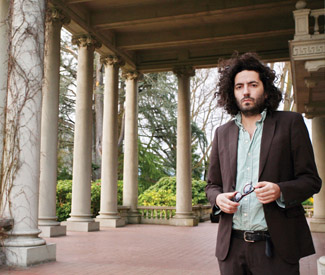
MUSIC “Harsh urban space, with a light misting.” That’s how Dan Bejar describes 2011’s Kaputt, his ninth full-length under the Destroyer moniker; listen to it with headphones, on a foggy day in San Francisco, and you just might agree.

Much has been made of the stylistic shift the Vancouver singer-songwriter has initiated on this record. Awash with fretless bass, lite-jazz sax noodling, and a syrupy synth-haze reminiscent of Avalon by Roxy Music, Kaputt comes across as subdued and wistful, in contrast to the baroque, acerbic tone of his previous output.

Bejar spoke with me over the phone from his home in Vancouver, detailing the second Destroyer lineup since the release of Kaputt, and their renewed approach to the material, as, “more dynamic and muscular than the aesthetic of the production… it’s mostly just a disco band, really,” he explains, with a tinge of sarcasm. “Yeah, hard-rock disco.”

However, while the previous tour was almost exclusively concerned with translating Kaputt to the stage, Bejar suggests that his current octet has, “probably learned twice as much material as any other Destroyer band before it.” The upcoming tour will find Destroyer approaching older, guitar and piano-based songs with trumpet, sax, and mega-synths for the first time. “We’ve not necessarily Kaputtified [the older material],” he explains, “but definitely given things a new sound.”

Kaputtified? Bejar wouldn’t likely be using this word if the album didn’t possess such a distinct, consistent atmosphere. The production aesthetic of Kaputt has inspired countless nerd-debates over the past year or so, largely concerning the merits of tributing a musical era — the early 1980sthat some listeners find questionable these days.

“I think there’s some things on the record that, some people might find repellent,” Bejar observes. “Not necessarily younger people so much as people my age, or a bit older, who maybe lived through the late ’70s and the ’80s, and were kind of just bludgeoned with really bad examples of production techniques and instrumentation that went down.”

That said, Bejar himself is hesitant to slap the “’80s” tag on Kaputt, despite this strong reaction from the blogosphere. “You never know when your intentions, and when the reality of what you’re doing, match up,” he admits, “[but] I always just think the songs are distinct enough that they can just grab hold of whatever style they feel like, and still come out sounding like their own voice.”

Another common misconception about Kaputt is the suggestion that it was written and recorded from a nostalgic perspective. After all, Bejar was a mere nine years of age when Avalon came out. “I don’t think it’s really nostalgic,” he insists. “I’ve always thought of it more as, say, someone on their deathbed, pumped full of morphine, maybe seeing what visions go wafting by.”

This deathbed image sheds some light on what Bejar describes as a “blankness” at the heart of Kaputt‘s songwriting and vocal delivery. “The sense of space was always important,” he contends. “There’s probably half the word count than there is on any other Destroyer album.” This relative economy of words is reflected in Kaputt‘s relaxed, unhurried pacing, which provides a stark contrast to the freewheeling energy of, say, 2006’s Destroyer’s Rubies.

In describing his aesthetic influences, Bejar mentions, “most of my inspiration comes from Miles Davis, on a daily basis, anyway,” Thinking within that context, Kaputt very well might be Destroyer’s In a Silent Way: a deeply transitional affair steeped in lush ambiance, with the ability to go hog-wild, but the class, restraint, and wisdom to keep things at a simmer.

It’s an ideal soundtrack to this city at its grayest. A light misting, indeed.

DESTROYER

With Sandro Perri, Colossal Yes

Tue/5, 9pm, $25

Fillmore

1805 Geary, SF

(415) 346-6000

www.thefillmore.com


Trans-formation

0

arts@sfbg.com

MUSIC After touring on 2009’s Words of the Knife with his band Os Beaches, Mark Matos’ world fell crashing from the cosmos. Internal struggles compelled him to fire his producer and his guitarist; Os Beaches’ practice space that doubled as a crash pad burned down (relegating the fresh-off-the-road group back to van sleeping); and Matos began to develop a destructive relationship with drugs.

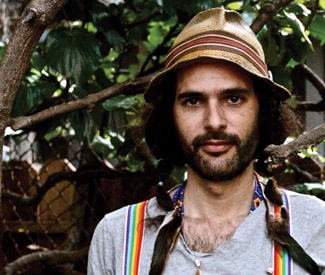
When I meet up with him over an extremely tall glass of weizen beer at German restaurant Suppenküche, Matos — an eloquent, bearded 30-something who comes off as much like a shaman as the front person of a psychedelic rock collective — explains how he somewhat-recently hit rock bottom; and how psychedelics enabled him to climb out of a debilitating death hole and build a mountain on top of it.

“I was up all night on cocaine. I hate cocaine. I felt it all slipping away. And I was like, ‘I’m going to take the heroic dose’ — five grams of mushrooms,” Matos recalls. “It’s what the shamans of South America say is the proper dose. It’s not fun.”

Matos says after he emerged from his heroic experience, he felt completely reborn. “I didn’t want to do coke. I didn’t care about being famous, and I really, really felt high. I was so high that people thought I was losing it.”

He says his consumption of the heroic dose, coupled with a series of vision quests, spawned the creation of his enlightened self — Trans Van Santos — and drew him toward the concept of communal musicianship.

The Trans Van Santos identity came to Matos during a vision quest in the desert. He remembers big hands lifting him onto a pyramid, and voices beckoning him to embrace his spirit name, Trans Van Santos.

“Santos is my grandmother’s maiden name, and in our [Portuguese] tradition we often take the matriarch’s name. When I think ‘Santos,’ it reminds me to honor the feminine.”

Coyote and the Crosser, Mark Matos & Os Beaches’ recent release, tells the story of Matos’ transformation into Trans Van Santos and his quest for “the ball of light” — a metaphor for illumination and enlightenment. The band will debut the Coyote and the Crosser live show this week at the Rickshaw Stop.

“This show will be a rock’n’roll extravaganza: loud, psychedelic, and very electric,” Matos says. “The album is a malleable rock opera, so it’s a rock opera in a sense that there’s a narrative structure — a group of [six songs] — but there are other [songs] too. There’s a mythological universe coming across, so certain songs of mine fit into that world.”

With the help of Joel Dean (who’s built sets for Phil Lesh and extravagant art pieces for Burning Man), Matos has constructed visually compelling stage props for his performance, including “the Spirit Molecule Sound Chambers with spinning disco balls hovering inside,” eight-foot tall glowing cacti, and a 13-foot tall dream catcher.

“I think having intention in the visual aspect of [Coyote and the Crosser] will bring people to the point where we can have a shared experience,” Matos anticipates.

Matos’ cosmic alter-ego Trans Van Santos will perform at Starry Plough the following night, which should be a calmer, quieter ceremony. Trans, along with his Trans Band, will explore “Americalia”: a synthesis of American folk and Brazilian Tropicalia.

For his Trans Van Santos other self and Trans Band, Matos says he “kept the direction to a minimum, focusing on the spiritual approach to the material. I want to hear the choices these folks make, to feel the spirit of discovery between us.”

Matos’ mystical transformation has compelled him to share his “acid gospel” with the community. “What I am trying to do with my little corner of rock’n’roll is to treat it as a new psychedelic ceremony,” Matos explains. “That and throw a birthday party for the whole galaxy!”

MARK MATOS & OS BEACHES’ COYOTE AND THE CROSSER

With Zodiac Death Valley, Little Owl, Ash Reiter

Fri/1, 8pm, $10

Rickshaw Stop

155 Fell, SF

(415) 861-2011

www.rickshawstop.com

TRANS VAN SANTOS

With the Bottlecap Boys, The Know Nothings

Sat/2, 9:30 p.m., $7-10 sliding scale

Starry Plough

3101 Shattuck, Berkeley

(510) 841-2082

www.starryploughpub.com


Oakland gets jilted

0

By Frank Artrage

news@sfbg.com

After a secret whirlwind courtship that lasted a mere five months, Mayor Ed Lee and the Golden State Warriors tied the knot May 22 at Piers 30-32, announcing their unexpected union at the site they intend to occupy with a new basketball arena by 2017.

The Warriors’ entrepreneurial new owners — Joe Lacob and Peter Guber — say they love this “iconic site” and promised to build a “spectacular sports and entertainment complex” that is “architecturally significant.”

But what about Oakland, the team’s unceremoniously jilted current homemaker? The perception from the East Bay is that Lacob and Guber were duplicitous and underhanded in their dealings with city officials that were desperately trying to retain the city’s three main sports franchises — the Oakland Athletics baseball club, the Oakland Raiders football team, and the Golden State Warriors basketballers — all of whom have recently signaled interest in moving.

Several sources told us that the Warriors’ new owners have been lying to Oakland officials about their intentions for months. For example, Oakland City Councilmember Larry Reid told me “that when our staff had conversations with the new owners, they always indicated they hadn’t yet come to a final decision.”

Reid told me what happened next. “I get a call Sunday night at 9:30 telling me about their move like a thief in the night.” Reid said. “It’s upsetting.”

On the fan site GoldenStWarriors, Lacob seemed to belittle Oakland. In an 18-minute video, Lacob predicts that Oakland will be left with only one sports team someday. “I think they’re challenged,” he said when asked what’s wrong with Oakland, adding the city is in “a difficult situation.”

Sports talk radio hosts, fan sites, and bloggers, however, seem to be evenly divided on the move. Even hardcore Oakland and Warriors blogger Ethan Sherwood Strauss prefers the San Francisco site. At his Warriorsworld site, Strauss wrote: “I’d never leave Oakland…. I have everything at arm’s length. There’s food from around the world, teeming farmers markets, lush green hills, Redwood trees, Mosswood Park, Grand Lake Theatre — this is all within two miles.”

But: “Guess which is the better place for the Golden State Warriors? It’s that west bay city national broadcasters keep showing during Warriors games while pretending Oakland doesn’t exist.”

Thus far, neither Oakland Mayor Jean Quan nor Mayor Lee have made any comments regarding the other side’s situation or whether their mutually reported “good relationship” has been strained. But it must be devastating to Quan, given all of her work and hoopla over her recent announcements surrounding her ambitious plans for the “Coliseum City” project.

Not unlike the Warriors’ “world class arena” planned for their new San Francisco home, Coliseum City, according to Quan, will be a “world-class sports and entertainment district.” Ryan Phillips, writing on the Oakland North blog in March, said that the project includes “building hotels, retail, office and residential space in the Coliseum complex…as well as building an Oakland Airport Business Park just across the freeway on the way to the airport. The business park will be developed to attract tech companies.”

Mayor Quan issued a press release following the Warriors’ bombshell to announce that she remains “bullish” on her Coliseum City project. Her new spin is that, “Coliseum City is a long-term development project that was never dependent on any one tenant. It was always a larger project than just one sports team.”

But if there’s even one team missing from the original trinity, then they have no choice but to lower their expectations and scale back their plans. Therefore, the Warriors’ move could trigger a complete unraveling of not only her recent plans to keep the Oakland A’s baseball team in Oakland, but also efforts to keep any team there.

For example, a case study published by the Airport Area Business Association (AABA) in conjunction with Coliseum City principal and manager Oakland-based JRDV Urban International, and students at UC Berkeley’s Haas School of Business found, The Coliseum complex presents a unique opportunity to prepare a pioneering business model that generates revenue for both public and private interests.”

Presciently, in the wake of this announced move by the Warriors and how that hurts Oakland, the study asked: “Are the withdrawal of redevelopment monies, the negative perception of Oakland (and especially Deep East Oakland) by investors and the soft commercial real estate market insurmountable? Can the City of Oakland and Alameda County garner the public support required to approve the necessary public financing and inspire investor confidence?”

Manning up, Councilmember Reid told me that Oakland bears some responsibility for this fiasco. “I’ve been agitating for 10 years to get this Coliseum project going. But let me tell you about two critical mistakes Oakland has made over the last decade,” he said. “One, Oakland has always taken the position that these teams had no place to go. Well, you see where that thinking got us today…Two, 10 years ago the decision was made to invest in the old [Oakland] Army Base. Yet, to this day, not one spade of dirt has been unearthed to symbolize any kind of progress is underway there. In fact, the whole project is at a standstill.”

Maybe, but Oakland and Warriors’ fans should not despair. It is not a done deal because a million things could go wrong. For example, this will be the fifth attempt to develop Piers 30-32 into something spectacular over the last several years.

Also, environmental groups and local activists are already squawking about the site. It has to pass a notoriously tough approval process of at least four major agencies. Financing might fall through, at least until Warriors ownership present to the press, government, and citizens some details: Tuesday’s press conference was basically a pep rally — the only thing missing were the pom-poms. Finally, Pier 30-32 and the site have yet to pass muster over the environmental and safety concerns and myriad other requirements of the California Environmental Quality Act (CEQA).

If any obstacle dooms the Warriors’ plans, Oakland’s Assistant City Administrator Fred Blackwell said they’d keep the door open for these prodigal owners: “And in the end, we will leave a space for the Warriors after they are exhausted from the CEQA litigation and cost increases required to be on the San Francisco Waterfront.”

“In a nutshell,” according to a City Hall press aide, Blackwell “means that waterfront development is expensive and requires an extensive and complex environmental review and permitting process involving review and approval by a number of local, state, and sometimes federal agencies.”

But what if it is a success? Oakland loses even more than just the Warriors. At least one politician pointed out, and I also heard this on 95.7 FM The Game, that what’s to stop circuses, ice shows, and major rock stars from ditching Oakland and following the Warriors to this splashy and scenic new entertainment venue?


Housing and highrise offices

0

EDITORIAL It's something of a civic shame that the only way San Francisco can build a new transit terminal is to sell a private developer the rights to stick a 1,070-foot highrise office tower on public land. In fact, it's a sad statement on the city, state, and local government: Once upon a time — and it wasn't the long ago — tax dollars collected through a progressive system paid for major infrastructure projects.

But there's no easy way to raise $4 billion in tax money for the Transbay Terminal — even though it ought to be seen as part of the high-speed rail project, and the federal and state government ought to be picking up the tab. So San Francisco ambles forward, selling land and lease rights to the highest bidder.

In this case, Gerald Hines of Houston won the right to build the largest highrise west of the Mississippi on property owned by the Transbay Joint Powers Authority. There are all sorts of drawbacks to the deal — among other things, it will cast shadows on a number of city parks, all the way to Portsmouth Square in Chinatown. Like any massive office complex, it will put pressure on Muni, on city streets, on police and fire and other city services — and no commercial office building ever pays its fair share of that burden. And since in this case the major recipient of the money from the project will be the TJPA, the city's General Fund will suffer.

Oh, and the building is ugly.

Meanwhile, city planners want to increase height limits all around the Transbay Terminal and allow hundreds of units of new (luxury) housing and more commercial office space. It's going to be a new highrise neighborhood, complete with a rooftop park and a few little patches of ground-level open space, which won't get a whole lot of sun, particularly in the morning and evening.

And at this point, there's been very little focus on what ought to be the defining issue of this and the other major developments on the city's planning horizon, and that's affordable housing.

This city has a terrible jobs-housing mix. The vast majority of the people who currently work in San Francisco can't afford to buy a house here, and many of them can only rent if they pay for more than the federal standard of one-third of their income for housing. So people who work in hotels and restaurants and city, state and federal offices and hospitals and even financial district companies wind up living far from the city and commuting. Nobody thinks that's a sound environmental policy.

And this kind of full-scale rezoning and development will only make it worse. According to the City Planning Department, the Hines project will pay about $27 million into the city's affordable housing fund, enough to pay for maybe 60 or 70 housing units. That won't even begin to cover the need created by the thousands of employees who will fill that tower. The market-rate housing on the site will almost certainly be beyond the reach of most San Franciscans, and probably many of the office workers who fill the Hines building. And only 35 percent of the new housing — at maximum — will be affordable.

San Francisco has to get a grip. The city can't keep allowing more high-end housing and highrise office space without a plan to meet its housing needs. We're glad to see the mayor talking about a $50 million a year fund, but that will barely meet existing needs; it can't possible keep pace with new development.

So before the supervisors rush ahead to approve this ambitious new downtown district, they need to ask Hines, and the TJPA, and any other developer who comes along, how it intends to meet the demonstrated need for affordable housing that these projects will create — and demand a much higher level of payment that what's currently on the city's books.

Reduce, re-use, replace

1

yael@sfbg.com

Greg Gaar knows the names, characteristics, and birds and butterflies attracted by every plant in the native plant nursery that he tends. Last week, he proudly toured me through the garden, pointing out plants like Yarrow ("great for bees and butterflies") and the beautiful flowers of the Crimson Columbine, of which Gaar believes there are "only two others left in San Francisco."

Gaar has been working at 780 Frederick St., where he now tends the garden, for decades. His mother went to high school on the same block, the old site of Polytechnic High. Before Gaar became the gardener, he ran the recycling center that Haight Ashbury Neighborhood Council (HANC) operates next to the garden. Now, the pioneering green operation he helped build may shut down.

At the center, people can recycle their bottles, cans, paper products, and even used vegetable oil, and make some cash along the way. Those who use the center say it's a green and dignified way to make some money.

But residents in the surrounding area have complained for years that the center is loud and attracts homeless people. They also say that, due to their proximity to the recycling center, the chance that their trash will get rifled through at night is greater than in other parts of the city.

Citing these concerns, the center's landlord, the San Francisco Recreation and Parks Department (RPD), has spent the past few years trying to evict the HANC recycling center. The center got an eviction notice in December 2010. HANC's lawyer, Robert DeVries, successfully challenged the eviction. RPD sued for eviction again in June 2011, and that matter may finally come to a close June 6 when it will be heard by a three-judge panel in SF Superior Court.

DELIVERING THE GARDEN


RPD officials cite neighbor concerns, claims that the recycling center's services are outdated and obsolete, and the idea of planting a community garden in its place. In fact, the Planning Commission approved a community garden in the place of the recycling center last year.

Since then, HANC staff got to work building its own community garden. In just a year, they erected 50 beds from recycled wood, and according to Gaar, about 100 neighbors have plots that they currently tend.

As the recycling center's director, Ed Dunn, tells it, the infrastructure already in place at the recycling center made building the garden come naturally. HANC was able to fund it with income from the recycling operation, and plant it with seeds from the native plant nursery.

Dunn emphasizes that no city money was used to build the current community garden. The city had laid out a $250,000 budget for the garden after it was approved and designed in 2010.

A bundle of documents containing arguments against HANC, provided by RPD, includes details of the Golden Gate Park Master Plan, surveys indicating a great need for community gardens in San Francisco, and letters and statements from neighbors complaining about the recycling center.

A 2004 survey discussed in the documents found that community gardens are among the top "recreation facilities most important to respondent households." Community gardens came in fifth in importance, after walking and biking trails, pools, fitness facilities, and running and walking tracks. The documents include a detailed map of the "Golden Gate Park community garden preliminary plan," imagined at HANC's current site.

The map was drawn up in November 2010, the same month that a meeting of the Recreation and Parks Commission laid out the reasons that HANC had to go. Minutes from the meeting include the city's need for community gardens as well as some neighbors' disdain for the recycling center in that site. It argues that the needs of recyclers can be well met with other recycling centers in the city.

Seventeen other recycling centers operate in San Francisco. Most are located in neighborhoods on the city's edges, with a few in the Outer Sunset and Excelsior, although most are located in Bayview-Hunters Point.

But the commission doesn't seem concerned with potential nuisance to neighbors in directing more traffic to these other recycling centers, or with the difficulty poor recyclers have in getting out there. "The San Francisco Department of the Environment is confident that recyclers that use the facility will take their material to another existing site for proper handling," according to the meeting's minutes.

The commission is, however, concerned about a nuisance that the recycling center creates for Haight-Ashbury neighbors, according to the minutes. The notes cite "neighborhood noise, truck traffic, litter, and public safety concerns as negative impacts related to continuing operations at the site."

AGAINST THE POOR?


But is this really just another case of resentment against people who are poor and homeless?

HANC's Dunn argues that, in fact, much of the material that those who use the center bring in isn't taken from residential waste bins. Besides, it's not technically "HANC's CRV redemption program" that encourages recycling as a revenue source for the less fortunate. State law requires that consumers be able to redeem bottles and cans for cash.

The meeting minutes argue that the recycling center "enables illegal camping and illicit and unhealthy behavior in Golden Gate Parks' eastern end and in neighborhoods in close proximity to the site."

Supposed evidence for the position cites letters to the editor published in the San Francisco Chronicle, a frequent outlet for anger at the homeless. One concerned resident, Karen Growney, asserts that the center "provides no benefit to people living in Haight/Cole Valley."

HANC disputes this, saying that many neighbors use the center. They have beneficial relationships with many nearby businesses, including New Ganges restaurant just across the street. Its website, kezargardens.com, shows many smiling neighbors who use the center to recycle.

Notable among them is actor/activist Danny Glover, a Haight resident since 1957. In a video on the website, Glover — interviewed while in his car dropping off recycling at the center — says, "I would be dismayed and not happy if we close this wonderful recycling center down…It would be a tragedy, and a great loss to this city and this community."

In her letter, Growney also laments that her family "had to pay a considerable amount to build a wrought-iron, locked gate to keep people out of our trash." Another letter, written by neighborhood resident Curtis Lee, asks that the city "eliminate the Haight Ashbury Recycling Center," saying that, "It is a blight on the neighborhood and an attraction to rodents and homeless carts."

Of course, those carts come with people. HANC takes issue with the assertion that their services "enable" or "encourage" homelessness, as well as the assumption that the recycling center only serves the homeless.

Dunn says that many of the recycling center' clientele are elderly immigrants, often housed, who contribute to their family income with cash from recyclables. He also insists that "most of the people that use the recycling center don't camp in the park."

Homeless people certainly do use the center, but it's not clear whether its presence truly "enables illegal camping and illicit and unhealthy activity." Dunn finds it laughable to say that "the center creates homelessness." It's a lot of work to cart around recyclables all day, he says, and the dedicated recyclers are generally not the same people that ask tourists on Haight Street for spare change.

THE RECYCLERS


There is a great diversity in how homeless San Franciscans spend their days, and recycling is in many ways a specialized, committed way of life. In her 2010 ethnography of homeless San Franciscans, Hobos, Hustlers and Backsliders, Teresa Gowan focuses on the "recyclers," the segment of the homeless population who have made a habit of collecting bottles and cans as a way of getting by.

"The phenomenon that captured my interest was the steady stream of shopping carts loaded high with glass, cans, cardboard, and scrap metal rolling past my door," she wrote.

Some of her interview subjects show disdain for the recyclers, who work hard all day and don't get much cash out of it. Dealing drugs, stealing, or panhandling can be more lucrative and less backbreaking. One subject, a man named Del who, according to Gowan, mostly stayed in the Tenderloin, thought the "20, 25 bucks on a big load" that recyclers usually made was pathetic. "'And that's for heaving around a big old rattling buggy all day,' Del said pityingly. 'I can make 15 bucks inside'a two minutes.'"

But many of her interview subjects prefer to recycle anyway. Gowan describes another subject, Sam, as "a champion recycler, muscular and persistent, who often put in nine, ten hours on the trot." She quotes Sam saying, "Without this, I'd kill myself. Couple a days, I'd do myself in…. You get some guys, seems like they can deal with homelessness. I'm not one of them."

The book argues that "pro recyclers" included a "large core group who had created an intense web of meaning around their work as a kind of blue-collar trade."

PIONEERING HANC


Recycling for cash may not be a respected or taxed job "blue collar" job. But it's certainly green.

Since the center began operating in the 1970s, mainstream attitudes towards environmentalism and sustainability have shifted dramatically. The HANC recycling center was a product of the environmental movement, and helped usher in the widespread support for recycling.

Now, with curbside recycling fully functional in San Francisco, many call the recycling center's work obsolete. But HANC argues that the city needs all the help it can get if it is to reach its goal for zero waste in 2020. It also employs 10 people, and Dunn argues that it would be foolish of the city to eliminate those stable green jobs.

HANC has also helped move along the trend towards community gardens that RPD is now embracing so thoroughly that, ironically, it could lead to the recycling center's demise. HANC helped underwrite the Garden for the Environment project as well as the Victory Garden planted outside City Hall in 2008. Dunn says that the staff enjoyed the challenge of building the garden, and would be interested in helping the city by creating more gardens without city money.

Gaar says he's committed to continuing to work for a healthier planet, regardless of what happens to the center. He and the other HANC staff have come to see the eviction process as symbolic of a direction in which the city's heading, that also includes last year's Sit-Lie Ordinance: decisions designed to shuffle homeless people out of wealthy neighborhoods.
The arguments for the community garden, however, seem to indicate a strong desire for a greener city. It's not easy balancing environmental initiatives with NIMBY woes — especially when your backyard is Golden Gate Park.

Sunshine eclipsed

1

As an advocate for the passage of the San Francisco Sunshine Ordinance in the early 1990s, I felt obligated to take my first and only City Hall position and serve as a founding member of the Sunshine Ordinance Task Force. I served for l0 years and helped with many other good members to build the task force into a strong and respected agency for helping citizens get access to records and meetings and hold city officials accountable for suppressing access and information.

The task force is the first and best local sunshine task force of its kind in the country, if not the world. It is the only place where citizens can file an access complaint without an attorney or a fee and force a city official, including the mayor, to come before the task force for questioning and a ruling on whether they had violated sunshine laws. The task force lacked enforcement powers, but it still annoyed city officials, including Mayor Willie Brown.

In fact, Brown spent a good deal of time trying to kick me off the task force. He used one jolly maneuver after another, even getting an agent to make a phony complaint against me for violating the ordinance with an email (The complaint went nowhere). I refused to budge and decided to stay on until Brown left office—on the principle that neither the mayor nor anybody else from City Hall could arbitrarily kick members off the task force.

That principle held until about 3pm last Thursday (May 17) at the meeting of the Board of Supervisors Rules Committee to appoint candidates to the task force. At that meeting, without proper notice, advance warning, explanation, apology, or even a nice word or two, the supervisors suddenly turned a normal drowsy committee meeting into an unprecedented bloodbath for the task force and its independence. Sup. Mark Farrell played the heavy, Jane Kim was the facilitating chair, and David Campos was the reluctant third party, working together to bring Willie Brownism back at the task force with a vengeance.

The committee rejected four qualified candidates from three organizations who are mandated by the Sunshine Ordinance to choose representatives for the task force because of the organizations’ special open government credentials. (Doug Comstock, editor of the West of Twin Peaks Observer; Attorney Ben Rosenfeld from the Northern California chapter of Society of Professional Journalists, sponsor of the ordinance; Allyson Washburn from the League of Women Voters and Suzanne Manneh from America New Media.)

The committee without blushing asked the organizations to come up with a “list of names,” a whiff of grapeshot aimed at members and organizations who had served the public well for years. Who wants to go before the supervisors on a list of names for a bout of public character assassination? Meanwhile, while knocking off the qualified, knowledgeable candidates, the committee approved four neophytes without experience and then unanimously appointed David Pilpel, a former task force member known for delaying meetings with bursts of nitpicking. He almost always comes down on the side of City Hall and against citizens with their complaints.

Farrell also tried to bounce Bruce Wolfe, an excellent member, but Kim and Campos supported him and his name was sent on to the full board for approval.

Then, when Wolfe’s name got to the board on May 22, it was a repeat of Willie Brownism and this time to the max. Sup. Scott Wiener moved to amend the motion and substituted Todd David. Farrell seconded. The vote was 6-5, meaning that Willie Brownism wiped the sunshine slate clean of anybody who would raise a pesky question of city officials and the City Attorney’s Office.

The infamous votes against Wolfe: Wiener (ah, yes, the heir of the Harvey Milk and Harry Britt seat in the Castro), Farrell (where is Janet Reilly when we need her?), Malia Cohen (who comes from the Potrero Hill/Bay View/Hunters Point district that needs all the sunshine it can get in facing an Oklahoma-style land rush of development), David Chiu (who was reportedly angry over the unanimous task force opinion finding he violated the Sunshine Ordinance with late submission of documents before the controversial vote to redevelop Parkmerced), Carmen Chu and Sean Elsbernd (neighborhood supes way out in West Portal and the Sunset who almost always vote the downtown line at City Hall). The good votes for Wolfe: John Avalos, Eric Mar, Cristina Olague, Jane Kim, and David Campos.

Campos told me that the organization candidates were “eminently qualified,” that they should have been appointed, and that he would fight for them. He advised the organizations to “stand by their candidates.” He is urging that the issue of organization candidates come back to the next Rules Committee.

Rick Knee, SPJ’s mandated journalist on the task force surveying the carnage, said the supervisors’ actions stem “partly from a desire by some supervisors to sabotage the task force and ordinance itself, and partly from a vendetta by certain supervisors after the task force found several months ago that the board violated local and state open meeting laws when it railroaded some last minute changes to a contract on the Parkmerced development project without allowing sufficient time for public review and comment.”

Knee is right, and it isn’t just Parkmerced, but all the high-stakes development deals flowing through City Hall these days, with their advocates preferring to cut backroom deals rather than being subjected to the full scrutiny of the public and the task force.

James Chaffee, a former chair of the task force, watched the board proceedings with outrage and fired off a letter to all supervisors later that day. He charged that the board in sacking Wolfe violated the Sunshine Ordinance on several counts. Among them: the board changed the committee recommendation on Wolfe without allowing public comment and it passed over Wolfe even though the ordinance requires at least one member of the task force to be “physically handicapped.” That was Wolfe.

Thus, Chaffee wrote, the orchestrated coup was “the perfect example of a failure to follow the sunshine ordinance that led to the sort of problem that it was intended to forestall, namely the supervisors taking an action without being informed of what they are doing.  If Scott Weiner and David Chiu and the rest of the crew did not consider the citizens the enemy and exercize judgment about whether they were complying with the spirit of open government rather than just shaving off the letter of the law as closely as possible, this could have been avoided.”

Chaffee said he couldn’t tell if David was physically handicapped but he said nothing in his application for the task force nor was any disability apparent from the video of the rules committee meeting.

Chaffee said David’s  application showed he  was “self-employed as an investor, obtained a BA from Stanford in 1993, has never attended a task force meeting, and left the statement of his qualifications blank.”

Chaffee said, “It’s easy to see why Scott Wiener likes him. He said it would be a long road before he would go against the city attorney’s office and when it came to constitutional law, he would place the city attorney’s opinion above his own because the city attorney is an ‘expert.'”

I sent Chaffee’s letter and my Bruce Blog post ( “The return of Willie Brown to the Sunshine Task Force,” 5/21) to City Attorney Dennis Herrera for comment: How can his office sit by while the letter and spirit of the sunshine laws are being violated in the move to sabotage the sunshine ordinance and task force? I also sent Chaffee’s letter, with the Bruce blog, to the supervisors with similar questions: Why  are you violating the sunshine laws to kick out the best candidates? For their answers (coming)  and the latest on this evolving controversy, follow along at  www.sfbg.com/bruce.

There you have it:  the state of sunshine and open government in city hall in San Francisco in May of 2012. Todd David over Bruce Wolfe. David  Pilpel uber alles.  Five inexperienced candidates over five experienced candidates. David Pilpel uber alles. A city attorney who rolls over and over and over again. And a whiff of grapeshot for the three organizations mandated by the charter to have represenatives on the task force  because of their open government and public access credentials (the Northern California chapter of the Society of Professional Journalists, the League of Women Voters, and America New Media.)  On guard,  b3


Tricky sings

0

MUSIC Compared with the smooth operator currently installed in the Oval Office, how nervous Richard Nixon looks now as a representative of America abroad, all stiff grins, rumpled shiftiness, outbursts of awkward rhetoric. Reviewing vintage footage of him recently, I half expected a rappin’ granny to suddenly appear, and goofy Uncle Dick to start “breaking it down.” And yet, 40 years after California’s second-most problematic political progeny (pace, zombie Reagan) went to Beijing to “open China” — ending 25 years of separation and going on to win re-election in a landslide, despite the growing Watergate scandal — might it be time to look past the jerky, jowly image of Tricky Dick and reassess the character of the man and the moment, to keep us on our toes?

“Nixon was an incredibly complicated man, whose intellect constantly got in his way,” Canadian opera director Michael Cavanagh told me over the phone during a wide-ranging interview. “And it’s especially relevant to examine him now in that light, with a certain distance of history. We tend to stop at the jowls, the scandal, and the Republicanism. But it’s often been remarked during this election cycle that there’s no way in hell Nixon would ever be considered for the Republican ballot now. He was too small ‘r’ republican, too centrist. So there’s this complexity to him that confronts lefties with their own stereotypes, assuming most patrons of the arts lean left. That’s something I really like.”

Cavanagh’s complexifying occasion will be his production of John Adams’ 1987 Nixon in China, part of the San Francisco Opera’s nifty-looking summer season. The opera, with a luminescent libretto by poet Alice Goodman and an engrossing, fever-dream score by Adams, whose melodies, time signatures, and musical reference points churn and shift like memory itself, takes us from the moment Nixon’s Spirit of ’76 touches down on the tarmac (Kissinger in tow), through his historic meetings with Chou En-Lai and Mao Tse-Tung, along with First Lady Pat on an eventful factory tour, and finally into the major characters’ bedrooms, memories, and fantasies. It’s a sensually intoxicating work, full of barnstorming arias sung by a multi-ethnic cast (you will have “I am the wife of Mao Tse-Tung” stuck in your head for days) that examines media spectacle, modern myth-making, and cultural difference on a truly, well, operatic scale.

San Francisco Bay Guardian Nixon was Californian, Adams is a longtime Bay Area resident. It’s the 40th anniversary of the China visit, and also an insanely contentious election year. The Bay Area as a huge Chinese population — many families escaped Mao’s Cultural Revolution. Do you feel any particular pressure bringing this production here, now? 

Michael Cavanagh I feel a tremendous amount of responsibility, but I also feel a lot of freedom. Of course, the events the opera depicts and its roots in the Bay Area will resonate, and that’s hugely exciting. But this isn’t a documentary, it’s a rumination, more of a poem. As Nixon says in the beginning of the opera, “News has a kind of mystery” — and I feel that’s what Adams and Goodman were really expanding upon with this.

I do think that this production, especially, will bring up memories for a lot of people. I myself had an inkling of this whole thing happening when I was really young — it’s something that a lot of the world shares, a memory of this iconic moment, even if that memory is only a glimpse of pavement or a handshake, kind of like my own. The opera works with that abstraction, those fuzzy frames of memory that overlay images of the past, while still sharpening some of the more historically relevant moments. I hope people can relate to it on all of those levels.

SFBG Twenty-five years separate us from the opera’s premiere in Houston in 1987 — and yet China remains, to use a slightly loaded term, as inscrutable as ever to many Americans, yet as enmeshed in their daily lives as ever. What relevance do you think the opera may hold today?

MC I think it has an eerie relevance. Even back when Nixon in China premiered, China was still remote and threatening to many, and this was before the reform machine revved into life, before China’s emerging economic dominance. In one scene, in Mao’s library, Mao goes off quite poetically about the revolution, and how things were changing, and he plays fast and loose with the concepts of capitalism and communism, almost as if he foresees the necessary reforms ahead, that came to pass.

Beyond that, the opera is very prescient about the evolution of the media — this was one of the first major world events to be broadcast on a global scale, to be covered as the kind of spectacle we base much of our opinions and thoughts on today. We think of Nixon as shifty-eyed, but he was really just trying to figure out where the cameras were most of the time, trying to acclimate to this new kind of fishbowl environment in which political figures were treated like movie characters. The opera records the beginnings of all that, and ends with them reviewing their memories of everything that’s occurred as if it was all this footage, which it is quite actually on stage.

Basically, though, the deepest relevance a work can have is by connecting to the audience through its characters. Take Pat Nixon. We hurt for Pat Nixon. She’s been betrayed. Nixon promised her a simple home life, the comforts of family and a man at home, and here she is traveling all the way to China! She’s bewildered, but as First Lady there’s really no place for that, so she forges her own, I think very American kind of resolve that cracks a couple times, but still gets her through.

It’s a very poignant psychological and emotional study, projected on the world stage, and amplified as only opera can. That’s what opera does better than any other art form: it amplifies life.

SFBG You’re a Canadian — have you caught any flack for interpreting these events that are so associated with the US?

MC You know, despite appeals to the contrary, our two countries really share the same history. This version of the opera was premiered in Vancouver during the Olympic Festival — it’s what Canada chose to represent itself will to the entire world. And when it comes down to it, really, everything you do effects us Canadians just as much. We sleep with the elephant. *

NIXON IN CHINA

June 8-July 3, times and prices vary

War Memorial Opera House

301 Van Ness, SF.

(415) 861-4008

www.sfopera.com


Deep dish

0

SUPER EGO Ooh, she's windy! And everybody knows it. I'm writing you from Chicago, specifically and improbably from the Hard Rock Hotel in the gorgeous old Union Carbide building. It's not so tacky (I'm staying on the Prince Floor, displaying several of his blouses), even though it's brimming with hopefuls for the International Mr. Leather Competition-related "Grabbys," the big annual gay porn awards. Someone please tell their hairdressers that 2005 was seven years ago! No more gay porn cockatoos, please. It is also big, hairy bear week here — officially called Bearpawcalypse 2012, I shit you not — so everything is thuper-thuper-gay.

I'll be back to join you at the following ragers, but right now I'm off to "grabby" me some drinks in the stunning Second City. First stop: a strong sidecar and some live Latin jazz at Al Capone's favorite hang, the Green Mill. Straight mobbin', y'all.

OMAR SOULEYMAN


Are you ready to completely lose it, hypnotic synth-groove hi-NRG Syrian folk-pop style? Even just thinking of how this hyper-energetic, legendary Middle Eastern singer somehow came to be embraced by Western ravers makes me smile — but we'll all be too busy bouncing and trying to sing along to deconstruct all that.

Fri/1, 8pm doors, $20 advance. Mezzanine, 444 Jessie, SF. www.mezzaninesf.com

STOMPY 20-YEAR REUNION


The Stompy label, party crew, and music production powerhouse has helped keep the chunky, funky, banging SF house sound alive (DJ Deron, Stompy's honcho, is one of my favorites when I just wanna let loose). To celebrate its second decade, Berlin's sunny tech-house wiz Ian Pooley is joining Jonene, Tasho, Sweet P, and Deron to stomp us good.

Fri/1, 9pm, $10 before 11pm, $20 after. Monarch, 101 Sixth St., SF. www.stompy.com

DOPPLEREFFEKT


Keepers of the true mad scientist techno flame, this mysterious, essential group — headed by mental lab technician Heinrich Mueller, a.k.a. Gerald Donald, a.k.a. Rudolf Klorzeiger — was all the rage, and one of the actual quality offspring, of the electro clash scene, which is now experiencing a full-blown revival. Dark thoughts and porn dreams burble up through insanely catchy melodies and sci-fi Kraftwerk affect. With C.L.A.W.S., Robot Hustle, Josh Cheon, Caltrop, and the No Way Back crew.

Sat/2, 10pm, $25. Monarch, 101 Sixth St., SF. www.monarchsf.com

KONTROL GRAND FINALE


What would the city's techno scene be like without Kontrol? Ace new crews like As You Like It and Rocket might not be around if it hadn't been for the seven-year-old monthly blast of live news from the global techno underground. Originally started at the storied Rx Gallery as a clean, minimal-pumping break from all the baroque, bombastic clutter that was techno in the early 2000s (and as a showcase for the burgeoning international touring circuit created by the Internet and advancing digital technology), Kontrol grew at the EndUp into one of our invaluable electronic faces to the world. Now the Kontrollers — Greg Bird, Alland Byallo, Sammy D, Nokloa Baytala, and Craig Kuna — have way too much going on, damn their popular talents! This seventh anniversary event is also the end of the line for the monthly party, although Kontrol will live on in other forms, including, I'm sure, one day, a 21st anniversary party, at which I will be raving in my hover-wheelchair. Berlin master Heiko Laux performs. Danke and aufweidersehn!

Sat/2, 10pm-6am, $20. EndUp, 401 Sixth St., SF. www.tinyurl.com/kontrolbye

WICKED 21-YEAR ANNIVERSARY


After last year's incredible reunion (and a hugely successful world tour) one of SF's original rave crews — the one that brought a tasty touch of pagan British psychedelia to its eclectic productions — gathers again to howl. DJs Garth, Jeno, Thomas, and Markie, plus a signature cast of beloved characters, get devilish all night. *

Sat/2, 10pm-7am, $20. Mighty, 119 Utah, SF. www.mighty119.com

On utopian frequencies

0

arts@sfbg.com

CULTURE It’s the tangible buzz I notice first, a tingling awareness of something important about to occur, followed swiftly by the realization that there are free quesadillas courtesy of the Great Tortilla Conspiracy, silk-screened with chocolate sauce and rabble-rousing sentiment: “Eat the Rich.”

It’s opening night for the ambitious Streetopia festival, and the scene outside the Luggage Store Gallery is vibrant and chocolate-scented. On the sidewalk, Brontez Purnell scrawls ritual sigils in bright pink chalk, while a watchful Amara Tabor-Smith, in Butoh face paint and bare feet, leans against a tree, waiting to enter the circle and begin her ceremonial dance. Festival co-curator (with Kal Spelletich and Erick Lyle) Chris Johanson is overheard gushing unselfconsciously about the “vibe,” and among the gathered throng of artists and tourists, Sixth Street residents and urban activists, bookworms and cinephiles, tastemakers and thinkers, old punks and new parents, it’s as apt a descriptor of the electric excitement as any.

Inside the Luggage Store itself, a fanciful reimagining of the space awaits, just past the heavily-graffitied stairwell and the bright shock of Day-Glo paint and black light of the entryway. A multi-level, wooden loft structure dominates the gallery itself, crammed with little nooks in which one might find a contemplative interactive art project involving paper boats, a tribute to Valerie Solanas, a solitary disco ball, a pirate radio set-up, a “live open letter office,” and countless murals, photographs and sculptures — frankly too much to absorb in one sweep through.

Down Market Street, beneath the Renoir Hotel, the cacophonous screech and throb from Shaun O’Dell’s noise installation “THE SOMETHING” attracts the curious, with amplifier knobs to twiddle, an out-of-tune ukulele to bang, synthesizers to desynchronize, and numerous cameras to record the emphatically spontaneous proceedings on. A rare opportunity for the public to visit the San Francisco Drug Users Union to view an art installation by Barry McGee, plus the promise of free food at the Tenderloin National Forest/Luggage Store Annex at 509 Ellis, entices the intrepid to wander further afield, into the TL night.

Impressively all-encompassing by any measure, Streetopia’s first weekend (it opened May 18) included nods to almost every possible artistic discipline with participants from all corners of the country. It gave space to panel talks, such as AIDS chronicler and former ACT UP activist Sarah Schulman’s “A Gentrification of the Mind” (an event co-curator Erick Lyle was eager to point out represented “the multi-generational teaching and sharing aspect of Streetopia”). It reinvigorated the idea of food as communion with Sy Wagon’s Free Café, the previously-mentioned Great Tortilla Conspiracy, and the War Gastronomy Food Cart; precipitated an off-site “spirit gardening” event at the Hayes Valley Farm with performance artist-musician Ryder Cooley; and hosted the kickoff to “endurance” performer Marshall Weber’s 72-hour poetry reading — a marathon that made that morning’s Bay to Breakers run look even more inconsequential than usua l.

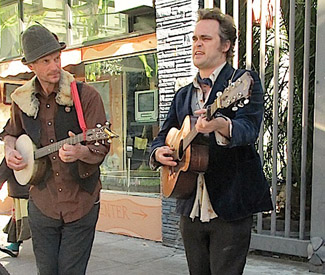
My favorite moment of the project thus far, however, came on the evening of May 20 at the Tenderloin National Forest during an all-too rare performance by dark folk minstrels Hazy Loper, currently a duo comprised of Devon Angus and Patrick Kadyk. Torn between our desire to listen to the mournful melodies and observe the onset of the solar eclipse, the entire crowd wound up in the street squinting at the sun through postcard pinholes, loosely-clenched fists, the holes of a colander, and the leaves of a nearby tree, while the band gamely finished their set out on the curb for the whole neighborhood to enjoy. It was an experience that, for me, best encapsulated a straying from the script that the entire Streetopia project seems designed to encourage: offering a framework for building lasting interpretations of an urban utopia, rather than an experience ready-made and soon forgotten.

STREETOPIA

Through June 23

Various venues, SF

www.streetopiasf.com


Seafaring

0

APPETITE Fish makes me happy. Raw, grilled, seared, any which way. One new restaurant and one established favorite are glorifying the fish, and seafood in general, in many formats.

LOCAL'S CORNER


Local's Corner just opened in March on a mellow corner of the Mission's east side. The sunny space is mostly white, evoking a cozy-chic New England seafood restaurant serving exquisite California fare. Dinner service was just launched mid-April, a delicate array of tastes of the mostly seafaring kind, though the menu simultaneously lists a "land" section.

Prior to opening, I was excited for this new seafood restaurant offering the likes of sardines and smaller, more sustainable fish, and they do deliver. The immediate downside is how quickly dishes add up. Small plates hover in the low teens while no dish tops more than the mid-20s, but as you finish each plate, hunger is not exactly satiated. There is little in terms of heartier fare, which is fine — you don't come here for "hearty." But $100 later (for two with a glass of wine), I left a couple dishes away from satisfied.

Crisp and bright as the equally crisp, bright space, a nice range of rosés and white wines pair ideally with fish offerings and rotating oysters ($2.50-3.50 each). A small plate of uni ($14) is alluringly punctuated by English peas, preserved Meyer lemon, and mint leaves, while Dungeness crab ($13) arrives glistening with snap peas, Cara Cara oranges, and spring onion. Cured halibut ($13) dances with radishes, grapefruit, and dill. Each is delicate, slight, tickling the taste buds.

Two flavorsome bites are cured anchovies and guanciale (Italian bacon made from pig's jowl or cheek) on toasts ($10), or a dollop of smoked trout rillettes and crème fraîche ($12), also with toasts. Both delight, but are so small-portioned, one is just hooked when they're gone. For $22, an entree of black cod on top of leeks, carrots, and watercress is likewise minimal and subdued. I was more satisfied with a "land" offering of beef tartare in a small pot, topped with quail egg ($15). Bread is (again) the filler, while the raw beef is glisteningly fresh.

Brunch is such a pleasant experience in the sunny space, it is tough having few seafood choices (just one currently) and a prix fixe only: now $18 for toast, two courses, and coffee or juice. Weekday lunch offers more seafood, which is primarily what one comes here for, though still few options compared to dinner.

Local's Corner is still in its infancy, exhibiting promising meticulousness and fresh tastes. I realize upping portions of the likes of uni and abalone is a costly thing while maintaining delicacy is crucial with such ingredients. It seems a worthy mission: satisfying appetite alongside artistry.

2500 Bryant, SF. (415) 800-7945, www.localscornersf.com

BAR CRUDO


One place that has long cornered artistry and appetite in my estimation is Bar Crudo, one of my top SF restaurants since its early days in the tiny Bush Street space, where Bouche is located now. Though the cavernous but narrow Divisadero space lacks the quirky charm and warm glow of the original location, service remains such that even as the place is packed nightly and waits are common, staff comes by offering wine, keeping me informed of the wait time.

The crudo, essentially Italian-style sashimi, are small and delicate (a sampler is $13 for 4 pieces, $25 for eight) but so uniquely delightful, they're worth every dollar. A visit here would not be complete without a bite of raw arctic char, lively with horseradish crème fraîche, wasabi tobiko and dill, or creamy butterfish crudo topped with apples, pear vinaigrette, and beet saffron caviar.

One easily fills up here, supplementing ethereal crudo with whole-roasted fish. Recently, I enjoyed a branzino ($26) with two friends. With the large fish, two smaller shared plates and a crudo sampler, we left full. The fish is generously sized, buttery, flaky. We devoured the cheeks, the head, every part, resting in butter beans, Swiss chard, oyster mushrooms, poblano peppers, and orange oil.

A flavor explosion comes in large head-on Louisiana prawns ($14) swimming in a spicy red brood, vivid and savory with shishito peppers and fresno chilies. I nearly drank it up. To fill up, there's always Bar Crudo's classic seafood chowder ($7/$14), a creamy, rich bowl of fish, mussels, squid, shrimp, potatoes, and applewood smoked bacon that elicits a moan of pleasure at first spoonful.

Coupled with a strong wine list (by glass or bottle) and equally strong craft and Belgian beer list, Bar Crudo remains not only one of San Francisco's seafood treasures. *

655 Divisadero, SF. (415) 409-0679, www.barcrudo.com

Subscribe to Virgina's twice-monthly newsletter, The Perfect Spot, www.theperfectspotsf.com

A different world

0

arts@sfbg.com

DANCE Moving, especially when it’s not by choice, is never fun. Losing your home after some 30 years of relative comfort and security is really the pits. That’s how I felt when I heard that the San Francisco Ethnic Dance Festival — my first encounter with the Bay Area’s voluptuous dance culture — would not be able to continue performing at the Palace of Fine Arts because of the Doyle Drive reconstruction.

Yet EDF has survived; the new, smaller, more varied venues have encouraged the re-thinking of what had become a comfortable format. One more time EDF is taking its shows on the road — to Fort Mason Center’s Cowell Theater and Firehouse, and to the de Young Museum, the Asian Art Museum, and the Novellus Theater at Yerba Buena Center for the Arts. Presentations range from intimate lecture formats to full-throttle multi-company performances.

Unlike previous years, however, the popular January auditions (where you could get your fill, or a least a taste of what world dance is all about, for a $10 day pass) had to be cancelled for financial reasons. Like other arts organizations, EDF is struggling, though the 34-year-old fest has been hit particularly hard. “We were forced into an expansion of projects at a time when the economy was contracting,” says Carlos Carvajal, EDF’s co-artistic director along with CK Ladzepko. The Novellus Theater also seats 200 fewer people than the Palace, a significant loss of earned income.

The Ghana-born Ladzekpo founded his African Music and Dance Festival in 1973 and has introduced generations of artists into the intricacies of African rhythms and traditions. Carvajal started folk dancing when he was in high school in San Francisco and has performed with SF Ballet and European and South American companies. Both men have been closely involved with the Festival for years — as adjudicators and observers and now as artistic directors.

The absence of auditions allowed the two curators to go for the best and the brightest for this year’s 30 slots. They were particularly looking for innovation because, as Carvajal quotes Ladzekpo, “We can’t hide behind tradition.” Master artists whose primary concern was the preservation and dissemination of specific traditions started many of these ensembles. But more and more, this generation of ethnic dancers feels free to reinterpret and experiment what used to be considered inviolate practices.

Today’s artistic directors very likely have not only encountered other global dance forms but probably have studied modern dance, choreography, and even ballet. Many of them are as willing to test the boundaries of their fields as their colleagues in other art forms. This year’s line-up, while still offering plenty of what we all have come to love — Chinese Dragon dance, Native American hoop dance, rites of passages rituals from Liberia, temple ceremonies from Bali — offers plenty of contemporary choreography grounded in specific cultural traditions. It’s global dance in all its complexity.

Two different gamelans working together — as the Balinese Gamelan Sekar Jaya and the Sundanese Pusaka Sunda are for the new Bayangan Jiwa — would have been unheard of two decades ago (not to speak of them using very cutting-edge shadow-light technology). Neither would you have had an Uzbek percussionist (Abbos Kosimov) pair up with a Tajikistani dancer (Mariam Gaibova). And, “We specifically asked Abhinaya Dance Company to return with San Jose Taiko,” Carvajal says. It took guts and imagination to bring (successfully) together Japanese Taiko and Indian Bharata Natyam.

Carvajal is also delighted by how Carola Zertuche has revitalized Theatre Flamenco of San Francisco. For EDF, the Company will perform flamenco barefoot, milonga style, reconnecting the dance with its Moorish and Gypsy roots and also reminding us that flamenco’s percussive qualities originated in a musician’s use of a cane and not the dancer’s heels.

Maybe OngDance Company personifies EDF at its most sophisticated. At Dance Mission Theater in January they showed themselves profoundly steeped in Korean tradition, absolutely contemporary in their perspective and brilliant in the art of stagecraft. They’ll present Shadow of Cheoyong during the festival’s third weekend of performances. *

SAN FRANCISCO ETHNIC DANCE FESTIVAL

June 2-July 1, $12-$20

Various venues, SF

www.worldartswest.org


Landlocked

1

arts@sfbg.com

MUSIC Pavement. That’s all I really associate with Stockton. Personally, I’ve only been there once, few weeks back on my way to Yosemite, and I just drove through — 205 to 120 — stopping once for gas. So pavement all the way. Yet, despite the lack of waves, it’s home to Surf Club, a sunny four-piece that’s recently released its debut EP, Young Love, on Death Party Records.

“It’s not that bad living in Stockton,” says guitarist Eddie Zepeda. “You make the best of it.” Zepeda barely finished this optimistic assessment before bassist Fonso Robles offers a conflicting view: “Uh, it’s pretty bad.” Earlier in the week, Robles had been pulled out of his car, in the middle of the day, and held up at gunpoint. Before taking off, the robber cautioned, “Don’t let me catch you slippin’,” a combined threat and unsolicited piece of street advice.

Early last year, Justin Vallesteros of Craft Spells moved his project from Stockton to Seattle (where he was born), citing the former city’s number one placement on Forbes Magazine’s 2011 list of “America’s Most Miserable Cities” among the reasons. Surf Club’s Frankie Soto, then guitarist for Craft Spells, stayed behind in his own hometown. “It wasn’t really a hard decision. It was Justin’s band, so I was just like go ahead, dude,” Soto says.

There doesn’t appear to be bad blood between the groups: “Justin still comes over and we all jam,” Zepeda says, and a few days after the interview I run into Soto and Robles at the Great American Music Hall, where Craft Spells is opening for the Drums.

Still, after the split, Soto tells me he spent a few months depressed in his room, trying to find his own sound. When he re-emerged it was with Zepeda and Robles, as well as drummer Jose Medina, who the rest of the group insists is its most talented member. “He’s probably the best drummer and guitarist in the band, and he doesn’t even play guitar for us,” Soto says.

With individual experience in a variety of other bands, the four switched around on instruments, trying to find the right configuration. Medina went from bass to drums, Soto took on vocals in addition to guitar, and Robles — in a Tina Weymouth move — started learning bass from the beginning.

When the band first started coming together, Zepeda had been listening to a lot of surf rock and Beach Boys. It’s certainly an influence on the sound of material released so far, but they didn’t set out or plan to be a Dick Dale revival band.

“I can’t even swim,” Soto says, in a moment of irony recalling Brian Wilson’s fear of the water. “Of all the band names, Surf Club just seemed the easiest to hear.” (Robles angled for Faucet Water, presumably in reference to Stockton’s E. coli contamination warning a couple years back, and Youth Wave was another aquatic option.) “I don’t consider us a surf band. It’s just pop, and that’s what we focus on for all of our songs,” Soto asserts.

True to its name, Young Love is full of open-hearted lyrics with youthful longing. In addition to vocal harmonies, the biggest surf aspect is the tidal wave tempo, where bouncy guitar rhythms get carried by the super tight drumming, speedy fill, and shifts in patterns that reveal Medina’s background in metal and jazz. Soto sings with a light voice, and comes off as a bit of a tender softy. “I guess I’m still kind of shy,” he explains, “I took choir in high school, but it’s still kind of weird being in front of everyone with them paying attention to what you’re saying.”

Barely in their twenties, friends since fifth grade, a band for less than a year, with less than a dozen shows performed so far, Surf Club is clearly still figuring out how to make it work.

As Zepeda puts it, “we’re pretty young, we really don’t have any money, and we all have bills to pay.” That’s the point where people might give you advice, besides slippin’ or not slippin’. When they played with the Soft Pack a couple months back, singer Matt Lamkin gave them some. “He was telling us to move out of Stockton,” Soto says. But ignoring that kind of advice has worked so far.

SF Popfest Day 2

With Surf Club, Kids On A Crime Spree, Manatee, Dead Angle, Cruel Summer

Sat/26, 4pm, $10

Knockout

3223 Mission, SF

(415) 550-6994

www.theknockoutsf.com

Theater of the observed

0

arts@sfbg.com

THEATER Unmanned spy drones, electronic snooping, cyber warfare — why should the government have all the fun? In FWD: Life Gone Viral — the world premiere comedy by Jeri Lynn Cohen, David Ford, and Charlie Varon currently enjoying a sharply-performed, comfortably low-tech production at the Marsh — today’s social media and some of Big Brother’s latest gadgetry inspire two pairs of ex-spouses to high-falutin’ excess over the more banal of security issues. The outcome is a surprisingly thoughtful and consistently amusing collision between perennial complaints, whether mortal or marital, and the current runaway state of online exhibitionism.

The nexus of issues are staked out early and with droll precision, beginning in the direct address by an entrepreneurial Russian (Varon) with a heavy accent and a former career in the security state, who explains a little device he has on offer to the abjectly curious. It’s a mini-drone in the shape of a housefly, operable through your cell phone, ready to beam into the palm of your hand pictures and audio from, say, your upstairs neighbors — answering those nagging questions you’ve always had about them: “How do they live? With whom do they have the sexual?”

It’s not as far-fetched as the accent. This kind of technology is already around, more or less. So it’s all the easier to accept middle-aged, terminally ill Donald Saperstein (Varon) getting to be the proverbial fly on the wall of his ex-wife’s medical practice. It’s a cozy arrangement for the rather megalomaniacal Saperstein, who seems to prefer one-way communication. He’s recently caught fire on YouTube, intoning his thoughts on dying to other cancer sufferers spread over the infinite expanse of cyberspace, while his ex-wife, oncologist Dr. Lillian Steinberg (a considerate, somewhat prim Cohen), toils away in a bland office. And offices are where director David Ford sets most of the action, sandwiched between parallel planes of dull carpet and off-white ceiling panels.

But Saperstein ends up having to share the wall with another fly, and another customer, named Ellen Green (a suddenly brash Cohen sporting a New York accent), who’s purchased the same gizmo to spy on her ex-husband, patient Adam Roth (Varon, bowed and anxious but with a pent-up exuberance). (As spy-flies Ellen and Donald, Cohen and Varon tuck their elbows in, jut their arms out and shake their jazz hands to indicate their droning drones’ airborne path through physical space.) Ellen is there to get her schadenfreude firsthand. Their unexpected encounter in cyberspace plays like a scene out of William Gibson, if Gibson wrote for 30 Rock. Meanwhile, their targets confer with what remains of patient confidentiality. It seems Roth is not dying after all, a matter of a mix-up in the records department: it’s another Adam Roth who has cancer.

The new lease on life gives Roth the hots for his doctor, who responds with cautious enthusiasm to his advances. But she’s deeply chagrined to learn he finds so much value in a certain YouTube video purporting to offer insight and aid to her patients while casting a veiled accusation in her own direction. Even the Mayo Clinic has seen fit to recommend her ex’s “Cancer of Blame” video. Roth, an amateur filmmaker with a taste for the classics and the ancient Athenian marketplace of ideas reborn in the internet, gallantly rises to her defense with a modest proposal: “Have you thought about reposting his video with your own subtitles?”

From this point, things get ugly, amid a rich vein of comical discourse and defensiveness around issues of privacy, revenge and pathological degrees of attention-seeking. The Russian spymaster, from his vantage, sees it all: “Soon we will have diseases of overexposure, diseases for which we still have no name.” It may be strange to say, but there’s something refreshing and affirming about a group of characters who, even in the face of their own mortality, can prove petty, vindictive assholes to each other. Our cyborg-selves end up pretty human after all.

FWD: LIFE GONE VIRAL

Through June 10

Thu, 8pm; Sat, 8:30pm; Sun, 7pm, $20-$50

Marsh San Francisco

1062 Valencia, SF

(415) 282-3055

www.themarsh.org


Bullet blender

0

Max Payne 3

(Rockstar Games/Take-Two Interactive)

Xbox 360, PS3, PC

GAMER There will be fans who complain that Rockstar Games doesn’t “get” Max Payne. Remedy Entertainment, a Finnish developer that has since moved on to the Alan Wake franchise, developed the action-noir series’ first two titles, and Rockstar picked up the ball in much the same way they revived Red Dead a few years back. The truth is there may be no company better suited to reimagining Max Payne; Rockstar and Remedy share a fascination and fetishization with the old cop movies, comic books, and cinematic style that inspired the series.

After the deaths of his wife and child in the first game, Max has given up. Holed up in a dingy bar in Jersey, he’s drinking himself to death when an old police academy buddy suggests private security work in São Paulo, Brazil. The suntanned change of scenery is pleasant, and the authentic music, un-subtitled Portuguese and po-faced grime of the dangerous favelas is typical Rockstar distillation of what makes Brazil “cool” to outsiders.

The wife of a wealthy aristocrat is kidnapped, and Max sets out to retrieve her from the corrupt cops and drug lords of Sao Paolo’s streets and slums. It’s got a Man on Fire (2004) vibe, one the developers encourage by incorporating Tony Scott-esque editing tricks like double exposures and scrolling key words of dialogue across the screen as characters speak them.

If one element will divide old fans from new, it’s a certain self-seriousness, something scoffed at by the original Max Payne. There’s a joke about gaming in the aughts and how every developer seemed to turn their protagonist into alcoholic, bearded scumbags, but at least Max embodies these traits thematically. The game’s grizzled noir clichés aren’t overtly tongue-in-cheek and aside from some superficial commentary about the divide between rich and poor in a predominately poor city, this is a game about slow-motion bullets and it’s hard to take too seriously.

Max Payne invented “bullet time” gaming, where the game world slows down as you dive through the air, picking off multiple enemies in slow-motion, and the mechanics haven’t changed. Basically, (1) keep moving, (2) keep shooting, and (3) kill thousands of people. Level design is inspired — though flashbacks to New York feel like a consolation to fans unhappy with the change of setting — and rock band HEALTH delivers a moody score that’s equal parts Jan Hammer and Japanese taiko drums.

There’s something quietly retro about a game that isn’t anything more than shooting a ton of bad guys. It’s a simple pleasure, and Max Payne 3 feeds that monster. But Rockstar Games aren’t known for “simple”; when they took over Red Dead Redemption they transformed a game about gunslinger showdowns into an epic open-world western. Part of me hoped for something revolutionary to happen here, and the final product looks quaint compared with the caliber of Rockstar’s past releases, but there’s no denying Max Payne 3 is a uniquely stylish take on Latin American crime.

Outer Mission opposition

1

steve@sfbg.com

HERBWISE Most medical marijuana dispensaries in San Francisco are clustered around the central part of the city, with the heaviest concentration in SoMa, leaving patients in many outlying parts of the city — such as the Outer Mission and Excelsior districts — with long journeys to visit a cannabis club.

That began to change in February when the Planning Commission approved permits for three new dispensaries to open in the Excelsior: venerable delivery service The Green Cross will open its first brick-and-mortar operation on the 4200 block of Mission, while Tree-Med and Mission Organics each won approval to locate on the 5200 block. All three clubs had been in development for years, delayed by a state case challenging new dispensaries that went all the way to the Supreme Court.

But Steve Currier, president of the Outer Mission Merchants and Residents Association, has appealed the building permit for the first of that trio of clubs to apply for one, Mission Organics, and he allegedly whipped up anti-pot hysteria in the neighborhood that included an April 21 protest march spanning the three dispensary sites.

David Goldman, a member of the city’s Medical Cannabis Task Force, said the Feb. 16 appeal hearing and April 21 demonstration — which he said also included supervisorial candidate Leon Chow — were marked by inaccurate statements that dispensaries attract crime and are harmful to children, even though all three dispensaries are more than 1,000 feet from schools.

“People who are ignorant assume we’re all a bunch of hoodlums or stoners looking to get high,” Goldman said. “We want them to realize that dispensaries don’t bring crime to neighborhood. If anything, it’s the opposite,” he said, citing the value of people, video cameras, and security guards on the street as a crime deterrent, particularly on blocks with vacant storefronts, as is the case with these blocks.

Neither Currier nor Chow returned Guardian calls or emails. Attorney Dorji Roberts, who represents Mission Organics owners Eugene Popok and Mike Mekk, said that he’s also had a hard time reaching project opponents to address their concerns before a Board of Permit Appeals hearing set for June 20.

“We’ve asked them for a meeting recently, but he won’t respond and he can’t articulate any real reasons why he has a problem with it,” Roberts said of Currier and his group.

Roberts said that Popok had attended meetings of the OMMRA to try to integrate into the group and address any concerns it might have, but they were surprised when the project got appealed after being approved 5-2 at the Planning Commission (Tree-Med’s vote was also 5-2, while The Green Cross won unanimous approval), where they saw their first hints of opposition.

“They’re saying it will be a density issue, even though no clubs are out there now,” Roberts said. “They say it will increase crime, which also isn’t true…It’s the same kind of fears and phobias that are offered by people who just don’t like [medical marijuana or its legality].”

Goldman, who had people monitoring the April 21 protest march, said the group would praise businesses along the way while condemning the dispensaries, as one point chanting, “Liquor stores, yes, pot stores, no,” a dichotomy he considers telling of the kind of moralism driving the appeal.

“Fundamentally,” he said, “it’s an attack on patients.”


Far from heaven

0

arts@sfbg.com

FILM Austrian writer-director Michael Glawogger’s narrative features include several comedies, which you wouldn’t necessarily guess from viewing his internationally better-known documentaries — in particular the “globalization trilogy” that began with 1998’s Megacities and continued with 2005’s Workingman’s Death. The first was a global survey of desperate lives on economic bottom-rung, from heroin-addicted NYC con artists to homeless Moscow beggars to sewer scavengers, slaughterhouse laborers, extensively pawed strippers, and so forth. The second was another look at modes of survival no one would choose, if they had a choice, from tapped-out Ukrainian coal mines to abandoned freight ships that Pakistanis risk their lives mining for scrap.

Constantly drawn to the ugly and wince-producing, these films nonetheless had a certain abstract grandeur wrought from cinematographer Wolfgang Thaler’s striking images and the director’s purist refrain from any external commentary. They were also criticized in some circles for questionably staged sequences, and for creating a sort of pornocopia of picturesque suffering halfway between Koyaanisqatsi (1982) and Mondo Cane (1962).

Now Glawogger and Thaler are back with their final panel in the series. The two-hour Whores’ Glory is itself a triptych, this time limiting itself to one profession — the world’s proverbial oldest — as it portrays life and business in three prostitution districts around the world. The services performed may (or may not) be the same, but the ways of conducting trade, and the attitudes toward it, are very different.

In Bangkok’s upscale enterprise “Fishtank,” the invariably young, slim women sit behind a glass partition to be checked out by customers until their number is called; the very non-PC comments uttered on either side go unheard on the other. Employees clock-punch in and out of work, have their own on site beauty parlor, and shrug “A job is a job.” Indeed, they seem more like unusually good-looking office temps than anything else, and are treated as such in an atmosphere of well-scrubbed corporate capitalism.

Faridpur, Bangladesh’s “City of Joy” area, by contrast, is a slum whose professional denizens are quarrelsome, foul-mouthed, high-drama, and often look well underage. Though primly clad by Western standards, they labor under a heavy societal mantle of shame — several we meet arrived here after being “driven out” of multiple prior locations. Others were sold by their impoverished families into one-year contractual obligations that one suspects will drag on much longer. “The crazy girl” is forever wailing, older women hector younger ones, a lot of raunchy talk is heard (“I tell them Allah didn’t create my mouth for that purpose” is the least of it), and johns flee the camera.

One exception is a junior barber who talks about coming here once or twice a day, and says that if prostitutes didn’t exist, horny men would assault “respectable women” on the streets. Therein lies the trouble, of course: the notion that sex (good sex at least) is never respectable, or that men can’t be expected to restrain themselves when faced with that massive cock-tease comprising 51 percent of humanity.

Finally, “La Zona” in Reynosa, Mexico is home to older, hardened, philosophical women as frank as their cheerfully horny customers. It’s a falling-down-drunk party scene in which one customer allows himself to be filmed in the act, while a retired sex worker describes a particular specialty she used to perform with an ice cube (“They bleat like goats”). The men curse and complement the women in the same breaths, Madonna-whore complex operating at maximum speed; one guy cruising around in a truck works himself into such a froth just discussing the local talent that you wonder if he’ll dirty-talk himself to climax. Yet there’s a forlorn quality to it all — even when a pro proclaims “I’m paid for it, I enjoy it. I’m paid to have fun,” the surroundings suggest she’s making the best of a deal that didn’t come with any better alternatives.

As usual Glawogger allows no overt commentary or judgment in another immaculately packaged object d’verite, this one sometimes a little too chicly scored to chill room tracks by CocoRosie, PJ Harvey, and such. More than its predecessors, though, Whores’ Glory could have used a little editorializing, or at least contextualizing. Is it even desirable to artfully yet passive observe this of all trades, so frequently rife with exploitation and complex moral issues? Raising myriad questions it’s too aesthetically clean to hazard addressing, the film becomes less an inquiry into than a scrapbook of prostitution ’round the world — a duty- (as well as STD-) free form of sex tourism for anthropologically inclined First Worlders. *


WHORES’ GLORY opens Fri/25 in Bay Area theaters.

Whorls away

1

le.chicken.farmer@gmail.com

CHEAP EATS Way out in the water.

A severed head, a small treasure in gold, or drugs, my own death, fish, a baby in a basket, the murder weapon, the meaning of life, peace and quiet, a clue .. . A long time ago, when I was fearless, I swam toward something. That’s how curious I was. It could have been anything, but I had to know.

Now, I can float. I like to think I can float.

Then, I was a pretty good swimmer. I could swim, see me swimming?

My people on the shore, Moonpie, Baby Rae, and Moonpie’s now resting-in-peace sister, Sweetpee … they didn’t know where I was going, because the fearless don’t always say.

They watched. They worried. And they must have seen what I was seeing — this bobbing thing, way out on the horizon.

As the ocean floor sloped and sloped and sloped away from my kicking feet, they watched, helpless and wondering, and I suppose I got a rise out of this.

Good. Risings was what I needed then, maybe even more than treasure. What it was, though, that I risked my ass for all those years ago, was an Igloo cooler with a half a loaf of sliced white bread in it, an open package of lunch meat, and mustard. Or in other words: sandwiches.

I risked my life for sandwiches!

And I don’t even particularly like sandwiches, I thought, watching a matzoh ball bob in my bowl of matzoh ball soup. That is so David Copperfield.

And these were some hard-earned matzoh balls. Not only because Soup Freaks is off my beaten path (unless I happen to be BARTing to a ballgame), but also because the matzoh gods were not looking out for me, on this particular day.

“Matzoh ball soup!” I said.

And the serverwomanperson digged and dug and couldn’t find hardly no matzoh balls in that there silver thingie of soup. Just one, and some broken off pieces of a couple others.

“Hold on a second,” she said, stepping away from the counter and returning, many months later, with a bag of frozen ones. At least they looked like they were frozen.

At least it seemed like many months.

Anyway, she was fixing to pour them into the vat when, apparently, a thought occurred to her: Did I want to wait for them to warm up, or…

“I’ll just take it as is,” I said, and that was how I wound up with a bowl of matzoh ball soup without hardly any matzoh balls in it. My fault, let the record show.

Theirs: to compensate, probably, they gave me three big pieces of bread — which seemed pretty generous, but I would have rather had a bigger bowl of soup with more things in it. I mean, classically, matzoh ball soup is not the most populated bowl of soup in the world, but, really? No carrots? No celery?

What little chicken there was was really not very good. It was peppered, and dry. Very dry. And there’s nothing worse than dry chicken in soup. Well, except maybe dry chicken outside of soup.

So I’m afraid I’m going to have to break with tradition here and declare Soup Freaks “just another restaurant.”

Not my new favorite.

David Copperfield, on the other hand. On the other hand, the Pixies. I haven’t read or listened to it or them in quite a while, respectively; but at times like these, when everything starts going wrong and doesn’t seem to want to right itself, we will grab at books and songs, if not straws.

If not drinks.

If not lunch itself.

See me swimming? Between waves, a mile from shore … the skinny girl, kicking frantically, breathing hard, and holding on for dear buoyancy to flotsam, jetsam, to little coolers full of someone else’s sandwiches. That’s me.

SOUP FREAKS

Mon.-Fri. 7am-8pm; Sat.-Sun. 10am-6pm

667 Mission St., SF

(415) 543-7687

AE,D,MC,V

No alcohol


New cocktails now

2

virginia@sfbg.com

APPETITE Wet your whistle: Here are a handful of spots in Berkeley, Sausalito, Union Square, and Hayes Valley with new drinks to put on your warm weather radar — and accompanying bites to go with.


COMAL

Downtown Berkeley has never overwhelmed with excellent dining options, much as I’ve combed restaurants within the BART vicinity over the years. Gather (www.gatherrestaurant.com) is my top recommend in the area, but Oaxacan newcomer Comal promises to be a favorite. It’s owned by the former manager of the band Phish with executive chef Matt Gandin, formerly chef de cuisine at Delfina, running the kitchen. The hook for drink lovers is a cocktail menu created by the Bon Vivants (www.bonvivants-sf.com), Josh Harris and Scott Baird. I went on opening night, May 5, and no surprise from that expert bartending crew: each drink tried was a winner, featuring South of the Border spirits from tequila to mezcal.

Jack Satan ($9) is not remotely evil. Despite a tinge of heat from the “infierno tincture,” the whole effect is tart loveliness with Tres Agaves Reposado, hibiscus syrup, lime, and salt. Another immediate standout is a Black Daiquiri ($10) mixing Pampero Aniversario Rum, Averna, lime, sugar, and Chiapan coffee tincture. Tart, bitter, sweet and robust, coffee notes do not dominate but add a hint of earth and body. Mexican classics like the Paloma get the Vivants treatment — the Palomaesque ($9) which substitutes Don Amado Rustico Mezcal for tequila, ups the bitterness ante with Cocchi Americano alongside grapefruit, and rounds it all out with lime, honey, salt, soda.

Oaxacan food, one of my great cravings (mole!), is the other great draw here in the open, modern space and appealing back patio. Of initial dishes tried, duck mole coloradito (a red mole sauce) enchiladas ($14) already had me jonesing for a return. Duck mole and a little Jack Satan? Sins worth committing.

2020 Shattuck Ave., Berk. (510) 926-6300, www.comalberkeley.com


COPITA

TV chef and cookbook author Joanne Weir showcases her love of tequila — and recipes from her Tequila — at Copita, Sausalito’s spanking new Mexican restaurant with sidewalk seating, open air setting, and rotisserie chicken, all a stone’s throw from the shimmering Bay. Still working out opening kinks since opening a couple weeks ago, two visits have allowed me to work my way through the entire cocktail menu and enjoyable flights (try the $20 Highlands Reposado flight: Siete Leguas, Ocho, Excellia reposados) with shots of house sangrita: tomato, pineapple, cucumber, orange, celery, ancho chile, lime.

There are cocktails like Joanne’s favorite — one I love to make at home — the Prado: Corazon blanco tequila, Luxardo maraschino liquor, lime, egg white. Fun is the spicy and smoky “Raspado”: Del Maguey Chichicapa mezcal, tamarind, with a chile-salt rim hit spicy, smoky and sweet simultaneously. Add anejo to your Oaxacan chocolate milkshake ($6), and don’t miss the restaurant’s most heartwarming bite thus far: Mexico City-style quesadillas ($8), fried and filled with Yukon gold potatoes, a savory, excellent house chorizo and queso fresco with crema on top.

739 Bridgeway, Sausalito. (415) 331-7400, www.copitarestaurant.com


GRAND CAFÉ

Grand Cafe hasn’t been the obvious place for a quality cocktail, but with new bar manager Kristin Almy on board, there’s a stronger focus on cocktails at the Hotel Monaco bar than ever before. In keeping with the restaurant, French influence resounds with cocktail names like Bardot and St. Tropez. Most drinks dwell on the softer side: fizzy, layered, delicate, though a light Napoleon’s Dynamite ($9) is a fine intro for those who don’t think they’re whiskey drinkers: Bulleit Rye, Dubbonet Rouge, lemon, and grapefruit bitters go down all too easy.

Merci ($8) is an elegant, dry aperitif ideal for afternoon or pre-dinner sipping and light on alcohol: Noilly Prat dry vermouth, sparkling wine (prosecco), and Almy’s house blackberry liqueur. A lovely Three Musicians ($9) is subtly soft, infusing tequila with piquillo peppers, mixing cucumber and lime, topping the drink with Lillet foam. Though ideally I’d like a stronger kick of heat and boldness, I see the dilemma at the Monaco: appealing to tourists and locals alike. This menu challenges the inexperienced palate with an approachable, playful whisper. Add on a round of braised ground octopus flatbread ($14) and it’s a happy hour.

501 Geary, (415) 292-0101, www.grandcafe-sf.com


ABSINTHE

With recently updated cocktail menu from former bar manager Jeff Hollinger, who went on to open Comstock Saloon (www.comstocksaloon.com) in 2010, classic stalwart Absinthe offers new drinks. If you like it sweet, but a little tart and smoky to keep things interesting, try the Sol Y Fuego, as I recently did. Bartending charmer Raoul mixed a kumquat shrub with nutty-spiced Velvet Falernum, lemon, bitters and a base of Don Amado mezcal. Savor it with fat garlic pretzel sticks dipped in fondue-like Vermont cheddar mornay. Don’t forget to finish with Absinthe’s house specialty: a flaming, cinnamon-laced Spanish coffee. Worth the spectacle alone.

398 Hayes, (415) 551-1590, www.absinthe.com

Subscribe to Virgina’s twice-monthly newsletter, The Perfect Spot, www.theperfectspotsf.com


C’est si bon

0

arts@sfbg.com

THEATER You could call them a pair of crazy kids with a dream. But two years after Playwrights Foundation executive director Amy Mueller was introduced to Ivan Bertoux, Deputy Cultural Attaché of the French Consulate by Rob Melrose, artistic director of Cutting Ball Theater, their vision of cross-pollinating their respective communities with newly translated theater pieces from either side of the Atlantic has become a reality.

Originating from a desire shared by Bertoux and co-attaché Denis Bisson to expose American theater-goers to hitherto untranslated works by young, contemporary French playwrights, a unique festival called “Des Voix … Found in Translation” has emerged. It involves an elaborate synthesis of dozens of playwrights, readers, translators, and theater-makers whose primary common ground has been the desire to forge something new.

For Bertoux, the opportunity to help facilitate the presentation of French drama to the American stage is more than just his job description — it’s a project that speaks deeply to his background. A former translator of British drama to French at the Maison Antoine Vitez (a center for theater translation in Paris), Bertoux’s personal passion for theater has found new expression with Des Voix. And Mueller, a veteran and mainstay of the new-play development scene in San Francisco, is excited by the prospect of helping to introduce fresh theatrical voices from abroad, voices all too absent from the American stage.

“Americans are still very interested in their own stories,” she points out. “We want to immerse ourselves in stories about ourselves.” But taking a page from New York’s Lark Play Development Center’s Playwright Exchange Program, she and Bertoux began reaching out to playwrights and translators, French and American both, in order to facilitate an even exchange. The resultant three-pronged festival includes a first-ever San Francisco version of a “Bal Littéraire,” a weekend of staged readings of the newly translated French plays at Z Space — and a similar staging scheduled for Paris in 2013, for the three American playwrights.

The selected Americans — Rajiv Joseph, Marcus Gardley, and Liz Duffy Adams — are all familiar names to Bay Area audiences, and all share a connection to the Playwrights Foundation in their past artistic development. But it’s the names Samuel Gallet, Marion Aubert, and Nathalie Fillion that the Des Voix festival founders hope to propel into the collective theatrical consciousness of the English-speaking world. What the three French playwrights have in common, besides having been nominated for consideration by the Maison Antoine Vitez, is membership in La Coopérative d’Ecriture, a loose confederation of French playwrights whose ranks also include Fabrice Melquiot (who was introduced to the American stage by SF’s foolsFURY).

Creators of the Bal Littéraire, a “pop-up” style of theater performance that uses the participating playwrights’ favorite songs as a jumping off point and culminates in an off-the-cuff, one-night-only experiment in collaborative playmaking (the San Francisco version of which will debut Fri/25), one of La Coopérative d’Ecriture’s goals is dissolving barriers between theater-makers and their audiences, including the barrier of language.

“We would transform our words into many foreign languages, so that they would come back like boomerangs,” promises their official manifesto, as translated by Bertoux.

Parrying with these boomerangs was the job of the translators, whose task was preserving the essential “Frenchness” of each piece while rendering them accessible to American audiences. Stylistically and thematically each play encompasses a singular vision and voice, but all are characterized by their particularly expressive uses of language. Bertoux and Mueller both cite festival participant Aubert as an exemplar of a playwright for whom the language itself is the primary dramatic element.

“The characters and the story are consequences of the language,” opines Bertoux. Kimberley Jannarone, who co-translated (with Erik Butler) Aubert’s Orgueil, Poursuite et Décapitation (Pride, Pursuit, and Decapitation) for Des Voix, concurs with this assessment. During a visit to the exhaustive, month-long, Festival d’Avignon, Jannarone became aware of the current emphasis on language-driven drama in modern-day France.

“Words were driving the theatrical action — they were the action,” she reflects via email. “The saying of words, the savoring of words, the relish in words, even the reflection on the delivery of words and the inability to stop them.” A chance encounter with another Aubert play at the Théâtre du peuple, in Bussang, cemented her desire to translate Pride.

“There were those words, flying all over the stage, accompanied by an exuberant theatricality impossible to put into stage directions,” Jannarone recalls. “Toy horses’ heads, leaping taxidermied animals, childishly scrawled backdrops, goofy set pieces, flying actors, barn doors swinging open into the countryside — it was nonstop action, all propelled by Aubert’s long columns of words.”

For Melrose, the challenge of translating the “heightened poetic, artfully unnatural” language of Gallet’s Communiqué N°10 lay in accurately decoding its raucous slang while preserving the air of non-naturalism encountered throughout. He was also struck by its disquieting parallels to the Trayvon Martin tragedy, a theme bound to resonate with American audiences.

One of the most interesting results of this still-untested festival is the response it’s already received from the international community. A second Des Voix festival is already in the planning stages, and Playwrights Foundation has been approached by the consulates of several other countries for consideration of similar translation projects. If all goes well, it’s heady to envision the Des Voix festival as a catalyst for a future in which San Francisco holds a reputation for being a flourishing center of contemporary theater translation, a vision that Mueller shares.

“This is just the beginning,” she promises.

“DES VOIX … FOUND IN TRANSLATION”

Fri/25-Sun/27, $20-$75

Z Space

450 Florida, SF

www.desvoixfestival.com

To Yelp at City Hall

1

By Anne Stuhldreher

OPINION If you attended any of the oodles of mayoral debates during last fall’s election, you surely heard every candidate say two things: One, that they’d make city government more accountable to San Franciscans — and two, that they’d harness technology to make city services better.

Now that Mayor Ed Lee is settled into office, there’s an easy and affordable way he can make good on this promise. It would give a megaphone to San Franciscans fed up (or delighted) with city services, letting them tell City Hall — and each other — what is and isn’t working with their tax dollars. It would amplify consumer power, increasing the responsiveness the public sector the way it has the private one.

San Francisco should be the first city to list all municipal services on one of the existing user-review websites that thousands of San Franciscans already rely on to critique restaurants, drycleaners, and auto repair shops. City Hall leaders would encourage all San Franciscans to get online and post reviews, to tell them what happens when they apply for a business license or send their kids to a city camp. Yelp and Citysearch are two user review sites that San Franciscans use right now.

This wouldn’t have a big price tag. Lee would simply mandate that every city service include a prominent icon on its web site asking users to “rate them” on the site. At every window and desk where public servants serve San Franciscans, there’d be a sign encouraging the public to share their experience on the site. Reviews on user review sites aren’t a feedback form sent to nowhere. People’s comments are seen by everyone.

Such open feedback has spurred thousands of businesses—from restaurants and retailers to doctors and dentists — to be more customer-focused and make better decisions with scarce resources.

Public servants and elected politicians are extremely keyed into public sentiment. They just often lack ways to gauge it. Feedback from public reviews would give them a clear picture of what successes they can tout and what problems they need to fix so they can benefit the most people and voters.

Imagine if you could look at online reviews before you went to apply for this permit or pay that fee. People would have written about good and bad times of day to go. They would have written about how much time it takes. They also would have written about which staff were friendly and which were rude.

I know I’d use it. I’d want to see what parks people think are good for toddlers and which ones are better for bigger kids. And what other parents think of different schools, camps, and pools. I’d also use it let the City know when I’ve called 311 three times to get an obscenity painted over in Dolores Park (that my kids walk by every day) but nothing has happened.

For inspiration, city leaders could look to the Family Independence Initiative, a coalition of working-class families in the Bay Area who grew frustrated after bad experiences with local programs. Nothing changed when the parents approached program leaders. So they set up an online rating system so parents could compare notes on services like childcare, job training, or after school-programs.

As decisions are made to dice up the shrinking budget pie to best serve San Franciscans, City Hall needs to hear from San Franciscans. Most city residents don’t have a lobbyist at city hall, but they have a lot to say.

Anne Stuhldreher is a Senior Policy Fellow at the New America Foundation