

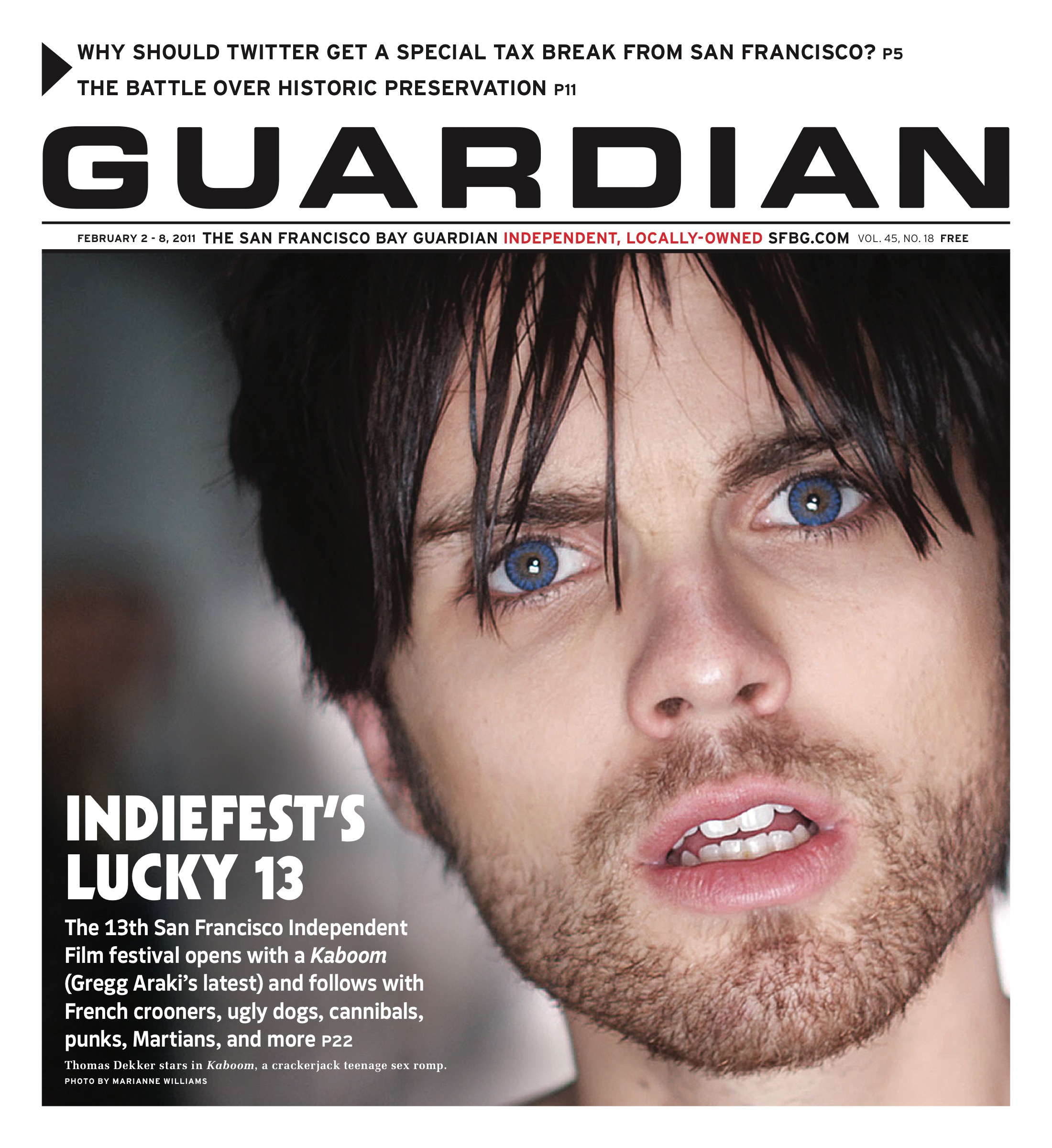
Volume 45 [2010–11]

Short takes on Indiefest ’11

1

So much to see, independently! Below are some quick reviews of flicks that caught our attention …

SAN FRANCISCO INDEPENDENT FILM FESTIVAL Feb 3–17, most shows $11. Roxie Theater, 3117 16th St., SF. 1-800-838-3006, www.sfindie.com

Bloodied but Unbowed (Susanne Tabata, Canada, 2010) “Nobody tells you that by the time you’re 25 half your friends will be gone” is just one of the memorable lines in Bloodied but Unbowed, director-writer Susanne Tabata’s affectionate and probing doc on the Vancouver punk-hardcore scene. It could have been any scene from around the U.S. in the early 1980s — except most weren’t as politicized and didn’t birth bands like the perpetually touring D.O.A., with speed-demon-in-the-pocket drummer Chuck Biscuits, who the Clash called the best, and the Subhumans, who made an impact with such songs as “Slave to My Dick” and whose vocalist Gerry “Useless” Hannah ended up serving five years in the pen for his involvement in the anarchist group Direct Action. Culling telling quotes from the musicians, managers, and knowledgeable onlookers like Jello Biafra, Henry Rollins, and Duff McKagen, Tabata contextualizes the scene up north, while also capturing the moment with the still-vital music, genuine-article photos and footage from Dennis Hopper’s Out of the Blue (1980), and those ironclad anecdotes, ending with the images of a road-worn D.O.A. and an encounter with the vanquished hope of the punk scene, Art Bergmann. What came after hardcore? Heroin is the bittersweet, inevitable punch line. But as narrator Billy Hopeless of the Black Halos offers at Bloodied but Unbowed‘s close, the memories and the music survive — and continue to inspire others to write their own chapters. Feb. 11 and 14, 7 p.m. (Kimberly Chun)

We Are What We Are (Jorge Michel Grau, Mexico, 2010) Hewn from the same downbeat, horror-in-the-cruddy-apartment-next-door fabric as 2008’s Let the Right One In, Mexican import We Are What We Are is a disturbing, well-crafted peek into the grubby goings-on of a family of urban cannibals. In the opening minutes, the patriarch collapses and dies in a shopping center; the rest of writer-director Jorge Michel Grau’s film follows the frantic actions of his widow and three kids, notably oldest son and apparent heir-to-the-hunt Alfredo (Francisco Barreiro), who seems way to timid to become the resident Leatherface. With Lady MacBeth-ish sis Sabina (Paulina Gaitán) urging him on — and volatile younger brother Julián (Alan Chávez) doing his best to blow the family’s tenuously-held cover — Alfredo grapples with the gory task at hand. (And I do mean gory.) If you miss this must-see at IndieFest (it’s sure to be a hot ticket), stay tuned for a theatrical release later in 2011. Fri/4, 7 p.m. (Eddy)

The Drummond Will (Alan Butterworth, U.K., 2010) For a quirky, fast-paced comedy, The Drummond Will has a high body count. It’s a mystery in the vein of Edgar Wright’s Hot Fuzz (2007), but it’s a much more subtle enterprise overall. Straight-laced Marcus (Mark Oosterveen) and charming Danny (Phillip James) travel from the city to the country for their father’s funeral. They soon learn that they stand to inherit his house, which — as it turns out — comes with a set of bizarre complications. Shot in black-and-white, The Drummond Will transitions seamlessly from fish-out-of-water comedy to bloody whodunit. As the deaths escalate, so do the laughs. Because, yes, sometimes it’s funny when people keep dying. I don’t know why the English seem to have a particular talent for gallows humor — the aforementioned Hot Fuzz, 2008’s In Bruges, the original Death at a Funeral (2007) — but let’s be glad they do. And here’s hoping first-time director Alan Butterworth (who co-wrote the film with Sam Forster) has more farce up his sleeve. Fri/4, 7 p.m.; Sun/6, 2:30 p.m. (Louis Peitzman)

Food Stamped (Shira Potash and Yoav Potash, U.S., 2010) Indeed, this is a doc by and about a Berkeley couple who temporarily set aside their Whole Foods-y ways and take the “food stamp challenge,” spending no more than $50 on a week’s worth of groceries (roughly $1 per meal, they figure). And they’re gonna eat only healthy meals, dammit, if they have to dumpster-dive to do it. But Food Stamped is, thankfully, not a self-righteous yuppie safari into po’ town — the Potashs’ experiment provides the framework for an investigation into ways diets could be improved among lower-income families, including visits to farmers’ markets and a farm in Maryland where food is grown for an entire school system. At a slim 60 minutes, Food Stamped is the ideal length to make its point succinctly, without getting preachy — though (and the filmmakers acknowledge this) their food-stamp project is merely a temporary stunt designed to open the eyes of those who’ve never actually needed food stamps to survive. These IndieFest screenings are copresented by the San Francisco Food Bank, which will be accepting donations on-site. Feb. 13, 4:45 p.m.; Feb. 15, 7 p.m. (Cheryl Eddy)

Free Radicals (Pip Chodorov, France, 2010) There’s a paradox at the core of Pip Chodorov’s feature, in that it employs perhaps the most commonplace and programmatic form of contemporary commercial moviemaking — documentary — to explore perhaps the most unique and expressive manifestation of film: experimental cinema. Free Radicals takes its title from a film by Len Lye, and one of the best aspects of Chodorov’s approach is that it doesn’t mercilessly chop up avant-garde works in the service of generic contemporary montage. He’s willing to show a work such as Lye’s film in its entirety, without intrusive voice-over. Chodorov is the son of filmmaker Stephan Chodorov, and his familiar and familial “home movie” approach to presentation is both an asset and a liability. It’s helpful in terms of firsthand and sometimes casual access to his subjects — he largely draws from and focuses on a formidable, if orthodox male, canon: Stan Brakhage, Robert Breer, Peter Kubelka. But it also opens the door for a folksy first-person approach to narration that can err on the side of too-cute. It’s subtitle — A History of Experimental Cinema — to the contrary, Free Radicals functions best as a celebration or appreciation of some notable and vanguard filmmakers and their efforts, rather than as an overview of experimental film. Feb. 13, 8:30 p.m.; Feb. 17, 7 p.m. (Johnny Ray Huston)

Kaboom (Gregg Araki, U.S.-France, 2010) Gregg Araki’s crackerjack teen sex romp is pure verve — a return to devil-may-care form for fans of The Doom Generation (1995) and Nowhere (1997). Kaboom is right: besides sneaking under the blue velvet rope for a classical mindfuck death trip (there’s even a good part for Jennifer Lynch), Araki and his winning cast let loose a fusillade of dorm-room chatter that runs metaphorical language to its limits. The cult-bidden mystery is too squarely accounted for, but then Kaboom is really as much The Palm Beach Story (1942) as Twin Peaks. Our coed heroes are Stella (Haley Bennett) and Smith (Thomas Dekker), and they’re the only platonic thing in the movie. Taken with Araki’s lasting affection for 1990s culture jamming, this rock-solid friendship is actually quite touching, but Kaboom works best when sliding up and down the Kinsey scale, huffing comic book paranoia for the fun of it. Thurs/3, 7 p.m. (Max Goldberg)

Mars (Geoff Marslett, U.S., 2010) Thanks to Mars, the question “Can mumblecore survive in outer space?” has been answered. (And it’s actually less annoying out there than it is on Earth!) Austin, Texas, writer-director Geoff Marslett’s rotoscope-animated tale follows three astronauts (including m-core heavy Mark Duplass) on a Mars mission, two of whom(Duplass and Zoe Simpson) spark romantically en route. Meanwhile, a solo robot delegation lands ahead of them, discovering new life forms and new emotions, as it sparks romantically, á la Wall-E (2008), with a Mars explorer thought lost a decade before. All the squee gets a little dippy toward the end, but the contrast between slacker and sci-fi genres mostly works. Added points for casting Texas hero Kinky Friedman as the POTUS; Giant Sand’s Howe Gelb did the film’s music and plays the sarcastic head of mission control. Fri/4, 9:15 p.m.; Mon/7, 7 p.m. (Eddy)

Special Treatment (Jeanne Labrune, France, 2010) Let’s get this out of the way first: Isabelle Huppert can do no wrong. That’s not to say she doesn’t occasionally pick terrible projects — she’s just never the thing that’s wrong with them. Special Treatment isn’t so much terrible as it is terribly misguided, contrasting the worlds of psychiatry and prostitution with broad, cartoonish strokes. Huppert plays Alice, a lady of the night who’s thinking about giving up the trade. I don’t blame her; the clients Special Treatment presents her with are the dullest of perverts. One wants her to dress up like a Japanese schoolgirl with a teddy bear and a giant lolly. Another goes the collar and dog bowl route. It’s 2011 — can’t we be a bit more creative with our fetishes? On the opposite end, there’s disenchanted therapist Xavier (Bouli Lanners). And wouldn’t you know it? His patients are photocopies from psychiatry textbooks. There’s a point to be made about the link between paying for sex and paying for someone to listen, but Special Treatment lacks the depth to drive it home. Sat/5 and Feb. 9, 7 p.m. (Peitzman)

Superstonic Sound: The Rebel Dread (Raphael Erichsen, U.K., 2010) “Everything I am came out of music,” says Don Letts — the second-generation Jamaican British DJ, director, and entrepreneur credited with turning punks on to reggae in the late 1970s — in this documentary about his life and work. Much like his contemporary, the late Malcolm McLaren, Letts was a cultural cross-pollinator, working in different mediums while encouraging subcultures to feedback into and off of each other to create something explosive and new. While this serviceable doc lets Letts himself retrace ground that’s been extensively covered elsewhere (it’s worth noting, though, that nearly all the archival footage used was shot by Letts himself), the scenes with his formerly estranged son, who’s also a DJ, are tender and unexpected. Feb. 12, 7 p.m.; Feb. 16, 9:15 p.m. (Matt Sussman)

Transformation: The Life and Legacy of Werner Erhard (Robyn Symon, U.S., 2010) The last thank you in the end credits of this documentary, in bold, is for Werner Erhard. The exiled former est leader and “personal growth” preacher or pioneer should thank director Robyn Symon — I think? – for Transformation, since it’s a 77-minute advertisement for him. Certainly, Erhard is a potentially rich choice in terms of subject matter, but very early on, it’s clear that Symon is out to paint a romantic, positive portrait: testimonials on his behalf are coupled with a low-volume acoustic guitar musical backdrop, and Erhard is even interviewed on the beach. Every once in a while an offhand moment — such as a brief mention of Scientology figurehead L. Ron Hubbard’s predatory view of Erhard — disrupts the soothing flow and opens the possibility of a broader, critical look at the “personal growth” phenomenon. (For the most part, it’s only been dramatized, usually through parody, in films such as 1999’s Magnolia and 1995’s Safe.) As a cultural and even historical figure, Erhard is worthy of an appraisal that’s neither enraptured nor utterly damning. This isn’t it. Thurs/3, 9:15 p.m.; Sat/5, 7 p.m.; Tues/8, 9:15 p.m. (Huston)

Worst in Show (Don Lewis, U.S., 2010) All films about animals in the competitive arena must acknowledge the fundamental truth that the animals themselves are nowhere near as entertaining as their owners. A dog just wants to play, eat, crap, sleep, and maybe have its belly rubbed. The dog’s owner, on the other hand, wants other things — titles, media attention, perhaps an endorsement deal — because they have convinced themselves (as they must convince the judges, and to some degree, the public) that their dog does not just want to play, eat, crap, sleep, and maybe have its belly rubbed. No! Their dog is special. Doc Worst in Show understands this basic drama and finds plenty of eager players in the canine and bipedal contenders, both new and returning, at Petaluma’s annual Ugliest Dog in the World Competition. Amid all the patchy fur, bad eyes, underbites, and malformed legs, it’s the big hearts and outsized egos that truly stand out in this portrait of pageant motherhood at its most extreme. Feb. 9, 9:15 p.m.; Feb. 13, 2:30 p.m. (Sussman)

Je T’aime, I Love You Terminal (Dani Mankin, Israel, 2010) It’s unfair to judge a film by its title, but Je t’aime, I Love You Terminal lets you know exactly what you’re in for. This twee indie romance is Before Sunrise (1995) meets Once (2006) meets every other twee indie romance you’ve ever seen. The film is more mediocre than it is bad, exploring the single-day love affair between two strangers stranded in Prague. Ben is moving from Israel to New York to marry the one that got away. Naturally, he also sings and plays guitar. Emily, an impulsive free spirit, teaches Ben a valuable lesson about living in the moment. Saying this story has been done before is an understatement: Je t’aime packs on indie cliché after indie cliché, without really bothering to develop Ben or Emily into interesting characters on their own. This is a retread without anything to distinguish it from the rest, dragging it down from shrug-worthy to eye-rolling. Feb. 12, 4:45 p.m.; Feb. 14, 9:15 p.m. (Louis Peitzman)

Every little star

0

HAIRY EYEBALL In 1979, the UC Berkeley Art Museum and Pacific Film Archive received a generous and somewhat unusual gift from the sister of the late German-born, pioneering American sculptor Eva Hesse: an assortment of small experimental works, made by Hesse herself, in materials such as latex, cloth, wax, fiberglass, wire mesh, and masking tape. What made these objects so unusual was their very indeterminacy. Should they be thought of as proper Hesse pieces? Were they studies for the large-scale sculptures that came to define Hesse’s output throughout the 1960s, or standalone technical experiments with different materials and processes? Alternately, were they intended to simply be as is — Hesse had given away similar objects as gifts and kept others arranged throughout her studio.

Hesse, who tragically died of a brain tumor in May 1970 at 34, left little to no indication. “Eva Hesse: Studiowork,” the stunner of an exhibit currently up at the Berkeley Art Museum, is then a homecoming of sorts for many of the pieces on display. Originally curated by Hesse scholar Briony Fer and Barry Rosen of the Hesse Estate for Edinburgh’s Fruit Market Gallery in 2009, this testament to the benefits of gutsy scholarship and cross-institutional support boldly embraces the precariousness of Hesse’s curious objects head-on and encourages us to see them on their own terms.

Entering the gallery space, you immediately encounter a group of previously unseen paper works arranged out in the open on a low plinth, like scattered autumn leaves. The forms vary in thicknesses and degrees of curvature: a worked shape of adhesive-enforced cheesecloth resembles a sunken pumpkin; a crinkled piece of tissue thin papier-mâché a bowl or shard of skull. The slightest breeze could send it flying. Hesse purposefully used fragile or impermanent substances — much to the bane of conservators — as a way to imbue her sculpture with a self-sustaining mutability, a means to continue the processes her initial crafting set into motion. In this sense, time is also one of her materials, as evinced by the caved-in latex bricks and box-like containers that have oxidized over the decades to a rich mahogany color.

The delicacy of the paper works is offset by the three large vitrines in the adjacent room each filled with a variety of objects that alternately read as: replicas of exotic coral or dried chili peppers; dirty jokes; rudimentary toy prototypes; or, more directly, obstinate lumps, variously crafted from latex, wax, painted wood and rubber tubing. The soft, round, protuberant forms of our bodies are evoked everywhere, and yet to call a fold of latex “vaginal” or a coil of tubing “intestinal” somehow feels inadequate to conveying the uncanny physicality of these pieces. It’s as if someone had made you a model of your own hand to hold.

“There is no wishing away the fact that it is hard to know what to make of these things because they are intractable in some way,” cautions Fer at the start of her warm and deeply perceptive catalog essay. Rather than function as a limitation, this interpretive resistance posed by the studio works invites us to un-see them as sculpture and to view Hesse’s careful making and undoing of material as posing a perhaps unnameable but immanently enriching possibility.


DOWN ON THE STREET

My first glimpse of Katy Grannan’s street photography was a startling color photo included in Fraenkel Gallery’s 30th anniversary show “Furthermore.” The picture was of an elderly woman wrapped in a mink stole, her face obscured by windswept gray hair as she walked down a sun-bleached street. When viewing it next to the other portraits in “Boulevard,” Grannan’s third solo show at Fraenkel, I realized it wasn’t so much the woman’s “odd” outward appearance that attracted the photographer, but the sense of purposefulness conveyed in her frozen stride.

It would be quite easy to dismiss the pictures in “Boulevard” on the grounds that Grannan is a latter-day Diane Arbus, inherently exploiting her “singular” subjects in the act of photographing them. Many appear to be regular denizens of the street — the homeless, addicts, hustlers — or are folks whose self-presentation defies established norms: an aging Marilyn Monroe impersonator, a trans woman with a 100-yard stare, an extremely hirsute biker-type.

Such a charge is unfair, and I suspect, likely the work of our own unease at looking at people who we would normally turn away from, or perhaps stare at furtively, if encountered on the street. Grannan, though, seems to want to give them their moment without overextending the encounter. Hence, a photograph. She doesn’t pose her subjects and none look directly at the camera. It’s as if, as with the fur-wrapped crone, she stopped them midstride, got her shot, and they went on their way. She respects their anonymity as well (each photo is titled after the city, Los Angeles or San Francisco, where it was taken). The discomfort in looking at Grannan’s work — she extends her gaze in The Believers, a related solo film installation at 1453 Valencia — partly comes from how technically accomplished and flawless it is: she shoots midday to capture her subject’s every wrinkle, blemish, and faded tattoo.

It feels off and disingenuous to call Grannan’s work “beautiful,” but it’s hard not to look and keep looking at the people in her neighborhood, some of whom are our neighbors as well.

EVA HESSE: STUDIOWORK

Through April 10, $5

Berkeley Art Museum

2626 Bancroft Way, Berk.

www.bampfa.berkeley.edu

KATY GRANNAN: BOULEVARD

Through Feb. 19, free

Fraenkel Galley

49 Geary, SF

www.fraenkelgallery.com

arts@sfbg.com

Landmark to loudness

0

MUSIC Happy Sanchez’s office is above the cafe, by the entrance. There are only a couple of windows. One opens onto the parking lot, where a car alarm blares during our interview. The other is dark; below it are the building’s two hourly rehearsal rooms. Aside from the vibration of a double bass revving, we’re cut off from the activity going on at Secret Studios. As the owner, Happy makes up for this isolation with a wall of closed-circuit TVs showing the hallways and common areas tying the Studio’s 130 monthly rehearsal spaces together.

“Mostly it’s just about dealing with the headaches of running a business,” Sanchez says. The headaches, when your clients are all musicians, can be numerous. Bands arrive at 2 a.m., fresh from a gig, and decide to toss utility carts down the stairs. People try to smoke inside, piss in the parking lot, live in their units. Watch out for speed freaks. Make sure women aren’t being harassed. “Sometimes I feel like I’m the principal of the school,” Sanchez says.

Sometimes it’s just plain traumatic. “The one thing that upset me the most, this fucking guy was pissed at his girlfriend, took her cat, put it in the [rehearsal] room, and left it for weeks. Fucking poor cat was skin and bones by the time the girlfriend came and asked me to look for it. Most I’ve ever been upset at anyone. He was banned.”

“But most of the time people are pretty cool,” Sanchez is quick to add. “The people who are on the lease are level-headed. It’s always the friend or the guy that’s just hanging out that makes problems.” There is reason for me to doubt this statement, having just heard Sanchez tell another story about being held up at gunpoint by a rapper who wants his demo tape. But I’m still inclined to believe him, given the sheer number of clients he’s come in contact with in the 25 years since he took a job as a studio manager at Secret Studios, back when it was a small two-room operation.

At the time, Secret, like most of the studios in town, was about hourly rehearsal and recording space. The two units of Secret Studios were originally at Third St., before a mid-1980s move to 215 Napoleon St. in a building with lots of neighbors. “Mostly we did a lot of punk rock recordings, back in ’87,” Sanchez remembers. “This guy David [Pollack], who I later bought the studio from, at the time I was just working for him and he set me up with all these gigs.” They’d rent the place out for parties, for extra money. “Metallica rented it, back in the days when I guess they were big in Europe but they weren’t really that big, yet. Before the Black Album [1991’s Metallica] came out, when they blew up.”

Those involved in Secret during the Napoleon Street era attempted to confine major sessions to nighttime, but it eventually became clear — as the neighbors bitched — that a different location was needed. After the owner sold the business to Sanchez (“Basically, he gave it to me at minimal cost”), he was able to expand and then move into 50 units at the current location on 2200 Cesar Chavez St. The large warehouse with a single floor of small rooms was previously the sound stage for the talk radio TV drama Midnight Caller.

Sanchez credits some of his success to timing. “I got in at the right time. It’s just more expensive to build nowadays. People have tried to build big studios like this and it’s just not affordable anymore. They see it as easy money, but it’s not easy to pull off.”

One person who tried — and succeeded — was Greg Koch, who developed the nearly 180-unit Downtown Rehearsal in 1992. Earlier, Sanchez had passed on its Third Street location. “It was shady at night when most of my clients would be around,” he says. “That building was cheap, though. They couldn’t give it away.”

Downtown was a major competitor until the summer of 2000, when Koch attempted to evict all of his tenants without notice in an attempt to flip the property for a huge profit. In the process, he instigated a musical community revolt, resulting in a large cash settlement and the formation of a then-hopeful, now apparently stagnant nonprofit, SoundSafe. At the time of the turmoil, Secret Studios was still expanding to its current size of 130 units. “I basically opened my units and saw a huge influx of bands,” Sanchez says.

Sanchez has had many models for what Secret Studios should — and shouldn’t — be. He recalls that Francisco Studios, a Turk Street basement space, had a bathroom out of Trainspotting. He’s quick to admit that since he’s taken over the business, there have been mistakes and failures. A plan to start the International DJ Academy in the front offices of the building, with a partner who managed Invisibl Skratch Piklz, fizzled. “They never could quite get it off the ground,” he says. “It was a good concept, but I think they needed someone to run it as a business.” Along with a rap studio that was going at the time, the academy devolved into something that included a barber shop and a night club before Sanchez had to shut it down.

Which, technically, makes two rap studios Sanchez had to end. Back in the late 1980s, at Secret’s old location, there was a lot of money to be made from hip-hop. “These rappers were coming in and you could pretty much just charge them anything,” Sanchez says. “I think there was always the drug dealer in the background financing it. I swear, we had like three clients over time that got murdered. The first time it was kind of a shock. They found the guy in a trunk in Oakland. The second guy got murdered on the night of the earthquake in 1989. The scene just got too crazy. Gangster rap came out, and the whole vibe changed. It got really hardcore.” After a hold-up occurred at the studio and an expensive keyboard was stolen, Sanchez stepped away from the rap game in 1991.

Many artists have come through Secret Studios, but it’s not something Sanchez brags about. In part this stems from his respect for overall security, a high priority when theft is a concern. But it also has to do with his respect for confidentiality. The music business exposed him to a lot of drugs in the ’80s, and he himself struggled with addiction. From 1989 until 1992, he hosted a Narcotics Anonymous gathering — the Straight Edge Rockers meeting — in the studio on Sunday nights. “There were a couple people there that you would definitely know their names,” he says. “I’m actually thinking about getting it going again. It’s not as easy to pull off, but I always thought that meeting was so cool. There are a lot of people in the music industry that need that.”

Sanchez is desensitized to stardom. He’ll say that no one really big has ever been at Secret Studios, then rattle off a long list of names: the Dead Kennedys, Michael Franti, the Go-Gos, EPMD, Romeo Void, Chris Isaak, Mike Pistel, Toots Hibbert. Some of these connections are long relationships, some are incidental. MC Hammer rehearsed at Secret before he was big (but had the parachute pants). Gene Simmons came down in a limo.

Sanchez is happy with his success so far and grateful for the freedom to be a musician with a stable business. With another 10 years on the lease (which he hopes to extend to when his two-and-a-half-year-old son reaches adulthood), he’s satisfied with assuming a more administrative role at Secret. He does the books, handles the day-to-day issues, and makes his own music, composing for movies and television as the Latin Soul Syndicate.

For a lot less drama, Sanchez is a little less in the know about his clients and their role in the scene of the moment. A while ago, for example, he needed to contact a band about a bill. But the band was on tour, and he was referred to its business manager. He went online to look it up. He had no idea who the band was until he Googled “The Dodos” and a video popped up showing the band playing on The Late Show with David Letterman.

www.secretstudios.com

arts@sfbg.com

Ollie beats

0

caitlin@sfbg.com

MUSIC Tommy Guerrero likes to skate down Potrero Hill. He’s been doing it since he was a young pup street boarder — one of the first to go pro, in fact — cruising down those steep residential declines that, looking south from SoMa, resemble like nothing so much as that scene from Inception where the dream city folds on top of itself. Guerrero skates smoothly from one legendary SF career to another, a shape-shift neatly illustrated by the release party for his eighth solo album Lifeboats and Follies at Cafe Du Nord Saturday, Feb. 5.

Despite the requests for autographs that he still gets; the occasional cravings his beat-up body experiences for skating (“It’s so raw and the energy is so fucking gnarly. Once you’ve had a taste of it, there’s no turning back.”); and a job that most ex-skate rats would kill for — he’s the art director for Krooked, a subset of Potrero Hill skate company Deluxe — he’s really more into music these days. “I would love to have all that time to work in the studio. I want to retire [from skate design] in a year,” he says, half-jokingly — but still longingly.

Maybe it’s a grass-is-always-greener thing, but until now he’s done a good job of balancing his various passions. Even in the 1980s and ’90s when Guerrero was grinding out his signature moves on the driveways and suicide hills of the city, back when he was popularizing Public Enemy in Japan by skating to the group’s tracks during competitions, music was always playing a supporting role. He and brother Tony played in punk bands, including Free Beer (a name that made for alluring concert flyers).

Nowadays Guerrero makes layered instrumental music that’s appropriately enough a mix of many different elements: chill jazz with electronic crescendos, a little Latin percussion, maybe a horn solo easefully inserted. Guerrero has a DJ-like impulse to play with genres. “I just hear so much shit in my head, this is what comes out.” Apparently his albums cause havoc in the Amoeba cataloging system. “I’ve seen it in electronic, rock, alternative, even experimental or some shit,” he laughs, sitting cross-legged in a patio booth at Thee Parkside, black leather Vans (his own signature design) on his feet.

He’s in the middle of doing some promotional work for Lifeboats and Follies, but like the rest of his projects, you get the feeling that Guerrero would be doing the same thing even if he never got paid a dime. After failing to resolve differences with his old label, Quannum, Guerrero bought the entire stock of his last album, From the Soul to the Soul, back from the company. He’s mulling over what to do with it — maybe give CDs away at Saturday’s show?

Guerrero never gained the Thrasher notoriety he got from skating in his musical career. But he casually mentions that he is, as the saying goes, big in Japan. He performs there a lot and gets off on being able to take risks with in his live performances that wouldn’t go over well with American audiences looking to hear the same old thing. “They can love J-pop and, at the same time, they can love John Zorn,” he says of his Japanese fans. It makes sense that Guerrero would gravitate toward an audience looking for a more diverse experience, one that trusts that whatever he’s popping off with — on the skateboard or mixing board — is gonna turn heads. 

TOMMY GUERRERO: LIFEBOATS AND FOLLIES RELEASE PARTY

Sat/5 9:30 p.m., $12

Cafe Du Nord

2170 Market, SF

(415) 861-5016

www.cafedunord.com>

The road, Thorrior

1

arts@sfbg.com

MUSIC There’s no easy way to describe Valient Thorr. Hailing from Chapel Hill, N.C., the quintet has labored throughout its career under the strain of countless casual characterizations, each less accurate than the one before it. Reached by phone in Raleigh, N.C., as he prepared for the band’s impending tour with Motorhead, singer Valient Himself gives the wry rundown.

“Forever, in The Onion, it said ‘Kiss-like band, biker band’ or some shit. None of us ride motorcycles!” he scoffs. Nor, for that matter, does the band wear elaborate makeup or sell branded coffins. The mistakes, however, continued. “People would say something like ‘Lynyrd Skynyrd-esque’ or some shit like that,” complains Valient. “We don’t play Southern rock. We have accents from the South because those are the colloquialisms that we have been accustomed to since we crash-landed here. Or they look at ‘Thorr’ and they say, ‘Oh, they’re Vikings.’ If you could pick three adjectives that we get called the most that are totally wrong, they’d be Southern, Viking, biker metal.”

Now, if you’ve been paying attention so far, you’ll have noticed that the singer goes by an outlandish pseudonym and makes offhand references to things like “crash landing.” By “here,” in the previous paragraph, he means “planet Earth.” This is because the band Valient Thorr claims, with a straight face, to be from the inside of the planet Venus. Valient Himself, a former sixth-grade teacher, sticks to his story throughout the interview, even when gently prodded to discourse on non-Venusian topics.

The band’s beginnings can be traced to East Carolina University, where the five Thorrs (Valient Himself, Eidan, Lucian, Sadat, and Dr. Professor Nitewolf Strangees Thorr) were masquerading as undergraduates. Nurtured by the college radio culture that defined their adopted home state for much of the 1990s, the band soon discovered the geographic advantages of hailing from the Tar Heel State, which features nine midsized cities along the axis of Highway 40, which neatly bisects it into northern and southern halves.

Before long, Valient Thorr was traveling nationwide, hitting 47 cities in 52 days on its first trip out. This relentless dedication to touring would come to define the band, which has effectively been on tour since Valient’s career in the classroom ended in 2005. That event also marked the last time he cut his beard, a fiery red thatch that has since attained truly epic proportions.

Though Valient Thorr’s music — a combination of the rabid, breakneck pace of punk rock and the precision guitar work of classic Thin Lizzy — produces some infectious, exultant tunes, the onstage charisma of the band in general and the singer in particular forms the most important part of its appeal. Clad in impossibly tight pants, cherry-red wrestling shoes, and little else, Valient prowls the stage soaked in sweat, striking mock-muscleman poses and exhorting the audience with the inexhaustible, manic energy of a true rock ‘n’ roll evangelist.

The power of Valient Thorr’s proselytizing can be seen at any show. A growing legion of die-hard fans, called Thorriors, pledge allegiance to the band above all others, often sporting customized jean jackets as emblems of their dedication. In that sense, at least, the band is like Kiss. One Thorrior, a Kansas City native, has even been granted an honorary Venusian surname; “Tim Thorr,” as he is known, “has more Thorrior tattoos than anyone else” explains Valient. “We call him the True Believer.”

Touring with a band as well-known as Motorhead, Valient Thorr is sure to win more converts to its cause. But whether people like it or not, or whether they believe it or not, the Thorrs will be out there. “I think performing is in your blood,” Valient says. “I think everyone was born to do something. We didn’t go to school to be rock ‘n’ rollers — it’s just something that came out of us. It’s an idea that started and it just had to happen.” *

VALIENT THORR with Motorhead, Clutch

Wed/2, 8 p.m.; $35

The Warfield

982 Market, SF

(415) 345-0900

www.thewarfieldtheatre.com


Dreadfully fun

0

Dead Space 2

(Visceral Games/Electronic Arts), Xbox 360, PS3, PC

GAMER Survival horror might be the game genre most affected by the environment it’s played in. You’ll see the best results when a player agrees to meet the title halfway: turning out the lights and turning up the volume. Then it’s up to the developers to deliver on their half of the equation. Though generally lauded when it released in 2008, the original Dead Space launched with promise but ultimately was content to repeat itself for the majority of its playtime.

Dead Space 2 delivers. An homage to movies like 1979’s Alien and 1997’s Event Horizon (which it most closely resembles), the Dead Space series is set in a future where space travel allows humans to embark on “planet cracking” missions, wherein all celestial bodies of the galaxy are prime meat for resource-exhausting expeditions. On one such expedition the shuttle finds an alien artifact, contagion, blah blah blah … zombies. A pretty first-rate “previously on” feature in the main menu will catch anyone up to speed.

As engineer Isaac Clarke, it’s up to you to survive this “necromorph” outbreak, this time aboard a space station named the Sprawl. Armed with a ton of weaponry and a little kinetic energy module, you’ll have to escape another apocalypse of the undead, as always by dismembering their arms and legs (and tentacles).

Perhaps taking a cue from last year’s Mass Effect 2‘s streamlining successes, Dead Space 2 is far more linear and cinematic than its predecessor. But unlike that other similarly space-themed sequel, the divide between what is lost and what is gained in the transition is far less apparent. In embracing the hallmarks of any good survival horror series — jump scares, the feeling of dread around each corner, and limited supplies — this sequel is less about innovation than it is about refinement.

Contrary to the drab shuttle hallways of the first game, the Sprawl was once a bustling metropolis and the environments you encounter are much more varied. From a church to a mall to zero-gravity space walks, the freshness in each area keeps it exciting. While the scares range from terrifyingly atmospheric (a bloodstained and deserted daycare center is especially eerie) to inelegant “monster closets” where enemies pop out of vents as you walk past, the game is never boring.

After a promising debut and a bit of a misstep with the God of War-aping Dante’s Inferno (2010), with Dead Space 2 developer Visceral Games has crafted an adventure that begs to be played more than once. Aspects remain overly familiar but, like the best franchises, the Sprawl provides players with a compelling setting and sense of dread that they’ll happily return to.

Psychic Dream Astrology

0

February 2-8

ARIES

March 21-April 19

Spontaneous change is awesome as long as it comes from the right place inside you. Movement from your intuitive, happy place is well-starred this week, while moody reactiveness will get you in a heap of trouble.

TAURUS

April 20-May 20

You are poised to make a deep, important change this week. Commit to moving forward and not letting habit or the fear of change dictate your future. Boldly make your own fortune!

GEMINI

May 21-June 21

This week, your intuition is infallible, Twin Star! The only way to screw it up is to do too much interpreting. Trust your gut and just go with it, and keep the analysis to a minimum. Let the future unfold.

CANCER

June 22-July 22

Be open-hearted and present this week, no matter the circumstances of your life. There are no certainties to cling to, just options to weigh. The more authentic you are, the better perspective you’ll have.

LEO

July 23-Aug. 22

This week’s frustrations can provide you with an excellent opportunity to become King of your Internal Castle, Leo. Make your world exactly as you want it to be — or at least moving in that direction. Stay in it to win it.

VIRGO

Aug. 23-Sept. 22

Passion, desire, and play need to have a place in your life, Virgo. Don’t let fear of consequences stop you from exploring the creative side of your life this week. Start something new, or go next level in the pursuit of pleasure.

LIBRA

Sept. 23-Oct. 22

Your integrity is in your emotions, but fear threatens to undo your emo clarity. Choose love over fear always, but especially this week. Adjust your behavior or expectations, but not your availability to amour.

SCORPIO

Oct. 23-Nov. 21

Reach out to the people and things that rejuvenate your harried heart, Scorpio. Your mind may be racing in circles that do you no good. Turn to friends and loved ones to give you some much-needed perspective.

SAGITTARIUS

Nov. 22-Dec. 21

Your sign has chronic karma with proportion: the question of how much is too much or not enough? continually plagues you! This week, be on the lookout for overdoing things. Tax yourself to the max and there’s nothing left to play with, Sag.

CAPRICORN

Dec. 22-Jan. 19

Loss and sadness are terrible, but their gift is that they bring you to the end of a cycle — and to a new opening. Own your need for closure and be bold in creating something new and better.

AQUARIUS

Jan. 20-Feb. 18

Let go of the stuff that seems like it’s keeping you together but is actually holding you back. Look to matters of the heart for where you need to change your own actions and reactions, and cultivate faith on the way.

PISCES

Feb. 19-March 20

You want to know, but you don’t — and it’s killing you. Knowing the answer is the wrong goal, Pisces. Let things develop and decisiveness will follow. You’re not in control, so strive toward creative healthiness this week.

Jessica Lanyadoo has been a Psychic Dreamer for 16 years. Check out her website at www.lovelanyadoo.com or contact her for an astrology or intuitive reading at (415) 336-8354 or dreamyastrology@gmail.com.

Haute pot

9

steve@sfbg.com

CANNABIS Marijuana edibles have come a long way in a short time.

Just a few years ago, the norm was still brownies of uncertain dosage that tasted like eating weed, right down to the occasional stem or lump of leaf, served in a wax paper envelope. But now the foodies have gotten into the game, producing a huge variety of tasty treats that are incredibly delicious even before the munchies kick in.

San Francisco could be on the verge of a culinary revolution that would parallel those being experienced in the realms of boutique eateries, gourmet coffee, and high-end street food vendors — except for the fact that makers of cannabis edibles still reside in a legal limbo.

As long as they’re operating under the umbrella of a cannabis collective, getting marijuana from its growers and selling through its dispensaries, then the weed bakers are in compliance with state law. But they’re still illegal under federal law, and even California law doesn’t allow them to operate independently as wholesalers, making it difficult to scale up operations and do more than just break even financially.

Judging from the skittishness of some of San Francisco’s top edibles producers — who didn’t want to be identified by their real names and were wary of letting us know too much about their operations — they perform this labor of love under a cloud of understandable paranoia.

“Unfortunately, secrecy is a rule we have to live by, day in and day out,” said the founder of Auntie Dolores, who we’ll call Jay. She makes a line of popular, strong, and yummy products that include pretzels, chili lime peanuts, caramel corn, and cookies of all kinds.

Yet the legal threats haven’t stopped producers from professionalizing the edibles industry — in terms of quality control, packaging, consistency, and innovation — and drawing on foodie sensibilities and their own culinary training to develop creative new products that effectively mask or subtly incorporate that bitter cannabis taste.

“We’re all about masking the flavor of the cannabis because I really don’t like the flavor that much,” Jay said of products that are stronger than most but somehow without a hint of weed in them. “People here have a high standard. It’s their medicine and their food, and we have a lot of foodies who are really into our products.”

Choco-Potamus is an example of this new generation of edibles, combining gourmet chocolate-making with the finest strains of cannabis, using only the best buds rather than the leaves and other plant matter that have often gone into edibles. Mrs. Hippo, the pseudonym of the chief baker, has worked for a national company in the food industry for about a decade, mostly doing branding, and it shows in this eye-catching product.

“I’m kind of a foodie. We have friends who roast whole pigs and brew their own beer, that kind of thing,” she said. “Really good high-grade marijuana has some really great flavor qualities, particularly when combined with cocoa. I really want the patients to enjoy the flavor, not just the feeling.”


EAT YOUR MEDICINE

Steve DeAngelo, founder of Oakland’s Harborside Health Center, one of the Bay Area’s biggest dispensaries, said edibles have been increasingly popular, particularly among older users, patients with medical conditions that make smoking problematic, or those who prefer the longer body highs of eating it.

“Our sales of edibles has trended steadily upward since we opened,” DeAngelo said, noting that last year the club sold $1.2 million in edibles, about 5.5 percent of total sales, compared to $306,000 (3.2 percent) after they opened in 2006. “As an absolute amount, we’ve seen the amount of edibles quadruple in the last four and a half years. As percentage of sales, we’ve seen it double.”

He said the main difference between eating and smoking marijuana is duration and onset. Smoking it brings on the high within minutes and it usually last for less than two hours, whereas eating it takes about 45 minutes for the effects to kick in, but they can then last for six to eight hours.

“There are different forms for different symptoms,” he said, noting that edibles are perfect for someone with insomnia or other symptoms that disturb normal sleep patterns, while someone who needs marijuana in the morning can smoke or vaporize it and have the effects mostly gone by the time they go to work.

“When you eat it, it goes through your limbic system, so it hits your brain differently,” said Jay of Auntie Dolores, saying that she and many others prefer the subtle differences in the high they get from eating cannabis. Others who prefer edibles are those looking to just take the edge off without being too stoned. “A lot of the people who like the edibles are moms. They don’t want to smell like pot or be too high,” Mrs. Hippo said.

She noted that her chocolates are not as strong as many of the edibles out there, with each candy bar containing two doses. “It’s a personal preference for how I want the bars to taste,” she said, although she has been working on making a stronger version as well, which many dispensaries and their customers prefer.

But Mr. and Mrs. Hippo say they think taste is becoming as important as strength, calling it an emerging area of the market. “I have a dream that there could be just an edibles dispensary,” Mr. Hippo said, envisioning a pot club with the look and feel of a high-end bakery.

For now, demand for edibles is still driven by “potency and packaging,” says SPARC founder Erich Pearson. “I think people eat food to eat food and enjoy. They don’t eat to get high.” Yet as long as they’re getting high in this competitive marijuana marketplace, the edibles makers have been making better and better tasting products.

Jade Miller makes 12 flavors of cannabis-infused drinks under the Sweet Relief label, with spiced apple cider being her top seller. She draws other training at New York City’s Institute for Culinary Education to make some of the best-tasting drinks on the market.

“I got into it because I needed alternative pain relief when I had whooping cough and a torn shoulder muscle,” Miller told us.

She was injured while on a cooking job with Whole Foods Catering in September 2006. She hated the opiates that she was prescribed for her shoulder pain, preferring marijuana. But when she contracted whooping cough, she couldn’t smoke pot anymore without painful coughing, so she got into making edibles.

At the time, many of the pot-laced foods out there weren’t very good or professionally made. “Some edibles were inedible,” she said. “I became a one-woman campaign against brownies.”


QUALITY CONTROL

With a background in homeopathy and appreciation for marijuana, Jay started making edibles 10 years ago, informally helping two aunts battling cancer. But in the last couple of years she’s honed her recipes, improved her packaging, and transformed her Auntie Dolores snacks into some of the best on the market, available in several local dispensaries, such as Medithrive, SPARC, Bernal Heights Dispensary, and Shambhala.

“I just knew I could make stronger and better-tasting stuff,” she said. “The demand from the patients is really high for great products.”

Horror stories abound about users who overdosed on edibles and ended up being incapacitated all day or night, but that’s mostly been a problem of dosage, which modern technology has helped overcome. Choco-Potamus and other makers routinely send their batches to a lab for testing.

“The idea is we can be helping an edibles producer or a tincture maker quantify the cannabis in the product,” said Anna Ray Grabstein, CEO of Steep Hill Laboratory in Oakland, which tests cannabis and related products for strength and purity. “They’re able to use that information to create consistency in their recipes.”

It’s been difficult to meet the rising demand given the current legal framework.

“Yes, we would love to scale up. I’d love it if more people had access to our product. We’d love to sell it outside of California,” Jay said. “But it’s tricky because there’s so many gray areas,”

Larry Kessler is the program manager for the San Francisco Department of Public Health’s Medical Cannabis Dispensary Inspection Program, which reviews the procedures of edibles makers and requires those who work with one than one dispensary to get a certified food handler license from the state.

“We just want to make sure they know what they’re doing,” Kessler told us.

San Francisco has some unique rules, banning edibles that require refrigeration or other special handling, granting exceptions on a case-by-case basis. Unlike Oakland and some other jurisdictions, San Francisco also requires edibles to be in opaque packaging. “It was to get rid of the visual appeal to children,” he explains.

All the edible makers say they can live with those local rules, and they praise San Francisco as a model county for medical marijuana regulation. The problem is that state law doesn’t allow them to be independent businesses.

“It’s against state law. There’s no wholesaling allowed, and that’s a big issue around edibles,” Kessler said. “It’s a complicated issue.”

All the edibles makers in this story say they are barely getting by financially, and all have other jobs to support themselves. Jay says she’s thought about giving up many times, but she’s been motivated by stories they’re heard from customers about the almost miraculous curative properties of their products, particularly from patients with cancer and other serious illnesses.

“I get an e-mail like this and then it’s back to the kitchen,” Jay said, referring to a letter from a customer who credits her with saving his life. “There are so many positive properties it has. There’s really no other plant like it.”

State of the weed

22

steve@sfbg.com

CANNABIS When we did our first Cannabis Issue a year ago, the Bay Area’s medical marijuana industry was booming, and there was high anticipation that California would soon legalize weed for everyone.

Proposition 19 divided even those who fully support decriminalizing cannabis — partly because the existing system was working so well in San Francisco and many other cities, so people were wary of an uncertain future — and voters rejected the measure in November.

But only the most dogmatic anti-drug warrior would take that vote as a repudiation of the wonder weed, because California’s love affair with its top crop today is stronger than ever. And the burgeoning industry that grows, processes, and delivers marijuana continues to expand rapidly amid a stagnating larger economy.

Three new high-end cannabis dispensaries have opened in San Francisco in the last six months, bringing to 25 the number of licensed clubs, and the selection and quality of indoor and outdoor buds, concentrates, and edibles has never been greater. The industry’s many opportunities are starting to attract top talent from unrelated sectors of the economy, such as Mark Williams and Nic duTemps.

Williams recently quit his job at Apple to start CloudNine, which is developing a high-quality portable vaporizer called Firefly that will be assembled here in San Francisco and released this summer. Unlike current vaporizers made of plastic that use butane heaters to release the cannabanoids from the weed without burning it, Firefly is made of metal and glass with customizable wood inlays, uses advanced batteries in its heating element, and will retail for about $300.

“I decided now is the time,” Williams, 42, said of his decision to leave the corporate cubicle world after 20 years. “The market is maturing and the users’ ability to make a discerning choice about how they’re going to take marijuana is maturing.”

DuTemps worked in public relations for many years and she also jumped ship to do something she loves a few years ago: landscaping backyard gardens. “But then the bottom fell out of the economy,” she said, and people growing marijuana were the only ones who still wanted her expertise.

Yet the supply of cannabis products had grown faster than the number of dispensaries and delivery outlets in recent years. “The clubs were becoming incredibly flooded,” duTemps said. “People have found themselves with copious amounts of product and nowhere to sell it.”

So she decided to marry her PR expertise with her cannabis connections and last month started Sweeter Made, a medical marijuana cooperative and delivery service that uses an old meter maid vehicle for deliveries. DuTemps said she loves “the secret thrill of delivering medical cannabis, hash, and edibles in something that used to give people parking tickets.”

They’re just a couple of the countless Bay Area residents involved in the pot business, an expanding and evolving sector of the economy that even cash-strapped government agencies are getting involved in.

Oakland city officials recently stepped back from their ambitious plan to permit large-scale pot farms in industrial warehouses, mostly because of legal concerns, but that city and Berkeley last year moved forward with plans to legitimize and tax the industry at a higher rate. And the big next step — full legalization of weed for even recreational users — is still lingering on the horizon.

Oaksterdam University founder Richard Lee, who bankrolled placing Prop. 19 on the ballot, has announced that he’ll try again on the November 2012 ballot. He told the Guardian that he’s currently developing his battle plan, consulting his allies, and determining what the measure will look like.

“We’re still doing research on what went right and what went wrong,” Lee told us. “There were lots of people who were for legalization that didn’t like the details [of Prop. 19].”

For example, the measure allowed counties to set different legal standards, potentially creating a logistical nightmare for distributing the product. Lee said the new measure will probably include statewide standards and some degree of local control, but he’s still working with groups ranging from the Drug Policy Alliance to the NAACP to develop it. Meanwhile, CaNORML, the state chapter of the National Organization for the Reform of Marijuana Laws, will be gathering movement leaders together in Berkeley on Jan. 29 for a daylong conference titled “Marijuana Reform: Next Steps for California.”

While there are differing visions for where the movement is headed and over how hard and quickly to push for full legalization, it’s undeniable that the industry is thriving and here to stay.

Set the oven to blaze

0

caitlin@sfbg.com

CANNABIS Used to be when you wanted to eat your weed, you half-listened to that “more-stoner-than-you” friend, scrawled down a couple of vague butter-to-swag ratios, and got to messing up your kitchen with a box of store-bought Duncan Hines brownie mix and quarter bags. But here’s a news flash: stop doing that. You have no excuse for dorm-room shenanigans with the new crop of wholesome marijuana cookbooks, which will teach you the proper way to add buzz to your lemon bars, chicken wings, and Thanksgiving turkey.

Such are some sample offerings from a new cookbook by the Bay’s preeminent voice on weed cooking: Sandy Moriarty. Moriarty is a graduate of Oaksterdam University who felt that the school could benefit from her 20-plus years of experience in the kush kitchen. After doffing her cap and gown, she cooked up a batch of her high-potency weed treats for Oaksterdam staffers and was rewarded with her own cooking courses on the syllabus. “They said ‘wow! This lady’s got something going on,’ ” Moriarty recalled in a phone interview with the Guardian. She now hawks her much-lauded lemon bars in the school’s Blue Sky Cafe and recently released an anthology of her best-loved bud recipes, Aunt Sandy’s Medical Marijuana Cookbook (Quick American Publishing, 96 pages, $18.95).

The secret to pot cuisine, Moriarty says, is in the lipids. “My butter-making process is superior over all,” she told us. So enthusiastic was she on the subject of medicinal marijuana cooking that she launched from one kitchen triumph to the next — the Super Bowl party when she plied guests with THC-laced hot wings and hot sauce, the Thanksgiving when she treated a houseful of happy loved ones to bud-inflected stuffing and a turkey whose skin she had lubed with that fine butter of hers.

So why, when her Oaksterdam classes are regularly packed and her snacks fly off the cafe shelves quicker than you can say “tetrahydrocannabinol,” would Moriarty want to share the secrets of her skills with a wider, cookbook-reading audience? First of all, she’s not giving up the whole goat, or shall we say, gram. When it comes to her famous lemon bars, Moriarty tweaked the recipe in the final publication — the bars in the book won’t knock you on your ass quite as hard as the specimens you’ll find at Blue Sky.

But Aunt Sandy’s has enough of the doyenne’s secrets to get you started in the kitchen. For example: grade AA butter is a must-have and titrating, or eating your weed at intervals to avoid the dreaded edible pass-out (or freak-out), is a must for the budding pot chef. Which brings us to another reason that you’ll want to check out these cookbooks: screw up the flour or salt measurements on a standard apple pie, and you may have to trash it. Screw up your marijuana-laced apple pie, and you’ll just wind up trashed.

STONERS’ DELIGHT: SPACE CAKES, POT BROWNIES, AND OTHER TASTY CANNABIS CREATION

By Spruce, 64 pages, $9.99, Spruce Books

A lovely little guide to medicinal desserts, this book promises sweet satisfaction with a minimum of the kind of jokes only a stoner could delight in.

BAKED: 35 MARIJUANA MUNCHIES TO MAKE AND BAKE

By Chris Stone, 128 pages $12.99, Ten Speed Press

A silly-yet-instructive paperback that lets you take the easy way (e.g., store-bought puff pastry) or the hard way (make the dough your own damn self) with your THC treats.

Mayor Lee and Big Pharma

0

EDITORIAL A piece of simple, logical legislation that would protect San Francisco consumers, public safety, and the environment appears headed for the desk of Mayor Ed Lee — and his signature would be the first clear sign that he’s not going to let powerful lobbyists (or the legacy of Gavin Newsom) guide his decisions.

The bill, by Sup. Ross Mirkarimi, would establish several secure places where people can drop off unused, unwanted, or expired pharmaceuticals for safe disposal. It seems so simple: every year, huge amounts of prescription meds are flushed down toilets or left around in medicine cabinets or drawers in the city. As much as one-third of all medicine purchased in the country is never used. The stuff that goes down the drain already has had a proven impact on aquatic life; the pills that never get thrown away are a hazard, particularly in households with small children.

But under current law, the only safe way to get rid of old meds is to return them to a pharmacy — and pay a fee. The cost of returning old drugs is enough of a deterrent that most consumers don’t bother.

If you have used motor oil in California, you can drop off and recycle it free. Many hardware stores recycle old batteries, light bulbs, and paint. Computer makers have to pay for recycling their products. Why can’t the city mandate the same rules for medication?

The easy answer: because it would cost about $200,000 a year to set up drop-off sites in drug stores and police stations — and the pharmaceutical industry doesn’t want to pay.

It’s a trivial amount of money, a fraction of what the industry spends on lobbying. In fact, with Big Pharma lobbyists from Washington and Sacramento crawling all over City Hall to block the Mirkarimi bill, it’s possible that the drug companies have already spent more fighting the legislation than it would cost to implement it.

The bill would charge companies that sell pharmaceuticals in the city a very modest fee to pay for the drop-off program. Similar programs in other places (San Mateo County, Washington State) have been highly successful — but nobody yet has asked the companies that make billions of dollars selling these products to underwrite the cost. San Francisco would be the first.

The San Francisco Chamber of Commerce has been fighting hard against the measure, claiming it would discourage biotech firms from investing in the city. That’s a huge stretch, but the chamber’s lobbying had an impact. When the measure came up at the end of 2010, four supervisors — Sean Elsbernd, Carmen Chu, Michela Alioto-Pier, and Bevan Dufty — voted with the Chamber and Big Pharma. So the bill would not have survived a Newsom veto.

But thanks to the oddities of scheduling, the legislation comes up for second reading Jan. 25, giving the new board a chance to weigh in. That will be a test for the new supervisors, but Mirkarimi is confident he’s got the six votes to give the measure final approval.

Then it goes to Lee. And if he can stand up to the chamber and the misinformation campaign from Big Pharma and sign the measure, he’ll not only help San Francisco take a national stand on an important consumer and environmental issue, he’ll also demonstrate that he’s not going to fall in line the way Newsom did every time downtown calls.

Editor’s Notes

2

tredmond@sfbg.com

This is how strange things are in the world:

I read a piece on SFGate Jan. 21, by an editor named David Curran, who claimed (in that kind of “wow-I’m-funny” tone) that young people should stop trying to be doctors and college professors. Instead, he says, he wants to “quietly sneak our kids into some midlevel bureaucrat position where they can hang out for decades, get decent vacation, loads of holidays, and, yes, face a few pay cuts and furlough days because in the end they hit the pension jackpot!” Of course, those jobs are easy, since all public employees are stupid and lame: “Whenever the kids take forever to set the table, I get a little angry and they reply, ‘But dad, we’re just getting ready for our future job at the DMV!'”

Three days later, I picked up the Jan. 22 edition of The Economist and read a flattering profile about a group called Tiger 21 — “A self-help group for rich people.”

“Only those with more than $10 million of investable assets are eligible for membership, so no one assumes that, just because you have truckloads of cash, your problems are trivial. Whether you are worried that your kids might turn out like Paris Hilton, or fed up with your brother in law who wants to borrow money for the umpteenth time, someone in the room has faced a similar problem before.”

And The Economist writer wasn’t joking.

I worry so much about the poor rich. I’ve read all those stories about lottery winners who are suddenly miserable, and I think, nah. Long-term unemployment makes you miserable. The prospect of reaching old age in poverty makes you miserable. Being forced into a Medicare nursing home because the visiting nurse who allowed you to be independent lost his job in budget cuts makes you miserable. Dealing with too much money? It’s not the same. It’s really not.

The very rich have problems too, I’m sure — but if I had to choose between cat food and Paris Hilton, I think I could handle Paris just fine.

Or I could just blame all of society’s problems on the folks who work at Caltrans and the DMV. After all, middle class people with pensions that give them a decent retirement are such a burden on society. And such a waste! People who work for the government can’t do anything right. When’s the last time you had a good experience registering your car?

Well, I’ve waited in line at the DMV, and I’ve waited on hold with those efficient private-sector tech companies, and I’ll take the DMV any day. My son just bought a computer game that didn’t load; at 4:02 in the afternoon, I called Electronic Arts tech support, which was supposedly open until 5. At 4:05, I was fifth in the queue; at 4:56, I was second in the queue. At 4:59:57, the line went dead. Sorry, sucker — we close at five.

Comcast: efficient private sector. The wait to exchange your cable box when it doesn’t work is far, far worse than anything any government bureaucracy has ever thrown at me.

Somehow, somebody’s missing the point here.

Getting free

3

rebeccab@sfbg.com

Shane Bauer and Josh Fattal have been held captive in Evin Prison in Tehran for more than 540 days, and their friends and supporters in the Bay Area have been mounting an extraordinary campaign pushing for their release.

On July 31, 2009, Bauer and Fattal were hiking with Sarah Shourd, who is Bauer’s fiancée, through green mountains in Iraqi Kurdistan. The three UC Berkeley graduates had traveled from Damascus for a recreational visit. They were wandering nearby Ahmed Awa, a popular tourist destination where hundreds of people had flocked to camp, to visit a waterfall and enjoy the peace and quiet of the mountains.

They say they didn’t realize how close they were to Iran, which has no diplomatic ties to the United States.

Shourd told the Guardian she’s not sure whether they accidentally traversed the Iranian border, because it was unmarked. “We had no intention of being anywhere near Iran,” she said. “And if we were, we’re very sorry.”

Iranian officials surrounded them, speaking in Farsi, which they couldn’t understand. They were arrested on suspicion of spying and taken into custody. Before being taken to prison, one phoned a friend, Shon MeckFessel — who had been traveling with them but opted not to go on the hike because he wasn’t feeling well — to alert him that something had gone wrong. That would be the last communication any of them would have with close friends or family members for months.

Shourd was finally released on bail Sept. 14, 2010 on humanitarian grounds after spending 410 days in solitary confinement. She was reunited with family and friends — but Bauer and Fattal have remained in detainment ever since.

Since returning to the United States, Shourd has thrown her energy into advocating for their release — and she’s not alone. “Everyone in the family has been working tirelessly for all 18 months,” she said, “which is far, far longer than we ever imagined in our worst nightmares.”


FIGHTING FOR FREEDOM

While Shourd was still in prison, her mother, Nora, gave up her home and job to move in with Bauer’s mother, Cindy Hickey, and work for their release full-time. Fattal’s older brother, Alex, suspended his graduate studies at Harvard to dedicate himself to the campaign. His mother, Laura Fattal, stopped working to devote herself to the campaign.

“That’s just family alone,” Shourd noted. “If you start to look to how many people have contributed to our campaign and how many ways, it just blows your mind.” Soon after her release, Shourd put out a call for people to hang banners proclaiming the innocence of Bauer and Fattal and calling for their release. In response, nearly 60 banners were unfurled in 25 different countries.

Shourd has made countless media appearances since her release, and even put out an MP3 of a song she composed while in solitary confinement, which can be downloaded as a way to support the Free the Hikers campaign. Their story has drawn the interest of prominent figures. On Jan. 19, Noam Chomsky released a video offering to testify on their behalf if a trial is held, saying Bauer and Fattal “have dedicated themselves to advocating for social and environmental justice in Africa and elsewhere, and they truly embody the spirit of humanitarianism.”

Others who have publicly defended the trio include President Barack Obama, who issued a statement in July saying none of the hikers ever worked for the U.S. government, addressing Iranian accusations that they were there to commit espionage. United Nations Secretary General Ban Ki-Moon and the Archbishop Desmond Tutu have called for their release. A documentary has been produced about their plight, and a second one is in the works.

In San Francisco, artists and musicians have responded in droves to a call for support. An art auction that will benefit the campaign is planned for Jan. 29, featuring the work of more than 80 artists, plus live musical performances. As a nod toward Bauer’s work in photojournalism, the event will emphasize photography, and notables such as Mimi Chakrova, Taj Forer, Roberto Bear Guerra, Ken Light, the LUCEO Photo Collective, Susan Meiselas, Lianne Milton, Mark Murrmann, Alec Soth, and others have donated work. Among the artists who donated pieces are Marianne Bland, Mark Brecke, Teresa Camozzi, Andreina Davila, Eric Drooker, and former Board of Supervisors President Matt Gonzalez.

In early February, a music benefit will be held at the Bottom of the Hill to benefit the campaign. Titled “They Sing These Songs In Prison,” the event will feature performances of The Nightwatchman — that’s Tom Morello of Rage Against the Machine — plus Jolie Holland, accordionist Jason Webley, and Ryan Harvey & Lia Rose.

“The funding is to support the campaign to free Shane and Josh, and it goes to a wide array of needs that we have, like translation into Farsi, travel for media, and meeting with some various embassies and governments that are involved in advocating for Shane and Josh’s release,” Shourd explained. “Also, some of the money will probably go toward legal fees, and website fees, and materials for the campaign from flyers to business cards to t-shirts.”


WHO ARE THE HIKERS?

The campaign to advocate for their release has been tagged Free the Hikers, but the identities of the three young people (Bauer and Fattal are both 28, Shourd is 32) go much deeper than that. They’re social-justice advocates, antiwar activists, writers, environmentalists, travelers, and creative thinkers with deep ties to the Bay Area.

Shourd, who lives in Oakland, was teaching English to Iraqi refugees when she was in Syria, as well as practicing some journalism. Fattal, who taught at Aprovecho — an education center in Oregon focused on sustainability and permaculture — had been traveling to India, South Africa, and other places through the International Honors Program to lead workshops on health and sustainable technology before visiting his friends in Syria.

“Josh is an environmentalist, he’s a teacher, he’s an incredible, incredible, generous and selfless man,” Shourd said. “As soon as you meet him, you feel what an extraordinary and unique human being he is. I was friends with him for years before he came to visit us in Damascus, and he decided to travel with us to Northern Iraq to Iraqi Kurdistan to learn about Kurdish culture, to see another diverse aspect of the Middle East.”

Bauer wrote for publications such as The Nation, Mother Jones, and the Christian Science Monitor. A photojournalist who has won multiple awards and had his work published internationally, Bauer has documented everything from tenant conditions in San Francisco SROs to conflict-ridden regions in Africa and the Middle East. Bauer also wrote an article for the Guardian about an Oakland residence that is famous among East Bay anarchists (See “Hellarity burns,” May 27, 2008).

“Shane has an incredible passion for pursuing truth and complicating our ideas about other parts of the world, about conflicts around the world and at home,” Shourd noted. She added that many of his stories serve to highlight “some of the very specific ways that the U.S. presence in Iraq has taken a toll on innocent people.”

Before their ill-fated excursion, Shourd said she’d heard from multiple westerners and her Arabic tutor that Iraqi Kurdistan was a safe and enjoyable place to visit. “It’s often referred to as ‘the other Iraq’ because it’s a semiautonomous region designated as a no-fly zone by the U.S. government,” she explained. “It’s actually a part of the Middle East that has a very positive fingerprint from the U.S. government because they helped protect the Kurdish people from Saddam Hussein. So Northern Iraq is not a dangerous place for Americans or westerners to go, and no American has ever been killed in Northern Iraq, which is just phenomenal after a decade of war and occupation.”

She said Bauer, Fattal, and MeckFessel were all enthusiastic about the trip, and after researching it online, the four felt they had enough information to travel there. “We ordered a special Lonely Planet guide of Northern Iraq, and a friend of ours who went a month before we did borrowed it and lost it, so we didn’t have the Lonely Planet guide,” she noted. “But we still felt we had enough information about it to travel there and really believed we had nothing to fear.”


SOLITARY

Shourd credits her fiancé and her friend with helping her through “every minute of prison,” even though she was alone in her cell for 23 hours a day. At first she wasn’t allowed to see them at all, but after some time had passed, guards allowed her to visit with them in an outdoor courtyard for 30 minutes a day. Later, that brief time together was increased to an hour.

“There’s no way I could have maintained hope and maintained my own sanity and the strength that it took to get through every day of isolation and depravity and uncertainty and fear,” she said. “The emotional strength that that took, and the discipline that it took, really Shane and Josh and I all created together in the little time that we had, through the unconditional support and love we had for each other.”

Since they didn’t speak Farsi and the guards spoke very little English, it was difficult to communicate basic needs, and Shourd described the experience as being surrounded by hostility.

“Whenever I just started to slip away mentally, Shane and Josh would bring me back, and the knowledge that they were going to be there for me was the only thing that got me through 410 days of solitary confinement,” she said. The three thought up activities to give themselves something to look forward to, like marking time with small courtyard celebrations and special food they saved to share together or discussing topics in an organized format. “We had almost like a curriculum that we followed of study, and sort of intellectual exploration,” she explained.

They were only allowed to have pens for one month — that was the easiest month, Shourd said. But the rest of the time, even though they weren’t permitted to write things down, they were allowed to read. “Books were our lifeline. We read the same books in concert, we took turns reading books and passed them back and forth when we saw each other in the courtyard. And we would memorize dates and memorize poetry and recite poetry to each other and test each other on dates,” Shourd said.

“Josh would give me math problems to do in my head because he knew I was trying to get better with algebra. We had a dictionary that we passed back and forth, and we would make stories from words in the dictionary and tell each other these really intricate fantastical stories that we came up with. Anything to keep your mind busy.”

Beginning in her second month in prison, Shourd also passed the time by composing songs. A month went by before she was able to share the first one with Bauer and Fattal, but when she did finally sing it for them, they learned the words and sang it with her. “When we were together in the outdoor courtyard, they would just tell me to sing louder,” Shourd said. “I know they’re singing those songs now.”

The intellectual drills, storytelling, math problems, and singing weren’t merely a remedy for boredom. “You have to really keep your mind strong and busy so that you don’t get sort of swallowed up by the abyss of fear and loneliness that encroaches on you day by day in that kind of situation,” she said.


LOOKING AHEAD

Despite the time, energy, and effort spent on the campaign to free all three, no one can say for sure just when Bauer and Fattal will finally be reunited with family and friends. In November, Iranian authorities said that a trial previously scheduled for that month had been postponed, but the Free the Hikers campaign is calling for them to be released without a trial.

“They don’t deserve to be there one minute longer than I was, and they never deserved to be there in the first place,” Shourd said. “They should be shown the same kind of humanitarianism that they have put into action in their lives, through their work.”

Amnesty International is among many of the groups that have called for the Iranian government to release the two young men. “One year after their arrest, the Iranian authorities’ failure to charge them with illegal entry into Iran or more serious charges, such as espionage, has fueled speculation that the Iranian authorities are holding them as a bargaining chip,” notes a statement released July 2010 by Amnesty International, an international human rights organization.

Meanwhile, Shourd has been contemplating what her experience would have been like if the U.S. and Iran actually maintained diplomatic ties, and she published an opinion piece on CNN International calling for greater communication between the governments.

“I think it’s their responsibility to their people to do that, and I think it’s a tragedy that there’s been 30 years of practically no relationship between Iran and the U.S.,” Shourd said. “It’s a tragedy for countless Iranian Americans in this country who have a hard time visiting their relatives in Iran, sending them money, even just getting information about them or visiting their homeland.”

She began her opinion piece by recounting the time that a prison guard brought her freshly picked roses, an uncommon gesture of kindness during her incarceration. “In the worst of circumstances, the most extraordinary acts of human kindness emerge,” she told the Guardian. “They were rare. The vast majority of my experience was empty and desolate. But the times that the guards were kind to me … will stay with me for the rest of my life.” *

ART AUCTION TO FREE ALL THREE

Saturday, Jan. 29, 7 p.m.

SomArts Cultural Center

934 Brannan, SF

Musical performances by The Ferocious Few, Devon McClive and Sons, Grant Hazard and Lorin Station

www.artforssj.tumblr.com/#about

THEY SING THESE SONGS IN PRISON

Featuring The Nighwatchman, Jolie Holland, Jason Webley, Ryan Harvey & Lia Rose

Thursday, Feb. 10, 8:30 p.m., $12–$18

Bottom of the Hill

1233 17 St., SF

www.bottomofthehill.com

To learn more, visit www.freethehikers.org, www.freeourfriends.eu

Why I may run for Congress

12

OPINION One of the most inspiring political leaders in recent decades, Sen. Paul Wellstone (D-Minn.), famously declared: “I represent the democratic wing of the Democratic Party.” Today we need progressives in Congress who will represent the progressive wing of the Progressive Caucus.

That’s the largest caucus on Capitol Hill — but having 80 members on the roster won’t do much good if many cave under pressure.

For 18 years, the North Bay has been represented in Congress by Rep. Lynn Woolsey. Her strong antiwar voice and very progressive voting record have endeared her to a lot of constituents. Now she’s publicly saying that she may choose to retire instead of seeking reelection.

This week, after decades of working for progressive social change, I’m announcing a federal exploratory committee for Congress (www.NormanSolomonExploratory.com). If Rep. Woolsey doesn’t run in 2012, I will.

Across the country, alarm is rising as corporate power escalates at the intersection of Wall Street and Pennsylvania Avenue. An egregious factor is the deference to such power from some elected officials who rely on a progressive base for votes but shrug off tangible accountability to that base.

Dysfunctional relationships between liberals in Congress and progressive social movements serve as enablers for endless war, massive giveaways to Wall Street, widening gaps between the rich and the rest of us, erosion of civil liberties, outrageous inaction on global warming, and so much more.

Back in congressional districts, the only way to beat corporate Astroturf is with genuine grassroots activism — committed to creating a very different kind of future for the next generations.

At a time when high unemployment is becoming more protracted in tandem with a gargantuan warfare state, we’re in the midst of what Martin Luther King Jr. called “the madness of militarism.”

So-called moderates are adept at fine-tuning rather than challenging a destructive status quo. But there’s nothing moderate about helping to fuel the engines of social inequity, eco-disaster and perpetual war.

Eight decades ago, much of the U.S. press was hostile to a new president named Franklin D. Roosevelt, and many of his political enemies called him a dangerous radical. But there was — and is — nothing unduly radical about supporting economic fairness and social justice.

Before the end of his first term, FDR denounced “the economic royalists.” He said: “They are unanimous in their hate for me — and I welcome their hatred.” He did not say, “They hate me — and I want them to like me.”

Today, big money and mega-media power are dominant; yet progressives who are principled, determined, and methodical can prevail in a big way. That’s what happened last year when activists defeated PG&E’s monopolistic Proposition 16 despite being outspent by more than 400 to 1.

Living in the North Bay for more than a dozen years, I’ve often been moved by the extent of local progressive passions. Antiwar, environmental, and social justice outlooks are widespread — and deserve forthright representation in Congress.

Paul Wellstone was vitally correct when he said: “In the last analysis, politics is not predictions and politics is not observations. Politics is what we do. Politics is what we do, politics is what we create, by what we work for, by what we hope for, and what we dare to imagine.”


Norman Solomon is national co-chair of the Healthcare Not Warfare campaign, launched by Progressive Democrats of America. His books include War Made Easy: How Presidents and Pundits Keep Spinning Us to Death. For more information go to www.NormanSolomonExploratory.com.

Remembering John Ross

0

P>John Ross — poet, journalist, hell raiser, and iconic San Franciscan — died Jan. 16 of liver cancer, on the shores of Lake Patzcuaro in Mexico. He had been writing for the Guardian fairly consistently since 1982, for the last 25 years as our Mexico City correspondent.

I wrote a fairly lengthy obituary for him that’s posted on the politics blog at sfbg.com. There are so many stories to tell about John that it’s hard even to begin, but my favorite was his tale of the day he left Terminal Island, the federal prison near Los Angeles where he served more than two years for refusing the draft during the Vietnam War.

The warden saw him to the gates, he told me, and than shook his head and said, “Ross, you never learned how to be a prisoner.”

And that was pretty much the story of his life. He lived every day in the spirit of freedom and social justice. He was beaten by the police in the streets of San Francisco and lost an eye. He went to Baghdad to stand in the way of the bombs when George W. Bush invaded. He dodged Gen. Augusto Pinochet’s bullets in Chile. He was madly fearless and would go wherever the story was.

I wanted this page to be about his life, not his death, so I’m reprinting some of my favorite John Ross poems. They were all self-published, some in booklets photocopied and stapled together, some done at cut-rate printers, but none still available from anyone. They are all labeled “anti-copyright.” I just hope my copies aren’t the last ones on Earth.

There will be a memorial in San Francisco soon. I’ll publish the details when I have them. you can also e-mail obispa@gmail.com for updates.

P.S.: John, as I expected, left very specific instructions for his remains. I quote:

I ask that my body be rendered into ashes and the ashes distributed in the following locations: Trinidad, California, both flow from the bluffs and sprinkled atop the gravesite of my old comrade, E.B. Schnaubelt, a noted anarchist.

San Francisco, strewn along the Mission 14 route between 24th and 16th streets and deposited in the planter boxes outside the Café Bohème.

Mexico, some of my ashes can be dumped in the ashtrays outside the Hotel Isabel and on the sidewalk outside the Cafe la Blanca. A handful can be spread in the zócalo plaza. Other ashes can be spread at the Zapatista caracol in Oventik, on the shores of Lake Pátzcuaro, and in the boneyard at Santa Cruz Tanaco, where my first-born, Tristram, is buried, both in Michoacán.

New York City, my place of birth: I ask that my ashes be strewn in Washington Square Park and other pertinent venues in the East and West Village in addition to Union Square. The remainder of my ashes should be rolled into marijuana cigarettes and smoked by participants in these scatterings. *


THE VIEW FROM MISSION ROCK

The big gray ships

They move so powerful slow

It almost seems We are not getting There.

This gives one hope.

(From At The Daily Planet, 1981)


RONCO Y DULCE

Coming out of the underground On the BART escalator, The Mission sky Is washed by autumn, The old men and their garbage bags Are clustered in the battered plaza We once named for Cesar Augusto Sandino. Behind me down below in the throat of the earth A rough bracero sings Of his comings and goings In a voice as ronco y dulce As the mountains of Michoacan and Jalisco For the white zombies Careening downtown To the dot coms. They are trying to kick us Out of here Again They are trying to drain This neighborhood of color Of color Again. This time we are not moving on. We are going to stick to this barrio Like the posters so fiercely pasted To the walls of La Mision With iron glue That they will have to take them down Brick by brick To make us go away And even then our ghosts Will come home And turn those bricks Into weapons And take back our streets Brick by brick And song by song Ronco y dulce As Jalisco and Michaocan Managua, Manila, Ramallah Pine Ridge, Vietnam, and Africa. As my compa OR say We here now motherfuckers Tell the Klan and the Nazis And the Real Estate vampires To catch the next BART out of here For Hell.

(from Against Amnesia, 2002)


PINOCHET MEETS THE PRESS

If the eye

inside the camera

offends thee,

pluck it out,

pluck out the eye

pluck out the film,

smash the camera,

slash the images,

pour gasoline over those

who framed the images

then strike a match.

Make sure there are

no witnesses,

that those who look

for witnesses disappear.

Silence the people,

cut out the tongues

of those who would complain

about being silenced.

Swear on blazing bibles

that none of you

will ever tell anyone

what you have seen here.

Empty out the nation.

Bury those who insist on staying

in unmarked graves.

Pretend that no one

will ever know.

Turn off the lights.

Try to sleep.

(from Heading South, 1986)


11TH SUICIDE POEM IN NOVEMBER

The next child I won’t father we will name

Nomathamba. We will call her Thembi for short

She will be exactly like Pharaoh drew her. She

Will smile several hours each day. Her teeth

Will come on like white Christmas. She will crawl

Into bed with us to see if we

Are fucking. She will never be scared. She will

Speak Xhosa. I will buy her a dog named Mardi Gras

And she will learn what it is to lose something

You love. She will grow up.

(Unpublished, undated)

Now and then

0

arts@sfbg.com

VISUAL ART “My ideal world [while making art] is to be on a comfortable chair by a sunny window listening to a baseball game,” says Lauren DiCioccio. For DiCioccio, such a setting is possible, because sewing is an integral part of her work, whether she’s hand embroidering The New York Times, creating cotton facsimiles of 35mm film slides and currency, or making organza replicas of plastic bags and bottles.

The new exhibition “Remember the Times” moves DiCioccio’s unique collection of handmade-readymade hybrids from the “wundercabinet” (to use DiCioccio’s term) of Jack Fischer Gallery to Yerba Buena Center for the Arts. On the second floor, she’s arranged a variety of objects on three shelves, adapting the acute vision and evocative perception of still-life painting, vanitas, and memento mori to today’s flurries of consumption and erasure. “Remember the Times” is the only current show at YBCA that can be photographed by visitors, and to be sure, adopting a photographer’s point is an ideal way of appreciating the individuality and interaction of DiCioccio’s pieces, and — especially — her attention to detail. I recently met with her at the museum.

SFBG What drew you to newspaper as a material? The ways in which you use it are unconventional — what are the challenges of working with it?

Lauren DiCioccio All of the work I’m making right now began with the newspaper. For about two years before I was showing my work or thought I could be an artist, I was making paintings. I began painting on newspaper as a material I felt comfortable about using, and that transformed into making sculptures with newspaper. At a certain point with the paintings, I realized I was more interested in the materials.

It hit me after college, when I traveled in Australia, and for six months lived in a town in the outback. It was 12 hours down a dirt road, with a 360-degree view of nothing, and 250 people, mostly aboriginal, lived there. It was a secluded world. We would get our mail twice a week, on Tuesday and Thursday, so we were one step up from the horse and buggy. The days the mail came, they would bring the newspapers, and even though they were two days old, people would just gather around and pore over them.

I became interested in the material as this trusted resource and definition of time and physical embodiment of a day. When I came home and unpacked all my paintings, I realized I was more interested in the way the newspaper itself located me in time and place.

When I moved to the Bay Area in 2004, I began working as the resident manager for the Djerassi Resident Artists Program in Woodside. I lived on site there, on a cattle ranch, pretty much isolated, and getting the newspaper delivered every day. Again, it was a situation where the newspaper was connected to how people would socialize and gather in the morning. People would really welcome it: “A newspaper! Let’s read that!”

I decided that painting wasn’t doing it for me — I wanted to do something more tactile and physical and also approachable. I set out this challenge to make a sculpture out of one newspaper every day for as long as I could. Then I made a quilt out of the newspaper, and that triggered my interest in the craft medium, which has always been a part of my life. It made me realize that craft and the newspaper have the same language, and I started to explore that more through sewing.

SFBG How did you come to select The New York Times as one subject? Also, the tactile emphasis you’re mentioning extends to the “Thank You” bags you’ve made.

LDC They are definitely specific materials — the plastic of a shopping bag, the soft paper of the newspaper are so unique to those objects, and are familiar feels and sounds and experiences for us. They’re disposable in nature, but they’re engrained in our human memory.

SFBG The “Thank You” bags are so commonplace, but they carry a lot of connotations.

LDC When I began making them, it started a divergent path in my work that I think I’m still in the fork of — I’m making these very loving recreations of both types of objects, and they both have disposable or waste aspects. The newspaper is more of a renewable resource, so the work is also about the loss of the form itself. But with the “Thank You” bags, in making them to talk about their obsolescence, I kind of think of them as ghosts of the actual object — I’m hoping for that.

I use bridal organza for the “Thank You” bag sculptures. When I first bought some, I expected it would fray and fall apart and be too delicate to embroider, but it actually stands up well. I just overlay the organza on the beg and draw with a waterproof pen on the surface before I embroider.

With the newspaper, the main series of works actually has a day’s newspaper in it. That introduces a sense of history or time. It’s important to me that the actual paper is in those pieces. It creates all these issues about conservation, and the newspaper not being acid-free, God forbid. The question would be asked, “What if 100 years the newspaper is just crumbly dust inside a bag?” — as if it that were a problem in terms of presenting it as art. But I actually think that it’s the most interesting thing about those pieces, how they’ll age and evolve.

SFBG Artists who work with paper today face those kinds of problems when dealing with those who view art primarily in economic terms.

LDC It’s so hard as an artist when you’re broached with that problem. When someone buys my work, that’s so special to me — I want them to have it as long as they want to have it, looking exactly like how they want it to look. But at the same time, conceptually, anyone who looks at [one of the newspaper pieces] should understand that it’s about decay and the life cycle and the way we all age — though now with plastic surgery, everyone wants to look as scary as possible [laughs].

SFBG How do you choose a particular page to spotlight? Is it the stories, the images, or both?

LDC It’s a combination. It’s an instinctive decision. I look for something that leaps off the page and speaks to me. At first I was only doing people who were communicating — politicians gesturing, or caught mid-speech. But I’ve loosened up the reins on that. I like sports images because they lend themselves to the way trailing thread can show the blur of time.

With all of my work I try to ride this line between precious and pathetic. There’s something somewhat pathetic about even creating these objects in such an obsessive way. It’s excessive, almost an overly tender act to sew this detailed work through functionless media.

SFBG It creates odd keepsakes.

LDC They’re happy and sad. I’m interested in the bittersweet, and nostalgia contains feelings of joy and sadness. With the images, I try to finish them up to the point where it looks like you could pull one of the threads and the whole thing would unravel.

LAUREN DICIOCCIO: REMEMBER THE TIMES

Through March 27, $5–$7

701 Mission, SF

(415) 978-2787

www.ybca.org

alt.sex.column: Get fit

1

Dear Readers:

The subject of size-discordant couples is a perennial favorite and will only get more so until such time as we Americans fulfill our apparent destiny and become a nation of like-size giants in height and girth. Until then, though, making a couple’s ends meet will continue to be an issue and a puzzlement. Pillows, ramps, and wedges sold expensively as sex pillows and less appealingly but more affordably at medical-device emporia will do but many couples would rather eschew such artifice and stick with the basics. First, short woman, tall man.

The woman can kneel on the bed, crouching forward a bit and stabilizing herself with her arms, ass toward the edge. Unless the guy is the Jolly Green Giant, he should be able to steer into her with just a little doing. She will be more comfortably positioned on the bed than if bending over while standing up, too.

Now, heavy woman, thin man. For this, I took the discussion to one of the invisible rooms full of invisible friends I frequent out on the interwebs. Here is what my favorite invisifriend said, in all her surprising, not to say shocking, candor. Say thank you!

I am very fat. My husband and I are both about the same height, and he’s slender. We both have joint problems. We also have awesome sex. Here are some things that work for us.

The best all-around position is what we call scissors. I lie on my left side, knees slightly bent, and raise my right leg. He kneels and enters me, and we roll over, me pushing off with my left leg so that he winds up lying on his side and I have my right leg over him. My left leg is between his two legs. I am almost, but not quite, lying on my back, and we’re at an angle to each other. This is great because it’s completely comfortable, he can reach to touch me, and we both have good access to me for hands or vibrator.

If you have the right furniture, cowgirl can be very easy. This position blows his mind. We line up a rectangular ottoman perpendicular to the sofa, and he lies back — propped up on big pillows — with his butt on the ottoman. He’s lying near one end of the sofa so that I can use the arm to help take my weight. All I do is straddle the ottoman and him (they’re almost the same width) and lower myself. Once down, I can rest my arms on the sofa, lean forward, or sit upright. He has a fantastic view and it’s perfect for kissing. Only drawback for me is that I can’t really get to my clit.

Three or four pillows also helps for doggy-style, so I don’t have to rest my entire weight on my arms. The sofa and ottoman are also handy for this. I put one knee on the sofa, one on the ottoman, and he stands behind me while I rest against the sofa arm, piled with cushions.

So get on that, readers, won’t you?  

Love, Andrea

Got a question? Email Andrea at andrea@mail.altsexcolumn.com


Derailment

0

le.chicken.farmer@gmail.com

CHEAP EATS The last thing I did before I left San Francisco, I promised Earl Butter that this time I would not kiss any gangsters on the train. I didn’t say anything about self-proclaimed hillbillies who burp a lot and don’t have front teeth — or luggage — so you wonder if they just escaped from prison or are only on parole.

This one, he flirted with me all the way from Emeryville to Chicago. That’s a long way to not kiss someone!

He was going on to Detroit and had less of a layover than me, but helped nevertheless with my luggage, which was considerable. He wanted to help more, but when he went outside to smoke, I stuffed my stuff in a locker, stepped out into the Windy City, and promptly got my nails done. Which was one of the best decisions I ever made.

One of the worst was early next morning when I stepped off the train into a frozen shit town not unlike, or far from, the frozen shit town where I was born. Did you hear me scream? Henceforth, when East Coast people in California say that they miss the seasons, I will put lettuce in their ears and flick them on the forehead.

Probably, to the residents of Erie, Penn., this snow was a non-event. But to an overtired, underdressed California girl without boots, it was the Big One, blizzardwise. To his credit, the snot-nosed station master did ask, before locking me out of the station, if I needed a ride.

“My friend is coming,” I said.

“Can I drop you somewhere?” he said. “Where are you going?”

“New York.”

He laughed at my apparent joke, pointed to where the Post Office was, in case I needed it, and left. In retrospect, I would have licked that booger off his upper lip for a ride to New York. Instead, I stood in the blowing snow and freezing cold, stomping my feet and, yeah, screaming, until the Post Office opened. Then I stood in there.

Probably I should have stayed on the train. I could have stayed on the train. It was going very close to where I wanted to get, but I’d thought I would keep my old ex-bandmate and good friend Rube Roy company on his way there and eat in diners for a day, instead of dining cars.

Rube Roy was two hours late and partially blind in one eye, but did buy me breakfast. On our way out of town we found a diner called Somebody’s “Dinor,” where, over eggs and potatoes and sausage and coffee and such, we talked about the old times, and the new times, and even some of the upcoming times.

There is so much time. So much time to think, in a car spinning around and around on a snowy interstate highway in Pennsylvania, bouncing between guardrails like a complicated bank shot off the cue of someone named Chuck or Lefty.

One of the things I thought about, boom, spin, was how I didn’t think I was going to die, but you never know, bang, spin. I never did like merry-go-rounds, or whirligigs, but the bumper cars I guess were all right. Now, I get motion sickness facing backward on BART. I didn’t think we were going to die, but when our car came to rest finally, facing traffic in the passing lane, I don’t know. I wondered.

Before I go, I would like to spell Papi’s name right, at least once, in the paper. They didn’t exact any promises from me, but Papi, Papa, and Coach did want one last dinner together before I left. So I said, “Brothers! Korean barbecue!”

And, like magic, that was where we went. For meat and meat for me and Papa, and some other kinds of things for the vegetarians. Ah, you know, it was all pretty good and everything, but not as probably good as the last time I went. Does it matter?

Not here.

“Rube Roy?” I said, as a semitruck whizzed by in the right lane. “Can I drive now?”

He flashed his headlights at the next one and said, “No.”

I write to you from New York City. Hi. Next time, I promise you, dear reader, dear gangsters, dear hillbilly, I will stay on the train. 

BROTHERS RESTAURANT

Daily 11 a.m.–midnight

4128 Geary, SF

(415) 387-7991

AE/D/MC/V

Beer and wine

Working to dance, dancing to live

5

arts@sfbg.com

DANCE When people ask what I do, I tell them I dance. I don’t tell them I work as a receptionist part time, or that I work events in a restaurant. I tell them I dance because, although it’s more glorious-sounding than my odd jobs, it’s also more important. These side jobs exist merely to facilitate the dance. They are expendable; dancing is not. But while dance fuels me physically and emotionally, it fails me financially. For better or worse, there is a whole community of dancers and choreographers in the Bay Area who share this same conundrum to lesser or greater degrees.

So what do Pilates instructors, nannies, dog walkers, waitresses, and personal assistants have in common? They are all jobs with variability in work scheduling, and they are just a handful of the flexible jobs employing Bay Area freelance dancers. Over the past month I’ve interviewed about 20 of my fellow dancers and have been heartened at the abounding courage found in the local dance community to pursue alternate lifestyles to continue dancing.

Daria Kaufman has an MFA in Dance from Mills College. She teaches Gyrotonic, works as a receptionist at a yoga studio, and does administrative work for the Subterranean Art House. “One of the major challenges for dancers and choreographers is money — how to afford classes, rehearsal space, and theater rentals, to name a few,” Kaufman says. “I’ve done a lot of work-study over the years to combat the issue of affording dance classes. Most studios have a work-study program — clean for an hour and a half, get a free class, that sort of thing. Some studios offer a similar deal for renting out rehearsal space.”

Adaptability is necessary. Schedules vary day to day and month to month according to who’s teaching which classes, who’s working on what project, and what jobs will work around those opportunities. Often the most flexible jobs can be found in the food industry. Evening shifts allow dancers and choreographers to take morning classes and rehearse through the day, while variability in shifts provides flexibility when it comes to evening performances.

Angela Mazziotta, a dancer with Cali & Co., works at Squat and Gobble Cafe and Crepery in the Marina. “Although I don’t work enough to be considered full time, I make enough to pay rent, eat, and dance,” Mazziotta says. “There are days that I long to have a ‘big girl’ job for security, insurance, and more financial cushion. The reality is that those full-time jobs don’t offer a lot in terms of flexibility, and the hours of operation coincide with dance classes and rehearsals.”

The downside of the restaurant business is the relentless fatigue it piles on a body. Foundry dancer Joy Prendergast discovered that a café job was too taxing and now primarily teaches dance and baby-sits. Project Thrust choreographer Malinda LaVelle also found the strain to be too much. “I stopped working restaurants because the physical aches and pains of dancing were compounded by the strain of standing on my feet until 2 a.m. and then getting up the next morning and dancing again.” After working five nights a week, LaVell quit the restaurant scene to walk dogs and pursue receptionist work.

Fitness-related instruction jobs are another popular money-making source. Many dancers are certified in Pilates, Gyrotonic, or yoga as a way to subsidize their income. “Teaching’s a great way to make consistent money,” says Gyrotonic instructor Andi Clegg. “I’ve been able to constantly shift my teaching schedule around shows or other dance-related work I am involved in.” SF Conservatory of Dance student Emily Jones finds Pilates adaptable to her lifestyle: “I sometimes wish that I had a job where I could just turn off my brain and go on autopilot. But then I think about all the people I know who have café jobs and how they wish they could do something a little less numbing.”

Perhaps the most obvious way for a dancer to make money is to teach dance. Gretchen Garnett, director and choreographer of Gretchen Garnett and Dancers, taught dance 25 hours a week at three different studios around the Bay Area when she first moved here. Since getting married, she has been able to teach a more reasonable 14 hours a week at two dance studios and dedicate more time to her company. Whitney Stevenson, who moved to SF within the past year to dance, enjoys teaching gymnastics to children because she gets to be active.

Although an active job like teaching classes or working in a restaurant might seem perfect for someone physically inclined, many dancers find it essential to sit down and rest their bodies while working. Gabby Zucker does transcription and reads drafts for author and music critic Jeff Chang. “It may sound silly, but I prefer desk jobs to waiting tables or working retail because I feel it’s important to rest my body when I’m not dancing,” Zucker says.

A more common sedentary line of work for dancers is administration. Maggie Stack works as the administrative assistant for the San Francisco Conservatory of Dance, and for her, the support and promotion of dance goes hand-in-hand with the medium. But for Julia Hollas, dancer and administrator for Dandelion Dance Theater, the realm of arts administration also became a bane. “There is always too much work, not enough funding, and the incredibly good people who stay in the field consistently take on more than they can comfortably handle,” says Hollas, who is currently seeking Pilates certification. “There is something quite noble about that fact, and I will always feel admiration for anyone who works as an administrator in the dance world. But what I was beginning to see in myself was a consistent state of burnout that took away from the inspiration I needed to pursue my art as I wanted.”

There are also those who take on jobs that are out of the ordinary. Darya Chernova moved here from Russia and was amazed by all the dance opportunities and classes available. Luckily, she found a job to facilitate that interest. “I have been working at the farmers market for an apple orchard farm for five years,” Chernova says. “Farmers market work is great but tiring. It can be very physical and socially exhausting. But I love fruit and being outside.”

Kaitlin Parks, who worked as an EMT before the job became too overwhelming, is another example. “Lights, sirens, and the glory of helping fellow humans are great, but the 10-hour shifts and the physical and emotional demands were dipping into my energy and attention for dance,” she says. “I currently dance with Alyce Finwall Dance Theater, the courage group, baby-sit for six different families, teach young children’s dance classes, and teach both EMT skills and CPR.”

When it comes down to it, making a life in dance is often an act of creativity in itself. Rachel Dichter helps organize people’s closets. Tyson Miller works room service at the Mandarin Oriental. Ri Molnar models for art classes, gardens, and assists people with disabilities. Paul Laurey lives in a theater basement with low rent to redirect time and financial resources to dance. While some may respond to his living situation with pity or concern, for him the luxury of pursuing dance outweighs any sacrifice in creature comforts.

Of course, pursuing dance becomes a whole different story when a family is involved. InkBoat dancer Dana Iova-Koga found that having a life in dance took on new meaning with a daughter. “Now that I am a mother, I’ve had to get more intentional with dancing,” Iova-Koga says. “It’s much harder to find the time to do it, and it has to be very planned out. But now, when I get to perform, it feels more essential and I appreciate being there in a whole new way.”

“Until recently, the key to making dance possible in my life was seeking out alternative lifestyles that allowed me to step aside from the money equation for the most part,” she continued. “This was much simpler to do as a single person, before becoming a family. We are still figuring out how we can keep the dance growing and maintain a sense of stability for our daughter.”

Although it’s a difficult balance to maintain, Bay Area dancers are more than up to the challenge of cultivating a life around a physically demanding art form with few monetary payoffs. Though it may demand fortitude, creativity, and a willingness to diverge from a more conventional lifestyle, the personal rewards of a life filled with inspiration and love-filled work are indeed great.

Mission Chinese Food at Lung Shan

3

paulr@sfbg.com

DINE As a rule, I am wary of restaurants where you order items by the number — especially when the numbers run into the hundreds. You start to think it’s like an automotive plant back there in the kitchen, where they’re slapping on option groups (fog lamps, alloy wheels, a leather-wrapped steering wheel) according to some big book of codes. Of course restaurant kitchens are like factories — are factories — we all know this, but there is such a thing as too much choice and too much process, even in America. I’m not sure anyone truly needs, or even wants, DishTV’s 500-plus channels, or a restaurant menu that has to be printed on several folios, like a poetry chapbook.

Chinese restaurants are notable, in my experience, for being more likely than other kinds of restaurants to offer a far greater number of dishes than any restaurant kitchen could be expected to cook with attentive passion, but a notable exception is Mission Chinese Food at Lung Shan. On any given night — even a cold weeknight — you might think you’ve stumbled on a crowd of people waiting to audition for “Brooklyn: The Musical.” Every hipster for miles around seems to be wedged into the dining room waiting for a table. It is a veritable hipsterama, and I mean this in the best possible way.

Hipsters have a certain reputation for shunning math — or is that meth? — and (perhaps because of being raised in a culture of shopping-mall vapidity) show a craving for any validating experience that can be described with the adjective “street.” So maybe their massive presence here is a response to the street-food menu, which numbers just a few dozen items. Or maybe they just know good food, at a good price, when they find it. There is plenty of agreeably mediocre Chinese food to be had in San Francisco, but not at MCF. The cooking here is clever and forceful, and it’s also gently incendiary. This is the kind of food that makes your nose run. You can also get Chinese beer for $3 a bottle; as Bart Simpson once put it after agreeing to let the vet spay Homer and give him a flea bath for $20, “shop around, you can’t beat that price!”

Even the cold items carry a chili charge. Tiger salad, for instance ($7) — an irresistible name; who could resist having it? — consisted of four squat pillars of herbed lettuces, red perilla (a kind of shiso leaf), and roasted seaweed in a puddle of chili oil, as if the plate’s previous tenant had been some greasy chorizo. But even with all the exhilarating heat, even cold heat, you soon understand that this is Chinese-influenced cooking, not Chinese cooking.

Salt cod fried rice ($10), for example, sounds like something the Vikings might have cooked up ago while sailing across the north Atlantic. Despite the fancy emendations, including confit of escolar, the dish seemed very much like other fried rice dishes you’d find around town, with little rounds of Chinese sausage, like a sliced-up red pencil, lending a defining presence, along with scallion for color contrast.

The menu’s signature dish could well be the sizzling cumin lamb ($12.50), served on a sizzling iron platter that keeps gently cooking the onion slivers and slices of jalapeño pepper as you pluck out chunks of the highly scented lamb. The meat is from the belly and is therefore quite fatty; it takes the form of jointed spindles whose two arms are glued together by the melted fat. It is rich, intensely perfumed, spicy-hot, and (for an auditory thrill) actually sizzling. We could not ask more from any meat dish.

Still, after working your way through a plate of such weighty food, a bit of relaxation would be in order — a bath, say, in a broad bowl of broth filled with pork dumplings ($10). The steam itself was — a kind of pork aromatherapy — and there was a strong temptation to put towels over our heads and hold our faces in the steam flow.

Lung Shan’s street face is about as prosaic as it gets. It doesn’t look to have been freshened for decades and gives no hint of the crowd that gathers there when the sun goes down. But thrill-seekers know that there’s no thrill quite so thrilling as the unadvertised one.

MISSION CHINESE FOOD AT LUNG SHAN

Thurs.–Tues., 11:30 a.m.–10:30 p.m.

2234 Mission, SF

(415) 863-2800

www.missionchinesefood.com

Beer and wine

AE/DS/MC/V

Loud

Wheelchair accessible

Que tristeza

0

arts@sfbg.com

FILM Whether or not they planned it from the beginning — though there was certainly grandiosity there at the start — Alejandro González Iñárritu and Guillermo Arriaga have been interesting as probably the first major narrative filmmakers to make post-NAFTA globalization their ongoing subject. The three-part Amores Perros (2000), while set entirely in Mexico City, found within it layers of society as remote from one another (if united in a fatalism, brutality, and one “accidental” twist of fate) as if they were continents apart.

Moving north into Hollywood funding and movie stars, the effortfully bleak 21 Grams (2003) again mixed up chronology, crisscrossing multiple story threads, and with big issues — religion, recovery, mortality — crossing literal and figurative borders. Babel (2006) went whole-hog, leaping from sunny SoCal and merely baked Northern Mexico to frenetic Tokyo and the Moroccan desert, finding or manufacturing crises everywhere, hang-wringing out questions you might boil down to “Can’t we all get along?” Or perhaps, to use the name of onscreen director Joel McCrea’s proposed pretentious magnum opus in Sullivan’s Travels (1941), O Brother, Where Art Thou?

These movies played God way beyond the ken of average auteurism, deus ex machinizing all over the joint to place actors in award-worthy emotional extremis and give us extended doses of that feeling experienced by characters in movies who shake their fists at the unforgiving sky and shout “WHHHHYYYY!?!!!” They were fairly humorless, highly contrived, and eager that you appreciate both qualities. They were also structurally ingenious, and in extended passages — like Rinko Kikuchi’s night on ecstasy and the Mexican wedding in Babel — purely cinematically dazzling. All these films speak to social injustice, the rising desperation that turns problem-solving violent, to connectivity (and disconnectivity) across cultures and economies. But what exactly director Iñárritu and scenarist Arriaga were saying was often much less persuasive, or clear, than the sheer bravado of their ambitions.

It was certainly hard to imagine one — intricately mapped screenplays, showily accomplished filmmaking — without the other. But the two indeed had a falling out after Babel, reportedly in part because Iñárritu (whose films are now “A Film By Iñárritu”) was kinda hogging the glory, downplaying his creative partner’s contribution.

So Arriaga wrote and directed 2008’s The Burning Plain, another elaborate multistory miserabilist exercise, albeit one that critics and audiences were catastrophically cold toward. Now Iñárritu is flying solo with Biutiful — oh, you just know that title is hiding a cruel irony — and it, too, is a problem.

Instead of weaving multiple story arcs in different locations to encapsulate man’s inhumanity to man circa now, he (working as scenarist for the first time, with Nicolás Biacobone and the late Armando Bo credited as cowriters) simply unloads several characters and continents’ worth of woe onto one continuous story. Or rather, one sagging man: Uxbal (Javier Bardem), a wearily hustling dude of all trades who seems to be keeping half of Barcelona’s marginalia afloat, if barely. He mediates between corrupt police who require bribes (then still fuck him over), illegal Chinese immigrant sweatshop workers who make designer purse knockoffs, the illegal African immigrants who sell them, and the bosses who just want him to exploit everybody faster and harder. It’s all falling apart even as he keeps slapping fresh papier-mâché on the teetering gray-market apparatus.

Meanwhile, he’s dad to two adorable young children and failed (but still trying) savior to their mother, who is bipolar with a vengeance. He’s also got a fuckup brother and various other satellites revolving around his warm but ebbing sun. Plus Uxbal can talk to dead people. You heard me. They generally tell him to inform surviving friends and lovers “Don’t worry, be happy,” which incites grateful tears. (Though nobody here is ever, ever happy.) All this and bloody urine too — no wonder our hero, reluctantly consulting a doctor, can’t quite believe the news he gets. Cancer? Terminal? Like, soon?!? As if he doesn’t already have enough on his plate. Now they’re just going to take the plate.

Biutiful dumps all this grief on Bardem’s shoulders and danged if he doesn’t just about hold up the whole movie, refusing to ham, marching through this two-hour Passion of Uxbal with enough wry dignity and palpable exhaustion to almost achieve credibility. Still, he’s a movie star, and that becomes one more way in which Iñárritu turns harsh “realism” into excess. This director is at his best in primarily visual set pieces, but his script here provides few such opportunities: the film flickers alive during an early police chase and a shocking later sweatshop discovery (though we’ve seen it coming). The scenes with Maricel Álvarez as crazy ex-wife Marambra are also effective because her character is complicated in ways that go beyond mere schematic usefulness in the movie’s overall whatsit of suffering piled upon suffering.

Biutiful isn’t a bad movie, but it attempts to mean so much there’s something painful in the degree to which it doesn’t move us as planned. Rather than making a universal statement about humanity at millennial wit’s end — with Bardem as Incredible Shrinking Everyman — Iñárritu has made a high-end soap opera teetering on the verge of empathy porn. He was better with Guillermo Arriaga, and vice versa.

BIUTIFUL opens Fri/28 in Bay Area theaters.