Volume 41 [2006–07]

Moving the bike plan forward

0

EDITORIAL It’s an odd year for Bike to Work Day: San Francisco is in the middle of an ambitious plan to improve the city’s bicycle infrastructure — and it’s utterly stalled. The city can’t add a single new bike rack, can’t add a single bicycle route sign, can’t take a single step to improve bike safety, and can’t move forward on any of the 60 projects that are in the hopper. Every single transportation improvement that involves bicycles is on hold for at least a year.

For that you can thank Rob Anderson, a dishwasher and blogger who thinks bikes are unsafe in the city and recently wrote on his blog that "if the Bike Nut Community (BNC) gets its way on city streets, traffic in the city will be made unnecessarily worse for everyone, with more air pollution as a result, as motorized traffic idles in traffic jams, squeezed into fewer lanes after the BNC creates bike lanes by eliminating traffic lanes and street parking."

The lone antibike nut filed a lawsuit claiming that the city’s bicycle plan lacked adequate environmental review, and in a departing slap at San Francisco, Judge James Warren signed off on an injunction blocking all bike improvements just before he retired. Now the city has to complete its entire plan — at least another year’s work — then complete an environmental impact report (EIR) on it, and then return to court to get the injunction lifted. It’s costing money and time, and it’s making it harder for what should be a safe, healthy, pollution-free method of transportation to pick up more adherents in what ought to be the nation’s most bike-friendly city.

But there’s not a lot anyone can do about Anderson and his pro-car crusade (yes, he says very clearly on his blog, district5diary.blogspot.com, that he’s pro-car and that "cars are a great invention, and they are here to stay"). In another year a judge will toss out this ridiculous injunction, and the city can get on with its planning.

But it’s critical right now that city hall not sit back and wait. The bicycle plan needs to be funded, and the project planning needs to continue moving forward at full speed, so that when the EIR is completed and the city is allowed once again to implement new programs, the projects will be ready to go. This lunatic lawsuit shouldn’t give Mayor Gavin Newsom an excuse to defund bicycle programs for the next year.

The truth is, thousands of additional people have begun to ride bikes to work over the past few years, and that’s had nothing but a positive impact on the environment. Bikes can and should be a central part of the city’s transportation infrastructure. That’s the lesson for Bike to Work Day. *

Out of downtown

0

› steve@sfbg.com

It wasn’t going well for Ted Strawser, predictably. The alternative transportation activist faced an uphill battle March 14 trying to convince a San Francisco Chamber of Commerce committee to endorse Healthy Saturdays, a plan to ban cars from part of Golden Gate Park.

Representatives of the park’s museums and Richmond District homeowners had just argued their case against the measure. “Visitors want access to our front door, and we want to give it to them,” Pat Kilduff, communications director for the Fine Arts Museums of San Francisco, indignantly told the group of two dozen business leaders gathered around a large conference table.

Strawser gave it his best shot: he talked about following the lead of other great cities to create car-free spaces; he said, “Golden Gate Park is one of the best parks in the nation, if not the world”; and he made a detailed case for closure. But around the table there were scowls, eye rolls, and other obvious signs that Strawser was being tolerated, not welcomed. Some — including chamber vice president Jim Lazarus — even started to interrupt and argue with him.

Then the man sitting next to Strawser spoke up. “I don’t think this is fair,” he said. And suddenly, everyone in the room shaped up. Strawser’s ally — his only supporter in the room — was somebody no chamber member could or would dismiss. Warren Hellman doesn’t shout or bang the table — but when he speaks, downtown pays attention.

Hellman, a prominent investment banker, told the committee members that he expected them to show the same respect for Strawser that they had for the previous two speakers. The nonsense ended, immediately.

And by the time Strawser turned the floor over to Hellman, the mood had changed. The group listened raptly, smiled, and nodded as Hellman spoke in his usual folksy, familiar, disarming style.

“It’s not a lot of fun when friends fall out,” he began, “because the previous speakers and many of you all agreed on the necessity of the garage [that was built in Golden Gate Park], and we worked together.”

He pointed out that many in the group had promised during the fall 2000 election to support Healthy Saturdays once the garage was built, although Hellman was now the only member of the coalition honoring that commitment. But he didn’t chide or shame his colleagues. That isn’t Hellman’s style.

Instead, he spoke their language. The garage has never been full and needs the money it can charge for parking to repay the bonds. This isn’t a fight that’s going away, since “part of the conflict is because this park is everybody’s park.” But there are “about 100 compromises not acceptable to either side that would move this forward.” And if a solution can’t be found, there will probably be an expensive ballot fight that nobody wants.

“My conclusion is we should attempt this test,” Hellman told the group. Ultimately, when the vote was later taken in secret, the chamber didn’t agree, although it did vote to back a trial closure after the California Academy of Sciences reopens next year.

At the meeting, Hellman openly called for Mayor Gavin Newsom to get involved in seeking a compromise, something Hellman said he had also just requested of the mayor at a one-on-one breakfast meeting. A couple of weeks later Newsom — who had already indicated his intention of vetoing the measure — did broker a compromise that was then approved by the Board of Supervisors.

As usual, Hellman didn’t take credit, content to quietly play a role in making San Francisco a better place.

Healthy Saturdays isn’t the most important issue in local history — but the significance of Hellman’s involvement can’t be underestimated. His alliance with the environmentalists and park advocates might even signal a sea change in San Francisco politics.

Warren Hellman represents San Francisco’s political and economic past. And maybe — as his intriguing actions of recent years suggest — its future.

This guy is a rich (in all senses of the word) and compelling figure who stands alone in this town. And even though his leadership role in downtown political circles has often placed him at odds with the Guardian, Hellman consented to a series of in-depth interviews over the past six months.

“Our family has been here since early in the 19th century, so we had real roots here,” Hellman told us. His great-grandfather founded Wells Fargo and survived an assassination attempt on California Street by a man who yelled, “Mr. Hellman, you’ve ruined my life,” before shooting a pistol and barely missing.

The Hellman family has been solidly ruling class ever since, rich and Republican, producing a long line of investment bankers like Warren.

Yet the 72-year-old comes off as more iconoclast than patrician, at least partly because of the influence of his irreverent parents, particularly his mother, Ruth, who died in 1971 in a scuba-diving accident in Cozumel, Mexico, at the age of 59. “She was entirely nuts,” Hellman said, going on to describe her World War II stint as a military flier in the Women’s Auxiliary Service Pilots and other colorful pursuits. “She just loved people, a little like I do. She collected people.”

Hellman grew up wealthy and cultured, but he also attended public schools, including Grant Grammar School and Lowell High School. In between, the young troublemaker did a stint at San Rafael Military Academy — “reform school for the rich,” as he called it — for stunts such as riding his horse to Sacramento on a whim.

After doing his undergraduate work at UC Berkeley, Hellman got his MBA from Harvard and went on to become, at the age of 26, the youngest partner ever at the prestigious Manhattan investment firm Lehman Bros. He developed into an übercapitalist in his own right and eventually returned home from New York and founded Hellman and Friedman LLC in San Francisco in 1984, establishing himself as the go-to financier for troubled corporations.

“He is really one of the pioneers of private equity,” said Mark Mosher, a longtime downtown political consultant and the executive director of Gov. Arnold Schwarzenegger’s California Commission on Jobs and Economic Growth, on which Hellman sits.

Hellman became what Business Week called “the Warren Buffett of the West Coast,” a man of extraordinary wealth and power. Among other accomplishments, Hellman took Levi Strauss private, recently made billions of dollars in profits selling DoubleClick to Google, and manages the assets of the California public employee retirement funds (CalPERS and CalSTRS), which are among the largest in the world.

Like many financial titans, Hellman has always been a generous philanthropist, giving to the arts, supporting schools in myriad ways, and funding the San Francisco Foundation and the San Francisco Free Clinic (which his children run). He vigorously competes in marathons and endurance equestrian events, often winning in his age bracket. And he has his humanizing passions, such as playing the five-string banjo and creating the popular Hardly Strictly Bluegrass festival.

But he’s also been a prime facilitator of downtown’s political power, which regularly flexes its muscle against progressive causes and still holds sway in the Mayor’s Office and other city hall power centers.

Hellman founded, funds, and is a board member of the Committee on Jobs, which is perhaps the city’s most influential downtown advocacy organization. Hellman and his friends Don Fisher, the founder of the Gap, and Sen. Dianne Feinstein also started SFSOS, which now wages the most vicious attacks on left-of-center candidates and causes.

When the de Young Museum and other cultural institutions were threatening to leave Golden Gate Park, Hellman almost single-handedly had an underground parking garage built for them, in the process destroying 100-year-old pedestrian tunnels and drawing scorn from the left. The Guardian called it “Hellman’s Hole.”

“We at the Bike Coalition very much started out on the opposite side of Warren Hellman,” San Francisco Bicycle Coalition executive director Leah Shahum told us. “We couldn’t have been more like oil and water on the garage issue.”

But over the past two years or so, Hellman’s profile has started to change. He went on to become an essential ally of the SFBC and other environmentalists and alternative transportation advocates who want to kick cars off JFK Drive in Golden Gate Park on weekends, crossing the downtown crowd in the process. He has shared his wealth with progressive groups such as Livable City, which often fights downtown, and has stuck up for edgy fun seekers over more conservative NIMBY types. He has also publicly repudiated the attacks of SFSOS and its spokesperson, Wade Randlett, and withdrawn his support from the group.

Hellman is still a Republican, but a thoughtful and liberal-minded one who opposed the Iraq War and wrote an article for Salon.com in February titled “If the United States Were a Company, Would George Bush Be Our CEO?” (His answer: hell no.) And to top it all off, Hellman sports a few tattoos and even attended 2006’s Burning Man Festival and plans to return this year.

Unguarded and reflective, Hellman’s comments to the Guardian foreshadow the possible future of capitalism and influence in San Francisco and point to potential political pathways that are just now beginning to emerge.

Our first conversation took place at the Guardian office two weeks before the November 2006 election, when it was starting to look like Nancy Pelosi had a good shot at becoming speaker of the House of Representatives.

“I think this election in two weeks is going to be really interesting,” Hellman told us.

This Republican was cheering for the Democrats to win. “They aren’t my kind of Republicans,” he said of the people in power. Hellman didn’t support the war or approve of how the Bush administration sold it, and he wanted Pelosi and the Democrats to hold someone accountable.

“What I’d like her to do is admit that we can’t get out [of Iraq immediately], but start to talk about what the fallout has been. Discuss the enormous cost in human life as well as money, and how it’s possible the war united the Middle East against us,” Hellman said.

The one thing he can’t abide is disingenuousness. Hellman speaks plainly and honestly, and he asked us to keep particularly caustic comments off the record only a few times during almost six hours’ worth of interviews. He was self-effacing about his political knowledge and seemed most interested in working through the problems of the day with people of goodwill.

Asked what he values most in the people he deals with, Hellman said, “It’s authenticity. Do they believe things because they believe in them, or do they believe in things because they’re cynical or they’re just trying to gain something?”

Locally, Hellman has reached out to people with varying worldviews and come to count many friends among those who regularly battle against downtown.

“I love to know people,” he said. “That’s probably the single thing that motivates me. When someone says to me, ‘How can you be friends with [then–head of SEIU Local 790] Josie Mooney?’ I say, ‘Look, I want to know Josie Mooney. And if she’s awful, then we won’t be friends.’ I’m just fascinated by getting to know people. And virtually always, they’re a little like Wagner operas: they’re better than they sound.”

Hellman was the chair of the Committee on Jobs when he got to know Mooney, who chaired the San Francisco Labor Council and was a natural political adversary for the pro-business group, particularly when Hellman was leading the fight to do away with the city’s gross receipts tax, which has proved to be costly for the city and a boon for downtown.

But after that victory, Hellman turned around and cochaired a campaign with Mooney to retool and reinstate the gross receipts tax in a way that he believed was more fair and helped restore the lost revenue to the city.

“We lost, but he put $100,000 of his own money into that campaign,” Mooney told us, noting that the proposed tax would have cost Hellman and Friedman around $70,000 a year. “I think he just thought the city needed the money. It was a substantive point of view, not a political point of view.”

Mooney considers Hellman both a friend and “an extraordinary human being…. He has made a huge contribution to San Franciscans that doesn’t relate to ideological issues. A tremendous thing about Warren is he’s not ideological, even in his political point of view…. On politics, I’d say he is becoming more progressive as he understands the issues that confront ordinary people.”

Mooney is one of the people who have helped bring him that awareness. When they first met, Mooney said, Hellman told her, “You’re the first union boss I ever met.” That might have been an epithet coming from some CEOs, but Hellman had a genuine interest in understanding her perspective and working with her.

“In a sense, I think that was a very good era in terms of cooperation between the Committee on Jobs and other elements of the city,” Hellman said. “Josie and I had already met, and we’d established this kind of logic where 80 percent of what we both want for the city we agree on, and 20 percent [of the time, we agree to disagree].”

Committee on Jobs executive director Nathan Nayman — who called Hellman “one of my favorite people in the world” — told us that Hellman feels more free than many executives to be his own person.

“He’s not with a publicly held company, and he doesn’t have to answer to shareholders,” Nayman said. “He takes a position and lives by his word. You don’t see many people like him in his income bracket.”

Hellman has become a trusted hub for San Franciscans of all political persuasions, Nayman said, “because he’s very genuine. He’s fully transparent in a city that likes to praise itself for transparency. What you see is what you get.”

Hellman expects the same from others, which is why he walked away from SFSOS (and convinced Feinstein to bolt as well) in disgust over Randlett’s scorched-earth style. Among other efforts, SFSOS was responsible for below-the-belt attacks on Sups. Chris Daly, Jake McGoldrick, and Gerardo Sandoval (whom a mailer inaccurately accused of anti-Semitism).

“If all things were equal, I’d just as soon that SFSOS went away,” Hellman said. “SFSOS started doing the opposite of what I thought they would be doing, so it was fairly easy for me to part company with them. What I thought we were doing is trying to figure out ways to make the city better, not just being an antagonistic, nay-saying attack organization. I’m not a huge fan of Gerardo Sandoval, but I thought the attacks on him were beyond anything I could imagine ever being in favor of myself. And it was a series of things like that, and I said I don’t want anything more to do with this.”

Downtown, they’re not always quite sure what to make of Hellman.

“Every once in a while, he does things that irritate people who are ideologically conservative,” Mosher said. “He took an immense amount of heat for supporting the Reiner initiative [which would have taxed the rich to fund universal preschool].”

He’s given countless hours and untold riches to public schools, doing everything from endowing programs to knocking on doors in support of bond measures and often pushing his colleagues to do the same.

“My connection to him has been through the school district, and he’s really been a prince,” Sup. Tom Ammiano said. “He has even stopped calling me antibusiness. He put a lot of his energy into improving public education, and so he shows it can be done.”

Progressives don’t always agree with Hellman, but they feel like they can trust him and even sometimes win him over. “If you get a relationship with him and you’re always honest about the facts and your own interests, he will listen, and that’s pretty remarkable,” Mooney said. “He shows a remarkable openness to people who have good ideas.”

His appreciation for people of all stripes often causes him to reject the conventional wisdom of his downtown allies, who viciously attacked the Green Party members of the Board of Education a few years ago.

“Everybody said, ‘Oh my god, Sarah Lipson, you know, she’s a Green Party member, she’s the furthest left-wing person on the board,’ blah, blah, blah,” he said. “And I phoned her up one day and said, ‘I’d really like to meet you.’ And she’s — leave aside the fact that I think she’s a very good person as a human being, but she’s a very thoughtful, analytic person. Listening to her opinions about things that are happening in the school district, I really respect that. I mean, what do I know about what’s going on in the school district? I know more now than I did then. But just getting to know people, and maybe get them to understand my point of view, which isn’t that penetrating.”

Many of his efforts have received little publicity, as when he saved the Great American Music Hall from closure by investing with Slim’s owner Boz Scaggs and helping him buy the troubled musical venue. “There are things that you and I don’t even have a clue that he has done,” Nayman said.

“He’s an interesting guy,” Mosher said. “He’s one of a dying breed, a liberal Republican. He has a social conscience and wants to use his money to do good.”

Actually, calling Hellman liberal might be going too far. In the end, he’s still very much a fiscal conservative. He doesn’t support rent control, district elections for the Board of Supervisors, taxing businesses to address social problems such as the lack of affordable health care, or limits on condo conversions.

He also opposes the requirement that employers provide health care coverage, which downtown entities are now suing the city to overturn, telling us, “In general, I don’t think it’s a good idea, because I’m still, even in my aging years, a believer that the marketplace works better than other things…. Universal health care I do believe in, but what I worry is that it’s going to be another damned bureaucracy and that it’s not going to work.”

Yet he doesn’t believe wealth is an indicator of worth, saying of his fortune, “It is luck. Most of what you do you aren’t better at than everyone.”

He doesn’t believe in the law of the jungle, in which the poor and weak must be sacrificed in the name of progress. In fact, he feels a strong obligation to the masses.

As he told us, “My mantra for capitalism — and I didn’t invent this, but I think it’s pretty good — is that capitalism won, and now we need to save the world from capitalism.”

Hellman looms large over downtown San Francisco. His Financial District office offers a panoramic view of the Bay Bridge, Treasure Island, the Ferry Building, and the rest of the city’s waterfront. He likes to be personally involved with his city and the companies in which Hellman and Friedman invests.

“Usually I’m directly involved,” he told us in an interview earlier this year. “I’ve always said that I don’t like to go to the racetrack to just look at the horses. The fun of being a principal is that you’re standing at the track and not saying, ‘Gee, that’s a beautiful gray horse.’ You’re saying, ‘Come on, he’s got to win!’ So I’m almost always invariably invested in the companies that we work with, either individually or through the firm.”

Unlike many Wall Street barons who strive to control a company and bring in new executives, flip it for a quick profit, or liquidate it, Hellman said his firm tries to identify solid companies and help facilitate what they do. “We don’t usually take over companies. I always think that we provide a service to help the businesses,” he said. “Our job is kind of the opposite of owning a factory. Our job is to be sure the people who run the business feel like it’s their business.”

Similarly, he thinks capitalists need to feel a sense of ownership over society’s problems, something he thinks is taking root in San Francisco and other economic centers, particularly among the younger generations. “It’s about understanding how much suffering there is on the other side and trying to figure out how that suffering can be alleviated,” he said. “I think it’s partly good economics that as you bring people up, they’re able to do more for society. If nothing else, they’re able to buy more and shop at a Wal-Mart or something — probably someplace you would wildly disapprove of — and buy goods and services. But I don’t think it’s that narrow.”

Rather, he believes that everyone has a little progressive in them, a little desire to cooperatively solve our collective problems rather than pass them off to future generations. He sees a marked change from his days at Lehman Bros.

“Everybody was into making it,” he said, noting that many capitalists then did charity work as a means of attaining social status but focused mostly on the accumulation of wealth. But, he said, the new generation of capitalists seems genuinely interested in improving the world.

“The feeling for giving back in the next generation, in the now 25- to 35-year-olds, it’s just an order-of-magnitude difference than it was for people who are now in their 40s and early 50s,” Hellman said. “I’m very encouraged.”

Yet the flip side is that, in Hellman’s view, downtown doesn’t wield as much power as it once did. Low political contribution limits have made politicians less dependent on downtown money, creating fewer shot callers, while democratizing tools such as the Internet have broadened the political dialogue.

“For the last 30 years we have become an increasingly tolerant city, and that’s great,” he said. “In the old days, [the Guardian] complained about downtown, and yeah, no shit, downtown really did control the city. The benefit was as that slipped away, the city became fairer and more open to argument. So now downtown hardly has any power at all anymore. In a sense, that’s a good thing. Tolerance grew tremendously when the city wasn’t dictated to.”

That tolerance caused street fairs to pop up all over town and festivals such as Hellman’s Hardly Strictly Bluegrass to blossom in Golden Gate Park. Bike lanes have taken space from cars, events such as Halloween in the Castro have gotten crazier, street protests have gotten bigger and more frequent, and people have felt more free to fly their freak flags. And all that freedom eventually triggered a backlash from groups of isolated NIMBYs who complain and often find sympathetic ears at city hall.

“Sometimes you get the feeling in this city that in the land of the tolerant, the intolerant are king,” said Hellman, whose festival has endured noise complaints even though the music is shut off by 7 p.m. “There is a continuing pressure to do away with fun, because fun is objectionable to someone, [but] we need to think about not creating a new dictatorship of a tiny group of people whose views are not in line with the opinion of most of the people of San Francisco…. You should try to balance the good of a lot of people versus the temporary annoyance of a few people.”

Preserving fun and a lively urban culture is a personal issue for Hellman, who plays the five-string banjo and calls his festival “the most enjoyable two days of the year for me.” He helps draw the biggest names in bluegrass music and acts like a kid in a candy shop during the event.

“I feel very strongly that an important part of our culture is built on the type of music and type of performance that goes on at Hardly Strictly Bluegrass,” Hellman said. From parables set to music to songs of struggle and the old union standards, “that kind of music is the conscience of our country.”

He considers bluegrass a vital and historically important form of political communication, more so than many of the upscale art forms that the rich tend to sponsor. “I’m glad that we have first-rate opera, but it’s equally important that we foster the kind of music, lyrics, etc., that support all this,” he said. “Somebody once said that most of the great Western philosophy is buried in the words of country songs. And that’s closer to the truth than most people think. A big passion of mine is to try to help — and people have defined it too narrowly — the kinds of music that I think have a hell of a lot to do with the good parts of our society.”

Perhaps surprisingly for a Republican venture capitalist from the older generation, Hellman also considers the countercultural freaks of San Francisco to be some of the “good parts of our society.” That’s why he attended Burning Man for the first time last year and why, he said, he loved it, as much for the culture and community as for the art.

“I went to Burning Man because as much as possible I want to experience everything,” he said. “I want to just see directly what it’s like. I knew I’d enjoy it. I never doubted that. But what really overwhelmed me is it was 40,000 people getting along with each other. I mean, it’s pretty intense. There were dust storms and the world’s most repulsive sight: nude men over 70 just dangling along. But I never saw an argument. It was 40,000 people just enjoying each other.”

It was most striking to Hellman because of the contrast with the rest of society. As he said, “I’ve never seen this country so divided.”

While Hellman supports Schwarzenegger — calling him “a good advertisement to California” — he has nothing good to say about his fellow Republican in the Oval Office. He calls Bush’s tenure “an absolute four-star disaster.” The invasion of Iraq is the most obvious problem, he said. “Our war policy has slowly veered from being ‘Don’t tread on me’ to we’re going to jump on your neck.”

But his antipathy to certain aspects of the Republican Party began even earlier, when the religious right began to take over.

“I thought we were not that polarized during the Clinton administration. I was somewhat encouraged,” Hellman said. “Maybe there was an undercurrent of strident religious behavior or strident conservatism, but not the conservatism that I think the Republican Party used to stand for, which was fiscal conservatism instead of social conservatism. Somehow, there was this angst in this country on the part of religious people who I guess felt this country was being taken away from them, and they were the kind of stalwart or underpinnings of society. And they took it back.”

But in the wake of that disaster, Hellman thinks, there is an opportunity for reasonable people of goodwill to set the future political course. As Nayman said of Hellman, “He does believe there is a middle way pretty much all the time.”

Politically, that’s why Hellman gravitates toward the moderates of both major parties, such as Schwarzenegger and Newsom. He looks for people who will marry his economic conservatism with a regard for things such as environmentalism and social justice.

“It’s very tough to be a big-city mayor,” Hellman said. “[Newsom is] probably the best mayor we’re entitled to. He’s got this fantastic balancing act.”

Hellman said downtown hasn’t been terribly happy with Newsom for supporting striking hotel workers, getting behind Ammiano’s health insurance mandate, supporting tax measures, and generally letting the Board of Supervisors set the city’s agenda for the past two years.

“Their measure is he has 80-percent-plus popularity, and he ought to spend some of it. Well, they might not agree with what he would spend it on. And he’s been unwilling to spend very much of it. In some parts of the business community there is disappointment with him, but I don’t think that’s right. He didn’t hide what he would be like.”

What Newsom said he would be — a big reason for his popularity — is a mayor for the new San Francisco, a place where the city’s traditional economic conservatism has been tempered by a greater democratization of power and an ascendant progressive movement that expects its issues to be addressed.

“I don’t like people who are intolerant,” Hellman said. “I don’t like people that are telling you something to get some outcome that, if you understood it, you probably wouldn’t want. I like people that are passionate.”

Asked, then, about Sup. Chris Daly, the nemesis of downtown and most definitely a man of strong political passions, he said, “I admire Chris Daly. I disagree with Chris on a lot of things he believes, but there are also probably a lot of things I would agree with Chris on. And I respect him.”

Hellman is the rare downtown power broker who wants to bridge the gap between Newsom — whom he calls a “moderate to conservative establishment person” — and progressives such as Daly, Mooney, and the Bicycle Coalition. The middle ground, he said, is often a very attractive place, as it was with Healthy Saturdays.

“I’m sure you spend time in the park on Sunday, and it’s a hell of a lot nicer in there on Sundays than Saturdays,” Hellman said. But even more important to him, this is about integrity and being true to what Golden Gate Park garage supporters promised back in 2000.

“They were proposing Saturday closing at that time, which I’ve always thought was a good idea,” he said. “And we made a commitment to them, or I thought we made a commitment to them, that let’s not have Saturday closure now, but as soon as the garage was done, we’d experiment with Saturday closure.”

We brought up what Fine Arts Museums board president Dede Wilsey has said of that pledge, that it was under different circumstances and that she never actually promised to support Saturday closure after the garage was completed.

“There’s a letter. She put it in writing,” he said of Wilsey. “She signed a letter on behalf of the museums saying that when the de Young is done, we should experiment with Saturday closings.”

The Bike Coalition’s Shahum said that even when Hellman was an enemy, he was a reasonable guy. But it’s in the past couple of years that she’s really come to appreciate the unique role he plays in San Francisco.

“He showed decency and respect toward us,” she said. “We never saw him as a villain, even though we disagreed completely. Later he really stepped up and has been a leader on Healthy Saturdays. And what I was most impressed with is that he was true to his word.”

Supervisor McGoldrick, who sponsored the measure, echoed the sentiment: “Hellman was certainly a man of his word who acted in a highly principled way.”

So why does Hellman now stand apart from the downtown crowd? Has he parted ways with the economic and cultural power brokers who were once his allies?

No, he said, “I think they parted ways with me.” *

 

Stationary biking

0

› steve@sfbg.com

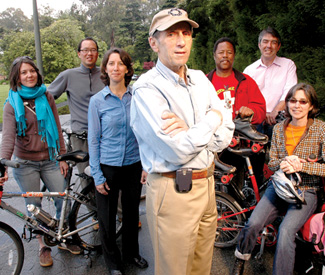
This year’s Bike to Work Day, set for May 17, comes as San Francisco’s cycling network lies dormant in a court-imposed coma. The city isn’t allowed to make any physical improvements to promote safe bicycling until late next year at the earliest, more than two years after the injunction began. Yet that setback could be followed by the most rapid expansion of bike lanes in the city’s history.

At issue is the San Francisco Bicycle Plan and its stated goal of making "bicycling an integral part of daily life in San Francisco." City resident Rob Anderson and attorney Mary Miles don’t share that goal — particularly when it translates to taking lanes and parking spaces from cars — and they challenged the plan in court last year after it won unanimous approval from the Board of Supervisors and Mayor Gavin Newsom.

Ironically, this environmentally benign mode of transportation was attacked under the state’s landmark California Environmental Quality Act (CEQA), which requires detailed studies of projects that might have impacts on the environment and measures that can be taken to offset those impacts.

City officials and bike advocates were shocked last June when Judge James Warren — in his final ruling before his retirement — issued a sweeping injunction against bike projects in the city, which was upheld and reinforced when Judge Peter Busch heard the case in September.

The judges found that city officials had taken an impermissible shortcut around CEQA by claiming the bike plan was exempt from its strictures. As the plan was being developed, some bike advocates and city officials had called for more resources to be put into doing the detailed studies CEQA calls for, and that’s what now appears to be happening.

"The good thing about the lawsuit is it is forcing the city to do the traffic analysis that it should have done with the bike plan and it reveals the absurdity of our interpretation of environmental laws," Dave Snyder, the former executive director of the San Francisco Bicycle Coalition (SFBC), who is now a planner with the San Francisco Planning and Urban Research Association, told the Guardian.

Now city planners and consultants are preparing environmental impact reports (EIRs) on up to 60 proposed bike projects in the city, which will be queued up and ready to begin once the bike plan is approved. "The projects can be approved all at once," Snyder said.

At least, that’s what could happen if the city’s political leaders don’t lose their will to create a more bicycle-friendly city.

Oddly enough, it was the vague, feel-good nature of the plan that created all the problems.

Cities are required to have a bike plan, updated every five years, to qualify for certain state funding. San Francisco did its first plan in 1997, and in 2001 transportation officials and bike advocates set out to develop an updated version.

From the beginning, there were divisions between those who wanted to focus on completing the bike network with ready-to-go projects and those who wanted a more comprehensive and innovative plan laying out policies for education, enforcement, safety, new traffic models, integration with public transit, and everything else associated with cycling.

Responsibility for developing the plan was shared by the Metropolitan Transportation Authority (MTA), the San Francisco Planning Department, and the San Francisco Department of Parking and Traffic, with significant input from the city’s Bicycle Advisory Committee, the SFBC, and other groups. For reasons of expediency, the decision was made to focus on a relatively vague plan, one that made all sorts of high-minded statements and offered lofty goals.

The plan was presented as an effort to radically transform the roadways to make bicycling a more attractive option, but it didn’t include the detailed transportation analysis needed to support that effort — nor did it draw any conclusions about which car spaces to give over to bikes.

"The plan makes no decisions…. The plan has no measurable objectives anywhere in it," Snyder said, noting that the vague nature of the final product was the reason it was so uncontroversial. "Anytime anything passes unanimously, you know you didn’t ask for enough."

Andy Thornley was chair of the Bicycle Advisory Committee when work on the plan got under way and now serves as program director for the SFBC, which was heavily involved on outreach for the plan. SFBC officials were shocked by the injunction but said the city should have devoted more resources to the project.

"It was a logical outcome to the city’s undercommitment to the bike plan," Thornley said of the lawsuit. "There wasn’t the commitment from the mayor on down to doing this right."

"We had discussions about what it means that the plan doesn’t have any benchmarks," said Leah Shahum, executive director of the SFBC and a member of the MTA board. Sure, it had the goal of having 10 percent of all vehicle trips be by bicycle by the year 2010. "Only later did we realize that the 100 pages behind it didn’t support that goal."

MTA public affairs managers wouldn’t allow the Guardian to speak directly to Oliver Gajda, the main staffer on the bike plan then and now. They required questions in writing and answered the one about lack of city support for the initial plan by writing that "the court’s decision was not based on resource issues."

Newsom’s press secretary, Nathan Ballard, also resisted admitting that the city did anything wrong, responding in writing to a written question by saying, "Actually, the City moved forward drafting and implementing this bike plan quite ambitiously, even though there was a risk it would be challenged in court."

Yet it was clear to all involved that doing the traffic analysis and other work would have headed off the injunction.

"Dave Snyder was always an advocate that the bike plan should be a bike plan and lay out what we’ll see for bicyclists," Tom Radulovich, executive director of Livable City, told the Guardian. "But the decision was made to do a bike plan in the abstract, not laying out specific routes."

Nonetheless, bike advocates say they’re happy with the commitment that city officials are now showing. "Now we’re clearly and unequivocally doing a bike plan," Radulovich said. "To some degree, the city has had to commit itself."

Bevan Dufty, chair of the Transportation Authority’s Plans and Programs Committee, has been demanding that bureaucrats report to him regularly to show progress on the plan.

"I think the fact that we’re seeing them regularly trotted out before the committee is a good thing, because it makes them hit their benchmarks," he told us.

Dufty also overcame the MTA’s restrictive approach to public relations and facilitated our interview with Peter Albert, who took on the job of deputy director of planning for the MTA 10 months ago.

"Right now we’re just looking to do the environmental review to clear the bike plan," Albert told us.

He said that staff and consultants are now going through 60 proposed projects to determine what their environmental studies will entail. Later this month that work will be presented during a scoping meeting, at which planners and advocates will decide whether some of the more complex projects will be eliminated from the plan.

"Our goal is to make sure this is as solid an environmental review as possible. We don’t want to deal with any more legal issues," Albert said. "I feel right now there is a huge will to have this done correctly."

Yet advocates have a slightly different view of that political will, particularly given the projection of completed EIRs by July 2008, followed by the approval process, and maybe more court fights.

"We’re not crazy about the timing, but the scope is good. We’ve moved to projects that we’re planning to do," Thornley said. "So, in a backwards way, the commitment has come to the plan from the gun of the injunction."

"But we have real concerns about the timeline and scope getting shrunk," Shahum said. "Our fear is that we’ll go from 60 projects down to 16."

That’s because the plan will now look at the physical changes to roadways that are bound to get controversial once neighborhood groups grapple with the idea of losing traffic lanes or parking spaces.

"You’ve got a lot of people who are afraid of NIMBY opposition, and that goes from the mayor and the supervisors to the bureaucrats working on the plan," Shahum said. She added that the political leadership of San Francisco is more supportive of bicycling than it’s ever been, "but you still have to work really hard for them to do the right thing in the end."

"Why did it take four years to get the Valencia Street bike lanes?" she asked, noting that the project has proved to be an unqualified success.

"They changed Valencia Street, and nothing [bad] happened, so that opened them up a little," Radulovich said of city officials. But only a little. "There is still a certain ad hoc quality to what they’re doing, rather than being standards-based in how streets are designed."

City policy regarding bike projects — which the Planning Commission will revisit this summer when it considers changes to how it interprets traffic level-of-service (LOS) impacts under CEQA — is that anything that slows car traffic is considered a significant environmental impact that requires extensive study and mitigation.

"It’s imperative for them to fix the way they do CEQA," Radulovich said. "LOS reform would help us in future projects."

Radulovich said that most California cities were built with a focus on automobiles before CEQA was even approved. Yet the law now requires expensive and time-consuming studies before those spaces can be converted to use by public transit, bicycles, or pedestrians.

"That’s why, in some ways, CEQA has become an impediment to making us environmentally sustainable," Radulovich said. "It’s turned into a tool that slows down the taking of spaces back from cars."

While the detailed EIR work is being done, Albert and others say the city is still committed to doing bicycling planning work, applying for grants, and making sure San Francisco can move forward quickly once the injunction is lifted. "We’ve been set back, but we’re not stopped," he told us.

"The current injunction is frustrating because we want to be moving forward with bike improvements each month. While we cannot make physical changes such as bike lanes and bike racks, planning and design are continuing," Ballard said, also noting that the Mayor’s Office is doing regular conference calls to ensure the bike plan moves forward quickly.

"I and the bike advocates are pushing to use this time to do the planning work so we’re ready to go once we have an approved plan," said Sup. Chris Daly, the only regular cyclist on the Board of Supervisors. Once the injunction is lifted, he said, "You will have the most rapid striping of bike lanes in the history of the city." *

Politics Blog

0

@@http://www.sfbg.com/blogs/politics@@

Fresh fruit from old punks

0

› a&eletters@sfbg.com

FULL CIRCLE Once upon a time, at Kezar Pavilion in San Francisco, the Dead Kennedys blew the Clash off the stage. I think it was early spring 1980. I didn’t pay much attention to dates in those days, but I remember this much — I was there.

On that night the DKs delivered their fat, funny broadsides with a joyous abandon that few bands of the era could match. Vocalist Jello Biafra — who finished his set drenched in sweat and wearing only his underwear’s elastic waistband — was simply inspired. The group was tight as a drum, and their material — most of which appeared on Fresh Fruits for Rotting Vegetables (Alternative Tentacles, 1980) — was first-rate. Songs such as "Holiday in Cambodia" and "California Über Alles" were politically sharp and lifted by the group’s sarcastic humor — which is to say the band delivered a hilarious, politically pointed good time.

The Clash never got cozy with their American audience. That evening they were self-conscious and too obviously under control — burdened by political points rather than delivering them. The band’s hard-edged working class–oriented politics, which evolved into complex internationalism, was hard for many to access. For comparison, try finding music by the Bay Area’s Dils, whose somewhat dry, hunt-and-peck rhetoric was as close to a domestic analogue as the Clash spawned.

That was nearly 30 years ago. Today Joe Strummer’s dead, Topper Headon looks dead, the DKs — minus Biafra — are an oldies act, and Biafra is an outspoken spoken word artist who, on his latest three-CD opus, In the Grip of Official Treason, compares DK guitarist East Bay Ray to deposed California governor Gray Davis.

Still, the Clash’s music holds up — as does Biafra’s delight with the absurdities of America’s hypocrisies. Our safe American homes don’t feel quite so secure, and bad news keeps leaking through cracks in the wall, which makes checking in with the Clash and Biafra relevant. The former’s somewhat vestigial but still cool Singles Box (Sony) was released late last year (there are so many discs that you could drop a few behind, say, a CD case and not miss ’em for a month or three). The compilation is simply superb, especially because it revives much of the band’s pre–London Calling material.

Nearly 30 years down the road, the Clash’s material has aged little. Perhaps the band just wanted fame, and the principals were as ignorant as the rest of us. Julien Temple’s recent documentary about Strummer, The Future Is Unwritten, undercuts that premise. But even the most cynical punks tended to clam up when it came to the Clash. To say the band wasn’t about albums before and after 1979’s fabulous London Calling (Sony) is a cop-out. Combat Rock (Sony, 1982) was a fully realized and wildly popular triumph, as much as three-disc Sandinista (Sony, 1981) was kind of a soporific mess. Nevertheless, punk rock — for aesthetic and financial reasons — wasn’t primarily about making albums.

Which means that hearing the Clash’s singles, along with the B-sides, as streamlined things unto themselves places a person right in step with what mattered from the only band that mattered. Just give a listen to "White Riot" or their simply brilliant cover of the Bobby Fuller Four’s "I Fought the Law."

Do you have to own this collection? Well, if you’ve got most of the band’s material, you can pass. This one might be best appreciated by fiends, collectors, and the idle rich. Yet it’s amazing how satisfying this music is, and not as a nostalgic exercise in golden protest. The Clash, born in defiant reaction against the musical mainstream, never made peace with it, their major-label contract and midcareer success notwithstanding. Their music delivers.

After all these years — and at this awfully nervous moment in history — it’s also a good time to consider Biafra’s new spoken word collection, a seriously timely 210-plus minutes of sardonic, smart, and occasionally funny political commentary. When he exited the DKs, Biafra drifted away from music as the principal vehicle for his wit and insight. Although he never moved far from punk, his work today seems to follow in the footsteps of social critics such as Paul Krassner.

On Grip (Alternative Tentacles), which consists of live material from various performances, Biafra offers uncommon observations about common household pests such as George Bush and Arnold Schwarzenegger, the wars on Iraq and on terror, and other familiar American vulgarities. Careening through a club while the Dead Kennedys were playing doesn’t, in most respects, share much with sitting down and listening to Biafra tear into the fabric of imperial America. What hasn’t changed, however, are the drive and acerbic wit that Biafra brings to the stage — then and now. *

DIRKFEST

Jello Biafra MCs the celebration of Dirk Dirksen’s life, with SF Mutant All Stars, the Contractions, White Trash Debutantes, No Alternative, and others

June 8, 8 p.m., $25

Great American Music Hall

859 O’Farrell, SF

(415) 885-0750

Digital Venuses

0

› a&eletters@sfbg.com

Call them the new British bitch pack: barefoot soul shouter Joss Stone and her ascendant sistren, skankin’ Lily Allen and torchy Amy Winehouse (Corinne Bailey Rae’s exempted due to being a queen of nice and hazy sentiment and, well, yes, color). The Pipettes also deliver Ronettes-Supremes paeans but have yet to splash large beyond the UK. It’s Stone and Winehouse who have made recent history on the US pop charts: the latter’s Back to Black (Republic) scored the highest ever debut for a British woman (number seven), and Stone’s Introducing Joss Stone (Virgin) followed a week later, debuting at number two.

The third release in this triumvirate, Allen’s Alright, Still (Capitol), is the least compelling, though it possesses the most diverse sonic palette: ska, Britpop jangle, punk, rocksteady, N’Awlinz funk, and English dancehall, courtesy of her fellow celebutot music maker, DJ and producer Mark Ronson. While "Friend of Mine" will doubtless prove a decent summer jam, the scattershot production speaks more to Ronson’s patented retro-soul ambition than to individuality on Allen’s part. I’m already over the stunt sampling of Professor Longhair and find Allen’s spin on jaded indie affect and lyrics powered by class snobbery grating.

The aforementioned artists are part of yet another wave of British acts working in black American musical idioms: James Hunter, James Morrison, Lady Sovereign, and Alice Russell. Call them the spawn of Dusty Springfield. Blue-eyed British soul diva Springfield’s 1969 classic Dusty in Memphis (Rhino/WEA) is the obvious grail for most of these new acolytes. They’ve also benefited from the successive layers of space opened by Blighty’s trends in Northern soul, acid jazz, trip-hop, and the Yankee stand taken for retro soul by the now-defunct Desco label (which split into Soul Fire and Daptone) with black vocalists such as Lee Fields. One wants to big up Allen, Winehouse, and Stone on the sisterhood empowerment tip for their brassy attitude and scathing kiss-offs to trifling men on these recordings. And it’s interesting that they’ve emerged at a time when their male counterparts, such as Morrison — and David Gray and Chris Martin — seem to have "bitched up." Yet this gender power–reversal is sadly trumped by glaring issues of race and authenticity.

REAL ME, REAL MIMICRY


Nowhere are these issues more clearly embodied than in Joss Stone, who’s about to hit the Yay Area. She’s been around for a minute, leading the cited alien invasion with her Miami Sound–assisted debut, The Soul Sessions (Virgin), in 2003. Missed in all the hype and scandal over Stone’s breakup with Motown scion Beau Dozier, her recent adoption of a faux-Yank accent, and the sacking of her handlers is the fact that her much-vaunted revamp has a precedent: Stone described her second CD — Mind, Body, and Soul (Virgin) — as her "real debut," and it contained a mix of Southern soul, urban swing, and hip-hop similar to the template codified by Lauryn Hill in the late 1990s.

The 19-year-old blond Venus actually coaxed Hill out of her fog to guest on "Music," but overall Introducing merely treads water instead of shifting any postmillennial soul paradigm. Stone remains trapped by the novelty factor of having been a 15-year-old girl from Devon who could mimic a middle-aged black American singer and has not figured out how to reconcile her West Country roots, accent, and affluence with the grit and honesty her ambitions require. She’s content to let producer Raphael Saadiq locate her brand-new thang somewhere between Aretha Franklin circa Sparkle and the early ’80s Isleys, with a soupçon of hip-hop flourishes — an approach that only really sparks on opener "Girl They Won’t Believe It" — when underage Stone really ought to be ashamed at her affair with 41-year-old Saadiq. The specter of Dallas Austin’s banging for beats screed rears its ugly head.

Stone may be styled in psychedelic body paint, flowers, and baubles as some lost wild child of Janis Joplin, but unlike that late bad-Jewish-girl-with-a-yen-for-the-blues icon, she lacks the ovaries and independence to instigate any sonic revolt, nor does she transcend her black influences. Although she too failed to flip the rock biz’s race politics, Joplin was an original. She was also perfecting a worthy form of hybridity, whereas Stone would still do best to apprentice behind a seasoned soul singer and grow into her voice. Meanwhile, she’s an immature artist trapped within the middle-class mythos and mass fantasies of the pop star system.

RUNNING THE RACE?


White artists’ love and theft of black expression, as ratified by the Elvis phenomenon, remains the primary cultural battleground in the aughties — don’t get it twisted. The phenomenon of white singers who sound black is as old as minstrelsy, of course. Vaginas trouble this aesthetic guerrilla warfare — with Stone and company entrenched in the valley of sound between Joplin, Springfield, Lydia Pense, and Teena Marie on the one side and Madonna, Taylor Dayne, Britney Spears, and Fergie on the other. Yet Stone and her sister purveyors of femme funk are not truly innocents with songs in their hearts and stars in their eyes. These daughters of Al Jolson, removing their Jewish foreignness by sonically and visually blacking up as he did in The Jazz Singer, are reaping the rewards this season from the West’s most vital industry: the consumption and export of essential blackness.

Whether fucking or channeling the likes of Dinah Washington and Ronnie Spector in the studio, Allen, Stone, and Winehouse are enjoying everything but the burden of blackness. These vocalists face the dilemma of the privileges of whiteness versus the comforts of being soulful, and this will continue to dog their careers if longevity’s next. Doubtless Stone, Allen, and Winehouse don’t want to be "nappy-headed hos" — thanks, Don Imus — but desire the erotic, exotic power of sistagirls without being the mules of the world. Yet why is the old "black joy, not black pain" truism surfacing now in the UK?

Look to recent cinema from across the pond: in The Queen, Elizabeth II, the paragon of English womanhood, is asked by Tony Blair to be feely and emotional to help heal the nation in the wake of Princess Diana’s death, to restore the heart Diana represented. But Elizabeth chafes, bound by old royal models of honor and duty. The crisis of Britannia is coded even more explicitly in Children of Men. In its dystopic vision, black women are despised yet also figures of salvation. As in the film, in which only a regenerative black female can save England, these new wave British soulsters labor to recuperate the distant and unreal of classic soul, despite its distinctly American set of societal preconditions. A post–Margaret Thatcher, post-Blair return to authenticity is what these singers represent, a late moment after Rod Stewart delivered fair Albion’s best-ever approximation of soul and empire has faded, leaving postcolonial turmoil and identity flux. Black female soul brings rebirth to this turbulent world via the vocalizing of Stone et al., placing them back at center of the world — at least aesthetically.

FLIPPING BACK TO BLACK


This activity meets its zenith in the petite, pinup-tatted, beehive-burdened, anorexic form of Winehouse. Unlike Stone, who’s at pains to elide her Englishness, Winehouse’s distinctly North London Jewish accent surfaces on her critically acclaimed Back to Black, but her extreme jazz-soul mummery remains paramount, even as white critics and listeners continue to adopt a white version of black culture at the expense of young black artists of the retro-nuevo soul or urban alternative persuasion. Winehouse has yet to be anointed with a universal ghetto pass and, like Stone and Allen, has bypassed the hood and proper apprenticeship for lucrative prime time at the nation’s premier venues this spring.

Throughout Back to Black, Winehouse gets away with borderline minstrelsy, carelessly mashing up a vocal cocktail of Washington, Billie Holiday, Carla Thomas, and Phil Spector’s girl-group surrogates while not being excoriated because her Pete Doherty–rivaling tabloid exploits with drunkenness, raunchy sexuality, and public belligerence fit her admirers’ view of authentic blackness. Behind Spanish Harlem drag, Motown cocktail dresses, and Cleopatra’s black eyeliner, Winehouse is the cunning poster girl of her mid-Atlantic milieu, permitted to get away with potentially offensive lyrics such as "side from Sammy you’re my best black Jew" ("Me and Mr. Jones"), showcasing a pair of cooning black backing vocalists and hipster-comforting insincerity.

"What kind of fuckery is this?" I’m sure to Winehouse’s equivalents across the color line — from fiftysomething Sharon Jones to 36-year-old failing freaky-deak diva Macy Gray and badass bitches in the wings such as Alice Smith — it seems like the demoralizing same old. These are black artists who, to varying degrees, can sang but whose efforts render them invisible in a field overwhelmed by white soul saviors. Why invest in these sistas’ development or even spotlight the neo–chitlin circuit movement afoot in the Southeast when the only blackness that really counts bears a stench of formaldehyde? *

JOSS STONE

Tues/15, 8 p.m., $35

Warfield

982 Market, SF

(415) 775-7722

Magic stars

0

› a&eletters@sfbg.com

"When we use magical in a positive sense," filmmaker Lawrence Jordan explains, parsing an adjective that is frequently brought up in discussions of his work, "it really means my eye is fresh at this moment and what I’m seeing is a discovery." Jordan’s films — in particular, the animated collages composed of Victorian magazine illustrations, Gustave Doré engravings, and flashing stars and orbs for which he is most famous — are the visual records of such moments of discovery.

The more than 40 experimental short (as well as three feature-length) films Jordan has made over his 40 years in the Bay Area are as much documents of the fanciful flight paths of his free associations — what he calls his "inner world" — as they are fleeting glimpses of a precinematic visual culture that has long since vanished. Thanks to an upcoming program put on by the San Francisco Cinematheque as part of its Bay Area Roots series, audiences will get the chance to discover — or perhaps rediscover with fresh eyes — the work of a filmmaker and advocate (Jordan helped found Canyon Cinema) who truly deserves to be called a Fog City maverick.

Like the cryptically beautiful boxes of Joseph Cornell, Jordan’s films exude a certain innocent surrealism. His poetic assemblages of fantastic fauna, romantic vistas, and hermetic symbols seem aimed at enchanting rather than disturbing the viewer through the kind of sexual shock tactics that were more the métier of Max Ernst. "That part of surrealism we don’t qualify for," Jordan says, referring to himself and Cornell, for whom he worked as an assistant in 1965, filming over the course of his stay at Utopia Parkway in Queens the only extant footage we have of the notoriously reclusive artist and his fabled workspace.

Jordan’s choice of the inclusive pronoun reveals both the slight reserve and matter-of-factness with which he speaks of his work and the strong sense of kinship he projects when talking about the artists — such as Cornell and collagist Jess Collins, who worked under his first name only — who became colleagues, served as inspiration, and, more often the case in a career filled with notable collaborators (Watts Tower sculptor Simon Rodia and Orson Welles), functioned in both capacities.

Following his high school friend and early collaborator Stan Brakhage to San Francisco from New York, Jordan moved into a basement flat below the poet Robert Duncan and his partner, Jess, whose baroque collages of finely crosshatched renderings of his source material shared affinities with Jordan’s then-still-developing aesthetic of assemblage. "[Jess] was the high priest of art magic in the time that I knew him," Jordan says.

Magic, as it turns out, keeps coming up in our conversation, whether in a passing reference to The Wizard of Oz (Jordan owns a complete set of the Oz books) or when Jordan cites that magician of silent cinema, Georges Méliès, as a major influence. Blue Skies beyond the Looking Glass, completed last year and one of the highlights of the cinematheque’s program, is very much an homage to the evocative power of early cinema.

A jubilant séance, Blue Skies resurrects silent-era stars such as Lon Chaney Sr., Lillian Gish, and Mary Pickford via some amazing screen test footage and invites them to tango with intercut animated segments. The film offers a nice summary of Jordan’s cinema of attractions, in which old signs are transmuted into wonders once more, restoring some of their mystery. "I don’t know about alchemy academically," Jordan reflects, "but I am a practicing alchemist in my own way." *

WORKS OF LAWRENCE JORDAN

Sun/13, 7:30 p.m., $6–$8

Yerba Buena Center for the Arts

701 Mission, SF

(415) 978-2787

www.sfcinematheque.org

The pyramid

0

While fretting a few days ago about the menace of the $40 main dish, I spoke to my neighbor, who on a recent trip to San Diego had a close encounter with a $63 main course, some kind of veal with truffles. San Diego — not Las Vegas, not New York. She ended up with a $40-something main dish (veal, no truffles), and I went to New York to forage on the lower reaches of the city’s restaurant pyramid.

High-end restaurant food, whether veal or something else, doesn’t just happen: it is built, or cooked, or created, on an infrastructure of more modest restaurants. In these places, far from the lurid glow of the world’s Columbus Circles, cooks and eaters alike educate themselves; expectations are formed and preferences established. While I am not a partisan of the inventive, technique-driven school of cooking that seems to prevail in New York City, I have always found the standard of execution in Manhattan restaurants to be of the highest order. Had, I must now say, for after spending several days grazing in restaurants up and down the West Side, I became filled both with surprisingly mediocre food and with disappointment.

Let us begin by granting conditional pardon to busy-body New York chefs, who after all must spend months working their way around an inconvenience called a real winter. Still, is this any excuse for serving plate after plate of perfectly unseasoned food? At a place called Fairway Café (above the fabulous Fairway Market on B’way at 74th St.), I nearly wore out my salt-shaking hand in the struggle to revive a succession of dishes, beginning with grilled asparagus and a mushroom pizza and continuing to creamed spinach and some linguine with scallops and pesto. At Swagat, a fragrant, crowded Indian restaurant on Amsterdam, it was the same, with the chicken tikka masala sweet rather than tangy. And again at Louie’s, a handsome café with extensive outdoor seating, a big Sunday brunch–with–the–Times service, and a DOA huevos rancheros–style egg preparation.

We were warned beforehand, by an Upper West Side–dwelling friend, that the neighborhood was a dead zone for food. The better places, he said, are all downtown. I came to see his point, but I couldn’t help wondering how good the food downtown would have to be to impress people immiserated by bad food uptown. That is the $63 question.

Paul Reidinger

› paulr@sfbg.com

Watered down

0

› a&eletters@sfbg.com

I’ve read more than once that Raymond Carver stories are short and laconic by artistic necessity. Some critics are invoking this dogma in writing of Ray Lawrence’s new movie, Jindabyne, and the story it’s based on, "So Much Water So Close to Home" (also used as a thread in Robert Altman’s Carver buffet Short Cuts). This is, at least where "So Much Water" is concerned, horse puckey. But Lawrence (director of 2001’s wonderful Lantana and 1985’s just-shy-of-brilliant Bliss) and screenwriter Beatrix Christian have only gone half the distance to prove it.

As Carver wrote the story, a woman struggles with the knowledge that her husband and his buddies decided to continue their fishing trip after finding a woman’s body in the river, not reporting the discovery for two days. Lawrence transplants the American story to Jindabyne, a second chance of a town in Australia’s New South Wales, relocated from its original spot, which is now under a human-made lake. The film adds characters and gives those original to the short story more unpleasantness to remember and more to look forward to, but it does substantially more in this undertaking than read Carver’s tea leaves. Particularly successful is the invention of an authority-undermining mother-in-law, whose strain on the already precarious marriage of Claire (Laura Linney) and Stewart (Gabriel Byrne) is no mere device. But the best-directed relationship in the movie is the one between the fishers and the river: the act of fishing is so lovingly captured as to implicate the audience in their decision to stay.

Overall, however, Lawrence’s style is so highly pitched (slow tracking shots of the mystery that is nature, indigenous wailing in the soundtrack, hypnotized stares aplenty) that the ugly power of the men’s decision is undercut by the film’s bigness. It waters down the shame — my preferred reading of the dammed-up Jindabyne metaphor — by elevating it. This same style was so much better suited to the tinier, coincidence-laden universe of Lantana, which actually held the mystery and danger that the editing and sound design so unaccountably try to re-create in Jindabyne.

Then there are the two megafuckups. Fuckup numero uno: the woman’s killer, ridiculously, is kept around in the movie to ooga-booga the proceedings at 20-minute intervals. He smacks strongly of the psycho in 2005’s limbs–torn–asunder–from–Down Under anatomy lesson Wolf Creek, but he lacks that character’s bitterness and intelligence. He also lacks any relevance to the story once he’s served his unfortunate inaugural purpose. But fuckup number two is a far bigger betrayal of the otherwise remarkably nurtured primary text: Lawrence and Christian graft race and class politics onto the self-contained family drama in the form of the discovered body, an Aboriginal woman, and her angry family. (For a lesson in subtly handled class politics, Wolf Creek, hand to god, is the way to go.) At first Claire’s quixotic attempts to connect with the woman’s family are good for the film’s battered soul: the men’s shameful negligence is followed by her flailing, insensitive attempts to make things right. But the film actually gives Claire and Stewart (and hell, everybody, in an end-of-the-movie congregation worthy of Scooby-Doo) their closure, and no less in a final sequence that is also blatant cultural voyeurism. An intended irony can be argued, I suppose, but some ironies are a lot more convenient than others. *

JINDABYNE

Opens Fri/11 in Bay Area theaters

See Movie Clock at www.sonyclassics.com/jindabyne

Not Coachillin’

0


SONIC REDUCER “I can’t believe you slept through the police helicopter above the tent at 3 a.m. and the megaphone going, ‘Disperse immediately or you’ll all be arrested,'” tentmate Fluffy marveled the day after another ear-busting night of the Coachella Valley Music and Arts Festival’s unofficial after-party scene in the campgrounds. It was only 8 a.m., though the sun was already beating down relentlessly like our heedless neighborhood drum circle.

I’ve snoozed through my share of lousy plays, bad bands, and crappy circuses, but I never thought I’d slumber through the 24-7 thrills at the Empire Polo Fields. And the chopper was just the chaser to April 28 trance headliner Tiesto, who began his loud set, pompously booming out over our not-so-fair tent city of spring breakers and Euro tourists, with “In the beginning there was the earth….”

We’re gonna have to sleep through the history of the planet, was my last thought as I drifted off.

O Coachella, don’t you cry for me, ’cause I’ve come from Alabama Street with a heat rash on my knee — and doubts about making the scene at the festival despite the fact that about 160,000 brave music fans were expected to face down the desert swelter as the event swelled to three days.

At this juncture, Coachella might be described as a music festival on steroids: it’s a carnival for 18 and overs with rides, art installations, dancers, and completely insane people wearing full-body chicken costumes in the 110-degree heat, though still boasting a comprehensive bill of today’s so-called hot bands. It’s your one-stop smorgasbord for music lovers, who will happily chat you up about the performer they deemed the most mind-blowing the previous night or the last Rage Against the Machine show they caught.

And they got what they came for: the Björk shroom headdress; the crazed buzz rising from such festival circuiteers as Amy Winehouse and Klaxons; solid pop from Jarvis Cocker and Peter Bjorn and John; show-stopping performances by DJ Shadow, CSS, Arcade Fire, and Konono No. 1; and the rattle of reunion bones by an amped and antic Rage Against the Machine, glowering and balding Jesus and Mary Chain, and, er, Crowded House. You couldn’t go amiss if you stuck to the desert to-do’s rave roots and entrenched yourself beneath the mirror ball, video screens, and pink and blue lights of the Sahara tent: the performances there by Justice and LCD Soundsystem connected with the crowd with a screw-it-all exuberance.

But the untold story lay far away from the press tent and Palm Springs love nests — in the crowded, brutal heat of the campgrounds next to the performance area. Is it possible to review a camping trip? In what seemed like a dusty, straw-strewn football field with thousands of other wake ‘n’ bakers? I spent far too much time taking refuge from the nonstop heat at the campground’s cybercafé, where hundreds of shirtless boys and bikinied girls would miserably crouch, recharging their cells at a bank of outlets, sit stunned watching the Coachella film on a loop, or lie on the ground like clammy, comatose dead fish, waiting out the morning before the acts began in early afternoon.

The southerly discomfort led most campers on a lengthy hike from the tent city, past the obscenely grassy country clubs surrounding the polo grounds, to find refrigerated refuge and 40s at Ralph’s, the nearest supermarket, where people were literally chillin’ on store lawn furniture. Coachella: the fest that inspired global warming — and a post–<\d>Earth Day longing for air-con.

Organizers Golden Voice had a clue: they gave away free water sporadically and provided campers with free Internet use and showers. But there were too few laptops, the wi-fi was too erratic, and the showers were locked down too early — and you knew there was too little shade in general when audience members broiled in the sparse shadows of lemonade stands.

The crowd — weighted with Rage Against the Machine fans eager to see the band’s first concert in more than five years — was also heavy on the testosterone. But maybe that’s just the state of Rage love: the band never really seemed too underground to me but has historically worked to surface activist subversion via modern rock radio. And their audience was still boiling — and amazingly good-natured despite the sleepless nights. As for myself, I finally woke up hours after the helicopter early April 29 to the sound of a random dude shouting, “Whoo!” and yammering loudly in Portuguese to the tentizens the next flap over. Later I was tempted to put my own spin on Zack de la Rocha’s onstage suggestion that Bush and Cheney be “tried for war crimes and shot.” I know the 12-hour roller coaster ride of quality hallucinogens can be a bitch — but then, so can I: is it so wrong to want the early morning shouters and the dude with the air horn to be tried for crimes against humanity’s sleep schedule and shot? I’d settle for finding out where they were dozing it off and delivering a special whoo-gram of my own.

BOB DYLAN STUDIED HERE That’s the rumor, anyway, at the Blue Bear School of Music, which has seen Tracy Chapman and more than 20,000 other musicians come through its doors in the past 36 years. Executive director Kevin Marlatt told me the nonprofit’s second annual fundraiser — showcasing 2007 Grammy Lifetime Achievement winner Booker T. Jones as well as Blue Bear staffer Bonnie Hayes and Sista Monica — will include an appearance by the James Lick Middle School Band, the result of the organization’s efforts in the last year to get more involved in public school music education. Since it took over the James Lick music program and brought in 30 guitars, he says, more than a dozen bands have popped up at just that school. So Stax around for a good cause. *

BOOKER T. JONES

Sat/12, 8 p.m., $45–$125

Great American Music Hall

859 O’Farrell, SF

www.bluebearmusic.org


All that she wants

0

DANCE Deborah Slater’s new The Desire Line is as quietly atmospheric as it is rambunctiously explosive. It is also a lot of fun as you catch glimpses — a hand holding a foot, a striped tie, a letter, teacups — of Alan Felton’s figurative paintings, reproduced in the Dance Mission Theater lobby, that inspired this fine hour-long piece. But Slater isn’t interested in imitating the portraits of these self-absorbed narcissists. She wants to dig below the canvas. This is her second go at Felton, whose silent figures look like they’d be full of stories if one just knew how to access them. Slater’s 2004 Trio (in the space between) was a trial run for the more ambitious and more thoroughly developed Desire.

The idea is as simple as it is ingenuous: break open shells of self-absorption, and watch as sparks fly as people start to rub against one another. In Desire privacy and isolation are held in balance with volcanic explosions of fury, jealousy, attraction, confusion, fear, you name it — the whole gamut of human emotions. For a while it looked like the piece turned around Kerry Mehling’s never-explained outbursts of hysteria, but then she became another member of a group, which bumped into each other and found brief connections before spinning away. The other performers, all strong, were Shannon Preto, Elizebeth Randall, Travis Rowland, Kenneth Scott, Breton Tyner-Bryan, and Shaunna Vella.

Slater forwent elaborate sets and empowered her septet of dancers to carry the piece with choreography that was as full-bodied and visceral as any of hers that I have seen. (Rita Felciano)

THE DESIRE LINE

Thurs/10–Sat/12, 8 p.m.; Sun/13, 7 p.m.; $18

Dance Mission Theater

1310 Mission, SF

(415) 273-4633

www.artofthematter.org

May day

0

› a&eletters@sfbg.com

The May Day rampage of the Los Angeles Police Department over peaceful protesters and journalists at an immigrants’ rights march lends an undeniable immediacy to America Tropical, a new and at times poignant chamber opera by composer David Conte and librettist Oliver Mayer that addresses the legacy of racial and class exploitation built into the very fabric of the City of Angels.

The compact 60-minute work, which premiered April 27 at the Thick House under the auspices of San Francisco’s Thick Description, takes its cue from América Tropical, a 1932 Olvera Street mural painted by the great Mexican social realist artist David Alfaro Siqueiros (sung with appropriately formidable presence by a swaggering, tempestuous Mark Hernandez). Meant as a mirror held up to the past and future of Los Angeles, Siqueiros’s wall pointed back to the city’s 18th-century Mexican founders in a group of pobladores (played here by six capable singers led by an impressive Antoine Garth) and ahead to the grim strife of an ethnically and racially stratified class system.

That strife culminates in America Tropical as the conflagration of the 1992 riots sparked by the police beating of Rodney King (played by Garth), famously witnessed and transmitted to the world by private citizen George Holliday (Chad Runyon), whose videotape thus becomes something of the equivalent of Siqueiros’s politically charged mural.

In an apt, indeed concrete metaphor for an increasingly divided and dividing age, walls as sites of division, reclamation, toil, and creative resistance pervade the poetic libretto provided by playwright Mayer (Blade to the Heat, Joe Louis Blues), which effectively brings Sisqueiros’s social realist language into 3-D relief. "Tell me what a wall can do," Siqueiros sings. "I’ll show you what a wall can be."

Meanwhile, Conte (whose beautiful, ghostly desert opera Firebird Motel was commissioned and produced by Thick Description) has fashioned a score featuring serrated melody lines and lush choral harmonies to augment the work’s three centuries, succinctly blended in Mayer’s libretto. The music moves determinedly forward through alternately agitated, wistful, angelic, and angry passages provided by an excellent sextet of piano, strings, and woodwinds conducted by John Kendall Bailey.

At the same time, Siqueiros’s emotionally powerful and provocative visual allegory can translate awkwardly to the stage. Those walking in cold without any knowledge of the opera’s deeply rooted relationship to Siqueiros’s mural may find some of the mise-en-scène (such as the crucifixion) a trifle hokey, despite graceful staging by director Tony Kelly, not to mention the excellent singing, generally decent performances, and arresting music. Some preparation for the audience — a description of the mural on a lobby poster or somewhere in the program — might have been in order.

Siqueiros’s Olvera Street mural was one of the earliest examples of the Mexican urban art movement that publicly portrays the local narratives of ethnic and indigenous people. But in 1932 the police arm of the ruling class had a brush of its own, and soon after the mural’s unveiling the LAPD whitewashed it into what turned out to be temporary oblivion. (It was partially uncovered and rediscovered in the 1960s and has recently been undergoing restoration.)

It’s more than merely ironic that the mural’s images of workers and an indigenous American woman, named the India (sung by Sepideh Moafi), crucified on a double cross of American imperialism, were staging a second return in Conte and Mayer’s America Tropical even as LAPD clubs and rubber bullets rained down on workers and families at MacArthur Park. The redemptive force of the opera’s historical ghosts rises on a wave of events that gives distressing currency to the libretto’s emphatic assertion, "There is no present / There is no future / Only the past, happening over and over again." *

AMERICA TROPICAL

Through May 20

Thurs.–Sun., 8 p.m., $15–$25

Thick House

1695 18th St., SF

www.thickhouse.org

Myth mash

0

God of War II

(Sony Computer Entertainment; PlayStation 2)

GAMER The sequel to the best game of 2005 may not be the best game of 2007, but that’s only because Shadow of the Colossus ruined all games for all time by boiling adventuring nerdery down to an unheard-of, almost new-age minimalism. That game ruled. There is nothing minimal about God of War II: it’s actually gorier, with even more expansive cut scenes than before, seamless game play, and volcanic brutality.

Your guy, Kratos, decides to go after Zeus and along the way encounters such old pals as Gorgons, minotaurs, and Cyclopes, with some new creeps thrown in, such as a hammer-wielding berserker who is really fun to decapitate. You also meet up with — and kill — Perseus, free the Phoenix, and rip off Icarus’s wings. Practically every well-known myth is represented. They release the kraken, for crying out loud! Fun, fun, fun.

More of God of War II relies on instantaneous button sequences followed by merciless button mashing than its predecessor, which is OK if you’re part of this new generation of alien children born grappling PlayStation 2 controllers. But for the old, motor skill–deteriorated rest of us, it can be a living hell. Just lifting gates can be murder. You certainly get the feeling that the makers of the game had this in mind when they designed it. There was a lot of me muttering, "You dicks," at the TV. In fact, on the bonus making-of documentary that came with the first game, the main creator, David Jaffe, made a few comments about being bummed that some superhard levels had to be cut. This time around, the makers seem to have thrown every possible thing in there to make beating level bosses a nightmare, but somehow they don’t make the difficulty too much to bear. As tough as some of the levels were, I was never overwhelmed with frustration, a daily occurrence for me with God of War I. I said, "What the hell? I can’t beat this guy," a couple times, but then all of a sudden, the guy was dead, and I wasn’t even sure what I did.

If anything, the game is too short, with more puzzles than fighting, yet you don’t think of that while playing because you’re having too much fun. And admittedly, it’s not that easy. I did throw and break one of my controllers at one point. It’s just over kinda quick. The problem is, it’s so fun being Kratos, any ending is gonna be a letdown. There just isn’t another character in video games who kills with his ferocity — and variety of methods. The guy kills everybody. (Mike McGuirk)

It’s a mad, mad about Mads world

0

Mads Mikkelsen has excessively high cheekbones on very long, flat facial planes, making him the kind of handsome actor suited for morally untrustworthy roles. Hence his casting as a charismatic antihero in the violent Pusher series (sort of Denmark’s big-screen Sopranos) and as the villain who inflicts improbably impermanent damage to chairbound James Bond’s weenus in 2006’s Casino Royale. Mikkelsen has been voted his country’s sexiest man, or something similar, two years running, and he was wonderful as a prim apostle of third-world charity atoning for an asshole past in Suzanne Bier’s After the Wedding (2006). Perhaps because he projects a certain tense ambivalence, saintliness also works for him — it’s something we have a hard time believing in now, so the unlikelier the casting, the better.

After the Wedding and many other excellent Danish films in recent years were written by Anders Thomas Jensen, who also directed Adam’s Apples. It has Mikkelsen as Ivan, the vicar of a country church whose congregation barely extends beyond the criminals he takes in for their community-service sentences. The latest to arrive is Adam (Ulrich Thomsen, who’s also played a Bond villain), a paunchy, shaved-head neo-Nazi who prefers to communicate by mute snarl or fist. Adam’s paperwork actually calls him evil. Ivan chirps, "There are no evil people!" His glass is forever half full, suffused with God’s forgiveness. He is the biggest fool Adam has ever suffered, and no amount of verbal or even violent physical abuse seems to shake his belief that God is on his side.

Because so many outrageously terrible things happen in it, Adam’s Apples has been called a black comedy. Fair enough. It’s often very funny, with the script’s continually surprising developments served up in a perfect deadpan by Anders’s direction, the classically handsome CinemaScope compositions, and a keening string score. But where it ends up is so far from cynicism that I pray no Hollywood remake arrives to desecrate its memory. Anders has worked more than once with most of his cast and crew. They should never be allowed to stop: James Bond production schedules should have to fucking wait until each Anders project is done. If Adam’s Apples isn’t the best movie I see in 2007, whatever movie is will be really, really, really good.

ADAM’S APPLES

Opens Fri/11 in Bay Area theaters

See Movie Clock at www.adamsaebler.dk”

Fab gadgets

0

› superego@sfbg.com

SUPER EGO "We’re trying to reverse the great Berlin brain drain," DJ Solekandi of the Bay Area Beatdrop crew told me, with great determination in her voice. She was preparing to launch Filter.SF, the latest and so far biggest monument to the return of peninsular techno, an "official" Saturday monthly at Fat City, that would later spill over — ecstatically — into 8 a.m. "Is that where my brain’s been draining?" I replied, emptying my scotch glass warily. "I honestly thought it was circling somewhere over the Hebrides."

But of course she was speaking of the years-long flight of local electro and techno talent to the undisputed club capital of the early Ohs. Reunification — and a city full of unguarded construction sites — definitely has its advantages. "Let’s face it: techno’s a dirty word here," Solekandi reminded me. "There’s still so much great electronic music evolving in the States, though, transcending itself, working the polyrhythmics. People are shocked that we’re fiddling with grooves at 120 bpm — we’re just as much in reaction to the whole ‘techno has to hit you over the head’ thing as everyone else. We don’t want to be pigeonholed. We’re into stripping all musical genres down, foregrounding different patterns and sequences, but not getting so heady or minimal that you want to stop and think — or jumping off the rails into breakbeat. We mainly started this party because we want to have someplace where people can dance all night. I mean, where did that go?"

Presumably through the Brandenburg Gate. In the "we" above, Solekandi’s including the other half of Beatdrop, her mate, DJ Kontakt. (She was a journalist in Budapest. He was a soulful loner in Toronto. When they met online, listening to Deep Mix Moscow Radio, it was love at first IM.) Solekandi then launches, as any fierce DJ would, into a rundown of her cutting-edge technical equipment: Tracktor software, Faderfox controllers from Robotspeak, Ecler Nuo4 MIDI mixer … Visuals by VJ Mike Creighton? Edirol V-4 Video Mixer, HP ZT-3010US laptop, custom VISP Flash-Flex-Apollo software, Wacom Intuos Graphire tablet …

Phew. When I hear tech heads, even hot ones, geek out over their digital apparatuses, I sink into languid bafflement. Suddenly, I’m a sultry ’60s housewife, lounging on my lime green sectional, slightly pinched by my girdle, nodding while Hubby blathers on about structural changes down at the aeronautics plant. Sounds complicated, darling. Shall I fix us another batch of martinis? May is officially techno month, however, with Movement, Detroit’s legendary electronic music festival (www.demf.com), drawing hundreds of thousands to the Motor City and Montreal’s gargantuan Mutek (www.mutek.ca) following hard on Movement’s gravel-pitted heels — so technology’s the ultra. Yet I’d naively thought that since techno and vinyl had been pushed from the clubs by laptops and mashups, iPods and electroclash, they would join forces in a retrofuture comeback assault. No can do, it seems. So rock on, techno mama!

"I hate the word Wii," my yummy pal Noel reflected at the recent LCD Soundsystem show when I told him about the latest DJ craze, WiiJing. "It’s just so … happy. Wii. Ugh."

WiiJing, you ask? Hell yes. You knew it was only a matter of time before some genius couch potato hacked their Wiimote to start mixing, as they say, Wiimotely. Well, that time is now, and DJ_! (pronounced "shift one") is that genius. He’ll be here May 12 at Bootie, debuting his skills to the mashup crowd. ("I’ll probably be mashing up my favorite video game themes — anything from Centipede to Tom Clancy’s Rainbow Six," he claimed.)

I asked Turlock’s Obi-Wii Kenobi over the phone how he did it. "I basically used GlovePie to patch the Wiimote through a Bluetooth dongle into my Ableton Live," he replied. Again the gizmo glaze descended. Still, that must be one heck of a dongle! What’s the range on that thing? "About 15 feet, I think." I riffed on the WiiJ potential, now that DJs won’t be tethered to the decks. Refresh your cocktail midset! Stage-dive without any skips! Embed your Wiimotes into lightsabers and duel other WiiJs!

"Maybe," DJ_! said. "I’m happy just to be able to take a bathroom break." Now that’s putting the wee in Wii, no pun Nintendoed. *

FILTER.SF

Last Sat., 10 p.m.–8 a.m., $20

Fat City

314 11th St., SF

www.myspace.com/fatcitysf

www.babd.org

BOOTIE

With DJ_!

Sat/12, 9 p.m.–late, $12

DNA Lounge

375 11th St., SF

(415) 626-1409

David’s Kitchen

0

› paulr@sfbg.com

In the kitchen of David’s Kitchen, a tiny restaurant in the Sunset, you will find David. The kitchen is of the semiexhibition sort, viewable from the snug dining room through a rectangular aperture that looks as if it once might have housed a picture window or maybe a large plasma flat-screen television. Was this space once home to a sports bar? David is David Chang, a native of China who opened the place with his wife, Terri, about four years ago. He could have called it David Chang, if he’d cared to join the trend of to-the-greater-glory-of-me chef-owners who name their restaurants after themselves. I have sometimes wondered how often these grand people can actually be found in their own kitchens. "David’s Kitchen" suggests to us that David is actually in the kitchen, and so he is, perhaps cooking your lunch after taking your order. At lunch it can be just you and him; it’s like having your own short-order chef. He seats you, writes down what you want, then makes and serves it. You are happy, even when he presents the bill, which your own short-order chef would never be so crass as to do. But then, even the best fantasies have limits.

It would be difficult to overstate the intimacy of David’s Kitchen. Like Thai Time, the fabulous and impossibly small restaurant on Eighth Avenue in the Inner Richmond, David’s Kitchen has only a handful of tables and fills to near capacity when a few parties of three or four come through the door at about the same time. If there had been an Asian restaurant on Skylab, the makeshift space station from the 1970s, it might have looked something like this. While David’s menu does include a strong Thai element, it’s pan-Asian in a way Thai Time’s isn’t; there are even a few New World items thrown in — for fun? Or because of neighborhood demand? One of them, the chicken barley soup ($3.50), we found to be insipid, but that was the only dish we came across that failed to sing in a clear, strong voice.

Even among the Asian dishes, one finds the occasional global touch. Although fat seafood noodles ($5.95 at lunch) spoke with a pronounced Thai accent — the sauce was coconut-milk green curry, with a strong subplot of chile heat — the noodles themselves were fettuccine, for a slight Marco Polo twist. The seafood, meanwhile (shrimp, mussels, clams, and whitefish, leavened with zucchini quarters), was immaculate, in keeping with the restaurant’s assurance that "we use only the freshest ingredients."

XO chow fun noodles ($5.95), on the other hand, were the broad, glistening Chinese rice-flour kind, tossed with shreds of boneless chicken, bean sprouts, scallions, and (the star ingredient) XO sauce, a Hong Kong–<\d>style paste of dried shrimp and scallop along with garlic, onion, and chile peppers. This saucing gave the dish a flat, fierce heat, like an August day on the Great Plains — quite different from the rounded punch of the fat noodles — with a strong hint of onion breath and some soy saltiness.

Although many of the appetizers will seem familiar to anyone who’s eaten at a Thai or Chinese restaurant in these parts (and who hasn’t?), David’s versions are mostly executed with a soupçon of panache, which helps make them memorable. The crispy fish cakes ($5.75), for example, will never be mistaken for tortilla chips, but they do minimize the characteristic rubberiness of the average fish cake and achieve a delicate stiffening around the edges. It helps that they’re quite flat, like small griddle cakes.

Spring rolls ($4.95) were nearly ordinary, despite a weighty filling — of shredded chicken, bean sprouts, and shiitake mushrooms — and a crime-scene-red dipping sauce redolent of chiles and garlic. But the veggie pancake ($5.25) was unlike anything I’ve had before, a kind of soft Asian crepe, like a socca or farinata, made from ground lotus and taro root (instead of chickpea flour) and spruced up with water chestnuts, scallions, and pesto.

We also detected European influences, or echoes, in a duck curry stew ($9.95), a crock of meat, potatoes, and carrots that resembled beef burgundy, except that the beef was duck (a little fatty, but tasty) and the sauce had no red wine but plenty of yellow curry, mildest of the Thai curries. Spicy sunflower chicken ($6.75), on the other hand, though not yellow, was straight from Thailand — a larb, really, of minced white chicken tossed with a lively combination of Thai basil, garlic, and chiles. The meat was heaped in the center of a large plate, with canoelike leaves of endive set around the perimeter like hour markings on a watch. The endive was convenient for the scooping up of the minced meat, of course, but even after the leaves had run out, all the members of our table, forks in hand, were jostling for a crack at the last of the chicken.

The kitchen at David’s Kitchen doesn’t much look like the kitchen at Canteen, Dennis Leary’s small boutique place downtown. Leary’s kitchen is L-shaped, for one thing, and also more exhibitiony: you can sit at the counter and watch the chef work the stoves.

But to be at either place is to be aware that the restaurant as a labor of love is a phenomenon that persists even in this overpriced city — and that there are a few fine chefs who still do their own cooking. And then some. *

DAVID’S KITCHEN

Lunch: Tues.–Sat., 11:30 a.m.–2:30 p.m. Dinner: Tues.–Thurs. and Sun., 5–9:30 p.m., Fri.–Sat., 5–10 p.m.

1713 Taraval, SF

(415) 566-6143

Beer and wine

MC/V

Moderately loud

Wheelchair accessible

Disorientation

0

› le_chicken_farmer@yahoo.com

CHEAP EATS The closest chicken fried steak to my shack is at the Route 1 Diner in Valley Ford. You probably know it, if you’ve ever been to Bodega Bay. And if not, what the fuck? The Sonoma coast has the prettiest beaches in the world. Surfers don’t like it because they get eaten by sharks, but, other than that …

Anyway, I’m not a beach reviewer.

Two chickens, like I said. That’s all the chickens I have left is two chickens. One lays eggs, and the other one eats them. Or: tough times for a chicken farmer. Oldest trick in the book is to suck the egg out of an egg, then fill it up with Tabasco sauce and put it back in the nest.

But I treat my chickens with a little more respect, I like to think, than most backyard farmers. Instead of Tabasco sauce, I’m whipping up a little roux — butter and flour — then adding onions, fresh jalapeños, tomatoes, and hot sausage. Season to taste, and this way if the oldest trick in the book doesn’t trick her out of the nasty habit, she’ll practically already be jambalaya.

One way or another, I’ll be eating lunch again in no time, by my calculations. But right now I’m still eating breakfast because it’s only 10:30. And I’m all-the-way out of money, so I have to put it on the card, but there’s a $10 minimum, so I have to have coffee too, even though I’m already overcaffeinated, and therefore I can’t stop writing on napkins.

Guess what. Now that I ain’t getting any at home, I can order eggs in restaurants again! Chicken fried steak and eggs ($8.75). Route 1 Diner, Valley Ford, on the way to Bodega Bay — for you. For me, it’s on the way to the city and back.

The eggs are not as fresh or as free-rangy as I’m accustomed to, but the chicken fried is great. Big, thick slab of cubed steak in a nice, crispy breading, draped over a mound of hash browns and just drowned in gravy.

Speaking of which (gravy), Satchel Paige the pitcher was here with his little Thai fambly, and his big American fambly threw a little picnic party for him recently. In Sacramento! So even though I didn’t get to ground out weakly to second against him, or eat no all-you-can-eat sushi with him, or laugh at his little tiny daughter for almost choking to death on cantaloupe instead of chicken bones, I did get to see my old big old friend, and hug him and stuff. And talk about how good the chicken wings were, just like in the good old days.

Except this time I was in Sacramento, which can be very disorienting. Warmth. Mosquitoes. Fireworks. A keg. And when I got back to the Bay Area, you’re not going to believe this, but I swear to you there was a small, compact car on fire at the MacArthur Maze, on the ramp from West 80 to South 880. Couple fire trucks, police, flares, one lane open, and traffic slowed some but not too bad because it was one in the morning, or at any rate after midnight.

Went to sleep in West Oakland, and by the time I woke up, in West Oakland, the media had blown the whole thing entirely out of proportion. Other people had to have seen this. Right? I swear, it was an old Pinto, slapped on the ass, or something. No big deal, a little campfire fire, they were roasting hot dogs and marshmallows.

And by four in the morning it wasn’t a Pinto anymore, it was an oil tanker, spun out and exploded. And the freeway had melted and collapsed and the MacArthur Maze as we know it was no more, snarling traffic all day, affecting the travel plans of generations to come and just generally ruining everything.

You’da thunk I’d have heard something like that right outside my window. Big rig goes boom, couple football fields of freeway crashing down, sirens, states of emergency, and so on. Yeah, right.

My point being: damn, those were some damn good chicken wings! Eh, Satch? To knock me out that hard. I must of ate about a bucket of them myself. And if I knew the name of the Sacto deli that battered and fried and buttered and hot-sauced them, I’d review it.

But I don’t, so … *

ROUTE 1 DINER

Mon. and Wed., 6:30 a.m.–7 p.m.; Thurs.–Sat., 6:30 a.m.–7 p.m.; Sun., 6:30 a.m.–5 p.m.

14450 Route 1, Valley Ford

(707) 876-9600

Takeout available

No alcohol

MC/V

Wheelchair accessible

About-face

0

› andrea@altsexcolumn.com

Dear Andrea:

I’m seeing someone who has a bad combination of fast-growing hair and sensitive skin. He has stubble an hour after shaving, but he can’t shave every day. After he spends the night, my face peels for days. When he goes down on me, the sensation is distracting and painful, which pretty much ruins it for me. I’ve mentioned it to him (surprisingly, no one else ever had!), and he does everything he can to avoid hurting me, but I’m still suffering. Right now we just see each other occasionally, but I really like him. Does this one factor mean that we aren’t compatible in the long run? Can anything be done?

Love,

Itchy Loves Scratchy

Dear Itchy:

I can’t promise this can be solved, but it can certainly be mitigated. Since he’s only recently been made aware that there even is a problem, one wonders if he’s actually tried to do anything about it. Is he the "I’ve tried nothing and I’m all out of ideas" type, or just young and slackery and literally a bit scruffy? Does he think shaving begins and ends with a disposable razor and a can of foam, and that the only alternative is a terrible little terrier beard? I hope so, actually, because then one of my ideas still has a chance of working.

Young men are often reluctant to fuss with their bodies, and, to be fair, a shower, a toothbrush, and a fresh shirt are all it really takes to render oneself kissable, if not, say, hireable. Many women even find a bit of scruff kind of (or wildly) sexy, and too much male primping and polishing a distinct turnoff. I often wondered, for instance, what the wives and girlfriends on Queer Eye really thought about having to share bathroom space with two moisturizers, a scrub, cuticle cream, sunless tanner, leave-in conditioner, and hair product, the insistently masculine packaging of which could not disguise the fact that they were all basically makeup for boys. I know how I’d feel, but the one time I confessed to a personal lack of attraction to fancy, flyless panties for men (manties) in the column, I got whined at for weeks. By men in panties. But I digress.

It is possible — not definite, but possible — that he could indeed shave every day if he used a product made for supersensitive skin, and this is a common enough problem that there are plenty such items on the market. The first one I found contains vitamin E and "a special dermatological lubricant." I wondered about that lubricant, since the first thing I thought of for you was "boyfriend needs silicone." I’d never thought about silicone and shaving before, I don’t think, but I’ve been extolling silicone lube for so long — it’s just the slipperiest, unfrictioniest stuff out there, plus it’s hypoallergenic and makes your hair shiny — how could it not help smooth over your difficulties? Sure enough, a search on "silicone shaving cream" brought up a slew of products. Buy him some (unscented, of course). He also needs either a good razor or a huge bag of very bad razors, although I’m not sure I can countenance the carbon footprint left by disposables. By far the sexiest solution, of course, is a straight razor, but not everyone welcomes the gift of edged weapons.

Finally, I have a suggestion for your second problem, secondary razor burn. This won’t work for the kissing part, and it’s perhaps not immediately appealing, but do bear with me: if the silicone does not sufficiently soften the bristles, try a barrier. If you’re not worrying about disease transmission, said barrier needn’t be anything serious — silky underwear will do. Not ideal, perhaps, but thin, slippery fabric does transmit sensation well and doesn’t cut off all other sensory input-output, either. And anything’s better than a dental dam. Or manties.

Love,

Andrea

Dear Andrea:

My girlfriend before I was married loved it when I would ejaculate on her face and breasts and in her mouth while I watched. It was never demeaning, just a fun dirty thing once in a while. My wife is a little more conservative. She does let me come in her mouth, and I also pull out on her stomach, but I would like to take it a step further. She said fine, as long as it doesn’t get in her eyes. However, I don’t know how to go about it so she is not surprised and so she can be comfortable with it.

Love,

Squirty

Dear Squirt:

If you can’t figure this out yourself, I suppose I should be relieved we’re not talking about procreative sex here. Good grief, man.

If you’re going to do something for which you have received consent but which has the possibility of surprising the recipient unpleasantly anyway, you say something first. "I’m coming" is traditional, although "incoming!" and "think fast!" have been known to work. Then let her adjust her (or your) angle appropriately. Once again I say, good grief, man.

Love,

Andrea

Prints charming

0

› a&eletters@sfbg.com

PREVIEW If only it were prix fixe. The lamb curry wrapped in crystallized mint leaves sounds delectable, but the butternut squash ravioli catch your eye first. Then you notice that one of the items on the menu is made entirely with ingredients from the chef’s garden. The choice is obvious. As you munch on homegrown multicolored heirloom tomatoes, conversation turns to how much is in our own backyards. Electric Works isn’t a restaurant, but if artists’ creative moods are seasons and we the adventurous diners, then this new incarnation of formerly Brisbane-based Trillium Press is the most seasonal print studio around.

Sitting in a brick-lined meeting room in the historic Buzzell Electric Works building on Eighth Street at Mission, Noah Lang recalls an article on the differences between cooking in New York and California. "In many ways, we’re closer to Chez Panisse than we are to Paulson or Crown Point Press," he says. "We’re more concerned with what we come up with at the end of the day than how we came up with it."

Noah’s father, the visionary printer Richard Lang, who serves as the president of Electric Works, invokes Adam Gopnik’s statement that the last artists in the world who really care about their patrons are the chefs. "I was trained in the art world, where the whole thing is ‘it’s my vision — you’re a loser if you don’t get it.’ That always struck me as dumb, because people have willing hearts if you’ll just step forward," Richard explains, imagining Electric Works as a chef saying, "Taste this! It’s a little funny at first, but it’s really good!"

In 1980, when Proposition 13 lost him his teaching job, Richard started doing lithographs with David Salgado, who had founded Trillium the year before. They eventually forged a 10-year formal partnership that dissolved in 2006. "We were in a boxer relationship, punching and counterpunching, and we really learned a lot about collaboration — that you really push hard and expect somebody to push back," Richard says of those early projects.

Deep collaboration became Trillium’s theme. After originally only doing contract work, the press started running a publishing program around 2000. "It’s a traditional system, headed by the artist, who comes in to collaborate. What we make, however, is totally untraditional," says Noah, who joined the studio in 1996 to spearhead the digital printmaking program. Electric Works’ high-tech scanning and printing devices allow the shop to scan anything, and it’s always eager to explore technology in order to realize and often expand an artist’s vision. Electric Works partner and art collector Anthony Luzi calls this an entrepreneurial practice because the creative process always trumps protocol.

Marcel Dzama’s The Cabin of Count Dracula and Stephanie Syjuco’s Future Shock Nesting Boxes (both 2005) show why the print shop has become known as the Land of Yes. Dzama started by imagining Count Dracula in the artist’s hometown, Winnipeg. His whimsical, bestial lithographs seemed to scream for appropriate housing, so Trillium, with considerable research, helped create a miniature log cabin complete with faux-beaver-fur rugs. The cabin simulates both hypersensitive isolation — remember Richard Barnes’s Unabomber photos? — and a playful sense of rapture. Syjuco’s boxes, slightly blurry folded replicas of stereo equipment, made of archival inks on laminated board, trigger similarly quirky states of mind: Is this touching me? How do you read it? Is it real? Yes.

Or nay? Working in the Land of Yes seems to tap into artists’ capacity for answering questions with questions, allowing them to ask "yes" in their own way. William T. Wiley’s illustrious postmodern hieroglyphics gain new life. Sandow Birk, in his Inferno projects, morphs Dante’s rich anxieties into our own, using urban überconsumer environments. Though those who don’t like these sorts of inquiries might freak out at the inaugural exhibition, which features new work from Tucker Nichols and Katherine Sherwood, their absence will just mean more room for those who want reality’s unreal underpinnings to open their wide eyes wider.

Electric Works weds the powers of curatorship and accessibility. As part of the print shop’s "venture philanthropy" program, artists develop unique editions to support nonprofits, and the new digs will include an alternative museum store with affordable art items, a natural art-for-the-people progression from a successful scholarship program offered through the California College of the Arts.

"The gatekeepers of the art world really want the world to be pyramidal," Richard says. "But the truth is that the world is spherical and everything is talking to everything else."

Is that true? Are you reading this as if it weren’t a dream? I’ll offer one hint: the answer isn’t no. *

TUCKER NICHOLS
AND KATHERINE SHERWOOD

May 11–June 23

Opens Fri/11, 5:30–7:30 p.m., free

Runs Tues.–Fri., 10 a.m.–6 p.m.;
Sat., 10:30 a.m.–4:30 p.m.

Electric Works

130 Eighth St., SF

(415) 626-5496

www.sfelectricworks.com

Myth of the universal library

0

› annalee@techsploitation.com

TECHSPLOITATION A lot of Web geeks believe that one day everything ever created by humans will be available online. Call it the myth of the universal library. Here’s how the myth goes: because there is unlimited real estate in cyberspace and because media can be digitized, we can fill cyberspace with all human knowledge and give everyone access to it. Without further ado, I present to you three arguments for the elimination of the myth of the universal library.

1. Cyberspace does not exist. The term cyberspace was invented in the late 1970s by a science fiction writer named William Gibson, who used it to describe a "consensual hallucination" experienced by people who were neurologically linked to computer networks. Even within Gibson’s novels, the author is careful to explain that the illuminated buildings, glowing roads, and avatars that his heroes meet in cyberspace are simply convenient representations of abstract data structures.

My point is that computer networks are not space and they are not real estate. They are data storage and manipulation devices connected together by wires and radio waves. They cost money and require massive amounts of power. They take up real-world space. And they break. In other words: no computer network is infinite. Storing all of human knowledge on a computer network would be expensive and intensely difficult to maintain. There is no infinite cyberspace — only finite computer networks subject to wear and tear.

2. Your human knowledge sucks. I was recently in a very interesting conversation with several smart librarians, all of whom are keen to use computers for preserving and disseminating information. Somebody pointed out that a good example of publicly accessible universal knowledge is the French Gaumont Pathé Archives, which makes hundreds of hours of searchable historic newsreel footage available online for free. The problem, as film archivist Rick Prelinger pointed out, is that the Gaumont Pathé project, like many of its kind, has had to pick and choose which films it can afford to archive. So the group focused heavily on politics and left the fashion and pop culture reels undigitized and therefore less accessible. The guy who’d brought up the archive thought this was just fine.

"No, it’s not," Prelinger replied. "If you want to know what everyday people cared about historically, fashion is going to tell you a lot more than newsreels about famous politicians."

The point is, people don’t agree on what "all of human knowledge" means. Is it great art and political history? Or is it xeroxed zines and fashion history? Who decides what gets digitized and what gets tossed in the ashtray of the unsearchable, the unnetworked? Do commercials go into our mythical universal library? What about hate speech and instruction manuals for hair dryers? Are those documents not also part of human knowledge? We will never reach an agreement on what all of human knowledge really is, and therefore we will never be able to preserve all of it.

3. Digitizing everything is impossible. Consumers can buy terabyte-size disk storage. The glorious Internet Archive buys petabyte storage devices by the bushel. You can fit your entire music collection in your pocket, and your book collection too. But even if we agreed on what all of human knowledge really is — which we never will — you couldn’t digitize all of it. Turning books into e-books takes time, as does turning film and television into digital video files. And what about rare scrolls, artworks, and machines? How do you put them online? Some medieval manuscripts and textiles are so delicate they can’t be exposed to light. Making something digital isn’t like waving a wand over it — poof, you’re digital! No matter how hard we work and no matter how much money we throw at this problem, there is simply no way to turn all physical media into digital formats.

The myth of the universal library is not only widespread, it’s also dangerous. Believing in the myth makes us forget that we need to be working hard right this second to preserve information in multiple formats and to make it available to the public any way that we can. *

Annalee Newitz is a surly media nerd who has a very large collection of nondigital books.

Summer lovin’

0

Summer 2007 fairs and festivals guide

Guide to local nude beaches

Bay Area public pools

Upcoming summer blockbusters

Quick local summer escapes

40th anniversary Summer of Love events

The Summer of Love™. That’s what we’ve been talking about round here. 1967. Timothy Leary. Flower children. Forty years ago this summer, it all happened here. The one summer that was officially about Love with a capital L.

But I’ve been thinking. Aren’t they all summers of love? Mine are. Starting in fourth grade, with red Otter Pops, my condominium complex swimming pool, a pink and white bathing suit with the middle cut out, and my crush on Neil Malesich — who was short, yes, but could do a mean backflip into the deep end — I learned that summertime and romance are inextricably connected.

And not just in the literal sense of vacation romances and mini-golf dates (yes, I saw the Karate Kid). It’s that feeling of infatuation and discovery and newness and nostalgia-for-the-moment about all kinds of things: your front porch or backyard, a slightly charred chicken breast, new flip-flops, new friends, mango juice on your fingers, blockbuster movies, mojitos, kiddie pools. Not just the first time either, but over and over, every year, as you start craving summer the way you’d anticipate the visit of a long-distance lover. Summer arrives, and it’s all new again — the chlorine and the sunburns and the hot pavement.

And so here it is May, and I can already feel it coming: warm winds, bare skin against bare skin, kisses that taste like beer and barbecue sauce, music turned up and windows rolled down, sandy hands tugging at short hems, fruity rum drinks, block parties, fireworks glittering above rooftops. Late nights, foreign locales, hotties made even hotter by circumstance and sunshine. It’s summer — and I’m falling in love. (Molly Freedenberg)

40th anniversary Summer of Love event

0

SEPTEMBER 2

Summer of Love 40th Anniversary Speedway Meadow, Golden Gate Park, JFK at 25th Ave, SF; www.2b1records.com/summeroflove40th. THIS SUNDAY starting at 10am, FREE! This event features world-class musical acts and entertainment that represent the spirit and energy of the 1967 Summer of Love. The lineup includes such legendary, rabble-rousing musicians, poets and speakers as: Country Joe McDonald, Canned Heat, Michael McClure, Taj Mahal, New Riders of the Purple Sage, Wavy Gravy, “Hair Reunion” original cast, Ray Manzarek, ruth weiss, Scoop Nisker, and many, many more. Tune in, turn on, and drop by to join thousands in commemorating this historic event.

A complete lineup of the artists appearing is available here.

You can find out more about the Summer of Love 40th Anniversary event, including local accomodations, transportation, and auxiliary events here.

Deleting accountability

0

› amanda@sfbg.com

Public records are coming in pretty handy these days. Congress is using them to investigate the relationship between the Republican National Committee and the firing of eight attorneys general, and as with many investigations that use documents to uncover malfeasance, some key documents are missing — in this case Karl Rove e-mails.

It seems Mayor Gavin Newsom’s office also has a penchant for the delete key, according to findings of the city’s Sunshine Ordinance Task Force. Two complaints brought by citizens have been heard by the task force regarding how the mayor’s daily calendar is kept — or isn’t kept — and what happened to e-mails that disappeared after they were requested by a member of the public.

"We found there was willful and ongoing violations and destruction of records," task force chair Doug Comstock told the Guardian.

Staff in the Mayor’s Office say they didn’t do anything wrong and no willful destruction of public records has occurred. According to Joe Arellano of the Mayor’s Office of Communications, the e-mails — invitations sent out for the mayor’s Jan. 13 District 1 community policy forum — were purged because they were temporary.

"We have such a huge e-mail system, we have to delete e-mails that are transitory. These, to us, were the same kind of e-mails," Arellano said.

The case is on hold awaiting further information regarding the city’s capability to retrieve purged electronic documents and will be heard again by the task force. But the larger issue is whether Newsom is intentionally keeping his calendar a secret, in violation of city law.

The Mayor’s Office only makes public Newsom’s so-called Prop. G calendar, named for a 1999 ballot measure expanding the Sunshine Ordinance and explicitly making the mayor’s schedule a public record. It’s a stripped-down version of his list of appointments, often with only a couple events per day.

The Mayor’s Office has argued that Newsom’s complete calendar can’t be made public, citing security and privacy concerns. The task force disagrees and contends it’s a document that should be public, with redactions of security and privacy information as needed.

The Mayor’s Office disagrees. "The sunshine task force is wrong, and we are right," Newsom press secretary Nathan Ballard said. "The calendar we give to the public and press exceeds Prop. G."

Arellano, in a letter to the task force, described the other document as a "working calendar that is extremely detailed and accounts for his time from departure from home until his return in the evening. The working calendar contains not only the Mayor’s meeting schedule, but also confidential information such as the officers assigned to protect him, security contact numbers, the Mayor’s private schedule, details of his travel," and everything else that he’s doing.

"What they refuse to realize is they’re both public documents," Comstock said about the dual calendars.

Peter Scheer, executive director of the California First Amendment Coalition (CFAC), agrees that both calendars are public if they contain information about what the mayor’s doing with his city time.

"If they have security concerns, they can withhold particular items that would jeopardize the mayor’s security. There are certain things we can all agree on that can be withheld, certain driving routes and evasive strategies for emergency planning. But when the vehicle stops and he gets out for a meeting at an office, home, or place of business, that item has to be revealed," Scheer said. "If we’re talking about a calendar, there may be thousands of items, and only a handful may be subject to redaction. They can’t use the few to justify nondisclosure of the many."

But that’s precisely what the Mayor’s Office is doing.

The mayor, city attorney, and all department heads are required by Prop. G to reveal "the time and place of each meeting or event attended." The only exclusions may be "of purely personal or social events at which no city business is discussed and that do not take place at City Offices or at the offices or residences of people who do substantial business with or are otherwise substantially financially affected by actions of the city."

Therefore, a Prop. G calendar should contain everything a city official does every day in the course of working for the public. When asked if all the blank spaces on the Prop. G calendar represent personal time, Ballard said, "It could be personal. It could be other. It’s not anything we’re required to divulge under Prop. G."

But just because it should be there doesn’t mean it is. For example, the mayor’s calendar for the afternoon of April 19 shows him attending a library luncheon at 12:30 p.m., a phone interview at 2:30 p.m., and a 4 p.m. meeting with his chief of staff, followed by a Port Commission swearing in.

But we ran into Newsom coming out of a 2 p.m. Recreation and Park Commission meeting, where he spoke in support of more public art in the city. This event is not listed on his calendar. Ballard said the Prop. G calendar is sometimes amended to reflect changes. "I don’t have an android following him at all times. We’re just human beings working here."

"If he indeed was there, I will try to remedy that," Ballard added.

This scenario suggests other public business is also not being adequately tracked and Newsom’s real calendar could fill in the gaps, but the mayor’s computer software is set to automatically delete the working calendar after five days, destroying a record of what the mayor actually did.

Aside from any prurient interest in what the mayor is up to, an accurate record of events is a part of public accountability. Newsom’s calendar for the week of April 16 lists 31 meetings and events amounting to 25 1/2 hours at work. The city attorney’s Prop. G calendar is even more paltry. Between April 23 and 27, Dennis Herrera apparently attended 13 meetings and spent 11 1/2 hours working for the city.

Calendars are important public documents, Scheer says. "Most importantly, they give an insight into who has access to that public official." But, he says, "it’s only as revealing as it is complete."

Scheer and the CFAC are currently involved in a court case with San Bernardino County. The San Bernardino Sun sued the county for access to supervisors’ e-mails, memos, and calendars for a period of time last summer during a large fire that destroyed houses. Bill Postmus, the chair of the board of supervisors, appeared to be AWOL during the emergency, and reporters at the Sun sought relevant documents that might support Postmus’s claim that he was in contact with his staff at the time.

A judge ordered the records released, with redactions, and most officials have complied, except Postmus, who has convinced the county to hire outside counsel and appeal.

Back in San Francisco, the Mayor’s Office doesn’t seem to be sweating much about the next legal action regarding its records management. The task force does not have the power to levy fines or punishment, so the calendar case has been referred to the Ethics Commission, the district attorney, and the attorney general.

"We will be vindicated by the Ethics Commission," Ballard said. "The Ethics Commission will side with us." *

SF, the next generation

0

OPINION Do you dream of a city where housing is affordable, where the diversity of our heritage is celebrated, where there are good schools in every neighborhood, where all children are safe, and where the next generation reaps the rewards of their families’ hard work?

This dream for San Francisco is possible. But it will require our determination to claim San Francisco as a city of opportunity for all. And it starts with our children — the 100,000 children who call this city their home today. They deserve the opportunity to see this dream come to life.

But the future being built before our eyes threatens these dreams and the values that have made San Francisco great. With 25,000 luxury condos on the way and very little housing planned that low- and middle-income families can afford, San Francisco may become a city only for the wealthy, with all its neighborhoods sold to the highest bidders.

And without affordable family housing or quality education, the children of today will be shut out of the city’s prosperity, unable to afford to stay in the city they call home.

We have called on the mayor, the Board of Supervisors, the superintendent of schools, and the San Francisco Unified School District Board of Education to commit to Next Generation SF — a broad and long-term agenda developed by our parent and youth leaders to claim San Francisco as a city of opportunity for all.

The Next Generation SF agenda has three priorities:

More affordable family housing. Double the city’s current affordable family housing pipeline of 1,500 units (recently revised to 1,700) to 3,000 units by 2011. This seems modest when two-thirds of the city’s families (about 39,000 families) are currently in a housing crisis, according to the city’s own data.

Good schools for all. Increase the opportunity for all students to go on to college or living-wage work, with an emphasis on students who are currently being left behind. Make the racial achievement gap in the SFUSD public schools (the most alarming gap in the state) the number one priority for the soon to be hired superintendent of schools. Raise the achievement of all students so that at least 60 percent of students in all racial groups have the opportunity to go to college by 2011.

Safety and security for all. Increase city budget investments in the safety and economic security of SF families, above the legal requirements. After running last year’s successful $10 million Budget 4 Families campaign, we are supporting this year’s Family Budget Coalition $20 million campaign for high-quality child care, violence prevention and alternatives to incarceration, youth employment, family support services, and health and after-school services.

But in order to create hope and opportunity for all San Franciscans, it will take the whole city to raise the next generation. Join Coleman Advocates for Children and Youth and more than 80 labor and community organizations May 12 at the Rally for the Next Generation at the Civic Center from 11 a.m.–1 p.m. *

NTanya Lee

NTanya Lee is executive director of Coleman Advocates for Children and Youth.