Review

Self service

1

THEATER Sitting in the Exit Café with a can of Guinness and the San Francisco Fringe Festival program is one of life’s modest but absorbing pleasures. For those without much inside knowledge on the lineup (currently encompassing 36 companies and 158 performances), it’s a little like taking a vacation by pitching darts at a wall map. There were several immediate sub-themes to choose from for 2013. I could have picked shows with bananas in the title, for instance. But for whatever reason, I dived into the service and servitude sector.

Of course, the Fringe, now in its 22nd year, is a lottery-based operation, so it is fate’s fingers that pluck these patterns from the cultural whirl. At the same time, you don’t need the I Ching to know that serving the rich is about all that’s left of the economy for most of us, making it hardly surprising to find so many stories of bartenders, wait staff, sex workers, and mermaids-who-are-also-sex-workers floating in the pool.

Things began on a high note with Jill Vice’s witty and deft solo, The Tipped & the Tipsy, which brings the querulous regulars of a skid-row bar to life vividly and with real (quasi-Depression era) charm. Without set or costume changes, Vice (who developed the piece with Dave Dennison and David Ford) proves a protean physical performer, seamlessly inhabiting the oddball outcasts lined up before bartender Candy every day at Happy’s — names as loaded as the clientele. With a love of the underdog and strong writing and acting at its core, Tipsy breezes by, leaving a superlative buzz.

O Best Beloved isn’t about service work, but the theme still crops up in the opening story — “How the Camel Got Her Hump” — an unburdened beast (played by Sam Jackson) whose relaxed work ethic draws negative attention. It’s one of three scheduled children’s tales by Rudyard Kipling (adapted by actor Joan Howard and director Rebecca Longworth), delivered by a rowdy six-person cast of storytellers. This playful piece is somewhat hectic and a bit garbled (in speech that can get lost in the reverberations of the Exit’s main stage). But it’s colorfully worked up (in costuming and properties as well as performances) and no doubt ideal for families or those happy to revel in light insouciance and unyielding silliness.

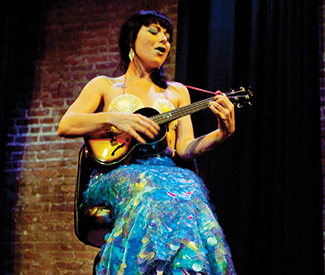
Sean Andries and Siouxsie Q’s Fish-Girl, meanwhile, has limited charm as a carny fable of doomed love between a nerdy young man (Andries, who also directed) and the freak-show beauty (Q, in sequined tail and half-shell bra) he’s hooked on. Co-creator Siouxsie Q hosts “The Whorecast” podcast showcasing the voices of American sex workers, and the mermaid’s plight takes on literal and metaphoric overtones of sex work. But the bland love story at the center keeps things bathtub shallow, albeit buoyed by a few decent songs belted out by poised songwriter Siouxsie Q to her own accompaniment on the ukulele — that spinet of the well-bred mermaid.

Hard on Fish-Girl‘s floppy heel came The Women of Tu-Na House, completing the evening’s sub-sub-theme of the aquatic erotic. (For cross-referencing purposes: Another bartender’s tale, with fish tails too, stood out in the program but was not seen in time for review: Alexa Fitzpatrick’s sushi-restaurant confessional, Serving Bait to Rich People.) Nancy Eng’s solo is a smart, sassy, and blushingly frank account of the workers at an Asian massage parlor. Although Eng’s characters are not always readily distinct, she marshals an unexpected angle and winning élan in bringing this worthwhile story to life.

Not every show in the Fringe need conform to a surface or sub theme. Dark Porch Theatre’s StormStressLenz brings its own thematic taxonomy with it, in director Martin Schwartz’s uneven but intriguing, vivacious remixing of the work of Jakob Michael Reinhold Lenz (1751–1792), the Baltic German author of the proto-Romantic, anti-rational Sturm und Drang school of literature.

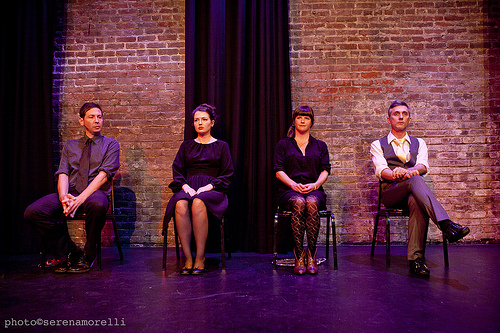
Schwartz’s Lenz remix comes across as an alternately cool and hyperactive investigation of the essence of melodrama, employing a fast-changing four-person ensemble (Nathan Tucker, Margery Fairchild, Ryan Hayes, Meg Hurtado) in a series of scenes shorn of their immediate context and aggregated under various section headings (“Love,” “Tricks,” “Sorrow,” etc.) — subheads called out by Schwartz, seated at a table to the left of the stage calmly scrutinizing the action, asking the lighting booth for the odd musical interlude (MC5 one minute, Brahms the next), and bouncing his palm lightly on a desk bell to trigger the beginning and the end of each scene. These range widely and wildly, making for a raucous but tonally patchy hour. The broadest and subtlest range of characters comes from Tucker and Fairchild, who between them suggest some of the darker elements otherwise left out of a largely comic romp. But if the show leaves one wanting more complexity and shading, its eccentric enterprise is still worth a stab, as they say.

Finally, San Francisco dancer and performance maker Cara Rose DeFabio’s admirable solo strikes its own idiosyncratic tone, or rather many of them, in another intriguing investigation, this time of the online afterlife to which we are all increasingly subject — whether willingly or not. After the Tone is a smart and provoking exploration of the intersections of grief, technology, memory, ideology, and individuality that uses DeFabio’s sly narrative persona, movement, video, and audio pastiche, and interactive audience participation (via those celebrated and hated cellphones) to productively turn over a subject too close to most of us to be clearly grasped otherwise. *

SAN FRANCISCO FRINGE FESTIVAL

Through Sept. 21, $12.99 or less

Exit Theatreplex

156 Eddy, SF

www.sffringe.org

For a longer version of this review, visit www.sfbg.com/pixel_vision.


Self service: SF Fringe Festival tells it like it is

1

Note: this is an extended version of an article that appears in this week’s print version.

Sitting in the Exit Café with a can of Guinness and the San Francisco Fringe Festival program is one of life’s modest but absorbing pleasures. For those without much inside knowledge on the lineup (currently encompassing 36 companies and 158 performances), it’s a little like taking a vacation by pitching darts at a wall map. There were several immediate sub-themes to choose from for 2013. I could have picked shows with bananas in the title, for instance. But for whatever reason, I dived into the service and servitude sector.

Of course, the Fringe, now in its 22nd year, is a lottery-based operation, so it is fate’s fingers that pluck these patterns from the cultural whirl. At the same time, you don’t need the I Ching to know that serving the rich is about all that’s left of the economy for most of us, making it hardly surprising to find so many stories of bartenders, wait staff, sex workers, and mermaids-who-are-also-sex-workers floating in the pool.

Things began on a high note with Jill Vice’s witty and deft solo, The Tipped & the Tipsy, which brings the querulous regulars of a skid-row bar to life vividly and with real (quasi-Depression era) charm. Without set or costume changes, Vice (who developed the piece with Dave Dennison and David Ford) proves a protean physical performer, seamlessly inhabiting the oddball outcasts lined up before bartender Candy every day at Happy’s — names as loaded as the clientele.

After some hilarious expert summarizing of the dos and don’ts of bar culture, a story unfolds around a battered former boxer and his avuncular relationship with Candy, who tries to cut off his bar service in fear of his deteriorating health, much to the consternation and even greater fear of his barfly associates and the self-aggrandizing sleazeball owner, Rocco. With a love of the underdog and strong writing and acting at its core, Tipsy breezes by, leaving a superlative buzz.

This was largely squandered a half hour later in Sandra Brunell Neace’s Parly Girl, an uneven and unpersuasive testimonial by a New York City waitress with a bad attitude and a traumatic back story. Neace, whose incidental characters are weakly written and delivered, is best in fleeting moments of genuine reflection. But these are few, and the piece flags early on, only to be at best partially redeemed in a hasty turnaround of a conclusion.

Service work gives way to involuntary servitude, and the horrifying reality of child sex trafficking, in writer-performer and activist Regina Y. Evans’ 52 Letters (co-directed with Louel Senores). More than a global scourge, this is a local story, and Evans delivers it with burning compassion in a poetical voice ringing with the resiliency and freighted history of the African American spiritual. The emotional register varies little, which can weaken somewhat the force it justly means to convey. Nevertheless, Evans and her urgent message as a modern-day abolitionist leave one impressed and unsettled.

O Best Beloved isn’t about service work, but the theme still crops up in the opening story — “How the Camel Got Her Hump” — an unburdened beast (played by Sam Jackson) whose relaxed work ethic draws negative attention. It’s one of three scheduled children’s tales by Rudyard Kipling (adapted by actor Joan Howard and director Rebecca Longworth), delivered by a rowdy six-person cast of storytellers. This playful piece is somewhat hectic and a bit garbled (in speech that can get lost in the reverberations of the Exit’s main stage). But it’s colorfully worked up (in costuming and properties as well as performances) and no doubt ideal for families or those happy to revel in light insouciance and unyielding silliness.

Sean Andries and Siouxsie Q’s Fish-Girl, meanwhile, has limited charm as a carny fable of doomed love between a nerdy young man (Andries, who also directed) and the freak-show beauty (Q, in sequined tail and half-shell bra) he’s hooked on. Co-creator Siouxsie Q hosts “The Whorecast” podcast showcasing the voices of American sex workers, and the mermaid’s plight takes on literal and metaphoric overtones of sex work. But the bland love story at the center keeps things bathtub shallow, albeit buoyed by a few decent songs belted out by poised songwriter Siouxsie Q to her own accompaniment on the ukulele — that spinet of the well-bred mermaid.

Hard on Fish-Girl‘s floppy heel came The Women of Tu-Na House, completing the evening’s sub-sub-theme of the aquatic erotic. (For cross-referencing purposes, another bartender’s tale, with fish tails too, stood out in the program but was not seen in time for review: Alexa Fitzpatrick’s sushi-restaurant confessional, Serving Bait to Rich People.) Nancy Eng’s solo is a smart, sassy, and blushingly frank account of the workers at an Asian massage parlor. Although Eng’s characters are not always readily distinct, she marshals an unexpected angle and winning élan in bringing this worthwhile story to life.

Not every show in the Fringe need conform to a surface or sub theme. Dark Porch Theatre’s StormStressLenz brings its own thematic taxonomy with it, in director Martin Schwartz’s uneven but intriguing, vivacious remixing of the work of Jakob Michael Reinhold Lenz (1751–1792), the Baltic German author of the proto-Romantic, anti-rational Sturm und Drang school of literature.

Schwartz’s Lenz remix comes across as an alternately cool and hyperactive investigation of the essence of melodrama, employing a fast-changing four-person ensemble (Nathan Tucker, Margery Fairchild, Ryan Hayes, Meg Hurtado) in a series of scenes shorn of their immediate context and aggregated under various section headings (“Love,” “Tricks,” “Sorrow,” etc.) The subheads are called out by Schwartz, seated at a table to the left of the stage calmly scrutinizing the action, asking the lighting booth for the odd musical interlude (MC5 one minute, Brahms the next), and bouncing his palm lightly on a desk bell to trigger the beginning and the end of each scene. These range widely and wildly, making for a raucous but tonally patchy hour. The broadest and subtlest range of characters comes from Tucker and Fairchild, who between them suggest some of the darker elements otherwise left out of a largely comic romp. But if the show leaves one wanting more complexity and shading, its eccentric enterprise is still worth a stab, as they say.

Finally, San Francisco dancer and performance maker Cara Rose DeFabio’s admirable solo strikes its own idiosyncratic tone, or rather many of them, in another intriguing investigation, this time of the online afterlife to which we are all increasingly subject — whether willingly or not. After the Tone is a smart and provoking exploration of the intersections of grief, technology, memory, ideology, and individuality that uses DeFabio’s sly narrative persona, movement, video, and audio pastiche, and interactive audience participation (via those celebrated and hated cellphones) to productively turn over a subject too close to most of us to be clearly grasped otherwise.

SAN FRANCISCO FRINGE FESTIVAL
Through Sept. 21, $12.99 or less
Exit Theatreplex
156 Eddy, SF
www.sffringe.org

Live Review: My Bloody Valentine’s SF show feels like something beamed in from another decade

17

Swirling guitars… cooing vocals… that all-engulfing wall of noise. It’s difficult to describe My Bloody Valentine‘s sound without veering into borderline erotica, and understandably so; in the guitar rock landscape, few bands make music that’s so tactile and exhilarating.

For many of its devoted fans, the band’s seminal 1991 LP, Loveless, is inextricably tethered to private moments of introspection and sexuality. Its delicate balance between loud and quiet, menace and seduction, resulted in a sense of emotional ambiguity, allowing the listener to project their own perspectives and yearnings onto those immaculate pop songs.

Fresh off the heels of this year’s long-awaited Loveless followup, simply titled mbv, My Bloody Valentine stopped by SF this past Friday for its first Bay Area appearance since 2008, on its first tour in support of new material since the early ’90s.

By the looks of the crowd, the band’s overwhelming paralysis was in full force. As wary as I am of audiences too “cool” or self-conscious to dance at live shows, this crowd’s stillness felt wholly appropriate. The band’s output rarely feels conducive to dancing, or jamming out; it’s music to surrender to, and My Bloody Valentine had the crowd in the palm of its hand.

Given My Bloody Valentine’s inconsistent production sound, from the tinny Jesus-and-Mary-Chaininess of Isn’t Anything (1988), to the fuller, more tactile Loveless, to the thuddy brawn of mbv, one of the highlights of last Friday night’s show was hearing a career-spanning set of songs, all delivered with similar depth and richness. It was quite the thrill to hear older material, like “Feed Me With Your Kiss,” and “Only Shallow,” delivered with the generous low-end of MBV circa 2013.

As new songs like “only tomorrow” and “who sees you” suggest, the band’s dynamics have grown more boomy and forceful, yet alternately, groovier and more relaxed. Much of the credit goes to the rhythm section of Deb Googe and Colm Ó Cíosóig, who plucked and smacked their instruments ferociously, providing much of the backbone that defines My Bloody Valentine’s second wave. It all makes sense, considering Googe’s muscular bass-lines on this year’s excellent Primal Scream LP, More Light, and Ó Cíosóig’s recent move to the Bay Area, and subsequent role as drummer for his wife Hope Sandoval’s post-Mazzy Star project, the Warm Inventions.

Otherwise, it seems things haven’t changed much, and thankfully so. Ever the recluse, bandleader Kevin Shields stood calmly on stage left, away from the spotlights, equipped with some heavy-duty Marshall stacks, and an arsenal of guitars and pedals. Abusing the whammy bars on his Fender Jaguars and Jazzmasters, Shields delivered beautifully on the queasy tremolo of his signature “glide guitar” technique. Alternately, Bilinda Butcher occupied center stage, supplying the soft-as-snow vocals that contrast so harmoniously with Shields’ outpouring of sound and feeling.

“Honey Power,” “Come In Alone,” and “Soon,” were wonderfully performed, delivering especially well on the loud/quiet, sweet/snarly binaries of My Bloody Valentine’s sound, and those hugely dense progressions that create an itch with one chord, and scratch it with the next. There’s a reason why the band’s influence has gone so far beyond rock music, into electronic and industrial realms; the live renditions of these songs were a masterclass in My Bloody Valentine’s ability to warp genre boundaries with standard rock instrumentation.

Seeing “Cigarette In Your Bed” performed live was a treat, as it allowed Shields to bust out the acoustic guitar for once, while “new you” offered a glimpse of My Bloody Valentine in full-on pop mode. “wonder 2,” the band’s experiment with Jungle music, was suffocating in its blend of reverb-soaked drum’n’bass beats and jet-engine guitars, while “You Never Should” offered the same claustrophobia in a rock setting. Perhaps most impressively, though, was the noisy, chaotic “holocaust section” of the band’s infamous closer, “You Made Me Realize.” What started out as a cacophony of guitars, bass, and drums, slowly hypnotized the listener, gradually resembling a monolithic, industrial roar, like cruising the Transbay Tube with the windows down.

My Bloody Valentine is one of the last great rock bands of the album era, and as such, every gesture at Friday night’s show was a big one: from handing out free earplugs at the door, to the giant Marshall stacks onstage, to the band’s decision to book the overly big/beige/bloated Bill Graham Civic Auditorium. Much like mbv’s total disconnection from the modern musical landscape, the band’s live show felt like a concert-going experience beamed in from another decade.

The audience, consisting of everyone from metalheads, to ravers, to garden-variety hipsters, might’ve been a bit perplexing, but made total sense, given My Bloody Valentine’s inability to fit comfortably into any one scene. Given its dense, borderline-electronic chords, abrasive guitar squalls, and overriding sense of calm, the band’s sound offers practically any subcategory of listener something to cling onto, providing a gateway to new musical realms.

For those skeptical about My Bloody Valentine’s ability to recapture the singular wonder of Loveless after a two-decade hiatus, mbv was a wonderful surprise, in its insistence on picking up right where the band’s first era left off. Last weekend’s show felt like an extension of this “new” strategy, with the band’s four members commanding the stage as if the past 22 years never happened. Countless groups have tried their hand at pushing the shoegaze genre forward in the post-Loveless wake, but as Shields and Co. resoundingly proved on Friday night, My Bloody Valentine remains the undefeated champion of “swirling guitars.”

Memorial for cyclist marred by SFPD harassment

4

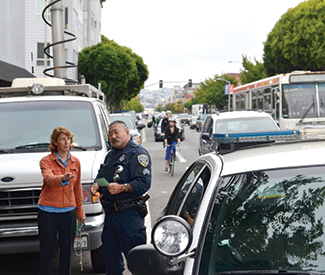
A memorial and informational event on Aug. 21 at the Sixth and Folsom corner where a bicyclist was fatally run over by a delivery truck a week earlier was marred by a tense and unsettling confrontation with an SFPD sergeant who showed up to block the bike lane with his cruiser, lecture the cyclists, and blame the victim.

The event was organized by the San Francisco Bicycle Coalition to raise awareness of the incident and that dangerous intersection and to call for the city to make improvements. It included friends and co-workers of 24-year-old Amelie Le Moullac, who was riding in the Folsom Street bike lane on the morning of Aug. 14 when an unidentified truck driver turned right onto Sixth Street, across her path, and ran her over.

SFPD Sgt. Dennis Toomer tells the Guardian that the department has completed the traffic incident report, information from which can only be shared with the parties involved, but that the investigation of the fatality is still ongoing and will be forwarded to the District Attorney’s Office for review once it’s done.

But SFBC Executive Director Leah Shahum said that SFPD Sgt. Richard Ernst, who showed up at the event a little before 9am, had already drawn his own conclusions about the crash and showed up to make his apparent disdain for “you people,” bicyclists, disturbingly clear.

Shahum said that she tried to be diplomatic with Ernst and asked him to please move his patrol car out of the bike lane and into an available parking space that was right next to it, saying that it presented an unnecessary hazard to bicyclists riding past.

But she said Ernst refused to do so for almost 10 minutes, telling the group that he has “a right” to leave his car there and that he was “making the point that bicyclists need to move around” cars parked in bike lanes, according to Shahum’s written account, which she prepared to file about the incident with the Office of Citizens Complaints.

“He then told me explicitly that he ‘would not leave until’ I ‘understood’ that ‘it was the bicyclist’s fault.’ This was shocking to hear, as I was told just a day ago by Commander [Mikail] Ali that the case was still under investigation and no cause had yet been determined,” Shahum wrote.

And apparently Ernst didn’t stop at denouncing Le Moullac for causing her own death, in front of people who are still mourning that death. Shahum said Ernst also blamed the other two bicyclist deaths in SF this year on the cyclists, and on “you people” in the SFBC for not teaching cyclists how to avoid cars.

“I told him the SF Bicycle Coalition does a significant amount of safety work educating people biking and driving about sharing the road, and that I’d be happy to share more information with him. I again urged him to move his car out of the bike lane. He again refused, saying it was his right and he wasn’t moving until I ‘understood,'” Shahum wrote.

Shahum said there were multiple witnesses to the incident, including three television reporters who were there to cover the event.

“In addition to the Sgt’s inappropriate and dangerous behavior of parking his car in the bike lane and blocking safe passage for people bicycling by, it was deeply upsetting to see him unnecessarily disrupt and add tension to what was already an emotional and difficult time for many people who lamented this sad loss of life,” Shahum wrote.

Asked about the actions and attitudes expressed by Ernst, who we could not reach for comment, Toomer told us he “cannot talk about personnel issues.”

Compounding Ernst’s insensitive and judgmental approach, it also appears the SFPD may have failed to properly investigate this incident, which Shahum and the SFBC have been tracking closely, and she said the SFPD told her that there were no video surveillance tapes of the collision.

After the event, SFBC’s Marc Caswell decided to check in at businesses on the block to see if they had any video cameras aimed at the intersection, and he found an auto body business at the intersection whose workers said they did indeed have revealing footage of the crash that the SFPD hasn’t requested, but which SFBC delivered to investigators.

“He had the time to come harass us at a memorial, but he didn’t have the time to see if anyone had footage of this incident,” Shahum told us. “It’s very unsettling.”

Changing the narrative

45

news@sfbg.com

Three distinct players with three distinct strategies for saving City College of San Francisco showed their hands last week, all centered around the Accrediting Commission of Community and Junior Colleges, which plans to revoke City College’s accreditation in less than a year.

City Attorney Dennis Herrera filed a lawsuit against the ACCJC, state lawmakers are revving up to investigate it, and City College Super Trustee Bob Agrella is doing his best to quietly meet the accreditor’s standards.

Whether any of the approaches will save the school is anyone’s guess, but one thing’s for sure: In the process of saving City College, its accreditation agency has gone from an unknown bureaucracy to a polarizing political punching bag.


HERRERA FILES SUIT

Herrera threw a right hook at the ACCJC on Aug. 22, announcing his lawsuit to stop them from closing City College. It offers a scathing critique of the accreditation agency and those whose agenda it is pushing.

The ACCJC said City College failed to meet certain standards by its deadline last July, leading the agency to order its closure in exactly one year. Since then, enrollment at the college of 85,000 students plummeted and the school is fighting for its very existence. Now Herrera is saying that closure action was improper, unwarranted, and out of line with the agency’s prior actions.

Herrera’s suit alleges the ACCJC unlawfully allowed its advocacy and political bias to prejudice its evaluation of college accreditation standards. “It is a matter of public record that the ACCJC has been an advocate to reshape the mission of California community colleges,” Herrera said at a press conference.

The agenda he said it was advocating for is the completion agenda, which was the focus of our July 9 cover story, “Who Killed City College?” Essentially, it’s the move to force community colleges to focus on only two-year transfer students at the expense of so-called “non-credit” classes, which can be lifelong learning skills or English as Second Language classes.

“There’s a reason judges aren’t advocates and advocates aren’t judges,” Herrera said. “We should have a problem when an entity charged with evaluation engages in political advocacy.”


City College avoided those reform efforts from the state for years, and Herrera alleges that the ACCJC tried to sanction City College because of that resistance.

ACCJC President Barbara Beno was not available for comment. In a statement, the agency said it was surprised to learn Herrera filed a suit against the ACCJC, and that the suit appears to be “without merit” and an attempt to “politicize and interfere with the ongoing accreditation review process.”

Herrera may be playing cowboy, guns aimed right at the ACCJC, but he also said he doesn’t want the agency to close, just to clean up its act and be accountable. But on the other side of the OK Corral, an investigation by the California Legislature is under way — and it may be sizing up a coffin for the ACCJC.


JLAC VS. ACCJC

Just a day before Herrera announced his lawsuit, the California Joint Legislative Audit Committee voted to investigate the accrediting commission. The audit committee is a legislative fact-finding body usually staffed by former investigative journalists, and the senators who asked for the hearing were out for the ACCJC’s blood.

“The stakes are high and the commission’s power is absolute,” Sen. Jim Beall, D-San Jose, told the audit committee. He then outlined the danger of losing community colleges that faced closure at the hand of the ACCJC.

Sen. Jim Nielsen, R-Gerber, was much more direct. “Sen. Beall and I met with (ACCJC) President Barbara Beno in my office,” he said. “In all my career, in my thousands of meetings with agency individuals, representatives, secretaries, etcetera, I have never met with such an arrogant, condescending individual in her response to Sen. Beall and I. That attitude reflected in such a senior person raised huge red flags for me.”


In public comment, Assemblymember Tom Ammiano, D-SF, noted that recently the U.S. Department of Education upheld the California Federation of Teachers’ complaints that the ACCJC process “is guilty of no transparency, little accountability, and conflict of interest.”

Then it was the ACCJC’s turn to defend itself. Beno was unable to attend, but ACCJC Vice President Krista Johns and Commissioner Frank Gornick were there instead.

Gornick defended the accrediting commission, saying it was “rigorously” evaluated every six years. Ultimately, the committee voted 10-1 to investigate a number of mysteries regarding the ACCJC: how it stacks up to the five other accrediting bodies nationwide, determining the ACCJC’s compliance with open meeting laws (it denied public access to a recent “public meeting,” also barring a San Francisco Chronicle reporter), and an evaluation of the fairness in how the agency issues sanctions.


MEET THE NEW BOSS

Amid the state and city level battles over City College, one key player prefers to work quietly. Super Trustee Bob Agrella, tasked by the state to take over the power of City College’s Board of Trustees and save the college, feels his hands are tied.

“My job is to play within the rules and regulations of the ACCJC,” Agrella told the Guardian. Sitting in his office at City College’s Ocean Campus, he pointed out that the accreditation agency actually has a rule that says colleges have to be on amicable terms with the ACCJC — or else.

“One of the eligibility requirements is the college maintains good relationship with the commission,” Agrella said. Notably, if City College fails to meet its requirements, it won’t be able to keep its accreditation in its evaluation next July.

So while Herrera and JLAC can blast the ACCJC, Agrella feels like he needs to remain neutral or he could blow City College’s chances at staying open.

If he were to try battling the commission on its rules, Agrella told us, he would do it within the framework of the ACCJC’s own policies. But it’s exactly those policies that Herrera said the ACCJC is violating.

The lawsuit from Herrera’s office alleges, among other things, that the evaluating team that ACCJC sent to review City College was stacked with the school’s political enemies from a body called the California Community College Student Success Task Force, which City College loudly and publicly opposed (full disclosure: as a former City College student, I spoke against the Task Force at a hearing in January 2012, and that public testimony is cited in Herrera’s lawsuit).

The ACCJC’s president, Beno, wrote multiple letters to state agencies in support of the Task Force’s recommendations, the suit alleges. This action contradicts the ACCJC’s conflict of interest policy, according to the suit, which defines a conflict as including “any personal or professional connections that would create either a conflict or the appearance of conflict of interest.”

So if the ACCJC won’t play by the rules, shouldn’t Agrella support the actions of Herrera and JLAC to resist the ACCJC’s decree?

“In fairness to the people taking these actions, they feel time is of the essence,” Agrella said. “I just happen to, respectfully, disagree with it, because my job is not to push the (ACCJC). My job is to try to retain accreditation.”

But it’s becoming increasingly clear that the ACCJC may not be the only body that will decide the fate of City College.

“Refeeding” is prison authorities’ new word for force-feeding

The practice of force-feeding inmates has a branding problem.

The issue first came to light after a U.S. District Judge last week granted the California Department of Rehabilitation and Corrections, or CDRC, the ability to feed inmates who are hunger striking even if they signed “Do Not Resuscitate” waivers, commonly known as DNR’s. The order called any DNR granted during the beginning of the hunger strike 50 days ago as invalid.

As the negotiations wind on, it’s looking more inevitable that the hunger strike holdouts will soon be near death. But when the prisons start force-feeding inmates, a whole new problem will arise: image.

The CDRC have given all the concessions they’re willing to give, they said, and if an inmate dies while fasting they’d become a martyr. At some point, the prisons may have to feed the inmates via liquid in an IV, or even via tubes.

The tubes are inserted through the nose and directly into their stomachs, and conjure images of alleged terrorists at Guantanamo Bay. 

In a video made by musician Mos Def, aka Yasiin Bey, Bey allowed himself to be force fed to bring attention to Guantanamo’s detainees. Bey is strapped to a chair, and a clear plastic tube is inserted through his nose as he screams, writhes, and begs for it to stop.

“The tube went in and the first part of it is not that bad, but then you get this burning,” he said in the video. “It starts to be like really unbearable, like something is reaching into the back of my brain…. I really couldn’t take it.”

For Mos Def, the feeding was brief. For inmates, the process can take two hours.

To address that issue the California Department of Corrections and Rehabilitation (CDCR) has taken to calling force feeding “refeeding,” which is term that already has a definition: feeding someone who has recently ended a fast. It has medical significance because a whole host of ailments can occur when someone who is ending a fast is fed the wrong foods, or fed too quickly. They can even die. 

But now the CDCR has used the word “refeeding” to mean feeding inmates who have already signed DNRs and are fed to prevent death. The word was in every major news report on the court’s recent decision, from Democracy Now to Al Jazeera.

“Refeeding” is the new force-feeding. 

Joyce Hayhoe, legislative director of California Correctional Health Care Services, wanted to make it clear that no one has been force-fed yet, and that refeeding was not force feeding.

“What I would like to say is we’re not force-feeding anybody,” she told the Guardian. “When doctors do not have a valid DNR, in the absence of any other information, when we have an inmate we cannot communicate with, we’re going to save their lives.”

But the sticking point in her statement is the word “valid,” advocates say. What is a valid DNR? The health care providers allege that some inmates began the hunger strike because of intimidation by senior gang members in the jails. Hayhoe said one inmate hid food so his fellow hunger strikers would not know, and that “implied something” to her.

There were 12,000 inmates who started the hunger strike on July 8, according to counts by the prisons themselves. Of those, it’s entirely conceivable that a few were coerced, said Dr. Ronald Ahnen, a politics professor at Saint Mary’s College focusing on prison reform.

“Is it possible some prisoners were coerced,” due to the sheer number of inmates involved, he said in an interview. But, “if you read the call from the hunger strike forward, and you heard from the reps in Pelican Bay (Prison), they have always stated emphatically and clearly that the hunger strike is voluntary. They have said no one should continue with the hunger strike longer than they were willing or able to do.”

Now the number of inmates in the hunger strike is down to 92, according to the CDRC. Of those, 41 have been on a hunger strike continuously since it began on July 8.

Hayhoe said there are only a handful of strikers with DNRs left, but would not reveal specific numbers. 

Ahnen, who is affiliated with the hunger strikers as a reform advocate but did not speak as their spokesperson, said that though those numbers have dwindled, they’re still significant.

“What amazes me is, 41 people who have been without food for 50 days. I think the major media is missing the importance of that,” he said. “When you think of the Irish hunger strike that we all think of from 1980, that’s 23 individuals who all died. We now have 42, risking their lives to have humane conditions in their confinement. Its very, very historic.”

Lost in the debate over food are the actual reasons for striking. The inmates have five core issues which you can see at their website here, but mostly they revolve around quality of life in Segregated Housing Units, commonly referred to as the SHU. The prisoners say it is solitary confinement, and they can be thrown in there easily by being told they have affiliations with gangs.

“I’ve had prisoners tell me their investigators say they can use any evidence and implicate anyone (as a gang member),” Ahnen said.

And the inmates have little recourse once they’ve been labeled a gang member and thrown in the SHU. Toshio Meronek covered this for Bay Guardian last month (“Hungry for Reform,” 7/3/13), saying it would take nearly 20 years to conduct reviews of the over 10,000 inmates presently held in solitary confinement in California.

In a statement circulated shortly after the CDCR’s on Thursday, State Senator Mark Leno wrote, “I have concerns that this review process is moving too slowly and I would like to see it accelerated.”

The hunger strike is one of the inmate’s last tools to reform that system. Now, in a cell that strips away most all human freedoms, “refeeding” may take away an inmate’s choice to die.

The federal judge’s decision to strip away that right reverberated across the world. The United Nations Special Rapporteur on torture, Juan E. Méndez, issued a statement saying “it is not acceptable to use threats of forced feeding or other types of physical or psychological coercion against individuals who have opted for the extreme recourse of a hunger strike.”

Hayhoe, from the prison’s health services, said there is some wiggle room in having your request to not be resuscitated honored.

“If a person has signed a DNR during the hunger strike, the best thing they can do is start having discussions with his primary care physician and expressing their need,” she said. The inmates have been sustained on Gatorade and vitamins, she said, and are not yet at the point of needing resuscitation.

Ahnen also clarified that the violent method of force-feeding may not be used. Another way to do it, he said, is to feed patients through an IV should they lapse into unconsciousness.

“This is a more likely scenario,” he said, but it is still force-feeding. Hayhoe said she would contact a doctor to see when each method would be used, but did not have the information immediately available.

These inmates are close to dehydration, close to organ failure, and close to death for their principles, Ahnen said, and now their political stand won’t be honored. They’ll be force-fed, no matter what terminology is used to describe it.

“Make no mistake about it, if a prisoner is being fed against their will, this is force feeding,” he said.

And with the flip of a word, the inmates have lost their right to die.

To learn see future actions on the hunger strike, visit http://prisonerhungerstrikesolidarity.wordpress.com/take-action-2/ .

Chronicle: Don’t question the City College takeover, just submit to the flawed ACCJC

71

I have very low expectations from editorials in the San Francisco Chronicle, which generally share a worldview with the Chamber of Commerce and carry water for some powerful Establishment figure or another. But today’s editorial on City Attorney Dennis Herrera’s lawsuit defending City College is so bad and illogical that it reads like an Onion parody of a Chronicle editorial.

Clearly put up to it by some of the most reactionary figures in the Mayor’s Office, Chronicle Editorial Page Editor John Diaz or one his lackeys parrot the submissive stance that Mayor Ed Lee has taken toward outsiders with corporatist agenda that have seized control of City College and sought to make a high-profile example of it.

“The city’s leaders should be calling for tough love, not coddling dysfunction. Fortunately, Mayor Ed Lee has done just that – but, regrettably, the city attorney is going in the opposite direct [sic],” the Chronicle wrote.

And by “tough love,” they apparently mean obedient and unquestioning compliance with an obscure accrediting agency’s demand that City College slash community-based curriculum; close facilities relied on by both students and local nonprofit groups; rip up contracts with faculty and force instructors to live on part-time wages; distill course offerings down to just what serve corporations, universities, and banking interests; and other aspects of an educational agenda that hasn’t been properly vetted in public hearings or approved by any elected body.

Herrera is to be applauded for pointing out the overreach and conflicts-of-interest on the Accrediting Commission of Community and Junior Colleges, which were also recently criticized by the US Department of Education. And we’re excited to see what Herrera uncovers during the discovery process in his lawsuit against a secretive, corporate-connected, document-shredding agency that broke its own internal rules in its treatment of City College.

The Chronicle graciously refers to these unavoidable facts in a brief paragraph, writing that the ACCJC “is not without flaws. It’s secretive, and its internal policies drew a rebuke from the U.S. Department of Education after City College faculty filed complaints about its conduct.”

But then it dimisses that and shows a suspicious incuriosity about why the ACCJC is being so secretive and what its agenda might be, instead doubling down on criticizing City College in a way that is so over-the-top that this fine institution is unrecognizable to anyone who is actually familiar with it, which Diaz and company clearly aren’t.   

“The needed changes include hiring a comptroller to organize financial controls, making sure students pay for classes, and overhauling a loose-fit governance system that puts faculty, students and staff in charge of operations with inadequate administrative controls. Lee has strongly endorsed an overhaul of City College’s ramshackle operations,” the Chronicle writes.

Unlike us here at the Guardian, where I’ve written two recent editorials in support of democracy and local control and critical of Lee and others who have been too quick to cooperate with the toppling of the locally elected Board of Trustees, the Chronicle apparently believe in more authoritarian methods of governance.

“The first repairs are now under way. The powers of the elected community college board are on hold, and a special trustee dispatched by state Community College Chancellor Brice Harris is in charge,” the Chronicle writes.

And as we report in our upcoming issue, that special trustee also has no interest in questioning the ACCJC’s process or methods or even allowing the public to review internal communications. It’s a shame that bootlickers like Lee and the Chronicle have sold out such an important local institution to their corporate masters, but luckily for San Francisco, Herrera, the California Federation of Teachers, the Guardian, other progressive media voices, and hundreds of our community partners aren’t giving up so easily, instead pushing for an open, truthful, democratic, and transparent discussion about City College’s mission and its future.

SF City Attorney Dennis Herrera sues to keep City College open

49

City Attorney Dennis Herrera filed a suit today to block City College of San Francisco’s accreditation agency from closing down the school.

The accreditation agency, the Association of California Community and Junior Colleges, moved to put City College on a sanction last July that would lead to its closure in exactly one year. Since then, enrollment at the college has plummeted and the school has been in the fight for its very existence. Now Herrera is saying that closure action was improper, unwarranted, and out of line with the agency’s prior actions.

Herrera’s suit alleges the ACCJC unlawfully allowed its advocacy and political bias to prejudice its evaluation of college accreditation standards, he said. “It is a matter of public record that the ACCJC has been an advocate to reshape the mission of California community colleges,” Herrera said, and that was the basis of his suit.

The ACCJC cannot be advocates for change in the higher education system, he said. “There’s a reason judges aren’t advocates and advocates aren’t judges,” he said. “Now we have no problem with the right of others to advocate an agenda against the open access mission… but we should have a problem with an entity charged with evaluation engages in political advocacy.”

Notably, the ACCJC wanted City College to shrink its mission, concentrating its money on students who could transfer easily to four year institutions from City College, which many advocates say would leave students learning trades, new English learners, and other disenfranchised students in the dust. You can see our coverage on that here.

Above: Text of Herrera’s suit and a press release with more information, courtesy of Sara Bloomberg, reporter for City College’s newspaper The Guardsman.


Herrera also filed an administrative action against the California Community College Board of Governors, saying they had abandoned their role as the check and balance on community colleges, and left it to a private institution that was unaccountable to the public (for full disclosure, I am named in Herrera’s suit on pages 16 and 18 for my role advocating against the Student Success Act of 2012 to the Board of Governors. I was a student at the time, not a professional reporter, and I have no personal stance on the future of the ACCJC). The Board of Governors oversees the 112 community colleges in California, the largest body of community colleges in the country. 

Alisa Messer, the faculty union president of City College, agreed that the Board of Governors should not be abdicating its policy and oversight role. 

“No outside, unaccountable agency should be making up its own rules or setting policy for our state’s colleges,” she said. 

City College Trustee Rafael Mandelman applauded action against the ACCJC.

“At this point I think it absolutely critical the ACCJC is not in the driver’s seat making these decisions, they’re not fit to do that,” he told the Guardian.

This past Tuesday City College submitted review documents to the ACCJC attesting to why it should be allowed to stay open and accredited, and Therese M. Stewart, the chief deputy city attorney, said that while they sent an order to ACCJC not to destroy documents, they had not yet obtained any documents yet. “We haven’t actually sought documents yet from the ACCJC, we asked them to not destroy documents so that we may seek them later,” she said. “Eventually we will get them.”

Memorial for cyclist marred by SFPD harassment

380

A memorial and informational event this morning at the 6th and Folsom corner where a bicyclist was fatally run over by a truck last week was marred by a tense and unsettling confrontation with an SFPD sergeant who showed up to block the bike lane with his cruiser, lecture the cyclists, and blame the victim.

The event was organized by the San Francisco Bicycle Coalition to raise awareness of the incident and that dangerous intersection and to call for the city to make improvements. It included friends and co-workers of 24-year-old Amelie Le Moullac, who was riding in the Folsom Street bike lane on the morning of Aug. 14 when an unidentified delivery truck driver turned right onto 6th Street, across her path, and ran her over.

SFPD Sgt. Dennis Toomer tells the Guardian that the department has completed the traffic incident report, information from which can only be shared with the parties involved, but that the investigation of the fatality is still ongoing and will be forwarded to the District Attorney’s Office for review once it’s done.

But SFBC Executive Director Leah Shahum said that SFPD Sgt. Richard Ernst, who showed up at the event a little before 9am, had already drawn his own conclusions about the crash and showed up to make his apparent disdain for “you people,” bicyclists, disturbingly clear.

Shahum said that she tried to be diplomatic with Ernst and asked him to please move his patrol car out of the bike lane and into an available parking space that was right next to it, saying that it presented an unnecessary hazard to bicyclists riding past.

But she said Ernst refused to do so for almost 10 minutes, telling the group that he has “a right” to leave his car than and that he was “making the point that bicyclists need to move around” cars parked in bike lanes, according to Shahum’s written account, which she prepared to file a report about the incident with the Office of Citizens Complaints.

“He then told me explicitly that he ‘would not leave until’ I ‘understood’ that ‘it was the bicyclist’s fault.’ This was shocking to hear, as I was told just a day ago by Commander [Mikail] Ali that the case was still under investigation and no cause had yet been determined,” Shahum wrote.

And apparently Ernst didn’t stop at denouncing Le Moullac for causing her own death, in front of people who are still mourning that death. Shahum said Ernst also blamed the other two bicyclist deaths in SF this year on the cyclists, and on “you people” in the SFBC for not teaching cyclists how to avoid cars.

“I told him the SF Bicycle Coalition does a significant amount of safety work educating people biking and driving about sharing the road, and that I’d be happy to share more information with him. I again urged him to move his car out of the bike lane. He again refused, saying it was his right and he wasn’t moving until I ‘understood,’” Shahum wrote.

Shahum said there were multiple witness to the incident, including three television reporters who were there to cover the event.

“In addition to the Sgt’s inappropriate and dangerous behavior of parking his car in the bike lane and blocking safe passage for people bicycling by, it was deeply upsetting to see him unnecessarily disrupt and add tension to what was already an emotional and difficult time for many people who lamented this sad loss of life,” Shahum wrote.

Asked about the actions and attitudes expressed today by Ernst, who we could not reach for comment, Sgt. Toomer told us he “cannot talk about personnel issues.”

Compounding Ernst’s insensitive and judgmental approach today, it also appears the SFPD may have failed to properly investigate this incident, which Shahum and the SFBC have been tracking closely, and she said the SFPD told her that there were no video surveillance tapes of the collision.

After today’s event, SFBC’s Marc Caswell decided to check in at businesses on the block to see if they had any video cameras aimed at the intersection, and he found an auto body business at the intersection whose workers said they did indeed have revealing footage of the crash that the SFPD hasn’t requested, but which SFBC today delivered to investigators.

“He had the time to come harass us as a memorial, but he didn’t have the time to see if anyone had footage of this incident. It’s very unsettled,” Shahum told us.

Whoever was ultimately at fault in this collision and others that have injured or killed bicyclists in San Francisco, today’s confrontation demonstrates an unacceptable and dangerous insensitivity and animosity toward bicyclists in San Francisco, which was also on display in the comments to the post that I wrote last week about the incident.

It’s fine to debate what happens on the streets of San Francisco, and you can even harbor resentments toward bicyclists and believe that we deserve your ire. But when you endanger people’s lives to make a point, or when you threaten violence against vulnerable road users, then you’ve gone too far.

Yes, let’s talk about what happens on the roads and how to improve behaviors, but let’s not forget our humanity in the process.  

City College’s judges get judged

10

City College of San Francisco had its accreditation revoked by the Accrediting Commission of Junior and Community Colleges in July, and now the ACCJC is getting a taste of its own medicine — its own existence has been threatened over its treatment of City College.

In an Aug. 13 letter to ACCJC President Barbara Beno, the Department of Education found it out of compliance with the Education Secretary’s regulations governing accrediting agencies, as well as the ACCJC’s own internal rules.

“Therefore, we have determined that in order to avoid initiation of an action to limit, suspend or terminate ACCJC’s recognition, ACCJC must take immediate steps to correct the areas of non-compliance in this letter,” the letter reads.

The DOE found the ACCJC noncompliant in four areas: A conflict of interest because Beno’s husband served on the visiting team that evaluated City College, no clear policies on who should serve on those teams (with the letter noting the teams were stacked with administrators rather than educators), no defined distinction between “deficiencies” and “recommendations” or indication of their severity levels, and failure to give CCSF two years to correct those deficiencies, as ACCJC policies call for.

Ironically, the ACCJC has plenty of time to correct its own shortcomings. “The process in this case is that ACCJC will have an opportunity to provide information about the steps it has taken to come into compliance with the cited criteria in its response to the draft staff analysis of the agency’s petition for renewal of its recognition, which is currently under review,” DOE spokesperson Jane Glickman told the Guardian, noting that there will be a hearing in mid-December, with possible actions ranging from limiting the agency’s authority to giving it another year to come into compliance.

But she said the DOE can’t directly help City College: “The Department does not have the authority to require an agency to change any accreditation decision it has made. The agency (ACCJC) needs to amend its policies and procedures and provide documentation that it follows its amended policies and procedures to demonstrate that it is in compliance with the cited criteria.”

The California Federation of Teachers, which filed the appeal with the DOE, wants the ACCJC to reconsider its sanction of City College in light of these validated concerns over its process.

“We are gratified that the U.S. Dept. of Education agreed with us that the process was deeply flawed, and we call on the ACCJC to rescind its unprecedented decision to deny accreditation to CCSF,” CFT President Joshua Pechthalt, wrote in a press release.

But ACCJC Vice President of Policy and Research Krista Johns told us that DOE’s concerns were narrow and shouldn’t affect its actions against City College:”The overall result of the US Department [of Education]’s analysis and study of the documents presented by the CFT about the ACCJC really affirmed that we are in compliance to a very large degree with all of the many regulations that touch on accreditors.”

But it’s still an open question whether the DOE’s findings will affect the decision to revoke City College’s accreditation and turn control over the institution to a state-appointed special trustee.

“We’re still analyzing the letter. There’s a lot in there,” Paul Feist, spokesperson for the State Community College Chancellor’s Office, told us. “I don’t know if it could say there is any reprieve [for City College]. Regardless, there are a number of problems with City College that need fixing.”

But even a cursory analysis of the letter reveals something that raises suspicions about the integrity of the entire process: the DOE letter raises concerns about why the ACCJC chose to go beyond its own policies to sock it to City College.

The college’s appeal ultimately is in the hands of the new Super Trustee of City College, Bob Agrella, who acts with all of the powers of the college’s now defunct board. But Agrella has, in past interviews, agreed with the way the ACCJC is run.

“I think the way the commission operates is okay,” he told City College’s newspaper, The Guardsman. “I’ve dealt with their policies and operating procedures at other institutions where I worked that were dealing with addressing accreditation problems—not to the same degree as here at City College—and the process worked there.”

But Karen Saginor, the ex-City College academic senate president, said the DOE criticism of the process should be taken into account in the appeal of the accreditation revocation decision.

“It’s pretty exciting, that letter,” Saginor told the Guardian. “It’s recognition from an important authority that there are irregularities in the process that put us on show cause. We’ve been saying ‘it wasn’t fair.’ And we’ve been told ‘its a totally fair process, you’re just not happy because you don’t like the result.’ Now we have an important authority verifying what we’ve been saying.”

America’s Cup organizers sell small-scale naming rights at Pier 27 to pay their debt to the city

0

The Port Commission has approved a proposal by the America’s Cup Organizing Committee (ACOC) to sell bricks, benches, and other assets at Pier 27 to offset budget shortfalls, but community activists fear that corporate naming rights are undermining plans for a public recreation space.

A presentation at the Tuesday meeting by Kyri McClellan, the former city staffer who now serves as CEO of the ACOC, and Mike Martin of the Office of Economic and Workforce Development outlined the sale of up to 1,000 bricks to be set in pathways and 72 benches to dot the Northeast Wharf Plaza, which will bear the names of donors. Benches will be priced at $25,000, which McClellan cited as the going rate at other high-profile locations throughout the city.

McClellan emphasized that “none of what we’re proposing today as a pilot program includes what may previously have been alluded to as naming rights for this particular park, the piers, or the buildings.”

Milo Hanke and Alex Walker of San Francisco Beautiful, a local advocacy organization, didn’t have a problem with the smaller scale elements of the ACOC proposal. “The tiles and the bricks that are being offered here for $150, $300, for instance,” Hanke told the crowd, “that’s a gratifying opportunity for ordinary citizens who have already invested in our port to volunteer to express additional support for this proud port.”

But Hanke and Walker expressed concern about bigger ticket items that McClellan addressed with less specificity. “We want to make sure that this is a thing that’s going to be place-making and not place-taking,” commented Walker.

In addition to bricks and benches, the wharf’s lawn and adjacent walkway, an open plaza area, and a point at the pier’s end are earmarked for recognition of donors. So too are an event space and an exterior concourse on the second floor of the James R. Herman Passenger Cruise Terminal, slated to open at Pier 27 next spring.

“Corporate naming rights,” explained Hanke, “come with an intangible cost and I think that, given San Franciscans’ historic aversion to excess commercialization of our public realm, corporate naming rights are well worth taking a bypass on.”

Diagrams presented by ACOC did not include detailed renderings of larger donor fulfillments or clarification as to whether recognition would be restricted to individual and foundational donors and off limits to more commercial interests. “There is concern,” said Hanke, “of a creeping naming rights program if large areas are named for corporations.”

Pulling in $500,000 to $2.5 million a piece, however, bigger structures may be the revenue drivers ACOC is desperately seeking. As part of its host agreement with San Francisco, the organization is obligated to help offset the city’s expenses incurred in event preparations and operations.

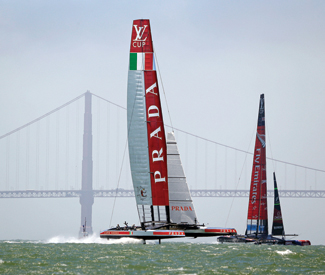
Luckily, the race’s outsized budget is expected to be less than the $32 million originally projected, due to the paltry number of teams competing (four at last count) and the resulting decrease in spectatorship. Still, the ACOC needs to come up with as much as $20 million – a debt burden that’s got Mayor Ed Lee personally stumping in the fundraising effort. The fundraising flop belies early promises that the city would make money hosting the event.

San Francisco voters approved Proposition B last November, authorizing the city to apply public funds towards repairs and redevelopment of recreational spaces. The fact that the Northeast Wharf Plaza was a named site in that bond measure isn’t the only reason community activists are demanding to know what assets on its piers are being auctioned off and who’s buying them.

According to Jon Golinger, a spokesman for the Northeast Waterfront Advisory Group, the San Francisco Waterfront Special Area Plan limited development on the Pier 27 plaza until a 2000 amendment lifted port restrictions in exchange for guarantees of public recreation areas.

Since then, “we’ve been paying close attention to this park. It’s particularly needed and a long time coming,” explained Golinger, who said there’s been no citizen review of the ACOC’s donor recognition program proposal.

Neighborhood organizations hope ACOC’s tag sale of infrastructure doesn’t torpedo use plans for land long ago promised as a public recreation area. Golinger would like to see features like a kids’ play area, a dog run, and exercise equipment for seniors included in the final design – whether or not they are lucrative to race organizers now.

“After the Cup is done in October, it should look, feel, and be used like a true public park,” Golinger said of the plaza. “This corner of town is the most densely packed part of San Francisco with the fewest recreation areas per capita…. [the plaza] should be part of the neighborhood as opposed to a corporate event venue.”

The promise of infrastructure improvements was one reason the city of San Francisco agreed to host the America’s Cup race in the first place. Residents are now left to hope that ACOC won’t forgo investments of lasting civic value for single-use vanity projects intended to float its budget deficit.

Concluding the discussion of the ACOC’s proposal on Tuesday, Port Commissioner Leslie Katz offered assurances that, “we’ll definitely oversee and be mindful of the aesthetics of anything going forward… This is not a selling off of the port, but really an opportunity to thank and acknowledge those that have allowed us to move forward.”

This opportunity, of course, assumes that donors actually surface. Mayoral spokesperson Christine Falvey said, “We will learn from [this] effort about how we can raise private dollars to improve our waterfront and engage city residents in the effort.”

If ACOC’s efforts to court private dollars from city residents aren’t fruitful, however, taxpayers-turned-debt-collectors may have no option but to sign former District 3 Supervisor Aaron Peskin’s online petition and to demand that America’s Cup billionaire defending champion Larry Ellison pick up the tab for his boat race all by himself.

Never enough hours in the weekend to see all these NEW MOVIES

0

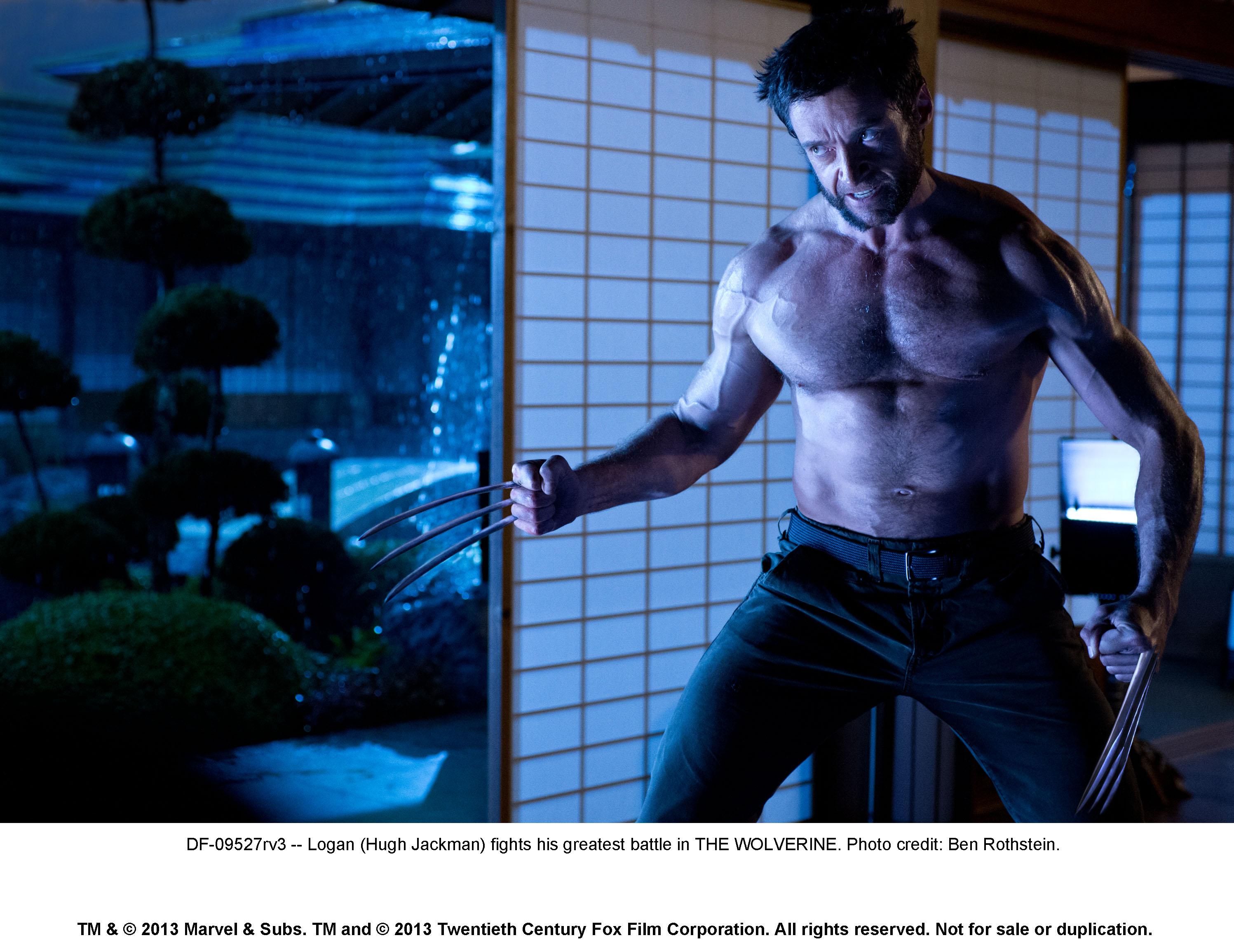
Quite a few openings this week, although it seems like 10-plus new movies is becoming the norm these days. (At least there’s no big film festival to distract you from the regular ol’ cinema at the moment.) In the spirit of efficiency I did a combo-platter review of sci-fi chiller Europa Report; Johnnie To’s latest, Drug War; Tenebre, a 1982 Dario Argento giallo that’s screening at the Roxie tonight; and doc Adjust Your Tracking: The Untold Story of the VHS Collector, which plays the Balboa. Also at length, Dennis Harvey takes a look at Shirley Clarke’s freshly restored 1967 doc Portrait of Jason, also screening at the Roxie.

Ain’t enough for you? Read on for Kick-Ass 2, Jobs, and more on the week’s fresh crop of flicks.

http://www.youtube.com/watch?v=X7MdQjqRjyw

The Artist and the Model The horror of the blank page, the raw sensuality of marble, and the fresh-meat attraction of a new model — just a few of the starting points for this thoughtful narrative about an elderly sculptor finding and shaping his possibly finest and final muse. Bedraggled and homeless beauty Mercè (Aida Folch) washes up in a small French town in the waning days of World War II and is taken in by a kindly woman (Claudia Cardinale), who seems intent on pleasantly pimping her out as a nude model to her artist husband (Jean Rochefort). As his former model, she knows Mercè has the type of body he likes — and that she’s capable of restoring his powers, in more ways than one, if you know what I mean. Yet this film by Fernando Trueba (1992’s Belle Époque) isn’t that kind of movie, with those kinds of models, especially when Mercè turns out to have more on her mind than mere pleasure. Done up in a lustrous, sunlit black and white that recalls 1957’s Wild Strawberries, The Artist and the Model instead offers a steady, respectful, and loving peek into a process, and unique relationship, with just a touch of poetry. (1:41) (Kimberly Chun)

http://www.youtube.com/watch?v=0O7b4nTRy2A

Blue Exorcist: The Movie Though it’s spawned from Kazue Kato’s manga-turned-TV-series, familiarity with the source material is not necessary to enjoy Blue Exorcist: The Movie‘s supernatural charms. Set in True Cross Academy Town — named for the Hogwarts-ish school of exorcism at its center — the film opens with a folk tale about an adorable demon that wrecked an entire town by turning all of its inhabitants into lazy slackers. The creature was eventually captured, but nobody knows where it’s been hiding — until boyish exorcist-in-training Rin, half-demon himself, encounters a suspiciously adorable critter while chasing yet another demon, this one huge and prone to damaging city blocks (and cracking open things that should remain sealed in the process). Trouble ahead! Blue Exorcist does contain some yep-this-is-anime moments (there’s a powerful female exorcist … who wears a tiny bikini top that barely contains her enormous bazongas), but it’s mostly fun fantasy, with a sly sense of humor (“Let’s put a beatdown on these Tokyo demons!”) and some endearingly flawed heroes. (1:28) Four Star. (Cheryl Eddy)

http://www.youtube.com/watch?v=BpFNTvA93iY

In a World… Lake Bell (Childrens Hospital, How to Make It in America) writes, directs, and stars in this comedy about a women who sets her sights on a career in movie-trailer voiceovers. (1:33)

http://www.youtube.com/watch?v=3tDHH1eXKmA

Jobs With the upcoming Aaron Sorkin adaptation of Walter Isaacson’s biography nipping at its heels, Jobs feels like a quickie — true to Silicon Valley form, someone realized that the first to ship can end up defining the market. But as this independent biopic goes for each easy cliché and facile cinematic device, you can practically hear Steve Jobs himself spinning in the ether somewhere. Ashton Kutcher as Jobs lectures us over and over again about the virtues of quality product, but little seemed to have penetrated director Joshua Michael Stern as he distracts with a schmaltzy score (he should have stuck to Bob Dylan, Joe Walsh, and era-defining AOR), and relies on corny slow-motion to dramatize the passing of a circuit board. The fact that Kutcher might be the best thing here — he clearly throws himself into impersonating the Apple icon, from his intense, upward-glancing glare to his hand gestures — says a bit about the film itself, as it coasts on its self-made man-captain of enterprise narrative arc. Dispensing with much about the man Jobs became outside of Apple, apart from a few nods to his unsavory neglect of friends and offspring, and simply never acknowledging his work at, say, Pixar, Jobs, in the end, comes off as a lengthy infomercial for the Cupertino heavyweight. (2:02) (Kimberly Chun)

Kick-Ass 2 Even an ass-kicking subversive take on superherodom runs the risk of getting its rump tested, toasted, roasted — and found wanting. Too bad the exhilaratingly smarty-pants, somewhat mean-spirited Kick-Ass (2010), the brighter spot in a year of superhero-questioning flicks (see also: Super), has gotten sucker-punched in all the most predictable ways in its latest incarnation. Dave, aka Kick-Ass (Aaron Taylor-Johnson), and Mindy, otherwise known as Hit-Girl (Chloë Grace Moretz), are only half-heartedly attempting to live normal lives: they’re training on the sly, mostly because Mindy’s new guardian, Detective Marcus Williams (Morris Chestnut), is determined to restore her childhood. Little does he realize that Mindy only comes alive when she pretends she’s battling ninjas at cheerleader tryouts — or is giving her skills a workout by unhanding, literally and gleefully, a robber. Kick-Ass is a little unnerved by her semi-psychotic enthusiasm for crushing bad guys, but he’s crushing, too, on Mindy, until Marcus catches her in the Hit-Girl act and grounds her in real life, where she has to deal with some really nasty characters: the most popular girls in school. So Kick-Ass hooks up with a motley team of would-be heroes inspired by his example, led Colonel Stars and Stripes (an almost unrecognizable Jim Carrey), while old frenemy Chris, aka Red Mist (Christopher Mintz-Plasse) begins to find his real calling — as a supervillain he dubs the Motherfucker — and starts to assemble his own gang of baddies. Unlike the first movie, which passed the whip-smart wisecracks around equally, Mintz-Plasse and enabler-bodyguard Javier (John Leguizamo) get most of the choice lines here. Otherwise, the vigilante action gets pretty grimly routine, in a roof-battling, punch-’em-up kind of way. A romance seems to be budding between our two young superfriends, but let’s skip part three — I’d rather read about it in the funny pages. (1:43) (Kimberly Chun)

http://www.youtube.com/watch?v=9uBXH_DLxsU

Lee Daniels’ The Butler Forest Whitaker stars as the White House’s longtime butler in this based-on-a-true-story tale, with the added bonus of some creative POTUS casting (John Cusack as Richard Nixon; Alan Rickman as Ronald Reagan; Robin Williams as Dwight Eisenhower). (1:53)

http://www.youtube.com/watch?v=3-mO5AMZDMo

Paranoia A young go-getter (Liam Hemsworth) gets drawn into the world of corporate espionage thanks to a feud between evil tech billionaires (Harrison Ford and Gary Oldman). (1:46)

*UPDATED 8/15* Tables turned: Department of Education finds City College’s accreditors out of compliance

23

UPDATE 8/15, 7PM: The U.S. Department of Education got back to the Guardian to explain their letter in further detail, answering the questions “Can the Department of Ed. reverse the decision to revoke City College’s accreditation?” and “How likely is it that the ACCJC will be closed by the Department of Ed.?”

Their answers, via spokesperson Jane Glickman: “The Department does not have the authority to require an agency to change any accreditation decision it has made.  The agency (ACCJC) needs to amend its policies and procedures and provide documentation that it follows its amended policies and procedures to demonstrate that it is in compliance with the cited criteria. During the past few years, a small number of agencies have withdrawn from the recognition process after having been found out of compliance with a large number of criteria rather than facing a decision to deny their request for a renewal of recognition. A few agencies have had their recognition limited for a period of time.”

And how likely is i the ACCJC will be closed? “The language in the letter is standard whenever we find an agency out of compliance with any criteria because of the statutory requirements.  The process in this case is that ACCJC will have an opportunity to provide information about the steps it has taken to come into compliance with the cited criteria in its response to the draft staff analysis of the agency’s petition for renewal of its recognition, which is currently under review. The Assistant Secretary is required to make a decision within 90 days of the National Advisory Committee on Institutional Quality and Integrity (NACIQI) meeting.  The meeting is scheduled for mid December.   Possible decisions include:
* continuing the agency’s recognition and requiring the agency to come into compliance with the cited criteria within 12 months and to submit a compliance report 30 days thereafter for review (as described above)
* limiting the agency’s recognition in some way
* denying the request for renewal of recognition

In making such a decision, the Assistant Secretary would take into consideration the severity of the compliance issues and potential impact on the agency’s being a reliable authority as to the quality of the education provided by the entities it accredits.  It would not be based merely on the number of citations.” END UPDATE

City College had its accreditation revoked by the Accrediting Commission of Junior and Community Colleges this past July, and now the ACCJC is getting a taste of its own medicine — its own existence has been threatened over its treatment of City College.

[Editor’s Note: This story may have major implications as far as City College’s future accreditation status. We posted this ASAP, but will be adding more information from sources as the news develops. Refresh this page for the newest info.]

In a letter to the accrediting commission of the West, the ACCJC, the Department of Education found it out of compliance with the (Education) Secretary’s Criteria for Recognition, a set of national education standards all accrediting bodies are held to. 

And the ACCJC’s non-compliance with those four standards could lead to its termination. 

From the letter: “Therefore, we have determined that in order to avoid initiation of an action to limit, suspend or terminate ACCJC’s recognition, ACCJC must take immediate steps to correct the areas of non-compliance in this letter.”

The DOE found the accrediting commission, ACCJC, noncompliant in four areas: A conflict of interest as the president, Barbara Beno, had her husband serve on the visiting team that evaluated City College, no clear policies on who should serve on those teams, no clear distinction between “deficiencies” and “recommendations,” and what the severity level for those would be, and for not following their own policies on a two-year timeframe to correct those deficiencies. 

Krista Johns, vice president of policy and research at the ACCJC, talked to the Guardian, painting the DOE letter in a positive light.

“The overall result of the US departments analysis and study of the documents presented by the CFT about the ACCJC really affirmed that we are in compliance to a very large degree with all of the many regulations that touch on accreditors,” Johns said.

The California Federation of Teachers had a different take on the letter. “We are gratified that the U.S. Dept. of Education agreed with us that the process was deeply flawed, and we call on the ACCJC to rescind its unprecedented decision to deny accreditation to CCSF,” wrote CFT President Joshua Pechthalt, in a press release. 

But will the DOE’s findings halt the decision to revoke City College’s accreditation? That’s the $200 million question, and its all too soon to have any decisions drawn yet, said Paul Feist, spokesperson for the State Community College Chancellor’s Office.

“We’re still analyzing the letter. Theres a lot in there,” he said. “I don’t know if it could say there is any reprieve (for City College). Regardless there are a number of problems with City College that need fixing.”

But even a cursory analysis of the letter reveals something that could truly turn everything around: The DOE letter could be seen as saying that the institution is out of compliance with its own policies, which is huge. And it raises the question of why the ACCJC chose to go beyond its own policies to sock it to City College.

The letter basically says that the ACCJC treated “deficiencies” found in 2012 with enough gravity to begin revoking the college’s accreditation, but did not find them serious enough to follow its own procedure of only allowing two years to correct those same deficiencies, which the ACCJC found in 2006.

Basically, the ACCJC is contradicting itself, the DOE wrote, leading to the question: “Were they even deficiencies in the first place?”

“The agency cannot treat an issue serious enough to require reporting and to be part of the rationale for the show cause order, but not serious enough to enforce the timeframe to return to compliance, as required by federal regulation,” the report reads. “The commission has not demonstrated appropriate implementation of this regulation. Allowing an institution to be out-of-compliance with any standard for more than two years is not permissible within 602.20(a)of the Secretary’s Criteria for Recognition.” 

Notably, the ACCJC’s own bylaws, under Article XI, Section 7, a college could appeal its accreditation decision if “there were errors or omissions in carrying out prescribed procedures on the part of the evaluation team and/or the Commission which materially affected the Commission’s action.”

In plain english, if the ACCJC messed up on enforcing its own policies, City College may get a pass on its accreditation decision.

The ACCJC responded to the allegation in its press release, saying “the (DOE) has determined the ACCJC should have taken adverse action on CCSF sooner after the 2006 evaluation review…However, the Commission feels it acted in a timely fashion.”


The accrediting commission denied that it violated any of its policies, and said the text of their bylaws would make it hard to use the DOE letter to make an appeal to reverse their decision to close City College. 


“The important part (of the appeals process bylaws) is ‘which materially affected the Commission’s action,’” Johns, from the ACCJC said. She said any error on the ACCJC’s part would need to be seen as having enough gravity to have affected their decision making process. 

And the independent panel that oversees the appeals process is actually chosen by Dr. Barbara Beno, president of the ACCJC, and a few other colleagues on the commission.

The commission gets to choose and appoint the people who investigate themselves, essentially.

When asked if this looked like a conflict of interest baked into the system, Johns disagreed. 

“This is fully in line with regulations and practice of accreditation, she said, adding “The institution (City College) does have the right to challenge any hearing members for cause.”

The college’s appeal ultimately is in the hands of the new Super Trustee of City College, Bob Agrella, who acts with all of the powers of the college’s now defunct board. But Agrella has, in past interviews, agreed with the way the ACCJC is run. 

“I think the way the commission operates is OK,” he told Sara Bloomberg, of City College’s newspaper, The Guardsman. “I’ve dealt with their policies and operating procedures at other institutions where I worked that were dealing with addressing accreditation problems—not to the same degree as here at City College—and the process worked there.” 

The non-compliance was discovered after the California Federation of Teachers, working with City College’s teacher union, the AFT 2121, filed a nearly 300-page legal complaint against the ACCJC with the Department of Education, alleging that the accrediting commission had conflicts of interest in evaluating City College and did not follow its own policies or procedures. But as the battle over the ACCJC’s verdict to revoke City College’s accreditation raged on, a split erupted in the college.

Half of the college rallied with groups like Save CCSF, calling the decision about City College unjust. Another half of the college basically said “sit down and shutup,” calling the protests and legal filings unwarranted, sour grapes, and a crazy conspiracy theory. 


Even local media outlets have played it mostly straight, and generally have not held the ACCJC’s feet to the fire. The Guardian however published many articles, such as “Who Killed City College?” pointing out irregularities in the ACCJC’s process. 


People like Karen Saginor, the ex-City College academic senate president, long fought the ACCJC decision and now feel vindicated. 

“Its pretty exciting, that letter,” Saginor told the Guardian. “Its recognition from an important authority that there are irregularities in the process that put us on show cause. We’ve been saying ‘it wasn’t fair.’ And we’ve been told ‘its a totally fair process, you’re just not happy because you don’t like the result.’ Now we have an important authority verifying what we’ve been saying.”

Time will tell what will come of the DOE letter, if anything. But for now it seems that if the ACCJC being out of compliance with its own rules is a conspiracy theory, then the Department of Education is wearing the biggest tin-foil hat in the room, and is onto something significant.

Agency official under fire for development project endorsement

Did a high-ranking official of a regional conservation authority improperly use her influence to secure $10,000 for a nonprofit she chairs the board of? That’s the allegation raised against San Francisco Bay Conservation and Development Commission Vice-Chair Anne Halsted in a complaint filed with the Fair Political Practices Commission, a statewide ethics agency.

Halsted appeared in a campaign ad produced by Open Up the Waterfront, which is pushing a San Francisco ballot measure seeking public approval for 8 Washington, a controversial waterfront development project that has become a political flashpoint in San Francisco.

https://www.youtube.com/watch?v=VF6OrFcwzn0&feature=youtu.be

Halsted also chairs of the board of directors of SPUR, a member-supported San Francisco nonprofit focused on planning issues.

In addition to publicly endorsing Open Up the Waterfront, SPUR received a $10,000 donation from San Francisco Waterfront Partners, the 8 Washington developers and major funders of the ballot initiative, sometime between May and the end of June. The campaign ad was posted to YouTube on July 22.

Geraldine Crowley, a volunteer working on a competing ballot measure campaign formed in opposition to 8 Washington, No Wall on the Waterfront, seized on this donation in her FPPC complaint. Crowley charged that Halsted violated conflict-of-interest rules under the California Political Reform Act, saying Halsted “used [her] official position to influence a governmental decision in which the official knows or has reason to know that he or she has a financial interest.”

“I would just like to have her portion of the commercial erased,” Crowley said in an interview. “What she says in the commercial does not reflect how all of BCDC feels about Open Up The Waterfront.” 

The video also features an appearance by Will Travis, retired director of BCDC. “This appears to be a violation of the conflict-of-interest rules designed to prevent financial gifts from influencing public officials entrusted to steward public assets  such as the Bay,” said Jon Golinger, a spokesperson for No Wall on the Waterfront. 

Halsted didn’t respond to our request for comment, but she did contact BCDC Chair Zack Wasserman to address the concerns raised by No Wall on the Waterfront in a message that was later forwarded to the Guardian.

“For several years [I] have supported a project called 8 Washington which is near the waterfront, but totally outside BCDC’s jurisdiction. Because a recent video advocating the project indicated that I, a supporter of the project, am vice chair of BCDC, some have worried that it implies BCDC support – something I have never envisioned or contemplated!  Please be assured that my advocacy is personal because I believe it is an excellent project, not because any organization with which I associate has voted to endorse the project!  Sorry if this confused anyone.”

Whether Halsted influenced the $10,000 donation to SPUR in connection with her support for the project remains unclear. The organization’s operating budget exceeded $3 million during the 2011-2012 year, according to SPUR’S annual report.

“When it comes to conflict-of-interest violations, it needs to be found that a public official is making governmental decisions based on money that has been given to them,” Gary Winuk, chief of the enforcement division at FPPC said. “After we receive the complaint, we wait 10 days for the person accused to respond, then launch an investigation and review all the facts if there is just cause.” 

David Beltran, spokesperson for Open Up the Waterfront, criticized the complaint as “a reckless and meritless attempt to suppress free speech.”

It’s likely to be a week or more before the FPPC determines whether Crowley’s complaint has any validity. If the FPPC determines that that Halsted did indeed violate the conflict-of-interest rules under the California Political  Reform Act, she may face penalties such as a misdemeanor and $5,000 per violation.

Larry Goldzband, the commission’s executive director, noted that BCDC has yet to endorse the project.

“The multi-use project proposed at 8 Washington Street in San Francisco is not in the jurisdiction of the San Francisco Bay Conservation and Development Commission,” Goldzband said. “BCDC has neither considered nor endorsed the project, nor has any Commissioner asked that the Commission review the project in any manner.”

Music Listings: August 7-13, 2013

0

WEDNESDAY 7

ROCK

Bottom of the Hill: 1233 17th St., San Francisco. Nothington, Masked Intruder, Elway, Sam Russo, 9 p.m., $10-$12.

DNA Lounge: 375 11th St., San Francisco. White Wizzard, Hysteria, Midnight Chaser, 8 p.m., $10-$13.

El Rio: 3158 Mission, San Francisco. Andalusia Rose, Magic Fight, Zigtbera, 8th Grader, 8 p.m., $5.

Hotel Utah: 500 Fourth St., San Francisco. International Pop Overthrow – Day 1, w/ Chris von Sneidern, Northern Son, Lannie Flowers, The Last Out, Hot Nun, Blake Jones & The Trike Shop, 7:30 p.m., $10.

The Knockout: 3223 Mission, San Francisco. The Mystery Men?, RocketShip RocketShip, Buzzy Frets, 9:30 p.m., $7.

Rickshaw Stop: 155 Fell, San Francisco. White Fence, Jessica Pratt, Jonathan Rado, 8 p.m., $12.

DANCE

The Cafe: 2369 Market, San Francisco. “Sticky Wednesdays,” w/ DJ Mark Andrus, 8 p.m., free.

Cat Club: 1190 Folsom, San Francisco. “Bondage A Go Go,” w/ DJs Damon, Tomas Diablo, & guests, 9:30 p.m., $5-$10.

The Cellar: 685 Sutter, San Francisco. “Eye Candy Wednesdays,” 9 p.m., free.

Club X: 715 Harrison, San Francisco. “Electro Pop Rocks,” 18+ dance party with Eptic, Jays One, Sound It Out, Tywrex, SwitchBlade, Brandon Lee Marble, Shane Fontane, Chris Gonzalez, Juan Beatz, Vyruz, Liquid Abyss, Robo7food, 9 p.m., $15-$20.

F8: 1192 Folsom St., San Francisco. “Housepitality,” w/ Claude Young, Tyrel Williams, Kawa, Bai-ee, 9 p.m., $5-$10.

Harlot: 46 Minna, San Francisco. “Qoöl,” 5 p.m.

Infusion Lounge: 124 Ellis, San Francisco. “Indulgence,” 10 p.m.

Lookout: 3600 16th St., San Francisco. “What?,” 7 p.m.

MatrixFillmore: 3138 Fillmore, San Francisco. “Innov8,” 8 p.m.

Monarch: 101 6th St., San Francisco. “Soul Phunktion,” w/ resident DJs Kimmy Le Funk, Primo, and M3, 9 p.m.

Q Bar: 456 Castro, San Francisco. “Booty Call,” w/ Juanita More, Joshua J, guests, 9 p.m., $3.

HIP-HOP

Double Dutch: 3192 16th St., San Francisco. “Cash IV Gold,” w/ DJs Kool Karlo, Roost Uno, and Sean G, 10 p.m., free.

John Colins: 138 Minna, San Francisco. BPos, Dublin, Melina Jones, Orukusaki, Gigio, 9 p.m., $10.

Skylark Bar: 3089 16th St., San Francisco. “Mixtape Wednesday,” w/ resident DJs Strategy, Junot, Herb Digs, & guests, 9 p.m., $5.

ACOUSTIC

Brick & Mortar Music Hall: 1710 Mission, San Francisco. Mountain Standard Time, 6 p.m., free.

Cafe Divine: 1600 Stockton, San Francisco. Craig Ventresco & Meredith Axelrod, 7 p.m., free.

Johnny Foley’s Irish House: 243 O’Farrell St., San Francisco. Terry Savastano, Every other Wednesday, 9 p.m., free.

Plough & Stars: 116 Clement, San Francisco. Jeanie & Chuck’s Bluegrass Country Jam, First Wednesday of every month, 9 p.m., free.

Union Square Park: 333 Post, San Francisco. The Easy Leaves, 12:30 p.m., free.

Yoshi’s San Francisco: 1330 Fillmore, San Francisco. Don Ross, 8 p.m., $21-$25.

JAZZ

Amnesia: 853 Valencia, San Francisco. Gaucho, Eric Garland’s Jazz Session, The Amnesiacs, 7 p.m., free.

Burritt Room: 417 Stockton St., San Francisco. Terry Disley’s Rocking Jazz Trio, 6 p.m., free.

Club Deluxe: 1511 Haight, San Francisco. Patrick Wolff, Every other Wednesday, 8:30 p.m., free.

Jazz Bistro At Les Joulins: 44 Ellis, San Francisco. Charles Unger Experience, 7:30 p.m., free.

Le Colonial: 20 Cosmo, San Francisco. The Cosmo Alleycats featuring Ms. Emily Wade Adams, 7 p.m., free.

Oz Lounge: 260 Kearny, San Francisco. Hard Bop Collective, 6 p.m., free.

Rasselas Ethiopian Cuisine & Jazz Club: 1534 Fillmore, San Francisco. M.B. Hanif & The Sound Voyagers, 8 p.m.

Savanna Jazz Club: 2937 Mission, San Francisco. “Cat’s Corner,” 9 p.m., $10.

Top of the Mark: One Nob Hill, 999 California, San Francisco. Ricardo Scales, Wednesdays, 6:30-11:30 p.m., $5.

Zingari: 501 Post, San Francisco. Brenda Reed, 7:30 p.m., free.

INTERNATIONAL

Bissap Baobab: 3372 19th St., San Francisco. Timba Dance Party, w/ DJ WaltDigz, 10 p.m., $5.

Boom Boom Room: 1601 Fillmore, San Francisco. Cha-Ching, First Wednesday of every month, 9 p.m., $5.

Brick & Mortar Music Hall: 1710 Mission, San Francisco. The Garifuna Collective with Danny Michel, Razteria, DJ Juan Data, 9 p.m., $15-$18.

Cafe Cocomo: 650 Indiana, San Francisco. “Bachatalicious,” w/ DJs Good Sho & Rodney, 7 p.m., $5-$10.

Cigar Bar & Grill: 850 Montgomery, San Francisco. Bamba 5, 8 p.m.

Pachamama Restaurant: 1630 Powell, San Francisco. “Cafe LatinoAmericano,” 8 p.m., $5.

Union Square Park: 333 Post, San Francisco. LaTiDo, 6 p.m., free.

BLUES

Biscuits and Blues: 401 Mason, San Francisco. Samuel James & Kevin So, 8 & 10 p.m., $15.

SOUL

The Cellar: 685 Sutter, San Francisco. “Color Me Badd,” w/ DJ Matt Haze, Wednesdays, 5-9 p.m.

Lexington Club: 3464 19th St., San Francisco. “Secret Lovers,” w/ DJs Ponyboy, Lil MC, Katie Duck, and Durt, First Wednesday of every month, 9 p.m., free.

The Royal Cuckoo: 3202 Mission, San Francisco. Freddie Hughes & Chris Burns, 7:30 p.m., free.

THURSDAY 8

ROCK

Brick & Mortar Music Hall: 1710 Mission, San Francisco. Outside Lands Night Show: Smith Westerns, Wampire, Social Studies, 8 p.m., $20 (Outside Lands festival ticket required).

California Academy of Sciences: 55 Music Concourse, San Francisco. Outside Lands NightLife: Outside Lands Night Show with The Growlers, Houndmouth, DJ Andy Cabic, 6 p.m., $12 (Outside Lands festival ticket not required).

S.F. Eagle: 398 12th St., San Francisco. Thursday Nite Live: Icky Boyfriends, Wet Illustrated, Violent Change, 9 p.m., $8.

Hotel Utah: 500 Fourth St., San Francisco. International Pop Overthrow – Day 2, w/ French Boutik, Preoccupied Pipers, Hope Chest, The Corner Laughers, The Clarences, Sea Dramas, 7:30 p.m., $10.

The Knockout: 3223 Mission, San Francisco. Glitter Wizard, Creepers, Wild Honey, 10 p.m., $7.

Monarch: 101 6th St., San Francisco. Inferno of Joy, My New Vice, Flexx Bronco, Bite, 8 p.m.

Rickshaw Stop: 155 Fell, San Francisco. “Popscene,” w/ Smallpools, Savoir Adore, Cloud Control, 9 p.m., $12-$14.

DANCE

Abbey Tavern: 4100 Geary, San Francisco. DJ Schrobi-Girl, 10 p.m., free.

Amoeba Music: 1855 Haight, San Francisco. Pretty Lights (DJ set), 4 p.m., free.

Aunt Charlie’s Lounge: 133 Turk, San Francisco. “Tubesteak Connection,” w/ DJ Bus Station John, 9 p.m., $5-$7.

The Cafe: 2369 Market, San Francisco. “¡Pan Dulce!,” 9 p.m., $5.

Cat Club: 1190 Folsom, San Francisco. “All ‘80s Thursdays,” w/ DJs Damon, Steve Washington, Dangerous Dan, and guests, 9 p.m., $6 (free before 9:30 p.m.).

The Cellar: 685 Sutter, San Francisco. “XO,” w/ DJs Astro & Rose, 10 p.m., $5.

Club X: 715 Harrison, San Francisco. “The Crib,” 9:30 p.m., $10, 18+.

Danzhaus: 1275 Connecticut, San Francisco. “Alt.Dance,” Second Thursday of every month, 7 p.m., $7, 18+.

DNA Lounge: 375 11th St., San Francisco. “8bitSF,” w/ Space Town Savior, Slime Girls, 1000 Needles, Adonisaurus, DJ La Facé, 9 p.m., $8-$11.

Elbo Room: 647 Valencia, San Francisco. “Afrolicious,” w/ DJs Pleasuremaker, Señor Oz, and live guests, 9:30 p.m., $5-$7.

The EndUp: 401 Sixth St., San Francisco. EDMSF Thursdays, 10 p.m., $10 (free before midnight).

F8: 1192 Folsom St., San Francisco. “Black Rock Big Bottom: A Burning Man Fundraiser for the Janky Barge,” w/ NVO, Matt Haze, Shouts!, Absurge, Ma Yeah, Gordo Cabeza, Phleck, Spank Bank, Lobo, $5-$10.

Infusion Lounge: 124 Ellis, San Francisco. “I Love Thursdays,” 10 p.m., $10.

Madrone Art Bar: 500 Divisadero, San Francisco. “Night Fever,” 9 p.m., $5 after 10 p.m.

MatrixFillmore: 3138 Fillmore, San Francisco. “Fusion,” w/ DJ Big Bad Bruce, 9 p.m., $5.

Mezzanine: 444 Jessie, San Francisco. “Fools in the Night,” w/ Lifelike, The Aston Shuffle, The Schmidt, 9 p.m., $10-$15.

Q Bar: 456 Castro, San Francisco. “Throwback Thursday,” w/ DJ Jay-R, 9 p.m., free.

Raven: 1151 Folsom St., San Francisco. “1999,” w/ VJ Mark Andrus, 8 p.m., free.

Ruby Skye: 420 Mason, San Francisco. “Awakening,” w/ Project 46, KhoMha, 9 p.m., $15-$20 advance.

The Tunnel Top: 601 Bush, San Francisco. “Tunneltop,” DJs Avalon and Derek ease you into the weekend with a cool and relaxed selection of tunes spun on vinyl, 10 p.m., free.

Underground SF: 424 Haight, San Francisco. “Bubble,” 10 p.m., free.

Vessel: 85 Campton, San Francisco. “Base,” w/ Fur Coat, 10 p.m., $5-$10.

HIP-HOP

Eastside West: 3154 Fillmore, San Francisco. “Throwback Thursdays,” w/ DJ Madison, 9 p.m., free.

John Colins: 138 Minna, San Francisco. “Party with Friends,” w/ resident DJs IllEfect, GeektotheBeat, Merrick, and Delrokz, Second Thursday of every month, 9 p.m., free.

Neck of the Woods: 406 Clement St., San Francisco. “Skratchpad,” Second Thursday of every month, 10 p.m., free.

Park 77 Sports Bar: 77 Cambon, San Francisco. “Slap N Tite,” w/ resident Cali King Crab DJs Sabotage Beats & Jason Awesome, free.

The Parlor: 2801 Leavenworth, San Francisco. “Locals Night Out,” w/ DJ Illy D, 9 p.m., free.

Skylark Bar: 3089 16th St., San Francisco. “Peaches,” w/lady DJs DeeAndroid, Lady Fingaz, That Girl, Umami, Inkfat, and Andre, 10 p.m., free.

ACOUSTIC

Atlas Cafe: 3049 20th St., San Francisco. The Kentucky Twisters, 8 p.m., free.

Boom Boom Room: 1601 Fillmore, San Francisco. Antoine Dufour, Craig D’Andrea, Adrian Bellue, 9:30 p.m., $10.

Cafe Du Nord: 2170 Market, San Francisco. Goodnight, Texas; Fox & Woman; Vandella, 8 p.m., $10.

Plough & Stars: 116 Clement, San Francisco. Emperor Norton Céilí Band, 9 p.m.

Thee Parkside: 1600 17th St., San Francisco. Chris Shiflett & The Dead Peasants, Rod Melancon, Misisipi Mike Wolf, 9 p.m., $10.

JAZZ

Blush! Wine Bar: 476 Castro, San Francisco. Doug Martin’s Avatar Ensemble, 7:30 p.m., free.

Bottle Cap: 1707 Powell, San Francisco. The North Beach Sound with Ned Boynton, Jordan Samuels, and Tom Vickers, 7 p.m., free.

The Chapel: 777 Valencia St., San Francisco. Ralph Carney’s Serious Jass Project, 8:30 p.m., free.

Cigar Bar & Grill: 850 Montgomery, San Francisco. Jimmy Grant Quartet, 7 p.m., free.

Club Deluxe: 1511 Haight, San Francisco. Michael Parsons, 8:30 p.m., free.

Feinstein’s at the Nikko: 222 Mason St., San Francisco. Ariana Savalas, 8 p.m.

Le Colonial: 20 Cosmo, San Francisco. Steve Lucky & The Rhumba Bums, 7:30 p.m.

Pier 23 Cafe: Pier 23, San Francisco. Primavera, 7 p.m., free.

The Royal Cuckoo: 3202 Mission, San Francisco. Chris Siebert, 7:30 p.m., free.

Savanna Jazz Club: 2937 Mission, San Francisco. Savanna Jazz Jam with Eddy Ramirez, 7:30 p.m., $5.

Top of the Mark: One Nob Hill, 999 California, San Francisco. Stompy Jones, 7:30 p.m., $10.

Yerba Buena Gardens: Fourth St. & Mission, San Francisco. Kally Price Old Blues & Jazz Band, 12:30 p.m., free.

Zingari: 501 Post, San Francisco. Anya Malkiel, 7:30 p.m., free.

INTERNATIONAL

Bissap Baobab: 3372 19th St., San Francisco. “Pa’Lante!,” w/ Juan G, El Kool Kyle, Mr. Lucky, 10 p.m., $5.

Pachamama Restaurant: 1630 Powell, San Francisco. “Jueves Flamencos,” 8 p.m., free.

Rasselas Ethiopian Cuisine & Jazz Club: 1534 Fillmore, San Francisco. Latin Breeze, 8 p.m.

Verdi Club: 2424 Mariposa, San Francisco. The Verdi Club Milonga, w/ Christy Coté, DJ Emilio Flores, guests, 9 p.m., $10-$15.

Yoshi’s San Francisco: 1330 Fillmore, San Francisco. The Gypsy Allstars, 8 p.m., $26-$30.

REGGAE

50 Mason Social House: 50 Mason, San Francisco. The Steady 45s, 9 p.m., free.

Make-Out Room: 3225 22nd St., San Francisco. “Festival ‘68,” w/ Revival Sound System, Second Thursday of every month, 9:30 p.m., free.

Pissed Off Pete’s: 4528 Mission St., San Francisco. Reggae Thursdays, w/ resident DJ Jah Yzer, 9 p.m., free.

BLUES

50 Mason Social House: 50 Mason, San Francisco. Bill Phillippe, 5:30 p.m., free.

Biscuits and Blues: 401 Mason, San Francisco. Dave Keller & Kevin So, Aug. 8-9, 7:45 & 10 p.m., $20.

Jazz Bistro At Les Joulins: 44 Ellis, San Francisco. Bohemian Knuckleboogie, 7:30 p.m., free.

COUNTRY

Bottom of the Hill: 1233 17th St., San Francisco. The Goddamn Gallows, The Calamity Cubes, Kountry Kittens, 9 p.m., $10-$12.

EXPERIMENTAL

Hemlock Tavern: 1131 Polk, San Francisco. Headboggle, Marielle Jakobsons, Good Willsmith, Black Hat, 8 p.m., $7.

The Luggage Store: 1007 Market, San Francisco. Jim Kaiser, Matt Davignon, Toaster, 8 p.m., $6-$10.

FRIDAY 9

ROCK

50 Mason Social House: 50 Mason, San Francisco. Black Crystal Wolf Kids, Electric Sheep, Thrillouette, 9 p.m., $10.

America’s Cup Pavilion: 27 Pier, San Francisco. The Trims, 3:30 p.m., free.

Bottom of the Hill: 1233 17th St., San Francisco. Daikon, Worth Taking, Upstairs Downstairs, 9:30 p.m., $10.

Brick & Mortar Music Hall: 1710 Mission, San Francisco. North American Scum; Tall Fires; Devon McClive & Sons; Gamble, Gamble, Die; Ben Davila & The Spectacles, 8 p.m., $10.

Hemlock Tavern: 1131 Polk, San Francisco. Burnt Ones, The Hussy, POW!, 9:30 p.m., $7.

Hotel Utah: 500 Fourth St., San Francisco. International Pop Overthrow – Day 3, w/ Stormy Strong, The Relatives, Agony Aunts, The Bobbleheads, Butch Berry, Sean O’Brien & His Dirty Hands, Sarah Petrella, 7:30 p.m., $10.

Milk Bar: 1840 Haight, San Francisco. Dirty Ghosts, The Tambo Rays, DJ Russell Quan, 8 p.m., $5.

Neck of the Woods: 406 Clement St., San Francisco. Body Parts, Maston, on the downstairs stage, 9 p.m., $5.

Rickshaw Stop: 155 Fell, San Francisco. Outside Lands Night Show: Milo Greene, Wild Belle, 10 p.m., $16 (Outside Lands festival ticket required).

Sub-Mission Art Space (Balazo 18 Gallery): 2183 Mission, San Francisco. Free Marissa Alexander: A Benefit Show & Call for Action, Fundraiser for the Marissa Alexander Legal Defense Fund with music by Heart of Orion, Betaray, and Allana Muhammad, plus art by Malik and Marissa Arterberry., 6-11 p.m., $10.

DANCE

1015 Folsom: 1015 Folsom St., San Francisco. Alice Glass, Jupiter Keyes, Sango, Marco de la Vega, DJ Dials, DJ Primo, Chauncey CC, 10 p.m., $17.50 advance.

Amnesia: 853 Valencia, San Francisco. “Indie Slash,” w/ resident DJs Danny White & Rance, 10 p.m., $5.

BeatBox: 314 11th St., San Francisco. “Bears in the Dark,” w/ DJ John LePage, 9 p.m., $5-$10.

Cafe Flore: 2298 Market, San Francisco. “Kinky Beats,” w/ DJ Sergio, 10 p.m., free.

The Cafe: 2369 Market, San Francisco. “Boy Bar,” w/ DJ Matt Consola, 9 p.m., $5.

Cat Club: 1190 Folsom, San Francisco. “Dark Shadows: Immortal,” w/ DJs Daniel Skellington, Panic, Melting Girl, and Tomas Diablo, 9:30 p.m., $7 ($3 before 10 p.m.).

The Cellar: 685 Sutter, San Francisco. “F.T.S.: For the Story,” 10 p.m.

Elbo Room: 647 Valencia, San Francisco. “Last Nite: A 2000s Indie Dance Party,” w/ DJs EmDee & Jamie Jams, Second Friday of every month, 10 p.m., $5-$10.

The EndUp: 401 Sixth St., San Francisco. “Fever,” 10 p.m., free before midnight.

F8: 1192 Folsom St., San Francisco. “Vintage,” w/ DJ Toph One & guests, 5 p.m., free.

The Grand Nightclub: 520 4th St., San Francisco. “We Rock Fridays,” 9:30 p.m.

Infusion Lounge: 124 Ellis, San Francisco. “Escape Fridays,” 10 p.m., $20.

Lone Star Saloon: 1354 Harrison, San Francisco. “Cubcake,” w/ DJ Medic, Second Friday of every month, 9 p.m.

Lookout: 3600 16th St., San Francisco. “HYSL,” 9 p.m., $3.

MatrixFillmore: 3138 Fillmore, San Francisco. “F-Style Fridays,” w/ DJ Jared-F, 9 p.m.

Mezzanine: 444 Jessie, San Francisco. Glass Candy, DJ Omar, Stanley Frank, Bus Station John, 9 p.m., $20.

Mighty: 119 Utah, San Francisco. “As You Like It + No Way Back,” w/ Metro Area, Christina Chatfield, Conor, Solar, Mossmoss, Carlos Souffront, Sassmouth, Rich Korach, Tyrel Williams, 9 p.m., $10-$20.

Monarch: 101 6th St., San Francisco. Stanton Warriors, All Good Funk Alliance, Gene Hunt, Sharon Buck, 9 p.m., $10.

Neck of the Woods: 406 Clement St., San Francisco. Viceroy, Plastic Plates, Bit Funk, on the upstairs stage, 9 p.m., $10-$12.

Public Works: 161 Erie, San Francisco. “Heart Deco: Ignite – Final Pre-Burn Heart Phoenix Fundraiser,” w/ Troy Pierce, Lazaro Casanova, Dax Lee, Atish, Josh Vincent, Derek Hena, Jen Woolfe, Vitamindevo, Jaybee, Jive, more, 9 p.m., $10-$20.

Q Bar: 456 Castro, San Francisco. “Pump: Worq It Out Fridays,” w/ resident DJ Christopher B, 9 p.m., $3.

Ruby Skye: 420 Mason, San Francisco. Eddie Halliwell, 9 p.m., $20-$25 advance.

Showdown: 10 Sixth St., San Francisco. “Electric WKND,” w/ The Certain People Crew, Second Friday of every month, 10 p.m., free.

Slide: 430 Mason, San Francisco. “E2F,” Second Friday of every month, 9 p.m.

Supperclub San Francisco: 657 Harrison, San Francisco. “Beach Party,” w/ DJs Playdoughboy, Pollux, Taj, Kyoto, and Telshak, 10 p.m., free if wearing flippers.

Temple: 540 Howard, San Francisco. “Trap City: Summer Gold,” w/ Gents & Jawns, Clicks & Whistles, Djunya, UltraViolet, Napsty, Ben Seagren, Dean Samaras, Matt Kramer, Darren Grayson, DJ Tone, DJ Von, 10 p.m., $15-$25.

Vessel: 85 Campton, San Francisco. Bart B More, KonMan, 10 p.m., $10-$30.

Wish: 1539 Folsom, San Francisco. “Bridge the Gap,” w/ resident DJ Don Kainoa, Fridays, 6-10 p.m., free.

HIP-HOP

EZ5: 682 Commercial, San Francisco. “Decompression,” Fridays, 5-9 p.m.

John Colins: 138 Minna, San Francisco. “Heartbeat,” w/ resident DJ Strategy, Second Friday of every month, 9 p.m., $5 (free before 11 p.m).

Slate Bar: 2925 16th St., San Francisco. “The Hustle,” w/ DJs Sake One & Sean G, Second Friday of every month, 9 p.m.

Yoshi’s San Francisco: 1330 Fillmore, San Francisco. Ras Kass, 10:30 p.m., $23-$26.

ACOUSTIC

Bazaar Cafe: 5927 California, San Francisco. “Sing Out of Darkness,” American Foundation for Suicide Prevention benefit featuring Obstacle Course, David Whitaker, Michael Vincent, Johnny Lawrie, and host Julie Mayhew, 6:30 p.m.

Plough & Stars: 116 Clement, San Francisco. The GoldDiggers, Josephine Johnson, 9 p.m.

Slim’s: 333 11th St., San Francisco. The Big Ass Hillbilly Show, w/ The Trespassers, Emily Bonn & The Vivants, The Muddy Roses, Shani Chabansky, 9 p.m., $15.

The Sports Basement: 610 Old Mason, San Francisco. “Breakfast with Enzo,” w/ Enzo Garcia, 10 a.m., $5.

Thee Parkside: 1600 17th St., San Francisco. Whiskey Shivers, Wild Child, Grow & Twine, 9 p.m., $10.

Velo Rouge Cafe: 798 Arguello, San Francisco. Hannah & Maggie, 7 p.m., free.

JAZZ

Beach Chalet Brewery & Restaurant: 1000 Great Highway, San Francisco. Johnny Smith, 8 p.m., free.

Bird & Beckett: 653 Chenery, San Francisco. Jimmy Ryan Quintet, Second Friday of every month, 5:30 p.m., free.

Cafe Royale: 800 Post, San Francisco. The Glasses, 9 p.m.

Center for New Music: 55 Taylor St., San Francisco. Glass Brick Boulevard, 7:30 p.m., $10-$15.

The Emerald Tablet: 80 Fresno St., San Francisco. Glen Pearson, 8 p.m., $5-$10.

Jazz Bistro At Les Joulins: 44 Ellis, San Francisco. Charles Unger Experience, 7:30 p.m., free.

Pier 23 Cafe: Pier 23, San Francisco. Legends & Friends, 8 p.m., free.

The Royal Cuckoo: 3202 Mission, San Francisco. Jules Broussard, Danny Armstrong, and Chris Siebert, 7:30 p.m., free.

Savanna Jazz Club: 2937 Mission, San Francisco. Jim Butler Quartet, Aug. 9-10, 7:30 p.m., $8.

Top of the Mark: One Nob Hill, 999 California, San Francisco. Black Market Jazz Orchestra, 9 p.m., $10.

Yerba Buena Gardens: Fourth St. & Mission, San Francisco. Chelle! & Friends, 11 a.m. & 12:15 p.m., free.

Zingari: 501 Post, San Francisco. Joyce Grant, 8 p.m., free.

INTERNATIONAL

Bissap Baobab: 3372 19th St., San Francisco. “Makossa West,” w/ The Latin Soul Brothers (Wonway Posibul & Joe Quixx), Second Friday of every month, 10 p.m., $5.

Cafe Cocomo: 650 Indiana, San Francisco. Taste Fridays, featuring local cuisine tastings, salsa bands, dance lessons, and more, 7:30 p.m., $15 (free entry to patio).

Cigar Bar & Grill: 850 Montgomery, San Francisco. Montuno Swing, 8 p.m.

Little Baobab: 3388 19th St., San Francisco. “Paris-Dakar African Mix Coupe Decale,” 10 p.m.

Pachamama Restaurant: 1630 Powell, San Francisco. Cuban Night with Fito Reinoso, 7:30 & 9:15 p.m., $15-$18.

REGGAE

Gestalt Haus: 3159 16th St., San Francisco. “Music Like Dirt,” 7:30 p.m., free.

Yoshi’s San Francisco: 1330 Fillmore, San Francisco. Mystic Roots, 8 p.m., $16-$19.

BLUES

Biscuits and Blues: 401 Mason, San Francisco. Dave Keller & Kevin So, Aug. 8-9, 7:45 & 10 p.m., $20.

Boom Boom Room: 1601 Fillmore, San Francisco. Bill Phillippe, 6 p.m., free.

Lou’s Fish Shack: 300 Jefferson St., San Francisco. Nat Bolden, 8:30 p.m.

FUNK

Boom Boom Room: 1601 Fillmore, San Francisco. Katdelic with Angelo Moore, Keno Mapp, and Eric McFadden, 9:30 p.m., $15 advance.

Make-Out Room: 3225 22nd St., San Francisco. “Loose Joints,” w/ DJs Centipede, Damon Bell, & Tom Thump, 10 p.m., $5.

SOUL

Cafe Du Nord: 2170 Market, San Francisco. The Inciters, French Boutik, The Slippery Slope, 9:30 p.m., $10.

Edinburgh Castle: 950 Geary, San Francisco. “Soul Crush,” w/ DJ Serious Leisure, 10 p.m., free.

El Rio: 3158 Mission, San Francisco. Friday Live: Queer Oldies Soul Review, 10 p.m., free.

The Knockout: 3223 Mission, San Francisco. “Nightbeat,” w/ DJs Primo, Lucky, and Dr. Scott, Second Friday of every month, 10 p.m., $4.

Madrone Art Bar: 500 Divisadero, San Francisco. “Yo Momma: M.O.M. Weekend Edition,” w/ DJ Gordo Cabeza, Second Friday of every month, 9 p.m., $5 (free before 10 p.m.).

The Ramp: 855 Terry Francois, San Francisco. “Soul Soirée,” w/ Myxx Elements Band, 6 p.m.

SATURDAY 10

ROCK

Bender’s: 806 S. Van Ness, San Francisco. Rum Rebellion, Absinthe Rose, The Pot House Shindies, 10 p.m., $5.

Bottom of the Hill: 1233 17th St., San Francisco. Tomihira, Space Waves, In Letter Form, 9:30 p.m., $10.

Brick & Mortar Music Hall: 1710 Mission, San Francisco. Outside Lands Night Show: King Tuff, The Men, Twin Peaks, 10 p.m., $20 (Outside Lands festival ticket required).

Cafe Du Nord: 2170 Market, San Francisco. Igor & Red Elvises, The Custom Kicks, 9:30 p.m., $20.

The Chapel: 777 Valencia St., San Francisco. MarchFourth Marching Band, DJ Shotnez, 9 p.m., $20-$25.

El Rio: 3158 Mission, San Francisco. Burn River Burn, Chris James & The Showdowns, The Messiah Complex, Eric Friedmann & The Lucky Rubes, 3 p.m., $10.

Hemlock Tavern: 1131 Polk, San Francisco. Rotfest IV, w/ 3 Stoned Men, Icky Boyfriends, Cameltoe, UKE Band, Junior Executives, Pineapple Princess, We Could Be Friends, The Peddlers, 5 p.m., $10.

Hotel Utah: 500 Fourth St., San Francisco. International Pop Overthrow – Day 4, w/ Talk Tonight, Eric Friedmann & The Lucky Rubes, The Connies, The Bottle Kids, Zero Pop, The Whitehalls, David Brookings, 7:30 p.m., $10.

The Lab: 2948 16th St., San Francisco. “Replicant: Part III,” w/ Grayceon, Wreck & Reference, Botanist, Red Light, 9 p.m., $5-$8.

Live Worms Gallery: 1345 Grant, San Francisco. Sad Tires, Sweet Water, Kiwi Time, DJ Nasty Nettles, 7 p.m., $8.

Milk Bar: 1840 Haight, San Francisco. Zodiac Death Valley, Cannons & Clouds, DJ Vin Sol, 8:30 p.m., $5.

Slim’s: 333 11th St., San Francisco. Evolution, Powerage, 9 p.m., $15.

DANCE

Amnesia: 853 Valencia, San Francisco. “2 Men Will Move You,” w/ DJs Primo & Jordan, Second Saturday of every month, 9 p.m.

BeatBox: 314 11th St., San Francisco. “Chaos,” w/ DJ Guy Scheiman, 10 p.m., $20 ($5 before 11 p.m.).

Cafe Flore: 2298 Market, San Francisco. “Bistrotheque,” w/ DJ Ken Vulsion, 8 p.m., free.

Cat Club: 1190 Folsom, San Francisco. “Club Gossip: Madonna vs. Tears for Fears,” w/ DJs Damon, Shon, Low-Life, Melting Girl, and Daniel Skellington, 9 p.m., $5-$8 (free before 9:30 p.m.).

DNA Lounge: 375 11th St., San Francisco. “Bootie S.F.,” w/ More Cowbell, DJ MyKill, DJ Entyme, Spencer4hire, Mr. Washington, Myster C, more, 9 p.m., $10-$15.

S.F. Eagle: 398 12th St., San Francisco. “Dark Days,” w/ Lady Bear, DJ Le Perv, guests, Second Saturday of every month, 3 p.m.; “Sadistic Saturdays,” Second Saturday of every month, 10 p.m., free.

The EndUp: 401 Sixth St., San Francisco. “Eclectricity,” Second Saturday of every month, 10 p.m.

Harlot: 46 Minna, San Francisco. DJ Pierre, Gene Farris, DJ Rooz, Brother Board, 9 p.m., $10 advance.

The Hot Spot: 1414 Market, San Francisco. “Love Will Fix It,” w/ DJ Bus Station John, Second Saturday of every month, 10 p.m., $5.

Infusion Lounge: 124 Ellis, San Francisco. “One Way Ticket Saturdays,” w/ Eric D-Lux, Second Saturday of every month, 10 p.m., $20.

The Knockout: 3223 Mission, San Francisco. “Galaxy Radio,” w/ DJs Lel Ephant, Smac, Emils, PlaZa, and Holly B, 9 p.m., free.

Lookout: 3600 16th St., San Francisco. “Bounce!,” 9 p.m., $3.

Madrone Art Bar: 500 Divisadero, San Francisco. “Music Video Night,” w/ DJs Satva & 4AM, Second Saturday of every month, 10 p.m., $5.

Mighty: 119 Utah, San Francisco. “Salted,” w/ Danny Krivit, Miguel Migs, Julius Papp, DJ Gray, 10 p.m., $10 advance.

Monarch: 101 6th St., San Francisco. “Lights Down Low,” w/ Baio, Twin Shadow (DJ set), DJ M3, Richie Panic, Sleazemore, 10 p.m., $10-$15.

Public Works: 161 Erie, San Francisco. Plump DJs, Krafty Kuts, Motion Potion, Syd Gris, Mancub, Murphstar, Ding Dong, 10 p.m., $17.50-$20.

Rickshaw Stop: 155 Fell, San Francisco. “Cockblock,” w/ DJ Natalie Nuxx & guests, Second Saturday of every month, 10 p.m., $5-$10.

Ruby Skye: 420 Mason, San Francisco. “Summer Love: The 10-Year Anniversary Celebration,” w/ DJ Donovan, Dimitris Mykonos, Frenchy Le Freak, DJ Nile, Hector Garza, 9 p.m., $20-$30 advance.

Slate Bar: 2925 16th St., San Francisco. “The KissGroove S.F.,” w/ DJ Vinroc & The Whooligan, Second Saturday of every month, 10 p.m., free.

Slide: 430 Mason, San Francisco. “Lemonade,” w/ Mike Attack, Trevor Simpson, 9 p.m.

The Stud: 399 Ninth St., San Francisco. “Frolic: A Celebration of Costume & Dance,” w/ resident DJ NeonBunny, Second Saturday of every month, 8 p.m., $8 ($4 in costume).

Vessel: 85 Campton, San Francisco. Tristan Garner, Tech Minds, Kid Alien, 10 p.m., $10-$30.

Wish: 1539 Folsom, San Francisco. “All Styles & Smiles,” w/ DJ Tom Thump, Second Saturday of every month, 10 p.m., free.

HIP-HOP

111 Minna Gallery: 111 Minna St., San Francisco. “Back to the ‘90s,” Second Saturday of every month, 9:30 p.m., $10.

Double Dutch: 3192 16th St., San Francisco. “Cash IV Gold,” w/ DJs Kool Karlo, Roost Uno, and Sean G, Second Saturday of every month, 10 p.m., free.

John Colins: 138 Minna, San Francisco. “Second Saturdays,” w/ resident DJ Matt Cali, Second Saturday of every month, 10 p.m., free.

ACOUSTIC

Atlas Cafe: 3049 20th St., San Francisco. Craig Ventresco & Meredith Axelrod, Saturdays, 4-6 p.m., free.

Plough & Stars: 116 Clement, San Francisco. Max’s Midnight Kitchen, 9 p.m.

The Riptide: 3639 Taraval, San Francisco. Trainwreck Riders, 9 p.m., free.

JAZZ

Biscuits and Blues: 401 Mason, San Francisco. Lavay Smith & Her Red Hot Skillet Lickers, 7:30 & 10 p.m., $20.

Cafe Royale: 800 Post, San Francisco. Noel Jewkes Band, 9 p.m.

Cigar Bar & Grill: 850 Montgomery, San Francisco. Josh Jones Latin Jazz Ensemble, 8 p.m.

Club Deluxe: 1511 Haight, San Francisco. Saturday Afternoon Jazz, w/ Danny Brown, Danny Grewen, Eugene Warren, & Beth Goodfellow, 4:30 p.m., free.

Jazz Bistro At Les Joulins: 44 Ellis, San Francisco. Bill “Doc” Webster & Jazz Nostalgia, 7:30 p.m., free.

Rasselas Ethiopian Cuisine & Jazz Club: 1534 Fillmore, San Francisco. The Robert Stewart Experience, 9 p.m., $7.

The Royal Cuckoo: 3202 Mission, San Francisco. Steve Lucky & Carmen Getit, 7:30 p.m., free.

Savanna Jazz Club: 2937 Mission, San Francisco. Jim Butler Quartet, Aug. 9-10, 7:30 p.m., $8.

Zingari: 501 Post, San Francisco. Amanda King, 8 p.m., free.

INTERNATIONAL

1015 Folsom: 1015 Folsom St., San Francisco. “Pura,” 9 p.m., $20.

Bissap Baobab: 3372 19th St., San Francisco. Misión Flamenca, Monthly live music and dance performances., Second Saturday of every month, 7:30 p.m.

Center for New Music: 55 Taylor St., San Francisco. Zoco Ensemble, 7:30 p.m., $10-$15.

Elbo Room: 647 Valencia, San Francisco. “Tormenta Tropical,” w/ El G, Benzona, Michele Maturo, Oro11, DJ Theory, 10 p.m., $5-$10.

Little Baobab: 3388 19th St., San Francisco. “Paris-Dakar African Mix Coupe Decale,” 10 p.m.

Make-Out Room: 3225 22nd St., San Francisco. “El SuperRitmo,” Latin dance party with DJs Roger Mas & El Kool Kyle, 10 p.m., $5.

Pachamama Restaurant: 1630 Powell, San Francisco. Peña Eddy Navia & Pachamama Band, 8 p.m., free.

Public Works: 161 Erie, San Francisco. “Non Stop Bhangra,” w/ resident DJ Jimmy Love, Dholrhythms dance troupe, more (in the main room), Second Saturday of every month, 9 p.m., $10-$15.

The Ramp: 855 Terry Francois, San Francisco. N’Rumba, 5:30 p.m.

Yoshi’s San Francisco: 1330 Fillmore, San Francisco. Wil Campa y Su Gran Union, 8 & 10 p.m., $21-$25.

BLUES

Lou’s Fish Shack: 300 Jefferson St., San Francisco. Robert “Hollywood” Jenkins, 8:30 p.m.

The Saloon: 1232 Grant, San Francisco. Dave Workman, Second Saturday of every month, 4 p.m.

FUNK

Boom Boom Room: 1601 Fillmore, San Francisco. Eddie Roberts’ West Coast Sounds with Ivan Neville, Eric McFadden, Tony Hall, and Nikki Glaspie, 9:30 p.m., $20-$25.

SOUL

Yoshi’s San Francisco: 1330 Fillmore, San Francisco. Lyfe Jennings, in Yoshi’s lounge, 10:30 p.m., $30-$45.

SUNDAY 11

ROCK

Cafe Du Nord: 2170 Market, San Francisco. Elliot Schneider, Silke Berlinn & The Addictions, 7:30 p.m., $12.

Hemlock Tavern: 1131 Polk, San Francisco. Moses, Bottom Feeder, Ladybird, Uzala, 4 p.m., $8.

DANCE

Cafe Cocomo: 650 Indiana, San Francisco. “2nd Sunday,” w/ DJ Dan, Gene Hunt, DJ Mes, Kevin Kind, Bryan Boogie, DJ Rooz, Roger Moorehouse, Sean B, Bardia F, ThuyVu, Hector Garza, noon, $15 advance.

The Cellar: 685 Sutter, San Francisco. “Replay Sundays,” 9 p.m., free.

The Edge: 4149 18th St., San Francisco. “’80s at 8,” w/ DJ MC2, 8 p.m.

Elbo Room: 647 Valencia, San Francisco. “Dub Mission,” w/ DJ Sep & J-Boogie, 9 p.m., $6 (free before 9:30 p.m.).

The EndUp: 401 Sixth St., San Francisco. “T.Dance,” 6 a.m.-6 p.m.; “Sunday Sessions,” 8 p.m.; “The Rhythm Room,” Second Sunday of every month, 8 p.m.

F8: 1192 Folsom St., San Francisco. “Stamina Sundays,” w/ Total Science, Lukeino, Jamal, 10 p.m., free.

Holy Cow: 1535 Folsom, San Francisco. “Honey Sundays,” w/ Honey Soundsystem & guests, 9 p.m., $5.

The Knockout: 3223 Mission, San Francisco. “Sweater Funk,” 10 p.m., free.

Lookout: 3600 16th St., San Francisco. “Jock,” Sundays, 3-8 p.m., $2.

Otis: 25 Maiden, San Francisco. “What’s the Werd?,” w/ resident DJs Nick Williams, Kevin Knapp, Maxwell Dub, and g

The Parlor: 2801 Leavenworth, San Francisco. DJ Marc deVasconcelos, 10 p.m., free.

Q Bar: 456 Castro, San Francisco. “Gigante,” 8 p.m., free.

Temple: 540 Howard, San Francisco. “Sunset Arcade,” 18+ dance party with bar games and video arcade, 7 p.m., $5.

ACOUSTIC

Bazaar Cafe: 5927 California, San Francisco. Cello Bazaar, hosted by Sam Bass, 8 p.m.

Club Deluxe: 1511 Haight, San Francisco. Musical Mayhem with the Dimestore Dandy, 5:30 p.m., free.

Hotel Utah: 500 Fourth St., San Francisco. Adam Zwig, Adam Marsland, Leisure McCorkle, 8 p.m., $8-$10.

The Lucky Horseshoe: 453 Cortland, San Francisco. Sunday Bluegrass Jam, 4 p.m., free.

Madrone Art Bar: 500 Divisadero, San Francisco. “Spike’s Mic Night,” Sundays, 4-8 p.m., free.

Neck of the Woods: 406 Clement St., San Francisco. “iPlay,” open mic with featured weekly artists, 6:30 p.m., free.

Plough & Stars: 116 Clement, San Francisco. Seisiún with Darcy Noonan, Richard Mandel, and Jack Gilder, 9 p.m.

St. Luke’s Episcopal Church: 1755 Clay, San Francisco. “Sunday Night Mic,” w/ Roem Baur, 5 p.m., free.

JAZZ

Amnesia: 853 Valencia, San Francisco. Slim Jenkins, Second Sunday of every month, 9 p.m., $7-$10.

Club Deluxe: 1511 Haight, San Francisco. Jay Johnson, 9 p.m., free.

Jazz Bistro At Les Joulins: 44 Ellis, San Francisco. Bill “Doc” Webster & Jazz Nostalgia, 7:30 p.m., free.

Madrone Art Bar: 500 Divisadero, San Francisco. “Sunday Sessions,” 10 p.m., free.

Martuni’s: 4 Valencia, San Francisco. Madame Jo Trio, second Sunday of every month, 4-6 p.m., free.

Revolution Cafe: 3248 22nd St., San Francisco. Jazz Revolution, 4 p.m., free/donation.

The Royal Cuckoo: 3202 Mission, San Francisco. Lavay Smith & Chris Siebert, 7:30 p.m., free.

Savanna Jazz Club: 2937 Mission, San Francisco. Vocal Jam with Benn Bacot, 7 p.m., $5.

Yoshi’s San Francisco: 1330 Fillmore, San Francisco. Rondi Charleston & Her All-Star Band, 7 p.m., $20.

Zingari: 501 Post, San Francisco. Lisa Lindsley, 7:30 p.m., free.

INTERNATIONAL

Atmosphere: 447 Broadway, San Francisco. “Hot Bachata Nights,” w/ DJ El Guapo, 5:30 p.m., $10 ($15-$20 with dance lessons).

Bissap Baobab: 3372 19th St., San Francisco. “Brazil & Beyond,” 6:30 p.m., free.

El Rio: 3158 Mission, San Francisco. “Salsa Sundays,” Second and Fourth Sunday of every month, 3 p.m., $8-$10.

Oasis Bar & Grill: 401 California Ave., San Francisco. “El Vacilón,” 4 p.m., $10.

The Ramp: 855 Terry Francois, San Francisco. BrazilVox, 5:30 p.m.

Thirsty Bear Brewing Company: 661 Howard, San Francisco. “The Flamenco Room,” 7:30 & 8:30 p.m.

BLUES

Biscuits and Blues: 401 Mason, San Francisco. Eddie Neon, 7 & 9 p.m., $15.

Lou’s Fish Shack: 300 Jefferson St., San Francisco. Jo Jo Diamond, 4 p.m.

Revolution Cafe: 3248 22nd St., San Francisco. HowellDevine, 8:30 p.m., free/donation.

The Saloon: 1232 Grant, San Francisco. Blues Power, 4 p.m.

Sheba Piano Lounge: 1419 Fillmore, San Francisco. Bohemian Knuckleboogie, 9 p.m., free.

COUNTRY

The Riptide: 3639 Taraval, San Francisco. Joe Goldmark & The Seducers, Second Sunday of every month, 7 p.m., free.

Tupelo: 1337 Green St., San Francisco. “Twang Sunday,” 4 p.m., free.

FUNK

The Independent: 628 Divisadero, San Francisco. Outside Lands Night Show: Superjam, Featuring Ivan Neville’s Dumpstaphunk with Jon Cleary and John Oates. 100 percent of ticket sales benefit San Francisco Recreation and Parks., 10 p.m., $40 (Outside Lands festival ticket required).

SOUL

Boom Boom Room: 1601 Fillmore, San Francisco. “Deep Fried Soul,” w/ DJs Boombostic & Soul Sauce, 9:30 p.m., $5.

Delirium Cocktails: 3139 16th St., San Francisco. “Heart & Soul,” w/ DJ Lovely Lesage, 10 p.m., free.

MONDAY 12

ROCK

DNA Lounge: 375 11th St., San Francisco. Davey Suicide, The Bunny The Bear, The Defiled, 7 p.m., $10-$13.

Elbo Room: 647 Valencia, San Francisco. Black Irish Texas, Tiger Honey Pot, Sweetwater Black, 9 p.m., $7.

Hemlock Tavern: 1131 Polk, San Francisco. Hornss, Wounded Giant, The Pilgrim, 6 p.m., $6.

Make-Out Room: 3225 22nd St., San Francisco. Jonathan Richman with Tommy Larkins, Aug. 12-15, 7 p.m., $15.

Monarch: 101 6th St., San Francisco. Fake Your Own Death, I Am Animal, The Fashion Slaves, 9 p.m., $8.

Slim’s: 333 11th St., San Francisco. San Cisco, Smallpools, 8 p.m., $15.

DANCE

DNA Lounge: 375 11th St., San Francisco. “Death Guild,” 18+ dance party with DJs Decay, Joe Radio, Melting Girl, & guests, 9:30 p.m., $3-$5.

Q Bar: 456 Castro, San Francisco. “Wanted,” w/ DJs Key&Kite and Richie Panic, 9 p.m., free.

Underground SF: 424 Haight, San Francisco. “Vienetta Discotheque,” w/ DJs Stanley Frank and Robert Jeffrey, 10 p.m., free.

ACOUSTIC

Amnesia: 853 Valencia, San Francisco. The Pick Bluegrass Jam, Second Monday of every month, 6 p.m., free; Toshio Hirano, Second Monday of every month, 9 p.m., free.

The Chieftain: 198 Fifth St., San Francisco. The Wrenboys, 7 p.m., free.

Fiddler’s Green: 1333 Columbus, San Francisco. Terry Savastano, 9:30 p.m., free/donation.

Hotel Utah: 500 Fourth St., San Francisco. Open mic with Brendan Getzell, 8 p.m., free.

Osteria: 3277 Sacramento, San Francisco. “Acoustic Bistro,” 7 p.m., free.

JAZZ

Le Colonial: 20 Cosmo, San Francisco. Le Jazz Hot, 7 p.m., free.

Rasselas Ethiopian Cuisine & Jazz Club: 1534 Fillmore, San Francisco. Open Mic Jazz Jam with Tod Dickow, 8 p.m.

The Union Room at Biscuits and Blues: 401 Mason, San Francisco. “The Session: A Monday Night Jazz Series,” pro jazz jam with Mike Olmos, 7:30 p.m., $12.

Zingari: 501 Post, San Francisco. Nora Maki, 7:30 p.m., free.

REGGAE

Skylark Bar: 3089 16th St., San Francisco. “Skylarking,” w/ I&I Vibration, 10 p.m., free.

BLUES

Jazz Bistro At Les Joulins: 44 Ellis, San Francisco. Bohemian Knuckleboogie, 7:30 p.m., free.

The Saloon: 1232 Grant, San Francisco. The Bachelors, 9:30 p.m.

SOUL

Madrone Art Bar: 500 Divisadero, San Francisco. “M.O.M. (Motown on Mondays),” w/ DJ Gordo Cabeza & Timoteo Gigante, 8 p.m., free.

TUESDAY 13

ROCK

Bottom of the Hill: 1233 17th St., San Francisco. Sean Bonnette, Jeff Rosenstock, Hard Girls, Dog Party, 9 p.m., $10.

Cafe Du Nord: 2170 Market, San Francisco. Jamie N Commons, Sasha Dobson with Joel Hamilton, 8 p.m., $12.

El Rio: 3158 Mission, San Francisco. Love Axe, Little Heart, Haesemeyer, 7 p.m., $3-$10.

Hemlock Tavern: 1131 Polk, San Francisco. Zebroids, Dirty Few, 8:30 p.m., $6.

Hotel Utah: 500 Fourth St., San Francisco. Mansion, Threads, Bitter Loa, 8 p.m., $6.

The Knockout: 3223 Mission, San Francisco. Buffalo Tooth, Obliterations, Wild Eyes, DJ Denim Yeti, 9:30 p.m., $7.

Make-Out Room: 3225 22nd St., San Francisco. Jonathan Richman with Tommy Larkins, Aug. 12-15, 7 p.m., $15.

DANCE

Aunt Charlie’s Lounge: 133 Turk, San Francisco. “High Fantasy,” w/ DJ Viv, Myles Cooper, & guests, 10 p.m., $2.

MatrixFillmore: 3138 Fillmore, San Francisco. “TRL,” w/ DJ Big Bad Bruce, 10 p.m.

Monarch: 101 6th St., San Francisco. “Soundpieces,” 10 p.m., free-$10.

Q Bar: 456 Castro, San Francisco. “Switch,” w/ DJs Jenna Riot & Andre, 9 p.m., $3.

Underground SF: 424 Haight, San Francisco. “Shelter,” 10 p.m., free.

Wish: 1539 Folsom, San Francisco. “Tight,” w/ resident DJs Michael May & Lito, 8 p.m., free.

HIP-HOP

Double Dutch: 3192 16th St., San Francisco. “Takin’ It Back Tuesdays,” w/ DJs Mr. Murdock and Roman Nunez, Second Tuesday of every month, 10 p.m., free.

John Colins: 138 Minna, San Francisco. John Colins 8-Year Anniversary Party, w/ Bayonics, The Whooligan, 9 p.m., free.

Skylark Bar: 3089 16th St., San Francisco. “True Skool Tuesdays,” w/ DJ Ren the Vinyl Archaeologist, 10 p.m., free.

ACOUSTIC

Amnesia: 853 Valencia, San Francisco. Split Screens, Sandy’s, Assateague, 9:15 p.m., $7.

Bazaar Cafe: 5927 California, San Francisco. Songwriter-in-Residence: Wilson Wong, 7 p.m. continues through Aug. 27.

Cafe Royale: 800 Post, San Francisco. Hunters, 9 p.m.

Plough & Stars: 116 Clement, San Francisco. Seisiún with Barry O’Connell & Vinnie Cronin, 9 p.m.

JAZZ

Beach Chalet Brewery & Restaurant: 1000 Great Highway, San Francisco. Gerry Grosz Jazz Jam, 7 p.m.

Blush! Wine Bar: 476 Castro, San Francisco. Kally Price & Rob Reich, 7 p.m., free.

Burritt Room: 417 Stockton St., San Francisco. Terry Disley’s Rocking Jazz Trio, 6 p.m., free.

Cafe Divine: 1600 Stockton, San Francisco. Chris Amberger, 7 p.m.

Club Deluxe: 1511 Haight, San Francisco. Eugene Warren Trio, 8:30 p.m., free.

Jazz Bistro At Les Joulins: 44 Ellis, San Francisco. M.B. Hanif & The Sound Voyagers, 7:30 p.m., free.

Oz Lounge: 260 Kearny, San Francisco. Emily Hayes & Mark Holzinger, 6 p.m., free.

Revolution Cafe: 3248 22nd St., San Francisco. West Side Jazz Club, 5 p.m., free.

Verdi Club: 2424 Mariposa, San Francisco. “Tuesday Night Jump,” w/ Stompy Jones, 9 p.m., $10-$12.

Yoshi’s San Francisco: 1330 Fillmore, San Francisco. Tommy Igoe Big Band, 8 p.m., $22.

Zingari: 501 Post, San Francisco. Sherri Roberts, 7:30 p.m., free.

INTERNATIONAL

The Cosmo Bar & Lounge: 440 Broadway, San Francisco. “Conga Tuesdays,” 8 p.m., $7-$10.

F8: 1192 Folsom St., San Francisco. “Underground Nomads,” w/ rotating resident DJs Cheb i Sabbah, Amar, Sep, and Dulce Vita, plus guests, 9 p.m., $5 (free before 9:30 p.m.).

REGGAE

Milk Bar: 1840 Haight, San Francisco. “Bless Up,” w/ Jah Warrior Shelter Hi-Fi, 10 p.m.

BLUES

Biscuits and Blues: 401 Mason, San Francisco. Alvon Johnson, 8 & 10 p.m., $15.

Rasselas Ethiopian Cuisine & Jazz Club: 1534 Fillmore, San Francisco. Bohemian Knuckleboogie, 8 p.m., free.

EXPERIMENTAL

Center for New Music: 55 Taylor St., San Francisco. sfSoundSalonSeries, w/ Séverine Ballon, Dan Joseph, Andrea Williams, 7:49 p.m., $7-$10.

FUNK

Madrone Art Bar: 500 Divisadero, San Francisco. “Boogaloo Tuesday,” w/ Oscar Myers & Steppin’, 9:30 p.m., free.

SOUL

Brick & Mortar Music Hall: 1710 Mission, San Francisco. Derrick Hodge, The Congress, DJ HeyLove, 9 p.m., $17-$20.

Make-Out Room: 3225 22nd St., San Francisco. “Lost & Found,” w/ DJs Primo, Lucky, and guests, 9:30 p.m., free.


 

Counterpoint: an appreciation of ‘The Lone Ranger’

11

Warning: slight spoilers ahead.

I will say it and I will say it loudly: Gore Verbinski’s The Lone Ranger is perhaps the most subversive Hollywood film since Paul Verhoeven’s still misunderstood sci-fi masterpiece, Starship Troopers (1997).

Not only does this sneaky, revisionist epic attempt to recontextualize the history of Western films, screenwriters Justin Haythe, Ted Elliott, and Terry Rossio — working directly from Zane Grey’s 1915 novel The Lone Star Ranger — have designed an ambitious journey through America’s tainted, tattered history. And like Starship Troopers, the combination of ruthless “all-American” violence, ironic historical references, and off-beat slapstick comedy give The Lone Ranger legs that audiences will get to uncover for decades to come. (Sadly it will have to happen after the film leaves US theaters this week.)
http://www.youtube.com/watch?v=Myl32ezlRSo

I watched this uniquely uncompromising popcorn-pleaser three times. By my second viewing, I caught even more references to old Westerns, ranging from the countless scenes set in John Ford’s Monument Valley to the ironic singing of the Christian hymn “Shall We Gather at the River” (as in Sam Peckinpah’s 1969 The Wild Bunch). But what surprised me even more than the homages to, say, the beginning of Sergio Leone’s Once Upon a Time in the West (1966), or the train-chase climax of Buster Keaton’s The General (1926), was the feeling that Verbinski and company were exploring not just the different styles from different decades, but the historical themes of those films.

Consider the nod to Frank Capra’s Mr. Smith Goes To Washington (1939): “Willet Creek” — the name of a corrupt government dam project in the Capra film — is hinted at as a conquest by the corrupt railroad boss played by Tom Wilkinson. Or, during a bank-robbing sequence that’s reminscent of Arthur Penn’s Bonnie & Clyde (1967), the scene suddenly freeze-frames, challenging the morality of the heroes by even having a character in the film stating his own confusion.

Another consistent theme throughout The Lone Ranger‘s big-budget spectacle is “nature is out of balance.”  A spirit horse drinks bottles of alcohol and chooses the “wrong” hero as its master, while innocent fluffy bunnies suddenly sprout fangs and launch attacks on scorpions. While these sudden shifts in tone may feel off-beat or random, I would argue that these screwball comedy moments are in fact motivated allegorical references to the traumatic events that coincided with the building of America’s cross-country railroad.  The film rebounds from an horrific event — as when a very bad dude cuts the heart out of a character we’re rooting for — by leaping right into the Buster Keaton-esque antics of Johnny Depp’s surreally wacked-out Tonto, which are inevitably played for dark comedy laughs.

Consider also the scene in which Tonto and the Lone Ranger (played stupendously stupid by the subtly subdued Armie Hammer) follow a horse, presumably returning to its wanted-outlaw master, through miles of empty desert. At a crucial juncture, the horse suddenly keels over. The cruelty is purposeful, even relentless — and what does Tonto do? He shuffles up to it, gives it a knock (literally, kicking a dead horse), and states to his partner, “He’s dead.”

Another example comes when Tonto and the Lone Ranger have been buried neck-deep in sand. Suddenly, a potential rescuer appears on the horizon. “The US Army! Finally, someone who’ll listen to reason!” our optimistic hero exclaims — only to barely avoid getting his skull hoof-clopped when the military men gallop right over them. The two feel like they are channelling Laurel and Hardy, or perhaps Jack and Wang from John Carpenter’s Big Trouble in Little China (1986).

The film’s unrelenting flair for layered irony regarding “How the West Was (Actually) Won” is solidified with its revisionist narrator in the form of an ancient Tonto, miraculously still alive in Depression-era San Francisco. The true complexity of The Lone Ranger is due to its frame story, in which Old Tonto spins his Wild West yarn for a wide-eyed youngster who represents the audience. Is he sharing truth, or are they all tall tales? Are Tonto’s truth-stretching stories in fact emblematic of how America chooses to interpret its own history?

Often, when the film cuts from the 1860s to 1933, Tonto slips items between the eras: a rock, an arrow, a bag of peanuts. This sort of inconsistency is quite purposeful in its awareness of how often American history is re-written by its storyteller — it’s also a bold attempt of this subversive masterpiece to undo as many of our history’s inaccuracies as possible.

Though a common criticism of The Lone Ranger was its nearly two and a half hour running time, I’m actually curious to know what Verbinski cut from the film. There’s a shocking amount of mindless bloodshed among the film’s innocent bystanders: Chinese railroad workers, American Indians, random townsfolk. This is perfectly punctuated when digging beneath the seemingly irrelevant prostitute played by Helena Bonham Carter (who is cleverly named Red Harrington.) Her ivory leg (which conceals a lascivious leg-gun) is yet another bloodied byproduct of the men who are blazing their train-of-terror across America. Ironically, the train is named The Constitution.

At one point Tonto wonders, “What does the white man kill for?” The Lone Ranger makes it clear: in this case, heartless slaughter is a necessary step in acquiring as much silver as possible. This “gold rush” allegory is perhaps even unpleasant to consider, and even more so to watch on the big screen for 149 minutes. (Remember, The Lone Ranger wasn’t exactly showered with glowing reviews.)

Which brings us to the final shot of this magnus opus of sorts. It arrives — in the fashion of other blockbuster-type movies these days — after the credits have started to roll. Tonto appears, all dressed up in a white-man’s suit and heading back into Monument Valley. This melancholic, even transcendental sequence delivers a different kind of message as opposed to hinting at what characters will appear in the sequel. (Given the film’s disastrous box-office take, Lone Ranger 2 seems nigh impossible, anyway.)

This meditative walk can be interpreted as history (represented by Tonto) slipping back into the past, or perhaps the truth leaving without anyone noticing. For me, it proved how intricately thoughtful The Lone Ranger truly is. Perhaps this film about two old-school heroes (who urge anyone who’d listen never take their own masks off) was a bit too modern for audiences in 2013. Hopefully, eventually, viewers will come to appreciate this inspired, unlikely, uncompromised, maniacal treasure.

Jesse Hawthorne Ficks runs MiDNiTES FOR MANiACS, a series devoted to celebrating dismissed, underrated, and overlooked films. He is also the Film History Coordinator at Academy of Art University.

For further reading, check out Cheryl Eddy’s Guardian review of The Lone Ranger here.

SF Jewish Film Festival, Hugh Jackman, killer whales, and more: new movies!

3

This week: the 33rd San Francisco Jewish Film Festival takes off with screenings all over the Bay Area; check out my take on some of the documentary selections here. Also, the harrowing documentary Blackfish opens, a film that will make you never want to visit SeaWorld again (with good reason). My interview with the film’s director, Gabriela Cowperthwaite, here.

Elsewhere, Hollywood hopes you’re ready for yet more claw-bearing Hugh Jackman (in The Wolverine), Danish actor Mads Mikklesen shines as a falsely-accused man in The Hunt; indie darling Andrew Bujalski delivers what may be his finest film to date with Computer Chess; a majorly great/bad/quotable/mind-blowing cult film plays the Clay’s midnight series; and more. Read on for our short takes.

http://www.youtube.com/watch?v=vnoHSnJsy6Q

Computer Chess Mumblecore maestro Andrew Bujalski (2002’s Funny Ha Ha; 2005’s Mutual Appreciation) makes his first period picture, kinda, with this stubbornly, gloriously retro saga set at an early-1980s computer-chess tournament (with a few ventures into the freaky couples-therapy seminar being held at the same hotel). The technology is dated, both on and off-screen, as hulking machines with names like “Tsar 3.0” and “Logic Fortress” battle for nerdly supremacy as a cameraman, wielding the vintage cameras that were actually used to film the feature, observes. Tiny dramas highlighting the deeply human elements lurking amid all that computer code emerge along the way, and though the Poindexters (and the grainy cinematography) are authentically old-school, the humor is wry and awkwardly dry — very 21st century. Keep an eye out for indie icon Wiley Wiggins, last seen hiding from Ben Affleck’s hazing techniques in 1993’s Dazed and Confused, as a stressed-out programmer. (1:32) (Cheryl Eddy)

http://www.youtube.com/watch?v=qNHPB-dS1t0

Fame High This doc by Scott Hamilton Kennedy (2008’s The Garden) steps behind the doors of the LA County High School for the Arts, where teens toil in (and out of) the classroom to achieve their artistic dreams. There’s the jazz pianist with the overbearing stage dad; the sheltered ballerina whose Juilliard aspirations depend on her learning to loosen up on the dance floor; the sparkplug actress who hails from a theatrical family; and the harpist-singer whose mother moved with her from small-town Wisconsin to nurture her talents. As the year progresses, Fame High tracks each teen’s struggle to negotiate academics and arts, their relationships with their parents, budding romances, and rebellions both tentative and full-blown. In a culture in which insta-fame seems the norm, thanks to reality TV competitions and the internet, Fame High serves as a reminder that most show-biz careers are built on hard work and difficult lessons — with the added bonus of likeable, well-chosen subjects, all of whom happen to be easy to root for. (1:41) Elmwood. (Cheryl Eddy)

http://www.youtube.com/watch?v=ieLIOBkMgAQ

The Hunt Mads Mikkelsen has the kind of face that is at once strikingly handsome and unconventional enough to get him typecast in villain roles. Like so many great foreign-accented actors, he got his big international break playing a bad guy in a James Bond film — as groin-torturing gambler Le Chiffre in 2006 franchise reviver Casino Royale. Currently, he’s creeping TV viewers out as a young Dr. Lecter on Hannibal. His ability to evoke both sympathy and a suspicion of otherness are particularly well deployed in Thomas Vinterberg’s very Danish The Hunt, which won Mikkelsen the Best Actor prize at Cannes last year. He plays Lucas, a lifelong small-town resident recently divorced from his son’s mother, and who currently works at the local kindergarten. One day one of his charges says something to the principal that suggests Lucas has exposed himself to her. Once the child’s misguided “confession” is made, Lucas’ boss immediately assumes the worst. She announces her assumptions at a parent-teachers meeting even before police can begin their investigation. By the time they have, the viral paranoia and suggestive “questioning” of other potential victims has created a full-on, massive pederasty scandal with no basis in truth whatsoever. The Hunt is a valuable depiction of child-abuse panic, in which there’s a collective jumping to drastic conclusions about one subject where everyone is judged guilty before being proven innocent. Its emotional engine is Lucas’ horror at the speed and extremity with which he’s ostracized by his own community — and its willingness to believe the worst about him on anecdotal evidence. Engrossing, nuanced, and twisty right up to the fade-out, The Hunt deftly questions one of our era’s defining public hysterias. (1:45) (Dennis Harvey)

http://www.youtube.com/watch?v=S4uPcFRBJbM

Plimpton! Starring George Plimpton as Himself Tom Bean and Luke Poling’s Plimpton! Starring George Plimpton as Himself, an affectionate portrait of the longtime Paris Review editor and “professional collector of experiences” who wrote books, articles, and made TV specials about his delight in being “the universal amateur.” His endeavors included playing football with the Detroit Lions, hockey with the Boston Bruins, and the triangle with the New York Philharmonic, among even more unusual pursuits. Some called him a dilettante (to his face while he was alive, and in this doc, too), but most of the friends, colleagues, and family members here recall Plimpton — born to an upper-crust New York family, he was friends with the Kennedys and worshipped Hemingway — as an irrepressible adventurer who more or less tailored a journalism career around his talents and personality. (1:29) Roxie. (Cheryl Eddy)

http://www.youtube.com/watch?v=R6OoZNdAQuA

Samurai Cop Terrible movies deserve restoration too! Such is the case with this under-the-radar 1989 direct-to-video atrocity whose slowly accumulated cult audience now has a newly restored print to watch in apt contexts like the Clay’s midnight series. It’s a martial arts movie shot in the US by an Iranian director (Amir Shervan), with at least one porn star (Krista Lane of such classics as Fatal Erection, Days Gone Bi, Mammary Lane, and The Bitches of Westwood) in the cast. Shervan also wrote the script, and to say the dialogue is a tad ESL would be a very kind way of putting it. Low-end Miami Vice-like duo Joe (Matt Hannon) and Frank (Mark Frazer) are cops on the trail of Japanese gangsters led by Mr. Fugiyama (Gerard Okamura), with Robert Z’Dar (from 1988’s Manic Cop) as their main enforcer. Joe acts like the slimiest swingin’-dick stud on the fern bar scene, his spray-tanned, long-feathered-hair vanity just partially excused when he takes off his shirt to reveal Tarzan-worthy musculature. (Hitherto a film-crew carpenter, Hannon understandably never acted again.) Frank is, er, African American. (Black sidekicks never require much character definition in this sort of movie.) Between fight scenes that feature some of the most ludicrous martial-arts howls ever (personal favorite: “Wafu!”), we get numerous gratuitous soft core sex scenes that briefly provide a female full-frontal glimpse. Other highlights include the peppy aerobics-workout synth score, an outrageously swishy “comedy gay” Costa Rican waiter, and the opening credit “Hollywood Royal Pictures presents.” You will laugh, you will cry (from the pain). While Samurai Cop will no doubt be an experience to remember watched on the big screen with an unruly crowd, you might also want to check out its DVD extras, the most memorable of which is an interview with today’s Z’Dar — a huge, burly actor now incongruously hair-dyed, rouge-painted and otherwise completely weird-looking. (1:36) Clay. (Dennis Harvey)

http://www.youtube.com/watch?v=7UrOOoOXLV8

The To Do List Mistress of deadpan Aubrey Plaza stars in this raunchy comedy about a recent high-school grad determined to go all the way (and then some) before she ships off to college. (1:44)

http://www.youtube.com/watch?v=AWemNKXIou4

The Wolverine James Mangold’s contribution to the X-Men film franchise sidesteps the dizzy ambition of 2009’s X-Men Origins: Wolverine and 2011’s X-Men: First Class, opting instead for a sleek, mostly smart genre piece. This movie takes its basics from the 1982 Wolverine series by Chris Claremont and Frank Miller, a stark dramatic comic, but can’t avoid the convoluted, bad sci-fi plot devices endemic to the X-Men films. The titular mutant with the healing factor and adamantium-laced skeleton travels to Tokyo, to say farewell to a dying man who he rescued at the bombing of Nagasaki. But the dying man’s sinister oncologist has other plans, sapping Wolverine of his healing powers as he faces off against ruthless yakuza and scads of ninjas. The movie’s finest moments come when Mangold pays attention to context, taking superhero or Western movie clichés and revamping them for the modern Tokyo setting, such as a thrilling duel on top of a speeding bullet train. Another highlight: Rila Fukushima’s refreshing turn as badass bodyguard Yukio. Oh, and stay for the credits. (2:06) (Sam Stander)

New generation of Guardian leadership seeks community partnership

52

San Francisco Print Media Company has named Marke Bieschke as publisher and Steven T. Jones as editor of the San Francisco Bay Guardian, elevating two longtime Guardianistas into the top spots, guaranteeing them editorial autonomy, and letting them work with the community to chart its future.

As a first step in that process, the Guardian will hold a public forum on July 31 from 6-8pm in the LGBT Center, 1800 Market Street, to solicit input and discuss the Guardian’s unique role in the Bay Area’s political and journalistic landscape. Helping to coordinate the forum is Guardian writer Rebecca Bowe, who has accepted the position of news editor. The forum and subsequent discussions will form the basis for a strategic plan that will help guide the Guardian into a new era.

The newspaper’s future was uncertain a month ago following the abrupt departure of longtime Guardian Editor-Publisher Tim Redmond in a dispute with the owners over layoffs and the Guardian’s autonomy. The company’s Vice President of Editorial Operations Stephen Buel, who is also editor of the San Francisco Examiner, was named interim Guardian publisher and Bieschke its interim editor.

Heeding concerns in the community about whether the Guardian would remain an independent, progressive voice in San Francisco, Bieschke and Jones negotiated terms with SF Print Media Company CEO Todd Vogt that guarantee them full editorial control, the addition of three new advertising sales positions and another staff writer, and guaranteed minimum staffing levels during a rebuilding period.

Bieschke and Jones, who are in their early 40s and have been with the Guardian for around 10 years each, say they are excited for the opportunity to work collaboratively with Guardian staff and its community to rejuvenate the paper, attract new readers, and achieve economic sustainability.

“Losing Tim’s leadership was hard on all of us at the Guardian, and we struggled with what to do next. But ultimately, the Guardian plays such an important role in San Francisco — particularly now, at a pivotal moment for this gentrifying city and its progressive movement — that we wanted to find a way to keep that voice alive, maintain our credibility, and reach out to a new generation of Bay Area residents,” Jones said.

The San Francisco Bay Guardian was founded in 1966 by Jean Dibble and Bruce B. Brugmann, who continues to blog and serve as editor-at-large for the Guardian. The couple retired from regular duties when the financially troubled paper was sold to Canadian investors headed by Vogt in the spring of 2012, a deal engineered by Redmond, who is always welcome in the pages of the Guardian as he pursues a new media venture.

“I’m stoked to bring a different energy and openness to innovation to the Guardian, while respecting our legacy and strengthening our bonds with the progressive, alternative community,” Bieschke said. “Obviously, Steve Jones and I stand on the shoulders of giants, and we’re so grateful to our Guardian family, past and present, for blazing a trail for world class progressive journalism, arts and culture coverage, and community-building in the Bay Area. In that spirit, I’m eager to reconnect with our readers and partner with them to amplify the Guardian voice and continue to change the Bay Area for the better.”

Vogt said he’s excited by the prospects of new generation of Guardian leadership: “I’m happy about this. I think it’s appropriate that two recognized leaders in the progressive community are in charge of the Guardian and I look forward to seeing what they do with it.”

Bieschke joined the Bay Guardian in 2005 as culture editor, coming on staff after covering nightlife in his Super Ego column, and he was made managing editor in 2010. His background includes online editorial and management level positions at Citysearch and PlanetOut Partners, as well as managing a bookstore in the Inner Richmond.

“I’m also excited to help diversify San Francisco’s media environment by bringing two decades of queer Arab-American activist experience to the role,” Bieschke said.

Jones is a Northern California native who was hired as the Guardian’s city editor in 2003, coming from Sacramento News & Review, where he served as news editor. Before that, he was a full-time staff writer for two other alternative newsweeklies, two daily newspapers, and one community weekly, all in California, since graduating from Cal Poly-SLO with a journalism degree in 1991.

Years of cutbacks have distilled the Guardian newsroom down to just a few excellent journalists: senior editor Cheryl Eddy, who has shaped the paper’s film and arts coverage since 1999; Bowe, an award-winning investigative reporter who returned to the Guardian in January from a one-year stint with the Electronic Frontier Foundation; and Music Editor Emily Savage, who knows the beats of this city better than anyone; with Art Director Brooke Robertson leading the Guardian’s creative presentation.

“We all hope you’ll help us to guard San Francisco’s values, appreciating all of its best cultural, artistic, and culinary offerings in the process,” Jones said. “We love the San Francisco Bay Area, in all its messy urban glory, and we think it’s worth fighting for.”

The Performant: Parts is Parts

1

FoolsFURY’s Factory Parts Builds a Future for Ensemble Works

Ever ambitious, the process-oriented foolsFURY theater ensemble has added yet another performance series to its production calendar: “Factory Parts,” focusing on works-in-development from fellow ensemble companies from both coasts.

Structured like a lower-key version of its biennial festival of ensemble theater, “The FURY Factory,” “Factory Parts” brings together ten companies to present segments of unfinished works before an audience (and each other) to gain perspective on how to shape them for the future. Broken up into three separate programs each showing three times over the course of ten days, Factory Parts offers artists and audiences alike to get in on the ground floor of a production’s existence and offer insight and feedback to the companies involved, turning what would normally be behind-the-scenes workshopping into a form of participatory theatergoing.

I caught up with foolsFURY’s associate artistic director Debórah Eliezer to get the inside scoop on the series, which opens tonight.

SF Bay Guardian So how does the focus of Factory Parts” differ from that of “The FURY Factory”?

Debórah Eliezer What we’ve been doing with “FURY Factory” is creating mainstage performances during the weekends; in the middle of the week, we’ve been doing works-in-progress. So what would happen is, we’d do multiple types of shows, and you’d get this cross-hybrid of audience, who were all there to see a different thing. And the secondfold here is to be able to offer a venue for creators who are working together over a long period of time. You need to have these stops on your journey where you go “Ok, this is what I’ve got, I’m going to bare my soul in front of you and show you this, bearing in mind that it’s a work in a larger development process.”

What we’ve found is that there are a lot of venues showcasing this kind of work if you call it dance. It’s very typical for dancers to have five minutes of their work in a choreographic showcase, and then to keep working on the piece. So what we want to do is [similarly] educate the theater audience member. We really want to bring people into process.

SFBG When we talk about works that are in progress in the context of this festival, was there a minimum threshold of completeness required for participation? What was the selection process like?

DE The selection process was in large part determined by time. My thing was, “Just give me ten good minutes. I would rather see that, than half an hour that contains ten good minutes.” I think the majority of the pieces, about 80 percent, are ten-minute pieces, including foolsFURY’s. It allows artists to take responsibility for what they are capable of producing in a time period that is feasible. 

SFBG And how did you wrangle the artists that you did?

DE We did send out a publicity letter, but more specifically, we reached out to people that we thought would really benefit from the experience. And I think we’re building on the strength of “The FURY Factory,” that this is really a way for some of the companies to start ramping up for next year. There’s no guarantee of acceptance but the idea is we’re providing this venue as a stair step for how to develop your piece. ”Ok I’m in ‘Factory Parts’ and maybe I can work toward ‘FURY Factory.’”

SFBG So the main thing you expect audiences to get out of this program is the opportunity to be integrated into the process of creating theater? Or what do you think the main draw will be?

DE [To] invite the audience into process development with the idea that they can then take responsibility for what they see and their own enjoyment, their participation is a vital aspect of the development process. On the third night of every program there’s going to be an audience feedback session, moderated by a dramaturg, a talkback of sorts, so there’ll be the feedback between the artist and the audience. And then there’ll be peer review feedback, between the companies, who are all required to see the other two programs, and they’ll have a feedback forum … and then the third part of this whole response ecosystem will be a roundtable discussion (on the morning of Sun/28). It’ll be a moderated discussion among peers, a community gathering of sorts, to culminate the process as a whole.

“Factory Parts”

Wed/17-Sun/21 and July 25-28, 8pm, $15 ($40 pass)

NOH Space

2840 Mariposa, SF

www.foolsfury.org


Kiwis score points as Oracle regroups

0

After a week of one-boat “races,” an argument over rules, and an angry sponsor making waves in international media, it would be easy to write off the America’s Cup as the lamest party in town (so lame, in fact, that the organizers have ceased broadcasting the one-boat shows on YouTube).

But, it was a week of wins for Emirates Team New Zealand, most obviously the solid drubbing they delivered to Luna Rossa on Saturday (7/13) during the first race at which two boats actually showed. A smart “hook” by ETNZ blocked Luna Rossa from the start line and gave the Kiwis a five second advantage that stretched to over five minutes during the seven legs of the race. Unfortunately, that was the peak of the action as the gap between the boats grew so great and Luna Rossa officially earned a “did not finish” result for exceeding the five minutes allowed to cross the finish line after ETNZ. Overall, the match was almost as boring to watch as the single-boat snoozefests of earlier in the week, however it did show off the capabilities of the Kiwi crew, who are clearly mastering foiling while jibing, a key move for maintaining high speeds downwind. Which brings us to the other big win for the New Zealanders this week. On Thursday, the international jury ruled in favor of ETNZ and Luna Rossa, who protested a new rule requiring larger, symmetrical rudder elevators as a matter of safety. The jury decided that allowing the larger rudder elevators — which Oracle have been using on their boat since they relaunched in April after a pitch-pole in October destroyed their wing sail — would violate the AC72 Class Rule that governs the design specifications of the boats.

They said regatta director Iain Murray couldn’t change this rule without buy-in from all the competitors and that voluntary compliance of the other safety rules would appease the Coast Guard, which permitted the event based on the additional safety measures made after Andrew Simpson died. The rudder elevators help stabilize the lightweight boats while foiling, or lifting off the surface of the water to hit speeds of over 40 knots — ETNZ saw 42.3 on the speedometer on Saturday while Luna Rossa maxed out at 39.9 knots. The crew that masters this move and can maintain it over the course of a race will likely come out ahead. ETNZ is doing it now and will likely get better and better at it over the coming weeks as they continue to race the course through the multiple round robins of the Louis Vuitton Cup.

Meanwhile, Oracle will have to return to the drawing board and Ellison’s crew will need to get out on the water and re-learn how to handle their boat with a new rudder that complies with the Class Rule. Oracle has been tight-lipped on the subject, with just a brief statement from general manager Grant Simmer on the jury’s decision. “We continue to support the Regatta Director and we believe all teams have benefited from his review. We don’t have an issue complying with the Class Rule, and we will be ready to race under the rules affirmed by the Jury.” However, they may have an issue playing catch-up to the Kiwis, who have a lot on the line. If they aren’t able to wrest the Auld Mug from Larry Ellison’s hands, it’s likely the New Zealand government won’t chip in for a future campaign — especially if high-tech, billion-dollar boats remain the name of the game. The Kiwis have already chalked up four points and will need to win just one more of the next three bouts with Italy to advance to the Louis Vuitton Cup semifinals, during which the Swedish team, Artemis, should be back on the water. Spectators won’t see Oracle on the course until September 7, when the America’s Cup final matches commence, however there should be plenty of opportunities to observe their practice sessions with a newly rule-compliant boat. To that end, it’s worth noting that situating the race close to land for the first time in the Cup’s history, and with a short course completed in multiple laps, was supposed to draw crowds to the shoreline and the television screen. Now that I’ve seen the boats live and on television, I have to admit that so far it’s still a pretty boring sport to watch. Standing near the start line at Marina Green or the finish line at Piers 27/29 may get you flashes of action and watching it on television is like watching a video game.

The best of both worlds is to park as near as possible to the water and get your hands on a portable marine VHF radio tuned to channel 20, which transmits the official America’s Cup broadcast. Then you can hear details on speed and tactics while actually seeing the most unforgettable part of this race — the boats jibing downwind, hitting freeway speeds while foiling with spray flying and crewmembers bouncing from one hull to the other.

That’s still drawing gasps and cheers from the crowd.

Burning Bacon

7

news@sfbg.com

Bacon has its own buzz these days, infused with an almost cult-like enthusiasm that’s hard to explain. But the uptick in business that my employer, the Bacon Bacon Food Truck, has recently experienced can hardly be explained by the pork product’s faddish popularity.

Bacon Bacon is in demand more than ever, and it’s all because a small group of neighbors who raised a stink inadvertently set off a national media craze, thereby inspiring bacon-loving supporters to come out in droves and place their orders.

When Jim Angelus opened a neighborhood breakfast sandwich shop five blocks from where he lives with his wife and daughters in the Haight, he never imagined he’d set off a media feeding frenzy about bacon. But that’s what happened.

Jim is my boss. I am a news intern at the Bay Guardian and a recent hire at the Bacon Bacon Food Truck as a line cook. Our menu is crammed full of items like bacon-wrapped fried chicken, a bacon-filled parody of the It’s-It ice cream sandwich called the “That’s-That,” and in quintessential San Francisco fashion, a BLT with goat cheese called “THE L.G.B.T.”

We’re open at Brick and Mortar, on Mission and Duboce streets in San Francisco, for lunch service. We recently reclaimed our original Frederick Street location, pending installation of a costly ventilation system replacement to be OK’d by the Planning Commission as a result of a dustup stemming from neighborhood complaints.

Just a typical San Francisco small business, right?

But ever since a group of neighbors in proximity to our location in the Haight filed complaints with the San Francisco Planning Department about the smell of bacon, sparking a media firestorm, things have gotten a bit surreal.

A Wall Street Journal reporter recently interviewed us for what would become a front-page article. Bacon Bacon even made Saturday Night Live in May, with Amy Poehler informing the nation that a “San Francisco bacon restaurant” was closed for its bacon smell.

Bloggers blogged, tweeters tweeted, and Bacon Bacon was thrown into the spotlight when ABC’s Good Morning America aired a segment titled, “big bacon battle sizzling.”

That media spectacle started to smell like business. Random San Franciscans, many of whom had only heard of us through recent headlines, began to walk up to the truck, stop by the new location and espouse gestures of solidarity to a crew of cooks bewildered by their sudden celebrity status. Many of these supporters had never even eaten the food.

It all started with a series of short San Francisco Examiner articles by Andrea Koskey, with catchy headlines like “Bacon Bacon Aroma Set To End,” which went viral in May. “One of the things I’ve taken away from all of this,” says Angelus, “is how few people called me [as the story was going viral] and asked questions.”

Maybe because it was about bacon, the media attention was largely sensational. “The Haight-Ashbury district was all about peace and love until bacon entered the picture,” Vauhini Vara’s Wall St. Journal story began on July 11, the day Bacon Bacon’s Planning Commission hearing was scheduled. When I asked Vauhini why she was doing the piece, said she just wanted to do more “fun” articles.

“Plus,” she added, as if to explain everything, “it’s bacon!”


THE SIZZLE

Angelus started the Bacon Bacon food truck two years ago, moving away from the late nights and weekends of the restaurant business to do a lunch-only truck so he could have more time with his family.

But, as he said the day before the hearing as a recently hired personal assistant scrolled through journalists’ emails, “a lot of this has been a huge distraction in running a business.”

The Wong Family, which owns Ashbury Market, offered Jim a lease on the deli portion of their building to operate as a commissary for the Bacon Bacon Food Truck (which then had four employees, Angelus included), and they started making bacon. The Planning Department stipulated that Angelus needed a “limited use restaurant” permit to operate. That’s when the trouble started.

Shortly after Angelus opened his doors in January of 2012, a handful of neighbors complained about the smell of bacon and the influx of bacon lovers to the new restaurant in their residential neighborhood. Contrary to SNL-fueled legend, none of the neighbors “complained to the cops that [they] smelled bacon.” Instead, they filed a discretionary review application, a process in which anyone can urge the Planning Department to take action if it’s found that the case demonstrates an exceptional and extraordinary circumstance. The Health Department allowed the restaurant to operate in the interim, as long as issues with the Planning Department were ultimately resolved.

But when the issue still wasn’t resolved more than a year later, the Health Department imposed a 75-day deadline by which the planning permits must be secured. Once that deadline passed in May, Bacon Bacon was shut down. This prompted the media frenzy, which continued through July 11 — when the Planning Commission unanimously ruled that it could reopen as long as an air filtration system was installed.

Four major-network television crews filmed the three-hour hearing, periodically running out of the hearing room to grab more videotape. Phylis Johnson-Silk lives around the corner from Bacon Bacon, on Downey St. “If they put in a nail salon,” she said during the commission meeting, “[these neighbors] would complain about that. Put in a bakery, then it’d be the smell of yeast!”

“I know [the neighbors] call FedEx when the truck is double parked for deliveries on their block,” said Mike Shell, who showed up to defend Bacon Bacon independently of the company in a pork-pink tie.

In an email to members of the Haight Ashbury Improvement Association, HAIA president Ted Lowenberg urged opponents to attend the Planning Commission hearing. “We have to get as many voices as possible to attend to say the Commission must take discretionary review,” he wrote. “The owner has committed a number of cardinal sins vis-a-vis the normal process of getting a business started, and to simply let this slide through creates havoc with the planning code and process. It would like legalizing Al Capone’s liquor sales because he’s been doing it for a while, whilst getting away with murder. Now is the time to scream, ‘STOP THIS!!!'”

Neighbor David Nevins described for the commission the physical “clouds” of bacon smell that wafted down the block, “almost toxic smelling.”

His wife, Inge, visibly teared up after her turn to speak. “This should not be a popularity contest,” she said. “This should be about proper placement of a restaurant … There are people on our sidewalks eating this stuff!”

In Bacon Bacon opponent David Nevins’ plea to the Planning Commission, he cited the Wall Street Journal’s interview with the head of Iowa State University’s Sensory Evaluation Unit as evidence that the bacon smell was a nuisance, while complaining the media overexposure had turned the proceedings into a “joke.”

“I have no problem with what the health department did,” Angelus said. “They waited a year and a half for us to sort all this out and it wasn’t working. The Planning Department was really banking on us resolving the issue with the neighbors.”

“This is a residential neighborhood, not a commercial neighborhood,” David Nevins said, “The commercial activity that’s existed is ‘limited commercial use,’ which means that it respects the integrity of the neighborhood that it’s in.”

If it weren’t for the Bacon Bacon buzzwords involved, it’s likely that none of us would have heard about any of this. The neighbors, who spent a lot of money obtaining top-level legal representation and footing the bill for all sorts of tests to check the credibility of Bacon Bacon’s operations, might have gained more traction if it weren’t for the public scrutiny.

But at the same time, it’s a prime example of the kind of story which gains national media attention simply because the topic is trendy.

Instead of reading about world affairs in the morning papers this week, many Americans will be reading about their breakfasts.