Volume 46 [2011–12]

Eat these words

1

le.chicken.farmer@gmail.com

CHEAP EATS One by one I am finding my old friends and hugging them. Last night at the Giants game, for example, I found El Centro, who — by the time you read this — will have sailed to Alcatraz and swum back to San Francisco. I’m so proud and impressed, and excited because, assuming she doesn’t drown and/or get eaten by sharks on her way home, there’s going to be a barbecue after at her house.

El Centro will be my second friend to have attempted this feat; not the barbecue, the swim.

How cool is that? To swim from Alcatraz to San Francisco — are you kidding me? It’s so cool, I’d need to wear a wet suit just to write one more sentence about it.

My own adventures have been more pedestrian, of late.

Hedgehog and me needed to get a neighborhood sticker for Angelo Joe, our gigantic and hard-to-park Honda Fit cargo van, and this required a long walk down to Market and South Van Ness. Along the way, we held hands and argued about geometry.

Hedgehog thinks that just because she remembers more words (in particular: hypotenuse) than I do, she is always right about math. I argue that, vocabulary-be-damned, the shortest distance between two points is always a straight line and never turning right on 14th St. and then left on Mission. (Except maybe in rare instances like Market St. has a parade or protest on it.)

BTW, I won that argument — as anyone save the staunchest surrealist and possibly airline pilots will plainly see. Even so, we were late for breakfast.

You know me. I can’t stand in line on an empty stomach, so I had asked Hedgehog to find us something good down there to bite into. She did that magic little thing she does with her thumbs and a cell phone and came back with my new favorite restaurant.

Little Griddle, of course. It’s just one block away from MTA, and they have those donut burgers like at Straw, with bacon and everything. Only their donuts are square. The Lucifer, they call it. They also have a giant double-pattied burger (the Evil Knievel), and one called the Hot Mess, featuring pepper jack cheese and jalapenos, and chipotle sauce. Plus cilantro and onions.

Thankfully it was a very breakfasty hour, or I would have been tempted. Instead, it was the Morning Star omelet that caught my eye — in particular the words “maple smoked bacon chicken sausage,” every single one of which is in my vocabulary.

This omelet comes with green pepper, yellow onion, tomato, and substitute spinach for mushrooms if you’re me. (Pssst. You’re not!) All that, plus cheese, and maple smoked bacon chicken sausage. Which is just one thing, mind you. With five words. Working backwards, it’s a kind of sausage, a chicken sausage. With bacon in it. Maple smoked bacon, to be precise.

Now is a very good time to be alive.

I’m serious. When a kind of sausage can have five words in the name of it, and every single one of those words is your all-time favorite word …

Those are the days. These.

I mean, it wasn’t as good as it sounds; but how could it possibly be?

Hedgehog ordered the Bits & Pieces scramble, which is basically the same ingredients minus cheese, scrambled. And you can get salad instead of hash browns so we got one with each and shared. Very good. Good, crispy hash browns. Good, crispy salad.

The coffee was good.

Coach came down on her bike and met us there, for support, and brought me a box of my favorite welcome home maple cream sandwich cookies from Trader Joe’s, and a black Champion skirt to play football in this season. She takes care of her players like that. Speaking of which …

Giants 3, Padres 2 — but I gotta tell you, even though the Giants are in first place and yeah yeah yeah, something even more exciting, baseballwise, is happening in Oakland these days. And it’s still easier to get to the Coliseum. And cheaper. Just saying.

LITTLE GRIDDLE

Sat-Mon: 7:30am-3pm; Tue-Fri: 7:30am-5pm

1400 Market St., SF.

(415) 864-4292

AE,D,MC,V

No alcohol


Dick and a smile

4

caitlin@sfbg.com

SEX “I was basically wearing a wet sock full of sweat,” porn crossover star of the year James Deen tells me. “There was hair everywhere, I was pulling hair out of the girl’s mouth.”

Perhaps another interviewer would not have led with questions about Deen’s recent involvement in an offbeat Kink.com panda gang bang production. Hey, this isn’t TMZ. And who doesn’t already know the standard gossip about the 26-year old, who has shot porn nearly every day of his life since turning 18?

(Just in case:) This year, Deen became the youngest performer ever to take home the industry’s vaunted AVN Award for Best Male Performer. He recently landed a starring role alongside Lindsay Lohan in a new, non-porn feature film penned by Brett Easton Ellis and directed by Paul Schrader, writer of Taxi Driver, American Gigolo, and Raging Bull.

Anyone remotely familiar with the Deen canon knows about the Deenagers, the actor’s legions of underage fans who fill Tumblr with odes to his dick and smile. These superfans were immortalized in epic fashion by an ABC Nightline segment which host Terry Moran introduced with this warning of corruption and apocalypse: “For any parent concerned about what their teen does online, the huge popularity of the young man you are about to meet may be deeply disturbing.”

But like I said, these facts have been written into public record, and dammit, I want to talk about panda porn. Because although Deen’s crossover from Simpsons porn parodies (he played Moe the Bartender, and fucked Cookie Kwan) to The Lohan and Perez Hilton coverage is certainly interesting, the fact that he has also been shooting brutal BDSM porn for years says something else entirely. And he doesn’t think anything of it! Perhaps this flip, blogging, boy-door-faced individual is the first real sign that BDSM porn is coming out of the closet (dungeon, steel-barred cage), and into mainstream consciousness.

BAMBOOZLED

In PANDAMONIUM!!! PANDA LULLABY!!! PANDA PORNO!!!!! adult star Ashli Orion is subjected to the penises of six, raping panda bears. One of these panda bears was Deen, in a furry suit with a custom-made dick hole.

“But I thought pandas were supposed to be nice!” Orion pants, surrounded by hazy pink lighting, artfully-placed bamboo shoots, and silent pandas who mostly remove their furry paws by the end of the scene because their fluffy baseball mitts turned out to be prohibitive to the nitty-gritty of sex acts.

The mini-movie could be considered the first Kink.com furry shoot — a wry twist on director Princess Donna’s usual product released through Kink subsite Bound Gang Bangs.

Not all of Kink’s regulars, and especially not the Bound Gang Bang enthusiasts found PANDAMONIUM!!! to their liking. User comments expressed their concern that Orion wasn’t even bound. Given the limited mobility of the men in the panda suits, she had to be mobile for copulation to even be possible. “I spent a lot of time holding fur out of the shot so we could see the penetration on camera,” said Princess Donna in an email interview.

“Some people think it’s the best thing that ever happened, some people think it’s the worst porn ever made,” she continued. “That’s what happens when you take risks.”

But Deen says he did the panda gang bang — just like every other project he takes — less because of the viewers, or for the chance to express himself creatively, as much as the kicks. “Princess Donna said she had this idea, I said that’s amazing. While it was going on, I just wanted it to end. There was hair everywhere. But the second it was done and we were all hanging out after I was like, I wanna do it again.”

Deen thinks nothing of a work schedule that takes him from vanilla scenes for Digital Playground to deliberately humiliating public sex in Spain for Kink to Dallas XXX parodies.

“It’s completely standard,” he says in our phone interview. “For pretty much every freelance talent, you go where the call takes you.” Sure, there are a few sex acts that Deen will not perform. These include sex with a person who is not into it, sex with clowns, and sex with men. He apologies to me for this last stipulation. “I’m a lame old straight boy.”

And the fact that Deenagers now refer to him affectionately as Baby Panda? (At ‘5″8, Deen made a shorter bear than his suited Kink peers on the shoot.) No dissonance there, says Deen, who hawked T-shirts emblazoned with the nickname on his website. There was no coordinated attempt to wind up alongside Justin Beiber and Robert Pattinson on dorm room walls, he says. “I’m not Joe Camel. I’m just going out and doing my job.”

Deen has minimal support staff besides his publicist. During our interview, I express my disbelief that a person that has sex for a living wouldn’t be worried about getting exploited without someone to review contracts, approve press requests. Deen shrugs it off. “There’s no reason to battle over everything, just be nice. You catch more bees with ants — honey, vinegar, whatever it is.”

Maybe everything really is just that simple. So seems the tale of Deen’s porn provenance. As a teenager, he heard Jenna Jameson tell a radio host that being in skin flicks simply took a complete lack of modesty, superhuman stamina, and an ability to ejaculate on command. He began proving he had those skills by having public sex at parties. Soon, he was on his way to 300 shoots a year, a figure that seems shocking to those unfamiliar with the standards of those unfamiliar with the grinding nature of the porn industry.

And now, Hollywood is knocking, seemingly uncourted by Deen himself. Ellis bagged him for The Canyons role by tweeting that he was interested in Deen for his low-budget, Kickstarter-funded film. (That momentous tweet mentioned the actor would have “to act and be full-frontal naked banging girls and guys realistically.” Will Deen’s comfort zones shift for fame?)

The two had dinner to talk about the writer’s vision for the tale of disaffected 20-somethings moping around drop-dead beautiful LA locations. Ellis, Deen relates to me, has a somewhat cynical view of modern-day celebrity. “People like Charlie Sheen, his acting didn’t make him famous,” Deen explains. “It was because he was Charlie Sheen.” As actor with next-to-no inhibitions and a famously goofy tell-all blog, Deen was perfect material for Ellis’ experiment in equating stardom with sheer exposure.

And sure enough, Deen is now getting a taste of what’s it’s like to live life à la Sheen — or put more aptly, à la Lohan. All it took was for the two to duck out of a restaurant for a smoke break and paparazzi blew up the Interwebs with rumors they were sleeping together.

This kind of thing seems besides the point for someone like Deen, who it would appear rarely sleeps with someone without posting a picture of their distended orifice on his blog. If the LiLo rumors had been true, he wrote on his site, “I think I would tell everybody.” And search engine optimize it with a shot of her boobs, one wants to add.

“I’m not surprised, because he’s that type of guy,” says a post-panda Orion when I contact her about Deen’s recent rise in profile. “He’s very charismatic and he has a look that’s definitely commercial, so I’m not surprised that he would get into Hollywood, you know what I’m saying.”

And for all of Nightline‘s tut-tutting, porn stars have been making waves in clothes-on culture for decades. Traci Lords appeared on Roseanne and Married With Children. Ron Jeremy, Nina Hartley, and Jenna Jameson have all made Hollywood features. And nowadays, even the hardcore stuff is surfacing more and more — like in Rihanna videos and 50 Shades of Grey, a 2011 novel that has become so ubiquitous that sex activists I’ve interviewed refuse to even say its name, so quick was it to sloppily spotlight their subculture for the viewing pleasure of soccer moms, et. al.

Switching between kink erotica and vanilla porn doesn’t seem to be that unusual anymore for adult talent. “When I first started there was a more clear delineation between ‘porn’ models and ‘BDSM’ models,” says Princess Donna. (“Donna is Kink.com. Without her, the company wouldn’t be as successful, and that’s a fact,” says Deen.) “Most BDSM porn didn’t have penis-in-vagina sex in it,” she continues. “Now that it does, you there is a huge crossover.”

Of course, there are other reasons why porn actors shift between kinds of erotica. It’s because they want to get paid.

“I’m a crazy nympho,” says Orion in a phone interview. “I’m down for everything and I always have been. But there’s a lot of girls who are like no, I would never have sex with [that] guy, or never in my ass, no kink. And now, that’s what they’re doing because they have no money!” In the era of low-budget gonzo porn and the consumer’s unwillingness to pay for any kind of media “You can’t rely on girl-girl scenes to pop up everyday if everyone is competing for that,” says Orion.

So maybe Deen is right, and he’s just a guy who is riding high on porn practicalities coupled with an increased tolerance of sluttiness and bondage in pop culture today.

Where will it all lead? I ask him about his career goals to round out our chat. “I want to keep myself in a constant state of smiles,” he says. “I like to smile. I am currently smiling.”

Doing what, pray tell? He has the day off from The Canyons‘ hectic shooting schedule that’s had him sleeping in odd, daytime spurts. What does James Deen do when he gets a moment to spare? Oh, you know. “I’m shooting some porno,” he says.


Cheaplicious

1

CHEAP EATS I can’t tell you how beside myself I am to be back in San Francisco. I can tell you, but it will sound like it’s coming from over there. It’s not! I’m right here where I belong, typing at you from the warmth of my very own(ish) clawfoot tub in the bowels of my old dungeon-y hovel at 18th and Guerrero.

Upstairs, in the relative sunshine of our other, airier studio apartment, Hedgehog is pacing back and forth and saying to herself: We live in San Francisco. We live in San Francisco. Until finally she can’t take it anymore and shaves off her eyebrows.

You too, dear reader, must be pretty somewhat goddamn happy to hear this. It means instead of me writing about restaurants in Oakland and Berkeley all the time, not to mention points even farther east, I will likely go right back to hardly ever leaving the Mission.

Just last night for example, because neither of our two refrigerators had any food in it yet, we were stuck in one of those where-to-eat thingies, wherein I kept saying: Sichuan Home! And I kept saying: Halu! No, Sichuan Home. No, Halu. And Hedgehog kept sitting on our pretty red couch, looking daggers at me and altogether having eyebrows.

Then she said, “Let’s just go outside and walk around the neighborhood and find something. You haven’t lived here in almost a year. There will be new things.”

“Yeah sure,” I said.

We grabbed our jackets and stepped out into the hallway of our apartment building just as Scotty the House was walking by with a bass. “What?” we all said.

“We’re back!” I said.

He was going upstairs to get Earl Butter to practice for their cute little bandy. But first he wanted to tell us about where he’d just had dinner, and how awesome it was. New place. Small plates. Outside tables. Tacolicious.

Can there be a dumber name for a restaurant?

Please don’t be in the Mission. Please don’t be in the Mission, I repeated to myself.

Scotty the House is a vegetarian.

“Where is it?” Hedgehog asked.

Scotty the House lives in Oakland. “In the Mission!” he said.

It was just around the corner, on Valencia, he said, between 18th and 19th. So OK so that was where we eventually walked to.

We were not the discoverers of Tacolicious. In fact, there was only one table left, and it was outside.

“The heaters are on,” our hostessperson assured us, and we were sold so she led the way.

Outside is a nice little alleyway between buildings, with a big black-and-white mural of the city along one wall. There are words on the mural, too. And the heat was on and the chips were fresh-made and immediate, the salsa spicy and delicious.

Uh-oh. If I’m not careful, I’m going to like this restaurant, I thought.

I wasn’t careful. At $3.95 a pop, 4 for $13, we ordered one of everything, tacowise, give or take the vegetarian one. Give, to be precise. But to make up for it, we tacked on a taco of the week, which was achiote chicken, and a side of drunken beans that promised us both bacon and “pickled things.” Their words, not mine.

Problem being, we couldn’t find anything at all pickled in those beans. It was either an oversight, or a very subtle drunk.

Neverminding that, though, the tacos were, generally speaking, pretty great. Except I don’t much like mole so I let Hedgehog have almost all of that one. And the shot-and-a-beer braised chicken and chorizo-and-potato ones were also not my favorites.

I loved the carnitas, the cochinita pibil and the braised beef short rib tacos. The fried rock cod one was also especially wonderful: one nice-size lump of white fish delicately breaded and bursting with juiciness. Honestly, at first bite I wondered if they had injected the fish with melted butter or something. It was heavenly.

Oh yeah: bistec adobado, with big chunks of actually rare steak and pickled onions. You have to add a buck, it’s so good. Not cheap. But close enough.

Tacolicious

Daily: 11:30 a.m.-midnight
741 Valencia St., S.F.
(415) 626-1344
AE,D,MC,V
Full bar


Foolin’

0

cheryl@sfbg.com

FILM A family tragedy, an international thriller, a Southern-fried mystery, and a true story: The Imposter is all of these things. This unique documentary reveals the tale of Frédéric Bourdin, dubbed “the Chameleon” for his epic false-identity habit. His ballsiest accomplishment was also his most heinous con: though his usual tactic was to invent a persona out of thin air, in 1997, he claimed to be Nicholas Barclay, a real San Antonio teen missing since 1994. Amazingly, the impersonation worked for a time, though Bourdin (early 20s, brown-eyed, speaks English with a French accent) hardly resembled Nicholas (who would have been 16, and had blue eyes).

Using interviews — with Nicholas’ shell-shocked family, government types who unwittingly aided the charade, and Bourdin himself — and ingenious re-enactments that borrow more from crime dramas than America’s Most Wanted, director Bart Layton weaves a multi-layered chronicle of one man’s unbelievable deception. I spoke with Layton and producer Dimitri Doganis on their recent visit to San Francisco.

San Francisco Bay Guardian How did you find out about Frédéric Bourdin, and at what point did you decide to make his story into a movie?

Bart Layton I read about him in a magazine in Spain. It didn’t talk about the Texas incident, but he had this reputation in France; he had traveled the length and breadth of Europe pretending to be an orphan or a damaged child.

That was immediately fascinating. And then I found information about this episode, where he’d stolen the identity of a missing child who looked nothing like him. As a documentary maker, to happen upon a story as extraordinary as that is quite unusual. We wanted to understand more about the kind of person who would be capable of going through with a con or a crime like that, and then obviously the kind of family that would be capable of falling victim to it.

Dimitri Doganis You could only tell the story as a documentary, because if you were to tell it as a scripted narrative film, [the audience] would just say, “There’s no way this could have happened.”

SFBG Bourdin seems to enjoy the attention of being filmed — but was it difficult getting access to Nicholas’ family?

BL They were certainly more hesitant. Also, for someone who’s not very trustworthy, [Bourdin is] not very trusting. I think that was one of the key things: realizing that when you engage with him, when you spend time with him, you are quickly on the receiving end of his manipulation. It’s part of what he does, and what he’s done to everyone.

That felt, to me, like a very crucial part of what this story was gonna be about. He is this very devious person, but how could anyone fail to know their own child? I think you have to allow the audience to experience him directly [and be] on the receiving end of the con man. He makes eye contact with you, and you willingly engage with his story.

So that felt like the starting point to what was going to be a very different kind of documentary. It wasn’t going to be an investigation into a factual series of events — it was going to be [more of an] emotional investigation.

The second part of that is talking to the family. They felt that they had had experiences in the media which were incredibly negative — but once they understood that we didn’t have a hidden agenda, they wanted to tell their side of the story. I think they’re really pleased they did.

SFBG Why did you decide to use re-enactments blended into the interviews?

BL In telling a past-tense story, particularly one as vivid as this — if you haven’t got masses of archives, like Capturing the Friedmans (2003) or Man on Wire (2008), you’re limited in what you can do with photographs or animation. Here, you’re experiencing a number of quite accomplished storytellers telling you this very extraordinary story, and I think that inevitably produces quite a visual experience. I wanted to recreate that movie that plays in your head when someone tells you a very compelling but very subjective story.

SFBG With a title like The Imposter, the audience knows the truth about Bourdin from the start — but the film is also able to suggest how his victims might have been fooled.

DD Over the course of the film, you spend a reasonable amount of time with this person who is lots of different things. He’s engaging. He pulls you in. He makes you complicit in this thing that he’s trying to achieve. And you kind of almost root for him, even though he’s trying to do something which seems not only wrong but impossible.

As the film goes on, you understand that he’s also a victim in some ways. He comes from this damaged place, and he’s looking for love and looking for a family. But he also does things which are inexcusable, and at points, I think, looks like a psychopath. When we were talking about making the film, someone asked whether it was the right thing to do, to give this guy a stage from which to hold forth. Here he is, a con man, a convicted felon, and he’s done terrible things to various people.

In a way it felt like allowing him that time wasn’t about being fair to him. It was actually about being fair to the family, or everyone who’s been conned. Because until you actually realize how charming and persuasive he can be, then you have no context for judging all of these people who were taken in by it, whether it’s family members, the FBI, or the American government.

BL Interacting with him is quite complex. It’s not just, “You’re creepy and weird,” it’s “You’re creepy, but now you’re kind of sympathetic. I feel like I need to look after you a little bit. Now I’m falling for your story and beginning to understand your logic.” Those are things we felt the audience needed to have some experience of directly.

DD The audience gets to go on this crazy journey — which is not dissimilar to the journey that we went on as filmmakers — and also follow the journeys that all of these individuals go on as their lives are impacted by these events. I hope the film presents a series of surprises that almost defy credibility — and are only redeemed by the fact that they’re true.


THE IMPOSTER opens Fri/3 in Bay Area theaters.

Dab’ll do ya

0

caitlin@sfbg.com

HERBWISE The neatly-dressed line of donors waiting outside the Fox Theatre on July 21 gawked at the procession coming down Broadway Avenue. Was it the impassioned protesters in wheelchairs, the oversized fake joint, or the realization that stoners could be so… vehement that had them transfixed?

"Obama keep your promise!" On the occasion of the President’s fundraising trip to Oakland — his first to the Bay Area since medical cannabis cornerstone Harborside Health Center was ordered to close in a letter from US Attorney Melinda Haag — medical marijuana had turned out for an unwelcoming party. Obama’s administration has been messing with weed, and patients weren’t about to go quietly into the night. A crowd of hundreds took a lap around the theater, starting and ending at Frank Ogawa-Oscar Grant Plaza.

Of course, the President wasn’t there to see it. Obama was hours late for his announced appearance at the Fox at 3pm.

Pre-march, sharing space in an Oaksterdam University classroom with a bank of healthy marijuana plants, OU president Dale Sky Jones welcomed members of the media to a panoramic look at today’s cannabis advocates. Jim Gray, ex-assistant US Attorney and current Libertarian Party vice presidential candidate spoke, and Harborside’s Steve Deangelo asserted that "if the US Attorneys can come after a dispensary like Harborside, no dispensary in this country is safe." Patients finished out this chorus of voices. The father of a medical marijuana patient — his young boy has Dravet Syndrome, a type of infant epilepsy — despaired that, should Harborside go under, his offspring would never get the right kind of medicine.

"What am, going to ask a drug dealer ‘do you have CBD?’" he asked, hands and voice shaking. "You’re going after the wrong drug."

DABBING 101


Oddly enough, considering the drama surrounding its legality, cannabis culture continues to grow unabated. Consider this: there are forms of ingestion that even I, your somewhat-dedicated pot columnist, remain unacquainted with. This is annoying, so upon pot Internet celebrity Coral Reefer’s 1000th tweet regarding "dabbing," I called her out on it. Would she be willing to teach me the ways of this mysterious process?

She would! Dabbing means inhaling the vapor the results from melting butane, or even super-melt cold water-extracted hash. Intriguingly, it resembles nothing so much as smoking crack with a bong, but never you mind, vapor has a lower impact on your lungs and increased potency means its a quicker process than smoking "flower," or regular dried buds.

So: heat up your dabbing surface. Reefer had no less than four kinds of set-ups for dabbing in her apartment, including a "skillet," or flat disc that attaches to any glass-on-glass bong (most dabbing kits will work with your pre-existing water pipe) and various kinds of "nails," or round, rimmed surfaces specifically made for dabbing. Wait until it’s red hot. Take your specially-designed metal pick, or "dabber," and with it rub some concentrate, called "super-melt" or "wax" at most dispensary, onto your post-red-hot surface. Inhale. Clear. Inhale. Repeat process.

The City College mission

6

By Alisa Messer

OPINION City College is a beacon for all San Franciscans, from immigrants and displaced workers to cash-strapped families seeking educational opportunities for their children. The largest community and junior college in America with more than 90,000 students, City College touches everyone in San Francisco.

Not long after pundits mocked Mitt Romney for encouraging Americans to get “as much education as they can afford,” City College of San Francisco was threatened with the loss of its accreditation — in large part because the school is going broke.

City College has faced been five straight years of drastic cuts in state funding — literally tens of millions of dollars. The result is over-flowing classes, employee furloughs, pay cuts, and givebacks, and shutting the doors on far to many students who are unable to get the classes they need.

CCSF has held on by its fingernails, seeking ways to continue to serve a broad range of student needs and maintain educational access during these challenging budgetary times.

But canceled summer sessions amount to tremendous hardships for students, and garage sales and other fundraising in the private sector cannot replace $40 million in lost state funds. So all of the college’s employees — from tutors to librarians to custodians and engineers and IT staff and biology professors to deans — have given back.

The accrediting commission isn’t taking aim at the quality of education City College provides. Instead, the report focuses on severe budget problems caused mostly by state cuts, and then makes some criticisms about political infighting and weak leadership in the school’s top ranks.

The crisis at City College is at the heart of a larger debate in America about access to opportunity. Education remains the most significant factor in social mobility, and we maintain domestic tranquility because most of our citizens embrace the idea they can improve their lot in life with education.

City College is living proof that the theory works — but it requires money, people, and a commitment to a broader mission. City College isn’t just San Francisco’s biggest school, it’s also the city’s largest provider of English-as-a-second-language (ESL) courses and its largest job training and placement agency. City College’s partnerships with San Francisco’s restaurant and hospitality sector and other industries are national models.

City College is using universal access to education as a powerful engine of economic recovery. While many suburban junior colleges focus on helping high school graduates make the transition to four-year colleges and universities, City College is also teaching immigrants English, helping welfare recipients transition to work, training those in recovery to help their peers through drug and alcohol counseling, and boosting the skills of unemployed and under-employed blue collar workers so they can win increasingly knowledge-intensive jobs.

CCSF’s leaders must craft a plan to balance the school’s budget and save its accreditation, and we will. We will find new revenue sources, including passing a parcel tax this November. We will maintain accessibility, educational quality, and our mission as a Community College, serving the entire San Francisco community with an essential and irreplaceable focus on low-income and underrepresented students for whom CCSF is the only option.

Perhaps we can even come out of this crisis with a college that is more affordable, accessible, high quality, democratic, and equal than ever.

Alisa Messer is an English teacher at City College and president of AFT 2121, which represents counselors, librarians, and instructors.

The Friedkin connection

0

arts@sfbg.com

FILM Like many directors who emerged in the 1960s, William Friedkin started out in television before trying his luck on the big screen. Between 1967 and 1970 he directed four films from which it was difficult to perceive anything beyond a rather wild flexibility.

Two were offbeat quasi-musicals — Good Times (1967), a mod skit-based showcase for Sonny and Cher, and retro burlesque homage The Night They Raided Minsky’s (1968) — while two were vivid if inescapably stagy adaptations of plays by Harold Pinter (1968’s The Birthday Party) and Mart Crowley (groundbreaking 1970 gay drama The Boys in the Band).

Then Friedkin made two enormously popular movies that defined his career, and helped define the early 1970s as an era of unusually adventurous mainstream Hollywood product. The French Connection (1971) was an electric police thriller with a thuggish cop hero (Gene Hackman); it was both familiar as a genre piece and fresh as something harsher, more deeply cynical than before. Then there was 1973’s The Exorcist, a bona fide pop culture phenomenon that scared the pants off millions and somehow drained supernatural hocus-pocus of its usual comforting, campy silliness.

Suddenly Friedkin was a king of the New Hollywood. But four years later Sorcerer, his striking remake of 1953 French suspense classic Wages of Fear, was a disastrous, costly flop. The crown was revoked.

Hardly alone among directors of his generation, he went back to projects that seemed seldom of his choosing — some on TV, some beleaguered by studio or other inference, all hit-and-miss in both critical and popular appeal, none equaling the triumphs of his peak moment. Most have their defenders (I’ll take 1987’s Rampage; you can keep 1980’s Cruising), though not all — 1990’s The Guardian was about a sexy murderous ancient tree spirit, a subject fit perhaps for Apichatpong Weerasethakul but not for a mainstream American horror film.

After a couple biggish action movies, it seemed a step down for him to be doing Bug (2006), a claustrophobic stage adaptation with falling star Ashley Judd, never-was Harry Connick Jr., and as-yet-little-heard-of Michael Shannon. But while Bug had its limits as a psychological quasi-horror that perhaps belabored its narrow concept a bit too far, you could feel the cracking recognition of like minds between cast, director, and playwright Tracy Letts.

The latter two are back in Killer Joe, which was a significant off-Broadway success for Letts in 1998 (and more recently for Marin Theatre Company, in a production that transferred to the Magic Theatre), paving early road to the 2008 Pulitzer for August: Osage County. That last is quippily updated, three-act dysfunctional family “well-made play” par excellence, with Meryl Streep duly on board for the movie somebody else (not Friedkin) is making.

Killer Joe is its bastard cousin — short, violent, bracing, with no assurances that anything, let alone everything, will turn out all right in the end. Once again Friedkin gets the ghoulish jet-black-comedic tone just right, and his actors let themselves get pushed way out on a limb to their great benefit. (We’re informed that Gina Gershon suggested Popeye’s fried chicken be served after a recent promotional screening, an inside joke you won’t appreciate until you’ve seen the film, but one suggesting she is a very, very good sport.) It’s very NC-17, a nasty piece of narrative work just soberly presented enough to trouble you with the similarities to old yokelspoitation like Tobacco Road (1941), Poor White Trash (1957), and Shanty Tramp (1967) — rather than let you dismiss outright it as just a more graphically cruel update of the same.

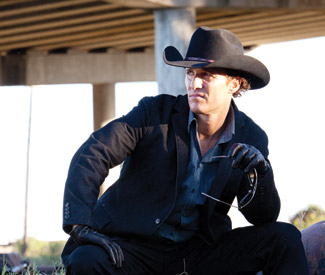
The Smith clan of Texas may pass many things from generation to generation, but brains are not among them. The current dimmest-bulb end product is Chris (Emile Hirsch), a yelping young fool whose solution to his temporary homelessness and a bungled drug deal is murdering the mother who just threw him out to collect her life insurance money. This scheme doesn’t particularly bother his pa, equally slow Ansel (Thomas Haden Church), or the latter’s somewhat sharper albeit slutty second wife Sharla (Gina Gershon). But none are capable or courageous enough to pull off such a stunt themselves, so an outside party is enlisted in the form of Joe (Matthew McConaughey), a corrupt police detective slash hit man for hire.

“Killer” Joe enters the Smith family mobile home like he owns it, cutting through their fumbling promises and excuses with bored, bullying impatience. When it becomes clear these yokels can’t possibly come up with his required $25,000 deposit, he announces he’ll accept as retainer the temporary possession of Dottie (Juno Temple) — Chris’ younger sister, an untouched innocent so wide-eyed she almost seems mentally deficient — with aforementioned to be forfeited entirely should they fail to come through.

Needless to say, almost nothing goes as planned, escalating mayhem to new heights of trailer-trash Grand Guignol. Things get fugly to the point where Killer Joe becomes one of those movies whose various abuses (physical and otherwise) are shocking enough to court charges of gratuitous violence and misogyny. Unlike the 2010 Killer Inside Me, for instance, it can’t really be justified as a commentary upon those very entertainment staples; Letts is highly skilled, but those looking for a message here will have to think one up for themselves.

Still, Friedkin and his cast do such good work that Killer Joe‘s grimly humorous satisfaction in its worst possible scenarios seems quite enough. He’s never been a moralizing director; The French Connection, The Exorcist, and Sorcerer remain great in part because they stare into spectacular voids with clinical, nonjudgmental fascination.

This latest is a more artificially contrived piece, but it still hits Friedkin’s sweet spot, with his actors more than rising to the occasion. In particular, McConaughey brings a snake’s cold-blooded sinuousness to the role of the most lethal weapon here. Coming on the heels of Bernie and Magic Mike, two movies in which he made deft fun of his own narcissism, this turn makes it a very good year for him — although Killer Joe is sure to be a little too much for awards notice, just as it is for MPAA tolerance. 


KILLER JOE opens Fri/3 in Bay Area theaters.

Compromise measures

3

news@sfbg.com

San Franciscans are poised to vote this November on two important, complicated, and interdependent ballot measures — one a sweeping overhaul of the city’s business tax, the other creating an Affordable Housing Trust Fund that relies on the first measure’s steep increase in business license fees — that were the products of intense backroom negotiations over the last six months.

Mayor Ed Lee and his business community allies sought a revenue-neutral business tax reform measure that might have had to compete against an alternative proposal developed by Sup. John Avalos and his labor and progressive allies, who sought around $40 million in new revenue, although both sides wanted to avoid that fight and find a compromise measure.

Meanwhile, Mayor Lee was having trouble securing business community support for the housing trust fund that he pledged to create during his inaugural address in City Hall in January. So he modified his business tax proposal to bring in $13 million that would be dedicated to the Affordable Housing Trust Fund, but that didn’t satisfy the Avalos camp, who insisted the city needed more general revenue to offset cuts to city services and help with the city’s structural budget deficit.

Less than a day before the competing business reform measures came before the Board of Supervisors on July 24, a compromise was finally struck that would bring $28.5 million a year, with $13 million of that set aside for the affordable housing fund, tying the fate of the two measures together and creating a kumbaya moment at City Hall that was reminiscent of last year’s successful pension reform deal between labor and the business community.

But there was one voice raised at that July 24 meeting, that of Sup. David Campos, who asked questions and expressed concerns over whether this deal will adequately address the “crisis” faced by the working class in a city that will continue to gentrify even if both of these measures pass. Affordable housing construction still won’t meet the long-term needs outlined in the city’s Housing Element that indicates 60 percent of housing construction would need public subsidies to be affordable to current city residents.

It’s also worth asking why a business tax reform measure that doubles the tax base — just 8.4 percent of businesses in San Francisco now pay the payroll tax, whereas 16.4 percent would pay the gross receipts tax that replaces it — doesn’t increase its current funding level of $410 million (the $28.5 million comes from increased business license fees). Some industries — most notably the technology and restaurant industries that have strongly supported Mayor Lee’s political ambitions — could receive substantial tax cuts.

Politics is about compromise, and Avalos tells us that in the current political climate, these measures are the best that we can hope for and worthy of progressive support. And that may be true, but it also indicates that San Francisco will continue to be more welcoming to businesses than the working class residents struggling to remain here.


SOARING HOUSING COSTS

As Mayor Lee acknowledged during his inaugural speech, the boom times in the technology industry has also been driving up commercial and residential rents, he sought to create “housing for the 100 percent.”

The median rent in San Francisco has been steadily rising, jumping again in June an astounding 12.9 percent over June of last year, according to real estate monitor RealFacts, leaving renters shelling out on average an extra $350 a month to landlords.

Driven by a booming tech industry and a lag in new housing, the average San Francisco apartment now rents for $2,734. That’s an annual increase of $4,000 per unit over last year, in a city that saw the highest jumps in rent nationally in the first quarter of 2012. Even prices for the average studio apartment have edged up to $1,800 a month.

The affordability gap between housing and wages in the city is stark. Somebody spending a quarter of their income on rent would need to be making $85,000 a year just to keep up with the average studio. With a mean wage of $64,820 in the San Francisco metro area, even middle class San Franciscans have a difficult time affording a modest apartment. For the city’s lowest paid workers, even earning the country’s highest minimum wage of $10.25 an hour, even devoting every earned dollar to rent still wouldn’t pay for the average small studio apartment.

For those looking to buy a home in the city, it can be a huge hurdle to put aside a down payment while keeping up with the city’s high rents. Almost 90 percent of San Franciscans cannot afford a market rate home in the city. The average San Francisco home price was up 1.9 percent in June over May, climbing to $713,500, or a leap of $50,000 per unit over last year’s prices.

In the 2010 census, before the recent boom in the local real estate market, San Francisco already ranked third in the nation for worst ratio between income and home ownership prices, behind Honolulu and Santa Cruz.

But as the city leadership grapples to mitigate the tech boom’s effects, the lingering recession and conservative opposition to new taxes have gutted state and federal funds for affordable housing. Capped off last December by the California Legislature’s decision to dissolve the State Redevelopment Agency, a major source of money for creating affordable housing, San Francisco has seen a drop of $56 million in annual affordable housing funds since 2007.

Trying to address dwindling funding for affordable housing, the Board of Supervisors voted 8-2 on July 24 to place the Affordable Housing Trust Fund measure on the fall ballot. Only the most conservative supervisors, Sups. Sean Elsbernd and Carmen Chu, opposed the proposal. Sup. Mark Farrell, who has signaled his support for the measure, was absent.

“Creating a permanent source of revenue to fund the production of housing in San Francisco will ensure that San Francisco is a viable place to live and work for everyone, at every level of the economic spectrum. I applaud the Board of Supervisors,” Mayor Lee said in response.

At the heart of the program, the city hopes to create 9,000 new units of affordable housing over 30 years. The measure would set aside money to help stabilize the ongoing foreclosure crisis and replenish the funds of a down payment assistance program for those earning 80 to 120 percent of the median income.

To do so, the city anticipates spending $1.2 billion over the 30-year lifespan of the program, with a $20 million annual contribution the first year increasing $2.5 million annually in subsequent years. It would fold some existing funding in with new revenue sources, including $13 million yearly from the business tax reform measure. Language in the housing fund measure would allow Mayor Lee to veto it is the business tax reform measure fails.

The board was forced to delay consideration of the business tax measure until July 31 because of changes in the freshly merged measures. That meeting was after Guardian press time, although with nine co-sponsors on the board, its passage seemed assured even before the Budget and Legislative Analysts Office had not yet assessed its impacts, as Campos requested on July 24.

“I do believe that we have to ask certain questions when a proposal of this magnitude comes forward,” Campos said at the hearing, later adding, “When you have a proposal of this magnitude, you’re not going to be able to adjust it for some time, so you want it to be right.”

The report that Campos requested, which came out in the late afternoon before the next day’s hearing, agreed that it would stabilize business tax revenue, but it raised concerns that some small businesses exempt from the payroll tax would pay more under the proposal and that it would create big winners and losers compared to the current system.

For example, it calculated that between the gross receipts tax and business license fee, a sample full service restaurant would pay 69 percent less taxes and a supermarket 33 percent less taxes, while a commercial real estate leasing firm would pay 46.7 percent more tax and a large engineering firm would see its business tax bills more than double.

Board President David Chiu, who has co-sponsored the business tax reform measure with Mayor Lee since its inception, agreed that it is a “once in a decade reform,” calling it a “compromise that reflects the best sense of that word.” And that view, that this is the best compromise city residents can expect, seems to be shared by leaders of various stripes.


BACKING THE COMPROMISE

The business community and fiscally conservative politicians have long called for the replacement of the city payroll tax — which they deride as a “job killer” because it uses labor costs to gauge the size of company’s size and ability to pay taxes — with a gross receipts tax that uses a different gauge. But the devil has been in the details.

Chiu praised the “dozens and dozens and dozens of companies that have worked with us to fine-tune this measure,” and press reports indicate that representatives of major corporations and economic sectors have all spent hours in the closed door meetings shaping the complicated formulas for how they will be taxed, which vary by industry.

When the Guardian made a Sunshine Ordinance request to the Mayor’s Office for a list of all the business representatives that have been involved in the meetings, its spokespersons said no such list exists. They have also asked for a time extension in our request to review all documents associated with the deliberations, delaying the review until next week at the earliest, after the board approves the measure.

But the business community seems to be on board, even though some economic sectors — including real estate firms and big construction companies — are expected to face tax hikes.

“The general reaction has been neutral to favorable, and I expect we’ll be supportive,” Jim Lazarus, the vice president of public policy for the San Francisco Chamber of Commerce, who participated in crafting the proposal but who said the Chamber won’t have an official position until it votes later this week.

Lazarus noted the precipitous rise in annual business license fees — the top rate for the largest companies would go from just $500 now to $35,000 under the proposal, going up even more in the future as the Consumer Price Index rises — “but some of it will be offset by a drop in the payroll tax,” Lazarus said.

He also admitted that the new tax system will be “hugely complicated” compared to the payroll tax, with complex formulas that differ by sector and where economic transactions take place. But he said the Chamber has long supported the switch and he was happy to see a compromise.

“I’m assuming it will pass. I don’t believe there will be any major organized opposition to the measure,” Lazarus said.

Labor and progressive leaders also say the measure — which exempts small businesses with less than $1 million in revenue and has a steeply progressive business license fee scale — is a good proposal worth supporting, even if they didn’t get everything they wanted.

“We fared pretty well, the royal ‘we,’ with the mayor starting off from the position that he wanted a revenue-neutral proposition,” Chris Daly, who unsuccessfully championed affordable housing ballot measures as a supervisor before leaving office and becoming the political director for SEIU Local 1021, the largest union of city employees.

Both sides say they gave considerable ground to reach the compromise.

“Did we envision $28.5 million in new revenue? No,” said Lazarus, who had insisted from the beginning that the tax measure be revenue-neutral. “But we also didn’t envision the Affordable Housing Trust Fund.”

Daly and Avalos also said the measures need to be considered in the context of current political and economic realities.

“We were never going to be able to pass — or even to craft — a measure to meet all of the unmet needs in San Francisco,” Daly said. “Given the current political climate, we did very well.”

“If we had a different mayor who was more interested in serving directly the working class of the city, rather than supporting a business class that he hopes will serve all the people, the result might have been different,” Avalos said. “But what’s significant is we have a tax measure that really is progressive.”

Given that “we have an economic system that is based on profits and not human needs,” Avalos said, “This is a good step, better that we’ve had in decades.”


THE HOUSING CRISIS

The tax and housing measures certainly do address progressive priorities — bringing in more revenue and helping create affordable housing — even if some progressives express concerns that conditions in San Francisco could get worse for their vulnerable, working class constituents.

“I don’t know if the proposal before us is aggressive enough in terms of dealing with a crisis,” Campos told his colleagues on July 24 as they discussed the housing measure, later adding, “As good as this is, we are truly facing a crisis and a crisis requires a level of response that I unfortunately don’t think we are providing at this point.”

Not wanting to let “the perfect be the enemy of the good,” Campos said he still wanted to be able to support both measures, urging the board to have a more detailed discussion of their impacts.

“I wish this went further and created even more funding for critically needed affordable housing,” Sup. Eric Mar said before joining Campos in voting for the proposal anyway. “I think they need to build 60 percent of those units as below market rate otherwise we face more working families leaving the city, and the city becoming less diverse.”

Yet affordable housing advocates are desperate for something to replace the $56 million annual loss in affordable housing the city has faced in recent years, creating an immediate need for action and potentially allowing Lee to drive a wedge between the affordable housing advocates and labor if the latter held out for a better deal.

Many have heralded the mayor’s process in bringing together developers, housing advocates, and civic leaders to build a broad political consensus for the measure, particularly given the three affordable housing measures crafted by progressives over the last 10 years were all defeated by voters.

“One of the goals of any measure like this is for it to gain broad enough support to actually pass,” Sup. Scott Wiener said at a Rules Committee hearing on the measure.

In the measure’s grand bargain, developers receive a reduction in the percentage of on-site affordable housing units they are required to build, from 15 percent of units to 12 percent. The city will also buy some new housing units in large projects, paying market rate and then holding them as affordable housing — the buying power of which could be a boon to developers while creating affordable housing units.

At its root, the measure shifts some of the burden of funding affordable housing from developers to a broader tax base and locks in that agreement for 30 years, which could also spur market rate housing development in the process.

A late addition to the proposal by Farrell would create funding to help emergency workers with household earnings up to 150 percent of average median income buy homes in the city, citing a need to have these workers close at hand in the event of an earthquake or other emergency.

While some progressives have grumbled about the givebacks to developers and the high percentage of money going to homebuyer assistance in a city where almost two-thirds of residents rent, affordable housing advocates are pleased with the proposal.

“Did we gain out of this local package? Yes, we got 30 years of local funding. We came out net ahead in an environment where cities are crashing. We essentially caught ourselves way early from the end of redevelopment funds,” said Peter Cohen, executive director of the San Francisco Council of Community Housing Organizations.

Without it, Cohen says many affordable housing projects in the existing pipeline would be lost. “This last year was a bumpy year, and we will not be back to the same operation level for a number of years,” Cohen said. “There was a dip and we are coming out of that dip. It will take us a while to get back up to speed.”

The progressive side was also able to eliminate some of the more controversial items in the original proposal, including provisions that would expand the number of annual condo conversions allowed by the city and encourage rental properties to be converted into tenancies-in-common.

With ballot measures notoriously hard to amend, the Affordable Housing Trust Fund measure is a broad outline with many of the details of how the fund would be administered yet to be filled in. If passed, it will be up to Olson Lee, head of the Mayors Office on Housing and former local head of the demised redevelopment agency, to fill in the details, folding what was essential two partnered affordable housing agencies into a single local unit.

But even the most progressive members of the affordable housing community said there was no other alternative to addressing affordable housing in the wings — which is indeed a crisis now that redevelopment funds are gone — making this measure essential.

As Sara Shortt of the Housing Rights Committee of San Francisco told the Rules Committee, “We lost a very important funding mechanism. We have to replace it. We have no choice.”


Corporations, people, money, and speech

4

tredmond@sfbg.com

On July 24, the San Francisco Board of Supervisors weighed in on a policy debate that’s become a powerful cause on the American left. By a unanimous vote, the supervisors placed on the November ballot a measure calling for a Constitutional amendment to end corporate personhood.

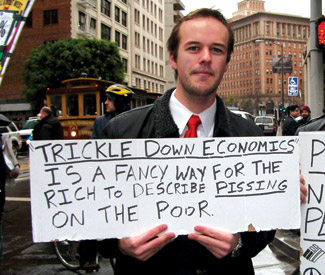
“We’re living in a time of trickle down economics and tax breaks for the rich,” Avalos said, later adding, “Big corporations [are] able to spend vast amounts of money” and have “the greatest influence on the outcome of elections.

“We need to look at our Constitution and have it amended so we aren’t looking at corporations as living, breathing people,” Avalos said.

That’s an immensely popular sentiment in this country, and it’s been stirred up by the US Supreme Court’s 2010 decision in Citizens United v. Federal Election Commission, a ruling that has come to represent all of the evils of big-money politics rolled into one two-word phrase.

More than 80 percent of Americans say they want the decision overturned. Six states, including California, have passed resolutions calling for a Constitutional amendment. Occupy protesters have made it a big issue. Marge Baker, policy vice president for People for the American Way, wrote a Huffington Post piece calling the campaign “A Movement Moment.”

But while Citizens United is a great rallying point, the challenge here goes way beyond one court decision. Citizens United didn’t create corporate personhood. Repealing the decision won’t end the flow of money in politics — and a lot of First Amendment experts are exceptionally nervous about anything that seeks to mess with this central part of the Bill of Rights.

And for all the denunciation of Citizens United, the solution — drafting the actual language of a new Constitutional amendment — turns out to be more than a little tricky.

MICHAEL MOORE AND HILARY CLINTON

Citizens United v. FEC has a complicated history. In 2002, Congress passed the McCain-Feingold Act, which barred corporations and unions from funding “electioneering” activities in the period right before an election.

The right-wing group Citizens United complained that Michael Moore’s documentary Fahrenheit 911 was an attack on George W. Bush and intended to influence the 2004 election, and the courts dismissed that complaint, saying that there was no evidence the independent documentary was an illegal campaign contribution.

Citizens United then started making its own “documentaries,” including one in 2008 that many saw as a campaign commercial against Hillary Clinton. The FEC found that the video was, in fact, “electioneering,” and the case wound up at the Supreme Court.

The legal decision was complicated, but among other things, the court ruled that a ban on independent corporate spending on election campaigns was a violation of the First Amendment rights of those business entities.

That was amplified when Republican presidential candidate Mitt Romney uttered his famous line, “corporations are people.”

But in reality, Citizens United alone hasn’t caused the tsunami of big money that’s poured into elections, including the 2012 campaigns. Much of the cash contaminating the presidential coffers this year comes not from corporations effected by the ruling but from individuals and private trusts that have been free to throw money around for decades.

“The flood of money is disgusting and corrupting,” Peter Scheer, director of the California First Amendment Coalition, told us. “But it isn’t coming from public corporations. It’s mostly wealthy people and private trusts, and they didn’t need Citizens United to do this.”

In fact, the groundwork for modern sleaze was set a long time ago, in 1976, when the Supreme Court ruled in Buckley v. Valeo that, in effect, money was speech — and that any rich individual could spend all he or she wanted running for office.

What the Supreme Court has done, though, is set the modern political tone for campaign finance — among other things, invalidating a Montana law that barred corporate contributions to campaigns. And in the majority ruling and the assenting opinions, the court made clear that it doesn’t think government has any role in leveling the campaign playing field — that it’s not the business of government to decide that the money and speech of rich people and big business is drowning out the opinions and speech of the rest of the populace.

SO NOW WHAT?

So now that every decent-thinking human being in the United States agrees that there’s too much sleazy money in politics and that it’s not a good thing for government to be for sale to the highest bidder, the really interesting — and difficult — question comes up: What do we do about it?

There are a lot of competing answers to that question. And frankly, none of them are perfect.

That may be one reason why the ACLU is mostly on the sidelines. When I contacted the national office to ask if anyone wanted to talk about the efforts to overturn Citizens United, spokesperson Molly Kaplan sent me an email saying “we actually don’t have anyone available for this.”

But on its website, the organization — in a nuanced statement on campaign reform — notes: “Any rule that requires the government to determine what political speech is legitimate and how much political speech is appropriate is difficult to reconcile with the First Amendment.”

In an ACLU blog post, Laura Murphy, director of the group’s Legislative Office in Washington DC, argues that “a Constitutional amendment—specifically an amendment limiting the right to political speech—would fundamentally ‘break’ the Constitution and endanger civil rights and civil liberties for generations.”

But David Cobb, one of the organizers of Move To Amend, which is pushing a Constitutional amendment, told me that “the idea that spending money is sacred is part of the problem, the reason that we don’t have a functioning democracy.”

There are two central parts to the problem: The notion that corporations have the same rights to free speech as people, and the notion that money is speech. Eliminate the first — which is immensely popular — and you still allow the Meg Whitmans and Koch brothers of the world to pour their personal fortunes into seeking political office or promoting other candidates.

Eliminate the second and you open a huge can of worms.

“It would be a disaster, in my view,” Scheer said. “As a general principle, I’m frightened by the concept of tampering with the Constitution.”

Money may not equal free speech, but it’s hard to exercise the right to free speech in a political campaign without money. And there are broader impacts that might be hard to predict.

But Peter Schurman, one of the founders of MoveOn.org and a leader in Free Speech for the People, told me that “it’s a false premise that money equals speech. The point is to get a level playing field.”

THE PROPOSALS

Move to Amend and Free Speech for People are promoting similar approaches, Constitutional amendments that, in fairly simple terms, would radically and forever alter American politics. Several members of Congress have offered Constitutional amendments that include similar language.

The Move to Amend proposal is the broadest and cleanest. It states: “The rights protected by the Constitution of the United States are the rights of natural persons only. Artificial entities, such as corporations, limited liability companies, and other entities, established by the laws of any State, the United States, or any foreign state shall have no rights under this Constitution and are subject to regulation by the People, through Federal, State, or local law.”

It goes on to say: “Federal, State and local government shall regulate, limit, or prohibit contributions and expenditures, including a candidate’s own contributions and expenditures, for the purpose of influencing in any way the election of any candidate for public office or any ballot measure.”

It also includes this statement: “Nothing contained in this amendment shall be construed to abridge the freedom of the press.”

Free Speech for the People is simpler. It only addresses the corporate speech issue: “People, person, or persons as used in this Constitution does not include corporations, limited liability companies or other corporate entities established by the laws of any state, the United States, or any foreign state, and such corporate entities are subject to such regulations as the people, through their elected state and federal representatives, deem reasonable and are otherwise consistent with the powers of Congress and the States under this Constitution.”

Cobb notes that the Move to Amend measure doesn’t say how political speech should be regulated; it just opens the door to that kind of lawmaking. “The question of how to protect the integrity of the electoral process is a political question, not a Constitutional question,” he said. In the end, there’s a huge issue here. The framers of the Constitution, their political consciousness forged in a battle against big and repressive government, feared as much as anything the notion of rulers controlling the rights of the people to speak, write, assemble, publish (oh, and carry firearms) freely. Corporate interests (with the possible exception of the British East India Company, which monopolized the tea trade) weren’t a major concern.

And First Amendment purists still recoil at the idea that government, at any level, could make decisions limiting or regulating political speech. I sympathize. It’s scary. But in 2012, it’s easy to argue that the power of big money and big business has far eclipsed the power of government, that for all practical purposes, the rich and their corporate creations are the government of the United States — and that the people, assembled and exercising the power envisioned under the Constitution, need to make rules to, yes, level the playing field. Not rashly, not in crazy ways, with full cognizance of the risks — but also with the recognition that the current situation is fundamentally unacceptable, and that the potential dangers of messing with the First Amendment have to be balanced with the very real dangers of doing nothing.

The comeback king

0

arts@sfbg.com

FILM As told in Searching for Sugar Man, the tale of the lost, and increasingly found, artist known as Rodriguez seems to have it all: the mystery and drama of myth, beginning with the singer-songwriter’s stunning 1970 debut, Cold Fact, a neglected folk rock-psychedelic masterwork. (The record never sold in the states, but somehow became a beloved, canonical LP in the closed Petri dish of repression and imminent revolution of South Africa.) The story goes on to parse the cold, hard facts of vanished hopes and unpaid royalties, all too familiar in pop tragedies.

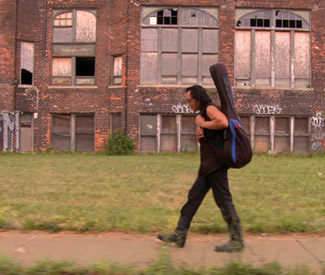
Yet loping into the Sir Francis Drake Hotel in a black suit and teal troubadour’s shirt, guitar slung around his shoulder, the long-haired man in sunglasses known as Sixto Rodriguez by friends and family in his native Detroit seems far from bitter, decades after his hard-to-classify music failed to make an impact on charts then dominated by BJ Thomas and Simon and Garfunkel.

“People who make me mad don’t inspire me — it’s issues. Hate is too strong a passion to waste on someone you don’t like, if you know what I mean,” he mutters, half easygoing ramble and half shy-guy mumble. In the decades since Cold Fact, Rodriguez has channeled the streetwise poetry of his lyrics into a politically active life, attending demonstrations and running for Detroit city council and even mayor at one point, though he’s never won an office.

“Social issues are more interesting to me. I’m about peace and prosperity and the pursuit of happiness — and how about justice?”

His is a curious, complicated conversational mixture of hipster-philosopher whimsy, stream-of-consciousness bohemian spiel, and numbers as hard as cash. The latter inspires the 70-year-old to start to breaking down his appeal in terms of seats sold (5,000 here; 10,000 there), celebrities in the audience (Alec Baldwin was at one recent show), and the money to be had in licensing (the Rolling Stones can charge $100,000 for a song!) — as if he needs to justify his presence with raw data.

Nonetheless, it’s an understandable response. Searching for Sugar Man lays out the ballad of Rodriguez as a rock’n’roll detective story, with two South African music lovers in hot pursuit of the elusive musician — long-rumored to have died onstage by either self-immolation or gunshot, and whose music spoke to a generation of white activists struggling to overturn apartheid.

Opening with the soulful strains of Rodriguez’s unforgettable “Sugar Man” and images of a sunlit drive along the South African coast, the film makes its way to the snowy urban wasteland of the Motor City. Filmmaker Malik Bendjelloul orients himself around the efforts of Stephen “Sugar” Segerman, who wrote the South African CD liner notes for Rodriguez’s second full-length, Coming From Reality (both of Rodriguez’s Sussex albums have since been reissued by Light in the Attic, which is releasing the doc’s soundtrack with Sony Legacy), and music journalist Craig Bartholomew-Strydom, who wrote the story of the search that eventually led Rodriguez’s eldest daughter, Eva, to make contact with Segerman and ultimately Rodriguez’s wildly disconnected fans.

Swedish documentarian Bendjelloul first got wind of Rodriguez’s tale in 2006, from Segerman. “I saw this was an amazing story, but after I heard the album, I thought, what amazing music — it needs an amazing director,” says the filmmaker, sitting across a conference table from Rodriguez. “I didn’t think it would be me. I was nervous that I would screw it up.”

His devotion to the project — which led him to quit his job, pour his savings into the movie, draw his own animation sequences, and resort to filming Super-8-like footage on his iPhone — took him on his own four-year journey.

Rodriguez came to the project in 2008, memorably materializing out of the shadows in Searching for Sugar Man in the window of the house he’s lived in for the last 40 years (and purchased for $100, he swears). He made a living doing demo on construction projects. “I’m from a working class background and that’s what I do,” the musician declares proudly. “I always like to say, ‘Never throw away your work clothes!’ I think it’s good for people to stay active: you can kick a lot more ass if you stay physically fit.”

Of his story’s fairy-tale trajectory, Rodriguez says, “I didn’t believe I was anything in South Africa. In this music business, everybody’s the greatest and latest. Everyone’s a sweetheart. But underneath that, there’s a lot of realism in music. People aren’t as successful as they appear to be. They talk about the wonderful Motown thing, but if you list all the tragedies they had, it wouldn’t be such a pretty picture.”

Still, even one as familiar with the cold facts as Rodriguez can’t deny the power of a great song — and one that he wrote. “This current issue of Esquire magazine has a song of the month: it’s ‘I Wonder,’ a 20-year-old song. The longevity of music amazes me,” he offers laconically, the barest hint of pleasure creeping into his voice. “It can last.” *

SEARCHING FOR SUGAR MAN opens Fri/3 in San Francisco.

RODRIGUEZ

Sept. 29, 9pm, $20

Bimbo’s 365 Club

1025 Columbus, SF

www.bimbos.com

Protest song

0

arts@sfbg.com

MUSIC Woody Guthrie would have turned 100 this summer, and numerous centennial celebrations mean that hundreds of people probably have “This Land is Your Land” stuck in their heads at this exact moment. But Guthrie was as much a political icon as he was a catchy folk singer. His “Union Maid” was the anthem of countless labor struggles, and he wrote a regular column for a communist newspaper. “This Land is Your Land” itself was penned in response to the complacent patriotism of “God Bless America.”

Political movements, of course, have always had soundtracks. Before Guthrie was singing the working man’s songs, the Wobblies were writing their own. Slaves sung — or whispered — about freedom as they traveled the Underground Railroad, and civil rights activists bellowed “We Shall Overcome” on marches and in jail. And for several years, the folk music scene was synonymous with the anti-Vietnam War movement.

While there is no one quite like Bob Dylan on the radio right now, or hoards of activists (that we know of) crooning from jail cells, plenty of local musicians are keeping up the tradition of writing and performing protest songs. If you ask any of them whether they’re primarily musicians or primarily activists, they’ll answer that the two identities are inseparable — and that 100 years after Woodrow Guthrie was born in Okemah, Oklahoma, the intersection of art and politics is still a completely natural one.

For Bonnie Lockhart, a member of the East Bay group Occupella, music inspired her to become a lifelong activist, and politics later supported her career as a musician. Growing up in conservative Orange County, she listened to civil rights songs on the radio. “I remember being so moved by the music. I had no context in which to understand what was going on in the South but because that music moved me, I pursued it and found out,” she explained. “It drew me into understanding that something was terribly wrong in our country and that people were doing something incredibly exciting about it.” Later, her involvement in the Women’s Movement gave her courage to pursue a musical career.

Activists have long recognized the power of song to raise morale and create cohesion. “Music is a powerful force for unity,” said Arthur Holden of the Musicians Action Group (MAG).

The amorphous MAG emerged from the more organized Bay Area Progressive Musicians Association, and now consists of a small group of veteran activists and anyone else wants to join them at demonstrations. Initially, music was a crucial political tool. “The police were not happy having picket lines blocking things and nobody knew what to do with a bunch of people with instruments,” said MAG clarinetist Gene Turitz. “When we saw the police coming we would get between the strikers and the police. It would at least stymy them.”

Now, one of the group’s primary goals is to preserve the sounds of historical struggles. MAG is one of the rare groups that continues to perform the Communist anthem “The Internationale.”

“Whenever we do it at a demonstration, someone comes over to us with tears running down their cheeks [in recognition],” Turitz said. The classic pieces have equal importance for those hearing them for the first time, Turitz said, recalling playing “Bread and Roses,” a tune about the Triangle Shirtwaist Factory strike, at a march on Cesar Chavez Day. “A guy in a Latino union group comes over and says, ‘That’s the most beautiful song, what’s it about?’ When I tell him, he gets thrilled. It’s that kind of thing we’re trying to preserve.”

Today, the concept of political musicians achieving commercial success might sound oxymoronic, and groups like Peter, Paul and Mary might seem a thing of the progressive past. “When I was coming up in the ’70s, you could record for real companies,” said Lockhart. “It was still capitalism but it wasn’t this voracious. The record labels weren’t into being monopolies, they were into having a niche.”

Others pointed to a more fragmented, diffused political scene to explain the lack of politics on the radio. But many believe that music is just as integral in contemporary struggles as it was in the past, even if the audience it reaches is smaller and the format is more innovative.

“I think our younger generation is just as engaged in art for social change,” said Talia Cooper, a 26-year-old Oaklander who performs original political songs at rallies. Some current Bay Area groups, such as the Brass Liberation Orchestra, consist mostly of younger musicians.

Cooper, who records under the name Entirely Talia, remembered going to long Occupy lectures at the beginning of the movement and watching the crowd become re-energized when she lead them in song.

“People go to demonstrations and passively listen to speakers. There’s just so much listening people can do,” said Occupella’s Hali Hammer. “When they’re singing, they’re directly involved.”

“I used to think it was cheesy for people to say that revolutions need art,” Cooper said. “But if you think about what gets people to show up, it’s the beautiful posters, or the flashmob with the dancers, or the singing.”

Occupella meets Mondays from 5-6pm at the weekly “Tax the Rich” demo on Solano Avenue at Fresno Avenue, Berkeley.

Halcyon days

0

emilysavage@sfbg.com

MUSIC Half a decade after their last album release, Two Gallants are back. As you might recall, the folk-punk duo made up of childhood pals guitarist-vocalist Adam Haworth Stephens and drummer-vocalist Tyson Vogel was already something of a legend in San Francisco — known for playing both BART stations and arenas — when it took an unexpectedly lengthy break. There were three years between them playing together, five years between records (their last being 2007’s self-titled LP on Saddle Creek).

That time apart proved both dramatic and fertile, with new side projects and solo records, personal struggles and rebirth. “Refreshing” is the word Stephens uses most frequently as he readies for a plane flight to Germany in the morning to play a few European festivals with his old friend.

After they return to SF from Deutschland, they’ll have a moment to relax in their hometown, and then will head back out on the road for their first official tour in years, hitting both Outside Lands and an Outside Lands night show at the Rickshaw Stop along the way, followed by, presumably, world reintroduction.

Before the hiatus, the duo was on a never-ending roller coaster of van-venue-van, five years of “incessant, grueling” touring, as Stephens describes it. “So I think we just needed a break, some time from each other and from the whole repetitive cycle of it — refreshing.”

Last year, they were back in the recording studio, spending two weeks at Fantasy Studios in Berkeley, then another week at Tiny Telephone. The new album was created with the help of John Congleton, a musician and producer-engineer wizard who NPR last year declared “Indie Rock’s Unsung Hero Of 2011,” thanks in part to his work on records with St. Vincent, Wye Oak, the Mountain Goats, and others.

Towards the end of last year, in late November, Congleton began work on yet another record — Two Gallants’ The Bloom and the Blight, due for release Sept. 4 on ATO Records.

“Making a record can be pretty trying at times, there’s a lot of dark moments when you’ve been working on something too much and you get caught up in it, you go in this wormhole of indecisiveness but he had a refreshing view on making records,” Stephens says lightly. “He brought out a little more levity, and a little more fun, which I think made the record much more enjoyable than anything we’ve done before.”

You can hear his touch on The Bloom and Blight. While it’s more aggressive, grungier than past Two Gallants output, it’s also more lively, despite the heavy subject matter at hand.

The record begins with a slow-burning, bluesy guitar-led ballad “Halcyon Days,” which bursts open cathartically with Vogel’s thumping bass drum and Stephens’ scratchy howl. The first single, “My Love Won’t Wait,” begins with a similarly exciting build-up — both voices, a capella, harmonizing “You can try/but ain’t no use/I’ll lose it if you cut me loose.” It builds to a crackling garage anthem.

“Our songs have always been pretty dark, but I think these have more of a light-hearted nature to them,” says Stephens. “I think we’ve gotten to the point where we still take the craft very seriously and music very seriously, but we don’t take ourselves quite as seriously.”

The band lifted the veil of the dark, brooding romanticism of the art, but were still able to convey their pain, just without that adolescent pretension. It’s an expected cycle from a long-running band, or really, any long-term relationship. People change, grow, fail to jump back on those horses, or learn to do it their way. In the album closer — folky acoustic ballad “Sunday Souvenirs” — Stephens pines “Memories of what I gave away/lost love/all the love that’s lost along the way/slow down/let me hold you once before you fade.”

“I think we’ve grown up a lot,” he says during our phone call. “[The songs on The Bloom and the Blight] have more perspective of experience and maturity and coming from the perspective of someone that sees the beauty and tragedy in things but doesn’t get as caught up in it.”

Certainly they’ve seen their fair share of beauty and tragedy in the past few years. Relationships have bloomed and crumbled, personal projects have achieved widespread if lesser acclaim. In likely the most tragic events in recent memory, in 2011 Stephens was involved in two separate accidents, a horrific van crash out on tour in Wyoming and a collision on his bike with a car while riding to his practice space in the Mission.

But he’s moved forward. He’ll get back on that touring horse, and is happy to soon be back in the van with his childhood pal, Vogel.

“I am actually really looking forward to going on tour again; We’re both really looking forward to playing new songs, and seeing people’s reactions,” he says, adding, “It’s not like we’re expecting everyone to fall in love with it, but at least people know what they’re getting into. We’re playing all the new songs — so the set’s pretty foreign to anyone besides us.”

TWO GALLANTS: OUTSIDE LANDS NIGHT SHOW

Aug. 8, 7:30pm, $20

Rickshaw Stop

155 Fell, SF (415) 861-2011

www.rickshawstop.com

TWO GALLANTS: OUTSIDE LANDS

Aug. 10, 1:50pm, $95 (one-day pass)

Outside Lands

Golden Gate Park, SF

www.sfoutsidelands.com

Love to Lovecraft

1

TRASH The movies had barely begun when adaptations of Edgar Allan Poe stories began appearing onscreen. However, that author’s closest inheritor, H.P. Lovecraft, sparked no interest from the medium until a good quarter century after he died in 1937 at age 46, a death as premature following a life by all accounts as miserable as his predecessor’s. Were his macabre tales too lowbrow (having been published in pulp-fiction magazines like Weird Tales) or just too grisly for film treatment until literary respectability and audience tolerance for graphic horror caught up with them?

That initial neglect has been more than made up for, especially in very recent years: according to one source there have been over 70 Lovecraft derived features and shorts since 2000 alone. Most of these have been very free with their source material; many are pretty bad in the usual way of cheap horror knockoffs. But Lovecraft’s bizarre ideas survive updating fairly well (if not his racism, which the movies seldom touch), and there have been interesting spins like the gay-angled Cthulhu (2007), U.S. indie Pickman’s Muse (2010), Alien (1979) writer Dan O’Bannon’s Shatterbrain (1992), multinational omnibus Necronomicon: Book of the Dead (1993), or John Carpenter’s relatively big-budget In the Mouth of Madness (1994).

The Roxie hosts a Lovecraft double bill Thu/2, offering up two of what are considered the all-time best adaptations to date. Points for extra faithfulness go to the filmmakers of The Whisperer in Darkness, which plays first (and also screens Fri/3 at the Rafael Film Center). But then you might expect special attention to fidelity from the H.P. Lovecraft Historical Society, which produced it last year. You might not expect that attention to extend as far as not only keeping the original short story’s 1930 origin as its setting, but making the film in the style of a black and white early “talkie.” (The Society’s prior film venture, the sub-feature-length The Call of Cthulhu, was based on a tale written in 1926 — so that 2005 enterprise, which plays alongside Whisperer Fri/3 in Marin, is a silent film.)

Tangentially related to the Cthulhu mythology that defined the author’s last decade of activity, Whisperer in Darkness articulates his favored theme: that mankind and its emphasis on scientific logic are pitifully ill-equipped to fathom the otherworldly forces truly shape our hapless destiny. Professional skeptic and professor of folklore Albert Wilmarth is drawn by a late colleague’s strange notes and a farmer’s desperate letters to rural Vermont, where locals believe “monsters” have been abducting their kin since settler days. Many a strange thing occurs before Wilmarth realizes the truth about a “strange colony” in the nearby hills and the alarming cult-like control it exerts over human followers.

Blackly humorous, slow-moving in the cinematic style of another era (things don’t really pick up until after an hour has passed), detailed in its aping of “Golden Age” Hollywood tropes, Whisperer is pulp sci-fi horror of an amusingly camp stripe. Despite content a tad grislier than any 1930s film would have allowed, it’s not far from the thrilling serials that entertained kids at matinees back then.

Striking a very different tone is Stuart Gordon’s From Beyond (1986), the second Roxie feature. The sleeper success of Gordon’s feature debut Re-Animator the prior year had occasioned this second loose Lovecraft adaptation, which would be far from his last — there would follow Castle Freak (1995), Dagon (2001) and a 2005 Masters of Horror episode. All are good, but Beyond is especially, deliciously berserk.

At the outset research assistant Crawford Tillinghast (Jeffrey Combs) has finally, semi-accidentally made Dr. Pretorius’ “Resonator” machine work — but its stimulation of the pineal gland opens a portal between this world and the next that is addicting and dangerous, with results that see the doc dead and Tillinghast committed to a prison psych ward. The latter is sprung, however, by Dr. McMichaels (Barbara Crampton), who returns him to the scene of the crime (accompanied by Ken Foree’s cynical cop) to find out what really happened. Unfortunately, the Resonator soon appears able to turn itself on, literally and figuratively — experiencing one endless “orgasm of the mind,” pervy Pretorius re-materializes again in grotesque form, as eager to mingle pleasure and pain with his unwilling visitors as Hellraiser‘s (1987) considerably less horn dogging Pinhead.

Luridly lit in shades of hot pink and turquoise, From Beyond doubtless would have shocked Lovecraft himself (who was from all evidence vehemently disinterested in sexual matters) with its MPAA-challenging mix of icky lasciviousness and ickier mutational gore. It’s one of those rare films that starts out near climax and just keeps building toward ever greater plateaus of tasteless glee. *

“WEIRD CINEMA: AN H.P. LOVECRAFT DOUBLE FEATURE”

From Beyond, Thu/2, 7pm; The Whisperer in Darkness, Thu/2, 9:15pm, $6.50-$10

Roxie Theater

3117 16th St, SF

www.roxie.com

“AN EVENING WITH H.P. LOVECRAFT”

The Call of Cthulhu and The Whisperer in Darkness

Fri/3, 7pm, $6.75-$10.25

Christopher B. Smith Rafael Film Center

1118 Fourth St, San Rafael

www.cafilm.org

Perspective and proportion

46

steve@sfbg.com

In the eyes of his critics, suspended Sheriff Ross Mirkarimi may never be able to recover from the portrayal by prosecutors and Mayor Ed Lee that he abused his wife, intimidated her with threats to use his power to take custody of their young son if they divorced, and used her and his campaign manager to try to dissuade witnesses and thwart a police investigation.

The tearful video of his wife, Venezuelan actress Eliana Lopez, displaying the bruise on her arm, and the fact that Mirkarimi pleaded guilty to a misdemeanor false-imprisonment charge in connection with the incident are all these critics need to condemn him. Indeed, it was all that Lee relied on when he suspended Mirkarimi without pay and launched unprecedented official misconduct proceedings to remove him from office.

But now that the Ethics Commission has gotten through the substance of its inquiry — and past the tedious work of creating from scratch systems and standards for gathering evidence and evaluating whether it warrants an elected official’s removal by the mayor — the testimony has told a very different story of what really happened.

Accusations of witness dissuasion (which had been one of three original criminal charges Mirkarimi faced before agreeing to a lesser plea deal) and abusing his official position haven’t been supported by any direct evidence or testimony, and as the hearings wore on, Deputy City Attorneys Peter Keith and Sherri Kaiser were looking increasingly vindictive as they fruitlessly pursued those angles with witnesses who seemed credible.

There is also no direct evidence that the abuse was anything more than a moment of frustration and bad judgment at noontime on Dec. 31, when Mirkarimi grabbed Lopez’s arm as she tried to walk away from their heated argument about divorce child custody, and she yanked it away, eight days before his swearing in as sheriff.

Whether that incident and its aftermath meets the City Charter’s broad and untested definition of official misconduct — including “conduct that falls below the standard of decency, good faith and right action impliedly required of all public officials” — will be up to the interpretation of the Ethics Commission, which has now accepted all the evidence that it has deemed relevant and credible. All that remains is the fight over its “finding of fact” at an Aug. 16 hearing and its subsequent recommendation to the Board of Supervisors, which could begin considering the matter in September.

There won’t be an inquiry into whether Mayor Lee committed perjury on June 29, as outside witnesses said he did on two separate issues. The commission July 19 rejected the argument by Mirkarimi’s attorneys that Lee’s alleged lies under oath would cast doubt over his reasons for launching these unprecedented proceedings and the discretionary judgment he exercised. Commissioners decided that was a tangential issue.

In the final hour of the commission’s laborious work in whittling down the voluminous evidence that the city has presented in this case — which both sides and the commission openly acknowledge will likely be considered by the courts as well as the board — it also made deep cuts into the written testimony of attorney Nancy Lemon, a domestic violence expert who drew damning conclusions about Mirkarimi based on how “batterers” typically behave.

That’s been a big part of the city’s case, reducing Mirkarimi down to a two-dimensional batterer whose every action can be predicted by that distinction, from the manner in which he relinquished his weapons to police to the reasons why Lopez has resisted cooperating with efforts to charge her husband with crimes and remove him from office.

Lemon’s testimony was based almost solely on second-hand descriptions of life in the Mirkarimi household in a 22-page written declaration by neighbor Ivory Madison, who was also the only witness that Lee said he spoke to before removing Mirkarimi from office. But most of Madison’s incredible and fantastical narrative — which painted Mirkarimi as a monster who repeatedly abused Lopez and their son and controlled every aspect of their domestic life, right down to what and whether they ate — had already been discredited and disallowed by skeptical commissioners in June.

“I was disappointed by the content of Ivory Madison’s declaration. A first-year lawyer should know that much of it is inadmissible and it should not have been given to us,” Commissioner Paul Renne told Keith in June. Renne called the declaration “clearly hearsay, clearly having the intention of poisoning the well of this hearing.”

Keith apologized and offered little resistance to much of the declaration’s removal, but the city has nonetheless continued to rely on the second-hand accounts of Madison and another neighbor, Callie Williams, in its descriptions of Mirkarimi’s conduct and the questioning of witnesses.

But that hearsay evidence and speculation was countered on July 18 and 19 with the extended cross examination of two key witnesses in the case: Lopez and Mirkarimi campaign manager Linnette Peralta Haynes, a woman with domestic violence training who Lopez reached out to on that pivotal day of Jan. 4 when Madison called the police. Each woman spent more than three grueling hours each on the stand, questioned by city attorneys and commissioners — and they painted a very different portrait of the events than Lee and Madison had.

As for Madison — having had most of her testimony stricken from the record, and with Lopez testifying about Madison’s sudden zeal for going after Mirkarimi and involving his political opponents in that process — Mirkarimi’s team decided not to call her to the stand for live cross-examination. Attorney Shepherd Kopp told reporters, “I think the neighbor’s testimony is suspect at best.”

The go-between

Haynes was central to the city’s allegation that Mirkarimi dissuaded witnesses and sought to thwart a police investigation. Phone and electronic records revealed that she communicated with both Lopez and Mirkarimi many times on Jan. 4, the day Mirkarimi learned that his wife had been confiding with neighbors about the Dec. 31 incident and that Madison had broken that confidence and called the police.

The city’s apparent theory was that Haynes acted as Mirkarimi’s agent in trying to cover up the incident and do damage control, including coaching Lopez on what to say to Madison and Williams.

But the city has never had any evidence to support its theory, and this was its first chance to question Haynes, who had been at the end of a high-risk pregnancy and resisted cooperating with the investigation.

Yet despite Kaiser and commissioners grilling Haynes for more than three hours — twice as long as she had told the commission that she would need — no smoking gun emerged. Haynes seemed calm and consistent as she described giving Lopez emotional support and probing to ensure that she wasn’t in danger. Kaiser fumbled through technical difficulties and maintained an accusatory and belittling tone even as the answers she was receiving seemed to destroy her line of questioning.

“I think the house of cards that mayor has been trying to establish about witness dissuasion was demolished by Linnette Peralta Haynes, who was absolutely credible,” Mirkarimi attorney Shepherd Kopp told reporters after the hearing.

Haynes has a background in domestic violence, undergoing a 40-hour certification training in the mid-90s when she went to work for a domestic violence center in San Mateo for almost two years, then later helping develop and teach a domestic violence curriculum for the jail in San Francisco.

She’s familiar with the Power and Control Wheel — the basis for many of Lemon’s conclusions — which indicates how physical abuse can be connected to other forms of abuse, such as emotional, verbal, and sexual abuse. It was with this background and training that Haynes questioned Lopez about whether she was in danger and being abused when she got an unexpected call on the morning of Jan. 4.

“She let me know she had an argument with Ross and wanted to talk to me,” Haynes said, later answering another question by saying, “She told me she was really worried about custody issues and she was talking to a friend who was an attorney.”

That friend turned out to be Madison, who Lopez maintains had represented herself as an attorney who would keep their conversation and the video they made of her injuries confidential, to be used only in the event of a custody battle. The city has sought to cast doubt on that claim — which the court rejected in Mirkarimi’s criminal case when it admitted the video as evidence — implying that Madison was simply a concerned friend and the attorney argument was developed weeks later.

Haynes said she asked Lopez whether there had been any prior incidents of physical abuse, whether Lopez felt unsafe, and whether she had been subjected to other forms of abuse — defining each form for Lopez — and that she was told “no” to each question.

“I asked if she thought she was in danger and she said no,” Haynes said.

Later on Jan. 4, Lopez told Haynes she had made the video: “She told me a friend had helped me do a video just in case I needed it for custody issues…She did tell me that she really wanted to work on her marriage, that she wanted to make to make it work, but that just in case she wanted to make sure she got custody of Theo.”

Lopez later testified that one reason she sought out Haynes was because Madison had suddenly become aggressive in trying to convince her that she was a domestic violence victim and the incident needed to be reported to the police, and Lopez wanted to get the perspective of someone with a background in domestic violence.

“I said, I have a person telling me this, I want your opinion about it,” Lopez testified.

Around 12:30pm that day, when Madison informed Lopez that she had called the police and they were on the way, she frantically called Haynes from Madison’s house and suddenly put the two women on the phone together, which Madison and the city have characterized as a witness dissuasion effort.

Haynes said she was confused when Lopez suddenly handed the phone to Madison: “She said, ‘help me, help me, help me,’ and I’m on the phone wondering what’s going on.”

“[Madison] told me, ‘I’ve been talking to Eliana for several days and I just called the police,’” Haynes said.

Haynes said she asked Madison if she had called any domestic violence agencies or if she just called the police “and she got very agitated” — adopting a defensive tone of voice — and that reaction seemed “fishy” to Haynes.

Asked whether she tried to dissuade Madison from talking to the police, she responded, “I told her she should maybe talk to her friend about what she wants.” She said that she could hear Lopez telling Madison, “This is not what I want, this is not what I want.”

So Haynes said she tried to extricate herself from the situation: “I told her I really think you need to get off the phone, talk to Eliana, and respect her.” And the phone conversation ended with Lopez getting back on the line and telling Haynes to call Mirkarimi to let him know what was going on.

But Mirkarimi was busy and not answering his phone, prompting Haynes to text at one point that he needed to answer ‘so I can protect you.” What did she mean by that, Kaiser asked.

“My thinking was that something sounded fishy, something wasn’t right, and they need legal help,” Haynes said.

“Your focus had been on Eliana up until then?” Kaiser asked.

“My focus has always been Eliana,” Haynes responded.

Later, asked about the nature of her repeated phone conversations with Lopez, she denied helping her strategize ways to dealing with witnesses or police. “I was just providing support for her, emotional support,” Haynes said, later adding “I wanted to be present for her.”

The victim

Lopez testified that while the grabbing incident was unacceptable and serious — which she conveyed to Mirkarimi — she didn’t consider herself to be in an abusive environment or in need of outside help, except perhaps the marriage counseling she had been seeking and which Mirkarimi finally agreed to.

“An abusive environment is when those kinds of think happen every day or every week,” she said, maintaining — in the face of repeated questioning — that this was the first and only instance of physical abuse.

“At the end of the day on Dec. 31, I told him, that cannot happen, this is wrong, we need counseling,” she said. “He realized it was wrong and he took it very seriously.”

But she said that Madison went from being a supportive friend and counselor on Jan. 1 to suddenly becoming increasingly insistent that Lopez report the incident to police in the days that followed.

“She started trying to convince me to call the police in that email,” Lopez said, answering a question about a Jan. 2 message from Madison, “but that wasn’t our conversation on Jan. 1.”

Lopez said Madison’s approach got more aggressive. “She said, ‘screw him, I have a lot of friends willing to help you,’” Lopez said, noting that Madison offered her the vacant homes of rich friends and offered to bring in journalist Phil Bronstein, DA George Gascon, Attorney General Kamala Harris, and Lieutenant Governor Gavin Newsom to help her.

“It looked to me suspicious…She was calling Ross’ political enemies,” Lopez said.

When Lopez finally made it clear she didn’t want police involvement, Madison called the police.

“I didn’t expect that my lawyer could call the police on her own. I thought that was my decision,” Lopez said.

Keith tried to tie Lopez’s custody concerns to his status as sheriff, driving at that point with many questions. But Lopez said her concern was that California family courts would favor Mirkarimi simply because he’s an American and she’s from a country that has bad relations with the US.

“In this country, I think he’s in a better position than me,” she said. After he again tried to make it about his official position, she said, “As a sheriff, no; as an American, yes.”

She denied the claim by the city and Madison that it was Mirkarimi who sought to improperly use his position, a key element of removing him for official misconduct. Lopez said her conclusions about Mirkarimi’s advantages in a potential custody battle were the result of conversation that happened much earlier.

“That conversation happened in March 2011. He wasn’t even thinking about running for sheriff at that point,” she said, denying that Mirkarimi ever raised his official position in their custody conversations and claiming the concerns about his power were her own. “He never said that, that was my conclusion of our conversations. He never said, ‘I am a powerful man.'”

Throughout hearings, Mirkarimi’s side has enjoyed strong shows of public support, with many of his supporters wielding signs that read, “I believe Eliana” and “I support Eliana,” both in Spanish and English.

During a recess in the July 18 hearing, Mirkarimi said he appreciated the outpouring of support: “There are scores of people showing their support who think this has gone way too far.”


Double visions

0

virginia@sfbg.com

APPETITE A strong concentration of cutting-edge American chefs are right here in the Bay Area. Widely acknowledged in food publications and among global diners, Bay Area creativity has been ascendant in recent years. Collaborative dinners between local chefs and with chefs from countries beyond our borders uniquely showcase the forward-thinking cooking coming out of our region. I’ve been privileged to attend recent one-of-a-kind dinners (like the one this week between culinary “it” town Copenhagen chef Christian Puglisi of Michelin-starred Relae and Bar Tartine’s visionary chef Nick Balla).

During a weekend in May, one of Australia’s star chefs, Ben Shewry of Attica in Melbourne (www.attica.com.au), joined the incredible David Kinch at Michelin-starred Manresa in Los Gatos (www.manresarestaurant.com). Both chefs are known foragers, utilizing local bounty in their restaurants in bursts of pure inspiration — Manresa sources its produce from nearby Love Apple Farms (loveapplefarm.typepad.com), which holds classes on urban goat-raising, cidermaking, edible perennials, and more. The hours-long dinner was not just a visual feast of color combinations, it was a dream of freshness in unexpected forms, heartwarming in taste.

Shewry started with walnuts in their shells, unadorned and tender, while Kinch offered carrots, clams, and savory, textural granola dotting vegetable marrow bouillon. Shewry’s fresh crab and artichoke leaves arrived softly layered, dotted with citrus cream. Unlike any crab dish I’ve had before, it nearly dissolved on the tongue, a striking as the sea yet elegantly subtle. A stunner. As was his beauty of diced sweet potato, purslane, and egg doused in a creamy pool of Cabot clothbound Vermont cheddar. Kinch’s gorgeous dessert was a silken, custard-like mound of white chocolate surrounded by crispy quinoa, goat’s milk ice cream, and a strip of rhubarb resembling an elevated fruit roll-up.

Manresa is a destination any time, with garden-fresh cocktails, impeccable service, and excellent wine list. The partnership this particular weekend showcased two world class chefs side-by-side, melding their visions.

As part of SF Chefs’ (www.sfchefsfoodwine.com) current Dinner Party Project, which teams up local chefs in themed dinners leading up to the big food and drink classic swiftly approaching August 2-5, inventive chefs Dominique Crenn of Atelier Crenn (www.ateliercrenn.com) and Jason Fox of Commonwealth (www.commonwealthsf.com) partnered at Dominique’s restaurant, for a special dinner on July 8. Both chefs connect over a similar ethos apparent in their delicate yet bold, often playful, cooking styles. Alternating courses, they produced bright, summer-spirited dishes.

An amuse bouche certainly did amuse: little white chocolate shells dubbed “Campari explosions” actually exploded with vivid, joyously bitter Campari reduction, paired alongside a Campari and blood orange cocktail aperitif. Both chefs rocked the tomato in unexpected ways. Fox played with green tomato in the form of a jelly disc gracefully dotted with silky uni, shiso mint leaves, and refreshing cucumber granita. Crenn saluted the glories of red and yellow tomatoes in varying forms and textures — peeled, sorbet, etc. — in a vibrant bowl accented by goat cheese, edible flowers from her home garden, and a strip of lardo, that beauty of pig fat salume, for rich contrast.

Unpredictable touches jumped out, like Fox’s frozen “white snow” over corn pudding topped with grilled sweetbreads and tempura-fried okra (paired beautifully with a 2006 Pierre Morey Bourgogne Chardonnay), or another Fox hit: bone marrow puree animating hearts of palm, skinned red potato and poached ruby fish, happily paired with a cup of duck consommé tea. The meaty tea seamlessly interacted with the vegetables and bone marrow, highlighting a masculine mischievousness in Fox’s stylish cooking. Besides her truly imaginative take on tomatoes, my other favorite Crenn dish arrived dramatically on a scooped stone slab graced with a chocolate branch and an edible, glistening silk nest filled with dehydrated vanilla pods over sweet corn and porcini mushrooms. Like a treasure found in an enchanted forest, the dish explored both savory and sweet whimsically, a feminine wildness tempered by refinement.

We’ll see more from both skilled chefs — and many others — during SF Chefs days’ long extravaganza, which I look forward to every year in tented Union Square. It’s a pleasure to witness our region’s best collaborate with each other and the finest globally, a reminder as to how the Bay Area is in the midst of yet another culinary renaissance, one of many the past few decades.

Subscribe to Virgina’s twice-monthly newsletter, The Perfect Spot, www.theperfectspotsf.com


Trust the police?

11

yael@sfbg.com

On July 16, 2011, Kenneth Harding Jr. lay bleeding on the ground. He was surrounded by San Francisco Police officers, who were in turn surrounded by neighbors and community members. The minutes ticked by and no ambulance arrived. After 28 minutes, Harding was dead at 19. The official story: after being stopped in a Muni fare check, Harding ran from police, drew a gun, and shot himself.

A year later, family members and community supporters maintain that the official story is a lie. A protest on his death’s anniversary this week shut down Muni service for an hour in his honor.

But protesters weren’t speaking of just Harding. Since he was killed by law enforcement officers, so were Charles Hill, Alan Blueford, and Derrick Gaines. All have led to varying degrees of protest that feed tensions between the cops and segments of the community.

Hill’s fatal shooting by a BART cop in San Francisco sparked last summer’s OpBART demonstrations, the energy from which flowed into early manifestations of the Bay Area’s Occupy movement, which was also marked by tense standoffs with cops that were followed by “fuck the police” marches throughout the Bay Area.

Despite such lingering tensions, Mayor Ed Lee recently suggested curbing gun violence by giving cops stop-and-frisk authority, a controversial idea that has been the subject of massive protest movements in New York City where what critics say is widespread racial profiling heightens tensions between police and communities of color.

Lee’s idea was widely criticized, triggering the Board of Supervisors to pass a resolution on July 10 criticizing the idea, urging Lee to abandon it, and saying it would destroy trust between the community and police.

There has always been tension in San Francisco between police and segments of the community, but a series of emotional, high-profile episodes and unsatisfying official responses over the last year has frayed that relationship even more than normal.


HARDING’S CASE

When Harding was killed, his mother Denika Chatman moved from Seattle to San Francisco. She wanted to convict the officers she believes murdered him. But the SFPD announced within weeks of the shooting that Harding had shot himself.

Now, Chatman and attorney John Burris have filed a federal lawsuit. “I know that it was murder,” she said. “I know his human rights had been violated.”

Chatman and other family members and friends maintain that when Harding was stopped while off-boarding the T train by SFPD officers and asked for proof of paying the $2 fair, he was unarmed. Harding ran, and those officers drew guns and shot him.

Police say that Harding had pulled out a gun as he ran and shot at police, prompting their return fire. They didn’t recover a gun at the scene, but after a weeklong “community effort,” police say a neighbor turned in a gun found at the scene.

The gun shot .38 caliber bullets, police reported—smaller than the .40 caliber bullets in a standard-issue SFPD weapon. The police crime lab then concluded Harding’s fatal wound was from a .38 caliber bullet, a finding confirmed later by the Office of the Medical Examiner.

A widely circulated video show’s Harding on the ground, bleeding to death, as police stand around him.

But as SFPD spokesperson Carlos Manfredi tells it, “The officers did not just stand around. Officers had just been involved in a violent confrontation, they were fearful for their lives…A hostile crowd began surrounding the officers.”

“It wasn’t until more officers arrived on scene to assist the primary officers and prevent them from being surrounded by a hostile crowd that could have potentially escalated the situation. Not to mention, the ambulance would not be able to enter a violent scene that could potentially put their lives at risk, until we feel it is safe,” he said. “Remember, the officers did not know if Harding was laying under the gun. Approaching an armed gunmen who was shooting at officers is extremely dangerous and life-threatening.”

But many say the police shouldn’t be afraid of the community it patrols. When Chatman moved to the Bay Area, she says, she found a community in Bayview-Hunters Point. She also found support in a movement against police violence, made up largely of grieving mothers.

When hundreds marched in San Francisco demanding that George Zimmerman be charged with murdering Trayvon Martin in Florida, Chatman joined other African American mothers in condemning police killings of their sons. Since Martin’s death, similar deaths have continued in the Bay Area.

Alan Blueford, 18, was killed May 6 in Oakland three weeks before he graduated high school. Derrrick Gaines was 15 when he was fatally shot June 5 in South San Francisco. Each case feeds anew the fears and resentments some communities feel toward the police.


POLICING THE COMMUNITY

Some Occupy reactions continued a tradition of a certain type of radical response to police: just get them out. For many, police are like foreign occupying forces in neighborhoods, afraid of locals they don’t understand and willing to shoot to kill in mildly threatening situations. Harding and Gaines were running away when they were shot; Blueford was allegedly wielding a screwdriver. In all these situations, shooting to wound likely would have sufficed for self-defense.

When asked how she would like to see police interact differently with Bayview-Hunters Point residents, Chatman didn’t see much potential. “Not at this point,” Chatman said. “There’s been too many murders. Things would have to change drastically. And the mayor trying to implement a stop and frisk? Kenny is a worst example of stop and frisk and racial profiling.”

Indeed, at the end of a tense year, Mayor Lee’s idea of adopting the stop-and-frisk tactics used in New York and Philadelphia has been met with intense dissent. Sup. Malia Cohen — whose District 10 includes Bayview-Hunters Point — and former Mayor Willie Brown, two of the mayor’s supporters, immediately came out against the idea.

“San Francisco should remain focused on community policing that values both law enforcement and building relationships with communities who live with gun violence. Anything less would undermine decades of hard work in building trust between local law enforcement and our neighborhoods,” she wrote in a San Francisco Chronicle op-ed.

Even the SFPD is wary of the idea.

“We are not passing stop and frisk,” Manfredi told the Guardian. “It’s not even an option on the table for the department. We’re using the same method we’ve been using this whole time: probable cause and reasonable suspicion.”


A TROUBLING PATTERN

The anniversary of Harding’s death comes a week after the Malcolm X Grassroots Movement released a highly circulated report that concluded an African American is killed by a police officer or someone “deputized to act in their name” every 40 hours.

“We call [the killings] ‘extrajudicial’,” the report notes, “because they happen without trial or any due process, against all international law and human rights conventions.” The report notes that only nine people have been charged in the 110 killings it looks at, and none convicted.

On paper, San Francisco isn’t having a particulary bad year. Manfredi said there have been “two officer-involved shootings and at least one was a fatality” so far in 2012. That’s compared to eight officer-involved shootings with three fatalities in 2011 and 14 officer-involved shootings with three fatalities in 2010.

But community perceptions and unease can linger for a long time when incidents don’t seem properly investigated or atoned for.

“It’s very alarming. Especially the rate that it’s happening at. And anybody is paying attention, they’re starting use all the same stories for all these young black teenage males that they’re murdering,” Chatman said.

Alan Blueford, 18, was killed by Oakland Police on May 6. He was confronted by police on suspicion of hiding a gun and ran away. Police first said he had drawn a gun and shot an officer as he ran; an investigation later revealed that the officer who was injured shot himself in the foot. There has been no evidence uncovered that Blueford had a gun.

A month later, Derrick Gaines, 15, was confronted by South San Francisco police, again for looking suspicious. Police say he ran away and drew a gun, and that they needed to fire in self-defense. At a community speak-out July 13, Gaines’ mother, Rachel Guido Red, said she had just received the coroner’s report. It’s conclusion? “Derrick was shot in the back.”

She related what she believes happened: “He was running. He was scared. He was tripped by the officer, and he didn’t have a chance to pick himself up because this man played judge, jury, and executioner.”

Over and over, police investigations clear the cops of wrongdoing, as an investigation of Hill’s shooting on a San Francisco BART platform recently did. Chatman said lawsuits like the one she filed are often the only way to seek justice.


DEMANDS FOR CHANGE

Chatman wants to see shoot-to-kill policies changed. “I would like to see a bill passed making these people responsible for murder,” she said. “And then maybe they’ll start going back to original ways, of maybe wounding somebody, firing a warning shot, or doing something to injure the person, instead of shooting to kill. Because now they all come with their guns drawn. How come every police man there has to shoot? Why do they all have to shoot? Why can’t one officer shoot, and just shoot to wound?”

Manfredi said the policy isn’t shoot-to-kill, but it isn’t shoot-to-wound either. Instead, it’s to aim for “center mass” (the torso area) and shoot until there is no longer a threat. “We never, ever had a shoot to kill policy,” he said. “We shoot to stop the threat. And once we assess the threat and realize there’s no longer a threat, then we stop.”

Sharen Hewitt, founder of the Community Leadership Academy and Emergency Response Project (CLAER) is also indignant about Harding’s murder. “I don’t think that I should pay for Kenneth Harding to be shot down in my streets because he didn’t have two dollars,” she said.

In her decade of work with CLAER, Hewitt has overseen many projects that improved conditions for families whose children were killed by police, from funding funerals for families who can’t pay to bury their dead to counseling for family members other than biological parents of murdered kids. CLAER also sends emergency responders to sites of murders.

“We thought it was important to deal with the immediacy of the homicide and provide support so we could mitigate the possibility of retaliation,” Hewitt said.

Hewitt also has ideas for how to increase trust in police. “They need to understand the nuances, so they see Johnny with the hoodie on and know, he’s a star quarterback. I’d like to see my cops, paid by my tax dollars, not going to Sonoma County to spend them. One day the officer might be out running and he’ll have a hood on, and he’ll understand the nuances of what people are going through,” Hewitt said. She also advocates for housing set-aside for police in every neighborhood, insuring that officers live in neighborhoods they patrol.

We asked Manfredi about this idea. “I’m a big proponent of having officers live in the community where they work, because then they can engage with the community,” he agreed. But, he said, “one of the major issues about San Francisco, the cost of living is extremely high. To buy a home out here, we’re talking in the millions of dollars. That’s just too expensive.”

He said that to make the idea work, the city would need to “implement some type of program or plan where they offer discounts for public officials so they can afford to live in the city.” He explained that even in less expensive areas like Bayview and Sunnydale, the cost of housing would be too high for police officers to raise a family.

The current entry-level salary for SFPD officers is $88,842 to $112,164. By comparison, the median household income in San Francisco is about $71,000. According to city-data.com, the median household income in Bayview is $47,147. In Sunnydale, Hewitt’s neighborhood, that figure is $33,641. “I would say, the police are part of the community,” Hewitt said. “And they must be held to community standards. What I’d like to do is make it part of common thought that they are perceived as community members.” She said the African American community has differing ideas on how to address police-related problem, but the tension is widely felt. “It’s not like the black community is monolithic,” she said, “although we are bearing the collective brunt.”

Gated communities of hate

32

OPINION “I have been arrested for 3 times in one day for sitting on the street in San Francisco” PoorNewsNetwork panhandler reporter and my fellow “poverty skolar” Papa Bear reported in our monthly community newsroom meeting last week.

As Papa Bear reported on yet another example of being arrested for the sole act of being poor, black and houseless in America, I received a text message from Berkeley that after a second round of seven hours of testimony against the proposal to put a sit-lie measure on the November ballot, it was approved anyway.

From Santa Monica to Santa Cruz, from Atlanta to San Francisco, cities across the US have been sliding towards fascism and the casual criminalization of poor people with the 21st century pauper law known as the sit-lie law.

As I have asked before — and I will ask again with the hope that readers will truly think this through: How did we all buy into the notion, without even realizing it, that emptiness equates with cleanliness, that public space should be empty to be clean and that public really doesn’t mean public anymore, if its filled with the “wrong” people?

When me and my poor Black/Indian mama dealt with houselessness and racist and classist profiling throughout my childhood, we were arrested multiple times for the sole act of sleeping in our car in certain neighborhoods, and eventually I was incarcerated for those poverty crimes — and no matter how many times I was arrested, cited, and incarcerated, my or my mama’s poverty didn’t go away. As a matter of fact, it got worse.

Berkeley, more than these other cities, is pretty ridiculous, because so many activists live there and work on issues of Palestine and immigration and anti-war and economic justice. It just shows the true colors of separatist, grant-guideline-fueled organizing that does not connect and conflate all of these struggles together.

As a poor indigenous mother who struggles on welfare and has been incarcerated and houseless for years for the sole act of being poor, my criminalization is completely connected to my migrant brothers and sisters fighting borders and to my sisters and brothers who struggle with colonization and globalization in the global south and beyond.

I cannot work against the false borders and occupation in Palestine and not work equally on the false borders and occupation by police and ICE in Mexico, Oakland, or Berkeley. I cannot work against the war in Iraq and not also work against the war on the poor.

But corporations and wanna-be corporations — not people — are in control of politricksters in these cities. So the racist and classist lies and mythologies about those dirty, crazy, and dangerous houseless people or young people of color flood the dialogue surrounding the issues of sit-lie, and gang injunctions, and increased police terrorism against poor folks of color. And the real issue — who defines what is public space and who can be considered the public? — is ignored.

I ask readers as this issue comes up on the ballot in Berkeley, as it did in San Francisco, to really think about the kind of world we are becoming, the ease with which we are thinking and incarcerating certain people and the borders and gates and locks we are putting in place that will eventually change our supposedly public and free society into smaller and smaller, gated, racist, communities of hate.

Tiny, aka Lisa Gray Garcia, runs POOR Magazine and is a poverty scholar and activist.


Shutting down Sunshine

8

EDITORIAL The unwillingness of the San Francisco Board of Supervisors to follow the City Charter’s rules on open government has reached a new level of absurdity: The Sunshine Ordinance Task Force voted July 11 to stop meeting, because the supervisors wouldn’t appoint the legally mandated members.

Technically, the fuss is over a provision in the law creating the Task Force that mandates one member must be a physically disabled person with a demonstrated interest in open-government issues. That was written into the law in part because access to meetings for people with disabilities is an ongoing area of concern.

But the supervisors refused to reappoint Bruce Wolfe, a longtime task force member who met that criterion — and who had the respect of independent and progressive leaders all over town. And none of the six people the board did appoint qualify as physically disabled.

So the City Attorney’s Office advised the task force that it would be violating the charter if it met and took any action — and although the chance that the courts would invalidate task force decisions might be slim, the members could face fines. So the panel did the prudent thing and quit meeting.

Now, for all practical purposes, there is no Sunshine Ordinance Task Force, and it will be in legal and political limbo until the supervisors appoint a disabled member.

That follows on the heels of the board refusing — for the first time since the creation of the task force in 1999 — to seat the nominees of the Society of Professional Journalists, New American Media, and the League of Women Voters. Those organizations were given the right to submit names for three seats as a way to ensure that some of the task force members were from outside City Hall and represented media and good-government groups.

So the agency that it supposed to protect the public’s right to access records and meetings has been stacked with City Hall-friendly appointees and now is unable even to hear complaints.

There’s no question that some supervisors are annoyed with the task force, in part because it’s issued some rulings that board members disagreed with. But the task force is supposed to come down on the side of public access whenever possible, and if the agency is doing its job, it’s going to piss off politicians. The response shouldn’t be to seek retribution by denying its ability to function.

The supervisors are demanding that SPJ, NAM and the League submit new lists of nominees, with multiple names, which is unprecedented and difficult: These grassroots groups are supposed to line up a group of volunteers for a difficult, time-consuming, unpaid job — then tell them that all but one of them will be rejected by the supervisors? Who’s going to want to be in that position?

The three organizations should hold their ground, resubmit their nominees and ask the supervisors to follow the City Charter. And the City Attorney’s Office needs to offer some clarity here: Can the supervisors, in a fit of pique, shut down a Charter mandated watchdog agency? Really?


Batter up

1

le.chicken.farmer@gmail.com

CHEAP EATS Hedgehog and me are on the road again. Mount Rushmore, Yellowstone Park, and the Mission lie ahead — by mere days! — and shrinking in the rearview mirror are both our families, several old priced-out-of-SF pals, 10 big states, four or five completely different kinds of barbecue, and many, many baseball games. Including big league ones, a minor league one, a semi-pro one, and a little league all-star game.

The American pastime, you will be happy to know, is alive and well on the other side of the bay. At PNC Park in Pittsburgh, for example, there are Polish Hill dogs, which are hot dogs with pierogi on them.

Earlier today, in a desperate attempt to be healthy, we both ordered grilled tilapia at a little family restaurant in Chenoa, Illinois. Make note, in case you are ever out Chenoa-way: “grilled,” in Chenoese, means breaded and fried.

You know me: I love these kinds of curveballs. But Hedgehog, who is still smoldering from the ears over a grilled pork chop disguised as a fried ham steak that occurred to her in Georgia three years ago, was less amused.

She has antiquated notions about the things she eats. She wants them to be what they are. That’s why I was surprised a couple nights ago in Youngstown, Ohio, my hometown, when she wanted to go to C. Staples barbecue.

The last time we were in Youngstown, a year ago or so, I took Hedgehog to C. Staples so she could experience the barbecue I lost my barbecue virginity to, which (and I warned her) isn’t barbecue so much as fried chicken slathered in a tangy, gritty sauce and served on white bread.

As I recall, she wasn’t amused.

So why did she insist on a do-over this year, on our way to the ballpark (Connecticut Tigers 5, Mahoning Valley Scrappers 4)? And why was C. Staples’ unbarbecued barbecue so freaking delicious this go-round?

I don’t have an answer.

And Youngstown was not the biggest barbecued revelation of our last thousand miles. That would be Pittsburgh, where, before the game, Moonpie and her man took us to Union Pig and Chicken. There, the truly smoked chickens and ribs and ohmigod the pork shoulder rocked my little world harder than it’s been rocked in a long time — by barbecue anyway. The brisket was only so-so, but that’s OK, cow being merely a special guest at Pig and Chicken.

San Francisco Giants 6, Pittsburgh Pirates 5.

We tend to root root root for the home team, so that game was kind of confusing for us. Not so Cleveland, where the Indians spanked the Tampa Bay Devil Rays 7-3. We met Kiz and her man beforehand at Hodge’s — a place fancy enough to bring out amuse bouches and unfancy enough for the amuse bouches to be tater tots. Crème fraiche for dipping.

There were lobster corn dogs with banana ketchup too, but that’s neither here nor there. Well, it’s there.

Here, we have the wonderfully fluorescent and blue collar Vientiane Cafe, on Allendale in East Oakland — which may as well be Des Moines to most City dwellers, I realize. But that’s OK. Go stand in line at San Tung.

We first discovered Vientiane last fall during our desperate search for a replacement for San Tung’s dry fried chicken wings. Angel wings, Vientiane calls them, and they come crispy and piled up on the plate, all second joints — which, as it happens, is both of our favorite joints, mini-drumstick be damned. Speaking for myself, I just like sticking my tongue between those two little bones, and getting the goods.

That joint reminds me of eating crawfish and crabs, and some other things. Vientiane’s dark, sticky sauce, according to Hedgehog, tasted like it belonged on Cracker Jacks.

Berwick 8, Danville 7.

Besides these angelic cracker jack wings, I love the papaya salad, which is almost too spicy and fish saucy, even for me. The menu has probably a hundred Lao, Thai, and Vietnamese dishes, and I hope to eventually try all of them. New favorite restaurant!

VIENTIANE CAFE

Daily 11am-9pm

3801 Allendale Ave., Oakl.

(510) 535-2218

AE,D,MC,V

No alcohol


City College fights back

19

news@sfbg.com

When your options are bad, terrible, and unthinkable, how do you choose which way to go? And should that decision be graded on a curve that takes into account the dire fiscal circumstances facing most public colleges in California these days?

City College of San Francisco (CCSF), which serves more than 90,000 students a year, last year did what some consider unthinkable: laying off administrators and leaving a reserve fund at dangerously low levels in order to save classes and stave off faculty layoffs. The current $187 million operating budget has a reserve of only $2.2 million, or just over 1 percent compared to the state-recommended 5 percent.

Such decisions may cost the college its accreditation and threaten its very existence, but they also represent legitimate differences over what role educational institutions should play in their communities.

In June, the college came under fire for administrative and financial mismanagement by the Accrediting Commission for Community and Junior Colleges, a private organization that evaluates K-12 schools and higher education institutions every six years.

Although the commission applauded the school for its commitment to students, it placed the school under its most severe sanction before accreditation is terminated: “show cause.”

It identified eight problem areas that the college has failed to address since 2006, which include measuring student learning outcomes, attaining financial solvency, and revising the college’s mission statement to reflect current fiscal realities.

“The team finds that the current, ongoing funding for San Francisco City College appears insufficient to fully fund the mission of the college as it is currently conceived,” the commission wrote in its June report. “The team advises the college to assure the mission of the college is obtainable based on accurate short-term and long-term funding assumptions.”

Essentially, the commission is recommending a refocusing of the school’s mission to prioritize college transfer classes. The report went on to say that too many people making decisions through a highly decentralized governance system slowed down or halted altogether the college’s ability to make cuts where it needed to — or where the state and commission thought cuts should be made.

These competing visions of how community colleges should continue to exist have driven a wedge between local college officials and state-level decision makers — a clash made clear through City College’s accreditation woes.

“It’s not that City College isn’t doing a good job, it’s that these are emerging trends we have,” former Student Trustee Jeffrey Fang said. “In the long run, it might actually improve City College. The bad part is that it came at a time when we are so strapped and mired neck deep in political games.”

Those games have starved funding for public education statewide, in the process redefining the role of community colleges.

“City College has a very ambitious mission. Part of that mission is that it’s a true community college,” CCSF spokesperson Larry Kamer said. “Now, decisions are being made de facto by the budget and we need to re-evaluate that mission.”


PUTTING THE “COMMUNITY” IN COLLEGE

Adult education used to be integrated into K-12 districts. But over the years, two-year “junior” colleges took over that responsibility, transforming them into today’s “community” colleges.

The newly minted community colleges began serving thousands of immigrants learning English, job seekers needing new skills, and elderly citizens looking to continue their education. But when California’s budget crisis hit a critical point, that all began to change.

Three years ago, the California Legislature said when the community colleges cut courses, they shouldn’t cut courses involving transfer, career technical education, and basic skills, State Community College Chancellor Jack Scott said in a phone interview.

Scott is responsible for overseeing all 112 community colleges in California, a quarter of all community colleges in the country. He’s on the cusp of retirement, and the end of his tenure has been marked with the changing mission of the colleges he oversees.

“I want it clearly understood that I personally want to see the community colleges offer all the classes it wants to,” he said. “But with scarcity, you have to prioritize. If you offer the same classes you did before, you’ll go bankrupt. Something has to give.”

The state agreed and asked community colleges to prioritize enrollment, with a focus on recent high school graduates who plan to transfer to a university in two years and anyone else seeking a degree or certificate.

If community colleges can’t afford to offer classes sought by their broader communities, and K-12 schools are ill-equipped to plug back into that task, does the notion of continuing adult education just fade away?

David Plank, executive director of policy analysis for California Education, a Stanford University-based research center, says it just may: “I don’t think that responsibility will be reimposed on K-12 districts because it was always seen as a sort of add-on supplementary responsibility.”


BUDGET WOES TRICKLE DOWN

California’s Master Plan for Higher Education — which mandates that community colleges provide classes for everyone — only worked as long as there was money to fund it. But Plank says that money has been steadily shrinking since 1978 when voters passed Proposition 13, which capped property tax increases and raised the voting threshold for the Legislature to increase other taxes.

As funding from Sacramento has been slashed by more than $500 million in the past year alone, California’s 112 community colleges have turned away more than 300,000 students trying to enter the system. If Governor Jerry Brown’s tax proposal wins in November, community college funding will stay at about the same level, but if it fails, the system will see further cuts of more than $340 million.

“The system now is breaking down,” Plank said. “We’ve finally reached a point where the state’s share is too small to hold things together. We see tuition going up at very rapid rates and a substantial deterioration both in access and affordability.”

In flush times, community colleges could serve everyone — rich and poor, those seeking new skills and others working toward a new degree. Now, the community college system faces two choices if it’s unable to find new sources of revenue: continue on the path of deep cuts, or change its priorities altogether.

City College Board member Steve Ngo cites new statistics that show enrollment in English as Second Language (ESL) classes are trending down, a sign that those classes should be cut first. “The community should lead. If the demand is down, you’re not serving your community,” he said.

Yet others say community colleges should strive to serve everyone who needs them.

“Some [classes] are really valued by our Pacific Islander population, but their enrollment may not be as high. Should those classes go away? I don’t think so. It’s something I feel like the whole college community needs to come to grips with” CCSF math instructor Hal Hunstman said.

City College ESL instructor Susan Lopez said her classes have been cut about 29 percent over a decade, which she considers drastic.

“Despite that large and somewhat intentional reduction, we still serve 20,000 annually throughout the city. By comparison with our very large ESL Department, the English Department serves only 7,000,” Lopez said. “How could we abandon those who are most educationally needy and often desperately poor in favor of those who are less needy?

“We need to step up adult education across the board,” she said. “The problem is all the pressure to do less and to fund less of this type of education.”


SMOTHERED ON ALL SIDES

The accreditation commission is an independent body, but it’s been pressured too.

“In the current climate of increased accountability, our regional accrediting associations find that tight spot to be more like a vice,” a commission newsletter said in 2006. “On one side are forces at the national level ready to throw out regional accreditation in favor of a federal approach; while at the local level, they are faced with institutions resistant to rapid change and increased scrutiny.”

In the past year, private entities ponied up thousands of dollars to help usher in a new numbers-based approach to education. In 2011, a 20-member body comprised of public and private representatives was charged with evaluating the community college system.

Called the California Community College Student Success Task Force, its creation was mandated by the state, but to many people it reeked of privatization.

Several private organizations funded the task force’s work, including the Lumina Foundation, an educational research and grant-making institution with ties to the American Legislative Exchange Council (ALEC), a controversial lobbying group for private interests that authored the Stand Your Ground gun law.

By fall 2011, students, faculty, and administrators across the state began to question the task force’s methods and recommendations, which initially included proposals to cut many non-credit and enrichment courses, restrict financial aid, prioritize transfer students, and cap the number of units one person could take.

Under the veil of increasing so-called “student success,” the task force was asking schools to prioritize limited funds and change their missions to once again become “junior” colleges — a fate that City College has refused to accept.

City College’s Board of Trustees passed a resolution in November 2011 opposing the task force, nearly unanimously, with Ngo the sole dissenting vote. Then-Chancellor Don Griffin warned that the task force’s agenda was a transparent attack on open access that would disproportionately affect poor people and people of color, imploring the board to reject its recommendations.

“They’re talking about taking over the vehicle of community colleges and turning it into something else,” Griffin said. “We have to take a hard stand because everybody around the state is watching City College of San Francisco.”

Students and faculty at City College joined the fight. They spoke out at Board of Governors meetings in Sacramento. They wrote letters, emails, and scathing editorials. The school’s student-run school newspaper, The Guardsman, led a statewide campaign opposing the task force.

Despite the public’s concerns, the California Community Colleges Board of Governors adopted the task force’s final report in January.

“As wonderful as open admissions is, if it’s a false promise to an objective, it fails,” Peter MacDougall, Board of Governors member and task force chair, said at the January meeting.

“Our objective is to have that promise realized, that’s what the recommendations are intended to achieve.”

Ultimately, the initiative succeeded, shifting priority enrollment to students who are freshly in the college system. The Task Force report is now Senate Bill 1456, sponsored by Sen. Alan Lowenthal and commonly known as the Student Success Act of 2012.


AHEAD OF THE PACK

As everyone waits with crossed fingers hoping for a favorable outcome at the ballot in November, City College officials are fighting keep the school open.

“Do we alter our mission slightly, or fundamentally? It’s not clear yet what we’re going to do,” Ngo said.

The trustees have until October to present the commission with a plan and then until March to prove they can achieve it. In the meantime, the commission requires that preparations be made for potential closure, which Interim Chancellor Pamila Fisher and other CCSF officials say won’t happen.

Only two other community colleges received a “show cause” order this year: College of the Redwoods and Cuesta College. Yet as of January, 25 percent of California’s community colleges are under sanctions, according to the accreditation commission documents.

Federal funding hinges on the certification and other educational institutions, such as the University of California and the California State University systems, only accept transfer credits from other accredited institutions.

Everyone seems to agree that City College is too big to fail — with more than 90,000 students, it’s the largest community college in the nation — but how it will look and operate in the future remains unknown.

City College already cut dozens of classes this year — including many with students already enrolled after the spring semester began. But City College isn’t alone in its plight.

Santa Monica Community College caused an uproar earlier this year when it proposed charging more for popular classes. As of July 1, classes cost $46 per unit but under Santa Monica’s proposal students would pay $180 per unit for courses in high demand.

When students protested this two-tiered payment system in April, police pepper-sprayed them, just five months after UC Davis students received the same brutal treatment for holding a non-violent Occupy-style action against their own tuition hikes.

“What we see is a move towards privatization, in the sense that we are now expecting students to pay a larger share of the cost,” Plank said. “Over certainly the last 40 years, California has been steadily disinvesting in post secondary education.” Whether tuition increases at the CSUs and UCs in the near future depends on whether voters approve Brown’s tax proposal this November. City College’s financial future hinges not only on the governor’s tax proposal, but a local parcel tax initiative as well. City College needs both to pass in November just to break even. “A lot of San Francisco’s workforce is educated at City College,” City College board member Chris Jackson said, adding that for poor and working class people, it’s the only affordable option. In addition, as veterans return from foreign conflicts, ex-offenders are released from prison and enrollment capped at the state universities, Jackson said, “We need local investment in City College.”

Do not disturb

0

arts@sfbg.com

FILM Todd Solondz elicits a variety of responses, nearly all of them extreme, and nearly all reasonable enough. You can look at his work and find it brilliant, savage, challenging; or show-offy, contrived, fraudulent. The circles of interpersonal (especially familial) hell he describes are simultaneously brutal, banal, and baroque.

But what probably distresses people most is that they’re also funny — raising the issue of whether he trivializes trauma (rape, murder, child abuse, etc.) for the sake of cheap shock-value yuks, or if black comedy is just another valid way of facing the unbearable.

His dialogue is enjoyably snappy, in the sense that the cat doubtlessly enjoys the crunchy snapping of bones in the bird or mouse it’s caught (and which the fox then enjoys in the cat). He’s very good with actors — it’s not easy to draw fully dimensionalized performances from such grotesque material. But these strengths only further muddy the line he walks between a theater of cruel hyper-realism and facile, modishly mean-spirited satire.

After 17 years and six features (excluding 1989’s Fear, Anxiety & Depression, a tampered-with debut he’s disowned), it seems safe to say the truth is somewhere between. While variable, his films have stayed interesting despite their narrow thematic and stylistic range. Life During Wartime (2009), the “sequel” to Happiness (1998), had startlingly good sequences even as it dutifully handed more ammo to the naysayers. No matter how suspect his intentions, it’s difficult to shrug off the alarming punch in reptilian Charlotte Rampling’s pickup of Ciarán Hinds, his tense reunion with the son he’d molested, or Allison Janney’s whole portrait of a hapless “good” mother self-justifying one bad decision after another. It proved, at the very least, that Solondz hadn’t lost his edge.

That’s why Dark Horse is disturbing — because it isn’t, in his usual way, and because it’s such a slight, inconsequential, even soft movie by his standards. This time the sharp edges seem glibly cynical, and the sum ordinary enough to no longer seem unmistakably his.

It opens at a wedding reception, always a ghastly ordeal for single people who figure themselves losers. In that regard, Abe (Jordan Gelber) would be right — he is a big fat loser, an obnoxious jerk of about 35 who still lives with his parents (Mia Farrow, Christopher Walken) and works at dad’s office, likely because no one else would employ him.

But Abe doesn’t exactly see himself as a loser. He resents and blames others for being winners, which is different — he sees the inequality as their fault. Spying Miranda (Selma Blair) at the reception, clearly miserable, he perceives someone whose self-esteem is so low she might lack the will or good sense to resist his awful personality when it’s forced upon her.

He’s right. Miranda’s self-loathing is such that after some bewildered and mortified initial resistance, she figures she … deserves him. In the interest of full disclosure, however, she airs some skeletons from the past, and these rattle Abe’s barricade of angry obliviousness. So does getting fired by his fed-up dad, being asked to move out, discovering something weird about the office secretary (Donna Murphy), and so forth. Plus there’s the eternal aggravation of being much less smart, handsome, and successful than his brother Richard (Justin Bartha), whom he thus blames for “ruining my life” — and who doesn’t even lose points with mom and dad for being gay! So unfair.

Dark Horse flirts with something interesting by letting these factors tear at Abe’s deniability until he starts suffering delusional episodes — ones in which people tell him exactly the truth about himself. (Farrow’s simpering voice has seldom been put to better use than a sequence in which her infallibly supportive mother uses just the same sugary tone to inform Abe he’s always been a waste of space.)

But Dark Horse is less of an ensemble piece than most of Solondz’s films, and in hinging on Abe, it diminishes his usual ambivalence toward flawed humanity. Abe is a buffoon, like a particularly unfunny Zach Galifianakis supporting character in a broad commercial comedy inexplicably given center stage in a low-key seriocomedy. The awful people in prior Solondz movies were also repellant, yet partly because we could perceive enough of their pathos to make them even more squirm-inducing. Abe has no pathos, or other redemptive qualities. He’s just an annoyance, one whose mental health issues aren’t clarified enough to induce sympathy. The director’s deliberately crap pop soundtrack choices and tritely ironic ending only further reduce these 86 minutes to a thin, overextended joke.

That’s disappointing for Solondz, though admittedly if Dark Horse were by somebody else its modest virtues might be more easily appreciated. In particular, the erratic Blair is excellent here — she digs into Miranda’s depression so deeply we marvel that the woman can still summon energy to walk and talk.


DARK HORSE screens Thu/19 at San Francisco Film Society Cinema; it opens Fri/20 in Bay Area theaters.