Education

SFUSD backs supervisors’ sugary beverage tax, with concerns

8

A San Francisco ballot initiative to levy a tax on sugary beverages got a boost last night as the San Francisco Unified School District Board of Education voted 5-2 to endorse it.

“The school district has done amazing work around nutrition for kids,” said Supervisor Scott Wiener, one of the initiative’s authors, shortly after the meeting. “This is a big win.” 

The initiative is proposed by Supervisors Mar, Wiener, Cohen and Avalos, and is estimated to generate up to $31 million annually, according to data from the supervisors, but its main aim is to curb the consumption of beverages they believe contributes to obesity in San Franciscans. The supervisors will be introducing a final, unified measure at the Board of Supervisors in the coming weeks, they said. 

Advocates at the meeting said sugary drinks contribute to a crisis in children’s health. “Our community suffers some of the highest rates of diabetes and hospitalizations from diabetes,” said Roberto Vargas, a Bayview resident and Mission high graduate of 1989. “I ask you to support these policies for San Francisco’s children, and San Francisco’s families.”

The resolution to support the tax initiative passed, but not easily. The ensuing argument may even have given a peek inside the mayor’s insecurities around the upcoming November ballot.

Commissioner Hydra Mendoza McDonald, who works in the Mayor’s Office as his education advisor, thought backing the “soda tax” could put a ballot initiative regarding SFUSD funding in jeopardy. 

“I don’t have a political or personal agenda, but I think we’d be remiss if we didn’t think this would be a political fight,” Mendoza McDonald said. “I have a tremendous amount of respect for Supervisor Wiener… but I have to say my priority right now is the public education enrichment fund, and that’s it.”

She’s referring to the city’s supplemental funding to the school district, PEEF, which the SFUSD depends on to pay for over 50 librarians, 200 PE coaches and more. That fund is about to sunset in 2015 — meaning no more money for the SFUSD from the city. In the 2013-2014 fiscal year, the city is set to provide the SFUSD over $50 million.

A ballot initiative is slated for November that would renew the PEEF funding agreement. That’s a lot of money at stake. 

Mendoza McDonald expressed fear that support of the soda tax would put the SFUSD in the crosshairs of Wiener and Mar’s deep-pocketed opponents, the beverage industry. 

“It makes me nervous,” she said. “It’s in everyone’s mind a slam dunk to pass the (PEEF funding initiative)…People have voted time and time again for children’s issues. But in every single measure, we’ve cleared the field and made sure we haven’t had any opposition, and that’s what makes us successful. I’m worried if the people who have historically supported us would do so again knowing there’s a bigger pot of money going against us.”

This 13 minute audio recording features some of the main arguments made against backing the sugary beverages tax initative. 

The board then asked Wiener to respond.

“If I could be blunt, the arguments that I’m hearing from people not comfortable supporting this are going to be the same in June as they are today,” Wiener said. “The idea that this would generate a campaign against the Children’s Fund and PEEF, has no basis, with respect. This is about the sugary beverage industry.”

“In San Francisco we don’t shy away from big business trying to threaten us,” he added.

Ultimately the board voted to back the sugary beverage tax initiative. Its reasons were many. Some commissioners described the early onset of puberty children are facing due to the effects of sugary drinks, others brought up the growing rates of obesity in children. 

They all echoed the sentiment that the benefits of supporting the resolution outweighed the risks. Commissioner Rachel Norton probably echoed their myriad positions most succinctly. 

“I have no idea whether this legislation will ultimately pass at the ballot box, but I think what’s important is that we support this resolution,” she said. “This is the right thing to do, and be fearless about.”

The secret life of Sylvia Fein

1

arts@sfbg.com

VISUAL ART In 2012, I ran down to the Los Angeles County Museum of Art for “In Wonderland,” a massive exhibition of women surrealist artists working in the US and Mexico from the 1930s through the ’60s. Among the artists — from big names like Frida Kahlo and Leonora Carrington to obscure figures like Bridget Tichenor and Julia Thecla — there were only two living participants: Yayoi Kusama and Sylvia Fein. I was familiar with Kusama’s polka dots and happenings, but Sylvia Fein was altogether something else, a figurative painter whose gleaming egg-tempera-on-gesso works from the ’40s and ’50s suggested at once the allegorical portraiture of the Renaissance and the alchemical surrealism of Remedios Varo.

As it happens, Fein lives out near Martinez, and I soon found myself making pilgrimages to her house. Nor was I the only one, and among the people to have sought her out in the wake of “In Wonderland” are curator Travis Wilson and Jasmine Moorhead, owner of Oakland’s Krowswork Gallery. Together Wilson and Moorhead have mounted an ambitious retrospective, “Surreal Nature,” spanning the whole of Fein’s career but particularly emphasizing her output of the last decade, which has never been publicly shown.

Still using egg tempera on gesso, the spry 94-year-old painter continues to create her most astonishing works today, paintings that defy the usual division between abstract and representational; an eye, for example, might float in the middle of an otherwise wholly abstract cosmos, as in Crucial Eye (2011) or Marble Galaxy (2010). And while the catalog to “Surreal Nature” indicates she has rejected such labels as “surrealist” since her mid-20s, Fein has softened her stance somewhat over the ensuing years.

“I really don’t think that’s the word even though we use it all the time,” Fein says. “I think most paintings are surreal because they’re in another dimension. Sur-real, but in the right sense. Because it is above the ordinary.”


EARLY SPELLS

Certainly Fein’s career has been anything but ordinary; while studying painting as an undergraduate at the University of Wisconsin, Madison, in the early ’40s, Fein became part of a six-person group of “magic realists” led by Marshall Glasier and including fellow “In Wonderland” artist Gertrude Abercrombie. Along with group member John Wilde, Fein earned a show at the university’s gallery in 1941, a rare honor for undergrads. World War II brought a period of intense anxiety over the fate of her enlisted husband, Bill Scheuber, expressed in such works as The Lady with the White Knight (1942-43), but it was during a stay in Mexico (1944-46) that her art fully flowered.

“I lived in a place where there was no running water and no flushing toilets,” she laughs, relating such elemental conditions to her artistic maturation. “God, that really fit my personality. And here I grew up in Milwaukee!”

In 1947, after her husband’s return from the war, the couple moved to the Bay Area, where Fein would receive an MFA from the University of California, Berkeley, participating in a pre-Beat bohemia that included the likes of dancer Anna Halprin and composer Harry Partch. But her real education, she maintains, was at the hands of art theorist Henry Schaefer-Simmern.

“He’d been brought to teach at Cal and his ideas were so revolutionary that technically they threw him out and he started his own art institute,” Fein recalls. “I was one of his first students, and he was teaching that there was an evolutionary artistic intelligence, that most art begins with scribbles, then it starts to get formation, it evolves into circles and out of circles children make other lines. Not only that, but if you look at the history of the world and primitive societies, you see the same evolutionary things, whether in caves or rocks, scribbles on hides.

“I worked with him for 20 years. He was writing books; I did research for him, and then I did drawings for his books, in ink, of historical subject matter, so it was like I was studying the history of the world all over again then delineating it for him. That’s like a secret part of my life nobody has ever mentioned.”


LATE MAGIC

At the same time, Fein managed a successful career as a painter. By the mid-’50s, when monumental abstraction was in, she was working nearly in miniature, painting tiny landscapes and seascapes. Nothing could have been less fashionable, but she still sold well on both coasts. Yet in the early ’70s, she began a 30-year hiatus from painting, as she wrote and self-published two books inspired by her work with Schaefer-Simmern, Heidi’s Horse (1976), an analysis of her daughter’s drawings of horses between the ages of 2 and 16, and First Drawings: Genesis of Visual Thinking (1993), a related account exploring the development of visual logic in children, primitive societies, and other artists. Only in the early 2000s did she return to painting, in time for rediscovery by curator Robert Cozzolino, who staged a show of the ’40s magic realist group, “With Friends,” at the University of Wisconsin in 2005. This show led directly to her inclusion in the 2012 LACMA exhibition.

While both “With Friends” and “In Wonderland” focused on the ’40s and ’50s, “Surreal Nature” is the first opportunity to see Fein’s present work, even as the curators have done an excellent job of contextualizing it in terms of her overall development. One need only juxtapose The Lady with the White Knight with her most recent series of memorial “trees” for her husband Bill — who died in 2013 after some 70 years of marriage — to see how her own version of surrealism has transformed from an image-based style to a more directly experiential art of brushwork and materials.

“It sure is flowering in my late age,” Fein remarks. “I’m so lucky that’s happening. You can’t make yourself do this.” *

SURREAL NATURE

Jan. 18-Feb. 22

Thu-Sat, noon-6pm and by appt.

Krowswork

480 23rd St (side entrance), Oakl.

www.krowswork.com


Events: January 15 – 21, 2014

0

WEDNESDAY 15

“Lyrics and Dirges: A Monthly Reading Series” Pegasus Books Downtown, 2349 Shattuck, Berk; www.pegasusbookstore.com. 7:30pm, free. With authors Brian Ang, Carmella Fleming, Judy Juanita, Hugh Behm Steinberg, and Harold Terezón.

Peace Corps recruiting event San Francisco Public Library, Mary Louise Strong Conference Room, 100 Larkin, SF; www.peacecorps.gov. 6-7:30pm, free. Learn about opportunities from returned Peace Corps volunteer Jazmian Allen.

THURSDAY 16

Sam Wasson Booksmith, 1644 Haight, SF; www.booksmith.com. 7:30pm, free. The author discusses Fosse, his biography of the legendary and influential choreographer.

Michael Shorb poetry reading Books Inc., 3515 California, SF; www.booksinc.net. 7pm, free. Toast the late, award-winning poet with a reading from his collection Whale Walker’s Morning.

FRIDAY 17

“An Afternoon in Conversation with David Broza” Osher Marin JCC, 200 N. San Pedro, San Rafael; www.marinjcc.org. 3:30-5pm, free (pre-register at marinjcc.org/broza). Israeli superstar and activist David Broza sings, signs CDs, and discusses his life and career.

“Literary Foolery Finale Show” Booksmith, 1644 Haight, SF; www.booksmith.com. 8pm, $10. Literary Clown Foolery closes out its series at Booksmith with a performance and interview with the store’s owner, Christin Evans.

“Sea Lion 24th Anniversary: Opening Day” Pier 39, SF; www.pier39.com. Tours at noon, 1, 2, 3, and 4pm, free. Through Mon/20. Gather at the Sea Lion Statue for a free, 20-minute stroll with Aquarium of the Bay naturalists around sea lion central to celebrate the blubbery beasts’ spontaneous arrival at Pier 39. The tour includes a stop at the aquarium’s brand-new, educational Sea Lion Center.

SATURDAY 18

“BAASICS.4: Watershed” ODC Theater, 3153 17th St, SF; baasics.com/baasics-4-watershed/. 9pm, free/sliding scale (seating is limited, so reserve tickets in advance). A diverse group of artists and scientists — including Megan Prelinger, Derek Hitchcock, and Jay Lund — gather to discuss the Bay Area watershed.

“Good Food Awards Marketplace” Ferry Building, 1 Sausalito, SF; www.goodfoodawards.org. 9am-2pm, $5. This year’s Good Food Award winners — in categories that include charcuterie, cheese, and chocolate — showcase blue-ribbon fare at this special marketplace, with tasty treats available for sampling and purchasing.

SUNDAY 19

“Pedestrian Press: A.D. Winans and John Domini” Emerald Tablet, 80 Fresno, SF; www.emtab.org. 7pm, $5. The Pedestrian Press authors read from their works.

“Zeitgeist Press Release Party for Joie Cook Collections” Readers Café and Bookstore, Bldg C, Rm 165, Fort Mason Center, Marina at Laguna, SF; friendssfpl.org/?Readers_FM. 2-4pm, free. The late poet is celebrated with two new collections, read by local literary luminaries including Jack Hirschman, Julia Vinograd, Q.R. Hand, Kathleen Wood, and others.

MONDAY 20

Free square dance lessons St. Paul’s Church Hall, 1399 43rd Ave, SF; www.sfsquaredancing.com. 7-9:30pm, free. Also Jan 27. Caper Cutters, the oldest square dancing club in SF, hosts two free introductory classes for aspiring do-si-do-ers. Wear soft-soled shoes.

“Martin Luther King, Jr. Celebration” Piedmont Community Center, 711 Highland, Piedmont; piedmontdiversity.wordpress.com/about/. 1-4pm, free. The Piedmont Appreciating Diversity Committee hosts the city’s annual MLK Day celebration, with speakers and performances from Piedmont Choirs’ Ensemble Choir, Oakland School for the Art’s One Voice Choir, and others.

“MLK Day with Uhuru Furniture” World Ground Café, 3726 Macarthur, Oakl; uhurufurniture.blogspot.com. 10am-3pm, free. Uhuru Furniture and the African People’s Education and Defense Fund present a one-hour program of historical clips of Martin Luther King, Jr. and the civil rights movement. Volunteers (email apedf.volunteer@yahoo.com) are needed for a community outreach service project that follows. *


Left turn?

27

rebecca@sfbg.com

Dan Siegel, an Oakland civil rights attorney and activist with a long history of working with radical leftist political movements, joined a group of more than 150 supporters in front of Oakland City Hall on Jan. 9 to announce his candidacy for mayor.

With this development, the mayor’s race in Oakland is sure to be closely watched by Bay Area progressives. Siegel’s bid represents a fresh challenge from the left against Mayor Jean Quan at a time when concerns about policing, intensifying gentrification, and economic inequality are on the rise.

Siegel is the latest in a growing list of challengers that includes Joe Tuman, a political science professor who finished fourth in the 2010 mayor’s race; Oakland City Councilmember Libby Schaaf; and Port Commissioner Bryan Parker.

In a campaign kickoff speech emphasizing the ideals of social and economic justice, Siegel laid out a platform designed “to make Oakland a safe city.” But he brought an unusual spin to this oft-touted goal, saying, “We need people to be safe from the despair and hopelessness that comes from poverty and long-term unemployment. We need safety for our tenants from unjust evictions and … gentrification.”

Siegel voiced support for raising the city’s minimum wage to $15 an hour. He also called for shuttering Oakland’s recently approved Domain Awareness Center, a controversial surveillance hub that integrates closed circuit cameras, license plate recognition software, and other technological law enforcement tools funded by a $10.9 million grant from the federal Department of Homeland Security.

He spoke about pushing for improvements in public education “to level the playing field between children from affluent backgrounds and children from poor backgrounds,” and described his vision for reorganizing the Oakland Police Department to foster deeper community engagement.

Among Siegel’s supporters are East Bay organizers with a deep history of involvement in social justice campaigns. His campaign co-chair is Walter Reilly, a prominent Oakland National Lawyers Guild attorney who said he’s been involved with civil rights movements for years. “This is a continuation of that struggle,” Reilly told the Bay Guardian, adding that leadership affiliated with “a progressive and class-conscious movement” is sorely needed in Oakland.

Left Coast Communications was tapped as Siegel’s campaign consultant. Siegel’s communications director is Cat Brooks, an instrumental figure in Occupy Oakland and the grassroots movement that arose in response to the fatal BART police shooting of Oscar Grant, whose Onyx Organizing Committee is focused on racial justice issues.

Olga Miranda, an organizer with San Francisco janitors union, SEIU Local 87, also spoke on Siegel’s behalf during the kickoff event. “San Francisco has become for the rich, and we understand that,” she said. “But at the same time, Oakland isn’t even taking care of its own.”

Referencing a recent surge in Oakland housing prices due in part to an influx of renters priced out of San Francisco, she added, “Dan understands that if you live in Oakland, you should be able to stay in Oakland.”

Siegel’s decision to challenge Quan for the Mayor’s Office has attracted particular interest since he previously served as her legal advisor, but their relationship soured after a public disagreement.

In the fall of 2011, when the Occupy Oakland encampment materialized overnight in front of Oakland City Hall, Siegel resigned from his post as Quan’s adviser over a difference in opinion about her handling of the protest movement. Police crackdowns on Occupy, which resulted in violence and the serious injury of veteran Scott Olsen and others, made national headlines that year.

“I thought that the Occupy movement was a great opportunity for this country to really start to understand the issues of inequality in terms of wealth and power,” Siegel told the Bay Guardian when queried about that. “And I thought the mayor should embrace that movement, and become part of it and even become a leader of it. And obviously, that’s not what happened.”

Since then, his relationship with Quan has been “Cool. As in temperature, not like in hip,” he said during an interview. “I don’t want to make this personal. But we have a difference about policy and leadership.”

With Oakland’s second mayoral election under ranked-choice voting, the race could prove fascinating for Bay Area politicos. Also called instant runoff voting, the system allows voters to select their first, second, and third choice candidates. If nobody wins more than 50 percent of the vote, the last-place candidates are eliminated in subsequent rounds and their vote redistributed until one candidate crosses the majority threshold.

Quan, who ran on a progressive platform in 2010, was elected despite winning fewer first-place votes than her centrist opponent, former State Senate President Don Perata. She managed to eke out an electoral victory with a slim margin (51 percent versus Perata’s 49), after voting tallies buoyed her to the top with the momentum of second- and third-place votes, many gleaned from ballots naming Councilmember Rebecca Kaplan as first choice.

Early polling conducted by David Binder Research showed Quan to be in the lead with the ability to garner 32 percent of the vote, as compared with 22 percent for Tuman, who placed second. That’s despite Quan’s incredibly low approval ratings — 54 percent of respondents said they disapproved of her performance in office.

When Schaaf announced her candidacy in November, Robert Gammon of the East Bay Express opined, “Schaaf’s candidacy … likely will make it much more difficult for Quan to win, particularly if no true progressive candidate emerges in the months ahead.” But Siegel’s entry into the race means there is now a clear progressive challenger.

The Guardian endorsed Kaplan as first choice in 2010, and gave Quan a second-place endorsement. While there has been some speculation as to whether Kaplan would run this time around — the David Binder Research poll suggested she would be a formidable opponent to Quan — Kaplan, who is Oakland’s councilmember-at-large, hasn’t filed.

Siegel, meanwhile, cast his decision to run as part of a broader trend. “I feel that not only in Oakland, but across the country, things are really ripe for change,” he told the Guardian.

Indeed, one of the biggest recent national political stories has been the election of Kshama Sawana, a socialist who rose to prominence during the Occupy Wall Street movement, to the Seattle City Council.

“When you have a city like Oakland where so many people are in poverty or on the edge of poverty, or don’t have jobs or face evictions,” Siegel told us, “it’s no wonder that the social contract falls apart. It seems to me that what government should do is elevate the circumstances of all people, and particularly people who are poor and disadvantaged.”

New arts high school would cost $240 million

0

Art advocates have tried to move the Ruth Asawa School of the Arts high school to its new home on Van Ness street since 1987. On Jan. 7, the dream moved one step closer, the only barrier is cost.

At a packed San Francisco Board of Education meeting, planners revealed the move’s sticker price, and it’s a big one: $240 million. Board of Education President Rachel Norton’s face sunk into one hand as she heard the news.

“There’s a big challenge going forward,” said David Goldin, chief facilities officer of the San Francisco Unified School District. “I don’t want to minimize that challenge for one minute. But for the first time in a long time, we’re close to having an architectural reality.”

The school is named for one of its founders, artist Ruth Asawa, with deep roots in San Francisco history as an arts and education activist. It has a unique education model: students attend academic classes in the morning, but spend two hours every afternoon learning a specific art discipline.

SotA is currently housed at the old McAteer campus on Twin Peaks, with its sister school, the Academy of Arts and Sciences (disclosure: I taught students video editing at SotA as a contractor until last summer). Collectively they have 1,000 students enrolled.

The cost of moving the school to the site on Van Ness is steep for a number of reasons, SFUSD spokesperson Gentle Blythe told us. SotA’s new home was formerly the High School of Commerce, and was granted historic landmark status — meaning the facade, at the very least, must be preserved. The building needs a seismic retrofit as well.

Most importantly, though, the cost is so high because the new site would be crafted with the arts in mind.

“It’s a high school for the performing arts with non-standard design considerations, including height of ceiling, and sophisticated electronics,” Blythe said. The building will be crafted for dance studios, orchestra rooms, multimedia facilities and more. It’s also not just a school: the district would also build an on-site auditorium that could seat 47,000 attendees.

By comparison, the new Willie Brown Middle School comes is budgeted at $55 million, Blythe told us. But the chief facilities officer said the price to move SotA was comparable to the cost of newer public arts schools in the US.

San Francisco artists came out in force to advocate for the move. First up to the podium to speak was the music director of the San Francisco Orchestra, Michael Tilson Thomas.

“I’m 10,000 percent behind this idea,” he told the board. “My dream is to do a Big Brothers Big Sisters program with all the grades, to share that vision with younger people.”

SFUSD students may get new police protections

0

Students who run afoul of the police may gain new protections under an agreement between the San Francisco Police Department and San Francisco Unified School District up for vote at tomorrow’s Board of Education meeting

The new agreement explicitly calls for parents to be notified when their children are taken into the custody of police, or are questioned as a victim or a witness. The agreement also introduces graduated steps that increase the burden on school administrators and the police to exhaust all other options before arresting a student.

“What we’re outlining in this policy is that the school system has the first responsibility to ensure discipline and safety, but we don’t want to overreact or push students toward the criminal justice system unless it’s absolutely necessary,” Board of Education Commissioner Matt Haney told the Guardian.

Under the current rules, police officers have been known to discipline kindergartners in San Francisco public schools at the behest of school administrators.

The Guardian touched on this issue briefly in our coverage of suspension reform (“Suspending Judgement,” Vol. 48, Issue 10, Dec. 4): 

He was five years old, and as kindergartners sometimes do, he threw a temper tantrum. In the school’s desperation to contain him, officials called the SFPD.

‘The police only came one time,’ Desamuel, now seven, told the Guardian. Sitting in his San Francisco home with his uncle Lionel, Desamuel sounded ashamed. ‘But I didn’t go to jail because they only put kids in jail for being bad, like kids taking guns to school.’

(Desamuel’s uncle and guardian) Lionel struggled with the school’s administration, and asked them to try less punitive ways of handling his nephew. ‘I told them to just hug the boy. Their response was ‘it’s hard to hug someone swinging at you.’

But it wasn’t just that the police were called in to handle his five year old nephew that set off Desamuel’s uncle and guardian, Lionel Hill. It was that they were brought in without his knowledge. 

If the new agreement passes a vote by the board, parents and guardians will be in the disciplinary process with police from the beginning. The disciplinary process itself may change too.

Before the police can bring students into the juvenile justice system, the new rules would allow them a series of graduated offenses. A first offense would bring an official warning notice, a second offense allows the officer to recommend the student into a diversion program, and only on the third offense can an officer bring that student to juvenile probation. 

Since 2009, over 50 students aged 12 or younger have been arrested at school, according to SFPD data compiled by Huckleberry Youth Services. 

United Educators of San Francisco President Dennis Kelley praised the potential for better communication among all involved. “You don’t want things going on with kids that are isolated from the parents,” he told us. “I think having coordination between the board, parents, and police is a positive step.” 

Coleman Advocates, an education and social justice group in San Francisco, was a driving force behind the new changes. 

“We’re putting the responsibility for student behavior back where it belongs, with educators, students, and parents, not with police,” said Karn Saetang, director of Student Organizing at Coleman Advocates. “When police get involved in school discipline, it sends all the wrong messages to students and makes it more likely they will fall behind, fail to graduate, or get involved in the juvenile justice system.” 

These changes come on the heels of new disciplinary reforms tasking the SFUSD with implementing new “restorative practice” interventions in lieu of suspensions, ending zero tolerance discipline that is falling out of favor nationally, according to a recent editorial by the New York Times

It looks like better days are ahead for students in the SFUSD. 

Dan Siegel announces candidacy for Oakland mayor

Oakland attorney Dan Siegel, known for a long history of involvement in Bay Area social justice movements, joined a group of more than 150 supporters in front of Oakland City Hall this morning to announce his candidacy for mayor.

In a speech emphasizing his campaign ideals of social and economic justice, Siegel called for shutting down Oakland’s recently approved Domain Awareness Center, raising the city’s minimum wage to $15 an hour, making improvements in public education “to level the playing field between children from affluent backgrounds and children from poor backgrounds,” and shifting the city’s approach to policing by reorganizing the police department to foster deeper community engagement. We caught a few moments from his speech here:

Guardian video by Rebecca Bowe

Siegel’s campaign co-chair is Walter Reilly, a prominent attorney affiliated with the National Lawyers Guild who said he has a long history of involvement with civil rights and social justice movements. “This is a continuation of that struggle,” he said, adding that Siegel’s affiliation with “a progressive and class-conscious movement” is sorely needed in Oakland.

Left Coast Communications was tapped as Siegel’s campaign consultant. Siegel’s communications director is Cat Brooks, who was previously an organizer and sometimes spokesperson for Occupy Oakland.

In 2011, when the Occupy Oakland encampment sprung up in front of Oakland City Hall, Siegel resigned as a legal advisor to Mayor Jean Quan over a difference in opinion about her handling of the protest movement. Police crackdowns on Occupy, which resulted in violence and the serious injury of veteran Scott Olsen, made national headlines that year. 

Olga Miranda, an organizer with San Francisco janitors union, SEIU Local 87, also spoke on Siegel’s behalf. “San Francisco has become for the rich, and we understand that,” she said. “But at the same time, Oakland isn’t even taking care of its own.” Referencing gentrification, a term that seemed to be everyone’s lips, she added, “Dan understands that if you live in Oakland, you should be able to stay in Oakland.”

Asked why he’d decided to run, Siegel told the Bay Guardian, “I feel that not only in Oakland but across the country, things are really ripe for change. When you have a city like Oakland where so many people are in poverty or on the edge of poverty, or don’t have jobs or face evictions … it’s no wonder that the social contract falls apart. It seems to me that what government should do is elevate the circumstances of all people, and particularly people who are poor and disadvantaged.”

Pelosi denounces City College’s accreditors

41

Rep. Nancy Pelosi denounced the accreditors seeking to close City College at a press conference held yesterday at the school’s Chinatown campus.

“You can be sure it will be subjected to harsh scrutiny in terms of how they do what they do, who they are and why is it the Department of Education cannot do more,” she said to the crowd of local luminaries and City College faculty. 

City College of San Francisco is one of the state’s largest community colleges, home to a student body of over 85,000. The school came under fire from its accreditors, the Accrediting Commission for Community and Junior Colleges, last July, who moved to revoke the school’s accreditation. Such a move would force the college to close. 

Since then the ACCJC has been beaten back from many directions: it’s tangled in three lawsuits, as well as a state inquiry from the Joint Legislative Audit Committee. Arguably the highest profile thrashing the agency received was from Congresspeople Anna Eshoo and Jackie Speier in November.

“I think the ACCJC has run amok, they have lost their vision — if they ever had one,” Speier told the Guardian. “They are riddled with conflicts of interest and arbitrariness.”

Pelosi voiced support for those views yesterday.

“I want to associate myself with remarks Congresswoman Jackie Speier and Anna Eshoo,” she told the crowd, to cheers. 

Singing the praises of City College is all well and good, but the Guardian asked her directly: what can you do, and what is your next step?

Pelosi indicated that Congresspersons Speier, Eshoo, and George Miller, would review the role of the Department of Education regarding accreditors at a congressional higher education committee. This is something they’ve looked at before

“We’ll see what is recommended when we go there,” she said. “Suffice to say this is not something that will be ignored.”

Rise of the machines

3

joe@sfbg.com

CAREERS AND ED As digital gizmos invade our pockets and our lives, the fear of machines replacing human work is as pervasive as ever. But of course that fear isn’t unique to the computer age.

As far back as the 1800s folk legend John Henry competed against a great railroad-building machine, hammering holes for railroad tracks in dirt and rock with the power of his arms.

In that tall tale of flesh versus steel, man won against automaton, and time marched on. The industrial revolution’s tech advances put farmers out of jobs, industrial robots put American factory workers out of jobs, calculators put abacuses out of jobs. So what’s new this time around?

Apparently, it’s a matter of speed.

MIT professors Andrew McAfee and Erik Brynjolfsson, authors of Race Against The Machine: How the Digital Revolution is Accelerating Innovation, Driving Productivity, and Irreversibly Transforming Employment and the Economy (Digital Frontier Press) say our modern robots are becoming so advanced, so quickly, that we can’t retrain our workers fast enough to keep up.

“Now the pace is accelerating, it’s faster than ever before in history, as a consequence we’re not creating jobs at the pace we need to,” Brynjolfsson told 60 Minutes anchor Steve Kroft in a segment on robots in November.

The nation’s unemployment rate was 7 percent last November, the most recent number available from the Bureau of Labor Statistics. That’s not counting the millions of underemployed people in the United States, working low or minimum wage jobs that don’t pay the bills.

Those workers are slowly being replaced by machines, from bank tellers (ATMs) to the Golden Gate Bridge toll takers (“pay-by-plate” systems). San Francisco weathered the job loss well, at least on paper. As Mayor Ed Lee is quick to tout, the city’s unemployment rate was at a low of 5.3 percent in September last year.

Maybe that’s because we’re in the eye of the storm. The Bay Area tech boom is a robotics boom too, and even small startups could innovate, upending entire industries.

San Francisco-based Momentum Machines calls its upcoming burger maker the “next generation” of fast food. They don’t mean Captain Picard serving up beef patties; they do mean burger disruption.

Momentum Machines’ burger machine can do everything a human can do, faster. It makes 360 hamburgers per hour, medium rare, or well done (if you please). It slices tomatoes, doles out pickles, and throws everything on a bun. The company promises this will “democratize” fast food — because everything in tech must be itemized, democratized, and then evangelized.

The company said this will, in the words of its website, “free up” all the hamburger line cooks in the restaurant.

Perhaps more telling is this section of its website, tucked well down at the bottom of its page.

“We want to help the people who may transition to a new job as a result of our technology the best way we know how — education. Our goal is to offer discounted technical training to any former line cook of a restaurant that uses our device,” they wrote.

Momentum Machines declined to be interviewed, citing a busy upcoming project. (Double-cheeseburgers?)

We also reached out to Super Duper Burger, and a spokesperson straight-out laughed at the idea of a robot burger cook. But that doesn’t mean economic forces won’t push the machines to eventually take over.

If thousands of fast food workers were replaced by machines, what would their next jobs be?

If the MIT professors are right, the robot revolution will not be stopped. Like the Terminators, they keep coming, and John Connor won’t save us. But maybe we can find peace and coexist.

That’s what they do at Kink.com.

Deep inside the Mission District brick fortress known as the Armory, over 35 robotic porn stars sit on shelves, waiting. They’re the talent of the website Fucking Machines, started by the Bay Area’s fine purveyors of pornographical pleasure, Kink.com.

John Henry has nothing on a fucking machine named Fuckzilla, a “Johnny 5” (from the movie Short Circuit) look-alike whose arms operate as high-power vibrators. While two women mount his appendages and scream for their lives, a webcam mounted in his face gives viewers an up-close view of the action.

The actresses who use them were not available for interview. But the filmmakers say they go gaga over it.

“The directors ask the girls ‘why do you like machines more?’ They always say it’s because (the machines) don’t get tired,” Sam, a videographer at Kink.com told us.

The machines are powerful too. The Intruder MK II has a fucking speed up to 500 RPM and exerts a torque (twist strength) of 3 foot-pounds. “One of our highest counts was a woman who went through 58 orgasms in a four hour period,” Kink.com videographer Aaron Farmer said.

I asked the pornographers if they lost any porn star employees since gaining the high-stamina bots. Turns out it was a noob question: most talent are freelancers and contractors in the industry, unless they run their own website.

So the machines aren’t displacing any jobs there. But they did create some.

“I was hired for Fucking Machines,” Aaron Farmer, the five-year videographer and sometimes director at Kink.com told us. They even have a machine shop in the armory, which while used for other purposes, also helps maintain the nearly 40 Fucking Machines on site, and even builds new ones.

Somewhere along the way, Kink.com outsmarted us all, riding the wave of tech disruption that one day may affect us all. Let’s hope we’re ready.


Injunction blocks City College closure

0

City College of San Francisco is safe from closure, for now. A ruling from San Francisco Superior Court Judge Curtis Karnow issued Jan. 2 would bar City College’s accreditors from terminating the college’s accreditation until after legal proceedings against it are done.

The loss of accreditation would make City College’s future degrees basically worthless, resulting in its closure or merger with another district.

“I’m grateful to the court for acknowledging what so far accreditors have refused to, that educational access for tens of thousands of City College students matters,” City Attorney Dennis Herrera said at a press conference announcing the judge’s decision.

Now Herrera and his team have time to save the school, and City College will keep its doors open for the duration of the suit — win or lose.

The ruling was the result of an injunction filed by City Attorney Dennis Herrera on Nov. 25 as part of his office’s suit against the Accrediting Commission for Community and Junior Colleges in August for allegedly using the process to carry out an ideological agenda against CCSF. The ACCJC openly lobbied in public hearings and via public letters for education reform across the state, reforms which City College’s administration believed would harm San Francisco’s most vulnerable students: the poor, certificate seekers, and lifelong learners.

Only part of the injunction was granted by Karnow, however. The ACCJC is barred from shutting down City College, but it can still revoke the accreditation from any of the other 112 community colleges it oversees across the state.

The ruling also doesn’t stop it them from making preparations to close the college, Herrera said.

“It does not stop them from continuing their review and analysis and evaluation, it stops them from issuing a final ruling with respect to taking accreditation of City College,” he said.

Not everyone agrees with Herrera’s efforts.

“Court intervention is not necessary to keep City College open,” State Community College Chancellor Brice Harris wrote to Herrera in a Jan. 2 letter.

Harris argues that the lawsuit detracts from the efforts to save the school made by the special trustee Robert Agrella, who was assigned by Harris to replace City College’s Board of Trustees just after the accreditation crisis broke out.

City College saved, for now (update)

0

Update: This post has been updated with new information, after a 5:30 press conference held by City Attorney Dennis Herrera.

City College of San Francisco is safe from closure, for now.

A ruling from San Francisco Superior Court Judge Curtis Karnow issued this afternoon would bar City College’s accreditors from terminating the college’s accreditation until after legal proceedings against it are done. 

The loss of accreditation would make City College’s future degrees basically worthless, resulting in its closure or merger with another district.

“I’m grateful to the court for acknowledging what so far accreditors have refused to, that educational access for tens of thousands of city college students matters,” City Attorney Dennis Herrera said at a press conference announcing the judge’s decision.

Now Herrera and his team have time to save the school, and City College will keep its doors open for the duration of the suit — win or lose.

The ruling was the result of an injunction filed by City Attorney Dennis Herrera on Nov. 25. as part of their suit against the Accrediting Commission for Community and Junior Colleges in August for allegedly using the process to carry out an ideological agenda against CCSF. The ACCJC openly lobbied in public hearings and via public letters for education reform across the state, reforms which City College’s administration believed would harm San Francisco’s most vulnerable students: the poor, certificate seekers, and lifelong learners.

ccsfhearing

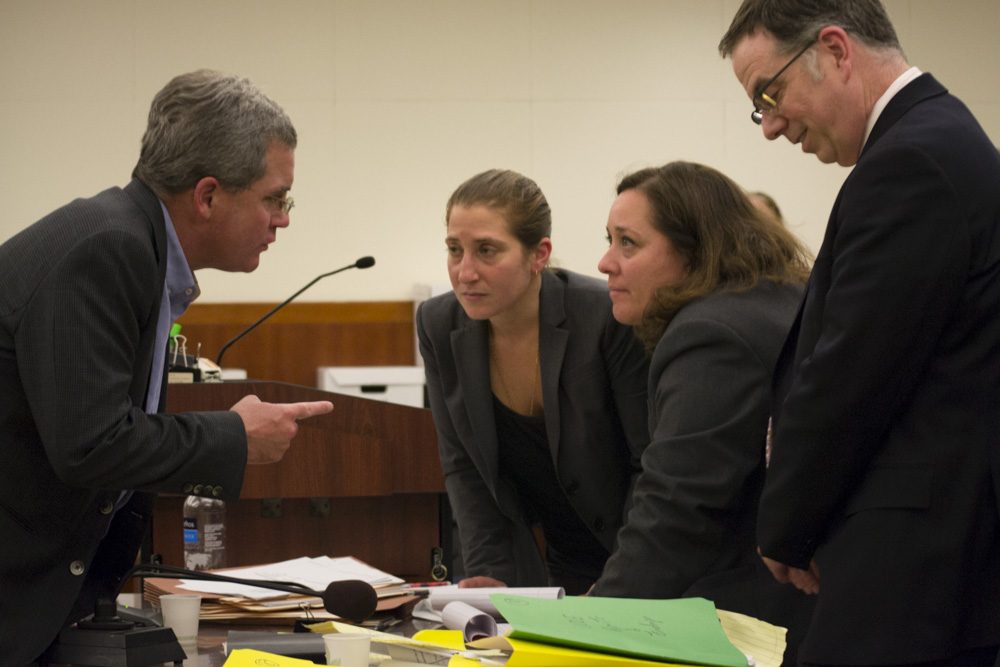
Counsel for the Accrediting Commission for Community and Junior Colleges, Andrew Sclar and Philip Ward, confer during a break at a preliminary injunction hearing regarding City College of San Francisco on Dec. 26, 2013. Photo by Sara Bloomberg

Only part of the injunction was granted by Karnow, however. The ACCJC is barred from shutting down City College, but it can still revoke the accreditation from any of the 112 community colleges it oversees across the state.

The ruling also doesn’t stop it them from making preparations to close the college, Herrera said.

“It does not stop them from continuing their review and analysis and evaluation, it stops them from issuing a final ruling with respect to taking accreditation of City College,” he said. 

Not everyone agrees with Herrera’s efforts though.

“Court intervention is not necessary to keep City College open,” State Community College Chancellor Brice Harris wrote to Herrera in a letter today. 

Harris argues that the lawsuit detracts from the efforts to save the school made by the special trustee Robert Agrella, who was assigned by Harris to replace City College’s board of trustees just after the accreditation crisis broke out.

“Characterizations that the cases before the court are a ‘last-ditch’ effort to ‘save’ City College are inaccurate and will do additional damage to the college’s enrollment,” Harris wrote.

And City College’s enrollment has taken a huge hit, down nearly 30 percent from last year, leading to the college’s new media campaign to get students back in City College seats. 

Though Harris criticized Herrera’s lawsuit as the chancellor of the state community college system, Harris has tangled ties with the accreditors — he was a commissioner on the ACCJC board some years ago

At the hearing to grant the injunction, Sara Eisenberg, the deputy city attorney, argued that real harm hit City College since the news of its closure hit. Students have left the school in droves.

We’re asking, your honor, right now for something that won’t happen until further down the road… but there’s real harm happening right now. Latest numbers show enrollment is down 27 percent,” she told Karnow. 

The ACCJC’s counsel, Andrew Sclar, argued that an injunction to stop City College’s closure would actually harm the ACCJC itself.

 “There certainly would be harm to us,” he told Karnow. “If we do not enforce sanctions or bring a non compliant institution into compliance within a two year period, we would be at risk of losing our recognition with the United States Department of Education.”

Karnow then asked if there was “evidence on the record” of that ever happening. Sclar said no.

The college is slated to lose its accreditation in July 2014. The college is trying to reverse its fortunes and is applying for an appeal with the ACCJC. 

Now, it has a chance to stay open while Herrera fights for its future. Two other lawsuits were filed against the ACCJC as well, one by the California Federation of Teachers and another by the Save CCSF Coalition. 

Lawsuits aren’t the only fire the ACCJC has come under lately. US Rep. Jackie Speier called for a forum on the ACCJC’s alleged misconduct in November, and the beleagured commission was recently reviewed by the federal government, and given one year to come into compliance with federal guidelines.

For our coverage of the court hearing that led to the injunction, click here.

Deputy City Attorney Sara Eisenberg discusses the hearing for the injuncton.

The full text of Herrera’s press release is below.

City College wins reprieve, as court enjoins ACCJC from terminating accreditation

Herrera grateful to court ‘for acknowledging what accreditors callously won’t: that the educational aspirations of tens of thousands of City College students matter’

SAN FRANCISCO (Jan. 2, 2014) — A San Francisco Superior Court judge has granted a key aspect of a motion by City Attorney Dennis Herrera to preliminarily enjoin the Accrediting Commission for Community and Junior Colleges from terminating City College of San Francisco’s accreditation next July.  Under terms of the ruling Judge Curtis E.A. Karnow issued late this afternoon, the ACCJC is barred from finalizing its planned termination of City College’s accreditation during the course of the litigation, which alleges that the private accrediting body has allowed political bias, improper procedures, and conflicts of interest to unlawfully influence its evaluation of the state’s largest community college.  Judge Karnow denied Herrera’s request for additional injunctive relief to prevent the ACCJC from taking adverse accreditation actions against other educational institutions statewide until its evaluation policies comply with federal regulations.  A separate motion for a preliminary injunction by plaintiffs representing City College educators and students was denied.  

In issuing the injunction, the court recognized that Herrera’s office is likely to prevail on the merits of his case when it proceeds to trial, and that the balance of harms favored the people Herrera represents as City Attorney.  On the question of relative harms, Judge Karnow’s ruling was emphatic in acknowledging the catastrophic effect disaccreditation would hold for City College students and the community at large, writing: “There is no question, however, of the harm that will be suffered if the Commission follows through and terminates accreditation as of July 2014.  Those consequences would be catastrophic.  Without accreditation the College would almost certainly close and about 80,000 students would either lose their educational opportunities or hope to transfer elsewhere; and for many of them, the transfer option is not realistic.  The impact on the teachers, faculty, and the City would be incalculable, in both senses of the term: The impact cannot be calculated, and it would be extreme.”

“I’m grateful to the court for acknowledging what accreditors have so far refused to: that the educational aspirations of tens of thousands of City College students matter,” said Herrera.  “Judge Karnow reached a wise and thorough decision that vindicates our contention that accreditors engaged in unfair and unlawful conduct.  Given the ACCJC’s dubious evaluation process, it makes no sense for us to race the clock to accommodate ACCJC’s equally dubious deadline to terminate City College’s accreditation.”

Judge Karnow adjudicated four separate pre-trial motions in today’s ruling following two days of hearings on Dec. 26 and 30.  Herrera filed his motion for preliminary injunction on Nov. 25 — three months after filing his initial lawsuit — blaming the ACCJC for procedural foot-dragging and delay tactics, which included a failed bid to remove the case to federal court and its months-long refusal to honor discovery requests.  Judge Karnow granted in part and denied in part Herrera’s motion, issuing an injunction that applies only to the ACCJC’s termination deadline for City College’s accreditation, and not statewide.

Apart from Herrera’s motion, AFT Local 2121 and the California Federation of Teachers also moved for a preliminary injunction on Nov. 25, citing additional legal theories.  That motion was denied.  A third motion by the ACCJC asked the court to abstain from hearing the City Attorney’s lawsuit for interfering with complex accrediting processes largely governed by federal law; or, failing that, to stay Herrera’s action pending the outcomes of City College’s accreditation proceeding and ACCJC’s own efforts to renew its recognition with the U.S. Department of Education.  A fourth motion, also by the ACCJC, requested that the court strike the AFT/CFT’s case under California’s Anti-SLAPP statute, which enables defendants to dismiss causes of actions that intend to chill the valid exercise of their First Amendment rights of free speech and petition.  (SLAPP is an acronym for “Strategic Lawsuits Against Public Participation.”)  Both of the ACCJC’s pre-trial motions were denied.

The ACCJC has come under increasing fire from state education advocates, a bipartisan coalition of state legislators and U.S. Rep. Jackie Speier for its controversial advocacy to dramatically restrict the mission of California’s community colleges by focusing on degree completion to the detriment of vocational, remedial and non-credit education.  The accrediting body’s political agenda — shared by conservative advocacy organizations, for-profit colleges and student lender interests — represents a significant departure from the abiding “open access” mission repeatedly affirmed by the California legislature and pursued by San Francisco’s Community College District since it was first established.  

Herrera’s action, filed on Aug. 22, alleges that the commission acted to withdraw accreditation “in retaliation for City College having embraced and advocated a different vision for California’s community colleges than the ACCJC itself.”  The civil suit offers extensive evidence of ACCJC’s double standard in evaluating City College as compared to its treatment of six other similarly situated California colleges during the preceding five years.  Not one of those colleges saw its accreditation terminated.  

The City Attorney’s case is: People of the State of California ex rel. Dennis Herrera v. Accrediting Commission for Community and Junior Colleges et al., San Francisco Superior Court No. 13-533693, filed Aug. 22, 2013.  The AFT/CFT case is: AFT Local 2121 et al. v. Accrediting Commission for Community and Junior Colleges et al., San Francisco Superior Court No. 534447, filed Sept. 24, 2013.  Documentation from the City Attorney’s case is available online at: http://www.sfcityattorney.org.

No decision yet following charged hearing to stall City College closure

35

At a Dec. 26 hearing in San Francisco Superior Court, the City Attorney’s office argued that City College of San Francisco should not be shuttered, as long as San Francisco’s lawsuit against a regional accrediting commission remains in court.

The two-year community college, which serves roughly 85,000 students, was notified earlier this year that the regional Accreditin​g Commission for Community and Junior Colleges would terminate its accreditat​ion in July 2014, rendering the school’s degrees worthless.

It would be forced to close.

In August, City Attorney Dennis Herrera filed suit against the ACCJC, alleging the closure action was improper, unwarranted, and out of line with the agency’s prior actions. 

At yesterday’s court hearing, litigators from Herrera’s office argued for a preliminary injunction against ACCJC, to keep the college open at least for the duration of the court proceedings.

Stop, halt, cease, desist. That was the City Attorney’s goal yesterday: keep City College open until the case is decided.

While yesterday’s hearing was focused on the injunction, the substance of Herrera’s complaint against the ACCJC — alleging that its members were acting improperly as advocates for greater austerity, among other things — came into play many times.

The litigators argued from morning till late afternoon, taking only brief recesses. While Judge Curtis Karnow subjected viewpoints from both sides to microscopic examination, there was no decision by the end.

It’s not yet known when Karnow will issue a ruling. 

“Judge Karnow did not rule from the bench, he issued no tentative order, and he gave no indication of how he intends to rule before concluding today’s hearing,” City Attorney spokesperson Matt Dorsey noted in a statement following the hearing.

In the meantime, a few statements made in court could shed light onto the outcome. We’ve highlighted a few of them below, along with some key questions.

Attorneys Phillip Ward and Andrew Sclar represented the ACCJC, in opposition to Deputy City Attorney Sara Eisenberg and labor lawyer Robert Bezemek, who appeared on behalf of the California Federation of Teachers.

We thought we’d present the case a bit differently, and give background to some of the main arguments and then write the main arguments attorneys made to address them. Each argument is prefaced first, and links are provided for further reading:

1. Herrera’s suit alleges that ACCJC commissioners acted improperly as advocates. That would mean they not only went beyond their role as objective accreditors, but sought to advance a political agenda against CCSF’s inclusive approach to higher education. They address that here.

Judge Curtis Karnow: All of those expression of political views, if you will, by either the staff or the commission itself, are being cited as the “true agenda” that they’re trying to unmask.

ACCJC counsel Philip Ward: There are problems, big problems, at City College of San Francisco…. all of those problems are the product of the so called “open access” mission and the new educational priorities that they’re saying are being shoved down CCSF’s throat.

Innuendo, character assassination … shows us that is what’s being targeted by the plaintiffs allegations.

City College has been kicking the can down the road for six years.

2. Herrera’s motion for an injunction argues that, even as the case is being decided, the school will suffer harm in the interim. How would this injunction soften the blow?

Judge Curtis Karnow: The real thrust of the motion seems to be that the uncertainty has generated behavior by faculty [and] students to depart, and this all stems from uncertainty harm.

When did this uncertainty harm start? How will the actions of this court affect anything? If there’s another hearing in July, won’t there be more uncertainty, even if I issue an injunction?

CFT counsel Robert Bezemek: Declarations filed show that there have already been instances that harm has already been felt. 

For example, (City College’s) radiology program is top in the nation above John Hopkins University. They’ve been given an execution date, everyone knows that. There’s an order to remove the college’s accreditation in July 31. When it got that order, students started to leave the college in droves. 

Deputy City Attorney Sara Eisenberg: We’re asking, your honor, right now for something that won’t happen until further down the road… but there’s real harm happening right now. Latest numbers show enrollment is down 27 percent.

3. Can the ACCJC base its decision to close City College on fiscal issues, rather than educational shortcomings?

CFT counsel Bezemek: We do not deny that they have financial issues… the quality of education is what they’re here (the ACCJC) to measure. But you have to find that the harm from the financial issues warrants shutting the school down the only community college in San Francisco. That it is the fundamental part of accreditation. 

Judge Karnow: So your position is that no matter what bad things the college has done, the commission can’t withdraw its accreditation?

CFT counsel Bezemek: No, we’re saying they have to show substantial evidence. 

(The ACCJC’s) ‘internal review’ is a joke. An injunction would provide huge relief.

accjc counsel

Counsel for the Accrediting Commission for Community and Junior Colleges, Andrew Sclar and Philip Ward, confer during a break at a preliminary injunction hearing regarding City College of San Francisco on Dec. 26, 2013. Photo by Sara Bloomberg

4. Is it within the ACCJC’s power to delay City College’s closure?

Judge Karnow: What if we just dropped the process now? 

ACCJC counsel Sclar: There certainly would be harm to us. If we do not enforce sanctions or bring a non compliant institution into compliance within a two year period, we would be at risk of losing our recognition with the United States Department of Education.

It’s going to have a chilling effect on all accrediting agencies.

Judge Karnow: Is there any evidence of that in the record?

ACCJC counsel Sclar: No, there hasn’t (been). 

Deputy City Attorney Eisenberg: If the people aren’t permitted to seek relief through an (injunctive) action, there’s no other recourse.

The ACCJC has demonstrated a very cavalier attitude in this case. We’re talking about closing the only community college in San Francisco. Many students don’t have access to other colleges otherwise. The relief that we are asking for here is quite modest. It has been granted before… and it didn’t do anything other than hit the pause button.

Homework troubles

28

joe@sfbg.com

The San Francisco Board of Education approved a land swap with city government on Dec. 10, gifting San Francisco an empty lot that it will use to build new affordable housing. That’s 115 units of living space for low-income San Francisco renters, wrapped in a bow for the holidays.

The proposal was the brainchild of board members Hydra Mendoza-McDonnell and Sandra Lee Fewer, who worked on the measure with the Mayor’s Office of Housing for over two years. The district will trade a lot on 1950 Mission street and another on Connecticut Street in exchange for a property it currently rents from the city of San Francisco. The city will also pay SFUSD $4.5 million, according to district data.

The deal was the culmination of that work, which Fewer said was the right thing to do.

“Could we get more money from [selling] this property with a private developer? I’m sure. But would we get the value? No,” Fewer said at the meeting.

The original intent of the land swap was to provide affordable housing for the school district’s employees. Project proponents say school district workers are being priced out of San Francisco in droves. But the affordable housing project will be general use, with no specific provisions for teachers or other SFUSD workers.

teachersinSF Though the teachers’ union supports the land swap, United Educators of San Francisco President Dennis Kelly warned that teachers are in dire need.

“It’s more than an oversight, it’s an insult, felt very deeply, and very bitterly,” Kelly said at the podium. “Affordable housing will not house a single teacher, not a single one, because of where the dollar breaks are.”

The board has made various promises over the past decade to aid with teacher housing, all empty words, Kelly told the Guardian. There’s yet to be a solution from the school district or the board on finding sustainable housing for teachers.

The problem is a microcosm of one of San Francisco’s toughest challenges during this tech-fueled affordable housing crisis. Affordable housing helps the poor, and the rich certainly don’t need help staying in the city, but help for middle-income earners is hard to come by.


NEW RECRUIT

Research from education nonprofit ASCD shows most first-year teachers face three challenges: difficulty learning to manage classroom behavior, an overload of curriculum creation, and lack of school support. San Francisco’s new teachers face a fourth: finding a place to sleep at night.

Second-year SFUSD science teacher Kate Magary, 29, knows this all too well. Her first year on the job went from challenging to hellish as she looked for an affordable place to live.

Despite having a modestly salaried full-time job, she couldn’t afford a studio on her own. She eventually found a room for rent on Craigslist, but her noisy roommates made grading papers and writing curriculum a constant challenge. She started a new apartment hunt, but even that was like a full-time job.

“As a first-year teacher, it was awful,” Magary said. “I tried not to let it affect me too much at school, but the stress from home eventually made it with me to the classroom.”

She over-disciplined some kids, she said, and her patience was at the breaking point for most of the year. When teachers suffer, students suffer.

Magary is a science teacher at the Academy of Arts and Sciences, which is on the Ruth Asawa School of the Arts campus at Twin Peaks. Three-story homes and apartment buildings dot the hills along the road from Market Street on her drive to school, but Magary can’t afford them.

Instead, she eventually found a place on Treasure Island. A sixth-generation San Franciscan, Magary is happy to stay in what is still technically part of the city. But her lease is tenuous, and she anticipates having to move within the next few years. She’s not alone.

Out of SFUSD’s 3,284 teachers, 927 live outside of San Francisco, according to data from their union. That’s 28 percent of teachers living outside of the city, 3 percent higher than just last year. That number masks the depth of the problem.

New teachers who aren’t established in San Francisco bear the brunt of displacement. Half of all new teachers leave SFUSD in their first five years, according to data from the district. And 35 percent of teachers hired since July 1 live outside the city.

“A teacher might start in the district, live in the city, and move out,” said UESF spokesperson Matt Hardy. “The turnover is very high, particularly in newer schools.”

Teachers we talked to said there are problems for those who manage to stay in San Francisco as well. They sometimes sleep in unstable or unsafe housing, couchsurf, or sleep in their cars. In the morning they teach the city’s children.

It’s bad for teachers, but worse still, it’s bad for students. Recognizing this, federal, state and city government have all pitched in to try and find housing solutions for teachers.

Unfortunately for them, and for us, they’ve mostly failed.


OWNERSHIP FOR NONE

Art Agnos is most well known for being San Francisco’s former mayor. But after stepping down in the ’90s, he served in the Clinton Administration as the Department of Housing and Urban Development regional director throughout California, Arizona, Nevada, and Hawaii.

He was in charge of finding folks places to live.

The crisis for teacher housing was stark. At the time, Agnos was in charge of implementing Clinton’s housing program for teachers in San Francisco. The experiment? Build affordable housing units at Dianne Feinstein Elementary School on 25th Avenue exclusively for teachers.

The idea died in a sea of NIMBYism.

“The resistance came from the neighborhood who thought affordable housing for the teachers would diminish the value for their property and make traffic issues,” Agnos told the Guardian. “The Board of Education yielded to that NIMBYism and refused to pursue the deal, which was on the table.”

The federal push for teacher housing died, having created a home for just one teacher in San Francisco by the year 2000, and only 100 in California, according to news reports at the time.

California would follow suit with a less ambitious teacher housing program. The Teacher Next Door program offers assistance for teachers buying homes in San Francisco through the Mayor’s Office of Housing. We called the office to get statistics on its use, but as of press time it had not called back.

Among teachers, the program is mostly a joke.

“That’s the case with most teachers,” science teacher Tom Dallman of Ruth Asawa School of the Arts told the Guardian. “They roll their eyes when it comes to talk about buying a place in San Francisco.”

Median home prices in San Francisco skyrocketed past $1 million in June, a signal that for many teachers, homeownership in the city is a near impossibility.

Subsidized Below Market Rate housing is out of their reach too. San Francisco teachers make anywhere between $40,000 and $80,000 a year, placing them just above the salary as a single person to qualify for affordable housing.

“The struggle is about middle income people who do not qualify for mortgages or newly develop projects, because the market is astronomically high,” Agnos said. And that’s leading to a teacher migration, numbers from the UESF show.

“If they have to live in Oakland, they’ll work in Oakland,” Agnos said. “Their talent will follow them.”

The dream of homeownership for San Francisco’s education workforce is a thing of the past, Susan Solomon, vice president of the UESF told us.

“Maybe long, long ago this was a possibility,” she said, “way back when.”


FEW SOLUTIONS

Fewer was ecstatic to see the land swap deal go through, and excited to see affordable housing for San Francisco families.

But when asked what she’ll do to tackle the struggle to find affordable housing for teachers, she said that the upcoming contract negotiations may be the time to revisit a new plan.

“We’ve asked the unions to give us a poll for a long time,” she said. She wants to know what the teachers want. Do they want to live in housing together? Have rental subsidies? Housing assistance? What are their needs?

Sup. Jane Kim, a former school board member, said there’s a split of preference in the union. Should affordable housing solutions be given to teachers in their first five years in SFUSD, to encourage them to stay in San Francisco, or to veteran teachers?

“There’s a limited amount of funding,” Kim told us. And when the district lucks itself into extra funding, it’s hard not to spend it in the classroom. “How do you invest the limited dollars that you have?” she asked.

Santa Clara’s school district built its own affordable housing, and spent $6 million in 2005 to construct 40 units for its workforce. Three years later, they built 30 more units. Teachers there initially paid $1,075 a month in rent for a two-bedroom apartment, according to The New York Times.

“You cannot be an education advocate without being a housing advocate,” Fewer said. But housing help has been largely elusive for SFUSD employees.

“Stubbornness is keeping me in the city,” Magary said. But without some help, that may not be enough.

Laboring for better health care

2

Gardening, plumbing, construction, janitorial work and washing dishes: the jobs day laborers perform for San Franciscans are done with their bodies. Their physical fitness is their gateway to work.

It’s that physicality they risk on the job every day. Undocumented Latino laborers have a hard time reaching options for medical care though, even in a sanctuary city like San Francisco.

To be clear, San Francisco has gone far and beyond many cities to provide medical care. The city’s Healthy San Francisco program, UCSF, and a smattering of nonprofits all provide medical care to undocumented immigrants, which often includes day laborers.

The problem is not a matter of options, but a matter of trust.

James Quesada, an anthropology professor at San Francisco State University who studied health care options for day laborers, said even when options are available, many day laborers actively avoid them.

The specter of deportation is always lurking, he said, stopping many from seeking clinics in the first place.

“Despite the fact that we’re a sanctuary city, there’s always that fear and threat that someone could come at any time,” Quesada said. “There are do-gooding public health services for them, public health contracted satellite clinics and the like. But one of the hardest things is to really convince them that they’re not in peril by going.”

At the U-Haul rental facility near Bryant street, laborers stand in pairs waiting for potential customers to drive by. When a customer comes into sight, they’ll start toward the passing car in huffing sprints. Their work is unpredictable and never guaranteed.

One man the Guardian spoke to, Gonzalo Moran, 62, cited one health care center as a timely godsend: the Mission Neighborhood Health Clinic. The wait there is only half an hour, he said, and in an emergency they make referrals to SF General Hospital.

But heading to SF General for care can carry a high price tag in both time and money, and results are not guaranteed.

“One day I had a toothache, I went to the emergency [room], was there from about four o’clock in the morning to four o’clock in the afternoon,” Moran said. “I told them I was homeless, that I didn’t have no income, I have no immigration papers or nothing. A nurse came to check on me, my tooth. They just gave me a prescription for Tylenol, but then a month later they sent me a bill for $300. For Tylenol.”

Moran isn’t necessarily out on the streets, but crashes regularly at different places. Whenever he tried to get a credit score the bill would come up in searches.

The hit wasn’t only monetary. The day he spent at the hospital was a day he could have worked.

Moran’s story reflects findings made by Quesada in his research. Though many providers claim to help the undocumented, the level of service can depend on just which doctor or nurse you happen to get that day. Service and safety are uneven, and there’s no way to keep track of it all.

“It’s a patch quilt, a moving target,” he said.

Moran told his story with strong English skills gained through City College classes, but he’s had the time to learn — the El Salvador native landed in the United States in 1976 to earn money for his family. Others Quesada talked to were not as lucky.

In his research on undocumented day laborers and health care, he found many who avoided clinics and hospitals for fear of being deported. Quesada found the laborers in the streets, and spent time in clinics and hospitals to find what kept them away from medical care. What he found was fear.

Some men would jump even at the sight of a rent-a-cop security guard, he said.

In an academic paper he published on the subject, Quesada related the story of Juan, a day laborer in his 50s who suffered terrible tooth pain. He refused to seek help.

“Look Jim, if I show up at the clinic [nearby public clinic] I cannot be sure I won’t be arrested and taken away. You know, it is more dangerous now. I can never be sure when it is safe to go [get medical attention]. But, you know what it is, I do not want to be like those others [Latinos] who have “no shame” [sin verguenzas] and want what they want for nothing. If I can I will pay my way, and if I can’t, I can’t. I’ll withstand the pain and take care of it myself, even if I have to pull them [his teeth] out myself. “

Juan would medicate the gaps in his teeth with Tequila soaked cotton balls, and aspirin.

Quesada tried to get him help, but Juan had to cancel dental appointments repeatedly when jobs became available. Day laborers never know when the next opportunity may drive up to them.

This is what pushes Quesada and others to push for a merging of social work and health care. Some facilities in San Francisco have already moved that way, as hospitals like UCSF visit churches and community centers on weekends to reach out to undocumented people in need of medical attention. Still, there’s room for change.

“Doctors shouldn’t have be social workers, but social workers should be there in the room,” Quesada said, saying that would go a long way towards helping undocumented workers find the help they need. But despite a lack of options, they carry on.

“They’re valiantly making a go of it, and don’t want to dwell on the negative,” he said. “They don’t want to be seen as fighting for basic human rights, as not fully human.”

The man we met outside the U-Haul on Bryant, Gonzalo Moran, has three trade school certificates, one of them in floor tiling. But he longed for one thing: time to attend school so he could get ahead.

“I go to school all the time, you know, if I have it,” he said. “But it’s hard, we’re always getting a lower wage.” And it’s a barrier. A barrier to health, a barrier to education, and a barrier to a better life.


Alerts: December 11 – 17, 2013

0

WEDNESDAY 11

No End In Sight: Artist talk and performance SOMArts Cultural Center, 934 Brannan, SF. www.somarts.org/noend. 7-9pm, free. Justin Hoover, curator of SOMArts exhibition All Good Things… will join featured artists in conversation on time-based art, hitting on themes like community engagement, the life cycle of a sculpture, and upcycling in contemporary art. The evening will include a reveal of Kristin Cammermeyer’s evolving sculptural installation, shown for the first time in full 360-degree fashion, and a performance by Jeremiah Barber, who will create a levitation that floats in the eyes of the audience, something like a gorgeously articulated sunspot.


League of Pissed Off Voters holiday party The Hot Spot, 1414 Market, SF.

tinyurl.com/pissedparty 6:30pm-8:30pm, free. Come have a few drinks with the League Gather round for a toast to 2013, a chat about what fun 2014 may bring, and a celebration of the league’s tenth anniversary!


THURSDAY 12


Ohlone short films New Nothing Cinema, 16 Sherman, SF. 8pm, free. This screening, part of the Incite/Insight Film Series, will feature a collection of short films on the return of Ohlone people to their ancestral lands — the peninsula where San Francisco now sits. You’ll hear the Ohlone’s own voices—in a sunrise healing ceremony at Yosemite Slough, and in asking San Francisco city supervisors for recognition at City Hall—as well as those evoked by the land and history. The story of the Ohlone will be brought right up to the present with a series of short films documenting the latest visits of the Costanoan Rumsen Carmel Ohlone as part of their 4-cycle effort of inclusion, and truth and reconciliation.

Eric Quezada PRESENTE! Mission Neighborhood Centers, Inc., 362 Capp, SF. 6-9pm, $5–$20 donation. center@politicaleducation.org. Friends of Eric Quezada and the Center for Political Education invite you to a community celebration of this beloved community activist’s life, on the occasion of his 48th birthday and the 15th anniversary of The Center for Political Education. Celebrate his contributions to SF-based struggles for social and economic justice, which continue to resonate. Featuring speakers, music and a left memorabilia auction, with light refreshments provided by Sun Rise Restaurant. All proceeds will benefit the Center for Political Education.

SUNDAY 15

A life in struggle: celebrating Elizabeth “Betita” Martinez Galeria de la Raza, SF 2pm, free. A celebration of the life and political activism of Elizabeth “Betita” Sutherland Martínez. On the occasion of Betita’s 88th birthday, Social Justice Journal is releasing a special issue featuring some of Betita’s unpublished works and more. The Dec. 15 celebration and fundraiser will feature readings by some of the contributors to the issue, alongside music, slideshows, and refreshments. Seating will be limited. RSVP at galeriadelaraza.org.

Suspending judgment

40

joe@sfbg.com

The Guardian is publishing only the first names of minors and their relatives named in this story, to protect their privacy.

In San Francisco public schools students can be sent home for talking back to a teacher, wearing a hat indoors, or sporting sagging pants. These infractions sound like the daily life of a kid, but the state calls them “willful defiance,” a category of suspensions that are nebulous to define at best.

Like the old saying about pornography, teachers say they know it when they see it, but students and parents alike are now calling foul on the practice.

The suspensions are so abundant in the San Francisco Unified School District that a movement has risen up against it. Sending kids home not only is an ineffective punishment, opponents say, it also can lead youth into the criminal justice system.

Now San Francisco Board of Education Commissioner Matt Haney is proposing a resolution that would ban willful defiance suspensions in San Francisco schools altogether.

“There will still be situations where we need to send a student home, but willful defiance will not be one of those reasons,” he told the Guardian. “Change is hard, complicated, and messy. But we can no longer deal with discipline or interactions with our students in that sort of way.”

He plans to introduce the resolution at the Dec. 10 Board of Education meeting, and if it passes, he said full implementation may take until the next school year.

There’s a fight to ban willful defiance suspensions statewide as well, but so far it’s been stymied. Just last month, Gov. Jerry Brown vetoed Assembly Bill 420, a bill mirroring aspects of Haney’s proposal. Those advocating for such a ban say it’s an issue of racial justice.

San Francisco’s African American and Latino students together suffer 80 percent of willful defiance suspensions, according to SFUSD data. The nonprofit student group Coleman Advocates for Children and Youth decried this statistic as an injustice, supporting the ban.

The San Francisco Board of Education took tentative steps to reduce suspensions as a whole in 2010, voting to introduce a new disciplinary system called Restorative Practices district wide. It’s complex, but basically asks students to talk things out in what are called “restorative circles” that include everyone involved in an incident, like a fight.

It’s also about changing the culture around discipline. It encourages teachers and students to establish a rapport, turning around the way some schools have practiced authority for decades.

At the time, there was hope. Fast forward three years, and that hope has dwindled.

Early evidence shows that Restorative Practices work better than suspensions, and prevent behavioral problems down the road, too. But out of SFUSD’s more than 100 schools, less than half of them started to implement the new reform.

Few schools have fully integrated the change, officials told us. Haney’s resolution addresses this with a mandate: SFUSD must implement Restorative Practices throughout the San Francisco school district.

The program is important, proponents say, because the majority of the 55,000 students a year moving through San Francisco schools still face school discipline that can set them way back in school and later may lead to incarceration. And suspensions can be levied for the smallest of infractions.

Cupcakes and justice

Xochitl is a 15-year-old SFUSD sophomore with long brown hair. She watches the TV show Supernatural (Dean is cuter than Sam) and yearns to one day live with her relatives in Nicaragua. Years ago on her middle school playground, she once faced a hungry child’s ultimate temptation: Free cupcakes.

The baked goods sat in a box on the cement by the playground, unattended. The frosting sat un-licked, the wrappers unwrapped.

She and her friend looked around, searching for a possible pastry owner nearby. Runners circled around the track in the distance, but no one else was around. The cupcakes met a satisfying fate inside Xochitl’s belly. The next morning went decidedly downhill.

As she walked into school, the counselor told her to go home: she was suspended.

“The cupcakes belonged to this girl because it was her birthday,” Xochitl said, something she found out only once she was being punished. “They went straight to suspension, they didn’t even let me speak.”

Restorative practices would have sat her with the birthday girl to explain her mistake and apologize. Maybe she would’ve bought the girl new cupcakes. That wasn’t what happened.

Suspended, Xochitl spent the day at her grandparents’ house. Not every suspended student has a safe place to go. Some turn to the streets.

stats

In October a group of mostly black young students marched to the Board of Education to protest willful defiance suspensions. The group, 100 Percent College Prep Institute, formed in the ashes of violence.

“I drive a school bus for a living, and I had a boy on my bus who was not bad, but not good,” said 100 Percent College Prep Institute co-founder Jackie Cohen, speaking with the Guardian as she marched with her students. “When we got back from Christmas break, he wasn’t back on the bus. Turns out he decided to ‘live that life.’ Three days later, I found he was shot and killed.”

In some communities the jaws of crime and drugs are forever nipping at their children’s heels. A child inside school is safe. Suspensions throw the most vulnerable students into the wild.

“Preventing crime in San Francisco begins with keeping children in the classroom,” SFPD Chief Greg Suhr wrote in a letter to the SF Examiner last year. “Proactive policies, such as the ‘restorative practices’ implemented by the SFUSD, emphasize the importance of building positive relationships while holding kids accountable for their actions.”

Black students make up about 10 percent of SFUSD’s population, but they represented 46 percent of SFUSD’s total suspensions in 2012, according to SFUSD data. Latino students represented about 30 percent of suspensions.

The racial disparity of suspensions mirror the disparity of incarceration. A study by nonprofit group The Advancement Project found that in 2002, African American youths made up 16 percent of the juvenile population but were 43 percent of juvenile arrests.

Xochitl sees that with her own eyes every day.

“Some kids turn to the streets, you know. I’ve seen people younger than me go to jail,” Xochitl said. “I was on Instagram and saw a friend locked up. I knew that girl, she’s in my PE class.”

It’s one of our country’s many shameful open secrets. Nearly half of all adult men in the United States serving life sentences are African Americans, and one in six is Latino, according to data from the nonprofit group the Sentencing Project.

Fathers and sons, mothers and daughters, all trapped in a cycle of poverty to prisons that for some starts at school.

“As a school district, when that’s staring us in the face, we can’t not do something about it,” Haney said.

Sometimes it begins when students are still learning their ABC’s.

Bruises inside and out

Restorative Practices are implemented from kindergarten to high school.

“If [students] don’t have a sense of belonging… that’s going to prevent schools from addressing behavior,” Kerry Berkowitz, the district’s program administrator of Restorative Practices, told us. The seeds of mistrust are planted when students are young.

Desamuel could not yet spell the world “police” when he first met them.

He was five years old, and as kindergartners sometimes do, he threw a temper tantrum. In the school’s desperation to contain him, officials called the SFPD.

“The police only came one time,” Desamuel, now seven, told the Guardian. Sitting in his San Francisco home with his uncle Lionel, Desamuel sounded ashamed. “But I didn’t go to jail because they only put kids in jail for being bad, like kids taking guns to school.”

The memory angers Desamuel’s uncle, who feels restorative practices would have prevented the misunderstanding. His home is a testament to bridge building.

Lionel, his brothers and mother all pitch in to take care of Desamuel while the boy’s father makes what he calls “a transition.” The home is large by San Francisco standards. Drawings of Spiderman and Batman line the wall, equal in number only to the portraits of their family, most of whom live in the city. There’s a lot of care in Desamuel’s life. That hasn’t stopped his tantrums, though.

The family tried to get him therapy, psychological analysis, anything to help. But as any parent can tell you, sometimes a child just needs love.

Lionel struggled with the school’s administration, and asked them to try less punitive ways of handling his nephew. “I told them to just hug the boy. Their response was ‘it’s hard to hug someone swinging at you.'”

The last time Desamuel fought a student he was tackled to the ground by a school security guard. The now-second grader came home with a bruise on his face.

“When I was bad I hurted the children. I wasn’t supposed to get up, and couldn’t get up off the ground. He took me by the arms and legs,” Desamuel said.

The problem with outsize use of suspensions and punitive action, Berkowitz said, is that it breeds a fear of school that shouldn’t exist. Desamuel is no different.

“I got sent to the office and I had to go to the principal’s office and they talked about me being bad,” Desamuel said. “I think because I make too much trouble I have a lot of problems and they don’t want me to be there.”

Cat Reyes is a history teacher who is now a Restorative Practices coach at Mission High School. She said transformation in behavior is the whole point.

She told the Guardian about a student recorded a fight on film. The two fighting teenagers tried to let the incident go, but with the video online for all to see their pride came between them. If the school suspended the girl who recorded the fight there may never have been resolution. The wounds would fester.

But now the girl will join a restorative circle and explain her actions to those involved in the fight, and their parents. That’s far more daunting to kids than simply going home for a day, Reyes said. It doesn’t just stop at the talk though. “On one end she has to say sorry,” Reyes said. “But now she may go to the media center and create a [movie] about it on our closed circuit TV. The consequence fits the crime.”

As students talk out their differences enemies can become friends, she said. After all, the goal is to correct bad behavior and break destructive cycles. Yet less than half of the schools in SFUSD are employing Restorative Practices.

Slowly but surely

One of the biggest critiques of Restorative Practices is that it removes consequences. That’s the wrong way to look at it, Berkowitz said: “When people say consequences, they mean punishment. We want to work with students to find root causes.”

The numbers back her up: 2,700 SFUSD staff members have trained in Restorative Practices, according to data provided by the district. This consequently led to a strong reduction in suspensions, the district says, from more than 3,000 in 2009 to about 1,800 last year.

SFUSD recognized a good thing when it saw it, growing the Restorative Practices budget from $650,000 in 2009 to $900,000 in 2013.

But only about 25 schools started measurable implementation, Berkowitz said. She put it plainly, saying the program is in its infancy. “Are they ‘there’ yet?” she said. “No.”

“Our team is pretty maxed out,” she said. “To really bring this to scale and implement Restorative Practices, there’d need to be a lot of discussions around that.”

Asked how much she’d need to fully fund the program across all schools, she was evasive. Haney was more direct. When asked if his resolution tied funding to the mandate of implementing Restorative Practices district-wide, he admitted that a funding source hadn’t yet been identified.

“Mostly we hear there needs to be more: more support, more social workers, more people in schools to make this functional,” he said. “It’s a longer term challenge.”

That solution may emerge as the resolution goes through the approval process, but the program faces other problems besides funding.

Teachers have depended on suspensions as a tool for years. Money is one thing, but changing educators’ minds about discipline is another.

The “R” word

Martin Luther King Jr. fought for the integration of schools, but in a speech about Vietnam he said something that could apply to the SFUSD today.

“Life and history give eloquent testimony to the fact that conflicts are never resolved without trustful give and take on both sides,” the southern preacher said in one of his last speeches before his death.

There is one issue simmering under this entire debate, festering, unspoken. Why are black and Latino students suspended more than other groups? Is this system inherently racist?

It’s a tough question. Teachers are notoriously underpaid, overworked, under supported, and asked to enforce the newest policies at the drop of a hat. The teachers the Guardian spoke to all described a packed year filled with new methods to learn, all with a common purpose — a love of their profession and a love of their students.

“There’s a hesitancy to talk about race with this,” said Kevin Boggess, civic engagement leader for Coleman Advocates, the group leading the charge for the willful defiance ban.

Nevertheless the question of racism permeates the discussion. Xochitl felt persecuted as one of the few Latinas in a mostly Asian middle school.

In the case of Desamuel, the young black child who had the police called on him at age five, his uncle stressed the need for culturally aware teaching. Lionel said Desamuel was well-behaved when he had an authoritative, elderly black female teacher, but acted up in the hands of substitutes who weren’t black and whom he characterized as “young and new” to teaching. Then again, the principal who called the police to handle Desamuel was herself black.

Norm “Math” Mattox is a former James Lick Middle School math and science teacher, and he said from his perspective as an African American he’s seen the issues Haney’s resolution addresses clear as day.

“My sense is that teachers might be blowing the alarm a little bit too soon as far as their brown and black students are concerned, especially the boys. They don’t know how to manage them,” he said. In his experience, misbehaving children are sent out of the room too soon.

In the short term, suspensions are an expedient tool, but punishment without communication does long lasting damage. “The dynamic between teacher and student did not get resolved inside of the class,” he said.

One SFUSD school tackled the specter of racism head on. Mission High School is at the vanguard of what its principal calls “anti-racist teaching.”

Mission High has a higher African American student college placement rate than many SFUSD schools, a group that struggles to perform elsewhere. And as a designated “newcomer pathway” for new immigrants, the school has 40 percent English language learners.

Mission High’s principal, Eric Guthertz, is energized by the challenge. He revamped the way the school teaches to address race and ethnicity directly.

The geometry teachers use Bayview district planning data to illustrate mathematical lessons, and teachers look at grades by ethnicity and address disparities directly.

Guthertz credited Restorative Practices with lowering the school’s suspensions. SFUSD data shows Mission High’s steady suspension decline, with a 14 percent suspension rate in 2009, before the program started, and down to a 0.4 percent suspension rate by 2012.

missionprincipal

Mission High School Principal Eric Guthertz. Guardian photo by Brittany M. Powell

“We’ve deeply embraced Restorative Practices,” he said.

Next week San Francisco will see if the Board of Education will take the same leap Gutherz did. As he is quick to point out, shifting the culture at Mission High School took years.

The Guardian contacted members of the school board, but did not hear back from them before press time to see how they may vote.

Either way, it’s time for SFUSD to change its ways, Haney said. But no matter what side of the matter you fall on, he said, it’s important to remember one thing.

“Everyone involved in this conversation wants to do better by these students,” he said.

The San Francisco Board of Education will vote on the ban of willful defiance suspensions and full implementation of Restorative Practices at their Dec. 10 meeting.

Why I’m resigning from the City College board

15

By Chris Jackson

When I worked for the state legislature, a member once told an overly ambitious guy that there are those who get into politics to be someone and those who get into politics to do something, and we have enough of the first type.

Serving on the City College of San Francisco Board of Trustees was always a means for me to work to connect underserved communities to education and eventually economic empowerment.

One of the first measures that I passed while on the board was to expand City College’s Community/Outreach Ambassador to the Mission and the Southeast campuses. Through this program, City College was better able to do outreach to underserved communities.

Be it by protecting CCSF’s GED program or child care sites, working with community leaders to continue to make the Mission campus an educational jewel to its residents, or working with Bayview advocates to ensure the Southeast campus’ survival and eventual growth, I came to the CCSF Board of Trustees on a mission to help ensure that our most vulnerable populations are given access to education as a means of equity.

Although I’ve had amazing success and even made a few mistakes along the way, I don’t want anyone to doubt my continued passion and commitment to the communities that CCSF serves. It is this passion to do something and not simply be a figurehead that has led me to the difficult decision to resign from the CCSF Board of Trustees.

The Accrediting Commission of Community and Junior Colleges, an unelected and publicly unaccountable organization, seeks to change the values and charge of City College from an inclusive, community-based and student-focused college to a simple junior college that serves the few and shares the values of the corporate education reform movement.

Even more disappointing has been our state Community College Board of Governors. Instead of performing its public-policy duties, the state Board of Governors, led by State Chancellor Brice Harris, has continued to allow itself to be bullied by the ACCJC to the point where there is a serious question of who really sets public policy for the 112 colleges in our statewide system: our publicly appointed Board of Governors or the unelected, unaccountable private ACCJC.

It pains me to see the scope of our class offerings pared back, our community-based campus continually threatened with closure, much-needed academic counselors laid off, and our Second Chance program for ex-offenders with an over 900-student waiting list. It pains me even more to be sidelined by Harris and our public Board of Governors and watch them shrink and cower to the power of Barbara Beno and her private ACCJC.

But in the face of this challenge to our public education, I see hope. Students like Trustee Shannell Williams, Student President Oscar Pena and former Trustee William Walker rallying students to stand up for their public education give me hope. The American Federation of Teachers Local 2121 and the Save CCSF coalition have become rallying points not just for the immediate CCSF community, but for the larger SF community. Their bravery in the face of the withering attacks on public higher education should be commended and be a model that others should follow. At this moment, there exists the base for a long-lasting coalition of students, educators, and community fighting for the high-quality, affordable education.

Thank you for the opportunity to do something to make an impact in people’s lives. Thank you for allowing me the opportunity to serve on the City College of San Francisco Board of Trustees.

Chris Jackson was elected to the CCSF Board of Trustees in 2008.


City and teachers seek injunction against City College closure

16

The plan to save City College of San Francisco took a proactive turn yesterday (Mon/25) as two separate-but-similar preliminary injunctions were being sought against the Accrediting Commission for Community and Junior Colleges (ACCJC). 

The injunctions, filed for yesterday by City Attorney Dennis Herrera and the California Federation of Teachers (CFT), would seek to keep the embattled school open for at least the duration of the impending litigation. A judge will consider the requests next month. 

The two sought-after injunctions come in the context of the civil lawsuits filed by both groups back in August, and would prevent the ACCJC from stripping CCSF’s accreditation on July 31, 2014, in addition to keeping the school both accredited and open while the civil lawsuits are heard and legislative challenges play out. ACCJC representatives didn’t return our calls for comment. 

Both the City Attorney’s Office and the CFT lawsuits hinge on the August findings of the US Department of Education. The determination made then said that the ACCJC violated two separate provisions of federal law: Failing to maintain effective controls against conflicts of interest and failing to have reasonable academic representation amongst the evaluation teams tasked to evaluate the school. 

If those two violations are upheld in federal court, then the City Attorney’s Office will simply need to prove that the “balance of harm” is negatively swinging toward the students of CCSF. And that unjust balance isn’t an under-the-rug number: 80,000 students go to CCSF, while 19 board members work at the ACCJC, something they do whether or not CCSF is open. Conversely, it’s not like those 80,000 students have 80,000 places to go. 

Both the CFT and the City Attorney’s Office are confident that the injunction will be granted by a San Francisco Superior Court judge, an arena of equitable governing both groups say hasn’t been seen from the ACCJC.

“We were trying to figure out our options. How do we defend the college?” said Alisa Messer, AFT Local 2121 president and English teacher at CCSF. “So how do you get a fair hearing? How do you get due process? Unfortunately the courts are the only way to do that under this scenario.”

If either interim injunction is granted by the courts, the school wouldn’t be stripped of its accreditation on July 31 — the ACCJC-appointed Doomsday for an educational institution that contributes nearly $300 million a year to the local economy, among other things — pending conclusions of the underlying court cases, which could take years. That would allow CCSF to offer at least a fall course-load. The injunction would also put the recently-maligned accrediting agency’s authority on hold.

And while an injunction simply delays the final determination and extends the school’s accredited status, both the city’s and the CFT’s plan to hold up the final determination elegantly mirrors the strategy most assume the ACCJC is employing.  

“What we’ve seen is the ACCJC essentially engaging in delay tactics,” said Therese Stewart, chief deputy of the City Attorney’s Office. “This [injunction] isn’t to resolve the whole thing, but rather to freeze the situation so it doesn’t get worse.”

According to a press release from Herrera’s office, the injunction would also, “prevent the Novato, Calif.-based ACCJC from taking similarly adverse actions against other California colleges until its policies and practices fully comply with state and federal law.”

But even if they can implore the ACCJC to reinstate CCSF’s accreditation, Messer says that the injunction the CFT filed on Monday is about much more than “stop gap measures.”

“Actually, I see it as much more than that. It’s not just about getting an injunction for what happens on [July 31, 2014],” said Messer. “This about getting an injunction now, to stop the actions toward closing the college and toward taking our accreditation. Now. Not for July, for right now. Because what we’re seeing is harm being done to the college even as we speak.”

The harm Messer is referring to isn’t just accreditation-related. She says that the reputation of a school is as important as anything, and right now students are unsure of the status of CCSF.

“It’s not about sitting on our hands and waiting and hoping that some of these things will right themselves,” said Messer. “It’s about saying that right now, because of the harm being done to the college, that we need San Francisco to know, and we need everybody to know that this college will not be closing.”


Film Listings: November 20 – 26, 2013

0

Film listings are edited by Cheryl Eddy. Reviewers are Kimberly Chun, Dennis Harvey, Lynn Rapoport, Sam Stander, and Sara Maria Vizcarrondo. For rep house showtimes, see Rep Clock.

OPENING

Broken Circle Breakdown This Belgian movie by director Felix Van Groeningen arrives bearing major awards (from the Berlin and Tribeca festivals) and promising to nab plenty more of them. Why, you ask? I haven’t the faintest idea. Didier (Johan Heldenbergh) is leader of a bluegrass group; Elise (Veerle Baetens) is a tattoo artist until she meets him, they get together, and it’s discovered that when she opens her mouth Alison Krauss falls out. They have a child, Maybelle (Nell Cattrysse), who develops cancer at age six or so, and whose prospects are grim. So far, so ordinary — Once (2007) meets Lorenzo’s Oil (1992), a tearjerker in which people sing high lonesome American roots music (in English, too) well enough, but not so well that you ever stop wondering “Why are these Belgians doing this?” The expected tragedy hits halfway through, and that’s when the movie really gets into trouble. Its protagonists fall apart, understandably, but in irksome ways — mostly picking on each other — with particularly annoying sequences occurring in both past and present tense. It’s hard to tell which one is worse, the arch flashback wedding scene, her deciding to rename herself “Alabama,” his endless onstage outburst about Yahweh, the climactic psychedelic flashback crisis montage, or the wholly gratuitous final … well, never mind. This was originally a stage play, and in the usual way that seeing musicians act and actors play instruments live is exciting, it probably worked well in that medium. But on film it seems like a contrived pileup of ill-matched ideas and plot devices. Don’t take my word for it, though: From Seattle to Osaka, apparently there’s been nary a dry eye in the house. So knock yourself out. (1:50) Opera Plaza, Shattuck. (Harvey)

Delivery Man Twenty years ago David Wozniak (Vince Vaughn) “put love in a cup” 600-plus times to finance a family trip to Italy. His mother was sick, his father couldn’t afford it, and with time running out, David embarked on a harebrained scheme to make (a lot of) “it” happen. The sperm bank that paid him $23K for his “seed” overused it, and 18 years later he has 533 kids, 143 of which are on a hunt to find their biological father, “Starbuck.” (This also the name of the 2011 Canadian comedy on which The Delivery Man is based.) With a premise this quirky you’ll have a hard time finding something to hate, even if this is technically a film about runaway jizz. This heartwarming Thanksgiving release isn’t really appropriate for youngsters (unless you’re been trying to find a entrée to explain sperm banks) but the way Delivery Man deals with the seemingly limitless generosity contained in each of us is both touching and inspiring. Maybe David’s contribution to “Starbuck’s Kids” doesn’t obligate him to reveal his identity, but he’s desperately attached, and goes embarrassingly far outside his comfort zone to interact. The kids’ emotional stake in this is murky, but the way their search for identity finds a voice in tune with the current tech-confident yet socially-confused younger generation could make Delivery Man relevant to more generations than X or Y. (1:45) Four Star, Presidio. (Vizcarrondo)

The Hunger Games: Catching Fire Jennifer “Your BFF Who Happens to Have An Oscar” Lawrence returns as fierce fighter Katniss in this blockbuster-to-be. (2:26) Balboa, California, Marina, Presidio, Shattuck.

Nebraska See “Born to Lose.” (1:55) Embarcadero.

Persistence of Vision The Holy Grail of cartoon features is The Thief and the Cobbler, which can never really be “found” — after nearly 30 years of work the unfinished film was taken from its creators’ hands and released in crudely patched together form. (You can find online Garrett Gilchrist’s Recobbled Cut, a fan edit utilizing storyboards and other materials that give a much better idea of its potential than these bastardized versions.) Would it have been the greatest full-length animation ever, as mastermind Richard Williams intended? Maybe: The sequences he did manage to finish are extraordinary, with dazzling background designs and amazing sight gags. But this Arabian Nights-inspired comedy adventure was perhaps always doomed by his ambition, perfectionism, and inability to find a grounding narrative spine. The film was ultimately torpedoed by financing woes (a completion bond company seized it when Williams failed to deliver a finished film by deadline), but all the money in the world might simply have allowed its writer-director to never stop tinkering with it. A Canadian who moved to London in the mid 1950s, he started his own animation studio there, achieving considerable success via shorts, TV specials, umpteen commercials, movie credits sequences (notably for the Pink Panther films), and as the Oscar-winning animation director on 1988’s Who Framed Roger Rabbit. All the while (as of 1964) he was working on Thief, driving his talented staff to exhaustion, but also exhilarating them with its tortuously frame by-frame-produced quality. It all dragged on so long that several collaborators and voice actors (including Vincent Price) died en route; so many animators passed through that when Disney’s Aladdin came out in 1992, the current team was horrified yet not entirely surprised to see that it had clearly ripped off several design concepts from their own still-unfinished film. Kevin Schreck’s documentary about this fascinating saga is missing (archival interviews aside) one voice — Williams’ own, since understandably the outcome was so embittering he now refuses to discuss it. Schreck will be present (via Skype) to answer questions after this first Northern California screening at Rafael Film Center. (1:23) Smith Rafael. (Harvey)

ONGOING

About Time Richard Curtis, the man behind 2003’s Love Actually, must be enjoying his days in England, rolling in large piles of money. Coinciding with the 10-year anniversary of that twee cinematic love fest comes Curtis’ latest ode to joy, About Time. The film begins in Cornwall at an idyllic stone beach house, as Tim (Domhnall Gleeson) describes his family members (Bill Nighy is dad; Richard Cordery is the crazy uncle) and their pleasures (rituals (tea on the beach, ping pong). Despite beachside bliss, Tim is lovelorn and ready to begin a career as a barrister (which feels as out of the blue as the coming first act break). Oh! And as it happens, the men in Tim’s family can travel back in time. There are no clear rules, though births and deaths are like no-trespass signs on the imaginary timeline. When he meets Mary (Rachel McAdams), he falls in love, but if he paves over his own evening by bouncing back and spending that night elsewhere, he loses the path he’s worn into the map and has to fix it. Again and again. Despite potential repetition, About Time moves smoothly, sweetly, slowly along, giving its audience time enough to feel for the characters, and then feel for the characters again, and then keep crying just because the ball’s already in motion. It’s the most nest-like catharsis any British film ever built. (2:03) Four Star, 1000 Van Ness, SF Center, Shattuck, Sundance Kabuki. (Vizcarrondo)

All Is Lost As other reviewers have pointed out, All Is Lost‘s nearly dialogue-free script (OK, there is one really, really well-placed “Fuuuuuck!”) is about as far from J.C. Chandor’s Oscar-nominated script for 2011’s Margin Call as possible. Props to the filmmaker, then, for crafting as much pulse-pounding magic out of austerity as he did with that multi-character gabfest. Here, Robert Redford plays “Our Man,” a solo sailor whose race to survive begins along with the film, as his boat collides with a hunk of Indian Ocean detritus. Before long, he’s completely adrift, yet determined to outwit the forces of nature that seem intent on bringing him down. The 77-year-old Redford turns in a surprisingly physical performance that’s sure to be remembered as a late-career highlight. (1:46) Albany, Opera Plaza, SF Center. (Eddy)

American Promise This remarkable look at race, education, parenting, and coming-of-age in contemporary America is the result of 13 years spent following African American youths Seun and Idris (the latter the son of filmmakers Joe Brewster and Michèle Stephenson). At the beginning, the Brooklyn pals are both starting at the exclusive Dalton School, where most of their classmates are rich white kids. This translates into culture-clash experiences both comical (a 13-year-old Idris estimates he’s been to 20 bar mitzvahs) and distressing, as both boys struggle socially and academically for reasons that seem to have a lot to do with their minority status at the school. Culled from hundreds of hours of footage — a mix of interviews and cinéma vérité — Brewster and Stephenson’s film captures honest moments both mundane and monumental, sometimes simultaneously, as when Seun’s mother, driving the kids to school, discusses her battle with cancer as his younger siblings trill a Journey song in the back seat. (And even this seemingly light-hearted aside takes on heft later in the film.) Extra props to Brewster and Stephenson, who clearly made a conscious choice not to edit out any of their own foibles — for the most part, they’re caring, involved parents, but be warned: strident homework nagging is a recurrent theme. (2:20) Roxie. (Eddy)

The Armstrong Lie “This is a story about power, not doping,” a talking head points out in Alex Gibney’s latest doc, The Armstrong Lie. Gibney, an Oscar winner for 2007’s Taxi to the Dark Side, set out to make something more along the lines of The Armstrong Return, shadowing Lance Armstrong as he prepped for his 2009 Tour de France comeback. He envisioned crafting a “feel-good movie,” especially when Armstrong notched an impressive third-place finish — a feat intended to silence those performance-enhancing drug rumors once and for all. In the end, it only amplified the skepticism that loomed over his accomplishments. And as the evidence against Armstrong mounted, Gibney scrapped his original concept and went in a decidedly darker direction. Armstrong’s critics, interviewed for Lie, admit they spotted the acclaimed documentarian among Armstrong’s Tour de France entourage and feared he was “buying into the bullshit.” Among these voices are Armstrong’s former US Postal Service teammate, Frankie Andreu, and his wife, Betsy, who’d been excoriated by their former good friend and his supporters for speaking out against him. A feel-good movie, this is not. And ultimately, Gibney’s film probes deeper than Armstrong’s flaws; it’s careful to point out that drug use is widespread among professional cyclists, who are surrounded by an insular, high-stakes culture that encourages it. The sports world lives and dies by the next world record or superhuman achievement. Is it any wonder that elite athletes seek out that extra competitive edge? And that Armstrong, in fully-inflated ego mode, would believe he had the power to rearrange reality to keep his victories intact? (2:03) Opera Plaza, Smith Rafael. (Eddy)

The Best Man Holiday (2:00) Metreon, 1000 Van Ness.

The Book Thief One of those novels that seems to have been categorized as “young adult” more for reasons of marketing than anything else, Markus Zusak’s international best seller gets an effective screen adaptation from director Brian Percival and scenarist Michael Petroni. Liesl (Sophie Nelisse) is an illiterate orphan — for all practical purposes, that is, given the likely fate of her left-leaning parents in a just-pre-World War II Nazi Germany — deposited by authorities on the doorstep of the middle-aged, childless Hubermanns in 1938. Rosa (Emily Watson) is a ceaseless nag and worrywart, even if her bark is worse than her bite; kindly housepainter Hans (Geoffrey Rush), who’s lost work by refusing to join “the Party,” makes a game of teacher Liesl how to read. Her subsequent fascination with books attracts the notice of the local Burgermeister’s wife (Barbara Auer), who under the nose of her stern husband lets the girl peruse tomes from her manse’s extensive library. But that secret is trivial compared to the Hubermanns’ hiding of Max Vandenburg (Ben Schnetzer), son of Jewish comrade who’d saved Hans’ life in the prior world war. When war breaks out anew, this harboring of a fugitive becomes even more dangerous, something Liesl can’t share even with her best friend Rudy (Nico Liersch). While some of the book’s subplots and secondary characters are sacrificed for the sake of expediency, the filmmakers have crafted a potent, intelligent drama whose judicious understatement extends to the subtlest (and first non-Spielberg) score John Williams has written in years. Rush, Watson, and newcomer Schnetzer are particularly good in the well-chosen cast. (2:11) Metreon, Shattuck, Sundance Kabuki. (Harvey)

Blue is the Warmest Color The stars (Adèle Exarchopoulos and Léa Seydoux) say the director was brutal. The director says he wishes the film had never been released (but he might make a sequel). The graphic novelist is uncomfortable with the explicit 10-minute sex scene. And most of the state of Idaho will have to wait to see the film on Netflix. The noise of recrimination, the lesser murmur of backpedaling, and a difficult-to-argue NC-17 rating could make it harder, as French director Abdellatif Kechiche has predicted, to find a calm, neutral zone in which to watch Blue is the Warmest Color, his Palme d’Or–winning adaptation (with co-writer Ghalya Lacroix) of Julie Maroh’s 2010 graphic novel Le Blue Est une Couleur Chaude. But once you’ve committed to the three-hour runtime, it’s not too difficult to tune out all the extra noise and focus on a film that trains its mesmerized gaze on a young woman’s transforming experience of first love. (2:59) Clay, Shattuck, Smith Rafael, Sundance Kabuki. (Rapoport)

Blue Jasmine The good news about Blue Jasmine isn’t that it’s set in San Francisco, but that it’s Woody Allen’s best movie in years. Although some familiar characteristics are duly present, it’s not quite like anything he’s done before, and carries its essentially dramatic weight more effectively than he’s managed in at least a couple decades. Not long ago Jasmine (a fearless Cate Blanchett) was the quintessential Manhattan hostess, but that glittering bubble has burst — exactly how revealed in flashbacks that spring surprises up to the script’s end. She crawls to the West Coast to “start over” in the sole place available where she won’t be mortified by the pity of erstwhile society friends. That would be the SF apartment of Ginger (Sally Hawkins), a fellow adoptive sister who was always looked down on by comparison to pretty, clever Jasmine. Theirs is an uneasy alliance — but Ginger’s too big-hearted to say no. It’s somewhat disappointing that Blue Jasmine doesn’t really do much with San Francisco. Really, the film could take place anywhere — although setting it in a non-picture-postcard SF does bolster the film’s unsettled, unpredictable air. Without being an outright villain, Jasmine is one of the least likable characters to carry a major US film since Noah Baumbach’s underrated Margot at the Wedding (2007); the general plot shell, moreover, is strongly redolent of A Streetcar Named Desire. But whatever inspiration Allen took from prior works, Blue Jasmine is still distinctively his own invention. It’s frequently funny in throwaway performance bits, yet disturbing, even devastating in cumulative impact. (1:38) Opera Plaza, Shattuck, Vogue. (Harvey)

Captain Phillips In 2009, Captain Richard Phillips was taken hostage by Somali pirates who’d hijacked the Kenya-bound Maersk Alabama. His subsequent rescue by Navy SEALs came after a standoff that ended in the death of three pirates; a fourth, Abduwali Abdukhadir Muse, surrendered and is serving a hefty term in federal prison. A year later, Phillips penned a book about his ordeal, and Hollywood pounced. Tom Hanks is perfectly cast as Phillips, an everyman who runs a tight ship but displays an admirable ability to improvise under pressure — and, once rescued, finally allows that pressure to diffuse in a scene of memorably raw catharsis. Newcomer Barkhad Abdi, cast from an open call among Minneapolis’ large Somali community, plays Muse; his character development goes deep enough to emphasize that piracy is one of few grim career options for Somali youths. But the real star here is probably director Paul Greengrass, who adds this suspenseful high-seas tale to his slate of intelligent, doc-inspired thrillers (2006’s United 93, 2007’s The Bourne Ultimatum). Suffice to say fans of the reigning king of fast-paced, handheld-camera action will not be disappointed. (2:14) 1000 Van Ness, Piedmont, SF Center, Sundance Kabuki. (Eddy)

Carrie Is the world ready for a candy-covered Carrie? It’s a sad state of affairs when the best thing about a movie, particularly a wholly superfluous remake like this, is its creepy poster. That’s the closest thing this Carrie has to offer next to that retina-scorching, iconic 1976 image of blood-saturated Sissy Spacek that continues to lend inspiration to baby Billiths everywhere. Nonetheless, like a shy violet cowering in the gym showers, this Carrie comes loaded with potential, with Boys Don’t Cry (1999) director Kimberly Peirce at the helm, the casting of Julianne Moore and Chloe Grace Moretz in the critical mother-daughter roles, and the unfortunately topical bullying theme. Peirce makes a half-hearted attempt to update the, um, franchise when the tormented Carrie (a miscast Moretz) is virally videoed by spoiled rival Chris (Portia Doubleday), but the filmmaker’s heart — and guts — aren’t in this pointless exercise. We speed through the buildup — which unconvincingly sets up Carrie’s torments at home, instigated by obviously mentally ill, Christian fundamentalist mom Margaret (Moore), and at school, where the PE teacher (Judy Greer) pep-talks Carrie and Sue Snell (Gabriella White) is mysteriously hellbent on paying penance for her bullying misdeeds — to the far-from-scary denouement. Let’s say mean-spirited reflexive revenge-taking is no real substitute for true horror and shock. Supposedly drawn to Carrie for its female-empowerment message, Peirce nevertheless isn’t cut out to wade into horror’s crimson waters — especially when one compares this weak rendition with Brian De Palma’s double-screen brio and high-camp Freudian passion play. (1:32) Metreon. (Chun)

Cloudy With a Chance of Meatballs 2 (1:35) Metreon.

The Counselor The reviews are in, and it’s clear Ridley Scott has made the most polarizing film of the season. Most of The Counselor‘s detractors blame Cormac McCarthy’s screenplay, the acclaimed author’s first that isn’t drawn from a prexisting novel. To date, the best film made from a McCarthy tale is 2007’s No Country for Old Men, and The Counselor trawls in similar border-noir genre trappings in its tale of a sleek, greedy lawyer (Michael Fassbender) who gets in way over his head after a drug deal (entered into with slippery compadres played by Brad Pitt and Javier Bardem) goes wrong. Yes, there are some problems here, with very few unexpected twists in a downbeat story that’s laden with overlong monologues, most of them delivered by random characters that appear, talk, and are never seen again. But some of those speeches are doozies — and haters are overlooking The Counselor‘s sleazy pleasures (many of which are supplied by Cameron Diaz’s fierce, feline femme fatale) and attention to grimy detail. One suspects cult appreciation awaits. (1:57) Metreon, Roxie. (Eddy)

Dallas Buyers Club Dallas Buyers Club is the first all-US feature from Jean-Marc Vallée. He first made a splash in 2005 with C.R.A.Z.Y., which seemed an archetype of the flashy, coming-of-age themed debut feature. Vallée has evolved beyond flashiness, or maybe since C.R.A.Z.Y. he just hasn’t had a subject that seemed to call for it. Which is not to say Dallas is entirely sober — its characters partake from the gamut of altering substances, over-the-counter and otherwise. But this is a movie about AIDS, so the purely recreational good times must eventually crash to an end. Which they do pretty quickly. We first meet Ron Woodroof (Matthew McConaughey) in 1986, a Texas good ol’ boy endlessly chasing skirts and partying nonstop. Not feeling quite right, he visits a doctor, who informs him that he is HIV-positive. His response is “I ain’t no faggot, motherfucker” — and increased partying that he barely survives. Afterward, he pulls himself together enough to research his options, and bribes a hospital attendant into raiding its trial supply of AZT for him. But Ron also discovers the hard way what many first-generation AIDS patients did — that AZT is itself toxic. He ends up in a Mexican clinic run by a disgraced American physician (Griffin Dunne) who recommends a regime consisting mostly of vitamins and herbal treatments. Ron realizes a commercial opportunity, and finds a business partner in willowy cross-dresser Rayon (Jared Leto). When the authorities keep cracking down on their trade, savvy Ron takes a cue from gay activists in Manhattan and creates a law evading “buyers club” in which members pay monthly dues rather than paying directly for pharmaceutical goods. It’s a tale that the scenarists (Craig Borten and Melisa Wallack) and director steep in deep Texan atmospherics, and while it takes itself seriously when and where it ought, Dallas Buyers Club is a movie whose frequent, entertaining jauntiness is based in that most American value: get-rich-quick entrepreneurship. (1:58) California, Embarcadero, Piedmont, Sundance Kabuki. (Harvey)

Ender’s Game Those entering Ender’s Game in search of homophobic threads or politically unsavory themes will likely be frustrated. After all, Orson Scott Card — once a board member of the National Organization for Marriage, and here serving as a producer intent on preserving the 1985 novel that netted him acclaim — has revisited what was initially a short story multiple times over the years, tweaking it to reflect a new political climate, to ready it for new expedient uses. Who knows — the times are a-changin’ fast enough, with the outcry of LGBT activists and the growing acceptance of gay military members, to hope that a gay character might enter the mix someday. Of course, sexuality of all sorts is kept firmly in check in the Ender‘s world. Earth has been invaded by an insect-like species called the Formics, and the planet unifies to serve up its best and brightest (and, it’s implied, most ruthless) young minds, sharpened on first-person-shooters and tactical games, to the cause of defeating the alien “other.” Andrew “Ender” Wiggin (Asa Butterfield) is the knowing hybrid of his sociopath brother Peter (Jimmy Pinchak) and compassionate sister Valentine (Abigail Breslin) — of the trinity, he’s “the One,” as Han Solo, I mean, Harrison Ford, cadet talent-spotter and trainer Colonel Graff, puts it. Ender impresses the leather off the hardened old war horse, though the Colonel’s psychologically more equipped cohort Major Anderson (Viola Davis) suspects there’s more going on within their chosen leader. Director-screenwriter Gavin Hood demonstrates his allegiance to Card’s vision, valorizing the discipline and teamwork instilled by military school with the grim purpose and dead serious pleasure one might take in studying a well-oiled machine, while Ender is sharpened and employed as a stunningly effective tool in a war he never truly conceived of. This game has a bit more in common with the recent Wii-meets-Rock ‘Em Sock ‘Em Godzillas of Pacific Rim than the winking, acidic satire of Starship Troopers (1997), echoing a drone-driven War on Terror that has a way of detaching even the most evolved fighter from the consequences of his or her actions. The question is how to undo, or rewrite, the damage done. (1:54) 1000 Van Ness, SF Center. (Chun)

Free Birds (1:31) Metreon, 1000 Van Ness.

Gravity “Life in space is impossible,” begins Gravity, the latest from Alfonso Cuarón (2006’s Children of Men). Egghead Dr. Ryan Stone (Sandra Bullock) is well aware of her precarious situation after a mangled satellite slams into her ship, then proceeds to demolition-derby everything (including the International Space Station) in its path. It’s not long before she’s utterly, terrifyingly alone, and forced to unearth near-superhuman reserves of physical and mental strength to survive. Bullock’s performance would be enough to recommend Gravity, but there’s more to praise, like the film’s tense pacing, spare-yet-layered script (Cuarón co-wrote with his son, Jonás), and spectacular 3D photography — not to mention George Clooney’s warm supporting turn as a career astronaut who loves country music almost as much as he loves telling stories about his misadventures. (1:31) Metreon, 1000 Van Ness, Sundance Kabuki. (Eddy)

Jackass Presents: Bad Grandpa (1:32) Four Star, Metreon, 1000 Van Ness.

Kill Your Darlings Relieved to escape his Jersey home, dominated by the miseries of an oft-institutionalized mother (Jennifer Jason Leigh) and long-suffering father (David Cross), Allen Ginsberg (Daniel Radcliffe) enters Columbia University in 1944 as a freshman already interested in the new and avant-garde. He’s thus immediately enchanted by bad-boy fellow student Lucien Carr (Dane DeHaan), a veteran of numerous prestigious schools and well on the road to getting kicked out of this one. Charismatic and reckless, Carr has a circle of fellow eccentrics buzzing around him, including dyspeptic William S. Burroughs (Ben Foster) and merchant marine wild child Jack Kerouac (Jack Huston). Variably included in or ostracized from this training ground for future Beat luminaries is the older David Kammerer (Michael C. Hall), a disgraced former academic who’d known Carr since the latter was 14, and followed him around with pathetic, enamored devotion. It’s this last figure’s apparent murder by Carr that provides the bookending crux of John Krokidas’ impressive first feature, a tragedy whose motivations and means remain disputed. Partly blessed by being about a (comparatively) lesser-known chapter in an overexposed, much-mythologized history, Kill Your Darlings is easily one of the best dramatizations yet of Beat lore, with excellent performances all around. (Yes, Harry Potter actually does pass quite well as a somewhat cuter junior Ginsberg.) It’s sad if somewhat inevitable that the most intriguing figure here — Hall’s hapless, lovelorn stalker-slash-victim — is the one that remains least knowable to both the film and to the ages. (1:40) SF Center. (Harvey)

Last Vegas This buddy film may look like a Bucket List-Hangover hybrid, but it’s got a lot more Spring Breakers in it than you expect — who beats Vegas for most bikinis per capita? Four old friends reunite for a wedding in Vegas, where they drink, gamble, and are confused for legendary men. Morgan Freeman sneaks out of his son’s house to go. Kevin Kline’s wife gave him a hall pass to regain his lost sense of fun. Kline and Freeman trick Robert De Niro into going — he’s got a grudge against Michael Douglas, so why celebrate that jerk’s nuptials to a 30-year-old? The conflicts are mostly safe and insubstantial, but the in-joke here is that all of these acting legends are confused for legends by their accidentally obtained VIP host (Romany Malco). These guys have earned their stature, so what gives? When De Niro flings fists you shudder inside remembering Jake LaMotta. Kline’s velvety comic delivery is just as swaggery as it was during his 80s era collaborations with Lawrence Kasdan. Douglas is “not as charming as he thinks he is,” yet again, and voice-of-God Freeman faces a conflict specific to paternal protective urges. Yes, Last Vegas jokes about the ravages of age and prescribes tenacity for all that ails us, but I want a cast this great celebrated at least as obviously as The Expendables films. Confuse these guys for better? Show me who. (1:44) Metreon, 1000 Van Ness, Presidio. (Vizcarrondo)

Running From Crazy Can one ever escape one’s toxic genetic legacy, especially when one’s makeup, and even one’s genius, is so entangled with mental illness, the shadow of substance abuse, and a kind of burden of history? Actor, author, healthy-living proponent, and now suicide prevention activist Mariel Hemingway seems cut out to try, as, eh, earnestly as she can, to offer up hope. Part of that involves opening the door to documentarian Barbara Kopple, in this look at the 20th century’s most infamous literary suicide, Mariel’s grandfather Ernest Hemingway, and just one of his familial threads, one full of lives cut deliberately short. For Running From Crazy, Kopple generally keeps the focus on Mariel, who displays all the disarming groundedness and humility of the youngest care-taking, “good” child. Her father, Ernest’s eldest son, Jack, regularly indulged in “wine time” with his ailing wife and, according to Mariel, had a pitch-black side of his own. But we don’t look to closely at him as the filmmaker favors the present, preferring to watch Mariel mountain climb and bicker with her stuntman boyfriend, meet up with her eldest sister Muffet, and ‘fess up about the depression that runs through the Hemingway line to her own daughters. Little is made of Mariel’s own artistic contributions in acting, though Kopple’s work is aided immeasurably by the footage Mariel’s rival middle sister Margaux shot for a documentary she planned to do on Ernest. Once the highest paid model in the world, Margaux leaves the viewer with a vivid impression of her brash, raw, eccentric, and endearingly goofy spirit — she’s courageous in her own way as she sips vino with her parents and older sister and tears up during a Spanish bull fight. Are these just first world problems for scions who never hesitated to trade on their name? Kopple is more interested in the humans behind the gloss of fame, spectacle and sensation — the women left in the wake of a literary patriarch’s monumental brand of masculinity and misogyny. And you feel like you get that here, plainly and honestly, in a way that even Papa might appreciate. (1:40) Smith Rafael. (Chun)

Thor: The Dark World Since any tentacle of Marvel’s Avengers universe now comes equipped with its own money-printing factory, it’s likely we’ll keep seeing sequels and spin-offs for approximately the next 100 years. With its by-the-numbers plot and “Yeah, seen that before” 3D effects, Thor: The Dark World is forced to rely heavily on the charisma of its leads — Chris Hemsworth as the titular hammer-swinger; Tom Hiddleston as his brooding brother Loki — to hold audience interest. Fortunately, these two (along with Anthony Hopkins, Natalie Portman, Idris Elba, and the rest of the supporting cast, most of whom return from the first film) appear to be having a blast under the direction of Alan Taylor, a TV veteran whose credits include multiple Game of Thrones eps. Not that any Avengers flick carries much heft, but especially here, jokey asides far outweigh any moments of actual drama (the plot, about an alien race led by Christopher Eccleston in “dark elf” drag intent on capturing an ancient weapon with the power to destroy all the realms, etc. etc., matters very little). Fanboys and -girls, this one’s for you … and only you. (2:00) Balboa, Metreon, 1000 Van Ness, Sundance Kabuki. (Eddy)

12 Years a Slave Pop culture’s engagement with slavery has always been uneasy. Landmark 1977 miniseries Roots set ratings records, but the prestigious production capped off a decade that had seen some more questionable endeavors, including 1975 exploitation flick Mandingo — often cited by Quentin Tarantino as one of his favorite films; it was a clear influence on his 2012 revenge fantasy Django Unchained, which approached its subject matter in a manner that paid homage to the Westerns it riffed on: with guns blazing. By contrast, Steve McQueen’s 12 Years a Slave is nuanced and steeped in realism. Though it does contain scenes of violence (deliberately captured in long takes by regular McQueen collaborator Sean Bobbitt, whose cinematography is one of the film’s many stylistic achievements), the film emphasizes the horrors of “the peculiar institution” by repeatedly showing how accepted and ingrained it was. Slave is based on the true story of Solomon Northup, an African American man who was sold into slavery in 1841 and survived to pen a wrenching account of his experiences. He’s portrayed here by the powerful Chiwetel Ejiofor. Other standout performances come courtesy of McQueen favorite Michael Fassbender (as Epps, a plantation owner who exacerbates what’s clearly an unwell mind with copious amounts of booze) and newcomer Lupita Nyong’o, as a slave who attracts Epps’ cruel attentions. (2:14) California, Embarcadero, 1000 Van Ness, Piedmont, Presidio, Sundance Kabuki. (Eddy) *


 

Parents under pressure

1

 In recent weeks, the San Francisco Unified School District held a series of community forums to ask parents what they think kids need in order to thrive in school. The meetings were held as part of a policymaking process leading up to next year’s renewal of two important funds — the Children’s Fund and the Public Education Enrichment Fund, which account for some $100 million in funding combined.

There were huge turnouts — a Chinatown forum, where Mayor Ed Lee was reportedly in attendance, attracted more than 180 participants, while a Nov. 14 meeting at Cesar Chavez Elementary in the Mission District drew a crowd of between 80 and 90.

The parents weren’t exactly asking for more museum field trips for their kids. During breakout sessions where facilitators wrote group members’ concerns on flip pads, a few recurring themes emerged. “Job security for parents,” one read. “Affordable housing,” another stated. “It’s a shame to have to talk about lack of funds given wealth and corporations in SF,” more parent feedback stated.

Maria Su, director of the San Francisco Department of Children, Youth and their Families, thanked parents for coming and told them, “We know how hard it is and how challenging it is to survive in the city. But that doesn’t mean we should give up.”

The whole exercise provided a glimpse into just how tough it is for families to get by in a city where a hefty cost of living amounts to serious pressure. “The sacrifices they make is, their children will have access to resources you can’t get anywhere else,” said Mario Paz with the Good Samaritan Family Resource Center, who works with a lot of Latino immigrant families.

A report digesting the findings of stakeholder focus groups boiled it down. “Many participants commented on … the extraordinarily high cost of living in San Francisco,” it noted, which “contributes to both financial and emotional strain on the part of our many working class and lower income residents.”