Education

After Prop 30, What’s Next? Reform Prop 13.

23


By Matt Haney

Proposition 30 was a big deal: It raised over $6 billion a year by increasing taxes on the wealthy, balanced the state budget, and allowed our K-12 and higher education systems to put an end to mass layoffs, exploding class sizes, and ballooning tuition.

But one year later, it’s about time we ask ourselves: What’s next?

Even after Prop 30, the under funding of education and essential services remains, with California still near the bottom nationally in K-12 per pupil funding. Prop 30 was a step forward, but we all knew that we ultimately would have to take on the “Godzilla” of California tax policy: Proposition 13.

Since its passage in 1978, Prop 13 has decimated public education and essential services in our state. Per pupil support in California plummeted from top 10 in the nation to bottom 10, and the tax burden shifted away from businesses and onto individuals. As state investments in services and education went down, poverty went up.

California voters originally passed Prop 13 mainly to protect homeowners. But due to loopholes in the law that prevent regular reassessment of commercial property, large commercial property owners are getting a multi-billion dollar public subsidy. Many commercial property owners are paying taxes at rates that are nearly unchanged from decades ago. Chevron alone is under-taxed by a billion dollars!

Reforming the commercial property tax loophole in Prop 13 could bring in over $7 billion dollars annually, most of which would go directly to education. Despite new funding from Prop 30, our schools desperately need greater investments if we are going to provide a 21st century education for all of our children.

Prop 13 has long been viewed as the “third rail” of California politics. Talk about reforming it, and risk your political career. Yet recent polls show an openness from Californians to reform Prop 13 to ensure more regular value reassessment of commercial property. Demographic change, voter education and registration, and the victory of Prop 30, have shifted the political landscape.

The San Francisco School Board recently joined dozens of School Boards, City Councils, and Board of Supervisors across the state in calling for the reform of Prop 13 through a statewide ballot initiative in 2016 or sooner. The strategy, led by organizations like Evolve California and California Calls, is to ramp up the pressure from the ground up. Cities, schools, and communities are the canaries in the mine. We have experienced Prop 13’s carnage firsthand, and we cannot be silent.

Just as we did with Prop 30, Californians deserve a choice: fully fund education and essential services, or maintain a broken and inequitable tax system. We can’t have both. Next time the stakes will be even higher, so it’s critical that we start preparing for this fight now. Let’s get to work.


Parents under pressure

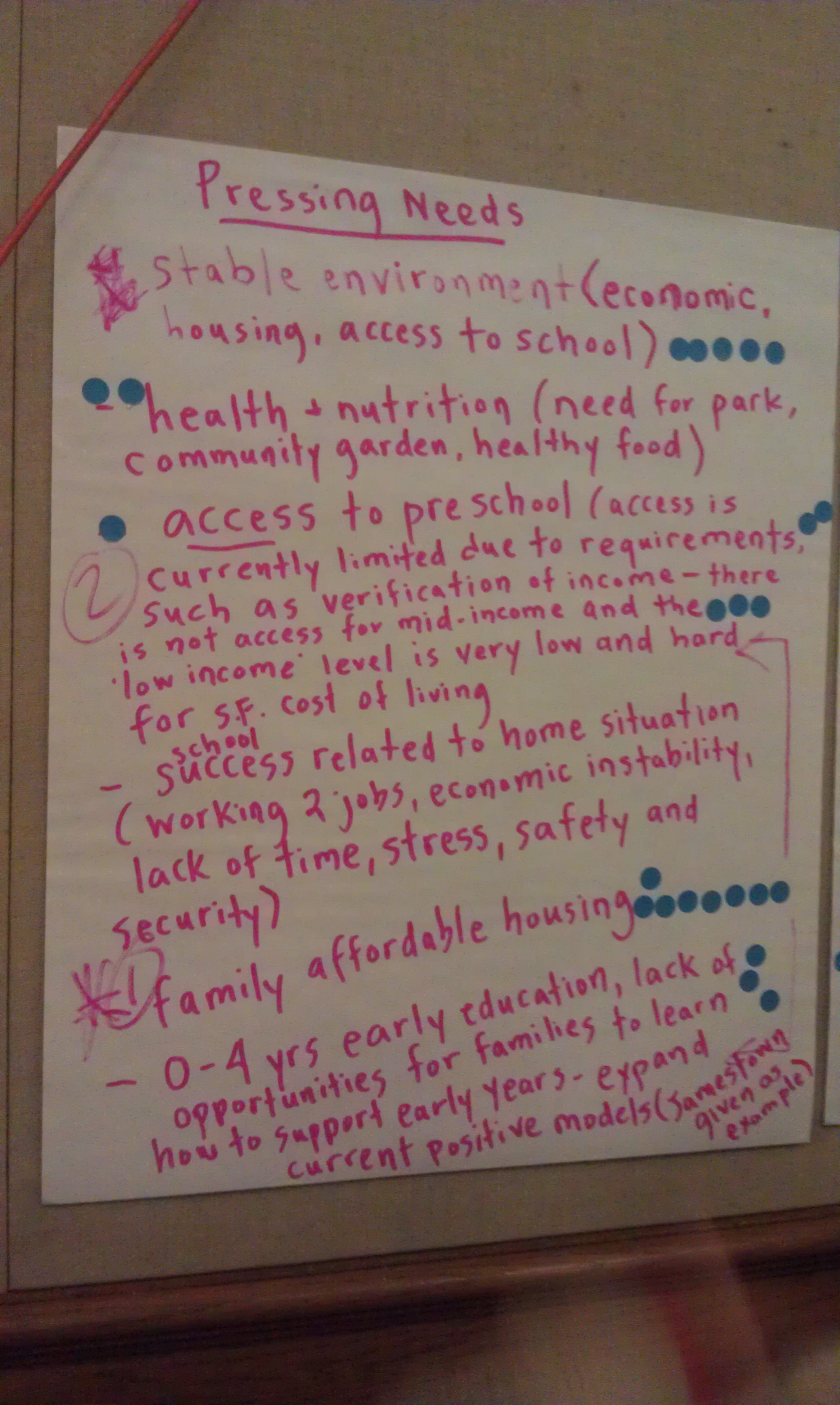
In recent weeks, the San Francisco Unified School District has held a series of community forums to ask parents what they think kids need in order to thrive in school. The meetings were held as part of a policymaking process leading up to next year’s renewal of two important funds – the Children’s Fund and the Public Education Enrichment Fund, which account for some $100 million in funding combined.

There were huge turnouts – a Chinatown forum, where Mayor Ed Lee was reportedly in attendance, attracted more than 180 participants, while a Nov. 14 meeting at Cesar Chavez Elementary in the Mission District drew a crowd of between 80 and 90.

The parents weren’t exactly asking for more museum field trips for their kids. During breakout sessions where facilitators wrote group members’ concerns on flip pads, a few recurring themes emerged. “Job security for parents,” one read. “Affordable housing,” another stated. “It’s a shame to have to talk about lack of funds given wealth and corporations in SF,” more parent feedback stated.

Maria Su, director of the San Francisco Department of Children, Youth and their Families, thanked parents for coming and told them, “We know how hard it is and how challenging it is to survive in the city. But that doesn’t mean we should give up.”

The event provided a glimpse into just how tough it is for families to get by in a city where a hefty cost of living amounts to serious pressure. “The sacrifices they make is, their children will have access to resources you can’t get anywhere else,” said Mario Paz with the Good Samaritan Family Resource Center, who works with a lot of Latino immigrant families.

A report digesting the findings of stakeholder focus groups distilled the pressures facing families. “Many participants commented on … the extraordinarily high cost of living in San Francisco,” it noted, which “contributes to both financial and emotional strain on the part of our many working class and lower income residents.”

New movies: a great week for docs

1

This week, doc lovers are in luck: not only is Chris Marker’s seminal 1962 Le Joli Mai making a return to theaters (Sam Stander’s take here), but Oscar-winning director Alex Gibney delves into cycling’s greatest scandal in The Armstrong Lie (my review here).

Plus! The moving American Promise, filmed over 13 years; the latest from Lynne Sachs, Your Day Is My Night; and more, after the jump.

http://www.youtube.com/watch?v=knFReWtLkgc

American Promise This remarkable look at race, education, parenting, and coming-of-age in contemporary America is the result of 13 years spent following African American youths Seun and Idris (the latter the son of filmmakers Joe Brewster and Michèle Stephenson). At the beginning, the Brooklyn pals are both starting at the exclusive Dalton School, where most of their classmates are rich white kids. This translates into culture-clash experiences both comical (a 13-year-old Idris estimates he’s been to 20 bar mitzvahs) and distressing, as both boys struggle socially and academically for reasons that seem to have a lot to do with their minority status at the school. Culled from hundreds of hours of footage — a mix of interviews and cinéma vérité — Brewster and Stephenson’s film captures honest moments both mundane and monumental, sometimes simultaneously, as when Seun’s mother, driving the kids to school, discusses her battle with cancer as his younger siblings trill a Journey song in the back seat. (And even this seemingly light-hearted aside takes on heft later in the film.) Extra props to Brewster and Stephenson, who clearly made a conscious choice not to edit out any of their own foibles — for the most part, they’re caring, involved parents, but be warned: strident homework nagging is a recurrent theme. (2:20) Roxie. (Eddy)

The Best Man Holiday Taye Diggs and Sanaa Lathan lead an ensemble cast in this seasonal sequel to 1999 hit The Best Man. (2:00)

http://www.youtube.com/watch?v=0sPr4snZqcM

The Book Thief One of those novels that seems to have been categorized as “young adult” more for reasons of marketing than anything else, Markus Zusak’s international best seller gets an effective screen adaptation from director Brian Percival and scenarist Michael Petroni. Liesl (Sophie Nelisse) is an illiterate orphan — for all practical purposes, that is, given the likely fate of her left-leaning parents in a just-pre-World War II Nazi Germany — deposited by authorities on the doorstep of the middle-aged, childless Hubermanns in 1938. Rosa (Emily Watson) is a ceaseless nag and worrywart, even if her bark is worse than her bite; kindly housepainter Hans (Geoffrey Rush), who’s lost work by refusing to join “the Party,” makes a game of teacher Liesl how to read. Her subsequent fascination with books attracts the notice of the local Burgermeister’s wife (Barbara Auer), who under the nose of her stern husband lets the girl peruse tomes from her manse’s extensive library. But that secret is trivial compared to the Hubermanns’ hiding of Max Vandenburg (Ben Schnetzer), son of Jewish comrade who’d saved Hans’ life in the prior world war. When war breaks out anew, this harboring of a fugitive becomes even more dangerous, something Liesl can’t share even with her best friend Rudy (Nico Liersch). While some of the book’s subplots and secondary characters are sacrificed for the sake of expediency, the filmmakers have crafted a potent, intelligent drama whose judicious understatement extends to the subtlest (and first non-Spielberg) score John Williams has written in years. Rush, Watson, and newcomer Schnetzer are particularly good in the well-chosen cast. (2:11) (Dennis Harvey)

How I Live Now As 16-year-old Daisy (Saoirse Ronan) arrives to spend the summer with cousins she’s never met, England is on the brink of war with an unnamed adversary. Daisy wants nothing to do with her new family and their idyllic countryside home — she’s too caught up in self-loathing image and diet obsessions, which manifest in the movie as overwhelming voiceover chatter. Her eldest cousin, Eddie (George MacKay), begins to draw her out of her shell, but everything changes when a nuclear explosion hits the country. At first, the cousins’ post-apocalyptic life is a charming bucolic, soundtracked by British folk-rock. But the horrors of war soon find them, and the movie’s latter half takes on a quite different tone. Adapted from Meg Rosoff’s YA novel, How I Live Now is almost eager to tackle the ugliest aspects of wartime existence — mass graves, prisoner abuse, work camps — and this unflinching approach is compelling, despite some flaws in the acting and character development. (1:41) (Sam Stander)

Your Day Is My Night Multidisciplinary artist Lynne Sachs returns to SF with this feature set in the world of NYC’s Chinatown “shift bed” apartments — ones whose crowded tenants take turns using sleeping space, a phenomenon that exists in many US cities and immigrant communities. An experimental mix of documentary and staged narrative, Day’s cohabiting protagonists are primarily older émigrés from China with diverse current jobs and divergent memories of life back home — from fond family reminiscences to the horrors of the Cultural Revolution. The individual stories told here are related not just in verbiage (both scripted and improvised), but song, dance, theater, poetical imagery, and composer-sound designer Stephen Vitiello’s collage soundtrack. At Other Cinema, Sachs will also present several of her short film works, including 2006’s Three Cheers for the Whale, a collaboration with the late Chris Marker that revised his 1972 Viva la Baleine, which was co-directed with Mario Ruspoli. In addition to its ATA screening Sat/16, Your Day Is My Night also plays the Pacific Film Archive Nov 20. (1:03) Artists’ Television Access. (Dennis Harvey)

Music Listings: Nov. 13-19

0

WEDNESDAY 13
ROCK
Brick & Mortar Music Hall: 1710 Mission, San Francisco. Hot Toddies, Kill Moi, Odd Owl, Blaus, 9 p.m., $6-$9.
Cafe Du Nord: 2170 Market, San Francisco. “Thanks But No Thanksgiving,” Benefit for KUSF in Exile and One Mama featuring The Sam Chase, Jesús & The Rabbis, M.O.M. DJs, 9 p.m., $10-$15.
The Chapel: 777 Valencia St., San Francisco. Those Darlins, Diane Coffee, Jesus Sons, 9 p.m., $12-$15.
Elbo Room: 647 Valencia, San Francisco. Buffalo Tooth, Commissure, Growwler, Popgang DJs, 9 p.m., free.
Hemlock Tavern: 1131 Polk, San Francisco. White Mystery, Dead Meat, 8:30 p.m., $10.
Hotel Utah: 500 Fourth St., San Francisco. Grex, Cash Pony, Inner Ear Brigade, Mark Clifford Quartet, 8 p.m., $8-$10.
Monarch: 101 6th St., San Francisco. Tall Fires, Mosaics, Unruly Things, Stomping Grounds, 8 p.m., $8.
Thee Parkside: 1600 17th St., San Francisco. The Deer Tracks, Low Leaf, Survival Guide, 8 p.m., $10.
DANCE
The Cafe: 2369 Market, San Francisco. “Sticky Wednesdays,” w/ DJ Mark Andrus, 8 p.m., free.
Cat Club: 1190 Folsom, San Francisco. “Bondage A Go Go,” w/ DJs Damon, Tomas Diablo, & guests, 9:30 p.m., $5-$10.
Clift Hotel, Redwood Room: 495 Geary, San Francisco. “Enigma: Sessions 003,” w/ Reckless in Vegas, Dean Samaras, Richard Habib, Marija Dunn, 6 p.m., free.
Club X: 715 Harrison, San Francisco. “Electro Pop Rocks,” 18+ dance party with Gummy & Dosvec, 9 p.m.
Edinburgh Castle: 950 Geary, San Francisco. “1964,” w/ DJ Matt B & guests, Second and Fourth Wednesday of every month, 10 p.m., $2.
The EndUp: 401 Sixth St., San Francisco. “Tainted Techno Trance,” 10 p.m.
F8: 1192 Folsom St., San Francisco. “Housepitality,” w/ Francesca Lombardo, Michael Tello, Paul Carey, Mike Bee, Joel Conway, 9 p.m., $5-$10.
Harlot: 46 Minna, San Francisco. “Qoöl,” 5 p.m.
The Independent: 628 Divisadero, San Francisco. Thundercat, Real Magic, The Seshen, 8 p.m., $15-$17.
Infusion Lounge: 124 Ellis, San Francisco. “Indulgence,” 10 p.m.
The Knockout: 3223 Mission, San Francisco. “Disorder,” w/ Detachments, Replicanti, DJ Nickie, 10 p.m., $5.
Lookout: 3600 16th St., San Francisco. “What?,” w/ resident DJ Tisdale and guests, 7 p.m., free.
Madrone Art Bar: 500 Divisadero, San Francisco. “Rock the Spot,” 9 p.m., free.
MatrixFillmore: 3138 Fillmore, San Francisco. “Reload,” w/ DJ Big Bad Bruce, 10 p.m., free.
Q Bar: 456 Castro, San Francisco. “Booty Call,” w/ Juanita More, Joshua J, guests, 9 p.m., $3.
HIP-HOP
Double Dutch: 3192 16th St., San Francisco. “Cash IV Gold,” w/ DJs Kool Karlo, Roost Uno, and Sean G, 10 p.m., free.
Skylark Bar: 3089 16th St., San Francisco. “Mixtape Wednesday,” w/ resident DJs Strategy, Junot, Herb Digs, & guests, 9 p.m., $5.
ACOUSTIC
Cafe Divine: 1600 Stockton, San Francisco. Craig Ventresco & Meredith Axelrod, 7 p.m., free.
Club Deluxe: 1511 Haight, San Francisco. Happy Hour Bluegrass, 6:30 p.m., free.
Dolores Park Cafe: 501 Dolores, San Francisco. Joe Marson & Roem Baur, 6:30 p.m.
Johnny Foley’s Irish House: 243 O’Farrell St., San Francisco. Terry Savastano, Every other Wednesday, 9 p.m., free.
The Lost Church: 65 Capp St., San Francisco. Tall Heights, Jeff Conley, 8 p.m., $10.
Plough & Stars: 116 Clement, San Francisco. Daniel Seidel, 9 p.m.
Rickshaw Stop: 155 Fell, San Francisco. Farallons, Michael Musika, From a Fountain, 8 p.m., $10.
Swedish American Hall: 2174 Market, San Francisco. Vanessa Carlton, Birdcloud, 7:30 p.m., $25.
JAZZ
Amnesia: 853 Valencia, San Francisco. Gaucho, Eric Garland’s Jazz Session, The Amnesiacs, 7 p.m., free.
Burritt Room: 417 Stockton St., San Francisco. Terry Disley’s Rocking Jazz Trio, 6 p.m., free.
Center for New Music: 55 Taylor St., San Francisco. Peter Brötzmann & Paal Nilssen-Love, 7:30 p.m., $18-$28.
Jazz Bistro At Les Joulins: 44 Ellis, San Francisco. Charles Unger Experience, 7:30 p.m., free.
Le Colonial: 20 Cosmo, San Francisco. The Cosmo Alleycats featuring Ms. Emily Wade Adams, 7 p.m., free.
Savanna Jazz Club: 2937 Mission, San Francisco. “Cat’s Corner,” 9 p.m., $10.
Sheba Piano Lounge: 1419 Fillmore, San Francisco. Jesse Foster, 8 p.m.
Top of the Mark: One Nob Hill, 999 California, San Francisco. Ricardo Scales, Wednesdays, 6:30-11:30 p.m., $5.
Tupelo: 1337 Green St., San Francisco. Kit Ruscoe, 9:30 p.m.
Zingari: 501 Post, San Francisco. Sherri Roberts, 7:30 p.m., free.
INTERNATIONAL
Bissap Baobab: 3372 19th St., San Francisco. Timba Dance Party, w/ DJ WaltDigz, 10 p.m., $5.
Cafe Cocomo: 650 Indiana, San Francisco. “Bachatalicious,” w/ DJs Good Sho & Rodney, 7 p.m., $5-$10.
First Unitarian Universalist Society of San Francisco: 1187 Franklin, San Francisco. Kaoru Kakizakai with Shirley Kazuyo Muramoto, 7 p.m., $20.
Pachamama Restaurant: 1630 Powell, San Francisco. “Cafe LatinoAmericano,” 8 p.m., $5.
BLUES
Biscuits and Blues: 401 Mason, San Francisco. Alvon Johnson, 7:30 & 9:30 p.m., $15.
The Saloon: 1232 Grant, San Francisco. Leah Tysse, 9:30 p.m.
FUNK
Vertigo: 1160 Polk, San Francisco. “Full Tilt Boogie,” w/ KUSF-in-Exile DJs, Second Wednesday of every month, 8 p.m.-1:30 a.m., free.
SOUL
The Royal Cuckoo: 3202 Mission, San Francisco. Freddie Hughes & Chris Burns, 7:30 p.m., free.
THURSDAY 14
ROCK
Bottom of the Hill: 1233 17th St., San Francisco. 65daysofstatic, Caspian, The World Is a Beautiful Place & I Am No Longer Afraid to Die, 9 p.m., $15-$17.
Brick & Mortar Music Hall: 1710 Mission, San Francisco. The Besnard Lakes, Elephant Stone, 9 p.m., $13-$15.
S.F. Eagle: 398 12th St., San Francisco. Thursday Nite Live: Titan Ups, Bell Tower, The Hampton Wicks, 9 p.m., $8.
Hemlock Tavern: 1131 Polk, San Francisco. Slough Feg, Skeletor, Vulturegeist, 8:30 p.m., $10.
The Independent: 628 Divisadero, San Francisco. KMFDM, Chant, 8 p.m., $28-$30.
The Knockout: 3223 Mission, San Francisco. Vaz, Burmese, Donkee, 10 p.m., $8.
Thee Parkside: 1600 17th St., San Francisco. Alestorm, Trollfest, Gypsyhawk, Valensorow, 9 p.m., $20.
DANCE
1015 Folsom: 1015 Folsom St., San Francisco. “A Light in the Attic,” w/ Phutureprimitive, Unlimited Gravity, Soulular, Bedrockk, Evolutionista, Smash & Grab, 10 p.m., $5-$10 advance.
Abbey Tavern: 4100 Geary, San Francisco. DJ Schrobi-Girl, 10 p.m., free.
Audio Discotech: 316 11th St., San Francisco. “Phonic,” w/ Felix Cartal, Ron Reeser, more, 9:30 p.m., $10 advance.
Aunt Charlie’s Lounge: 133 Turk, San Francisco. “Tubesteak Connection,” w/ DJ Bus Station John, 9 p.m., $5-$7.
The Cafe: 2369 Market, San Francisco. “¡Pan Dulce!,” 9 p.m., $5.
Cat Club: 1190 Folsom, San Francisco. “Throwback Thursdays,” ‘80s night with DJs Damon, Steve Washington, Dangerous Dan, and guests, 9 p.m., $6 (free before 9:30 p.m.).
The Cellar: 685 Sutter, San Francisco. “XO,” w/ DJs Astro & Rose, 10 p.m., $5.
Club X: 715 Harrison, San Francisco. “The Crib,” 9:30 p.m., $10, 18+.
Danzhaus: 1275 Connecticut, San Francisco. “Alt.Dance,” Second Thursday of every month, 7 p.m., $7, 18+.
DNA Lounge: 375 11th St., San Francisco. “8bitSF,” w/ Crashfaster, Bit Shifter, Trash80, Unwoman, DJ Doctor Popular, 9 p.m., $10-$15.
Elbo Room: 647 Valencia, San Francisco. “Afrolicious,” w/ DJs Pleasuremaker, Señor Oz, and live guests, 9:30 p.m., $5-$8.
Harlot: 46 Minna, San Francisco. “Modular,” w/ Uner, JOill, Pedro Arbulu, MFYRS, 9 p.m., $7-$10.
Infusion Lounge: 124 Ellis, San Francisco. “I Love Thursdays,” 10 p.m., $10.
Madrone Art Bar: 500 Divisadero, San Francisco. “Night Fever,” 9 p.m., $5 after 10 p.m.
Public Works: 161 Erie, San Francisco. “Enigma,” w/ Butane, Stephanie, Marija Dunn, Amber Reyn, Richard Habib (in the OddJob Loft), 10 p.m., $10-$20 advance.
Q Bar: 456 Castro, San Francisco. “Throwback Thursday,” w/ DJ Jay-R, 9 p.m., free.
Raven: 1151 Folsom St., San Francisco. “1999,” w/ VJ Mark Andrus, 8 p.m., free.
Ruby Skye: 420 Mason, San Francisco. “Awakening,” w/ Danny Avila, Matisse Sadko, 9 p.m., $20-$25 advance.
The Tunnel Top: 601 Bush, San Francisco. “Tunneltop,” DJs Avalon and Derek ease you into the weekend with a cool and relaxed selection of tunes spun on vinyl, 10 p.m., free.
Underground SF: 424 Haight, San Francisco. “Bubble,” 10 p.m., free.
HIP-HOP
Eastside West: 3154 Fillmore, San Francisco. “Throwback Thursdays,” w/ DJ Madison, 9 p.m., free.
The EndUp: 401 Sixth St., San Francisco. “Cypher,” w/ resident DJ Big Von, 10 p.m., $5-$10.
John Colins: 138 Minna, San Francisco. “Party with Friends,” w/ resident DJs IllEfect, GeektotheBeat, Merrick, and Delrokz, Second Thursday of every month, 9 p.m., free.
Mezzanine: 444 Jessie, San Francisco. A$AP Ferg, A$AP Mob, Joey Fatts, Aston Matthews, 100s, DJ Sean G, 9 p.m., $20.
Milk Bar: 1840 Haight, San Francisco. Rime Force Most Illin’, Fatees, Al Lover, Height with Friends, DJ Brycon, 9 p.m., $5.
Park 77 Sports Bar: 77 Cambon, San Francisco. “Slap N Tite,” w/ resident Cali King Crab DJs Sabotage Beats & Jason Awesome, free.
Skylark Bar: 3089 16th St., San Francisco. “Peaches,” w/lady DJs DeeAndroid, Lady Fingaz, That Girl, Umami, Inkfat, and Andre, 10 p.m., free.
ACOUSTIC
Amnesia: 853 Valencia, San Francisco. Ghost & Gale, Lea Pruett, The Shants, 9 p.m., $7-$10.
Atlas Cafe: 3049 20th St., San Francisco. Gayle Lynn & The Hired Hands, 8 p.m., free.
Bazaar Cafe: 5927 California, San Francisco. Acoustic Open Mic, 7 p.m.
Boom Boom Room: 1601 Fillmore, San Francisco. Whitewater Ramble, Free Peoples, 9:30 p.m., $10.
Cafe Du Nord: 2170 Market, San Francisco. The Melodic, Steve Taylor Band, Sophia Knapp, 8:30 p.m., $12.
The Lost Church: 65 Capp St., San Francisco. Aireene & The Hobos, Deborah Crooks, 8 p.m., $10-$12.
Pa’ina: 1865 Post St., San Francisco. Ashley Lilinoe, 7 p.m., free.
Plough & Stars: 116 Clement, San Francisco. Emperor Norton Céilí Band, 9 p.m.
Yoshi’s San Francisco: 1330 Fillmore, San Francisco. An Evening with Graham Nash, 8 p.m., $89.
JAZZ
Blush! Wine Bar: 476 Castro, San Francisco. Doug Martin’s Avatar Ensemble, 7:30 p.m., free.
Bottle Cap: 1707 Powell, San Francisco. The North Beach Sound with Ned Boynton, Jordan Samuels, and Tom Vickers, 7 p.m., free.
Cafe Claude: 7 Claude, San Francisco. Mad & Eddie Duran Trio, 7:30 p.m., free.
Le Colonial: 20 Cosmo, San Francisco. Steve Lucky & The Rhumba Bums, 7:30 p.m.
The Royal Cuckoo: 3202 Mission, San Francisco. Charlie Siebert & Chris Burns, 7:30 p.m., free.
Savanna Jazz Club: 2937 Mission, San Francisco. Savanna Jazz Jam with Eddy Ramirez, 7:30 p.m., $5.
SFJAZZ Center: 205 Franklin St., San Francisco. “Hotplate,” w/ Tiffany Austin (playing Hoagy Carmichael), 8 & 9:30 p.m.
Top of the Mark: One Nob Hill, 999 California, San Francisco. Stompy Jones, 7:30 p.m., $10.
Zingari: 501 Post, San Francisco. Barbara Ochoa, 7:30 p.m., free.
INTERNATIONAL
Bissap Baobab: 3372 19th St., San Francisco. “Pa’Lante!,” w/ Juan G, El Kool Kyle, Mr. Lucky, 10 p.m., $5.
Cafe Cocomo: 650 Indiana, San Francisco. Danilo y Universal, DJ Good Sho, 8 p.m., $12.
Fort Mason, Southside Theater: Marina, San Francisco. Theatre Flamenco: Con Nombre y Apellido, The country’s oldest flamenco dance company celebrates its 47th home season., Nov. 14-16, 8 p.m.; Sun., Nov. 17, 2 p.m., $35-$75.
H Cafe: 3801 17th St., San Francisco. An Evening to Benefit the Duniya Center for Arts & Education, w/ Duniya Dance & Drum Company, Wontanara Revolution, Charlotte Nehm, Vanessa Sanchez, Naila, more, 6 p.m., $35-$80.
Pachamama Restaurant: 1630 Powell, San Francisco. “Jueves Flamencos,” 8 p.m., free.
Pier 23 Cafe: Pier 23, San Francisco. Armando Compean, 7 p.m., free.
Sheba Piano Lounge: 1419 Fillmore, San Francisco. Gary Flores & Descarga Caliente, 8 p.m.
Verdi Club: 2424 Mariposa, San Francisco. The Verdi Club Milonga, w/ Christy Coté, DJ Emilio Flores, guests, 9 p.m., $10-$15.
REGGAE
Make-Out Room: 3225 22nd St., San Francisco. “Festival ‘68,” w/ Revival Sound System, Second Thursday of every month, 10 p.m., free.
Pissed Off Pete’s: 4528 Mission St., San Francisco. Reggae Thursdays, w/ resident DJ Jah Yzer, 9 p.m., free.
BLUES
50 Mason Social House: 50 Mason, San Francisco. Bill Phillippe, 5:30 p.m., free.
Biscuits and Blues: 401 Mason, San Francisco. Nick Moss, 7:30 & 9:30 p.m., $20.
Jazz Bistro At Les Joulins: 44 Ellis, San Francisco. Bohemian Knuckleboogie, 7:30 p.m., free.
The Saloon: 1232 Grant, San Francisco. Tom Bowers, 4 p.m.; Steve Freund, 9:30 p.m.
COUNTRY
The Parlor: 2801 Leavenworth, San Francisco. “Twang Honky Tonk & Country Jamboree,” w/ DJ Little Red Rodeo, 7 p.m., free.
EXPERIMENTAL
The Luggage Store: 1007 Market, San Francisco. Capricious Forms Vol. 1, 8 p.m., $6-$10.
Yerba Buena Center for the Arts: 701 Mission, San Francisco. San Francisco Contemporary Music Players, 8 p.m., $12-$30.
FRIDAY 15
ROCK
Bottom of the Hill: 1233 17th St., San Francisco. Meat Puppets, The World Takes, 10 p.m., $17.
Brick & Mortar Music Hall: 1710 Mission, San Francisco. Golden Void, Hot Lunch, Harsh Toke, 9 p.m., $7-$10.
DNA Lounge: 375 11th St., San Francisco. Happy Fangs, Night Club, Everyone Is Dirty, Kat Haus, 8 p.m., $10.
El Rio: 3158 Mission, San Francisco. Friday Live: Down in Front, DJ Emotions, 10 p.m., free.
Hotel Utah: 500 Fourth St., San Francisco. The Bananas, Audacity, Hunters, Caldecott, 9 p.m., $10-$12.
Milk Bar: 1840 Haight, San Francisco. Part Time, Exray’s, Andy Human, Epicsauce DJs, 9 p.m., $10.
Rickshaw Stop: 155 Fell, San Francisco. Heroes and the Homo Superior: The Parables of Fancy Nancy, A “David Bowie superhero burlesque rock odyssey” featuring music by First Church of the Sacred Silversexual, burlesque routines by Hubba Hubba Revue, drag performances, and more., 9 p.m., $13.
Slim’s: 333 11th St., San Francisco. Alternative Tentacles 33 1/3 Anniversary Party, w/ Jello Biafra & The Guantanamo School of Medicine, Mojo Nixon, Death Hymn Number 9, Pins of Light., 8 p.m., $18.
Thee Parkside: 1600 17th St., San Francisco. That Ghost, FayRoy, Sons of Hippies, WAG, 9 p.m., $8.
DANCE
1015 Folsom: 1015 Folsom St., San Francisco. Rusko, Roni Size, Tonn Piper, Dynamite MC, Havoc, Ivry, Nebakaneza, Mr. Kitt, Johnny5, Danny Weird, Miss Haze, DJ Dials, Jays One, Audio-Troma, White Mike, Ryury., 10 p.m., $25 advance.
Audio Discotech: 316 11th St., San Francisco. Alex Sibley, Eelrack, Festiva, 9:30 p.m., $10 advance.
Cafe Flore: 2298 Market, San Francisco. “Kinky Beats,” w/ DJ Sergio, 10 p.m., free.
The Cafe: 2369 Market, San Francisco. “Boy Bar,” w/ DJ Matt Consola, 9 p.m., $5.
Cat Club: 1190 Folsom, San Francisco. “The Witching Hour,” w/ DJs Sage, Daniel Skellington, Joe Radio, and Nickie, 9:30 p.m., $7 ($3 before 10 p.m.).
The Cellar: 685 Sutter, San Francisco. “F.T.S.: For the Story,” 10 p.m.
The Chapel: 777 Valencia St., San Francisco. DJ Assault, Double Duchess, BadboE, Rapid Fire, 10 p.m., $10-$15.
DNA Lounge: 375 11th St., San Francisco. “So Stoked 13,” w/ Daniel Kandi, Ravine, Jimini Cricket, more, 7 p.m., $15-$25.
The EndUp: 401 Sixth St., San Francisco. “Fever,” 10 p.m., free before midnight.
The Grand Nightclub: 520 4th St., San Francisco. “We Rock Fridays,” 9:30 p.m.
Infusion Lounge: 124 Ellis, San Francisco. “Escape Fridays,” 10 p.m., $20.
Lookout: 3600 16th St., San Francisco. “HYSL,” 9 p.m., $3.
Madrone Art Bar: 500 Divisadero, San Francisco. “That ‘80s Show,” w/ DJs Dave Paul & Jeff Harris, Third Friday of every month, 9 p.m., $5.
Manor West: 750 Harrison, San Francisco. “Fortune Fridays,” 10 p.m., free before 11 p.m. with RSVP.
MatrixFillmore: 3138 Fillmore, San Francisco. “F-Style Fridays,” w/ DJ Jared-F, 9 p.m.
Mezzanine: 444 Jessie, San Francisco. “Fools in the Night,” w/ Ladyhawke (DJ set), American Royalty, Blackbird Blackbird, Aaron Axelsen, 9 p.m., $15.
Mighty: 119 Utah, San Francisco. “Masters at Work,” w/ Kenny Dope & Louie Vega, 9 p.m., $20-$50.
OMG: 43 6th St., San Francisco. “Release,” 9 p.m., free before 11 p.m.
Public Works: 161 Erie, San Francisco. “Odyssey,” w/ Rick Preston, Robin Simmons, Trevor Sigler (in the OddJob Loft), 9:30 p.m., $10.
Q Bar: 456 Castro, San Francisco. “Pump: Worq It Out Fridays,” w/ resident DJ Christopher B, 9 p.m., $3.
Ruby Skye: 420 Mason, San Francisco. Arnej, Bobina, Dirtyhertz, 9 p.m., $20 advance.
Slate Bar: 2925 16th St., San Francisco. “Darling Nikki,” w/ resident DJs Dr. Sleep, Justin Credible, and Durt, Third Friday of every month, 8 p.m., $5.
Sub-Mission Art Space (Balazo 18 Gallery): 2183 Mission, San Francisco. “Deathrock Night Terrors,” w/ The Frozen Autumn, V.E.X., Red Light, plus DJs Le Perv, Necromos, and Burning Skies, 8:30 p.m., $12-$15.
Temple: 540 Howard, San Francisco. “Refresh,” w/ Pedro Arbulu, Chemical Ali, David Gregory, DJ Tone, DJ Von, 10 p.m., $15.
Underground SF: 424 Haight, San Francisco. “Bionic,” 10 p.m., $5.
Vessel: 85 Campton, San Francisco. Dirty South, 10 p.m.
Wish: 1539 Folsom, San Francisco. “Bridge the Gap,” w/ resident DJ Don Kainoa, Fridays, 6-10 p.m., free; “Depth,” w/ resident DJs Sharon Buck & Greg Yuen, Third Friday of every month, 10 p.m., free.
HIP-HOP
EZ5: 682 Commercial, San Francisco. “Decompression,” Fridays, 5-9 p.m.
The Independent: 628 Divisadero, San Francisco. Big Freedia, 9 p.m., $20.
John Colins: 138 Minna, San Francisco. “Juicy,” w/ DJ Ry Toast, Third Friday of every month, 10 p.m., $5 (free before 11 p.m.).
Showdown: 10 Sixth St., San Francisco. BPos, Mo Classics, Monk McNizzle, 9 p.m., free.
Yoshi’s San Francisco: 1330 Fillmore, San Francisco. Sir Mix-A-Lot, 10:30 p.m., $18-$22.
ACOUSTIC
Amnesia: 853 Valencia, San Francisco. SnowApple, 7 p.m.
Bazaar Cafe: 5927 California, San Francisco. The Canon Band, 7 p.m.
Cafe Du Nord: 2170 Market, San Francisco. Megan Slankard, Tom Freund, Wafflebarrel, 9 p.m., $15.
Mercury Cafe: 201 Octavia, San Francisco. Toshio Hirano, Third Friday of every month, 7:30 p.m., free, all ages.
Plough & Stars: 116 Clement, San Francisco. “Bluegrass Bonanza,” w/ Travers Chandler & Avery County, Belle Monroe & Her Brewglass Boys, 9 p.m., $6-$10.
Red Poppy Art House: 2698 Folsom, San Francisco. Amy LaCour with Ross Hammond, 7:30 p.m., $10-$15.
The Sports Basement: 610 Old Mason, San Francisco. “Breakfast with Enzo,” w/ Enzo Garcia, 10 a.m., $5.
Yoshi’s San Francisco: 1330 Fillmore, San Francisco. An Evening with Mason Jennings, 8 p.m., $29.
JAZZ
Beach Chalet Brewery & Restaurant: 1000 Great Highway, San Francisco. Johnny Smith, 8 p.m., free.
Bird & Beckett: 653 Chenery, San Francisco. The Third Quartet, Third Friday of every month, 5:30 p.m., free.
Cafe Claude: 7 Claude, San Francisco. Nick Rossi Trio, 9:30 p.m., free.
City College: 50 Phelan, San Francisco. The Cartoon Jazz Band, 7:30 p.m., free.
Jazz Bistro At Les Joulins: 44 Ellis, San Francisco. Charles Unger Experience, 7:30 p.m., free.
The Palace Hotel: 2 New Montgomery, San Francisco. The Klipptones, 8 p.m., free.
Revolution Cafe: 3248 22nd St., San Francisco. Emily Anne’s Delights, Third Friday of every month, 8:45 p.m., free/donation.
Savanna Jazz Club: 2937 Mission, San Francisco. Jim Butler Group, 7:30 p.m., $8.
SFJAZZ Center: 205 Franklin St., San Francisco. Pamela Rose & Wayne De La Cruz, 7 & 8:30 p.m., $25.
Sheba Piano Lounge: 1419 Fillmore, San Francisco. Sam Caddy Quintet, 9 p.m.
Top of the Mark: One Nob Hill, 999 California, San Francisco. Black Market Jazz Orchestra, 9 p.m., $10.
Zingari: 501 Post, San Francisco. Joyce Grant, 8 p.m., free.
INTERNATIONAL
Bissap Baobab: 3372 19th St., San Francisco. Qumbia Qrew, Third Friday of every month, 8 p.m.; “Paris-Dakar African Mix Coupe Decale,” 10 p.m., $5.
Cafe Cocomo: 650 Indiana, San Francisco. Taste Fridays, featuring local cuisine tastings, salsa bands, dance lessons, and more, 7:30 p.m., $15 (free entry to patio).
Cigar Bar & Grill: 850 Montgomery, San Francisco. Orquesta La Clave, 8 p.m.
Fort Mason, Southside Theater: Marina, San Francisco. Theatre Flamenco: Con Nombre y Apellido, The country’s oldest flamenco dance company celebrates its 47th home season., Nov. 14-16, 8 p.m.; Sun., Nov. 17, 2 p.m., $35-$75.
Pachamama Restaurant: 1630 Powell, San Francisco. Cuban Night with Fito Reinoso, 7:30 & 9:15 p.m., $15-$18.
Pier 23 Cafe: Pier 23, San Francisco. Armando Compean, 8 p.m., free.
Public Works: 161 Erie, San Francisco. Afrolicious Band, J-Boogie, 10 p.m., $10.
REGGAE
Elbo Room: 647 Valencia, San Francisco. “The Social,” w/ Native Elements, Jah Yzer, 10 p.m., $10.
Gestalt Haus: 3159 16th St., San Francisco. “Music Like Dirt,” 7:30 p.m., free.
BLUES
Biscuits and Blues: 401 Mason, San Francisco. Kevin Selfe & The Tornadoes, 7:30 & 10 p.m., $20.
The Saloon: 1232 Grant, San Francisco. West Coast Blues Revue, 4 p.m.; Cathy Lemons, 9:30 p.m.
FUNK
Amnesia: 853 Valencia, San Francisco. “Hella Tight,” w/ resident DJs Vinnie Esparza, Jonny Deeper, & Asti Spumanti, Third Friday of every month, 10 p.m., $5.
Dolores Park Cafe: 501 Dolores, San Francisco. Shake It! Booty Band, 7:30 p.m.
Make-Out Room: 3225 22nd St., San Francisco. “Loose Joints,” w/ DJs Centipede, Damon Bell, & Tom Thump, 10 p.m., $5.
SOUL
Edinburgh Castle: 950 Geary, San Francisco. “Soul Crush,” w/ DJ Serious Leisure, 10 p.m., free.
The Knockout: 3223 Mission, San Francisco. “Oldies Night,” W/ DJs Primo, Daniel, Lost Cat, and friends, Third Friday of every month, 10 p.m., $5.
SATURDAY 16
ROCK
Bender’s: 806 S. Van Ness, San Francisco. Moses, Hornss, 10 p.m., $5.
Bottom of the Hill: 1233 17th St., San Francisco. Quasi, Blues Control, Street Eaters, 9:30 p.m., $15.
Brick & Mortar Music Hall: 1710 Mission, San Francisco. Someone Still Loves You Boris Yeltsin, Army Navy, 9 p.m., $12-$15.
Cafe Du Nord: 2170 Market, San Francisco. San Francisco Food Bank Benefit with Tommy Guerrero & Friends, El Diablitos, DJ Romanowski, 9:30 p.m., $10-$15.
The Chapel: 777 Valencia St., San Francisco. Cellar Doors, 9 p.m., $12.
El Rio: 3158 Mission, San Francisco. Benefit for Family Dog Rescue with The Shams, The Next, The Unfortunate Bastard, Psychokitty, 9 p.m.
Hemlock Tavern: 1131 Polk, San Francisco. Guantanamo Baywatch, Death Hymn Number 9, Buffalo Tooth, Pookie & The Poodlez, 8:30 p.m., $7.
Hotel Utah: 500 Fourth St., San Francisco. “Rocket Ship!,” w/ Starr Saunders, The Coffis Brothers, Exhausted Pipes, Katie Ekin, 9 p.m., $8-$12.
Rickshaw Stop: 155 Fell, San Francisco. Tera Melos, Zorch, Sister Crayon, Creepers, 9 p.m., $15.
Slim’s: 333 11th St., San Francisco. Born Ruffians, Grmln, 9 p.m., $17.
Thee Parkside: 1600 17th St., San Francisco. Fog of War, Nekrofilth, Burning Monk, Tomes, 9:30 p.m., $8.
DANCE
Amnesia: 853 Valencia, San Francisco. “Pance Darty,” w/ Jjaaxxnn & Duke, Third Saturday of every month, 9 p.m., $7.
Audio Discotech: 316 11th St., San Francisco. Miguel Migs, Andrew Phelan, 9:30 p.m., $10 advance.
Balancoire: 2565 Mission St., San Francisco. “Play It Cool,” w/ Boogie Nite, Avalon Emerson, Derek Opperman, Guillaume Galuz, Matthew Favorites, 9 p.m., $5.
BeatBox: 314 11th St., San Francisco. “I Just Wanna F*ckin Dance,” w/ DJs Hector Fonseca & Chi Chi LaRue, 10 p.m., $15-$25.
Cafe Flore: 2298 Market, San Francisco. “Bistrotheque,” w/ DJ Ken Vulsion, 8 p.m., free.
Cat Club: 1190 Folsom, San Francisco. “New Wave City: Duran Duran Video Night,” w/ DJs Shindog, Andy T, B.A.D. Reputation, and Girl Panic, 9 p.m., $7-$12.
DNA Lounge: 375 11th St., San Francisco. “Bootie S.F.,” w/ DJ Tripp, Entyme, Meikee Magnetic, Mixtress Shizaam, Dcnstrct, MyKill, Hubba Hubba Revue, more, 9 p.m., $10-$15.
The EndUp: 401 Sixth St., San Francisco. “The Show,” w/ Ben Seagren, Dean Samaras, and guests (starts 2 a.m. Sunday morning), Third Saturday of every month, $10-$20 (free before 11 p.m.).
F8: 1192 Folsom St., San Francisco. “Hegemoney,” w/ Mr. Carmack, Insightful, Mikos Da Gawd, Bobby Peru, Starter Kit, 9 p.m., $10-$15.
Infusion Lounge: 124 Ellis, San Francisco. “Social Addiction,” Third Saturday of every month, 10 p.m., $20.
Lookout: 3600 16th St., San Francisco. “Bounce!,” 9 p.m., $3.
Madrone Art Bar: 500 Divisadero, San Francisco. “Fringe,” w/ DJs Blondie K & subOctave, Third Saturday of every month, 9 p.m., $5 (free before 10 p.m.).
Mighty: 119 Utah, San Francisco. “Mighty Real,” w/ Tiga, Bells & Whistles, David Harness, 10 p.m., $15 advance.
Milk Bar: 1840 Haight, San Francisco. “The Queen Is Dead: A Tribute to the Music of Morrissey & The Smiths,” w/ DJ Mario Muse & guests, Third Saturday of every month, 9 p.m.
Monarch: 101 6th St., San Francisco. “Lights Down Low,” w/ MK, Richie Panic, Sleazemore, MPHD, 10 p.m., $15-$20.
Powerhouse: 1347 Folsom, San Francisco. “Beatpig,” Third Saturday of every month, 9 p.m.
Project One: 251 Rhode Island, San Francisco. “Familia vs. Friends and Family,” w/ Lee Coombs, Ethan Miller, Ding Dong, Tamo, Nugz, 9 p.m., $10-$15 advance.
Public Works: 161 Erie, San Francisco. “Isis,” w/ PBR Streetgang, Mountaincount (in the OddJob Loft), 9:30 p.m., $10-$15.
Ruby Skye: 420 Mason, San Francisco. “World Town,” w/ Deorro, Trevor Simpson, 9 p.m., $20 advance.
Slate Bar: 2925 16th St., San Francisco. “Smiths Night S.F.,” w/ The Certain People Crew, Third Saturday of every month, 10 p.m., $5.
Slide: 430 Mason, San Francisco. “Luminous,” w/ DJ Zhaldee, Third Saturday of every month, 9 p.m.
Supperclub San Francisco: 657 Harrison, San Francisco. “Scorpio’s Ball,” w/ El Papa Chango, Smasheltooth, Jocelyn, Portal, 9 p.m., $10-$20.
Vessel: 85 Campton, San Francisco. Tall Sasha, 10 p.m., $10-$30.
HIP-HOP
111 Minna Gallery: 111 Minna St., San Francisco. “Shine,” Third Saturday of every month, 10 p.m.
John Colins: 138 Minna, San Francisco. “The Bump,” w/ The Whooligan, Third Saturday of every month, 10 p.m., free.
The Knockout: 3223 Mission, San Francisco. “The Booty Bassment,” w/ DJs Dimitri Dickinson & Ryan Poulsen, Third Saturday of every month, 10 p.m., $5.
Mezzanine: 444 Jessie, San Francisco. Spawnbreezie, BigBody Cisco, Drew Deezy, 9 p.m., $20.
Showdown: 10 Sixth St., San Francisco. “Purple,” w/ resident DJs ChaunceyCC & Party Pablo, Third Saturday of every month, 10 p.m.
ACOUSTIC
Amoeba Music: 1855 Haight, San Francisco. Mason Jennings, 3 p.m., free.
Atlas Cafe: 3049 20th St., San Francisco. Craig Ventresco & Meredith Axelrod, Saturdays, 4-6 p.m., free.
Bazaar Cafe: 5927 California, San Francisco. Paul Griffiths, 7 p.m.
The Independent: 628 Divisadero, San Francisco. Vienna Teng, 6 & 9 p.m., $25.
The Lost Church: 65 Capp St., San Francisco. North Home, Jean Marie, 8 p.m., $10.
Plough & Stars: 116 Clement, San Francisco. John Haesemeyer, Jeff Hayward, RonDre., 8 p.m., $6.
The Riptide: 3639 Taraval, San Francisco. Chris James & The Showdowns, 9:30 p.m., free.
St. Cyprian’s Episcopal Church: 2097 Turk, San Francisco. A Musical Tribute & Celebration of the Life & Songs of Phil Ochs, featuring Sonny Ochs, Kim & Reggie Harris, Carolyn Hester, James Lee Stanley, and Aileen Vance, 8 p.m., $17-$20.
Tupelo: 1337 Green St., San Francisco. Shantytown, 9 p.m.
Yoshi’s San Francisco: 1330 Fillmore, San Francisco. An Evening with Mason Jennings, 8 & 10 p.m., $24-$29.
JAZZ
Cafe Claude: 7 Claude, San Francisco. The Monroe Trio, 7:30 p.m., free.
Jazz Bistro At Les Joulins: 44 Ellis, San Francisco. Bill “Doc” Webster & Jazz Nostalgia, 7:30 p.m., free.
The Royal Cuckoo: 3202 Mission, San Francisco. Jules Broussard, Danny Armstrong, and Chris Siebert, 7:30 p.m., free.
Savanna Jazz Club: 2937 Mission, San Francisco. Lily Alunan, 7:30 p.m., $10.
SFJAZZ Center: 205 Franklin St., San Francisco. Wesla Whitfield, 7 & 8:30 p.m., $30.
Sheba Piano Lounge: 1419 Fillmore, San Francisco. The Robert Stewart Experience, 9 p.m.
Zingari: 501 Post, San Francisco. Brenda Reed, 8 p.m., free.
INTERNATIONAL
1015 Folsom: 1015 Folsom St., San Francisco. “Pura,” 9 p.m., $20.
Bissap Baobab: 3372 19th St., San Francisco. “Paris-Dakar African Mix Coupe Decale,” 10 p.m., $5.
Cafe Cocomo: 650 Indiana, San Francisco. Peruvian Salsa Showdown, w/ Pepe y Su Orquesta vs. Julio Bravo y Su Orquesta Salsabor, 8 p.m., $15.
Cigar Bar & Grill: 850 Montgomery, San Francisco. Conjunto Picante, 8 p.m.
Fort Mason, Southside Theater: Marina, San Francisco. Theatre Flamenco: Con Nombre y Apellido, The country’s oldest flamenco dance company celebrates its 47th home season., Nov. 14-16, 8 p.m.; Sun., Nov. 17, 2 p.m., $35-$75.
Make-Out Room: 3225 22nd St., San Francisco. “El SuperRitmo,” w/ DJs Roger Mas & El Kool Kyle, 10 p.m., $5.
OMG: 43 6th St., San Francisco. “Bollywood Blast,” Third Saturday of every month, 9 p.m., $5 (free before 10:30 p.m.).
Pachamama Restaurant: 1630 Powell, San Francisco. Peña Eddy Navia & Pachamama Band, 8 p.m., free.
Public Works: 161 Erie, San Francisco. “Non Stop Bhangra,” w/ Jimmy Love, Rav-E, Pavit, Mehul, Dholrhythms dance troupe, more (in the main room), 9 p.m., $10-$15.
Red Poppy Art House: 2698 Folsom, San Francisco. Makrú, 7:30 p.m., $10-$15.
Revolution Cafe: 3248 22nd St., San Francisco. Go Van Gogh, Third Saturday of every month, 9 p.m., free/donation.
Roccapulco Supper Club: 3140 Mission, San Francisco. Farruko, 8 p.m., $40 advance.
BLUES
Biscuits and Blues: 401 Mason, San Francisco. Paula Harris, 7:30 & 10 p.m., $20.
Pier 23 Cafe: Pier 23, San Francisco. Bobbie Webb, 8 p.m., free.
The Saloon: 1232 Grant, San Francisco. Tony Perez & Second Hand Smoke, Third Saturday of every month, 4 p.m.; Nick Gravenites, 9:30 p.m.
EXPERIMENTAL
Columbarium: One Loraine Court, San Francisco. Luciano Chessa: Lightest, 6 p.m., free.
FUNK
Boom Boom Room: 1601 Fillmore, San Francisco. Polyrhythmics, Ideateam, 9:30 p.m., $10-$15.
SOUL
Elbo Room: 647 Valencia, San Francisco. “Saturday Night Soul Party,” w/ DJs Lucky, Phengren Oswald, and Paul Paul, Third Saturday of every month, 10 p.m., $10 ($5 in formal attire).
SUNDAY 17
ROCK
Bottom of the Hill: 1233 17th St., San Francisco. The Grannies, Winter Teeth, Bar Fight, 7 p.m., $10.
Cafe Du Nord: 2170 Market, San Francisco. Grant Farm, Emily Yates, Misisipi Mike Wolf, 8 p.m., $12.
Hemlock Tavern: 1131 Polk, San Francisco. Pop. 1280, 8:30 p.m., $7.
The Independent: 628 Divisadero, San Francisco. Anna Calvi, Sandy’s, 8 p.m., $20.
Milk Bar: 1840 Haight, San Francisco. Corners, Froth, Adult Books, Bicycle Day, 8 p.m., $5.
Neck of the Woods: 406 Clement St., San Francisco. Cadaver Dogs, MoonFox, A Happy Death, 8 p.m., $5-$8.
Rickshaw Stop: 155 Fell, San Francisco. White Lung, Antwon, Tony Molina, 7 p.m., $10-$12.
Slim’s: 333 11th St., San Francisco. Tonight Alive, The Downtown Fiction, For the Foxes, Echosmith, 7 p.m., $14.
DANCE
BeatBox: 314 11th St., San Francisco. “Tea-Rex,” w/ DJ Corey Craig, 4-8 p.m., $5-$10.
The Cellar: 685 Sutter, San Francisco. “Replay Sundays,” 9 p.m., free.
The Edge: 4149 18th St., San Francisco. “’80s at 8,” w/ DJ MC2, 8 p.m.
Elbo Room: 647 Valencia, San Francisco. “Dub Mission,” w/ Roger Mas, DJ Sep, Vinnie Esparza, 9 p.m., $6 (free before 9:30 p.m.).
The EndUp: 401 Sixth St., San Francisco. “T.Dance,” 6 a.m.-6 p.m.; “Soul Affair,” Third Sunday of every month, 8 p.m.; “Sunday Sessions,” 8 p.m.
F8: 1192 Folsom St., San Francisco. “Stamina Sundays,” w/ DLR & Adept, 10 p.m., free.
The Knockout: 3223 Mission, San Francisco. “Sweater Funk,” 10 p.m., free.
Lookout: 3600 16th St., San Francisco. “Jock,” Sundays, 3-8 p.m., $2.
MatrixFillmore: 3138 Fillmore, San Francisco. “Bounce,” w/ DJ Just, 10 p.m.
Monarch: 101 6th St., San Francisco. “Reload,” 9:30 p.m., $5; “Reload,” 9:30 p.m., $5.
Otis: 25 Maiden, San Francisco. “What’s the Werd?,” w/ resident DJs Nick Williams, Kevin Knapp, Maxwell Dub, and guests, 9 p.m., $5 (free before 11 p.m.).
The Parlor: 2801 Leavenworth, San Francisco. DJ Marc deVasconcelos, 10 p.m., free.
Q Bar: 456 Castro, San Francisco. “Gigante,” 8 p.m., free.
Showdown: 10 Sixth St., San Francisco. “The Dark Wave Rises,” w/ DJ Xtine Noir & DJ From Full House, Third Sunday of every month, 10 p.m.
Slate Bar: 2925 16th St., San Francisco. “She Said…: A Queer Affair,” Third Sunday of every month, 4 p.m., $3-$5.
HIP-HOP
Boom Boom Room: 1601 Fillmore, San Francisco. “Return of the Cypher,” 9:30 p.m., free.
Brick & Mortar Music Hall: 1710 Mission, San Francisco. Chuck Inglish, Kings Dead, Sayknowledge, Young Gully, Nick Jame$, Symba, 9 p.m., $12-$15.
ACOUSTIC
Hotel Utah: 500 Fourth St., San Francisco. Donovan Plant Band, Ian Franklin & Infinite Frequency, Jeff Desira, Ray Vaughn, Benjamin Brown, 8 p.m., $8-$10.
The Lucky Horseshoe: 453 Cortland, San Francisco. Sunday Bluegrass Jam, 4 p.m., free.
Madrone Art Bar: 500 Divisadero, San Francisco. “Spike’s Mic Night,” Sundays, 4-8 p.m., free.
Neck of the Woods: 406 Clement St., San Francisco. “iPlay,” open mic with featured weekly artists, 6:30 p.m., free.
Plough & Stars: 116 Clement, San Francisco. Seisiún with Darcy Noonan, Richard Mandel, and Jack Gilder, 9 p.m.
St. Luke’s Episcopal Church: 1755 Clay, San Francisco. “Sunday Night Mic,” w/ Roem Baur, 5 p.m., free.
Tupelo: 1337 Green St., San Francisco. The West Nile Ramblers, 9 p.m.
JAZZ
Biscuits and Blues: 401 Mason, San Francisco. Macy Blackman, 7:30 & 9:30 p.m., $15.
Chez Hanny: 1300 Silver, San Francisco. Scott Amendola Quartet, 4 p.m., $20 suggested donation.
Jazz Bistro At Les Joulins: 44 Ellis, San Francisco. Bill “Doc” Webster & Jazz Nostalgia, 7:30 p.m., free.
Madrone Art Bar: 500 Divisadero, San Francisco. “Sunday Sessions,” 10 p.m., free.
Revolution Cafe: 3248 22nd St., San Francisco. Jazz Revolution, 4 p.m., free/donation.
The Riptide: 3639 Taraval, San Francisco. The Cottontails, Third Sunday of every month, 7:30 p.m., free.
The Royal Cuckoo: 3202 Mission, San Francisco. Lavay Smith & Chris Siebert, 7:30 p.m., free.
SFJAZZ Center: 205 Franklin St., San Francisco. Jackie Ryan, 5:30 & 7 p.m., $20.
Zingari: 501 Post, San Francisco. Amanda Addleman, 7:30 p.m., free.
INTERNATIONAL
Atmosphere: 447 Broadway, San Francisco. “Hot Bachata Nights,” w/ DJ El Guapo, 5:30 p.m., $10 ($18-$25 with dance lessons).
Bissap Baobab: 3372 19th St., San Francisco. “Brazil & Beyond,” 6:30 p.m., free.
Fort Mason, Southside Theater: Marina, San Francisco. Theatre Flamenco: Con Nombre y Apellido, The country’s oldest flamenco dance company celebrates its 47th home season., Nov. 14-16, 8 p.m.; Sun., Nov. 17, 2 p.m., $35-$75.
Old First Presbyterian Church: 1751 Sacramento, San Francisco. Shoko Hikage with Thomas Schultz & Narae Kwon, 4 p.m., $14-$17.
Thirsty Bear Brewing Company: 661 Howard, San Francisco. “The Flamenco Room,” 7:30 & 8:30 p.m.
REGGAE
Mezzanine: 444 Jessie, San Francisco. Shaggy, Rayvon, Thrive, DJ Green B, 9 p.m., $25.
Pa’ina: 1865 Post St., San Francisco. Siaosi, Kiwini Vaitai, Jasmine Lee, 7 p.m., $10.
BLUES
Amnesia: 853 Valencia, San Francisco. HowellDevine, Third Sunday of every month, 8:30 p.m., $7-$10.
Lou’s Fish Shack: 300 Jefferson St., San Francisco. Nat Bolden, 4 p.m.
Revolution Cafe: 3248 22nd St., San Francisco. HowellDevine, 8:30 p.m., free/donation.
The Saloon: 1232 Grant, San Francisco. Blues Power, 4 p.m.; Silvia C, 9:30 p.m.
Sheba Piano Lounge: 1419 Fillmore, San Francisco. Bohemian Knuckleboogie, 8 p.m., free.
Swig: 571 Geary, San Francisco. Sunday Blues Jam with Ed Ivey, 9 p.m.
EXPERIMENTAL
El Rio: 3158 Mission, San Francisco. Marielle Jakobsons, Tecumseh, Names, 8 p.m., $7.
The Lab: 2948 16th St., San Francisco. “Godwaffle Noise Pancakes,” w/ Medicine Cabinet, Dictionary of Ghosts, Beast Nest, Rent Romus, Moo Kau, noon, $5-$10.
Musicians Union Local 6: 116 Ninth St., San Francisco. The Reckoning Quartet, Skullkrusher, 7:30 p.m., $8-$10.
SOUL
Delirium Cocktails: 3139 16th St., San Francisco. “Heart & Soul,” w/ DJ Lovely Lesage, 10 p.m., free.
MONDAY 18
ROCK
Brick & Mortar Music Hall: 1710 Mission, San Francisco. Social Studies, Foli, The Tropics, 9 p.m., $6.
The Chapel: 777 Valencia St., San Francisco. Nightlands, 8 p.m., $12.
Slim’s: 333 11th St., San Francisco. Wire, Chastity Belt, 8 p.m., $25.
DANCE
DNA Lounge: 375 11th St., San Francisco. “Death Guild,” 18+ dance party with DJs Decay, Joe Radio, Melting Girl, & guests, 9:30 p.m., $3-$5.
Q Bar: 456 Castro, San Francisco. “Wanted,” w/ DJs Key&Kite and Richie Panic, 9 p.m., free.
Underground SF: 424 Haight, San Francisco. “Vienetta Discotheque,” w/ DJs Stanley Frank and Robert Jeffrey, 10 p.m., free.
HIP-HOP
Elbo Room: 647 Valencia, San Francisco. Travaille, Ickymack, Cozmost, 9 p.m.
ACOUSTIC
Amnesia: 853 Valencia, San Francisco. Windy Hill, Third Monday of every month, 9 p.m., free.
Bazaar Cafe: 5927 California, San Francisco. West Coast Songwriters Competition, 7 p.m.
Cafe Du Nord: 2170 Market, San Francisco. Lindi Ortega, Brett Detar, 8:30 p.m., $12.
The Chieftain: 198 Fifth St., San Francisco. The Wrenboys, 7 p.m., free.
Fiddler’s Green: 1333 Columbus, San Francisco. Terry Savastano, 9:30 p.m., free/donation.
Hotel Utah: 500 Fourth St., San Francisco. Open mic with Brendan Getzell, 8 p.m., free.
Make-Out Room: 3225 22nd St., San Francisco. “Sad Bastard Club,” Third Monday of every month, 7:30 p.m., free.
Osteria: 3277 Sacramento, San Francisco. “Acoustic Bistro,” 7 p.m., free.
The Saloon: 1232 Grant, San Francisco. Peter Lindman, 4 p.m.
JAZZ
Cafe Divine: 1600 Stockton, San Francisco. Rob Reich, First and Third Monday of every month, 7 p.m.
Le Colonial: 20 Cosmo, San Francisco. Le Jazz Hot, 7 p.m., free.
Sheba Piano Lounge: 1419 Fillmore, San Francisco. City Jazz Instrumental Jam Session, 8 p.m.
The Union Room at Biscuits and Blues: 401 Mason, San Francisco. The Session: A Monday Night Jazz Series, pro jazz jam with Mike Olmos, 7:30 p.m., $12.
Zingari: 501 Post, San Francisco. Nora Maki, 7:30 p.m., free.
REGGAE
Skylark Bar: 3089 16th St., San Francisco. “Skylarking,” w/ I&I Vibration, 10 p.m., free.
BLUES
Biscuits and Blues: 401 Mason, San Francisco. Craig Horton, 7:30 & 9:30 p.m., $15.
Jazz Bistro At Les Joulins: 44 Ellis, San Francisco. Bohemian Knuckleboogie, 7:30 p.m., free.
The Saloon: 1232 Grant, San Francisco. The Bachelors, 9:30 p.m.
SOUL
Madrone Art Bar: 500 Divisadero, San Francisco. “M.O.M. (Motown on Mondays),” w/ DJ Gordo Cabeza & Timoteo Gigante, 8 p.m., free.
TUESDAY 19
ROCK
Amnesia: 853 Valencia, San Francisco. French Cassettes, Black Cobra Vipers, Eagle, 9:15 p.m., $7.
Boom Boom Room: 1601 Fillmore, San Francisco. The Bennys, Big Sticky Mess, Glimpse Trio, 9:30 p.m., $5.
Bottom of the Hill: 1233 17th St., San Francisco. Obits, Rob Crow’s Gloomy Place, Pins of Light, 9 p.m., $12.
Cafe Du Nord: 2170 Market, San Francisco. Ezra Furman, Tristen, Fronds, 8:30 p.m., $10.
The Chapel: 777 Valencia St., San Francisco. The Reverend Horton Heat, Larry & His Flask, Deke Dickerson, 9 p.m., $25.
Hotel Utah: 500 Fourth St., San Francisco. The Melismatics, Goldenboy featuring The New Familiar, Laura Leighe, South Hero, 8 p.m., $8-$10.
The Knockout: 3223 Mission, San Francisco. Payoff, Great Apes, Jabber, DJ Jesse Luscious, 9:30 p.m., $7.
DANCE
Aunt Charlie’s Lounge: 133 Turk, San Francisco. “High Fantasy,” w/ DJ Viv, Myles Cooper, & guests, 10 p.m., $2.
Monarch: 101 6th St., San Francisco. “Soundpieces,” 10 p.m., free-$10.
Otis: 25 Maiden, San Francisco. “Vibe,” w/ Binkadink, Third Tuesday of every month, 6 p.m., free.
Q Bar: 456 Castro, San Francisco. “Switch,” w/ DJs Jenna Riot & Andre, 9 p.m., $3.
Underground SF: 424 Haight, San Francisco. “Shelter,” 10 p.m., free.
Wish: 1539 Folsom, San Francisco. “Tight,” w/ resident DJs Michael May & Lito, 8 p.m., free.
HIP-HOP
Skylark Bar: 3089 16th St., San Francisco. “True Skool Tuesdays,” w/ DJ Ren the Vinyl Archaeologist, 10 p.m., free.
ACOUSTIC
Bazaar Cafe: 5927 California, San Francisco. Andy Padlo, 7 p.m. continues through Nov. 26.
Plough & Stars: 116 Clement, San Francisco. Seisiún with Autumn Rhodes, 9 p.m.
Swedish American Hall: 2174 Market, San Francisco. Moonface, 8 p.m., $14-$16.
JAZZ
Beach Chalet Brewery & Restaurant: 1000 Great Highway, San Francisco. Gerry Grosz Jazz Jam, 7 p.m.
Blush! Wine Bar: 476 Castro, San Francisco. Kally Price & Rob Reich, 7 p.m., free.
Burritt Room: 417 Stockton St., San Francisco. Terry Disley’s Rocking Jazz Trio, 6 p.m., free.
Cafe Divine: 1600 Stockton, San Francisco. Chris Amberger, 7 p.m.
Jazz Bistro At Les Joulins: 44 Ellis, San Francisco. M.B. Hanif & The Sound Voyagers, 7:30 p.m., free.
Le Colonial: 20 Cosmo, San Francisco. Lavay Smith & Her Red Hot Skillet Lickers, 7 p.m.
Revolution Cafe: 3248 22nd St., San Francisco. West Side Jazz Club, 5 p.m., free; Panique, Third Tuesday of every month, 8:30 p.m., free/donation.
Sheba Piano Lounge: 1419 Fillmore, San Francisco. Michael Parsons, 8 p.m.
Tupelo: 1337 Green St., San Francisco. Mal Sharpe’s Big Money in Jazz Band, 6 p.m.
Verdi Club: 2424 Mariposa, San Francisco. “Tuesday Night Jump,” w/ Stompy Jones, Carl Sonny Leyland, 9 p.m., $15; “Tuesday Night Jump,” w/ Stompy Jones, 9 p.m., $10-$12.
Yoshi’s San Francisco: 1330 Fillmore, San Francisco. Tommy Igoe Big Band, 8 p.m., $22.
Zingari: 501 Post, San Francisco. Linda Kosut, 7:30 p.m., free.
INTERNATIONAL
Cafe Cocomo: 650 Indiana, San Francisco. “Descarga S.F.,” w/ DJs Hong & Good Sho, 8 p.m., $12.
The Cosmo Bar & Lounge: 440 Broadway, San Francisco. “Conga Tuesdays,” 8 p.m., $7-$10.
Elbo Room: 647 Valencia, San Francisco. “Porreta!,” all night forro party with DJs Carioca & Lucio K, Third Tuesday of every month, 9 p.m., $7.
F8: 1192 Folsom St., San Francisco. “Underground Nomads,” w/ rotating resident DJs Amar, Sep, and Dulce Vita, plus guests, 9 p.m., $5 (free before 9:30 p.m.).
Yoshi’s San Francisco: 1330 Fillmore, San Francisco. Jorge Ben Jor, 8 & 10 p.m., $35-$55.
REGGAE
Milk Bar: 1840 Haight, San Francisco. “Bless Up,” w/ Jah Warrior Shelter Hi-Fi, 10 p.m.
BLUES
Biscuits and Blues: 401 Mason, San Francisco. The Pulsators, 7:30 & 9:30 p.m., $18.
The Saloon: 1232 Grant, San Francisco. Lisa Kindred, Third Tuesday of every month, 9:30 p.m.
EXPERIMENTAL
Center for New Music: 55 Taylor St., San Francisco. sfSoundSalonSeries, 7:49 p.m., $7-$10.
FUNK
Madrone Art Bar: 500 Divisadero, San Francisco. “Boogaloo Tuesday,” w/ Oscar Myers & Steppin’, 9:30 p.m., free.
SOUL
Make-Out Room: 3225 22nd St., San Francisco. “Lost & Found,” w/ DJs Primo, Lucky, and guests, 9:30 p.m., free. 

Film Listings: November 13 – 19, 2013

0

Film listings are edited by Cheryl Eddy. Reviewers are Kimberly Chun, Dennis Harvey, Lynn Rapoport, Sam Stander, and Sara Maria Vizcarrondo. For rep house showtimes, see Rep Clock.

OPENING

American Promise This remarkable look at race, education, parenting, and coming-of-age in contemporary America is the result of 13 years spent following African American youths Seun and Idris (the latter the son of filmmakers Joe Brewster and Michèle Stephenson). At the beginning, the Brooklyn pals are both starting at the exclusive Dalton School, where most of their classmates are rich white kids. This translates into culture-clash experiences both comical (a 13-year-old Idris estimates he’s been to 20 bar mitzvahs) and distressing, as both boys struggle socially and academically for reasons that seem to have a lot to do with their minority status at the school. Culled from hundreds of hours of footage — a mix of interviews and cinéma vérité — Brewster and Stephenson’s film captures honest moments both mundane and monumental, sometimes simultaneously, as when Seun’s mother, driving the kids to school, discusses her battle with cancer as his younger siblings trill a Journey song in the back seat. (And even this seemingly light-hearted aside takes on heft later in the film.) Extra props to Brewster and Stephenson, who clearly made a conscious choice not to edit out any of their own foibles — for the most part, they’re caring, involved parents, but be warned: strident homework nagging is a recurrent theme. (2:20) Roxie. (Eddy)

The Armstrong Lie See “The Great Pretender.” (2:03) Embarcadero, Shattuck, Smith Rafael.

The Best Man Holiday Taye Diggs and Sanaa Lathan lead an ensemble cast in this seasonal sequel to 1999 hit The Best Man. (2:00)

The Book Thief One of those novels that seems to have been categorized as “young adult” more for reasons of marketing than anything else, Markus Zusak’s international best seller gets an effective screen adaptation from director Brian Percival and scenarist Michael Petroni. Liesl (Sophie Nelisse) is an illiterate orphan — for all practical purposes, that is, given the likely fate of her left-leaning parents in a just-pre-World War II Nazi Germany — deposited by authorities on the doorstep of the middle-aged, childless Hubermanns in 1938. Rosa (Emily Watson) is a ceaseless nag and worrywart, even if her bark is worse than her bite; kindly housepainter Hans (Geoffrey Rush), who’s lost work by refusing to join “the Party,” makes a game of teacher Liesl how to read. Her subsequent fascination with books attracts the notice of the local Burgermeister’s wife (Barbara Auer), who under the nose of her stern husband lets the girl peruse tomes from her manse’s extensive library. But that secret is trivial compared to the Hubermanns’ hiding of Max Vandenburg (Ben Schnetzer), son of Jewish comrade who’d saved Hans’ life in the prior world war. When war breaks out anew, this harboring of a fugitive becomes even more dangerous, something Liesl can’t share even with her best friend Rudy (Nico Liersch). While some of the book’s subplots and secondary characters are sacrificed for the sake of expediency, the filmmakers have crafted a potent, intelligent drama whose judicious understatement extends to the subtlest (and first non-Spielberg) score John Williams has written in years. Rush, Watson, and newcomer Schnetzer are particularly good in the well-chosen cast. (2:11) (Harvey)

How I Live Now As 16-year-old Daisy (Saoirse Ronan) arrives to spend the summer with cousins she’s never met, England is on the brink of war with an unnamed adversary. Daisy wants nothing to do with her new family and their idyllic countryside home — she’s too caught up in self-loathing image and diet obsessions, which manifest in the movie as overwhelming voiceover chatter. Her eldest cousin, Eddie (George MacKay), begins to draw her out of her shell, but everything changes when a nuclear explosion hits the country. At first, the cousins’ post-apocalyptic life is a charming bucolic, soundtracked by British folk-rock. But the horrors of war soon find them, and the movie’s latter half takes on a quite different tone. Adapted from Meg Rosoff’s YA novel, How I Live Now is almost eager to tackle the ugliest aspects of wartime existence — mass graves, prisoner abuse, work camps — and this unflinching approach is compelling, despite some flaws in the acting and character development. (1:41) Opera Plaza, Shattuck. (Stander)

Le Joli Mai See “Eternal Spring.” (2:25) Opera Plaza, Shattuck.

Your Day Is My Night Multidisciplinary artist Lynne Sachs returns to SF with this feature set in the world of NYC’s Chinatown “shift bed” apartments — ones whose crowded tenants take turns using sleeping space, a phenomenon that exists in many US cities and immigrant communities. An experimental mix of documentary and staged narrative, Day’s cohabiting protagonists are primarily older émigrés from China with diverse current jobs and divergent memories of life back home — from fond family reminiscences to the horrors of the Cultural Revolution. The individual stories told here are related not just in verbiage (both scripted and improvised), but song, dance, theater, poetical imagery, and composer-sound designer Stephen Vitiello’s collage soundtrack. At Other Cinema, Sachs will also present several of her short film works, including 2006’s Three Cheers for the Whale, a collaboration with the late Chris Marker that revised his 1972 Viva la Baleine, which was co-directed with Mario Ruspoli. In addition to its ATA screening Fri/16, Your Day Is My Night also plays the Pacific Film Archive Nov 20. (1:03) Artists’ Television Access. (Harvey)

ONGOING

About Time Richard Curtis, the man behind 2003’s Love Actually, must be enjoying his days in England, rolling in large piles of money. Coinciding with the 10-year anniversary of that twee cinematic love fest comes Curtis’ latest ode to joy, About Time. The film begins in Cornwall at an idyllic stone beach house, as Tim (Domhnall Gleeson) describes his family members (Bill Nighy is dad; Richard Cordery is the crazy uncle) and their pleasures (rituals (tea on the beach, ping pong). Despite beachside bliss, Tim is lovelorn and ready to begin a career as a barrister (which feels as out of the blue as the coming first act break). Oh! And as it happens, the men in Tim’s family can travel back in time. There are no clear rules, though births and deaths are like no-trespass signs on the imaginary timeline. When he meets Mary (Rachel McAdams), he falls in love, but if he paves over his own evening by bouncing back and spending that night elsewhere, he loses the path he’s worn into the map and has to fix it. Again and again. Despite potential repetition, About Time moves smoothly, sweetly, slowly along, giving its audience time enough to feel for the characters, and then feel for the characters again, and then keep crying just because the ball’s already in motion. It’s the most nest-like catharsis any British film ever built. (2:03) 1000 Van Ness, SF Center, Sundance Kabuki. (Vizcarrondo)

All Is Lost As other reviewers have pointed out, All Is Lost‘s nearly dialogue-free script (OK, there is one really, really well-placed “Fuuuuuck!”) is about as far from J.C. Chandor’s Oscar-nominated script for 2011’s Margin Call as possible. Props to the filmmaker, then, for crafting as much pulse-pounding magic out of austerity as he did with that multi-character gabfest. Here, Robert Redford plays “Our Man,” a solo sailor whose race to survive begins along with the film, as his boat collides with a hunk of Indian Ocean detritus. Before long, he’s completely adrift, yet determined to outwit the forces of nature that seem intent on bringing him down. The 77-year-old Redford turns in a surprisingly physical performance that’s sure to be remembered as a late-career highlight. (1:46) SF Center. (Eddy)

Blue is the Warmest Color The stars (Adèle Exarchopoulos and Léa Seydoux) say the director was brutal. The director says he wishes the film had never been released (but he might make a sequel). The graphic novelist is uncomfortable with the explicit 10-minute sex scene. And most of the state of Idaho will have to wait to see the film on Netflix. The noise of recrimination, the lesser murmur of backpedaling, and a difficult-to-argue NC-17 rating could make it harder, as French director Abdellatif Kechiche has predicted, to find a calm, neutral zone in which to watch Blue is the Warmest Color, his Palme d’Or–winning adaptation (with co-writer Ghalya Lacroix) of Julie Maroh’s 2010 graphic novel Le Blue Est une Couleur Chaude. But once you’ve committed to the three-hour runtime, it’s not too difficult to tune out all the extra noise and focus on a film that trains its mesmerized gaze on a young woman’s transforming experience of first love. (2:59) Smith Rafael, Sundance Kabuki. (Rapoport)

Blue Jasmine The good news about Blue Jasmine isn’t that it’s set in San Francisco, but that it’s Woody Allen’s best movie in years. Although some familiar characteristics are duly present, it’s not quite like anything he’s done before, and carries its essentially dramatic weight more effectively than he’s managed in at least a couple decades. Not long ago Jasmine (a fearless Cate Blanchett) was the quintessential Manhattan hostess, but that glittering bubble has burst — exactly how revealed in flashbacks that spring surprises up to the script’s end. She crawls to the West Coast to “start over” in the sole place available where she won’t be mortified by the pity of erstwhile society friends. That would be the SF apartment of Ginger (Sally Hawkins), a fellow adoptive sister who was always looked down on by comparison to pretty, clever Jasmine. Theirs is an uneasy alliance — but Ginger’s too big-hearted to say no. It’s somewhat disappointing that Blue Jasmine doesn’t really do much with San Francisco. Really, the film could take place anywhere — although setting it in a non-picture-postcard SF does bolster the film’s unsettled, unpredictable air. Without being an outright villain, Jasmine is one of the least likable characters to carry a major US film since Noah Baumbach’s underrated Margot at the Wedding (2007); the general plot shell, moreover, is strongly redolent of A Streetcar Named Desire. But whatever inspiration Allen took from prior works, Blue Jasmine is still distinctively his own invention. It’s frequently funny in throwaway performance bits, yet disturbing, even devastating in cumulative impact. (1:38) Metreon, Vogue. (Harvey)

Captain Phillips In 2009, Captain Richard Phillips was taken hostage by Somali pirates who’d hijacked the Kenya-bound Maersk Alabama. His subsequent rescue by Navy SEALs came after a standoff that ended in the death of three pirates; a fourth, Abduwali Abdukhadir Muse, surrendered and is serving a hefty term in federal prison. A year later, Phillips penned a book about his ordeal, and Hollywood pounced. Tom Hanks is perfectly cast as Phillips, an everyman who runs a tight ship but displays an admirable ability to improvise under pressure — and, once rescued, finally allows that pressure to diffuse in a scene of memorably raw catharsis. Newcomer Barkhad Abdi, cast from an open call among Minneapolis’ large Somali community, plays Muse; his character development goes deep enough to emphasize that piracy is one of few grim career options for Somali youths. But the real star here is probably director Paul Greengrass, who adds this suspenseful high-seas tale to his slate of intelligent, doc-inspired thrillers (2006’s United 93, 2007’s The Bourne Ultimatum). Suffice to say fans of the reigning king of fast-paced, handheld-camera action will not be disappointed. (2:14) 1000 Van Ness, SF Center, Sundance Kabuki. (Eddy)

Carrie Is the world ready for a candy-covered Carrie? It’s a sad state of affairs when the best thing about a movie, particularly a wholly superfluous remake like this, is its creepy poster. That’s the closest thing this Carrie has to offer next to that retina-scorching, iconic 1976 image of blood-saturated Sissy Spacek that continues to lend inspiration to baby Billiths everywhere. Nonetheless, like a shy violet cowering in the gym showers, this Carrie comes loaded with potential, with Boys Don’t Cry (1999) director Kimberly Peirce at the helm, the casting of Julianne Moore and Chloe Grace Moretz in the critical mother-daughter roles, and the unfortunately topical bullying theme. Peirce makes a half-hearted attempt to update the, um, franchise when the tormented Carrie (a miscast Moretz) is virally videoed by spoiled rival Chris (Portia Doubleday), but the filmmaker’s heart — and guts — aren’t in this pointless exercise. We speed through the buildup — which unconvincingly sets up Carrie’s torments at home, instigated by obviously mentally ill, Christian fundamentalist mom Margaret (Moore), and at school, where the PE teacher (Judy Greer) pep-talks Carrie and Sue Snell (Gabriella White) is mysteriously hellbent on paying penance for her bullying misdeeds — to the far-from-scary denouement. Let’s say mean-spirited reflexive revenge-taking is no real substitute for true horror and shock. Supposedly drawn to Carrie for its female-empowerment message, Peirce nevertheless isn’t cut out to wade into horror’s crimson waters — especially when one compares this weak rendition with Brian De Palma’s double-screen brio and high-camp Freudian passion play. (1:32) Metreon. (Chun)

Cloudy With a Chance of Meatballs 2 (1:35) Metreon.

The Counselor The reviews are in, and it’s clear Ridley Scott has made the most polarizing film of the season. Most of The Counselor‘s detractors blame Cormac McCarthy’s screenplay, the acclaimed author’s first that isn’t drawn from a prexisting novel. To date, the best film made from a McCarthy tale is 2007’s No Country for Old Men, and The Counselor trawls in similar border-noir genre trappings in its tale of a sleek, greedy lawyer (Michael Fassbender) who gets in way over his head after a drug deal (entered into with slippery compadres played by Brad Pitt and Javier Bardem) goes wrong. Yes, there are some problems here, with very few unexpected twists in a downbeat story that’s laden with overlong monologues, most of them delivered by random characters that appear, talk, and are never seen again. But some of those speeches are doozies — and haters are overlooking The Counselor‘s sleazy pleasures (many of which are supplied by Cameron Diaz’s fierce, feline femme fatale) and attention to grimy detail. One suspects cult appreciation awaits. (1:57) Metreon, 1000 Van Ness. (Eddy)

Dallas Buyers Club Dallas Buyers Club is the first all-US feature from Jean-Marc Vallée. He first made a splash in 2005 with C.R.A.Z.Y., which seemed an archetype of the flashy, coming-of-age themed debut feature. Vallée has evolved beyond flashiness, or maybe since C.R.A.Z.Y. he just hasn’t had a subject that seemed to call for it. Which is not to say Dallas is entirely sober — its characters partake from the gamut of altering substances, over-the-counter and otherwise. But this is a movie about AIDS, so the purely recreational good times must eventually crash to an end. Which they do pretty quickly. We first meet Ron Woodroof (Matthew McConaughey) in 1986, a Texas good ol’ boy endlessly chasing skirts and partying nonstop. Not feeling quite right, he visits a doctor, who informs him that he is HIV-positive. His response is “I ain’t no faggot, motherfucker” — and increased partying that he barely survives. Afterward, he pulls himself together enough to research his options, and bribes a hospital attendant into raiding its trial supply of AZT for him. But Ron also discovers the hard way what many first-generation AIDS patients did — that AZT is itself toxic. He ends up in a Mexican clinic run by a disgraced American physician (Griffin Dunne) who recommends a regime consisting mostly of vitamins and herbal treatments. Ron realizes a commercial opportunity, and finds a business partner in willowy cross-dresser Rayon (Jared Leto). When the authorities keep cracking down on their trade, savvy Ron takes a cue from gay activists in Manhattan and creates a law evading “buyers club” in which members pay monthly dues rather than paying directly for pharmaceutical goods. It’s a tale that the scenarists (Craig Borten and Melisa Wallack) and director steep in deep Texan atmospherics, and while it takes itself seriously when and where it ought, Dallas Buyers Club is a movie whose frequent, entertaining jauntiness is based in that most American value: get-rich-quick entrepreneurship. (1:58) Sundance Kabuki. (Harvey)

Diana The final years of Diana, Princess of Wales are explored in what’s essentially a classed-up Lifetime drama, delving into the on-off romance between “the most famous woman in the world” (Naomi Watts) and heart surgeon Hasnat Khan (Naveen Andrews). Relationship roadblocks (his Muslim family, back home in Pakistan, is hesistant to accept a divorced, Christian Brit as their son’s partner) are further complicated by extraordinary circumstances (Diana’s fame, which leads to paparazzi intrusions on the very private doctor’s life), but there’s real love between the two, which keeps them returning to each other again and again. By the third or fourth tearful breakup — followed by a passionate reunion — Diana‘s story becomes repetitive as it marches toward its inevitable tragic end. Still, director Oliver Hirschbiegel (2004’s Downfall, another last-days-in-the-life biopic, albeit of a slightly different nature) includes some light-hearted moments, as when a giggling Diana smuggles Hasnat through the palace gates (past guards who know exactly what she’s up to). As you’d expect, Watts is the best thing here, bringing warmth and complexity to a performance that strives to reach beyond imitation. (1:52) SF Center. (Eddy)

Don Jon Shouldering the duties of writer, director, and star for the comedy Don Jon, Joseph Gordon-Levitt has also picked up a broad Jersey accent, the physique of a gym rat, and a grammar of meathead posturing — verbal, physical, and at times metaphysical. His character, Jon, is the reigning kingpin in a triad of nightclubbing douchebags who pass their evenings assessing their cocktail-sipping opposite numbers via a well-worn one-to-10 rating system. Sadly for pretty much everyone involved, Jon’s rote attempts to bed the high-scorers are spectacularly successful — the title refers to his prowess in the art of the random hookup — that is, until he meets an alluring “dime” named Barbara (Scarlett Johansson), who institutes a waiting period so foreign to Jon that it comes to feel a bit like that thing called love. Amid the well-earned laughs, there are several repulsive-looking flies in the ointment, but the most conspicuous is Jon’s stealthy addiction to Internet porn, which he watches at all hours of the day, but with a particularly ritualistic regularity after each night’s IRL conquest has fallen asleep. These circumstances entail a fair amount of screen time with Jon’s O face and, eventually, after a season of growth — during which he befriends an older woman named Esther (Julianne Moore) and learns about the existence of arty retro Swedish porn — his “Ohhh&ldots;” face. Driven by deft, tight editing, Don Jon comically and capably sketches a web of bad habits, and Gordon-Levitt steers us through a transformation without straining our capacity to recognize the character we met at the outset — which makes the clumsy over-enunciations that mar the ending all the more jarring. (1:30) Metreon, 1000 Van Ness. (Rapoport)

Ender’s Game Those entering Ender’s Game in search of homophobic threads or politically unsavory themes will likely be frustrated. After all, Orson Scott Card — once a board member of the National Organization for Marriage, and here serving as a producer intent on preserving the 1985 novel that netted him acclaim — has revisited what was initially a short story multiple times over the years, tweaking it to reflect a new political climate, to ready it for new expedient uses. Who knows — the times are a-changin’ fast enough, with the outcry of LGBT activists and the growing acceptance of gay military members, to hope that a gay character might enter the mix someday. Of course, sexuality of all sorts is kept firmly in check in the Ender‘s world. Earth has been invaded by an insect-like species called the Formics, and the planet unifies to serve up its best and brightest (and, it’s implied, most ruthless) young minds, sharpened on first-person-shooters and tactical games, to the cause of defeating the alien “other.” Andrew “Ender” Wiggin (Asa Butterfield) is the knowing hybrid of his sociopath brother Peter (Jimmy Pinchak) and compassionate sister Valentine (Abigail Breslin) — of the trinity, he’s “the One,” as Han Solo, I mean, Harrison Ford, cadet talent-spotter and trainer Colonel Graff, puts it. Ender impresses the leather off the hardened old war horse, though the Colonel’s psychologically more equipped cohort Major Anderson (Viola Davis) suspects there’s more going on within their chosen leader. Director-screenwriter Gavin Hood demonstrates his allegiance to Card’s vision, valorizing the discipline and teamwork instilled by military school with the grim purpose and dead serious pleasure one might take in studying a well-oiled machine, while Ender is sharpened and employed as a stunningly effective tool in a war he never truly conceived of. This game has a bit more in common with the recent Wii-meets-Rock ‘Em Sock ‘Em Godzillas of Pacific Rim than the winking, acidic satire of Starship Troopers (1997), echoing a drone-driven War on Terror that has a way of detaching even the most evolved fighter from the consequences of his or her actions. The question is how to undo, or rewrite, the damage done. (1:54) 1000 Van Ness, SF Center, Sundance Kabuki. (Chun)

Free Birds (1:31) Metreon, 1000 Van Ness.

God Loves Uganda Most contemporary Americans don’t know much about Uganda — that is, beyond Forest Whitaker’s Oscar-winning performance as Idi Amin in 2006’s The Last King of Scotland. Though that film took some liberties with the truth, it did effectively convey the grotesque terrors of the dictator’s 1970s reign. But even decades post-Amin, the East African nation has somehow retained its horrific human-rights record. For example: what extremist force was behind the country’s Anti-Homosexuality Bill, which proposed the death penalty as punishment for gayness? The answer might surprise you, or not. As the gripping, fury-fomenting doc God Loves Uganda reveals, America’s own Christian Right has been exporting hate under the guise of missionary work for some time. Taking advantage of Uganda’s social fragility — by building schools and medical clinics, passing out food, etc. — evangelical mega churches, particularly the Kansas City, Mo.-based, breakfast-invoking International House of Prayer, have converted large swaths of the population to their ultra-conservative beliefs. Filmmaker Roger Ross Williams, an Oscar winner for 2010 short Music by Prudence, follows naive “prayer warriors” as they journey to Uganda for the first time; his apparent all-access relationship with the group shows that they aren’t outwardly evil people — but neither do they comprehend the very real consequences of their actions. His other sources, including two Ugandan clergymen who’ve seen their country change for the worse and an LGBT activist who lives every day in peril, offer a more harrowing perspective. Evocative and disturbing, God Loves Uganda seems likely to earn Williams more Oscar attention. (1:23) Roxie. (Eddy)

Gravity “Life in space is impossible,” begins Gravity, the latest from Alfonso Cuarón (2006’s Children of Men). Egghead Dr. Ryan Stone (Sandra Bullock) is well aware of her precarious situation after a mangled satellite slams into her ship, then proceeds to demolition-derby everything (including the International Space Station) in its path. It’s not long before she’s utterly, terrifyingly alone, and forced to unearth near-superhuman reserves of physical and mental strength to survive. Bullock’s performance would be enough to recommend Gravity, but there’s more to praise, like the film’s tense pacing, spare-yet-layered script (Cuarón co-wrote with his son, Jonás), and spectacular 3D photography — not to mention George Clooney’s warm supporting turn as a career astronaut who loves country music almost as much as he loves telling stories about his misadventures. (1:31) Metreon, 1000 Van Ness, Sundance Kabuki. (Eddy)

Inequality for All Jacob Kornbluth’s Inequality for All is the latest and certainly not the last documentary to explore why the American Dream is increasingly out of touch with everyday reality, and how the definition of “middle class” somehow morphed from “comfortable” to “struggling, endangered, and hanging by a thread.” This lively overview has an ace up its sleeve in the form of the director’s friend, collaborator, and principal interviewee Robert Reich — the former Clinton-era Secretary of Labor, prolific author, political pundit, and UC Berkeley Professor of Public Policy. Whether he’s holding forth on TV, going one-on-one with Kornbluth’s camera, talking to disgruntled working class laborers, or engaging students in his Wealth and Poverty class, Inequality is basically a resourcefully illustrated Reich lecture — as the press notes put it, “an Inconvenient Truth for the economy.” Fortunately, the diminutive Reich is a natural comedian as well as a superbly cogent communicator, turning yet another summary of how the system has fucked almost everybody (excluding the one percent) into the one you might most want to recommend to the bewildered folks back home. He’s sugar on the pill, making it easier to swallow so much horrible news. (1:25) Balboa. (Harvey)

Jackass Presents: Bad Grandpa (1:32) Metreon, 1000 Van Ness.

Kill Your Darlings Relieved to escape his Jersey home, dominated by the miseries of an oft-institutionalized mother (Jennifer Jason Leigh) and long-suffering father (David Cross), Allen Ginsberg (Daniel Radcliffe) enters Columbia University in 1944 as a freshman already interested in the new and avant-garde. He’s thus immediately enchanted by bad-boy fellow student Lucien Carr (Dane DeHaan), a veteran of numerous prestigious schools and well on the road to getting kicked out of this one. Charismatic and reckless, Carr has a circle of fellow eccentrics buzzing around him, including dyspeptic William S. Burroughs (Ben Foster) and merchant marine wild child Jack Kerouac (Jack Huston). Variably included in or ostracized from this training ground for future Beat luminaries is the older David Kammerer (Michael C. Hall), a disgraced former academic who’d known Carr since the latter was 14, and followed him around with pathetic, enamored devotion. It’s this last figure’s apparent murder by Carr that provides the bookending crux of John Krokidas’ impressive first feature, a tragedy whose motivations and means remain disputed. Partly blessed by being about a (comparatively) lesser-known chapter in an overexposed, much-mythologized history, Kill Your Darlings is easily one of the best dramatizations yet of Beat lore, with excellent performances all around. (Yes, Harry Potter actually does pass quite well as a somewhat cuter junior Ginsberg.) It’s sad if somewhat inevitable that the most intriguing figure here — Hall’s hapless, lovelorn stalker-slash-victim — is the one that remains least knowable to both the film and to the ages. (1:40) SF Center. (Harvey)

Last Vegas This buddy film may look like a Bucket List-Hangover hybrid, but it’s got a lot more Spring Breakers in it than you expect — who beats Vegas for most bikinis per capita? Four old friends reunite for a wedding in Vegas, where they drink, gamble, and are confused for legendary men. Morgan Freeman sneaks out of his son’s house to go. Kevin Kline’s wife gave him a hall pass to regain his lost sense of fun. Kline and Freeman trick Robert De Niro into going — he’s got a grudge against Michael Douglas, so why celebrate that jerk’s nuptials to a 30-year-old? The conflicts are mostly safe and insubstantial, but the in-joke here is that all of these acting legends are confused for legends by their accidentally obtained VIP host (Romany Malco). These guys have earned their stature, so what gives? When De Niro flings fists you shudder inside remembering Jake LaMotta. Kline’s velvety comic delivery is just as swaggery as it was during his 80s era collaborations with Lawrence Kasdan. Douglas is “not as charming as he thinks he is,” yet again, and voice-of-God Freeman faces a conflict specific to paternal protective urges. Yes, Last Vegas jokes about the ravages of age and prescribes tenacity for all that ails us, but I want a cast this great celebrated at least as obviously as The Expendables films. Confuse these guys for better? Show me who. (1:44) Metreon, 1000 Van Ness. (Vizcarrondo)

The Motel Life (1:25) Roxie.

Running From Crazy Can one ever escape one’s toxic genetic legacy, especially when one’s makeup, and even one’s genius, is so entangled with mental illness, the shadow of substance abuse, and a kind of burden of history? Actor, author, healthy-living proponent, and now suicide prevention activist Mariel Hemingway seems cut out to try, as, eh, earnestly as she can, to offer up hope. Part of that involves opening the door to documentarian Barbara Kopple, in this look at the 20th century’s most infamous literary suicide, Mariel’s grandfather Ernest Hemingway, and just one of his familial threads, one full of lives cut deliberately short. For Running From Crazy, Kopple generally keeps the focus on Mariel, who displays all the disarming groundedness and humility of the youngest care-taking, “good” child. Her father, Ernest’s eldest son, Jack, regularly indulged in “wine time” with his ailing wife and, according to Mariel, had a pitch-black side of his own. But we don’t look to closely at him as the filmmaker favors the present, preferring to watch Mariel mountain climb and bicker with her stuntman boyfriend, meet up with her eldest sister Muffet, and ‘fess up about the depression that runs through the Hemingway line to her own daughters. Little is made of Mariel’s own artistic contributions in acting, though Kopple’s work is aided immeasurably by the footage Mariel’s rival middle sister Margaux shot for a documentary she planned to do on Ernest. Once the highest paid model in the world, Margaux leaves the viewer with a vivid impression of her brash, raw, eccentric, and endearingly goofy spirit — she’s courageous in her own way as she sips vino with her parents and older sister and tears up during a Spanish bull fight. Are these just first world problems for scions who never hesitated to trade on their name? Kopple is more interested in the humans behind the gloss of fame, spectacle and sensation — the women left in the wake of a literary patriarch’s monumental brand of masculinity and misogyny. And you feel like you get that here, plainly and honestly, in a way that even Papa might appreciate. (1:40) Smith Rafael. (Chun)

Thor: The Dark World Since any tentacle of Marvel’s Avengers universe now comes equipped with its own money-printing factory, it’s likely we’ll keep seeing sequels and spin-offs for approximately the next 100 years. With its by-the-numbers plot and “Yeah, seen that before” 3D effects, Thor: The Dark World is forced to rely heavily on the charisma of its leads — Chris Hemsworth as the titular hammer-swinger; Tom Hiddleston as his brooding brother Loki — to hold audience interest. Fortunately, these two (along with Anthony Hopkins, Natalie Portman, Idris Elba, and the rest of the supporting cast, most of whom return from the first film) appear to be having a blast under the direction of Alan Taylor, a TV veteran whose credits include multiple Game of Thrones eps. Not that any Avengers flick carries much heft, but especially here, jokey asides far outweigh any moments of actual drama (the plot, about an alien race led by Christopher Eccleston in “dark elf” drag intent on capturing an ancient weapon with the power to destroy all the realms, etc. etc., matters very little). Fanboys and -girls, this one’s for you … and only you. (2:00) Balboa, Metreon, 1000 Van Ness, Sundance Kabuki. (Eddy)

12 Years a Slave Pop culture’s engagement with slavery has always been uneasy. Landmark 1977 miniseries Roots set ratings records, but the prestigious production capped off a decade that had seen some more questionable endeavors, including 1975 exploitation flick Mandingo — often cited by Quentin Tarantino as one of his favorite films; it was a clear influence on his 2012 revenge fantasy Django Unchained, which approached its subject matter in a manner that paid homage to the Westerns it riffed on: with guns blazing. By contrast, Steve McQueen’s 12 Years a Slave is nuanced and steeped in realism. Though it does contain scenes of violence (deliberately captured in long takes by regular McQueen collaborator Sean Bobbitt, whose cinematography is one of the film’s many stylistic achievements), the film emphasizes the horrors of “the peculiar institution” by repeatedly showing how accepted and ingrained it was. Slave is based on the true story of Solomon Northup, an African American man who was sold into slavery in 1841 and survived to pen a wrenching account of his experiences. He’s portrayed here by the powerful Chiwetel Ejiofor. Other standout performances come courtesy of McQueen favorite Michael Fassbender (as Epps, a plantation owner who exacerbates what’s clearly an unwell mind with copious amounts of booze) and newcomer Lupita Nyong’o, as a slave who attracts Epps’ cruel attentions. (2:14) 1000 Van Ness, Sundance Kabuki. (Eddy) *


Reduce California’s prison population

67

EDITORIAL California must reduce its prison population — as federal judges have been ordering for years to address severe overcrowding and substandard health care — and it should use this opportunity to completely reform its approach to criminal justice.

Instead, Gov. Jerry Brown has chosen to fight this reasonable directive, exporting thousands more of our inmates to other states and propping up the unseemly private prison industry in the process by signing a $28.5 million contract with Nashville-based Corrections Corporation of America.

Last month, the federal judges overseeing California’s prison downsizing once again extended their Dec. 31 deadline for the state to cut its 134,000-person prison population by another 9,600 inmates, pushing it back to Feb. 24 while the state and lawyers for the prisoners try to negotiate a deal. An update on the status of negotiations is due Nov. 18.

We urge Gov. Brown to follow the lead of his fellow Bay Area Democrats in choosing a more enlightened path forward. Assemblymember Tom Ammiano (D-SF), who chairs the Assembly Public Safety Committee, has convened several recent hearings looking at alternatives to incarceration, including one on Nov. 13 focused on diversion and sentencing.

“I’m hoping to come up with a sentencing reform bill out of this hearing,” Ammiano told the Guardian, expressing hopes that Californians are ready to move past the fear-based escalation of sentences that pandering politicians pushed throughout the ’90s, continuing the progress the state has already made on reforming Three Strikes and some drug laws. Sen. Mark Leno has also provided important leadership on these issues.

There’s no justification for California to have among the highest incarceration rates in the world, four times the European average, and we should embrace the mandate to reduce our prison population with everything from sentencing reform to addressing poverty, police and prosecutorial bias, early childhood education, and other social and economic justice issues.

Closely related to reducing our prison population, at least in term of dropping the “get tough” attitudes that undermine our compassionate and humanity, is treating those we do incarcerate more humanely.

Ammiano and Sen. Loni Hancock (D-Oakland) helped end this summer’s prisoner hunger strike by holding a hearing on improving conditions in the prisons, including the possibility of abolishing cruel solitary confinement practices, as the United Nations recommends and even Mississippi has managed to do. And we think abolition of capital punishment should remain an important near-term goal.

Brown isn’t the most progressive on criminal justice issues, following in an unfortunate tradition of Democratic governors who fear being called soft on crime. But Ammiano sees hopeful signs of potential progress, and he has our support. Now is the time to move California’s criminal justice system into the 21st century.

Schooled

10

joe@sfbg.com

Federal politicians are blasting the commission that would close City College of San Francisco, calling the entire accreditation process a debacle.

At a forum US Rep. Jackie Speier (D-SF) and Rep. Anna Eshoo (D-Palo Alto) convened at City College on Nov. 7, Speier trumpeted what local advocates have said all along: The evaluation of CCSF was bungled, lacked transparency, and violated federal education regulations, all pointing to a desperate need for reform of its accreditors.

Accreditation has been the means to check the quality of education in colleges, but now a growing chorus of critics says the process can be used to carry out an ideological agenda and usurp local control (“Whose college?” Aug. 13).

Yet upending the accreditation process could also have unintended consequences, perhaps letting corporate and conservative interests seize the chance to implement their long-simmering agendas.

Either way, it is beginning to look like the fight to save City College could end up being about more than just City College.


ACCJC UNDER FIRE

The Accrediting Commission of Community and Junior Colleges keeps a watchful eye on the community colleges of California, Guam, and Hawaii. After a six-year review, the ACCJC this summer rocked City College by terminating its accreditation, pending appeals before the sentence is carried out in July 2014.

At the forum, Speier said the debacle with the ACCJC signaled a need to reform accreditation on a national level, citing a lack of public accountability.

“I think the ACCJC has run amok, they have lost their vision — if they ever had one,” Speier said in an interview after the forum. “They are riddled with conflicts of interest and arbitrariness.”

Teachers, faculty, and education advocates packed City College’s Diego Rivera Theater, all cheering at every jibe toward the ACCJC. Pressure on the group is mounting. A third lawsuit against the body was announced the day of the forum, this one filed by the activist group Save CCSF.

But Speier sees the problems as stemming from the US Department of Education, which she said needs the tools to correct problems at the ACCJC, something she plans to meet with Education Secretary Arne Duncan to discuss.

“The Department of Education only has one hammer, and that is to deny the ACCJC certification,” she said.

The group is slated to undergo this evaluation in December, which could spell its end. But if the fight for City College sparks a change in accreditation nationally, what would take its place?

There are wolves at the door of the US education system, for-profit colleges with a history of taking vulnerable students to the bank with nothing to show for it. And they want accreditation reform too.


THE DEVIL YOU KNOW

The ideological argument between the ACCJC and City College is taking place nationally.

President Obama called for a change to college accreditation in his last State of the Union speech, calling for higher graduation and transfer rates for community colleges (see “Who killed City College?” July 9).

One of the biggest cheerleaders of the president’s reform is the American Enterprise Institute, a conservative think tank. At a conference it held on accreditation last month, AEI and its partners lampooned accreditation as it stands now.

“This is a system that is flawed, unable to deal with the rapidly changing higher education landscape,” Anne D. Neal, a partner of the American Council of Trustees and Alumni, a national education reform group, said at the conference. “If meat inspections were as loose as college accreditation… most of us would have mad cow disease.”

On the surface, the critique seems reasonable. More people should transfer, and more people should graduate. But how colleges get those numbers is the challenge. The ACCJC asking City College to jettison students not aiming for a higher degree was just the start, one higher education watchdog told us.

“There are people on both sides saying that accreditation is broken. The White House is pushing this, as are Republicans. You almost never hear that,” Paul Fain, a reporter for Inside Higher Ed, told the Guardian.

But the reform may lead to the transformation of accreditation, allowing tech companies and long distance online learning universities to bypass the process entirely.

Accreditation is seen as “holding back innovators who are trying to transform the Internet,” Fain said.

These “innovators” are largely for-profit colleges that want to offer single courses or shortened courses online, like the Minerva Project or Straighterline, both online universities lobbying Congress to loosen accreditation requirements.

But for-profit colleges have been attacked nationally for their abysmal job placement rates, and their graduation rates aren’t much better. A widely circulated 2010 report by the think tank Education Trust found that for-profits in the U.S. had a graduation rate of 22 percent.

And with many of those for-profits fighting for accreditation reform by Congress, it’s unclear how a push to reform accreditation from Speier would aid or stall them.


FEAR FACTOR

ACCJC President Barbara Beno said that City College is having problems facing reality. Beno would only speak with the Guardian by email through a representative. She defended the accountability of the ACCJC, saying that her doors were always open.

“Colleges don’t need a forum like that held on Nov. 7; they can write to the commission at any time, or ask to address the decision-making commissioners at one of their two meetings each year, or can call up the commission chair or president,” Beno wrote.

“Instead of joining forces to help improve City College, many purported supporters of the college are bent on disrupting the ACCJC operations. It is simple to blame the messenger of bad news,” she wrote. “People unhappy with the commissioners’ decisions are targeting [me] for doing [my] job.”

But Rafael Mandelman, a newly elected member of CCSF Board of Trustees, told those assembled at the forum that ACCJC was unprofessional and unduly punitive: “I went from ACCJC agnostic, to skeptic, to foe”

Dr. Sarah Perkins, vice president of instruction of Skyline College, told the forum that ACCJC is hard to work with.

“I came here to California after spending 25 years in the middle part of the country under the Higher Learning Commission,” she said, contrasting that accrediting agency with the bullying done by ACCJC. “That I even feel like I’m putting my college at risk by speaking at this forum speaks volumes.”

Indeed, the ACCJC even makes criticism of the agency or its methods grounds for a revocation of accreditation, making “collegiality” part of its “policy on institutional integrity and ethics.” CCSF Special Trustee Bob Agrella in September cited that as one reason not to criticize the agency.

Sen. Jim Beall and Assemblymember Tom Ammiano were also in attendance at the forum, and promised to continue the fight at the state level to preserve City College. The Joint Legislative Audit Committee is evaluating ACCJC at the request of those legislators and Sen. Jim Nielsen (R-Gerber).

“We will kick a lot of butt, with class, of course,” Ammiano said.

And would City College close down? “It’s not going to happen,” Speier said to the cheering crowd.

Alerts: November 13 – 19, 2013

0

Thursday 14

Forum: Our children, our city Cesar Chavez Elementary School, 825 Shotwell, SF. ourchildren-ourcity.wikispaces.com. 6-9pm, free. Mayor Ed Lee and San Francisco Unified School District Superintendent Richard Carranza will join with other city leaders for this forum on public education in the city. The Children’s Fund and the Public Education Enrichment Fund, which together provide more than $100 million for young people in the public education system, will soon expire. Are there smarter and more effective ways for parents, educators and city officials to work together? Show up to share your opinions and ideas. Mayor Ed Lee, San Francisco Unified, and senior leaders from the City and SFUSD invite you to share your opinions and ideas.

Watch a film about climate change aboard a famous ship Pier 15, 698 Embarcadero, SF. tinyurl.com/PostcardsofClimateChange. 6-7:30pm or 8-9:30 p.m., free. RSVP required. Join Greenpeace on the deck of their intrepid environmental crusading vessel, the Rainbow Warrior, which is temporarily berthed in the San Francisco Bay. “Postcards from Climate Change,” was inspired by the unprecedented destruction wrought by Hurricane Sandy. Greenpeace began collating climate change stories from the affected region and expanded its reach to the rest of the country.

Friday 15

Social Impact Film Festival The New Parkway Theater, 474 24th St., Oakl. Events.compathos.com. 6-11pm Friday, 5pm-12am Sat/16. Sponsored by the Compathos Foundation, the Relevate! Social Impact Film Forum will bring together community leaders to deepen an understanding of issues relevant to the Bay Area. With the theme New Worlds are Possible, it will include screenings of award-winning documentaries and nonfictional shorts by filmmakers and young, Oakland-based media artists tackling issues such as human rights, immigration, crime and violence, environmental and related heath issues and social injustice. Tickets can be purchased online in advance. Ticket proceeds benefit Compathos’ Youth Media Travel Abroad Program, which facilitates youth media and social justice. Cosponsored by KPFA.

Tuesday 19

Forum on a new county jail First Unitarian Universalist Center, 1187 Franklin, SF. 1-3pm. A debate is underway about a proposal to build a long-term jail, to replace seismically unsound county jails at San Francisco’s Hall of Justice. The planned facility would be smaller than the current jail and incorporate more space for programming and family visitation. But some prison justice advocates question the idea of building a new jail at all. At this forum, representatives from the San Francisco Sheriff’s Department and Californians United for a Responsible Budget, which seeks to reverse mass incarceration, will debate the best way forward for prison and restorative justice.

Undocumented and unafraid

45

rebecca@sfbg.com

Business as usual means buses depart from the Immigration and Customs Enforcement building in downtown San Francisco every weekday, ferrying deportees from throughout the region to federal detention centers or the airport. Even in San Francisco, a Sanctuary City where local law enforcement agencies have limited cooperation with ICE authorities, life can be filled with uncertainty for those who lack legal citizenship status.

In recent years, many immigrant activists have taken the step of publicly revealing themselves to be “undocumented,” to sound a call for immigration reform and to push back against the fearful existence that the looming threat of deportation can create.

But the young people who are profiled here have taken things a step further, going so far as to risk arrest by protesting deportations and pushing for immigration reform, all while identifying themselves loud and clear as undocumented.

In the same vein as protesters who marched for civil rights, gay rights, free speech, or in anti-war movements before them, the undocumented youth are putting themselves on the line. Their mantra, chanted at top volume, is “undocumented and unafraid,” highlighting the ever-present possibility that they could face stiff penalties for their actions.

Nationwide, an estimated 11 million undocumented immigrants remain in limbo as a push for federal immigration reform, which would create a pathway to citizenship for people in the country illegally, remains stalled in Congress. While community-led campaigns have yielded legislation that creates safeguards against deportation for young people who arrived with their parents as children, bureaucratic nightmares and forced deportations continue unabated.

Nearly everyone we interviewed for this article mentioned their grandparents while sharing their personal stories with the Guardian. While the politics and policy surrounding immigration reform are tremendously complex, the impact the current system has on people’s lives often boils down to problems like not being able to take a flight to visit an ailing grandparent because it would be impossible to return.

“It’s intense,” says Nicole Salgado, an American citizen who lives with her foreign-born husband in Mexico. “Because you know, it’s essentially an issue of trespassing, and so it seems to me like it’s a really harsh penalty for a civil infraction. No harm was done to a person, and that’s the case for the vast majority of people who are in this situation.”

ALEX ALDANA

Alex Aldana is nervous.

He’s stopped making eye contact, which is strange, because Aldana doesn’t normally break eye contact, and isn’t the nervous type. Since 2012, he’s been arrested seven times.

All seven arrests stemmed from acts of civil disobedience, each carried out to protest the same issue: immigration laws that he views as unjust, because they lead to forced deportation.

Aldana, 26, is an undocumented immigrant. He entered the US legally from Guadalajara, Mexico, in February 2003 on a work visa, but when the time on his visa ran out, he was left undocumented. It coincided with the departure of his father, a man Aldanda says deceived his family.

Like many other undocumented immigrants, he has been trying to give a largely misunderstood population a face. Unlike many others, he’s doing so in a way that carries a great deal of risk.

He’s part of the growing contingent of undocumented immigrants who are, as they say, “undocumented and unafraid.” And when they say it, they shout it.

Aldana participated in a sit-in inside Gov. Jerry Brown’s office. He’s faced the Ku Klux Klan at pro-immigration reform rallies in San Bernardino. He’s been a key link in a human roadblock created to halt a deportation bus in San Francisco. He’s been detained by ICE and local police departments. He normally comes across as fearless, but not on this day.

“This is probably the last crazy thing I’ll do,” Aldana says. “I have thought about it, I have planned it.”

Sometime in late November, he and an intrepid band of humanitarian crusaders plan on taking their fight to the southern US border for the first action of its kind.

The details — which they’re keeping intentionally vague — involve a group of activists crossing the San Diego-Tijuana border legally (many are still Mexican citizens, after all), before ferrying previously deported people back over the border into the United States.

Their hope is to create a spectacle to raise awareness, and even mentioning the planned action makes Aldana squirm a bit. He’s hesitant to disclose specific information; the wrong statement could end his journey before it begins, he explains.

And the timing isn’t perfect for community support, he adds. The last act of civil disobedience he engaged in — a human blockade that halted an ICE bus (see “On the line,” Oct. 23) — didn’t garner universal backing within the immigrant activist community.

“[Some] people are really backlashing the immigrant youth movement right now,” says Aldana. “They consider us harmful.”

But on the flip side, Aldana considers that community’s apathy toward deportation harmful. He doesn’t think that any approved immigration reform should even include deportation as an option.

“In the immigrant community, if you mention ‘immigration reform’ — not ‘conscious,’ not ‘comprehensive,’ just ‘immigration reform’ — then you hear, ‘Yeah, I support it,'” he says. “But what kind of immigration reform are we supporting? Are we supporting militarization? Are we supporting massive deportation? Because word by word, that’s what it says right now.”

The immigration reform package now being pushed by President Obama includes beefed up border security, a crackdown on the hiring of undocumented immigrants, and streamlined deportation procedures, along with a path to citizenship.

Aldana’s confidence in his activism belies a background drenched in fear.

“I never learned how to drive because of that fear [of being deported]. I never traveled because of that fear,” he says. “One of the reasons I never went to college was because ICE was in every bus stop, at least where I come from. When you lose fear, you do incredible things. I’ve been to like 30 states now.”

He started on the activism trail when he was still in high school in Coachella, advocating for women’s rights after watching his mother suffer through domestic abuse, but he didn’t start advocating for immigration reform until years later.

“I was very open about my sexuality and my gender identity very early on,” says Aldana, who identifies as queer. Yet he felt more self-conscious about sharing his immigration status. “Ten years after that, even when I was working for a nonprofit [in Southern California], I was really afraid saying I was undocumented, because my family depended on that job.”

More recently, Aldana has struck a balance between activism and bread winning, a lifestyle that will be put to the test in the coming month. He says he isn’t planning on coming back to the US for a little while after the protest at the border, but not for legal reasons. He just wants to have peace of mind for a moment, to be treated like any other American.

“My grandmother is dying, and I’m not gonna wait for any policy to deny what I couldn’t do with my mom’s mom,” says Aldana. “I think that when what makes us human is that vulnerability, that we really need to have those rights.”

He adds, “I really dislike when people say, ‘I’m gonna visit so-and-so because they’re really sick and they’re on the other side of the world.’ To me it’s like, why can’t I do that?” (Reed Nelson)


MAY LIANG

May Liang, a 23-year-old campaign organizer who accompanied her parents to the United States from China as a child, remembers the moment she realized there were other undocumented Asian families in her midst.

She was at a conference on issues surrounding the Asian Pacific Islander community at the University of California Berkeley campus, where she was a student. “Outside of each workshop, there’s this poster. This one said ‘undocumented Asian students.'” It struck a chord as she realized she wasn’t the only one.

It was one of the first meetings of ASPIRE (Asian Students Promoting Immigrant Rights through Education), a small but growing organization where Liang is now the first paid staff member. Her first undertaking was to plan out last month’s ICE bus blockade.

Now, she’s in the middle of preparing for a Thanksgiving Day vigil to be staged with others outside the West County Detention Center in Richmond, where undocumented immigrants are held in federal custody. Many in her community won’t get the chance to enjoy Thanksgiving dinner with loved ones, she says, “because their families have been ripped apart by deportation.”

Liang wasn’t always an activist. She didn’t become aware of the barriers her immigration status presented until she became a teenager and started pursuing part-time jobs and a driver’s license, only to discover she lacked a Social Security number.

Not having an ID posed problems, but she’s quick to note that she had it easier than some of her fellow activists. “I walk around, and nobody suspects me because I’m Asian. In the media we see a lot of Latino people,” she explains. Nevertheless, “It was just like hiding a secret. I was trying to pass as something I knew that I wasn’t.”

One day, just as she was gearing up to go to college, her father called a family meeting. Their immigration status had been “pending” ever since they’d arrived on tourist visas and applied for green cards. But he’d just been notified that their applications had been denied.

“As soon as you get denied, you can’t be here,” Liang notes. “And so we were also ordered deported.”

They decided to fight it out in court, and the case dragged on until after she’d entered college.

“My family’s first court date was on the same day as a midterm,” she recalls. “It was really early in the morning, at the immigration court on Montgomery. I was in the waiting room, reading and studying. And then right afterward, I got on the BART and took my anatomy midterm. It felt really surreal.”

In the end, they were able to avert deportation, yet remained undocumented. As a full-time activist, Liang is thinking big. “For me, it’s like we need to change the system of immigration. One of the most important things we need is sort of a cultural shift as to how we treat people.”

Her first priority is to call for an end to deportations as long as federal immigration reform remains pending in Congress.

Liang is big on being inclusive. Laws such as the California DREAM Act, which aids undocumented students, and the federal Deferred Action for Childhood Arrivals can help youth like herself. Yet she doesn’t understand that piecemeal approach.

“Why is there a distinction being made, just because we’re younger?” she says. “These narratives were given to us. We did not create them. And it becomes divisive, because it really puts our parents under the bus.”

She’s also critical of the notion that immigration laws should treat people differently based on their nations of origin. “We like to say immigration is a Latino issue,” she says. “But it is also an Asian issue. It’s an American issue, because we are immigrants of America.”

Along those lines, Liang regards the work that she and other undocumented youth are engaged in as being a kind of patriotism, for a country that hasn’t yet accepted them as citizens.

“We actually love this country,” she says, “because it does have this sort of mentality of fighting for your rights, social justice, freedom of speech, and that stuff. In all that has happened in the history of this country, there are so many examples of things having been changed because of the people.” (Rebecca Bowe)


DAVID LEMUS

On July 21, 2008, David Lemus arrived in the United States at the age of 16.

He’d spent the previous two days marooned in the pick-your-poison expanse of desert spanning the southern border of the US.

All told, his El Salvador-to-California journey lasted a month, and he did the final two-day leg of the passage solo, carrying nothing more than a water bottle, tortillas, and beans.

He had no identification, he said, and no other personal items; nothing that could tie him to an existence he was supposed to be leaving behind. The goal was to be invisible, both to Border Patrol and any computers storing records.

He made the trip with his father and two younger brothers, but he’d last seen them in Mexico; the coyote guiding them across the border had informed Lemus and his family that they stood a better chance of making it if they split up. Lemus got in one car, next to a Honduran teenager who was roughly the same age, and his father and brothers got into another one.

He didn’t see his father and brothers again until October 2008. They were detained at the US-Mexico border and were deported back to El Salvador; their second trip took over four months, but they finally made it.

Lemus, his father, and his brothers were trying to reunite with his mother and sister, who had successfully completed the journey earlier that year. But as things went, Lemus was ferried across the border, let out in the desert, and traveled across a desert known for its potentially fatal landscape, all without his family.

It was a remarkable journey — hot, rugged, impossibly arid — made even more remarkable by the fact that Lemus, along with the rest of his family, is among the millions to complete it. Yes, millions.

But now, as a UC Berkeley student and member of the East Bay Immigrant Youth Coalition, Lemus is a key player in the “undocumented and unafraid” wave of activism that is under way in California, and he’s a long way from donning the invisible mask he felt he had to wear while crossing the desert.

“Undocumented and unafraid is probably the only thing owned by the undocumented community, where we can say, ‘This is our thing,'” Lemus said.

Lemus and his peers have been making waves in California since 2011, when an anti-ICE action in San Bernardino made national headlines. He was arrested alongside six other students in the demonstration, which he refers to as “coming out of the shadows.”

It was his first action of civil disobedience, and the rush of activism overwhelmed him. The second time he was arrested for civil disobedience was this past summer, while protesting President Obama and the slow pace of immigration reform.

“The first time was scary, because we didn’t know what was going to happen,” Lemus said. “But I also feel that that is the moment when you really wake up, because you see it for the first time.”

Lemus is a born agitator, someone who can’t sit idly by while an injustice is being committed. His face, almost eternally placid, contorts when he mentions things like the public perception of undocumented immigrants.

“People say that we are not only the shit stirrers, but that we created the shit,” said Lemus. “And that’s not fair. The way I see it is that most immigrants are here because of a lot of actions the US has taken in Latin America; military interventions in Nicaragua, Guatemala, El Salvador, Columbia, Venezuela. You know we don’t even have a currency in El Salvador anymore? We have dollars.”

Lemus doesn’t consider himself a DREAMer, a word used to describe students brought here as children who would receive protection from deportation under the federal DREAM Act, were it signed into law. He was born in El Salvador and remembers it well, in stark contrast to the DREAMers — and doesn’t know if he would even want to become a US citizen should the opportunity present itself, since he says he’s witnessed too much injustice at the institutional level.

What he won’t stop fighting for is what he calls, “not civil rights, but human rights. It would be unfair for us to want civil rights right now, because we need to get human rights first.”

For Lemus, that distinction is about valuing our basic humanity more than our citizenship.

“I don’t think a lot of people realize the amount of risk it takes to come here,” he said. “We leave everything behind in the process, and a lot of times we don’t get it back. We just want a better life.” (RN)


SITI “PUTRI” RAHMAPUTRI

Siti Rahmaputri, who goes by Putri, was 19 when she risked arrest by joining a handful of classmates in disrupting a meeting of the University of California Board of Regents.

A petite, soft-spoken UC Berkeley student, she hardly comes across as an agitator. Yet she joined the July protest to voice anger about the selection of Janet Napolitano, former secretary of the Department of Homeland Security, as head of the UC system. For undocumented students like Rahmaputri, Napolitano is synonymous with deportations due to her former post as head of the agency that oversees ICE.

When they got word of Napolitano’s appointment, Rahmaputri and fellow activist Ju Hong joined with some students from UC Irvine and UC San Diego to call attention to the secretary’s role in deportations.

“We started chanting, ‘undocumented unafraid,’ ‘education not deportation,’ ‘no to Napolitano.’ Unfortunately, two of my friends got hurt — they were tackled down by the UC police. And at the end, the four of us stood there and really linked arms. We were screaming and screaming,” she recalls. In a matter of minutes, “everyone left except for us, the media, and the UC police. The UC Regents were just outside the door.”

She was charged with two misdemeanors, placed in handcuffs for several hours, and then released. But the whole time, Rahmaputri said she felt encouraged by supporters from ASPIRE and others.

“I heard people chanting from the outside: Let them go. Let them go. I didn’t want to seem scared, I wanted to seem confident, like here I am, getting arrested, so what?” she says. “I’m just standing for the things that I feel is right.”

Originally from Indonesia, Rahmaputri attended middle school and high school in San Francisco after coming to the United States with her parents at age 11. Not long ago, she and her parents narrowly averted deportation.

“They never really told me exactly that I was undocumented, but they gave me hints,” she says of her upbringing.

A couple years ago, not long after she’d enrolled in Diablo Valley College, her parents were notified — six months late, due to an incorrect address — that their green card applications had been denied.

“I lost a lot of hope. I didn’t really know what to do,” she remembers. “I talked to my counselor and asked, ‘should I keep going in school or should I start working instead to save money to go back to Indonesia?'”

In the end, they were able to defer deportation through letters of support and legal assistance from the Asian Law Caucus, but their immigration status continues to hang in the balance, and the possibility of eventual deportation still looms.

In early October, Napolitano agreed to sit down with Rahmaputri and nine other UC students to discuss policies affecting undocumented university students. The activists urged her to shore up sanctuary protections, by providing campus resources and incorporating better sensitivity training for UC police.

But it was a little awkward, Rahmaputri thought, because Napolitano’s office had made it a lunch meeting.

“She was just there eating her lunch, listening to our stories and our struggles and why we think she should not be here. And here she is, enjoying her meal. It was a weird conversation. She said okay, ‘I will look at it thoroughly. Give me time to look at it.’ So, she’s basically not giving us any answers.”

She and others plan to keep the pressure on by staging rallies whenever Napolitano makes public appearances, and they were planning an action for the Nov. 8 inauguration of the new Berkeley chancellor, Nicholas Dirks.

When her family was fighting deportation, Rahmaputri caught a glimpse of detainees in the ICE facility in downtown San Francisco when she was there to be fingerprinted. She was impacted by the sight of them being led around in shackles.

“It was time for me to reflect, that I have this privilege to be free, to be out here where I can speak my mind, and I am able to go to school and get educated,” she says of that experience. “At the same time, I want to represent others who cannot.” (RB)


Agitating in exile

An American citizen who was born and raised in the United States, Nicole Salgado holds a master’s degree, is a published author, and previously held jobs in the Bay Area as a high school science teacher and urban gardener. While she might seem like an unlikely person to be directly impacted by immigration laws, she’s essentially been living in exile in Queretaro, Mexico, for the past seven years.

She’s there because Margo, Salgado’s husband and the father of their daughter, is prevented from returning to the US from Mexico due to immigration laws.

“It really boils down to some pretty strict technicalities,” Salgado explained in a Skype interview. “There’s really not any way around it. My husband has a permanent bar that lasts 10 years, and we’re in year seven of that. And if there was no reform in the next three years, we would not be able to apply — just apply — for his return until 2016.”

They met in 2001, when she was 23.

“I worked for the San Francisco League of Urban Gardeners. I was working on a project down the peninsula, in La Honda, and I met Margo through friends. We got really close really fast, and got engaged within a few months,” she said.

Salgado knew he was undocumented, “but I didn’t know what it entailed.” Simply getting married, it turned out, wasn’t going to put them in the clear.

As long as they remained in the US, Margo’s status was a source of anxiety. He didn’t have a driver’s license, but nevertheless had to drive in order to work.

“I was always really petrified when he would be working more than half an hour away from the house,” Salgado said. “Because I always knew that if there was just one little bit of racial profiling, or something wrong with the taillight or something, then he could get pulled over.”

They closely monitored the progress of proposed laws that could offer protection for undocumented immigrants, and went to immigration rallies. But in the end, they opted for joining his family in Mexico, because they did not want to live in fear.

Salgado co-authored a book with Nathaniel Hoffman, Amor and Exile: True Stories of Love Across America’s Borders, which explores the role that American citizens who are married to undocumented immigrants might play in the larger immigration reform efforts in Congress.

She’s also been organizing online. “We got together and we formed a sort of loosely organized forum of women, like myself who were in exile, or were separated from their spouses in the US,” she said. “We called ourselves Action for Family Unity.”

She acknowledges that adults who knowingly crossed the border illegally might have a harder time winning over the public at large than youth who were brought to the US as children. Yet she still believes the laws that have placed her in this situation are in need of reform.

“My basic premise is, you know, the US is a nation of immigrants, and we depend on immigrants every year as part of our economy and part of our society,” Salgado says. “And as an American citizen, I believe that it’s my right to be able to determine where I want to live, regardless of who my choice of spouse is.” (RB)

High fidelity rockers

0

MUSIC Everyone knows the best way to music idolatry is a solid education in the school of rock (or pop, or hip-hop, or goth, Madchester, shoegaze, techno, et. al). And what better way to soak up the sexy, jagged history of music than to work at one of the few brick-and-mortar stores left that sells it exclusively.

Yes, we’re talking about the classic record shop clerk/artist dichotomy. It’s alive and well in San Francisco and the Bay Area beyond. We see it in Andee Connors of Aquarius Records and his bands like A Minor Forest [see full story]. And also bubbling over elsewhere in sound city thanks to still-vibrant music purveyors and lovers of all things sonic:

Perhaps the most well-documented record shop employee is SF’s darling garage rocker Kelley Stoltz, who works at Grooves on Market Street (he has done so for 12 years), and who released his latest full-length, Double Exposure, last month on Third Man Records.

There’s also Amoeba’s Upper Haight location, which is a hotbed of worker-musicians, including Fresh & Onlys bassist Shayde Sartin, whose formerly fuzzy band a few months back released latest EP Soothsaver on Mexican Summer, a shiny vintage pop gem. In that Golden Gate-adjacent mega-shop (which also has locations in Berkeley and LA) there’s also Andrew Kerwin of Trainwreck Riders, Luciano Talpini of Ceiling Eyes, Rory Smith of Death Pajamas, Steve Peacock of Pale Challis, and David James, who plays in many a band (Afrofunk Experience, Beth Custer Ensemble, Curtis Bumpy, David James’s GPS).

Brand-spanking-new record store RS94109 in the Tenderloin is brimming with vinyl dance music — and dance music talent. Twin owners Askander and Sohrab Harooni both make tracks upstairs, while close associate Oliver Vereker is rising through the dark techno ranks with eardrum-challenging DJ sets and hyped new L.I.E.S. label releases “Rosite” and “Fear Eats the Soul.”

The main man behind Explorist International, Chris Dixon, is currently in a few bands, including duo tujurikkuja, and a synthy electronic drone-psych project called Earth Jerks. He’s also finally remixed some Death Sentence: Panda! (remember them?) recordings from 2011 that will probably be released on cassette.

Punk-friendly Thrillhouse Records on the border of the Mission and Bernal hosts staffers who are also members of Apogee Sound Club, Dead Seeds, C’est Dommage, Dead Seeds, Pig DNA, Robocop 3, New Flesh, and Fantasy World.

Oakland’s newest record shop, Stranded, has Sam Lefebvre, a music writer himself who also plays in Pure Bliss and Cold Circuits.

And Rob Fletcher at 1-2-3-4 Go! is in Beasts of Bourbon-influenced rock band MUSK.

Some shops are breeding grounds for bands. Streetlight Records’ San Jose and Santa Cruz locations, for instance, harbor members of nearly a dozen different bands including death metal acts Abnutivum and Infernal Slave (both Matt DeLeon), Churches (Caleb Nichols), Cat & Shout (Cat Johnson), Folivore (Kyle Kessler), and Doctor Nurse (Jeff Brummett). There’s also Stiff Love, which includes four Street Light Santa Cruz co-workers: Raul Medrano, Rey Apodaca, Chelsea Cooper, Cherene Araujo.

Of course, there are plenty more budding musicians behind those shop counters. Do yourself a favor and talk to your local record store clerk. Get the dirt on his or her own musical project then dig deeper through the vinyl crates for the inspirations. And feel free to add your favorites in the comments.

Finally, lest we forget the archetypal, faintly satirical pop culture reference: there’s High Fidelity‘s band of jaded collectors who are also sort-of musicians and DJs on the side. “We’re no longer called Sonic Death Monkey. We’re on the verge of becoming Kathleen Turner Overdrive, but just for tonight, we are Barry Jive and his Uptown Five.”

Zombies to attack City Hall! UPDATED

50

We in the Bay Guardian newsroom have just received word of an impending zombie attack on City Hall. I repeat: Zombies are planning to attack City Hall this afternoon! [Updated coverage from the scene below]

Oh, wait, it looks like it’s actually going to be City College of San Francisco students and supporters — dressed as zombies and other Halloween creatures — that will be descending on City Hall around 4pm today (Thurs/31). Okay, maybe this isn’t as big a deal as an actual zombie attack, but it’s still newsworthy.

The faux-zombies came to see Mayor Ed Lee to demand that he stop supporting the state takeover of CCSF and that he stand up for local control over this important, low-cost educational institution. The San Francisco-elected college’s board of trustees’ powers were given to Special Trustee Bob Agrella, who was in turn appointed by the California Community College Chancellor Brice Harris.

At the rally Alisa Messer, CCSF’s local faculty union president, called for Lee to push for the board’s reinstatement.

“We’re calling on Mayor Lee to ask the state chancellor to restore democracy at City College,” Messer said, “We want our board restored next year. Not two years from now, not three years from now, next year!” 

She also called on the mayor to demand that Accrediting Commission for Community and Junior Colleges restore CCSF’s accreditation immediately.

Christine Falvey, the mayor’s spokesperson, wrote in an email to the Guardian that the mayor supports efforts to save CCSF — but only the ones he thinks will work.

“The mayor has said these are difficult times for the college, but that this is the time to commit to true reforms,” she wrote. “The mayor wants to focus his efforts on activities that will ultimately help the college stay open.” 

When asked if the mayor supported City Attorney Dennis Herrera’s lawsuit against the ACCJC meant to stop the closure of CCSF, she responded that the lawsuit may “go up and beyond” critical deadlines to save the college. The mayor has so far shown no support for any of the efforts to combat the ACCJC, despite multiple lawsuits against the accreditors as well as condemnation from the U.S. Department of Education of their practices.

The zombie march will began at 3:30pm, at the CCSF Downtown Campus, 750 Eddy Street, and hundreds of protesters arrived at City Hall around 4pm — to see if there’s anyone in City Hall with any brains.


Alerts Oct. 30-Nov. 5, 2013

0

THURSDAY 31

March to protect City College CCSF Civic Center Campus, 750 Eddy, SF. 3:30pm, free. Join supporters of the embattled City College of San Francisco for a major mobilization to protect this critical educational resource. A week of action will culminate with this march to deliver several thousand postcards to Mayor Ed Lee, urging him to protect City College. Advocates say City College is crucial and must be preserved to protect educational access for low-income and immigrant communities, veterans, older adults, displaced workers, and so many others.


FRIDAY 1


Conference on media and democracy University of San Francisco, 2130 Fulton, SF. www.udcconference.org. 9am with sessions through Sun/3, $125 registration. More than 200 radical media activists, scholars and students will convene for “The Point is to Change It: Media Democracy and Democratic Media in Action,” a three-day conference sponsored by The Union for Democratic Communications, Project Censored and the Department of Media Studies at the University of San Francisco. Researchers, activists and media-makers will present their investigations of the most pressing problems with top-down corporate- and government-controlled media; showcase exemplars of independent, alternative media; and share some of the latest methods in media education. This conference represents a unique partnership, bringing together academic and independent researchers, educators, students, and media justice activists from across the U.S. and Canada, the Middle East, China, Africa and Latin America.

SATURDAY 2


What is Social Justice? Art Internationale Gallery, 963 Pacific Ave., SF. www.socialjusticemonth.org. 7pm, free. November is social justice month, and the Revolutionary Poets Brigade is hosting this event to explore some key questions. What is Social Justice? What is Social Injustice? Speakers include Jack Hirschman, former SF poet laureate, Ethel Long-Scott of the Women’s Economic Agenda Project, John Curl, author of For all the People, and poets Sarah Page, Sarah Menefee, Ayat Jalal-Bryant and Aja Couchois Duncan. SUNDAY 3 Hottest bike party of the year City View at the Metreon, 135 Fourth St., SF. www.sfbike.org. 6-10:30pm, $20–$60. The San Francisco Bicycle Coalition’s Winterfest celebration will bring thousands of bike-loving people together for a bash in celebration of cycling. Festivities will include an art auction, a bike auction and a community silent auction.

Shit happened (Oct. 23-29)

6

Tenant proposals and Guardian forum address eviction crisis

Tenant advocates have proposed a sweeping set of legislative proposals to address what they’re calling the “eviction epidemic” that has hit San Francisco, seeking to slow the rapid displacement of tenants by real estate speculators with changes to land use, building, rent control, and other city codes.

“In essence, it’s a comprehensive agenda to restrict the speculation on rental units,” Chinatown Community Development Center Policy Director Gen Fujioka told the Guardian. “We can’t directly regulate the Ellis Act [the state law allowing property owners to evict tenants and take their apartments off the rental market], but we’re asking the city to do everything but that.”

The package was announced Oct. 24 on the steps of City Hall by representatives of CCDC, San Francisco Tenants Union, Housing Rights Committee of SF, Causa Justa-Just Cause, Tenderloin Housing Clinic, UNITE HERE Local 2, Community Tenants Association, and Asian Americans Advancing Justice.

“San Francisco is falling into one of the deepest and most severe eviction crises in 40 years,” SFTU Director Ted Gullicksen said. “It is bad now and is going to get worse unless the city acts.”

The announcement came a day after the Lee family — an elderly couple on Social Security who care for their disabled daughter — was finally Ellis Act evicted from its longtime Chinatown home after headline-grabbing activism by CCDC and other groups had twice turned away deputies and persuaded the Mayor’s Office to intervene with the landlord.

But Mayor Ed Lee has been mum — his office ignored our repeated requests for comment — on the worsening eviction crisis, the tenant groups’ proposals, and the still-unresolved fate of the Lees, who are temporarily holed up in a hotel and still hoping to find permanent housing they can afford.

The package proposed by tenant advocates includes: require those converting rental units into tenancies-in-common to get a conditional use permit and bring the building into compliance with current codes (to discourage speculation and flipping buildings); regulate TIC agreements to discourage Ellis Act abuse; increase required payments to evicted tenants and improve city assistance to those displaced by eviction; require more reporting on the status of units cleared with the Ellis Act by their owners; investigate and prosecute Ellis Act fraud (units are often secretly re-rented at market rates after supposedly being removed from the market); increase inspections of construction on buildings with tenants (to prevent landlords from pressuring them to move); prohibit the demolition, mergers, or conversions of rental units that have been cleared of tenants using no-fault evictions in the last 10 years (Sup. John Avalos has already introduced this legislation).

“The evidence is clear. We are facing not only an eviction crisis but also a crisis associated with the loss of affordable rental housing across the city. Speculative investments in housing has resulted in the loss of thousands affordable apartments through conversions and demolitions. And the trend points to the situation becoming much worse,” the coalition wrote in a public statement proposing the reforms.

Evictions have reached their highest level since the height of the last dot-com boom in 1999-2000, with 1,934 evictions filed in San Francisco in fiscal year 2012-13, and the rate has picked up since then. The Sheriff’s Department sometimes does three evictions per day, last year carrying out 998 court-ordered evictions, Sheriff Ross Mirkarimi told us, arguing for an expansion of city services to the displaced.

At “Housing for Whom?” a community forum the Guardian hosted Oct. 23 in the LGBT Center, panelists and audience members talked about the urgent need to protect and expand affordable housing in the city. They say the current eviction epidemic is being compounded by buyouts, demolitions, and the failure of developers to build below-market-rate units.

“We’re bleeding affordable housing units now,” Fred Sherburn-Zimmer of Housing Right Committee said last night, noting the steadily declining percentage of housing in the city that is affordable to current city residents since rent control was approved by voters in 1979. “We took out more housing than we’ve built since then.”

Peter Cohen of the Council of Community Housing Organizations actually quantified the problem, citing studies showing that only 15 percent of San Franciscans can afford the rents and home prices of new housing units coming online. He said the housing isn’t being built for current city residents: “It’s a demand derived from a market calculation.”

Cohen said the city’s inclusionary housing laws that he helped write more than a decade ago were intended to encourage developers to actually build below-market-rate units in their projects, but almost all of them choose to pay the in-lieu fee instead, letting the city find ways to build the affordable housing and thereby delaying construction by years.

“It was not about writing checks,” Cohen said. “It was about building affordable units.”

Discussion at the forum began with a debate about the waterfront luxury condo project proposed for 8 Washington St., which either Props. B or C would allow the developer to build. Project opponent Jon Golinger squared off against proponent Tim Colen, who argued that the $11 million that the developer is contributing to the city’s affordable housing fund is an acceptable tradeoff.

But Sherburn-Zimmer said the developer should be held to a far higher standard given the obscene profits that he’ll be making from waterfront property that includes a city-owned seawall lot. “Public land needs to be used for the public good.”

Longtime progressive activist Ernestine Weiss sat in the front row during the forum, blasting Colen and his Prop. B as a deceptive land grab and arguing that San Francisco’s much ballyhooed rent control law was a loophole-ridden compromise that should be strengthened to prevent rents from jumping to market rate when a master tenant moves out, and to limit rent increases that exceed wage increases (rent can now rise 1.9 percent annually on rent controlled apartment).

“That’s baloney that it’s rent control!” she told the crowd. (Steven T. Jones)

Students fight suspensions targeting young people of color

Sagging pants, hats worn indoors, or having a really bad day — the list of infractions that can get a student suspended from a San Francisco Unified School District school sounds like the daily life of a teenager. The technical term for it is “willful defiance,” and there are so many suspensions made in its name that a student movement has risen up against it.

The punishment is the first step to derailing a child’s education, opponents said.

Student activists recognize the familiar path from suspensions to the streets to prisons, and they took to the streets Oct. 22 to push the SFUSD to change its ways. Around 20 or so students and their mentors marched up to City Hall and into the Board of Education to demand a stop of suspensions over willful defiance.

A quarter of all suspensions in SFUSD for the 2011-12 school year were made for “disruption or defiance,” according to the California Department of Education. Half of all suspensions in the state were for defiance.

When a student is willfully defiant and suspended, it’s seen as a downward spiral as students are pushed out of school and onto the streets, edging that much closer to a life of crime.

“What do we want? COLLEGE! What are we gonna do? WORK HARD!” the students shouted as they marched to the Board of Education’s meeting room, on Franklin Street.

They were dressed in graduation gowns of many colors, signs raised high. They smiled and danced and the mood was infectious. One driver drove by, honked and said “Yes, alright!” Assorted passersby of all ethnicities cheered on the group. The students were from 100% College Prep Institute, a Bayview tutoring and mentoring group founded in 1999 aiming to educate students of color in San Francisco. Their battle is a tough one. Though African American students make up only 10 percent of SFUSD students, they accounted for 46 percent of suspensions in 2012, according to SFUSD data. Latinos made up the next largest group, at 30 percent. (Joe Fitzgerald Rodriguez)

Techies to NSA: Stop spying on us!

Thousands of privacy and civil liberties activists, including many from the Bay Area, headed to Washington DC for an Oct. 26 rally calling for surveillance legislation reform, in response to National Security Agency spying programs. It was organized by more than 100 groups that have joined together as part of the Stop Watching Us coalition. The group has launched an online petition opposing NSA spying, and planned to deliver about 500,000 signatures to Congress. Many of the key drivers behind Stop Watching Us, from the Electronic Frontier Foundation to Mozilla, are based in San Francisco. (Rebecca Bowe)

In charge … sort of

5

joe@sfbg.com

Former Compton Community College Special Trustee Dr. Arthur Q. Tyler was formally announced as City College of San Francisco’s new chancellor on Oct. 16. The decision ends a months-long search and comes at a time when CCSF is under state control and facing the loss of its accreditation.

As everyone fears for the future of City College, the key to understanding its new chancellor may lie in his history with similarly troubled community colleges, and to CCSF’s own turbulent history.

City College is in the fight for its life as the deadline of July 2014 looms, at which point the Accrediting Commission of Community and Junior Colleges says it will revoke CCSF’s accreditation. But Tyler has been in a similar position before, in Compton.

Tyler held the same position overseeing the troubled Compton Community College that Special Trustee Bob Agrella held as CCSF lost its accreditation. But more importantly, Tyler was at the helm when it was told its accreditation was revoked in 2005.

In a letter to the community, Compton’s Board of Trustees outlined what they’d need to do: regain their footing and win an appeal to the accreditation commission. They filed for review, much like City College of San Francisco recently did. And they lost.

Compton Community College never regained its accreditation. It was absorbed into a neighboring district, El Camino College, and is now known as The El Camino Compton College Center, essentially another campus in the El Camino system.

“They had problems with integrity,” he said at the Oct. 16 press conference, addressing Compton’s failure under his watch. “It was a different situation.”

Tyler is now tasked with saving San Francisco’s only community college. At the ceremony, Tyler was told that he’d be held liable for CCSF’s future.

“Dr. Tyler, you have many people here, whether they’re students, faculty, staff, and administrators… to stand behind you as you take on this important responsibility,” said Hydra Mendoza, Mayor Ed Lee’s education advisor. “We’re also here to hold you accountable.”

After CCSF was notified it would lose accreditation in a year, the state gave Agrella the full powers of City College’s Board of Trustees, leaving San Francisco’s elected board powerless.

Just exactly how much power and influence Tyler will have while the state-appointed trustee remains at City College is still a mystery. But then again, the history of leadership of CCSF has been cloaked in secrecy and dubious dealings.


DAY’S LEGACY


Former Chancellor Philip Day was head of City College in 1998, and he left under a criminal indictment, pleading guilty and later convicted of misuse of $100,000 of college funds. His chancellorship ended in 2008, but his scandal was not his only contribution to the school.

“In a lot of ways he was a great chancellor. He had some vision,” Fred Teti, who was City College’s Academic Senate president under Day, told the Guardian.

Day was a divisive figure, and the politics around him has split the college to this day. Teti said that rightly or wrongly, Day’s legacy was mainly tied to the construction boom at City College.

“When the state Legislature passed (a law allowing) bonds for schools, he jumped on it immediately. It was really him that got all those buildings up,” Teti said.

The construction boom built the college’s new Multi-Use Building, and the towering Chinatown Campus. Many we talked to attributed this to Day’s coalition style leadership, bringing together disparate groups of the college to a single purpose.

It was also what led him to falter, as Day’s misuse of funds conviction was directly centered around funding he was using to promote more bonds for City College. He put laundered district money into an ad campaign for a facility related bond measure, and he was caught.

Even after Day was gone, the legacy of bitter divisions among trustees and lack of proper fiscal checks-and-balances that Day fostered contributed to CCSF’s downward spiral — and now, the hiring of a hobbled new chancellor to try to pick up the pieces.

Tyler may not have the chance to enact his own City College vision for awhile, and when asked at his introduction to the school “What can and will you do here?” he said “I’ll make recommendations to the board, in this case to Dr. Agrella, on the things we believe… will heal and fix this institution.”

Former City College administrator Stephen Herman, who shared a criminal conviction with Day over the misuse of district funds, told us that Tyler will have few powers until Agrella steps aside.

“Dr. Tyler is going to be a little hamstrung to begin with,” Herman said. “Ultimately, if the college gets its accreditation and is able to survive, then (Tyler) can spread his wings and take over some policy decisions.”

But the history around Tyler’s policy decisions are equal parts heartening and worrisome.


TYLER’S HISTORY

Tyler was charming and self-effacing at his press conference, saying “I’m privileged to stand before you as your new chancellor,” building on what he called “the legacy” that the interim-chancellor Thelma Scott-Skillman will leave for him: “I know I’m filling a large pair of lady shoes.”

Tyler’s resume seems to glow. He’s an anti-terrorism expert who served in the US Air Force, was vice president at Los Angeles City College, and was in charge at Sacramento City College. He also speaks Farsi.

But it was his time as deputy chancellor of Houston Community College where he walked through fire, allegedly resisting bribes and sexual advances from contractors in the corruption-plagued district. Dave Wilson, 66, runs the investigative website “Inside HCCS” in Texas that’s a tell-all about alleged dirty dealings at Houston Community College.

One gold mine of documents he obtained came when the Harris County District Attorney’s Office was investigating alleged corruption at HCC. Family members and friends allegedly helped questionable construction contracts get approved by the HCC Board of Trustees, according to the Houston Chronicle’s stories at the time.

Ultimately, those accused had to take ethics training courses, but it’s the investigation itself that’s really revealing.

Law Firm Smyser Kaplan & Veselka interviewed college officials at the behest of HCC’s board in 2010. Its goal was to get to the bottom of who had anything to do with getting the dirty contracts passed. Houston Community College’s attorney turned investigator, Larry Veselka, interviewed Tyler as part of this investigation and Wilson obtained Veselka’s notes.

When looking into a construction project, Tyler told Veselka he found about $14 million in questionable spending. The interview details allegations that Tyler was receiving vague promises of sexual favors and bribes from a pair of would-be contractors, which he refused.

Veselka would not return phone calls from the Guardian, but the Harris County District Attorney’s Office, which was involved in the investigation of Houston Community College, confirmed that it had documents regarding the college from Veselka’s law firm but would not release them to the Guardian.

The documents paint a rosy picture of Tyler, who cleaned house, and even claimed to have shrugged off shady dealers at Houston Community College.

“I can tell you I did speak to the law firm,” Tyler said when the Guardian asked him about the alleged attempted bribe. “Because that was a violation of trust. Anyone who knows anything about me can confirm that I’ve been about trusting my own instincts about what’s right and what’s wrong. It’s a keynote of my value set that I will never compromise, now and in the future.” But in the same documents that confirmed Tyler talked to attorneys about the alleged bribe, one trustee was concerned enough about Tyler’s close relationship with another trustee that Tyler’s future authority regarding contracts was limited. And while different news outlets reported that Tyler resigned from Houston Community College, that’s not exactly the story the Houston Chronicle told in July. “The trustees agreed Thursday to a settlement with Deputy Chancellor Art Tyler for $600,000, confirmed his attorney, Vidal Martinez. Tyler relinquished all duties Friday,” the paper wrote. “Art is part of the old chancellor’s team. This was part of finishing the past,” Vidal Martinez, Tyler’s attorney, told the Houston Chronicle. Ultimately, they reported, the buyouts of the two administrator’s contracts cost Houston Community College over a million dollars. Tyler would not return follow-up phone calls on the matter. When asked if he was worried about Tyler’s history, CCSF Board President John Rizzo said that none of it came up in the chancellorship interviews — but even if there was truth to it, he wasn’t worried. “He’s going to have a lot of eyes on him,” Rizzo said. “He’ll have the state chancellor and special trustee looking over his shoulder, more than a normal chancellor would.”

On the line

31

rebecca@sfbg.com

Nobody knew exactly when the bus would leave. It was the afternoon of Oct. 17, and a group of about 60 immigrant rights activists were gathered in the shade of some tall trees in a park by the TransAmerica Pyramid in downtown San Francisco.

Many were young, Latino or Asian Pacific Islander, dressed in hooded sweatshirts, baseball caps, and slim-fitting jeans. They chatted and milled about, perhaps trying to ease a gnawing sense of anticipation over what was about to happen.

Half a block away and out of view, federal Immigration and Customs Enforcement officers were leading passengers onto a white bus, parked at the ICE building at 630 Sansome St., with a “Homeland Security” label inscribed on the front. All the passengers were ICE detainees; some were about to embark on long deportation journeys, while others were being sent to detention centers where they would remain in limbo until either being deported or exonerated.

Back at the park, organizer Jen Low was peering at her phone every 10 minutes. “They’re locking the bus!” she exclaimed after reading a text sent by someone on the lookout. That meant it was almost time to go. The activists started organizing themselves into two groups: Those willing to risk arrest, and those planning to rally in support.

The ones facing arrest were planning to engage in peaceful civil disobedience, by placing their bodies in front of the bus to prevent it from going anywhere. “About half of the people who will be blocking the bus are undocumented,” Low told the Guardian as they prepared to exit the park. “That’s why some of us are so on edge right now.”

They headed toward the ICE building en masse, slowly at first and then quickening their pace, some hastily peeling off top layers to reveal handmade T-shirts underneath proclaiming, “Not one more.” Others were already stationed at the bus, and as 10 protesters linked arms and settled onto the street in front of it, someone had already started up a chorus of “We Shall Not Be Moved.”


INTO ICE CUSTODY

They’d been inspired by a recent ICE bus blockade carried out by Arizona activists, organizer Jon Rodney said, and the civil disobedience was meant to send a message to President Barack Obama that it’s unfair to continue deporting undocumented people as long as a resolution on federal immigration reform remains stalled in Congress. Rodney’s organization, the California Immigrant Policy Center, has emphasized family unity as a guiding principle that should inform immigration reform efforts.

A variety of organizations had been involved in planning the action, including the California Immigrant Policy Center, Causa Justa/Just Cause, POWER (People Organized to Win Employment Rights), ASPIRE (Asian Students Promoting Immigrant Rights through Education), and the Asian Law Caucus.

Among the protesters was Dean Santos, a 23-year-old originally from the Philippines who had been brought to the US when he was 12. Not so long ago, he’d been transported out of San Francisco on a white deportation bus leaving from that very building. Faced with a trumped-up felony that was later downgraded to a misdemeanor, Santos was taken into federal custody in late 2010 because the initial serious charge triggered ICE involvement.

He was given the choice of voluntary deportation or indefinite detention while he fought his case. Santos chose the latter. He called his mother in San Bruno, where they lived, and apologized for what had happened.

Locked in a cramped cell in the San Francisco ICE building, he started to feel overcome with fear, but an elder man he was detained with offered comforting words. “He told me he had also decided to stay and fight, and he said he was doing it for the sake of his daughters,” Santos recalled.

That’s when it hit him that he wasn’t the only one whose life was potentially about to be upended due to deportation. The realization eventually fueled his activism, he said. He was inspired to participate in the undocumented youth movement to call for just and inclusive immigration reform, and he’d joined the ICE blockade as a member of ASPIRE and the Asian Pacific Islanders Undocumented Youth Group.


TWO MILLION DEPORTATIONS

In just a short time, the scene outside the ICE building had become zoo-like. Television news crews appeared, police cars raced up with lights flashing, and a few young ICE guards, sporting thick black vests and belts with holstered weapons, stood by the bus in wide defensive stances.

More than 100 supporters formed a procession and encircled the vehicle, waving signs and chanting as they went round and round. “Down, down with deportation! Up, up with liberation!” Some chants were in Spanish: “Obama, escucha, estamos en la lucha!” (Obama, listen, we’re in the struggle.)

Obama delivered comments that very day, as the federal government was reopening after being shut down by Congress, signaling that immigration reform was the next major agenda item.

“We should finish the job of fixing our broken immigration system,” the president said in a televised address from the Rose Garden. “There’s already a broad coalition across America that’s behind this effort — from business leaders to faith leaders to law enforcement. The Senate has already passed a bill with strong bipartisan support. Now the House should, too. It can and should get done by the end of this year.”

California has the largest immigrant population of any other state, with an estimated 2.8 million undocumented Californians. Advocates are calling for the creation of a path to citizenship that isn’t overly burdensome, and for immigration policy that doesn’t rely on detention and deportation as cornerstones of immigration enforcement.

“We were really hoping immigration reform would pass and reduce deportations,” Asian Law Caucus staff attorney Anoop Prasad told the Bay Guardian just before the protest got underway. Instead, “Obama is closing in on his two millionth deportation since becoming president,” he said, a higher number than those carried out under President George H.W. Bush when he’d been in office for the same duration.

Much of that steep increase has to do with technological capability and information sharing under Secure Communities (S-Comm), which has resulted in an estimated 90,000 deportations of undocumented people in California alone.

Prasad said he had reviewed the roster of detainees loaded onto the bus earlier that day. They’d been taken into ICE custody in various Northern California cities, including San Francisco, and they had origins in Russia, Mexico, Ethiopia, Vietnam, El Salvador, India, and other countries. Some had children, and a few were minors themselves.

“One guy has been here since he was 11 months old,” Prasad said. “Now he’s in his 40s.”

There are three immigration courts inside 630 Sansome. Undocumented detainees are transported there from ICE facilities in Richmond, Bakersfield, Sacramento, and Yuba County, often roused around 3am. They aren’t allowed any books or personal property when they’re locked up awaiting court appearances, Prasad said/

“In court,” he said, “a lot of times people have their legs and hands shackled.”

Sometimes the early-morning departures and daytime detentions can disrupt medication routines, he added. That’s a problem for people taking medication to combat mental illness — especially when they’re headed for anxiety-inducing appearances in court.


FALSE IMPRISONMENT, REAL CONSEQUENCES

Around 5:30pm at the ICE bus blockade, the SFPD closed off the intersection and told activists they would risk arrest if they didn’t move out of the way. The larger group of supporters squeezed onto the sidewalk, but those who had set out to perform civil disobedience stayed planted where they were.

It seemed the SFPD would arrest them at any time. A police officer crouched down and spoke with them in a conversational tone as they sat with their hands clasped. “I know what you guys are trying to do,” he said, adding that he wasn’t trying to stop them from speaking out about their cause. But he asked them to stand up and let the bus get on its way. They refused.

San Francisco has been a Sanctuary City since 1989, which means city employees are prohibited from helping Immigration and Customs Enforcement (ICE) with immigration investigations or arrests except in cases where it’s required by federal or state law, or a warrant.

If they were taken into custody by the SFPD and charged with misdemeanors, the activists had reason to believe they would be spared from deportation. Added protection for undocumented San Francisco residents will soon take effect under legislation recently approved by the San Francisco Board of Supervisors.

Authored by Sup. John Avalos, it prohibits local law enforcement from honoring ICE requests to hold detainees for an additional 48 hours, except in very narrow circumstances. Federal authorities issue those requests to allow enough time to take those undocumented individuals into custody — even if they lack probable cause showing that the person was involved in criminal activity. Their status is detected via S-Comm, an information-sharing program between federal agencies that links fingerprint databases.

But a debate had apparently started between the two agencies over whether the protesters were under SFPD’s jurisdiction, or ICE’s. Prasad said federal agents threatened the activists with charges of felony false imprisonment if they did not end their protest immediately. That charge essentially means holding someone against his or her will, but “they’re not blocking the door,” he pointed out. (Some armed ICE agents, meanwhile, did happen to be standing in front of the bus door.)

The prospect of facing federal felony charges carried potentially grave consequences. Just before the start of the protest, Santos described what his own ICE bus trip had been like. He’d boarded it with about 35 other passengers, mostly men. As they crossed the Bay Bridge, he felt a pit in his stomach as he looked back at the Ferry Building, wondering if he was going to be separated from his family for good.

Santos and the other detainees were transported to Oakland International Airport, brought through a special security area, and led onto a plane. The flight stopped in Bakersfield, Los Angeles, and San Bernardino, picking up more detainees at each location. Then the flight touched down in San Diego, where some were taken off the plane and sent across the border to Tijuana.

Santos’ journey ended at an ICE detention center in Florence, Ariz. He said there were 14 bunks in a room with a single toilet, which was not well maintained. He had no idea how long he was going to remain there, but it ultimately turned out to be two weeks.

Extended family on the East Coast helped his parents locate a lawyer in Arizona, and the lawyer helped him qualify for bail, which his parents posted. He was released, and finally returned to San Francisco after 16 hours on a Greyhound bus.

Eventually, the whole matter was dropped because he benefitted from prosecutorial discretion under Deferred Action for Childhood Arrivals, federal policy enacted in June 2012 directing ICE to give special consideration to individuals who immigrated illegally to the US as children.


STILL UNAFRAID

Protesters at the blockade were having an intense consultation with Prasad, the Asian Law Caucus attorney, as he explained what was potentially at stake. Heads together and eyes wide as they talked it out, they ultimately opted to hold firm.

“We will do whatever is necessary for our community!” Alex Aldana bellowed into a megaphone while the supporters cheered. The group erupted into wild chanting: “Undocumented, unafraid!”

Not long after that, all were brought to their feet and led away from the bus by men in uniforms — it was federal ICE officers who escorted them away, not SFPD officers.

They brought them past the crime tape and around the corner from where the bus was parked. Then they lined them up, wrote out tickets, and let them go. Prasad said he guessed that the agency was worried about the backlash it might receive had it gone through with taking them into custody and pressing charges. Energy was high as it dawned on the activists that they were getting Certificates of Release instead of handcuffs. Still in the line police had arranged them, they jumped up and down on the sidewalk, still chanting, while a federal officer filled out the forms and placed them into their hands. As evening fell, the bus passengers remained shackled in their seats, invisible to all but the driver. Once the activists had been cleared from the scene and the authorities regained control of the situation, the bus backed up and left.

Promo: United Nations Association Film Festival in San Francisco Wed/23

0

UNAFF was conceived to celebrate the signing of the Universal Declaration of Human Rights and is currently screening films for the 16th year in Palo Alto, East Palo Alto, San Francisco, and at Stanford University.

The theme for this year is “Individual to Universal.” UNAFF celebrates the power of films dealing with human rights, environmental themes, women’s issues, population, homelessness, racism, children, health, universal education, war, and peace. In the past sixteen years, UNAFF has attracted a broad audience from the San Francisco Bay Area with regards to ethnicity – many finding the screenings to be a rare chance to see the state of human rights and culture in their own native countries. UNAFF promotes education, awareness and social change through images, dialogue and action.

UNAFF comes to San Francisco this Wednesday, October 23 at Ninth Street Independent Film Center (125 Ninth St., SF). Films include The Story of an Egg (USA), Irish Folk Furniture (Ireland), Shady Chocolate (Denmark/Ivory Coast), and Shift Change (Spain/USA), followed by the panel discussion  “Alternative Economic Models.”

Find out more at unaff.org.

BEST OF THE BAY 2013: LOCAL HEROES

0

Bruce Brugmann, Jean Dibble, and Tim Redmond

The San Francisco Bay Guardian — which has had a significant impact on the Bay Area’s cultural and political dynamics and dialogue over the last 47 years — was largely the creation of three people with complementary skills and perspectives, an amalgam that gave the Guardian its voice and longevity.

Although they are no longer involved with running the paper, we’re honoring their contribution and legacy with a form of recognition they created: a Local Hero Award in our Best of the Bay issue, an annual edition that has been adopted by almost every alt-weekly in the country.

Bruce Brugmann and Jean Dibble launched the Guardian in October 1966 after years of planning by the married couple, and they ran it as co-publishers until the paper’s sale to the San Francisco Newspaper Co. last year, with Dibble running the business side and Brugmann in charge of editorial and serving as its most public face.

“We were one of the few husband and wife newspaper teams, a real mom and pop operation,” Brugmann told us. “We couldn’t have done it without the two of us, we needed both of our skill sets.”

They met in 1956 at the University of Nebraska, where Brugmann studied journalism and served as editor of the Daily Nebraskan, starting his long career as journalistic rabble-rouser. Dibble studied business, which she would continue in graduate school at Harvard University’s Radcliffe College while Brugmann got a master’s in journalism at Columbia University.

As graduation neared, they started talking about forming a newspaper together, an idea that percolated while Brugmann served in the US Army, where he wrote for Stars and Stripes, and Dibble moved to San Francisco with their two kids to work in personnel and administrative positions.

After the Army, they settled in Wisconsin, where Brugmann worked as a reporter for the Milwaukee Journal before moving to the Bay Area to work on launching the Guardian while Brugmann supported the family working for the Redwood City Tribune.

“We came out here with the idea of doing it and we immediately started planning. Jean did the prospectus, a damn good prospectus,” Brugmann said.

The Guardian published sporadically in the beginning, but it tapped into a vibrant counterculture that was clashing with the establishment and began publishing important articles highlighting inequities in the Vietnam War draft and exposing local political scandals, including how Pacific Gas & Electric illegally acquired its energy monopoly.

“A lot of it was just keep your head down and keep going,” Dibble said. “We never talked about alternatives, it was just what we were going to do.” The Guardian covered the successful revolts against new freeways in the city and plans to build Manhattan-style skyscrapers, publishing the book The Ultimate Highrise in 1971. In the mid-’70s, the Guardian won a successful unfair competition lawsuit against the Chronicle and the Examiner over their joint operating agreement, allowing the paper to become a free newsweekly. “Eventually, things got better, and we got some large advertisers in the ’80s and they really helped kick us off,” Dibble said. That was also when Tim Redmond, a journalist and activist steeped in radical politics, started writing for the Guardian, going on to serve as the paper’s executive editor and guiding voice for more than 30 years. “Tim was always more radical than I was,” Brugmann said, giving Redmond credit for the Guardian’s groundbreaking coverage of tenant, environmental, and economic justice issues. “Every publisher needs an editor who was more radical than they are to push them.” The two journalists had a prolific partnership, mentoring a string of journalists who would go on to national acclaim, turning the Guardian into a model for alt-weeklies across the country, exposing myriad scandals and emerging arts and cultural trends, and helping to write and pass the nation’s strongest local Sunshine Ordinance. “We always wanted to make things better,” Brugmann said of what drove the Guardian. “Even the battles that we lost, we got major concessions. Yerba Buena is much better because of the stories we did at the time, same thing with Mission Bay…San Francisco is much better that we were here. And we’re really proud and we appreciate the work of the current Guardian staff in keeping the Guardian flame alive.”


LOCAL HEROES: Kate Kendell

The night Proposition 8 passed was one of the hardest of Kate Kendell’s life. She remembers it with startling detail — and she should, because she was one of the most prominent opponents of the measure to overturn marriage equality in California.

“I was hopeful right up until the end that Prop. 8 would be defeated,” she said, speaking slowly as she pulled her thoughts from what sounded like a dark place. “Our initial polling numbers said we’d probably lose, but I really hoped in the deepest heart of my heart that when people got in there that they’d punch their vote in favor of the person they knew.”

But as the voters of California showed in that 2008 election, sometimes the good guys lose.

Kendell, executive director of the National Center for Lesbian Rights, fought the good fight since she started there in 1994. The NCLR litigates, creates policy, and performs outreach for LGBT civil rights on a national level, with headquarters in San Francisco. After years of anticipation, she poured herself into the campaign against the proposition that would make her marriage illegal, and then the measure passed.

That night she hung her head in disbelief. She felt physically ill, and her mind roiled in grief equaled only by the death of one of her parents. “It felt like that,” she said.

Kendell and her wife, Sandy, went home without speaking a word, and when she got in the door she tried to pull it together. Steeling herself to face her family, Kendell walked out of the bathroom and burst into tears. Her son said simply “this just means we have to fight more.”

So she did, and we all won.

That led to the moment for which Kendell may be remembered for a long time to come. When Prop. 8 was overturned by the US Supreme Court this year, a flock of San Francisco politicians descended the steps inside the rotunda at City Hall. Kendell took to the podium and spoke to the nation.

“My name is Kate Kendell with the National Center for Lesbian Rights,” she said, “and fuck you, Prop. 8!” The crowd erupted into cheers.

She regrets saying it now, but history will likely forgive her for being human. For someone whose own marriage’s validity was threatened and who spent two decades fighting for equality, she earned a moment of embarrassing honesty.

Kendell’s infamous declaration may be how she’s known, but one of her key decisions behind the scenes shaped the LGBT equality movement as well. When then-Mayor Gavin Newsom’s administration wanted a couple to be the first in his round of renegade gay marriages in 2004, it was Kendell who suggested Del Martin and Phyllis Lyon.

The two were in a relationship since 1953, pioneers of LGBT activism in San Francisco. Kendell said it was only right that they were first to read their vows in the city they helped shape. “Were it not for their contributions, visibility, and courage in the ’50s and ’60s, we wouldn’t be in that room with Newsom contemplating marriage licenses,” she said. “I’m just happy they said yes. It was absolutely appropriate.” And it’s with that sense of history that she herself pioneers forward, pushing in states across the US what Harvey Milk fought for in California — workplace protections for the LGBT community. “In 38 states, you can be fired from your job or being lesbian, gay, bisexual, or transgender. That has to change,” she said. “When the next chapter of history is written, it will be about a nation that treats the LGBT community as equals.”


Theo Ellington

Last year, when San Francisco Mayor Ed Lee floated the idea of implementing stop-and-frisk, a practice that many civil rights advocates say amounts to racial profiling, Theo Ellington stepped up to create a Change.org petition to oppose the idea — and won.

The policy would have given San Francisco police officers the authority to stop and search any individual who “looks suspicious,” in an effort to get guns off the streets.

“I found it was basically a predatory policing practice that didn’t belong in a city like San Francisco,” Ellington told us. His petition garnered a little more than 2,300 signatures, “enough to show policymakers we were paying attention,” he guesses. Faced with mounting pressure and a community outcry, Lee ultimately abandoned the idea.

“That was a win, I think, for everyone fighting for what’s really a civil right,” the 25-year-old, native San Franciscan told us in a recent phone interview. “It’s not a black issue or a white issue,” but it did strike a nerve and provide Ellington with some momentum for coalition building.

Ellington was born and raised in San Francisco’s Bayview Hunters Point neighborhood, home to a significant portion of the city’s dwindling black population. The campaign against stop-and-frisk helped catalyze his still-evolving political organization, the Black Young Democrats of San Francisco, of which he is president.

Go to BYDSF’s website and you’re confronted with some startling statistics about the experience of black San Franciscans: In the last 20 years, the African American community has dwindled to only 6 percent of the city’s population; meanwhile, the high school dropout rate stands at 38 percent, the unemployment rate is 18 percent, and the level of poverty stands at a disheartening 20 percent.

To tackle these looming challenges, BYDSF now faces the hurdle of getting local elected officials to care. “Since then, we have been trying to build our membership and figure out where we fit in the political climate of SF,” Ellington says.

His group’s chief concerns include closing the achievement gap in San Francisco public schools, doing something about the escalating cost of housing, and finding better solutions for public transit. “There’s the housing need, obviously. It’s a need that working class folks in general are facing,” he said.

He’s pursing a master’s degree in urban affairs at the University of San Francisco, and says he’s taken it upon himself to learn everything he can about how cities operate. To that end, he often ponders vexing questions: “How do you figure out a way to give those same opportunities to everyone? How do you provide opportunities for all income levels?”

His successful opposition campaign to stop-and-frisk didn’t stop Mayor Lee from appointing him to the Commission on Community Investment and Infrastructure, which oversees the successor to the San Francisco Redevelopment Agency. A major project under that body’s purview is the Hunters Point Shipyard development, a massive undertaking led by construction firm Lennar Urban, practically in Ellington’s backyard. Having grown up in the neighborhood, he sees himself as being in a unique position to ensure that the developers are providing jobs for local residents as required under the agreement. “It allows me to speak to both sides — on the community level, and in City Hall,” he said. “There are certain social dynamics you won’t understand unless you have lived in the community.” Ultimately, Ellington says, his goal is to push local politicians to find ways of making San Francisco a place where people of all income levels can find their way. “There’s a lot more work to do,” he said. “I think San Francisco is at a real pivotal point, where we can choose to go in the right direction … or we can choose the opposite.”


LOCAL HEROES: Shanell Williams

Shanell Williams is a chameleon activist, spearheading the effort to save City College of San Francisco from many fronts.

When City College fought off a statewide initiative to save money by stigmatizing struggling students, she defended the school as an Occupy activist. With a banner raised high, she faced down the California Community College Board of Governors, shouting their wrongs aloud at a meeting attended by hundreds. The board was stunned but her fellow activists were not, because that’s who Williams is: an uncompromising defender of San Francisco.

Now, as City College faces a fight for its existence, Williams is defending it again, this time as a duly elected CCSF student trustee.

Williams is at the forefront of Save CCSF, an Occupy-inspired group publicly protesting the Accrediting Commission of Community and Junior Colleges, the body trying to shut down City College. San Francisco is holding its breath until next July to hear if the accrediting commission will close the city’s only community college — and Williams was one of the key organizers helping students’ voices rise up to decry the decision to close the school.

She has reason to fight hard, growing up watching her community ravaged by those in power who purported to do good. She is a black woman and San Francisco native raised in the Fillmore and the long history of redevelopment and its role in the flight of The City’s African American population shaped her ethos. To Williams, there are forces that care about money at the expense of communities and those forces need to be fought.

“How are we supporting people to have a decent quality of life?” she said, and that’s the way she’s approached saving her community since a young age.

In 2003, while in high school, Williams got a taste of politicking as a member of San Francisco’s Youth Commission, appointed by then-Mayor Willie Brown. “I think he’s a very interesting character with a lot of influence over the city,” she said, with just an edge of steel to her voice.

As a teenaged politician, she discovered the work of the Human Rights Commission and was inspired. While a student of Washington High School and then Wallenberg High, she had a tough home life and entered the foster care system, getting a firsthand look at how the state takes care of its youth.

It galvanized her, honed her, and made her yearn for change. “I just innately had a sense of wanting to see justice and fairness,” she said.

Energized, she joined the Center for Young Women’s Development, the Youth Treatment Education Court, Urban Services YMCA, the Youth Leadership Institute, and more. She joined so many organizations and taught so many youth and government officials that even she can’t remember all of them off the top of her head.

At one point, she even taught judges across the country about cultural competency. “We had this whole spoken word performance thing we did,” she said, laughing.

In 2010, as Williams took classes at City College, she waved the banner defending San Francisco’s community college students. She pushed for city-level minimum wage requirements for City College workers, who earned dollars less. She also pushed back against state requirements to cut off priority registrations to those who took too long in the community college system — because she’s been there herself.

“They need a few chances to get it right and become a good student,” she said. When the struggle to save City College is done, win or lose, Williams sees herself remaining an advocate for students for years to come. At 29 years old, she’s still a student herself, and she eagerly awaits the day she’ll transfer to Cal or Stanford as an Urban Studies major. It all comes back to defending her city. “We have to broaden the movement,” she said. “The enemy is not about color, it’s about wealth inequality. It’s not just about City College either. It’s about the austerity regime that doesn’t care about working class people and poor folks.”


San Franciscans for Healthcare, Jobs, and Justice

When the San Francisco Mayor’s Office cut a deal with Sutter Health and its California Pacific Medical Center affiliate for an ambitious rebuild of hospital facilities — which would shape healthcare services in San Francisco for years to come — community activists began to find serious flaws in the proposal.

So they organized and banded together into a coalition to challenge the powerful players pushing the plan, eventually helping to hash out a better agreement that would benefit all San Franciscans. Representing an alliance between labor and community advocates, the coalition was called San Franciscans for Healthcare, Jobs, and Justice.

When the whole affair began, it seemed as if the CPMC rebuild would incorporate a host of community benefits — but those promises evaporated after the healthcare provider walked away from the negotiating table, unhappy with the terms.

Then a second agreement, with much weaker public benefits, came out of a second round of talks between CPMC and the Mayor’s Office. But by then, so much had been given up that “we were stunned,” said Calvin Welch, who joined the coalition on behalf of the Council of Community Housing Organizations. “We met with [Mayor Ed Lee] and told him, this is absolutely unacceptable.”

But the mayor wasn’t willing to address their concerns at that time. When the deal failed to win approval after a series of hearings at the Board of Supervisors, however, “the unacceptable deal that the mayor created melted in the sun of full disclosure,” Welch said.

That plan would have allowed St. Luke’s Hospital, a critically important facility for low-income patients, to shrink to just 80 beds with no guarantee that it would stay open in the long run. CPMC’s commitment to providing charitable care to the uninsured was disappointingly low. And while the project was expected to create 1,500 permanent jobs in San Francisco, the deal only guaranteed that 5 percent of those positions would go to existing San Francisco residents.

Enter the movers and shakers with San Franciscans for Healthcare, Housing, Jobs, and Justice. The coalition took its place at the negotiating table, along with CPMC, a mediator, and an unlikely trio of supervisors that included Board President David Chiu and Sups. David Campos and Mark Farrell. Over several months, the coalition put in some serious time and energy to push for a more equitable outcome.

“We pushed so hard for a smaller Cathedral Hill [Hospital] and a larger St. Luke’s,” Welch said, describing their strategy to safeguard against the closure of St. Luke’s. They also pushed for CPMC to make a better funding contribution toward affordable housing, a stronger guarantee for hiring San Franciscans at the new medical center, and improvements to transit and pedestrian safety measures as conditions of the deal.

Under the terms that were ultimately approved, St. Luke’s will remain a full-service hospital, and CPMC will commit to providing services to 30,000 “charity care” patients and 5,400 Medi-Cal patients per year.

CPMC also agreed to contribute $36.5 million to the city’s affordable housing fund, and promised to pay $4.1 million to replace homes it displaces on Cathedral Hill. Under the revised deal, 30 percent of construction jobs and 40 percent of permanent entry-level positions in the new facilities would be promised to San Francisco residents.

One of the greatest victories of all, Welch said, was how well coalition members worked together. “This was the most straight-up equal collaboration with labor and community people, equally supporting one another, that I’ve ever been involved with,” Welch said. Even though they were motivated to participate by different sets of concerns, the two sides remained mutually supportive, Welch said. During the long, grueling hearings, “The nurses never left,” he noted in amazement. “The nurses stuck around for all the community stuff.”


Photos by Evan Ducharme

Lock-up shake up

21

rebecca@sfbg.com

Should San Francisco spend $290 million on a modernized jail to replace the old ones that will be demolished when the Hall of Justice comes down?

That’s been the plan for years, but the Board of Supervisors Budget & Finance Committee started to ponder that question at its Oct. 9 meeting, setting the stage for a larger debate that hinges on questions about what it means to take a progressive approach to incarceration.

The Department of Public Works, in collaboration with the Sheriff’s Department, is preparing to submit a state grant application for $80 million to help offset the cost of rebuilding County Jails 3 and 4, outmoded facilities that are located on the sixth and seventh floors of the Hall of Justice.

That building is seismically vulnerable, and slated to be razed and rebuilt under a capital plan that has been in the works for the better part of a decade. With a combined capacity of 905 beds, Jails 3 and 4 were built in the 1950s and are in deplorable condition.

At the hearing, when supervisors considered whether to authorize the $80 million grant application, Sheriff Ross Mirkarimi said the current state of affairs is so bad that his department had to convert a bathroom to a visitation area because there was nowhere else for inmates to spend time with their kids in the same room. In other areas of the jail, temporarily vacant holding cells sometimes double as classroom space, since the department lacks dedicated areas for conducting classes.

The new jail would be built with somewhere between 481 and 688 beds, based on a lower calculated projected need, and more space would be devoted to programs like substance abuse education, parenting programs, or counseling.

San Francisco currently has five jails, but only one — a San Bruno facility built in 2006 — has what the Sheriff’s Department considers to be adequate space for rehabilitative services. Inmates there can opt to earn a high school diploma or take a course in meditation, and the department wants to build on that design in the new facilities.

Mirkarimi urged committee members to sanction the funding request as a first step toward that goal. “Whether it’s parenting programs or something that goes much deeper, then we need that space to make it happen,” he said.

At the same time, some community advocates questioned the very premise of spending millions on a new jail, arguing that scarce public resources could be better spent on services to prevent people from winding up in the criminal justice system to begin with.

In late August, the American Civil Liberties Union and the Lawyers’ Committee for Civil Rights of the San Francisco Bay Area called for the plan to be reexamined. “We agree that Jails 3 and 4 in the Hall of Justice should be torn down,” they wrote, “[but] we question the need to replace them with a new facility.”

Micaela Davis, criminal justice and drug policy attorney at the ACLU of Northern California, told the Guardian that advocates are seeking to reframe the debate by questioning why a new jail should even be built, rather than focusing on what kind of jail should replace the old ones.

She and other advocates are pushing for the county to explore alternatives to jailing arrestees who haven’t yet gone to trial, or look at ways of reorganizing housing for existing inmates. Given that the jail has been in the capital plan for so many years, she said, “it just seems necessary to reevaluate before moving forward with this project.”

While Sup. David Campos hasn’t taken a position so far, he submitted a request at the Oct. 1 board meeting for a hearing “to have an open discussion about what is being proposed, and to really examine if what is proposed makes sense,” he said. It’s expected to take place in early December at the Neighborhood Services and Safety Committee.

If San Francisco is awarded the $80 million in state funding, it must agree to dedicate $8.9 million of its own funds toward the project, which would be spent on preliminary designs, studies, environmental review, and other early costs, according to a board resolution approving the request.

Speaking at the Oct. 9 committee hearing, Sup. John Avalos responded to activists’ concerns by saying: “The last thing I want to do is build out the prison industrial complex. … I’ve always wanted to make sure we were minimizing what would lead to incarceration of more people.” While he did support the idea of applying for the grant, he did so with a caveat. “I would certainly want to uphold the right to vote against a jail in the future,” Avalos said.

Sup. Eric Mar, on the other hand, would not consent to allowing the funding request. “I can’t, under clear conscience, support this,” he said. In the end, the committee authorized the grant application with Avalos and Sup. Mark Farrell supporting it, and Mar opposed.