• No categories

Politics Blog

SFMTA chief hopes to calm the parking meter furor at supervisorial hearing

64

San Francisco Municipal Transportation Agency director Ed Reiskin faces a tough challenge tomorrow (Thu/2) at the Board of Supervisors Neighborhood Services and Safety hearing that Sup. Mark Farrell has called on expanding parking meters into new neighborhoods, where Reiskin is expected to face a hornet’s nest of SFMTA critics stirred up by the loss of free street parking and perceptions that the agency is mismanaging public spaces and transit. [UPDATE: Read what happened here.]

Reiskin needs to quell some of the anger that is erupting in the northeast Mission District, Potrero Hill, and other areas slated for new meters enough to prevent increased supervisorial intervention into his independent agency and ensure a transit improvement bond measure planned for next year has a chance of passing – which the agency desperately needs to make improvements to Muni.

“We appreciate the opportunity to share information on how we’re trying to create more parking availability and ease congestion,” SFMTA spokesperson Paul Rose told us.

Jay Primus, who manages the SF Park variable price meter program for the SFMTA, told us he’s seen the presentation that Reiskin will be giving and finds it compelling, even though he knows better than anyone that, as Primus said, “Parking is always a difficult subject, particularly in an area as dense as San Francisco.”

It’s hard to imagine what might satisfy the SFMTA’s staunchest critics, who have created websites blasting and lampooning the agency’s every action and formed opposition groups that use militant rhetoric.

Mary Eliza is the spokesperson for Eastern Neighborhoods United Front, which has whipped up critics of the parking plans with calls to “FILL THE HALL. Raise your flag and wear your colors.” Speaking to the Guardian, she cited a litany of complaints and deep, conspiratorial suspicion of the SFMTA and its agenda, which is why she said critics have appealed to the supervisors.

“We’re not dealing much with the MTA anymore, we’re dealing with the supervisors because we think it’s our best chance to get anything accomplished,” Eliza told us.

They seem to have found a sympathetic audience with Farrell, a conservative from the westside, where pro-car ideologies are strongest. “Even as a transit first city, San Franciscans deserve to have reasonable parking situations in their neighborhoods. With plans under discussion to expand SFMTA’s number of parking meters citywide, every potentially affected neighborhood deserves to have extensive input into and thorough understanding of SFMTA’s upcoming plan,” Farrell wrote in calling for the hearing.

Primus said the SFMTA does try to be responsive to community concerns, noting that when its plans for new meters in the northeast Mission, Potrero Hill, and Mission Bay ran into strong community opposition in 2011, officials delayed the plans to gather more data and do more community outreach, separate the proposals, and remove them from the SF Park pilot program.

They are now finishing work on the Mission plan, which should come out this summer, after they do more work on solving issues raised by car repair and other light industrial businesses. But Primus said parking scarcity and good transit access in the area make it “an area where good parking management is all the more important.”

Then comes Potrero Hill, where the anti-meter furor appears to be strongest. But with increased development planned for the area, Primus noted that the community and Board of Supervisors have already called for more active parking management by the SFMTA: “All these parking policies were called for in the Eastern Neighborhoods plan, so it was already approved by the supervisors.”

Assembly committee OKs moratorium on fracking in California

Three bills seeking to impose moratoriums on fracking in California won approval at the California Assembly Natural Resources Committee in Sacramento on April 29, an important milestone for environmentalists who ultimately plan to push for a permanent ban on the practice.

Assembly Bill 1301, introduced by Assembly Member Richard Bloom (D-Santa Monica), is backed by a host of statewide environmental organizations including the Center for Biological Diversity, Food & Water Watch, and Clean Water Action. That bill and AB 1323, similar legislation sponsored by Holly Mitchell of Culver City, seek to halt the controversial oil-and-gas extraction method in California until possible health and environmental impacts have been adequately reviewed.

“It’s an important step,” notes Adam Scow, California campaigns director for Food & Water Watch in San Francisco. “In theory, the quickest timeline the bill could pass is [sometime] this year.” He added, “Gov. Jerry Brown has the power to issue a moratorium now,” but “Brown is repeating industry talking points that fracking can be done safely.”

A third bill, AB 649, would create moratoriums on fracking only nearby sensitive sites such as aquifers or agricultural lands, but that proposal received less support from fracking opponents who believe it should be subjected to a blanket moratorium and ultimately banned. All three bills won approval from the Natural Resources Committee, and are now headed for the Assembly Appropriations Committee.

Short for hydraulic fracturing, fracking is an oil and gas extraction method that utilizes high-pressure water and toxic chemicals to fracture shale deep underground. It’s prompted fierce opposition in New York, Pennsylvania and throughout western states, where fears about groundwater contamination and long-term ecological impacts are growing as the practice is more widely adopted.

“It uses huge amounts of water,” Wenonah Hauter, executive director of Food & Water Watch, told the Bay Guardian in an interview. “It pollutes the water with chemicals that don’t even have to be disclosed, and the wastewater either stays underground and we don’t really know what happens to it, or it has to be disposed of through injection wells that are associated with earthquakes.”

And yet, powerful momentum is building in the petroleum industry around oil extraction from the Monterey Shale, a geologic formation estimated to contain 15 billion barrels of oil that would have been inaccessible but for technological advancements in fracking. The Western States Petroleum Association, a powerful industry lobby, placed the vast California fossil fuel reserve in the crosshairs in a mid-March report, along with the outright giddy pronouncement that “this oil, if prudently and safely developed, could dramatically change our state’s energy security picture for decades to come and usher in an era of unprecedented prosperity.”

All of which amounts to stringent opposition to bills that would impose a moratorium until health and environmental impacts can be carefully evaluated. According to this article in High Country News, that industry association spent $8.5 million last year lobbying state government.

While things still hang in the balance in California as far as fracking is concerned, the mad dash for shale oil has already transformed vast swaths of rural landscape in North Dakota, where oil production has shot up dramatically in recent years. According to a study released by the Western Organization of Resource Councils, fracking and other oil and gas extraction practices result in the permanent removal of seven billion gallons of water from the hydrologic cycle each year in North Dakota, Montana, Wyoming, and Colorado.

The most bitter Bradley Manning-Pride piece yet

16

Lots of people angry about the Pride Committee’s decision to fire Bradley Manning as a grand marshal. But the most savage, all-out assault comes from Steven W. Thrasher, a former Village Voice writer who has nothing good to say at all about Pride or the people who run it — or for the more mainstream parts of the LGBT movement:

Listen up, fellow homos—you have been bought, paid-for and sold to the highest bidder. The military industrial complex is so far up the ass of the LGBT movement that it can feel what is being digested in its upper intestines. Talking points and “messaging,” not discussion and debate, are the preferred methods of “communication” in a movement now run and owned by PR-firm trained Professional Homosexuals. Dissent will not be tolerated, and the assimilation of homosexuals into the rest of the militarized American public is complete.

On Manning and Pride:

A regular homosexual can give Dan Savage handjob after handjob for his anti-bully “It Gets Better” campaign if he wants, and he can even scream from the rafters that Savage should be given the Nobel Peace Prize for saying that something must be done to protect the powerless who are bullied by the powerful. But that same homosexual becomes as beholden to the military-industrial complex as the Professional Homosexual when he fails to call out SF Pride as a bully. The powerful group found perhaps the most marginalized, powerless homosexual in the nation, pulled him into the spotlight for a few hours, took a giant shit on him, roughed him up a little, called him names, and then kicked him back into the gutter.

I had to smile when I came to the end of the post, which notes:

Steven W. Thrasher was named Journalist of the Year 2012 by the National Lesbian and Gay Journalists Association for his staff writing for the Village Voice and his freelance contributions to the New York Times and Out magazine. Two weeks after receiving this award, he was laid off by the Voice.

Is he being too harsh? Is he channeling his inner Marc Salomon? Or does the guy have a point here?


Teachers try to dis-accredit accreditation group

14

The union representing teachers at San Francisco City College have fired back at the accreditation commission that’s threatened to shut the school down and forced dramatic changes in its mission. The California Federation of Teachers and AFT Local 2121 filed a legal complaint May 1 charging the Accrediting Commission for Community and Junior Colleges with violating its own rules and federal law — and the complaint asks the federal Department of Education to withdraw the accreditation of the accreditation commission.

The language of the 260-page complaint is harsh:

The Commission has violated nearly every Federal regulation which guides it, disregards its own policies, misrepresents
its actions or legal requirements, fails to respect the law and public policy of the State,violates Federal common law due process and California common law fir procedure, and acts arbitrarily, capaciously, unfairly and inconsistently in evaluating colleges and
districts throughout the State, thereby harming colleges, students, faculty and staff, boards of trustees and ultimately the People.

But in the end, union members on a conference call noted, the big issue is whether the ACCJC ought to be evaluating classroom instruction and offering constructive criticisms (which is what these panels have tended to do in the past) — or ought to be looking at overall college finances, including retirement costs and management structure.

For example, the ACCJC wants City College to pre-fund some of its retiree health-care benefits — diverting money that could be used right now in classrooms. “Accreditation agencies shouldn’t be looking at [those types of] finances,” union spokesperson Fred Glass said.

Alisa Messer, president of the Local 2121, said that the commission’s threat to withdraw accreditation from City College “has thrown the college into turmoil,” which is hardly news. Jim Mahler, president of the CFT Community College Council, took the broader view, saying that schools are now so afraid of the ACCJC that they’re spending disproportionate amounts of money and time just trying to please the agency.

CFT President Joshua Pechthalt said the goal of the legal filing was to get the ACCJC to withdraw its “show cause” order at City College — and the change the overall approach the accreditors are taking. “No other body operates like this,” he said. The Department of Education has to accredit the accreditors, and the ACCJC comes up for review this year — so in a sense, the unions want to put the oversight agency under the same type of scrutiny the schools are enduring.

So far, no response from ACCJC.

UPDATE: ACCJC posted the following on its website:

While we understand there is interest in obtaining information in this regard directly from the ACCJC,
the Commission will maintain its normal practice of reviewing third party comment and communicating
about that comment directly to the affected member institution. Further, complaints against the ACCJC
are treated formally, in accordance with policy; comment from the organization or its officers is limited
during this time.


Hearing on event security as SFPD pushes police state

17

Just a few weeks ago, Sup. Scott Wiener, civil libertarians, and I were raising concerns here about the SFPD unilaterally expanding its video surveillance reach. Then came the bombings at the Boston Marathon, which the SFPD used to seriously up the ante in the police state pot, asking for real time video surveillance up and down Market Street and banning backpacks at Bay to Breakers.

Now, I’m not one to stand in the way of reasonable security precautions. But we shouldn’t just defer to the SFPD on whatever it says it wants because then we’ll have cameras on every corner, spy drones overhead, stop-and-frisk, and an ever-greater portion of our tax dollars going to expand the police state. Because the cops will always want more tools to police us, tools they will always say they need to protect us – it’s just in their nature. But it’s up to the rest of us to strike the right balance and not lose our heads every time some whack-job resorts to violence.

That’s why it’s good to see that Sup. Eric Mar has called a Neighborhood Service and Safety Committee hearing for this Thursday at 2pm on security measures for large events, to which he’s invited the SFPD, Planning Department, Recreation and Parks Department, and Entertainment Commission. Let’s talk about this before acting too rashly.

For example, is it really reasonable to ban backpacks at Bay to Breakers just because the Tsarnaev brothers allegedly carried their homemade bombs in backpacks? Is it possible for police to ensure that nobody in or around an event that draws more than 100,000 people has a backpack? Is it even legal to prevent me from riding my bike near a race that bisects San Francisco if I happen to be wearing a backpack?

I’m always amazed at Americans’ capacity for fear and overreaction. One nut decides to put a crude explosive in his shoe and suddenly we all have to remove our shoes every time we board an airplane (a silly measure most other countries don’t require). Even as horrible as the 9-11 attacks were, the 2,977 people they killed that day is a small fraction of the death toll that we inflicted in response (6,693 US troops killed in Afghanistan and Iraq, and at least hundreds of thousands of Iraqis and Afghanis killed), and I don’t think anyone can credibly claim that we’re any safer today as a result.

Fearful people will accept anything police say will make them safer, and that’s how the slide into police states throughout history always begin, pushed by tyrants of all ideological stripes. But isn’t that just giving in to terrorism? After all, we’re all far more likely to be killed by a distracted motorist than we are a terrorist, but I’m not hearing calls for big crackdowns on drivers, even in the face of good evidence this would keep us safer than banning backpacks.

Our country was founded by people who were more wary of soldiers and cops than they were random kooks, and I think we’d do well to remember what people like Benjamin Franklin had to say about irrational fears: “Those who would give up essential liberty to purchase a little temporary safety deserve neither liberty nor safety.”

You want scary? We’ve got an eviction map

205

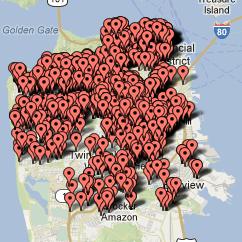
You want to see something frightening on a lovely afternoon? Check out this amazing interactive map of Ellis Act evictions in San Francisco put together by Brian Whitty.

It’s stunning: Between 1997 and 2013, it seems as if most of the Mission, Noe Valley, North Beach, the Marina, and Potrero Hill was evicted. Hundreds and hundreds of apartments turned into TICs, which now want to convert to condos. Hundreds and hundreds of tenants, who once had rent-controlled apartments, losing their homes — and given the price of housing, losing their ability to live in San Francisco.

Each little red flag is a human tragedy. Each one represents a transforming city that no longer has room for the middle class, much less poor people. It makes we want to cry. Or throw up. Or something.

Bay to Breakers: Go naked, everyone!

15

I realize security is a serious issue after Boston. And I’m all for public safety. So if the city is going to ban backpacks at Bay to Breakers, (just for runners, or for spectators, too? How can that be enforced?), we might as well take the next logical step:

More naked runners.

Run naked and you can’t hide a bomb. Run naked and you are no security threat to anyone. In fact, public nudity is one of the best defenses against terrorism; have you ever heard of a naked terrorist?

Let’s go all the way. The runners. The spectators. The casual passers-by, the folks who happen to live along the route …. banning backpacks is just a start. Ban clothes. All day, all along the 7.5 miles. A naked city is a safe city.

Scott Wiener can stay home.

Pride faces backlash from defenders of gay whistleblower

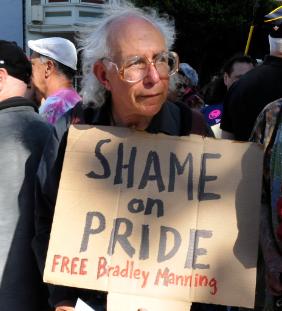
In the wake of the debacle unleashed by San Francisco Pride’s announcement that gay whistleblower Bradley Manning would not be grand marshal for this year’s Pride Parade after all, a large crowd of protesters assembled outside Pride’s Market Street headquarters April 29 for a hastily organized rally condemning the move. They held signs depicting Manning’s image, and chanted, “Grand marshal, not court martial!”

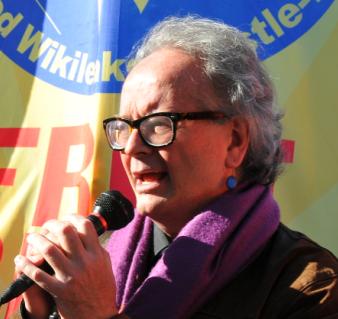
Famed whistleblower Daniel Ellsberg, who helped foment opposition to the Vietnam War by leaking classified government documents known as the Pentagon Papers to the New York Times in 1971, expressed support and admiration for the young US Army soldier. Manning was arrested in May of 2010 on suspicion of having leaked classified government cables and military footage later published by WikiLeaks, and faces a possible life sentence.

“A big mistake was made by the Board of Directors of SF Pride,” Ellsberg said. Referencing director Lisa Williams’ statement that not even a “hint” of support for Manning would be tolerated, Ellsberg said, “I don’t hint at support for Bradley Manning. I couldn’t be louder. I will be marching in that parade, for the first time for me, with a banner honoring Bradley Manning.”

Gay Navy veteran John Caldera, commander of the Bob Basker Post 315 of the American Legion, an LGBT-focused veteran’s organization, announced that his members had voted unanimously to call for Williams’ resignation, saying she had “negated and belittled all of the voices of the community” who had expressed support for Manning. He also condemned Pride for withholding its support for Manning while accepting funding from the likes of Wells Fargo, a banking giant responsible for foreclosures that have affected veterans. “The SF Pride committee has to put people first and corporations second,” he said.

Joey Cain, a former grand marshal who said he nominated Manning, noted that he was not calling for Williams to resign, but hoped she would realize the mistake and reinstate him as grand marshal. “What he did was heroic … Bradley made the world a better place,” Cain said. He shamed Pride for straying so far from the roots of the gay movement. “We believed in radical inclusivity,” practicing tolerance for all “colors, genders and opinions,” he said, with the understanding that “We don’t all agree. We never will. But we’re sure never going to throw any part of the community under the bus.”

The rally was organized by longtime housing activist Tommi Mecca (pictured, center), comedian Lisa Geduldig and blogger Michael Petrelis.

Some counter-protesters from the Log Cabin Republicans, a gay GOP organization, even made an appearance. “We were praising the Pride Committee for not having selected Manning,” SF Log Cabin Republicans Fred Schein told the Bay Guardian.

Paul Bloom, a longtime activist, handed the Guardian a written statement on his take of the whole dustup, which he viewed as “an opportunity for people to unite in our understanding that there is no antiwar movement without gay people, and no movement for human rights that doesn’t envision an end to war.”

“Why does the SF Gay Pride Parade need corporate sponsorship, anyway?” Bloom wrote. “The parade must be brought back into the struggle as a part of it instead of remaining the grossly commercial spectacle it has become. We need to occupy the parade.”


The Google-bus elitism

144

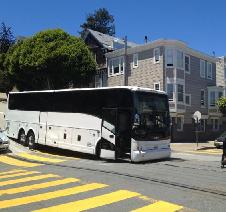
I’ve been waiting for the Chron’s culture columnist Caille Millner to finally write about something interesting, and I got it April 27 when she stumbled onto the Google Buses. Or rather, the problem with the Google buses.

Thanks to the Chron’s silly paywall, you can’t read her column online, and since hardly anyone in San Franciso buys the Chronicle anymore, Millner’s story won’t get the attention it should. So allow me to repeat some of it here:

It was close to 9 p.m., and I was waiting at a bus stop on an island in the middle of Market Street. Next to me stood a tired-looking middle-aged woman who had clearly just left work. While we waited, up cruised the big white pod. It paused right in front of us. The door at the front slid open to discharge a few Googlers, and the luggage door on the lower right side of the bus also slid open to allow them access to their belongings.

One gentleman bounced down the bus steps and pushed his way in front of us to get his bicycle from beneath the bus. As he hurled it out onto the bus island, it hit the woman standing next to me. She glanced at me, mute and horrified, and in that moment I sensed that she didn’t feel able to confront him. So I did.

“Excuse you,” I said loudly.

>No response. He was busy fumbling with his messenger bag

“You hit her,” I yelled.

He glanced up in no particular direction, as though suddenly troubled by the buzz of an insect. Circling his head around, he finally noticed where he was – the bus stop, the night, the fact that there were other people around him.

“Sorry?” he asked the air, in a tone of confusion. Then he climbed on his bicycle and pedaled away. He never looked at the woman he had hit.

There’s a sense of entitlement about the rich, and the young rich are often the worst. And that’s one reason why the logic of the Google bus — it’s better to have a single luxury vehicle haul all those people to work than have them all drive cars — doesn’t register with a lot of us. They’re too good for Caltrain. They’re too good for Muni. And they’re too damn good to bother to notice that they’ve hit an old lady.


Behind the Gay Pride “Manning-gate”

13

The whole Bradley Manning-Pride fiasco was such a clusterfuck that we’re starting to wonder whether the people who run the giant parade and festival can count, much less make a decision.

Here, as best as we can tell, is how it went down.

Every year, the Pride board selects a group of people as honorary parade grand marshalls. All the past recipients of that distinction — the “college” of former marshalls — get to pick on person for the list.
It’s never a very big issue.

Joey Cain, who served on the Pride board for ten years and is a former grand marshall, made some waves this time around by nominating Bradley Manning. And after the email went out, and the votes were counted (only perhaps 30 or so of the former poobahs bother to vote most years), it appeared that Manning was on top.

But no: According to a written chronology that Cain has prepared, “On Tuesday, April 23,  Michael Thurman from Bradley Manning Support Network called me to say that Bradley Manning had been chosen by the collage of former Pride grand marshals to be a Grand Marshal but that he was then contacted two hours later by Joshua Smith and told that the Pride Board of Directors had asked for an audit of the votes and as a result of the audit he had not been elected.”

So Cain started pushing back. “You don’t tell someone they’re a grand marshall and then pull it away,” he told me. “That’s just not right.” His plea to Board Chair Lisa Williams: Just use the power of the board to vote Manning back in.

“At 9:41 on Tuesday night, I got a call back from Lisa. She said they were going to do the right thing, make him a grand marshall, and make it all right,” Cain recalled.

Williams hasn’t responded to our phone calls.

The next day, the Bay Area Reporter released the full list of GMs, and Manning’s name was on the list. “It said he DID win the college vote,” Cain noted.

Cain called the Manning crew. “I told them that Pride would do the right thing, that they wouldn’t back down,” he said. “I’ve been on the board ten years, and we’ve never backed down.”

Ah, but the office was flooded with phone calls and emails, organized by a group of gay soldiers in San Diego, and the pressure got intense. And next thing you know, Williams had issued a blistering press release saying that Manning should never have been named a grand marshall and in effect accusing him of endangering the lives of service members, something even the Pentagon hasn’t actually said.

Manning’s in. Manning’s Out. Manning’s in. Manning’s out. Yes, it’s part of the New Gay World, where the Pentagon is our friend because: gay soliders. But it’s also embarassing.

“I call it Manning-gate,” Cain said. “The cover up is always worse than the crime.”

And the fact that Williams isn’t talking to the press makes it all more confusing.

“The worst part is that I’m part of the anarchist community, and I’ve always been out there arguing in support of Pride,” Cain said. “Then this is like, holy fucking shit, they just proved everything I’ve been trying to disprove all these years.”
 

Michael Mina reaches settlement after overcharging customers at his SF restaurants

27

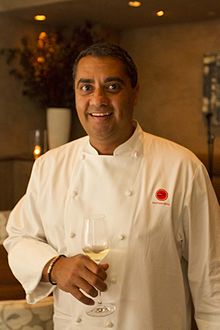
Celebrity Chef Michael Mina and his four San Francisco restaurants – Michael Mina, RN74, Bourbon Steak, and Clock Bar – have agreed to pay $83,617 to their employees to settle charges of overbilling their customers a 4 percent meal surcharge ostensibly intended to cover the company’s employee health care obligations.

As I reported last week, City Attorney Dennis Herrera is investigating fraudulent use of surcharges by restaurants, and its settlement with Mina Group LLC was the first of what could be dozens with local restaurants to come clean under Herrera’s partial amnesty offer. The company was the city’s worst violator, according to filings last year with the city’s Office of Labor Standards Enforcement, which showed the company collected $539,806 in surcharges and spent just $211,809 on employee health care.

A spokesperson for Mina Group had told the Guardian that a settlement was in the offing and that the company would forward it to us as soon as it was available. Instead, the company leaked the settlement to SFgate.com’s Inside Scoop restaurant column, which posted a story about it on Friday evening, the dead spot in the weekly news cycle.

Mina told Inside Scoop that all the surcharges it collected are being held in a fund for employee health care and the company has lowered its surcharges from 4 to 3 percent to correct the overcharging. San Francisco’s restaurant industry – which waged an aggressive legal battle against the employer health care mandate – is the only industry to use explicit customer surcharges to cover its obligations under city law.

The full joint statement by the City Attorney’s Office and Mina Group follows:

“The City Attorney’s Office and Mina Group announce a settlement regarding surcharges imposed in response to San Francisco’s Health Care Security Ordinance. The settlement terms have been guided in part by findings in which the City Attorney’s Office acknowledges that Mina Group’s employee health care program reflects some best practices in administration of health care surcharge funds.

“Mina Group and its affiliates collected surcharges during 2009 – 2011, as previously reported to the Office of Labor Standards Enforcement (OLSE). The City recognizes that 100 percent of the surcharges collected will continue to be used exclusively for employee healthcare and that the majority has already been used. Under the settlement agreement, Mina Group will contribute $83,617.50 of remaining surcharges to eligible persons who were employees during that period.

“The City Attorney’s Office reaches no conclusions on liability in successfully concluding its enforcement action with Mina Group and its affiliates. Mina Group will continue to fully support the San Francisco Health Care Security Ordinance.”

Former Pride grand marshal: Manning is LGBT hero, Board action ‘height of stupidity’

61

“I was one of the 15 former grand marshals on the electoral commission that voted for Bradley Manning,” Barry Saiff, former BiNet president, told me over the phone this morning from Washington, DC, about the Bradley Manning Pride grand marshalship controversy. (As one half of a bi-national queer couple, he lives most of the year in the Phillipines with his boyfriend, who is unable to come to the United States due to discriminatory immigration laws.)

To recap: An ‘electoral college’ of former grand marshals elected the jailed gay (possibly now transgender) whistleblower who provided Wikileaks with a huge dump of raw classified US government info. Someone announced the choice on Friday and the media went nuts. Then the Pride executive director issued this bizarre statement repudiating the decision and rescinding the honor, to the dismay of the electoral college and a huge swath of LGBT locals. A protest at Pride HQ is planned for today, 5pm at 1841 Market, SF.) 

“The list of nominees from the other board members was presented to me in March, and the instant I saw Bradley’s name on there I knew it was the right choice. Pride stands for justice, freedom, and an end to discrimination, and I feel Bradley represents all of these things — as well as complete honesty and bravery. What the Pride board did to repudiate that choice, especially in its official statement — to not be able to make the distinction between Manning’s necessary actions and way the government is denigrating our troops with these illegal and unjust wars — is the height of stupidity.

“They [the Pride board] are colluding in the giant ‘Support Our Troops’ hoax that says you must never question the leadership of the military. There is actually no contradiction between supporting our troops as individuals, including our LGBT folks in the armed services, and supporting Bradley Manning and what he did.

“Specifically, if we care about our troops, we should care that they are used by our military for just ends, for missions and goals that actually increase our security, rather than decrease it, and that they are dealt with honestly. And, regardless of how you feel about the rightness or wrongness of Manning’s actions, there is no question that it is both immoral and illegal under international law (the US is a signatory to the Convention Against Torture), that he was tortured by the USA. Bradley Manning is an American hero, and an LGBT hero. We can rightfully be proud of him. He will rightly be remembered long after his duplicitous superiors are forgotten.

“What the Pride Board should have done to respond to the critics of the nomination was to point out that they were failing to make a crucial distinction. That it is simply a point of logic that we can support our troops while being diametrically opposed to the ends to which they are used by our government. This is a crucial point for the LGBT movement to understand and promote. We should not allow ourselves to be divided by people who are committed to denying reality. We can agree to disagree on the military and the wars in Afghanistan and Iraq, but there is no disagreement on this, it is a point of fact.”

What about the charge that Manning’s leaks endangered US troops?

“I say, ‘Bullshit.’ Of course that’s what the government says. Look, Manning did not act alone. He worked with some extremely savvy media people with this — Wikileaks, the New York Times — he didn’t just publish everything himself. Those organizations worked to edit what was put out there and protect peoples’ lives. To dump this all on him and call him a traitor is a mistake.”

How much of all this had to do with Manning’s queerness?

“Well, all things being equal, that’s what qualified him in the first place. But as I said, this fight has resonance with LGBT people in terms of freedom and justice. The fact that he’s gay may play into his situation in terms of military and former persecution.”

Were you ever given guidelines by the Pride board about who was qualified to be elected a grand marshall?  

“Not that I know of. I don’t know the bylaws off-hand, but every year, as the ‘electoral college,’ we’ve been able to elect one grand marshall and it’s never been a problem. We voted in March, although there may have been a period before the final decision was tallied. [Radical faerie elder and historian Joey Cain put forth the Manning nomination.] And that was the last I heard of it until Friday. I wasn’t contacted personally by [executive director] Lisa Williams or anybody else saying we had to change anything. It wasn’t until Friday that I found out about any controversy — in the news media, like everybody else. And I was outraged.”  


Captain Greg Corrales saves the Haight from Demon Weed

63

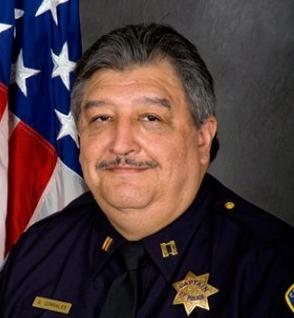
I’m glad to see the Ex now has the data to show what we all knew was happening: The old Drug Warrior at Park Precint, Captain Greg Corrales, is trying to save the Haight from pot smokers.

Hate to have to tell you, Cap, but you lost that battle a loooong time ago.

And here’s the thing: Arresting people is expensive. It takes the time of police officers (who, let’s remember, often make $100,000 a year or more), it takes the time of the District Attorney’s Office, and, since none of the people Corrales arrests can afford private counsel, it takes the time of the Public Defender’s Office, which is already so short of money that it might have to stop taking cases.

And meanwhile, San Francisco has a terrible record closing homicide cases.

So now we’re spending hundreds of thousands of dollars (yes, that’s what it will add up to) busting small-time pot dealers in Golden Gate Park.

Remember, the statistics are clear: The “buy-bust” arrests are not nabbing crack or meth or heroin dealers. It’s all about the Demon Weed.

It’s also part of the quiet transformation of law enforcement and city policy in the Haight, which has become all about “quality-of-life” cases. A guy named Giuliani made that a big deal in New York way back when. Now we have sit-lie, and we have the eviction of the Haight Ashbury Neighborhood Council Recycling Center, and we have buy-bust. It’s really about trying to turn the Haight into a sanitized, movie-set version of itself.

Which, by the way, has never seemed to work.


Cal president resists pressure to veto West Bank divestment bill

17

Late Tuesday night, UC Berkeley Student President Connor Landgraf decided not to a veto SB 160, which called on the university to divest from companies that profit from the Israeli occupation of the West Bank. The bill labels the university “a complicit third party in illegal occupation and ensuing human rights abuses” by Israel.

Before announcing his decision, Landgraf acknowledged to the Guardian that he had promised divestment proponents during his campaign that he would not exercise his veto. But following the close 11-9 vote last Thursday, Landgraf came under intense pressure from both pro- and anti-divestment groups and he waited until just before the deadline for a veto to announce his decision.

Although the UC Berkeley Student Senate has no control the university’s budget, the divestment bill drew national attention. Palestinian solidarity activists called upon Landgraf to allow the bill to stand, while the Jewish Community Relations Council (JCRC) and the Israel Action Network launched campaigns to pressure Landgraf into vetoing the measure.

Early Tuesday morning, the Guardian revealed that Landgraf had taken advantage of a fully-funded trip to Israel, paid for by the the American Jewish Committee, a sponsor organization for the Israel Action Network. Landgraf failed to disclose this relationship during the debate over SB160, even after the Israel Action Network launched a pro-veto campaign.

Although Landgraf stopped short of issuing a veto, he did release a statement distancing himself from the bill.“I firmly reject its one-sided narrative, and the bill’s complete and utter failure to create any constructive discussion or dialogue on a complex and multifaceted issue,” Landgraf wrote.

Following Landgraf’s announcement, SB 160 author Senator George Kadifa praised Landgraf’s decision to refrain from a veto. “The 60 communities that supported divestment are grateful for President Landgraf’s courage in agreeing not to veto,” Kadifa told the Guardian.

Pro-Israel groups on campus expressed disappointment in his decision. “Obviously we’re really dismayed by the decision,” Abby Porth, associate executive director of the JCRC, told J Weekly.

Ultimately, the divestment bill is unlikely to alter the UC’s investment portfolio. Before Landgraf announced his decision, UC Chancellor Robert Birgeneau voiced his opposition to SB 160, promising the bill would have no effect of the UC’s investment decisions.

But the success of encouraging divestment at Berkeley may inspire other UC campuses to follow suit. On Tuesday, students at UC Davis launched a campaign calling on their own student government to consider divestment from many of the same companies included in Berkeley’s SB 160.

Reports of grenade-type devices used in West Oakland raid

A high profile police raid occurred last night in multiple East Bay locations, with most activity centered at the Acorn public housing complex in West Oakland. According to recent news reports, some 150 FBI agents and support staff carried out the raid, along with 120 Oakland police officers and other law enforcement officers from San Leandro, Hayward and Antioch.

OPD Chief Howard Jordan told reporters at a press conference that the raid targeted the Acorn gang of West Oakland, and that officers made five arrests, served 16 narcotics and weapons warrants, and seized firearms, heroin, cocaine and marijuana.  

An official statement attributed to OPD spokesperson Johnna Watson in a Chronicle report suggested that police did not use force during the operation. This suggests OPD does not consider deploying grenade-type devices (considered to be “less lethal weapons”) to be “use of force,” because residents living nearby the Acorn housing complex at Eighth and Adeline streets told the Guardian that they heard loud bangs, probably from flash grenades, go off when the operation was underway around 7:30 Wednesday night.

A neighbor who lives nearby the apartment complex, who asked not to be identified, had a partial view of the police activity from their West Oakland residence. The person described the operation as “like a military presence” due to the sheer number of officers, many outfitted in SWAT gear, and “very precise,” targeting a specific address and lasting roughly an hour and 15 minutes. The streets surrounding the apartment complex were closed off for the duration of the raid.

The neighbor estimated that the flash grenades (or similar devices) were used five times, but since the explosions produce echoes, there could have been fewer deployments. The observer wasn’t able to see how they were used because there wasn’t a clear view of the unit, but heard the bangs in sequence. An OPD officer could be heard addressing occupants inside one of the units on a loudspeaker, reading out the address, telling them they were surrounded, and then saying something like, “you in the suit, get down, get down on the ground.”

The neighbor said they observed three people being removed from the unit and taken into custody – a man who was wearing a suit, a person in a motorized wheelchair, and a tall, younger-looking man. The arrestees were cooperative. 

The West Oakland resident also reported seeing an armored vehicle parked at the scene. A host of official OPD vehicles were parked along the street, along with unmarked cars including SUVs and white vans. 

More details about the massive police operation, the targeted gang, and the criminal activity the cops zeroed in on are sure to come out. A lot of outstanding questions remain, of course, including why officers decided to use the grenade-type devices. So far, OPD hasn’t responded to our email or voice message, but we’ll post the department’s response if we receive one.

The vultures of greed

129

A small but enthusiastic crowd marched through the Castro April 20 to bring some attention to the rash of Ellis Act evictions that are forcing seniors and disabled people out of the city. The activists stopped at the home of Jeremy Mykaels, whose plight is symbolic of the state of housing in San Francisco today. Mykaels insists he’s not a public speaker, but his remarks were poignant; we’ve excerpted them here:

I have AIDS and I am being evicted through the use of the Ellis Act. I want to welcome you to my home for the past 18 years, and to my Castro neighborhood where I’ve spent the last four decades, or two-thirds of my life.

I was there at some of the earliest Gay Pride Parades and Castro Street Fairs, listening to speakers like Harvey Milk and seeing entertainers like Sylvester with Two Tons ‘O Fun and Patrick Cowley. I proudly voted for Harvey to become the city’s first openly gay supervisor. I participated in the fight against the Briggs amendment, which would have outlawed gay teachers in California schools. I walked in the candlelight march honoring the lives of Harvey Milk and Mayor Moscone after their assassinations by Supervisor Dan White. And I’ve been here for many other protests and for many other celebrations.

And like most of you, I’ve seen how HIV and AIDS have devastated this community over the years and I have lost most of my closest friends and lovers to this disease. Until 12 years ago I thought I had somehow miraculously escaped it’s clutches, but that was not to be and I have been dealing with that reality as best as I can ever since, with mixed results. And now on top of the great losses this disease has cost our gay community, even more losses are occurring in the form of more and more long-term tenants with HIV/AIDS living in rent-controlled apartments being forced to move out of their homes and/or out of the city after being evicted through the use of the Ellis Act, or who have been scared and bullied by just the threat of an Ellis eviction into accepting low buyout offers to vacate.

I had always thought that I would spend the rest of my life living in this neighborhood and city that I love. Now I know that, like so many others before me who found themselves in similar situations, I will have no choice but to move out.

Tech boom 2.0 has brought out what I call the Vultures of Greed, a de facto alliance of banks, the real estate lobby, and, whether unwittingly or not, city officials like the mayor and several supervisors and the Planning Commission. But the worst Vultures of Greed have been the real estate speculators, many of whom I have listed on my website.

And here I would like to call out my own personal vultures as a prime example of how uncaring real estate speculators can be. The new owners of this property are Cuong Mai, William H. Young and John H. Du, and their business entity is 460Noe Group LLC, based in Union City. These are truly callous individuals who knew from the very beginning that they had a person with AIDS living in the building, and soon after they bought the place they began threatening me with an Ellis eviction if I didn’t accept their low-ball buyout offer and vacate. On September 10th, 2012 they subsequently Ellised the building and served me with eviction papers which means that I will only have until September 10th of this year to legally occupy my apartment. All these men want is the highest profit they can get after they remodel and re-sell this building. They could care less what happens to me when I am forced to move out of the city and no longer have access to all my HIV specialists who have kept me alive for this long. A prospect I’ll admit that, yes, scares me. But these guys, they won’t lose even a seconds sleep over my fate.


Yes, the Vultures of Greed are soaring high with sharpened talons ready to feed upon our city’s seniors and disabled, and on what’s left of our already decimated San Francisco gay community. But we don’t have to allow it. Together with our growing number of allies, we can change minds and we can eventually reclaim this city from the Vultures of Greed.

BTW, we couldn’t reach Mai, Young, or Du, and their lawyer, Saul Ferster, did not return a call seeking comment.

City-owned electricity generation works

7

I remember years ago a loser of a supervisor named Bill Maher tried to make a lame joke in opposition to a public-power measure. “If the city tries to run an electric system,” he said, “every time I throw a light switch my toilet would flush.”

Ha. Ha. Ha.

But it’s a common refrain: We can’t even run the Muni on time — how can we run an electricity system?

Which is why it’s worth noting that the San Francisco Public Utilities Commission and the Department of Public Works have managed, all on their own, to build successful solar generating facilities –– without contract scandals or any other apparent problems. The School District is happy; when they throw the light switch, the lights turn on — and the price of electricity is really, really low (far less than half what Pacific Gas and Electric Co. charges), so there’s more money for classroom instruction.

This is the future of green energy in San Francisco: Small-scale renewable projects, either owned by the city or financed by the city and placed on residential and commercial rooftops. It’s why CleanPowerSF is so important. PG&E is never going to support distributed generation; that kind of project makes PG&E irrelvant and undermines its business model. Once the city has enough generating facilities, it can start buying its own distribution system.

So yeah: Public power works. On a small scale, to be sure, but if the city can build one solar project, it can build more.

Ammiano’s on a roll

18

Willie Brown, the former mayor and current unregistered lobbyist, has been trying to undermine Assemblymember Tom Ammiano for years. But take a look at two Ammiano bills this spring and you get a sense of how effective San Francisco’s veteran representative can be.

On April 23, the state Assembly Judiciary Committee passed Ammiano’s Homeless Bill of Rights, 7-3. That wasn’t easy; he had to amend the bill and work the committee hard. The League of California Cities, which has a lot of clout in Sacto, doesn’t like the bill; neither does the California Chamber of Commerce. This is a big deal; the bill would ban most “sit-lie” laws and guarantee everyone the right to use public space.

Then the Pubilc Safety Committee approved his marijuana regulation bill, 5-2 (despite Brown and Co. trying to screw it up). And his Domestic Workers Bill of Rights , which the governor vetoed last year, is headed for likely approval at the Labor and Employment Committee.

There’s still a long road ahead for all of these bills — more committees, Assembly floor, Senate, and then the guv (and who the hell knows where Jerry will be on anything these days). But it’s possible that, in his final term, Ammiano could have several landmark bills approved.

(Yeah, it’s his final term. Six years is all you get in the Assembly. Crazy what terms limits has wrought. The minute you get to the point where you really know how to do your job, and you can truly deliver for your constitutents, they shove you out the door.)


On 8 Washington, it’s No, No

56

The November ballot may contain not one but two measures addressing super-luxury condos on the waterfront. And that could pose a serious problem for the developer of the 8 Washington condominium project.

The Board of Supervisors approved that proposed 134-unit complex, which would be the most expensive condos ever built in San Francisco, in June, 2012, but immediately opponents gathered enough signatures to force a vote of the people. The referendum would overturn the increased height limits that developer Simon Snellgrove wants for the site.

That, it turns out, is a popular notion: “If Snellgrove is looking at the same polls we’re looking at, the public is not interested in raising building heights on the waterfront,” Jon Golinger, who is running the referendum campaign, told us.

So Snellgrove is now funding his own initiative — a ballot measure that would essentially approve the entire project, allowing 136-foot buildings along the Embarcadero and giving the green light to start construction on housing for multimillionaires.

The paperwork for the initiative was set to be filed April 23, allowing Snellgrove’s team to begin collecting signatures. They’ll need more than 9,000 valid ones to make the November ballot — and that’s not much of a threshold. If the developer funds the signature-gathering effort — which he’s vowed to do — he’ll almost certainly get enough people who are fooled by the fancy name of his campaign: “San Franciscans for Parks, Jobs, and Housing.”
That, presumably, suggests that there are San Franciscans who are against Parks, Jobs, and Housing, although we don’t know any of them. We just know people who think this particular project provides housing the city doesn’t need without paying nearly enough for affordable units.

At any rate, the campaign manager for this effort, according to the paperwork filed at the Department of Elections, is Derek Jensen, a 20-something communications consultant who was Treasurer of the Lee for Mayor Campaign. The address for the waterfront initiative is listed as 425 Market St, 16th floor –which, by the way, was the same address used by the Lee Campaign. And since it’s right near our office, we took a stroll over to see what the Snellgrove forces had to say.

Well, it turns out that 425 Market is a secure building, and the 26th floor is the law office of Hanson Bridgette, and you can’t get up there unless your name is already in the computer system, which ours was not. The security guard kindly called up to ask about the 8 Washington initiative, and was told there was nobody who could talk about it today, but to check back later.

The person who answered the phone at Hanson, Bridgette had never heard of Derek Jensen. Transferred to voicemail, we left a message for someone named “Lance.” Perhaps that would be Associate Counsel Arthur “Lance” Alarcon, Jr. He hadn’t called back at press time.

The campaign against 8 Washington, on the other hand, has an office at 15 Columbus. First floor. Walk right in the door. The campaign manager is Jon Golinger, who answers his own phone.

At any rate, we can’t figure out what Snellgrove is up to, since his plan makes zero political sense. The referendum needs a “no” vote to block the project. If voters don’t like increased height limits on the waterfront, they won’t like his initiative, either. And if all that this does is confuse the voters, they’ll tend to vote “no” on both measures. If anything, he’s only hurting himself.