• No categories

Politics Blog

A boost for Ammiano’s pot bill

1

Assemblymember Tom Ammiano’s bill to create state regulations for pot clubs just got a boost: Although I disagree with the Supreme Court decision allowing towns to ban the dispensaries, it’s kicked local governments into gear. Now mayors from around the state are asking the Legislature to weigh in and craft “sensible marijuana policies.”

It’s tricky: The Department of Consumer Affairs, which might be the logical place for the regs, doesn’t want anything to do with pot, and Gov. Jerry Brown thinks we’re all too stoned to compete with China, so Ammiano’s looking to the Department of Alcoholic Beverage Control to create a new marijuana division. Logically, that makes sense, and it’s what Colorado is doing. Practically, a lot of people don’t like the ABC, but that’s a factor of bad agency leadership and poor priorities. It’s not a structural problem. If we’re ultimately going to legalize pot altogether, and we are at some point soon, then it makes sense to have regs in place — or at least a system for regs in place — that can give cities and counties direction.

And it might help a little with the Reigning Asshole of Prohibition, Melinda Haag.

I suspect this will make it to the governor’s desk. I hope he comprehends that we aren’t going to compete with China if we can’t even solve a simple regulatory problem.

Also: Ammiano’s bill to protect transgender students made it off the Assembly floor.

Those overpaid, underworked public employees

49

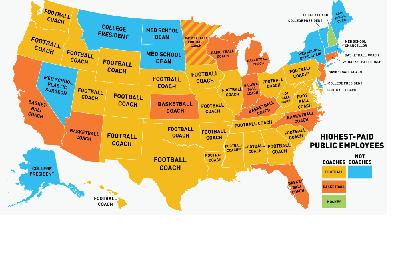
Before you start griping about ovepaid Muni drivers and public employee unions, you might want to take a look at this neat-o map that shows who the highest-paid public employees are in every one of the 50 states. Hint: It’s not a bus driver. Or even a cop or firefighter:

You may have heard that the highest-paid employee in each state is usually the football coach at the largest state school. This is actually a gross mischaracterization: Sometimes it is the basketball coach.

In fact in 40 of the 50 states, the highest-paid person runs a collegiate sports operation. The other ten are doctors running medical centers or, in a couple of places, college presidents.

Oh, but aren’t those people earning their money by bringing in the big bucks? Maybe; maybe not:

In 2011-2012, Mack Brown was paid $5 million to lead a mediocre 8-5 Texas team to the Holiday Bowl. The team still generated $103.8 million in revenue, the most in college football. You don’t have to pay someone $5 million to make college football profitable in Texas.

Just sayin.

(Oh, and what’s up with New Hampshire, where the guy making the most money coaches hockey?)

Aiming for the top of the food chain

The issue of labeling for genetically engineered foods gained fresh momentum last week, when Sen. Barbara Boxer announced she’d be pushing for the U.S. Food and Drug Administration to require this consumer notification on a national level.

It’s sure to be an uphill battle for the organic food movement, which suffered a loss on this issue at the California ballot last year, but a new book calling for a mass restructuring of the nation’s food system might help provide ammunition for proponents of GE food labeling.

Wenonah Hauter’s Foodoply: The Battle over the Future of Food and Farming in America traces decades of little-known history documenting small farmers’ resistance to agricultural consolidation, followed by national and international policy agreements that gave rise to the commercialized agribusiness model that dominates America’s food system today. Hauter, executive director of Food and Water Watch, grew up on a farm.

“It gave me life experience about how difficult farm work is, and how hard farmers have to work, and how under-valued they are in our society,” the author said of that experience in a recent interview with the Bay Guardian. “One of the reasons I wrote Foodopoly was to get at this issue … It’s easy to demonize farmers rather than the systemic causes of the traditional food system.”

Her book is nothing short of a call to arms to take back corporate control of a food system that short-changes small farmers and leaves consumers with limited, unhealthy options.

“If we want to change our food system, we have to reclaim our democracy,” she says. “So many people just think we’re going to create an alternative system, without really doing the political work to address fundamental issues, like the consolidation that allows some companies to have so much power over our political system.” It won’t be achieved with certified sustainable agriculture programs or farmers markets alone, she says – but rather through confronting agribusiness’ influence in the halls of government.

Her meticulously researched work names names, providing detailed lists of the industry’s most influential processers, grocers, and junk-food manufacturers along with the ubiquitous brands they produce. It also sheds light on the ills of factory farming and genetically engineered foods.

“The top 20 processing companies and the grocery industry have benefited from figuring out that fat, sugar and salt actually addicts people to junk food, and is making people sick and overweight,” Hauter told us. “Children see just under 5,000 junk food ads a year. We know that children begin to identify with brands at about the age of two. Lots of junk food is placed at eye level for young children, because they pull on their parents’ shirttails, whining for the junk food.”

While organics may pose a healthier alternative, meanwhile, Hauter’s chapter on the “paradox” of attractively packaged, premium-priced organic food is rather disheartening. “Fourteen of the 20 largest food processing companies actually control many of the organic brands, and organics today are viewed as a rich market, where people can be charged,” Hauter notes, going straight to the heart of the matter. “It’s a lot different from the vision I think many people had in the early 1970s, when the organics movement began.”

Foodopoly also devotes considerable attention to the political influence of the biotech sector. “I think that the biotech industry has a lot of political power,” she told the Guardian, and then revealed that assertion to be a profound understatement: “Over a 10-year period, they spent $572 million on lobbying and campaign contributions, they hired 13 former members of Congress during this period, they hired 300 former staff from the White House … and they have about 100 lobby shops in Washington. … With Prop 37, [of the] the approximately $45 million put towards ads, about $8 million was Monsanto’s.”

This kind of influence doesn’t just carry troubling implications for the democratic process, but makes it less likely that looming questions around the long-term health effects of genetically engineered foods will ever be sufficiently answered.

“With all the new technology coming on – nanotechnology, cloning, genetic engineering – we really need to take a look again at our regulatory system,” Hauter insists. “There’s a lot of new evidence coming out on the problems with these new technologies. There was a review of hundreds of scientific studies around glyphosate, which is a major ingredient in Monsanto’s Roundup herbicide. It shows that there are cellular effects within the human body, and that these could very well be working together with other variables to trigger health problems. We’re talking about everything from gastrointestinal problems, to diabetes, autism, obesity, Alzheimer’s, and a number of different problems.”

Despite these disturbing findings, there’s been a distinct lack of long-term study or precautionary restraints imposed by lawmakers, Hauter says.

“There are a lot of other reasons that we should be concerned about genetic engineering, from the cost and control of foods, to the overuse of this dangerous herbicide, glyphosate, and the fact that it’s creating super weeds,” she says. Further complicating matters, “New pesticides are being developed to address the problems that these co-branded herbicides have caused. That’s the problem with our society,” Hauter adds. “We never look at the unintended consequences.”

Coastal Commission to rule on Beach Chalet soccer project

25

The California Coastal Commission will decide tomorrow (Thu/9) whether San Francisco and its Recreation and Parks Department violated the Coastal Act in approving a renovation of Golden Gate Park’s Beach Chalet soccer fields that uses artificial turf and stadium lights and seating. [UPDATE 3pm: The commission just approved the project. Full story coming soon.]

SF Ocean Edge, a group comprised mostly of environmentalists and neighbors of the site where the park meets the ocean, has been fighting the project since its inception. They got a big boost recently when the Coastal Commission staff recommended rejection of the project, finding that it violated requirements that coastal areas should remain in a naturalistic state and be open to the general public.

“Going into any hearing, you never know what’s going to happen, but the staff report was excellent,” group spokesperson Kathy Howard told the Guardian. “They have a lot of good idea for renovations to the area which would allow more than just organized sports teams to use the area.”

Spokespersons for the Recreation and Park Department didn’t return Guardian calls for comment. The hearing is being held in San Rafael, with this item expected to be heard starting at 9:30-10am, Howard said. Check in here later in the day for a full report.

More SF restaurants settle with the city over fraudulent employee health surcharges

12

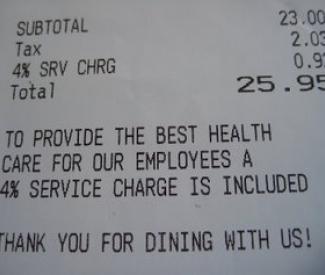
City Attorney Dennis Herrera today announced another batch of settlements with restaurants that have been fraudulently using surcharges on customers’ bills to cover their city-required employee health coverage and using some of that money to simply pad their profits.

Seventeen San Francisco restaurants that took advantage of Herrera’s partial amnesty offer — settlements are half of what the violators should owe, based on voluntarily submitting records by last month’s deadline — will be paying tens of thousands of dollars each to the employees’ they ostensibly collected the money for, joining two other restaurants that had settled with the city earlier this year.

Among this latest batch of restaurants is Burgermeister, whose $134,088 settlement is the largest of this group; and Burma Superstar, whose $10,045 is the smallest. Other restaurants paying up as part of the settlement are 5A5 Steak Lounge, Amber India, B Star, Bix, Cafe Bellini, Calibri Mexican Bistro, Citizen’s Band, Cafe Flore, Fresca, MarketBar, Nob Hill Café, Press Club, Skool, Tony’s Pizza Napoletana, and Venticello Ristorante.

In total, Herrera’s office has recovered about $844,000 that will be split among about 1,500 employees.

Another dozen restaurants suspected of misusing the surcharges were given a clean bill of health: Bluestem Brasserie, Cafe Claude, Cupola Pizzeria, Firefly Restaurant, Gitane Restaurant and Bar, Lark Creek Management LLC, Lark Creek Steak, NOPA, One Market Restaurant, Plant Cafe, Ristobar, and Twenty Five Lusk.

There are still more than 30 restaurants that responded to the amnesty offer that remain in negotiates with Deputy City Attorney Sara Eisenberg, with more settlements expected in the coming weeks and the possibility of lawsuits being filed against restaurants that won’t settle.  

The full press release follows:


Restaurant workers net $844K restitution in 19 surcharge enforcement settlements so far

Herrera praises good faith efforts by restaurants ‘to do right by their employees’; announces ‘clean bills of health’ for 12 other establishments targeted in investigation

SAN FRANCISCO (May 8, 2014) — City Attorney Dennis Herrera today announced settlement agreements with 18 local restaurant businesses that voluntarily took part in his office’s surcharge enforcement and amnesty program, which seeks to remedy shortfalls between amounts collected from customers to cover the cost of complying with San Francisco’s universal healthcare law, and funds actually expended to provide health care benefits to employees.  Together with an earlier settlement announced in January, Herrera’s restaurant surcharge enforcement effort has now netted a total $844,644 to be distributed among approximately 1,500 eligible employees by 19 different companies.

The program announced in January included a one-time 50 percent amnesty offer for establishments with significant shortfalls — provided they fully cooperate with city investigators; agree to good faith compliance with the employer spending requirement of San Francisco’s Health Care Security Ordinance moving forward; and directly compensate their current and former employees who were the intended beneficiaries of the surcharges paid by customers.  All agreements announced today resolve potential disputes with the City over collected surcharges without admissions of liability.  

“I commend these businesses for working cooperatively with us so early in the process, and for understanding our duty to enforce the law even-handedly,” said Herrera.  “Today’s settlements reflect good faith efforts by restaurant owners and managers to do right by their employees, and to honor the intent of fees charged to their customers.  I recognize that complying with groundbreaking programs like Healthy San Francisco can sometimes present new and unique challenges.  So, I’m grateful to these businesses for their cooperation in reaching settlement agreements with us.  I’m glad to continue patronizing these establishments, and I hope other San Franciscans and visitors will join me in doing so, too.”

Some of the 19 establishments that reached settlements under the program include: 5A5 Steak Lounge, Amber India, B Star, Bix, Bugermeister, Burma Superstar, Cafe Bellini, Cafe Flore, MarketBar, Mina Group, Nob Hill Cafe, Patxi’s Chicago Pizza (announced in January), Press Club, Skool, and Tony’s Pizza Napoletana.

Twelve establishments receive ‘Clean Bills of Health’ following investigation
Herrera also announced that 12 businesses targeted for investigation on the basis of the health care expenditure shortfalls they reported to San Francisco’s Office of Labor Standards Enforcement had received “clean bills of health.”  Recipients of such letters were informed by Herrera’s office that after extensive review of additional evidence provided in the course of the City Attorney’s investigation, surcharge-related consumer fraud did not appear to have been committed during the relevant time periods.  In most instances, shortfalls reported to OLSE by businesses that received “clean bills of health” were attributable to their inadvertent reporting or accounting errors.

Establishments so far issued “clean bills of health” are: Bluestem Brasserie, Cafe Claude, Cupola Pizzeria, Firefly Restaurant, Gitane Restaurant and Bar, Lark Creek Management LLC, Lark Creek Steak, NOPA, One Market Restaurant, Plant Cafe, Ristobar, and Twenty Five Lusk.

Surcharge Fraud Enforcement Program background
Herrera announced the program at a City Hall news conference on Jan. 25 with Assemblymember Tom Ammiano, Supervisors David Campos and David Chiu, and representatives from San Francisco restaurants and the Office of Labor Standards Enforcement.  Ammiano first authored legislation in 2005 as a member of the Board of Supervisors that would ultimately lead to the City’s Health Care Security Ordinance, or HCSO, which passed in 2007 with policy input from then-Mayor Gavin Newsom.  Board President Chiu and Supervisor Campos have both been active in subsequent proposed amendments to strengthen and improve the law.  In launching the enforcement and amnesty program, Herrera lauded the Golden Gate Restaurant Association for working productively to share its helpful input, even after years of legal disputes over the law that ultimately ended in the U.S. Supreme Court.  

Status of enforcement efforts and investigation
In addition to the establishments involved with today’s announcement, more than 30 other businesses applied for Herrera’s amnesty program before the April 10, 2013 deadline.  The City Attorney’s Office expects a significant number of additional settlement agreements in the coming weeks, pending further analysis of surcharge funds that establishments collected and expended over the relevant time period.    

Herrera’s one-time offer of 50 percent amnesty has now expired, and the favorable settlement terms are no longer guaranteed to non-participating establishments with significant shortfalls between health care-related collections and expenditures.  Announcing his enforcement and amnesty program in January, Herrera said that restaurants and other businesses found to have committed HCSO-related surcharge fraud during the years 2009 to 2011 that failed to come forward before the deadline voluntarily would risk being sued for full restitution of the amount of surcharges collected during that period, together with potentially substantial penalties, costs and attorneys’ fees.  A small number of defiant, non-participating businesses remain under consideration by the City Attorney for further enforcement action or litigation.

“For restaurants that haven’t yet come forward, it’s still very much in their interest to do so voluntarily,” Herrera said.  “I can’t guarantee the same favorable terms reflected in today’s settlements, but cooperative engagement is better and more cost-effective than lawsuits.”  

Will SF’s new broadband infrastructure be controlled by the city or Google?

28

Board President David Chiu is calling for San Francisco to add to its broadband fiber network every time a contractor or utility tears up a street, joining other cities in expanding high-speed Internet capacity. But will this new network be a municipal utility or corporate-controlled? An upcoming hearing he has called for could begin to answer that question.

“In the 21st century, cities need access to affordable, high-quality broadband to compete economically, just as access to water, electricity, roads or railways was critical in the 20th century,” Chiu said in a public statement. “We see other cities like Austin, Kansas City and Santa Clara making enormous strides.  My proposal will ensure that San Francisco does better in this area.”

But Austin and Kansas City have opted to take the easy path and let Google install and control the system, which raises a variety of questions and problems that are highlighted “Kansas City Gives it up for Google,” in the current issue of Harper’s Magazine, which looked at how KC is letting corporate interests trump the public interest.

“According to its contract, Kansas City must give Google access to its underground conduits, fiber, poles, rack space, nodes, buildings, facilities, and available land. It cannot charge the company for ‘access to or use of any city facilities . . . nor will it impose any permit and inspection fees.’ And what does the city get in return? It has no say in the pricing of Google’s services, nor can it ensure that Google will deliver fiber-optic service to all of the city’s residents. Google’s offices, meeting spaces, and showroom are provided free of charge, and the city pays the company’s electric bill. The mayor, moreover, is barred from commenting on Google’s activities without the express permission of Google,” the magazine writes.

Chiu is building his proposal from a report that then-Sup. Tom Ammiano commissioned years ago, calling for the city to build a network of fiber as it opens up the streets. Now, Chiu is trying to implement that idea with legislation and an upcoming hearing on the issue, but right now he’s agnostic on whether that network is owned by San Francisco or a corporation that it might contract with.

“My legislation doesn’t dictate who lays the fiber, it just ensures that it happens,” Chiu told the Guardian, although he did add that he’s “more intrigued that it could be the public sector.”   

The Harpers article discusses how public utilities have succeeded in delivering reliable, cost-effective services to millions of Americans since the 1930s when FDR began to use government to deliver electricity to rural areas that lacked it, drawing parallels to the 100 million Americans now who lack access to high-speed Internet service. But the federal government seems to be encouraging corporations to do the work this time, and they’re more than happy to oblige.

“Why does Google feel so at home in Kansas City—rather than in, say, California, where the company is based? Why not build their first citywide fiber-optic network in a nearby community? According to Google vice president Milo Medin, the company has preferred to steer clear of such pesky statutes as the California Environmental Quality Act. ‘Many fine California city proposals . . . were ultimately passed over in part because of the regulatory complexity here,’ Medin told a congressional committee in 2011. ‘In fact, part of the reason we selected Kansas City for the Google Fiber project was [that] the city’s leadership and utility moved with efficiency and creativity in working with us to craft a real partnership,’” the article says.

Yet with Google in charge, the company is only guaranteeing access to neighborhoods where a minimum number of residents pre-register and pay for premium service, redlining out many African-American neighborhoods and forcing community members to go door-to-door essentially selling Google’s services.

And in the end, the corporation will make gains even if it loses money on the project, as the article concludes: “So why would an Internet-search company want to spend a fortune to install fiber-optic cable in Kansas City, Missouri, and neighboring Kansas City, Kansas? Freedom from regulatory headaches is one part of the equation: if such networks are the wave of the future, the time to jump in is now, before legislative oversight can ruin the party. But another explanation might be the treasure trove of user-behavior information that such a network represents. Data of this kind is so prized that a company like Google can afford to give away other services for free, as long as this beneficence opens up new markets. In Kansas City, low-income subscribers to the company’s slower, ‘free’ Internet option will be giving Google details about each URL they visit, even if their accounts remain anonymous. And customers who plunk down $120 a month for the ‘Full Google Experience’ will have their television-viewing habits individually tracked by Google’s data-mining elves. Is this a reasonable bargain? For Kansas City, it’s too late to ask. But history—and the success of municipally owned fiber-optic projects throughout the country—strongly suggest that we should look this gift horse in the mouth.”

Food for thought as San Francisco contemplates whether it wants to build public infrastructure or simply facilitate more corporate infrastructure.

Nice to know our tech friends aren’t paying taxes

9

Since Mayor Ed Lee has decided that tech companies are the future of San Francisco, it’s nice to note that these outfits are often no better than the cheating robber barons of old — or the modern Leona Helmsleys. The Campaign for America’s Future notes that Apple dodged a $9.2 billion tax bill that would have been enough to cover most of the sequester cuts this spring. Notes Isaiah Poole:

Apple makes great products, but the obscenity of its use of the tax code to avoid paying its fair share for the functions of government that make its success possible is only exceeded by the tax code itself and the nexus of ideology and corporate greed that created it.

Only the little people pay taxes.

How SF politics (and journalism) really works

51

The internal report on SF Housing Authority management berates ousted director Henry Alvarez as a jerk and a bully, somone who made racist and homophobic comments and intimidated staff. But the report also shows exactly how the corrupt politics of San Francisco contracting works. You can’t read the whole Chronicle story because of the paywall, but I’ll excerpt the part that matters:

In another instance, Larsen said Alvarez had him resolicit bids three times for a contract to provide security at public housing projects. Alvarez later called Larsen into his office and said he had just returned from lunch with Chronicle columnist and former Mayor Willie Brown where he met Stan Teets, who runs the private security firm Personal Protective Services, which was not poised to win the contract, the report said.

“Larsen said that Alvarez told him, ‘You need to figure this out; you need to figure out a way to get PPS the work,’ ” according to the report. “Larsen said that his belief is that Alvarez saw Brown as an influential person, and that he (Alvarez) therefore needed to get Teets a contract or risk losing his job.”

After PPS failed to win the contract, Larsen said Alvarez told him to start the process over a fourth time, the report said.

Alvarez denied to investigators that ever happened.

Brown, when reached on his cell phone, said: “I can’t talk to you. I’m at a luncheon.”

Check that out: Brown — who works for the Chronicle as a columnist — said he can’t talk to a Chronicle reporter because he’s at a luncheon. BTW, he’s used the exact same excuse with me a bunch of times, including once at 4pm. He has a lot of luncheons. And they seem to last most of the day.

And let’s remember: in his columns, Brown has consistently made excuses for Alvarez and gone out of the way to tell his side of the story.

PPS has had serious problems with its work at the Housing Authority in the past, when Teets was hired by Brown’s hand-picked authority director, Ronnie Davis. Now Brown meets with Alvarez — who he defends in his column — and tries to get a contract for a firm with a shaky history that wasn’t the low bidder.

Is PPS one of Brown’s private law clients? We don’t know — the Chron doesn’t require him to disclose that information.

But we know this is fucking sleazy shit, and it’s exactly how the city worked every day when Brown was mayor — and apparently, it’s how things are working again, now that Brown’s pal Ed Lee is mayor. I give Lee credit for ousting Alvarez and shaking up the Housing Authority Commission, but by the time he did that, he really had no choice — the evidence and the mounting media pressure was overwhelming. And Willie clearly still has his hands in the operations of the city.

All this is happening at the same time that the Columbia Journalism Review has taken up the issue of Brown’s column and the truly shady ethics involved.

I had a lot of gripes with Mayor Gavin Newsom, as all of you know, but when he was mayor, this kind of pay-to-play overwhelming sleaze wasn’t the order of the day at City Hall. Now it’s back.

That’s how it works in San Francisco in 2013. How lovely.


Pride Board locks out press, protesters at public comment meeting

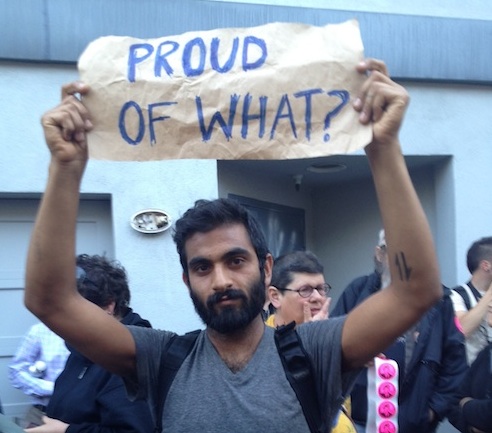
“Let the press in! Let the press in!” the crowd of about 50-60 Bradley Manning for Grand Marshal supporters chanted yesterday evening at 7pm, packed into the lobby of the Golden Gate Business Association on Pearl Street, after being denied entrance to the elevator leading to the Pride Board meeting on the fourth floor. A hired security guard held the crowd, which included reporters from KTVU and KQED, back and the elevator doors closed for the last time as “No cameras, no justice!” filled the air. 

The word came via the significant police presence outside the building (officers were also posted outside the building’s stairwell) that only 15 people at a time were being allowed into the board meeting, which was held to accept “public comment” on the Bradley manning controversy. The meeting was also supposedly held to address any questions about its official statement, released yesterday afternoon, rescinding Manning’s election as Grand Marshal because he was “not local.”

No one there, it was clear, was getting in. 

Safety hazards were cited. Surely, some protesters put forth, the Pride Board knew it would need a bigger space to address the community’s concern — like, say, the LGBT Community Center across the street? 

Scene inside the lobby after being denied entrance to the Pride Board public comment meeting

(Blogger Michael Petrellis did manage to get into the sparsely occupied meeting by arriving early and begging to use the bathroom. You can read his report here.)

Among the protesters outside were Daniel Ellsberg of Pentagon Papers fame, who spoke eloquently at a previous demonstration defending Manning. (He eventually made it into the meeting, along with a few other high-profile community representatives like Gary Virginia, Carol Queen, Starchild, Lisa Geduldig, and Rainey Reitman of the Bradley Manning Support Network.) Also present outside were members of Code Pink, ACT UP/SF, and the Gray Panthers.

Waiting on the street was attorney David Waggoner, who that day had filed an official discrimination complaint with the city’s Human Rights Commission. The complaint alleges that “the Pride Board syomped on the moral convictions of the grand marshals who voted for Manning. SF Pride — a recipient of City funding — is not allowed to discriminate against people just because they don’t like their moral support of Manning.”

The Pride Board ended its meeting early, and a representative said that it would plan another in a more appropriate — hopefully meaning bigger — venue. 

As usual, queer activist Tommi Avicolli Mecca put everything into perspective.

“I know it’s 40 years ago and I’m old, but I was at the first Gay Freedom march in Philadelphia in 1972 — and we were oficially protesting the war in Vietnam. How did we come to this — standing outside the corporate offices of Pride and shouting for them to let a military protestor, from the military itself, into their parade — into our parade?”

As the Manning supporters took to the streets and shouted “You say court martial, we say grand marshal!” from the nearby F-Market stop, Patricia Jackson, convener of the Gray Panthers, added:

“If Pride is about inclusion, how can they shut us out — of the meeting, of the conversation? The only way to heal any divide in a community is to accept that people have different views, and make things bigger than that.”  

Pride Board statement: Manning “not local,” controversy “not our mission”

20

Here’s the official statement just issued by the Pride SF Board about the Bradley Manning grand marshal fiasco, “clarifying” its bizarre rules (“Under longstanding policy, the community grand marshal upon whom the Electoral College votes is defined as ‘a local hero (individual) not being a celebrity'”), and directing the electoral college to vote for one of “two, duly qualified nominees for the 2013 Community Grand Marshal: Bebe Sweetbriar and Associate Justice Jim Humes.”

(Poor singing drag queen BeBe Sweetbriardespite her incredible productivity, even Pride doesn’t think she’s a celebrity! We still love you, Beebs.)

The statement also engages in a gross bit of condescencion.

“Those that nominated Mr. Manning surely knew that he is not a local, Bay Area community member, and that he should not have been voted on by the Electoral College. His nomination is more appropriately debated and voted on by the public than by a small group, and it could be next year when nominations open…. Taking sides in the controversy concerning Mr. Manning’s conduct is not appropriate for the organization and falls outside its core mission. We apologize to Mr. Manning, knowing that he did not ask to be at the center of a community firestorm, and for any harsh words that may have been said about him.”

Because the core mission of Pride, of course, is not to take a side in any controversy ever. Except gays in the military. And whether the Altoids float should come before or after PFLAG. Tell us, SF Pride: does Bud Light taste great, or is it less filling? We’ll have to wait until the end of time for an answer.

I’ll be asking the Pride Board about this statement tonight at its public meeting (7pm at 30 Pearl St., Fourth Floor). Stay tuned.


“For the past four decades, SF Pride has stood firmly to advance its mission to educate the world about LGBT issues, commemorate LGBT heritage, celebrate LGBT culture, and liberate LGBT people.  It remains a considerable honor and utmost commitment to engage the community to recognize those persons who have positively advanced the LGBT liberation movement, representing the full spectrum of contributions to advance full equality for all.

Presenting various categories and criteria for annual parade grand marshal nominees offers SF Pride and the community a broad range of opportunities to recognize and honor a diverse range of individuals and organizations for their achievements on behalf of LGBT people. Grand Marshal Categories include Celebrity, Lifetime Achievement, Organizational, Community, Special Guests, and Pink Brick.

The SF Pride Board recognizes and regrets the recent error in the announcement of Mr. Bradley Manning as the Electoral College’s Community Grand Marshal.  The Electoral College was not the appropriate forum for his nomination. The longstanding Grand Marshal Policy provides that one community grand marshal shall be elected by an electoral college composed of Community Grand and Honorary Marshals elected or appointed since 1999. Grand Marshal/Pink Brick Policy, Sections 3.3 and 5.2.3.  Under that longstanding policy, the community grand marshal upon whom the Electoral College votes is defined as “a local hero (individual) not being a celebrity.” Grand Marshal/Pink Brick Policy, Section 5.2.3.

Because Mr. Manning is not local, by definition under the Grand Marshal policy, he may not be nominated or elected by the Electoral College as its community grand marshal. The SF Pride Board determined that because the nomination and election had been conducted in the incorrect forum, the election could not be upheld as valid. Mr. Manning might rightfully qualify as a nominee for Celebrity Grand Marshal or another community grand marshal spot, but not as the Electoral College’s nominee, as a matter of longstanding, written policy.

The integrity of the elections process and procedures are important to SF Pride and the community. Those that nominated Mr. Manning surely knew that he is not a local, Bay Area community member, and that he should not have been voted on by the Electoral College.  His nomination is more appropriately debated and voted on by the public than by a small group, and it could be next year when nominations open.

Taking sides in the controversy concerning Mr. Manning’s conduct is not appropriate for the organization and falls outside its core mission. We apologize to Mr. Manning, knowing that he did not ask to be at the center of a community firestorm, and for any harsh words that may have been said about him. In the end, SF Pride recognizes that becoming embroiled in the controversy concerning the merit of Mr. Manning’s conduct was an honest mistake. However, because the Grand Marshal/Pink Brick policy precludes Mr. Manning from being nominated for, or elected as a community grand marshal by the Electoral College, SF Pride stands by his disqualification on those unequivocal policy grounds.

Moving forward, in the spirit of fairness and to respectfully honor the contributions of qualified nominees, the SF Pride Board is re-opening the Electoral College’s voting process so that it may select a Community Grand Marshal from the remaining two, duly qualified nominees for the 2013 Community Grand Marshal: Bebe Sweetbriar and Associate Justice Jim Humes. Members of the Electoral College will have until May 16 to re-cast their vote. 

Starting on Wednesday, May 8, ballots will be sent to the Electoral College both by email and snail mail. Votes can be cast by either email or postal mail to the SF Pride offices at 1841 Market Street, 4th Floor, San Francisco, CA 94103; Att: Electoral Voting.  Votes must be cast by 5pm PST on Thursday, May 16.  The elected Grand Marshal will be announced by noon the following day, Friday, May 17.  The SF Pride Board of Directors appreciates the support of concerned members of the community. These matters have been sorted out towards a fair resolution.  We encourage all former Community and Honorary Grand Marshals in the Electoral College to participate in this extended opportunity to select a qualified Community Grand Marshal for the 2013 Parade and Celebration.

Shortly before this statement was released, SF Pride received a complaint filed against it at the San Francisco Human Rights Commission concerning Mr. Manning.  This statement is not a response to that complaint, and SF Pride will be responding to that complaint in the proper forum, not in the press and/or at board meetings.”

T-Third passengers unhappy about train service disruptions

Around 20 residents from San Francisco’s Bayview neighborhood lined up at the San Francisco Municipal Transportation Agency board meeting May 7 to voice complaints that all too often, the T-Third light rail transit vehicles leave passengers stranded on train platforms, taking rail cars out of service before the end of the line and leaving riders to wait for the next arrival.

Organized by People Organized to Win Employment Rights, an organization better known as POWER that has campaigned around Muni issues before, the riders asked the SFMTA board to address the T train turnarounds, and called on the transit agency to run all trains through to the end of the line in the city’s Southeast neighborhoods.

Muni service disruptions along the T-Third occur most frequently at 23rd and Third, Armstrong and Third, and Williams and Third, based on SFMTA data. The passengers expressed frustration that even though the T-Third technically runs all the way to Sunnydale, a Visitation Valley housing complex, it often stops short of the final destination and causes delays on an already lengthy commute. The topic of Muni “switchbacks” picked up momentum earlier this year after District 4 Sup. Katy Tang vowed to take up the issue of train turnarounds, which also impact transit passengers in the Sunset. 

Jackie Wysinger, who walks with a cane and resides at a senior center nearby Armstrong and Third streets, told SFMTA board members that she’s no longer able to drive and depends upon the T train to get around.

“We need better transportation,” Wysinger said. “The T train turns around right there, and they do it regularly,” leaving passengers with no choice but to walk or wait in discomfort. “It’s just bad on the senior citizens.”

Claudia Bustamante, a member of POWER who spoke in Spanish through a translator, related a story of traveling back to the Bayview on the T-third on Monday night. “We were on the T-train and there was a person in a wheelchair, and another woman crying,” she said. “But the driver said, ‘sorry, this is the last stop. Everybody has to get off.’ … They kicked us off. This happens not just to me, but to the members of the African American community in Bayview. And this needs to stop.”

Jim Hill, who told SFMTA board members that he’s lived in the Bayview for 51 years, said he’s experienced train service disruption at 23rd Street on a regular basis. “I don’t understand why a man would turn a train around that’s full of people,” he said. “I have experienced 45 minutes to an hour before another train comes.”

Hill added, “I don’t think a person should have to work all day, and have to stand up from the time they get off work, until they get home.”

Gloria Dean, a Bayview resident who penned an editorial in the San Francisco BayView newspaper in March, characterized the frequent disruptions to service in Bayview Hunters Point as “shameful racism” in her opinion piece. She recounted one evening when her commute from Oakland to Third and LaSalle took from 6:45pm until 9:08pm. Since her husband is battling health problems, “it’s important for me to get home” following her evening classes at Mills College in Oakland, Dean wrote.

Juana Teresa Tello, an organizer with POWER, stressed that while switchbacks are known to occur on other lines, Bayview residents tend to have fewer transportation options. “It’s the highest concentration of people in public housing,” Tello pointed out. “It’s people who need the transit system the most.”

There was no SFMTA agenda item on the topic of turnarounds on the T-Third line, so residents aired their grievances about the issue during public comment. Once they had all finished speaking, SFMTA board chair Tom Nolan indicated that the item should be added to the board meeting agenda “sometime in the near future.”

In response to a query submitted several weeks ago, SFMTA spokesperson Paul Rose sent the Bay Guardian a detailed response to questions about train turnarounds at the 23rd and Third stop.

“Trains going to 23rd Street on the T-Third are typically going to our maintenance yard located near 25th Street and Illinois at the end of their shift,” Rose explained in an email. “These trains are J, K, L, M, and N trains that travel in service as T-Third trains to the yard and accept passengers all the way to the last stop before the yard – 23rd Street. The alternative is to have the trains travel ‘not in service’ to the yard from the subway and accept no passengers.

“The vehicles returning to the yard and traveling from the subway only to 23rd Street add additional frequency between the subway and 23rd Street but are not scheduled full trips to Sunnydale,” Rose acknowledged.

The 23rd Street stop marks the end of a stretch of recently installed condominium complexes in San Francisco’s Dogpatch neighborhood, an increasingly popular residential area for Silicon Valley commuters who have easy access to the highway to travel south to tech campuses.

Finally, Rose stressed that “We minimize unscheduled train turnarounds as much as possible … Supervision is also told to only perform these turnarounds when there is another train within five minutes or less,” he added, “to minimize passenger inconvenience.”

Why the PG&E settlement is lame

3

One of the factors that the state regulators took into account when they decided how much PG&E should be fined for the San Bruno blast was the company’s financial situation — that is, how much of a fine could the utility “safely absorb.” That’s the first sign that something screwy is going on here.

If I run a red light, the traffic court doesn’t ask how much of a fine I can “safely absorb.” A crook who embezzles money not only has to pay the money back, but suffer a financial penalty that can greately exceed what he or she can afford. A murderer doesn’t get to go before a judge and say, gee, two years in prison is all I can “safely absorb.” That’s not how it works.

PG&E is a giant company that has a guaranteed annual rate of return exceeding ten percent on everything it spends. It’s shareholders are large investment banks and stock funds. Its executives are very well paid. And gross negligence — that is, intential mismanagement at the level of criminal activity — on the part of the company led to the deaths of eight people and the destruction of an entire neighborhood.

The penalty ought to be MORE than the company can “safely absorb.” It ought to be enough to make shareholders wonder whether PG&E is a good investment. It ought to really, really hurt PG&E.

Instead, the CPUC staff is just telling the company to spend $2.25 billion doing what it should have been doing all along, and needs to do anyway: Fix the pipelines.

Sure, that money will come from profits, not from the ratepayers. But again, as the mayor of San Bruno pointed out on KQED’s Forum this morning, PG&E, as a regulated monopoly utility, has a guaranteed rate of return — and can borrow money at less than half that rate. The company reported revenues of $15 billion and profits of $830 million for 2012. PG&E seems to have plenty of money to fight CleanPowerSF and offer its own “green energy” program for less than the city will charge — and that’s guaranteed to be a money-loser, covered by some of those profits.

The CPUC ought to order the company to fix the pipes — then assess a fine high enough to wipe out all profits for, say, five years, which is how long it’s going to take San Bruno to fully repair the damage and recover from the explosion.

That would be a suitable “punishment.” Would it drive PG&E into bankruptcy? No — lots of companies operate with little or no profit margin these days. Let the killer utility cover its costs, do its job, pay its employees … and nothing more. The staff report is scathing; the penalty sounds stiff. But it’s not going to send enough of a message.


The 8 Washington-Monterey connection

11

The guy who wants to build the most expensive condos in San Francisco history on the waterfront is facing a ballot measure that could derail his dreams — so he’s hiring a team of signature-gatherers to put a competing measure on the ballot. Which makes little sense to us, since when the voters are confused, then tend to vote against things, and there will be two measures (confusing) and all the opponents of the 8 Washington have to go is get people to vote No, which is easier than Yes.

But whatever.

What intrigued us is that the signature-gathering company that is about to launch Simon Snellgove’s pro-condo drive is also doing a petition drive a couple hours to the south — where environmentalists are facing off against a developer who wants to build a luxury horse-racing facility along with housing, two hotels, and an office complex on the old Fort Ord military base in Monterey.

The opponents, who want to preserve open space, are doing an initiative campaign to block it — and the developer is now doing his own counter-intiative.

According to a message on the petition company’s voice mail, signature gatherers are getting $1.60 a signature in Monterey. Don’t know yet what they’re getting in San Francisco.

And of course, the developers in Monterey are talking about jobs and recreation and parks — just as they are in San Francisco. Someone must have done a few focus groups on that.

If Monterey Downs gets built (and for the record, I am not an opponent of race tracks, horse racing, or gambling, and I love Golden Gate Fields and its $1 beers) it won’t be the kind of blue-collar cheapie place across the Bay. It will be a high-end equestrian center. “Maybe,” Jon Golinger, an 8 Washington foe, says, “that’s where the multimillionaires in the new condos will keep their horses.”

It’s an interesting political tactic — block an opposition intiative with one of your own — and it’s going to play out twice this fall in Northern California. If it works, the developers will have yet another tool. If it fails, that may be the end of it.


Condo bypass legislation now before the full board

196

Controversial condominium lottery bypass legislation — sponsored by Sups. Mark Farrell and Scott Wiener but substantially modified by tenant group that strongly opposed the original legislation, with the help of Sup. David Chiu, Jane Kim, and Norman Yee — is finally coming to the full Board of Supervisors today (Tues/7, starting at 2pm).

Those involved in the negotiations say the legislation will likely to be returned to the Land Use Committee because of amendments being introduced today that the City Attorney’s Office has deemed substantial enough to require another public hearing. [UPDATE: The board voted unanimously to send this back to committee, which will consider it on Monday the 13th].They include a provision pushed by tenant groups that would scuttle the lottery bypass if the 10-year lottery moratorium is challenged in court. 

That moratorium was pushed by tenants and their supporters as a tradeoff for letting a backlog of around 2,000 tenancy-in-common owners buy their way out of the city’s lottery for the annual allowed conversion of 200 TICs into condominiums, which are more valuable and easier to sell and finance than TICs.

Farrell told the Guardian late last week that he was still negotiating with both sides and hopeful that he might be able to support the legislation, despite the hostile amendments that Chiu made which were opposed by Farrell and Wiener in committee.

San Francisco Tenants Union head Ted Gullicksen told us that the tenants’ side was willing to accept a couple of the technical amendments that Farrell proposed during negotiations with them, including exempting from the bypass fee the 19 building that have awaited conversion the longest and allowing some owner-occupier changes as the bypass is phased in over six years.

He said Farrell also proposed that if less than 2,000 condos opt for the bypass, then the difference in numbers would be added to the allowable number of condos in the first year that the lottery is restored, which the tenants’ groups haven’t yet agreed to.

Farrell and Wiener are also expected to offer other amendments, but the tenant groups have said they’ve gone as far as they’re willing to in allowing any increase in condo conversions, and they seem to have six solid votes lined up on the board.

Yet it’s still an open question how new amendments might affect those political dynamics, how the real estate industry (which simply wants as many condo conversions as possible) will respond, whether Mayor Ed Lee (who has avoided taking a position on the legislation) will sign or veto whatever emerges, and whether whoever is left unsatisfied by this deal will try to go to the ballot.

In other words, there may be some tricky political maneuvering ahead, so stay tuned. 

Hospital union targets UC executive pensions [VIDEO]

An update to this story has been posted below.

An ongoing labor rift is intensifying between frontline University of California hospital employees and the UC medical center system. UC administrators have minimized employees’ stated concerns about eroding patient care due to staffing rollbacks, saying the real issue at the heart of the dispute is AFSCME’s “refusal to agree to UC’s pension reforms.”

But now the union is striking a different note on pension reform, most recently taking aim at UC executive pensions – or what AFSCME 3299 spokesperson Todd Stenhouse glibly refers to as the “golden handshake protection program.”

AFSCME 3299 represents 13,000 UC patient care and technical workers. The union is expected to announce the outcome of a strike authorization vote, stemming from a contract negotiation that has been at an impasse for months, any day now.

Meanwhile, the hospital workers’ union issued a statement on May 3 pointing out that top-ranking UC executives, particularly longtime administrators whose robust retirement benefits were grandfathered in from a more bountiful era, stand to receive pension payouts that dramatically exceed the reduced retirement benefits most public employees can now expect.

“Our point is simply this,” Stenhouse explains. “How can you even pretend to have pension reform when you’re not capping executives’?”

UC spokesperson Steve Montiel noted that UC restructured its pension program several years ago. He justified the higher payouts, saying, “That’s something we see as being necessary to attract the best people at all levels, and to compete with others for the very best people.”

This past January, sweeping pension reform legislation took effect after winning bipartisan support in Sacramento. The new limits cap pensionable salary levels at $110,000 for public employees who earn Social Security, and $130,000 for those who don’t.

Yet the leaner retirement regime does not apply to employees in the UC system, which operates under a separate pension structure. Under the UC framework, pensionable salary levels are capped at $250,000, or $375,000 for employees hired prior to 1994.

“The cap on compensation for the governor of California is $110,000,” Stenhouse points out. “They say they want pension reform. Well, we want real pension reform.”

AFSCME is targeting Mark Laret, CEO of UCSF Medical Center, in particular. Since he was hired early enough to benefit from the higher pensionable salary cap, the hospital director, whose total annual compensation exceeds $1 million, is expected to earn more than $309,000 per year in retirement benefits.

In 2010, Laret joined 35 other UC executives in threatening to sue the Board of Regents if pension caps, mandated by the Internal Revenue Service, were not lifted. The IRS had offered to grant an exemption to the UC system but Regents ultimately determined that the caps should remain in place, despite executives’ objections.

In this clip, AFSCME 3299 President Kathryn Lybarger and Pathology/Lab Technician Margaret Mann confront Laret during his onstage address at the UC Health Center for Health Quality and Innovation’s Spring Colloquium, held at Oakland Marriott City Center on May 3. Video courtesy AFSCME.

Had they succeeded in lifting the caps, Laret could have received more than twice as much in annual retirement benefits, according to AFSCME estimates. (The medical center CEO recently co-authored an Op Ed in the San Francisco Examiner admonishing AFSCME for resisting “modest reforms” on pension contributions proposed by hospital management.)

Montiel emphasized to the Bay Guardian that contract bargaining negotiations are the central issue, noting that executive pensions haven’t figured into that discussion. “They haven’t raised this at the bargaining table,” he said. “If they wanted to propose caps on pensions for their units, we would look at that, but what they’re talking about is beyond what’s being bargained right now.” A key issue, he added, is a proposal for employees to contribute 6.5 percent toward retirement savings, up from 5 percent.

AFSCME has estimated that the UC system could save $35 million annually if executives were held to the $110,000 pensionable salary cap now in effect for a majority of state, county and municipal employees.

“I haven’t looked at the math on that,” Montiel said when asked about this potential source of savings. “The medical centers are supported by medical center revenue, so there’s really no state funding that is going into salaries there. … There are lots of savings that could be made. These are all things that have been taken into consideration for years as compensation levels have been set and so forth, but this is not part of the negotiations with AFSCME.”

Sen. Leland Yee has introduced legislation, SB 8, to prohibit pay increases for top UC administrators within two years of a tuition hike or when budget allocations are not increased. According to a fact sheet prepared by Yee’s office, the bill is meant to address a trend where “the UC and the CSU systems have historically hiked executives’ pay while raising student fees and have given new administrators more than double digit pay hikes.” The legislation is working its way through the approval process, currently in committee.

On this latest debate, Yee sided with the union. “I don’t see why, when state workers are in a pinch and tuitions are at record highs, UC executives should be pulling down $300,000 a year on their pensions,” he said. “This shows yet again the profoundly backwards priorities in the UC system.”

UPDATE: We just got word that AFSCME 3299 members voted to authorize a strike with 97 percent support. The union can lawfully call a strike any day now, but dates and duration of a strike have not been finalized.

The warriors arena: How are you going to get there?

51

The Warriors and the all-star lineup of nearly every political consultant in town launched a new public relations offensive this week with the release of a new, spiffy set of drawings and a rewritten plan for a waterfront arena. And opponents of the project pretty much shrugged and said: So, what?

Sure, it looks nicer than it did before. Sure, there’s a pedestrian walkway around the arena. Yeah, there’s glass on the inside that will give spectators a nice view of the Bay. Oh, and there’s room for a cruise ship terminal, to give the whole thing a veneer of maritime use.

But the problems with this project have never been the architecture of the 12-story structure or the inevitably dubious links to the water. “The design was never the point,” Randy Shandobil, a spokesman for the Waterfront Alliance, told us. “Is this the best place to put a big arena?”

The new plan calls for a slightly smaller arena — 125 feet high instead of 135 — with slightly less retail space and seating inside. The glass sides will not only allow fans to look out, but allow people walking around the outside to view in and see something going on inside. The scoreboard will probably be visible; the actually play on the floor less so.

The visuals presented by the architects, Snøhetta and AECOM, indicate that the arena will perch on a large pad raised significantly above the level of the current Piers 30-32. From the ground level, the arena looks like a giant flying saucer, taller than AT&T Park, that’s plopped down below the Bay Bridge.

Craig Dykers, a representative of the architects, told a Board of Supervisors committee May 6 that the arena will fill a need for some sort of project along the open stretch of waterfront from the Ferry Building to AT&T Park. His presentation made it sound as if that undeveloped area was by nature a blight; thousands of joggers, walkers, bicyclists and people enjoying the unimpeded views of the Bay might disagree.

In fact, the project will change more than the two piers; it will create a busy residential and commercial shopping district that will increase foot and vehicle traffic even when there are no games or concerts scheduled.

This is, by any standard, a very different project from what the Warriors first proposed back in November, 2012. That’s why the Waterfront Alliance is asking that the scoping sessions for the environmental impact report on the project ought to go back to square one.

No matter what you think about the design, or the views, or the impact on the city’s priceless waterfront, there’s a problem that’s glaringly obvious, and Sup. Scott Wiener made the point very clearly:

This absolutely has to be a transit-first arena. There’s no way that part of the city can handle even half of the 5,000 cars that have been counted at the Warrior’s current home, Oracle Arena in Oakland. And much of that impact is going to fall on the subway, or light-rail vehicle system.

“It absolutely has to have good LRV service,” Wiener said.

The problem: “Our current system is not even meeting our current needs. I have a lot of constituents who say, when there’s a Giants game you just don’t take the subway because there’s not going to be any capacity. We’re close to a breaking point now, even past it. and our ten-year capital plan puts to the side most of Muni’s unmet capital needs.”

Jennifer Matz, the Mayor’s Office point person on waterfront development, said she agreed with Wiener. “I recognize this challenge,” she said. “There needs to be more of a holistic approach.”

But Wiener wasn’t backing down. Adding the capacity that will be needed to serve the new arena, and the new Giants development, and the new residents moving into the waterfront neighborhood, is not going to be cheap. “Where,” he asked, “is the money going to come from?”

Peter Albert, who works for the Municipal Transportation Agency, is looking into the number of passengers that will be riding Muni — and BART, and Caltrain — and the capacity those systems plan to add. But he had no answer to Wiener’s question.

That’s because there is only one answer: The taxpayers will have to come up with something in the range of a billion dollars to solve Muni’s capacity problems in the next few years — or else the developers will. And right now, there’s not a lot of political will at City Hall to ask for either.

The right wing and armed revolution

29

Man, I’m getting old. When I was growing up, in the 1960s, and even when I was in college in the 1970s, and when I was first in San Francisco in the early 1980s, the only ones talking about “armed revolution” were the commies. The system was coming down, fast; the Black Panthers marched around with rifles. The RCP and the Weather Underground and a bunch of other offshoots and fringe groups talked about fighting in the streets. Mick Jagger once sang “hey, think the time is right for violent revolution,” tho Mick was living in a posh condo in Manhattan and dating supermodels and building the first band ever to gross a billion dollars in sales.

Now nobody on the left talks about revolution much any more; it’s the folks on the far right — and, alarmingly, nearly half of the Republicans in this country — who say that “armed revolution might be necessary in order to protect our liberties.” The poll is a bit scary — 18 percent of Democrats even agree that it’s going to be time to pull out the assault rifles and have at the Gummint.

I wonder how this breaks down by age, and how much of it is (not-so) subtle racism aimed at the first Black president. Probably most of it comes from the gun nuts who think Obama is going to take away their weapons. But Jeez: “Armed revolution?” That’s so 1968.


Why are the feds cracking down on pot again?

13

President Obama keeps saying that marijuana isn’t a big priority for his administration, and his rogue nutcase of a US Attorney in Northern California keeps making it a priority. Now the Drug Enforcement Administration, which also reports to the White House, is joining the action, going after licensed dispensaries in San Francisco and San Jose.

Maybe the feds are just trying to make sure everyone’s following the rules — except that the DEA has no jurisdiction over California law, and California laws says the dispensaries are just fine. So it’s hard to imagine that this is anything other than a heavy-handed attempt to drive more pot clubs out of business.

For what? For why? And why are our US Senators, Dianne Feinstein and Barbara Boxer, not making a stink about this?

Bay to Breakers will have video surveillance, license plate scans, and secret “FBI assets”

19

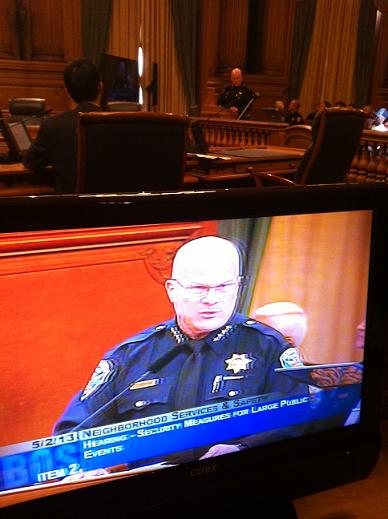
Police video surveillance was in the spotlight during yesterday’s City Hall hearing on security measures at large events, as supervisors voiced a desire to strike the right balance between security and civil liberties. And while they got some reassurance and small signs of restraint from the SFPD, they also learned about secretive new security measures that go beyond what the public was aware of.

San Francisco Police Chief Greg Suhr clarified misleading media reports (a Chronicle story then picked up by Associated Press) that he’s seeking real time video surveillance along Market Street. Right now, Suhr said he just wants an inventory of existing video cameras along Market and downtown that he can request footage from after a crime is committed and that he would make his case to the board if he ever wanted to go beyond that.

“Right now, we only look at footage in retrospect,” Suhr told the Neighborhood Services and Safety Committee hearing, adding that he has no objections to seeking a court warrant to obtain that footage because “we do want it to be admissible.”

Yet Suhr and Deputy Chief James Loftus also revealed that SFPD will be deploying an undisclosed number of temporary real-time video surveillance cameras atop long poles at the Bay to Breakers footrace on May 19, as it did last fall during the World Series and the big parade down Market Street celebrating the Giants victory.

“We always want more video,” Suhr told the Guardian, although he said that he also understands the civil liberties sensitivities of San Franciscans, which is why he isn’t now seeking a permanent increase in SFPD’s real time video surveillance capabilities. “I’m from San Francisco, I get it.”

Other security tools that the SFPD will be employing at Bay to Breakers and other large events are technology that uses video cameras on police cars to capture license plate numbers and run them through a DMV database, what Loftus vaguely described as “specialized resources from surrounding jurisdictions” (watch out for the drones, y’all), and unspecified “FBI assets [that] will be present and assisting in event security.”

When Sup. Eric Mar, who called the hearing, asked about those last two items, Loftus said he wouldn’t discuss them publicly, but “I could talk to you about it offline if you’d like.”

Sup. David Campos said that he doesn’t want San Francisco to be reactionary after incidents like the Boston Marathon bombing and that we should be a model city for balancing security with civil liberties: “I think that’s a very difficult balance to strike, but it anyone can strike that balance, I think San Francisco can.” He also expressed concerns about plans to ban backpacks at Bay to Breakers: “I don’t know if that’s going to address the problem.”

Loftus said the ban only applied to large backpacks (larger than 8.5x11x14 inches) and that runners and spectators will still be allowed to use small backpacks to hold water and changes of clothing. Yet for those concerned about the creeping police state, including several people who spoke during the public comment period, there was little consolation offered in the presentations, and the supervisors said this would be an important ongoing discussion.

“This is a discussion that goes beyond San Francisco,” Campos said. “We as a country need to have this discussion.”

Students celebrate SF resolution to divest from fossil fuels

Famed environmental writer and 350.org founder Bill McKibben wore a short-sleeved T-shirt as he stood on the steps of San Francisco City Hall this afternoon and addressed a crowd of energized student climate activists.

“It’s a pretty day here, but it’s a little warmer than it should be,” he remarked of the hot afternoon with temperatures creeping above 80 degrees F. “This is the hottest May 2 ever recorded in the city of San Francisco.”

McKibben was there to celebrate a recent victory for his organization’s fossil fuel divestment campaign, which came last week when the San Francisco Board of Supervisors voted to adopt a resolution by Sup. John Avalos urging the San Francisco Employee Retirement System to divest from companies that hold fossil fuel reserves.

McKibben’s organization, 350.org, has been urging colleges, universities and city governments across the country to enact similar measures. “This is pretty simple math. The math is, if you’re invested in the fossil fuel industry, then you are profiting from the wreckage of the climate,” McKibben said. You are making a bet that nothing will ever be done to stop or slow down climate change, because if anything ever is done, it will put those investments at risk. The perversity of that is stunning.”

Students across the country have organized campaigns to divest, borrowing a tactic from the anti-apartheid movement. Over the last couple days, “The students at the Rhode Island School of Design had gone and occupied their president’s office, because they were getting no attention to their demand for divestment,” McKibben noted. “And they dropped a banner out the window. And the banner said, ‘We may be art students, but we can still do the math.’”

He went on: “There’s no absolute guarantee that we’re going to win this fight. But I do know … that we’re at the very least going to fight. And fight hard.”

Sup. John Avalos also delivered comments at the rally. When he first contemplated introducing the resolution, “I thought, oh no, just another advisory measure that we’re going to do as a Board of Supervisors,” Avalos admitted, “but I also saw the real value of it. That if San Francisco could take a stand like this, it could have a real impact on all the other cities around the country.”

He added that the most compelling argument for divestment was that, “We know that we cannot take all of the fossil fuel out of the ground that those corporations are seeking. And eventually … they’ll be stranded assets that we’ll have no return on in the future.”

Asked after the rally whether he thought SFERS would indeed divest as a result of the nonbinding resolution, McKibben told the Bay Guardian, “I have no doubt that they will. … I think that that’s starting to happen all over the country, and I think people like Supervisor Avalos are serious about making sure that it’s for real. You know, in Washington we make rhetorical statements with nothing behind them, but hopefully in San Francisco,” things will turn out differently, he added.

Earlier in the day, Norm Nickels of SFERS noted that the resolution has not yet been added as an agenda item for the Retirement Board to take up, because it has not yet cleared the final hurdle for official Board of Supervisors approval.

Another attack on public-employee unions

43

Big-business and conservative interests have been trying to years to find a way to undermine the political clout of organized labor, particularly unions like the teachers and nurses, who have played a huge role in progressive campaigns. And now there’s a new tactic.

The anti-union folks have gone to court to try to do what they haven’t been able to do in the legislative arena: take away the ability of public-employee unions to use membership dues for political campaigns:

In a scarcely-noticed lawsuit filed Monday in federal district court in Los Angeles, a conservative nonprofit, the Center for Individual Rights, claims that California’s system for collecting union dues from government employees abridges free speech safeguards by compelling employees to subsidize union political advocacy and activities with which they disagree.

Peter Scheer, who runs the California First Amendment Coalition, notes that current law is on the side of the unions — but five Supreme Court justices have been critical of the prevailing case law.

And if they prevail? Public employee unions, not just in California but across the country, would lose the bulk of their dues funding-and with it, the ability to wield decisive political influence in state and local governments everywhere. That is a big deal.

Yep. It’s a big deal. It could do what corporate America has been trying to do for years — eliminate the one remaining power base with the money to challenge right-wing efforts. If this gets all the way to the Supremes, it will be a few years away, but we need to keep an eye on it.

Guest opinion: LGBT supporters of Bradley Manning

33

Editor’s note: At least 24 LGBT community leaders and activists have signed on to the following statement in support of Bradley Manning as a Pride grand marshal.

Recently, it was announced that PFC Bradley Manning would be a grand marshal of the 2013 San Francisco Pride Celebration. We felt this decision was a bold and uplifting choice, bestowing a great honor on a young whistleblower being persecuted for following his conscience.

Much to our disappointment, two days later SF Pride board president Lisa Williams issued a separate announcement that the SF Pride board would not be honoring PFC Manning as a grand marshal after all.  It appears the SF pride board’s reversal was affected by criticism from a recently formed gay military rights group. 

We want the world to know that the SF Pride board’s decision is not reflective of the LGBTQ community as a whole, and that many of us proudly celebrate PFC Manning as a member of our community.  Unfortunately, the statements by Williams, and the group which originally advocated against PFC Manning as grand marshal, continue to perpetuate certain factual inaccuracies with regards to the military prosecution against him. 

The first inaccuracy would be that PFC Manning did not advocate for gay rights.  In fact, while serving in the military, PFC Manning experienced harassment and physical assault because of his perceived sexuality.  He responded by marching against Don’t Ask Don’t Tell in the DC pride parade, where he spoke to reporters about his position, in addition to attending a fundraiser with Gavin Newsom and the Stonewall Democrats so he could discuss the issue of homophobia in the military.  He told a friend in February of 2009 that his experience living under DADT and experiencing the oppression that entailed helped increase his interest in politics more generally.

LGBTQ activists fought hard for years to win the right to live free from the fear that we could be targeted with violence deemed acceptable to society at large, simply for being who we are.  We members of the LGBTQ community would like to stand in solidarity with others around the world who still must live in fear of violence and oppression, simply for being born into a particular group.

Contrary to SF Pride Board president Lisa Williams’s claim, no evidence has been presented that PFC Manning’s actions endangered fellow soldiers or civilians. In fact, the military prosecution has successfully argued in court that it isn’t required to provide such evidence, and former State Department spokesperson P.J. Crowley continues to insist that the “Aiding the enemy” charge is unwarranted. 

In a February 28, 2013, court statement, PFC Manning detailed the due diligence he performed prior to releasing materials to ensure this lack of harm, in addition to explaining,

“I believed the detailed analysis of the [Iraq and Afghanistan war log] data over a long period of time by different sectors of society might cause society to reevaluate the need or even the desire to even to engage in counterterrorism and counterinsurgency operations that ignore the complex dynamics of the people living in the affected environment every day.”

The truth is that President Bush and VP Cheney’s aggressive wars in the Middle East endangered far more LGBTQ service members and civilians than any Army whistle-blower.  Unlike PFC Manning, however, they have never served prison time, and likely never will.

Millions of people around the world support Bradley for the personal risk he took in sharing realities of complicated U.S. foreign conflicts with the American people.  He is the only gay U.S. serviceperson to be nominated three times for the Nobel Peace Prize.  In joining the Army, soldiers take an oath to protect the U.S. Constitution, and we believe that by his actions PFC Manning strengthened our democracy, and fulfilled that oath to a greater degree than most enlisted.

We are proud to embrace PFC Bradley Manning as one of our icons, and intend to march for him in pride contingents across the country this year, as we have in years past.  We think Bradley Manning sets a high standard for what a U.S. serviceperson, gay or straight, can be.

Lt. Dan Choi, 2009 SF Pride Celebrity Grand Marshal, anti-DADT activist
Joey Cain, 2008 SF Pride Community Grand Marshal, former Board Member and President of SF Pride
Gary Virginia, 2012 SF Pride Community Grand Marshal
John Caldera, Commander, Bob Basker Post 315ED, American Legion, SF Veterans For Peace
Peter Tatchell, Peter Tatchell Foundation
Glenn Greenwald, award-winning journalist
Leslie Feinberg, transgender author and activist
Minnie Bruce Pratt, award-winning poet, activist and educator
Dossie Easton, Therapist and Author
Susie Bright, public speaker, educator, writer
Andy Thayer, co-founder, Gay Liberation Network
Becca von Behren, Staff Attorney, Swords to Plowshares Veterans Service Organization
Stephen Eagle Funk, Artistic Director, Veteran Artists
Liz Henry, poet and activist
Lori Selke, author and activist
Rainey Reitman, Steering Committee, Bradley Manning Support Network
Sergei Kostin, Codepink Art Director
Kit Yan, Queer & Trans Asian American Poet
Lori Hurlebaus, Civilian-Soldier Alliance, SF Chapter; Co-founder, Courage to Resist
Evan Greer, radical queer riotfolk musician
Pat Humphries, Emma’s Revolution
Sandy Opatow, Emma’s Revolution
Pamela Means, award-winning OUT musician
Malachy Kilbride, Coordinating Committee, National Campaign for Nonviolent Resistance
Oliver Shykles, Queer Friends of Bradley Manning
Gabriel Conaway, equality activist, Steering Committee of SAME
Adele Carpenter, Civilian-Soldier Alliance, SF Chapter

May Day rally for immigration reform in SF

Hundreds gathered for a rally outside San Francisco City Hall on May 1, capping off a march that drew activists into the streets to commemorate International Workers Day. The events were organized by a broad coalition of immigrant rights advocates to call for improvements to the recently unveiled proposal for federal immigration reform, which will go before the Senate Judiciary Committee next week. [More photos after the jump]

Olga Miranda of SEIU Local 87, the San Francisco Janitors Union, addressed the crowd. “I want to be able to recognize sheet metal workers, carpenters, laborers, hospital workers, housekeepers, domestic workers,” she said. “We are a proud economy. … All we want is for workers to be able to come out of the dark. We want to make sure that we are not exploited for the color of our skin, that we are not pushed into the darkness. We are Chinese, we are Arabic, we are Filipino, we are gay, we are transgender. We are workers! And comprehensive immigration reform needs to be inclusive.”

Activists from Causa Justa / Just Cause led the crowd in a unity chant in five different languages.


Putri Siti, an undocumented student from Indonesia, shared the story of when she and her family thought they might face deportation. “I am more than just an illegal. I am more than just undocumented. I’m a student. I’m a dancer. It doesn’t matter what paper I have. And now, I am proud to say, that I am undocumented, unafraid, unashamed,”  she said.