Volume 48 [2013–14]

PrEP school

32

Two weeks ago, the Centers for Disease Control and Prevention announced that it was recommending physicians consider Truvada, a medication used to treat HIV/AIDS, to prevent infection for high-risk patients who are HIV negative. Seen as a miracle drug by some and a “party drug” by others, Truvada has struggled to take off as a preventative measure and, prior to the CDC’s endorsement, foundered under its own controversy.

The drug regimen is known as pre-exposure prophylaxis, or PrEP, and involves taking one pill of Truvada daily. The most common side effects are initial nausea and headaches, but even those generally subside after a couple of weeks. Most impressive is the efficacy rate: Studies point to a reduction in risk of contracting HIV that is higher than 90 percent for individuals who take the medicine daily as recommended.

Additionally, the CDC has recommended PrEP only for high-risk patients — meaning gay men who have sex without condoms; intravenous drug users; and couples, gay or straight, where one partner is HIV positive and the other is negative.

“While a vaccine or cure may one day end the HIV epidemic, PrEP is a powerful tool that has the potential to alter the course of the U.S. HIV epidemic today,” said Dr. Jonathan Mermin, director of CDC’s National Center for HIV/AIDS, in a press release.

But PrEP comes with its detractors, the most vocal of whom have come from within the HIV/AIDS and gay community. PrEP users often carry the stigma of being hypersexual gay men, looking to justify their promiscuous sex lives and disavowal of condoms with a daily pill. The label “Truvada whore” soon emerged as a means to shame PrEP users (though the term is now being reclaimed by PrEP activists as a source of pride through hashtags and T-shirts).

However, the loudest critic by far has been the AIDS Healthcare Foundation, a nonprofit organization based in Los Angeles that provides care to HIV positive patients around the globe.

“This is a position I fear the CDC will come to regret,” said AHF President Michael Weinstein in a public statement. “By recommending widespread use of PrEP for HIV prevention despite research studies amply chronicling the inability to take it as directed, and showing a limited preventive effect at best, the CDC has abandoned a science-driven, public health approach to disease prevention — a move that will likely have catastrophic consequences in the fight against AIDS in this country.”

The push for PrEP is playing out like a grand battle between two formidable foes. On one side is the multi-billion dollar pharmaceutical company that produces Truvada, Gilead Sciences, headquartered just a few miles south in Foster City. On the other is AHF, the largest provider of HIV/AIDS medical care in the US. While on the surface it may seem like a massive corporation taking on the not-for-profit underdog, the reality is much more complex.


THE TRUVADA TRAIN

When Truvada was first approved by the Food and Drug Administration 10 years ago, it was a revolutionary new pill used in combination with other drugs to help control the virus in HIV-positive patients. At a time when most HIV medications required taking pills throughout the day and carried intolerable side effects, Truvada was a once-a-day godsend.

Since then, Gilead has established itself as one of the leading companies for HIV medications, producing or helping to produce many top drugs, such as Atripla, Complera, and Stribild, all of which use components of Truvada in their formulas.

But Truvada’s truly revolutionary moment came in July 2012, when it became the first drug approved by the FDA to reduce the risk of HIV infection in negative individuals.

Controversy immediately ensued.

Medicating healthy people is not a popular approach, especially when those drugs cost $13,000 annually per patient (most insurance companies, as well as Medicare and Medicaid, cover PrEP). In comparison, the CDC estimates that the annual cost to treat someone who already has HIV is $23,000. If all of the 500,000 high-risk Americans who the CDC recommends use PrEP were to begin the therapy, the gross revenue for Gilead would be $6.5 billion — all for people who aren’t even sick.

Despite the potential for astronomical profits, as of September 2013 only 2,319 unique individuals had been prescribed Truvada as PrEP, according to Gilead. Half of those patients are women, suggesting that gay men are not being aggressively targeted for PrEP. When PrEP users who are part of research studies are included, the total number of patients is still estimated to be under 10,000.

One reason for the slow start is a lack of awareness. Outside of big cities, there is less dialogue surrounding HIV and prevention techniques. And even in metropolitan areas, familiarity with Truvada is often limited to the HIV specialist doctors treating patients who already have HIV and wouldn’t benefit from PrEP.

“We get a fair number of patients here who are rejected for PrEP from other physicians in the city,” said Dr. John Nienow of One Medical Group in the Castro. “I haven’t heard about widespread adoption in other offices, but I have heard of other physician groups not wanting to prescribe Truvada for PrEP.”

When asked whether the recent CDC announcement endorsing PrEP would change that, Nienow was hopeful.

The CDC announcement “will educate and legitimize PrEP’s use on a widespread basis,” he said. “I think physicians might be uncomfortable prescribing it, and this will make them more comfortable.”

Another reason PrEP has failed to gain traction is that Gilead has spent virtually no money on advertising its own drug. Well, sort of. It is true that Gilead has avoided advertising campaigns — drug companies that push their own drugs tend to stir up controversy — but many of the organizations that have come out publicly in favor of PrEP have received grants from Gilead. According to tax forms, Project Inform and the San Francisco AIDS Foundation, two prominent local nonprofits that support PrEP, have both received large donations from the pharmaceutical company.

One such grant was awarded to Project Inform, for the group to produce videos about PrEP targeted toward young gay men, particularly men of color, according to David Evans, director of research advocacy.

Was this donation a part of Gilead’s marketing strategy? It’s tough to say for sure; Gilead did not return Bay Guardian calls seeking comment.

Regardless of money, it is clear that a new approach is needed for combating HIV. New infections in the US have stubbornly hovered at around 50,000 incidences per year since the ’90s, despite pushes for condom usage and education efforts.

“Yes, PrEP is working. It works when it’s adhered to,” Nienow said. “It’s been extensively studied in populations at risk for HIV, and the conclusion was that it is dramatically successful. So much so that one expert even said that the debate about efficacy is now over.”


FROM SELF-PROTECTION TO “SLUT”

It’s true that the AIDS Healthcare Foundation is no billion dollar corporation such as Gilead. But with an operating budget this year of $904 million and a presence in 28 countries, AHF is still a force to be reckoned with.

Though the list of organizations that are loyal exclusively to condoms as a method of prevention is dwindling, AHF has been one of the most powerful and resolute allies of latex protection since the very beginning. Even before Truvada was approved by the FDA as PrEP in 2012, AHF campaigned to prevent it from happening. Even though AHF may be growing more and more isolated in its anti-PrEP stance, it is anything but ready to give way.

Though the efficacy rate for using PrEP is upwards of 90 percent reduction in risk, AHF and other critics consistently cite a drastically lower 40 percent reduction. The difference between these two figures lies in patient behavior: When Truvada is taken correctly, that is, every day without skipping doses, then it’s been shown to reduce new HIV infections by over 90 percent. However, when research studies publish data they must include all participants, regardless of whether they took the dosage as instructed. Average out the effectiveness of the drug between participants who adhered religiously and those who didn’t take it at all, and you arrive at about a 40 percent reduction in risk.

But as AHF points out, the outcome for the participants who did not follow instructions is an important reality that should not be overlooked.

“When you read these studies carefully, what they say is that research modeling can be whatever percent effective, but research modeling is not real-world applicable,” said Ged Kenslea, AHF director of communications. “In every study participants were given incentives and paid to participate,” yet still didn’t adhere to instructions consistently.

“We can’t even get people who already have HIV to take their pills as prescribed,” Kenslea added.

Even amid legitimate concerns about health risks associated with improper use of PrEP or its inability to act as a safeguard against other STDs, much of the debate has become infused with anti-PrEP rhetoric rooted in stereotypical assumptions about the promiscuity of gay men. Patients who use it to protect themselves are reduced to “Truvada whores,” men who live capriciously and are always on the lookout for their next fuck.

“The last couple of years that we’ve been prescribing [Truvada], there have been reports from patients who have received negative reactions from some people,” said Nienow. “Some people, particularly online, regard it as a marker for whores and promiscuity, and others as a marker for self-protection. The stigma kind of ranges from, ‘Great, you’re protecting yourself,’ to, ‘Horrible, you’re a slut.’ My patients have seen all of those.”

Just last month, AHF President Michael Weinstein referred to Truvada as a “party drug,” setting off such a fury that a petition to remove him as head of the organization is now circulating around the Internet. It has amassed nearly 4,000 signatures.

AHF’s policy of championing condoms above any other method is strange, considering that it cites poor adherence to Truvada as the drug’s primary downfall. While the efficacy of the drug clearly drops when it is not taken correctly, AHF critics point out that condoms are not used consistently either, and having multiple methods of protection is better than one.

After viewing donations by Gilead to HIV/AIDS groups, the Bay Guardian requested a list of donors from the AHF as well, but the organization provided a 2012 tax form that did not include a donor list.

PrEP does have some efficacy, Kenslea said, and AHF clinicians are free to prescribe Truvada as a preventative drug.

“If an AHF physician feels that prescribing PrEP is appropriate, then we do not stop that,” Kenslea said.

Still, AHF’s uncompromising reluctance to consider endorsing PrEP is puzzling. AHF leaders repeatedly list reasons that the drug will not work, despite mounting scientific evidence stating the contrary. There is no doubt that PrEP should not be taken lightly or with a blasé attitude, but why eschew it with such fervor?

“We are not refuting the science,” Kenslea said. “We are disagreeing on the understanding of human nature.”


A DAILY ROUTINE

When Damon Jacobs re-entered the dating game in 2011, it was a completely different playing field from what he remembered. At first, he wasn’t sure what to expect after coming out of a seven-year relationship with his boyfriend, but he quickly realized there were some significant differences since he had last played the field.

“For me, getting back into the dating world and the cruising world, I was realizing that people were not using condoms as they were a decade earlier,” Jacobs said. “And I wasn’t using them like I was in 1990’s San Francisco either.”

But even scarier than Jacobs’ risky behavior was the reasoning behind it.

“I noticed that my thinking had changed,” he admitted. “I started thinking of HIV as a ‘when,’ not an ‘if.'”

It was during that time when the PrEP studies were just beginning to be published. After attending a forum about using an HIV treatment drug to prevent HIV, Jacobs gathered all of the information he could on this unconventional approach and ran back to his doctor. He knew he wasn’t being as diligent to prevent HIV as he once had, and PrEP seemed like an effective way to stay negative.

His physician had never heard of giving Truvada to a patient without HIV, but Jacobs showed him the research and promising results. He began taking PrEP in July 2011, exactly one year before its FDA approval for HIV-negative individuals.

“Those of us using PrEP now, we were the first ones asking for this, so we’ve had to be the educators and the advocates,” Jacobs said. “We even educate the doctors. Some doctors take that and say, ‘yes, I want to work with you.’ Others give tacit dismissal, and then some tell outright lies about it.”

In the past three years, Jacobs has never missed one of his daily pills. He has built it into his everyday routine: eat breakfast, brush teeth, take PrEP. If you can remember to brush your teeth, he postulates, you can remember to take your pills.

Unfortunately, Jacobs has dealt with the stigma that surrounds PrEP as well.

“If I’m on a date with someone who is negative and he finds out, he’ll ask me, ‘Oh, so you’re a whore? Do you have sex with everybody?'” Jacobs lamented. “It’s not a common reaction, but it stems from a misunderstanding of what PrEP is.”

Instead of being offended, embarrassed, or angry, he takes the time to educate, often resorting to the same analogy: that it’s very similar to women taking birth control; it reduces the unwanted consequences of condom-less sex.

Even though Jacobs disagrees with today’s critics of PrEP, he seems to understand where they are coming from. He volunteered with the Stop AIDS Project in San Francisco in 1992, while HIV was crippling the gay community and condoms were considered the only safeguard from a then-fatal virus.

“Michael Weinstein’s message has been that people should use condoms,” said Jacobs. “When I started volunteering at Stop AIDS [Project], we had a marketing campaign where we gave out pins and T-shirts at local bars and clubs that said, ‘100%’ because we knew that if everybody used condoms 100 percent of the time, we could eradicate AIDS by 2000. “Well I ask you, how did that pan out?”


Guardian Intel: Guardian Clean Slate clip-out guide, Intersection for the Arts halts programs

1

GUARDIAN CLEAN SLATE

Our clip-out guide to take to the polls for the June 3 election. Read our full endorsements at www.tinyurl.com/SFBGJune2014Endorsements

GOVERNOR: Jerry Brown

LIEUTENANT GOVERNOR: Gavin Newsom

SECRETARY OF STATE: Derek Cressman

CONTROLLER: Betty Yee

TREASURER: John Chiang

ATTORNEY GENERAL: Kamala Harris

INSURANCE COMMISSIONER: Dave Jones

SUPERINTENDENT OF SCHOOLS: Tom Torlakson

BOARD OF EQUALIZATION: Fiona Ma

ASSEMBLY, DISTRICT 17: David Campos

ASSEMBLY, DISTRICT 19: Phil Ting

PROPOSITION 41: Yes

PROPOSITION 42: Yes

SF PROPOSITION B: Yes

SF SUPERIOR COURT JUDGE: Daniel Flores

CONGRESS, DISTRICT 12: Nancy Pelosi

CONGRESS, DISTRICT 13: Barbara Lee

CONGRESS, DISTRICT 14: Jackie Speier

MELTING ICE

Family members of federal immigration detainees gathered in downtown San Francisco May 23, calling for the release of three asylum seekers who’ve been detained in Texas for months. Joined by San Francisco Organizing Project activists and other supporters, they rallied outside the Immigration and Customs Enforcement building, and spoke about how tough it’s been to be separated from their loved ones. One detainee, Guatemalan refugee Ricardo Ivan Martinez, who previously lived in San Francisco with his wife and daughter, received death threats after reporting a rape to U.S. Border Patrol. Yeni and Dariela Escobar-Pereira, sisters from Honduras, fled from violence and are now being detained; their mom, a San Francisco resident, is worried sick. The detainees “have been subjected to the ‘hielera’ or the ‘ice box’,” according to a statement issued by faith groups lending support, “where detainees are placed in a cold room for hours and even days with little clothing.”

OCEAN PROTEST LAYDOWN

The best way to become environmentally conscious is to start young. 850 Marin students, grades 2-7, spent the better part of a day last week cleaning up Ocean Beach. After, the students laid down to form a Western Grebe plucking a fish out of the ocean, with the words “Only One Ocean” above it, for an aerial photo. Western Grebe populations are in decline, the California Coastal Commission said. There’s nothing more inspiring than young people doing something to save the world.

INTERSECTION HALTED

In the latest blow to San Francisco’s arts community, one of our oldest alternative art spaces, Intersection for the Arts, has halted its programming and laid off key staff.

“Our financial situation is deeply challenged,” wrote Board of Directors Chair Yancy Widmer in a post on Intersection for the Arts’ website (www.theintersection.org),

“and it has become apparent that the current business model is no longer sustainable.”

“With the specific shifts in the economy and culture of San Francisco, it has been increasingly difficult to operate and sustain a community-based nonprofit arts organization like Intersection,” ousted program directors Kevin B. Chen, Rebeka Rodriguez and Sean San Jose wrote in a joint statement.”

The decades-old studio and artists space will lay off most of its staff and program directors by the end of the month, and will no longer produce its own arts programming.

HOT OPERA

The San Francisco Opera‘s frisky summer season is upon us — this little sister to its annual cavalcade of spectacle is the perfect opportunity to dip your toes into the world of grand song and drama. Jerome Kern and Oscar Hammerstein II’s milestone musical Showboat (pictured) kicks the series off June 1, with La Traviata (June 11) and Madama Butterfly (June 15) following close behind. www.sfopera.org

DEFENESTRATION TOSSED

Enjoy it in its final weeks: Artist Brian Goggin’s iconic installation at San Francisco’s former Hugo Hotel at Sixth Street and Howard, “Defenestration” — the one with all the furniture climbing out of the building’s windows — is scheduled to be dismantled June 3. According to Laughing Squid, Goggin is preparing to sell the beloved furniture at the Varnish Fine Art Gallery. (www.varnishfineart.com)


Progressives challenge mayor’s abuse of authority

4

EDITORIAL Mayor Ed Lee has repeatedly overstepped his authority on behalf of the entrenched political and economic interests who put him into office, and we’re happy to see Sup. John Avalos and his progressive allies on the Board of Supervisors starting to push back and restore a more honest and equitable balance of power at City Hall.

There was no excuse for Lee and his political appointees on the San Francisco Public Utilities Commission to sabotage a decade of work creating the CleanPowerSF program, the only mechanism the city has for creating the renewable energy projects we need to meet our climate change goals.

This was a program created by a veto-proof majority on the Board of Supervisors, the body that the City Charter gives the authority to create such programs on behalf of the people who elect them, then the SFPUC used a vote that should have been a procedural formality to block it (see “Power struggle,” 9/17/13).

Lee refused to work with the supervisors to address his stated concerns — most of which have already been addressed by now anyway, from the program’s cost to the involvement of Shell Energy North America, which is now out — draining the CleanPowerSF funding and providing more evidence that this ruse was really all about protecting PG&E from competition.

So Avalos and other progressives of the Budget & Finance Committee last week rejected the SFPUC budget, forcing Lee and allies to now bargain in good faith. That’s the kind of realpolitik in service of progressive values that we’ve been missing at City Hall in recent years, the willingness to get tough with the grinning mayor who disingenuously talks about civility while his operatives stab their opponents in the back.

Avalos is also sponsoring a fall ballot measure that would let voters fill vacancies on the Board of Supervisors, rather than letting the mayor, who heads the executive branch, stack the legislative branch of government in his favor. We should have done that a decade ago after Gavin Newsom executed his infamous “triple play” to gain another ally on the board, and it’s especially relevant now that two supervisors are running against either other for the Assembly.

Avalos isn’t stressing the balance of powers argument for his Let’s Elect our Elected Officials Act of 2014, which would call a special election to fill vacancies in all the locally elected positions if the next election was more than year away (both the Board of Education and City College Board of Trustees would appoint interim members). It even gives up the supervisors’ power to appoint a new mayor (with the board president serving the interim, as is now the law). San Francisco isn’t a dictatorship, as much as that might please Lee’s business community allies. The people and our district-elected supervisors need to have a stronger voice in how this city is being run, so we at the Bay Guardian are happy to see a few new green shoots of democracy springing up at City Hall.

Fool me once…

8

rebecca@sfbg.com

As any job seeker knows, it’s tough to compete for a desirable gig if you can’t point to a solid track record. You might think this would be especially true for city contractors who stand to make a killing on lucrative construction projects.

Take, for instance, a $283.2 million San Francisco Public Utilities Commission contract awarded to perform an absolutely essential service: making seismic and hydraulic retrofits to water-treatment units.

With close to $300 million in taxpayer dollars on the line, not to mention the general importance of having a properly functioning water treatment system in the event of an earthquake, you might think the city would kick some tires and make a few inquiries about the company’s track record before signing a deal.

But according to the results of an audit issued May 20 by the Office of the Controller, local agencies do not “consider past performance in the construction contract award process.”

Which is to say, there is no mechanism preventing city agencies from awarding high-paying construction gigs — over and over again — to bidders who have done a terrible job in the past.

For the water-treatment fixes, the SFPUC wound up selecting what the controller’s audit charitably termed a “poor-performing” contractor. It didn’t go well: The company “delivered poor quality control, and applied poor project management,” according to the audit.

It issued 87 “change orders” — adding work beyond what was outlined in the original contract — consequently padding the bill by an additional $2.1 million. And this contractor was hit with 70 noncompliance notices, issued when a contractor isn’t following the obligations spelled out in the contract. Sending out those notices eats up city resources, auditors noted, while following up on them necessitates further inspections and site visits.

Although the audit didn’t name the contractor, the amount allocated and work described suggests that it was Keiwit Infrastructure West Co., hired to take on a water treatment plant retrofit project at the SFPUC’s Harry Tracy facility, which treats drinking water that originates at the Crystal Springs Reservoir System.

According to the project website, “Seismic retrofits and electrical upgrades will allow us to reliably provide up to 140 million gallons of water per day, for 60 days, within 24 hours of a major earthquake. Harry Tracy serves several communities on the Peninsula in addition to San Francisco.” The company didn’t return a call from the Guardian seeking comment.

Why was a problematic contractor entrusted with such a critical project? According to the audit, city law does in fact require a contractor to have “a record of prior timely performance,” and a history of dealing with the city “in good faith.”

But there’s no system for holding contractors to these standards. Since the city has no system in place for evaluating bids based on a contractors’ past performance, it’s anyone’s guess whether this contractor had a poor track record before being hired — and there is nothing to prevent the firm from being hired yet again despite the problems encountered by the SFPUC.

The city contracting process follows a scoring system to ensure that the contract award is impartial and equitable — but since it doesn’t factor in a contractor’s prior track record, that’s never formally considered.

And because the city doesn’t require contractor evaluations, or maintain any centralized database of records showing how well contractors have carried out their duties in the past, “poor-performing contractors — even contractors incapable of performing the work on which they bid — can secure additional city contracts,” auditors found.

This SFPUC contract was just one example. The report also highlighted a case study from the San Francisco International Airport, in which a construction crew botched a welding job performed as part of a $15 million contract to build a pedestrian bridge and mezzanine to an airport terminal. The report outlines what went wrong, citing “inadequate installation and missed steps in the welding procedures; bolt holes were misaligned and measured incorrectly.” As a result, SFO issued 59 noncompliance notices.

A contractor hired by the Department of Public Works, for a $5.2 million neighborhood branch library project, was reportedly “aggressive and argumentative … focused on preparing a claim instead of the project,” and “left the job midway through the project,” the audit notes. After that went south, the city spent $85,000–$100,000 on litigation, finally completing the job with the city’s own workforce.

The coming decade promises to be golden for city contractors who work in the construction sector. San Francisco has budgeted more than $25 billion for ambitious projects under its capital improvement plan, so many lucrative construction opportunities will arise.

The Controller’s City Services auditor has kept a watchful eye on construction over the past couple years, Director of City Audits Tonia Lediju told the Guardian. That led to the discovery that the city lacks a process for tracking contractors’ past performance when making hiring decisions.

“Given what we learned from our previous audits, not to mention … our reliance on contractors to accomplish our city’s capital plan, the Controller’s Office decided to conduct this audit to more formally assess the adequacy of the departments’ contractor evaluation processes,” Lediju explained.

As part of the audit, the Controller’s Office surveyed construction management staff at various city agencies, finding that a full 70 percent of them reported encountering poor-performing contractors “at least occasionally.”

To address the gaping problems in the construction contracting system, the Office of the Controller recommended that city agencies work with the Mayor’s Office, the Board of Supervisors, and the City Attorney’s Office to strengthen the law by requiring contractor performance evaluations to be completed — and to consider those evaluations when awarding contracts. With $25 billion in spending over the next 10 years, this might be a wise move.

Artists say vote for Campos

54

By Sara Jean Yaste


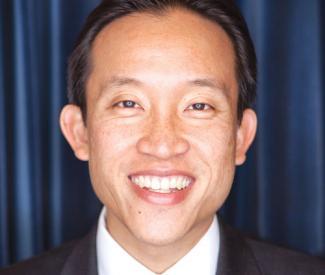
OPINION David Campos stands up for the underdogs. And in this current state of capitalism U$A, we the people need to give power only to leaders who won’t abuse it for personal profit. Foucault once said "society must be defended." Campos defends that society, and was granted a valid power from the people of San Francisco, based on actually helping us and being trusted, not just being a political yes person, like so many other modern politicians seem to be. Most politicians are all too eager to grant favors in exchange for shiny objects.

As some of you may or may now know, Campos is running for the 17th State Assembly District seat, which would enable him to create legislation at the state level. Campos shows that he is a man of the people by creating legislation that increases payouts for folks unjustly displaced by Ellis Act evictions, as well as giving displaced residents priority for affordable housing units as they become available. He champions the underdogs of the art scene by supporting legislation that enables emerging promoters to continue operating, without having to purchase $1 million insurance policies that are currently required of larger concert promoters. Basically, Campos is on the side of ensuring good times may still be had in SF, and that we don’t fall into the culturally disadvantaged realms of whitebread blandness that strangled vitality in suburbia for decades.

Campos is running against Divide Chiu for this seat. Seemingly, both candidates uphold progressive ideals, but in today’s tepid political waters, trying to stay informed often feels more like watching a bloated puppet show with talking heads, rather than participating in a genuine process of civic engagement. The solution? In my humble opinion, in order to really separate the fakers from the real, one must follow the money. Case in point, Campos proves his integrity and commitment to everyday people from all walks of life, in his refusal to accept cash from the financial industry (read: banks). He also has accepted only $82,000 from locally based real estate developers, who have committed to building affordable housing as well as market-rate housing (ex: the old Mission Theater project). Chiu, on the other hand, shows his true colors (they always say "money talks" right??) by accepting $34,000 from the finance industry, and $143,000 from out-of-state real estate developers.

Chiu promotes himself as being someone who can "get things done" in office. But that’s a pandering tired cliché at this point and it’s offensive that someone would insult our intelligence by using such tired rhetoric as a means to gain our trust and confidence. Yet Campos’ background alone (he was an undocumented immigrant from Guatemala’s civil war, who arrived speaking no English as a child, then later went on to graduate from Stanford University and later Harvard Law), shows that he is a true underdog who overcame adversity and has the capacity, resolve, and integrity to continue fighting on our behalf (yes, this writer identifies as a non-commodified emerging artist, aka underdog).

Campos represents those who actually pulling themselves up by their boot straps, as the saying goes, in reality. He demonstrates strength of character and values in not accepting funds from shady interests (unlike Chiu) and continues to help the people who truly need it, those who are unjustly displaced and in desperate need of housing in the community that is their long-term home. He supports emerging artists by being in touch with our needs, and crafting legislation that enables us to stay in our homes, and helps the current law become more just (because let’s face it, justice is always ahead of the law; for example, see: slavery being sanctioned in colonial U$A and marriage discrimination in California by Proposition 8).

From one concerned and civilly engaged resident of San Francisco to the next, I urge you to vote for David Campos in the upcoming primary on June 3.

Sara Jean Yaste is a writer, musician, and creative social interventionist living and breathing in San Francisco. Her band, Future Twin, performs May 31 from 3-6pm at a Happy Hour for David Campos at DNA Lounge.

Oakland roundabout

0

arts@sfbg.com

THEATER Read. Think for yourself. Speak your mind. Map the wide world. Just don’t leave your house.

Those are the parameters for a hungry young mind in a black male body in Oakland in 2008 — at least according to Watts (Michael Wayne Turner III), who has been living by them for years. Watts became a shut-in after his 10-year-old self took in the cold fact and wider implications of the 1991 Rodney King beating. Seventeen years later — which is how many dead young black men later? How many incarcerated bodies? — Watts lives a life of restless confinement with his sometimes prodding but understanding mother, Willie (Halili Knox).

Quick, a little acerbic but generally kind, Watts (played with a frank charm by Turner) is a voracious reader and a self-styled cartographer, aware of every square mile of his city and yet afraid to physically set foot in any corner of it. As if to underscore the danger he perceives outside, his siblings are more or less MIA. As if to underscore the impossibility of holding it all at bay, he eventually finds a guilt-ridden white guy (Dan Wolf) living as a tenant in his own small bedroom. More ironically still, the New Year’s Day he resolves to finally leave the house is the day a BART policeman named Johannes Mehserle (in what was later deemed an accident) takes Oscar Grant’s life at Fruitvale Station.

Like her main character, playwright and poet Chinaka Hodge is mapping her world here with a keen, obsessive focus. In Chasing Mehserle, Hodge, an Oakland native, picks up again the lives of the Oakland family she introduced in Mirrors in Every Corner, her 2010 debut. Once again, too, she teams up with Intersection for the Arts, Campo Santo, and Youth Speaks’ Living Word Project to realize her sure, capacious imagination in what directors Marc Bamuthi Joseph and Sean San José ensure is an overall vibrant transposition to the stage.

Act II is somewhat less sure and consistent in its unfolding than the strong opening act, and some of the staging (especially the video projections against a slack fabric wall) is less effective than it might be. But throughout Chasing Mehserle is strong acting, lyrical yet rooted dialogue, redolent ensemble movement, and scenes that range from effortlessly funny to startlingly potent.

Unfolding on and around a makeshift playing area at Intersection (where a rolling set of wooden stairs, courtesy of designers Evan Bissell and Tanya Orellana, serves variously as stoop, bedroom, and jail cell), the story comes narrated by a series of characters beginning with Watts, who tells us "his" play is not about Oscar Grant but about himself. Then again, we come to see that Watts’ vision of things is skewed by his long isolation. He may be well-read, he may have intricately mapped his city, but once he steps out in it there is much that eludes him, and much he gets wrong, even tonally — his fictional sidekick and co-narrator, Puck (Danez Smith), balks sometimes at the 10 dollar words he’s made to speak. A chorus of four (Tristan Cunningham, Tommy James Shepherd Jr., Isiah Thompson, and Johnathan Williams), that channels the human landscape in some spare and evocative choreography, also serves as a casual, no-nonsense counterpoint to Watts’ rhetorical flourishes and emotional extremes.

This is all the more crucial a corrective when Watts, learning of the death of Grant, takes it upon himself to track down and kill Mehserle, who has fled the Bay Area and gone into hiding. Watts, in other words, addresses his longstanding fear of white authority, and specifically the police, by turning the tables. But the road he sets down is complicated and confused. His unwanted partner is Lyle (the aforementioned white guy bunking in his bedroom). His perspective is in some ways fresh, in others myopic and deeply problematic. We root for him, and recoil from him. Hodge has created a wonderfully flawed hero, around whom a more complicated topography presents itself, and with whom we encounter a truer and more compassionate grasp of our fraught, divided, unequal, haunted, absurd, yet yearning environment.

CHASING MEHSERLE

Thu/29-Sat/31, 8pm; $15-$25

Z Space

450 Florida, SF

theintersection.org/chasing-mehserle

No web jukes

1

culture@sfbg.com

THE WEEKNIGHTER Weekends are for amateurs. Weeknights are for pros. That’s why each week Broke-Ass Stuart (www.brokeassstuart.com) will be exploring a different San Francisco bar, bringing you stories about the places and people who make San Francisco one of the most phenomenal cities in the world. Who wants a drink?

 The Internet jukebox may be the second worst thing that has happened to drinking since mankind invented alcohol. The first worst thing was the hangover, of course, but that has existed since the morning after alcohol was discovered. It took millennia for villains to come up with something nearly as vile as a hangover, and when they did, it was the Internet jukebox.

Think about it. The jukebox is one of the best ways for a bar to create its vibe. If you go to Zeitgeist, you know you’re going to hear Slayer. You may not like Slayer, but you at least know what you’re getting into and you accept it as part of the experience. The Internet jukebox pisses on all of that by taking away the establishment’s ability to curate its soundscape. Now any asshole can ruin everybody’s night by throwing a $50 bill in the machine and playing two hours of 2 Chainz. These people need to be taken out back and beaten with any number of chainz.

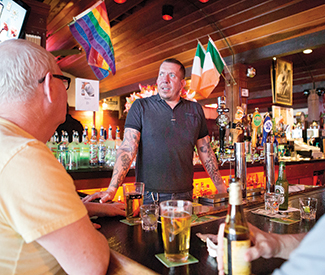
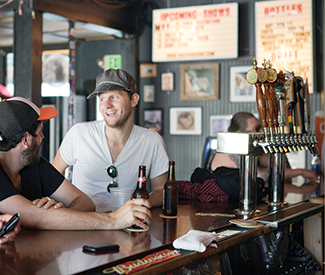
This was all part of the rant I was giving Alex as we sat on the barstools at Last Call (3988 18th St, SF. 415-861-1310). It was happy hour on a Tuesday and I was already a couple drinks in. One of the many things that makes Last Call great is that it doesn’t have an Internet jukebox. Instead, it has one that the owners filled with music they knew their customers would enjoy. Considering Last Call is a neighborhood bar in the Castro with a mild Irish pub feel to it, the box is filled with music like Madonna, The Smiths, U2, Kylie Minogue, and Cher. And of course, lots of disco. And you know what? It’s perfect.

There’s a lot more that makes Last Call great though. Fresh flowers always adorn the back bar, there’s a small library one can peruse, the drinks are stiff as hell, and there’s a cool ’70s-looking fireplace to keep you warm on one of San Francisco’s many chilly nights. But more than anything, it’s the friendliness of the bar that makes it great.

Last Call is a quintessential neighborhood bar. The regulars all know one another — but are more than welcoming when someone new comes in. While waiting for Alex to show up I sat there bullshitting with a handful of guys who were joking that, while they hated gym class in high school, they’d probably love it now because of all the hot boys.

Then there was Karl, the super duper nice happy hour bartender. Each time, just before my little bowl of popcorn went empty, he would appear and fill it again. Karl must’ve had that bartender sixth sense that told him I desperately needed food if I was going to continue downing vodka sodas. All this was happening while people down at the other end of the bar were yelling and high-fiving each other over something one of the Giants did. There wasn’t a shitty-seeming person in the whole joint; everyone seemed to love Last Call as much as it loved them.

“So in conclusion, I say ‘fuck the Internet jukebox’ and all the spineless bastards who invented it,” I finished haranguing Alex. “Jesus dude,” he responded, “All I did was ask how you were doing.” And to that I got up, fed a dollar in the jukebox and put on some Donna Summers…or at least I wanted to. The thing wasn’t on, since the Giants game was.

Stuart Schuffman aka Broke-Ass Stuart, is a travel writer, poet, and TV host. You can find his online shenanigans at www.brokeassstuart.com


Bay Guardian Community Forum! Bikes, buses, and budgets: How to create the transportation system San Franciscans need

58

Join the San Francisco Bay Guardian as we explore the current swirl of challenges and initiatives that will determine how people get around San Francisco. We’ll discuss transportation funding measures recently placed on the fall ballots this year and in 2016, big ideas such as tearing down I-280 and taking a Bay Bridge deck for bikes and buses, and the gap between political rhetoric and realities on the street along with a panel of key experts and activists. This is a free community event, and attendees will be entered into a raffle for an A2B electric bicycle, with a winner selected at the end of the event.

Panelists:

Supervisor Scott Wiener — Wiener represents San Francisco’s Supervisorial District 8 (Castro, Upper Market) and he has taken the lead role on the Board of Supervisors and Metropolitan Transportation Commission in advocating for dedicated funding sources for transportation project and challenging his colleagues to get serious about the challenges we face.

Professor Jason Henderson — As a geography professor at San Francisco State University, Henderson has focused his research and teaching on urban transportation issues. He’s also the author of Street Fight: The Politics of Mobility in San Francisco and he writes the Guardian’s popular and controversial monthly Street Fight column.

Chema Hernández Gil — Hernández Gil is a community organizer with the San Francisco Bicycle Coalition, San Francisco largest member-based grassroots advocacy organization, which has recently been highlighting funding shortfalls in creating the bicycling infrastructure needed to accommodate a growing number of cyclists. 

Susan King — King coordinates the popular Sunday Streets program, which creates temporary car-free spaces in San Francisco, the latest endeavor in a long history of transportation activism ranging from working for Livable City to helping found WalkSF to serving on the city’s Bicycle Advisory Committee to working on transit justice campaigns.


Moderators: Guardian Editor-in-Chief Steven T. Jones and News Editor Rebecca Bowe


Agenda:

6-7pm: Panel discussion — Prompted by questions from the moderators, panelists will share their insights into what kind of the transportation system San Francisco needs to address a growing population amid global warming and other environmental challenges, how to overcome the multi-billion-dollar funding shortfalls that have been identified, the political/ideological context of this debate, and other issues.

7-7:15pm: Break and networking — Stretch your legs, meet fellow concerned citizens, enjoy snacks provided by the Guardian, sign up for the A2B bike raffle, and prepare your remarks

7:15-8pm: Comments and questions: What do you think San Francisco needs from its transportation system and how do we get it? This is your chance to offer your ideas and/or ask questions of our panelists (note: Wiener has a prior engagement and will only be there for first hour, sorry). This is also a time for panelists to raise big, thought-provoking ideas and get audience feedback.

8pm-?: Haven’t had enough? Join the diehards over at Zeitgeist to continue the discussion over pitchers of beer and burgers. 


Gettin’ festy

0

esilvers@sfbg.com

LEFT OF THE DIAL Earlier this month, Oakland singer-songwriter Ash Reiter was at Hipnic, an annual three-day music festival in Big Sur thrown by promoters folkYEAH!, featuring Cass McCombs, the Fresh & Onlys, the Mother Hips, Nicki Bluhm & the Gramblers, and plenty of other Bay Area folky faves. Held at the Fernwood Resort and campgrounds, with families gathering under the shade of redwoods, it’s one of the cozier, more homegrown summer festivals in the greater Bay Area — there’s nary a Coachella-esque VIP section in sight — but a three-day pass still comes in at a cool $240.

Looking around, Reiter saw how the ticket price had shaped the crowd.

“There was obviously some great music, but that kind of boutique festival thing is so expensive that a lot of the audience seemed like older, well-off folks, parents — I mean, those are the people who can afford to go to these things,” she recalls. “I’m sure a lot of the bands playing wouldn’t be able to go to that festival, if they weren’t playing.”

It was that kind of thinking that sparked the idea for Hickey Fest, a three-day festival now in its second year and named for its location in Standish Hickey State Park in Mendocino County, “where the South Fork of the Eel River shimmers against the backdrop of the majestic redwoods,” according to the fest’s flyers. Born of the desire to curate a “musical experience outside of just your average festival, a chance for musicians to actually hang out and talk to each other and get to know each other that’s not just in a loud rock club,” Reiter launched Hickey Fest over Memorial Day weekend last year, with a lineup of friend-bands like Warm Soda, Farallons, Cool Ghouls, and Michael Musika. The goal: A festival her musician friends would actually enjoy, in an atmosphere that wouldn’t be “as overwhelming as a BottleRock or an Outside Lands.” She estimates some 500 to 600 people attended in total.

This year’s festival, which runs June 20-22 in the same location, includes another local-love lineup, including Papercuts, Sonny and the Sunsets, Black Cobra Vipers, and more. A $60 ticket gets you three days of music and camping. “I wanted it to be about community, about putting the fun back in music,” says Reiter, who will also perform. “So I did intentionally try to make it as cheap as possible.”

It’s a sentiment rarely heard from music promoters, especially as the days get longer and the work-ditching gets ubiquitous and the college kids are all turned loose for the summer. Festival season is upon us, Bay Area, and make no mistake: It’s a great way to see touring bands from all over the country. It’s a great platform for local bands, who get the chance to play bigger stages and reach new audiences. And as a music fan, it’s a great way to spend a shit-ton of money.

FIELD OF DREAMS

In the summer of 1969, when Woodstock was changing the meaning of “music festival” on the East Coast via Jimi solos and free, mud-covered love, plans were taking shape for a San Francisco festival that, had it actually taken place, would have been legendary: The Wild West Festival, scheduled for Aug. 22-24, was designed as a three-day party, with regular (ticketed) concerts each night in Kezar Stadium, while other bands performed free music all day, each day, in Golden Gate Park.

Bill Graham and other SF rock scene movers and shakers worked collaboratively on organizing the festival, which — had it happened — would have seen Janis Joplin, the Grateful Dead, Jefferson Airplane, Sly and the Family Stone, Santana, Country Joe and the Fish, the Steve Miller Band, and half a dozen other iconic bands of the decade all taking the stage within 72 hours.

Why’d it fall apart? According to most versions of the story, too many of those involved wanted the whole damn thing to be free. Graham, among others, countered that, while the free music utopia was a nice idea, lights, a sound system, and other basic accoutrements of a music festival did in fact cost American dollars. The plans collapsed amid in-fighting, and the infamous Altamont free music festival was planned as a sort of make-up for December of that year — an organizational disaster of an event that came to be known for the death of Meredith Hunter, among other violence, signaling the end of a certain starry-eyed era.

So yeah, money has always been a sticky part of live music festivals. But the industry has boomed in a particularly mind-boggling way over the last decade; never before have ticket prices served as such a clear barrier to entry for your average, middle-class music fan. Forget Hipnic: In the days after Outside Lands sold out, enterprising San Franciscans began plonking their three-day festival passes onto the “for sale” section of Craigslist at upwards of $1,000 each.

The alternative? The “screw that corporate shit, let’s do our own thing” attitude, which is, of course, exactly the kind of attitude that’s birthed the bumper crop of smaller summer festivals that have sprung up in the Bay Area over the past few years, like Phono del Sol (July 12, an indie-leaning daylong affair in SF’s Potrero del Sol Park, started by hip-kid music blog The Bay Bridged in 2010, tickets: $25-$30) and Burger Boogaloo (a cheekily irreverent punk, surf, and rockabilly fest over July 4 weekend in Oakland’s Mosswood Park — weekend pass: $50). Both pair bigger, buzzy acts with national reach like Wye Oak (Phono del Sol) or Thee Oh Sees and the great Ronnie Spector (Burger Boogaloo) with a slew of local openers.

“I’ve played a few festivals, and when it’s a really big thing, you realize there are just so many other huge bands that people would rather see,” says Mikey Maramag, better known as the folk-tronica brains behind SF’s Blackbird Blackbird. He’ll be sharing a bill with Thao and the Get Down Stay Down, Nick Waterhouse, White Fence, A Million Billion Dying Suns, and others at Phono del Sol — which, judging by last year’s attendance, could draw some 5,000 to 6,000 people.

“I think at smaller festivals you have more people who take the time to really listen, appreciate the music more, really big fans,” he says. “There are fewer artists on this bill [than at large festivals] but they’re all great ones — I’m especially excited to see Wye Oak.”

Maramag will be debuting some songs from his new album, Tangerine Sky, out June 3; the show will serve as a welcome-home from a quick national tour to promote it.

Then there are the even more modest summer offerings, like SF Popfest, which takes place over four days (May 22-25) at various small venues in the city. It’s not exactly a traditional festival — you’re not likely to find slideshows online of the “BEST POPFEST FASHION!!1!” the way we’ve unfortunately become accustomed to from Coachella — but for the small contingent of super passionate ’90s indie-pop fans in the Bay Area (hi!), this is one not to miss.

“I’ve been getting a lot of calls from people who think it’s a very different kind of festival than it is. App people. This one guy had some kind of offer about a parking app for festivals, I think? Which would really not make any sense at all,” says Josh Yule, guitarist for SF jangle-pop maestros Cruel Summer, who received the mantle of SF Popfest organizer from his predecessor in the mid-aughts (older history of the festival is a little hazy, as it’s always been primarily organized by musicians for musicians — for fun and, says Yule, absolutely no profit whatsoever). There was talk of getting some beer sponsors at some point, but he decided against it. “We have friends working the door at most of these things. I was a punk kid in high school, I guess, I tend to stay away from things that would make this go in a more corporate direction.”

This year’s fest is centered around reunions of bands who’ve been broken up for a while, like cult-favorite Sacramento popsters Rocketship, who haven’t played together in at least a decade; the band will be at the Rickshaw Stop Fri/23 for a Slumberland Records showcase. Dressy Bessy, Dreamdate, the Mantles, Terry Malts, and plenty others will all make appearances throughout the fest, as well as a few newer bands, like the female-fronted Stockton garagey-punk band Monster Treasure.

“Obviously it’s not gonna be thousands of people, it’s not going to be outside — it’s going to be 100 to 200 like-minded individuals who all enjoy the same thing, and they all get it,” says Yule. “We got these bands back together to play and they’re all excited about it even though there’s no [financial] guarantee…It’s that community that I’ve always been involved in and sometimes I feel like it’s not around anymore. So it’s nice to go ‘Oh wait, there it is. It’s still there, and it’s still strong.'”

CROWD SURFING

For local bands just starting to make a name for themselves, of course, there’s nothing like a larger and yes, very corporate festival for reaching new audiences. Take the locals stage at LIVE 105’s BFD, the all-day radio-rock party celebrating its 20th year June 1 at the Shoreline: Curated by the station’s music director, Aaron Axelsen — aka the DJ who’s launched 1,000 careers, thanks to his Sunday night locals-only show, Soundcheck, as well as booking up-and-comers for Popscene — the locals stage at BFD has a pretty good track record for launching bands onto the next big thing. The French Cassettes, one of SF’s current indie-pop darlings, sure hope that holds true for them.

“Aaron Axelsen has been really generous to us. I think we’re all clear that none of this would be happening without him,” says singer-guitarist Scott Huerta. The band will be playing songs from its newest album, out on cassette (duh) at the end of May. “But we’re super excited just to be in there. Hopefully we make some new fans. I know I used to find out about new bands by going to BFD and just passing by that stage. It’s by all the food vendors, so as long as people are hungry, we’ll be good. Don’t eat before you come.”

For the Tumbleweed Wanderers, an Oakland-based soul-folk-rock band that’s been hustling back and forth across the country for the past year, hitting the stage at Outside Lands (Aug. 8-10) — that festival everyone loves to hate and hates to love — will be the culmination of years of playing around the festival, quite literally.

“In 2011, we busked outside, and I think that’s the year [our keyboard player] Patrick almost got arrested?” says Rob Fidel, singer-guitarist, with a laugh. “Then the next year we got asked to play Dr. Flotsam’s Hell Brew Review, which is this thing in the park just outside Outside Lands, and we did that for an hour and a half every day for free. And then busked outside. I like to say we played Outside Lands more than any other band that year.

“But to be on the other side of that all of a sudden is awesome,” he says, noting that the band will be playing some tunes from a new record set for release later this year. “It was the same when we played the Fillmore for the first time — we used to busk outside of there and the venue would get super pissed, and now, oh look, that same guy’s carrying our amps…but I think the experience of working our way up like that has kinda taught us you’re gonna see the same people on the way up as on the way down. And we’ve worked really hard these past few years. It’s nice to feel like we’ve earned it.”

It’s only a slight exaggeration to say there are roughly 1,000 other music festivals happening throughout the Bay Area this summer — at the Guardian, our inboxes have been filling up with press releases and show announcements since February; check out the roundup below for a mere smattering of what’s going on. And, ticket price hand-wringing aside, you don’t need to be rich to rock out: Stern Grove’s free Sunday lineups, with heavy hitters like Smokey Robinson, Andrew Bird, Rufus Wainwright, and the Zombies, are among the best we’ve seen. In the East Bay, the Art+Soul Festival is always a source of up-and-comers in hip-hop, funk, and more — this year for the whopping price of $15.

So, yeah, we never got that Janis and Sly and Jefferson Airplane show. So be it. As a music fan in the Bay Area, there’s no better time than summer to smack yourself, remember that you’re super lucky to live here, grab a sweater (because layers), and get out to hear some music. Call it your own damn three-month-long Wild West Festival. We’ll see you in the bathroom line.


May

SF Popfest, May 22-25, locations vary throughout SF, www.sfpopfest.com

Audio on the Bay, Craneway Pavilion, Richmond, May 23-25, www.insomniac.com

BottleRock Napa Valley, Napa, May 30-June 1, www.bottlerocknapavalley.com


June

LIVE 105’s BFD, June 1, Shoreline Amphitheatre, Mountain View, www.live105.cbslocal.com

Not Dead Yet Fest, June 7, Thee Parkside, SF, www.notdeadyetfest.com

OMINODAY Music Festival, June 7, McLaren Park, SF, www.ominoday.weebly.com

The San Francisco Jazz Festival, June 11-22, locations vary. www.sfjazz.org

Reggae in the Hills, Calaveras County Fairgrounds, June 13-15, www.reggaeinthehills.com

Hickey Fest, June 20-22, Leggett, www.hickeyfest.wordpress.com

San Francisco Free Folk Festival, June 21-22, Presidio Middle School, SF, www.sffolkfest.org

Berkeley World Music Festival, June 22, People’s Park, Berk., www.berkeleyworldmusic.org


July

High Sierra Music Festival, July 3-6, Quincy, www.highsierramusic.com

Burger Boogaloo, July 5-6, Mosswood Park, Oak., www.burgerboogaloo.com

Phono del Sol, July 12, Potrero del Sol Park, SF, www.phonodelsol.com

Northern Nights, July 18-20, Mendocino/Humboldt, www.northernnights.org


August

Art + Soul Oakland, Aug. 2-3, City Center, Oak., www.artandsouloakland.com

Outside Lands, Aug. 8-10, Golden Gate Park, SF, www.sfoutsidelands.com

First City Festival, Aug. 23-24, Monterey, www.firstcityfestival.com


Throughout the summer: Stern Grove Festival, Sundays, www.sterngrove.org; People in Plazas, dates vary, throughout downtown SF, www.peopleinplazas.org.

It’s all reel

0

cheryl@sfbg.com

FILM As far as Hollywood is concerned, it’s already been summer for weeks, with superheroes (Captain America and Spider-Man have had their turns; X-Men: Days of Future Past opens Fri/23) and monsters (Godzilla) looking mighty comfortable atop the box office. But the season is just getting started, screen fiends, and there’s plenty more — maybe too many more, if you’re operating on a limited popcorn budget — ahead. Read on for a highly opinionated, by-no-means-comprehensive guide; as always, dates are subject to change. (And keep reading for a list of local film festivals, too, since the healthiest diet is always a balanced one.)

The first post-Memorial Day weekend unveils Angelina Jolie (dem cheekbones!) as Sleeping Beauty’s worst nightmare in Maleficent, probably the biggest Disney casting coup since Johnny Depp sailed to the Caribbean. First-time helmer Robert Stromberg has a pair of Oscars for his art-direction work on Avatar (2009) and Alice in Wonderland (2010); if this dark fantasy clicks with audiences, expect a raft of live-action films starring Disney’s ever-growing stable of villains (fingers crossed for Ursula the Sea Witch next).

If fairy tales aren’t your thing, add thriller Cold in July to your calendar (like Maleficent, it’s out May 30). It’s the latest from genre man Jim Mickle (2013’s We Are What We Are), with his highest-profile cast to date. Dexter‘s Michael C. Hall, rocking a mullet, plays a small-town Texan whose unremarkable life goes into pulpy overdrive after he kills a burglar, angering the man’s ex-con father (Sam Shepard). But nothing is what it seems in this twisty tale, which also features Don Johnson and a synth score — both stellar enhancements to the film’s late-1980s aesthetic.

Moving into June, sci-fi thriller Edge of Tomorrow  has Tom Cruise saving the world — just another day on the job for the suspiciously ageless star, though he apparently lives the same day over and over here. Look for director Doug Liman (multiple Bourne movies) and co-stars like Emily Blunt and Game of Thrones‘ Noah Taylor to add some depth — though, OK, this’ll probably still be a one-man show. Never change, Tom. Elsewhere June 6, erstwhile Divergent ass-kicker Shailene Woodley aims to prove she’s not just the poor man’s Jennifer Lawrence with young-adult weepie The Fault in Our Stars.

June 13, undercover cops Schmidt and Jenko — played by the likable team of Jonah Hill and Channing Tatum — return for more jokes (and winks, because they’re in on the joke too, you guys!) in 22 Jump Street. Far less comedic, and far more brain-melting, is sci-fi drama The Signal, which starts off like a typical road-trip movie, then switches gears a few times before slam-banging into weirdness so out-there it’s almost (almost) a spoiler to note that Laurence “Morpheus” Fishburne plays a key role.

The following week (June 20), Aussie filmmaker David Michôd — whose gritty 2010 Animal Kingdom became an insta-classic of the crime genre, and launched the stateside careers of Jackie Weaver and Joel Edgerton — reunites with Kingdom star Guy Pearce for The Rover, the outback-set tale of a man seeking revenge on a gang of car thieves. In an intriguing casting choice, former vampire Robert Pattinson co-stars as a wounded baddie forced along for the ride.

Next up, June 27 unleashes Transformers: Age of Extinction. Memo to the world: Until we all agree to stop seeing these movies, Michael Bay and company will keep grinding ’em out. At least this one is LaBeouf-less.

Ahead of the long Fourth of July weekend, July 2 unleashes saucy comedy Tammy, which stars Melissa McCarthy (she also co-wrote the script) and Susan Sarandon as a road-tripping granddaughter and grandmother. Or, you could check out Eric Bana as an NYPD detective who teams up with a priest (Edgar “Carlos the Jackal” Ramírez, recently cast in the Swayze role in the highly unnecessary Point Break remake) in Deliver Us From Evil; despite sharing a title with Amy Berg’s harrowing 2006 doc about pedophiles in the Catholic Church, it’s about demonic possession — but is still probably less frightening than the Berg film, to be honest.

July 11, Richard Linklater’s Boyhood has a gimmicky premise — filmed over 12 years, it charts the coming-of-age of a child, and his relationship with his parents (played by Ethan Hawke and Patricia Arquette) — but also glowing reviews from its film festival stints. And, just when you thought it was safe to go back to the banana aisle, Dawn of the Planet of the Apes arrives, laying further waste to a San Francisco that already took a beating in the first film, not to mention losing most of its downtown to Godzilla and friends just a week ago. Andy Serkis returns as chimp king Caesar. Also: Roman Polanski’s latest, Venus in Fur — based on the David Ives play, and starring Polanski’s wife, Emmanuelle Seigner — arrives on our shores after picking up a César award for the director in France.

Andy and Lana Wachowski’s latest eye candy-laden epic action fantasy, Jupiter Ascending, is about an ordinary human (Mila Kunis) who turns out to be Neo the One, er, royalty from another planet. Based on production stills, this film also features Channing Tatum flying through the air shooting guns and stuff. July 18 also brings The Purge: Anarchy, sequel to last year’s sleeper hit about a near-future America that allows a crime spree free-for-all one night per year. The follow-up lacks Lena Heady — but it does have Michael K. “Omar” Williams, and the characters actually leave the house this time.

https://www.youtube.com/watch?v=5w0KAHhKECg

Then, on July 25, choose your hero: Dwayne “The Rock” Johnson sporting a hat made out of a lion’s head (and, apparently, beard made out of yak hair) in Hercules, or those dancin’ kids of Las Vegas-set Step Up All In. (For those keeping score, this is the fifth Step Up film.) Plus, there’s Woody Allen’s 1920s-set Magic in the Moonlight, starring Emma Stone as a psychic and Colin Firth as the skeptic who falls for her. Sounds kinda twee, and Allen’s private life remains controversial, but that cast, which also includes Marcia Gay Harden and Jackie Weaver, is all kinds of dynamite.

August begins with a bang — Marvel’s hotly-anticipated Guardians of the Galaxy, which just about broke the Internet when its first trailer rolled out in February, is out on the first — before meandering a bit. Taking a break from her own Marvel duties, Scarlett Johansson (so great in Under the Skin) plays a different kind of superhuman in Luc Besson’s Lucy, while the live action-CG mash-up I’m not sure anyone was really begging for, Teenage Mutant Ninja Turtles, also takes a bow (both Aug. 8).

As the summer winds down, Phillip Noyce (2002’s The Quiet American) strays onto YA turf with an adaptation of Lois Lowry’s The Giver, with Jeff “The Dude” Bridges playing the title role, and Brenton Thwaits (who also stars in The Signal, above) as his protégé. Also out Aug. 15, The Expendables 3 adds Harrison Ford, Antonio Banderas, and Wesley Snipes (!!) to its cast o’ aging action hunks. Don’t you worry, Nic Cage — there’s still room for you in the inevitable part four. And don’t miss The Trip to Italy, which re-teams British comedians Steve Coogan and Rob Brydon for a foodie road trip that will make you guffaw (at the impressions) and drool (over the plates of pasta).

Labor Day looms as Robert Rodriguez brings Frank Miller’s Sin City: A Dame to Kill For, which looks to be as visually stunning as its 2005 predecessor, if not much friendlier to the female perspective; a sports drama inspired by Concord’s own De La Salle High School football team, When the Game Stands Tall; and yet another YA adaptation, If I Stay, starring Chloë Grace Moretz, who is one of the more dynamic teen actors of late, and may make this girlfriend-in-a-coma tale livelier than it sounds. *

ESCAPE THE MULTIPLEX: SUMMER FESTIVALS

San Francisco Green Film Festival (May 29-June 4; www.sfgreenfilmfest.org) Doc-heavy fest of films from 21 countries that explore environmental issues and themes.

San Francisco Silent Film Festival (May 29-June 1; www.silentfilm.org) Exquisitely curated and rock-concert-popular showcase of films from cinema’s earliest days, plus live accompaniment and special guests.

SF DocFest (June 5-19; www.sfindie.com) The San Francisco Independent Film Festival’s doc-tastic offshoot consistently offers a strong slate of true-life tales.

New Filipino Cinema (June 11-15; www.ybca.org) Documentaries, narratives, shorts, and experimental films direct from the Philippines’ burgeoning film scene.

Queer Women of Color Film Festival (June 14-16; www.qwocmap.org) Five shorts programs highlight 55 works, with a focus this year on queer culture in Southeast Asian, North African, Middle Eastern, and other Muslim communities.

Martin Scorsese Presents Masterpieces of Polish Cinema (June 14-Aug 23, bampfa.berkeley.edu) Rare and important works by Andrzej Wajda, Jerzy Kawalerowicz, Wojciech Has, and others — and since Uncle Marty’s in charge, expect glorious digital restorations across the board.

Frameline (June 19-29; www.frameline.org) The oldest and largest fest of its kind, the San Francisco International LGBT Film Festival has been programming the best in queer cinema for 38 years.

San Francisco Jewish Film Festival (July 24-Aug 10; www.sfjff.org) Also the oldest and largest fest of its kind, the SFJFF presents year-round programming, though this fest, now in its 34th year, is its centerpiece event.

On the town

0

arts@sfbg.com

DANCE

Now in his fourth year guiding the newly constituted Oakland Ballet Company, Artistic Director Graham Lustig seems to have found his stride in creating a troupe that respects its past but is no longer tied down by it. If, for the time being, the “ballet” part of the company’s name has to take a back seat to the place where it is at home, so be it.

“Oakland-esque,” four world premieres for OBC’s spring season at the Malonga Casquelourd Center for the Arts, offered an affable afternoon of spiffily danced, and at the very least conceptually intriguing, choreography.

Kudos to the program’s ability to throw a spotlight on the city’s tradition in the arts. Choreographers Sonya Delwaide and Molissa Fenley teach at Mills College. Jazz piano great Earl “Fatha” Hines spent his last years in Oakland, while Larry Graham (of Sly and the Family and Graham Central Station) grew up there and created what became known as “East Bay Funk.” Guests Sonsheree Giles and Joel Brown perform with AXIS Dance Company; Garion “Noh-Justice” Morgan and Rayshawn “Looney” Thompson do so with street dancers Turffeinz.

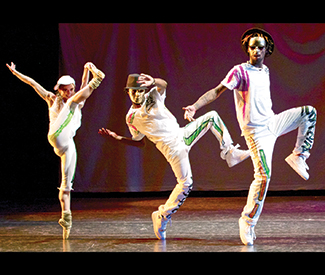
Delwaide’s Rocky Road, named after the ice cream invented in Oakland in 1929, takes a light-hearted but intricately shaped approach to Hines’ joyously embracing pianisms within a big band context. With a quartet of four (Jori Jahn, Megan Terry, Marte Madera, and Matthew Roberts) and two soloist couples, Delwaide’s tongue-in-cheek approach to both jazz and ballet brought out a commonality between these very different arts: Both shine with a surface of ease while demanding great technical facility; their soloists also often perform against backup groups, known in ballet as the corps.

Rocky‘s loose-limbed dancers kicked, slinked, and stepped with, against, and behind the beat. With the women on point, they inhabited a universe in which stylistic differences didn’t matter, but dancing full out did.

The soloist couple from inside OBC — the liquidly expressive and ever so versatile Sharon Wehner partnered by a refined Evan Flood — was paired with AXIS’s fierce Giles and Brown on wheels. In its individual duets and sharing the same stage, this quartet confirmed, one more time, that lyricism, grace, and power communicate no matter what shape they take. It helped that Delwaide has an embracing, refined choreographic voice.

Robert Moses’s choreography for TIP pitted furiously fast, shifting ensembles of various sizes against Graham’s bass-heavy, beat-heavier music. In part because of the dated-looking teenage outfits of white tops and checkered skirts and pants (by Christopher Dunn), I thought of Moses perhaps having looked at TIP as a memory of some 1970s club scene.

TIP began with a clump of people who just happened to come upon each other, and turned into a sweaty night in which they hooked up with each other and switched partners with ease. Some interactions stood out, such as the three sitting upstage who companionably slid along on their butts. Or the male dancer who tried out three women in a row. In a hetero duet, a woman lent much-needed support to her back-falling companion. TIP‘s surfeit of material developed a somewhat messy structure, yet it allowed the eye to wander over a sea of intense dancing, out of which limbs arose like curling smoke.

Mills College’s majestic grove of redwood trees has inspired both poets and painters. It also provided Fenley with ideas for the verticality, restraint, and elegance for Redwood Park. She set it on a quintet to a score by Joan Jeanrenaud, here excellently performed by percussionists Nava Dunkelman and Ann Wray. At first the music’s sharp attacks and tonal variations seemed at odds with the tranquil dancing’s soft strides and pliant turns spinning off into extended patterns — but as Redwood evolved, you realized that both arose from a calmly spacious sense of time. The piece was designed for five men, but Emily Kerr successfully pinch-hit for an injured one. While it was good to see dancers as different as Vincent Chavez, Flood, Madera, and Roberts attempt this spare choreography, not everyone was equally up to the task.

Turf dancing (taking up room on the floor) developed as way of claiming urban territory, and as a tribute to lives lost on Oakland’s streets. Lustig’s Turfland was a well-intentioned but unconvincing attempt to bring two of its practitioners to the concert stage, and have his ballet dancers in turn follow them out into the street.

Much of the piece looked improvised and none of the dancers — with the exception of Chavez, who fluidly straddled both worlds — seemed at ease. It takes more than performing on the tip of your toes, whether in blocked shoes or sneakers, to find a common language. These dancers were about as far apart as the washed-out visuals of the stage and the graffiti-inspired, scintillatingly beautiful backdrops by Samuel Renaissance. *


Wear no evil

2

arts@sfbg.com

CULTURE

Do you know where your clothes come from: Bangladesh? China? Possibly. Clothes are a commodity whose origins are often taken for granted. Fashion followers glamorize garments as collectible items, while others value comfort above all. In most cases, customers will size up a garment’s price or style first, rather than considering where or how it was manufactured.

But consider this: The production end of the apparel industry impacts the world significantly. The fashion industry employs one-sixth of the world’s population. An estimated 250 million children work in sweatshops. The lack of regulation results in unfair labor and pollution around the world. It is the second most polluting industry, second only to oil. Due to the toxic waste discharge in China, you can tell what colors are in season by looking at the rivers. The deadliest garment-factory accident in history, the Bangladesh factory collapse last year, killed 1,129 workers and injured twice as many.

The fact of the matter is, if you care about where your craft beer came from, whether your apple is organic, or if your latte contains fair-trade coffee, you need to be applying that same consciousness to your clothes. Read on for ways to whip your fashion karma into shape.

sustainableshop

Click the image above to see our flowchart, “So you want to shop sustainably…”


SHOP SOCIAL

Global warming isn’t going anywhere. Why not help save the world (as summers grow hotter) one T-shirt at a time? Many independent (and several mainstream) brands have partnered with nonprofits to support the environment. Eco-friendly SF-based brand Amour Vert (www.amourvert.com) developed the Plant A T(r)EE program, in which a tree is planted in the US with each T-shirt purchase. According to the company, 15,000 have taken root so far, with plans to reach 100,000 by 2015. Other eco-conscious brands, including Alternative Apparel (www.alternativeapparel.com), support the workers behind the products. Though the company sources its materials in Peru, it works to ensure fair labor practices. Both of these brands design fashionable apparel with organic cotton and other natural, sustainable fabrics — which can result in higher prices. But if your clothing budget allows, it pays to focus on quality, not quantity.


SHOP SECONDHAND

Thrift shopping is probably the easiest and cheapest way to reduce your carbon footprint. The average American throws out 68 pounds of textiles every year. By buying secondhand, you’re saving water and energy that would otherwise be used to manufacture new products, not to mention keeping textile waste out of landfills — and curating your own unique style in the process.

When you clean out your closet, donate your duds to a local thrift store instead of discarding them. Somewhere, there’s a vintage shopper who will treasure that sparkly mini-dress you wore one long-ago New Year’s Eve.


SHOP LOCAL

Why haunt the mall when San Francisco has a plethora of homegrown makers? Eco-friendly apparel defies stereotypes (it’s not just hemp dresses anymore) thanks to independent, multi-brand shops like the Mission District’s Gravel & Gold (www.gravelandgold.com) and new Hayes Valley spot Gather (www.gathersf.com), both of which thoughtfully select products to create a connection with the craftspeople behind the designs. Progressive street style brands like San Franpsycho (www.sanfranpsycho.com) and Oaklandish (www.oaklandish.com) celebrate local love while keeping their manufacturing nearby. You can also find city blocks packed with locally made goods at craft and street fairs like the roving Urban Air Market (www.urbanairmarket.com).

But be wary. A label reading “Made in the US” does not guarantee the garment was produced under fair labor conditions. Despite labor laws, sweatshops still exist on our shores. Be an informed, aware shopper, and make sure your dollars are supporting an ethical company before you make a purchase. *


Missing Indie Mart

1

THE WEEKNIGHTER  Weekends are for amateurs. Weeknights are for pros. That’s why each week Broke-Ass Stuart (www.brokeassstuart.com) will be exploring a different San Francisco bar, bringing you stories about the places and people who make San Francisco one of the most phenomenal cities in the world. Who wants a drink?

I’ve fallen in love many times at Thee Parkside. Okay, that’s a gross exaggeration. I’ve fallen into moderate, short-term infatuation many times at Thee Parkside.

For years it was home to Indie Mart, the DIY, rock-n-roll, block party Kelly Malone and Co. used to throw. Scores of local artist and designers would set up booths along Wisconsin Street, selling all the strange and beautiful things they created, while grimy-looking bands played ear-splitting music inside.

The parade of manic pixie dream girls was unnerving. They had no real place in society and only belonged as unblemished ideals in my mind. Some would float into town for the weekend and set up shop, only to disappear as soon as Indie Mart shut down. Others would flit from booth to booth, trying on each other’s wares and complimenting each other’s outfits. All of them pretty much sold the exact same shit, not that it mattered to me, they were all so lovely to look at and really only brought things to sell to each other anyway.

Thee Parkside is way more than just for day-long block parties full of whimsically dressed Amelies though. It’s a semi-legendary dive bar famed for it’s out-of-the-way location and its kick-ass live shows. Any night of the week you can see a variety of punk, metal, or country bands playing their hearts out on that tiny stage in that perfectly dingy barroom.

It’s also known for an awesome kitchen that manages to turn well-executed dishes like bahn mi and Cuban sandwiches into perfect bar food. If you haven’t been before, the Original Famous Twang Sundays are a great introduction to Thee Parkside life. Where else in The City can you hear country and bluegrass at an all-ages venue with a back patio for free? I think that’s what Sundays were invented for.

Despite these great things that happen at Thee Parkside, it’s still all those Indie Mart afternoons that most poignantly stick out in my mind. Maybe that’s just because, for many San Francisco’s doers and makers, Indie Mart was a place where we found a community of like-minded bad-asses. Dozens of people who were tinkering with wonderful things all throughout the Bay Area suddenly had a place to coalesce, sharing and selling what they made.

Sculptors, screen printers, and jewelry designers, set up shop next to each other while vintage clothes were hawked down the way and carpenters displayed their crafts. People who may never have encountered each other otherwise, were now meeting and forging relationships that would lead to marriages, babies, collaborations, and successful businesses. A diaspora of creative people now had a base and a community and a way to show the world what they were up to. It was honestly and truly, with all earnestness, magical. And Thee Parkside allowed that to happen.

Like all great scenes, Indie Mart came and left just like a goddamn fireball. One day it jumped from being a small thing in Kelly Malone’s backyard to a block party at Thee Parkside. It burned hot and heavy for a few years, and then suddenly it was done. But what it left in its wake was a slew of creators who now had the confidence and contacts to make a business out of what was previously just a hobby. And of course Thee Parkside is still around too.

Every time I pass by, I think, maybe I should get some people together and throw one more big block party for old times sake. And then I say nah, and stop in for a Cuban sandwich and a cheap drink instead.

Stuart Schuffman aka Broke-Ass Stuart, is a travel writer, poet, and TV host. You can find his online shenanigans at www.brokeassstuart.com

Desegregate our schools

8

By Matt Haney

OPINION

Sixty years after the landmark Supreme Court decision Brown v Board of Education, we face the shocking reality that our nation’s schools are more racially and economically segregated today than they have been in more than four decades.

The vast majority of public school students attend schools where students look like them and share their socioeconomic background. Even areas where significant progress has been made are experiencing resegregation, including here in San Francisco.

For over 20 years, 1983-2005, San Francisco schools were under a federal court-ordered consent decree to eliminate segregation and accelerate racial equity, including a controversial assignment policy that limited enrollment of any ethnic group to no more than 45 percent in any school.

This policy ended after it was found unconstitutional in 2001. Since then, San Francisco schools have experienced a steady resegregation. A quarter of our schools have more than 60 percent of a single ethnic group, even though the district is highly diverse and lacks a majority group.

After three years of a new student assignment system, despite holding the reduction of racial isolation as a central goal, there has been little change. In the face of neighborhood segregation and displacement, family request patterns, language pathways, and elimination of school buses, our current student assignment system, absent additional interventions, may be outmatched in addressing this challenge.

Thus, 60 years after Brown, we must ask ourselves the question: Is racial and economic integration still a priority? And what does this mean for our ability to provide educational opportunity for all students, regardless of race or socioeconomic status?

While Brown is best known for helping end legalized segregation and sparking the Civil Rights Movement, Brown’s foundational premise is that all students have a right to educational opportunity.

In San Francisco, as in other cities, racial isolation and concentration of underserved students in the same school are highly correlated with other school factors that define school quality, including average years of teacher service, teacher turnover, attendance, and suspension rates. San Francisco’s most racially isolated and underserved schools are, thus, also those that are the most persistently low achieving.

As daunting as it may seem, there are things we can do now to restore the promise of Brown.

First, we should acknowledge that establishing racially and economically diverse schools still matters, and draw on creative and intentional tools at our disposal to work towards them. Segregated schools should not be accepted as a foregone conclusion, particularly in light of the well-documented challenges of ensuring educational opportunity in these contexts. We should look to diverse school models here in San Francisco, especially those where parental involvement is central.

Second, we must be honest about the resources needed to ensure equal opportunity for every student, particularly those in racially and economically segregated schools. This will take much more than small reforms or even equalizing funding; in fact, San Francisco has long had a system where schools with higher needs are given additional funding.

Ensuring true opportunity for every student in racially isolated schools requires transformation of what schools look like in these contexts, including longer school days, much smaller classes, high quality early childhood education and after school programs, experienced and highly paid teachers, and full-service school health clinics.

Third, we should recognize the interconnectedness of education with other forces, particularly poverty. Students come to school with deep trauma and stress caused by violence, poor nutrition, and economic instability, which deepen segregation and educational inequities. Anyone who is an education advocate must also be an antipoverty advocate, a worker’s rights advocate, a housing advocate, and a health care advocate.

These days it seems our collective outrage around race is applied in short bursts, often to sound bites and celebrity comments. We need to channel that energy and dialogue instead to a sustained focus on what is truly most unacceptable — the persistent unequal and segregated education of our children. Sixty years after Brown, equal education in diverse contexts for all children may be past due, but not past solving.

Matt Haney is an elected member of the San Francisco Unified School District Board of Education.

Neighborhood papers tell the story of SF

1


By Jessica Lipsky

news@sfbg.com

Before many San Francisco residents traded their newspaper subscriptions for Internet media, a dozen monthly papers covered the beat of the city’s distinct neighborhoods. Nine of these papers, whose heyday came with radical changes in the ’70s and ’80s, are being digitally archived by local historical organization Found SF.

“The papers all have their own personalities,” said Found SF organizer LisaRuth Elliott. “You get a sense of even how those change over time too, whether it’s a hard hitting article or it’s talking about the evolution of how the street businesses changed in Noe Valley. Archiving these papers opens up the gates for all the stuff we don’t know, and that you want to find out about, in San Francisco.”

Over the course of six months, Found SF volunteers will archive two decades’ worth of content from papers published throughout the city — the Noe Valley Voice, Tenderloin Times, Visitation Valley Grapevine, Richmond ReView, Potrero View, the New Fillmore, El Tecolote, North Mission News, and the Glen Park Perspective — in partnership with the Internet Archive and San Francisco Public Library. Since beginning the project in January, Found SF has scanned over 200 issues and tagged each with searchable keywords.


BILINGUAL VOICES

While several of the papers have come and gone, the publication that inspired the project is still going strong. Born from 1968 riots at San Francisco State for relevant ethnic education, the Mission’s El Tecolote was founded in 1970 as a bilingual paper dedicated to social activism. The paper made great inroads in the mid-’70s fighting for equitable health services, such as a bilingual emergency phone system, while covering Latino arts and civil wars in Nicaragua and El Salvador.

“We started El Tecolote to fill the gap of the mainstream media, which wasn’t covering this neighborhood with any real consistency; if it did it was often times negative news,” founder Juan Gonzales said. “The mission was to really be a voice for the neighborhood and hopefully move the spirit of organizing ahead to make some social change.”

In addition to taking a hard line on local politics and immigrant issues, the archives document the evolution of San Francisco from various perspectives. Residents of lower-income neighborhoods were displaced, and many districts leveled, during urban renewal projects in the 1950s and 1960s, while a 1973-75 recession caused further damages. The resulting plight set the stage for journalism driven by demand for hyper-local coverage of LGBT and feminist rights, gentrification, and third-world issues.

“In the mid-’70s there was consciousness around neighborhoods as social centers and places where community organizing was happening,” Elliott said. “People are facing eviction, they’re protesting, there are these vigils happening, and people talking about gaining rights for long-term things. We’re still working with the legacy of some of the housing decisions [San Francisco] made around that time due to the activism,” she added, citing the Tenderloin Times’ advocacy for SROs in the face of hotel development west of Union Square.


RESILIENCE IN HARD TIMES

The New Fillmore — established in 1986 as the city became inflicted with crack and AIDS epidemics, just as Reaganism swept in — was at the heart of socioeconomic changes that transformed parts of San Francisco from what felt like a blue-collar town to an increasingly white-collar city. Approximately 30 blocks in the Fillmore and Western Addition were leveled and left vacant until the ’80s, and the monthly paper played an important role in chronicling the return of businesses to the once thriving neighborhood.

“We ended up with the worst of both worlds in the Fillmore,” said Thomas Reynolds, who took over publishing the New Fillmore in 2006. Redevelopment efforts initially provoked no organized public protest, he said, but later “generated a lot of activism. The New Fillmore managed to capture a lot of the change that was coming to the neighborhood, and a lot of the flavor and history of the neighborhood that was being lost.” The paper encouraged civic engagement through a regular architecture column that featured local homes and helped owners register their historic buildings.

Several papers served neighborhoods with large refugee and immigrant populations, many of whom didn’t speak or read English. The Tenderloin Times promoted social services and encouraged activism through coverage of Southeast Asian and local politics, while publishing simultaneously in English, Lao, Cambodian, and Vietnamese over its two-decade run. Others chronicled changes in demographics, including an influx of Chinese residents into Visitation Valley and a population shift in the Mission from predominately Chicano to more Central Americans.

The Noe Valley Voice also took an international turn when escaped Irish prisoner Liam Carl toured the U.S. to expose harsh conditions in British jails. Carl entered the country illegally and was housed in a Noe Valley home in the fall of 1980, telling the Voice, “If [prisoners] thought that perhaps there was a chance that they could be heard through less drastic measures … and maybe bring about some change without so many people having to die, perhaps I can save lives.”

While the newspapers often differed in their coverage, each featured complementary stories chronicling the 1989 Loma Prieta earthquake. Common features included how to check for damage, profiles on restaurants that fed the neighborhood or, as one Noe Valley Voice headline described the experience of meeting neighbors during a power outage: “We Could See the Stars.” Ahead of the 25th anniversary in October, Found SF has examples of quake coverage online.

“It makes me think that the city is comprised of all these little villages and it’s a little hard to say San Francisco has one direction, one value system,” Elliott said. “The papers show the wide variety of people who live in the city … but it’s all very much at a very personal level. They know each other. They’re telling stories about each other.”

For more information on the neighborhood newspaper archiving project, or to volunteer, visit foundsf.org.


Bernal blows up

21

rebecca@sfbg.com

When Herb Felsenfeld and his wife, Gail Newman, look out the window of the Bernal Heights home they’ve lived in for more than 30 years, they see a vacant hilly lot grown in with tall grass, stretching up in the direction of nearby Bernal Heights Park.

The surrounding area has become quite popular. Earlier this year, real estate firm Redfin crowned Bernal Heights the nation’s No. 1 “hottest neighborhood,” its desirability ranked using “a combination of big-data analysis and real-life human experience,” according to the company blog.

There are plans to build two new single-family homes on the slope directly above them, causing a bit of a neighborhood stir. But one detail about this particular site — perched high atop Folsom Street on the eastern slope of Bernal Hill — has neighbors on edge.

Below the surface, extending up a 35 percent grade, is a natural gas pipeline owned and operated by Pacific Gas and Electric Co.

Property records designate it as Line 109, and it traverses the Bernal Heights neighborhood from farther south, running up Folsom Street. Two orange-and-white striped markers stake out its trajectory uphill, with an orange sticker on the back proclaiming, “Warning: Gas Pipeline.”

It’s serviced the area for at least 30 years, perhaps much longer, qualifying it as an aging piece of infrastructure. Felsenfeld, Newman, and neighbor Deborah Gerson say they’re worried that performing excavation on the slope for a road and new home foundations poses a safety threat.

Newman said she was especially perplexed by the San Francisco Planning Department’s issuance of a waiver of an environmental impact review, which is routine for a project of this size, citing no unusual circumstances. “I’m like, wait a minute,” she said. “There’s a pipeline here.”

One would think that any sort of risk would be eliminated by routine safety protocols. But it gets complicated when one considers that PG&E is under federal indictment for criminal negligence for its alleged failure to keep up with pipeline maintenance, due in part to sloppy recordkeeping. There may indeed be little risk involved with the new construction at this site — but then again, the neighbors’ concerns raise questions about whether adequate measures are in place to guarantee safety in this and other situations.

The criminal charges facing PG&E that were filed March 31 stem from an investigation launched in the wake of a fatal 2010 explosion in San Bruno caused by a pipeline rupture, which killed eight people and destroyed an entire neighborhood. The utility is fighting the charges in court and has reportedly invested $2.7 billion in shareholder dollars toward safety improvements since.

But according to the results of a regulatory audit on PG&E’s assessment of its own pipeline records that was undertaken to set things straight after the tragic explosion, crucial pipeline information is still missing or flawed, as the San Francisco Chronicle recently reported.

“Given the San Bruno disaster and the recent media revelations about PG&E’s pipes, we are wondering what information you have gathered on this subject,” Felsenfeld wrote in a letter to one of the housing developers, Fabien Lannoye. “Where exactly is Pipeline No. 109? How deeply is No. 109 buried? What is Pipeline No. 109 composed of? How big in diameter is Pipeline 109? How/with what are the pipe seams welded?”

He sent the same set of questions to PG&E. So far, Felsenfeld hasn’t received any answers. PG&E has also been stonewalling the developer’s information requests.

Lannoye, who is building one of the two new houses, described the project as a two-story, single-family home where he hopes to live with his wife and two children. He said he understands the neighbors’ concerns about safety, but also believes they are organizing in an effort to prevent him from moving forward.

When it comes to his communications with the utility company, however, Lannoye is a bit more baffled. “It’s kind of a little bizarre that we’re not getting clear information,” he said. “I’ve contacted like 15 different people from PG&E, and every time, they send me to someone else. Either they don’t want to give me the information, or they don’t know what it is.”

PG&E did not respond to the Bay Guardian‘s request for comment.

In general, the only parties who seem to be directly involved when there is construction near natural gas pipelines are the utility company and the project developer. An association called the Common Ground Alliance maintains the 811 phone line — a service known as Call Before You Dig — to ensure the location of underground lines are marked prior to any excavation.

When the Guardian phoned San Francisco’s Department of Public Works to ask if the agency has a pipeline risk assessment procedure in place when new construction is planned, we were told that such a thing might fall under the scope of the Department of Building Inspection.

But in a voicemail, DBI spokesperson Bill Strawn responded that such a thing might be up to the Department of Public Works, adding, “There’s no restriction about somebody building a project or a house somewhere in the vicinity of a natural gas pipeline.”

All of which means it falls to PG&E to ensure that high-pressure underground lines are safe, with no chance of rupture when new foundations are being installed close by. But PG&E doesn’t always know what it’s got. According to charges in the federal indictment, the utility created a GIS database in the late 1990s based on pipeline survey sheets that contained erroneous or incomplete information. PG&E then relied on that database to make integrity management decisions.

The indictment noted that prior to the San Bruno disaster, PG&E had been intentionally elevating pressure levels on Line 132, the one that ruptured, as well as Line 109, to maintain peak pressure levels in accordance with federal regulations. But experts have noted that this spiking practice could erode the integrity of a line if there are vulnerable welds.

“Our plan,” Lannoye explained, “is not to dig where the gas line is.” Line 109 would run beneath a sidewalk, he added.

Marilyn Waterman, another neighbor, outlined the situation in an email to University of California Berkeley professor Robert Bea, a nationally renowned civil engineer. She asked Bea if concern is warranted.

“Given the background you provided in your email, yes — you should be concerned,” he responded. It’s an old line, Bea pointed out, in an area with highly variable topography, with no available records detailing its operation and maintenance.

“This list is identical to the list of concerns that summarized causation of the San Bruno Line 132 gas pipeline disaster,” Bea wrote. “The fundamental ‘challenge’ associated with your concern is tied to the word ‘safe.'”

His rule of thumb? “If the potential consequences associated with a failure are low, then the likelihood of the failure can be high. If the potential consequences are very high, then the probability of failure must be very low.”

Fast food workers strike in the Bay Area and worldwide

0

Bay Area fast food workers who walked out and picketed their stores last year are set for a repeat performance in their battle against the house that Big Mac built, timed to debut right as the Guardian hits the streets. And this strike is also set to expand.

On May 15, fast food workers worldwide plan to rise up in protest of unfair labor practices and punitive actions by their bosses. Fast food workers in the Bay Area will be joining the strike. Labor sources tell us their numbers may double thanks to new workers joining the movement in Pleasanton, Livermore, and Oakland.

The new Oakland march is twofold: One will picket a McDonald’s on East 12th Street, and another a McDonald’s on 14th and Jackson.

“I haven’t had a raise in three years,” a McDonald’s worker who identified herself as Markeisha told us just after she went out on strike from an Oakland McDonald’s in December. And contrary to the common narrative of fast food workers being independent teenagers, Markeisha said she has two children, and she is their sole provider.

Another common misconception is that workers are merely fighting for higher wages. Although raises are among their needs, fast food workers also contend they are a vulnerable workforce. Wage theft, low salaries, slashed hours, and punitive measures for speaking out are among the grievances fast food workers allege against their bosses at chains including McDonalds, Burger King, and Taco Bell.

“One thing we found when talking to fast food workers was wage theft issues were high,” Service Employees International Union Local 1021 Political Director Chris Daly told the Guardian. “When you’re making $8-11 an hour, a couple shifts can be the difference between paying the rent or not.”

Workers we talked to at the last strike alleged their jobs at McDonald’s and Kentucky Fried Chicken paid so low they had to also enroll in CalFresh (food stamps) to afford food. That sort of government subsidy for big business puts a strain on the taxpayer, former Labor Secretary and current UC Berkeley professor Robert Reich noted on his blog.

McDonalds alleges last year’s actions were strikes-in-name-only. “To right-size the headlines, however, the events taking place are not strikes. Outside groups are traveling to McDonald’s and other outlets to stage rallies,” McDonald’s wrote in a press statement.

Counter to the corporate narrative, the Bay Guardian witnessed multiple Oakland McDonalds workers joining picket lines (captured on video: “Oakland joins 100 cities in national strike,” Dec. 5,www.sfbg.com).

The next Fast Food Strike will have a world focus. Earlier this month, Salon.com reported the strike will reach cities including Karachi, Casablanca, London, Bangkok, Buenos Aires, Geneva and San Salvador.

“The fast food organizing across the country speaks to how this issue is capturing not just the public imagination,” Daly told us, “but speaking to low-wage workers realities to struggling simply to live.”