

Volume 45 [2010–11]

Prison for killer cop

0

rebeccab@sfbg.com

On Nov. 5, former BART Police officer Johannes Mehserle was sentenced to two years in state prison for fatally shooting Oscar Grant, a 22-year-old African American rider, on the Fruitvale train platform on New Year’s Day 2009.

Mehserle, who is white, was convicted of involuntary manslaughter in July in an incident that has become charged with racial undertones. He received credit for 292 days served in jail so far, which will considerably reduce his time in prison. It was the lightest prison sentence he could have received for the crime.

Grant supporters gathered in Frank Ogawa Plaza in downtown Oakland to express anger and sorrow upon hearing news of the sentence. “I’m not shocked,” said Cat Brooks, who helped organize an afternoon rally for the Coalition for Justice for Oscar Grant. “But I’m disgusted and distraught. It seems like the justice system didn’t work.”

After the rally came to a close and night fell, protesters spilled into the streets and marched toward the Fruitvale BART Station, the scene of the crime. But after a dozen car windows were smashed along the way, police officers in riot gear corralled the group into a residential neighborhood. Police then placed 152 protesters under mass arrest, mostly on charges of unlawful assembly. Roughly two-thirds of those arrested were Oakland residents, according to the Oakland Police Department, while others were from Berkeley, San Francisco, Hayward, and other local cities.


COMMUNITY RESPONDS

A stage outside Oakland City Hall was transformed into a venue for personal expression in the wake of the sentencing. Community members lined up to air their frustrations and resolve to keep fighting. They piled flowers onto a shrine that had been created with a picture of Grant’s face. Some painted pictures, while others gave spoken word or hip-hop performances. Several told stories of loved ones who’d died in police shootings.

Cephus Johnson, Grant’s uncle, was at the Los Angeles courtroom where Mehserle was sentenced, but shared some thoughts with the Guardian beforehand. Asked what he’d thought when the verdict had been announced, Johnson said, “My first thought was that we’re witnessing the criminal justice system failing to work as it should have worked.” If the sentence fell short of the 14-year maximum, he said, “it will be another slap in the face, signifying that black and brown men are worthless.”

East Bay labor organizer Charles Dubois was among those attending the Nov. 5 rally. “Every black parent, every brown parent, lives with this nightmare of their children being killed by some cops because they thought they had a gun,” Dubois said in an interview with the Guardian. “It’s been happening since I was a kid. It’s been happening then and it’s happening now, and it’s going to keep happening until we do something.”

California Assemblymember Tom Ammiano (D-SF) also weighed in during a phone call with the Guardian. “This verdict is outrageous,” he said. “It’s Dan White all over again.”


JUDGE DROPS GUN ENHANCEMENT

Judge Robert Perry sided with arguments presented by Mehserle’s defense attorney, Michael Rains, when he levied a reduced punishment. Mehserle could have served up to 14 years prison for involuntary manslaughter committed while wielding a gun, but Perry tossed out the firearm enhancement.

“No reasonable trier of fact could have concluded that Mehserle intentionally fired his gun,” the judge was quoted in media reports as saying. But that appears to be what the jury found, as the prosecution argued in a presentencing memorandum.

“The evidence was presented regarding the use of the gun, and in discussing the use of the gun in the jury room, somehow or another the jury decided he had used the gun illegally,” criminal defense attorney and National Lawyers Guild observer Walter Riley told the Guardian. “One has to believe the jury expected him to have exposure to a greater amount of jail time because of that.”

Perry said he believed Mehserle suffered a “muscle memory accident” that led him to draw and fire his service weapon instead of his Taser, a cornerstone of the defense’s case.

Rains wrote to the court prior to sentencing that jurors should never have been allowed to apply the firearm enhancement to an involuntary manslaughter conviction “because in this case, there is no logical way to square a verdict of involuntary manslaughter and a finding that Mehserle intended to use his gun.”

Prosecutor David Stein of the Alameda County District Attorney’s Office countered that the jury’s conviction showed they believed Mehserle intended to shoot, but not to kill, Grant. Yet Perry agreed with the defense, conceding he had mistakenly permitted the jury to enhance Mehserle’s sentence.

Riley said he sympathized with frustrations over the gun enhancement getting dismissed. “The use of guns is too prevalent in circumstances where law enforcement comes in contact with young black people,” he said. “Our society — our civil society, our judicial authority, and our communities — have to hold government and law enforcement officers to a higher level of accountability in their interactions with citizens. When people with guns shoot an inordinate number of people of one group, it’s worth tremendous scrutiny.”


ANOTHER NIGHT IN JAIL

Twice before, activists took to the streets in furious protest over this case. In January 2009, things escalated to the point where cars were set ablaze. In July 2010, a street rally gave way to rioting and looting. So on Nov. 5, many downtown Oakland storeowners boarded up and closed business early in anticipation of a third wave of vandalism.

Yet the turnout was smaller than the previous events. And while there were reports of smashed car windshields and other instances of vandalism along the circuitous path of the march, there was far less property destruction.

The community affair outside Oakland City Hall ended around 6 p.m., when the permit expired. Soon after, activists spilled into the intersection of 14th and Broadway streets, then began advancing down 14th Street chanting “No Justice! No Peace!” and “The whole system is guilty!” The march turned right onto Madison Street, then left onto 10th Street.

A police helicopter with a spotlight kept pace overhead while it progressed, and when protesters reached Laney College, police officers in riot gear blocked them in. So protesters cut through a park and wandered in a pack until they reached the intersection of East 18th Street and Sixth Avenue in a residential neighborhood. Once again, police surrounded the protesters. This time, the crowd was trapped.

Rachel Jackson, an activist who was barricaded in, began sounding off. “We were going to Fruitvale,” she explained. “We wanted to go to the scene of the crime. All night the police have been trying to suppress our free speech.” When a nearby TV news reporter asked her about windows that had been busted along the march, she was incensed. “We will not equate glass with Oscar Grant’s life!” she responded. “If we have to come out ourselves and board up windows, we’ll do that. But what we are concerned with right now is murder.”

Reporters were allowed to exit the confined area, but if anyone else had been inclined to leave peacefully, they were unable to. Police issued a call on a megaphone telling activists, “You are all under arrest. Do not resist arrest.” By the time the mass arrest was underway, public information officer Jeff Thomason told a group of reporters that there were more police officers on the scene than protesters.

“When the rocks were being thrown, it was declared an unlawful assembly,” Thomason explained. He said a dispersal order had been issued simultaneously. Yet it would have been impossible for the trapped crowd to comply with such an order.

Meanwhile, a resident of the Oakland neighborhood who had come outside when the commotion began told the Guardian that she sympathized with the protesters. “The only thing I don’t condone is the vandalism,” said Dyshia Harvey, who surveyed the scene from behind a fence with her six-year-old son.

Harvey had been anticipating word of Mehserle’s sentencing. “I was upset. I was frustrated, angry, and hurt” by the outcome, she said. But she wasn’t surprised. “I already knew we weren’t going to get no justice,” she said. “For taking a life, 14 years isn’t enough. It makes you feel like there’s no justice in the justice system.”


NOT OVER YET

Alameda County District Attorney Nancy O’Malley has not stated whether her office will appeal Perry’s ruling. Rains told reporters in L.A. that he would appeal Mehserle’s involuntary manslaughter conviction.

Meanwhile, the Civil Rights Division of the U.S. Department of Justice released a statement indicating that a federal investigation is in the works. “The Justice Department and the U.S. Attorney’s Office for the Northern District of California have been closely monitoring the local prosecution of this case,” a USDOJ prepared statement notes. “Now that the state prosecution has concluded and consistent with department policy, we will thoroughly review the prosecution and its underlying investigation to determine whether further action is appropriate.”

BART settled a civil lawsuit filed on behalf of Grant’s daughter in January that is likely to total $5.1 million, according to civil rights attorney John Burris’ website. Two other lawsuits, one on behalf of Grant’s mother and one on behalf of five other men on the Fruitvale station platform that night, have been consolidated into a single trial that will begin in May 2011, Burris told the Guardian.

Meanwhile, Grant’s death marked just one of three police shootings that occurred Jan. 1, 2009 — the other two cases also sparked allegations of civil-rights violations, since both victims were African American men. Adolph Grimes, 22, was fatally shot 14 times, including 12 times in the back, by a group of New Orleans police officers, who erroneously believed he was a suspect who’d fled the scene of a shooting.

The same night, Robert Tolan, 23 — the son of a Major League Baseball player — was shot and seriously injured outside his home in an upscale Houston suburb by a police officer who mistakenly believed Tolan had stolen the vehicle he was driving. Sgt. Jeffrey Cotton, the white officer who shot him, was ultimately acquitted.


CREATIVE OUTLET

Not everyone in Oakland reacted to Mehserle’s sentence by charging through the streets. The Oscar Grant Foundation, which facilitated live art performances at Frank Ogawa Plaza Nov. 5, is calling for youth groups, Bay Area schools, and adults to participate in an art and poetry showcase inspired by Grant. Information can be found online at IamOscarGrant.org. The foundation is advertising a $1,000 grand prize. Three artists from the Trust Your Struggle Collective didn’t wait to join a contest, however, and spent the afternoon of Nov. 5 adorning plywood covering the Youth Radio building windows at 17th Street and Telegraph Avenue, a few blocks from Frank Ogawa Plaza.

The mural displayed a prominent image of Grant holding his daughter, Tatiana, who was four years old when Grant was killed. The pair are flanked by the names and figures of more than 20 people killed by police.

“We asked the youth inside what they wanted to see,” Miguel Perez, an artist with the Trust Your Struggle Collective, told the Guardian as he looked over the mural. “They said they wanted to see the names of people killed by police nationwide, not just in the Bay Area. The list is so huge, it’s hard to pick out specific names.”

Perez said Trust Your Struggle is a group of artists and educators with social-justice backgrounds who create art as activism. “Being a person of color, I’ve had racist stuff said to me by the police,” Perez said. “It seems like it’s slowly been changing for the past hundreds of years, but it’s still not enough — enough being fairness.” *
The next mayor

108

tredmond@sfbg.com

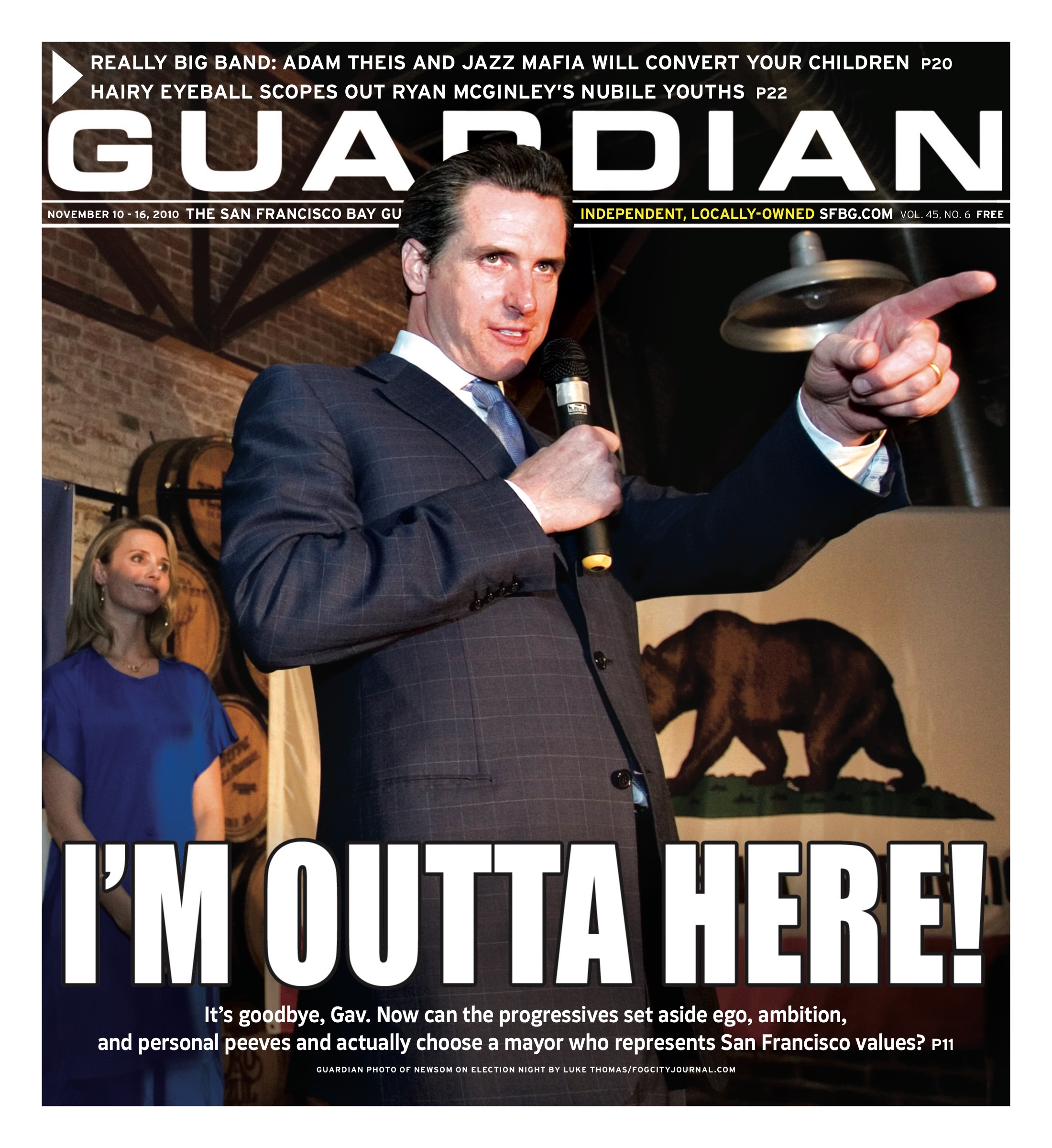
By the time a beaming Mayor Gavin Newsom took the stage at Tres Agaves, the chic SoMa restaurant, on election night, enough results were in to leave no doubt: the top two places on the California ballot would go to the Democrats. Jerry Brown would defeat Meg Whitman in the most expensive gubernatorial race in American history — and Newsom, who once challenged Brown in the primary and dismissed the office of lieutenant governor, would be Brown’s No. 2.

It might not be a powerful job, but Newsom wasn’t taking it lightly anymore. “We can’t afford to continue to play in the margins,” he proclaimed proudly, advancing a vague but ambitious agenda. “There is absolutely nothing wrong with California that can’t be fixed with what’s right with California.”

But around the city, as results trickled in for the local races, the talk wasn’t about Newsom’s role in the Brown administration, or the change the Democrats might bring to Sacramento. It was about the profound change that could take place in his hometown as he vacates the office of mayor a year early — and opens the door for the progressives who control the Board of Supervisors to appoint a chief executive who agrees with, and is willing to work with, the majority of the district-elected board.

At a time when the Republican takeover of Congress threatens to create gridlock in Washington, there’s a real chance that San Francisco’s government — often paralyzed by friction between Newsom and the board — could take on an entirely new direction. It’s possible that the progressives, long denied the top spot at City Hall, could put a mayor in office who shares their agenda.

This could be a turning point in San Francisco, a chance to put the interests of the neighborhoods, the working class, small businesses, the environmental movement, and economic justice ahead of the demands of downtown and the rich. All the pieces are in place — except one.

To make a progressive vision happen, the fractious (and in some cases, overly ambitious) elected leaders of the progressive movement will have to recognize, just for a little while, that it’s not about any individual. It’s not about David Chiu, or Ross Mirkarimi, or Chris Daly, or John Avalos, or Eric Mar, or David Campos, or Jane Kim, or Aaron Peskin. It’s not about any one person’s career or personal power.

It’s about a progressive movement and the issues and causes that movement represents. And if the folks with the egos and personal gripes and career designs can’t set them aside and do what’s best for the movement as a whole, then the opportunity of a generation will be wasted.

Folks: this is a hard thing for politicians to recognize. But right now it’s not about you. It’s about all of us.

It’s an odd time in San Francisco, fraught with political hazards. And it’s so confusing that no one — not the elected officials, not the pundits, not the lobbyists, not the insiders — has any clear idea who will occupy Room 200 in January.

Here’s the basic scenario, as described by past opinions of the city attorney’s office:

Under the state Constitution, Newsom will take office as lieutenant governor Jan. 3, 2011. The City Charter provides that a vacancy in the Mayor’s Office is filled by the president of the Board of Supervisors until the board can choose someone to fill the job until the end of the term — in this case, for 11 more months.

So if all goes according to the rules (and Newsom doesn’t try to play some legal game and delay his swearing-in), David Chiu will become acting mayor on Jan.3. He’ll also retain his job as board president.

On Jan. 4, the current members of the Board of Supervisors will hold a regularly scheduled Tuesday meeting — and the election of a new mayor will be on the agenda. If six of the current supervisors can agree on a name (and sitting supervisors can’t vote for themselves) then that person will immediately take office and finish Newsom’s term.

If nobody gets six votes — that is, if the board is gridlocked — Chiu remains in both offices until the next regular meeting of the board — a week later, when the newly elected supervisors are sworn in.

The new board will then elect a board president — who will also instantly become acting mayor — and then go about trying to find someone who can get six votes to take the top job. If that doesn’t work — that is, if the new board is also gridlocked — then the new board president remains acting mayor until January 2012.

There are at least three basic approaches being bandied about. Some people, including Newsom and some of the more conservative members of the board, want to see a “caretaker” mayor, someone with no personal ambition for the job, fill out Newsom’s term, allowing the voters to choose the next mayor in November, 2011. That has problems. As Campos told us, “The city has serious budget and policy issues and it’s unlikely a caretaker could handle them effectively.” In other words, a short-termer will have no real power and will just punt hard decisions for another year.

Then there’s the concept of putting in a sacrificial progressive — someone who will push through the tax increases and service cuts necessary to close a $400 million budget gap, approve a series of bills that stalled under Newsom, take the hits from the San Francisco Chronicle, and step out of the way to let someone else run in November.

The downside of that approach? It’s almost impossible for a true progressive to raise the money needed to beat a downtown candidate in a citywide mayor’s race. And it seems foolish to give up the opportunity to someone in the mayor’s office who can run for reelection as an incumbent.

Which is, of course, the third — and most intriguing — scenario.

The press, the pundits, and the mayor have for the past few months been pushing former Sup. Peskin as the foil, trying to spin the situation to suggest that the current chair of the local Democratic Party is angling for a job he wouldn’t win in a normal election. But right now, Peskin is no more a front-runner than anyone else. And although he’s made no secret in the past of wanting the job, he’s been talking of late more about the need for a progressive than about his own ambitions.

“If the board chose [state Assemblymember] Tom Ammiano, I would be thrilled to play a role, however small, in that administration,” Peskin told us.

In fact, Peskin said, the supervisors need to stop thinking about personalities and start looking at the larger picture. “If we as a movement can’t pull this off, then shame on us.”

Or as Sup. Campos put it: “We have to come together here and do what’s right for the progressive movement.”

Two years ago, the San Francisco left was — to the extent that it’s possible — a united electoral movement. In June, an undisputed left slate won a majority on the Democratic County Central Committee. In November 2008, Districts 1, 3, 5, and 11 saw consensus left candidates running against downtown-backed opponents — and won. In D9, three progressives ran a remarkably civil campaign with little or no intramural attacks.

The results were impressive. As labor activist Gabriel Haaland put it, “we ran the table.”

But that unity fell apart quickly, as a faction led by Daly sought to ensure that Sup. Ross Mirkarimi couldn’t get elected board president. Instead that job went to Chiu — the least experienced of the supervisors elected in that class, and a politician who is, by his own account, the most centrist member of the liberal majority.

This fall, the campaign to replace Daly in D6 turned nasty as both Debra Walker and Jane Kim openly attacked each other. Walker sent out anti-Kim mailers, and Kim’s supporters charged that Walker was part of a political machine — a damaging (if silly) allegation that created a completely unnecessary rift on the left.

And let’s face it: those fights were all about personality and ego, not issues or progressive strategy. Mirkarimi and Daly have never had any substantive policy disagreements, and neither did Walker and Kim.

In the wake of that, progressives need to come together if they want to take advantage of the opportunity to change the direction of the city. It’s not going to be easy.

“We’re good at losing,” Daly said. “I’m afraid we’re doing everything we can to blow it.”

The cold political calculus is that none of the current board members can count on six votes, and neither can Peskin or any of the other commonly mentioned candidates. The only person who would almost certainly get six votes today is Ammiano — and so far, he’s not interested.

“I know you never say never in politics, but I’m happy here in Sacramento. Eighty-six percent of the voters sent me back for another term, and I think that says something,” he told us.

It’s hardly surprising that someone like Ammiano, who has a secure job he likes and soaring approval ratings, would demur on taking on what by any account will be a short-term nightmare. The city is still effectively broke, and next year’s budget shortfall is projected at roughly $400 million. There’s no easy way to raise revenue, and after four years of brutal cuts, there’s not much left to pare. The next mayor will be delivering bad news to the voters, making unpleasant and unpopular decisions, infuriating powerful interest groups of one sort or another — and then, should he or she want the job any longer, asking for a vote of confidence in November.

Yet he power of incumbency in San Francisco is significant. The past two mayors, Newsom and Willie Brown, were reelected easily, despite some serious problems. And an incumbent has the ability to raise money that most progressives won’t have on their own.

Chiu thus far is being cautious. He told us his main concern right now is ensuring that the process for choosing the next mayor is open, honest, and legally sound. He won’t even say if he’s officially interested in the job (although board observers say he’s already making the rounds and counting potential votes).

And no matter what happens, he will be acting mayor for at least a day, which gives him an advantage over anyone else in the contest.

But some of the board progressives are unhappy about how Chiu negotiated the last two budget deals with Newsom and don’t see him as a strong leader on the left.

Ross Mirkarimi is the longest-serving progressive (other than Daly, who isn’t remotely a candidate), and he’s made no secret of his political ambitions. Then there’s Campos, an effective and even-tempered supervisor who has friendly relationships with the board’s left flank and with centrists like Bevan Dufty. But even if Dufty (who I suspect would love to be part of electing the first openly gay mayor of San Francisco) does support Campos, he’d still need every other progressive supervisor. Campos also would need Chiu’s vote to go over the top. Which means Chiu — who needs progressive support for whatever his political future holds — would have to set aside his own designs on the job to put a progressive in office.

In other words, some people who want to be mayor are going to have to give that up and support the strongest progressive. “If there’s someone other than me who can get six votes, then I’m going to support that person,” Campos noted.

Then there are the outsiders. City Attorney Dennis Herrera has already announced he plans to run in the fall. If the board’s looking for a respected candidate who can appeal to moderates as well as progressives, his name will come up. So will state Sen. Mark Leno, who has the political gravitas and experience and would be formidable in a re-election campaign in November. Leno doesn’t always side with the left on local races; he supported Supervisor-elect Scott Wiener, and losing D6 candidate Theresa Sparks. But he has always sought to remain on good terms with progressives.

All that assumes that the current board will make the choice — and even that is a matter of strategic and political dispute. If the lame duck supervisors choose a mayor — particularly a strong progressive — you can count on the San Francisco Chronicle, Newsom, and the downtown establishment to call it a “power grab” and cast doubt on the legitimacy of the winner.

“But choosing a mayor is the legal responsibility of this board and they ought to do their jobs,” Peskin said.

The exact makeup of the next board was still unclear at press time. Jane Kim is the likely winner in D6 and has always been a progressive on the School Board. She’s also close to Chiu, who strongly supported her. If Malia Cohen or Lynette Sweet wins D10, it’s unlikely either of them will vote for a progressive mayor.

Newsom also might try to screw things up with a last-minute power play. He could, for example, simply refuse to take the oath of office as lieutenant governor until after the new board is seated.

Chiu’s allies say it makes sense for the progressives to choose a mayor who’s not identified so closely with the left wing of the board, who can appeal to the more moderate voters. That’s a powerful argument, and Herrera and Leno can also make the case. The progressive agenda — and the city — would be far better off with a more moderate mayor who is willing to work with the board than it has been with the arrogant, recalcitrant, and distant Newsom. And if the progressives got 75 percent of what they wanted from the mayor (as opposed to about 10 percent under Newsom), that would be cause to celebrate.

But to accept that as a political approach requires a gigantic assumption. It requires San Franciscans to give up on the idea that this is still, at heart, a progressive city, that the majority of the people who live here still believe in economic and social justice. It means giving up the dream that San Francisco can be a very different place, a city that’s not afraid to defy national trends and conventional wisdom, a place where socioeconomic diversity is a primary goal and the residents are more important than the big companies that try to make money off them. It means accepting that even here, in San Francisco, politics have to be driven by an ever-more conservative “center.”

It may be that a progressive can’t line up six votes, that a more moderate candidate winds up in the Mayor’s Office. But a lot of us aren’t ready yet to give up hope.

Additional reporting by Noah Arroyo.

Editor’s Notes

0

tredmond@sfbg.com

Way back in 1986, Tom Hsieh Sr., an architect and one of the most conservative members of the Board of Supervisors, called his colleague Harry Britt — by all accounts the most liberal supervisor — and asked for a meeting. The way both men described it to me at the time, Britt was a little mystified; why would someone who was on the opposite end of the political spectrum want to be pals?

Well, it turned out that Hsieh had a message for his colleague. "Someday," Hsieh told Britt, "the gays and the Asians will be running this town, and we might as well get along."

It’s taken a while, but Hsieh (whose son is a moderate-to-conservative political consultant and activist) was prophetic. One of the little-noticed facts about this supervisorial election is that the majority of the members of the next Board of Supervisors will be either Asian or gay. And the odds are pretty good that the person in the Mayor’s Office in 2012 will be Asian (David Chiu, Leland Yee, Phil Ting) or gay (Tom Ammiano, David Campos, Mark Leno).

I mention that bit of interesting history as a sort of a prelude to the fascinating historic challenge facing progressives in San Francisco today. At a time when the rest of the country seems to be drifting (at least for the moment) to the right, San Francisco has a chance to go to the left. There hasn’t been a mayor the progressives supported in this town in at least 20 years (and that’s if you count Art Agnos, which is a bit of a stretch). With Gavin Newsom (will he be San Francisco’s last straight white mayor?) leaving early in his term, the supervisors could profoundly change the direction of the city.

And they could also duck, punt, or make a terrible mistake.

If the board wants to appoint someone who’s going to promote a progressive agenda, that person not only needs to be able to get six votes in January, but hold on to the seat until November — when the competition will be intense. And any progressive mayor will be vilified by the local daily papers, mocked by the national media, and held to an almost impossible standard by his or her constituents.

You wonder why anyone would want the job.

But taking on that insane challenge is also about history, and about proving that this city is (still) different. And the person in the job is going to need a whole lot of help and support. I have to believe that we’re up to it.

How not to choose a mayor

5

EDITORIAL There are plenty of good arguments among progressives about who would be the best person to replace Gavin Newsom as mayor and how the Board of Supervisors should make that decision. It’s a complicated situation: The next mayor will face a horrible budget deficit, all sorts of tough decisions — and then face the voters in 10 months. And if the board appoints a progressive, that person will face a hostile daily newspaper and several well-funded opponents in the fall.

But we know there are some very bad scenarios, some things the board and the potential mayor contenders shouldn’t do — because in the end, the process needs to be free of any sort of backroom taint.

Here are some basic ground rules for the next two months.

Newsom shouldn’t try to mess around with the selection of his successor. The mayor decided to run for state office with the full knowledge that he would leave behind a vacancy that the supervisors would fill. He has no business playing political and legal games to skew the results. For example, some say Newsom is considering delaying his swearing in, now set for Jan 3, 2011, for a week to prevent the current supervisors from voting on an interim mayor. That would be a bad faith, manipulative move. He made his choice; now he needs to get out of the way and let the City Charter process work.

The current board should have a fair shot at electing Newsom’s replacement. The day after Newsom takes office as lieutenant governor, the current board will meet for one last time — and by law, they should and will have a chance to find a candidate who can get six votes to serve out Newsom’s term. Any parliamentary moves that serve only to delay the vote and push the decision to the new board would be inappropriate.

The idea of a “caretaker” mayor is fraught with problems — and Willie Brown shouldn’t even be on the list. Newsom is pushing the idea of a true interim mayor, someone who won’t run for the job in November and will simply keep the lights on for 11 months. That means ignoring the city’s serious structural problems. A caretaker would have no authority and little ability change things. And the notion that’s being floated around of former mayor Willie Brown stepping in is disgraceful. Brown was a terrible mayor, and a rerun of that nightmare — even of only 11 months — is the last thing San Francisco needs.

Kamala Harris shouldn’t be a player in this game. If Harris, the current district attorney, is elected state attorney general, her job will be open too — and it’s easy to see how Newsom could use that as a plum to get his way. If Harris resigns before Newsom is sworn in, Newsom would get to appoint her replacement — and if that appointee is currently on the Board of Supervisors, Newsom would get to fill a seat on the board too. Harris needs to stay out of that unseemly sort of deal.

All the rules and procedures need to be made public, now. The legalities of this transition are tricky. Could the current board appoint an interim mayor now, knowing that a vacancy will occur, or must they wait until Newsom has actually resigns? Could Newsom delay his swearing in? The supervisors need to get legal advice on every possible scenario — and make it public. The last thing anyone needs in this confusion period is secrecy.

Plenty of people will be unhappy with whatever plays out. But if the process is bad, the result will be a mayor with no legitimacy.

GOLDIES 2010

0

GOLDIES 2010 Welcome to the 22nd annual Goldies issue. The Goldies stand for Guardian Outstanding Local Discovery awards, and rather than isolating one particular art form as a promotional endeavor, they aim to bring the Bay Area arts community together to celebrate actors, choreographers, filmmakers, musicians, and performance and visual artists who have added something special to the creative landscape.

It’s always tempting for me to imagine a grand Goldies production codirected by all of a year’s awardees. As they come together, the Goldies have a tendency to take on a life or identity of their own, and this year it’s fair to say that through chance or happenstance, the awards are sporting a little more gay glitter than usual. Another theme that has revealed itself is how true fandom or intense appreciation for a form of expression can, through the type of education that blooms from extreme dedication, metamorphose into art. A number of this year’s winners began as fans or enthusiasts, and over time, converted that enthusiasm into unique sites, sights, and sounds.

The 14 2010 Goldie winners were selected by myself along with fellow Guardian editors Cheryl Eddy and Marke B., and regular critics and contributors Robert Avila, Rita Felciano, and Matt Sussman. The initial nominations came from contributors to the Bay Area arts scenes and a number of Guardian writers. You can join the awardees and some surprise special guests Nov. 10 for a free celebration at 111 Minna Gallery. If you’re wondering what to wear, go for the gold. (Click below to learn more about this year’s winners, and check out last year’s winners here.)

GOLDIES 2010:

LIFETIME ACHIEVEMENT: RICK AND MEGAN PRELINGER

LIFETIME ACHIEVEMENT: MARC HUESTIS

LIFETIME ACHIEVEMENT: SLUMBERLAND RECORDS

VISUAL ART: JENNIFER LOCKE

MUSIC: SAID ADELEKAN

THEATER: CHRISTOPHER KUCKENBAKER

DANCE: AMY SEIWERT

MUSIC: HUNX AND HIS PUNX

VISUAL ART: AMANDA CURRERI

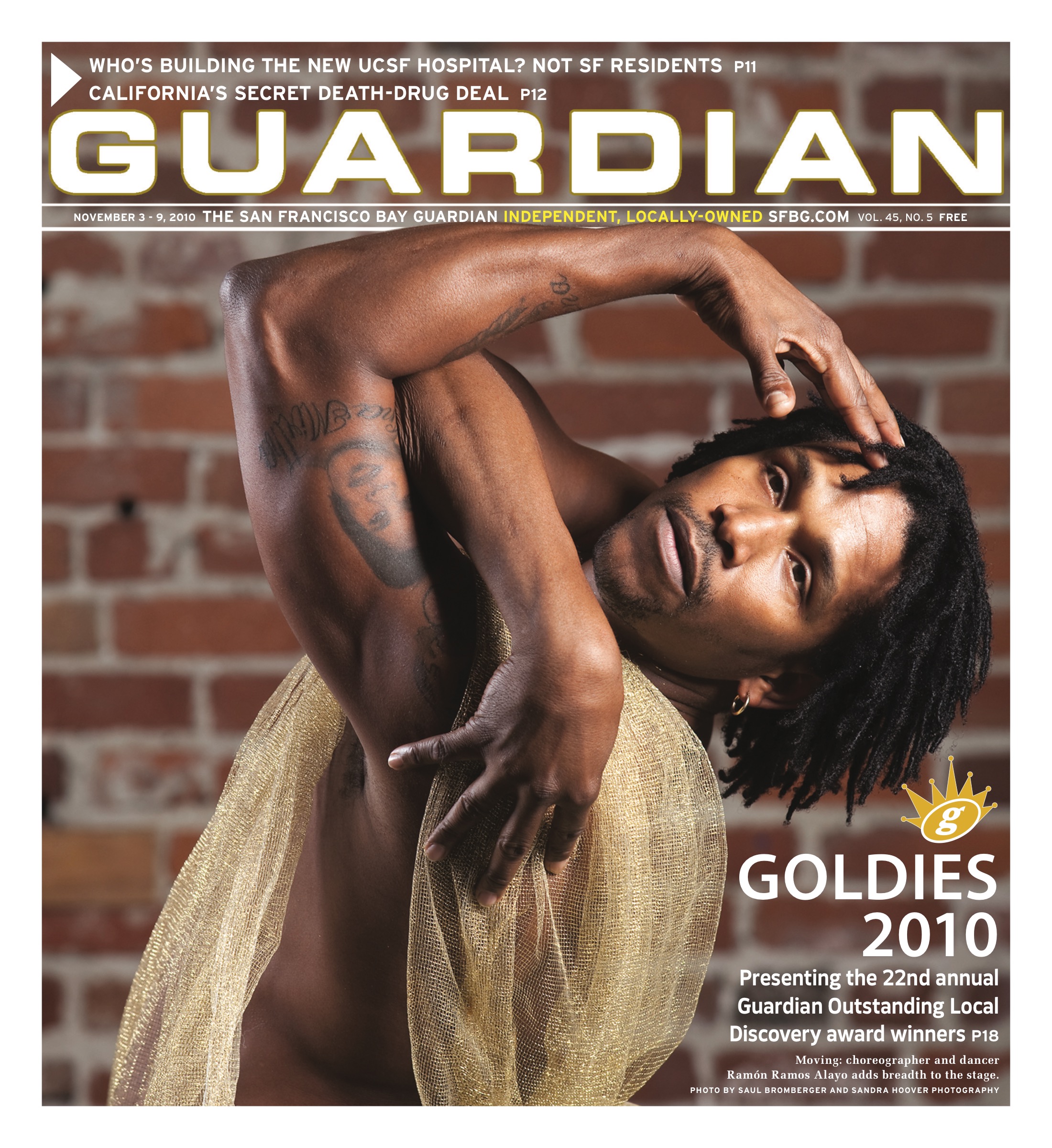
DANCE: RAMÓN RAMOS ALAYO

FILM: JOSHUA GRANNELL

MUSIC: DJ BUS STATION JOHN

VISUAL ART: RUTH LASKEY

STAGE: JESSE HEWIT/STRONG BEHAVIOR


All Goldies portraits by Saul Bromberger and Sandra Hoover


GOLDIES PARTY

With Myles Cooper, Alexis Penney, and surprise guests TBA

DJing by Primo Pitino and Naoki Onodera

Wed/10, 9 p.m., free

111 Minna Gallery

(415) 974-1719

www.111minnagallery.com

GOLDIES 2010 LIFETIME ACHIEVEMENT: Slumberland Records

0

Look at the key critically acclaimed and popular indie (or subsidiary) releases of the past few years, and certain label names recur: Captured Tracks, Mexican Summer, Sincerely Yours, True Panther, Slumberland. Most of these names belong to new kids on the block, but Mike Schulman has been at the helm of Slumberland for more than 20 years. If anything, his label, a home for perfect guitar pop, is stronger than ever, with bands such as Pains of Being Pure at Heart and Crystal Stilts on the roster. Slumberland has outlived many of the legendary indie labels — from Postcard to Creation to Rough Trade — that inspired it. Sometimes dedication reaps rewards.

In 1989, when Slumberland began in Washington, D.C., indie rock was a postal affair. The foundation of an international pop underground was being forged through letters and records and zines sent among fans and small record stores. From the beginning, Schulman was uniquely out of step, focusing on melodicism when the D.C. scene was known for punk abrasion. When Slumberland relocated to the Bay Area a few years later, releases by Stereolab, Henry’s Dress, Aisler’s Set, and the unjustly obscure Rocketship had nothing to do with grunge mania. “I felt painted into a corner,” Schulman, who was working at the Berkeley record store Mod Lang, remembers. “It seemed like there weren’t a lot of opportunities to get stuff heard, unless you took bigger deals. It was a craven time.”

Slumberland endured, and Schulman’s deep and abiding love of music is a major reason. One can argue that the label is more refined or restrictive in terms of sound than most — simply put, it offers the true wild heart of what has been more calculatedly and generically marketed as noise pop. But Schulman’s musical taste runs deep and wide. In the mid-1990s he started an electronic label, Drop Beat, and today he DJs at Oakland’s Actual Cafe, spinning rock steady, ’60s hard bop, Blue Note classics, and ’70s soul, funk, and reggae.

Schulman draws from a deep library — he has 30,000 records in his basement. “It’s out of control,” he admits with a smile. “I don’t sell anything. I buy new records every week: dubstep, soul and jazz reissues, and more indie than I have in the recent past. But currently it’s hard for me to listen to new stuff because I’m spending so much time listening to [Slumberland] test pressings.”

For Schulman, the process of assembling an album is one of the greatest pleasures of running a label. “I was really happy when they started sending me mixes,” he says when asked about the newest Slumberland release, Sports by the Bay Area trio Weekend, an album that promises future greatness and mass appeal. “The only reason I do this is to help bands get their music out there. I’ve been doing it long enough that I can give advice to a young band doing their first record. It’s gratifying talking to a band, listening to demos, and hearing an album come to fruition.”

Another gratifying moment for Schulman was Slumberland’s 20th anniversary mini-tour, when new bands and older bands — including his own, Black Tambourine — united for shows on both coasts. “The SF show was crazy,” he says. “There were so many people I hadn’t seen since the Aisler’s Set broke up [in the late ’90s]. So many people came to see Henry’s Dress.” Contrary to what one might assume from Slumberland’s music, Schulman is the opposite of a sentimentalist, but in this instance, he’s unabashedly romantic: “It was magical. It was kind of heartwarming. When I started doing a label I was so into music and supporting labels and I wanted to contribute. There was something about those shows that made me feel like, oh, maybe I did.”

He did — and he’s still contributing, with support and inspiration from his wife Nomi and son Theo. Through well-timed and still-strong acts of fidelity, Slumberland has forged its own community of friends who now have a shared history. The label’s present — 2010 brought powerful debut albums by Weekend and Frankie Rose and the Outs — is vital. Its future looks even livelier. Schulman is excited about upcoming releases by Brown Recluse and Emitt Rhodes-like baroque pop troubadour Devon Williams, and he drops some big name hints regarding the next Pains of Being Young at Heart album. For Slumberland, the pains of being young at heart have matured into the rewards of being true.

www.slumberlandrecords.com

>>MORE GOLDIES 2010

GOLDIES 2010: Amy Seiwert

0

As a kid in Cincinnati, Amy Seiwert didn’t want to be a ballet dancer. She strove to become a gymnast, just like her adored older sister. But, she says, “I was a scrawny little thing.” And when she tried walking on her head because her arms couldn’t support her, her parents suggested that ballet might help her gymnastics. “I didn’t want to do it,” she explains. “Ballet was ‘girly’ stuff and I was a tomboy.” Gymnastics’ loss, however, became ballet’s gain.

At 10, Seiwert got hooked on ballet — not the polite, princess/sylph/fairytale type, but the kind that let her soar, jump, turn, and “dance, dance, dance.” For her, the big attraction was ballet’s physicality. “I have always been fascinated with the geometry inside and outside the body. What you are drawing in three-dimensional space is based on physics. Ninety-eight percent of ballet makes perfect sense of what you want to do physically.” She even took a year’s training in Pilates to understand the body’s mechanics from a different perspective.

Seiwert became a good dancer, but she has the potential to become a great choreographer. She quite possibly is the Bay Area’s most original dance thinker, taking what some consider a dead language and using it as a 21st century lingo to tell us something about who we are. Monopoly took on the corporate glass ceiling. It’s Not a Cry looked at the difficulty of letting go even though a relationship has died. Static explored our tendencies to accentuate differences instead of seeing underlying commonalities.

As a choreographer, Seiwert credits much of her development to the late Michael Smuin, in whose Smuin Ballet she performed for nine years, even though his choreography could not have been more different from her own. Current Smuin Artistic Director Celia Fushille appointed Seiwert as choreographer in residence for exactly that reason. With Smuin Ballet, she will face her biggest challenge yet: choreographing Mozart’s Requiem in D Minor, which premieres next spring at Yerba Buena Center for the Arts.

But it’s for her own pick-up company, Im’ij-jre, that Seiwert is creating her most experimental work. It’s there that she works toward overcoming her fear of creating “the same ballet over and over.” In Relying on Fragmentation, she worked with controlled improvisation. In Light Essays, her dancers collaborated with set and light designer Marc Morozumi. Her most daring sharing of responsibility occurred in last year’s White Noise, with Berlin-based software artist Frieder Weiss.

Seiwert comes from a long family line of piano teachers, so perhaps it’s not surprising that she often lets music influence the kind of ballet she chooses to make. She doesn’t eschew the classics, but favors the music of our own day. She draws on a variety of sources, from Kevin Volans to Otis Redding, Steve Reich to Leonard Cohen, Zoe Keating to Morton Feldman.

Three years ago, while working with the Margaret Jenkins Dance Company’s CHIME mentoring program, Seiwert met poet-performer (and 2003 Goldie winner) Marc Bamuthi Joseph and used some of his work within Double Consciousness, a solo for her former colleague Charlie Neshyba-Hodges. “I just so much regretted that I couldn’t have Marc on stage,” she remembers. Next May, Seiwert will get her wish. Atlanta Ballet recently commissioned a new work from her; Bamuthi Joseph will help bring it to life when it premieres. (Rita Felciano)

www.amyseiwert.com

>>MORE GOLDIES 2010

GOLDIES 2010 LIFETIME ACHIEVEMENT: Rick and Megan Prelinger

0

“Juxtaposition,” “serendipity,” “appropriation,” and “collaboration” are all words that come up frequently when you talk to Rick and Megan Prelinger about the Prelinger Library.

Tucked above a SoMa carpet store, the space (“a free offering, an installation, a workshop, and an extension of our living room,” according to the handout given to visitors) is stuffed floor-to-ceiling with books, maps, magazines, and other ephemera. It is a place where artists, students, teachers, architects, T-shirt makers — basically anyone with a curious, creative mind — can seek information and inspiration. Visitors are encouraged to photograph, copy, and scan materials for future use in their own projects.

“This is a completely unconventional library,” Rick says. “It’s much more a place where serendipity rules.”

A certain magic comes courtesy of the library’s unconventional shelving system, designed by Megan to maximize what she calls “browsing-based discoveries.” It’s based on a continuum of ideas and interests, not Dewey Decimals. In a section dedicated to the American South, for example, a dusty government tome about Georgia’s river system might nestle next to a paperback copy of Deliverance.

“[Library visitors] tend to start going where they think they’re headed,” Megan said. “Then they find something they’d never seen before, and they just go in a different direction. They come out going, “Wow! I thought I was looking for this, but I found this.'<0x2009>”

Opened to the public in June 2004, the Prelinger is tailored to its current location. Though the fit is snug, Prelingers have no plans to upsize. “The collection is composed in such a way that there’s a relationship between the aisles,” Rick explains.

But the collection is anything but static. In addition to what they call the “user-based chaos” that arises when visitors remove and replace books on the shelves, the Prelingers are constantly adding to, and editing, their highly selective inventory. Subjects range from transportation and land-use to media studies and political history (they joke that the stacks harbor “98 percent bad ideas”). “[The library is] specific to what we’re interested in,” Rick says. “But we’re interested in a lot of things.”

The Prelinger also boasts an online component composed of thousands of digital books that may be downloaded for free. Though this represents only a fraction of the physical collection, it’s a useful tool for those who can’t visit the library in person. As it is, the place has limited hours, and both Prelingers support it with other endeavors.

Megan is also a historian, a wild-bird rehabilitator, and an author; her 2010 release, Another Science Fiction: Advertising the Space Race 1957-62 (Blast Books), is a gorgeous, hefty volume that culls and contextualizes imagery from magazines like Missiles and Rockets, bound editions of which can be admired in the library. Rick is widely known for the Prelinger Archives, a groundbreaking moving image archive he founded in 1983. It eventually grew to include more than 60,000 works — all originally made by amateurs or earmarked for industrial, educational, and advertising use. Much of it was acquired by the Library of Congress in 2002 and 2003 (some 2,500 titles are also available online). The archive inspired Rick’s 2004 collage film, Panorama Ephemera, as well as his popular “Lost Landscapes” presentations, which meld lively discussions about history with found footage.

Along those lines, the Prelingers have a new-old passion: home movies. “Megan and I now run a really fast-growing and exciting home movie collection,” Rick says. “Home movies — that’s the only cinema that matters for me. Each one is unique. We think we understand home movies, but they’re shallow and deep at the same time.”

Rick’s latest film (“slowly in the works”) will be based on this burgeoning collection. “One of the things that we say we’re trying to do — it’s a little grandiose, but it’s actually true — is putting together a complete ethnographic portrait of 20th century North America through home movies,” Rick says. Looking at what they’ve accomplished so far, it’s not hard to conclude that if anyone can pull off such a feat, it’ll be the Prelingers.

www.archive.org/details/prelinger; www.prelingerlibrary.org

>>MORE GOLDIES 2010

GOLDIES 2010: Jennifer Locke

0

In her pieces, Jennifer Locke has, variously, jumped rope for 30 minutes in a full-body latex suit (cutting out a hole in the bottom afterward to drain out her accumulated sweat and urine); wrestled with a partner at the Berkeley Art Museum smeared in stage blood; covered herself in Elmer’s glue, let it dry into a second skin, and then peeled it off; received a lap dance from a male stripper; and branded a fellow participant.

Granted, reducing Locke’s art to such a titillating laundry list is a superficial move. But the immediate visceral spectacle her work repeatedly presents is undeniably seductive — albeit in a punk rock kind of way. It’s hard not to be pulled in by the grappling, athletic bodies, the donning and shedding of second skins, all frequently soundtracked by the amplified breath of the participants themselves, even if it sometimes causes one to flinch.

Locke, who has spent considerable time working as a pro dom and is herself a champion submission wrestler, is keenly aware of her art’s initial draws. “Yeah,” she laughs over the phone, “athletic bodies are inherently sexy. It’s in our nature as human beings to want to look. But I want there to be a barrier between the audience and the image of the body.”

In Locke’s work, which she describes as a sculptural hybrid of live studio actions and video, the camera often provides that layer (or more often, layers) of mediation. Locke strategically uses video within her pieces to alter the on-site audience’s expectations and perceptions of what’s occurring in front of them, as well as those of viewers encountering the pieces as video documents after the fact.

Whatever erotic or transgressive charge a viewer may have invested in the actions being performed becomes rewired through the camera set-up, or is short-circuited entirely. As critic Daniel Coffeen has noted of Locke’s work: “She does not dabble in human affect but in human mechanics.”

In the aforementioned BAM piece, Red/White (Fake Blood), Locke and her wrestling partner sparred in the museum’s loading bay, their actions relayed to the audience via a live video feed that, due to technical difficulties, wound up being projected in black and white. The door to the dock, however, was left slightly ajar so anyone who wanted to see the “real event,” and the piece’s “true colors,” could — although no one was ever specifically directed to.

In Black/White, a three-day piece done as part of the opening of the San Francisco offices of the Marina Abramovic Institute of Performance Art, Locke placed the camera filming a live feed of her actions so that it encompassed those viewing her as well, then projected that image on a rear wall so the audience could observe either Locke’s action or the projection of themselves watching Locke’s action, but not see both simultaneously.

“I used to talk a lot in my artist statement about power dynamics, but then I realized over time that I’m more interested in how meaning gets produced,” she says. “Power is a means to talk about that, but I want to know how those hierarchies actually shift around in reality: Who’s in control? Am I? Is the camera? Is the audience? My work is like a three-card monte.”

www.jenniferlocke.net

>>MORE GOLDIES 2010

GOLDIES 2010: Ruth Laskey

1

One thing that Bay Area art has no shortage of is color. Whether it be Albers-informed theory, Op-influenced repetitious patterns, Mission muralismo, or mural-like Mission School paintings, in general, local color has been primary, if not outright garish. Ruth Laskey’s palette stands apart — confident enough to be low-key or even muted in comparison. “Color is kind of it for me,” Laskey says, in the middle of a sleepy afternoon at a Mission cafe. “It’s where a piece gets its emotion.”

You could say that there’s a quality of quiet intensity to Laskey’s work, and the artist herself is soft-spoken. She’s also strong, clear, and candid in terms of viewpoint. “My relationship to color is not very systematic,” she says, when the topic of Albers references in relation to her work is broached. “It’s more intuitive. I already see things from a painter’s perspective. When you’re a painter making color, there’s an evolution that happens.”

In Laskey’s case, this evolution is ongoing — and it isn’t taking place within traditional painting. Both “7 Weavings,” her first solo exhibition at Ratio 3 in 2008, and a self-titled show at the same space this year are taken from her larger “Twill Series,” a growing group of “investigations” that she began in 2005, years after taking a weaving class in between undergraduate and graduate studies at California College of the Arts. “Twilling is basic, the first pattern weave you learn,” she says. “The loom I’ve been using from the beginning is basic. I was thinking about my understanding of weaving, and I was interested in how twill creates shape on its own. It kind of clicked one day that I could use twill, but insert the thread in the same way I would with tapestry.”

That moment kick started Laskey’s unique use of dye and weft and warp to create color forms in which minimalism and materiality intersect. Her “Twill Series” has generated a cover story critical appraisal in Artforum and many responses locally — in some ways, the discourse about her growing body of work (including my own 2008 piece for this publication, which focused on geometric elements) reveals as much about the writers as it does about the art itself, which invites contemplation and allows open interpretation. It’s a mistake to assume this openness is cool detachment, though. “It’s fabric,” she says. “It’s inherently warm.”

At the moment, Laskey’s studio is in the garage of her apartment in Glen Park, a neighborhood that has housed some artists of renowned dedication, like Bruce Conner. Her day job at California College of the Arts’ Oakland library is one source of inspiration and perspective. Music could be another. When I ask her what sounds might make apt accompaniment for an audiovisual presentation of her art, her choice is Sun Ra. Thinking of her work as what Ra would call an “art form of dimensions tomorrow” adds another a playful element to its fabric. She uses blankness around an image as he uses the silence that surrounds sound. Space is the place.

As for Laskey’s “Twill Series,” at the moment it’s hard to gauge how large it will grow, but there is no doubt her deployment of dye and geometric shape is subtly shifting. “It’s an issue that artists have to deal with all the time,” she reflects. “I might still be interested in what the work is doing, but is it still engaging for everyone else? There’s always that tiny figure on your shoulder saying, ‘Maybe you need to move on.’ But I feel like it’s taking me on this journey. It might be a really slow journey. It might have small steps. But I’m enjoying that. For me, it’s fruitful.” 

www.ratio3.org; www.ruthlaskey.com

>>MORE GOLDIES 2010

GOLDIES 2010: Christopher Kuckenbaker

0

In September, the San Francisco Fringe Festival offered patrons an off-Beat gem, The Burroughs and Kookie Show. A deftly performed blend of homage and intimate psychic excavation, the play imagines William S. Burroughs (actor-playwright Christopher Kuckenbaker) as talk show host, opposite a deadpan, laconic musician named Loubis the Pubis (Louis Libert), and a missing cohost, “Kookie,” symbolized in absentia by a small, empty chair. Tonight’s guest? An unsuspecting actor named Chris Baker (Christopher Kuckenbaker again). At once mood-alteringly dreamy and piquant, shrewdly funny and unexpectedly poignant, the show deservedly scampered off with “Best of Fringe” honors.

Kuckenbaker is a sharp, versatile actor who’s plied the more vibrant fringes of Bay Area theater since the 1990s. He and his now ex-wife moved away in 2001 to pursue professional careers as actors in Chicago and Boulder, but Kuckenbaker returned in 2007. The timing was auspicious. A month later, he was memorably cast as real mama’s monster Grendel in Banana Bag & Bodice’s bicoastal hit, Beowulf: A Thousand Years of Baggage. Next up, Kuckenbaker appears at Z Space opposite 2009 Goldie winner Beth Wilmurt in The Companion Piece, directed by Mark Jackson.

Kuckenbacker came to acting while at Santa Barbara City College. This followed a scattered upbringing in California towns like Hollister and Salinas, and far-flung lands like Australia. He credits all the moving around with seeding his actor’s outgoing personality. “It maybe forced me to be a little more gregarious than other people,” he suggests.

Arriving in San Francisco in 1993, Kuckenbaker received a degree from San Francisco State’s prolific theater department in 1997. Since then, his graceful work and alternately intense and quirky looks have made him a unique presence onstage. He’s also an astute and generous ensemble player who’s worked repeatedly with leading smaller companies like Art Street and the Shotgun Players; been part of a now defunct sketch comedy troupe called Old Man McGinty; and appeared repeatedly in Playground’s popular stagings of contest-generated short plays.

His own shift to playwriting, meanwhile, is more than a lark. He and Burroughs go way back. They first met in the Interzone of the imagination around the time Kuckenbaker left Santa Barbara with some Beat-obsessed cohorts for Bellingham, Wash., in the early 1990s. He stayed only a year in the Pacific Northwest rain, but something had happened to him up there, some inter-era nod, some afflatus. A mind-meld with old Bill.

“When I first moved to Bellingham, I’d go to the grocery store and pick up CDs of him reading his own works. That turned me on. There was something about his voice that triggered something in my brain, released some kind of new chemical in my head, and it just made sense.”

After gestating for nearly two decades, that initial inspiration has become a Möbius strip seamlessly joining in one actor two complex identities: Burroughs and the actor alter ego called on to process the painful end of a marriage. In giving a compelling dramatic shape to the voices in his head, Kuckenbaker says he’s found new definition in a still-unfolding career.

“When I look back, it seems to me I was just going from one show to the next, never really seeing myself any further along than the next show. Now, after giving birth to something in a very personal way, I want with all my power for it to grow and be seen, to spread itself out across the world. I have some big ideas about where I want to take the next iteration of The Burroughs and Kookie Show, making it a much larger and richer piece.” 

www.kuckenbakery.com

>>MORE GOLDIES 2010

GOLDIES 2010: Hunx and his Punx

0

It should come as no surprise that a gay 30-year-old male living in the Bay Area who borrows elements of his fashion-forward look from Freddie Mercury is putting out the “gayest music ever.” He’s a Pisces who rocks a switchblade comb and blends leather daddy duds with a 1950s-meets-1980s juvenile delinquent touch.

Seth Bogart, a.k.a. Hunx, has been devoted to rock and trash pop culture for years. He made zines as a teen in Arizona when riot grrrl was happening, and has essentially created a life from his variety of enthusiasms.

“I do it for myself, to have fun. It makes me feel better being constantly creative. As cheesy as it sounds, happiness is doing what you want to do,” says the rather butch-looking Bogart over tortas at a 24th Street restaurant. His eyes are piercing, he’s wearing a torn biker jacket, and he’s sporting a few days more than a five o’clock shadow.

Probably tired from having just gotten back from New York City, where he spent eight days recording the next Hunx and His Punx album for Sub Pop’s subsidiary label Hardly Art, Bogart appears happy to be home. After years living in Oakland, he currently resides in the Bayview District.

Thematically, Bogart describes the first proper Hunx and His Punx album as being similar to this year’s compilation Gay Singles (True Panther) in that it deals with love and teenage heartbreak. “It sounds like a dream,” he exclaims. But the upcoming album delves deeper into a sadness he said he’s never really written about before. His father committed suicide when he was just a teen, and with his mom left “out of it and depressed” in the immediate aftermath, it’s no wonder he grew up fast and was on his own by 17.

Bogart found catharsis in freedom of expression. As the tale goes, after his previous group Gravy Train!!! disbanded, friends such as Nobunny and Christopher McVicker helped pen some of the early Hunx and His Punx songs. On the new album, Bogart more fully takes the reins, writing half the album’s tracks himself, with his bold bassist and bandmate Shannon Shaw also contributing a few numbers. As for Hunx’s flirty and quick-witted onstage candor, Bogart attributes some of his brazen confidence to old pal and former roadie Nobunny, who instilled in him that you only have one chance in life. This attitude has led to a colorful album insert of Hunx in the buff, as well as an awkward moment when his Internet-browsing mom unexpectedly saw his boner in a Girls music video.

If you think Bogart’s skills to pay the bills begin and end with music, guess again. He happens to co-own Down at Lulu’s, a popular Oakland vintage boutique and salon, with Tina Lucchesi (of Trashwomen, Bobbyteens, and now Midnite SnaXXX). The shop has been open four years, and Bogart, a licensed cosmetologist, cuts hair there three days a week. He and his friend Brande Baugh are also developing a TV talk show.

Although owning his own shop and contributing to the local music scene are two obvious ways Bogart serves the Bay Area community, it’s what he stands for on a larger scale as a unique gay personality in the still hetero male-dominated genre of punk — and broader realm of rock — that makes him bold and noteworthy. You can call him bubblegum and outrageous, but the fact remains that Hunx exudes an image of strength and confidence. He fills a void in garage rock that isn’t quite clean enough for the Castro and maybe too queer for some fans of harder sounds. He blurs the lines, breaks down boring boundaries, and stays true to himself all the while. 

www.myspace.com/hunxsolo; www.myspace.com/gayestmusicever

>>MORE GOLDIES 2010

GOLDIES 2010 LIFETIME ACHIEVEMENT: Marc Huestis

0

“What a swimmer is Dracula’s daughter!,” exclaims John “the Cool Ghoul” Zacherle, as “Dinner With Drac” blares from the speakers in Marc Huestis’ Redstone Labor Temple office. ‘Tis the season for Huestis’ tribute to Poltergeist‘s Jobeth Williams, and the activist, filmmaker, and camp impresario is in the final stretches of preparing for the big night.

What hasn’t Marc Huestis done? As a youngster, he arrived in San Francisco from Long Island, New York, unafraid to recite poetry while sporting a pompadour that would make any Elvis impersonator feel size envy. Soon you could see him singing in drag or writhing around on stage in a dirty diaper in Angels of Light productions. But from the very beginning, film was at the heart of Huestis’s life. His father was an editor who worked on the ’60s teen music TV show Hullabaloo, while his mother was a showgirl. “I have a little bit of both in me,” he jokes, and it’s the truth — a Marc Huestis extravaganza involves informed editing and explosive creative freedom.

One of Huestis’ first notable celebrations was the San Francisco Gay Film Festival, now known as the Frameline fest, which he and his non-biological twin-of-sorts Daniel Nicoletta (born just three days apart from him) began with other like minds in 1976. “It was fun, a bunch of kooky hippie kids who wanted to get their movies shown,” he remembers. “There was no pretense, and the group of us were able to get together to do it. It’s great to see what it has evolved into, and feel a bit like a patron saint. Some people will always hate you, but at this age” — Huestis is 55 — “you get to the point where some people respect you. And you respect yourself.”

In 1982, after making some short films, Huestis wrote and directed Whatever Happened to Susan Jane?, his distinctly San Francisco answer to the kinds of antic comedies John Waters was making on the East Coast. In recent years, the movie has found a new audience amongst music lovers devoted to San Francisco’s new wave heyday — one of its strongest aspects is its documentation of wild performances from Tuxedo Moon and other groups of the day. “It was a great combination of gay culture and punk culture,” Huestis says of the era. “There’s a kindness to it, and it was very smart.”

Huestis’s next feature-length movie, 1993’s Sex Is… is very much a film of its time. A direct look at and discussion of the experience of gay sex and intimacy amid the AIDS crisis, it was also a do-it-yourself, many-year labor of love, with DIY aesthetics one common thread throughout Huestis’s creative life. “It’s very heartfelt,” he says of the film. “It was an important film when it came out because no one was talking about sex, and if they were, it was really hypocritically. The high point of my life was to be at the Berlin Film Festival for the world premiere, and then several days later, be at the awards presentation with Billy Wilder sitting nearby. For me, having HIV, and not thinking I was going to live, that moment was a gift.”

One year later, Huestis moved into his office in the Labor Temple, a treasure trove of film memorabilia where the walls are lined with autographed photos, and VHS tapes, DVDs, VCRs and DVD players are stacked on top of each other — in a well-organized fashion. The site is his base for the celebrity events that he puts on at the Castro Theatre, theatrical and cinematic programs that have blazed a trail for another generation of movie mayhem purveyors such as Jesse Hawthorne Ficks and this year’s Goldie winner Joshua Grannell, a.k.a. Peaches Christ.

Old media surrounds us as we talk, but there is little doubt that Huestis, experienced at putting together political and community fundraisers, is always focused on the present and future as well. “I love new media,” he says. “I could not do what I do if I didn’t have knowledge. I design the posters, I do the clip reels, I get the music together, I do the PR. I would sell the popcorn if I could. I love it. I never get tired of movies.”

It’s fitting, then, that Huestis gets to call one of this country’s oldest and most beautiful movie palaces, the Castro Theatre, home. “One of the first shows I put on there was when the Republicans took control of Congress, so everything comes around,” he says. “The best thing is seeing someone go there for the first time. To me it’s like the town barn, but it’s an amazing, beautiful place.”

If star power can me measured in size, some of the players that Huestis has brought to the Castro over the years — Debbie Reynolds, Jane Russell, Tony Curtis, Piper Laurie, Patty Duke — rival the size of the fabled venue. He’s also given eccentric talents such as Sylvia Miles and Karen Black the type of spotlight they deserve. In the end, it’s about gratitude, on his part, on behalf of the audience, and hopefully, from the subjects of his tributes. Huestis’ night for Tony Curtis resulted in him being hired by the actor to create a clip retrospective that ultimately wound up being shown at Curtis’s funeral. “I had a great fondness for and connection with him,” he says. “I love it when they’re thankful, because no one shows gratitude, the world is so entitled. After the [Castro] show, he [Curtis] held my hand really hard, looked me straight in the eyes, and said, ‘Thank you.'”

Thank you, Marc Huestis.

www.myspace.com/marchuestispro  www.youtube.com/user/hostesshue

>>MORE GOLDIES 2010

GOLDIES 2010: Jesse Hewit/Strong Behavior

2

Most shows start with a request to turn off your cell phones. Tell Them That You Saw Me begins with an implicit request to leave your virtual mind outside. As the lights come up in this latest work from Jesse Hewit/Strong Behavior (which premiered after a residency at CounterPULSE in August), five utterly gobsmacked women, sprawled in enervated postures on floor and furniture, stare back at the audience for a very long time. The audience is still, but maybe still not seeing everything in front of them, as a micro-choreography of breath and saliva and eyelash unfolds amid a glacial volley of questions and answers. The real seeing takes time and patience and something like courage, things that feel in short supply these days — unless you attend this piece, which requires as well as rewards “attending.”

“It’s a study in focus,” says Hewit, “and it’s a study in what we’re looking at and why, and how we deal with each other for long periods of time.” The piece, he says, made him conscious of a concern he’s had with duration as a condition of social life and a strategy for art. Like an aikido master, Hewit uses the sheer weight of time to unsettle our usual, predictable, and tyrannical rhythms. In doing so he advances an invigorating and revelatory body of work exploring our myriad personal and social identities.

For his part, the 30-year-old choreographer and theater maker is both a unique artist and part of a tight-knit milieu making serious waves across the Bay Area’s performance scene. Much of this network of young, bold, savvy, and mostly queer artists gathers under the banner of The Off Center, an ongoing artist-run performance initiative originally formed around recently-shuttered queer performance incubator Mama Calizo’s Voice Factory. (The group includes close colleague Laura Arrington, the other CounterPULSE summer residency artist, whose Hot Wings shared the bill with Tell Them.)

From ages 8 to 13, Hewit studied ballet in Montreal. But dance went by the wayside as his family kept pulling up stakes and moving, since in most places “it wasn’t cool to be a boy who was a dancer.” He got back into dance while at New York University in Tisch’s Experimental Theater Wing. Then, unexpectedly, he headed to a psychology program in central Florida: “I don’t know what the deal was, but something didn’t agree with me in New York anymore.” After a year-and-a-half, Hewit found San Francisco State’s graduate program in sexuality studies. “I thought I was going to be a sociologist,” he admits. “[But] my mode of expression while in graduate school kept coming back to mounting performances or looking at bodies and posturings, so I realized, ‘Oh, okay, I have to go back and do dance stuff.'”

The theoretical rigor explicitly informs Hewit’s work, but he’s also inspired by an international discourse among dance/theater makers. He recently trained with choreographer Meg Stuart and names among other significant influences New York–based choreographer Miguel Gutierrez, Bulgarian-born physical theater artist Ivo Dimchev, North Carolina–raised feminist choreographer-provocateur Ann Liv Young, and New York’s Big Art Group. Locally Hewit cites people like Erika Chong Shuch, Jess Curtis/Gravity, and Sara Kraft.

Hewit particularly credits Keith Hennessy, a friend and mentor, with drawing his work into an international context. He brings up Hennessy’s balancing of two boards on his head in his Bessie Award–winning show Crotch. “It’s really relentless and impossible and it takes way too long,” he recounts with satisfaction. “It’s nice. It’s always these little sites of resistance — just how quickly do we think things are supposed to happen?” 

www.jessehewit.com

>>MORE GOLDIES 2010

GOLDIES 2010: Joshua Grannell

1

Whether he’s all dolled up as Peaches Christ or wearing his everyday attire, Joshua Grannell is a cinematic force to be reckoned with. He turned a love of cult film into a modest empire, with a memorable drag character, a popular midnight movie series, and All About Evil, his first full-length feature film.

But back in 1998 when Grannell was working for Landmark Theatres, Midnight Mass was a tough sell. “Midnight movies had really died in San Francisco,” he recalls. “It was sort of a thing that was considered passé and relegated to the suburbs.”

To Landmark’s credit, Grannell did get the go-ahead to create Midnight Mass, which he hosted as his alter ego Peaches Christ. He screened camp classics like Showgirls (1995), Female Trouble (1974), and Beyond the Valley of the Dolls (1970). The stage show was led by Peaches, who Grannell describes as “a character born out of the world of cult movies.”

“I’m not just programming a movie,” he explains. “I’m also creating an entire environment and a whole show to go along with it.”

While Grannell still produces Midnight Mass sporadically, he no longer maintains it as a regular series. And who can blame him? He has plenty on his plate as a filmmaker, the role he’s wanted to play since childhood.

“I went through a period where I started to freak out and think, oh my God, what have I done?” he admits. “I’m best known for being a clown named after Jesus. And I was proud of that … but I really did start to think that no one was ever going to invest any money in me or my filmmaking.”

But it was his Peaches Christ fame and the popularity of Midnight Mass that gave Grannell an audience who understood and appreciated his vision. He was able to use that when he wrote and directed All About Evil, in which he also cameos — as Peaches, natch.

The film is Grannell’s ode to his idols, an homage to the schlocky gore of Herschell Gordon Lewis and the charming perversity of John Waters. It’s also an impressive achievement, the work of a filmmaker who is accomplished in his own right.

But he hasn’t let the success go to his head. As Peaches, Grannell remains a snarky fan, noting that part of her appeal is her unwavering silliness.

“Peaches is a bit of a goofball, and I certainly don’t take Peaches too seriously,” he notes. “The minute I do, go ahead and put a bullet in my head, because that would ruin everything.”

To Grannell, the fannish aspect is essential to the Peaches Christ brand. In a way, it mirrors his own passion — he’s just as excited to share the stage with his cult heroes as we are to see them.

“I’ve built a whole career centered around worshiping my idols,” Grannell says. “I’ve gotten to meet them and I’ve gotten to work with them. But even though I would say that I consider John Waters to be a friend, I don’t know that he’s a friend to me without my obsession still being there and being a fan.”

Grannell’s humility isn’t an affectation. Despite his considerable successes, he’s still driven by simple goals.

“I make crowd-pleasers,” he says. “I’m an entertainer. There’s a sort of art to what we do, certainly, and an aesthetic, but first and foremost, I get off on making people laugh or puke or scream. That’s always been the thing I’m most interested in.”

www.allaboutevilthemovie.com; www.peacheschrist.com

>>MORE GOLDIES 2010

GOLDIES 2010: Amanda Curreri

0

Five minutes into talking with Amanda Curreri over a slice and coffee at Mission Pie, I’ve agreed to take part in a piece she’s working on as part of Shadowshop, the in-gallery artists’ marketplace Stephanie Syjuco is organizing for SFMOMA’s upcoming survey of work made in the past decade.

“It’s called Afghanistan Insert,” Curreri explains, speaking in the measured fashion of someone who carefully considers her words. “I’m trying to insert Afghanistan into SFMOMA and into San Francisco’s art community.”

Curreri’s commitment to getting the local arts scene to engage with what has become commonly dubbed by the mainstream news media as “the forgotten war” is not just politically motivated. It’s also personal. Her husband has been working in Afghanistan for the past five months as a security contractor, during which he has sent her snapshots of local graffiti. They are documents of his ground truth.

Curreri plans on physically inserting herself and her husband’s images into Shadowshop, much in the same way she holds one of his pictures in the portrait accompanying this feature. Indeed, the photo, this profile, Curreri’s new status within the local arts community as a Goldie winner, and the conversations this increased attention might encourage will all become part of the discourse surrounding Insert Afghanistan and contributing to its impact.

All this is consonant with Curreri’s view of herself as more of an instigator than an artist. “I’m trying to make art that crosses out of the art world,” she says, echoing Joseph Beuys’ notion of social sculpture. Her projects thrive on participation, using the exhibition space as a kind of social laboratory in which she arranges shared cultural touchstones and institutions — campfire songs, the judicial process, family recipes — as prompts for personal reflection and shared conversation on the “big subjects” that undergird them: history, politics, memory, and in the case of Afghanistan Insert, their intersection within a seemingly endless and fruitless foreign occupation thousands of miles away.

Engaging with Curreri’s art often entails an extended encounter with the artist herself (given how unexpectedly my interview at Mission Pie has turned out, the reverse seems true as well). The last conversation I had with Curreri was this past July, when she videotaped my extemporaneous responses to her off-camera questioning about the topic of last words. My interview was to be incorporated into her concurrent exhibit “Occupy the Empty,” for which she transformed Ping Pong Gallery via hand-sculpted “props” into a courtroom in which various associates, friends, and strangers, such as myself, volunteered their time and testimony.

As with Insert Afghanistan, the inspiration for “Occupy the Empty” was also personal: after participating in a court hearing concerning her late father, Curreri found out it had been held in the same Massachusetts courthouse in which Italian-American anarchists Sacco and Vanzetti were sentenced to death in the early 20th century. Curreri, also of Italian-American descent, saw the coincidence as a chance to connect to that history and, in the process, build a community around a larger discussion of remembrance. Curreri recalls one participant for whom the show served an almost therapeutic function.

“I want to create art that has an interpersonal function, in real-time,” she says. “I want my work to set a specific frame around our inherent connectivity.” 

www.amandacurreri.com

>>MORE GOLDIES 2010

GOLDIES 2010: DJ Bus Station John

0

“Listening to records is really the closest thing we have to a time machine,” says DJ Bus Station John. “Rest the needle in the groove, close your eyes, and the sensory experience can take you right back to 1979 — if you’re lucky enough to be that old, ha ha!”

Perhaps the most important DJ on the San Francisco gay scene in the past decade, Bus Station John has been the musical conduit for a huge cultural reawakening among younger homos. Called “the godfather of bathhouse disco,” he’s revered throughout the dance music world for his fastidious attention to party detail and his inimitable blend of extremely rare 1970s and early ’80s soul, boogie, garage, funk, Italo disco, Hi-NRG, and NYC no-wave.

But his influence goes far beyond helping to inspire the underground disco revival that has displaced techno as the music of choice on many of the world’s sophisticated dance floors. Believe it or not, disco and Hi-NRG used to be verboten in most gay clubs in the ’90s and early ’00s, sonic reminders of the early AIDS crisis that were trampled beneath pounding circuit music beats and generic diva screams. Imagine queers being ashamed of disco!

The arrival of life-extending protease inhibitors for HIV-positive men in the late ’90s opened the door for a not-so-painful appreciation of the recent gay past, and the time was ripe for a DJ to reprise the fantastic sounds of a generation tragically swallowed by disease — sounds that San Francisco had a huge hand in creating through the likes of producer Patrick Cowley, singer Sylvester, and dozens of other integral analog musicmakers.

Enter DJ Bus Station John in 2000, tastefully flaunting his dedication to the hot and heavy bathhouse and backroom days of yore. (The city, still gripped by AIDS panic, continues to outlaw these queer sexual venues.) Although the music is central to his mission, his parties are a complete package. From Xeroxed flyers of hand-made Gluesticked collages featuring Grace Jones or Joan Crawford in a spiky forest of exaggerated phalluses to his notorious “no cell phone” policy on the dance floor, he conjures the heady lust of gay history before social networking and the Internet replaced genuine human contact. “I work without a net, as it were,” he says. “There’s still a sense of discovery when you walk into my parties — no pretedermined list of ‘friends’ who are going. It’s a fresh and spontaneous mix.”

Bus Station John parties have also fostered the discovery of new spaces for homos to get down — past gigs have brought Deco Lounge, the Gangway, and the old Transfer to light as viable venues. His current regular parties include the disco-drenched Tubesteak Connection (Thursdays, 10 p.m., $4. Aunt Charlie’s Lounge, 133 Turk, SF. www.auntcharlieslounge.com) and the wonderfully named Le Perle Degli Squallor (first Saturdays of the month, 10 p.m., $5. The Hotspot, 1414 Market, SF.).

Musically, Bus Station John’s most meaty contribution to clubs, besides fostering the rediscovery of past genius, may be the renewal of classic disco song structure. His selections bring back the notion of dancing as erotic hold-release, an embarkment on a series of expertly crafted journeys. As a DJ, it’s OK (heroic, even) to let people’s attentions wander when a new track is abruptly introduced, then have them relax into an ultra-melodic verse-chorus-verse format as they freshen their drinks and eye a hottie or two. Because when the hypnotic extended outro hits and the red lights kick in, everything falls into place and it’s pure sexytime on the dance floor.

For more information, contact Bus Station John at djbusstationjohn@gmail.com.

>>MORE GOLDIES 2010

GOLDIES 2010: Ramón Ramos Alayo

1

Whoever coined the phrase “jack of all trades, master of none” didn’t foresee an artist like Ramón Ramos Alayo, who is a stunning dancer, a socially committed choreographer, a passionate advocate of Afro-Caribbean culture, scholar of Yoruba spirituality, and an inspiring teacher of modern dance and salsa.

With his tall, powerfully built frame, Ramos Alayo is a mesmerizing presence whether he dances the West African Warrior God Ogun, the Tibetan Lord of Death, the son in La Madre — his tribute to family — or a prisoner trying to shed his shackles. Most recently he assumed Bob Hope’s mantle — unusual even for an open-minded artist like him — by spending a month entertaining American troupes stationed in Europe. “It was a good experience,” the Cuban-born dancer explains. “It was needed. These people have no entertainment. All they do is walk around with guns all day.”

Ramos Alayo regularly returns to Cuba. Next year he’ll go to choreograph and, even more important, to take classes. “The training in Cuba is very strict. There is no choice — you have to go to class,” he says. At 11, he began studying modern and folklórico. He still remembers that unless you met established standards, you couldn’t move to the next level. That kind of discipline paid off. Locally, he has danced with ensembles and choreographers as diverse as Robert Moses’ Kin, Zaccho Dance Theater, Sara Shelton Mann, and Krissy Keefer.

Ramos Alayo has two other passions: choreography and spreading the word about Caribbean culture.

For his Alayo Dance Company, he uses song, music, visuals, and narration to create theatrically potent works that include Afro-Cuban, modern, folkloric, and popular dance styles. Structurally these pieces can be rough, but they have an intoxicating quality — and often a no-holds-barred political perspective — that can prove irresistible. “Mixing things the way he does comes to him by nature and training,” Deborah Valoma, textile artist and costume designer for some of the choreography, explains. “The results are vibrantly alive pieces, approached from an unusually broad set of disciplines.”

After Rain looks at destruction and regeneration from an individual and social perspective. Blood and Sugar traces the passage of slavery through history and geography. A Piece of White Cloth metaphorically explores the movement of culture from Africa via Cuba to the Bay Area. These are big-themed endeavors, but Ramos Alayo also embraces athletic intimacy in works such as Wrong Way and last year’s Grace Notes. Still, Keefer, who first met Ramos Alayo when she took over Dance Mission Theater in 1999, appreciates him above all as a storyteller. “There are so few choreographers in modern dance who create narratives,” she explains.

The Cuba Caribe Festival, which Ramos Alayo founded in 2003, has become a mini ethnic dance festival, showcasing groups from the Cuban diaspora on the first weekend and Ramos Alayo’s ensemble on the second. The festival is always a rollicking, joyous affair. If sometimes there is a friendly rivalry between ensembles, it’s all in good spirit.

In the past, most of Cuba Caribe’s participating groups have been grounded in folklórico traditions. Lately, however, reflecting both the changes taking place within that community and Ramos Alayo’s personal interests, modern dance groups like Paco Gomes and Dancers and Liberation Dance Theater have made successful appearances. Master classes, workshops, and lectures augment the offerings.

Just how successfully Ramos Alayo will be in helping the Caribbean diaspora deepen its roots in the Bay Area remains to be seen. He has two daughters. “One of them is a dancer, the other a soccer player.”

www.alayodance.org; www.cubacaribe.org

>>MORE GOLDIES 2010

GOLDIES 2010: Said Adelekan

2

One of the joys of house music in this century is that it doesn’t exist. Or rather, its influence is so ubiquitous, its borders so gleamingly porous, that to call a dance track (or indie song, or laptop experiment, or even symphonic composition) “house” is to engage in the laughably vague. And while the expansion of the genre has produced its fair share of unlistenable clutter, it’s also given rise to exciting new standards of quality and adventurousness. Many of the new house standard bearers are located in the Bay Area, and among the most invigorating is Said Adelekan, known as DJ Said.

A Nigerian native who discovered his love for music through his family’s record collection, Said became a young disciple of Fela Kuti, the outspoken legend who shared his political message through Afrobeat, which combined a plethora of African styles into popping, hypnotic grooves featuring chiming guitars and swelling brass and organ chords. After promoting one of Kuti’s clubs in Lagos, Said moved to England to study and absorb the underground London club scene. Soon after, he found himself drawn to “the beautiful and very open” Bay Area in the 1990s, hosting parties like the wonderful, storied Atmosfere, which combined soulful house grooves with live instrumentation and Afrobeat spirit.

As his party reputation grew, Said felt the need to expand and launched the topnotch Fatsouls record label in 2007. “After a decade of successful event production, I realized that throwing parties isn’t all there is, and that creating music is equally important,” he says. “Dance music at the time had gotten so dark and aggressive, I wanted to counter that with something organic, refreshing. Something that celebrated the soul — the soul of the Bay Area, the soul of Africa, the soul of dance music — to bring that to the world.”

With his parties, Said had already attracted global attention to the Bay’s burgeoning Afrohouse scene, and his Fatsouls releases — featuring sparkling live instrumentation, heavy bass-driven grooves, and collaborations with soulful house giants like Alton Miller, Jerome Sydenham, Hideo Kobayashi, and Mr. Raoul K. — repped the Bay abroad as well. (The world dance music community also has been rediscovering house music’s black and African roots, celebrating complex rhythms and Chicago-style funkiness.) “The vast majority of people that download and buy Fatsouls vinyl are from Europe, Japan, South Africa, and Canada.” Said says. “I wanted to create and bring music to the very same people that had been attending my parties and keeping the spirit alive.”

Fatsouls’ first release, “Bad Belle (Remix),” a sublime, slow-burning slice of Afrohouse by Said overlaid with a ethno-ecological spoken word lament by Nigerian poet Ikwunga, was one of the best dance music releases of the past decade, and the seven Fatsouls releases since have shown an astonishing devotion to quality production and expanding scope. (Said plans to release a Fatsouls compilation soon.)

Said hasn’t stopped throwing parties either. “We & the Music” (first Fridays of the month, 9 p.m., $10. 222 Hyde, SF. www.222hyde.com ) is a fantastic and necessary monthly get-down in San Francisco that showcases the deep and lovely grooves being produced here — especially those coming from Oakland’s thriving soulful and Afro-influenced house scenes. East Bay players like Stephen Ringmaiden, Aybee and the Deepblak crew, and parties like The People, Top Ten Social, and Ra Rah are also contributing to the Bay’s liveliness, and Said is an invaluable supporter of their efforts.

“With the everchanging demographic of new partygoers here and so many promoters willing to cash in on faceless trends, I feel there’s a danger of the true San Francisco nightlife essence — diverse in its range but consistent in its dedication to soulfulness and intimacy — being compromised,” Said says. “With my parties and releases, I strongly wish to preserve that here and transmit it to the world.” 

www.fatsouls.com

>>MORE GOLDIES 2010

Epic Bush crawl, part 2

0

ruggy@yelp.com

SUPER EGO Marke B. is off getting hitched to Hunky Beau (finally!) so we asked scruffy lad-about-town Ruggy Joesten, senior community manager at Yelp.com, to fill in as nightlife correspondent. This is the second part of his SF Bush Corridor bar blitz. You can read all about part one here.

Summer Place Cocktail Lounge (801 Bush): Once we adjusted to the optical shock of entering this dark bar, we were treated to red accents throughout, Festivus lights along the low ceiling, and a new-school jukebox flashing every color of the rainbow and begging for our hard-earned dollars. We were clearly no regulars, but if looks could kill, we’d have all been assassinated by the three locals bellied up to the bar. I get it, though. Here we were, a bunch of young knuckleheads on an ironic bar crawl, interrupting their usually quiet evening with jovial intrigue and obnoxious requests for shots that should only be consumed on 21st birthdays. Clearly we deserved the hesitated acceptance. The standoff between us and the barflies became so contentious that when I asked the bartender for a flyer to help spread the good word about the joint’s 12-year anniversary party, one of the seasoned veterans retorted, “How about this for a flyer: use your fucking mouth and tell people yourself.”

I actually appreciated his candor and offered him a shot. As expected, tequila helped bury the hatchet. Then I learned that every alcoholic beverage purchased comes complete with a free bowl of Doritos! I don’t know if that’s usual policy, since I also noticed a rice cooker and a bottle of mustard on the counter behind the bar. Meanwhile, with cheese-stained fingers and a solid buzz, my posse fixated on a young couple engaging in some serious heavy petting in the corner of the room. And by heavy petting, I mean, I’m almost certain we collectively became pregnant just by watching them. (I named my newly formed zygote Darius, since I’ve always wanted a boy.) Were we slugging moonshine in the Tenderloin, or watching a live sex show with Roman Polanski in Amsterdam? After bidding adieu to the two lovebirds, I thanked my lucky stars that I’d opted for denim instead of sweatpants, and we hightailed it to our next stop.

21 Club (98 Turk): Five warm PBRs for $12.50. Faint smell of Brylcreem, urine, and failure. Esquire magazine’s proclamation that this bar was one of the country’s finest in 2008, proudly framed on the far corner of the facade. Good times for all.

Yong San (895 Bush): Yet another Bush hole-in-the-wall with extremely good-looking Korean women at the helm, and yet another bar where smoking was not only tolerated, but also borderline encouraged. I’m not a smoker, but when in Rome and you find yourself with a lit match in your grill and wandering brown eyes anticipating a long, fiery drag, it almost makes you wish you had a Virginia Slim at the ready. Sadly in this instance, I didn’t have a fag within arm’s reach, but I’ll be better equipped the next time.

Minutes after indulging in complimentary Doritos at Summer Place, I was just as impressed with the honorary eats Yong San had to offer: Cheetos Puffs! I would have been just fine with an ashtray full of Snyder’s or some Beer Nuts. But it’s that kind of outside-the-box thinking that keeps me intrigued. From there, and with another round of shots consumed and more High Life entering my bloodstream than runoff after a winter storm, we sadly waved farewell to Bush Corridor … but I did hold onto a few bullet-pointed observations.

BUSH CRAWL BY THE NUMBERS

7: number of bars visited in one evening

13: number of drinks consumed (belch)

5: hours in which this was accomplished

6: number of sext messages sent with much regret the following morning

8: number of miles walked

16: number of hours needed to fight the herculean hangover.

(415) 674-1821: number for the San Francisco chapter of Alcoholics Anonymous

Up, up, down, down, left, right, left, right, B, A: Konami Code. How this is relevant is beyond me, but somehow, it just seems appropriate.

Another Monkey

6

paulr@sfbg.com

DINE The restaurant formerly known as Conduit was so strikingly designed inside that when, earlier this year, it morphed into a Thai spot, another of those with “monkey” in the name — Another Monkey — I winced, and only in part because the word “monkey” makes me think of ol’ Dubya, now in exile in the Dallas suburb of Elba. The indecorous neon beer sign glowing in the front window seemed to be a particularly glum portent. It said: come in and slam a few! And eat pad Thai with your fingers while you watch ESPN.

As fate would have it, Another Monkey does offer pad Thai, and the flat-panel television mounted over the bar probably does show ESPN on occasion, but otherwise, the ruin I inferred from the infernal neon sign is nowhere to be seen. The restaurant’s high-style interior is intact, while the food is electrifying. The only physical change I noticed in the space was the screening-off of what had been an exhibition kitchen at the rear of the dining room; the counter and stools are still there, but the view now consists of a long eyeful of frosted glass instead of a tableau of busy chefs.

Conduit had been, in its brief heyday, a scene reminiscent of the early days of Foreign Cinema — limousines double-parked on the street and swarms of hipster-geeks in various shades of black jamming the doorway — so Another Monkey’s more relaxed state is easier to live with. When a place becomes over-popular, everything is put at risk, from the quality of the food and service to the ambience itself. Another Monkey shows no signs of becoming a Conduit-style scene, but it is distinctive and gracious enough to draw a steady crowd. It has a neighborly feel, yet for those farther afield it’s worth seeking out, both for its distinctive setting and the sharpness of its cooking.

Chef Aom Phanthong’s menu is, like a bar stool (!), sturdily balanced on three legs: familiar standards, innovative dishes, and items for hard-core (or, in menu-speak, “experienced”) connoisseurs of Thai cuisine. In this last category we find the dip-relishes, whose odors and flavors are “very strong,” according to the menu card’s minatory phrasing. Suspicious people might flee in the direction of the pad Thai, or the excellent fish cakes ($7.50 for four) with an enlivening sweet-sour sauce on the side, along with threads of red and green cabbage.

In the alternative, they might turn toward the mix-and-match department. You can get tom yum shrimp ($9.95), served in little heaps atop crisped triangles of flour tortilla. The menu calls this “nacho style,” and it was quite good, though the frying left the tortillas with an oily aroma, and why flour tortillas instead of the tastier (and healthier, not to mention more authentic) kind made from masa?

The appeal of duck has long eluded me. Like goose, it resembles (for me) slightly gamier, richer chicken — the chicken, interestingly, being native to Southeast Asia. So subbing duck for chicken in a red curry ($15) wasn’t a complete Californication, and maybe, in its exponential richness (rich meat amplified by rich sauce) it wasn’t California at all. The portion size turned out to be just right, though, and with a pineapple slice for a subfloor and some fresh basil over the top, the dish’s richness remained under control.

Richness also briefly threatened the northern Thai hung le curry of pork belly ($13), mostly because of the nature of the meat. Our exquisitely polite server asked if we would be comfortable with “visible fat.” As an American, I have lived most of my life amid visible fat, so this prospect did not deter. And the dish itself turned out to be marvelous, a kind of gingery stew served in a handsome little pot, the meat stringy but tender and a scattering of fresh peanuts for textural counterpoint.

Another Monkey maintains an extensive wine list, which on the one hand is a reassuring line of continuity from Conduit and on the other is paradoxical. Thailand is not wine country, and Thai cuisine (like Indian and Mexican cuisine, to name two other large examples) didn’t evolve with wine. But wine geeks must love a challenge, because the carefully bound list is presented with almost biblical reverence. Beer is still preferable, in my view, but not the almost undrinkably bitter Duvel, the only Belgian beer I’ve ever had that I didn’t like. That’s not the beer proclaimed by the window sign, by the way.

ANOTHER MONKEY

Dinner: Sun.–Thurs., 5–10 p.m.

Lunch: Mon.–Fri., 11:30 a.m.–2:30 p.m.

280 Valencia, SF

(415) 241-0288

www.anothermonkeythai.com

Full bar

MC/V

Some noise, but not bad

Wheelchair accessible

Pork in a storm

0

le.chicken.farmer@gmail.com

CHEAP EATS Kayday came here from Seattle. She tenor guitars my band and, being the opposite of a Luddite, helps me think about the future in terms of publishing, recording, and having things. Her car isn’t just red. It’s a Honda Fit. What else: she looks cute in a raincoat, which is important if you come from Seattle.

It was raining so hard in the Mission, we decided to go to the Outer Sunset to eat. A “double down,” she called it. I call it fighting water with water.

In spite of her rain gear couture, Kayday does not like precipitation. Every time it rains two days in a row, I get nervous she’s going to move to Baja and I’m going to have to find a new tenor guitar player with a red Fit.

“How you holding out?” I asked her in the car, on our way to food.

“I think I reached my lifetime rain quota while I was in Seattle,” she said. “But I don’t know what to do. I don’t want to move to Arizona.”

“Nor am I suggesting that you should,” I said. “It’s just that Tucson is not, in my opinion, all that half-bad of a city.”

She told me about the botched Biosphere 2 experiment conducted near there in the early 1990s, and I started to cry because I thought about how the people living in that bubble for two years were not likely to have had access to really good dim sum, let alone Dim Sum.

Then again, a lot of people, including most of my very own relatives, live in Ohio and, as such, don’t even know what dim sum is.

Anyway, the place we were aiming for was somewhere Kayday had heard and heard about, and had tried several times to go there, but: closed. So this time she called first and they said, “Open! Until 2:30!”

We arrived at 1:30, many hours late for brunch, on a rainy rainy Sunday, and they were closed — not closed because they were closed, but closed because the wait for a table was longer than an hour.

At least I got to sneak a look at their food, which did look pretty good and fluffy, and the atmosphere, which was so nice and wooden and cozy, I almost passed out. Does anyone know the name of this place? I can’t remember, and anyway it wasn’t where we ate.

We decided to cross the park to go to Shanghai Dumpling Something on Balboa Street, but then, 1/32 of the way there, I realized that Kingdom of Dumpling was on the Sunset side of the park, and therefore closer.

Did I mention how hungry I was? Pretty damn.

I still keep chicken farmerly hours, see, whereas Kayday is of course a rock ‘n’ roller, so her brunch is my late lunch.

And wouldn’t you know it, there was a line out the door of Kingdom of, too. We stood in it for a little too long, because there was only one group ahead of us, and the smells and warmth coming out the doorway were just too good to leave.

Then I poked my head inside, realized it was a tiny, tiny place, that four of the dozen or so tables had just gotten their menus, and that no one else looked even close to finished, and still — it looked and smelled so good, and the warmth in there was so warm compared to the rain and wind on the sidewalk — we waited a couple minutes longer before Kayday pulled me away to T-28 down on the corner.

We ordered mackerel fried rice, chicken steak noodle soup, green onion pancakes, and (my favorite name ever for a thing) Pork Chop Porky Bun.

What a rip! It was just a regular old bun, only with a pork chop in it. Like a Vietnamese sandwich only without all the fun stuff, and even the pork chop was thin and dry.

There are 10 of these Macau-style “porky buns” listed, including peanut butter, Spam, and spicy sardine. Not for me.

The soup was boring. I never thought I’d see the day when a Chinese meal was saved by fried rice and green onion pancakes. Well, this was that day.

T-28 BAKER & CAFE

Daily: 7:30 a.m.–midnight

1753-1757 Taraval, SF

(415) 682-8200

Cash only

No alcohol

alt.sex.column: Waiting for ….

0

andrea@altsexcolumn.com

Dear Readers:

I was at the San Francisco Sex Information conference recently, where once again there wasn’t enough time to cover the intriguing (and frustratingly unavailable) new methods of male contraception lurking, not unlike unejaculated spermatozoa, in the great urethra of scientific research and development.

I’d run out of space myself with the “If we can put a man on the moon, why can’t we … ?” argument, but in brief, yes, scientific understanding of male fertility in general lags its female counterpart. The other explanation for the paucity of male contraceptives is that men’s reproductive systems are just too, I dunno, male, to tame. It sounds reasonable enough to say it’s far easier to aim at one target — an ovum — than it is at 100 million new squirmy little targets a day. But the NIH’s repro-health branch, the National Institutes of Child Health and Human Development, blames “social and economic/commercial restraints,” and I’m always up for blaming those too.

If we somehow cleared those pesky socials and economics out of our path (Big Pharma has to step up; there’s only so much university researchers can do), would we see an explosion of safe and acceptable male birth control options? Pretty soon, probably, yes. And study after study suggests that men are ready and even eager to take over some of the hassle and responsibility. Women might just be ready for that too.

Despite the many “Whither the male pill?” articles you see, the new products and procedures likely won’t come in pill form: shots, implants, and even nasal sprays are the front-runners so far. On the kind-of-freaky front, there’s a “dry orgasm” nostrum, a so-far-nonexistent combination of a well-known blood pressure med with a discontinued antipsychotic that has unexpected effects on smooth muscle tissue.

RISUG, for reversible inhibition of sperm under guidance, is far better studied and far more promising. It’s a long-lasting injection of a sludgy compound that both blocks the vasa deferentia and messes with the enzymes a sperm needs to penetrate the egg.

Other researchers are looking into chemically blocking necessary tubage. A couple new male versions currently under study, though, are at least somewhat reversible, if not as instantly (and cheaply!) so as the RESUG, with its bi-carb and tingly massage.

Possibly my favorite unorthodox method is so low-tech and un-patentable that it’s hard to see where any major research money is ever going to come from. It’s plain old heat, applied via very-tighty-whities (called suspensories, these undies mimic undescended testicles by nearly pushing your balls — painlessly! — back up the inquinal canal) or hot bath.

As for the tech-ier and more expensive methods, remember those “social and economic/commercial restraints? That means the big money isn’t getting thrown at male contraception because the big money people don’t believe there’s a huge and eager market. If you beg to differ, you can go to MaleContraceptives.org and fill out their survey, which goes out quarterly to policy makers and pharmaceutical bigwigs. Put your mouth where the money is!

Love,

Andrea


Calls for justice

0

rebeccab@sfbg.com

Since the fatal shooting of Oscar Grant III on New Year’s Day in 2009, a photograph of the 22-year-old African American man from Hayward has become iconic. The picture shows Grant’s smiling face, and the black ski cap and a hooded sweatshirt he was wearing the day it was taken.

It has been copied onto posters and displayed like wallpaper in downtown Oakland cafes and along city blocks, manipulated with different hues and accents to produce scores of flyers, banners, hip-hop album jackets, T-shirts, and even masks. An expansive mural in Oakland displays Grant’s image on a larger-than-life scale, framed with roses.

The ubiquitous pictures of Grant, the victim of a shooting by police, are a constant reminder that his life was taken suddenly when BART cop Johannes Mehserle shot him in the back on the Fruitvale train platform. At the time, Grant was unarmed and physically restrained, having been arrested following reports of a fight.

Cell phone camera footage of the shooting went viral, and the case drew national attention. The defense argued that it was all a tragic accident, saying Mehserle had mistakenly drawn his firearm when he meant to draw his Taser.

Mehserle was convicted of involuntary manslaughter and his sentencing is expected Nov. 5. With all the attention surrounding the case, this final determination has taken on the proportions of a moment of truth.

Mehserle could be sent to prison for as long as 14 years, or merely be placed on probation. For many Grant supporters, it’s a question of whether the justice system will incarcerate a police officer for killing a young person of color, after so many other youths have been slain in police shootings that never went to trial. For Mehserle’s supporters, the outcome will signify something else entirely.


RIVAL NARRATIVES

Mehserle, a white Napa native in his late 20s who resigned from BART after the shooting, was tried on a murder charge. But a jury in Los Angeles (where the trial was moved because of the publicity here) found him guilty of involuntary manslaughter on July 8. Protesters, decrying the verdict as too lenient, converged in downtown Oakland for a street rally directly afterward that later gave way to bursts of rioting and looting.

The grassroots community leaders who urged supporters into the streets aren’t the only people now mobilizing around the sentencing. In the months following the verdict, the law enforcement community rallied in support of Mehserle, whose conviction for on-duty police conduct stood out as a rarity.

The former cop’s supporters have set up websites, hosted vigils, and arranged media interviews for Mehserle and his allies. A website called Justice4Johannes.com decries his conviction, denouncing the justice system as biased against police. “Do not let our officers fall victim to a spineless system,” the website urges, “who would rather protect criminals than protect our law enforcement officers who daily put their lives on the line for you!”

As the date of the sentencing approaches, each side has demonstrated that they are as active as ever. When the Giants played in AT&T Park in October, Mehserle’s father, Todd, made an appearance in McCovey Cove on a stately sailboat with “Free Johannes Mehserle” banners ruffling on its tall masts. But a smaller wooden ketch with activist Jared Aldrich at the helm, hoisted banners that read “Justice for Oscar Grant” and, on another occasion, “Jail Killer Cops.”

On Oct. 23, the International Longshore and Warehouse Union (ILWU) Local 10 shut down Bay Area ports, using a stop-work day to hold a rally at the Port of Oakland calling for the maximum sentence for Mehserle.

“The litany of police killings of innocent young black and Latino men has evoked a public outcry in California,” Jack Heyman, a co-organizer of the rally, wrote in an article in CounterPunch. “Yet when it comes to killer cops, especially around election time, with both the Democratic and Republican parties espousing law and order, the mainstream media either expunges or whitewashes the issue.”

Heyman told the Guardian that he had visited Oakland high school classes to speak about the issue and found that in some classes, every single student raised a hand when asked if they knew the name Oscar Grant. “They happen to be sensitive to the issue of police brutality,” he noted. “A number of them had had problems with police.”


PRISON OR PROBATION?

On Oct. 26, opposing briefs on the sentencing were filed in Los Angeles County Superior Court. Defense Attorney Michael Rains submitted a 126-page memo urging the judge to drop the gun-enhancement charge and place Mehserle on probation, which would keep him out of prison. Meanwhile, prosecutors with the Alameda County District Attorney filed a 20-page memo indicating that Mehserle should be sent to prison, but stopped short of advocating for the maximum sentence.

Rains’ motion goes into great detail, quoting from letters sent to the court in Mehserle’s defense, in which the former transit officer is said to be “a gentle giant.” It even goes so far as to suggest that Mehserle’s infant son (born New Year’s Day, 2009) could suffer psychological difficulties later in life if he is separated from his father.

Grant, too, was a father — his daughter, Tatiana, is six — but the prosecution’s motion doesn’t mention how she may be psychologically affected later in life by her loss. Grant supporters sent some 2,000 letters to the judge, according to a posting on civil rights attorney John Burris’ website, but none were referenced in the briefing.

The DA argues that Mehserle intentionally shot Grant, implying that the Taser argument was a fabrication. In the moments following the shooting, the document notes, Mehserle told his fellow officer that he thought Grant was going for a gun. “If the sentence in this case is to serve any purpose whatsoever,” it notes, “it must serve as punishment.”


INSIDE THE POLICE LOBBY

The Peace Officers Research Association of California (PORAC) covered the cost of Mehserle’s defense. The 85,000-member, politically powerful police organization maintains a legal defense fund for officers facing legal troubles.

Technically, Mehserle wasn’t entitled to the financial assistance. According to PORAC’s website, an officer who voluntarily resigns may be ineligible for benefits, and Mehserle quit shortly after the shooting. Still, PORAC stepped up and put itself on the hook for millions in legal fees to ensure he had the best possible defense. PORAC was a driver behind the Peace Officers’ Bill of Rights, which established a unique set of protections for law enforcement officers under investigation for misconduct.

PORAC president Ron Cottingham acknowledged that its decision to fund Mehserle’s defense was discretionary, but declined to say more. It’s possible that PORAC was interested in preventing Mehserle’s trial from setting a precedent for other cases involving officers who use deadly force against unarmed suspects.

PORAC also played a role in the BART civilian oversight structure that was ultimately approved by the California Legislature. The transit agency’s lack of civilian oversight became a flashpoint in the wake of the shooting, prompting Assemblymember Tom Ammiano to draft legislation that would have created an Office of Citizen Complaints (OCC) for BART patterned after the system in place in San Francisco. PORAC fought it and the effort was stymied.

“PORAC … will actively oppose your bill as it is written,” Jesse Sekhon, president of the BART Police Officers’ Association, wrote in a letter to Ammiano’s office. “They also said that they will have every law enforcement agency in the state oppose the bill.” Ammiano’s bill would have prevented police officers from serving in oversight roles and would have granted more power to the OCC.

The bill that went forward instead, Assembly Bill 1586, was crafted by BART, supported by PORAC, and introduced by Assemblymember Sandre Swanson (D-Oakland). Under this system, the oversight process begins with a police auditor selected by the BART Board of Directors, and a citizen board — which may include police officers.

According to Lynette Sweet, a member of the BART Board who spoke about the bill during a community meeting in Oakland in August 2009, PORAC opposed Ammiano’s bill because it would have allowed the state to direct municipalities throughout California to create civilian-oversight offices. “PORAC doesn’t want to see that happen. So we’ve now become the lesser of two evils for them,” she said.

On Oct. 29, BART held a dedication ceremony for the new police auditor office and honored Swanson for bringing the legislation forward. The transit agency has initiated a search to fill the civilian-oversight positions. But the rifts in the community over this shooting are far from healed.

On one side, a politically powerful and financially robust police lobby is actively influencing civilian-oversight legislation and spending top dollar trying to keep Mehserle out of prison. On the other, a grassroots community movement furious about police brutality against black and Latino youth is gaining momentum.

Only Judge Robert Perry knows what his own personal interpretation of justice is, and he alone will determine if or for how long Mehserle will spend time behind bars. If he is spared from prison, the community will be outraged. If he is incarcerated, Mehserle supporters will be outraged. But regardless of the decision, Mehserle’s life will go on.