Volume 45 [2010–11]

Shangri-La

0

paulr@sfbg.com

DINE For many of us, the word “kosher” immediately suggests something about meat. As one of the crazy women on Seinfeld once put it, “it’s how they kill the pig.” Well, not exactly, but maybe we can give partial credit, because while there is no such thing as kosher pork — pigs are strictly off-limits, kosher-wise — the method of slaughter is an important aspect of kosher dietary restrictions.

But kosher isn’t only about meat. It’s also about vegetables and fruits, all of which qualify, provided you don’t eat any tag-along bugs. At Shangri-La, a 33-year-old Chinese vegetarian restaurant in the mid-Sunset, the cuisine is cooked “under kosher supervision,” according to the menu card. I pictured a proper authority figure back there in the kitchen, inspecting the produce like an Army medic examining freshly shorn inductees for signs of head lice.

You can’t see into the kitchen, of course. This is an old-style Chinese joint, complete with worn red carpeting, fake-wood paneling, Chinese calendars, and — an element of beautiful discord — elegiac violin music on the sound system. The music reminded me, a little, of the early scene in Schindler’s List in which the Shabbat candles are lighted. It was like being in a café in some city in central Europe in 1937, with the shadows of war gathering in dark corners. The sounds of the violin are among the most haunting and moody in music. I tend to object to almost all music played in restaurants, but that’s at least in part because you rarely hear this kind of music in restaurants any more.

Despite and because of the violin’s tones, we found Shangri-La to be atmospheric rather than moody. The service staff was cheerful and remarkably knowledgeable; we ordered by number, and our server quietly named the dish while writing it down. She knew them by heart. We even threw in a couple of extra numbers, as if giving a quick quiz. She knew them all.

This kind of intimate knowledge suggests confidence in the menu, and although Shangri-La emphasizes meat substitutes, from shark-fin soup to duck and kidney — a style I find suspect, as if most people would not even consider eating vegetarian food unless they were faked out into thinking it was made with real meat — the cooking is outstanding and reasonably priced. Not for nothing are the tables laid with placemats proclaiming the various kosher-vegetarian awards the restaurant has won in recent years.

Some of the most convincing dishes are the ones that don’t bother to pretend — a plateful of spicy cucumbers ($3.50), say, skinned, seeded, cut into lengths, then dressed with a thick, glistening sauce that began in sweetness and ended in chili heat, like spring into summer. The cucumber has to be among the most modest members of the vegetable kingdom, and hardly any serious attempt is made with it beyond slicing it into salads or raita or puréeing it into gazpacho. Here it offered a wonderful texture and a moist mildness that gently supported the sauce.

Green onion cake ($4.25) is another dish that’s vegetarian by birth, and Shangri-La’s version was big, puffy, and crisp, like a flatbread. Veggie goose ($4.50), on the other hand, did seem to try for some carnivore appeal by stuffing smoked tofu into a buckwheat pancake, rolling it into a fat cigar, slathering it with hoisin sauce, and slicing it into bite-sized pieces. It was tasty, but it wasn’t goose.

“Mu shu,” in my life, has almost always meant mu shu pork, but Shangri-La’s fleshless version ($6.95) gave proof of how unimportant the shreds of meat actually are. With some lingerie-sheer pancakes, a small dish of hoisin sauce, and a big platter heaped with a stir-fry of shredded cabbage, carrots, water chestnuts, and (optional) egg, the uninvited guest really wasn’t missed much. We found the Szechuan-style spicy noodles ($6), heavily dabbed with garlic-red chili sauce, to be equally satisfying, even though they were cold — and there is a psychological resistance that has to be overcome to eat cold dishes in cold weather, when one really wants to be bathed in fragrant steam rising from friendly bowls. Cold is dour and can be a flavor damper, but not here.

Still, we did feel a slight want of steam. The pot of green tea gave off a little. A little more would have been heaven, though not pig heaven.

SHANGRI-LA

Daily, 11 a.m.–8:45 p.m.

2026 Irving, SF

(415) 731-2548

Beer and wine

MC/V

Not noisy

Wheelchair accessible


L.A. Confidential

0

arts@sfbg.com

FILM Patrick Warburton occupies his own special niche. He is a big (6 feet, 3 inches), hirsute, square-jawed kinda white guy — the kind who saved screaming ingénues from gorillas or Martians in 1950s B flicks — who’s flourished parodying macho blowhards. Who doesn’t love Warburton? People who don’t know who he is, obviously.

They probably know him regardless, if not by name. First widely noted as Elaine’s emotionally deaf boyfriend on Seinfield, in recent years he’s starred in successful network sitcoms Rules of Engagement and Less than Perfect. They followed The Tick, a short-lived Fox superhero parody series everyone loved but the viewing public. He’s voiced various characters on Family Guy (a man’s gotta work), as well as loftier ‘toons including The Venture Bros., Kim Possible, and Scooby-Doo! Mystery Incorporated, playing Buzz Lightyear in Toy Story spinoffs, as well as endearing villain Kronk in The Emperor’s New Groove (2000).

The Emperor’s New Groove reunited him with Eartha Kitt, also a costar in his screen debut: 1987’s WTF Mandingo (1975) rip-off Dragonard, in which he played a race traitor Scottish hunk on an 18th century Caribbean slaving isle populated by such punishing extroverts as boozy Oliver Reed, chesty Claudia Uddy, and creaky Pink Panther boss Herbert Lom. This campsterpiece features steamy sex intercut with chicken sacrifice, a character called “Manroot,” appalling homosexual caricatures, much library music, and other incitements to drinking-game joy. (Start trolling eBay for used VHS copies now.)

These days, Warburton is promoting a past project he’d rather remember: 1999’s The Woman Chaser, billed as both his leading-role debut (hello! Dragonard!!) It was definitely the first feature for Robinson Devor (2005’s Police Beat, 2007’s Zoo), one of the most stubbornly idiosyncratic and independent American directors to emerge in recent years.

Derived from nihilist pulp master’s Charles Willeford 1960 novel, this perfect B&W retro-noir miniature sets Warburton’s antihero to swaggering across vintage L.A. cityscapes. Sloughing off an incestuously available mother and other bullet-bra’d she cats, his eye on one bizarre personal ambition, he’s a vintage man’s man bobbing obliviously in a sea of delicious, droll irony. Warburton appears with Devor at the Roxie for The Woman Chaser‘s theatrical-revival opening night. I caught up with the actor via phone last week.

SFBG Did The Woman Chaser have a significant impact on your career?

Patrick Warburton It should have. We debuted at the New York Film Festival, an amazing experience, then went to Sundance. The film got a nice little art house release in 15 or 20 cities. But after that, there were ownership issues, [and] it never went to DVD. So the audience has been extremely limited.

SFBG Yet a whole lot of people here seem to know and love it.

PW Of course I’ve always known San Francisco and its residents to possess far more beauty and art and culture than this desolate hell-hole we call Los Angeles.

SFBG Were you at all familiar with Charles Willeford before?

PW No, my first peek was Rob Devor’s screenplay adaptation, which was originally entitled King Size, then went back to the original [novel’s] title.

SFBG: A strange title, because the hero isn’t chasing women. In fact, he’s completely self-absorbed and alarmingly misogynist.

PW No, this isn’t about a guy chasing women. I guess that’s the way you sold a pulp novel back then, putting a man with a topless woman in a convertible on the cover of a paperback with a title like The Woman Chaser — even though Willeford’s interests were much more psychological. I was [36] years old, playing this role had my sexual interest at an all-time low. I didn’t get it. Meanwhile the actor, Patrick Warburton, was probably knocking one off in his dressing room once a day back then.

SFBG: Once?

PW Well, I was eating whatever the fuck I wanted, cuz this guy is a chain-smoking, whiskey-drinking car salesman. I got heavier than I’d ever been in my life, about 250 pounds. My wife was not pleased. [This character] was certainly an odd fellow, a misogynist.

SFBG How did you get involved?

PW My agent said “Here’s a script,” I met Rob, and we clicked. What’s interesting is it was right after the ninth season of Seinfeld. Anything else coming my way was because of that. But [Devor] had never seen an episode — I still don’t know if he has.

SFBG The movie does an incredible job recreating 1960 L.A. on a budget.

PW It was a grind. We’d procured a handful of permits, but mostly just ran into locations with our guerilla crew and stole shots. Rob really did have a vision. When you’re working long hours, you’re not getting paid a dime, you’re working with a director who has such a specific idea what he wants — he’s going to be a little bit of a pain in the ass. But it’s an experience I’ve come to appreciate over time. Because I’ve been on the other side, where you can’t believe what a piece of garbage you’re a part of. That movie was what it was wholly because of Rob. He’s truly an artist. You don’t get such opportunities very often in this business. We’ve talked about [working together] again, and the right thing hasn’t come up. But I would love that more than anything.

SFBG: On another subject, I must quote 12 words of dialogue: “Sometimes being a slave is a man more dignity than being free!” So ungrammatical, for starters. Please reveal every last thing about Dragonard.

PW Oh, God. It was the first thing I ever did, and I knew after that experience … well. You have to be able to accept it. The most you can ask for [in this industry] are experiences where you learn and in the end get a great product. Like doing The Dish (2000) in Australia was great. I spent quality time with Sam Neill and Geoffrey Wright, then this delightful film came out of it. But with something like Dragonard, if you’re going to grow as an actor, you’ve got to just shit it out. You’ve got to say, not only is this the most awful movie ever made, but I am the worst thing in it.

THE WOMAN CHASER

Feb. 25–March 3, 7 and 9:15 p.m. (also Sat/26, 2 and 4:30 p.m.), $$5–$9.75

Roxie

3117 16th St., SF

(415) 863-1087

www.roxie.com


This time it’s personal

0

arts@sfbg.com

MUSIC The wee small hours of the a.m., when the rest of the world is deep in z’s, is magic time for Tim Cohen. “Most of my profound musical moments have come very early in the morning, not being able to sleep and being woken up by a weird dream or nightmare,” verifies the leader of the now-defunct Black Fiction, co-songwriter of the Fresh and Onlys, and proud papa of Magic Trick (Captured Tracks). He casts clear gray eyes — taking everything in like fully open apertures — out the front window of Cafe Abir, pint on hand and orange cap squashed over his brow while sunlight brushes away gray, stormy skies.

One such sonic turning point came in about 2002, when Cohen was visiting his parents in Richmond, Va. After buying a clutch of John Fahey LPs from a thrift store that day, he dreamt of driving through the “spiderweb-like complex” of a suburban business park. All around him women standing at the tops of the buildings were jumping to their death. Startled awake, he put on the first album he saw — Fahey’s Vol. 4: The Great San Bernardino Birthday (Takoma, 1966) — and, with his headphones on, drifted back to sleep to the sound of acoustic fingerpicking and then the backwards guitar of “Knott’s Berry Farm Molly.” This time he was driving the dream in reverse, cruising backward as the suicides jumped back onto the buildings.

“I woke up and swore off playing with a pick,” Cohen declares today. “I went on this several-year run of writing fingerpicked acoustic songs, waking up and realizing there are so many possibilities to this guitar.”

Those sorts of dawn revelations are the reason Cohen says he bolted awake in his Left Coast bed for no explicable reason on the morning of 9/11 — and why he advises susceptible listeners, in the notes for his third solo album and its accompanying double 7-inch EP, Bad Blood (also on Captured Tracks), that they should listen to the music in the comfort and terror of morning darkness. And it may be the reason why he ever-so-sweetly wails on Magic Trick‘s “Sweetheart,” “Don’t be afraid of my heart/ I’m not afraid of the dark.”

“That’s the time of day when you’re most like a sponge,” Cohen explains, as busy Divisadero Street bustles outside. “Every experience you have, whether it’s ecstatic or traumatic, it’s going to stick with you.”

There’s more than a bit of a seer in Cohen, who says he’s making a practice of being open to collaborations with, say, bassist Shayde Sartin in the Fresh and Onlys (note: Cohen refuses to cop to being either Fresh or Only) and to inspiration when it hits him, which is often. “I have a lot of songs coming out me,” he says matter-of-factly.

Fortunately, Cohen has iPhone’s voice memo at the ready to capture scraps of melody and a Tascam 388 in his amazingly tidy bedroom studio to record with, high in the gnome’s-cap fairytale tower of his Western Addition Victorian, surrounded by 360-degree bird’s-eye windows overlooking SF. Cohen’s own intriguing, intricately detailed drawings decorate the walls of the flat, much as they do the covers of his solo LPs, coexisting easily alongside Cubs memorabilia. He’s recorded much of his music here — and it’s legion, including hip-hop projects the Latter, Hattattack, Feller Quentin, and the semi-active Forest Fires Collective; psych combo 3 Leafs; and the “druggy” Window Twins, which will release a full-length this year.

With the help of bassist-keyboardist Alicia Vanden Huevel (Aislers Set), drummer James Kim (Kelley Stoltz), and Noelle Cahill, Magic Trick may be Cohen’s most refined, effortlessly endearing recording to date. His dark, pretty, strangely exhilarating lovestruck songs dip deliciously into cockeyed folk ruminations (“I Am Never Going to Die”), curious psychedelia (“New House in Heaven”), throwback 1960s pop with a three-way wink (“Don’t Give Up”‘s whimsical “When three people lie down together/ They’re trying to make a good thing better/ Good things happen all the time”), and scorched-earth country (“The Flower,” based on the songwriter’s real-life experience of eating a poisonous lily in mid-flirt), with Cohen hitting new almost-heartbreaking highs with his disarmingly rough-hewn vocals and wiseacre-y wise-fool wordplay.

Modern lovers, take heed. This time it’s personal for Cohen, who enjoys a nice, sturdy alias as much as the next MC. That’s why his name is on it. 

TIM COHEN

With Holy Shit, Puro Instinct, Sam Flax and Higher Color, DJ Jimi Hey

Thurs/24, 9 p.m., $5–$8

Great American Music Hall

859 O’Farrell, SF

(888) 233-0449

www.gamh.com


Health class, without the STD slideshow

0

caitlin@sfbg.com

RENEW For a brief moment, we here at the Guardian are taking a break from listing the best places to host more damage to your liver to give some soapbox time to a health care professional. Meet Dr. Julie Chen, who has a private practice in San Jose that specializes in integrative medicine, an approach combining conventional Western health knowledge with holistic care options. That’s right, just like Tron‘s Kevin Flynn, Chen is able to operate in multiple dimensions when it comes to your physical well-being. We asked her some big-kid questions about health and her innovative brand of medicine that you should probably know the answers to.

SFBG What’s the most commonly held misconception about integrative medicine?

Julie Chen The fine line between “alternative” and “conventional” medicine is frequently erased and redrawn. For example, fish oil used to be “alternative.” So was vitamin D supplementation. But now we have Lovaza and vitamin D prescription versions that insurance companies will pay for.

Integrative medicine is frequently seen as “alternative medicine,” but — especially if the physician is fellowship-trained and board-certified — it is heavily evidence-based, just like “conventional” medicine. We utilize clinical research as a basis for treatment plans that integrate aspects of conventional and complementary medicine like supplements and herbs, energy medicine, manual therapy, acupuncture, and hypnotherapy. It’s not about one or the other, it’s about utilizing all appropriate modalities available out there to achieve optimal health outcome.

SFBG You’re an expert on stress-reducing mind-body exercises, so let’s get practical here. Recommend one for people sitting on Muni or at a computer.

JC Breath work is relatively unobtrusive and inconspicuous, as is meditation or self-hypnosis. You may even try abridged versions of progressive muscle relaxation: tightening shoulder and upper back muscles, then relaxing; tightening hands and arms, then relaxing; tightening gluteal muscles, then relaxing; tightening leg and feet muscles, then relaxing.

For people who say they can’t sit still long enough to do meditation or self-hypnosis, this exercise may be an option — it offers something active to focus on.

SFBG Eating healthy is hard. What are some ways people eat wrong?

JC Patients frequently think they have to make all the right changes all at once with their diet, and then feel defeated when they can’t sustain them. I’m a big fan of setting smaller, more attainable goals, and using positive reinforcement that helps you to move onto the next.

I’m also a big fan of mixing foods if you’re not ready for a complete change. For people who don’t like brown rice, mix brown and white or use less white rice and mix it with vegetables. That way you can increase complexity of the food you are eat and decrease simple carbohydrate intake with food that is still palatable. Many patients also think that as long as they eat vegetables at one main meal, that’s enough for the day. But our bodies function better if we can provide those phytonutrients and flavonoids all day long. That means that we should incorporate healthy foods like whole grains and vegetables into every meal.

SFBG We live in an age of health info oversaturation. With all the conflicting theories out there, how can we tell if we’re living healthily or not?

JC This is a great question. First, it’s important to educate ourselves about what’s considered “healthy.” At the end of the day, we physicians do not go home with you. Your readers should know that they are the most important member in their health care team, and that they should utilize their doctors as informational tools. Second, our bodies usually will tell us if we are living as healthy as we can. If you feel chronically fatigued, or have insomnia, or a “foggy” mind, there are probably steps you can take to improve your overall health by evaluating and maximizing aspects of your lifestyle, nutritional intake, or health status.

SFBG What should someone do if the advice they are getting from their HMO differs from or conflicts with what is prescribed by their holistic health care provider?

JC In this situation, it would be beneficial for the physician to speak with the holistic health care provider. The extent of training among holistic care providers can be vastly different — it can range from those who have taken weekend courses or are self-taught versus those who are board-certified or fellowship-trained. By increasing communication between physicians and holistic practitioners, it provides an additional level of protection for the patient in case the holistic provider is suggesting something medically dangerous. On the other hand, if the treatment plan from the holistic provider is medically appropriate, then it provides an opportunity for the physician to learn more about holistic care and how it can augment conventional care.

SFBG Are there real health benefits to going vegetarian?

JC There are tremendous benefits to a vegetarian or vegan diet. Plant-based diets tend to be much more anti-inflammatory and thus are more beneficial. The trick is to make sure that the diet is high in plant-based proteins, minerals, vitamins, and phytonutrients, and not processed or fried fatty foods. If the vegetarian or vegan diet is composed of things like steamed vegetables, legumes, and whole grains, it has tremendous health benefits like improving cholesterol levels, insulin sensitivity, and decreasing inflammation.

SFBG Are there positive health benefits of living in a big city?

JC San Francisco is one of the healthiest cities in America — access to healthy, organic, and diverse foods allows us to eat well throughout the year. Another tremendous benefit of living in San Francisco is the easy access to hiking, biking, and other forms of outdoor exercise. Even for those who aren’t interested in outdoor activities, the simple act of getting around the city allows us to get in regular exercise thanks to the hilly streets.

Hoop dreams

2

culture@sfbg.com

RENEW Christabel Zamor moves like a snake — eyes fixed, lithe body writhing, hips rippling back and forth — which isn’t really surprising, considering the number of times she’s shed her skin.

Zamor is a hoopdancer — one of those sylph-like sirens who show up at parties and raves and on the playa in order to make the men drool and the women vow to do sit-ups. She credits hooping as the secret to her sensuous shape — but if you’re thinking of getting out your snake charmer’s flute, let’s get one thing straight: in this case, it’s the sexy serpent who’s charming you.

Zamor is magnetic and incredibly talented, but what sets her apart from other Bay Area hoopers is her avid following, cultivated by Hooping! The Book!, an array of instructional DVDs and 72-hour teacher training program that has certified 570 instructors in 16 countries. Zamor is HoopGirl® — a persona that not only has allowed her to whittle her waist and tone her tummy but to explode into a fitness franchise.

An erstwhile doctoral student and one-time “heavy-set, shy academic,” Zamor says she transformed her life — and her body — through hooping’s calorie-burning workouts and confidence-building powers. She now travels the world as a fitness trainer and empowerment coach, teaching people that they can do the same thing.

“I wasn’t really looking for hooping,” she says. At 27, Zamor was a UC Santa Barbara PhD student struggling to find academic support for her interest in ethnomusicology and drumming. Frustrated, she dropped out from her program after receiving a master’s degree, traveled to Senegal to study djembe, returned to the States, enrolled in Pacifica Graduate Institute’s master’s program in mythology and depth psychology, and began working as a personal assistant. Amid the confusion, she says she didn’t have the power to envision a life outside her studies. “I wanted to be a healer but didn’t know it,” she says.

But a simple circle changed all that. At a Gathering of the Tribes conference in Los Angeles, Zamor fortuitously picked up her first hoop — and HoopGirl was set in motion.

Zamor claims she never had a hula hoop as a child, but from the first instant she picked up the plastic ring and it clattered uncooperatively to the ground, she was hooked. Despite the initial “experience of not succeeding,” she was captivated by the hoopers around her — “beautiful nymphs undulating gorgeously” — and she was determined to become one.

“I got a hoop and started practicing in the park, in rhythm with high-energy trance or electronic music,” she says, and crowds “just started gathering.” When a newspaper reporter wrote a story on her weekly spin sessions, “100 people showed up wanting to hoop.”

Hooping has provided Zamor with a means of transformation, for her physical body as well as her spiritual self. She describes hooping as the portal that awakened her to underground subcultures like the circus-arts scene and artistic communities like Burning Man.

Zamor found that she could hoop for six hours at a time and that it catalyzed a level of physical and spiritual presence she describes as a “quickening” of the body. She interprets the orbital motion of the hoop as “intrinsically about coming back to your center,” a practice that stills mental chatter.

Hooping also began to fill in for the cultural activity that Zamor had so desperately wanted to study at UCSB. She had sought to understand how tribal rituals played a role in society, but she realized that dissecting a cultural form appropriated from the third world brought up questions of co-optation that she didn’t want to wrestle with. Hooping provided the same rhythmic, percussive, ritualistic aspects and counted as an indigenous rite in California in the early aughts, when its popularity was exploding. Burning Man was where Zamor tapped into hooping as a “sacred, transcendent experience,” one that she ultimately felt empowered to interpret for a national audience.

Now 10 years later, Zamor has performed at events for Warner Bros., Universal Pictures, and Cirque du Soleil. She has been hired to represent fitness brands and health club chains. She is licensing HoopGirl® Workout teachers across Canada, England, Australia, and the United States, where her hoop regimen has been certified by the Aerobics and Fitness Association of America.

At 38, she is a fitness guru and the leader of a profitable exercise business. In her books and DVDs, she maintains a bubbly exuberance in describing her physical transformation. “My unwanted extra fat just disappeared and was replaced by gorgeous muscle,” she crows, describing her journey. But she leaves out transcendence at Burning Man in favor of the elation of calories burned.

Zamor admits that she has had to be a chameleon to market herself and her hooping. Unlike other elite hoopers who began to develop the art form around the same time or even earlier, Zamor hasn’t been content to limit herself to a part of the San Francisco subculture. She hopes to bring legitimacy to hooping, which sometimes means talking abs and aerobics. “To spread hooping, I have to be able to spread the lingo. I gain respect by speaking a language that people respect.”

But when she is training HoopGirl dancers, she says she still refers to hooping as a spiritual practice. Her mantra — hooping is sexy! — is as much about a sense of self-worth as a satisfying session in the sack. The once “introverted loner” has been able to use hooping to help shed her old self, literally — and she’s eager to show us that results are replicable at home.

“The hoop adheres better to bare skin,” she explains, “so I started wearing less clothing. Showing my arms, showing my legs — it’s like the hoop was asking me to take those things off. I started to feel like I didn’t have to hide who I was.”

Flipping through pages of toned hotties in her book, or watching the bootie-shorted babes in her DVDs, it might be difficult to believe that the sexiness of hooping isn’t about, well, sex. But Zamor says there is something deeply and inherently feminine about the hoop — and it’s not just that the ladies look better shakin’ it.

After two surgeries for endometriosis, Zamor is convinced that the “soothing gyrations” of the hoop against her pelvis have helped heal her. “Hooping provided the insight I needed to slow down and focus on my body,” she says, explaining that it’s also a way to strengthen her core and reproductive organs, bringing fresh blood to the pelvic region and awakening her libido. Now, six years since her last surgery, she emphasizes that her doctor was amazed at how quickly she healed by hooping through the ordeal.

Next up, Zamor will be working on bringing that whole-body healing to women who may not be willing to step inside the hoop. She has expanded her business to include empowerment classes that honor the “divine, delicious feminine” and that will help women become a more supple, radiant, and luminous version of themselves, she says.

These classes in “hooping outside the hoop” are geared toward helping others uncover the empowerment and sense of self-worth that Zamor has found through HoopGirl. Of course, unless Zamor is planning on turning out hundreds of successful fitness revolutionaries with profitable book deals of their own, it’s hard to say whether her personal transformation will be replicable. But with one irresistible smile from Zamor, it’s easy to see that the hoop has worked for her — and difficult to resist the urge to run out and buy one for oneself.

Renew yourself

2

culture@sfbg.com

So 2011 is a couple months in, and already your new year’s resolution list reads like so many dreams deferred? Chuck it in the flames — not all rebirths neatly coincide with the Gregorian calendar. This spring, rejuvenate your inner and outer workings with some of these excellent opportunities to renew everything from your chi, to your core strength, to the sweetness of your swagger.


HEAR THE CRY OF THE MIDNIGHT DOWN-DOG

Tripped the light cataclysmic a time too many? The toxic Fernet fumes ooze from your pores, and you’ve left not only your debit, but your credit, library, and frequent bagel-buyer card in various watering holes about time? Time to purge. Take a night off from tippling and toddle to Laughing Lotus, where Friday night’s midnight yoga class (each week from 10 p.m.-midnight) soothes abused chakras — and livers, need be. Each week even features a different live musician: Fri/25’s class will be home to the didgeridoo and sound-healing savasana of Amber Field.

Laughing Lotus, 3271 16th St., SF. (415) 355-1600, www.laughinglotus.com


PARTICIPATE IN A GROUP POKING

What’s community acupuncture, you ask? Small groups of patients are treated in recliners in a quiet, calm room. During the hour-long sessions, those waiting for their pokes receive staggered personalized care (needles are inserted into one’s limbs, face, and head: no disrobing necessary) from a licensed acupuncturist. Learned how to share in kindergarten? Perfect, because the cooperative method means that a single session will only run you $25–$45, including the initial visit’s paperwork fee. Circle Community Acupuncture, 1351 Harrison, SF. (415) 864-1070, www.circleca.com


ALKALINIZE!

Fasting, ugh. It has its place, but not eating anything is a bitter pill in the land of street tacos and gourmet coffee grounds. If you’re asking our opinion, a day of cleanse is best accessorized with Lydia’s raw green soup, a tangy elixir of kale, cucumber, dulse seaweed, avocado, ginger, and other green delicious majicks. Lydia’s sells neatly packaged soup servings, resplendent kale chips, and other yummy raw treats are favorites at the city’s crunchiest festivals, and you can pick them up at health food stores too.

Available at various SF grocery stores, www.lydiaslovinfoods.com


SWEAT IT OUT

Hidden behind hippie-wear emporium P-Kok is a small green garden and a sauna where tired city souls retreat for the store’s patchouli-heavy full moon ceremonies, complete with vibrational sauna singing. Starting in March, the hidden space will go holistic and become Tall Tree Tambo Wholeness Center. Monthly memberships (to encourage the use of the space as a healthy community hub) will be available for $100–$125 including coed and single-sex sauna access, healing events facilitated by other members, and the center’s four on-site healing arts practitioners, small-group classes in spiritual alignment, yoga, and the ever-popular full moon rites.

776 Haight, SF. (415) 430-8285, www.talltreetambo.org


TAKE INSPIRATION FROM A FEMALE FIGHTER

Forget Rocky. For true Bay Area boxing spirit, you couldn’t do better than checking out the super bantamweight championship boxing match of Ana “the Hurricane” Julaton vs. Franchesca “the Chosen One” Alcanter on Fri/25. Julaton, a Daly City and Bayview raised Filipina American, is looking to regain her standing in the pro world after a disappointing loss last year. Regardless of who walks with the belt, the ring’s high-powered punching — and rock hard musculature — is worth checking out if you’re in need of some gym motivation.

Fri/25 6 p.m., $35–$360. Craneway Pavilion, 1414 Harbour, Richmond. www.brownpapertickets.com


SWEAT TO BOLLYWOOD BREAKS

Of course, you could saddle up your most comfortable heels and get your werqout in the club. Should you try this tactic, you could hardly do better than the rum-tum-tum stylings of Non-Stop Bhangra, a night that’s been teaching San Franciscans how to circle wrists and move hips in pure Punjabi mode since 2004. Nights begin with a hour-long class on Bollywood-style dance, continues with ample time to practice to beats by resident DJs and guest scratchers, and now attract a diverse following of races, ages, and ahem, physical aptitudes. Calorie burn and culture learn at the same time, perfect.

Next show: March 19 9 p.m., $10–$20. Rickshaw Stop, 155 Fell, SF. (415) 861-2011, www.nonstopbhangra.com


READ ABOUT OTHER, HEALTHIER PEOPLE

Maria Arellano was gunning for a healthier lifestyle, so she decided to blog about it. “Accountability,” the chipper office manager e-mailed us when we asked her about Oh Healthy Day‘s providence. “Posting your workouts and healthy eating habits with others is a great way to stay motivated.” Her short, addicting posts and sunny photos of her ongoing journey to fitness are also great ways to hold us accountable — how are you going to down that family-sized bag of corn chips after reading Arellano’s upbeat prose about her delicious protein and veggie dinners or inspiring Crossfit workout? Answer: you’re not.

www.ohhealthyday.com


REACH FOR THE SKY

While the spectacularly cool House of Air has added a valuable component to San Francisco’s kid’s-activity-starved landscape (little ones can’t help but explode with glee at the very sight of the humongous “Bounce House”), there’s trampin’ for adults as well. Specifically, the Air Conditioning workout is a 50-minute fly-through that promises to “leave your cheeks just as sore as your quads from smiling so much.” At $16 for a 50-minute session, it’s not a huge leap to “yes.”

926 Mason, SF. (415) 345-9675, www.houseofairsf.com


BUFF YOUR BRAINPOWER

Feel the burn all you want in your thighs, but no fitness program would be complete without a stretching your mind. At vibrantBrains, you’ll exercise that flabby cerebellum in what amounts to a workout for your brain. Improve your memory, tackle abstractions, and fast-track your alertness, literacy, and comprehension skills with programs like “Neurobics,” “Mind Evolve,” “NeoCORTA,” and “Posit Science Cortex with InSight.” Each program concentrates on a different area of mental agility using a combination of cutting edge techniques and personal attention. Even reading about the various vibrantBrains offerings makes us feel smarter.

3235 Sacramento, SF. (415) 775-1138, www.vibrantbrains.com


IMMERSE YOURSELF IN EGGHEAD

Holy smarty-pants, Batman, there’s a ton of intellectually stimulating stuff going down at the Mechanics’ Institute. Any given day you might enjoy a screwball comedy from the 1940s, a talk by a famous fantasist-cartographer, a book club discussion centering on the Harlem Renaissance, a class in beginner Excel, or intensive chess instruction at any level. It’s also a library! The 1854 Mechanics’ Institute building is a mind-blow in itself — but with a wide-ranging and welcoming program of creatively exhilarating (and very inexpensive) events, you may not even notice your intriguing surroundings.

57 Post. # 415, SF. (415) 393-0110, www.milibrary.org


STROKE SOME FUR

Next time you’re about to calculate your checkbook in your head or cry because your (ex-)drummer stole your boyfriend, head over to the Little Farm petting zoo in Berkeley’s Tilden Regional Park. This fully-loaded snuggle gang of cows, goats, rabbits, chickens, and pigs will have you back to your cute self — because petting zoos are restorative for small, whiny children, but they also work for midsized, whiny adults.

Little Farm petting zoo, Tilden Regional Park, Central Park Drive, Berk. (510) 525-2233, www.ebparks.org


MEDITATE STUPA-SIDE

If you want to change your outlook, pay a visit to the Peace Pagoda in Japan Center, an underrated San Francisco landmark. Designed by artist and architect Yoshiro Taniguchi, the pagoda and its subtly Op Art-tinged interpretation of a Buddhist stupa made their debut in the year of the Summer of Love. Walk around and even step inside Taniguchi’s 100-foot-high, five-tiered, many-passaged structure to meditate from an infinite variety of angles. Or better yet, play a quick game of hide and seek with someone you love. 24-7.

1704 Post, SF. (415) 775-1817, www.sfjapantown.org


LET YOUR SPIRIT WANDER

Sometimes the best way to refresh yourself is to get a little lost. When things begin to spiral out of control, let the ancient spiritual meditative paths of the three Bay Area labyrinths lead you to a calmer place. Take a natural journey to the mysterious Eagle Point Labyrinth (Lands End, Sutro Heights Park, SF.). Experience transcendence — and a spectacular quiet zone — with the Labyrinth at Grace Cathedral (1100 California, SF. www.gracecathedral.org). Or amble with playful tots along the colorful circle of the Scott Street Labyrinth near Duboce Park (Scott between Duboce and Waller, SF).


MULTITASK YOUR RETRO BEAUTY FIX

If you want to feel new, sometimes there’s only one thing to do: get a fresh hairdo at Down at Lulu’s. The bass is thumpin’, the clothes are cheap and sexy, and the pop culture treasures and creative energy are abundant at this self-described “hair salon-vintage clothing-record store-junk shop” co-owned by Tina Lucchesi and Seth Bogart, where you can get hot highlights, cuckoo color jobs, and perms with panache.

6603 Telegraph, Oakl. (510) 601-0964, www.downatlulus.com.


PUT CUTE AT YOUR FINGERTIPS

You’ll break your lease in the land of not-so-fresh after an introduction to wonders of kawaii nail art. Let Trang Bui, the manager of Crystal Nail, facilitate your escape from the days of dull French manicures with her signature collage talons of glitter, jewels, and — so popular you should book and specify you want them well in advance — Hello Kitty 3-D art. Don’t be shocked at the price tag — a full acrylic set with designs and tip will run around $65. Worth it for such blingy digits, no? Next challenge: learning to type with horizontal fingers.

2347 Clement, SF. (415) 752-4425


STICK A FEATHER IN YOUR COIF

Still rocking the all-natural look? Shame that — freshen up your do with some feather hair extensions, slim bursts of hue that’ll set you apart from the other land-locked long hairs, but don’t involve the same commitment as a jar of Manic Panic (though they can last for months). You can get a natural or neon-colored bundle of up to four feathers for $30 or single plumes for $10 each at the Mission’s Pretty Parlor. Move fast — once these hit Dolores Park, the trend’s gonna blow up.

Pretty Parlor. 3150 18th St., SF. (415) 556-2883, www.prettyparlorsf.com

Naughty girls (need love too)

0

SCANDAL! Flaubert’s Madame Bovary is one of those pillars of French culture whose dismissal might well get you deported. (Deservedly.) It has inspired innumerable adaptations and co-optations, including a Hindi musical, a VeggieTales episode, and a postmodernist novel posing as a nonfiction memoir-literary homage (Julian Barnes’ Flaubert’s Parrot). Its film incarnations have been reset everywhere from Portugal to Argentina to Rye, N.Y., attracting directors as celebrated as Jean Renoir and Vincente Minnelli and actresses as disparate as emotional heavy-lifter Pola Negri and chilly, twiggy Isabelle Huppert.

A few notches below that lofty company is 1969’s The Sins of Madame Bovary, a German-Italian coproduction with the era’s requisite mixture of dubbed multinationals — none very well remembered now — which is being issued this month by South San Francisco’s CAV Distributing. Despite its lurid title, this is a fairly faithful, if uninspired, version of the novel directed by journeyman Hans Schott-Schöbinger, whose less-than-illustrious prior credits included something called The Pastor with the Jazz Trumpet (1962).

It was a last career stop for him, but just the beginning for star Edwige Fenech, an Algerian-born beauty contest winner of Maltese and French extraction who would be the face that launched a thousand European exploitation movies — well, a lot of them anyway — over the next decade-plus. (Never entirely retired, she recently had a cameo in 2007’s Hostel: Part II.) Through all her giallos and sex comedies, Fenech, a brunette with a jones for heavy mascara, gamely deployed her beauty in various stages of undress, revealing a curvy figure with considerably less discretion than Flaubert allowed the tragic ninny he both pitied and ridiculed.

It’s probably on the shelf of every junior-high library now, but the original Madame Bovary was hugely scandalous — not just in her fictive world of bourgeois discontent, but in the salons, government offices, and courts of actual mid-19th century France. Couched in the most exquisite prose, her hapless infidelities — spurred by the fatal error of having married a nice, very dull country doctor — brought charges of immorality against author and original publisher (when it was serialized in a magazine) that came close to throwing the future pal to George Sand, Turgenev, and Emperor Napoleon III in prison.

Who knows how many titillated readers tried to emulate Emma B.’s suggested shag in a closed horse-drawn carriage only to discover their design in that era would in all likelihood make that exercise conducive to unpleasant contortions and muscle cramps? Perhaps that was another of Flaubert’s little jokes — as a many-mistress’d lifelong bachelor who’d explored the length of the Kinsey Scale (yet never truly moved out of his mother’s house) and had the venereal souvenirs to show for it. Yet one suspects he would have found the subsequent graphic sexualities of later banned books Lady Chatterley’s Lover, Ulysses, Tropic of Cancer, etc. to be merely vulgar.  


The children

0

Robert Moses may not know it, but he is a pied piper. The ability to hold the attention of 200 hormone-packed middle school students at 9 a.m. on a Wednesday in early February must qualify as some kind of superhuman ability.

But Moses, choreographer and artistic director of Robert Moses’ Kin, defers to his own pied piper, the one on stage who immortalized the German city of Hamelin. As the fabled character, Dexandro “D” Montalvo twitches, churns, and first commands the rats; then, with beckoning index fingers, he mesmerizes the “children” to follow him who knows where.

The Sunset District students may not have known the story of the Pied Piper of Hamelin, who was cheated out of his justly earned wages and took awesome revenge. But they surely recognized the popping moves Montalvo so skillfully threaded into his character. One way or another, the kids were hooked. For close to an hour, they sat quietly and took in what Moses and his dancers had to show them from their upcoming world premiere, Fable and Faith.

As a kid, I was terrified by the Pied Piper story. No good grades or cleverness — usually assigned to boys anyway in fairy tales — were going to get me out of this scenario. No prince was coming, and there was no happy ending. I was going to be locked in that mountain. The adults had royally messed up. My mother assured me that “it’s just a story.” Well, mom, you were wrong.

Myths, fables, and fairy tales tell us about the way the world works. “Actions”, Moses explains after the performance, “have consequences. The stories talk about life, adversity and perseverance through hard times.” He admits that some of them can be problematic. Stepmothers, for instance, get a “major bum rap.”

Perhaps that’s what initially drew Moses to last year’s The Cinderella Project, which will be performed with the new Fable and Faith before going on tour later in the spring. Cinderella Project, his first collaboration with writer/actor Anne Galjour, who also wrote and performs the text for Fable and Faith, was informed by interviews with contemporary constructed families rooted in love, not blood. “Still, tough as it was,” Moses notes, “Cinderella stuck to who she was and it turned out alright.”

In the 1950s, there was a move underfoot to clean up some of these old tales; the thinking was that children’s psyches would be damaged by so much darkness and uncertainty. Fortunately, the stories have survived, though it’s good to know that Rapunzel no longer gets locked up in the tower because she was pregnant — it was just the evil deed of a jealous witch.

Moses takes a common sense, “age-appropriate” approach when he reads to his own two children, ages five and three. It was this fatherly task of sharing an imaginary world — everything from Dr. Seuss and the Brothers Grimm to African American folktales and Greek mythology — that got him to think about the contemporary resonance of some of these once-upon-a-time tales.

“Think of it,” he says. “Children are being abducted. Or today we talk about ‘the wolf at the door.’ ” In Fable and Faith, the wolf (Montalvo) goes to see a psychiatrist (Katherine Wells) to find out why he is behaving the way he does. The back-and-forth exchange in words and movement ends on a note of real poignancy.

Formally, Moses and Galjour decided on a structure “in which stories clash into each other.” The setting, they felt, had to be a village. “It’s where life happens,” Moses says. Elaine Buckholtz, who started lighting with Contraband and who has become a magician of visual installation, will do the honors on Fable and Faith. To keep a child’s presence at the forefront of these adult dances, Moses is partnering with the San Francisco Boys Chorus. They will perform, among other selections, the “Lacrimosa” from Mozart’s Requiem.

As the students were leaving for their classes, a teacher turned to me and whispered, “We have been very lucky this morning.”

FABLE AND FAITH

Fri.18-Sun./20, 2 p.m.; $25–$35

Yerba Buena Center for the Arts, Novellus Theater

701 Mission, SF

(415) 978-2700

www.ybca.org

Mad science

2

Is the Bay Area’s experimental beat scene finally coming together? After a few years of lagging behind the explosion of beat conductor talent in Los Angeles, and suffering a steady exodus of potential down south, the Bay Area’s time for creating a forward leaning psychedelia — composed from the bass-infused backbone of instrumental hip-hop — might have arrived.

This week, San Francisco’s DJ veteran Mophono releases his debut full-length, Cut Form Crush, on his upstart CB Records. It’s a colossal experiment in deconstructed percussive patterns and warped synth keys, washed with distorted textures, panning effects, and field recordings. Since 2006, Mophono has hosted the weekly party Change the Beat, guided by only one principle: blow up the soundsystem with unlikely combinations of sounds.

Last week, Change the Beat resident and SF mainstay Salva also dropped his first full-length effort, Complex Housing (Friends of Friends), an excellent dance record that glides across an array of genres infatuated with the interplay of bass, groove, and melody: hip-hop, house, UK funky, Chicago juke, and ghetto-tech all get equal treatment.

Here’s the rub: Although Salva insists that the Bay is still home, especially through his SF-grounded imprint Frite Nite, which supports bubbling acts like Ana Sia and B.Bravo, he was practically unpacking boxes in his new L.A. crib when I spoke to him on the phone before writing this article. On the other hand, another L.A. force of sonic gravity, Low End Theory — Daddy Kev’s acclaimed weekly, which helped form the social fabric that pushed Flying Lotus, the Gaslamp Killer, and Daedalus, among many others, to international attention — has kicked off a monthly residence in San Francisco. Ultimately, both cities can benefit from creative exchange, so let’s just say that California’s got it going on.

Born Benji Illgen, Mophono has been rocking parties in the Bay Area for nearly 20 years as DJ Centipede. His early obsession with digging for records — one that’s amassed a vinyl vault of around 6,000 records — defied genre and era for a love of percussion in all its forms, including conspicuous absence. “I’m drawn to rhythm, both as a DJ and as this metronome-carrier-guy who maintains turntables,” Illgen tells me over the phone, as raucous noise and strange bangs reverberate in the background.

Cut Form Crush could be called a study of drums: percussive patterns unfold and disappear, giving rise to new formations set on their own uneasy path toward self-dissolution. While the drums, crunchy and multilayered, degenerate, a barrage of synth noise and warped textures dance frenetically around the pockets of space jarred open by the percussive momentum. This record alarms as much it disorients.

In many ways, Cut is the product of all the music Illgen has absorbed over the course of the past two decades. From closely following the development of hip-hop and U.K. electronic genres and digging into psychedelic rock, musique concrète, jazz-funk, Kosmische, and post-punk, Illgen became interested in the way imaginative music is made through improvisation. “Bands in the ’60s would get in these zones, really rhythmic areas, and they would tap into a minimal expression,” says Illgen. “I’m interested in those minimal, odd breakdowns, when these cats just jam out on some craziness.”

Rather than just sampling loops and bits from these sources, Illgen decided to reproduce the creative environments that shaped their genesis. “I’d get groups and musicians together in my little studio who aren’t necessarily band mates but are involved in the same sort of music community,” says Illgen. “Then we’d just vibe out. We’d create these recordings that later I’d access and reconfigure the sounds.”

One of the outcomes of this recording process is the dizzying song “Cut Form Crunch,” extracted from multiple sessions with Flying Lotus and later edited into a condensed can of musical psychosis. Thick-bodied synth keys vibrate over muddled bass thumps and compressed percussive claps as if dubstep’s basic components were thrown together into a washing machine, cycling in rotation. “Electric Kingdom” maneuvers through dubstep’s signature helicopter wobble, curdling an off-kilter rhythm with sequenced claps and blips. In “Cut Form Crush Groove,” Illgen reworks the early disco breaks that established the basic framework of hip-hop in circa-1980s South Bronx. A Vocoder-dissimulated MC channels the cosmic frequency of Afrika Bambaataa, calling us to respect the foundation. But even these more conventional drum patterns and familiar vocal refrains wisp away into static and gurgling fuzz.

What Illgen emphasizes in his recording technique is a preference for textural environment over the clarity and crispness often associated with quality. “I see experimentation as an open-minded direction to making music,” he says. “I don’t know what I’m going to find, but if I open my ears, I’ll find something. And I’ll let that dictate where the music goes.”

Paul Salva takes a similar improvisational approach to music production. “Without all the theory and formal training, I have to relish this time where I’m feeling out the instruments and learning what to do with them,” he says. “As amateurs, and coming from a place of ignorance, kids are doing amazing shit — by accident.”

Despite his Chicago upbringing, Salva initially gravitated to West Coast backpacker hip-hop and the East Coast stylings of the Diggin’ In The Crates (DITC) crew before taking an interest in his hometown-bred house and its ghetto-tech offspring. “Record store culture really helped solidify my eclecticism,” he says. “Through working at Gramaphone Records in Chicago and also in Miami, I got into IDM, drum ‘n’ bass, and whatever else caught my ears.” Recently, as genre allegiances have begun to dissolve among young musicians and listeners, Salva grew comfortable with the idea of consolidating his diverse tastes and producing a record on his own terms. Although Complex Housing takes influences from a flux of emerging ideas and sounds across the spectrum of today’s future bass and beat scene innovators, it finds an enduring coherence in being, very simply, a well-crafted dance record.

“Wake Ups” has Salva showing his chops on the synthesizer and the drum machine, layering lush boogie-funk chords over a skittering rhythmic grind. In “Keys Open Doors,” he anchors dirty disco arpeggios with poly-percussion pilfered from the odd-shuffle of UK funky and grime. In these songs, the gritty underside of club music — recalling its many places of origin and evolution in abandoned warehouses and neon-lit bars, juiced from electric outlets in public parks and now the outer zones of the Internet — emerges from layers of shimmering production. The record reaches toward its apex with “I’ll Be Your Friend,” a future-funk rendition of Robert Owens’ early ’90s house classic of the same title. Salva edits Owens’ longing hook into a repetitive chant, spliced around a minimal rhythmic knock and atmospheric washes of sound that delicately grow and just as softly decay.

What consistently stands out within the record is Salva’s ability for crafting effusive melodies over rolling bass lines. It’s an absolutely seductive combination that hinges on a resilient tension in the music: a mechanistic but unsteady beat underpins the expressive quality of the chord progressions. Salva owes this effect at least in part to his recording technique of combining live instrumentation on the keyboard with laptop robotics. “When I’m making music with live instruments, I have more of an open palette,” he says. “When I’m in the computer, in the sequencer — the options are nearly limitless — anything goes. And because of that, my creativity can be stifled if I don’t place restrictions on myself.”

Salva and Mophono both figure out surprising and compelling ways to tap into the elusive formula of creativity. In the end, the search for the future beat is more of a mad science than an exact one.

FIX UP PRESENTS: SALVA COMPLEX HOUSING RELEASE PARTY

With Shlomo, B.Bravo, Epcot, and more

Thurs./17, 9 p.m.; $8

222 Hyde

222 Hyde, SF

(415) 345-8222

www.222hyde.com


CB RECORDS PRESENTS: MOPHONO CUT FORM CRUSH RELEASE PARTY

With Gaslamp Killer and Citizen Ten

Sat./19, 10 p.m.; call for price

SOM

2925 16th St., SF

(415) 558-8521

www.som-bar.com

Appetite: Lovely visit, with vino

0

Long Meadow Ranch Winery does it all in Wine Country: grass-fed beef, heirloom fruits and vegetables, eggs from their chickens, lush olive oils, and, of course, wines. Seeking to grow everything used in their restaurant and winery, they continue to push boundaries, currently exploring a dairy and cheese-making.


I’ve written a few times about Farmstead, Long Meadow’s restaurant, helmed by delightful, hilarious Chef Sheamus Feeley, including it in my top new openings of 2010. A return press visit included a jeep ride over dirt lanes on Mayacamas Mountains through vineyards and olive tree groves to tour the Long Meadow winery, caves, and olive oil press.

We finished with a three-course lunch at Logan-Ives House, a restored Gothic revival farmhouse built in 1874 that houses their wine and olive oil tasting room. Feeley’s heartwarming-yet-gourmet cooking showcases his Southern roots. We tried many LMR wines, the 2007 Cabernet Sauvignon ($42) being their most popular, though I preferred a crisp 2009 Sauvignon Blanc ($18) and lush E.J. Church Cabernet ($85).

Though a pricey $150, the experience I had is available to any visitor, along with more affordable tastings and tours. And you can always visit Farmstead for top-notch grass-fed burgers on your next jaunt up to Napa.

–Subscribe to Virgina’s twice monthly newsletter, The Perfect Spot: http://theperfectspotsf.com

Noise Pop 2011 short takes

0


DAN DEACON

Don’t take drugs before a Dan Deacon concert — it’s a waste of your perfectly good toxins, because even sober attendees will feel totally fucked up after a show with the holy Jesus of electronic madness. Crawl! Spin! High fives! Jump! Close your eyes. Spin! Imagine you’re running in a forest, etc. You’ll leave a wolf. With Ed Schrader’s Music Beat, Oona, and Altars, Tues./22, 8 p.m., Independent. Also with Ed Schrader’s Music Beat, Sister Crayon, Lily Taylor. Wed./23, 8:30 p.m., Rickshaw Stop. (Amber Schadewald)


VERSUS, TELEKINESIS

Live through this — be it heartbreak, hearing loss, or the heavy-duty poker sessions in the basement of Lost Weekend Video. Versus’ Richard Baluyut has moved on from his gig at the invaluable Mission video store, but he hasn’t lost his way with a moody rocker: Versus’ On the Ones and Threes (Merge, 2010), its first album in a decade, finds beauty in the darkness — and in the return of old compatriots like original member (and Richard’s bro) Edward Baluyut and engineer Nicolas Vernhes (Deerhunter). Elsewhere on this insurmountable bill: Michael Benjamin Lerner of Telekinesis has grappled with hearing loss by way of a cryptic disease and coped with the demise of the relationship that inspired his debut. Sounds like he’s rising above, beautifully, via the gritty, grumble-y, bass-wrought numbers of 12 Desperate Straight Lines (Merge). With The Love Language, Burnt Ones. Wed./23, 8 p.m., 21+, Cafe Du Nord. (Kimberly Chun)


THE EXTRAORDINARY ORDINARY LIFE OF JOSE GONZALEZ

If the trailer is any indication, this portrait of the singer-songwriter and Junip member uses animation and some Idiots-like live action to illustrate his music. “The best stuff is generally an unexpected twist while still maintaining a thread,” he says in voice-over, as directors Mikels Cee Karlsson and Frederik Egerstrand show him trying to write, slumped over a desk in a dark room. Wed./23, 9 p.m., Roxie Theatre. (Johnny Ray Huston)


WAY BEHIND THE MUSIC

Anthony Bedard of Hank IV and the Hemlock Tavern hosts as Mark Eitzel, Thao Nguyen, Beth Lisick, Linda Robertson, Michelle Tea, Bucky Sinister, Jesse Michaels, Paul Myers, and Tom Heyman read from some of the most bizarre American music memoirs. This showcase includes the words of Justin Bieber, Jewel, Gene Simmons, George Jones, Marilyn Manson, Tori Amos, Vince Neil, and Denise McLean (mother of Backstreet Boy A.J. McLean), among others. Thurs./24, 7:30 p.m., Make-Out Room. (Jen Verzosa)


APEX MANOR

Terrible-two Spoon meets newborn Dinosaur Jr.? Apex Manor, the latest project from Ross Flournoy, brings such post-punk pack leaders to mind, as the effortless strains of jingle-jangle bliss and well-hooked-up rock ‘n’ roll course out of the new Year of Magical Drinking (Merge). But, really, it must have been Flournoy’s passionate, punchy performance on “Under the Gun,” coupled with a bitchin’ guitar solo, that captured Carrie Brownstein’s heart and won her NPR challenge to write and record a song in one weekend. That’s all gravy, though, considering that the exercise succeeded in busting Flournoy out of a lousy case of writer’s block after the breakup of his underrated Broken West. With Film School, Gregory and the Hawk, Melted Toys. Thurs./24, 8 p.m., 21+, Cafe Du Nord. (Chun)


SHANNON AND THE CLAMS

Hey freak, you know you’re one of us. The wait has been long, but the time is coming soon for Shannon and the Clams to release Sleep Talk on 1-2-3-4-Go! Records. Get ready to be blown away by Shannon Shaw’s voice, one of the great untamed forces-of-nature of rock ‘n’ roll, and my vote for the best pure sound you can hear at this year’s fest. With Jake Mann and the Upper Hand, Wet Illustrated. Fri./25, 5 p.m., 21+, Benders Bar. (Huston)


NICK ZINNER’S 1001 IMAGES

While most noted as the guitarist for the Yeah Yeah Yeahs, Nick Zinner is making a name for himself as a talented photographer. (He has four books of images to his name, including his latest, Please Take Me Off The Guest List.) In this exhibition of 1,001 photographs, the Bard College-educated, four-time Grammy nominee captures intimate moments of his world travels as a member of an iconic art rock and garage pop trio. Fri./25, 5 p.m., 21+, Public Works. (Versosa)

YOUNG PRISMS

Thick, super-gooey reverb-smothered toast, crunchy and burnt and totally delicious. Young Prisms is a group of five San Francisco residents who roast gritty shoegaze tracks straight over the fire while living together in a house that apparently feels like an “extended camping trip.” You can’t take small bites of Young Prisms — this sound is meant for inhaling. With Big Lights, Seventeen Evergreen, DJ Britt Govea. Fri./25, 8 p.m., 21+, Independent. (Schadewald)


TAMARYN, THE SOFT MOON

Noise Pop broods with this bill, which presents an opportunity to hear the widescreen songs from Tamaryn’s The Waves (my fave: “Dawning) in live form, and find out how they’ll translate to Cafe Du Nord’s close-quarters basement setting. Luis Vasquez is a busy guy — in addition to his band the Soft Moon, he also plays with the Lumerians, who’ll be putting out an album this spring. With the Black Ryder, Wax Idols. Fri./25, 8 p.m., 21+, Cafe Du Nord. (Huston)


BATTLEHOOCH, EXRAY’S, DOWNER PARTY, NOBUNNY

Whether playing impromptu shows on street corners or headlining Noise Pop at Bottom of the Hill, Battlehooch is a San Francisco five-piece with a brilliant manic-depressive sound that flips from indie pop to experimental noise rock. Joining Battlehooch are: Exray’s, an SF duo whose song “Hesitation” was handpicked for use in the blockbuster Social Network; pop-punk trio The Downer Party, which dazzles audiences with its songs of teenage angst; and Nobunny, a psychobilly-meets-garage rock force of nature. Fri./25, 9 p.m., Bottom of the Hill. (Verzosa)


HUNX AND HIS PUNX

Hunx masters songs of love and death — whether they be teen-death love anthems or odes to his late father — on the upcoming Too Young to Be in Love, with tremendous help from Punkette Shannon Shaw of Shannon and the Clams. (He’s also just recorded some “straight”-ahead classic rock-pop solo songs that will make it less possible for dunderheads to pigeonhole him as a gay comic novelty.) I’d tell you exactly what’s rad — as in truly radical — about the interplay between Hunx’s and Shaw’s voice, but I’m going to wait until the album comes out. Why don’t you find for yourself? With Best Coast, Wavves, Royal Baths. Sat./26, 8 p.m., Regency Ballroom. (Huston)


NO AGE

Yes, age — maturity has been good to the L.A. duo. Beyond the walls of grinding distortion lies Everything in Between (Sub Pop, 2010), and such raging jewels as “Fever Dreaming,” a hell-bent, hardcore-fed hurl through sheet-metal noise and bemused but anthemic Joey Ramone-style vocals. Somehow the twosome has reclaimed the epic poetry in art punk, scratching through the ethereal rubble of “Skinned” and the mournful crunch and glimmer of “Positive Amputation.” With Grass Widow, Rank/Xerox, Crazy Band. Sat./26, 8:30 p.m., Rickshaw Stop. (Chun)

Noise Pop 2011 highlights

0

MUSIC The 2011 edition of Noise Pop finds the festival stretching the definition of noise pop ever further outward in order to swallow excellent sounds. Back in 1993, when Noise Pop originated, muted My Bloody Valentine-derivative bands with lowercase names evocative of junior-high lunch were the norm. This year, the fest taps into the recent, more sharp-edged shoegaze revival and the current California garage rock zeitgeist, while also making room for hip-hop, freak folk, and deep funk. It’s safe to say that, unlike the character assassinated in Steely Dan’s “Hey 19,” Noise Pop at 19 knows about the queen of soul. Here’s our guide to some of the event’s best lineups.

>>Read more of our Noise Pop 2011 picks here


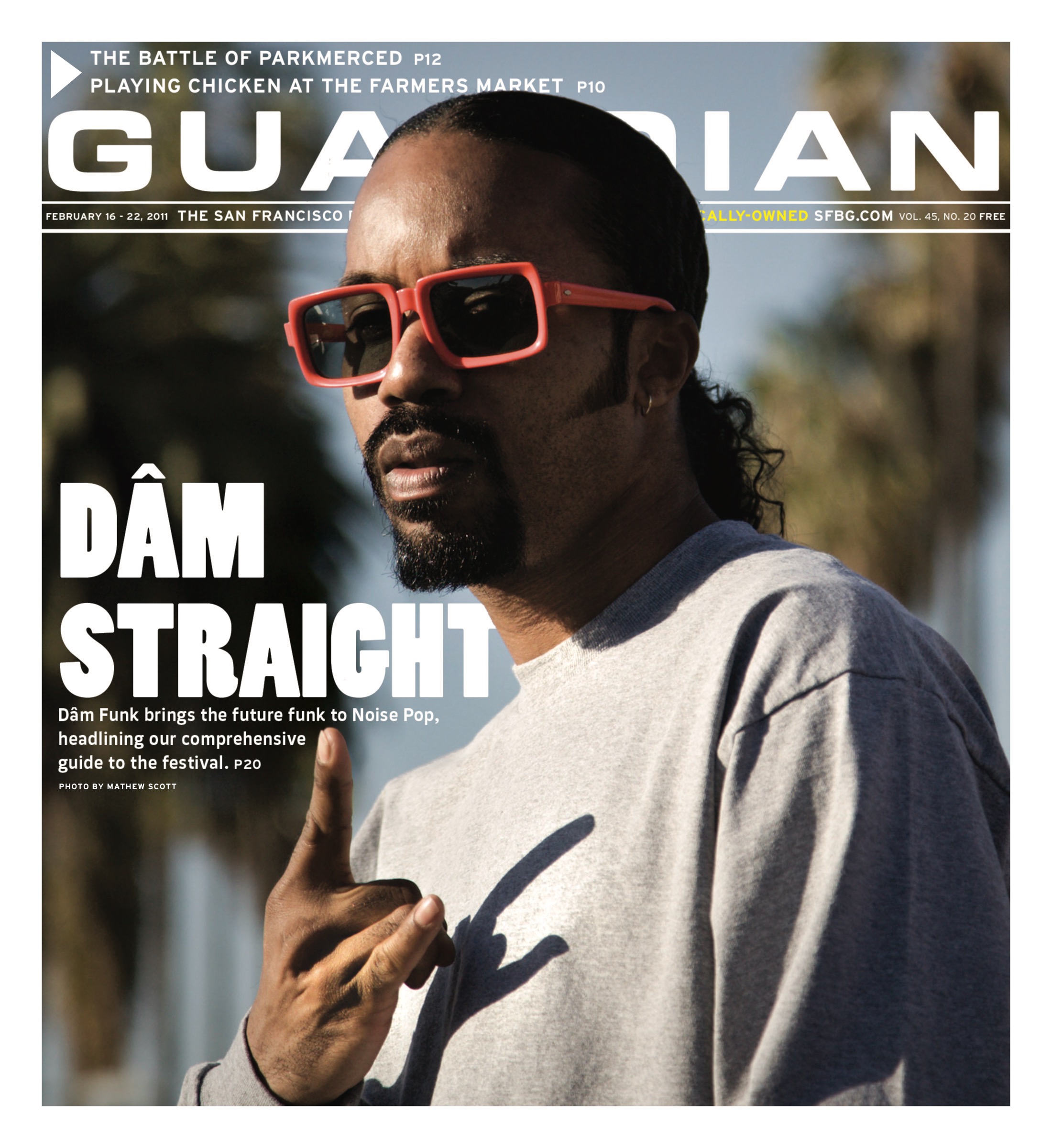
PEANUT BUTTER WOLF AND DÂM-FUNK: THE DISCOVERERS

It’s the midnight hour on Valentine’s Day in Portugal when I reach Dâm-Funk, a.k.a. Damon Riddick, on the phone. He’s just outside of Lisbon, his surroundings are “phenomenal,” and he’s ready to wax enthusiastic about his longtime partner in funk Peanut Butter Wolf. “Me and Chris [Manak, a.k.a. Peanut Butter Wolf] connect on that sound because we remember and we revere,” he says, when I ask about their shared love of soul, hip-hop, and funk. “We knew what it was like before cable television and the Internet existed, we remember everything from those early VHS tapes to the way the sun set.”

As the sun is still rising on Valentine’s Day, in L.A., the man Dâm-Funk calls “Wolf” for short shows similar brotherly love. “When Dâm met me, we had a mutual respect,” says Manak. “He saw my record collection and vice-versa. When we discover songs, we’ll say, ‘Check this out.'” In turn, this shared enthusiasm, and the positive response to Dâm-Funk’s albums Toeachizown and Adolescent Funk — both released on Manak’s label, Stones Throw – has recharged funk sounds in Los Angeles and SF, and led to new discoveries of soulful and funky treasures from the recent past.

One such gem is Jeff Phelps’ 1985 Magnetic Eyes, a Tascam Portastudio 244 bedroom recording with sensational vocals by Antoinette Marie Pugh, who stars in a terrific no-budget video for the album’s “Hear My Heart” currently up on YouTube. “That album is something I’ve known about for a long time,” Dâm-Funk says, when I mention Magnetic Eyes and its hand-drawn yet futuristic cover art. “It’s a great project.”

Another great project is Tony Cook’s Back to Reality (Stones Throw), a collection of mid-1980s recordings by a musician who got his start as James Brown’s drummer. Taking on the role of executive producer, Manak has added some extra pop to the already formidable strut of Cook songs such as “Heartbreaker,” even drafting in Dâm-Funk to contribute new vocals to one track, “What’s On Your Mind.” “You’d think they were 24-track recordings, but he [Cook] only worked on an 8-track,” marvels Manak. “He was a good musician and producer – when you’re bouncing tracks, you have to know what you’re doing. In those days it was hard to achieve a full sound like that.”

These days, both Dâm-Funk and Peanut Butter Wolf know what they’re doing — and that’s a damn lot. Reflecting his Gemini nature, Dâm is planning to explore the dark side on an EP with that title before venturing into the light on his next LP. He’s also remixed Nite Jewel and is collaborating with her on a project, Nite Funk. He’s producing music by Steve Arrington for Stones Throw, and he wants to put out another chapter of his archival venture Adolescent Funk, with him choosing the tracks instead of Manak. As for the man Dâm calls “Wolf,” he’s got Stones Throw’s 15th anniversary on his hands, including a 7-inch box set, and a series of live-to-vinyl performances by the label’s artists in L.A. These guys are busy, but — fortunately for Noise Pop, and for SF — that doesn’t mean they don’t have time to throw a 45 party. (Johnny Ray Huston)

PEANUT BUTTER WOLF, DAM-FUNK

With Guillermo (Sweater Funk), Hakobo (Fresco)

Sat./26, 9 p.m., $15 (21+)

Public Works

161 Erie, SF

(415) 932-0955

www.publicsf.com


DOMINANT LEGS: LOST IN LOVE

Whether he’s raging in the streets alongside fellow Giants maniacs or musically lost between the sheets, Dominant Legs’ Ryan Lynch sounds like he’s sweet to the core—and even more. “I didn’t have anything to do with setting the mattress on fire, but I was there,” says the SF musician of SF’s impromptu World Series throw-downs. “But I wasn’t stopping anybody from celebrating.”

Lynch also rolls with the love when it comes to music. “I don’t really listen to much music that would be characterized as aggressive,” he continues, on one of those sunny Bay afternoons that make it easy to float away on blue skies and daydreams. “I listen to pop music and, honestly, mostly KISS FM.” His favorite song on this crisp, creamy day is R. Kelly’s “Lost in Your Love.” “It’s all about him wanting to bring love songs back to the radio,'” Lynch adds. “And that’s sort of what I also aspire to—not that we get any radio play!”

But, oh, a girl — or a boy who once was a Girl (until recently, Lynch was Girls’ touring guitarist) — can dream. And dreams have been coming true for Lynch, a longtime Giants follower who recently contributed “Finally Champions” to a digital-only benefit comp of Giants tribute songs released by True Panther. Meanwhile Dominant Legs continues to pick up steam—and members.

Once the repository of Ryan’s solo singer-songwriter imaginings away from longtime band Magic Bullets, Dominant Legs found favor when the Redwood City-bred musician was laid off from his job as mail clerk-receptionist at a law firm. He didn’t sink his sparse funds into job retraining classes or the like; instead he bought a cheap Casio keyboard and drum machine. “I shouldn’t have been spending any money,” he recalls now. “But the direction of the music really took off after acquiring those pieces of musical equipment.” Friend Hannah Hunt, who had just graduated from college, offered to help out at a 2009 show at Amnesia and ended up sticking around.

“She brought a softness, and delicacy, which made the songs more delicate since her voice is so different from mine,” he observes. “I think her voice is easier on the ear than mine.” For Noise Pop, the two have acquired a few more legs to help them on their way: drummer Rene Solomon, bassist Andrew Connors, and guitarist Garrett Godard, the latter once the drummer for Girls.

They’ll be filling out the already intoxicating pop bounding off Dominant Legs’ 2010 EP, Young at Love and Life (Lefse), which has inspired music bloggers to go wild, tossing out scattershot, albeit flattering allusions to Orange Juice and Belle and Sebastian, Kelley Polar and Arthur Russell—and even Dave Matthews. Feeling lost again? Just listen to the earnestly lovelorn, gently bopping, synth-popping tunes like the title track and “Clawing Out at the Walls,” with its curious admixture of sweetness and self-doubt. Kindred spirits and modern lovers such as Jeremy Jay and Camera Obscura, also given to such exquisitely anxious reveries, would understand. “The only thing I’ve heard is that [the EP] is too heavily influenced by the ’80s,” says Lynch. “But I don’t see that as a problem.” (Kimberly Chun)

DOMINANT LEGS

With How to Dress Well, Shlohmo, Chelsea Wolfe

Sat./26, 8 p.m., $12–$14

Café Du Nord

2170 Market, SF

(415) 861-5016

www.cafedunord.com


ADMIRAL RADLEY: LIFE AFTER GRANDADDY

Jason Lytle has never been shy in revealing the frustrations leading up to Grandaddy’s demise. Exhaustion from middling success, a love/hate relationship with his lifelong home of Modesto, and a diminished interest in making music with others resulted in a move to Montana to focus on a solo career in 2006. Enter Admiral Radley, a collaboration with members of indie-pop group Earlimart and Grandaddy drummer Aaron Burtch that has him not only playing in a band again, but touring Japan and singing about his former home on songs such as the sarcastic “I Heart California.” Lytle took some time out from a snowy day of magazine shopping at Borders in his new hometown of Bozeman to talk about the project.

SFBG Rumors of a collaboration between you and Earlimart date back to the Grandaddy days. What led to you guys finally working together?

Jason Lytle It was really an excuse to hang out at [Aaron Espinoza’s] studio and just have people coming in and playing parts. We set aside a week as a fun little project. Maybe somebody else had other plans for it, but at the time, I was convinced it was just gonna be a cool opportunity to make a record and be done with it.

SFBG Were you guys surprised by the amount of excitement surrounding the project?

JL Yeah. Then it turned into, alright, we gotta name this record something, and give the band a name, and pretty soon it was this real entity. The Japan thing started off as a joke, and then became more of, “Let’s give this a go, and if it winds up getting us to Japan, we can call it good” — and the whole thing was worth it.

SFBG And how were the Japan shows?

JL They were really scrappy. The places were just dumps. I kept joking with Aaron, saying, “If we weren’t in Japan right now, and if these weren’t exceptional circumstances, there’s no way I’d be putting up with this.”

SFBG You’d expressed some skepticism about playing in bands again after Grandaddy split. Has this experience changed your opinion?

JL My place in Admiral Radley is totally different from what my situation was with Grandaddy. I’m getting off easy. Aaron is a great organizer and knows that a big appeal for me joining the band was not dealing with a lot of the day-to-day crap I used to deal with. I feel like I’m a piece of a puzzle with this band, which after all these years is something I’ve never really experienced. So it’s been kind of neat.

SFBG Both you and Aaron like being hands-on with production in your work. How was the collaborative process on this album?

JL That part was pretty effortless. Aaron and I share a lot of the same philosophies on production and making albums sound a certain way. I definitely sat in on some of the mixing, but there was a lot of it where I was just able to trust what he was going to do, knowing that it probably wouldn’t be too far off from what I’d do myself.

SFBG Was it strange writing lyrics about California now that you’ve been gone for almost five years?

JL I’ve definitely had a renewed perspective. Every time I visit or I’m there doing some work, I’m thrust right into the shit. Like right into L.A. or SF, rather than adjusting or letting it sink in slowly. So, usually it’s pretty jarring for me just because the pace is a lot more relaxed and different here. Having a bit of that outside perspective now allows me to look at things a bit differently. (Landon Moblad)

ADMIRAL RADLEY

With Typhoon, Social Studies, Fake Your own Death

Wed./23, 8 p.m., $12 (21+)

Bottom of the Hill

1233 17th St., SF

(415) 621-4455

www.bottomofthehill.com


GEOGRAPHER: EARTH PEOPLE

The dress code doesn’t include a finely-pressed lab coat, and the toolbox isn’t filled with fragile beakers, but a geographer is indeed a scientist, one who pours himself into the earth and bleeds across its surfaces to observe and categorize its residents. I haven’t asked the members of the San Francisco synth-pop trio Geographer if this occupation has had any inspiration on its sound, but there’s reason to believe the answer may be a humble yes.

Geographer has discovered new ground in the electronic realm. Its unique ménage a trois of music-making contraptions — drums, synth and cello — produces audible scenery that simultaneously calms and energizes the senses. Luscious forests of synth share habitats with rushing bass and guitar. The cello adds a sneaky-smooth layer that easily melts between or melds the more jagged sounds.

Behind the sweet scenery resides a less than pretty picture. Themes of loss and inevitable change creep through their sun-stained melodies, pulling at the roots of the band’s core. In 2005, Michael Deni fled his home in New Jersey, after the unexpected deaths of two family members. He landed in SF, and his instruments became a source of comfort and release while he wandered the new, unfamiliar territory. After a period of searching and surveying, Deni met and began collaborating with Nathan Blaz and Brian Ostreicher. In 2008, Geographer self-released its debut full-length, Innocent Ghosts, a far more relaxed collection that showcases Deni’s round, patient voice.

The landscapes on 2010’s Animal Shapes (Tricycle) are majestic, but far more celebratory. Things are tighter spun, beats kick harder and there’s a cohesive exploratory factor. Specifically fabulous: “Kites,” a track that strikes gold with a lustrous synth party. Deni’s sincere vocals float high above the mountainous bass vibrations, but mingle ever so courteously with the shrill, twinkling electronic additions. Enter the romantic cello and the song is a straight-up gem.

Now is a good time to button up your favorite white jacket and take some notes on the current environment in which you reside. Whether you’re into earth science or not, Geographer is a swell listen that goes well with salty pretzels and an adventure around your own neighborhood. Animal Shapes on repeat will keep you in step with eyes and ears open. And listen carefully: there’s good word on the street about these Geographer guys in the live form. (Amber Schadewald)

GEOGRAPHER

With Butterly Bones, K Flay, Funeral Party

Wed./23, 8 p.m., $13–$15

The Independent

628 Divisadero, SF

(415) 771-1421

www.theindependentsf.com


PSYCHIC FRIEND: PIANO POWER

Will Schwartz and the piano go way back, to when he was nine. “I’ve been attracted to the C chord and to A minor since I was a kid,” he says from L.A., where he’s living in Los Feliz. “I learned to play piano by ear, and it was always based on [starting with] a C major and going from there.”

You could say Schwartz played his first gigs on the instrument. “We had this two-story living room in our house in New Jersey with a little balcony, and the piano was up on the balcony,” he says with a laugh. “I would imagine I was playing for people down below. I would put on shows for the living room furniture.”

In his new band Psychic Friend, Schwartz updates California chamber or piano pop for today’s era, with contributions by Hole drummer Patty Schemel and instrumentalist-producer Bo Boddie. The result is a fresh chapter in Schwartz’s musical story, one that has ranged from the guitar-rock of Imperial Teen to the D.I.Y. choreographed pop of Hey Willpower, which involved contributions from videomaker Justin Kelly, DJ Chelsea Starr, and musician Tomo Yasuda.

Crisp and clean, in a way Psychic Friend sounds like the moment Schwartz has found his voice, or unknown heights or depths of it. The pounding “Once a Servant” revives the spirit of Jobriath. “Water Sign” has a Serge Gainsbourg undercurrent. “Shouldn’t Have Tried Again”‘s rendering of the repeat failure of a relationship matches the plaintive sunshine-y yearning of Harry Nilsson’s sublime covers of Randy Newman.

You could say Psychic Friend is new Californian pop. The piano-based melodic immediacy of the group’s sound has a kinship to Carole King’s solo work, or Burt Bacharach and some of his hits for psychic and other friends, yet both the sound and the lyrical content is very contemporary, not retro. It also isn’t Rufus Wainwright showboating — tracks like “We Do Not Belong” allow Schwartz’s voice a freedom and resonance it hasn’t had before, but he doesn’t run away with himself. “The nature of playing a piano and writing melodic songs, it almost brings you back to ’70s songwriting,” Schwartz observes.

“I just found this place in my voice that feels very connected, actually, that comes from playing the piano, and it feels good,” he adds, simply.

Schemel’s powerful drumming and Boddie’s hit-making skills have a role in this shift. “It’s like an Eddie and the Cruisers feeling,” Schwartz says, “where you start to play something, and by the end it sounds like a finished song.” (Huston)

PSYCHIC FRIEND

With The Concretes, Birds and Batteries, Magic Bullets

Fri./25, 8:30 p.m., $13–$15

Rickshaw Stop

155 Fell, SF

(415) 861-2011

www.rickshawstop.com

Crazy like a Mission homeboy

1

caitlin@sfbg.com

LIT Benjamin Bac Sierra, San Francisco City College English composition and literature professor and author of Barrio Bushido, an ode to Mission District vato locos, picks me up in his cherry red-and-black 1972 Chevy Monte Carlo low rider. As an academic who started selling weed in the Army Street projects when he was 10, Bac Sierra is well aware that he has an attention-getting car. As it turns out, it nicely represents his world view.

“I’m not supposed to be driving a Monte Carlo. I’m not supposed to be talking to you like this,” he tells me, his conversation inflected with casual swear words and a rhythm like that of an evangelist preacher, or maybe just a man who feels what comes out of his mouth. “A lot of people go into education and think they have to choose: am I going to be square or am I going to be how I used to be? But you can be intellectual and homeboy-homegirl at the same time.”

Barrio Bushido, Bac Sierra’s first novel, follows the story of three young men who ricochet from romance to brutal gang beatings, PCP leños, larceny, and neglect. Lobo, Santo, and Toro’s world has made them wild gangsters. Author Maxine Hong Kingston has compared Bac Sierra’s prose to that other chronicler of the underground man in uncertain times, Dostoyevsky. Although it hardly glorifies the protagonists, an honor and a beautiful-crazy logic to their deeds does emerge. Bac Sierra holds that the impulsiveness, that locura, needn’t be forgotten when someone leaves the street hustling lifestyle.

“I want to make a line between being a homeboy and the negativity. Craziness is a power — you can’t learn that in a book,” he reflects. We drive by his brother’s old house on Treat and 21st streets — Bac Sierra hears that a PayPal executive lives there now. After Bac Sierra’s father died, his brother, charismatic and clever, brought him up — until his brother wound up in jail and died young.

When Bac Sierra was 17, years after he had dropped out high school and begun dealing angel dust, he had a choice. He could continue his lifestyle, possibly ending up dead or in jail, or “retreat” into the Marines, which represented an honorable discharge, as it were, from the barrio.

Bac Sierra’s experience in the Marines followed the same lines as Toro’s, his headstrong and loyal Barrio Bushido character — to a point. Both of them cleaned up and were promoted to squad leader because of their sheer “craziness.” And both saw serious front line action during the Gulf War. Bac Sierra manned a machine gun as part of the first wave of Marines to land in Kuwait City in 1991. He also began writing in the military, letters home that he would revise “maybe 10 times — I wanted to be heard.” Although he doesn’t specifically recommend military service to young people, he recognizes the value of the discipline learned in the armed forces. “A lot of homeboys don’t do shit,” he says flatly.

After serving, he retained his strong ties to the Mission and his family there. Before his brother died, he was the one who motivated Bac Sierra to get his college degree, not to stop at his master’s in creative writing from UC Berkeley, but to continue on to law school. “Hood logic,” Bac Sierra calls it, the idea that a degree in a concrete field was far better than one writing. Although he hated every day of law school, he can now appreciate the experience and the knowledge it brought him.

He pulls the Monte Carlo over to speak with an older man on the corner across the street from his brother’s old house. “Yo escribí un libro, señor, en honor de mi hermano,” he calls out the window, inviting the man to his upcoming book release party at Mission Cultural Center. Many of his friends from the old neighborhood (he now lives in Richmond, where he is raising two of his four children, Margarita, nine, and Benny, six) are Barrio Bushido‘s biggest supporters. I ask him if it makes him sad, how much the neighborhood has changed since when he grew up. “This is the world. Economics knows no friends.”

I recognize the last line from Barrio Bushido. Its characters speak with an urgent poetry, moving through scenes influenced by Dostoyevsky and Miguel Ángel Asturias, with Gabriel Garcia Márquez-like magical realism. Bac Sierra wants the book to be taught in schools and has set a goal of having it adopted into 50 class sections by next semester.

Other things he hopes for: first, that readers be taken on a journey. “It doesn’t have to be stuffy. I want them to be amazed with the language.” Second, he wants the book to show that life is full of choices. “Start living here in this world,” as he puts it.

His last hope is for a “homeboy resurgence” in the Mission, the neighborhood that was once the center of Latino culture in Northern California. Thursday’s party at the Mission Cultural Center is a start. Bac Sierra is planning a low-rider show, Aztec dancers, a reading, and live music for the event — the positive parts of homeboy culture, like Bac Sierra himself. “I’m fucking straight homeboy,” he says. “I am very efficient. I am always inventing things.” 

BARRIO BUSHIDO BOOK PARTY

Thurs/17 7 p.m., free

Mission Cultural Center for Latino Arts

2868 Mission, SF

(415) 643-5001

www.missionculturalcenter.org

Not forgotten

0

arts@sfbg.com

HAIRY EYEBALL Around 500 people a day pass through the long corridor that bisects San Francisco City Hall’s lower level: supervisors dashing to the café for a quick lunch; tour groups of elementary school children; aides making a post office run; the occasional member of a wedding party looking for the bathroom.

It is also one of the last places where you’d expect to find a politically vital art installation, which is what makes San Francisco Art Commission gallery director Meg Shiffler’s decision to hang its current exhibit, “Afghanistan in 4 Frames,” in such a public and heavily-trafficked area so gutsy. Though the SFAC regularly puts on three to four art shows a year in the City Hall space, none in recent memory have resonated so powerfully with the dynamics of the venue itself.

The “4 Frames” exhibit presents a ground-level (no pun intended) portrait of the country through the lenses of four photojournalists who, over the past five years, have embedded themselves with various military forces and units stationed there. Though each photographer varies in style and background, their work — presented as photo-essays — shares a focus on the day-to-day, intersecting lives of civilians and soldiers off the battlefield.

James Lee, a U.S. Marine Corps veteran and current San Francisco State University graduate student whose move to photography from writing was a recent one, captures in crisp color the downtime faced by young Afghan National Security Force soldiers stationed near the Pakistan border.

In contrast to the all-male environment Lee documents, Lynsey Addario’s series “Women at War” focuses on the experience of female U.S. troops and their engagement with female civilians. The Pulitzer Prize-winning photographer has a knack for taking a picture at the moment her subjects are at their most unguarded, whether sharing a laugh with each other or shaving their legs in the barracks.

Addario’s photos are pointedly hung on a wall across from Bay Area photographer Eros Hoagland’s slightly more testosterone-driven series, “Siege Perilous.” The high contrast black and white photos depicting British military forces in the Korengal Valley and Helmand Province practically crackle with tension.

Another veteran photographer, Teru Kuwayama, is the only one who works with actual film, and his grainy, black and white Holga and Leica portraits of rural clans and armed mercenaries feel as if they are from another era. Kuwayama’s most timely work on Afghanistan actually resides offsite and online: his Web reporting initiative, Basetrack, links deployed Marines with life at home through images and video created by embedded journalists (although just last week military brass asked the embeds to leave).

Afghanistan made front pages again last summer after WikiLeaks uncovered 90,000 pages of classified materials chronicling a five-year window in the U.S. military’s long slog there. But “4 Frames” reminds those who encounter it — as well as those who seek it out — that regardless of the headlines, there will always be an ongoing, human side to what has been so often dubbed “the forgotten war.” And forgetting is not a luxury we can afford.


THE ATROCITY EXHIBITION

Although a vastly different beast from “Afghanistan in Four Frames,” SFMOMA’s current juggernaut of a thematic survey “Exposed: Voyeurism, Surveillance and the Camera Since 1870” offers a pointed study in contrast, demonstrating how not to curate a photography show with clarity of vision or regard to what could be called an ethics of representation.

As proclaimed by its title, “Exposed,” which was organized by SFMOMA and the Tate Modern in London, where it originally premiered, attempts to track — across various eras, technologies, and milieu — what the introductory wall text calls the “voyeuristic impulse” in modern and contemporary photography: “an eagerness to see a subject commonly considered taboo.”

With such an open-ended criteria, the curators have essentially given themselves carte blanche to include everything from early 20th-century “detective cameras,” Walker Evans’ portraits of unknowing New York City subway passengers, Ron Galella’s paparazzi snaps of Jackie O., Nick Ut’s iconic image of a crying Kim Phuc in Vietnam (as well as his 2007 picture of a crying Paris Hilton), Robert Mapplethorpe’s BDSM pictures, surreptitious documentation of the liberation of Nazi concentration camps, and Trevor Paglen’s near-abstract renderings of distant military sites.

The 200 or so pieces are arranged in thematically-grouped galleries (“Celebrity and the Public Gaze,” “Witnessing Violence”) that wind through half of the museum’s fifth floor. By the time you’ve made it through the lengthy, final “Surveillance” section of the show, “Exposed” feels more like a photography catalog that become the genesis for an exhibit, and not the other way around.

Such tidy categorization has the negative effect of creating closed systems rather than allowing different pieces to speak to each other. For example, two harrowing, anonymously-attributed lynching photos belong next to one of the most moving selections in “Exposed,” Oliver Lutz’s Lynching of Leo Frank, which hangs in another gallery. At the same time, the very proximity of death images and paparazzi shots cheapens both.

When presenting highly-charged, difficult images, many of which document humankind at its most brutal and unsavory, the context they are displayed in becomes as crucial as the images themselves. “Exposed,” which feels like the result of several unseemly Google image searches rather than a decade of curatorial sweat, disappoints in this regard.

Atrocity. Murder. Fame. Kinky sex. It’s all here! The question no one seemed to ask is: does it need to be? “Exposed” is simply too much. *

AFGHANISTAN IN 4 FRAMES

Through May 13, free

City Hall

1 Dr Carlton B. Goodlett Place (ground floor), SF

(415) 554-6080

www.sfartscommission.org/gallery

EXPOSED: VOYEURISM, SURVEILLANCE, AND THE CAMERA SINCE 1870

Through April 17; free–<\d>$18

San Francisco Museum of Modern Art

151 Third St., SF

(415) 357-4000

www.sfmoma.org


Life after death

0

cheryl@sfbg.com

FILM “I like telling the story of life better than I do living it,” Spalding Gray explains in Steven Soderbergh’s And Everything Is Going Fine, a tribute to the late performer that cobbles together interviews and scenes from Gray’s trademark autobiographical monologues (including the award-winning Swimming to Cambodia, made into a film in 1987). Without using a narrator or any other talking heads, Everything emerges a poignant portrait — and a masterful work of editing, considering the man left hours and hours of storytelling behind.

“Behind,” that is, when he committed suicide in 2004. Everything doesn’t mention Gray’s death, but it looms over the whole movie, particularly since Gray — whose mother killed herself in 1967 — was fascinated by mortality. It’s hard to accuse Soderbergh of deliberately culling foreboding clips, since death (Gray’s mother’s, and fantasies about his own demise) was a theme the performer revisited obsessively.

That’s not to say he was totally without joy. He lights up when discussing his love of acting, sparked early in life and encouraged by a teacher who remarked on “Spud’s” excellent timing. Though he mostly kept to the stage (“I’m an inverted method actor. I was using myself to play myself. I was playing with myself!”), he did appear in several films — he met Soderbergh when the director cast him as a (suicidal) character in 1993’s King of the Hill; Soderbergh also directed the film version of performance piece Gray’s Anatomy (1996). The birth of Gray’s first child — a typically overwrought life experience since his baby mama wasn’t his long-term partner, but a woman he’d been having an affair with — turned the self-absorbed Gray on his head. He married his son’s mother and built a life with her, her daughter from a previous relationship, their first son, and their soon-to-arrive second son.

Though Gray did most of his monologues seated behind a desk, there’s a performance excerpt in Everything where he recreates his family having a spontaneous dance party to Chumbawumba’s “Tub Thumper.” It’s a transcendently playful moment, and the audience erupts into stunned applause when a grinning Gray shuffles back behind his desk.

But as Gray fans know, the famously morbid storyteller wasn’t demon-free for long: a gruesome 2001 car accident while vacationing in Ireland left him physically mangled and mentally shaken. Three years later, he took his fateful last trip on the Staten Island Ferry. With the blessing of Gray’s widow, Soderbergh took on the mighty task of telling his friend’s life story; like Gray, Everything‘s a downer, but moving, and not without thought-provoking after effects. 

AND EVERYTHING IS GOING FINE opens Fri/18 at the Sundance Kabuki.

Empress yourself

0

marke@sfbg.com

SUPER EGO It certainly has not escaped my attention that this whole amazing Arab youth uprising thing is taking place during Fashion Week. It’s a mitzvah! But while Hunky Beau and I have been busily rooting through Reuters for inspiring pics of various hipster Egyptsters and Tunisians turnin’ in out (or, conversely, signs of any uprising under the Manhattan tents — watch out for Joseph Altuzarra, y’all), I’ve tried to have more than fast-forward fashionistas in my forethoughts and yummy Yemenis on the Bahrain.

Specifically: gay democracy. It’s time once again for an annual event that still remains charmingly underground here, yet has a heavy impact on San Francisco’s charitable community and global gay image. For serious, the wigs alone weigh like 20 pounds. Yes, it’s time to elect a new Empress of San Francisco — and this year the candidates have come out fighting, but graciously.

If you’re unfamiliar with our nearly 50-year-old Imperial Court system, which originally took ironic inspiration from beloved-yet-deranged San Francisco scallywag Joshua Norton, who in 1859 declared himself Emperor of the United States — and which first found full flower in 1965 with majestic Absolute Empress Jose Sarria I, The Widow Norton, while later helping to lead the community through gay liberation and the AIDS crisis — then hie thee ho to the newly revamped www.imperialcouncilsf.org website for a highball full of essential history.

Empress 2011 will wholly dedicate the next year of her life raising tens of thousands of dollars for good causes through nightlife affairs and traveling to regally represent our fair burg at Imperial Courts around the world. And this year’s candidates make for a feisty ballot: Saybeline, glamorous longtime luminary of the LGBT fundraising scene, and rousing dark horse Monistat, the party promoter voted Best Drag Queen in the Guardian’s Best of the Bay poll.

If elected, the youthful Monistat promises to tap her extensive database of “promoters, DJs, performance artists, and venues” to “refresh” the institution. She also invokes her considerable party stamina, promising to give us night after night (after night) of fundraising in face.

Saybeline vows to throw “open the doors to younger members of our community” and to “engage and encourage them” to become more involved in community service. She puts forth her “two decades of experience in volunteering and organizing fundraising events” as one of the main reasons to grant her the crown.

The crown is stunning, btw.

There are two great guys running for emperor as well, Frankie Fernandez and Ray MacKenzie, and voting should be hot and heavy. Everyone 21+ who lives in San Francisco, Marin, and San Mateo is welcome to vote. So hit the polls and enjoy our freedoms while we wait for that exhilarating youth uprising to finally spread to Iraq! Oh wait …

SAN FRANCISCO EMPRESS 2011 VOTING DAY Sat/19, free. Noon–7 p.m. at Castro Muni Station, Castro and Market, and 11 a.m.–6 p.m. at Project Open Hand, 730 Polk, SF. www.imperialcouncilsf.org

>>Read Marke B.’s full interviews with the Empress 2011 candidates here


SLUMPFEST

“Slumps” = Cali-meets-Detroit (a.k.a. Calitroit) hip-hop beats. And this massive charitable beat battle, featuring two dozen future underground hitmakers, will surely tease out more than a few sublime J. Dilla apostles.

Fri/18, 9 a.m., $10 or $7 with can of food. Club Six, 60 Sixth St., SF. www.clubsix1.com


HOTTUB

Gotta give shouties to my fave Oakland female electro-hop terrors, rapping us up in cataclysmic Four Loko bliss. They’ll demolish the stage with the Tenderlions, Kool Karlo, and Frite Nite DJs.

Fri/18, 10 p.m.–3 a.m., $5 before 11 p.m., $10 after. Public Works, 161 Erie, SF. www.publicsf.com

Grub

4

paulr@sfbg.com

DINE When cultural historians of the future gather to argue the question of when and where Valencia Street finally jumped the shark, they might find themselves concentrating on the changes that came to a single block, between 18th and 19th streets, early in the presidency of Barack Obama. They might, in particular, find themselves considering a place called Grub, which sounds like a greasy joint of some kind where people eat with their fingers but is in reality a gorgeously designed restaurant that flows from a plate-glass façade through a nouveau-mod dining room to a glowing blue bar that looks like something from Star Wars, or Las Vegas.

It’s the sort of place you wouldn’t have found on Valencia as recently as five years ago, and it suggests, to me — along with the nearby The Summit, with its matching plate-glass façade — that a basic shift in sensibility is occurring. Like the Ferry Plaza farmers market, Valencia Street and its establishments now get mentioned in the travel section of The New York Times, and this kind of publicity means tourists, coming as if to some exotic game preserve. Tourists fundamentally change the nature of whatever it is they’re coming to experience, almost as in a chemical reaction.

None of this is to imply that Grub itself is an unworthy restaurant. It is highly worthy, with a value-intensive menu that includes authentic grub like burgers and mac ‘n’cheese, as well as such highfalutin treats like osso buco. (Is it just me, or has osso buco suddenly become trendy?)

Both the burgers and mac ‘n’ cheese are offered in “bar” (ie, design your own) mode. Your burger choices include beef, buffalo, vegetarian, ahi tuna, and portobello mushroom. The ahi burger ($12) consists of five ounces of seared filet. You can add cheeses and condiments to your heart’s content, but given the priciness and quasi-delicacy status of ahi, we thought it decadent to slather it with pickled red onions and bacon. Our suave server (a godlet who might have just stepped from the set of one of those Twilight movies) recommended the wasabi aioli, which did indeed bring a moistening intensity, though the sandwich remained a little frail, pale, and delicate, like a child who needs to get outside more.

Plunging into the mac ‘n’ cheese bar, by contrast, is like going to a gym where everyone is insanely worked out. All the variations (base price $9) include white and sharp cheddar cheeses and a gratin of grana padano breadcrumbs — more than enough flavor thrust to reach escape velocity. But you can tart up your crock with everything from truffle oil to grilled steak ($1 per extra ingredient) and some savories in between. Truffle oil is, for me, one of the world’s most overrated (and overpriced) food items — with lobster (a favorite of the godlet) not far behind — and I thought it more or less got lost amid the meatiness of the mushrooms and bite of the cheese. The steak stood up better, adding a hint of smokiness and enough weight to make the dish a meal unto itself.

But the menu offers other meals unto themselves, too, with a bit more polish. Grilled tiger prawns ($15) were arranged atop a butternut squash risotto heavily leavened with Parmesan cheese, whose tang balanced what otherwise might have become a cloying sweetness. A filet of Pacific snapper ($16) was “crusted” — “smeared” would have been more accurate — with what seemed like crab-cake batter and seated on a pad of celery-root puree with a pool of carrot-butter-white wine sauce and watercress salad. And the osso buco ($17) arrived in autumnal, rather grave guise atop mashed potatoes with a burgundy-charged sauce and fried shoestring carrots. The meat was fork-tender, and as someone who’s been making osso buco for years (from the same Patty Wells recipe), I can tell you this isn’t a given, even with long simmering. As for mashed potatoes instead of the more traditional risotto: eh. The potatoes did have a dense, mousseline-like velvetiness, which led me to suspect the involvement of tons of butter. But then, at higher-end sort of greasy spoon, you would expect a higher grade of grease, and butter is the grease of the gods, or at least godlets.

GRUB

Dinner: nightly, 6 p.m.–12:30 a.m.

Brunch: Sat.–Sun., 10 a.m.–2:30 p.m.

758 Valencia, SF

(415) 431-GRUB (4782)

www.grubsf.com

Beer and wine

AE/MC/V

Noisy

Wheelchair accessible


Gum-choux seduction

0

le.chicken.farmer@gmail.com

CHEAP EATS She made me a gumbo-reduction taco, then took my hand and led me to her bedroom. At the time, jazz did not exist yet. There was something on TV, but the sound was off. Hedgehog was wearing a Saints jersey, No. 73 — Someone Evans, who made the Pro Bowl and came from her home town. I already had a picture of her in her Saints shirt, but there was something else in the world where jazz would be. Maybe some dishes, or a paper bag full of paper bags. Holding the spot.

In bed, I licked taco juice off my fingers. I mean gumbo-reduction. I mean, Appalachian moux-choux gumbo, or for short, gumb-choux, pronounced gumshoe, like a detective. I licked the detective, I guess, would be the least sexy way to say this.

It wasn’t the first time we went to bed together, and it wouldn’t be the last, but it is the one makes the paper, because never before in my life has anyone reduced a gumbo for me by way of foreplay.

And I have to say, from the smell alone, while I was waiting on her tiny couch, New Orleans, I was ready to be led to bed. Dang, I’d of followed that lesbian into the snake pit of hell, or Houston, on the wings of the smell I was smelling.

One bite and I was butter. So the next night, over Korean, when one of her friends asked me what was the best meal I had eaten here so far, I said the right thing and didn’t even have to think about it, let alone lie.

“A gumbo-reduction taco,” I said, high-fiving Hedgehog, who was sitting next to me and blushing out of either culinary pride, horrified embarrassment, or civic duty. “It’s true,” I said. “What can I say?”

I started saying a lot of other things … about all the other meals we’d eaten. Like that very morning, at Slim Goodie’s Diner, where I had the Jewish Coonass, potato latkes with spinach and fried eggs on top, smothered in crawfish etouffe.

And that wasn’t even all that great compared to the boiled crawfish and raw oysters and hot roast beef with ham sandwich we shared the afternoon before at a sports bar called Cooter Brown’s. Where we brought our laptops to write but instead of being productive got grease and hot sauce all over them.

And that was nothing compared to the fancy pants hanger steak and pork chops we overwhelmed on our first date date night at Patois.

In other words, it’s going to be really hard for me right now to say anything at all very exciting about the soup I ate in Berkeley a few weeks ago, or the other soup I ate in Berkeley a few weeks ago. Hmm. Let’s try my new favorite Indian restaurant in Albany.

Remember? I went there one night with the Maze when we were both working up the hill, but I forgot to ever say anything. But I still remember it, even though the rest of my brain has been erased, because Indian food is something that does not happen so well in New Orleans.

Ah, but if you head up San Pablo Avenue into Albany, you will find a gem of a new, nice, friendly, cheap, and awesome Indo-Nepalese joint called Hamro Aangan, where the chicken tikka masala is out of this world. And the naan is top o’ the line.

We loved it, me and Maze. “Tell your friends,” the hosterperson guy suggested. And I assured him I would.

OK, so I got that out of the way.

Now I can devote myself to the Story of Last Night at the Spotted Cat, where the Jazz Vipers, a great old-guy front-lined brass band, inexplicably imploded midshow. The sax and the trumpet, both aged enough to know better, times four, start arguing right in front of everyone. The young guys in the band, and the trombonist, act casual. Some people leave. The bartender’s getting pissed. And Sax is berating Trumpet, off-mic but on-volume, just generally being a big baby, when Trumpet turns to what’s left of the bewildered audience and shrugs. Apropos of I-don’t-know-what, he says, “And that’s how jazz was born.”

I don’t know. I just thought I would take his word for it.

HAMRO AANGAN

Daily: 11 a.m.–9 p.m.

856 San Pablo., Albany

(510) 524-2220

MC/V

Beer and wine

alt.sex.column: Fine bi me

0

Dear Andrea:

I’m a woman who likes women and men. I’m been in a serious relationship with a man several years. Having recently moved back to my home town, I’m wondering about something. My close friends know about my orientation (I don’t like the word ‘bisexual’ because of all its connotations and my general reluctance to label myself) but now I’m meeting new people, colleagues, etc., and I feel weird about not addressing this important part of my life. Is it OK to tell people, or should I just shut up?

To compound things, my parents don’t know I’ve ever been anything other than straight — do they need to know? I wouldn’t tell them how many sexual partners I’ve had or anything else about my sexual past, but …

Love,

Bi Serious

Dear Seri:

Great question, bless you. Also, tricky question, so … damn you?

There are, of course, excellent reasons to tell. National Coming Out Day (Oct. 11, mark your calendars) exists for good reason; coming out is one of the few personal/sociopolitical acts I truly believe can affect serious change. Most homophobes not of the Fred Phelps God hates whoever God is hating this month variety aren’t motivated by hatred for the abomination as much as they are simply uncomfortable. This discomfort is in some ways excusably human, born of bred-in-the-bone suspicion of the Other but seems totally anachronistic now that most of us aspire more to “love thy neighbor” than to “Oook! Stranger! Hit him with a rock!”

The more sexual minority folks come out the less anyone is able to claim not to know any. And the more you come out to people who already know and love you, the less comfortable those people might be, in future, with Otherizing others. Ideally, they become less comfortable with hearing others Otherizing others, as well, and there you go. Presto social change-o.

There are other reasons to just tell people. You want live an authentic life. You don’t want to deny who you are, and you don’t want other people making assumptions about you. Right?

But there’s another school of thought — the TMI Is Bad school. We are surrounded by too much information about everyone and everything and honestly, people, have a little decorum. There is a time and place for everything. Thanksgiving dinner, for instance, is not the time to tell Uncle Morris and Aunt Sylvia that you live with your Mistress and two co-slaves, and you have this very interesting piercing, would they like to see? That isn’t being authentic, it’s just being shocking and stagey for effect.

So, should you just shut up? I would say generally not. When someone assumes you are heterosexual in that blithe, blind, assumption-making way that people make assumptions, there is no reason not to say — when you want to, “Actually, I’m with Gary now, but I’m bisexual.” The end. It might sound odd, but the more often people say it, the less odd it will sound.

And that’s the point.

Love,

Andrea

Got a sex question? E-mail Andrea at andrea@mail.altsexcolumn.com

A jaundiced proposal

0

news@sfbg.com

An ordinance to ban unsolicited print Yellow Pages across San Francisco, proposed Feb. 1 by Board of Supervisors President David Chiu, seeks to reduce waste and save money.

“Phone books are a 20th-century tool that doesn’t meet the business and environmental needs of the 21st century,” Chiu said as he introduced the measure in board chambers.

The ordinance would establish a three-year pilot program starting Oct. 1 in which the city would reduce the mass distribution of phone books, making them available only at distribution centers or to residents or businesses that request them.

A rally in support of the ban before the meeting included Rainforest Action Network’s founder Randall Hayes and California Sen. Leland Yee (D-San Mateo), who proposed legislation that failed to gain steam last year for making it easier for Californians to opt out of receiving phone books.

But the Yellow Pages Association refuses to be thrown out with the rest of yesterday’s trash. YPA Vice President of Public Policy and Sustainability Amy Healy said her group opposes the proposal but that she was encouraged that Chiu and his staff say they are open to working with the association.


BY THE NUMBERS

Chiu introduced the ordinance, which is cosponsored by Sup. Scott Wiener, because of the potential effect it could have on reducing city waste, both in the city’s garbage bins and its treasury.

According to Chiu’s office, San Francisco receives about 1.5 million phone books a year. At an average weight of 4.33 pounds per book, the current distribution system creates about 7 million pounds of waste. If the production were cut in half for the city, it would save nearly 6,180 metric tons of carbon dioxide emissions a year from polluting the air.

But it isn’t just the environmental cost that is wearing on the city.

Phone books are tough to recycle. With plastic inserts, bulky design, and low-grade paper, the books have to be presorted and recycled manually. It costs Recology, the company contracted with the city for waste disposal, $300 per ton to dispose of the city’s unused phone books, which in turn costs taxpayers about $1 million a year for their disposal.


OPT IN VS. OPT OUT

The YPA has been sensitive to the environmental concerns, recently launching a website that allows a person to opt out of receiving a phone book.

But it is also suing the Seattle City Council over its Feb. 1 approval of a plan to charge Yellow Pages a 14-cent publisher’s fee per book and create an opt out system for the city, arguing the Seattle ordinance violates the First Amendment’s free speech protections.

According to a statement by YPA President Neg Norton, the association believes that “if don’t want a phone book, you shouldn’t have to get one.”

But YPA opposes the ban on unsolicited books, citing the jobs it would cost, the business community’s desire to “generate leads and revenue from ready-to-buy consumers,” and claiming the First Amendment “prohibits government from licensing or exercising advance approval of the press and from directing publishers what to publish and to whom they may communicate.”

Wiener has a different take on the matter, a stand he said he has already received lots of criticism for, including from some constituents who compared it to the board vote to ban Happy Meals last year. But he said this issue is very different.

“An enormous number of books dumped all over the city is a bad thing, and we should do something to address the issue,” he told the Guardian, noting that the ability to opt out isn’t good enough. “It’s not like the do-not-call list where it is directly annoying and people are more likely to take action … Stacks sit in apartment lobbies, and people don’t decide to opt-out.”

But YPA is also citing the public’s apathy as a reason the ban is unfair. “People don’t take the time to respond to e-mails,” Healy said. “It’s an unreasonable barrier to have a stranger knock on your door and ask you to take something.” The YPA claims that “seven in 10 adults in California use print Yellow Pages, so we do not believe a system that puts a burden on the majority of people to opt in is the best path for choice.”


ARE THEY USEFUL?

Do people still value the Yellow Pages?

Healy believes they do, stating that advertising with the Yellow Pages gives businesses a “high return on their investment.” We asked some city businesses that still advertise in the Yellow Pages what they thought about the potential ban.

Barbara Barrish, manager of Barrish Bail Bonds, doesn’t see her customers using the Yellow Pages anymore. “We used to swear by the Yellow Pages. Now young people use the computers, or their Blackberries and phones.”

Although she has an ad in the print edition, Barrish said she wouldn’t advertise with the directory again and only did so this time because it slashed its prices. “It used to cost a lot more, but it cut its advertising costs by a third,” she said. “They gave me a good deal.”

When asked if she would request a copy if the ban goes through, she said she probably would. “I might grab a phone book if the computer is down.”

Daniel Richardson, an immigration attorney who advertised in the Yellow Pages until 2008, predicted the business community would kill or water down the ordinance. “You are talking about going up against AT&T and other major businesses,” he told the Guardian with a chuckle.

Richardson said he stopped advertising in the Yellow Pages because he didn’t get enough business. He believes people look to the Yellow Pages for criminal or personal injury lawyers, but not immigration attorneys.

Even pizza places, a staple of advertising in the Yellow Pages, are ho-hum about the usefulness of the Yellow Pages. Junior Reyes, who is in charge of advertising for Go Getter Pizza on Gough Street, believes the restaurant gets most of its customers from online. “We do a lot of advertising with other places and online,” he said. “The Yellow Pages isn’t our main source.”

But what about people who do use the Yellow Pages, particularly groups that are not big Internet users. Would they miss it?

David Bolt is the dean for academic affairs at Expression College for Digital Arts in Emeryville and producer of the PBS series The Digital Divide. He believes that banning the Yellow Pages may be a problem for certain groups, including the elderly, recent immigrants, and the poor — groups with the least access to Internet, particularly in urban centers.

“We should err on the side of giving as much information to the greatest numbers of people, especially to groups that may not be technologically literate,” he said. “Society should think about how groups could be impacted by this decision.”

But Barbara Blong, executive director of the Senior Action Network, said older people are becoming more tech savvy. She said computer classes and other resources have put many of the city’s seniors online. She questioned the concept that seniors are one of the largest groups affected by the digital divide, noting that seniors oppose wastefulness as much as anyone.

“We are against having a lot of Yellow Pages laying around,” she said. Blong also mentioned that seniors who do not use the Internet for contacts can use the public library or senior centers that have phone books on hand. “I don’t see it as a ban, but moving on so we don’t have a great deal of waste,” she said.

The ordinance also exempts foreign language phone directories, further diluting the divide argument. The legislation wouldn’t ban the Chinese Yellow Pages or Momento (Spanish Yellow Pages) because they are distributed through community centers, not residences.

The ordinance is expected to have its first public hearing around the end of the month. The YPA will continue to tout its opt out website to the board in hopes it might be enough to persuade the city to forgo the opt in system. The group also hasn’t ruled out a lawsuit.

But YPA’s Healy said he hopes the coming dialogue will be productive. “We share the same goal — we don’t want to print directories that are unwanted.”

Dense in the west

9

rebeccab@sfbg.com

A marathon special meeting of the San Francisco Planning Commission on Feb. 10 demonstrated a clear split over Parkmerced, a $1.2 billion private development project that will rebuild an entire existing neighborhood on the west side of San Francisco.

While some expressed strong enthusiasm for moving forward with the ambitious plan, many residents turned out to voice vehement opposition, citing concerns about traffic congestion, noise, dust, and the demolition of affordable apartments that some Parkmerced tenants have occupied for decades.

The votes to certify the project’s environmental analysis and send the plan onto the Board of Supervisors with a commission endorsement were split 4-3, with Commissioners Christina Olague, Hisashi Sugaya, and Kathrin Moore dissenting.

Those who voted no were appointees of the Board of Supervisors, while the four commissioners who voted in favor were appointees of former Mayor Gavin Newsom, suggesting a break along clear political lines. State Assemblymember Tom Ammiano also submitted a letter urging commissioners not to approve the project.

While Parkmerced Investors LLC, the project sponsor, eagerly awaits groundbreaking, spokesperson P.J. Johnston noted that they weren’t there yet. “First,” he said, “we have to break ground at the Board of Supervisors.”


IS IT GREEN?

The Parkmerced redesign has been touted as an ecological and sustainable beacon for urban development and, indeed, some features of the grand plan read as if they were plucked from a checklist from the U.S. Green Building Council’s Leadership in Energy and Environmental Design (LEED) green-neighborhood standards.

Walkable, bikeable streets with proximity to transit? Check. Water-efficient landscaping? Check. Energy-efficient dwellings? Check. Project sponsors claim that through dramatic reductions in per capita resource consumption, three times as many residents would consume the same amount of water and electricity as Parkmerced’s current population does today.

Johnston emphasized how adding new units to the west side of the city also helped contribute to “density equality,” since most new projects tend to be concentrated in the eastern neighborhoods.

Johnston was particularly jazzed about an innovative storm-water discharge system envisioned for the plan, which he described as a design that could “regenerate and repair the environment.” It would recirculate rainwater through a naturally filtrating system of ponds and bioswales to recharge Lake Merced, a water body that has been slowly shrinking due to being choked off from its natural watershed by a concrete urban barrier.

Green points might be awarded for plans for an on-site organic garden, but Commissioner Michael Antonini, who said he lives less than a mile from Parkmerced, cautioned that developers shouldn’t get too attached to that idea. After all, he said, many kinds of vegetables won’t thrive in that part of the city.

Meanwhile, the wholesale destruction of existing units is decidedly not eco-chic. The Green Building Council’s LEED neighborhood standards insist that “historic resource preservation and adaptive reuse” is always preferable in a green development — and that’s the point that Aaron Goodman, an architect who previously lived at Parkmerced, has been driving at for more than a year. Proponents maintain that Parkmerced’s wartime construction meant it was built with inferior materials, and that property owners have battled dry rot and other infrastructure problems.

Another not-so-green Parkmerced project feature has also raised eyebrows: parking. While proponents portray the redesign as a switch from a suburban, love-affair-with-the-automobile style to an enlightened departure from car-centrism, plans nonetheless include a parking space for every single unit.

That creates the potential for more than 6,000 new cars on the road in that area, and the 19th Avenue corridor is already notorious for traffic snarls. According to calculations by the Environmental Protection Agency, the typical American motorist generates more than five metric tons of carbon dioxide by driving in a given year.


REPLACING WHAT’S THERE

Before the Planning Commission meeting, residents from the Parkmerced Action Coalition — a relatively new residents’ group formed to oppose the redevelopment and a wholly different entity from the Parkmerced Residents’ Organization — made a public show of their dissatisfaction outside City Hall. Holding signs with slogans such as “Don’t Bulldoze Our Homes,” residents sang protest songs and chanted, “We are Parkmerced!”

With the dramatic makeover, Parkmerced would expand to around 8,900 units, tripling the number of residents who could be accommodated. Existing 1940’s-era garden apartments would be razed to make way for higher, denser housing. The plan comes at a time when neighboring San Francisco State University is undergoing its own phase of expansion.

“This project in its current state is a vision that is not in harmony with the people, place, or the environment,” charged Cathy Lentz, an organizer with the Parkmerced Action Coalition, in a vociferous plea to the commissioners. “It is a narrow vision, a corporate vision … a true vision would be inclusive of present dwellings, inclusive of animals, trees, and present environment.”

One resident lamented the pending loss of his garden courtyard, noting how much his children had enjoyed the green space growing up and listing the different kinds of birds that would surely be driven away by heavy-duty construction and tree removal. For many, the point was not so much what developers intended to build, but what would be lost to make way for it. One speaker dismissed the plan as “architectural clear-cutting.”

Commissioner Moore, an architect, sounded a similar note when she rejected the notion that the Parkmerced redevelopment should be hailed as infill, a desirable development concept that curbs sprawl by utilizing space efficiently. “Urban infill housing is defined as infill on vacant sites,” Moore said, “not sites that have become vacant by demolition.” She added that she believed the environmental impact review “fails to sufficiently examine why housing demolition is even necessary.”

In Moore’s view, “the only reasonable alternative is a significantly redesigned … project.”


WORKING-CLASS NEIGHBORHOOD

Unlike a luxury condominium development, the Parkmerced plan emphasizes built-in economic diversity — yet critics point out that as it stands, the housing complex is already inclusive of many lower-income, working-class residents.

The plan will incorporate several hundred below-market rate units, in accordance with the city’s inclusionary zoning ordinance. Commissioner Antonini also emphasized the boost to city coffers from tax revenue associated with the project.

Meanwhile, questions are still arising on the issue of rent control. “We do not believe it is appropriate for the City and County of San Francisco to be displacing rent-controlled residents,” noted Michael Yarne, a mayoral development advisor. A binding agreement between Parkmerced Investors LLC and the city of San Francisco, which will be linked to the land, promises that new units will be made available to rent-controlled tenants at the same monthly rate they now pay, with rent control intact (See “Weighing a Landlord’s Promise,” Dec. 21, 2010).

Yet Polly Marshall, a commissioner on the San Francisco Rent Board, noted that she still didn’t believe tenant protections were adequate. She also spoke to the pitfalls of tearing down and redoing an entire neighborhood.

“The proposed Parkmerced development is the kind of development that I normally would support. It’s the kind of thing I work on in my profession,” noted Marshall, an attorney who has worked on redevelopment projects. “What’s different about this project is that it involves an existing community. It requires devastation of that community. It reminds me of the old-style redevelopment projects that went on in the Fillmore that destroyed existing neighborhoods. Look around that area now … there’s high density housing there, but that’s about all. The community — the networks of the people — was destroyed decades ago.”

Marshall took it a step further, offering her analysis on why Parkmerced was targeted. “It’s because it’s a working-class neighborhood of renters,” she said. “That’s why we’re going to destroy Parkmerced.”