Media

Cabs v. Lyft et. al. isn’t just about tech

65

Of course the Chron portrays it as “The latest battle pitting disruptive high-tech innovators against old-school industries and regulators,” because that makes for good copy. It also puts the taxicab industry and the people who oversee it in the position of being dinosaurs fighting against an inevitable new world.

But seriously: This has so little to do with smart phones and apps and GPS systems. Those are tools that anyone can use, and the local cab companies ought to and will soon anyway.

What it’s about is the notion that there are such things as public utilities that ought to be regulated in a way that protects the public.

San Francisco decided as a city many, many years ago that you can’t just stick a sign on your car, call yourself a taxi and start charging people for rides. That’s fairly standard practice in American cities, where cabs are considered part of the transportation system — and are a service that, without regulation, is ripe for consumer fraud and safety problems.

Not to make too broad a case, but in California, you can’t just hang out a sign and call yourself a contractor and start applying for building permits. You need a license. You can’t just open a bank and start making loans, at any interest rate you want. You can’t call yourself a dentist and start pulling teeth, either. There are good reasons for these rules. (I suppose some day someone will suggest that surgeons should be chosen not by the AMA or by state licensing boards but by Yelp; some guy cuts off the wrong part of the body or kills someone on the operating table? Hey, he won’t get a good rep on social media and his prices will have to come down. But I don’t think that’s such an excellent idea.)

Even conservatives agree that there needs to be some form of business regulation — and when it comes to cabs in a major urban center, those regulations need to include safety tests and standards on the vehicles, safety checks for drivers (a DUI in the past three years will make you ineligible to drive a cab in SF), a system to regulate fares (so tourists who don’t speak English or understand US currency don’t get cheated) and, perhaps most important, an oversight system that allows people to complain about incompetent or dangerous drivers — and have those complaints investigated and addressed by a government agency.

The battle between the new high(er)-tech faux cabs and the existing industry is also being portrayed as selfish, entitled drivers not wanting to give up their piece of the game:

SideCar’s Paul, a onetime congressional policy analyst, said the issue might eventually work its way up to the governor’s office, which oversees the commission. “The PUC has an existing set of rules that were written for an era when communication technology was literally just a landline telephone, and they’re trying to shoehorn them into this new world,” he said. SideCar is also using social media to drive support of an online petition to the PUC. Within 24 hours, the petition at Change.org had more than 5,000 signatures. “Change always threatens incumbents,” wrote Tim O’Reilly, a Sebastopol business owner. “But some incumbents find ways to get government on their side and try to restrict competition.”

But let’s have a little perspective here. We’re not talking about (unregulated) musicians complaining about MP3 downloads and song-sharing or old-school (unregulated) newspaper publishers complaining that Craigslist took all the classified ads. We’re talking about an industry that is part of a public infrastructure and needs to fall under direct government supervision.

There are good reasons why San Francisco limits the number of cabs on the streets — and it’s not just industry corruption and influence. Too many cabs chasing too little money leads to bad behavior — and to bad drivers. You can’t get someone to drive a cab for so little money that they can’t pay the rent, and the lower the pay, the lower the quality of the drivers. There are excellent cab drivers in this town who have been doing the job for 20 years or more and know every address, every shortcut, every trick to get you there … but there won’t be many more of them if it becomes a business only for the young and the desperate.

Now: The city ought to have a centralized computerized dispatch system, with GPS on all the cars and an app to get the one that’s clsoes to you (and even more important, give you honest, real-time information about when the ride will arrive). These are technological changes that are coming, and that the city can mandate.

But you can’t just let anyone with a smart phone be a cab driver. That’s not innovation against old-school; that’s just good common sense.


Stage Listings

0

Stage listings are compiled by Guardian staff. Performance times may change; call venues to confirm. Reviewers are Robert Avila, Rita Felciano, and Nicole Gluckstern. Submit items for the listings at listings@sfbg.com. For further information on how to submit items for the listings, see Picks.

THEATER

OPENING

History: The Musical Un-Scripted Theater, 533 Sutter, SF; www.un-scripted.com. $10-20. Opens Thu/15, 8pm. Runs Thu-Sat, 8pm (no show Nov 22). Through Dec 22. The Un-Scripted Theater Company performs "an unscripted romp through Western history."

ONGOING

Carmelina Eureka Theatre, 215 Geary, SF; www.42ndstmoon.org. $25-75. Wed/14, 7pm; Thu/15-Fri/16, 8pm; Sat/17, 6pm; Sun/18, 3pm. 42nd Street Moon performs the "forgotten musical" that inspired the Broadway hit Mamma Mia!

Elektra Geary Theater, 415 Geary, SF; www.act-sf.org. $20-110. Wed/14-Sat/17, 8pm (also Sat/17, 2pm); Sun/18, 2pm. Academy Award winner Olympia Dukakis stars in Sophocles’ Greek tragedy.

Foodies! The Musical Shelton Theater, 533 Sutter, SF; www.foodiesthemusical.com. $30-34. Fri-Sat, 8pm (no show Sat/17). Open-ended. AWAT Productions presents Morris Bobrow’s musical comedy revue all about food.

The Foreigner Mission Dolores Academy Auditorium, 3371 16th St, SF; (650) 952-3021. Free (donations requested). Fri/16, 7:30pm; Sat/17-Sun/18, 3pm. 16th Street Players perform Larry Shue’s comedy about an Englishman in the American South.

Geezer Marsh San Francisco, 1062 Valencia, SF; www.themarsh.org. $30-100. Sat/17, 8pm; Sun/18, 7pm. Geoff Hoyle’s popular solo show about aging returns.

The Hundred Flowers Project Thick House, 1695 18th St, SF; www.crowdedfire.org. $10-35. Wed/14-Sat/17, 8pm. Reinvention is as American as apple pie — allowing every individual to shed the limitations of the past and move constantly forward. Of course it’s not an exclusively American concept, a point Christopher Chen makes early on in his latest play, The Hundred Flowers Project. A group of Asian American actors gather to collaborate on a play about the Maoist Cultural Revolution, focusing first on the idea of China as a "country of only beginnings … built on the idea of no past," while wrestling with the implications of creating and recreating history as you go along, including, eventually, their own. Ultimately the ideal overtakes their earnest intentions and hijacks the play to serve its own dictatorial end, each actor reduced to an insubstantial shadow of their former "selves," from the over-eager Sam (Ogie Zulueta) to the penitent philanderer Mike (Wiley Naman Strasser) to his somewhat wary ex, Lily (Anna Ishida). Their identities gobbled up by the restless juggernaut the play has morphed into after a triumphal five-year world-tour they hover constantly just on the edges of a dangerous discovery, their once lively sense of purpose replaced by an almost willful inability to question their roles or their fate. Chen’s sprawling, Orwellian tour de force is further bolstered by an army of adroit designers and the competent hand of director Desdemona Chiang, who one hopes is a slightly more benign force than the director of the play-within-the-play, Mel (Charisse Loriaux). (Gluckstern)

Lost Love Mojo Theatre, 2940 16th St, Ste 217, SF; www.mojotheatre.com. $28. Wed/14-Sat/17, 8pm. Modern love and modern life: it’s all a wash in this very funny and smart play from playwright-director Peter Papadopoulos about two pairs of lost souls thrown together in the shoals of a soggy apocalypse. Mitzy (a sure Elena Spittler) is a stunned bride whose just lost her wedding party and everyone she knew — except the valet, Tito (a perfectly deadpan Carlos Flores, Jr.), a loose canon if ultimately goodhearted, who finds himself clinging to the same rock after some unmentioned catastrophe. Meanwhile, Jan (a brilliantly, manically articulate Kimberly Lester) has gone from just sexy crazy to all-out nuts for her girlfriend Barb (a sharp, sympathetic Jessica Risco), whose recent infidelity has apparently triggered Jan’s meltdown, key symptoms of which include an obsession with a certain downbeat French existentialist on the Discovery Channel (a spritely Roy Eikleberry in an outrageous French accent so mal it’s bon), and shedding all material possessions in their mutually decorated apartment. What happens when they all end up together? The possibilities, if not endless, spell end times for the old world. The welcome inaugural production by newcomers Mojo Theatre turns out to have preempted Hurricane Sandy with its own storm of the century, proving rather timely as well as dramatically very worthwhile. Director Papadopoulos makes excellent use of modest resources in staging the action with dynamic contrasts and choice detailing, across a set of finely tuned ensemble performances, as the eccentricities and common sense at war within and between his characters begin slowly and surely to unravel a life out of balance, merrily and mercifully making way for who knows what. (Avila)

Phaedra’s Love Bindlestiff Studios, 185 Sixth St, SF; www.doitliveproductions.com. $15. Wed/14-Sat/17, 8pm. Although she didn’t make it into the 21st century herself, British playwright Sarah Kane (1971-1999) left behind a small group of plays that continue to test the complacency of an age lulled into thinking itself ultimately rational and civilized. In Kane’s cutting, brutally funny reworking of Seneca’s play (itself an adaptation of Euripides’ Hippolytus), the titular lovelorn queen (an amiably tormented Whitney Thomas) throws herself shamelessly at her stepson, royal slob Hippolytus (a sharp yet low-key Michael Zavala, channeling mumblecore nihilism) despite, or because of, his pungent contempt for everyone around him. The play’s main action, however, takes place after Phaedra has killed herself, leaving a note accusing Hippolytus of rape and setting in motion a downfall that is his own perverse salvation. Despite occasionally flagging momentum, director Ben Landmesser and newcomers Do It Live! (in their second outing since last season’s debut, an agile staging of Sam Shepard’s Suicide in B Flat) deliver a worthy production of this clever gem. While a sporadic, low-murmuring sound design (by Hannah Birch Carl) infuses the atmosphere with a muffled libidinal menace, the thrust stage brings us close to the action, rubbing our noses in the fetid whisperings and fumblings of royal parasites and their dialectical kin, the infantilized, desensitized masses. Kane’s Hippolytus, meanwhile, turns from a sort of repellent Hamlet without motive to a Genet-like criminal-saint whose martyrdom is a solitary ecstasy of stark perception. (Avila)

The Rainmaker Shelton Theater, 533 Sutter, SF; www.sheltontheater.org. $38. Fri-Sat, 8pm. Through Dec 22. Shelton Theatre preforms N. Richard Nash’s classic drama.

"ReOrient 2012 Festival and Forum" Z Space, 450 Florida, SF; www.goldenthread.org. $20. Series A runs Thu/15-Sat/17, 8pm; Sun/18, 7pm. Series B runs Sat/17-Sun/18, 8pm. After a three-year hiatus, Golden Thread Productions’ ReOrient Festival of short plays from and about the Middle East is back (coupled with an impressive two-day forum of talks, panels, workshops, and performance around art and politics in the wake of the Arab Spring and other momentous developments across the region). The first of two series of plays, Series A, includes War & Peace, a short symbolical comedy by 20th-century Egyptian literary giant Tawfiq Al-Hakim (handily translated by May Jayyusi and David Wright) that distills imposing social forces into a three-way ménage between a smart, free-spirited woman (a vibrant Lena Hart), her secret suitor in a showman’s coattails and cane (a comically fervent Jesse Horne), and her jealous husband, a violent-tempered military officer (a suave yet stentorian Garth Petal). Sharply directed by Hafiz Karmali, it’s an effervescent little farce that in its power dynamics, and the elusive happiness of the characters, neatly limns bigger themes never timelier in Egypt (or here). It’s followed by Farzam Farrokhi’s 2012, directed by Sara Razavi, a low-key second-coming cum coffee klatch among three laid-back, cell phone-obsessed messiahs (Cory Censoprano, Horne, Roneet Aliza Rahamim) from the three Abrahamic religions that sets an unexpected tone but never really amounts to much. Far more dramatic is Birds Flew In by Yussef El Guindi (of Golden Thread hit Language Rooms, among others), a monologue by a single Arab American mother mourning her deceased soldier-son and wondering where she might have gone wrong. Delivered with unsentimental grit by Nora El Samahy, it’s a strongly voiced if familiar story that registers ambivalence with facile patriotism and violent nationalism, yet unconvincingly retreats at the last moment into a familiar red-white-and-blue corner. Silva Semericiyan’s Stalemate, directed by Desdemona Chiang, is a triptych of scenes between changing pairs of men (played by Censoprano and Horne) that aims at a transnational snapshot of ingrained patterns of male aggression (from Fleet Street to Red Light Amsterdam to war-torn Baghdad) but comes across too weakly and a little confusingly. Durected by Christine Young, Jen Silverman’s In the Days That Follow — set in Boston amid clichés of American openness, innocence and possibility (albeit charmingly personified by Censoprano) — is the longest piece and the most dramatically interesting, if also somewhat strained, positing a 22-year-old Jewish Israeli translator and IDF veteran (Rahamim) as the instigator of peaceful dialogue and mutual affection with an older and politically hardened Palestinian Lebanese poet (El Samahy). Finally, in Mona Mansour and Tala Manassah’s sweet but drifting meta-theatrical, The Letter, directed by Razavi, a Palestinian American physicist (Petal) and his philosopher daughter (Hart) mount an amateur theater piece to respond to the 2011 controversy over CUNY’s blocking of an honorary degree to Tony Kushner based on an attack by a CUNY board member on Kushner’s opposition to Israel’s occupation of Palestine. (Avila)

Roseanne: Live! Rebel, 1760 Market, SF; www.brownpapertickets.com. $25. Wed/14, 7 and 9pm. Lady Bear, Heklina, D’Arcy Drollinger, and more star in this tribute to the long-running sitcom.

Shocktoberfest 13: The Bride of Death Hypnodrome, 575 10th St, SF; www.thrillpeddlers.com. $25-35. Thu/15-Sat/17, 8pm. Thrillpeddlers’ seasonal assortment of yeasty Grand Guignol playlets is a mixed bag of treats, but it all goes so nicely with the autumnal slink into early nights and dark cravings. Fredrick Whitney’s Coals of Fire is lightly amusing, if far from smoking, as a two-hander about a blind older matron (Leigh Crow) who discovers her young companion (Zelda Koznofski, alternating nights with Nancy French) has been secretly schtupping her husband. I’m a Mummy is a short, not very effective musical interlude by Douglas Byng, featuring the bright pair of Jim Jeske and Annie Larson as Mr. and Mrs., respectively. The titular feature, The Bride of Death, written by Michael Phillis and directed by Russell Blackwood, proves a worthy centerpiece, unfolding an intriguing, well-acted tale about a reporter (Phillis) and his photographer (Flynn DeMarco) arriving at a stormy castle to interview a strangely youthful Grand Guignol stage star (Bonni Suval) making her film debut. After another, this time more rousing musical number, Those Beautiful Ghouls (with music and lyrics by Scrumbly Koldewyn; directed and choreographed by D’Arcy Drollinger), comes the evening’s real high point, The Twisted Pair by Rob Keefe, acted to the bloody hilt by leads Blackwood and DeMarco as the titular duo of scientists driven mad by an experimental batch of ‘crazy’ glue. All of it comes capped, of course, by the company’s signature lights-out spook show. (Avila)

Speed-the-Plow Actors Theatre of San Francisco, 855 Bush, SF; www.actorstheatresf.org. $26-38. Wed-Sat, 8pm. Extended through Dec 21. Actors Theatre of San Francisco performs the David Mamet drama.

"Strindberg Cycle: The Chamber Plays in Rep" Exit on Taylor, 277 Taylor, SF; www.cuttingball.com. $10-50 (festival pass, $75). Thu/15, 7:30pm; Fri/16-Sat/17, 8pm (also Sat/17, 2pm); Sun/18, 5pm. The first pair in the Cutting Ball Theater’s cycle of five newly-translated August Strindberg chamber plays, Storm and Burned House share much in common. Written in 1907, five years before Strindberg’s death, they are the most straightforward, least supernaturally-charged of the five, whose characters are haunted by memories rather than actual ghosts, and whose cloak and dagger domestic intrigues foreshadow Alfred Hitchcock as much as they do Harold Pinter. Both star a commanding pair of veteran Bay Area actors James Carpenter and Robert Parsons as elderly brothers, whose ability to move forward in the present is impeded by memories of past mistakes. In Storm, Carpenter plays the role of an elderly cuckold, whose wife left him five years previous and who, in the words of Parsons, "murdered" his reputation. In Burned House, Carpenter returns to his childhood home from America, a long-lost prodigal son, only to find it has burned to the ground, and with it, any hope of reconciling an unpleasant past. In both, an atmosphere of muted mendacity and stifling unease crowds the stage like an unnamed character whose presence is little acknowledged but felt acutely by all the principles. Gloomy and hostile, bereft of even the slightest glimmer of hopefulness, Storm and Burned House will appeal most to Strindberg completists, post-naturalists, and admirers of new translations (of which Paul Walsh has done a stellar job). (Gluckstern)

The Submission New Conservatory Theatre Center, 25 Van Ness, SF; www.nctcsf.org. $25-45. Wed-Sat, 8pm (no shows Nov 21-22); Sun, 2pm. Through Dec 16. New Conservatory Theatre Center performs Jeff Talbott’s drama about a playwright who falsifies his identity when he enters his latest work into a prestigious theater festival.

Superior Donuts Gough Street Playhouse, 1622 Gough, SF; www.custommade.org. $25-30. Thu-Sat, 8pm; Sun, 7pm. Through Dec 2. Custom Made Theatre performs Tracy Letts’ poignant, Chicago-set comedy.

Twelfth Night, or What You Will Phoenix Theatre, 414 Mason, Sixth Flr., SF; www.ninjazofdrama.com. $10. Thu/15-Sat/17, 8pm (also Sat/17, 3pm). Ninjaz of Drama perform the Shakespeare classic.

The Waiting Period Marsh San Francisco, 1062 Valencia, SF; www.themarsh.org. $15-50. Thu-Fri, 8pm; Sat, 5pm. Extended through Dec 8. Brian Copeland (comedian, TV and radio personality, and creator-performer of the long-running solo play Not a Genuine Black Man) returns to the Marsh with a new solo, this one based on more recent and messier events` in Copeland’s life. The play concerns an episode of severe depression in which he considered suicide, going so far as to purchase a handgun — the title coming from the legally mandatory 10-day period between purchasing and picking up the weapon, which leaves time for reflections and circumstances that ultimately prevent Copeland from pulling the trigger. A grim subject, but Copeland (with co-developer and director David Ford) ensures there’s plenty of humor as well as frank sentiment along the way. The actor peoples the opening scene in the gun store with a comically if somewhat stereotypically rugged representative of the Second Amendment, for instance, as well as an equally familiar "doood" dude at the service counter. Afterward, we follow Copeland, a just barely coping dad, home to the house recently abandoned by his wife, and through the ordinary routines that become unbearable to the clinically depressed. Copeland also recreates interviews he’s made with other survivors of suicidal depression. Telling someone about such things is vital to preventing their worst outcomes, says Copeland, and telling his own story is meant to encourage others. It’s a worthy aim but only a fitfully engaging piece, since as drama it remains thin, standing at perhaps too respectful a distance from the convoluted torment and alienation at its center. (Avila)

BAY AREA

Acid Test: The Many Incarnations of Ram Dass Marsh Berkeley, 2120 Allston, Berk; www.themarsh.org. $15-50. Thu-Fri, 8pm; Sat, 5pm. Through Nov 24. Lynne Kaufman’s new play stars Warren David Keith as the noted spiritual figure.

The Kipling Hotel: True Misadventures of the Electric Pink ’80s Marsh Berkeley, 2120 Allston, Berk; www.themarsh.org. $20-50. Sat, 8:30pm; Sun, 7pm. Extended through Dec 16. This new autobiographical solo show by Don Reed, writer-performer of the fine and long-running East 14th, is another slice of the artist’s journey from 1970s Oakland ghetto to comedy-circuit respectability — here via a partial debate-scholarship to UCLA. The titular Los Angeles residency hotel was where Reed lived and worked for a time in the 1980s while attending university. It’s also a rich mine of memory and material for this physically protean and charismatic comic actor, who sails through two acts of often hilarious, sometimes touching vignettes loosely structured around his time on the hotel’s young wait staff, which catered to the needs of elderly patrons who might need conversation as much as breakfast. On opening night, the episodic narrative seemed to pass through several endings before settling on one whose tidy moral was delivered with too heavy a hand, but if the piece runs a little long, it’s only the last 20 minutes that noticeably meanders. And even with some awkward bumps along the way, it’s never a dull thing watching Reed work. (Avila)

Richard the First: Part One, Part Two, Part Three Berkeley City Club, 2315 Durant, Berk; www.centralworks.org. $14-25. Thu/15-Sat/17, 8pm; Sun/18, three-part marathon, 2, 5, 8pm. This Central Works Method Trilogy presents a rotating schedule of three plays by Gary Graves about the king known as "the Lionheart."

Richard III Live Oak Theatre, 1301 Shattuck, Berk; www.aeofberkeley.org. $12-15. Fri/16-Sat/17, 8pm. Actors Ensemble of Berkeley performs the Shakespeare classic.

Sex, Slugs and Accordion Marsh Berkeley, 2120 Allston, Berk; www.themarsh.org. $10. Wed/14, 8pm. Jetty Swart, a.k.a. Jet Black Pearl, stars in this "wild and exotic evening of song."

The Sound of Music Julia Morgan Theatre, 2640 College, Berk; www.berkeleyplayhouse.org. $15-35. Thu-Sat, 7pm (also Sat, 2pm); Sun, noon and 5pm. Through Dec 2. Berkeley Playhouse opens its fifth season with the Rodgers and Hammerstein musical.

Toil and Trouble La Val’s Subterranean, 1834 Euclid, Berk; www.impacttheatre.com. $10-20. Thu-Sat, 8pm (no show Nov 22). Through Dec 8. Impact Theatre presents Lauren Gunderson’s world premiere comedy inspired by Macbeth.

The White Snake Berkeley Repertory Theatre, Roda Theatre, 2025 Addison, Berk; www.berkeleyrep.org. $29-99. Opens Wed/14, 8pm. Runs Tue and Thu-Sat, 8pm (also Nov 29, Dec 13, and Sat, 2pm; no matinee Dec 1; no show Nov 22); Sun, 2 and 7pm. Through Dec 23. Mary Zimmerman (Metamorphoses) returns to Berkeley Rep with this classic romance adapted from a Chinese legend.

Wilder Times Aurora Theatre, 2081 Addison, Berk; www.auroratheatre.org. $32-60. Tue, 7pm; Wed-Sat, 8pm; Sun, 2 and 7pm. Through Dec 9. Aurora Theatre performs a collection of one-acts by Thornton Wilder.

The World’s Funniest Bubble Show Marsh Berkeley, 2120 Allston, Berk; www.themarsh.org. $8-50. Sun, 11am; Nov 23-25, 11am. Through Nov 25. Louis "The Amazing Bubble Man" Pearl brings his lighter-than-air show back to the Marsh.

PERFORMANCE/DANCE

BATS Improv Bayfront Theater, B350 Fort Mason Center, SF; www.improv.org. $20. "Theatresports," Fri, 8pm, through Dec 21. "Family Drama," Sat, 8pm, through Nov 24.

"The Buddy Club Children’s Shows" Randall Museum Theater, 199 Museum Wy, SF; www.thebuddyclub.com. Sun/18, 11am. $8. Magician Timothy James performs.

"Clone Zone" Dance Mission Theater, 3316 24th St, SF; clonezone.brownpapertickets.com. Fri/16-Sat/17, 8pm; Sun/18, 7pm. $20. Anna and the Annadroids perform a multi-media dance theater piece inspired by video games and Carl Jung.

"Comedy Bodega" Esta Noche Nightclub, 3079 16th St, SF; www.comedybodega.com. Thu, 8pm. Ongoing. No cover (one drink minumum). This week: Caitlin Gill, Wonder Dave, and friends.

"The Comikaze Lounge: A Showcase of Smart Comedy" Café Royale, 800 Post, SF; www.comikazelounge.com. Wed/14, 8pm. Free. Comedy with Brendan Lynch, Griffin Daley, Drew Harmon, and more.

"Fauxgirls!" Infusion Lounge, 124 Ellis, SF; www.fauxgirls.com. Thu/15, 8pm. Free. Drag revue with Victoria Secret, Alexandria, Chanel, Maria Garza, and more.

"Illuminique Under the Dome" Westfield SF Centre, 865 Market, SF; westfield.com/sanfrancisco. Thu/15, 4:30pm. Free. Dancers from the San Francisco Ballet’s Nutcracker perform a demonstration for children at this launch event for the shopping center’s new 3D holiday light display.

International Taiko Festival Yerba Buena Center for the Arts Theater, 700 Howard, SF; www.ybca.org. Fri/16-Sat/17, 8pm (also Sat/17, 2pm). $32-38. With Grand Master Seiichi Tanaka and San Francisco Taiko Dojo, and more.

"Life with Laughter" Garage, 715 Bryant, SF; www.brownpapertickets.com. Fri/16, 8:30pm. $10-20. Variety show featuring comedy, storytelling, spoken word, and music.

"New Frequencies Fest 2012" Yerba Buena Center for the Arts, 701 Mission, SF; www.ybca.org. Fri/16-Sat/17, 8pm. $20-25. Fri/16: "Women, Strings, and Song" with women songwriters and composers performing live; Sat/17: Dafnis Prieto Proverb Trio and a lively celebration of the African Diaspora.

"Our Daily Bread" CounterPULSE, 1310 Mission, SF; www.counterpulse.org. Thu/15-Sun/18, 8pm. $20-30. Amara Tabor-Smith’s Deep Waters Dance Theater performs a work inspired by food traditions.

"Round One Cabaret" Alcove Theater, 414 Mason, Ste 502, SF; roundonecabaret.brownpapertickets.com. Fri/16-Sat/17, 8pm. $30. Not Quite Opera presents this showcase of new songs by Bay Area composers.

San Francisco International Hip Hop Festival Palace of Fine Arts Theater, 3301 Lyon, SF; www.cityboxoffice.com. Program A: Fri/16, 8pm and Sun/18, 2pm. Program B: Sat/17, 8pm and Sun/18, 7pm. $39.99 (combo tickets, $75). Sixteen hip-hop dance companies from the Bay Area, the East Coast, Europe, and more perform at this 14th annual event.

"San Francisco Magic Parlor" Chancellor Hotel Union Square, 433 Powell, SF; www.sfmagicparlor.com. Thu-Sat, 8pm. Ongoing. $40. Magic vignettes with conjurer and storyteller Walt Anthony.

"The Way Tomorrow Was: A Retro-Future Burlesque and Bellydance Revue" 50 Mason Social House, 50 Mason, SF; www.lightreclaimed.com. Sat/17, 10pm. $12-20. Retro space-age performances.

BAY AREA

Mills Repertory Dance Company Lisser Theatre, Mills College, 5000 Macarthur, Oakl; www.brownpapertickets.com. Fri/16-Sat/17, 8pm (also Fri/16, 1pm). Also Sun/18, 3pm at Dance Mission Theatre, 336 24th St., SF. $12-15. Fall concert with works by Sonya Delwaide, Shinichi Iova-Koga, Katie Faulkner, and others.

"Yes, Bay Area: The Selected Tweets of Lyrics Born: A Reading with Beats" Pegasus Books Downtown, 2349 Shattuck, Berk; (510) 649-1320. Sun/18, 7:30pm. Free. The musican shares his first book at this "musically enhanced literary reading" presented by First Person Singular’s On Book series.


Protest — and run for office

1

OPINION Millions of Americans are eager, even desperate, for a political movement that truly challenges the power of Wall Street and the Pentagon. But accommodation has been habit-forming for many left-leaning organizations, which are increasingly taking their cues from the party establishment: deferring to top Democrats in Washington, staying away from robust progressive populism, and making excuses for the Democratic embrace of corporate power and perpetual war.

It’s true that many left-of-center groups are becoming more sophisticated in their use of digital platforms for messaging, fundraising and other work. But it’s also true that President Obama’s transactional approach has had demoralizing effects on his base. Even the best resources — mobilized by unions, environmental groups, feminist organizations, and the like — can do only so much when many voters and former volunteers are inclined to stay home.

For people fed up with bait-and-switch pitches from Democrats who talk progressive to get elected but then govern otherwise, the Occupy movement has been a compelling and energizing counterforce. Its often-implicit message: protesting is hip and astute, while electioneering is uncool and clueless. Yet protesters’ demands, routinely focused on government action and inaction, underscore how much state power really matters.

To escape this self-defeating trap, progressives must build a grassroots power base that can do more than illuminate the nonstop horror shows of the status quo. To posit a choice between developing strong social movements and strong electoral capacity is akin to choosing between arms and legs. If we want to move the country in a progressive direction, the politics of denunciation must work in sync with the politics of organizing — which must include solid electoral work.

Movements that take to the streets can proceed in creative tension with election campaigns. But even if protests flourish, progressive groups expand and left media outlets thrive, the power to impose government accountability is apt to remain elusive. That power is contingent on organizing, reaching the public and building muscle to exercise leverage over what government officials do — and who they are. Even electing better candidates won’t accomplish much unless the base is organized and functional enough to keep them accountable.

Politicians like to envision social movements as tributaries flowing into their election campaigns. But a healthy ecology of progressive politics would mean the flow goes mostly in the other direction. Election campaigns should be subsets of social movements, not the other way around.

For progressives, ongoing engagement with people in communities has vast potential advantages that big money can’t buy — and (we hope) can’t defeat. But few progressive institutions with election goals have the time, resolve, resources or patience to initiate and sustain relationships with communities. For the most part, precinct organizing is a lost art that progressives have failed to revitalize. Until that changes, the electoral future looks bleak.

Norman Solomon is founding director of the Institute for Public Accuracy and co-founder of rootsaction.org. A longer version of this piece appears in the Nov. 24 edition of The Nation.

Voters affirm progressive leadership at City College

5

San Francisco voters this week reinforced their support for progressive leadership at City College, re-electing incumbents Steve Ngo and Chris Jackson (assuming Jackson’s 549-vote margin over Amy Bacharach holds), and bringing newcomer Rafael Mandelman into the fold during a period where the school will make drastic, transformative changes. 

At the same time, voters rejected a monied, politically connected, fiscally conservative board member, Rodrigo Santos, who was appointed by Mayor Ed Lee in August to fill the vacancy created by Milton Marks’ death. Longtime board member Natalie Berg was also re-elected, likely buoyed by her decades of incumbency, but finishing third behind the more-progressive Ngo and Mandelman.

As the college airs all of its dirty laundry, showing its worst practices to the world, San Francisco voters also showed faith that the college could spend money wisely in the future: they passed Proposition A with more than 72 percent of the vote, delivering $14 million a year in parcel taxes, for the next eight years, to the money-starved institution.

The lack of money means more than just numbers on a page — real classes will be cut, real campuses are already being closed, and the diverse communities the colleges serve will either be given smaller portions, or excused from the dinner table entirely.

Rejecting politicians that represent these kind of austerity measures, Santos was one of the casualties of this voters’ swing away from conservative politicians (despite what Chuck Nevius may think).

Santos, who head the pro-development Coalition for Responsible Growth, had all the odds stacked in his favor: he was an incumbent appointed by the mayor himself, and had a huge  campaign war chest. He raised $192,000 for his college board race, an unheard of for a local college board member.

 It did nothing for him: ultimately, Santos got slightly more than half the votes of candidates with as little as $30,000 in their campaign chests. By voting in mostly progressive candidates, and overwhelmingly reaffirming Prop. A, San Francisco has said loud and clear: they want the college to protect education in their individual communities, and for the college to maintain as many classes as possible, despite cuts urged by lack of state funds.

Steve Ngo and Chris Jackson earned their progressive bona fides in pushing forward the “Placement Plus One” program, a policy giving students taking placement tests the ability to “bump up” a class higher than they placed. Students, mainly from the local nonprofit Coleman Advocates, complained that placement tests were disproportionately unfavorable to minorities.

The consequences for placing low in math or English are huge — a student placing in a rudimentary English class could delay transferring to a four year school by years. Ngo and Jackson fought for a student’s right to decide their own futures, and importantly, fought for minority students who were falling behind.

But don’t think that just because Ngo is progressive, that he isn’t afraid to make the cuts he feels he needs to make. He notably did not support his colleagues on the board as they voted to reject the Student Success Task Force, which advocated for lowering class registration prioirty for students who took too long to get out of community colleges statewide, accruing over 100 credit units.

Mandelman as well is a figure whose professional, calm demeanor lends himself to a new progressive movement. He may have lost his past bid for supervisor of District 8, but as Chris Daly noted, Mandelman is a consensus builder with the backing of many groups and associations in San Francisco. The same was true of his City College bid, and likely why he won.

The college desperately needs someone like him that can build unity right now. The school, highly politicized and villainized in the media, needs allies. With Mandelman and his calm demeanor on the new progressive bloc on the board and a clear strong mandate from the city to back up classes with millions of dollars in taxes, there is now hope that the changes at City College may not only be transformative, but serving its diverse community through solid progressive values.

Prop. 34: We’re making progress

0

It’s always easy after a losing campaign to make excuses and play up the positive, but there really is some good news in the Prop. 34 loss. For starters, it put the death penalty back on the agenda in the state. That’s a big deal — one of the reasons there were so many undecided voters going into the last couple of weeks of the election was the fact that there haven’t been any executions in a while, so the major news media haven’t been talking about the issue. For a lot of younger voters, it’s never even been on the radar.

George McIntire reported from the No on 34 party last night, and said that Jeanne Woodford, the former San Quentin warden who was the lead proponent of the measure, remained upbeat. She pointed out that the last time the death penalty was on the ballot, 70 percent of the voters supported it. Now, that’s down to a narrow 55 percent — and with a little more money to get the message out, the nubmers could have been narrower still.

So we’re moving in the right direction. It’s not as fast as I’d like, but the death penalty is on life support and won’t be around forever.

D5 race displays key SF political dynamics

70

There’s so much to say about the District 5 supervisorial race, whose top five finishers’ parties I attended tonight, gathering interesting perspectives from each candidate. But given the late hour, I’m just going to run a few thoughts and quotes and save most of it for a more in-depth report tomorrow, because there’s a fascinating story to be told here.

Christina Olague, John Rizzo, and Julian Davis – respectively the second through fourth place candidates – each presented as more progressive than the likely winner, London Breed, who has an 8-point lead going into the final ballot tally and ranked choice tabulation. They and their allies raised concerns that renters were undermined by Breed’s victory in one of the city’s most progressive districts.

“It was a lie. I’m a renter, I live in a rent-controlled apartment,” she told us just before midnight outside in party at Nickie’s on Haight. “I will do everything to protect rent control. I will work with the Tenants’ Union. I’m here to be everybody’s supervisor.”

She pledged to work productively with all the progressive groups who opposed her, such at SEIU Local 1021, whose members “ take care of my mom at Laguna Honda,” while others are her friends.

“The pettiness of politics is over and it’s time to move forward,” Breed said.

It was a widely sounded theme among jubilant progressives tonight, but D5’s (likely) runner-up Olague sounded a bit of bitterness when we caught up with her a little after 11pm as she was leaving her party at Rassela’s on Fillmore. “The Left and the Right both came at me,” she told us.

She felt unfairly attacked by progressives after being appointed to the D5 seat by Mayor Ed Lee, saying her only bad vote was in favor of the 8 Washington luxury condo project, which Sup. Eric Mar also backed without losing progressive support. “From the beginning, people were hypercritical of me in ways that might not be completely fair.”

Then, this fall, Mayor Lee’s people – chief of staff Steve Kawa, tech point person Tony Winnicker, and billionaire backer Ron Conway – turned on her after a series of votes culminating in the one to reinstate Sheriff Ross Mirkarimi, resisting what she labeled “a power play” aimed at progressives.

Yet she believes her key vote in favor of CleanPowerSF, coming after her support for Sup. John Avalos getting new revenue out of the business tax reform Prop. E, was really what turned Conway and the downtown crowd against her and attracted outrageous attacks that she condoned domestic violence and supported Big Oil.

“They don’t want to say it, but it was the whole thing around CleanPowerSF. Do you think PG&E wanted to lose its monopoly?” she said. “It’s not about disloyalty, it’s about power.”

Julian Davis was similarly deflective about his campaign’s fourth place finish, despite having a strong presence on the streets today and lots of energy at his crowded campaign party at Club Waziema, after he weathered a loss of prominent progressive endorsements over his handling of sexual misconduct allegations.

“It’s been a challenging few weeks, but I’ve kept my head held high in this campaign,” Davis said, decrying the “self-fulfilling prophecy of the local media” that didn’t focus on the progressive endorsers who stayed with him, such as former D5 Sup. Matt Gonzalez and the SF Tenants Union.

Third place finisher John Rizzo, whose party at Murio’s Trophy Room party reflected his less-than-exuberant campaign, was generally positive about the night, although he expressed some concerns about the agenda of the “people putting up hundreds of thousands of dollars” into this race and the D1 contest, where progressive favorite Eric Mar won a strong victory.

I stopped by Breed’s party twice tonight: at the end, and a little before 10pm, when the results were coming over the television proclaiming that voters in Maryland approved same-sex marriage and Colorado voter legalized marijuana – and the room erupted in cheers – and Oregon voters rejected legalizing weed, drawing big boos.

Breed’s was a liberal crowd, a D5 crowd, and a largely African American crowd. Rev. Arnold Townsend, who is on the Elections Commission and local NAACP board, told me as I left Breed’s party the second time, “It’s a good election for my community. The black community was energized by this.”

New school board member Matt Haney, whose party at Brick & Mortar was my final stop of the night, also likes Breed and said her likely victory was another part of “a good night for progressive San Francisco,” which stands for important egalitarian values. “We are the ones about equity and compassion. That’s what this city is about.”

Our Weekly Picks: November 7-13

0

WEDNESDAY 7

Twin Sister

At times romantic and sultry but also plenty psychedelic, Twin Sister will bring its energetic, upbeat dream-pop back to San Francisco this week. Singer, Andrea Estella, an artist who also works in water color and sculpture, is decidedly nymph-like with her hypnotic voice and pixie features. And if that’s not entrancing enough, she’s backed by a collaboration of Brooklyn musicians who handle their instruments (keyboards, synths, and melodica to name a few) with thoughtful precision. If you’re lucky, they may throw in some acoustic versions, but you’ll have to come and find out for yourself. (Molly Champlin)

With Melted Toys, Some Ember, and Yalls (DJ set)

8pm, $10

Rickshaw Stop

115 Fell, SF

(415) 861-2011

www.rickshawstop.com


THURSDAY 8

San Francisco Transgender Film Festival

With Cloud Atlas co-director Lana Wachowski (and her fab pink hair) all over pop culture media these days, trans filmmakers have never enjoyed a higher profile. But the artists who’ve participated in the San Francisco Transgender Film Festival, now in its 11th year, don’t need Hollywood to assure them of their talent. The 2012 fest is the biggest ever, with three nights of globally-sourced short films (“enticing tales of defiance, bullying, relationships, sex, humor, enchantment, romance, and zombies”), plus a performance spectacular (with Sean Dorsey Dance, Eli Conley and the Transcendence Gospel Choir, and more). Previous fests have sold out lickety-split, so buy your tickets ASAP. (Cheryl Eddy)

Thu-Sat, 8pm; Sun, 7pm, $12–$15

CounterPulse

1310 Mission, SF

www.sftff.org


Wet Paint

Contrary to popular belief, the Beats were not just an old boys’ club. Bay Area painter Jay DeFeo stands as a contradiction to the flat female characters you’ll encounter in a Kerouac novel. She pushes boundaries alongside all persuasions of painters. Her work lays the paint thick, looking at light, nature, and the body to find the abstract in the real and vice versa. In conjunction with her retrospective at SFMOMA will be a performance of Wet Paint by Kevin Killian (maybe you know him as a poet, editor, and award-winning author of gay erotic fiction). The play about DeFeo’s life will be performed by the Poets’ Theater and should be a great way to learn the background of her art and ties with the beat movement. (Champlin)

7pm, $10

San Francisco Museum of Modern Art

151 Third St., SF

(415) 357-4000

www.sfmoma.org


Maya Jane Coles

If London producer and DJ Maya Jane Coles has made a statement in her so far short and rapid ascension in the dance music world, it was with the title of her 2011 EP, Don’t Put Me in Your Box. Whether under her own name, dubstep alias Nocturnal Sunshine, or as part of dub duo She Is Danger, Coles has resisted the contrived hooks and familiar samples that promise EDM success, instead forging a path through deep house, delivering independent productions with her personal stamp on everything from vocals to visual design. Noted in the press for being both a breakthrough artist and still quite young, Coles is worth paying attention to as she prepares her eagerly awaited full-length album. (Ryan Prendiville)

With Moniker, Brian Bejarano

9pm, $20

Monarch

101 Sixth St., SF

(415) 284-9774

www.monarchsf.com


FRIDAY 9

“Flamenco en Movimiento”

The emphatic swirl of voluminous skirts, the pounding of heels against the floorboards, the mesmerizing stop-start rhythms, the rose gripped in the teeth, the ache of tight pants … Spanish flamenco dancing and music, bursting with full-throated emotion and thrilling restraint, can be addictive. The Bay Area certainly loves it: flamenco has been eliciting hearty “olé!”s in a new wave of wine bars, beer halls, and Spanish restaurants over the last few years. We’re also home to some incredible flamenco troupes, especially Theatre Flamenco of San Francisco, led by brilliant director Carolyn Zertuche and celebrating its 46th year. Her company’s annual show (this year called “Flamenco in Motion” in English) blew me away last year: the passion, technique, and gorgeous live music emanating from the stage were spellbinding. And I’m no drama queen! If you need a shot of strings-free emotional beauty in these trying times, here’s your best bet. (Marke B.)

8pm (also Sat/10 at 8pm and Sun/11 at 2pm), $20–$40

Cowell Theater, Fort Mason

Marina Blvd, SF.

(415) 826-1305

www.theatreflamenco.org


Christopher Owens

It was only in July that with a few tweets Christopher Owens announced the break up of his breezy, garage rock infused pop band Girls. Owens cited personal reasons — as if there were any other kind — but promised that he would continue to make music in some other form. Just as quickly as that news came, the songwriter has turned around and scheduled a solo date, premiering an entirely new road-trip themed album called Lysandre, at an intimate performance above the Regency Ballroom. A special peek at the album due for release in January, this show will also be filmed for a music video. (Prendiville)

9pm, $20

The Lodge at the Regency Ballroom

1300 Van Ness, SF

(800) 745-3000

www.theregencyballroom.com


“Forever Natalie Wood”

Natalie Wood was a child star (1947’s Miracle on 34th Street) turned teenage Oscar nominee (1955’s Rebel Without a Cause) turned Hollywood legend (1961’s West Side Story; 1961’s Splendor in the Grass) turned celebrity tragedy (after her mysterious 1981 drowning death at age 43). Marc Huestis curates a special tribute to the gone-but-never-forgotten icon with three days of films (all of the above save Miracle, plus 1966’s This Property is Condemned; 1962’s Gypsy; 1963’s Love With the Proper Stranger; 1969’s Bob & Carol & Ted & Alice; and 1965’s Inside Daisy Clover), including an appearance by Natalie’s sister (and Bond girl) Lana Wood before the Saturday night centerpiece screening of Splendor. (Eddy)

Through Sun/11

Castro Theatre

429 Castro, SF

www.castrotheatre.com


SATURDAY 10

Jon Spencer Blues Explosion

Jon Spencer has been pushing the boundaries of modern rock for nearly 30 years now, first with Pussy Galore, which brought new meaning to the union of the words noise and art, and he has continued to light up stages with his electric live presence with several other projects, notably Boss Hog, Heavy Trash, and the Jon Spencer Blues Explosion. With its first new record in eight years, Meat and Bone, dropping earlier this year, Blues Explosion — which also features Judah Bauer and Russell Simins — is hitting the road once again to testify to the power of rock’n’roll. (Sean McCourt)

With Quasi.

9pm $21–$23

Great American Music Hall

859 O’Farrell St., SF

(415) 885-0750

www.slimspresents.com


La Sera

These jangly, melancholic pop songs might sound a bit familiar to you. Brooklyn singer-songwriter Katy Goodman, the woman behind La Sera, is also “Kickball Katy,” one third of the indie rock band Vivian Girls. This year’s Sees the Light is Goodman’s second solo release under the La Sera moniker. It’s a rollicking break-up album that leaves you, after many powerfully emotional highs and lows, feeling not downtrodden, but empowered. Layers of distorted sound create a dreamy, escapist pop landscape, at times blurring the lines between pop and punk rock. La Sera is one of the first indie artists to perform at the Chapel, the Mission’s brand new music venue. (Haley Zaremba)

9:30pm, $10

Preservation Hall West at the Chapel

777 Valencia, SF

www.thechapelsf.com


SUNDAY 11

“Animating Dark Dreams: The Films of Jan Svankmajer”

Some of the creatures by Czech animator and puppeteer, Jan Svankmajer, seem like they were plucked out of David Bowie’s Labyrinth. If you were into the flying gremlins in Magic Dance and Escher-world ending, this double feature should be a no-brainer. Svankmajer’s films are a bit more gruesome than stealing someone’s baby, though, and are deepened with inspiration from classic stories. Lunacy (2000), based on several shorts by Edgar Allen Poe, goes for the philosophical horror while Little Otik (2005), based on a Czech folktale, shockingly captures the gore of child-rearing. A few things to look forward to: dancing slabs of meat, hair eating, and a devious tree-stump baby. (Champlin)

2pm, 4:30 p.m., $10 each

Yerba Buena Center for the Arts

701 Mission, SF

(415) 978-2787

www.ybca.org


MONDAY 12

Titus Andronicus

Titus Andronicus stunned everyone in 2010 when The Monitor, a ridiculously ambitious civil war-themed concept album, turned out not to be meandering celebration of its own complexity, but a powerful, masterfully written opus. Now, with 2012’s Local Business, Titus Andronicus is eschewing high-brow theatrics and multi-instrumental recordings for a simple, down-and-dirty rock album, intended as a marriage of its recorded work and its remarkably energetic, guitar-heavy live sound. In Local Business singer and driving force Patrick Stickles howls about stigmatized subjects relevant to his own life, like deteriorating mental health, and male eating disorders. 2012’s Titus Andronicus may not be grandiose, but it’s definitely badass. (Zaremba)

With Ceremony

8pm, $19

Great American Music Hall

859 O’Farrell, SF

(415) 885-0750

www.slimspresents.com


Napalm Death

Hailing from Birmingham, England — the same industrial city that gave birth to Black Sabbath — British grindcore pioneer Napalm Death has been pummeling listeners since the mid 1980s. Though the band has gone through a multitude of lineup changes over the years, key members, including Shane Embury and Mark Greenway, continue to lead the group to success. Returning to the US in support of its new album, Utilitarian, its 15th release, the quartet joins local rockers Municipal Waste, Exumed, Attitude Adjustment, and Impaled at what is guaranteed to be a most brutal night of extreme music.(McCourt)

7pm, $12–$16

Oakland Metro

630 Third St., Oakl.

www.oaklandmetro.org

The Guardian listings deadline is two weeks prior to our Wednesday publication date. To submit an item for consideration, please include the title of the event, a brief description of the event, date and time, venue name, street address (listing cross streets only isn’t sufficient), city, telephone number readers can call for more information, telephone number for media, and admission costs. Send information to Listings, the Guardian, 225 Bush, 17th Flr., SF, CA 94105; or e-mail (paste press release into e-mail body — no attachments, please) to listings@sfbg.com. Digital photos may be submitted in jpeg format; the image must be at least 240 dpi and four inches by six inches in size. We regret we cannot accept listings over the phone.

The practice of politics

119

steve@sfbg.com

ESSAY San Francisco’s progressive movement needs restoration and renewal. Our focus on immediate fights and indignities has blurred our perspective on the larger, longer struggle for a more just, sustainable, and inclusive society. It’s time to regain that vision by taking a new path and practicing a different kind of politics.

Back-to-back local scandals involving progressive male politicians treating women badly have spawned waves of ugly reactions and recriminations on all sides. Those frustrations have bubbled up against an overwhelming tidal wave of money from wealthy individuals and corporations used to deceive and divide the voting public on the local and national levels.

Real concerns about domestic violence have been reduced to an election-year weapon, cheapening an important issue. Stubborn injustices like lack of gender equity in pay and promotions and access to contraception have been countered with mythical “binders full of women,” a new take on the old dodge of personal responsibility. Unacceptable groping or grabbing is alternatively denied, dismissed, or blamed on the women. Little has changed except the modern polish on our dated pronouncements.

The turbulence of this political year has tested our tolerance and we’ve lost our balance, if not our minds from time to time. But we can learn from our mistakes. San Franciscans should be leading the way forward, not just with our gadgets and technological innovations, but with the example we set in how we practice our politics.

Perhaps I’m not the best one to call out my comrades and propose our next steps. I’m a single, straight man, and I’ve fought as fiercely as anyone on behalf of the Guardian’s progressive values and worldview, sometimes resorting to the same nastiness that we’ve seen bubbling over this year.

But as I’ve covered this year’s high-profile political scandals involving Ross Mirkarimi and Julian Davis for the Guardian — and read the vitriolic comments reacting to my stories and expressed in public forums — it has caused me to rethink my own approach and that of the progressive movement. So I want to offer my insights, make amends, and contribute to the dialogue that our community desperately needs to have.

***

Let me start by saying that I understand why people perceive political conspiracies against Mirkarimi, Davis, and other progressive politicians in San Francisco. Wealthy interests really do have a disproportionate influence over the decisions that are shaping this city’s future, to the detriment of the working and creative classes.

A small group of powerful people installed Ed Lee as mayor using calculated deceptions, and he has largely been carrying out their agenda ever since, practicing dirty politics that have fractured and debilitated the progressive movement. In this election cycle, we saw the willingness of Lee’s deep-pocketed benefactors, such as right-wing billionaire Ron Conway, to shatter previous spending records to achieve their unapologetically stated goal of destroying San Francisco’s progressive movement.

But if we want to replace economic values with human values — emphasizing people’s needs over property and profits, which is the heart of progressivism — we can’t forget our humanity in that struggle. Choosing conflict and the politics of division plays into the hands of those who seek to divide and conquer us. We need to embody the change we want to see and build new systems to replace our ailing political and economic models.

When Mayor Lee decided in March to suspend Sheriff Mirkarimi without pay and without any investigation — and by the way, showing no interest in hearing from the alleged victim, Eliana Lopez — progressives had good reason to be outraged. Domestic violence advocates and the Chronicle’s editorial writers may not see it this way, but I understand why it seemed politically motivated.

I also understand why people wanted Mirkarimi gone, believing that someone who admitted to domestic violence couldn’t possibly remain San Francisco’s chief elected law-enforcement officer. This was a black-and-white issue for them, and they saw progressive opposition to his removal as condoning his actions, despite our arguments that his criminal punishment was separate from the question of what the standard should be for removing an elected official from office.

Both sides fervently believed in their respective positions and were largely talking past one another, unable to really communicate. Positions hardened and were charged with emotion until they boiled over during the Oct. 9 hearing on Mirkarimi’s removal.

But there’s never any excuse for booing or making derogatory comments to domestic violence advocates who braved a hostile crowd to offer their opinions on the issue. Tolerance and respect for differing opinion are core progressive tenets, and our faith in those values must override our emotional impulses, which only feeds a fight that we lose just by fighting.

It was against this backdrop — and partially as a result of this polarized climate — that revelations of Davis’ bad behavior toward women were made public. Davis is a friend of mine, and I was aware that he could act like an over-entitled jerk toward women, particularly during his worst period several years ago, although I had no idea how bad it really was.

As with many political scandals, the issue here wasn’t just the original incidents, but how someone responds to them. That’s the mark of someone’s character and integrity. Most people do the wrong thing sometimes, but if we learn from our mistakes and truly make amends — which isn’t something we claim, but something offered to us if our intentions seem true — then we become better people.

As we said in our editorial withdrawing our endorsement from Davis a few weeks ago, being a progressive has to be more about the movement than the person, and it’s time that we remember that. So as a movement, the moment has arrived to come clean, admit our flaws, start anew, and try to lead by our example rather than our rhetoric or our stands on the issues.

***

They say confession is good for soul, so let me give it a shot. Shortly after Sup. Jane Kim took office in 2010, we had a series of confrontational conflicts over some votes she made and her failure to come clean about what her relationship was with Willie Brown, which seemed to me related. She offered a misleading answer to my question and then said she wouldn’t answer any more questions from me, which infuriated me because I believe politicians have a duty to be accountable. And so I continued to be hard on her in print and in person.

Now, I realize that I was being something of a bully — as political reporters, particularly male reporters, have often been over the years. I want to offer a public apology for my behavior and hope for forgiveness and that our relationship — which was a friendly one since long before she took office — can be better in the future.

While I felt that I was treating Kim like I would any politician, and I probably was, the fact is that the style of combative political exchanges — embodied in the last decade by Mirkarimi, Chris Daly, Aaron Peskin, and many others, mostly men but some women like Carole Migden — is what has brought the progressive movement and San Francisco politics in general to the lowly point that we now find ourselves.

My old friend and ex-girlfriend Alix Rosenthal and other political women I know have long tried to impress upon me the value of having more females in office, regardless of their ideology, as long as they aren’t actual conservatives. I have always bristled at that idea, believing ideology and political values to be more important than identity politics, which has been used as a wedge to divide the progressive movement.

At first, I supported Davis because I saw in him a progressive warrior. But most progressives know in our hearts that nobody wins wars. We are all diminished just for fighting them, and their fallout can be felt in unexpected ways for years to come. Even though I agreed with the Board of Supervisors decision to reinstate Mirkarimi, I felt sad and sick watching the celebrations that followed, and I understood that winning that battle might do real damage to the progressive movement.

So I’m proposing that we just stop fighting. We need to stop demonizing those we don’t agree with. “We are not the enemy,” Domestic Violence Consortium head Beverly Upton told supervisors at the Mirkarimi hearing, and she’s right. We can still disagree with her position, and we can say so publicly and call for her to talk to Lopez or take other steps, but we shouldn’t make her an enemy.

***

Having written this essay before the Nov. 6 election, I don’t know the outcome, but I do know progressive power is waning just as we need it most. Landlords and Realtors are intent on rolling back renter protections, while technology titans and other corporate leaders will keep pushing the idea that city government must serve their interests, something the mayor and most supervisors already believe. And they’re all overtly hostile to progressives and our movement.

Against this onslaught, and with so much at stake, the temptation is to fight back with all our remaining strength and hope that’s enough to change the dynamics. But it won’t. Now is the time to organize and expand our movement, to reach out to communities of color and the younger generations. We need to grow our ability to counter those who see San Francisco as merely a place to make money, and who are increasingly hostile to those of us standing in their way.

It may sound trite, but we need to meet their hate with our love, we need to counter their greed with our generosity of spirit. In the year 2012, with all the signs we see in the world that the dominant economic and political systems are dying, we need to work on building our capacity to create new systems to replace them. If they want to build a condo for a billionaire, we should find a way to build two apartments for workers. If they want to bend the campaign rules and dump millions of dollars into one of their candidates, we should use free media and bodies on the street to stand up for someone with more integrity.

Our heroes are people like MLK and Gandhi, and — and most recently and perhaps more relevantly, Arundhati Roy, Amy Goodman, and Aung San Suu Kyi — and we should heed their examples now more than ever. I’m not going to presume to lay out a specific agenda or new tactics, leaving that leadership to those who embody the new approaches and visions that I’m willing to learn and lend my energies and experience to supporting.

But the one essential truth that I’ve come to embrace is that our current struggles and paradigms are as unsustainable as the system that we’re critiquing. It’s time to embrace a new way of doing things, and to join the vast majority of people around the world in creating a new era.

KCSM and the future of community TV

0

OPINION On October 24th, the San Mateo Community College District Board of Trustees voted unanimously to reject the final two bidders (of an original six) for the broadcast license for KCSM television, bringing to an end an 18-month process by the district to try to sell the television broadcast license housed at the College of San Mateo since 1964. KCSM television reaches 10 Bay Area counties and is broadcast on 60 municipal cable systems in Northern California.

The 48-year old TV station was originally established as a broadcast training facility. From 1964 to 1980, the College of San Mateo ran one of the most comprehensive broadcast journalism programs in the country. In 2004, the station converted to a digital-only signal and in 2009, dropped PBS affiliation and became one of the largest independent public televisions stations in the country.

The district, which operates the College of San Mateo, Skyline College and Canada College, has experienced the severe financial pressures affecting California higher education generally and community colleges in particular. Throughout the US, colleges and universities have been shedding non-commercial broadcast licenses at a rapid rate, causing a crisis in independent media that has long had a home at educational facilities. KCSM-TV is the largest Bay Area media asset to go on the chopping block so far.

KCSM currently broadcasts a block of distance learning opportunities and on-line courses that provide a lifeline to many Bay Area residents who for reasons of disability or family obligations can’t participate in campus-based education. It also features a variety of cultural-exchange, craft/hobby, theatrical and informational programs including Ideas in Action, the Miller Center forums and Moyers and Company. The station is also one of the few sources for children’s programs free of commercials and provides 16 hours of week of kids TV.

Educational broadcasters are a bulwark against the commercially-driven broadcast media, whose need to deliver eyes and ears to advertisers compels them to avoid potentially controversial content and pander to the audiences that are most likely to buy large amounts of consumer goods. The freedom to present content that appeals to smaller niche audiences or presents ideas that may be challenging to some aspects of the status quo largely belongs to the independent media. So when a big chunk of it goes up for sale, it affects everyone who values the free exchange of ideas without a corporate blockade.

My organization, democratic communication advocates Media Alliance, filed a public records request with the District to obtain the details of the bids for the broadcast license and the documents are available for review at media-alliance.org.

Unsuccessful bidders for the station included Christian broadcaster Daystar Television Networks, low-power San Jose station KAXT, the Minority Television Project, which operates KMPT, Channel 32, and Belmont’s Locus Point Networks, a startup run by two former telecom executives The final two runners-up were Public Media Company, a division of the Colorado LLC Public Radio Capital, the radio brokers who have been active in scooping up college radio stations, and San Mateo Community Television, a newly established nonprofit connected with Independent Public Media of Colorado.

At the October 24th board meeting, district trustees stated repeatedly that despite the collapse of the process, they were unwavering their determination to sell the television license. This follows previous board meetings at which some trustees referred to the $5 million public asset as the equivalent of a junked car.

A new bid cycle is likely to ensue, which will provide an opportunity for an open and transparent process to find a responsible local operator to serve Bay Area residents and their informational and educational needs. It’s more than time for colleges and universities to stop speculating on broadcast infrastructure like Maui condos and strive to fulfill the public interest obligations inherent in the free gift of a non-commercial license to broadcast.

Tracy Rosenberg is the executive director of Media Alliance, an Oakland-based advocate for community media. They can be found at www.media-alliance.org.

An icon’s icons

0

arts@sfbg.com

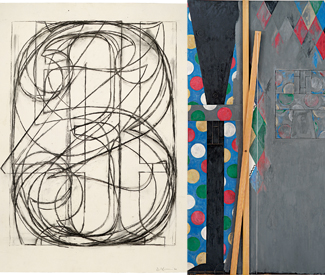
VISUAL ART The new Jasper Johns retrospective currently on view at the San Francisco Museum of Modern Art opens not with his seminal 1955 painting Flag, but with one much less well known from 1956, a painted object titled Canvas. That work is made from a wood stretcher frame and canvas panel turned around to face the wall, the entire back of the thing covered in gray encaustic. Above it on the wall is a quotation from Johns, “I’ve always considered myself a very literal artist.”

This greeting at the show’s entrance is meant to tell you two things: that you may not be seeing all the most iconic works by one of the world’s most famous living artists, and that you’ll want to take this one slowly, since you’re going to be presented with a methodical review of Johns’ handling of artworks as objects. The central narrative of this excellent show — comprising some 90-plus works, some new and never before exhibited — is Johns’ continuing inquiry into the relationship between what an artwork is as an object and what it depicts.

The first two galleries are dedicated to Johns’ Numbers works, which bookend his nearly 60-year career. The numbers stand in for the other early works, the flag and target paintings that made him an immediate star in the late 1950s and announced the arrival of the post-Abstract Expressionist era. The room is framed by a high key oil painting titled 0 through 9 (pun probably intended), in which a stack of superimposed numerals competes with loud bursts of brushed color. Also in the same room is 1959’s White Numbers, a large relief grid of ordered numerals painted in very thick white encaustic. That impasto grid, texture and all, recurs in a cast bronze wall work from 2005, and a silver sculpture from 2008. Likewise, 0 through 9 is shown also as a charcoal drawing, a lithograph, and a lead relief.

The thing about numbers, of course, is the same about targets or flags. Namely, a painting of a flag is in fact a flag (distinct from how, say, a painting of a tree is not actually a tree). Letting this sink in and acknowledging that Johns is interested in the literal facts (pun intended here, too) of painting and sculpture helps frame how you encounter the rest of the works on display. From start to finish of the show, Johns’ works slowly build in visual and textual intricacy, but tend to circle around this same main refrain.

Johns wants you to understand the complex objects he’s creating, but that doesn’t mean he’ll make it easy. Proceeding by a kind of diffracted metonymy, the various components in Johns’ artworks are both meant to be exactly whatever they are, and also to stand in for a set of other things that also might have been included. This is made explicit in the way Johns mulls over compositions, and transmutes them across media, recasting — sometimes literally — a work in different iterations. Compounding this self-reflexivity, you’ll find statements once proposed as standalone artworks recur later as motifs or referents.

In other hands, this activity might be inexcusably hermetic or academic, but in Johns’ best works the effect is to establish at once both a harmonic resonance between concepts and a continual scrutiny of his own conclusions. For example, in the 1970s-80s Crosshatch paintings, you notice that same numerical grid from 20 years prior, this time reintroduced as the underlying compositional structure of works like Usuyuki (1979-81) or Scent (1973-74). Or, beginning with his 80s Seasons series and continuing to his new Shrinky Dink and Bushbaby images, entire compositions from past works are miniaturized and sampled in new ones, in a highly complex virtualization that juxtaposes metonymy with metaphor. When it works it is astonishing.

It’s axiomatic that an artist will return to established precepts over the course or her career, but few have done so with the explicitness of Johns, who uses his own process as fodder for new deconstructions and assemblages. That the show contains several new works and two new series suggests that Johns, now 82, is not done yet. *

JASPER JOHNS: SEEING WITH THE MIND’S EYE

Through Feb. 3

SFMOMA

151 Third St., SF

www.sfmoma.org


ALSO RECOMMENDED:

MARIE BOURGET, KENNETH LO, AND DANIEL SMALL

Marie Bourget’s arabesque paintings take from tile work and ceramics and combine them with translations of Walt Whitman to lovely effect. Through Nov. 22, Johansson Projects, 2300 Telegraph, Oakl; www.johanssonprojects.com

JAMES STERLING PITT

Pitt’s painted wooden sculptures recall both Jonathan Lasker and Richard Tuttle. And that ain’t a bad thing. Through Dec. 8, Eli Ridgway Gallery, 172 Minna, SF; www.eliridgway.com

ROBERT SAGERMAN

Sagerman’s paintings reimagine Georges Seurat’s pointillism as luminous color field paintings. Through Dec. 22, Brian Gross Fine Art, 49 Geary, Fifth Flr., SF; www.briangrossfineart.com

Who’s really behind the No on Prop. 30 ads?

7

The Fair Political Practices Commission released a bit of information about who just dumped $11 million into the No and 30 and Yes on 32 campaigns, and on the surface, the disclosure doesn’t tell much except that secretive PAC money moves around in tight circles. The head of the FPPC, Ann Ravel, called it “money laundering,” which sounds like a fairly accurate description. But all the FPPC records really show is that one nonprofit called Americans for Job Security and another called The Center to Protect Patient Rights moved the cash into the Arizona-based Americans for Responsible Leadership, which sent the money to California.

Who the hell are any of these groups? Technically, nobody knows, since they don’t disclose their donors. The SacBee notes that:

Although it could not be confirmed, the Center to Protect Patient Rights has been connected to Kansas-based Koch Industries, whose owners, David H. Koch and Charles G. Koch, are conservative advocates.

“Conservative advocates” is a kind way of putting it.

When the Bee called Koch HQ, a flak there said her guys weren’t involved:

Asked about reported ties to the Center to Protect Patient Rights, Koch Companies Public Sector spokeswoman Melissa Cohlmia said in an email, “Contrary to some media reports, Koch Industries, Charles Koch, and David Koch have not provided any financial support in favor of Proposition 32 and are not involved in this issue.”

Ah, but that’s a bit of a stretch. The LA Times has actually done some investigative work on this, and it’s pretty clear that the Center to Protect Patient Rights IS the Koch brothers, and that any money that comes through there is part of the brothers right-wing network.

I’m surprised Jerry Brown hasn’t jumped all over this. A big ol’ press conference event with the guv denouncing the (actual) vast right-wing conspiracy to shut down unions and drive California off the fiscal cliff might be the boost Prop. 30 needs in the final day.


The billionaire attack on D5

155

The attack on Sup. Christina Olague, funded by a couple of right-wing billionaires, is in full swing in District 5, with mailers, robocalls, a social-media buy and even TV ads. It’s a disgraceful effort to buy an election in the final week, a flood of sleaze that’s outrageous even by modern political standards.

On the surface, the PAC called San Francisco Women for Responsibility and an Accountable Supervisor is talking about domestic violence. One mailer features a woman whose daughter was killed by an abuser saying she is “appaled” that Sheriff Ross Mirkarimi still has his job — and that Olague voted not to throw him out. A 60-second TV ad features Ivory Madison, the Mirkarimi neighbor whose video was the centerpiece of the campaign to oust the sheriff.

But the PAC is entirely funded by Ron Conway, his wife Gayle, and Thomas Coates. Conway hasn’t been a leading voice on domestic violence issues, and neither has Coates — they are business people who are primarily interested in making money. In the case of Conway, he’s someone who has publicly announced that he wants to “take San Francisco back” from progressives and install more big-business-friendly politicians at City Hall. Coates is a real-estate investor who has spent a lot of time and money fighting to limit tenant-protection laws.

Why are these two so interested in the D5 race? Well, in an email, Conway told me that “the Committee that my wife Gayle and other women, including longtime anti-domestic violence advocates, have formed and that I and others support exists solely to oppose Christina Olague because she put her own politics ahead of women and the victims and survivors of domestic abuse.”

But it’s eminently clear that there’s a larger agenda here, that the wealthy donors are using the domestic violence issue to get rid of a supervisor who they see as not sufficiently friendly to their economic interests. And there’s probably a bit of payback involved: Olague defied the mayor with her Mirkarimi vote — and while a lot of observers still say this was all a setup to demonstrate her independence in time for the election, Conway, one of the mayor’s closest allies and advisors, clearly didn’t get that message.

Coates lives in Los Angeles. Conway lives in Pacific Heights. Neither of them has any connection the D5 — except for their desire to get rid of Olague. They’ve taken a real, serious issue — domestic violence — and used it to their own political advantage.

We haven’t endorsed Olague, but we know a shady scam when we see one, and that’s exactly what this is. The voters of District 5 should reject this kind of outside-influence politics and not let a couple of billionaires decide the future of their the city.

Record-breaking spending floods District 1 with political propaganda

19

District 1 supervisorial candidate David Lee and independent expenditure campaigns supporting him have spent nearly $800,000 – shattering previous spending records for a district election – bombarding Richmond District voters with a barrage of mailers and other media pushing a variety of claims and criticisms about incumbent Sup. Eric Mar that sometimes stretch credulity and relevance.

But is it working? Or is the avalanche of arguments – much of it funded by “big money from Realtors, Landlords, and Downtown Special Interests,” as a recent Mar mailer correctly notes – feeding speculation that Lee would do the bidding of these powerful players on the Board of Supervisors?

Mar campaign manager Nicole Derse thinks that’s the case, arguing the Lee campaign would have leaked internal polls to the media if they were favorable, and it wouldn’t be escalating its attacks on so many fronts hoping for traction, such as yesterday’s press conference hitting Mar on the issue of neighborhood schools.

“They’re pretty desperate at this point and throwing anything out there that they can,” Derse told us, later adding, “I feel good, but we really have to keep the fire up.”

Mar and the independent groups supporting him, mostly supported by the San Francisco Labor Council, have together spent about $400,000. Most of the mailers have been positive, but many have highlighted Lee’s political inexperience and his connections to big-money interests, raising questions about his claims to support tenants and rent control.

Lee campaign manager Thomas Li, who has been unwilling to answer our questions throughout the campaign, did take down some Guardian questions this time and said he’d get us answers, but we haven’t heard back. On the issue of why the Realtors and other groups who seek to weaken tenant protections were supporting Lee, Li simply said, “Our position has been steadfast on protecting rent control and strengthening tenant protections.”

The Lee campaign has repeated that on several mailers – possibly indicating it is worried about that issue and the perception that Lee’s election would give landlords another vote on the board, as tenant and other progressive groups have argued – but most of its mailers recently have attacked Mar on a few issues where they must believe he is vulnerable, even when they distort his record.

Several mailers have noted Mar’s support for a city budget that included funding for a third board aide for each of the 11 supervisors – a budget the board unanimously approved – as well as his support for public campaign financing, despite the fact that Lee’s campaign has taken more than $150,000 in public financing in this election, 30 percent more than Mar’s. They have also criticized Mar for supporting the 8 Washington high-end condo project, even though Lee also voted for the project as a member of the Recreation and Parks Commission.

As this Ethics Commission graphic shows, Lee has been by far the biggest recipient of independent expenditures in this election cycle, with hundreds of thousands of dollars coming from the downtown-funded Alliance for Jobs and Sustainable Growth and the Realtor-created Citizens for Responsible Growth.

Mar and his allies have hit back with mailers noting that most of the funding for the Chinese American Voter Education Project, Lee’s main political and communications vehicle in recent years, has simply gone to pay his $90,000-plus annual salary, which he didn’t fully report on financial disclosure forms required of city commissioners. They have also hit Lee for his support for the Recreation and Parks Department’s closure of recreation centers and other cuts while he “consistently supported privatization of our parks.”

At this point, it’s hard to know how this flood of information and back-and-forth attacks will influence District 1 voters, but we’re now days away from finding out.

Giants’ revelers who crossed the line face charges

17

Yesterday’s parade celebrating the Giants’ World Series sweep almost went down without a hitch, no thanks to a handful of inebriated miscreants. Among the estimated one million revelers that attended, the SFPD reports that 22 were arrested, including 13 for public drunkenness. Others were charged for robbery, battery and unlawful possession of a loaded firearm.

Yesterday’s violations, however, paled in comparison to the chaos that ensued after the final game on Sunday night, when even more arrests were made and major damage was done to the city. District Attorney George Gascón is prosecuting nine individuals detained in connection to the shenanigans that occurred around the city last weekend. 

“What occurred last Sunday was inexcusable,” Gascón at a press conference Tuesday afternoon. “We want to send a clear message that we will prosecute all the cases presented to us, to the fullest extent of the law.”

The nine charged so far include eight men and one woman, all of them locals. “So far I believe everyone we have are San Francisco residents,” says Gascón.

Seven are charged with assaulting or threatening a peace officer. SFPD Officer Carlos Manfredi says two officers – whose names he could not release – suffered injuries after confrontations with rioters. “One suffered a hand injury and one suffered lacerations to the leg from a glass bottle that was thrown.”

Tomas Lunsford was arrested on charges of robbery after he allegedly stole a phone from a woman who was filming the celebration. He then allegedly punched her female friend while attempting to evade capture. Additional charges include resisting arrest with force, battery and arson of property.

The latest arrest associated with the carnage occurred Tuesday after police identified a man who was photographed shattering a Muni bus window. Gregory Tyler Grannis, 22, of San Francisco was detained on felony charges of vandalism and destroying a passenger transit vehicle. Police were led to him after tips from social media sites.  Grannis is scheduled to be arraigned Friday.

The DA’s office has been presented with several other individuals who have yet to be reviewed.  Gascón anticipates more violators will be charged in the coming days: “We expect additional cases, including cases involving damage to city vehicles.”

SFPD is currently investigating the torched Muni bus incident.  On Wednesday, Police Chief Greg Suhr released cell phone video and photographs of two suspects wanted in connection with the arson of the bus. “We are now asking for public assistance in identifying these two arsonists and bringing them to justice,” Suhr said.  Photos and video can be viewed at sf-police.org

It is unknown what the ultimate cost of the damage from Sunday night’s chaos will be. City Attorney Dennis Herrera said that in addition to being charged criminally, public offenders will receive civil fines commensurate with their offenses.  “I’m here to tell folks that you will be hit in your pocket book,” he says. “If you damage the city we will seek retribution and damages.”

Celebrations turned chaotic in North Beach and Downtown, but it was the Mission District that saw the most damage. Along Mission Street, 24th Street and Valencia Street vandals tagged several businesses, damaged public property and set fires.  In a statement Monday, Mission District Supervisor David Campos said, “I have been in communication with the Department of Public Works and we are working closely to clean up the streets and help affected businesses.”

Our Weekly Picks: October 31-November 6

0

WEDNESDAY 31

Halloween at Thee Parkside

There was a pretty sizable chunk of paper last week dedicated to the eye-popping range of spooky/trashy/candy-coated Halloween events out there for you to dig into. Though on this night, this favorite holiday of many, I throw my vote to the tribute band. It’s just fun to see local bands dressed as other bands, rocking a catalogue they likely researched on Wikipedia and/or Youtube. That’s why I doff my cat-eared hat to Thee Parkside’s linup: Glitter Wizard as the Seeds, Twin Steps and the Cramps, Meat Market as G.G. and the Jabbers, and the Parmesans as the Kinks. Plus, some monster mashups via DJ Dahmer, MOM’s spook booth, tarot card readings, and (creepy?) silent film projections. (Emily Savage)

8pm, $8

Thee Parkside

1600 17th St., SF

(415) 252-1330

www.theeparkside.com


THURSDAY 1

Mr. Kind

Less than a year old, Oakland foursome Mr. Kind is still in its infancy. But when the band formed in March, it hit the ground running, releasing its first EP OK just a few months in. Now, three months later, Mr. Kind is taking on another ambitious project by playing Wilco’s Yankee Hotel Foxtrot in its entirety. The 2002 best-selling, alt-country masterpiece celebrated its 10th anniversary this year. When the band discussed which album they wanted to honor with a tribute show, Yankee Hotel Foxtrot was the unanimous choice, described in the group’s press release as “a classic album that has played a big part in influencing the members of Mr. Kind.” To top off the celebration, Mr. Kind will be joined onstage by various Bay Area musicians, including members of Please Do Not Fight and Finish Ticket. And one more thing: be sure to keep wearing your costume, Halloween’s not over yet. (Haley Zaremba)

With River Shiver, Marquiss

9pm, $10

Bottom of the Hill

1233 17th St, SF

(415) 626-4455

www.bottomofthehill.com


When We Were Young and Dumb: the Stranger vs. Believer

You’re currently reading the San Francisco Bay Guardian (thanks!), but if you lived in Seattle, you would probably be scanning Dan Savage’s home paper, the Stranger. As comrades in free-thinking liberal media, we can’t help but support their appearance in a face-off with another great publication, the Believer. One of Dave Eggers many projects, the literary journal lets writers do what they do best: ramble. It started by publishing only rejects from other literary journals and now specialize in longer form interviews and original work. Writers from both publications will be speaking of their younger days, including some key cornerstones: Jesus, LSD, and virginity. (Molly Champlin)

6pm, free

Makeout Room

3225 22 St., SF

(415) 647-2888

www.makeoutroom.com


Kirk Von Hammett Presents: Day of the Dead Bash

That guy from Metallica? Stringy-haired lead shredder Kirk (Von) Hammett? He’s also way into horror paraphernalia, and has packed his home with a collection of monster-movie memorabilia, including Bela Lugosi’s Dracula script and original Frankenstein posters. He’s got so much stuff, that he compiled an entire 224-page coffee table book on the subject — Too Much Horror Business — and will fête said tome’s release with zombies, Day of the Dead burlesque by Hubba Hubba Revue, and live performances by veteran Concord metal band Death Angel, and local string-metal trio Judgement Day tonight at Public Works. (Savage)

9pm, $13.99

Public Works

161 Eerie, SF

(415) 932-0955

www.publicsf.com


FRIDAY 2

“Private Life Studies”

Being a soldier and an artist is not a natural fit. But think about it. For both you need dedication, discipline, a willingness to submit your ego to something bigger than yourself and, for dancers, an ability to work with others. So, perhaps, it should be no surprise that Private Freeman, one of ODC/Dance’s most generous, witty, and focused dancers, managed to successfully integrate these two, seemingly contradictory impulses. Deborah Slater’s work-in-progress Private Life Studies is exploring some of these issues as a series of “dance stories”, based on strategies from Sun Tzu’ “The Art of War.” Sun was just one of some of history’s most brilliant minds writing about war; Machiavelli and von Clausewitz were others. Odd, isn’t it? (Rita Felciano)

Also Sat/3, 8pm; Sun/4, 2pm, $15–$25

CounterPULSE

1310 Mission St. SF

(877) 297-6805

privatelife-eorg.eventbrite.com


Day of the Dead altars and procession

Although the changing nature of the crowd at the Mission’s annual night of remembrance for those who’ve passed has earned it the affectionate nickname “Dia de los Dead Gringos,” there’s no denying that the community-led, candle-lit procession and park full of homemade altars can be breathtakingly lovely. Arrive early at Garfield Park to tiptoe around meticulously, sometimes even extravagantly decorated tributes to dead family members and public figures. Add a note of your own to the interactive exhibits, and await the arrival of the costumed procession, whose inevitable approximations of La Catrina are a distinctly San Franciscan way of celebrating the holiday. (Caitlin Donohue)

Procession: 6-7pm, free

Starts at Bryant and 22nd St., SF

Festival of Altars: 6-11pm, free

Garfield Park

Harrison and 26th St., SF

www.dayofthedeadsf.org


Chilly Gonzales

It’s not hard to come up with a list of catchy things about Chilly Gonzales to entice you to go to his show. And he knows it. While his strongest talents lie in piano, he has made quite a scene on Youtube, adapting his skills to popular demand with his genuine love of rap (and bongos, hula hoops, and pink suits). He has provided compositions for Feist, Drake, and Steve Jobs and then turned the tables to rap with the BBC Philharmonic Orchestra. Now though, like a true artist, he’s returning from his pop adventures and getting serious with his latest work, “Piano Solo II,” which is mostly short piano pieces showcasing serious skill in a still modern, easily digestible format. (Champlin)

8pm, $20

Swedish American Hall

2170 Market, SF

(415) 861-5016

www.cafedunord.com


SATURDAY 3

Informant

No documentary subject in recent memory is as infuriating as Brandon Darby — the radical activist turned FBI informant turned Tea Party chucklehead at the center of Informant, local documentary filmmaker Jamie Meltzer’s most recent work. (Prior to this, Meltzer was probably best-known for 2003’s wonderfully bizarre Off the Charts: The Song-Poem Story.) Scream at the screen (you will want to) at Other Cinema tonight, Informant’s first local showing since its San Francisco International Film Festival bow earlier this year. (Cheryl Eddy)

8:30pm, $6

Artists’ Television Access

992 Valencia, SF

www.othercinema.com


SF Symphony Dia de los Muertos community concert

Is a skeleton a xylophone or a marimba? You can bet your sweet sugar skull there’ll be an ocean of chromatic bones, dancing akimbo, at the vibrant annual celebration of the afterlife. The family favorite boasts performances from the SF Symphony Youth Orchestra (playing Aaron Copland’s El Salón México and Jose Pablom Moncayo’s Huapango), dance company Los Lupeños de San José, Mariachi Nuevo Tecalitlán, and more, all narrated by the twinkling Luis Valdez, “father of Chicano theater.” Face painting, paper flower-making, tons of colorful art, and a pre-show by the Mixcoatl Anahuac Aztec dancers, the 30th Street Chorus, and the Solera singers boost the fun — but really they had us at cinnamon-infused Mexican hot chocolate and pan de muerto. (Marke B.)

2pm, $17.50–$68

Davies Symphony Hall

401 Van Ness, SF.

(415) 864-1000

www.sfsymphony.org


AU

In my younger and more vulnerable years, certain music videos left definitive scars on my brain. Faith No More’s “Epic” — seemingly an over-the-top ode by Mike Patton to drowning fish and exploding pianos — taught me the meaning of the word in a way that no amount of Greek literature could. Things have largely remained that way until listening to the latest adventurous pop album from Portland’s AU, which opens with another “Epic” — an instrumental soundscape where technical, Hella-tight drumming is joined by impossibly high rising GY!BE guitars as part of a larger Tim-Riggins-winning-the-big-game-triumphant structure. The lexographically challenging track is only the first surprise on the record, and demands a live rendition. (Ryan Prendiville)

With Zammuto

9pm, $15

Independent

628 Divisadero, SF

(415) 771-1421

 www.theindependentsf.com


SUNDAY 4

Kid Koala

It’s been a big year for Eric San, the Montreal turntablist better known as Kid Koala. Not only did he contribute to the revival of Deltron 3030 after a decade-long hiatus; he’s also managed to release 12 Bit Blues, his first solo record in six years. Conceptually inspired and determined, the album utilizes a clunky, old-school sampler, à la Public Enemy, to reconstruct blues music from the ground up, resulting in a man vs. machine sort of tension that makes for a constantly engaging listen. Luckily, for those fans hesitant to watch a dude spin records for two hours, Kid Koala’s “Vinyl Vaudeville Tour” is loaded with bells and whistles to keep things interesting: Puppets! Dancing girls! Parlor games! Robots! If only more electronic acts were bold enough to co-opt these kooky antics of the Flaming Lips variety. (Taylor Kaplan)

With Adira Amram and the Experience

9pm, $20

Independent

628 Divisadero, SF

(415) 771-1421

www.theindependentsf.com


MONDAY 5

Jens Lekman

“Hey do you want to go see a band? No I hate bands. It’s always packed with men spooning their girlfriends, clutching their hands, as if they let go their feet would lift off the ground and ascend,” Swedish pop master Jens Lekman sings on I Know What Love Isn’t, his first full-length since 2007’s classic Night Falls Over Kortedala. Gone are the enraptured recollections of romantic highs — this is the ever autobiographically charming Lekman, soberly looking at relationships from the outside. But on this “break-up” album, Lekman’s observations on past failures and limitations break through to a melancholic optimism for the future. Recreating the album’s full palette of ’80s balladry, Lekman will be performing with a full band. (Prendiville)

With Taken By Trees, Big Search

8pm, $25–$35

Fillmore

1850 Geary, SF

(415) 346-6000

 www.thefillmore.com


TUESDAY 6

Reverend Peyton’s Big Damn Band

Reverend Peyton’s Big Damn Band must be exhausted. Not only does the trio have to live up to its highfalutin’ damn big title, it found time this year to release its eighth full-length album while maintaining its ridiculous, awe-inspiring average of 250 shows per year. The Indiana-based Americana blues band consists of a Reverend Peyton on guitar and vocals, his wife Breezy on washboard, and Peyton’s cousin, Aaron “Cuz” Persinger on drums. For the band’s newest effort Between the Ditches, the Rev. and company slowed down enough to get into a studio and lay out the record instrument by instrument, track by track, instead of recording it live all in one big, enthusiastic rush as usual. The result is a beautifully recorded bit of nostalgia that transports the listener to a big wraparound porch in the Southern summer. And trust me, it’s exactly where you want to be. (Zaremba)

With The Gypsy Moonlight Band, Anju’s Pale Blue Eyes

9pm, $10

Bottom of the Hill

1233 17th St, SF

(415) 626-4455

www.bottomofthehill.com

The Guardian listings deadline is two weeks prior to our Wednesday publication date. To submit an item for consideration, please include the title of the event, a brief description of the event, date and time, venue name, street address (listing cross streets only isn’t sufficient), city, telephone number readers can call for more information, telephone number for media, and admission costs. Send information to Listings, the Guardian, 225 Bush, 17th Flr., SF, CA 94105; or e-mail (paste press release into e-mail body — no attachments, please) to listings@sfbg.com. Digital photos may be submitted in jpeg format; the image must be at least 240 dpi and four inches by six inches in size. We regret we cannot accept listings over the phone.

Hurricane Sandy and climate change

14

I guess it’s no surprise that most of the news media coverage of Hurricane Sandy was focused on the immediate — when you have six million people without power and transit systems paralyzed and at least 38 deaths, you deal with that stuff first. There will be plenty of time later to talk about causes and preparadness and what to do next time.

But I expected a little more mainstream coverage of the clear and obvious fact that this storm — and the many more severe storms that are likely to follow in places that aren’t used to seeing this type of weather — is the result of climate change caused by humans. 

The scientists — at least, all but the looney ones — are not in denial. The oceans are warmer than they were 20 years ago, and the warm water extends farther north. Warmer oceans mean more, and stornger, hurricanes:

Scientists have long taken a similarly cautious stance, but more are starting to drop the caveat and link climate change directly to intense storms and other extreme weather events, such as the warm 2012 winter in the eastern U.S. and the frigid one in Europe at the same time.

There have been three presidential debates. Both candidates have suspended campaigning because of Sandy. Mitt Romney’s out collecting cans of food that the Red Cross doesn’t want.But at no point in this campaign has climate change been a serious issue.

Maybe people will start paying attention now. Maybe a $20 billion hit to the heavily populated East Coast areas where the heart of the nation’s banking and politics business are will wake up the White House and Congress. Because this ship has sailed — the damage already done is serious and can’t easily be repaired. And preventing serious from becoming catastrophic is now our only option, and we’re running out of time.

Most of Manhattan and Long Island is less than two feet about sea level. Unless you’re going to build massive dikes around both of them, those places are going to be worse off than south Florida in a few years. Sandy was a Category 1 when it hit the Jersey shore; in a few years, that region is going to be dealing with Category 3 and 4 storms and the flooding will be devastating.

Can we please talk about this?

Dick Meister: A Halloween invasion from Mars!

0

By Dick Meister

Dick Meister is a longtime San Francisco-based journalist and writer. Contact him through his website,  www.dickmeister.com

“2X2L calling CQ … 2X2L calling CQ, New York…. Isn’t there anyone on the air?  Isn’t there anyone on the air?  Isn’t there anyone?

Millions of Americans – panic-stricken, many of them – waited anxiously for a response to the message, delivered over the CBS radio network in slow flat, mournful tones on a crisp Halloween eve. It was Oct. 30, 1938.

“Isn’t … there … anyone?”

There wasn’t. Listeners heard only the slapping sounds of the Hudson River.

Many of New York’s residents were dead.  The others had fled in panic from “five great machines,” as tall as the tallest of the city’s skyscrapers, that the radio announcer had described in the last words he would ever utter. The metallic monsters had crossed the Hudson “like a man wading a brook,” destroying all who stood in their way.

“Our army is wiped out, artillery, air force – everything wiped out,” gasped the announcer.

It was the War of the Worlds, Mars versus Earth, and the Martians were winning with horrifying ease. Their giant machines had landed in the New Jersey village of Grovers Mill, and soon they would be coming to your town, too – and yours … and yours.  Nothing could stop them.

The War of the Worlds had sprung with frightening clarity from the extremely fertile imagination of Orson Welles and the other young members of the Mercury Theater of the Air who adopted H.G. Wells’ novel of that name and dramatized it so brilliantly – and believably – from the CBS radio studios on that long ago Halloween eve.

Their use of realistic sounding bulletins and other tools of radio news departments made it sound as if Martian machines truly were everywhere, and everywhere invincible.

Studies done at the time show that at least one million of the program’s estimated six million listeners panicked.

“People all over the United States were praying, crying, fleeing frantically to escape death from the Martians,” noted Hadley Cantril, an actual Princeton professor who directed the most detailed study of the panic that was caused in part by the pronouncements of “Richard Pierson,” a bogus Princeton professor played by Welles.

“Some ran to rescue loved ones. Others telephoned farewells or warnings, hurried to inform neighbors … summoned ambulances and police cars…. For weeks after the broadcast, newspapers carried human interest stories relating the shock and terror of local citizens.”

“When the Martians started coming north from Trenton we really got scared,” a New Jerseyian told one of Professor Cantril’s interviewers. “They would soon be in our town. I drove right through Newberg and never even knew I went through it … I was going eighty miles an hour most of the way. I remember not giving a damn, as what difference did it make which way I’d get killed.”

Those who didn’t join the streams of cars that clogged the highways clogged the phone lines or huddled in cellars and living rooms to await the end, some with pitchfork, shotgun or Bible in hand.

“I knew it was something terrible and I was frightened,” a woman recalled. “When they told us what road to take, and to get up over the hills, and the children began to cry, the family decided to go. We took blankets and my granddaughter wanted to take the cat and the canary.”

It was an extremely rare occurrence, as Cantril noted:  “Probably never before have so many people in all walks of life and in all parts of the country become so suddenly and so intensely disturbed.”

And never since then has the country experienced such deep and widespread fear and anxiety. Not even after Japan’s surprise attack on Pearl Harbor three years later. Not even in the wake of the terrorist attacks of Sept. 11, 2001.   It was a unique display of widespread panic. Many people actually believed their very world was coming to an end and there was nothing anyone could do to stop it.

Welles had made clear at the start that the presentation was fictional. But radio listeners generally paid little attention to opening announcements, and many Sunday night listeners commonly turned first to the very popular Edgar Bergen-Charley McCarthy show that was broadcast over another network in the same 8 p.m. time slot, turning to the Mercury Theater out of curiosity only later.

What they heard that Sunday Halloween eve were primarily news reports and commentaries ingeniously patterned on the real reports and commentaries that were constantly interrupting programs to report the aggressive actions of Nazi Germany and other events that would shortly lead to the outbreak of World War II.

People expected to hear the worst. Most also expected that what they heard would be accurate, radio having supplanted newspapers as the most trusted and relied upon of the mass media.

It helped, too, that much of the information was presented by “experts” – Welles and other make-believe professors from universities around the world, supposed astronomers, army officers and Red Cross officials, even the otherwise unidentified “Secretary of the Interior.”

“I believed the broadcast as soon as I heard the professor from Princeton and the officials in Washington,” as one listener recalled.

Even relatively sophisticated and well-informed listeners were fooled by what Cantril cited as the program’s “sheer dramatic excellence.”

Events developed slowly, starting with the relatively credible – brief news bulletins calmly reporting some “atmospheric disturbances,” later some “explosions of incandescent gas,” and finally the discovery of what appeared to be a large meteorite. Only then came the incredible – the discovery that the “meteorite” was a Martian spaceship, reported in a halting, incredulous manner by the “reporter” supposedly broadcasting live from Grovers Mill.

The police, the New Jersey State Guard, the army – none could subdue the invaders. Finally, the “secretary of the interior” announced that man could do no more, that the only hope for deliverance from the Martians was to ”place our faith in God.”

Few listeners were in a position to make independent judgments about matters Martian. Few knew astronomy, and what standard does one use to judge an invasion from Mars anyway?

Listeners could easily have turned to other radio networks for the truth, of course, but many were too caught up in the masterful drama of the CBS program to think of that.

Even some people who lived near the alleged invasion site were fooled. “I looked out the window and everything was the same as usual,” said one, “so I thought it hadn’t reached our section yet.”

The second half of the hour-long broadcast, with “Professor Pierson” wandering dazedly through the deserted and ravaged streets of New York, should have made it obvious to even the most gullible that they had been listening to drama rather than news. At the program’s end, Welles, shocked and shaken by the listener response,  quickly voiced an ad-libbed assurance that it had all been make-believe.

But by then, many people had left their radios. They had other ways in which to spend their last hours on Earth.

Dick Meister is a longtime San Francisco-based journalist and writer. Contact him through his website,  www.dickmeister.com