APPETITE Earthy, savory desserts call out to me. Despite my diminishing tolerance for excessive sugar, ice cream and gelato remain my biggest weaknesses, and I’m as appreciative of baked goods and balanced, unique desserts as I ever was. There are a slew of new and noteworthy Bay Area sweets on my menu — and a couple older places worth revisiting. (Visit the Pixel Vision blog at SFBG.com to read about six more.)
MISO SESAME RICE CRISPIES AND SOME OF SF’S BEST ICE CREAM
Run by husband-wife pastry chef dynamos Dennis and Eloise Leung (their fine dining background included Bong Su, a restaurant I still miss), Delise is a small cafe near Fisherman’s Wharf. Now three years old, the cozy spot is home to some of the best ice cream in SF (you read that right), cupcakes (thankfully unlike the typical “cupcake” served elsewhere), bars, cookies, bagels from House of Bagels, and sandwiches with unique Asian twists like crab salad in ginger turmeric aioli and kaffir lime dressing. Highlights are many, including a matcha green tea cupcake filled with red beans or a miso sesame rice crispy. I dream of ice cream flavors like Triple Threat, possibly the best pumpkin ice cream I’ve ever tasted with candied pumpkin seed and ale, or divine toasted rice ice cream, which is also served — alongside a few of Delise’s sorbets and ice creams — at Martin Yan’s brand new M.Y. China.
Since its debut at the Underground Market in 2011, Frozen Kuhsterd (launched by Jason Angeles, who now runs it with Alex Lam and Tim Luym) has proffered a Midwestern favorite with roots in Coney Island. Dense, creamy, soothing, it’s like ice cream made with eggs alongside cream and sugar. Available at a few locations, including from their food truck at SoMa StrEAT Food Park (follow on Twitter @frozenkuhsterd), flavors like Cinnamon Toast Crunch (Cereal Milk) and Thai Iced Tea are already a hit, Peppermint Bark and Eggnog Latte hook me for the holidays, and I’m eager to try the likes of Coffee Mint Mojito. Besides unusual sundae toppings, the custard is served in varying formats and as part of collaborations announced via social media, such as in donut sandwiches with Dynamo Donuts or in French pastry favorite kouign-amann from B. Patisserie.
Afternoons at Chocolate Lab, chocolate master Michael Recchiuti’s brand new, all day chocolate cafe in the original Piccino space, feel almost Zen-like. Friendly service in cozy, light-filled environs, sitting at the communal table or at high corner tables with a Bay shrimp tartine sandwich, finished off with an affogato… it’s a happy respite. Opt for a Virgil’s root beer or cream soda float layered with Recchiuti extra bitter chocolate sauce and chocolate malt ice cream, then stop off at the shop next door to purchase some chocolates to take home.
The first time I visited Inner Richmond’s new Pretty Please Bakeshop was two days post-opening — before the demise of Twinkies. I knew even then that “twinks,” far superior versions (think Twinkies for the gourmand), would be a hit. Trying to decide between red velvet, banana bread, or pumpkin twinks means I just get one of each. The rest of the offerings please, from cupcakes to a quality Ding Dong — yes, they’ve got that covered, too.
CHOCOLATE-DIPPED PEANUT BUTTER CUPCAKES. ENOUGH SAID
Opened this December in the historic MacFarlanes Candy and Ice Cream space, Sweet Bar Bakery in Oakland is the kind of bakery where just about everything ordered tastes as good as it looks. As I’m a peanut butter fanatic, chocolate dipped peanut butter cupcakes ($3.75) are more than enough reason to stop in. Lightly whipped yet intensely peanut-y PB rests inside dark chocolate coating a chocolate cupcake. Sweet Bar does right by all baked goods, from a savory bacon gorgonzola scone ($2.75) to perfect muscovado ginger cookies ($2).
Dining at Baker and Banker is memorable, from the tranquil space and service to husband-wife chef duo Jeff Banker and Lori Baker’s finely crafted food. A chef’s table and tasting menu (at $75 per person) in the active bakery is a key way to sample their range, including Lori’s exquisite desserts, much of which is available at their bakery during the day. Cult classic XXX chocolate cake is merely a starting point. A restaurant dessert that stays with me? Divine candied bacon doughnuts oozing with bourbon cheesecake filling under maple glaze. Bacon doughnuts may be overdone elsewhere, but there’s none quite like B&B’s.
Before we get to the week in Bay Area sex events, here is something you will want to be aware of: the ingenious ad campaign perpetuated by Baltimore activists from Force: Upsetting Rape Culture, who riffed off of questionable underwear design from Victoria’s Secret. In doing so [as Baltimore Fishbowl reports], the group ended up giving the company irrefutable proof that yes, their clientele cares about consent when in comes to sex.
“[VS’] ‘Sure Thing’ and ‘Yes No Maybe’ and ‘NO peeking’ underwear promote the idea of limitless availability,” Force activists Hannah Brancato and Rebecca Nagle told Fishbowl. “Or on the other hand, leaving the choice up to the (presumably male) partner. The brand teaches girls to be coy instead of vocal and makes it seem uncool and unsexy to say no and mean it.”
So what’d they do about it? They made a fake VS website promoting undies that say “No Means No” and “Ask First”, and mounted a viral social media campaign, and soon enough the praise for VS’ apparent conscious-dawning was rolling in via Twitter, Facebook, etc. from survivors of sexual assault and VS employees alike. The website and @LoveConsent Twitter handle were eventually shut down, but not before their effects were visible across the Interwebs.
So that was neat. On to the week in Bay sex.
Moon Market
Insofar periods are related to babies are related to the act of making love, this is a sex event! This lil’ indie gift fair features sea sponge menustration kits from Holy Sponge, kits that feature besides two all-natural, sustainably-harvested sea sponges, tea tree oil with which to disinfect them, and desert or white sage with which to purfity thyself. Also, lunar eclipses are sexy, and you will want to be in a room full of lunaphiles when Friday’s occurs, so go. Also on sale: Chamomile on Mars‘ hangover tea and Down At Lulu‘s vintage ladywear.
It’s not important what you have on underneath them, gentlemen — panties, briefs, jocks, or otherwise. What matter is that you remove them, immediately. Your pants, of course. And you’ll be in good company in this deliciously seedy SoMa dive — studly go-gos serve as role models for what to do when you’ve freed yourself from lower body constrictions.
Fri/14, 11pm-1am, free. KOK Bar, 1225 Folsom, SF. www.kokbarsf.com
Whobilation
The pansexual costumed pervs of Kinky Salon host their yearly holiday party, where DJs spin, swingers swing, and a candy cane fellation contest will incur horrendous sweet tooths. Says the website:
So fluff up your PinkMink and shine up your Ball-Hoo
Put that ruff on your muff and buff up your wazoos
The joint will be hoppin, the bubbly poppin
and of Merriment & Mirth- you may ask?
no, there’s no stopping!
Sat/15, 10pm-late, price and location info sent to those who sign up for free membership. www.kinkysalon.com
School of Shimmy student showcase
Enter the world of Dottie Lux, creator of this local troupe of pasty-shaking, heart-breaking burlesque performers. Today’s showcase features numbers by Lux La Croix, Dorian Faust, and Ruby Vixen — plus a host of guest stars and Lux herself overseeing precedings.
International Day to End Violence Against Sex Workers
Ten years ago, feminist porn icons Annie Sprinkle and Robyn Few (RIP) marked December 17th by holding a candlelight vigil for the 70-plus victims, many of them sex workers, of Washington State’s Green River Killer. Since then, their simple ritual has spread across the globe, and the day has become an annual opportunity to call for justice for sex workers everywhere. Attend the vigil at the Center for Sex and Culture, where everyone is invited to add to a community altar to those who’ve passed, and the birth of a new PFLAG-style group for friends and family of sex workers will be announced.
Mon/17, 5-7pm, free. Center for Sex and Culture, 1349 Mission, SF. www.december17.org
Win a harness, why don’t you?
Drop by your locally-born national purveyor of quality sex accoutrement to meet Tres, who created the SpareParts HardWear line of harnesses. SpareParts’ Sasha harness may be of particular note — the ruched sides of the attached panty give an extra frisson of femme-sexy to your playtime. Sasha is among the two harnesses that will be raffled off today at the store and Tres will be doing fittings for customers, so no more chafing or slipping for you.
Dec. 20, 3-7pm, free. Good Vibrations, 2504 San Pablo, Berk. www.goodvibes.com
YEAR IN MUSIC Local musicians, rappers, producers, and music writers sound off on the year’s best songs, album releases, shows, personal triumphs, and local acts.
HANNAH LEW, GRASS WIDOW
TOP 10 OF 2012
1. Starting our own label HLR and releasing our own record (Internal Logic)
2. Total Control’s LP
3. Touring with the Raincoats and singing “Lola” with them every night
4. Getting obsessed with Silver Apples
5. Hollywood Nails
6. Wymond Miles LP
7. Scrapers (band)
8. Sacred Paws (band)
9. Making eight music videos and losing my mind
10. Wet Hair’s LP
ANTWON, RAPPER
TOP 10 2012 RAP JAMZ
1. DJ Nate, “Gucci Gogglez” 2. Chief Keef, “Ballin” 3. French Montana, “Shot Coller” 4. Chippy Nonstop, “Money Dance” DJ Two Stacks remix 5. Cash Out, “Cashin’ Out” 6. Future, “Turn on the Lights” 7. Gucci Mane, “Bussin Juggs” 8. Juicy J, “Drugged Out” 9. Lil Mouse, “Don’t Get Smoked” 10. Lil Reese, “Traffic” feat. Chief Keef
MICHAEL KRIMPER, GUARDIAN
THE ENDLESS DESIRE LIST
(IN NO PARTICULAR ORDER, OR, OUT OF ORDER)
1. Les Sins/”Fetch”/12″ (Jiaolong)
Run, fall, catch your desire.
2. The Soft Moon/”Want”/Zeros (Captured Tracks)
Infinite want, can’t have it. O, ye of bad faith.
3. Frank Ocean/”Pyramids”/channel ORANGE (Def Jam)
Pimping Cleopatra, whoring the pyramids.
4. Daphni aka Caribou/”Ye ye”/Jiaolong (Jiaolong)
Affirmation on repeat.
5. Grimes/”Genesis”/Visions (4AD)
Whatever, you know you like it.
6. Todd Terje/”Inspector Norse”/It’s the Arps (Olsen/Smalltown Supersound)
Inspecting never felt so good.
7. Burial/”Kindred”/Kindred (Hyperdub)
Kindred outcasts, jealously desiring their solitude.
8.John Talabot/”Estiu”/Fin (Permanent Vacation)
If a permanent vacation wasn’t hell, this might be its soundtrack.
9. Purity Ring/”Obedear”/Shrines (4AD)
Nothing pure in this abject need.
10. Kendrick Lamar/”A.D.H.D.”/good kid m.A.A.d city (Interscope)
Crack babies: she says, distracted, endless desire.
TYCHO, AKA SCOTT HANSEN
FAVORITE BAY AREA AND BAY AREA-AFFILIATED MUSIC ACTS
1. Toro Y Moi 2. Christopher Willits 3. Blackbird Blackbird 4. Jessica Pratt 5. Sam Flax 6. Ty Segall 7. Yalls 8. Doombird 9. Little Foxes 10. Dusty Brown
BEN RICHARDSON, GUARDIAN
BEST METAL ALBUMS OF 2012
1. Dawnbringer, Into the Lair of the Sun God (Profound Lore)
2. Asphyx, Deathhammer (Century Media)
3. Woods of Ypres, V: Grey Skies & Electric Light (Earache)
4. Uncle Acid and The Deadbeats, Blood Lust (Metal Blade)
5. Pallbearer, Sorrow And Extinction (Profound Lore)
6. Windhand, Windhand (Forcefield Records)
7. Omens EP
8. Hour of 13, 333 (Earache)
9. Gojira, L’enfant Sauvage (Roadrunner)
10. Lord Dying, Demo
CALEB NICHOLS, CHURCHES
TOP 10 VINYL PURCHASED IN 2012, AND WHERE I PURCHASED THEM
1. The Shins, Port Of Morrow (Amazon — forgive me, I had a gift card.)
2. The Walkmen, Heaven (Urban Outfitters clearance — yeah, I know, but you can’t beat brand-new vinyl for $10.)
3. Various Artists, Death Might Be Your Santa Claus (Boo Boo Records, San Luis Obispo. My hometown record store.)
4. Ella Fitzgerald, Live at Montreaux (Boo Boo Records, San Luis Obispo)
5. Mahalia Jackson, Christmas With Mahalia (Abbot’s Thrift, Felton, CA — Great thrift store in the Santa Cruz Mountains.)
6. Benjamin Britten/Copenhagen Boys Choir, A Ceremony Of Carols (Abbot’s Thrift, Felton, Calif.)
8. The Hunches, Exit Dreams (1234Go! Records, Oakland)
9. Various Artists/Angelo Badalamenti, Wild At Heart OST (Streetlight Records, Santa Cruz)
10. Tijuana Panthers, “Crew Cut” seven-inch (Picked up at show — Brick and Mortar Music Hall, San Francisco)
KACEY JOHANSING, SINGER-SONGERWRITER
TOP 10 FAVORITE SONGWRITERS IN THE BAY AREA
1. Sleepy Todd
2. Tommy McDonald of The Range of Light Wilderness
3. Emily Ritz of Yesway and DRMS (biased opinion, I know)
4. Kyle Field of Little Wings
5. Alexi Glickman of Sandy’s
6. Michael Musika
7. Bart Davenport
8. Indianna Hale
9. Jeffrey Manson
10. Sonya Cotton
HALEY ZAREMBA, GUARDIAN
TOP TEN CONCERTS OF 2012
1. El Ten Eleven at the New Parish
2. Good Old War at Slim’s
3. Girls at Bimbo’s
4. St Vincent and Tune-Yards at The Fox
5. Bomb the Music Industry! at Bottom of the Hill
6. Fucked Up at Slim’s
7. Amanda Palmer and the Grand Theft Orchestra at the Fillmore
8. Ariel Pink at Bimbo’s
9. Conor Oberst at the Fillmore
10. Titus Andronicus at the Great American Music Hall
CARLETTA SUE KAY, SINGER-SONGWRITER
BEST OF 2012
1. “See All Knows All,” A Thing By Sonny Smith at The Lost Church.
2. “Silent Music” music ephemera show at Vacation (651 Larkin) curated by Lee Reymore, opening party set by the Fresh and Onlys, after -party pot cookie monsters invade the Gangway.
1. Hiatus Kaiyote: Tawk Tomahawk (self-released) I could tell you that a bunch of white Australians somehow merged the sound-worlds of Erykah Badu, J Dilla, and Thundercat into a 30-minute, self-released debut LP that rivals the best work of any of those musicians, but you just might have to hear for yourself: hiatuskaiyote.bandcamp.com.
2. Lone: Galaxy Garden (R&S) This is the Lone album we’ve been waiting for. The British laptop producer’s past efforts, while exquisitely lush, were inhibited by a sense of hollow simplicity; Galaxy Garden, his danciest effort yet, shows improvement on nearly every front, from generously layered percussion, to a nuanced, bittersweet take on melody and harmony. A gorgeous fulfillment of Lone’s hedonistic vision.
3. Scott Walker: Bish Bosch (4AD) Difficult as it is to proclaim Bish Bosch 2012’s best album, (its hulking weight and unyielding grimness renders casual listening a difficult proposition) no LP this year has matched its gutsiness and sonic adventurousness, or consolidated so many ideas into a singular space. An array of musical possibilities as dense, thorny, and encyclopedic as a Pynchon novel, with Walker’s quivering, operatic baritone as its sole, anchoring force.
4. Zammuto: s/t (Temporary Residence) Former Books member Nick Zammuto’s solo debut impresses with its vitality and strength of purpose. Despite the heightened emphasis on conventional songwriting this time around, Zammuto strikes that divine balance between bewildering sound-collage and pop approachability that made the Books such an endearing project in the first place.
5. Tame Impala: Lonerism (Modular) Kevin Parker’s first LP as a lone, multitracking solo artist under the Tame Impala moniker, is a bubbly, golden pop album, despite its pervasive theme of existential dread. Its hooks achieve a weird form of transcendence, befitting the Beatles and Britney Spears in equal measure.
6. Laurel Halo: Quarantine (Hyperdub) Much like Oneohtrix Point Never’s Replica (2011), Quarantine is ideal soundtrack material for those late-night, marathon web-surfing sessions that seem to transcend time and space. Halo’s cold, glassy electronics are anchored by dry, straightforward vocals on an album that occupies a mysterious void between vocal pop and ambient electronica.
7. Field Music: Plumb (Memphis Industries) Less a song-cycle than a series of hooks, Field Music’s latest is the work of a band with a hundred wonderful ideas up its sleeve, and only 35 minutes to communicate them. Channeling the impulsive energy of Abbey Road‘s second half with proggy dexterity, Plumb cements this vastly underrated British outfit as one of the most visionary songwriting duos around.
8. THEESatisfaction: awE naturalE (Sub Pop) Splitting the difference between progressive hip-hop and neo-soul, this Seattle duo’s breakthrough record zips through its 30-minute run-time with remarkable tenacity and economy. Bearing the exhilarating energy of J Dilla’s rip-roaring beat-tapes, and shrewd lyricism that effortlessly balances the political, the personal, and the cosmic, awE naturalE feels urgently, confrontationally NOW.
9. Nik Bärtsch’s Ronin: Live (ECM) Not quite nu-jazz, math-rock, or classical minimalism, Swiss ensemble Nik Bärtsch’s Ronin is as compelling, and innovative, as any live band around, tackling Reichian time signatures with the borderline robotic technical ability of Juilliard grads, and the undeniable groove of an airtight funk band.
10. d’Eon: LP (Hippos In Tanks) Approaching the tongue-in-cheek meta-pop of James Ferraro’s Far Side Virtual with a twisted mythology of Christianity and Islam vs. iPhones and the Internet, and a bizarrely heavy dose of Phil Collins’ influence, d’Eon’s LP‘s totally dubious backstory is redeemed by solid songwriting, lush synths, killer keyboard solos, and a ’70s big-time art-rock sensibility. The most convoluted release to date from the prankish Hippos In Tanks imprint.
Honorable mention: Farrah Abraham: My Teenage Dream Ended (self-released) You can’t make this shit up: the year’s weirdest, most haunted and terrifying album wasn’t brought to us by Swans or Scott Walker, but the star of MTV’s Teen Mom. Trapped between the real world, and a web-based alter-reality, it’s the sound of an All American girl, brought up on The Notebook and Titanic, finding herself imprisoned in a Lynchian nightmare.
STREET SEEN To the casual observer, it may have appeared as if I had taken a painful, rainy early morning Muni ride into SoMa for the sole purpose of eating plastic-wrapped Japanese pancakes filled with red bean paste in a chain store. But to adherents of the Muji phenomenon, I was actually witnessing the birth of cross-Pacific retail revolution.
“The minimalism of Muji fits San Francisco perfectly with what the city is trying to do with conservation,” said store manager Eric Kobuchi, who was standing with the cash registers behind of him, and the sleepy-eyed attendees of the November 30th press preview and reception in front of him. His company was to open its first West Coast location (540 Ninth St., SF. www.muji.us) in an hour-and-a-half.
Among minimalism aficionados, this brand is paramount. Muji was born in 1980, originally as a line of 40 house and food items that were sold in Seiyu supermarkets. The name itself means “no label, quality goods.” The items were cheap, but relatively high quality. These savings were possible, said the company, by simplifying packaging and production, and utilizing offbeat materials, like the parts of the fish near the head and tail for its canned fish.
Muji fans kindled to the line’s recycled, plain packaging (the company has courted the “sustainable” label for decades). Being a Muji consumer is an identity unto itself, at least according to the brands’s brilliant ad campaigns. From a 256-page coffee table book of such endeavors presented to me at the preview: “Muji tries to attract not the customer who says ‘This is what I want,’ but rather the one who says, rationally, ‘this will do.'”
Zen. Today, Muji’s selection is an Ikea-Gap mélange. The San Francisco location, says Azami, has a similar, but smaller product selection (minus the food — tight regulations here make importing comestibles complicated), and the same layout and presentation as its Japanese stores. I don’t doubt that little changes have been made to the Muji formula for its West Coast audience — during the press preview, display prices for some of the stock were still only visible in yen.
Muji is but one simple, made-from-recycled-material package in a shopping bag full of newish Japanese brands to hit the Bay Area. Daiso, in my eyes the epitome of dollar (or rather 100 yen, roughly $1.50) store excellence, has been plying lunch boxes, fake eyelashes, party wigs, and stationary on the West Coast since 2005. It has several stores from SF to Milpitas (SF locations at 570 Market and 22 Japantown Peace Plaza).
We have homegrown Japanese retailers as well. Lounging in a bright office lined with shelves of Japanese comics, Seiji Horibuchi explained to me how he came to open retail complex New People (1746 Post, SF. www.newpeopleworld.com) in the heart of San Francisco’s Japantown.
Dressed in head-to-toe Sou Sou, a neo-traditional line of Japanese worker comfortwear whose signature item is its brightly patterned split-toe shoes, Horibuchi says he moved to the city in 1975, and started his anime-manga publishing house Viz Media in his adopted city in 1986. Viz Pictures, a distribution company for Japanese films followed, and then New People was born, originally as a movie theater at which to play Viz titles.
But the project grew, and by its opening in 2009, the J-pop mall included a gift shop, art gallery, and entire floor of Japanese fashion brands like Sou Sou and the babydoll goth Lolita brand Baby, the Stars Shine Bright.
New People is a bit different than the new megachains in town, however. Even the casual visitor can tell Horibuchi’s inventory couldn’t have come from any other country — unlike a lot of Muji’s stock, comprised of simply-universal products, most of New People’s vinyl dolls, high design flatware, and frilly babydoll bonnets could really have only come from Japan.
But Horibuchi understands why brands like Muji choose San Francisco for their debut on this side of the country. “We’re more open to foreign culture,” he says. “San Francisco is very flexible, livable.”
Plus, Asian Americans make up nearly 36 percent of the city’s population — and that ratio has grown in recent years. Companies know that many residents are already familiar with their brand, Horibuchi says. “I’m sure they’ve done enough marketing research.”
A company that has certainly done its marketing research is Uniqlo, which opened a popup shop (117 Post, SF) this summer, then a full-size West Coast flagship store (111 Powell, SF) in Union Square in October. In its opening weeks, the latter attracted 100-plus-person lines of shoppers with cheaply-priced rainbows of colored denim and ultralight down jackets.
In a calm moment on a busy holiday shopping day, I got a chance to talk with Uniqlo’s John “Jack” Zech, a “superstar store manager” according to a publicist that sat with us while we talked.
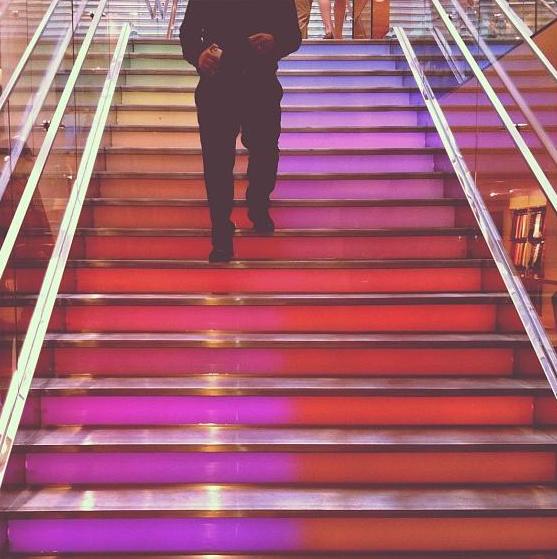
The three of us had a view of Uniqlo’s specially-designed-for-SF “magic mirror” (put on a down jacket, press a button, and the hue of your garment in the reflection shifts through the line’s different colors), its staircase of melting rainbow tones, and slowly rotating armies of mannequins clad in ski-ready fashions, ensconced in glass cases.
Zech worked in Uniqlo’s Japanese locations for months before the SF stores opened, and he says the company’s goal is to bring the Japanese concept of supreme customer service, irrashai mase, to the rest of the world.
When you walk into Uniqlo, a person in a happi day kimono greets you warmly. But other than that, I couldn’t see much of a difference between the cheery sales staff there versus that of any of the other chain stores in the neighborhood.
You won’t find happi on sale at Uniqlo. Instead, its affordably-priced cashmere, “Heat Tech” clothing — that I promise you, actually tingles and heats your skin up — and $9.90 packable raincoats (the only clothing item made specifically for the SF store) dominate the sales floor.
In 2010, the company’s official language switched to English. All managerial staff worldwide is required to speak it. “We found that people basically need the same things in Japan, France, London, here,” chirps Kech. “[CEO] Tadashi Yanai thinks we can improve the world by being a global company.”
Which snapped me out of the reverie I’d been lulled into by banks of $29.90 beige boot-cuts. Are Uniqlo and Muji really all that different than the globalized brands from the United States? Walmart, after all, has store greeters.
“If the product is good, it will sell,” regardless of geography, Horibuchi told me. These big brands have real cute stuff (admittedly, I would like to draw Santa’s attention to Muji’s $38 cardboard MP3 speakers.) But you’re not being worldly by shopping at them, though you are being globalized.
Sam Flores, a graffiti-inspired artist whose work often deals with religious themes, now turns his attention to the conflicting symbols of violence and innocence. His recent paintings, which show a more classical style than previous works, depict the lion and the lamb amongst other figures in chaotic, urban settings. These bold and deeply hued paintings convey the convoluted relationship between good and evil. As a prominent artist in the crossover between urban and fine arts, you may have found his work alongside painter-designer, Jeremy Fish or tagger-tattoo artist, Mike Giant. Like many others, Flores got his start designing for skateboard and clothing companies, but with more and more solo exhibits, his painting has begun to flourish. This show should be a great example of the strong voice he has found. (Molly Champlin)
Oddball Americana guru Charles Phoenix has explored and celebrated the best in kitschy, cool, and kooky artifacts and history for many years now, having written several books on mid-20th century, deep-fried pop culture, fashion, lifestyle and more. The author of tomes such as Southern California In The 50s, and Americana The Beautiful brings his hilarious holiday show and talk to the city, set to roast not just Christmas, but all of the holidays with his ever-growing collection of slides and tales of his off-beat and always colorful road trip adventures. (Sean McCourt)
The Grouch is continuing his annual holiday hip-hop tour through 18 cities across the West Coast. This year the merry night in San Francisco will include performances by Bay Area native Mistah F.A.B., Minneapolis-based artist Prof, DJ Fresh, and of course, the Grouch and Eligh. Apart from the live show, Mistah F.A.B. will host a Battle of the Bands/MCs Showcase where participants will have the platform to show their own talent. The freestyle champion will win a Grouch Merchandise pack and a pair of Able Planet studio headphones. (Soojin Chang)
Subterranean Arthouse’s Third Annual Chanukah Party
Yiddish supergroups, klezmer dance parties, and tzedakah, all wrapped into one shiny gold coin of an evening. The Subterranean Arthouse’s Chanukah Party is part of Heather Klein’s "Hungry for Yiddish: A Mitzvah Project" concert series, which donates proceeds from events to the Berkeley Food Pantry and similar organizations; and the event is co-presented by KlezCalifornia and the Jewish Music Festival. Acts include Klein’s Inextinguishable Trio, Anthony Mordechai-Tzvi Russell, noted Yiddish dance instructor Bruce Bierman, and Saul Goodman’s Klezmer Band. With instructions from Bierman, the lovely Yiddish songs of both Klein and Russell, and Goodman’s brassy klezmer, this should make for a fun, frenzied mid-point party during the festival of lights — and yes, they’ll light the menorah. Chag Sameach, Berkeley. (Emily Savage)
9pm, $10–$20 donation
Subterranean Arthouse
2169 Bancroft, Berk.
Klezmer.brownpapertickets.com
FRIDAY 12/14
Dylan Moran
Perhaps best known to American audiences for his appearances in Shaun of the Dead and Run, Fatboy, Run, Irish comedian Dylan Moran is a huge hit in his native UK, notably for his brilliant role as a cantankerous and drunk, yet lovable book shop owner in the tragically short-lived BBC series "Black Books." His live stand-up is where he’s really making his name now though; his current "Yeah, Yeah" tour is only stopping in New York, Los Angele, and here in San Francisco — consider yourself lucky and don’t miss your chance to see one of funniest comics on either side of the pond. (McCourt)
I’d like to sit on some front porch (any porch, really) with John Darnielle and just listen to him tell stories — maybe over a glass of whiskey and several puffs of something. Sometimes telling the truth, but mostly relying on a wild imagination, the Mountain Goat’s dynamic leader has been writing songs about addiction, infidelity, and more sensitive subjects for the last 20 years. The group’s new album, Transcendental Youth, has been an excuse for Darnielle to branch out, inviting avant-symphonic rocker, Matthew E. White, to write horns for the album and working with Owen Pallett to arrange the songs for a collaboration with the a cappella quartet, Anonymous 4. This should be a well-worn show — mixing old and new in a chaotic journey through the picaresque scenes of Darnielle’s mind. (Champlin)
The glorious annual flamenco season is in full swing — so much emotion, so much drama, so much invigorating live sound and movement, olé! It’s all a perfect rehearsal for your upcoming family holiday gatherings. Next up, fantastic choreographer Yaelisa and her Caminos Flamencos company, an enthralling troupe that stomps, whirls, hypnotizes, and enraptures like a force of nature, all under the expert musical direction of Jason McGuire "El Rubio." I would say the distinguishing feature of Yaelisa’s work is its generous spirit and breadth of technique. As evidenced by Caminos’ show last year, she favors longer solos and duos, giving each featured performer enough time to weave a spell of exquisite technique and subtle variations. Gorgeous costumes (hello, tight-pantsed toreadors!) and music from an international ensemble helps turn up the magic past 10. (Marke B.)
As urban art has become more popular, many taggers are making a profit from their work in the gallery world. New2, who has been writing in Australia since the movement began in the early ’80s, is one of these. He’s worked in a variety of spray paint alternatives when bringing his work indoors, including paint, sculpture, and paper. His most recent project, "In One Hand A Ghost, The Other an Atom," uses intricate, paper cut-outs to merge his long tradition of writing (the ghost) with his futuristic take on letters (the atom). In the show, care and thoughtfulness form the same bright colors, geometric currents, and space themes that he has developed in years of experimentation on trains and empty walls. (Champlin)
Making dances — we all know — is a lonely and precarious enterprise. You can’t just sit down on your keyboard and write your poems. You need bodies and a bigger area than your kitchen. That’s why ODC’s Pilot program is such a gift to young choreographers. They get 11 weeks, a studio, a tiny budget, and a lot of feedback. In return, they have to commit to two public performances — of which we are the beneficiary. Seeing what gifted but not-yet-established choreographers come up with is a thrill like few others. In its 61st incarnation, Pilot will introduce Jenni Bregman, David Schleiffers, Katharine Hawthorne, Erin Malley, and Phoebe Osborne. They are calling the program Nightcap. (Rita Felciano)
You’ve seen ’em: those piles of mysterious VHS tapes, often unmarked, gathering dust at Community Thrift. Found Footage Festival curator-hosts Nick Prueher and Joe Pickett live for the thrill that comes from finding bizarre, hilarious cast-off videos — and they’re on the road, sharing their fascination with audiences across the country. The 2012 program of repurposed entertainment looks to be stuffed with gems, gut-busters, and things that make you go "WTF?": ferret-care tips, freaky craft-sponging, and something called "The Sexy Treadmill Workout." Head to the FFF website to whet your appetite with the "VHS Find of the Day" feature. Two words: cat massage. (Cheryl Eddy)
Dee Dee from the Dum Dum Girls and Brandon from the Crocodiles are in love — married, in fact, and make a rather swoon-worthy couple. She with her thick-lined lids and vertical striped tights, he with his dark sunglasses. Listen to Dee Dee’s crooning on "Bedroom Eyes" off 2011’s Only In Dreams, in which she repeats "fear I’ll never sleep again" and you start to get a sense of their connection, and the pain they feel apart on separate tours. To view said connection live, in all its gushy splendor, be the voyeur at their joint Rickshaw Stop show tonight; a very special showcase, indeed, where both will perform songs from their respective catalogs and — as I can only imagine — harmonize like old lovers do. Like Johnny and June, Exene and John Doe, all those passionate, oft-heartsick music mates that have come before them, the duo is sugar and spice with a splash of whiskey. (Savage)
Although he has garnered a considerable amount of national mainstream success in the last 25 years as the author of a series of popular mystery novels and non-fiction books touching on politics, writer and all-around raconteur Kinky Friedman first made a name for himself as a singer and songwriter. In the early 1970s, along with his band the Texas Jewboys (he was raised by Jewish parents in the Lone Star State), he penned a slew of country and twang-tinged tunes such as the rollicking and humorous "They Ain’t Making Jews Like Jesus Anymore." He hits the city tonight as part of his "Bipolar" tour. This is your chance to meet the man, as he promises to "sign anything but bad legislation!" (McCourt)
The Guardian listings deadline is two weeks prior to our Wednesday publication date. To submit an item for consideration, please include the title of the event, a brief description of the event, date and time, venue name, street address (listing cross streets only isn’t sufficient), city, telephone number readers can call for more information, telephone number for media, and admission costs. Send information to Listings, the Guardian, 225 Bush, 17th Flr., SF, CA 94105; or e-mail (paste press release into e-mail body — no attachments, please) to listings@sfbg.com. Digital photos may be submitted in jpeg format; the image must be at least 240 dpi and four inches by six inches in size. We regret we cannot accept listings over the phone.
YEAR IN MUSIC “We weren’t supposed to be allowed to play live on the morning news,” Ty Segall says just moments after finishing a meal at In-N-Out, on his way down the coast from San Francisco, the city he can no longer afford to live in, to pick up his 16-year-old sister from his hometown of Laguna Beach. “Giving a bunch of long-haired weirdos really loud amplifiers and free reign on the morning news is just stupid. So I thought that was a great opportunity to do whatever the hell we wanted.”
“And I’m really happy we did that,” he says of the Ty Segall Band’s bizarrely mesmerizing performance of “You’re the Doctor” off this year’s Twins (Drag City), on the Windy City’s WGN Morning News in October. It ended with screeching feedback and Segall repeatedly screaming “Chicago!” into the mic. “It was way too early, so we were already feeling a little weird.” The weirdness rubbed off on the news anchors, who, when the camera panned back to them mid-song, were throwing papers up in the air and pogoing behind their desk. It made for a great split second.
The band also made its late night debut in 2012, on perhaps more appropriate Conan. Segall, drummer Emily Rose Epstein, bassist Mikal Cronin, and guitarist Charlie Moothart seemed a bit more in tune with that set-up and host, playing Twins‘ awesome “Thank God For Sinners.”
The group of old friends toured extensively this year, playing a whole bunch of festivals including Bumbershoot, the Pitchfork Music Festival (“I had no idea what to expect with that one, because like, you know, Pitchfork is almost a mainstream media outlet now. But that was one of the most wild, definitely craziest festival we played”) and Treasure Island in San Francisco (“most beautiful festival…the scenery — it was just psychotic”).
http://www.youtube.com/watch?v=CCMSYRgRdAo
And Segall again had a full hand of releases over these 12 months. He began the year with a White Fence collaboration: Hair (Drag City), following that up with a Ty Segall Band record, Slaughterhouse (In the Red). Then in October he dropped a solo album, Twins (Drag City).
Each record stood for itself. They were recorded with different bands at various locations (Eric Bauer’s studio in Chinatown, the Hangar in Sacramento). Hair was a true collaboration between Segall and White Fence’s Tim Presley, exploring one another’s strengths through fuzzy noise, psychedelic wanderings and the occasional surfy licks. It was originally slated to be an EP, but it was going well, they decided to put out a full LP.
Slaughterhouse kicks off with foaming feedback and maintains a sonic assault of aggressive, noisy guitars, screaming in the ether, throughout — a loud, frenzied, psychedelic garage-punk masterpiece. Bluesy-punk thumper “Wave Goodbye” turns down the riffs on the intro and lets Segall’s nasal intonations take charge, with a ’70s punk approach: “I went to church and I went to school/I played by all of your other rules/but now it’s time to…wave goodbye/Bye bye.” He shrieks that last “bye bye,” simultaneously recalling early Black Sabbath, and sonically flipping the bird.
Twins was the solo triumph, lyrically exploring Segall’s dual personalities between his thrashy stage persona, and his casual, polite, dude-like demeanor off-stage.
“Who can know the heart of youth but youth itself?” — Patti Smith in ‘Just Kids.’
Segall first picked up the guitar at 15 after hearing Black Flag. “I was super into Black Sabbath and Cream and classic rock and then I heard Black Flag and I was like ‘dude, I can play punk.'”
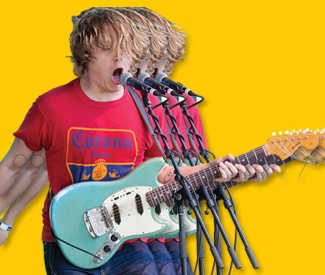
The multi-instrumentalist still plays guitar, first and foremost. Currently, he sticks to a ’66 baby-blue Fender Mustang he calls “Old Blue” or “Blue-y,” but brings along a ’68 Hagstrom as backup.
During the week of Halloween though, Segall, 25, played drums with the first band he joined when he moved to San Francisco eight years back, straight-forward punk act Traditional Fools. It was at Total Trash’s Halloween show at the Verdi Club with a reunited Coachwhips (with Thee Oh Sees’ John Dwyer) and it made for an epic night of reunions for the two men most associated with the current garage rock scene in San Francisco. “I have always thought, and will always think, that John Dwyer is the savior of rock and roll.”
When I bring up the news of Segall’s pal Cronin signing to Merge recently, he has a similar compliment for him: “He’s going to be the savior of us all. I can’t wait until you guys hear his next record; it’s insane.” Segall swears Cronin will be the next big thing.
Late last week, In The Red Recordings announced it would be reissuing Segall and Cronin’s joint 2009 surf-laden, chainsaw-garage record Reverse Shark Attack. In a video from that era for the song “I Wear Black,” Segall and Cronin cruise through town on skateboards in washed-out clips, ever the beach-bred rockers.
It was just three years ago, but that’s lifetime in Ty-land.
As the city has watched him grow Segall has maintained a youthful glow, a raucous, energetic punk spirit surrounded by sun-kissed California locks and a fuck-everything attitude. His sound, however, has expanded. How couldn’t it? He put out three records in 2012, and a dozen more in his relatively short lifetime.
But youthful abandon has caught up Segall. He can longer afford to live and work in San Francisco, the city that loves him so. He plans to move to LA in March or April of 2013. Will the wide sea of local rockers here soon follow suit? How many have we already lost to the rising tides of tech money? It’s a question currently without an answer.
“It’s really expensive,” Segall says. “I’ve loved it there, but I can’t even play music…I can’t work at my home. It’s a drag. I think a lot of musicians and artists are being forced to move out of San Francisco because they can’t afford it, and they can’t really work anymore because they can’t afford housing that allows for noise.”
It seems backward, that a year full of such booming professional success and critical acclaim should be the final year he’s able to afford the life he’s lead for the better part of a decade. But perhaps he just needs a break, to go back and focus all of his time and energy on a single release in the far-off future. Give his tired mind a minute to grasp his explosive last year.
“[In 2013] I’m going to like, get my head wrapped around the next thing and take some time, [and] slowly and lazily start working on demos,” he says. “There’s definitely not going to be a record from me for a year. I just want to focus on one thing and make it as best as I can. I’ve never really focused on just one thing for a year straight, so I’d like to do that.”
EMILY SAVAGE’S LIST OF NEW ALBUMS I LISTENED TO ENDLESSLY IN 2012
1. Grass Widow, Internal Logic (HLR)
2. Cloud Nothings, Attack on Memory (Carpark)
3. Ty Segall, Slaughterhouse (In the Red)
4. Dum Dum Girls, End of Daze EP (Sub Pop)
5. Frankie Rose, Interstellar (Slumberland)
6. Godspeed You! Black Emperor, Alleluja! Don’t Bend! Ascend! (Constellation)
7. The Fresh and Onlys, Long Slow Dance (Mexican Summer)
FILM Early last week, the Academy of Motion Picture Arts and Sciences announced the 15-film shortlist from which the five Best Documentary nominees will be culled. There are some strong contenders — including The Waiting Room, set at Oakland’s Highland Hospital — but two of 2012’s highest-profile docs were oddly absent: Amy Berg’s West of Memphis (which opens locally Feb. 8) and Ken Burns’ The Central Park Five, which opens Friday. It might be ironic that both films are about injustice.
The exclusion of Memphis could simply be due to thematic fatigue. No amount of producer Peter Jackson’s Middle-earth millions could massage away the fact that 2011’s Paradise Lost 3: Purgatory — the final entry in Joe Berlinger and Bruce Sinofsky’s series of West Memphis Three docs going back to 1996 — was nominated, and lost to a feel-good flick about high school football. (Atom Egoyan’s narrative film based on the case is due in 2013.) The only chance for a WM3 doc to win an Oscar, it seems, will be if the real killers are ever discovered — in which case, place your bets on which movie will be made first: Paradise Lost 4 or West of Memphis 2.
The case at the heart of The Central Park Five is different from the West Memphis ordeal in several notable ways: it was a rape and beating, not a triple murder; there were five teens convicted of the crime, not three; instead of “Satanic Panic,” it had racial overtones (the victim was white; the accused were African American and Latino) inflamed by NYC’s screaming-headline press; and no celebrities bothered to take up the Central Park Five’s cause, unless you count veteran documentarian Ken Burns (who co-directed with his daughter, Sarah Burns, and David McMahon, Sarah’s husband). Also, the real rapist has been found — his confession, corroborated by DNA evidence, is played at the beginning of the film — though he came forward after most of the accused had finished serving their time.
The filmmakers do well to contextualize the case, using news footage and interviews to reconstruct the mood of 1989 New York City. It hardly resembled its glittering present incarnation: there was a crack epidemic, rampant street crime, and an average of six murders a day. Even still, the Central Park jogger attack was sensational enough to spark intense, racially-biased media coverage; the fact that Antron McCray, Kevin Richardson, Raymond Santana, Korey Wise, and Yusef Salaam had confessed to the crime just exacerbated the public hysteria.
But as The Central Park Five makes clear, those confessions were coerced from scared young men who’d already been interrogated for several hours. As the accused recall in present-day interviews, they all had been in the park that night, as part of a larger group whose misdeeds included rock-throwing and harassing passers-by. There was no physical evidence tying them to the jogger (who had no memory of being brutalized), and the timeline of her assault and their movements in the park didn’t quite line up. But “the confessions seemed genuine,” remembers a juror. “It was hard to understand why anyone would make that kind of thing up.”
None of the NYC police or prosecutors involved in the case are interviewed in The Central Park Five. Two reasons: an ongoing civil rights lawsuit filed by the wrongfully convicted men (which now involves the filmmakers — in September, they were subpoenaed for footage of the accused discussing their confessions); and really, who wants to go on record admitting that they failed, and ruined multiple lives as a result? Unlike the WM3, the Central Park Five’s “innocence never got the attention that their guilt did,” historian Craig Steven Wilder points out. Academy Award nomination or not, The Central Park Five may help change that.
Like the injustice doc, another late 2012 trend is the presidential biopic. Weeks after the release of Lincoln, Hyde Park on Hudsonarrives with a lighthearted (-ish) take on Franklin D. Roosevelt’s 1939 meeting with King George VI (of stuttering fame) and Queen Elizabeth at FDR’s rural New York estate. Casting Bill Murray as FDR is Hyde Park‘s main attraction, though Olivia Williams makes for a surprisingly effective Eleanor.
But the thrust of the film concerns FDR’s relationship with his cousin, Daisy — played by Laura Linney, who’s relegated to a series of dowdy outfits, pouting reaction shots, and far too many voice-overs. The affair has zero heat, and the film is disappointingly shallow — how many times can one be urged to giggle at someone saying “Hot dogs!” in an English accent? — not to mention a waste of a perfectly fine Bill Murray performance. As that sideburned Democrat bellows in Lincoln, “Howwww dare you!” *
THE CENTRAL PARK 5 opens Fri/14 in the Bay Area; HYDE PARK ON HUDSON opens Fri/14 in San Francisco.
There’s been growing media coverage of the widely anticipated 12/21/2012 date – which marks the end of the Mayan Long Count calendar, a rare Winter Solstice galactic alignment, and associated New Age predictions – with journalists and skeptics scoffing at doomsday predictions that it will trigger the apocalypse.
Yet as I’ve researched the prophecies, predictions, and possibilities associated with 2012, it seems that the only significant people offering up such end-of-days views are those seeking to mock them, shoot them down, or whip up hysteria. And nobody is feeling more frustration over this straw man media hype than author/researcher John Major Jenkins, who has written more about the significance of this date than anyone.
Before Jenkins would even let me interview him, he had me read the “Guide to 2012” that he prepared for those interested in writing about the subject, which he begins by reinforcing the accuracy of the 12/21/2012 date and clarifying its significance. “The doomsday assumption is not found in Maya tradition,” wrote Jenkins, who has researched the subject for 25 years and written nearly a dozen books on Mayan cosmology and beliefs. “The evidence indicates that Maya concept for cycle endings (such as 2012) is transformation and renewal.”
That idea – that we’re leaving an age focused on competition and consumption and entering an era of greater cooperation and connection – has been emphasized by everyone that I’ve interviewed on the concept. That includes New Age authors, a professor who studied Mayan folklore, political activists seeking a shift now to avoid real ecological and economic catastrophes later, and astrologers focused on the alignment of the earth, sun, and dark center of the Milky Way for the first time in 13,000 years (when that alignment occurred on the Summer Solstice, double that period for the last time it appeared this way on the longest night of the year, which some view as a more significant catalyst for change).
“I feel like the collective has been unable to receive the basic message I’ve been trying to give,” Jenkins told me, a hint of irritation in his voice as he recounted his painstaking research into Mayan artifacts and beliefs, the significance of which lies largely with their connection to the natural world that many modern people have lost. “That doesn’t seem to be what the collective wants or what the mainstream media want to say.”
Jenkins expresses almost equal frustration with those who seek to discredit or misrepresent his work as he does with those who have appropriated it for their own political or self-aggrandizing purposes. “We don’t know what’s going to happen,” he said. “We’ve been filtering 2012 through this kind of Nostradamus lens.”
Yet beyond his main point of simply understanding and honoring the Mayan people, Jenkins does hope that people use this moment as a prompt to create a transformation in global consciousness: “The challenge is for us to engage in and participate in the world in a more sustainable way and get past the domination mode.” And by “moment,” Jenkins and others emphasize that 12/21/2012 is the peak of moment lasting weeks, months, or years, depending on people’s perspectives.
Rob Brezsny, the San Rafael resident whose down-to-earth Free Will Astrology column has been printed in alt-weeklies throughout the country for decades, told us he respects Jenkins’ work and sympathizes with his current plight. “He gets it from both sides,” Brezsny said, noting how Jenkins gets attacked by both the skeptics and true believers.
Brenzsny is also a little skeptical about all the hype and focused hope surrounding 2012 – mostly because he thinks such magical thinking discounts the need for the long, hard work involved in either spiritual or political transformations – but he does believe in the importance of markers and rituals like those associated with the 12/21/2012 date.
“I think most people these days understand that how the world proceeds is through spectacles,” Brezsny told me. “The activists believe this may be a good moment, a good excuse to have a transformational ritual and to take advantage of this time. We need transformational rituals…Rituals have been a way to marshal our emotional and spiritual resources.”
Both Jenkins and Brezsny acknowledge the difficulty, even the danger, of relying too much on this moment to spark the sociopolitical renewal the world needs. “It’s a complex phenomenon as far as cultural change, and the recognition that things need to be done differently,” Jenkins said.
Yet Brezsny said that to achieve the kind of fundamental transformation that humans need to address issues like global warming and the mass extinctions now underway, that begins with a personal awakening and realization of our connection to one another and the planet. We need to set aside our egos and selfish desires, listen to one another, regain our connection to the natural world, and learn to work together. As Brezsny said, “For me, so much of what the revolution is about is how we treat each other moment to moment.”
These are just two of the dozens of sources that I’ve been interviewing about the 2012 predictions and possibilities, which I’ll take an in-depth look at from a variety of perspectives for the Guardian’s long Dec. 19 cover story (we’ll also include listings and other resources for how to spend that much-anticipated moment, such as the World Unity 2012 online hub).
Then I’ll be traveling through Mayan country in the Yucatan from Dec. 17-23, interviewing fellow pilgrims and wisdom keepers, visiting Tulum and other significant sites, and attending the Synthesis Festival in Chichen Itza, Mexico (and perhaps the Day Zero Festival in Playa del Carmen), so I hope you’ll follow along with my regular postings on this site. See you on the other side.
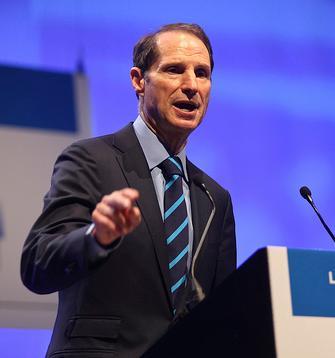
And the really scary thing is that Sen. Dianne Feinstein is pushing this, and only one member of the Senate Intelligence Committee, Ron Wyden (D-Oregon) voted against it — and if if weren’t for his single-handed moves to block the measure, it would probably already be law.
I think Len Downie has one of the best arguments against the measure:
The most troubling provision in the bill would prohibit all contact with the news media or “any person affiliated with the media” by any intelligence officials other than an agency’s director, deputy director or “specifically designated” public affairs officers — all of whom are political appointees. That could limit the flow of intelligence information to what political appointees decide to tell reporters, in “authorized leaks,” for political purposes. Reporters could be cut off from more knowledgeable and impartial career analysts, such as those who disclosed, in the run-up to the Iraq war, their doubts about Bush administration claims of Iraqi weapons of mass destruction. This prohibition “would make everyday reporting about everyday intelligence activities practically impossible,” Jack Goldsmith told me. “It would promote opportunistic spinning by the executive branch, which is already a problem.”
In other words, more official misinformation, more spinning that gets us into more wars — and now way to counter it.
San Francisco’s next great designer, sculptor, or filmmaker could possibly be in attendance this Sat/8 at the second annual San Francisco Youth Arts Summit taking place at SOMArts Cultural Center.
Maybe the next big things will be Maeve Fitzhoward and Brandy Ruedas, two youth artists who we met who will be showcasing – and selling, hey – their printmaking projects from Out of Site youth arts center, which will help host Saturday’s science-fair-meets-arts-gala. Fitzhoward and Ruedas also dish out advice to other artists through their positions on the Out of Site youth advisory board.
The Guardian also spoke with another Out of Site participant Mari Galicer, who’s been taking the digital media class this past semester. Galicer has learned how to create and manipulate film using programs like FinalCut Pro and Photoshop. Right now she’s working on a film with a group of peers about the city’s 11th district. If you stop by to see her, smile pretty – she’s putting together footage of this weeks’ Art Summit for an upcoming promotional video for Out of Site.
The summit will feature a total of 200 teenage artists from over 20 youth arts organizations. Attendees will also get to check out autuers from YBCA’s Young Artists at Work program, the Children’s Creativity Museum, and BAYCAT‘s base of budding Bayview media types.
While you’re perusing the various works of art you may want to indulge in some printmaking at the Out of Site bartering bank and ATM (Art That Matters) machine, or unleash your inner filmmaker by creating a stop-motion video at the mobile animation studio. If you’re a wordsmith, show off your literary skills at a poetry workshop with members of the WritersCorps, SF Mime Troupe, and TILT, the independent film center for young people.
UPDATED A group calling itself the Anti-Colonial Anti-Capitalist 19 (ACAC19), representing 19 demonstrators who were arrested Oct. 6 in downtown San Francisco during a Columbus Day protest that devolved into a violent clash with police officers, says the Twitter account information of two protesters has been subpoenaed by local police or prosecutors.
“They got a letter saying Twitter was going to turn over the files unless the defendants filed a motion to quash, which they’re going to do on Friday,” said Tony Marks-Block, a spokesperson for the group, which has started a blog and campaign of Twitter postings to publicize their plight.
The Guardian could not independently confirm the subpoenas, letter, or the identities of those targeted, which Marks-Block told us the defendants were unwilling to release yet because of legal concerns. [UPDATE 12/10: Marks-Block has shared redacted copies of the subpoenas, which were served on Twitter by the District Attorney’s Office on Nov. 13, with the Guardian. It claims the account information being sought “would tend to show there was a conspiracy or agreement to stage a riot, to unlawfully assembly, and to wear a disguise while partaking in criminal activities; thus, the records or lack thereof are material to the crimes charged.”]
Twitter spokesperson Jim Prosser told us, “We don’t comment on specific requests or an individual user.” And SFPD spokesperson Albie Esparza denied the group’s claim that the SFPD issued the subpoenas, telling us, “This matter was not handled by the SFPD.”
But given that the case is currently with the District Attorney’s Office, with a pretrial conference scheduled for Dept. 16 in Superior Court tomorrow (Fri/7) at 1:30pm, it’s likely that any subpoenas would have come from prosecutors rather than police. DA’s spokesperson Stephanie Ong Stillman told us, “We cannot go into specific details about this case because there is an ongoing investigation.”
Protesters in the group were initially charged with felony conspiracy and inciting to riot charges, which have since been scaled back to misdemeanors. And police officers who broke up the protest came under fire after video from the incident showed a violent crackdown by officers, which police sources said was prompted by block bloc protesters hurling bags of paint and other projectiles.
The group charged that the crackdown and invasive investigation were intended to quell efforts by these and other anarchists to challenge capitalism. “This invasion of privacy is part of a current wave of political repression on the West Coast,” member Marion Delgado said in the press release. “The federal Grand Jury investigations in the Pacific Northwest and this attempt to stop us from using social media are connected. We’re been attacking capitalism; they’re attacking back.”
In the cases that have been made public, San Francisco-based Twitter has generally resisted law enforcement efforts to subpoena information about users engaged in First Amendment-protected activities, starting with the US Department of Justice’s 2010 effort to gather information about Wikileaks and continuing after New York City law enforcement officials issued a subpoena to get account information from an Occupy Wall Street protesters arrested on the Brooklyn Bridge of Oct. 1, 2011, which Twitter has been fighting in court. In August of this year, Twitter complied with an NYPD subpoena for a user who threatened to massacre theater-goers.
As Delgrado said in the press release, “This is not the first time the online information network has been used as a resource for state repression of political activity. This is part of an ongoing effort to chill political movements in the Bay Area and beyond.”
The Media Alliance, a local media watchdog group leading the media consolidation battles, says in an SOS message that the Federal Communications Commission is once again trying to jam through new rules during the Christmas rush to facilitate more media consolidation. The FCC, the Alliance points out, “touts localism, competition and diversity as the hallmarks of a healthy media ecosystem. This rule change guts all three.” Here is the Alliance’s action alert (b3):
New proposed rules relax media cross-ownership rules (again) paving the way for more media concentration and polishing the path for the Rupert Murdochs of the world to buy up everything that’s left.
In the now-familiar holiday season hurry-up employed by federal agencies when they want to sneak something through before the public has a chance to get outraged about it, FCC commissioner Julius Genachowski has proposed a relaxation of the media cross-ownership rules remarkably similar to Kevin Martin’s try at increasing media consolidation several years ago.
What can you do?
Tell the Democratic commissioners they need to fight this and that as a member of the public, you have their back if they publicly oppose the Christmas rush to media consolidation today – December 4th National Day of Action:
And then send a tweet @fcc no xmas sneak #mediajustice
Background:
The relaxation permits the same corporation to own print, radio and television outlets in the top 20 communication markets in the US, condemning urban populations to canned and repetitive news and information, especially those who depend heavily on free over-the-air broadcasts.
The FCC is trying to jam these rules through during the holiday siesta to avoid the outpouring of public protest engendered during the last attempt at relaxing the rules, when the FCC received the largest quantity of public comments in their history and eventually lost in court and rescinded the attempted rule change.
The FCC was ordered to do research into impact on the diversity of media ownership, particularly by women and minorities. Despite completing a comprehensive whose initial results indicate little to no improvement in increasing ownership diversity and not completing a full impact report on the mounds of ownership data received in the quadrennial report, the FCC seems to be determined to move ahead with the rule change in an evidence-free zone. The FCC touts localism, competition and diversity as the hallmarks of a healthy media ecosystem. This rule change guts all three.
Links:
Politifact ranks Obama’s promise to foster media diversity as a broken promise:
Schedules are for Wed/5-Tue/11 except where noted. Director and year are given when available. Double and triple features marked with a •. All times pm unless otherwise specified.
ABCO ARTSPACE 3135 Filbert, Oakl; www.everythingisterrible.com. $10. "Everything is Terrible! Holiday Special!," found-footage video collage, Sat, 10.
"ANOTHER HOLE IN THE HEAD FILM FESTIVAL" Terra Gallery, 511 Harrison, SF; Roxie, 3117 16th St, SF; Victoria, 2961 16th St; and Vortex Room, 1082 Howard, SF; www.sfindie.com. Ninth annual festival of genre films, with 28 features and 26 shorts, Wed-Sun.
ANSWER COALITION 2969 Mission, SF; www.answersf.org. $5-10. Occupy the Bay (Riley, 2012), Thu, 7.
ARTISTS’ TELEVISION ACCESS 992 Valencia, SF; www.atasite.org. $6. "Other Cinema:" works by Jeremy Rourke, Ben Wood, and others celebrating forgotten formats and media archaeology, Sat, 8:30.
BALBOA 3630 Balboa, SF; www.cinemasf.com. $10. •Remembering Playland at the Beach (Wyrsch, 2010), Sat, noon, and Sutro’s: The Palace at Lands End (Wyrsch, 2011), Sat, 1:30. With director Tom Wyrsch in person.
CASTRO 429 Castro, SF; (415) 621-6120, www.castrotheatre.com. $8.50-11. •Get Carter (Hodges, 1971), Wed, 2:40, 7, and The Trip (Winterbottom, 2010), Wed, 4:50, 9:10. Mystical Traveler: The Life and Times of Dr. John-Roger (2013), Thu, 7:30. This event, $10; preceded by free video seminars from Dr. John-Roger, Thu, 9am-6pm. More info at www.mysticaltraveler.com. "Midnites for Maniacs: No Pain No Gain Triple Bill:" •Bring It On (Reed, 2000), Fri, 7:30; Hairspray (Waters, 1988), Fri, 9:30; and Kickboxer (DiSalle, 1989), Fri, 11:30. Samsara (Fricke, 2011), Sat-Sun, 2, 4:30, 7, 9:15. "Rick Prelinger Presents Lost Landscapes of San Francisco 7," Tue, 7:30. More info at www.longnow.org.
CHRISTOPHER B. SMITH RAFAEL FILM CENTER 1118 Fourth St, San Rafael; (415) 454-1222, www.cafilm.org. $6.75-$10.25. A Late Quartet (Zilberman, 2012), call for dates and times. A Royal Affair (Arcel, 2012), call for dates and times. "Pierre Étaix: Lost and Found:" Le Grand Amour (1969) with "Happy Anniversary" (1962), Fri and Dec 13, 6:45 (also Fri, 4:30); The Suitor (1963) with "Rupture" (1961), Fri, 9; Sat, 2; Tue, 8:30; Yo Yo (1965), Sun, 5, 7:15; Dec 12, 8:30; As Long As You’re Healthy (1966) with "Feeling Good" (1969), Tue, 6:45; Dec 13, 9; Land of Milk and Honey (1971), Dec 12, 6:45. "Mysteries of the Krell: Making the Sci-Fi Epic Forbidden Planet," Sat, 7. This event, $12. White Christmas (Curtiz, 1954), Sun, 1. "A Century Ago: The Films of 1912," presented on a vintage projector with live accompaniment, Mon, 7. This event, $12.
PACIFIC FILM ARCHIVE 2575 Bancroft, Berk; (510) 642-5249, bampfa.berkeley.edu. $5.50-9.50. "Day With(out) Art:" United in Anger: A History of ACT UP (Hubbard, 2012), Wed, 7. "Grand Illusions: French Cinema Classics, 1928-1960:" Crime and Punishment (Chenal, 1935), Thu, 7; Port of Shadows (Carné, 1938), Fri, 7; Eyes Without a Face (Franju, 1960), Fri, 8:50; Les orgueilleux (Allégret, 1953), Sun, 3; Carnival in Flanders (Feyder, 1935), Sun, 5. "Wild at Heart: Barry Gifford:" Lost Highway (Lynch, 1997), Sat, 6; Perdita Durango (de la Iglesia, 1997), Sat, 9:10.
ROXIE 3117 and 3125 16th St, SF; (415) 863-1087, www.roxie.com. $6.50-11. Another Hole in the Head Film Festival, Wed-Fri. Visit www.sfindie.com for complete schedule. Just 45 Minutes from Broadway (Jaglom, 2012), Wed-Thu, 7, 9:15.
SF CINEMATHEQUE San Francisco Museum of Modern Art, 151 Third St, SF; www.sfcinematheque.org. $10. "Shifting Geographies/Special Relativity:" Deep State (Butler and Mirza, 2012), with other works, presented in association with SFMOMA, Thu, 7.
VORTEX ROOM 1082 Howard, SF; Facebook: The Vortex Room. $10. "The Vortex Apocalypse, or How I Learned to Stop Worrying and Love Thursday Film Cult:" •Chosen Survivors (Roley, 1974), Thu, 9, and The Last Days of Planet Earth (Masuda, 1974), Thu, 11.
YERBA BUENA CENTER FOR THE ARTS 701 Mission, SF; www.ybca.org. $8-10. "Honk If You’re Horny: Retro Sex Musicals:" Alice in Wonderland (Townsend, 1976), Thu, 7:30. Islam Unknown: Part Two (Elders, 2012), Sun, 2.
Spooky chanteuse Jill Tracy describes her new holiday release, Silver Smoke, Star of Night, as “the Christmas album for those who prefer the October chill.” She celebrates its release with three festive events, starting with tonight’s “Fragrance: The Allure and Magical History of Perfumes,” an after-hours party at the San Francisco Conservatory of Flowers. The evening is both concert and launch of her limited-edition fragrances (appropriately, devoted to “dark elegance”), created with local perfumers Nocturne Alchemy. Sat/8, the Hypnodrome (where Tracy has been known to perform with the Thrillpeddlers) hosts “Creepshow Christmas” — a family-friendly show mixing ghost stories with live accompaniment. Finally, Silver Smoke‘s official CD release shindig is Dec. 19 at the DNA Lounge. Spirits will be bright! (Cheryl Eddy)
The young MCs in Seattle rap duo Blue Scholars met, quite appropriately, in a hip-hop club at the University of Washington. You can hear these academic roots clearly in DJs Sabzi and Geologic’s smart, searing rhymes. The heady lyrical content of their work tackles serious, political issues such as socioeconomic mobility, empowerment, and questioning authority. Even more impressively, these boys don’t just talk the talk. Geologic’s history of activism in the Filipino-American community and the duo’s headquarters in 98118, the country’s most ethnically diverse zip code, is the perfect recipe for the smart, relevant hip-hop that the scene most desperately needs (we’re looking at you, Chris Brown). (Haley Zaremba)
Verrrry clever, Castro Theatre — programming back-to-back screenings of Get Carter (1971) and The Trip (2010). Gritty Get Carter follows a snarling Michael Caine as he prowls around Newcastle, punching his way through the local gangster contingent he holds responsible for his brother’s death. The Trip, a travelogue featuring Steve Coogan and Rob Brydon (playing exaggerated versions of themselves), contains some genius and quotable comedy — ABBA sing-offs, mock-epic speeches — but none more memorable than the two actors going head to head with their Caine impressions: “You were only supposed to blow the bloody doors off!” Truly, an inspired double feature. (Cheryl Eddy)
Get Carter 2:40 and 7pm; The Trip 4:50 and 9:10pm, $8.50–$11
It’s a bird! It’s a plane! It’s … er, definitely something, flying at you with the unstoppable momentum of a two-story wig and a pair of birdseed-filled balloons. You already know what’s green and ice skates (Peggy Phlegm) now come find out what’s queen and ice wobbles — all those years in man-stilletos can’t help you out on the rink, honey. This cherished annual hoot features a wealth of San Francisco’s beloved gender clown personalities threading their way through bewildered tourist families in Union Square (who actually get really into it, and by the end it’s a heartwarming family affair, full of squeals of delight). You can even skate with these swanning lovelies! No money back if you end up with a weave in your face. The great Donna Sachet — she of the stunning, form-fitting, fake-fur-trimmed ravishing red holiday dress — mistresses the ceremonies. Grab a warming adult beverage from nearby Emporio Rulli Il Caffe and join in the fun. But don’t you dare judge, or you might get Nancy Kerrigan’d. Skates are blades, remember. (Marke B.)
I’ve had some good times listening to San Francisco’s Sly and the Family Stone — both letting my mind wander the groove of their funky sound and feeling the sense of pride in one’s self that Sly Stone sings so well — and I’d venture a guess that you have too. Though that innovate teacher and leader has opted for life out of the spotlight, three of the original members, Jerry Martini (saxophone), Cynthia Robinson(trumpet), and Greg Errico (drums), are keeping the music alive with the help of a few younger talents. Mostly hailing from the Las Vegas area, these new members are all performers with rich experiences listening to Sly’s music. This new Family Stone recreates the old hits in a fresh show, hoping to bring the music to all generations. (Molly Champlin)
Streetlight Manifesto was pretty late to the ska game, releasing its first album in 2003, well over a decade after the genre’s revival heyday. Though in a way, the band’s timing was actually perfect. Born out of the ashes of previous Jersey ska-punk heroes Catch-22 and One Cool Guy, Streetlight’s catchy tunes and punk rock virility have been nearly single-handedly keeping third-wave ska alive in a world dominated by hip-hop, mainstream pop, and EDM. The band is ringing in the new year with the release of its fifth album, The Hands That Thieve. During this tour, Streetlight Manifesto promises to play new songs, old favorites, and everything in between; so put on your skanking shoes and lace ’em up tight. It’s gonna be a good night. (Zaremba)
Kim Gordon, artist and gallery director at Modern Eden, has curated the one-night-only art show, Hope Beyond, a benefit for the victims of Hurricane Sandy. The assembled line-up includes an impressive selection of artists representing a variety of pop-surreal and contemporary styles. The work ranges from the graffiti style sharpie drawings of Kidlew to intricate fusion of nature images and Hindi symbolism by Inge Vandormael. Personally, I’m excited to see what all of these artists will contribute to the show. Especially Serge Gay Jr. — an artist whose paintings collage and reproduce pop culture images to create dichotomies between what’s real and what’s fake and make you to take a second look at his subjects: beauty, violence, drugs, and race. With all art priced below $100 and the proceeds going to Hurricane Sandy victims, what’s not to love? (Champlin)
The folks in Imperial Russia loved The Nutcracker and kept it alive during Soviet times. But the West never saw it until some White Russians, who had escaped to San Francisco, nagged then San Francisco Ballet Artistic Director Willam Christensen to choreograph it in 1944. By now there are hundreds of versions all over the world; the oddest one I ever saw had Drosselmeyer arrive on a spaceship. SFB’s, choreographed by Helgi Tomasson in 2004, is set during the 1915 Panama International Exhibition. It lacks the cloying sweetness and sentimentality that infects so many others. Tomasson’s is a love letter to the City — cool, transparent, a little reserved and superbly elegant. (Rita Felciano)
Did you ever feel cheated as a kid when you would see cartoons and hear stories about elves making toys from scratch, then you got a Barbie doll or video game that obviously wasn’t cobbled at the North Pole? Well, now is your chance to watch the toys actually being made. Not by elves though, but by local artists. There will be over 35 of them at Root Division Art Space bringing creativity from their various fields (painting, sculpture, and illustration mostly) to the art of toy making. All the work will be sold for a flat rate of $40. Bring cash for some shopping, or just come to enjoy the atmosphere of creativity complete with music by DJ Yukon Cornelius. (Champlin)
I think I need to start with a disclaimer: I love John Prine. Yes, I’m completely biased when I say that he is one of the greatest living lyricists and you’d be lucky to go see him. But why take my word for it? His more than 40 years of successful songwriting can speak for themselves. Starting off as a Chicago-area postman doing open mics in his spare time, Prine eventually got noticed — by a young Roger Ebert. Now, almost 70 years after that glowing review, Prine is still an incredible songwriter and performer, and each song is a charming, witty, and poignant labor of love. In his time as a performer, many trends and genres have come and gone, but a great folk song never goes out of style. (Zaremba)
Continuing a long-running San Francisco tradition that takes advantage of the fact that the crab fishing season along the California coast coincides with the holiday season, the Fisherman’s Wharf Community Benefit District 2012 Crab Fest will offer up a tasty fete featuring the crustacean prepared in a variety of ways by local restaurants, along with exhibits, cooking demonstrations and more. A host of sustainably-produced regional wines will provide the perfect way to raise a toast to the annual event, which donates all proceeds to the San Francisco Firefighters Toy Program and the San Francisco Police Department’s Youth Fishing Program. (Sean McCourt)
Though the weather outside is frightful, the smolderingly creative queers performing tonight at El Rio are more than capable of keeping your toasty warm. The lineup alone is worth the sleigh ride to El Rio — burlesque from the bountiful Ms. Vagina Jenkins, jazzy moves courtesy East Bay punker Brontez Purnell, the release performance of drag king blueser K.B. TuffNStuff’s Trans of Venus album, and so much more hotness. But as if that wasn’t enough to draw you like a moth to flame, this: the evening is a benefit for Queer Rebels’ year-round lineup of genderbending, empowering art events like the Exploding Lineage! experimental film fest, two-day summit of Asian American activists, and the group’s annual eponymous production of queer takes on the Harlem Renaissance and beyond. (Caitlin Donohue)
Whereas Lou Reed was the primary source of the Velvet Underground’s swagger, and hard-bitten lyricism, John Cale took charge of the group’s more avant-garde leanings. Even 45 years after leaving the band, Cale continues to challenge and surprise his listeners, as evidenced by the title of his latest LP: Shifty Adventures in Nookie Wood. Largely devoid of the splintering bursts of noise that defined his formative years, and the rootsy pastoralism of Paris 1919 and Vintage Violence, Cale’s latest is an art-rock record in the tradition of Peter Gabriel and Kate Bush: affecting in its ability to experiment and take risks while working squarely within the pop template. Another gutsy effort from an aging icon whose renegade streak hasn’t gone anywhere. See him while you can. (Taylor Kaplan)
The Guardian listings deadline is two weeks prior to our Wednesday publication date. To submit an item for consideration, please include the title of the event, a brief description of the event, date and time, venue name, street address (listing cross streets only isn’t sufficient), city, telephone number readers can call for more information, telephone number for media, and admission costs. Send information to Listings, the Guardian, 225 Bush, 17th Flr., SF, CA 94105; or e-mail (paste press release into e-mail body — no attachments, please) to listings@sfbg.com. Digital photos may be submitted in jpeg format; the image must be at least 240 dpi and four inches by six inches in size. We regret we cannot accept listings over the phone.
Since club life is unpredictable, it’s a good idea to call ahead or check the venue’s website to confirm bookings and hours. Prices are listed when provided to us. Visit www.sfbg.com/venue-guide for venue information. Submit items for the listings at listings@sfbg.com. For further information on how to submit items for the listings, see Picks.
WEDNESDAY 5
ROCK/BLUES/HIP-HOP
Bob vs Charles Johnny Foley’s Dueling Pianos. 9pm, free.
Curren$y, Paydin Cash, J. Price, Zyme, Eric Ryan Elliott, G. Maly DNA Lounge. 9pm, $25, all ages.
Gunshy Johnny Foley’s. 9pm, free.
How To Dress Well, Beacon, Seatraffic Rickshaw Stop. 8pm, $12-$14.
Keith Crossan Blues Showcase: Freddie Hughes Biscuits and Blues. 8pm, $15.
Lost Bayou Ramblers Chapel, 777 Valencia, SF; www.thechapelsf.com. 9pm, $10-$12, all ages.
Franco Nero, Tritonics, DJ Adam Elbo Room. 9pm, $7.
Surplus 1980, Satya Sena, Electric Chair Repair Co. Bottom of the Hill. 9pm, $9.
Trixie Whitley, Social Studies, Hosannas, Johnny Hwin x, Brodie Jenkins Brick and Mortar Music Hall. 8pm, $8-$10, 18+. Communion in San Francisco.
JAZZ/NEW MUSIC
"Del Sol Days" Z Space, 450 Florida, SF; www.zspace.org. 4-6pm, 8-10pm. $10. Two open rehearsals with composers Dylan Mattingly, Matt Cmiel, Lembit Beecher, and Irene Sazer.
Dink Dink Dink, Gaucho, Eric Garland’s Jazz Session Amnesia. 7pm, free.
Ricardo Scales Top of the Mark, 999 California, SF; www.topofthemark.com. 6:30pm, $5.
Tuck and Patti Yoshi’s SF. 8pm, $20.
DANCE CLUBS
Booty Call Q-Bar, 456 Castro, SF; www.bootycallwednesdays.com. 9pm. Juanita MORE! and Joshua J host this dance party.
Coo-Yah! Slate Bar, 2925 16th St, SF; www.slate-sf.com. 10pm, free. With Vinyl Ambassador, DJ Silverback, DJs Green B and Daneekah.
"Umloud" DNA Lounge. 7pm, $15, 18+. Charity concert for Child’s Play Charity with 27 bands.
JAZZ/NEW MUSIC
Break Up Record Release Party Lab, 2948 16th St, SF; www.thelab.org. 9pm, $7-$10. With Never Knows, Head/Head, Bezier, Space Burn.
"Del Sol Days" Z Space, 450 Florida, SF; www.zspace.org. 8pm, $15-$100 for gala reception. "Night" from GARDEN, a multi-media production by Del Sol.
Stompy Jones Top of the Mark, 999 California, SF; www.topofthemark.com. 7:30pm, $10.
Tuck and Patti Yoshi’s SF. 8pm, $20.
FOLK/WORLD/COUNTRY
El Gavachillo, DJ Senor Oz Elbo Room. 9:30pm, $10.
Twang! Honky Tonk Fiddler’s Green, 1330 Columbus, SF; www.twanghonkytonk.com. 5pm. Live country music.
Jonathan Warren and the Billy Goats Connecticut Yankee. 9pm.
DANCE CLUBS
All 80s Thursday Cat Club. 9pm, $6 (free before 9:30pm). The best of ’80s mainstream and underground.
Base: Attack of the DJs Vessel, 85 Campton Place, SF; www.vesselsf.com. 10pm, $10. With Quinn Jerome, Lisa Rose, Alex Sibley, John Destiny.
Bridge SF Public Works. 9pm, $15. With Guilty Simpson, House Shoes, Samiyam, Dibia$e, Knxwledge, Drewmin.
Ritual Dubstep Temple. 10pm-3am, $5. Trap and bass.
Supersonic Lookout, 3600 16th St., SF; www.lookoutsf.com. 9pm. Global beats paired with food from around the world by Tasty. Resident DJs Jaybee, B-Haul, amd Diagnosis.
Tropicana Madrone Art Bar. 9pm, free. Salsa, cumbia, reggaeton, and more with DJs Don Bustamante, Apocolypto, Sr. Saen, Santero, and Mr. E.
FRIDAY 7
ROCK/BLUES/HIP-HOP
Elvin Bishop Biscuits and Blues. 8pm, $39.
Bob, Nathan Temby, Charles Johnny Foley’s Dueling Pianos. 9pm, free.
Buttercream Gang, Surf Club, Horrorscopes Brick and Mortar Music Hall. 9pm, $7-$10, 18+.
Funkin’ Fridays with Swoop Unit Amnesia. 6pm.
Judgement Day, Young Hunter, La Fin Du Monde, Billions Upon Us Thee Parkside. 9pm, $8.
Moe. Independent. 9pm, $30.
Night Genes, White Teeth, Youth of Today Hemlock Tavern. 9:30pm, $7.
Ozomatli Fillmore. 9pm, $26.50.
Top Secret Band Johnny Foley’s. 9pm, free.
Turbo Fruits, White Lung, CCR Headcleaner Bottom of the Hill. 10pm, $12.
"Usual Suspects Songwriter Showcase" Neck of the Woods, 406 Clement, SF; www.rock-it-room.com. 7pm, $5.
Vhol, Lawless Elbo Room. 9:30pm, $12.
"What the Dickens Two-Day Fundraiser for Carole Lennon" Lennon Rehearsal Studios, 271 Dore, SF; lennonstudios.com/dickens.html. 4pm. With Lewd, No Alternative, Hemorage, Guverment, Next, D’Jelly Brains, and more.
World/Inferno Friendship Society, O’Death, Bobby Joe Ebola Slim’s. 9pm, $16.
Old School JAMZ El Rio. 9pm. Fruit Stand DJs spinning old school funk, hip-hop, and R&B.
Paris to Dakar Little Baobab, 3388 19th St, SF; (415) 643-3558. 10pm, $5. Afro and world music with rotating DJs including Stepwise, Steve, Claude, Santero, and Elembe.
Planet Booty, Hottub DJs Brick and Mortar Music Hall. 9pm, $7-$10, 18+.
Polyphonic Spree Holiday Show Slim’s. 6pm, $20.
John Prine Warfield. 8pm, $39-$59.
Slow Motion Cowboys Riptide. 9:30pm, free.
Stevie Tombstone, Jimmy Nash, Uke Hunt Thee Parkside. 9pm, $8.
"What the Dickens Two-Day Fundraiser for Carole Lennon" Lennon Rehearsal Studios, 271 Dore, SF; lennonstudios.com/dickens.html. Noon. With Translator, John Shirley and the Screaming Geezers, Frightwig, Thrill of the Pull, and more.
In a win for the NIMBY neighbors of the Haight neighborhood, the Haight Ashbury Recycling Center was gifted with its final eviction notice, ordering it out on the street by the day this story goes to print, Dec. 5.
But those who hoped this eviction would rid the neighborhood of poor people recycling bottles and cans may be disappointed — and so might local small businesses that could face some unintended consequences of the move.
The site, run by the Haight Ashbury Neighborhood Council (HANC), houses a community garden, native plant nursery, and recycling center. HANC battled eviction for nearly a decade as newer neighborhood associations complained to the city, saying the center was too noisy and attracted too many homeless people.
The recycling center is located at the edge of Golden Gate Park behind Kezar stadium, and has been crushing cans and busting bottles since 1974.
The San Francisco Recreation and Park Department issued several eviction notices to HANC over the years, and the process seemed to drag on, but the eviction notice from the Sheriff’s Department on Nov. 28 is likely the last nail in the coffin.
Even Sup. Christina Olague, who has championed HANC as one of their few supporters on the current Board of Supervisors, said that the recycling center was done, although representatives from Sup. Eric Mar’s office told us they were still hopeful the eviction could be delayed long enough to relocate HANC somewhere else.
Olague told us that she’d talked to Mayor Ed Lee about the issue many times, and they discussed many options. But with the finality of the eviction notice, she said, “I just don’t know what we can do.”
COAL FOR CHRISTMAS
The recycling center’s employees will lose their jobs just at the start of the winter holiday season. “The notion that they’d put people out of work before Christmas was horrendous,” Dunn said.
What will happen to HANC’s 10 employees is up in the air. “I have no idea what I’ll do,” HANC employee Brian McMahon told us, lowering his orange protective headphones to talk. He’s worked there since 1989, and his last job was at a Goodwill store. “The quote under my high school yearbook picture says ‘take it as it comes,’ and that’s what I’m going to do.”
Susan Fahey, the sheriff’s media relations officer, declined to discuss the details of how the officers would handle the eviction, saying only that “we plan accordingly.”
A staff report prepared for the Recreation and Park Commission’s Nov. 20 meeting estimated that just 0.1 percent of San Francisco’s recycling tonnage is processed at HANC, according to a report by citizen journalist Adrian Rodriguez. The agenda also said that the Department of Environment was confident that recyclers would use other nearby sites instead.
But the customers at HANC that we talked to didn’t agree.
“I think it’s necessary they have the [recycling center] here,” HANC customer Eugene Wong told us. Wong lives in the Haight, and hauls in his recyclables every six months or so for some extra pocket money. As Wong and his friend Bob Boston spoke, one of their Haight Ashbury neighbors, Rory O’Connor, surprised them as he walked up.
“Just droppin’ off my beer cans, man,” O’Connor said. Asked if he would make his way out to the Bayview recycling center when HANC closed, he said, “You’ll spend more on gas than you would even get back.”
There were quite a few neighborhood locals there that day, and more people drove into the recycling center than there were people pushing shopping carts. But it’s the folks with the shopping carts that had HANC’s opponents up in arms.
And though some — like Chronicle columnist C.W. Nevius, a regular critic of HANC — are celebrating HANC’s demise, the unintended consequences should have all small businesses in the Haight Ashbury worried.
CLASS WARFARE BACKFIRES
State law requires that Californians have easy access to a “convenience zone,” basically somewhere nearby that they can collect the five-cent deposit all consumers pay for cans and bottles. HANC served that purpose for a half mile radius around its location on Frederick, near Stanyan.
“Whole Foods and Andronico’s were serviced by HANC’s existence,” Regina Dick-Endrizzi, the director of San Francisco’s Office of Small Business, told us. With HANC gone, “They will be required to buy back [bottles and cans] from local stores.”
San Francisco’s Department of Environment oversees recycling policy in the city, but did not respond to calls or emails.
The reason that HANC was being pushed out was due to a vocal few, like the Haight Ashbury Improvement Association, complaining that HANC was a magnet to the homeless population looking to sell bottles and cans collected in shopping carts. That group didn’t respond by press time. Now those same poor folks may take their business from Golden Gate Park to the Haight neighborhood itself by recycling at the local Whole Foods, the new legal alternative to HANC.
Sometimes local grocery stores defy the state mandate, and instead choose to pay a state-mandated fee, Dick-Endrizzi said. If Whole Foods chooses not buy back recyclables, small businesses all over the Haight will be required by state law to do it themselves.
Suhail Sabba has owned Parkview Liquors on Stanyan Street, just two blocks from HANC, for nine years. He said that he doesn’t have the employees, storage, or scale “to handle even a portion of HANC’s customers.”
He may not have much of a choice. If small businesses don’t buy back the recyclables, they would face charges of $100 a day under California state law. A year gone without complying would lead to charges up to $36,000, an amount that large-scale businesses often factor into their budgets, but which could bankrupt a small store.
When contacted, Whole Foods representative Adam Smith said that the company was aware of the issue and was still deciding on a course of action.
The company has a 60-day grace period to make a decision that, for good or ill, would ripple through the Haight neighborhood. “I might go out of business,” Sabba said.
Store owners can apply for an exemption, but the process can be as lengthy as a few months and fines could still accrue, Dick-Endrizzi said. The Office of Small Business will soon reach out to the affected store owners, but she encourages them to contact her office directly at 415-554-6134.
GARDEN FOR A GARDEN
The HANC site houses more than the recycling center. It also encompasses a native plant nursery, run for the past decade by caretaker Greg Gaar, who we’ve profiled before (“Reduce, reuse, replace,” 5/30/12). Gaar raises Dune Tansy, Beach Sagewort, Coast Buckwheat and Bush Monkey — all native plants bred from the dunes of old San Francisco, which Golden Gate Park used to be.
Adjacent to the nursery is a community garden with 50 plots serving just more than 100 neighbors. But the odd part is, when the city is done tearing down the recycling center and gardens, it plans to put in, well, another community garden, at taxpayer expense.
The new plan does offer a few tweaks. There will be a small stone Greek-style amphitheater, and removing the recycling center will leave more green space for the site. The new community garden will feature 10 fewer plots. As of now, there is no formal plan to transfer the 100 gardeners from HANC’s community gardens to the new plots once they’ve been built.
Some of HANC’s current gardeners count among the local homeless population, said Soumyaa Behrens, HANC’s social media coordinator. Those few homeless use their plots to grow food.
“You meet people you wouldn’t meet anywhere else,” said Miriam Pinchuck, a writer who will soon lose her and her husband’s garden plot at HANC. “It’s very shortsighted, and it’d deprive us of a chance to meet our neighbors.”
Though Dunn and Gaar are in negotiations with city officials on their gardners’ behalf, at this point it looks like the current gardeners will need to sign up for the new plots, just like everybody else.
Gaar looks like he may be the only employee to work at the new garden site once it replaces the recycling center. He’d have to volunteer, but he said that doesn’t necessarily bother him.
“For me, gardening is a joy,” Gaar said, although he did voice one concern: “I just want the nursery to survive.” With HANC’s eviction, it seems like everyone has something to worry about.
FAIR, the national media watchdog organization, has written an excellent critique of the coverage of the Bradley Manning case, one of the more shameful episodes in U.S.military and journalism history. KPFA’s “Democracy Now” radio program headed by Amy Goodman (9-10 weekdays) has also done regular superlative coverage. Here is FAIR’s report (B3):
Turning Their Back on Bradley Manning: Whistleblower speaks but press doesn’t listen
As the alleged source of many of the most vital WikiLeaks reports of the past several years, U.S. Army Private Bradley Manning shed considerable light on how the United States has prosecuted the Iraq and Afghan wars. Other State Department cables reportedly leaked by Manning conveyed vital information about U.S. foreign policy.
Manning has, in other words, been connected to a lot of news (FAIR Media Advisories, 4/7/10, 12/16/10, 7/30/10): the video of a 2007 U.S. helicopter attack in Baghdad that killed several civilians (two Reuters journalists died in the attack); the revelation that hundreds of U.S. attacks on civilians in Afghanistan had been recorded by the military– but were unreported elsewhere; the cache of diplomatic cables that uncovered U.S. efforts to stymie legal investigations into torture, U.S. involvement in airstrikes in Yemen; and much more. But the developments at his trial last week–including the first time Manning has spoken about his treatment–are evidently not newsworthy.
Manning has been held in conditions that have been criticized as psychological torture, including long periods of solitary confinement in a tiny cell, forced nudity and sleep deprivation.
Last week, the military trial at Fort Meade centered on the question of whether these pre-trial conditions were unlawful. Arrested in May 2010, Manning faces 22 counts associated with the leaks of classified material–including the government argument that Manning’s leaks constitute aiding the enemy, apparently because some of the materials he leaked made their way onto the computers of Al-Qaeda figures.
The government maintained that Manning’s treatment was based on a judgment that he was a suicide risk. But the court proceedings included testimony from military psychiatrists who disagreed, and recommended against holding Manning under such “clinically inappropriate” conditions–recommendations that were ignored at the Quantico military facility where Manning was confined (Guardian, 11/28/12).
These dramatic developments, in particular the testimony from Manning (11/29/12), were mostly unreported in corporate media. The New York Times ran a brief Associated Press wire story (11/30/12). Manning’s story was mentioned by just one of the three big network newscasts (CBS Evening News, 11/29/12). There was a brief mention on the PBS NewsHour (11/30/12), mostly about suicide risk.
CNN did regular reporting on the trial throughout the week. According to the Nexis news database, Manning’s trial last week was not mentioned on the liberal MSNBC channel until a discussion on Up With Chris Hayes (12/1/12). Democracy Now!, which has closely followed the Manning case for the past two years, featured thorough analysis of the trial.
It is not hard, on any level, to see the relevance of the Manning trial. As the Guardian’s Ed Pilkington argued on Up With Chris Hayes (12/1/12), the government’s argument in the case will have a chilling effect, which should obviously concern journalists:
You have to bear in mind that the main charge, charge No. 1 against him, is aiding the enemy. Now this is a massively chilling thing. What he’s being accused of is by posting something via WikiLeaks on the Internet, that by doing so he effectively gave it to Osama bin Laden. They don’t have to show–in the prosecution’s mind, the government’s mind–they don’t have to show that he intended to do that. They’re just saying by the sheer act of putting it on the Internet, it was available to Al-Qaeda.
Indeed, the notion that such trials constitute a threat to freedom of the press was part of the reason that the leak investigation of New York Times reporter Judith Miller was so closely followed by corporate media. Many outlets and editorial pages proclaimed the proceedings an attack on journalism itself–even though in that case, the reporter in question was seeking to protect a government source who was peddling information intended to diminish a government critic (Extra!, 9-10/05).
In the Manning case, the whistleblower apparently responsible for releasing documents that formed the basis for literally thousands of reports of incredible international significance is challenging government mistreatment. The questions about the case have been longstanding. As NPR’s All Things Considered noted (11/26/12), the secrecy around the proceedings has been “so intense that reporters and human rights groups have sued to get access to information.”
All that in mind, the minimal attention to Manning’s trial last week tells us how little corporate media care about the mistreatment of a government whistleblower. The revelations about U.S. foreign policy Manning allegedly made possible were news; the military’s abusive retaliation against him apparently is not.
FAIR, the national media watchdog organization, has written an excellent critique of the Bradley Manning case, one of the more shameful episodes in military and journalism history. Here is its report (B3): Turning Their Back on Bradley Manning Whistleblower speaks–but press doesn’t listen
As the alleged source of many of the most vital WikiLeaks reports of the past several years, U.S. Army Private Bradley Manning shed considerable light on how the United States has prosecuted the Iraq and Afghan wars. Other State Department cables reportedly leaked by Manning conveyed vital information about U.S. foreign policy.
Manning has, in other words, been connected to a lot of news (FAIR Media Advisories, 4/7/10, 12/16/10, 7/30/10): the video of a 2007 U.S. helicopter attack in Baghdad that killed several civilians (two Reuters journalists died in the attack); the revelation that hundreds of U.S. attacks on civilians in Afghanistan had been recorded by the military– but were unreported elsewhere; the cache of diplomatic cables that uncovered U.S. efforts to stymie legal investigations into torture, U.S. involvement in airstrikes in Yemen; and much more.
But the developments at his trial last week–including the first time Manning has spoken about his treatment–are evidently not newsworthy.
Manning has been held in conditions that have been criticized as psychological torture, including long periods of solitary confinement in a tiny cell, forced nudity and sleep deprivation.
Last week, the military trial at Fort Meade centered on the question of whether these pre-trial conditions were unlawful. Arrested in May 2010, Manning faces 22 counts associated with the leaks of classified material–including the government argument that Manning’s leaks constitute aiding the enemy, apparently because some of the materials he leaked made their way onto the computers of Al-Qaeda figures.
The government maintained that Manning’s treatment was based on a judgment that he was a suicide risk. But the court proceedings included testimony from military psychiatrists who disagreed, and recommended against holding Manning under such “clinically inappropriate” conditions–recommendations that were ignored at the Quantico military facility where Manning was confined (Guardian, 11/28/12).
These dramatic developments, in particular the testimony from Manning (11/29/12), were mostly unreported in corporate media. The New York Times ran a brief Associated Press wire story (11/30/12). Manning’s story was mentioned by just one of the three big network newscasts (CBS Evening News, 11/29/12). There was a brief mention on the PBS NewsHour (11/30/12), mostly about suicide risk.
CNN did regular reporting on the trial throughout the week. According to the Nexis news database, Manning’s trial last week was not mentioned on the liberal MSNBC channel until a discussion on Up With Chris Hayes (12/1/12). Democracy Now!, which has closely followed the Manning case for the past two years, featured thorough analysis of the trial.
It is not hard, on any level, to see the relevance of the Manning trial. As the Guardian’s Ed Pilkington argued on Up With Chris Hayes (12/1/12), the government’s argument in the case will have a chilling effect, which should obviously concern journalists:
You have to bear in mind that the main charge, charge No. 1 against him, is aiding the enemy. Now this is a massively chilling thing. What he’s being accused of is by posting something via WikiLeaks on the Internet, that by doing so he effectively gave it to Osama bin Laden. They don’t have to show–in the prosecution’s mind, the government’s mind–they don’t have to show that he intended to do that. They’re just saying by the sheer act of putting it on the Internet, it was available to Al-Qaeda.
Indeed, the notion that such trials constitute a threat to freedom of the press was part of the reason that the leak investigation of New York Times reporter Judith Miller was so closely followed by corporate media. Many outlets and editorial pages proclaimed the proceedings an attack on journalism itself–even though in that case, the reporter in question was seeking to protect a government source who was peddling information intended to diminish a government critic (Extra!, 9-10/05).
In the Manning case, the whistleblower apparently responsible for releasing documents that formed the basis for literally thousands of reports of incredible international significance is challenging government mistreatment. The questions about the case have been longstanding. As NPR’s All Things Considered noted (11/26/12), the secrecy around the proceedings has been “so intense that reporters and human rights groups have sued to get access to information.”
All that in mind, the minimal attention to Manning’s trial last week tells us how little corporate media care about the mistreatment of a government whistleblower. The revelations about U.S. foreign policy Manning allegedly made possible were news; the military’s abusive retaliation against him apparently is not.
Just about everyone who watches news media is calling it the Story of the Week, and it’s probably going to be one of the top stories of the year, my (informal) nominee for a Pulitzer: Louise Story at the New York Times exposes how corporate America shakes down state and local governments — who often get little in return. The biggest perp over the years has been the automotive industry, which Story says first perfected this kind of blackmail (though Southern Pacific Railroad did pretty well in its day). But now just about every big company tries to demand a tax break or threatens to leave town.
In in the end, there’s no evidence that tax breaks, or the lack of tax breaks, is the most important factor in corporate relocations. There’s even less evidence that all these billions of dollars in public money actually help create jobs, pay for themselves, or are the best way to invest in economic development:
One corporate executive, Donald J. Hall Jr. of Hallmark, thinks business subsidies are hurting his hometown, Kansas City, Mo., by diverting money from public education. “It’s really not creating new jobs,” Mr. Hall said. “It’s motivated by politicians who want to claim they have brought new jobs into their state.”
It’s hard to imagine any sane person reading all the way through the story and now wanting to feel like this poor guy:
“I just shake my head every time it happens, it just gives me a sick feeling in the pit of my stomach,” said Sean O’Byrne, the vice president of the Downtown Council of Kansas City. “It sounds like I’m talking myself out of a job, but there ought to be a law against what I’m doing.”
Story even weighs in on San Francisco’s deal with Twitter, which, she notes, was hardly a struggling startup at the time:
Twitter was not short on money — it soon received a $300 million investment from a Saudi prince and $800 million from a private consortium. The two received Twitter equity, but San Francisco got a different sort of deal. The city exempted Twitter from what could total $22 million in payroll taxes, and the company agreed to stay put. The city estimates that Twitter’s work force could grow to 2,600 employees, although the company made no such promise. … Like many places, San Francisco has been cutting its budget. Public parks have lost about $12 million in recent years, though workers at Twitter will not lack for greenery. The company’s plush new office has a rooftop garden with great views and amenities. Enjoying the perks, one employee sent out a tweet: “Tanned on Twitter’s new roof deck this morning as some dude served me smoothie shots. This is real life?”
So what if the city just said that it wasn’t going to tax stock options as payroll? Wouldn’t that have satisfied Twitter — without the city giving up payroll taxes on a large swath of mid-Market and surrounding areas? Could we instead have used some of that payroll tax money to protect the vulnerable small businesses that are getting forced out by the Twitter tech boom?
In the end, considering the pluses and minuses (displacement of existing small businesses and their jobs is a minus), will this dead really help create net new jobs for unemployed San Franciscans? (At least automotive manufacturing jobs are unionized and people without advanced degrees can qualify.)
I bet when the numbers are all crunched a decade from now, we’ll learn that this local tax break, like the others Story discusses, did nothing good for San Francisco.
In a win for the gentrifiers of the Haight Ashbury, the Haight Ashbury Neighborhood Council’s (HANC) Recycling Center has been issued an official eviction notice, posted by the Sheriff’s Department, and is slated to be out on the street by this Wednesday, Dec. 5. But those who hoped this would rid the neighborhood of poor people recycling bottles and cans may be disappointed.
The HANC site in Golden Gate Park — which houses a community garden, native plant nursery, and recycling center — has been battling eviction pushed by the Mayor’s Office and mayoral appointees for nearly a decade. Previously, the city Recreation and Park Department pushed for HANC to leave, a stand reinforced by court rulings, but the eviction notice looks like the last nail in the coffin. The recycling center’s employees will lose their jobs just as the winter holiday season begins.
“The notion that they’d put people out of work before Christmas was horrendous,” said Ed Dunn, HANC’s director. The eviction caught him totally flat footed, as he had just last week given a tour to San Francisco officials interested in mediating the dispute.
“It seemed like there was growing awareness that we’re a public good,” Dunn said. “I guess that went nowhere.”
Deputies posted the eviction notice at HANC’s doors on Wednesday, Nov. 28. Susan Fahey, the Sheriff’s Department media relations officer, declined to discuss the details on how the department would handle the eviction, saying only that “we plan accordingly.”
And though some, like Chronicle columnist C.W. Nevius, are celebrating HANC’s demise, the unintended consequences should have all small businesses in the Haight Ashbury worried.
State law requires that Californians have easy access to a “convenience zone,” basically somewhere nearby that they can sell the cans and bottles and get back the “redemption” fee charge to consumers. HANC served that purpose for a half mile radius around its location on Frederick, near Stanyan.
“My position is we have to understand the full potential of the decision we’re making,” Regina Dick-Endrizzi, director of San Francisco’s Office of Small Business, told us. Namely, that without HANC, two local grocers will have to pick up the slack and buy back the bottles and cans they sell.
“Whole Foods and Andronicos were serviced by HANC’s existence,” Dick-Endrizzi said. With HANC gone, “they will be required to buy back [bottles and cans] from local stores.”
The whole reason that HANC was being pushed out in the first place was due to a vocal few, like the Haight Ashbury Improvement Association, saying that HANC was a magnet to the homeless population and their shopping carts filled with bottles and cans. Now those same poor folks may take their business from Golden Gate Park to the Haight neighborhood itself, frequenting the local Whole Foods, defeating the whole purpose behind the opposition’s scorn for HANC.
But sometimes local grocery stores defy the state mandate, and instead choose to pay state fines, Dick-Endrizzi said. If they choose not to take recyclables, small businesses all over the Haight would be required to individually pay customers for their used recyclables.
If they don’t, small businesses could be fined as $100 a day under state law. A year gone without dealing with the issue could cripple a business, with fines up to $36,000.
When contacted, Whole Foods representative Adam Smith said that the company was aware of the issue and was still deciding on a course of action for the neighborhood.
While The Cure and R.E.M. were soaking up all the mainstream recognition, British singer-songwriter Karl Wallinger quietly churned out some of the most infectiously jangly pop of the 1980s and ’90s under the World Party moniker. Since the release of his magnum opus, Goodbye Jumbo (1990), Wallinger has gone on hiatus numerous times, coming out of the woodwork with a new set of songs, and a fresh cast of supporting musicians, whenever inspiration strikes. It’s been 12 years since his last LP, but with a new career-spanning box set on the way, and a rare US tour to support it, we’ll take whatever we can get. (Taylor Kaplan)
With Martin Harley 8pm, $26 Great American Music Hall 859 O’Farrell, SF (415) 885-0750 www.slimspresents.com
GOLDIES after-party
You read all about the 24th annual Goldie winners — that’s Guardian Outstanding Local Discovery awards! — in the Nov. 14 issue of the paper. Now’s your chance to come celebrate with us and the winners (musicians the Mallard, 5kinandbone5, and WATERS; theater company PianoFight; performers Mica Sigourney and Anna Ishida; filmmaker Jamie Meltzer; visual artist Brett Amory; dance winners Joe Landini and the Garage; and lifetime achievement winners Frank Shawl and Victor Anderson of Berkeley’s veteran Shawl-Anderson Dance Studio. The free party features performers Mad Noise, Kat Marie Yoas, and Dr. Zebrovski, plus tunes by Goldie alumni DJ Bus Station John. Gold attire encouraged! (Cheryl Eddy)
If the 2010 album All Night from Chicago’s Houses seems sunnier and warmer than what you’d expect, given a cliched notion of the windy city, it may be because the album originated while the band was on a sort of idyllic, post-layoff stay in Hawaii. Seemingly lost in a year that was flooded with too many DOA “chillwave” bands, the album — with an air of IDM and standout track “Reds” — deserves a second listen, mainly for the vocal intimacy engendered by Dexter Tortoriello and Megan Messina, partners on and off record who have an immediately apparent rapport that suggests a hybrid sound of Mazzy Star and the xx, with feet on the dancefloor. (Ryan Prendiville)
It’s one of those contradictions that I guess those of us who love live performances are also aware that the minute it happens, it dies. Gone, finished, never to return. It’s what Monique Jenkinson is exploring in her new Instrument, a solo performance piece to which she invited choreographers Miguel Gutierrez, Chris Black and Amy Seiwert — talk about diversity! — to set movement on her, which she then adapted to her own purposes. Somewhere, the late Rudolph Nureyev also entered into the equation. Jenkinson, who lives and breathes live performance, has made the slithery ground of identity a major theme of her dance/theater-making. She is a superb artist and entertainer, with immaculate craft and a fabulous perspective on what it means to be alive today whether as drag queen, fashion maven, opera diva or, perhaps, ballet super star. (Rita Felciano)
“Rah Rah,” is accurately named — even its slower songs have a go-get-em, anthemic feel. At times this comes off as mildly ironic with some nonplussed singing paired with invigorating chord progressions. Our generation does love its irony. Mostly though, Rah Rah is full of wonder and cheer. The Canadian sextet makes good on the team spirit promise with a collaborative effort in which all the band members chip in for songwriting. With everybody switching instruments, singing, and maybe even tossing around balloons (or confetti), the band members bring the mirth wherever they go. (Molly Champlin)
Hailed for his massive influence on the Detroit techno scene he’s contributed to ever since the early ’90s, enigmatic producer Moodymann is that rare EDM artist who milks the album format for all it’s worth. Unlike the majority of his peers, content to churn out standalone tracks for the dancefloor, Moodymann stuffs his propulsive beats with funk and soul flourishes, samples from blaxploitation films, and impossibly lush, glossy synth tones, assembling cohesive LPs that conjure up a seductive, luminous sound-world all their own. Finding common ground between ravers and headphone geeks can be a challenge, but this master makes it look easy. (Kaplan)
The SOMArts gallery and grounds will transform into a playground with games that are as fun as they are artistic in the finale to its month-long “Come Out and Play” exhibit. There will be plenty for the kids, such as the parkour-inspired Sloth Chase, which will force the young ones to get creative in navigating everyday spaces. This is all-ages, so keep an eye out for adult games too, including the mind-bending experiment, Out of Body Labyrinth. It includes video goggles that give the player a third person perspective on his or her movements as they navigate a labyrinth. And then there’s Propinquity, which uses neon lights to measure scores in an experience that is equal parts club and Capoeira. Be sure to register in advance to skip the lines. (Champlin)
Also Dec. 2, 11am–5pm, free
SOMArts
934 Brannan, SF
(415) 863-1414
somarts.org/playsf
Bay Brewed Rock and Roll Beer Festival
What pairs better with rock and roll bands than beer? And I’m not talking about half-watching the (admittedly, enticing) dad rock band in the back corner of a pub while nursing a warm Pabst. This second annual Bay Brewed event, again hosted by the Bay Bridged blog, will feature performances by bands you actually want to see live: Bear in Haven, Sonny and the Sunsets, Born Gold, Blasted Canyons, James and Evander, and Trails and Ways. Plus, tickets include endless tasting of the frosty, locally-brewed stuff by 13 SF Brewers Guild breweries, including 21st Amendment and Social Kitchen and Brewery. Added bonus: Seoul on Wheels and Adam’s Grub Truck will be standing by to help you soak up your indulgences. (Emily Savage)
Casey Watson works graphite and colored pencil like paint to create rich, intricate floral patterns. This isn’t your typical flower power art though, her pieces combine to create abstract forms evocative of microscopic organic life or macrocosmic activity. The process is poetically described as the “sharp-edged task of portraying a soft exterior.” The exhibit will be on display at Johansson Projects, the fine art gallery with the DIY spirit people always remember from Oakland’s Art Murmur. Also showing will be Rachel Kaye, whose abstract work explores the relationship between fashion and fine art through geometric color fields. If you can’t make it to the reception on Saturday, you can always check out the exhibit at the First Fridays event, Dec. 7 this month. (Champlin)
Wovenhand might be one of the only folk-rock bands around whose songs can evoke both the cool grandeur of a cathedral arch and the sweaty tent of a traveling preacher man set up beneath a wide-open prairie sky. Even if the band’s lyrics weren’t deeply rooted in the Christian faith of frontperson David Eugene Edwards, its intense, pounding rhythms, tightly-knit instrumentation and otherworldly vocals would be enough to drive even the most committed atheist to their knees. With The Laughing Stalk, Edwards eschews the occasional diversions of earthly delights and goes straight for the marrow, a nine-song cycle of tormented devotion using the Old Testament (and bone-shaking guitar riffs) as points of departure. Known particularly for the ferocity of their live shows, you will not want to miss these passionate Denverites at Bottom of the Hill — or anywhere else, really. (Nicole Gluckstern)
The easiest explanation for the attention and acclaim this band has garnered — including a hot-off-the-presses of SPIN award for Artist of the Year — would be controversy. We are talking about a group that canceled a tour, leaked its second album of the year onto the Internet (complete with the title, No Love Deep Web, scrawled across one member’s turgid member on the cover) and subsequently got dropped from Epic Records. (Epic Records still exists?) But to get past the ceaseless debate surrounding Death Grips and its currently incomparable hybrid of growling, punk infused rap, just see the band live, like some did last year at 103 Harriet, when barking singer Stefan Burnett and frenetic drummer Zach Hill delivered a memorable, aggressive, and beyond sweaty performance. (Prendiville)
Have you heard the good “News”? Freshly minted Goldie winner Mica Sigourney (as his unforgettable alter ego, VivvyAnne ForeverMORE!) is guest-curating SOMArts’ popular monthly showcase of queer, experimental debut and in-progress works. With Ms. ForeverMORE! at the helm, the event will be a blend of performance art and nightlight, featuring costume designer, accordionist, and queer-identity explorer DavEnd; interdisciplinary performer Cara Rode DeFabio; drag performers Elliot “Christina Christopher Damnit” Orona and Nathan “Nikki Sixx Mile” Rapport; and more. Space is limited, so get your tickets (a steal at just $5!) in advance. (Eddy)
The Guardian listings deadline is two weeks prior to our Wednesday publication date. To submit an item for consideration, please include the title of the event, a brief description of the event, date and time, venue name, street address (listing cross streets only isn’t sufficient), city, telephone number readers can call for more information, telephone number for media, and admission costs. Send information to Listings, the Guardian, 225 Bush, 17th Flr., SF, CA 94105; or e-mail (paste press release into e-mail body — no attachments, please) to listings@sfbg.com. Digital photos may be submitted in jpeg format; the image must be at least 240 dpi and four inches by six inches in size. We regret we cannot accept listings over the phone.
On October 6, 2010, longtime civic leader and financier Warren Hellman stood before the Bay Area Council’s annual dinner and announced the presence of a special guest. MC Hammer stepped forward to introduce the man of honor. His name was Ron Conway, and, according to the SF Business Times, he’d moved to San Francisco from Atherton six years earlier.
But now, he was acting like he owned the place.
Former Mayor Art Agnos was in the audience, and he remembers the moment well. “This guy stood up and said that we have to take the city back from the progressives,” Agnos told us. “I barely knew who he was. I’ve been in San Francisco since 1966, and here he comes telling us what to do.”
Agnos minces no words about the man who is, by some accounts, now the most powerful unelected person at City Hall despite suddenly bursting onto the political scene just last year, shortly after that event. “He’s come to San Francisco using his multimillions of dollars to buy systems and people to effectively mandate his views, to project his way of doing things onto liberal San Francisco.”
So who is this guy? He’s one of Mayor Ed Lee’s closest advisors. He’s poured more than $1 million into the last two local elections — dropping at least $625,000 in this year’s election cycle (journalist Larry Bush reports this year’s total at about $800,000). That includes $275,000 to help pass Prop. E, which lowered the business tax rates for technology companies in which he’s invested, and $69,000 to help oust Sup. Christina Olague for defying Lee and Conway on a couple of key votes.
Conway is one of the Silicon Valley’s preeminent angel investors since just after the dawn of the Internet, parlaying his early successes bankrolling Google, PayPal, and Facebook into investments with a vast array of SF-based tech companies, including Twitter, Digg, Airbnb, and Zynga.
His net worth is widely reported at $1.5 billion, but he disputes that he’s a billionaire. Business Insider obtained a leaked list of his investments in 2011 and it included 228 companies. A report on his investments that appeared on Crunchbase.com quantified many of Conway’s investments, including $10 million each in Square (the SF-based startup by a Twitter founder), Stitcher, Yammer, and Pinterest; $20 million in AddThis, $8.3 million in AirTime; $8 million in BuzzFeed; and $5 million each in Twitter, Friend.ly, and Magnetic, among more than 200 tech investments.
It’s difficult to discern his precise financial worth — but nobody doubts that it’s more than enough to funnel vast amounts into local politics, as Conway has been more willing to do than anyone in these last couple years.
There have always been wealthy people in San Francisco who have tried to throw their money — and political weight — around. Walter Shorenstein, the developer and commercial landlord, dominated Democratic Party politics for decades. Warren Hellman and Gap founder Don Fisher put money and time into political initiatives. The list goes on.
But most of them were fairly homegrown — they’d been active in the city for many years before they became political players. And they tended to make their mark in major charitable and philanthropic efforts as well as partisan politics.
Conway, while he does give money to charities like Ronald McDonald House, is a different type, part of the impatient tech generation that’s right-wing on economic policy (Conway was a registered Republican before switching to decline-to-state as he became political active here in early 2011), wants things done his way, and sees no need for community accountability.
“Warren Hellman was interested in children’s issues, public education, he wanted to invest in building community,” Sup. John Avalos told us. “Conway is all about the bottom line of his industry, and nothing more.”
Avalos complained that Conway (like many in his industry) disdains openness and public access. “It’s all behind the scenes,” he told us. “That’s how he likes to operate.”
In each of the last three years, Conway has doubled or quadrupled his political contributions. He’s the first big spender to operate in the city in the post-Citizens United era, when one rich person can play an outsized role in politics, creating independent expenditure committees that can throw around unlimited amounts of money.
And right now, a lot of City Hall insiders say, this unelected, unappointed operative is helping undermine progressive policy and send city politics in a very different direction.
WEALTHY, CONSERVATIVE ROOTS
Conway declined to be interviewed for this piece, with his press spokesperson — Aaron McLear, who served as press secretary to then-Gov. Arnold Schwarzenegger and other prominent Republicans — offering up a canned statement for print. So what little we can glean of Conway’s beginnings come from public records, other media reports, and Gary Rivlin’s insightful book The Godfather of Silicon Valley: Ron Conway and the Fall of the Dot-coms.
Ronald Crawford Conway was born in San Francisco on March 09, 1951. The middle child in an Irish-Catholic family of 12 siblings, Conway also has a twin brother, Rick. Ron Conway went to St. Stephen’s boys high school in San Francisco until he was 15, when the family moved to the wealthy nearby enclave of Atherton.
Conway’s father was a top exec at the then-Oakland-based American President Lines, which today is a major shipping company for Walmart’s goods. The elder Conway cashed out for what Conway described as “a couple million dollars,” according to Rivlin.
Driving through Atherton, you get a feel for how starkly different it is from San Francisco. Stone walls 10-feet high surround most homes, many that look like Spanish villas or small castles to the eye of a San Francisco native. The Conways home there was valued at $18 million in 2001.
It was in wealthy, conservative Atherton that Conway found his political voice, according to Rivlin’s book. “It was in high school where I became more outspoken,” Conway told him. While studying political science at San Jose State, Conway served on the Atherton City Council starting at the age of 21, mostly to “counteract the noisy student protesters at nearby Stanford,” Rivlin wrote.
While his father had been active in San Francisco politics as a Democrat, Conway got involved in local Republican politics as a teenager and worked on Nixon’s 1968 campaign for president, telling Rivlin that he and his twin brother were “dyed-in-the-wool conservatives.”
That ideology apparently stayed with Conway, who records show gave $50,000 to George W. Bush’s 2000 presidential campaign and $90,000 to Schwarzenegger, his “recover team,” and the California Republican Party in 2005-06.
But, Rivlin noted, “he was hardly someone you would describe as politically engaged.” On the issues, Conway told him, “I could care less.” He cares about government, Rivlin noted, “to the extent it has an impact on the business climate.”
GETTING HIS WINGS
Conway worked for National Semiconductor in the 1970s and cofounded Altos Computer Systems in 1979, selling it in the early ’90s and using its proceeds to become an “angel investor,” providing early capital in exchange for an ownership stake, in small tech startups in the early years of the Internet.
To Conway, being an angel seemed to be about helping the rich get richer by pumping up the first big tech bubble. His Angel Investors, LP consisted of Conway and a number of already wealthy Internet and film luminaries, from hardcore investors and disinterested tinkerers, each contributing to the pot that was controlled by Conway.
To be a part of his exclusive investment club you had to have a minimum net worth of at least a million dollars, or have a famous name, according to Rivlin. Countless of the Internet’s rising stars joined Angel Investors and its successor companies. Cobbled from myriad business journals is a small list from among many of Conway’s chosen: Dean Morton of Hewlett Packard, golfer Tiger Woods, Stanford University Engineering Dean Jim Gibbons, Twitter CEO Biz Stone, entertainer MC Hammer, venture capitalist Frank Quattrone, and Salesforce CEO Marc Benioff.
For a man who made his fortune investing in the hottest names in tech, Conway is often described as a bit of an anti-tech Luddite. Not relying on product knowledge, his strategy boils down to this: Conway trusts his first impression of a startup’s CEO. He goes with his gut, as he explains in a free Stanford YouTube class featuring Conway.
And though sometimes his companies would fail, the successes more than made up for those failures — so much so, that he had to expand. Conway started new LLCs to handle his expanding investments. Angel Investors II started with $150 million, according to Rivlin. SV Angel III and IV were no slouches either, starting with investments of $40 million apiece, according to SEC filings for the companies.
The number of investments from Angel Investors at the time of Rivlin’s 2001 book was already well over the hundreds. And the most recent numbers for SVAngel, from 2011, list the number of startups they’ve invested in at 290 companies.
Conway disciple David Lee officially took over as head of the Angels last year, according to California business filings, but several sources indicate Conway is still the largest investor in the various “Angel” branded companies.
Conway is also the head of a long list of other shadowy businesses, all incorporated in Delaware for its lax tax and regulatory policies. Among the more than a dozen companies just in San Francisco that list Conway as president, partner, founder, or agent-of-service — for which most have little information publicly available — are SV Angel Management Holding, RC Chirp Fund LLC, RC Chirp Management LLC, 2000 Washington Street, 2006 Washington Street, Conway Family Foundation, and Magillicutty LLC.
What separates Angel Investors, though, from the usual investment angels, is Conway’s unique way of leveraging his network, known as his “Rontourage.” Hundreds of tech luminaries and celebrities tied to Conway’s Angel companies have an understanding that they will trade favors, according to Rivlin’s book.
“The only caveat, whether you joined a side fund, an advisory board, or Angel Investors, was that you should lend a hand when you could,” Rivlin wrote. “If you’re in the club, you can do someone a favor and trust that somehow you’re going to get repaid for that favor,” tech entrepreneur Jad Duwaik told Rivlin.
That strategy goes a long way towards explaining what Conway is doing in San Francisco.
CEO OF SAN FRANCISCO
Mayor Lee nows seems to be getting the royal Conway treatment, and the companies Conway invests in are getting strong support from the Mayor’s Office at City Hall, from the tax breaks that Twitter and Zynga received last year to this year’s unsuccessful effort to maintain Ainbnb’s exemption from the transient occupancy tax (a decision made by the Treasurer/ Tax Collector’s Office, which defied Lee’s public lobbying on the issue).
SV Angel has investments or equity in over 103 total San Francisco startups, according to SV Angel documents leaked to Fortune last year, including Airbnb, Digg, Formspring, Wikia, EventBrite, Zynga, StumbleUpon, Justin.TV, and a little company called Twitter.
It was Twitter’s threat to leave San Francisco in early 2011, which newly appointed Mayor Lee countered with a multi-million-dollar exemption from the city’s payroll tax — followed by a repeal of the city’s tax on stock options — that first attracted Conway and his wealth to city politics as Lee’s biggest benefactor.
Conway formed the independent expenditure group San Franciscans for Jobs and Good Government to back Lee and undermine his challengers, seeding it with $100,000 and urging fellow tech titans including Benioff and Sean Parker, founder of Napster and an early Facebook backer, to do the same (see “The billionaire’s mayor,” 10/18/11).
Beyond just money, Conway tapped his connections to back Lee, filling a re-mix video of MC Hammer’s “2Legit2Quit” promoting Lee with members of his Rontourage, including local sports stars Ronnie Lott and Brian Wilson, former Mayor Willie Brown, Twitter CEO Biz Stone, and Google exec Marissa Mayer — all performing their parts on the roof of Conway’s Pacific Heights home during a party he threw for them.
Emboldened by Lee’s decisive victory and the mayor’s apparently willingness to move Conway’s agenda of propping up tech companies, Conway upped the ante this year.
RAISING THE STAKES
After successfully pushing last year’s measure exempting Twitter and other mid-Market businesses from paying taxes on new hires, Conway this year supported broadening out those tax cuts through an overhaul of the business tax that voters approved as Prop. E this year.
The measure initially pitted Conway and the technology companies against more traditional businesses, at least in terms of which companies would see tax hikes and which would get the cuts. With large payrolls and low revenue streams until they take off, tech companies stood to gain the most from the measure.
Some technology companies could see their business taxes decrease by 25 percent, while large real estate firms could see theirs increase by a similar amount. The San Francisco Controller’s Office estimated “information” companies saw their share of city tax revenues drop from 8 percent to 6 percent under the change, while “Finance, Insurance, Real Estate” rose from 23 percent to 28 percent.
In October, Reuters reporter Gerry Shih reported on an heated exchange during a closed-door meeting at City Hall in April, where Conway reportedly cut off SF Chamber of Commerce leaders, telling them they “need to get on board” with backing the tax overhaul because “the tech industry is producing all the jobs in this city.”
That may not be entirely true, but Conway and his tech allies are certainly acting as if they are indispensable to both the business community and the city’s political landscape. The next month, on May 11, Conway donated $49,000 to the newly formed Mayor Ed Lee for San Francisco Committee.
And that was just the beginning of spendy year for Conway, from the $275,000 he spent to help pass Prop. E to the $69,000 that he and his wife Gayle contributed to San Francisco Women For Accountability to go after Olague for defying Lee by supporting efforts to have Prop. E bring in some extra revenue, creating CleanPowerSF, and the reinstating Sheriff Ross Mirkarimi.
Now, Conway has pledged to fund the campaign to recall Mirkarimi, continuing his efforts to support Lee and undermine progressives into the new year.
CONWAY’S AGENDA
Whether the Conway-funded attack on Olague was about power, payback, domestic violence, or something else is difficult to say for sure. But his formation earlier this year of San Francisco Citizens Initiative for Technology and Innovation (sf.citi) made clear his politics and agenda in a strange video it made.
The video talks about the range of San Francisco’s problems — you can’t get a cab fast enough, Muni doesn’t work very well, and there’s trash and graffiti on the streets. All of these problems, the video suggests, can be solved with technology. But there’s nothing in the video, or in sf.citi’s agenda, about homelessness or poverty or the gap between the rich and the poor — or the fact that the tech boom is making a lot of those problems worse.
In fact, sf.citi — and Conway’s agenda — offers nothing for San Franciscans who are not middle class or above. There is no suggestion of an app for facilitating improvements to dilapidated public housing in the city, or for a map of free immunization clinics in low-income neighborhoods, or a database for easily tracking the political influence of Conway and his wealthy friends.
In the end, Conway had only this to stay in a statement delivered to us by McLear: “I am very proud to support Mayor Lee and members of the Board of Supervisors who are tackling the important issues facing our City head-on, from creating jobs for San Francisco residents to building more affordable housing to improving our parks, transit and infrastructure.
I became involved in San Francisco politics and formed sf.citi with leading technology companies because we believe that the technology industry shares in the responsibility to solve our City’s challenges and give back to our community. That’s why I donated generously this year to support consensus measures for our parks, City College, affordable housing and protect Hetch Hetchy, and why sf.citi and so many of its member companies supported these measures as well. sf.citi member companies and I will continue to partner with City leaders and communities to give back to the City we love and work together to create jobs and to improve our public transit, public schools, public safety and the lives of every San Francisco resident.”
But his record shows that he’s mostly interested in how the public sector can help the private sector. McLear says that Conway has supported many Democrats; that’s true of almost anyone who tries to be a power-broker in a city where Republicans are a tiny minority.
“He is not right-wing,” McLear said, but when we asked McLear to tell us if Conway had ever supported a measure to raise taxes on wealthy people, we got no response.
That’s because Conway’s agenda is about — as he himself announced at the Bay Area Council and again later at the Commonwealth Club — repealing the progressive agenda. “He wants to make this a totally business-friendly city with nothing that would slow down his plans or those of his friends,” Agnos said.
Adds Avalos: “He wants San Francisco to be a mirror image of Silicon Valley, but he doesn’t have any real concern for the social impacts for working people, renters, and the rest of us.”
Conway’s role in the campaign to defeat Olague showed a fascinating, and dangerous, side of his politics. When Lee first named Olague to the Board of Supervisors, she told us she was introduced to Conway as someone who would support her.
“Willie Brown collected some checks from him,” she told us. She also said caustic mayoral aide Tony Winnicker, who sent Olague a vicious text message after the Mirkarimi vote with a vow to “defeat you,” is Lee’s main liaison to the tech industry. That vote was the last straw after she didn’t play along with Conway on taxes and defeating CleanPowerSF, so the Conway shithammer came down.
“It was a calculated, cruel political strategy to punish her, and to send a message to other politicians that this is what happens if you cross him,” Agnos said. “And that message is going to spread unless progressives stand up against it.”
Added Olague: “I’ve never seen anything like this.”
And Conway doesn’t like to operate in the sunshine. In fact, that’s a key part of his political strategy: Rather than contributing to existing organizations — the Chamber of Commerce, for example — Conway sets up his own independent committees, sometimes several in an election cycle. That can make it harder for the public to follow the money.
Avalos said the main problem with Conway is that “his campaign contributions gives one person, him, overwhelming influence in San Francisco elections and puts San Francisco’s democracy at great peril. ” Steven T. Jones and Larry Bush contributed to this report
With manic energy and exploratory style, Major Powers and the Lo-Fi Symphony, has garnered a set of reviews likening the band to rock legends, including one extolling on its resurrection of the rock opera genre. With musician blood (Kevin and Dylan Gautschi, sons of Pamela Wood, bass player for Bay Area rock legends Leila and the Snakes) and years of practice (band leader Nicholas Jarvis Powers is a self-taught pianist and songwriter since the age of eight) this trio is well qualified for the praise. And true to the reviews, its intricate arrangements, harmonies, and general flair for the dramatic often channel the spirit of Queen’s Freddie Mercury. As MPATLFS is opening for the upbeat, danceable rock of Solwave, this show should be a great way to kick off your Thanksgiving weekend. (Molly Champlin)
While Eats Everything may seem to have come out of nowhere in 2011 with the release of attention-seeking track “Entrance Song,” that’s a narrative that ignores the fact that Daniel Pearce had been plugging away as a DJ for quite some time. You can hear it in his omnivorous house sound, in which each bubbly two-step and jungle bounce seems to have carefully digested two decades of electronic music. Since his “debut” Eats Everything has released tracks for SF’s Dirtybird as well as high profile mixes for Resident Advisor and the BBC (which identified Eats Everything as a premiere artist in the rising, resurrected, heavy-heavy bass sound of Bristol, UK).(Ryan Prendiville)
With Ryan Crosson, Bill Patrick, KMLN, Little John, Rich Korach, Dax
In 1969, the Indians of All Tribes group staged an occupation of Alcatraz Island. After the prison closed, 79 America Indians successfully occupied the island for 19 days, demanding that the government return the land to American Indians with sufficient funding to build a university and cultural center. On the holiday that glosses over the bloodshed of Native American and colonial relations, this celebration should be a positive event that gives thanks to Mother Earth, but also recognizes the inequalities that are present in our society. All are welcome to hear the Native speakers talk about remembrance, gratitude, and the fight for equality. There will be performances by All Nations Singers and traditional Aztec, Pomo, and Pacific Island dance groups. Like the end of a vigil or celebration of new beginnings, the event will take place at sunrise, which should be a beautiful sight from the middle of the bay. (Champlin)
Another murdered president is getting all the headlines lately, thanks to a splashy new Spielberg film — but the puzzle of John F. Kennedy’s untimely death, dramatized by Oliver Stone’s 1991 JFK, remains fascinating both onscreen and off for historians and (conspiracy) theorists. After you’re stuffed with Thanksgiving treats, waddle over to the Roxie for an epic discussion of all things Dealey Plaza and beyond. The evening is anchored by a JFK screening and features enough special guests to fill a presidential limousine, including CIA agent (and Watergate figure) E. Howard Hunt’s eldest son, Saint John Hunt, and Judyth Vary Baker, author of Me and Lee: How I Came to Know, Love, and Lose Lee Harvey Oswald. (Cheryl Eddy)
4:45pm, $10
Roxie Theater
3117 16th St., SF
jasondove.com/jfk/JFKEVENT.html
Henry Rollins
Ah, Thanksgiving. The one time a year you get to set aside all your stress, take the day off, and spend some good quality time with Henry Rollins. Tell your aunties you won’t be bringing the stuffing — you have bigger, less smothering fish to fry. Rollins won’t make you chop anything, take family photos, or leave greasy lipstick marks on your cheek, no — the former Black Flag frontperson is beginning a three-day residency at Yoshi’s to dish up his own smart, searing brand of political commentary and stories from his recent developing world travels. On the road since January of this year, Rollins has taken his Long March tour through nearly every state and dozens of countries before bringing it home to his final destination — California. You’ll laugh, you’ll cry, and you won’t have to help clean up. (Haley Zaremba)
If Vampire Weekend met at Humboldt State instead of Columbia, it might have ended up with a band more like Delicate Steve. Co-opting Afrobeat rhythms, and West African guitar licks a la Tinariwen, and pushing them into jammy, loosely psychedelic territory, the NYC ensemble’s sophomore full-length, Positive Force, hovers continuously between indie rock and white-dude world music, while shrewdly avoiding the pitfalls of both musical traditions. Makes sense, then, that David Byrne signed the band to his Luaka Bop label last year. (Taylor Kaplan)
This again; it always seem to end up in a club the day after Thanksgiving. The combination of dealing with bigot relatives and overeating (in that order) inevitably leading to the need to burn some calories. (I guess a gym would work as well, but those don’t have booze.) The consistently solid Opulent Temple DJs at the bottom of this eclectic lineup will definitely put down some solid house sets, but also worth checking out is Kill Paris, an EDM up-and-comer with a near fetish for funky ’80s soul and ’90s R&B. Expect to hear Prince, Montell Jordan, and Blackstreet reworked with the sounds of French electro, dubstep, and the fringes of LA’s beat scene. (Prendiville)
With Big Chocolate, Jelo, Opulent Temple DJs (Tekfreaks, Dutch, Dex Stakker, and more)
Could it be that we have found the true sport of kings? What, pray tell, could be more noble than stockily limbed canines, running as fast as their angular, low-rise bodies can take them across the lacquered floor of a professional basketball arena? Save your horses and greyhounds, for true athletic prowess we will take the Wienerschnitzel weiner dog races. Today’s winner will receive $250 and more importantly (because what the hell is a dog going to do with $250?), a trip to San Diego to compete against the country’s fastest daschunds. (Caitlin Donohue)
There is nothing that Richard Cheese can’t turn into a vocal pop standard, loungifying rock’n’roll, hip-hop, top 40s hits, and everything in between. Previous covers include Nine Inch Nails’ “Closer” and Def Leppard’s “Pour Some Sugar on Me” like you’ve never heard them before (or will again.) The Los Angeles-based cover band and comedic ensemble make a welcome caricature of Las Vegas lounge entertainment, often decked out in tiger striped tuxedos with oversized microphones, and pairing elegant, smooth jazz stylings with blue language and lewd humor. The group has recorded an impressive 10 albums in its 12 years of swank existence. Grab a martini, sit back, and enjoy the ridiculous show. (Zaremba)
The documentary Helvetica proved that graphic design can be as relevant to your life as the question of whether you should buy Mac or PC. Designer, Zak Kyes will have plenty to say about the unsung importance of things such as font choice and negative space in his lecture at California College of the Arts. In addition, he will discuss how his work has been opening creative avenues between publishing, presentation, architecture, and installation. His collaborations and work across multiple fields won him the prestigious Inform award in 2012, and his resulting exhibition, Zak Kyes Working With… , has been featured in the Museum for Contemporary Art Leipzig, the Graham Foundation in Chicago, and the Architectural Association in London. In our information age, graphic design is useful to anyone who works on a computer, and what better way to learn more about it than from someone who clearly knows his stuff? (Champlin)
You may be scratching your head, wondering how a cartoon band could headline a real venue. But hey, the Gorillaz did it, and anything pop can do metal can do harder. Dethklok, the band at the center of Adult Swim’s Metalocalypse, has made a habit of touring alongside genuine, esteemed metal bands, providing some humor to an otherwise dark genre. On tour, the men behind the music get to show their faces, performing fan favorites from the show interspersed by comedy sketches poking fun at moshing, headbanging, and the metal community at large. Turns out, metalheads can take a joke. Though the actual fans don’t have to sign “pain waivers” to see Dethklok like they do on Metalocalypse, they probably would if it was requested of them. Brutal. (Zaremba)
With Machine Head, All That Remain, The Black Dahlia Murder
Unlike a certain other Republican rocker that has been making headlines as of late, you can ignore Alice Cooper’s quiet politics and still thoroughly enjoy the output of his very loud 40-plus music career — a career that has influenced untold numbers of other shock rock bands and secured him a spot in the Rock and Roll Hall of Fame last year. From writing anthems such as “I’m Eighteen” and “School’s Out” to bringing wild, vaudeville-style theatrics and horror movie imagery to his stage show, Cooper—who hits the city tonight on his “Raise The Dead Tour” — remains one of the greatest icons in the pantheon of rock. (Sean McCourt)
The Guardian listings deadline is two weeks prior to our Wednesday publication date. To submit an item for consideration, please include the title of the event, a brief description of the event, date and time, venue name, street address (listing cross streets only isn’t sufficient), city, telephone number readers can call for more information, telephone number for media, and admission costs. Send information to Listings, the Guardian, 225 Bush, 17th Flr., SF, CA 94105; or e-mail (paste press release into e-mail body — no attachments, please) to listings@sfbg.com. Digital photos may be submitted in jpeg format; the image must be at least 240 dpi and four inches by six inches in size. We regret we cannot accept listings over the phone.
TOFU AND WHISKEY’S HOLIDAY GUIDE Before I expound on anything, I’ve got to spit this out: buy local. If you’re going to buy something; in particular, if you’re going to buy actual vinyl records or CDs or books or musical equipment, get them from an independent store in the Bay Area.
Support Aquarius, Amoeba Music, Black Pancake Records, GROOVES, 1-2-3-4 GO!, Recycled Records, Rooky Ricardo’s, Rasputin’s, Streetlight, and the smaller mom-and-significant-other type stores; otherwise, the brick and mortars will slowly die and we’ll be stuck rifling only through the virtual library, which will inevitably lead to a host of other problems (loneliness, fatigue, hive mindedness).
Making it even easier to shop live, Record Store Day has a Black Friday special releases list (Fri/23), which means there will be lots of specialty music and rare editions on the shelves. And yes, some detractors complain of the single-mindedness of asking shoppers to obsess over rare vinyl jewels just one day a year — actual Record Store Day takes place in April — and that most of the items end up online with jacked up prices anyways. I disagree with this mindset, especially around the holidays. That push can make the difference for a struggling independent shop. Keep in mind, this is not advocating for actual Black Friday shopping at Wal-Mart and the like. End rant.
Last year, all I wanted for Chanukah was the Phil Spector box set, each disc enveloped in tiny cardboard sleeves made to replicate the original records in miniature — like dollhouse versions. I got the CDs, and have listened to the Crystals’ “Frankenstein Twist,” on average, once a day for these past 12 months. This year, I’m just not sure what to covet, so I asked around.
From my non-academic study, I found that musicians tend to be of the practical angle when it comes to gifts. They want extra cables, or picks, headphones, or record needles. One mentioned the Fender Champ amp, which is good for thin-walled apartment use, or the $39 Fireye Mini portable headphone amp. Better yet, a gift certificate to a (local) music shop — try spots like Real Guitars (15 Lafayette, SF; www.realguitars.com), SF Guitar Works (323 Potereo, SF; www.sfguitarworks.com) or Starving Musician (2474 Shattuck, Berk; www.starvingmusician.com).
Those one step apart from the musicians, the quintessential music nerds such as myself, on the other hand, tend to desire the ostentatious and/or extraordinary. They want that rare, hard-to-find seven-inch on white vinyl, the oversized coffee table book, or that carefully curated box set.
Or something else entirely: a gift subscription to Turntable Kitchen’s pairing boxes ($25/month, www.turntablekitchen.com) is a particularly cool gift that’s based right here in the Bay. The boxes ship once a month and include dry ingredients, recipes, and limited edition seven-inches, often by local musicians.
Now on to the music shops. The specialty records, box sets, and CDs in general that stuck out to me as great gifts this year — of course dependent on the listener — are Blackbird Blackbird’s covers of Kate Bush on limited edition vinyl with origami, Castle Face Record’s The Velvet Underground and Nico Tribute, and new box sets from the English Beat, and Death Cab for Cutie. That Castle Face Records full album tribute features covers by a who’s-who of revered locals: Kelley Stoltz, Fresh and Onlys, Warm Soda, Ty Segall, the Mallard, and more (www.castlefacerecords.com).
There’s also Record Store Day’s Black Friday exclusives such as the Fat Boys pizza disc — the record looks like a saucy pie and it comes packaged in a cardboard box — Wanda Jackson’s Capitol Rarities, the Asobi Seksu/Boris split seven-inch,”obscure giants of acoustic guitar” trading cards, and a limited deluxe edition of Joey Ramone’s Ya Know?.
For all the Record Store Day Black Friday specials and to check participating Bay Area shops, visit recordstoreday.com/SpecialReleases.
For the Chanukah specific, I’d recommend ‘Twas the Night Before Hannukah: The Musical Battle Between Christmas and the Festival of Lights. It’s another release from the Idelsohn Society for Musical Preservation, generally the best archivists of vintage Yiddish and Jewish-centric music from the past century or so. The 34-track double CD comp includes Chanukah songs by Woody Guthrie, the Klezmatics, and Mickey Katz, along with Christmas tunes performed by Jewish musicians like Lou Reed, Herb Alpert and the Tijuana Brass, and the Ramones.
An added bonus, there will be a ‘Twas the Night Before Hannukah show at Brick and Mortar Music Hall in December (Dec. 15, 9pm, $15–$18, 1710 Mission, SF. www.brickandmortarmusic.com), with live appearance by Luther Dickinson, Sway Machinery, Thao, Steve Berlin, Ethan Miller, and Ceci Bastida.
As for books, there’s a new coffee table beast that I’ve been dying to talk about called The Art of Punk: The Illustrated History of Punk Rock Design (Voyageur Press, 224pp, $40), by Russ Bestley and Alex Ogg. It’s a beautiful hardcover with splashy images showcasing the aesthetics of punk; graphic fliers, posters, album covers, patches, and other imagery from the proto-punk era through the present, including international punk art, hardcore designs, and fringe elements (though aren’t they all?). Interesting, there’s another great book on punk graphics released this fall: Jon Savage’s Punk: An Aesthetic (Rizzoli, 352pp, $55).
As The Art of Punk puts it, “The value of such groundbreaking artwork, which continues to have an impact on music, fashion, design, and media to this day, is even now only becoming fully apparent. The visual legacy of punk is extensive and its graphic codes — symbols of struggle and resistance, but also a complex subcultural visual vocabulary, and more cynically, a means to tap into deeply held antiauthoritarian consumer sentiments by lifestyle branders — still have resonance. “
The books will appeal to anyone that ever spent hours carefully sewing garish back-patches to jackets to represent the music they believed in, or those who stared at album covers so long their eyes crossed, and the imagery has been burned in their brains ever since. Basically, the music nerds we’ve been shopping for here today.
SHARON JONES AND THE DAP-KINGS
It’s the swinging, soul-funk group’s first headlining show in San Francisco in more than two years, and in the grand Davies Symphony Hall to boot. The Brooklyn nine-piece Dap-Kings, is of course led by the velvety, luminous Sharon Jones and will likely be belting tracks off 2010’s I Learned the Hard Way LP.
Is there anything more exciting than reverb-heavy surf guitar? It warbles through the veins. Last time the King of Surf Guitar, Dick Dale, popped up at the Uptown he roared through all the hits — yes, “Misirilou” was high on the setlist — and then some, rapidly fingering his custom guitar at a blistering speed, his long white hair whipping around him. Trust me, see the 75-year-old maven while you still can.
if you don’t poop well, I’ll hit you with a stick,
Poop log!
HOLIDAY GUIDE Despite its media image, Detroit is a vastly diverse place, full of Hmong, Arabs, Christian Lebanese, Chicanos, Jews, Greeks …. but very few Spaniards, at least that I know of.
So it may seem a bit out of place for my family to be kneeling each year around a blanket-covered log that we’ve drawn a smiley face on, beating it until it “poops” out presents — an ancient Catalonian tradition known as tió de Nadal, or the “Christmas poop log.”
We call him by his more informal name, Caga Tió, and he comes to stay with us every year, bringing us a kind of exotic, slightly malicious delight. (Much better we beat up a log than each other.) About two or three weeks before Christmas, we set him out on our hearth and cover him with a small blanket. Each night, just like for Rudolph and friends, we lay a plate of treats and some milk for him. The treats are gone by morning, and Caga Tió starts to swell underneath the blanket. Soon, Caga Tió is one fat, smiling log!
Then, on Christmas morning, we gather around him with sticks and sing a slightly different Spanish version of the song above. (How slightly different depends on how much spiked eggnog we Anglophones have imbibed.) Then we beat him vociferously with the sticks.
We’ve literally beaten the shit out of him! And the shit is presents. We reach under and see what Caga Tió has been kind enough to poop out. One year the gifts were tiny windup toys that we raced down the kitchen table. Another, it was fake mustaches for a hilarious family portrait. And another it was various plastic animal noses, and 3-D puzzles, and chocolates. No sweet almond cakes (a.k.a. turrón) yet, however.
How did my family embrace this strange practice? In January of 2006, I’d just gotten back from attending my friends’ wedding in Madrid, one of the first legal same-sex weddings under Spanish law, performed by the member of parliament who sponsored the bill. In Bush’s America, this was unimaginable. So I brought back an obsession with all things Spanish. The Catalan region lies east and north of Madrid, but one night I fell into a Spanish history Youtube hole (a Yubehole, if you will) and came out with the poop log on the other end. I was determined to try it when visiting my parents for the holidays. They loved it — it was something different we could share as a far-flung family — and we’ve continued ever since. Once he’s pooped out your gifts, you’re supposed to burn the log like a yule log. But we’ve kept the same one: he’s almost part of the family!
Why poop for Christmas? Let’s just say the wonderful people of Catalonia are big on holiday shit. Besides the tió de Nadal, derived from medieval Catalan mythology and beaten for centuries, they’re also keen on exquisitely hilarious caganers, tiny porcelain figurines of well-known personages that they place in the background of nativity scenes. And what are these personages doing? Why taking a dump with their pants around their ankles, of course. Darth Vader, Justin Bieber, Spongebob, Obama, the Queen of England, the Pope — all are fair scatological game. It’s a good-natured note of vulgarity that reinforces the immediacy of life amid all the theological pomp and mysticism.
Caga Tió isn’t so strange to Americans: South Park‘s Mr. Hanky, the Christmas Poo, is a famous manifestation. Soon, maybe, you’ll be beating a poop log for the holidays, too. And you thought you wouldn’t get shit for Christmas.