Media

This week in sex events: Free Internet anti-porn and sex nerd heaven

7

What to do when Halloween rolls around, but you’re already slutty 365 days a year? Up the ante with one of this week’s sex events, because you’re more than just an awkwardly-gender-coded bag of crap from Spirit.

Quickies Indie Erotic Short Film Festival

Once a year, locally-born sex toy behemoth Good Vibrations gives us an opportunity to don a Halloween costume, kick back in a historic theater, and watch ourselves have sex. This would be Good Vibes’ annual erotic short film competition, which welcomes sensual submissions featuring sexualities of all stripes, vanilla and kink alike, and all manner of core, rock-hard to whisper-soft. This year, sexologist-about-town Carol Queen and drag cinenova Peaches Christ host the affair, whose audience-selected winner will take home a cool $1,500.  

Pre-party 7pm, $10; screening 8pm, $10

Castro Theatre

429 Castro, SF

(415) 621-6120

www.castrotheatre.com

Australian animated genitals await you at Quickies

Good Vibrations Sex Summit

And the fun need not end in the Castro. “Sex nerd” is becoming one of those that’s-so-San-Francisco identities, right up there with “proud wearer of cock rings.” Bawdy Storytelling based an entire show ‘n’ tell session around the concept this year, and now you can spend an entire Saturday (bonus if it’s bright and sunny out) getting into the nitty-gritty of desire, lecture style! Good Vibes hosts this day of panels and keynote talks by all kinds of sexperts. Topics up for discussion include “Regulating Pleasure: Sex, Politics and Censorship,” “Outspoken/Unsaid: Sex and Media,” “Pills, Profits and Pleasures: Sexual Health and Pharmaceuticals,” and “Sexual Stargazing: Sex and Pop Culture.” Attendees get in free to Friday night’s erotic film festival at the Castro. Make a weekend of it, nerd!

Sat/27 8:30am-9pm, $69-99

Marriot Marquis Hotel

www.goodvibessexsummit.com

XXX Apocalypse Funhouse 

This Halloween season, hightail to the one haunted house where you don’t have to be embarassed about getting the pants scared off you (and yes, this is the perfect opportunity to look at those photos again.) Kinky Salon hosts a spooky, two-night edition of its vampire kink orgy (all orientations, all the time.) This weekend look for zombie strippers, Satanic rituals gone sexy, and tunes by DJ Fact 50.

Fri/26 Sat/27, 10pm, $25-35

Mission Control

2519 Mission, SF

www.missioncontrolsf.org

Poetry class for sex workers

Poet Zhayra Palma is teaching four sessions (they started Oct. 23) of writing workshops for people in the sex industry, because really who has better stories than them? (Sorry, Muni drivers.) Come if you’d like your poetry demystified, your voice unleashed, your writing workshops taking place in the most amazing library of sex lit in San Francisco. 

Tuesdays through Nov. 13, 4-6pm, free 

Center for Sex and Culture

1349 Mission, SF

www.sexandculture.org

As this trailer of Somebody’s Daughter clearly shows, when women become sex workers they become mice.

White Ribbon Against Pornography Week

Through some odd vagary in conservative PR-think, I am on the press list for Morality in Media, a batshit crazy anti-porn organization who sends me important tidings like the fact that adult filmmakers are voting for Obama. Thusly, I have been alerted to the fact that next week will be chockful of free livestreams of sure-to-be-hilarious-if-you’re-not-terrified anti-porn flicks (like this documentary of a real-life pastor’s son who “felt a call from God” to marry a sex worker. Lucky her), seminars on how to spy on your child/limit their ability to access information, and psuedo scientific talks on porn addiction. I suggest masturbating to all of it. 

Various online events, Sun/28-Nov.4, free

www.pornharms.com

Protest the Weiner bill

Though public nudity is currenty legal in our fair city, your right to strut like a peacock may be in danger — Supervisor Scott Weiner has submitted an anti-nudity piece of legislation that woud make everyone put their clothes on. Should that rub you the wrong way, join this protest in the middle of the city to show your true colors. Clothing very much optional. After the chanting, head to the Center for Sex and Culture to estatic dance the night away with Seattle DJ Jules O’Keefe. 

Protest: Tue/30, noon, free

City Hall

1 Dr. Carlton B. Goodlett 

After-party: Tue/30, 7pm, free (all-ages)

Center for Sex and Culture

1349 Mission, SF

www.mynakedtruth.tv


SF Stories: Annalee Newitz

0

46TH ANNIVERSARY SPECIAL Right now, at UC Berkeley, somebody is inventing a new organism. Across the Bay, at the San Francisco hacker space Noisebridge, somebody is programming a giant array of LEDs they bought from a cheerfully piratical Chinese website that sells the lights on long ribbons rolled tightly into bundles. On Mount Tam, long after the park closes on Saturday night, a group of amateur astronomers has set up telescopes and is surveying Messier objects. In Golden Gate Park, historians are leading walking tours; in the Presidio, the Park Service has just painstakingly recreated a dune ecosystem that had been destroyed by development decades ago. And over at Tech Shop, in SoMa, somebody is inventing a high-tech prosthetic that will turn disabilities into superpowers.

The San Francisco Bay Area is globally famous for its subversive subcultures, from the hippies and punks to the hipsters and steampunks. But what we usually forget is that scientists and engineers are part of the city’s phylogeny of subversives too. The Bay Area was home to the nation’s first conservationist movement in the early twentieth century, as well as the first urban “sidewalk astronomy” club in the 1960s. The Homebrew Computer Club, whose members included a bunch of weirdos who invented the first home PCs, started in Silicon Valley in the 1970s. The people who participated in these groups, like John Muir and Steve Wozniak, were activists. Their goal was to teach everyone about science, so that we could use science to transform our cities and the world.

We did it, too. In the 1960s, conservationists prevented developers from choking the Bay with landfill so they could build more condos. In the 1980s, computer scientists at Stanford and Berkeley organized to educate the public about the incredible dangers of Reagan’s “Star Wars” project, a computerized missile defense system. And today, Bay Area scientists are still trying to save the world. Earthquake engineers at an enormous lab in Richmond are figuring out ways to construct buildings that won’t collapse when the Big One hits. Biologists at Walnut Creek’s Joint Genome Institute are using a fleet of genome sequencers save the environment by figuring out which plants make the best biofuels — and which microorganisms are the best carbon sinks.

It’s no accident that San Francisco is home to two of the country’s most radical experiments in politicized science: the Electronic Frontier Foundation (EFF), which fights legal battles to protect people’s privacy and free speech in the realms of technology; and the Public Library of Science (PLoS), which makes scientific journal articles freely available online under open copyright licenses. Both organizations challenge the conventional wisdom that technology and science should be controlled by an elite few.

Here in the Bay Area, we use education to disturb the peace. We do science in the streets. When it comes to rational inquiry, we do not fuck around. And that is why San Francisco will always be a city with one glowing tentacle wrapped tightly around the future. Of course, our version of tomorrow isn’t ruled by brain-eating zombie authoritarians and mind-controlled mutants. Instead, it’s full of green energy, freely-shared information, robotic exoskeletons for people who are paralyzed, carefully maintained ecosystems, and Utopian experiments with Internet democracy. I know you’ve seen that future, too. It lurks in labs and libraries. Of course there are always reasons to be pessimistic. But sometimes, when you climb a hill and look out at the open Bay, you cannot suppress the feeling that we are inventing a better tomorrow.

Annalee Newitz is a surly media nerd who is editor and time distortion field operator for i09.com.


Was Realtor-financed attack ad illegally coordinated with Lee?

33

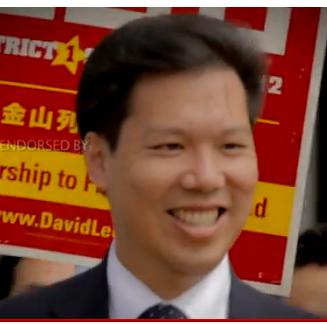
District 1 supervisorial candidate David Lee might have violated election laws prohibiting candidates from coordinating with groups doing independent expenditures after being featured in a pricey attack ad blasting his opponent, incumbent Sup. Eric Mar.

The San Francisco League of Pissed Off Voters yesterday filed a complaint with the Ethics Commission requesting an investigation into illegal coordination between Lee and the Association of Realtors, which produced an ad entitled “Send Mar Back to Mars,” in which Lee appears to have participated in the filming.

“Our concern is that Lee’s campaign has collaborated with the San Francisco Realtors Association in providing footage,” says Fabiana Ochoa, a member of the steering committee for the League.  “That’s really a violation of the law.  It’s a concern this year because we see how national super PACs have an influence on campaigns.”

Lee’s direct fundraising and the allegedly independent expenditures on his behalf this week topped $557,486 – more than any other San Francisco supervisorial campaign in history — prompting the Ethics Commission to again raise the expenditure cap on the public financing in Mar’s race. Lee and his campaign have refused to answer questions about this or other issues. 

“No one has ever seen that kind of spending here in San Francisco.  It’s turned into a challenging and nasty campaign,” Ochoa said.  “It’s a small district but the game has changed.”

Progressive groups — including the League, San Francisco Tenants Union, and Harvey Milk LGBT Democratic Club — are fighting back with a rally scheduled for this Monday at 5pm outside the Realtors Association office at 301 Grove Street. They’re urging participants to bring pots and pans, reminiscent of the group of scowling children who were smeared with dirt and banging pots and pans in the video.   

In an email to the Guardian, the Ethics Commission’s Executive Director John St. Croix said, “The Ethics Commission can not confirm, deny or discuss complaints.” If the Ethics Commission does investigate and finds that Lee knowingly participated in this advertisement, it is unclear what exactly the penalty will be and the District Attorney’s office is not jumping to any conclusions yet. “For now it’s still with the Ethics Commission so we can’t comment on it,” says Stephanie Ong Stillman, press secretary for the D.A.’s office.

In a time when corporations are considered people and wealthy interests have unprecedented political influence in elections, all eyes are on the candidates and how honestly they run their campaigns.  Current San Francisco law prohibits candidates from organizing with independent expenditures like this one.

The ad, which cost $50,000 to make, mocks Mar’s efforts to remove toys from McDonald’s Happy Meals by featuring kids protesting his policies.  The glossy 3 ½ minute commercial is high-quality with Hollywood production value, leaving skeptical viewers wondering if Lee’s cameo was staged and his participation deliberate.   If it was, then Lee also violated laws that ban candidates from accepting campaign contributions exceeding $500.

The Association of Realtors clearly has an interest in David Lee, considering Mar supports tenant rights, and the Tenants Union has make its rally and campaign an effort to “save rent control” and called it a “march on the 1 percent” that is trying to buy the Board of Supervisors and remake San Francisco.

Realtors Association President Jeffery Woo would not discuss the issue when reached by phone.  In an emailed press statement to the Guardian, the Association of Realtors wrote, “ We stand by the facts, and humor, of the video we produced on the election in District 1 and do not plan to remove it from YouTube as it has achieved success in raising important issues in San Francisco.”

The Guardian also reached out to the political media expert who produced the film, Fred Davis, but he did not return our calls. 

Davis, who served as chief media strategist for John McCain’s 2008 presidential campaign, is a Hollywood-based veteran of campaign marketing and has produced some of the most notorious political ads in recent history including the Demon Sheep video for Carly Fiorina’s 2010 GOP senate campaign.  He also created the highly lampooned 2010 ad featuring Delware Senate candidate Christine O’Donnell, who assured viewers that she was “not a witch.” 

Judge for yourself whether Lee participated in the making of this video:


Guess who pornographers are voting for in November

0

Surprise! It’s Obama, by a whopping 55 percentage point differential.

Porn PR conglomerator Xbiz conducted the poll of adult filmmakers (details are hazy regarding when and by what method the poll was administered), whose results says that only 13 percent of the XXX-ers asked would be voting for Mitt Romney, compared to Obama’s 68 percent.

The news here being that 13 percent of pornographers would vote for a guy who signed an anti-porn pledge and appears to be deadset on curtailing access to adult material by the “promotion of parental software controls” and “strict enforcement of our nation’s obscenity laws.”

Said Morality in the Media president Patrick Trueman in a press release, “the porn industry is flourishing because the Obama Administration has given it a green light to distribute hardcore porn to every man, woman, and child in America.

[h/t Morality in the Media (scary ones!)]

Fukushima controversies that the mainstream media ignores

11

This week, we wrote our annual analysis of the list of censored stories released by Project Censored. We wrote that “in one study that got little attention, scientists Joseph Mangano and Janette Sherman found that in the period following the Fukushima meltdowns, 14,000 more deaths than average were reported in the US, mostly among infants.”

It’s true that the study got little attention in mainstream media, with a few exceptions including coverage in Al Jazeera. It was, however, the subject of scrutiny from multiple sources.

Sherman is a physician and former advisory board member for the Environmental Protection Agency (EPA) Toxic Substances Control Act, and Mangano is an epidemiologist and public health administrator and researcher.

The debate that followed the release of their study got into important issues of the health effects of the Fukushima Daiichi nuclear disaster. Both those defending and attacking the study, and the general principle of the health impacts of nuclear energy, had their say. But all this happened outside mainstream media, and in the wake of Fukushima, mainstream media has largely ignored health implications. That’s why the story was highlighted by Project Censored, which explores stories underreported by the mainstream media, in their book Censored 2013: Dispatched from the Media Revolution.

An article by Sherman and Mangano about their research was first published in June 2011 in Counterpunch, a left-leaning political newsletter. It was criticized then. Counterpunch came back with a response from their “statistical consultant” Pierre Sprey, who found that there was an increase in infant deaths, although not as stark as the increase Sherman and Mangano found. He found that the increase was amplified by including other cities in the Pacific Northwest in the set.

An updated version of the study was published in a peer-reviewed journal, the Journal of International Health Services, in December.

Sherman and Mangano came to their conclusions by comparing deaths in a set of US cities during a 28-week period during which the meltdown occurred on March 11 to the same 28-week period in 2010. They found that in the 14 weeks before March 11, deaths were up 2.34 percent in 2011, but in the period after the Fukushima disaster, they were up by 4.46 percent. They extrapolated this data and determined a “a projected 13,983 excess U.S. deaths”

Again, the study was widely criticized. One source of critique was Michael Moyer, who wrote an article in Scientific American lambasting the study. He said that the authors cherry-picked the data they used. Moyer wrote that “No attempt is made at providing systematic error estimates, or error estimates of any kind. No attempt is made to catalog any biases that may have crept into the analysis, though a cursory look finds biases a-plenty (the authors are anti-nuclear activists unaffiliated with any research institution).”

But aside from the Scientific American article and a few other instances of mainstream coverage, the critical response to Sherman and Mangano’s story was also underreported. The people who took another look at their numbers were writing for alternative press. Websites like nuclearpoweryesplease.org, whose creators are “are convinced that nuclear power is vital to securing energy production in a sustainable way until science can provide us with a truly limitless source of power.” and atomicinsights.com, written by self-described “pro-nuclear advocate” Rod Adams.

The whole incident raises interesting questions about what constitutes mainstream media and alternative media, the value of peer-review and fact-checking, and the way that corporate interests control news stories. Almost every person who weighed in on this story was likely biased in some way, from the researchers who set out to see if there was a correlation between US deaths and the Fukushima meltdown to the pro-nuclear activists who attacked their study.

The nuclear industry has plenty of mouthpieces. The Nuclear Energy Institute, a lobbying group for nuclear companies, releases its own press statements. A blog associated with the NEI, neinuclearnotes.blogspot.com, has been a part of the online debunking frenzy surrounding Sherman and Mangano’s work.

Does being associated with the nuclear industry make critiques incorrect? In this situation, it seems clear that the refutations are credible.

It does make them suspicious, as the nuclear industry’s profits rely on the belief that nuclear energy is perfectly safe.

Mainstream news is supposed to serve as a credible and reliable source of information. But coverage of the effects of the Fukushima Daiichi disaster have been mostly left up to bloggers and activists. And Sherman and Mangano’s flawed study is far from the only outcry. In Canada, concerns were raised about radiation levels in rainwater. A series of investigations into RadNet, the EPA’s radiological detection network, found that the system suffers from maintenance and reliability issues, and may have reported false low levels of radiation in the weeks following Fukushima.

In Japan, a strong protest movement insists that they and their children aren’t safe following the meltdown. The country announced plans to phase out nuclear power by 2040 following Fukushima. Strong anti-nuclear sentiment also exists in Germany, where the government has plans to phase out nuclear energy by 2022.

In the United States, the controversy over nuclear energy rages on. The nuclear industry is a powerful corporate interest, and likely has something to do with the suppression of mainstream coverage of nuclear hazards. At the same time, corporate flaks are just as capable of creating “alternative” media sources that twist stories to reflect a pro-nuclear agenda. Of course, so are anti-nuclear advocates, who may be equally willing to ignore facts to promote their agenda.
As Censored 2013 points out, that debate is largely underreported by the mainstream media. Nuclear power may not have led to 14,000 excess deaths in the US following the Fukushima disaster. But it has certainly led to a confused circus of less than reliable sources, competing to be believed as truth, while traditional credible reporting falls away.

Local censored 2012

0


BEHIND THE MIRKARIMI CASE

In early January, details from the police investigation of then-Sheriff-elect Ross Mirkarimi bruising his wife’s arm during an argument were leaked to the San Francisco Chronicle and other news outlets. The key piece of evidence was a 45-second video that Mirkarimi’s wife, Eliana Lopez, made with her neighbor, Ivory Madison, displaying the bruise and saying she wanted to document the incident in case of a child custody battle. That video convinced many of Mirkarimi’s guilt, and a majority of Ethics Commissioners say they found it to be the main evidence on which Mirkarimi should be removed from office on official misconduct charges (the Board of Supervisors was scheduled to vote on Mirkarimi’s removal on Oct. 9, after Guardian press time).

But that video was only a small part of the overwhelming and expensive case that Mayor Ed Lee brought against Mirkarimi, including the more serious charges of abuse of power, witness dissuasion, and impeding a police investigation, all of which go more directly to a sheriff’s official duties. All of those charges got lots of media coverage and they helped cement the view of many San Franciscans that Mirkarimi engaged in a pattern of inappropriate behavior, rather than making a big momentary mistake. Yet most of the media coverage during the six months of Ethics Commission proceedings ignored the fact that none of the evidence that was being gathered supported those charges. Indeed, all those charges were unanimously rejected by the commission on Aug. 16, a startling rebuke of Lee’s case but one that was not highlighted in many media reports, which focused on the one charge the commission did uphold: the initial arm grab.


THE NEXT DOT-BOMB

In the late 1990s, San Francisco was in a very similar place to where it is now. The first dot-com boom was full bloom, driving the local economy and creating countless young millionaires — but also rapidly gentrifying the city and driving commercial and residential rents through the roof (great for the landlords, bad for everyone else). And then, the bubble popped, instantly erasing billions of dollars in speculative paper wealth and leaving this a changed city. The city’s working and creative classes suffered, but the political backlash gave rise to a decade with a progressive majority on the Board of Supervisors.

The era ended in 2010 when Ed Lee was appointed mayor, and he began ambitious agenda of pumping up a new dot-com bubble using tax breaks, public subsidies, and relentless official boosterism to lure more tech companies to San Francisco. Lee has been successful in his approach, in the process driving up commercial rents and housing prices. By some estimates, about 30 percent of the city’s economy is now driven by technology companies.

Yet there have been few voices in the local media raising questions about this risky, costly, and self-serving economic development strategy. The Bay Citizen did a story about Conway’s self interested advice, the New York Times did a front page story raising these issues, and San Francisco Magazine just last month did a long cover story questioning how much tech is enough. But most local media voices have been silent on the issue, and much of the damage has already been done.


OLD POWERBROKERS RETURN TO CITY HALL

More than a decade ago, then-Mayor Willie Brown and Chinatown power broker Rose Pak worked together to empower big business, corrupt local politics, and clear the path for rampant development — an approach that progressives on the Board of Supervisors repudiated and slowed from 2000-2010. But Brown, Pak, and a new generation of their allies have returned in power in City Hall, and it’s as bad as it ever was.

Many San Franciscans know of their high-profile role appointing Lee to office in early 2011. But their influence and tentacles have extended far beyond what we read in the papers and watch on television, starting in 2010 when their main political operatives David Ho and Enrique Pearce ran Jane Kim’s supervisorial campaign, beating Debra Walker, a veteran of the fights against Brown’s remaking of the city.

Now, this crew has the run of City Hall, meeting regularly with Mayor Lee and twisting the arms of supervisors on key votes. Pearce and Ho persuaded longtime progressive Christina Olague to co-chair the scandal-plagued Run Ed Run campaign last year, she was rewarded this year with Lee appointing her to the Board of Supervisors. Pearce has been her close adviser, and most of her campaign cash has been raised by Brown and Pak. Even progressive Sup. Eric Mar admits that Pak in raising money for him, a troubling sign of things to come.


THE REAL OCCUPY STORY

The Occupy San Francisco camp that was cleared by police last week may have been mostly homeless people. And major news media outlets from the start reported that Occupy was dangerous, filthy, and a civic eyesore.

But last fall, the camps were comprised of a huge variety of people that chose to live part or full time on the streets. Students, people with 9-5 jobs, people with service jobs, and the unemployed were all represented. Wealthy people who lived in the financial districts where camps popped up mixed with working-class people who came from suburbs and small towns. Families came out, welcomed in the “child spaces” set up in many Occupy camps throughout the country. Most camps also boasted libraries, free classes, kitchens, food distribution, and medical tents.

As news media focused on gross-out stories of pee on the streets and graphic descriptions of drunk occupiers, they managed to ignore the complex systems that were built in the camps. Nor did anyone mention that homeless people have the right to protest, too.

Supervisors reinstate Mirkarimi, rejecting Lee’s interpretation of official misconduct

181

The Board of Supervisors has voted to reinstate Sheriff Ross Mirkarimi and reject the official misconduct charges that Mayor Ed Lee brought against Mirkarimi for grabbing and bruising his wife’s arm during a New Year’s Eve argument, for now ending an ugly saga that has polarized San Franciscans.

The vote was 7-4, two votes shy of the nine needed to sustain the charges and remove Mirkarimi, who now resumes the position voters elected him to in November with back pay going back to March when Lee suspended him. Sups. Christina Olague, David Campos, John Avalos, and Jane Kim voted in Mirkarimi’s favor, condemning the domestic violence incident but saying that it didn’t meet what is and should be a high and clear standard for overruling the will of voters, a concern also voiced by Sup. Mark Farrell. 

“I do take this job seriously, that we are public policy makers,” said Kim, a lawyer who emphasized their duty to set clear standards for officials during these unprecedented proceedings rather than being swayed by emotional responses to conduct by Mirkarimi that she called “incredibly egregious.”

But for most of the supervisors, that was enough. Sup. Eric Mar, who is in the middle of difficult reelection campaign against the more conservative and well-financed David Lee, said he thought is was important to have “zero tolerance” for domestic violence and his vote was “in the service of justice and a belief it will combat domestic violence.”

Earlier in the hearing, Kim had led the questioning of Deputy City Attorney Sherri Kaiser, whose broad interpretation of official misconduct standards and inability to set clear guidelines troubled Kim, just as it had earlier to Ethics Commission Chair Benedict Hur, the sole vote on that body against removal after it conducted six months worth of hearings.

“I agree with Chairman Hur, I think we need to take the most narrow view of official misconduct,” Kim said, echoing a point that had also been made by Campos, who quoted Hur’s comment from the Aug. 16 hearing where the commission voted 4-1 to recommend removal: “I have a lot of concern about where you draw the line if you don’t relate this to official duties.”

Farrell also shared that concern, which he raised in questioning Kaiser and during the final board deliberations almost seven grueling hours later. 

“I worry a great deal about the potential for abuse in this charter section,” Farrell said, warning this and future mayors to use great caution and restraint before bringing official misconduct charges. Yet he still found that the “totality of the circumstances” warranted removal because Mirkarimi had compromised his ability to be the top law enforcement officer.

Each supervisor expressed what a difficult and joyless decision this was, and even those who supported Mirkarimi strongly condemned his actions and the efforts by some of his supporters to minimize the seriousness of his actions and the need for him to change.

“I have tremendous mixed feelings about Ross Mirkarimi,” Avalos said, noting his many proud progressive accomplishments but adding, “I’ve always seen Ross as someone who has deep flaws….[This saga] offers a chance for personal transformation and I think that’s something Ross really needs to do.”

Mirkarimi seems humbled by the hearing, and the stinging criticism of his former colleagues and his one-time allies in the domestic violence community, and he pledged to work on “regaining their trust” as he tries to embody the city’s long-held value on redemption.

“I appreciate all the comments of by the Board of Supervisors and I hear the message. The next step is mending fences and moving forward,” Mirkarimi said. Later, he told reporters, “We’re absorbing all the comments that were made by the Board of Supervisors. They are my former colleagues and I take it very seriously.”

That need to heal the deep and emotional divide between San Franciscans who see this case in starkly different ways – which was on vivid display during the hours of public testimony – was sounded by several supervisors. “We will need to come together as a city on this,” Board President David Chiu said.

Most of those who spoke during the nearly four hours in public comments favored Mirkarimi and condemned the efforts to remove him as politically motivated, overly judgmental, and setting a dangerous precedent rather than resorting to usual method for removing politicians after a scandal: recall elections.

“If anything happens to the man, it should come back to me to make that decision. Don’t do their dirty work for them,” one commenter said.

The most politically significant person to speak during public comment was former Mayor Art Agnos, who said he was a friend and supporter of Mirkarimi, but he was more concerned with the scary implications of this decision. “I respectfully urge that this Board protect all elected officials from the dangerous discretion used in this case and reinstate Sheriff Ross Mirkarimi.”

Most of those who spoke against Mirkarimi were domestic violence advocates, who were adamant that Mirkarimi be removed, casting it as a litmus test for whether the city takes their issue seriously. “This is a disciplinary proceeding, it is not election stealing,” said Beverly Upton, head of the Domestic Violence Consortium, who has lead the campaign to oust Mirkarimi since the incident was made public.

But the two sides seemed to be speaking past one another, each expressing righteous indignation that people didn’t see the issue like they did, indicating how polarizing these long-lingering proceedings have become and how difficult to heal that rift may be.

“It made my stomach turn to hear some of the comments that were made,” Sup. Carmen Chu said, condemning the actions of Mirkarimi supporters in vocally or visibly supporting one another. “That was wrong, this is not a joyous event.”

Yet Farrell said he was also concerned that Mirkarimi’s opponents would go after supervisors who made a principled stand against removing him. “I hope no one takes pot shots at the people who voted against this,” he said.

That principled stand – condemning Mirkarimi’s behavior but having a high standard for removing an elected official – was a trail blazed by Hur, who opened the hearing by presenting the Ethics Commission’s findings and a decision that he was the sole vote against. He noted the “challenge of my presentation” but made careful efforts to accurately represent the views of the commission majority.

Yet he ended up using almost half of his time at the podium — his allotted 10 minutes plus a few extra minutes to respond to questions from supervisors — to stress the danger of broadly interpreting the city’s official misconduct language and not requiring direct connection to an official’s duties.

“Public policy suggests we should interpret this more narrowly than proposed by the majority,” Hur said, later adding that his colleagues on the commission “did not provide a clear basis for how official misconduct is delineated.”

When Sup. Malia Cohen asked what he meant by the “public policy” interest at stake here, he replied, “The need to have policies that are clear…It does benefit the public when the laws are clear.” (Cohen later voted to remove Mirkarimi, stating with little explanation, “I believe the reading of the charter is narrow and appropriately applied in this case.”)

The issue of what qualifies as official misconduct — and whether there is a predictable way for officials to know where that line is drawn, or whether it’s entirely up to the discretion of mayors — was also highlighted by Kaiser’s long presentation, but probably not in the way she intended.

Kaiser appealed to people’s sense of outrage about the initial arm-grab and subsequent guilty plea — claiming Mirkarimi “attacked his wife” and “this conduct was serious!” — and seemed to think that was an adequate test of whether bad behavior by an elected official warrants his unilateral removal from office.

Kaiser took issue with Hur’s contention that a lack of clear, limiting standards gives too much power to future mayors to remove their political enemies for minor incidents.

“The mayor certainly does not agree with Hur’s argument for a bright line rule,” Kaiser said. She mocked the notion that mayors would abuse this expanded power. “The check on that is the Ethics Commission, and the check on that is this body.” Kaiser’s position was that the statute should be read as broadly as possible and that the process should be trusted to protect against political manipulations.

But Chiu also took issue with that standard, saying “having clarity in the law seems to make sense” and asking Kaiser how officials can know what standards they’re expected to meet.

“I don’t agree and I didn’t mean to convey the standard is murky,” Kaiser replied, but as she tried to elaborate, her standard began to seem ever murkier.

“It depends on the circumstance,” Kaiser said. “But that doesn’t make it too vague to apply. It makes it more nimble.”

A nimble standard might suit mayors just fine, but the idea seemed to bother the supervisors, even Farrell, who told Kaiser that her position “seems to me very contradictory.”

At the end of the hearing, Campos returned to Kaiser’s “nimble” comment as a reason for rejecting that argument and Lee’s charges: “I don’t think the analysis made me comfort. She said the interpretation was nimble, but I don’t know the difference between nimble and vague, and I think they are one in the same.”

“Most cases will be clear, but there are decisions on the periphery,” Kaiser told Farrell during the earlier questioning, not making it clear which category she’d put the Mirkarimi case into.

Kim was the next to try to pin Kaiser down on whether there’s a discernible standard for the city to apply to this and future cases, saying she’d like to see a “bright line rule or a test.” Kaiser said that it depends on the office, but that a law enforcement officer shouldn’t commit a crime.

“Then any misdemeanor the sheriff pleads to is official misconduct, is that right?” Kim asked.

No, she said, the conduct must be while someone is in office — seemingly contradicting her earlier point – and found to be so by the board and commission. But then she said, “It is true that any misdemeanor relates to the duties of a sheriff.”

Kim persisted: “This is where I get stuck. When does it fall below the standard of decency?”

“The charter doesn’t answer that question. It’s a case-by-case determination,” Kaiser said.

“What’s to guide us in the future?” Kim asked.

But again, there was no clear answer, it’s simply for mayors to decide. “It is a discretionary decision,” Kaiser said.

Kim, a lawyer, questioned whether the stance by Kaiser and Lee could lead the courts to strike down the city’s untested statute. “Does that open us up to the vagueness issue, which would make the clause unconstitutional?” Kim asked.

But Kaiser said San Francisco voters wanted to give the mayor wide power to interpret misconduct when they approved the broad new official misconduct language in 1995, part of a complete overhaul of the City Charter.

“Voters made a considered choice to put suspend and remove procedures in the charter,” she said, trying to counter the argument that recall elections should be used to remove elected officials. “These suspension and removal procedure is more nimble. It’s less expensive than a recall.”

Yet with a final price tag expected to be in the millions of dollars and proceedings lasting seven months, it’s debatable whether this process was really cheaper and more nimble.

Mirkarimi attorney David Waggoner began his presentation by saying, “There’s no question that on Dec. 31, 2011, Ross Mirkarimi made a terrible mistake.”

But it was a mistake that Mirkarimi admitted to, accepted the criminal punishment that followed his guilty plea, endured a forced six-month separation from his family, had his job and salary taken from him, was the target of a media and political campaigns that have deeply damaged his reputation, “his entire life’s work was destroyed almost in an instant.” All for pleading to a low-level misdemeanor.

“At the end of the day, the punishment does not fit the crime,” Waggoner said.

He noted that just three elected officials have been removed for official misconduct in the city’s history, each time for serious felonies. But now, it’s being applied to a misdemeanor with arguments that broaden a mayor’s ability to remove political adversaries.

“You must decide whether to uphold or overturn the will of the voters,” Waggoner told the supervisors.

He even took a swipe at the domestic violence advocates who have led the campaign to remove Mirkarimi: “Ironically, the very advocates who should be defending Eliana Lopez have been attacking her.”

Taking over from Waggoner, Mirkarimi’s other attorney, Shepard Kopp, said Mirkarimi had no official duties before taking the oath of office, and the charter makes clear there needs to be connection. “It says misconduct has to occur while an official is in office.”

Kopp also brought the focus back to the precedent in this historic case. “The other problem with the mayor’s position is it doesn’t give you any guidance or future mayors any guidance,” Kopp said, later adding, “To follow the mayor’s position is not workable policy and it doesn’t have any support under the law.”

Supervisors questioned Kopp and Waggoner, but it didn’t seem to reveal any new insights, simply reinforcing their points that official misconduct should be a rarely used tool applied only to serious crimes.

In her final five-minute final rebuttal, rather than letting her co-counsel Peter Keith speak or trying to mitigate some of the damage from her earlier testimony, Kaiser seemed to double-down on her tactic of using emotional arguments rather than addressing legal standards for removal.

She alleged Mirkarimi’s team offered “a theory that domestic violence doesn’t matter if you’re sheriff,” prompting an audible negative reaction from the crowd that Chiu gaveled down. That reaction was even louder and more outraged when Kaiser implied Mirkarimi “threatens the life of a family member.”

Those sorts of characterizations fed much of the crowd’s stated belief that this case was a “political witchhunt” designed to destroy a progressive leader, and the opposition expressed to some domestic violence advocates testimony could be used against the larger progressive community.

But Agnos, who sat in the audience throughout the long hearing, told us the frustration was understandable. “The crowd, after nine months of agony, expressed a lot of emotions, and that is inherent in mass crowds,” he said. “They didn’t mean ill will to the domestic violence community. There was no malevolent intent there.”

Supervisors who voted to reinstate Mirkarimi said they want to make clear their commitment to combating domestic violence. “I worry that this case has set us back because of the tensions around how we responded,” Avalos said.

“I think it’s important that no matter how we feel about this that we come together as a city,” Campos said. “People on both sides have legitimate viewpoints on this issue.”

Our Weekly Picks: October 10-16

0

WEDNESDAY 10

Happy Hour at 251 Post

Stumbling on 251 Post Street feels a lot like clicking on a square in Minesweeper that opens up an awesome chunk of mine-free space. The entrance is nudged between a designer sunglass shop and high-end French clothing store, but it leads to six floors full of innovate artwork. Granted, the art might be in the same price range as the surrounding stores, but hey, admission is a lot cheaper than a museum. The happy hour will feature artist talks at four of the six galleries, including the Bay Area painter Brett Amory, whose simple but beautiful paintings are evocative of my lonelier dream visions. His work, focused on figures and buildings he encounters in Oakland and San Francisco, reduces everything down to the essence, creating empty spaces where buildings and figures seem to recede and appear before your eyes. (Molly Champlin)

5pm, free

251 Post Street Art Galleries, SF

(415) 291-8000

www.artgalleryweek.com


Dinosaur Jr.

We don’t need to tell you that Dinosaur Jr was one of the most influential alternative rock bands of the 1990s or that these dudes can really shred. We’ll just let their 28-year career attest to that. What we will tell you is that their new album is not to be overlooked or underestimated. These Dinosaurs have aged well. I Bet on Sky, their 10th full-length, is a loudmouthed snarl of a record. It features all the best quirks of Dinosaur Jr’s extensive catalogue: frightening amounts of fuzz, weirdly engaging hooks, and deep dark lyrics in J Mascis’ disengaged nasal yowls. Don’t forget to bring earplugs. (Haley Zaremba)

8pm, $32.50

Fillmore

1805 Geary, SF

(415) 346-3000

www.thefillmore.com


FRIDAY 12

Lenora Lee Dance

The history of Chinese Americans in the Bay Area is not exactly a closed book. Over the years many artists — including dancers — have opened a few of its pages, but I can’t think of any choreographer who has taken an approach as simultaneously intimate and large scale as Lenora Lee. In her work, the personal and the political intertwine inextricably. As part of her fifth anniversary celebration she, and some very fine visual, musical and text collaborators, are presenting a triptych that is still in the making. “Passages: For Lee Ping To” is the most personal — based on Lee’s grandmother’s story; “Reflections” looks at conflicting ideas of maleness; and “The Escape”, a work on immigrant women. (Rita Felciano)

Fri/12-Sat/13, 8pm, $15–$25

Sun/14, 3:30pm

Dance Mission Theater

3316, 24th St., SF

www.dancemission.com


The Raveonettes

The collaboration of Sune Rose Wagner and Sharin Foo feels like 1950s and ’60s rock’n’roll overlaid with electric noise and coupled with darker, more introspective lyrics. Their sound recalls grunge and captures a shoegazy moodiness that’s both mysterious and lyrical. The Danish duo has been making music together as the Raveonettes since 2001, has developed a cult following along the way, and has been credited with spawning somewhat of an American indie rock renaissance. Wagner relates Observator, the group’s recently released sixth album, to “a heavenly dream that you slowly realize is actually taking place in hell.” (Mia Sullivan)

With Melody’s Echo Chamber

9pm, $25

Bimbo’s

1025 Columbus, SF?

(415) 474-0365

www.bimbos365club.com


Morbid Angel

Time was that Morbid Angel could do no wrong. Tampa was bursting with bands in the later Reagan years, but few combined brutality with complexity as well as guitarist Trey Azagthoth, drummer Pete Sandoval, and bassist-vocalist David Vincent. With the release of 2011’s Illud Divinum Insanus, however, that time officially ended. Industrial and electronic textures alienated fans, leaving them uncertain about the band’s new direction. Thankfully, having missed the Illud… sessions while recovering from back surgery, Sandoval is now back in the fold, which bodes well for a return to death metal roots on the band’s current tour. (Ben Richardson)

With Dark Funeral, Grave

9pm, $31

Slim’s

333 11th St., SF

(415)-255-0333

www.slimspresents.com


SATURDAY 13

Life is Living Festival

Even in the season of street fair, Marc Bamuthi Joseph’s Life is Living Festival stands out. The overarching theme for the fests — they take place in ‘hoods across the country, from Houston’s Emancipation Park to Chicago’s South Side to the Bronx — is bringing green to the black community, uniting the sustainability movement with a hip-hop sensibility. The fest overflows with hip-happenings: Oakland’s first youth poet laureate Stephanie Yun will take the stage, there’ll be a street art contest, a show by a local team of dunk artists, vegan Filipino food, free breakfast (a park tradition started by the Black Panthers), youth science exhibition, dancing, hip-hop cipher — oh, and Talib Kweli will DJ. The fest prides itself on being an uber-positive, multi-generational show of strength. You won’t go home frowning. (Caitlin Donohue)

10am-6pm, free Defremery Park 1651 Adeline, Oakl. www.lifeisliving.org


Alternative Press Expo

Besides, of course, the sweetly self-conscious parade of Optimus Prime, Misty from Pokemon, and Clockwork Android costumes, my favorite part of the dearly-departed Wonder Con was the sociology nerd comics panels. “Women in Comics,” “Social Justice in Comics,” the list goes on. Graphic novels present the perfect, neurosis-friendly media in which to delve into alternative culture, which is why the Alternative Press Expo will make you forget all those Hollywood blockbuster star panels. Go this year to delve into the best scribblers of alt culture, like the Hernandez brothers of Love and Rockets Latino punk fame, a queer cartoonist panel moderated by Glamazonia’s Justin Hall, and the chance to connect with a gajillion like-minded indie comic freaks. (Donohue)

11am-7pm; also Sun/14, 11am-6pm; $10 one day, $15 two day pass Concourse Exhibition Center 635 Eighth St., SF www.comic-con.org/ape


Yerba Buena Night

Art allies in the Yerba Buena district are rallying together for another installment of Yerba Buena Night. The neighborhood will be full of people getting their musing-spectator on during the gallery walk, rocking out at the three main performance stages, and chatting with class at the champagne reception hosted by Visual Aid. Be sure to stop by 111 Minna to see surreal graffiti and pen artist Lennie Mace, who operates in both America and Japan, as well as some of Mike Shine’s paintings and props from Outside Lands (minus the live carny folk, unfortunately). Or visit Wendi Norris Gallery for beautifully bright but often gruesome narrative paintings by artist Howie Tsui: think pop-surrealist Mark Ryden with a Chinese influence. (Champlin)

3pm, free

Yerba Buena District

701 Mission

(415) 541-0312

www.yerbabuena.org


MONDAY 15

David Byrne and St. Vincent

Old and young, man and woman, beauty and beast (albeit a hip beast with now slick, silver hair), David Byrne and St. Vincent make quite the unlikely pair. Despite, or maybe in light of these differences, their respective talents fit together like puzzle pieces in their joyously poppy and horn-laden collaboration, Love This Giant. The album, released in September, rings in like a call to action and touches on issues of wealth, prescribed and individual culture, love, and forgiveness. Aside from the fact that everyone loves a rock show backed with an eight-piece brass band, this is set to be a memorable night.(Champlin)

8pm, $63.50–$129

Orpheum Theater

1192 Market, SF

(888) 746-1799

www.shnsf.com


The Sheepdogs

If you’re itching for some classic rock nostalgia but aren’t in the mood for the full-on experience (i.e. Dark Star Orchestra), check out The Sheepdogs. This Canadian quartet looks like they were pulled straight out of the ’70s and has been sonically influenced by rock icons like The Grateful Dead, Credence Clearwater Revival, and Steely Dan. These guys released a self-titled, debut album with Atlantic Records last month. (They released their first three albums independently.) The Sheepdogs thrive on three-part harmonies, produce extremely catchy tracks, and have been rumored to put on fun, blissful shows. (Sullivan)

With Black Box Revelation

7:30pm, $15

Rickshaw Stop

155 Fell, SF

(415) 861-2011

www.rickshawstop.com


TUESDAY 16

Nik Bärtsch’s Ronin

Not quite nu-jazz, math-rock, or classical minimalism, Nik Bärtsch’s Ronin attacks Reichian time signatures with the borderline robotic technical skill of a group of Juilliard grads, the undeniable groove of an airtight funk band, and the Steely Dan-worthy production values inherent to ECM, the venerable European jazz label to which they’re signed. Bärtsch’s piano playing is remarkably dynamic, flowing between resonant, open tones and muffled, percussive hammering, while generously layered drums, agile bass-plucking, and exotic woodwinds (contrabass clarinet, anyone?) create a dark, steely backdrop. Considering the Swiss ensemble’s masterful ability to anchor soulful acoustic instrumentation with a relentlessly electronic pulse, Nik Bärtsch’s Ronin is as compelling, and unmissable, as any live ensemble currently working. (Taylor Kaplan)

8pm, $20

Yoshi’s Oakland

510 Embarcadero West, Oakl.

(510) 238-9200

www.yoshis.com/oakland


Vampyr with live score by Steven Severin

Get your Halloween on a little early this year with Steven Severin, founding member and bassist of Siouxie and the Banshees, who comes to haunt the city tonight with two special live performances of his new score to the classic 1932 horror film Vampyr. The third installment in Severin’s ongoing film accompaniment series “Music For Silents,” the darkly moody synthesizer score perfectly matches the surreal scenes on the silver screen, working in conjunction with the somewhat unorthodox style of filmmaker Carl Theodor Dreyer, who continued to use elements of the silent era, including dialogue title cards, even though the film was made at the advent of the talkies. (Sean McCourt)

7 and 9:30pm, $15

Roxie Theater

3117 16th St., SF

www.roxie.com


The Guardian listings deadline is two weeks prior to our Wednesday publication date. To submit an item for consideration, please include the title of the event, a brief description of the event, date and time, venue name, street address (listing cross streets only isn’t sufficient), city, telephone number readers can call for more information, telephone number for media, and admission costs. Send information to Listings, the Guardian, 225 Bush, 17th Flr., SF, CA 94105; or e-mail (paste press release into e-mail body — no attachments, please) to listings@sfbg.com. Digital photos may be submitted in jpeg format; the image must be at least 240 dpi and four inches by six inches in size. We regret we cannot accept listings over the phone.

PROJECT CENSORED 2012

6

yael@sfbg.com

People who get their information exclusively from mainstream media sources may be surprised at the lack of enthusiasm on the left for President Barack Obama in this crucial election. But that’s probably because they weren’t exposed to the full online furor sparked by Obama’s continuation of his predecessor’s overreaching approach to national security, such as signing the 2012 National Defense Authorization Act, which allows the indefinite detention of those accused of supporting terrorism, even US citizens.

We’ll never know how this year’s election would be different if the corporate media adequately covered the NDAA’s indefinite detention clause and many other recent attacks on civil liberties. What we can do is spread the word and support independent media sources that do cover these stories. That’s where Project Censored comes in.

Project Censored has been documenting inadequate media coverage of crucial stories since it began in 1967 at Sonoma State University. Each year, the group considers hundreds of news stories submitted by readers, evaluating their merits. Students search Lexis Nexis and other databases to see if the stories were underreported, and if so, the stories are fact-checked by professors and experts in relevant fields.

A panel of academics and journalists chooses the Top 25 stories and rates their significance. The project maintains a vast online database of underreported news stories that it has “validated” and publishes them in an annual book. Censored 2013: Dispatches from the Media Revolution will be released Oct. 30.

For the second year in row, Project Censored has grouped the Top 25 list into topical “clusters.” This year, categories include “Human cost of war and violence” and “Environment and health.” Project Censored director Mickey Huff told us the idea was to show how various undercovered stories fit together into an alternative narrative, not to say that one story was more censored than another.

“The problem when we had just the list was that it did imply a ranking,” Huff said. “It takes away from how there tends to be a pattern to the types of stories they don’t cover or underreport.”

In May, while Project Censored was working on the list, another 2012 list was issued: the Fortune 500 list of the biggest corporations, whose influence peppers the Project Censored list in a variety of ways.

Consider this year’s top Fortune 500 company: ExxonMobil. The oil company pollutes everywhere it goes, yet most stories about its environmental devastation go underreported. Weapons manufacturers Lockheed Martin (58 on the Fortune list), General Dynamics (92), and Raytheon (117) are tied into stories about US prisoners in slavery conditions manufacturing parts for their weapons and the underreported war crimes in Afghanistan and Libya.

These powerful corporations work together more than most people think. In the chapter exploring the “Global 1 percent,” writers Peter Phillips and Kimberly Soeiro explain how a small number of well-connected people control the majority of the world’s wealth. In it, they use Censored story number 6, “Small network of corporations run the global economy,” to describe how a network of transnational corporations are deeply interconnected, with 147 of them controlling 40 percent of the global economy’s total wealth.

For example, Philips and Soeiro write that in one such company, BlackRock Inc., “The eighteen members of the board of directors are connected to a significant part of the world’s core financial assets. Their decisions can change empires, destroy currencies, and impoverish millions.”

Another cluster of stories, “Women and Gender, Race and Ethnicity,” notes a pattern of underreporting stories that affect a range of marginalized groups. This broad category includes only three articles, and none are listed in the top 10. The stories reveal mistreatment of Palestinian women in Israeli prisons, including being denied medical care and shackled during childbirth, and the rape and sexual assault of women soldiers in the US military. The third story in the category concerns an Alabama anti-immigration bill, HB56, that caused immigrants to flee Alabama in such numbers that farmers felt a dire need to “help farms fill the gap and find sufficient labor.” So the Alabama Department of Agriculture and Industries approached the state’s Department of Corrections about making a deal where prisoners would replace the fleeing farm workers.

But with revolutionary unrest around the world, and the rise of a mass movement that connects disparate issues together into a simple, powerful class analysis — the 99 percent versus the 1 percent paradigm popularized by Occupy Wall Street — this year’s Project Censored offers an element of hope.

It’s not easy to succeed at projects that resist corporate dominance, and when it does happen, the corporate media is sometimes reluctant to cover it. Number seven on the Top 25 list is the story of how the United Nations designated 2012 the International Year of the Cooperative, recognizing the rapid growth of co-op businesses, organizations that are part-owned by all members and whose revenue is shared equitably among members. One billion people worldwide now work in co-ops.

The Year of the Cooperative is not the only good-news story discussed by Project Censored this year. In Chapter 4, Yes! Magazine‘s Sarah Van Gelder lists “12 ways the Occupy movement and other major trends have offered a foundation for a transformative future.” They include a renewed sense of “political self-respect” and fervor to organize in the United States, debunking of economic myths such as the “American dream,” and the blossoming of economic alternatives such as community land trusts, time banking, and micro-energy installations.

They also include results achieved from pressure on government, like the delay of the Keystone Pipeline project, widespread efforts to override the US Supreme Court’s Citizens United ruling, the removal of dams in Washington state after decades of campaigning by Native American and environmental activists, and the enactment of single-payer healthcare in Vermont.

As Dr. Nafeez Mosaddeq Ahmed writes in the book’s foreword, “The majority of people now hold views about Western governments and the nature of power that would have made them social pariahs 10 or 20 years ago.”

Citing polls from the corporate media, Ahmed writes: “The majority are now skeptical of the Iraq War; the majority want an end to US military involvement in Afghanistan; the majority resent the banks and financial sector, and blame them for the financial crisis; most people are now aware of environmental issues, more than ever before, and despite denialist confusion promulgated by fossil fuel industries, the majority in the United States and Britain are deeply concerned about global warming; most people are wary of conventional party politics and disillusioned with the mainstream parliamentary system.”

“In other words,” he writes, “there has been a massive popular shift in public opinion toward a progressive critique of the current political economic system.”

And ultimately, it’s the public — not the president and not the corporations—that will determine the future. There may be hope after all. Here’s Project Censored’s Top 10 list for 2013:


1. SIGNS OF AN EMERGING POLICE STATE

President George W. Bush is remembered largely for his role in curbing civil liberties in the name of his “war on terror.” But it’s President Obama who signed the 2012 NDAA, including its clause allowing for indefinite detention without trial for terrorism suspects. Obama promised that “my Administration will interpret them to avoid the constitutional conflict” — leaving us adrift if and when the next administration chooses to interpret them otherwise. Another law of concern is the National Defense Resources Preparedness Executive Order that Obama issued in March 2012. That order authorizes the President, “in the event of a potential threat to the security of the United States, to take actions necessary to ensure the availability of adequate resources and production capability, including services and critical technology, for national defense requirements.” The president is to be advised on this course of action by “the National Security Council and Homeland Security Council, in conjunction with the National Economic Council.” Journalist Chris Hedges, along with co-plaintiffs including Noam Chomsky and Daniel Ellsberg, won a case challenging the NDAA’s indefinite detention clause on Sept. 1, when a federal judge blocked its enforcement, but her ruling was overturned on Oct. 3, so the clause is back.


2. OCEANS IN PERIL

Big banks aren’t the only entities that our country has deemed “too big to fail.” But our oceans won’t be getting a bailout anytime soon, and their collapse could compromise life itself. In a haunting article highlighted by Project Censored, Mother Jones reporter Julia Whitty paints a tenuous seascape — overfished, acidified, warming — and describes how the destruction of the ocean’s complex ecosystems jeopardizes the entire planet, not just the 70 percent that is water. Whitty compares ocean acidification, caused by global warming, to acidification that was one of the causes of the “Great Dying,” a mass extinction 252 million years ago. Life on earth took 30 million years to recover. In a more hopeful story, a study of 14 protected and 18 non-protected ecosystems in the Mediterranean Sea showed dangerous levels of biomass depletion. But it also showed that the marine reserves were well-enforced, with five to 10 times larger fish populations than in unprotected areas. This encourages establishment and maintenance of more reserves.


3. US DEATHS FROM FUKUSHIMA

A plume of toxic fallout floated to the US after Japan’s tragic Fukushima nuclear disaster on March 11, 2011. The US Environmental Protection Agency found radiation levels in air, water, and milk that were hundreds of times higher than normal across the United States. One month later, the EPA announced that radiation levels had declined, and they would cease testing. But after making a Freedom of Information Act request, journalist Lucas Hixson published emails revealing that on March 24, 2011, the task of collecting nuclear data had been handed off from the US Nuclear Regulatory Commission to the Nuclear Energy Institute, a nuclear industry lobbying group. And in one study that got little attention, scientists Joseph Mangano and Janette Sherman found that in the period following the Fukushima meltdowns, 14,000 more deaths than average were reported in the US, mostly among infants. Later, Mangano and Sherman updated the number to 22,000.


4. FBI AGENTS RESPONSIBLE FOR TERRORIST PLOTS

We know that FBI agents go into communities such as mosques, both undercover and in the guise of building relationships, quietly gathering information about individuals. This is part of an approach to finding what the FBI now considers the most likely kind of terrorists, “lone wolves.” Its strategy: “seeking to identify those disgruntled few who might participate in a plot given the means and the opportunity. And then, in case after case, the government provides the plot, the means, and the opportunity,” writes Mother Jones journalist Trevor Aaronson. The publication, along with the Investigative Reporting Program at the University of California-Berkeley, examined the results of this strategy, 508 cases classified as terrorism-related that have come before the US Department of Justice since the 9/11 terrorist attacks of 2001. In 243 of these cases, an informant was involved; in 49 cases, an informant actually led the plot. And “with three exceptions, all of the high-profile domestic terror plots of the last decade were actually FBI stings.”


5. FEDERAL RESERVE LOANED TRILLIONS TO MAJOR BANKS

The Federal Reserve, the US’s quasi-private central bank, was audited for the first time in its history this year. The audit report states, “From late 2007 through mid-2010, Reserve Banks provided more than a trillion dollars… in emergency loans to the financial sector to address strains in credit markets and to avert failures of individual institutions believed to be a threat to the stability of the financial system.” These loans had significantly less interest and fewer conditions than the high-profile TARP bailouts, and were rife with conflicts of internet. Some examples: the CEO of JP Morgan Chase served as a board member of the New York Federal Reserve at the same time that his bank received more than $390 billion in financial assistance from the Fed. William Dudley, who is now the New York Federal Reserve president, was granted a conflict of interest waiver to let him keep investments in AIG and General Electric at the same time the companies were given bailout funds. The audit was restricted to Federal Reserve lending during the financial crisis. On July 25, 2012, a bill to audit the Fed again, with fewer limitations, authored by Rep. Ron Paul, passed the House of Representatives. HR459 expected to die in the Senate, but the movement behind Paul and his calls to hold the Fed accountable, or abolish it altogether, seem to be growing.


6. SMALL NETWORK OF CORPORATIONS RUN THE GLOBAL ECONOMY

Reporting on a study by researchers from the Swiss Federal Institute in Zurich didn’t make the rounds nearly enough, according to Censored 2013. They found that, of 43,060 transnational companies, 147 control 40 percent of total global wealth. The researchers also built a model visually demonstrating how the connections between companies — what it calls the “super entity” — works. Some have criticized the study, saying control of assets doesn’t equate to ownership. True, but as we clearly saw in the 2008 financial collapse, corporations are capable of mismanaging assets in their control to the detriment of their actual owners. And a largely unregulated super entity like this is vulnerable to global collapse.


7. THE INTERNATIONAL YEAR OF COOPERATIVE

Can something really be censored when it’s straight from the United Nations? According to Project Censored evaluators, the corporate media underreported the UN declaring 2012 to be the International Year of the Cooperative, based on the coop business model’s stunning growth. The UN found that, in 2012, one billion people worldwide are coop member-owners, or one in five adults over the age of 15. The largest is Spain’s Mondragon Corporation, with more than 80,000 member-owners. The UN predicts that by 2025, worker-owned coops will be the world’s fastest growing business model. Worker-owned cooperatives provide for equitable distribution of wealth, genuine connection to the workplace, and, just maybe, a brighter future for our planet.


8. NATO WAR CRIMES IN LIBYA

In January 2012, the BBC “revealed” how British Special Forces agents joined and “blended in” with rebels in Libya to help topple dictator Muammar Gadaffi, a story that alternative media sources had reported a year earlier. NATO admits to bombing a pipe factory in the Libyan city of Brega that was key to the water supply system that brought tap water to 70 percent of Libyans, saying that Gadaffi was storing weapons in the factory. In Censored 2013, writer James F. Tracy makes the point that historical relations between the US and Libya were left out of mainstream news coverage of the NATO campaign; “background knowledge and historical context confirming Al-Qaeda and Western involvement in the destabilization of the Gadaffi regime are also essential for making sense of corporate news narratives depicting the Libyan operation as a popular ‘uprising.'”


9. PRISON SLAVERY IN THE US

On its website, the UNICOR manufacturing corporation proudly proclaims that its products are “made in America.” That’s true, but they’re made in places in the US where labor laws don’t apply, with workers often paid just 23 cents an hour to be exposed to toxic materials with no legal recourse. These places are US prisons. Slavery conditions in prisons aren’t exactly news. It’s literally written into the Constitution; the 13th Amendment, which abolished slavery, outlaws  slavery nor involuntary servitude, except as a punishment for crime whereof the party shall have been duly convicted.” But the article highlighted by Project Censored this year reveal the current state of prison slavery industries, and its ties to war. The majority of products manufactured by inmates are contracted to the Department of Defense. Inmates make complex parts for missile systems, battleship anti-aircraft guns, and landmine sweepers, as well as night-vision goggles, body army, and camouflage uniforms. Of course, this is happening in the context of record high imprisonment in the US, where grossly disproportionate numbers of African Americans and Latinos are imprisoned, and can’t vote even after they’re freed. As psychologist Elliot D. Cohen puts it in this year’s book: “This system of slavery, like that which existed in this country before the Civil War, is also racist, as more than 60 percent of US prisoners are people of color.”


10. HR 347 CRIMINALIZES PROTEST

HR 347, sometimes called the “criminalizing protest” or “anti-Occupy” bill, made some headlines. But concerned lawyers and other citizens worry that it could have disastrous effects for the First Amendment right to protest. Officially called the Federal Restricted Grounds Improvement Act, the law makes it a felony to “knowingly” enter a zone restricted under the law, or engage in “disorderly or disruptive” conduct in or near the zones. The restricted zones include anywhere the Secret Service may be — places such as the White House, areas hosting events deemed “National Special Security Events,” or anywhere visited by the president, vice president, and their immediate families; former presidents, vice presidents, and certain family members; certain foreign dignitaries; major presidential and vice presidential candidates (within 120 days of an election); and other individuals as designated by a presidential executive order. These people could be anywhere, and NSSEs have notoriously included the Democratic and Republican National Conventions, Super Bowls, and the Academy Awards. So far, it seems the only time HR 347 has kicked in is with George Clooney’s high-profile arrest outside the Sudanese embassy. Clooney ultimately was not detained without trial — information that would be almost impossible to censor — but what about the rest of us who exist outside of the mainstream media’s spotlight? A book release party will be held at Moe’s Books, 2476 Telegraph, in Berkeley, on Nov. 3. You can listen to Huff’s radio show Friday morning at 8pm on KPFA.

Today’s gathering of the music apps

2

The music industry — as we all know — has reached the nadir of its financial situation after a dozen or so years of file sharing. The Internet, many would say, hasn’t been too kind to the business. But if the Web taketh it also giveth, as evidenced by the plethora of music apps and Internet-based services (Spotify, Turntable.FM, Shazam, etc.) that are competing to transform the industry.

One of the driving forces behind this development is Brian Zisk, the executive producer of today’s SF Musictech Summit. The Summit is a biannual conference that aims to advance the profile of the digital music business by providing a space where entrepreneurs, developers, and music industry reps can come together, build networks, learn from one another. In addition, Michael Franti, of Spearhead fame, and composer Zoë Keating will be giving talks. The two will be in attendance through the conference, holding it down for the actual musicmakers.

Musicians testify about Musictech.

Zisk is the perfect person to facilitate such a gathering, due to this extensive career in digital media. He founded the production company Buzzmakers, Inc., which produces this event and the Future of Money and Technology Summit. He is also the co-founder and technologies director of the Future of Music Coalition, a non-profit that advocates on the behalf of musicians in the digital and legal spheres.

In a recent email interview with the Guardian, Zisk remarked on what sets his conference apart from others.

“Many conferences are all about showcasing the heads of sales and marketing. If given the choice, they tend to leave their tech guys at home. Our event specifically brings together the developers and CTOs to share knowledge and promote new ideas innovation. With these technically savvy folks leading the way, everyone else comes along.”

Some of the more recognizable names in the field will be in attendance today — DJ favorite Soundcloud, the so-called Youtube of mp3s, and top-selling radio app Tunein Radio. One of the more intriguing companies at the summit will be BAMM.tv, which uses its web platform to produce and distribute music videos for emerging musicians. And just like any gathering of tech-minded people, you won’t be able to walk two feet without hearing someone’s elevator pitch about his or her hot new app. In years past, the conference has also included seminars dedicated to helping attending developers perfect the elevator pitch.

Founded in 2008, the summit has made significant inroads in elevating this once-niche industry’s profile. In the finance realm, funding for digital music companies this year has increased 26.5 percent from last year. Zisk is also quick to point out that the summit has “helped people better realize that the goal is to better connect artists and fans, and helped show how the Internet has enabled musicians to do so.”

The summit now regularly features speeches from people such as Pandora CEO and founder Tim Westergren, and has even grabbed the attention of the big labels (representatives from companies like Universal Music Group will be in attendance.) It is possible to envision the startups that will be featured next week full on rescuing the music industry, but it remains to be seen whether or not they can return the music business back to its peak revenue earning days of the roaring 1990s.

SF MusicTech Summit
Tue/9 9am-6pm, $400
Hotel Kabuki
1625 Post, SF
www.sfmusictech.com

The Mirkarimi vote: Will there be some profiles of courage?

52

(See the postscript for the Chronicle’s shameful crucifixion coverage of Mirkarimi and a timely, newsworthy oped it refused to run by Mirkarimi’s former girl friend. And how Chronicle columnist Debra Saunders ran the Nieves piece on her blog. Damn good for you, Debra Saunders.)

On Jan. 6, 2011, the Bay Citizen/New York Times broke a major investigative story headlined “Behind-the-Scenes Power Politics: The Making of Ed Lee.” The story by Gerry Shih detailed how then Mayor Gavin Newsom, ex-Mayor Willie Brown, and his longtime political ally Rose Pak orchestrated an “extraordinary political power play” to make Ed Lee the interim mayor to replace Newsom, the lieutenant governor-elect.

The story also outlined the start of a chain of events that leads to the vote by the San Francisco Board of Supervisors on Tuesday on whether Sheriff Ross Mirkarimi keeps his job.

Shih reported that “word had trickled out” that the supervisors had narrowed the list of interim candidates to three—then Sheriff Michael Hennessey, former Mayor Art Agnos, and Aaron Peskin, then chairman of the city’s Democratic party.  But the contenders “were deemed too liberal by Pak, Brown, and Newsom, who are more moderate.”

Over the next 48 hours, Pak, Brown, and the Newsom administration put together the play, “forging a consensus on the Board of Supervisors, outflanking the board’s progressive wing and persuading Lee to agree to become San Francisco’s first Asian-American mayor, even though he had told officials for months that he had no interest in the job,” Shih wrote.

The play was sold on the argument that Lee would be an “interim mayor” and that he would not run for mayor in the November election. The Guardian and others said at the time that the play most likely envisioned Lee saying, or lying, that he would not run for mayor and then, at the last minute, he would run and overpower the challengers as an incumbent with big downtown money behind him.  This is what happened. That is how Ed Lee, a longtime civil servant, became the mayor and that is how the Willie Brown/Rose Pak gang won the day for the PG&E/Chamber of Commerce/big developer bloc and thwarted the progressives.

Let us note that the other three interim candidates would most likely never have done what Lee did and suspend Mirkarimi for pleading guilty to misdemeanor false imprisonment in an arm-bruising incident with his wife Eliana. In fact, Hennessey supported Mirkarimi during the election and still does and says he is fit to do the job of sheriff. 

This was a political coup d’etat worthy of Abe Ruef, the City Hall fixer at the start of the century. “This was something incredibly orchestrated, and we got played,” Sup. John Avalos told Shih. Sup. Chris Daly was mad as hell and he voted for Rose Pak because, he told the Guardian, she was running everything in City Hall anyway. Significantly, the San Francisco Chronicle missed the story and ever after followed the line of its columnist/PG&E lobbyist Willie Brown and Pak by supporting Lee for mayor without much question or properly reporting the obvious power structure angles and plays.

This is the context for understanding a critical part of the ferocity of the opposition to Mirkarimi. As the city’s top elected progressive, he was a politician and force to be reckoned with. His inaugural address as sheriff  demonstrated his creative vision for the department and that he would ably continue the progressive tradition of Richard Hongisto and Hennessey. That annoyed the conservative law enforcement folks. He could be sheriff for a good long time, keep pushing progressive issues from a safe haven, and be in position to run for mayor when the time came. So he was a dangerous character.  

To take one major example, the  PG&E political establishment and others regard him as Public Enemy No. 1. Among other things, he managed as an unpaid volunteer two initiative campaigns during the Willie Brown era. They were aimed at kicking PG&E out of City Hall, enforcing the public power provisions of the federal Raker Act, and bringing  the city’s cheap Hetch Hetchy public power to its residents and businesses for the first time. (See Guardian stories since 1969 on the PG&E/Raker act scandal.)

He then took the public power issue into City Hall when he became a supervisor and aggressively led the charge for the community choice aggregation (cca) project.  His work was validated in the recent 8-3 supervisorial vote authorizing the city to start up a public power/clean energy program. This is the first real challenge ever to PG&E’s private power monopoly.

Significantly, Willie is now an unregistered $200,000 plus a year lobbyist for PG&E. He writes a column for the San Francisco Chronicle promoting, among other things, his undisclosed clients and allies and whacking Mirkarimi and the progressives and their issues on a regular basis.  And he is always out there, a phone call here, an elbow at a cocktail party there, to push his agenda.   The word is that he’s claiming he has the votes to fire Mirkarimi.

The point is that the same forces that put Lee into office as mayor are in large part the same forces behind what I call the political assassination of Mirkarimi.  And so, when the Mirkarimi incident emerged, there was an inexorable  march to assassination. Maximum resources and pressure from the police on Mirkarimi. And then maximum pressure from the District Attorney. And then maximum pressure from the judicial process (not even allowing  a change of venue for the case after the crucifixion media coverage.)  And then Lee calls Mirkarimi “a wife beater” and suspends him with cruel and unusual punishment: no pay for him, his family, his home, nor legal expenses for him or Eliana for the duration.

And then Lee pushes for maximum pressure from the City Attorney and the Ethics Commission to try Mirkarimi and force the crucial vote before the election to put maximum pressure on the supervisors. Obviously, the vote would be scheduled after the election if this were a fair and just process.

Lee, the man who was sold as consensus builder and unifier, has become a polarizer and punisher on behalf of the boys and girls  in the backroom.  

And so the supervisors are not just voting to fire the sheriff.  Mirkarimi, his wife Eliana, and son Theo, 3, have already paid a terrible price and, to their immense credit, have come back together as a family.

The supervisors got played last time and voted for a coup d’etat to make Lee the mayor, rout the progressives, and keep City Hall safe for Willie Brown and Rose Pak and friends.   This time the stakes are clear: the supervisors are now voting on the political assassination of the city’s top elected progressive and it’s once again aimed at helping keep City Hall safe for PG&E, the Chamber, and big developers.

The question is, will there be some profiles of courage this time around? b3

P.S.1  Julian Davis for District 5 supervisor: “Supes mum on sheriff,” read the Sunday Chronicle head. Nobody would say how he/she would vote. And poor Sup. Sean Elsbernd claimed that he would be “holed all Sunday in his office reading a table full of thick binders of official documents related to the case plus a few that he’s prepared for himself containing some case law.”  (Anybody wonder how he’s going to vote? Let’s have a show of hands.)  

The last time I saw Julian Davis he was holding a “Stand with Ross” sign at a Mirkarimi rally on the City Hall steps. With Davis, there would be no second guessing and hand wringing on how he would vote. That’s the problem now with so many neighborhood supervisors who go down to City Hall and vote with Willie and downtown. Davis would be a smart, dependable progressive vote in the city’s most progressive district (5), and a worthy successor to Matt Gonzalez and Ross Mirkarimi. If Davis were on the board now, I’m sure he would stand with Ross and speak for Ross, no ifs, ands, or buts. And his vote might be decisive.  

P.S. 2 The Chronicle’s  shameful crucifixion of Mirkarimi continues  The Chronicle has refused to run a timely and  newsworthy op ed piece from Evelyn Nieves, Mirkarimi’s former girl friend. She  wrote an op ed piece for the Chronicle four days before the Tuesday vote.  Nieves is an accomplished journalist who for several years was the San Francisco bureau chief for the New York Times.  She told me that she was notified Monday morning that the Chronicle didn’t have room for the op ed in Tuesday’s paper. I sent an email to John Diaz, Chronicle editorial page editor, and asked him why the Chronicle couldn’t run her op ed when the paper could run Willie Brown, the unregistered $200,000 plus PG&E lobbyist who takes regular whacks at Mirkarimi, as a regular featured column in its Sunday paper.  No answer at blogtime.

This morning, I opened up the Chronicle to find that the paper, instead of running the Nieves piece today or earlier,  ran an op ed titled “Vote to remove Mirkarmi,” from Kathy Black, executive director of the Casa de las Madres, the non profit group that advocates against domestic violence. It has been hammering Mirkarimi for months. On the page opposite, the Chron ran yet another lead editorial, urging the supervisors to “Take a Stand” and vote for removal because “San Francisco now needs its leaders to lead.” It was as if Willie was not only directing the Chronicle’s news operation but writing its editorials–and getting paid both by PG&E and the Chronicle.  And so the Chronicle started out with shameful crucifixion coverage of  Mirkarimi and then continued the shameful crucifixion coverage up until today. Read Nieves on Ross.

Well, the honor of the Chronicle was maintained by columnist Debra Saunders, virtually the Chroncle’s lone journalistic supporter of Mirkarmi during his ordeal. Many Chronicle staffers are privately supportive of Ross, embarrassed by Willie’s “journalism,” and critical of the way the Chronicle has covered Mirkarimi. Saunders posted the Nieves column her paper refused to print on her Chronicle blog. Damn good for you, Debra Saunders.  


We don’t feel “tepid” about either Nevius or Davis

40

When we make our endorsements here at the Guardian, we try to be honest with our readers about each candidates’ strengths and weaknesses, allowing you to understand our thinking and to feel free to choose a different candidate if you disagree with our conclusions. After doing dozens of hours of endorsement interviews and research each election, we share as much as we can about what we know, warts and all.

Most San Franciscans understand this, knowing that we have a reputation for often giving even the candidates we endorse a black eye in the process (after all, we’re journalists, not partisans or campaign boosters), but apparently this decades-long practice is news to Chronicle columnist C.W. Nevius. He just wrote a blog post noting our “tepid” top endorsement of Julian Davis for District 5 supervisor.

As usual, this sports-turned-city columnist doesn’t know what he’s talking about – adding this to a whole heap of things that Nevius doesn’t understand but writes about anyway. Perhaps that’s to be expected from a political columnist who describes himself this way on his blog: “Movies, media, sports – and as little politics as possible. Light reading for those who follow the entertaining parts of life, but don’t take them too seriously.”

Well, we at the Guardian do take our politics rather seriously. And as we wrote in our editorial, we care a great deal about who represents the city’s most progressive district: “We hold this truth to be self-evident: District 5 is the heart of progressive San Francisco, the most left-leaning district in the city. The supervisor who represents the Haight, Western Addition, and Inner Sunset has to be a reliable part of the progressive community, someone who can be counted on to vote the right way pretty much 100 percent of the time. That’s what we’ve had since the return of district elections in 2000. ”

Nevius finds fault with our values, quipping, “so much for independent thinking.” Again, he doesn’t seem to understand the nature of representative democracy, particularly in our system of district elections. Voters cast their ballots for the people they think share their values and worldview, and who have the integrity to represent that perspective in the face of economic and political pressure. The “independent thinking” that Nevius values is necessarily unpredictable, unaccountable, and prone to pressure from powerful interests, something we’ve seen too much of in the last two years.

It was important to us that District 5 be represented by someone shares its values, which also happen to be the Guardian’s values, and not the reactionary approach of people like Nevius. We never doubted that Davis shares our values and has the willingness and ability to fight for them.

That isn’t a sign of being tepid, we were simply being honest, just as we were when we wrote that Davis has the “strongest progressive credentials” of any candidate in the race, and our belief that he has “tremendous political potential.” The Guardian and our endorsements can be called many things, but I really don’t think “tepid” is on that list.

David Lee and his landlord backers raise the stakes in District 1

29

Realtors and commercial landlords have transformed the supervisorial race in District 1 into an important battle over rent control and tenants’ rights, despite their onslaught of deceptive mailers that have sought to make it about everything from potholes and the Richmond’s supposed decline to school assignments and economic development.

It’s bad enough that groups like the Coalition for Sensible Government – a front group for the San Francisco Association of Realtors, which itself is in the middle of internal struggles over its increasing dominance by landlords rather than Realtors – have been funding mailers attacking incumbent Eric Mar on behalf of downtown’s candidate: David Lee. Combined spending by Lee and on his behalf is now approaching an unheard of $400,000 (we’ll get more precise numbers tomorrow when the latest pre-election campaign finance statements are due).

What’s even more icky and unsettling is the fact that Lee – a political pundit who has been regularly featured in local media outlets in recent years, usually subtly attacking progressives while trying to seem objective – has refused to answer legitimate questions about his shady background and connections or the agenda he has for the city. He refused to come in for a Guardian endorsement interview or even to respond to our questions. His campaign manager, Thomas Li, told me Lee is too busy campaigning to answer questions from reporters, but he assured me that Lee will be more accessible and accountable once he’s elected.

Somehow, I don’t find that very reassuring. But I can understand why Lee is ducking questions and just hoping that the avalanche of mailers will be enough to win this one. In a city where two-thirds of residents rent, but where landlords control most of the city’s wealth, it’s politically risky to be honest about a pro-landlord agenda.

“It’s pretty clear that is a real estate-tenant battleground,” Ted Gullicksen, executive director of the San Francisco Tenants Union, told us. “District 1 is all about rent control, really. If David Lee wins, we’ll see the Board of Supervisors hacking away at rent control protections. The only question is whether it will be a severe hack or outright repeal.”

Real estate and development interests have already been able to win over Sups. Jane Kim and Christina Olague on key votes – and even Mar, who has disappointed many progressives on some recent votes, which many observers believe is the result of the strong challenge by Lee and his allies – but an outright flip of District 1 could really be dangerous.

“I want people to know how high the stakes are in this election. I want people to know that outside special interests are trying to buy this election,” Mar told us.

Mar is far from perfect, but at least he’s honest and accessible. With all the troublesome political meddling that we’ve seen in recent years from Willie Brown and Rose Pak on behalf of their corporate clients, particularly commercial landlords – which has been a big issue in District 5 this election and the mayor’s race last year – progressives were disturbed by rumors that Pak is helping Mar.

When we asked him about it, he didn’t deny it or evade the issue. “Yes, I have the support of just about all the Chinatown leaders, including Rose Pak,” Mar told us. “I’m proud to have a strong Chinese base of support.”

When asked about that support and how it will shape his votes, Mar noted that he also has strong support from labor and progressives, and that he will be far stronger on development and tenants issues than Lee. “I view myself as an independent, thoughtful supervisor who works very hard for the neighborhood,” Mar said. “There’s an accusation [in mailers paid for the Realtors] that the Richmond has become unlivable, and that’s just not true.”

We have a stack of official documents showing how Lee has used his Chinese-American Voter Education Project and his appointment to the Recreation and Parks Commission to personally enrich himself and his wife, using donations from rich corporations and individuals whose bidding he then does, and we mentioned some of that in our endorsements this week. We’ll continue seeking answers from Lee and his allies about their agenda for the city.

In fact, just as I was writing this post, Lee sent a message to supporters responding to our editorial and other efforts to raise these issues. “I know it is shocking, but while working as a full-time employee for CAVEC for the last twenty years, I was paid a salary. But let me tell you this was no six figure job with benefits,” he wrote. Actually, CAVEC’s federal 990 form shows he was paid $90,000 per year, while his wife, Jing Lee, was paid up to $65,000 per year as “program director” up until 2006. 

“We did not receive any money from the government. All of our activities were funded by private donations and grants and our finances were audited on a regular basis,” Lee wrote, not noting that he has refused to make public a full list of his donors, although we know from a 2001 report in Asian Week that they included Chevron, Wells Fargo, Anheuser-Busch, Bank of America, Marriott, Levi Strauss, Norcal Waste Management (now known as Recology), State Farm, and the late philanthropist Warren Hellman, who at the time was funding downtown attacks on progressives through groups including the Committee on Jobs.

District 1 has always been an important San Francisco battleground. During the decade that progressives had a majority on the Board of Supervisors, District 1 was represented first by Jake McGoldrick and then by Mar. Neither McGoldrick nor Mar always voted with the progressives, yet McGoldrick had to endure two failed recall drives funded by business and conservative interests.

Now, they have increased their bet, raising the question that President Barack Obama posed in last night’s presidential debate: “Are we going to double down on the top down policies that got us into this mess?”

Let’s hope not.

Shake, rattle, and read

1

LIT What do you get when you bring together a horde of ravenous bibliophiles in a city that’s known for the possibility of a future catastrophic event? No, not the zombie-nerd apocalypse: Litquake, the largest annual independent literary festival on the West Coast. This year’s nine-day festival runs from Fri/5 through Sat/13, ending with Lit Crawl, the infamous booklovers pub-crawl that words up the Mission. The festival’s venues are as diverse as its writers, ranging from theaters, coffee houses, bars to a barbershop, a bee-keeping supply store, even a parklet. The jam-packed program is expected to bring even more attendees than last year (a whopping 16,581), and features 850 authors in 163 events including hundreds of readings and a multitudinous array of panels and cross-media events.

Originally dubbed Litstock, the festival was conjured up by Jane Ganahl and Jack Boulware at the Edinburgh Castle pub in San Francisco, a watering hole where local authors had been doing readings of their work. Ganahl and Boulware’s idea was simple: get a bunch of writers together to read their work in Golden Gate Park, and see what happens. With the help of Phil Bronstein, then editor of the San Francisco Examiner, they got $300 for a sound system, and on July 16, 1999, Litstock was born. Twenty-five writers read from their work, and to the surprise of Ganahl and Boulware, 300 people came to hear them. In 2002, the festival acquired its new, quintessentially San Francisco moniker, Litquake, and has been growing exponentially — more than 3,650 authors have presented to more than 83,500 people.

(About this year’s installment, Boulware tells the Guardian, “”This year, the festival feels like the programming has more depth than in previous years. We’re including more events at museums, more events outside the city, in particular the Berkeley Ramble, more tributes to noteworthy authors — Lenore Kandel, Woody Guthrie, and Juan Rulfo — and much more diversity in our expanded Lit Crawl schedule. We’re overjoyed to help cement the Bay Area’s rightful place on the national and international literary map.”)

As the story goes, the renaming of the festival in 2002 was partly inspired by an article in USA Today reporting that San Franciscans spend more money on books and alcohol than the residents of any other major city in the nation, according to the Bureau of Labor Statistics. Added to the festival in 2004, Lit Crawl has becoming the living, breathing embodiment of San Francisco’s happy marriage of books and booze — more than 6000 scribes and fans take part in venues in the Mission. San Francisco’s Lit Crawl (this year on Sat/13) has been so successful that there are now Lit Crawls in New York, Austin, Brooklyn and, soon, Seattle.

As neighborhoods go, the Mission is the perfect setting for the event, given its noteworthy independent bookstores and Dave Eggers’s brainchild, 826 Valencia. Like North Beach and the Haight, the city’s former literary hotspots, the Mission has an inherited bohemian spirit (some would call it Beat) that gives life to the idea of literary community.

This year’s Liquake roster of readers is a hefty one, spanning various genres and including such notable participants as Christopher Coake and Daniel Alarcón, both among Granta’s Best of Young American Novelists, along with local legends like US Poet Laureate Robert Hass and poet D.A. Powell. A bound-to-be-popular panel featuring cartoonist Daniel Clowes and Eggers himself will surely to draw a crowd, as the two discuss everything from the creative process to their favorite comics, books, and movies.

And for history buffs, there will be panels on little-known and formerly censored poetry of Beat poet Kandel and a tribute to Jane Austen featuring Karen Joy Fowler, author of bestseller book The Jane Austen Book Club.

It’s a fitting testament to San Francisco’s rich intellectual heritage that, in a city known for its ballooning tech industry (the oft-feared culprit behind literature’s “imminent demise”), San Franciscans’ literary love affair shows no signs of waning. Our lust for books still causes the city to tremble.

LITQUAKE

Fri/5-Sat/13

Various times, venues, and prices, SF.

www.litquake.org


Gruesome discovery

0

cheryl@sfbg.com

FILM In the summer of 1999, horror fans hungered for something, anything, that wasn’t a Scream-inspired self-aware slasher.

Though it had no stars, a microscopic budget, and was filmed in nausea-inducing shaky-cam, The Blair Witch Project burst into cinemas with a novel set-up — filmmakers lost in the woods record supernatural goings-on before falling victim to evil themselves — and scares galore. Towering box-office receipts, a Time magazine cover, and legions of rip-offs ensued.

“We just wanted to scare people,” Blair Witch co-director Daniel Myrick told me when I interviewed him for the Guardian back in 1999. He couldn’t have known that Blair Witch‘s influence would still be felt over a decade later, in movies like the blockbuster Paranormal Activity series — and even outside the horror genre, where stories constructed from characters filming themselves have become commonplace.

Now there’s V/H/S, an energetically exploitative take on the trend that reaches past Blair Witch to high-five the granddaddy of them all, 1980’s legendarily nasty Cannibal Holocaust. V/H/S also nods to vintage horror’s fondness for the anthology format, setting up the action with a frame story, Tape 56: hooligans film themselves behaving badly, then prowl a house in search of a mysterious VHS tape.

The apparently abandoned dwelling is creepy enough, with a dead body just hangin’ out in the TV room. But each tape they watch contains material so shocking (a woman turns flesh-tearingly monstrous after a drunken hookup; a student Skyping with her boyfriend suspects her apartment is haunted; and a road trip, a camping trip, and a Halloween party all go very, very wrong) it unsettles even tough guys who, earlier in the day, were grabbing women on the street in service of their budding “reality porn” business.

http://www.youtube.com/watch?v=Iv6S3RGMGw8

Each “tape” is directed by a different filmmaker or filmmaking team, all of whom were directed to use the found-footage format. So yes, V/H/S is a movie about people filming themselves watching other people who are also filming themselves.

“With a found-footage anthology, you could make a found-footage movie about people finding footage, and that seemed like such an obvious idea,” explains Simon Barrett, who worked on both the wraparound and haunted-apartment tale The Sick Thing That Happened to Emily When She Was Younger. “A lot of found-footage [features] become ludicrous; after two hours, you run into all the clichés of characters screaming at each other to turn the camera off. But you can believe that someone would leave the camera on for, say, 14 minutes of something scary happening to them.”

Adds Adam Wingard, whose multiple V/H/S credits include directing Tape 56, “Found footage is the most modern, new way to tell stories that we’ve seen before. We’ve seen vampires and ghosts. It puts it in a whole new context and framework for modern audiences — it basically spices up the genre.”

The biggest name on V/H/S‘s roster is probably Ti West, who made cult hit The House of the Devil (2009) and last year’s The Innkeepers.

“Some of my favorite movies are documentaries, so documentary-style filmmaking isn’t something that I have a problem with,” West says. “It’s that mostly [these kinds of films are] really derivative of the ones that came before them, which is frustrating.”

West, whose V/H/S segment is styled like a vacation video, prefers to shoot his films traditionally, though “I don’t think found footage is going to go away,” he says. “All of us in our daily lives [consume] found footage. We’re so accustomed to recording videos like it’s no big deal, and seeing videos recorded by amateurs. We’re so conditioned by the news and reality TV. It’s now just part of us, and part of our media.”

He’s right, of course. And when the found-footage aspect is no longer the film’s biggest novelty, like it was in the Blair Witch era, there’s room for other themes to emerge. V/H/S is — to use a word that doesn’t exist — “bro-y.” There are multiple scenes of male characters pointing the camera at clothed women, naked women, naked women who don’t know they’re being filmed, women the men are trying to have sex with, etc. (All of the filmmakers were male, though some female producers did work behind the scenes.)

V/H/S played multiple festivals, including Sundance, ahead of its theatrical debut this week. “I’m very curious about how mainstream audiences are going to respond,” Barrett says. “I feel like in the festival world, audiences come at these films ready to find some kind of political subtext to them, which I think our film overall kind of lacks at times. And when they’re trying to find out what it might be, that’s when segments get accused of being misogynistic.

He adds, “I think it’s an instinctive reaction to a horror film that touches on these subjects but doesn’t stop to tell the audience that these things are wrong, which — by the way, I think that actually is sexist, feeling you have to stop and tell the audience that women are empowered. That’s actually pretty condescending. I would rather just make a movie that does those things and hope that people get it. Which, you know, happens about half the time.”

The theme of voyeurism that runs through the film was a coincidence, though Barrett thinks that once the other filmmakers saw the frame story — inspired, he says, by Romain-Gavra’s “Stress” video for the band Justice, Harmony Korine’s 2009 Trash Humpers, and “sharking” videos — they might have been inspired in that direction.

“It is interesting that four of the six shorts could be interpreted as having some kind of failed sex tape element to them,” he says. “But I think that also just kind of organically came up, because we realized that we had total creative freedom to address the things that most found footage movies normally have to avoid. I think this was an opportunity for us to touch on these serious subjects in a goofy way. Ultimately, we just wanted to make a fun horror movie.”

West, who had a tight window to make Second Honeymoon, was the first to finish his short, turning it in before Tape 56 was completed.

“[V/H/S] turned out to have this really intense, misogynistic theme that kind of just came out of nowhere. It wasn’t planned,” he says. “Since I was first, I wonder: if I had gone last, would I have made something different? It sounds really stupid to say we didn’t know [the theme] was going on, but really everyone was very removed from each other.”

Also, West points out, “The filmmakers are not like the people they depict. In a way, the movie is presenting these awful dudes and they’re getting their comeuppance. So it may seem misogynistic, but actually it’s kind of this feminist revenge thing. I don’t know why it happened. I didn’t realize it until Sundance, when I was watching it and going, ‘There are some weird threads going on in this movie.'”


V/H/S opens Fri/5 in Bay Area theaters.