Mayor

Supervisors approve condo legislation with veto-proof majority

64

The San Francisco Board of Supervisors today voted to approve compromise legislation that will allow more than 2,000 tenancy-in-common homeowners to convert to condominiums in exchange for a 10-year moratorium on the city’s current condo conversion lottery that now allows 200 conversions annually.

Approved by a veto-proof 8-3 majority after some last amendments were shot down by the six supervisors who most steadfastly supported the version that Board President David Chiu took the lead on crafting, this was a big victory for tenant groups who strongly opposed the original legislation, which did not include the moratorium and other restrictions.

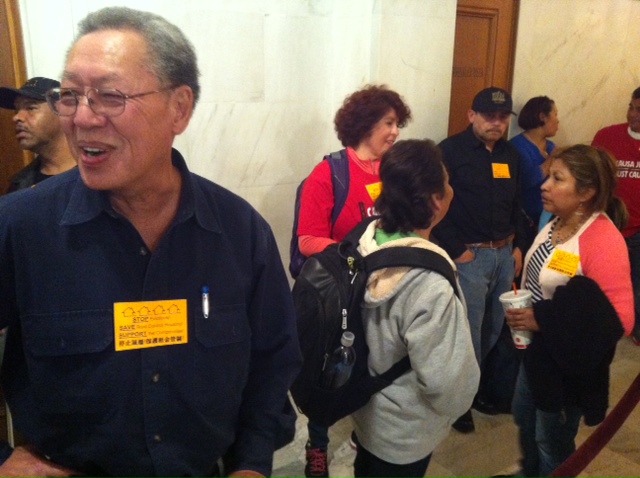
“It’s great. We’re going to see a significant drop in condo conversions in the future. All of us tenants are very happy,” San Francisco Tenants Union head Ted Gullicksen told us after the hearing, which was packed with tenant supporters.

Sup. Mark Farrell, who sponsored the original legislation, decried how divisive the issue had become, criticized the approved version as deviating from his original intent of helping TIC owners in exchange for a fee that would help fund new affordable housing, and said, “This doesn’t need to be a zero sum game.”

But Chiu and the five supervisors who supported his version – Jane Kim, Norman Yee, David Campos John Avalos, and Eric Mar – noted the finite number of rent-controlled apartments in the city and the need to protect them from being converted into condos.

“How do we balance the needs of tenants who fear being evicted with TIC owners looking for relief?” Chiu said of the balance he aimed to strike, which he continued to tweak with new amendments today, including allowing TICs with all owner-occupied units to move forward if the legislation is challenged in court, an event that would otherwise freeze all condo conversions until the lawsuit is resolved.

Sup. London Breed wanted even greater flexibility in that so-called “poison pill” aspect of the legislation, which tenant groups had insisted on to prevent the bypass from going through even if the moratorium was challenged. Breed proposed allowing condo conversion applications to proceed for a year after a lawsuit was filed, but Chiu said that would let TIC owners convert to condos while challenging other aspects of the legislation, such as the lifetime leases for tenants in converted buildings.

Breed and Sup. Malia Cohen, who privately and rather grimly conferred with one another and sometimes Chiu before the item began a little after 4pm, were clearly the two swing votes on the question of whether the legislation would reach the crucial eight-vote threshold needed to override a possible mayoral veto. Mayor Ed Lee has refused to take a position on the issue, leaving both sides in the dark.

But after the motion to insert Breed’s amendments failed on a 5-6 vote, the board voted 8-3 to approve Chiu’s version of the legislation, with Sups. Farrell, Scott Wiener, and Katy Tang opposed. A subsequent vote on a version of the legislation backed by Farrell and Wiener – which contained a weaker poison pill and more flexible owner-occupancy provisions – then failed on a 4-7 vote, with Breed joining the three dissenting supervisors.

Underscoring this legislation was what some supervisors called a “housing affordability crisis” in San Francisco, an issue that Mayor Lee was asked about at the start of the meeting, which he deflected by claiming “our city has some of the toughest anti-displacement laws in the nation.”

We’ll analyze that discussion and offer more details on the condo conversion debate and the politics behind it tomorrow in the space, so check back then.      

Developers should pay — on time

7

OPINION San Francisco used to be an eclectic city, filled with working class folks, people of color, lots of artists, and families. But that’s changed dramatically. The black population has dismally plummeted, to 6.3 percent, according to the most recent census. Families of color are streaming out, expensive condos and sky-high rentals are shooting up, and the unique mix that once was the city and made it such a diverse and culturally rich place to live and thrive is changing.

Three years ago, then-Mayor Gavin Newsom decided that private developers in San Francisco needed a local stimulus boost. The housing bubble had burst and taken the economy down with it, but Newsom wanted to ensure that private development in the city continued. So he proposed that private developers be allowed to defer paying the neighborhood impact fees on their projects, thus delaying funding for safety-net programs that help existing residents of working class neighborhoods fight displacement.

His proposal passed in 2010, and since then the Eastern Neighborhoods, SoMa, and the Octavia/Market Area have seen an upswing in private development projects coupled with rising eviction rates and housing costs, while affordable housing throughout the city becomes harder and harder to find. Because neighborhood impact fees were deferred services that would help vulnerable populations were underfunded by a total of almost $53.5 million — in 2011-2012 alone.

That lost money impacted affordable housing construction, affordable child care, development of parks and other types of open spaces, infrastructure and pedestrian-safety measures, neighborhood schools and libraries, and eviction prevention services.

Meanwhile, out-of-town private development companies are set to make millions of dollars building high-end rental units and luxury condominiums that the average San Franciscan can’t afford.

Given that private market-rate residential development in San Francisco is speeding up regardless of displacement dangers, it’s even more necessary today to strengthen and sharpen the tools our neighborhoods have for fighting displacement.

A longstanding question for San Francisco has been how to keep it from becoming a place where only the very wealthy can afford to live while the rest of us have to commute in to the city that we work in and love. Now as we field off another local housing boom fueled by speculation, we are faced again with needing to ensure that we prioritize San Franciscans over profit.

That’s why tenant groups, affordable housing advocates, and San Franciscans fighting for the right to stay in their city will be urging the Planning Commission to end the fee deferrals. The Planning Department staff has studied the issue and recommends that the Newsom program be allowed to expire; that would bring back the funds needed to invest in the vitality and vibrancy of our neighborhoods.

Come join us in helping get San Francisco’s priorities back on track at the Planning Commission meeting Thursday June 13th at 12pm in room 200 of City Hall. Private development is not worth more than the well being of working class communities, immigrants, families, LGBTQ, and tenant communities.

Maria Zamudio is a housing rights organizer for Causa Justa: Just Cause

8 Washington and the Warriors

16

I won’t be a bit surprised if the Warriors start putting money behind Simon Snellgrove’s efforts to win ballot approval for his 8 Washington condo project. And it won’t be just because of general developer solidarity. And I don’t think the basketball team owners are counting on a lot of fans living just down the Embarcadero — odds are a lot of the people who buy Snellgrove’s ultra-luxury condos won’t live in San Francisco much of the time anyway.

No: What the Warriors realize is that the fate of their arena could be linked to the fate of the height-limit battle on Snellgrove’s lot.

The mayor has called the Warriors Arena his legacy project. The head of the Planning Commission says it’s a done deal. Despite the screwy financing and the serious problems with traffic and transit, this thing is moving forward through official San Francisco on greased skids.

But given the way things work in this city, it’s almost certain that the arena will wind up on the ballot. Either the Warriors will organize an initiative campaign to put it before the voters, or the opponents will. And in this case, both sides will have money — the neighbors who don’t want the project are a relatively well-off bunch.

It’s too late for anything to happen for the Warriors this fall, which means a likely battle in November, 2014. But the voters this fall may very well reject the condo towers, and if they do, it will likely hinge on the notion that San Francisco has historically reduced height limits near the Bay. Polls show most voters don’t want tall buildings on the waterfront. And a strong vote to reinforce that would have impacts for any future projects.

“If 8 Washington goes down,” former Mayor Art Agnos, who opposes both projects, told me, “then the people will have spoken out about big buildings on the waterfront, and the Warriors will be in trouble.”

Remember: The arena is only one piece of the Warriors’ project. There’s also a shopping mall, hotel and highrise housing planned for the area — and without the highrise on Seawall Lot 333, the arena doesn’t pencil out. So you can love the idea of a big ol’ flying saucer thingy on a concrete pad four times the size of Union Square sitting on the edge of the Bay and still not like the idea of (once again) spot-zoning a waterfront lot for high-end condos that will block people’s views.

If I were opposed to the arena, I’d be reaching out to the folks fighting Snellgrove and throwing some cash their way. Because this is the first in a series of battles over the use of waterfront land, and its importance goes far beyond 134 condo units.

Supervisors pose tough but important questions to Mayor Lee

6

There’s a full agenda at the San Francisco Board of Supervisors meeting today, from the condo conversion lottery bypass legislation to approval of the term sheet from the massive development project at Pier 70, but some of the most interesting and potentially newsworthy items are at the very beginning of the agenda, when Mayor Ed Lee will answer questions posed by the supervisors.

Unfortunately, if past is prologue, Lee won’t give direct, substantive answers to the vitally important questions that he’s being asked, just as he dodged a question on the condo conversion debate in February and has kept everyone in the dark of which of the rival measures he supports and which he may veto. Mayoral leadership was desperately needed on that protracted debate, just as it’s needed today on some of the questions he’s being asked.

The first question, posed by Sup. Eric Mar, concerns Plan Bay Area and how it plans to pack 280,000 more people into San Francisco by 2040, which was the subject of a May 28 Bay Guardian cover story and panel dicussion that we’re sponsoring at the LGBT Center tomorrow night.

Mar lays out the massive displacement of existing residents and the traffic gridlock that the plan will create in San Francisco and how the approval process from much of this streamlined development may be given waivers from California Environmental Quality Act review.

Mar notes more than 40 regional groups have come together to try to improve the plan and mitigate its damage, and he plans to ask Lee:

“A consensus has formed around the following recommendations for making Plan Bay Area better:

– Provide $3 billion in additional operating revenue for local transit service and commit to a long-range ‘Regional Transit Operating Program’ to boost transit operating subsidies by another $9 billion over the coming years.

– Move 5 percent of the housing growth from low-income communities (mainly San Francisco, Oakland, and San Jose) to transit-connected suburban job centers.

– Incorporate strong anti-displacement policies for community stabilization measures, such as land banking and preservation of affordable housing in at-risk neighborhoods.

– Director the Planning Department to analyze the impacts of potential CEQA streamling as soon as possible and create strong mitigation measures.

Do you support these measure, and are you committed to a plan with lower displacement level than the current proposal? If you do not support these ideas, why not?”

Excellent  question, and definitely an appropriate one for our chief executive officer, who would have more clout to push for these changes than any of the supervisors.

The second question comes from Board President David Chiu, who makes news by noting that Mayor Lee has continued his predecessor’s underhanded practice of refusing to fill city positions to provide services that the supervisors have decided to fund in the budget, undermining the city’s balance of power and Lee’s rhetoric on collaboration.

“In recent months, Controller data indicates that positions allocated by the Board for librarians, recreation and park staff, building inspection, health and labor enforcement, urban agriculture and other Board priorities were either not filled or only recently hired. Will you commit to ensuring that when the FY 13-14 budget is approved, our Board of Supervisors’ priorities are treated equally to your Administration’s, with positions filled as soon as possible?”

Again, great question about an important current issue, the kind of thing that voters created this question time for, to ensure that there was communication and collaboration between these two branches of government.

The last two questions concern San Francisco’s housing crisis. Sup. David Campos cites the scatching report that he commissioned from the Budget and Legislative Analyst on the dysfunctional and mordibund Housing Authority, which Lee controls, asking “what is your long term vision to save public housing — a significant public asset to San Francisco?”

Sup. John Avalos cites data on the skyrocketing rents in San Francisco and asks, “Are you concerned that your administration’s policies to stimulate economic activity, especially supporting the tech industry, have created one-sided development and only job for high-income ‘appsters,’ and have exacerbated the already extremely limited housing market? Do you have any plans to address the increasing rents, and increasing rate of evictions and displacement of long-time San Francisco renters?”

These are tough questions, but they are central to what kind of city San Francisco is becoming. They were all submitted last week, so the mayor has had time to think about them and he should provide answers and show leadership on these difficult issues. That is his job.

Will he? Check back later and I’ll let you know. The meeting starts at 2pm.

Rival condo conversion measures finally up for board vote

58

Controversial condominium conversion lottery bypass legislation is finally headed for a vote by the full Board of Supervisors this Tuesday. Befitting legislation that has stirred strong emotions and traveled a twisting political path over the last six months, there are new dramas and uncertainties cropping up at the last minute, including the lingering unknown of where Mayor Ed Lee stands.

Originally co-sponsored by Sups. Mark Farrell and Scott Wiener, the legislation was intended to allow 2,000-plus tenancy-in-common owners to buy their way past the city’s lottery that allows 200 conversions to condominiums each year. But tenant groups and their progressive allies strenuously opposed the idea, and it was amended by Sups. David Chiu, Jane Kim, and Norman Yee working with tenants to couple the bypass with a 10-year moratorium on new conversions, thus clearing the backlog without opening the door to speculators taking more rent-controlled apartments off the market.

The Land Use Committee voted June 3 (2-1, with Chiu and Kim voting yes and Wiener opposed) to send the tenant-supported legislation to the full board and keep a Wiener-backed rival measure stuck in committee. But since then, Wiener invoked a board rule allowing four supervisors to pull the stalled legislation out of committee, getting Farrell and Sups. Katy Teng and London Breed to place that rival measure on Tuesday’s agenda as well.

Tenant groups decried the move and have put out the call for supporters to flood City Hall for the 2pm meeting, but Wiener told us that the differences in the two pieces of legislation are minor. One difference deals with whether transfers of ownership interest will affect an applicant’s spot in the queue and the other involves the so-called poison pill inserted by tenant groups, which would freeze the conversion process if anyone challenges the legislation in court, as real estate interests have threatened to do.

Wiener said the tenant-backed legislation’s changes to condo conversion eligibility, such as a 10-year wait period and banning future conversions of buildings with more than five units, that would remain in place after a successful legal challenge is an unfair overreach. But Chiu said tenant groups have already compromised as much as they can and they need this protection: “This is a carefully constructed compromise, and for the first time tenants groups are supporting thousands of condo conversions.”

Breed’s concerns about the poison pill provision — which was why she said she went along with Wiener’s play to bring up the rival measure — go even beyond Wiener’s. While most concerns involved a lawsuit from real estate interests, Breed worries about a pro-tenant litigant who wants to stop all condo conversions.

“If anyone chose to sue, it would help renters by shutting down everything completely. Where is the incentive not to sue?” Breed told us, noting that she still doesn’t have a solution to the problem, but she wanted the leverage of rival measures in order to address the issue. “I’m hoping it’s a win-win for renters and TIC owners,” she said. “Everyone else is not my concern right now.”

But the real estate interests will almost certainly try to preserve an ability for speculators to continue funneling more rent-controlled apartments into the real estate market, and just yesterday, the San Francisco Association of Realtors announced the hiring of an influential new point person on lobbying and housing issues: Mary Jung, a former spokesperson for then-Mayor Gavin Newsom before moving over to represent PG&E, and who was last year elected chair of the Democratic County Central Committee.

That could make a difference when it comes to Mayor Lee, who has resisted efforts by both sides to weigh in on the issue, saying only that he supports both tenants and TIC owners and that he understands the concerns about opening the door to a flood of new conversion requests.

“The one wild card here is no one know where the mayor is,” Wiener told us, noting that neither side is likely to get the eight votes that would be needed to override a veto. “The mayor, if he wanted to, could have significant leverage in crafting a compromise.”
Chiu said that he’s confident that his version of the legislation has the six votes needed to pass, but that it is still unclear what Mayor Lee will support, despite Chiu asking Lee to weigh in publicly in February and privately during a meeting yesterday. As Chiu told us, “We’ll see.”

The Chron’s token conservative on tech hegemony

9

It’s always fun when things are so screwy in town that the leading conservative writer at the Chron starts to agree (even just a little) with the crazy commie at this blog.

Debra Saunders is unhappy with the way the Apple store is moving into Union Square. Not because she hates Apple; she’s a Republican who loves all business. Not because she wants to save the fountain or thinks the urban design is ugly; she’s all for new development.

The problem she has is the same problem so many of us have with Sean Parker’s wedding: The technoriche don’t have to play by the same rules as everyone else:

But I think some locals object to the plan because Apple gets kid-glove treatment. Small business owners have to jump through many hoops to accommodate the Special City’s sensibilities – or else. There’s an ordinance, for example, that prohibits chain stores in certain neighborhoods. Yet when the high-tech money knocks, the door is wide open.

Yep. Small businesses don’t get special tax breaks out of the Mayor’s Office. Local merchants don’t get these kinds of special exemptions when they want to open or build something. (Try to open a nightclub in this town.)

When hi-tech money knocks, the door is wide open. And even the conservatives are getting sick of it.


The adulation of the technoriche

31

It’s hardly news at this point that billionaire tech mogul Sean Parker tore up a public campground to build the sets for his $10 million fantasy wedding in Big Sur. And it’s been widely reported that Parker paid a $2.5 million fine to the Coastal Commission, which he tried to spin as a wonderful environmental gift to improve the state park system.

But I read with interest in the Chron that both Lite Guv Gavin Newsom and Attorney General Kamala Harris were reportedly at the wedding. Both are very smart people; both have the ability to observe the world around them. So I have to wonder:

Didn’t either Newsom or Harris think it was a little bit odd to see all this new development in a protected area? Did it occur to either of them that their richy-rich-rich pal, who has a history of snubbing laws he doesn’t like, might have done the same thing here?

Could the state’s top law-enforcement official and a member of the state Lands Commission really look at artificial ponds and large new structures, which involved bulldozers to create, and not say:

Huh? Aren’t there rules against this sort of thing?

Okay, it was a wedding, and nobody wants to be the one to throw the turd in the punchbowl. The politician guests were there to celebrate with a person who is capable of helping to fund future campaigns (and since both Harris and Newsom are considered possible candidates for governor when Jerry steps down, I bet they had a great time together).

But didn’t either of them feel at least a little weird about it?

I called Newsom’s office and left a message for Dierdre Hussey, his press person. She hasn’t called back. Nick Pacilio in Harris’s office told me someone would get right back to me; hasn’t happened yet. So we don’t know what the two were thinking.
But I do know this: The level of adulation of the technoriche has reached levels we haven’t seen since the Gilded Age.

Technology columnist James Temple puts it this way:

To the outside observer, Parker’s actions look like contempt for the piddling rules that we non-billionaires can’t buy our way around. And they certainly do nothing to alter the increasingly popular local view of the tech class as selfish and aloof, conspicuously relishing their venture capital rounds and IPO winnings, as a growing portion of the Bay Area population struggles to make the skyrocketing rents.

And politicians seem to adore the most selfish and aloof (and clueless) among them.

Take Mayor Ed Lee’s comments about Airbnb. The company is clearly cheating on its taxes. The city treasurer investigated the situation and ruled unequivocally that airbnb needs to collect and remit the Transit Occupancy Tax money that should be charged on its rooms.
When Michael Krasny asked the mayor on Forum about the issue, Lee defended airbnb (which is funded by his buddy Ron Conway), saying that the company is just “making arguments” about whether it owes the tax.

But that’s just false: The arguments are over. The company argued with the tax collector and lost. And it isn’t arguing anywhere anymore — not in court, not in the political sector. It’s just …. not paying. And because it’s a tech company, and Conway is nurturing it, the mayor seems just fine with that.

It appears that big corporations are big corporations. They may claim that they won’t be evil, and they may be headed by people in their 20s who dress like hipsters, and they may make really cool products — but their operating just like the robber barons of old. And the great wealth they’ve created has, to a great extent, also created great arrogance.

Before the trolls accuse me of fomenting class warfare, let me repeat: I didn’t start this war. I didn’t rig the political and tax systems so that the middle class would be wiped out as all of the net new wealth in a generation goes to the top 1 percent. I’d much prefer we all share in the bounty, as the middle class and working class did in the post-War era.

Meanwhile: Does anyone really need a $10 million wedding in a state park?

SF homeless services budget item < 0.25 percent of Larry Ellison’s net worth

Billionaire Larry Ellison, the vainglorious CEO of Oracle and yachtsman responsible for bringing the America’s Cup to San Francisco, has come a long way since 2010, when he first floated the idea of hosting the elite regatta against a Golden Gate backdrop.

On Forbes’ 2010 list of the world’s wealthiest individuals, Ellison’s estimated net worth of $28 billion earned him a spot in sixth place. That amount gave him a slight edge over the current GDP of Panama, but the superrich seafarer is doing waaaaay better than that Central American nation these days. On the 2013 Forbes roster, the tech mogul rose to No. 5, and his estimated net worth had ballooned considerably, to an estimated $43 billion.

As it happens, the additional $15 billion Ellison managed to attract in the last three years is nearly twice the total spending plan unveiled by San Francisco Mayor Ed Lee last week, when he presented the largest proposed city budget in history.

Lee made a point of noting in press statements that he’d taken pains to preserve social services; even tossing an additional $3.8 million toward funding for homeless prevention and housing subsidies. Nevertheless, some dust seems to be kicking up over how equitably Lee would have public dollars distributed across the board.

With the America’s Cup looming on the horizon, the mayor’s budget now awaiting supervisors’ review, and an ever-widening gulf between the haves and the have-nots in San Francisco, we began to ponder: Just how does Ellison’s wealth compare to the amount spent on, say, homeless services in San Francisco?

In Lee’s proposed 2014-2015 budget, “homeless services” is allotted $101,669,214 via the Human Services Agency, about $1.5 million less than the amount included in the city’s 2013-2014 budget. 

That figure could also be expressed as 0.236 percent of Ellison’s estimated net worth. Decimal dust.

Within a week or so, we’re told, the Human Services Agency will release an updated estimate of the city’s homeless population, along with historical comparisons suggesting whether the ranks of the un-housed has grown or waned in recent years. Weeks after that, San Francisco’s waterfront will be transformed by a sporting event that only the superrich can afford to compete in.

The Warriors Arena: Art Agnos v. Gary Radnich

8

Here’s a fun one: former Mayor Art Agnos debating the Warriors arena with Gary Radnich and Larry Krueger. Radnich has always been my favorite sports guy, ever since his days on KRON TV (although Kruk and Kuip are the best live-action announcers), and Agnos is my favorite ex-mayor. (Lord, I gave him a hard time when he was in office, and he sometimes deserved it, but he’s been great as a former.)

The two go at it — mostly in good spirts, although Agnos can’t avoid getting in a dig about male enhancement.

The sports guys talk about how great it would be for San Francisco to have another tourist attraction (and more customers for the city’s number one industry.) Agnos points out that it’s not just a basketball arena we’re talking about — it’s a huge shopping mall, with more square footage than all the restaurants at Fisherman’s Wharf (wow, that’s what Agnos says, I didn’t realize it was so big), plus a highrise hotel, plus a highrise condo tower.

Radnich likes to compare the new arena to the Giants stadium, which is on the waterfront but not built on the water, on a concrete slab in the Bay, but the Giants didn’t build two highrises and a mall.

It’s not a long debate, but it’s interesting.

Some wins, some losses in Sacto

9

The state Assembly and Senate passed the usual flurry of bills on May 31, the last day for initial-house approval, with some unusual drama that temporarily sidelined a medical-marijuana bill by Assemblymember Tom Ammiano.

By the time it was all over, several other Ammiano bills passed, a measure by Assemblymember Phil Ting to ease the way for a Warriors arena on the waterfront won approval, and state Sen. Mark Leno got most of his major legislation through.

The pot bill, AB 473, would have established a state regulatory framework for medical cannabis, something that most advocates and providers support. Still, because the subject is marijuana, it was no easy sell and at first, a lot of members, both Republicans and Democrats, expressed concern that the measure might restrict the ability of local government to ban or limit dispensaries.

Ammiano, in presenting the bill, made it clear that it had no impact on local control, and that was enough to get 38 votes. Typically, when a bill is that close to passage, the chair asks the sponsor if he or she wants to “hold the call” that is, freeze the vote for a few minutes so supporters can make sure all of their allies are actually on the floor and voting and to try, if necessary, to round up a couple of wobblers.

In this case, though, Speaker Pro Tem Nora Campos, of San Jose, simply gaveled the vote to a close while Ammiano was scrambling to get her to hold it. “That’s very unusual, not good behavior,” one Sacramento insider told me.

Ammiano was more respectful toward Campos, simply calling it a “procedural mistake.” He told us he would be looking for other ways to move the bill. “The door is never fully closed up here,” he said.

However that turns out, the veteran Assemblymember, now in his final term, won a resounding victory with the passage of his Domestic Workers Bill of Rights, AB 241. The bill would give domestic workers some of the same labor rights as other employees, including the right to overtime pay and breaks. “These workers, who are mostly women, keep our households running smoothly, care for our children, and enable people with disabilities to live at home and remain engaged in our communities,” Ammiano said. “Why shouldn’t they have overtime protections like the average barista or gas station attendant?”

An Ammiano bill restricting the ability of prosecutors to use condom possession as evidence in prostitution cases also cleared, as did a bill tightening safety rules on firearms.

Ting’s bill, AB 1273, would allow the state Legislature, not the Bay Conservation and Development Commission, to make a key finding on whether the new area is appropriate for the shoreline. Mayor Ed Lee and the Warriors strongly backed the measure, clearly believing it would make the path to development easier. Ammiano voted against it showing that the San Francisco delegation is by no means unanimous on this issue.

Leno had a string of significant victories. A bill called the Disclose Act, which would mandate that all campaign ads reveal, in large, readable type, who is actually paying for them, cleared with the precise two-thirds majority needed and it was a straight party-line vote. Every single Republican was in opposition. “They know that if their ads say “paid for by Chevron and PG&E, the won’t work as well,” Leno told us.

He also won approval for a bill that would ease the way for people wrongfully imprisoned for crimes they didn’t commit to receive the modest $100 a day payment the state theoretically owes them. There are 132 people cleared of crimes and released from prison, but the process of applying for the payment is currently so onerous that only 11 have actually gotten a penny. “We victimized these people, and we shouldn’t make them prove their innocence twice,” Leno said.

Bills to better monitor price manipulation by oil companies and to expand the trauma recovery program pioneered by San Francisco General Hospital also cleared the Senate floor.

But Leno had a disappointing loss, too: A bill that would have helped tenants collect on security deposits that landlords wrongfully withheld died with only 12 vote a sign of how powerful the real-estate industry remains in Sacramento.


Emulating Switzerland

9

Today’s “human nature is revolting” story comes from the state of Utah. Apparently, one the state’s leading gun-rights activists was busted for threatening his ex-wife’s family with a 2.5 tom Army surplus vehicle, as he intended to run over all of their cars with his. His lawyer says it’s no big deal and he was just “having fun in his big boy toy.”. 

I guess that crushing other people’s property could be construed as boys will be boys, assuming the boy in question is another porcine asshole with privilege issues, but it got to thinking about the mess that is the gun debate in America. Around and around it goes and as it accelerates, it gets crazier and meaner. Gun control advocate Michael Bloomberg, mayor of New York City, is getting ricin laced hate mail from people that are apparently terrified that he’s gonna do to the Bushmaster as he did to the Big Gulp. Bloomberg’s PAC is sinking a ton of cash into gun control friendly candidates, making him the embodiment of the anti-NRA. The latter group has kept their lawmakers in check for years by threatening to run well funded opponents against anyone not toeing their line–if Bloomberg can match them dollar for dollar, this is a new ball-game.

And a new one would be coming anyway, Bloomberg or not. While sales of firearms are up, gun ownership is down. The same people are simply buying more weapons, wound up to the gills with the irrational fear that “Obama’s gonna take your guns”. The market is getting smaller, though and the NRA–no longer a gun safety or hunter’s rights group but really a trade association dedicated to expanding gun makers revenues–is getting cranky.

The center can’t hold. It is inconceivable that the US government would ever seize the millions of weapons in private hands, even if there was overwhelming public demand for same, it’s physically impossible. It’s also inconceivable that the public’s patience for inaction will remain much longer. A simple vote on innocuous background checks–which are supported by about 90% of the country--was unable to pass cloture in the Senate. The senators that voted against it watched their approval ratings plummet. So what now?

How about a new idea that works wonders elsewhere. In Switzerland, where there is no standing military, able bodied males over 18 are issued a rifle and bullets and fulfill the role of militia. As the Second Amendment attaches the right to bear arms to a “well regulated militia”, why not implement the same idea of a sort in the US? Every home in the US becomes required by law to have one firearm per adult, registered to same and with a reasonable amount of ammunition for same. Training and safety courses must be passed every few years like a trip to the DMV is. 

Surplus weapons can be sold back to the government. And locked up in armories.

I can see where both sides would hate this idea. Gun control advocates would be furious at the idea that the hated and lethal firearm would be mandatory–but who says they have to be loaded? The firearm fetishist upon whom the gun industry depends would be furious as well as their collections would be depleted–but once again, an idea–“remove and prove”. You collect weapons, remove firing mechanism and prove same.

Yes, it’s a pain in the ass in a lot of ways, but America can’t continue down this path. If every home has a couple of guns in it, according to the logic of the pro-gun cadre, no one will rob it (I know this isn’t true, but bear with me). Everyone will be presumably safer (that is to say, less scared)–isn’t that what they want?

Most people, yes. The NRA, of course not. As an adjunct to business, they have to show higher revenues each quarter and this idea more or less ends them. But that’s coming anyway–fairly soon, the gunmaker could be anyone with a 3-D printer. Sorry, Mr. LaPierre.

It is but a simple suggestion, but I think it’s a workable compromise. Because the all or nothing gambit is getting us nowhere. 

Dianne Feinstein and 8 Washington: The letters

8

Here’s a fascinating little bit of history that relates to the 8 Washington project.

In 1984, the owners of Golden Gateway proposed to build a nine-story condo tower on the site, pretty close to where Simon Snellgove wants to build his ultra-luxury condos today. Dianne Feinstein was the mayor of San Francisco, and she didn’t like the idea at all. In fact, she sent a letter to the Redevelopment Agency Commission, which at that time controlled the land, to say that condo development was inappropriate.

(Feinstein was remarkably open about the whole thing; Willie Brown would have made one phone call, gotten his way, and left no paper trail.)

The point she made in the letter (pdf here) was that the existing Golden Gateway project was approved in the first place largely because of the promise of open space and recreation facilities. Those facilities, contrary to what Snellgrove’s team is saying, are in fact open to anyone who pays dues. “To tear up the present tennis courts to crowd a condominium tower on the site would be regrettable,” she said.

Then in 2003, another plan reared its head — developers wanted to build a $39 million condo and health-club facility on the Golden Gateway site. Again, Feinstein — by that point a US senator — weighed in with a letter of opposition. “Development of more residential units would create traffic noise and pollution and disregard the original understanding between City officials and area residents that open space and recreational amenities would be preserved.”

Feinstein’s opposition was notable: She rarely opposed any development of any sort, anywhere in the city. She allowed massive new waves of office construction and — like Ed Lee today — argued that cranes on the skyline were a sign of progress.

But this idea — condos at the 8 Washington site — was so beyond the pale that even the most pro-growth mayor in the city’s history had to oppose it.

Feinstein hasn’t said anything about the latest project. But she clearly doesn’t actively support it; when the measure came up the the Democratic County Central Committee, her representative didn’t vote.


Ed Lee’s “no social service cuts” budget

6

So Mayor Ed Lee is going to spare social services, and apparently at least part of the Department of Public Heath, from any further budget cuts. That’s good. Lives will be saved.

Lee — like Willie Brown before him — has the luck of serving as mayor during a period of growth, not recession. We don’t know how long the boom is going to last, or what will happen when it ends (as these things always do), but right now, in Sacramento and San Francisco City Hall, there is joy over the fact that revenues are up.

(Lee’s supporters on this blog and elsewhere will say it’s because of the mayor’s “pro-jobs” policies that we have all this new revenue. But remember, he promised tax breaks for Twitter and other tech firms that are moving into mid-Market, so we’re not getting much extra payroll tax revenue there. SF is a disgustingly hot real-estate market right now and more people with more money are moving in, so that’s absolutely a factor. So is the general California recovery.)

Either way, I’m always happy to hear about “no-cuts” budgets. But I have to keep raising the question:

If you’ve already cut about a billion dollars worth of services — which is about what most people on all sides of the political spectrum agree has happened in SF in the past decade — and now you’ve agreed not to cut any more, are you really making progress?

At what point do we need to start planning to restore all the services that are gone?


Editor’s notes

57

tredmond@sfbg.com

EDITORS NOTES I know you’re getting a lot of shit these days, and it’s not entirely fair. You’re not the ones making a killing in overpriced real estate. You came here looking for a job, and the jobs you get pay well enough that landlords and speculators can extract wealth that you ought to be able to save or spend in town, creating more jobs for everyone. I can’t blame you for wanting to live in one of the world’s greatest cities; I came here too, from the East Coast, in 1981, looking for work as a writer but mostly looking to live in San Francisco. So did waves of immigrants before me.

But we all have to remember something: There were people living here when we arrived. It was their city before it was ours. And they had, and have, the right to live here, too.

In fact, the people who have been here for 20 or 30 years, who have worked to build this community, have — in a karmic sense — even more right to be here than you. Trite as it sounds, they were here first.

Americans have a bad record when it comes to moving into established populations. Ask any American Indian. Ask the Mexicans about the treaty of Guadalupe Hidalgo.

The hippies who arrived in San Francisco in the 1960s — attracted, among other things, by really cheap rent in the Haight Asbury — weren’t always terribly polite to, or concerned about, the natives who lived there, and had fun teasing the straights and fouling their parks. But they didn’t force anyone else to leave; there was lots of empty space in San Francisco. The city wasn’t kind to them, either — official San Francisco may celebrate the Summer of Love now, but back then, the cops went after the hippies with gusto.

Gay people who arrived in the 1970s — attracted, among other things, by cheap rent in Eureka Valley — faced harassment, discrimination, and brutality.

You, on the other hand, are officially welcomed — the mayor thinks you’re the city’s future. You face no barriers to renting or buying a home, no police crackdowns. The only people unhappy about your presence are the ones who are getting forced out of town to make room for you.

It’s not your fault that the city lacks eviction protections or effective rent control — but it is your fault if you act as if it doesn’t matter. Building community means more than spending money. It means getting involved.

Many of you are tenants. You may be richer than the people who you displaced, but your landlord will cheat you just the same. The Tenants Union needs support. You can be a part of making it stronger. Some of you will have kids at some point; there are great public schools in San Francisco, and I hope you support them.

Meanwhile, you can help keep longtime residents from being forced out. Jeremy Mykaels, a former web designer disabled by AIDS, has set up a site listing all the properties that have been cleared through the eviction of a senior or disabled person (ellishurtsseniors.com). Check it out. Don’t buy those units. If that means you have to live with lesser housing for a while, you can deal. For generations, the rest of us did.

Yeah, we were here first. Show a little humility and a little respect, and perhaps we’ll all get along fine.


Da Mayor, local hire advocate

Even as Sup. John Avalos continues to be raked over the coals by San Francisco Examiner columnist Melissa Griffin for his so-called “peacocking, disrespectful demeanor” and “flexible hate speech standards,” the progressive District 11 supervisor nevertheless earned something akin to praise May 22 from an unlikely figure: former San Francisco Mayor Willie Brown.

The San Francisco Chronicle columnist, attorney (Brown mentioned in his speech that he paid $50 a semester for law school), sometimes PG&E consultant, self-proclaimed “buddy” of former California Gov. Arnold Schwarzenegger, and all-around power broker delivered his Annual Lecture on Political Trends at the Commonwealth Club yesterday. He plugged his own column, saying, “On Sunday, you can read a column that can’t be disputed. Because it’s my version of the facts.”

Brown is known for his cozy relationship with Mayor Ed Lee and is politically at odds with Avalos, who ran against Lee in 2011. Emphasizing his support for Lee, Brown lauded him for clinching the city’s right to host Super Bowl 2016 events in San Francisco. He pointed out, “That Super Bowl is going to be exactly when he’s possibly seeking reelection.”

Brown also mentioned accompanying the mayor on a recent trip to China, where Lee was reportedly “treated as if he was the president of America instead of just the mayor of San Francisco.”

However, Da Mayor had a bone to pick. He launched into a tale of how he often wanders down to the city’s bustling construction sites, marked by “these 24 or 25 cranes that you see around town” (presumably he finds time for this aimless wandering this between international excursions, dining with the Gettys in North Beach, and palling around with his “buddy” Schwarzenegger?). “Invariably I take a look at the cars, the crews,” he said, and has concluded that “they’re not San Franciscans.” Not only are private development projects being built by out-of-towners, he said, no local hire requirement was imposed upon the city’s Central Subway contractors. 

Giving voice to a cause long championed by Avalos, a progressive who fought doggedly to enact a local hire ordinance, Brown expressed frustration that locals aren’t the ones scoring gigs in the city’s construction bonanza.  

Then he gave Avalos a sort of backhanded compliment, calling him “the strongest advocate for local hire,” but saying “he hasn’t followed up the way he should follow up, to ensure that people who live here get the jobs.”

It seems unfair to lay the blame for this at Avalos’ feet, but Da Mayor seems to be on the money as far as this point is concerned: As long as SF has embarked on a building frenzy, shouldn’t it be residents who reap the benefits of decent paying construction gigs?

Airbnb is still snubbing SF, even after a NY judge rules it illegal there

39

Now that a judge in New York has ruled that Airbnb is illegal there, a model that violates city tenant laws and state law, that should put pressure on the San Francisco-based company to finally stop snubbing cities and find a way to exist within local regulatory frameworks and finally start paying its taxes.   

It was good to hear KQED’s Forum discuss Airbnb this morning – it was getting lonely as the only local reporter highlighting the company’s open defiance of San Francisco’s ruling that it should be paying the city’s Transient Occupancy Tax, just like hotels – and to finally question an Airbnb executive on an issue the company has been refusing to address publicly (yes, they still aren’t returning my calls).

But the answer that David Hantman, Airbnb’s global head of public policy, gave this morning was pretty astounding in its hypocritical arrogance. He acknowledged the tax ruling by San Francisco and the company’s lack of compliance, and said the company was waiting for clarification on the various issues related to the questions of the legality of some of the short-term rentals it facilitates before paying its taxes.

In other words, this company is making tens of millions of dollars annually in San Francisco alone on a business model that it developed – one that often runs afoul of local land use and tenant laws, and in violation of people’s leases – and it’s up to city officials to find a solution to this company’s problems before it will pay taxes?!?

To his credit, Board of Supervisors President David Chiu has been trying to do just that for months, slogging through a number of complex and difficult issues that arise from this business model, and he has been clear throughout that Airbnb should be paying its taxes to the city, which it isn’t.

“It’s reasonable to ask people who benefit from the economic transactions we’re talking about to pay their fair share,” Chiu reiterated on Forum, citing the cost to the city of serving the 16 million tourists who visit the city each year.

Coincidentally, there’s a German television crew from ARD (Germany’s equivilent of the BBC) in San Francisco this week doing a story on Airbnb and the shareable economy, interviewing me about my coverage of the company, as well as others, including Airbnb co-founder Nathan Blecharczyk.

The ARD reporter told me this afternoon that Blecharczyk was animated and expansive when discussing how wonderful his company is and how it’s changing the world, but he became terse and unresponsive when she raised the issue of local taxes and regulations.

As I said on camera today, Airbnb and other shareable economy companies are cool, I’ve used them myself, and they’re certainly here to stay. But I just don’t understand their unwillingness to be good corporate citizens and to pay the taxes they owe to support the city services that their customers use.

Chiu has clearly said that Airbnb should pay the TOT — which my reporting has shown would bring $1.8 million annually into city coffers — and that paying its taxes will be a part of the regulatory package he’s working on. But sources have also told me that negotiations have been hard slog, largely because of Airbnb’s unwillingness to play by the rules and because of the unqualified support the company has from Mayor Ed Lee, whose main political fundraiser, Ron Conway, is also a major investor in Airbnb.

Hopefully the New York ruling and growing media scrutiny will prompt the young executives at Airbnb to finally become good faith partners in a city that has been so good to them — a city whose leaders seem anxious to return the favor and legalize Airbnb’s operations in San Francisco.


Weiner Rises!

27

Midnight Wednesday, Anthony Weiner–who resigned from Congress two years ago because of a “sexting” scandal–has announced he will run for mayor of New York City. He will enter a crowded field to replace Michael “Big Gulps Are Murder” Bloonberg.

As he has a boatload of cash and 100% name recognition, he will be a force to be reckoned with. Plus, his main opponent, Christine Quinn has serious personal issues of her own. New York politics and politicians being what they are, from Walker and LaGuardia to Ed Koch and Rudy Giuliani, means that this will be very amusing to the rest of the country.

Weiner, if you recall, sent out bare chested (among other things) pics to females via text a few years ago. That was the proximate cause of the uproar behind his resignation. It can be debated whether this was really the reason or not–Weiner went after the insurance industry with an awful lot of gusto. And, like fellow New Yorker Eliot Spitzer, he paid for it–screw with the mega-wealthy while you are playing games on the Internet or with hookers and they will snag you.

The difference between Weiner and Spitzer is while Spitzer (a lawman) was breaking the law and having actual sex, Weiner was doing neither. For all of the hand-wringing and ridicule Weiner brought on himself and his wife, he did absolutely nothing wrong. In fact, he did absolutely nothing at all, because sexting and cyber sex are not sex. At all. By any stretch of the definition of sex.

Minus actual contact between parties, there is no sex. Weiner could not impregnate the women he was sexting nor could he directly provide them sexual pleasure and most importantly, if this is sex, when has sexting ever led to an STD? If there is no sexual transmission, there is no sex. The objection that he was indiscreet stands (no pun), but if there was any real unhappiness over these non-existent trysts, where is it?

Cyber sex is no more sex than a strip club or porn is sex or for that matter, flirting is sex. Because that’s all cybersex really is, flirtation. And for all the noise this nonsense generated, Huma Abedin (Mrs. Weiner) never left him–it is entirely possible that she sees this for what it is–nothing. She may even like the idea that her husband is a popular figure among women and that when it comes to the actual act, it’s her and he. (So far as we know).

Weiner, like Spitzer and even the pitiful John Edwards, were held up as pariahs because of their dalliances. But the truth is, they enraged the powers that be, from hammering Wall Street to suggesting that there are “two Americas” where the lesser one gets screwed a lot harder than anything in A Weiner’s provocative prose and photos. As the voters of South Carolina just sent back a cheater whose actual behavior is a hundred times worse than Bony Tony’s was, maybe this idiocy can finally be put to rest once and for all, but I wouldn’t count on it.