History

Events: July 16 – 22, 2014

0

Listings are compiled by Guardian staff. Submit items for the listings at listings@sfbg.com. For further information on how to submit items for the listings, see Selector.

WEDNESDAY 16

“The James Webb Space Telescope: Science Potential and Project Status” Randall Museum Theater, 199 Museum Way, SF; www.randallmuseum.org. 7:30pm, free. Tom Greene of NASA Ames Research Center discusses the highly advanced James Webb Space Telescope.

“Lyrics and Dirges” Pegasus Books Downtown, 2349 Shattuck, Berk; www.pegasusbookstore.com. 7:30pm, free. Monthly reading series curated by Sharon Coleman, with Joyce E. Young, Monica Zarazua, Joshua McKinney, Katayoon Zandvakili, Rusty Morrison.

Celeste Ng Book Passage, 1 Ferry Bldg, SF; www.bookpassage.com. 6pm, free. The author shares Everything I Never Told You, her debut novel about a mixed-race family in 1970s Ohio.

THURSDAY 17

“The Heights of Birding in Colombia” First Unitarian Universalist Church, 1187 Franklin, SF; www.goldengateaudobon.com. 7-9pm, $5. Photographer and birding instructor Bob Lewis shows images of birds he observed in the Colombian mountains. Sponsored by the Golden Gate Audobon Society.

LaborFest 2014 Meet at M stop at 19th and Holloway, SF; www.laborfest.net. 2-3pm, free. Park Merced Housing Walk led by members of the Park Merced Action Committee. Also 518 Valencia, SF. 7pm, donations accepted. “FilmWorks United: International Working Class Film and Video Festival:” “The Plundering” (Ressler, 2013), “Made in the USA: Tom Hudak’s Plan to Cut Your Wages” (Gillespie, 2013), “Judith, Portrait of a Street Vendor” (Pirana, 2013),” and “High Power” (Indulkar).

FRIDAY 18

“Bay Area Now 7” opening night party Yerba Buena Center for the Arts, 701 Mission, SF; www.ybca.org. 8-11pm, $12-15. Celebrate the opening of YBCA’s signature triennial, an exhibit highlighting works by local artists who capture “the spirit of now,” with tunes by Honey Soundsystem.

LaborFest 2014 First Unitarian Universalist Church, 1187 Franklin, SF; www.laborfest.net. 7pm, donations accepted. “FilmWorks United:” Empire of Shame (Hong, 2013).

SATURDAY 19

“East Bay SPCA Pet Adopt-a-Thon” Jack London Square, Washington at Embarcadero, Oakl; www.jacklondonsquare.com. 10am-3pm, free. Meet your new best friend at this event highlighting East Bay adoption agencies — and the dogs, cats, bunnies, rats, guinea pigs, birds, and reptiles they care for that need new homes. The event also features canine demos and $10 microchip implants.

“GeekGasm” Club OMG, 43 Sixth St, SF; geekGasm.eventbrite.com. 9pm-2am, $5 (free with advance RSVP and before 11pm). Let your inner geek out with fellow nerds, dorks, cosplayers, furries, sci-fi fans, gamers, and gaymers at this party, which features dancing, a costume contest, drink specials, and more.

LaborFest 2014 ILWU Local 34 Hall, 801 Second St, SF; www.laborfest.net. 10am-1pm, free. “Life and Death! The Attack on OSHA, Workers Health and Safety, and Injured Workers” public forum. Also National Japanese American Historical Society, 1684 Post, SF. 2pm, free. “ILWU and Japanese Americans” presentation. Also ILWU Local 34 Hall. 7:30pm, donation. “Movement Energy: A History of May Day and the Eight Hour Day,” performance by the Rockin’ Solidarity Chorus, Sat, 7:30.

Sara Lautman Cartoon Art Museum, 655 Mission, SF; www.cartoonart.org. 1-3pm, free. The July cartoonist-in-residence shares and discusses her work.

“Meet Your Maker” David Brower Center, 2150 Allston, Berk; www.browercenter.org. Noon-6pm. Free. Celebrate the alternative economies of the Bay Area at this event featuring artisans from Treasure Island Flea, educators from Institute of Urban Homesteading, Urban Ore scavengers, and more, plus a craft market, food trucks, workshops, presentations, and more.

SUNDAY 20

“How a Chinese Game Shaped Modern America” Contemporary Jewish Museum, 736 Mission, SF; www.thecjm.org. 1-2pm, free with museum admission ($10-12). Stanford’s Annelise Heinz discusses mah jongg’s journey from China to America’s Jewish community, with a focus on the Catskills and San Francisco. Part of the CJM’s new exhibit, “Project Mah Jongg.”

LaborFest 2014 First Unitarian Universalist Church, 1187 Franklin, SF; www.laborfest.net. Noon-2pm, free. Reception for “Union Artists and Labor Art,” with works by Attila Cziglenyi, Carol Denny, David Duckworth, and others. Also 240 Second St, SF. Noon, free. “Irish Labor History Walk.” Also Niles Station, 37001 Mission, Fremont. 2pm, $7-12. “All Aboard the Niles Canyon Train and Films,” train ride and film screening at the Edison Theater.

TUESDAY 22

“We Are CA: Glen Denny and Yosemite in the Sixties” California Historical Society, 678 Mission, SF; www.californiahistoricalsociety.org. 6-8pm, $5. Veteran Yosemite climber Denny shares photographs and recounts his experiences climbing with the 1960s icons of “Camp Four.”

*


Moving pictures

0

cheryl@sfbg.com

FILM As one of the Bay Area’s largest film festivals prepares for its opening (that’d be the San Francisco Jewish Film Festival, which runs July 24-Aug. 10), this weekend heralds several smaller fests with unique approaches to programming, including the San Francisco Frozen Film Festival at the Roxie, and Oakland’s outdoor Brainwash Drive-In/Bike-In/Walk-In Movie Festival. Also in Oakland: the second annual Matatu Film Festival, which takes its name from colorfully decorated mini-buses found in Kenya and other East African countries.

The reference suggests a focus on films from that region of the world. But while it is an international festival, it’s more interested in “matatu” as metaphor, presenting films as a way to transport the viewer to new places or points of view. Amid an overall strong program, one of the most timely entries is Mala Mala, a gritty yet joyful exploration of Puerto Rico’s trans community that makes great use of neon-lit streetscapes, a retro-synth score, and the oversized personalities of its subjects. Among them are drag queens, including recent RuPaul’s Drag Race contestant April Carrión, and transgender activists like Ivana Fred, who cuts a striking figure whether she’s raising awareness on TV talk shows, handing out condoms to sex workers, patiently enduring the opinions of a homophobic priest, or modeling her carefully sculpted assets (“I was born in Puerto Rico, but I was made in Ecuador,” she jokes).

The less-glamorous figures are also compelling, including prostitute Sandy, who’s refreshingly candid about all aspects of her life, and Paxx, the sole transman interviewed, who faces what he sees as a “harder transition than trans girls,” since his hormone therapy is far less accessible, and his social support system is far more limited. With trans issues in the spotlight more than ever — see: TV actress Laverne Cox’s Time magazine cover and Emmy nomination — Mala Mala directors Antonio Santini and Dan Sickles do an admirable job showing how diverse the community is, and how complex each individual’s struggles and triumphs can be. Speaking of triumphs, once the dance moves of future drag superstar Queen Bee Ho command the screen, it’s pretty clear who should star in the filmmakers’ next project — or at least season seven of Drag Race.

Elsewhere among Matatu’s docs is Evolution of a Criminal, Darius Clark Moore’s deeply personal film about his detour from standout Houston, Texas, high school student to bank robber, and from prisoner back to school — this time, at NYU’s esteemed film school. Criminal benefits from the sheen of executive producer Spike Lee, but Moore’s story would be gripping even with less polished production. He frames the film as a series of interviews with family members — mom, step dad, grandma, assorted aunts and uncles, etc. — and others (former teachers, the district attorney who prosecuted him) who reflect on the family history and financial circumstances that nudged Moore down the wrong path.

He was a bright kid from a close-knit, hardworking family that couldn’t seem to dig its way out of debt. One night, he was watching America’s Most Wanted and got the bright idea to plan a crime so flawless there’d be no way he’d get caught. He and his fellow teenage accomplices even had the perfect alibi: They’d show up at school, fake illness so they could slip out for the heist, do the deed, and then return to class several thousand dollars richer.

It did work — we watch the crime unfold in re-enactments far more tasteful than anything ever seen on America’s Most Wanted — until it went sideways, as recounted in interviews with Moore’s now-grown, now-regretful friends, and Moore himself, who brims with genuine emotion and yearns for closure, even going so far as to track down, and apologize to, bank workers and patrons who witnessed the robbery. After awhile, this feels like we’re witnessing a 12-step program in progress, but one of the men, a born-again pastor, is an effective mouthpiece for Criminal‘s themes of forgiveness. On the other hand, the DA is far more skeptical, wishing Moore well with his film career, but suggesting she won’t believe he’s really turned a corner until his prison stint is more than 10 years in the past.

Also among Matatu’s doc fare is Evaporating Borders, Iva Radivojevic’s poetic take on the current immigration crisis in Cyprus, an island ruled by both Turkey and Greece (with an “open wound” of a border between). “Its story is multi-layered and complex,” the filmmaker explains in voice-over. “It’s sordid and manipulated.” She has personal insight — she immigrated there herself during the war in her home country, the former Yugoslavia — but also offers of-the-moment perspective via firsthand accounts from recent arrivals. Many arrive fleeing war, as Radivojevic did, though now most come from Iraq, a situation that inflames the island’s considerable anti-Muslim bias. (The filmmaker interviews one Cypriot politician whose anti-immigration rhetoric sounds awfully Tea Party, a reminder that sweeping intolerance isn’t a uniquely American trait after all.)

Other Matatu docs include Virunga, about park rangers fighting to protect the dwindling population of mountain gorillas in Congo’s Virunga National Park; 12 O’Clock Boys, about a scrappy pack of young Baltimore dirt-bike riders (it had a Roxie run earlier this year, though here it’s paired with dreamy sci-fi short Afronauts as an added incentive); and Kehinde Wiley: An Economy of Grace, which follows the famed NYC-based painter as he shifts his focus from male to female subjects for the first time.

Clocking in at under 40 minutes, Kehinde Wiley is paired with a film of similar running time, if not subject matter: Unogumbe, a refashioning of the Benjamin Britten opera Noye’s Fludde. Set in South Africa, sung in Xhosa, and orchestrated with African instruments, it also recasts the Noah character as a woman (the wonderful Paulina Malefane) who gets a heads-up from the guy upstairs that she needs to gather her family and build an ark, pronto. The other two narrative films in the festival are Of Good Report, a contemporary film noir that also hails from South Africa, and the African folklore-inspired Oya: Rise of the Orisha.

But the best companion piece for Unogumbe is Matatu’s opening-night film, The Great Flood, which pairs archival footage shot during and after the devastating 1927 Mississippi River flood (curated by filmmaker-multimedia artist Bill Morrison) with a jazzy, bluesy score (by guitarist-composer Bill Frisell). It’s a memorable, haunting collection of images: slow pans across small towns with just rooftops visible; residents paddling whatever few belongings they’ve salvaged to higher ground; a makeshift tent city for the displaced, with an open-air piano providing much-needed entertainment; and starched politicians, including future POTUS Herbert Hoover, surveying the damage while skirting the mud as much as possible. *

MATATU FILM FESTIVAL

Wed/16-Sat/19, $12

Most screenings at Flight Deck

1540 Broadway, Oakl

www.matatufestival.org


Blurry portrait

0

arts@sfbg.com

FILM Time is money, making both things usually in short supply when it comes to moviemaking. Ergo, a movie that takes forever to make is often a novelty — an extreme conceptual luxury. (On the other hand, movies that never actually get finished are probably more common than you’d expect; there’s a whole invisible history of films abandoned mid-production, usually because the money ran out.) This week sees the theatrical release of Richard Linklater’s Boyhood, an unusual and by all accounts wonderful experiment shot over a 12-year course, so its actors (particularly Ellar Coltrane’s titular youth) could grow older naturally within the story’s time span.

Unfortunately, the by-all-accounts wonderfulness of Boyhood didn’t screen in time for this particular column — necessitating an attention shift to the Roxie, which just happens to be opening a movie also shot over several years’ course. If Boyhood is obviously about life’s formative early years, Tamar Halpern and Chris Quilty’s Llyn Foulkes One Man Band leaps forward decades to that point where an individual life no longer seems to change very much. Not nearly as much as they’d like, in this case. Foulkes is a veteran of that fabled Los Angeles art scene briefly and famously (albeit mostly in retrospect) centered around the Ferus Gallery. He was such a prodigy he dropped out of the Chouinard Art Institute (now known as CalArts) to go professional, then got kicked out of Ferus for (he says) dissing another, better-entrenched resident “rebel,” Bob Irwin.

Of course, no one since approximately 1900 has ever met a “serious” painter who wasn’t also a “rebel.” After that parting of ways, Foulkes became quite a popular artist for a while via large paintings derived from vintage landscape (in particular, rocks) photography. Such popularity chafed, so he turned toward what he calls his “bloody heads” period, gory portraiture that made his “macabre edge” very plain to anyone who somehow hadn’t sussed it already. Suddenly he was no longer the US artist invited to international biennales and handed prestigious prizes. One Man Band follows him some time later (2004-2012, to be exact), when he passes age 70 with no ebbing of lust — for acclaim, that is, for the sales and exhibitions and critical raves he possibly bypassed in “going out of his way to turn his back on the proprieties of the art world,” as one bemused observer notes.

We see him prepping for shows that force him into the position he most resists: actually finishing a work. At least that’s his problem with two notable pieces. Intense surreal landscape The Lost Frontier was started in 1997. It has grown so thick in places that he’s periodically used saw and hammer to excise a section he wants to rework. It duly includes a representation of Mickey Mouse, the pop culture icon he worshipped early on (in high school he’d aimed at working for Disney), then increasingly used as the perfect symbol of all things corrupt, exploitative, and American. A gallery deadline finally forces him to sign off on it, following a typical final frenzy of tinkering all-nighters.

There’s no similar happy ending for The Bedroom Painting, aka The Awakening, which depicts himself and his second ex-wife (she wasn’t “ex” when he started it) in bed — she in a near-fetal position, alone, the very definition of neglect. “The one thing I’ve failed at in my life is being a good husband. I’m too self-centered. My marriage was falling apart, I was trying to solve it in the painting,” Foulkes says here. We hear from this wife, and the prior one — albeit so briefly and tactfully it’s as if the subject forbade the filmmakers from digging into the psychological truths his art so often bares nakedly. (That second wife mentions realizing he could “not be a nurturing partner,” a terribly polite way of describing what must have been a colossal disappointment.) His grown children also appear, fleetingly. Why does their tone invariably hit the “long-suffering” note? Viewers would like to know.

Foulkes himself is spry, petulant (“If something doesn’t happen with this show, I feel like quitting art”), quite possibly brilliant, admittedly obsessive (“My process is kind of make and destroy and make again”), random (“I think vegetables are overrated”), and self-indulgently juvenile in that way of men who once got away with it by being very handsome. (When we see an archival clip of him clowning on Johnny Carson’s Tonight Show in 1974 as part of a joke band, he looks like a delighted prankster passing among actual misfits.)

Foulkes’ proclaimed alternative second career is as a “one-man band” whose bizarre stream-of-consciousness autobiographical lyrics (sum: he’s bad with women) are accompanied by the often delightful racket of his “monkey on my back” — a massive sculptural whatzit composed of myriad cowbells, bicycle horns, and other gizmos. He’s the ultimate Incredibly Strange Music ironicist, goin’ all primitive as an art project. You can exit One Man Band thoroughly intrigued, yet still so puzzling over its subject’s overall personal history or impact on contemporary art. *


LLYN FOULKES ONE MAN BAND opens Fri/18 at the Roxie.

Alerts: July 16 – 22, 2014

0

THURSDAY 17


Comedy and music fundraiser for David Campos

El Rio, 3158 Mission, SF. davidcampossf.com/elrio. 7-9pm, $7 minimum donation requested. This is a fundraising event for California Assembly candidate David Campos, featuring comedians Yayne Abeba, Frankie Quinones, Steve Lee and Lisa Geduldig; and music by Candace Roberts (and Larisa Migachyov); and Dr Loco y Sus Cuates (featuring The Pena Goveas, Tomas Montoya and Francisco Herrera). El Rio will match and donate $7 for the first 75 tickets.


Laborfest: FilmWorks United International Working Class Film Festival

518 Valencia, SF. laborfest.net. 7-9pm, free. LaborFest was established to institutionalize the history and culture of working people in an annual cultural, film and arts festival. This screening will feature four short films. The Plundering, by Oliver Ressler, documents extreme privatization during the transformation of the former Soviet republic Georgia towards independence and capitalism. Made In The USA, Tom Hudak’s Plan to Cut Your Wages, by Bill Gillespie, exposes the ideology of “open shop” states that seek to prevent unionization. Judith: Portrait of a Street Vendor, by Zahidi Pirana, tells the story of one of the thousands of immigrant workers in major U.S. cities who make their living as street vendors. High Power, by Pradeep Indulkar, offers a glimpse into the lives of workers at India’s Tarapur nuclear power plant, built 50 years ago in a poor rural community.


FRIDAY 18


Fourth Annual San Francisco Living Wage Awards Dinner

SEIU 1021 Hall, 350 Rhode Island, SF. livingwage-sf.org. 6:30pm, $35 in advance; $50 at the door. In addition to dinner and cultural performances, this event will honor activist and San Francisco Labor Council board member Maria Guillen as Labor Woman of the Year, and Allan Fisher, activist with AFT Local 2121 and delegate to the San Francisco Labor Council, as Labor Man of the Year.


SUNDAY 20

Meeting: Mayhem in Iraq and the U.S. Role

New Valencia Hall, 747 Polk, SF. globalexchange.org/events. 1pm, free. $8 donation requested for brunch, served at 12:15pm. Hosted by the Bay Area Freedom Socialist Party, this forum will explore questions on the latest turn of events in Iraq. What are the factors behind the new crisis? What responsibility does the U.S. bear, given the interests of oil and armament industries in the Middle East? Does the massive damage from the first Gulf War impact the current situation? What can we do to help? Bring your ideas and participate in this lively discussion.

This Week’s Picks: July 9 – 15, 2014

0


WEDNESDAY 9


‘A Hard Day’s Night’

In 1964, Beatlemania thoroughly swept America. Fifty years after the Fab Four’s stateside and film debuts, San Francisco’s celebrations seem like a blast from the past. Aside from Paul McCartney’s August concert at Candlestick Park — coming full circle to where the Beatles played their last official show — the band’s 1964 film A Hard Day’s Night returns to U.S. theaters this month. Old age may be sneaking up on Macca, but the Liverpudlian boys’ moptops, music, and mockery of Paul’s grandfather are timeless. Stay in your seat for the second feature — the 1978 film I Want to Hold Your Hand chronicles some fans’ Beatlecentric shenanigans. (Amy Char)

5:30pm, 7:30pm, $11

Castro Theatre

429 Castro, SF

(415) 621-6120

www.castrotheatre.com


THURSDAY 10


Nicole Kidman Is Fucking Gorgeous at ‘Gorgeous’

Arty art-pop-performance-party mavens Nicole Kidman Is Fucking Gorgeous (John Foster Cartwright, Maryam Rostami, and Mica Sigourney) show up at the Asian Art Museum this week to host one night’s worth of grand gorgeosity on the occasion of the museum’s current exhibit — Gorgeous (June 20–September 14) — which delves into its permanent collection as well as that of SF MOMA for a cache of 72 fabulous pieces ranging across more than two millennia. Who better to “activate the spaces” of the museum with dance and performance than special guests Fauxnique (Monique Jenkinson), Fatima Rude, La Chica Boom, and DJ Hoku Mama Swamp. Casual dress? I don’t think so. But TopCoat Nail Studio will handle the mani with designs inspired by the artwork. (Robert Avila)

6–9pm, free with museum admission, $5 after 5pm

Asian Art Museum

200 Larkin, SF

(415) 581-3500

www.asianart.org


FRIDAY 11


Cynic

The world was not ready for Cynic when they first emerged in the late ’80s. The band’s jazzy prog-metal and anti-macho stage presence (inspired in part by members Paul Masvidal and Sean Reinert’s sexuality — Reinert calls their music “some gay, gay metal”) made them equal parts influential and reviled. On their first national tour opening for Cannibal Corpse, the extreme audience hostility they experienced was enough to make them call it quits for 12 years — during which time their reputation and influence grew. Since the crew’s 2006 reunion, they’ve enjoyed success and reverence, releasing two more albums and playing major festivals in the U.S. and Europe. Their upcoming Fillmore gig is a chance to see one of metal’s coolest influences rock a venue as comfortably and thoroughly as they deserve to. (Daniel Bromfield)

9pm, $22.50

The Fillmore

1805 Geary, SF

(415) 346-6000

www.thefillmore.com


Lia Rose

Formerly of Or, the Whale, San Francisco singer-songwriter Lia Rose has the kind of voice that seems like it could cut steel with its clarity — but instead, she’s going to pick up a guitar and carve you a lovesick, honey-and-whiskey-coated lullaby, with pedal steel or upright bass or banjo or all three helping to lull you under her spell. The timeless quality of her indie-folk pairs well here with opener We Became Owls, an East Bay Americana outfit that’s been gaining devotees like a steam train for the past year, despite not having an album out (this is their record release show). Gritty, Guthrie-esque sing-alongs are a distinct possibility here; maybe do some vocal warm-ups? (Emma Silvers)

9pm, $15

The Chapel

777 Valencia, SF

(415) 551-5157

www.thechapelsf.com


Hot Chip (DJ set)

Hot Chip’s catchy brand of electro-funk has buoyed the group’s five critically acclaimed albums. Their most recent release, 2012’s In Our Heads, is perhaps their best yet — “Don’t Deny Your Heart,” a harmony-heavy party anthem with irresistible vocals from Alexis Singer that capture all the melody of the Britpop era, was one of the most unique and danceable singles of its year. The group comes to the glitzy Mezzanine for a DJ set that promises to be full of mixing, subtle live instrumentation, and mash-ups of prior releases. The band has a penchant for debuting new music at their gigs (or else subverting their old tunes to an extent that they’re effectively entirely new tracks) and a smaller-scale dance club provides the perfect location for them to run wild. Also performing is local legend and Lights Down Low host Sleazemore and DFA records mainstay The Juan Maclean, who just dropped a stinging new single called “Get Down (With My Love).” (David Kurlander)

8pm, $16-$25

Mezzanine

444 Jessie, SF

(415) 625-8880


SATURDAY 12


Sonny and the Sunsets

San Francisco’s Sonny Smith is a scattered man. He is a singer-songwriter, playwright, author, and curator who honed his musicianship in piano bars and travelling between the Rocky Mountains, the West Coast, and Central America. The music of Sonny and the Sunsets, his SF-based pop outfit with a revolving-door lineup, reflects the patchwork nature of Smith’s mind and talents, melding aspects of pop, doo-wop, indie rock, surf, and folk. Smith is a gifted storyteller and his compelling and wonderfully strange lyricism lends itself well to the demure Ocean Beach vibes of his music. The Sunsets’ most recent album, Antenna to the Afterworld, reflects on Smith’s experiences with the paranormal, and presents some of his strongest and most wonderfully weird material to date. Tonight’s show will feature a brand new lineup and material that’s never been heard before. (Haley Zaremba)

With The Reds, Pinks, and Purples, Bouquet

9pm, $15

The Chapel

777 Valencia, SF

(415) 551-5157

www.thechapelsf.com


The U.S. Air Guitar Championship Semifinals

The times, they are a-changin’. Now you can put “professional air guitarist” on your LinkedIn profile and actually justify the position. Unlike most artists who usually take the stage at the Independent, tonight’s stars left their instruments at home, but they’re ready to shred. Hear — or see, rather — contestants breathe new life into some of your favorite songs, including hits from years past. It’s time for a classic rock revival. AC/DC’s and Van Halen’s riffs inspire fans to rock out, sans guitars, as past contestants can attest to. No offense to Bob Dylan, but his brand of folk just isn’t that conducive to replicate on air guitar. (Amy Char)

9pm, $20

The Independent

628 Divisadero, SF

(415) 771-1421

www.theindependentsf.com


Xavier Rudd

Xavier Rudd is a music festival’s wet dream. He’s a handsome, frequently shirtless, habitually barefoot Australian surrounded by dozens of instruments over which he has complete mastery —and he plays them all at once. Since debuting in 2002 with the album To Let, the one-man band has had a platinum album in Australia (Solace, released in 2004) and gigs at festivals across the Anglophone world, in addition to slots opening for fellow stage hounds like Jack Johnson, Dave Matthews, and Ben Harper. Though he’s been sticking more to indoor venues on this leg of his American tour, his style should be well suited to the Fillmore — home to all manner of hippie-leaning, improv-happy artists since the heyday of the Dead. (Daniel Bromfield)

9pm, $25

The Fillmore

1805 Geary, SF

(415) 346-6000

www.thefillmore.com


SUNDAY 13


Darryl D.M.C. McDaniels

Neck of the Woods becomes a time machine on Sunday as Darryl McDaniels, better known as D.M.C., drops in for a nostalgic journey through the annals of 1980s rap. One third of the explosive rap innovators Run-D.M.C., McDaniels has kept busy since the dissolution of the group more than ten years ago, playing a full festival circuit, doing extensive charity work, and covering Frank Zappa’s “Willie the Pimp” with Talib Kweli, Mix Master Mike, and Ahmet Zappa for a pulsating track on a birthday compilation put out by the Zappa Family Trust. It’s hard to say whether D.M.C. will pull out anything quite as wild during this set, but expect zeitgeist-defining songs like “It’s Tricky” and “Walk This Way,” and hopefully some deeper cuts from the group’s later work (2001’s Crown Royal has some underrated tracks) and D.M.C.’s only solo album, Checks, Thugs, and Rock and Roll. Joining McDaniels on the mic are local groups the Oakland Mind and Jay Stone, each of whom have decidedly D.M.C.-inspired beats and flows and will offer up both politicized and party-themed bangers centered around the Bay. If you’re feeling like “Raising Hell,” then head over. (Kurlander)

9pm, $18

Neck of the Woods

406 Clement, SF

(415) 387-6343

www.neckofthewoodssf.com


MONDAY 14


BAASICS.5: Monsters

These aren’t the monsters that haunted your childhood nightmares. No, these monsters have matured alongside you, escaping their fantasy story homes and creeping into the minutiae of everyday life. A group of scientists and artists serve as their caretakers tonight, enthralling audiences with accounts of honey bees’ transformation into “ZomBees,” vampires’ affinity for the best coast (namely, California), Sasquatch sightings (guaranteed to be more terrifying than the music festival), and glow-in-the-dark plants (mundane, yes, but at least you won’t wet your pants in fear). Still, the multi-media presentation finds the delicate balance between artistic and hair-raising, while maintaining a somewhat spooky aura to keep you on your toes until Halloween. (Amy Char)

7pm, free

ODC Theater

3153 17th St., SF

(415) 863-9834

www.odcdance.org


TUESDAY 15


The Dwarves

 The Dwarves came into the world as we all do, screaming and covered in blood. Formed in Chicago in the mid-’80s as The Suburban Nightmare, the hardcore punk outfit has since relocated to our fine city to wreak havoc. In their three decades of existence, the Dwarves’ lineup and sound have shifted from hardcore to shock rock. The twin pillars of the Dwarves, singer Blag Dahlia and guitarist He Who Cannot Be Named, however, have stood the test of time, and continue to deliver some of the most insane live shows and stunningly tasteless lyrics punk rock has to offer. Infamous for their short, bloody, and often nude live shows, the Dwarves are a legendary part of punk history and the San Francisco rock scene. Also featuring the equally notorious Queers, this show is going to be a doozie. (Zaremba)

With the Queers, Masked Intruder, the Atom Age

9pm, $20

Bottom of the Hill 1233 17th St., SF

(415) 626-4455

www.bottomofthehill.com


Liz Grant

Local stand-up comedian Liz Grant has gotten divorced twice and gone on an astonishing number of dates in the interim. Additionally, she has served as a “ghost online dater” for a busy executive. In her show “Dating Is Comedy,” she breaks down the contemporary SF dating scene and gets brutally honest about her various misadventures and heartbreaks along the way. While the show isn’t expressly designed for singles, Grant hopes that her words of wisdom will resonate with those who “have dated, are dating, or want to date.” With a thematic scope that large, Grant is sure to strike a funny bone (or perhaps a more fragile Achilles’ Heel) for anyone who has survived the rough seas of the dating world. Fresh off a 23-week run of another dating rumination, “Deja Wince: Lessons From a Failed Relationship Expert,” Grant is no stranger to baring her soul about the most universally distressing of all societal practices. (Kurlander)

8pm, $15

Punch Line

444 Battery, SF

(415) 397-7573

www.punchlinecomedyclub.com


The Guardian listings deadline is two weeks prior to our Wednesday publication date. To submit an item for consideration, please include the title of the event, a brief description of the event, date and time, venue name, street address (listing cross streets only isn’t sufficient), city, telephone number readers can call for more information, telephone number for media, and admission costs. Send information to Listings, the Guardian, 835 Market Street, Suite 550, SF, CA 94103; or e-mail (paste press release into e-mail body — no attachments, please) to listings@sfbg.com. Digital photos may be submitted in jpeg format; the image must be at least 240 dpi and four inches by six inches in size. We regret we cannot accept listings over the phone.

Events: July 9 – 15, 2014

0

Listings are compiled by Guardian staff. Submit items for the listings at listings@sfbg.com. For further information on how to submit items for the listings, see Selector.

WEDNESDAY 9

LaborFest 2014 Meet at SW corner of Geary and Laguna, SF; www.laborfest.net. 3-4:30pm, free. “Union Sponsored Affordable Housing in San Francisco: St. Francis Square Cooperative” walking tour.

Kim Stolz Book Passage, 1 Ferry Bldg, SF; www.bookpassage.com. 12:30pm, free. The author and media personality discusses Unfriending My Ex: And Other Things I’ll Never Do.

THURSDAY 10

Kjerstin Gruys Books Inc, 601 Van Ness, SF; www.booksinc.net. 7pm, free. The sociologist discusses her memoir Mirror, Mirror Off the Wall: How I Learned to Love My Body By Not Looking at It For a Year.

LaborFest 2014 518 Valencia, SF; www.laborfest.net. 7pm, donations accepted. “FilmWorks United: International Working Class Film and Video Festival:” Black and White and Dead All Over (Foster, 2013), followed by a discussion on the newspaper industry. Also: Berkeley City College Auditorium, 2050 Center, Berk; www.laborfest.net. 7pm, free. “FilmWorks United:” Coming for a Visit (Tourette, 2013).

Jervey Tervalon Book Passage, 1 Ferry Bldg, SF; www.bookpassage.com. 6pm, free. The author discusses his new thriller, Monster’s Chef.

FRIDAY 11

LaborFest 2014 First Unitarian Universalist Church, 1187 Franklin, SF; www.laborfest.net. 7pm, donations accepted. “FilmWorks United: International Working Class Film and Video Festival:” ASOTRECOL, The Struggle Against Transnationals in Colombia (2013).

“Off Shore: A Live Drawing Event and Fundraiser” Verdi Club, 2424 Mariposa, SF; www.soex.org. 6pm, $15-20. Southern Exposure’s annual “Monster Drawing Rally” fundraiser presents 120 artists drawing in shifts in front of a live audience.

“Punk: Convulsive Beauty” iHeartNorthBeach Art Gallery and Gifts, 641 Green, SF; www.pmpress.org. 5-11pm, free. PM press presents its new book, Dead Kennedys: Fresh Fruit for Rotting Vegetables, The Early Years, by Alex Ogg, featuring photographs by Ruby Ray and art by Winston Smith. Ray and Smith will also be exhibiting their artwork capturing the punk scene, circa 1977-1981.

SATURDAY 12

Tony Gilbert Green Apple Books, 506 Clement, SF; www.greenapplebooks.com. Noon, free. The author reads from Hannah and the Secret Mermaids of San Francisco Bay, alongside a display of original art from the story painted by Gail Weissman.

LaborFest 2014 Meet at 75 Folsom, SF; www.laborfest.net. 10am, free. “San Francisco Waterfront Labor History Walk,” with Lawrence Shoup and Peter O’Driscoll. Also: meet in front of Bill Graham Auditorium, 99 Grove, SF; www.laborfest.net. 10am, $20. “WPA Bus Tour.” Also: Fellowship of Unitarian Universalists, 1924 Cedar, Berk; www.laborfest.net. 7pm, free. Class War CD release party with Redd Welsh. Also: First Unitarian Universalist Church, 1187 Franklin, SF; www.laborfest.net. 7pm, donations accepted. “People’s Voices for a World of Harmony, Peace, and Justice.”

“Writers With Drinks: An Evening of Oversharing About Money” Make-Out Room, 3225 22nd St, SF; www.writerswithdrinks.com. 7:30pm, $5-20. With J. Bradford DeLong, Carol Queen, Farhad Manjoo, Frances Lefkowitz, and Charlie Jane Anders.

SUNDAY 13

“Bookish Beasts” Center for Sex and Culture, 1349 Mission, SF; www.sexandculture.org. Noon-6pm, free. Zine fest featuring authors whose work takes on sexuality, gender, and erotica.

MP Johnson Borderlands Books, 866 Valencia, SF; www.borderlands-books.com. 3pm, free. The author reads from Dungeons and Drag Queens. Attending in drag encouraged!

LaborFest 2014 ILWU 34 Hall, 801 Second St, SF; www.laborfest.net. 10am, free. “Staples, Our Public Post Office, Privativation, and Trust” panel discussion. Also: Manilatown Center, 868 Kearny, SF; www.laborfest.net. 4-7pm, donations accepted. “Revisiting the History of California Agricultural Workers and Filipino Labor” with a variety of speakers.

TUESDAY 15

Anoop Judge Booksmith, 1644 Haight, SF; www.booksmith.com. 7:30pm, free. The author discusses her Bay Area-set novel, The Rummy Club.

LaborFest 2014 Potrero Hill Neighborhood House, Southern Heights at De Haro, SF; www.laborfest.net. 10am, free. Potrero Hill history walk. Also: Modern Times Bookstore, 2919 24th St, SF; www.laborfest.net. 7pm, free. LaborFest Writers read their work. Also: San Jose Improv, 62 Second St, San Jose; www.sjimprov.com. 8pm, donations requested (make free reservations online). “LaborFest Comedy Night” with Will Durst and others. *


Lost and found

0

cheryl@sfbg.com

FILM Gerald Santana is stoked about his new Vitamix. When we speak, he’s juicing up breakfast for himself and his kids as part of their raw-food diet. “Overall, it gives me better mental clarity, a stronger ability to focus, and all of the things that I really need to get my business together.”

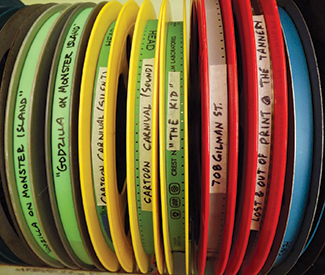
His business includes movies. Lots of movies. The avid film collector is the founder of the Berkeley Underground Film Society, which has for the past two years hosted screenings showcasing gems from Santana’s stash. It’s held in a Gilman Street office space that transforms into a micro-cinema for BUFS gatherings.

Amateur film collecting is a hobby that’s almost as old as cinema itself. “Home viewers [could obtain] 16mm film prints for the first time in the 1930s,” he says. “In that era, people rented whatever was available, say, The Little Rascals from the New York public library, and then have a film party. There’d be, like, the neighborhood cinema guy. If you flash forward 90 years later, we have Craig Baldwin, [filmmaker and Other Cinema curator], who is pretty much that same guy.”

Santana and the Artists’ Television Access staple met years ago through an online forum for 16mm enthusiasts, when Santana contacted Baldwin about purchasing a film. Today, Santana considers Baldwin his mentor. “He’s passed on a lot of film history to me,” Santana says. “We meet several times a year, and he gives me a personal screening of films that are on the way out of his archive, and into mine. That’s one way I started collecting.”

Once Santana started acquiring films, he was hooked. “You start with buying one or two, and then suddenly you have 100. Then you have 1,000. And some people go much, much higher.” (Santana estimates he owns “probably 3,000.”)

He started a blog in late 2010, hoping to connect with other Bay Area collectors. “Lost and Out of Print,” the name of BUFS’ screening series, is an apt description of the works he favors. “These are obscure anomalies from eras gone by. Once I started building up my collection, I started realizing how many films are just not available. I need to preserve these, because sometimes I might have the only print in the state. Sometimes, I might have the only copy. So I went from hobbyist, to collector, to archivist, to preservationist.”

Santana, who grew up in Los Angeles, has a background in video media, but he was always drawn to celluloid — a fascination that flourished once he moved to the Bay Area. “When I came up here, I found Super 8 films at thrift stores, and I wanted to try to project them. And then I wanted to know everything about film history, film stocks, projectors, and all these other things that make movies go.”

The film club seemed a logical progression once his collection was ready for an audience. “When I started BUFS” — he pronounces it buffs, as in film buffs — “it was just me, seeing if anyone else was interested. And I had to wait until I had titles that were difficult to find, or that I thought were important, and that seemed to work if you grouped them together. That’s when I learned that programming is an art,” he recalls.

His collection includes silent films, home movies, B movies, made-for-TV movies, educational and industrial films, cartoons, and classic Hollywood films that aren’t available on DVD. There are also foreign films that never made it into US theaters — like 1972’s Godzilla vs. Gigan, which he’s showing in 16mm July 18 — in their original, uncut forms. (Other BUFS screenings this month are July 19 archival shorts program “Cartoon Carnival #5: Kids and Pets,” and a July 20 showing of Charlie Chaplin’s 1921 The Kid.)

One bump in the BUFS road: Earlier this year, a licensing agency contacted him after he screened some Woody Allen movies without first obtaining the rights to do so. Not wanting to have to pay any high fees — or, you know, break any laws — Santana will be steering his future programming toward works in the public domain.

“I had to backpedal a little bit. I didn’t think anyone even cared,” he admits. He put BUFS on hiatus in April to regroup. “I had to reduce the number of screenings I did, down to one weekend of programming a month. But that way I can just jam-pack that weekend with as much material as possible. And there’s a lot of great stuff coming up — it’s the best stuff I have. I don’t want to screen mainstream movies anymore.”

BUFS fans will also soon be able to experience Santana’s other passion: healthy, homemade food. “I’m going to offer incredible raw food, organic concessions, and cottage foods,” he says; it’s a small business venture he hopes to expand beyond his concession stand. “When we tested it, people responded very positively. During the [BUFS hiatus], I worked on my recipes, I got the Vitamix, and I’m ready to go. I’m excited for the July screenings.” *

“LOST AND OUT OF PRINT”

July 18-20, 7:30pm, donations accepted

Tannery

708 Gilman, Berk

lostandoutofprintfilms.blogspot.com

Alerts: July 9 – 15, 2014

0

WEDNESDAY 9


Talk on gun control

Commonwealth Club SF Club Office, 595 Market, SF. 6pm, $20 non-members, $12 members, $7 students. Michael Waldmanpresident of the Brennan Center for Justice at NYU School of Law and author of The Second Amendment: A Biography will recount the raucous public debate surrounding the Second Amendment and gun control policy in the United States. In 2008, the U.S. Supreme Court ruled for the first time that the Constitution protects an individual right to gun ownership. Waldman argues that our view of the amendment is set, at each stage, not by a pristine constitutional text, but by the push and pull, the rough and tumble of political advocacy and public agitation. Moderated by Mark Follman, Senior Editor of Mother Jones.

SATURDAY 12


Survival Adaptations

Adobe Books Backroom Gallery, 3031 24th St., SF. www.rootdivision.org/071214. 7-10pm, free. This exhibition explores “the creative ways in which artists are responding to the challenge” presented by the changes in the Bay Area’s socio-economic landscape, and what the relocation of cultural administrators and institutions means for San Francisco’s future. The purpose of the project is to “reflect on our changing city” and “celebrate those who have chosen to stay and fight.”


Laborfest: SF waterfront labor history walk

Meet at Hills Brothers Coffee, 75 Folsom, SF. www.laborfest.net. 10am-noon, free. Join this walk and learn the stories of San Francisco’s labor struggles, affecting the maritime industry from 1835 until 1934. Labor historian Larry Shoup will discuss the 1901 transportation workers strike, led by the Teamsters, which the San Francisco police failed to quell.

Sunday 13


Greening the Economy, the Emerging Green Job Sector and Making Your Own Life Eco-Friendly

First Unitarian Universalist Society of San Francisco, MLK Room, 1187 Franklin, SF. http://tinyurl.com/qhw7jjq. 9:30am, free (light breakfast offered for a slight fee). Sierra Club managing editor Tom Valtin will give a talk on how our economy is becoming increasingly “green” and how to live a more eco-friendly life. Part of the society’s Sunday FORUM Speaker Series, this event will highlight new opportunities in the ever-growing green job sector.

Recycle-pocalypse

16

Joe@sfbg.com

Red explosions and yellow starbursts lit the sky, accompanied by the requisite oohs and aahs.

San Franciscans sat by the beach at Aquatic Park celebrating our nation’s independence, eyes fixed upwards. But all around them, a team of independent scavengers, mostly ignored, methodically combed the wharf, plucking cans and bottles from the ground and overflowing trash bins.

Often derided as thieves or parasites, these workers are cogs in a grand machine instituted by California’s Bottle Bill in 1986, forming a recycling redemption economy meant to spur environmentalism with market principles.

The concept is simple. Taxpayers pay an extra five cents when they buy a can or bottle, and may redeem that nickel by trading the used can or bottle in at a recycling center. Thus, more recycling is spurred.

But now a wave of recycling center evictions is causing San Francisco’s grassroots recycling economy to crumble, and newly released numbers reveal just how much stands to be lost by the trend.

San Franciscan recyclers may miss out on millions of dollars in redemption, local mom-and-pop stores could wind up on the hook for millions of dollars in state fees, and neighborhoods stand to be besieged by recyclers flocking to the few remaining recycling centers.

Recycling activists and local businesses are pushing for change, but NIMBY interests are pushing for more of the same.


SOLUTION IS THE PROBLEM

San Francisco Community Recyclers is on the parking lot of Safeway’s Church and Market location, and after months of legal entanglement, the recycling center’s eviction draws near. Still, SFCR is making a show of resistance.

The San Francisco Sheriff’s Department is set to evict the recycling center within a week or so, as the rebel recyclers have so far refused to vacate voluntarily.

Sup. Scott Wiener says he’ll be glad to see them gone.

“This recycling center caused enormous problems in our neighborhood,” he told the Guardian. This particular Safeway lies within the boundaries of his district, and Wiener says his constituents complain the recycling centers draw too many unruly patrons, who are often homeless.

“There is problem behavior around the center in terms of camping and harassing behavior, defecation, urination in a much more concentrated way,” he said.

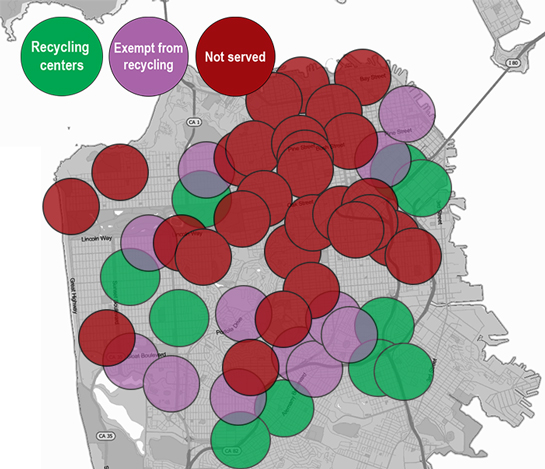
This animation shows the areas around San Francisco where recycling centers remain, which are often overburdened with customers as other centers close. The red zones indicate areas where supermarkets are mandated by state law to host recycling centers, but have chosen to pay fees instead.

But others say the not-in-my-backyard evictions only serve to create a ripple effect. The catalyst is a story we’ve reported on before: As well-heeled Golden Gate Park neighbors complained of homeless recycling patrons and waged a successful campaign to shutter the Haight Ashbury Recycling Center two years ago, the clientele adjusted by flocking to the Church and Market recycling center. New numbers illustrate this outcome.

Susan Collins is the president of the Container Recycling Institute, a nonprofit that conducts analysis on recycling data. On average nationwide, Collins said, one recycling center serves about 2,000 people.

But since 2012 the number of recycling centers in San Francisco has been reduced from 21 to 7, causing Church and Market’s service population to boom closer to 40,000, a difference that has more to do with the closures than the density of the area. Data from CalRecycle shows almost half of the city’s populace lacks a recycling center within close proximity, forcing patrons to overwhelm the few remaining centers.

“This makes it a chicken and egg process,” Collins told us. “For people to have the perception that the site is attracting so many people, they have to realize it’s because there are so few sites to begin with.”

Late last month, Assemblymember Tom Ammiano wrote to Safeway Chief Executive Officer Robert L. Edwards, urging the grocery chain to reverse its decision to evict San Francisco Community Recyclers from the Church and Market Safeway.

“Safeway has such a long history of supporting sustainability efforts,” Ammiano wrote, “and I truly believe that it can do so again.” Safeway, however, has other concerns.

“As curbside recycling has increased in San Francisco and around the state,” Safeway Director of Public Affairs Keith Turner wrote to Ammiano, “Safeway’s focus on recycling has evolved as well.”

Safeway is now also flouting local and state laws to throw recyclers off its back. CalRecycle, the state’s recycling agency, performed an inspection in April of the Diamond Heights Safeway. It found that the grocer failed to accept recyclables and offer state guaranteed redemption, despite signing an affidavit with CalRecycle pledging to do just that. CalRecycle cited that location and two other San Francisco Safeways for noncompliance with the bottle bill.

And that’s just the violations CalRecycle has documented so far. Ed Dunn, owner and operator of San Francisco Community Recyclers, has initiated his own investigation into Safeway statewide, filing complaints with CalRecycle alleging that as many as 75 Safeway stores aren’t following the mandates of their affidavits and offering redemption for recyclables.

On the other side of the fence, Safeway and other recycling-center critics (such as Chronicle columnist C.W. Nevius) are essentially saying, who cares? Don’t we all just use blue bins nowadays?

The short answer: Nope.


MAKING GREEN, GOING GREEN

“Why do we need recycling centers if we have curbside recycling?” Sup. Eric Mar asked the deputy director of recycling at CalRecycle, point blank.

Jose Ortiz responded in less than a beat. “While some communities think curbside operations ensure the state’s goals of collecting [recyclables], the reality is that 90 percent of recycling volume is collected through recycling centers, not curbside programs,” he said from the podium.

That number came as a shock to many at the Board of Supervisors Neighborhood Services and Safety Committee June 19, including Sups. Mar, David Campos, and Norman Yee. Only 8 percent of recycling statewide comes through blue bins, CalRecyle confirmed to the Guardian.

Nor is that limited to California: Data from the Container Recycling Institute shows that the 10 states with recycling redemption laws produce such a high rate of return that they account for 46 percent of the nation’s recycling. And since California Redemption Value recycling is pre-sorted, experts note, the bottles are often recycled whole (as opposed to broken) which can be used for higher-grade recycling purposes.

So for the city with a mandated goal of zero waste by 2020, the case for keeping recycling centers open is an environmental one. It’s also fiscal.

San Franciscans make $18 million a year selling back recyclables, Ortiz said, most of which went directly into the pockets of recyclers. Those scavengers at the Fourth of July festivities may have only collected five cents per can, but that’s enough to buoy the income of many poor San Franciscans.

At the recycling hearing, David Mangan approached the podium to speak. His red hat was clean and his grey sweatshirt was ironed, but his face was worn with worry-lines and creases.

“I can’t walk more than about eight blocks at a time, and I’m unemployable because of my disabilities,” he told the committee. Recycling centers are a lifeline, he added. “I need this job, I’m on a limited income. I need the help they offer. I need them to stay open, please.”

Critics say some poor and homeless depend on a black market of recycling truck drivers who trade drugs for cans and bottles, then turn to recycling centers to make a profit. But those at the hearing said the extinction of recycling centers actually helps the mobile, black market recycling fleets bloom, as motorists have an easier time shuttling recyclables across the city.

So recyclers are increasingly forced to rely on these so-called “mosquito fleets” for far-flung trips to cash in their bottles.


SMALL BUSINESS BUST

Meanwhile, recycling center evictions are becoming a source of anxiety within the small business community.

State law establishes a half-mile radius called a “convenience zone” around any supermarket that annually makes more than $2 million. The supermarket is mandated to provide recycling on-site, accept recyclables in-store, or opt to pay a $100 a day fee.

With the eviction of SFCR from Church and Market, Safeway may opt to pay the fee. But that gap would leave surrounding businesses inside that convenience zone with the same options: accept recyclables in-store or pay $36,000 a year.

Miriam Zouzounis of the Arab-American Grocer Association said those options are daunting for liquor stores and mom-and-pop grocers.

“We just don’t have the space for [recycling],” she said at the hearing. If SFCR were to close, the total of small businesses shouldering the burden of state recycling fees would jump from 100 to more than 360, said Regina Dick-Endrizzi, director of the city’s Office of Small Business.

All told, San Francisco small businesses would be made to send $12.96 million in annual fees to California coffers because a few supermarkets didn’t want to handle recyclables. Mar is now calling upon all involved to step up and solve this glaring problem.


SOLUTIONS ON THE WAY

This week the Board of Supervisors is tentatively set to vote on a moratorium of recycling center evictions, introduced by Mar on June 24. The pause would give Mar time to form a work group with those involved: Department of the Environment, Department of Public Works, CalRecycle, local supermarkets, grocers, the Coalition on Homelessness, and others to come together to form a compromise solution.

Department of the Environment proposed a mobile recycling center, which Wiener called an equitable solution that would help distribute recycling responsibility evenly across the city. While that agency did not provide a timeline on the creation of a mobile recycling center before our deadline, it’s been in the works since 2012, when then-District 5 Sup. Christina Olague said it was the answer to the Haight Ashbury Recycling Center’s closure.

It’s been a long wait for a solution. And in the meantime, many more stand to lose.

Live Shots: Burger Boogaloo 2014, Take #1

3

About 30 minutes into this year’s Burger Boogaloo, I noticed a guy walking around in a Tool shirt. Ten minutes later, I saw another dude walking around in a Meshuggah shirt. This wouldn’t be so remarkable at most concerts, but it’s worth keeping in mind that this was ostensibly an indie rock concert. Most fans of progressive metal wouldn’t dare enter that often rigid and snobbish universe, just as most indie fans would consider those heavy-but-impeccably-produced bands well outside the accepted parameters of “cool.”

But Burger Babes, Burger Boppers, Burger Bitches, Burger Boys, and Burger Heads are not most indie fans. This is a community that has room for 5-year-olds and 70-year-olds, for classic-rock bar bands and summery beach-pop groups, for queer-as-fuck punk rockers and dudes with handlebar mustaches and chain-link guitar straps. In the often overly cool-conscious world of indie rock, it was not only refreshing but relieving to see a community this accepting. Messrs.Tool and Meshuggah might have been wearing those shirts ironically, but at an event like Burger Boogaloo, it would have been less cool to do so than to wear them with pride and earnesty.

boo

Burger seemed to be willing to throw anything at the audience. And at a single-stage festival with ample seating and few extraneous distractions (a “music & arts festival” this was not), there wasn’t much reason to ignore any of the bands. Given how few of these artists were recognized names outside of very underground regional circles, it seemed like the primary purpose of such a diverse lineup was to introduce the audience to as much new music as possible.

The most striking thing about the Burger Boogaloo lineup was how much older the artists were than at most indie showcases. Of the four headliners, none had a frontperson under 30.  Shannon Shaw of Shannon & The Clams is 31; Thee Oh Sees’ John Dwyer is 39; OFF!’s Keith Morris is 58; Ronnie Spector is 70. Milk ‘n’ Cookies have been around since 1973, The Gizmos since 1976, Phantom Surfers since 1988, the Muffs since 1991, and Bananas since 1993. Danny James’ Pear and Reigning Sound both seemed like middle-aged ensembles stuck in the rock era, and they could have as easily opened for Santana as Thee Oh Sees — yet this was not to their detriment, as they were all incredible musicians.

But with the exception of Spector (and Morris to some extent — more on this later), these artists weren’t cross-generational juggernauts or revered influences but rather veteran bands who had honed their craft in obscurity for years.  Though the audience could roughly be split into hip kids and older music-scene stalwarts, it was interesting to see both sides of the audience devour such unhip music with equal relish.  This indicated to me that Burger fans aren’t looking for the coolest, most cutting-edge music.  They’re just looking for a solid supply of rock ‘n’ roll to dance and party to, and Burger Boogaloo provided that and more.

* * *
DAY 1

The first day opened with White Fang, who were either the best or the worst festival opener I’ve ever seen. Frontman Erik Gage walked out in an American flag T-shirt, kissing his guns like the most cartoonish male lover imaginable, before tearing into a short set of songs chiefly about partying and marijuana.  Though they were sloppy and lacked any semblance of self-seriousness, they all but blew the two bands that followed offstage. Though Terry Malts and the Trashies were both competent bands with fine instrumentalists, their singers lacked any of White Fang’s charisma.

Wand upped the energy substantially; though they were a good band, I could not get past their uncanny sonic resemblance to Ty Segall, particularly his Fuzz project. But it was Thunderroads that pumped the energy back into the festival. Hailing from Japan, the trio rolled through a set of unhinged, ’50s-style rockabilly songs sung through thick accents that rendered most words incomprehensible except for rock’s great buzzwords — “rock ‘n’ roll,” “tonight,” “everybody.” Needless to say, they didn’t need much more to get their point across.

thunderroads

Next came the aforementioned bar band Reigning Sound, the extremely good surf band Phantom Surfers, and Sacramento punk band Bananas, whose caterwauling vocalist culled the crowd enough to secure me a prime audience position for Nobunny. Though his spirits were significantly lowered by the audience’s refusal to catch him were he to jump from the amplifier stack, the man in the bunny mask still put on one of the best shows of the night. He more than made up for his admittedly lacking vocal skills through a menacingly cartoonish stage presence, ample crotch-bulge display, and above all else, a set of great rock songs.

nobunny

Next came Milk ‘n’ Cookies, a ’70s power-pop band who could not distinguish themselves from the festival’s more pedestrian pop acts despite their clout. Finally, the big two headliners: OFF! and Thee Oh Sees.

OFF!, the current project of Circle Jerks frontman and founding Black Flag member Keith Morris, was by far the most interesting act at the festival. Morris has long given up adhering (or pretending to adhere) to punk’s staunch anti-commercial aesthetic, evident in his recent promotions with major brands like AOL and Vans (and Burger — OFF! isn’t actually on the label).  But he plays punk because it’s the music he loves — and he performs it with as much fury as in any of his previous projects.

And what fury. Despite his short stature, Morris seemed to tower over the sea of moshing kids at which he directed his harangues. It was an invigorating performance in part because of how tight the band was and in part because of how in love with the music Morris seemed — as pissed-off as his songs were, he looked genuinely happy to be up there.

off

Even better were Thee Oh Sees, whose recent departure for L.A. sent waves of dismay through the Bay Area music community but who are showing no signs of abandoning their hometown fans. Bar none, Thee Oh Sees were the best live band I’ve seen all year. Despite being a relatively new incarnation of the band (singer/lead guitarist John Dwyer being the only constant), they rocked as hard as ever, with Dwyer’s almost Hendrix-like guitarwork carrying the bulk of the sound this time around. But the true star of the show was Dwyer’s voice, a tiny coo that can nonetheless hold an entire crowd captive. He can scream as well as anyone, but why would he need to when he can do so much with so little?

thee

Thee Oh Sees’ music seemed to transcend genre. It was hard to say exactly where the roots of such music lay — there were elements of punk, metal, garage rock, and grunge, but none seemed like an apt signifier. Rather, the hallmarks of each genre combined into a monolithic slab of rock ‘n’ roll that encouraged the audience to move and engage with it rather than analyze it. This focus on rock as a form of music rather than an aesthetic or a concept unified all the bands of the day. At Burger Boogaloo, it didn’t matter how old or how uncool a band was — at the end of the day, it was all about getting down. And isn’t that what a rock show is supposed to be about?
 
DAY 2
 
After the head rush of Day One, it was hard not to be a bit disappointed with Day Two. The lineup pulled a lot of the same tricks to diminished effect. A lot of the bands seemed to be the equivalents of bands from the first day. Pookie & The Poodlez played White Fang’s role as the silly, punky opening act; Meatbodies played Wand’s role as the heavy, grooving jam band; The Gizmos filled Milk ‘n’ Cookies’ role as obscure power-pop legends unearthed from the annals of history. But the day also brought with it some pleasant surprises — not least of which was Ronnie Spector, whose dynamite set ran completely contrary to my expectations.

Pookie, a member of Nobunny, showed up onstage still brushing his teeth. (Apparently he’d overslept but luckily lived a few blocks away–though this is a fun story, the aesthetic appeal of a cute, skinny man walking out onstage with a toothbrush in his mouth to open a festival is just a little bit too good.)  His set was brief but fun, though the similarities to White Fang’s set were a bit obvious — especially after he introduced one of the songs as being about “Slurpees and kissing and marijuana cigarettes.”

The next run of bands was thoroughly disappointing. Summer Twins were, if possible, even more generic than their name suggests. Though my friend theorized they would sound like “Best Coast but less mainstream,” they sounded more like a Best Coast ripoff hastily assembled for a commercial by someone whose grasp on indie aesthetics was limited to 500 Days Of Summer. I was surprised a label like Burger (or any label) would sign such a band. The beach-rock fad has been over for over three years, and it’s easy to tell when a band is still clinging to it — usually they have words like “Summer” or “Twins” in their name.

Dirty Ghosts were interesting only because they were difficult to pin down in a genre — their music wasn’t quite funk, rock, punk, or psychedelia, but it was largely forgettable and didn’t benefit from its implacability. Danny James was similar to the previous day’s Reigning Sound but a lot tighter. La Sera was essentially a better version of Summer Twins. Meatbodies sounded like a less heavy Wand, while the Gizmos played with little effort or enthusiasm and could only have been there because of their clout as an obscure but veteran protopunk band.

Of the mid-day acts, folk singer Juan Wauters was the most enjoyable, but it was hard to tell if it was because of the quality of his music or because he was by far the most unique attraction of the day — he initially performed as a solo artist before being augmented by a bassist, a guitarist, and a percussionist. San Francisco band Personal & the Pizzas were likewise entertaining, but their schtick–pop songs about pizza and brass knuckles played by three tough-looking dudes–got old very quickly.
 
The Muffs ramped up the energy substantially. Fronted by Kim Shattuck (best-known these days for her brief stint in the Pixies), the group started out playing tough yet grooving pop songs driven by Shattuck’s ferocious voice. (She screamed an average of about 10 times per song.)  Yet their set never recovered from an ill-advised mid-performance slow song, which disrupted what could have evolved into full-on moshing but never progressed beyond a lot of enthusiastic bouncing and head-nodding.

shannon

Shannon & The Clams were a fine act, but they were disappointingly low-energy for their late placement in the lineup.  Their show was better because the crowd, desperate to mosh, took it upon themselves to have a good time. The result was a bizarre sort of mix of moshing and slow-dancing that mainly entailed a bunch of people shoving into each other at very deliberate speeds.  Being in the mosh enhanced the performance substantially; the Clams’ girl-group balladry was best suited for slow dancing, and brushing up against a bunch of random strangers with romantic music in the air is pretty much the second-best thing to that. Nonetheless, the fast-paced “The Cult Song” was the undoubted highlight.

I was expecting Ronnie Spector‘s set to be mostly just a glorified celebrity appearance from the woman whose run of Sixties records with the Ronettes inspired a substantial chunk of the festival’s acts.  Instead, I was surprised to be treated to the night’s most electrifying performance.  Over a top-caliber band of stern, professional-looking musicians, Spector let loose with her vocals in a way she was never able to do as part of the homogeneous Wall of Sound her ex-husband/producer Phil Spector pioneered.  Some of her vocal turns were absolutely haunting.  Though she may not sound like the twenty-year-old starlet she once was, she sounds now like what she is–an incredibly gifted vocalist with a natural presence as an entertainer and a long and tumultuous life behind her.

ronnie

But the true star of Spector’s set wasn’t her or her beehive hairdo but the songs, and one song in particular.  The words “Be My Baby” had been placed over the stage in gold balloons hours before, and the inevitability that she would perform it created a natural climax to the festival.  Either directly or indirectly, that song had inspired nearly every act there.  Its maelstrom production practically launched psychedelic rock, while its unmistakable drum opening has become an obvious way for backwards-looking pop acts from The Jesus And Mary Chain to Girls to pay tribute to their influences.

True, that drum opening was the most scream-inducing moment of the entire festival.  But I felt she played it too soon.  Her set was much shorter than it should have been, and deploying the ultimate weapon after only five songs ruined a bit of the song’s climactic nature.  Furthermore, her shout of “my favorite part!” over the reprise of the drum opening defused its impact. But I forgive her — I don’t know if she realizes how revered that song is in the indie community. 

ronnie

Furthermore, treating that song like a sacred artifact would be incongruous with what made Spector’s set so effective — that she wasn’t treated like a sacred artifact. As massive as her influence pop music is, I believe she was there because of her skills as a performer, not for the baggage her name carries. It would be contradictory to Burger’s ethos to bring such a revered artist on if she wasn’t a great performer. Burger Boogaloo isn’t about the mythology of old-school rock ‘n’ roll, but about the sound — and just how great it is to hear that sound live.

crowd

The resurrection of Ronnie Spector

1

esilvers@sfbg.com

LEFT OF THE DIAL How do you address a woman who toured with the Rolling Stones as an opening act, while being chased after by a baby-faced John Lennon? Who had five singles in the Top 40 by the age of 21? Who perfected the beehive hairdo two decades before Amy Winehouse was even born?

“Call me Ronnie,” purrs Ronnie Spector, age 70, on the other end of the line. You can almost hear the hairdo.

The woman who influenced performers like Billy Joel, Patti Smith, and Joey Ramone is calling from a suburb near Danbury, Conn., where she lives with her manager/husband of 30 years, Jonathan Greenfield. Their life is a quiet one. Spector — who, as the lead singer of the Ronettes, perhaps the most iconic girl group of the early ’60s thanks to hits like “Be My Baby,” has been described as the original bad girl of rock ‘n’ roll — likes to read and watch movies. She goes grocery shopping, does a little cooking, goes to Bed, Bath & Beyond. Three times a week she goes to an office and dictates responses to her fan mail to an assistant (she doesn’t like to use the Internet much herself). She doesn’t drink (never has, she says), but she still smokes (Marlboro Reds).

Okay, and every now and then she’ll catch up with her old friend Keith Richards, who lives 15 minutes away.

For the past two years, the ’60s icon has also been on tour again: Her one-woman stage show, “Beyond the Beehive,” chronicles her tumultuous life from childhood onward, punctuated with songs, stories, behind-the-scenes dirt and dishing. She’ll bring elements of that show to the Bay Area July 4 weekend, when she performs at Brick and Mortar Music Hall Sat/5 (in a ridiculously fabulous-sounding evening hosted by Peaches Christ) and at Burger Boogaloo in Oakland’s Mosswood Park Sun/6.

So: Why would someone who’s lived such a full life — not to mention a self-described homebody — put herself through the rigors of a touring stage show at a time in her life when she could be resting on her laurels? Or at least, one might think, just resting?

“Because I love it — it lets all of my emotions out,” says Ronnie, sounding straight-up girlishly, genuinely excited. “When I first started, of course, I was scared to death: I’ve been on stage singing since I was a little girl, but I never had to sit down and talk to an audience. Now, I feel so good after I do that show. I go through the good, the bad, and the ugly. I tell them everything, and I’m nervous every time, but I love it.”

A little like on-stage therapy, no?

“I stopped going to therapy when I started ‘Beehive’!” she cries. “Who needs a psychiatrist? My show is my therapy. The audience loves it, I love it, and I get to tell them things I never got to talk about.

“Because a lot of stories from my life — ooh, if walls could talk…”

FROM HARLEM TO HOLLYWOOD

Born to a Cherokee and African American mother and an Irish father, a drummer, on Aug. 10, 1943, Veronica Bennett grew up in Spanish Harlem, in a large, working-class family that served as her first audience.

“When I was 7 or 8, me and eight of my cousins were in the lobby of our building and I was singing ‘Why Do Fools Fall In Love’ — the sound was great down there, the tall ceilings — and my cousins all started clapping,” she recalls. “And I thought, I got it! From that point on, all I thought about was singing. I didn’t do homework. The teachers were calling my house saying ‘She’s just singing for the class.’ It was all I cared about.” She spent hours singing with her sister, Estelle Bennett, and cousin, Nedra Talley, the trio that would go on to become the Ronettes.

When the girls were young teens, as if to say “Okay, let’s see what you’ve got,” Ronnie and Estelle’s mother, a waitress at a restaurant next door to the Apollo Theater, managed to get the girls a spot on the bill at the legendary venue’s amateur night. They didn’t win that evening’s competition, but the audience applauded (as opposed to throwing tomatoes), and Spector still remembers the feeling. “That was it. It was the toughest crowd in town, and they liked us,” she says.

The rest is show business history: The signature eye makeup and impeccable on-stage style. Hordes of shrieking fans during appearances on American Bandstand. The UK tour on which the girls spent evenings flirting and dancing with the Beatles. Bottles upon bottles of hairspray.

And, of course, the group’s relationship with wunderkind producer Phil Spector, the man responsible for the “wall of sound” instrumentation that makes so many ’60s records sound so beautifully, chart-toppingly lush. “Be My Baby,” a song Brian Wilson has called the best pop song ever made (at 21, he was driving when he first heard it and had to pull over), is considered the first pop record to use a full orchestra, with horns, multiple pianos, and guitars layered generously over each other. Backup singers included Darlene Love and a then-unknown couple named Sonny and Cher.

To be sure, Spector was ahead of his time. But 30 seconds of any Ronettes song will tell you everything you need to know about what made the group stand out from the pack.

As the Time magazine writer Michael Enright once put it: “Ronnie had a weird natural vibrato – almost a tremolo, really – that modulated her little-girl timber into something that penetrated the Wall of Sound like a nail gun. It is an uncanny instrument. Sitting on a ragged couch in my railroad flat, I could hear her through all the arguments on the street, the car alarms, the sirens. She floated above the sound of New York while also being a part of it…stomping her foot on the sidewalk and insisting on being heard.”

It’s that same combination of vulnerability, sex appeal, and determinedly tough-as-nails I’ve-been-through-hell-so-don’t-test-me bravado that still attracts fans to her shows some 50 years later — despite the fact they’ve probably already heard a good chunk of the story.

Her low points are well-documented: the nightmarish marriage to a jealous Phil Spector that, according to her 1989 memoir, involved death threats and the young singer being physically locked in his mansion. Then rehab, which she later said was just a means of escape from her ex-husband (who, it must be mentioned, as of this writing, is five years into a 19-year sentence for the 2003 murder of actress Lana Clarkson — after a trial in which at least five female acquaintances recounted him holding them at gunpoint).

Then there was life after Phil. Ronnie burst back onto the charts in 1986 as a guest on Eddie Money’s “Take Me Home Tonight” (with her signature whoa-oh-oh-ohs front and center), may or may not have had a brief fling with David Bowie, released a critically acclaimed solo album produced by Joey Ramone, married her second husand, had two kids (not necessarily in that order). In 2000, after a 15-year royalty battle, a New York State Supreme Court judge ruled that Phil Spector owed the Ronettes $2.6 million; despite licensing their songs to everything from commercials to Dirty Dancing over the previous four decades, he’d only ever paid the women $14,000 and change.

And now? She’s an unmistakably happy woman, and she clearly likes to talk. It doesn’t take much to get her going on today’s pop music: “It’s like a circus! You can’t see a show without dancers and lights and booms and bangs. It takes away from rock ‘n’ roll. Everyone has to have ridiculous outfits, and you don’t even know who they are by the time their record comes out. People don’t have an identity! Miley Cyrus gets up there with an [inflatable] penis coming out of her? Hello? What is that?”

“You take away the dancers, you take away the choreographers, and [with a lot of pop stars] you will not see a real artist there,” she says. “And everybody lip-syncs. In my day you didn’t do that; I would never do that. To me, it’s cheating the audience.” (Ronnie’s voice has stayed strong, she says, because she’s never liked parties.)

However: “I do love that today’s women artists [are allowed to] write their own material, which we couldn’t. You look at the artists from the past like me, the pioneers, we ended up with nothing because of royalties. Now, Taylor Swift is one of the richest girls in rock ‘n’ roll.”

She also has nothing but kind words for Amy Winehouse — a singer who owed her obvious debts in the vocal and visual style department, and whose “Back To Black” Ronnie sometimes covers in return (once, in London, with Winehouse trying not to be spotted in the audience). “She was a dirty rock ‘n’ roll singer, her voice was real, and she was real,” she says. “I miss her.”

Aside from not really enjoying Top 40 radio, however, Ronnie says she’s loving life — and you believe her. She talks like a survivor — not just of an abusive marriage, but of a time and a place in pop music that chewed young women up and spit them out with astounding ease.

“To be honest, a lot of the groups I knew 50 years ago are dead or dead broke,” she says. “And I had to fight for my career. I was in court for 15 years.

“But you know what? What goes around comes around,” she says conspiratorially. “Karma’s a bitch, and it’ll bite you right in the ass. He’s in prison, and I’m not. I’m out there singing, having the time of my life, and I have everything I want: My shows, a great husband, everything I wanted back then. Turns out you can have your cake and eat it too.” A hearty laugh.

“Otherwise, what’s the point of having cake?” 

Ronnie Spector will perform at the Burger Boogaloo After-Party (Sat/5 9pm, $35) at Brick and Mortar Music Hall and at Burger Boogaloo Day 2 (Sun/6, all day, $35-$50) in Oakland’s Mosswood Park.


Events: July 2 – 8, 2014

0

Listings are compiled by Guardian staff. Submit items for the listings at listings@sfbg.com. For further information on how to submit items for the listings, see Selector.

WEDNESDAY 2

Jean Kwok Book Passage, 1 Ferry Bldg, SF; www.bookpassage.com. 6pm, free. The author discusses her new novel, Mambo in Chinatown.

Craven Rock Long Haul Info Shop, 3124 Shattuck, Berk; www.thelonghaul.org. 7pm, free. The author reads from cultural-studies tome Days and Nights in a Dark Carnival. Yes, it’s about Juggalos.

Judy Wells and Dale Jensen Books Inc, 1344 Park, Alameda; (510) 522-2226. 7pm, free. The poets read as part of the Last Word Reading Series, followed by an open mic.

THURSDAY 3

“Target Independence Day Celebration” Craneway Pavilion, 1414 Harbour Way South, Richmond; www.oebs.org. 6:30pm, free. Oakland East Bay Symphony performs patriotic works to celebrate Independence Day, followed by a fireworks display.

FRIDAY 4

Fourth of July at the Berkeley Marina Berkeley Marina, 201 University, Berk; www.anotherbullwinkelshow.com. Noon-10pm, $15. Family-friendly fun with live entertainment, pony rides, arts and crafts, and fireworks (9:30pm).

July 4th Festival of Family Fun Jack London Square, Broadway and Embarcadero, Oakl; www.jacklondonsquare.com. 11am-4pm, free. Fun activities for families including a petting zoo, balloon artists, face paint, bubble wrangling, and more.

Pier 39 Fourth of July Pier 39, SF; www.pier39.com. Noon, free. The family-friendly fun begins at noon with live music from the USAF Band of the Golden West, followed by Tainted Love. At 9:30pm, enjoy the traditional fireworks display over the bay.

SATURDAY 5

Fillmore Jazz Festival Fillmore between Jackson and Eddy, SF. www.fillmorejazzfestival.com. 10am-6pm, free. Also Sun/6. The largest free jazz fest on the West Coast fills 12 blocks with music, arts and crafts, gourmet food, and more.

LaborFest 2014 Redstone Building, 2940 16th St, SF; www.laborfest.net. 11am-5pm, free. Street fair in honor of the 100th anniversary of the San Francisco Labor Temple. Also today: Noon, meet at 518 Valencia, SF. Free. Labor bike tour with Chris Carlsson (ends at Spear and Market). 2pm, meet at Harry Bridges Plaza Tower, Embarcadero at Market, SF. Free. SF General Strike walk led by retired ILWU longshoreman Jack Heyman and others. 7pm, ILWU Local 34 Hall, 801 Second St, SF. Donations accepted. “FilmWorks United” screening of Miners Shot Down (Desai, 2014).

SUNDAY 6

LaborFest 2014 First Unitarian Universalist Church, 1187 Franklin, SF; www.laborfest.net. 9:30am, free. “Working Class Housing, Ethnic Housing: Hunters Point and Bayview” panel discussion. Also today: 9:45am, meet at Coit Tower entrance, One Telegraph Hill, SF. Free. Coit Tower mural walk with Peter O’Driscoll, Gray Brechin, and Harvey Smith. 11am, meet at 18th St and Tennessee, SF. Free. Dogpatch and Potrero Point walk with Nataly Wisniewski of SF City Guides. Noon, meet at One Market St, SF. Free. Labor history and Market St. walk with Chuck Schwartz of SF City Guides. 2pm, Bird and Beckett Bookstore, 653 Chenery, SF. Free. Author Zeese Papanikolas discusses the Ludlow Massacre. 7pm, 518 Valencia, SF. Free. “Labor, Privatization, and How to Defend Public Education” discussion.

Temescal Street Fair Telegraph between 40th and 51st Sts, Oakl; www.temescaldistrict.org. Noon-6pm, free. Three food courts and multiple stages showcasing local performers (including an entire stage just for kids with magicians, jugglers, and more), plus 150 booths with local crafts, artworks, and more.

MONDAY 7

LaborFest 2014 Meet at Portsmouth Square, Washington St, SF; www.laborfest.net. 10am, free. Chinatown walk with Mae Schoeing of SF City Guides. Also today: 7pm, Bird and Beckett Bookstore, 653 Chenery, SF. Free. Poetry reading by Nellie Wong and Alice Rogoff.

TUESDAY 8

LaborFest 2014 Meet at the corner of Stockton and Maiden Lane, SF; www.laborfest.net. 10am, free. “Rising Steel: Two Centuries of San Francisco Architecture” walking tour. Also today: 6-9pm, Pacific Media Workers Guild, 433 Natoma, SF. Free. “Méndez Rising: Spotlight on the Revolutionary Works of an Artist for Social Justice,” tribute to the art of Leopoldo Méndez. *


Pumping up awareness

7

Warning! This is just a friendly reminder that your petroleum habit is hurting us all.

Berkeley’s Community Environmental Advisory Commission recently approved the concept of stickers to be placed on gas pump handles that warn drivers that greenhouse gases such as those emitted from automobile tailpipes contribute to global warming. If it makes sense to warn that cigarette smoking increases the likelihood of developing lung cancer, then hey, why not remind drivers that by using fossil fuels, they’re increasing the planet’s temperature and volatility.

The campaign is led by 350 Bay Area, a grassroots environmental organization affiliated with 350.org, a global climate movement. The name reflects its main goal: follow scientists’ warnings to reduce the amount of C02 in the atmosphere from its current level of 392 parts per million to below 350 ppm, a crucial threshold of climate instability.

While Berkeley has gained the most political traction for 350 Bay Area’s “Beyond the Pump” campaign, 350 Bay Area is also working on getting San Francisco to adopt the gas pump stickers and other planet-saving tactics.

Since last year, advocates with 350 Bay Area worked in collaboration with Sup. John Avalos on a 10-Point Climate Action Work Plan that was officially adopted in April. This plan commits the Bay Area Air Quality Management District to reducing greenhouse gas emissions to 80 percent of 1990 levels by 2050. The group has also been in contact with Avalos and his legislative aide Jeremy Pollack about sponsoring an ordinance to place the warning stickers on gas pumps in San Francisco.

“I think it’s great. We need reminders about the impact of fossil fuels on an individual basis,” Avalos told the Guardian. “We have choices, and this is a great way to build awareness of those choices.”

Avalos said that his office has already started looking into the idea of putting stickers on gas pumps. Right now, he’s still waiting on enough research to ensure the stickers can pass legal muster against any challenges by the petroleum industry.

“Hopefully it will work out. The City Attorney is looking into it, and we’re waiting to see what happens with Berkeley,” Pollack told the Guardian. “We tried something similar with warnings about cell phone radiations, but the court struck it down.”

He’s referring to the nearly three years of legal battles with the mobile phone industry group CTIA over a San Francisco law passed in 2011 that had required every store selling cell phones in the city to display the specific absorption rate of radiation expected from each phone model.

CTIA took San Francisco all the way to the 9th Circuit US Court of Appeals, saying the law interfered with their free speech rights. And, it won. Finally, last May, San Francisco gave in and killed the warning law. Those legal battles are not something San Francisco is likely to forget, no matter what environment-happy warning labels come along.

Yet the San Francisco public might not mind a gentle push. According to a recent poll by the Yale Project on Climate Change Communication, 77 percent of San Franciscans think that residents should be doing more to address climate change. The stickers could serve as a gentle push in that direction, and though Avalos is confident his city will get stickers eventually, it looks like Berkeley residents will get their warnings first.

“We’re not going to stop at Berkeley,” Jack Lucero Fleck, 350 Bay Area Steering Committee member, told us. “Right now, there’s no clues in gas stations that fossil fuels might be a problem. But advertising works. That’s why corporations spend billions on it. The human mind can’t ignore it.”

The campaign — the only one in the country with political fraction — is parallel to a Toronto campaign called Our Horizon. But unlike the stark, graphic warnings in Canada, 350 Bay Area takes heed from failed attempts by the US Food and Drug Administration to pursue graphic cigarette warning labels.

Right now, thanks to tobacco advocates who’ve aggressively protected their free speech rights, warnings on US cigarette packaging are tame. But if you go to Canada for a smoke, you’ll find packaging that reads, “This is what dying of lung cancer looks like,” followed by the image of an emancipated, corpse-like body. The least graphic image is of a gentle crib, but even that’s followed by information about the connection between smoking and Sudden Infant Death Syndrome.

Berkeley could opt for similar, hardcore carbon emission warning graphics (picture it now: baby polar bears balancing on ice, fish washed up on shores, massive dust clouds about to drown villages), but 350 Bay Area is more mindful of the legal fallout that would likely follow.

Instead, the Berkeley warning sticker samplers are downright peppy. In hot pink, the sticker shouts, “Global warming alert!” followed by a pastel blue that informs drivers, with the gentle nudge of a concerned parent, “Burning gasoline emits C02. The City of Berkeley cares about global warming.” Then there’s a picture of a cute little car emitting a cloud of murky C02.

“We wanted the language to be careful and the facts noncontroversial,” 350 Bay Area Campaign Manager Jamie Brooks told us. “We have to be as gentle as possible. It’s tough love.”

One sticker sampler reads, “The State of California has determined that global warming caused by C02 emissions poses a serious threat to the economic well-being, public health, natural resources, and the environment of California.”

You can’t really argue with that, it’s even enshrined in California law. Plus, the stickers aren’t anywhere near the gruesome Canadian samples that show famine in deserts and unhappy kids suffering from smog-induced asthma.

Berkeley City Council member Kriss Worthington, who sponsored the council item in support of the stickers, said, “We made sure we had language that wasn’t questionable and that it wasn’t pre-emptive to state or federal law. The language in the stickers is language already law in the state of California.”

Sure enough, the California Global Warming Solutions Act, adopted in 2006 as Assembly Bill 32, already states that emissions are harmful to humans and the environment.

Yet Western States Petroleum Association’s President Catherine H. Reheis-Boyd isn’t pleased. She issued what Brooks called a “love letter” to the advisory committee. Just as tobacco lobbyists argued that cigarette warnings are forced — and therefore not free — speech, Rheis-Boyd ignores the global warming debate and instead focuses on the US Constitution.

“Far less restrictive means exist to disseminate this information to the general public without imposing onerous restrictions on businesses and forcing unwanted speech in violation of the First Amendment,” she wrote.

Reheis-Boyd goes on to appeal to Berkeley’s history in the Free Speech Movement: “Perhaps no city in our nation has as rich a tradition in the exercise of the First Amendment right to freedom of speech as the City of Berkeley.” She also accuses 350 Bay Area of advancing messages that are not “purely factual” but a “policy determination by the State of California.”

This is true; the stickers do reflect policy determination from AB 32, which mandates the state to reduce greenhouse gas emissions, and that’s why they’re likely to stick.

Besides, the stickers will likely only appeal to global warning believers; they’re meant to remind drivers that there are ways to curb their appetite for gas, such as by choosing public transit or other alternatives modes of transportation. The campaign’s technical advisor, Dr. Kirk R. Smith, said, “The cigarette analogy isn’t perfect, because gas is only one factor in climate change. But individual decisions are important.”

The question is whether or not such peppy stickers can get drivers thinking about the implications of their transportation choices.

The campaign in Berkeley isn’t done yet. After the Energy Commission votes in July, the sticker proposal will head to the Berkeley City Council in September. And from there, 350 Bay Area will see if those in San Francisco might like some friendly warning stickers on their gas pumps.

Wax on: a journey into the new Madame Tussauds San Francisco

0

You probably won’t win any staring contests inside the new Madame Tussauds that opened June 26 at Fisherman’s Wharf. (Besides, I wouldn’t recommend holding prolonged eye contact with any of the wax figures, especially the Nicolas Cage one.) Like the youngest sibling in the shadow of brothers and sisters who have already established themselves, the SF branch — the fifth North American branch — tries to make a name for itself by flaunting its individuality whenever it’s convenient. Its attempt showcases eerily lifelike figures of well-known San Franciscans in themed rooms.

The museum’s main selling point is the Harvey Milk figure, which successfully presents itself as a thoughtful tribute. His nephew Stuart Milk had the privilege of unveiling his uncle’s wax figure to press less than an hour before the museum’s opening. The moment the red curtain fell — days before this year’s Pride Weekend — we stepped into a scene from 1978’s SF Pride, where Harvey parks himself on the roof of a car, clutching a handmade sign proclaiming “I’m from Woodmere, N.Y.” Stuart himself lauded the authenticity of the wax figure down to the shabby state of the shoes, as he said Harvey was quite frugal then. 

Later during the tour, I learned that Madame Tussauds’ team painstakingly pays attention to every possible detail. Apparently, the artists place the wax figures’ hair in place one strand at a time (!) and strive for complete accuracy — I was assured that if someone had a wrinkle on their face, it’d reappear in the exact same spot on their doppelgänger’s face. After examining the stubble on a baseball player’s face (even though it seemed to give him a slightly ashen complexion), I was convinced of the employee’s claims.

Madame Tussauds stresses how visitors can get up close and personal with the figures. Even the wallpaper of Harvey Milk’s room underscores this point, as it depicts a crowd of participants banding together with Harvey in his fight for gay rights. Props sit on the sidelines so you don’t have to. Grab a bullhorn or a sign that reads “Free to be” in big block letters and join Harvey.

Admittedly, it’s clear the museum tries to capitalize on its location — isn’t that how you stay in business at Fisherman’s Wharf? Yes, there’s a room to commemorate 1967’s Summer of Love, complete with Janis Joplin beside a psychedelic Volkswagen van and Jerry Garcia. But it quickly gets cramped. The room also includes a replication of the famous Haight Street fishnet stocking legs (just if you forgot you were in the middle of tourist territory), and interestingly enough, a Chinese New Year parade commemoration that feels out of place. Here, it begins to get a little gimmicky. The Spirit of San Francisco room slightly redeems itself by featuring the Golden Gate Bridge at two moments in its history — its current likeness and the construction process (complete with engineer Joseph Strauss).

Mark Zuckerberg didn’t quite make the cut for the Spirit of San Francisco room. He’s relegated to the same floor, however. In his trademark hoodie, he sits cross-legged and barefoot in a chair, enjoying some downtime even though he’s almost rubbing elbows with wax figure Barack Obama and his Oval Office reproduction. The iconic Apple logo is noticeably absent from what must be Zuck’s Macbook Pro. (Curiously enough, his sandals still sport the Adidas logo. Go figure.) 

“He’s been very popular with selfies,” said Adrea Gibbs, general manager of Madame Tussauds San Francisco. Our press preview ran a little overtime and members of the public had already entered by the middle of our tour, getting cozy with the wax figures. And to accommodate visitors who have qualms about awkwardly-angled photos taken at arm’s length, employees are quick to offer assistance. I saw only one visitor attempt to take a selfie, but it wasn’t too crowded yet. Give it some time.

The appeal of the remainder of the museum, however, quickly dwindled for me. Madame Tussauds San Francisco — the youngest sibling again — falls short of differentiating itself. It’s likely that most of the wax figures, including Lady Gaga, George Clooney, Audrey Hepburn, and E.T., will feel right at home in another branch somewhere across the world from San Francisco. (Although it did feel like I was supposed to be in Lincoln Park when the Golden Gate Bridge, as part of the wallpaper behind Tiger Woods, caught my eye.)

Apart from the Spirit of San Francisco room, there’s nothing that feels quite as put together elsewhere in the museum. Sure, Madame Tussauds does a fine job of creating interactive props to accompany the other wax figures and to entertain visitors. And marketing-wise, I suppose it only makes sense to include a variety of figures to appeal to a broad audience. Adult admission stands at a somewhat steep price and in this economy, attendees want to get enough bang for their buck. A visit to the new Madame Tussauds, however, is best saved for those who don’t think twice about wearing shorts to Fisherman’s Wharf in the middle of a San Franciscan summer.

Madame Tussauds San Francisco

Open daily at 10am, $16-$26

145 Jefferson, SF

www.madametussauds.com/SanFrancisco/

A great week for (indie) sci-fi and docs: new movies!

0

This week, Frameline continues (our coverage here!), plus offbeat sci-fi winners Coherence and Snowpiercer are well worth seeking out … especially if you’re not in the mood for more giant robot smash-ups from the Michael Bay factory. Plus: new docs and more! Read on.

Breathing Earth: Susumu Shingu’s Dream Japanese artist Susumu Shingu has built his career through his concerted engagement with the natural world. The wise and eternally smiling 75-year-old creates angular and often gargantuan mobiles that harness the power of wind and water to gyrate in ever-changing directions. In Breathing Earth, German director Thomas Riedelsheimer crafts a deliberately paced rumination on Shingu’s life philosophy that, while devoid of the frenetic facts, figures, and trite biographical rehashes that punctuate hyper-informative pop-docs, uses a beautifully simplistic narrative arc to illuminates Shingu’s attempt to create a hilly, open-air collection of windmills. The sculptor’s impassioned narration and charming conversations with potential landlords and investors (who usually entirely miss the point of his mission to raise environmental consciousness through aesthetic beauty) make Shingu impossible not to fall in love with — he is laid-back, funny, and astonishingly youthful. Riedelsheimer’s camera is similarly relaxed, gliding sumptuously over the green and wild landscapes on which Shingu installs his works. Despite his meditative tempo, Riedelsheimer manages to explore a remarkably wide scope; Shingu’s late-life marriage to a fellow sculptor, his appeals to both Japanese and German schoolchildren to care for the earth and help to avoid environmental disasters, and his intricate technical processes all receive intimate and inspiring sections. (1:37) (David Kurlander)

Citizen Koch After quietly influencing conservative ideology, legislation, and elections for decades, the billionaire industrialist Koch brothers have found themselves becoming high-profile figures — much to their dismay, no doubt. The relative invisibility they hitherto enjoyed greatly abetted their impact in myriad arenas of public policy and “popular” conservative movements. Look behind any number of recent red-vs.-blue flashpoint issues and you can find their fingerprints: Notably state-level union busting; “smaller government” (i.e. incredible shrinking social services); seeding allegedly grassroots organizations like the Tea Party; furthering the Corporations = People thing (see: Citizens United); and generally helping the rich like themselves get richer while fostering working-class outrage at everybody else. This documentary by Trouble the Water (2008) co-directors Carl Deal and Tia Lessen touches on all those matters, while also focusing on Wisconsin as a test laboratory for the brothers’ Machiavellian think-tank maneuvers, following a Lousiana GOP candidate on the campaign trail (one he’s marginalized on for opposing corporate influence peddling), and more. Any one of these topics could support a feature of their own (and most already have). Citizen Koch’s problem is that it tries to encompass too much of its subjects’ long reach, while (despite the title) leaving those subjects themselves underexplored. (It also suffers from being a movie completed at least 18 months ago, a lifetime in current US political terms.) For the reasonably well-informed this documentary will cover a lot of familiar ground—which is not to say that ground isn’t still interesting, or that the added human interest elements don’t compel. But the film covers so much ground it ends up feeling overstuffed and unfocused. (1:26) (Dennis Harvey) 

Coherence See “Vortex Room.” (1:29)

Korengal This companion piece to 2010’s Oscar-nominated Restrepo — one of the best docs about modern-day warfare to date, offering unfiltered access to an Army platoon stationed in Afghanistan’s Korengal Valley — uses previously unseen footage shot during the year filmmakers Sebastian Junger and Tim Hetherington spent shadowing their subjects. Korengal is structured as a more introspective work, with musings on what it feels like to be a soldier in the Korengal, surrounded by rough (yet strikingly beautiful) terrain populated by farmers who may or may not be Taliban sympathizers, not to mention unpredictable, heavily armed opponents referred to simply as “the enemy.” Interviews reveal sadness, boredom, a deep sense of brotherhood, and the frustrating feeling of going from “100 miles an hour to a dead halt” after the surreal exhilaration of a firefight. Korengal also functions as a tribute to Hetherington, who was killed in 2011 while on assignment in Libya. Not only does his death add a layer of poignant subtext, it also suggests why Junger felt moved to revisit this story. That said, though Korengal‘s footage is several years old, its themes remain distressingly timely. (1:24) (Cheryl Eddy)

Snowpiercer Eighteen years after an attempt to reverse global warming has gone wildly awry — freezing all life into extinction — the only known survivors are on a one-of-a-kind perpetual-motion train that circles the Earth annually, has its own self-contained ecosystem, and can smash through whatever ice buildup has blocked its tracks since the last go-round. It’s also a microcosm of civilization’s worst class-economic-racial patterns over history, with the much-abused “tail” passengers living in squalor under the thumb of brutal military police. Unseen at the train’s front is its mysterious inventor, Wilford, whose minions enforce “Eternal Order Prescribed by the Sacred Engine.” Curtis (Chris Evans) is default leader of the proletariat’s latest revolt, in which they attempt to force their way forward though the prison section (where they free Song Kang-ho and Go Ah-sung as the train’s original lock designer and his psychic daughter) on to the wonders of the first class compartments, and beyond. This first (mostly) English-language feature by South Korean Bong Joon-ho (2006’s The Host, 2009’s Mother), based on a 1982 French graphic novel, starts out as a sort of locomotive, claustrophobic Mad Max (1979) variation. But it gets wilder and more satirical as it goes along, goosed by Tilda Swinton’s grotesquely comic Minister Mason, and Alison Pill as a teacher propagandist in a particularly hilarious setpiece. In case the metaphor hasn’t already hit you on the head, one character explains “The train is the world, we the humanity.” But Snowpiercer’s sociopolitical critique is as effective as it is blunt, because Bong handles everything here — visceral action, absurdist humor, narrative left-turns, neatly etched character archetypes, et al. — with style, confidence, and wit. Some of the FX may not be quite as seamless as it would have been in a $200 million Hollywood studio production, and fanboys will no doubt nitpick like nitwits at various “credibility gaps.” (As if this movie ever asks to be taken literally.) But by current, or any, sci-fi action blockbuster standards, this is a giddily unpredictable, risk-taking joy. (2:07) (Dennis Harvey)

Third Person A screenwriter, Paul Haggis, pens a script in which a novelist (Liam Neeson) sits alone in a smoke-filled hotel room in Paris struggling over a manuscript about a novelist who can only feel emotions through his characters. What that psychic state would actually look like remains unclear — when the woman (Olivia Wilde) he’s left his wife (Kim Basinger) for shows up, their playful, painful, fraught interactions reveal a man with above-average emotional reserves. Meanwhile, in another hotel in another city, Rome, a sleazy fashion industry spy (Adrien Brody) finds his life turned sideways by a seemingly chance encounter in a bar with a beautiful Romanian woman (Moran Atias) in dire need of money. And in a third hotel, in Manhattan, a young woman (Mila Kunis) cleans up the suites she used to stay in when she was married to a renowned painter (James Franco), with whom she has a son she may or may not have harmed in some terrible way. The film broadly hints at connections between these three sets of lives — in each, the loss or endangerment of a child produces an unrelenting ripple effect; speaking of which, objects unnaturally submerged in water present an ominous visual motif. If the movie poster doesn’t give the game away as you’re walking into the theater, the signposts erected by Haggis ensure that you won’t be in the dark for long. Learning how these characters relate to one another, however, puts considerable drag on the fabric of the plot, exposing the threadbare places, and where Haggis offers his tortured characters redemption, it comes at the cost of good storytelling. (2:17) (Lynn Rapoport)

Transformers: Age of Extinction In Michael Bay’s fourth Transformers installment a villainous Black Ops leader (Kelsey Grammer) allies with a snarky Steve-Jobs-alike (Stanley Tucci) to build Transformers de coeur: designer impostor robot-cars they hope will reinvent the face of war. In IMAX 3D, “TransFOURmers” is packed with relentless rock-‘em-sock-‘em action, spectacular property destruction, and about as much sense as a bucket of worms. After 60 minutes, you think you’re getting more than your money’s worth. At 90 minutes, you’re tired. At two hours, confusion sets in: If Autobots get stronger together how could Optimus be in so much trouble? Who is the bounty hunting Terminator lookalike? HOW MUCH MORE COULD THERE BE? And then … the action shifts to China, Optimus rides a Dinobot, and chaos reigns. I’ve always liked the working-class poetry of the Transformers themselves — the leader is a trucker and the cast is stacked with ambulances, tanks, and the metal workforce that preserves American lives. If that’s not traditional hero worship, I don’t know what is. But Age of Extinction is the soulless designer imposter it lampoons — the whole sequel-snarking ordeal makes you long for Buzz Lightyear, who saw a thousand Buzz Lightyears on a store shelf and survived that existential crisis heroically — while also riding a dinosaur and fighting Frasier. This Transformers movie (sadly, it won’t be the final one) starts with a thesis: Mark Wahlberg walks through an abandoned movie theater and a Wilford Brimley twin (Ron Shedd) bellows: “Movies today! Sequels! Remakes! Crap!” Age of Extinction follows that moment with nearly three hours of evidence that the cause of extinction is redundancy. (2:30) (Sara Maria Vizcarrondo)

Under the Electric Sky Hey, raver! This 3D concert film enables you to experience the Electric Daisy Carnival without punching any holes in your brain. Or, y’know, dying. (1:25)

Violette Taking on another “difficult” woman artist after the excellent 2008 Séraphine (about the folk-art painter), Martin Provost here portrays the unhappy life of Violette Leduc (Emmanuelle Devos), whose fiction and autobiographical writings eventually made her a significant figure in postwar French literature. We first meet her waiting out the war with gay author Maurice Sachs (Olivier Py), one of many unrequited loves, then surviving via the black market trade before she’s “discovered” by such groundbreaking, already-established talents as Jean Genet (Jacques Bonnaffé) and Simone de Beauvoir (Sandrine Kiberlain). It is the latter, a loyal supporter who nonetheless retains a chilly emotional distance, who becomes bisexual Violette’s principal obsession over the coming 20 years or so. Devos does her best to portray “a neurotic crazy washed-up old bag” with an “ugly mug” — hardly! — who is perpetually broke, depressed, and awkward, thanks no doubt in part to her mean witch of a mother (Catherine Hiegel). “Screaming and sobbing won’t get you anywhere,” Simone at one point tells her, and indeed Leduc is a bit of a pill. For the most part lacking the visual splendors of Séraphine (this character’s environs weren’t so pastoral), Violette is finely acted and crafted but, like its heroine, hard to love. (2:18) (Dennis Harvey)

Film Listings: June 25 – July 1, 2014

0

Film listings are edited by Cheryl Eddy. Reviewers are Kimberly Chun, Dennis Harvey, Lynn Rapoport, and Sara Maria Vizcarrondo. For rep house showtimes, see Rep Clock. For complete film listings, see www.sfbg.com.

FRAMELINE

Frameline 38, the San Francisco International LGBT Film Festival, runs through June 29 at the Castro Theatre, 429 Castro, SF; Roxie Theater, 3117 16th St, SF; Victoria Theatre, 2961 16th St, SF; and Rialto Cinemas Elmwood, 2966 College, Berk. For tickets (most shows $10-15) and schedule, visit www.frameline.org.

OPENING

Breathing Earth: Susumu Shingu’s Dream Japanese artist Susumu Shingu has built his career through his concerted engagement with the natural world. The wise and eternally smiling 75-year-old creates angular and often gargantuan mobiles that harness the power of wind and water to gyrate in ever-changing directions. In Breathing Earth, German director Thomas Riedelsheimer crafts a deliberately paced rumination on Shingu’s life philosophy that, while devoid of the frenetic facts, figures, and trite biographical rehashes that punctuate hyper-informative pop-docs, uses a beautifully simplistic narrative arc to illuminates Shingu’s attempt to create a hilly, open-air collection of windmills. The sculptor’s impassioned narration and charming conversations with potential landlords and investors (who usually entirely miss the point of his mission to raise environmental consciousness through aesthetic beauty) make Shingu impossible not to fall in love with — he is laid-back, funny, and astonishingly youthful. Riedelsheimer’s camera is similarly relaxed, gliding sumptuously over the green and wild landscapes on which Shingu installs his works. Despite his meditative tempo, Riedelsheimer manages to explore a remarkably wide scope; Shingu’s late-life marriage to a fellow sculptor, his appeals to both Japanese and German schoolchildren to care for the earth and help to avoid environmental disasters, and his intricate technical processes all receive intimate and inspiring sections. (1:37) Roxie, Smith Rafael. (David Kurlander)

Citizen Koch After quietly influencing conservative ideology, legislation, and elections for decades, the billionaire industrialist Koch brothers have found themselves becoming high-profile figures — much to their dismay, no doubt. The relative invisibility they hitherto enjoyed greatly abetted their impact in myriad arenas of public policy and “popular” conservative movements. Look behind any number of recent red-vs.-blue flashpoint issues and you can find their fingerprints: Notably state-level union busting; “smaller government” (i.e. incredible shrinking social services); seeding allegedly grassroots organizations like the Tea Party; furthering the Corporations = People thing (see: Citizens United); and generally helping the rich like themselves get richer while fostering working-class outrage at everybody else. This documentary by Trouble the Water (2008) co-directors Carl Deal and Tia Lessen touches on all those matters, while also focusing on Wisconsin as a test laboratory for the brothers’ Machiavellian think-tank maneuvers, following a Louisiana GOP candidate on the campaign trail (one he’s marginalized on for opposing corporate influence peddling), and more. Any one of these topics could support a feature of their own (and most already have). Citizen Koch‘s problem is that it tries to encompass too much of its subjects’ long reach, while (despite the title) leaving those subjects themselves underexplored. (It also suffers from being a movie completed at least 18 months ago, a lifetime in current US political terms.) For the reasonably well-informed this documentary will cover a lot of familiar ground—which is not to say that ground isn’t still interesting, or that the added human interest elements don’t compel. But the film covers so much ground it ends up feeling overstuffed and unfocused. (1:26) Opera Plaza, Shattuck. (Harvey)

Coherence See “Vortex Room.” (1:29) Presidio.

Korengal This companion piece to 2010’s Oscar-nominated Restrepo — one of the best docs about modern-day warfare to date, offering unfiltered access to an Army platoon stationed in Afghanistan’s Korengal Valley — uses previously unseen footage shot during the year filmmakers Sebastian Junger and Tim Hetherington spent shadowing their subjects. Korengal is structured as a more introspective work, with musings on what it feels like to be a soldier in the Korengal, surrounded by rough (yet strikingly beautiful) terrain populated by farmers who may or may not be Taliban sympathizers, not to mention unpredictable, heavily armed opponents referred to simply as “the enemy.” Interviews reveal sadness, boredom, a deep sense of brotherhood, and the frustrating feeling of going from “100 miles an hour to a dead halt” after the surreal exhilaration of a firefight. Korengal also functions as a tribute to Hetherington, who was killed in 2011 while on assignment in Libya. Not only does his death add a layer of poignant subtext, it also suggests why Junger felt moved to revisit this story. That said, though Korengal‘s footage is several years old, its themes remain distressingly timely. (1:24) Opera Plaza, Shattuck. (Eddy)

Snowpiercer Eighteen years after an attempt to reverse global warming has gone wildly awry — freezing all life into extinction — the only known survivors are on a one-of-a-kind perpetual-motion train that circles the Earth annually, has its own self-contained ecosystem, and can smash through whatever ice buildup has blocked its tracks since the last go-round. It’s also a microcosm of civilization’s worst class-economic-racial patterns over history, with the much-abused “tail” passengers living in squalor under the thumb of brutal military police. Unseen at the train’s front is its mysterious inventor, Wilford, whose minions enforce “Eternal Order Prescribed by the Sacred Engine.” Curtis (Chris Evans) is default leader of the proletariat’s latest revolt, in which they attempt to force their way forward though the prison section (where they free Song Kang-ho and Go Ah-sung as the train’s original lock designer and his psychic daughter) on to the wonders of the first class compartments, and beyond. This first (mostly) English-language feature by South Korean Bong Joon-ho (2006’s The Host, 2009’s Mother), based on a 1982 French graphic novel, starts out as a sort of locomotive, claustrophobic Mad Max (1979) variation. But it gets wilder and more satirical as it goes along, goosed by Tilda Swinton’s grotesquely comic Minister Mason, and Alison Pill as a teacher propagandist in a particularly hilarious set piece. In case the metaphor hasn’t already hit you on the head, one character explains “The train is the world, we the humanity.” But Snowpiercer‘s sociopolitical critique is as effective as it is blunt, because Bong handles everything here — visceral action, absurdist humor, narrative left-turns, neatly etched character archetypes, et al. — with style, confidence, and wit. Some of the FX may not be quite as seamless as it would have been in a $200 million Hollywood studio production, and fanboys will no doubt nitpick like nitwits at various “credibility gaps.” (As if this movie ever asks to be taken literally.) But by current, or any, sci-fi action blockbuster standards, this is a giddily unpredictable, risk-taking joy. (2:07) (Harvey)

Third Person A screenwriter, Paul Haggis, pens a script in which a novelist (Liam Neeson) sits alone in a smoke-filled hotel room in Paris struggling over a manuscript about a novelist who can only feel emotions through his characters. What that psychic state would actually look like remains unclear — when the woman (Olivia Wilde) he’s left his wife (Kim Basinger) for shows up, their playful, painful, fraught interactions reveal a man with above-average emotional reserves. Meanwhile, in another hotel in another city, Rome, a sleazy fashion industry spy (Adrien Brody) finds his life turned sideways by a seemingly chance encounter in a bar with a beautiful Romanian woman (Moran Atias) in dire need of money. And in a third hotel, in Manhattan, a young woman (Mila Kunis) cleans up the suites she used to stay in when she was married to a renowned painter (James Franco), with whom she has a son she may or may not have harmed in some terrible way. The film broadly hints at connections between these three sets of lives — in each, the loss or endangerment of a child produces an unrelenting ripple effect; speaking of which, objects unnaturally submerged in water present an ominous visual motif. If the movie poster doesn’t give the game away as you’re walking into the theater, the signposts erected by Haggis ensure that you won’t be in the dark for long. Learning how these characters relate to one another, however, puts considerable drag on the fabric of the plot, exposing the threadbare places, and where Haggis offers his tortured characters redemption, it comes at the cost of good storytelling. (2:17) Shattuck. (Rapoport)

Transformers: Age of Extinction Mark Wahlberg and the Dinobots star in the latest installment of Michael Bay’s action sci-fi series. (2:30) Presidio.

Under the Electric Sky Hey, raver! This 3D concert film enables you to experience the Electric Daisy Carnival without punching any holes in your brain. (1:25)

Violette Taking on another “difficult” woman artist after the excellent 2008 Séraphine (about the folk-art painter), Martin Provost here portrays the unhappy life of Violette Leduc (Emmanuelle Devos), whose fiction and autobiographical writings eventually made her a significant figure in postwar French literature. We first meet her waiting out the war with gay author Maurice Sachs (Olivier Py), one of many unrequited loves, then surviving via the black market trade before she’s “discovered” by such groundbreaking, already-established talents as Jean Genet (Jacques Bonnaffé) and Simone de Beauvoir (Sandrine Kiberlain). It is the latter, a loyal supporter who nonetheless retains a chilly emotional distance, who becomes bisexual Violette’s principal obsession over the coming 20 years or so. Devos does her best to portray “a neurotic crazy washed-up old bag” with an “ugly mug” — hardly! — who is perpetually broke, depressed, and awkward, thanks no doubt in part to her mean witch of a mother (Catherine Hiegel). “Screaming and sobbing won’t get you anywhere,” Simone at one point tells her, and indeed Leduc is a bit of a pill. For the most part lacking the visual splendors of Séraphine (this character’s environs weren’t so pastoral), Violette is finely acted and crafted but, like its heroine, hard to love. (2:18) Albany, Embarcadero. (Harvey)

ONGOING

Belle The child of a British naval officer and a Caribbean slave, Belle (Gugu Mbatha-Raw) is deposited on the doorstep — well, the estate grounds — of her father’s relatives in 1769 England after her mother dies. Soon she’s entirely orphaned, which makes her a wealthy heiress and aristocratic title holder at the same time that she is something less than human in the eyes of her adopted society. For Belle is black (or more properly, mixed-race), and thus a useless curiosity at best as a well-bred noblewoman of the “wrong” racial makeup. Based on a murky actual historical chapter, Amma Asante’s film is that rare sumptuous costume drama which actually has something on its mind beyond romance and royalty. Not least among its pleasures are a fine supporting cast including Tom Wilkinson, Miranda Richardson, Penelope Wilton, and Emily Watson. (1:45) Embarcadero, Piedmont, Shattuck. (Harvey)

A Coffee in Berlin How do you say “mumblecore” in German? Jan Ole Gerster’s debut feature has certain arty pretensions — it’s shot in black-and-white, and scored with peppy jazz — but it’s more or less a rambling day in the life of law school dropout Niko (Tom Schilling). It happens to be the very day Niko’s golf-loving father decides to stop funding his shiftless son’s slacker lifestyle, though that crisis (which, you know, Lena Dunham built an entire HBO comedy around) receives nearly equal heft as a cutesy ongoing gimmick that sees Niko incapable of getting a cup of coffee anywhere in Berlin. Hipster ennui can be compelling if it has some underlying energy and purpose (see: 2013’s Frances Ha, to which this film has been compared), but A Coffee in Berlin comes up short on both. That said, it does offer an intriguing portrayal of Berlin — a city whose modern-chic façade barely contains the history that haunts it — and some of its supporting characters, particularly Friederike Kempter as a former schoolmate of Niko’s who has outgrown him emotionally by about one thousand percent, provide pleasant enough distractions. (1:28) Opera Plaza, Shattuck. (Eddy)

The Fault in Our Stars I confess: I’m no card-carrying, vlog-flogging Nerdfighter in author John Green’s teen-geek army. But one can admire the passion — and teary romanticism — of the writer, readers, and the breakthrough novel that started it all. Much has been made over the cinematic tweaks to the best-selling YA book, but those seem like small beefs: OK, male romantic lead Gus’s (Ansel Elgort) perhaps-understandable brattiness seems to have been toned down a touch, but we’ll all get the somewhat-subversive push and pull of Green’s love story centered on two cancer-stricken innocents. Sixteen-year-old Hazel (a radiant Shailene Woodley) has been battling cancer almost all her life, fighting back from the brink, and now making her way every day with an oxygen tank and her devoted parents (Laura Dern, Sam Trammel) by her side. Her mordant wit, skeptical attitude, and smarts attract Gus, a handsome teen with a prosthetic leg, at a cancer support group, and the two embark on what seems like the most normal thing in the world — sweet, sweet love — albeit cut with the poignancy of almost-certain doom. Would the girl who calls herself a grenade dare to care for someone she will likely hurt? That’s the real question on her mind when the two reach out to the solitary author (Willem Dafoe) of their favorite book, An Imperial Affliction. The journey the two make leaves them both open to more hurt than either ever imagined, and though a good part of Fault‘s denouement boils down to a major puddle cuddle — with solid performances by all, but particularly Dern and Woodley — even a cynic is likely to get a bit misty as the kids endure all the stages of loss. And learning. (2:05) Balboa, 1000 Van Ness, Presidio, SF Center. (Chun)

Gore Vidal: The United States of Amnesia Nicholas Wrathall’s highly entertaining documentary pays tribute to one of the 20th century’s most brilliant, original, and cranky thinkers, with extensive input from the man himself before his death in 2012 at age 86. The emphasis here is less on Vidal’s life as a literary lion and often glittering celebrity social life than on his parallel career as a harsh scold of US social injustices and political corruption. (Needless to say, recent history only sharpened his tongue in that department, with George W. Bush dismissed as “a goddamn fool,” and earlier statements such as “This is a country of the rich, for the rich and by the rich” seeming more apt than ever.) He’s a wellspring of wisdoms both blunt and witty, sometimes surprising, as in his hindsight doubts about the virtues of JFK (a personal friend) as a president. We get plenty of colorful archival clips in which he’s seen verbally jousting with such famous foes as William F. Buckley and Norman Mailer, invariably reducing them to stammering fury while remaining exasperatingly unruffled. His “out” homosexuality and outré views on sexuality in general (at odds with an increasingly assimilationist gay community) kept him controversial even among many liberals, while conservatives were further irked by his rock-solid family connections to the ruling elite. In our era of scripted political rhetoric and pandering anti-intellectualism, it’s a joy merely to spend an hour and half in the company of someone so brilliantly articulate on seemingly any topic — but particularly on the perpetually self-mythologizing, money-worshipping state of our Union. (1:29) Opera Plaza. (Harvey)

The Grand Seduction Canadian actor-director Don McKellar (1998’s Last Night) remakes 2003 Quebecois comedy Seducing Doctor Lewis, about a depressed community searching for the town doctor they’ll need before a factory will agree to set up shop and bring much-needed jobs to the area. Canada is still the setting here, with the harbor’s name — Tickle Head — telegraphing with zero subtlety that whimsy lies ahead. A series of events involving a Tickle Head-based TSA agent, a bag of cocaine, and a harried young doctor (Taylor Kitsch) trying to avoid jail time signals hope for the hamlet, and de facto town leader Murray (Brendan Gleeson) snaps into action. The seduction of “Dr. Paul,” who agrees to one month of service not knowing the town is desperate to keep him, is part Northern Exposure culture clash, part Jenga-like stack of lies, as the townspeople pretend to love cricket (Paul’s a fanatic) and act like his favorite lamb dish is the specialty at the local café. The wonderfully wry Gleeson is the best thing about this deeply predictable tale, which errs too often on the side of cute (little old ladies at the switchboard listening in on Paul’s phone-sex with his girlfriend!) rather than clever, as when an unsightly structure in the center of town is explained away with a fake “World Heritage House” plaque. Still, the scenery is lovely, and “cute” doesn’t necessarily mean “not entertaining.” (1:52) Albany, Embarcadero. (Eddy)

Ida The bomb drops within the first ten minutes: after being gently forced to reconnect with her only living relative before taking her vows, novice nun Anna (Agata Trzebuchowska) learns that her name is actually Ida, and that she’s Jewish. Her mother’s sister, Wanda (Agneta Kulesza) — a Communist Party judge haunted by a turbulent past she copes with via heavy drinking, among other vices — also crisply relays that Ida’s parents were killed during the Nazi occupation, and after some hesitation agrees to accompany the sheltered young woman to find out how they died, and where their bodies were buried. Drawing great depth from understated storytelling and gorgeous, black-and-white cinematography, Pawel Pawilowski’s well-crafted drama offers a bleak if realistic (and never melodramatic) look at 1960s Poland, with two polar-opposite characters coming to form a bond as their layers of painful loss rise to the surface. (1:20) Albany, Clay, Piedmont. (Eddy)

Ivory Tower The latest “issue doc” to come down the pipeline is this very timely and incisive look at the cost of higher education from director Andrew Rossi (2011’s Page One: Inside the New York Times). Rossi is a Yale and Harvard Law grad, and he begins his film in the hallowed halls of the latter to frame the question: In the era of skyrocketing tuition, and with the student loan debt hovering at a trillion bucks, is college still worth it? The answer is left open-ended, though with the very strong suggestion that nontraditional education (including community colleges, online learning, and the Silicon Valley-spawned “uncollege” movement) is certainly something worth exploring, particularly for the non-wealthy. Along the way, we do see some positive tales (a kid from the mean streets of Cleveland gets a full-ride scholarship to Harvard; students at rural Deep Springs College follow philosophy discussions with farm work; African American women at Spelman College thrive in an empowering environment), but there’s a fair amount of cynicism here, too, with a hard look at how certain state schools are wooing deep-pocketed out-of-staters with fancy athletic stadiums, luxurious amenities, and a willingness to embrace, however unofficially, their hard-partying reputations. Segments following a student protest at New York’s Cooper Union, a formerly free school forced to consider collecting tuition after a string of financial troubles, echo Frederick Wiseman’s epic At Berkeley (2013), a thematically similar if stylistically very different work. (1:37) California. (Eddy)

Jersey Boys The musical that turned the back story of Frankie Valli and the Four Seasons — the 1960s hit making machines behind upbeat doo-wop ditties like “Sherry,” “Big Girls Don’t Cry,” “Walk Like a Man,” and a zillion more; you will recognize all of them — into Broadway gold ascends to the big screen thanks to director Clint Eastwood, a seemingly odd choice until you consider Eastwood’s own well-documented love of music. Jersey Boys weaves a predictable tale of show biz dreams realized and then nearly dashed, with a gangster element that allows for some Goodfellas-lite action (a pre-fame Joe Pesci is a character here; he was actually from the same ‘hood, and was instrumental in the group’s formation). With songs recorded live on-set, à la 2012’s Les Misérables, there’s some spark to the musical numbers, but Eastwood’s direction is more solid than spontaneous, with zero surprises (even the big finale, clearly an attempt at a fizzy, feel-good farewell, seems familiar). Still, the cast — including Tony winner John Lloyd Young as Valli, and Christopher Walken as a sympathetic mobster — is likable, with Young in particular turning in a textured performance that speaks to his years of experience with the role. For an interview with cast members Young, Michael Lomenda (who plays original Four Season Nick Massi), and Erich Bergen (as Bob Gaudio, the member who wrote most of the group’s hits), visit www.sfbg.com/pixel_vision. (2:14) Four Star, Marina, 1000 Van Ness, SF Center, Shattuck, Sundance Kabuki, Vogue. (Eddy)

Obvious Child We first encounter the protagonist of writer-director Gillian Robespierre’s funny, original film — a Brooklyn-dwelling twentysomething named Donna (Jenny Slate), who works at a lefty secondhand bookstore and makes regular (if unpaid) appearances at a local comedy night — onstage mining such underdiscussed topics as the effects of vaginal discharge on your garden-variety pair of underwear. This proves a natural segue to other hefty nuggets of embarrassment gold concerning her love life, to the dismay of boyfriend Ryan (Paul Briganti), auditing from the back of the club. He pretty much deserves it, however, for what he’s about to do, which is break up with her in a nasty, well-populated unisex bathroom, taking time to repeatedly glance at the texts coming through on his phone from Donna’s good friend, with whom he’s sleeping. So when Donna, mid-drowning of sorrows, meets a nice-looking fellow named Max (Jake Lacy) at the bar, his post-fraternity-presidency aesthetic seems unlikely to deter her from a one-night stand. The ensuing trashed make-out dance-off in Max’s apartment to the Paul Simon song of the title is both comic and adorable. The fractured recap of the evening’s condom-free horizontal events that occurs inside Donna’s brain three weeks later, as she hunkers down with her best friend, Nellie (Gaby Hoffmann), in the bookstore’s bathroom after peeing on a stick, is equally hilarious — and unwanted-pregnancy jokes aren’t that easy to pull off. Robespierre’s treatment of this extended windup and of Donna’s decision to have an abortion is a witty, warmhearted retort to 2007’s Knocked Up, a couple generations’ worth of Hollywood rom-com writers, and an entertainment industry that continues to perform its sweaty contortions of storytelling in the gutless cause of avoiding the A-word. (1:15) California, Embarcadero, Piedmont, Sundance Kabuki. (Rapoport)

Ping Pong Summer Eighties teen flicks of the My Bodyguard (1980), smart-dweebs-beat-the-bullies ilk are paid homage in Michael Tully’s deadpan satire, which is closer in spirit to the Comedy of Lameness school whose patron saint is Napoleon Dynamite. Radley (Marcello Conte) is an average teen so excited to be spending the summer of 1985 in Ocean City, Md. with his family that he renames himself “Rad Miracle.” He acquires a new best friend in Teddy (Myles Massey), who as the whitest black kid imaginable might make even Rad look cool by comparison. However, they are both dismayed to discover the local center for video gaming and everything else they like is ruled by bigger, older, cuter, and snottier douchebag Lyle Ace (Joseph McCaughtry) and his sidekick. Only kicking Lyle’s ass at ping pong — with some help from a local weirdo (a miscast Susan Sarandon, apparently here because she’s an off screen ping pong enthusiast) — can save Rad’s wounded dignity, and the summer in general. A big step up from Tully’s odd but pointless prior Septien (2011), this has all the right stuff (including a soundtrack packed with the likes of the Fat Boys, Mary Jane Girls, New Edition, Whodini, and Night Ranger) to hilariously parody the era’s inanities. But it’s just mildly amusing — a droll attitude with lots of period detail but not much bite. (1:32) Roxie. (Harvey)

The Rover Future days have never seemed quite so bleak as they are depicted in the wild, wild Aussie west of The Rover — rendered by Animal Kingdom (2010) director David Michod, who co-wrote The Rover with Joel Edgerton. Let’s just say we’re probably not going to see any primo Burner ensembles inspired by this post-apocalyptic yarn: Michod ventures to a plausible future only a decade out, after a global economic collapse, and breaks down the brooding road trip to its hard-boiled bones, setting it in a beauteous, lawless, and unceasingly violent outback. A heist gone wrong leads a small gang of robbers to steal the car belonging to monosyllabic, ruthless mystery man Eric (Guy Pearce). The latter wants his boxy little sedan back, badly, and, in the cat and mouse game that ensues, seems willing to die for the trouble. Meanwhile, one of the gang of thieves — the slow, dreamy Rey (Robert Pattinson), who has been left to die of a gunshot wound in the dirt — turns out to be more of a survivor than anyone imagined when he tracks down the tracker hunting for his brother and cohorts. Michod seems most interested in examining and turning over the ties that bind, in a mean time, an eminently absurdist moment, when everything else has fallen away in the face of sheer survival. Cineastes, however, will appreciate the elemental, existential pleasures of this dog-eat-dog Down Under out-Western, not the least of which include the performances. Pearce’s rework of the Man With No Name exudes intention in the very forward thrust of his stance, and Pattinson breaks his cool — and the confines of typecasting — as a blubbering, babbling, thin-skinned man-child. Clad in the mystic expanses of the South Australia desert, which tip a hat to John Ford Westerns as well as scorched-earth-of-the-mind movies such as El Topo (1970) and Paris, Texas (1984), The Rover is taken to the level of tone poem by the shuddering, moaning cellos of Antony Partos’s impressive, atonal electroacoustic score. (1:42) Metreon, Shattuck. (Chun)

The Signal Sharing its title with a 2007 film — also a thriller about a mysterious transmission that wreaks havoc in the lives of its protagonists — this offbeat feature from co-writer and director William Eubank belies its creator’s deep affection for, and knowledge of, the sci-fi genre. Number one thing The Signal is not is predictable, but its twists feel organic even as the story takes one hairpin turn after another. MIT buddies Nic (Brenton Thwaites) and Jonah (Beau Knapp) are driving Nic’s girlfriend, Haley (Olivia Cooke), cross-country to California. Complicating the drama of the young couple’s imminent separation is Nic’s deteriorating physical condition (it’s never explained, but the former runner apparently has MS or some other neurological disease). The road trip turns dark when the trio (who also happen to be hackers) realize an Internet troll they’ve tangled with in the past is stalking them. After a brief detour into found-footage horror — fooled ya, Eubank seems to be saying; this ain’t that kind of movie at all! — the kids find themselves embroiled in ever-more-terrifying realities. To give away more would ruin the fun of being shocked for yourself, but think Twilight Zone meets Area 51 meets a certain futuristic trilogy starring Laurence Fishburne, who turns up here to play a very important role in Nic and company’s waking nightmare. (1:37) Metreon. (Eddy) *


Vortex room

1

cheryl@sfbg.com

FILM Coherence begins with an important phone conversation that’s cut off by a crappy connection — just as the phone’s owner, Em (Emily Foxler), realizes its screen has spontaneously cracked. It’s the first eerie moment in a film set at a seemingly normal dinner party among four couples: insecure ballet dancer Em and boyfriend Kevin (Maury Sterling), who are teetering on the verge of either taking the next step in their relationship, or breaking up; new-agey older married couple Beth (Elizabeth Gracen) and Hugh (Hugo Armstrong); the casually dating Amir (Alex Manugian) and Laurie (Lauren Maher); and hosts Lee (Lorene Scafaria), a techie, and her actor husband, Mike (Nicholas Brendon).

About five minutes into the movie, chatter turns to the comet that’s about to pass overhead — a casual conversation topic that soon becomes an invasive presence. Phones don’t work, and the power shuts off — except for that one house a few blocks over that’s mysteriously illuminated. Tension among the group spikes as various members go to investigate and discover that the comet has some serious fucking-with-reality powers. Spooky, pleasingly mind-bending, and highly creative (the whole thing takes place almost entirely within a single room), Coherence only gets more satisfying with multiple viewings. It’s the directorial debut of James Ward Byrkit, a Hollywood veteran who wrote Oscar-winning animated film Rango (2011) and worked on multiple Pirates of the Caribbean movies. Once my brain had time to untangle a bit, we talked Coherence.

SF Bay Guardian You’re known for your work on Rango and the Pirates movies. What drew you to Coherence, which is a completely different type of film?

James Ward Byrkit I actually have a background of working on much more intimate projects — but all these years, because of my drawing abilities, I ended up working on these huge blockbuster films, which I love, and I love those directors, and I love big crews. But I was really craving getting back to the purity of working closely with actors, and concentrating on storytelling and characters. Especially after Rango — which was super-fun, but it was years of manipulating every pixel of every frame — I wanted to get back into something much more improvisational and grounded in bare-bones filmmaking.

SFBG How did you cast your actors?

JWB They were friends of mine — I knew them all, but they didn’t know each other. I cast people that felt like they would be friends, or partners. They met each other for the first time five minutes before we started shooting, and they had to jump right into it. The whole thing was an improvisational experiment.

I’ve always wanted to try something that did not rely on a script, because everything in Hollywood is all about the script, and that’s the only priority; that’s one way to do it, but it’s not the only way to do it. I wanted to get rid of the script so I could get those naturalistic performances. I wanted eight people talking, and overlapping, and having natural speech patterns. The only way you can do that, really, is to get rid of the script and allow them to be in the moment.

SFBG The dialogue may be improvised, but the story is intricately plotted. How did you approach that without a script?

JWB It took a year of just pounding out the story — the twist and turns and the puzzle of it all, figuring out the clues and the structure. I had a very clear, very solid outline that was just for me, though I made it with my co-writer, Alex Manugian, who plays Amir in the film.

When we actually shot it, before they would show up each day, I gave each actor a note card of their character’s motivations, or back story. Little bits and pieces that they could use that night. But they wouldn’t know what any other character got, so it was all a surprise to them how everybody else reacted. And none of them knew how it was going to end.

SFBG Did the actors help create their characters?

JWB I kind of gave them a general background of what their character was, and what their history was, and what their problems were. Basically everybody is in secret conflict with themselves, or with each other. That’s the whole movie: These people who, in the first 10 minutes, they just look like they’re having a party — but there’s all this unspoken conflict going on either between each other or with themselves.

SFBG Can you talk about the unusual editing choice you made, to have scenes abruptly cutting to black?

JWB Part of it was a rhythmic theme, and part of it was a clue. For the people who watch the film multiple times, there’s definitely a pattern of cutting to black that starts to inform what’s going on, which I’m not going to give away [laughs]. Going into black is such an important theme. The lights go out, they’re plunged into blackness. There’s an even darker space when they go outside. And then, the blackness between characters. So when we tried it as an editorial thing, it was so effective that we committed to it and it ended up being something that took many, many, many weeks to perfect. And it still baffles some people, obviously, because it’s so jarring.

SFBG Coherence is a relationship drama, but it’s also a sci-fi film. What inspired you to include those elements?

JWB Well, we basically didn’t have any money [laughs]. I had a camera, some actors that I knew, and a living room — and that’s it. So how do we make a living room more interesting? It got us thinking about Twilight Zone episodes, and how those are often set in very mundane, normal places, and yet there’s this bigger feeling to them because there’s a cosmic story, or a slightly supernatural element that has permeated their reality. And that got me really excited, to think of a fractured reality, and therefore the living room became much bigger.

SFBG Sci-fi without special effects is kind of a genre on the rise.

JWB I love it. My biggest hope is that someday [Coherence] could be on a double or triple feature with Primer (2004) or Timecrimes (2007), or another super low-budget homemade movie. It’s a really exciting realm to be in. I think people went down the wrong road when they started assuming science fiction meant only big visual effects.

SFBG And wait, did you say you filmed it in your living room?

JWB Yeah! We didn’t have any money to rent another house. It was very challenging because my wife was nine months pregnant and she was planning on having a home birth. She said, “You’re gonna have a film shoot in our house weeks before I’m due? That’s the craziest thing I’ve ever heard!” I said, “I’m sorry, honey, but if I don’t do it now, we can’t really do it after the baby comes.” And she said, “All right. You have five nights.” We shot five nights, and then a week later, Emily [Foxler] came back to do some pickups around my house, walking around the neighborhood in the darkness. We ended that shoot at one o’clock in the morning; two hours later my wife went into labor. *

COHERENCE opens Fri/27 at the Presidio. For additional theaters, check http://coherencethemovie.com.

Proud of the whistleblowers

3

rebecca@sfbg.com

A lot has happened since June 2013, when famed Pentagon Papers whistleblower Daniel Ellsberg, then 82, donned a pink feather boa to lead an energized San Francisco Pride Parade contingent on behalf of US Army private Bradley Manning, who couldn’t attend due to being held in federal custody.

Manning, a whistleblower who stood accused of leaking classified US documents, was celebrated as a queer hero by the more than 1,000 parade participants. They hailed the young private’s courageous decision to share US military secrets with WikiLeaks in a bid to expose human rights atrocities committed during the Iraq War.

The Bradley Manning Contingent had been ignited by the drama following Manning’s nomination as a grand marshal for Pride, then crowned grand marshal in an erroneous public statement, an announcement that was then emphatically revoked by the San Francisco Pride Board of Directors.

The messy, embarrassing incident made international headlines and sent a torrent of criticism raining down upon Pride. Progressives sharply condemned the board as spineless for being afraid to stand with a celebrated queer whistleblower whose act of self-sacrifice could alter the course of history.

In late August 2013, Manning announced that she identified as female and would be known as Chelsea Manning from that day forward. The announcement was concurrent with her sentencing to 35 years in prison for leaking classified US government documents.

The whistleblower’s name and gender identity aren’t the only things to change since last year: Chelsea Manning has been named an honorary grand marshal for the 2014 Pride celebration.

“The 2013 SF Pride Board’s controversial decision to revoke her status as Grand Marshal fueled an international controversy and created intense strife within the local LGBT and progressive communities,” a statement on Pride’s website explains. “In January, in the spirit of community healing, and at the behest of SF Pride’s membership, the newly elected SF Pride Board of Directors reinstated Manning’s status as an honorary Grand Marshal for the 2014 Celebration and Parade.”

The other game-changing subplot of this continuing whistleblower saga, of course, began to unfold just weeks before the 2013 Pride celebration, when former National Security Agency contractor Edward Snowden came forward to explain that he’d leaked secret NSA documents to expose a sweeping dragnet surveillance program intercepting millions of Americans’ digital communications, because he believed it posed a threat to democracy and personal freedom.

Snowden first unmasked himself as an NSA whistleblower in a statement filmed in a hotel room in Hong Kong; he’s now in Russia, where he’s been temporarily granted asylum. Ellsberg recently joined an advisory board to the newly formed, Berlin-based Courage Foundation, which has set up a legal defense fund for Snowden. Manning continues to serve out her prison sentence, while Julian Assange, founder and publisher of WikiLeaks (which exposed Manning’s leaks to a global audience) marked his second anniversary of being confined within the walls of the Ecuadoran Embassy in London on June 19.

Meanwhile Glenn Greenwald, whom Snowden selected as the recipient of his revelatory NSA files, has just embarked on a US book tour.

“The last year has been a bit intense,” Greenwald told a sold-out audience at San Francisco’s Nourse Theater on June 18, shortly after his arrival onstage was greeted with a standing ovation. His newly released book, No Place To Hide, provides an overview of what’s transpired in the movement against government surveillance since Snowden first approached him with leaked NSA documents.

“The surveillance state is aimed not at terrorists,” Greenwald said, “but at entire citizenries, without any shred of evidence of wrongdoing. The debate that has been triggered is about more than just surveillance,” he added, spurring dialogue on several overarching issues, “including the value of privacy.”

Greenwald named two troubling outcomes to emerge from the exposure of government secrets: First, the whistleblowers had been tarnished in the press as freakish or crazy as a way to diminish the gravity of the information they’ve revealed; secondly, the government’s practice of conducting massive electronic surveillance raises questions about how far press freedom can possibly extend in the digital age.

The author and constitutional lawyer then engaged in some myth-busting against the narratives that had been put forward concerning Snowden — claims that the security analyst is “a fame-seeking narcissist” or a spy.

“When I asked him over and over again why [he did it] … He told me it was the pain of having to live the rest of his life knowing he’d done nothing about this,” Greenwald said.

He added that he found the actions of those who sought to condemn Snowden to be very telling. “It is not simply a bunch of hacks or loyalists. The people who have decided that there must be some hidden secret motive … are doing that because they really can’t believe that a person can take an action … out of political conviction,” he said. “There’s a belief by the people who are soulless and have no convictions that everyone else is playing by the same rules.”

Nor was this treatment of being raked over the coals unique to Snowden. Manning was maligned in the press as suffering from a “gender disorder,” Greenwald pointed out, rather than being accepted as a transgender person.

And in the case of Assange, Greenwald shared an illuminating anecdote: “The Iraq War logs showed extreme atrocities,” he pointed out, but The New York Times granted this story just as prominent front-page treatment as “a profile of the quirky personality attributes of Julian Assange.” This article painted the WikiLeaks founder as bizarre and freakish, Greenwald explained, containing the “shocking revelation that Julian Assange’s socks were actually dirty.”

Meanwhile, on the morning of Greenwald’s San Francisco speech, Assange made a virtual public appearance in his own right. In a conference call with the Bay Guardian and other media outlets held from within the walls of the Ecuadorian embassy in London, the WikiLeaks publisher discussed his bizarre situation and took questions from the press.

Assange has been granted asylum in Ecuador and is staying in an apartment inside the Ecuadoran Embassy in London, but if he sets foot outside the building, he will be immediately taken into custody by British security forces. More than $10 million has reportedly been spent on having officers stand guard outside the embassy, where they harass his guests as they come and go — but the British security apparatus is only one of several complicated problems facing Assange. His other adversaries include the governments of Sweden and the United States, both of which want to put him on trial.

In Sweden, prosecutors are waiting to try him on allegations of sexual misconduct — but “If he goes to Sweden, it will more than likely mean a one-way ticket to the United States,” his attorney Michael Ratner made plain in the press call.

In the US, WikiLeaks continues to be the subject of a criminal investigation by the Justice Department, which Assange described as the longest ever directed against a publisher.

“It is against the stated principles of the US, and I believe the values of its people, to have a four-year criminal investigation against a publisher,” Assange said. He added that the government’s targeting of WikiLeaks for publishing classified documents could have ramifications for any members of the press who seek to dig deeper than just reporting “the contents of a press conference,” as he put it. And with the rise of digital media, “All publishers will shortly be Internet-based publishers,” he added.

Journalists peppered Assange with questions, and evidently some couldn’t resist the temptation of infotainment. Had he been tuning into the World Cup? One wanted to know.

“I have been watching the World Cup,” Assange replied, “although the reception in this building is quite difficult.”

And who, pray tell, is he rooting for? “Ecuador undoubtedly deserves to win,” Assange said. “But I think there’s such prestige riding on the issue for Brazil that they are the most likely victors.”

Pride and prejudice

7

joe@sfbg.com

As Pride celebrations across the country unfurl their rainbow flags this month, teacher tenure in California suffered a stunning blow from a Los Angeles Superior Court, undermining protections that have shielded the LGBT community from discrimination.

Although the decision will likely be appealed, Judge Rolf M. Treu’s ruling galvanized teachers unions and evoked memories of conservative attacks on gay teachers in the 1970s, including the unsuccessful Briggs Initiative that was a rallying point for then-Sup. Harvey Milk and a new generation of LGBT political leaders.

“To jeopardize any of the protections we have now, it’s a thinly veiled attempt to demoralize teachers, and it’s an attack on public education,” Assemblymember Tom Ammiano, the San Francisco Democrat who began his political career as an openly gay teacher campaigning against the Briggs Initiative, told the Guardian.

LGBT rights and teacher tenure may seem to have little in common, but a peek at the movers and shakers in the LGBT and teachers’ rights movements show an interconnected relationship of protections and the players who fight for them. Loss of tenure can threaten the protection of minority groups, academic freedom, and unpopular political speech, despite employment rights gained in recent years.

“We’ve beaten back that thinking,” Ammiano said, “but it’s still lurking.”

In California, K-12 teachers are shielded by legal protections often referred to commonly as tenure. Permanent status is the backbone of these protections, offering an arbitration process for teachers who administrators intend to fire. Also struck down by the judge was the First In, First Out law, which protects veteran teachers from layoffs by letting go of recent hires first.

In his ruling, Treu said these policies created an environment where students were burdened by ineffective teachers who were difficult to fire, disproportionately detracting from minority students’ education quality in the most troubled schools.

“The evidence is compelling,” the judge wrote in his ruling, “indeed, it shocks the conscience.”

Many education advocates vehemently disagreed with that ruling, and the veracity of the evidence will be further weighed in upcoming appeals. But along the way to pursuing equality for students, the equality of teachers may find itself eroded by an unlikely new hero of the LGBT movement: A conservative attorney who fought against marriage discrimination, but also litigated against the legacy of an LGBT legend.


HERO OF MARRIAGE EQUALITY

The morning last year when the US Supreme Court ruled to overturn California’s ban on same-sex marriage, Proposition 8, San Franciscans gathered inside City Hall by the grand staircase. Men held men, women held women, and families held the their children tight.

When the court’s decision finally hit the news, the outcry of happiness and surprise at City Hall was deafening. The expressions on the faces of those there was that of joy with many understandably streaked by tears. Attorney Theodore Olson helped litigate against Prop. 8 and won, and as he fought for gay rights, his face was often streaked with tears as well, LGBT rights activist Cleve Jones told us.

“There was a part of that trial when the plaintiffs Kris Perry and Sandy Stier described their love for each other,” Jones said. “I was sitting with their family in [US District Court Judge] Vaughn Walker’s court. When we broke, Ted Olson went to embrace them and there were tears on his face.”

But Olson is not a poster child for most politics considered the realm of liberals and Democrats. Olson and fellow Prop. 8 litigator Attorney David Boies were on opposing sides of the Bush v. Gore case that Olson won, handing George W. Bush the presidency in 2000. Olson was then appointed solicitor general of the United States, often leading conservative causes.


Olson and Boies will talk about their new book Redeeming the Dream: The Case for Marriage Equality at the LGBT center on June 25 (joined by Supervisor Scott Wiener), but Olson gave us a glimmer of those motivations.

Olson, a Los Altos native who attended UC Berkeley School of Law, told the Guardian in a phone interview that his stand on gay rights was based on conservative principles: “I think of conservatives as including people who are libertarians and respect individual liberty.”


A trailer for “The Case Against 8,” which features Ted Olson heavily.

He said the right to marry the person of one’s choosing should be an individual right that government has no business banning. That belief in individual liberty is at the core of his political principles. “It affects me in absolutely the deepest personal way,” he told us.

Whatever his ideological motivations, Olson became a hero in the LGBT community. But this year, he was one of the attorneys who convinced Judge Treu of the evils of teacher tenure. In the trial, Olson claimed one Oakland teacher was harming elementary students’ educational outcomes: “The principal couldn’t remove that teacher. These stories are so awful, sometimes you feel people are exaggerating.”

Yet the problems afflicting Oakland schools and its children, the unions argued, are not due to teacher tenure. In a city with high violence rates, students’ broken homes, low teacher pay, and difficult working conditions, critics say Olson oversimplified and misrepresented a complex problem.

“We all know there are problems in our schools,” Jones, who works with unions, told us. “But there’s never of course discussion about poverty, or students growing up in single families, or class sizes.”

These were all arguments the union made against Olson, unsuccessfully. The decision to remove protections for teachers may send ripples into other states and spur increased attacks on teacher protections.

And unlike California, which has strong anti-discrimination protections, that campaign may allow teachers of other states to be fired or dismissed for coming out of the closet, an issue that helped elevate Harvey Milk into such an iconic leader.


ECHOES OF BRIGGS

Jones and Ammiano fought alongside Milk against Proposition 6 in 1978, known as the Briggs Initiative, which would have made it illegal for openly gay people to teach. Then-Sen. John Briggs and his allies associated gay teachers with child molesters and frequently said they may influence children to become gay.

“I was born of heterosexual parents, taught by heterosexual teachers in a fiercely heterosexual society,” Milk said in a speech at the time. “Then why am I homosexual if I’m affected by role models? I should’ve been a heterosexual. And no offense meant, but if teachers are going to affect you as role models, there’d be a lot of nuns running around the streets today.”

This fight may be history, but Ammiano said such biases are still with us today, such as with how some see the transgender community. “We’re holding people at bay around LGB issues, but the T part now is the crossroads for the right wing [activists] who are rolling back protections,” he said.

Only 30 US states offer employment protections for sexual orientation, and some of those only cover government employees, according to a study by Center for American Progress. Only 23 states protect against firing for gender identity.

Vulnerable teachers lacking protections granted by tenure or equal employment laws are still being fired in California and across the country. In April, a transgender Texas substitute teacher was fired for making children “uncomfortable,” according to news reports. In Glendora, California, a teacher was fired from a religious private school after a photo of he and his husband kissing on their wedding day made the local newspaper.

This month, President Barack Obama announced an Executive Order mandating federal contractors enact policies protecting workers from dismissal due to sexual orientation or gender identity. Many speculate this was announced to press Congress to pass the Employment Non-Discrimination Act, which would protect private employees from discrimination based on gender or sexual orientation.

briggs

“This is only round one,” stated Senator John Briggs to the press about the defeat of Proposition 6, Nov. 7, 1978, at a Costa Mesa hotel. Proposition 6, called the Briggs Initiative, prohibits gay teachers from working in California public schools. AP file photo by Doug Pizac

But ENDA has stalled for years, despite the best efforts of advocacy groups nationwide. And as the country awaits equality, many teachers’ last hope against unlawful dismissal is tenure. In fact, tenure laws were first drafted after the Red Scare and Sen. Joseph McCarthy’s witch-hunt for communists, California Federation of Teachers spokesperson Fred Glass told us.

Yet Olson recoils at linking LGBT rights to teacher protections. “I support wholly protections for people for who they are, for heaven’s sakes,” he told us, mentioning that Milk “was very much an inspiration and very important to us.”

And Jones still thinks of Olson as a hero, saying that life and politics are complex.

“Irony abounds,” Jones said. “I don’t square it. You can’t square it. It’s there. But my respect for Ted Olson is based on his very genuine support for our community on the issue of marriage. For LGBT people to win equalit,y it’s important there’s a national consensus, it can’t just be from the left. Ted Olson was incredibly important with that effort and will be remembered generations for now. You don’t have to like everything about Ted Olson or President Obama to acknowledge they had a profound effect.”