Print sections as they appeared in the early 2010s

To find articles by keyword or author, you may want to use our Search function.

Print Sections

On the Cheap Listings

0

Submit items for the listings at listings@sfbg.com. For further information on how to submit items for the listings, see Picks.

WEDNESDAY 12

"Birth of Suns" astrophysics presentation Revolution Books, 2425 Channing, Berk. (510) 848-1196, www.revolutionbooks.org. 7pm, free. Walls closing in around you? For a little perspective, attend this lecture by UC Santa Cruz professor Mark Krumholz, whose expertise lies in star formation. He’ll be discussing how a celestial being is born, which involves so much mass, space, and distance that your roommate problems will fade into the distance on the power of his words.

SoMa B.A.G. (Bad Art Gallery) Satellite 66 Gallery, 66 Sixth St., SF. www.sfindie.com. Art show is open Wed/12-Fri/14, Sept. 19-21, and Sept. 26. Film screenings every Wednesday in September, 8pm, free. Perhaps a description of a work included in this SF IndieFest exhibition will suffice for this listing: "The artist created this work during his controversial Paint By Numbers period of the late 1980s and early ’90s. A raccoon engages the viewer with his coal black eyes, caught in the act of posing for a painting." Also, the gallery is screening Patrick Swayze movies on Wednesdays. Tonight is Point Break.

"(re)collection: Family Photos Swept by the East Japan Tsunami" Intersection for the Arts, 925 Mission, SF. www.theintersection.org. Through Oct. 27. Opening reception: 7-9pm, free. Without being told to do so, rescue workers in the town of Yamamoto, Japan began to collect photos from the houses damaged and destroyed by the 2011 tsunami. This art exhibit assembles just a few of these partially-obscured images, reminders of the human cost of that catastrophic event.

THURSDAY 13

Belcampo Meat Co. job fair Food Craft Institute, 65 Webster, SF. www.foodcraftinsitute.org. 8am-noon, 4-7pm, free. Ever wanted to work with artisan animal products? Head over to Belcampo’s job fair, where you can learn about career opportunities at its NorCal farm, meat counters in Marin and SF, plus jam and cheese-making classes. Snack provided, bring your resume.

Projector Magazine screening Roxie Theater, 3117 16th St., SF. www.roxie.com. 8pm, $5. Movie geeks and freaks will thrill to this live reading of the magazine that dissects films creatively (no snarky film reviewers here, folks). Tonight, screenings and readings collide as writers read their Projector pieces after a clip from the film that inspired them plays on the Roxie’s big screen.

FRIDAY 14

SF Society for the Prevention of Cruelty to Animals Homecoming Adoptathon SFSPCA, 201 Alabama, SF. www.sfspca.org. Through Sun/16. Fri/14, 1-8pm; Sat/15 and Sun/16, 10am-6pm; free. Kick-off party: Fri/14, 5-9pm, free. The friend of the furry and feathered couldn’t be making it any easier for you to go home with a companion of your own. The SFSPCA is hosting a party with free cocktails, free wine, free beer, with the opportunity for a free adoption to boot! The adoption special last throughout the weekend, so take home a kitty, puppy, bird, beast just as soon as you’re ready.

"From One Thing To Another: The Art of Recycle" Gray Loft Gallery, 2889 Ford, third floor, Oakl. grayloftgallery.blogspot.com. Through Nov. 9. Opening reception: 6-9pm, free. Have you been to Jingletown? So has this developing arts area in Oakland been recently dubbed. Check out the pleasures of the neighborhood by starting at this group show of art made from recycled, reclaimed, and upcycled materials.

Armenian Bazaar and Food Festival Khachaturian Armenian Community Center, 825 Brotherhood Way, SF. (415) 751-9140, www.stgregorysf.org. Through Sun/16. Fri/14, 7pm-midnight; Sat/15, noon-midnight; Sun/16, noon-6pm; free. For over 50 years, St. Gregory’s has hosted this superb opportunity to sample sarma and sou-beoreg (stuffed grape leaves and a cheese-parsley dish), check out the "highly anticipated" Sunday backgammon tournament, and watch live folk dancing. This year is the first for the fest’s beer and wine garden, which surely will only up its appeal.

"The Shirt" photography by Matt Sharkey Pretty Pretty Collective, 3290 22nd St., SF. www.mattsharkeyphotography.com. Opening reception: 8pm-midnight, free. Do you like photography? How about naked women? Photographer Sharkey took shots of 30 in the same old t-shirt, and most will be in attendance tonight as he celebrates the release of his new book of said shots, appropriately titled This Shirt.

"Oakland Under $100" Actual Cafe, 6334 San Pablo, Oakl. (510) 653-8386, www.actualcafe.com. Through Oct. 11. Opening reception: 6-10pm, free. Oakland artist Emily Coker shows her works (all retailing for under $100, natch) at this art opening, which also features live art-making, a silk-screening station, photobooth, and live music by Starmachine and DJs Ladybyrd and Who Killed Laura.

SATURDAY 15

Kiddo Disco Bollyhood Cafe, 3372 19th St., SF. www.kiddodisco.com. 11am-3pm, $5 per person, $20 maximum per family. You’ll be able to see over everyone’s heads at this club, and no need to save your monies for the late night burrito afterwards – snacks here are free, and anyways the thing will be over by 3pm. This is the fourth annual Kiddo Disco, where families can bring their future clubbers for a taste of the future while DJ Matt Haze spins. DIY face painting, bubbles, and a quiet area for reading and coloring will be supplied. Why aren’t all parties more like this one?

Coastal cleanup day Martin Luther King Jr. Shoreline Park, Doolittle Drive and Swan Way, Oakl. www.savesfbay.org. 9am-noon, free. Bring your own bucket (there will be a contest to determine the prettiest one) to this cleanup day, which aims to provide safe space for trees to thrive, birds to birth, and people to gaze out over the beauty of nature. And keep your eyes out for weird: Save the Bay will be giving prizes for the most bizarre piece of detritus recovered.

"Folsom Exposed!" photography by Mark I. Chester Wicked Grounds, 289 Eighth St., SF. www.wickedgrounds.com. Through Nov. 30. Opening reception: 7-10pm, free. Gear up for high leather season with photographer Chester’s shots of SF’s sex culture underbelly. Images going as far back as the late 1970s are in included in this show at SF’s kinky coffee shop. Come early (on time, at 7pm) for special slideshow discussion by the pervy photog himself.

Dance Discourse Project de Young Museum, 50 Hagiwara Tea Garden Drive, Golden Gate Park, SF. www.counterpulse.org; www.dancersgroup.org. 2-4pm, free. Performer Monique "Fauxnique" Jenkinson, SFMOMA associate curator Frank Smigiel, and others form a panel that will discuss the intersection of dance and visual arts – what happens when movement enters a building designed for housing paintings and the like?

SUNDAY 16

Mexican Museum free family day Mexican Museum, Fort Mason Center Building D, SF. www.mexicanmuseum.org. Noon-3pm, free. Celebrate Mexico’s Independence Day with this open invitation to families during Hispanic Heritage Month (which, oddly enough, runs Sept. 15-Oct. 15). The museum’s special portraiture and contemporary art exhibits will be open, and kids will have an opportunity to make creative masterpieces of their own.

Another IPA

0

steve@sfbg.com

BEER I’m addicted to strong beer.

In a less confessional mood, I might just leave it at the fact that I love strong, malty, hoppy India pale ales, the nectar of the gods. That weak-tasting lagers and pilsners just don’t quite do it for me. But the truth is that I’ve begun to think of my taste for strong beer as something closer to an addiction, one that I’m increasingly powerless to resist.

It doesn’t matter what time it is — or what my intention, mood, or level of sobriety. When the bartender asks what I want, my mouth almost involuntarily forms the words “Racer 5” or “Lagunitas IPA” or some other strong beer, as if it has a mind of its own and knows what it wants. I find it difficult to argue with my own mouth.

Even at a superb beer spot like Magnolia Pub and Brewery, with its wide variety of great and tasty beers — many of which I’ll taste from time to time, just to remind myself of what I’m missing — I’ll always wish that I’d ordered one of its house-brewed Proving Ground IPAs instead, and get that on my next round. Never mind the consequences of several 7 percent alcohol beers, it’s just what I have to have.

I seek out bars like Toronado Pub and Murio’s Trophy House that carry Pliny the Elder, Russian River Brewing Company’s decadent double IPA, with its chart-topping 8 percent alcohol content. And on the special occasions when they’re privileged to carry a keg of Pliny the Younger — the rarely-released triple IPA with 10.5 percent alcohol, the malty hops oozing from each pint — I’ll be there with my fellow addicts at any hour of the day, staying until that keg is dead (which usually happens within an hour or so.)

Peer pressure may have something to do with it, because increasingly it seems as if my closest mates share and help enforce my addiction. I’ve been heckled mercilessly when I try to mix things up with a different, lighter pitcher during our long sessions at Zeitgeist, or when we’re taking advantage of the $3 happy hour pints at Dalva and I stray from ordering Green Flash or Bombay by Boat.

Addictions need reinforcement, and we all seem to be part of cultural moment when strong beer — the stronger the better, as befits our maturing constitutions — is king. It’s our birthright and our expectation. When Southern Pacific Brewing Company opened in my Mission District neighborhood last year, it surprised nobody that it brewed a strong pale ale, a stronger India pale ale, and an even stronger extra India pale ale.

As a Northern Californian in his mid-40s, I’m a child of the microbrew revolution, the first generation that rebelled against watery, mass-produced “beer,” rejecting the Coors and Budweiser cans favored by the Baby Boomers in favor of the stronger, tastier ales hatched in bottles and kegs by California craft brewers.

That’s when it began, simply enough, with beers like Anchor Steam and Sierra Nevada Pale Ale that would find themselves fermenting in ever-larger vats due to their popularity with my people.

But pretty soon, they weren’t cutting it anymore, particularly after I began to experiment with homebrewing and developed a taste for the sweet malts and hops that I mixed into my wort, spurred on by watching my yeast consume carbs and expel strength into my bubbling concoction.

Maybe there’s a cure for what ails me, or what ales my buds crave. Frankly, I’m not looking for one. I’ve embraced the fate that strength is my weakness, and I’ll drink it in by the pitcher. Cheers.


Talk that tart to me

0

culture@sfbg.com

BEER Over the past 30 years, California microbrew has conquered niche markets and infiltrated the mainstream. Arguably, no individual is more responsible for this spirit of innovation than Vinnie Cilurzo of Russian River Brewing Company, based in Santa Rosa.

Possessing a cult following with Trekkie-like fervor for his generously hoppy beers, Cilurzo is credited with inventing the double IPA early in his career; and Russian River’s elusive, seasonally-released Pliny the Younger was recently determined by BeerAdovocate.com to be the best beer in the world.

But his maverick side is perhaps best reflected in his sour ales: a highly specialized range of Belgian-derived brews, revered in beer-geek circles for their complexity. Aged in wine barrels for years at a time, with the addition of fruit like sour cherries and currants, and often subjected to the risky practice of spontaneous fermentation, sours are as temperamental as they are inefficient in respect to time, cost-effectiveness, and space preservation. Often called “wild ales,” these beers require a knowledgeable, experienced brewer to tame them.

I spoke with Cilurzo over the phone recently about his approach to the lip-smacking sour. Beer lovers, and novices alike, read on:

SFBG: “Sour” is a pretty popular umbrella term for a whole range of beers. Do you accept that term? Reject that term? How do you classify them?

Vinnie Cilurzo: I’m fine if someone wants to call them sour, or barrel-aged, or whatever they want to call them. I think for the most part the beer connoisseurs know what they are. You know, on occasion a non-beer-enthusiast will buy a bottle and be surprised when they find it is sour in flavor. It doesn’t say it on the front of the label, but we don’t make a huge deal out of it, either way. Barrel-aged funky beers… is the term we tend to go with.

SFBG: These sours, you’ve been making them for a while. Do you feel like you’ve kind of gotten the variables down, and know how to control it, pretty much every step of the way?

VC: We have a good handle on it, but the beer is always in control. The time when you start feeling that you know what you’re doing, the yeast and the bacteria will throw a curveball at you, that’s for sure. So, the beer really does tell you when it’s ready. It’s weather-dependent; it’s temperature-dependent; it’s seasonally-dependent; it’s what was in the barrel before; it’s how long you clean the barrel. For the spontaneous beers, specifically, it’s how long we leave the wort in the koelship, which is the open fermenter. There’s so many variables. So, you have to be very, very pliable, and be able to go with the flow, if you will.

SFBG: Is there a glass that you feel that your sours are particularly well served in?

VC: If you’re at home drinking Belgians or sour, barrel-aged beers, I’d say: try a pint glass with half the beer and put the other half in a wine glass, if you don’t have a stemmed, beer-type glass, and see if you can tell the difference. I think you can tell a big difference, particularly in aroma, and obviously some flavor, as well, by using a non-pint glass.


East Bay buzz

0

caitlin@sfbg.com

BEER I will not re-enter the one-sided debate of whether the East Bay is cooler than San Francisco (we covered that in our much hullabalooed April 11 cover story, helpfully titled “San Francisco’s loss”) But I will tell you this: one side of the Bay Bridge has less hills. Less hills being a boon for the drunk biker in us all.

If that is not enough motivation to embark upon a self-guided cycling tour of the East Bay beer scene, then I don’t know what is. Let me tell you about a recent, successfully-completed jaunt from which my team and I emerged with double IPA paunches, and a newfound appreciation for the San Francisco Bay Trail (of which you can find maps here: baytrail.abag.ca.gov).


EL CERRITO

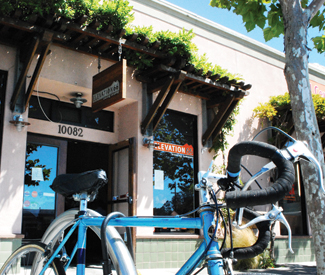
Hook up your handlebars for a pleasant BART ride out to this north-of-Berkeley, family-friendly area, where a cruise of mere blocks will take you to the airy brewpub of Elevation 66 (10082 San Pablo, El Cerrito. (510) 525-4800, www.elevation66.com). Stainless steel fermentation tanks make for tasty eye candy from the bar, where we wound up setting our messenger bags and ordering a sampler flight of seven beers. For such a tiny operation, Elevation 66 offers a swath of pours: on tap the day we visited were seven of its in-house brews, including a heavenly Contra Costa kölsch, the perfect light beverage with which to begin a day of exercising and drinking, and five guest pours, of which we tried a bubbly, sweet Two Rivers blood orange cider. Important matters settled, we tackled the extensive food menu, which stocks homemade potato chips, a Peruvian causa made with poached prawns, avocados, Yukon potatoes, and habanero, and more.

Now, leave the brewery (I know, but there’s lots to see.) Take the beautiful, wetlands-lined Bay Trail south, feeling free to jump off at the overpass when you see the Golden Gate Fields (1100 Eastshore Frontage Road, Berk. (510) 559-7300, www.goldengatefields.com). If it’s Sunday, all the better — $1 entry, $1 beers, $1 hot dogs.


BERKELEY

Note the USDA community garden that will zip by on your right (at 800 Buchanan, Berk.) as you emerge from the Bay Trail into the Albany-Berkeley area, home to some of the largest breweries in the East Bay, besides of course the mega-fermenters at the Budweiser factory in Fairfield.

Your first stop will be at Pyramid Alehouse (91 Gillman, Berk. (510) 528-9880, www.pyramidbrew.com), and though you may find the quality of some of the beers at this Seattle-born chain brewery to be just about what you’d expect from a space tinged with notes of T.G.I. Friday’s, you can make a game of counting the pyramids incorporated into the décor for extra stimulation. If you dare, embark upon a 40-minute free tour given every day at 4pm by a bartender who may or may not include gems like: “if you like metaphors, you’ll love this one.” At any rate, it’s a good primer for people who have no idea how beer is made and it includes tons of free booze at the end. Check out Trumer Pils Braueri (1404 Fourth St., Berk. (510) 526-1160, www.trumer-international.com) a few blocks away for another free tour that runs daily at 3:45pm.

Head back to the Bay Trail, unless you feel like a trip further inland to Berkeley’s two fun brewpubs Jupiter (2181 Shattuck, Berk. (510) 843-8277, www.jupiterbeer.com) and Triple Rock Brewery (1920 Shattuck, Berk. (510) 843-2739, www.triplerock.com). Between Berkeley and Oakland you have three lovely miles of trail ride, and if I’m not mistaken we are in the thick of blackberry season, which means the indigo clumps you’ll see on your right just past Sea Breeze Market and Deli (598 University, Berk.) are ripe for picking.


OAKLAND

You could while away a day within just a few blocks in downtown Oakland, such a prime sitting-out-with-a-microbrew kinda neighborhood it is.

In terms of places that make their own brew, there is none better than the 1890s warehouse building that houses Linden Street Brewery (95 Linden, SF. (510) 812-1264, www.lindenbeer.com), the little brewery that could. There’s only a few meters in between tank and tap here, and on weekdays you can sit in the joint’s tap room and suck down golden pints of its Urban Peoples’ Common Lager, while hearing the story from the bartender of how it came to the forefront of Oakland’s craft beer scene.

You may not even guess, right off the bat, that Pacific Coast Brewing Company (906 Washington, Oakl. (510) 836-2739, www.pacificcoastbrewing.com) is brewing the suds that wind up in your $9/five beer sampler — but it is. The charming brick pub has all the fried pickles one has come to expect from a solid bar menu, and a latticed patio that provides a little privacy from the Oakland cityscape. Out front, you can park your steed and walk it out — the rest of your stops are within stumbling distance, unless you’re trying to really make a day of it and head south to Drake’s Brewing (1933 Davis, San Leandro. (510) 568-2739, www.drinkdrakes.com) and its tucked-away pint parlor.

You may just have saved the best for last. The Trappist (460 Eighth St., Oakl. (510) 238-8900, www.thetrappist.com) and Beer Revolution (464 Third St., SF. (510) 452-2337, www.beer-revolution.com) are two of my favorite Bay beer bars, regardless of area code. Both have superlative selection and cute, sunny patios, but considerably different vibes.

The Trappist is a classy, under-lit place with two bars and an elegant rotating list of beers at each, some local and some from far-flung locales. On our visit, we tried a trio of superb sour beers, including the transcendent red-brown Belgian Rodenbach Grand Cru. Trappist’s food menu is full of elegantly spare, small plates packed with big flavors, like a recent Mahon Reserva cheese platter with truffled almonds and shisito peppers. I’m no meat eater, but I heard rave reviews of the comparatively proletarian Trappist dog, which was studded with bacon and seemed an apt pairing for a beer that may out-class you.

Beer Revolution, as the name would imply, is a populist place — local brewers regularly roll through to share their fermentation philosophies. Though their draft menu is impressively large, the beauty of this place is variety. Inside the bar there is a vast refrigerator land where bottles await for your to-go/for-here fancy. We vote for-here, because you’ll want to savor every drop of your East Bay booze cruise.


Beer for dinner

0

virginia@sfbg.com

BEER + WINE Craft beers are in their heyday, alongside craft everything else — it only makes sense that they would begin to take prominence on local menus next to intricately prepared and finely sourced dishes. San Francisco beer luminary Dave McLean has been brewing Magnolia beers, among my favorites anywhere, at his Upper Haight brewpub for nearly 15 years, now expanding to a new Dogpatch location. Like Magnolia, modern classic Monk’s Kettle in the Mission has focused since its 2007 opening on serving food to match its beer offerings, and new Maven in Lower Haight is innovative in its extensive beer-food pairings menu. (And we haven’t forgotten more casual beer-and-sausage options like Gestalt and Toronado-Rosamunde.) Now, two new restaurants arrive where food is equally important to beverage, with exciting beer slants.


ST. VINCENT

Opened in May with great wine world buzz, St. Vincent is owned by sommelier David Lynch, known for his impeccable wine list at Quince. Accordingly, the wine list at St. Vincent (named not for the popular indie musician but for a third-century Spanish deacon known as the patron saint of winemakers) is global and excellent, with many bottles in the $30–$50 range, plus affordable by-the-glass pours like a crisp, floral 2011 Domaine de Guillemarine Picpoul de Pinet.

Wisely, Lynch brought on beer director (and certified cicerone) Sayre Piotrkowski, whose brings his beer knowledge and keen eye for the unusual from his former position at Monk’s Kettle. Piotrkowski has made spot-on drink recommendations on every visit, and the friendly staff are well-versed on the menu. I’ve tasted many of the eight rotating beers on draft, like those from Oakland’s Linden Street and Dying Vines breweries, or delightful beers from tiny Pasadena micro-brewery Craftsman Brewing Co., including a Triple White Sage Belgian-Style Tripel or a 1903 Lager, pre-Prohibition style. Splurge for a $22 bottle of fascinating Birrificio del Ducato’s Verdi Russian Imperial Stout, spicy with hot chile from Parma, Italy. ($11 if you can find it at liquor store extraordinaire Healthy Spirits, btw.)

New Jersey native Chef Bill Niles (most recently of Bar Tartine) exhibits a strong dose of New Southern in his California cooking. Although dishes like she-crab soup ($14), utilizing sea urchin, sugar snap peas and Carolina gold rice in a corn-lobster chowder, or rabbit burgoo ($24), a mélange of white turnips, baby green okra, white corn grits, and rabbit loin sausage with unusual lamb’s quarter herb, are nothing like the she-crab soups I’ve loved in South Carolina or the burgoo stews I’ve dined on in Kentucky, Niles has reinterpreted the regional dishes with care — and a distinctly West Coast ethos.

Beet-horseradish or curry pickled eggs ($3 each) are a predictably a good time, while a hand-rolled pretzel with mustard and butter ($5) is a bit small and forlorn. I searched for the listed clothbound cheddar in the baked Vidalia onion soup ($9), where even onions didn’t impart the hoped-for flavor intensity. Rarely-seen, ultra-salty Welsh laverbread ($18) is a hunk of Tartine wheat bread lathered in Pacific sea laver (seaweed), Manila clams, and hen of the woods mushrooms, ideal with beer. Entrees like roasted duck leg ($22), surrounded by buttered rye berries, griddled stonefruit, celery, and pickled mustard are heartier, but, unexpectedly, I preferred a vegetarian entree: an herb-laden spring succotash ($18) of butter beans, white corn, and dandelion, perfected with padron peppers.

Though St. Vincent’s food voice feels like it’s still finding itself, I appreciate that it is not the same iteration of gastropub food we’ve seen a thousand times over.

1270 Valencia, SF. 415-285-1200, www.stvincentsf.com


THE ABBOT’S CELLAR

Abbot’s Cellar opened in July and is Monk’s Kettle sister restaurant. The Lundberg Design (Moss Room, Quince, Slanted Door) space immediately impresses with 24-foot ceilings illuminated by skylights, and a long, 3000-square-foot dining room marked by reclaimed woods for a rustic, urban barn feel. A two-story stone cellar houses beer at proper temperatures, listed in a book that pulls out from the side of each table.

The volume lists more than 120 rotating beers — curated by co-owner and cellarmaster Christian Albertson with co-beer director Mike Reis — grouped by style (sours, saisons, etc.), with two pages dedicated to drafts. There’s a wall of glassware suited to every type of beer served, whether Jolly Pumpkin’s Madrugada Obscura Sour Stout from Dexter, MI, or Italian 2004 Xyauyu Etichetta Rame. A pricey ($14.50 for a six-ounce pour) Belgian Brouwerij De Landtsheer Malheur Brut is a dry, elegant Champagne-style beer served on the stem, one of ten offerings in a by-the-glass selection from large beer bottles rarely available by the pour.

As a temple dedicated to beer, the Cellar succeeds immediately. The bar and chef’s counter are ideal perches from which to sip, accompanied by hand-pump cask engines (sample Firestone Walker’s Unfiltered Double Barrel Ale from these classic pumps), and a reading shelf lined with Dulye’s collection of cookbooks.

Chef, co-owner, and experienced craft beer restaurateur Adam Dulye explores flavors optimal to brews. Dishes — a la carte options or tasting menus: three course $45, $60 with pairing; 5 course $65, $90 with pairing — are well-crafted and artful. As at St. Vincent, some dishes stand well above others, although there’s generally promising possibility. A coon-striped shrimp salad ($11) makes a dramatic presentation but, similar to crawfish, you’ll struggle to pull a tiny bite of meat from the shrimp. Cumin-roasted heirloom carrots ($11), elegantly displayed with quinoa, oyster mushrooms and sprouts, lack distinctive flavor.

Alternately, braised rabbit on tender handkerchief pasta ($23), dotted with English peas and hen of the woods mushrooms, is heartwarming, particularly with beer. “Wow factor” is in play with a unique beef bone marrow ($12) dish. The bone is topped with crispy house pastrami, alongside spicy greens, more pastrami, pickled mustard seeds, and rye croutons — one of the more exciting of countless bone marrow dishes I’ve had. While roast pheasant ($24) with lacinato kale and non-existent (but listed) cauliflower puree was too dry, a generous pork chop ($25) is insanely juicy and satisfying over chewy caraway spaetzle, topped with grilled peaches. A dessert of warm, roasted parsnip cake ($9), co-mingling with whipped cream cheese and a ginger molasses cookie, is a homey highlight, lovely with the coffee-almond malt of Great Divide’s Yeti Imperial Stout.

742 Valencia, SF. 415-626-8700, www.abbotscellar.com


UPCIDER: SF’S FIRST CIDER BAR

Ever since savoring a fantastic New England cider pairing with each course of a fall dinner at NYC’s Gramercy Tavern years ago, I’ve wondered when we might witness the arrival of urban cider bars. SF’s new Upcider and Bushwhacker in Portland are it thus far.

Two aspects of Upcider jump out immediately: Ozgun (Ozzie) Gundogdu and his sister’s warm welcome — Ozzie opened the bar with former roommate and co-worker Omer Cengiz — and a second story upstairs space with floor to ceiling windows overlooking Polk Street. One can sit at the windows, gazing below at a busy street scene, enveloped by low-ceilings and a cozy glow, transported to a European bar or maybe even one in Turkey, Ozzie and Omer’s homeland.

The bar, lined with rustic, reclaimed wood, houses a range of bottled ciders — 19 producers, 40 varieties of cider (and growing) at $5–$26 a bottle, the most expensive being a 750ml of Etienne Dupont Brut De Normandie from Victot-Pontfol, France. You’ll find big brands like Magners or ones we’ve seen often in SF like Fox Barrel, Crispin, and Two Rivers. But you’ll also discover three ciders from Wandering Aengus Ciderworks in Salem, OR, or J.K. Scrumpy Organic, a sweeter cider from Flushing, MI. On the dry side (there’s also a medium-dry option), I liked Hogan’s Cider from Worcestershire, England. A new discovery was Julian Hard Cider from Julian, CA, a small Gold Rush town inland from Escondido and San Diego.

Its tart, dry Cherry Bomb ($11 for 22 oz. bottle) is a fascinating cider with a funky finish. There are Basque ciders, mead, wines, and beers, and bar food from chef Tony Carracci (Cha Cha Cha). For the time being there are no ciders on tap, but that is due to the intensive plumbing rebuild necessary to meet city requirements. Hopefully, there will be a way to provide draft ciders in the future.

Whiling away summer evenings in Upcider feels like traveling. I noticed the neighborhood’s Middle Eastern community gathering below for friendly banter, a refreshing alternative side of a street lined with raucous partiers and bar-hoppers.

1160 Polk, SF. 415-931-1797, www.upcidersf.com

Subscribe to Virgina’s twice-monthly newsletter, The Perfect Spot, www.theperfectspotsf.com

Central Market Guide*

0

CounterPULSE

CounterPULSE is an experimental and innovative non-profit theater, performance space, community center, and gallery with roots deep in the Bay Area’s provocative performance and dance scenes. Supports emerging, local, and talented artists and performers who have not yet tapped into the larger Arts funding streams by producing their own shows, hosting residency programs, and boot camps, not to mention the constant combing of the artist community for emerging talent. Their small and intimate stage can seem to blur the link between audience and performer for a truly unique theater-going experience. Perfect for those seeking an out-of-the-box adventure and fringe art aficionados alike, CounterPULSE is conveniently and centrally located – just a short walk up Ninth St. from the Civic Center BART and Muni Metro stations.

1310 Mission St | (415) 626-2060 | counterpulse.org


A.C.T. Presents: Electra

Direct from its acclaimed sold-out premiere in Los Angeles, A.C.T. director Carey Perloff brings her sweeping production of Sophocles’ Electra to the Bay Area beginning October 25, with a specially-commissioned new translation by London playwright Timberlake Wertenbaker and a haunting original score by Pulitzer Prize-winning composer David Lang. A feast of poetic language, Elektra features two of A.C.T.’s most beloved performers: core acting company member René Augesen in the title role and associate artist (and Academy Award winner) Olympia Dukakis as the fiercely partisan Chorus Leader.

After her mother murders her father, Elektra is driven by grief, perpetually reliving the horrific event to refuel her burning need for revenge. See why the LA Times calls A.C.T.’s production of Electra “shattering in its poignancy.” For show times, visit act-sf.org.


24 Days of Central Market Arts Festival

Central Market Arts, is thrilled to announce its third year offering the 24 Days of Central Market Arts Festival, a free and open-to-the-public art festival in the Central Market district of San Francisco. The festival kicked-off last month and continues through October 21 with action-packed performances and activities at a variety of Central Market locales like Mint Plaza, United Nations Plaza, The Old Mint Building, and Market at 6th Street. A calendar and map of all events can be found by logging on to centralmarketarts.org.

Next up is KUNST-STOFF arts presents: Dance Based Artistic processes at Mint Plaza from 1-4:30pm on Saturday, October 20. Sharing the outdoor stage is Tango & More Argentine Dance, Hallie Dalsimer, Santa Barbara Dance Theater Kate Jordan, Tahoe Youth Ballet, Bruno Augusto, Dance ELIXIR, Anne-Rene Petrarca/Sculpted Motion Samantha Giron, Laura Arrington, KUNST-STOFF Dance Company Dancers, and Guests.


Marinello Schools of Beauty

Started in 1905 by a physician’s wife cooking up batches of face cream in her Wisconsin kitchen, Marinello Schools of Beauty are now the nation’s leading chain of beauty schools, where industry professionals teach aspiring cosmetologists, estheticians, and manicurists their tricks of the trade. Marinello schools are at the forefront of beauty education so rest assured that their advanced students will give you quality services at unbelievably reasonable prices, that will make you feel like a million bucks. For a complete menu or guest services – everything from five-dollar haircuts to forty-dollar Glycolic peels – visit their website.

1035 Market #100, SF | marinello.com | (415) 800-5842


Pearl’s Deluxe Burgers


One cannot call him or herself a burger fan unless they’ve eaten at Pearl’s. With four locations, two of which are in San Francisco, there’s no excuse not to! They’ve got a variety of beef burgers (including Kobe!) and chicken sandwiches, salads, homemade chili, and plenty of sides to make everyone in your party happy. Try the healthier and leaner grass-fed buffalo burger, or the somewhat less so King Burger topped with a hot dog, or the much less so – and appropriately named – Phat Bob with BBQ sauce, bacon, onion rings, and cheese. Pearl’s looks out for the vegetarians with veggie burger options, as well as the more indecisive crowd with their clever sides menu that includes “springs” (half sweet potato fries and onion rings), “spries” (half sweet potato fries and french fries), and “frings” (you guessed it – half french fries and onion rings). Down any combo of their outstanding comfort food with one of their milk shakes and you’re good to go.

1001 Market Street and 708 Post Street, SF | pearlsdeluxe.com


Huckleberry Bikes

Not even open for one year yet, Huckleberry Bikes has already become the FiDi bicycle commuter’s dream come true and go-to (their five-star Yelp score speaks for itself.) Leaving work and need a repair? Riding to work in the morning and catch a flat? Not only are they conveniently located on San Francisco’s heaviest bike commuting corridor with a nice and late close time of 7pm, they were smart – correction: genius – enough to convert a newspaper kiosk on the corner of Market and Seventh Streets for early morning drive-by servicing – open from 7:30am to 9:30am every weekday morning. Their prices are more than reasonable, their staff is less than pretentious, and their shop is stocked to the gills with everything you need for the smoothest ride.

1073 Market Street | huckleberrybicycles.com


Summer of Art continues through fall with What’s On Stage?


What’s on Stage? (produced by Denia Dance and People in Plazas) takes the stage from the theatre to the streets with free Tuesday lunch-time performances at UN Plaza. A part of the Summer of Art series, this cultural respite from the hectic workweek continues throughout the month of September.

Up next is the September 11 event featuring Yannis Andoniou’s KUNST-STOFF Dance Co., who will preview The Moment You Stood Still…#7 moNOs – catch the world premier at the Old Mint Building Courtyard on October 13 and 14. KUNST-STOFF Dance Company partners with The San Francisco Museum and Historical Society to present this funny, dramatic, and at times “real” play on appropriation and acceptance.

Also catch the Leyya Tawail’s DANCE ELIXER preview of Destroy// with live music by Mike Guarino of Tiberius before a full ensemble of dancers and musicians perform it October 4-6 at KUNST-STOFF arts, as well as Kate Jordan Dance Project’s preview of BUILd – performed by Bruno Augusto – before it premiers October 24 at the 24 Days of Central Market Arts Festival.

Defending Richard Aoki — and the movement

0

By Steve Woo and Alex T. Tom

OPINION In a new book, Bay Area journalist Seth Rosenfeld publicly names longtime Asian American leftist Richard Aoki as an FBI informant during his time as a leader of the Third World Liberation Front movement and as a founding member of the Black Panther Party. As Asian American activists in the movement today, we denounce these claims as baseless and false and are shocked at the way Rosenfeld makes such unsubstantiated claims while promoting his book release. His allegations damage the movement and reinforce trite “yellow peril” stereotypes of Asian Americans.

The allegations against Richard come without any credible evidence. Rosenfeld provides one incomplete document that he claims identifies Richard as an informant called “SF T-2.” It reads: “SF T-2 was designated for [redacted] (Richard M. Aoki) for the limited purposes of describing his connections with the organization and characterizing him.” The FBI cover sheet associates names of informants with their “T” codes. All informants’ names have been redacted.

It is astounding to us that Rosenfeld concluded Richard was an informant from that scrap of evidence. Later in this document, Aoki’s name is used again in order to name an FBI file location. In the few pages available under his FBI file, the informant “SF T-2” goes on to inform about the readings, political thought, and organizational/party membership of Richard Aoki. It appears to us that an informant named “SF T-2” was assigned to inform about Richard.

Rosenfeld also cites a former agent named Burney Threadgill, who claims Richard was an informant; before his death in 2009, Richard denied that in an interview. Threadgill is hardly a credible source and was a major player at the height of COINTELPRO, implementing FBI policy that was designed to deter and divide the movement. Unfortunately, both men are now deceased and cannot defend their claims.

He also uses testimony of a former FBI agent, M. Wesley Swearington, who had no relation to Richard Aoki. Despite this, Swearington claims that Richard was a “perfect informant” because he was a Japanese person in an organization of Black Americans. That makes no sense because Richard stuck out while in the Black Panther Party, and again feeds into the divisive stereotypes of Asian Americans.

Rosenfeld implies that Richard worked as an instigator, pushing people toward violent action. In fact, Richard was cautious about the use of violence and was vigilant about it during mass actions. It’s true that Richard armed the Black Panthers; however, he did so in the name of self-defense and protecting the people against police brutality.

All in all, Seth Rosenfeld’s news story on Richard Aoki was poorly researched and only a small fraction of his new book. His public accusations are unfounded and sensationalist.

Richard advanced leftist political thought, mentored and developed new leaders, educated his working-class sisters and brothers, and built Black and Asian solidarity — and this was invaluable. Richard and other movement veterans inspired us and a new generation of young leaders to carry forward the work today. We are stronger because of them — and that is how people should be judged and remembered.
Steve Woo is an organizer in the Tenderloin and steering committee member of the Richard Aoki Fund. Alex T. Tom is the executive director of the Chinese Progressive Association.

Koi hooey

0

le.chicken.farmer@gmail.com

CHEAP EATS Coach’s dad said it was the best Chinese restaurant in the world. The world being a pretty big place, and one which includes all of China, we went. Him, her, me, Hedgehog, Indiana Jake, and a Random Texan.

Daly City. Koi Palace. Pffft.

I’d retract that last little almost involuntary and entirely uncomplex sentence in deference to Mr. Coach, him being a respected figure among us, but come to find (over appetizers) that he didn’t say it was the best Chinese restaurant in the world; some guy did.

Some guy in an interview on NPR, turns out. He had eaten at 5,000 Chinese Restaurants (which is a lot, by even my standards) and Koi Palace in Daly City was his favorite.

OK. If that guy wants to take me there and order what he ordered, I’ll go back. But I happen to consider myself the High Halushki of Hyperbole, and I’m here to tell you that, no matter what Coach’s dad told Coach he heard some guy tell some interviewer, Koi Palace isn’t even the best Chinese restaurant in Daly Goddamn City, let alone the Bay Area, let alone the big fat world.

Why, it’s not even cheap! The kind of portions and quality you pay $8-10 for at the best Chinese restaurants in my world, you can expect to pay $16-18 for at Koi Palace.

And that, in a nutcase, is why I don’t listen to the radio.

Come to think of it, though, the pork and oysters clay pot…

(continued later this page, after sports section)

CHEAP SPORTS

by Hedgehog

Next week I’ll have an actual pickup baseball game to write up. This week, though, I attended my first ever flag football practice. While it’s true that I already broke my arm at a flag football game, I had never actually practiced before. Which evens out since the practice I attended this week was for a team I don’t play on. I don’t play flag football anymore. Or ever. Since I broke my arm just thinking about playing once. Did I mention my arm is broke? Well it is.

Turns out, once you have a broken arm, there isn’t much you can do at a flag football practice. In the beginning, I tried kicking a soccer ball around, and the team initially joined me but finally got wise to my distractions and pulled out the pigskin.

So then I snapped the ball to Stringbean while the rest of the team ran passing routes. And then the Chicken Farmer and I played defense while the offense ran plays. Every play, one of us would blitz Stringbean and the other would drop into pass coverage. But whichever job I had, I kept putting my broken hand up to block the ball, so I decided it was safer to pull that arm into my shirt and run one-armed.

But when I blitzed Stringbean like that she just stopped and laughed and said I was the most “unintimidating” thing she’d ever seen.

She’ll rue the day.

(continued from before the sports section)

…was pretty good. And the seafood noodles, I thought, were great. But the country vegetables and the eggplant dishes were boring, the pork cheeks were at least as weak, and the spicy chicken wasn’t spicy. At all.

But mostly how I can tell when I really don’t like a restaurant is I wake up in the middle of the night that night, not feeling sick so much as cheated. Or maybe disturbed would be a better way to put it.

I have nightmares.

My mouth gets awful.

I mean no disrespect to Coach’s dad, who I kind of idolize because his whole family pretty much breathes football — with the possible exception of Coach herself, who is in it for the babes — but I’ve been so thrown by Koi Palace that I might need to go find some dollar-fifty steam-table fried rice for lunch. By way of a reset.

KOI PALACE

Lunch: Mon-Fri 11am-2:30pm; Sat 10am-3pm; Sun 9am-3pm; Dinner: Sun-Thu 5-9:30pm; Fri-Sat 5-10pm

365 Gellert Blvd., Daly City

(650) 992-9000

AE,D,MC,V

Full bar


The park bond battle

17

yael@sfbg.com

Recreation and Parks clubhouses are privatized and cut off from public access. Public spaces like the Botanical Gardens and the Arboretum in Golden Gate Park are closed to people who can’t pay the price of admission. Event fees and permit processes have become so onerous that they’ve squeezed out grassroots and free events.

It’s been enough to infuriate a long list of neighborhood groups who have been complaining about the San Francisco Recreation and Park  Department for years.

And now those complaints have led to a highly unusual coalition of individuals and groups across the political spectrum coming together to do what in progressive circles was once considered unthinkable: They’re opposing a park bond.

From environmentalists, tenant advocates, labor leaders, and Green Party members to West Side Republicans and fiscal conservatives,  activists are campaigning to try to defeat Proposition B, the Clean and Safe Neighborhood Parks Bond. 

The bond would allow the city to borrow $195 million for capital projects in several parks around the city. It comes five years after the voters passed a $185 million park bond. 

Environmental groups like San Francisco Tomorrow and SF Ocean Edge oppose the bond, and even the Sierra Club doesn’t support it because “In recent years, we have had many concerns with management of the city’s natural places,” as Michelle Meyers, director of the Sierra Club’s Bay Chapter, told us.  

Matt Gonzalez, the only Green Party member ever to serve as Board of Supervisors president, is part of the opposition, as is progressive leader Aaron Peskin.  Joining them is retired Judge Quentin Kopp, darling of the city’s fiscal conservatives.

The San Francisco Tenants Union wrote a ballot argument opposing Prop. B. The left-leaning Haight Ashbury Neighborhood Council and the more centrist Coalition of San Francisco Neighborhoods both want the bond defeated.

Many of the people opposing Prop. B have never before opposed a city bond act. “This is very difficult for me,” said labor activist Denis Mosgofian. “Some of us always support public infrastructure spending.”

When we called Phil Ginsburg, the director of Rec-Park, for comment, his office referred us to Maggie Muir, who’s running the campaign for Yes on B. She sent a statement saying: “Unfortunately, a small group of individuals are opposing Proposition B because they disapprove of Recreation and Park Department efforts to improve our parks and better serve San Francisco’s diverse communities.” The statement refers to Prop B’s opponents as “single issue activists”

 So who are these activists, and why have they come together to oppose the parks bond?

 Many started with, as Muir put it, a single issue.  Journalist Rasa Gustaitis  didn’t want to see fees to enter the Botanical Gardens and Arboretum in Golden Gate Park.  West of Twin Peaks resident George Wooding was upset that Rec-Park has been leasing public clubhouses to private interests. Landscape Architect Kathy Howard took issue with a plan to renovate Beach Chalet soccer fields, complete with artificial turf and stadium lighting.

After a few years of fighting these small battles, people like Gustaitis, Wooding, and Howard started to see a pattern.  Park property was being privatized.

THE ENTERPRISE

Some city departments, like the airport and the port, are so-called enterprise agencies. They don’t receive allocations from the city’s general fund, and operate entirely on money they charge users. In the case of the airport, most of the money comes from landing fees paid by airlines. The port charges ships that dock here, and takes in rent from its real-estate holdings.

Other departments, like Recreation and Parks, provide free services, funded by taxpayer money. In theory, the department creates and maintains open spaces for public use. The recreation side offers services like classes and after-school activities, many of which are centered in recreation centers and clubhouses in parks throughout the city. 

These have been staffed in the past by recreation directors, adults who coordinated and supervised play, in many cases becoming beloved community figures.

But some city officials want that mission to change. In a time of tight budgets (and facing significant cuts to its operating funds), Rec-Park has been looking for ways to increase revenue by charging fees for what was once free.

In fact, in a 2010 Rec-Park Commission meeting, interim General Manager Jared Rosenfeld said, “the sooner we become an enterprise agency, the better off we will be.”

In August 2010, the department fired 48 recreation directors.  In their place, Rec-Park hired part-time workers who were paid to put on programs but not to staff neighborhood rec centers. The department also hired six more employees in the Property Management Division, tasked with leasing out and renting parks property.

In 2010, the commission also approved a plan to impose a fee for non-residents and require residents to show ID to enter the Arboretum. The once-free public garden was on its way to becoming a cash cow (operated in part by the private San Francisco Botanical Society).

A fledgling group formed to fight the fees – and its members soon connected People from SF Ocean Edge, the Parks Alliance and SPEAK who were not pleased with a proposal to install artificial turf and floodlights at the Beach Chalet soccer field and people who opposed the leasing of clubhouses.

 Mosgofian, a member of the Labor Council and worker with Graphic Communications International Union Local 4-N, helped bring together many disparate groups who, they realized, have a common goal in halting the privatization of the parks system.

“It started with a number of different people who were involved in a number of different efforts to get the Rec and Park Department to do the right thing running into each other and eventually getting together,” said Mosgofian “People from these groups found themselves listening to each other’s efforts and got together.”

Subhed: The empty clubhouse

One of the turning points was the fight over J.P. Murphy Clubhouse in the Sunset.

 In July 2010, Rec-Park quietly began taking clubhouses, previously free and open to anyone in the neighborhood, and putting them up for lease. Nonprofits, some of them offering expensive programs,  took exclusive control of public facilities.

For Rec-Park, it was more money. For neighborhood residents, it was a sign they were being cut off from the resources their tax dollars built and funded.

“They would put a notice on the clubhouse door for a hearing, they would have four or five concerned mothers show up, and they would lease the facility,” said George Wooding, then-president of the West of Twin Peaks neighborhood group that got involved in opposing the clubhouse privatization.

The J.P. Murphy clubhouse in the inner sunset had benefitted from the 2008 bond. The building was renovated at a cost of $3.8 million. But when the shiny new rec center was finished, Rec-Park tried to put it up for lease.

Wooding helped organize strong opposition to the lease. They had already paid for the clubhouse through taxes and bond money, the opposition figured—why shouldn’t it be kept open to the public, free? 

 “I’d had enough. We felt, this is our park,  they just spent a ton of money. They fired the rec director. When Rec-Park came to rent out the facility, we just said no way,” Said Wooding.

The department gave up, and J.P. Murphy wasn’t leased. But without a lessee, the department simply closed the center. It’s empty and dark – although it’s available for $90 an hour rent.

Other similarly frustrating battles were going on around the city. 

Muir called the opposition “short-sighted.” 

“This opposition is punishing the people who use the facilities across the city, children who need safe parks to play in, seniors, and those who are disabled who need ADA compliance,” said Muir.

But Friends of Ethics, another group opposing the bond, argues that Rec-Park shouldn’t get another cent until the agency cleans up its act. In a paid ballot argument against Prop B, the group brought up the controversial process of leasing out the Stowe Lake Boathouse last year. The move to put Bruce McLellan, longtime operator of the family business that sold snacks and rented paddle boats, on a month-to-month lease before auctioning a new lease to the highest bidder created a serious backlash.

 On top of that, commission officials were accused of bias when they recommended a lobbyist, Alex Tourk, to one of the companies vying for the contract. 

 “It’s unseemly and it clouds public trust,” said No on Prop B proponent Larry Bush,  who publishes Citireport. 

The boathouse isn’t the only much-beloved tradition ended under the current Rec-Park administration’s reign. The Power the Peaceful festival, which brought big name musicians and thousands of attendants, all for free, has been priced out due to dramatic increases in fees. So has the Anarchist Book Festival. 

 Bob Planthold, a disability rights advocate who is also a member of Friends of Ethics, says that there are issues in the ADA compliance plans for the Parks Bond as well. Planthold says that money from the last bond measure in 2008 was misspent in terms of disability access.

 “Trails weren’t graded properly. There was no attention to whether there were tree roots that might be rising above the level of the trail that could trip somebody,” said Planthold. “They didn’t do a good, proper, fair job on making trails accessible.”

 The bond got unanimous support from the Board of Supervisors. That’s because it earmarks money for parks that desperately need it throughout the city. 

 But that doesn’t mean all the supervisors are pleased with the way Rec- is being run, either. In July 2010, Sup.  David Campos and then-Sup.  Ross Mirkarimi tried to pass a Charter Amendment to split the appointments to the commission among the mayor and the supervisors. 

 But they couldn’t get the measure through, and the commission remains entirely composed of mayoral appointees.  

So now the voters have a choice: Give more money to what  many say is a badly managed department moving toward the privatization of public property – or shoot down what almost everyone agrees is badly needed maintenance money. Of course, the critics say, Rec-Park can always change its direction then come back and try again in a year or two – but once public facilities become pay-per-use private operations, they tend to never come back. 

Pop thrills

0

tredmond@sfbg.com

LIT So much trash lit, so little summer left. It hasn’t been the greatest of years for beach and backyard reading (seriously, more trash than lit), but we struggle on. Some selections:

THE AFFAIR

By Lee Child

Delacourte Press

405 pp, hardcover $28

Jack Reacher is one of the best action characters of our time, up there with Spenser and Travis McGee.

Child came up with a winner, a former military cop who wanders the world like Kwai Chang Caine, doing good work, sometimes reluctantly, with superior fighting skills that make him a true badass.

The Affair is sort of a prequel, and takes us back to Reacher’s army days. It’s absolutely formulaic, completely predictable, just like all the other Reacher books — but so well executed that it’s still a beautifully guilty pleasure.

There’s a murder that puts Reacher in danger, a gang of thugs who get their butts kicked, a hot woman in law enforcement with whom Reacher has what we all know will be a short-lived affair … and plenty of sharp dialogue the keeps the pages turning.

With all the pablum out there, it was nice to sit down and read the work of a master who is still in his prime.

STOLEN PREY

By John Sandford

G.P. Putnam’s Sons

402 pp, hardcover $27.95

Put this one up there with The Affair. If you love Lucas Davenport and his world of twisted murder shit in and around the Twin Cities, then Stolen Prey works fine.

Mexican drug gangs seem to be the Most Evil Fuckers In The World this summer, and in Stolen Prey, they’re particularly horrible, doing a stomach-turning murder that takes place in a nice upper-middle class town. The dead family appears to have no ties to any type of criminal activity — but ah, there is much more here.

Again, nothing radically new (except a suprising ending involving Davenport’s adopted daughter, Letty, who apparently has some of the step-old-man in her), but a fine read for a sunny afternoon.

THE LITIGATORS

By John Grisham

Dell Paperback

488 pp, paper $9.99

Grishman practically invented the modern lawyer novel, and most of his protagonists are brilliant (if tormented) legal advocates who fight valiantly against corporate crime.

It was getting old.

This time around, there’s plenty of evil corporation (big pharma) — but the lawyers are bumbling idiots, worthless ambulance chasers who’ve stumbled into something they’re mind-bendingly unqualified to handle. Drunk lawyers, dumb lawyers, lawyers behaving badly … it’s a grand and glorious testament to the noble profession. And it moves right along.

DON’T BLINK

By James Patterson and Howard Roughan

Hachette

365 pp, paper $9.99

Patterson has written so many books I don’t think even he can keep track. The Alex Cross series is among the modern classics in crime lit. His current M.O.: Find co-writers who can do some of the heavy lifting while he polishes. At least, that’s how much of his stuff reads. And this one, sad to say, is a snooze.

Even in his collaborations, Patterson normally manages to keep things lively. The plots are good, the characters decent, and there’s no shortage of action. He’s into seriously depraved, psychotic villains and seriously evil enemies. Never a dull moment — mostly.

But Don’t Blink bored me. It’s about a reporter (good) who sees a mob killing (cool) and then gets in trouble (predictable). The protag is decent and believable, but the plot goes on and on and gets nowhere. Blink.

LET THE DEVIL SLEEP

By John Verdon

Crown

449 pp, hardcover $25

Verdon’s series hero, retired cop Dave Gurney, continues to live in his gruesome Green Acres in upstate New York, where his wife wants a quiet country life and he keeps tangling with psychokillers. I really liked the first two, Think of a Number and Shut Your Eyes Tight, and this one’s fine, although not as stone-cold sick-ass wacked-out crazy as the past two.

Here, Gurney looks into a cold case and everyone thinks he’s crazy except that the killer, who supposedly isn’t around, keeps doing things like shooting deadly hunting arrows into his garden. Between the murderer and the pain of his tormented marriage, there’s enough to keep you turning the pages. But it’s at best a B-plus.

ROBERT B. PARKER’S LULLABY

By Ace Atkins

G.P. Putnam’s Sons

320pp, hardcover $26.95

All of the knockoffs suck. Tom Clancy’s Ops Center? Worthless. The Jason Bourne sequels? Robert Ludlum’s ghost is puking. You don’t do that shit; it doesn’t work. And another writer trying to take on the Late Great Robert B. Parker and Spenser? Not a prayer. Give it up.

Except that Ace Atkins actually makes it work. And he does it not by becoming Parker but by staying true to the characters and developing just enough of his own voice that it’s not just a weak parody. You’ve got Spenser and Hawk and Vinnie and Susan Silverman and a 14-year-old terrified girl who hired the detective for a box of donuts and leads him into a fierce FBI-Boston mob frameup gig that sparkles like Parker of old.

For real. I’m amazed.

Tasty reads

2

virginia@sfbg.com

LIT A harvest of cookbooks, some set for release in the fall, some ready for your shelf, cupboard, or bar hot off the press.

THE BLUE BOTTLE CRAFT OF COFFEE: GROWING, ROASTING, AND DRINKING, WITH RECIPES

By James Freeman, Caitlin Freeman, and Tara Duggan

Ten Speed Press

240 pp, paper $24.95

Since its first kiosk opened in January 2005, Blue Bottle has been my first choice in coffee, from ethos (served immediately, individually brewed, beans sold fresh after roasting) to taste. Musician James Freeman dove into coffee after being laid off from a corporate job post-9/11: the inspiring story of how he began is detailed in this book. Written with his wife, Caitlin, and James Beard-nominated food writer Tara Duggan, with photography by Clay McLachlan, Craft contains sections on global growing regions, roasting, cupping, pour-over, siphon, espresso machines, and multiple techniques. Caitlin, resident Blue Bottle pastry chef and former owner of Miette, contributes more than 75 pages of recipes — not so much utilizing coffee itself, but including breakfast recipes to go with morning coffee from Blue Bottle cafés, desserts and treats for dunking, and recipes from chef friends like Stuart Brioza of State Bird Provisions’ tuna melt with piquillo peppers. Although Blue Bottle has now gone nationwide with New York locations, these pages allow one to wax nostalgic over this Bay Area success story bringing us all better coffee. To be released October 9.

DESTINATION COCKTAILS: THE TRAVELER’S GUIDE TO SUPERIOR LIBATIONS

By James Teitelbaum

Santa Monica Press

408 pp, paper $19.99

Chicago resident James Teitelbaum wrote the kind of book I would happily pen, the first I’ve seen to detail the world’s best craft cocktail bars. Destination Cocktails (www.destinationcocktails.com) is a cocktail aficionado’s trusty guide to destinations both obvious (NYC and SF) and overlooked (Reno and Cleveland). As for the international scene, the book runs the gamut from Wellington to Edinburgh. While there are a few missing great drinks and bartenders — and info can change so quickly, even since Destination‘s September 1 release date — Teitelbaum’s book offers a comprehensive collection that would set any budding or well-traveled cocktailian on the right path. From London (Worship St. Whistling Shop, 69 Colebrooke Row) to Denver (Williams & Graham), many of my global tops are highlighted, alongside cities and bars I’ve been hankering visit (ah, Tokyo!)

SPQR: MODERN ITALIAN FOOD AND WINE

By Shelley Lindgren and Matthew Accarrino with Kate Leahy

Ten Speed Press

304 pp, hardcover $35

A beautiful, visual tribute to Italy, local restaurant SPQR releases a book by its wine director, Shelley Lindgren (also of A16), and executive chef Matthew Accarrino with Kate Leahy. The book features eight regions of Italy, each influencing creative recipes from SPQR’s kitchen and from which Lindgren chooses wines. Her essays explore lesser-known producers and varietals succinctly but with depth. Accarrino’s artful skill with Italian cuisine may not appear easy for most of us, but there are tips and photo breakdowns of recipes, small animal butchery, and pasta-making. Photos by Sara Remington inspire with a romantic eye tempered by realism. To be released October 16.

FORAGED FLAVOR: FINDING FABULOUS INGREDIENTS IN YOUR BACKYARD OR FARMER’S MARKET

By Tama Matsuoka Wong with Eddy Leroux

Clarkson Potter

224 pp, hardcover $25

At a recent intimate gathering at Coi, I was privileged to spend time with Tama Matsuoka Wong, forager for Daniel restaurant in NYC (Daniel Boulud wrote this book’s forward), sampling bites made with ingredients she’d foraged with Coi staff while visiting the Bay Area. We celebrated Foraged Flavor, released earlier this summer. I learned of her career change from lawyer to forager in New Jersey (my former stomping grounds), where her three daughters are involved in her foraging and cooking lifestyle. The book’s clean, classic layout includes botany-style plant diagrams, seasonal groupings, and approachable gourmet recipes like dandelion leaves with poached eggs and bacon. There are foraging and growth tips and info on key characteristics of each wild plant.

COOKING OFF THE CLOCK: RECIPES FROM MY DOWNTIME

By Elizabeth Falkner

Ten Speed Press

224 pp, hardcover $29.99

Longtime local favorite and Top Chef Master star Elizabeth Falkner recently moved to NYC and released her second book August 28. As a James Beard-nominated pastry chef, her first book, Demolition Desserts, focused on the sweet side, while new Cooking Off the Clock is a volume of everyday, accessible recipe favorites. There are sections on condiments (kimchee, tahini sauce), flavorful salads, playful snacks (three types of hot wings: Moroccan, Tabasco-honey, black bean-sesame-ginger), a few of her beloved desserts (two versions of cherry pie), and pizzas, including her amazing pastrami version — like a Reuben pie, with Russian dressing, shredded cabbage, and thinly-sliced pastrami — which I never forgot from her restaurant Orson.

DAILY DECADENCE: THE ART OF SENSUAL LIVING

By Sherri Dobay

Flying Archer Press

231 pp, paper $14.99

Sherri Dobay feels like a kindred spirit… although young, her romantic, sensual verbiage communicates that “old soul,” the kind of view with which I’ve seen the world since girlhood. Food, wine, art, nature, horses (she’s a rider) are her subject, and she is as inspiring as she is comforting. More memoir than cookbook — and published in a format that’s hard to open while working in the kitchen — the book’s draw is its tone, not its recipes. Sections are grouped around themes of decadence (Divine Decadence, Decadent Simplicity, Decadence of the Seasons, Decadence of Letting Go), and wine recommendations are explored from a right-brain perspective rather than thorough analytical tasting notes. Reading bits of the book at a time is like a sip of crisp, refreshing wine.

Subscribe to Virgina’s twice-monthly newsletter, The Perfect Spot, www.theperfectspotsf.com

Pagoda madness

18

culture@sfbg.com

LIT Either I’m terrible at parking or Philip P. Choy was exactly the right person to author his recently-released San Francisco Chinatown: A Guide to Its History and Architecture (City Lights Publishers, 184pp, $15.95). We find a spot for my car in a well-hidden lot, tucked into an alleyway behind the Chinese Historical Society of America. It’s the first sign of the day that Choy’s knowledge of the area goes beyond tea shops and Peking duck.

“Chinatown…” Choy pauses as we stand outside a sidewalk stall whose owner angrily mutters at us (we’re blocking pedestrian traffic by hovering over his dried sea cucumber display.) “Chinatown is real. There are people here living, relying on Chinatown.”

Choy’s newest publication is not just a faithful retelling of the enclave’s social and architectural history. The book goes out of its way to dispel the stereotypes and fanciful constructions of the neighborhood that the outside world maintains. Choy was born in Chinatown, and as a co-professor of the first collegiate level class in Chinese American history at San Francisco State, he’s well-qualified to tell its story.

With apologies to our embattled shopkeeper, we continue to examine the cukes, first brought to the neighborhood via 1800s trade routes between China and the US. We move past other stalls while Choy points out the historical importance of their wares.

He shows me sandalwood, traditionally burned in Chinese temples, and ginseng root, which had been harvested by Native Americans but became a staple Chinese delicacy.

Choy tells me that the Chinese — who were not-so-charmingly called “mongols” around about 1840 — have suffered alongside Native Americans and other people of color throughout our country’s history, enduring ghettoized living situations and sub-par educational offerings.

As Choy and I wander Grant in search of the infamous pagodas that were built after the 1906 earthquake, we take a small detour up the hill to peek at Gordon J. Lau Elementary School. In the late 1800s a Chinatown father sued the city when his daughter was barred from attending other schools. Though the Supreme Court ruled in his favor, the school district opened the originally-named Chinese Primary School rather than integrate. 

We pass quickly by an East West bank, which was once the home of the first San Francisco paper, the Star. Around the corner stands a cheap retail center, originally the Mandarin Theater, a cultural and artistic mecca for neighborhood residents. Its once-lavish stage now serves as a platform for garish home decorations, its grand balconies now providing seating only to building debris.

Our whirlwind tour ends at the pagoda building Sing Fat, nestled at the corner of Grant Avenue and California Street. It was erected by the San Francisco Chinese Chamber of Commerce and prominent merchants in a post- 1906 earthquake attempt to repackage the once-funky Chinatown as an ornate, prosperous “oriental city.”

But Sing Fat’s pagodas are actually what Choy (an architect himself) calls a “Disneyland approach” to Chinese architecture: unstudied, inauthentic. The only legitimately Chinese quality of the structure is its green, yellow, and red color motif.

“Does any truly, authentically Chinese institution or edifice exist in Chinatown?” I ask, sidestepping tourists to keep up with Choy, who navigates Stockton Street with shocking deftness.

Choy reaches a hand out to avoid my death-by-delivery-truck and laughs. “Doesn’t exist.”

That’s because Chinatown is first and foremost a Chinese American town. And for all its perceived exoticism, the neighborhood has been around since almost the beginning of San Francisco.

Such is the beauty of Choy’s book. It retells a neighborhood’s story that’s too often render mythic by rumors money-hungry tour guides and ignorant outsiders. San Francisco Chinatown illuminates the untold history of the enclave, urging readers to consider its quiet alleyways and SROs housing six people just above the busy streets. The book wants you to consider the political, historical, and cultural implications of Chinatown’s very existence.

Says Choy of the generations who lived in this neighborhood, “they were pioneers of the city. They did more than just open laundries.”

PHILIP CHOY: SAN FRANCISCO CHINATOWN

Oct. 7, 1pm, free

California Historical Society

378 Mission, SF

www.litquake.org


Oct. 27, 11am, free

San Francisco Public Library

100 Larkin, SF

(415) 437-4844

www.sfpl.org

Dixie

1

virginia@sfbg.com

APPETITE A fledgling new restaurant is a work in progress, evolving. Often I’ll visit restaurants in their opening week, then return three to four weeks later, noticing a marked improvement in rhythm and flow, if not a dramatic change in food (often first food impressions prove to be consistent).

Returning a few months into a restaurant’s life, if things are heading the right direction, a distinct voice emerges, reflected in service and menus. Other times, one still searches for a point of view, a compelling enough reason to return. Opening in May with big vision and standouts on the plate, Dixie in the Presidio struggles to find cohesion after three months of visits.

The Southern intention of chef Joseph Humphrey (a Florida native) is just the sort of thing I get excited about: California-fresh with a New Southern ethos, not dissimilar to some of the Southern-influenced mashups I find at the likes of Maverick, the new St. Vincent, or in the best food cities of the South. Humphrey cooked at Michelin-starred Meadowood and Murray Circle, and in New Orleans with none other than Dickie Brennan & Co. South truly meets West in Dixie.

In the former Pres a Vi, Dixie hints at Southern plantation feel on the roomy veranda — ideal for the just-launched brunch — clearly the best area in the roomy restaurant. Though dreamily set in the Presidio, surrounded by trees, the Palace of Fine Arts standing majestically across the lawn, the inside remodel hasn’t quite covered up the space’s corporate feel. Rich wood grains and musical instrument art installations warm slightly, but neutral tones and a subdued air communicate “bland.”

Nearly condescending, cold service on my first visit had me actually dreading a return. Dread should never be on the menu, especially at this price. In another visit, I dined in the back space where at 7:30pm on a Saturday night more than half the tables were filled with thankfully well-behaved children. Here service improved: sweet if unsure.

Humphrey’s skill shines in chicken-fried quail on garlic waffles ($15), a twist on my soul food favorite, with cabbage and kale slaw and a subtle kick from Thai chilies in the syrup. Another excellent dish is chicken and dumplings ($24). “Dumplings” are melting-soft ricotta gnudi surrounding tender cuts of chicken draped with baby carrots. This reinterpretation does what it should: it makes you rethink, but still thoroughly enjoy, a classic.

Red miso black cod ($23), silky in apple and bourbon-tinged foam, was so good it was the one dish I reordered. Accompanied by lobster mushrooms, only a mound of farro was flavorless and forlorn. I couldn’t help but long for 4505 Meats and Ryan Farr’s unparalleled, dissolve-in-your-mouth chicharrones when chomping on the harder, overly-salty version ($6) with nori salt here. Abalone and pickled jalapeno peek out of creamy corn soup ($14), while horseradish deviled eggs ($7) are smartly topped with fried chicken liver. Despite the promise of shaved tasso ham (I adore tasso), a Dixie chopped salad ($12) is almost banal, the ham more like two big slices of deli meat draped across an otherwise unadorned salad (merely lettuce in creamy shallot dressing with a smattering of radishes), rather than sliced up and in the mix.

Wine or a pour of whiskey were the more gratifying drink choices. On the cocktail front, a pricey Terroir Fizz ($14) utilizes amazing, local St. George Terroir gin with lemon, lime, Cointreau, lemon verbena, and egg white for froth. Though I commend the move away from sweet, it was so sour (and I’ve been to known suck on lemons, that’s how much I crave sour), balance was lost in what could have been a beautiful aperitif — a bigger blow when this town is packed with excellent cocktails in the $8–$12 range. Dixie Triple S ($12) fared better in balance of sweet-smoky-spicy (the triple “S”) with Espolon silver tequila, lime, watermelon-jalapeno puree, and a hickory-smoked salt rim. 2 Bens is a playful tribute to “what dad and granddad drank” — a pint of Guinness and shot of Jack Daniels — but I cannot fathom paying $16 for a pour of such basic brands.

Dixie’s musical, New Southern vision is among my dream restaurant concepts but in actuality feels incongruent and out-of-sync despite supreme moments of taste. After the bill arrives at well over $100 for two, walking out into misty Presidio air before a green expanse leading to the Bay, our first thought is where to go next to fill up.

DIXIE

One Letterman Dr., SF

(415) 829-3363

www.sfdixie.com


More than ink

2

arts@sfbg.com

THEATER In 2009, Paul S. Flores was at work on his new play, Placas: The Most Dangerous Tattoo, in consultation with Alex Sanchez, founder of Homies Unidos, when a call came from Denver that brought everything to a standstill.

Federal agents were then cracking down nationwide on Mara Salvatrucha (or MS-13), the notorious Salvadoran gang that arose in 1980s Los Angeles among refugees of El Salvador’s US-fueled civil war and later spread in a loose network across North and Central America. Locally, U.S. Immigration and Customs Enforcement (ICE) had launched Operation Devil Horns on the Mission District’s 20th Street contingent. In Denver, flummoxed MS members called Sanchez (a staunch, internationally-respected Salvadoran-born peace activist whose former MS affiliation made him a natural confidant to some) with news of the raids.

Flores, whose play concerns a Salvadoran family impacted by gang life in the Mission, had already interviewed over 60 active and non-active MS members in Los Angeles, San Francisco, and El Salvador. No easy feat, it required a strict adherence to gang protocol, respecting the conditions set by the subjects for their cooperation.

“I had to hide all my video,” remembers Flores. “I had to give it to the reporter [who was helping us] so he could hold it under First Amendment rights — because I didn’t want anybody coming to my house looking for evidence on any of these guys. It’s not like they were telling me who they killed or who they robbed, but these were active and non-active gang members. If you wanted to find out who was who, you could have looked at my videos.”

The crisis passed, and Flores went back to work. But the moment speaks to the international context and complexity of the subject he had set out to dramatize.

In fact, the project, which did not originate with the playwright, was always rooted in the concerns of the local Latino community (particularly its Salvadoran population) as well as larger socio-economic and political realities. The idea for a play about Mission gangs came from Ana Pérez — executive director of the Central American Resource Center (CARECEN), an organization devoted to immigrant family rights and well-being in the Bay Area — soon after the 2008 Bologna family killings in San Francisco’s Excelsior District, which were linked to MS-13 members. Pérez brought the idea to Andrew Wood, executive director of the San Francisco International Arts Festival, who agreed to help produce it (with Mission Cultural Center for Latino Arts coming in as third co-producer). Together they recruited Flores to write it.

Flores isn’t Salvadoran, he’s of Cuban and Mexican extraction, but as a longtime community and youth violence prevention activist as well as prominent Latino artist (a writer-poet well known for, among other things, his work as co-founder of Youth Speaks), he was clearly the most knowledgeable and expert person around. A Mission denizen since 1995, his work in juvenile hall and counseling centers already connected him to the marginalized and at-risk youth of the neighborhood. And his artistic work specifically bridged youth culture and political theater. Placas — a title referring to barrio slang for tattoos, graffiti tags, or a nickname — would be his sixth full-length theatrical production. Still, Flores admits he had no idea what he was getting into.

“I never thought I’d get in this deep, to being in El Salvador in a prison talking to MS members and getting their permission to interview them. That was very cool,” he says respectfully. “Then realizing what was at stake. Having to meet in secret with these guys, having to pay them to interview them — people’s lives were at stake.”

But his research proved remarkably fruitful, despite initial suspicion from people who thought he was probably a cop pretending to be a playwright. “They didn’t tell me about their crimes,” he explains, describing heart-to-heart conversations with young men eager to dispel characterizations of themselves as monsters or thugs. “They were going to tell me about what makes them hurt and what makes them feel love. And that’s what I was looking for.”


ENTER RIC SALINAS, NATIVE SON

Placas opens this week at the Lorraine Hansberry Theatre — a venue chosen partly for its location in neutral territory outside the Mission, where the rivalry between Sureños and Norteños (Southern and Northern gangs) makes staging the play impossible.

In a crucial coup for the production, its main character, Fausto, is played by Ric Salinas, the Salvadoran-born co-founder of Culture Clash, the now LA-based but Mission-bred Latino theater trio and political-satirical juggernaut. Fausto is a middle-aged former gang member back after deportation and years in prison who hopes to reunite with wife Claudia (Cristina Frias) and teenage son Edgar (Ricky Saenz), who is himself just becoming involved with gang life and resists his father’s belated call to familia. As a condition of his parole, Fausto is also getting his old gang tattoos removed (a literal and serious issue that the play subtly expands into a metaphor for identity and renewal).

Salinas says he signed onto the project enthusiastically after reading Flores’s heavily researched script.

“I remember telling him, ‘Wow, I don’t think anyone has ever done this.'”

In a play that draws sometimes verbatim on the real lives of the gang members and former gang members, and the concerns and dynamics of the larger Salvadoran community, Fausto comes particularly indebted to the experiences of Alex Sanchez and another unnamed source the playwright has by necessity kept secret.

Salinas himself, however, shares a particularly violent but formative identification with Fausto, whose opening monologue describes surviving a near fatal shooting — and seeing it as a call to devote himself to his son. In 1989, at the height of the crack epidemic, Salinas was nearly killed in a gang-related shooting, as he attempted to prevent a fight at Harrison and 25th Streets. It had an impact not only on him personally, but on his then-budding career as an artist.

“A 17-year-old kid shot me with a sawed-off shotgun. I survived it; it was a miracle. It gave me a second outlook on life, and it also gave Culture Clash a new outlook: whenever we did something onstage [from then on], it was about something. We weren’t going to just be doing comedy for comedy’s sake.”

Salinas, whose gentle influence on the project has been another important source of the script’s vitality and verisimilitude, is confident the play will not only be involving but will begin conversations long overdue.

“If it starts with the gang, then it will continue with, ‘Ok, who are these people? Who are Salvadorans? What’s a pupusa?'” The actor then recalls with a laugh the song his mother thought should also be represented, a staple of every Salvadoran home.

“It’s ‘La Bala’ by Los Hermanos Flores. So it’s going to be in the play now. This is me educating Paul, and my mom reminding me. It’s really going to be rich in some authentic stuff that’s never seen, you know? But the thing is, it’s going to open up dialogue.”

PLACAS

Through Sept. 16

Opens Thu/6, 8pm; runs Thu-Sat, 8pm and Sun, 3pm, $13-$35

Lorraine Hansberry Theatre

450 Post, SF

www.sfiaf.org

The darn thing’s got wings

0

marke@sfbg.com

SUPER EGO And thus the epic saga of the Eagle Tavern, legendary drunken gay leather biker den of iniquity (which secretly boasted one of the best DJs in the city, Don Baird, on Sundays), closed for a year and a half, ravenously beset upon by upscale restaurant developers, canonized by the Sisters of Perpetual Indulgence, radicalized by queer activists desperate to preserve the scared space around which were scattered the ashes of some of our ancestors, transformed into a symbol of contemporary gentrification, gutted by real estate agents, tossed around by the Board of Supervisors like a hot potato, has finally entered another stage.

Please welcome new gay proprietors Mike Leon and Alex Montiel, who told me they hope to open the SF Eagle (www.sf-eagle.com) by Halloween, they’ll still hold charitable events, they’re looking forward to hosting live music nights again, and they’ll be doing their best to preserve that precious Eagle ambiance. You can read the whole story here, but little patent leather caps off to Glendon Anna Conda Hyde, David Campos, Jane Kim, El Rio (which hosted the Eagle’s wonderfully pervy Sunday beer busts in exile), and everyone else who pushed for the preservation of queer nightlife space in SoMa.

Says Glendon, who really led the push, “People thought we couldn’t preserve queer nightlife in this city — but that’s just a lazy excuse for gentrification. we should all be proud of what happens when we come together. Our nightlife history is a powerful force.”

That’s great. Now if we could only get the EndUp back on track, I could do my old Sunday bar (literally) crawl: Eagle, Lone Star, EndUp. Except for those times when I simply curled up beneath a parked car on Harrison. She was hella classy in the ’00s.


SF ELECTRONIC MUSIC FESTIVAL

There’s a lot going on at this annual feast of nifty experimentation — Negativwobblyland, William Basinski, Dieter Moebius, Cheryl E. Leonard, Guillermo Galindo, soddering trio Loud Objects, Machine Shop’s amplified gongs — kind of freaking out about it, ready for scary beautiful.

Wed/5-Sun/9, various times, prices, and locations. www.sfemf.org


NEW WAVE CITY 20TH ANNIVERSARY

Holy Echo and the Bunnymen! San Francisco’s longest-running party is celebrating two decades? Somebody call Square Pegs. I adore DJs Skip and Shindog — they started being retro about the ’80s almost before the ’80s were over. And their selections (Bauhaus, New Order, the Cure, Depeche Mode) somehow transcend the casket of ubiquity, possibly because of the lively and actually old-school cool crowd still riding the brave new waves of aural devotion. Here’s to 20 more years of Tears for Fears, at which point it will be like listening to Elvis in the ’90s. Or something. Prefab Sprout had a song about it. Just go.

Fri/7, 9pm-3am, $12. DNA Lounge, 375 11th St., SF. www.newwavecity.com


PUSH THE FEELING: LES SINS

Underground indie impresario Kevin Meenan’s monthly Push the Feeling parties are a hot ticket already — but add in Les Sins and we’re entering another dimension? Who are Les Sins? Oh, just chillwave-plus genius Toro Y Moi dropping a DJ set. For an intimate crowd in Lower Haight. For $5. And you’re one of the only people who know about it.

Fri/7, 9pm, $5. Underground SF, 424 Haight, SF. www.epicsauce.com


DARK ENTRIES THIRD ANNIVERSARY

Speaking of New Wave Cities — Josh Cheon’s Dark Entries label has kept the Bay Area at the forefront of the minimal and dark wave movement, which mines overlooked bands of the synth music past and reverential present acts that are direct descendents of those slightly sinister new waves. (Recent signee Linea Aspera is to die for.) This dark celebration features a live performance by Max + Mara plus a glowering set by Cheon himself, with Nihar, Jason P, and Dreamweapon.

Sat/8, 10pm, $5. SubMission, 2183 Mission, SF. www.darkentriesrecords.com


SOUL CLAP AND DANCE OFF

Considering the garage powerhouse that is Oakland, it’s weird to me that we don’t have a huge dirty-funk, pervy girl group, kooky Hairspray 1960s dance-party scene here. (Hard French and any concert by Shannon and the Clams come close.) NYC DJ Jonathan Toubin was set to bring his great Night Train party here last year, but he was almost killed by a freak accident in Portland that made national headlines (a car drove into his hotel room and ran over him in bed). Well, he’s recovered enough now to get the party going again, and this groovy dance-off will also be an all-ages celebration of life. Celebrity judges and the cream of our underground garage crop will be in attendance.

Sun/9, 7pm, $13, all ages. Great American Music Hall, 859 O’Farrell, SF. www.gamh.com


OPERA IN THE PARK

Dearest drama queens, have you had a hard night out on the town? Do you need your over-the-top batteries recharged? How about just a lovely day on the lawn to check out other cute arts enthusiasts — like me! — swooning along to our hometown opera company’s overwhelming melodiousness? Bring a little (secret) wine, and let’s sing along.

Sun/9, 1:30pm, free. Sharon Meadow, Golden Gate Park, SF. www.sfopera.org


Goodbye to romance

1

cheryl@sfbg.com

FILM A movie called Bachelorette is inevitably going to be accused of riding Bridesmaids‘ coattails, even if — as it happens — Bachelorette‘s source-material play was written years before the 2011 comedy hit theaters.

A coincidence, to say the least, but also a hat tip to the zeitgeist. Bachelorette‘s title evokes not just Bridesmaids, but also TV’s wretchedly addicting The Bachelorette — as well as the wedding-industrial complex, which remains at frenzied heights, recession be damned (I blame Pinterest).

Bachelorette playwright turned scriptwriter-director Leslye Headland may also count herself among the current crop of female writers and directors who are bringing incisive, women-centric entertainment to pop culture’s forefront: Kristin Wiig and Annie Mumolo (Oscar nominees for penning Bridesmaids), Tina Fey, Diablo Cody, and Lena Dunham among them. The latter three’s Mean Girls (2004), Young Adult (2011), and HBO show Girls, respectively, share themes with Bachelorette, an imperfect film that nonetheless does a good job portraying women who are repulsive in realistic ways.

Imagine Young Adult‘s Mavis broken into three parts, stripped of her complexities but with her bad habits intact; you’d more or less have Regan (Kirsten Dunst), Gena (Lizzy Caplan), and Katie (Isla Fisher). A decade ago, they were the popular “B-Faces” at their high school and haven’t matured much since. Competitive Regan is a Type A blonde; Gena’s the queen of one-night stands; and Katie’s a self-destructive party girl. All of them are pushing 30, and though Regan’s the most functional among them, she’s the hardest-hit when she learns that Becky (Bridesmaids‘ Rebel Wilson), always treated as a second-tier B-Face by virtue of being plus-sized, is engaged. “I was supposed to be first,” Regan wails via three-way cell call to Gena and Katie, who’re sympathetic to this sense of entitlement.

The wedding is a fancy New York City affair, so the B-Faces reunite for what they think will be a bachelorette party for the ages. Most of the film takes place during that single night, a madcap, coke-fueled, mean-spirited spiral into chaos that puts Becky’s wedding dress in peril and sees Gena sparring with the high-school boyfriend (Adam Scott) she’s never forgiven or forgotten, Katie OD’ing, and Regan locking horns with the irritatingly hot best man, who also happens to be a complete douchebag (James Marsden). Nothing that transpires is as funny as the high points of The Hangover (2009), though Bachelorette is unafraid to match that film’s raunch factor.

That’s not to say the film lacks any laughs. The scenarios they get themselves into may be exaggerated, but the women themselves often feel unusually true to life. Headland’s dialogue sounds like real people talking (overlapping, snarking), and the script is loaded with 1990s pop-culture references, which makes sense, since the characters are nostalgic for their teenage glory days. Bachelorette also delves into thornier issues — eating disorders, unplanned pregnancies, drug abuse, raging jealousy — that groups of close female friends often grapple with.

However, it’s a problem for the audience when nearly every character is utterly unlikable. Headland’s play was written as part of a series on the deadly sins (Bachelorette was for “gluttony” — obviously reflected in Becky’s weight, but also Katie’s pill-gobbling, Gena’s sluttiness, etc.), and it’s one thing to see a satirical comedy play out onstage. The actors are there in front of your eyes: intermittently hateful, but living, breathing, and palpably human. Blown up to movie size, there’s nothing to temper the toxicity of the characters; even on the small screen, where Bachelorette proved to be a popular On Demand pick prior to its theatrical release, their awfulness can be agonizing.

Back to inevitable comparison point Bridesmaids: sure, Wiig’s hapless maid of honor was prone to cringe-inducing episodes (dear god, the airplane scene), but Bridesmaids took the time to explore the reasons behind her outrageous behavior. Her character was shaped by, not completely defined by, her failings, and through all her fuckups she remained sympathetic. Her sweet conclusion was cheesy, but she’d earned it.

Bachelorette‘s leading ladies are amusingly vile in the moment, but the movie’s so pleased with itself for being “edgy” that its own last-act attempt at sentiment rings jarringly false. Young Adult didn’t need a happy ending, and neither does Bachelorette, a film that would’ve been better served by sticking with its rallying cry: “Fuck everyone!” 


BACHELORETTE opens Fri/7 in San Francisco.

Evil genius

2

arts@sfbg.com

MUSIC Mark Mothersbaugh wants to devolve. “I would love to be 20 right now. Kids now have cell phones that have more power than the Beatles had when they recorded their first album. You don’t have to go through the whole gauntlet of getting on a record company.” We’re looking back since Mothersbaugh’s band Devo is currently touring again with Blondie. The two bands haven’t played shows together since 1977, when Devo — on the East Coast for the first time, at Max’s Kansas City and CBGB’s — was an unsigned, pop avant-garde band fresh out of Akron, Ohio.

“As a kid, I’d wondered, how do you get on the other side of the moat? How do you get to be on the side with the castle that has the recording studio? It seemed so impossible when i was a kid and now it’s a non issue.” Mothersbaugh is speaking from his own “castle,” his Mutato Muzika production company on the Sunset Strip.

A multimedia artist, Mothersbaugh has made a solo career in soundtracks. Pee-wee’s Playhouse started the trajectory, and his work on Rugrats and most Wes Anderson films cemented a reputation as a go-to-guy for quirky, slightly off-center scores. (Rivaled only by Danny Elfman.) It’s a different lifestyle, being in the studio, chasing a lot of deadlines for film companies. His recent work includes 21 Jump Street, Safe, and Hotel Transylvania. Evaluating the success of a project, he seems to look to the box office. “What to Expect When You’re Expecting,” he says, “was Lionsgate’s follow-up to The Hunger Games, so it wasn’t as big as their other one.”

If Mothersbaugh looks at the industry shrewdly, it’s for good reason. For much of the last two decades — while still performing at cherry picked festivals and events — Devo was on a recording hiatus. “Dealing with record companies, quite honestly, just became a burn out and made it not fun to be an artist,” Mothersbaugh says.

“At the time cassettes came out, I went to Wexler, the President of Warner Brothers and said, ‘I read something in Variety, it costs you guys more to make an audio cassette than to make an LP, but you deduct 35 percent of my royalties when you make a cassette instead of an LP, instead of letting me share the profit. Why is that?’ He just smiled and said ‘Because that’s the way it is.'”

It’s fairly telling about how labels treated musicians that this is coming from Mothersbaugh. Formed in the aftermath of the Kent State shooting — where the idealism of the ’60s suddenly devolved — Devo took a decidedly anti-punk approach, trying to change the system from within. Mothersbaugh recalls seeing Pachelbel’s Canon turned into a Burger King jingle and being inspired. “I just remember thinking that was evil genius at work. Rebellion isn’t how you change things. It’s through subversion in this country. And who did it best? Madison Avenue.” (Devo would in turn appropriate the BK jingle as lyrics to “Too Much Paranoia.”)

A band that wanted to be a brand, part of Devo’s strategy has been embracing commercialism and infecting it. “For us every time one of our songs got in a commercial we thought there was a chance that some kid would hear the song later on somewhere else and think, what is that song actually about?” An early plan (taking cues from Andy Warhol’s factory) was to send out groups of kids to perform. It actually came about in 2006, as Devo 2.0 on Walt Disney Records, but in the pre-MTV era, it just puzzled execs. “It was hard enough to talk them into letting us make our short films,” Mothersbaugh says.

Today Devo is re-energized. In addition to finding time to tour, it picked up where it left off with 2010’s return to formula, Something for Everybody, a candy-coated pop album with a cynical filling. The timing was right and everybody — the two sets of brothers that make up the band — wanted to make another record. “And probably more than anything, it was Alzheimer’s,” Mothersbaugh says. “We forgot what it was that made us stop.”

DEVO

With Blondie

Mon/10, 8pm, $39.50–$92.50

Warfield

982 Market, SF

(415) 345-0900

www.thewarfieldtheatre.com

Beyond the Pink

2

marke@sfbg.com

LIT Molly Ringwald is 44, fabulous, and living a dream life in Santa Monica with her gorgeous husband and three daughters. She’s also far from shy when it comes to talking about her storied past as an 1980s movie legend, the red-headed dream girl of choice for a generation of disaffected teens.

No, she didn’t have anything to do with designing Andie’s prom dress in Pretty in Pink (1986). Yes, director John Hughes almost fired Judd Nelson from The Breakfast Club (1985) for being mean to her (Nelson was staying in character). And — sorry those of us who spent hours pushing our boobs together — she cannot put lipstick on with her cleavage. That was “movie magic.”

Also? The quote she gets most on the street is “What’s a-happenin’, hot stuff?”

Ringwald is hot stuff for something else right now. She’s just released When It Happens to You: A Novel in Stories (It Books, 256 pp., $24.99), a debut novel comprised of linked short stories that’s been garnering raves. (She’ll be appearing courtesy of Litquake at the Verdi Club, Thu/6.)

The book deals with the dissolution of the marriage of Phillip and Greta, and the unsettledness that ripples through their family and friends. It’s a naturalistic mosaic of betrayals, full of lovely observations of contemporary human behavior and well-wrought passages that jibe with her love of Gustave Flaubert, Raymond Carver, and poet Mary Oliver — yet still reveal a voice distinctly her own.

The promotion she’s been doing for the book has been revealing too: her sharp wit and playful literary intelligence have had many realizing how much they’ve missed her. (Example: She basically slayed all of Reddit during a community interview when she casually mentioned that she drinks the blood of Kristen Stewart to stay young.) Ringwald called me during a tumultuous morning at her household: her twins were starting their first day of preschool, and she was getting them ready to go. She briefly put one of them on the phone with me, who told me she was excited about her “new backpack and pink nail polish.”


San Francisco Bay Guardian Um, I just talked to one of Molly Ringwald’s kids — that’s kind of a weird time warp for me.

Molly Ringwald Ha, I can see that. Are you OK?


SFBG A bit dazzled, but I’ll survive. Another time warpy thing is finding out how much you’re a self-described “Internet junkie.” I feel that I and so many others connected with your ’80s movies because we were so isolated as weirdos and outsiders. Those movies were like the social networking of the time — not in terms of actually communicating with others like ourselves, but just knowing there were people like us out there …

MR I’ve never thought about it that way, but I certainly know how the presence of the Internet has changed the lives of young people now, which has so much to do with reaching out but also moving forward, always going on to the next thing. My children are Internet natives. And I have to limit myself because I can just dive in to all the distractions. I’m fascinated by the effect it’s having on movies, the opening up, the distribution. I’m working to adapt my book to a screenplay right now, but I could see writing a Web series someday.


SFBG I’m curious how your book took on the form of linked stories. One of the most famous examples of that form is John Steinbeck’s Pastures of Heaven, set in Monterey. Did you model When It Happens to You on any particular linked story collections?

MR You know, the form came about on its own — I wrote one story, and then I was so curious about what was happening with some of the other characters, another came out, then another. I was thinking about all the ways people betray each other, and that theme guided me forward. I didn’t want to do a lot of reading research while I was writing, I was afraid it would overly influence me. After it was all done, I found other linked story collections, like Elizabeth Strout’s Olive Kittredge, which I loved. But there were no intentional influences on the book.


SFBG Themes of motherhood pervade the book — from Greta’s chemical fertility rituals and presence of the super harvest moon in the first story, through the maternal ambivalence of Betty later on, and in between, Marina’s surprise at how much she loves her child Olivia, and her struggle to accept that child’s transgender identity.

MR Motherhood is obviously a huge part of my life right now, and in a way those characters define themselves by their reactions to it. Especially with Marina, I could never understand growing up how anyone could imagine a fulfilling life without wanting or having children — but of course people do. So that character lead me to live in that perspective for a while, so different from what I feel. And society really does judge women through the prism of motherhood.


SFBG You mentioned how much you admire Michel Houllebecq and love Georges Perec — both considered radical experimentalists. Would you ever write something outright experimental?

MR I would love to explore everything I can with my writing, and I do love challenging things. But I feel it still has to retain an emotional component that I can interact with — otherwise it’s like super-abstract jazz fusion [Ringwald is putting out a jazz album next spring], and my brain can’t handle it. I’m reading D.T. Max’s biography of David Foster Wallace right now, and I can totally see where his style was coming from, but that might not be my individual path. But this is my first fiction book, so who knows? *

LITQUAKE: MOLLY RINGWALD IN CONVERSATION

Thu/6, 8pm, $12–$15

Verdi Club

2424 Mariposa, SF

www.litquake.org

PR problems

0

caitlin@sfbg.com

HERBWISE Though I’ll admit the waves of federally-mandated dispensary closures that have washed over the Bay in recent months make it hard to keep in mind, I can’t shake the feeling that the key to legalization is not burning effigies of US Attorney Melinda Haag and harassing Barack Obama when he comes to town. Though those things can be fun.

These nonsensical days of the government blocking our access to cannabis will only stop when regular old citizens realize that the War on Drugs is not making them any safer.

Which is why I’m talking to Kristina Barnes about her porch rowdies. The mother of two, who is a project manager for an energy conservation company, moved to the Mission a year and a half ago. Along some of her neighbors and an agent from the Mission Miracle Mile Business Improvement District, Barnes wrote a letter in protest of property owner Gus Murad’s plan to put a weed dispensary into part of the Mission Street building that until recently housed his restaurant Medjool.

The letters were sent to the city’s Planning Commission, but also to Haag, causing East Bay Express reporter David Downs to call Barnes and her crew “snitches,” and “clueless, craven, money-hungry carpetbaggers,” whose primary goal was to gentrify the Mission. One of the letters, he reported, even used what I like to call “the g-word,” as a positive term, calling into question the protesters’ basic grasp of SF’s social climate.

Fine, I chortled a little at the snitches part.

But I live really close to Morado Collective’s proposed site. It troubled me that my neighbors thought that “this shop will invite loads more undesirable people to our neighborhood,” as Barnes’ letter put it.

The perception of the pot clubs as a dangerous, disruptive place is sadly, common — Haag has used it as justification for her crusade, even though a UCLA study published in the July issue of the Journal of Studies on Alcohol and Drugs found zero evidence that dispensaries raise crime rates.

I needed to know where the negative image was coming from. So I called Barnes up to find out why she didn’t want high-quality nuggets near her family.

Turns out, Barnes does not support medical marijuana. “There’s a lot of misleading legality about it,” she said. “If I were to guess, 80 percent of the people [who frequent dispensaries] have no reason to be there.” In other neighborhoods, she told me, she’s seen people exit clubs and give joints to friends.

She thinks the Morado Collective will adversely affect her block. “My primary concern is that it’s really selfish,” she told me. “We moved into a neighborhood that has the promise of getting a little cleaner and better.” More saliently, she was concerned that her porch would look like an attractive place to smoke that newly-purchased bud. People use it as a smoke spot already, she said.

Of course, there was no reason to base this conversation on conjecture. Until it was shuttered by the feds earlier this summer, Shambhala Healing Center welcomed patients at 2441 Mission — across the street from the Morado Collective’s future home. (The dispensary is now delivery-only.) Had Barnes’ porch been inundated by Shambhala’s patrons? Had such disruptions diminished in the months since the club closed its doors?

Actually, she was unaware that she’d been living around the corner from a dispensary since she moved to the neighborhood. Granted, Shambhala looked like a yoga studio from the outside. “I can’t believe I didn’t know the other one was there,” Barnes said. It was unclear if this fact was enough to affect her views on disruptive dispensaries, but one hopes it was food for thought.


ALSO, LOGIC PROBLEMS

While researching this column, I also spoke with Philip Lesser of the MMMBID, who told me his neighborhood group was firmly in favor of medical marijuana, likening pot clubs to medical centers. But, he said, the Morado Collective’s spot between fancy restaurants Foreign Cinema and Lolinda “just doesn’t seem like the appropriate place to have a doctor’s office.”

What would be appropriate? “I’m thinking that anything that could better promote the arts and entertainment,” he ventured, adding that Alamo Draft House is set to open a five-screen movie theater in another Murad property across the street.

But — what makes you want to go to the movies more than weed?


The latest insurance scam

0

steve@sfbg.com

Mercury Insurance and its billionaire founder George Joseph are trying, for the second time in two years, to charge infrequent drivers more for car insurance.

Only this time, the measure has the surprising support of a progressive advocacy group that represents low-income communities of color — and that recently received a substantial donation from Mercury.

Proposition 33 — which so far has received fairly little news media attention in an election dominated by talk of taxes — is a reprise of a similar measure, Prop. 17, that went down to defeat in 2010.

The measure seeks to allow insurance companies to set premiums based in part on whether consumers have had continuous coverage. In other words, Mercury wants to raise rates on people who take a break from driving for economic, environmental, or other reasons.

The new measure contains a few exemptions targeted at sympathetic groups singled out by opponents in the last campaign, including active-duty soldiers and those unemployed due to layoffs.

And Prop. 33 also has a significant new backer, the Berkeley-based Greenlining Institute.

That alliance has drawn the ire of Consumer Watchdog, the nonprofit group that created California’s regulated car insurance system with Prop. 103 in 1988 and has been fighting to defend it ever since.

“It raises rates on the people that Greenlining claims to represent,” Consumer Watchdog President Jamie Court told us.

GOLDEN STATE GOLD

Mercury got its start in the 1960s, selling insurance to car owners who had spotty records, charging high rates — and aggressively challenging claims. About 80 percent of its business is in California.

And Mercury has been trying for some time to challenge the landmark Prop. 103, the 1988 ballot measure that set tight regulations on what car-insurance companies can charge — and what they can use to set rates.

Under that law, insurance companies can only use three basic rating factors: how long someone has been driving, vehicle miles traveled per year, and a driver’s safety record. There are 16 more factors that the state has allowed to have a smaller impact on rates, including the “persistency discount” that rewards drivers for staying with a single company.

Court said there are good reasons for that discount, noting that it costs companies more to market to and administer new customers than to serve existing ones.

Prop. 33 would allow consumers to shop around and still keep that discount — something that Court said only makes sense if you want to give insurance companies the power to divide customers by class and punish people who choose to give up driving for a while.

“It’s sleight of hand,” Court said. “Some drivers get a discount, everybody else is going to get a surcharge.”

Two years ago, every single legitimate consumer group in the state opposed Mercury’s efforts. So why is the prominent Greenlining Institute changing its tune?

Greenlining says the new measure is better. But the group’s staffers also acknowledge that Mercury is now a significant donor to Greenlining. Joseph appeared as a panelist at Greenlining’s 19th Annual Economic Summit in April, and the company donated $25,000 at that time.

Greenlining General Counsel Sam Kang, who pushed for the new position and is the designated point person in defending the stance, told us the new exemptions make the measure worth supporting. “The protections are what really distinguish Prop. 17 from Prop. 33,” Kang said. “It’s better than what we’ve got now.”

Kang argues that the increased competition it could foster among insurance companies might lower premiums for everyone. “If customers are willing to walk away” from their current insurance provider and still keep their continuous coverage discount, Kang told us, “that’s how it will drive down rates.”

Court called it “ridiculous” to claim this corporate-sponsored measure — Joseph has personally given almost $8.3 million to the Yes on 33 campaign, the lion’s share of its total funding — would drive down premiums through increased competition for customers.

“There’s no dispute on that and Greenlining is using tactics that are really reprehensible, and it’s a shame because they are likely to be the centerpiece of Mercury’s campaign,” he said. “George Joseph is trying to get cover from a group that has no business doing this.”

Greenlining Executive Director Orson Aguilar acknowledged the organization was divided on this measure, and that is still open to being convinced it made the wrong call. “This was hotly debated. This was not an easy issue for us,” Aguilar told us. “Frankly, if we’re wrong, we’re happy to be convinced.”

GREENLINING’S CAMPAIGN ROLE

Yet it may be too late for that: The state voter handbook has already been printed, and the Yes on 33 campaign has been touting the group’s support. “The Greenlining Institute — a consumer group founded to fight unfair business practices — supports Proposition 33 because it protects consumers and allows this discount to everyone who has followed the law,” says a ballot argument that signed by Kang and CDF Firefighters President Robert T. Wolf and California Hispanic Chamber of Commerce President Julian Canete.

“As you know, we opposed Prop. 17 and we opposed it quite vigilantly,” Kang told us. And the main reason was the organization didn’t buy Mercury’s spin that it would simply lower rates for those with continuous coverage. “If someone is going to get a discount, someone else is going to pay more,” Kang acknowledges.

Yet he is now parroting the Yes on 33 campaign’s rhetoric that the measure simply rewards drivers who “followed the law” and maintained continuous insurance coverage, saying the exemptions that Mercury wrote into the new measure actually give those groups — soldiers and the unemployed, which he notes are disproportionately poor people of color — more protections than they now enjoy.

“If you have continuous coverage for five years, you are eligible for a persistency discount,” Kang said, casting the measure as simple and straightforward.

Court and his group strongly object to that simplistic approach, asking why an insurance company would sponsor a measure that lowers premiums. The reality, consumer advocates say, is that this is a duplicitous measure that relies on a flawed premise and is really about giving insurance companies a new tool to capture certain customers and bilk those who can least afford it.

“These exemptions are bullshit, and they are written to be very narrow. It’s lipstick on a pig,” Court said. “It exposes how it raises rates for all low-income people who don’t meet these very narrow exemptions.”

In fact, the official summary by the Attorney General’s Office makes it clear that prop. 33 “Will allow insurance companies to increase cost of insurance to drivers who have not maintained continuous coverage.”

Kang disputes that objective analysis, telling us, “The ballot title and summary is up for discussion as far as what it meant.”

Kang admitted that Mercury is supporting Greenlining. “They gave us $25,000 in anticipation of the summit, and we anticipate they they’ll help us out in the advocacy of this measure,” Kang said. “Corporations regularly contribute to us, and it has never guaranteed our consent or dissent on anything.”

He defended the approach, telling us, “Sometimes working with corporations is the only way to make monumental changes,” citing their successful efforts to improve the billing practices of PG&E, which regularly makes six-figure donations to Greenlining.

Aguilar also strongly defended the organization’s integrity. “To say that just because we got a stipend from Mercury Insurance” that bought their support, Aguilar said, is simply wrong. “Money comes from somewhere.”

Greenlining’s allies in various campaigns to protect low-income communities say they’re willing to give the group the benefit of the doubt. Joshua Arce, executive director of the SF-based Brightline Defense Project, doesn’t think donations from Mercury Insurance influenced the group’s position, noting that it has also received contributions from PG&E and AT&T then subsequently joined campaigns that opposed those companies’ practices.

Instead, he said Greenlining was probably just offering support to the measure because Mercury had addressed Greenlining’s criticism of Prop. 17 two years ago. “That’s one of the things about Greenlining,” Arce told us, “they say, ‘If you fix all the things we laid out, if you address them, then we’ll support it.” Yet Court said the minor changes made between Props. 17 and 33 shouldn’t have won over such a potentially influential ally. “I’m told they’re going to use Greenlining in the commercial. It’s clearly a transactional relationship,” Court said. “When the billionaire behind Mercury Insurance says it, it’s hard to believe, but it’s easier to believe coming from an organization called Greenlining.”

Approve clean power SF

20

EDITORIAL The clean energy plan for San Francisco isn’t perfect. It’s going to cost residents a bit extra to join a sustainable, city-run electricity system. Officials at the San Francisco Public Utilities Commission figure that only about 100,000 residential customers will pay the premium to buy renewable energy — fewer if Pacific Gas and Electric Company launches a huge marketing effort to drive potential customers away. And PG&E will still control the distribution lines, the billing, the meters — and will make most of the profit.

It is, in other words, a long way short of a city-owned public-power system.

But it’s an important step in that direction, and the supervisors should approve the plan.

San Francisco has been talking about community choice aggregation for almost a decade, since the state approved legislation allowing cities and counties to form the equivalent of co-ops to buy electric power. The idea is that the city can purchase power in bulk — either at low rates or with a cleaner generation portfolio — and resell it to local customers. CCA programs don’t displace private utilities, which still own the power lines and charge a fee to deliver the electricity to customers.

But they do offer consumers choice: Right now, PG&E can’t even meet the weak, limited state standards for renewable energy, so San Franciscans are buying power from fossil-fuel and nuclear plants. Clean Power SF, as the city program is called, would offer as much as 100 percent renewable electricity — purchased through Shell Energy — at what at first will be a higher price.

But the goal of the program — and after years of wrangling, the SFPUC is now entirely on board with it — is to use the revenue stream from the early stages of electricity sales to build local renewable-energy facilities that can be brought on line to replace the power from Shell. Eventually, although it may be a decade or more down the road, San Francisco can probably generate enough power from solar, wind, and its existing hydroelectric dam to meet around 40 percent of the total power needs. If part of the program involves aggressive demand reduction, that number could go higher.

The locally produced energy would be cheap and green — and would bring down the price of the city alternative. If the city can build, operate, and make money from renewable energy plants, it will also demonstrate that running a municipal utility is entirely feasible. And the initial work of creating a full public power system will be in place.

It’s a modest experiment. Anyone who doesn’t want to pay extra for green power can opt out, and the city won’t even be trying to take on major commercial customers yet. But as the price of renewables comes down, and San Francisco commences its own build-out, it’s almost certain that Clean Power SF will be offering not only cleaner power but better rates.

For all its flaws, this is a program that community activists and city officials have spent years working out — and both sides are, for once, happy it. It needs strong support at the board, to send a message to the mayor that this is something San Franciscans want.

Rep Clock

0

Schedules are for Wed/5-Tue/11 except where noted. Director and year are given when available. Double and triple features marked with a •. All times pm unless otherwise specified.

ARBOR 4210 Telegraph, Oakl; www.shapeshifterscinema.com. Free. "Shapeshifters Cinema:" expanded cinema works by Kerry Laitala with John Davis and Neal Johnson, Thu, 8.

BRIDGE 3010 Geary, SF; www.landmarktheatres.com. $8-10.50. "Studio Ghibli Animation Retrospective:" Spirited Away (Miyazaki, 2001), Fri, 1:47, 7; Nausicaä of the Valley of the Wind (Miyazaki, 1984), Fri, 4:30, 9:40; My Neighbor Totoro (Miyazaki, 1988), English language version Sat, 3. 7; Japanese with English subtitles, Sat, 5, 9; Princess Mononoke (Miyazaki, 1997), Sun, 1:40, 7; Kiki’s Delivery Service (Miyazaki, 1989), Sun, 4:30, 9:50; Porco Rosso (Miyazaki, 1992), Mon, 2, 7; Only Yesterday (Takahata, 1991), Mon, 4:20, 9:10; Castle in the Sky (Miyazaki, 1986), Tue, 1:40, 4:20, 7, 9:40. All films in Japanese with English subtitles, except where noted with My Neighbor Totoro.

CASTRO 429 Castro, SF; (415) 621-6120, www.castrotheatre.com. $8.50-11. •Fast Times at Ridgemont High (Heckerling, 1982), Wed, 7, and Back to School (Metter, 1986), Wed, 8:45. •The Harder They Come (Henzell, 1972), Thurs, 7, and Marley (Macdonald, 2012), Thurs, 9. "QT & PT:" Reservoir Dogs (Tarantino, 1992), Fri, 7:30, and Sidney (Hard Eight) (Anderson, 1996), Fri, 9:30; •Pulp Fiction (Tarantino, 1994), Sat, 1, 7, and Boogie Nights (Anderson, 1997), Sat, 3:55, 9:55; •Magnolia (Anderson, 1999), Sun, 2:30, 8:50, and Jackie Brown (Tarantino, 1997), Sun, 6. Magic Mike (Soderbergh, 2012), Tue, 2, 4:30, 7, 9:20.

CHRISTOPHER B. SMITH RAFAEL FILM CENTER 1118 Fourth St, San Rafael; (415) 454-1222, www.cafilm.org. $6.75-$10.25. Ai Weiwei: Never Sorry (Klayman, 2012), call for dates and times. Beasts of the Southern Wild (Zeitlin, 2012), call for dates and times. Little White Lies (Canet, 2010), call for dates and times. The Queen of Versailles (Greenfield, 2012), call for dates and times. 2 Days in New York (Delpy, 2012), call for dates and times. California Forever (Vassar, 2012), Sun, 7. With filmmakers David Vassar and Sally Kaplan in person; this event, $12.

"FILM NIGHT IN THE PARK" This week: Old Mill Park, 300 block of Throckmorton, Mill Valley; www.filmnight.org. Donations accepted. Mamma Mia! (Lloyd, 2008), Fri, 8. China Camp, San Rafael. The Adventures of Tintin (Spielberg, 2011), Sat, 8.

GOETHE-INSTITUT SAN FRANCISCO 530 Bush, SF; (415) 263-8760. $5 suggested donation. "Homage to Romy Schneider:" Sissi (Marischka, 1955), Wed, 7:30.

GRAND LAKE 3200 Grand, Oakl; www.sf911truth.org. $7-10. 9/11 Truth Film Festival, a benefit for the Northern California 9/11 Truth Alliance, Tue, 2-11.

JACK LONDON SQUARE First Street at Broadway, Oakl; www.jacklondonsquare.com. Free. Fatal Attraction (Lyne, 1987), Thu, sundown.

PACIFIC FILM ARCHIVE 2575 Bancroft, Berk; (510) 642-5249, bampfa.berkeley.edu. $5.50-9.50. "Alternative Visions:" "The Nervous Films of Janie Geiser" (2002-12), Wed, 7. "LA Rebellion: Creating a New Black Cinema:" Daughters of the Dust (Dash, 1991), Thu, 7. "Life is Short: Nikkatsu Studios at 100:" Capricious Young Man (Itami, 1936), Fri, 7; The Warped Ones (Kurahara, 1960), Fri, 7; Season of the Sun (Furukawa, 1956), Sat, 6:30. "A Theater Near You:" The Graduate (Nichols, 1967), Sat, 8:20.

ROXIE 3117 and 3125 16th St, SF; (415) 863-1087, www.roxie.com. $6.50-10. San Francisco United Film Festival, local and global docs, features, and more, Wed-Thu. Tickets ($10) and more info at www.theunitedfest.com. The Ambassador (Brügger, 2012), Wed-Thu, 7, 9. Kumaré (Gandhi, 2011), Sept 7-13, 6:45, 8:45 (also Sat-Sun, 3, 4:45).

SAN FRANCISCO ART INSTITUTE 800 Chestnut, SF; www.iranianfilmfestival.org. $8-10 (festival pass, $80-100). Iranian Film Festival, short and feature films made by or about Iranians, with a tribute to composer Esfandiar Monfaredzade, Sat-Sun, 11am.

TANNERY 708 Gilman, Berk; berkeleyundergroundfilms.blogspot.com. Donations accepted. "Berkeley Underground Film Society:" The Last Picture Show (Bogdanovich, 1971), Sun, 7:30. *

Psychic Dream Astrology: August 29-September 4

0

Sept. 5-11

ARIES

March 21-April 19


There is such a thing as starting too strong, Aries. This week make every effort to create support around you, even if you don’t think you need it. You are moving in the right direction at a good speed, but that doesn’t make you invincible. Reach out to others; your vision and successes need to be shared.

TAURUS

April 20-May 20

Regard the changes in your life as friends this week. You are not known for rolling with the punches, Taurus, but that’s exactly what you should be doing. Ask yourself what you can gain or at the very least, learn, from what’s in front of you. There is positive potential in that which most upsets you, pal.

GEMINI

May 21-June 21

Avoid becoming embroiled in power struggles this week. You are being challenged to sit tight and look pretty, Gemini – don’t bolt into action just because you’ve had a brilliant idea. Assess your situation, consider the best approach and how it will affect others. You’re almost there, so don’t blow it.

CANCER

June 22-July 22

True freedom is being able to own all of your crap with humility, and to not carry it around with you. It doesn’t matter if you posture like you’re unfettered by others or your circumstances, it matters how you feel. Own your part honestly, Cancer, and resolve to act in the best ways possible moving forward.

LEO

July 23-Aug. 22

Support the love in your life with straight shooting communication. You are nearing the end of a long, played-out cycle, and the only stuff you can control is how you participate. Things don’t have to be wrong or bad for you to work on improving them. Play it honest and direct this week, Leo.

VIRGO

Aug. 23-Sept. 22

There is no value in tiring yourself out, Virgo. You’ve got nothing to prove and there’s no race. Figure out what you want and more importantly, what you’re willing to do to get it. If the path itself is not healthy for you, you will not be happy with the results you set out for, no matter how letter-perfect they are.

LIBRA

Sept. 23-Oct. 22

You don’t need to know how you’re going to execute all of your goals this week. Identify your big picture plans and your timelines – once that’s done, you only need take the first step in front of you. Don’t concentrate on what you don’t know, focus on what you do know in the now.

SCORPIO

Oct. 23-Nov. 21

When it comes to the things you love, is there such a thing as enough? This week you may find yourself daily gorging on bonbons, watching Honey Boo Boo Child on repeat, and partying way too hard. Instead of excess, find the balance of how much you can healthily take in by pinpointing where gluttony begins.

SAGITTARIUS

Nov. 22-Dec. 21

Do what you do because it’s the right thing for your life, not because you are trying to force change. You’ve heard that you can lead a horse to water but you can’t make it drink, right, Sag? Stop trying to control your world and the people in it, and accept where things are at right now. Work with you’ve got.

CAPRICORN

Dec. 22-Jan. 19

Whatever is true inside your soul is the truth you should be using to make decisions, Cap. Instead of strategizing, try supporting yourself this week. Use your creativity to get the job done, instead of relying solely on pragmatics. It is essential that you be true to your heart above all else.

AQUARIUS

Jan. 20-Feb. 18

You have got to slow down, Aquarius. If you’re feeling overwhelmed and find yourself worrying over every stinking detail, then you know you have traveled out too far into the future with your thinking. Get present, get grounded, and get it together this week.

PISCES

Feb. 19-March 20

In order to become the self you are working so hard to be, you must keep an even pace, Pisces. If it’s unclear where to go from where you’re at, don’t go anywhere for now. Assess the potential in your situation before you make decisions. You haven’t seen all that is possible yet, pal.

Jessica Lanyadoo has been a Psychic Dreamer for 18 years. Check out her website at www.lovelanyadoo.com to contact her for an astrology or intuitive reading.