News and Politics | San Francisco Bay Guardian

News & Opinion

Behind the attacks on City College

17

OPINION Last year the Accrediting Commission for Community and Junior Colleges harshly sanctioned City College of San Francisco and gave us just nine months to shape up or face the consequences. This was pushed on the community even though the quality of education provided at City College was never in question.

Since then, CCSF has changed student assessment metrics and addressed the governance, institutional planning, and enrollment management issues cited. We have done so even as we have also documented disquieting information about the ACCJC’s damaging role at CCSF and at community colleges throughout California.

Our research into ACCJC found that the commission failed to respect the law and public policy of the state and violated federal common-law due process and California common-law fair procedure. Further, at CCSF and in districts around the state, the ACCJC often acts arbitrarily, capriciously, unfairly, and inconsistently in evaluating colleges, thereby harming the schools and their communities.

San Francisco has shown valiant support for City College despite the drumbeat of negative publicity around our accreditation status.

Recently, the San Francisco Board of Supervisors voted unanimously in support of preserving the quality and diversity of education at City College of San Francisco, of tackling the achievement gap and ensuring equitable opportunities for students, and of utilizing Proposition A funds as intended.

In the age of the 24-7 corporate news cycle, educators and unions are too often portrayed as the opposition in attempts to push austerity, undermine the public sector, and efface the important educational work we do for students. We will not apologize for resisting the downsizing of our students’ educations, for saving jobs, and for protecting educational programs that benefit our students—particularly our most vulnerable students. We will not apologize for attempting to sustain employees’ health, working conditions, and well-being.

When San Franciscans passed Proposition A overwhelmingly last November, it was a ray of light for those of us who have devoted our lives to City College and its students. Providing $15.2 million, the tax was designed to reverse the cuts to classes and employees in our starved public educational system, helping sustain our college for San Franciscans. Now the administration is diverting millions of these dollars and pumping additional money into consultants, lawyers, computers, and maintenance. Under the administration plan, next year less than a third of that money will go toward the educational purposes voters were promised.

Meanwhile, the race to downsize continues. At the negotiating table and in the press, the administration uses the need to retain the college’s accreditation—something all of us agree is crucial—as reason, excuse, and threat. It has shirked its duties at the bargaining table, imposing pay cuts and implementing premature and damaging layoffs of staff and faculty.

We face a host of other dramatic changes that cut into our ability to serve student needs, including a reorganization that pushes faculty expertise and voices further into the background and a shocking lack of substantive dialogue or transparent processes. Our trustees now preside over meetings that squelch public speech, restricting access to a too-small meeting room with the windows literally papered over so that no one can see in or out.

Thankfully, we are not alone in this fight. In Chicago, in Seattle, and in communities around the country afflicted with disingenuous “reforms” and diminished access, we are gathering strength and allies and standing up for the principles that inform our work as educators, responsible for defending and improving quality, accessible public education for the public good.

To join the fight to save our City College, email aft@aft2121.org

Alisa Messer is an English instructor at City College of San Francisco and president of AFT Local 2121, which represents instructors, counselors, and librarians at the college.


Editor’s notes

1

EDITORS NOTES It’s a good thing the Giants were at home Friday night, or I might have tried to drive across the Bay Bridge. Always a bad idea after work, always a worse idea on a Friday, when the backup starts somewhere around SF General Hospital. I spent almost two hours getting past Berkeley one Friday when I thought we could leave at 3:30 and beat the traffic. When the Giants are in town, it’s impossible.

It’s so crowded nobody drives there any more. Or something like that. I didn’t.

Instead, I got on my bike and rode to BART, took the Richmond train to North Berkeley, and rode a few blocks to a birthday party on University Avenue. Cost $7.70, I think, for the round trip. Took less than an hour each way, including biking home up Bernal Hill. The late train back was party central, with the bridge and tunnel crowd all decked out in club finery and a woman singing full-volume along with her phone.

“How was I?” she asked me. “Ready for American Idol,” I said.

I could have been stuck in traffic.

This is how life is going to have to be in the future, and it’s not a bad picture. One of the main reasons I like riding my bike in San Francisco, and I hate driving, is that I know exactly how long it’s going to take me to get somewhere on two wheels. On four, it could be 15 minutes, or it could be an hour.

The thing is, we’re so used to the idea that cars are the fastest way to get around — and in some places, sometimes they are. If we fixed up the city the way we should (which would mean changing not only the lane patterns but the directions of some streets) cars would almost always be the worst and slowest way to go most places.

Either way, in this Bike to Work Day issue, were explore the idea that speeding around town at 30 miles an hour in your personal can isn’t a natural right of all people. In fact, Jason Henderson, a professor at San Francisco state who I interviewed argues that the most environmentally sound thing we can do in urban areas might be to … slow down.

Hard to imagine, that. This city runs on speed: Tech speed, work speed, party speed, frenetic speed … I can’t imagine not being in a serious rush for a large part of my day. It’s nice, sometimes, to think about the alternative.

Bike hot spots

16

steve@sfbg.com

When a four-year-long court injunction against new bicycling improvement projects in San Francisco was finally lifted in 2010, there was great hope in the cycling community that the city would rapidly move forward on completing its long-planned network of bike lanes.

Feeding that optimism, Mayor Ed Lee, Board President David Chiu, and other top officials set ambitious goals to increase cycling, even though they did little to provide funding that was up to the task or overcome political opposition that inevitably arises to projects that take space from cars (see “20 percent by 2020,” 5/8/12).

San Francisco is still a long way from emerging into even double-digits in terms of the percentage of vehicle trips taken by bike, and a big part of that is many people don’t feel safe or comfortable fighting with cars for space on the roads. They want bike lanes throughout the city, ideally more of the physically separated cycletracks that debuted a few years ago on Market Street.

So, on Bike to Work Week 2013, we’re taking a look some of the cycling hot spots in the city, places where the San Francisco Bicycle Coalition and other advocates have been pushing for pivotal bike safety improvements, the opposition they’ve encountered, and the status on those improvements.

Polk Street: This has become the hottest of hot spots in recent weeks, with an SFMTA plan for cycletracks shot down by local residents and businesses who complained about the loss of parking spaces on this narrow and increasingly congested corridor. SFBC is organizing to restore the bike lanes, starting with a May 14 event at its office.

Masonic Boulevard: Cars turning left from Fell onto Masonic, which bisects the bike-friendly Panhandle, used to be one of the most dangerous spots in the city, a problem that was largely solved with a special bike-signal light. Next, the SFMTA is proposing to take a lane from cars on that fast-moving thoroughfare and install bikes lanes all the way to Geary, with important funding decisions on that project coming up this summer.

Fell and Oak Streets: There’s finally been some recent progress to this short but important east-west connection after years of delays and broken promises. Cycletracks on each busy street to connect the Wiggle to the Panhandle were approved in October, with an appeal denied the next month as Fell got new striping. But it was only in the last week that Oak finally got two blocks of temporary bike lanes, with parking spaces still standing in the way of the final block.

Second Street: After years of political haggling and community meetings, the SFMTA is finally on the verge of approving bicycle and pedestrian improvements on this dangerous car-clogged artery. The latest plans call for one-way cycletracks running next to the sidewalks on both sides of the street separated by a raised median with street trees separating riders from rows of parked and moving cars. Look for community meetings on the project in June.

Caesar Chavez Boulevard: This busy street got some much needed improvements earlier this year, with good bike lanes on the eastern portion, clearer signage for automobiles approaching the confusing maze as Chavez crosses I-280, and pedestrian safety improvements. Now the city just needs to continue what it started and complete the bike-lane link all the way to Valencia.

Market Street: Cyclist demand is causing mini Critical Masses everyday during the morning and evening commutes on mid-Market Street. Yet despite the fact that the last two mayors long ago called for private cars to be removed from this showplace thoroughfare, Market is a traffic mess and will probably remain so for awhile without fresh political will. The Better Market Street project has delayed improvements to 2017, and its planners this year offered the daffy idea of banning bikes from Market and forcing them over to Mission.

Mansell Street: Improving people’s ability to safely ride bikes to and through McLaren Park, the SFMTA has designed and approved a road diet along Mansell that includes a two-way cycletrack and pedestrian path from Brazil to University, after a series of multilingual community meetings.

Embarcadero: To help improve access to and views of the waterfront during this year’s America’s Cup, the SFBC is aggressively pushing for a pilot project with a two-way cycletrack along the bay side of the roadway. Meanwhile, the SFMTA is now doing a long-term transportation study that will inform approval of the Warriors Arena and the Giants/Anchor Stream development at Pier 48, which will hopefully fund the Blue-Greenway bike path along the waterfront.

Alerts

0

WEDNESDAY 8

Tales from the Mission District 518 Valencia, SF. www.shapingsf.org. 7:30pm, free. Adriana Camarena, a longtime Mission District resident famous for interviewing everyone in her midst, unveils her new multimedia work, “Unsettlers: Migrants, Homies, and Mammas in the Mission.” Join Shaping SF for an evening of storytelling featuring the Mission’s most precarious residents: Indigenous migrant workers from Mexico, day laborers, war veterans, and youth in gangs.

THURSDAY 9

Debate: Hack the Sky? Richard and Rhoda Goldman Theater, David Brower Center, 2150 Allston, Berkl. www.earthisland.org/events/skyhack. 7pm, $10. Join Earth Island Journal and Grist.org for an important debate about geoengineering: Controversial proposals to artificially reduce the amount of sunlight filtering through earth’s atmosphere, using technological fixes, to solve climate change. Atmospheric scientist Ken Caldeira and Australian professor of ethics Clive Hamilton will debate this timely, provocative issue.

SHOUT! Art by Women Veterans San Francisco Women’s Building, 3543 18th St, SF. www.swords-to-plowshares.org. 6-9pm, free. RSVP requested. Hosted by Swords to Plowshares, a San Francisco-based veteran service organization, the fifth annual SHOUT aims to engage with women veterans and bring about greater public awareness to the issues they face. The event, which began as an annual art show and celebration of women veterans, was inspired by the intersections of art, community, health, and healing.

FRIDAY 10

Jeremy Scahill Lecture on Dirty Wars First Congregational Church of Oakland, 2501 Harrison St, Oakl. 7:30pm, $12 advance / $15 door. 800-838-3006 www.kpfa.org/events. KPFA Radio hosts author and journalist Jeremy Scahill, author of the New York Times best-seller Blackwater. Scahill will discuss his latest book, Dirty Wars, tracing the consequences of the declaration that “the world is a battlefield.” From Afghanistan to Yemen, Somalia and beyond, Scahill reports from the frontlines of his high-stakes investigation.

SUNDAY 12

Conflict Kitchen: The two Koreas Headlands Center for the Arts, 944 Simmonds Rd, Sausalito. tinyurl.com/2koreas. 6:30pm, $35. RSVP requested. Artists Jon Rubin and Dawn Weleski bring their Pittsburgh-based project, Conflict Kitchen, to the Marin Headlands’ Mess Hall. Serving cuisine from countries with which the United States is in conflict, the artists present flavors from North and South Korea. Featuring three courses, as well as guided discussion on the culture, politics, and issues at stake within the two countries.

Scenes from the struggle for economic justice

9

Hacking Oakland’s budget

Sporting trucker hats, nose rings, and in activist Shawn McDougal’s case, a white tee with “Revolutionary” printed across the front in simple black lettering, the young, energetic activists assembled at Sudo Room, an Oakland hacker space, come across as unlikely ballot-initiative proponents. Nevertheless, in a few short weeks, the all-volunteer Community Democracy Project crew intends to hit the pavement and begin collecting signatures for a measure to introduce “participatory budgeting” to Oakland city government.

Their objective is to set up a kind of direct democracy system for hashing out the city’s discretionary spending. The proposal would create a charter amendment and a new Oakland city department to reconfigure the politically contentious budget allocation process, by “shifting accountability in a way that more people are able to engage,” says organizer Sonya Rifkin.

The proposal envisions convening democratic “neighborhood assemblies,” each of which would represent roughly 4,000 Oaklanders. Any resident age 16 or older would be free to attend meetings and vote on NA proposals. The NA proposals would then be forwarded onto citywide committees and synthesized as proposals for the ballot, whereupon the electorate would have the final say.

For the Community Democracy Project organizers, who mostly became acquainted through Occupy Oakland, the radical concept is just as much about achieving equitable budget allocation as it is about stoking the embers of community building. To place it on Oakland’s city ballot, the ambitious campaigners hope to collect 40,000 signatures in the next six months.

It’s a tall order, yet the activists appear undaunted. It’s a movement, McDougal says, comprised of “regular people, realizing that they don’t have to be spectators. They can be participants.” (Rebecca Bowe)

Solidarity with Bangladeshi sweatshop workers

News of a Bangladesh factory collapse last week that killed hundreds of low-wage workers reached San Francisco just as labor organizers were preparing to rally for stronger safety measures in overseas sweatshops.

Last November, a fire broke out in the Tarzeen Fashions factory in Bangladesh, killing 112 employees who produced garments for Walmart and other retailers. Sumi Abedin, a 24-year-old garment worker who earned about $62 a month working 11-hour days, six days a week, survived the blaze.

Through a translator, Abedin told reporters, “We were trying to exit through the staircase, and then we saw a lot of burned bodies, injured bodies. And I jumped through a third floor window because I thought, instead of being burned alive, even if I die, my mother will get my body.”

Abedin was standing outside San Francisco’s Gap headquarters, flanked by Bay Area activists from Jobs with Justice, Unite HERE, Our Walmart, and others. They were there to call on the popular retailer to sign a fire-safety agreement to implement renovations, at an estimated cost of about 10 cents per garment. In a statement, Gap noted that it had implemented its own four-point plan “to improve fire safety at the selected factories that produce our products.”

Gap had no direct connection with the Tarzeen Fashions blaze that Abedin narrowly escaped. Yet Bangladesh Center for Worker Solidarity organizer Kalpona Akter explained that the campaign was targeting Gap because “they’re saying they have corporate social responsibility,” yet have refused to sign onto the worker-sanctioned, legally binding fire safety agreement endorsed by BCWS, which brands such as Tommy Hilfiger and German retailer Tchibo have committed to. “This is one appropriate thing Gap can do in this moment,” Akter said, “if they really wanted to prevent this death toll in other parts of the world.” (Bowe)

Making job-training programs actually work

The phrase “welfare” may conjure up the image of a couch potato catching up on daytime soaps while the checks roll in, but Karl Kramer of the San Francisco Living Wage Coalition says it’s simply not the case — some people are not only working to earn those meager checks, they’re faced with few options once their participation in such programs comes to an end.

In San Francisco, many recipients of public assistance are part of the local Community Jobs Program, designed to provide unemployed people with on-the-job experience to help them land on their feet after six months. In practice, however, “it’s not happening,” Kramer says. “They’re dead-end programs. People aren’t moving onto jobs, and at the end of the Community Jobs program, they’re cut off completely.”

Part of the problem is that few pathways exist to connect the workers with actual paid gigs once they’ve finished. So the Living Wage Coalition is pushing for legislation that would improve and expand upon the Community Jobs Program, by raising the wage rate from $11.03 to $12.43 per hour, giving participants the option of working 40 hours a week, extending the program from six months to one year to square with eligibility requirements for many job listings, and creating an advisory committee to facilitate entry-level job creation in city departments.

“There has not been political will to really make these programs successful,” Kramer notes. And in the meantime, “people don’t connect it with why there’s such a growth of homeless families” in San Francisco. (Bowe)

Basic rights for domestic workers

The California Domestic Workers Bill of Rights would apply basic federal labor protections (such as a minimum wage, the right to breaks, and basic workplace safety standards) to domestic workers. If it becomes law, credit will go in part to its author, Assemblymember Tom Ammiano, but also to the California Domestic Workers Coalition, which has been pushing the issue for years.

Supporters of the bill say it’s unconscionable that domestic workers — the people who care for our children and grandparents and tend our homes — are one of just two occupations exempt from the Fair Labor Standards Act of 1938, the other being farm workers (another profession with a well-documented history of labor abuses, and also one comprised largely of unpaid immigrants). “We need to have protections for the people who do really important work,” Katie Joaquin, campaign coordinator for the coalition, told the Guardian.

As we reported recently (“Do We Care?,” 3/26/13), Gov. Jerry Brown vetoed the measure last year after it was overwhelmingly approved by the Legislature, expressing the paternalistic concern that it may reduce wages or hours of domestic workers. But its supporters have come back stronger than ever this year. Now know as Assembly Bill 241, the measure cleared the Assembly Labor Committee on a 5-2 vote on April 24 and it now awaits action by the Assembly Appropriations Committee. They say this bill, which New York approved in 2010, is a key step toward valuing caregiving and other undervalued work traditionally performed by women. (Steven T. Jones)

Debt peons, unite!

49

rebecca@sfbg.com

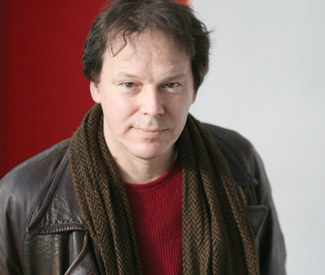
David Graeber is renowned among occupiers and idealists as an intellectual founder, or anti-leader as it were, of the Occupy Wall Street encampment that sprung up in Zucotti Park in the fall of 2011. He’s an organizer, an anarchist, a professor of anthropology and sociology at Goldsmiths University of London, a former instructor at Yale, and the author of several books, including Debt: The First 5,000 Years, a tome tracing the concept of debt back to the roots of Western civilization.

His latest book, The Democracy Project: A History, a Crisis, a Movement (Spiegel & Grau, 2013), chronicles the rise of Occupy, a leaderless economic justice movement Graeber unapologetically characterizes as a success. In honor of International Workers Day, May 1, the Bay Guardian caught up with him over coffee to talk about economic pressures facing today’s workers, particularly the young and marginalized.

Turns out, it’s not a pretty picture out there — but at least Graeber, who has a propensity to collapse into giggles between full throttle ruminations on the absurdity of global economic policy, has a sense of humor about it.

Below are some excerpts.

San Francisco Bay Guardian: Looking at the Occupy movement, the mainstream narrative seems to be that it was a short-lived, failed experiment and now it’s over. But in your book, you ask the question ‘why did it work?’

David Graeber: Let’s put it this way. When was the last time that the issue of social class was put at the center of American politics? Probably the 1930s. Social movements have been desperately trying to do this for 50, 60, 70 years and gotten nowhere. We managed to do it in three months. Um, that’s pretty impressive. … And I’m pretty sure that if it weren’t for us, we’d have a President Romney right now. That whole 47 percent thing? It would not have resonated had it not been for the 99 percent thing.

SFBG: Why do you think the idea of wealth inequality, of all issues, resonated so much?

DG: I think because there’s a basic change in the way capitalism works in America. It’s been going for some time, but it just became unmistakably apparent after 2008. People talk about the “financialization” of capitalism, and it sounds very abstract. Casino capitalism, speculation, they’re playing these games, they’re making money appear out of thin air, which is not entirely untrue. … It’s based on getting everybody into debt. The profits of Wall Street are — they now say a very small percentage is actually based on commerce — it’s now based on finance. But what does ‘based on finance’ actually mean? It means they go into your bank account and take your money.

I’ve been trying to figure out just what percentage of the average American’s income is simply extracted every month by the finance sector. …You count mortgages, you count credit card debt, loan debt, all the fees and penalties that you don’t notice… all that stuff put together comes to about 20 percent at least, and probably higher. For example, families that are in their early 30s, it’s often 40 percent. … I saw a poll the other day that said, for the first time since they’ve been taking statistics, a majority of Americans don’t consider themselves middle class. … And I think the reason for this is because it really never was an economic category. It has to do with how you feel you relate to basic institutions. What middle class first and foremost means is, if you see a policeman, do you feel safer, or do you feel less safe? … Then there’s more going on. For the first time, we found that there is incredible solidarity between students and workers, which have traditionally not been friends — go back to the 60s and it’s hard-hats beating up hippies. Now, the transit workers in New York are suing the police over taking their buses to arrest us [occupiers].

SFBG: How would you reflect on the economic condition that workers are facing, compared with how things were historically over the last several decades?

DG: It’s atrocious. One thing that’s happened is there’s been this disconnect between productivity and wages. This is kind of the deal they struck at the end of World War II in most of the North Atlantic countries: It used to be that you work harder, you produce more, you get a share of the profits. And that was worked out through mass unionization, it was worked out through negotiations, and it was tacit somewhat, but you know, it was understood.

Since the ’70s, that deal is off. So, productivity goes up, wages stay flat. So that’s why they say all profits have now gone to one percent of the population. So workers are working harder and harder, more and more hours, under more and more stress. …It’s all the more difficult because of education, because now it’s gotten to the point where if you don’t have a college degree, your chance of having any benefits at work is basically nil. If you want to have health care, you need to go to college. At the same time, if you want to go to college, you need to pay student loans. So you’re double damned. … You have all these people who are sort of trapped: I’d like to finish, I’m still going, I’ll take night classes — for five or ten years, while you have a working class job. So the line between the students and the proletariat blurs, and this is one of the reasons why the student loan issue actually spoke to people in unions.

And there’s also a shift in the type of work. Did you ever see the “We are the 99 percent” tumblr page? It was all these people talking about their jobs… their debts and difficult medical problems…. One of the things that fascinated me about that was that like 80 percent of the people on that page were women. …They were all doing something where the work was clearly to the benefit of someone else. And I think that those are the people who are the most screwed right now, ironically. The more obviously your work benefits other human beings, the less you’re paid.

SFBG: Going back to this idea of debt — your book [Debt: The First 5,000 Years] looks at debt through the ages of human history. I’m curious to hear your thoughts on debt as it relates to personal freedom.

DG: That’s one of the most pernicious things about the current debt regime in America. Being young is supposed to be a place where you can let your imagination run free and explore your sense of possibility. That’s what college used to be. In a sense, those students who are just out of college, I always call them post-students, they’re the kind of people who are activists, the kind of people who are thinking okay I’ll start a band, maybe I’ll be an artist. That’s where everything comes out of in a generation, where everything new and exciting emerges. What could be more stupid than taking all those people and turning them into debt peons? … I think of it like horror movies — what is it that’s so scary about monsters? It’s that they turn you into them, right? Vampires, werewolves. But you don’t get to be like the really cool super count vampire, you get to be a pathetic minion vampire, where you’re in debt for the rest of eternity, as a flunkie. In a way, that’s what’s scary about debt. It forces you to think like a capitalist, you have to think about money and profit all the time. But it’s even worse, because you’re a capitalist with no capital. It like totally destroys your ability to think of anything but money, and you don’t even have any money.

SFBG: Another thing we’re seeing increasingly is austerity measures and public sector spending cuts. What’s the root cause of these rollbacks, and what do you see as the most appropriate response from economic justice activists?

DG: I am in the peculiar situation at the moment that some members of the ruling class actually talk to me and even ask for my advice. Which, you know they’re in trouble if they’re talking to me, right? Part of the reason for that is that these guys are on a completely self-destructive course. I live in the UK most of the time. They’re going into a triple debt recession because of these austerity programs. Now what are you going to make of it? It has nothing to do with economics.

SFBG: So why is it happening?

DG: It’s moral. It’s political, and moral. Neoliberalism is not basically an economic ideology. It’s about politics … Always prioritize the political advantage over the economic advantage. Breaking unions, getting rid of job security, making people work more and more hours — that’s not economically efficient … So what does it do? Well, it’s the best thing you could possibly do if you want to depoliticize workers … The classic justifications for capitalism are harder and harder to maintain. … So what excuse do they have left? They can say, well, it’s the only thing that’s possible. Basically all they can do is hammer away at our imagination. The only alternative is this, or North Korea. And the amazing thing is that the only war they’ve won, is the war against the imagination.


A call to arms

38

OPINION No one can deny that the San Francisco of the new dot-com boom is a scary place to live. Rents are astronomical: $2,353 is the median rent for a one-bedroom in the Bayview, an area that has never had high rents. Ellis Act evictions are up 68 percent from last year, and buyouts and threats of Ellis (de facto evictions) are skyrocketing. Longterm rent-controlled tenants live in absolute dread that their buildings will be sold to a real-estate speculator who will decide, a month later, to “go out of the business of being a landlord.”

Neighborhoods are being transformed, and not for the better. The once immigrant Latino and working-class lesbian area of Valencia Street is now mostly white, straight and solidly upscale. The Castro has more baby strollers per square foot than a suburban mall, not to mention a high rate of evictions of people with AIDS. Along Third Street and in SOMA and other areas, people of color are being pushed out, and the working-class is being replaced by middle-income condo owners. The African American population of the city is down to 6 percent.

Small businesses, too, are being decimated, as landlords demand higher and higher rents and chain stores try and creep into every block. If the demographics of the city continue to change and become more moderate, many longstanding political gains could be lost.

Resistance is not futile.

During the Great Depression, the Communist Party in the Bronx and elsewhere successfully mobilized the working class to block doorways when the marshals arrived to evict tenants. In the 1970s here in San Francisco, the “redevelopment” of the Fillmore and the I-Hotel was met with widespread protests. Then-sheriff Richard Hongisto went to jail rather than evict the working-class Filipino tenants at the I-Hotel. In the late 1990s, organizing to fight the evictions and displacement happening in the wake of the first dot-com boom culminated in a progressive takeover of the Board of Supervisors.

These days, there’s no mass movement to fight the evictions and displacement. Occupy Bernal, ACCE and others have successfully stopped the auctions of foreclosed homes, and even twisted the arms of banks to renegotiate some mortgages. Tenant organizations have been holding back efforts to weaken rent control for years.

Where is the building-by-building organizing of renters? Where is the street outreach in every neighborhood? Where are the blocked doorways of those being forced out of their apartments by pure greed? Where are the direct actions against the speculators and investors who are turning our neighborhoods into a monopoly game? Where is the pressure on the Board of Supervisors to pass legislation to curb speculation and gentrification rather than approve tax breaks for dot-com companies? Where is the pressure on state legislators to repeal the Ellis Act and other state laws that prohibit our city from strengthening rent control and eviction protections?

Every moment we wait, more people are displaced from their homes, more neighborhoods become upscale, more small businesses are lost. Progressives wake up.

It’s time to take back what’s left of our city.

Tommi Avicolli Mecca is a longtime queer housing activist who works at the Housing Rights Committee. He is editor of Smash the Church, Smash the State: the early years of gay liberation (City Lights).


A win for the tenants

44

EDITORIAL In a stunning victory, tenant advocates have managed to derail a terrible piece of condo-conversion legislation — and replace it with a compromise that actually improves the current situation and could help slow the wave of speculative evictions.

The supervisors need to support the revised version of the bill — and if Mayor Lee wants to have any credibility at all with tenants, he needs to sign it.

For some 30 years, San Francisco has had a strict policy limiting the conversion of rental apartments to condominiums. Only 200 units a year get permission, through a lottery.

But thanks to the popularity of tenancies in common (a backdoor way around the limit) and the state’s Ellis Act, which allows landlords to evict all their tenants and sell the units as TICs, there’s now a long waiting list.

TIC owners say it’s unfair that they have to accept (somewhat) higher mortgage payments and reduced value on their homes because the wait for a conversion permit has grown to ten years or more. Real-estate speculators see huge profits in clearing buildings of long-term tenants with rent-controlled apartments and selling the places as TICs.

When Supervisors Scott Wiener and Mark Farrell first proposed allowing more than 2,000 tenancy-in-common units to bypass the lottery, tenant advocates began organizing to defeat the bill. Nobody thought a compromise was possible — particularly when the landlord-backed Plan C refused to negotiate in good faith and look for a solution everyone could accept.

But with the help of Supervisors Norman Yee, Jane Kim, and David Chiu, the tenants were able to craft a deal that clears up the backlog — and then prevents any further conversions for at least a decade. That’s fair: If the limit is 200 a year, and TIC owners want to clear up a backlog of 2,000 all at once, a ten-year moratorium makes sense. The tenant package also bars conversion of any buildings with more the five units and includes more protections for existing tenants.

If this proposal is really about helping TIC owners who face a long and uncertain time on the conversion list, then the compromise ought to be fine — and indeed, many TIC owners support it. The real-estate speculators who want to see evictions continue at a rapid pace hate it — this would make TICs less appealing and less valuable. But that’s fine: Buying a TIC has never been, and should never be, based on a future promise of condo conversion. And if this slows down the horrifying epidemic of evictions and displacement, it will be a very positive change.

Wiener and Farrell didn’t accept the compromise, but it was amended into their legislation anyway. The new version will come before the supervisors May 7. The supervisors should see this for what it is — greedy speculators against everyone else — and vote yes.

Alerts

0

WEDNESDAY 1

May Day immigrant rights march 24th and Mission, SF. 3pm march, 5pm rally, free. The San Francisco Bay Coalition for Immigrant Justice invites all to join this year’s May Day immigrant rights march, convened to urge Congressional representatives to fight for improvements to the recently unveiled federal immigration reform proposal bill. The march will begin at 24th and Mission and proceed to Civic Center for a 5pm rally.


May Day celebration 518 Valencia, SF. www.518valencia.org. 3-8pm, free. After the May Day marches and rallies have come to an end, head over to the Eric Quezada Center for Culture and Politics for a celebration of international worker solidarity, featuring a theater performance on the history of May Day by the Shaping SF Players on the history of Mayday, live screen printing, Cumbia beats, Aztec dance, protest art, sangria and beer.

SATURDAY 4

Movies that motivate change The New Parkway Theater, 474 24th St, Oakl. tinyurl.com/chngmovie. (510) 568-0702 6:30pm, $15–$100. In honor of the 20th anniversary of the Rose Foundation, attend this party and film festival and enjoy beer, wine, a silent auction, and four film screenings. Featuring Trash, a documentary exploration of global waste; 16 Seeds, a film highlighting the role of people of color in the Bay Area food justice movement; A Fierce Green Fire (Act 2), documenting the environmental battle over Love Canal, and a film about the Rose Foundation for Communities and the Environment.

SUNDAY 5

Justice for Tristan art opening La Peña Cultural Center, 3105 Shattuck, Berkl. Lapena.org. 7pm, free. This art opening will feature photos and art by Tristan Anderson, an activist who sustained a serious injury when he was struck with a teargas canister fired by the Israeli Defense Forces in 2009. Anderson’s art will be set to the sounds of 40 Thieves’ revolutionary hip hop, Nepantler@s’ queer Chicano punk, and more. Free Food Not Bombs dinner at the Long Haul, across the street, at 5:30pm before the program.

MONDAY 6

Debating “sustainable capitalism” Commonwealth Club, 595 Market, SF. www.climate-one.org. 5:30pm, $20. As a consumer, how do you know if a product billed as eco-friendly is the genuine article, or just greenwashing? Join Aron Cramer, CEO of Business for Social Responsibility, and Andrea Thomas of Walmart for an intriguing discussion on “the promise and perils of a move toward so-called sustainable capitalism.”

TUESDAY 7

Panel: Communities doing it for themselves RallyPad, 144 2nd St, SF. www.communitiesforthemselves.eventbrite.com. 6pm, free. Join the San Francisco Bay Area Chapter of the Social Enterprise Alliance for “Communities Doing it for Themselves,” a look at how UK community activists are utilizing “creative finance” to invest in local communities. Hear from panelists Jim Brown, of Community Shares; John Avalos, SF District 11 Supervisor; Charlie Sciammas of PODER and others for an exploration of how these strategies could be used by US social activists and entrepreneurs.

Care clash

13

The first week in April was a rough time for Connie Salguero. The Filipina nursing assistant, who says she would’ve been eligible to retire in two years, reported to her shift at the University of California San Francisco medical center at Mt. Zion on April 1 — and was told she was laid off. Two days after that, she was forced out of her home through an eviction, but fortuitously met an elderly Filipina woman who said Salguero could stay with her until she gets back on her feet.

“This manager said to me, Connie, come here, let’s talk,” and delivered the bad news, Salgeuro recounted, getting a little misty-eyed. Two other Filipina hospital assistants in her unit met with the same fate that day, she said.

“I’m trying to find a job,” Salguero said. “It’s very hard. But I will survive.” She projected a sense of resolve despite the whirlwind of sudden stress, which seemed fitting for someone whose job entailed feeding, bathing, and assisting up to ten bedridden patients at a time, many of them suffering from cancer.

Salguero said management told her the layoffs were necessary because of the most recent wave of federal budget cuts. But Cristal Java, lead organizer for UC patient care technical workers’ union, AFSCME 3299, interjected during an interview with the Bay Guardian to refute that explanation, calling it “total crap. They don’t want to tell workers the truth,” Java said, “which is that the hospitals are extremely profitable.”

UCSF ELIMINATES 300 POSITIONS

Salguero is one of about 25 UCSF certified nursing assistants whose recent layoffs prompted AFSCME to register a formal complaint with the Public Employee Relations Board, an agency that mediates labor disputes. The CNA layoffs hit in March and early April as part of a raft of cutbacks that eliminated a total of 300 full-time equivalent positions. Some of those positions were unfilled while other staffers were reassigned elsewhere or had their hours cut; a total of 75 individuals were laid off.

The cuts prompted union representatives to organize a protest at UCSF’s Parnassus Campus April 4, with San Francisco Sup. John Avalos and California Sen. Leland Yee turning out in support of the workers. Salguero was there too, waving a sign, and she wound up telling her story for an international broadcast by a Filipino news station. Things took a dramatic turn when police arrived on the scene, and Union President Kathryn Lybarger and some others were escorted off the premises in handcuffs.

Asked to explain the rationale behind the layoffs, UCSF spokesperson Karin Rush-Monroe responded, “We evaluated the impact of the Affordable Care Act, expected reductions in Medicare, MediCal and private insurance reimbursements,” as well as employee benefits and rising costs in drugs and medical supplies, and ultimately decided on a 4 percent labor budget cut. “We must make a ‘course correction’ if we are to maintain our resources to care for our patients,” Rush-Monroe said.

But the staffing cuts hit just weeks after AFSCME published a blistering report, titled “A Question of Priorities,” charging that UC has prioritized profit margins at its medical centers since 2009 while needlessly eliminating frontline staff positions, all to the detriment of patient care.

“It feels very much like they’re chasing down the Wall Street model of business,” Randall Johnson, an MRI technologist at UCSF Parnassus Campus who is active with Local 3299, told the Guardian. “We’re pressed to move faster and faster and faster. It’s more about profit than it is about patient care.”

Steve Montiel, spokesperson for UC Office of the President, told us that UCSF is “consistently ranked as one of the top hospitals in the country by U.S. News and World Report,” and pointed out that the AFSCME report coincided with an ongoing contract dispute concerning patient care technical workers, which may lead to a strike authorization in the next few weeks.

DANGEROUSLY LOW STAFFING LEVELS?

Billed as a “whistleblower report,” AFSCME’s 40-page publication portrays an internal environment throughout UC medical centers in which staffers — particularly frontline workers — are exhausted, overburdened, and dangerously likely to make mistakes.

Peppered with anecdotal horror stories describing things like dried blood observed on operating room tables at facilities where custodial staffing was cut to a bare minimum, or an incident in which a mentally altered patient was found on a window sill at a medical facility where harrowed nursing assistants’ attention was divided too many ways, the report portrays an unsafe environment that seems out of sync with the system’s reportedly healthy earnings derived from patient care.

“Bring it up at bargaining, and you get told to kick rocks,” said union spokesperson Todd Stenhouse. AFSCME has called upon state agencies and lawmakers to investigate UC policies on “cutting costs, reducing staff, and maximizing revenue.”

“We’ve been getting lots of reports about short staffing, and no coverage for breaks,” said Tim Thrush, a diagnostic sonographer who works with patients experiencing complications in pregnancy, and has worked at UCSF for years. “If you get a break or a lunch, it seems to be rare — even though it’s state law.” Thrush added. “It looks to us … that UC’s response to us raising concerns … is to say, OK well then let’s make it worse. Let’s lay off a whole bunch of people.

“It’s been very disappointing,” he said, “and it’s getting to be kind of scary.”

The report emphasizes California Department of Public Health findings of violations relating to bedsores from 2008 to 2012. The sores can occur if a patient stays in one position for too long, causing reduced blood flow and damage to skin tissue, and have been linked to infection.

Among those affected by the layoffs were “lift and turn team” members, including care workers tasked with turning immobilized patients to prevent bedsores.

Ironically, Rush-Monroe, the UCSF spokesperson, noted in response to a Guardian query that a $300,000 “incentive pay” bonus CEO Mark Laret received in 2011 was based on multiple “clinical improvement goals” that had to be satisfied in order to qualify for the 2011 compensation increase. One of these targets was a reduction in the number of hospital-acquired bedsores.

While the union report points to rising instances of bedsores, and the UCSF administration claims they were reduced to the extent that the CEO was monetarily rewarded for the accomplishment, a quick look at scores on hospital ranking website California Hospital Compare showed that pressure sore rankings at UCSF are almost exactly even with the statewide average.

Meanwhile, hospital rankings of patient safety indicators on Health Grades, an online consumer ranking website, didn’t reflect any dramatic differences between patient safety scores at UCSF, CPMC or Kaiser Permanente.

QUESTIONS RAISED

In the midst of these staffing cuts, AFSCME charges, the $6.9 billion system has enjoyed robust finances, with UCSF earning $100 million in net revenue last year. Between 2009 to 2012, management positions increased by 38 percent system-wide, while payroll costs for managers grew by 50 percent, with an additional $100 million a year allocated to administrative staffing.

According to a 2013-14 budgetary report prepared at the UC level, the system’s network of public universities have suffered deep financial cuts while its five medical centers “have continued to flourish and grow,” and “enjoy robust earnings.”

A revenue breakdown in the UC budget report shows that 62 percent of medical center earnings system-wide were derived from private health care plan reimbursements, while about a third came from Medicare and MediCal, funded by the federal and state government.

Meanwhile, ASCFME’s report has raised eyebrows in the California Senate. Sen. Ed Hernandez, who represents part of Los Angeles County and chairs the Senate Health Committee, “has expressed an interest in looking at it further,” according to committee consultant Vincent Marchand. “We may decide to call a hearing” sometime in May to see if further action is warranted, he added.

Sen. Yee lambasted the UC system for what he called “blatant disregard for the working staff.” Yee said the layoffs raised concerns about the quality of patient care, saying, “How do you lay off 300 individuals and think that it’s not going to compromise patient care?”

Yee added that he thought the UC budget ought to be scrutinized when it goes before the Senate. “Although the Constitution gives the UCs of California tremendous autonomy via the Board of Regents, ultimately we in the Legislature still allocate dollars … so there is a legislative and moral responsibility that we need to exercise,” he said. “Are the dollars within UC being used appropriately to take care of patients and in ensuring their safety?”

CONSTRUCTION, COMPENSATION AND VIPS

In early 2015, UCSF will open its new Mission Bay complex, a 289-bed facility featuring a children’s hospital with an urgent/emergency care unit and an adult care unit for cancer patients. The estimated price tag for the project is about $1.5 billion, and construction costs associated the project were referenced in an Oct. 12 letter Laret, UCSF’s CEO, issued to hospital staff announcing the pending staffing cuts.

Thrush questions decisions made at the highest administrative levels. Laret is “eliminating 300 jobs, and we’re opening a new facility, and he’s getting a $300,000 bonus,” he said, referring to a “retention bonus” expected to be awarded this year, which could be followed by a $400,000 bonus in 2014. “Why is he getting a huge bonus if we’re having to lay off so much staff?”

With a total compensation of around $1.2 million in 2011, Laret’s salary seems excessive in comparison with that of frontline workers — and it is. At the same time, it seems to be within the realm of a CEO of a major medical facility, a quick Internet search reveals.

ACSFME’s report targets Laret specifically, saying he repeatedly emphasized to hospital staff, “When you see patients, you should see dollar signs.” Johnson, the MRI technician, told the Guardian he heard Laret make this statement years ago, when he first came on as CEO. “I know that some physicians were outraged by it,” he said. “I heard that the physicians told him to stop, and he stopped saying it.” UCSF did not respond to Guardian requests for a comment on this allegation.

The report also focuses on a practice of so-called “VIPs” — patients connected with the UC Regents or other influential persons — receiving preferential care. “I got called in on a Sunday to take care of a celebrity, because they had a headache,” said Johnson. “I’ve seen patients have to be on hold so we can scan the [VIPs]. They definitely get preference. I’ve been told, if one of those VIPs comes in, we have to get them on the scanner.” UCSF didn’t respond to Guardian questions concerning VIP patient treatment, either.

LABOR DISPUTE

Montiel, the media relations director for the UC system, responded to a Guardian query with a wholesale rejection of the detailed 40-page report, without directly addressing any of the allegations. Instead, he said the whole controversy arose from a labor rift over pension reform.

“These claims by AFSCME coincide with a bargaining impasse, and the scheduling of a strike vote by its patient care technical workers,” Montiel wrote in an email. “Quality of care is not the issue. The real issue is pension reform. AFSCME has resisted pension reforms that eight unions representing 14 other UC bargaining units have agreed to. The reforms also apply to UC faculty and staff not in unions.”

AFSCME recently announced that its membership would begin voting on April 30 over whether to authorize a strike, following months of stalled negotiations over a contract that expired last September. Stenhouse, the union spokesperson, called it “the impasse of impasses” yet suggested to the Guardian that the strike authorization vote was a side issue from the concerns raised in the whistleblower report. The workers are there to “provide patient care,” he told the Guardian. “They’re not making Buicks.”

“This report is about something much bigger than our members’ livelihoods,” Lybarger stated when the report was released. “It’s about whether the UC is prioritizing quality care for the millions of Californians who put their lives in our hands.”


Check, please

44

steve@sfbg.com

San Francisco restaurants that have been cheating their customers and employees — charging diners for city-required healthcare coverage that they aren’t fully providing to workers — will finally be exposed in the coming weeks, with some notable names in foodie circles among the likely culprits.

City Attorney Dennis Herrera is working on settlements with dozens of restaurants that responded to his investigation and partial amnesty offer, which had an April 10 deadline. His effort augments the complaint-driven enforcement actions by the city’s Office of Labor Standards Enforcement, which has collected millions of dollars for thousands of employees of negligent local businesses in recent years.

At issue is the Healthcare Security Ordinance, the landmark 2008 law authored by then-Sup. Tom Ammiano that requires San Francisco businesses to provide a minimal level of healthcare benefits to their workers. Businesses are also required to report spending and surcharge figures to the OLSE annually, with the next report due April 30.

Last year’s data show celebrity chef Michael Mina’s Mina Group LLC — which includes the restaurants Michael Mina, RN74, Bourbon Steak, and Clock Bar — to be the top violator, collecting $539,806 in surcharges from customers and spending just $211,809 on employee healthcare.

Herrera used that list to ask more than 70 businesses to show they are in compliance with the law or reach discounted settlements now to avoid punitive fines or criminal charges later, and Herrera told us he received 60 responses and had his inquiry snubbed by fewer than a dozen.

“It’s too early to talk about how large a recovery we’ll be getting for workers, but I’m pleased with the response rate,” Herrera told us. He refused to estimate how many of the respondents were found to be in violation, but in an April 11 message to reporters covering the issue, his spokesperson Matt Dorsey wrote, “Based on our investigation so far, we anticipate that the majority of these establishments will be required to pay money to compensate their workers.”

WHAT THE FIGURES SHOW

The Guardian contacted many of the restaurants that topped the OLSE list. Some wouldn’t respond, some said they’ve changed their policies since the controversy erupted, and some wouldn’t talk until after a settlement is announced — including the Mina Group. That seems to indicate they’re about to pay for past violations.

Nicole Kraft, who handles public relations for the Mina Group, responded to Guardian inquires by writing, “I wanted to let you know that Mina Group will soon be releasing a joint statement with the City Attorney’s office, which should answer many of your questions. We’ll be sure to send it your way ASAP.” [UPDATE 4/29: Mina Group settled its case for $83,617.]

Sources in the City Attorney’s Office say settlements with as many as 10 restaurants that admit clear violations of the HCSO could be announced in the next week or two, while another 10 or so have provided data showing they are not in violation. The rest are more complicated and could take weeks or months of investigations, which are being led by Deputy City Attorney Sarah Eisenberg.

“There are going to be some that are given a clean bill of health,” Herrera told us. Herrera also told us that his investigation is just getting started and that it will look at businesses that haven’t made required annual reports to the OLSE. “When we get to a place where we’re announcing settlements, we’ll have more to say,” he said when asked for details and dimensions of his investigation.

GGRA Executive Director Rob Black has maintained that the OLSE figures don’t accurately reflect whether businesses are in compliance because the reporting requirements are confusing. GGRA held a compliance workshop on April 17, and Black told us about 40 restaurateurs attended.

“It was very informative and we got really good feedback from the restaurants,” Black told us. “We had people saying, ‘knowing what I know now, we should redo my 2011 form because I did it wrong.”

Black was initially critical of Herrera’s focus on the restaurant industry, but told us last week, “He made a commitment that the process would be efficient and fair, and he’s lived up to that so far….I still believe that the majority [of violators] didn’t have a mal-intent…Many people on the list that was reported have done nothing wrong.”

Cheesecake Factory — which was seventh on last year’s OLSE list, allegedly taking in $159,242 more in surcharges than it spent on employee health care — insists that it is in compliance and expects the City Attorney’s Office to confirm that.

“We believe the City Attorney’s initial review was erroneous,” Richard J. Frings, the company’s vice president of compensation and benefits, told us. “We are in full compliance with HCSO. Our healthcare costs in San Francisco have far exceeded the surcharge that we have collected. Once the City Attorney’s office has an opportunity to review our filings, we believe this matter will be closed without any further action.” He refused to provide figures to support the assertions.

THE HSA PROBLEM

Most of the restaurants that have been accused of stiffing employees use health savings accounts, which health officials say is a far worse option than private health insurance or the city’s Healthy San Francisco plan, which was created in conjunction with HCSO. Federal law bars cities from prescribing how health benefits are delivered.

San Francisco’s restaurant industry has always been hostile to the HCSO’s employer mandate, with the Golden Gate Restaurant Association unsuccessfully challenging the law all the way to the US Supreme Court. Controversy then erupted in 2011 with revelations (first in the Wall Street Journal, followed up by local media outlets) that some of the city’s most high-profile restaurants were shirking their responsibilities even as they charged diners 3 percent to 5 percent surcharges, sometimes essentially pocketing that money at the end of each year.

That verges on consumer fraud, but District Attorney George Gascon has refused to investigate, telling the Guardian and other papers that he was deferring to the OLSE and the City Attorney’s Office.

In 2011, a progressive-led majority on the Board of Supervisors passed legislation authored by Sup. David Campos to require that businesses keep the money they are required to spend on employee healthcare — which is currently $2.33 per employee-hour for large companies or $1.55 per employee-hours for businesses with less than 100 employees — for employees to use as needed.

But under aggressive lobbying by the GGRA and San Francisco Chamber of Commerce — which asserted the right of business owners to raid these funds, calling the set-aside a multi-million-dollar annual loss to the local economy — Mayor Ed Lee vetoed the measure. He later signed watered-down legislation requiring the money be set aside for two years, setting standards for letting employees know how to access the funds, and explicitly calling for all customer surcharges to remain in escrow accounts.

The OLSE, which also monitors compliance with the city’s paid sick leave and minimum wage laws, can only investigate businesses when an employee files a complaint. But then complaints trigger investigations that cover all of a given business’s employees, who are often compensated for past violations. To file a complaint, just write hcso@sfgov.org or call (415) 554-7892.

OLSE figures show the agency has investigated more than 100 complaints since 2008, resulting in $8.1 million in health care benefits provided to more than 6,400 employees and $244,000 in penalties paid to the city. Herrera’s office also reached a $320,000 settlement with the owners of Patxi’s Chicago Pizza in January, just before announcing his broader investigation.

“The vast majority of San Francisco employers have complied with their obligation to make health care expenditures pursuant to the HCSO,” OLSE Manager Donna Levitt told the Guardian. “With respect to the minority of businesses who fail to meet their obligations, the OLSE works tirelessly to ensure that workers receive the benefits to which they are entitled and that all businesses compete on a level playing field.”

Among the restaurants near the top of the OLSE list that did not respond to the Guardian inquires are Squat & Gobble, Wayfare Tavern, and Trinity Building Services.

“We are actually in complete compliance,” Larry Bouchard, manager of One Market restaurant, told us, explaining its inclusion on the OLSE list by saying, “It’s my understanding that we reported the wrong information.” He said the restaurant uses health savings accounts, but that they are widely used by employees, who get their expenditures repaid within three weeks.

Scott Carr, general manager of Boulevard — who sources say was one of the first restaurants to use the healthcare surcharges on customer bills, and whose parent company, Reroute LLC, was fifth on the OLSE list, underspending by $169,777 — told us the figures didn’t fully reflect the company’s spending on employee health care.

He wouldn’t say whether the company will be settling with Herrera for any past violations, but he did say that the restaurants decided to abandon health savings accounts in favor of health insurance policies for employees starting on Jan. 1. As he told us, “We feel we’ve made a positive step.”

The ride-share parasites

18

OPINION These days, all signs point to the eventual deregulation of the San Francisco cab industry.

On any given weekend night in the city, you can find a wide array of illegal taxis operating with impunity, including limo drivers, out-of-town taxis, Super Shuttle vans, ZIP cars, and even some sketchy folks driving their private vans down Valencia Street at 2am soliciting rides for hire. If you have wheels, you can become your own livery service.

It’s a free-for-all out here. The city appears to be giving all comers carte blanche. And while the courts wrangle over ride-sharing rules and what constitutes a taxicab, the cab industry could cave in under the unfair advantage given to its competitors.

The general manager of ride-share startup Uber, Ilya Abyzov, has been quoted as saying that cab companies have had a “state-sanctioned monopoly. They’re not used to competition.” I have two words for him, and they’re not, Yo taxi! We’re competing with about as much chance as the proverbial one-legged man in a kicking fight.

The advertisement on the website of another startup, Lyft, uses for recruiting drivers reads: “Make $22 an hour, have a blast, drive when you want, meet new people, make friends, learn about new restaurants …” This idyllic version of a cab shift could never happen without real cab drivers holding up the foundation.

I don’t think you’ll find a Lyft cab willing to take a sick grandmother from Kaiser Hospital to her home in the Alice Griffith projects. A pink mustache sighting at Griffith and Fitzgerald will probably coincide with the next great earthquake because only a drastic geological shift will cause that to happen.

Right now, it’s a cakewalk for the ride-share drivers. But without the cab industry picking up the rear and girding the underbelly, these parasites couldn’t exist. The Oxford English Dictionary defines a parasite as an organism that lives in or on another organism (its host) and benefits by deriving nutrients at the host’s expense. Substitute the word “nutrients” for the word “money” and you have what in the cab business we call a bingo.

At the end of the day, driving a cab is a hustle. And once your host is gone and the cab business gets deregulated, kiss your city tours goodbye. You won’t be able to rely on donations anymore, and your legal babble and dishonest terminology won’t save you from a harsh descent into the street, into the dog-eat-dog world of a real cab driver.

And then, you’ll know what it’s like to hustle, in the middle of the night when you’re worried about your gates and gas, and it gets real slow, and you have to take chances with your life.

Desoto Shelby III is the pen name for a San Francisco taxi driver.


Editor’s Notes

7

tredmond@sfbg.com

EDITORS NOTES It was breezy and San Francisco-spring-perfect along the Embarcadero the other day. People were jogging, and rollerblading, and sitting in the sun. Red’s Java House was doing brisk business.

Out on the old, crumbling piers, cars were sitting in the lots that now make up most of the economic use of some of the city’s most spectacular and valuable land. Kind of a waste — but the upside (and it’s a big one) was the feeling of open space, the idea that we were all so close to the Bay, that nothing blocked the views of the waterfront or that sense that this is still a city that has some connection to the marine environment that surrounds it.

And then I imagined the Warrior’s Arena. Right there in the middle of everything. And I stopped for a second and wondered what I’d be feeling if I were walking past it 10 years from now. And it made me kind of sad.

I know that parking lots aren’t the best use of Port of San Francisco land. I know that the Port needs huge amounts of capital to rebuild the piers. I know that the most obvious way to get that money is to give developers pieces of waterfront land. I know that a new Warriors Arena will create jobs and bring in tax money. I know that AT&T Park has been a great success for the Giants, the city, and the neighborhood.

I also know that some of the people who oppose the arena are well-off homeowners who don’t want to lose the sight of the Bay out of their fancy condo windows.

But ever since San Francisco, with the help of Mother Nature and a 7.3 earthquake, tore down the Embarcadero Freeway, the waterfront area from Harrison to the Ferry Building has been a really nice place to hang out. Not perfect; not the “Grand Boulevard” that some dream of. But a part of the city where humans can feel the salt breeze and enjoy the outdoors in a relatively mellow way, just blocks from the downtown core. Put an 18-story arena there and it all changes. It mostly goes away.

Is this really the best we can do with the waterfront? What about a bond act for open space, and another Dolphin Club for swimmers, and waterfront parks? Other cities have done it; can’t San Francisco have a world-class waterfront too?

Making CEQA work

10

OPINION In San Francisco, a single person can file an 11th-hour appeal under the California Environmental Quality Act to stop a park, library, transit, or affordable housing project that has broad public support. It’s actually worse: that single person can file the appeal long after the project has been approved and even after it goes into construction. When the appeal is filed, the project must stop construction — creating huge costs — until the Board of Supervisors gets around to ruling on the appeal.

This is government dysfunction at its worst, and it needs to be reformed. Supervisor Scott Wiener is sponsoring legislation to do just that: to allow full public participation and challenges to projects while implementing the common-sense rule that for any project, there must be an end to the process and a clear deadline for filing CEQA appeals. Public participation in decision-making is important, but at some point, the decision is made, the process comes to a conclusion, and the project begins. Open-ended CEQA appeals with no deadlines — San Francisco’s current system — are anti-democratic.

Passed 40 years ago, CEQA is an important state law that requires environmental analysis before approving projects. CEQA has helped stop or modify environmentally problematic projects in our state. Pretty much every project in San Francisco — whether a mega-development or a smaller project, such as a homeowner replacing a rotted-out porch handrail, a playground or library renovation, an affordable housing project, or a bike or pedestrian-safety upgrade — must undergo CEQA evaluation. These myriad CEQA evaluations are then appealable to the Board of Supervisors. Yes, if you are replacing that rotted out handrail or working with your neighbors to renovate your local playground, those projects can be appealed to the Board of Supervisors under CEQA if a single person doesn’t like what you’re doing.

We support CEQA and support the right to appeal projects. What we cannot support is having no firm deadline to file those appeals. We’ve seen excellent projects, with broad public support, get delayed and have dramatically increased costs because of our bad process. A small group abused CEQA to fight the North Beach Library for years. After the Dolores Park renovation underwent dozens of community meetings and attained broad community support, a single person appealed the project, arguing that the dog areas of the park would lead to childhood obesity. San Francisco’s bike plan was delayed for years, costing millions of tax dollars.

By setting a clear deadline to file CEQA appeals — 30 days after the project is approved — and by improving notice to the public, Supervisor Wiener’s legislation will provide opponents every opportunity to challenge a project, but they will have to do so before the project goes into construction. That is a common sense rule, and as a result, the legislation has garnered broad support from affordable housing builders, the San Francisco Bicycle Coalition, Walk SF (our pedestrian safety advocacy group), SPUR, labor unions, and neighborhood associations and leaders.

Supervisor Jane Kim has introduced an alternative to Supervisor Wiener’s legislation. Supervisor Kim’s legislation would make our dysfunctional process even worse. It would allow for multiple CEQA appeals of projects instead of just one and would continue to allow CEQA appeals long after projects are approved and even after they go into construction.

It’s time to bring rationality to our CEQA appeal process. Supervisor Wiener’s CEQA appeal legislation is the right approach and deserves to be passed.

Scott Wiener is a member of the San Francisco Board of Supervisors. Pat Scott is Executive Director of Booker T. Washington Community Service Center in the Western Addition, which provides services and affordable housing to families and youth.


Billy and the golden toads

1

Reverend Billy Talen and his Church of Stop Shopping — which evolved from anti-consumerism street theater in San Francisco in the 1990s into a venerable New York City protest/performance institution — is bringing its creative environmentalist prayers and ploys back to the Bay Area next week.

Talen is a talented talker and writer whose most recent book, The End of the World, is a poetic plea for people to finally get serious about climate change, loss of biodiversity, and other environmental indicators that are passing irreversible global tipping points, all of them fed by the relentless growth of global capitalism.

“When Hurricane Sandy hit New York, there was no discussion of the underlying causes,” Talen told us. “There’s a disconnect. We have a 1,000-mile wide storm that seems to be aimed at Wall Street, and we’re not mentioning Wall Street.”

Billy and his crew are, using street theater to make their point. As he spoke, Talen said he was surrounded by two dozen costumes of the extinct Golden Toad that his crew has been donning to invade and engage in media-friendly civil disobedience at branches of Chase Bank, which the Rainforest Action Network concluded is the leading investor in carbon-emitting projects.

“Amphibians are going extinct around the world, and if I can mix my metaphors, that’s the canary in the coal mine,” Talen said, calling climate change a systemic result of an economic system predicated on consumption and growth. “Corporations are made to not be sustainable. They have to expand every quarter.”

Talen begins his visit on Monday, April 22, with a 7pm reading at Booksmith, 1644 Haight Street, and he wraps up on April 27 at 8pm with a full 17-member Church of Stop Shopping performance at Victoria Theater, 2961 16th St., SF. In between, they’ll be Lone Mountain College in SF on April 24, Pt. Reyes Dance Palace on April 25, the Chalkupy event at Oakland City Plaza on April 26, the Live Coast West taping on April 27 — and perhaps exorcising a Chase Bank or two along the way.

Is there a “green” way to frack?

5

Michael Klein is an unlikely oil industry executive. He’s also an unlikely environmental activist. For many years, the wealthy San Franciscan was a major donor and chair of the board of the Rainforest Action Network, an environmental organization famous for agitating aggressively against timber giants, coal companies, air polluters, and the dirty energy financiers of Wall Street.

But Klein stepped down from that role, and has since helped form a company called Hydrozonix, which might be called a “green” fracking enterprise.

Klein’s company seeks to eliminate the use of two particularly nasty fracking-fluid chemicals, known as biocides and scale inhibitors, while giving companies a way to treat and recycle wastewater fluid. Hydrozonix just completed its first year of operations, with 12 systems up and running in Texas oil fields. Does this mean Klein has crossed over to the dark side? “It was never an easy decision,” Klein told us. “I never thought I would tell anybody that I’m in the oil business.” He hasn’t exactly turned into a climate change denier. “I believe we have to stop using carbon-based fuels as soon as possible,” Klein says without hesitation, “and find the political will to put a price on carbon.” He also supports a temporary moratorium on fracking. But he claims he’s only trying to make fracking “dramatically safer” in the interim, because “until we stop subsidizing [fossil fuels], the alternatives are at a severe disadvantage.” But since entering the biz, he’s no longer convinced by the arguments made by proponents of fracking bans who cite health and safety concerns. “I’ve come to the conclusion that if best practices are used, it’s … considerably safer than deepwater drilling,” he told the Guardian. “I do believe it can be done without concerns about contaminating aquifers or poisoning everyone.”

By the numbers

16

rebecca@sfbg.com

77: Years before climate scientists say the Sierra Snowpack, the state’s largest reservoir, could dwindle to half its historic size. [Source: Fact Sheet, California Air Resources Board]

2,500,000,000,000: Barrels of “produced” wastewater generated by onshore oil and gas wells in California in 2011.

[Source: California Department of Conservation]

2,294: New oil and gas wells drilled in California in 2011.

[Source: California Department of Conservation]

565: Gigatons of carbon that can be burned before global average temperatures rise by 2 degrees Celsius, the ceiling target established by the Copenhagen Accord to avert the worst consequences of global climate change.

[Source: 350.org]

2,795: Gigatons of carbon held in reserves by the world’s oil and gas companies, which would emit five times the “safe” amount of carbon into the atmosphere if burned.

[Source: 350.org]

$26,200,000,000: Annual profit reaped by San Ramon-based Chevron last year — the oil company’s second-highest profit ever earned.

[Source: San Francisco Chronicle]

$1,000,000: Approximate amount Chevron was fined by state regulators for the Aug. 6, 2012 Richmond Refinery fire, which resulted in about 200 hospital visits due to exposure to toxic fumes.

[Source: LA Times]

656,576: Miles of waterways, representing 55 percent of all rivers and streams in the U.S., ranked in “poor” condition in the EPA’s latest assessment, meaning they can’t support healthy aquatic life.

[Source: US EPA]

13,144: Miles of U.S. waterways where fish are not safe for human consumption, due to high levels of mercury.

[Source: US EPA]

16: Inches sea level is expected to rise in the San Francisco Bay by 2050, according to climate change scenarios.

[Source: Bay Conservation and Development Commission]

55: Inches sea level is expected to rise in the San Francisco Bay by 2099, according to climate change scenarios.

[Source: Bay Conservation and Development Commission]

234,167: Metric tons of greenhouse gases Pacific Gas & Electric Co. reported emitting in San Francisco in 2011, from natural gas distribution.

[Source: U.S. EPA]

195,061: Acres of pine or fir forest it would take to absorb PG&E’s 2011 San Francisco greenhouse gas emissions, assuming CO2 absorption for one year. (Roughly 6.5 times the land area of SF.)

[Calculation based on California Air Resources Board million metric ton equivalents]

$500,000,000: Estimated San Francisco Employee Retirement System holdings in 81 fossil fuel companies including Chevron, BP, Exxon Mobil, Occidental Petroleum and Arch Coal.

[Source: SFERS]

Fracking changes everything

31

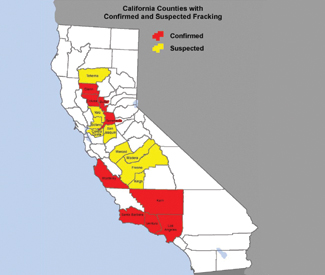
In December 2012, the federal Bureau of Land Management held an annual auction for oil and gas development rights on federal territory in California, offering up wild lands in Fresno, Monterey, and San Benito counties. It sold off leases to 15 parcels, totaling nearly 18,000 acres. One bidder was a subsidiary of Occidental Petroleum, an oil company that drilled 675 new wells in California in 2011 alone.

The BLM affair works like any other auction: Bids are made verbally, and leasing rights are awarded to the highest bidder. Every last acre was snapped up, locking companies in for 10-year leases.

The average bid per acre? $4.21. The highest bid per acre? Ten bucks. The total federal government revenue? Just over $100,000.

The fact that oil companies can buy up mining rights to such a vast area of public land, for the price equivalent of about a tenth of a house in San Francisco, is nothing new. But this land auction was significant because BLM turned a blind eye to fracking, an oil and gas extraction technique that’s fueled widespread opposition. BLM green-lighted the leases based on an official assessment projecting that no more than a single acre of land would be disturbed by the anticipated oil drilling, the same argument used to justify the previous year’s auction.

Such a scenario may have been realistic in 2006, when the governmental agency drafted the document it relied on to make such a rosy prediction. But technological advancement has transformed the fossil-fuel sector over the past six years, and the oil industry is buzzing about vast untapped potential contained within the Monterey Shale, a leviathan geologic formation that extends across a major stretch of California, including beneath the federal lands in question.

“The Monterey area has become a focal point,” says Brendan Cummings, “because, but for fracking, these areas would never get tapped for oil.” An attorney with the Center for Biological Diversity, Cummings splits his work between offices in Joshua Tree and San Francisco. He led the Center in a lawsuit against BLM over its 2011 oil-and-gas lease auction, which affected 2,500 acres, arguing that the government should have realistically assessed the environmental threats posed by fracking before it started handing out drilling rights.

“Fracking changes the economics of oil,” Cummings says. “Fracking changes everything.”

And it’s happening all over California, and growing at a rapid rate.


DRILLING ON STEROIDS

Sounding more like an approximate substitute to circumvent a television ban on profanity, “fracking” is short for hydraulic fracturing. It consists of pumping high-pressure fluids up to 15,000 feet underground and into “horizontal wells” that can fan outward for a mile or more, with the aim of smashing up the shale formations. While a form of fracking has been in use for decades to “rework” oil wells, the kind of high-pressure, high-temperature operations now being employed represent a departure from traditional methods.

The exact contents of the proprietary fracking fluids are mostly secret, but they’re known to contain high volumes of water, sand, and a patented blend of toxic chemicals, sometimes incorporating acid to make the rock brittle enough to fracture.

“Once they’ve fracked up the shale,” explains Adam Scow, California campaigns director at San Francisco-based Food and Water Watch, “they can pump indefinitely.” It’s a short-term, expensive operation, Scow says, amounting to “drilling on steroids.”

On April 8, a federal judge ruled that the Obama Administration had violated federal law in the 2011 BLM auction by failing to first conduct an environmental impact study on fracking. It’s too soon to say how this will affect the 18,000 acres auctioned off in December, but Cummings says he expects to be back in court before long.

Yet the ruling has no effect on the oil wells already dotting the landscape in places like Kern County, an area already marked by poor air quality that supports the highest concentration of fracking operations in California. And for every acre of federal land now tied up in court, there are thousands more private parcels susceptible to being radically altered by fracking.

The U.S. Energy Information Administration estimates that the Monterey shale formation, which extends from the northern San Joaquin Valley to Los Angeles County and westward to the coast, holds more than 15 billion barrels of oil.

It’s an astounding quantity that dwarfs that of the Bakken Formation, which has helped light up North Dakota’s economy with a fracking boom, or the Eagle Ford Shale in West Texas, each of which are estimated to contain between 3 and 4 billion barrels.


NO SPECIAL PERMIT REQUIRED

Once a company has obtained a permit to extract oil and gas, “the state doesn’t require companies to get a permit to frack,” explains Scow, so it’s unknown just how much it’s currently happening. Voluntarily reported industry data shows that at least 91 wells were fracked in California between January 2011 and April 2012. Yet in 2011 alone, state records show, 2,294 new wells were drilled, while 3,376 notices were filed to “rework” existing wells.

In California, oil and gas drilling is regulated by the Division of Oil and Gas Resources. Speaking at a forum at the Commonwealth Club hosted by Climate One on April 2, Mark Nechodom, director of the California Department of Conservation, said DOGR never required reporting on fracking because it’s “one short blip” in oil production.

“In our historical use of fracturing in California, we have had no evidence that there is any environmental damage or hazard to human health—no evidence, I am saying—and therefore we have not required reporting,” said Nechodom, whose agency presides over DOGR. “Now we are requiring reporting and we are in the middle of developing a regulation for that.”

Nevertheless, the prospect of a pending California fracking boom on top of the loosely regulated activity already underway has galvanized Bay Area environmentalists. A host of environmental organizations are planning to form a coalition in the next several weeks to push for a permanent ban on fracking, targeting Gov. Jerry Brown.

Unchecked fracking could unleash a host of problems, says Scow, including a high risk of tainted groundwater, harmful air emissions, a spike in atmospheric carbon from the release of underground methane, and possibly even more frequent earthquakes due to wastewater disposal deep below the earth’s surface, which can destabilize faults.

“The process is just too dangerous,” he says. “There’s no safe way to frack. In the long term, we want fracking banned.”


OIL AND WATER

Policy discussions about fracking often arrive at the “Halliburton loophole.” In 2005, the story goes, when the federal Energy Bill was being drafted under the Bush Administration, then-Vice President Dick Cheney orchestrated the inclusion of a perplexing provision exempting “hydraulic fracturing” from the Safe Drinking Water Act.

Cheney famously presided over Halliburton, a company that invented a precursor to modern-day fracking in the 1940s. Few understood what it meant at the time, but the ascendance of fracking has made it clear that the loophole amounted to a munificent gift to the oil industry, clearing the way for rigs to bore downward and outward with toxic underground fluid injections unencumbered by regulatory slowdowns — all to the detriment of safe drinking water.

“The Safe Drinking Water Act loophole has really created a problem for us,” Steve Craig, an olive rancher from Monterey County, noted while speaking at the Commonwealth Club panel.

Craig described the frustrating process of trying to get agencies to intervene in a fracking operation nearby his ranch, right along the Salinas River. “At this point, we don’t know what’s in the fracking fluids. How can you know if it’s a problem if you don’t know the content of the chemistry? It’s not fair to the public to hide behind that trade secret veil and expect us to live with it.”

The risk of groundwater contamination tops Scow’s list of nightmarish scenarios. Fracking fluids can contain benzene and other carcinogens, as well as compounds linked with kidney or nervous system problems. “Once fracking fluid is injected underground, much of it stays underground indefinitely,” a Food and Water Watch issue briefing notes. “There is a network of different pathways through which contaminants … could flow into and contaminate groundwater.”

And since groundwater is drinking water in some places, Scow says this possibility is a major concern. “Prevention is really the key here,” he says. “We’re talking about some nasty stuff that could be irreversible.”


TOUGH FIGHT AHEAD

On April 29, the Assembly Resources Committee is scheduled to take up two nearly identical pieces of legislation that would impose indefinite moratoriums on fracking. The practice has already been subject to moratoriums in New York and New Jersey, and was permanently banned in Vermont and nationwide in France and Bulgaria.

But there’s likely to be stiff resistance, because for oil companies, fracking may as well be California’s modern-day gold mine.

“We’ve been a major petroleum state for a number of years, and the governor has indicated strongly that we want to continue to do that,” Dave Quast, head of an industry association called Energy in Depth, noted at the Climate One panel. “It’s been done safely, and it will continue to be done safely, and we should all be excited about that,” because it’s preferable to importing oil from the Middle East or places with weaker environmental regulations, Quast said.

But there’s a larger question: Do we really want to be burning more oil? If every last barrel of oil were extracted from the Monterey shale, says Scow, it could indeed meet the nation’s total oil needs — but based on current consumption rates, it would be entirely burned up in less than three years.

“Burning the 15 billion barrels of oil — even if that were some kind of achievement,” Scow says with a wry laugh, “is still going to make our climate crisis worse.”

Alerts

0

WEDNESDAY 24

Forum: Art and politics with Rebar 518 Valencia, SF. rebargroup.org. 7:30-10:30pm, free. Operating in San Francisco since 2004, Rebar has been transforming cities with urban art and creative actions with an aim toward reclaiming the city by and for citizens themselves. Join founder and principal Blaine Merker for a discussion exploring how people both inside and outside positions of power can help the city benefit from urban art and other creative actions.

THURSDAY 25

Protest Gap sweatshops Gap Headquarters, 2 Folsom, SF. laborrights.org/gappetition. Noon, free. Call on the Gap to pay 10 cents more per garment and to join a fire safety agreement to improve conditions in their overseas garment factories. Sumi Abedin, a Bangladeshi garment worker who survived a factory fire that killed 112 workers producing garments for Walmart, and Bangladeshi labor organizer Kalpona Akter will attend this action. Sponsored by Corporate Action Network, International Labor Rights Forum, San Francisco Jobs with Justice, SumOfUs, SweatFree Communities, and United Students Against Sweatshops.

Muslim women’s transformative activism panel California Institute of Integral Studies, 1453 Mission, SF. tinyurl.com/ciismuslimwmn. 7-9pm, $15. RSVP. Facilitated by Dr. Anshu Chatterjee, this panel aims to spotlight the activism of Muslim women. Panelists include Samina Ali, a novelist, feminist organizer and curator of the International Museum of Women; Ghazala Anwar, a pioneer in the movement of LGBTIQ Muslims, and Jane Sloane, Vice President of Programs at Global Fund for Women.

FRIDAY 26

“Pipeline Paradigm” panel Commonwealth Club, 595 Market, SF. tinyurl.com/pipelinepdgm. 11:30am, $20 or $7 for students. Hosted by Climate One, this talk on the Keystone XL pipeline will focus on why the controversial oil pipeline project has inspired “the largest expression of civil disobedience since the Civil Rights movement of the 1960s.” Featuring Sam Avery, author of The Pipeline and the Paradigm, and others in a conversation about climate and activism.

Conference: Socialism versus capitalism Niebyl Proctor Marxist Library, 6501 Telegraph Ave. Oakl. sfsocialistaction@gmail.com, 510-268-9429. 7pm, $5-$10. This three day event will feature a host of speakers exploring socialist theory, attacks on civil liberties, and movements against the corporate elite.

SATURDAY 27

Annual Walk Against Rape The Women’s Building, 3543 18th St, SF. www.sfwar.org/walk. 11am, free. Registration required. Join the movement against sexual violence by participating in the Walk Against Rape. Registration begins at 10am. Followed by a festival from 1-3pm featuring dance, spoken word and musical performances.

SUNDAY 28

Public forum on education and the forces of gentrification San Francisco Community School, 125 Excelsior, SF. www.politicaleducation.org. 3-6pm, free. Pauline Lipman, an activist scholar and organizer with Teachers for Social Justice in Chicago, will lead a dialogue on the intersection between school closures, the attacks on City College of San Francisco, and the forces of gentrification.


Silent sting

12

rebecca@sfbg.com

If the FBI is trying to track down a suspect in your neighborhood, investigators could sweep up information from your mobile device just because you happen to be nearby.

It’s been going on for years with little public notice or attention.

Records obtained through the Freedom of Information Act request shed new light on a surveillance device known as a Stingray that allows law enforcement to automatically collect cell phone data from potentially hundreds of subscribers in a given area — even when the vast majority of those affected have nothing to do with the criminal investigation at hand.

The documents came in response to an FOIA request from the Bay Guardian and the Northern California Chapter of the American Civil Liberties Union.

Stingray is a brand name; the devices might also be known as a Triggerfish, a digital analyzer, a cell site emulator, or an IMSI catcher, the latter being a technical term describing the gadget’s ability to detect International Mobile Subscriber Identities. It essentially behaves like cell phone tower, putting out a strong signal that tricks mobile devices into connecting automatically.

If there are 200 cell phone customers in an area where it’s being deployed, all of their phones will automatically connect to the device.

Once cell phones are talking to the Stingray, the device scoops up digital information and uses it to help agents ferret out their target. Some Stingrays have the capability to capture actual content — texts or telephone conversations — while others act like eyes and ears that can guide police to the precise geographic location of a targeted suspect, even within a couple meters.

And it doesn’t even require a warrant.

“You can operate it without having to involve the cell phone providers at all,” Peter Scheer, executive director of the California First Amendment Coalition, told us. His organization helped a journalist obtain records about the Los Angeles Police Department’s use of Stingrays.

“The service providers, while they don’t stand as a major barrier, tend to insist on police having some kind of judicial authorization,” Scheer said. “It has been an important check on police use of these technologies.”

MANY AGENTS USING IT

The FBI initially refused to provide the documents, but after the ACLU filed suit, the U.S. Attorney for the Northern District of California finally released some information, including a particularly juicy set of internal emails documenting federal agents’ use of these devices.

In one of the emails, Criminal Division Chief Miranda Kane wrote: “Our office has been working closely with the magistrate judges in an effort to address their collective concerns regarding whether a pen register is sufficient to authorize the use of law enforcement’s WIT technology … to locate an individual.”

(“WIT technology” is described as a box that simulates a cell tower and can be placed inside a van to help pinpoint an individual’s location with some specificity.”)

Kane added: “Many agents are still using [this] technology in the field although the pen register application does not make that explicit.” In a clarifying email sent later on the same thread, Assistant U.S. Attorney Kyle Waldinger noted: “Just to be super clear, the agents may not use the term ‘WIT’ but rather may be using the term … ‘Stingray.'”

Kane’s reference to a “pen register application” describes a request for court approval to use an investigative tactic that can trace the outgoing numbers dialed from a particular phone. While Stingrays can potentially sweep in hundreds of cell phone customers’ information, pen-register wiretaps focus narrowly on the digits being punched in by one individual.

The US Supreme Court ruled in 1979 that the use of a pen register is “not a search under the Fourth Amendment,” Susan Freiwald, a law professor at the University of San Francisco, told us. That means law-enforcement agents don’t need a full-scale search warrant. And court orders permitting pen-register wiretaps are “really easy to get,” Friewald explained.

To secure a judge’s blessing, law enforcement agents need only to submit complete applications and show that the phone numbers dialed are “relevant” to an investigation.

Kane’s email, dated in 2011, is significant because it suggests that “many agents” were using Stingrays for investigations after clearing only the low hurdle of court approval for a pen register. “The federal government was routinely using Stingray technology in the field, but failing to make that explicit in its applications to the court to engage in electronic surveillance,” ACLU Staff Attorney Linda Lye wrote in a recent blog post. “When the magistrate judges in the Northern District of California finally found out what was happening, they expressed ‘collective concerns,’ according to the emails.”

The revelation is closely tied to an electronic surveillance case that’s currently making its way through court, most recently prompting the ACLU and the Electronic Frontier Foundation to file an amicus brief challenging the constitutionality of a Stingray use.

TRACKING A HACKER

It all began back in 2008, when FBI agents used the technology to track down a hacker and alleged fraudster named Daniel David Rigmaiden — a guy who sometimes goes by an alias, represented himself in court, and seems to possess enough technical savvy and disposable income to challenge his prosecutors at every turn.

Through discovery proceedings, Rigmaiden “managed to get the government to admit that it has used this location tracking technology to find him,” Lye noted. “That is quite extraordinary, because there have been suspicions that that this device has been around and in use for quite a long time, but there are really very few cases where we talk about it, and this is the only criminal case where the government has plainly admitted to using it to locate a suspect.”

Because FBI agents used a Stingray to locate Rigmaiden, they not only figured out that he was inside a Santa Clara apartment building, but successfully sniffed down to the level of his exact unit.

But the request for court orders that authorized this investigation made only a fleeting mention of a mobile tracking device, without conveying just how powerful the surveillance tool actually is. “When we read the orders, we were very, very surprised and troubled,” Lye said. “Because the government was arguing in the criminal proceeding in Rigmaiden, yes, we acknowledge that we’ve used this cell site emulator, and we’re even … acknowledging that the device is intrusive enough in the way it operates to constitute a search — which is a significant concession.”

In this case, the FBI agents obtained a court order to use a pen register, and separately obtained court approval to solicit Verizon’s help in locating Rigmaiden, which the government claims constituted a warrant (though this is a point of contention). But nowhere did agents make it clear to the judge that in order to work, this surveillance device vacuums up vast amounts of third-party data. The search potentially affected hundreds of subscribers in Rigmaiden’s apartment complex, none of whom were suspected of any involvement in wrongdoing. The government noted in court filings that it purged the third-party data after the fact, presumably as a way to deflect privacy concerns.

“It did not explain that the device broadcasts signals to all devices in the area, receives information about other devices in the possession of third parties, potentially disrupts the connections of third-party devices, and penetrates the walls of every private residence in the vicinity, not solely that of the target,” the ACLU-EFF brief argues.

At the end of March, Lye argued in an Arizona federal court hearing that evidence gathered using a Stingray should be suppressed in the Rigmaiden case, because the government used the tracking tool but failed to tell the federal magistrate judge that it was doing so. But in the course of that hearing, “the government stated … that ‘use of these devices is a very common practice,'” Lye note in an update following the hearing. “It also stated that there were many parts of the country in which the FBI successfully obtains authorization to use this device through a trap and trace [pen register] order.”

Nor is it just federal agencies that use these surveillance tools. The results of a FOIA request filed by a Los Angeles journalist with the assistance of the First Amendment Coalition revealed that LAPD used this technology in 21 out of 155 cell phone investigation cases — from June to September of last year alone. The devices were used to investigate five homicide cases and a roster of other offenses, including a burglary, a narcotics investigation, two suicides, a robbery and three kidnappings.

For civil liberties advocates, the aim is to require stronger judicial oversight and a warrant before this kind of surveillance practice can be used. “The argument here is about, well this technology is so powerful and so intrusive — it really needs to be under extensive oversight by members of the judiciary,” notes Friewald, the law professor. “And in order for that to happen, the judge needs to have that technology described to them.”

Why CEQA matters

3

By Arthur Feinstein and Alysabeth Alexander

OPINION Is now the time to significantly weaken San Francisco’s most important environmental law? When our world is facing the greatest environmental threats ever experienced, why is there a rush to diminish our hard won environmental protections?

That’s the question we should all ask Supervisor Scott Wiener, who has proposed legislation that would significantly weaken the city’s regulations that enforce the California Environmental Quality Act.

Global climate change and extreme weather events are sending a clear message that the world is in trouble. Unprecedented droughts threaten our food supply and drinking water, while floods and sea level rise threaten our homes (the Embarcadero now floods where it never has before). The ozone hole still exists, threatening us with skin cancer, and the critters with whom we share this world are experiencing an unprecedented extinction rate.

Recent region-wide planning efforts, such as One Bay Area, expect San Francisco to provide housing for more than 150,000 new residents, bringing even more impacts to our city.

The best tool available to city commissioners, supervisors, and the public to understand and effectively reduce negative environmental effects of new projects is CEQA, which requires analysis and mitigation of unavoidable environmental project impacts. CEQA mandates that the public be informed of such impacts, and requires decision-makers to listen to the public’s opinions about what should be done to address them. It allows the people to go to court if decision-makers ignore their concerns.

Without an effective CEQA process, the public is helpless in the face of poor planning, and planning based only on the highest corporate-developer-entrepreneur return on the dollar with no regard for environmental consequences, including noise, night-lighting, aesthetics, and transportation — all issues of concern to urban residents. And with current tight real-estate economics, worker safety is at risk if developers cut corners on environmental review, especially with projects built on toxic and radioactive waste sites like Treasure Island, which potentially endanger construction workers and service employees who will work in these areas after projects are completed.

Wiener’s legislation, introduced at the Land Use Committee April 8, makes it much harder for the public to appeal potentially damaging permit decisions, by shortening timelines and establishing more onerous requirements for such appeals. In many instances it would also steer appeals away from being heard by the entire Board of Supervisors, instead allowing small committees to rule on these crucial issues.

A broad coalition of environmental, social justice, neighborhood, parks protection and historic preservation groups, allied with labor unions, is challenging Wiener’s attack on our environmental protections.

Supervisor Jane Kim recently stepped forward to champion these efforts, and work with these groups to draft a community alternative to make the CEQA process more fair and efficient while carefully protecting our rights to challenge harmful projects.

The supervisors need to reject Wiener’s damaging legislation and consider Kim’s community-based alternative in seeking to truly improve our local California Environmental Quality Act process.

Arthur Feinstein is chair of the Sierra Club Bay Chapter. Alysabeth Alexander is vice-president of politics for SEIU Local 1021.


What cabs really do

0

tredmond@sfbg.com

EDITORS NOTES There are two ways to look at the taxicab industry in San Francisco: Either it’s purely a business, out to serve customers with the products that are most profitable — or it’s part of the city’s public transportation infrastructure, and thus subject to regulations that ensure all parts of the city are properly served.

If you take the first approach, then you’re like the entrepreneurs who founded Lyft, Uber, Sidecar, and Tickengo. They offer a product that the market clearly wants — rides that can be summoned with a smart phone and tracked by geolocation (no more “when the hell is that cab going to get here?”), with both drivers and passengers rated on a Yelp-like system.

The newcomers have no interest in the city’s old-fashioned regulations, which really do, in some ways, date back to the days when cabs were buggies pulled by horses. They’ve got a business model, and they’re going to follow it.

The problem here is that cabs are not just a business. (Housing isn’t just a business, either; that’s why we have, for example, rent control, eviction protections, and code enforcement.) Taxis are an essential part of the transit system in San Francisco. They backfill where buses and trains can’t or don’t go. They provide a lifeline for disabled people and seniors who need a ride, for example, to and from health-care appointments or supermarkets.

They are absolutely essential to the tourist economy, which is the city’s biggest and most lucrative industry (tech is still far behind).

There are problems with this part of the transportation system, as there are problems with Muni and BART and airport shuttles. There need to be more cabs on the streets, particularly at busier times. The existing drivers and operators need better technology and a better dispatch system.

But taxi drivers — the old, traditional type — are required to pick up anyone and drive anywhere; they can’t cherry pick the most attractive rides. They have to go through screening and training that ensures the public is safe.

They are, like many other utilities, almost a part of the public sector. There’s a good reason for that. And it’s what the city and the state regulators should be looking at.