News and Politics | San Francisco Bay Guardian

News & Opinion

Scorning smokers

news@sfbg.com

San Francisco officials are attempting to ban the public use of e-cigarettes under the same laws that restrict smoking cigarettes, which are banned in most public places purportedly because secondhand smoke endangers others. However, the alleged lack of toxic emissions from e-cigarette vapor raises questions about the basis for the crackdown.

Has the crusade against smoking in public really been about protecting the innocent, or is the moralistic motivation to try to save people from their own bad choices also driving the trend? And if so, does that undermine the legal basis for restricting an otherwise lawful product?

Since 2011, the San Francisco Department of Public Health has backed legislation to hold e-cigarettes under the same public smoking laws as traditional tobacco products. Currently, San Francisco’s continually expanding smoke-free ordinance bans cigarette consumption in nearly any public place. This consists of Muni stops, festivals, parks, farmers’ markets, non-smoking apartments and, unfortunately for all you nicotine-addicted bingo lovers, the obscure addition of “charity bingo games.”

San Francisco has yet to pass any regulatory laws regarding e-cigarette consumption, or “vaping.” But Nick Pagoulatos, a legislative aide to Sup. Eric Mar, a staunch sponsor of San Francisco’s many anti-smoking policies, says a plan is in the works.

“Currently there is nothing on the books,” Pagoulatos told the Bay Guardian. “But there has been discussion with the health department [which is] working something up and the Mayor’s Office has been talking with them as well. The timing is unclear, but at some point it will happen.”

California Senate Bill 648, approved in May and currently on its way to the California Assembly, would elevate similar e-cigarette regulations to a state level. So why are California and San Francisco pushing so hard to regulate these products?

“The suspicion is that allowing people to vape these things reinforces the culture of smoking,” Pagoulatos said. “It continues in the tradition of making smoking look cool, even if it’s not actual smoke.”

Traditionally, San Francisco’s smoking ordinances have derived from the hazards of secondhand smoke on innocent bystanders, but the regulation of e-cigarettes evokes an entirely new basis for public smoking laws.

California has an active history of anti-smoking legislation beginning in the 1990s when San Luis Obispo became the first city in the world to ban smoking in all public buildings. In 1998, the public smoking ban elevated to the state level, specifically because of the health risks posed to bar and restaurant employees by secondhand smoke. This year, the San Francisco Board of Supervisors voted to extend the already strict non-smoking laws to cover festivals and street fairs and require landlords to designate their building units as smoking or non-smoking. Now, vapers in California face a similar threat.


VAPING ISN’T SMOKING

E-cigarettes contain a battery operated heating device that vaporizes a combination of nicotine and a binding liquid such as propylene glycol, a substance “generally recognized as safe” by the FDA. Since nicotine is not what kills smokers, e-cigarettes have the potential to exist as a safe alternative for smokers who can feed both the physical and mental habit of smoking without the detrimental effects of tar and the plethora of other chemicals found in traditional cigarettes.

However, conflicting studies exist regarding the safety of e-cigarettes for both users and the public. While the FDA has yet to regulate e-cigarettes, a 2009 evaluation reported the finding of numerous chemicals in e-cigarette liquid, such as those found in antifreeze.

Gregory Conley, legislative director for The Consumer Advocates for Smoke-Free Alternatives Association, told us these reports are misleading.

“Essentially, there is absolutely no evidence that e-cigarette vapor poses any significant threat to public health,” said Conley. “The antifreeze chemical was found in one of the 18 cartridges and tested in an amount that was less than 1 percent. Additionally, the amount of the chemical diethylene glycol found by the FDA would take thousands of cartridges to reach a toxic level.”

Conley cites the publication Tobacco Control, a premier tobacco science journal in the US with no tobacco industry ties, as the leading evidence in the case for e-cigarettes. The study, funded by the National Institute of Health, tested 17 different brands of e-cigarettes for chemicals known to cause harm in secondhand smoke.

“These amounts were nearly identical to the amounts in the control product, or the FDA approved nicotine inhaler,” said Conley. “They are trace levels, and anyone who has been in a room with an e-cigarette knows that there is a vast difference in comparison to a normal cigarette.”

A study by the Fraunhofer Wilhelm-Klauditz-Institut in Braunschweig, Germany found similar results, reporting that the release of toxins from e-cigarettes were marginal to non-existent. In fact, researchers attributed many of the low level chemicals detected in the tests, such as formaldehyde and acetone, to the test subjects, since our lungs naturally exhale these chemicals in small amounts.

Conley says e-cigarettes not only provide a safe alternative, but also offer a public promotion of smoking cessation by illustrating the addicting effects of nicotine.

“It’s a walking advertisement to show how addictive cigarettes are,” Conley said. “The fact that you have to buy one of these things to quit smoking, with a battery and everything, it’s ridiculous.


TARGETTING TOBACCO

Equating e-cigarettes and traditional cigarettes does tend to disregard the potential benefits safer nicotine alternatives can have on addicts. The language of the FDA and the DPH appears to dismiss the advantages of e-cigarettes over smoking. While issues certainly arise with the lack of regulation and quality control of e-cigarettes, much of the discussion from these groups pertains to reversing social views on smoking.

“The major concern for us is about social norms,” Derek Smith, a health program coordinator at the Tobacco Free Project, told us. “People get confused about the use of these products in public where they might think tobacco use is allowed. That’s one of the major concerns because there are limits to where people can safely smoke indoors. It’s the idea of a copycat item.”

According to Smith, AT&T Park, San Francisco General Hospital, and the San Francisco Airport Commission have all already banned the use of e-cigarettes on their premises. Some Bay Area cities, such as Petaluma, have already classified vaping under their smoking ordinances. In Canada, the sale of e-cigarettes is entirely prohibited due to a lack of regulation and quality control, while cigarettes remain legal.

FDA regulation could certainly alleviate much of the pressure e-cigarette companies face from the public. However, if a safe e-cigarette is proven to exist via an official FDA evaluation, organizations like the DPH may still not allow public vaping for the sake of remaining strictly against the use of tobacco related products in public places.

Many of the arguments against the use of e-cigarettes are seemingly arbitrary to the discussion of public use since San Francisco’s public policy holds so much blunt hostility toward anything tobacco related (but, of course, anything marijuana related is okay with the city). Oddly, e-cigarettes continue to get flack from the FDA, while other nicotine delivery systems such as patches and gum are FDA approved.

Under what legal grounds could San Francisco’s government have the right to ban e-cigarette usage in public places if they are proved harmless? If the legislation passes, residents of non-smoking apartments would be unable to legally vape a scentless, allegedly toxin free e-cigarette in the privacy of their own home.


FEDS AND E-CIGS

In March the FDA appointed Mitch Zeller as the new director of the Center for Tobacco Products. According to his FDA profile, Zeller, a lifelong proponent of FDA tobacco regulation, has deep-rooted ties to the anti-smoking movement and is currently an executive of a pharmaceutical consulting firm working closely with sellers of FDA approved, nicotine-replacement pharmaceuticals.

But Zeller has openly advocated the idea of harm reduction through nicotine-replacement systems, much more than his predecessor, Dr. Lawrence Deyton. So hope may yet exist for the plight of vapers who don’t want to be lumped in with smokers. So much of the anti-smoking conversation is drenched in black-and-white thinking, promoting a system of total abolition over harm reduction. Unfortunately for smokers, this could impede their transition to a safe nicotine delivery system that they can use virtually anywhere, and one that may consequently help save lives. As of now, public discourse and education may act as the most important catalyst toward a widespread understanding of e-cigarettes.

For anyone who has seen an e-cigarette, the soft glow of the LED light at the end has little resemblance to a traditional cigarette, which is on fire and emitting a cloud of noxious smoke. If an FDA approved, emission-free e-cigarette eventually hits the market, users in San Francisco could still face a loss of freedom solely backed by the ideological social standards of the anti-smoking movement, which would bar them from vaping in public. But for now, San Francisco’s vapers should enjoy their freedom while it lasts.

CORRECTION: This article was corrected to change the chemical name in Conley’s quote from propylene glycol and to clarify that the FDA studied the liquid in e-cigarettes, not their emissions. 

Alerts

0

WEDNESDAY 12

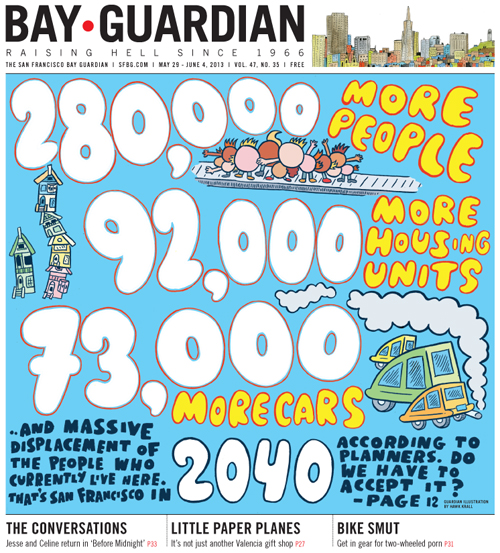
Whose future? Community forum LGBT Community Center, 1800 Market, SF. sfbg.com, ccho@sfic-409.org. 6-8pm, free. In July, the Bay’s Regional governing body is scheduled to approve a state-mandated plan aimed at reducing carbon-emissions that proposes to put 280,000 more people, 92,000 new housing units, 100,000 new jobs (and 73,000 more cars) into SF over the next 30 years. By the proposed Plan’s own assessment: it will increase the risk of neighborhood disruption and displacement of existing residents and businesses, especially among the city’s working class communities. What can we do about it? Join Tim Redmond, San Francisco Bay Guardian; Mike Casey, Unite HERE Local 2; Cindy Wu, San Francisco Planning Commissioner; Maria Zamudio, Causa Justa: Just Cause; and others for this important panel discussion.

THURSDAY 13

Raising the Roof for Renters 111 Minna Gallery, 111 Minna, SF. tenantstogether.org/raisingtheroof2013. 6pm, $30 in advance/ $40 at the door. Tenants are hurting right now, so show your support by attending this fundraiser for Tenants Together — California’s statewide organization for renters’ rights. Celebrate five years of mobilizing tenants statewide for housing justice. Featuring a silent auction, fantastic food, and a cash bar.

SUNDAY 16

Teach-in: class struggle in Turkey Niebyl Proctor Marxist Library, 6501 Telegraph Ave., Oakl. (510) 428-1578. 10:30am-12:30 p.m., free with donation requested. On May 31, without warning, Turkey erupted. For the first time in recent history, women, students, workers, artists, youth, Kurds, Artists, Turks, gays-lesbians, Alevites, doctors, small merchants, environmentalists, unions and progressive associations rose up together. Mehmet Bayram, a long time journalist and Bay Area activist from Turkey, will report on the developments that led to the events and the aftermath. A discussion of politics and class struggle in Turkey will follow.

THURSDAY 20

Rally and protest against Keystone XL Battery East, below Golden Gate Bridge Visitor Center, SF. tinyurl.com/mf6m2ef. Noon, free. Join Bill McKibben of 350.org for a noon rally against the Keystone XL pipeline, followed by a march across the Golden Gate Bridge. This time, environmentalists seeking to halt this major oil infrastructure project will be joined by National Nurses United, who are organizing a day of action in the city against austerity and the Keystone XL.

Developers should pay — on time

7

OPINION San Francisco used to be an eclectic city, filled with working class folks, people of color, lots of artists, and families. But that’s changed dramatically. The black population has dismally plummeted, to 6.3 percent, according to the most recent census. Families of color are streaming out, expensive condos and sky-high rentals are shooting up, and the unique mix that once was the city and made it such a diverse and culturally rich place to live and thrive is changing.

Three years ago, then-Mayor Gavin Newsom decided that private developers in San Francisco needed a local stimulus boost. The housing bubble had burst and taken the economy down with it, but Newsom wanted to ensure that private development in the city continued. So he proposed that private developers be allowed to defer paying the neighborhood impact fees on their projects, thus delaying funding for safety-net programs that help existing residents of working class neighborhoods fight displacement.

His proposal passed in 2010, and since then the Eastern Neighborhoods, SoMa, and the Octavia/Market Area have seen an upswing in private development projects coupled with rising eviction rates and housing costs, while affordable housing throughout the city becomes harder and harder to find. Because neighborhood impact fees were deferred services that would help vulnerable populations were underfunded by a total of almost $53.5 million — in 2011-2012 alone.

That lost money impacted affordable housing construction, affordable child care, development of parks and other types of open spaces, infrastructure and pedestrian-safety measures, neighborhood schools and libraries, and eviction prevention services.

Meanwhile, out-of-town private development companies are set to make millions of dollars building high-end rental units and luxury condominiums that the average San Franciscan can’t afford.

Given that private market-rate residential development in San Francisco is speeding up regardless of displacement dangers, it’s even more necessary today to strengthen and sharpen the tools our neighborhoods have for fighting displacement.

A longstanding question for San Francisco has been how to keep it from becoming a place where only the very wealthy can afford to live while the rest of us have to commute in to the city that we work in and love. Now as we field off another local housing boom fueled by speculation, we are faced again with needing to ensure that we prioritize San Franciscans over profit.

That’s why tenant groups, affordable housing advocates, and San Franciscans fighting for the right to stay in their city will be urging the Planning Commission to end the fee deferrals. The Planning Department staff has studied the issue and recommends that the Newsom program be allowed to expire; that would bring back the funds needed to invest in the vitality and vibrancy of our neighborhoods.

Come join us in helping get San Francisco’s priorities back on track at the Planning Commission meeting Thursday June 13th at 12pm in room 200 of City Hall. Private development is not worth more than the well being of working class communities, immigrants, families, LGBTQ, and tenant communities.

Maria Zamudio is a housing rights organizer for Causa Justa: Just Cause

A ‘reasonable’ cheek swab

7

Rebecca@sfbg.com

On June 3, the U.S. Supreme Court ruled that it’s legal for law enforcement to collect DNA samples from people who are arrested — even when the individuals taken into custody are never convicted of a crime. The justices were narrowly split, and the decision immediately drew criticism from civil liberties advocates like American Civil Liberties Union, who characterized it as a blow to American’s Fourth Amendment right to privacy.

Does the historic ruling carry implications for law enforcement practices in California? Not exactly. As it turns out, current state law allows police to collect DNA samples through cheek swabbing on a far more routine basis than in Maryland, where only a handful of serious offenses can trigger this kind of search. And in the Golden State, fewer protections are in place for arrestees.

The Supreme Court issued its ruling with a narrow 5-4 vote. “The majority’s take was that cheek-swabbing is reasonable … even without any suspicion of wrongdoing by the arrestee, because the intrusion is minimal, the arrestee has less of an expectation of privacy than a typical citizen, and the state has a strong interest in using DNA to identify people,” explained Andrea Roth, a law professor at the University of California at Berkeley and founding member of a group that studied and litigated forensic DNA typing.

In contrast, Roth said, conservative Justice Antonin Scalia “was concerned that this is the first time that we’ve ever allowed searches of someone’s body, without any type of individualized suspicion, for the purpose of general crime-solving. He thought that was a line the Constitution draws in the sand, and that the law is on the wrong side of that line.”

Despite drawing a scathing critique from a conservative Supreme Court justice, Maryland’s system for the collection and use of DNA is actually much narrower in scope than the law that went into effect in California in 2004, when Proposition 69 passed.

Maryland’s law “only applies to a limited number of offenses, it doesn’t apply at all to people who are simply arrested but not charged, and they can only make use of the sample after there’s been a judicial finding of probable cause,” Michael Risher, a lawyer with the Northern California Chapter of the American Civil Liberties Union, told us.

“California doesn’t have any of those safeguards,” Risher added. “It’s a different law.”

2.1 MILLION SAMPLES

When Prop. 69 was approved, California voters initially sanctioned DNA collection from people convicted of felony offenses. But on January 1, 2009, a different provision of that initiative kicked in, expanding it to allow police to collect DNA samples from “any adult person” arrested for “any felony offense,” regardless of whether that person is ever charged or convicted of a crime.

When used as a form of identification, DNA samples are processed to yield a 26-number sequence that aids law enforcement in verifying suspects’ identities.

Once they’re collected and used to produce unique identifiers, those cotton-swabbed samples aren’t destroyed; instead, they remain in the hands of a state agency. “The problem is that the state keeps your samples,” Roth said. “It’s not like they develop the 26-number profile and then throw the rest of the sample in the trash. So if you’re in a database, state officials still have your entire DNA strand.”

According to the California Department of Justice, since the start of the program, the DNA data bank had received and logged more than 2.1 million samples as of March 31. The data bank is shared with the National DNA Index System (NDIS), part of the Combined DNA Index System (CODIS), which is linked to federal records.

In its decision, the nation’s highest court determined that “taking and analyzing a cheek swab of the arrestee’s DNA is, like fingerprinting and photographing, a legitimate police booking procedure.”

Yet civil liberties advocates point out that the information contained in a DNA sample can reveal much more about an individual than either a fingerprint or a unique identifier generated from a sample.

“There’s a basic difference between your DNA and your fingerprint,” Risher explains. “Your fingerprint doesn’t tell you anything about yourself. And your DNA is your genetic blueprint. The profile that they generate might not say a lot about you … but they are keeping these physical samples. Current law says they can’t be tested for sensitive things, but laws change, and people can violate them.”

And a properly preserved DNA sample can last hundreds of thousands of years — essentially forever.

ANTI-WAR PROTESTER ASKED FOR DNA

Lily Haskell has been fighting the state of California over DNA collection ever since her arrest in March of 2009, at an anti-war demonstration in downtown San Francisco. Held to commemorate the anniversary of the start of the Iraq war, the protest was staged in Civic Center Plaza. “With no prior warning, police charged the crowd, penned us in, arrested us, and charged us with trying to incite a riot,” she told us.

But hours later, after she and a handful of others had been processed at the San Francisco County Jail, Haskell was summoned from her holding cell and presented with what struck her as an odd request. Although she says she had already been fingerprinted, and her identity already confirmed, an officer “told me I had to provide a DNA sample.”

Her first instinct was to decline. “I didn’t believe it was just to have to comply with that,” she said. “I told them I believed it was my right to refuse.” Haskell was told that if she continued to resist the sample collection, she’d be charged with a misdemeanor and would likely spend a few additional nights in jail. So she relented.

Although she was neither charged with a crime nor tried for a felony or any other offense after being released from jail 24 hours later, Haskell’s DNA sample remains in the state databank. Now she’s a lead plaintiff in a class action lawsuit filed by the ACLU.

Haskell said she’s never tried to get her DNA expunged from the state database, because she sees her participation in the lawsuit as an important challenge to a law she views as unjust. “I don’t want my DNA to be held,” Haskell says, “and I don’t want anybody else’s DNA to be held, either.”

Individuals who have tried to go the route of having DNA samples removed have found it can be tedious. “In California, the process of getting your DNA out of a database if your case ends in dismissal or acquittal is an onerous one,” Roth explained. “You have to pay your own filing and attorney fees, you have to wait until the statute of limitations has run, the judge has complete discretion to deny your motion, and you can’t appeal the judge’s decision.”

Legal upshot still unclear

Meanwhile, ACLU attorneys in Northern California were closely watching the Supreme Court case, Maryland v. King, to see how it might affect their class-action challenge to Prop. 69, a case known as Haskell v. Harris. Although a divided panel of Ninth Circuit judges upheld the law in February of 2012, the court took the unusual step last July of voting to rehear the case en banc, with a nine-judge panel. However, the court issued an order after oral arguments saying it wouldn’t issue a ruling until King had been decided in the Supreme Court.

“Yes, they will have to do something with our case — but what they do is actually up to them,” Risher explained. “There’s no binding opinion in our case right now. Everything was up in the air waiting for King to be decided.”

Risher added that in future arguments, the ACLU plans to highlight the differences between Maryland’s DNA collection law and California’s far broader Prop. 69. “If King was a 5-4 decision with a law that was so narrowly focused, with those safeguards,” he said, “well okay — this one crosses the line.”

No security

3

rebeccab@sfbg.com

To qualify for his job as a security officer, Jerry Longoria had to obtain a license, undergo a background check, and take a drug test. He’s required to wear a suit to work. He’s stationed at a downtown San Francisco high rise that houses Deloitte, a multinational consulting, finance, and real-estate firm that reported $31.3 billion in revenues last year. His employer is Universal Protection Services, a nationwide security contractor with a slick online marketing pitch emphasizing that all guards are “electronically supervised around the clock,” and “kept accountable on the job through our 24-hour command center.”

If an intruder showed up at his office building brandishing a firearm, it would be Longoria’s problem; that’s the job. Nevertheless, he says he doesn’t earn enough to cover rent for an apartment in San Francisco. Instead, he stays in a single room occupancy hotel near Sixth and Mission streets, an area known for a high rate of violent crime. Walking home still wearing the suit makes him stand out on the street.

He’s lived in the 150-unit building, which has shared bathrooms and a shared basement-level kitchen, for 11 years. “It’s affordable for me, and it allows me to be closer to work,” he explains. He can’t afford a car, and says a public transit delay could prove disastrous if he relocated outside the city. “If you’re late to your post, you get fired.”

At press time, about 7,000 security officers throughout the Bay Area and Los Angeles were gearing up for a strike that could begin any day. Members of United Service Workers West, affiliated with Service Employees International Union, authorized their bargaining committee to call for the work stoppage because officers have been without a contract since the end of 2012.

The starting wage for a security officer is $14 an hour in the city, which comes to slightly more than $29,000 a year before taxes. In some places that would be sufficient to meet basic needs. In San Francisco, where the median market rate on rental units recently peaked above $3,000 a month, it doesn’t go very far. “With the cost of living here in San Francisco, $14 an hour is simply not enough to make ends meet,” Kevin O’Donnell, a USWW spokesperson, told us.

The security officers’ threats to strike coincided with a second worker action in the Bay Area last week. Despite lacking any form of union representation, Walmart associates from stores in Richmond, Fremont, and San Leandro affiliated with the nationwide organization OUR Walmart joined 100 employees from across the country in walking off the job and caravanning to Bentonville, Arkansas to raise awareness about their poverty-level wages and insufficient benefits at Walmart’s annual shareholders’ meeting. But first, they paid a visit to the Four Seasons in downtown San Francisco, which houses the 38th floor penthouse apartment of Yahoo CEO Marissa Mayer, a Walmart director.

Despite seeking full-time working opportunities and staying with the company for years, a handful of associates we interviewed said they can’t earn enough at Walmart to cover basic needs, so they rely on government assistance or help from extended family to make ends meet. Some said they had witnessed their coworkers get fired after participating in OUR Walmart activities.

Walmart associates in the Bay Area are in a considerably more precarious situation than the security officers, earning lower hourly wages. But in the pricey Bay Area, security officers, Walmart employees, and scores of other low-wage private sector workers all share something in common. Despite reporting to work every day and working long hours in many cases, they’re forced into impoverished conditions due to economic circumstances, while a middle-class existence remains far out of reach.

FIGHTING FOR STABILITY

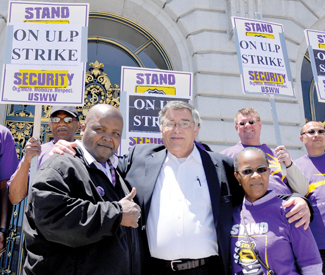
ABM Security and Universal Protection Services are the largest employers in the private security contractor industry; in the Bay Area, the majority of guards are stationed at office buildings in downtown San Francisco. On May 30, Supervisors John Avalos, David Campos, David Chiu, Jane Kim and Scott Wiener all voiced support for the guards at a rally outside City Hall. “Better working conditions for security officers mean more stable, family-supporting jobs, less turnover, and more ability to handle challenges at work,” Avalos said.

Matt Roberts has been working as a security officer for years, and originally moved into his unit in a San Francisco SRO in a financial pinch. “I figured, I’ll get out of this rut eventually. And here I am, seven years later, still paying $1,000 a month for a space that’s really not much bigger than a walk-in closet,” he told us. Roberts was terminated recently, and believes it’s because he spoke up to his site director about workplace issues his fellow guards felt needed to be addressed.

In Roberts’ view, the situation he’s found himself in is reflective of the broader erosion of the middle class, which is particularly acute in an area with a soaring cost of living. He was born and raised in San Francisco’s Crocker Amazon district, with a father who worked as a firefighter and a mother who worked as a clerk typist at the Cow Palace.

“They were able to achieve the American dream,” he said. “They had a house, they paid their mortgage off in 25 years, they were able to send me and all my three siblings to good schools. I realized when I was still in my 20s that I’m probably going to be a renter the rest of my life. The American dream is totally eclipsing my generation.”

Keven Adams, a security officer of 23 years who lives in Oakland, also attended the City Hall rally on May 30. “We’re fighting for wages, health care, and stability in the workplace,” Adams said. “We’re in a city we love so very much, but the community and the middle class is shrinking.” Adams said he was once held at gunpoint for four hours during a work shift. He’d love to live in San Francisco, he said, but can’t afford it.

According to a June 3 media advisory, unions throughout the Bay Area were preparing to demonstrate support for the security officers as they geared up to strike. “The support could come in the form of workers attending rallies, non-violent civil disobedience or perhaps even non-security workers refusing to cross picket lines,” according to USWW, “and walking off their own jobs in solidarity.”

‘STAND UP, LIVE BETTER’

Among the small group of protesters who had assembled on the sidewalk far below Mayer’s San Francisco penthouse on May 29 were associates who had taken the drastic and unusual step of going on strike from Walmart — the nation’s largest private employer. Clad in bright green shirts and waving signs, they chanted, “stand up, live better,” a play on Walmart’s slogan, and also, “What do we want? Respect.”

Dominic Ware, who works part-time at a Walmart in San Leandro, led chants and sounded off on a megaphone about the need for greater respect in the workplace. Ware, who’s been involved with OUR Walmart activities on a national level, said he earns $8.65 an hour and stays with his grandmother, since his paycheck isn’t enough to cover rent. He estimated that roughly half his earnings go directly back to Wal-Mart, where he purchases groceries and other basic items. Asked what motivated him to strike, Ware mentioned his daughter, who turned eight on June 1. “What if she has to work there some day?”

He added that some elderly colleagues were experiencing problems such as being unable to get a shift changed so as to catch a bus home at the end of the night. Another one of his coworkers was let go after it became clear to management that he was participating in OUR Walmart activities, Ware said.

While only a tiny fraction of Walmart’s 1.4 million workers took action to strike, their campaign appears to resonate in high places. A report recently released by the Democratic staff of the U.S. House Committee on Education and the Workforce seized on Walmart’s low wages, emphasizing that so many of its workers are forced to turn to government assistance that it is resulting in a collective drag on taxpayers.

“Rising income inequality and wage stagnation threaten the future of America’s middle class,” the report notes. “While corporate profits break records, the share of national income going to workers’ wages has reached record lows. Walmart plays a leading role in this story. Its business model has long relied upon strictly controlled labor costs: low wages, inconsiderable benefits and aggressive avoidance of collective bargaining with its employees. As the largest private-sector employer in the U.S., Wal-Mart’s business model exerts considerable downward pressure on wages throughout the retail sector and the broader economy.”

When the Coastal Commission fails

43

The sensationalist title of the Bay Guardian article “Fornication loses to soccer fields” (5/15/13) overshadows the far-reaching implications of the Coastal Commission’s rubber-stamp of San Francisco’s Beach Chalet soccer complex. Lost in the article is the story of what really happened: powerful political interests leaned on the commissioners to abrogate their responsibility to protect the California coast.

Project supporters repeated the fallacy that seven acres of artificial turf and 150,000 watts of sports lighting next to Ocean Beach would stem the flight of families from the city. Notably, none of the commissioners acknowledged that the City of San Francisco’s own environmental impact report identified an alternative that meets the project goals — including the need for playtime — without any impact on the coastal zone. In fact, the “need” argument is a red herring to push through a pet project.

When the commissioners approved the Beach Chalet’s 150,000 watts of lights — situated only 500 feet from the beach — they did not even discuss the impacts from sports lights. They disregarded their own staff report — which said much of what opponents of the project have been saying for years — and ignored copious evidence from well-credentialed experts demonstrating the city’s faulty environmental analysis on the negative biological and aesthetic impacts of lights on people and wildlife in the coastal zone.

Only Commissioner Steve Blank seemed willing to uphold his duty to protect the coastline. Blank reminded the panel that its mandate is to uphold the Coastal Act and protect the interests of the 38 million Californians in our shared coastline. The California coastline has remained protected for decades due to the diligence of past commissions. The commission is supposed to transcend local politics. But the remaining commissioners failed to do this.

The approval of the Beach Chalet project is not just the acquiescence of the Coastal Commission to a single project but an all-out attack on coastal protections. Now, any developer who can trump up claims of local need for recreation can expect this commission to rubber-stamp its project.

Anyone concerned about the integrity of California’s coast should be outraged. We encourage you to let your elected representatives know that if the Coastal Commission members can’t abide by the Coastal Act, they should be replaced before they can do even more damage to our remaining coastline.

For those not at the hearing, the Bay Guardian headline refers to the claim that the Beach Chalet is a cruising ground for gay men, a claim used to sensationalize the issue and also to assert that healthy, all-American recreation field would make the area “safe for children.” This homophobic tactic was a recurrent theme during local hearings and has been deeply felt by the LGBT community.

The battle for our parkland is not over. There is currently a CEQA lawsuit in the courts; in addition, a broad coalition of groups is moving forward to continue to fight this project. Join with them — it will take everyone’s participation to win back our parkland, our beach and our coast.

Sue Englander is an Executive Board Member, Harvey Milk LGBT Club. Arthur Feinstein is chair of the Sierra Club, Bay Chapter. Mike Lynes is executive director of the Golden Gate Audubon Society. Katherine Howard is a member of the Steering Committee of SF Ocean Edge.

Editor’s notes

51

Tredmond@sfbg.com

EDITORS NOTES It’s as if someone has some kind of auto-respond system: Every time I write about housing or rent control, one of the trolls who comments on the Guardian Politics blog complains that landlords are “subsidizing” longterm tenants.

That’s a complaint I’ve heard plenty of times before — rent control is a “subsidy” because property owners have to allow the use of their property for a lower rate than the current market might allow.

And it’s completely wrong.

In fact, it only takes a basic understanding of economics to realize that in many cases, tenants are subsidizing their landlords. That’s how the business works.

You don’t have to read Karl Marx to learn that in a capitalist system, the owner of a business typically pays his or her employees less than the value they bring to the operation; the difference is what’s called “profit.” It’s how American capitalism works.

Same way, when a landlord signs a rental agreement with a tenant, the rent he or she charges is typically enough to: (a) cover that tenant’s portion of the building mortgage; (b) cover expected maintenance costs, and (c) provide the owner with a profit. Not that many landlords go into the business to lose money, or to break even.

I have a friend who bought a multi-unit building in the East Bay a few years ago, and it’s a great deal for him: He lives in one unit, and the tenants in the other units pay enough rent to cover most of the mortgage. So my friend’s housing is practically free. The tenants are subsidizing him.

Now: Add in rent control, and what do you get? The same exact situation. At the time a landlord and a tenant agree on a lease, the payments are adequate to cover the landlord’s costs plus a margin of profit. (Otherwise the landlord would be a fool to sign the lease.) Over time, the rent goes up a little bit every year. The landlord’s mortgage either stays the same, or, these days, goes down after a refinance at the lowest rates in history. The landlord’s next biggest expense — property tax — goes up by less than the allowable rent increase most years. So every year, the tenant pays the landlord more than it costs the landlord to provide the housing. Every year, the vast majority of landlords in San Francisco make a profit.

Yes: a rent-controlled unit prevents someone who bought a building years ago and has longterm tenants from making even more of a profit. It is, and should be seen as, a way of limiting profit on rental property to a reasonable amount, not to what a speculative market could bring. That’s fair; housing is a public right, and should be regulated a little like a public utility. (PG&E gets to make a profit every year, but not an unlimited profit.)

But like workers in a capitalist system whose product of labor subsidizes the profit of the owners, tenants in San Francisco are subsidizing landlords. That’s how the private housing market works.

Alerts

0

THURSDAY 6

Resisting gentrification in San Francisco The Green Arcade bookstore, 1680 Market, SF. www.thegreenarcade.com. 7-8:30pm, free. San Francisco author and political economist Karl Beitel will discuss his new book, Local Protest, Global Movements: Capital, Community, and State in San Francisco, which chronicles the history of anti-gentrification and housing rights activism in the city. The book focuses on the broader historical, political and global context of urban movements. Book talk followed by discussion.

Patent pending: The rise of GM humans Brower Center’s Goldman Theater, 2150 Allston, Berk. www.browercenter.org. 7:30pm, free. In 1997, New York Medical College cell biologist Stuart Newman applied for a patent on a “humanzee” — part human, part chimp — to call attention to the ethical hazards of biotech patenting. Last year, researchers in the UK and US sought approval for creating and implanting genetically modified (GM) human embryos. What is the state of human genetic modification? What is at stake for the species? Join Stuart Newman, PhD, in conversation with Milton Reynolds of Facing History and Ourselves for this talk, part of an East Bay Conversations series on the Promises and Perils of Biotechnology.

SATURDAY 8

Tenth anniversary World Naked Bike Ride Justin Herman Plaza, 1 Market, SF. 10:30am-4:30pm. Organizers of San Francisco’s Tenth Anniversary World Naked Bike Ride are hoping for the largest turnout yet. Meet on the northeast side of Vaillancourt Fountain at 10:30 AM to spend half an hour primping with body and face paint, then get ready to ride as bare as you dare. Route will pass through Fisherman’s Wharf, the Marina, Lombard, North Beach, the Embarcadero, the Civic Center, the Haight, past Golden Gate Park, and finally to Ocean Beach. The WNBR is part of a global against oil dependency.

TUESDAY 11

Our vanishing civil liberties St. John’s Presbyterian Church, 2727 College Avenue, Berk. 7:30-9:30pm, free. This panel talk on the erosion of civil liberties will feature Birgitta Jonsdottir, a member of Icelandic Parliament, Wikileaks and Bradley Manning supporter, and poet; Daniel Ellsberg of Pentagon Papers fame; and Nadia Kayyali of the Bill of Rights Defense Committee. Panelists will hit on concerns such as indefinite detention, the National Defense Authorization Act (NDAA), police militarization, and the prosecution of whistleblowers.

Planning for displacement: Short takes

14

Regional planning hits Chinatown

When regional planners at the Metropolitan Transportation Commission funded a study to create a bus-rapid transit system on Van News Avenue, they decided, in the interest of speeding the buses along, to allow only one left turn — onto Broadway.

That would turn Broadway into a much-busier thoroughfare — and have a huge impact on Chinatown, where there’s heavy pedestrian traffic. That, Cindy Wu says, is one of the problems with regional planning — it doesn’t always consider the impacts on existing, fully developed neighborhoods.

Wu is a planner with the Chinatown Community Development Center and a member of San Francisco’s Planning Commission. She’s concerned that Plan Bay Area, with its macro focus, ignores the micro — the people who already live in communities that will feel the pressure.

“Chinatown is performing amazingly,” she told me recently. There’s low car use, high density … all the things ABAG seems to want. And yet, it’s in the Priority Development Area, where new construction could lead to displacement. “It doesn’t get to the neighborhood scale, where people will be forced to control the impacts of growth.”

Gen Fujioka, policy director at CCDC, noted that the plans says people displaced from a San Francisco community like Chinatown can be accommodated elsewhere in the region. “Like that’s an acceptable alternative,” he said.

A (somewhat) better approach

The Draft Environmental Impact Report on Plan Bay Area looked at several alternatives, including doing nothing at all, which everyone pretty much agrees is a bad idea. But interestingly, a proposal put together by community groups, including Public Advocates, Urban Habitat, and TransForm, turned out to do a better job of reaching ABAG’s environmental goals.

In the DEIR models, “Alternative Five,” as it’s described, leads to slightly lower levels of displacement and less car travel. It does that in large part through the imposition of a Vehicle Miles Travelled Tax — a one-cent levy on every mile driven by a private car or light truck in the region.

That, it turns out, does indeed discourage car use. It would also raise more than $600 million a year, most of which would go to public transit and affordable housing. Over 25 years, that’s a lot of cash.

But ABAG planners rejected that proposal, preferring their own alternative.

ABAG and the UN plan for world domination

One of the biggest problems with opposing, or even questioning, ABAG’s Plan Bay Area is that some of the loudest voices against it are, in a word, loony.

Around the Bay Area suburbs, people packing hearings on the plan are talking about the secret United Nations plan to confiscate all private property, burn down suburban homes, and force everyone into tiny cells in teeming cities where our personal freedoms will be systematically destroyed.

You haven’t heard of that? It’s called Agenda 21, and the John Birch Society is convinced that it’s a global plot to destroy America.

Actually, Agenda 21 is a weak, unenforceable document that came out of the UN’s environmental conference in 1992. It suggests — as does SB375, as does just about every sane thinker in civilization — that the world’s growth ought to be planned, sustainable, and energy efficient.

But it’s getting dragged up as grounds to scuttle Plan Bay Area. The black helicopter folks, the Obama Wants To Take My House folks, and a few NIMBYs who just don’t want density in the suburbs, have been wailing about this massive conspiracy in the past few months.

It’s unlikely that the Tea Party types will make common cause with San Francisco progressives on this issue. But there’s a real danger here: If the nut cases get the attention, serious questions about the feasibility of this plan could get lumped in with the ravings of conspiracy kooks.

And as far as the UN taking over California? Hey, at least we’ll get universal health care.

Keep the focus on real estate

70

OPINION Let’s stop blaming the hipsters. The Google bus, that annoying icon of yuppie invasion and transit privatization, is not the lead driver of gentrification’s reckless stampede reshaping our city (though it does play a role). The upscale restaurants dominating commercial strips may be economically and aesthetically offensive to many, but they are the natural byproducts of gentrification’s much-ignored elephant in the room: the real estate industry.

While headlines, comment threads, and café chatter fixate on the tech industry and yuppies with fistfuls of dollars, it’s the profit-gobbling real estate companies and speculators who are jacking up rents and evicting so many small businesses and renters—and they are surely happy to stay out of the spotlight.

Gentrification is a many-layered beast nurtured by cultural and economic trends, regional and local labor and housing factors, and public policies (or lack thereof). Beneath the surface-level aesthetics, it is about displacement of people who don’t fit the dominant economic growth plan—radical market-driven upheavals of communities often abetted by government policies and inaction.

The stats are familiar but bear repeating as they are so destructive: average apartment rentals exceeding $2,700 a month, requiring someone making $70,000 a year to pay half of his or her salary in rent. Literally thousands of no-fault evictions in the past decade, according to the Rent Board.

Despite rampant displacement of thousands of San Franciscans, there has been little response from City Hall: no hearings, no proactive legislation, not even bully-pulpit style leadership. We must demand more.

Where is the leadership demanding the city do everything in its albeit limited power to halt further displacement of residents and small businesses? The toxic combo of tenant evictions and home foreclosures by the thousands — driven principally by major banks and real estate companies — is destroying lives and communities.

Some of this is beyond City Hall’s jurisdiction: state laws like the Ellis Act and Costa-Hawkins enable no-fault evictions and prevent vitally needed commercial rent control. Still, beyond their valiant opposition to the Wiener-Farrell condo conversion threat, city leaders have been largely silent about this latest wave of gentrification that’s eviscerating communities, driving out small businesses, and squeezing renters to the bone.

What can we do? We won’t defeat gentrification with city hearings or loud protests or online screeds and petitions — but we need all those things, along with serious public education, to shine a bright hot spotlight on the companies and individuals defining who lives and votes here.

We need a new era of citywide awareness, unity, and action to literally save San Francisco — a bold unapologetic vision that puts affordability and diversity at the forefront of what our city is about. We can’t have diversity without affordability; it’s that simple.

Renters are gearing up to fight back. An ‘Eviction Free Summer’ is being planned — an innovative campaign to counter the rash of evictions that are generating both displacement and skyrocketing rent prices. The idea of ‘Eviction Free Summer’ is to put evictions and evictors in the spotlight, to put would-be evictors on notice and capture the attention of city officials who have so far done little to stem their tide.

We must demand accountability and action by City Hall and state legislators to rein in the real estate industry and put the brakes on evictions and other displacement. People’s lives, neighborhoods and communities, and the very fabric and identity of our city are at stake.

To those who cheer “change” as if its victims were not real, or who wearily concede the fight, we must ask: are we really going to allow the profit-hungry market and wealth-seeking executives and speculators decide who lives and votes here? Are we going to let the market destroy what’s left of our city’s economic, cultural, racial and ethnic diversity — the very things that make San Francisco what it is?

Christopher D. Cook is an award-winning journalist and author, and former Bay Guardian city editor. Contact him at www.christopherdcook.com

Editor’s notes

57

tredmond@sfbg.com

EDITORS NOTES I know you’re getting a lot of shit these days, and it’s not entirely fair. You’re not the ones making a killing in overpriced real estate. You came here looking for a job, and the jobs you get pay well enough that landlords and speculators can extract wealth that you ought to be able to save or spend in town, creating more jobs for everyone. I can’t blame you for wanting to live in one of the world’s greatest cities; I came here too, from the East Coast, in 1981, looking for work as a writer but mostly looking to live in San Francisco. So did waves of immigrants before me.

But we all have to remember something: There were people living here when we arrived. It was their city before it was ours. And they had, and have, the right to live here, too.

In fact, the people who have been here for 20 or 30 years, who have worked to build this community, have — in a karmic sense — even more right to be here than you. Trite as it sounds, they were here first.

Americans have a bad record when it comes to moving into established populations. Ask any American Indian. Ask the Mexicans about the treaty of Guadalupe Hidalgo.

The hippies who arrived in San Francisco in the 1960s — attracted, among other things, by really cheap rent in the Haight Asbury — weren’t always terribly polite to, or concerned about, the natives who lived there, and had fun teasing the straights and fouling their parks. But they didn’t force anyone else to leave; there was lots of empty space in San Francisco. The city wasn’t kind to them, either — official San Francisco may celebrate the Summer of Love now, but back then, the cops went after the hippies with gusto.

Gay people who arrived in the 1970s — attracted, among other things, by cheap rent in Eureka Valley — faced harassment, discrimination, and brutality.

You, on the other hand, are officially welcomed — the mayor thinks you’re the city’s future. You face no barriers to renting or buying a home, no police crackdowns. The only people unhappy about your presence are the ones who are getting forced out of town to make room for you.

It’s not your fault that the city lacks eviction protections or effective rent control — but it is your fault if you act as if it doesn’t matter. Building community means more than spending money. It means getting involved.

Many of you are tenants. You may be richer than the people who you displaced, but your landlord will cheat you just the same. The Tenants Union needs support. You can be a part of making it stronger. Some of you will have kids at some point; there are great public schools in San Francisco, and I hope you support them.

Meanwhile, you can help keep longtime residents from being forced out. Jeremy Mykaels, a former web designer disabled by AIDS, has set up a site listing all the properties that have been cleared through the eviction of a senior or disabled person (ellishurtsseniors.com). Check it out. Don’t buy those units. If that means you have to live with lesser housing for a while, you can deal. For generations, the rest of us did.

Yeah, we were here first. Show a little humility and a little respect, and perhaps we’ll all get along fine.


Planning for displacement

70

tredmond@sfbg.com

The intersection of Cesar Chavez and Evans Avenue is a good enough place to start. Face south.

Behind you is Potrero Hill, once a working-class neighborhood (and still home to a public housing project) where homes now sell for way more than a million dollars and rents are out of control. In front, down the hill, is one of the last remaining industrial areas in San Francisco.

Go straight along Evans and you find printing plants, an auto-wrecking yard, and light manufacturing, including a shop that makes flagpoles. Take a right instead on Toland, past the Bonanza restaurant, and you wander through auto-glass repair, lumber yards, plumbing suppliers, warehouses, the city’s produce market — places that the city Planning Department refers to at Production, Distribution, and Repair facilities. Places that still offer blue-collar employment. There aren’t many left anywhere in San Francisco, and it’s amazing that this district has survived.

Cruise around for a while and you’ll see a neighborhood with high home-ownership rates — and high levels of foreclosures. Bayview Hunters Point is home to much of the city’s dwindling African American population, a growing number of Asians, and much higher unemployment rates than the rest of the city.

Now pull up the website of the Association of Bay Area Governments, a well-funded regional planning agency that is working on a state-mandated blueprint for future growth. There’s a map on the site that identifies “priority development area” — in planning lingo, PDAs — places that ABAG, and many believers in so-called smart growth, see as the center of a much-more dense San Francisco, filled with nearly 100,000 more homes and 190,000 new jobs.

Guess what? You’re right in the middle of it.

The southeastern part of the city — along with many of the eastern neighborhoods — is ground zero for massive, radical changes. And it’s not just Bayview Hunters Point; in fact, there’s a great swath of the city, from Chinatown/North Beach to Candlestick Park, where regional planners say there’s space for new apartments and condos, new offices, new communities.

It’s a bold vision, laid out in an airy document called the Plan Bay Area — and it’s about to clash with the facts on the ground. Namely, that there are already people living and working in the path of the new development.

And there’s a high risk that many of them will be displaced; collateral damage in the latest transformation of San Francisco.

CLIMATE CHANGE AND “SMART GROWTH”

The threat of global climate change hasn’t convinced the governor or the state Legislature to raise gas taxes, impose an oil-severance tax, or redirect money from highways to transit. But it’s driven Sacramento to mandate that regional planners find ways to reduce greenhouse gas emissions in California cities.

The bill that lays this out, SB375, mandates that ABAG, and its equivalents in the Los Angeles Basin, the Central Coast, the Central Valley and other areas, set up “Sustainable Communities Strategies” — land-use plans for now through 2040 intended to reduce greenhouse gas emissions by 15 percent.

The main path to that goal: Make sure that most of the 1.1 million people projected to live in the Bay Area by 2040 be housed in already developed areas, near transit and jobs, to avoid the suburban sprawl that leads to long commutes and vast amounts of car exhaust.

The notion of smart growth — also referred to as urban infill — has been around for years, embraced by a certain type of environmentalist, particularly those concerned with protecting open space. But now, it has the force of law.

And while ABAG is not a secret government with black helicopters that can force cities to do its will — land-use planning is still under local jurisdiction in this state — the agency is partnering with the Metropolitan Transportation Commission, which controls hundreds of millions of dollars in state and federal transportation money. And together, they can offer strong incentives for cities to get in line.

Over in Contra Costa and Marin counties, at hearings on the plan, Tea Party types (yes, they appear to exist in Marin) railed against the notion of elite bureaucrats forcing the wealthy enclaves of single-family homes to accept more density (and, gasp, possibly some affordable housing). In San Francisco, it’s the progressives, the transit activists, and the affordable housing people who are starting to get worried. Because there’s been almost zero media attention to the plan, and what it prescribes for San Francisco is alarming — and strangely nonsensical.

Under the ABAG plan, San Francisco would approve 92,400 more housing units for 280,000 more people. The city would host 190,000 more jobs, many of them in what’s called the “knowledge economy,” which mostly means high tech. Second and third on the list: Health and education, and tourism.

The city currently allows around eight cars for every 10 housing units; as few as five in a few neighborhoods, at least 10 in many others. And there’s nothing in any city or regional plan right now that seeks to change that level of car dependency. In fact, the regional planners think that single-occupancy car travel will be the mode of choice for 48 percent of all trips by 2040 — almost the same as it is today.

And since most of the new housing will be aimed at wealthier people, who are more likely to own cars and avoid catching buses, San Francisco could be looking for ways to fit 73,000 more cars onto streets that are already, in many cases, maxed out. There will be, quite literally, no place to park. And congestion in the region, the planners agree, will get a whole lot worse.

That seems to undermine the main intent of the plan: Transit-oriented development only works if you discourage cars. In a sense, the car-use projections are an admission of failure, undermining the intent of the entire project.

The vast majority of the housing that will be built will be too expensive for much of the existing (and even future) workforce and will do little to relieve the pressure on lower income people. But there is nothing whatsoever in the plan to ensure that there’s money available to build housing that meets the needs of most San Franciscans.

Instead, the planners acknowledge that 36 percent of existing low-income people will be at risk for displacement. That would be a profound change in the demographics of San Francisco.

Of course, adding all those people and jobs will put immense pressure on city services, from Muni to police, fire, and schools — not to mention the sewer system, which already floods and dumps untreated waste into the Bay when there’s heavy rain. Everyone involved acknowledged those costs, which could run into the billions of dollars. There is nothing anywhere in any of the planning documents addressing the question of who will pay for it.

THE NUMBERS GAME

Projecting the future of a region isn’t easy. Job and population growth isn’t a straight line, at best — and when you’re looking at a 25-year window in a boom-and-bust area with everything from earthquakes to sea-level rise factoring in, it’s easy to say that anyone who claims to know what’s going to happen in 2040 is guessing.

But as economist Stephen Levy, who did the regional projections for ABAG, pointed out to us, “You have to be able to plan.” And you can’t plan if you don’t at least think about what you’re planning for.

Levy runs the Center for the Continuing Study of the California Economy, and he’s been watching trends in this state for years. He agrees that some of his science is, by nature, dismal: “Nobody projects deep recessions,” much less natural disasters. But overall, he told me, it’s possible to get a grip on what planners need to prepare for as they write the next chapter of the Bay Area’s future.

And what they have to plan for is a lot more people.

Levy said he started with the federal government’s projections for population growth in the United States, which include births and deaths, immigration, and out-migration, using historic trends to allocate some of that growth to the Bay Area. There’s what appears at first to be circular logic involved: The feds (and most economists) project that job growth nationally will be driven by population — that is, the more people live in the US, the more jobs there will be.

Population growth in a specific region, on the other hand, is driven by jobs — that is, the more jobs you have in the Bay Area, the more people will move here.

“Jobs in the US depend on how many people are in the labor force,” he said. “Jobs in the Bay Area depend on our share of US jobs and population depends on relative job growth.”

Make sense? No matter — over the years it’s generally worked. And once you project the number of people and jobs expected in the Bay Area, you can start looking at how much housing it’s going to take to keep them all under a roof.

Levy projects that the Bay Area’s share of jobs will be higher than most of the rest of the country. “This is the home of the knowledge industry,” he told me. So he’s concluded that population in the Bay Area will grow from 7.1 million to 9.2 million — an additional 2.14 million people. They’ll be chasing some 1.1 million new jobs, and will need 660,000 new housing units.

Levy stopped there, and left it to the planners at ABAG to allocate that growth to individual cities — and that’s where smart growth comes in.

For decades in the Bay Area, particularly in San Francisco, activists have waged wars against developers, trying to slow down the growth of office buildings, and later, luxury housing units. At the same time, environmentalists argued that spreading the growth around creates serious problems, including sprawl and the destruction of farmland and open space.

Smart growth is supposed to be an alternative: the idea is to direct new growth to already-established urban areas, not by bulldozing over communities (as redevelopment agencies once did) but by the use of “infill” — directing development to areas where there’s usable space, or by building up and not out.

ABAG “focused housing and jobs growth around transit areas, particularly within locally identified Priority Development Areas,” the draft environmental impact report on the plan notes.

The draft EIR is more than 1,300 pages long, and it looks at the ABAG plan and several alternatives. One alternative, proposed by business groups, would lead to more development and higher population gains. Another, proposed by community activist groups including Public Advocates, Urban Habitat, and TransForm, is aimed at reducing displacement and creating affordable housing; that one, it turns out, is the “environmentally preferred alternative.” (See sidebar).

But no matter which alternative you look at, two things leap out: There is nothing effective that ABAG has put forward to prevent large-scale displacement of vulnerable communities. And despite directing growth to transit corridors, the DEIR still envisions a disaster of traffic congestion, parking problems, and car-driven environmental wreckage.

THE DISPLACEMENT PROBLEM

ABAG has gone to some lengths to identify what it calls “communities of concern.” Those are areas, like Bayview Hunters Point, Chinatown, and the Mission, where existing low-income residents and small businesses face potential displacement. In San Francisco, those communities are, to a great extent, the same geographic areas that have been identified as PDAs.

And, the DEIR, notes, some degree of displacement is a significant impact that cannot be mitigated. In other words, the gentrification of San Francisco is just part of the plan.

In fact, the study notes, 36 percent of the communities of concern in high-growth areas will face displacement pressure because of the cost of housing. And that’s region wide; the number in San Francisco will almost certainly be much, much higher.

Miriam Chion, ABAG’s planning and research director, told me that displacement “is the core issue in this whole process.” The agency, she said, is working with other stakeholders to try to address the concern that new development will drive out longtime residents. But she also agreed that there are limited tools available to local government.

The DEIR notes that ABAG and the MTC will seek to “bolster the plan’s investment in the Transit Oriented Affordable Housing Fund and will seek to do a study of displacement. It also states: “In addition, this displacement risk could be mitigated in cities such as San Francisco with rent control and other tenant protections in place.”

There isn’t a tenant activist in this town who can read that sentence with a straight face.

The problem, as affordable housing advocate Peter Cohen puts it, is that “the state has mandated all this growth, but has taken away the tools we could use to mitigate it.”

That’s exactly what’s happened in the past few decades. The state Legislature has outlawed the only effective anti-displacement laws local governments can enact — rent controls on vacant apartments, commercial rent control, and eviction protections that prevent landlords from taking rental units off the market to sell as condos. Oh, and the governor has also shut down redevelopment agencies, which were the only reliable source of affordable housing money in many cities.

Chion told me that the ABAG planners were discussing a list of anti-displacement options, and that changes in state legislation could be on that list. Given the power of the real-estate lobby in the state Capitol, ABAG will have to do more than suggest; there’s no way this plan can work without changing state law.

Otherwise, eastern San Francisco is going to be devastated — particularly since the vast majority of all housing that gets built in the city, and that’s likely to get built in the city, is too expensive for almost anyone in the communities of concern.

“This plan doesn’t require affordable housing,” Cindy Wu, vice-chair of the San Francisco Planning Commission, told me. “It’s left to the private market, which doesn’t build affordable housing or middle-class housing.”

In fact, while there’s plenty of discussion in the plan about where money can come from for transit projects, there’s virtually no discussion of the billions and billions that will be needed to produce the level of affordable housing that everyone agrees will be needed.

Does anyone seriously think that developers can cram 90,000 new units — at least 85 percent of them, under current rules, high-cost apartments and condos that are well beyond the range of most current San Franciscans — into eastern neighborhoods without a real-estate boom that will displace thousands of existing residents?

Let’s remember: Building more housing, even a lot more housing, won’t necessarily bring down prices. The report makes clear that the job growth, and population boom that accompanies it, will fuel plenty of demand for all those new units.

Steve Woo, senior planner with the Chinatown Community Development Center, sees the problem. In a letter to ABAG, he notes: “Plan Bay Area and its DEIR has analyzed the displacement of low-income people and explicitly acknowledges that it will occur. This is unacceptable for San Francisco and for Chinatown, where the pressures of displacement have been a constant over the past 20 years.”

Adds the Council of Community Housing Organizations: “It would be irresponsible for the regional agencies to advance a plan that purports to ‘improve’ the region’s communities as population grows while the plan simultaneously presents great risk and uncertainty for many vulnerable communities.”

Jobs are at stake, too — not tech jobs or office jobs, which ABAG projects will expand, but the kind of industrial jobs that currently exist in the priority development areas.

Calvin Welch, who has been watching urban planning and displacement issues in San Francisco for more than 40 years, puts it bluntly: “It is axiomatic that market-rate housing drives out blue-collar jobs,” he said.

Of course, there’s another potential problem: Nobody really knows where jobs will come from in the next 25 years, whether tech will continue to be the driver or whether the city’s headed for a second dot-com bust. San Francisco doesn’t have a good record of building for projected jobs: In the mid-1980s, for example, the entire South of Market area (then home to printing, light manufacturing, and other blue-collar jobs) was rezoned for open-floor office space because city officials projected a huge need for “back-office” functions like customer service.

“Where are all those jobs today?” Welch asked. “They’re in India.”

TOO MANY CARS

For a plan that’s designed to reduce greenhouse gas emissions by moving residential development closer to work areas, Plan Bay Area is awfully pessimistic about transportation.

According to the projections, there will be more cars on the roads in 2040, with more — and much worse — traffic. The DEIR predicts that a full 48 percent of all trips in 2040 will be made by single-occupant vehicles — just slightly down from current rates. The percentage of trips on transit will only be a little bit higher — and there’s no significant increase in projected bicycle trips.

That alone is pretty crazy, since the number of people commuting to work by bike in San Francisco has risen dramatically in the past 10 years, and the city’s official goal is that 20 percent of all vehicle trips will be by bike in the next decade.

Part of the problem is structural. Not everyone in San Francisco 2040 is going to be a high-paid tech worker. In fact, the most stable areas of employment are health services and government — and hospital workers and Muni drivers can’t possibly afford the housing that’s being built. So those people will — the DEIR acknowledges — be displaced from San Francisco and forced to live elsewhere in the region (if that’s even possible). Which means, of course, they’ll be commuting further to work. Meanwhile, if current trends continue, many of the people moving into the city will work in Silicon Valley.

Chion and Levy both told me that the transit mode projections were based on historical trends for car use, and that it’s really hard to get people to give up their cars. Even higher gas prices and abominable traffic delays won’t drive people off the roads, they said.

If that’s the case — if auto culture, which is a top source of global climate change, doesn’t shift at all — it would seem that all this planning is pointless: the seas will rise dramatically, and San Franciscans ought to be buying boats.

“The projections don’t take into account social change,” Jason Henderson, a geography professor at San Francisco State University and a local transportation expert, told me. “And social change does happen.”

Brad Paul, a longtime housing activist who now works for ABAG, said these projections are just a start, and that the plan will be updated every four years. “I think we’re finding that the number of people who want to drive cars will go down,” he said.

Henderson argues that the land-use policy is flawed. He suggests that it would make more sense to increase density in the Bay Area suburbs along the BART lines. “Elegant development in those areas would work better,” he said. You don’t need expensive high-rises: “Four and five stories is the sweet spot,” he explained.

Most of the transportation projects in the plan are already in the pipeline; there’s no suggestion of any major new public transit programs. There is, however, a suggestion that San Francisco adopt a congestion management fee for downtown driving — something that city officials say is the only way to avoid utter gridlock in the future.

SIDELINING CEQA

ABAG and the MTC have a fair amount of leverage to implement their plans. MTC controls hundreds of millions of dollars in transit money; ABAG will be handing out millions in grants to communities that adopt its plan. And under state law, cities that allow development in PDAs near transit corridors can gain an exemption from the California Environmental Quality Act.

CEQA is a powerful tool to slow or halt development, and developers (and some public officials) drool at the prospect of getting a fast-track pass to avoid some of the more cumbersome parts of the environmental review process.

Under SB 375 and Plan Bay Area, CEQA exemptions are available to projects that meet the Sustainable Community Strategy standards and are close to transit corridors. And when you look at the map of those areas, it’s pretty striking: All of San Francisco, pretty much every square inch, qualifies.

That means that almost any project almost anywhere in town can make a case that it doesn’t need to accept full CEQA review.

The most profound missing element in this entire discussion is the cost of all this growth.

You can’t cram 210,000 more residents into San Francisco without new schools, parks, and child-care centers. You can’t protect those residents without more police officers and firefighters. You can’t take care of their water and sewer needs without substantial infrastructure upgrades. And even if there’s state and federal money available for new buses and trains, you can’t operate those systems without paying drivers, mechanics, and support workers.

There’s no question that the new development will bring in more tax money. But the type of infrastructure improvements that will be needed to add 25 percent more residents to the city are really expensive — and every study that’s ever been done in San Francisco shows that the tax benefits of new development don’t cover the costs of public services it requires.

When World War II and the post-war boom in the Bay Area brought huge growth to the region, property taxes and federal and state money were adequate to build things like BART, the freeways, and hundreds of new schools, and to staff the public services that the emerging communities needed. But that all changed in 1978, with the passage of Prop. 13, and two years later, with the election of Ronald Reagan as president.

Now, federal money for cities is down to a trickle. Local government has an almost impossible time raising taxes. And instead of hiking fees for new residential and commercial projects, many communities (including San Francisco) are offering tax breaks to encourage job growth.

Put all that in the mix and you have a recipe for overcrowded buses, inadequate schools, overstressed open space (imagine 10,000 new Mission residents heading for Dolores Park on a nice day), and a very unattractive urban experience.

That flies directly in the face of what Plan Bay Area is supposed to be about. If the goal is to cut down on commutes by bringing new residents into developed urban areas, those cities have to be decent places to live. What would it cost to accommodate this level of new development? Five billion dollars? Ten billion? Nobody knows — because nobody has run those numbers. But they’re going to be big.

Because just as tax dollars have been vanishing, the costs of infrastructure keep going up. It costs a billion dollars a mile to build BART track. It’s costing more than a billion to build a short subway to Chinatown. Just upgrading the sewer system to handle current demands is a $4 billion project.

And if the developers and property owners who stand to make vast sums of money off all of this growth aren’t going to pay, who’s left?

The ABAG planners point out, correctly, that there’s a price for doing nothing. If there’s no regional plan, no proposal for smart growth, the population will still increase, and displacement will still happen — but the greenhouse gas emissions will be even worse, the development more haphazard.

But if the region is going to spend all this money and all this time on a plan to make the Bay Area more sustainable, more livable, and more affordable in 25 years, we might as well push all the limits and get it right.

Instead of looking at displacement as inevitable, and traffic as a price of growth, the planners could tell the state Legislature and the governor that it’s not possible to comply with SB375 — not until somebody identifies the big sums of money, multiples of billions of dollars, needed to build affordable housing; not until there are transit options, taxes, and restrictions on driving.

Because continued car use and massive displacement — the package that’s now facing us — just isn’t an acceptable option.


Alerts

0

WEDNESDAY 29

Protest: Call on Walmart and Gap to protect worker safety tinyurl.com/nfvnslj. Four Seasons, 757 Market, SF. Continue to Gap flagship store, 980 Market, SF. 5pm, free. Activists with Our Walmart and San Francisco Jobs With Justice recently discovered that Walmart made clothing at Rana Plaza, the Bangladesh factory building that collapsed recently, killing more than a 1,100 workers. Activists plan to rally outside the Four Seasons penthouse of Yahoo CEO Marissa Mayer, who also sits on the board of Walmart. Activists will show up to ask Mayer, then Gap, to sign onto a building safety agreement that would prevent future tragedies of this scale. Actions followed by a 6pm gathering at Bayanihan Community Center, 1010 Mission, SF. Dialogue on LGBT-inclusive comprehensive immigration reform SF Public Library, 100 Larkin, SF. www.sf-hrc.org. 5:30-7:30pm, free. The SF Human Rights Commission will host this community conversation on LGBT-inclusive comprehensive Immigration Reform, cosponsored by the Human Rights Commission LGBT Advisory Committee, Our Family Coalition, and Out4Immigration.

THURSDAY 30

San Francisco Green Film Festival Various SF and East Bay locations, Thu/30 thru Wed/5. www.sfgreenfilmfest.org. General admission $12/$11; Festival passes $100–$200. View 50 new films from around the globe, with over 70 visiting filmmakers and guest speakers, on topics ranging from clean energy, to water, to trash, to art in the environment. Events take place at the New People Cinema in Japantown, the SF Public Library, SPUR Urban Center and the David Brower Center in Berkeley.

SATURDAY 1

Moana Nui 2013 two-day teach-in Martin Luther King Jr. Middle School Auditorium, 1781 Rose, Berk. tinyurl.com/nlw34wd. 10am on Sat/1 to 6pm on Sun/2, $10–$20. The International Forum on Globalization and Pua Mohala I Ka Po present this two-day, international gathering featuring 45 speakers from 20 nations. All will present on critical issues facing the Asia-Pacific region, ranging from environment, to militarism, to global trade and resource depletion. Participants include Jerry Mander (dubbed as the "Ralph Nader of the anti-globalization movement" by the New York Times); indigenous actress Q’orianka Kilcher; Anuradha Mittal of the Oakland Institute, and Victoria Tauli-Corpuz, one of the original drafters of the UN Declaration on the Rights of Indigenous People, among others.

SUNDAY 2


Conference on public banking Dominican University, San Rafael. www.publicbanking.org. 1pm on Sun/2 to 6:30pm on Tue/4, $35 to $295. Join the Public Banking Institute in conversation with pioneering policymakers, civic leaders, banking entrepreneurs, innovators and ordinary citizens interested in learning about one of the most critical undertakings of our time: creating a truly prosperous, democratic and sustainable new economy. Attend the conference or just catch the Sun/2, 7pm forum, titled Take Our Economy Back from Wall Street, with Rolling Stone staff writer Matt Taibbi, Web of Debt author Ellen Brown, and guests Birgitta Jonsdottir, a member of Icelandic Parliament, and Gar Alperovitz, author of What Then Must We Do?

Alerts

0

WEDNESDAY 22

Harvey Milk Day The GLBT History Museum, 4127 18th St., SF. (415) 621-1107 . 11am-6pm, free. California marks Harvey Milk’s birthday, May 22, as an annual statewide day of significance. The GLBT History Museum will honor the occasion this year by offering free admission to all visitors. In addition, the museum is extending a special welcome to Bay Area schools.


Talking about ecology and science in public 518 Valencia, SF. 7:30-10:30pm, free. Join environmental scientist and climate change activist Azibuike Akaba, Brent Plater of the Wild Equity Institute and Rose Aguilar of KALW’s Your Call radio for a debate on the best way to communicate issues about climate change with the general public.

THURSDAY 23

Report-back from Cuba Modern Times Bookstore Collective, SF. (415) 282-9246. 7pm, Free. Tony Ryan, longtime bookseller and Cuba solidarity activist, will give a presentation on the Havana International Book Fair and discuss the work of Nancy Morejón, the best known and most widely translated woman poet of post-revolutionary Cuba.

FRIDAY 24

Outdoor Film screening: Who Bombed Judi Bari? Mythbusters, 1268 Missouri, SF. tinyurl.com/aoha47n. 8:30-11:30pm, free. On May 24, 1990, a bomb blew up in the car of two of the most prominent Earth First! redwood activists: Judi Bari and Darryl Cherney — while they were driving through Oakland, CA on an organizing tour for Redwood Summer. The FBI and Oakland Police immediately accused the pair of carrying their own bomb and of being environmental terrorists. Bari and Cherney launched a lawsuit against the FBI and Oakland Police for violations of the First and Fourth Amendments of the Constitution, and when their case went to trial in 2002, they won. Watch this film on the anniversary of the explosion.

TUESDAY 28

The Future of Bicycle Parking: An International Exhibition SPUR, 654 Mission, SF. www.spur.org. 11am-8pm, free. Yerba Buena Community Benefit District presents an exhibit featuring designs from 100 international teams who entered a student competition to craft a portable bicycle corral for the Yerba Buena neighborhood. The exhibit goes till May 31, till 5pm most days.

Changing the metaphor

2

news@sfbg.com

With my partner-in-crime Keith Chandler at the wheel, we’re driving through San Francisco on our way to Stanford University Law School for the Three Strikes Summit, a deeply personal topic to both of us. Three Strikes is partly why I served 15 years in prison, and Stanford’s Three Strikes Project is a big reason why I was released earlier this year.

Chandler is a renowned activist, ex-lifer, and my comrade in the struggle to reintegrate inmates back into life in the outside world. I have become a fanatic on a mission, and this May 2 event will feature many of the top criminal justice players responsible for last year’s Three Strikes reform measure, from Attorney General Kamala Harris to San Francisco District Attorney George Gascon.

So the path we carve through the City takes us deep into the heart of the reform movement that changed my life. Change is in the air, and I’m following the scent back to its roots.

POSTER CHILD

Three Strikes as a metaphor made perfect sense. In the 1980s, the justice system was a revolving door. Relatively short sentences for serious and/or violent crimes were the norm, sentences often cut in half by parole. Lengthy records of arrests and convictions fueled a movement to get tough on crime.

As per usual, bad things happened. In 1993, sexual predator Richard Allen Davis killed Polly Klaas, a 12-year-old girl from Petaluma. A general consensus formed that repeat offenders needed to be punished to the fullest. So prison industrialists came up with a catchy solution: three strikes and you’re out. Commit three violent crimes, the authors sold to the public in 1994, and you’ll serve 25 years to life.

However, the fine print expanded the concept to any third felony — even crimes that would be misdemeanors to non-parolees — and California’s prisons swelled.

In many ways, I was a Three Strikes poster child. As a wild youngster in Sacramento, I was a menace. At 18 in 1984, I began a four-year spree of crimes that included armed robbery, assault with a deadly weapon, and residential burglary. For those transgressions, among others, I received a 12-year sentence in 1988.

I embraced sobriety, college, and writing as I served six discipline-free years. Back then, we had a right to participate in rehabilitative endeavors. Effective programs like cognitive restructuring and life-skills classes might have been foreign concepts, but I benefitted from college, weight training, and family visiting.

But I was still trapped by my criminal thinking — plagued by my nefarious associations. Though I hid it well, I was all fucked up.

In 1994, I was paroled into a whole new ball game: the era of three strikes. As soon as the law passed, the horror stories began to amass. Guys were being struck out for stealing from stores or possessing small amounts of drugs. California became the republic of the intolerant. Mired by myriad imperfections, I stepped up to the plate and swung for the fences.

A 28-year-old undergraduate with a range of goals, I started a construction company and contemplated graduate school. And instead of taking my construction company seriously, or even finishing my undergraduate education, I started using and selling meth — partying like there was no tomorrow.

In my broken way of thinking, I convinced myself that supplementing my income made perfect sense. In reality, it was an excuse to get high for free and it all fell apart. Two parole violations for drug cases seamlessly lead to a felony drug case in 1999. I went from baller to squalor, and hit a line drive right to the catcher. I struck out and faced a lifetime behind bars.

When my life came to an end, I chose to change the rules of my game. I found purpose by advocating for my demographic. As the system began to shift towards smart-on-crime principles in the mid-’00s, I managed to shift with it. My two-pronged litigious and literary activism — a lifestyle that regularly put me at odds with my captors — morphed into rehabilitative advocacy.

As a result of voters approving Prop 36 last fall, my life sentence was lifted on March 22. The merits of my rehabilitative record coalesced with a successful one-time review. As I walked out of prison a week later and jumped into the arms of my childhood sweetheart, I told Charlotte, “Let’s get the hell out of here before they change their minds.”

ROAD TO REFORM

After all the craziness of 15 years of incarceration, I have been decompressing in a transitional housing program. With a bachelor’s degree and multiple drug counseling certifications, I’m establishing myself as rehabilitative consultant. Moreover, I received the ultimate welcome home gift when The Sacramento Bee covered my reentry.

As we arrived on the Stanford campus, I thought of the friends and foes I left behind in prison. To me, this is serious business, a personal progression of nonstop advocacy. Keith’s gig as a criminal justice consultant now includes a new task — delivering me into the apex of reform.

Stanford Law School started the Three Strikes Project in 2006. The human lessons learned from securing the release of 26 three strikers motivated project director and law professor Mike Romano to shift tactics. He decided to take a bigger swing at a very bad law. By avoiding the mistakes from a catastrophic 2004 reform initiative, Romano could secure the release of thousands rather than dozens.

The project decided a narrowly drafted initiative would have the best chance for success. To qualify for a reduced sentence, minor third strikers without murder or sex offenses in their backgrounds would be vetted by the courts to determine whether they currently posed an unreasonable risk to public safety. He took down one of the nation’s toughest laws with 69 percent of the vote.

Of the 9,000 three strikers in California prisons, Prop. 36 made nearly 3,000 eligible for review. On the day of the summit, a prison official reported 460 had already been released — a number that will climb daily. While most counties have over 100 candidates — and some hotly contested cases are on the horizon — Los Angeles has a staggering 1,325 cases. San Francisco, by contrast, only has two, the result of SF’s sober, compassionate approach to charging three strikes cases.

Hearing the statewide cries from their landmark measure, Stanford invited all relevant parties to discuss how to move forward. Harris, the keynote speaker, wrapped her entire speech around a unique prosecutorial career that began in San Francisco.

As the author of Smart on Crime: A Career Prosecutor’s Plan To Make Us Safer, Harris models cutting-edge thinking as the state’s top cop. She pursued data-driven policies as she learned to look at “other issues through the lens of public safety.” By doing so, Harris avoided the sensationalism mentality that leads to hyper-incarceration.

Her successor, Gascon, followed her approach. Research showed Gascon that “higher levels of incarceration don’t translate into increased public safety.” So he teamed up with Stanford, the NAACP, and other like-minded officials as early supporters of the Three Strikes Reform Act of 2012.

Overall, the summit included a range of panelists who discussed a number of relevant topics. But how to adjudicate all these cases was juxtaposed by the need to find resources for reentry services. Stanford professor Joan Petersilia has been instrumental in every recent criminal justice policy change in California, and she warned of the need for more reentry programs.

“What goes down can easily go up,” Petersilia said, warning the crowd about prison populations and crime rates. “Roughly $1 million is being spent on the average three striker, and zero is being spend on their reentry.”

FREEDOM

Most of us are being released without any supervision or any type of state or county funds associated with probation or parole. Since we have far exceeded our sentences, the average three striker is leaving prison with little to no resources, let alone being able to tap into existing programs. I’m paying for my program out of my own pocket.

While it took decades to create the worst justice and prison system in the country, it’s definitely going to take years to correct. I advocated for more than a decade while buried under draconian measures buttressed by dreadful prison policies. Thus, I am excited groundbreaking issues are being discussed by people like this.

For those officials still trapped in their broken thinking, I also know how hard it is to abandon criminal thinking. However, like Gascon said, “Prop 36 is changing the metaphor.”

Seated in Keith’s sports car with the top down, we are making our way up 280 towards the city. Heading back home to Sacramento, I felt like a passenger on the Titanic with an alternate ending. While I am still in the honeymoon stage of my reentry — and reluctant to let this feeling go — I am at the beginning of a new era. We all have work to do.

My life of crime and activism has been an open book — and so is my reentry. After spending the day with journalists and actors in the field of justice, now I feel an even greater obligation to repay my debts. For the first time the light at the end of the tunnel is no longer blurred by the cold hard steel of the penitentiary, or maintained by tone-deaf policy-makers.

I still can’t believe it — I am free.

Tech workers aren’t all evil

59

Read the full original blog post this op-ed was drawn from here.

OPINION I hear a lot of talk, especially from my own queer community, about how “tech people” are ruining San Francisco. From skyrocketing rent prices and disappearing diversity to economic and cultural ruination, the tech community has become the scapegoat for a lot of the problems we are facing in the city as a whole. As a tech worker, I’m writing this to say: wake up and direct your anger at the real sources of these problems.

First of all, let’s get one thing straight. The vast majority of “tech people” in San Francisco don’t make nearly as much money as you think they do. We are not all making six-figure salaries, we are not personally driving up rent costs, and we are not killing the cultural community here. Simply put, we are trying to further our careers and make the city we call home a nicer place to live.

From day one of living in San Francisco, I’ve put blood sweat and tears into building the cultural community in SF (music, mostly), and I’ll never stop doing that. I first moved here with my husband in 2006 from Indiana. I immediately immersed myself in the music scene here, forming a touring band and quickly becoming a booker and promoter for live shows. It wasn’t until several years into my time here that I snuck my way into the tech industry. Here I am, five years into my tenure at Bay Area music tech startup Thrillcall, hustling every day to help build music communities not only in SF, but across the country.

The tipping point for me, to be honest, was the nonsense of people beating up a Google bus piñata in the Mission, shouting epithets about how they’re the bane of San Francisco. The people that ride those buses are not to blame. They are not heading up that company, they don’t make millions of dollars, and they certainly don’t deserve the hatred being directed at them by many people here in San Francisco.

You know what is ruining San Francisco? Complacency. Apathy. Misguided hate. Inaction. Put some energy into making change, not senseless whining.

If you’re upset about rising rent costs, be angry at the money-hungry landlords that do absolutely nothing to put money back into the city or help build culture. Want SF prices to stop skyrocketing? Let’s organize and drive proposals with our city government. Upset about the recent sanitization of many of the lovely traditions and values of San Francisco? Get mad at Sup. Scott Weiner, who is actually supported by a lot of longtime, non-tech residents. Want more culture, arts, music? Maybe try reaching out to people that can help in the tech world instead of complaining about everything going downhill.

We are not the companies we work for, however large or small. Corporations, for the most part, suck.

We’re not the douche bags you think we are. Let’s put our energy toward doing good, instead of just pointing fingers. We all know that. Demonizing the people that work for them (while contributing to this wonderful city) is baseless, classless, and makes you look like a total dick.

A great deal can be accomplished if people take an active role toward coexisting, rather than shouting “ENEMY!” to anyone who will listen.

Johnny Koch is promotional manager, artist management, and site administrator at Thrillcall.

Ultimate zero

3

rebecca@sfbg.com

In January, Mayor Ed Lee appeared on the PBS NewsHour to talk up the city’s Zero Waste program, an initiative to eliminate all landfilled garbage by 2020 by diverting 100 percent of the city’s municipal waste to recycling or compost. “We’re not going to be satisfied,” with the 80 percent waste diversion already achieved, Lee told program host Spencer Michels. “We want 100 percent zero waste. This is where we’re going.”

But somewhere in Te Anau, New Zealand, an environmental scholar tuning into an online broadcast of the program was having none of it. “I sat there thinking, no, you’re not. It would be great if you were, but you’re not — for obvious reasons,” said Robert Krausz, who’s working toward a PhD in environmental management, describing his reaction during a Skype call with the Bay Guardian.

Krausz, a Lincoln University scholar originally from Canada, spent three years studying municipal zero-waste initiatives internationally, and completed an in-depth, 40-page analysis of San Francisco’s Zero Waste program as part of his doctoral thesis.

He may as well have taken aim at a sacred cow. The city’s Zero Waste program has near-universal support among local elected officials, and has garnered no shortage of glowing media attention. San Francisco’s track record of diverting 80 percent of waste from the landfill is well ahead of the curve nationally, scoring 15 percent higher than Portland, Ore., a green hub of the Pacific Northwest, and 20 percentage points or higher above Seattle, according figures provided by Recology, San Francisco’s municipal waste hauler.

Despite the city’s well-earned green reputation, Krausz arrived at the pessimistic conclusion that “San Francisco’s zero waste to landfill by 2020 initiative is headed for failure.” In seven years’ time, he predicts, the program deadline will be marked with a day of reckoning rather than a celebratory gala. “I think the city is setting itself up,” Krausz told the Guardian. “Somebody’s going to be holding the bag in 2020.”


ANOTHER AFFLUENT CITY

Sporting a goatee and glasses, Krausz comes across as the type you might find locking up his bike outside a natural foods store with canvas bags at the ready. When he visited San Francisco, he said he was ready to be wowed by the example of an ecologically enlightened city, yet ultimately left in disappointment. “It was just another affluent American city, in terms of consumption.”

The problem, he argues, is that people are still buying way too much disposable stuff — and a significant amount can’t be recycled. Plastic bags, food wrapping, pantyhose, plastic film, pet waste, construction materials with resin in them (like the popular Trex decking), and particularly disposable diapers have nowhere to go but into the landfill.

San Francisco produces a total of about six kilograms of trash per person per day before diversion is factored in — three times the U.S. national average. That’s a sobering figure that puts a slight dent in the city’s eco-conscious image. It’s not really fair to denizens of the city by the Bay, because it counts trash generated by 20 million annual visitors, daytime employees, developers, and businesses as well as residents. Nevertheless, the trash output ranks well above the per capita average for the Eurozone, which clocks in at a minimalistic 0.5 kg per person per day.

The city has earned its bragging rights for making strides toward diverting waste from the landfill — yet truckloads of waste still leave the famously green city every day. Since 2003, Krausz notes, San Francisco’s overall waste generation has actually increased, from 1,900 to 2,200 kilograms per person per year. At the same time, the per capita amount of waste going into a landfill has dropped, from about 1,000 to 500 kilograms per year. That’s still a lot of garbage.

Krausz argues that San Francisco has no comprehensive plan for achieving Zero Waste, while at the same time having little control over “top of the pipe” consumption, which generates a glut of trash. “While the city has achieved success at managing waste at the end-of-pipe, it has thus far failed to address the fundamental problem of consumption, which is driving waste generation,” his study notes.

Guillermo Rodriguez and Jack Macy of San Francisco’s Department of the Environment counter that there is a strategy, involving a host of different measures ranging from education, to policy initiatives, to incentive programs aimed at reducing waste. They think zero waste is possible. “We’re probably at 99 percent diversion here in this office,” said Macy, who serves as the city’s Commercial Zero Waste Coordinator. “At least 90 percent of the discard stream is recyclable and compostable,” he added. And as for the last 10 percent, “that pie will be shrinking as we find more markets” for recyclables.

Krausz also raised skepticism about Recology’s bid for a landfill contract that would extend until 2025, five years beyond the deadline for all waste elimination. To that, Recology’s Eric Potashner responded that state law requires 15 years of disposal capacity to guarantee a safety net, regardless of municipal aspirations.

Krausz is critical of San Francisco officials for promising zero waste, but he acknowledges that manufacturers of disposable goods, not city officials, are to blame. Ambitious legislative measures such as San Francisco’s mandatory composting program and a ban on plastic bags have been enacted and achieved tangible results, but for items like ubiquitous thin-film plastics, dirty diapers, synthetic materials, and the like, good solutions have yet to be found.

Krausz’ study also determined that no city on the planet that’s set out to do so has ever actually succeeded at achieving zero waste. “If you are a city that is a member of Western civilization as we know it, you’re not going to be zero waste to landfill, because you participate in the global economy,” Krausz states plainly.


SF’S TRASH PIT

On a recent Friday morning, Recology’s Potashner and Paul Giusti led a tour of the city’s recycling and waste processing facilities. It featured a stop at the transfer station, housed in a large warehouse off of Tunnel Road where all the refuse from the black trash bins is deposited before being carted off to the Altamont Landfill. A sweet, pungent aroma hung in the air. “We call this the pit,” Giusti explained as we approached a sunken area that could have contained multiple Olympic-sized swimming pools, extending a story or two below us into the earth. “This is the last frontier,” Potashner added. “The last 20 percent.”

It was filled with an astonishing quantity of trash, making a tractor that ambled awkwardly over top the mound to compact it down appear toy-like in comparison. The sea of discarded material contained every hue, and floating around in the debris were orange juice containers, cardboard boxes, and thousands upon thousands of (banned) plastic bags. Between 200 and 300 garbage trucks eject their contents into the pit each day, and a single truck can hold up to four tons of trash.

Giusti started working for Recology, formerly NorCal Waste Systems, in 1978, following in the footsteps of his father. Back then, the pit was more like a mountain: “When I would dump my truck, I could walk up this pile,” he said, gesturing toward a set of sprinklers suspended from the ceiling to indicate how high it once extended. State data confirms the story: In 2011, according to CalReycle, San Francisco sent 446,685 tons of waste to the landfill. That number has steadily declined over time; in 2007, it stood at 628,914 tons.

Asked for his reaction to Krausz’s thesis that the Zero Waste program won’t ever actually get to zero, Guisti turned the question around by asking, what’s the harm in trying? “Let’s say you said, zero waste is unattainable,” he said. “Then what’s the number? I think zero waste is an ambitious goal — but if we get to 90 or 95 percent, what a tremendous achievement.” Setting the highest of bars is important, he said, because striving for it provides the motivation to keep diverting waste from the landfill.

In order to actually reduce the city’s garbage from 446,685 tons to zero in the next seven years, Zero Waste program partners Recology and San Francisco’s Department of the Environment face a twofold challenge. First, they must prevent compostable and recyclable material from getting into the landfill pile. Second, they must find solutions for diverting the waste that currently has nowhere else to go but the landfill. With a combination of seeking new markets for recyclables, using technology that can sort out the recyclable and compostable matter, and implementing incentives and educational outreach programs, they’re still focused on the goal. “It’s hard to tell how close we’ll get to zero in 2020,” Macy said. So even if zero waste does not actually mean zero waste in the end, that goal “sends a message that we want to move toward being as sustainable as we can.”

Editor’s notes

2

tredmond@sfbg.com

EDITORS NOTES Jaron Lanier is not a Luddite. He’s one of the most brilliant technologists in the world, the virtual inventor of virtual reality and one of the first people calling for information (and music) to be free. He was a tech giant when most of today’s tech titans were in their disposable diapers. So when he starts talking about how the Internet is destroying the middle class, everybody ought to listen.

And that’s exactly what he saying in his new book, Who Owns the Future?

Lanier is 53; he’s been around long enough to see some of the best promises our modern industrial era turn out to be failures or lies. He’s got a little perspective on things — and he’s not happy with what he’s seeing.

We all know American capitalism is a force for disruption and destruction as well as creativity and creation. We all know that industries are born and die. The automobile replaced the horse and buggy. And in a lot of today’s conventional thinking, the tech revolution is just another step in the same direction.

Lanier has another perspective. The current light-speed, youth-driven tech economy has undermined the social contract that has been part of the United States political and economic systems since the Great Depression: People ought to have the right to job security, a decent wage, and the chance to have a family and grow old.

In an interview with Salon, Lanier notes:

“We don’t realize that our society and our democracy ultimately rest on the stability of middle-class jobs. When I talk to libertarians and socialists, they have this weird belief that everybody’s this abstract robot that won’t ever get sick or have kids or get old. It’s like everybody’s this eternal freelancer who can afford downtime and can self-fund until they find their magic moment or something.

“The way society actually works is there’s some mechanism of basic stability so that the majority of people can outspend the elite so we can have a democracy. That’s the thing we’re destroying, and that’s really the thing I’m hoping to preserve. So we can look at musicians and artists and journalists as the canaries in the coal mine, and is this the precedent that we want to follow for our doctors and lawyers and nurses and everybody else? Because technology will get to everybody eventually.”

Hey Googlers and Twitterati and Facebookians: You should listen, sometimes, to your elders.

Alerts

0

WEDNESDAY 15

Bike ride for fallen cyclists Justin Herman Plaza, SF. ramona.wheelright@gmail.com. tinyurl.com/bq623vg. 6:30pm, free. On the third Wednesday of May each year, the Ride of Silence is held in cities throughout the world to honor cyclists injured or killed while riding. The ride is also intended to advocate for safe streets for all users. The San Francisco 2013 contingent will visit nine locations, where ten bicyclists have been killed since 2001, to honor their memories.

THURSDAY 16

Sportswriter Dave Zirin in conversation with KALW’s Rose Aguilar Mission Cultural Center for Latino Arts, 2868 Mission, SF. tinyurl.com/cyujal2. 7pm, $10. The Center for Political Education (CPE) and Solespace present Rose Aguilar, the host of KALW’s “Your Call,” for a special on-stage discussion with noted author Dave Zirin, an author who writes regularly for The Nation and whose commentaries decode the political messages and messaging embedded in sports. Aguilar has hosted Your Call, a daily public affairs radio show on KALW, since 2006. This the only chance to catch Zirin in SF; he’ll appear a second time on May 17 in Oakland (visit link for details).

SATURDAY 18

Yogathon to raise awareness of HIV Madison Square Park, 849 Madison, Oakl. asianhealthservices.org/0518/ 8:30am-1pm, $10. Join Asian Health Services’ HIV/AIDS program for its Fourth Annual Strike a Pose! Yogathon, held in observance of National Asian and Pacific Islander (API) HIV Awareness Day. The event was created to raise awareness and resources for HIV/AIDS prevention within the Asian American, Native Hawaiian, and Pacific Islander (AANHPI) community in Alameda County.

Bay Area Debtors’ Assembly. Unite Here, Local 2, 209 Golden Gate, SF. strike-debt-bay-area.tumblr.com. (415) 568-6037. 2-5pm, free. Strike Debt Bay Area, a local chapter of an international movement formed to resist unjust debt, will host its second Debtors’ Assembly, with the goal of rethinking debt as a political platform for collective resistance and action. Come to the Assembly to learn about tools for escaping debt, sharing resources, skills and experiences, and brainstorming.

MONDAY 20

Eve Ensler reads from her memoir First Congregational Church, 2501 Harrison, Oakl. tinyurl.com/brcvovn. 7:30pm, $35 advance / $38 door. KPFA Radio, Code Pink and Pegasus Books present “Eve Ensler: In the Body of the World,” hosted by Erica Bridgeman. Internationally renowned playwright, activist and author Eve Ensler is the founder of V-Day, the global movement to end violence against women and girls. Ensler will discuss her memoir, In the Body of the World, taking readers through her personal history of sexual abuse, her travels to the Congo, her diagnosis with cervical cancer, and her reflections on the resilience of humanity.

TUESDAY 21

An Evening with Eduardo Galeano First Congregational Church of Oakland, 2501 Harrison, Oakl. tinyurl.com/bl8mb4z. 7:30-9:30pm, $15 advance. One of Latin America’s most distinguished writers, journalists and historians, Eduardo Galeano is the author of the Memory of Fire Trilogy, Open Veins of Latin America, Days and Nights of Love and War, and many other works. Born in Montevideo in 1940, Galeano lived in exile in Argentina and Spain for many years before returning to Uruguay. In his latest work, Children of the Days: A Calendar of Human History, each page has an illuminating story that takes inspiration from that day of the calendar year. Hosted by KPFA Radio.

The zero-sum future

74

tredmond@sfbg.com

It’s going to take longer, sometimes, to get from here to there. Acres of urban space are going to have to change form. Grocery shopping will be different. Streets may have to be torn up and redirected. The rules for the development of as many as 100,000 new housing units in San Francisco will have to be rewritten.

That’s the only way this city — and cities across the country — can meet the climate-change goals that just about everyone agrees are necessary.

Jason Henderson, a geography professor at San Francisco State University, lays out that case in a new book. He argues, persuasively, that the era of easy “automobility” — a time when people could just assume the ease and convenience of owning and using a private car as a primary means of transportation — has come to an end.

Henderson isn’t suggesting that all private vehicles go away; there are places where cars and trucks will remain the only way to move people and supplies around. But in the urban and suburban areas where most Americans live, the automobile as the default option simply has to end.

“In 10 years, there will be less automobility,” he told me in a recent interview. “It’s a simple limit to resources.”

And the sooner San Francisco starts preparing for that, the better off the city and its residents are going to be.


BIG NUMBERS

Henderson’s book, Street Fight: The Politics of Mobility in San Francisco, focuses largely on the Bay Area. But as he points out, the lessons apply all over. The numbers are daunting: Cities, Henderson reports, “use 75 percent of the world’s energy and produce 78 percent of global greenhouse gas emissions.” He adds: “Transportation is the fastest growing sector of energy use and [greenhouse gas] emissions, and this fact is in great measure owing to the expansion of automobility.”

And the United States is the biggest culprit. This nation has 4 percent of the world’s population — and 21 percent of the world’s cars.

To turn around the devastating impacts of climate change, “America will need not only to provide leadership, but also to decrease its appetite for excessive, on demand, high-speed automobility.”

And buying a lot of Priuses, or even electric cars, isn’t going to do the job. “Americans must undertake a considerable restructuring of how they organize cities, and that must include the rethinking of mobility and the allocation of street space.”

The Bay Area is about to enter into a long-term planning cycle that, according to groups like the Association of Bay Area Governments, will involve increased urban density. ABAG, according to its most recent projections, would like to see some 90,000 new housing units in San Francisco.

That’s got plenty of problems — particularly the likelihood of the displacement of existing residents. Henderson agrees that more density is going to be needed in the Bay Area — but he’s surprisingly bullish on the much-denigrated suburb.

“It’s actually quick and easy to retrofit suburbia,” he told me.

And like so much of what he discusses in his book, the primary solution is the old, venerable, human-powered contraption known as the bicycle.

“Existing communities like Walnut Creek are eminently bikeable,” Henderson told me. He suggests expanding development in three-mile circles around BART stations — after getting rid of all the parking. “We could easily get 20 to 30 percent of the trips by bike,” he noted.

In fact, he argues, it’s easier to put bicycle lanes and paths in the suburbs than in San Francisco. The streets tend to be wider, there’s more room in general — and it’s fairly simple to provide barriers from cars that make biking safe for everyone.

In fact, a lot of European cities are less dense than San Francisco — and have far fewer drivers. Even in California, the city of Davis is famous for its bike culture; “In Davis,” Henderson said, “There are all these children riding their bikes to school.”


ACRES OF PARKING

One of the most profound changes San Francisco is going to have to make involves coming to terms with the immense amount of scarce space that’s devoted to cars. Parking spaces may not seem that big — but when you combine the 300-square-foot typical space (larger than many bedrooms and offices) with the space needed for getting into and out of that space, it adds up.

“Parking for 130 cars amounts to about an acre, and the aggregate of all non-residential off-street parking is estimated to be equal in area to several New England states.”

Cars need more than a home parking space — they need someplace to park when they’re used. So in a city like San Francisco that has more than 350,000 cars, a vast amount of urban land must be devoted to parking. In fact, Henderson estimates that parking space in San Francisco amounts to about 79.4 million square feet — or about 79,400 two-bedroom apartments. Off-street parking alone takes up space that could house 67,000 two-bedroom units.

And it’s hella expensive. Building parking adds as much as 20 percent to the cost of a housing unit. He cites studies showing that 20 percent more San Franciscans could afford to buy a condo unit if it didn’t include parking.

But the city still mandates off-street parking for all new residential construction — and while activists have managed to get the amount reduced from a minimum of one parking space per unit to a maximum of around eight spaces per 10 units, that’s still a whole lot of parking.

And if San Francisco is expected to absorb 90,000 more housing units, under current rules that’s 72,000 more cars — which means a demand for 72,000 more parking spaces near offices, shopping districts, and parks. Crazy.

So how do you get Americans, even San Franciscans, to give up what Henderson calls the “sense of entitlement that we can speed across town in a private car?” Some of it requires the classic planning measures of discouraging or banning parking in new development (AT&T Park works quite well as a facility that is primarily accessed by foot and transit). Some of it means putting in the resources to improve public transit.

And a lot of it involves shifting transportation modes to walking and bicycles.

San Francisco has had significant success increasing the use of bikes in the past few years. But there are limits to what you can do by tinkering around the edges, with a few more bike lanes here and there.

There are, for example, the hills. And there’s grocery shopping for a family. Those things need bigger shifts in the use of urban space.

San Francisco’s street grid, for example, sends travelers straight up some nearly impossible inclines. Young, healthy people in great physical condition can ride bikes up those hills, but children and older people simply can’t.

Henderson suggests that the city could install lifts in some areas, but there’s another, more radical (but less energy-intensive) solution: Reroute the grid.

If city streets wound around the sides of hills, instead of heading straight up, walking and biking would be far easier. That would involve major changes, particularly since there’s housing in the way of any real route changes — but in the long term, that sort of concept should, at least, be on the table.

Bikes with cargo trailers make a lot of sense for shopping, Henderson told me — and once big supermarkets get rid of all that parking, the price of food will come down.


THE POLITICS OF NEO-LIBERALS

The biggest challenge, though — and the heart of Henderson’s book — is political. Transportation, he argues, is inherently ideological: “It matters how you get from here to there.” And he notes that progressives, who are willing to think about social responsibility, not just individual rights, see the choices very differently than the neo-liberals, who in this city are often called “moderates.” If the neo-libs have their way, he says, the changes will be too little, too late, and mostly ineffective.

Because Americans are facing a series of choices — and there are no solutions that preserve the old way of life without sacrificing the future of the planet. It’s entirely a zero-sum game: We can slow global climate change, or we can keep driving cars. (Oh, and electric cars — which still require large amounts of power, mostly from fossil-fuel plants — aren’t going to solve the problem any time soon.)

We can shift to bicycles and transit as our primary ways to get around, or we can leave our kids an ecological disaster of unprecedented scope. We can overhaul the entire way we think about urban planning — to make streets friendly to bikes and buses — or we can go down a deadly path of no return.

We can accept the fact that moving around cities may be a little slower, particularly while we adapt. Or we can join the climate-change deniers. “There are a lot of neo-liberals out there who say we can’t start controlling automobility until we have a gold-plated transit system,” Henderson told me. “But this is not a chicken and egg problem. First you have to create the urban space. Then you can build a better system.”

Parking breaks

9

steve@sfbg.com

This was the moment these indignant motorists had been waiting for. The elected supervisors were finally going to get the unelected bureaucrats at the San Francisco Municipal Transportation Agency to back off of plans to manage street parking and install new parking meters in their Western SoMa, northeast Mission, Potrero Hill, and Dogpatch neighborhoods.

Anger and frustration over the parking program has been building for more than a year (see "Pay to park," 1/24/12), and when Sup. Mark Farrell called a May 2 hearing before the Neighborhood Services and Safety Committee, SFMTA’s critics put out the call and dozens showed up to voice their displeasure.

Farrell opened the hearing with a clear statement about where he stands on the issue: "I am very much against expanding parking meters into our residential neighborhoods." He also expressed opposition to the SFMTA’s extension of meter hours to evenings and Sundays and said that would be the subject of another upcoming hearing.

"I think we’re frankly on the wrong track," said Sup. Malia Cohen, who isn’t on the committee but showed up just to voice the frustrations of her District 10 constituents and to help grill SFMTA head Ed Reiskin. She repeated the populist criticisms of the SFMTA, calling its goals "unattainable" and its critics "reasonable," and accusing the agency of not having a comprehensive parking management plan.

"I look forward to you saying, ‘I quit, you win, no more parking meters,’" Cohen said to Reiskin, throwing red meat to the seething crowd, which erupted into loud, raucous, sustained applause and shouts of appreciation at the comment.

Those comments frame a defining problem in San Francisco: The city can’t get to its sustainability and climate-change goals without reducing car use (see "Zero-sum future, p. 12) — but even mild attempts to reduce parking create populist furor.

When Reiskin took the podium to deliver his presentation, he struck an even, diplomatic tone, saying that he understands people’s concerns about the issue. "Parking is a challenging, sensitive, and difficult issue. Parking matters to people," he said.

But then he went on to explain that voters and previous supervisors charged the SFMTA with managing the city’s entire transportation system — Muni, cars, bikes, cabs, pedestrians, and parking — in accordance with the city’s Transit-First policy, which calls for active promotion of alternatives to private automobile use in this dense and growing city.

Then he responded directly to Cohen’s challenge: "I would have to respectfully decline the suggestion that we don’t manage parking. We have an obligation under the Charter to do so."

BALANCING ACT


Reiskin rejects the frequent accusation that SFMTA is anti-car — and the suggestion that the agency should focus on improving Muni before it can realistically expect people to rely less on private automobiles. The reality, he said, is that the city can’t make Muni or bicycling more attractive without regulating automobiles in general and parking in particular.

He said drivers who circle the blocks looking for parking spots constitute 20-30 percent of traffic in this highly congested city, and they are the worst sorts of drivers to have on the roads. They clog traffic by stopping frequently or double-parking, they drive in bike lanes, they do dangerous U-turns, and they are often inattentive and distracted, presenting a danger to pedestrians and cyclists.

The agency’s SF Park program tries to alleviate some of that problem by using market-based pricing at meters and garages to promote turnover in high-demand areas and to ensure the availability of parking spots. But in Potrero Hill and the few other parts of the city that still have unregulated street parking, other issues arise, such as out-of-town commuters parking for free all day and limiting availability in a region slated for lots of new development in the coming years.

"Parking management matters," Reiskin said, adding that without it, "we won’t be able to achieve our goals of having an efficient transit system."

He cited policies in the Eastern Neighborhoods Plan that the supervisors approved that call for parking management and noted growth projections that could draw another 100,000 people into San Francisco in the next 20 years.

"The competition we feel today in the public right-of-way will only grow more intense," Reiskin said.

Farrell argued that families and many individuals need cars to get around: "The use of a car is simply necessary." Reiskin acknowledged that cars are still the top transportation choice in San Francisco and they will remain so for the foreseeable future. But he said that each person who opts to use a bike, Muni, or to walk is an important gain in the efficiency of the overall transportation system, given how much space cars take up, so eliminating free parking is an important incentive.

"There is a clear relationship between transportation choices and costs," Reiskin said. "If there is free parking, a lot more people will choose to drive."

Farrell then repeated the other big criticism that gets aimed at the SFMTA over its parking management program, that it’s simply a "revenue grab" that uses meter and parking citation revenue to make Muni and cycling improvements. But Reiskin said the $200 million in revenues from parking have been fairly consistent, with increases in meter revenue being offset by declining revenue from citations (which he attributed to longer meter hours and new payment options) and lowering the rates in city parking garages to make them more competitive with street parking.

"We’re lowering your rates as much as we’re raising them," Reiskin said after noting that, "We’d much rather get the revenue through the meter than through citations."

Finally, Farrell got down to the crux of the criticism from car owners: why can’t everything else wait until the SFMTA makes Muni more efficient and attractive? This is a car-dominant culture, and people won’t take the bus until it’s easy and reliable. Bike advocates make a similar argument, saying completion of a safe system of bike lanes is the only way to substantially increase cycling in the city. But Reiskin said the SFMTA has to do everything at once lest traffic congestion slow the entire system.

"I know it’s a challenge for you, but it’s a challenge for us with how to respond to it as well," Reiskin replied to Farrell. "I don’t think we have the luxury of putting one part on hold while we make up for decades of underinvestment in public transit."

Sup. David Campos said he understands the frustrations of his northeast Mission constituents and he thought the SFMTA was right to delay the implementation of parking management programs there (the revised plan comes out this summer). But he noted that many of his constituents can’t afford to own a car and they need SFMTA to actively promote other transportation options: "We do need to find a way to do everything and balance this out."

FRUSTRATION WITH SFMTA


No neighborhood epitomizes the tricky balancing act on parking polices more than the northeast Mission, with its tight mix of residential and production, distribution, and repair businesses in a neighborhood where growing parking demand will be exacerbated by plans to convert the parking lot at 17th and Folsom streets into a park.

That was where the anger at the SFMTA’s approach to parking reached a fever pitch last year, spawning opposition groups such as the Northeast Mission Coalition. Angela Sinicropi, who heads that group, is calling for new preferential parking permits for local residents and the PDR businesses in the area.

"It’s not a preference or a choice. Vehicles are a necessary part of these businesses," said Sinicropi, who owns a photography business called Syntax Studio. "We need long-term, all-day parking."

She said her members appreciate SFMTA staff working with residents, but they’re still frustrated by the agency’s reliance on parking meters as the main parking management tool. Others simply slammed the SFMTA — which was set up as an independent agency that would be somewhat immune from political pressures — as out-of-control.

"The problem with the MTA is their lack of transparency and accountability," Rob Francis said.

"MTA has lost its way. They shouldn’t be focused on parking. They should focus on transit," said Potrero Hill resident Jim Wilkins. "As taxpayers, we pay for the streets. We pay to maintain those streets. So we should be given priority on those streets."

"Keep things as they are and be respectful of taxpayers," said Walter Bass, a Potrero Hill property owner, blaming the "bike people" for skewing the agency’s priorities. "SFMTA has lost the privilege to manage parking in San Francisco."

Reiskin sat in the front row listening to angry tirades against him and his agency for more than an hour, yet he stuck by his position that managing parking is far from a privilege — it is a difficult duty and one he doesn’t intend to shirk, even as he tries to heed the public’s concerns.

In the end, the supervisors didn’t really chasten the SFMTA, as its critics had hoped for.

Farrell seemed content to declare, "There are no other plans to expand parking meters throughout San Francisco," after Reiskin said he’s not planning to go beyond the five parking management areas now being created.

"I hope MTA was listening to the public comments and concerns," Cohen offered, hoping the hearing will somehow alleviate the shitstorm from some of her car-driving constituents.

And Campos closed with perhaps the only real conclusion that could be drawn from this hearing: "This won’t be the last time we’ll be talking about this issue."