Volumes

The cost of the death penalty

4

OPINION As a retired police officer, I believe deeply in safety and justice. As a father and a person who has devoted more than 30 years to working with young people, I know what our kids need to become positive members of our communities. I’ve seen the positive changes that come from resources, attention and education. I’ve seen it as a precinct service officer in East Harlem, New York, as a police officer and lieutenant in the Oakland Unified School District.

I can no longer stand by while we tell young people that we care about them while simultaneously undermining their future and safety with poor use of our resources. I can’t stay silent as we talk about tough times and budget cuts, but spend billions on death row inmates who will actually die in prison of illness or old age instead of execution. It’s not right, and it’s not effective.

California’s death penalty is suffocating our resources. A June 2011 study by former death-penalty prosecutor and federal judge Arthur L. Alarcón and law professor Paula Mitchell found that California has spent $4 billion dollars on the death penalty since 1978 and that death-penalty trials are 20 times more expensive than trials seeking a sentence of life in prison without the possibility of parole.

That money is wasted, because the system is so dysfunctional that those death row inmates actually end up serving the equivalent of life without the possibility of parole anyway. California is on track to spend $1 billion dollars in the next five years on the death penalty — all of this while risking the execution of an innocent person.

These irresponsible budget choices are undermining the safety of California families. Despite a horrific unsolved murder rate of 46 percent, we fire homicide investigators and take police off the streets. Even though a shocking 56 percent of reported rapes go unsolved, rape kits all over the state remain untested on shelves because of lack of funding. Budget cuts for crime labs and police mean evidence that can help find and convict criminals is sitting on a shelf while we waste millions on a death row that is broken beyond repair.

We also undermine crime prevention by firing teachers and taking away violence intervention programs — two things I know for sure keep kids out of a life of crime.

Proposition 34 will help us put our priorities into action by replacing the death penalty with life in prison without the possibility of parole. That will save California $130 million dollars a year. Prop. 34 would redirect a portion of those savings for three years to solve open murder and rape cases. By solving more cases and bringing more criminals to justice, we can keep our families and communities safer and hold these people accountable for what they have done.

Murderers deserve tough punishment. But I can tell you from my career as a police officer — lifetime incarceration in prison with no chance of parole is real punishment.

There is no fixing the death penalty, but Prop. 34 will help us fix the funding for our priorities. That is justice that works for young people, and for all of us.

Steve Fajardo is a former police officer.


The parking fee’s too low

18

EDITORIAL The San Francisco Municipal Transportation Agency is reviewing its policy on neighborhood parking, which is a positive step: The current system has been in place for more than 30 years and has become an unwieldy mess. But the agency needs to do more than just aggregate districts and set uniform rules; it needs to adjust the concept of preferential parking, meters, and prices to reflect the reality that San Francisco can’t afford (and shouldn’t promote) free parking.

Since 1976, the city has issued permits allowing residents of certain neighborhoods to park for as long as 72 hours on streets that otherwise offer only two-hour parking. The idea was to keep out-of-town commuters from parking near, say, a BART line and leaving their cars all day. The zones also protect neighborhood privileges near busy shopping districts and employment centers.

The zones are designated only when a majority of property owners request it. The fees for the permits are set at $104 a year.

The Examiner reported Aug. 13 that the system is in line for “a major overhaul.” And the first thing the MTA needs to do is look at the price.

Renting a garage in most city neighborhoods runs close to $300 a month. Paid parking in even outlying areas can be as much as $10 a day. A Muni fast pass costs $74 a month.

But the neighborhood parking permits in effect give a piece of the city’s streets — public property — to some residents for $8.60 a month, or about 28 cents a day. At a time when Muni can’t afford to keep its buses rolling, that’s ridiculous.

Easy, cheap on-street parking encourages more residents to buy cars, which is in direct contrast to official city policy. It’s true that the permits also allow people to leave their cars behind and take transit to work — but the cost is so low that the rest of the city’s residents, particularly the lower-income people who pay for Muni rides, are subsidizing car owners.

If the MTA could double the annual fee, it would bring in an additional $6.5 million a year, which could be dedicated to improving Muni. And at $208 a year, the permits would still be an phenomenal bargain. Car owners have been saving money for years (at great cost to the state) from the Schwarzenegger-era reduction in the Vehicle License Fee; paying some of that money back to the city wouldn’t exactly be a brutal hardship.

It’s not easy — the state mandates that local fees be set at the cost of administering the program. But if nothing else, the MTA ought to ask Sacramento for an exemption — and look for creative ways to link subsidized parking to supporting Muni. (Maybe the parking zones get all-day meters that residents can pay for in advance. Maybe create a parking benefit district. There are so many ways around this.)

The MTA screwed up badly the last time it tried to change neighborhood parking rules (in that case, meters), and any new rules will require extensive community outreach. But everyone needs to understand that free on-street parking in a crowded city with far too many cars is not some god-given right. The neighborhood parking program has a lot of benefits and we agree that it helps discourage car commuters from clogging residential streets. But the people who benefit from it ought to pay a fair fee.


Lens flair

3

arts@sfbg.com

VISUAL ART Cindy Sherman is nearly always described as a groundbreaking postmodern photographer and pioneer. The mostly excellent, just-the-hits traveling retrospective currently visiting the San Francisco Museum of Modern Art is carefully curated to justify that praise. All the high points of Sherman’s prolific career are here, and her virtuosic scrambling of photographic conventions and assumptions are shown in high relief. As an act of institutional pedagogy, it’s certainly effective if not exactly revelatory.

Luckily for us, in pairing her retrospective with the “Stage Presence: Theatricality in Art and Media” group show across the hall, SFMOMA makes interesting work of recasting Sherman as primarily a performance artist who utilizes photography as a tool. “Stage Presence” curator Rudolf Frieling’s scruffy show fashions a strong lens through which to see Sherman’s work from new angles, and if you bounce from one show to the other you’ll see undercurrents drawn out by that context.

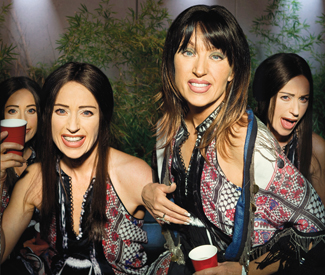
>>Drag artists re-enact Cindy Sherman portraits: view our “Tastes of Cindy” photo essay

The retrospective leads off with “Untitled Film Stills,” Sherman’s breakout 1980 series of 69 images, presented together in the show’s first gallery. These black and white photos, staged and composed to resemble European film promotion stills, show Sherman in costume and makeup inhabiting dozens of distinct, recognizable tropes and types. These are not self portraits, and understanding that point is a kind of prerequisite for digging beneath Sherman’s body of work. Although she appears in every image, Sherman is an actor playing a role. Or more precisely, she’s performing the act of recreating herself and slipping between multiple roles.

Completed when Sherman was 26, “Untitled Film Stills” sets out the major themes she would follow for the next 30-plus years: fascination with media and film, deliberate manipulation of photographic conventions, ability to stitch together and swap out identities like costumes, a flair for storytelling, and a complicated allegiance with the characters she invents.

And about those pictures. As both photographer and model for her images, Sherman appropriates, tweaks, and ultimately tries to outrun established photographic idioms. At the heart of these single-frame performances, Sherman couches the act of slipping into character within familiar conventions of portrait work — series formats include publicity stills (“Untitled Film Stills”); centerfolds (her 1981 work commissioned for and then scrapped by Artforum magazine); classical portrait painting (over represented, frankly, in this show); headshots (here, from 2000); and large-scale society portraits (from 2008). By turns creepy, gaudy, lurid, ugly, garish, and exhilarating, her photographs put up a testy fight to keep you from instantly or casually objectifying the woman or man — usually woman — in the image.

While each tableau is meant to show a persona, it’s also meant to keep you at distance. Her facial expressions throughout are steely, usually blank-ish, and they project thin personalities that reveal only slivers of the people behind them. Across series she repeats the same narrative beat in her work, namely a moment of resistance in her characters to being fully captured on film. She’s rubber and you’re glue. Your gaze bounces off her and sticks to you.

Still, don’t be fooled by what may seem to be sarcasm — she is emphatic and earnest about the complications of photography’s lies, and by extension about the sum of ways we can possibly present ourselves to each other. One of the main reasons art historians love Sherman’s work is that she injects complicated arguments into the trajectory of identity and liberation theory. In her work, you see traces of an adaptable, slippery identity that represents itself only by wearing and exchanging costumes and masks. The self in Sherman’s work is an actor that acts, and never leaves the stage. It’s not that mastery of appearances allows for the actual presentation of the real, it’s that appearances are the only thing there is. There is no presentation of the real, only the constructed reality of the presentation.

Viewed together with “Stage Presence,” Sherman’s work fills in for performance artists you might find oddly absent across the hall. She stands in for both Mike Kelley and Paul McCarthy, as well as Bruce Nauman. All the same concerns that those artists (yes, male) are known for — forces played out in the body by abjection, failed desire, absurdity, and the grotesque — abound in her work. In this context it’s hard not to see both commentary on and participation with those artists in her clowns, fashion, and grotesque series. This angle is made most explicit by her work of the last dozen or so years. Less referential to film, her headshots and society portraits since the late 1990s include more plausible, abject characters whose constructed lives and identities are in various states of decay.

For another day or two, Sherman’s photographs can be seen in contrast with the exuberant Jean Paul Gaultier retrospective at the De Young Museum (closing August 19). In some ways Sherman is the yang to Gaultier’s yin, both addressing the slippery nature of identity and the performance of norms through the clothes and apparatuses of presentation. Highly recommended.

CINDY SHERMAN

Through Oct. 8, $11-$18

San Francisco Museum of Modern Art

151 Third St., SF

www.sfmoma.org


Off the walls

3

arts@sfbg.com

VISUAL ART As the Cindy Sherman retrospective draws huge crowds to the San Francisco Museum of Modern Art’s fourth floor, visitors will find it the gateway drug par excellence for a neighboring show just a few steps away. Taking in Sherman’s frozen drag — in which visual art harnesses performance as both subject and tactic — is already to broach the invigorating dialogue underway in “Stage Presence: Theatricality in Art and Media.”

>>Drag artists re-enact Cindy Sherman portraits: view our “Tastes of Cindy” photo essay

The eclectic group show, curated by SFMOMA’s Rudolf Frieling, gathers choice pieces from the museum’s collection, plus some vital loans, to consider the increasing role of theatricality as theme and strategy in contemporary art since the 1980s.

It further includes a “live art” component courtesy of the museum’s curator of public programs, Frank Smigiel — a weekly performance series that continues through Labor Day weekend in a commissioned space adjacent to the gallery, a lush little jewel box of a theater-cinema designed by Bay Area artist Tucker Nichols. This week’s performance piece is a highly anticipated appearance by Los Angeles-based troupe My Barbarian: Broke People’s Baroque Peoples’ Theater, a raucous, multi-layered work that figures the American financial system as a garishly absurd spectacle of waste. (In addition to this site-specific series, a performance finale takes place October 4 in the museum’s atrium: Rashaad Newsome’s Shade Compositions, a choreographed choral work for 20 women of color.)

Whether live or otherwise, the bridging of the visual and performing arts in “Stage Presence” encompasses a truly wide range of work. Highlights include some fascinating projected pieces on view in one or another of the floor’s darkened recesses — each one furnished with a glass window allowing visual access from the gallery proper, whether or not one wants to venture into the screening room.

One of these is Charles Atlas’s Hail the New Puritan (1986), which collapses the visual and performing arts by way of a made-for-BBC faux-documentary portrait of Scottish dancer-choreographer Michael Clark, supposedly captured over the course of one monumental but half-desultory day as he and his company rehearse his New Puritan (1984). With endless interruptions and segues — and a soundtrack sharpened by ample doses of post punk’s jolly downers, the Fall (whose Mark E. Smith and Brix Smith even appear in a staged TV “interview” with Clark) — Hail the New Puritan remains a gorgeous work whose ’80s-era aesthetic (a little like Godard meets Culture Club) retains a questioning and mocking insouciance.

http://www.youtube.com/watch?v=PLm0tgyH4cc

It’s such jubilant indifference, including toward previous standards of seriousness or taste, that has contributed to a significant turn in much new work in the 1980s. Frieling, in an email correspondence from Europe, describes it as “a moment where the historic era of performance art and conceptualism had been challenged by a more exuberant, playful, and hybrid way of working — Charles Atlas, Peter Fischli and David Weiss, or Robert Wilson [all represented in the show] being three examples from that time despite their huge differences.”

Other salient themes running through the show explore the conceptual and practical possibilities in rehearsal, reenactment, and the speech act. To this end, the installation Today Is Not a Dress Rehearsal — which repurposes video of a Judith Butler lecture and other materials from an eponymous three-day collaborative performance by Mika Tajima (with her group New Humans) and Charles Atlas in the museum’s atrium in 2009 — offers subtle food for thought amid a visual and aural repositioning of a privileged form of address.

Also intriguing along similar lines is Sharon Hayes’s restrained yet progressively enthralling four channel video work, Symbionese Liberation Army (SLA) Screeds #13, 16, 20, & 29 (2003). In each of four television screens fixed with audio headphones, viewers see and hear the artist reciting from memory each of Patty Hearst’s four video messages to her parents while a hostage of the SLA in 1974, with prompting from an unseen audience each time she veers even slightly from the script. It becomes, especially in the era of Occupy, a resonant occasion for a collective act of remembering as well as re-presenting, re-creating, resituating, and reformulating an iconic but elusive link to a radical past.

“Rethinking formats of presentation is a key to many of the works and the whole show,” says Frieling. “We were ultimately interested in art works that stress this open process while reflecting about the conscious act of staging.” *

“STAGE PRESENCE: THEATRICALITY IN ART AND MEDIA”

Through Oct. 8, $11-$18

San Francisco Museum of Modern Art

151 Third St., SF

www.sfmoma.org


Mid-century modern

0

arts@sfbg.com

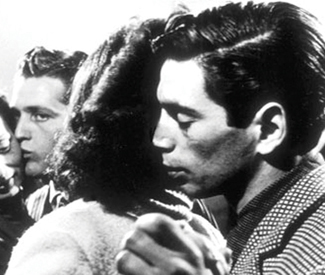
FILM After World War II, the hitherto miniscule U.S. market for foreign language films slowly opened up, partly due to G.I.s returning home curious about the countries they’d been stationed in. But mostly it was because bold new voices in European cinema were delivering a new realism that could be sold (even when cut by censors) as more “shocking,” “frank,” and “shameless” than anything Hollywood would hazard for years yet.

While Sweden, France, and other nations would soon catch up, the first to make a significant impact was Italy, whose artists chronicled the ruination it had to recover from after Axis defeat. Italian Neorealism, as the movement came to be called, looked like nothing else before it; even rare social-issue documentaries had been heavily doctored and sanitized by comparison. Reacting against the increasingly incongruous glamour of studio films made as war and Mussolini’s government wreaked havoc, the neorealists (largely film critics turned makers, as with the French New Wave a decade later) eschewed soundstages and trained actors for the real world. Lines between fiction and nonfiction were willfully blurred.

Leading neorealist films (which fast influenced American film noir and other genres) made a splash. That happened thanks to (or in spite of) misleading adverts for movies that were far from sexy: 1945’s Rome, Open City (resistance fighters caught, tortured, and killed by Gestapo), 1946’s Shoeshine (poor kids scapegoated by corrupt cops, thrown in prison), 1948’s The Bicycle Thief (desperate father and son lose the vehicle that provides their threadbare subsistence), 1952’s Umberto D. (old pensioner gets sick, evicted, suicidal). All these were directed by Roberto Rossellini or Vittorio De Sica, the first star neorealists.

By 1953 Italian cinema was moving on. It had begun to export bombshells (Silvana Mangano from 1949’s Bitter Rice, then Sophia Loren and Gina Lollobrigida); soon would come the sword and sandal epics and international co-productions that would make Rome a crazy hive of commercial filmmaking. Neorealism was on its way out, but as a brand it still had familiarity and a certain market appeal. Ergo a “second generation” of directors were introduced via Love in the City (1953), a recently restored six-part omnibus feature opening for a week at the San Francisco Film Society Cinema (side note: SFFS’s residency at Japantown’s New People ends August 31; the organization plans to shift its fall programming to various local venues).

It isn’t a great film so much as a great curio, and a crystal ball forecasting where the local industry would be head for the next 20 years or more. Little of that was immediately apparent, but just months later Federico Fellini (the sole director here who’d already made several well-received features) would cause a sensation with La Strada (1954). The others, including Michelangelo Antonioni, would eventually follow with breakthroughs of their own. The two surviving today are still active — in fact Francesco Maselli and Carlo Lizzani just contributed to a new omnibus feature last year.

Introduced as “a journal created out of film rather than pen and ink” — love being the topic of its first (and last) “issue” — Love in the City announces its “Raw! Revealing! Shocking!” intentions with Lizzani’s psuedodocumentary opening “article,” a series of interviews with alleged prostitutes. The next similarly surveys women driven to attempted suicide. While the style is as yet unidentifiable, the subject of profound, despairing alienation amid the crowd could hardly be more apt for young Antonioni.

Things lighten up considerably with a delightful set piece of amorous shenanigans in a divey dancehall, demonstrating the wry observation that would make Dino Risi one of Italian cinema’s greatest comedy directors. Fellini’s equally bemused vignette finds a young reporter investigating a matchmaking agency for a humorous story sobered by the plight of the poor, earnest would-be bride he meets.

These breezy episodes are followed by the most devastating. Maselli’s Story of Caterina, co-written by De Sica’s scenarist Cesare Zavattini, follows its plain, forlorn heroine (Caterina Rigoglioso) from bad to worse — impregnated and abandoned, she can neither return to the Sicilian family that’s disowned her or work legally in Rome to support her toddler son. The extremes to which she’s driven are bleakest tragedy.

Even the most frivolous of these segments capture the realities of urban poverty with unblinking authenticity. As if acknowledging that so much realism might be bad for the digestion, Love in the City ends on its silliest (and sole upwardly mobile) note. Future Mafioso (1962) director Alberto Lattuada’s The Italians Turn Their Heads finds all Roman mankind neck craning to leer at a procession of pretty women in tight modern fashions, each granted their own distinct lounge-music theme by composer Mario Nascimbene — thus silencing the chorus of wolf-whistles that would have been their real-life soundtrack.

LOVE IN THE CITY

Aug. 17-23, 2, 4:15, 6:30, and 8:45pm (no 6:30pm show Mon/20), $10-$11

SF Film Society Cinema

1746 Post, SF

www.sffs.org


Pläj

0

virginia@sfbg.com

APPETITE The world has become hooked on New Nordic cuisine in recent years, thanks to Copenhagen’s Noma, often referred to as the world’s best restaurant for three years straight, sparking a global interest in all things Scandinavian and a new generation of chefs.

Before this renaissance I dined at New York City’s Aquavit, back in the days when Marcus Samuelsson was still its chef. I reveled in Samuelsson’s clean dishes and shots of the restaurant’s eponymous liquor infused with horseradish or dill. As a fan of pickled herring, cured fish, and the like, I’ve long been drawn to Germanic and Eastern European cuisines. Perhaps my love for Scandinavian food was a forgone conclusion. I dream of taking a trip to the region to eat lutefisk (air-dried whitefish), and breathe in crisp air during long hours of summer daylight.

But then Pläj (pronounced “play”) opened in SF in June, tucked behind the Inn at the Opera and within sight of City Hall. I dined there during its opening week, and have returned multiple times since. Granted, what you’re about to read is an early take. The newborn restaurant needs time to come into its own.

Yes, Pläj is a hotel dining room, and off-putting smooth jazz and clubby Euro tunes often intrude, altering the mood of a meal. But bright orange accents and fireside seating warm up the blessedly peaceful space, and service is warmly welcoming, staff attentive and gracious.

Pläj isn’t so much New Nordic or Scandinavian-style minimalist. It’s more reminiscent of Aquavit: traditional dishes interpreted with a fresh regional spin, Scandinavia by way of Northern California. Chef-owner Roberth Sundell hails from Stockholm but has been in the Bay Area long enough to be well-acquainted with local ingredients, putting them to good use in Nordic-influenced dishes.

Working my way through every dish on the initial menu, I was happiest in the Fjord-seafood section that highlighted the best parts of Scandinavian cooking. A creative “taste of herring” trio ($12) brought fish served à la ginger-smoked soy, saffron tomato, and with coriander, chile, and lime on rye crackers. Rustic bread arrived at the table, artfully served in a paper bag.

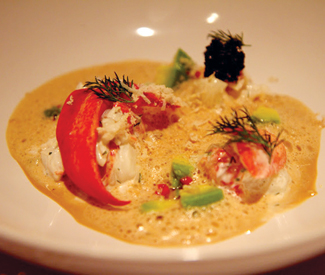
Krondill (crown dill) poached lobster is the seafood of choice for Sundell’s skagen, which is typically toast topped with a mixture that often includes poached shrimp, mayo, caviar. Beautifully reinterpreted here, lobster swam in a foam akin to bisque that was also made of lobster, with horseradish, avocado, and a hint of chili, all of it accented by white fish caviar.

Norwegian salmon belly gravlax ($9) proved to be buttery, thin slices of cured salmon over lemon crème fraîche, spicy grain mustard, and dill purée. Only the Alaskan halibut ($21) felt closer to typical: the fish came seared in herbs and partnered with shaved asparagus in a chanterelle emulsion. In a similar, though more traditional vein of meat and veg entree was the tender, porter-braised ox cheek ($22) topped with a mountain of fried onions. Other than the vibrant red, whipped beetroot the ox rested atop, the dish was well-executed, if not particularly memorable. Next time I’d go for traditional, comforting Swedish meatballs ($15), which were juicy in their pan gravy and bed of mashed potatoes, served with lingonberries and pickled cucumber that added a much-desired contrast of sweet and vinegar.

On the Hagen (“pasture”) or vegetarian section of the menu, burrata ($12) was pleasant, but its presentation was similar to countless burrata plates everywhere — heirloom tomato and greens. At least it wasn’t beets, which are obvious, overdone burrata companions. Barely-there aquavit in the vinaigrette could have set it apart if it was kicked up a few intensity levels. I found a subtle smearing of beetroot under a salad ($14) piled with Jerusalem artichoke, watercress, hazelnuts, and thinly-shaved layers of Västerbotten cheese and black summer truffles more interesting. Equally intriguing were the potato dumpling kumla ($12), dense and doughy dumplings in brown butter sauce that were savory with onion ragout and, once again, lingonberries.

Desserts ($8) are certainly pleasing — particularly the rhubarb crumble pie — but none left a major impression. Cocktails ($11) thankfully utilize Scandinavian spirits like vodka and genever (Dutch gin, often aged in wood so as akin to whiskey as gin.) Spirit-cocktail aficionados may crave more depth in a menu that leans toward sweet, subtle, and light cocktails. The Midsommar is promising: Pernod absinthe that delivers herbaceous notes to a Flor de Cana light rum, lime, and dill simple syrup. It was garden-fresh, a fine companion to seafood.

An all-Scandinavian beer list is spot-on, with pours like HaandBryggeriet Norwegian harvest ale ($14) or cheaper, refreshing Einstock Icelandic white and pale ales ($6 each.)

Pläj is a welcome newcomer to the SF dining scene — one I hope thrives as it dares to bring what we lack. What a delight it would be to form a “best of” list of Scandinavian eateries here, as we can with so many cuisines.

PLÄJ

333 Fulton, SF

(415) 294-8925

Subscribe to Virgina’s twice-monthly newsletter, The Perfect Spot, www.theperfectspotsf.com


Friends, love, leftovers

0

le.chicken.farmer@gmail.com

CHEAP EATS Georgie Bundle is my new favorite person. My ever-loving bassist and keeper of my records, he has at various times during our many years of friendship impressed me with his barbecued things and bass lines. His harmonies, his goosey Christmases… He once accepted custody of some hand-me-down chickens of mine and built a coop for them on his lunch break. It was next to the steps, under the avocado tree, as if my old ex-chickens’ existence wasn’t cartoonish enough.

Well, yesterday evening we stood on those steps in North Oakland, after work, and reminisced. We have such a rich and rhythmic history, but the subject of our nostalgic reverie was a fried chicken dinner he’d cooked up two nights before.

I was there! I love it when people make fried chicken, because it’s something I have never myself been able to do. In fact I only know, personally, a handful of people who have managed to fry the chickens in the comfort and coze of their own little kitchens: Kentucky Fried Woman (obviously), Ruberoy “Shortribs” Perrotta, Wayway…

And now this. Now Georgie Bundle. Dude bought $70 worth — in fact, “bought” might not suffice — dude fucking purchased $70 worth of healthy, grass-fed Sonoma County chickens, brined them overnight, dredged them through some kind of fancy-pants specialty gluten-free flour, bathed them in buttermilk, and then flour again before they hit the hot oil.

When we joined his Southern-themed dinner party, with our Hedgehog-made cornbread and my me-made okra and tomatoes, Bundle was three paper towels to the wind, pinballing between the counter, the stove, and the sink, high on peanut oil fumes. He had a thermometer in the oil, and did the breasts all together at one temperature, and then the wings, legs and thighs at an altogether different temperature.

I don’t know if I ever hugged a host or hostess harder.

Long story short, the chicken was the best chicken ever, but this weird anti-Jesus thing happened where, after everyone had cleaned their plates and licked their fingers and (if they were me) their wrists and forearms, there weren’t any seconds.

Hedgehog is a lot of wonderful things, but “the most gracious guest in the world” isn’t one of them. When she came back outside with a second helping of Everything But, her disappointment was palpable.

Sadness, she calls it now. “Mostly I was just sad. I went up there with hope in my heart,” she said, when I interviewed her for this story. Just now, in the kitchen.

Mr. Bundle and our very dear Yoyo were sad too, and confused.

“I don’t know what happened,” Bundle said. “It seemed like so much chicken while I was cooking it.”

“It was the best fried chicken ever in the history of the world,” I said. “That’s what happened. We disappeared it. Everybody got some.”

There were so many great sides, like roasted carrots and greens and mac and cheese, that nobody stayed sad for long and everyone went home happy.

Short story long: Next day I get an email from Georgie Bundle titled, “there was MORE chicken!” He had put a whole tray of it in the oven to keep warm, and then forgot about it. And here’s where the superhero comes out in him. He offered to deliver more chicken to anyone who wanted it. “Even if you don’t email me I might just show up with some chicken,” he said. “You’ve been warned.”

I did email him, of course. I’m not proud. And it really was awesome, awesome fried chicken. But we had been chicken-sitting in Alameda when the dinner happened, or we probably wouldn’t have been invited. In fact, I’m not sure we were, technically, invited. The point is, it was an East Bay thing. And by the next day we were back home in the Mission, so I was sure there was no chance of a Late Night Trans-Bay Leftover Fried Chicken Delivery.

I took a bath.

I fell asleep, as usual, in the bathtub. And when I came back upstairs to get into bed with Hedgehog, my phone was blinking. Georgie Bundle. Are you still up, can I bring chicken? I’m in SF.

So you see what I mean about superhero? Georgie Bundle is my new favorite person.

New favorite restaurant?

Curry Boyzz

Sun.-Thu. noon-11pm; Fri.-Sat. noon-2 am

4238 18th St., SF

(415) 255-6565

www.curryboyzz.com

AE,D,MC,V

Beer and wine


The trouble with demons

0

cheryl@sfbg.com

FILM Suspended between the deluge of superhero flicks and awards-show fodder (speaking of, check back next week for the Guardian’s fall movie preview), mid-to-late August is an outstanding time to go to your local art house, rep theater, underground cinema, or movie night in the park.

You could also seek out a pair of new movies from Asia, both opening Friday, which offer viewing experiences only similar in that they’re entirely different than anything else out there right now — or ever, in the case of Painted Skin: The Resurrection, a sort-of sequel to 2008’s Painted Skin (which one need not have seen to enjoy Resurrection).

Starring two of China’s most glamorous leading ladies, Resurrection is a lavish fantasy following the adventures of fox demon Xiaowei (Xun Zhou), who can become human only if someone voluntarily offers up his or her heart (as in, the actual blood-pumping muscle). Though she’s been rampaging cross-country trying to find a suitable man-donor, she spots a likelier candidate in Princess Jing (Vicki Zhao), who wears a delicate gold mask to conceal her scarred face. Jing has fled her royal duties to confront her true love, General Huo (Chen Kun), who is a generally nice guy and most excellent archer, but not a huge fan of the messed-up face. But wait! Supernaturally pretty Xiaowei has just the solution, and it definitely involves swapping bodies (and all-important internal organs).

But Huo is secondary here. Less a love story than the tale of a toxic friendship, Resurrection adds levity with a subplot about a demon hunter (William Feng) who falls for Xiaowei’s bird-demon sidekick (Mini Yang), and has plenty of over-the-top flair, with abundantly obvious CG and Kris Phillips’ campy performance as an evil wizard. It was a huge hit in China but will probably only reach a small audience here, so don’t miss your chance.

A different type of demon — the mental, fucks-with-your-emotions kind — infiltrates Hara-Kiri: Death of a Samurai, the latest from prolific director Takashi Miike. The speed of his output is nearly as dizzying as the array of genres represented in his filmography, though for Hara-Kiri, he sticks with the samurai milieu of his hit 2010 epic, 13 Assassins. That said, despite its equally suggestive-of-gore title, Hara-Kiri — which takes place some 250 years earlier than Assassins — is no limb-lopping extravaganza. Rather, it’s a surprisingly somber drama, with violence used judiciously (albeit gruesomely).

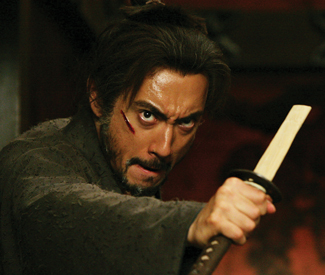
Solemn samurai Hanshiro (Ebizo Ichikawa, an acclaimed kabuki theater actor) appears before a feudal lord, humbly asking permission to commit ritual suicide in the man’s courtyard. But in this house, skepticism reigns over honor, thanks to a recent rash of “suicide bluffs” — it’s not death these downtrodden men seek, but sympathy in the form of handouts or job offers. In fact, there was a suicide bluff recently, right there in the courtyard. A young man named Motome. It ended badly.

It’s soon clear that Hanshiro and Motome are connected, and the circumstances that motivate their extreme behavior are indeed tragic and deeply felt. Miike takes his time getting there, though, and fans seeking breakneck mayhem may be disappointed. Side note: for whatever reason, Miike filmed Hara-Kiri in 3D, but it’ll be screening in old-school 2D during its local run at the Four Star.


PAINTED SKIN: THE RESURRECTION and HARA-KIRI: DEATH OF A SAMURAI open Fri/17 in San Francisco.

Suspended in the groove

2

arts@sfbg.com

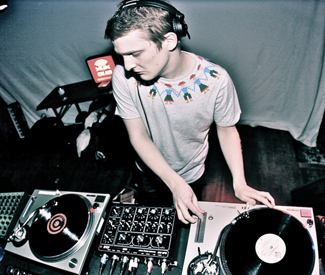
MUSIC Out of nowhere an isolated house groove surfaced from the ether of the Internet and touched an unexpected chord. It was called “Love Me Like This,” a throbbing re-edit of the early 1980s track of the same title from R&B group Real to Reel. Its author was an unknown British musician going by the name of Floating Points, a gerund whose aerial element reminded me at the time of another producer closer to home, Flying Lotus.

Apart from names, both applied jazz tendencies to their electronic compositions. And both were involved respectively in a loose constellation of musicians and producers, whose inspired theorizing on low end frequencies had just begun to crack apart the stale course taken by much of dance music, exploding it into countless directions.

This was the case in, at least, that nebulous sphere of grassroots creativity that many still lovingly call the underground — in which the alleged distinction between dance and head music (or, in industry parlance, between electronic dance music and intellectual dance music) just doesn’t make any sense. Is it head music dancing? Dance music getting head? How about this: dance music about dance music. That’s heady enough. And if you think I’m dancing around the issue, then I would be so lucky to have got my point across.

Putting my word games aside, Floating Points’s music hits a sweet spot. Something about “Love Me” suspends you in midair. Syncopated percussion lurches ahead, offset by a wandering snare. The song unravels joyously, arriving and departing from a series of peaks where the programmed drums and swirling vocal refrain come to be utterly overwhelmed by lush arpeggios, sweltering keys. Most of what we tend to place under the category of dance music operates precisely this formula in which claustrophobic discomfort builds and holds itself back until it’s finally spent in an expulsive release. Again and again. Floating Points, who is also called Sam Shepherd, often executes this to brilliant effect.

But something else can happen too, where the difference between claustrophobia and release is suspended. It’s as if, against all odds, you feel both restraint and letting go at the same time. And there you are, floating in the delay between them — in an extraordinarily ecstatic shuffle where the climactic drop that has become so essential to the huge financial success of EDM festival acts just doesn’t even count anymore. You’ve been taken instead somewhere else, outside of the drop’s comfort zone.

“Love Me Like This” appeared from nowhere more than three years ago, before anyone really knew the name Skrillex, before dub-step would begin to sell its signature wobble to the popular consumption of American cars and Brittney Spears’ songs. Then, Californian producers were in the midst of reinventing instrumental hip-hop, while others toyed with the boogie funk of Prince, as the sounds of UK club culture filtered into this experimental space.

I remember waiting impatiently for two specific aspects of these worlds to collide — waiting for someone to take what Dam-Funk was doing in Los Angeles with bounce driven soul and fissure it with the two-step drum patterns that made all the sub-genres splintering from and around dub-step sound so interesting. Floating Points answered my silent wish.

I exaggerate my prescience here, though, because Shepherd far exceeded whatever I could muster in anticipation. His first proper release was a seven-inch record that debuted Eglo Records, which he co-founded with Alexander Nut in London. The single’s two tracks stem from the disorienting free jazz belonging to another incessant breaker of rules, Sun Ra. “Radiality” warps Ra’s “Lanquidity” into a plosive shattering of synthetic rhythms and melodies. The way the groove lobs in time is a bit like the floating I mentioned earlier — there we are, languishing warmly in rhythm.

A couple EPs, a number of singles, remixes, and collaborations followed. On Vacuum, Shepherd shows that he can just as well make a no frills house groove. Subtle narrative arcs made up of punchy bass lines and sticky keys invite you to surrender willingly to the beat. Shadows is a bit more experimental. The extended compositions are fractured: bass lines disappear into quiet piano solos, chords dissolve into pulses spiraling in concentric circles around themselves. From these shallow swirls of sound arise huge swells of energy, only to dissipate once again.

Some of Shepherd’s most magnetic music, though, features fellow Eglo signee Fatima on vocals. She not only sings wonderfully with the Floating Points Ensemble, but has also done significant work of her own with Shepherd on production. What sticks with me most is last year’s Follow You EP, a subtle and lovely take on the intoxicating inner visions that music can conjure.

It turns out Floating Points is a classically trained musician, who only moonlights on analog drum machines and synthesizers. A great deal of his waking hours are otherwise devoted to pursuing a Ph.D in neuroscience. I assume that’s why it’s taken Shepherd this long to touch down in San Francisco for a live performance. And thanks to the curatorial teamwork between DJ Dials and Noise Pop’s Dawson Ludwig, he’ll join the eclectic bill for the upcoming Scene Unseen event.

Set among other headliners — including both the extravagant rapper, Riff Raff (who will be played by none other than James Franco in an upcoming film directed by Harmony Korine), and the showy Chicago duo, Flosstradamus — I’m not sure what to expect. Add to that set list two experimental beatsmiths from LA, Dibiase and Groundislava, as well as locals Ghost on Tape and the DJ crew KM / FM, among others, then you’ve pretty much run the risk of nullifying any categorical expectation. It’s really quite a gamble. Then again, that’s the liminal space in which Floating Points has thrived, and in which tomorrow’s music has always thrown its dice.

FLOATING POINTS

With Riff Raff, Flosstradamus, and others

Fri/17, 10pm, free with RSVP

1015 Folsom, SF

www.1015.com

Outer limits

0

arts@sfbg.com

MUSIC Last year, we thought it couldn’t get better, and then it upped the ante. Outside Lands 2012 takes place this weekend, and the lineup is packed with legendary performers, reunited favorites, and flashy newcomers, pieced together (some overlapping) in a masterful Golden Gate frame, outlined by all that glorious flora and fog.

There’s little to debate; our inboxes have been unequivocally flooded with requests to cover the event from the moment the full list roared onto the web. Who’s to say what sparked the revved up offerings and subsequent queries?

The facts: 72 bands on stage, 15 DJs in the Dome, 25 comedy-variety acts in the Barbary, plus 10 night shows featuring 20 performers. Expected attendance is more than 65,000 people per day, according to the organizers.

It’s a lot to take in, even for the seasoned San Francisco festival-goer (keep hydrated, wear layers, duh). So we’ve whittled down the schedule to the must-sees — those with a certain unscientific combination of vitality and vigor, of historical significance and a very-modern presence.

Of course, if you’ve got a one or three-day pass, you’re likely planning on packing in as many acts as possible, with perfectly timed bathroom, wine, and gourmet food stand breaks. But if you’re of the looser sort, one to wander with feckless abandon among those throngs, keep the below in mind.

Here are your must-see Outside Lands performances:

THE BIG ONES

Headliners and icons

Watching an old friend dance with his bride to iconic folk ballad “Harvest Moon,” it dawned on us: despite his gruff persona, broadly influential singer-songwriter Neil Young & Crazy Horse (8:10-9:55pm Friday, Lands End) is for lovers. And his words — and strumming — are deeply personal for a handful of generations. They’ve left a yearning imprint on our collective pleasure center.

This is a grand return for ’90s indie rockers, Grandaddy (5:10-6:10pm Saturday, Sutro). The Modesto five-piece split in 2006, after a respected career that included touring with Elliott Smith (RIP) and a song, “AM 180,” used in a memorable zombie-less supermarket sweep scene in 28 Days Later.

Kill ‘Em AllAnd Justice For All…okay, and we guess St. Anger. The heavy metal — and then some other stuff — back catalogue of Metallica (7:55-9:55pm Saturday, Lands End) is forever drilled into our brains. In a press call leading up to the fest, drummer Lars Ulrich said, “we’re very proud of our…relation and our history with San Francisco,” (does that mean the band will do us a solid and play early tracks?), later adding, “it’s an amazing thing, 31 years into a career to be able to be as busy as we are and to [see] people give a shit and to be able to still tour.” We give a shit, Lars.

As one fan noted, Mr. Superstition, Steve Wonder (7:20-9:30pm Sunday, Lands End), is likely the most creative choice of a headliner in 2012. And it makes the night-map easy for some of us; in the scheduling contest between dub-monster Skrillex and Motown icon Stevie Wonder, there is no contest.

LOCALS ONLY

Best of the Bay represented

It’s been five years since Two Gallants (1:50-2:40pm Friday, Lands End) released an album, and this fest (along with the OL night show) are the first local shows for the folk-punk duo touring on the new record, The Bloom and the Blight. Seems they’ll have a lot of stowed away energy to release in the park.

Perhaps never has man and computer so beautifully collided than with San Francisco digi-rock act Geographer (2:10-2:55pm Saturday, Twin Peaks). Swelling vocal melodies blend so evenly with darting beeps and blurps and laser synths, sometimes deepened by floating violin. It’s hard-rocking orchestral pop, operatic robot love, and world travel in a machine. The band paid its dues playing Rock Make, Treasure Island, Live 105’s BFD, and now, Outside Lands.

These San Francisco pysch-surf-punks are notorious for their headspinningly prolific songwriting, unpredictable live shows, and spastic energy. Regardless of what happens during Thee Oh Sees (6:05-6:45pm Saturday, Panhandle) set, it’ll be an act people are talking about.

THE ANDY WARHOL FACTOR

Who everyone will be Tweeting about

Having just premiered barely pronounceable single “XP€N$IV $H1T” (“I rub my dick on XP€N$IV $H1T” being actual lyrics) it’s safe to assume that Southern African freak-rap trio Die Antwoord (5:25-6:15pm Friday, Twin Peaks) is going to continue down a path of what-the-fuck-did-I-just-witness trashy splendor. There will be rave wear and Ninja’s inexplicable junk-thrusting dance moves, DJ Hi-Tek records spinning, and Yo-Landi’s hyper-high chirp.

When Father John Misty (2:55-3:35pm Saturday, Panhandle), a.k.a. J. Tillman of Fleet Foxes, stopped by Bottom of the Hill earlier this year, folks didn’t know what hit them. FJM was a wild force on stage, engaging in an ongoing and increasingly odd conversation with the audience, with quips and asides a-plenty in between a hectic set of woozy pop and crunchy-hippie psychedelic jams.

Perhaps not since Janis Joplin, have we heard a lady blues vocalist with pipes this powerful. That wail is a show-stopper. And, four-piece Alabama Shakes (3:50-4:40pm Saturday, Sutro), led by Brittany Howard (she of the powerful pipes), is actually born and raised Alabama, as the band name would imply, meaning its a more authentic experience, it would seem.

After a prolonged break, Santigold (5:10-6pm Sunday, Twin Peaks) dropped long-awaited Master Of My Make-Believe this year, with reggae-flecked party jam single “Disparate Youth,” cut through with a machine-gun guitar riff. Clearly, Santigold is no less bold in her return. Both the sound and her avant-pop style will surely absorb those expansive outdoor stages.

WORLD TRAVEL

Globally relevant bands from far and wide

Sigur Ros is not the only Icelandic band at Outside Lands 2012. If ambient soundscapes aren’t your thing, check out the lesser-known folk sextet Of Monsters and Men (5:25-6:25pm Friday, Sutro), which balances catchy melodies with beautifully harmonized vocals. Amadou & Mariam (3:35-4:25pm Sunday, Twin Peaks) met at Mali’s Institute for the Young Blind. What the African duo lacks in 20/20 vision they make up for in mesmerizing sound — irresistible hip-hop-and blues-inspired world music. We dare you not to dance. Globally recognized Columbian culture-masher band Bomba Estéreo (6-6:40pm Sunday, Panhandle) mixes in the sounds of Latin America, the Caribbean, reggae, dub, and beyond, with bouncy hip-hop beats. Live, lead vocalist Li Saumet (who this year also released a side-project in which she imagines killing her boyfriend) pumps up the energy tenfold.

SONIC BREAK

Explore beyond the music

Imbibe in yeasty concoctions at this year’s first ever Beer Lands (oui, Wine Lands will be there too). And the beer lineup is made up of local craft breweries: 21st Amendment, Anchor Brewing, Magnolia, Pac Brewing Labs, Speakeasy (all San Francisco); Bear Republic (Russian River area), Drakes, (San Leandro) and Linden Street (West Oakland). Oh, and Sierra Nevada is debuting the Outside Lands Saison at the fest, said to be inspired by OL itself. Reggie Watts, Neil Patrick Harris, David Cross, Kristen Schaal, Nerdist Chris Hardwick, the list goes on for The Barbary. The comedy and variety tent keeps getting bigger, and weirder. There are the big names of course (see above) but also some awesome homegrown talent — Jesse Elias, for one. We caught him in the Cinecave last month, and were blown away by his timing. Our cheeks ached from laughing. And he never once looked up at the audience, only moving to push his glasses back up his nose.

OUTSIDE LANDS MUSIC AND ARTS FESTIVAL

Fri/10-Sun/12, noon, $95

Golden Gate Park, SF

www.sfoutsidelands.com

Giving you L1fe

2

marke@sfbg.com

SUPER EGO Summer has been carrying a look. A killer neon queer hip-hop wave is splashing across better dance floors, raiding classic i-D magazine spreads, relaunched Boy of London lines, and cheeky RHLS lookbooks (or anything coming out of former SF club kid Frankie Sharp’s insane Tuesday night Westgay party in Manhattan or our own Future| Perfect, Stay Gold, or Swagger Like Us), and soundtracked by ghetto gothic vogue beats and freaky Internet-pastiche rappers. Who knew vogue dramatics and a retro-MS Paint aesthetic would save hip-hop? Somehow a rupture opened in the forcefield and a way ahead appeared.

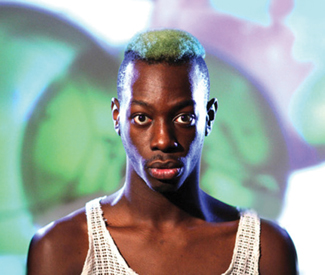
“I’m totally coming from the Internet, I can be honest about it,” emblematic star Le1f tells me over the phone from his home in NYC, when I ask him about his look and feel. (He’s performing at the Lights Down Low party Sat/11, 10pm-4am, $10–$18 at Monarch, 101 Sixth St., SF, www.monarchsf.com) “It is what it it is, and very natural to me. I’m very much about digital mystique, completely inspired by open source culture. I wanted to be an avatar when I grew up.”

The whip-smart MC has indeed become an avatar of a kind. On the strength of his bass-a-holic, fiercely gay mixtape Dark York, which dropped last April and tapped bleeding-edge producers Ngunguzungu, Booody, Cybergiga, and Morris, and especially track “Wut?,” produced by SF’s 5kinandbone5, with its brilliant accompanying video, Le1f has been branded as the face of the “new queer hip-hop,” if that’s even a thing. In a post-Frank Ocean world, it’s been hilarious watching larger media awkwardly trying to address this whole gay thing. In some cases, critics have been surprised that a gay rapper’s voice can be so low. (Le1f often sounds exactly like 80 percent of the black gay men I know, which is what’s so completely refreshing about him blowing up.)

“I’ve seen the comments, and although I can’t directly address anyone’s personal audio-homophobia, I will say that I do play with different voices and characters — and maybe people are bugging when I’m in my erotic creepy zone. I’m only getting deeper and darker, though.”

I guess why not let new queer hip-hop be a thing, when Le1f is lightening our loafers and intriguing fellow DIY homo-cosmic rappers like Zebra Katz, House of Ladosha, and Mykki Blanco are getting second looks. (Maybe some of the media shine will rub off on our own totally worthy Micah Tron.) Still, there are no outright political statements here — “Conscious rap is not my favorite type of rap,” Le1f has said — nor is there a desire to work in the still-lively, decades-old homo-hop tradition. The new queer hip-hop deal is more about doing your own hyperreal thing, posting alien emoticons from another dimension to killer abstract beats and feeling sexy about it.

Le1f studied dance for most of his life and received advanced training at Wesleyan University (he’s responsible for the beats behind fellow Wesleyan rappers Das Racist’s “Combination Pizza Hut and Taco Bell”), yet told me, “I always wanted to be a rapper. I mean, I was a gay kid at a boarding school, it was the furthest escape I could think of. ” He cites influences from Missy Elliot to seminal vogue DJ MikeQ, but when it comes to traditional hip-hop audiences and their reactions to all the awesome weird that seems to be flooding into the scene lately, Le1f says, “I really have no connections whatsoever to those crowds or those types of performers. I’m sure they have a scene, and that’s great for them — just like my scene is vibrant and right for me.”

The current popularity of Dark York, which took three years to record, and even some of Le1f’s media spotlighting as a “gay rapper” are all part of a painstaking masterplan. “If people are freaking out now, wait until they see my next video, for ‘Mind/Body.’ I’m an alien transsexual being writhing in a trance rave cosmos.” You need to take us there, Le1f.


#Y3K | URL IN IRL

“I generally feel like 18 and over parties pander and talk down to their audience,” mega-wicked promoter Marco de la Vega tells me. “So I’m trying to focus on the opposite.”

Um, talk about respect — here’s the dark, dreamy, bass-crazy lineup of his first monthly youthful assay: Gatekeeper, Teengirl Fantasy, Nguzunguzu, 5kinandbone5 with secret spec1al guest, and the Tenderlions. Good thing I turned 18 last month, see you there.

Fri/10, 10pm-4am, $10–$18. DNA Lounge, 375 11th St., SF. www.dnalounge.com

Korean commotion

0

virginia@sfbg.com

APPETITE The nation’s on a kimchi kick. Truth be told, California has long been home to some of the country’s densest Asian populations, so here in the Bay Korean cuisine is at a crossroads — is it a staple? Exotic novelty? With the help of a few new openings, the answer may be shifting. Despite a smattering of Korean BBQ joints in SF and a concentrated Korean population in Oakland, it hasn’t been until the last few years that I’ve witnessed local Korean eateries offering much beyond barbecue.

But now, thanks to the forward-thinking fusion of Namu Gaji and home-cooked joys of To Hyang, Nan, Manna, and Aato, the Bay is getting a crack at more diverse Korean offerings. In Oakland, good times can be had at the “porno bar,” a.k.a. Dan Sung Sa (2775 Telegraph, Oakl. (510) 663-5927), so-called due to the Korean film posters lining its walls, though there’s actually nothing explicit to be seen. Its fried chicken, Korean beers, and comfortably dive-y atmosphere evoke an under-the-radar speakeasy vibe, reminiscent of long-timer Toyose (3814 Noriega, SF. (415) 731-0232), tucked away in a similarly relaxed spot in an Outer Sunset garage.

Here’s two stand-outs in a wave of openings that exemplify the gourmet fun of casual Korean snacking, both an ideal locales for cheap beers with good friends.

ARIA KOREAN AMERICAN SNACK BAR

The Kim family has taken over what was once the Old Chelsea Fish and Chips space in the Tenderloin. Aria Korean American Snack Bar is a closet-sized eatery — still appropriately dingy for its bustling block, but the Kims have infused it with fresh life, greeting visitors with a smile and a record player stocked with Tom Jones and Sinatra LPs. Mom and Pop Kim run the place, though their son and his girlfriend have come up from LA to help them get going.

The family has a hit on its hands with the Korean fried chicken (nine pieces for $6.99-7.99, 16 pieces for $12.99-13.99). It feels like everyone is doing KFC these days, but these boneless, overgrown nuggets are special: crispy-tender and fried in cottonseed oil, with zero trans fat. Dip them into earthy-sweet spicy sauce and an addiction will be born. Mama’s acidic sweet-and-sour radishes are just the right accompaniment to clean the palate and perk up the taste buds.

There’s also an array of fried snacks from mixed veggies (carrots, sweet potato, zucchini, onion) to seaweed rolls packed with potato and glass noodles (eight pieces for $5.99). Hot and spicy rice cakes ($5.99) are another of mom’s recipes. They arrive blessedly chewy, sitting in — what else? — a spicy red sauce. The Kim family good cheer and authentic fried bites make this the kind of snack bar every neighborhood should be so lucky to have.

932 Larkin, SF. (415) 292-6914

FUSEBOX

Tucked away in a sunny courtyard off desolate West Oakland streets sits FuseBOX, a truly exciting haven for Asian fusion. Those looking to categorize its food could satisfy themselves by calling it Korean food served Japanese izakaya style, but the FuseBOX mashup goes above and beyond this simplification.

In the three months it’s been open, this cash-only respite created by Sunhui and Ellen Sebastian Chang offers daily robata specials ($1–$3). Granted, these are merely bites, but there’s real joy in sampling this range of grilled vegetables and meat.

From the spare, industrial interior sparsely dotted with tables to rice purified with binchotan, or Japanese white charcoal ($2), it’s clear this no typical Asian eatery. There is — of course! — KFC ($5), although here it is lightly fried, yielding spicy chicken more akin to buffalo wings than the aforementioned boneless chicken at Aria. Bento box-like “BAP sets” ($6-10) offer meat or veggies alongside rice and banchan or panchan (mini-dishes that often accompany Korean meals that could account for the name of these plates on the menu), which rotate daily. Spinach roots and French breakfast radish crowns are brined in mustard and nori, and sesame leaves are pickled in soy, white zucchini or green mango in vinegar. Kimchi comes in multiple forms, including versions made with bok choy and kale.

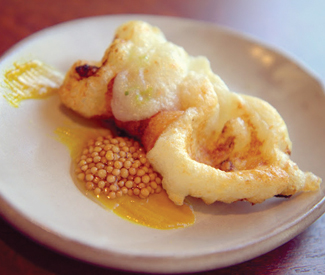
Robata specials are grilled on wood skewers. There’s okra and snap peas and tender chicken “oyster” cuts. The best bite of all? Bacon mochi ($2.50). The mochi is sticky, subtly savory, and gummy, satisfying on its own merit — until you reach the bacon and accompanying mustard seeds. I’d eat this fantastic bite for breakfast, dessert — basically any way at all. For bigger appetites, there’s sandwiches ($8) like a Tokyo po’ boy laden with fried chicken, red cabbage slaw, house mayo, and pickles.

To drink there’s a bracing, cool roasted corn tea ($1), chilled and nearly creamy with fresh corn flavor. Other drink options include Tang (yes, Tang!), house barrel-aged soju, and glasses from the neighbors, like Alameda’s Rock Wall Wines and beer on tap from Oakland’s Linden Street Brewery. FuseBOX is only open Wednesday through Friday, 11:30am—2:30pm, but promises that its dinner menu will soon be operational. As its hours expand, I’ve no doubt it will become even more crowded than its three-day-a-week lunches already are. There’s no place like it.

2311A Magnolia, Oakl. (510) 444-3100, www.fuseboxoakland.com

Subscribe to Virgina’s twice-monthly newsletter, The Perfect Spot, www.theperfectspotsf.com


Poppin’ off

1

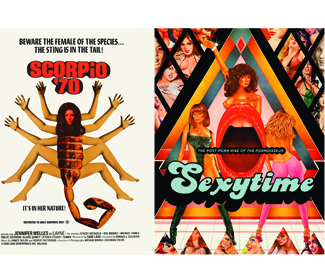
TRASH The late, beloved Werepad begat the Vortex Room, the former closing when co-founder Jacques Boyreau moved from SF to Portland, Ore. But ties between those concerned with both venues remain tight, and August is a big month for them all. Firstly, it sees the release of Boyreau’s latest coffee table tome, Sexytime: The Post-Porn Rise of the Pornoisseur (Fantagraphics, 96pp., $29.95). Really, you might ask, does there need to be a book devoted to full color reproductions of posters from the “golden age” (circa 1971-82) of XXX features?

Ohhhh yes. These hundred pages excavate a retro wonderland of film-shot sleaze with the usual tasteless ad lines (Finishing School: “She took a cram course in pleasure”) and graphics variably dime-novel crude, psychedelic, and disco-era slick. There are titles topically trendy (CB-themed Breaker Beauties; Erotic Aerobics; Patty Hearst-inspired Tanya) and parodic (Blazing Zippers; One Million Years AC/DC; Flash Pants). There’s even cautionary sexploitation, as the sheet for 1976’s Female Chauvinists warns “DO YOU KNOW: Women libbers are planning to take over the world? That they have recruiting camps in every corner of this planet?” So that’s where Rush learned about feminism.

Meanwhile back at the Vortex, the venue’s fifth anniversary is being celebrated through the month’s end with a Pop art-themed series of Thursday night double bills. It doesn’t get any more Pop, or Op, than incredible and inexplicable The Touchables, which despite its obscurity today was actually a mainstream 20th Century Fox release in 1968. Ah, the Sixties. This was just a simple tale of four Swinging London model types who, after stealing a Michael Caine dummy from Madame Tussauds, decide to be more ambitious and kidnap a live male pop star. They then take him to their giant-inflatable-plastic-dome country hideaway, torture him with sex play and go-go dancing, and unknowingly await the arrival of gangsters hired by a gay wrestler who also covets the abducted lad.

You know, that old story. Keen minds thought up this insanity: Robert Freeman, the Beatles’ “official” photographer making his directorial debut, cooked up the screenplay with Ian La Frenais (future Tracey Ullmann collaborator) and Donald Cammell (soon to be responsible for 1970’s Performance and 1977’s Demon Seed). The Touchables‘ co-feature is the almost equally daft Deadly Sweet (1967), another Swinging London artifact, albeit one directed by Italian Tinto Brass, who had yet to meet Caligula or his true calling as ass-man equivalent to Russ Meyer’s boobaholic in the softcore sexploitation hall of fame.

Next week things settle down a bit with Streets of Fire, Walter Hill’s fetishistically stylized 1984 music-video fable, and 1971’s Captain Apache, a weak Euro Western enlivened by a trip sequence and Carroll Baker’s apparent belief that she’s acting in a farce.

Then the weirdness level rises dangerously again August 23, with two lysergically bent missives from the “turbulent” decade. From 1969, Cult of the Damned (a.k.a. Angel, Angel, Down We Go) is the least-known of American International Picture’s psych flicks, and no wonder — compared to giddy The Trip (1967), Psych-Out (1968), and Wild in the Streets (1968), it’s a twisted downer. Future feminist singer-songwriter icon Holly Near plays the plump, unhappy only child of a jaded Hollywood couple whose household is seduced whole by rock singer Bogart (Jordan Christopher) and his entourage. Advertised with “If You’re Over 30 This Is A Horror Story,” Robert Thorn’s only directorial feature is rancid, baroque, and bizarre to no end, offering the opportunity to hear Roddy McDowell say “Baby man, I am just sexual. Like sometimes I can just stare at a carrot and baby man, that carrot can turn me on,” as well as Jennifer Jones (as mom) brag “I made 30 stag films and never faked an orgasm.” (It should be noted that shortly after completing her role, Jones had a nervous breakdown.) Cult‘s co-feature is 1962 sci-fi oddity Creation of the Humanoids, which was purportedly Andy Warhol’s favorite movie — that should be recommendation enough.

The series’ final bill moves upmarket to showcase two expensive early 1970s flops. You may search in vain for defenders of 1972’s Bluebeard, which features Richard Burton as the famed ladykiller and an array of Eurobabes as his victims — alas, not including American lounge-act extraordinaire Joey Heatherton, whose final wife is by far the most annoying but lives to tell. For a movie that features Raquel Welch as a nun, it’s pretty slow going, despite some imaginative production design and hints of a satirical zest that old-school Hollywood director Edward Dmytryk just couldn’t grok.

A more rewarding curio is 1974’s 99 and 44/100% Dead, a gangster spoof that supposedly represented a career nadir for director John Frankenheimer. (Actually, his nadir came the prior year with Story of a Love Story, one of those movies so interesting in concept and cast you can’t imagine it’s worthless — until you see it.) What can you say about a film that features Chuck Connors as a thug who screws different lethal weapons into his severed arm socket? Plus a rare appearance by the mysterious Zooey Hall of I Dismember Mama (1972) and Fortune and Men’s Eyes (1971)? That it can’t be all bad, and in fact it isn’t.

POP GOES THE VORTEX

Thursdays through Aug. 30, 9pm, $7

Vortex Room

1082 Howard, SF

Facebook: The Vortex Room


Eternal return

1

marke@sfbg.com

MUSIC Those were days of mystery, when a rare album would come to you like a message from alien shores, a spectral cryptogram, the crackle of the plastic wrap as you tore it open subbing in for ghostly static. Especially if that album found its serendipitous way to you (breathtakingly arty gay older coworker, amazing cool girl from another high school who lived in her parents’ patchouli-scented basement, astronomical sum plunked down at unerring record store clerk’s slightly condescending suggestion) from willfully obfusc label 4AD, its releases so calculated to transcend earthly bonds that you could barely figure out the lyrics, let alone what possessed angelic being those mouthfuls of gothly warbled vowels belonged to. The label was notoriously recalcitrant about exposing its artists to mundane promotional hoo-haw. Pre-Internet, this often insurmountable unknowing became almost erotic.

And more than any other act on 4AD’s roster in the 1980s — more than Cocteau Twins or Throwing Muses, more than the vague amalgamated entity known as This Mortal Coil — Dead Can Dance (appearing Sun/12 at the Greek Theatre) embodied and perpetuated this exquisitely agonizing inscrutability. You knew they were an Australian-British duo that traded in deep musico-anthropological investigations worked up into stately, chthonic pop, you knew their names, you even saw a picture or two. But that was a close as you’d get to any kind of intimacy. The music (and of course the iconic cover art — I still dream of the imagery for albums Spleen and Ideal and Within the Realm of a Dying Sun) had to stand for everything.

http://www.youtube.com/watch?v=IM2Z6WnZqGY

So it was a bit unsettling for me to be on the other end of the phone from DCD’s high priestess of eerie glossolalia, Lisa Gerrard, as she dished about her tumultuous relationship with her musical partner, Brendan Perry.

“Oh, we had such fights, such awful fights — wrecking things, really, in the studio, and often we’d just have to separate ourselves,” she told me, her wonderfully animated voice ringing clear with a certain pastoral mysticism.

“But you see, darling, it was all in service of the music, this powerful force that we tap into together, that comes through us into the world. We had to learn that we just can’t force it, the power must emerge when it’s ready. You must be very patient and wait for the unlocking to begin — the great unlocking that connects all literature and art, and shines through in our shared humanity.

“We can’t weave the specific threads of this underlying magnificence if the loom isn’t there. You must have the loom. Now, we feel we’ve found it again.”

Specifically, Gerrard was referring to the fact that solidly pleasurable and Middle Eastern-tinged return to form, Anastasia, to be released on August 12, is the first Dead Can Dance album in 16 years. The pair has kept themselves very busy in the meantime. Gerrard produces highly acclaimed soundtracks for movies like Gladiator and The Insider and Perry, the more somberly bucolic of the pair, has converted a mid-19th century church in central Ireland into a studio, Quivvy, where Anastasia and several of his solo albums were recorded.

After a focused but exhausting reunion tour in 2005, the pair found it wasn’t the right time to reconnect in the studio and headed back to separate lives in different hemispheres. (Prominent in the pair’s press materials is the fact that their physical relationship ended in the early ’90s.) But a couple years ago, Perry commented on his online forum that the two were talking, and sure enough Anastasis, the Greek word for resurrection, was born.

The album weaves Platonic and Ayurvedic philosophical sentiments into esoteric folk-derived rhythms and eerie chant-like vocals — although they’ve left 4AD for the more, er, familiarly named Play It Again Sam label, they’ve retained the occultish fabric of the 4AD DCD sound, with its usual deliciously shivery rewards.

“Working on the album, we relished the opportunity to work with new instruments like the hang [a UFO-shaped Swiss instrument that crosses a steel drum with a gamelan gong] and a host of other percussion that we’ll be talking on the road with us,” Gerrard said about the tour, “as well as another fantastic singer who we’ve trained to double my vocals so we can really bring out the sounds of our older catalogue. I can’t wait to uncork those songs for everyone at the beautiful Greek Theatre in Berkeley. They’re just the right vintage now, they’re so ripe for the ears, if you will.

“And our new ones, we’re working in 6/8, 9/5 time signatures in these lovely Sufi and Eastern traditions. It really is going to be a show — but we’re putting so much practice into it, it’s not just feeding everything into a digital machine.”

About that digital machine: how does Dead Can Dance feel in a world of instant access — and a lot less mystery when it comes to musical artistry?

“Connection is both the key and the mystery, darling — it depends where its coming from. We try to locate ourselves within the connective tissue of an ur-culture that can free us from the suffocating membrane of mediocrity.”

DEAD CAN DANCE

Sun/12, 7:30pm, $39.50

Greek Theatre

2001 Gayley Rd, Berk.

www.apeconcerts.com

www.deadcandance.com


Fangs, but no fangs

0

arts@sfbg.com

FILM The whole “lesbian vampire” thing may seem a very 20th-century, pop entertainment trope, as it blends sex and violence in one neatly exploitative package offering voyeuristic maximum appeal to straight men, long perceived as the primary audience for both horror and erotica. (In recent years, however, that assumption has begun to seem outdated.) But in fact Irish writer Joseph Sheridan Le Fanu’s Gothic novella Carmilla was published in 1872, a quarter-century before Bram Stoker’s Dracula, thus placing lesbian vampires well ahead of heterosexual ones in literary history. If that order was reversed in movie history, well — you can’t expect much girl-on-girl action to have surfaced before censorship standards began crumbling in the 1960s.

That decade began and ended with two major Carmilla adaptations: French horndog Roger Vadim’s 1960 Blood and Roses (originally titled And To Die of Pleasure) and the English Hammer studio’s 1970 heaving-bodice marathon The Vampire Lovers. Since then, lesbian vampires on screen have become ubiquitous.

They’ve usually been distinctly designed with the “male gaze” in mind, however, appealing to that guy-spot which (to quote the inimitable Axl Rose) would “rather see two women together than just about anything else.” Inevitably, though, someone was going to reclaim the concept for the younger female audience that has made the Twilight books and movies huge.

Ergo we now have The Moth Diaries, Rachel Klein’s 2002 novel turned into Mary Harron’s film. Why it’s an Irish-Canadian production that’s landed on our local SF Film Society Cinema screen for a week rather than a Hollywood extravaganza playing a bazillion multiplexes is a matter for further study. It’s certainly the director’s most mainstream-friendly effort, being less edgy and grown-up than American Psycho (2000), I Shot Andy Warhol (1996), or even The Notorious Bettie Page (2005).

It’s the start of a new academic year at an upscale girls’ boarding school. Despite the strictness of their overseers, the girls manage to be ordinary, fun-loving teens. Becca (Sarah Bolger from The Tudors) is particularly happy to be reunited with best friend and roommate Lucie (Sarah Gadon), as the former is still psychologically fragile in the wake of her well-known poet father’s suicide. But a wedge is driven between them by the arrival of Ernessa (Lily Cole), a tall, English-accented student with a face like a creepy porcelain doll. She “colonizes” Lucie, who at first guiltily hides her infatuation from Becca, then (along with everyone else) accuses her of simple jealousy.

But Becca notices things others don’t, or dismiss: how Ernessa never seems to eat, how she can’t abide water, the sickly sweet smell emanating from her room and her odd disappearances into the luxury-hotel-turned-school’s off limits basement. One ally gets expelled; another, after witnessing Ernessa doing something logically inexplicable, meets a more brutal fate. Meanwhile, Lucie (the same name as Dracula’s preliminary victim in Bram Stoker’s novel) grows seriously ill. Turning to a sympathetic (as well as hot) new literature teacher for help, Becca instead gets inappropriate overtures from Mr. Davies (Scott Speedman).

Klein’s book, which had our heroine looking back on this episode from middle age, insisted on ambiguity: we’re never sure whether Ernessa really is a supernatural predator, or if all this is just a hysterical fantasy Becca devises to process (or evade) her profound grief over losing a parent. Adapted by Harron as scenarist, the movie eliminates that frame and leaves little room for doubt that there be vampires here.

But the film’s weakness is that it still tries to play it both ways, as troubled coming-of-age portrait and Gothic horror, with the result that the two elements end up seeming equally half-realized. Despite an inevitably somewhat glamorized surface, a certain attention is paid to real-world adolescent detail, like the presence of casual recreational drug use or the disappointment voiced by one student whose eagerly awaited deflowering turns out neither good or bad, but just an indifferent experience. There’s also a knowing wink at the usual adult dismissal of teenage ideas when Mr. Davies condescendingly shrugs off Becca’s fears: “Cooped up here you girls can get so close, all that emotion can turn toxic.” The movie is handsome enough, with a color palette that aptly grows darker and more untrustworthy as things progress.

Cole is well-cast for her eeriness, while Bolger gives an intelligent performance even if the film ought to be channeling her character’s growing instability more vividly — as Harron managed very well for Valerie Solanis and Patrick Bateman.

There’s little suspense here, however, and the fantastical elements are seldom staged with any inspiration. You get the feeling that this highly talented director ultimately couldn’t find anything all that interesting in her young-adult-fiction material, but still hoped for a Twilight-style hit that might make more personal future projects easier to fund. (Even after Kathryn Bigelow’s 2010 Hurt Locker Oscar, it still seems like the road is always uphill for women directors.) Instead she wound up with a polished but forgettable genre piece that’s probably the mildest entry in the annals of lesbian (or at least Sapphically-tinged) vampire cinema yet.


THE MOTH DIARIES opens Fri/10 at SF Film Society Cinema.

Cocktales

0

virginia@sfbg.com

FOOD AND DRINK It was another humid, sweltering year at Tales of the Cocktail in New Orleans. The world’s biggest cocktail event drew thousands of attendees July 25-29 for a week of nonstop tastings, seminars, and parties in the great queen of the South.

Any reason to be in Nola is a good one and with the city overrun with some of the world’s best bartenders, brand ambassadors, writers, and distillers, it was as usual, one long party. Here’s a few highlights — read the rest online at sfbg.com.

SF REPRESENTS

Though Tales’ Spirited Awards continue to be dominated by winners from Europe and New York , particularly London, this year San Francisco made a dent that still only hinted at our long-established cocktail culture. At Thursday night’s Bar Room Brawl, bars from six US cities fielded teams that served up special drink menus as brass bands blew. The winner of this showdown, and by extension, the tile of best cocktail bar in America? Our own Beretta. Ryan Fitzgerald, Jennifer Colliau, Enrique Sanchez, and a hard-working crew of SF bartenders ecstatically accepted a giant trophy.

Scott Baird, Josh Harris, Alex Straus of the Bon Vivants deservedly won the John Lermeyer award for good behavior at the Spirited Awards. It was a joy watching them be acknowledged for their humanitarian work. In addition to painting over 30 New Orleans charter school classrooms with a team of volunteers, the group threw its third annual Pig and Punch school fundraiser on Saturday in Washington Square Park. With delicious barbecue (whole hog, y’all), Don Julio and George Dickel punches, and a crowd of over 800 people, it raised over $21000, a shining example of how to have fun and give back at the same time.

With two of the four nominees for Spirited Awards’ best restaurant bar award being from SF (the other was the wonderful Bar Agricole), it was a delight to see the ever-talented Erik Adkins win for the Slanted Door. He’s done equally impressive work behind Heaven’s Dog. I wish more US bars would win awards at Tales — and that the list of those honored would be a little more up to date. Often, places are nominated that were great or established years ago. Though I adore the town and have been to all the bars that were nominated from London, I can’t help but notice that the US isn’t represented at its Cocktail Week. Why shouldn’t we reserve a platform to more specifically acknowledge the fantastic bars right here in the States?

JAPANESE WHISKEY HAVEN

Thank you to Suntory for what was my top highlight of Tales: an intimate, invite-only tasting room in a warehouse district loft. Down a candlelit hall stood a white room punctuated by glowing bar, decorative kimono on loan from a Paris museum, and mini-tables lined with vials of single barrel whiskies from the Suntory line for us to mix and pour over hand-cut ice.

Michael Mina corporate chefs Lincoln Carson and Gary Lamorte flew out to cook four exceptional bites. I’m still dreaming of the 76-degree sous vide egg strained through a siphon, so creamy served over vanilla brioche and bacon. Cool banana mochi on top of golden raisin puree elicited a long sigh of delight. The space’s zen-like peace and the camaraderie I found there with my fellow whiskey aficionados were spectacular, and the afternoon was made a landmark event by a bar stocked with Hakushu 25-year, Yamazaki 1984, Hibiki 30-year, and other extremely rare, unavailable in the US Japanese whiskies. While I would be hard pressed to chose a favorite, Yamazaki ’84 lingered on my palate long after I returned to the blinding heat outside.

FIRST TASTES OF UNRELEASED SPIRITS

Meeting with distillers and previewing unreleased spirits are key reasons I go to Tales, even if there wasn’t an overwhelming amount of new offerings in 2012. This year, I spent time with WhistlePig master distiller Dave Pickerell, who was also a Maker’s Mark master distiller for 14 years. Pickerell told me I was the very first to try his upcoming October Whistlepig release, TripleOne. This is a 111 proof rye versus the standard 100, aged 11 years in place of the typical 10. The bracing TripleOne doesn’t boast quite as long a finish as Whistlepig’s flagship rye, but it’s even more complex, surprisingly akin to applejack or Calvados at first sip, opening up into spicy rye body with citrus and chocolate notes. American whiskey fans, watch for this one.

AMARO/AMARI 

You say amaros, but I say amari (short grammar lesson about the plural for amaro). The bottom line is amaro (Italian for “bitter”), the wide range of herbal liqueurs commonly sipped as after-dinner digestifs in Italy, has been hot for the past few years and only continues to get hotter. Though there are still countless amari not yet imported from Europe, big names like Fernet and Cynar have ushered bitter liqueurs into the mainstream. Amari popped up all over Tales, most notably in the fortified and aromatized wines tasting room highlighting port, sherry, etc. Not to mention some of the US’ best vermouths like SF’s Sutton Cellars and Imbue in Portland. The highlight of the tasting was Neil Kopplin pouring Imbue’s debut of brand new Petal & Thorn, a gorgeously bitter gentian liqueur using homegrown beets for color, alongside cinnamon and menthol.

On the Italian front, The Spirit of Italy threw a two-morning brunch hosted by Francesco Lafranconi and featuring seven producers: Amaro Lucano, Luxardo, Moccia, Nardini, Pallini, Toschi and Varnelli. Lafranconi’s cocktails stole the show, there was an addictive Amaro Lucano-bourbon milk punch and Zabov NOLA coffee. Zabov is essentially zabaglione (the Italian dessert of whipped egg yolks, sugar, sweet wine) in a bottle. It was a little sweet on its own but fascinating in texture and in the coffee cocktail. On the other end of the spectrum, Varnelli’s expensive ($52), uber-bitter Amaro Sibilla is a complex delight, unfolding with chestnuts, coffee, honey, and intense bitter notes. This one is not for the novice amaro drinker.

INDIE SPIRITS ROCK

Kudos to Dave Schmier for Indie Spirits That Rock, a version of his Indy Spirits Expo here in San Francisco. Crowds thronged around small, independent spirits — methinks they need a bigger tasting room next year. I even discovered a few new spirits I had not tasted before, including West Virginia’s Smooth Ambler Spirits‘ (I’d had their Old Scout bourbon before) fascinating Barrel-Aged Gin, aromatic with orange marmalade, bitter subtleties, pine, cinnamon, and their Very Old Scout bourbon, earthy with oak, nuts, toast and butter. Few Spirits (from Evanston, IL) also offered an intriguing rye and bourbon, the former spicy, sweet, bracing, the latter smooth but not lacking in character. I look forward to revisiting each of these.

FRANCIS FORD COPPOLA’s NOLA HOME

Besides Suntory’s sacred den of Japanese whiskey, the other haven from Tales madness and New Orleans’ Summer heat was Francis Ford Coppola’s French Quarter home. By invite only, we were merely given an address, entering a candlelit walkway into a classic New Orleans courtyard and hundred years’ old home with exposed brick walls, fireplaces, grand piano and jazz duo serenading us as we sipped Krug and Inglenook wines. I stopped in more than once, grateful for a peaceful gathering on comfy couches where I ran into friends from New York to Ireland.

HOUSE SPIRITS’ MORNING COFFEE BAR

Thanks to Portland’s House Spirits for the brilliant idea of a coffee bar — with booze, of course —  every morning at an art gallery across the street from the Tales’ home base of the Hotel Monteleone. Iced Stumptown Coffee perked us up on those slugglishly hot, post-party mornings. And if one must add House Spirits’ coffee liqueur or aquavit to the coffee, so be it.

Subscribe to Virgina’s twice-monthly newsletter, The Perfect Spot, www.theperfectspotsf.com


2012 TALES of the COCKTAIL Spirited Award Winners

Winners in bold


The John Lermeyer Award for Good Behavior

The Bon Vivants 


American Bartender of the Year

Eric Alperin

Charles Joly

Jeffrey Morganthaler

Joaquin Simo


Best American Brand Ambassador

Erick Castro

Elayne Duke

Jamie Gordon

Jim Ryan


Best American Cocktail Bar

Anvil Bar & Refuge – Houston, Texas

Clover Club – Brooklyn, New York

Columbia Room – Washington, District of Columbia

The Varnish – Los Angeles, California


Best Bar Mentor

Bridget Albert

Wayne Collins

Francesco Lafranconi

Steve Olson


Best High Volume Cocktail Bar

Beretta – San Francisco, California

Clover Club – Brooklyn, New York

Eastern Standard – Boston, Massachusetts

La Descarga – Los Angeles, California


Best Cocktail Writing, Non-Book

BarLifeUK

Liquor.com

ShakeStir.com

Time Out NY


Best Cocktail Writing

Gary Regan

Robert Simonson

David Wondrich

Naren Young


Best International Brand Ambassador

Jacob Briars

Ian Burrell

Claire Smith

Angus Winchester


Best New Cocktail/Bartending Book

The American Cocktail by the Editors of Imbibe

Bitters: A Spirited History of a Classic Cure-all

Gaz Regan’s Annual Manual for Bartenders 2011

PDT Cocktail Book


Best New Product

Chairman’s Reserve Spiced Rum

Cognac Pierre Ferrand 1840 Formula

Lillet Rose

Perlini System


Best Restaurant Bar

Bar Agricole – San Francisco, California

Rivera – Los Angeles, California

Saxon + Parole – New York, New York

Slanted Door – San Francisco, California


International Bartender of the Year

Zdenek Kastanek

Alex Kratena

Sam Ross

Dushan Zaric


World’s Best Cocktail Bar

69 Colebrooke Row – London, United Kingdom

Black Pearl – Melbourne, Australia

The Connaught Bar – London, United Kingdom

The Varnish – Los Angeles, California


World’s Best Cocktail Menu

Black Pearl – Melbourne, Australia

Callooh Callay – London, United Kingdom

Clover Club – Brooklyn, New York

Mayahuel – Manhattan, New York


World’s Best Drinks Selection

Artesian Bar at The Langham – London, United Kingdom

Death & Co. – Manhattan, New York

Eau de Vie – Sydney, Australia

Salvatore Calabrese at The Playboy – London, United Kingdom


World’s Best Hotel Bar

Artesian Bar at The Langham – London, United Kingdom

Clive’s Classic Lounge – Victoria, British Columbia

Clyde Common – Portland, Oregon

The Zetter Townhouse – London, United Kingdom


World’s Best New Cocktail Bar

Aviary – Chicago, Illinois

Candelaria – Paris, France

Canon – Seattle, Washington

The Zetter Townhouse – London, United Kingdom


Helen David Lifetime Achievement Award

Gaz Regan 

 

Liver or leave ‘er

0

le.chicken.farmer@gmail.com

CHEAP EATS Kayday came back down to town and for letting her stay in our bottom apartment, she treated Hedgehog and me to Chinese food, and just me to Japanese. The Japanese was at Izakaya Yuzuki, which I can see out my window right now cause it’s just across the street, kitty-corner-wise.

Small plates. Big bucks. Not the kind of place I would ever dare to go to if there weren’t at least a 67 percent chance of someone else picking up the check. In this case there was a 100 percent chance.

I’m not saying that this is a review of Izakaya Yuzuki, but this one dish . . . I never got its name, but it was squid marinated in its own liver and something really very salty.

I love liver, and that includes every kind of liver I have ever had, including squid liver, but the really remarkable thing about this dish was that the squid didn’t go away when you chewed it. It didn’t grind, crush, tear, or otherwise respond to mastication in any of the usual ways. You couldn’t even call it chewy. It just kind of immediately . . . shrunk. It retreated into itself and became a small, condensed blip in my mouth.

My first thought was, it’s alive.

But it wasn’t, of course.

This is a review of Salumeria, where once I shared a prosciutto-on-pretzel sandwich with Stringbean the Person, my beloved quarterback, because really if there’s one person in life a wide receiver needs to eat with, it’s her quarterback. Nothing says “throw me the ball” more than sharing a sandwich and pickle board at an outside table on a sunny Mission day.

She insisted on paying for her sandwich though, dadburn it.

“Throw me the ball,” I said, thrusting her wadded up ten back at her. She wouldn’t take it — maybe because of some quarterbacky code I don’t know about.

But, anyway … yeah: pickles. As in pickled things — maybe some of the same ones that were conspicuously missing from my beans a couple weeks ago in this column. Salumeria delivers. Salumeria comes through, on the pickle front. Okra. Green tomatoes. Beets …. Pickles!

And the sandwich came through too. It was prosciutto on pretzel, and it was dee-fucking-both-licious-and-lightful. I’d never had pretzel bread before. And I’m not sure I ever had that much prosciutto, either, on a sandwich. Fantastic!

The Person had to go to Rainbow Grocery after lunch, she said, to return things. “What are you returning?” I said. She told me she’d accidentally bought an overpriced foodie magazine for $11, and something else overpriced for $11 — I think she said vitamins. “I’m going to return them,” she said, “and buy $22 worth of sausage.”

Seldom in my life have I heard such sound economic theory laid out before me, like pickles on a board. I was touched.

I was moved.

I loved my quarterback right then, and felt proud to be one of only a handful of people in life who gets to catch her balls. I mean, 11 + 11 = 22, forever and always, but when you express this mathematical truth in terms of sausage attainment, it kind of sizzles and pops. Like poetry.

And when I first met Stringbean, bear in mind, she was a skinny vegetarian! Speaking of which, I did feel a little badly for my many skinny vegetarian friends down at Rainbow, because of course they don’t sell sausages. Which gave me an idea.

“Bean, wait right here,” I said, and I ran back into Salumeria to buy her a homemade salami. For (what? whoa!) 10 bucks. Ack! I couldn’t pull the trigger, even though I had a 10-dollar bill I didn’t really want. Which gave me an even better idea.

I ran back outside and handed the 10 to Stringbean. “I bought an overpriced salami for you,” I explained. “But then I returned it for cash to add to your sausage fund. Here.”

She looked at me like I was crazy and would not take the ten.

“Throw me the ball,” I said.

SALUMERIA

Daily 9am-7pm

3000 20th St., SF

(415) 471-2998

AE, D, MC, V

Beer and wine

www.salumeriasf.com


Let it learn

1

culture@sfbg.com

CAREERS AND ED Be not dazzled by the big show across the pond into forgetting your studies! Regardless of how assured and gosh-darn perfect the Olympians may seem, few of us will ever find our dream job by cutting another tenth of a second off our 100-meter dash, or adding another five pounds onto our barbell (egads! Didn’t you people check that Korean weightlifter’s horrific elbow dislocation last week? Low weight, high reps out there, please.) But there are ample ways to improve your lot in life, by attending a class or two or enrolling at one of our fine educational institutions. We’ve compiled some amazing options within your grasp here. Grasp… poor, poor Sa Jae-hyouk.

EXTRACURRICULARS

INTRODUCTION TO ACCORDION

Saturdays at the Accordion Apocalypse repair shop offer a shot in SoMa at learning to tickle the ivories on sweet, sweet squeezebox. For only $20, staff teach accordion-playing hopefuls about the inner workings of the instrument. It’s said you’ll even emerge from your day of instruction knowing how to wheeze an entire song. Lessons happen once a week and hey, how convenient! If you really take to the accordion, fine specimens are available for purchase mere feet from your classroom.

Saturdays, 4pm. $20. Accordion Apocalypse, 255 10th St, SF. www.accordianapocalypse.com

CAMP WAKEUPOBAMA

You don’t have to be a stoner to be upset about the way the federal government has been shutting down our cannabis dispensaries and raiding marijuana trade schools here in the Bay Area. And you don’t have to be a stoner to not know, like, what the hell to do about it. Enter patient advocacy group Americans For Safe Access, who is teaching you how to stand up for medical marijuana with its free Camp WakeUpObama program. Earn online merit badges for calling your elected officials, making protest art projects — even coordinating pot-themed street theater with the help of ASA’s exhaustive website’s educational resources.

www.americansforsafeaccess.org/campwakeupobama

STUDIO SCULPTURE

Maybe you don’t want to go back to college, but you are down to take a college class. It happens, and San Francisco State’s extended learning department gets it. Register for an Open University course for this kind of real class, real life confluence. For example, its Studio Sculpture course. It’s a rare opportunity to get a in-depth studio sculpting experience without all the boring prerequisites. That doesn’t mean you won’t get ample lessons in theoretical background. You didn’t think your trip back to college will be all clay and play, did you?

Tuesdays and Thursdays Aug. 27-Dec. 17, 9:10-11:55am. $960. SFSU Fine Arts Building, 1600 Holloway, SF. www.sfsu.edu

WE BE SUSHI WORKSHOP

Sharpen your hamachi-making skills at this City College of San Francisco two-session course on the best in raw fish prep. We Be Sushi owner Andy Tonozuka opened his first sushi shop in 1987, so he should be able to impart all you need to know, from rolls to sashimi. Best of all: the lessons take place in Tonozuka’s classic Mission District eatery. You can’t get more San Francisco sushi-authentic than that — and we’ll bet you your class fee covers at least a free sample or two.

Sundays, Sept. 26-Oct. 6, 10am-1pm. $65-80. We Be Sushi, 538 Valencia, SF. www.ccsf.edu

SURVIVAL TOOL MAKING

From camp-happy urbanites to professional explorers, Bay Area citizens can take their wilderness savvy to the next level with Adventure Out, one of NorCal’s ultimate resources on all things wild. With the organization’s flintknapping and stone tools course, students will be introduced and trained in stone technology, which sound like an oxymoron, but actually entails exacting processes like spalling, percussion, and pressure flaking. Apocalypse now!

Sep. 29-30, 10am, $250. Adventure Out, Santa Cruz. www.adventureout.com

DEGREE PROGRAMS

DRAMA THERAPY

A concentration within the school’s counseling psychology degree, this is one of the nation’s only master’s in drama therapy. The program is intended for those who’d like to make their living implementing Erik Erikson’s psychological prescription to “play it out.” Courses focus on broadening self-understanding and activating dormant aspects of the human psyche.

California Institute of Integral Studies, 1453 Mission, SF. (415) 575-1600, www.ciis.edu

BROADCAST JOURNALISM

If you can’t beat ’em, join ’em. After all, if our media sources aren’t covering the news to your liking, it may be high time you became a newscaster. This program teaches students the appropriate research, writing, and reporting skills for careers in media forms including radio, television, cable, syndicated, Internet, and satellite news organizations.

Community College of San Francisco, 50 Phelan, SF. (415) 239-3285, www.ccsf.edu

PRODUCT DESIGN AND DEVELOPMENT

For every consumer consuming, there must be an industry creating. San Francisco State keeps this basic fact of capitalism on the books by offering a degree that is as much kooky inventor as it is savvy economist. Process, people, and product provide the basis for this bachelor’s degree in industrial design with a concentration in product design and development. Students will learn product design through researching technology, material, aesthetics, and the nuances of that ever-present invisible hand.

San Francisco State University, 1600 Holloway, SF. (415) 338-1111, www.sfsu.edu

DIETETICS

Body-conscious, food-obsessed Californians can thank their stars that some of the state’s brightest students are equally as nutrition-oriented, and driven to make moves in the world of healthy eating. UC Berkeley’s College of Natural Resource undergraduate degree in dietetics focuses on disease prevention through understanding metabolic regulation, genetics, and the biological and chemical sciences of nutritional studies. Graduates from the program are generally expected to gun for a future in food production, clinical settings, or community and governmental leadership.

UC Berkeley, 318 Sproul Hall No. 5900, Berk. (510) 642-7405, www.berkeley.edu

If you want my advice

0

CAREERS AND ED In July, the unemployment rate in California was 11 percent. Which got us thinking: what’s the smart way to job hunt these days? We’re not the only ones — this month, the Commonwealth Club is hosting a series of lectures and workshops called “The Future of Work.” We tapped two of the series’ experts for email interviews, asking Marty Nemko, author of Cool Careers For Dummies, and Joel Garfinkle, Oakland-based career coach, for their takes on the matter. They offered two points of view on today’s dreary job market. Upside? Nemko, who spoke on August 1, is positive that more workers will be needed to implement upcoming immigration reform. Of course, he also foresaw growth in “bio-chemical terrorism.” Oh, the future.

San Francisco Bay Guardian: Tell us about your Commonwealth Club event.

Marty Nemko: [My focus was] on which careers are likely to burgeon [in] the result of [an] Obama win — which ones polls and Intrade [a speculative, crowd-sourced website] betting suggest will occur. I’ll also talk about how to survive and even thrive during what may be America’s decline and fall.

Joel Garfinkle: Working hard and being good at what you do is not enough to attain the level of success you truly deserve. So what exactly makes one person more successful than another? The answer: leveraging and applying perception, visibility, and influence better than anyone else.

SFBG: What kinds of issues are older workers facing in terms of getting new jobs?

MN: It’s very tough to convince an employer that a 40-year old with no experience is better than a 25-year old with experience. In this job market, the employer doesn’t have to settle.

JG: Mid-life career transitions occur because after years of success, many of my clients find that they lack fulfillment. Success isn’t enough anymore to satisfy them. [But] it’s difficult to make a mid-life career transition due to the lack of financial stability that exists when making the change. Learning of new skills in a different profession can be a daunting and intimidating task.

SFBG: What are some place that are still proving fruitful for job searchers?

MN: Some of my predicted areas for growth are auditing for corporations, the US Treasury, and the IRS; immigration-related bureaucrats that will be needed after Obama gets comprehensive immigration reform after the election; health care advocates to help people get the health care they need as ObamaCare is implemented; and bio-chemical terrorism. Anything mandated will be the last sort of employment to get cut. Lastly, multicultural marketers to address the tastes of the fastest-growing ethnic groups.

JG: Information technology is still growing. About two-thirds of hiring manages have been adding staff this year and will continue to add headcount to the IT departments. Health care is still pretty in-demand due to rising ages in the US. And many employers have had difficulty finding and hiring enough engineers.

SFBG: Should people still be striving for their dream job? Is that idea still relevant?

MN: It’s in the Bay Area’s drinking water. If there was a motto on the San Francisco flag, it would be “Do what you love and who cares if the money follows. My parents will support me.”

JG: The increase in collective desire to love one’s job comes from something missing in a person’s life. Statistics over the years have stayed consistent in stating that over two-thirds of Americans are unhappy in their jobs. The task is to recognize that people are uniquely special, have something to give, have a talent no one else shares in quite the same way.

MARTY NEMKO: “KEYS TO BEATING THE ODDS IN STARTING A BUSINESS”

(next lecture) Thu/9 6pm, $20

Commonwealth Club 

595 Market, Second Floor, SF

JOEL GARFINKLE: “GETTING AHEAD AND TAKING YOUR CAREER TO THE NEXT LEVEL”

Aug. 30, 7pm, $15 

Silicon Valley Bank

3005 Tasman, Santa Clara

(415) 597-6700

www.commonwealthclub.org


We need a hero

0

caitlin@sfbg.com

HERBWISE News coverage of the Olympics have successfully converted the world’s premier sporting event into a gossip fest befitting a British royal family divorce, and talk of record-setting Olympic swimmer Michael Phelps’ pot smoking have ignited the cannabis blogosphere. But not so fast: Phelps hasn’t owned up to smoking weed since 2009, when he was spotted ripping a bong during an extended break from training. He told CNN in an interview that aired just last week that the feeling of having the photo published was “the lowest of the low.” Perhaps the cannabis world should look elsewhere for celebrity endorsement…

THERE’S ALWAYS SNOOP

“Kids were walking around light-headed. The animals and everything.” Oakland radio DJ cum-MTV News executive producer Sway had the pleasure of introducing Snoop Dogg’s latest reincarnation at a recent press conference (still available online if this abbreviated sum-up doesn’t cut it for you.) But before he introduced Snoop Lion, he wanted us to know Dogg had smoked out Sway’s guest house on a recent visit — so badly, in fact that it took weeks to air out. Think of the children!

Snoop is. He just recorded Reincarnated, a roots album with Diplo. The first single “La La La” already available to buy. The rapper said the project is for his fans that can’t stomach his career’s gangsterisms. “I can’t just keep taking them to a dead end street and dropping them off,” he said. “I got to teach them how to fish, how to plant, how to grow.” Oh, and he’s bored. ” I’m a wise man in this music industry,” he said. Onto the next genre, where he at least has to hustle.

“I’ve always said I was Bob Marley reincarnated,” the Lion mused. The rebirth apparently took place on visit to a Jamaican temple. A priest informed Snoop “you are Brahimi, you are the light, you are the lion.” Said Snoop, “from that moment on, it was like I began to understand why I was there.” Helpfully, Vice cameras were on hand for the meeting, for Snoop getting dreadlocks, and for the creation of the album. A documentary named Reincarnated will be debuting at the Toronto International Film Festival, but surely the intrepids of Vice Media will be happy to bring it your way after that.

When Sway asked him straight up if he’d be converting to Rastafarianism, Snoop said that being a rasta was more about lifestyle than religion. “It’s the way you live, it’s the way you do what you do. I felt like I’ve always been Rastafari. I just didn’t have my third eye open. But it’s wide open right now.”

What his tri-eye see? Will Snoop Lion shake his mane at cannabis Prohibition in the United States? What would Bob Marley do?

WWBMD?

Tuff Gong would certainly not have been stoked had he been in the Bay on July 31, when SF dispensaries Vapor Room and HopeNet shut their doors for the last time after receiving prohibitory letters from US Attorney Melinda Haag. The next day, activists took to the streets in a mock funeral for medical cannabis, touting “Cannabis is Medicine: Let the States Decide” signs, a coffin, and a paper mache version of Haag to the US Federal Building, where she has an office.

BOOK BEAT

New release exploring the complications involved in ending Prohibition: Marijuana Legalization: What Everyone Needs to Know (Oxford University Press, 288pp, $16.95), co-authored by Oakland’s Beau Kilmer. Kilmer is the co-director of RAND’s Drug Policy Research Center, and appears to be recommending a cautious approach to making pot legal — a prospect being voted on in three states in the fall election.

When in Venice

1

arts@sfbg.com

FILM The distinguishing characteristic of André Téchiné’s movies is the speed and force with which life changes people and their relationships with one another, even as the director’s presentation is so matter-of-fact that no single moment betrays the enormity of changes endured. He’s put out a film every year or two since the mid-1970s, and like a prolific, reliable literary novelist, his efforts are always admirably crafted even when they’re not particularly inspired. When they are inspired, as in Wild Reeds (1994) or My Favorite Season (1993), they’re superb — yet not all that different from the rest, just a bit better.

His latest, Unforgivable, is only quite good, but then one might as well be grateful he’s still this interested and deft at age 69. Francis (the estimable André Dussollier) is the French author of best-selling crime novels who’s decided to recharge his batteries by living in Venice for a year. He’s struck by the brisk attractiveness of Judith (Carole Bouquet), the estate agent he consults to find a rental; she finds his brazen come-on more annoying than amusing, let alone tempting.

Yet 18 months later they’re contentedly married, and hosting two daughters of his by a prior marriage. The eldest, Alice (Mélanie Thierry), clearly takes her mother’s side in a lingering grudge match she’s doing her best to keep alive; when she disappears, probably with a ne’er-do-well local aristocratic boyfriend, there is puzzlement but also a certain relief. That turns to real worry for Francis, however, as days go by and no one at all seems to know Alice’s whereabouts — not even the husband she’s possibly abandoned. Has she eloped with her lover? Or drowned, having last been seen swimming?

Advised on all sides to relax and wait for her to turn up, Francis instead hires a private detective in the form of Anna Maria (Adriana Asti), who was once ex-model Judith’s paramour and, like Francis, has a problem child in the recently prison-sprung, extremely prickly-tempered Jérémie (Mauro Conte). The paternal quest that’s become an obsession oddly fosters a bond between Francis and this mercurial delinquent, even as it erodes the happiness he’s won in autumnal life with Judith.

Unforgivable is based on a novel by Philippe Djian, but feels very much of a piece with films whose stories Téchiné originated with or without collaborators. It hurtles forward with a casual intensity that’s uniquely his own, sometimes surprising or even shocking us, but never inflating incidents to the point of melodrama. It offers a morally complex universe without judgment — Téchiné may be a gay filmmaker, but it’s typical of his unpredictability that the most horrific action here is taken by two minor characters as payback for a homophobic incident. Unforgivable isn’t among the director’s most memorable creations, but particularly in the midst of the usual summertime pap, it’s satisfying to spend two hours with someone who thinks like an adult, and treats the audience as one.


UNFORGIVABLE opens Fri/10 in Bay Area theaters.

Eternal return

1

marke@sfbg.com

MUSIC Those were days of mystery, when a rare album would come to you like a message from alien shores, a spectral cryptogram, the crackle of the plastic wrap as you tore it open subbing in for ghostly static. Especially if that album found its serendipitous way to you (breathtakingly arty gay older coworker, amazing cool girl from another high school who lived in her parents’ patchouli-scented basement, astronomical sum plunked down at unerring record store clerk’s slightly condescending suggestion) from willfully obfusc label 4AD, its releases so calculated to transcend earthly bonds that you could barely figure out the lyrics, let alone what possessed angelic being those mouthfuls of gothly warbled vowels belonged to. The label was notoriously recalcitrant about exposing its artists to mundane promotional hoo-haw. Pre-Internet, this often insurmountable unknowing became almost erotic.

And more than any other act on 4AD’s roster in the 1980s — more than Cocteau Twins or Throwing Muses, more than the vague amalgamated entity known as This Mortal Coil — Dead Can Dance embodied and perpetuated this exquisitely agonizing inscrutability. You knew they were an Australian-British duo that traded in deep musico-anthropological investigations worked up into stately, chthonic pop, you knew their names, you even saw a picture or two. But that was a close as you’d get to any kind of intimacy. The music (and of course the iconic cover art — I still dream of the imagery for albums Spleen and Ideal and Within the Realm of a Dying Sun) had to stand for everything.

So it was a bit unsettling for me to be on the other end of the phone from DCD’s high priestess of eerie glossolalia, Lisa Gerrard, as she dished about her tumultuous relationship with her musical partner, Brendan Perry.

“Oh, we had such fights, such awful fights — wrecking things, really, in the studio, and often we’d just have to separate ourselves,” she told me, her wonderfully animated voice ringing clear with a certain pastoral mysticism.

“But you see, darling, it was all in service of the music, this powerful force that we tap into together, that comes through us into the world. We had to learn that we just can’t force it, the power must emerge when it’s ready. You must be very patient and wait for the unlocking to begin — the great unlocking that connects all literature and art, and shines through in our shared humanity.

“We can’t weave the specific threads of this underlying magnificence if the loom isn’t there. You must have the loom. Now, we feel we’ve found it again.”

Specifically, Gerrard was referring to the fact that solidly pleasurable and Middle Eastern-tinged return to form, Anastasia, to be released on August 12, is the first Dead Can Dance album in 16 years. The pair has kept themselves very busy in the meantime. Gerrard produces highly acclaimed soundtracks for movies like Gladiator and The Insider and Perry, the more somberly bucolic of the pair, has converted a mid-19th century church in central Ireland into a studio, Quivvy, where Anastasia and several of his solo albums were recorded.

After a focused but exhausting reunion tour in 2005, the pair found it wasn’t the right time to reconnect in the studio and headed back to separate lives in different hemispheres. (Prominent in the pair’s press materials is the fact that their physical relationship ended in the early ’90s.) But a couple years ago, Perry commented on his online forum that the two were talking, and sure enough Anastasis, the Greek word for resurrection, was born.

The album weaves Platonic and Ayurvedic philosophical sentiments into esoteric folk-derived rhythms and eerie chant-like vocals — although they’ve left 4AD for the more, er, familiarly named Play It Again Sam label, they’ve retained the occultish fabric of the 4AD DCD sound, with its usual deliciously shivery rewards.

“Working on the album, we relished the opportunity to work with new instruments like the hang [a UFO-shaped Swiss instrument that crosses a steel drum with a gamelan gong] and a host of other percussion that we’ll be talking on the road with us,” Gerrard said about the tour, “as well as another fantastic singer who we’ve trained to double my vocals so we can really bring out the sounds of our older catalogue. I can’t wait to uncork those songs for everyone at the beautiful Greek Theatre in Berkeley. They’re just the right vintage now, they’re so ripe for the ears, if you will.

“And our new ones, we’re working in 6/8, 9/5 time signatures in these lovely Sufi and Eastern traditions. It really is going to be a show — but we’re putting so much practice into it, it’s not just feeding everything into a digital machine.”

About that digital machine: how does Dead Can Dance feel in a world of instant access — and a lot less mystery when it comes to musical artistry?

“Connection is both the key and the mystery, darling — it depends where its coming from. We try to locate ourselves within the connective tissue of an ur-culture that can free us from the suffocating membrane of mediocrity.”

DEAD CAN DANCE

Sun/12, 7:30pm, $39.50

Greek Theatre

2001 Gayley Rd, Berk.

www.apeconcerts.com

www.deadcandance.com


When the people lead

0

By Jon Golinger

OPINION Thursday, July 19, 2012 was an especially gorgeous day in San Francisco. On that warm and sunny summer afternoon, a colorful collection of more than 100 citizens from every corner of the city gathered together on the steps of City Hall to announce they had done something political insiders and powerbrokers had just weeks earlier dismissed as “impossible.”

This grassroots coalition of neighborhood leaders, tenant activists, homeowners, seniors, environmentalists, and recreation enthusiasts had just collected more than 31,000 petition signatures in less than 30 days from San Francisco voters. For the first time in more than 20 year, they had just qualified a referendum for the ballot challenging a Board of Supervisors-approved ordinance. They had just stopped in its tracks the seemingly done-deal to dramatically increase height limits on the waterfront for the proposed 8 Washington luxury condo high-rise project.

This citizen activism was made even more difficult by developer Simon Snellgrove, who went to extraordinary lengths to interfere with the petition drive and prevent it from succeeding, including:

• Using crafty legal maneuvers to require the petition to include not just the five-page city ordinance it challenges, but 515 additional pages of charts and addendums. This created a 520-page “book” that was expensive to print and heavy to carry.

• Spending $30,000 to pay hired “blockers” to encircle petition gatherers wherever they could find them and shout, intimidate, and otherwise interfere with their talking to voters.

• Paying an attorney to hover over the shoulders of workers at the Department of Elections as they counted petition signatures, repeatedly challenging their decisions.

While all of these hurdles and questionable tactics certainly had an impact, the citizen activists and volunteers nevertheless persevered. Soon after the 65 boxes overflowing with signed petitions had paraded through the corridors of City Hall, they were certified as sufficiently valid by the San Francisco Department of Elections. The “impossible” was done.

A recent poll by David Binder Research found that voters citywide would overwhelmingly reject the 8 Washington waterfront height limit increase by a vote of 56 percent to 25 percent if the Waterfront Referendum were put to a vote today. However, before it is officially placed on the ballot, the referendum process offers the Board of Supervisors a “second-chance” to make the right decision at its September 4th meeting.

Supervisors Christina Olague, Jane Kim, Eric Mar, and Malia Cohen — who all voted in favor of the waterfront height limit increase in June — now have the opportunity to take some time to talk with their constituents, reexamine their initial decision, and hopefully make a different choice.

But if they fail to do so, the referendum on the proposed 8 Washington project’s “Wall On the Waterfront” will appear on the November 2013 ballot and the people will decide. The people will decide whether a special exemption should be made to give away prime public land to a developer to build multi-million-dollar condos that 99 percent of San Franciscans can’t afford. The people will decide whether to allow the construction of a high-rise luxury condo building on the waterfront that would be 50 feet higher than the old Embarcadero Freeway. The people will decide whether we should protect or neglect our unique and beautiful waterfront. If the leaders fail to lead, the people will lead.

Jon Golinger is the Campaign Director for No Wall on the Northeast Waterfront www.NoWallOnTheWaterfront.com