Volumes

Portable pollution

11

news@sfbg.com

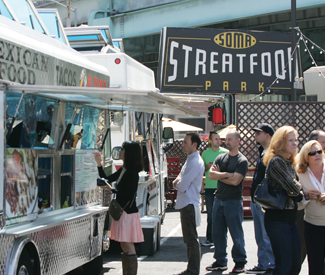
With its decidedly hip aesthetic and clientele, San Francisco’s food truck trend may be naturally assumed to be environmentally sound and health conscious. But the rapidly expanding craze may actually be creating air pollution and endangering the health of their employees in ways that aren’t yet being regulated.

Although the mobile eateries are held to a few of the same standards as their brick and mortar counterparts, such as food hygiene and sanitation, the gas-powered portable generators that provide needed energy to the trucks are a tricky beast to tame. The exhaust-heavy portable generators do not fall under the San Francisco Department of Public Health’s radar of regulation, according to its Food Safety Program Director Richard Lee.

“There are combustion products from the generators being generated while the truck is parked and operating,” he told the Guardian. “The generators are needed to power lights, fans, refrigerators, etcetera. SFDPH does not monitor or regulate the generators.”

The lack of monitoring on the generators may not be due to a lack of need for regulation, but rather the difficulty in doing so. Given that most of the generators are used to power relatively small vehicles, their small size inhibits them from meriting the attention of the California Air Resources Board (CARB) after their initial manufacture.

A CARB-compliant generator has met with the organization’s restrictions on various organic gases, nitrogen oxides, sulfuric oxides, carbon monoxide, carbon dioxide, and particulate matter. However, the generators are only monitored at the point of manufacture, with their in-use emissions going unregulated.

Furthermore, Bay Area Air Quality Management District spokesperson Aaron Richardson tells us that despite the BAAQMD’s 28 air monitor stations, the localization of the fad and the trucks themselves would make it difficult to see the effects of the generators as a regional issue.

“The concern would be they may not all operate in the same ways,” he said. “I think that if the trucks…are running back up generators, it’s going to emit some pollution. It’s something I think we will be doing more research on, but at this point it’s not looking like it’s a dramatic impact on air quality. CARB regulates all mobile sources, and lot of these trucks use individual generators. At this point, we only regulate back up diesel generators…of 50 horse power or above.”

So BAAQMD doesn’t regulate the generators because they’re gas-powered, and they don’t trigger CARB’s post-production attention, despite that agency’s current efforts to reduce the state’s carbon footprint.

CARB spokesperson John Swanton explained that given the small size and localization of the generators, it’s up to the individual communities to decide how to approach the situation.

“It’s up to the community to decide if they can bear the expense of a highly regulated community. In the terms of restaurants — which is what food trucks are — what are the community’s standards and regulations?” he said. “When we sell, say, a Honda generator, we have ideas of how that’s going to be used…We try to make it as clean as practically possible, but the idea is that it’s not gonna run 24/7 at the same location. If it’s going into a food truck and the food truck is going into a particular district, then it becomes the decision of the city and the air quality management [district].”

It seems, then, that no one is really regulating the exhaust emissions coming from the hordes of trucks that travel up Haight, down Market, into Fort Mason, and sit in clusters downtown, in SoMa, around City Hall, and other spots around town.

But at least they aren’t dirty diesel fuel, right? Perhaps the BAAQMD and the city of San Francisco have no need to regulate the teensy-eensy bit of gasoline generator exhaust.

Yet according to SFDPH spokesperson Imelda Rayes, there are now approximately 300 (registered) mobile food facilities in San Francisco. That means the number has nearly tripled since the mere 120 registered MFFs that were scouring the streets in 2009. What they lack in horse power, the generators may make up for in sheer multitude.

“In a period of three years, the number has increased almost 250 percent and [we’re] still getting more applications,” she said.

In addition to cumulative impacts, there are also questions about the health impacts on food truck employees.

Studies like such as the 2009 “Modeling the Effects of Outdoor Gasoline Powered Generator Use on Indoor Carbon Monoxide Exposures” by academics Liangzhu Wang and Steven Emmerich brings up a different concern: gasoline generators create emissions of poisonous carbon monoxide.

“The generators are always positioned outside of the vehicle. The workers are inside,” Lee said. “We would not expect that there is significant employee exposure to the generator exhaust to the employees.”

Yet the U.S. Centers for Disease Control and Prevention (CDC) reported that half of non-fatal carbon monoxide poisoning incidents in the 2004 and 2005 hurricane seasons were due to the gas-powered generators used to heat homes, even when placed outside the homes themselves.

Food truck generators, given their smaller size, are often placed much closer to the trucks and their workers than in the case of houses and their inhabitants. Furthermore, the trucks often idle for long periods to keep the food warm and utilities working.

“At this point, it’s enough of a new thing…We’re interested in finding out more about them, but at this point we are not receiving many complaints,” Richardson said. “A lot of variables are involved. It’s something I think we will be doing more research on.”

After the game of verbal hot potato that was research for this article — it seems every agency deferred to another in terms of exactly who is monitoring these things — Swanton assured us that the danger doesn’t seem imminent.

“In general, small engines [portable generators] are dirtier than an engine providing motor power to a vehicle,” he said. “But the sheer number of these cleaner engines dwarfs everything.”

True, but the food trucks that run for more than a few hours at one location are increasing in numbers at a rapid pace. With the high number of mobile food trucks in operation, most of which utilize some form of generator or another, it may be time to nail down those pesky variables involved and draw some conclusive evidence on the potential environmental and health effects of our city’s seemingly innocent snack time.

Jesus-free food

0

“For I was hungry and you gave me food, I was thirsty and you gave me drink, I was a stranger and you welcomed me,” Jesus supposedly said way back when. In San Francisco, there are a multitude of churches that offer free food to the hungry (find a handy list at www.freeprintshop.org).

But what follows is a list of secular organizations that share food — for the planet, for self-determination and providing for community outside of the system, for healthy food untainted by hormones, pesticides and GMOs, for food not grown by exploited workers, and for many other reasons, these groups bring food straight to the people.

FREE FARM STAND

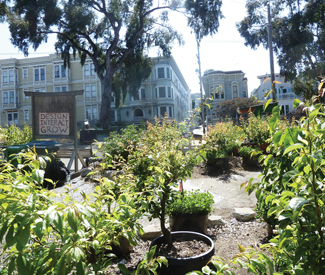
Where: Parque Niños Unidos, 23rd St. and Treat. When: Sundays, 1-3pm. Numbers given out at around noon. The Free Farm Stand gives out food and flowers grown at the Free Farm on Eddy and Gough, where local volunteers grow and harvest produce. They also share local organic surplus produce left over from several farmer’s markets and produce brought in from neighbors and from locally gleaned fruit trees.

The philosophy of the Free Farm is food sovereignty. Why should anyone go hungry, or go broke, feeding themselves and their kids? Instead, they figure, they should get for free what the earth gives. They facilitate this by offering the farm’s harvest — as well free sprouts and plants, that people can use to grow food themselves.

“The solution to the problem of hunger is to share the abundance that’s out there and to encourage people to grow food and share some with those in need.” said a Free Farm Stand organizer. “We can set up neighborhood networks of people growing food and sharing their surplus.” The Free Farm Stand is a step towards that vision.

BETTER DAYS TO COME

Where: Tuesday, 16th and Mission, Thursday, Turk and Taylor. When: 6pm. Some of the folks at Better Days to Come have God in mind, but the organization’s founder, Leonard Fulgham, came from not the churches but the prisons. As its mission statement says, “Mr. Fulgham began mentoring many of the younger inmates, while having the unique opportunity to hear their stories. Many of their stories outlined how they landed in the prison community and why they continued to return. Being homeless upon release back into society is a commonly known contributing factor to these ex-offenders being hungry while being starved by the lack of job training and vocational skills.” Fulgham passed away March 24, 2012, and in his memory, the organization began serving two hot meals a week.

CURRY WITHOUT WORRY

Where: Civic Center Plaza at Hyde and Market. When: Tuesdays 5:45-7pm. Curry Without Worry serves vegetarian food, mostly Nepali and mostly with five courses, in San Francisco every week. It does the same at its other branch in Kathmandu. Shrawan Nepali once owned a restaurant, Taste of the Himalayas, but used the proceeds to start Curry Without Worry and eventually sold it when “I realized I was not a businessmen.” Instead, he’s a man who feeds people a vegan five-course meal, which includes a sauce made from timur, herbs that grow in his Himalayan hometown but are rare in the US. “Our mantra is healthy food for hungry souls,” says Nepali.

FOOD NOT BOMBS

Where and when: Monday, UN Plaza at 6:30pm and 16th and Mission at 7pm. Wednesday, UN Plaza at 6pm. Thursday: 16th and Mission at 7pm. Saturday: Haight and Stanyan at 5pm. After 30 years, Food Not Bombs still serves almost daily in San Francisco at a few locations throughout the city. Volunteers cook meals then bring them out to the people, bringing home the message that there’s enough to go around and you shouldn’t need money to feed yourself. The Saturday team still shares food at Haight and Stanyan, where Food Not Bombs first parked three decades ago.

FOOD BANK OF AMERICA

Where: In front of the Bank of America at 2701 Mission. When: Thursday, 5pm until food runs out. Occupy-related people, carrying on from the giant Food Bank of America action on Jan. 20, when the Bank of America at the Embarcadero locked its doors after activists set up a food table and hung two interactive banners where passers-by could write what fit under the category “person” and what fit under the category “corporation.” They hung a third banner saying Food Bank of America, hundreds ate a hot meal, and the concept caught on. Now, people who have been gathering food donations for Occupy and otherwise give away fresh produce and hand out information about credit unions weekly in front of the bank.

COMMUNITY FEED

Where: Mendell Plaza, at Third and Oakdale. When: Every third Sunday, 10-2. A few organizations, including the Black Star Riders Coalition and the Kenneth Harding Jr. Foundation, work together to put on this food giveaway every other week. It takes place in Mendell Plaza, the square that some have renamed Kenny’s Plaza after Harding, who was killed in the plaza at 19 years old after a dispute with SFPD officers over bus fare. “First, we definitely want to honor Kenny, that’s why we got there,” said Tracey Bell-Borden, one of the organizers of the Community Feed. “But there’s been a lot of activity in that area for a long time. So it’s really about healing the community,” she said. “We have to take care of our community.”

Parting gift

0

news@sfbg.com

Retirement is knocking at Ed Harrington’s door. But the San Francisco Public Utilities Commission general manager is hesitating, not quite able to muster the will needed to walk out the door. He has something that he wants to finish first.

The sage city veteran has labored for years to launch an historic program so transformative that it would finally allow city residents and businesses to reject a homicidal utility monopoly and the dirty electricity that it sells. Success could be mere weeks away; failure would be a bitter blow.

Twice in the past 27 months, Harrington and his staff have fumbled efforts to launch the city’s long-promised community choice aggregation (CCA) program. The program, CleanPowerSF, would give Pacific Gas & Electric (PG&E) customers the option of switching over to a publicly backed electricity provider selling green, climate-friendly power.

The energy would continue to be ferried into homes and other buildings over PG&E’s electrical grid, and customers who switch would continue to receive their bills from PG&E. Those gas and electricity bills could initially swell by an average of one quarter, but the mix of power that they pay for would jump from 20 percent renewable up to 100 percent renewable.

Harrington’s previous CleanPowerSF launch schemes collapsed in mid-2010 and again early last year without getting off of the ground, largely because nobody — neither the city nor private industry — would shoulder the large financial risks. Unlike those failed efforts, which would have offered a private company virtual carte blanche to sell power to as many PG&E customers as possible, the latest CCA proposal resembles a successful program operating in Marin County. The Marin program started small in early 2010 and is already growing at a rapid clip as it pursues true energy independence.

For the next few weeks, despite having previously planned to retire in August, Harrington will oversee a last-ditch effort to drive approval of his latest iteration of CleanPowerSF by the Board of Supervisors. “I’ve offered to stay into September so that we can have the CCA discussions at the board,” Harrington told the Bay Guardian.

Harrington declined to discuss the latest version of CleanPowerSF, the real and perceived financial risks of which will be hashed out by the Budget and Finance Committee, referring questions to a spokesperson.

But environmentalists and local “green jobs” advocates who just 12 months ago were panning CleanPowerSF, ready to block its passage through the board, are now lauding it. They say the change came about after Harrington met directly with them and seemingly changed his own mind about how the program should be run.

The program would initially see Shell Corp. sell 20 to 30 megawatts of renewable electricity generated in far-flung places to fewer than 100,000 residential customers. Instead of fostering new supplies of renewable energy, San Francisco residents may initially buy power at premium prices from existing wind, solar, and other green facilities. That might make San Franciscans feel warm and fuzzy, but it wouldn’t necessarily reduce the nation’s overall carbon footprint.

The activists agree that it’s a crying shame to get into bed with an evil multinational oil company. But they say it’s an acceptable start, as long as the program evolves into something far more meaningful — into something resembling the Marin Clean Energy model. Like in Marin, the activists want San Francisco to use CleanPowerSF revenues to help build its own solar, wind, and other renewable energy and energy efficiency projects, many of them right here in city limits. They want the city to sell those power and the energy efficiency gains directly to CleanPowerSF customers.

Over the coming years, the SFPUC could gradually add enough clean electricity at competitive rates into the CleanPowerSF mix, generated by its own facilities and purchased off the open energy market, to meet the needs of all the city’s residents and businesses.

The build-out of solar power plants and other renewable energy facilities has always been imagined as an integral element of CleanPowerSF. But until last October, critics say SFPUC officials were treating the build-out as an afterthought, making little effort to lock in plans to move forward with the construction as a structured part of a CCA program.

“The SFPUC staff decided they wanted to do this the easy way and just buy energy,” said Eric Brooks, a regular at City Hall hearings who chairs the San Francisco Green Party’s sustainability committee and has spent years working with the SFPUC on CleanPowerSF. “They wanted to do that because it was easy — you can just declare victory.”

Once the general manager started to meet directly with local activists, Brooks says, “Harrington started hearing what we had been saying to the staff for all these years about how important the build-out is.” Harrington began to understand the importance of a renewable energy build-out that begins as soon as the new program launches. In turn, the activists threw their support behind Harrington and the program.

Brooks said that the build-out of city-owned renewable energy facilities could create thousands of jobs. It could also lead to energy independence in a city where environmentalism is a badge of honor, but where PG&E continues to sell nuclear and polluting fossil fuel energy without facing any competition.

“This is the perfect solution to the climate crisis and the economic crisis,” Brooks said. “We need to create a green New Deal. That’s the depth of crisis that we’re in, economically and environmentally.”

Such a build-out is also expected to build support for the program at the Board of Supervisors. Without it, the City Controller’s Office calculated that the city’s economy could take a hit to the tune of $8 million over five years after CleanPowerSF launches in the spring in additional electricity expenses, potentially jeopardizing about 100 jobs. But that analysis failed to consider the thousands of jobs that could be created laying panels, installing turbines, and performing other tasks if the city develops its own renewable energy supplies as a part of the program.

It’s impossible right now to say precisely what type of renewable energy facilities would be built by San Francisco: A $2 million study that would paint that picture is planned. But Paul Fenn, president of Local Power Inc., which is helping the SFPUC prepare to call for bids from companies interested in building the facilities, said they could include everything from solar panel arrays to customers’ energy efficiency gains to a wave energy plant.

The first CleanPowerSF committee hearing is scheduled Sept. 12, followed at some point thereafter by an historic board vote that will almost certainly prove contentious, likely pitting the board’s progressive members who have long supported public power against some of its fiscal conservatives.

Much of the debate will focus on an initial $19.5 million investment by the city. Of that money, about one-third would be used as collateral — a pool of cash held in escrow and available to reimburse Shell if the program flops. SFPUC spokesperson Charles Sheehan said the $7 million in collateral would gradually be recouped by San Francisco if the program moves forward successfully.

Another $2 million would fund CleanPowerSF customers’ energy efficiency programs; $2 million would help customers install solar panels; and $2 million would be spent on the study to determine how best to build out the portfolio of renewable energy plants owned by San Francisco. The rest of the money would cover operating and startup expenses, and it could be recouped later through power sales.

In a town where PG&E wields tremendous political and financial influence, proposing to gamble public funds establishing a competitor to the company is always sure to be thoroughly scrutinized, if not outright opposed and criticized. Supporters of the program, however, say that the gamble is a safe and necessary one that could have sweeping workforce and economic benefits.

“I don’t think that we can afford not to do CCA,” said Sup. David Campos, the program’s most active supporter on the Board of Supervisors. “So long as something like CCA is not in place, PG&E will continue to be the only game in town. I think it’s important for us to give consumers in San Francisco an alternative to PG&E.”

CleanPowerSF has long suffered an identity crisis that has harmed its prospects of legislative approval. Opponents deride it as a public power scheme and they work on behalf of PG&E to quash it. But ardent public power supporters do not see it that way: They consider CleanPowerSF to be little more than a minor stepping stone toward public power, and they have not rallied around it nearly as much as they have rallied around some of the storied yet unsuccessful public power campaigns of years past.

If Harrington can clinch lawmaker approval for CleanPowerSF before he retires, he will have provided city residents with a lasting choice in what kind of electricity they buy.

“I think that any effort to compete with PG&E is seen as public power,” Campos said. “But this is really about providing a choice.”


Eat to the beat

0

emilysavage@sfbg.com

EAT BEAT Good food was never the part of the concert plan. In high school, the punks and shredders ate giant Pixy Stix, filled to the plastic brim with unnaturally purple sugar dust — purchased from the all-ages venue snack counter — followed by late night Del Taco red burritos slathered in Del Scorcho and stuffed with crinkle fries. Flash forward a decade or so, and the vegan Malaysian nachos with spicy peanut sauce and pickled veggies from Azalina’s were all I could talk about after Outside Lands, save for the requisite “oh my god” Metallica utterance.

I wasn’t the only one. From every corner of that packed festival, people — and of course, bloggers — were raving about The Whole Beast (featuring pop-ups from the Michael Mina Group) tucked away by Choco Lands, Andalu’s fried mac and cheese, and Del Popolo’s massive, industrial-looking rustic pizza truck.

While the higher-end meal options have now been going strong at Outside Lands for a few years — and, granted, food has long been a part of the festival equation — the gourmet pop-up thing, and locally-sourced, quality food offerings are on the menu more and more in brick-and-mortar music venues in San Francisco. Last week, the Great American Music Hall hosted an event dubbed the Great American Pop-Up. Seems it’s more open to experimentation in the slower summer months.

The one-off (for now) event was a family affair for the Great American Music Hall. There were six pop-up food vendors set up in between the grand bronze pillars of the Tenderloin venue, chosen by security guard Drake Wertenberger, who stepped forward at a managers meeting to coordinate. Jessica DaSilva, who works in the box office at both GAMH and sister-venue Slim’s, was there selling imaginative sweet treats for Milk Money/Dora’s Donuts Shut Yer Hole Truck, including a strawberry cheesecake push-pop, and the chewy chocolate raspberry cookie I devoured. There was also local, sustainable sushi by Ricecrackersushi, some colorful Asian fusion dishes via Harro-Arigato & Ronin, and a whole lot of sausages sliced by the Butcher’s Daughter.

It felt nearly illicit to be in the venue without the anticipation of a live set, like we were sneaking in. And the warmer lighting opened up the intricacies of the architectural design. But this event was focused squarely on the food, with the tables pushed out onto the floor, and a flannel-clad DJ spinning inoffensive hip-hop while munching on something from a paper plate.

Last year, Slim’s created something similar, but broke it down to one chef at a time hosting rotating gourmet pop-ups once a week for the month of August. Those too were more about the unique food offerings, less about music. There were dinners served in the venue by Jetset Chef Alex Marsh and Cathead’s BBQ (which now occupies its own legitimate space down the street from the venue).

GAMH and Slim’s both already serve dinner nightly at live shows, but publicist Leah Matanky tells me there were no hard feelings from the in-house restaurant staff.

On regular show nights even, Matanky says she’s seen an increase of interest in gourmet food at the venues. “We have seen our kitchen sales numbers increase noticeably over the last couple of years. We’ve started running nightly food and drink specials that include things we don’t normally offer and people have really responded to that. We still offer the full array of bar food…but you can also get gourmet specialties like the baked polenta pizza with smoked mozzarella or the grilled tri-tip steak with garlic-herb potatoes.”

Mountain View’s infinitely larger Shoreline Amphitheater also recently got an in-house food upgrade. So the story goes, when the GM of Shoreline dined at Calafia in Palo Alto, Chef Charlie Ayers pointed out the stadium’s lackluster food, and was then summoned to create a tastier menu. Ayers now has a “Snack Shack” at Shoreline that generates $8,000 per show, selling vegan lentil bowls, pork bowls, and salad wraps with Dino kale and feta cheese.

At the bars-with-bands level, El Rio seems to also be upping its epicurean pop-ups. Along with the now-frequent Rocky’s Fry Bread (side note: Rocky is also in the band Sweat Lodge, which often plays El Rio) stand, there’s Piadina homemade Italian flat bread, and the occasional Mugsy pop-up wine bar, which offers bubbly and red wine varieties.

There was an entirely separate event that took place Aug. 4 in San Francisco, which combined all of this: the high-end food, the live music, the ubiquitous pop-ups. It was a food and music festival (Noisette) at a brick-and-mortar venue (Public Works, where it moved after switching venues from Speakeasy Brewery).

The event was put on by Noise Pop Industries. The production company, which does Noise Pop and the Treasure Island Festival, began dipping into independent food culture a few years back with the Covers dinners, pairing well-known chefs with corresponding cover songs for a relatively small group. Noise Pop’s Stacey Horne came up with the Noisette concept after talking with DJs Darren and Greg Bresnitz of New York promotion company Finger on the Pulse, who do an event out there called Backyard Barbecue, which also pairs live music and gourmet food.

From the beginning, the Dodos were the first choice of headliners at Noisette. Merrick Long is a “professed foodie,” has worked in the restaurant business, and was on a panel at SXSW talking about food and music. Horne says they chose chefs that do things a little differently, and are more attuned to the pop-up mentality.

“Something that struck me at Noisette that I loved was that we were eating such good food and then were able to wander over and hear amazing music. It wasn’t one or the other. It was nice to have that as an option,” Horne says. “The chefs we’re focusing on are kind of the indie version of that world, and that’s what Noise Pop has always been interested in, independent music, independent film and art. It just seems like a logical extension.”

Noise Pop is also again looking to do a variation on the Covers dinners with the upcoming Treasure Island Festival. Sound Bites is more of a passed appetizer event with little bites inspired by the bands playing at the festival.

So what does it all mean? Are we, as the generalized concert-going public, getting soft, both physically from all those readily available treats, and mentally because we’ve expanded beyond a minimalist punk rock lifestyle? Should we all go back to Pixy Stix and Del Scorcho hangovers?

“Look, the reality is that most nights that you go to hear a band in a club, there’s no food or if there is food, it’s not going to be anything great. So you can still have your punk rock experience, but something like Noisette and other events like ours that are popping up around the country are just offering another type of event, and people are interested in it, as we’re seeing,” Horne says.

I guess, if you want to see your life as a black and white cookie, you’ll see this change as against type. Or maybe if you’re in the teenage angst subset, you’re just getting in to the greasy post-concert routine. But perhaps this mashup is just another trend — participate if you will. It goes far beyond the music scene, to the way Americans eat now, looking for quality, locally sourced food, seeking creative options.

“Speaking for myself personally, I still love going to see shows,” Horne says, “but if I can have both things in one place, it’s win-win.”

www.slimspresents.com

www.noisepop.com

www.elrio.com

shoreline.amphitheatermtnview.com

Shoot to thrill

0

FALL ARTS At some point in the last 30 years game publishers decided that releasing in the summer was financial suicide. Maybe these publishers were under the mistaken impression that everyone is out enjoying the sun and, I don’t know, hiking? But as those of us who also enjoy gaming will tell you, you make time for video games.

So it’s been a pleasure to see the fall gaming season inch ever earlier into August, where it can leverage gamers’ anticipation about autumn releases and avoid being subjected to the intense scrutiny of a more competitive schedule. Two games released last week teeter on that precipice and officially ring in what looks to be another big season of gaming.

Darksiders II is a tad rough but an immense undertaking for a still-unproven license. Playing as Death himself, you must undo the end of the world and save your brother, one of the Four Horsemen of the Apocalypse. Dabbling in light heaven-hell mythology, the art style of Darksiders II is vigorously heavy metal, but it’s the game play homages to Zelda, God of War, and even Portal that make this epic game a pleasure. Dungeons and puzzles are faintly familiar but that’s part of the charm, and the series’ new RPG elements and abundance of treasure chests make the game irresistibly fun to play.

Similarly rugged, Sleeping Dogs sometimes struggles to match the fluidity and detail of Rockstar’s best efforts, like Grand Theft Auto and Red Dead Redemption, but it’s also not nearly as self-serious and has one of the best open-world environments the genre has seen. In this sandbox game set in Hong Kong, you play an undercover cop working his way up the ranks of the triads, playing both sides of the law. In terms of sheer delight, few games this year can match the unique experience of cruising through a neon city listening to traditional Chinese string music while vendors call to you to try their pork buns. And then running them over with your SUV.

Of course, the months of true autumn are still where you’ll find the big titles, and it’s impossible to list upcoming games without acknowledging that there is another Call of Duty game coming out this November, and it will undoubtedly sell more copies than any other game in 2012. The first sequel from odd-year, back-up developer Treyarch, Call of Duty: Black Ops II occurs partly in the Cold War era and partly in the near future, where the PRC have taken control of US revolutionary drone warfare technology and are using it against us.

In lieu of a new Battlefield game, publisher Electronic Arts hopes a new Medal of Honor will fill the shooter-sized hole in their schedule this year, but Medal of Honor Warfighter seems unlikely to compete with Black Ops, considering the player reaction to its 2010 prequel.

No, the Call of Duty franchise’s nearest competitor this year is 343 Studios’ Halo 4. It’s been five years since the last numbered entry in the Halo series and a new developer aims to repeat the mammoth sales of Halo 3 (a game with such crossover appeal that I picked up my copy at 7-11) with another blockbuster. Halo 4 will once again star iconic space soldier Master Chief, and promises a renewed focus on exploration and discovery over straightforward alien bombast.

http://www.youtube.com/watch?v=Ca3Y8Ws3plI

Fan favorite Resident Evil has slowly evolved from its deliberately-paced survival horror roots into an action series — resulting in both uproar and increased sales. And we all know which result matters more to publishers. But in an effort to satisfy fans new and old, Resident Evil 6 has two protagonists, and for all intents and purposes two separate storylines. One plays it slow and scary while the other delivers on the explosions and firefights that likely mean big sales this October.

Another series that developed a new identity based on fan feedback, Assassins Creed III brings the time-traveling franchise to the USA during the American Revolution. Playing as a Native American assassin, you hobnob with the likes of George Washington and Thomas Jefferson in a dynamic recreation of 18th century Boston and New York. You’ll probably also murder a lot of redcoats. Like Call of Duty, Assassins Creed has a new entry each year, and its dependable quality is its greatest asset.

Then there are games whose futures are less certain. New IP Dishonored looks to take BioShock’s steampunk aesthetic one generation earlier, into the Victorian era, with a stealthy first-person-shooter soaked in atmosphere. Borderlands 2 takes its predecessor’s successful basic characteristics — a boatload of loot, focus on cooperation and tongue in cheek humor — and ratchets them up to 11. Also, releasing in the typically untouchable month of December, Far Cry 3 explores an entire tropical island, complete with psychedelic mushrooms and a very nasty pirate villain.

All of the above for the new season, without even touching Nintendo’s new Wii U. We know it’s coming, but no release date, price, or game lineup yet. It wouldn’t surprise me to learn that Nintendo’s slow approach to starting the next generation of hardware may be a case of wanting to fully size up the competition before committing. With games like these, it’s never been clearer that people crave good games above new hardware.

Don’t blink

0

FALL ARTS If there’s such a thing as seasonal themes in the art world, then we’re about to see the summer of performance art gradually give way to the autumn of geography. Look for big institutional shows and smaller gallery projects that present ideas about places and spaces. To that point, this roundup starts with two exhibits that should get you out of the city.


Barry McGee Arguably the most famous and influential visual artist to emerge from the Bay Area in the last few decades, McGee is getting the mid-career survey treatment at the Berkeley Art Museum. His activist-leaning work pulls from graffiti, comics, sign painting, and hobo art, usually in ways that interrupt and transform the spaces where they’re installed. The exhibition promises a broad retrospective sampling from early work to new projects, and if for some reason you haven’t already heard of Barry McGee, this is your chance to get up to speed. Through Dec. 9; bampfa.berkeley.edu

ZERO1: Seeking Silicon Valley ZERO1, the Silicon Valley-based (and funded) art and tech biennial, is curated this year to showcase international perspectives on place and placelessness in the post-Internet world. Over 150 artists from 13 countries will participate. Take heart, commute-averse, projects will be hosted at venues throughout (and in the sky above) the Bay Area. Among those, Nelly Ban Hayoun’s space opera music video penned by Bruce Sterling and performed by NASA employees; ISHKY’s Pi in the Sky, which utilizes skywriting planes to remind you of what comes after 3.14; and Rafael Lozano-Hemmer’s interactive pirate radio station. Sept. 12-Dec. 8; www.zero1biennial.org

Six Lines of Flight: Shifting Geographies in Contemporary Art Comparing six global cities that are important regional cultural centers but not global art commerce centers, Six Lines of Flight brings together progressive artists from San Francisco; Beirut, Lebanon; Cali, Columbia; Cluj, Romania; Ho Chi Minh City, Vietnam; and Tangier, Morocco. If it’s as good as I hope, the exhibition will showcase possible models for social art making that bridge regional and transnational identities. Sept. 15-Dec. 31; www.sfmoma.org.

re(collection) In the wake of the March 2011 tsunami that devastated northern Japan, volunteers and cleanup workers salvaged and preserved more than 750,000 family snapshots and photos, a community performance both defiant and touching. Some of those photos make up this exhibition, alongside collaborations and new work by Mark Baugh-Sasaki, Ariel Goldberg, Mayumi Hamanaka, Taro Hattori, Sean McFarland, Kari Orvik, and Kelli Yon. Sept. 12-Nov. 3; www.theintersection.org

Guy Overfelt: Blacklight I confess. I’m sending you on a blind date to Guy Overfelt’s October show. I have no idea what he has planned, but if recent work — which usually involves burning rubber, inflating stuff, and performance — is any indicator, the 2012 SECA nominee will not disappoint. Oct. 6-Nov. 3; www.evergoldgallery.com

The Parade: Nathalie Djurberg and Hans Berg Dazzling, funny, and unsettling, “The Parade” combines kaleidoscopic, person-sized bird sculptures with five stop-motion animated films by Djurberg featuring ingenious synchronized soundtracks scored by Berg. I caught this in a rush at the New Museum in New York; can’t wait to spend more time with it here. Oct. 12-Jan. 27; www.ybca.org

Liam Everett Liam Everett’s lovely and haunting minimal abstract paintings usually incorporate alcohol, paint, and salt to distress and age unstretched canvases, making vibrant palimpsests and riffing on color field painting and installation work. Nov. 1-Dec. 22, www.altmansiegel.com

Jasper Johns: Seeing with the Mind’s Eye Elder statesman of the American post-war period and pop art master sees a new major retrospective at the San Francisco Museum of Modern Art. Organized with Johns and spanning the last 60 years, this latest survey of Johns’ work will include 85 paintings, works on paper, and sculptures, many of them from Bay Area collections. Nov. 3-Feb. 3; www.sfmoma.org

Tradition

2

virginia@sfbg.com

APPETITE Despite its Future Bars group provenance, Tradition is not Bourbon and Branch part two. Although I continue to bring visitors and locals who’ve never been to the still-magical, speakeasy-like B and B, Tradition is a more relaxed entrant in the Future line-up, which also includes Wilson and Wilson, Rickhouse, Swig, and Local Edition.

I’ve been to Tradition multiple times since its June opening. Part of me misses the divey fun (and cheesy movie nights — Top Gun! Tony Scott, RIP) of the former Mr. Lew’s Win-Win Bar and Grand Sazerac Emporium. The location is unrecognizable from those days. Yet I’m a fan of the dramatically altered, high-ceilinged space with numerous areas to enjoy a drink: small upstairs bar overlooking the action (dedicated to house blends and barrel-aged spirits), giant, rectangular center bar where you can sit or stand, in a cozy back nook reminiscent of an English pub, or in one of eight “snugs,” which are essentially booths (reserve ahead). Each booth varies in size, seating two to eight, themed along with a visually striking artistic menu: New Orleans, Prohibition, Tiki, American dive bar, English, Irish, Scottish, and Grand Hotel. Themes are established with vintage ads, signs, and barware in each booth.

Impressively, owner Brian Sheehy and beverage director Ian Scalzo created an extensive house-blended and barrel-aged spirits program. They are storing and experimenting with countless barrels, grouped by spirits from gin to whiskey. Options imaginatively run the gamut, while menu tasting notes appeal to spirits geeks or help narrow down options served neat or on the rocks. One could sip Four Roses bourbon finished in Pinot Noir wine casks or Four Roses Single Barrel in apple brandy casks. Russell’s Rye in a Green Chartreuse cask thoroughly intrigued me though I didn’t get as much herbal emphasis as I was hoping for from the Chartreuse.

My beloved Redbreast 12-year Irish Whiskey (cask strength) is poured from a barrel washed with Guinness. Flor de Cana rum is finished in a sweet vermouth barrel, an “Autumn Blend” of bourbon and apple brandy in an Arabica coffee cask, Auchentoshan 12-year Scotch in a puer tea cask — combinations are fascinating. I have not seen the likes of this in any city… yet. There are likely to be many imitators forthcoming.

Each themed cocktail menu also includes a couple beers in keeping with categories from English to Irish, all of it generally unfussy. With so many cocktails and barrel-aged spirits, some fare better than others. Pitchers and volcano bowls are ideal for groups, although those craving more intricate sips might steer clear, as these either get watered down quickly or aren’t as nuanced as individual drinks.

After sampling more than 30 drinks in my visits, my barrel favorite is Espolon Reposado tequila finished in an arabica coffee cask. Coffee and tequila impart a chocolate-orange spirit with notes of cedar, slate, citrus — a fascinating tipple. On the cocktail side, I’m most smitten with Kona Kope ($9) in the exotic-Tiki category. Diplomatico Reserva Exclusiva and barrel-aged spiced rums intermingle with coffee syrup, a touch of coconut cream, and barrel-aged Angostura for a lively bit of elegance, bracing with coffee and whispers of the tropics.

Multiple Sazerac variations on the New Orleans or Speakeasy menus haven’t quite gripped me. I prefer the chicory coffee sour from the former (do you see a coffee theme developing?) or a classic Hanky Panky from the latter. On the Scottish menu, Hebrides Flip ($9) is a savory finish for those who like flips (i.e. whole egg): Black Bottle scotch, Dry Sack sherry, gomme syrup, whole egg, and a little Cynar for bitter roundness.

At Bourbon and Branch, patrons of the otherwise enchanting Library Bar in the back are limited to an abbreviated cocktail list (a downside, in my book), compared to a full menu in the front room. Similarly, walk-ins to the left side of the bar at Tradition are also offered a limited list, while those seated at the right or in snugs get the full book of options. It’s therefore a good idea to make reservations — although I haven’t had trouble securing a seat on weeknights without one.

Tradition adds to the excellent little cocktail district developing near Union Square, which includes Jasper’s Corner Tap, Bourbon and Branch, Wilson and Wilson, and Rye), and provides a convenient Tenderloin meet-up spot with a little something for everyone, from cocktail geek to British pub fan. despite many gems, it doesn’t serve the most exquisite cocktails in town — but its unique barrel program and relaxed vibe certainly make it a downtown destination.

TRADITION

441 Jones, SF.

(415) 474-2284

www.tradbar.com

Subscribe to Virgina’s twice-monthly newsletter, The Perfect Spot, www.theperfectspotsf.com


Dishing the dirt

0

le.chicken.farmer@gmail.com

CHEAP EATS I didn’t do justice to Curry Boyzz, my new favorite restaurant, in last week’s review; I realize that. I completely and utterly neglected to mention who I ate there with!

Well, Hedgehog.

Moving right along …

Wait, there was someone else at our table, I feel certain. But Hedgehog, who is the half of our family that remembers things, is at work. She is also the half of our family that works.

With headphones on! So I am going to have to figure this out for myself, think think think … It was somebody skinny, I’m thinking, and so probably a vegetarian. Super skinny. With dreadlocks, and wearing a kind of cardboard hat or scarf, or something. With a price tag on it.

Doh! It wasn’t a vegetarian so much as a mop. Our spanking new, microfiber, swivel-headed dust mop that we’d just picked up at Cliff’s Hardware. I remember now: we wedged the handle through a chair back and its green dreadlocked head kind of watched over our meal, kind of hungrily. In fact, while Hedgehog used the bathroom, it spoke to me.

“That Tikka Masala looked pretty good,” it said.

“Yeah, well,” I said.

And in other news, I did a thing I haven’t done since the ’90s: I ate three Mission burritos in a week, and — funny thing — this was the week we were chicken-sitting in Alameda. When we are stationed in the Mission, Hedgehog and me, and our mop, we don’t eat burritos.

But we were going to watch that movie in Dolores Park with some buds, so we went to Cancun first. And we were going to a baseball game in Oakland, but I was in SF for some reason, and stopped at El Toro on my way to BART.

And Papalote, on a different day, but now I’m mad at them. Hardly any meat on my carne asada burrito: for shame, considering its relative expensiveness! And it was rolled all wrong, so that, cross-sectionally, one side of the burrito was just pretty much rice, and the other side had a few fairly tasteless beans and occasional chunks of meat. Pfft.

Lucky for them, they’re still my favorite taqueria, the orange salsa’s so goddamn good. I’ll just never eat there again, is all.

Hedgehog’s idea is to buy jars of Papalote’s overpriced orange salsa to take home and put on Cancun burritos.

So you see? You see why I love that lesbian? Even though she’s gluten free and dairy free, and made me eat at Radish for lunch today just because they had gluten free po-boys.

But at least she eats meat. Unlike some mops that I know.

So it shouldn’t surprise longtime readers of this column that her new favorite restaurant, like mine (after all these years), is Cancun. Specifically, the one on Mission and 19th, where I gained 20-some pounds in my thirties.

But it’s a 20-year tradition of mine not to review Cancun. To dwell on it, but never to actually review it. Therefore, I give you my other new favorite restaurant, Radish, the thing that finally happened across the street from the Lexington Club. Where I don’t drink, ’cause I’m too old.

But on our way to Cancun, we have to walk past one or the other, and lately it’s been Radish, so’s Hedgehog can look at their menu. We tried to eat there on a weekend but the line was too long.

Today (a weekday), I got the fried oyster po-boy, and it reminded me of Papalote’s carne asada burrito in that there were only about four or five oysters in it. And they weren’t very well battered. They just kind of crumbled.

But the bread was good! It was slathered with what they call “Cajun dirt.” I’d hoped that this would be the same thing Cajuns call “dirty rice,” which is chopped up giblets and liver and stuff, but no. It was reminiscent of muffuletta spread, which is more Italian than Cajun: chopped olives, onions, and lemon.

Good. But the best thing about Radish, as far as we could make out, was the homemade root chips: potato, taro, and yuca — yum!

RADISH

Mon-Tue 5-10pm; Wed-Thu 10am-10pm; Fri 10am-11pm; Sat 9am-11pm; Sun 9am-5pm

3465 19th St., SF.

(415) 834-5441

www.radishsf.com

MC,V

Beer & wine


Styles for miles

0

arts@sfbg.com

FALL ARTS Most folks going to dance performances have a sense of how they want to spend their time and dollars. For some, a show must be conceptually edgy. For others, it’s got to be ballet. Still others want choreography that resonates with socio-political implications — or they only want to see choreography grounded in indigenous traditions. I’m more of an omnivore: show me a piece, no matter its style, in which the forces at work arise from some internal necessity and play off each other convincingly, and I’m in.

The next three months are bursting with dance offerings. In downtown San Francisco, many are free. Zaccho Dance Theatre reprises its hauntingly poetic Sailing Away (Sept. 13-16, Powell and Market, SF; www.zaccho.org); it pays tribute to the exodus of a remarkable group of African Americans. In only three years, the Central Market Arts Festival (Sept. 28-Oct. 21, various locations, SF; www.centralmarketarts.org) has exploded into a major event with dozens of performances that have probably contributed just as much to the area’s revitalization as those high-rent dot coms. Not to be missed is the world premiere of Jo Kreiter and Flyaway Productions’ Niagara Falling (Sept. 26-29, Seventh St. and Market, SF; www.flyawayproductions.com), projected and danced on an exterior wall of the Renoir Hotel. And how about the easy-riding Trolley Dances (Oct. 20-21, various locations, SF; www.epiphanydance.org) that offer unexpected site-specific encounters?

If you are willing to take another look at what may be already familiar, and your budget allows it, the Mariinsky Ballet and Orchestra (Oct. 10-14, Zellerbach Hall, Berk; www.calperformances.org) brings Swan Lake to Berkeley. It may be the most popular ballet in the world, and it is also one of the greats. Another old-timer, the 40-year-old Mummenschanz (Nov. 23-23, Zellerbach Hall, Berk; www.calperformances.org), can’t be beat for its skill, magic, and gentle humor. Take a kid. If your taste oscillates between new and old, check out Na Lei Hulu I Ka Wekiu (Oct. 20-28, Palace of Fine Arts, SF; www.naleihulu.org); its mix of traditional and new-style hula — which this year includes hip-hop — will be time and money well spent.

Keith Hennessy, probably the Bay Area’s most radical theatrical thinker, moves his pulverizing Turbulence (a dance about the economy) from COUNTERPulse to Yerba Buena Center for the Arts (Sept. 27-29, YBCA Forum, SF; www.ybca.org). There you will be invited to participate in the concept’s actualization.

Ticket-buying decision time kicks into high gear in October, with the season’s most intense concentration of big-time artists both local and visiting. Making its Bay Area premiere with the full-evening After Light (Oct. 13-14, YBCA, SF; www.performances.org) will be another of San Francisco Performances’ finds, Britain’s Russell Maliphant Company. The work, set on three performers to Erik Satie’s Gnossiennes, is inspired by dance genius Vaslav Nijinsky’s photographs, choreography, and drawings. Margaret Jenkins Dance Company (Oct. 18-21, Kanbar Hall, Jewish Community Center of San Francisco, SF; www.mjdc.org) presents a first look at Times Bones, for which the choreographer excavated ideas in her rep to re-examine for new content.

Alonzo King LINES Ballet‘s collaboration with musicians and lighting designer Axel Morgenthaler are well known. Increasingly, King seems to be searching also for innovative scenic collaborators to contextualize his mythic choreography. A preview last spring of the as yet un-named premiere (Oct. 19-28, YBCA, SF; www.linesballet.org), at the very least, promised that Jim Campbell’s set of hundreds of LED globes will create its own rhythmic motion.

African and African American voices will be heard at YBCA as part of its commitment to showcasing contemporary dance from that continent. Voices of Strength (Oct. 19-20, YBCA, SF; www.ybca.org) is a quartet of four African women — among them Mozambique’s well-known Maria Helena Pinto — who will show one work each. New YBCA Program Director Marc Bamuthi Joseph concocted “Clas/sick Hip Hop” (Nov.30-Dec.1, YBCA, SF; www.ybca.org) for which he matches a violinist with five radically different hip-hop artists, including the legendary Rennie Harris, who 20 years ago pioneered the art’s theatrical potential.

Others I will try not to miss: smart dance with RAWDance‘s Burn In/Fall Out, (Nov. 2-4, ODC Theater, SF; www.rawdance.org); Deborah Slater’s in progress collaboration with dancer-vet Private Freeman, Private Live (Nov. 2-3, CounterPULSE, SF; www.deborahslater.org); and Sebastian Grubb‘s Workout (Dec. 14-15, CounterPULSE, SF; www.counterpulse.org). At the Garage (Garage, SF; www.715bryant.org), it will be Human Creature Dance Theatre for Halloween (Oct. 31), neo-Finnish punkkiCo (Nov. 16-17), and contemporary Congolese, now SF-based dancer Byb Chanel-Bibene (Dec. 5-6). Perhaps I’ll also return to the Garage for Burlesque Basquiat, Dorian Faust‘s birthday tribute to the late painter (Dec. 21-22).

Howdy, strangers

0

arts@sfbg.com

FALL ARTS Gemma Paintin and James Stenhouse were obsessed with Americana long before the two Bristol-based performance makers (known collectively as Action Hero) ever set their cowboy boots in the United States. In fact, they’d performed their site-specific first piece, a barroom exploration of the Western (called simply A Western) for years before lobbing it into the belly of the beast, where it appeared as part of Austin, Texas’ Fusebox Festival in 2010.

“We were shitting it,” remembers Paintin, in a British phrase meaning mighty fretful. But the crowd loved it; Paintin calls it their best audience ever. She and Stenhouse have worked together since 2005 on pieces that engage the audience as co-conspirators as well as subjects in their own right. A good example is their piece, Watch Me Fall, which had the audience cheering on a series of ridiculous, slightly risky stunts from either side of a long runway, a work that Paintin explains was inspired by the duo’s interest in motorcycle daredevil Evel Knievel.

>>VIEW OUR FULL FALL ART 2012 PREVIEW

A diminutive woman with bright blond bangs, Paintin spoke last week at a sidewalk table outside BrainWash Café, fresh from a rehearsal at CounterPULSE, where she and James were in the fifth day of leading a collaborative performance workshop with a selected group of Bay Area–based American artists (Laura Arrington, Andrea Hart, Xandra Ibarra, Richie Israel, Elizabeth McSurdy, Mica Sigourney, and Ernesto Sopprani).

Stenhouse was not able to join the conversation — rehearsal had run long and he was following its willy-nilly course to a local karaoke bar, where he and the rest of the group were planning to take turns singing Tammy Wynette’s “Stand by Your Man.” A couple of days earlier, the group had gone tailgating at a pre-season NFL game in Oakland. Such are the trails, happy or otherwise, down which the adventurer in Americana must travel. (You can follow some of the research results thus far — in a process McSurdy calls “aesthetically polyamorous” — in the group’s blog posts at www.counterpulse.org.)

The workshop sets out to investigate American cultural mythologies using the concept of the stranger or outsider as starting point. Hosted by CounterPULSE with leadership from program director Julie Phelps, the program is part of a major cultural exchange project by CounterPULSE’s collaborator on Stranger in a Strange land, the arts-based University of Chichester in the South of England.

“All the work of the Department of Performing Arts is about making radical new work, and we have a reputation for working with exciting and challenging artists, hence our connection to Action Hero,” explained Ben Francombe, head of the department, by email. “The University of Chichester has instigated this overall project as a way to explore different interdisciplinary working methods,” he continues, “which involve the idea of exchange.” Francombe adds that the University is keen to continue having a presence in the Bay Area.

“It’s been really fun actually,” enthuses Paintin, clearly pleased with how experienced and open-minded her American counterparts have proven with collaboration. “We’re trying to just be about the process.”

STRANGER IN A STRANGE LAND

Mon/27, 8 p.m., $10-$20

CounterPULSE

1310 Mission, SF

www.counterpulse.org


TAKE ANOTHER BOW, LAZARUS

The fall theater season includes several worthy returns (in addition to shiny new premieres) worth keeping in déjà view:

Chinglish The new comedy about East-West miscommunication from David Henry Hwang (M. Butterfly) has already been to Hong Kong but rebounds to the West Coast courtesy of Berkeley Rep. Aug. 24–Oct. 7; www.berkeleyrep.org

San Francisco Fringe Festival It’s a phoenix, really, rising each September like a sassy, gangling, 41–headed bird of play. Sept. 5–16; www.sffringe.org

Invasion! Crowded Fire delivers its own politically pointed comedy of miscommunication and cultural misconceptions in its West Coast premiere of Jonas Hassen Khemiri’s 2011 Obie-winner. Sept. 6–29; crowdedfire.dreamhosters.com

Geezer and The Real Americans The Hoyle boys — veteran clown and physical actor Geoff Hoyle and bounding son Dan, a theater sensation in his own right — return to the Marsh for re-runs of their respective, wildly popular solo shows. The Real Americans: Sept. 7–29; Geezer: Oct. 6–Nov. 18; www.themarsh.org

The Normal Heart Larry Kramer’s 1985 play returns (in the new Broadway revival directed by George C. Wolfe) at a time when the history of the AIDS crisis has become endangered by a vague “normalizing” narrative of American progress, or what Sara Schulman aptly calls “the gentrification of the mind.” Here’s an opportunity to remember lots of things, not least those who died and fought, a great play, a vital movement, a continuing health emergency, and the importance of mass resistance. Sept. 13–Oct. 7, www.act-sf.org

Roughin’ It 2: Theater. Oysters. Campfire. Booze. Again. Fresh from sold-out success with Duck Lake, PianoFight heads back up to Point Reyes for a second season of woozy waddling, shucking and jiving along the shore of Tamales Bay, featuring everything in the subtitle including brand new short plays harvested from a bed of delicious local playwrights. Sept. 15 and 22; www.pianofight.com

Assassins Shotgun Players mount the Sondheim musical about presidential recalls made and attempted from John Wilkes Booth onward, an election-year favorite directed by Susannah Martin. Sept. 26–Oct. 28; www.shotgunplayers.org

Rhinoceros Paris-based Theatre de la Ville’s production of the Ionesco play — a modernist classic on individual resistance to tyrannical conformity — is a remounting of the company’s acclaimed 2004 production, making its first US tour. Sept. 27–28, www.calperformances.org

Acid Test: The Many Incarnations of Ram Dass “Be Here Now” all over again in Lynne Kaufman’s new play — not so much a theatrical return as a serious flashback — starring the exceptional Warren David Keith as the titular giant of 1960s counterculture, a Harvard prof turned LSD advocate and spiritual teacher. Oct. 4–Nov. 24, www.themarsh.org  

Einstein on the Beach Composer Philip Glass and director Robert Wilson reinvented the opera in 1976 as an enthrallingly weird-ass piece of avant-garde spectacle and the world has not been the same since. This remounting —overseen by the original team of Glass, Wilson, and choreographer Lucinda Childs — marks the first performances of the five-hour formalist extravaganza in 20 years. The international tour takes its highly anticipated Bay Area bow courtesy of co-commissioner Cal Performances. Oct. 26–28, www.calperformances.org

Talk about chaos

2

steve@sfbg.com

FALL ARTS Is this the last Burning Man? After 26 years of resiliently expanding on the vast canvas of Nevada’s Black Rock Desert, and reaching what is arguably the pinnacle of its popularity and artistic innovation, the answer is: Probably not.

But there have been more portents of doom than ever this year, culminating last week when the event’s organizer — San Francisco-based Black Rock City LLC — issued a dire warning about new efforts by Pershing County officials to impose steep fee increases and regulation of behavior (including possibly banning minors) at this annual orgy of free expression.

After a Nevada judge concerned with burner morals and values recently worked with the county’s Board of Commissioners to void its agreement with BRC and place Burning Man under its new Festival Ordinance, BRC sued the county, claiming it “imposed new, unnecessary, unlawful, and potentially ruinous fees on BRC, threatening BRC’s ability to conduct Burning Man 2013 and going forward.”

The suit won’t affect this year’s event, which officially begins Aug. 26 and which was already being heavily battered by other forces, particularly Mother Nature of late. Art and setup crews on the playa, which is extra dusty after a record-dry winter, are telling horror stories of sustained 60-mph winds, day-long whiteouts, freak storms, and temperature extremes.

That could be one reason why a glut of Burning Man tickets went on the market in recent weeks, with many desperate sellers accepting less than face value and knocking the bottom out of the market for any ticket scalpers still hoping to cash in on record early demand for Burning Man tickets.

BRC started the year under a torrent of criticism for a new ticket lottery system that left most veterans without them. The organization gradually took several countermeasures, including canceling a secondary ticket sale and selling those 10,000 tickets directly through established camps and collectives, organizing an aftermarket ticket exchange and taking anti-scalper actions, successfully petitioning the Bureau of Land Management to increase the population cap to 60,900 (last year, the event peaked at below 54,000), and releasing a few thousand extra tickets at the very end. And that big year unfolded against the nearly forgotten backdrop of BRC’s internal work developing the new nonprofit Burning Man Project to take over the event from the LLC in a few years.

Each action prompted its own backlash — from both burners and anti-burners concerned about the skyrocketing population to myriad complaints about BRC policies and direction — and set of warnings of impending doom.

When I asked event founder Larry Harvey on the phone about this crazy year, he agreed, “It’s been full of alarm and incident.”

The incident that most alarms Harvey now is the sudden turn that Pershing County has taken, tripling this year’s Burning Man fees to $450,000 and potentially jacking them above $1 million in coming years, reportedly to fund more policing of risqué behaviors that Judge Richard Wagner has publicly objected to.

BRC’s lawsuit claims the judge and county officials used “a collusive state lawsuit as to which BRC was not a party” to regulate the event “not out of a neutral and objective concern for public safety issues, but because of their opposition to what they consider to be the content and culture of Burning Man, in violation of the First Amendment.”

“We’re doing this because we felt we had no recourse,” Harvey told me, although he expressed far less concern about other perceived existential threats to Burning Man. “I would like to take some modest credit for solving the scalper problem,” Harvey said. He claimed validation in the current easy availability of tickets at face value and minimized the role of departing veterans, discouraged visitors from afar, and those scared by dust storm stories.

“Last year was remarkably good weather, and it was unlikely we would see that again,” Harvey said fatalistically. But Burning Man is meant to be difficult and unpredictable. After all, he said, “We’re talking about chaos here.”

Guardian City Editor Steven T. Jones is the author of The Tribes of Burning Man: How an Experimental City in the Desert is Shaping the New American Counterculture.

Cheeseburger wolfpack

0

caitlin@sfbg.com

FALL ARTS In a workshop far north, in the wilds of Portland, a man creates wooden monsters. But they’re gorgeous, these beasts: vertigo-inducing whorls of eyes and mouths and thousands of pin feathers. So entrancing are the works of artist A.J. Fosik that you want to trip and fall into the maw of one of his riotously colorful works, preferably while on whatever drug their maker was partaking in when he laboriously cobbled them together. (perhaps also while listening to Mastodon.) Fosik will bring the wolfpack south to Guerrero Gallery for a show beginning Nov. 10.

SFBG: I’ve read that your sculptures are meant to ape religious icons and the zealotry that surrounds them — is that true of this latest series?

A.J. Fosik: It is true. If religious people would stop being such colossal dickheads I would have a lot more time on my hands to pursue hobbies.

SFBG: High-falutin’ theories of faith aside, do your beasties have names, personalities?

AJF: They are characters in an archetypal sense, not in a my name is Dave sense. They are manifestations of the apparently inescapable human need to put a face to the unknowable in some sort of attempt at easing our existential angst. Ideally, I would like them to serve as inspiration to move past that way of thinking and embrace the unknowable. Sometimes [they have names], mostly they are named after the ideals of a humanity better than ours.

SFBG: Where do they live?

AJF: The same place all deities do, in your head.

http://www.youtube.com/watch?v=_in6MbARF4s

SFBG: They’re so attention-grabbing — during the creation process, how do you relate to them? Do you have conversations?

AJF: I breathe life into them through their nostrils. Each piece receives a command written on parchment and rolled up, which is then placed in their mouths and compels them to obey.

SFBG: How long does a standard piece take you to make?

AJF: It takes a few splinters per hand and a couple of thousand pin nails.

SFBG: If you could engineer your beasts to perform a mechanical function, what would it be? You can say “eat people.”

AJF: I would like them to be able to take a precision slice from the part of the brain of every thick-skulled mouth breather that is responsible for holding onto the idea of faith as a virtue. Either by tooth or by claw they could slowly replace the justifications of so much hatred and replace them with the urgency of this life. Or they could regurgitate cheeseburgers to order.

SFBG: Your work is incredibly detailed. Why so elaborate?

AJF: If I stop working then I have to drink. When I start drinking, out come the wolves. It’s a safety measure. Also, DMT.

SFBG: Does anyone out there have a wall of Fosik pieces, like a psychedelic version of one of those wild imperialist British hunters?

AJF: If it does exist then I am insulted that my invitation has failed to materialize. If you’re reading this I can bring booze and firearms on short notice.

SFBG: Describe where you’d most like to see one of your works installed.

AJF: That’s sort of an odd thing at the moment. It really doesn’t seem to matter as much where the physical piece ends up, its real life is on Tumblrs and blogs or wherever else. If they don’t have teeth there they haven’t really lived.

A.J. FOSIK

Nov 10-Dec 8

Guerrero Gallery

2700 19th St., SF

(415) 400-5168

www.guerrerogallery.com

Drug peace

0

HERBWISE Author Doug Fine’s last book, Farewell My Subaru, is about the year he moved to a secluded New Mexico farm and attempted to live without petroleum. He’s just as creative about advocating against the War on Drugs as is his against fossil fuel dependency — for his new book Too High To Fail: Cannabis and the New Green Economic Revolution Fine spent a cannabis season living in a Mendocino grow town. He’s been getting love from his recent appearance on Conan, but we caught up with him via email for some real talk while he was en route from his home, a.k.a. the Funky Butte Ranch, “hurtling toward live events in Colorado in an ’87 RV.” He’ll be in town this week doing readings, so read up here and bring him questions to his Booksmith reading on Wed/22 and his event for cannabis patients at Harborside Health Center on Fri/24. 

SFBG: What are you adding to the discussion on cannabis legalization with Too High To Fail?

Doug Fine: I relocated to Mendocino County, and for 10 months covered the county’s successful efforts to permit sustainable cannabis farmers. I followed one flower named Lucille — for reasons that have to do with the neighbor of a farmer I followed — from farm to liver cancer battler. 

Mendocino’s “zip-tie” [cannabis farm permit] program was so successful in 2011 that it was about to be emulated in several other counties in the Emerald Triangle. With 100 tax-paying American small farmers coming above ground to declare themselves legitimate, the county raised $600,000 and saved seven deputy sheriff positions. The practitioners of a profession that generates 80 percent of the county’s revenue could now be part of society. Then, just before harvest, the DEA raided the most prominent zip-tie farmer, and the US Attorney threatened the county Board of Supervisors with arrest if they didn’t effectively cancel the program. Which they did. 

SFBG: Would you say you have a different writing style than others who have tackled the War on Drugs?

DF: It’s kind of comedic investigative journalism. Since I don’t only want to preach to the converted on any issue, I think the humor draws people in as they see I’m a regular guy, a dad, an American, and not some kind of radical pushing an agenda. I try to laugh my way to the truth. 

SFBG: In your opinion, why isn’t cannabis legal today?

DF: Pat Robertson wants to end the Drug War, my cowboy hat-wearing senior ladies at the post office in my New Mexico canyon want to end it. Everyone’s ready except Congress. Even a DEA spokesman said when I asked why the zip-tied farmer was raided, “If you don’t like the Controlled Substances Act ask Congress to change it.” And it’s up to us as voters to do just that: get cannabis out of the CSA and allow states to regulate it like alcohol. It’s win-win: a $30 billion infusion into the economy annually that will cripple the cartels. 

SFBG: Do you smoke weed?

DF: I have used it. I think it’s a good plant. My general take on it is a spiritual one. The Bible isn’t vague on this. It’s in Genesis, not bured way back in Numbers. Chapter 1, Verse 29 says: “You shall have all the plants and seed-bearing herbs to use.” Not “unless one day Richard Nixon decides he doesn’t like one of them.”

SFBG: I hear you live with goats?

DF: Yep, I generally see as many goats on a given day as I do humans. I meditate with my goats and live on their yogurt, cheese, and, most importantly, their honey-cardamom ice cream.


DOUG FINE

Wed/22 7:30pm, free

The Booksmith

1644 Haight, SF

www.thebooksmith.com


Fri/24 2-5pm, free, medical marijuana patients only

Harborside Health Center

1840 Embarcadero, Oakl.

www.harborsidehealthcenter.com

Fools in love

0

>>Check out our complete FALL ARTS PREVIEW 2012

emilysavage@sfbg.com

FALL ARTS “You’re at the right place,” Tim Cohen mutters, holding a large laundry sack swaddled like a burrito to his chest as he walks up to the tri-level white Victorian on McAllister Street in San Francisco’s Western Addition. A prolific singer-songwriter with morose pop vocals and a gruff exterior, Cohen is preparing to once again tour with his band, the Fresh and Onlys. And Cohen is flying out to the East Coast earlier than the others so he can play a few shows in his other incarnation, Magic Trick.

After dropping off his laundry sack upstairs in the top tower of the Victorian, Cohen climbs down the steps and stands against a railing on the front stoop with the band’s newest member, pony-tailed drummer Kyle Gibson, who really isn’t all that new. Gibson’s first show with Cohen, bassist Shayde Sartin, and skinny, pompadoured guitarist Wymond Miles, was at Noise Pop on Feb. 26, 2009. Before he came along, the band dilly-dallied around with a bunch of different drummers for around eight months, says Cohen.

The cohesive four-piece hit the ground running, creating psychedelically swirled darkly moving garage and psych-pop in home recording studios, and releasing records and EPs at a dizzying speed, touring nearly nonstop through the past three years.

Now signed to Mexican Summer, the Fresh and Onlys have slowed down a bit, spending the end of last year recording 2012’s Long Slow Dance (which sees release Sept. 4), their fourth long-player and first since 2010’s noisier Play It Strange. This fall they’ll again pick up the pace, and tour the West Coast, East Coast, and Europe through early next year.

“I feel like this is the record we all wanted to make, we’ve been wanting to make this record for a long time,” says Miles, who slinks up last to Cohen’s stoop on this unseasonably warm summer day in SF. If not for the occasional cool breeze, the day would be downright hot. I ask him to expand and he laughs and says, “Take it, Tim.”

“We were all a lot more patient with the process,” says Cohen. “It was like, it’s already been this long, let’s do it right. Let’s get the sounds right, let’s get the takes right, let’s get the feelings and the moods right.”

Moods come up frequently in both the stoop conversation and the record itself. The dark poetic drawl is inherent within Cohen, that Morrissey-Robert Smith pain paired to jangly pop. Album opener “20 Days and 20 Nights” has a classic hook, but matched to Cohen’s words, it’s actually quite sad. “Something so heavy/in my mind/I think I want to try and get it out/So I cry/and I cry.”

Many of Cohen’s lyrics come lifted from his dreams, so naturally he keeps a notebook by his bed in the tower. “When I write something down, I’ll look at it a few days later and be like, ‘wow, that’s kind of strange,’ and I’ll usually turn that into something.”

He feels he may be subconsciously influenced by the absurdist and surrealist fiction he reads, by authors such as Kafka, and conversely, classic radio pop. On jangly “No Regard,” he opens with “ever wonder why fools fall in love?”

“I don’t know how aware Tim was of Frankie Lymon when he wrote it,” says Sartin. “Not only is it a classic lyric, it’s a classic sentiment in pop culture in general. Whenever you hear that song, Frankie Lymon still lives, even though he died a miserable death.”

After a hot pause of silent remembrance, Sartin continues, “So I think sometimes those things pop up in Tim’s lyrics. They get mangled by the time they get to the pen and paper in Tim’s hand or onto the record for that matter.”

“That’s exactly right,” Cohen says. “What I intend to do with lyrics is make them clear cut with a twist. Put sad lyrics over happy music, or happy lyrics over sad music, just to create a juxtaposition of moods that’s a more compelling listen.”

Gibson pops up, “Morrisseying. I made Morrissey a verb. That’s what he would do, he’s one of the best at that. So really macabre and dark over this like, jangle.”

While Cohen is the frontperson and lead lyricist, he doesn’t always get his way. He’s quick to bring up the example of “Foolish Person,” a dreamy ’80s-esque pop song — which dissolves into battling psychedelic guitarwork — that made it on Long Slow Dance after at least three different iterations. “Some people in the band really wanted to see it through, to see it to completion. I wasn’t totally into the idea, but I’m sort of glad we did it,” he says with a sniff. “At least, I never have to record it again.”

Gibson laughs, slipping on his sunglasses.

The band has had their share of rough spots, especially during grueling tours, but they’ve learned to communicate. “We wouldn’t have lasted this long if we couldn’t reign that toxicity in, and direct it elsewhere,” Cohen says.

The keys to the Fresh and Onlys’ success, both personally and musically, include their diverse sonic backgrounds, and relative age. Unlike youngster bands, the four musicians were already established, and had played in previous bands (including Black Fiction, and Kelley Stoltz’s band), when they came together all hovering around the age of 30.

Each blasted a different kind of noise from their childhood stereo. Cohen listened exclusively to hip-hop in Virginia (“I just listened to the way people put their words together. I would never really go off the beat — I never really have, I’m not really capable of this shambolic, careless approach to words and vocals.”). Miles came from an array of guitar schools of thought in Denver, Colo., listening to the Cure, goth, punk, and hardcore. Sartin came from the Florida punk scene, but also loves country, and his bass-playing is rooted in soul music. From DC, Gibson listened to punk and Dischord bands, which justifies his muscular drumming.

“In a fearless way, we welcome each others music genealogy into the fold,” Cohen says.

The band also thrives thanks to its San Francisco location. “I can call up any of my friends and say ‘let’s go play music.’ And if they don’t want to do it, someone else will,” says Sartin, adding “We also have a ton of inspiration from other people who live here, other bands, other artists.” He mentions former Girls drummer Garret Goddard, and Gio Betteo from Young Prisms, along with perhaps the most prolific musician in San Francisco, aside from Cohen, Thee Oh Sees’ John Dwyer (formerly of Pink and Brown and Coachwhips).

“You can have a conversation with John Dwyer and go fucking write three songs, just off the energy absorbed from him barking at you,” says Sartin.

All four musicians on the stoop shake their heads in agreement.

FRESH AND ONLYS

With Terry Malts, DJ Britt Govea

Sept. 8, 9pm, $15

Independent

628 Divisadero, SF (415) 771-1421

www.theindependentsf.com


Full circle

52

steve@sfbg.com

When Mayor Ed Lee suspended Sheriff Ross Mirkarimi in March, he publicly took the position that it was an act of official misconduct when Mirkarimi grabbed his wife’s arm during a Dec. 31 argument, subsequently pleaded guilty to false imprisonment, and was placed on probation for three years.

Lee and his allies said that under those conditions, Mirkarimi could no longer effectively function as the city’s top elected law enforcement officer and that his actions clearly violated the City Charter’s ban on "conduct that falls below the standard of decency, good faith and right action impliedly required of all public officers."

The City Attorney’s Office, through deputies Peter Keith and Sherri Kaiser, has maintained that position throughout the investigation and Ethics Commission proceedings over the last five months. On August 16, on a 4-1 vote, the commission agreed and recommend the Board of Supervisors find its former colleague guilty of official misconduct, which would almost certainly result in his removal from office.

But that simple set of facts and interpretations belies the ugly spectacle that Lee and the City Attorney’s Office actually decided to create — at great cost to taxpayers, Mirkarimi’s reputation, and the public’s faith in the proceedings — over the last five months.

Instead of sticking by their initial position, Lee and his attorneys decided to pile on a long list of other official misconduct charges: dissuading witnesses to his crime, impeding a police investigation, abusing his authority in several ways, engaging in a pattern of abuse of women, refusing to cooperate with a city investigation, lying to officers in a scheme to keep a gun, and other charges.

Almost all of those accusations were included in the original written charges that Lee filed on March 21 — before the city had actually begun its investigation to learn whether there was any evidence to support them. Keith and Kaiser continued to make all those accusations right up until the end.

When the Ethics Commission finally deliberated on August 16, going through each of the main factual allegations against Mirkarimi, one by one, it unanimously agreed that there wasn’t enough evidence to support any of those other charges, even using the "preponderance of evidence" standard that is lower than the "beyond reasonable doubt" standard used in criminal cases.

So in the end, the case against Mirkarimi ended at the same place where it began: with the question of whether pleading guilty to a misdemeanor act of domestic violence warrants the removal of an elected official. But the implications and repercussions of what has transpired over these last five months could be felt for many years, in ways that it’s impossible to predict today.

WHAT IS OFFICIAL MISCONDUCT?


With very few legal precedents to guide them, the commissioners spent most of the nine-hour hearing on Aug. 16 wrestling with how to interpret the city’s untested new official misconduct language, how directly the wrongful behavior must relate to the office, and whether broadly interpreting those two issues gives too much power to the mayor.

Underlying that discussion is the question of whether the statute and the city’s interpretation of it will eventually be struck down as unconstitutionally vague by the courts, which Mirkarimi will likely turn to if the board removes him from office. But the commission pointedly refused to enter that debate, with Commissioner Jamienne Studley saying, "I don’t think determining constitutionality is what I signed on for as a commissioner."

Chair Benedict Hur, the sole dissenter in recommending a finding of official misconduct, expressed far more concern about the precedent they were setting than with the fate of Mirkarimi, whose actions he strongly condemned as "clearly wrongful and unlawful."

"There has to be a direct relationship of the behavior to the office held," Hur said. "If we don’t find a nexus, we are opening this provision up to abuse down the road."

Commissioner Paul Renne led the charge in interpreting misconduct in the broadest possible way, arguing it didn’t even have to be related to his official duties. "There’s nothing in that clause that says the misconduct has to relate to the office," Renne said.

But Hur called that a "dangerous precedent," saying he has "grave concerns" about how such a broad interpretation could be applied in the future. "I have a lot of concerns about where you draw the line if you don’t relate it to official duties," he said.

For example, could members of the Board of Supervisors be removed after getting arrested at demonstrations — as has happened many times before in connections with labor and other disputes — or even for using colorful language with constituents or colleagues that might violate a future mayor’s "standard of decency?"

Mirkarimi attorney Shepherd Kopp said there’s a good reason why recall is the preferred means of removing an elected officials accused of wrongdoing, calling the charter "an imperfect document" that can’t cover all circumstances — indeed, it doesn’t allow for the removal of mayors, even those who commit serious crimes — noting that "this is a rarely brought proceeding and it can have the effect of contravening the will of the electorate."

"These proceedings," Kopp said, "are far too susceptible to the vagaries of politics."

THE PILE-ON


Lee’s decision to overcharge Mirkarimi could be a costly one. The City Attorney’s Office won’t release expenses associated with ongoing legal actions like this one, but most indications are that it will run into the millions of dollars, perhaps many millions depending on how Mirkarimi fares in the courts if he is removed and challenges the city’s actions.

According to the City Attorney’s Office, the official misconduct proceedings against former Sup. Ed Jew in 2007 cost the city $381,505 in legal fees, but that was a relatively short and simple proceeding, with just one Ethics Commission hearing and couple of state court appearances before the case was settled.

By contrast, the case against Mirkarimi has already entailed five months of detailed exchanges between the two sides’ attorneys, covering a wide array of legal issues, and months-long investigations of matters only tangentially related to the core charge. The city has paid out money for expert witness. Mayor Lee cast a wide net to catch the fish that he had already hooked before setting out to sea.

Even if the Jew case had played out to completion, it would likely have cost just a fraction of what Mirkarimi’s will, for a simple reason: Mayor Lee acted quickly and brought a broad array of charges before investigating them. Then-Mayor Gavin Newsom investigated whether Jew really lived in the city and then brought just that narrow charge.

The simple residency question was enough to warrant Jew’s removal, and Newsom didn’t even need to get into the far more serious corruption charges related to Jew being caught with $80,000 in marked bills as part of an FBI extortion sting, for which Jew is still serving a five-year term in federal prison.

Lee has refused to justify his decision to pile on the charges and introduce defamatory declarations unsupported by direct evidence, such as the long declaration of key witness Ivory Madison, most of which was stricken from the record after Commissioner Paul Renne called it "clearly hearsay, clearly having the intention of poisoning the well" and said "a first-year lawyer should know that much of it is inadmissible and it should not have been given to us."

Even though Keith apologized to Renne and the commission, Lee and his lawyers continued to defend much of that declaration and use it as the basis for many of their most incredible accusations.

"You received a great deal of evidence, most of it from the mayor and most of it unchallenged," Keith said in his closing statement, glossing over the multitude of challenges and the fact that most evidence doesn’t support the city’s charges.

Mayoral Press Secretary Christine Falvey wouldn’t address a list of Guardian questions about overcharging the case and continuing to rely on discredited evidence. Instead, the Mayor’s Office stands by this Aug. 16 prepared statement: "I am pleased that the members of the Ethics Commission, following a careful review of the evidence, and in the face of a sustained campaign to distract and misdirect them from the facts, agreed with me that Ross Mirkarimi’s actions constitute official misconduct and fall below the ethical conduct we expect of the sheriff."

City Attorney’s Office spokesperson Matt Dorsey said his office also stands by the process: "We respect Ethics Commissioners’ differing opinions about the remaining counts. But nothing about the commission’s conclusions would cause us to pursue these charges of official misconduct differently if we had to do it over again."

But Mirkarimi’s team says it is Lee who has repeatedly sought to distract and misdirect the public, whether through unsubstantiated claims in his charging documents or Lee’s public statements that Mirkarimi "beats his wife" and other comments that blow a single arm-grab out of proportion.

"What the commission has effectively done is agreed with us that’s the only issue," Mirkarimi attorney David Waggoner told reporters after the hearing, noting that he had offered to stipulate to those facts from the beginning and avoid a prosecution that his closing brief deemed "a dog and pony show." Mirkarimi also told reporters that "the piling on of these charges has weighted us down" and complicated his defense. He added, "I leave this process concerned that the will of the voters is being undermined."

THE PRICE OF OVERKILL


Perhaps it was understandable for the city to use over-the-top tactics on Mirkarimi, who has certainly been weakened by proceedings that generated reams of fodder to be used against him in future elections if he survives the board’s removal vote. But the tactic also seems to have hardened the stance of Mirkarimi’s supporters and fed their conviction that this was a politically motivated prosecution and misuse of public resources.

During more than three hours of public testimony on Aug. 16, with each speaker strictly limited to less than two minutes each, speakers overwhelmingly favored Mirkarimi and condemned the city case as overkill.

"Some of the things done in this case, and the levels this has gone to, is outrageous," said Brenda Barros, who works in the city’s public health clinic and said these resources could be better applied to help the "seriously abused women" she works with. Barros called the city’s case "a political witch hunt."

"I think Mayor Lee has overstepped his boundaries and I think you should find that as well," said Pedro Fernandez, a private investigator and former San Francisco Police officer.

David Elliott Lewis, a member of the city’s Mental Health Board, noted that the Sheriff’s Department has no civilian oversight, making the role of an elected sheriff who is progressive and independent of the city’s good-old-boy police culture all the more important. "Those who claim otherwise are really politically motivated," he said.

One issue left unresolved by the Ethics Commission is whether Mirkarimi should be removed even though the case against him was substantially whittled down. In fact, several commissioners indicated during the hearing that they thought the findings and punishment were separate issues.

"Do you agree that it is a two-step process we have to deal with?" Renne asked Keith, referring to the official misconduct finding and whether Lee abused his discretion by removing Mirkarimi.

"There is a determination of, are the consequences appropriate to the wrongful action," Keith replied.

But later, when attorney Scott Emblidge — who is volunteering his legal services to both the Ethics Commission and Board of Supervisors on this case — offered his interpretation that the charter language requires removal of officials found to have committed official misconduct, the commission accepted that and opted not to consider recommending a lesser punishment to the Board of Supervisors.

Mirkarimi’s team objected to the commission’s rewriting of new charges based on its evidentiary findings, and things got so confusing by the end that the commission decided to meet one more time in early September to finalize its recommendation.

So the case probably won’t get to the board until mid-September. Nine votes are required to remove Mirkarimi and the charter requires the board act within 30 days, meaning that final vote will be just a few weeks before the Nov. 6 election, timing that will only increase perceptions that politics will largely determine its outcome.

Farmville, for real

11

yael@sfbg.com

In the next few months, San Francisco will lose some of its most beloved urban farms.

The City Hall victory garden is now reduced to dirt. The grants that kept afloat Quesada Gardens Initiative, which creates community gardens in Bayview, were temporary and are now drying up. Kezar Gardens, funded by the Haight Asbury Neighborhood Council recycling center, is facing eviction by the city.

Time is up for Hayes Valley Farm, on the old freeway ramp, where developers are now ready to build condos.

St. Paulus Lutheran Church has also announced that it wants to sell the land that the Free Farm uses at Eddy and Gough.

“There’s the old joke about developers,” said Antonio Roman-Alcalá, co-founder of Alemany Farm and the San Francisco Urban Agriculture Alliance. “God must be a developer, because they always seem to get their way.”

At the same time, new urban agriculture projects have sprung up across San Francisco. Legislation authored by Sup. David Chiu will create a city Urban Agriculture Program, with the goal of coordinating efforts throughout the city.

So is the movement to grow food in the city progressing? It’s a tricky question that gets down to one of the oldest conflicts in San Francisco: The best use of scarce, expensive land.

THE VALUE OF FARMING

The San Francisco Planning and Urban Research Association lauds the value of community gardens. An April 2012 SPUR report notes that urban agriculture connects people “to the broader food system, offers open space and recreation, provides hands-on education, presents new and untested business opportunities, and builds community.”

According to the report, the city had “nearly 100 gardens and farms on both public and private land (not including school gardens),” two dozen of which started in the past four years.

But that’s nowhere near enough for the demand. “The last time waiting lists were surveyed, there were over 550 people waiting,” Eli Zigas, Food Systems and Urban Agriculture Program Manager at SPUR, told us. “That likely underrepresents demand because some people who are interested haven’t put their name down.”

Changes in zoning last year, and the recent ordinance to create the Urban Agriculture Program, show a measure of city support for urban farming and gardening.

“We have one of the most permissive zoning codes for urban agriculture that I know of in the country,” said Zigas.

One zoning change from 2011 makes it explicit that community gardens and farms less than one acre in size are welcome anywhere in the city, and that projects on larger plots of land are allowed in certain non-residential districts.

More recent legislation is meant to streamline the process of starting to grow food in the city. Applying to use empty public land for a garden can be an arduous process, and every public agency has a different approach. The hoops to jump through for land owned by the Police Department, for example, are entirely different than what the Public Utilities Commission requires. A new Urban Agriculture Program would coordinate efforts.

“The idea is to create a new program that will serve as the main point of entry. Whether it will be managed by existing agency or nonprofit is to be determined,” said Zigas.

If the timeline laid out in the ordinance is followed, the plan will be implemented by Jan.1, 2014.

By then, if all goes according to plan, no San Franciscan looking to garden will wait more than a year for access to a community garden plot.

NO NEW LAND

Roman-Alcalá said that efforts to clear the way for urban agriculture are much less controversial than for affordable housing and other tenets of anti-gentrification. But for all the good the latest legislation does, it doesn’t secure a single square foot of land for urban agriculture.

“If you look at the language, there’s nowhere in it that mandates or prioritizes urban agriculture on any site,” said Roman-Alcalá. “The closest thing is a call for an audit of city owned rooftops. That’s the closest it comes to changing land use.”

And it won’t be easy. “No matter how much support there is for urban agriculture, in the end, developers and their ability to make money is going to be prioritized,'” he said. “The only way to really challenge that right now is cultural. Social change is not an event but a process.”

Janelle Fitzpatrick, a member of the Hayes Valley Farm Resource Council and a neighborhood resident who has been volunteering at the farm since it started, is committed to that process.

“Hayes Valley Farm proves that when the city, developers, and communities come together, urban agriculture projects can be successful,” Fitzpatrick said. She and dozens of other volunteers created the farm, which is now lush with food crops, flowers, and trees. The farm has a bee colony, a seed library, and a green house. It offers yoga and urban permaculture classes.

Hayes Valley Farm started on land that used to be ramps to the Central Freeway before that section was damaged in the Loma Prieta earthquake. The land under the freeway was toxic, but volunteers spent six months layering mulch and cardboard and planting fava beans to create soil. It took less than a year to create a productive farm on a lot that had been vacant and overgrown for nearly two decades.

“We’re producing food, we’re producing community, we’re producing education,” said Zoey Kroll, another volunteer and resource council member.

When they vacate their land in the winter, many Hayes Valley Farm team members will already be knee deep in new urban agriculture projects. These include Bloom Justice, a flower farm in the Lower Haight that Kroll says will teach job skills like forestry and landscaping. The farm has also built a relationship with Hunters Point Family, working together to offer organic gardening and produce at Double Rock Community Garden at the Alice Griffith Housing Development and Adam Rogers Community Garden.

As for the loss of the current site, Kroll says, “It’s an exercise in detachment.” Change in landscapes and ownership is part of urban life, she said — “We’re a city of renters.”

We’re also a city of very limited land. “Securing permanent public land for urban agriculture would be challenging,” said Kevin Bayuk, an instructor at the Urban Permaculture Institute. “And securing long-term tenure on anything significant, an acre or more of land in San Francisco, if it were on private land, would be cost prohibitive.”

Of the city’s three largest farms, only Alemany Farm seems secure in its future. The farm is on Recreation and Parks Department land, and has been working with the department since 2005 to create a somewhat autonomous governance structure.

Community gardens on Rec-Park land are subject to a 60-page rulebook, and according to Roman-Alcalá, Alemany Farm’s operations were restricted by the rules.

Last week, the group’s plan to be reclassified as a farm instead of a garden was approved, eliminating some of the rules and creating an advisory council of community stakeholders that will exert decision making power over the farm, although Rec-Park still has ultimate authority.

“Now it’s more secure,” said Roman-Alcalá. “We’ve finally reached this point where the city acknowledges it as a food production site.”

“I think the urban agriculture movement is still growing and burgeoning in the grassroots sense,” said Bayuk. “And I think some of the grassroots growth is reflected in the policy and code changes. “I’m optimistic for the idea of people putting land into productive use to meet human needs and be a benefit of all life.”

This article has been corrected to reflect information about the location and ownership of the Free Farm.

Healthy transitions

1

yael@sfbg.com

When the Human Rights Campaign, the national LGBT rights group, released its latest scorecard, rating companies by their support for LGBT issues, the healthcare giant Kaiser scored 100 percent. In June, the company’s float in the San Francisco Pride Parade was packed with happy employees.

But as the float passed through the streets, it was met by a group of protesters. Pride at Work complained, loudly, that Kaiser — for all its efforts to work with the community — excludes transgender care from its standard policies.

“We said, let’s push Kaiser,” said Sasha Wright, an organizer with Pride at Work. “They say they’re good for the community. Let’s show them that the queer community demands this.”

It was a perfect sign of the city’s struggle with trans health care. In many ways, San Francisco is exemplary — this is a long ways from Chattanooga, Texas, where state legislator Richard Floyd tried to pass a law instituting steep fines for people who can’t prove their genders match the designated genders of public bathrooms.

And with Healthy San Francisco officials’ recent decision to cover transgender and care, it’s likely this city is leading the nation in trans health.

But that’s a limited distinction — because trans people everywhere, even here, still face sometimes daunting obstacles in getting access even to basic care. And the struggle to change that is becoming a high-profile (and increasingly successful) political fight.

TRANSITIONS AND COSMETIC SURGERY

Kaiser’s insurance plans are typical of the industry. In its 2012-2013 “Traditional Plan,” Kaiser lists “transgender surgeries” among the services excluded from coverage, along with massage therapy and cosmetic surgery.

And Kaiser’s not alone.

Medicare, the federal health plan for low-income people, specifically excludes transgender health care. MediCal, the state version, is required to cover trans care — but will often deny individual applications. And many of the doctors and surgeons who accept MediCal (and many don’t) are unfamiliar with transition-related care.

Then there’s plain old discrimination. A troubling number of people report being denied healthcare — not just healthcare related to their gender identity — because the doctor they saw didn’t want to treat a transgender person.

The State of Transgender California, a 2008 survey by the Transgender Law Center, found that 30 percent of transgender people in California reported that they have “postponed care for illness or preventative care due to disrespect and discrimination from doctors or other healthcare providers. Over 40 percent did so because of economic barriers.”

The study also found that 35 percent of respondents “recount having to teach their doctor or care provider about transgender people in order to get appropriate care.”

To make things worse, American health insurance is overwhelmingly employer-based — and unemployment among trans people is epidemic. A 2011 study from the National Center for Transgender Equality found that trans unemployment was double the national rate and that 47 percent of trans people surveyed had been fired or overlooked for a job.

The World Professional Association for Transgender Health (WPATH) sets the international standard for transgender health care. WPATH states that, for many transgender people, “sex reassignment surgery is effective and medically necessary.” Hormone therapy, voice and communication therapy, as well as non-discriminatory primary and preventative care are also necessary.

But with high rates of poverty and discrimination among transgender people, affording these medically necessary procedures can be nearly impossible. Even in San Francisco, where some politicians and powerful organizations advocate tirelessly for transgender rights, many people are forced to go outside the system altogether to take care of themselves.

“We see transgender folks either not being able to make a transition, or having to spend a lot of money,” said Wright. “I don’t know if you’ve ever been to a top surgery party, but they’re common in San Francisco.”

Mia Tu Mutch, a member of San Francisco’s Youth City Services Committee who advocates for LGBTQ rights inside and outside City Hall, recently started a group that supports and raises funds for people who are transitioning.

“Me and my partner have been shocked at trans incompetency in San Francisco,” said Tu Mutch. “We’ve had several really bad instances of doctors refusing to treat us when they found out that we were trans. There’s still education needed.”

Tu Mutch said that, even though she is covered by a high-quality, trans-inclusive insurance plan, she has spent at least $10,000 out of pocket on transition related expenses.

“People are usually told, ‘get a good job, save all your money,'” she said. “But I’ve been spending 80 percent of my money on transgender related care for the past couple of years. I don’t think the whole ‘pull yourself up by your bootstraps’ thing works.”

HOPE ON THE HORIZON

But the situation is starting to change. In fact, trans organizers say that the medical, insurance and political establishments — particularly in California — are beginning to realize how backward the system is and are open to dramatic changes.

“It is an exciting time,” said Dr. Dawn Harbatkin, executive director or San Francisco’s Lyon Martin Health Center, which offers free and low-cost service to trans people “I didn’t think I would see this during my career.”

Nikki “Tita Aida” Calma, program supervisor at Trans: Thrive, echoed that sentiment. Said Calma, “I’m glad to see this in my lifetime.”

Thanks to groups like Pride at Work and the Transgender Law Center (TLC), city workers in San Francisco and Berkeley are now covered by the trans-inclusive version of Kaiser’s plan. The TLC, along with Lyon Martin and Equality California, came together to form Project Health in 2010, which convinced Healthy San Francisco to drop its transgender exclusions.

Tu Mutch has also worked this year to start FEATHER, or Fundraising Everywhere for All Transitions: a Health Empowerment Revolution.

Meanwhile, lawmakers in Sacramento, and even nationally, are also chipping away at the transgender discrimination that plagues the healthcare system.

Harbatkin told us that there isn’t a specific set of services that make up transgender health care.

“Really good transgender medicine means that you are providing good primary care, that you’re treating a patient as a whole person and taking care of all of their health care needs,” she said.

Lyon Martin provides preventative care like pap smears, breast exams, and prostate exams, treatment for chronic issues like hypertension and diabetes, as well as transition-related care—services that assist transgender people in transitioning to a body that reflects their gender identity.

“The bigger part of providing good medicine is about being culturally competent, culturally sensitive,” Harbatkin said. “Knowing how to address people respectfully and with their appropriate name and pronoun. Knowing about their legal name versus preferred name, or gender markers in terms of billing issues.”

One obstacle transgender patients face is doctors who are unfamiliar with transition-related healthcare, such as hormone therapy and surgeries. But often, trans people are denied care that doctors know well and would perform on cisgender patients, simply because of their gender identity.

Then there’s the challenge low-income people face in finding doctors who accept MediCal.

Harbatkin cited the example of an orchiectomy — surgical removal of the testicles, a procedure done by urologists. Finding a urologist who takes MediCal is fairly routine.

“But finding a surgeon who would do a vaginoplasty who accepts MediCal, that is more challenging,” she said.

And some urologists might perform an orchiectomy for someone with testicular cancer — but refuse to do so for someone who is transitioning from male to female.

That type of discrimination has caught the attention of Assemblymember Tom Ammiano, and his office has been working for several years to change it.

Ammiano aide Wendy Hill has been focusing on eliminating transgender health barriers in California for years. Thanks in part to her efforts, the California Department of Insurance now interprets existing gender equity legislation to include transgender people.

“They’ve clarified a set of recommendations and essentially code sections that spell out that for the purpose of transgender, this law requires gender equity,” Hill said. “If you cover pap smears, you have to cover them for everybody. If you cover breast reconstruction or hysterectomy, you have to cover it for everybody, regardless of gender.”

Now Ammiano’s office is taking on the Department of Managed Health Care and has been documenting cases of discrimination.

“When a citizen calls the Department of Managed Health Care, their helpline, they tag the call so that they know what’s going on,” Hill explains.

“They just tagged the calls based on discrimination. But we got them to tag the calls based on gender discrimination, and then even more specifically, discrimination against transgender people.”

The sort of problem she sees: “A person goes in to be treated for what could potentially be pneumonia, but the physician is having trouble seeing this person because their papers say they’re male but they are trying to see a gynecologist.”

Hill said some of her most interesting moments have been outreach meetings with community members and local businesses.

“I’ve gone in to talk with folks and said, how many of you know someone who’s transgender?” Hill recalls. “And in Sacramento, not that many people raise their hands. And then I say, how many of you identity as transgender? And the transgender people raise their hands. A lot of people don’t know that they already knew transgender people.”

Ammiano, who created Healthy San Francisco, said he was thrilled about the program dropping its transgender exclusions. “This has been in the works for a while,” he said. “We always fully intended to make sure that everyone who needed it was covered.”

Nationally, he said, “I think it’s an uphill battle around eradicating the transphobia and getting services provided without any hassle, but there’s light at the end of the tunnel.”

SUPPORTIVE NETWORK

San Francisco offers plenty of support. Lyon Martin is part of a network of organizations providing health-related services to transgender people.

Trans: Thrive, a project of API, serves as a drop-in center for transgender people, including many who show up there as one of their first stops after coming to San Francisco to escape discrimination and danger in their hometowns. Trans: Thrive provides counseling, computer labs, food, activities, and an all-important clothing closet to cut the extensive costs of a whole new wardrobe that better reflects a person’s gender identity.

Lyon Martin is “a federally qualified health center, so we take MediCal, MediCare, and many commercial insurances and Healthy San Francisco,” said Harbatkin. “And for patients who are uninsured, they are put on a sliding scale based on income and family size. And we continue to see people whether they can afford it or not.”

That means even people with little or no income can access transition-related surgery at Lyon Martin. This can be essential for people who otherwise would rely on MediCal.

The situation will actually be improved with the changes to Healthy San Francisco, as people who access healthcare through the program will have more options for surgeons and specialists.

In the 2008 State of Transgender California report, the TLC made a series of recommendations — and to the surprise of even the TLC staff, many have been adopted.

For example, the Affordable Care Act bars discrimination against people with pre-existing conditions — a term used to deny coverage to trans people. Most medical schools still don’t teach transgender healthcare, but on a local scale, Lyon Martin is working to train healthcare professionals and students to provide quality, culturally appropriate care to transgender patients with a residency program.

But one of the key recommendations — “Enact federal and state legislation prohibiting transgender- and gender-specific exclusions that limit access to comprehensive, quality care in public and private insurance plans” — is still a ways off.

As far as state legislation goes, said Hill, “Assemblymember Ammiano is definitely there. But the Legislature is not there yet. We don’t have enough support for that, to get a bill down to the governor.”

Kristina Wertz, director of Policy and Programs at the TLC, says that significant progress has been made on the recommendations that the 2008 report included.

“We’re really getting there,” said Wertz. “Things have changed. The world of transgender healthcare is very different than it was five. years ago.

“Right now there’s a lot of advocacy to build on the good laws that we already have and make sure they’re effectively implemented.”

Why?

44

steve@sfbg.com

Just a couple years ago, it seemed like the golden age of marijuana in San Francisco, the birthplace of the movement to legalize medical pot and a national leader in creating an effective regulatory framework to govern an industry that had become a legitimate, respected member of the business community.

More than two dozen patient cooperatives jumped through a variety of bureaucratic hoops to become licensed dispensaries, most of them opening storefront businesses that were often the most attractive, clean, and secure retail outlets on their blocks, sometimes in gritty stretches of SoMa, the Tenderloin, or the Mission.

“Pretty much everyone involved agrees that San Francisco’s system for distributing marijuana to those with a doctor’s recommendation for it is working well: the patients, growers, dispensary operators, doctors, politicians, police, and regulators with the planning and public health departments,” I wrote in “Marijuana goes mainstream” (1/28/10).

Since then, San Francisco’s medical marijuana industry has only become more established and professional, complying with new city regulations (such as changing how edibles are packaged to avoid tempting children), paying taxes and fees — and making very few waves. According to city officials, there have been almost no complaints from anyone about the dispensaries — and in San Francisco, people complain about everything.

But in the last six months, the full force of the federal government has brought the hammer down hard on this budding business sector, forcing the closure of eight brick-and-mortar dispensaries and instilling paranoia and insecurity in those that remain.

In just the past few weeks, two of the city’s oldest and most respected dispensaries –- HopeNet and the Vapor Room -– were forced to close their doors.

There’s been little rhyme or reason to which clubs get those dreaded letters warning operators and landlords to shut it down or be subject to asset forfeiture and prison time — and the officials involved have refused to explain their actions, except with moralistic anti-drug statements or unsupported accusations.

“These are people who played by the rules and paid their taxes, and now they’re being punished for it,” said Assembly member Tom Ammiano, a leader in creating a state regulatory framework to govern the distribution of medical marijuana, which California voters legalized in 1996. “This is pure thuggery. They are ignoring due process out of blind prejudice and ambition.”

Ammiano met with Melinda Haag, the US Attorney for the Northern District of California, who has coordinated the local crackdown from her 11th floor office in the Federal Building near City Hall, shortly after she announced her intentions to go after medical marijuana. He said she was like a throwback to a less enlightened era.

“In talking to Haag, not only is she a bit of a bully, but she’s totally uneducated about the issue,” Ammiano told us. When she told him that her office has received many complaints about the dispensaries, he asked to see them -– even making a formal Freedom of Information Act document request –- but she has yet to produce them. “Her duplicity is very moralistic, it’s like going back 100 years.”

Neither Haag nor anyone from the White House or Justice Department would grant an interview to the Guardian to discuss the reasons for and implications of the crackdown, or to answer the list of written questions her office asked us to submit. Instead, Haag gave the Guardian this statement and refused to respond to our follow-up questions:

“Although all marijuana stores are illegal under federal law, I decided to use our limited resources to address those that are in close proximity to schools, parks and playgrounds and operations so large that they constitute marijuana superstores. I hope that those who believe marijuana stores should be left to operate without restriction can step back for a moment and understand that not everyone shares their point of view, and that my office has received many phone calls, letters and emails from people who are deeply troubled by the tremendous growth of the marijuana industry in California and its influence on their communities.”

But in San Francisco, where more than 80 percent of residents consistently support medical marijuana in polls and at the ballot box, most people don’t share Haag’s point of view. And city officials contest many of her claims, from saying the dispensaries are “left to operate without restriction” to her implication that they promote crime or endanger children to the haphazard way she has targeted dispensaries to the characterization that many people are “deeply troubled by the tremendous growth of the marijuana industry.”

In fact, to talk to city officials, virtually nothing Haag says is true.

“We’re not getting nuisance complaints [about the dispensaries],” Dr. Rajiv Bhatia, the city’s medical director who oversees regulation of the dispensaries by the Department of Public Health, told the Guardian. “We’ve had very few complaints over the years and good cooperation with the storefront part of the regulations.”

Almost across the board, city officials and club operators praise one another and the cooperative relationship they’ve established over the last four years. Some of San Francisco’s biggest dispensaries have somehow avoided Haag’s wrath, but their once-open operators are now afraid to speak publicly, warily checking the mailbox each day. A thriving industry eager to pay its taxes and submit to regulation is being driven back underground, with all the uncertainty and hazards that creates.

“The question everyone is asking: Why here, why now, why these businesses? Nobody knows the answer,” Bhatia said. “We’re left to speculate and guess about motives.”

MULTI-AGENCY ATTACK

The federal crackdown has been stunning in both its speed and breadth, with various federal agencies coordinating their attacks. The IRS is auditing the biggest clubs and denying write-offs for routine business expenses, the DEA is threatening asset forfeiture efforts, and Haag and the DOJ are threatening prison time and court injunctions.

Underlying all of that is President Barack Obama, who pledged not to use federal resources to go after those in compliance with state law in the 17 states where medical marijuana is legal. Then, last year, Attorney General Eric Holder suddenly announced a new policy: “It will not be a priority to use federal resources to prosecute patients with serious illnesses or their caregivers who are complying with state laws on medical marijuana, but we will not tolerate drug traffickers who hide behind claims of compliance with state law to mask activities that are clearly illegal.”

When we sought an explanation and clarification from the White House Communications Office about why well-established medical marijuana collectives carefully operating under California law were suddenly deemed “drug traffickers” that wouldn’t be tolerated, they refused to answer and referred us to a statement Obama made to Rolling Stone magazine.

“What I specifically said was that we were not going to prioritize prosecutions of persons who are using medical marijuana. I never made a commitment that somehow we were going to give carte blanche to large-scale producers and operators of marijuana -— and the reason is, because it’s against federal law. I can’t nullify congressional law,” Obama told the magazine.

That simplistic explanation – which conveniently ignores how people are supposed to get this medicine – has infuriated local growers and patients. It’s particularly galling for those who supported Obama and took him at his word in the last election, and who don’t understand why he is suddenly escalating the federal war on drugs, ignoring local laws and values, and re-criminalizing their communities.

FUNERAL PROCESSION

Hundreds of medical marijuana supporters gathered on Aug. 1 for a New Orleans-style funeral procession at the Lower Haight intersection near where Vapor Room had operated -– without incident and with praise as a model business from three successive district supervisors –- from 2004 until the previous day.

The mood was festive and defiant on that sunny afternoon, where advocates from both sides of the bay gathered to express solidarity with the closed clubs and resolve to battle through the recent setbacks.

“I’m feeling the fight,” Steve DeAngelo, star of the reality television show Weed Wars and head of Oakland’s Harborside Health Center, which received Haag’s shut-down-or-else letter last month, told the Guardian. “I don’t think we can allow taking a few hits to break our spirit….We started this struggle to win it and we’re not going to stop until we do.”

Local politicians and business leaders also came to offer their support.

“As president of the Lower Haight Merchants Association, I’m upset that Vapor Room had to shut down,” Thea Selby, who is also running for the District 5 supervisorial seat, told us. “The Vapor Room did a lot of good for this neighborhood and was a great business.”

Marchers, most clad in black, carried “Cannabis is Medicine: Let States Regulate” and other signs -– as well as a makeshift coffin and massive puppet depicting a scowling Haag -– and danced down the middle of the street as Brass Mafia horns belted out lively jazz tunes. By the time the procession reached Haag’s office at the Federal Building, a chill fog had darkened the skies and the mood.

DeAngelo took the bullhorn first and called out Obama directly: “Either you were lying, sir, or your employees are out of step with your policies.” Steph Sherer, executive director of the DC-based Americans for Safe Access, told the crowd, “We need to tell Obama to lose Haag or lose California.”

Ammiano and the other mostly Democratic Party politicians who spoke tried to avoid putting Obama directly into the crosshairs of the angry activists, although he did say those executing this crackdown “are harming Obama’s chances of winning.” He also urged activists to put the pressure on politicians in Sacramento and Washington DC: “We need to be a voice in reshaping what’s happened in these last few months.”

Ammiano said the crackdown “empowers the cartels and the people who use violence,” contrasting that with San Francisco’s civilized approach to regulating marijuana.

“We in San Francisco have been a model for how to regulate this industry and we have been successful. We are not going to let the federal government interfere with our rights in this city,” Sup. David Campos told the crowd.

Cathy Smith, the founder of HopeNet, who was still reeling from watching her club gutted and shuttered the day before, also sounded an angry and defiant tone, urging supporters to make their voices heard by Haag and others.

“Everybody that’s here needs to go up to this evil woman’s office tomorrow and tell them what we think,” Smith said.

The general feeling was that if the feds can target model clubs like HopeNet and Vapor Room –- which had deep community roots and generous compassionate care programs for low-income patients -– then all clubs are in danger.

“I’m very upset that we’re losing two great medical marijuana dispensaries where patients could medicate on site,” said David Goldman, a local ASA activist and member of the city’s Medical Cannabis Task Force, noting how important that is for patients who live in apartments that ban smoking.

HopeNet and Vapor Room were some of the only dispensaries in town where smoking was allowed on site, because they were more than 1,000 feet from schools, playgrounds, or day care facilities, the city’s standard. Bhatia said that’s a very strict standard in a city as dense as San Francisco, which is why only four clubs ever met it.

Yet the feds saw things differently, ostensibly targeting HopeNet because a small private school opened two blocks away last year, and the Vapor Room because the feds didn’t use the city’s standard of being more than 1,000 feet from the playground at Duboce Park, instead deciding the dispensary was a community menace because it was a little under 1,000 feet from that dog-friendly park’s nearest patch of grass.

LAST DAYS

Vapor Room founder Martin Olive was a bundle of complicated emotions on the club’s last day in business (it will still operates as delivery-only, just like HopeNet, Medithrive, and a few other shuttered clubs have done). Initially, he didn’t want to talk to us: “I’m trying to keep a lower profile because it’s scary out there now.”

But he slowly opened up and tried to describe the feeling of watching his proudest accomplishment so rapidly undone by the one-two punch of a letter from the merchant services company cutting off credit card access (just like every dispensary in the city, returning pot sales to a cash-only status) followed days later by Haag’s shut-down letter.

“It’s complicated emotions that I’m feeling -– let down, confused. At the end of the day, I don’t understand why this is happening,” Olive said. “It’s a community tragedy, it really is.”

Vapor Room was a welcoming gathering place for its members and a supporter of a variety of community events and causes.

“I’ve always treated this as if it were just a nice coffee house. I’m not an outlaw,” Olive said. “I almost forgot I was breaking federal law. It was so normal, so legitimate.”

In fact, some club owners say their establishments helped clean up rough streets. “We took care of the entire block. Before us, it was all dealers, so there’s a safety issue,” HopeNet’s Smith told me as the once-welcoming club on 9th Street near Howard was reduced to bare walls.

Patients were also feeling the pain, including a 48-year-old ex-con who said he was paroled two years ago after serving 25 years in prison for attempted murder. “I have anger issues, big time. The only thing that keeps me calm and quiet and not blowing up is medical marijuana,” he told us, seething, before praising HopeNet’s “homelike environment” and supportive community. “It’s important to sit and relax in an environment that is comfortable and safe. All this is doing is pushing us into the streets.”

DRIVEN UNDERGROUND

Before going through his latest official misconduct battles and fighting to return to his job as the elected sheriff, Ross Mirkarimi was the District 5 supervisor who sponsored the creation of the city’s medical marijuana regulatory system, the product of a long and arduous legislative process.

“We developed the system out of stark necessity because neither local government nor state government gave a roadmap to the dispensaries,” Mirkarimi said. “Prop. 215 legalized medical marijuana, but there were no rules around it.”

After an intensely collaborative process that lasted more than a year, the city in 2005 adopted a process for licensing dispensaries that balanced the needs of this nascent industry with concerns by police, patients, disability rights activists, neighborhood groups, and health officials. Mirkarimi said that maybe it’s time for city officials to consider an idea he floated a few years ago of having the city itself directly distribute medical marijuana through General Hospital.

“I still think that’s a good idea, particularly if the feds are going to force medical marijuana dispensaries back into the dark ages.” For all his praise of the city’s dispensaries, Dr. Bhatia will admit that the industry still needed better oversight -– dealing with issues such as standards for growing and transporting cannabis, fiscal transparency, and potency and dosage standards –- but the federal crackdown has scuttled his efforts to expand the city’s regulatory system.

“This DEA action stops us from making progress on the regulation of clubs that we need to make,” Bhatia said. “There are lots of issues, but we had just finished getting the clubs into their housing.” Now the industry is being driven back underground.

Ironically, Haag and other federal officials have accused dispensary operators of profiteering, which they’ll certainly be more free to do now that local officials have lost their leverage to begin regulating the finances of the supposedly nonprofit patient collectives that officially operate each dispensary.

“That was one of the areas that we never developed the tools or capacity to look at,” said Bhatia, who proposed more transparent record-keeping by dispensaries last year, only to have the operators express concern about how the feds might use that information, which turned out to be an understandable fear.