Volume 48 [2013–14]

Fresh out

21

Rebecca@sfbg.com

Food stirs strong passions in San Francisco. Protests have been mounted against foie gras and live chicken sales, and epic battles have been fought over chain grocery stores’ proposals to open up shop in certain neighborhoods.

When Whole Foods opened in the Upper Haight in 2011 amid no shortage of neighborhood controversy, Rachel Levin wrote in The Bold Italic that her glee at beholding offerings such as Kombucha on tap belied her nagging conscience about patronizing a chain retailer in an area dotted with local businesses. Internal conflict ensued; the writer confessed feeling “totally conflicted.”

But a very different food-related dilemma is currently plaguing residents in Bayview Hunters Point, a racially diverse, low-income area in the city’s southeast sector.

Six months after the Upper Haight Whole Foods flung open its doors to guilt-ridden and guilt-free patrons alike, a different grocery store was welcomed with much fanfare.

Five years had passed from the time when Fresh & Easy Market had agreed to do business in the Bayview to the day it finally opened for business. The store launch, held in late August of 2011, was treated as a celebratory affair — after much involvement by city officials, it marked the first time in 20 years that the low-income community would have a grocery store.

“The opening of Fresh & Easy on Third Street creates jobs for the community and will help make the neighborhood a place where families will want to stay and thrive,” Mayor Ed Lee said at the time.

But just over two years later, Fresh & Easy was closed. Tesco, the British parent company that owned the grocery chain, fell into financial trouble and unloaded its West Coast stores onto an affiliate of Yucaipa companies, headed by Los Angeles billionaire Ronald Burkle. Other San Francisco Fresh & Easy locations survived the transition, but the Bayview store didn’t make the cut.

Now it’s back to square one, and the neighborhood is once again without a grocery store where one can purchase fresh food. That’s especially problematic considering that Bayview residents suffer from diet-related illnesses such as heart disease and diabetes at much higher rates than other city residents.

And ever since Fresh & Easy closed, Sup. Malia Cohen, who represents District 10 where Bayview is located, has discovered that attracting a new grocery retailer to that neighborhood is like pulling teeth.

“Safeway was absolutely closed to the idea,” Cohen reports. “They cited safety concerns.”

When she first contacted Safeway representatives to pitch the idea of having the grocery retailer move into the vacant Fresh & Easy location, their response was to ask her office to track down emergency service call data in the surrounding neighborhood. “They said they couldn’t get the information,” Cohen said. “I said, that’s interesting, it’s public information.”

Safeway also cited concerns about the configuration of the vacant space and the size of the parking lot, Cohen said. She noted that the grocer has shown generosity in the past by making Safeway gift card donations to needy Bayview residents, but “that also presents a challenge. It’s a hike to get to the grocery store.”

Safeway spokesperson Wendy Gutshall did not answer questions about why the retailer was unwilling to consider moving to the area, and wrote in an email to Bay Guardian, “There are no plans at this time with respect to a new location in the Bayview.”

Cohen was frustrated, but undeterred. “I think there’s a certain level of racism and classism that blinds retailers from even exploring these communities,” she said. “I really want the community to be able to have healthy food options — not discounted toss-aways.”

Next on Cohen’s list was Trader Joe’s. “The conversation went well,” she noted, adding that she’s targeting the chain because numerous residents have told her they would shop there. “I’m optimistic — although they did express a desire to be in Noe Valley. Or the Castro.”

Asked whether the company would consider opening a store in the Bayview, Trader Joe’s spokesperson Alison Mochizuki would only say, “At this time, it’s not in our two-year plan to open a location in that area.”

Cohen said she’d also reached out to Kroger, Sterling Farms, and 99 Ranch Market to gauge interest. Meanwhile, nearby Visitation Valley will be getting its own grocery store, with an anticipated opening in June: discount retailer Grocery Outlet.

The closure of Fresh & Easy left some Bayview residents without jobs. Gloria Chan, spokesperson of the Office of Economic and Workforce Development, a city agency that works closely with Mayor Ed Lee, noted that OEWD had “deployed its rapid response team to assist [displaced Fresh & Easy] employees during the transition, and provided information on workforce services including unemployment assistance.”

Investment firm Fortress Investment Group acquired the vacant Fresh & Easy site in December, Chan added. “OEWD reached out to the Fortress Investment Group and expressed interest and the need for ensuring a grocery retail outlet continues to remain in the now vacant location,” she wrote. “OEWD remains diligent in pursuing a grocery retail outlet in the Bayview and have also spoken to various food operators.”

But so far, nothing has fallen into place, and Cohen says the mayor’s office could be offering more support. “We have the density needed to support a store — households, age range, all the qualifying data points,” Cohen said. “I do have my fingers crossed.”


Guns, gods, and government

20

EDITORIAL Humans tend to believe that we’re smarter than we really are. It’s a problem that can be exacerbated by concentrations of wealth and technological expertise, which can cause some people to believe they have an almost God-like power to manifest solutions to any challenge they confront, particularly when they have lots of money to throw at the problem.

But that’s really just hubris. It’s the story of Icarus striving for the sun and falling back to Earth when his technology failed him. Knowing our limits and feeling a sense of humility and social responsibility are the first steps toward dealing honestly with problems we face. And last week, we were reminded again of this reality by venture capitalist Ron Conway, the libertarian-leaning power broker who has taken a paternalistic hold on the city (see “The Plutocrat,” 11/27/12).

Being a newspaper that has always believed in gun control, we share Conway’s newfound desire to reduce gun violence, a cause he suddenly adopted after the massacre at Sandy Hook Elementary school in December 2012. Conway and his Smart Tech Foundation last week unveiled some early designs for high-tech guns that only work in the hands of their owners, and which will notify those owners when someone has moved them.

“Let’s use innovation to bring about gun safety. Let’s not rely on Washington,” Conway told the San Francisco Examiner, which put the story on its Jan. 29 cover.

There are many levels of ridiculousness to Conway’s belief that his gizmos can do more to reduce gun violence than even modest federal regulation of the more than 300 million guns in this country. After all, guns are designed to inflict violence, and just 3 percent of gun deaths are accidental shootings (62 percent are suicides and 35 percent are homicides). Sandy Hook shooter Adam Lanza used guns from his home that he’d been taught to use by his mother, who ended up being his first victim, so it seems unlikely Conway’s guns would have changed that outcome.

When reporter Jonah Owen Lamb asked Conway how his technology differed from widely available trigger locks, he compared them to the iPhone, which invented a new market for its product. So the answer to gun violence is creating a new market for a new generation of guns that only their wealthy owners can fire?

While we’re not huge fans of the Second Amendment — the one that conservatives like Conway consider sacrosanct — we do understand that it was written to give the masses tools to resist wealthy and powerful oppressors. That includes people like Conway, fellow venture capitalist Thomas Perkins (whose comparison of progressive activists to Nazis has been lighting the Internet), and the Establishment politicians whom they sponsor.

Guys, society doesn’t need your gizmos, libertarian ideals, or hubris to address the most vexing challenges we face, from gun violence to global warming to creating a modern transportation infrastructure. We just need some of the obscene wealth you’ve been hoarding.


Did Feinstein see a drone?

6

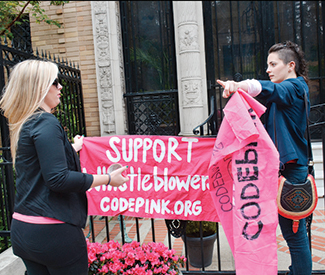
For years now, Bay Area organizers with the antiwar group Code Pink have been staging protests outside the Pacific Heights residence of Sen. Dianne Feinstein, who chairs the Senate Intelligence Committee.

Code Pink director Medea Benjamin has led delegations to Pakistan and Yemen in the past to protest US drone strikes, and San Francisco activists have frequently appeared outside the senator’s home to sound off against the US military’s use of drones.

But more recently, Code Pink activists have paid visits to Feinstein to let her know what they think of her comments condemning the actions of whistleblower Edward Snowden.

“We at Code Pink think Edward Snowden did a great service to this country,” by leaking secret National Security Agency documents detailing the intelligence agency’s dragnet surveillance program, said organizer Nancy Mancias.

So on June 15, 2013, “We flew a couple toy helicopters outside her home” as part of an anti-surveillance protest. It was an “Austin Powers” themed protest, she added, “playing spy-type music.”

But a couple months ago, Feinstein mentioned during a hearing about drones that she’d actually seen a drone peeking outside her window at her San Francisco home. She said it crashed shortly after she detected it.

But that left activists and others wondering about Feinstein’s account, since Mancias says the remote controlled device they sent up to fly around Feinstein’s mansion was not a drone, but rather a pink helicopter, “like a toy you pick up at Toys-R-Us.”

The Code Pink activists captured video of the event, she added, and sent it to the television program 60 Minutes. “Hopefully, they’ll air it when they interview Dianne Feinstein.”

Another wrinkle in Feinstein’s story is that “she said she was home when this demonstration was happening,” Mancias said. “But we were knocking on the door, ringing the doorbell.”

Believe it or not, Feinstein has actually responded to this sort of activity in the past by coming to the door and engaging with the concerned, pink-clad citizens.

“She’s a very old school politician,” Mancias said by way of explanation. “She’s very approachable. On that day she didn’t come outside, and if she was home, we would have loved to have a discussion with her about Edward Snowden.”

So was Feinstein’s account of spotting a surveillance drone rooted in nothing more than noticing a pink kid’s toy zip past her window during a routine Code Pink protest?

Nobody knows for sure but nevertheless, Code Pink activists feel vindicated. “I can say that we actually achieved our goal,” Mancias said. That’s because more recently, Feinstein has softened her stance somewhat and admitted that “we need to look into” the domestic surveillance program.

But that perception of a small victory doesn’t mean they aren’t going back. On Tuesday, Feb. 11, Code Pink plans to return to Feinstein’s Pac Heights mansion for yet another protest, this time to coincide with a national day of action being planned in opposition to NSA spying.

Called “The Day We Fight Back,” the Feb. 11 action day will consist of website owners installing banners to encourage their visitors to challenge online spying, and employees of tech companies calling on their organizations to do the same.

“We’re asking people to bring surveillance equipment, drones, and magnifying glasses,” to Feinstein’s house, Mancias said, presumably talking about props and not real surveillance equipment (does Google Glass count?). “We’ll just play some music,” she added, “and have a fabulous time.”

In the dark

5

A battle for transparency that has dragged on for years is nearing a milestone, as Bay Area civil liberties advocates await a judge’s ruling on whether the federal government will be forced to hand over memos outlining its legal justification for overseas drone strikes targeting US citizens.

The First Amendment Coalition, an Oakland-based civil liberties organization, submitted a Freedom of Information Act request in October 2011 seeking a legal memo prepared by the Office of Legal Counsel to the US Department of Justice.

Initially referenced in the New York Times and the Washington Post, the memo reportedly justifies the legal arguments underpinning the DOJ’s decision to track down and execute Anwar al-Awlaki, an American-born Al Qaeda operative who was killed by a US drone strike in Yemen in September 2011.

In its request, FAC noted that it was not interested in factual information about intelligence sources, but rather “discussion of the legal issues posed by prospective military action against a dangerous terrorist who also happens to be a US citizen.”

It’s hard to see how releasing a legal memo would constitute a threat to national security, an exemption that allows government to classify much of its information about military operations, but nevertheless federal authorities refused to honor FAC’s request.

In fact, the DOJ took its denial a step further, stating that it “neither confirms nor denies the existence of the document described in your request … because the very existence or nonexistence of such a document is in fact classified.”

After filing an appeal and getting nowhere, the civil liberties organization filed suit in Feb. 2012, demanding the release of the memo. Attorney Tom Burke, of Davis Wright Tremaine LLP, is representing FAC.

“We are not interested in how the US government found Al-Awlaki,” he explained. “Our suit is to release that memo with all intelligence information redacted.”

In Oakland on Jan. 23, US District Judge Claudia Wilken heard arguments from Burke and DOJ lawyers in motions for summary judgment, seeking a pretrial decision to settle the matter. By press time, Wilken still had not issued her ruling.

“It’s hard to know the ruling,” Burke said in a phone interview a week after the hearing. “The judge was being very short and blunt.” He added, “We’ve been fighting for this for years. If the ruling doesn’t go our way, I look forward to taking this to the Ninth Circuit [Court of Appeals].”

Meanwhile, the US District Court for the Southern District of New York heard two similar cases, brought against the DOJ by the New York Times and a New York chapter of the American Civil Liberties Union. In January of 2013, that court decided in favor of the DOJ, albeit with grave reservations.

“I find myself stuck in a paradoxical situation in which I cannot solve a problem because of contradictory restraints and rules — a veritable Catch-22,” Judge Colleen McMahon wrote in her opinion. “I can find no way around the thicket of laws and precedents that effectively allow the Executive Branch of our Government to proclaim as perfectly lawful certain actions that seem on their face incompatible with our Constitution and laws, while keeping the reasons for their conclusion a secret.”

The New York Times and ACLU appealed the decision, and are currently awaiting further ruling from the Court of Appeals for the Second Circuit.

The American citizens at the heart of these convoluted proceedings are al-Awlaki, his teenage son, Abdulrahman al-Awlaki, and Samir Khan. Al-Awlaki and his son — who was 16 at the time of his death — were both born in the United States, while Khan was a naturalized citizen of Pakistani origin.

Although all three were killed in strikes associated with counter terrorism operations, the elder al-Awlaki was the only one specifically targeted, according to a letter Attorney General Eric Holder wrote to members of Congress last May.

While the US government’s use of drone strikes has always been politically contentious because of stray civilian deaths, the use of this tactic to target American citizens has been particularly controversial. How is it that the US government — a global beacon for democracy and due process — can find guilty and execute its own citizens without a modicum of a trial?

“Judge McMahon expressed serious concerns that what the government was doing was unconstitutional,” said Brett Kaufman, an ACLU attorney who is handling the cases concerning drone strikes. “But on the merits of [the Freedom of Information Act], which was the issue before her, she had to agree with the DOJ.”

Francisco Alvarado contributed to this report.

Conservative star in ‘Monologos de la Vagina’ replaced

5

Following national controversy over the resignation of a politically conservative actress from the local Spanish-language production of The Vagina Monologues, producer Eliana Lopez announced last week that the production had found a replacement.

Actress Alba Roversi, a veteran of the Spanish language Monologos de la Vagina, will take the place of Maria Conchita Alonso, whose departure from the play had Fox News crying foul over her being “forced out” for her conservative political views.

Any chance to needle San Francisco, right?

Roversi starred in over 20 Spanish language soap operas, though she may not have the same name recognition in the US as Alonso, whose filmography includes Predator 2 and The Running Man (with our former Governator). Roversi is in, and Alonso is out.

Alonso stirred the pot for backing Tea Party gubernatorial candidate Tim Donnelly in a YouTube ad that garnered just over 100,000 hits. Donnelly, a Republican Assemblymember representing the 33rd District along the Arizona border, is running a long-shot campaign to unseat the ever-popular Jerry Brown this November on a core right-wing platform.

“We’re Californians, I want a gun in every Californian’s gun safe, I want the government out of our businesses and our bedrooms,” he says in the controversial ad, standing in a cowboy hat next to Alonso.

“He has ‘big ones,’ and he is angry,” Alonso says in Spanish, by way of translation.

The ad had San Franciscans fired up, diverting attention from a performance celebrating women and devolving into a political shouting match, Lopez told the Guardian. Threats of boycotts put Monologos de la Vagina in the crosshairs. Alonso told media outlets she’d stepped down from the play to protect her fellow performers.

“The other actors don’t have to go through this,” she said to Fox News & Friends host Clayton Morris. “They don’t deserve this. It’s on me only, they can do whatever they want with me.”

Residents of the historically Latino Mission District have good reason to be pissed at Donnelly: The Tea Party wunderkind rose to fame as a former member of the gun toting border-patrollers, the Minutemen.

“Of course she [Alonso] has a right to say whatever she wants. But we’re in the middle of the Mission. Doing what she is doing is against what we believe,” Lopez, who is also starring in the play, said in her most oft-mentioned quote in national media outlets.

In particular, Alonso’s endorsement didn’t jibe with the intention behind bringing the Spanish-language Monologos de la Vagina to the Mission’s Brava Theater, which was to celebrate the rapidly disappearing Latino/a culture of the area.

“I’ve been working on this show for almost a year trying to raise the money, find the venue, the sponsors,” she said. “My feeling was, as Latinas we have such beautiful things to offer. We have great actors and actresses who can bring things to the Mission and feel proud of. Inside me I felt, I want to bring that here, I want to do it. We can bring attention to our culture in a beautiful way, a high quality way.”

With a new actress in place, she’s ready to move beyond the controversy, Lopez said. “How do you say in English? The show must go on.” 

Cities face legal obstacle to safer biking

7

San Francisco has been blazing the trail toward safer cycling with innovative designs such as cycletracks, or bike lanes that are physically separated from cars, which have been installed on Market Street and JFK Drive. But cycletracks aren’t legal under state law, something that a San Francisco lawmaker and activist are trying to solve so that other California cities can more easily adopt them.

“Right now, many cities are not putting in cycletracks for fear they don’t conform to the Caltrans manual,” says Assemblymember Phil Ting, whose Assembly Bill 1193 — which would legalize and set design standards for cycletracks — cleared the Assembly on Jan. 29 and is awaiting action by the Senate.

Ting is working on the issue with the California Bicycle Coalition, whose executive director, Dave Snyder, is a longtime San Francisco bike activist. Snyder says Caltrans doesn’t allow bike lanes that include physical barriers against traffic, even though they are widely used in other countries and states and considered to be safest design for cyclists.

“San Francisco is technically breaking the law because they have the best traffic engineers in the state and a good City Attorney’s Office and they know they can defend it in court if they have to,” Snyder said. “Most places in the state won’t do that.”

In addition to the direct benefits of the legislation in San Francisco and other cities, Snyder said the legislation seems to be triggering a long-overdue discussion at Caltrans and other agencies about how to encourage more people to see cycling as an attractive transportation option, with all the environmental, public health, and traffic alleviation benefits that it brings.

“It’s opened up a conversation about bike lane design and Caltrans’ role in encouraging safe cycling,” Snyder told the Guardian, praising Ting for championing the legislation. “It’s having an impact beyond its immediate impact.”

In response to a request for comment, a Caltrans spokesperson said, “It’s our policy not to comment on pending legislation.”

Surveys conducted by the San Francisco Bicycle Coalition have shown safety is the top concern of those considering riding to work or school more often. Ting said he hopes this legislation will address that concern: “By building more cycletracks in California, there will be increased ridership.”

Residents vs. tourists

64

steve@sfbg.com

Evictions and displacement have become San Francisco’s top political issues, amplified by protests against tech companies that are helping gentrify the city. Yet Airbnb, which facilitates the conversion of hundreds of San Francisco apartments into de facto hotel rooms, has so far avoided that populist wrath.

Tenants use the online, short-term rentals to help make rent in this increasingly expensive city, a point that the company often emphasizes.

“For thousands of families, Airbnb makes San Francisco more affordable,” Airbnb spokesperson Nick Papas wrote to the Guardian by email, citing a company survey finding that “56 percent of hosts use their Airbnb income to help pay their mortgage or rent.”

But it’s also true that Airbnb allows hundreds of rent-controlled apartments to be removed from the permanent housing market — in violation of local tenant, zoning, tax, and other laws — something that has united tenant, landlord, hotel, and labor groups against it (see “Into thin air,” 8/6/13).

“The problem is Airbnb is so easy and attractive that you can take a unit out from under rent control forever,” San Francisco tenant attorney Joseph Tobener told the Guardian.

“We’re getting 15 calls a week on Airbnb,” he said, describing four categories of complaints: landlords evicting tenants to increase rents through Airbnb, tenants complaining about neighbors using Airbnb, tenants being evicted for getting caught illegally subletting through Airbnb, and Airbnb hosts who can’t get guests to leave (city law gives even short-term residents full tenant rights, except in hotels).

There isn’t good public data on how many units are being taken off the market, but Airbnb generally lists well over 1,000 housing units in San Francisco at any given time, with its smaller competitors (such as Roomorama and VRBO) adding hundreds more.

The San Francisco Rent Board listed 326 no-fault evictions (Ellis Act, owner move-in, capital improvement) in its 2012-13 annual report. That number is almost certain to rise in the 2013-14 report due out in March, and it is compounded by an unknown number of buyouts that pressure tenants to voluntarily leave, all of it creating a displacement crisis that has galvanized the city.

“Isn’t it far more likely that more units are being lost [from the rental market] through Airbnb?” San Francisco Magazine recently quoted a UC Berkeley professor as saying in an article questioning whether Ellis Act evictions are really a “crisis.”

So Airbnb is clearly having a big impact on the city’s affordable housing crisis. Yet Airbnb is largely flying under the political radar in its hometown and ducking questions about its impacts.

“Airbnb has all the statistics we need to assess its impacts on the city’s housing market,” Tobener said. The company refuses to disclose such data. Airbnb’s customers need to consider their impacts to the city’s affordable housing crisis, Tobener added, because “there are social consequences to the decisions we make.”


STALLED IN LIMBO

Last year I discovered Airbnb was flouting a ruling that it should be paying the city’s 15 percent transient occupancy tax (“Airbnb isn’t sharing,” 3/19/13), a nearly $2 million per year tax dodge.

Yet Airbnb, which has quickly grown from a small start-up into a company worth nearly $3 billion, has some powerful friends in Mayor Ed Lee and venture capitalist Ron Conway, who invests in both Airbnb and Mayor Lee’s political campaigns and committees.

So the company has stonewalled Guardian inquiries for the last year as it has worked with Board of Supervisors President David Chiu on legislation that tries to bring the company’s business model into compliance with local laws. That hasn’t been easy, as Chiu told us.

“It has been difficult to corral the different stakeholders to get on the same page,” Chiu said. “Airbnb has been like unraveling an onion. The more progress we make, the more issues come up.”

Janan New, executive director of the San Francisco Apartment Association, says it shouldn’t be so hard. “They need to enforce the law. They need to collect the hotel tax. They don’t need new laws,” she told us.

While the city is unlikely to simply follow New’s advice, the displacement issue adds another layer to Airbnb’s onion, one that sources say has become an issue of growing concern within the company, which has finally begun to respond to Guardian inquiries.

Those concerns have also been compounded as Airbnb is now being sued by one of Tobener’s clients, Chris Butler, who says he was evicted from his rent-controlled Russian Hill apartment so the landlord could make more money through Airbnb (see “Airbnb profits prompted SF eviction, ex-tenant says,” SF Chronicle, 1/22/14).

“We strongly support rules that keep people in their homes, and the vast majority of Airbnb hosts are regular people just trying to make ends meet,” Airbnb told the Guardian. “Whatever happened in this case, we certainly do not support unscrupulous landlords who evict long term tenants solely to turn their apartments into short-term rentals, but it is important to note that experts have found such cases to be extremely rare.”

Airbnb didn’t respond to our follow-up questions, but those “expert” findings appear to be a reference to a study the company commissioned late last year from Berkeley-based Rosen Consulting Group entitled “Short-Term Rentals and Impact on Apartment Market.”

But that study of Airbnb’s impact to rental housing in San Francisco doesn’t really draw the conclusions that company seems to think and hope it does.


MISLEADING NUMBERS

One number that the study and Airbnb have repeatedly sought to highlight is the claim that “90 percent of Airbnb hosts in San Francisco use Airbnb to occasionally rent out only the home in which they live,” as the company put it to us.

“Airbnb users generally do not identify themselves as utilizing short-term rentals as a business. In fact, 90 percent of Airbnb hosts [in San Francisco] indicated that they live in the home listed on Airbnb,” was how the study put it.

“It’s trash. They pick and choose the data they want to share,” Tobener said of the study and the 90 percent figure, which he says was derived from a 2011 user survey before the local housing market exploded. Rosner Consulting told us it stands by the study but won’t discuss it.

The figure also lumped in those with multiple rooms in their homes that have traditionally been rented by local residents and covered by rent-control laws. It also discloses that 10 percent of Airbnb hosts are renting out outside units simply as a business, a figure that has likely risen over the last three years.

The study does disclose that there were 1,576 properties booked through the company in August 2012, which the study notes was just 0.4 percent of the 378,000 homes in San Francisco, which Airbnb uses to dismiss its impacts on the market.

But the study includes only macroeconomic data, rather than looking at the company’s impact on certain socioeconomic groups — such as those making 120 percent or less of median area income, the people being evicted from and priced out of the city — or the supply of rent-controlled housing.

“The average gross income per Airbnb property in the previous 12 months was $6,722, or an average of $564 per month,” the study discloses, choosing to use average rather than median figures even though they’re considered less accurate gauges of income and housing data.

Customers who only use Airbnb once or twice will skew those averages way down. Yet the study then compares that number to the “average market-rate apartment rent in San Francisco, which was $2,498 per month in mid-2013. The average income generated is insufficient to cover monthly rental expenses in full.”

Which tells us nothing about how Airbnb is impacting either rent-controlled housing or the median income San Franciscans who rely on it. According to the US Census Bureau, the median rent in San Francisco was $1,463 in 2012 and 64 percent of San Franciscans rent their homes.

“The study is bullshit,” Tobener said. “They could pull data and tell us how many people are renting full units on Airbnb, but they don’t.”

Yet the company claims that it is concerned about these issues and working with the city.

“We believe our community of hosts should pay applicable taxes and we are eager to discuss how this might be made possible. We’ve reached out to officials in San Francisco and we continue to have productive discussions with city leaders,” Airbnb told the Guardian. “These issues aren’t always easy, but if we work together, we can craft fair, responsible, clear rules that ensure San Francisco continues to benefit from home-sharing.”

Yet neither Airbnb nor its political supporters seem to want to have this public discussion. The company has stopped responding to our inquiries, again, and when we asked the Mayor’s Office about Airbnb’s impacts to the affordable housing market, we got this response and a refusal to directly answer either the original or follow-up questions: “The Mayor has prioritized preserving, stabilizing and growing the City’s housing stock. His policy priorities include protecting residents from eviction and displacement, including Ellis Act reform and stabilizing and protecting at-risk rent-controlled units, through rehabilitation loans and a new program to permanently stabilize rent conditions in at-risk units.”

Yet Airbnb continues to have an impact on those “at-risk rent-controlled units” that few people seem to want to discuss.

Expose yourself to art

0

arts@sfbg.com

THEATER It takes a playwright of particular boldness to forgo text entirely in deference to movement and music. But in addition to the formal choices made in her Untitled Feminist Show, eminent New York downtown theater maker Young Jean Lee also pursues a theme (flagged by her “un-title”) that stubbornly remains as controversial as ever: the politics and pleasures of female empowerment. This theme plays out starkly, without clothes and without shame, over the course of an hour-long romp that will make its Bay Area premiere this weekend at Yerba Buena Center for the Arts.

Conceived and directed by Lee, with choreography by Faye Driscoll (another prominent New York artist whose You’re Me ran at CounterPULSE last March), Untitled Feminist Show is just one of the latest of Lee’s willfully provocative, consistently witty pieces. She and her Young Jean Lee’s Theater Company have made a national reputation by reaching for the most uncomfortable subjects, producing a set of humorous, audacious, experimental plays about race, sex, family, religion — great taboo regions normally shrouded in prickly mythology, limited by official debate, or otherwise smothered by good intentions.

Her works include Straight White Men, an exploration of success in contemporary American society; The Shipment, her “black-identity politics show”; Church, investigating American-brand Christianity through the structure of a church service; and the fierce, zany, and dis-Orienting Songs of the Dragons Flying to Heaven (produced locally by Crowded Fire in 2011) in which, drawing on her own Korean American roots, the fractured perspectives and sacrosanct traditions of an American minority serve a master narrative about a young white couple’s banal relationship.

YBCA’s presentation of Untitled Feminist Show comes, not coincidentally, as the organization transitions under its new leadership. Deborah Cullinan, who succeeded Ken Foster as YBCA’s executive director in September, was the longtime executive director of Intersection for the Arts. She has a well-deserved reputation for turning that esteemed arts organization around from hard times after she took over in 1996. YBCA’s director of performing arts, Marc Bamuthi Joseph, was a successful Oakland-based artist and activist when he took over from Angela Mattox (now running PICA in Portland) in 2012.

As longtime associates in the local arts scene, both of whom have been exceptionally community-oriented advocates for the arts, Cullinan and Joseph together promise a bold redrawing of the lines at YBCA. They recently sat down to speak with me about the vision they share for a 21st century arts organization — including the development of something they call the creative ecosystem — and where the work of an artist like Young Jean Lee fits into it.


SF Bay Guardian How are you settling in, after a couple of months and a couple of years now, respectively? And what are these creative ecosystems?

Deborah Cullinan Where I’m at: I’m still listening, learning—frankly a little astonished. I was, what, three blocks away? And my predecessor Ken Foster was one of my closest work friends; Bamuthi another one. I had no idea how much goes on here. It’s just abundant. The creative ecosystem is something Marc dreamed up, and certainly wooed me with. It’s something the two of us, and everybody here, considers to be a way we can think about a contemporary arts center in this century.

Marc Bamuthi Joseph The day that this feature runs will be my second anniversary. My last work [red, black & GREEN: a blues] was commissioned here, and premiered here. I interviewed for this position three days after the premiere. That last work was built around an integrated, documentary process of asking public intellectuals, doers, activists of all stripes—and by activists I don’t mean by vocation but in the purest sense of the word—to contemplate a question and create a physical response. The result, in terms of making art but also in terms of my personal relationships (the way that community might interact with an artistic process), was something that I essentially adapted and created here.

Our community engagement program is a curatorial department. It doesn’t function as a traditional department in that it’s not supplementary. They are agitators; they are intentional. They make space, as opposed to supplementing work. Their gig is not to cue up the Q&A after a play. [It’s] ultimately about the cultivation of relationships.

So that’s what the creative ecosystem is. It’s an adjunct to my own artistic process; it’s a scheme and structure that works within the infrastructure that we have at Yerba Buena Center. What we do is we curate small groups, somewhere between 30 and 50, around key questions that artists are driving. We bring these folks together in salon spaces to watch work together. So, for Young Jean Lee, the questions are: “What is on the other side of your body’s joy?” and “What is on the other side of your body’s shame?” The group has been together for about a year. And when we present the work, they’ll create in our theater lobby physical responses — performative, immersive, antagonistic, and also very vulnerable responses to those questions of joy and shame in the body.

Having piloted a group already (which was contemplating futurity and soul), and now working with body politics, we’re going to add a layer of the onion every year, so that in the coming years we’ll have hundreds if not thousands of folks operating on our campus not just as audience members but as agents within artistic inquiry, so that while we’re here it’s a place of thinking and doing and not just watching.

SFBG Who makes up this group?

MBJ They come from all over the educational spectrum, and all over the vocational spectrum. That too is by design. We wanted at least 10 different practices in each of these groups. These groups aren’t made up of artists exclusively, and ideally artists are in the minority. What we’re creating is a platform by which an arts space might be a hub for diverse intellectual activity. It’s art-framed, but it’s not necessarily art-centered.

DC I’m excited to see us pursue not an either/or definition of what an arts center is — or what art is — but a both/and. What we’re trying to suggest here is that the more we consider what the art is doing, who’s gathering around it or who’s making it, the more valuable that art itself is. The community engagement structure Marc talked about suggests that if you don’t have an active curatorial arm asking, “Who’s not here still?” and “What don’t we know yet?” then the curatorial structure is static. I think putting things together in this way means it’s much more of a circle, and it’s much more inclusive.

SFBG Where does Young Jean Lee’s Untitled Feminist Show come in?

MBJ There’s an arc around relationship to the body—in a way that’s not so much about identity; I think it’s more about empathy and vulnerability. These broad themes of joy and shame are more visceral than intellectual. The alchemy of transformation, the movement of molecules in a room, that’s currency to me. An artistic experience is more valuable if I feel my chemistry changing. So I look for art and artists that demonstrate a similar value system. Myra Melford’s work; Dohee Lee’s work; all of the artists in our New Frequencies music festival — these are artists who demonstrate that same sensibility: the attack of inquiry with brilliant intellectual design, but also a fierceness and unflinching-ness around personal transformation.

The work I subscribe to is work where I feel an artist being transformed, with a magic or sorcery around the ability to have personal transformation be a conduit for collective transformation. I think that’s at work [in Untitled Feminist Show]. And in terms of an intentional community design, this is what we foreground. *

“UNTITLED FEMINIST SHOW”

Thu/30-Sat/1, 8pm, $30-$35

Yerba Buena Center for the Arts

Lam Research Theater

700 Howard, SF

www.ybca.org

Young at heart

0

LEFT OF THE DIAL “Why are some songs so perfect in a way that never happens again in our lives? What is it about music and being older than 12 but younger than 20?”

Those are the lines of narration capping the final panel of one of my favorite Lynda Barry comic strips, an autobiographical story in her collection One Hundred Demons. In it, our teenage protagonist is lying in bed, staring at the ceiling, listening to the radio in a manner immediately recognizable to anyone who has ever been a teenager. The mood is: I am surely feeling feelings and thinking thoughts no one ever has before. As I recall, this is what being a teenager is. Every emotion, positive or negative, however fleeting, is all-consuming, and often you have no choice but to lie in your room, crushed by the weight of it, headphones drowning out the world. The idea that “this too shall pass” is impossible to understand, because you can’t even see past the econ test you’re surely going to flunk tomorrow, or that guy in biology who barely knows your name. This is why teenagers always seem so sluggish: That shit’s exhausting.

Ask any teenager what helps them get through it — and here I realize I’m starting to sound like adolescence is an inevitable six-year-long disease of sorts, or perhaps a heroin detox you just have to sweat through, but whatever, it kind of is — and near the top of the list, I bet you’ll find music.

“I would have ended up as a drug dealer, no question,” says John Vanderslice, the musician-producer-owner of SF’s storied Tiny Telephone studios, of what he might have become without music as a young person. “I would currently be residing in prison.”

Lucky for him, “My mother forced me by gunpoint to take piano lessons,” he says. “And this was the dirty South. I was in public schools, where the arts meant, you know, coloring. But I got really interested in music, and that became a huge open door for me. I think it would have been a lot tougher to do what I do now if I hadn’t had that music theory kind of shoved in to my brain when I was seven, eight, nine years old, even if I didn’t know it was happening at the time.”

Vanderslice is just one in a who’s who of Bay Area artists who were invited to think about what music meant to them when they were young — how and when and which music shaped their formative years — in preparation for a Friday, Jan. 31 show celebrating the 5th anniversary of the Magik*Magik Orchestra at the Fox Theater in Oakland. The orchestra, a group of more than 50 musicians who have provided “made-to-order” support on records and tours with Death Cab for Cutie, Zola Jesus, How to Dress Well, and Nick Cave, to name a few, is raising money for Magik For Kids, their nonprofit arm that throws hands-on music education events for school-aged kids in the Bay Area.

“When We Were Young,” presented by Noise Pop, will showcase bands — Nicki Bluhm and the Gramblers, the Dodos, Geographer, and a dozen others — collaborating with a 30-piece orchestra and the 30-piece Pacific Boychoir on songs that the artists themselves selected. The prompt: Pick a tune from your childhood that’s close to your heart.

“It was really interesting to see what people chose — I was expecting more ’80s given the age range, but you realize you’re not always listening to what’s new when you’re little,” says arranger, conductor and Magik*Magik founder Minna Choi, a Berkeley-born, classically trained 32-year-old colleagues refer to as a dynamo. (Vanderslice — who will be performing a Simon and Garfunkel song — agreed to Magik*Magik becoming the house band at Tiny Telephone after Choi cold-emailed him five years ago: “Minna’s the kind of person who can and will do absolutely anything she wants to do.”) Choi will conduct most of the show, with Michael Morgan, conductor of the Oakland East Bay Symphony, appearing on a couple pieces.

In designing music programming for children, says Choi, “We’re trying to create ways to expose younger kids not only to music, but to a music career and what that looks like.” The orchestra has organized instrument “petting zoos,” taught kids to build their own string instruments, and run a summer camp where children learn to conduct.

Many players in the orchestra also teach private music lessons, and some had to cancel a few lessons in order to rehearse for the show. “But the point of this show is music education,” says Choi. “So we came up with a kind of ‘Bring your student to Magik work’ day and had them reach back out to parents saying ‘I can’t do a traditional violin lesson Tuesday, but you’re welcome to bring your son or daughter to the studio, we’ll have it set up for them’…there’s so much to learn there, whether it’s rehearsal technique, or just how to communicate when you’re working with 40 other people.”

Diana Gameros, a staple of the Mission’s indie-folk scene — she’s been called “the Latin Feist” — chose an original song from her most recent album, a song she wrote for her hometown of Juárez, Mexico.

“I grew up listening to very traditional Mexican songs, because my grandparents lived on a little farm and that was what there was,” she recalls. “And I didn’t like it when I was young. I wanted to be hip, I wanted to be cool. I liked really poppy songs, which you could hear on the radio because we were so close to the border. What was that band that sang ‘I Saw the Sign’? That’s what I wanted.”

She moved to the States as a teenager, and began writing songs as a young adult. And that’s when she realized that the traditional Mexican music she’d disliked as a child “was embedded in me…it’s in my blood.” She chose “En Juárez” for this show in part because it’s written from a mother’s perspective: “If I had children, this is a song for them — explaining the realities of Juárez, the violence, but also talking to them about what’s possible, about dreams and the hope we should have regardless of problems,” she says.

“I was just honored to be asked to be part of this show, honestly. It’s going to be a magical night.”

A handful of scattered thoughts, while we’re on the topic of music that helped when you needed to lie on your bed blasting music through a Walkman:

  • Green Day’s Dookie was released Feb. 1, 1994 — 20 years ago this Saturday.
  • I’ve listened to that album from start to finish more recently and more frequently as an adult than I should probably admit. If “When I Come Around” starts on the radio when I’m driving, I will turn it all the way up.
  • Miley Cyrus. Skrillex.
  • My grandfather, in the last stages of Alzheimer’s at age 95 and unable to keep family members’ names straight, would sing along if you brought him tapes of Big Band songs from the 1930s.
  • Sherman Alexie: “Your generation’s music isn’t better than any others. It’s just inextricably linked to your youth.”


When We Were Young
With Nicki Bluhm and The Gramblers, The Dodos, Diana Gameros, Geographer, How To Dress Well, Zoe Keating, The Lonely Forest, Maestro Michael Morgan, The Pacific Boychoir, Rogue Wave, Two Gallants, and John Vanderslice

Fri/31, 8pm, $29.50 – $45
The Fox Theater
1807 Telegraph, Oakland
www.thefoxoakland.com


Radio Romance

0

Being a radio DJ in 2014 feels oddly radical.”What do you mean ‘radio’?” people ask, totally perplexed, when I tell them what I do. It’s an independent station on the Internets, I tell them. “Can I call in?” is, without fail, their next question. Not exactly, I say, but we can tweet. It’s not your grandfather’s radio, but the perks are all there.

Web or dial, radio at a very basic level is transmission and reception. No doubt DJing now is physically different from my days on college radio — for starters, 2005 meant I was still fumbling with stacks upon stacks of CDs. Sometimes that shit would skip. Sometimes the play button would stick. Once I lost a disc under the desk and that was that — no more Brother Ali.

As a young college pup, I started as most do — manning a graveyard shift that allowed for the inevitable fuck-ups all newbies make: leaving the mic on while you sing to yourself, messy transitions, stuttering, and awkward jokes. Eventually I smoothed my nerves, developed a more seductive voice, and became master of the knobs and buttons. All my hard work earned a prime-time slot — happy hour. I had arrived. People were listening. I flirted with the idea of radio as a career.

In came the warnings. People called me brave for attempting to make my way into “dying industries”: journalism and radio. They gave me sad eyes, as if envisioning a lifetime of layoffs and corner store ramen. I picked one sinking ship over the other and continued writing. My radio days earned me iPod rights on road trips and conversations at parties, but “DJ” wasn’t even listed on my resume.

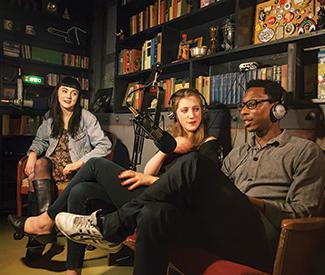
I kind of forgot about my old friend, the radio — at least in terms of working with the medium. Then came my new friend, BFF.fm: A now four-month-old, web-based radio station housed in the Mission. The programming is a constant stream of rad, weird, new, and classic jams. The DJs are a diverse batch of local cats, bonded by their unique obsessions with music.

And so it’s official: Radio and I have rekindled our romance.

Every Friday night my human BFF, Brit Spangler, and I co-host “hello, cheetle,” two hours of ratty rock-and-roll and secrets about our whiskey habits, stoney shenanigans, pizza, merkins, and all kinds of naughty things that I’m slightly embarrassed to have my parents hear on the regular — yes, they’re dedicated listeners.

Thankfully the station founder, Amanda Guest, thinks all this is entertaining. Creepy girls being creeps is OK by BFF standards. The station aims to be the audible representation of San Francisco. Guest is beyond stoked by BFF’s growing popularity.

“Things are going prettyyyyy amazingly,” Guest tells me while sipping a gin and tonic. She’s smiling hard. “I know it’s dumb to say, since I started the station, but…I love the station. I think it’s great. It’s filling a need.”

Birthing a San Francisco radio station was the entire purpose of her move from the East Coast a couple years back. Her skeptical Massachusetts friends sent her packing for a city that might be down with such unique ambitions. The original plan included hosting the station from her and husband Forrest’s apartment, but the idea quickly outgrew the living room. “I had this dream, but it wasn’t big enough,” — her grand plans were taking shape and collecting support.

Guest — aka DJ Cosmic Amanda — craved a real broadcast studio. By a fat stroke of luck and plenty of charm, she landed a space in the fairytale-esque Peter Pan-style workspace that is the Secret Alley. Immediately she and her man began the work that would get BFF on air.

“Forrest became the station manager and pretty much handled everything else related to that department,” she says. “I was like, oh, I’ve seen a station, I know what it looks like — you just plug this into this. Clearly that is not how it works.”

Through technical concerns, financial woes, and equipment searches, the couple caressed the challenges until their lovechild of a station was born. “BFF.fm is the baby I will never have,” she says, laughing — in all seriousness.

Trading potential offspring for SF music nerds, the Guest family is growing — 60 DJs now host 45 shows throughout the week. From obscure electronica and ’80s favorites to garage rock and blues, BFF’s roster goes in all directions.

“I like to say our show plays ‘high-quality’ music — no point in using genres anymore,” says Gregory Hill, who DJs as Cool Greg on Monday nights. Together with co-hosts Marisa Breall and Katie Kopacz, the trio plays tracks to complement their other shared gig, Professional Fans: show promoters, DJs, and the like.

“Our show is the perfect way to plug both the shows we are going to as fans and the ones we are going to as promoters,” says Hill. The friends see the radio as bonding space for music lovers at large: fans, bands, labels, and venues, all mingling in new ways. “BFF is creating community. There’s some real closeness happening.”

This kind of passion is exactly what Guest is cultivating. “I want to see real excitement in the DJs. Putting together a thoughtful show every week isn’t easy. It takes a certain kind of person, someone who strives to keep it fresh,” she says, being a long-time DJ herself. “It’s a job done out of love.”

I ask her if streaming ever weirds her out. Does the connection feel less real? Less radio?

“It still feels very natural to me. The delivery has changed a lot but the basic components remain,” she says.

“It’s still a person in a room, sharing with another person somewhere else. It’s people devoting their attention to a shared media,” she says. “Radio is magic.”

Tune in to BFF.fm on the Internets here.

The language of hope

11


By Fernando Andres Torres

arts@sfbg.com

LIT When Alejandro Murguía was named San Francisco’s sixth Poet Laureate in July 2012, he brought a fresh momentum to poesía en español, a movement with historical traction in the city. Murguía, the first Latino appointed to the two-year seat, is a noted bilingual poet whose sharp takes on the city by night, dark notes on tumultuous love, and verses raging against poverty have helped his work rise to prominence. The last lines of his 16th & Valencia: “And we were going to stay angry/And we were not leaving/Not ever leaving/El corazón del corazón de La Mission/El Camino Real ends here.”

Murguía’s post as San Francisco laureate builds on a recent trend, along with Juan Felipe Herrera — California’s current poet laureate — and José Montoya, who was Sacramento’s poet laureate at the time of his death last year. And if we sprinkle in Obama’s second inaugural poet, Richard Blanco, we could say that the national establishment is also paying attention.

Lately, Latino poetry written in both English and Spanish (or “Spanglish”) is blossoming with a vigor not seen since the 1994 passage of Proposition 187 — when many poetas surfaced to protest the vindictive initiative to prohibit undocumented persons from using social services. In this great moment for poesía en español, many fresh voices are rising up and challenging the norms of two intertwined languages.

“There are thoughts in Spanish, and maybe the next one is in English. My poetry is the rhythm of the speech; it is born while I walk, giving me a poetic sense,” says Silvia Parra, also known as Mama Coatl, who strolls the streets of the Mission with her poems and Mayan-Quiché spiritual teachings. Descended from Sonora, Mexico’s Yaqui people, Mama Coatl is also a performance-art activist, and a strong advocate of preventing violence against women; she co-presents Guardianas de la Vida, an annual performance and healing event in honor of San Francisco’s observation of the International Day for the Elimination of Violence Against Women and Girls.

“Poetas have always existed in San Francisco,” says Salvadorean poet Jorge Argueta. Many of us have come from Latin America. Bilingual readings are organized all over the city where poets express themselves in the way they want.”

In 1980, Argueta fled El Salvador’s brutal military regime for San Francisco, where he began mingling with the Mission District’s Chicano poets. He went on to publish his first chapbook, Del Ocaso a la Alborada (From Sundown to Dawn). Several books later, 2001’s award-winning memoir Una Película En Mi Almohada (A Movie in My Pillow) made him one of the top children’s book authors in North America.

According to renowned California poet Francisco X. Alarcón, author of 13 bilingual books, the growing interest in bilingual poetry has turned the genre into “a boom reflecting the linguistic and demographic of the times. Poetry is the only literary genre Latinos continue to write in Spanish. It has to do with life experience and emotions.”

Latino poets reflect their own reality in the language of their intimacy, he says. “Besides, English and Spanish are cousins, sharing the same Roman alphabet.”

But poesía en español is hardly a new phenomenon in San Francisco. By 1959, the beatniks were already looking to the south when Chilean poet Gonzalo Rojas visited City Lights Bookstore to invite several of them to the First Encounter of Writers of the Americas at the Universidad de Concepción. In 1966, Pablo Neruda’s UC Berkeley reading packed the house, with prominent poets and writers (including Lawrence Ferlinghetti, Mario Vargas Llosa, Allen Ginsberg, and Fernando Alegría) in attendance. That night, many ended up at Alegría’s home, and it was a meeting of two different languages with one common denominator: poetry. It was also a historic gathering “of profoundly different movements, the counterculture of the Beats a contrast to the aspirations of Western acclaim of the Latin Americans,” writes author Deborah Cohn, who details the many points of intersection between Latinos and Beat poets since the 1950s in her 2012 book The Latin American Literary Boom and US Nationalism During the Cold War.

And what about those purists alarmed by the Spanglish? “It is ridiculous! Both languages are enriching themselves from each other,” insists Alarcón. Adds Argueta, “Sometimes newcomers are bothered; they see it as an insult. You can call it bilingualism or Chicanismo, but for me it doesn’t denigrate the language — it embellishes the language.”

Late Sacramento laureate Montoya, one of California’s most celebrated poets, mixed English and Spanish with ease. In 1969, he wrote El Louie; along with Corky Gonzales’ 1967 I’m Joaquin, it became one of Chicano poetry’s most famous works. Maximizing the natural rhythms of the languages, words intertwine in a ravishing dance. The poet crosses back and forth between English and his mother tongue, emerging with the language of California.

Which brings us to San Francisco, 2014: el poeta de las corbatas brillantes, the poet of the glittering ties, and the first Latino appointed as the city’s Poet Laureate, Alejandro Murguía. As part of its San Francisco Poet Laureate series, City Lights has just published Stray Poems, a collection of bilingual poems written on napkins, matchboxes, parking tickets and wrinkled pieces of paper over the past 12 years. He’ll celebrate its release at a reading next week, appropriately enough at the very bookstore where Rojas first met the Beats. *

ALEJANDRO MURGUÍA

Feb. 5, 7pm, free

City Lights Bookstore

261 Columbus, SF

www.citylights.com


Mumble, mumble, murder

1

cheryl@sfbg.com

FILM Joe Swanberg’s latest film to play the Roxie, 24 Exposures, isn’t actually his newest. That’d be family drama Happy Christmas, which just premiered at Sundance. Going by festival reviews, Christmas sounds like it’s in the vein of Swanberg’s Drinking Buddies — last year’s Olivia Wilde-starring tiptoe into the mainstream, a departure for the indie writer-director-actor — with a marquee cast that includes Buddies‘ Anna Kendrick and hipster queen Lena Dunham.

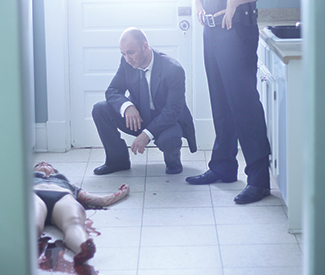
24 Exposures is the busy artist’s 15th flick to play the Roxie in a year (the list includes Buddies, 2012’s acclaimed All the Light in the Sky, 2007 breakout Hannah Takes the Stairs, and the only public screening to date of short Privacy Settings). In some ways, 24 Exposures marks another departure, being an “erotic thriller” (scare quotes needed, because it’s highly aware of its genre) — though it also incorporates Swanberg’s affection for relationships that aren’t working out, no matter how much the principals talk about their problems. His interest in horror (see: his participation in 2012 anthology film V/H/S and 2011 cult hit You’re Next, etc.) flavors 24 Exposures‘ plot: Parallel lives collide when photographer Billy (Adam Wingard), who snaps cute, topless women posed in gruesome death scenes, meets depressed cop Michael (Simon Barrett), who happens to be investigating the actual murder of a cute, topless woman.

Yep, this film stars director Wingard and writer Barrett of You’re Next and V/H/S fame. That slurping sound you hear is the mumblecore snake eating its tail, and not for the first time. (Is there anyone in that scene who hasn’t appeared in or worked on a peer’s film? The answer is no.) In 24 Exposures, it’s less of an in-joke than expected, since Billy and Michael don’t achieve BFF mode until the film’s coda. The relationships that form the core of the film are between Billy and the various women in his life, including girlfriend Alex (Caroline White), who is totes cool with his artistic pursuits as long as she’s included in the process, and any three-ways that occur after the shoots. Inevitably, there’s tension when she returns from a weekend away and realizes Billy’s been “taking smutty pictures when I’m not here.”

Billy is a sleaze, but otherwise he’s basically a harmless dude in a cardigan. If 24 Exposures had been made in early 1980s Europe, the film would pump out more bloody bodies for Michael to find; there’d be way more POV creeping and probably a chase involving an unseen killer wearing black leather gloves. Despite a sleek credit sequence illustrated with pulpy artwork, this is no lo-fi giallo. A better reference point is one from the script itself: Silk Stalkings, that 1990s epitome of basic-cable sexy thrillerdom. That it’s brought up jokingly (as in, “Do you feel like a character in Silk Stalkings right now?”) only enforces 24 Exposures‘ aspirations toward meta-ness.

The self-consciousness doesn’t end there. The film’s synthy score, which swells knowingly during suspenseful moments, is another obviously obvious choice. But if you’re expecting 24 Exposures to descend into full-on camp, you’ll come away disappointed. Lurid is perhaps a better descriptor, since 24 Exposures is bulging with “boobies” — a word Billy uses moments after explaining to a skeptical model that he practices “dress-up mixed with fine art.” Earlier, he’s described his work as “personal fetish photos,” clarifying that they’re “classy.” (Truly, they’re not.) We never see the results displayed anywhere, yet this is apparently his profession, not a private hobby, since the photo shoots involve makeup artists and assistants.

Clearly, 24 Exposures is poking fun at the erotic-thriller genre, and itself by extension. Any haters who cry “misogyny!” — because Swanberg’s camera ogles just as much as Billy’s does — are answered in a scene that’s been planned with them in mind. Photographing death is “way more interesting than taking a picture of a fuckin’ tree in your front yard,” Billy tells Michael, who counters by asking, “Why is it always dead women? Why not a dead old guy?” It’s not about that, Billy insists. “It’s ridiculous for me to try and explain this, because it’s not something that I even think about. You can’t say, ‘Why am I doing this?’ You just have to say, ‘OK, I’m attracted to this, and that’s what I’m gonna do.'”

That’s vague, and — again — Billy is a sleaze, but Swanberg’s careful to make his underlying point visually. When Michael asks Billy, “Have you ever seen a real dead body?”, it foreshadows the film’s second cute-girl murder. A distinction is made when a character we’ve come to sympathize with is brutally killed, and hers is the only crime scene that doesn’t invite us to leer at the victim.

The film’s last act cuts some months ahead; we see aspiring memoirist Michael receiving feedback from a book agent (played by Swanberg), who advises him to rewrite his manuscript. There are too many loose ends, he says, and not enough strong connections between the cop and the photographer. Oh, and the ending needs work, too. 24 Exposures, you’re talking to yourself — and you know it, and we know it, and you know we know you know.

Up next for the prolific, probably sleep-deprived Swanberg, who’s likely also got a dozen or so new movies in the pipeline: helming an episode of the San Francisco-set HBO series Looking. Wonder if there’ll be a scene set at the Roxie? *


24 EXPOSURES opens Fri/31 at the Roxie.


META WORLD PIECES: CATCHING UP WITH 24 EXPOSURES DIRECTOR JOE SWANBERG


SF Bay Guardian How’s Sundance?

Joe Swanberg It’s been amazing. [Happy Christmas] is a pretty small, personal movie, so it’s nice that people seem to be liking it.


SFBG When will it be coming out theatrically?

JS We’re probably gonna follow the Drinking Buddies (2013) release pattern of doing VOD and theatrical sometime around July, and then having it come out on DVD around Thanksgiving.


SFBG You’ve had 15 movies screen at the Roxie Theater in the past year, which is a pretty astonishing number.

JS They did a retrospective, which was incredible. Not only was it a great chance to hang out in San Francisco for a week, but it was amazing for me to look back at a lot of movies that I hadn’t seen in a long time. It’s also crazy to think that there’s that much stuff. I sort of forget that I’ve made that many movies.


SFBG Do you not consider yourself prolific?

JS Because I don’t write, I can very quickly jump from one project right into the next. The first six years I was making movies, I was making around one a year, because I had a day job and that was all the time I could spend on it. As soon as I was able to support myself as a filmmaker, I really was making a lot of them [laughs] — there was one year where I made six, which was really too many by anyone’s standards. It made the following year really strange, trying to actually get all of those out into the world. And also, while they’ve all had some form of distribution, there’s really only four or five of my movies that people have heard of. There’s all of these others that only the hardcore cinephiles have checked out.


SFBG When you say you don’t write, do you mean because your films are improvised?

JS Yeah, exactly. I do write, but it’s just an outlining process. I’m working so collaboratively with the actors that it’s not the sort of difficult screenplay process that a lot of filmmakers go through.


SFBG With this long filmography, is it weird for you to be suddenly known as “the director of Drinking Buddies”?

JS It’s totally fine. I tend to like the newest film the best, just because it’s the closest to where my head is at. Drinking Buddies would be the one that I would recommend to people, and talk about as well. And probably Happy Christmas will very quickly become the next center of conversations. I haven’t watched a lot of those early ones in a long time, so I don’t even know if I would like them anymore [laughs]. Hopefully, they’re all leading toward something. Getting better. Let me put it this way: It’s great that people are talking about Drinking Buddies and not some movie I made six years ago.


SFBG You mentioned that Happy Christmas is a personal movie, and obviously Drinking Buddies ties into your much-documented love of beer. So what inspired 24 Exposures?

JS I had been acting in genre movies a lot, especially with Adam Wingard and Simon Barrett. I was really interested in what motivated them to make those kinds of movies instead of romantic comedies or something [laughs]. Also, I think a lot of what 24 Exposures is about is the responsibility and ownership of that stuff. I wanted to investigate where the women fit in. Are they passive models who are being exploited, or are they willing participants? Are they co-authors of the art? Is it a little bit of all of those things? It’s something that I’ve made other movies about, too. I’m genuinely interested in the collaborative process. Who ends up taking the credit, and who ends up feeling taken advantage of?  

SFBG The film is very meta.  

JS Definitely. I was reading Richard Brody’s book on Jean-Luc Godard at the time, so meta was very much on my mind. I was interested in the way that Godard played around with genre movies, but very atypical genre movies. They were always much more like Godard movies than they were genre movies. It was fun to sort of dabble in that space. The other thing that was exciting to me was how my generation’s sexuality was informed by late-night Cinemax and very cheesy, soft-focus, heavy-music kind of stuff. (I’m 32.) When all of us were in junior high, that was the most erotic thing we had access to. That aesthetic is such a joke now. It’s so dated. So I wanted to investigate that as well.  

SFBG Do you worry that someone will come across the film and not pick up on that subtext?

JS This is an interesting one for that question. Pretty much all of my movies have existed very squarely in the art-house audience, so I haven’t really thought much beyond that sort of space. But that’s changing these days, especially with Drinking Buddies, and, I’m assuming, with Happy Christmas too. So maybe 24 Exposures will be seen by considerably more people than some of those earlier ones. But I feel like the movie’s sort of subverting the genre at every turn. It never fully gains momentum as a pure exploitation thriller. Every five minutes it reminds you that you’re watching a movie, and puts in some sort of criticism or other unsexy thought into your head.  

SFBG Totally changing gears, but I noticed you directed an episode of HBO’s Looking, which all anyone here can talk about right now.  

JS Yeah! It was one of the most fun things I’ve done as a filmmaker. I really like the show, too, so I’m just happy to have had some little piece of involvement. I live in Chicago, so I have hometown pride, but San Francisco is without a doubt the most beautiful city in America. I spent three weeks trying to find a bad view, and I couldn’t. *

To the occasion

0

arts@sfbg.com

DANCE Now in its 19th season, Robert Moses’ Kin offered up a three-part program, “RISE,” this past weekend at Yerba Buena Center for the Arts. “RISE” contained two world premieres — Profligate Iniquities and The Slow Rise of a Rigid Man — and a reprise of last year’s ambitious NEVABAWARLDAPECE. It was an evening in which Moses’ 14-member ensemble showcased its individualities, and presented rich perspectives on two very different pieces of choreography. The dancers would have been even more appreciated if they could have been seen better. For some reason, David K. H. Elliott’s lighting design favored darkness; at times, it was so murky that it wasn’t easy to see who did what, where.

For Profligate, Moses chose a selection of glorious Sephardic music that evoked the cultural complexity of southern Spain before the expulsion of the Jews in 1492. Tiffany Snow’s brightly lit sukkah, the temporary and fragile dwelling associated with the High Holy Days, suggested a place of respite.

The duets that made up the majority of Profligate explored a wide range of relationships, yet all of them seemed to have a touch of anger and distrust to them. There was weariness in the way Katherine Wells and Brendan Barthel circled each other, with Wells bursting into limb-shaking explosions. Yet they finished by going off together into the darkness. Standing tall and self-assured, Crystaldawn Bell barely glanced at Victor Talledos, who crawled and slithered in her direction like something emerging from below the earth. They shared a couple of promising dominance encounters, but then she sent him off.

Norma Fong, fiery and fierce, and Dexandro Montalvo, the man with the loosest hips, went at each other like two different forces. When he swung her, she defiantly stared at us.

Individually, the duets were strongly delineated, beautifully showing off these fine dancers — including major solos by Carly Johnson in her second year with the company, and Jackie Goneconti in her first. But Profligate was too episodic. It dragged. It needed some thread, some trajectory to tie the individual parts together.

The evening’s second premiere was Artistic Director Moses in the modest but well-focused The Slow Rise of A Rigid Man, a solo he created for himself. The work is part of a project about family, Blood in Time, which Moses began in 2000.

Dressed in a flowing coat and wide pants, the dancer looked heavier than he is in real life. Walking calmly into the spotlight, Moses started a movement conversation with David Worm (heard on tape), a founding member of the SoVoSo singing group. His rich baritone roamed in a free-flowing but wide-ranging manner through the topic of emptiness, perhaps aging. Moses started with simple warm-up movements in place, repeatedly wishing his knee into action. As he began to spread into space, you could still see young Moses with ODC/Dance in the fluidity of his gestures. But every step, every turn has been distilled, not from memories but from a recognition of the now. At one point, he reached both arms high, perhaps to embrace Worm. Though modest in language, Slow resonated.

I had feared that without the live music and text that was such a major part of last year’s NEVABAWARLDAPECE (“never will be there a world of peace”), its reprise would lose power. In dance terms, it was made richer through the simple addition of four dancers — the unisons, for instance, whether simply sitting on the sidelines, working their way in line formations across the stage, or observing the action from the wings. However, the 45-minute work did not come more into focus.

The major issue seemed to be Carl Hancock Rux’s overwhelming text that ranges from ancient to contemporary injustices. His words thundered across the stage like some invisible doomsayer’s. Since we are more wired to absorb information aurally than visually that can’t be helped, but it put a big burden on the dance.

Often the stage looked like an arena for struggle. Jeremy Bannon-Neches gesturing and leaping as if attacked, Wells whipping through turns as if pursued, and Montalvo drawing on his hip-hop roots to tear into the fray. Even the gorgeously long-limbed Bell seemed besieged when simply standing still. In their solos, Goneconti and Johnson seemed as unstoppable as the passage of time. At one point two dancers appeared to be nailed to a wall, quite arbitrarily. And yet among these incidences, there were welcome moments of quiet, passages of waiting, and a double circle folk dance when everybody seemed to be on the same page.

The last image was of Montalvo vigorously gyrating his hips with some overhead comment about being creative, because that’s all we have. A noble thought, perhaps, but not enough to pull this ambitious project into focus. *


Broken bodies, broken lives

42

Motorists driving for rideshare companies have struck and also killed pedestrians in San Francisco, even since state regulations were adopted to make these new transportation businesses safer and more accountable to the public.

Four months after the new rules were created, lawsuits from these incidents reveal that the new regulations contain gaping holes that continue to place passengers, pedestrians, and even drivers at risk.

One recent local story actually started in 2004 in Florida’s Monroe County. A vehicle sped down the Overseas highway at over 100mph. Ever seen the movie The Fast and the Furious? It was like that.

In the Florida heat, the car blazed by palm trees and an ocean view, hell bent for Miami. It accelerated as it took a curve, swerving around two vehicles going half its speed. Brazenly passing a traffic control device, the car cut off one more vehicle, then another, and another. Still barreling over 100mph, the driver swerved across the double yellow lines, forcing an oncoming vehicle to veer off the highway.

A traffic snarl put an end to the thrill ride. According to the Monroe County Sheriff’s Office incident report, which the Guardian obtained through a records request, driver Syed Muzzafar was accompanied by his wife and three children during his death-defying drive. He told the police officer, “This was just a dumb thing to do. I know I’m wrong.”

Muzzafar was booked for reckless driving. Nine years later, he would be booked again in San Francisco for hitting a family as they crossed the street in the Tenderloin.

On New Year’s Eve 2013, picking up fares for the tech company Uber, Muzzafar’s car struck young Sofia Liu, her mother, Huan Kuang, and brother, Anthony Liu. Six-year-old Sofia did not survive. Her family filed a wrongful death suit against Uber on Jan. 27, and will be represented by attorney Christopher Dolan.

Uber is part of an emerging cast of companies commonly known as rideshares, now legally called Transportation Network Companies (TNCs). The gist of how they operate is this: the company’s mobile app connects a driver with a customer, much like a taxi dispatch. Only a few years old, the TNCs initially operated in a wild west, devoid of regulation. But the California Public Utilities Commission passed rules for TNCs in September with the aim of protecting pedestrians, passengers, and drivers in collisions.

Uber, formed in 2009, has drivers in over 50 cities worldwide and an estimated worth of just over $3 billion, according to leaked evaluations. But Uber may still be in need of a version 2.0.

The death of the young Sofia Liu, killed by a driver already arrested for reckless driving, shows the state still has a long way to go on the road to regulating rideshares.


NOT MY PROBLEM

The night Muzzafar struck the Liu family, he was ferrying customers using the Uber app — but the company disavowed responsibility for the incident.

“We thank law enforcement for the quick release of information,” Uber wrote in a blog post the day after Sofia Liu died. “We can confirm that the driver in question was a partner of Uber and that we have deactivated his Uber account. The driver was not providing services on the Uber system during the time of the accident.”

But that’s a half-truth: Muzzafar was picking up passengers for Uber all night, but because he’d just dropped off a customer, he allegedly ceased being an Uber driver. With no passengers in the vehicle, Uber did not consider him “on the Uber system.”

If that sounds like a giant loophole, you’d be right — but it’s a legal one, for now.

The new CPUC regulations specify that TNCs must only provide liability insurance when drivers are “in service.” The Taxicab Paratransit Association of California is suing to modify those rules, saying the meaning of “in service” was never defined — and they allege this wording allows companies to disavow responsibility for a driver not carrying passengers at the moment of an accident.

This gaping loophole can also lead to insurance and liability consequences.

“I would guess that’s on the order of a $20 million liability case,” Christiane Hayashi, director of Taxi services at the San Francisco Municipal Transit Agency, said of Liu’s death. “The question is, who is going to pay for it?”

Muzzafar, and not Uber, may be on the fiscal hook, even though it’s unlikely he could cover the family’s medical and legal fees on his own.

Though much reporting has focused on TNC drivers’ lack of insurance, the collision that killed Sofia Liu on New Year’s Eve raises other questions as well. Just how did a driver with a reckless driving record manage to become a partner with Uber in the first place?

Checking out drivers

The recently drafted CPUC regulations require the TNCs to carry out background checks, a key element for safety. As it turns out, not all background checks are made equal.

Uber hired a private company called Hirease to conduct its checks, the Guardian learned in emails obtained from drivers. While Hirease requires Uber drivers to fill out a form with their personal information, taxi drivers who must register with the city’s transportation agency are screened with fingerprinting, Hayashi from the SFMTA told us.

The fingerprint checks make use of the FBI’s national criminal database, something a company like Hirease lacks access to (since it isn’t a government agency). We called the FBI’s background check department, based in West Virginia, to better understand the two methods.

We spoke to a rank and file employee, not a spokesperson, so he declined to give his name. The FBI employee spoke with a twang, and clearly laid out the problems.

The first snag with private background checks are false positives from common names (like John Smith) or stolen identities, he said.

Self-identification is also a problem. “If you’re a criminal, you’re not going to use your information,” the FBI employee said. “What if you were a lady and you were married six times, which name will you use for a background check? Bottom line, fingerprints are exclusive. Names are not.”

Another flaw is that while background checks performed for entities like the SFMTA make use of a federal database that dates back 100 years, California law doesn’t allow private background checks to go beyond seven years — and Muzzafar’s reckless driving arrest was nine years ago.

“Uber works with Hirease to conduct stringent background checks,” Uber spokesperson Andrew Noyes wrote to us via email. “This driver (Muzzafar) had a clean background check when he became an Uber partner.”

Hirease and Uber did what they legally could, but the summation of laws and regulations blinded Uber to Muzzafar’s background — and nothing in the new CPUC regulations would have prevented this. That may go a long way toward explaining how a man caught recklessly driving with his own family in the car in Florida was driving for Uber the night he allegedly struck and killed a child.

Importantly, California law does allow for a taxi driver to have one reckless driving incident, or one count of driving under the influence, on his or her record. But as Hayashi told us, stricter background checks make it easier for taxi companies to spot a red flag before making hiring decisions.

The relative insecurity of private background checks raises an unsettling question: How many others with reckless driving records or DUIs drive for TNC companies like Uber, Sidecar, and Lyft without the companies’ knowledge?

The results of a collision can be severe, as San Francisco’s tragic New Year’s eve incident demonstrates. But even those who survive are left with bills that Uber, allegedly, isn’t paying.


PAYING NO ONE

Last September, Jason Herrera and Nikolas Kolintzas summoned an Uber driver via smartphone, intending to hop from Valencia Street to the Marina district. Driver Bassim Elbatniji responded, and drove the pair down Octavia, where his Prius collided with a Camry.

Herrera suffered a concussion and was knocked unconscious. Kolintzas also suffered a concussion, and they both sustained injuries to their necks and backs, according to court documents.

But when the two sought financial assistance from Uber to cover their medical costs, Uber said it was the driver’s responsibility.

“As far as Uber’s concerned, their insurance isn’t providing any of this,” attorney Colleen Li told the Guardian. Li is representing Kolintzas and Herrera in their suit against Uber, which seeks damages to cover their medical bills, which reached “tens of thousands” of dollars, Li told us.

According to a policy published on Uber’s website, the company maintains a $1 million “per incident insurance policy applicable to ridesharing trips,” which is in keeping with requirements under the new CPUC regulations.

Nevertheless, Uber has not stepped up to cover damages in response to a lawsuit arising from a similar incident. Months ago, the Guardian reported on the case of an Uber driver who hit a fire hydrant, which flew through the air and struck Claire Fahrbach, a barista living in San Francisco (“Lawsuit over injury from airborne fire hydrant tests Uber’s insurance practices,” 8/8/13). She sustained lacerations to her body, a fracture in her lower leg, and multiple herniated discs, according to her lawsuit against Uber.

Her medical bills and injuries destroyed her dreams of living in San Francisco, and she moved home with her parents in North Carolina to recover. Her lawyer, Doug Atkinson, told us Uber still hasn’t paid for his client’s medical services.

“They’re still denying they have any liability for the driver,” he said. “They said they wouldn’t fight the CPUC ruling, but in our case they obviously are.”

But the hydrant also sprouted a geyser that flooded a nearby business, Rare Device, and the apartment building above it. “It was horrible. Our store flooded, we lost a bunch of inventory,” Rare Device’s owner, Giselle Gyalzen, told us.

Her insurance covered the damage, but she’s still trying to recover the deductible from Uber.

Uber directed the lawyers to its terms of service, which tell people up front that they won’t cover anything: “Uber under no circumstance accepts liability in connection with and/or arising from the transportation services provided by the Transportation Provider or any acts, action, behavior, conduct, and/or negligence on the part of the Transportation Provider.”

Meanwhile, the drivers also find themselves in a bind when it comes to obtaining insurance. Given the lack of clarity, state agencies have opted to alert TNC drivers that they’re going without a safety net.

On its website, the California Department of Insurance posted a notice warning, “TNCs are not required to have medical payments coverage, comprehensive, collision, uninsured/underinsured motorist coverage or other optional coverages.” It goes on to explain that TNCs’ liability policies aren’t required to cover bodily injury to the drivers, damages to the drivers’ cars, or damage and injuries caused by an uninsured or underinsured motorist.

And as the Guardian previously reported (“Driven to Take Risks,” 8/6/13), rideshare drivers don’t qualify for commercial insurance since their vehicles are registered as private automobiles, yet insurance companies won’t grant complete insurance coverage to TNC drivers since it’s considered an insufficient safeguard against risk.

Notably, limo drivers who also work for Uber (and get commercial insurance through those companies) don’t have this problem — just those using Uber or other rideshare apps as independent contractors. Taxi drivers are also eligible for commercial coverage.

Is there any way for an independent TNC driver to legally insure him/herself on the road? “Not that I’m aware of,” said Patrick Storm, a spokesperson for the Department of Insurance.


FIXING SAFETY

Paul Marron is an attorney for the Taxicab Paratransit Association of California, the group suing the CPUC to tighten up its regulations. In his view, a key test of the new CPUC regulations is whether they’re enforced — and with a bare bones staff, enforcement is likely to be anemic.

“The CPUC does not have the adequate resources to regulate (transportation) safety statewide,” he told us.

As a lawyer for taxi interests competing against rideshares, Marron obviously has skin in the game, so we looked at the numbers.

We compared the staff counts of the SFMTA, the CPUC, and for some perspective, the New York City Taxi Commission.

The SFMTA has 15 employees who oversee San Francisco’s 1,850 taxi cabs. That’s one staff person for every 123 cabs in the city. The NYC Taxi Commission’s staff of 569 oversees 94,500 taxis, town cars and similar liveries, according to their posted annual report. Though the numbers are greater than San Francisco, the ratio is similar: One staff person for every 166 vehicles.

Now for the CPUC. Though it is now tasked with overseeing “rideshare” TNC vehicles, the agency is also responsible for regulating limos and town cars statewide. Public documents obtained by the Guardian show it oversees 1,900 liveries in the Bay Area, and though there are no official numbers, there are an estimated 3,000 rideshare drivers in the city, according to data compiled by the San Francisco Cab Driver’s Association.

The CPUC has a staff of six based in San Francisco, responsible for overseeing an estimated 4,900 vehicles. That leaves the CPUC with one staffer for every 700 vehicles, a ratio wildly out of sync with other vehicle safety regulators.

Hayashi pleaded with the CPUC to allow cities to regulate rideshares on the local level, saying, “You don’t even have the resources to monitor this stuff.”

Sup. Eric Mar met repeatedly with the SFMTA over these concerns, and will hold a February hearing to get to the heart of the safety culture around San Francisco’s TNC rideshares.

CPUC spokesperson Christopher Chow defended its safety regulations and enforcement. “We can clarify or modify our TNC requirements, if needed, particularly the insurance requirements, as we see how the TNCs attempt to comply with the decision’s directives,” Chow wrote in an email. “If we believe there are any issues that should be addressed, we will take action.”

But as things stand, Claire Fahrbach, Giselle Gyalzen, Jason Herrera, Nikolas Kolintas and the family of Sofia Liu are all waiting for that action.

Reed Nelson contributed to this report.

 

H. Brown: Goodbye to all that, we hope

137

OPINION While we mourn the tamping down of the fiery progressive idealism that characterized City Hall in the early 2000s, we celebrate the departure of that era’s dated man-warrior posturing. Last week proved a good occasion to pop a bottle: Misogynist blogger and progressive scene queen H. Brown announced he would soon be leaving San Francisco for destinations unknown.

Brown, a proud bigot famed for hurling invective from behind a double shot of whiskey at ex-Supervisor Chris Daly’s since-closed progressive hangout Buck Tavern, took the occasion to hang out for posterity with an SF Weekly reporter. Joe Eskenazi wrote a lyrical, subtly satiric ode to the aging troll’s legacy, “Last Call for Know-It-Alls: The Departure of a Classic Specimen of Old-San Francisco Bon Vivantery.”

But nuanced pokes at the longtime “character” proved too subtle to the victims of his bullying throughout the years. And since the piece failed to include the voice of a single woman, we thought we’d remedy with a retrospective of our own. Behold, the legacy of a real jerk:

“At a benefit at the Buck Tavern I walked in and there were all these progressive journalists sitting around a table with him. [Brown] said ‘you’re the one with the great ass!’ He started asking me if I had family members he could date. I was standing there horrified. I’m a mouthy lady, and even I couldn’t think of anything to come back with — not just to him, but to every other progressive journalist who was sitting there listening to him who laughed! I said hi to a few people, and then I left the event.”

– Laura Hahn, president of the San Francisco Women’s Political Committee

“H. is a bully and a sexist. If you want to look at why the progressive movement is failing it’s because it alienates youth, women, and people of color. Deifying somebody like him is shutting women out, the message is they aren’t welcome. It’s not separated from the fact that progressives are really faltering right now with no leadership and very little inspiration.”

– Debra Walker, artist and longtime activist

“As a purveyor of alcohol, I found that the man was a lawbreaking mooch and a pain to deal with. As a woman, I found him pathetic, insulting, gross, or all three, depending on his mood. The first time I met him he cussed me out for an imagined slight in a way that was actually shocking — and it takes a lot for cuss words to flummox me. For a time, I simply refused to serve him.”

– Siobhann Bellinger, Buck Tavern bartender

“His behavior symbolized the running joke amongst some progressive men that women were there for their own entertainment to be mocked and harassed with no one blinking an eye. FUCK. THAT.”

– Anonymous ex-City Hall aide

Ah, old San Francisco bon vivantery. Of course, the real reason we’re cheering on whatever Greyhound that will ferry this foul-mouthed sprite from our burg has nothing to do with Brown. Rather, we’re hoping no one will step into his shoes as your supervisor’s personal Bobby Riggs, to invoke the publicity-pig chauvinist who famously challenged tennis legend Billie Jean King to a match, the infamous Battle of the Sexes in which King mopped the floor with her opponent.

We hope that our purported progressive leaders will no longer invite woman-haters and homophobes to their household Sunday salons, or take Speedo-clad dips with them in the bay. That they will no longer think it’s OK to enable the presence of their own yapping id in polite company.

In the middle of City Hall’s current and unfortunate drift toward elite-serving “moderation,” one must wonder about what hangers-on like Brown did to the strength of our political movement. He and his ilk were allowed to establish through constant bullying, both online and off, that only straight men have the right to feel comfortable in our city’s high-powered progressive circles. What heroes did we lose in the process?

Caitlin Donohue is a staff writer at Rookie magazine and editor of AHDM4U.com.


Drought

41

steve@sfbg.com

I remember the dead lawns, 90-second timed showers, empty fountains and pools, and water cops issuing tickets for washing one’s dirty car. “If it’s yellow let it mellow, if it’s brown flush it down,” went the toilet edict they taught us in school. Water was too precious to just wantonly flush away.

I was 8 years old in 1976-77 during California’s last severe drought, but I retain vivid, visceral memories of that time. Water was an ever-present concern. I learned how dependent we are on the natural world and the role that individual responsibility plays in collective action, particularly in times of turmoil.

Everyone’s yards were brown; nobody’s cars were clean. We were in it together.

But even deeply implanted memories and learned behaviors fade. I may still feel subtle emotional pangs when I watch the water running down the drain when I shave or wash the dishes, yet I’d content myself with the knowledge that water is a renewable resource and we were no longer in a severe drought.

Or at least I was able to do that until this season. California experienced its driest year in recorded history in 2013, and it’s still not raining as we go to press. Yes, there are welcome predictions of finally getting some rain this week, but not the sustained precipitation we need to make a difference.

If current long-range weather forecasts hold true, this winter could be even drier than last winter, causing by far the most severe drought in state history, worse than ’76-’77, even worse than 1923-24, the driest winter ever and the beginning of a seven-year drought.

“We’re facing the worst drought California has ever seen,” Gov. Jerry Brown told reporters on Jan. 17 as he proclaimed a state of emergency, invoking powers to redirect water resources and asking Californians to reduce their consumption by 20 percent.

Yet as dire as this situation may be — and we’ll have a better idea by the end of March, when more stringent water restrictions will be enacted if we don’t get some serious rainfall by then — one of the scariest aspects to this drought is that it may be just a preview of things to come.

This could be the new normal by the end the century. Most reputable climate change models predict California’s average temperature will increase 3-8 degrees by 2100. That’s enough to radically change our climate, causing shorter winters with less precipitation, and more of it coming in the form of rain than snow, undermining the elegant system of storing water within the Sierra snowpack.

That also translates into more extreme conditions, from more flooding in the winter and spring to more dangerous heat waves and wildfires in the summer and fall — and more frequent and severe droughts.

“People should reflect on how dependent we are on rain, nature, and other another,” Brown said at the end of his news conference. “This is Mother Nature. At some point we have to decide to live with nature and get on nature’s side and not abuse the resources we have.”

That theme of interdependence was one he returned to several times during that 14-minute event. Brown was governor during that last big drought in ’76-’77, and when a reporter asked what lessons he took from that experience, he said, “We’re dependent on rain, we’re dependent on one another.”

He expressed confidence that Californians will find their way through even the most severe drought, although he acknowledged it will exacerbate existing conflicts between cities and rural areas, farmers and environmentalists, and Northern and Southern California as each fights for its interests.

“This takes a coming together of all the people of California to deal with this serious and prolonged event of nature,” Brown said. “This is going to take a lot of support and a lot of collaboration on the part of everybody.”


STATE OF DENIAL

California is on a collision course with reality. Whether or not it’s this drought that wakes us up, at some point we’ll awaken to the fact that a growing population can’t survive on dwindling water resources without a major shift in how we operate.

“California does not today live within its means. We want more water than nature is naturally providing, even in normal years,” said Dr. Peter Gleick, president of the Oakland-based Pacific Institute and a world-renowned expert on water issues whose research has fueled United Nations studies as well as his own books. “Some of the most serious impacts of climate change are going to be on water.”

That’s particularly true for California, whose large population and huge agricultural and other water-dependent industries belie a Mediterranean climate that is actually quite fragile and susceptible to droughts and the impacts of climate change.

“You’ve got 30 million people perched on the edge of a physical impossibility, unless we act with huge speed,” said Bill McKibben, an author and researcher who founded 350.org, one of the leading advocacy organizations for addressing climate change.

Gleick and McKibben are leading voices on the related issues of water policy and climate change, respectively, and they both told the Guardian that this drought should finally get people serious about conservation, efficiency, reducing our carbon output, and generally living in greater harmony with the natural world.

“The current drought ought to be a wake-up call to tell us we have to start thinking about our water resources differently,” Gleick told us, calling for far greater efficiency in how we use water, particularly in cities and the agriculture industry. “California has made great progress over the last several decades, but we’re nowhere near where we could be or should be.”

From low-flow toilets and shower heads to smarter irrigation techniques and recycled wastewater, California has made tremendous advances in its water efficiency since the last big drought. But Gleick and McKibben both say California needs a seismic shift in its thinking to grapple how a growing population can function within a changing climate.

“The assumption has always been that as we get larger populations, we’ll figure out their resource needs,” Gleick said, pointing out that climate change challenges that assumption and calls for more proactive thinking. “We need to do a better job at planning for future resource needs.”

Times of crisis can trigger that kind of shift in thinking. Gleick said Australia’s “Millennium drought” from 1995 to 2009 began with basic conservation measures and eventually led to a complete overhaul of water rights, “policies that we haven’t even contemplated” in California.

But Californians may soon be forced into such contemplations.

“It’s physics in action. This is what happens when you start to change the way the world has worked throughout human history,” McKibben told us. “Some people will be empowered to act, and some will have to go into denial. A truly interesting test will be Jerry Brown — he ‘gets it’ on climate, but he’d love to frack as well apparently. He’s like a Rorschach for the state.”

Brown’s call to work with nature and one another is encouraging, but neither Gleick nor McKibben were willing to wager that Brown is ready to lead the big discussion Californians need to have about our long-term needs.

Yet Gleick says something will have to start that conversation before too long: “It’s either going to take a more severe drought or better political leadership.”


FIRES IN JANUARY

California is a tinderbox right now, with a high risk of wildfires that could get unimaginably worse by this summer.

“We’re experiencing conditions in California that we typically see in August,” CalFire spokesperson Daniel Berlant told us. “We never really moved out of fire season in Southern California.”

And that will only get worse as global warming changes California’s climate.

“As summers get longer, it extends the window for fires,” Berlant said. “It’s a clear sign that this generation is seeing more and bigger fires.”

Farmers are also worried, facing the prospect of fields going fallow.

“There is considerable anxiety on farms and ranches throughout California,” Dave Kranz, spokesperson for the California Farm Bureau, told the Guardian. “We know it’s going to be bad, we just don’t know how bad.”

He described ranchers selling their animals before they reach market weight and farmers considering whether to plant field crops and how to keep trees and vines alive if things get bad.

“You have people irrigating crops in January, which is a very unusual occurrence,” Kranz said. And if the rains don’t come this winter, “hundreds of thousands of acres of land would be left unplanted.”

Kranz said that “farmers have become significantly more efficient in their water use,” citing stats that crop production doubled in California between 1967 and 2005 while the water used by the industry dropped 13 percent. “We talk about more crop per drop.”

But Gleick also said the fact that agriculture accounts for 80 percent of water use in California must be addressed, something that Kranz acknowledges. For example, he said Central Valley fields that once grew cotton, which takes a lot of water, have mostly switched to almonds. Pistachios are also big now, partially because they can be grown with saltier water.

“Farmers adapt, that’s what they’ve done historically in response to weather trends and market demands,” he said.

“There’s only so much water and much of it is spoken for for the environment,” Kranz said, acknowledging species needs but also complaining about much of the last big rains, in November and December of 2012, were released to protect the Delta smelt. “We should have saved some of that water.”

While the 1927-28 winter was the driest on record in the state, dropping just 17.1 inches of rain, this winter already looks worse, with just 3.5 inches falling so far as of Jan. 27. That could change quickly — indeed, a chance of rain was finally in the forecast for Jan. 30 and Feb. 2 — but it doesn’t seem likely that we’ll get enough to end this drought.

“Right now, we are saying the odds do not indicate a Miracle March, which is not good,” a meteorologist with the National Weather Service’s Climate Prediction Center told the San Jose Mercury News on Jan. 16 following release of its three-month forecast.

The worse it gets, the more heated the political battles will become over how to address it.

“You’re going to hear a lot of talk about additional water storage,” Kranz said. “We’re paying now for not creating more storage 10-15 years ago. Droughts happen in California.”

But even Kranz and his generally conservative constituency is talking about tweaks to existing reservoirs — such as increasing Shasta Lake’s capacity and expanding the Sykes Reservoir in Colusa County — rather than big new dam projects.

Gleick agrees that the era of building big dams in California is over. “You can’t build a new dam in California, with their enormous political, economic, and environmental costs.”

And that makes the challenges this state faces all the more vexing.


PAST AND FUTURE

California has dealt with drought many times before, including several that lasted for a few years. The last sustained drought was in 1987-1992, but it wasn’t nearly as dry as earlier droughts, such the 1928-1934 drought, the worst one on record.

Officials try to learn from each drought, studying what happened and trying to develop long-term solutions, such as the water banking and distribution systems established during the 1976-77 drought. Yet a study by the Department of Water Resources in 1978 also concluded that we’re essentially at the mercy of nature.

“The 1976-77 drought has again shown that finite nature of our resources and our limited ability to control nature,” read the introduction to the report “The 1976-77 California Drought: A Review.”

DWR’s then-Director Ronald Robie warned at the time that there was no way to predict when or how severe the next drought might be. “We can be assured, however, that drought will return,” he wrote, “and, considering the greater needs of that future time, its impact, unless prepared for, will be much greater.”

Those words could carry a special resonance now, but it’s even scarier given long-range climate change forecasts that Robie wasn’t taking into account when he wrote those words. California estimates it will add more than 15 million people between 2010 and 2060, crossing the 50 million people mark in 2049.

“California could lead the nation into renewable energy. You’ve got the sun. But it would take a 21st century statesman. I guess we’ll find out whether Brown’s that guy — he could be, freed from the need for political popularity after this next election,” McKibben said, calling Brown “a true visionary in many ways, but also a politician. What a fascinating gut check!”

Gleick said that he sometimes gets asked whether climate change is causing the current California drought or other specific weather incidents, and he said that question misses the crucial point: “All of our weather today is influenced by climate change.”

As the climate changes and the world warms, that becomes the new normal for California and other regions, affecting all of its weather patterns. “As goes our climate,” Gleick said, “so goes our water, and we’re not ready.”

SFMTA approves tech shuttle plan

8

The San Francisco Municipal Transportation Agency Board of Directors approved a pilot program Jan. 21 that allows operators of private commuter shuttles to use public bus stops, something they’ve been doing illegally for years on a very predictable basis.

The program will establish an “approved network” of 200 designated San Francisco stops where private shuttles may pick up and drop off passengers. It will issue permits and identifying placards to the private buses and require them to adhere to certain set of rules, like yielding to Muni buses if they approach the stop at the same time. (There’s already a Curb Priority Law stating that any vehicles not operated by Muni will be fined $271 for blocking a bus zone. But the city has chosen to ignore that law when it comes to private commuter shuttles.)

Finally, the program will charge shuttle operators $1 per stop per day, which seeks to cover the costs of the program implementation and no more. The meeting drew a very high turnout that included the protesters who have been blockading the buses, Google employees, private commuter shuttle drivers, and residents of various San Francisco neighborhoods.

Sup. Scott Wiener said at the meeting he was fully supportive of the pilot program, which was developed over the course of many months in collaboration with tech companies who operate the shuttles.

“These shuttles are providing a valuable service,” Wiener said. He said he was sensitive to widespread “frustration and anxiety” around the high cost of housing and rising evictions, but thought it was unfair to blame tech workers: “We need to stop demonizing these shuttles and these tech workers.”

Then Sup. David Campos addressed the board. “I think it’s really important for us to have a dialogue to find common ground,” Campos said, adding that pushing shuttle riders into private automobiles was not a good outcome. But he also urged the SFMTA board to send the proposal back to the drawing board: “It’s a proposal that simply does not go far enough.”

Campos was also critical of the SFMTA’s process of studying the growing private shuttle problem for years and drafting a proposal in collaboration with members of the tech community, with Campos pointing out, “Public input is being sought after the fact.”

Bus plan ignores real cost

Many community members have criticized the new $1 per stop tech shuttle fee as being too low, but city officials say their hands are tied by a state law prohibiting them from charging any more than that.

Yet under Proposition 218 — the state law that limits local governments’ ability to impose new fees — the city has more discretion about how to calculate “cost recovery” than officials have let on.

“Prop. 218 is part of a legal scheme that doesn’t so much limit how we calculate cost recovery,” San Francisco City Attorney’s Office spokesperson Gabriel Zitrin told us, “but limits the city to cost recovery.”

At the Jan. 21 SFMTA meeting, Project Manager Carli Paine explained how her team had arrived at the $1 per stop, per day fee amount.

“We identified everything it would take to implement this program,” Paine said. After identifying all the program components, the agency “took the number of stop events and came up with a ‘per stop event’ cost…The kinds of costs we included are upfront costs, ongoing program costs.”

Under Prop. 218, however, the SFMTA could determine whether there are other costs associated with allowing private commuter shuttles to use public transportation infrastructure, beyond just the cost of issuing and enforcing permits and placards.

Zitrin said the city can identify any costs not already being recovered elsewhere. If shuttles’ use of public bus stops cause transit delays, for instance, what are the costs associated with those delays? More overtime pay for bus drivers?

Low-income kids getting to school late and missing breakfast? What’s the cost of that?

If rents rise in neighborhoods located along the shuttle routes (and studies show they do), what are the associated costs of that phenomenon? What’s the cost of displacement resulting from those higher rents?

In light and shadow

0

arts@sfbg.com

THEATER Last week’s performance of the shadow play Poro Oyna: The Myth of the Aynu, at Fort Mason’s Southside Theater, began with a blessing in disguise.

As members of the cast and of the Aynu community gathered onstage ahead of the performance, four Aynu men in black shirts and traditional headbands and necklaces prepared to sing and dance. As the elder of the four explained, shadow master Larry Reed, founder and longtime artistic director of Shadowlight Productions, had asked if the Aynu folks in attendance could offer a short blessing to start things off.

“I didn’t have a chance to tell Larry, we don’t do blessings,” confessed the man. “But we welcome people. And this is one of our most sacred dance stories; it’s about family,” he explained, adding that, with it, “we welcome you to our part of the world.”

So began a rare, gently moving, and altogether charming encounter three years in the making. Co-produced by Shadowlight and Tokyo-based shadow theater company Urotsutenoyako Bayangans, Poro Oyna: The Myth of the Aynu brought together traditional Aynu artists and musicians with masters of the shadow theater form in the US and Japan to share a mythological world at once distinctive and not so far from our own.

Adapted by OKI and Koyano Tetsuro, and directed by Larry Reed (the Bay Area’s master of a unique and potently cinematic style of modern shadow theater), the Aynu creation myth came to life on a stage and screen populated by a revolving and enrapturing set of images and figures. Some were drawn, some were embodied by actors in masks, some walked out before the screen onto the darkened lip of the stage, like living, breathing, three-dimensional shadows. And just as the imagery contained a surprising set of rich hues amid its black-and-white scheme, the English narration came generously colored with snatches of Japanese and Aynu.

Heavy in the mix was a transporting score created by a wonderful pairing of masterful musicians. Accomplished musician and recording artist OKI (who, in addition to adapting the story, also oversaw the art direction) provided live accompaniment on a pair of tonkori, the traditional plucked stringed instrument of the Aynu people, as well as offering the first springing, playful tones of the night on a mukkuri (a wooden mouth harp). Meanwhile, in entrancing, syncopated rhythms, the four members of the female vocal group Marewrew channeled the traditional Aynu musical form of upopo.

The Aynu (also spelled Ainu) are a small community of people living in Hokaiddo, Japan’s northern and second largest island. Indigenous to this area of morthern Japan as well as to nearby Russia, the Aynu have a culture that stretches back more than 3,000 years. Having faced centuries of oppression, including forced assimilation, their culture remains little known even inside Japan, and their language (which has no written form) is at risk of disappearing entirely, with fewer than 15 native speakers left alive.

A large proportion of these were on hand in the creation and delivery of Poro Oyna. The title, which means “the great story,” refers to the hero’s journey of Aynu Rakkur, the most powerful of all the gods. He is also a god who “smells like a human being,” born (as we see in the opening scene) from the incendiary coupling of his father, the god of thunder, and his mother, a great elm tree. Indeed, Aynu Rakkur is considered the progenitor of the human race.

In ensemble member Kawamura Koheisai’s impressive Balinese-inspired shadow designs, Aynu Rakkur’s shadow self is a black and white portrait of grace and resolve, a noble profile protruding from a finely drawn latticework of hair. He’s tough, goes his own way, and has a sly sense of humor. He lives beside Kaikaiunt, a sacred lake and the source of all life. One day a growling, cockeyed monster with a fearsome under bite and an unpronounceable name (rattled off in a long string of Aynu sibilants actually delighting to the ear) steals the Sun Goddess and plunges the world into darkness and a perpetual sleep from which many humans never awake.

As other lesser gods try and fail to wrest the sun from the clutches of the monster, Aynu Rakkur bides his time, doggedly carving away at something that turns out to be “a bear for a flat screen TV.” Finally taking umbrage at finding his front door pinned down with arrows and spears, he seeks out the monster and the two of them tumble deep down into the Underworld, where they battle for some six years.

The happy ending might have been expected, but it came, under the circumstances, with what felt too like an auspicious beginning.

“The people come back, the sun returns,” rejoices the narrator, “our sacred power is getting stronger every day.” *

www.shadowlightaynuproject.org


A comedian cursed

0

For those of us who’ve been following Michael Showalter since he was but a flop-haired 20-something on MTV’s The State — where he gave us, among other absurdist treasures, Doug, a rebellious teenager whose cool dad gave him frustratingly little to rebel against — there is no Showalter project too silly, too cranky, too obscure to love. Whether it was Stella, Michael and Michael Have Issues, or, say, the training montage from Wet Hot American Summer that burrowed its way weirdly into your heart, there’s something about the comedian that’s eminently, endearingly watchable.

Ahead of his appearances Jan. 31 and Feb. 1 at SF Sketchfest, we caught up with Showalter as he took a break in the writers’ room of the Rebel Wilson TV show Super Fun Night (he’s a producer) to talk cats, comedy, and what makes him feel like a loser.

San Francisco Bay Guardian: You have several projects going on right now, but the first thing I need to ask about is a male-centric cat ownership guidebook you published last October: Guys Can Be Cat Ladies Too. How many cats do you have?

Michael Showalter: Right now I’m living in LA, and we have four indoor cats here. And then at our place in Brooklyn, there’s a small posse of cats that live in my backyard, that are now being taken care of by the people subletting our place. At any given moment there are between three and six cats back there…so using the law of averages, I’ll say I have seven.

SFBG: Why did the world need a book about how to be a male cat lady?

MS: Basically, I really took to heart the saying “Write what you know.” I looked around me and said “What do you know?” As I was saying that I probably had two cats on my lap. My next book is going to be about drinking coffee.

SFBG: Since it’s premiering at Sundance this week, what can you tell us about They Came Together (in theaters Jan. 24) , the Paul Rudd-Amy Poehler rom-com you made with your usual partner-in-crime David Wain? Do you think it will appease the hordes of Wet Hot American Summer fans who are hungry for a sequel — or prequel, as has been discussed?

MS: I’d say it’s a parody/homage to the romantic comedies of the ’80s and ’90s that myself and David Wain sort of grew up on and loved. It’s a combination send-up/love letter, based in New York. Obviously it’s got a great cast…and yeah, it’s very similar in a lot of ways [to Wet Hot]. It has a lot of the same sensibility to it, the reference points, the sense of humor.

SFBG: Because I have to ask anyway: Is there still a Wet Hot prequel in the works?

MS: Yeah. We’re figuring it out. But I’ve been instructed by David Wain not to talk about it, because we want it to be shrouded in mystery. Like the new Star Wars movie.

SFBG: Fair. Shall we talk about your podcast with Michael Ian Black? How is that kind of writing different from screenwriting or, say, cat books?

MS: Topics! Topics is actually all improvised. Basically the two of us are in character as two guys who take themselves very seriously and think very highly of their own opinions. The main thing with Topics is we try not to tell jokes — we’re just being these characters who are really, really serious about what they’re talking about, but they don’t actually know anything. We just start out with a topic and we improvise for half an hour. [Ed. note — December brought us such topics as “Regret,” “The Middle East,” and “Paranormal Activity.” It’s excellent.]

SFBG: There are some of us for whom The State is still the gold standard in sketch comedy. Do you think it would work on TV right now? There hasn’t really been anything like it since.

MS: You know, I think we were very much a product of our generation. It was Kids in the Hall and The State and the Upright Citizens Brigade…and I think at that time, sketch comedy was still a kind of theatrical thing; it hadn’t yet become so video-based. I don’t know if sketch in that traditional sense is still as viable. But I’m sure another great sketch show will come along, figure out the next thing.

SFBG: As for Sketchfest — of the events you’re scheduled to perform in, I’m most excited about the Uptown Showdown debate on breakfast vs. dinner. Can you say what side you’re on?

MS: (Sighs deeply.) OK, which do you think will win, should win?  

SFBG: I would say breakfast, hands down.  

MS: Yeah. So I am on dinner. I did not choose to be on dinner; dinner was given to me. Here’s the thing: This will be my fourth time competing in Uptown Showdown. The first time was cats vs. dogs. I was on cats, and we lost to dogs. The second time was Christmas vs. Hanukkah. I was on Christmas, and we lost to Hanukkah. The third time, last year, we did the ’80s vs. the ’90s, and I was on the ’80s, and we lost to the ’90s. So this year — dinner vs. breakfast — I already know I’m going to lose, and I’m livid about it. I’m not even joking. I could read you my emails back and forth with [the organizers] where they’re asking me to do this and I’m saying I don’t like it — here, I’ll pull it up. I wrote, “I’m sick and tired of losing at this.” I’m not being facetious. It’s making me feel bad about myself. Like a loser. It really pisses me off.

SFBG: How did this happen, exactly? Who gets to choose? 

MS: Here, let me find this email: “David Wain prefers that his team defend breakfast as the superior meal.” Sure. What’s the point? I know we’ll lose. I have the Uptown Showdown curse.  

SFBG: You sound pretty defeatist about this. Are you even going to prepare?  

MS: Oh, yeah. I mean, don’t get me wrong. When it’s game time, I’ll come to do battle.  

Uptown Showdown: Breakfast vs. Dinner  
Sat/1, 10pm, $30
Marines Memorial Theatre  
609 Sutter, SF
www.sfsketchfest.com