Volume 47 [2012–13]

Damaged goods

0

emilysavage@sfbg.com

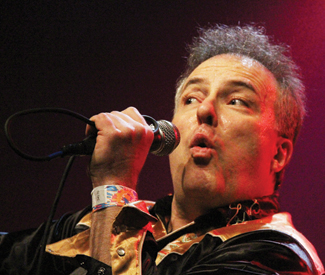
TOFU AND WHISKEY Jello Biafra could be your theatrical political science professor. The still-charismatic frontperson and song-composer has long spewed knowledge deep from the underbelly of political theater, from his influential early 1980s Bay Area punk band Dead Kennedys, and projects like the band Lard, through his nine dense spoken word albums, and up to his newest musical endeavor, louder than ever in his 50s, Jello Biafra and the Guantanamo School of Medicine.

That band, which also includes Victims Family guitarist Ralph Spight, plays the Uptown this weekend with D.I., the Divvys, and Gir-illa Biscuits — an excellent local Gorilla Biscuits tribute act (Fri/26, 9pm, $15. Uptown, 1928 Telegraph, Oakl. www.uptownnightclub.com.)

Given Biafra’s affinity for weaving news-worthy (though oft-overlooked) scandals into contextual lyrics, I have often wondered from where he gathered his news. “Why, the Bay Guardian, of course! Where would a local voter be without your fine rag?” Biafra tells me from his San Francisco home, while finishing up making a juice of apples and greens. Is he mocking me? “I just hope the new ownership and staff goes pedal to the metal to keep up the standard of muckraking and ethics. There’s so much corruption to dig up in this area.” No, his tone is just often sarcastic.

“Locally, we have you folks, among others. And then you know, the Nation, Progressive, Mother Jones, interesting things people send me in the mail, digitally or otherwise, putting two and two together — trying to write songs about stuff that no one else has. Or at least, not in the same way.”

He continues: “It’s just filling in the gaps with what’s interesting. I’m proud that no two of my music albums sound alike. Not even the Lard albums sound alike. From Dead Kennedys onward my mission as the main lyricist and composer of the damn tunes, I kind of stick to my punk core — whether I intend to or not, it’s just who and what I am —but widen the base of the pyramid to what you can do with that energy.”

Guantanamo School of Medicine’s White People and the Damage Done (Alternative Tentacles, 2013) is the group’s most recent album. A semi-concept album, Biafra says it’s about “grand theft austerity, and how unnecessary it is.”

He explains, “People have asked me…what I think is the biggest problem in the world today and they expect me to say something like ‘climate change’… or inequality, or war, or whatever. I say you know, there’s a worse one, it’s corruption. Because that is what’s blocking anything constructive from being done about all those other problems.”

The title track of White People and the Damage Done, a pounding, guitar-heavy, Dead Kennedys-esque song, explicitly points a finger toward attitudes of the higher-ups in the US and EU regarding countries run by people of color, and the need to step in and take control.

Anthemic single “Shock-U-Py!” has a chantable chorus, and moment-in-time impact. In it, Biafra howls “Wake up and smell the noise/We can’t take it any more/Corporate coup must go/We will Occupy/We will Shock-U-py.” The Occupy movement may have left the mainstream radar for now, but Biafra’s song commemorated the moment, much like he did in early career chants calling out yuppies and atrocities in places like Cambodia, in the early ’80s. His lyrics are typically both rooted in the present, and packed with historical references.

A fast-paced earlier released track (still with that Biafra-esque carnivalian breakdown), “Dot Com Holocaust,” recorded at the time of the The Audacity of Hype EP (AT, 2009), touched on problems more local to Biafra and this rag, of gentrification and a new class of tasteless techies coming in to the Bay. Dripping with satire, the song seemed to have touched a nerve when first released, and garnered scores of angry, faceless Internet comments.

“I had this funny feeling we weren’t done with the Dot Com Holocaust. Sure enough, now it’s more aggressive and obnoxious than ever. Dot Com Monte Carlo — that’s kind of what Willie Brown’s puppets are trying to turn this city into, yet again,” he says. “It has been really sad for me to see so many cool people and artists and service-workers and people of color just bulldozed out of this town to make room for more mini little yuppies who treat San Francisco as a suburb of Silly-clone Valley.” Yes, Biafra talks like he sings.

When we discuss newer bands, he notes many acts are fleeing SF for the East Bay, something bands across genre styles and influences have brought up with me during casual conversations and interviews.

“Now you don’t see people like me when I was 19, just moving out to San Francisco [from Boulder, Colo.], chasing a dream. There was a time when the vitality of the underground was maintained by entire bands moving here as a unit. Everybody from MDC and the Dicks to DRI and later, Zen Guerilla.”

But as an underground label owner (Alternative Tentacles) he knows times are tough for both bands and music fans, with a poisonous combination of the crashed economy and rampant file-sharing affecting all involved. “I wonder how many people save up money from their shitty jobs for years in order to make some really cool piece of music only to find that nobody actually gives anything back,” he says. “Maybe the solution for people who want to get their friends into really cool music, don’t just send them the whole album, pick some favorites and send them a little teaser package, a little file to inspire them to check out them more.”

For the complete Jello Biafra Q&A, see SFBG.com/Noise.


YASSOU BENEDICT

Counterpoint, there are still some bands and artist types heading way out west to San Francisco in these turbulent, high-priced times: Yassou Benedict. This band is not in the slightest akin to Biafra’s people, though it is a group of hopeful young dreamers.

The shoegazing dreampop four-piece formed at a small high school in Upstate New York. While most bands from the area would migrate south to New York City, Yassou Benedict made the “fairly random” decision to head to SF. “We all got into a Subaru Forrester with a Great Dane in the back and all our stuff in a trailer and drove across country,” says guitarist James Jackson, who traveled with singer-bassist Lilie Bytheway-Hoy, guitarist-keyboardist A.J. Krumholz, and drummer Patrick Aguirre.

Now in the Bay, they work as servers at Outerlands, a cook at Beauty Bagels and Wise Sons, a bartender at the Boxing Room, and a pizza-dealer at Lanesplitter Pizza and Pub.

But more importantly, the group of 20-somethings recently released its debut EP, In Fits in Dreams, a moody, complex, emotionally fraught record that leaves the listener itching for a full-length, and touches on themes of “anxiety, and wanting to be weightless, the desire to run through wide open spaces.” The album release party was actually a few weeks back, but you can catch the band this week at Milk Bar with Beautiful Machines, Hotel Eden, and NVO (Fri/26, 8:30pm, $10. Milk Bar, 1840 Haight, SF. www.milksf.com).

Led by Bytheway-Hoy’s dramatic, high-ranging vocals, and unconventional song structures (like shifting time signatures) In Fits in Dreams also features guest vocals by Hole’s Melissa Auf Der Maur on track “Cloisters.”

The subtle beats and rolling vocals of “Cloisters” feels like a doomed march toward the unknown, while closer “Last Cicada” ventures more into Radiohead In Rainbows territory (the band has been known to cover “Jigsaw Falling Into Place”). There’s also the church-like pop hymn of “Back Roads that Dead End,” which begins as an anxious vocal solo with faraway chimes, the beats and guitars slowing filtering in.

It’s surely been noted elsewhere on the blogosphere, but there’s something strangely seductive within Yassou Benedict, which I mention to Jackson. “I am not sure why that is. If we are making people feel, whether it is the desire to make love, or children or anything else, than we are succeeding. It is kind of strange though. Our music is fairly depressing. Now I’m just imaging people holding each other and crying while they listen. Lilie’s voice probably has a lot to do with that.” Bytheway-Hoy’s voice is indeed both haunting and captivating.

There’s also a cinematic quality to In Fits in Dreams, likely driven by that high emotional tug. Given the soundtrack capabilities, I asked Jackson what type of film would best be suited to Yassou Benedict and he picked a future Wes Anderson film, also noting that a dream opening slot would be an imaginary Radiohead show in an intimate venue (no arenas!).

While the record was recorded and produced back in Hudson, NY (with Steve Durand at Dioramaland Studios), the band is touring on it from its new homebase in the Bay.


Soul-savers

0

arts@sfbg.com

MUSIC “That’s it, I’m done. In love.” This is what Erykah Badu had to say, late last year, upon discovering Hiatus Kaiyote: an unsigned “future soul” ensemble from Melbourne, Australia, with a Bandcamp page, a single EP to its name, no marketing budget, and everything to prove.

Now, less than a year later, the band has found itself reissuing its self-released debut LP via Sony (with a newly added guest spot from Q-Tip, no less) and co-headlining a highly anticipated bill with D’Angelo and Badu herself, in Detroit later this summer.

This Sunday, Hiatus Kaiyote will grace the Independent, in its first ever SF appearance, with local R&B powerhouse, the Seshen, featured in the opening slot.

So, how does an unassuming four-piece band, from halfway across the world, find itself on the radar of America’s neo-soul elite?

The answer to that question lies almost entirely in the strength of Tawk Tomahawk: Hiatus Kaiyote’s inaugural statement as a group, which rips through its 30-minute runtime with incendiary force, and a mind-boggling flair for invention and appropriation.

West African polyrhythms intermingle with sludgy, offbeat grooves á la J Dilla. And 1970s electric piano-washes bounce off harsher, synth textures resembling IDM and the LA beat scene as led by Flying Lotus. All the while, the production sound switches between clean lushness, and uncompromising rawness, at the drop of a hat.

Hiatus Kaiyote might identify as a “future soul” ensemble, and Nai Palm’s impassioned, show-stopping vocals surely establish a strong R&B foundation, but in the end, Tawk Tomahawk sounds less like a soul LP than an unfiltered rush of creative energy, heaping countless ideas and influences into an ecstatic vision of musical possibility.

This anything-goes approach is largely the result of all four members’ divergent musical backgrounds, and the varying influences they bring to the table. Vocalist and guitarist Nai Palm is the band’s principal songwriter, whose intricately layered, shapeshifting compositions move with Jeff Buckley-esque vertigo.

Drummer Perrin Moss is an accomplished MC, whose hip-hop background is evident in the lumbering chug of his grooves, often recalling Questlove’s work on D’Angelo’s Voodoo.

Bassist Paul Bender, a former student of University of Miami’s jazz program, lays down basslines as intricately fingerpicked as they are viciously slapped and primally funky.

Keyboardist Simon Mavin has found himself inhabiting a range of scenes, from Latin, to soul, to dub-reggae, which comes through in the lush, diversely textured tonal layering he brings to Hiatus Kaiyote’s sound.

“I think if you listen to our music enough, you sort of start to realize that it’s not just a soul band, or a jazz band… Our influences are pretty vast,” Mavin told the Guardian via Skype, from a hotel room in Mulhouse, France, the night before an eagerly anticipated appearance at the Montreux Jazz Festival in Switzerland. “We’re all in it because we want to be creatively intense, and stimulate each other through our ideas.”

This potency of ideas, and resistance to categorization, is likely what caught the ear of BBC’s tastemaker-in-chief Gilles Peterson, the famed radio DJ and musical ambassador who first brought Hiatus Kaiyote’s sound to international attention.

Not long after, the Twittersphere went abuzz; when everyone from Badu to the Roots’ indispensable Questlove began singing its praises, Palm, Mavin, Bender, and Moss were vindicated (in small circles, anyway) as saviors of soul music, transitioning it from a largely revivalist, wheel-spinning art-form, into a musical attitude with the ability to transcend genres as freely as it consumes them.

After its first American tour this spring, (including stops at SXSW and Questlove’s big-deal club night at Brooklyn Bowl), Hiatus Kaiyote signed a contract with Flying Buddha records, a subsidiary of Sony, which re-released Tawk Tomahawk last week, featuring a guest spot from A Tribe Called Quest’s Q-Tip added to their breakthrough track, “Nakamarra.” A sophomore LP is in the works as well; however, the band doesn’t plan on significantly altering its homegrown, independent recording process.

“Sonically, the reason we signed this record deal is because it enables us 100 percent creative freedom, even down to the point of mixing it,” Palm explained. “So, we’re gonna be recording it in our own setup… same home studio vibe.”

The magic of Hiatus Kaiyote can be found in this balance between the otherworldly thrust of its music, and its insistence on this humble, DIY approach to songcraft. By rejecting the interference of producers, engineers, and other outside forces, Palm, Mavin, Bender, and Moss have generated a sound that bears the single-minded vision of a great auteur, yet with the richness of ideas allowed by the collaboration of harmonious minds.

If Hiatus Kaiyote’s ascent continues, Erykah Badu could end up with some serious competition atop the soul pyramid.

HIATUS KAIYOTE

With the Seshen, Bells Atlas

Sun/28, 9pm, $22

Independent

628 Divisadero, SF

(415) 771-1421

www.theindependentsf.com


The truth hurts

3

cheryl@sfbg.com

SAN FRANCISCO JEWISH FILM FESTIVAL The 33rd San Francisco Jewish Film Festival broadens its scope this year with a theme — “Life Through a Jew(ish) Lens” — that allows it to encompass a wide spectrum of films. Though plenty of SFJFF’s programs do specifically address Jewish religion and culture, some of the films I watched were only tangentially “Jew(ish)” — as in, they simply happened to be made by a Jewish filmmaker. For fans of quality programming, however, that’s a moot point: SFJFF 2013 is a solid if eclectic festival, with a typically strong showing of documentaries well worth seeking out.

Previously seen locally at the San Francisco International Film Festival, Martha Shane and Lana Wilson’s After Tiller is as timely as ever, with the advent of increasingly restrictive abortion legislation in states like Texas and North Carolina. This doc focuses on the four (yes, only four) doctors in America who are able to perform late-term abortions — all colleagues of Dr. George Tiller, assassinated in 2009 by a militant anti-abortionist.

The film highlights the struggles of what’s inherently a deeply difficult job; even without sign-toting (and possibly gun-toting) protestors lurking outside their offices, and ever-shifting laws dictating the legality of their practices, the situations the doctors confront on a daily basis are harrowing. We sit in as couples make the painful decision to abort babies with “horrific fetal abnormalities;” a rape victim feels guilt and relief after terminating a most unwanted pregnancy; a 16-year-old Catholic girl in no position to raise a child worries that her decision to abort will haunt her forever; and a European woman who decides she can’t handle another kid tries to buy her way into the procedure. The patients’ faces aren’t shown, but the doctors allow full access to their lives and emotions — heavy stuff.

Similarly devastating is Brave Miss World, Cecilia Peck’s portrait of Israeli activist Linor Abargil, who survived a violent rape just weeks before she won the Miss World pageant in 1998. As Linor travels around the world on her mission to help others heal from their own sexual assaults, it becomes clear that she still has some lingering issues of her own to deal with. Taking action — working tirelessly to keep her rapist in prison; making a painful return trip to Milan, where the attack happened — only brings a certain amount of closure. Her emotional fragility manifests itself in a newfound embrace of religion (much to the confusion of her largely secular family, fiancé, and gay best friend), which is somewhat at odds with Brave Miss World‘s female-empowerment message. Still, though it gets a bit documentary-as-therapy, Brave Miss World offers a compelling look at one woman’s determined quest to help others who’ve suffered similar traumas — urging them, through sheer force of personality, to speak out and become activists themselves.

More cinematic therapy is offered up by the structurally similar Here One Day and My Father and the Man in Black. In both of these first-person docs, the filmmaker remembers a parent who committed suicide, making extensive use (in both cases) of remarkably candid audio and written diaries that were left behind. In Here One Day, Kathy Leichter delves into her troubled mother’s manic depression as she cleans out the closets of the New York City apartment where she grew up — and where her own young family now resides. Even more fraught with meaning than her mother’s physical leftovers — a mix of both meaningful (her writings and recordings) and pack-ratty (a trash-scavenged Marie Antoinette bust, a Coca-Cola memorabilia collection) — is the window where she leapt to her death in 1995. Leichter’s father, longtime New York State Senator Franz Leichter, is among the family members who speak openly about the event.

Filmmaker Jonathan Holiff’s My Father and the Man in Black is no less personal, but it offers slightly broader appeal, weaving the tale of Holiff’s father, Saul Holiff, and his stint as Johnny Cash’s manager from 1960-73. Holiff’s association with Cash coincided with the musician’s At Folsom Prison triumph, but also with the height of his raging drug problem; the beleaguered Holiff spent much of his time doing damage control in the wake of cancelled (or should-have-been cancelled) concerts. Parenting wasn’t a high priority, the younger Holiff recalls, but once the filmmaker discovers his father’s memoir and memorabilia-stuffed storage locker, he’s able to piece together the man behind the anger (and the drinking problem). The film relies perhaps too heavily on re-enactments (that, in turn, are heavily inspired by 2005’s Walk the Line), but it offers a not-often-seen perspective on show biz’s darker aspects, as witnessed by a man tasked with managing a superstar whose addictions often threatened to overtake his talent.

Beyond parental angst, another favorite theme among SFJFF doc-makers is race. Paul Saltzman builds off an incident in his own life for The Last White Knight, an insightful but at-times difficult to watch film anchored by an interview with Delay De La Beckwith, aging racist. (His father, the late Byron De La Beckwith, was finally convicted in 1997 of killing civil rights leader Medgar Evers in 1963.) Saltzman and the younger Beckwith, who are around the same age, first met in 1965: one, an idealistic student who traveled to Mississippi to help register African American voters; the other, a proud KKK member who punched Saltzman in the face because he didn’t care much for meddling outsiders. Welcome to the South!

Using animation, interviews with other civil rights activists (including Harry Belafonte and Morgan Freeman — though the latter insists “I don’t talk race”), and personal reflections, The Last White Knight strives to explore the current state of race in America. At its heart, though, it’s about the two men who form a surprising friendship of sorts, despite their combative past. It’s unclear, after all these years, if Beckwith is truly a chuckling specter of evil (“Got what they deserved,” he drawls when asked about the 1964 murders of civil rights workers Andrew Goodman, James Chaney, and Michael Schwerner), or a simple-minded man who thinks nothing of saying “Obama is a direct descendent of the devil” — and, while smiling and chatting with a man he knows is Jewish, “Jews control all the money and the media.” Jaw-dropping doesn’t begin to cover it, but Saltzman remains admirably composed throughout.

Race also factors, inevitably, into The Trials of Muhammad Ali, Bill Siegel’s lively investigation of the boxing champ’s Nation of Islam conversion, name change, and refusal to fight in Vietnam. If you’ve seen an Ali doc before (or even the 2001 biopic), a lot of the footage and material will feel familiar. But Trials, which offers interviews with Louis Farrakhan and Ali’s former wife Khalilah, among others, does well to narrow its focus onto one specific — albeit complicated and controversial — aspect of Ali’s life.

http://www.youtube.com/watch?v=99HMxN94bEc

Contemporary civil rights struggles factor heavily in Dawn Porter’s Gideon’s Army (first screened here at DocFest), about a trio of public defenders struggling with daunting work loads (one women has 180 clients at a time) and a system seemingly rigged against low-income defendants, many of whom plead guilty, whether or not they actually are, because they simply have no other options. Like After Tiller, it’s a doc that offers a sobering, eye-opening look at a job you wouldn’t want — yet makes you glad that those who do it are such steadfast characters.

And if all that sounds too intense, take note of these two films: Mehrnaz Saeedvafa’s Jerry and Me, in which the filmmaker and teacher reflects on Hollywood’s influence on her pre-revolutionary Tehran youth (including her love of Jerry Lewis; if you’ve ever wanted to see clips of 1960’s Cinderfella dubbed in Persian, this is your chance); and Amy Winehouse: The Day She Came to Dingle, a made-for-Irish-TV concert film that spotlights the singer in 2006, before her slide into addiction derailed her career and ended her life. Here, her voice sounds stunning as she croons her hits in a tiny, 200-year-old church; she’s also sweetly jazzed to discuss her influences (dig her story of hearing Ray Charles for the first time) in an accompanying sit-down interview that reveals how endearing and intelligent she could be. *

SAN FRANCISCO JEWISH FILM FESTIVAL

July 25-Aug 12, most shows $12

Various venues in SF, Berk, Oakl, San Rafael, and Palo Alto

www.sfjff.org


The death aquatic

0

cheryl@sfbg.com

FILM The 911 call placed from SeaWorld Orlando on February 24, 2010 imparted a uniquely horrific emergency: “A whale has eaten one of the trainers.” That revelation opens Gabriela Cowperthwaite’s Blackfish, a powerful doc that puts forth a compelling argument against keeping orcas in captivity, much less making them do choreographed tricks in front of tourists at Shamu Stadium.

Whale experts, former SeaWorld employees, and civilian eyewitnesses step forward to illuminate an industry that seemingly places a higher value on profits than on safety — skewed priorities that made headlines after veteran trainer Dawn Brancheau was killed by Tilikum, a massive bull who’d been involved in two prior deaths. (Though SeaWorld refused to speak with Cowperthwaite on camera, they recently released a statement calling Blackfish “shamefully dishonest, deliberately misleading, and scientifically inaccurate;” read the filmmaker’s response to SeaWorld’s criticisms at film blog Indiewire.) Blackfish, which premiered locally at the San Francisco International Film Festival, opens theatrically this week. I spoke with Cowperthwaite ahead of its release.

SF Bay Guardian Blackfish uses home-movie footage to illustrate training accidents, whale misbehavior, and so forth. I’m guessing a company as image-conscious as SeaWorld would strive to keep that kind of material out of the public eye. How did you get ahold of it?

Gabriela Cowperthwaite It came from every source imaginable: personal archives, historical archives, people who happened to be filming shows when they were visitors at the park. We had to vet every piece of footage, figure out the original owner, and go from there. It was the most time-consuming process imaginable — but we really needed to be inside the park to tell the story, so we had no choice but to really do the detective work to find out where every little bit came from.

SFBG Did you do any of your own clandestine filming at SeaWorld?

GC We kind of had to. I had to “meet” Tilikum, you know? Whatever we could do to get footage that could truthfully represent the story, we did.

SFBG The film interviews several former SeaWorld trainers who seem eager to speak out against the park. How did you find them?

GC When they heard how SeaWorld responded to Dawn Brancheau’s death in the news, they knew something was amiss and they began speaking out. In terms of them being comfortable [with being in] the film, they had spoken to author Tim Zimmerman [for the] Outside magazine article “Killer in the Pool,” and had felt a level of comfort with him. His article was one of the best articles I read about the Brancheau case. So from that, I was able to contact them. Their only caveat was that the film [would have to] be truthful, and I told them I planned to do a fact-based narrative that wasn’t sensationalized or gratuitous. Because we saw eye to eye on that approach, they agreed to be interviewed.

SFBG Blackfish highlights the disconnect between SeaWorld’s version of Brancheau’s death and what the trainers suspect actually happened. Their analysis of the video shot in the moments leading up to the attack is very effective.

GC It’s exactly what you want to know because you can’t understand what’s happening. The lay viewer sees a whale circling a pool; there’s nothing other than, “Isn’t this a cute trick?” Audience members at these shows are trained just as much as the whales are, to respond and laugh and clap on cue. And yet, to have a trainer say, “Oh no, this session is going badly” — that was so eye opening for me, and I could only learn that from these former trainers.

SFBG What do you think would be the best-case scenario for whales in captivity, going forward?

GC If SeaWorld were to stop its breeding program, that would be hugely important. And one of the best alternatives [for whales in the park] is instituting a sea pen, which is essentially cordoning off part of an ocean cove with a big net. You can’t just dump [the whales] into the ocean because they don’t know how to eat live fish, and a lot of them are hopped up on antibiotics. But you could soft-release them and keep them in a place where you could monitor their health, and yet allow them to be in an ocean environment. That would be an amazing thing that SeaWorld could do.

SFBG You mentioned that you had gone to see Tilikum in person. What was that like?

GC I was terrified of Tilikum when I first started making the documentary — I think because I’d read [Brancheau’s] autopsy report early on, and it was the stuff of nightmares. But when I started unpacking his life to try and understand [him], I started feeling this empathy. It culminated with me seeing him and truly feeling sorry for this tremendous, impossible animal — relegated to doing this silly lap around the pool and splashing everybody, and then going right back into his little pool.

SFBG And SeaWorld doesn’t acknowledge that it’s the whale that killed the trainer, of course.

GC Oh no. Absolutely not. They just don’t talk about it. And remember, they call everything Shamu. That’s the easiest way not to have to deal with the Tilikum factor.

BLACKFISH opens Fri/26 in Bay Area theaters.

The ascendants

0

arts@sfbg.com

DANCE Though only in its fourth season, Robert Dekkers’ Post:Ballet has already gained an enthusiastic, impressively large following that has allowed the company to move from the Cowell to the Herbst to this year’s Lam Research Theater at Yerba Buena Center for the Arts. It’s easy to see the reason for Dekkers’ success.

While his dance making is clearly ballet-based, his works have an expansive sense of freedom that makes them welcoming and easy on the eye. By choosing to perform in the summer when other companies are on break, he can also work with highly trained professionals otherwise unavailable to a small (ten-person) ensemble like his. This year they came from Houston Ballet and Ballet Arizona, as well as the local Smuin Ballet, Alonzo King LINES Ballet, and Company C Contemporary Ballet.

Perhaps most intriguing is the ease with which Dekkers’ choreography embraces the ground and the air as one liquid continuum. His dancers crawl, slither, and slide along the floor like billowing smoke — and then rise into space as if born to it.

The world premiere for seven dancers, field the present shifts, is probably Dekkers’ most ambitious piece yet. It is a problematic work. A collaboration with architects Robert Gilson and Catherine Caldwell and a commissioned score, performed live by Matthew Pierce, it also features gorgeous magenta body-hugging costumes by Christine Darch, and a richly varied lighting design by David Robertson.

According to the program notes, field examines complex relationships. Within a given set of parameters, the piece also allows for individual decision-making by everyone involved. It added up to a lot of in-the-moment choices by a lot of people, and the results did not convince.

Visually, however, field was a feast for the senses. The dancers flew at each other like arrows, bunched up into swaying unisons as if buffeted by some gale force wind. They gathered on individual squares of light, responded to each other across the stage, and seemed to walk on water. They rolled into somersaults and carefully explored and yanked at each other. What I missed was an encompassing frame that held these individual units together. Also, a sense of uncertainty marred some the canons and unisons.

The two designers came up with what looked like huge sheaves of wheat hung upside down; at one point, they were lowered, presumably for the dancers to interact with. Few of them did. So what was the point? The distinct character of each of the ten or so sections of Pierce’s score for five violins, however, was a pleasure to hear.

The evening opened with the reworked Colouring II from 2011, danced with great authority by Ashley Flaner and Domenico Luciano. The piece traced the making of a pas de deux, developing at the same time as Enrico Quintero’s creation of a large, calligraphy-inspired painting. The dancers, approaching each other from opposite sides, added another gesture with each encounter, suggesting an almost filmic sense of accumulation. Daniel Berkman’s score, performed live, contributed his own voice to this intriguing process. This was watching visual and kinetic art in the making, and it was a delight. However, Dekkers standing on the sidelines, cueing the process, seemed intrusive. He should have trusted his artists.

Sixes and Seven, also from 2011, is a solo, here danced delicately yet firmly by Jessica Collado. This was richly varied choreography in which the dancer made full use of her body, including an excellent use of gestural language. At times, Collado appeared to withdraw into herself, but she also reacted to invisible external forces that impinged on her. You got a sense that she was living in a rich world. If the use of an excerpt from Philip Glass’s Einstein at the Beach meant to suggest some kind of cosmic existence, the choice was perfect.

Last year’s When in Doubt ended awkwardly in a wobbly pyramid, and used a distracting word-and-sound score by Jacob Wolkenhauer. But Dekkers showed considerable choreographic chops in the way he used his septet of dancers both in unisons and in smaller units. With the women on pointe walking in plié, and Robertson’s stark lighting that pulled the dancers across the stage with a quasi magnetic force, When began to feel ominous. This was even true for the two very different duets for Raychel Weiner and Christian Squire, and Collado and Jane Hope Rehm.

Dressing the women in black leotards and the topless men in black tights was inspired because the dancers could almost disappear into each other. The women were dark from the waist up, the men from the waist down. The color scheme abstracted personal interactions and sequences into two-dimensional patterns — thus foregoing overly eager tendencies to read narrative intentions into Dekkers’ choreography. *


Phone home

1

culture@sfbg.com

COCKTAIL HOUR I’m not sure whether it was completely unintended, but after my night at new SoMa gastropub the Willows, one thing was clear: I need to call my mother.

A sister bar to the Mission’s Sycamore, the Willows opened a few weeks ago on the corner of Folsom and 12th, in one of those cursed spots that’s seen a lot of turnover ever since Hamburger Mary’s decamped a decade ago. (Here’s hoping the Willows breaks the curse and settles in.) It’s walking distance from my job, and at 6pm I had a serious case of the Mondays and was ready to drink.

The place is divided into two parts: a main bar room and a smaller, cozier room dedicated to serving craft beers. The main room is huge with large windows letting in lots of natural light. There were couples sitting at tables doing whatever couples do, people playing pool near the door, and arcade games in the back of the bar. Just a nice open space.

As befits the Willows’ arboreal name, the craft beer room has wooden walls and a few wooden tables out in the open, with a couple of intimate booths as well. Relieved by the emptiness, I took a seat in the smaller room and ordered a malt beer. I chatted with the bartender — a friendly young man who looked like a lost member of Vampire Weekend — and waited for my friends to arrive.

When they showed up, we all dove into the menu. This is when you get a bit of nostalgia for home. The food menu takes you right back to your childhood: burgers, roast beef, sloppy Joes (“Just like Mom’s” was the caption on the menu), and the aptly titled “Mom’s Meatloaf.” Just reading it makes you feel like a kid waiting anxiously at the dinner table. Unfortunately, we weren’t too hungry at the time. But we decided to order the pork-belly donuts anyway. I mean, how could you not?

They were delicious. And then came the drinks. Most of the cocktail menu consists of traditional classics with a tiny twist — but I think what we enjoyed most was the menu itself. Filled with fun names (Oh, Trisha!, Mom’s Mai Tai, Donkey Show) and captions (“A distinctive drink for a discerning drinker” for the 007 Perfect Martini), we had a blast reading it. There was even had a drink called Fuck You, Grandpa!, which is something my mom would totally say.

My buds and I all ordered a couple each. They were pretty good for the most part, but the hands-down winner was the Willows’ version of a sidecar. At $12, it was the most expensive drink on the menu and worth every penny — and having ordered about four, there were a lot of pennies. When ordering the last of these, the bartender told me rather candidly that she hadn’t memorized the bar’s recipe yet.

“This is just how my mom likes it,” she shrugged. I should have asked if her mom was a bartender.

So, to recap: The Willows may not be the place to take your mom — but if you want to feel right at home, here you go.

THE WILLOWS 1582 Folsom, SF. (415) 529-2039, www.thewillowssf.com


New Guardian leadership wants your input

0

San Francisco Print Media Company last week named Marke Bieschke as publisher and Steven T. Jones as editor of the San Francisco Bay Guardian, elevating two longtime Guardianistas into the top spots, guaranteeing them editorial autonomy, and letting them work with the community to chart its future.

As a first step in that process, the Guardian will hold a public forum on July 31 from 6-8pm in the LGBT Center, 1800 Market Street, to solicit input and discuss the Guardian’s unique role in the Bay Area’s political and journalistic landscape. Helping to coordinate the forum is Guardian writer Rebecca Bowe, who has accepted the position of news editor. The forum and subsequent discussions will form the basis for a strategic plan that will help guide the Guardian into a new era.

The newspaper’s future was uncertain a month ago following the abrupt departure of longtime Guardian Editor-Publisher Tim Redmond in a dispute with the owners over layoffs and the Guardian’s autonomy. The company’s Vice President of Editorial Operations Stephen Buel, who is also editor of the San Francisco Examiner, was named interim Guardian publisher and Bieschke its interim editor.

Heeding concerns in the community about whether the Guardian would remain an independent, progressive voice in San Francisco, Bieschke and Jones negotiated terms with SF Print Media Company CEO Todd Vogt that guarantee them full editorial control, the addition of three new advertising sales positions and another staff writer, and guaranteed minimum staffing levels during a rebuilding period.

Bieschke and Jones, who are in their early 40s and have been with the Guardian for around 10 years each, say they are excited for the opportunity to work collaboratively with Guardian staff and its community to rejuvenate the paper, attract new readers, and achieve economic sustainability.

“Losing Tim’s leadership was hard on all of us at the Guardian, and we struggled with what to do next. But ultimately, the Guardian plays such an important role in San Francisco — particularly now, at a pivotal moment for this gentrifying city and its progressive movement — that we wanted to find a way to keep that voice alive, maintain our credibility, and reach out to a new generation of Bay Area residents,” Jones said.

The San Francisco Bay Guardian was founded in 1966 by Jean Dibble and Bruce B. Brugmann, who continues to blog and serve as editor-at-large for the Guardian. The couple retired from regular duties when the financially troubled paper was sold to Canadian investors headed by Vogt in the spring of 2012, a deal engineered by Redmond, whose writing is always welcome in the pages of the Guardian as he pursues a new media venture.

“I’m stoked to bring a different energy and openness to innovation to the Guardian, while respecting our legacy and strengthening our bonds with the progressive, alternative community,” Bieschke said. “Obviously, Steve Jones and I stand on the shoulders of giants, and we’re so grateful to our Guardian family, past and present, for blazing a trail for world class progressive journalism, arts and culture coverage, and community-building in the Bay Area. In that spirit, I’m eager to reconnect with our readers and partner with them to amplify the Guardian voice and continue to change the Bay Area for the better.”

Vogt said he’s excited by the prospects of new generation of Guardian leadership: “I’m happy about this. I think it’s appropriate that two recognized leaders in the progressive community are in charge of the Guardian and I look forward to seeing what they do with it.”

Years of cutbacks have distilled the Guardian newsroom down to just a few excellent journalists, but all say they’re excited for the chance to rejuvenate the paper, build its readership and revenues, and work more closely with the community.

“We all hope you’ll help us to guard San Francisco’s values, appreciating all of its best cultural, artistic, and culinary offerings in the process,” Jones said. “We love the San Francisco Bay Area, in all its messy urban glory, and we think it’s worth fighting for.”

New director triggers a brain drain at SFDPH

1

The San Francisco Department of Public Health has seen an exodus of top officials over the 18 months since Barbara Garcia took the reins from longtime chief Mitch Katz, the most recent being Environmental Health Director Dr. Rajiv Bhatia, who was placed on administrative leave last month pending an investigation into unspecified concerns.

Bhatia has been a hero to many progressive San Franciscans and public health professionals for his innovative work supporting expanded worker protections, regulation of cannabis dispensaries and restaurants, environmental justice initiatives, and other work that has landed him in the pages of the Guardian many, many times.

“The poorest Americans are about two times as likely to die. People in low-wage jobs have less access to health care … food, shelter, clothing, and transit,” Bhatia testified during the 2002 Board of Supervisors hearing that led to the creation of a city minimum wage.

Neither Bhatia nor the department would comment on his leave, although sources tell us that he has not been informed of the charges against him (which an item in the Chronicle last month suggested was a possible conflict of interest issue relating to his regulation of restaurants) and that Garcia has clashed with many top officials in the department since taking over.

Among those who have left the department are Dr. Susan Fernyak, Director of Communicable Disease Prevention and Control; Dr. Masae Kawamura, Director of TB Control; Dr. Grant Colfax, Director of HIV Prevention; Elizabeth Jacobi, Director of Human Resources; Tangerine Brigham, Director of Healthy San Francisco; Mark Trotz, Director of Housing and Urban Health; and Dr. Erica Pan, Director of Emergency Preparedness.

“SFDPH has a national and worldwide reputation for innovative solutions to traditional public health problems. As a citizen of this city, I’m concerned that the current leadership is fostering an environment that is driving out and stifling that innovation to the detriment of all of us. A number of staff people have told me they have been instructed not to stretch themselves to innovate, to do only what their job description says and no more,” said the source, who works for a nonprofit that partners with the department.

Asked to comment on the exodus and her role in it, Garcia issued the following statement in response to questions from the Guardian: “Three staff that reported to me directly were recruited and provided promotions in the Los Angeles Department of Health Services. I’m very proud of these staff who are now involved with Health Care Reform efforts for the Los Angeles area. Several other staff that reported to our Public Health Division left for positions that were closer to home and the majority of these departures were promotions. All staff left in good standing with the San Francisco Department of Public Health.”

Meanwhile, 93 “members of the public health, social and environmental justice, foundation and education communities” wrote a signed letter to Mayor Ed Lee on July 10 on behalf of Dr. Bhatia, highlighting his work and appealing for a just resolution to the situation.

“Many across the nation have been grappling with how to improve the social and environmental conditions that are the cause of poor health and health inequities. Under Dr. Bhatia’s leadership, the San Francisco Department of Public Health Environmental Health Section has found practical ways — using research, policy, regulation, and cross-sector collaboration — to produce measurable improvements to environmental and social conditions throughout San Francisco’s diverse communities,” they wrote.

While writing that they “have no knowledge or commentary on the details of the leave or investigations, they went on to note the initiative that Bhatia has shown in going beyond his prescribed duties to work with various San Francisco constituencies to support equitable solutions to this city’s problems: “He takes his responsibilities as a public servant seriously, working well beyond required hours, and he is committed to improving the life-chances of socially, economically, and politically marginalized communities.”

After Oscar, after Trayvon…

49

rebecca@sfbg.com

Even before Cephus “Uncle Bobby” Johnson picked up the phone on Feb. 27, 2012, he wasn’t having an easy day. His nephew, Oscar Grant, would have celebrated his 26th birthday on that date if he had not been killed by a gunshot wound on Jan. 1, 2009.

Grant was shot by BART police officer Johannes Mehserle while lying face down on a train platform, an incident that was caught on film, prompted riots in Oakland, drew international scrutiny, and became the subject of the award-winning film Fruitvale Station by Oakland filmmaker Ryan Coogler.

In the years since Grant’s death, Johnson and his wife, Beatrice X, founded the Oscar Grant Foundation to develop a support network for families who’ve lost loved ones due to police violence. It was his involvement in this work that led Johnson to be contacted that day, and informed that a 17-year-old boy named Trayvon Martin had been gunned down in Florida one day earlier.

It wasn’t a police shooting but nevertheless, “We knew at this point that we had to go to Florida,” Johnson recalled. “What we’ve decided is that whenever a family experienced that, we would definitely try and get to them.”

Fast forward to July 13, almost exactly three years after violent protests erupted in Oakland following the news that Mehserle, who was charged with second degree murder, had been convicted of involuntary manslaughter instead. A new wave of demonstrations flared up as word spread that George Zimmerman, the neighborhood watch volunteer who killed Martin, had been acquitted.

“We weren’t surprised,” Johnson, who returned to Florida last month to observe the jury selection process for Zimmerman’s trial, told the Guardian. “But it was still painful.”

The verdict in this high-profile case has brought discussions about racial profiling and unequal treatment in the criminal justice system to the forefront. Even President Barack Obama touched on the theme in comments to White House reporters on July 19, saying, “Trayvon Martin could have been me 35 years ago.”

At the national level, new findings on “implicit bias” — unconscious prejudices that research in psychology has shown can persist in individuals (including poorly trained police officers), even if they consciously reject racial stereotypes — has started to inform policy debates around racial profiling.

“Policy needs to recognize that implicit bias exists,” Maya Wiley, founder and president of the New York City-based Center for Social Inclusion, told us. “Rep. John Conyers introduced a bill last year to prohibit racial profiling in law enforcement. That bill, if made law, would collect data on stops by race, as well as provide resources for training. That is a step in the right direction.”

But things get complicated, Wiley says, because “research shows that people of color, women, the elderly, may all experience discrimination as a result of implicit bias. There is no remedy in the law for this. … I think what is important now is to fight Stand Your Ground Laws which empower people to act on their implicit biases.”

At a July 16 rally held on the steps of San Francisco City Hall, Rev. Malcolm Byrd, pastor of San Francisco’s First A.M.E. Zion Church, illustrated his point about racial profiling by donning a hoodie and sneakers at the rally.

“I wanted to come looking suspicious,” he explained. “I wanted to give you an image that America has of young black men. I look suspicious. This is my country. I love my country. Yet, I look suspicious.”

Last year, Mayor Ed Lee’s proposal to introduce a stop-and-frisk policy, which would have allowed police officers to randomly stop individuals who appeared to be suspicious in an effort to get weapons off the streets, was abandoned in the face of widespread community concern.

Officers who undergo training at the San Francisco Police Department Academy must complete 52 hours of “cultural diversity” training, according to SFPD spokesperson Sgt. Dennis Toomer, which includes a mandatory four-hour intensive geared toward preventing racial profiling. State law mandates just 16 hours for such training for law enforcement agencies, Toomer told us.

But despite supplemental police training and the efforts of grassroots organizations that carefully monitor police activity, the Bay Area has witnessed a number of fatal shootings at the hands of police since Grant’s death, and many draw a link between these cases and the broader issue of racial profiling.

When asked about the outreach efforts of the Oscar Grant Foundation, Johnson began to rattle off a long list of names — mostly young black men, from places ranging from Oakland to Vallejo to Stockton to San Leandro — who were killed by police, and whose families his organization has reached out to.

They have also been in touch with several families in New York City who lost loved ones in similar situations, Johnson said. In many cases, the individuals were killed despite being unarmed, and officers later explained their actions by saying they’d mistakenly believed the shooting victims had firearms.

After several years of taking an up-close look at the investigative and legal proceedings that unfold in the aftermath of officer-involved shootings, Johnson has reached the conclusion that from case to case, “The playbook is pretty much the same. The officer first alleges he felt threatened — it’s all about the thought process of the officer. It’s always found to be justifiable because the officer feared for his life.”

One long-term goal of the Oscar Grant Foundation is to build up a coalition that can mount a meaningful challenge to the California Peace Officers Bill of Rights, a law enacted some 30 years ago that affords special protections for law enforcement officers facing misconduct charges. Johnson and others are critical of provisions such as officers’ rights to keep confidential information out of their personnel files, which can prevent significant information from being disclosed during a criminal trial. Meanwhile, others throughout the Bay Area seem primed to push for change in the wake of the Zimmerman verdict. “On Sunday, every black church in the nation was talking about what? Trayvon Martin, and what we need to do,” Andrea Shorter, a member of the San Francisco Commission on the Status of Women, said during the July 16 rally. “Two weeks ago, and we were all standing here as San Franciscans to rejoice … because we knew that LGBT people could be treated as first class citizens. The job is not done.” San Francisco NAACP President Rev. Amos Brown, who organized the rally, vowed that his organization “will push for a civil suit to bring this Zimmerman gentlemen to justice.” The national NAACP is petitioning U.S. Attorney General Eric Holder to open a civil rights case against Zimmerman. Sups. London Breed, Malia Cohen, Jane Kim, and David Campos also delivered speeches at the rally. “For the first time in my life, after growing up and going to funeral after funeral after funeral after funeral, of all boys and black men throughout my life, I see people in this audience who are not African American, who are just as hurt as I am, who are just as sick of this as I am,” Breed said. “And we are all in this together. We have got to work together if we want to change it.”

Striking Out

21

news@sfbg.com

Today marks 1,575 days since concession workers at AT&T Park have had a raise, during which time the San Francisco Giants have been fabulously successful, both on and off the playing field.

The 750 workers represented by UNITE-HERE Local 2 are currently involved in frustrating and fruitless negotiations with their employer, Centerplate, a South Carolina-based food service company contracted by the Giants to sell beer, garlic fries, and other overpriced consumables at games.

The Giants and its front office seem fairly unconcerned about the plight of workers who proudly don the team’s logo and pad its revenues. Not a single concession worker that we interviewed for this article said that they work for Centerplate — each of them said that they work for the Giants.

Since the last contract expired in March 2010, the Giants have won two World Series championships, raised the average ticket price by 20 percent, and have seen the value of the team shoot up by $223 million. The only thing that hasn’t improved are the wages of the concession workers.

Cashiers currently make $16.40 per hour, in-seat runners make $13.40, and some entry-level workers make just $10.45, which is actually less the city’s minimum wage. That’s only legal because those workers were under contract for $10.45 per hour when the wage increased to $10.55 at the beginning of this year. And Centerplate won’t even let Giants workers have a tip jar to augment their substandard wages.

Local 2 reports that revenue from concessions is divided up in a 55-45 split between the team and Centerplate (the Giants PR office disputes this number, but it won’t divulge the actual split). So when a fan spends $17 for a hot dog and 16oz beer, Centerplate and its workers get $7.65 and the Giants get $9.35, all of it pure profit. And the Giants executives even set the concession prices, not Centerplate.

But the team says the plight of these workers isn’t its problem. “We continue to urge both parties to get back to the bargaining table and to have productive discussions so the matter can be resolved as quickly as possible. This dispute is between Centerplate and Local 2, not the Giants,” is the team’s public position on the issue.

The Giants communications office responded with this stance to every question the Guardian asked about the issues involved: What have you done to “urge” Centerplate to settle the contract? Couldn’t the Giants force a settlement if it really wanted to? Why haven’t concessions workers shared in the team’s success and rising revenues? How can you claim to support the community if you can’t even ensure the people who work in your stadium are paid minimum wage?

The Giants had nothing to say about a petition signed by 600 of the workers urging the team and Centerplate to agree to a deal, instituting a company-wide no-comment policy on the standoff with concession workers.

“It would be nice if they would come in and talk—not be a mediator, but to know what we’re asking for and say why they’re not providing it or why they feel they shouldn’t provide certain information,” Billie Feliciano, who has worked as a Giants cashier for more than 30 years, told us. “They could talk to the president of the union on that if they wanted to. You know, we’re not asking you to tell us how you spend your money. We just want to know how much control you have of this situation.”

Feliciano and her fellow workers just want the Giants to be team players.


WHO’S IN CONTROL?

Contrary to what the Giants may say, there is one pressing issue—job security for the workers—that is nearly impossible for the workers and Centerplate to resolve. Every worker interviewed for this story has explicitly said that job security is their most important goal.

Even Centerplate says only the Giants can offer job security to concession workers. If Centerplate goes out of business or loses its contract, the concession workers will likely lose their jobs, which is why they’re advocating for a succesorship clause that would guarantee their employment in that scenario.

When The Guardian inquired with the Giants office about the issue, its spokesperson once again responded, “This is an issue between the workers and Centerplate, not the Giants.”

But with the Giants controlling who runs its concession and how much they charge the fans, is Centerplate just an easy scapegoat for squeezing more profits from workers? Because on the subject of health benefits and wages, the two camps are separated by a wide chasm.

In order to qualify for healthcare, the workers need to work at least 10 games in a month (they’re eligible for health insurance only from June 1 through December 1) to have coverage a month later, which means that the health and well-being of the 750 workers hinges on Major League Baseball’s scheduler.

Workers almost got denied coverage for August because June only had nine games, but they ended up qualifying because they worked a private event at AT&T Park for the biotechnology firm Genentech.

Yet Centerplate wants to raise the number of qualifying games to 12, while Local 2 wants to keep it at 10 and grant healthcare coverage to workers who work every game in months with less than 10 games.

On wages, Centerplate has offered 25-cent increase in hourly pay, no retro raises for the years worked under the expired contract, and a $500 bonus. Though Local 2 has not put out an exact number on their wage demands, its spokesperson says Centerplate’s wage offers are beyond unacceptable; they’re insulting.

Centerplate’s main message in this quarrel is its insistence that the concessions workers are among the highest paid in the nation and that they accrue more benefits than most part-time workers. But the workers say that claim is misleading given the high cost of living in the Bay Area.

“If we were living in Dallas, Texas, I’d say yeah, we’re probably overpaid. But we’re not,” Anthony Wendelburger, who has been a cook for three years, told us.

The Bay Area is among the most expensive metropolitan areas in the nation. Last month, the business consultant Kiplinger published a list of the top 10 most expensive cities in the U.S. San Francisco was third behind Honolulu and New York, with nearby San Jose in fourth and Oakland eighth.

The average concessions worker makes around $11,000 in a year while some make upwards of $13,000 during the regular season. Based on differences in the cost of living, we calculate (using www.bankrate.com) that $11,000 translates to $7,760 if they served food and drinks for the Seattle Mariners, $7,880 for the Chicago Cubs or White Sox, and $6,530 for the Atlanta Braves.


THE OLD BALLGAME

At the Giants-Padres game on June 18, a Tuesday, several hundred protesters gathered at a rally to show support for the Giants concession workers. Most were affiliated with Local 2, but a few off-duty concession workers came to join the demonstration.

They implored the fans—most whom seemed to be just learning about the dispute—to abstain from purchasing any concession stand products. The rally started an hour before game time engulfed fans waiting in line with chants of “No justice, no garlic fries!” and “Ain’t no protest like an union protest because an union protest don’t stop!”

Inside the stadium, 44 protesters (all of whom had purchased tickets) staged a sit-in in front the garlic fries stand situated behind sections 122 and 123. Their numbers withered as the game progressed and by the fourth inning, the area in front of the stand was cleared and business resumed, with 10 protesters arrested for refusing to disperse.

That protest followed a more significant action on May 25, when all of the 750 workers staged an one day strike, authorized by a 500-16 vote by workers. For that game, Centerplate employed volunteer workers who only got paid in tips. Yes, the scabs got the tips that the regular workers are being denied.

Food and drink service during that game was significantly slower than normal, as even the Giants acknowledged. There were reports of fans standing up to 40 minutes in line for a beer, which is usually more than two innings, an amount of playing time that few true baseball fan would ever give up for a beer run.

Critics—including several passerby fans who were loudly expressing their disdain for the demonstrators at the Giants-Padres game—say the workers should be content with what they have, perhaps assuming the workers were getting more from that $10 beer than they really are.

When Pearlie Jones started working concessions at Giants games 22 years ago, hot dogs were $3. Today they sell for twice that amount at the stand that Jones now manages.

We met Jones at the Local 2 building in the Tenderloin. She lives in Daly City, survives on unemployment during the off-season, and has no other source for health insurance. With nervous laughter, Jones told us she “prays to God during [the off season] that I don’t get sick.”

Wendelburger, who has to commute almost two hours each way to the ball park, works as a bartender during the off-season, although he can only get three days a week. When asked about health insurance during the off-season, this husband and father of two says, “Unless I’m going to die, I’m not going to see a doctor.”

But Jones says that as important as improved wages and healthcare benefits are to her and other employees, they really fear losing their jobs: “Our job security is the main issue that we’re pushing for right now.”

One issue that seems telling of the way Centerplate and the Giants are treating concession workers is on the issue of tips. The workers are currently not allowed a tip jar or a tip line on credit card receipts, a standard feature of food service, particularly here in the Bay Area, where even butchers and bakers have tip jars.

Ramirez says she’s utterly baffled by Centerplate’s stubbornness on the issue. “A tip line is something that doesn’t cost management anything and requires a small change in the computer system and is something the customers are actually demanding. We have a great experience with our fans and customers and they want to share their gratitude and they can’t,” she told us.

Another seemingly minor yet deadlocked issue is the request for benches for in-seat food runners. These workers currently have nowhere to sit for breaks or in between food runs, yet Centerplate has refused to budge on that issue.

When asked about these minor demands, a Centerplate spokesperson said that they have not seen any list of demands from Local 2, a statement disputed by workers and Local 2.

Centerplate has cast workers as greedy, even filing a lawsuit against Local 2 claiming that the union and the workers are trying to exploit the Giants’ World Series championships, an action that the union and its workers heard about from reporters, adding to the aura of mistrust hanging over these negotiations.


LONG STANDOFF

Both sides have accused the other of not operating in good faith, something they both hope will change when negotiations resume on July 29.

Centerplate says it wants to give the workers a contract, but blames the deadlocked negotiations on Local 2 head Mike Casey, who also serves as the elected president of the San Francisco Labor Council.

“Unfortunately, Local 2 and its leader Mike Casey have not responded to our economic proposal. Our employees, and Local 2 members, remain without a contract, raise, bonus, and health security all because of Casey’s failures,” Centerplate spokesperson Gina Antonini told us.

But the concession workers seem to strongly support Casey, who was on vacation and unavailable for comment. “I have tremendous faith in our Local 2 union leadership. Mike Casey is brilliant,” Patricia Ramirez, a line cook of 14 years, told us. “I think Casey and [Local 2 organizer] Alphonso Pines are leading us in the right way and I think we’re going to win because of their guidance.”

Centerplate seemed unaware of Casey’s local reputation and community support. “The entire labor community is supporting Local 2 and our message is clear: If you have to go to the games, don’t buy the food” San Francisco Labor Council Executive Director Tim Paulson told us.

Local 2’s tough, deliberate, long-term strategy is one that has paid big dividends numerous times in its history, even if it has resulted in long standoffs with management, as was been the case with hotel workers in San Francisco.

“We have seen plenty of times that they have deadlocked for a period of time, they hold out, they tend to fight as long as it takes, and they tend to win” said Ken Jacobs, chair of the UC Berkeley Labor Center.

For their part, concession workers involved in the negotiations blame Centerplate lawyer and lead negotiator George Aude and his abrasive style for the impasse and the tense relations. Several workers we talked to cited Aude’s disrespectful demeanor, with one worker calling him a “giant hothead”.

In one of the negotiations, Aude made several irate comments, which Local 2 took as a threat. They say Aude demanded of the Local 2, “If you don’t stop all these actions you’ve been doing, we’ll offer you less money.”

We reached Aude to comment on the contract talks, he said simply “unsatisfied,” and when we asked for further details, Aude hung up and refused to answer our calls.


SUPPORTING THE TEAM

Mayor Ed Lee says he’s urging the two sides to settle the standoff and that he has offered to help, although he’s leaving it to the mediators involved. So for those keeping score, City Hall has offered help but the Giants organization has not.

Yet Lee’s half-hearted offer to help Giants workers belies his zealous efforts to promote the Giants and its brand. In February, Lee and the Giants launched a citywide anti-litter program called “The Giant Sweep,” named in honor of the Giants’ sweep of the Detroit Tigers in the 2012 World Series.

“Last year the Giants showed us that winning the World Series took a team effort that went far beyond individual heroics. It required the effort of every player, coach, manager, and support staff — not to mention the fans — to build a championship team. The same approach is needed to attack San Francisco’s litter problem. The Giant Sweep will help San Francisco remain a place where people want to live, work and visit,” the Mayor’s Office said in announcing the program.

Mayor Lee and Gavin Newsom awarded the Giants a “Key to the City” for their World Series wins. Pitcher Matt Cain was awarded a “Key” last year for his perfect game against the Houston Astros. Even disgraced slugger Barry Bonds was given a “Key” after passing Hank Aaron on the all time home run list in August 2007.

“You know, we usually give keys to individual dignitaries who have accomplished great things, whether it was the president of Ireland, or Tony Bennett, or even a Matt Cain on his wonderful perfect game in San Francisco,” Lee said during last year’s celebration. “We normally celebrate those individual accomplishments, but today, we’re gonna break with that tradition and present this key to the entire team and coaching staff, everybody involved in the Giants, the investors, their front office. Congratulations to a team that doesn’t know how to quit, never gives up, and defied the odds at every opportunity.”

Then the city spent nearly a reported quarter-million-dollars to throw its team a massive victory parade and San Franciscans went wild in celebrating the Giants, once again, as the concession workers waited to feel like part of the team.

Could Lee or other City Hall figures help solve the standoff? Other mayors have successfully intervened in situations like this before. In 2004, then-Mayor Newsom sided with the 4,300 picketing hotel workers after the hotels refused his request to end a lockout.

Less than a year before that, Newsom ran for mayor as a “business friendly centrist” who raised millions of dollars from the hotel industry and other downtown business interests. But when he saw that hotel management wasn’t being reasonable, he used the power of his office to help broker an agreement.

It would seem Lee could do the same thing if he wanted, particularly given that the Giants are currently asking the city for land and support to help grow its business.

STADIUM SPRAWL

The Giants organization is currently working on a $1.6 billion, 27-acre development project at Pier 48, located on the opposite side of Mission Creek from AT&T Park. The gargantuan project will include 1,000 housing units, 125,000 square feet of retail, 1.7 million square feet of office space, 2,690 garage parking spaces, and more than eight acres of public space. The project is on public land and will be subject to numerous approval processes, by both the city and the Port of San Francisco. Pier 48 and Seawall Lot 337 are some of the last valuable, easily developable sections of waterfront in San Francisco, so one might say the team is asking a lot from the community. And of course, Mayor Lee offered unqualified, enthusiastic support for the project, telling the Chronicle, “Among my highest priorities is to make sure our homegrown companies can stay, grow, and hire right here in San Francisco, driving job growth, improving our neighborhoods, and in this case our world-class waterfront.” But Lee, Centerplate, and the Giants seem to think that just creating jobs is enough, regardless of pay, benefits, and job security. “The success of a Major League Baseball club is measured by more than game-winning rallies and pennant drives. Beyond the box scores, a ballclub has a unique opportunity to create partnerships to improve the quality of life in its community,” the Giants proclaim on its community page. But for Giants workers, such sentiments have done little to improve their quality of life.

Privatizing the Botanical Gardens

48

news@sfbg.com

The Board of Supervisors last week voted to continue the collection of “non-resident fees” at the Botanical Gardens in Golden Gate Park for a minimum 10-year period. Then it approved a companion measure to allow construction of a new, privately run nursery that will be the home of corporate parties and members-only activities, giving a private group unusual control over a public space.

The proposed plan will replace the existing nursery with a new Center For Sustainable Growth, funded as a “gift-in place” from the San Francisco Botanical Garden Society, a nonprofit that has supported the gardens since 1955, when it was known as Strybing Arboretum.

“This vote means we are basically privatizing 55 acres of Golden Gate Park and handing it over to a nonprofit with no public accountability,” Harry Pariser, a longtime resident of the Inner Sunset, activist, and author told the Bay Guardian. “Essentially we’re allowing the government to make us show an ID to come onto public land. It’s also going to be a space where there’s going to be a lot more commercial activity. I think inevitably there is going to be fees for everyone.”

The new agreement consists of demolishing an existing 4,600 square foot greenhouse, which will be replaced by a new 9,800 square foot nursery. A real estate evaluation report on the nursery project performed by Clifford Advisory, a limited liability corporation, compares the project to allegedly positive public-private development efforts such as the Hunter’s Point Shipyard project.

The lease agreement between the Botanical Garden Society and the City of San Francisco allows the society to use the premises for “special events,” designate members-only hours for the facility, and waive the non-resident fee for those events. According to the lease, the city shall avoid interfering with the Society’s “quiet use and enjoyment of the premises,” namely by allowing them to throw private parties.

“The Botanical Gardens is an incredible asset to the city, it’s a great place for families and kids, and now they’re no longer treating it as a public asset,” Sup. John Avalos, who recently voted against the non-resident fees and the lease agreement, told the Guardian. “They’re making it more exclusive.”


LAND GRAB

The SFBGS has a history of campaigning for private exclusivity on public land as well as generating new revenue sources. In 2010, Avalos pushed a plan to replace the revenue brought in by non-resident fees with $250,000 pulled from the city’s real estate transfer tax.

SFBGS, backed by London Breed before she was elected the supervisor of District 5, which includes the Botanical Gardens, opposed Avalos’ effort and helped shoot down the proposed plans, continuing the fee collections.

A large part of the board’s approval is derived from the lobbying efforts of Sam Lauter, a lobbyist hired by SFBGS who has continually pushed for permanent fees and the new conservatory. Lauter also helped support and fund Breed’s supervisorial campaign last year.

While the lease and management agreement purports that the SFBGS’s management shall be subject to the city’s definition of the gardens as a public space, it offers an exception in cases of SFBGS-sponsored special events, circumventing its status as a public space. The lease also allows the Society to use other buildings on the premises, such as the County Fair Building, for special events, free of charge.

Although the SFBGS is essentially taking over operation of the gardens, the city will continue to pay for utilities and offer a “rent credit” that requires the Society to pay just $100 in rent annually. Additionally, SFBGS will be reimbursed for non-resident fee collection expenses.

“We understand the logic of providing benefits for people who donate to the facility,” Breed legislative aide Conor Johnston told us. “It’s very important to remember all San Francisco residents have free access and [organized groups of] youth from outside the city have free access. This structure allows the arboretum to stay open.”

While San Francisco residents still have free access, the agreements with the SFBGS strongly limit this access by instituting members-only hours, forcing residents to show identification at security gates, and renting out buildings for exclusive corporate parties.

Another part of the Botanical Garden’s master plan consists of providing food services in a new visitors center. Consequently, the “public” gardens will enforce a rule barring visitors from bringing in outside food. The plan also details the SFBGS’s plan to bring in new revenue streams through corporate events.

“This is about weeding people out, controlling people and deciding who has access to this place,” said Pariser. “They put up a wall that must cost thousands of dollars and they destroyed this meadow that even London Breed was appalled by. They control this place like it’s a domain and you’re not allowed to say anything.”


QUIET TRANSFER

The lack of public outreach and input on the SFBGS’s buyout has left residents like Pariser feeling robbed of public land that their taxes pay to support. Nancy McNally, founder of the San Francisco AIDS Grove, voiced similar concerns regarding the misplaced priorities of both SFBGS and the Recreation and Parks Department, which in recent years has been under growing criticism for monetizing public spaces (see “Parks Inc.,” 7/12/11).

“For me, I can’t even be in the same room as Recreation and Park Director Phil Ginsburg. I think he has done so much harm to the parks,” McNally told us. “He’s created a ton of positions in the marketing and PR department. What do they need four people for to run public marketing for a public space?”

Frederick Law Olmsted, the co-designer of Central Park, is said to have influenced the style of Golden Gate Park. Olmsted’s theory was to bring wilderness into the city. For McNally, this non-manicured, rustic aspect of Golden Gate Park is what makes it so appealing.

“They’re taking away the basic foundation of the park, which is wildness,” said McNally. “The new building is so big, obtrusive, and unnecessary. It’s only about income for the Botanical Society’s select group.”

McNally views the RPD and SFBGS as predatory entities who target residents attempting to use the land by charging egregious fees for weddings, memorials, and other events.

McNally recalled a friend who wanted to have a memorial for another gardening enthusiast in the Arboretum. For 10 people, the RPD wanted $1,000 and to hire a security guard for a group of elderly gardening enthusiasts.

SFRPD did not return the Guardian’s phone calls regarding the management under the SFBGS, which also did not return our call.

Jane Glasby, an ex-librarian for the SFBGS, whose job was terminated in 2010 due to widespread cuts to the garden’s education program, expressed her inside views on the changing tides of park’s atmosphere in a letter written to “friends and garden lovers” as her tenure came to an end.

“Over the last few years, the library budget has been slashed, the children’s program cut back, and the adult education program all but eliminated,” Glasby wrote at the time. ‘With money available to pay a firm to lobby for an entrance fee $10,000 every month for at least the last seven months, it looks very odd to close the library [that was at the Arboretum] with the excuse of saving just $10,000 a year. Charging admissions would put the garden in danger of becoming an exclusive but shallow and flashy entertainment (I am thinking of the Tea Garden and the Academy [of Science]), rather than the living museum that we all love and respect.”

While Glasby’s comments refer to cutbacks dating back to 2010, her experience denotes what is seemingly becoming the protocol of SFBGS. Three years later, the Society has succeeded in charging non-residents indefinitely and turning what was once a public place of solitude for residents and non-residents alike into an increasingly privatized hub for members willing to pay extra for exclusivity of an allegedly public space.

McNally, who is now retired, has taken it upon herself to document the decreasing local attendance of the arboretum, which was once a frequent lunch spot for residents and nearby UCSF students. “On a sunny day at noon it used to be to be carpeted with people having lunch. It’s not anymore,” said McNally. “I have four years of documentation of that empty lawn at high noon, showing it completely empty, with just geese shitting everywhere.”


Corrections: The permit fee for the gardening club was corrected. We also added the parenthetical to Johnston’s quote to clarify visitor fees.


Why democracy matters

21

EDITORIAL There’s a troubling anti-democratic trend taking place in this country, one that’s been recently reflected everywhere from the US Supreme Court’s decision to strike down key provisions of the landmark Voting Rights Act to City College of San Francisco losing its accreditation and being placed under state control.

Maybe you’ve only been passively following the City College story, either because it doesn’t seem to directly affect you or simply because of mid-summer distractions, but here’s why you should care: power has been unilaterally stripped from the Board of Trustees, the people we elect to carry out our will, spend our money (including the parcel tax for CCSF that local voters overwhelmingly approved just last year), and strike the right balance between training students for jobs and universities and offering more community-based programming.

That can be a difficult balance to strike in San Francisco, with its multitude of interests and needs, and we can legitimately criticize how decisions are made or not made by this often dysfunctional board (as we’ve repeatedly done in these pages over the years). Democracy isn’t always the cleanest or most effective way to govern, but we as a country long ago decided that it’s an important experiment worth trying, and that it beats more autocratic alternatives.

But Mayor Ed Lee has been all too eager to give up on that experiment when it comes to City College, as he’s made clear in repeated public statements since the decision. Asked about the issue during the July 9 Board of Supervisors meeting, including the loss of local control over vital public assets and meeting halls, Lee once again praised the move “to save City College through a state intervention.”

Maybe that’s not a surprising position coming from a career bureaucrat who was appointed mayor with the support of powerful economic interests, but it should trouble those of us who haven’t yet given up on democracy, which is the stuff that happens between elections even more than casting ballots every couple years.

It’s about process and protests, coalitions and consensus-building, trial and error. As strange as it may seem to some, the Egyptian military’s recent removal of President Mohamed Morsi, whose unilateral dismantling of democratic mechanisms prompted widespread protests, was essentially a democratic act (albeit an imperfect choice between untenable options). That’s because that unilateral action was driven by popular will and accompanied by strong assurances to rapidly restore democratic institutions and leadership — something that has not yet happened in relation to City College.

Detroit has long been one of the most troubled big cities in the US, thanks to this country’s evaporating industrial sector and other factors. But when Michigan Gov. Rick Snyder implemented a state takeover of the city in March, fully half of the state’s African-American population was denied democratic representation. And since then, Snyder and other Republican leaders have magically found the funds that could and should have been offered in the first place to bail this city out. Instead, they’ve begun packaging up Detroit for the capitalist speculators.

If we aren’t vigilant, financially troubled California cities such as Vallejo and Stockton could be next on the urban auction block, and that list could grow from there given the ability of coordinated capitalists to withdraw investments and cripple any jurisdiction that opposes their interests (as writer Naomi Klein compellingly showed in her 2007 book The Shock Doctrine: The Rise of Disaster Capitalism).

Are we being a little alarmist about the state takeover of one, small democratic institution? Maybe, but there is good reason to draw bright, clear lines in defense of our experiment in democracy. The conservative-dominated US Supreme Court has already signaled its willingness to grease this slippery slope, led by Chief Justice John Roberts, who clearly is playing the long game and will likely be quarterbacking this effort for decades to come.

As the New York Times and other legal analysts noted after the court’s latest session ended, Roberts has been carefully laying the groundwork for an undermining of democracy, even when issuing rulings that ostensibly side with the liberals, as he did in helping strike down Prop. 8.

While we in San Francisco cheered the resulting legalization of same-sex marriage, what the ruling actually did was limit the power of the people to defend decisions made through the initiative process. And earlier that week, Roberts also wrote the ruling that the racial discrimination guarded against in the Voting Rights Act no longer existed, despite aggressive current efforts by Republicans to disenfranchise African American, Hispanic, and poor voters through disingenuous voter fraud laws, scrubbing voter rolls, and other mechanisms.

It was Thomas Jefferson, the greatest advocate for democracy among our founding fathers, who said, “The price of liberty is eternal vigilance.” In other words, we lose our liberty a chunk at a time if we don’t resist those who would trade democracy for efficiency (or in the parlance of Mayor Lee, “getting things done.”).

So the loss of local control over City College is something that should not stand, and we should all put be putting pressure on Lee and other locally elected representatives to demand a clear plan for when and how this important institution will be returned to local democratic control. If the Egyptian military can do it, clearly state education officials can as well.

Trayvon Martin: Guns escalate conflicts

86

OPINION The tragedy of Trayvon Martin’s death is not merely the loss an innocent young boy’s life, nor the criminal justice system’s failure to provide justice, though those are wounds we struggle to bear. The tragedy is that these wounds are not unique. We have felt this pain before. Trayvon is but one of thousands of young African American men who have lost their lives to gun violence. And George Zimmerman’s acquittal represents the dismissive attitude our country seems to have about those lives.

People from all walks of life are angry about Trayvon’s death and George Zimmerman’s acquittal. Our anger in the face of such tragedy is understandable. I share it. But I also believe that even in our darkest hours, there is hope. There is something to be learned here.

Let this be the start of a greater debate on gun laws, racism, and our national climate of fear for our own personal safety and the safety of our children.

We have to do something about the prevalence of guns in our society. If not for the introduction of a gun into the situation, Mr. Zimmerman likely would have been beaten up—something he probably deserved—and that would have been the end of it. His firearm needlessly escalated the situation far beyond where it needed to go.

This case is a very real example of a nation that puts someone’s right to carry a handgun over someone’s right to not be pointlessly murdered. Let me add my voice to the multitudes calling for greater firearm accountability.

And why did the situation that night begin in the first place? “Neighborhood Watch” means “watch” and “report suspicious activity,” not “chase” or “pursue.” What is so suspicious about walking, wearing a hoodie, and talking on a cell phone? Nothing. Unless you are black.

Although the African American community is, sadly, used to being profiled, used to grieving the loss of our young boys and men to gun violence, Trayvon’s case has opened the eyes of others who are finally as outraged as we are. For the first time, I feel that something has changed. The outpouring of support from non-African Americans for Trayvon Martin and his family has given me hope that our cries for boys and men in our community are finally being heard.

Anger is a great motivator. And progress is often borne from tragedy. I hope for the African American community and for our country that this tragedy is more than just a passing media spectacle. I hope it’s the beginning of something meaningful, a reevaluation of gun laws, of the violence young black men face every day, and of the way we empower our communities.

London Breed represents the Western Addition and the Haight on the Board of Supervisors


Trayvon Martin: Can it happen here?

25

OPINION Like many others I have been captivated by the proceedings in the Trayvon Martin case. Personally, and as a member of the Board of Supervisors, it has inspired disappointment, outrage, frustration, and more questions about our criminal justice system than I have answers. But more than anything else this case prompts me to ask: Can this happen here?

However you feel about this particular case, we all like to think that in San Francisco we are more advanced than the rest of the country, and in most ways we are. From our Sanctuary City to our community policing strategies, we have always been conscious about race in our criminal justice system and City policies.

The neighborhoods I represent have 33 percent of the City’s African American population, more than any other area of our City, and we also have the highest concentration of young people, nearly 23 percent. More than half of the individuals who are incarcerated in San Francisco are African American and last year District 10 had the City’s highest number of youth on probation.

Regardless of their ethnicity, residents of areas that experience public safety challenges have a heightened sense of awareness or tension about what goes on in their neighborhoods. Unfortunately, sometimes seeing a young African American man is a trigger. It is a trigger to walk faster, be more alert, notify neighbors, or even call the police to report suspicious behavior.

This is the exact tension that a year ago led Mayor Lee to discuss implementing a version of New York City’s controversial Stop and Frisk Policy. Under this policy, each year police officers stop hundreds of law abiding citizens, the vast majority of which are African American, Latino, and young men on the suspicion that they may be engaging in illegal behavior. I was proud to join with many residents, faith leaders, and even our Police Chief in outlining more productive ways that we can interrupt violent behavior without instituting a policy based on racial profiling.

Thankfully, Stop and Frisk was never implemented in San Francisco, but the debate we had about it demonstrated that we still struggle with the role race plays in our criminal justice system and crime in our neighborhoods.

This verdict serves as a call to action for all of us that if we don’t want a similar tragedy to occur here, we must continue to do what San Francisco has always done best — lead the way. I will continue to push our City to have open dialogues about race in all of our public safety policies. I have spent the last year and will continue to do everything possible to strengthen our City’s regulations on gun control and work collaboratively with all of our communities to develop real solutions to violence that are rooted in protecting and supporting our neighborhoods instead of racial profiling.

Malia Cohen represents southeast San Francisco on the Board of Supervisors.

Labors of love

0

arts@sfbg.com

THEATER A white passenger van pulls to the curb in a Santa Rosa neighborhood, discharging a group of Latino men and women at the door of a converted warehouse. The visitors vary by age, class, and education. All hail from Mexico or Central America, but more recently Los Angeles, where they’re among the city’s thousands of jornaleros, or day laborers, making their way job by job, often without secure documentation or security of any kind.

Standing beside the warehouse on this quiet street, they could be mistaken for an ad hoc work crew. But the warehouse is a theater, and this sunny afternoon in June is the culmination of a precious week off. Not that these men and women aren’t here in Santa Rosa to work — just this time, it’s on a play.

Brent Lindsay and Amy Pinto, artistic directors of the Imaginists, greet the visitors as they collect outside the theater and saunter in, joining other members and friends of the Santa Rosa company. It’s the final day of a weeklong artistic exchange between the Imaginists and Teatro Jornalero Sin Fronteras (Day Laborer Theater Without Borders), a Los Angeles–based Spanish-language ensemble theater created by and for the immigrant day laborer population. The ten-member troupe, founded in 2008 under the umbrella of LA’s Cornerstone Theater and led by co–artistic directors Juan José Mangandi and Lorena Moran, has created 15 short plays that they perform mostly at day laborer centers across Los Angeles — although last year saw TJSF tour both Northern California and El Salvador. The plays examine everything from the legal and human rights of immigrant workers to the transnational cultures migrant workers share and foster.

After a light breakfast of coffee and pan dulce, the two companies gather in a circle for warm up exercises led by both Lindsay and Moran. Then they all get back to work on a playlet they’ve been developing from improvisations. It begins with two workers who alternately pay off and slip by a snoozing guard (played by Imaginists company member Eliot Fintushel) to dump toxic waste into a nearby stream. When this causes an environmental disaster, a government spokesperson (Pinto) assures people in the audience that their organic produce is safe. Meanwhile, a cleanup crew of migrant workers is slowly poisoned to death. A news team rushes to the scene of the eco-disaster, but seems to take no notice of the brown bodies sprawled over it. Left alone onstage, the workers rise as ghosts — beginning with one who sings, “They’re carrying me off to the cemetery. Don’t anyone cry for me. Just sing my favorite song…” — and one by one exit the stage.

Throughout, Lindsay directs from a chair audience-side, giving advice or suggestions. All, however, are welcome to chime in with comments and do. An elderly woman named Adela Palacios, for instance, suggests that before departing the stage each ghost can simply state their name and what they did for a living, a suggestion readily embraced by all. Soon the form of the scene has a solid arc, and a tone that makes a virtue of the mix of amateur and professional actors. Combining slapstick, winking asides, an eerie sense of tragedy, and a moving use of direct address, it’s a surprisingly affecting bit of work.

“We come to the theater as older people,” explains Moran. “But we feel we’ve found a company [in the Imaginists] like us. We share the same path.” A native of Guatemala who worked in business administration before fleeing domestic abuse and the country, Moran (translated by Gustavo Servin of the Imaginists) speaks eloquently about the company she joined five years ago amid a dangerous working life both foreign and alienating to her. She acknowledges frankly, “Theater saved my life.”

TJSF is currently developing its first full-length play, Caminos al Paraíso (Paths to Paradise), written by Mangandi and directed by Moran. This exchange in Santa Rosa, made possible by a grant from the Network of Ensemble Theaters, has offered TJSF members the opportunity to learn important technical aspects of crafting a full evening’s production from their more experienced colleagues. At the same time, it’s offered the Imaginists, which has grown into a bilingual company since rooting itself in Santa Rosa, a chance to advance its own mission through contact with a deeply community-driven Latino theater. But neither motive really captures the personal ties and mutual respect that have been forming here, the subtle and profound reciprocity of influence, and the solidarity emerging from it all.

“TJSF is a brave, important theater company that is telling stories that we don’t usually hear,” reflected Pinto by email. “Coming together for a week, we were able to strengthen our own resolve to tell these stories, not to be afraid of being deemed ‘political.’ For the Latino members of the Imaginists, the exchange was a catalyst to be empowered by their histories and stories. This exchange reinforced how necessary it is to have comrades, to share experiences and methods, to have a network of support throughout the country for this work.”

The Imaginists plan to travel to Los Angeles for another face-to-face meeting with TJSF over next steps. Together they hope to develop something that can tour to labor centers across the country.

In the meantime, inspired by the exchange, the Imaginists are concocting a new play, based on a famous children’s story, which will address the plight of undocumented people. Working title: REAL. *

For an extended version of this story, visit www.sfbg.com/pixel_vision.


My stars!

22

culture@sfbg.com

PSYCHIC DREAM This month marks 10 happy years of predicting your weeks ahead through the magic and wisdom of astrology, with my weekly Psychic Dream horoscopes. These 10 years have been so much fun — thank you, my beloved stargazers (and naysayers!). In honor of this decade of Psychic Dream, we solicited questions from readers across the zodiac about the fine art of astrology and the intuitive work I do. Below are my answers. XO, Jessica.

Q What’s the Guardian’s sign? 

Jessica Lanyadoo An intense and taboo breaking Scorpio, of course!

Q In terms of compatibility, does astrological compatibility differ for same-sex couples? If I’m looking at my partner and my charts, where should I look for compatibility? 

JL In traditional astrology we often see traditional thinking about gender and sexuality. Unfortunately, most astrological texts are written not only for heterosexual couples, but also for people who conform to stereotypical gender norms and relationship styles. This often leaves homos, poly folks, and anyone of any sexual orientation who doesn’t fit into classic gender roles straining to find themselves reflected in astrological relationship readings.

Compatibility doesn’t differ for same sex couples, but relationship dynamics, values, and expectations can. People are just energy, and astrology gives voice to the ways that our energies run, and the most effective ways to use them, regardless of where we fall on the sexuality spectrum.

So this next part applies to all relationships. What I look for in relationship compatibility is a couple of things. After making sure that the people involved’s moons are well aspected so that they both feel safe and loved, I like to look for some healthy friction in a chart. We need difference in order to have sustained attraction and be interested in a person, so one shouldn’t be scared away by predictions of conflict. Some of the most successful relationship charts I have seen are riddled with strife! The key is to make sure that whatever problems you see challenge you to become a better, more whole person instead of ones that replay your old patterns. Don’t get too hung up on whether or not your Sun signs are supposed to be well matched; we are more than the sum of our Sun signs. Remember, easy is not the same as compatible.

Q How can I make “Virgo” sound sexier to people? 

JL One of the worst things that people do in astrology is pathologize others with it. Stereotyping sucks!

Virgo does sound sexy to people, but only people who are excited by smart, contemplative, and complex lovers. All 12 signs of the zodiac are sexy in their own way, but if you don’t werque what you’ve got then you’re not using your natural goods to their full potential. Be unapologetic about the sign you are, and trust that whether your spirit animal is Grumpy Cat, K.I.T.T. the talking car, or the Eiffel Tower, there is someone out there who’s astrologically perfect for you.

Q How can you spin the negative or challenging traits of your sign into something good? For example, manipulation for Scorpio, fickleness for Sagittarius, etc. 

JL Luckily, every sign has its bad and good traits, no spin necessary.

Most bad traits of your astrological sign are only positive qualities that are out of balance. For instance, we know that Sagittarius can be a know-it-all, but that’s just an over-exaggerated expression of Sag’s awesome enthusiasm and truth-seeking nature. Cancers can be clingy, but that’s just the fear-based side of their gift of being able to experience their needs and feelings genuinely. If we stop thinking about the signs as good or bad, and start seeking balance in our nature, whatever our natures are, then we tend to thrive. A simple concept, but not an easy task to fulfill.

Q In addition to astrology, tarot, and speaking to the dead, you say you work by intuition. What can you tell about someone when they walk in the room? 

JL I get asked this a lot. I try not to know anything about people when they walk in the room because it’s creepy when intuitive people psychically peep on others. I’m committed to respecting others’ privacy as much as I can. Also, when I’m not working, I don’t want to be overwhelmed by other peoples’ personal issues.

The most common misconceptions people have about psychics are that we can read your mind or are Hollywood style fortune-tellers. Your psyche and your life are not like a movie with a well-defined plot line and a beginning, middle, and end. Life is a complex choose-your-own-adventure story, a “Where’s Waldo” of happiness, success, and health. Psychics and astrologers can’t know all things at once about a person or their life because it’s all too complex and constantly shifting.

We all have agency in our lives, and with effort and time we can change just about anything, including the path we’re walking on right now.

Q Hi Jessica. Hope you are doing well. I have a question for your anniversary column. Can you see in someone’s chart when/how they are going to die — or even any possibilities or hints? 

JL Another commonly asked question! I always have the same thought when someone asks me this: why in the world would you want to know how or when you’re going to die? How can this information help you, and what if it’s wrong? We all die, and we generally don’t get to control the when and where of it, so as an astrologer and a counselor I never predict death.

What I do look for is how to maximize your quality of life while you’re here, how to make good choices that promote the highest quality of life possible, for the long haul. I believe that living well trumps having a solid When-Am-I-Gonna-Die theory any day. As a medical astrologer and medical intuitive, I am interested in investigating health issues and tendencies, but only inasmuch as it’s constructive.

Q Can you say without a doubt, after 10 years, that astrology “works” as a predictive science? 

JL I’ve been working as a professional astrologer for 18 years now and I can say authoritatively that, yes, astrology works!

Nothing is foolproof though; I believe that medical science works too, but I don’t know a single person who hasn’t been misdiagnosed or mistreated by it on occasion. No system or practitioner works effectively all of the time, or for all of the people, and no system should be used without discernment.

Many people throw away the wisdom of astrology and call it quackery without investigation. Many people follow it blindly. Neither approach is wise. Astrology is not a religion or a belief system. It is a valuable process of divination that when used by a trained and experienced professional can profoundly help people.

I no more encourage a person to make decisions about medicine by reading WebMD than I do by reading a random astrology website. Always consult a professional if you want accurate, high quality astrology information, folks!


NUDE BEACHES 2013

4

culture@sfbg.com

Below you’ll find our annual update on the state of nude beaches in Northern California, along with detailed guides and directions to some of our favorites. For details on dozens more, please see our complete Nude Beach Guide at www.sfbg.com/nudebeaches, which we are in the process of updating.

While researching clothing-optional beaches in Jamaica in November, my girlfriend and I noticed that native Jamaicans don’t think anything of stripping down to their underwear to take a dip in a waterfall on a hot day — our driver did just that near one of the nation’s biggest cities, Ocho Rios — while visiting tourists can go topless or nude with hardly a complaint on Negril’s seven-mile long shoreline of shimmering white sand, at the west end of the country.

It made me wonder, what if the same tolerance existed here, where each beach has its own traditions and its own set of rules? Sometimes, it takes as little as a person moving some sand or staying after sunset to annoy our cops. In Jamaica and many other parts of the world, that would never happen.

For example, law enforcement actions recently hit two Bay Area nude beaches — Marin’s Red Rock and Steep Ravine — while most access to a third site, fan favorite Muir, near Stinson Beach, has been closed by authorities until November.

The good news: visits by rangers to both skinny dipping coves mentioned above have died back, while anti-nudity patrols at Monterey’s Garrapata Beach, which erupted in 2011, have been discontinued. And the Guardian is publishing three “secret” alternate ways that die-hard visitors can use to reach the nude section of gorgeous Muir Beach.

Red Rock was rocked by a ranger who reportedly used a crowbar to remove part of a sunbathing “terrace” that beach regulars had built by moving sand to create more “towel space.” He also cited two male beachgoers for violating Title 14, Section 4307, of the California Code Of Regulations, which bans removal of “earth” or “sand” from state parks.

The men are appealing their penalties, while their friends at the beach are asking for donations to pay for their legal fees. “We’re going to take up a collection,” says Stinson Beach attorney-teacher Fred Jaggi.

The ranger’s boss, Bill Lutton, a state parks superintendent for the Marin area who visited the beach after the busts, told us that “altering” and “changing the features” of the beach is a serious offense. “We consider ourselves the guardians of seven generations of users of California’s park system,” he says, “so we must protect the parks’ cultural and natural resources.”

Meanwhile, instead of being charged with destroying park property, several people at nearby Steep Ravine Beach, which is open from 7am until dusk, were cited last fall for soaking in its dangerous-to-reach nude hot springs after sunset by the same ranger who raided Red Rock. “A guy was handcuffed after mouthing off to the ranger, so he really deserved it,” says former springs frequent visitor Michael Velkoff, of Lucas Valley. “He almost took a girl away too.”

Citing “safety and lack of lighting” concerns, Lutton says the after-dark curfew at rock-strewn Steep Ravine, where numerous users have slipped and sustained cuts, bruises, and other injuries, “will be strictly enforced.”

And at Muir Beach, which is used by nudists as a gateway to a nude beach that begins on its north end, visiting hours have been officially eliminated until November 15, while crews improve its parking, toilets, and watershed.

“Don’t even think about visiting the beach,” urges Golden Gate National Recreation Area public affairs specialist Alexandra Picavet, who points out that users won’t have access to the beach, ocean, parking, restrooms, or garbage cans. “Find a new experience — the Bay Area has plenty — to try this summer and then you’ll really appreciate Muir Beach when it reopens.”

Because the main portion of Muir is blocked by fencing and being patrolled by rangers, anyone trying to reach Little Beach, as the nude area next to Muir is also known, will have to hike anywhere from 30 minutes to several hours to reach the shore and then continue walking to the naked area. Picavet says that if you stop for any length of time in front of the non-nude part of Muir, even to stand and admire the view or take a dip in the water, you’ll be cited.

While cops are tightening the use of beaches in Marin, they’re relaxing their hold in Monterey County. In fact, nudists at Garrapata Beach, close to Carmel, have something to celebrate: “nudie” patrols by rangers have ended, in part because the state ran out of money to fund them and because not a single complaint has been received in 2013.

“We’ve been complaint free,” says Sean James, who became acting state parks superintendent for the area in April and appears to be fairly tolerant of naturists. “I don’t see how just being nude would be threatening.”

Please be careful at our beaches. Two women in their 30s died June 30 after they were swept into the ocean by a wave near another popular nude beach, Bonny Doon. They were with two men when the wave swept the foursome into the water. The two men were rescued by a Coast guard helicopter after being stranded on some rocks and surrounded by a rising tide.

Of course, you don’t have to go to the sea to be nude. Our listings include naked lakes, rivers, waterfalls, reservoirs, and at least one meadow. Or how about hiking while wearing only your birthday suit? Au naturel “Full Moon Hikes” have been happening for several years. But the world’s first-ever “Supermoon Nude Hike” (named after a new or full moon which occurs with the moon within 90 percent of its closest approach to Earth) took place right here in the Bay Area the night before the brightest moon of 2013.

“I’ll never forget the hike,” said Raj, one of the walkers, after making the trek in the East Bay Hills, near Castro Valley, June 22. “I will think of it every time I see a full moon.”

Agrees Dave Smith, of San Leandro, who led it: “It was spectacular — one of the greatest hikes ever. Keep in mind we did it in moonlight, while even having to scramble on all fours down some rocks. I felt like Gollum in The Lord Of The Rings and The Hobbit.”

Want to join in the fun? More “Full Moon Hikes” will take place July 20 and August 18 (see our online listings below for Las Trampas in Contra Costa County).

Another idea to meet and socialize with fellow naturists: drop by Santa Cruz’s Bonny Doon Beach on September 21 or Lake Tahoe’s Secret Harbor Creek Beach on June 7, 2014, when visitors will be getting together to keep them clean by finding and removing trash.

Finally, you can help beachgoers and the naturist community by sending me your new beach discoveries, trip reports, and improved directions (especially road milepost numbers), along with your phone number to garhan@aol.com or Gary Hanauer, c/o San Francisco Bay Guardian, 71 Stevenson, 2nd Floor, San Francisco, CA 94105.

Our ratings: “A” signifies a beach that is large or well-established and where the crowd is mostly nude; “B” indicates places where fewer than half the visitors are nude; “C” means small or emerging nude areas; and “D” depicts spots that are in use, but not recommended.

SAN FRANCISCO

NORTH BAKER BEACH, SAN FRANCISCO

RATING: A

North Baker’s neo-hippie revival is continuing for a third straight season, with more art work springing up on the USA’s largest urban nude beach. Guitar- and drum-playing was added to the scene last year. This summer, a second so-called “art tree” made of driftwood and festooned with seaweed has appeared. “I call it the Sea Hag,” says Santosh, an organizer of alternative activities at the beach who also produces San Francisco’s annual How Weird Street Faire. “Anybody can add things to it. They bring mementos, flowers, anything you can think of. I tend it, but it attracts a life of its own. Several tourists per day usually drop by. One child looked up at the things dangling from it and asked, ‘Is it some kind of voodoo?'” Baker’s own “beach language” is also evolving. Last year, “duney,” which describes the site’s tent-like, shade-providing structures without walls, and “Baker Day” (when the sun’s out and it’s not too windy) came into usage. “Now, we’ve added ‘rock block’ and ‘cosmic volleyball,'” adds Santosh, who describes the former as any stretch of three Baker Days in a row, while cosmic volleyball allows visitors “to keep playing, even if the ball bounces off one of our driftwood poles.”

Directions: Take the 29 Sunset bus or go north on 25th Avenue to Lincoln Boulevard. Turn right and take the second left onto Bowley Street. Follow Bowley to Gibson Road, turn right, and follow Gibson to the east parking lot. At the beach, head right to the nude area, which starts at the brown and yellow “Hazardous surf, undertow, swim at your own risk” sign. Some motorcycles in the lot have been vandalized, possibly by car owners angered by bikers parking in car spaces; to avoid trouble, motorcyclists should park in the motorcycle area near the cyclone fence. Parking at Lincoln’s 100 or more nearby parking spaces was limited to two hours recently. But through June, there had been no reports of cops actually writing tickets for parking too long.

LAND’S END BEACH, SAN FRANCISCO

RATING: A

One of the better locales in the Bay Area to enjoy a little naked sunning without many people present, a visit to the little cove off Geary Boulevard known as Land’s End may make your worries melt away, at least during a quiet afternoon. Cops only occasionally visit it. But don’t be shocked if you see more clothed visitors than nudists — many locals and tourists who wander down to the sand don’t realize it’s a clothing-optional beach. Tip: on hot days, arrive before noon or there may be no unoccupied sand left on the little, semi-rocky shoreline. If possible, try to use one of the rock-lined windbreaks left by previous sunbathers. Pack a warm covering in case the weather changes.

Directions: Follow Geary Boulevard to the end, then park in the dirt lot up the road from the Cliff House. Take the trail at the far end of the lot. About 100 yards past a bench and some trash cans, the path narrows and bends, then rises and falls, eventually becoming the width of a road. Don’t take the road to the right, which leads to a golf course. Just past another bench, as the trail turns right, go left toward a group of dead trees where you will see a stairway and a “Dogs must be leashed” sign. Descend and head left to another stairway, which leads to a 100-foot walk to the cove. Or, instead, take the service road below the El Camino del Mar parking lot 1/4 mile until you reach a bench, then follow the trail there. It’s eroded in a few places. At the end, you’ll have to scramble over some rocks. Turn left (west) and walk until you find a good place to put down your towel.

GOLDEN GATE BRIDGE BEACH, SAN FRANCISCO

RATING: A

Mostly a gay male cruising scene, “Nasty Boy Beach” is also visited by some straight men and women. Though fairly rocky and packed with people on hot days, everyone seems to enjoy the trio of coves you can find by walking along the shore. Oh, and did I mention the view? If you want to feel immersed in a picture postcard of the famous bridge, then this is the place to plop down. On warm days, some users even swim in the usually chilly, undertow-plagued water. “You can sometimes go out over 100 feet during low tide,” says a woman.

Directions: from the toll booth area of Highway 101/1, take Lincoln Boulevard west about a half mile to Langdon Court. Turn right (west) on Langdon and look for space in the parking lots, across Lincoln from Fort Winfield Scott. Park and then take the beach trail, starting just west of the end of Langdon, down its more than 200 steps to Golden Gate Bridge Beach, also known as Marshall’s Beach. Despite recent improvements, the trail to the beach can still be slippery, especially in the spring and winter.

FORT FUNSTON BEACH, SAN FRANCISCO

RATING: C

Known as Fort Fun by its fans, this Golden Gate National Recreation Area sun spot, located south of Ocean Beach, attracts hang gliders, dogs and their walkers, and even from time to time a few naturists, the latter of which sometimes tuck themselves between the dunes on the shore. But not all is fun on its magnetic sands and the cliffs above them. A few months ago, a tussle between two dogs ended when a canine was stabbed by the owner of one of the pets. Besides pugnacious pooch protectors, watch out too for sharp winds, especially in March and October. And to stave off hassles from rangers, disrobers should stay away on weekends or when families or rangers are near. If anyone seems upset or gripes about you being au naturel, be sure to suit up fast since the authorities will bust naturists if they see them or they receive complaints. The good news: usually, only a few citations a year are issued at Fort Funston, so if you are discreet and stay in the dunes, you may be rewarded with a suntan without lines.

Directions: From San Francisco, go west to Ocean Beach, then south on the Great Highway. After Sloat Boulevard, the road heads uphill. From there, curve right onto Skyline Boulevard, go past one stoplight, and look for signs for Funston on the right. Turn into the public lot and find a space near the west side. At the southwest end, take the sandy steps to the beach, turn right, and walk to the dunes. Find a spot as far as possible from the parking lot.

CONTRA COSTA COUNTY

LAS TRAMPAS REGIONAL WILDERNESS, CASTRO VALLEY

RATING: C

Imagine tromping in the East Bay Hills naked at night, guided only by your flashlight and a representative of the Bay Area Naturists group, plus a few fellow travelers. And yes, mooning during America’s only Full Moon Hikes is permitted. “Those who haven’t experienced these incredibly beautiful, if slightly challenging hikes to the ridge at sunset really ought to put this on their calendar this year,” says organizer Dave Smith, of San Leandro, who’ll be leading trips starting at a Castro Valley nudist club on Saturday, July 20, leaving at 7pm (there will be a potluck earlier), and Sunday, August 18, departing around 6:30pm.

“It’s one of the greatest hikes in the Bay Area, rivaling any I know of,” tells Smith. “It’s right up there with the Palomarin Trail (from the Bolinas area, passing Bass Lake and Pelican Lake, to Alamere Falls, on the coast), the Cascades, and others. The walk is not hard, but it is challenging. We take it slow so everyone can make it. So far, no one has ever been hurt.”

“We usually leave an hour and a half before sunset and hike up to the top to catch the sunset and moonrise and then come back down in the moonlight,” he adds.

“Whether you are clothed or not, participating in the Full Moon Hike is a big treat,” says past hiker Jurek Zarzycki, who suggests walkers bring good hiking shoes, a flashlight (“Most of the time you won’t need it, because of the moonlight”), and bug spray. “And don’t forget to have some baby carrots with you to give to the horses that sometimes come out at night, so close that you may even feel their breath. Don’t worry, though, they’re very friendly.”

Organized by the Sequoians Naturist Club and the Bay Area Naturists, based in San Jose, walkers leave the property of The Sequoians fully clothed at dusk and walk through meadows and up hills until the moon rises, before heading back down the slopes completely nude, with their clothes folded neatly into their backpacks.

Directions: Contact the Sequoians (www.sequoians.com) or the Bay Area Naturists (www.bayareanaturists.org) for details on how to join a walk. Meet at the Sequoians. To get there, take Highway 580 east to the Crow Canyon Road exit. Or follow 580 west to the first Castro Valley off-ramp. Take Crow Canyon Road toward San Ramon .75 mile to Cull Canyon Road. Then follow Cull Canyon Road around 6.5 miles to the end of the paved road. Take the dirt road on the right until the “Y” in the road and keep left. Shortly after, you’ll see The Sequoians sign. Proceed ahead for about another .75 mile to The Sequoians front gate.

SAN MATEO COUNTY

DEVIL’S SLIDE, MONTARA

RATING: A

Despite the opening of the Tom Lantos Tunnels on March 25, 2013, nearby Gray Whale Cove, also known as Devil’s Slide, continues to function — and may, state officials think, soon attract even more visitors than in previous years. The reason: crowds soon will be coming not only to the beach, but also to a mile-long stretch of the old Highway 1 that was circumvented by the tunnels and is being turned into a walking and biking trail; it’s expected to open soon. To handle the larger attendance, workers will build new parking lots on either side of the highway, giving Devil’s Slide a parking area on the ocean side for the first time. The current parking lot on the east side of Highway 1 is still open. “We will also be improving the stairway (leading down to the beach),” says San Mateo coast state parks sector superintendent Paul Keel. Best of all, traditional use of the beach for clothing-optional sunbathing has been continuing, with few problems. “We’re not having an increase in (complaint) calls there,” says Keel.

Directions: Driving from San Francisco, take Highway 1 south through Pacifica. Three miles south of the Denny’s restaurant in Linda Mar, at 500 Linda Mar Blvd., Pacifica, and just past and south of the Tom Lantos Tunnels, turn left (inland or east) on an unmarked road, which takes you to the beach’s parking lot on the east side of the highway and to a 146-step staircase that leads to the sand. Another lot will “eventually” be opened on the ocean side (please see above). Coming from the south on Highway 1, look for a road on the right (east), 1.2 miles north of the old Chart House restaurant in Montara. Most naturists use the north end of the beach, which is separated by rocks from the rest of the shore. Wait until low tide to make the crossing to the nude area.

SAN GREGORIO NUDE BEACH, SAN GREGORIO

RATING: A

Now in its 47th year of operation, America’s oldest nude beach even has its own website and live webcam at www.freewebs.com/sangregoriobeach. The privately-run site is located next to San Gregorio State Beach. The beach often draws a large gay crowd, along with some nude and suited straight couples, singles, and families. On your first visit, though, you may be a little shocked by the provocative behavior that is sometimes happening in the driftwood structures on the slope leading down to the beach. Their walls aren’t completely closed. Some users even want passersby to observe them having sex inside the so-called “sex condos,” including Kerry, from San Francisco, who told us about her October 2012 visit with her partner, Lisa: “It was an exciting time. We’ve been to the beach six times. We have had men wander by and try not to stare. Other times, we have had men that more or less sneak up and peek through the wood at us while we are having sex. One time, we had three men who stood 15 feet away and watched intently as we went at it. We have not met anybody that we consider creepy. In fact, there have never been any words exchanged at all.”

Directions: From San Francisco, drive south on Highway 1, past Half Moon Bay, and, between mileposts 18 and 19, look on the right side of the road for telephone call box number SM 001 0195, at the intersection of Highway 1 and Stage Road, and near an iron gate with trees on either side. From there, expect a drive of 1.1 miles to the entrance. At the Junction 84 highway sign, the beach’s driveway is just .1 mile away. Turn into a gravel driveway, passing through the iron gate mentioned above, which says 119429 on the gatepost. Drive past a grassy field to the parking lot, where you’ll be asked to pay an entrance fee. Take the long path from the lot to the sand; everything north of the trail’s end is clothing-optional (families and swimsuit using visitors tend to stay on the south end of the beach). The beach is also accessible from the San Gregorio State Beach parking area to the south; from there, hike about a half-mile north. Take the dirt road past the big white gate with the Toll Road sign to the parking lot.

SANTA CRUZ COUNTY

GARDEN OF EDEN, FELTON

RATING: C

Are you looking for a gorgeous place to have a picnic? If you’re in the Bay Area, you won’t have to travel far to find the Golden State’s version of the Garden of Eden, a creekside skinny-dipping spot located in Henry Cowell Redwoods State Park, between Santa Cruz and Felton. Used even more by suited swimmers and sunbathers, many hikers are surprised when they come across naturists at the stream. Eden gets mixed reviews by visitors: some parts of the trail may be slippery, so watch your step and keep your eyes out for poison oak. To find Eden and two other clothing-optional swim holes on San Lorenzo River, check for vehicles pulled over on Highway 9, alongside the state park, which forbids nudity but only occasionally patrols the creek with rangers.

Directions: From Santa Cruz, drive north on Highway 9 and look for turnouts on the right side of the road, where cars are pulled over. The first, a wide turnout with a tree in the middle, is just north of Santa Cruz. Rincon Fire Trail starts about where the tree is, according to reader Robert Carlsen, of Sacramento. The many forks in the trail all lead to the river, down toward Big Rock Hole and Frisbee Beach; Carlsen says the best area off this turnout can be reached by bearing left until the end of the trail. Farther up the highway, 1.3 miles south of the park entrance, is the second and bigger pullout, called the Ox Trail Turnout, leading to Garden of Eden. Park in the turnout and follow the dirt fire road downhill and across some railroad tracks. Head south, following the tracks, for around .5 miles. Look for a “Pack Your Trash” sign with park rules and hours and then proceed down the Eden Trail.

Ox Trail, which can be slippery, and Eden Trail both wind down steeply to the creek. “The path continues to the left, where there are several spots for wading and sunbathing,” Carlsen says. The main beach is only 75 feet long and 30 feet wide, but fairly sandy. Carlsen’s favorite hole is accessible from a trail that starts at the third turnout, a small one on the right side of the road, about 4.5 miles from Highway 1 and just before Felton. A gate marks the start of the path. The trail bends left. When you come to the road again, go right. At the railroad tracks, go right. From here, look for the river down the hill on your left; many paths lead to it. Says Mike: “Within 10 yards, you can be in the water.”

BONNY DOON NUDE BEACH, BONNY DOON

RATING: A

Were anti-nudity signs really recently posted at Bonny Doon Beach, whose north end has been used for clothing optional sunbathing for decades? Yes, but officials took the warnings, which were placed at two trailheads leading to the sand, down just two months later. “We’re not planning to change anything,” says Chet Bardo, superintendent of state beaches in the Santa Cruz district. “The truth is that we get complaints on all sides of this issue. It’s not uncommon to get calls from people. This is California, after all, so what to local people might seem not that unusual sometimes turns out to shock people who are visiting from Iowa, who find it (nudity) a bit disconcerting.”

“The way I see it, unless there’s a problem (happening at the beach), it’s not a problem to us,” he adds. In fact, the only problem at Bonny Doon this year is that it has less sand than usual. A 15-foot long rock on the sand, along with a sloping cliff with rocks that jut out, separate the two sides of the cove — one clothed for clothed visitors and the other for nudes — known as Bonny Doon.

“In the short term, things at Bonny Doon are destined to continue the way they are,” says Kirk Lingenfelter, sector superintendent for Bonny Doon and nearby state beaches. “Ultimately it would be nice to see some level of improvement, maybe trail work or stair work,” adds Lingenfelter. “But before we’d even do that, there would need to be a General Plan or an Interim Use Plan, which we don’t have. And we also don’t have any funding for it.”

As for nudity, Lingenfelter says his rangers, who periodically patrol the beach, haven’t issued a single warning or citation for nudity since the state approved the acquisition of the beach in 2006. “We’ll respond to complaints we receive,” he explains, “but I can’t recall (receiving) a single complaint.”

Directions: From San Francisco, go south on Highway 1 to the Bonny Doon parking lot at milepost 27.6 on the west side of the road, 2.4 miles north of Red, White, and Blue Beach, and some 11 miles north of Santa Cruz. From Santa Cruz, head north on Highway 1 until you see Bonny Doon Road, which veers off sharply to the right just south of Davenport. The beach is just off the intersection. Park in the paved lot to the west of Highway 1; don’t park on Bonny Doon Road or the shoulder of Highway 1. If the lot is full, drive north on Highway 1, park at the next beach lot, and walk back to the first lot. Or take Santa Cruz Metro Transit District bus route 40 to the lot; it leaves the Metro Center three times a day on Saturdays and takes about 20 minutes. To get to the beach, climb the berm next to the railroad tracks adjacent to the Bonny Doon lot, cross the tracks, descend, and take a recently improved, sign-marked trail to the sand. Walk north past most of the beach to the nude cove on the north end. Alternately, Dusty suggests parking as far north as possible, taking the northern entrance, and, with good shoes, following a “rocky and steep” walk down to the sand.

2222 BEACH, SANTA CRUZ

RATING: A

Aptly named 2222, a mini-nude beach that takes its title from the house across the street, is still beautiful, still hidden from most passersby, and still attracts a small crowd of regular visitors who are in good enough shape to handle its sketchy, foreboding-looking path.

One of America’s smallest nude beaches, 2222 is so tiny it could probably fit in your yard. And that’s what makes it such a special place. You won’t see many people on the sand, which takes scrambling to reach and isn’t recommended for children or anyone who isn’t a good hiker. However, those who are able to make it down a sharp-angled cliff and past several concrete blocks on the way down may like the quiet and solitude that the beach offers. The most dependable trail begins on the southeast corner of the hillside overlooking the site. Even though there’s a walking path just above it, the beach can’t be seen from there. College students like to hangout here and, if they’re lucky, get a glimpse of a local juggler who sometimes practices his routines on the sand. Tip: for great accommodations, check out the West Cliff Inn, 174 West Cliff Drive, Santa Cruz, a bed and breakfast inn located a few blocks to the south; it’s somewhat pricey, but truly enjoyable.

Directions: The beach is a few blocks west of Natural Bridges State Beach and about 2.5 miles north of the Santa Cruz Boardwalk. From either north or south of Santa Cruz, take Highway 1 to Swift Street. Drive .8 miles to the sea, then turn right on West Cliff Drive. 2222 is five blocks away. Past Auburn Avenue, look for 2222 West Cliff on the inland side of the street. Park in the pullout with eight parking spaces next to the cliff, on the west side of the road. If it’s full, continue straight and park along Chico Avenue. An overlook with two benches facing an interesting obelisk-style sculpture — where my girlfriend and I sat last year — is located between the parking area and the edge of the cliff. Bay Area Naturists leader Rich Pasco suggests visitors use care and then follow the path on the side of the beach closest to downtown Santa Cruz and the Municipal Wharf.

PRIVATES BEACH, SANTA CRUZ

RATING: A

Want to visit a beach with great sand and surf, plus a mix of suited and naked users? This year, the charge remains $100 — or $50 if you live nearby — for all the visits you want to make to Privates, which is one of the county’s best beaches, until May 31. If you go daily for a year, that’s about 27 cents a day. But there are also several ways people have used to circumvent the fee, which we explain below. Visitors include nudists, surfers, families, and local residents. “Everyone gets along,” says Brittney Barrios, manager/buyer of Freeline Design Surf Shop, which sells up to 600 beach passes to Privates a year. “It’s always very peaceful.”

“There’s a great swell happening here,” says a surfer we interviewed this summer. Security guards plus a locked gate keep most troublemakers out. With almost no litter or loud noise, and less wind than most local beaches, the site almost always provides a pleasant atmosphere for users. Do you want to bring your dog? It’s OK too.

To catch a game of Nude Frisbee or to start one, when you reach the bottom of the beach stairs, walk to the left until you see some people who aren’t wearing part or all of their swimsuits.

Directions: 1) Some visitors walk north from Capitola Pier in low tide (not a good idea since at least four people have needed to be rescued). 2) Others reach it in low tide via the stairs at the end of 41st Avenue, which lead to a surf spot called the Hook at the south end of a rocky shore known as Pleasure Point. 3) Surfers paddle on boards for a few minutes to Privates from Capitola or the Hook. 4) Most visitors buy a key to the beach gate for $100 a year at Freeline (821 41st Ave., Santa Cruz, 831-476-2950) 1.5 blocks west of the beach. Others go with someone with a key or wait outside the gate until a person with a key goes in, provided a security guard is not present (they often are there). “Most people will gladly hold the gate open for someone behind them whose hands are full,” says Bay Area Naturists leader Rich Pasco. The nude area starts to the left of the bottom of the stairs.

MARIN COUNTY

BASS LAKE, BOLINAS

RATING: B

“The lake was great,” says regular user Dave Smith, of San Leandro, about his visit to Bass Lake, near Bolinas, this year. “It was during spring break, so there were a lot of people on the trail that day. But we weren’t the only ones who were naked in the water. Several people were skinny dipping besides us.” Others, who don’t necessarily go nude, love Bass too, which, by the way, does not have any bass. San Rafael resident Marie described her November visit as “awe-inspiring” on a message board. She said the walk to get there “was worth every minute … the water while cool was exhilarating. I can’t wait to go back.” And Cindi, of San Anselmo, found the setting to be “rejuvenating, awesome, stunning, orgasmic … I would do it again and again.” Bass doesn’t attract as many nudists as it did 10 years ago. “When I first went, everybody was nude,” says Smith. “Today, though, you have to feel pretty comfortable with your own nudity to swim that way at the lake.”

Directions: Allow about an hour for the drive from San Francisco’s Golden Gate Bridge. From Stinson Beach, go north on Highway 1. Just north of Bolinas Lagoon, turn left on the often-unmarked exit to Bolinas. Follow the road as it curves along the lagoon and eventually ends at Olema-Bolinas Road. Continue along Olema-Bolinas Road to the stop sign at Mesa Road. Turn right on Mesa and drive four miles until it becomes a gravel road and ends at the Palomarin parking lot. On hot days the lot fills quickly, so come early. Says Smith: “We once saw hundreds of cars.” A sign at the trailhead next to the lot will guide you down scenic Palomarin Trail to the lake. For directions to incredibly beautiful Alamere Falls, 1.5 miles past Bass Lake, which empties onto a beach at the sea, please see “Elsewhere In Marin” in our online listings.

RED ROCK BEACH, STINSTON BEACH

RATING: A

The beach is in good shape this year. Warmer than usual weather in spring brought more people — 80 on one day — onto the sand earlier than usual, but, due to higher gas prices and a rough economy, crowd sizes remain down from a decade ago. “We’ve had fewer gawkers too,” says veteran visitor Fred Jaggi. “The beach is the mellowest it’s ever been.” If gawking remains down, then it would bring welcome relief. A 2012 visitor estimated the site had “25 percent nasty creeper grossness.” In another improvement, the trail is getting rave reviews. Foliage along the path has been pruned back since last year. “It’s clean of poison oak,” says Jaggi. “It’s a really easy walk now,” adds another visitor, Michael Velkoff. “You can’t beat it. I wear my sandals down there (instead of hiking shoes) while carrying a chair and backpack. If I can walk back up the trail at the end of the day, anyone can do it.” Rock climbing continues to be popular. Ultimate Frisbee, Double Disc Court (you throw two Frisbees at once), Befuddle (players toss the first disc softer and the second one harder), Nude Hearts, and Naked Scrabble are some of the other favorite pursuits on the sand. Tips: visit when the tide is low or early in the day; come before noon for the best parking. For the most sand space, drop by on a Monday, known as “Club Day” to the repeat visitors who like to gather then. And, if possible, bring a folding beach chair.

Directions: Go north on Highway 1 from Mill Valley, following the signs to Stinson Beach. At the long line of mailboxes next to the Muir Beach cutoff point, start checking your odometer. Look for a dirt lot full of cars to the left (west) of the highway 5.6 miles north of Muir and a smaller one on east side of the road. The lots are at milepost 11.3, one mile south of Stinson Beach. Limited parking is also available 150 yards to the south on the west side of Highway 1. Or from Mill Valley, take the West Marin/Bolinas Stage toward Stinson Beach and Bolinas. Get off at the intersection of Panoramic Highway and Highway 1. Then walk south .6 mile to the Red Rock lots. Follow the long, steep path to the beach that starts near the Dumpster next to the main parking lot.

MUIR NUDE BEACH, MUIR BEACH

RATING: A

Although the public part of Muir Beach has been closed since July 8, the small, quarter-moon shaped, clothing-optional beach just to the north of it is still technically open. This summer, the site was attracting 30-40 people a day, although it may get 100 on hot days. It’s one of the only Bay Area nude beaches that receives nearly as many female visitors as males. A variety of people share the cove, which has a more serene and less social atmosphere than nearby Red Rock. Finding it is usually easy: you park at the main Muir lot, walk north on the sand, cross over some rocks, and you’re there. Now, though, during improvement work lasting until November, visitors can’t park near Muir or enter it by foot. To reach the naked beach, you’ll need to hike up to several hours and not be able to use restrooms or garbage cans, which are ringed with fences. Once there, you must continue to the nude beach without stopping on the main beach, even to admire the view or swim in the water, or you will be cited.

Directions until 11/10: 1) Take the Coastal Trail to Muir Beach from the Tennessee Valley trailhead, then walk north until you come to a line of rocks marking the start of the nude area. Walk over the rocks. The roundtrip loop is just under 8 miles. See our web listings for details. 2) A hike of up to 30 minutes on the Coastal Trail begins at the Green Gulch Farm Zen Center, at 1601 Shoreline Highway, off Highway 1 just south of Muir Beach. But the Center’s parking lot is tiny, costs single-occupant drivers $5 to use on Sundays (when participation in the Center’s program is requested) and isn’t open to the public on weekdays or Saturdays, so staff are strongly discouraging its use for Muir access during the beach’s closure. Our online report has more info. 3) If you live on Cove Lane, near Pacific Way, you can still access the beach from Cove. Nonresidents can’t park on Cove Lane, Pacific Way, or other nearby streets during the closure period. Starting 11/10: From San Francisco, take Highway 1 north to Muir Beach, to milepost 5.7. Turn left on Pacific Way and park in the Muir lot (to avoid tickets, don’t park on Pacific). Or park on the street off Highway 1 across from Pacific and about 100 yards north. From the Muir lot, follow a path and boardwalk to the sand. Then walk north to a pile of rocks between the cliffs and the sea. You’ll need good hiking or walking shoes to cross; in very low tide, try to cross closer to the water. The nude area starts north of it.

RCA BEACH, BOLINAS

RATING: A

In a 1998 movie, visiting Jamaica was How Stella Got Her Groove Back. But if you’d like to revitalize your life, all you may need to do is spend an afternoon at awe-inspiring RCA Beach. Even though the site is isolated, don’t try to have sex on the sand; rangers ticketed at least one person for engaging in public sex here last fall. A single stopover at this relaxing oasis of tranquility will probably inspire you to keep coming back. “It hasn’t changed in decades,” says regular visitor Michael Velkoff. One problem: the cove is exposed to the wind. The good news is that there are lots of nooks that are sheltered from the wind. Some nooks, though, provide good shelter from the periodic breezes. Plus there’s so much driftwood on the sand that many people build windbreaks or even whole forts. Suited and unsuited men and women and families visit the shoreline. The beach seems far bigger than its one mile length because everyone is usually spread out on the sand. Adds Velkoff: “We’ll see six people on a Sunday. Everybody’s 30 yards apart. It’s amazing.”

Directions: From Stinson Beach, take Highway 1 (Shoreline Highway) north toward Calle Del Mar for 4.5 miles. Turn left onto Olema Bolinas Road and follow it 1.8 miles to Mesa Road in Bolinas. Turn right and stay on Mesa until you see cars parked past some old transmission towers. Park and walk .25 miles to the end of the pavement. Go left through the gap in the fence. The trail leads to a gravel road. Follow it until you see a path on your right, leading through a gate. Take it along the cliff top until it veers down to the beach. Or continue along Mesa until you come to a grove of eucalyptus trees. Enter through the gate here, then hike .5 miles through a cow pasture on a path that will also bring you through thick brush. The second route is slippery and eroding, but less steep. “It’s shorter, but toward the end there’s a rope for you to hold onto going down the cliff,” tells Velkoff.


LIMANTOUR BEACH, OLEMA

RATING: B

Would you like to walk a mile wearing nothing but your smile? At lovely Limantour, in Point Reyes National Seashore, you can do just that. Bring a pair of binoculars for watching birds, seals, and other wildlife. “I’ve been going there this year since the spring,” says Lucas Valley’s Michael Velkoff. “There are always whales and dolphins off shore, but recently we’ve been seeing porpoises too. It’s so beautiful at Limantour. I just head away from any people and put my towel down in the dunes or against a wall. A friend went a few days ago. Even though it was windy, she was very comfortable in the dunes. The best thing is that nobody bothers you. Of course, I carry a pair of shorts, just in case I need to put them on. I love it at Limantour. Plus it has tons of nice sand.” The long shoreline is one of America’s most beautiful beaches, yet few visitors realize the narrow spit of sand, between Drakes Bay and an estuary, is clothing-optional. The site is so big — about 2.5 miles in length — you can wander for hours, checking out ducks and other waterfowl, shorebirds such as snowy plovers (if you are lucky enough to see these endangered birds on the north end of the beach), gray whales (including mothers and their calves during spring), and playful harbor seals (offshore and at the north edge of the sand). Dogs are allowed on six-foot leashes on the south end of the beach.

Directions: From San Francisco, take Highway 101 north to the Sir Francis Drake Boulevard exit, then follow Sir Francis through San Anselmo and Lagunitas to Olema. At the intersection with Highway 1, turn right onto 1. Just north of Olema, go left on Bear Valley Road. A mile after the turnoff for the Bear Valley Visitor Center, turn left (at the Limantour Beach sign) on Limantour Road and follow it 11 miles to the parking lot at the end. Walk north a half-mile until you see some dunes about 50 yards east of the shore. Nudists usually prefer the valleys between the dunes for sunbathing. “One Sunday we had 200 yards to ourselves,” Velkoff says. But lately, the dunes have been more crowded.




Rise and snack

0

emilysavage@sfbg.com

TOFU AND WHISKEY Listening to infectious Terry Malts track “I Do” on a blissed-out drive across the bridge to Oakland last weekend, I was struck by how the song has grown so ingrained in my psyche.

With its driving hook and repetitive “I do/I do/I do/oh-oh” chorus about young punks in love, it’s like an underground college radio hit earworm, or the song you methodically skip to with a carful of friends on a sweaty sojourn to the beach, triumphantly pushing play on the old tape deck. It has that timeless, enduring quality. It feels like its always been in my collection.

And yet, the upbeat punk song is less than two years old, created by the San Francisco trio for its debut 2012 LP Killing Time (Slumberland). It’s got this nostalgic pull inherent in the band, and might be the best example of such among its back catalog. Returning to Killing Time left me wondering what was next for the group. Lo and behold, Terry Malts just announced the sophomore follow-up: Nobody Realizes This Is Nowhere, which will be released Sept. 10 also via Slumberland Records. The announcement came with a first single, driving, noisier, “I Was Not There.” Sensing a theme here?

Terry Malts were featured in my inaugural “On the Rise” cover story, in 2012 (it’s now a yearly tradition in the first couple months of the year), and it made me wonder how the others were doing.

As luck would have it, there was also news last week that chilly synch duo Silver Swans (Jonathan Waters and Ann Yu) returned with new track “Sea of Love,” off upcoming album Touch.

Likely the group I’ve most followed since the story, rockers Dirty Ghosts have grown tighter and louder in the past year or so, and have played both the Treasure Island Music Festival and a raucous, shred-worthy Noise Pop slot opening for the Thermals.

And then there’s multi-instrumentalist Jhameel, who has since moved to LA, but has kept up with a steady stream of beat-friendly R&B and pop releases, music vids, and drunk YouTube clips for fans, most recently collaborating with Giraffage and DWNTWN on the track “Move Me,” which showed up on the Kitsuné America 2 compilation.


DEEP SEA NIGHTLIFE

For those who’ve yet to experience “symphonic ambisonic soundscapes” deep down in the coral reefs: Soundwave SonicLAB, MEDIATE, and the Bold Italic present this sound-heavy Cal Academy Nightlife event with electronic composer-musician Christopher Willits (owner of experimental label Overlap.org) on the soundscapes, and local garage pop act the Mantles playing live among the fishies. And for the more scientific angle, there’ll be a talk by oceanographer and National Geographic Explorer-in-Residence (best title ever) Dr. Sylvia A. Earle.

Thu/18, 6-10pm, $12. California Academy of Sciences, 55 Music Concourse Drive, Golden Gate Park, SF. calacademy.org/events.

MIWA GEMINI

Vintage children’s tales always seem to take on a slightly creepy quality, and the same can be said for experimental folk songstress, Miwa Gemini. The Brooklyn singer-songwriter makes moody narrative lullabies that sound like campfire tales, told in a crisp singsongy voice over pah-pum drums and guitar lines that bend from Western twang to plucky surf. With Zoe Muth, Margaret Glasby.

Thu/18, 9pm, $10. Amnesia, 853 Valencia, SF. www.amnesiathebar.com.

BURGER SPREAD

That blissful drive last weekend? It was the route to Burger Boogaloo, the punk rock summer camp in Oakland’s Mosswood Park. Put together by Burger Records and Total Trash Booking, the fest boasted noisy punks, retro-inspired doo-wop groups, and sloppy surf-rock bands mostly from the Bay Area, LA, and Portland, Ore.,plus Jonathan Richman. There was great warm weather, a fenced off beer plot, vintage clothes and records for sale, and the sugary vegan donut burger made by Hella Vegan Eats.

Hysterical blindness

0

arts@sfbg.com

FILM Mads Mikkelsen has the kind of face that is at once strikingly handsome and unconventional enough to get him typecast in villain roles. (A good Hollywood parallel would be Jack Palance in his prime — they’ve got the same vaguely Slavic features, with sharp cheekbones and narrow eyes.)

He’s certainly known best, if not exclusively, as a villain in countries where Danish cinema has a non-existent or minor presence. (Which is to say, most of the world.) Like so many great foreign-accented actors, he got his big international break playing a bad guy in a James Bond or other blockbuster action series — in his case an actual Bond, as groin-torturing gambler Le Chiffre in 2006 franchise reviver Casino Royale. He was mean again in the big-budget 2011 flop Three Musketeers remake, and is currently creeping TV viewers out as a young Dr. Lecter on Hannibal.

Those roles are pretty much all American viewers know about Mikkelsen. But if you’ve been following Danish movies since 1996, when he debuted in the first of Nicolas Winding Refn’s Pusher trilogy — and you should have been, even years before that — you’d know he’s an endlessly charismatic actor who’s played many sympathetic roles. Several have been for leading Danish writer directors Anders Thomas Jensen (2005’s Adam’s Apples), Ole Bornedal (2002’s I Am Dina), Susanne Bier (2002’s Open Hearts, 2006’s After the Wedding) and Lone Scherfig (2002’s Wilbur Wants to Kill Himself). Why he hasn’t made a movie for Lars von Trier, I dunno — though he’s probably a happier person for it.

He’s a very fine actor, the kind whose international profile is eventually assured — even though Hollywood, which invariably magnetizes such actors with its engorged salaries and publicity, has so far found nothing else for him to do than play diabolically intelligent monsters. The Danish movies reveal other sides: the gradual crumbling of his charity-worker’s character’s well guarded emotional defenses in After the Wedding, for instance, or the near farcical yet eventually beatific blind faith of his minister in Adam’s Apples, who holds fast during a blackly comedic avalanche of misfortunes echoing the Book of Job.

His ability to evoke both sympathy and a suspicion of otherness are particularly well deployed in The Hunt, which won him the Best Actor prize at Cannes last year. Strangely, it’s Mikkelsen’s first film with another major Danish writer-director, Thomas Vinterberg — perhaps because the latter spent most of the interim time since 1998’s Dogme triumph The Celebration making weak English-language features.

In the very Danish Hunt, Mikkelsen plays Lucas, a benign lifelong small-town resident recently divorced from his son’s mother (with whom he has ongoing custody disputes), and who currently works at the local kindergarten. One day one of his charges — the youngest child of his best friend, in fact — says something to the principal that suggests Lucas has exposed himself to her. We’ve already seen how the little girl, who has obvious if unexplained psychological issues (symptomized by her superstitious skittishness about stepping on any sidewalk or tiling line), might’ve been led to parrot elders’ statements through sheer infantile confusion and willingness to say what adults apparently want.

Once her misguided “confession” is made, however, Lucas’ boss immediately assumes the worst. She announces her assumptions at a parent-teachers meeting (from which Lucas has already been excluded) even before police can begin their investigation. By the time they have, the viral paranoia and suggestive “questioning” of other potential child victims by all parties has created a full-on, massive pederasty scandal with no basis in truth whatsoever. Lucas is shunned (even beaten) by people he’s known all his life.

The Hunt is a valuable depiction of child-abuse panic, in which there’s a collective jumping to drastic conclusions about one subject where everyone is judged guilty before being proven innocent. (If you doubt that judgment, look on any gay-related Yahoo news comment-board, in which some posters will invariably state the “fact” that all gay people are pedophiles and/or were “turned” gay by being molested as children.) Many parents fervently believe “children don’t lie” — yet they do all the time. Sometimes inadvertently because they don’t understand the complexities of a situation, sometimes blatantly because they’re simply trying to tell adults what they want to hear.

The Hunt‘s emotional engine is Lucas’ horror at the speed and extremity with which he’s ostracized by his own community — and its willingness to believe the worst about him on anecdotal evidence. Mikkelsen’s imperfect yet upstanding father and teacher here is a fine parabolic illustration of such predator-hyperconscious adults’ victims. Engrossing, nuanced, and twisty right up to the fade-out, The Hunt questions one of our era’s defining public hysterias. In our own society, many people believe in entrusting guns to young children whom they wouldn’t dream of thinking mature enough to drive, drink, or absorb basic sex ed. Nonetheless — and this is not to remotely dismiss the existence and prosecution of genuine child sexual abuse cases — they assume children always know what they’re talking about when they’re nose-led into accusing elders of vaguely grapevine-heard behaviors they probably don’t yet understand the actual meaning or consequences of. *


THE HUNT opens July 26 in Bay Area theaters.

Glamour revival

0

cheryl@sfbg.com

FILM The 18th San Francisco Silent Film Festival opens with Augusto Genino’s 1930 Prix de Beauté, literally translated as “beauty prize” but more often referred to in English as Miss Europe. Memo to all wannabe pageant queens: you might as well shuffle off the stage when Louise Brooks — flawless features, perfect hair, sparkling smile, star quality oozing from every pore — shows up to compete.

Though she knows her jealous boyfriend will disapprove, vivacious typist Lucienne (Brooks) impulsively enters herself into the Miss France contest; after she wins, she advances to Miss Europe, where she’s also victorious. (Apparently Miss Universe hadn’t been invented yet, because obviously she’d take that title, too.) When her sourpuss love orders her home, she mourns her lost-and-found glamorous life while confined to their small apartment, where she’s kept company by a caged bird and a cuckoo clock. Amid all this dreary symbolism, a movie contract (offered by a worldly, dandy prince who’d pursued her at the beauty pageant) seems just the ticket to a better life — but as any Brooks fan can tell you, happy endings were not exactly her specialty.

Scripted by frequent Brooks collaborator G.W. Pabst (with René Clair, director of 1924’s Entr’acte), Prix de Beauté was the Hollywood rebel’s last major starring role; though it was shot as a very early sound film, Brooks’ part was dubbed, and it’ll be shown at the Silent Film Festival in traditional silent form. Look forward to a gorgeous print, thanks to a full restoration done last year by Italian film archive Cineteca di Bologna, and accompaniment by seasoned silent film pianist Stephen Horne.

More movie-star charisma comes courtesy of the oft-misunderstood Marion Davies, who gets a chance to display her considerable comedic talents in King Vidor’s 1928 The Patsy. Modern audiences remember Davies for her long association with William Randolph Hearst; some assume she was more or less exactly like the shrill Susan Alexander character in 1941 roman à clef Citizen Kane. And while Hearst did manipulate her career, he was said to prefer her in costume dramas, like 1922’s When Knighthood Was in Flower, in which she played Mary Tudor — hardly similar to The Patsy‘s goofy heroine, sort of a proto-Greta Gerwig type.

The Silent Film Festival’s description of the film attributes The Patsy‘s existence to star director Vidor’s “Hollywood clout.” But its enduring popularity (it closed the 2008 fest) is surely due to Davies’ performance, which famously includes her dead-on impressions of fellow silent stars Mae Murray, Lillian Gish, and Pola Negri. Living in the shadow of her elegant older sister, Grace (Jane Winton), awkward Pat (Davies) is forever stumbling and messy-haired. (“I wish I were beautiful and seductive, like a stocking advertisement,” she says, in one of the play-turned-film’s many hilarious intertitles.)

Pat pines for Grace’s nerdy beau, Tony — but even when Grace starts sneaking around with a local bad boy, Tony doesn’t notice Pat, despite her attempts to get his attention via some silly self-improvement efforts. Blustering on the sidelines is stage and screen legend Marie Dressler, a 1930 Best Actress Oscar winner for Min and Bill, who plays the sisters’ comedically overbearing mother. The Library of Congress supplies The Patsy on 35mm, with live accompaniment by the five-piece Mont Alto Motion Picture Orchestra.

Also a tale of two siblings, Henri de la Falaise’s Legong: Dance of the Virgins (1935) — a two-strip Technicolor fable shot on location in Bali — is rapturously described by the Silent Film Festival program as “the delineation of Balinese culture … an absorbing and mesmerizing quasi-documentary.” That may be so, but one suspects neither its cultural content, nor its love-triangle story (comely temple dancer falls for the new gamelan musician in town, and he’s OK with that — until he decides he prefers her younger sis), were what lured audiences in 1935. Rather, the sight of “Balinese beauties bathing in all their native glory,” as one poster trumpeted at the time (that’s code for “topless women”), was likely the main draw.

Decades later, however, Legong‘s more exploitative elements feel pretty tame, and the film remains most interesting for its fairly respectful depictions of what was considered an outrageously “exotic” way of life at the time. The Silent Film Festival screens the UCLA Film and Television Archive’s restored 35mm print; a sure highlight will be Legong‘s live score, a collaboration between Bay Area-based ensembles Gamelan Sekar Jaya and Club Foot Orchestra.

Additional highlights include the premiere screening of the meticulously-restored The Last Edition (1925) — a newspaper yarn about a San Francisco Chronicle press worker, complete with thrilling Market Street scenes; Tokyo Chorus (1931), an early entry from the highly influential Yasujiro Ozu; “Winsor McCay: His Life and Art,” biographer John Canemaker’s tribute to the Gertie the Dinosaur (1914) animator; Douglas Fairbanks as the titular outcast in Alan Dwan’s newly-restored 1916 The Half-Breed; and closing-night crowd-pleaser Safety Last (1923), which contains one of silent film’s most famous scenes: comedian Harold Lloyd scaling a multi-story building and dangling from a clock face. *

SAN FRANCISCO SILENT FILM FESTIVAL

Thu/18-Sun/21, most shows $15

Castro Theatre

429 Castro, SF

www.silentfilm.org


Giraudo (and activists) close CPMC deal

18

The takeaway message from a July 11 press conference held in the Mayor’s Office touting legislation authorizing California Pacific Medical Center’s construction of two new San Francisco hospitals was seemingly this: Everyone hearts Lou Giraudo.

A part owner of Boudin Bakery and former president of the San Francisco Police Commission, Giraudo was called in last year to help mediate a deal that seemed doomed when CPMC, city officials, and a coalition of labor and community organizations were unable to hash out an agreement that was acceptable to all sides.

Negotiations have been contentious over the past year due to early indications that CPMC would not guarantee that St. Luke’s, a health care facility relied upon by many low-income San Franciscans, would keep its doors open as a condition of moving forward with the new Cathedral Hill facility, a centerpiece of CPMC’s $2.5 billion project.

Enter Giraudo, who was, according to a not-so-subtle hint dropped by former Mayor Willie Brown in his San Francisco Chronicle column last year, “quietly brought in” by the mayor’s office to fix the half-baked mess that the CPMC deal had evidently devolved into.

Sup. David Campos sang Giraudo’s praises, saying, “I have yet to meet a finer public servant,” and calling Giraudo “a real hero of mine.”

Giraudo himself told the Guardian that his strategy was “to de-politicize the process and get people to think about the community.”

Board President David Chiu, who worked closely with Campos and Sup. Mark Farrell to negotiate with CPMC and other parties on behalf of the Board, went so far as to compare Giraudo to Batman. He even joked that he was going to shine a bat signal the next time a negotiator was needed, in hopes that Giraudo would save the day.

Yet while Giraudo may have provided the catalyst needed for a deal, it was community advocates who ensured that the public at large benefited from the CPMC plan more than they would have otherwise — since the mayor’s office seemed willing to go along with the health care giant’s original terms.

Long before Giraudo’s involvement, a coalition of labor and community organizations waged a campaign to rebuild CPMC “the right way,” holding strong on the issue of St. Lukes and refusing to agree to anything that would leave open the possibility that the hospital, a critically important facility for low-income patients, would be shuttered. “That coalition has been working for quite some time … to save St. Lukes,” Campos said of the diverse coalition of community and labor leaders, who formed under the name San Franciscans for Healthcare, Housing, Jobs and Justice. “It kept working for many years.” Under the terms of the agreement that was ultimately agreed upon, St. Luke’s will have a number of specified services to ensure it remains a full-service hospital, and CPMC will commit to providing services to 30,000 charity care patients and 5,400 Medi-Cal managed care patients per year. CPMC will also contribute $36.5 million to the city’s affordable housing fund, and it will pay $4.1 million to replace the homes it displaces on Cathedral Hill. While many advocates for San Francisco’s most vulnerable populations heralded the deal, some were disheartened that it did not dedicate space for psychiatric care.