Volume 44 [2009–10]

Meaning what?

0

MUSIC Michael Sempert, frontman of Oakland synth-folk outfit Birds & Batteries, has a talent for avoiding questions. Sitting across from me in a Mission District café near the studio on Cesar Chavez where his band practices, he evades my hardly tactful attempts to adhere a concise creative vision to his efforts as a songwriter, producer, and multiinstrumentalist. "I think that meaning isn’t fixed, no matter the intention of the artist," he resolves. "The same song can mean something different even to the same person every time."

Well, Sempert’s right, and I might qualify that my predicating Birds & Batteries as synth-folk at the beginning of this article only begins to hone in on the project’s constantly evolving hybrid aesthetic. The 2007 full-length I’ll Never Sleep (eightmaps) contains robust, electronic toned folk-rock, including a crackling cover of Neil Young’s "Heart of Gold." In contrast, last fall’s EP Up To No Good (eightmaps) pulls as much from "Atomic Dog" electro-funk as from warm 1970s studio pop. Most hybrid bands experimenting with pastiche tend to get lost in the process, but Birds & Batteries finds ways to craft strangely charming and captivating music.

A brief tale at just short of 20 minutes, Up To No Good summons a playfully dystopian mood and story line. At first, we follow a roguish protagonist in the wake of some apocalyptic catastrophe that struck the heart of a sprawling city. "Now I believe in the villain/ I believe in the thief/ Who steals what he is given/ Keeps it in his teeth," a husky-voiced Sempert croons during "The Villain."

Eschewing conventional choruses, Sempert lets rhythmic tides carry the songs forward in alternating patterns, layering them with haunting synth arpeggios and mellifluous string cords. An enchantingly ominous world emerges — one populated by verdant creatures that shape-shift among the animate and robotic and ghostly — inciting revelry more than any horror. The effect is similar to that of watching a John Carpenter film or reading a Phillip K. Dick novel, where we can drop our critical guard, at least for a moment, to take ironic pleasure in the evils of the world and a less than promising-looking future. That pleasure might also arise from the numerous strands of the familiar that ring in Up To No Good, sparking nostalgia for a sort of childlike innocence before we had to be so crafty in our coping.

The climax takes a propulsive turn in "Out in the Woods." A bubbling, boogie-funk bass line quickens and slows as the melodic chords warp unexpectedly, mirroring the racing thoughts of the supposed villain who loses himself in an enigmatic black forest. "Up to no good/ But we’re up to no bad/ We are only what we are," Sempert sings over a howling whistle that sounds like a synthetic gust of wind.

"With music, I try to get at the unexplainable," Sempert says. "The lyrical content deals with the climate of moral ambiguity." Such conceptual play on the notions of good and evil casts the Up to No Good EP with the aura of a pensive and cautionary fable, despite its tongue-in-cheek facets.

Birds & Batteries’ oncoming third full-length — set for release this summer with the tentative title Panorama — will follow similar explorations into right and wrong. However, that might be the only solid thread linking it to the highly polished Up To No Good, even though the tracks were recorded during the same time frame. "[Panorama] is informed a lot more by the live show and live process," Sempert says. "It’s a shift back to earnest and uplifting music."

The dynamic nature of Birds & Batteries is born from Sempert’s restless character and overarching creative control. "It takes months to make music," he says. "Over the course of that period, I’m grappling with all the possibilities and all the different potential meanings. My relationship with the music is fluid. That’s why I hesitate to pin down a meaning."

BIRDS & BATTERIES

With Memory Tapes, Loquat, Letting Up Despite Great Faults

Sat./27, 9 p.m., $12

Bottom of the Hill

1233 17th St., SF

(415) 621-4455

www.bottomofthehill.com

The haunt of fear

0

MUSIC Something wicked this way comes when you put on a Shackleton track. Tinny hi-hats, shivering vocal snippets, and water drip snares skitter about like panicked rats as synths bellow like distant foghorns, announcing the approach of the bass.

Oh, that bass. Shackleton’s bass doesn’t drop, but rather lodges itself as a formidable presence within a track’s darting double-, sometimes triple-time rhythms; an iceberg whose total, intimidating mass is never truly perceptible beneath the black depths it floats on. Low end-heads and melancholics alike will get a chance to deep sea dive with the reclusive British producer when he hits Club Six’s Darkroom for his first San Francisco appearance on Sunday in support of last year’s Three EPs (Perlon).

Although he’s most frequently identified with the dubstep scene, Shackleton’s debut on Europe’s most prestigious house and techno label isn’t that surprising. Many of the releases on his now defunct Skull Disco imprint treated dubstep as a template to be toyed with and stretched. Tracks evoked vintage Muslimgauze and Chain Reaction’s hazy pulses as much as the latest white label played out by Mary Ann Hobbs. It was a crossover cemented in his 2006 track, the haunting "Blood On My Hands," which minimal techno expansionist Ricardo Villalobos remixed into a post 9/11 elegy that rivals William Basinski’s Disintegration Loops (2062) as one of the most powerful artistic response to that tragedy.

Four years on and a decade after the towers fell, Three EPs doesn’t offer much in the way of solace. The sampled chants of "He’s got the whole world in his hands" on "Asha in the Tabernacle" come off as a threat rather than a reassurance. The only thing certain is what’s waiting for us in the dark, what’s waiting for us in the end. It’s a sentiment echoed in the lyrics of the Bob Dylan song "Slow Train," summoned in name and spirit on Three EP ‘s most dirge-like track, "There’s A Slow Train": "Man’s ego is inflated, his laws are outdated, they don’t apply no more /You can’t rely no more to be standin’ around waitin’ />In the home of the brave, Jefferson turnin’ over in his grave /Fools glorifying themselves, trying to manipulate Satan /And there’s a slow, slow train comin’ up around the bend."

SHACKLETON

March 7, 9 p.m.

Club Six

60 Sixth St., SF

(415) 863-1221

www.clubsix1.com

Sing, spelunker, sing

0

arts@sfbg.com

SONIC REDUCER How many degrees of separation can be charted between the soulful, indie-folk natural men of the Cave Singers and the cut, tanned, laundered, and pugnacious bruisers and thugettes of Jersey Shore? Way fewer than you, or Snooki, would think.

“I’m all about it. It runs in my veins,” says Cave Singer Pete Quirk from downtown Seattle, taking a lunch break from his toils as a bike messenger and struggling to be heard above the din of jackhammers and a seemingly invisible, stalking squeeze-box player. He grew up on the shore, albeit on a more rustic stretch, which fostered mischievous fun like pool-hopping rather than cop car riding. “I’ve only seen the commercials, and I was so frightened by it. I got a glimpse of a guy punching a girl — so horrific.” Still, he adds, “Things seem a little less dramatic when you’re a kid. It wouldn’t be on TV if it wasn’t overblown.”

Of course, who knows what sort of reality show would focus on the Cave Singers, though the group’s origins could read like the stuff of potentially high drama considering songwriters Derek Fudesco, ex of Pretty Girls Make Graves and Murder City Devils, and Quirk, once of Hint Hint, share the same house — best friend-style, not Surreal Life-style. (Drummer Marty Lund, formerly of Cobra High, bunks elsewhere.) “People would fall in love with us, you know,” speculates Quirk, 34, gamely. “We’re just three lovable guys cruising around the country. It’s like that movie 3 Men and a Baby — just no baby. Music is the baby.” Quirk would like to be the Tom Selleck of that bunch. “But I’d probably Steve Guttenberg. But Guttenberg is cool because he’s down to earth.”

That’s an asset for these beach-, cave-, and nature-loving nu-folkies, who dive deeply into a breast-beating, witchy breed of acoustic rock on their brighter, more upbeat second long-player, Welcome Joy (Matador, 2009). A fleet of frisky, Feelies-like rhythm guitars drone with infectious optimism on “I Don’t Mind,” transmogrifying into kick-off-your-shoes pop bliss for “W” and the plucky, clickety-clack climax of “Hen of the Woods,” before taking it down a few gleaming notches for a bongo-laced, incantatory “Shrine.” The arc of Welcome Joy‘s tracks is crucial, miming the passage of a fiery orb across a midyear sky.

Why such joy? “We all went to therapy together like Metallica, y’know,” quips Quirk. But really, folks, Quirk qualifies, “we always sit around, and Derek will play a guitar line, and we’ll just be jamming, and it will bring up a cinematic image, and we’ll go with that. A lot of the songs at the time seemed joyful, for whatever reason. It seemed like there was a lot of beach imagery, or just youthful things we remembered doing in the past.”

It’s all organic down in the Fudesco and Quirk basement, where they practice and demo, decorate and sing freely, as Quirk puts it. There’s safety in that man cave — and in this band, apparently. “We’re best friends and housemates,” Quirk offers, amid the city clamor and chatter of kids with petitions. “We’re each other’s second wives or something — we help each other when we’re down. It’s like a Rotary Club down there.”

THE CAVE SINGERS

With the Dutchess and the Duke and the Moondoggies

March 9, 8 p.m., $12–$14

Independent

628 Divisadero, SF

www.theindependentsf.com


JOHNNY CASH TRIBUTE

Speedy’s Wig City cashes in with the seventh annual event showcasing Glen Earl Brown Jr., the B Stars, the Royal Deuces, Big B and His Snake Oil Saviors, the Mystery Men, Whiskey Pills Fiasco, and Misisipi Mike and the Country Squires. Thurs/25, 8 p.m., $10. Knockout, 3223 Mission, SF. www.theknockoutsf.com


ZAIMPH AND STELLAR OM SOURCE

Double Leopards diva Marcia Bassett serves up metal-flake No Fun noise candy alongside electronic dreamweaver Christelle Gualdi. With Vodka Soap and Bill Orcutt. Thurs/25, 9 p.m., $7. Hemlock Tavern, 1131 Polk, SF. www.hemlocktavern.com


TAKEN BY TREES

“Sweet Child O’ Mine,” Steinbeck, and South Asian exotica are a few of the touchstones for ex-Concretes vocalist Victoria Bergsman. With El Perro Del Mar. Tues/2, 9 p.m., $15. Café Du Nord, 2170 Market, SF. www.cafedunord.com

Brick by brick

0

TOY-NAMATION Denmark has given us so much. In the past few decades alone it has gifted the world with live-sex club acts, Brigitte Nielsen, breakfast pastries, and Lars “Antichrist” von Trier. In 1969 it became the first country to legalize pornography, and two decades later did likewise for same-sex marriage. It is also currently designated the least corrupt nation on earth, with the greatest income equality.

But predating all these wonders was that cultural juggernaut we call Lego. Toymaker Ole Kirk Christiansen named his company that in 1934; 15 years later, he began producing interlocking plastic bricks, though it was not until 1958 that the perfected current design debuted. (Thus, 52-year-old blocks remain compatible with ones you could buy today.) In 1988, Lego Group’s last patent on its fortune’s literal building block expired, resulting in a rash of cheap imitations, most manufactured in (surprise) China. But a Lego is a Lego is a Lego. Like Kleenex, it is a brand name more familiar than the object’s literal description. What five-year-old wants his “interlocking plastic brick”?

This week sees the (direct-to-DVD) release of the first feature-length Lego movie. The first thing you notice about Lego: The Adventures of Clutch Powers is that there’s been some heinous error: how can this not be stop-motion animation, but CGI?! What’s the point if we’re not seeing actual crazy Legos-constructed figures moving around an all Lego-landscape?

That said, it does sport a certain blocky design theme, and the early-1980s Cars-type songs with handclaps and synths seem just right. Clutch is an all-American, thrill-seeking, planet-saving blowhard who learns the value of teamwork by being forced to cooperate with a girl (plucky!), musclehead (jerky!), and egghead (German!) on an intergalactic voyage to defeat an evil wizard and his army of skeleton warriors. There’s a little Indiana Jones here, a little Shrek there, a lotta Lord of the Rings hither and yon.

But these 82 innocuous minutes are just a blip in the ever-widening Lego cosmos, which includes umpteen subsidiary toy franchises, clothes, video games, books, theme parks, “Lego Serious Play” (for business consensus-building!), and independent uses that run from elaborate Lego reconstructions of live action movies to epic online biblical illustration The Brick Testament.

Legos are timeless and cool. The company is laudable, not just for inviting action and imagination from kids, but for being a good global citizen. Lego’s corporate responsibility bylaws regarding environmental impact, charitable contributions, and treatment of workers are the sort of “socialist” stuff that would be lobbied out of existence here in five seconds. Oh, those Scandinavians — when will they realize all their prosperity, public benefits, and high overall happiness index is really a living hell in sheep’s clothing? Surely they need an angry Tea Party movement to protest a society that actually takes care of its own. 

www.legoclutchpowers.com

Economy vs. environment

0


By Adam Lesser

news@sfbg.com

GREEN CITY The Port of Oakland has long been a battleground that pits economic development against environmental justice, a dichotomy that has become all the more fraught with emotional baggage during the current recession.

For years, West Oakland residents, environmentalists, and public health officials have demanded that government officials do something about the long lines of old, idling diesel trucks that spew toxic emissions that have sickened the surrounding community (see “The polluting Port,” 3/24/09).

When the state finally mandated expensive retrofits of the oldest trucks at the start of this year, truckers and their allies reacted angrily to what they called a job-killing regulation. But rather than viewing such fights in isolation, a new Bay Area movement is seeking to broaden the debates within what it labels the “toxic triangle” extending from the Port of Oakland to San Francisco’s Bayview-Hunters Point to the city of Richmond.

Citing concern for how to effectively address the cumulative impact of pollution, community groups including the West Oakland Environmental Indicators Project and Asian Pacific Environmental Network are sponsoring the Toxic Triangle Hearings. The first hearing was held Feb. 13 in Oakland; the next two hearings will take place later this year in the other two triangle points.

At the first hearing, supporters introduced their cumulative impact pledge, a request that agencies ranging from the Environmental Protection Agency to the California Air Resources Board work together to define emission limits for an entire area and to collectively adopt reduction strategies. The ultimate goal is an environmental justice ordinance that would require any new project to receive an “EJ permit” before a proposed project was allowed to move forward.

The city of Cincinnati approved a similar system last June, but it was put on hold this month due to concerns about the cost of implementing it during these hard economic times. The delay in Cincinnati points to an emerging theme in the narrative from lawmakers and corporations. With high unemployment and huge government budget deficits, can we afford to further regulate pollution?

California Assembly Member Nancy Skinner, who represents Richmond, was on hand at the Toxic Triangle Hearings. Questions arose about the ongoing legal battle between community groups and Chevron, which wants to expand its Richmond refinery. The refinery is the largest in Northern California, with a capacity of 240,000 barrels of crude oil per day.

The retrofit is on hold after a court rejected the project’s EIR, asking Chevron to clarify whether the expanded refinery would process heavy crude oil, which generates more pollution. A Jan. 19 editorial in the Contra Costa Times made the pro-business argument, claiming that Chevron “is poised to shut down its Richmond refinery operations” and laying blame on environmentalists.

“All we know is that the Chevron people have talked of change — there’s been a shift,” Skinner said. “They’re looking at all their North American operations. That doesn’t mean we just roll over. But it means that we have to be aware of that when we sit at the table.”

But environmentalists question whether closing the Richmond refinery is a realistic threat from Chevron, or merely a negotiating tactic. “There is no credible scenario in which this refinery will close anytime soon for business reasons,” said Greg Karras, a senior scientist for Communities for a Better Environment. “The issue is whether Chevron can move to heavier oil and whether they have to disclose that. It has nothing to do with jobs.”

The Toxic Triangle Hearings highlight this perceived conflict between the economy and the environment. But Karras called the dichotomy a “false choice,” arguing that the greatest potential for job growth lies in innovation and green jobs, not a refinery expansion.

APEN’s State Organizing Director Mari Rose Taruc agreed: “We want people to have jobs and make it out of the recession. But we’re not going to trade our health and the ailing conditions of our community for something worse.”

Taruc sounded frustrated, similar to the tone Karras expressed when faced with the question of the economic impact of environmental regulation. For now, she said the rationale for delay is the recession, but “when the economy is good, there would be another excuse.”

Fixing the Foundation

1


By Anna Widdowson

news@sfbg.com

The Foundation of City College of San Francisco is seeking to shield its financial dealings from public scrutiny under a new agreement that could limit the college district’s oversight of fundraising done in its name.

The agreement establishes the formal relationship between the foundation and the district, renewing a document that expired last June. But it became controversial when the district sought to make the foundation into an auxiliary organization, which would allow greater oversight by the district and the public, while the foundation sought greater autonomy and secrecy surrounding its fundraising operations.

The two sides have been in strained negotiations for months, but the freshly inked compromise agreement will likely be on the Feb. 25 Board of Trustees’ agenda as a discussion item so that public testimony can be taken and changes can be made before it’s formally considered for approval.

The backdrop of the dispute — and the reason it’s so contentious — is last year’s criminal indictment of former City College Chancellor Philip Day for a money-laundering scheme using foundation accounts. Last July, Day was charged with eight felonies for misappropriating more than $150,000 in college funds, including using the foundation to funnel public money into a political campaign and maintaining an unregulated slush fund. The trial is set to begin later this year.

But the foundation, which controls more than $19 million in scholarships and other assets for the district, says that corruption is precisely why it wants to back away from the college, which managed the foundation’s finances under the previous agreement that expired last June.

Peter Bagatelos, the foundation’s lawyer, said Day’s missteps have cast a shadow on the foundation that has impeded its ability to fundraise. He explained that many donors mistook the district’s actions for those of the foundation and were scared away from donating, which is why the foundation is seeking to be an independent body.

Yet a Guardian investigation (“On shaky ground,” 3/5/08) unearthed documents showing that the foundation helped Day launder $35,000 in public funds into a 2006 political campaign, although an internal audit couldn’t find evidence that foundation directors approved the transfer and, as Bagetelos told us at the time, “It was never done with their consent or knowledge or participation.”

Now the foundation is asserting that it cannot fundraise successfully if it is turned into an auxiliary organization, as some trustees are seeking, which would subject the foundation to public records, open meetings, and other sunshine laws that Bagatelos derided as “a lot of bureaucracy and entanglements.”

“They just want to go out and raise money to help the students,” Bagatelos said. As for why transparency hinders that cause, he said: “There are many donors who don’t want to be made public.”

“The foundation is not a public agency, it’s a private corporation,” he noted.

A rough draft of the agreement, which is still under review, lays out the steps the foundation will take to gain greater autonomy, including hiring and paying its own employees, and adopting a structure comparable to other nonprofit entities to make it more attractive to prospective donors.

But some college trustees, including President Milton Marks and Vice President John Rizzo, believe they should be given greater oversight over the foundation’s finances. “The district [and the foundation are] equally tarnished by the activity because they enabled [Day],” Rizzo said. “I just want to get enough sunshine in there that goes beyond what they have to report by law, so if a future chancellor does something like that, we’ll know about it.”

Bagatelos said the foundation will still be subject to monthly reviews and regular audits as outlined by the laws governing all nonprofit organizations, but the district may not have access to donor and fundraising information.

Hao Huntsman, president of the Academic Senate, which represents the college faculty, said this lack of transparency would hurt the ability of both entities to rebuild their reputations.

“The foundation raises money using the City College name. We have a lot of investment in that name and are very sensitive to how that name is being used and the kinds of places we are soliciting money from,” he said. “We don’t want to be taking money from firearm manufacturers and tobacco companies, for example.”

But Rizzo explained that the college has no control over where the foundation gets its donations. “They could collect money from PG&E or Chevron and give scholarships and the district would have no say,” he said.

This leaves the college wide open to efforts by corporations to make donations that direct the course of research at the college, a phenomenon that has blighted many a public school over the years. “We are concerned that there won’t be the same degree of knowing,” Huntsman said. “If the college doesn’t have a say in the control of that money, it could be used for something other than what it was intended for.”

As it stands, the foundation primarily raises money for scholarships. Rizzo would also like to see the foundation give the college from $3 million to $5 million annually to help cover operational costs and close the budget deficit. “It’s great to have scholarships, but if we don’t have classes the scholarship can’t mean much,” he said.

Rizzo and Huntsman also want the new agreement to require the foundation to turn over upwards of $3 million raised by faculty members independently of the foundation.

Rick Knee, a member of the San Francisco Sunshine Ordinance Task Force who has tried for years to bring City College under its oversight, said the potential agreement raises concerns about the foundation’s ability to wield unprecedented political clout.

“It might enable them to do some arm twisting,” Knee said. “If the foundation wants to make a clean break from the Day era, they should give the current Board of Trustees a chance to make their case and demonstrate that they’re not Phil Day.”

Peter Scheer, executive director of the First Amendment Coalition, said that an agreement in which there was both independence and transparency for the two parties would strike an appropriate balance.

“The irony here is that you have the college and the foundation saying the exact same thing,” he said. “The college is worried that unless they have control the foundation will threaten its integrity, and the foundation is saying that without autonomy the school will tarnish its name and make it harder for them to get donors. They are both right in light of what happened with Day.”

Lawyers on both sides agree that, as a nonprofit, the foundation has the right to control its own assets. But that doesn’t mean they should keep the district in the dark, say the trustees, who want the foundation to open its books to the district, if only to ensure a modicum of public accountability.

Rizzo, who was on the negotiating team, told us that the agreement currently maintains donor secrecy but allows for some financial oversight by the district, including monthly audit reports and notification of instances when district funds enter foundation accounts. “They’ll have to report some things to the Board of Trustees, then the district will make them public,” Rizzo said. “But they do not want to report donor names and that will be an item of discussion.” *

Steven T. Jones contributed to this report.

Editor’s Notes

0

Tredmond@sfbg.com

Gavin Newsom never got any traction in the race for governor, in part because he completely alienated the progressive base in his hometown. And when you have unionized city employees holding protests outside your campaign fundraisers — and you’re in a Democratic primary in California — you’ve got serious problems.

And now, oddly enough, the progressives in San Francisco may be his biggest allies in the race for the second-place job of lieutenant governor.

There are some good reasons for that.

For starters, a lot of us thought that Newsom, whatever his positions on issues, wasn’t ready to run California — to deal with all of the massive problems the state faces and to take on the brutal politics of Sacramento. And I think his behavior during his brief gubernatorial campaign demonstrated that we were right.

But the Lite Guv job is a lot different. You don’t have to balance a state budget that’s $20 billion in the red; you don’t have to solve water problems. It’s a place where you can learn about state politics on the job, without really screwing things up.

And if his real goal is to run for U.S. Senate down the road, say, when Dianne Feinstein retires, he’ll be in a good place to launch that campaign.

But let’s face it. A lot of this is practical politics. With either Jerry Brown or Meg Whitman in the Governor’s Office, the state will continue to be screwed up and it will be even more important that cities take on their own economic destinies. And Newsom, as a bitter lame duck, simply can’t do that.

The progressive political community isn’t unanimous at all. But a lot of people are thinking that if Newsom’s ascension to Sacramento means that the district supervisors will have a chance to appoint a progressive mayor, it’s worth the trade-off.

No more silence on Prop. 16

0

EDITORIAL Pacific Gas and Electric Co. has found few allies in its effort to halt the spread of public power in California. The Sacramento Bee has come out strongly against PG&E’s initiative, Proposition 16 on the June ballot. Los Angeles Times columnists have denounced it. Six Democratic leaders in the California Senate have called for the company to withdraw the measure. Even the California Association of Realtors, hardly a radical environmental group, has come out strongly against the measure, in part because it’s so badly worded that it could halt residential and commercial development in large parts of the state.

But PG&E has already set aside $30 million to try to pass this thing — and since the cities and counties that would be hit hardest can’t use public money to defeat it, elected officials across the state need to be using every opportunity they have to speak out against it.

Prop. 16 is about the most anti-democratic measure you can imagine. It mandates that any local agency that wants to sell retail electricity to customers first get the approval of two-thirds of the local electorate. The two-thirds majority has been the cause of the debilitating budget gridlock in Sacramento, and it will almost certainly end efforts to expand public power or create community choice aggregation (CCA) co-ops in the state.

It actually states that no existing public power agency can add new customers or expand its delivery service without a two-thirds vote — which means, according to former California Energy Commissioner John Geesman, that no new residential or commercial development in the 48 California communities that have public power could be given electricity hook-ups.

It also, of course, eliminates the possibility of competition in the electricity business, making PG&E the only entity legally allowed to sell power in much of Northern California. That’s a radically anti-consumer position that most residents of the state would reject — if they understood it.

And there’s the problem. With PG&E spending $30 million (of our ratepayer money) promoting this, using misleading language and a campaign based on lies, and with very little money available for a counter-campaign, it’s going to be hard to get the message out.

That’s why every single elected official, candidate for office, and political group in the state that isn’t entirely bought off by PG&E needs to loudly oppose it, now.

And there’s still a lot of silence out there.

State Sen. Mark Leno and Assembly Member Tom Ammiano, to their credit, are not only opposing Prop. 16, they are helping lead the campaign against it. Sup. Ross Mirkarimi has helped build the coalition that’s running the No on 16 effort. The San Francisco Board of Supervisors has passed a resolution opposing the initiative. Sup. Bevan Dufty, who is running for mayor, is a public opponent. State Sen. Leland Yee’s office told us he opposes it (although he hasn’t made much of a big public issue of the measure). Same for City Attorney Dennis Herrera.

But where is Mayor Gavin Newsom? Where is District Attorney Kamala Harris, who is running for attorney general? Where’s Rep. Nancy Pelosi and Sens. Dianne Feinstein and Barbara Boxer? Where’s the City Hall press conference with the mayor and every other elected official in town denouncing Prop. 16 and urging San Franciscans to vote against it?

The silence is a disgrace, and amounts to a tacit endorsements of PG&E’s efforts.

And it’s happening at the same time that the supervisors are pushing against a tight deadline to get the city’s Community Choice Aggregation program up and running.

San Francisco is the only city in the United States with a federal mandate to sell public power, and the city is moving rapidly to set up a CCA system. This is a monumental threat to the city — and everyone either in office or seeking office needs to recognize that and speak out. Prop. 16 and CCA ought to be a factor in every local organization’s endorsements for Democratic County Central Committee and supervisor this year, and any candidate who can’t stand up to PG&E has no business seeking office in San Francisco.

An open letter to the Transit Workers Union

18


By Gabriel Metcalf

OPINION Last week, the Transit Workers Union refused to accept a deal with San Francisco that would have modestly reduced major service cuts and eliminated another increase in discount fares at least for this year. The proposal would have involved two things: first, a one-time contribution by drivers to their own pension plans (worth $8.9 million for next year, almost precisely cancelled by the automatic raise of $8 million the drivers will receive next year); and second, a change in work rules that would have required drivers to actually work 40 hours in a week before earning overtime, which would have saved $3.8 million over the next 14 months.

Muni is facing a deficit of at least $17 million in the current fiscal year and around $55 million next year. Future years will be worse. Given these pressures, the TWU is getting ready to re-vote. I presume that, eventually, union members will accept the deal. But either way, given how utterly marginal this deal is for the riders, progressives need to begin a public conversation about what responsibility the union has for making Muni work better.

The problem is not that TWU salaries are too high. The problem is the work rules. These include: drivers not having to let their managers know how long they will be absent from work, making it impossible to set schedules; drivers earning overtime pay before actually working 40 hours a week; and perhaps most significantly, a set of rules that makes it virtually impossible to hire part time drivers. Currently, Muni is forced by the work rules to pay drivers at full hourly rates to sit around between the morning and afternoon peaks. That rule costs MTA about $11 million each year.

If the TWU is willing to give on just the overtime and part-time driver rules, MTA would save $12.4 million in next year’s budget — and this savings would grow in the future. Other work rule changes could save much, much more, while dramatically increasing service to riders.

Probably the underlying cause of Muni’s work rules is the fact that the TWU, unlike other bargaining units in the city, has its salary and benefits set by formula in the City Charter — which means that management has nothing to offer during labor negotiations. Friends of mine in the labor movement argue that TWU is just doing its job in trying to get a good deal for members. I would argue that TWU needs to do more than that, and needs to begin taking responsibility for building a transit system that works well and can grow over time.

Maybe this public sector union needs to take a page from the Swedish labor movement.

Early into the post World War II economic boom, the Swedish unions learned that, since they controlled the government and increasingly controlled the boards of directors of the corporations they had organized, they were essentially always going to get their major demands met. This forced a big shift in their culture, causing them to have to take responsibility not just for cutting a good deal for their members, but for ensuring the profitability of the companies. Labor could easily “win too much” and drive the companies out of business, thereby returning its members to unemployment. Once labor controlled the businesses, it had to come up with a proactive agenda for how to run them successfully.

Closer to home, we’ve seen the teachers union accept cuts and changes to their equivalent of work rules in order to prevent teacher layoffs. And we’ve seen the Service Employees International Union at the national level put immense resources into passing health care reform — something that will benefit all Americans, not just SEIU members.

Something similar needs to happen now at Muni.

Muni workers deserve a good wage. It’s a hard job under the best of circumstances. And as Muni tries to keep service on the streets without enough money for equipment and maintenance, workers on the front lines will bear the brunt of the bigger problems. But a lot of people resent the things the union has chosen to ask for in addition to a good wage.

Muni’s troubles are multifaceted. They involve bad management, bad street design, bad land use planning, and certainly insufficient funding. But work rules are undeniably part of the issue as well. It cannot be progressive for the TWU, in the middle of the worst financial crisis to hit our country since the Great Depression, to cling to the same work rules it has had in the past. Muni needs TWU to help it be successful.

Gabriel Metcalf is executive director of the San Francisco Planning and Urban Research Association (SPUR).

Playtime

0

“It’s like he was waiting for someone to find him. It was overwhelming at first because I was just this little person trying to write a dissertation, and here was someone I thought needed to be recognized by history.”

Filmmaker and University of San Francisco professor Melinda Stone is telling me about Sid Laverents, the backyard auteur whose Multiple SIDosis (1970) is unlike any other work enshrined by the National Registry. Laverents died last May, at 100, but not before receiving the Library of Congress honor in 2000 — the result of years of faithful barnstorming by Stone and other enthusiasts (notably filmmaker and preservationist Ross Lipman). The 35mm UCLA restoration of SIDosis screening at a Pacific Film Archive tribute fits with Lipman’s ongoing historiographic missive to refurbish exemplars of Southern California’s “minor cinemas.” Charles Burnett, Kent Mackenzie, John Cassavetes, and Kenneth Anger are heady company, but then Laverents may yet be seen as San Diego’s own Georges Méliès.

So then, what is Multiple SIDosis? Film archivist David Francis’ description of the nine-minute short as a “technical comedy” is apt. The film opens in Laverents’ conservative San Diego spread. It’s Christmas morning, and his wife has given him a reel-to-reel machine. He records a little banjo jaunt and listens to the playback, grabbing a few more instruments. Partly due to Laverents’ straight appearance, we begin to think we’re watching an ordinary demonstration. We’re not. Following a slightly psychedelic title card, Laverents’ trusty metronome is telescoped into a masked, locket-shaped image in the top-left of the frame. His banjo, ukulele, and whistling parts are split into three other miniatures, Brady Bunch style. Then, an amazing geometric panoply of six Sids, nine Sids, 16 Sids; chimes over here, harp over there, Sid, Sid, everywhere.

Laverents created these pre-digital effects with a syncing system of his own devising (he honed his one-man band chops touring the Southern vaudeville circuit in the 1920s and ’30s). Multiple SIDosis is not merely inventive; it is, in some real way, an invention. “It’s so perfectly that confluence of aeronautical engineer and vaudeville performer,” Stone gushes. Local film buffs still drunk on a month’s worth of Jacques Tati screenings at various venues may well note a family resemblance in the way Laverents bends modern technology to his own idiosyncratic vision.

Multiple SIDosis is not your typical home movie, but Laverents didn’t work in a vacuum — he was a proud member of the San Diego Amateur Moviemakers Club (motto: “If it moves, we’ll shoot it”), a once-thriving community group that, like many such organizations, provided encouragement, tech support, and elevated expectations. In proper club fashion, Stone graciously brings out tea and cookies when we meet.

“I really came to believe in the cinema clubs and what they might tell us about the longevity of civic engagement,” she muses. But the number of clubs is dwindling. Even before YouTube presented a virtual forum (but definitely no tea and cookies), film schools attracted the young, would-be filmmakers who might have replenished the clubs’ stocks. Without wanting to disparage university programs, their emphasis on specialization comes at a cost — not to mention that the clubs offered a lifetime membership rather than a two- to four-year shot at community.

The Pacific Film Archive’s “For the Love of It” program features a few recent selections from clubs in Cupertino, San Jose, and Los Angeles, along with one minor masterpiece from the now-defunct, SF-based Westwood Movie Club. Moods of a City (1972) may be the closest San Francisco ever gets to its Berlin: Symphony of a Great City (1927). To make the film, the club split into different teams covering fog, architecture, the sea, public gatherings, and typical San Franciscans.

It’s a patchwork, but one with surprisingly perceptive seams: a perfect graphic match between a gleaming spider’s web and the Golden Gate Bridge’s cables, for instance, or the hard cut between a flock of suits rolling the Financial District and scattered hobos down and out in the urban wilderness. The postcard views all come at a local slant, and the architecture segment, with its minute focus on variations in windows and doorframes, reminds us that the etymological root of amateur is lover. The fog slides off, and we’re treated to a North Beach round of bocce. Better yet are the gestures (spitting, cigarettes held on the lower lip) that have disappeared — like so many buildings, but not so easily memorialized by a plaque.

Moods of a City is a collective work, made during a period when avant-garde circles grappled with questions of authorship and community. Though Stone admits being somewhat resigned about bridging these worlds, she hasn’t stopped trying. When San Jose Movie Club rep Bernard Wood gave her a few rolls of discontinued Kodachrome stock — coincidentally, Nathaniel Dorsky’s last Kodachrome film, Compline (2009), premiers Feb. 23 at PFA — Stone distributed the film to a quartet of top Bay Area experimentalists. Their three-minute rolls will run with the club films at PFA. Refreshments to follow.

“FOR THE LOVE OF IT: SEVENTH ANNUAL FESTIVAL OF AMATEUR FILMMAKING”

Sun/21, 3 p.m.

“SID’S CINEMA: A TRIBUTE TO AMATEUR FILMMAKER SID LAVERENTS”

Feb. 28, 3 p.m.

Both events $5.50–$9.50

Pacific Film Archive

2575 Bancroft, Berk.

(510) 642-5249

www.bampfa.berkeley.edu


The people vs. corporate power

2

steve@sfbg.com

The June 8 election is shaping up to be one that pits the people against powerful business interests, a contest that will demonstrate either that money still rules or that growing public opposition to corporate con-jobs has finally taken root.

On the state level, the five ballot measures include two brazen money-making schemes and two experiments in election reform, along with primary races that are still in flux. In San Francisco, where the ballot measures still have a few more weeks to shake out, the election will feature two rarely contested judges races, recession relief for renters, City Hall fiscal reforms, and a fight for control of the local Democratic Party.

So far, only four local measures have qualified for the San Francisco ballot, all placed there by members of the Board of Supervisors. Progressives qualified the Renters Economic Relief package (which limits rent increases during recessions and sets conditions for landlords passing costs to tenants), an initiative establishing community policing standards, and one affirming city support for making Transbay Terminal the northern high-speed rail terminus. Supervisors were unanimous in supporting a charter amendment governing the Film Commission.

But the board is still hashing out changes to the more controversial ballot proposals, a debate that will continue at its Feb. 23 meeting. They include an overhaul of how the city funds its pension program and an effort to remove Muni salary minimums from the city charter, both by Sup. Sean Elsbernd; a $652 million seismic safety bond proposed by Mayor Gavin Newsom; and a Sup. John Avalos charter amendment that would prevent the mayor from unilaterally defunding certain budget expenditures. All measures must be approved by March 5.

Also still forming up in the coming weeks are primary races for legislative seats (although no incumbents appear to be facing strong challenges) and all eight state constitutional offices, including governor (where Attorney General Jerry Brown seems poised to easily win the Democratic nomination), lieutenant governor, and attorney general (which District Attorney Kamala Harris is running for).

Candidates have until March 12 to declare themselves for statewide and legislative offices, as well as for the San Francisco Democratic County Central Committee, which could play a key role in this fall’s Board of Supervisors elections. Two years ago, a slate of progressives led by Aaron Peskin and Chris Daly launched a surprise attack to wrest control of the board away from the moderates who have long controlled it. Newsom, U.S. Sen. Dianne Feinstein, and their downtown allies are expected to try hard to regain control over their party’s purse-strings and endorsements.


JUDGING THE JUDGES

Another struggle from two years ago is also being replayed. In 2008, then-Sup. Gerardo Sandoval successfully challenged Superior Court Judge Thomas Mellon, arguing the Republican-appointed jurist was too conservative (and the entire court is not diverse enough) for San Francisco. This time the target is Judge Richard Ulmer, a conservative appointed by Gov. Arnold Schwarzenegger. Ulmer is being challenged by two LGBT attorneys, Daniel Dean and Michael Nava, the latter endorsed by Sen. Mark Leno, Assembly Member Tom Ammiano, and Peskin, who chairs the Democratic Party and could be helpful in the race. “He’s a brilliant guy,” Leno said of Nava.

Leno also has endorsed deputy public defender Linda Colfax, a Latina lesbian, in a four-way race to replace retiring Judge Wallace Douglass. The other candidates are Harry Dorfman, Roderick McLeod, and Robert Retana. If no candidate wins a majority of votes, the top two finishers square off in a runoff election in November.

Leno said he’s thrilled to see a diverse crowd of attorneys seeking judgeships: “This governor has failed horribly in his appointments, not only with the LGBT community, but with communities of color as well.”


TWO COMPANIES TRY TO BUY CALIF.

The struggle between the broad public interest and the wealthy power brokers that have long-dominated California politics is most apparent in the state propositions, which have been certified and for which ballot arguments are now being collected by the California Secretary of State’s Office.

Two of those ballot measures, Propositions 16 and 17, are blatantly self-serving efforts by a pair of powerful corporations to increase their profitability, however deceptively and with overwhelming amounts of campaign cash they are presented.

Prop. 16, sponsored by Pacific Gas & Electric Co., would require local governments to get two-thirds of voters to approve creation of energy programs like Clean Power SF, San Francisco’s plan for developing renewable energy projects and selling that power directly to citizens.

As we’ve reported (“Battle royale,” Jan. 13, and “PG&E attack mailer puts City Hall on defensive,” Dec. 22, 2009), PG&E placed the measure on the ballot to avoid having to repeatedly crush public power initiatives around the state with multimillion dollar campaigns, even though political leaders like Leno and Sup. Ross Mirkarimi say the measure violates the state’s community choice aggregation law. That law allows local governments to create energy programs and prohibits PG&E from interfering with those efforts.

“The unregulated behavior of corporate arrogance is killing our democracy. Prop. 17, sponsored by Mercury Insurance, would let companies increase car insurance premiums for a variety of reasons that are now prohibited by the 1988 measure Prop. 103. Mercury has continuously attacked that landmark law, using lawsuits, huge political contributions, sponsored legislation, and, according to newly released documents from the California Department of Insurance (see “The malevolence of Mercury Insurance,” Feb. 10, Guardian Politics blog), blatantly illegal activity in setting premiums and excluding certain customers, such as artists, bartenders, and members of the military.

“The Mercury initiative is even more pernicious than what it was doing before,” Harvey Rosenfield, who wrote Prop. 103 and works for Consumer Watchdog, told the Guardian. “Under Mercury’s initiative, if you’ve never had prior insurance, you can be surcharged for the first time. Then they’ve thrown in some other tricks and traps.”

Mercury spokesperson Coby King told us the company has been unfairly maligned and denies that the measure is simply about boosting its profits: “Prop. 103 is the law of the land, but to the extent there are improvements that can be made that are pro-business and pro-consumer, Mercury has not been shy about acting in the public interest.”

Yet few public interest groups or public officials believe the claims being made by Mercury or PG&E, and they hope that the public won’t be fooled.

“These are measures designed to give a financial advantage to a specific industry or company,” U.S. Rep. John Garamendi, who battled Mercury as California’s first insurance commissioner, told us. He strongly opposes both measures, but did say, “Money talks. It always has, particularly in propositions.”

Yet Leno said he’s a bit more hopeful: “Californians have been savvy in the past, and I do believe they’ll be able to see through the tens of millions of dollars in misleading ads.”

“To me, it’s a classic case study of what’s going on with the initiative process in California and with politics in general,” said Derek Cressman, western regional director of California Common Cause. “There are two initiatives literally sponsored by corporations to push very narrow interests.”

Yet Cressman said recent events could help. There’s been a big public outcry in recent weeks over the U.S. Supreme Court’s decision to allow unlimited corporate spending to influence elections, the role that insurance companies played in sinking federal health care reform efforts, and the way businesses interests are hindering efforts to deal with global warming.

“It makes people aware of the overwhelming role corporations are playing in dictating government policy,” Cressman said.


TAKE OUT THE MONEY

A pair of election reform measures might help lessen the influence of money and political parties. Prop. 14 is an open primaries measure that Sen. Abel Maldonado (R-Santa Maria) got placed on the ballot as a condition for breaking last year’s budget stalemate. It would create a single primary ballot and send the top two finishers to the general election, regardless of party.

Prop. 15, the California Fair Elections Act, takes direct aim at the corrupting influence of money in elections, creating a pilot public finance program in the secretary of state races for 2014 and 2018. The measure, which has broad support from politicians and good government groups in the Bay Area, is modeled on successful programs in Maine and Arizona.

“No elected official should be in the fundraising game the way they are now,” campaign chair Trent Lange told us. “This is a way to change how we fund elections.”

The idea is to create a model that will eventually be used for other offices. The campaign fund would be generated by a $350 annual fee on lobbyists, lobbying firms, and lobbyist employers. Currently lobbyists pay just $12.50 per year to register, which Lange said, “just shows the power of lobbyists in Sacramento.” *


Someone wonderful

0

Written with Cedar Sigo

Nancy Wilson has been quoted as saying that she doesn’t play clubs, she plays Yoshi’s. That’s the truth this weekend, especially on Feb. 20, when Miss Wilson will be celebrating her 73rd birthday on stage with a pair of shows. There is only one Nancy Wilson, only one singer who can bring a fusion of longing and attractiveness to a recording such as “He’s My Guy.” On the occasion of her birthday and upcoming Bay Area visit, I asked someone near and dear to me, the poet Cedar Sigo, if he’d like to interview Miss Wilson. He did.

SFBG It’s always a pleasure to hear you live. I have so many of your recordings, from the Capitol and Columbia albums to the more recent ones, and some of the live tracks really stand out to me.

NANCY WILSON I love [The Nancy Wilson Show] Live at the Coconut Grove (1965, Capitol).

SFBG Listening to “Don’t Take Your Love From Me” [off The Nancy Wilson Show], it’s a recording, nothing visual, but I can see you under the spotlight.

NW I understand what you’re saying.

SFBG Over the years, have you gotten a lot of crazy fan mail?

NW No, it’s been calm. I haven’t had a lot of crazies in my career.

SFBG Have fans painted portraits of you?

NW I’ve gotten some portraits [laughs]. Some of which were quite good. One was not at all good.

SFBG I’ve always been fascinated by your image, particularly during your albums with Columbia. Did you work with one particular stylist?

NW I never had a stylist.

SFBG The cover of Something Wonderful (Capitol, 1960) is terrific.

NW Oh yeah. My hands on my knees, right?

SFBG That’s the kind of music I put on when I’m trying to look totally hot and go out for the night. More recently, I like R.S.V.P. (MCG, 2004).

NW It’s hard to find songs, in fact I was just talking to MCG the other day and saying, ‘Just go through Gershwin and Cole Porter and Billy Strayhorn — is there anything I haven’t done?’ Finding something I have not recorded, that’s the hardest thing. I’ve done so many of the really great things already, and finding things of the same caliber is difficult.

SFBG When you were recording for Capitol, would you do many albums in a year?

NW At Capitol, we’d record every six months. Myself, Nat Cole, Peggy Lee, Tennessee Ernie Ford.

SFBG Are you still a quick study with a song? The impression I get is that you can instinctively or innately put your stamp on a song.

NW I just sing. I am what I am. It’s painless, it’s not a painful process.

SFBG When I listen to “Blame It on My Youth” [on R.S.V.P.], I think that your voice is not that different from when you first recorded. How do you account for that?

NW I don’t!

SFBG The same applies regarding your face, your body, your spirit.

NW Hey, listen, it is what it is!

SFBG I’ve heard you acknowledge Dinah Washington and Jimmy Scott as vocal influences.

NW Dinah — more the humor. Jimmy Scott, the sound and the phrasing. I guess my dad had recordings of when Jimmy was with Lionel Hampton. I was about 10, I guess. When he came out with his own album, my dad bought that, and I loved it. It just so happens that we phrase similarly, not so much that we sound alike. We phrase alike.

SFBG Yes, the long notes. Are there others besides Dinah Washington and Jimmy Scott you’d name?

NW Lena Horne.

SFBG What about instrumentalists?

NW I don’t know that any instrumentalists have influenced my vocal style. I don’t know that anyone has influenced my vocal style. I don’t recall wanting to be like or sound like anybody. It’s just been there.

SFBG That is completely true of you. It’s common for people to talk about a singer sounding like an instrument, but you’ve always brought a sense of drama.

NW I’m a lyric person. I’m not interested in vocalizing. I want to get the story across.

SFBG It seems now that the art of being an entertainer as well as a great singer is being lost. You bring that.

NW Yes. Hopefully it will come back, and there will be places for people to learn and hone their craft. It’s out there, you just have to hunt for it, whereas what I sing today was the pop music back in the day.

SFBG Lena Horne, whom you mentioned earlier, is an example of someone who could sing but also entertain.

NW Exactly.

SFBG One of my favorite of your albums is I Know I Love Him (Capitol, 1973). That one has “Don’t Misunderstand,” by Gordon Parks.

NW I’m the godmother to one of his children. I love Gordon.

SFBG Did he write a lot of music?

NW No. I don’t know where that one came from. But it’s a goodie.

SFBG Do you enjoy playing in the Bay Area?

NW I love Yoshi’s. I love that club.

SFBG It’s a nice size.

NW It’s the perfect size. If you’re going to choose a place to hang out and have some fun with a guy, that’s the place to do it.

SFBG I’m looking forward to seeing and hearing you there again.

NW There are certain songs I’ll have to sing — “I Can’t Make You Love Me” and “Guess Who [I Saw Today]?” Certain songs, you’ve just got to do them.

SFBG I don’t think people would let you off stage until you’ve done “Guess Who [I Saw Today]?” [Laughs] Songs like that one and “Face It Girl, It’s Over” have a gay appeal. Have you always had a strong gay following?

NW I would assume so. [Laughs]

SFBG Going to see you, one of the best things is the audience — they’re usually a great group of people who seem happy to be together.

NW I’ve been blessed, I’ve been fortunate.

SFBG Thank you. It’s an honor to talk with you after appreciating your music for so long.

NW I’m glad you called. It was enjoyable just to talk with someone who knows the body of work and appreciates it.

NANCY WILSON

Thurs/18–Sat/20, 8 and 10 p.m., $50

Yoshi’s Oakland

510 Embarcadero West, Oakl.

(510) 238-9200

www.yoshis.com

Crossings

0

superego@sfbg.com

SUPER EGO Let’s quit partying for a minute and listen to some mind-blowing music. Oh, lies! We can do both, Big Ears.

In a year when the best-sounding new dance track (so far) is experiment-laced, bottle-kicking psych-pop ditty “Odessa” by Caribou, and the planet’s most adventurous club continues to be the New York City’s Le Poisson Rouge, with its nights of circuit-bent string quartets, “contemporary classical” is more than ever the connoisseur’s nightlife drug of choice. It needs a better name, but none of our current bangers (let alone Animal Collective) would exist without it.

So when I heard the Bay’s beloved Kronos Quartet was staging four nights of audacious tunes at Z Space showcasing commissioned scores from composers under 30, and that the centerpiece of each performance would feature the four stringers playing giant electrified fences, what, I hopped on the horn with ever-hip Kronos violinist David Harrington.

“Our audience is definitely getting younger,” he told me from Maryland, his group stalled there by the East Coast snowpocalypse. “Although I’ve always said that all you need to get into a Kronos concert is two ears. Heck, one will do. We’re not picky.”

Since 1973, Kronos has taken the unconventional approach. When I first saw them in the early 1990s, they played John Oswald’s jaw-dropping “Spectre,” during which the foursome appeared to sculpt phantasmal drones in the air around their instruments. Harrington told me, “Kronos was originally formed specifically to play Black Angels by George Crumb, a work that galvanized me when I heard it on the radio. Besides the strings in that, we banged gongs, strummed tuned crystal glasses, chanted in several languages …” So bowing juiced barbed wire for John Rose’s Music from 4 Fences is no sweat.

When Kronos premiered Fences in Australia last summer, it was bracketed by works from the quartet’s globalesque Floodplain (Nonesuch, 2009) and other pieces that represented regions recently defined by blood and turmoil: Iraq, the Balkans, Afghanistan. “The idea that musicians can turn objects of confinement, detainment, and violence into musical instruments has inspired me,” Harrington said at the time. “There might be a way to transform the nature of fences, by bowing them. We will try.”

This go-round, the context has been tweaked. Besides under-30 composers Alexandra du Bois, Felipe Pérez Santiago, Dan Visconti, and Aviya Kopelman, the four performances — different each night — will also include works by rockers Damon Albarn (Gorillaz, Blur) and Bryce Dessner (The National), noise-jazz god John Zorn, Bay minimal legend Terry Riley, and Clint Mansell, who worked with Kronos on the Requiem for a Dream soundtrack. The sonic possibilities of the fence will take on a more rockist feeling.

“For us, it’s always about playing with context,” says Harrington. “We have more than 650 works in our catalog to choose from, so at this stage we have a tremendous opportunity to improvise and do whatever we feel the moment requires. In fact, we still haven’t planned the entire program for our run! But frankly, I can’t wait.”

Lest anyone fear the results will lack political or emotional edge, however, the quartet is dedicating the four nights to the memory of recently passed author and subversive hero Howard Zinn. “Howard was an amazing friend, a guest performer, and someone who supported us completely,’ Harrington said, a quiver seeping into his baritone. “We miss him so much.”

KRONOS QUARTET: MUSIC FROM FOUR FENCES

Feb 24–27, 8 pm, $20–$25

Z Space

450 Florida, SF

www.zspace.org

www.kronosquartet.org

Ain’t no iguana

0

cheryl@sfbg.com

“David Lynch presents a Werner Herzog film” — there’s a phrase guaranteed to titillate a certain percentage of the filmgoing public. Anyone still reeling from last year’s The Bad Lieutenant: Port of Call New Orleans may not be ready for My Son, My Son, What Have Ye Done, a less accessible tale imprinted with trademark quirks from both its producer and director.

Loosely based on a true case of matricide in San Diego, My Son begins as Brad McCullum (Michael Shannon of 2008’s Revolutionary Road) has just used a sword to slay his mother (Grace Zabriskie). As police, led by Detective Hank Havenhurt (Willem Dafoe), gather ’round Mark’s pink, flamingo-festooned home — where he’s barricaded himself, apparently with hostages — the tale of a son’s bizarre downfall is pieced together via flashbacks courtesy of his fiancée, Ingrid (Chloë Sevigny), and ascot-wearing theater director Lee (Udo Kier).

Lee had recently cast aspiring actor Brad in a Greek tragedy as noted mother-killer Orestes — a role that inspired him to borrow the eventual murder weapon from his Uncle Ted (Brad Dourif). But Brad proved too wacko for the stage, interrupting rehearsals to reflect on his glory days as a high school basketball star, and to make pronouncements about the state of the universe. As Ingrid primly explains, Brad hasn’t been the same since he returned from a trip to Peru, the only survivor of a rafting trip that apparently visited the setting of Herzog’s Aguirre, the Wrath of God (1972). (Peru is only glimpsed in a few scenes, but the locations are indeed authentic.) But Ingrid’s description of life at Casa McCullum suggests that all hasn’t been well for some time; Mrs. McCullum puts the smother in mother, and Brad’s been seeing God in his oatmeal since childhood.

The whole thing, as Brad might say, is a “cosmic melodrama” imbued with just enough surreal and off-putting stylistic choices to alienate general audiences. Ernst Reijseger’s score is haunting, often to the point of distraction. A tuxedo-wearing little person appears, maybe as a shout-out to Lynch fans who’re hanging on hope that 2006’s Inland Empire won’t be his last theatrical film. A dinner scene involving Jell-O is capped by a frozen tableau, actors motionless even as the dessert jiggles. Ostriches, only slightly more integrated into the plot than Bad Lieutenant‘s iguanas, stalk across the screen. Herzog, ever the outsider auteur, may win no new fans with My Son. One senses he’s just fine with that.

MY SON, MY SON, WHAT HAVE YE DONE opens Fri/19 at the Castro.

All about Amazon Eve

16

culture@sfbg.com

SEX Leg, leg, and more leg — the 6-foot, 8-inch model Amazon Eve is one tall glass of water who’s become the drink of choice for an entire population of men. Thirsting for a romp with the busty blonde, Amazon fetish lovers beg Eve to throw them around, hold them like a baby, and dominate their puny bodies. There’s no sex and no nudity, just some good ol’ fashioned rough-housing with a giant, hot chick.

“I pick up guys for a living — it’s the oddest job in the world. And I love it,” she says.

Originally from Oakland and currently in the midst of a worldwide tour packed with interviews, photo shoots, and client visits that leave her exhausted, bruised, and totally stoked, the imposing Eve met me at the San Francisco Museum of Modern Art for a quick tour of the gallery — and an explanation of what it means to be an Amazon woman.

I immediately spotted her at a table in the back of the museum’s cafe. Her elongated arm reached out and to my surprise, offered one of those dainty-lady, totally limp handshakes. All that talk about warriors and power must be reserved for impressing dudes. But then she stood up, immediately grabbing the attention of patrons and towering over my 5’6″ frame. She pointed at her feet. “I finally got a pair of Uggs! I could never find my size until I went to Australia,” she gushes, beaming. People, this Amazon wears a size 14.

We cruised through SFMOMA’s extensive “75 Years of Looking Forward” anniversary exhibit, her shoulders nearly grazing the tops of several large sculptures, and eventually found a bench in a room full of 1950s typewriters to sit on and talk. A strange place for a chat with this kind of working girl, but Eve paid no mind and busted out the November 2009 issue of Australia’s Zoo Weekly. In a feat of obvious yet still striking incongruity, she’s featured on the cover next to a 5-foot, 1-inch model. With huge perky breasts, flat abs, and those neverending limbs, Eve looks like an oversized Playboy cardboard cutout any Midwestern man would love to have in his garage.

“I’m owning the fact that I’m no longer an ugly duckling,” she said, flipping her long hair over her broad shoulders.

amazon eve

Amazon, with art. Photo by Amber Schadewald

After majoring in theater in college, Eve worked as a paralegal, but the position drained her creativity and added the pounds. Looking for a way out, she started an ambitious workout regime, telling herself, “Supermodel or bust!” Quickly, however, she grasped that she would never achieve runway-thin frailty. “I can never be small and I can never be weak,” she said.

So she became a personal trainer. At the gym, she was introduced to a woman working as a pro domme. She tried it herself, “But I quickly realized that I didn’t want to wear that skimpy leather costume. I don’t like floggers, whips, and cuffs. So I started taking martial arts and wrestling classes and finding my own fetish niche.”

Now, 80 percent of Eve’s sessions are spent lifting and carrying her male clients, or performing a series of height comparisons. The other 20 percent are played out with wrestling, boxing, and physical domination. Typically her clients are “small” guys (less than 5-feet, 8 inches) who are educated, professional, and located all over the world. They often pay for her to fly to them. When she walks into the room, they bow. “Amazon women like me are rare, and the guys who like us are plentiful. It’s like a built-in celebrity.”

Most often her sessions revolve around a theme, from the naughty schoolgirl to the cowgirl who knows how to hogtie. She’s held a powerful oil executive in her arms while he muttered “Mommy, mommy!” She’s wrestled with her legs tied together with a paralyzed Danish man. And her next hurdle: wrestling a 465-pound professional wrestler in Dallas. “I need to start training immediately,” she said. “He wants me to perform a very particular scissor move, so it’s my job to figure out how to get my legs around him.”

At $400 per hour, it seems crazy that guys would spend such a large amount of cash without the promise of a “big finish.” But Eve reminds me that fetishes aren’t necessarily sexual: “Fetish is about a heightened sense of awareness and sexual stimuli, not necessarily sexual acts themselves.”

Our tour of the museum is cut short so Eve can make it to a session with a new client. She pulled me in for a hug, my face pressed directly into her soft breasts. I immediately understand why little guys like Eve.

And off to work she goes — extra-large schoolgirl outfit in her purse.

Approximately infinite, still

0

kimberly@sfbg.com

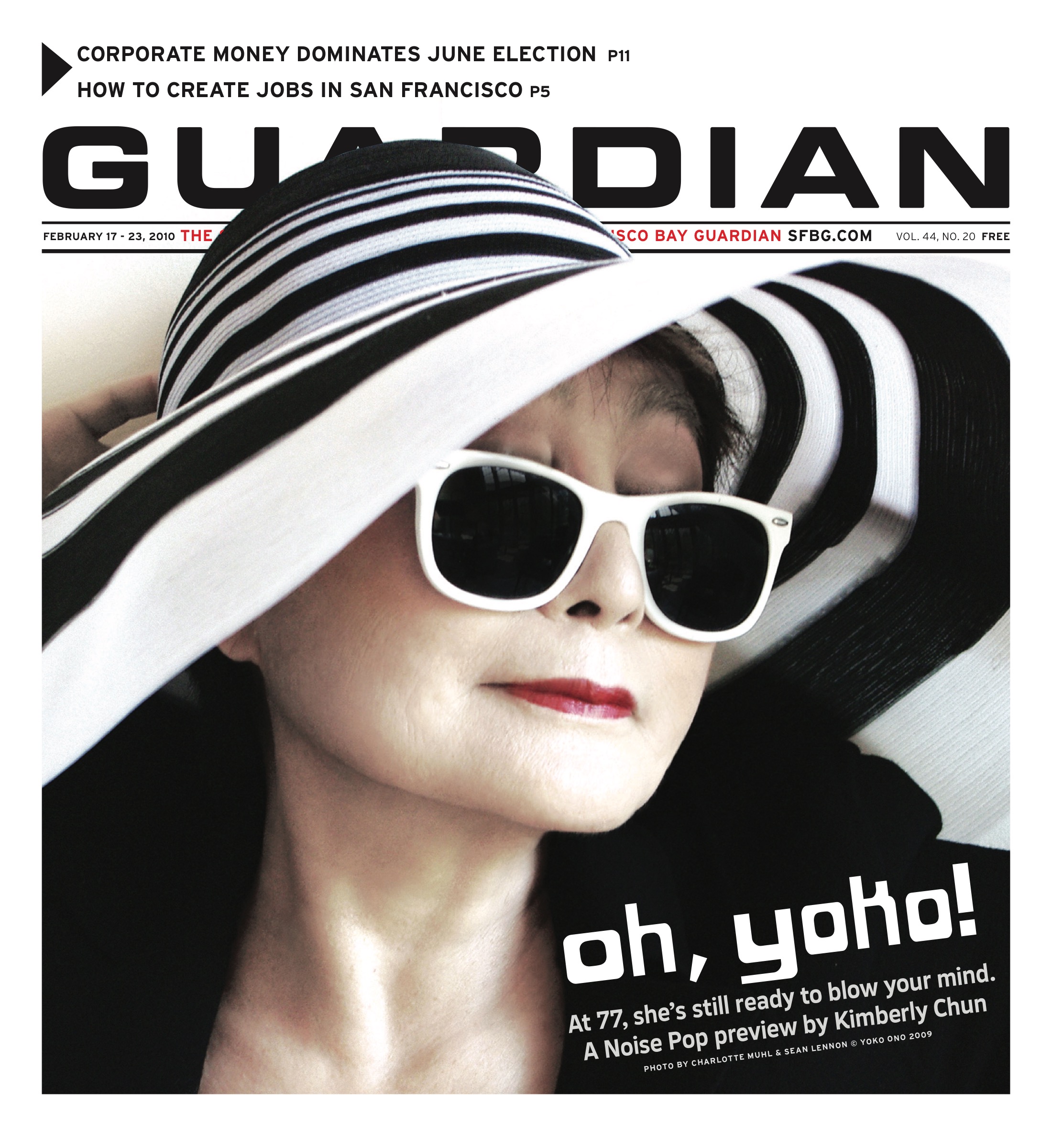
MUSIC The simplest, most singular words and images have always been Yoko Ono’s most potent artistic tools — depth charges designed for maximum impact, unexpected wit, and subtly change-inducing effect. And though words like “empowerment” feel too tapped-out to draw from the same power source as Ono-connected words like “yes” (the title of the retrospective that opened a new generation’s eyes to the woman too long associated with her late husband John Lennon), it’s outright empowering to see the septuagenarian Ono continuing to harness the same intuitive courage that led her to create 1960s performance art works like Cut Piece (1964).

Exhibit one: A Hole (2009) — a plate of glass pierced with a bullet hole, beneath which are the instructions “A HOLE GO TO THE OTHER SIDE OF THE GLASS AND SEE THROUGH THE HOLE” — on display in December at Gallery 360 in Tokyo. Playing off the image of holes that recurs in her work — and nodding to the title phrase’s femme-y glory and, er, half-assed curse — Ono entreats us to look at gun violence from both the shooter’s and the victim’s perspectives, while clearly harking to Lennon’s shooting death.

It’s a startling window — or portal, much like the tunnel to the Dakota where Lennon was killed — leading back to one of the darkest periods of Ono’s life. “There are so many windows like that in the world now,” Ono says by phone, surprisingly girlish-sounding on the edge of 77 and her Feb. 18 birthday, and off-the-cuff (“We can wing it — come on!” she urges, when I bring up that her people asked to see my questions). “One is the shot, one is the hole that you see when you’re shooting, and the other is the hole that you see when you’re shot!”

Ono’s mind is clearly on her February NYC Plastic Ono Band shows, which will include original members and big-wiggies like Eric Clapton and Klaus Voormann, as well as wildly disparate successors such as Scissor Sisters and Kim Gordon. (Plastic Ono Band’s plastic lineup includes son Sean Lennon, Cornelius, and Yuka Honda when it tops Noise Pop on Feb. 23.) But the thought of A Hole is obviously still charged for her.

At first she didn’t recognize it as a piece triggered by Lennon’s killing. “At the time there were four shots — that was for my husband. Then, I think — I don’t know if it was intentional or not — but the idea was to first get John and then get me, too. So when I was going around the door [at the Dakota at the time of Lennon’s shooting], I saw the glass made a hole, and a hole toward me. But luckily, the angle of the bullet didn’t come at me.

“It’s amazing, you know,” she continues with a sigh. “For the longest time I was creating canvases with a hole to see the sky. Then suddenly I didn’t want to do another hole to see the sky. I thought, ‘OK, why don’t I do a glass with a hole-way — and I didn’t connect it with John’s death at all. I was just thinking about all the holes that are made by shooting people in the world now. There are so many wars. Then I realized it might be coming from that experience.”

Few can face their most horrific moments and darkest fears and make art from them — and amid a decade-shift of such uncertainty, the time is now to look to Ono’s bravery under the burn of the spotlight. In response to the sexism, violence, and hatred she’s encountered, she continues to ply her own unique, unabashed voice, influenced by Kabuki and traditional Japanese music. Her page-size ads announcing “War Is Over! / If You Want It” appear even now in weeklies like this one. She still makes music and art in the face of the boos and hisses she’s caught from backward Beatles fans who think of her as the “ugly Jap” who broke up the band of lovable mop-tops.

Exhibit two: Ono’s latest album, Between My Head and the Sky (Chimera, 2009), her first release working with the name Plastic Ono Band since 1975’s Shaved Fish (Apple). Plastic Ono Band is a name Lennon dreamed up when told about an Ono performance utilizing four plastic stands with tape recorders in them. The loose gathering of rock cohorts — encompassing not only Clapton and Voormann but also the Who’s Keith Moon, Billy Preston, Yes’ Alan White, and Phil Spector — is a precursor to that utopian, gang-of-like-minded-friends quality embedded in so many experimental rock ensembles today.

Lennon and Ono’s son — and Ono’s current music director — Sean Lennon suggested resurrecting the project. “Sean said, ‘Mommy, would you mind if we record as Yoko Ono Plastic Ono Band? Bring up Plastic Ono Band again!” Ono recalls. “<0x2009>’Why do we do that? You want to do that?’ I said, and I thought about it and thought the reason why I was blocking that name was because John and I used it and, I mean, John thought of it, and for me. And when John passed away, I just blocked it, you know.”

“The thing is, many people are, like, ‘Are you kidding? You don’t do it with your son! You just don’t do it — it’s just the most difficult thing to do,'” Ono continued. “And I got a bit scared. I said, ‘Oh, dear, did I say anything I shouldn’t have?’ But my position was right. I didn’t have any problem about it, and it just worked out very well.” The album does stand out among Ono’s shockingly deep discography. It embraces elegiac acoustic beauty and poetry (“Memory of Footsteps”), playful and still-surprisingly sexy funk (“Ask the Elephant”), and ambient experiments (“CALLING”) that recall her most brilliant avant rock recordings, à la Fly (Apple, 1971), in addition to her call-outs to the dance-floor (“Walking on Thin Ice”).

The key, Ono believes, is that Sean listened to everything by his mother and father, as well as the Beatles. “He knows all of them, but not in the way that most fans just listen to something. Because he’s a musician, he knows the intro, the bars, the what-comes-next kind of thing musically, very well. So if I say, ‘Why don’t we do it something between “Why” and “Mind Train”? He’s, like, ‘OK.’ So it’s very, very good that way. Our creative conversation didn’t start from scratch. It started from all the knowledge that he had of my music, you know.”

Sean’s studies take on an air less of filial obedience than newfound respect when one considers the last time he collaborated with his mother, on Rising (Capital, 1995). “He was 17 and he was a very different animal then,” Ono says chuckling. “Luckily, he’s grown up to be a very unique and talented musician. But in those days … I went with him and his band — and it was a bit difficult. You know, just 17, and they were very cocky. They really felt like they were doing a favor for me! Of course, I just wanted to give Sean a musical experience.”

As gratifying as it is to see Sean and younger generations finally appreciating her work, Ono continues to be propelled by other forces. Despite her well-documented activities, including seeing to the licensing of Lennon’s music for products like last year’s The Beatles: Rock Band game, she still jots down ideas for new artwork and song lyrics. “It’s my security blanket” she explains matter-of-factly. “In a sense, without art or music or being able to express myself that way, I would have died a long time ago, I’m sure.

“You see, I think music is a very important thing for the world, and I just want to cover the world with music and art,” she continued. “I think art — meaning art with a capital A, is the thing that can really bring change in the world,” Ono muses. “Politicians don’t have much respect for art — that’s why they just ignore it — and we can just do whatever we want in a way, through that kind of situation where there’s a big hole. They think we’re not powerful, so they just ignore us — that’s where we can do all sorts of things and change the world.” 

YOKO ONO PLASTIC ONO BAND

With Deerhoof

Feb. 23, 8 p.m., $39.50

Fox Theater

1807 Telegraph, Oakl.

www.apeconcerts.com

Tuba

0

A score or so years ago, the corner of 22nd and Guerrero streets was one of the gastronomic hotspots of the city. (A score, as we will all recall from our civics class parsings of Lincoln’s Gettysburg Address, is 20 years.) On one corner stood, from 1989, Arnold Tordjman’s eclectic and imaginative Flying Saucer, replete with neon flying saucers in the windows, while across the street was Robert Reynolds’ Le Trou, which from the early 1980s offered a monthly rotation of regional French cooking. By the early 1990s, a glam trattoria called Mangiafuoco completed the triad.

But these sorts of convergences, like all magic, tend not to last too long. A city’s tectonic plates shift. Both Flying Saucer and Mangiafuoco vanished shortly after the turn of the millennium, becoming (respectively) Tao Café, a handsome Vietnamese restaurant, and (after some throat-clearing) La Provence, a handsome Provençal restaurant. These successors are good restaurants, but they are not as compelling as the restaurants they replaced.

Nowhere is this shift more apparent than in the Le Trou space. The first successor was the Moa Room, which served New Zealander food. Then came the dot-com edition of NeO, with its white walls, white tables, white everything — it was like being inside the sperm scene from Woody Allen’s movie Everything You Always Wanted to Know About Sex. All-white was evidently a bit much, for NeO was soon reinvented along Day Glo-Cubist lines before vanishing altogether. It was briefly succeeded by a good Indian restaurant whose owner ended up moving to Dallas, but not before painting the walls red, and those red walls constitute part of the inheritance of what is now a Turkish enterprise called Tuba.

Tuba opened early in the new year and is already packing them in. In a flaccid economy, it’s good to see any small business thriving, but Tuba, like its many predecessors, isn’t laid out to accommodate a crush of patrons. There is no host’s station or waiting area at the front; instead the door opens to rows of tables on either side and a clear if narrow path to the bar at the rear, where the staff congregates. On a crowded night, you might make it all the way back there before bumping into the host.

Why the big crowds? Part of the reason must be that the neighborhood, once edgy, is now well-to-do, and the array of restaurants (there’s also a nice sushi spot just a few doors down) draws strollers who scan posted menus. If this place doesn’t appeal, walk a few steps to that one or — in the extreme — cross the street. Tuba’s prices are also gentle; even the menu’s highest peaks scarcely rise to the mid-teens.

Then there’s the draw of the Turkish food itself. It’s Mediterranean, and eastern Mediterranean, with obvious affinities for the neighboring cuisines of Greece, Lebanon, and the Arab Middle East. It suggests simplicity, honesty, healthfulness; there is plenty of yogurt, lamb, and eggplant. At the same time, it has its own character and distinctive dishes.

The signature Turkish specialty in America might be sigara boregi ($7), cigar-like phyllo flutes filled with feta cheese and some spinach and deep-fried to a delicate, flaky crispness. When fresh, as at Tuba, their texture is wonderful; the cylinders are like edible (and still slightly molten) gold. But I found the feta’s assertiveness and saltiness to be near the border of acceptability, even as softened by the spinach. They’re also incredibly rich, which is a factor you have to weigh in relation to the fabulous round loaves of warm, focaccia-like bread you’re brought at the outset and might have trouble resisting. (The bread, unlike focaccia, contains no oil, our server told me. But it’s just as pillowy.)

White bean salads are common throughout the Mediterranean. Tuba’s is called piyaz ($6), and is heartily spiked with garlic, lemon, and parsley. Then there is the baked eggplant casserole musakka ($13) — layers of eggplant and potato dressed with cheese, a spicy tomato sauce, and béchamel sauce. Many of us probably think of this as a Greek dish while tending to forget that Greece was the subject of a hostile takeover by Turkey for several centuries.

Among the most appealing of the larger courses is beyti ($14), a flatbread rolled into a cylinder around a filling of spiced ground beef and lamb, sliced into disks and plated with yogurt and spicy tomato sauce. It’s very shareable, so don’t be shocked if others at your table score their fair share.

TUBA

Dinner: Sun.-Thurs., 5–10 p.m.; Fri.-Sat., 5-11 p.m.

1007 Guerrero, SF

(415) 826-8822

Alcohol pending

AE/MC/V

Noisy

Wheelchair accessible

Labor’s love lost

4

Note: This file has been corrected from an earlier version.

rebeccab@sfbg.com

Two recent events could have major implications for Service Employees International Union Local 1021 — San Francisco’s largest public-sector union and an important ally for progressives — for better or for worse. And this union’s fate seems closely tied to that of the progressive movement in San Francisco.

The first event was likened to a “nuclear bomb in the morning paper” by one observer, and might be interpreted as the kickoff to a fierce budget battle. Mayor Gavin Newsom announced that he is considering a plan to help solve next year’s budget deficit by laying off 10,000 full-time city workers and rehiring them at 37.5 hours, which would amount to a sweeping 6.25 percent pay cut for workers and an estimated $50 million in savings for a fiscally impaired city.

Though it was framed by Newsom spokesperson Tony Winnicker as one preliminary cost-saving option among many, the proposal received prominent front-page coverage in the San Francisco Chronicle, even before official discussions were called between the mayor and public sector unions. Since SEIU Local 1021 represents 17,000 members in San Francisco and a majority of the city’s 26,000 total employees, it would likely absorb the greatest impact if such a plan went through.

At the same time the mayor’s startling announcement hit newsstands, SEIU was in the midst of mailing out ballots to its membership for union elections. “I don’t know whether it’s a coincidence, or if the city is taking advantage of the fact that SEIU is absorbed in its elections,” Sin Yee Poon, an SEIU chapter president for Human Services Agency workers, told us while pointing out that the events happened simultaneously.

With three separate slates of candidates vying for control of SEIU Local 1021, grudges between warring internal factions have intensified into bitter sparring matches. The timing is unfortunate — just as SEIU’s internal turmoil is coming to a head, one of its greatest battles is pending over an unprecedented $522 million budget shortfall that looms like a dark cloud over the city. The deficit will surely result in job losses, and the public sector union’s ability to mount resistance even as it wrestles with internal strife is shaping up to be a key question.

This pivotal moment carries wider political implications considering that the progressive organization has in the past helped seal an alliance between San Francisco’s left-leaning leaders and organized labor through the San Francisco Labor Council.

With SEIU besieged by infighting and soon to be hurting from wage slashes and layoffs, more conservative factions of the labor community, such as the San Francisco Firefighters Union and the Building and Construction Trades Council, have recently been butting heads with progressive members of the Board of Supervisors.

At the same time, forces on all sides are beginning to eye the coveted seats up for election in June at the Democratic County Central Committee, a Democratic Party hub that is a cornerstone of local political influence, as well as the seats that will open up on the Board of Supervisors in November. Negotiations between unions and the mayor are ongoing, and mayoral spokesperson Tony Winnicker was quick to note that Newsom is open to options, other than reconfiguring 10,000 city jobs, that organized labor brings to the table. At the same time, the Guardian heard from numerous sources that city workers felt outraged and blindsided by Newsom’s decision to air the plan in the Chronicle instead of bringing stakeholders to the table.

SEIU Local 1021 President Damita Davis-Howard told us she thinks the idea of taking $50 million out of the pockets of working people in a rocky economy is wrong-headed.

“This was devastating,” said Davis-Howard, who is running for a newly created union position called chief elected officer, which is different from the union president, and similar to an executive-director post. “The mayor might as well have raised their taxes, because if you decrease their pay by 6.25 percent, they will still have the same amount of work, they will still have to pay the same mortgage, they will still have to buy the same food, the same PG&E, and they’ll be doing it with a lot less money. If any idea like this were to go through, it would actually remove the very fabric or fiber of San Francisco. It would really cut to the core of the very being of San Francisco. … I don’t see how anybody could believe that we could continue being the city that we love being with this kind of action.”

Winnicker, the mayoral spokesperson, cast it as a plan that could avert hundreds or even thousands of layoffs. “This year the easy decisions are behind us,” he noted in a recent discussion with the Guardian.

Solving last year’s fiscal shortfall was far from easy — budget tussles between frontline city workers and the mayor got ugly, and even then, the city received millions in federal stimulus dollars to cushion the blow. A similar plan of sweeping hourly cuts was floated then too, but it didn’t gain enough traction to move forward.

“The mayor is facing a huge budget deficit, there’s no question about it — but he has not lifted one finger to raise a dime in revenue,” charged SEIU member Ed Kinchley, who works at San Francisco General Hospital. As for how the union might respond if such a proposal went through, he speculated, “I think it’s the kind of thing that could lead to a strike. A big fight.”

While the city charter bars strikes by public employees, Kinchley’s comment indicates the level of frustration among SEIU’s rank-and-file.


The proposal could present a common enemy and a rallying point for a union in disarray. Internal jockeying for elected positions can be fierce in any organization, but for San Francisco’s service-workers union, the rifts are particularly deep.

The elections, which will be decided Feb. 28, mark the first time since a radical restructuring in 2007 that members will collectively decide who should lead. In 2007, the face of SEIU was changed across California when the international president, Andy Stern, began consolidating dozens of far-flung locals into centralized, beefier entities in a bid to maximize political effectiveness (California comprises roughly one-third of the entire union’s membership).

Local 1021 came into existence when 10 locals were conglomerated into one 54,000-member giant — hence the “10-to-one” label — representing health care and frontline service workers from the Bay Area to the Oregon border. 

In San Francisco, where a large segment of its members are based, the shift was interpreted by some as a power grab, and it triggered a period of ongoing strife between those allied with Stern and the international wing on one side, and those dissatisfied with changes they saw as antithetical to the democratic ideals championed by Local 790, its predecessor, on the other.

In the years following the reorganization, Stern began trying to aggregate members by raiding other unions to consolidate power. But campaigns to bring in members from United Healthcare Workers (UHW) and fend off membership losses to the newly created National Union of Healthcare Workers (NUHW) have consumed money and resources that some members told the Guardian would’ve been better spent bolstering national support for health-care reform and the Employee Free Choice Act. According to one source, SEIU spent $10 million on a Fresno battle against NUHW.*

A fight waged between SEIU Local 1021 and UNITE HERE Local 2, a hotel-workers union that was historically allied with Local 1021’s predecessor, left some members especially stung because it marred a longstanding relationship between two groups of frontline workers.

“Andy Stern has concentrated more and more power into the hands of a group of so-called elite members of the union,” Kinchley told the Guardian. Stern’s top-down leadership style and growth-oriented objectives “run pretty harshly against what many of us believe is in the best interest of our workers locally,” he added.

In recent weeks, divisions have deepened further. A staff person who preferred not to be identified for fear of retribution filed charges with the U.S. Department of Labor against a supervisor, who is aligned with the international faction, for alleged harassment and bullying. Another complaint was filed with union leadership alleging that union bylaws were violated when membership money was authorized, but not spent, to conduct a poll without proper approval.*

“There’s a fiscal rogue-ness about it. [Davis-Howard] does whatever she wants, and she spends our dues money without authorization from anybody,” Kinchley charged.

Stern appointed Davis-Howard, and now she is running for election on a slate aligned with the international wing. When the Guardian tried to reach her to discuss union elections, spokesperson Carlos Rivera told us that Davis-Howard found it inappropriate to publicly discuss internal divisions.

Sin Yee Poon is running as her opponent on a reform slate, formed by members disaffected by the international’s modus operandi. “For the whole reform group, we’re disappointed with the general direction of corporate unionism,” Poon told the Guardian. Stressing that she believes grassroots, democratic ideals have eroded since the restructuring, she said members in her camp are agitated when they see resources siphoned into raids on other unions such as UNITE HERE and UHW. “We want it to be member-driven,” she said. “The raiding of other unions is absolutely not OK.”


The internal strife could have a wider ripple effect. SEIU Local 1021 has historically been influential in securing an alliance between the city’s labor community and San Francisco’s progressive leadership. During the last round of elections for San Francisco’s Board of Supervisors, Sups. John Avalos and Eric Mar campaigned and ultimately were elected with strong fundraising support from the labor council.

Yet in recent weeks, several skirmishes pitted certain factions of the labor community against progressive members of the Board of Supervisors. Outrage bubbled up from the firefighters — and ultimately the labor council as a whole — against a charter amendment proposed by Sup. John Avalos that would have extended the minimum number of work hours for firefighters.

Billed as a cost-saving measure, the proposal might have ultimately resulted in fewer firefighter jobs, but it was designed to spread the pain of budget cuts more equitably by grazing public safety departments instead of just inflicting blows on frontline and healthcare workers.

After Labor Council Executive Director Tim Paulson came out strongly against it, Avalos abandoned the idea. A source from within the labor council, who spoke on background only, described it as an opportunity for the labor council to come together and unite on class interests.

The political posturing that came out of that fight shook even Sup. David Campos, who vocally called for equitably sharing the pain during last year’s budget debacle. “This isn’t the way to do it,” Campos said when asked about Avalos’ failed charter amendment. “And I worry about the negative impact on labor and the progressive board. There are larger issues at play here. The entire progressive agenda is at stake. We need to think long-term about the specific issues plus the future of the progressive movement.”

Sup. Sean Elsbernd’s bid to reform the pension system to save money has provoked yet another fight with SEIU Local 1021. Union members argue that if they are asked to contribute to their own retirement funds, which would become mandatory under this proposal, then they should be given the same wage increase that other unions were granted when they agreed to similar terms.

But when Sup. Eric Mar tried to amend Elsbernd’s proposal by inserting language guaranteeing that pay increase, Elsbernd said it would cost the city millions more. If Mar’s amended version goes forward, “you’ll be going to the voters by yourself,” Elsbernd told the progressive-leaning supervisor at a Feb. 9 board meeting.


Another fight has erupted over 555 Washington, a tower proposed to go up beside the TransAmerica Pyramid, which was debated at a joint hearing Feb. 11 between the Planning Commission and the Recreation and Park Commission. For members of the Building & Construction Trades Council, which represents unionized carpenters, plumbers, and other workers in development-related trades, the project represented jobs — the screaming priority in an economy where funding for new construction has trickled to almost nil.

“There is, in general in San Francisco progressive politicians, a knee-jerk reaction to development projects,” Building & Trades Council Secretary Treasurer Michael Theriault told us. As a council representing people whose livelihoods depend on private sector construction, “We have a particular quandary,” he said. “We need politicians who at the same time are friendly to labor and understand that development is an economic tool that can help the city.”

The arm of labor representing Theriault’s council has been slammed with job losses due to the economic downturn, and he’s publicly expressed frustration when projects of this scale are shot down.

“What the mayor did, what Elsbernd did, and what Avalos did are all the same thing: They all staked out a position, put a provocative idea on the table, and forced unions to have a discussion with a gun to their head in a non-constructive way,” Mike Casey, president of UNITE HERE Local 2 and a member of the labor council’s Executive Committee.

A source familiar with the inner workings of the labor council said the tension between building trades and firefighters versus more left-leaning members of the labor community has been in existence for decades, and it isn’t anything new — particularly in the months preceding election season.

Casey challenged the very notion that there is a subculture of the labor council that isn’t progressive, pointing out that labor came together as whole to support Sups. Avalos, Mar, and David Chiu — “and I personally would do it again in a heartbeat,” he added. Internal catfights and struggles for control come with the territory in a democratic, diverse organization, he said. “As a group of working people, I have great regard for the membership [of SEIU Local 1021],” he said. “Occasionally there’s a dustup. In my experience, after the dust settles, more often that not, unions come out stronger for it.”.

*Corrections made to the original file.

Reality bites

0

arts@sfbg.com

THEATER Feb. 5 saw a varied but collectively incensed body of American conservatives unfurl itself all red-white-and-blue in Nashville’s Gaylord Opryland Hotel for the first Tea Party Nation convention. The delegates, dubbed “teabaggers” by media wags and hailing from all parts of the land, responded enthusiastically to a keynote speech bewailing the “Islamification” of a nation overrun by foreigners and subverted from within by the Obama administration, the green movement, and the “cult of multiculturalism.”

Many in the Bay Area might look upon such a grouping, and the groundswell it purports to represent, with a vaguely uneasy sense of amusement, not to say superiority. But the name itself begs the question: are these people really patriots, or just pudheads? Maybe the only thing to do is gas up and head out for some reconnaissance. After all, there’s a legitimate wave of anger across the downsized middle of this otherwise clinically obese country, and it behooves us smug coastal dwellers to know something about it.

Or better idea: let Dan Hoyle go and report back from the stage. Like many a 20-something seeker before him, the restlessly peripatetic San Francisco–based writer-performer set out last year in a custom van to, as he put it in one of his dispatches to the San Francisco Chronicle, “find out what makes America’s heartland tick.” What he discovered during the three-month, 27-state odyssey may not be all that surprising in the end — indeed, the liberal biases Hoyle looks to complicate come back more or less intact — but it makes for a deft, sharply funny, and entirely engaging night of theater.

In the episodes brought to theatrical life here — astutely and meticulously shaped in collaboration with director Charlie Varon (Rabbi Sam) and reminiscent of the humanist satire of Garry Trudeau — Hoyle heads out from his charmingly incongruous but insular circle of friends (and their “liberal bubble”) straight to Texas, where he joins hands in mealtime prayer with a born-again Vietnam vet and his family, including a grandson about to ship off to Iraq with the Marines.

The dinner conversation is largely devoted to a defense of creationist history: “Now,” his kindly host asks with rhetorical relish, “How did Noah fit all those dinosaurs in the ark?” Afterward, Hoyle deflects a postprandial pass from the man’s son, who’s clearly surprised a guy from San Francisco could ever be so straight. Retreating to his van, Dan is not above doing some praying of his own, including hoping for the safety of the young soldier about to do “what I could never do” in Iraq.

Then it’s off to Alabama, Hoyle toggling expertly between, on the one hand, the casual racism of a moonshine-sipping paraplegic ex-trucker and his apologetic wife, and, on the other, an African American casino worker and ex-con (“livin’ the mutherfuckin’ American dream”) who expounds with gritty eloquence upon the impact of Obama on white and black minds.

Reagan Democrats, gun-show vendors, and aging Midwestern hippies-turned-reactionaries, among others, all lie on the road ahead. Hoyle finds much to sympathize with and honor along the way — an all-American cross-cultural encounter related by Ramón, a Dominican from New York whom Hoyle meets in Michigan, is particularly supple and hopeful — but the going is rough. Frequently Hoyle gives vent to his frustration in song, picking up the guitar and letting go a melodic tirade of inspired lyricism. “Americans” is pervaded with a sense of the playwright’s own loneliness, a frustrated desire for connection in the face of a reactionary populism that will not meet an earnest liberal halfway.

Maybe there is no halfway? Or maybe a halfway line requires more rigorous interrogation of the play’s own political assumptions. That might have cast the ideological landscape in a somewhat different light. After all, the widespread conviction that Obama is a “Moozlum” is one thing; a more general distrust of the state and big business as dangerously encroaching powers is another.

THE REAL AMERICANS

Through April 18

Thurs.–Fri., 8 p.m.; Sat., 5 p.m.

Sun/21, Feb 28, and all Sundays starting March 14, 3 p.m.

Marsh

1062 Valencia, SF

(415) 826-5750

www.themarsh.org


Nothing’s shocking

0

BioShock 2

(2K Games/Digital Extremes/Arkane Studios); Xbox360, PS3, PC

GAMER The original BioShock (2007) was a revelation in game design, inviting players into a living, breathing world that simultaneously awed and terrified, an undersea metropolis at the bottom of the Atlantic, undergirded by a surprisingly deep treatment of Objectivist philosophy. In the game’s stylized 1950s, the city of Rapture is conceived and built by its founder Andrew Ryan as a libertarian paradise. Developer Irrational Games rendered it as a gorgeous ruin, filled with Art Deco filigree, cascading seawater, and haunting period music — the soundtrack to a uptopia’s devolution into Hobbesian chaos.

There were many who balked when the sequel was announced, and the concerns of the naysayers seem justified in light of a game that cannot muster the watertight coherence of its predecessor. BioShock 2 puts you into the clanking dive suit of one of the original’s iconic “Big Daddy” characters, genetically modified brutes who protect creepy, glowing-eyed “Little Sisters” as they harvest ADAM (the game’s magical, chemical MacGuffin) from the ruined corpses strewn liberally about.

Big Daddies were panic-inducing adversaries the first time around, so it serves as an interesting inversion to step into their weighted boots and impale crazed “splicers” (Rapture’s mutilated, gene modification-addicted denizens) with a drill-bit the size of a traffic cone. Your character’s ability to breathe underwater enables the introduction of brief traverses outside the city’s pressurized buildings — a novel exercise in the eerie, aquatic sublime.

The player’s Big Daddy is one of the original models, codenamed “Delta,” and the action of the game is driven by your attempts to reunite with your Sister sidekick. In your way is Dr. Sofia Lamb, a sort of Stepford Stalin who replaces the Randian exhortations Andrew Ryan provided via radio in the first game with a lot of religious, communitarian claptrap. Unfortunately, Lamb isn’t half the adversary Ryan was, and the game’s story has none of the careful calibration or bold engagement with questions of individual freedom that made its predecessor so affecting.

Instead, in classic video game sequel fashion, the title throws a bunch of zany “bigger and better” ideas at you, in the form of new weapons, ADAM- derived pseudo-spells, and the “Big Sisters,” spindly, hyperkinetic murderers who are mostly notable for their tinnitus-inducing screeches. A frantic new multiplayer mode is likely the cause of the item overload and short single-player campaign, and though serviceable, those in search of frags are likely to find satisfaction elsewhere. Like Rapture itself, the BioShock franchise began as a grand, noble idea — only to descend into internecine, leaking disrepair.

Come to life

0

arts@sfbg.com

In the 1970s and early ’80s, Gil Scott-Heron sang, spoke, and wrote viscerally of social and spiritual unrest. Few artists could voice acute awareness of the struggles of their time and still touch on glimmers of redemption with such aplomb. Even at his biting bleakest, Scott-Heron always preferred the profundity of hope to cynical withdrawal.

Born in Chicago and raised in Jackson, Tenn., a teenage Scott-Heron absorbed the successes and failures of the civil rights movement in the hustle of the Bronx. In the wake of Martin Luther King Jr.’s death, he moved to Manhattan, where he channeled the Harlem Renaissance and followed in the footsteps of Langston Hughes. Nearly a decade before the first hip-hop record was pressed on wax, Scott-Heron deftly rapped spoken word poetry over jazz-funk backbeats. His songs and street-talk illustrated the joys and sufferings of life — black self-determination and the plight of the inner city (“Home is Where The Hatred Is”), apartheid (“Johannesburg”), political protest (“B Movie”), the poisonous drug epidemic (“Bottle”), and an urgent call for uprising (“The Revolution Will Not Be Televised”). He cloaked poignant criticisms of the American dream with a tough wit sweetened by his rich, impassioned baritone. Today Gil Scott-Heron is the stuff of legend.

Despite the unwavering relevance of his music, Scott-Heron released his last album, Spirits (TVT), 16 years ago, his only recording since 1982. He spent much of the last decade in and out of prison and rehabilitation centers on cocaine possession and parole transgression charges. Upon release from Rikers Island in 2007, Scott-Heron started touring again with his band the Amnesia Express. Last fall, I managed to catch his inspiring live performance in San Francisco at the Regency Ballroom. Addressing rumors about his alleged drug abuses and weakened state of health, a jaunty Scott-Heron warned the audience not to trust the gossip circulating on the Internet. The plea seemed more like a strategy for protecting himself, perhaps stirred by the artist’s haunting realization that he couldn’t help falling victim to his own cautionary tales. Yet Scott-Heron prophesied it all 35 years prior. He told stories from life experience and out of necessity rather than through the idealistic eyes of a watchdog. “If you ever come looking for me/ You know where I’m bound to be — in a bottle,” he sang. “If you see some brother looking like a goner/ It’s gonna be me.”

On the brilliant new I’m New Here (XL), a 60-year-old Scott-Heron eschews outright protest to turn his sights inward. The concise effort, clocking in at just under 30 minutes, visits fragments of Scott-Heron’s life through an unusual, electronic-laced patchwork of introspective meditations, poetry snipped from earlier works, cover songs, and off-the-cuff interludes from recorded studio conversation. The two-part “On Coming From a Broken Home” bookends I’m New Here. The first part — a heartfelt tribute to his grandmother Lily Scott who raised him in Jackson — sets a confessional tone, one about searching for home. In the closer, a weathered and raspy-voiced Scott-Heron speaks in praise of the courageous women-folk who made him the man he is today. The introspective and momentous sound of “Broken Home” also sets up the multi-referential aesthetic of the record. Its production extends the intro loop of Kanye West’s “Flashing Lights” (continuing a dialogue — West sampled Scott-Heron in “No Way Home”), which itself took inspiration from the fluttering string arrangements in Curtis Mayfield’s Superfly theme, “Little Child Running Wild.”

I’m New Here then embarks on a starkly orchestrated narrative, largely the vision of Richard Russell, label head and main producer of XL Recordings, the home of Tom Yorke and Vampire Weekend. (Russell signed Scott-Heron four years ago, while he was still in Rikers.) Scott-Heron’s guttural blues pulls tremendous vigor from Russell’s bleak electronic beats and sparse folk arrangements. The shuffling rhythm and ghostly atmospherics of “Your Soul and Mine” recall the dreary wastelands and enchanted junkyards depicted by dub-step progenitor Burial. In “Running” and “The Crutch,” off-kilter industrial pounding weaves foreboding spirits into Scott-Heron’s words, which circle the question of absolute loneliness and salvation like a feverish pack of vultures. “Because I always feel like running,” Scott-Heron intones, “Not away, because there is no such place/ Because if there was, I would have found it by now.” He takes the outsider’s perspective on the isolating effect of pain in “The Crutch”: “From dawn to dawn his body houses hurt/ And none of us can truly aid his search.” The handclap driven gospel blues of “New York is Killing Me” sees Scott-Heron longing for his Jackson home over the alienating grind of city living; “Eight million people, and I didn’t have a single friend,” he levels.

On the three cover version here, Scott-Heron reimagines 20th century songs that play on the possibility that renewal might emerge from the final throes of desperation. He flips Robert Johnson’s shadowy dance with evil in the lead single “Me and the Devil” over a ravaging beat that intensifies the weight of solitude. The song transitions abruptly into the guitar strummed title track “I’m New Here,” wherein Scott-Heron invigorates alt-rocker Smog’s original lyrics with a contradictory pairing of confidence and stripped-down anxiety. “I did not become someone different/ That I did not want to be,” he proclaims, but then admits, as if pushing himself forward in a repeating line, “No matter how far wrong you’ve gone/ You can always — turn around.”

It’s easy to hear I’m New Here as autobiographical, but I can’t help but wonder how to piece together an accurate view of the man behind the music, beneath the icon. Sincere-sounding emotions — suffering, and hope for some sort of earthly redemption — emerge. But they come from an artist and occasional satirist who reminded us to always question the media spectacle, the beguiling and toxic messages foisted on us, the business of buying, selling, and experiencing art.

In a recent interview on BBC Radio 4, host Mark Coles attempted to address the subject of Scott-Heron’s personal trials. Scott-Heron interrupted, “Very few things have been autobiographical that have been included in my work … If you do a good job on a song and convince people of it, they’ll attach it to your biography as though it’s actually something that’s part of your life instead of a good acting job.”

Is Scott-Heron trying to protect himself once again from the public’s judgment? It’s a strategy that I’m New Here captures well. The lifelong fabulist can make the unhinged pathos underlying a cover song his own. He can conjure up moments of raw expression; he can recite reflective poems from distant nights. But Scott-Heron’s storytelling talent itself is what sinks into your gut. It’s the self-renewing life of the words and sounds that linger in your flesh. “And so we’ve made a lot of characters come to life for people,” he said, “because they needed them to come to life.” *

GIL SCOTT-HERON

March 16, 17

8pm, 10pm, $26

Yoshi’s San Francisco

1330 Fillmore, SF

(415) 655-5600

www.yoshis.com

War and pensi

0

le.chicken.farmer@gmail.com

CHEAP EATS Dear Earl Butter,

I’m not mad at you for writing to me about German food. Nothing, not even the shit that I am in, can change the way I feel about sausage. In fact, I ate at Schmidt’s before I left, for practice, and ordered the same thing you did, and felt similarly, which is to say: happy.

Those were the days!

These are something else. I changed my return ticket to leave from Rome so as not to have to set foot on German soil, or even fly through German air space, ever again. Of course, it’s not their air or soil, per se, that I object to. I have no problem with German things, or even the things that German people do.

It’s the people themselves I hate — although, technically, I suppose, I don’t hate all of them. Or even most of them. I hate less than 10 German people. I hate two. Well, really, one.

But Earl, I have enough hatred for that one German person to probably qualify as a racist, or at any rate go to war. In Paris — did I tell you? — I stayed a half a block away from the Palais de l’Élysée. Baked Nicolas Sarkozy some cookies, just to let him know I was in the ‘hood, in case if he ever needed to borrow anything.

“I love your butter,” I said. I said if the Germans ever invaded his country again, not to bother with the White House — contact me directly. I would defend his cows with the passion and recklessness of a heart-broked chicken farmer from hell, which equals about 40,000 troops.

In Rome my cousin Stefano said, over homemade carbonara, “Non pensi, mia cugina. Non pensi. Ti voglio bene. No go into depression. You get strong, like me. Very important, no depression. No pensi.”

I’ll tell you a secret, Earl: Pensi means “think,” but I accidentally typed “penis” that last time, which made me laugh. Out loud. On the airplane. I’m on an airplane, trying not to penis. Cousin Stefano spent two months in a mental hospital after his wife cheated on him.

His mom, my Zia Carmella, is in the hospital dying. I stood by her bedside and watched her move her lips. Sometimes she was trying to eat, and sometimes she was trying to talk. My Italian’s not great. Her voice is almost gone. Her body too.

Italy’s a little warmer than France, and a lot warmer, in both senses of the word, than Germany. The people here actually want to talk to you, even if your Italian’s not so good. They are open-hearted, expressive, humorfully passionate people, and eaters, and they don’t care if you use your hands. An elegant, classy waitress in a nice restaurant laughed at me for eating the way they taught me to in Germany.

I hate to hate, Earl, but I have to at least try. I loved so much, it would be the end of me not to something. I would blow away. A German psychologist whose ex-ex never in eight years said “I love you” mistakes my passion for mental instability. I’ll take it.

Ti voglio bene.”

My mentally unstable cousin, who met me twice, can say it. With tears in her eyes, my aunt, who can’t of course remember me, moves her lips.

Dearest Daniest,

That is great. I went to Pakwan in the Mission on 16th Street, between Valencia and Guerrero with Joel and Chris, who is your brother, and Mike, who is your cousin-in-law. Joel was getting used to being 42 that very day. And Mike, well, you know Mike, he lives in a house in Glen Park.

We enjoyed the saag gosht ($7.99), which is the delicious, spicy lamb with the spinach, the saag daal ($5.50), which is the lentils and spinach, the saag paneer ($6.99), which is the cheese balls and the spinach, the chicken tikka masala ($6.99), which is Joel’s favorite, and the fish curry ($6.99) which is the special, and very, very spicy. And by that I mean great. Plus the naan, Daani, the naan. We also enjoyed each other, very much.

yers,

Earl Butter

PAKWAN

Mon.-Sun., 11:30 a.m.–11 p.m.

3180 16th St, SF

(415) 255-2440

Cash only

BYOB


How to create jobs in SF

10

EDITORIAL If Mayor Gavin Newsom is serious about stimulating the San Francisco economy, he ought to start with a basic number that the city’s own economist, Ted Egan, passed along to us this week. The number is 2.11 — and Egan says that’s the multiplier effect of cuts in local public spending.

In other words, every dollar Newsom cuts from the city budget has a ripple effect of taking $2.11 out of the San Francisco economy. Which means that if the mayor decides to solve the city’s $520 million deficit with cuts alone, he’ll be taking more than $1 billion out of the local gross domestic product.

And that, in a nutshell, is the problem with the mayor’s economic stimulus package: it’s entirely aimed at the private sector, with no regard for how it will hit public spending.

A dose of reality here — public-sector jobs are also jobs. People who work in the public sector pay rent and mortgages and buy clothes and food for their kids and go shopping in local stores and go to local clubs and restaurants and pay taxes — and have the same economic impacts on the economy as private-sector workers. If you lay off nurses and recreation directors, those people stop spending money in town, and you continue the vicious cycle that has made this recession so deep and painful.

And if your entire economic stimulus program is aimed at cutting private sector taxes, it’s going to lead to public sector job losses. And those losses will undermine much of the impact of any gains you might get from private sector job growth.

Egan predicts that Newsom’s program of eliminating the payroll tax for new hires would create 4,330 new jobs in the city. We find that something of a stretch — it’s hard to imagine how any struggling small business would find eliminating a small tax enough reason to hire a new worker, and small businesses provide the vast majority of the private-sector jobs in San Francisco. But even if it’s accurate, it’s a fairly tiny gain. The city’s lost more than 35,000 jobs since 2007, and when the economy rebounds in the next two years, Egan predicts about 20,000 new jobs in the city even without the stimulus.

Egan also acknowledged to us last year that “the consensus among economists is that most of the time government spending stimulates the economy more” [than tax cuts].”

That’s particularly true in a city where the largest employers are all in the public sector (see opinion piece this page).

If the mayor and the supervisors actually want to create jobs in San Francisco, there are plenty of things they can do — starting with finding ways to close as much of the budget gap as possible without layoffs. Here are some possible approaches.

Put a major revenue measure on the November ballot that saves city jobs without costing private sector jobs. There are several ways to do this, but all of them start with the well-demonstrated concept that transferring wealth from the rich to the poor and middle-class — that is, giving money to people most likely to spend it — is good for job creation. One option: shift the payroll tax to a gross receipts tax and charge bigger companies a higher rate. Another: a commuter tax on income earned above $50,000 a year would charge wealthier people who use city services and don’t pay for them.

Issue infrastructure bonds. The notion that cities can’t borrow money the way the federal government does to fund economic stimulus programs is just wrong. San Francisco can sell bonds for a wide range of projects, from affordable housing to alternative energy projects to public works programs that are badly needed and could put San Franciscans directly to work. But it can’t be small-time projects; to make a difference, direct stimulus needs to be big, perhaps $1 billion. San Francisco’s property owners, who ultimately are on the hook for the bonds, are by and large (thanks to Prop. 13) entirely able to handle more payments.

Lend more money to small businesses. The biggest obstacle to small business hiring isn’t taxes but a lack of credit. The $73 million Newsom is going to spend on tax cuts would create far more jobs as part of a city-sponsored microloan fund. Newsom’s efforts on that front are still very small scale.

There’s so much more the city can do — but cutting taxes and losing city jobs is the wrong way to turn around the economy.