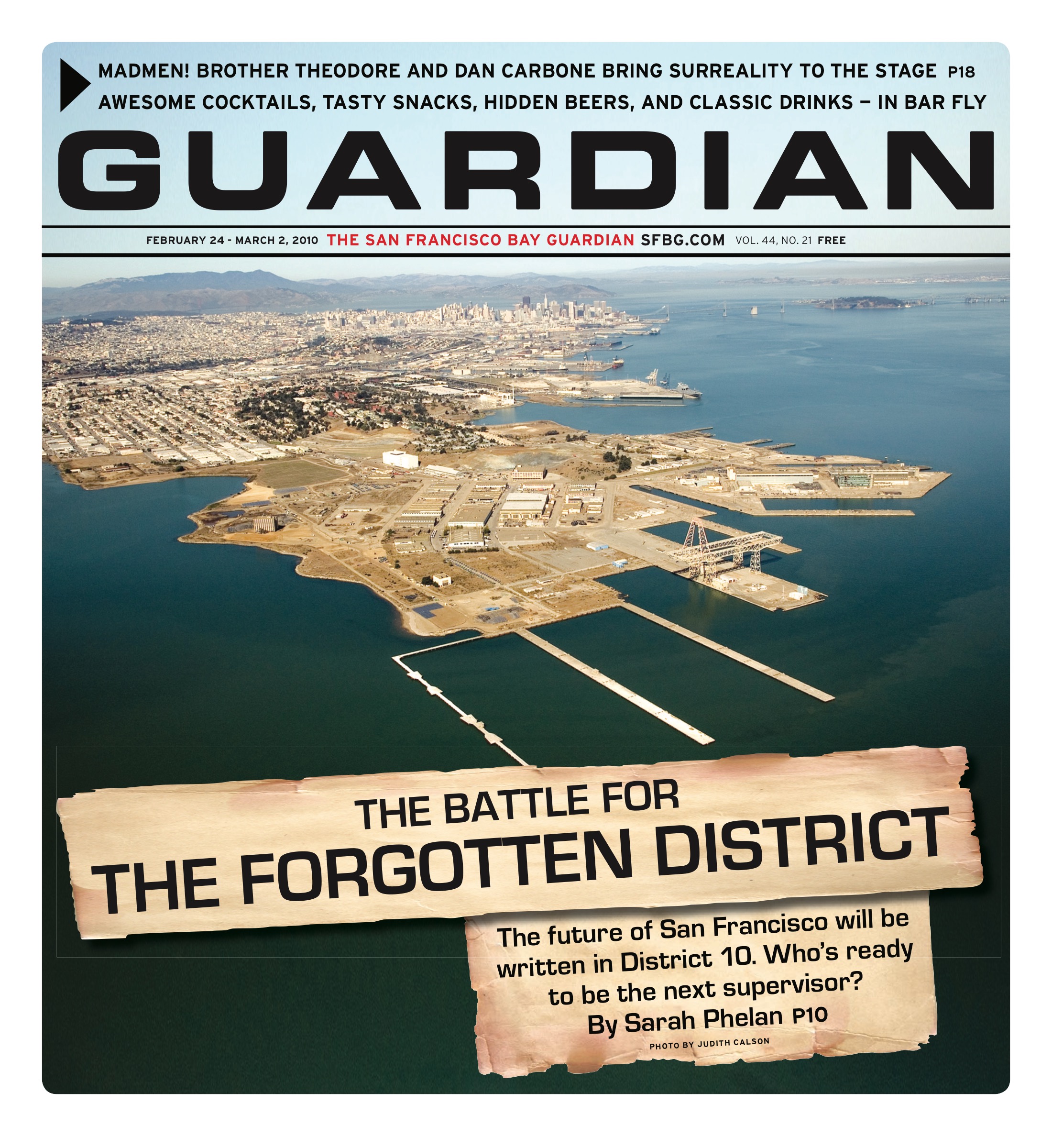
Volume 44 [2009–10]

Riff evangelists

0

arts@sfbg.com

MUSIC "I felt pretty much the day Wino called me up that it was a really important, really essential thing." Speaking by phone from Los Angeles, Shrinebuilder bassist/vocalist Al Cisneros makes the founding of his new band seem inevitable, like some sort of astronomical event. "Wino" is the nom de rock preferred by legendary guitarist/vocalist Scott Weinrich, cofounder of a new collaboration between musical luminaries that also includes guitarist/vocalist Scott Kelly and drummer/vocalist Dale Crover.

For fans of a certain kind of slow, heavier-than-lead music called "doom metal," these are all household names. Cisneros played bass in the mythical South Bay trio Sleep (with High on Fire’s Matt Pike) before founding drone metallers Om. Wino’s is the most impressive pedigree, one defined by stints with Washington, D.C.-area doom pioneers the Obsessed and L.A. cult heroes St. Vitus. Kelly is well-known in the Bay Area for his work with Oakland experimental titans Neurosis. Crover cut his teeth in Seattle, drumming for the Melvins.

The towering reputations and wide-ranging commitments of the musicians involved made creating the first Shrinebuilder album a scheduling nightmare. Rehearsals took place in multiple locations, often with only two members present — those absent participated by swapping riffs over the Internet. Despite these logistical difficulties, Cisneros insists, the process couldn’t have been more natural. "The in-person rehearsals really just confirmed the songs that we had going." Confined to only three days of studio time, they nevertheless crafted a self-titled album that exudes a confident coherence across its five lengthy tracks.

Even the lyrics, often a point of contention in other, lesser bands, benefited from this uncanny natural understanding: "Without explaining anything about the song, or the vibe, we just all knew what went next — how to proceed," Cisneros recalls. "We had a common understanding of the lyrical theme between all of us. I’m not sure that’s common in bands. We didn’t really need to say anything, we just all finished the lyrics as each other would have."

As can be guessed from the band’s name, the lyrical theme is one of religion, and construction, and the marriage of the two. Song titles like "Solar Benediction," "Pyramid of the Moon," and "The Architect" exemplify this fascination. More than just singing about worshipers, however, the members of Shrinebuilder are worshipers themselves, crafting a temple of their own design. As Kelly explains in an interview with Decibel magazine, "I think we’re just laying more bricks on the foundation that has been laid previously … it’s really an homage to sound, to music, and to its infinite wisdom, you know? The power of it. The religion that is sound. The electric church. All of that. I think that that’s been our lives."

The members of Shrinebuilder, then, are the four riff evangelists, and the album, like the New Testament, is a coherent whole that allows significant leeway for the individual tendencies of its creators. Each of the album’s five songs is a concatenation of different parts, many of which bear the tell-tale fingerprints of their authors. Wino’s bluesy howl makes his sections easy to identify; so too Kelly’s muscular, mammoth riffs and Cisneros’ syrupy bass lines. The album’s most liturgical passage occurs halfway through "Pyramid of the Moon," when an epic, reverberant riff suddenly culminates in haunting, euphonic chanting, which Kelly insists was entirely improvised by Crover and Cisneros in the studio.

Preparations have already begun for another, longer album, one that will involve more rehearsal and more studio time. But even if conflicts arise, the members of Shrinebuilder can rely on the natural affinity that results from their canonization as doom metal apostles. Have you heard the good news?

SHRINEBUILDER

with Harvestman, A Storm of Light

Sun/7, 8 p.m., $17

The Independent

628 Divisadero, SF

(415) 771-1421

www.theindependentsf.com

New New Orleans

0

arts@sfbg.com

MUSIC Galactic’s provocative new album, Ya-Ka-May (Anti-), is the sound of new New Orleans. It’s named after yaka mein (which is alternately spelled ya ka mein, yaca-meat, et cetera), a type of Asian noodle stew. Its clash of jazz, bounce, and R&B is hot and sweat-inducing, with so many voices that you can’t tell if it’s a great party or a riot breaking out. “No more dreams, this is reality!” shouts “sissy” performer Big Freedia on the bounce track “Double It.” “You gotta shake, baby!”

“I’m a wild man,” chants funk Indian Big Chief Bo Dollis from the Wild Magnolias. “I’m a wild man, oh y’all!”

At its center is a “Liquor Pang,” a derelict’s screed from Josh Charles and Ryan Scully (formerly of N’awlins funk band the Morning 40 Federation). “I’m making bad decisions with the money I earn,” slurs Charles. “Ain’t no shame like a pang for some liquor, man.” Meanwhile, Scully screams, “Yeah! I’m shutting it down!” “Liquor Pang” is supposed to sound like an oncoming hangover, but it feels like an alarm — a reminder of how dark and unhinged the Ya-Ka-May party becomes.

The album itself seems like a happy accident. For years, Galactic was best known as part of a sprawling jam scene, one of dozens of bands that traveled through earthy festivals and small theaters like wandering minstrels. The band’s early albums, including the 2003 Sanctuary release Ruckus (which featured production by Dan the Automator) hewed to the funky, organic side of downtempo — like flagship artists Medeski, Martin & Wood and Thievery Corporation — with long instrumental passages and wah-wah workouts punctuated by former member Theryl DeClouet’s gritty vocals.

“Some of our early success on the road was due to that scene embracing us,” says Galactic guitarist Jeff Raines during a phone interview. Like many associated with the jam scene, he dislikes that phrase, calling it a “label created by the press.” He seems to prefer “taper community,” although jam fans probably don’t use cassette recorders anymore. “Our band started in a grassroots way — we got in a van and literally drove around America. The way we approached our business originally was in the jam band style of grassroots, do it yourself.”

The turning point was 2007’s From the Corner to the Block (Anti-). Inspired by Brand New Heavies’ Heavy Rhyme Experience Vol. 1 (Delicious Vinyl), where the acid jazz pioneers recorded with golden age hip-hoppers like Kool G Rap and the Pharcyde. Galactic worked with indie-rappers like Gift of Gab, Lateef and Lyrics Born from the Quannum crew, pioneering 1990s bounce artist (and subsequent “Back Dat Azz Up” superstar) Juvenile, and DJ Z-Trip. Vibrant and energizing, From the Corner to the Block was the first Galactic album that didn’t seem like a byproduct of its neverending tours.

To hear Raines tell it, there wasn’t any grand ambition fueling Ya-Ka-May. “Our intent was not to create a dark, disturbing type of record,” he says. “We were really trying to work with some of our favorite artists and do a snapshot of what the current music is there, and maybe isn’t that well known outside of New Orleans.”

Much of Ya-Ka-May features Katey Redd, Sissy Nobby, and Big Freedia from New Orleans’ “sissy” bounce culture. It’s one of the few queer rap scenes in the country that isn’t divided from the mainstream since, as Raines puts it, they perform at clubs throughout the city. “These are bounce rappers that happen to be gay,” says Raines.

A local DJ, Jay “Rusty Lazer” Pennington, served as a liaison for the bounce rappers. Other guests like “supafunkrock” player “Trombone Shorty” Andrews and the world-famous Rebirth Brass Band are longtime acquaintances of the band. “It’s a small town. Everyone knows each other.”

With so many shouting and signifying, Ya-Ka-May can wear you out like a daylong community festival with 100 performers on the bill. The specter of Hurricane Katrina lingers above it all. Perhaps that’s where all the wondrous and sometimes-bizarre mania comes from.

“For years, you couldn’t walk out of your door without thinking about the storm or interacting with some aspect of it,” he says. “But there’s life there, and there’s art being made. It’s a really fascinating city to live in, to watch an American city go through something so traumatic.

“To some degree, everything in New Orleans now revolves around that event. But Ya-Ka-May isn’t about Hurricane Katrina. It’s about the contemporary scene in New Orleans as it exists today.”

GALACTIC

Fri/5, 9 p.m.

The Fillmore

1805 Geary, SF

(415) 346-6000

www.livenation.com

Education of a felon

0

arts@sfbg.com

FILM Filmmaker Jacques Audiard has described his new film, A Prophet, as “the anti-Scarface.” Yet why do this gripping, gritty feat of moviemaking — tutored though not neutered by the schools of grim social realism and grimy magical realism — that disservice? Why deny this heartfelt yet tough-minded entry into the prisonsploitation ranks of Cool Hand Luke (1967), Papillon (1973), and HBO’s Oz?

A Prophet‘s forebears are couched in the lyrics of Dylan’s “Gotta Serve Somebody” and Bertolt Brecht’s “Mack the Knife” (Jimmie Dale Gilmore’s version wheezes warmly over the final credits) and lurk in the memoirs of Edward Bunker and Jean Genet, rather than in the Grand Guignol fantasy of a snow-blind Al Pacino introducing us to his little friend. Yet much like Scarface (1983), A Prophet bottles the heady euphoria that chases the empowerment of the powerless and the rise of the long-shot loner on the margins — permutations of the capitalist success story and odes to hard-working individualism familiar to, say, Michael Mann fans. Still, that swirl of programmatic referents shouldn’t discount the inspired rigor of A Prophet, which — in its almost-Dickensian attention to detail, devotion to its own narrative complexity, and passion for cinematic poetry — rises above the ordinary and, through the prism of genre, finds its own power.

The supremely opportunistic, pragmatically Machiavellian intellectual and spiritual education of a felon is the chief concern of A Prophet. Played by Tahar Rahim with the guileless open-faced charisma reminiscent of River’s Edge-era Keanu Reeves (though Rahim is more agile and pliable than the reserved Reeves), Malik is half-Arab and half-Corsican — and distrusted or despised by both camps in the pen. When he lands in jail for his six-year sentence, he’s 19, illiterate, friendless, and vulnerable enough to get his shoes snatched straight off his feet his first day in the yard. His deal with the devil — and means of survival — arrives with Reyeb (Hichem Yacoubi), temporarily locked up before his testifies against the mob. Corsican boss Cesar Luciani (Niels Arestrup, who resembles a scary, sketchy Father Christmas) wants him dead, and Malik, loudly propositioned by the would-be stoolie in the showers, is tagged to penetrate Reyeb’s defenses, namely his cell, with a blade hidden in mouth.

The bittersweet irony is that the man Malik must kill, at the risk of being killed himself, seemingly turns out to be the first to show him any kindness. During their brief, bloody tryst, the cultured Reyeb advises his assassin to educate himself behind bars, offering him gifts of books. And after Malik’s gory rebirth, as first a protected, contemptible serf serving the Corsicans, it turns out that the teenager’s a seer in more ways than one. From his low-dog position, he can eyeball the connections linking the drugs entering the prison to those circulating outside, as well as the machinations intertwining the Arab and Corsican syndicates — just as he happens to see, and confide in, the dead Reyeb, too. It’s no shock that when Cesar finds his power eroding and arranges prison leaves for his down-low, multilingual crossover star that Malik serves not only his Corsican master, but also his own interests, and begins to build a drug empire rivaling his teacher’s.

Throughout his pupil’s progress, Audiard demonstrates a way with Henri Cartier-Bresson’s decisive moment, and when Malik finally breaks with his Falstaffian, castrating patriarch, it makes your heart skip a beat in a move akin to the title of the director’s last film. It’s like several other exquisitely imperishable scenes in A Prophet: a sequence that aims for the chaotic, sensuous intercourse of a close-range shoot-out; the image of a sacrificial deer arcing through the air; the sight of Malik, awkward in a business suit, taking his first plane ride; a vision of a fragile rainbow coalition of crime. This Eurozone/Obama-age prophet is all about the profit — Malik is a biracial, border-crossing player who has translated his survival skills into power-grabbing opportunity — but here he’s imbued with grace, even while gaming for ill-gotten gain.

A PROPHET opens Fri/5 in Bay Area theaters.

My son, my son, what have ye done

0

FILM Some of the best documentaries in recent years have been hijacked by their subject — or even by another subject the filmmaker wasn’t planning on. Prodigal Sons was supposed to be Kimberly Reed’s story about a high-school quarterback, basketball captain, class president, and valedictorian born to a family of Montana farmers, returning for a reunion 20 years later — albeit as a fully transitioned male-to-female transgender person attending with her female lover. This will definitely be news to most of Helena, Mont., especially those former classmates who once swooned with puppy love or envy over the jock prince who is no more.

That would have made for an interesting movie. What makes Sons a fascinating one is that Reed finds the camera focus — as director/producer/coeditor, her own camera — stolen almost right away by a crisis in progress. Its name is Marc, adopted “problem child” of the McKerrow family (Kimberly changed her surname post-op). It’s not so much that Marc grabs the spotlight out of a jealous need for attention, though that may be a factor. It’s that he’s still trapped in a sibling relationship that for her ceased to exist — at least in its original form — decades ago, and Kimberly’s presence stirs up all kinds of buried shit.

Marc’s living in the past isn’t mere self-pity or indulgence. Already stamped as a bit of a fuckup (held back in grade school, a high school dropout), he suffered a head injury at 21. That commenced an ordeal of seizures, brain surgeries, and complicated med cocktails. He’s married with a daughter, but emits toxic clouds of social awkwardness and discontent that sometimes erupt in violent mood swings, which here result in at least one police intervention.

“It’s not the real me” is his usual refrain afterward each such “episode.” While Kimberly looks to reconcile her successful new identity with a community she’d ago severed most ties to, Marc struggles to assert any cogent post-accident identity at all.

Running a gamut from harrowing to miraculous (not necessarily in that order), the remarkable Prodigal Sons grows stranger than fiction when abandoned-at-birth Marc discovers something jaw-dropping about his ancestry. Suffice it to say, this results in a trip to Croatia and biological link to some of Hollywood’s starriest legends.

If Kimberly’s story is about repression forcing a mentally healthy transformation, Marc wrests us away from that inspirational self-portrait. He renders Sons a challenging, head-on glimpse of mental illness with no easy answers in sight. Christianity, a well-adjusted gay third brother, conservative yet surprisingly adaptable parents, jail time, savant piano mastery, and other elements also factor into this wild ride of a documentary. Its narrative progress might be dismissed as over-the-top if it didn’t happen to be true. 

PRODIGAL SONS opens Fri/5.

No regular play

2

superego@sfbg.com

SUPER EGO One of the best things about the San Francisco scene is we don’t have “hits.” You can always escape that tired Kid Cudi dirge or hypothetical Ke$ha-Cannibal Corpse mashup (not a bad idea, as long as it involves rusty chainsaws) by jetting to another spot. Below is a brief survey of four of the city’s most intriguing regular parties, and the music they’ll most likely ravish you with.

YORUBA DANCE SESSIONS

I’ve got to admit I kind of lost it in a good way on the Som floor at this new weekly the last time I attended. (If I huffed down the back of your neck, I apologize.) It’s one of the most diverse-crowded joints in the city, flipping to deep global soul rhythms, and yes there was a dance circle. “There is a negative stigma attached to house music,” DJ and founder Carlos Mena told me. “It is not the stereotype-laden skits that appear on Saturday Night Live. It is soul-filled music, which encompasses rhythms from Africa and beyond. I want to provide a space for dancers to express themselves.” Upcoming guests include Greece’s Osunlade and Ezel from the Dominican Republic.

Sounds like:

DJ Spinna featuring Erro, “Butterfly Girl (Casamena Remix)” Babatunde Olatunji, “Saré Tete Wa” Ezel featuring Tamara Wellons, “”In My Lifetime (Deetron Remix)” Fela Kuti, “Ako” Afefe Iku, “Baiao”

Wednesdays, 10 p.m., $5. Som, 2925 16th St., SF. www.som-bar.com

LIFE/STYLE

You’ll want to don a fly fedora or pop a fresh gardenia in your hair for this youthful and stylish — but actually not pretentious — free weekly at the revamped Beauty Bar, which just celebrated its first anniversary. Decades of familiar retro (is that redundant?) are definitely on the carefully curated playlist, but mixed into some newer party jams by DJs Roll and Ts with the help of some stellar backup from the likes of the excellent Sweaterfunk crew. Indie, Northern Soul, boogie, glam, Brit, Mod … the night can go in any direction. “It’s always a headful of rad times!” says Roll.

Sounds like:

The Juan Maclean, “Happy House” New Order, “Blue Monday” The Ronnettes, “By My Baby” Holy Ghost!, “Hold On” David Bowie, “Queen Bitch” Wham!, “Club Tropicana”

Thursdays, 10 p.m., free. Beauty Bar, 2299 Mission, SF. www.beautybar.com/sf

LOOSE JOINTS

Tom Thump, Centipede, and Damon Bell — the “highly unlikely yet perfectly unusual” DJ trio behind this two-year-old weekly throwdown at the Make-Out Room are pure quality, mainstays on the SF scene who each light up in individual ways. Loose Joints is a gonzo sonic outlet for their funkier sides, incorporating Italo, Latin, space disco, globaltronics, and even future bass beats into a cutting-edge stew. Says Thump, “We’re like an all-vinyl house party (as in your home) where everyone is so trashed they’re tearing their clothes off. We’re boundary pushing and blurry — but never cheesy.”

Sounds like: The Bamboos featuring Lyrics Born, “Turn It Up!”

Tropical Discoteque 2, “La Rosa (Simbad and F. Francis Edit)”

Stevie Wonder, “Superstition (Todd Terje Edit)” Situation, “Goblin in the Bikini Shack” Gonja Sufi, “Holidays/Candylane”

Fridays, 10 p.m., $5. Make-Out Room, 3225 22nd St., SF. www.makeoutroom.com

OLDIES NIGHT

“We’ve had people that dress really nice, like from a certain era — and we’ve had people in their underwear, ha ha,” says one of my favorite club people, Primo Pitino, of the attendees at the fantastic, eight-year-old, twice-monthly, doo-woppy Oldies Night, which he puts on with DJs Ivar and Daniel. “But our party isn’t a throwback party for turning back the clock, it’s for playing music we used to dance around the house naked to, like ‘Please Mr. Postman.’ And our cute crowd has a fairly low asshole ratio.” It’s all true, and not a hard sell by half.

Sounds like:

Little Eva, “The Loco-Motion” Gino Washington, “Out Of This World” The Montereys, “Without A Girl” Bo Diddley, “Bo Diddley” The Metros, “Since I Found My Baby”

First and third Fridays, 10 p.m., $3. The Knockout, 3223 Mission, SF. www.theknockoutsf.com

Specchio

0

paulr@sfbg.com

Success brings penalties as well as rewards, and if you are a successful cuisine in America, one of the penalties involves banality. Banality is the essence of mass culture. You are Italian food and everybody loves you, but Chef Boyardee puts you in a can and sells you from Wal-Mart shelves, and (just a bit higher up the shame scale) you can find yourself being dished out in hackneyed versions in hackneyed settings, squishy cannelloni in bland Bolognese sauce at quaint spots with tabletop candles set in empty bottles of cheap Chianti.

Yet there’s much to be said for the tried-and-true. Europe might be the Old World, but it also has its ultramodern dimensions. In my observations, the resolution of old and new has generally meant that the latter is fitted gracefully into the former, another piece of a puzzle being forever assembled. The American way is to raze whole blockfuls of hideous, shoddy buildings so a new generation of hideous, shoddy buildings can replace them. The past in America is as disposable as everything else, from razor blades to auto workers.

Specchio is a newish Italian restaurant in America (in our very own San Francisco, in fact), but it has the Euro-modern feel of a glam place in Milan or Barcelona. The embrace of the new is fervent and obvious; the name means “mirror,” with an implication of a dusty article you might find atop Granny’s chest of drawers, but Specchio’s interior design doesn’t emphasize mirrors and certainly not dust. There are, instead, textured concrete walls, concrete floors, a gleaming stainless-steel exhibition kitchen at the rear of the soaring main dining area, and spare furniture of a post-Bauhaus flavor. It is the sort of setting you would expect to be deafening even without people in it, but the noise, while not inconsiderable, is surprisingly well-managed. In this respect Specchio resembles Delfina.

The au courant setting does not quite prepare one for chef Gino Assaf’s poised, traditional menu. (Assaf grew up in Venice and was the chef at Gondola in North Beach for several years.) It’s the photographic-negative, or mirror, effect: a reversal, with the old as an inlay on the new. It has been many years, for instance, since I last tasted vitello al tonno — veal topped with tuna sauce, as classic an Italian dish in its way as spaghetti with meat balls — and that version had been made (with scaloppini-style cutlets) by a home-schooled Italian friend. Specchio’s version (part of a $48 prix-fixe) featured slow-roasted veal in thin slices, almost like carpaccio or bresaolo; these were laid like mats on a wide plate and topped with the creamy, caper-sharpened tuna sauce, pipings of crème fraiche, plenty of lemon, and a small garden of arugula leaves.

More thin-sliced flesh: salmon carpaccio (also a prix-fixe item), scattered with shreds of fennel root and green peppercorns and dressed with a lemon vinaigrette. This version was visually more arresting than the traditional beef interpretation — translucent orange salmon flesh trumping opaque red meat — but the overall flavor effect was less rich and tangy.

Lobster is overrated and problematic, and (for me) the less that’s done to and with it, the better. The flesh is best when plucked right from the shell, swabbed with a bit of butter, and eaten. So lobster ravioli in a lobster bisque sauce (again, prix-fixe) sounded as if it might be overwrought. It wasn’t. The meat inside the pasta pockets remained sweet and firm, with its distinctive tactility, while the creamy sauce was intense with crustacean essence. For a bit of color, the kitchen added asparagus coins.

Swordfish, as the meatiest of fish, needs no introduction and very little help — just some tabs of braised leek and grapefruit sections, say, atop a grilled steak (prix-fixe), itself seated atop a bed of roasted potato, zucchini, and red bell pepper. The leek and grapefruit made an unexpected and appealing combination: a fruity sharpness with an undertone of earth.

Complaining about tiramisù is almost as cliché as tiramisù itself, so I am pleased to report that Specchio’s tiramisù was as good as could be: moist but not soggy, with a nice balance between the competing charges of espresso and liquor. (The great weakness of tiramisù is too much booze, which leads to sogginess and drunk-breath.) Equally impressive, in the Italian tradition of classic simplicity, was a pat of lightly sweetened ricotta cheese topped with a syrupy strawberry reduction that was more fruit than sweet. It was like a small piece of cheesecake, with no crust. Is there a Chef Boyardee take on this? I hope not.

SPECCHIO

Dinner: Tues.–Thurs., Sun., 5:30–10:30 p.m.;

Fri.–Sat., 5:30–11 p.m.

2331 Mission, SF

(415) 958-5528

www.ristorantespecchio.com

Wine and beer,

AE/DS/MC/V

Well-managed noise

Wheelchair accessible


Shipwrecked

1

 le.chicken.farmer@gmail.com

CHEAP EATS

Dear Earl Butter,

As you go through life, never underestimate the importance of somewhere to sit. In fact, stand up right now and kiss your chair. Kiss one for me, too — the comfy cat-hair chair that I like — and use your tongue please, Earl. For me. I dream of that chair, and hope to be sitting in it two weeks from today.

Let’s not ever, ever again take furniture for granted, OK? Everyone talks about a roof over your head, clean water, something to eat, honest work, etc. Those things are important, sure, but my message is this: so are chairs.

Probably you are wondering about the process of soul-searching and/or method of meditation that led me to such a discovery. Well, welcome to the less sisterly aspect of my loopy family. I know you know what I’m talking about.

This time: As a favor to and from our brother and your friend Phenomenon, Jean-Gene the Frenchman and me occupy two multimillion dollar houses on North Caicos, which is an undeveloped island in the Caribbean. It’s not only not Ohio, it is also the furthest thing from Germany I could ever imagine — if not geographically, at least in tone. Think: 80 degrees, fluffy white clouds, a continuous breeze, palm trees, the sound of surf, powdery beaches, and swimmably soft blue water. For free!

Can I complain? Well, since I am drawn to impossible challenges, let me try: There’s nowhere to sit. Our spectacular beachfront houses, which Phenomenon helped build and lost more than his shirt on, are of course unsellable, and, for our purposes, unfurnitured. We eat lunch on the beach, which is nice, but breakfast is a stand-up affair, and for dinner we sit on coolers and eat off of luggage.

My brothers are, like me, undiluted (and therefore deluded) optimists. As such, we are susceptible to posers, and prayer. We are here to work. Well, anyway, Jean-Gene is always hammering, sawing, landscaping, and just generally trying to nicen up for the banks that will likely soon own these doomed homes. I’m washing windows, sweeping, mopping, and pruning. But let’s face it, most of the meaningful work I’ve been doing is on my tan. Not only because I hope to attract some emergency rebound loving upon my untriumphant return to San Fran. It also happens that the only place I can breathe is the beach.

A couple miles out there, where the reefer is, where the waves break, where the water gets deep and darker blue, is a very visible and highly metaphorish, to me, shipwreck. At night we sing Belafonte songs to it. I brought my steel drum.

By day, I can’t stop looking. I dream. I think I probably might be pretty beautiful. I know my steel drum is. The front half of the ship juts proudly out of the water, and then, after a gap, there’s the back half, cracked and tilted, a complete mess.

Like a crosswired siren, drawn fatally to shipwrecks, I am tempted to swim it. But Jean-Gene, always the peach, has an inflatable kayak. I’ve never been in a kayak, canoe, or raft that didn’t spill, but I can swim forever. I can float. I’m strong, right?

Same time, I know that I’m also in many respects myself a shipwreck. For example: this longing to be explored.

Dear Lady,

That is great. Me and Joel, we went to the NYBuffalo Wings, in which Joel got the BBQ steak sandwich ($6.49) and Earl got himself the chili cheese hot link ($4.98). Joel said, “This is hitting the spot” and later described the sandwich as very tasty. And with lettuce that really helped it along, Joel did say, crispy, and very fresh. Earl will say that when you get a chili dog, it’s one thing, but when it’s a chili hot link dog, and there’s cheese (sauce, I think), it is not out of line to expect a lot of flavor.

But Earl was left out in the bland cold a little bit. If your chili and your link don’t cut it, you can hit up a meal like this in all sorts of ways, condiments for example, like raw onions, relishes, jalapeños … there are literally a million of them, but none were offered. Also, Joel paid because Earl is broke.

NYBUFFALO WINGS

Mon-Thurs., 10 a.m.–11:30 p.m.;

Fri-Sat., 10:00 a.m.–2:30 a.m.;

Sun., 10 a.m.– 11:30 p.m.

665 Valencia, SF

(415) 863-7755

AE/MC/V

No alcohol

L.E. Leone’s new book is Big Bend (Sparkle Street Books), a collection of short fiction.


Marshall amps

1

johnny@sfbg.com

VISUAL ART/MUSIC I’m walking with Jim Marshall from his apartment in the Castro to his favorite restaurant just around the corner. The T-shirt he’s wearing showcases one of his more famous photos, of Johnny Cash flipping the bird. Marshall tells me and his friend and assistant of 13 years, Amelia Davis, about another time he was wearing the shirt. When the person he was with said he wanted one, he promptly took it off and gave it to him. We sit down at a table, I turn on my old tape recorder, and Marshall asks me for my first question. I say, “Well, it’s not a question, but I guess the first thing I could observe about you is that you’ll give someone the shirt off your back.” He laughs.

This story, itself born from a story from Marshall, suits an article about him, because as the title of his one of his new books makes clear, a major foundation of his photography is trust. Almost every page of Trust: Photographs of Jim Marshall (Vision On, 165 pages, $34.95) illustrates the deep implicit bond between photographer and subject in Marshall’s work, an element largely lacking from the prefab realm of music photography today. At times, this trust makes for startling juxtapositions: more than once Marshall’s camera catches a singer — Mahalia Jackson at Carnegie Hall; BB King at the Fillmore West; Janis Joplin at an outdoor concert in San Jose; Big Mama Thornton in a San Francisco recording studio; Nina Simone at New York Town Hall; Big Joe Turner at Berkeley Folk Festival — wholly unguarded, with arms open wide. The gesture reflects Marshall’s wholehearted embrace of music, an approach that makes his best images sing.

Marshall is a San Francisco photographer. “I was just starting out during the Beat era, in 1959, hanging out in North Beach,” he says. “They called me Jaguar Jim because I had a Jag 120. I photographed at the Hungry Eye. Lenny Bruce was the first roll of color I ever shot — 10 frames. Fantasy Records called me up about 10 years ago and said, ‘Jim, we’ve got some of your shots here.’ I figured there was some Creedence [Clearwater Revival] stuff, or Otis Redding. But there were 10 slides [of Bruce] that had been stuck under a cabinet for 35 years.” One of those 10 frames can be found in Match Prints (HarperCollins, 208 pages, $40), a just-published collaborative monograph that juxtaposes photos by Timothy White with photos by Marshall. In the shot, Bruce is standing before a brick wall, and he has his arms outstretched — almost like he’s expecting to be arrested. He’s on stage.

The back and forth between White’s photos and Marshall’s in Match Print — also on display at New York’s Staley-Wise Gallery later this month — is partly a conversation between on-the-scene verité images and the carefully set designed studio shots that tend to dominate magazine profiles. But it’s also about iconography and a memorable pose: Jim Morrison taking a drag from a cigarette for Marshall, Robert Mitchum inhaling (unlike Bill Clinton) for White. Match Prints has a casual sense of humor, evident in the pairing of Cash giving the finger with a White shot of Elizabeth Taylor flipping two birds after stepping out of a limo. (It’s also made clear by Alice Cooper’s playfully catty comments about his sister-in-leopard-skin-boots Lil’ Kim.) But the lingering moments of the book, and ironically, the most contemporary visions, come from older black and white Marshall photos, such as one of a zaftig Mama Cass in the back of a car, or bouffant-and-eyeliner beauty Little Richard lost in thought. Cass’s style and Richard’s drag are very Bay Area rock n’ roll 2010.

Marshall’s photography is 2010 enough to be lodged in the White House at the moment. President Obama has a Marshall shot of John Coltrane (also within Trust) on the wall. “He [Obama] had a White House photographer take a picture of him reflected in the [frame’s] glass,” Marshall explains with pride. “He signed it, ‘To Jim — I’m a big fan of your work … and Coltrane!” A little later, back at Marshall’s apartment, I look at this photo, and think of Obama’s image and trust. In deed, is the President doing right by the artists?

At lunch, Marshall zooms in on a telling moment from Obama’s recent State of the Union address. “He said, ‘This administration this year will end discrimination against gays in the military.’ The camera was on four generals and admirals in front of Obama. The whole place stood up and applauded. Those motherfuckers didn’t blink, didn’t move — nothing. They just sat there stone-faced. That’s the last thing they wanted to hear.”

The trust recorded in Trust is a different kind of commitment than one offered by a political figure. The photo of Coltrane — itself reflective, a bit melancholy, even haunted — that Obama sees himself within is a chief example. “Miles [Davis] saw my pictures of Coltrane and saw that John trusted me, and that was good enough for Miles,” Marshall explains, after I tell him about a great Davis interview in which he proclaimed that his favorite thing to do was watch white people act stupid on TV. “Miles, he didn’t like white people a whole lot. But for some reason he liked me. He said, ‘You’re as crazy as me.'” The truth is, in America, then and now, that’s as good a reason as any to like someone.

Truth is another strong element of Trust. Marshall’s investment in emotional truth means that his opinions aren’t always orthodox. Trust contains some photos of the infamous 1972 Rolling Stones American tour — “I must have done two pounds of blow on that tour,” Marshall crows — also documented by Robert Frank in the movie Cocksucker Blues. “I was never a big Robert Frank fan, and I’ll tell you why,” Marshall says, with trademark intimate candor. “As good as [Frank’s classic 1958 monograph] The Americans is — and it’s one of the all-time great photo books, damn near as great as [1955’s] Family of Man — what Frank failed to do is this: he didn’t show in one picture, as far as I can remember, the joy of being an American. It’s cynical. That bothers the shit out of me.”

As much as Frank, Marshall is a primary documentarian of 20th century America, well aware of a time when great filmmakers and photographers had enough faith in the government to work for it. “I had a Baby Brownie [camera] when I was a kid,” he says, when asked how he found his calling. “Everything was blurry — you had to take the picture when the sun was at your back. But I won a track meet, the 50 yard dash, and a guy was taking pictures for the school. He had an early Leica. When we go back to my apartment I’ll show you my scrapbook — it has pictures of cameras cut out of magazines and pasted on the paper, with their prices written in pencil. He took a picture of me that was razor sharp, and I thought, ‘This guy has a magic box.'”

Marshall’s Leica images have their own magic, evident in monographs such as Tomorrow Never Knows — The Beatles’ Last Concert (1987), Monterey Pop (1992), Not Fade Away (1997), Proof (2004), and Jazz (2005). Trust distinguishes itself by the dominance of color images — Marshall laughs heartily when I tell him that the blue sky found in a pair of outdoor concert photos of Joplin is a California blue. The color in Marshall’s photos is super-real, to re-deploy a word Anthony DeCurtis applies to White in the introduction to Match Prints. It isn’t the cliché hallucinogenic vision found in so many recreations of drug trips or the ’60s, but instead an extra intensity, utterly pure.

“The single greatest performance I ever saw in my life was Otis Redding in Monterey [at Monterey Pop in 1967],” Marshall says, as we page through Trust. “Brian Jones was there as a guest, and he said, ‘I think Mick [Jagger] is one of the greatest singers, and our band is one of the best, but personally, you couldn’t give me a million pounds to follow Otis Redding on stage.’ It was that shattering of a performance.” The photo we’re looking at as he says this is deep black and rich blue, with fists to the fore. It’s a cry — a shout — into the night.

A pair of photos in Trust capture confidences exchanged between Johnny Cash and a top-of-the-world Bob Dylan — a country-folk echo of the gestures of confidence between Marshall, Coltrane, and Davis. Marshall laughs when I tell him of an anecdote about the great folk artist-archivist and magician Harry Smith slamming the door of his Chelsea Hotel room in the young Dylan’s face with a loud “Fuck off!” When Marshall first began to photograph Cash and Dylan, the upstart musician was uncooperative, until his idol set him straight about the man behind the lens. “Bob Dylan respected without equivocation two people,” says Marshall. “Johnny Cash and Pete Seeger.” Indeed, Trust’s American history isn’t just a rock star history, it’s a secret history, a braided folk tale that extends from Elizabeth Cotten to the unlikely yet perfectly logical friendship between Sly Stone and Doris Day. Its stunning photos of the Carter Family can inspire a conversation about Redding’s and Anita Carter’s individually magnificent versions of “I’ve Been Loving You Too Long.”

Back at Marshall’s apartment, a photo of his late friend Tim Hardin at Woodstock broods as quietly as one of Hardin’s ballads, near the fireplace. “A million people around him, and he’s totally alone,” Marshall says, as if he took the shot yesterday. The hallway is lined with photos, not just by Marshall, but more often by famous acuaintances, many of them layered gestures of friendship that need no inscription. Marshall takes out his teenage scrapbook and sets it down on a table by his autographed images of Obama and Joe DiMaggio. “This was from the late 1940s!” he says, his voice rising in amazement. “Isn’t that a mindfuck?” It sure is. Another mindfuck would be for the best musicians and biggest personalities of the Bay Area to step in front of Marshall’s Leica today.


A NEW LOOK: JIM MARSHALL AND FRIENDS PUT THE FOCUS ON MS

VISUAL ART/EVENT This month, from March 5–19, one of Jim Marshall’s iconic images of Janis Joplin will be showcased in Union Square. The shot, of Joplin at the Palace of Fine Arts with arms outstretched as she sits atop a colorful Volkswagen Beetle, is just one of a number of prints being auctioned up for sale by photographers such as Baron Wolman, Michael Zagaris, Herb Greene, Robert Altman, Bobby Klein, and Marshall.

The cause is treatment of — and public awareness and conversation about — multiple sclerosis. All of the proceeds from sales of the photography goes to MSFriends, a grass-roots nonprofit begun by Marshall’s longtime friend Amelia Davis. Marshall hired Davis as an assistant knowing she had MS, and one encounter with Davis makes it easy to see why: she’s committed and dedicated. In the case of MSFriends, this dedication involves providing 24/7 telephone peer support, running an organization staffed by people who have MS, in an effort to help people with MS and others understand and respond to a misdiagnosed and misunderstood disease. 

For more information about MSFriends Rock for MS and MSFriends, go to www.msfriends.org  


Taxi turbulence

13

By Skyler Swezy

news@sfbg.com

It’s 10:20 p.m. on a recent Saturday night. Cab driver Dorian Lavender picks up a middle-aged couple outside the Gold Club, a strip joint in SoMa.

The couple is sharply dressed for a night out. After requesting the Mitchell Brothers’ O’Farrell Theatre as their destination, the man brags to Lavender about having had sex with a stripper in one of the club’s private rooms. His female companion smiles and says nothing.

“This is before I met her,” the man explains. “We’re swingers.”

Minutes later, beneath the theater’s flashing marquee, the man hands the driver a $20 bill for the $10 fare. “Keep the change,” he says.

A few blocks away, a young couple flags the cab from the corner of Bush and Polk streets. They are talkative and entertained as Lavender tells them about the swingers. Ten minutes later, the meter reads $9.86. Apologizing, the young man hands him $11.

Lavender folds the bills into the cash-wad kept in his pocket.

“That’s how it goes with cab driving,” he says. “The nice couple tips 10 percent, the weird swingers tip 100 percent — and they were more interesting to talk to.”

At 25, Lavender considers cab driving a great gig and survives working only three shifts a week. He enjoys the cash, freedom, and unpredictable encounters. He’s even landed a few dates. A lot of career cabbies start driving for the same reasons. But after the excitement wears off, it turns out to be a tough job.

A typical cab driver in San Francisco makes less than $30,000 a year. Before drivers even start a shift, gate fees (covering the rental on the cab and the use of its permit, known here as a medallion), gas, and graft have already set them back close to $100. Bribes are commonplace in the industry, used to ensure weekend shifts, airport fares, and newer cars.

The industry offers no retirement plan or health coverage. In fact, the primary reason some people stay behind the wheel long after the thrill is gone is the promise that at some point, after maybe 15 years, an active driver becomes eligible for his or her own medallion. It costs almost nothing, and offers a tremendous benefit: drivers with medallions no longer pay high gate fees, get better shifts — and can lease out the permit when they’re not working. The lease revenue alone can nearly double a driver’s income.

Since 1978, medallions have been issued only to working drivers, and entirely on the basis of a waiting list that now numbers 3,200 names. New medallions become available when permit-holders retire, die, or are forced by disability to stop driving.

That system — and the entire cab industry — is about to change, profoundly. On Feb. 26, the San Francisco Municipal Transportation Agency agreed to allow some permits to be sold on the open market to help close its huge budget deficit. When the dust settles and the implications of that decision become clear, life for cab drivers and passengers will be very different.

Some say the industry will be better; some say it will be much worse — but the truth is, nobody really knows.


PRIVATIZING PERMITS

Mayor Gavin Newsom’s adminstration has talked about allowing the sale of permits for several years, but only in the past few months has Christine Hayashi, SFMTA’s deputy director of taxi services, come up with a detailed plan.

It’s aimed at addressing what some drivers call an unfair and flawed system. Permit-holders by law must drive a minimum number of shifts, and it they get hurt or just get too old to drive, they have to surrender their medallions, leaving them with no source of income.

It will also help SFMTA’s budget — the city could sell unclaimed permits for big money and would get a cut of every other sale.

But critics, including Judge Quentin Kopp, the former San Francisco supervisor who wrote the 1978 law that created the old system, say the medallion holders just want to cash in on something that has always been city property.

The pilot project approved by the SFMTA board allows the city to sell up to 60 medallions directly to drivers and allow about 300 drivers over the age of 70 to sell their medallions to any qualified driver who can come up with the cash. The program aims to set a fixed selling price, but has yet to do so, instead setting a $400,000 limit. It is estimated that medallions will sell for no less than $200,000.

That, of course, will be a huge windfall to the sellers, who paid nothing for their permits.

The pilot program was essentially a done deal even before the Feb. 26 vote. In an e-mail to the Guardian, agency spokesperson Judson True confirmed that $11 million in taxi revenue had been added into the MTA budget before the vote took place.


THE GREED FACTOR

Kopp sat behind the desk in his West Portal neighborhood office a week before the MTA vote, bitterly condemning the medallion sales program. “It’s based on greed. It’s based on City Hall greed,” he said. The stentorian 82-year-old occasionally thumped the desk with his fist for emphasis as he launched into the history of Proposition K. Then-Sup. Kopp authored that landmark legislation prohibiting private companies from owning driving permits, instead granting control to drivers.

“This will reverse a system that gave a genuine cab driver the opportunity to obtain a permit and replace it with a system that restores the ability of people with lots of money to buy a permit,” he said.

But Kopp’s bill had some unforeseen consequences. The list has become so long that medallions are being issued to people in their 60s and 70s — and some of those people are driving passengers around town despite failing reflexes, eyesight, and motor skills.

Carl Macmurdo, president of the Medallion Holders Association (MHA), believes that selling medallions will provide an exit plan for geriatric drivers while giving younger cabbies an entry opportunity. At 59, Macmurdo is still a full-time driver and has been in the industry 27 years.

It makes sense that MHA members are generally in favor of the pilot program — they could potentially make a mountain of money. Although only those over the age of 70 are now eligible to sell them, the age limit could be lowered in the future.


INDENTURED SERVANTS

The United Taxi Workers (UTW) headquarters consists of a few cramped offices on the fourth floor of an old office building in the Mission District. All the interior trim is painted taxi-yellow. In late January, UTW spokespersons Mark Gruberg and Rua Graffis sat at a large table, fearing the worst.

They predict the sale of medallions will provide large cab companies with the equivalent of indentured servants. They say drivers will need upwards of a $200,000 loan to purchase a medallion, requiring a hefty downpayment.

Few drivers will be able to pay for a permit with savings, so the system will only work if someone is willing to finance those purchases. And drivers who are recent immigrants or have bad credit may not be able to get traditional loans. So they could wind up borrowing from their employers, the cab companies, UTW activists say — and by owning the debt the companies will essentially own the medallion.

“Supposedly there’s going to be a provision that says a cab company can’t lend money to a driver toward purchasing a medallion. But it would be so easy to get around that by hooking up with an outside lender,” Gruberg said.

Another fear is that the pilot program will favor young drivers and punish veterans. “Suppose a 27 year-old is on the list and I’m 63. Which one of us is the bank more likely to lend money to?” Graffis asked.

Under the pilot program, drivers will have the option to purchase according to seniority on the list. But without a lender, that’s little help.


WHO’S GETTING SCREWED

At 1 p.m. the day of the SFMTA vote, Bill Mounsey and David Barlow were sitting on a bench outside the hearing room. Both are members of UTW and planned to speak in protest of the pilot program.

Mounsey is 63. He’s been on the list for 13 years and is No. 200. He is part of the group most vulnerable in the medallion reform process — drivers who have already waited more than a decade but still have years to go.

If at any point the board decides to eradicate the list before he receives a medallion, Mounsey’s years of waiting will be wasted. “I would never buy one. I’m 63 years-old, no one would ever give me a loan,” he said.

For now, the wait list survives. Under the pilot program, one medallion will be given away for every one sold until the list is exhausted. However, with only half as many medallions being given out, Mounsey fears the list will move half as fast.

Around 50 people attended the meeting, a small fraction of the city’s cab drivers. At 3:56 p.m. the board passed the pilot program and Prop. K moved a little closer toward death.

Hayashi spent more than 175 hours trying to create a pilot program that provides the city with revenue and benefits the taxi drivers. She has made an effort to engage the taxi community and worked with a group of drivers to draft the proposal. She even plans on getting a taxi license.

After the City Hall meeting, Hayashi explained the challenges facing the pilot program over coffee in a downtown cafe. Before March 30, when the proposal is set for a final SFMTA vote, Hayashi must lock down lenders, create lending programs feasible for drivers, and set a fixed selling price for the medallions.

The blaring problem with the pilot program is a lack of committed lenders ready to finance cab drivers’ loans. Bank of the West has expressed interest, as well as two New York credit unions experienced in medallion loans and two San Francisco credit unions.

But how will those loans be structured? Who will qualify? How much of a downpayment will drivers need? And how, in the end, will this change the experience and qualifications of the drivers — and the quality of cab service in the city?

Hayashi sounds confident. “Good service depends on happy drivers. Our goal is to restore professional pride for the drivers, allow them to feel that taxi driving is a career and a respected profession,” she said.

But a lot — a whole lot — can go wrong with this major change in a complex industry that provides essential service to residents and tourists alike. And once the city moves down the path to private medallions, it’s going to be hard to go back.

Expanding movement

1

rebeccab@sfbg.com

When University of California Berkeley students staged building occupations last fall, their furious, brazen response to startling tuition hikes and staff cutbacks captured the attention of the world, recalling the radical actions of earlier generations.

Yet the thrust behind the March 4 Strike and Day of Action, a mass mobilization for public education and services that is reaching into all corners of the state and spreading nationwide, appears to stem from widespread agitation that extends well beyond the flare-ups on college campuses.

"What’s historic about this is that pre-K through PhD has never walked together," said Lillian Taiz, president of the California Faculty Association, which represents faculty in the California State University system. "We have often been pitted against one another, and I think everyone feels finally, in the end, there is no difference in importance between pre-K and PhD. We need it all."

The historic new alliance faces an uphill climb in an environment characterized by a devastating budget crisis at the state level. California — the world’s eighth-largest economy — hovers around 47th in the nation in terms of per-pupil spending, and the most recent wave of budget rollbacks has cut to the bone.

Students and teachers across the Bay Area argue that with dramatic slashes in funding, the educational system is failing youth. Class sizes are ballooning to claustrophobic levels, students are unable to take their desired courses, fees are going up, bathrooms are getting cleaned less frequently, and staffers are getting stressed by overwhelming workloads. "Classes are jam-packed," Taiz says. "You have kids sitting on the floor. You have students just begging to be allowed in a class."

As University of California students decry a 32 percent hike in fees, the California State University system is suffering from damage inflicted by 2,000 faculty layoffs over the past year. The San Francisco Unified School District, meanwhile, is staring down an estimated $113 million budget deficit over the next two years, and 900 layoff notices recently were issued to teachers, librarians, secretaries, and other school employees to warn them that their jobs could be slashed by the end of the school year.

When San Francisco’s school district faced a gaping budget shortfall during the last budget cycle, it was propped up by a combination of Rainy Day Fund reserve dollars and stimulus funding from the American Recovery and Reinvestment Act. With no such safety nets in place this time around, anxiety levels are higher and the outlook is uncertain.

March 4 is shaping up to be more than an opportunity to vent frustrations to elected leaders. Instead, organizers describe it as a rallying point for a movement to defend public education that has caught on like wildfire, uniting people from different worlds. Pickets and rallies will be staged throughout the region. Thousands are expected to swarm Civic Center Plaza in San Francisco. Students from a handful of East Bay campuses are organizing marches to Frank Ogawa Plaza in downtown Oakland. Students and faculty from Berkeley will be boarding buses to take the message to Sacramento. The Oakland Unified School district will host a districtwide mock "disaster drill" to call attention to the disastrous budget. Even public transit activists opposed to the latest round of Muni service cuts and fare hikes are joining the protests, hoping to expand the discussion to support vital public services (for details on these and other events, see "Alerts" opposite this page).

"We’ve never gotten this level of activism over anything in SF since I’ve been here," says Matthew Hardy, communications director for United Educators of San Francisco. "There’s a growing movement for progressive taxation and budget reform instead of draconian cuts."

Taiz, who teaches history at Cal State Los Angeles, described March 4 as an opportunity to fill a void in leadership. "Historically, in these moments where ordinary people step up to the plate, you end up leading the leaders," she said. "We are kind of shocked, but in truth, we do know what has to be done." Quality education isn’t just important for young people, but for society as a whole, she argued. "I am a baby boomer, and if the folks coming up behind me don’t have really, really good jobs, I’m going to be eating dog food. Because those are the people who pay Social Security and pay the taxes."

In the week preceding March 4, teachers and students throughout the Bay Area were in a frenzy of preparation.

Carlos Baron, a theater professor at SF State, was wondering whether the grand procession of papier-mâché puppets his theater students will unveil on the March 4 Day of Action should take a V-shape or some other form. "The main puppet is the Draculator," explained Baron, a Chilean who directed plays in the Salvador Allende era before he began teaching at SF State in 1978. "It’s a cross between the Terminator-Governor and Dracula. But also it doubles as a banker and a general."

When asked how funding cutbacks affect students, Baron didn’t hesitate. "It impedes the creation of a positive vision for themselves and this society," he said. It stunts "the development of the imagination," he added. "We are trained as individuals to accept our failure and our smallness because we’re familiar with it. They don’t want an educated population, a sensitive population, a dreaming population. Would we select Schwarzenegger?"

Nicole Abreu Shepard, a first-grade teacher at Buena Vista Elementary in San Francisco’s Mission District, was collecting permission slips from parents to take her students to a rally and march down 24th Street. "The entire school is walking out," Abreu Shepherd said. Buena Vista’s art program exists solely because parents volunteer their time, she explained. More than half the students qualify for free or reduced lunch, and many incoming kindergarteners or preschoolers are new to the English language. Now there are proposals on the table to increase kindergarten class sizes to 25 or possibly even 30 students. "It’s sort of tying their hands behind their back and asking them to teach on one foot," she noted, and worried about the eventual result. "It’s going to be harder and harder to keep parents who could afford private school in a public school system."

Meanwhile, at the UC Berkeley campus, Krystof Cantor was sitting behind a table heaped with piles of radical literature bearing titles such as "After the Fall: Communiques from an Occupied California." Cantor, who earned his PhD in vision science in 2005, was joining student organizers in making one last push to drum up student interest in March 4 events at a multi-faceted event called "Rolling University." Late on the evening of Feb. 26, a dance party on the Berkeley campus morphed into a street riot — replete with ignited Dumpsters — in downtown Berkeley. The incident attracted media attention and drew public criticism from administrative officials.

The radicalized student movement that has erupted on the UC Berkeley campus is "very much about seizing power," Cantor told the Guardian several days before. "It’s been disruptive, it’s been militant, and it’s been creative. That’s very scary," to the administrators the movement is targeting, he added.

That focused pressure on UC administrators sets these students apart from the coalition of UC Berkeley faculty members and student government members and allies who are coordinating bus trips to protest in Sacramento March 4, he explained. "Sacramento’s not innocent, but it’s not like the administrators are just doing what they have to do," he charged, pointing to new construction projects on campus even as workers are hit with layoffs and furloughs, plus an increasing trend of privatizing on-campus jobs and services. "You can save the public sector by pouring money into it. But it won’t work if the people in charge … want to privatize everything."

Jasper Bernes, a graduate student in English who was seated next to Cantor, noted that the occupation tactic is catching on at other campuses. "I have no doubt that March 4 will greet us with news of many occupations," he said.

Baron, the Chilean theater professor, noted that some SF State students had occupied a business school building in protest of budget cuts. "They were pissed," he said. "They wanted to do something radical. They really inconvenienced a lot of people — but they took chances nonetheless. I went there, and I locked arms with them for awhile." At the same time, he wondered about how effective it was, he said.

And for all the months of preparation and visioning, Baron said he also wonders what will ultimately be borne out of the marches, rallies, pickets, and procession of lovingly crafted street puppets he helped breathe life into. For all the hard work and planning, he says, "My problem is not so much March 4. It’s March 5."

Questioning Prop. 16

4

rebeccab@sfbg.com

GREEN CITY In Sacramento, at a Feb. 26 joint legislative committee hearing about Proposition 16, a ballot initiative that Pacific Gas & Electric Corp. plans to sink $35 million into, PG&E executive Ed Bedwell found himself in the hot seat. Sen. Mark Leno and Assembly Member Tom Ammiano, who both represent San Francisco, joined Assembly Member Jared Huffman (D-San Rafael) in grilling Bedwell about an initiative that seems to be aimed directly at the efforts of San Francisco and Marin counties to establish alternative power providers to PG&E.

"What this measure is really about is limiting competition," Leno charged as the hearing got underway. "It’s not about anything else, right? In effect, this will do nothing but limit competition."

San Francisco and Marin are both in the process of creating community choice aggregation (CCA) programs, public entities that would offer electricity from clean, renewable technologies. Prop. 16, on the June ballot, would require two-thirds of voters to approve CCAs.

None of the state’s other investor-owned utilities have supported into the initiative, but representatives from the California Chamber of Commerce and the California Taxpayer’s Association joined Bedwell in testifying in favor of Prop 16.

Bedwell said he didn’t believe there is any motive behind it, a statement that prompted laughter from the audience. He argued that Prop. 16 would "give Californians the right to choose who would serve them." He quoted a professor at UC Berkeley’s Haas School of Business who said CCA is "fraught with danger" and added, "We couldn’t agree more."

But if Prop 16 passes, the likelihood that San Franciscans will be able to choose between PG&E or a power provider that offers 51 percent green electricity will be significantly decreased. And if PG&E rates continue to climb, customers will have no choice but to go along for the ride with this energy monopoly.

Mark Toney, executive director of the Utility Reform Network who testified against Prop. 16, said PG&E has requested rate increases amounting to 30 percent by 2013. In rural communities where unemployment is high and farmers rely on energy-intensive water pumping for irrigation, these ballooning energy costs would hurt the economy.

Michael Boccadoro of the Agricultural Energy Consumers Association, an organization representing 40,000 growers that usually partners with PG&E, testified against Prop. 16. "This will have a chilling effect, not just on CCA, but on the irrigation districts as well," he said. In the midst of a recession, "we’re in a very significant water crisis," he said. "Rate increases have a chilling effect on the farming community because we’re paying for higher-priced power from PG&E and we have to pump groundwater."

Paul Hauser, representing municipally-owned Redding Electric Utility, testified that if customers in his economically depressed territory were paying PG&E prices instead of the municipal rates, they would pay an extra $440 per year.

"Never … have I seen political activity by a regulated utility so far outside the bounds of acceptable conduct as PG&E’s sole sponsorship of the Constitutional Amendment politely referred to as Proposition 16," said John Geesman, former executive director of the California Energy Commission. Geesman noted that PG&E Corp. derives all its funding from PG&E Co., which is regulated by the California Public Utilities Commission, meaning ratepayer dollars are being siphoned into the $35 million devoted to the Prop 16 campaign.

"It ought to be illegal to take ratepayer dollars and use it against ratepayer interests," Geesman said.

San Francisco Sup. Ross Mirkarimi testified that the opposition could never amass as much funding for a fight against Prop. 16 as PG&E will spend to promote it. "It should be laughed out of the political arena anywhere near Sacramento," Mirkarimi said.

Yet it’s moving forward. Despite stern warnings from Leno that PG&E is flouting a state law saying utility companies must cooperate fully with CCA programs, Bedwell was free to leave after the tough questioning session from elected officials. Clustered in the hallway just after their pro-Prop. 16 testimony, the men in expensive suits were the ones laughing.

Still defying gravity

0


By Brady Welch

news@sfbg.com

For more than a decade, a curious scene has greeted viewers looking upon the old Hugo Hotel at Sixth and Howard streets. A bright green couch lurches precipitously from the building’s corner window. Packs of reading lamps are scaling the building’s outer walls. A floor or two up, another couch, some coffee tables, and one of those old and impossibly heavy television cabinets appear to contemplate jumping from the fourth-story rooftop. No prank of the homeless, this precarious assemblage — wow, that’s a dangling claw-foot bathtub three stories up — is the Defenestration Project, the work of Bay-Area artist Brian Goggin.

“I never thought it would last,” Goggin recently admitted to us. In fact, the project wasn’t supposed to last for more than six months. “The clock and armoire were built for the project. But the bathtub is an original from the Hugo, and all the others were salvaged from the street or found in thrift stores.” It is a testament to the project’s sheer fortitude against the elements — and its quirky appeal — that Defenestration will celebrate its 13th anniversary March 5 at 1:AM Gallery, located directly across the street from the installation.

The event will be a retrospective-cum-fundraiser for a proposed $75,000 restoration Goggin has titled “Project Restore Defenestration” that includes illuminating the lamps and installing an LED strobe in the hulking television set. “We’re making sure that all the pieces are looking good and in some cases even better than they originally looked,” he said.

A few pieces of furniture already have been removed, many needing to be entirely rebuilt. Others will be restored while remaining affixed to the building, requiring boom lifts and scaffolding. Overall, these will require resealing, repainting, fiberglassing in some instances, and in the case of the couch, getting covered in a new gloss of latex (as a preservative). Goggin estimates the restoration will take from one to three months, and he may even add some entirely new pieces to the installation.

“We want to see it vibrant again,” he said. For the gallery show, he plans to have individual pieces of furniture on view with the intent that patrons will sponsor them. “We’re hoping to get the funding and support, so by the time the rain stops, we’re funded and ready to go. If we don’t, maybe it’s time for it to come down.”

And come down it eventually will, though not for lack of funding and support. In October 2009, a court ruled that the San Francisco Redevelopment Agency could condemn and acquire the building under eminent domain for $4.6 million. Though the agency’s plan is to build much-needed affordable housing in the area, the sale represented the retreat of any protective cover the building’s original owners, the I.M. and S.I. Patel Living Trust, inadvertently provided for the artwork.

The Guardian spoke to Jeremy Sugerman, Goggin’s legal adviser, who was able to confirm that the artist always had a loose agreement with the Patels whereby they reserved the right to notify the artist to take down the work for any reason or lose title to it. So when the Redevelopment Agency purchased the building, the notice from the Patels came due.

Sugerman and Goggin then went directly to the Redevelopment Agency and pleaded with them to let the building and art stay until a new development was solidly in the works. A raggedy Hugo Hotel with couches and reading lamps welded to its side, they argued, is easier on the eye than an empty hole in the ground. Sugerman told us that the agency was immediately receptive. A month after the purchase, SFRA commissioners approved a permit stipulating that the work could stay hanging for a minimum of 18 months.

Then again, any demolition of the building will require a litany of proposal reviews, permits, and budgeting that could take longer than the 18-month lifeline. In other words, Defenestration will continue to occupy the same conspicuously abandoned and, depending on whom you ask, dilapidated building at the corner of Sixth and Howard.

Originally funded by a combination of maxed-out credit cards, a $3,500 grant from the National Endowment for the Arts, “sweat equity” from more than 100 volunteers, and a staggering $14,000 raised on the project’s opening night, Goggin — understandably — doesn’t envision the same type of institutional support existing in today’s economy for his present renovation. Still, he’s positive. “I feel like this can be done,” he said, adding that $75,000 “is not an outrageous amount to be raised. It’s much less than Burning Man projects that only stay up for a few days.”

Which got us to wondering how in the heck Goggin came up with the idea of Defenestration — a word that means throwing someone or something out a window — in the first place. “I was an apprentice to a sculptor in Europe for a number of years, helping him set up shows, and he invited me to go create an installation in Paris,” Goggin told us. “There was this one area where they were demolishing 18th-century buildings, and I could see remnants of the walls and portions of the staircases and tiled elements of the bathrooms and old shelving. Through the course of imagining what could fill that vacant space that so many had lived in, life and form created a drama.”

For years, it was a drama that played out solely within the artist’s head. But Goggin eventually received the NEA grant, and like a kid who just received his allowance, went shopping around. “I just started knocking on doors, asking people who had buildings if they’d be interested as a base for this installation,” he told us. “Most owners were interested in the idea but then, when they found out what would be involved in installing the piece, became less interested. After I was told off a 16th time, I was riding my bicycle by the Hugo Hotel and I noted the sign.” The sign Goggin is referring to is still there. Posted for potential buyers of the building, it reads: “LOT & BUILDING for SALE. Limit ‘130’ ZONED: RC. 3 HEIGHT,” and lists a fax number.

“It looked vacant, so it seemed like a good option,” he said. “I sent them a proposal.”

Sumati Patel, the daughter of the buildings owner, loved the idea, and over the course of a few weeks, convinced her father that having Goggin work on the building would ultimately be advantageous to the real estate. Squatters had become a problem since renovations on the building had stalled in the 1990s. “Lots of squatters,” Patel told us. “Tons. They’re pooping and peeing. They would have rallies. It gets tiring. It gets expensive.” Under the artist’s agreement with the owners, Goggin sort of took responsibility for the building. “If a squatter got it in, Brian would go over there and take care of it,” Patel said. And how does she feel the project turned out? “I remember once picking up my AAA magazine and seeing an article about Defenestration and showing my dad, like, ‘See?'”

The agreement between Goggin and SFRA to keep the work hanging certainly testifies to the success of the project. It has become part of the neighborhood, and although its days are numbered, perhaps they will be brighter than ever before.

Bill Bennett, Public-Interest Fighter, dies at 92

0

On the front page of the Oct. 19, l988 issue of the Guardian, we ran a big picture of Bill Bennett with a caption that read: “Bill Bennett, the only public official in California to take on PG&E.” The California Public Utilities Commission was poised to make yet another multibillion giveaway to the Pacific Gas and Electric Co. — and not one public official in San Francisco was on hand to monitor the CPUC hearings and testify about the horrible impacts the rate hike to pay for the Diablo Canyon nuclear power plant would have on the public. Our editorial noted, “The only public official in California who has taken on the case is Bill Bennett, a member of the State Board of Equalization and a former member of the CPUC, a determined old warrior who fought Diablo from the start and continues to do so, on his own, against the odds and at considerable personal cost.” William Morgan Bennett, the public official who for more than five decades fought the corporate goliaths, died Feb. 9 at his home in Kentfield after a short illness. He was 92. Today, there are other public officials out there fighting PG&E, but there is nobody who could take on PG&E and its private utility allies as effectively as Bennett.

For the full obituary, see the Bruce Blog at sfbg.com


In the Whispering Pines

11

This is the year when your scribing cowgirl returns wholly to the barn — or at least the fabled Cabin-in-the-Ppines where folks used to pick, grin, and get up to no good throughout my father’s youth in southwest Georgia. And sho’nuff the Whispering Pines’ fine, self-released debut, Family Tree (self-released), will be in tow alongside the potbelly stove, vintage Akan gold weights, and patchwork spreads courtesy of my late great-aunt, the hedonistic quilter Kate.

Family Tree served as fitting accompaniment not just to holiday doldrums but also the tail end of sonic voting season — when the results of the Nashville Scene‘s ninth annual Country Music Critics Poll, which I contributed to, heralded the genre’s likely future. While I don’t disagree with anointing Brad Paisley and Miranda Lambert for a soon-come twang Mount Rushmore, and would give my right pinky toe to cut a record with the great outlaw heir Jamey Johnson, the psychedelicized wing of cowboy music needs more recognition as its revival reaches its maturity. And it seems we ought not to wait a year or more to claim what’s worthy. So here’s stepping out in Topanga dirt at the ghost site of the ole Corral on behalf of the Whispering Pines’ efforts.

Family Tree, reaching back to twang’s glorious midcentury of pioneering fusions to fetch sounds for envisioning the near-future, is surely as much of an aesthetic atlas for country’s current progression as Brother Johnson’s stunning commingled pathos and mirth on “Mowin’ Down the Roses” or “Women.” Of course, the long-haired and denim-clad quintet of Brian Filosa (bass, vocals), Joe Bourdet (guitar, vocals), Dave Baine (keys, guitar, vocals), Joe Zabielski (drums, percussion), and David Burden (harmonica, percussion, vocals) abide and create in a vastly different space than Music Row or the plains and Rust Belt enclaves of Midwestern alt-country. This is reflected in the sunny clarity of their sound and sometimes mellower lyrical concerns. Silver Lake’s Whispering Pines is part of a loose, freewheeling confederacy of young SoCal-based solo artists and groups who purvey what some used to call “wooden music” and my friend Zach a.k.a. DJ Turquoise Wisdom has taken to terming “bootcut.”

This movement has bubbled under during recent years, yet has seemed to enjoy quite a spike recently. Over the last 18 months, several colleagues released histories of Laurel Canyon; maxi dresses (or “town gowns”) were deemed chic in downtown Manhattan and Los Angeles’ Echo Park; and Kamara Thomas’ Honky Tonk Happy Hour at assorted New York City venues reminded audiences that the East Coast has a rich stake in cosmic country, too. Likewise, Hair‘s ballyhooed Broadway run and Taking Woodstock reacquainted the fickle masses with festivals and freaky-deak; Neil Young dropped volume one of his storied Archives; SoHo sported a vintage store actually called Laurel Canyon, replete with embroidered western shirts, perfectly-scuffed boots, and Gunne Sax; my friend Henry Diltz’ iconic images of CSN and their friends crowned a blockbuster exhibit at the Brooklyn Museum; and Levon Helm just won a Grammy for Electric Dirt (Dirt Farmer Music/Vanguard Records). This past month, New Jersey’s Wiser Time put out their strongest evidence of a northeastern-minted “Southern rock,” Beggars and Thieves (Wiser Time). A slate of Essra Mohawk reissues is in the wings.

The network for the emerging acts intent upon reinfusing the “western” part of what used to be country and western into their sounds stretches in an illusory but potent line from New York, where Filosa used to hold down the low end for the lovely Maplewood, to Northern California, where assorted Devendra Banhart boys hold sway. Indeed, I first became aware of Whispering Pines via its association with folk-rock magus Jonathan Wilson. Less than six degrees of separation from Wilson tends to yield artists with a deep host of ideas excavated from the lode overseen by beloved Gram Parsons and the Band’s Richard Manuel. Whispering Pines is definitely in the Cosmic Americana camp: deriving its name from Manuel’s fragile beauty; covering the likes of J.J. Cale (“Crazy Mama”); spinning as far out as Les Brers and their San Franciscan soul mates from the Grateful Dead on “Stars Above” and the rollicking boogie of “Grapevine Blues.” The band displays clear affection for Scott Boyer’s lost, lamented Capricorn label gem, Cowboy.

Maybe it’s just because I spent the entire fall in thrall to pre-Sufi Mighty Baby, but I can dig where Whispering Pines is comin’ from; there is a winning light in the chorusing of the four voices. Although neither hillbilly-tooled enough to compete with Trace Adkins nor polemical enough to address the amber waves’ current disarray, Family Tree is still a great record for 2010, militant in its mellow as corrective to the gray of our times. Early adopters and ecstatic praise for Family Tree have typically come from Europe, where they’re unafraid to unfetter their ears.

Back East and down the road from Nashvegas, Valerie June is also pointing a fierce way forward for country by looking even farther back. She harks back to the prewar mountains of the Carter Family and rural blues vainglory of Jessie Mae Hemphill and Elizabeth Cotten. Born in Jackson, Tenn., the Memphis-based Valerie June has been percolating on her local scene, with several forays to busk in California and make connections in the East, independently releasing collections of her “organic moonshine roots music” such as 2006’s The Way of the Weeping Willow and 2009’s Mountain of Rose Quartz along the way. It’s not that we haven’t seen such leanings before from assorted folk revivalists over the past two decades, but they almost never spring from the soul of a black woman in her 20s. Sistagirl’s womanist, unabashedly burlap manifesto “No Draws Blues” delineates these tensions.

While our brothers and sisters of European descent were riding the wave of Woodstock/Altamont’s 40th anniversaries last year, and the country establishment was wrapping its heads and resources around the chart- and Opry-bound breakouts of former Hootie Darius Rucker and Rissi Palmer, alternative black country artists were not really traveling the canyon circuit, even if they popped up at Merlefest or Bonnaroo. During his downtime from the Mayercraft, David Ryan Harris’ solo turns and the Soul of John Black’s great, underrated Black John (Eclecto Groove) showed new fire in the so-called soul-folk vein, even as Still Bill, Damani Baker and Alex Vlack’s stirring documentary on the genre’s grand master Bill Withers, made its way from SXSW ’09 to a theatrical run in Manhattan.

Several NYC-area events honoring the late folk titan Odetta provided another necessary spotlight for rising luminaries of the “black banjo movement,” like the legendary Ossie Davis and Ruby Dee’s son, Guy Davis. Bela Fleck’s Africa project Throw Down Your Heart traces from Western Sudan to the Southeast’s hollers. The sad passing of Jim Dickinson unleashed two cross-cultural celebrations on Memphis International of world boogie and twang reclamation from his elder son, Luther: the dirge catharsis with the Sons of Mudboy, Onward and Upward, and the South Memphis String Band’s deep tread into bluenotes via Home Sweet Home. Even John Legend has surprised with a riveting spin on Richie Havens’ chamber-rock rearrangement of “Motherless Child” at George Clooney’s Haiti telethon.

Considering this, when sister Valerie recently rode into NYC to play Mercury Lounge — with Clyde (her trusty six-string), Mose (her banjo), and them boys from Old Crow Medicine Show in tow — her real pretty renditions of “Wildwood Flower” and original songs all seemed part of an auspicious moment. It only remains for the two strains of independent roots music to truly have a reckoning some time this year. This would likely be even more hallowed if it goes down far from the thronged fields of Manchester, Tenn. in June. I’m scooting my boots now toward that distant point of power-light.

Underground and proud

0

THEATER It’s difficult enough to want to perform in San Francisco without the added hardship of not quite fitting into someone else’s concept of “performance.” And the unclassifiable Dan Carbone must surely be one of the hardest acts to shoehorn into a hapless festival curator’s vision. As a performer who regularly skirts the way-out edge between the surreal and the downright schizophrenic, he’s had the dubious honor of being shut out of the comedy club circuit, kicked off the stage at San Francisco’s now-defunct Dadafest, and not selling out the house of numerous local and national “standard” venues.

But Carbone’s ability to evoke the most unconventional of worlds — beginning with his classic one-act Up From the Ground, involving a mysterious giant flower in a Southern cornfield, and most recently with his “one man space opera” Kingdom of Not — has been discomfiting and astonishing audiences and critics on for more than 10 years, and he has the accolades, if not the ticket sales to prove it.

“The SF theater world has no idea what I’m about,” Carbone confesses via e-mail. “They don’t know what to do with me.” Originally an experimental filmmaker, Carbone’s off-kilter performance aesthetic and penchant for dream logic meshes more readily with his silver screen collaborators (including the inimitable Kuchar brothers) than with his more traditionally linear solo show peers. So what’s a decidedly noncommercial, genre-shredding, avant-gardian to do to widen the scope of his influence? Start his own damn performance series, of course.

To kick start this series with a serious bang, Carbone is hosting professional provocateur-comedian Rick Shapiro in his second San Francisco appearance. A former drug addict and homeless rent boy, Shapiro’s own slow rise (literally, up from the ground) serves as ample fodder for his mercurial rants against the status quo, and his unstructured, stream-of-consciousness performance style once earned him the moniker “the James Joyce of comedy.” Or as Carbone puts it, “He’s the only guy on the circuit who not only tells dick jokes but also riffs on Sartre and Kierkegaard — and does so simultaneously.” Their shared inability to write for the mainstream, which has precipitated this joining of forces, will test the theory that art is at its best when designed to suit its creators — not its curators.

March 6, Carbone performs his two most celebrated solo shows, Up from the Ground and Here be Monsters, and premiere a show of works April 3 (both at the Dark Room Theater; check Web site for details). But his ultimate goal is collaboration. “The lesson,” he concludes, “is I need to start my own scene.” Dan Carbone and Rick Shapiro Sat/27, 10 p.m., $8 Dark Room Theater 2263 Mission, SF (415) 401-7987

www.darkroomsf.com

Bin 38

1

paulr@sfbg.com

DINE If we agree that the Marina District is a sort of Castro District for heterosexuals — the het ghetto, or hetto — it should follow that food in the neighborhood’s restaurants is something of an afterthought. Restaurant food in the Castro has long been a swamp of mediocrity (though there are signs of improvement), and restaurants in the Marina have likewise tended to be more about convenience, speed, and affordability — like refueling race cars — than an experience in their own right.

At a glance, Bin 38 would seem to conform to this pattern. The restaurant and wine-beer bar occupies a narrow storefront space on a run of Scott Street between Lombard and Chestnut streets already chockablock with eating places pitched to the young. From outside it looks like a typical box, but once you’re inside the door, you find a dodge-and-weave of rectangles: an entryway with host or hostess, a bar with a nest of intimate tables opposite, a passageway, another dining room rich in alcoves, yet another passageway, and a garden. There is a snug, cave-like quality to the layout — it reminded me of a lost beloved, Rendezvous du Monde, which back in the 1990s occupied a similarly burrow-like abode on Bush Street in which splendid food was served.

I could say that Bin 38’s food is as good as Rendezvous du Monde’s. That’s saying something, and it is as good, but what is most immediately notable about the dishes emerging from head chef Matt Brimer’s kitchen is how gorgeously everything is composed and plated. The designs aren’t so fussy that you feel like a Visigoth trashing the treasures of Rome when you start eating them, but they are striking in their combinations of shape, color, and texture. I hesitate to describe food as art, but I hesitate a little less here.

Color is perhaps the most arresting aspect of food that has yet to be eaten, and winter, the bleakest season, offers surprising possibilities to the color-minded chef. Beets, for instance, of gold, ruby, and rose. Bin 38’s roasted-beet salad (part of a $29, three-course prix-fixe) looked like the contents of a jewel box: an array of richly gleaming disks, arranged on mache with dabs of mild, creamy French feta, and scatterings of equally jewel-like pomegranate seeds. The whole thing is dressed with a citronette, basically a vinaigrette made with lemon juice instead of vinegar. The finishing touch was the platter itself, a long narrow rectangle such as might be used for presenting a sushi roll.

Just as colorful was a wide, shallow bowl of hand-cut tagiolini (also a prix-fixe item), ribbons of pasta a little wider than fettucine, tossed with a colorful mélange of spinach, tomato, baby carrot, turnip, and chunks of braised pork, with flavor amendment provided by olio nuovo and square flaps of Parmesan cheese. What was most remarkable about the sauce was the way in which the various ingredients kept their individual identities while managing, at the same time, to become part of a greater whole.

If I mark down the winter salad — again, prix-fixe — a bit, it’s mainly because the color scheme wasn’t quite as intense: Belgian endive (white with hints of green), fennel shreds (white with even fewer hints of green), sprigs of watercress (green but small), sections of blood and mandarin orange (gorgeous), and pink peppercorns (too small to add much visually). The arrangement was appealing, though, with the leaves of endive neatly lined up along the platter like canoes tied up in the marina of a summer camp. Dressing: cherry vinaigrette.

Bin 38 enters the burger derby with the BIN burger ($13), a well-seasoned disk of ground beef enhanced with smoked gouda and mayonnaise, served on an English muffin and presented with a heap of sliced cornichons. You have to order fries separately, which isn’t the worst thing. You might want a small bowl of spiced nuts ($3) instead — better for you — though they’re at least as sweet as spicy. Or you might want neither, if you opened with wild Gulf prawns ($12), served sizzling on a fajitas-like cast-iron platter with chile arbol oil, very spicy, and garlic, and levain slices for mopping up.

Desserts are also arty. A toasted almond panna cotta arrives as little hemispheres that resemble white-chocolate truffles, topped with chunks of strudel, interspersed with blood-orange segments, and bathed with a reduced hibiscus tea that looks as if it leaked out of a joint of beef. Chocolate pudding cake is distinguished mainly by the pat of brown-butter gelato on the side, tasting rather caramely. Hetto heaven!

BIN 38

Dinner: Mon.–Thurs., 5:30–10:30 p.m.;

Fri.–Sat., 5:30–11 p.m.; Sun., 5:30–9 p.m.

3232 Scott, SF

(415) 567-3838

www.bin38.com

Beer and wine

AE/DS/MC/V

Wheelchair accessible

Connecting flights

0

arts@sfbg.com

DANCE The buzz surrounding the Akram Khan Company’s second Bay Area visit — they first appeared in 2003 as part of the San Francisco International Arts Festival — proved that sometimes pre-performance excitement is not the result of marketing hype. A copresentation by San Francisco Performances and Yerba Buena Center for the Arts, Khan’s bahok (2008), a 75-minute evocation of displacement in a world constantly on the move, proved witty, humane, and haunting, despite its sentimental ending.

Though bahok (“carrier” in Bengali) is set for an international cast of eight, this was of less interest than the way Khan peeled away each dancer’s anonymity. The piece showed individuals who tease, love, fight, and ultimately find commonality despite linguistic and cultural differences. Each, some more clearly than others, was a “carrier” of the cultural forces that shaped them. But that’s not all they were.

Tall Taiwanese ballerina Cheng-Fang Wu’s character was an image-obsessed show-off. Her duet with the much shorter Indian Saju was pure Marx Brothers. Seoul-born Young-Jin Kim appears hopelessly lost in an interview with an immigration official but becames a determined peacemaker when breaking up a fistfight. And what about the neurotically self-possessed Spaniard Eulalia Ayguade Farro? She’s the one who breaks the ice by picking up a bag dropped by the catatonically staring Sung-Hoon Kim.

bahok is set in a place of transit, an airport, a bus station — but also, perhaps, a center for processing migrants. In Fabiana Piccioli’s somber lighting, the sense of nowhere numbs spirits as well as limbs, as those assembled wait for their numbers to come up. From anonymity and suffocating stasis, Khan built bahok into something like a community of hope — still waiting, but bathed in what looked suspiciously like a sunrise.

With an immaculate sense of timing, Khan layers individual dramatic episodes with fiercely physical dancing that rebounds from the floor even as it gives into it. The work started slowly with tiny movements from the seated dancers. A leg opens; an arm drops; papers are rustled. The immobile Sung-Hoon Kim seemed planted in front of a babbling electronic message-board, yet he had the first big solo, in which he sliced space with fractured fury only to melt into the ground. Then, one by one, the dancers opened themselves.

Among the most complex characters was a gymnastically flipping Farro, who raced around like an errant firecracker and turned into an attack dog when somebody dared to touch her precious papers. She just about ate the glued-to-his cell phone Saju when he didn’t seem to know all that much about Indian mythology. The dynamic Saju, who has a flair for the deadpan, later defended himself in a hilarious, but matter-of-factly delivered, pan-Asian solo.

Khan doesn’t shy away from metaphors; he slips them unobtrusively into his physical language. South African dancer Shanell Winlock, who tried to facilitate the interview with the non-English-speaking Young-Jin Kim, tells the invisible interrogator that she carries her father’s shoes in her bag. Later, having donned a man’s jacket, she stepped into them and haltingly performed a half-remembered version of an over-boot dance invented by South African miners.

One of bahok‘s wonderfully humorous duets showed Slovak Andrej Petrovic trying to wake up his floppy-doll Korean girlfriend, Set-Byeol Kim. Her resistance drives him to distraction, but they make a go of it, her still-sleeping form sitting on top of him as they try to find a common rhythm for their competing arms. Their bumbling was touching, funny, and all too believable.

I just wish Khan’s ending had not literally spelled out bahok‘s meaning on that otherwise well-used message-board. There was no need for that. We got it just fine.

The battle for the forgotten district

24

sarah@sfbg.com

This November, when voters in District 10 — the largest, sunniest, and most diverse of the city’s 11 supervisorial districts — replace termed out Sup. Sophie Maxwell, they’ll be making a selection that could have pivotal implications for the entire city.

That’s because the next supervisor from southeast San Francisco inherits a district that is home to some of the city’s biggest environmental and public health challenges, as well as the most potential for development that will determine what kind of city San Francisco becomes.

District 10 is where you’ll find the most polluted and most underdeveloped lands in San Francisco, areas that could either be transformed into models of a sustainability or, in the words of Tony Kelly, the president of Potrero Boosters Neighborhood Association, “be turned into a toxic Foster City.”

District 10 is where the slaughterhouses, tanneries, and glue factories set up shop and used the bay as a dumping ground. It’s where the smokestacks of coal and oil fired power plants polluted the air. It’s where the Navy filled the Bay, built a shipyard at Hunters Point and loaded parts of the first atomic bomb onto the USS Indianapolis in 1945.

District 10 is where the bottom fell out of this industrial economy in 1974, when the Navy left, taking with it people’s jobs, pay, and hopes for a home of their own and a better future, particularly for what was then a predominantly African American population.

And District 10 is ground zero for plans that will triple the population and double the number of homes — homes that likely will only be “affordable” to Google executives and retirees from Marin, forever changing the face of San Francisco’s southeast sector. Critics fear that will accelerate what has been a steady exodus of black residents, replaced by megadeveloper Lennar’s vision for a new D10.

It’s against this dark history and difficult present that a wide open field of more than a dozen candidates are vying to replace Maxwell, who came to power in 2000 and has had a mixed voting record in her decade on the board. Sometimes, Maxwell was the eighth vote that let the progressive majority on the Board override Mayor Gavin Newsom’s veto and pass trailblazing legislation. Other times, she was the swing vote that allowed the moderate minority to carry Newsom’s water.

So, in addition to D10’s many internal challenges, this seat could determine the political balance of power on the Board of Supervisors, placing all the more importance on voters in this long-marginalized part of town.


DISTRICT OF DISCONTENT

Eric Smith, a biodiesel activist who has thrown his hat in the D10 ring, says that there is a lot of frustration in the air, and looking at the problems the district is facing, it’s hardly surprising that it has what nearly every candidate agrees is a fractured political culture.

“The Bayview, the Hunters Point Shipyard’s toxic Superfund site, the homicide rate, unemployment, poor public transportation, dwindling services and community resources have made D10 one of the city’s largest melting pots of discontent,” Smith said.

Smith’s words were spoken while the Elections Department was verifying signatures earlier this month on a second failed effort to qualify a petition to recall Maxwell.

Bayview resident and D10 candidate Marie Franklin didn’t support the attempt to recall Maxwell, but she understood it as “a frustration movement.”

“People are sinking in the sand, we’ve already lost so many of them, and they felt Sophie wasn’t doing anything for them,” said Franklin, who praised Maxwell for helping get Franklin’s apartment building complex renovated — a job that was completed 18 months ago, at a cost of $65 million, creating 500 local jobs.

“There are 654 units here, and they were uninhabitable,” Franklin said. “There was black mold, rain falling inside. We had people living worse than Haiti.”

Franklin, who said she is running because she “knows the history,” came here in 1978, when she and her son were living in a car after a fire left them homeless. She said the Bayview was a totally isolated area, barely part of mainstream San Francisco.

“There were no taxis, no services,” she recalled. “Nobody would come here, it was the stigmatized area where no one was accountable to provide services.”

The Bayview — which in some ways is the heart of D-!0 — wasn’t always a black community. But African Americans have been living here for 70 years, dealing with all the racism, denial of services, poverty, and pollution. And it bothers Franklin that 85 percent of the 10,500 homes that Lennar plans to develop won’t be affordable to the elderly, disabled, unemployed and low-income people who currently live in the Bayview.

“We need to preserve the diversity of the community and make sure their issues and information will flow to City Hall,” she said. “You must give the people a handle. If you don’t reach out, they’ll slip. That’s why folks out migrated.

Whoever succeeds Maxwell will be a central player in addressing some very big and dirty issues: the future of the Navy’s radiologically impacted shipyard at Hunters Point, Lennar’s massive redevelopment plan for the Shipyard and Candlestick Point, the polluting power plants, replacement of stinky digesters at the sewage plant, and the SF Hope public lousing rebuild.

There’s also the chance to address violence and crime. James Calloway, a candidate who has long worked in Bay Area schools, told us he believes that education and jobs are part of the keys to rejuvenating the district.

“Job opportunities are not as plentiful in the district,” Calloway said. “When I was a kid, you could walk down Third Street at 2 a.m. Now I wouldn’t walk down it at 9 p.m., and I know the area.”

Calloway is hopeful that the massive redevelopment plan, if done correctly, could start the district’s comeback. “Not a lot of black folks stay here when they have extensive education,” he said. “But it’s not only them. Many were displaced by redevelopment and had no way to go back.”


ELECTION UP FOR GRABS

The largest of the city’s 11 electoral districts, D10 is a huge triangular piece of land in the city’s southeast sector that was used as an industrial dumping zone for decades. Today, the district runs from the Giants stadium at AT&T Park to the 49ers stadium at Candlestick Point and encompasses Mission Bay, Potrero Hill, Dogpatch, India Basin, Portola, Little Hollywood, and Visitacion Valley. It’s also crossed by two freeways that isolate it from the rest of the city, and is home to a large number of crumbling housing projects that are in the process of being rebuilt.

Candidate Ed Donaldson grew up in the projects until he was 10 years old, when the Redevelopment Agency kicked his family out in the 1970s. “We landed on our feet, but others weren’t so lucky,” said Donaldson, who works as a housing counseling director at the San Francisco Housing Development Corporation.

“There is a sense that the Bayview and Visitacion Valley have not been included within the San Francisco family,” Donaldson said. “There is a sense of being forgotten.”

In 2007, Donaldson co-founded the Osiris Coalition to tackle the city’s dormant Certificate of Preference program, in which the Redevelopment Agency issued a document to displaced residents and businesses in the 1960s promising that they could return.

He also tried to rescue some 700 foreclosed properties and recycle them as affordable housing stock. And now he is trying to prevent the city from bulldozing seven SF Hope projects without guaranteeing residents that they have right to remain.

In 2007, Mayor Gavin Newsom and Maxwell convened an African American Outmigration Task Force that didn’t get a public hearing about its findings until August 2008. The timing angered some, who questioned why the report’s findings and implications for urban planning weren’t released before June 2008, when the residents of San Francisco voted for the Lennar-led Proposition G, a proposal to build 10,000 market rate homes at one of San Francisco’s last remaining black communities, which Newsom and Maxwell endorsed.

The taskforce didn’t publish its recommendations until the end of 2009, allegedly because of insider squabbling. Meanwhile, gentrification was going on actively, and many blamed Newsom, and by extension Maxwell, for failing to do anything with the group’s findings as D10 residents continued to suffer from high rates of asthma, cancer, unemployment and an ongoing black exodus.

It wasn’t always this way. In the 1940s, the district’s black population exploded when migrants from the south and World War II veterans came to work at the Hunters Point Naval Shipyard. Some moved to Alice Griffith Public Housing complex, or Double Rock, which was built as military housing in 1962. Others relocated to the Bayview when the Redevelopment Agency took over the Fillmore/Western Addition in the ’60s and ’70s as part of a controversial urban renewal effort.

But when the Navy abandoned the shipyard in 1974, unemployment hit the black community hard. Today, hundreds of the city’s lowest income residents live in Alice Griffith’s crumbling units and endure sewage backups, no heat, cloudy drinking water and leaking ceilings, as they wait for the projects to be rebuilt.

“Generations have been trapped in the silo of public housing and cannot get out, because of lack of opportunity and education, so when we legislate, we need to take that into consideration,” said candidate Malia Cohen, whose grandfather came from Texas to work at the shipyard where he met her grandmother, whose family came from New Orleans.

“My grandfather’s father was a longshoreman. He worked with the infamous Leroy King [a commissioner at the city’s Redevelopment Agency] and he has fantastically vivid stories of racism,” said Cohen, who works for the Federal Reserve Bank of San Francisco, previously served on the executive staff of Mayor Gavin Newsom, and has already raised over $18,000 in the D10 race and qualified for public matching funds.

“My family came here to work hard, they lived on Navy road in the projects, and then they bought a house here. My parents were born here, and we were all public schooled,” Cohen recalled as she took me on a tour of D10 that ended up in Visitacion Valley, an increasingly Chinese-American neighborhood that reflects a district-wide trend.

Census data show that by 2000, Asians were the largest racial group in the district (30 percent), followed by blacks (29 percent), whites (26 percent), and Latinos (19 percent). By 2003, according to the California Urban Issues project, the trend continued. Asians were the largest racial group (32 percent), followed by blacks (27 percent), whites (21 percent) and Latinos (17 percent) of the population.

This means that D10 candidates will have to garner support from more than one ethnic group to win. Over a dozen candidates have already filed papers in the race, but so far there is no clear front-runner.

Also frustrating the prognosticators is that fact that D10 has had the lowest voter turnout in the city, so the winner will also depend on who goes to the polls.

D10 candidate Geoffrea Morris, who is the grand daughter of longtime Bayview activist Charlie Walker, has been knocking on doors and participating in voter registration drives.

“We need new blood,” Morris said

Getting elected will be a complicated equation. Although Bayview’s population was 50 percent African American at the time of the 2000 census, it didn’t turn out the vote. In the 2006 election, only 14,000 of the district’s 37,000 registered voters went to the ballot, and 50 percent were from whiter, richer, and more Asian neighborhoods.

“It’s very important to the future of the city that the ethnicity diversity of the board be maintained and that the African American community have representation,” former Board President and current Democratic Party chair Aaron Peskin told the Guardian.

Maxwell recently told the Guardian that she’s not ready to endorse any D10 candidates yet. “I’m waiting for people to have a better understanding of what this community is, what the common thread running through it is, and how to use rank choice voting,” she told us.

The only candidate who currently holds elected office is BART director Lynette Sweet, who had her answers down pat when we reached her by phone, and even used wording that was eerily similar to Maxwell’s words.

“D10 is a pretty diverse district, but there is only one common thread: the need for economic development,” Sweet told me. “That’s true in Potrero Hill, Portola, Dog Patch and the Bayview. It’s the same mantra: a lot of small businesses need help, and the only way to help them is through economic development. In Potrero Hill it’s about land use. In the Bayview, it’s about the shipyard and better transportation and truancies.”


THE COMMON THREAD

District 10 is ground zero for the Lennar’s $2.2 billion plan to develop 10,500 market rate condos at the Shipyard and Candlestick Point. The plan will allegedly create thousands of jobs and new parks, deliver on an historic community benefits agreement that labor groups claim is so “lawyered up” that the developer can’t renege on its promises.

The package is framed as the one and only way to revitalize the southeast’s formerly vibrant economic engine. Indeed, any time anyone tries to slow down the process—to take time to thoroughly read the draft EIR and see if it adequately addresses the impacts of this massive urban reengineering project — a chorus of “no delays” starts up, either from residents of the housing projects desperate to see their homes rebuilt, or the labor contractors who hope to get jobs.

“It’s as if the city is playing checkers, while Lennar is playing three-dimensional chess,” Eric Smith observed.

Lennar has stated that it will contribute $711 million to finance this massive project. The remainder will be leveraged by Mello-Roos bonds, state taxes based on the use and size of a property and intended to raise money for needed services, and tax increment financing, which creates funding for projects by borrowing against future property tax revenues.

The conceptual plan won Maxwell’s backing but environmental groups are critical of the draft EIR.

During DEIR hearing, environmentalists questioned the wisdom and the cost of filling the Bay to build a bridge over Yosemite Slough, and building condos on Candlestick Point state recreation area, the only open major open space in the district.

But the city’s Planning Department also has 20,000-30,000 units of housing in its pipeline. This means that if all these plans get approved in the next decade, they’d account for 80 percent of residential development citywide. And D10’s population could triple, further skewing the district’s already shifting demographics.

In other words, D10 as we know it could become nothing more than a historic relic in a few years, and the next supervisor will play a key role in deciding whether that happens. SFHDC’s Ed Donaldson warns that any supervisor who does not understand the complexity of the city’s largest district can expect a similar recall backlash in future.

“There is no one homogenous voice in the community,” Donaldson said. “The grass-roots organizing that brought about the recall effort was a result of a changing political structure in the area, but is not yet on par with other districts in town. We still allow our politics to be controlled from downtown.”

Fellow candidate Eric Smith warns that the issues—and politics—are complex.

“People were emotional, angry, and desperate because they feel no one listens to them,” Smith said. “That’s part of the problem here; they would rather have a supervisor go down swinging for them, rather than watch one seemingly side with Lennar, PG&E and the mayor on issues contrary to their interests. That’s the terrible irony and one of the biggest problems in District 10. Folks are so mad, they’re willing to do whatever it takes to make them feel they have a voice in the outcome, even if it’s potentially worse.”

Smith cited the sequence of events that culminated last year in the Navy dissolving the community-based shipyard Restoration Advisory Board (RAB), which for years has reviewed technical documents and commented on the Navy’s clean-up proposals. But in December, the Navy made its official decision to disband the RAB, citing dysfunctional behavior and off-topic discussions that got in the way.

“Some of the same folks who were frustrated by the process, tried to send a signal to the Navy that they weren’t being heard and for all their well-intentioned efforts got the RAB dissolved,” Smith said. “I truly feel for them, it’s absolutely heartbreaking, but at times, they can be their own worst enemy.”

One of the looming issues about the shipyard is that the land has been polluted and needs to be cleaned. The shipyard contains radioactive debris from ships towed to the shipyard, after a 90-foot wave washed over them during an atomic test gone awry. The Navy burned 610,000 gallons of radioactively contaminated ship fuel at the shipyard, and workers showered on the shipyard, raising concerns that radioactive materials got into the drains and sewers. And questions have been raised about radiological tests on animals at the yard.


LEAKS AND FLOODS

It’s not just the shipyard that’s toxic. Even the buildings that were constructed to house workers 50 years ago are a serious mess.

Realtor Diane Wesley Smith, who grew up in public housing projects, took me on a walking tour of Alice Griffith last week to see conditions that tenants will likely have to endure until at least 2014, if the city sticks to its plan to relocate people into a new replacement unit in the same geographical area, if not the exact same site.

What we found was pretty messed up.

“The water sometimes comes out brown and feels like sand. It’s been like that for a year,” one resident said.

“The water is cloudy, the bath tub isn’t working and the sink keeps stopping up,” said another.

A woman named Silvia showed us how the water from the tap in her elderly mother’s kitchen flows out cloudy and then doesn’t settle properly, like foamy beer.

“The roof’s been leaking for years, the sewage backs up, but they just fixed the lights,” Silvia said. A neighbor named Linda was using her oven as a heater.

“The toilet backs up a lot, and my grandson’s been coughing a lot from asthma,” Linda said.

“Roaches is always a problem,” said a woman named Stormi, dressed in black sweats and a black T-shirt that read, “Can’t knock the hustle.”

“They’re trying,” said Stormi, a member of the Alice Griffith Residents Association, as a couple of Housing Authority trucks pulled up to do repairs.

“They promise that you will not have to leave your unit, but if they try to move us down to the waterfront, well, there’s a reason there’s no housing there, and it’s because the land will flood,” Stormi said.

“If we don’t end up at the table, we’ll end up on the menu,” Wesley Smith warned, as she stopped to chat with a group of young men, who were worried they would pushed out of the Alice Griffith rebuild through the criteria being established.

“Fred Blackwell, the executive director of the Redevelopment Agency, assures me that’s not the case, but Alice Griffith is a Housing Authority property, and empty promises have the potential to be great promises provided they are made in writing,” Wesley Smith said as we walked out of the projects and onto the road where a yellow and black sign announced “flooded” next to Candlestick Point park, where Lennar wants to build.

Malia Cohen expressed concern about Hope SF residents, as we drove through the Sunnydale housing project.

“We have to be diligent and mindful that people are not pushed out,” Cohen said, noting the sweeping views at Gleneagles golf course above Sunnydale, and the value of housing for a golf course community. “When public housing gets taken offline, we must work with Redevelopment and the Housing Authority to make sure no one is changing the rules halfway. We have to make sure the talks and walks line up. We need to be equal partners. We cannot be bulldozed by City Hall.”

Geoffrea Morris is a Calworks employee, at the Southeast Community College facility on Oakdale, which was built to mitigate the city’s expansion of the sewage plant in 1987. She cited concerns about the literacy levels of people who live in the 2200 public housing units that cluster D10. “A lot of people in Alice Griffith don’t even know the dates or when it’s going to be reconstructed,” Morris said. “Folks like to be told stuff like that, but the city gives you a stack of papers. Some will read them, but others rely on folks they think are trustworthy. They need stuff in layman’s terms written on one sheet of paper.”

Morris is a fan of the Internet who posted a community survey online, and made sure every housing project got some literature telling people to get informed. She worries about the digital divide in D10:

“A lot of folks don’t have computers and access to important information,” Morris said. “And let’s talk about the way ‘affordable’ is used to trick people.”

Michael Cohen, Newsom’s top economic adviser, recently stated in a memo that over the expected 15-20 year phased build out, Lennar’s Candlestick-Shipyard development would include, “up to 10,500 residential units, about 32 percent of which (3,345) will be offered at below market rates.”

“But 892 units of this ‘affordable category’ will be sold to folks earning $100,000,” Morris said. “So if you subtract 892 units from affordable unit category, you’re back to 25 percent affordable.”

Candidate Kristine Enea, an attorney and a former RAB member, chairs the India Basin Neighborhood Association, which administers a US EPA grant to hire experts to translate the Navy’s cleanup documents into plain English and comment on them She was frustrated by the Navy’s decision to dissolve the RAB.

“The lack of a forum does nothing to bolster the community’s trust in the cleanup or the redevelopment process,” Enea said.

Enea generally supports the Lennar project, but has concerns about whether it will adequately mitigate increased car traffic, or result in commercial development that benefits her neighborhood.

“India basin is a pocket of Hunters Point right along the shoreline,” Enea said. “Right now, we have no shops or restaurants, no ATM, no groceries, nothing beyond one liquor store and a few industrial businesses.

Potrero Boosters president Tony Kelly told us that District 10 residents can think for themselves. “D10 residents don’t need to rely on corporations to solve their problems,” he said.

“Folks in the eastern neighborhoods came up with a better revitalization plan than what the city proposed and community activists managed to close the power plant, after the city said it was impossible,” Kelly recalled.

And there’s no shortage of good ideas.

Kelly suggested that an urban agriculture center could immediately put low-skilled folks to work by erecting greenhouses on unused land. Smith said the industrial zone could be “incredible eco-park made from sustainable sources.

‘D 10 is the dumping ground for everything, including all the city’s waste,” he said. “We could be a shining example, not just for D 10, but the rest of the state.”

The D 10 candidate line up includes Calloway, Cohen, Donaldson, Smith, Enea: civil rights attorney Dewitt Lacy, Morris, Potrero View publisher Steve Moss; District 7 BART director Lynette Sweet, Wesley-Smith. Bill Barnes, who works for Sup. Michela Alioto-Pier, and Linda Richardson, who was appointed to the Human Rights Commission in 2007 by Mayor Newsom, have also expressed interest in the race.

In such a huge field, name identification will play a major role. Sweet is in office, but BART Board is not a high-profile job and won’t give her a huge advantage.

Cohen has a slight edge right now in that she’s raised $18,505, including $500 from former Newsom flak Peter Ragone, making her the first D. 10 candidate to qualify for campaign financing. The oldest of five girls, Cohen recalls how her mother got laid off from her city job as a school-based mental health worker and then rehired, as part of the city’s budget cuts.

“We felt that pinch and the frustrating games that are played out between the leadership and the rank and file,” she said.

Cohen who worked for Newsom in his first term as mayor, but has since left his administration , said she is uncomfortable at being framed as Newsom’s candidate.

“Because I’m not, but I am one of the few candidates who has seen how the mayor and the Board work—and don’t work—together,” she said.

Moss sees the city’s southeast as a “district in transition.” Over coffee at Farley’s in Potrero Hill, he told me that the southeastern neighborhoods could be “launching pads for environmentally sustainable growth.”

“The district’s been in a frozen period for 30 years, But despite the problems, people are deeply committed to and in love with their community.

“This district is the future of San Francisco and its social fabric—the diversity, income –and its problems are leftovers from the city’s industrial age.”


DISTRICT 10, BY THE NUMBERS

Total Acres: 5,650

Average household income: $85,000

Population: 73,000

Registered voters: 37,700

Average housing price: $335,000

Ethnicity (2003 figures): Asian 32%, African American, 27%, white 21%, Hispanic 17%

Development status of land: 18% residential, 38% is commercial, 38% undevelopable

All figures the latest available. Sources: SFGIS, Association of Bay Area Governments, U.S. Census, California Urban Issues Project. Ethnicity and income data is from 2003 and almost certainly has changed.


Changes/chances

0

superego@sfbg.com

SUPER EGO Sorry to put a slight damper on the socks-knocking, thrillingly complex, and exuberant nightlife decade we’re just rafting into. (Listen to Tensnake, Move D, Matías Aguayo, Minimal Wave, Zombie Disco Squad, and recently reinvigorated legends Jeff Mills, Greg Wilson, and Todd Edwards for clues to the new.) But I’ve got to launch some shout-outs to some Bay club people and places no longer with us. Clubwise, the consistently excellent techno-plus happy hour Qoöl (www.qoolsf.com) ended its 15-year run at 111 Minna last month, so founders Spesh and Jondi et al could concentrate on their label, Loöq, and larger affairs. And high-voltage, bare-fleshed electro blackout BlowUp (www.blowupsf.com) quit after five years due to capacity overflow at the Rickshaw Stop.

On sadder notes, promoter Chantal Salkey, who revolutionized the womens club scene with her summer Mango tea-dances, upping the party power of lesbians of color into global sounds, passed away, as did David Kapp, the former manager of Deco (and several pre-gentrification Polk Street bars), who brought conceptual disco and wet alternaqueers to the Tenderloin. Let’s dedicate an extra twirl this week to the pioneers.


BASS GAMES: MARIJUANA CHANCES

Light one up and get pixilated with the true-electro kids of Party Effects (www.partyeffects.biz), as they skunk out swank palace Otis with unthinkable low-end roll and passionate blips. Live P.A.s from Adeptus, Dade Elderon, Marnacle, and Tarythyas dust it, while glamourpuss hostesses Domonique and Alexis pinch it tight. With $10 bottomless drafts, it’ll be slow-motion anarchy.

Thu/25 and last Thursdays, 10 p.m., free. Otis, 25 Maiden Lane, SF. www.otissf.com


KISS MY BLACK ASS

New York City’s great and kiki classic-house KMBA party, helmed by Quentin Harris — my vote for house producer of the ’00s — is landing at Triple Crown with Harris and SF’s David Harness. Expect energetic cuts with generous dollops of sass: at the last KMBA I attended, Quentin dropped all eight minutes of his slinky edit of DJ DeMarko’s “Drop a House.” The red lights flashed.

Fri/26, 10 p.m.–4 a.m., $10. Triple Crown, 1760 Market, SF. www.triplecrownsf.com


REBEL RAVE

This party, put on by the Crosstown Rebels label, confuses yet delights me. The intriguing featured players — Damian Lazarus, Deniz Kurtel, Jamie Jones, and Seth Troxler — possess unassuming demeanors and ravaging musical intellects that span the neo-edit, house revival, minimal, and techno-pop genres. Yet the joint’s being marketed harder than a Steve Aoki appearance in 2k7. TV cameras! Hookah room! Wear your “Rebel Rave” gear! Fortunately, the potential greatness and actual fun of the music should cut through the hype static.

Fri/26, 10 p.m.–4 a.m., $20. Mighty, 119 Utah, SF. www.mighty119.com


CUTE FANG

Possibly no one has done more to sustain the classic SF techno sound — chunky, funky, sample-heavy, breaks-laced, and often unabashedly rave-y — than homegirl Forest Green. Her recent, bass-blasting productions on Daly City Records and her own Cute Fang recordings have bravely updated the groove, prepping it for its inevitable third or fourth comeback. She’ll be celebrating her birthday with a roiling lineup, including Clairity, Ethan Miller, Dragn’fly, Triple D, Raydeus, and more.

Sat/27, 8 p.m., $5. Shine, 1337 Mission, SF. www.forestgreen.org


MARTIN KEMP

Is UK Funky a trap? One of the most exciting sounds of the past couple years, the British genre revived two-step beats, added dubstep atmospherics, and incorporated R&B, tribal, and Latin flourishes. But the organic sheen of the music — bongos, vibes, strings — soon rubbed off, leaving UK Funky in a strange electro No Man’s Land (full of men, of course). Future-eared brothers Martin Kemp and Brackles are the best current candidates to move the movement forward, infusing their DJ sets with enough experiment to keep it fresh while playing with UK Funky’s natural air of loveliness that grabbed ears and asses in the first place. Kemp will turn up the gas at the banging new Icee Hot party.

Sat/27, 10 p.m., $5. 222 Hyde, SF. www.222hyde.com

This kiss’ progress

0

arts@sfbg.com

MUSIC Tino Sehgal doesn’t like objects. But it’s not just the thing-ness of things he shuns; it’s also the traces of things. In addition to refusing any recordings of his work, Tino (his last name is too “thingy” even for me) also refuses to deal with artist statements or written contracts, or anything, really, that might leave a material residue. (Digital photos? Sorry, they can be disseminated and printed.)

Tino is formally trained in dance and economics (not visual art). One starts to wonder if he doesn’t share the same eccentric anxieties and crackpot economic theories Ezra Pound did about usury. Pound loathed interest precisely because it left a trace; it created a thing (money) out of a non-thing (borrowed time) and refused to disappear. And this usurpation competed with the clean, rigid images and lines of Pound’s Vorticist vision and poetics of precision.

Despite Pound’s and Tino’s shared aversion for extraneous excess, there is one fundamental difference: if the Vorticist and Imagist movements attempted to “capture movement in an image,” then Tino’s work is attempting to release movement beyond the image — and into the realm of lived experience. But before I delve into the ontology of materialism, let me walk you through his current show at the Guggenheim Museum. (Those who plan to see the work in person should stop reading now.)

With a steady flow of people ahead and behind, you pass through the revolving doors at the Guggenheim’s entrance and are spit into the atrium of the Frank Lloyd Wright-designed rotunda — a naturally bright, open chamber that resembles an indoor shopping mall with circulating escalators, or the inside of an enormous Energy Dome (that Devo hat) flipped upside down and bleached white. Either way, when you look up, you feel vertigo. When you look back down, you see Tino’s first piece, Kiss (2004), and you start to feel dizzy again, but erotically so.

Kiss is two young things caught in a slow, exaggerated embrace of seamless looped sequences blending makeouts and dry humps all at about the speed of 2 frames per second. The couple is entirely absorbed into each other as they transition from standing to lying down and back again. And you become entirely absorbed in their absorption. It’s like watching a soft-core in slo-mo. You start to get aroused, but then a grandmother chides her grandson in that grating “New Yawk” accent, and your gaze breaks. You roll your head slowly, exhaling, then head for the ramp nearby.

After the first bend an elated, eager child steps in front of you and offers his hand. “Hi. This is a piece by Tino Sehgal, would you like to follow me?” “Sure,” you say. Then the precocious or extremely caffeinated kid asks you what your understanding of “progress” is, and you respond a bit sarcastically, “It’s a word.” But the kid doesn’t give a shit what you think or say; he’s just cataloging your responses in order to hand them off to the next interlocutor — a teenager with an opinion.

“You think “progress” is a word?” asks the confident teen, who anticipates your answer with a reply before you’re able to split your lips. You argue back and forth about the merits and semiotics of progress, and whether or not it’s even a real thing. The philosophical banter is fun for a moment but then you realize the jerk is basically repeating everything you say but with a contradictory spin. So you quicken your pace and by the next bend in the road the succeeding generation’s representative inserts an anecdotal non sequitur in stride.

“So the other day I lied about something really petty … You ever do that? Lie about stupid things?” Or “After I graduated law school, I realized I didn’t want to be a lawyer and am now doing voluntary work….” Or some other minor/major consciousness shift where one becomes concerned and aware of one’s life and its recursive trajectory. This is where the conversations actually start to “progress” and you find yourself engaging with a stranger who otherwise feels like an old friend — albeit a needy, unstable one.

At this point there are maybe two revolutions left in the rotunda. Your adult friend gets siphoned off somewhere into the building’s innards, and a weathered, smiling face greets you in relief. The two of you walk slowly as the senior agent massages a memory and focuses on the importance of restoring phenomenology. Your attention oscillates between boredom and intrigue as you offer “ums” and “uh-huhs” and the occasional “wow, really?” Then you reach the end, and Wisdom vanishes.

You start to wonder about the disingenuous aspects of Tino’s pieces — how some of the conversations felt artificial and scripted, not genuine and spontaneous — and if the experience was real. Like really real. As real as the people or walls you bumped into along the way, and as real as the vertigo-induced anxiety now screaming through your body as you look over the hip-high ledge and down the spiraling corridor at Kiss below. Kiss is now in its dry-humping stage and looks 100 percent flat, like a 2-D painting — a painting depicting a deformed centaur’s suicide: three legs, two heads, and one arm sprawled in an outline. But then it moves. Slightly.

“When you look at a painting,” Tino tells me in an interview back on ground level, “you know that you might like it or you might not like it, but you don’t have a similarity to it. With my work, the medium of the work is the same as you. And as a visitor, one has all the resources there as well.”

The interactions, Tino assures me, “are not scripted. They might repeat something sometimes, but that’s not what they’re supposed to do. They get information about you, and then they react to you. It’s a loose structure.” The only restrictions the conversationalists have: “They can’t talk about art, and they can’t talk about the piece itself.”

It’s this last part, the refusing to talk about itself — refusing, for instance, to call itself “This Is Progress” — that makes Tino’s work surpass a role as just the latest “Death of Art” incarnation in the Fountain and Brillo Box evolutionary chain. And because Sehgal’s work desperately needs you — an audience member, a participant — to exist, a sustainable and open relationship develops and lasts even after the museum’s doors close.

CCA Wattis Institute is currently hosting Tino’s first U.S. solo exhibition, a constantly evolving work incorporating pause, through April 24. It’s on a much smaller scale than the Guggenheim’s Sehgal show, but well worth the visit.

TINO SEHGAL

Through March 10

Solomon R. Guggenheim Museum

1071 Fifth Ave., N.Y.

(213) 423-3500

www.guggenheim.org

TINO SEHGAL

Through April 24

CCA Wattis Institute for Contemporary Arts

1111 Eight St., SF

(415) 551-9210

www.wattis.org

Siteseeing

0

FILM If America garlanded a filmmaker laureate, who would be better than James Benning? After helping thaw the structuralist/abstraction divide in the 1970s and ’80s, he’s since embarked on several adjoining 16mm contemplations of the American landscape, as marked by trains, lakes, paradises lost and alienation found — in the course, this son of Milwaukee has produced a matchless western oeuvre. In Ruhr (2009), his latest, Benning migrates to Europe and digital, but the bedrock is safe.

The constant of Benning’s films is a multilevel engagement with time. Within the structural demands of the audience (you will sit and watch these 10-minute takes), different measures of duration are overlaid — if you find yourself contemplating industry, geology, historical revisionism, prophecy, chaos theory and, indeed, the meaning of contemplation itself, you are following Benning’s path.

An earlier work screening this weekend, American Dreams (1983), is an intriguing bit of watch-making. The hour-long film tracks three chronologies, roughly aligning with image, sound, and text. Benning’s immaculate collection of cards and memorabilia plots Hank Aaron’s record-busting career (the home run king started as a Milwaukee Brave); the sound excerpts political speeches, newscasts, pop songs, and jingles concurrent with Hammerin’ Hank’s mounting statistics; and finally the text, in Benning’s own script, sources the 1972 diaries of Arthur Bremmer (also from Milwaukee), the man who shot George Wallace. On the one hand, we can’t take it all in; on the other, we never can. After RR (2007), it’s tempting to conceptualize the film’s historiography kit as a "if one train leaves the station at 2 p.m." problem, and indeed, the pleasure is not unrelated to that of an elegant math proof.

The question of whose story this is lingers, as does the trifurcated quicksand of history as progress (the home run chase), rupture (the news briefs) and maelstrom (the sociopath’s diary). At the root of American Dreams’ archaeology is the triangulation of Aaron, Bremmer, and Benning’s respective quests (the latter as artist and collector), all encoded as different figures of masculinity. If the subject of his artist’s talk Sunday afternoon is any indication, Benning continues to work through this enigmatic mode of portraiture. Two years ago, he built replicas of a pair of all-American cabins: those of Thoreau’s Walden and Ted Kaczynski’s own private Montana. It takes a lively mind to discern this hermetic dialectic — and a brave one to turn it back on his own practice.

"DARKEST AMERICANA AND ELSEWHERE"
Fri/26, 7 and 8:15 p.m., $10
Yerba Buena Center for the Arts
701 Mission, SF
Sat/27, 7:30 p.m., $10
Presentation Theater at USF
2350 Turk, SF
Sun/3, 3 p.m., $10
McBean Theater at Exploratorium
3601 Lyon, SF

Trapped in the museum

0

VISUAL ART Have you heard? SFMOMA turned 75. There is a lot to take in across the museum’s related exhibits, from the “Anniversary Show” centerpiece to the small retrospectives devoted to specific artists that SFMOMA has fostered relationships with over the years. While everything is certainly worth a gander, below are some pieces worth more than your while.


SINGLES GOING STEADY

Next to Bruce Conner’s Ray Charles-and-found-footage shotgun wedding Three Screen Ray (2006), in the other media gallery, you’ll see a series of music-related or somehow “musical” single channel video works (cannily titled “The Singles Collection”). Media arts curator Rudolf Frieling has played DJ with the archive, going from Steina’s 1970-78 violin-powered video-drone to Cory Arcangel’s hilarious crotch-centric re-edit of footage of Simon and Garfunkel’s 1984 Central Park reunion concert.

The chart-topper, however, is undoubtedly Michael Bell-Smith’s dizzying 2005 piece, Chapters 1-12 of R. Kelly’s Trapped in the Closet Synced and Played Simultaneously. As explained by its title, the piece exploits the identical backing track used throughout Kelly’s magnum opus, introducing a new audio and video layer with each successive repeat of the bass hook until all 12 chapters are going at once. Bell-Smith’s condensation of Kelly’s soap opera reduces the series’ increasingly labyrinthine narrative to pure affect, in a sense exposing R&B’s McLuhanian truth that the medium is the message. As the visual field moves from palimpsest to whiteout, so too does the audiotrack transform, kecak-like, from discernable speech into a buzzing monsoon of indecipherable chatter, melisma runs, and huge swells of nonverbal emotionality. The idea and execution are so simple and brilliant as to come off as almost self-evident (alternately, I wonder if Kelly just didn’t plan it that way). Here’s hoping Bell-Smith will make a sequel with the other 10 chapters.


BAD BOYS AND BEESWAX

Recently, art critic Roberta Smith humorously posited the three career stages of artistic bad boys: “beginner (there’s still time to turn back), over the top, and over the hill.” I wonder where she would slot Matthew Barney. SFMOMA has had a long relationship with the SF-born artist: the museum put on Barney’s first non-gallery retrospective in 1991, followed by the co-acquisition with the Walker Center of the Arts of Cremaster 2 in 2000, and most recently, the massive Drawing Restraint retrospective in 2006. Certainly, there is something of the “beginner” in the 1991 installation Transexualis — part of a “Focus on Artists” exhibition that include sections on Diane Arbus, Gerhard Richter, Richard Serra, and others — with its petroleum jelly-cast decline bench set in a walk-in cooler. Like a teen bodybuilder, its aesthetic perfection is visually arresting, yet there is something about such over-development that is off-putting and faintly obnoxious. Such is the vanity of youth, perhaps?

Robert Gober’s beeswax torso in the adjacent gallery, made a year before Barney’s Crisco home gym, takes the opposite tack. Slumped on the floor like a throw pillow, Gober’s untitled Eva Hesse-like form simultaneously welcomes you with the upright repose of a postcoital lover (that happy trail that leads the eye up and down from a small cloud of chest hair is made of human follicles), only to then take on the cast of something long past its prime to be taken out with the trash. It is a body many of us have seen, or had, or have. It is a wingless Pyrrhic victory that still manages to fly miles above Barney’s Super Bowl half-time show deconstruction of masculinity. Who’s bad?

THE ANNIVERSARY SHOW

FOCUS ON ARTISTS

LONG PLAY: BRUCE CONNER AND THE SINGLES COLLECTION

Through May 23 (“Anniversary Show” through Jan. 16, 2011)

San Francisco Museum of Modern Art

151 Third St., SF

(415) 357-4000

www.sfmoma.org

Unhappy days

3

FILM Brother Theodore had a way with words. Possessed by a message he had to deliver, in monologue he’d refer to days of yore when his articulate charisma could cause “duchesses [to] laugh freely and dance like dervishes” and “the sick at heart, same-day cleaners, women’s clubs and horseflies [to follow] me in a whirlwind of ecstasy.” Those last three words, so pulpy they’re worthy of George Kuchar, are vintage Theodore. With his trademark guttural voice shifting from deep rumble to surface quake, he’d compare his sweaty skin to “rancid pork” and say he’d “rather be a contented pinworm than a tormented Brother Theodore.” But a tormented Brother Theodore he was, an E.M. Cioran-caliber comic of melancholy and misery who viewed life as a fatal disease.

Jeff Sumerel’s documentary portrait To My Great Chagrin layers performance footage of Brother Theodore (birth name: Theodore Gottleib) from different eras to create a baying chorus of Theodores: young ones, older ones, almost always sporting a furrowed brow and a silly mini-bouffant haircut. Sumerel also has small puppets mouth Theodore’s words, in a nod to the existential curse at the core of his subject’s dramatic philosophy — a philosophy born from life experience and unflinching intelligence. It turns out that the boy who became Brother Theodore played chess in a Vienna apartment with his mother’s lover, Albert Einstein, before the Nazis annihilated his family and changed his fortune from one of tremendous wealth to abject poverty.

To My Great Chagrin is at its best when it presents unfiltered — and even magnified — Brother Theodore. A fixture of the New York stage who in some ways presages performance art, Brother Theodore dedicatedly honed his monologues over the course of decades. His mid-’80s appearances on Late Night with David Letterman were such a revelation to me as a teenager that my first visit to Manhattan had to include a trip to see him perform in Greenwich Village. His hostility towards that fraternal show’s host (I remember him likening Letterman to a “fishwife”) paved the way for similar though less substantive TV stunts and pranks by the likes of Crispin Glover. In the YouTube era, those clips of Brother Theodore are beginning to find an audience again, but Sumerel’s movie provides a much fuller dose of the Teutonic titan’s towering, glowering torment. Through the wonders of recording, this fiery orator and cosmo-dynamic personality lives on, long past the prime of his senility.

TO MY GREAT CHAGRIN: THE UNBELIEVABLE STORY OF BROTHER THEODORE

Thurs/25, 7:30 p.m., $8

Yerba Buena Center for the Arts

701 Mission, SF

(415) 978-2787

www.ybca.org