SoMa

Localized Appreesh: The Parmesans

1

Localized Appreesh is our thank-you column to the musicians that make the Bay. To be considered, contact emilysavage@sfbg.com.

That’ll teach me to judge a book by its cover; or better yet, to judge a whole lineup by its headliners. I first caught the Parmesans opening up for Buffalo Tooth, Poor Sons, and Uzi Rash at Elbo Room this summer, so I naturally assumed they’d be in the same thrashy vein, or at least, they’d play some variation on the loud rockn’roll theme. Untrue: they lined up, strumming guitars, banjos, a mandolin, a stand-up bass, and the like, and launched into a fun set of bluegrass, folk, and Americana ditties, some covers and some originals.

Since then, I’ve been casually following along, occasionally checking their band page for upcoming shows and releases. Turns out, they’re doing one of those Halloween shows I love (bands costumed as other bands, c’mon, I’ve talking about it all week) and they have another record release coming later this month. Get in on the Parmesans early, check them out as the Kinks tonight at Thee Parkside, and read up below: 

http://www.youtube.com/watch?v=ekQ8iC3i4yc

Year and location of origin: 2012, San Francisco

Band name origin: After partaking in the Devil’s lettuce, it seemed like a good idea. 

Band motto: [none]

Description of sound in 10 words or less: Something new and something old. 

Instrumentation: Guitars and mandolins and basses and banjos and trumpets. 

Most recent release: Uncle Dad’s Cabin and Horse Crumbs were released back to back earlier this year.

Best part about life as a Bay Area band: [none]

Worst part about life as a Bay Area band: Being poor. 

First album ever purchased40 Dayz and 40 Nightz by Xzibit 

Most recent album purchased/downloaded: Plumb Restless by Hungry Hands from Brooklyn, NY.

Favorite local eatery and dish: Friday lunch buffet at the Gold Club in SOMA. 

Hallorager at Thee Parkside 

With Glitter Wizard, Twin Steps, Meat Market, the Parmesans

Wed/31, 8pm, $8

Thee Parkside

1600 17th St., SF

www.theeparkside.com


SF Stories: Annalee Newitz

0

46TH ANNIVERSARY SPECIAL Right now, at UC Berkeley, somebody is inventing a new organism. Across the Bay, at the San Francisco hacker space Noisebridge, somebody is programming a giant array of LEDs they bought from a cheerfully piratical Chinese website that sells the lights on long ribbons rolled tightly into bundles. On Mount Tam, long after the park closes on Saturday night, a group of amateur astronomers has set up telescopes and is surveying Messier objects. In Golden Gate Park, historians are leading walking tours; in the Presidio, the Park Service has just painstakingly recreated a dune ecosystem that had been destroyed by development decades ago. And over at Tech Shop, in SoMa, somebody is inventing a high-tech prosthetic that will turn disabilities into superpowers.

The San Francisco Bay Area is globally famous for its subversive subcultures, from the hippies and punks to the hipsters and steampunks. But what we usually forget is that scientists and engineers are part of the city’s phylogeny of subversives too. The Bay Area was home to the nation’s first conservationist movement in the early twentieth century, as well as the first urban “sidewalk astronomy” club in the 1960s. The Homebrew Computer Club, whose members included a bunch of weirdos who invented the first home PCs, started in Silicon Valley in the 1970s. The people who participated in these groups, like John Muir and Steve Wozniak, were activists. Their goal was to teach everyone about science, so that we could use science to transform our cities and the world.

We did it, too. In the 1960s, conservationists prevented developers from choking the Bay with landfill so they could build more condos. In the 1980s, computer scientists at Stanford and Berkeley organized to educate the public about the incredible dangers of Reagan’s “Star Wars” project, a computerized missile defense system. And today, Bay Area scientists are still trying to save the world. Earthquake engineers at an enormous lab in Richmond are figuring out ways to construct buildings that won’t collapse when the Big One hits. Biologists at Walnut Creek’s Joint Genome Institute are using a fleet of genome sequencers save the environment by figuring out which plants make the best biofuels — and which microorganisms are the best carbon sinks.

It’s no accident that San Francisco is home to two of the country’s most radical experiments in politicized science: the Electronic Frontier Foundation (EFF), which fights legal battles to protect people’s privacy and free speech in the realms of technology; and the Public Library of Science (PLoS), which makes scientific journal articles freely available online under open copyright licenses. Both organizations challenge the conventional wisdom that technology and science should be controlled by an elite few.

Here in the Bay Area, we use education to disturb the peace. We do science in the streets. When it comes to rational inquiry, we do not fuck around. And that is why San Francisco will always be a city with one glowing tentacle wrapped tightly around the future. Of course, our version of tomorrow isn’t ruled by brain-eating zombie authoritarians and mind-controlled mutants. Instead, it’s full of green energy, freely-shared information, robotic exoskeletons for people who are paralyzed, carefully maintained ecosystems, and Utopian experiments with Internet democracy. I know you’ve seen that future, too. It lurks in labs and libraries. Of course there are always reasons to be pessimistic. But sometimes, when you climb a hill and look out at the open Bay, you cannot suppress the feeling that we are inventing a better tomorrow.

Annalee Newitz is a surly media nerd who is editor and time distortion field operator for i09.com.


SF Stories: Benjamin Bac Sierra

5

46TH ANNIVERSARY SPECIAL 

Puro San Fran: These words have inspired me to somewhere beyond my city and to someone beyond myself. Puro San Fran, I have howled into our smashed streets, into the lush jungles of Okinawa, death deserts of Saudi Arabia, the overly intellectual classrooms at U.C. Berkeley — into barrios worldwide.

Puro San Fran can be literally translated into Pure San Francisco, but what exactly is so pure about this Golden Gated city is the subject for this musing.

As an adolescent homeboy from our Mission district, I shouted Puro San Fran with anger, as a demand to combat. In different evolutions, though, St. Francis blessed me with different powers that forced me to confront profound paradoxes, within myself and my home.

Puro San Fran is more than a battle-cry; it is a meditation, a mantra that has soothed me and granted me an identity that has fueled my consciousness. I like to pride myself as a Missionero and Cortlandero before gentrification of those gritty hoods, but it is idealistic impurity to tell the tale that the Mission district is all I knew. I liked to claim those territories as if I, we, owned those streets, but those streets were only half my story.

A veteran Muni bus rider by age 11, I would graffiti tag my name and the name of our break dance crew all over every neighborhood — the Haight, Noe Valley, Soma (back when all that existed there were dull warehouses), the Sunset, Excelsior, etc. At 14 years old, we, brown skinned, would blow white angel-dust smoke halos into San Francisco’s spitting seashore at Ocean Beach. During the crack-era 1980s, we would drink and fight at rat-infested Union Square, a home for black-bearded bums who we would share our Mad-Dog 20/20 wine with. Parading our poverty on 30th street after our many 49ers Superbowl victories, we proclaimed the streets as ours, not knowing or understanding that the actual tar and cement would be “rehabilitated” (gentrified) before we would be, so that now almost all of my former San Franeros have vanished outside its borders.

Except for very brief stints in backyard cities, I did not truly explore outside of San Francisco until I was seventeen and joined the Marine Corps. Before then, I had never even heard of other major Bay Area cities called Santa Rosa, Richmond, Berkeley, or Menlo Park. My world, my life was Puro San Fran, but it was that spirit that also charged me forward, so that now I have trumpeted our unique city everywhere I have traveled. With San Fran spirit, I thrust myself into becoming a student, a writer, a professor, a father, a sinner, and a fuller human being.

San Francisco is changing, as it has always been changing, but we are at our roots Native American hippie Missionary 49er Giant locos. Thanks to our counterculture tradition, we believe in peace and diversity as an essence, yet we contradict ourselves by also being hedonistic kings and queens who wear the golden crown of capitalism on the West Coast. What goes on in Vegas may stay in Vegas, but what goes on here in San Fran becomes a permanent tattoo on our souls, and we like to believe we have them, that stuff of souls. We live in the moment trusting it is forever. Go to AT&T Park during the Giants playoffs; you will feel the forever, and you will fall in love with it. Puro San Fran, therefore, is a hopeless romantic nostalgia for something that never really existed but that always is possible. With that purity, that hopeless possibility, that profound paradox, I write and represent us all. Con Safos.

Benjamin Bac Siera is a San Francisco City College English composition and literature professor and author of Barrio Bushido, an ode to Mission District vato locos.

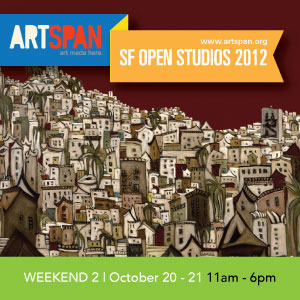
Second weekend of SF Open Studios: TL, SOMA, Potrero Hill, Dogpatch, Bayview

0

Visit hundreds of artists during weekend two of SF Open Studios in SOMA, Tenderloin, Potrero Hill, Dogpatch, Bayview!

Artists open their studio doors to show the pubic their art. The work is for sale, but much more than an exchange of goods takes place: perspective, inspiration, and ideas are shared, creative processes are divulged, and the appreciation of a life devoted to art is doled out. Join in the celebration by exploring investigating a vast range of artists and artwork during this year’s SF Open Studios.

View online maps, artist profiles, and artwork images to plan your self-guided studios tours here. For more info about the free SOMA Studio Shuttle Bus to on Sat/20, click here.

Saturday, October 20 & Sunday, & October  21 from 11am-6pm | FREE and open to the public!

On the cheap

0

Listings compiled by George McIntire. Submit items for the listings at listings@sfbg.com. For further information on how to submit items for the listings, see Picks.

WEDNESDAY 10

“Seeing is Not Believing”: The Art of Barren Storey Room 140, CCSF Ocean Campus, 50 Phelan, SF. (415) 239-3580. 6:30-8:30pm, free. Renowned artist Barren Storey, most famous for his cover design for the 1980 reissue of Lord of the Flies, lectures today at an event hosted by CCSF’s graphic communications department and its concert and lecture series.

THURSDAY 11

“Day of the Dead and Beyond” Mini Bar, 837 Divisadero, SF. (415) 525-3565. 7pm-1am, free. Nopa’s Mini Bar will be hosting a Day of the Dead-themed showcase featuring work from local artists like Gaytha Watley, James McPhee, Janette Lopez, and Neil Motteram.

“My Heart is an Idiot”: Found Magazine’s anniversary celebration Space Lounge at Saturn Café, 2175 Allston, Berk. (510) 845-8505, www.spacelounge.saturncafe.com. 7pm, $5. Davy and Peter Rothbart invite you to celebrate the 10th anniversary of Found Magazine this Thursday. The function will also double as a book release party for Davy’s new book of personal essays My Heart is an Idiot that has garnered significant praise from the likes of Dave Eggers and Elizabeth Gilbert (Eat, Pray, Love).

FRIDAY 12

Adrian Tomine: New York Drawings Pegasus Bookstore, 2349 Shattuck, Berk. (510) 649-1320, www.pegasusbookstore.com. 7:30pm, free. Noted for his cartoons in The New Yorker, cartoonist and illustrator Adrian Tomine will be on hand at Pegasus Bookstore for a presentation of the new collection of his works from that esteemed publication and elsewhere — an ode to an adopted home from an original West Coaster.

“Original Navigations/Navegações Originais” Village Market, 4555 California, SF. (415) 221-0445, www.tinyurl.com/originalnavigations. 6-8pm, free. Billed as San Francisco’s first ever Luso American by those eager to see more Portuguese diaspora events in the Bay, this event will be hosted by Brazilian American and Portuguese American writers, delving into experiences pertaining to their distinct heritage.

SATURDAY 13

Day of the Dead Exhibition SOMArts Cultural Center, 934 Brannan, SF. (415) 863-1414, www.somarts.org. Through Nov.10. Opening reception: 11am-5pm, free. In a rather intimate setting, over 80 local artists continue the tradition of honoring those who have passed. The event, which features altars commemorating dear friends, natural disasters, and deaths that affected society, is curated by father-son artists Rene and Rio Yañez, with the help of architect Nick Gomez.

Life is Living Defremery Park, 1651 Adeline, Oakl. www.lifeisliving.org. 10am-6pm, free. It’s going to be quite the shindig in West Oakland this Saturday. The urban-centric block party will feature everything from a Talib Kweli DJ set to the Hood Games skate competition to a petting zoo. The fest — which looks to unite black communities across the country with the sustainability movement — will also will be balancing out the fun with an assortment of educational activities such an open mic read in and a food first teach-in.

Fall Gallery Walk Various SF locations. www.yerbabuena.org. 4-7pm, free. In a group effort orchestrated through the Yerba Buena Gardens, 15 art galleries in the surrounding SoMa neighborhood will be opening their doors to all comers. 111 Minna, Gallery 4n5, and the Society of California Pioneers are all featured. Plus, get stamps each time you visit a gallery — the more you collect, the better chance you have of winning a prize at the end of the night.

50th Anniversary of a Wrinkle in Time Koret Auditorium, SF Main Library, 100 Larkin, SF. www.sfpl.org. 2pm, free. In conjunction with Litquake, the San Francisco Public Library will be celebrating the 50th anniversary of Madeleine L’Engle much-adored classic A Wrinkle in Time by having writers such as Rebecca Stead, Hope Larson, and Lewis Buzbee discuss how the book served as a muse for them and their writing careers.

SUNDAY 14

Sunday Streets Berkeley Shattuck between Haste and Rose, Berk. www.sundaystreetsberkeley.com. 11am-4pm, free. Everybody’s favorite Sunday car-free block party will be making its way across the Bay, planting itself in North Berkeley this upcoming Sunday. The 17-block festival will be awash with all the fanfare that you’ve been accustomed to such as yoga classes, dodgeball, and a bike rodeo for kiddos.


Aim for these

0

virginia@sfbg.com

APPETITE Most memorable restaurants boasts an overarching standard of quality to their menus. Other times, one dreams of specific items from certain spots. Here are a few places worth trekking out to for unique dream dishes.


LASAGNA BOLOGNESE AT MARCELLA’S

Lasagna… there are few foods as evocative of my childhood. Until now, Gaspare’s in the Outer Richmond was typically where I’d get my old school lasagna fix. Since May, though, Dogpatch now has a lasagneria, of all fantastic things. Marcella’s Lasagneria and Cucina is a humble corner shop selling Chef Massimo’s aioli spreads (like black truffle or spicy Chardonnay) and other housemade food products, paninis, soups, and pizzas for eating in or taking out. Best of all, six kinds of lasagna to choose from.

Jovial Massimo hails from Italy’s Abruzzo region (I’m charmed by the 1980s-looking photo of him above the counter in chef’s hat with a glass of wine), who regales with tales of early kitchen work and family. The shop is named after his daughter, while his friendly son sometimes works the counter. On a typical visit (open weekdays, 11:30am-7pm), lasagna options are butternut squash, bolognese, wild mushroom, spicy eggplant, spicy sausage, and pesto zucchini. I buy a whole lasagna for a family birthday — yes, it’s celebratory-good — and bring home three slices for dinner (8.50 each), reveling in savory-sweet red sauce and ultra-thin pasta sheets redolent with but not overcome by ricotta and mozzarella.

Butternut squash lasagna is typically white, so that the squash shines. Here it still does, while benefiting from a bit of red sauce. Earthy wild mushroom, spicy eggplant or pesto ricotta are winning. I like classic Bolognese best, the version my mother used to make. Massimo corners lassagna balance: there’s never too much of any one ingredient. The entirety melts in your mouth, as heartwarming as your Italian mama’s cookinge.

1099 Tennessee, SF. (415) 920-2225, www.marcellaslasagneria.com


MILLIONAIRE’S BACON AT BLACKWOOD

There are not many Thai joints in the Marina (Yukol Place has been keeping it real for years), and certainly not one like Blackwood. High ceilings and shades of black and grey set a chic tone, while non-traditional dishes like mushroom egg rolls and unfortunately named Marina Strips — Wagyu beef strips wrapped in baby hearts of palm — fill the menu. Many dishes are larger, more artfully arranged, versions of typical Thai dishes, like papaya salad or Pad See Ew (spelled Pad See You). Thai fusion is apparent in a Thai Wagyu burger ($12) on brioche loaded with a Thai salad of cucumber, carrot, cilantro, sesame. Or in generous, sizzling stone pots ($14-16), akin to Koran bibimbap filled with rice, veggies, meat of choice (I like crispy red snapper in plum dressing), topped with a fried egg.

However, the one destination item is merely a $5 add-on to a breakfast platter (served daily, 8am-4pm). And what an add-on! Blackwood’s only been open since June, but the millionaire’s bacon has already been named on the Discovery Channel Destination America’s United States of Food. Two hefty strips of bacon are dense, shimmery, chewy beauties, caramelized and slightly sweet and smoky. Despite bacon burn-out over the past decade, with bacon gracing every dessert and dish possible, these juicy strips renew and refresh the love, reminiscent of Southern ham in gourmet jerky-like form.

2150 Chestnut, SF. (415) 931-9663, www.blackwoodsf.com


CALABRIAN CHILE SPAGHETTINI AT BLUESTEM

Bluestem Brasserie is no run-of-the-mill downtown shopping break. In fact, it has improved since opening in summer 2011, honing in on its menu, house charcuterie, and whole-animal butchery practices (no part goes to waste). With new executive chef Francis Hogan, there is fresh life in the space frequented by tourists, shoppers, and the Moscone Center crowd. While wine on tap, grass-fed beef, and whole-animal practices are common in SF at large, being centrally situated downtown between SoMa and Union Square, Bluestem is exposing a new range of clientele to the delicious taste of sustainability.

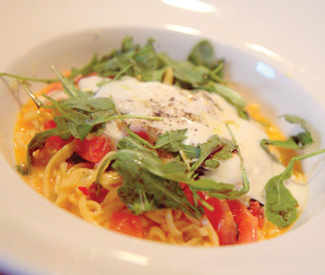
Besides satisfying house pâté (on the charcuterie platter) of pork, pistachio, and the like, a whole roasted branzino ($29) is flaky, perked up with roasted summer chilis or your choice of side, while grass-fed six-ounce filet ($31) or 12-ounce ribeye ($34) steaks are appropriately tender, medium rare, with choice of sauce ($3.75), like bourbon espresso or horseradish-roasted garlic cream. The dish I found myself trekking back for whether at lunch or dinner is Calabrian chile spaghettini ($19). Though I would prefer some heat from Calabrian chiles (I detected none), the heaping bowl of pasta is topped with Early Girl tomatoes, arugula, and basil — the pièce de résistance being melted burrata flowing over the pasta in lush waves. A gentle zesting of lemon rind perfects it. Dessert ($9.50) is no afterthought. The Peaches and Herb “Reunited” sundae was a layered summer treat, but the jar filled with mini-cookies baked in-house, including lemon sugar and peanut butter, made me feel like a kid again. There were so many cookies, I finished the rest for breakfast the next day with coffee.

One Yerba Buena Lane, SF. (415) 547-1111, www.bluestembrasserie.com


On the Cheap Listings

0

Submit items for the listings at listings@sfbg.com. For further information on how to submit items for the listings, see Picks.

WEDNESDAY 3

Humpday Happy Hour! Good Vibrations Lakeshore Store, 3219 Lakeshore, Oakl. (510) 788-2389, www.goodvibes.com. 6:30-7:30pm, free. We’ve all faced the post-work dilemma: gym or happy hour? Stress no more because the good folks at Good Vibrations would like to invite you to come and work out those PC muscles by doing Kegel exercises. Remember, strong PC muscles are very beneficial regardless of age, gender and, sexuality.

Venus and Mars reading J. Paul Leonard Library, Room 121, 1600 Holloway, SF. (415) 338-2408, www.library.sfsu.edu. 4pm, free. SFSU professor of cinema Jan Millsapps reads from her new novel Venus and Mars, a story about the discoveries of a 20th century astronomer.

THURSDAY 4

“The Art of Conservation” The Bone Room, 1573 Solano, Berk. (510) 526-5252, www.boneroom.com. 7-9pm, free. Artist Jane Kim’s passion for the environment is her raison d’etre. Her environmental consciousness will be on display at this upcoming event hosted by Berkeley’s Bone Room. Featured will be life size murals of the endangered Sierra Nevada bighorn sheep, meant by Kim as a reminder of our own fragile ecosystem.

Hendrix on Hendrix Pegasus Books, 2349 Shattuck, Berk. (510) 649-1320, www.pegasusbookstore.com. 7:30pm, free. Jimi Hendrix historian and author Steven Roby will be a giving an audiovisual presentation on the storied and tragic career of one of rock’s most talented guitarists. This unique presentation will feature interviews with reporters in which Hendrix discusses his fraught childhood and his legacy. A cannot-miss for Hendrix enthusiasts.

“Circular Motion: Subverting Circumscription” Meridian Gallery, 535 Powell, SF. (415) 398-7229, www.merdiangallery.org. Through Nov.24. Opening reception: 5:30-8:30pm, free. Seven video installations from contemporary Cuban female artists will be display at the Meridian Gallery. The pieces of art each with its own distinct circular aspects form together to symbolize the much-troubled relationship between Cuba and United States.

FRIDAY 5

Pancakes and Booze Pop-Up Art Show Gallery 4n5, 863 Mission, SF. (415) 522-2440, www.galiara.com. Also Sat/6. 8pm-1am, free. If the name of this art show doesn’t convince you to show up then nothing will. But then again, don’t be that person and show up just for the food and beer — in addition to art from over 75 local and emerging artists, there will be a zombie fashion show, live music, and body painting.

SATURDAY 6

Frank Moore; Risk For Deep Love Temescal Art Center, 511 48th St., Oakl. (510) 526-7858, www.temescalartcenter.org. 8pm, free. Lauded and controversial shaman performance artist Frank Moore’s event at the Temescal Art Center will be sure to baffle your mind. Moore will attempt to reimagine human emotion through the use of musicians, actors, dancers, and members of the audience. It’s experimental performance art at its most experimental.

Garden Party White Walls, 835 Larkin, SF. (415) 931-1500, www.whitewallssf.com. Through Nov.5. Opening reception: 7-11pm, free. Artist Casey Gray will debut new works in his third exhibition with White Walls. This time around, the focus will be on paintings of 17th century Flemish life.

Cheeses of France Pop-Up Café Minna Gallery, 111 Minna, SF. (415) 974-1719, www.111minnagallery.com. 10am-5pm, free. Calling all cheeseheads! Famed chef Jason Fox of Commonwealth will be putting on a cheese dish clinic courtesy of the SOMA Pop-up Café. Five different French cheese producers will also be on hand to let you sample their delectable goods. Oh and there’ll be cheese art too.

SUNDAY 7

Japan Center Anime Fair: Sailor Moon’s 20th Anniversary Japantown Peace Plaza, Post and Buchanan, SF. www.japancentersf.com. 12:30-4:30pm, free. Bust out that Sailor Mercury ‘fit and head on over to Japantown to celebrate the 20th anniversary of the Sailor Moon anime classic series. There will be a performance that consists of a battle between Super Sentai and Kamen Rider and singing and dancing by Mari Watanabe, Yukie Dong, Ti@Mi, and Angel Hearts.

UCSF Taste for the Cure: A Taste of Science Jewish Community Center, 3200 California, SF. (415) 353-7672, www.jccsf.org. 11am-4pm, free. It’s nutrition meets education in UCSF’s popular event on how diet can have a significant effect on breast health. Breast cancer doctors from the university will be conducting presentations numerous breast cancer-related topics. Unique to this year’s event will be a demonstration of DNA extraction — after the strands have been extricated you’ll be able to view them via microscope on the spot.

MONDAY 8

Safeway World Championship Pumpkin Weigh-Off IDES Grounds, 735 Main, Half Moon Bay. www.miramarevents.com/weighoff. 7-11am, free. Cartoonishly fat pumpkins will be battling it out for the heavyweight title (no pun intended) at this year’s Safeway World Championship Pumpkin Weigh-Off. Defending champion Leonardo Urena of Napa will have to bring his A game if he’s going to break the state record that he set at last year’s competition. For the first time in the history of outlandish contest there will be a mega-prize of $25,000 offered to the pumpkin grower that can grow the world’s first one-ton pumpkin.

Fly, on the wall

1

arts@sfbg.com

DANCE Suspended by a single rope, Jennifer Chien’s bare feet gently push against the white wall of Zaccho Dance Theatre’s studio. The move propels her into space; perhaps she is swimming, perhaps flying, or just floating on Carla Kihlstedt and Matthias Bossi’s finely detailed score.

Chien is rehearsing the finale for Niagara Falling, Flyaway Productions artistic director Jo Kreiter’s latest site-specific outdoor work. It will be performed against the west wall of the Renoir Hotel on Market Street. The dance in the air feels quiet and ever so poetic, particularly for a work that originated in Kreiter’s sense of having been “stung and caught by that whole American economics story.”

Niagara is another of Kreiter’s socially conscious choreographies, in which she examines vital issues through art making. She has called herself a “citizen artist,” a person she describes as someone whose work is “essentially concerned about how we live in the world.” (Poet Adrienne Rich and musician-activist Pete Seeger have been guiding lights.)

“Actually,” Kreiter adds, “any artist does that — except that some of us are more able or willing to talk about the issues.” She has called Niagara Falling “an artistic response to the economic degradation of our current recession.”

As a citizen artist, Kreiter’s choreographies are most frequently performed in public places, free of charge. They are accessible to casual passersby, neighborhood folks, and dancegoers. This is art at the heart of the democratic ideal.

Her works also subtly alter the urban landscape and the way we perceive it. After Singing Praises: Centennial Dances for the Women’s Building, the owners of the Women’s Building confessed that before the piece, they had not even known their Mission District neighbors. Mission Wall Dances honored the old Garland Hotel, an SRO that housed disadvantaged people until it burned and was rebuilt as lodging for tourists. (Painter Josef Norris was inspired to add some of Kreiter’s dancers to the building’s existing mural.) With one of her earliest works, Sparrow’s End, Kreiter created an “urban fantasy” for one of the most drug-infested alleys in the Mission. I still remember its beauty and also the odor that pervaded that sad location.

Niagara happened because Kreiter had admired David and Hi-Jin Hodge’s video setting for Brenda Way’s 2009 In the Memory of the Forest. Talking with the artists, Kreiter realized that the three of them had much in common — particularly when she learned that the Hodges had documented the poverty and decay of David’s hometown, Niagara Falls, NY, by talking with its citizens. Some of what he said sounded all too familiar with what is happening to many people in San Francisco.

Both cities are also surrounded by beautiful but sometimes terrifying bodies of water. The imagery is as ancient as Noah’s bobbing ark and as recent as the videos of Japan’s 2011 tsunami. So it seems appropriate that the first two pieces of equipment Kreiter ordered were a lifeboat and life jackets. The boat is a commissioned steel structure; the vests came off the rack.

Hanging from the wall at the Zaccho studio for the last rehearsal there — the equipment would be moved downtown later that day — three dancers are buffeted by the video’s raging waters and a howling storm on the soundtrack. The women look ever so vulnerable as they try to catch and don the slippery life jackets. Yet gradually in all that chaos they find a common rhythm and can link arms in relative safety.

While Niagara is a piece that gives voice to the reality of the urban poor, it’s also a beacon of hope. The work happened because, Kreiter acknowledges, people — like the Renoir Hotel’s owners and Urban Solutions, the SOMA-based economic development nonprofit — have been supportive of the project. Pointing out that she started working on the piece before the advent of Occupy Wall Street, she observes that “everything is collapsing, and yet in some places there are people who try to pull things forward.” *

“NIAGARA FALLING”

Wed/26-Sat/29, 8:30 and 9:30pm, free

West wall of the Renoir Hotel

Seventh St at Market, SF

www.flyawayproductions.com

Torture, for real

3

OPINION Last week I walked into my favorite café in SoMa and noticed the barista wearing a t-shirt emblazoned with the black and orange word “torture.”

I froze. I knew I was holding up the line but I didn’t care. I had to ask about that shirt.

“Oh, it’s to promote the San Francisco Giants,” he said. He continued speaking, not noticing my umbrage. “So do you want your coffee hot or cold today?”

I wanted to keep talking about that shirt, but I didn’t know what to say. “I will have my coffee cold please,” I told him.

For the past ten years, torture has never been far from me. When I worked at Amnesty International, it was two doors down in the person of my colleague Kumar, who was tortured in Sri Lanka for advocating for Tamil rights. When I was on Capitol Hill as a foreign policy aide in the House of Representatives, I saw lawmakers justify President Obama’s lackadaisical attitude towards US torture.

One of the first things I learned at Amnesty International is the power and the responsibility of words. Human-rights work is about finding and verifying stories and then giving those stories names: war crime, rape, genocide … torture. It’s in the naming that our action begins. When we use the word torture it carries weight—and can heal wounds—because for so many people, their torture is denied, rationalized, or trivialized.

When I see the word torture on a t-shirt I do more than cringe: I mourn how far we are as a nation from a serious discussion of the use of torture by our own government.

Just last week Attorney General Eric Holder announced that the Justice Department was closing the last two cases examining harsh CIA interrogation tactics during the Bush administration.

According to the ACLU, “(CIA) Interrogators were told they could use, among other tactics, extended sleep deprivation; ‘stress positions’ such as forced-standing, handcuffing in painful crouched positions and shackling people to the ceiling, usually for hours or even days; confining prisoners to small, coffin-like boxes with air and light cut off; extended forced nudity; sensory bombardment; extreme temperatures; hooding; and physical beatings, including slamming prisoners into walls.”

I can understand and I can attest that watching your team blow a lead in the bottom of the ninth is painful, excruciating even. It might cause you to drink or curse or smoke more. But it’s not torture. It doesn’t violate the core of your being. It doesn’t terrorize your nights.

Standing in line at the café that day, I thought of my friend Firoze who was tortured so badly he can no longer have sex. I wonder what he would say if were staring at the Barista with the “torture” t-shirt.

He would probably laugh and say it’s just a game. And then he might say what he told me each time we met: “People have no idea.”

Zahir Janmohamed recently completed a fellowship at the San Francisco Writers’ Grotto and is writing a book about Juhapura, the largest ghetto of Muslims in India

.

Appetite: What not to miss at SF Cocktail Week

0

SF Cocktail Week is here once again, drawing out cocktail geeks, spirits aficionados, and those seeking a memorable event or a fine drink.

For those of you who attended last year’s San Francisco Cocktail Week, you know it was jam-packed with some downright magical events, celebrating our city’s rich cocktail heritage and talent that has influenced the cocktail renaissance globally. There’s another strong line-up this year, in keeping with the memorable highlights from last year and the year prior.


To name a few, the annual party at St. George’s WWII hangar and distillery is always one of the highlights of Cocktail Week. This year the theme is cops and robbers with bartenders serving drinks behind bars, squirt gun target practice, live music from funky-fun Hot Pocket, and food from Tacolicious, Breads of India and Five Ten Burger.

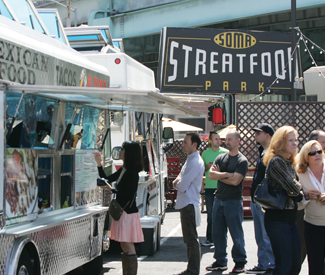
The second annual Legends Awards http://sfcocktailweek.com/legends-awards.html honors legends in the drink world, including a lifetime achievement award for Miles Karakasevic, 13th-generation master distiller at Charbay. Best of the West assembles top bartending talent from cities of the West Coast, and for the first time this year, food carts and cocktails gather at Spirited Food Trucks in the new SoMa StrEat Food Park, heated patio and all. Another new event this year? Jupiter Olympus’ California Altered State Fair, a raucous event of games, fried food, contests in a state fair theme with drinks like a Salt-Water Taffy Old Fashioned or a Manhattan Sno-Cone.

There are dinners, after parties, and nightly events… a little something for everyone in a city that has long known how to craft a fine cocktail. Tickets and schedule here.

— Subscribe to Virgina’s twice monthly newsletter, The Perfect Spot

Fall wine, uncorked

0

virginia@sfbg.com

WINE Recommended bottles, fall events in Sonoma, urban wine classes … here are a few wine tips for true autumn flight. Check out my online Appetite column on the Pixel Vision blog at SFBG.com this week for restaurants making some of Napa’s best cocktails, a family vineyards wine-tasting report, and more Wine Country dining reviews.


URBAN EXPLORATIONS

An in-house wine club with storage facilities and a wine school launched in April, SF Wine Center (757 Bryant, SF. 415-655-7300, www.sfwinecenter.com) hosts intimate classes, held in owners Brian and Hillary McGonigle’s inviting City Room. With kitchen, library, and comfy leather chairs, it feels more like a friend’s home than a classroom. This room is available for private parties, as is a wood-lined, speakeasy-like room tucked away above the wine storage area — it feels ready for a cigar, a glass of Pinot, and a round of cards and good friends.

Recently, a class led by James Beard award-winning writer and Burgundy expert Jordan Mackay was a walk through regions and wines of Burgundy in the best way possible: by tasting a wide range side-by-side. We discussed styles and regions as we sipped nine different wines — a steal considering class price (generally $60-75) vs. costs of wines poured. Tastes ranged from a meaty 2009 Dujac Fils & Pere Cambolle Musigny ($65 a bottle) boasting excellent acidity and earthiness, to a rare 1976 Domaine Leroy Romanee St. Vivant Grand Cru ($500), with sediment and funkiness (it’s a whole cluster wine, after all), and notes of black tea, mushroom, leather, smoke, moss, tart cherry. Fall classes start up September 25th and sell out quickly. Watch the website for the fall schedule.

********

Bluxome Street Winery (53 Bluxome, SF. 415-543-5353, www.bluxomewinery.com) wins cool points just for being an urban winery whose product is actually made right here in the city with grapes from various Sonoma plots. It’s already a wine-tasting respite, and some change is afoot with new winemaker Web Marquez, who is also one of three winemakers at Anthill Farms and one of two at C. Donatiello. His early days interning at the excellent Williams Selyem — and in New Zealand and France — give him a balanced perspective on Old and New World wine styles.

While we have to wait until next year’s bottling to see the results of his approach with Bluxome’s wines, in the meantime we can enjoy a tart 2011 Rose of Pinot Noir, or the acidic, balanced 2010 Sauvignon Blanc, or a Chardonnay and three Pinots (all bottles under $45). Taste in the candlelit space while watching winemaking through glass windows under a projected movie (shining on a brick wall) showcasing San Francisco in pre-1906 quake days when winemaking in the city was common — there were no less than 120 wineries and commercial cellars in SoMa alone. Here’s to Bluxome reviving our rich urban wine history.


SUNNY SONOMA EVENTS

A foodie’s dream event: Slow Food’s Fresh Food Picnic (Sun/15, 11am-6pm, $40–$125. Rancho Mark West, Santa Rosa, www.slowfoodrr.org) is a picnic and then some. Carlo Petrini, the founder of Slow Food himself, flies out from Italy for a rare appearance, while Alice Waters and Nikki Henderson (of Oakland’s People’s Grocery) join him as speakers for the event. Then there’s the chef line-up. A family-style picnic will be served by Christopher Kostow (Meadowood), Dennis Lee (Namu Gaji), Ryan Farr (4505 Meats), Christopher Kronner (formerly Bar Tartine, Slow Club), Thomas McNaughton (flour+water, Central Kitchen), Christopher Thompson (A16), and more There will be tastes from farmers, food artisans and winemakers, local bands, a petting zoo, guided hikes and tours of Rancho Mark West, the event’s farm setting. Proceeds benefit A Thousand Gardens in Africa, a Slow Food International project, and California-based Slow Food initiatives focused on food and farm education. As a zero waste event, bring your own plates, flatware, and napkins — provide glassware will be provided.

********

Jordan Winery (1474 Alexander Valley Road, Healdsburg. www.jordanwinery.com) is a pioneer in Sonoma’s wine history, started by Tom and Sally Jordan in 1972. These Bordeaux wine lovers built a Bordelais inspired chateau on their 275-acre Alexander Valley vineyard in 1976, a gorgeous structure overseeing the winery’s soothing grounds (tastings by appointment only). With spectacular chateau apartments reserved for overnight guests, the 1100 acre grounds go beyond winery to full working ranch with cattle, chickens, gardens, olive oil groves, and fishing lake with Tiki bar and hammock. As from the beginning, Jordan stays refreshingly focused on only two varietals, a green apple-inflected Chardonnay ($29) and elegant Cabernet ($52 for a bold but balanced 2008 Cab). It’s a family business with son John as CFO, while Rob Davis has been Jordan’s head winemaker for 35 years, since the inaugural vintage in 1976.

Now is the time to shop for your holiday wine with them to earn a fabulous Jordan Winery harvest lunch. You must sign up for their email newsletter and purchase wines to earn the points which can be used towards winemaker tours, Christmas library tastings, and the coveted harvest lunches, which begin this week and run through mid-October. Harvest season is the most enchanting time in Wine Country, ideal for a family-style, weekday feast alongside winemaking staff and a tour of the grounds during crush season.


FALL BOTTLE RECOMMENDS

Where to shop for the below? K&L Wines, Jug Shop, Bi-Rite, Arlequin, Ferry Plaza Wine Merchant, SF Wine Trading Co., and D&M offer excellent wine selections in the city.

CALIFORNIA

Au Bon Climat “Hildegard” White Table Wine, Santa Maria Valley

Au Bon Climat’s is one of the state’s great, small wineries, and Hildegard ($35) is one of my top California whites. A blend of 55 percent Pinot Gris, 40 percent Pinot Blanc, 5 percent Aligoté, it’s layered and complex, unfolding with apple, almond, violet.

www.aubonclimat.com

Heitz Cellar Cabernet and Sauvignon Blanc, St. Helena

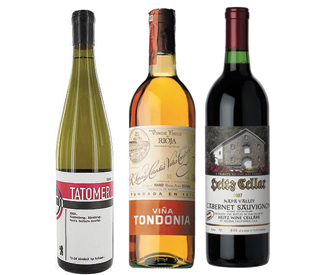
Heitz Cellar is one of my longtime Napa favorites for a beautifully balanced, lively Sauvignon Blanc ($19.75), and splurge-worthy Martha’s Vineyard Cabernet Sauvignon ($110-200) — the far more affordable 2007 Napa Valley Cab ($45) is a worthy substitution. This family-run winery has been going strong since 1964 with Old World balance, one of Napa’s true gems.

www.heitzcellar.com

Lucia Vineyards LUCY, Santa Lucia Highlands

Lucia Vineyards’ LUCY ($18) is a a beauty of a rosé boasting zippy acidity pairs well with a wide range of dishes — another Santa Lucia treasure.

www.luciavineyards.com

Tatomer Riesling Vandenberg, Santa Barbara

2008 Tatomer Riesling Vandenberg ($24.99), named for the neighboring air force base, is easily one of the best wines in the Santa Barbara region. Maintaining an Old World ethos, dry, crisp, it still boasts a New World uniqueness. Incredibly balanced, pear and apple skins shine with minerality that’s gorgeous with food.

www.tatomerwines.com

Amapola Creek’s 2009 Cuvee Alis, Sonoma Valley

Glen Ellen’s Amapola Creek, from Richard Arrowood (who founded Arrowood Winery), is a small, boutique winery. Cuvee Alis ($48) is named after Richard’s wife, a hand-harvested, unfined and unfiltered blend of 55 percent Syrah, 45 percent Grenache, organically grown on a slope of the Mayacamas Mountains on the Arrowood’s 100-acre ranch. The wine gives of a nose of cherry pie, gentle pepper, smoke, tasting of dark berries, spicy meat, with silky tannins and acidic balance.

www.amapolacreek.com

EUROPE

Viña Tondonia Rosé Gran Reserva Rosado, Rioja, Spain One of the best rosés I’ve ever had, 2000 Viña Tondonia Rosé Gran Reserva ($30) is not for novices. At 12 years of age, this blend of 60 percent Garnacha, 30 percent Tempranillo, 10 percent Viura exhibits a velvety, rosy hue, unfolding with damp, funky, mushroom notes dancing alongside bright blood orange, berries, hazelnuts, rhubarb. It’s so unusual, it pairs beautifully with spicy foods from a range of cuisines. Thanks to sommelier Ted Glennon of Restaurant 1833 in Monterey for introducing me to this stunner, available through K&L Wines. Every time I have it, it’s a pleasure.

www.lopezdeheredia.com

Vidal-Fleury Saint Joseph & Muscat, Rhone Valley, France

Vidal-Fleury is produced by winemaker and managing director Guy Sarton du Jonchay, who understands the balance between New and Old World having made wine in France, Chile, Argentina and Australia. “Old world is terroir… New World is winemakers”, he says, as he pursues a balance of both. Stand-outs are a 2007 Vidal-Fleury Saint Joseph Syrah ($28.99), full, bright, earthy, with dark berry, black tea, pepper, and meaty notes (he only releases best vintages so there will not be a 2008 — 2009 releases next); and 2009 Vidal-Fleury Muscat de Beaumes-de-Venise ($18.99), tasting of elderflower, dried apricot, lychee, nuts, with a balanced sweetness and minerality.

www.vidal-fleury.com


On the Cheap Listings

0

Submit items for the listings at listings@sfbg.com. For further information on how to submit items for the listings, see Picks.

WEDNESDAY 12

"Birth of Suns" astrophysics presentation Revolution Books, 2425 Channing, Berk. (510) 848-1196, www.revolutionbooks.org. 7pm, free. Walls closing in around you? For a little perspective, attend this lecture by UC Santa Cruz professor Mark Krumholz, whose expertise lies in star formation. He’ll be discussing how a celestial being is born, which involves so much mass, space, and distance that your roommate problems will fade into the distance on the power of his words.

SoMa B.A.G. (Bad Art Gallery) Satellite 66 Gallery, 66 Sixth St., SF. www.sfindie.com. Art show is open Wed/12-Fri/14, Sept. 19-21, and Sept. 26. Film screenings every Wednesday in September, 8pm, free. Perhaps a description of a work included in this SF IndieFest exhibition will suffice for this listing: "The artist created this work during his controversial Paint By Numbers period of the late 1980s and early ’90s. A raccoon engages the viewer with his coal black eyes, caught in the act of posing for a painting." Also, the gallery is screening Patrick Swayze movies on Wednesdays. Tonight is Point Break.

"(re)collection: Family Photos Swept by the East Japan Tsunami" Intersection for the Arts, 925 Mission, SF. www.theintersection.org. Through Oct. 27. Opening reception: 7-9pm, free. Without being told to do so, rescue workers in the town of Yamamoto, Japan began to collect photos from the houses damaged and destroyed by the 2011 tsunami. This art exhibit assembles just a few of these partially-obscured images, reminders of the human cost of that catastrophic event.

THURSDAY 13

Belcampo Meat Co. job fair Food Craft Institute, 65 Webster, SF. www.foodcraftinsitute.org. 8am-noon, 4-7pm, free. Ever wanted to work with artisan animal products? Head over to Belcampo’s job fair, where you can learn about career opportunities at its NorCal farm, meat counters in Marin and SF, plus jam and cheese-making classes. Snack provided, bring your resume.

Projector Magazine screening Roxie Theater, 3117 16th St., SF. www.roxie.com. 8pm, $5. Movie geeks and freaks will thrill to this live reading of the magazine that dissects films creatively (no snarky film reviewers here, folks). Tonight, screenings and readings collide as writers read their Projector pieces after a clip from the film that inspired them plays on the Roxie’s big screen.

FRIDAY 14

SF Society for the Prevention of Cruelty to Animals Homecoming Adoptathon SFSPCA, 201 Alabama, SF. www.sfspca.org. Through Sun/16. Fri/14, 1-8pm; Sat/15 and Sun/16, 10am-6pm; free. Kick-off party: Fri/14, 5-9pm, free. The friend of the furry and feathered couldn’t be making it any easier for you to go home with a companion of your own. The SFSPCA is hosting a party with free cocktails, free wine, free beer, with the opportunity for a free adoption to boot! The adoption special last throughout the weekend, so take home a kitty, puppy, bird, beast just as soon as you’re ready.

"From One Thing To Another: The Art of Recycle" Gray Loft Gallery, 2889 Ford, third floor, Oakl. grayloftgallery.blogspot.com. Through Nov. 9. Opening reception: 6-9pm, free. Have you been to Jingletown? So has this developing arts area in Oakland been recently dubbed. Check out the pleasures of the neighborhood by starting at this group show of art made from recycled, reclaimed, and upcycled materials.

Armenian Bazaar and Food Festival Khachaturian Armenian Community Center, 825 Brotherhood Way, SF. (415) 751-9140, www.stgregorysf.org. Through Sun/16. Fri/14, 7pm-midnight; Sat/15, noon-midnight; Sun/16, noon-6pm; free. For over 50 years, St. Gregory’s has hosted this superb opportunity to sample sarma and sou-beoreg (stuffed grape leaves and a cheese-parsley dish), check out the "highly anticipated" Sunday backgammon tournament, and watch live folk dancing. This year is the first for the fest’s beer and wine garden, which surely will only up its appeal.

"The Shirt" photography by Matt Sharkey Pretty Pretty Collective, 3290 22nd St., SF. www.mattsharkeyphotography.com. Opening reception: 8pm-midnight, free. Do you like photography? How about naked women? Photographer Sharkey took shots of 30 in the same old t-shirt, and most will be in attendance tonight as he celebrates the release of his new book of said shots, appropriately titled This Shirt.

"Oakland Under $100" Actual Cafe, 6334 San Pablo, Oakl. (510) 653-8386, www.actualcafe.com. Through Oct. 11. Opening reception: 6-10pm, free. Oakland artist Emily Coker shows her works (all retailing for under $100, natch) at this art opening, which also features live art-making, a silk-screening station, photobooth, and live music by Starmachine and DJs Ladybyrd and Who Killed Laura.

SATURDAY 15

Kiddo Disco Bollyhood Cafe, 3372 19th St., SF. www.kiddodisco.com. 11am-3pm, $5 per person, $20 maximum per family. You’ll be able to see over everyone’s heads at this club, and no need to save your monies for the late night burrito afterwards – snacks here are free, and anyways the thing will be over by 3pm. This is the fourth annual Kiddo Disco, where families can bring their future clubbers for a taste of the future while DJ Matt Haze spins. DIY face painting, bubbles, and a quiet area for reading and coloring will be supplied. Why aren’t all parties more like this one?

Coastal cleanup day Martin Luther King Jr. Shoreline Park, Doolittle Drive and Swan Way, Oakl. www.savesfbay.org. 9am-noon, free. Bring your own bucket (there will be a contest to determine the prettiest one) to this cleanup day, which aims to provide safe space for trees to thrive, birds to birth, and people to gaze out over the beauty of nature. And keep your eyes out for weird: Save the Bay will be giving prizes for the most bizarre piece of detritus recovered.

"Folsom Exposed!" photography by Mark I. Chester Wicked Grounds, 289 Eighth St., SF. www.wickedgrounds.com. Through Nov. 30. Opening reception: 7-10pm, free. Gear up for high leather season with photographer Chester’s shots of SF’s sex culture underbelly. Images going as far back as the late 1970s are in included in this show at SF’s kinky coffee shop. Come early (on time, at 7pm) for special slideshow discussion by the pervy photog himself.

Dance Discourse Project de Young Museum, 50 Hagiwara Tea Garden Drive, Golden Gate Park, SF. www.counterpulse.org; www.dancersgroup.org. 2-4pm, free. Performer Monique "Fauxnique" Jenkinson, SFMOMA associate curator Frank Smigiel, and others form a panel that will discuss the intersection of dance and visual arts – what happens when movement enters a building designed for housing paintings and the like?

SUNDAY 16

Mexican Museum free family day Mexican Museum, Fort Mason Center Building D, SF. www.mexicanmuseum.org. Noon-3pm, free. Celebrate Mexico’s Independence Day with this open invitation to families during Hispanic Heritage Month (which, oddly enough, runs Sept. 15-Oct. 15). The museum’s special portraiture and contemporary art exhibits will be open, and kids will have an opportunity to make creative masterpieces of their own.

The darn thing’s got wings

0

marke@sfbg.com

SUPER EGO And thus the epic saga of the Eagle Tavern, legendary drunken gay leather biker den of iniquity (which secretly boasted one of the best DJs in the city, Don Baird, on Sundays), closed for a year and a half, ravenously beset upon by upscale restaurant developers, canonized by the Sisters of Perpetual Indulgence, radicalized by queer activists desperate to preserve the scared space around which were scattered the ashes of some of our ancestors, transformed into a symbol of contemporary gentrification, gutted by real estate agents, tossed around by the Board of Supervisors like a hot potato, has finally entered another stage.

Please welcome new gay proprietors Mike Leon and Alex Montiel, who told me they hope to open the SF Eagle (www.sf-eagle.com) by Halloween, they’ll still hold charitable events, they’re looking forward to hosting live music nights again, and they’ll be doing their best to preserve that precious Eagle ambiance. You can read the whole story here, but little patent leather caps off to Glendon Anna Conda Hyde, David Campos, Jane Kim, El Rio (which hosted the Eagle’s wonderfully pervy Sunday beer busts in exile), and everyone else who pushed for the preservation of queer nightlife space in SoMa.

Says Glendon, who really led the push, “People thought we couldn’t preserve queer nightlife in this city — but that’s just a lazy excuse for gentrification. we should all be proud of what happens when we come together. Our nightlife history is a powerful force.”

That’s great. Now if we could only get the EndUp back on track, I could do my old Sunday bar (literally) crawl: Eagle, Lone Star, EndUp. Except for those times when I simply curled up beneath a parked car on Harrison. She was hella classy in the ’00s.


SF ELECTRONIC MUSIC FESTIVAL

There’s a lot going on at this annual feast of nifty experimentation — Negativwobblyland, William Basinski, Dieter Moebius, Cheryl E. Leonard, Guillermo Galindo, soddering trio Loud Objects, Machine Shop’s amplified gongs — kind of freaking out about it, ready for scary beautiful.

Wed/5-Sun/9, various times, prices, and locations. www.sfemf.org


NEW WAVE CITY 20TH ANNIVERSARY

Holy Echo and the Bunnymen! San Francisco’s longest-running party is celebrating two decades? Somebody call Square Pegs. I adore DJs Skip and Shindog — they started being retro about the ’80s almost before the ’80s were over. And their selections (Bauhaus, New Order, the Cure, Depeche Mode) somehow transcend the casket of ubiquity, possibly because of the lively and actually old-school cool crowd still riding the brave new waves of aural devotion. Here’s to 20 more years of Tears for Fears, at which point it will be like listening to Elvis in the ’90s. Or something. Prefab Sprout had a song about it. Just go.

Fri/7, 9pm-3am, $12. DNA Lounge, 375 11th St., SF. www.newwavecity.com


PUSH THE FEELING: LES SINS

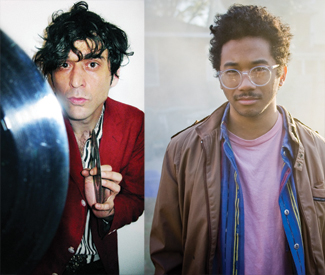
Underground indie impresario Kevin Meenan’s monthly Push the Feeling parties are a hot ticket already — but add in Les Sins and we’re entering another dimension? Who are Les Sins? Oh, just chillwave-plus genius Toro Y Moi dropping a DJ set. For an intimate crowd in Lower Haight. For $5. And you’re one of the only people who know about it.

Fri/7, 9pm, $5. Underground SF, 424 Haight, SF. www.epicsauce.com


DARK ENTRIES THIRD ANNIVERSARY

Speaking of New Wave Cities — Josh Cheon’s Dark Entries label has kept the Bay Area at the forefront of the minimal and dark wave movement, which mines overlooked bands of the synth music past and reverential present acts that are direct descendents of those slightly sinister new waves. (Recent signee Linea Aspera is to die for.) This dark celebration features a live performance by Max + Mara plus a glowering set by Cheon himself, with Nihar, Jason P, and Dreamweapon.

Sat/8, 10pm, $5. SubMission, 2183 Mission, SF. www.darkentriesrecords.com


SOUL CLAP AND DANCE OFF

Considering the garage powerhouse that is Oakland, it’s weird to me that we don’t have a huge dirty-funk, pervy girl group, kooky Hairspray 1960s dance-party scene here. (Hard French and any concert by Shannon and the Clams come close.) NYC DJ Jonathan Toubin was set to bring his great Night Train party here last year, but he was almost killed by a freak accident in Portland that made national headlines (a car drove into his hotel room and ran over him in bed). Well, he’s recovered enough now to get the party going again, and this groovy dance-off will also be an all-ages celebration of life. Celebrity judges and the cream of our underground garage crop will be in attendance.

Sun/9, 7pm, $13, all ages. Great American Music Hall, 859 O’Farrell, SF. www.gamh.com


OPERA IN THE PARK

Dearest drama queens, have you had a hard night out on the town? Do you need your over-the-top batteries recharged? How about just a lovely day on the lawn to check out other cute arts enthusiasts — like me! — swooning along to our hometown opera company’s overwhelming melodiousness? Bring a little (secret) wine, and let’s sing along.

Sun/9, 1:30pm, free. Sharon Meadow, Golden Gate Park, SF. www.sfopera.org


Nite Trax: The Eagle flies again

41

I hung out yesterday evening with the new occupants of the Eagle Tavern (now known as the SF Eagle, apparently) at a celebration of the lease-signing at the Lone Star Saloon. Alex Montiel and Mike Leon seem perfect to replace the former Eagle operators Joe and John: Tough-looking and leather-bearish, a tad gruff at first but friendly once they warm to you, and a wee bit shy of the press right now.

They’ll be releasing their full plans for the storied queer bar in a couple weeks, but I did manage to squeeze some juicy info out of Alex. They hope to open the bar in time for Halloween, the liquor license has indeed been secured (in fact, they have two!), and they’ll be doing their best to return some of the Eagle’s ambiance to the now-pretty-much-gutted space, with a few slight modifications to the bar layout for code and traffic flow reasons.   

It’s certainly been a long, winding, super-convoluted road to get to this point!

I’m not sure anyone can convey all the twists and turns and backroom mechanations of the whole thing — Jay Barmann at Grubstreet has done some excellent reporting on it all, but there were still many, many balls in the air, shall we say, and the shady politics got slightly out of control. The fight to keep a historically queer space queer — despite the previous occupants’ quasi-abandonment, despite the lucrative offers from upscale restaurants, despite the limited power and will of the city to legislate such things — was a bit of a hot gay potato for the past year. (The Eagle’s infamous, charitable Sunday Beer Busts lived on in monthly form at El Rio in the Mission, at least.)

Even the idea of a “historic queer space” was questioned: if the Sisters of Perpetual Indulgence had sanctified it, and the ashes of multiple queer people were scattered about a place that raised tens of throusands of dollars for amazing local causes and was regarded as the heart of the old school gay leather rock ‘n roll biker community, was it important enough to fight for?

Hats off to Milk Club president and outspoken queer activist Glendon Anna Conda Hyde for saying, “Hell yes!”

Glendon (identified slightly incorrectly in a recent Chron story as the Norm of the Eagle’s “Cheers” — that was actually the frizzy-haired dear in the thong and flip-flops who stood around clutching a goblet of piss) kept the Eagle issue at the forefront of the city’s debate about gentrification and the loss of queer nightlife spaces, angering some fussy queens with his usual passion and stridency, but in the end succeeding in rallying an assortment of powerful players to the Eagle’s defense.

I talked to Glendon today about how the whole thing went down. His basic summation was that Supervisors David Campos and Jane Kim did excellent jobs of making sure the Eagle stayed queer (Sup. Scott Weiner does not get very high marks from him in this regard), and that dubious dealings by the person supposedly representing the owner of the building — who lives north of the city, and who Glendon said had indeed wanted to welcome in new queer owners all along — were what kept screwing everything up. Finally the building owner (actually, the manager of a trust that includes several elderly owners) awarded the lease to Mike and Alex after he realized what was happening with his representation and the reaction of the community.

“I think it’s so great,” Glendon told me. “People keep saying that you can’t revitalize queer nightlife in SoMa — but that’s just a lazy excuse for gentrification. I’m glad we could band together to ensure a future for queer spaces in this city. We should be proud of what happened here. Our shared queer history is a powerful force. 

“We’re still fighting for an officially recognized queer historical district in SoMa that will honor those who came before us, and also help preserve lively alternative queer spaces. Supervisor Christina Olague and CMAC [California Music and Culture Association] is working hard on that. One of the major problems is that it’s illegal to say something has to be or remain ‘gay.’ I think we saw here that it can be done within the limits of current boundaries.”

As for the future of the Eagle? “Mike and Alex have indicated that while they’ll still be preserving the main traditions and atmosphere — as well as probably hiring some of the old staff back — they are hoping it will be a much more open space. Already the Lexington Club is planning to host a fundraiser to help them remodel, so that suggests the Eagle will be more women-friendly, and there may be new parties there from some of the city’s younger promoters as well.”

My favorite part of this whole thing — besides the colorful faux-funeral outside Foreign Cinema restaurant, or the “assless chaps” takeover of the Skylark bar (both at one point identified as villains in the Eagle saga)? Beyond the banding together of the community to save an actually cool place that is a huge and drunken part of my life (also, DJ Don Baird on Sundays was secretly the best DJ in the city)?

At one point it was announced that the Eagle was to become a fancy pizza place with a wood-fired oven on the back patio. Glendon turned to me and hissed: “I always knew the straights wanted to put us in the oven!” 

Portable pollution

11

news@sfbg.com

With its decidedly hip aesthetic and clientele, San Francisco’s food truck trend may be naturally assumed to be environmentally sound and health conscious. But the rapidly expanding craze may actually be creating air pollution and endangering the health of their employees in ways that aren’t yet being regulated.

Although the mobile eateries are held to a few of the same standards as their brick and mortar counterparts, such as food hygiene and sanitation, the gas-powered portable generators that provide needed energy to the trucks are a tricky beast to tame. The exhaust-heavy portable generators do not fall under the San Francisco Department of Public Health’s radar of regulation, according to its Food Safety Program Director Richard Lee.

“There are combustion products from the generators being generated while the truck is parked and operating,” he told the Guardian. “The generators are needed to power lights, fans, refrigerators, etcetera. SFDPH does not monitor or regulate the generators.”

The lack of monitoring on the generators may not be due to a lack of need for regulation, but rather the difficulty in doing so. Given that most of the generators are used to power relatively small vehicles, their small size inhibits them from meriting the attention of the California Air Resources Board (CARB) after their initial manufacture.

A CARB-compliant generator has met with the organization’s restrictions on various organic gases, nitrogen oxides, sulfuric oxides, carbon monoxide, carbon dioxide, and particulate matter. However, the generators are only monitored at the point of manufacture, with their in-use emissions going unregulated.

Furthermore, Bay Area Air Quality Management District spokesperson Aaron Richardson tells us that despite the BAAQMD’s 28 air monitor stations, the localization of the fad and the trucks themselves would make it difficult to see the effects of the generators as a regional issue.

“The concern would be they may not all operate in the same ways,” he said. “I think that if the trucks…are running back up generators, it’s going to emit some pollution. It’s something I think we will be doing more research on, but at this point it’s not looking like it’s a dramatic impact on air quality. CARB regulates all mobile sources, and lot of these trucks use individual generators. At this point, we only regulate back up diesel generators…of 50 horse power or above.”

So BAAQMD doesn’t regulate the generators because they’re gas-powered, and they don’t trigger CARB’s post-production attention, despite that agency’s current efforts to reduce the state’s carbon footprint.

CARB spokesperson John Swanton explained that given the small size and localization of the generators, it’s up to the individual communities to decide how to approach the situation.

“It’s up to the community to decide if they can bear the expense of a highly regulated community. In the terms of restaurants — which is what food trucks are — what are the community’s standards and regulations?” he said. “When we sell, say, a Honda generator, we have ideas of how that’s going to be used…We try to make it as clean as practically possible, but the idea is that it’s not gonna run 24/7 at the same location. If it’s going into a food truck and the food truck is going into a particular district, then it becomes the decision of the city and the air quality management [district].”

It seems, then, that no one is really regulating the exhaust emissions coming from the hordes of trucks that travel up Haight, down Market, into Fort Mason, and sit in clusters downtown, in SoMa, around City Hall, and other spots around town.

But at least they aren’t dirty diesel fuel, right? Perhaps the BAAQMD and the city of San Francisco have no need to regulate the teensy-eensy bit of gasoline generator exhaust.

Yet according to SFDPH spokesperson Imelda Rayes, there are now approximately 300 (registered) mobile food facilities in San Francisco. That means the number has nearly tripled since the mere 120 registered MFFs that were scouring the streets in 2009. What they lack in horse power, the generators may make up for in sheer multitude.

“In a period of three years, the number has increased almost 250 percent and [we’re] still getting more applications,” she said.

In addition to cumulative impacts, there are also questions about the health impacts on food truck employees.

Studies like such as the 2009 “Modeling the Effects of Outdoor Gasoline Powered Generator Use on Indoor Carbon Monoxide Exposures” by academics Liangzhu Wang and Steven Emmerich brings up a different concern: gasoline generators create emissions of poisonous carbon monoxide.

“The generators are always positioned outside of the vehicle. The workers are inside,” Lee said. “We would not expect that there is significant employee exposure to the generator exhaust to the employees.”

Yet the U.S. Centers for Disease Control and Prevention (CDC) reported that half of non-fatal carbon monoxide poisoning incidents in the 2004 and 2005 hurricane seasons were due to the gas-powered generators used to heat homes, even when placed outside the homes themselves.

Food truck generators, given their smaller size, are often placed much closer to the trucks and their workers than in the case of houses and their inhabitants. Furthermore, the trucks often idle for long periods to keep the food warm and utilities working.

“At this point, it’s enough of a new thing…We’re interested in finding out more about them, but at this point we are not receiving many complaints,” Richardson said. “A lot of variables are involved. It’s something I think we will be doing more research on.”

After the game of verbal hot potato that was research for this article — it seems every agency deferred to another in terms of exactly who is monitoring these things — Swanton assured us that the danger doesn’t seem imminent.

“In general, small engines [portable generators] are dirtier than an engine providing motor power to a vehicle,” he said. “But the sheer number of these cleaner engines dwarfs everything.”

True, but the food trucks that run for more than a few hours at one location are increasing in numbers at a rapid pace. With the high number of mobile food trucks in operation, most of which utilize some form of generator or another, it may be time to nail down those pesky variables involved and draw some conclusive evidence on the potential environmental and health effects of our city’s seemingly innocent snack time.

Homeless camp raided

41

California Highway Patrol police, San Francisco police, Cal Trans workers, Department of Public Works, and workers from the mayor’s Homeless Outreach Team descended today on an encampment on Fourth and King.

Yesterday, 40-50 people lived on the sidewalk and under the freeway overpass next to the Caltrain tracks. The encampment had tents, mobile units, and other makeshift housing. One group of residents had a large tent with a well-maintained garden in the front yard.

Another, a woman who several residents said suffered from mental illness, had built a home out of metal that looked like parts of carts, wood, sheets and mattresses. After about four hours this morning, most other residents were moved out of the camp, but she remained, moving and packing suitcases. After Homeless Outreach Team members, police, workers, and humanitarian volunteers approached her, she took a single suitcase and walked to the sidewalk, then sat and watched as her other suitcases, mattresses, and the structures that constituted her house were thrown into a garbage truck.

The eviction began around 8am. Some residents said they were told they could take with them only what they could carry or, if they had something wheeled like a shopping or bike cart, what they could push. Others said they hadn’t been told one way or another what they could take, just that they had to get out.
 
The items in the dump trucks, said CHP Officer Sarah Wrathall, is “the stuff they said they don’t want.” Wrathall said people were given the chance to keep whatever they wanted to, and that items they wanted to keep but could not carry would be stored and tagged for retrieval later.

Jamie Crisco, a resident of the camp who was moving out, said that this was an unusual eviction. “There isn’t usually this dog and pony show,” said Crisco. A large amount of media was present at the eviction.

“Usually they will tell people to get out, and people will start packing. And in the process the workers will come and start taking stuff and throwing it away,” said Crisco, a veteran who had been living in a small trailer for a year.

“I don’t understand that,” added Crisco. “You’re creating a criminal element when you do that. You’re putting people in a position where they have to steal to acquire what just got taken from them.”

According to John Gallagher, an organizer with the Coalition on Homelessness who did outreach at the encampment before it was evicted, trash was pushed safely to the side and the camp was clean and peaceful before this morning’s “clean up.”

“We’re respectful, we’re quiet. Honestly, we keep this area cleaner than they ever could dream to,” agreed one person who was staying in the camp.

Wrathall described a very different situation, saying that the area under the overpass had amassed trash, waste and rats.

She said that the eviction was based on complaints from neighbors and other residents.

“People have a right to complain if they can’t walk down the sidewalk to get to Caltrain,” said Wrathall. She said that some people feared the dogs that lived in the camp.

She said illegal lodging and trespassing was reason enough to evict the camp’s residents. “It doesn’t have to be any other kind of crime.”

No citations were issued this morning.

Camp resident Margaret Stallings said that the camp was very peaceful and neighbors walked on the sidewalk and parked their cars in the adjacent parking lots without issues.

“This is a dead end street,” she said. The area under the freeway is out of the way of most city life and, according to Stallings, “Some people have been underneath there for eight years.”

In an outreach report written based on Gallagher’s observations, he stated that “This camp is so peaceful that I saw more that four people on their way to work walk unafraid right down the middle of camp.”

Patrice Perkins, who had been living in the camp for two and a half months, said that the encampment’s location was relatively tucked away. He expressed frustration that many of the residents will be pushed out towards other parts of SoMa and downtown.

“We found a place where you’re not in public. We’re not bothering anybody here,” he said. He pointed out the no parking signs along the street.

“See, no parking. It’s not being used.”

His neighbor in the camp, James Belcher, said that the eviction was causing him to miss two classes at Laney College. “I missed Civil War History this morning, and I’ll miss math at 10:30,” he said. Belcher said he has been studying for a few solid semesters and earning good  grades while looking for work, but struggling, based in part on issues associated with being a disabled veteran.

“It’s difficult for me to study in this little tent and stay in school,” he said.

One resident, who said she provided first aid at the camp, shared disinfectant wipes with a DPW worker when he expressed a need for them.

One of the city’s stated concerns with the camp was the presence of children, and in Gallagher’s outreach statement he said at least two children lived in the camp. None were present this morning, and Wrathall said that in her previous visits to the camp, she hadn’t seen any.

“I’ve never seen kids here, but if I did, I would take them to CPS [Child Protective Services]. Of if they’re older, 16 or 17, I would connect them to services like Huckleberry House. I would never walk away from someone who is 18 or under in the encampment. Its not safe,” she said.
 
“Homelessness is not a crime. People are afraid for the public to see their children because they will be taken away from them. And for what, the crime of being poor?” said Gallagher.

The Homeless Outreach Team secured rooms for several of the people who were evicted, including Stallings and Crisco.

“They’re housing me. I’ve been waiting on the VA list for housing for four and a half years,” said Crisco. “I’m a combat vet. I used to be a business owner. But life does things to you. Ends up putting you in places you didn’t plan on being.”

Crisco said he was happy to accept the room, but frustrated in general with the way the homeless are pushed around.

“I’m only human. I can only take so much pushing and prodding,” he said. “Sometimes, someone’s going to snap. And they’ll say, it’s the drugs. They never say, maybe it’s us. Maybe its what we’re doing to them.”

Nite Trax: DJ Deevice wraps up summer, digs deep

1

Ours was another SUMMER OF BASS. I love it, of course — who doesn’t like their buns to get a rumblin’ in the club? As an SFer I’m spoiled with low-low riches, and have amazing access to the very first and best in post-dubstep, moombahton, trap, and spooked. And when it comes to more driving, esoteric UK bass house? Oh, I have a very special secret weapon. A very special Scottish secret weapon.

Ay, it’s DJ Deevice, aka Martin Collins, host of the excellent Gridlock radio show on Radio Valencia (www.radiovalencia.fm), 87.9 FM, Thursdays noon-2pm. The weekly playlist is a veritable feast of cheat sheet for those of us looking for the latest hypnotic bass sounds rolling out of London, Brooklyn, and other woofer-blowing capitals. Here’s his latest radio show podcast:

And here’s an excellent bouncy mix he recently put up:

I’ll be profiling Deevice in the paper next week, where you’ll learn much more about him (and listen to his show tomorrow for some great tunes!). But I wanted to post his current top 10, which doubles as a good “best of summer 2012.” I also asked him to share a couple juicy stories from his long experience as a DJ and international player, which you’ll find below.

DJ DEEVICES TOP 10 FOR SUMMER 2012

1. Makoto “Another Generation” (Apollo)

2. Om Unit “Ulysses” (Civil)

3. Ave Astra “More L (Original Mix)” (Filigran)

4. John Tejada “When All Around Is Madness” (Kompakt)

http://www.youtube.com/watch?v=DJCeiyz-5yk

5. Sarrass “A New Day (Original Mix)” (Third Ear)

6. Steve Huerta “Take Me Closer” (Amadeus)

http://www.youtube.com/watch?v=PzoeTy233C4

7. Ripperton, “Let’s Hope (Bicep Remix)” (Mugpie)

http://www.youtube.com/watch?v=WdceMV92Yxw

8. Ghosts On Tape “Nature’s Law” (Icee Hot)

9. Volor Flex “About You” (Apollo)

10. BWANA “Baby Let Me Finish (Black Orange Juice remix)” (Somethinksounds)


>>COCKTAILS WITH STACEY

“In about 1995, I was doing a party at the Sub Club on Thursdays, a weekly house-techno night I did with another DJ, his name was Mark Ryal. And back then, we were playing pretty much everything that was coming out of Detroit and Chicago, all the stuff on Balance, Prescription, all the Ron Trent, all the Chez Damier, plus all the techno that was coming out on Underground Resistance, Robert Hood, you name it — basically if it came from Chicago or Detroit, we played it on Thursdays. It was really one of the most popular things that was happening at the the time and it was every Thursday on Jamaica Street in Glasgow.

“We were bringing in guests like Derrick May, who played a bunch of times. The Slam guys (Soma Records), Ralph Lawson, Darren Emerson, Dave Clark and Mark Broom were all playing. And then there was this one time Stacey Pullen was playing the Sub Club for the first time, on a Friday or Saturday and the management of the club asked me to take him around, shopping for vinyl for his set, since I knew all the good spots.

“It was Glasgow, and definitely not exactly the nicest day in the world. I suggested after we’d been to a couple of record stores, ‘Do you want to go get a drink?’ And we went to this place off Great Western Road — nothing special, just a typical Glasgow bar. So we went up to the bar and I asked Stacey what he wanted to drink. What you have to understand is, this was like the worst foggy day in San Francisco, but 10 times wore than that and all rainy and horrible and in Scotland. And here I was with Stacey Pullen from Detroit, the Kosmic Messenger, “Forever Monna,” etc…. in this hole-in-he-wall in Scotland on a shitty day.

“And I kid you not, he said ‘I’ll have a pina colada.’

“Needless to say he didn’t get a pina colada.”

>>BANNED FROM THE DJ BOOTH

“A couple years back, I played an all-night party, it was a friend’s birthday. We were up still and we had been partying, so a bunch of us decided to go to the End Up. It was me and maybe eight to 12 other people. We pulled up in separate cabs and I got out of my cab right in front of the End Up, and I had two bags of records with me. The door staff were really, really nice, as nice as nice could be, which really kind of shocked me a little bit.

“They were like, ‘Hey, how are you doin’?’ and asking me all these questions, ‘How’s things’ and everything. And I was, ‘Yeah, I’m fine.” And they asked me ‘Are you on your own?’ and I said, ‘No, I’ve got a bunch of people with me.’ So basically, we all just rolled in for free. And I thought, ‘That was nice of them!’

“So I’m coming in the door and going by the DJ booth, and the guy who’s spinning — this is a Saturday morning — says, ‘You’re early!’ It was only then that I realized what was going on — they thought I was the replacement DJ.

“So I answered, ‘Yeah, I suppose I’m a bit early!’ I went out on the patio and hung out with some of the people I came with and told them, ‘Hey, I’m actually going to go on in 15 minutes’ — they were stoked, and said they’d keep the party going.

“I ended up going on, played for half an hour, 45 minutes — and then the guy turned up, and he was pissed at the fact this was happening. He was late, so who cared. Basically what happened was I wasn’t banned or escorted out of the club.

“But I’m banned from the DJ booth. Not from the club — they still managed to get a lot of money from me at the bar, but I’m apparently banned from the DJ booth. For impersonation.”

The Performant: Howard’s End

0

While the Performant is off hugging trees in Oregon, please enjoy this series of interviews with the curators of three innovative performance spaces.

After five years of making the address 975 Howard synonymous with emergent dance, queer, and fringe artists, Joe Landini has packed up The Garage and relocated it further down SOMA way. Now tucked in an industrial zone next to an automotive repair shop, The Garage’s new location at 715 Bryant might lack the allure of being a hidden gem on ramshackle Howard Street, but has the distinct advantage of having fewer neighbors to annoy, a consideration no low-budget performance space can afford to completely ignore. Particularly one as active and prolific as The Garage—which has hosted over 1000 performances for some 50,000 people during its five-year tenure.

“We are awful neighbors!” Landini admits when I swing by to check out the new digs.

“We are loud. We host 120 choreographers a year, 230 shows a year, that’s a lot of music to listen to.” After looking around the Central Market area for three years without finding a space that was both affordable and allowed for public assembly, Landini set his sights on the section of SOMA he knew to have some of the lowest rental rates in the area yet was still mostly accessible via public transportation—a consideration for many of his performers and audiences.
       
After a cacophonous May Day parade from Howard Street to Bryant, led by a merry conglomerate of performers — familiar faces from The Offcenter and Garage performance series such as RAW and AIRspace — The Garage opened back up for business just 24 hours later. The space is still a work-in-progress a few weeks later (aren’t all moving projects?), but its current bare bones state will not seem unfamiliar to its fans (makeshift risers, a table over to the side for the board operator, minimal but effective lighting). What’s most important, from Landini’s POV is that they are finally ADA compliant, and they have repainted the front door red: “theatre’s love tradition.”

In addition to moving into a new physical space, The Garage is occupying a new psychic space, expanding its definition of incubation, by helping its emerging artists connect to spaces where they can create work for larger audiences. Recently, six Garage artists dubbed The WERK Collective, participated in a joint mentorship program between The Garage and ODC <www.odcdance.org>, culminating in a weekend of performance at ODC, the next step up the narrow ladder of professional possibility that defines the San Francisco Bay Area dance community.

“We’re the only free space in the city now and that does attract a very specific group of broke artists,” Joe muses. “We’ve been so lucky to have some of those artists stay with us for the whole five years, and that’s where the partnership with ODC came up, because I had to come up with a way to keep them involved, and they had clearly outgrown the space…so hopefully that’s going to be a model for the future, an artist could start here and then work their way into ODC (which is) pretty well-organized in terms of where they want their artists to go….(ODC Director) Christy Bolingbroke is very sharp, and she has a real clear understanding of the national profile, and what’s happening nationally.”

What has also changed for Landini is a deeper understanding of The Garage’s overall mission and impact on its core community.

“The old space was such a lark…we threw a lot of mud at a lot of walls and some stuff stuck, but that’s not going to work here…..we’re going to have to become a really shrewd organization. I didn’t really have a sense of the importance of the work we were doing. I mean I kind of knew in the back of my mind, because so many people were coming through…and that community rallied to move into this space…they really really got behind it.”

Why?

44

steve@sfbg.com

Just a couple years ago, it seemed like the golden age of marijuana in San Francisco, the birthplace of the movement to legalize medical pot and a national leader in creating an effective regulatory framework to govern an industry that had become a legitimate, respected member of the business community.

More than two dozen patient cooperatives jumped through a variety of bureaucratic hoops to become licensed dispensaries, most of them opening storefront businesses that were often the most attractive, clean, and secure retail outlets on their blocks, sometimes in gritty stretches of SoMa, the Tenderloin, or the Mission.

“Pretty much everyone involved agrees that San Francisco’s system for distributing marijuana to those with a doctor’s recommendation for it is working well: the patients, growers, dispensary operators, doctors, politicians, police, and regulators with the planning and public health departments,” I wrote in “Marijuana goes mainstream” (1/28/10).

Since then, San Francisco’s medical marijuana industry has only become more established and professional, complying with new city regulations (such as changing how edibles are packaged to avoid tempting children), paying taxes and fees — and making very few waves. According to city officials, there have been almost no complaints from anyone about the dispensaries — and in San Francisco, people complain about everything.

But in the last six months, the full force of the federal government has brought the hammer down hard on this budding business sector, forcing the closure of eight brick-and-mortar dispensaries and instilling paranoia and insecurity in those that remain.

In just the past few weeks, two of the city’s oldest and most respected dispensaries –- HopeNet and the Vapor Room -– were forced to close their doors.

There’s been little rhyme or reason to which clubs get those dreaded letters warning operators and landlords to shut it down or be subject to asset forfeiture and prison time — and the officials involved have refused to explain their actions, except with moralistic anti-drug statements or unsupported accusations.

“These are people who played by the rules and paid their taxes, and now they’re being punished for it,” said Assembly member Tom Ammiano, a leader in creating a state regulatory framework to govern the distribution of medical marijuana, which California voters legalized in 1996. “This is pure thuggery. They are ignoring due process out of blind prejudice and ambition.”

Ammiano met with Melinda Haag, the US Attorney for the Northern District of California, who has coordinated the local crackdown from her 11th floor office in the Federal Building near City Hall, shortly after she announced her intentions to go after medical marijuana. He said she was like a throwback to a less enlightened era.

“In talking to Haag, not only is she a bit of a bully, but she’s totally uneducated about the issue,” Ammiano told us. When she told him that her office has received many complaints about the dispensaries, he asked to see them -– even making a formal Freedom of Information Act document request –- but she has yet to produce them. “Her duplicity is very moralistic, it’s like going back 100 years.”

Neither Haag nor anyone from the White House or Justice Department would grant an interview to the Guardian to discuss the reasons for and implications of the crackdown, or to answer the list of written questions her office asked us to submit. Instead, Haag gave the Guardian this statement and refused to respond to our follow-up questions:

“Although all marijuana stores are illegal under federal law, I decided to use our limited resources to address those that are in close proximity to schools, parks and playgrounds and operations so large that they constitute marijuana superstores. I hope that those who believe marijuana stores should be left to operate without restriction can step back for a moment and understand that not everyone shares their point of view, and that my office has received many phone calls, letters and emails from people who are deeply troubled by the tremendous growth of the marijuana industry in California and its influence on their communities.”

But in San Francisco, where more than 80 percent of residents consistently support medical marijuana in polls and at the ballot box, most people don’t share Haag’s point of view. And city officials contest many of her claims, from saying the dispensaries are “left to operate without restriction” to her implication that they promote crime or endanger children to the haphazard way she has targeted dispensaries to the characterization that many people are “deeply troubled by the tremendous growth of the marijuana industry.”

In fact, to talk to city officials, virtually nothing Haag says is true.

“We’re not getting nuisance complaints [about the dispensaries],” Dr. Rajiv Bhatia, the city’s medical director who oversees regulation of the dispensaries by the Department of Public Health, told the Guardian. “We’ve had very few complaints over the years and good cooperation with the storefront part of the regulations.”

Almost across the board, city officials and club operators praise one another and the cooperative relationship they’ve established over the last four years. Some of San Francisco’s biggest dispensaries have somehow avoided Haag’s wrath, but their once-open operators are now afraid to speak publicly, warily checking the mailbox each day. A thriving industry eager to pay its taxes and submit to regulation is being driven back underground, with all the uncertainty and hazards that creates.

“The question everyone is asking: Why here, why now, why these businesses? Nobody knows the answer,” Bhatia said. “We’re left to speculate and guess about motives.”

MULTI-AGENCY ATTACK

The federal crackdown has been stunning in both its speed and breadth, with various federal agencies coordinating their attacks. The IRS is auditing the biggest clubs and denying write-offs for routine business expenses, the DEA is threatening asset forfeiture efforts, and Haag and the DOJ are threatening prison time and court injunctions.

Underlying all of that is President Barack Obama, who pledged not to use federal resources to go after those in compliance with state law in the 17 states where medical marijuana is legal. Then, last year, Attorney General Eric Holder suddenly announced a new policy: “It will not be a priority to use federal resources to prosecute patients with serious illnesses or their caregivers who are complying with state laws on medical marijuana, but we will not tolerate drug traffickers who hide behind claims of compliance with state law to mask activities that are clearly illegal.”

When we sought an explanation and clarification from the White House Communications Office about why well-established medical marijuana collectives carefully operating under California law were suddenly deemed “drug traffickers” that wouldn’t be tolerated, they refused to answer and referred us to a statement Obama made to Rolling Stone magazine.

“What I specifically said was that we were not going to prioritize prosecutions of persons who are using medical marijuana. I never made a commitment that somehow we were going to give carte blanche to large-scale producers and operators of marijuana -— and the reason is, because it’s against federal law. I can’t nullify congressional law,” Obama told the magazine.

That simplistic explanation – which conveniently ignores how people are supposed to get this medicine – has infuriated local growers and patients. It’s particularly galling for those who supported Obama and took him at his word in the last election, and who don’t understand why he is suddenly escalating the federal war on drugs, ignoring local laws and values, and re-criminalizing their communities.

FUNERAL PROCESSION

Hundreds of medical marijuana supporters gathered on Aug. 1 for a New Orleans-style funeral procession at the Lower Haight intersection near where Vapor Room had operated -– without incident and with praise as a model business from three successive district supervisors –- from 2004 until the previous day.

The mood was festive and defiant on that sunny afternoon, where advocates from both sides of the bay gathered to express solidarity with the closed clubs and resolve to battle through the recent setbacks.

“I’m feeling the fight,” Steve DeAngelo, star of the reality television show Weed Wars and head of Oakland’s Harborside Health Center, which received Haag’s shut-down-or-else letter last month, told the Guardian. “I don’t think we can allow taking a few hits to break our spirit….We started this struggle to win it and we’re not going to stop until we do.”

Local politicians and business leaders also came to offer their support.

“As president of the Lower Haight Merchants Association, I’m upset that Vapor Room had to shut down,” Thea Selby, who is also running for the District 5 supervisorial seat, told us. “The Vapor Room did a lot of good for this neighborhood and was a great business.”

Marchers, most clad in black, carried “Cannabis is Medicine: Let States Regulate” and other signs -– as well as a makeshift coffin and massive puppet depicting a scowling Haag -– and danced down the middle of the street as Brass Mafia horns belted out lively jazz tunes. By the time the procession reached Haag’s office at the Federal Building, a chill fog had darkened the skies and the mood.

DeAngelo took the bullhorn first and called out Obama directly: “Either you were lying, sir, or your employees are out of step with your policies.” Steph Sherer, executive director of the DC-based Americans for Safe Access, told the crowd, “We need to tell Obama to lose Haag or lose California.”

Ammiano and the other mostly Democratic Party politicians who spoke tried to avoid putting Obama directly into the crosshairs of the angry activists, although he did say those executing this crackdown “are harming Obama’s chances of winning.” He also urged activists to put the pressure on politicians in Sacramento and Washington DC: “We need to be a voice in reshaping what’s happened in these last few months.”

Ammiano said the crackdown “empowers the cartels and the people who use violence,” contrasting that with San Francisco’s civilized approach to regulating marijuana.

“We in San Francisco have been a model for how to regulate this industry and we have been successful. We are not going to let the federal government interfere with our rights in this city,” Sup. David Campos told the crowd.

Cathy Smith, the founder of HopeNet, who was still reeling from watching her club gutted and shuttered the day before, also sounded an angry and defiant tone, urging supporters to make their voices heard by Haag and others.

“Everybody that’s here needs to go up to this evil woman’s office tomorrow and tell them what we think,” Smith said.

The general feeling was that if the feds can target model clubs like HopeNet and Vapor Room –- which had deep community roots and generous compassionate care programs for low-income patients -– then all clubs are in danger.

“I’m very upset that we’re losing two great medical marijuana dispensaries where patients could medicate on site,” said David Goldman, a local ASA activist and member of the city’s Medical Cannabis Task Force, noting how important that is for patients who live in apartments that ban smoking.

HopeNet and Vapor Room were some of the only dispensaries in town where smoking was allowed on site, because they were more than 1,000 feet from schools, playgrounds, or day care facilities, the city’s standard. Bhatia said that’s a very strict standard in a city as dense as San Francisco, which is why only four clubs ever met it.

Yet the feds saw things differently, ostensibly targeting HopeNet because a small private school opened two blocks away last year, and the Vapor Room because the feds didn’t use the city’s standard of being more than 1,000 feet from the playground at Duboce Park, instead deciding the dispensary was a community menace because it was a little under 1,000 feet from that dog-friendly park’s nearest patch of grass.

LAST DAYS

Vapor Room founder Martin Olive was a bundle of complicated emotions on the club’s last day in business (it will still operates as delivery-only, just like HopeNet, Medithrive, and a few other shuttered clubs have done). Initially, he didn’t want to talk to us: “I’m trying to keep a lower profile because it’s scary out there now.”

But he slowly opened up and tried to describe the feeling of watching his proudest accomplishment so rapidly undone by the one-two punch of a letter from the merchant services company cutting off credit card access (just like every dispensary in the city, returning pot sales to a cash-only status) followed days later by Haag’s shut-down letter.

“It’s complicated emotions that I’m feeling -– let down, confused. At the end of the day, I don’t understand why this is happening,” Olive said. “It’s a community tragedy, it really is.”

Vapor Room was a welcoming gathering place for its members and a supporter of a variety of community events and causes.

“I’ve always treated this as if it were just a nice coffee house. I’m not an outlaw,” Olive said. “I almost forgot I was breaking federal law. It was so normal, so legitimate.”

In fact, some club owners say their establishments helped clean up rough streets. “We took care of the entire block. Before us, it was all dealers, so there’s a safety issue,” HopeNet’s Smith told me as the once-welcoming club on 9th Street near Howard was reduced to bare walls.

Patients were also feeling the pain, including a 48-year-old ex-con who said he was paroled two years ago after serving 25 years in prison for attempted murder. “I have anger issues, big time. The only thing that keeps me calm and quiet and not blowing up is medical marijuana,” he told us, seething, before praising HopeNet’s “homelike environment” and supportive community. “It’s important to sit and relax in an environment that is comfortable and safe. All this is doing is pushing us into the streets.”

DRIVEN UNDERGROUND

Before going through his latest official misconduct battles and fighting to return to his job as the elected sheriff, Ross Mirkarimi was the District 5 supervisor who sponsored the creation of the city’s medical marijuana regulatory system, the product of a long and arduous legislative process.

“We developed the system out of stark necessity because neither local government nor state government gave a roadmap to the dispensaries,” Mirkarimi said. “Prop. 215 legalized medical marijuana, but there were no rules around it.”

After an intensely collaborative process that lasted more than a year, the city in 2005 adopted a process for licensing dispensaries that balanced the needs of this nascent industry with concerns by police, patients, disability rights activists, neighborhood groups, and health officials. Mirkarimi said that maybe it’s time for city officials to consider an idea he floated a few years ago of having the city itself directly distribute medical marijuana through General Hospital.

“I still think that’s a good idea, particularly if the feds are going to force medical marijuana dispensaries back into the dark ages.” For all his praise of the city’s dispensaries, Dr. Bhatia will admit that the industry still needed better oversight -– dealing with issues such as standards for growing and transporting cannabis, fiscal transparency, and potency and dosage standards –- but the federal crackdown has scuttled his efforts to expand the city’s regulatory system.

“This DEA action stops us from making progress on the regulation of clubs that we need to make,” Bhatia said. “There are lots of issues, but we had just finished getting the clubs into their housing.” Now the industry is being driven back underground.

Ironically, Haag and other federal officials have accused dispensary operators of profiteering, which they’ll certainly be more free to do now that local officials have lost their leverage to begin regulating the finances of the supposedly nonprofit patient collectives that officially operate each dispensary.

“That was one of the areas that we never developed the tools or capacity to look at,” said Bhatia, who proposed more transparent record-keeping by dispensaries last year, only to have the operators express concern about how the feds might use that information, which turned out to be an understandable fear.